Key Takeaways
- Three output classes dominate overland world/continent maps, urban settlement plans, and grid-aligned dungeon or tactical battlemaps.
- Prompt structure beats prompt length scale, then topography, then biome and hydrology, then settlements, then architectural era, then art medium, then grid overlay.
- Style is not limited to medieval parchment production-ready presets now cover Atlas, Ink, Watercolour, Verdant, Pixel Art, Steampunk/Industrial, and Dark Gothic/Grimdark aesthetics, plus Sci-Fi, Post-Apocalyptic, Ancient-Historical, and Asian-inspired settings.
- Speed is a hardware question cloud GPU fleets render a frame in roughly 2 to 5 seconds; local generation needs about 8 GB VRAM minimum for 4K terrain rasters.
- Copyright depends on human authorship purely prompt-generated maps are not registrable in the United States; documented human edits are.
- Export format decides deployment PNG for virtual tabletops, SVG for print,
.dd2vttor.UniversalVTTfor Foundry VTT and Roll20 wall and lighting data.
Who This Guide Is For, and How the Map Pipeline Breaks Down
The answers differ, but the pipeline does not. Every serious workflow moves through the same five stages: declare parameters, generate candidates, edit with human hands, log what happened, then export to the format the destination actually accepts. Skip stage four and you own a pretty picture with no provenance.
One more framing note before the mechanics. Speed is the cheap part now. Reproducibility is the expensive part, and it is the part most creators discover they need only when a publisher asks for it.
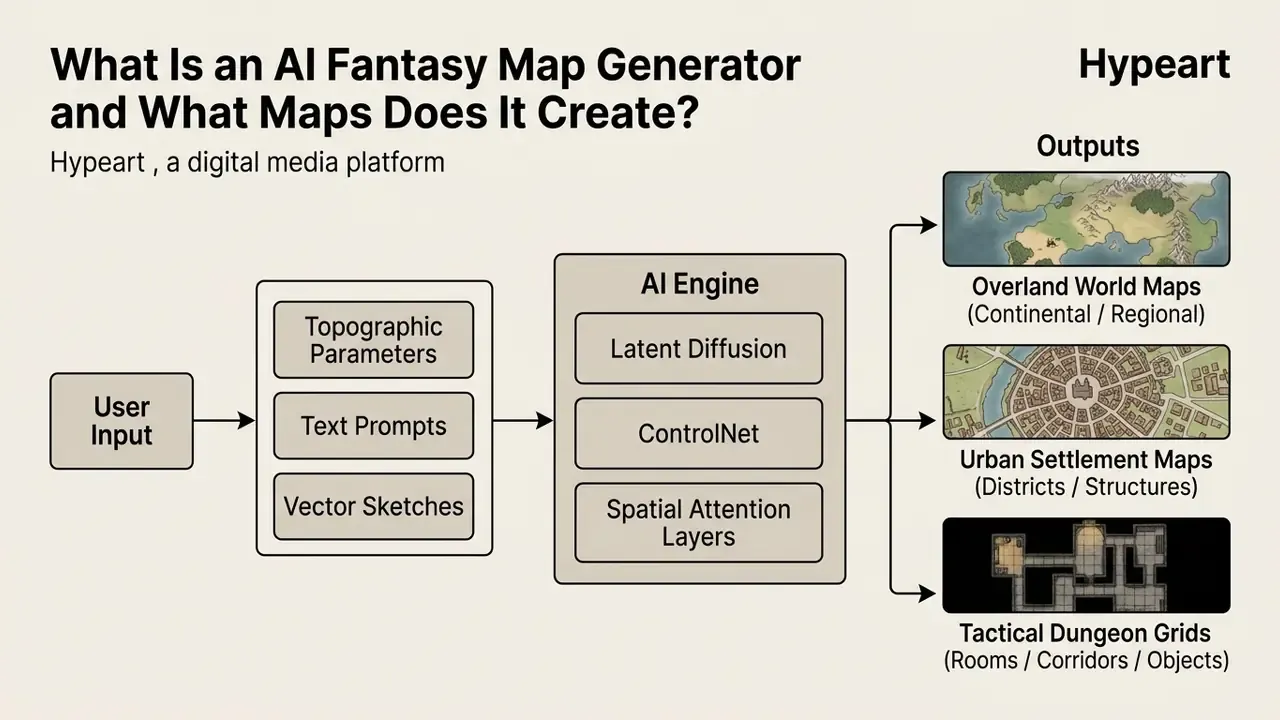
What Is an AI Fantasy Map Generator and What Maps Does It Create?
An AI fantasy map generator converts user prompts into structured visual maps, using machine learning architectures to build geographic layouts, tactical battlemaps, and urban cartography. These generative systems replace manual digital painting by interpreting parameters such as topography, landmass distribution, biome distribution, and artistic medium, then producing downloadable raster or vector assets. Readers weighing engines against each other can also review our roundup of AI image generators before committing credits to a cartography-specific tool.
Architecturally, these tools are not generic art models with a map keyword bolted on. Structured-map research shows measurable topological gains from purpose-built generative pipelines:
In modern creative workflows, an ai fantasy map generator works as a core asset pipeline for authors, game masters, and digital artists who need rapid spatial visualization. Because the models are trained on cartographic datasets, users can generate custom spatial layouts in seconds while keeping structural consistency across a series of related maps.
World, Continent, and Regional Maps for Fantasy Worldbuilding
A world map ai generator creates large-scale overland terrain assets: multi-continental landmasses, mountain chains, hydrology systems, and climate biomes. These systems establish the spatial backbone of a fantasy setting by turning a high-level geographic brief into a coherent global or regional layout.
To keep geographic realism, advanced models apply procedural elevation rules and hydrological modelling. Procedural terrain work archived by Rensselaer Polytechnic Institute's advanced graphics group shows that computing hydrologic systems before biome assignment, modelling moisture distribution alongside elevation layers, prevents topographical nonsense such as rivers flowing uphill or misaligned mountain rain shadows (Dynamic Procedural Generation of Terrain with Hydrologic Systems, Rensselaer Polytechnic Institute project archive, https://www.cs.rpi.edu/~cutler/classes/advancedgraphics/S21/final_projects/frankj6.pdf).
Scale fidelity is measurable, not rhetorical. Planetary-scale generation research reports concrete resolution benchmarks:
When you generate a fantasy world map generator ai output, the underlying diffusion model establishes coastline geometry using polygonal partitioning principles. The classic formulation defines coastline as the edge where land meets water, ocean as water connected to the map border, and beaches as land adjacent to ocean (Polygonal Map Generation for Games, Amit Patel / Stanford, http://www-cs-students.stanford.edu/~amitp/game-programming/polygon-map-generation/). That logic is why land-water boundaries, island archipelagos, and continental shelves follow natural geomorphological patterns instead of random noise.
Geometry and visual texture also have to agree with each other, which is where joint-generation methods matter:
For creators who want a real-world reference layer underneath invented geography, open basemap data remains a practical anchor. Natural Earth publishes free vector and raster map data at 1:10m, 1:50m, and 1:110m scales, which map neatly onto world, continental, and regional fantasy map tiers (Natural Earth, https://www.naturalearthdata.com/).
City, Dungeon, and Tactical Battle Maps
A specialized ai fantasy map creator can switch scales to produce small-scale urban settlement plans, underground complexes, and tactical battlemaps. Urban generators arrange streets, districts, trade routes, and structural footprints. Dungeon generators output connected room modules and corridors formatted for grid-based play.
Tactical dungeon generation relies on graph-based layout models: generative networks output rooms as connected tile sets while enforcing planarity and grid alignment. That constraint is what gives you playable choke points, logical corridor connections, and clear line-of-sight boundaries at the table.
The classic hand-authored pipeline behind these models is still worth knowing when you write prompts: place non-overlapping rooms, connect them with corridors, then remove dead ends to produce a playable layout (Rooms and Mazes: A Procedural Dungeon Generator, Bob Nystrom, 2014). Cyclic dungeon-generation approaches add a grid-placement check after graph substitution, which is precisely why phrasing like "snap-to-grid" and "planar layout" measurably improves usable output.
Gallery: AI Fantasy Map Formats and Cartographic Styles
| # | Map Example | Technical Specification | Alt Text |
|---|---|---|---|
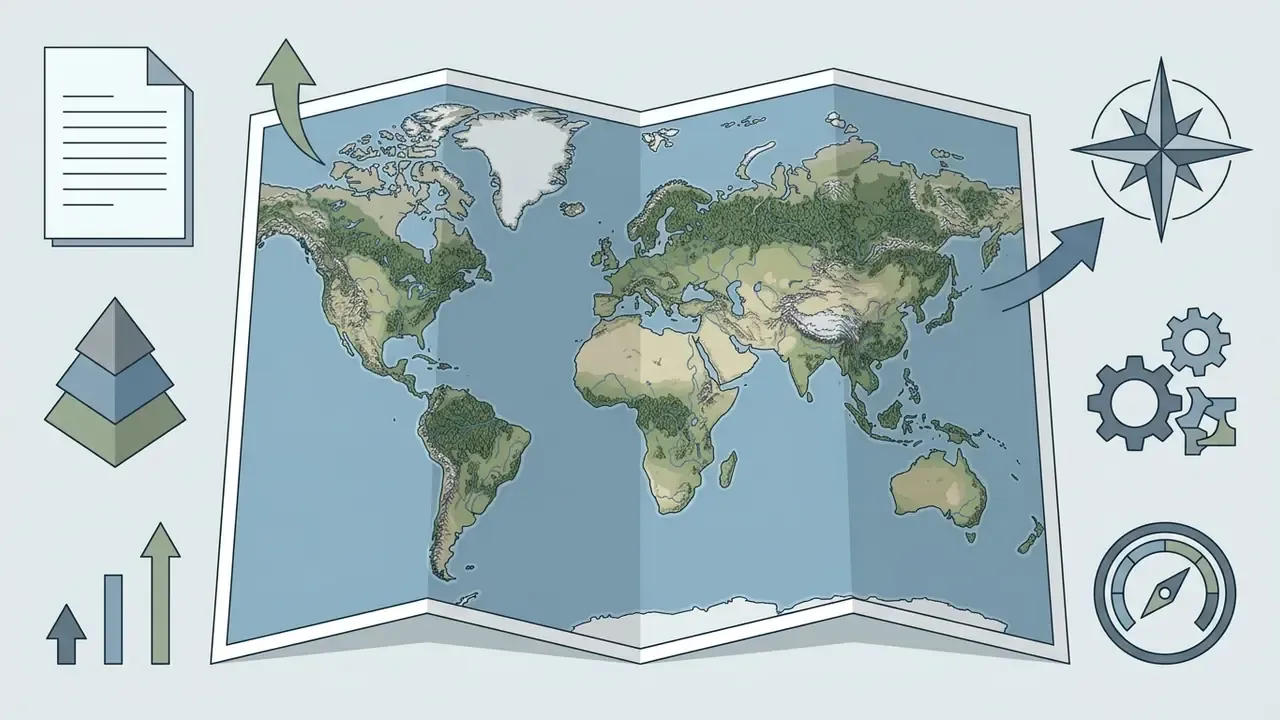
| 1 | Parchment Overland World Map | ~1:10m scale, sepia tones, continent-level landmasses, decorative compass rose | ai fantasy map generator, parchment style world map with continental landmasses |
| 2 | Coastal Island and Regional Map | ~1:50m scale, hex travel grid, island archipelagos, trade routes | ai map generator fantasy, island map with hex grid for rpg travel |
| 3 | Medieval Walled City Map | District outlines, central keep, port docks, cobblestone street networks | ai fantasy map maker, detailed fantasy city layout with urban districts |
| 4 | Tactical Dungeon Grid Map | Top-down view, 1-inch square grid, stone rooms, corridors, lighting effects | ai fantasy map generator free, tactical dungeon grid map for tabletop rpg |
How to Select Style and Detail for Your AI Fantasy Map
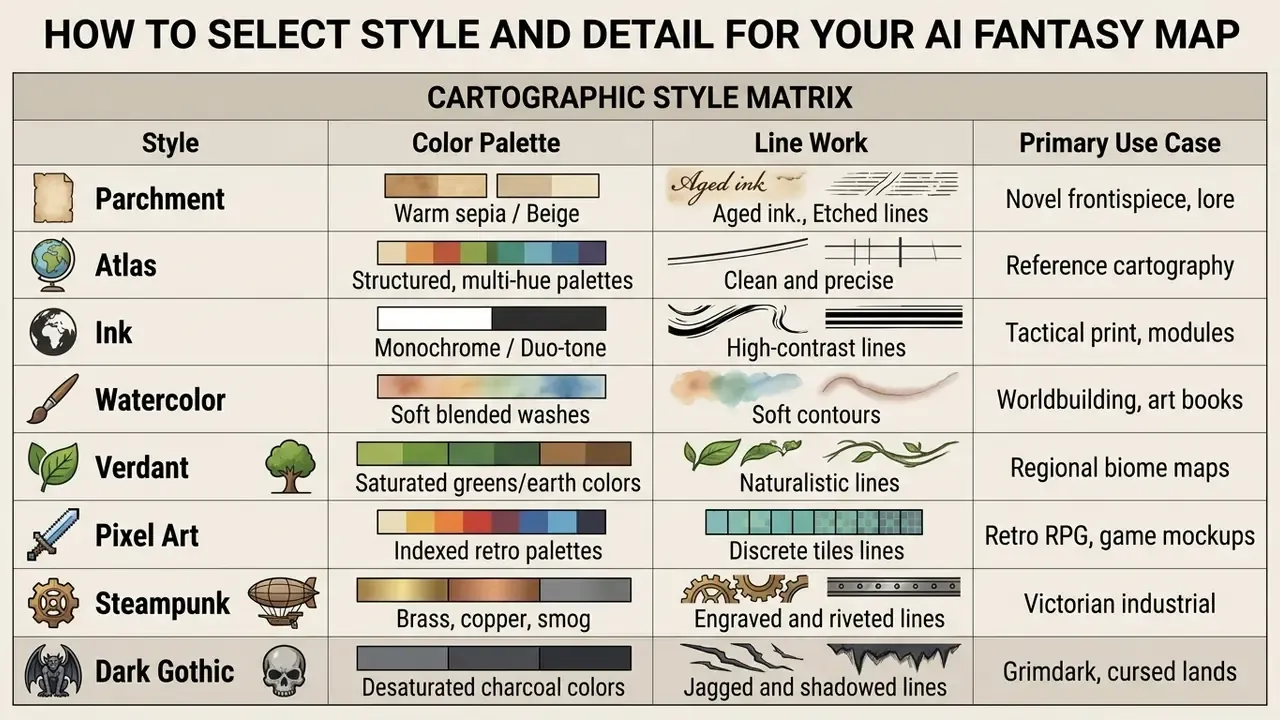
Choosing the right visual style and level of detail for an ai fantasy map means balancing spatial readability against thematic taste. Visual settings govern line weight, colour saturation, historical architectural markers, and labelling schemes.
In professional production, style parameters decide how clearly spatial information reaches the end user. High-detail operational maps for tactical play need clean line work and hard contrast. World maps for a published novel usually want textured, artistic mediums instead. Different jobs, different settings.
Artistic Styles: Parchment, Atlas, Ink, Watercolor, Verdant, Pixel Art, Steampunk, and Dark Gothic
Generative image engines support multiple artistic cartography presets, letting creators match visual presentation to narrative tone:
- Parchment Style Emulates historical hand-drawn maps with warm beige palettes, aged paper textures, worn edges, and decorative border flourishes with calligraphic labelling. The classic "old map" register for lore documents and frontispieces.
- Atlas Style Focuses on geographical precision, clean legend boundaries, elevation shading, place-name hierarchy, and standardized administrative labelling, mirroring modern reference atlases.
- Ink Style Sharp monochrome line art, crisp contouring, high-contrast etching. Ideal for low-cost print publishing and black-and-white module inserts.
- Watercolor Style Soft washes, translucent colour fields, blended edges, painterly terrain transitions. Historically, ink supplied the structural drawing layer while watercolour supplied tone; the same division still works in prompts.
- Verdant Style Emphasizes environmental biomes through rich green tones, dense canopy textures, and detailed forest-to-wetland transitions.
- Pixel Art / Retro Style Replicates 8-bit and 16-bit RPG video game cartography using indexed colour palettes and discrete tile grids for retro worldbuilding and game mockups.
- Steampunk and Industrial Style Brass contours, copper plating textures, clockwork compass roses, and smog-tinted regional boundaries for Victorian-era or industrial fantasy settings.
- Dark Gothic and Grimdark Style Desaturated charcoal tones, high-contrast shadows, and jagged border flourishes for cursed, hostile, or post-apocalyptic environments.
Controllability, not raw aesthetic variety, is what keeps a stylised map spatially truthful:
In practice this means style instructions belong at the end of the prompt, after structural terrain data, so medium keywords modulate rendering rather than overwrite geography. Contextual background tools can be referenced through our ai background generator hub, and creators comparing broader aesthetic engines can review our overview of AI art generators.
Setting Genres Beyond High Fantasy: Sci-Fi, Steampunk, Post-Apocalyptic, and Historical
An ai map generator fantasy engine is genre-agnostic once the architectural era and material vocabulary are declared explicitly. The following setting presets consistently produce coherent, non-medieval cartography:
- Sci-Fi / Futuristic: Orbital colony schematics, arcology districts, mag-rail corridors, terraforming zones, and starport footprints rendered with luminous vector overlays and HUD-style legends.
- Steampunk / Victorian Industrial: Factory quarters, canal networks, airship docks, coal-belt regions, and brass-plate cartouches with soot-stained boundary shading.
- Post-Apocalyptic: Ruined metropolitan grids, irradiated exclusion zones, scavenger settlements, collapsed highway spines, and hand-annotated survivor markings over pre-collapse basemaps.
- Ancient Historical (Egyptian, Greek, Roman): River-valley agriculture belts, temple precincts, amphitheatre districts, aqueduct lines, and papyrus or mosaic-inspired render mediums.
- Eastern / Asian-Inspired: Terraced rice valleys, mountain monasteries, pagoda districts, and ink-wash mountain profiles with vertical label placement.
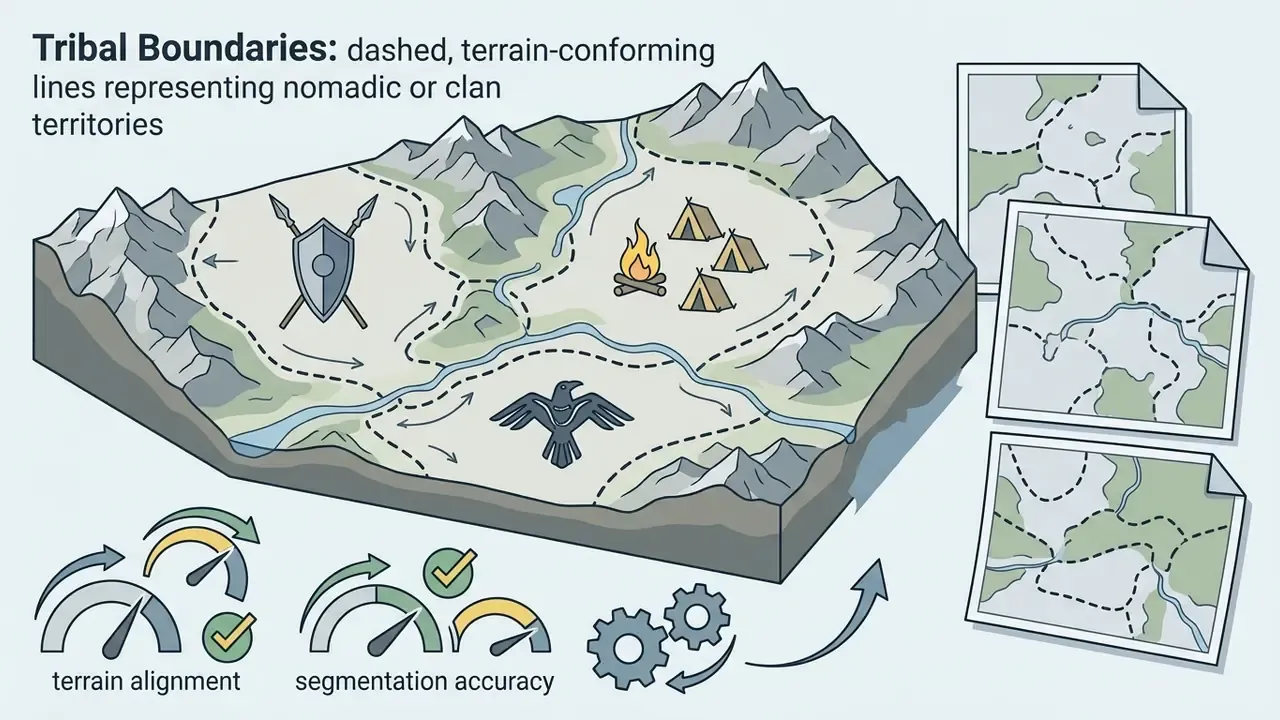
- Tribal / Primitive: Nomadic migration routes, seasonal camps, sacred groves, and terrain-conforming dashed territory markings instead of hard sovereign lines.
- Mythological / Timeless: Floating islands, void oceans, ley-line networks, and dual-moon celestial annotations that intentionally break terrestrial physics.
- Dark Gothic / Cursed Lands: Blighted forests, plague quarantines, necropolis wards, and cathedral fortresses under permanent overcast shading.
Landscapes, Borders, Cities, and Key Locations
Balancing geography, political boundaries, settlements, and cartographic landmarks needs a strict visual hierarchy, otherwise the canvas turns into clutter. Established labelling practice places point labels for legibility and association, centres area labels inside their polygons, and separates feature classes (boundaries, lakes, streams, cities) so administrative lines and point features stay visually distinct through line weight and label placement.
To keep cartographic balance on an ai map generator fantasy canvas, place major physical landmarks (mountain ranges, primary river basins) before declaring political boundaries. City icons and point-of-interest markers should sit where topography and hydrology intersect: river mouths, natural harbours, mountain passes. That is also how real settlements grew, which is why the result reads as plausible.
When defining political divisions, specify the border vector type explicitly:
Declaring the border class stops the model inventing arbitrary sovereign lines across oceans or mountain interiors. It happens more often than you would expect.
Perspective and Viewpoint Selection
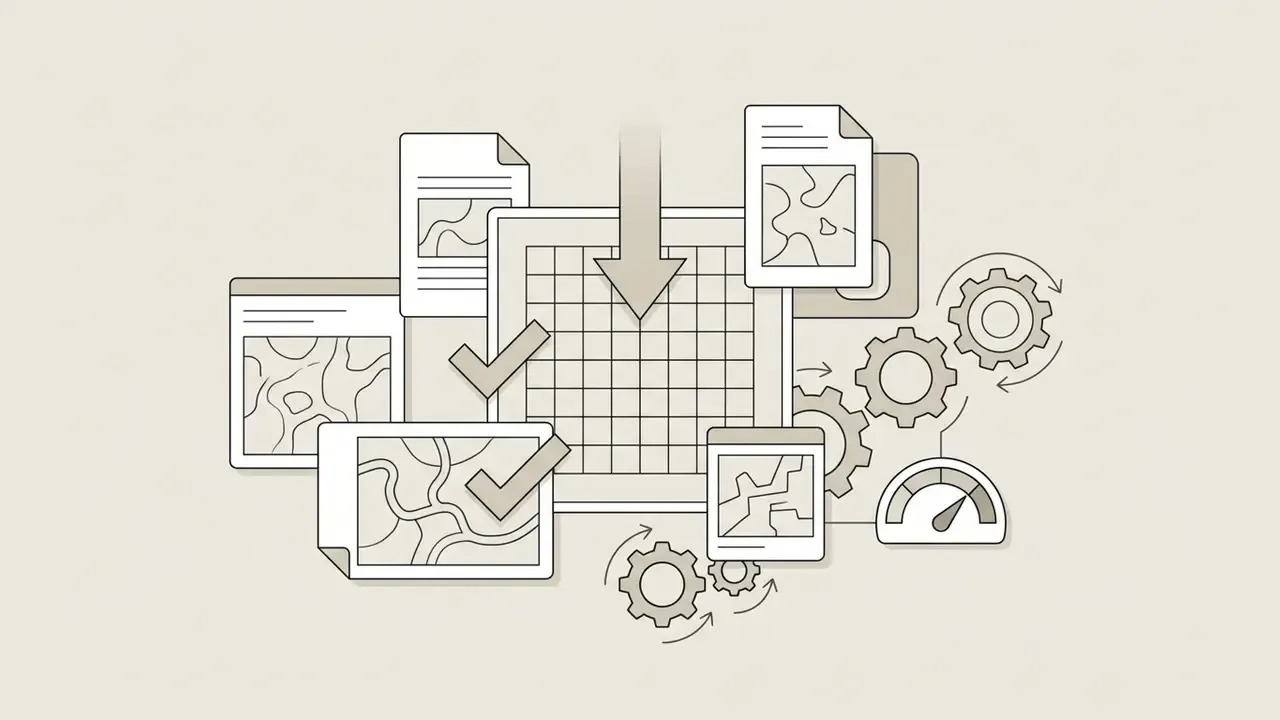
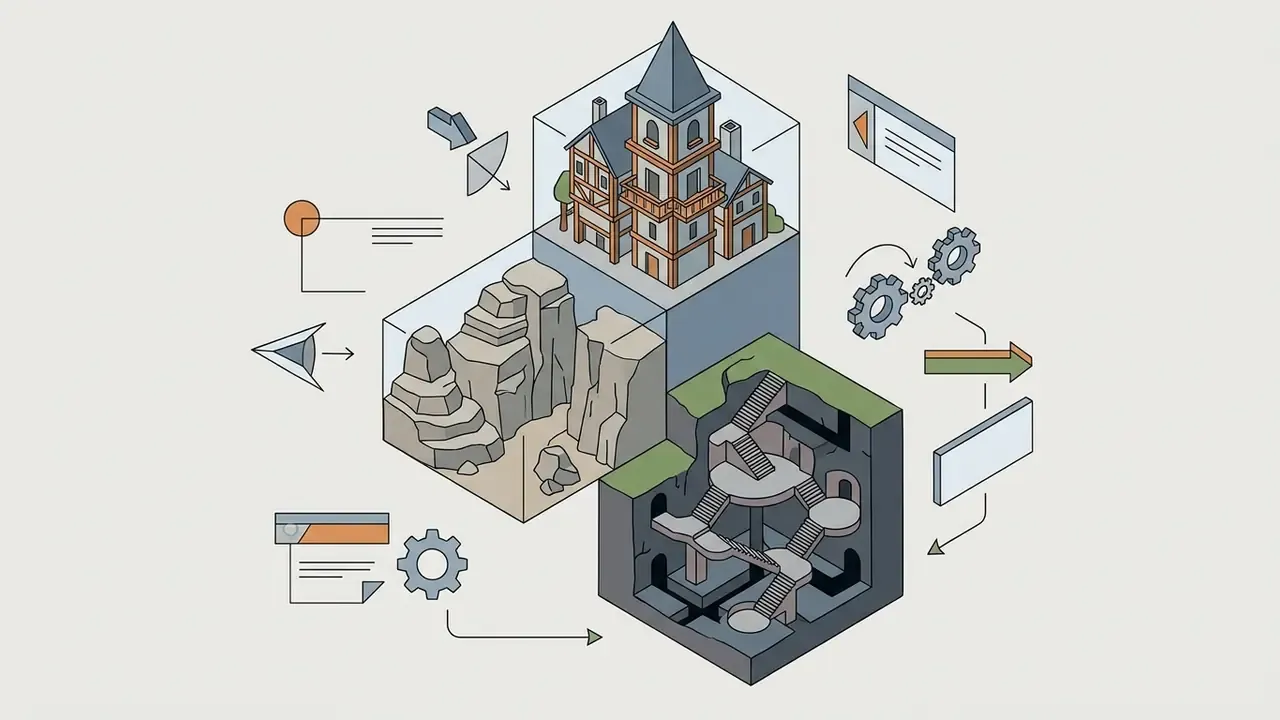
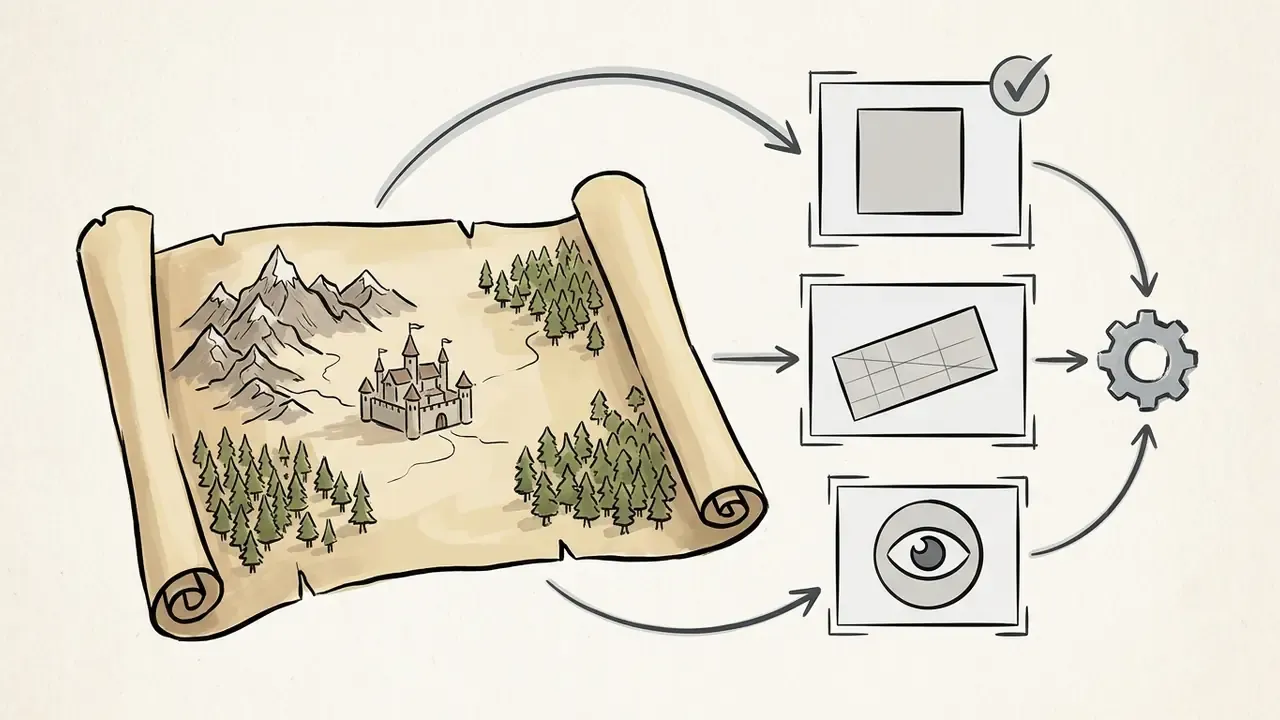
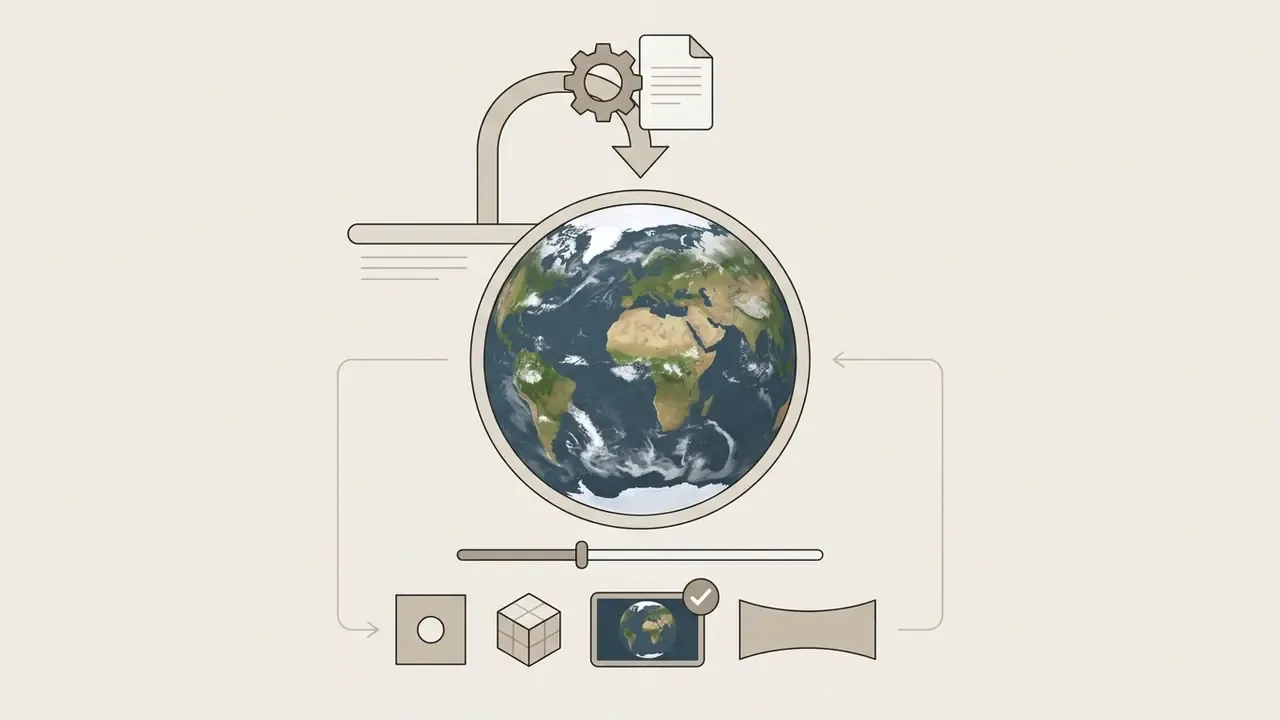
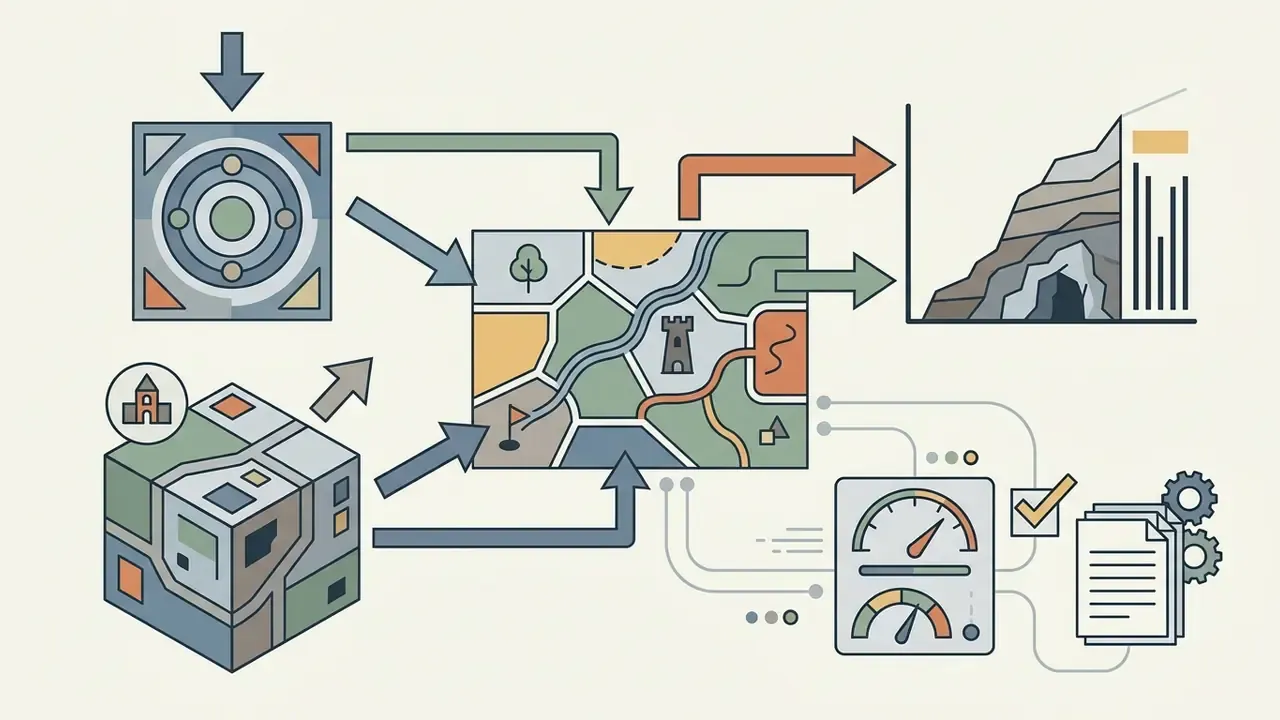
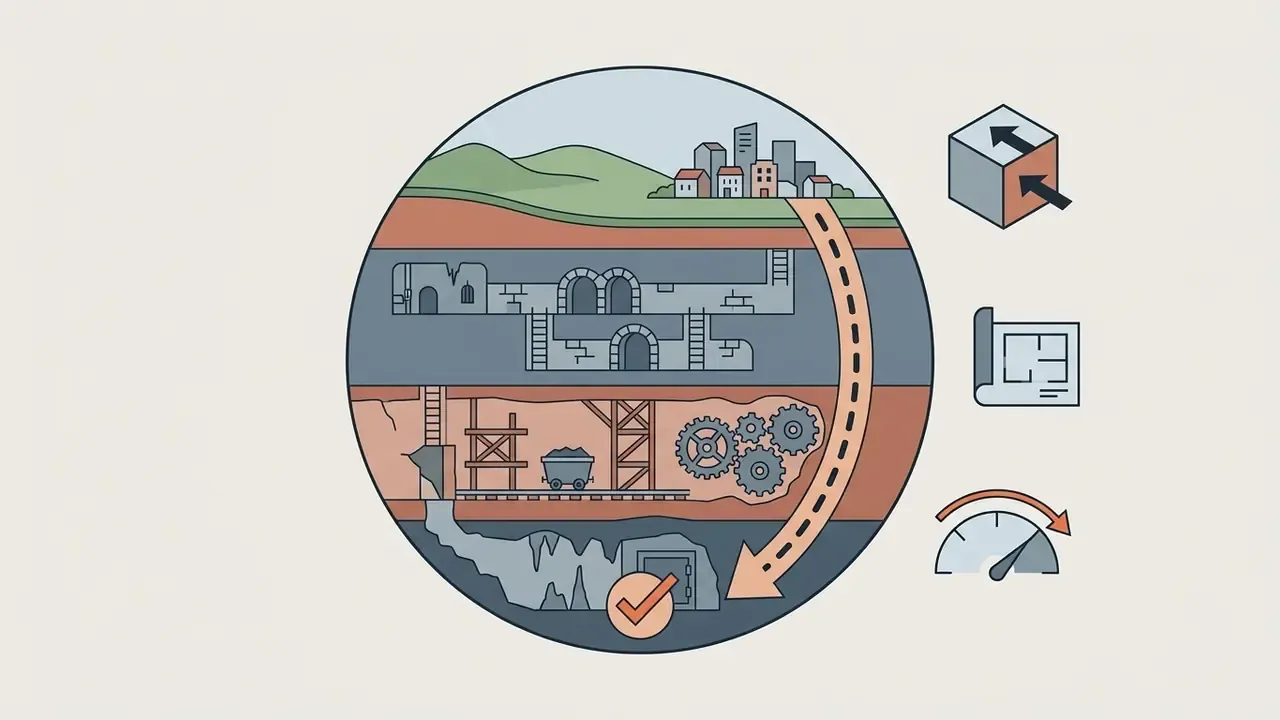
Viewpoint changes what a map is for, so declare it as its own parameter rather than implying it through style:
How to Write a Prompt for a Fantasy Map AI Generator
Writing an effective prompt for a fantasy map ai generator means building a structured, multi-parameter text string that defines scale, biomes, structural features, lighting, and artistic medium. Structuring the input prevents generative drift and pushes the model to respect cartographic boundaries.
Mainstream prompt-engineering guidance converges on a fixed ordering: background and scene, then subject, then key details, then constraints, with style and technical parameters declared last. Negative boundaries work better expressed as positive constraints than as conversational requests. Hierarchical planning research shows why ordering matters:
This systematic structure prevents contradictory inputs and produces consistent assets across a set. Creators testing prompt formulas across engines can benchmark output quality with our comparison of free AI image generators before spending paid credits.
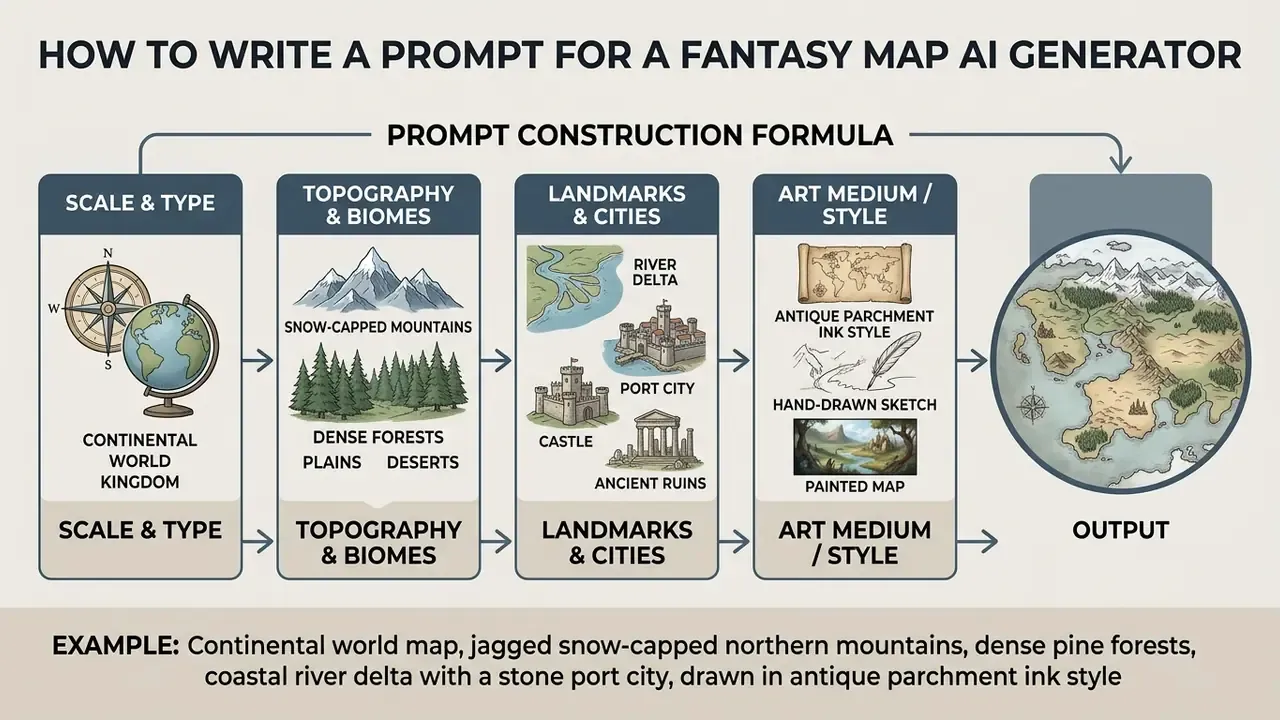
Prompt Structure: Scale, Biomes, Locations, and Style
To get reliable output from an ai fantasy map maker, assemble prompts with a standardized six-part parameter sequence:
- Map Scale and TypeDeclare spatial extent (for example
continental world map,regional island map,walled city map,isometric dungeon grid). - Topography and CoastlinesDefine physical structures (
fractured archipelagos,jagged mountain spine,deep glacial fjords). - Biomes and HydrologySpecify climate regions and water features (
arid salt flats,temperate rainforest,braided river system). - Settlements and RoadsList human-made structures (
concentric fortress city,cobblestone trade roads,coastal lighthouse). - Architectural Style and EraSet cultural design markers (
gothic stone masonry,timber-framed medieval buildings,riveted brass industrial works). - Art Medium and Render DetailsSpecify rendering parameters (
vintage parchment paper texture,black ink hatching,sepia colour palette,topographic contour lines).
For detail control, remember that sampling depth is a real lever, not a stylistic word. Lower inference-step ranges (roughly 10 to 20) produce faster, softer drafts. Higher ranges (roughly 30 to 50) resolve fine label edges and texture grain. Logging that value next to the seed is what makes a map reproducible weeks later, when the art director asks for "the same map, one province wider".
Prompt Ideas for World, City, Dungeon, and Non-Fantasy Maps
The following tested templates show how to apply this structure across cartographic formats and genres:
World Map Prompt:
"Large-scale fantasy world map, two major continental landmasses separated by an ocean strait, snow-covered northern peaks, vast central savannah, dense equatorial rainforest, scattered coastal port cities, connected by sea trade routes, hand-drawn vintage atlas style, muted sepia and teal tones, highly detailed coastline, 8k resolution."Fantasy City Prompt:
"High-angle overhead view of a fantasy capital city built inside a river bend, fortified outer stone walls, circular inner citadel, crowded market square, timber and stone buildings, stone bridges, clean cartographic vector line art, parchment background."Isometric Dungeon Prompt:
"Isometric tactical dungeon battlemap, subterranean stone crypt, central obsidian altar room connected by narrow stone corridors, vaulted ceilings, iron sconces casting warm torchlight, 1-inch grid overlay, high contrast, clean line work for tabletop play."D&D Battlemap Prompt:
"Top-down tactical battlemap of a forest road ambush point, dense oak canopy on both sides, dirt road with wooden wagon tracks, small rocky stream crossed by a wooden bridge, crisp 1-inch square grid, detailed environmental textures."Island Archipelago Prompt:
"Regional island archipelago map, one volcanic island with lava flows, three jungle islands, hidden pirate coves and reef hazards, hexagonal travel grid, Tolkien-style ink illustration, aged paper, compass rose and scale bar."Sci-Fi Colony Prompt:
"Satellite-view map of a terraformed colony world, two visible moons, polar ice caps, domed arcology cities linked by mag-rail corridors, orange dust plains, luminous cyan vector overlays, schematic HUD legend, 4k resolution."Steampunk Industrial Prompt:
"Overhead map of a Victorian industrial city-state, factory quarter with smokestacks, canal network, airship docking towers, brass-plated cartouche and clockwork compass rose, copper and soot palette, engraved line work."Post-Apocalyptic Region Prompt:
"Top-down post-apocalyptic regional map, collapsed highway spine crossing an irradiated exclusion zone, ruined metropolitan grid, scavenger settlements in a dry riverbed, hand-annotated survivor markings in red ink over faded pre-collapse basemap."
Advanced AI Map Prompt Builder
Work down the nine rows below and concatenate your selections in order. The result is a complete, contradiction-free prompt string ready to paste into any diffusion engine.
| # | Parameter | Available Values |
|---|---|---|
| 1 | Map Scale | World · Continent · Region · City · Dungeon · Ambush Battlemap |
| 2 | Setting Genre | High Fantasy · Dark Gothic · Steampunk · Sci-Fi · Post-Apocalyptic · Ancient Historical |
| 3 | Perspective and Viewpoint | Top-Down Traditional · Isometric 3D · Satellite Photoreal · Schematic Minimalist |
| 4 | Primary Biome | Temperate · Arid Desert · Glacial Tundra · Volcanic Wasteland · Subterranean · Void |
| 5 | Settlement and Structure Density | Uninhabited · Scattered Hamlets · Fortified Keep · Sprawling Metropolis |
| 6 | Political Borders | No Borders · Soft Territorial Shading · Hard Kingdom Lines · Tribal Boundaries |
| 7 | Render Medium and Aesthetics | Aged Parchment Ink · Topographic Atlas · Monochrome Line Art · Pixel Art 16-Bit · Watercolor Wash |
| 8 | Architectural Era | Gothic Stone · Timber Medieval · Victorian Industrial · Futuristic Metal · Primitive Mud-Brick |
| 9 | Tactical Overlay | None · 1-inch Square Grid · Hexagonal Travel Grid |
Worked example (rows 1 to 9): Region map, dark gothic setting, top-down traditional perspective, glacial tundra biome, scattered hamlets, tribal boundaries, monochrome line art, gothic stone architecture, hexagonal travel grid, high contrast, 4k resolution.
How to Create a Fantasy Map with AI: From Concept to Finished Image
Creating a complete map with an ai map maker fantasy tool follows an iterative loop: define parameters, run the first text-to-image pass, post-edit locally, export high-resolution files.
Web-based generators compress this into structured interface steps, and the coarse-to-fine ordering is architectural rather than stylistic:
In practice: resolve continental geometry and hydrology before touching city icons or label typography. Going back to global structure after local detailing forces a full regeneration and throws away your refinement work. I have watched a two-hour label pass evaporate that way. Once is enough.
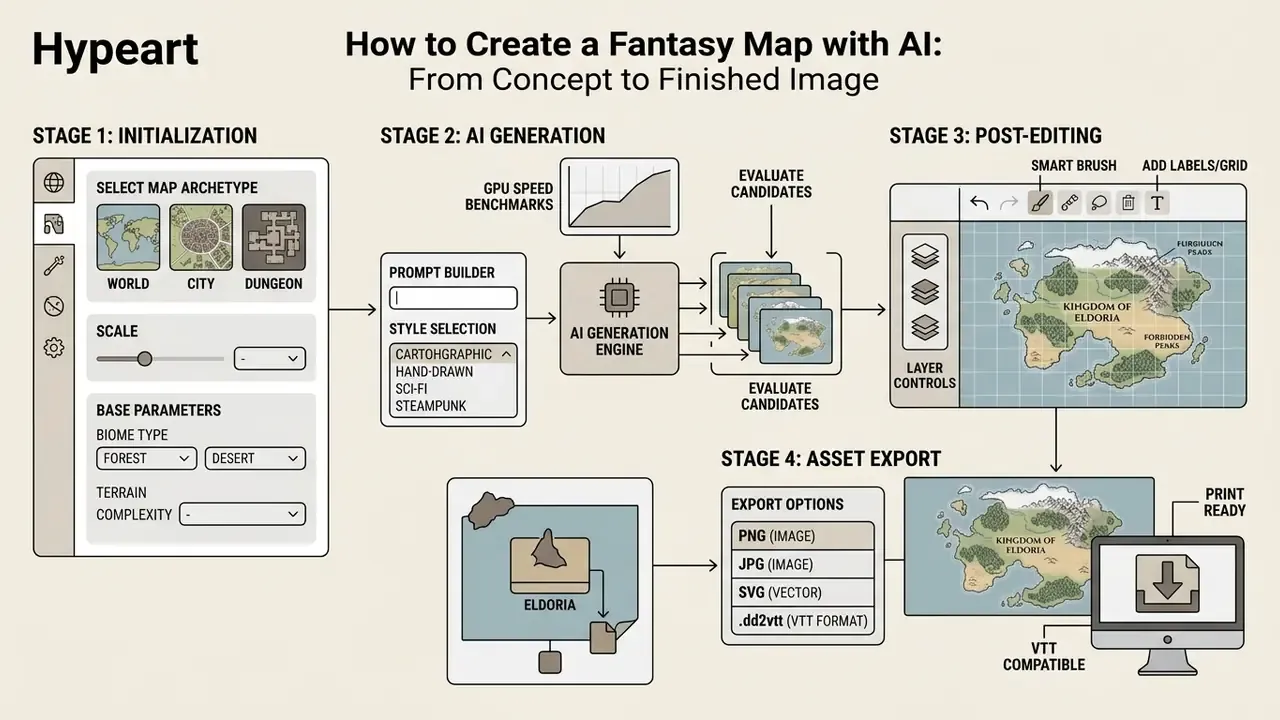
Selecting Map Type and Generating the First Draft
Generation starts by configuring base canvas parameters in the generator interface. You pick a spatial template (continental landmass, island kingdom, underdark cave complex) and enter initial prompt conditions. Template-first interfaces are now standard: choose archetype and world size, enter a campaign hook or brief, then press generate once to get candidates.
In a single click, the world map generator ai runs the latent diffusion process and returns an initial high-resolution candidate within seconds, holding global spatial logic together. Persistence architectures push this past one-shot rendering:
Editing, Adding Elements, and Map Export Options
After you pick a candidate, post-processing tools let you refine details without starting over. Interactive generators offer layer-based editing: modify colour channels, adjust coastline vectors, move labels, swap projections, drop point-of-interest markers.
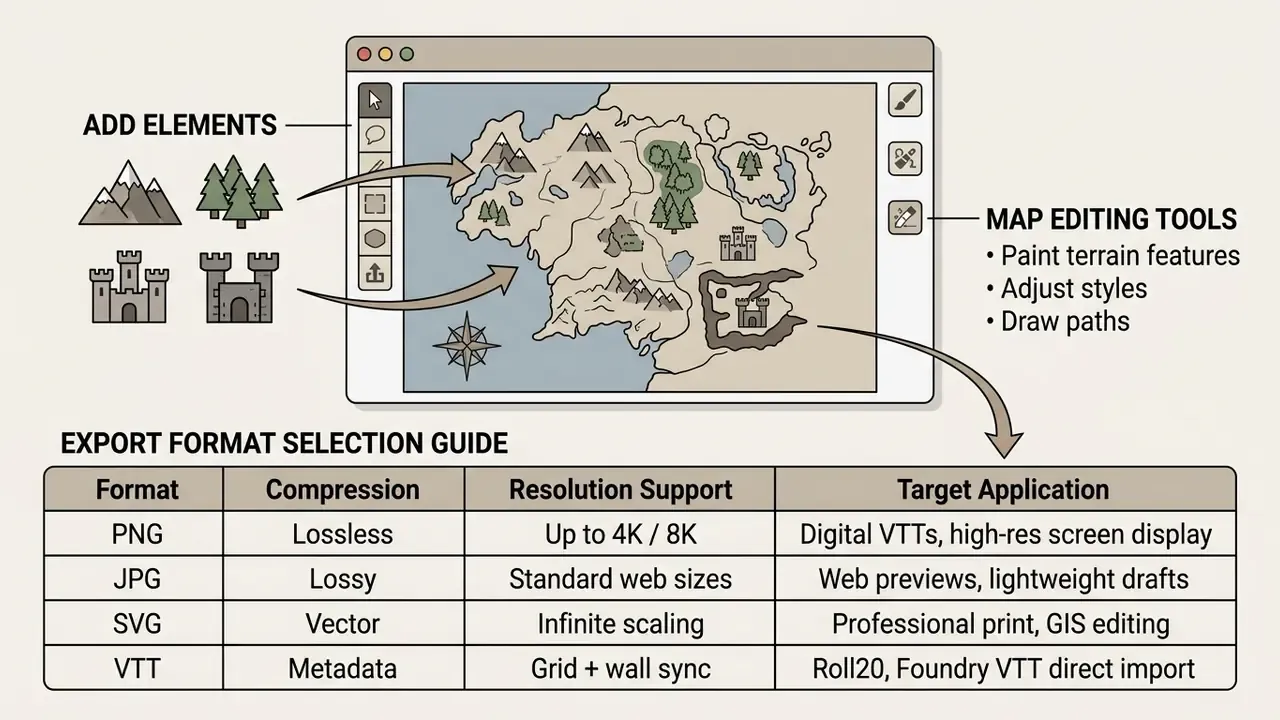
For tactical maps, toggle 1-inch square or hexagonal grids and export as .dd2vtt or .UniversalVTT to preserve wall occlusion data, door objects, and light sources for virtual tabletops. Detail-oriented workflows often pair custom map backgrounds with tools from our ai backstory generator catalog to attach location lore to each named site.
How to Choose the Best AI Fantasy Map Maker: Features and Constraints
Selecting the best ai fantasy map generator means judging technical capability against project requirements. The decisive factors: spatial generation accuracy, grid alignment controls, layer customization, export resolutions, and commercial licensing models. That last one is examined in depth in our guide to the commercial use of AI image generators.
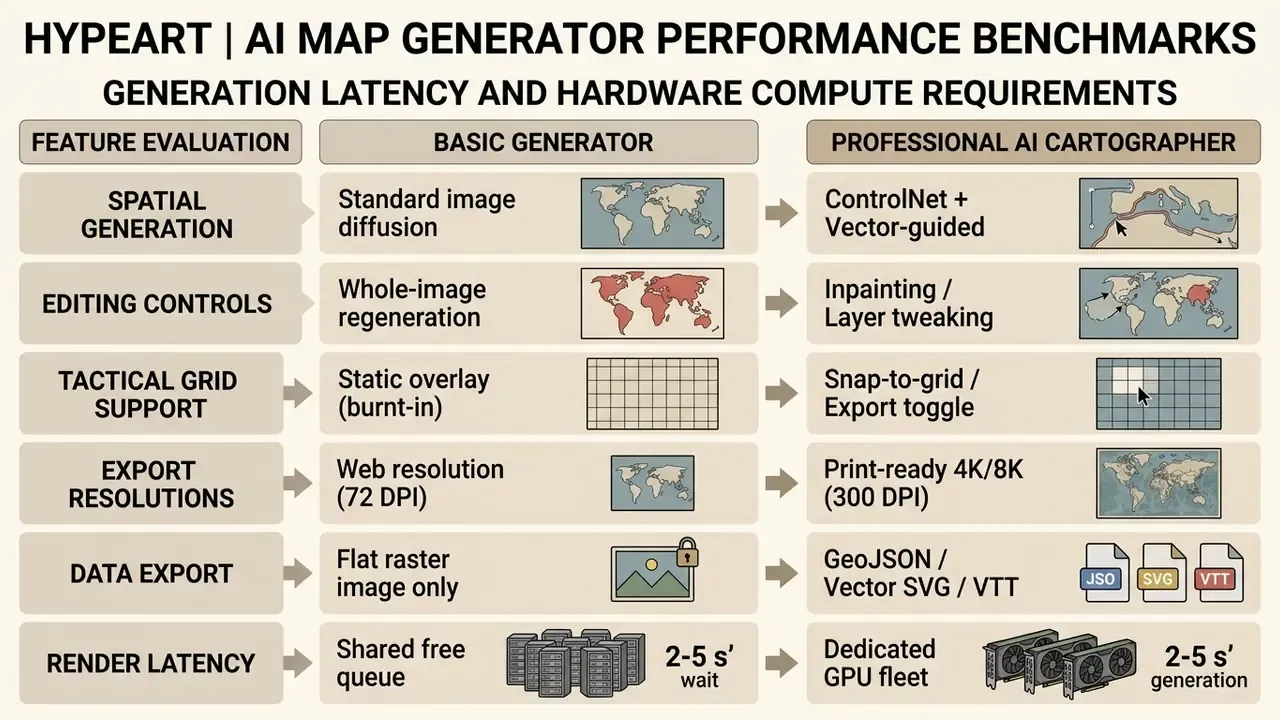
Generation Latency and Hardware Compute Requirements
Render speed and output fidelity depend directly on hardware. Cloud-based map generators lean on high-performance GPU clusters (enterprise NVIDIA RTX 5090 or A100 nodes) to run latent diffusion steps in 2 to 5 seconds per frame. Browser-based tools commonly report 2048×2048 PNG or JPG renders in roughly 12 seconds including queue time. For local generation, say running ControlNet through Stable Diffusion, plan on a minimum of 8 GB VRAM to build 4K terrain rasters without memory overflow, and 12 to 16 GB for 8K tiled upscaling passes.
Read latency claims alongside tier limits. "Instant" generation on a dedicated GPU fleet is usually a paid-plan feature; free queues are shared and variable.
Key Features for Worldbuilding and RPG Campaigns
For tabletop campaigns and long-running worldbuilding, an ai fantasy world map generator has to offer function, not just art:
- Layer Separation Toggle text labels, political borders, roads, water, and grid lines independently from the background terrain art.
- Inpainting and Smart Brush Selective regeneration of localized areas, such as swapping a desert region for forest, without disturbing adjacent landmasses.
- Grid Calibration Precise alignment for square and hex grids so tokens, props, and map tiles stay true to the declared cell size.
- Object Hierarchy and Interactive Labels Multi-layer object structures with cross-layer links, connectors, and annotation labels for points of interest.
- Persistent World Memory Architectures that store spatial layouts in external memory so you can modify the map live during play.
Export Options, Post-Editing, and Device Compatibility
Cross-platform access and flexible exports matter for publishing workflows. Modern platforms run directly in the browser across PC, Mac, and tablet, which removes the need for a dedicated local GPU rig.
Professional cartographers need vector SVG output for scale-independent printing, high-resolution PNG downloads for digital displays, and lightweight JPGs for web publishing. Some tools add print-ready PDF or an HTML embed option. Users evaluating broader media pipelines can cross-reference editing options with our AI Media Comparison Matrices.
| Service / Platform | Supported Map Types | AI Generation Technology | Editing Capabilities | Export Formats | Free Access Tier | Commercial Use Rights |
|---|---|---|---|---|---|---|
| Inkarnate | Overland, Regional, City, Battlemaps | Manual brush + AI-assisted assets | Full layer control, asset stamp library | PNG, JPG (up to 8K) | Free tier available (2K limit) | Pro plan required ($7.99/mo) |
| Adobe Firefly | Overland, Stylized Concept Maps | Text-to-image latent diffusion | Inpainting, Generative Fill, Style match, reference image upload | PNG, JPG | Free daily credits with account | Commercial use allowed on paid plans |
| Recraft | Overland, City, Vector Maps | Vector and raster diffusion engine | Vector editing, canvas extension, palette control | PNG, JPG, SVG | Free tier (up to 30 gens/day) | Allowed under standard terms |
| FantasyGen | World, City, Dungeon Maps | Prompt-driven AI generation | Basic post-edits, credit-based generation | PNG, JPG (up to 4K) | 5 free trial credits ($1.9 one-time top-up) | Included in Pro sub ($29.9/mo) |
| Azgaar's Generator | Procedural World and Politics | Non-AI procedural algorithm | Full vector map editing, climate/culture tweak | SVG, PNG, JPEG, GeoJSON | Free and open source | Full commercial rights under open license |
For a wider field test of render engines that can back a map pipeline, see our benchmark of the best AI image generators.
Governance, Shadow AI, and Asset Inventory Controls
Studios, publishers, and any organisation with a compliance function should treat map generation as a governed pipeline, not an ad-hoc creative habit. Four controls cover most of the exposure:
- Asset inventoryKeep a register of every generated map that reaches a product: file name, tool and model version, plan tier at time of generation, and licence class (free/non-commercial versus paid/commercial).
- Parameter loggingRecord prompt text, seed, inference steps, resolution, and any reference images used. Without the seed and step count, a map cannot be regenerated or defended as a reproducible output.
- Data-handling reviewConfirm whether prompts, uploaded sketches, or reference art are retained on vendor servers or used for model training. Unpublished manuscript geography and client IP should not enter tools that reserve training rights.
- Shadow-AI policyPublish an approved-tool list with tier requirements, so contributors do not hand in assets generated on personal free accounts that drag watermarks or non-commercial restrictions into a commercial release.
Human review closes the loop. An art lead should sign off that a map's human-authored edits are documented before the asset is locked for publication. One signature, one dated line in the register. That is the whole control.
Free AI Fantasy Map Generators, Pricing Tiers, and Commercial Rights
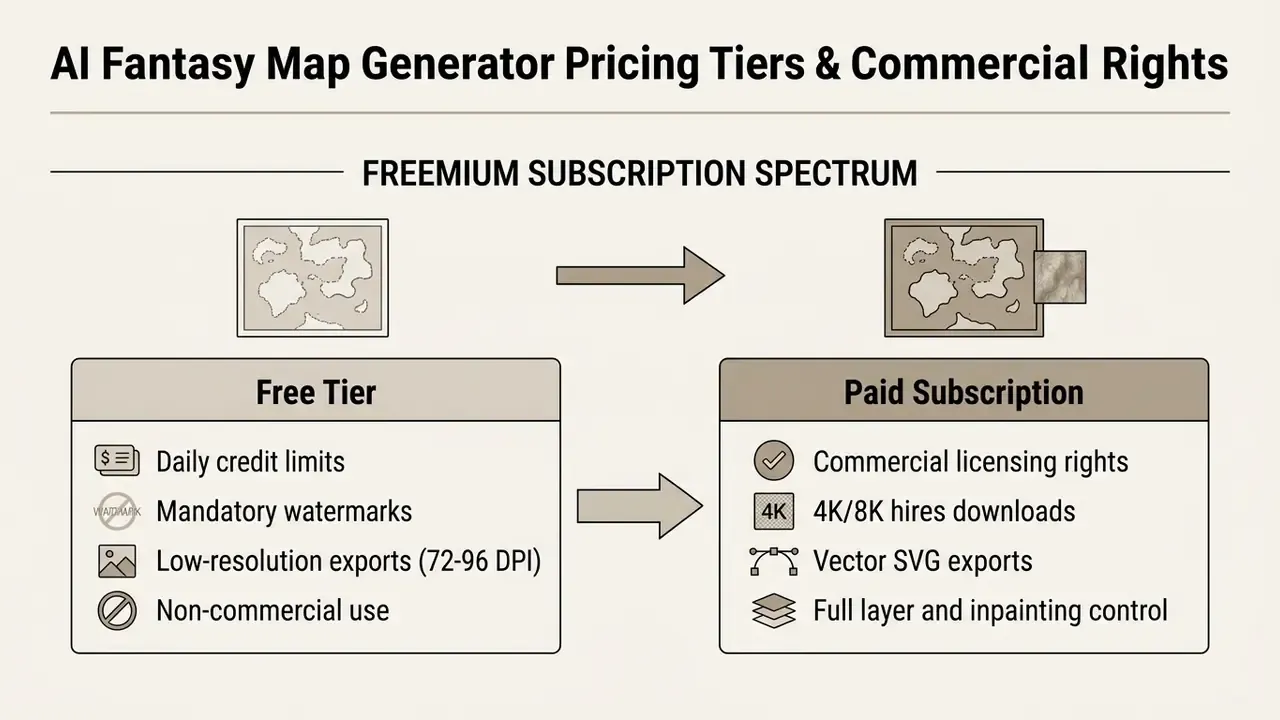
Understanding the pricing model and licence terms of an ai fantasy map generator free platform is critical if you plan to publish or monetize your maps. Most platforms run a freemium model: basic map generation for free, commercial licences and high-resolution exports behind a subscription.
What Free Access Includes: Generation Limits, Watermarks, and Exports
A free ai fantasy map generator lets you test tools and produce draft assets, but free tiers come with operational constraints. Creators capped at low output resolution can often bridge the gap with AI image upscalers before print:
- Generation Caps Daily or monthly limits. Recraft, for example, holds free users to roughly 30 daily generations; some free tools cap attempts per day outright.
- Watermarks and Branding Free exports often carry platform logos or attribution plates, such as a small "made with" wordmark applied to free-tier images and videos.
- Resolution Caps Downloads are frequently limited to standard web resolutions, for instance 2K caps on free Inkarnate accounts.
- Non-Commercial Restrictions Free assets are commonly licensed for personal use, home games, and non-monetized projects only. Some map services do grant commercial use on free exports, but only with attribution, and waive that requirement on paid tiers.
Commercial Use in Books, Indie Games, and Published RPG Modules
Using generated maps in commercial novels, indie games on Steam, or published D&D modules requires compliance with copyright law and platform terms of service. Under U.S. Copyright Office guidance, purely AI-generated output lacking human creative input cannot be registered. Applicants must disclose AI-generated material and describe the human authorship they are claiming.
"Human creativity is the sine qua non of copyright."
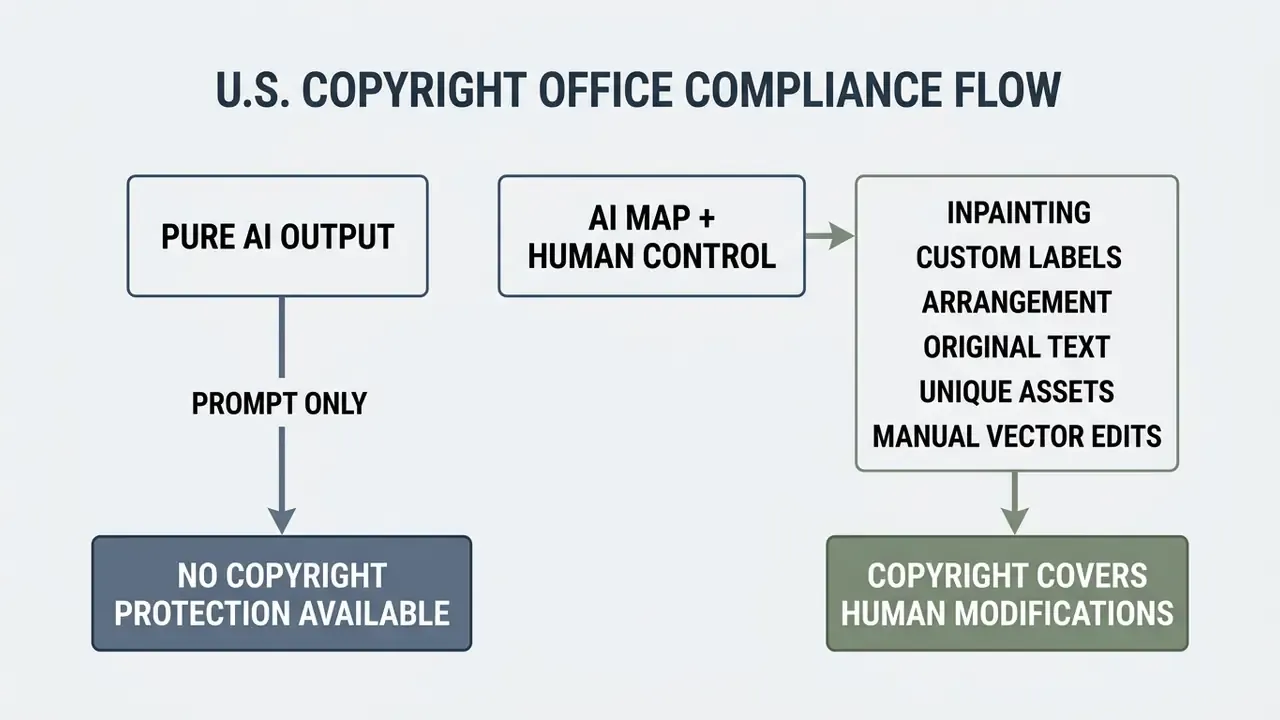
Maps created with significant human creative direction, meaning custom layout arrangement, manual vector edits, inpainting, and original labelling, can qualify for protection over those human-authored elements, including as part of a larger human-authored work such as a novel or a game. Platforms like Canva AI and OpenAI grant commercial usage rights to output generated under paid plans, and both state they do not claim ownership of user output. Other services require explicit attribution. Our breakdown of the Canva AI Generator covers its licence wording in detail, and the AI Media Commercial-Use Hub analyses licensing models across vendors.
Worth flagging: map-adjacent data licences behave differently from image-generator licences. Geodata and basemap terms frequently impose attribution requirements and NonCommercial limits, so a map built on third-party geographic data may carry obligations even when the generated artwork does not.
Pre-Publication Checklist: Licences, Attribution, and Export Rights
Before publishing or monetizing an AI-generated map, run this compliance pass:
Checklist0 / 5
"The U.S. Copyright Office requires authors to clearly identify human-created elements, separating them from AI content. Precise documentation is critical to registration validity."
Publishers running incoming-asset checks may also pair this documentation with AI image detectors to verify what a contributor actually supplied.
Checklist0 / 2
Where to Use Generated Maps: RPGs, Novels, and Game Development
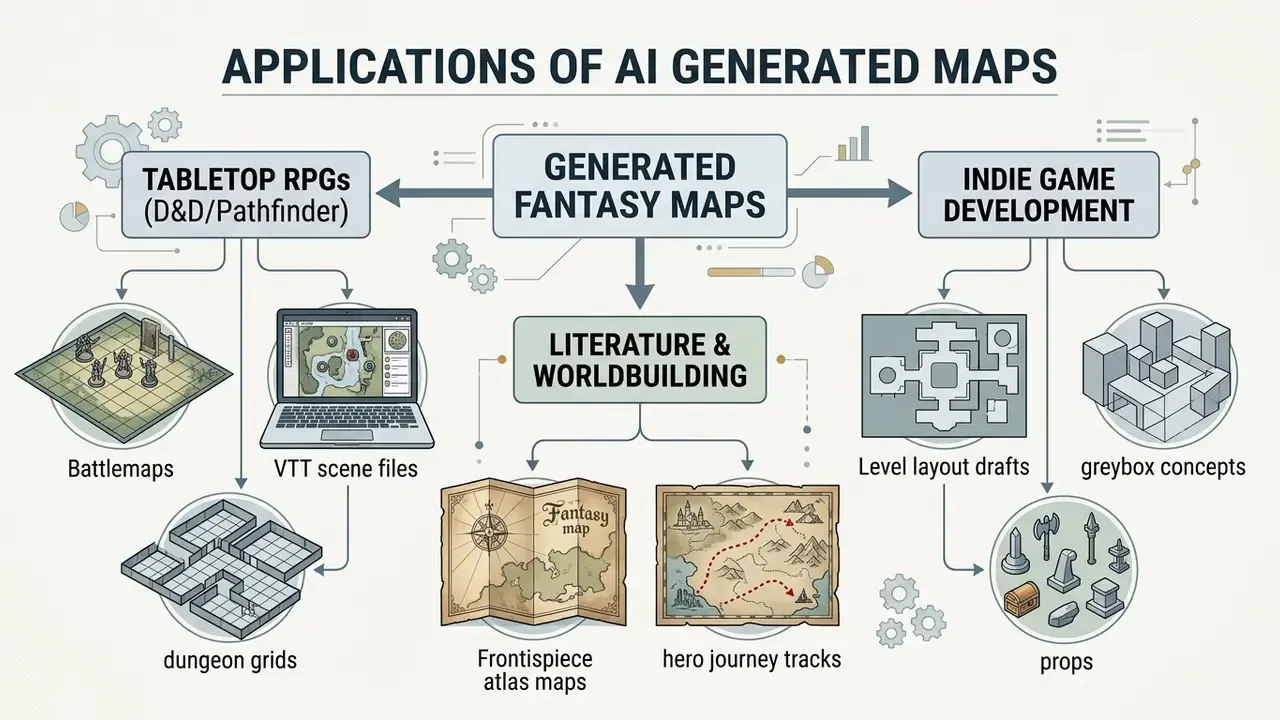
An ai map generator fantasy engine serves several creative industries at once, supplying custom visual assets for tabletop gaming, literature, and digital game design.
Maps for D&D Campaigns, VTTs, and Tactical Adventures
In tabletop role-playing games like Dungeons & Dragons and Pathfinder, AI generators supply tactical battlemaps, regional overland maps, and dungeon layouts. Game masters drop generated raster files straight into virtual tabletops such as Roll20 and Foundry VTT, where Universal VTT and .dd2vtt exports carry wall boundaries, door objects, and dynamic lighting into the canvas automatically.
The same tile-and-prompt logic underpins dungeon generation. A prompt that names room count, corridor topology, and hazard placement produces a far more playable grid than one that names only mood. Exploration and fog-of-war workflows benefit from predictive map completion too:
For campaign prep, that translates into progressive reveals: generate the fully realised region once, then release plausible partial geometry to players as scouting proceeds. Handy for hex-crawls.
Maps for Novels, Storytelling, and Indie Game Development
For authors writing fantasy novels, a frontispiece map gives readers a spatial reference for tracking character journeys across invented continents. Craft guidance for novelists suggests building the map outward from the continental outline to cities, rivers, mountains, and roads, then walking the protagonist's route across it to sanity-check travel times against terrain. The map becomes both a narrative axis and a continuity tool, pinning legends, factions, and sub-plots to specific ground. Authors who need to extend a finished map past its original canvas can use AI outpainting tools to widen an ocean or add a neighbouring province without regenerating the whole plate.
In indie game development, AI map tools work as greybox layout assistants, mirroring established concept-art practice: identify story beats and keywords, gather references, then test composition and lighting in a grayscale sketch before final rendering. Teams use generative terrain tools such as TerraFusion and EarthGen to produce environmental concepts and heightmaps, then import them into engines like Unreal Engine.
Teams sourcing complementary visual assets (key art, item icons, faction heraldry) can compare engines in our review of the best AI art generators. Character-facing pipelines run on adjacent tooling: NPC portraits and family-lineage art are covered in our notes on the ai baby generator and on ai baby face rendering, while animated lore intros and short cinematic stingers overlap with the ai baby video generator and ai baby videos documentation. Same licence questions apply there, incidentally.
FAQ: Fantasy Map Generator AI Questions
What is an AI fantasy map generator?
An AI fantasy map generator is a digital tool that uses artificial intelligence models, such as latent diffusion and vector networks, to build custom world, city, or dungeon maps from text prompts or layout sketches.
Can I use AI-generated fantasy maps commercially in published books or Steam games?
Yes, provided the tool explicitly grants commercial usage rights under its paid plan. Under U.S. copyright law you must also contribute genuine human creative direction (custom editing, layout modification, original labelling) to protect those human-authored elements.
What are the best file formats for exporting AI fantasy maps?
PNG suits digital use and virtual tabletops thanks to lossless compression. SVG is preferable for scale-independent printing and vector editing. Specialized VTT formats (.dd2vtt, .UniversalVTT) preserve grid, wall, and dynamic lighting metadata for tabletop platforms.
Can AI generators create grid-aligned dungeon maps for D&D?
Yes. Many specialized AI map makers offer 1-inch square or hexagonal overlays with snap-to-grid controls built for tactical battlemaps and VTT integration. Naming room count, corridor topology, and grid size in the prompt improves playability noticeably.
How fast is AI map generation, and what hardware do I need?
Cloud generators on enterprise GPU fleets typically render a map in about 2 to 5 seconds, with browser tools reporting roughly 12 seconds for a 2048×2048 export including queue time. Local generation via Stable Diffusion and ControlNet needs about 8 GB VRAM for 4K terrain rasters and 12 to 16 GB for tiled 8K upscaling.
Can AI generate non-fantasy maps, such as sci-fi or steampunk settings?
Yes. Declare setting genre, architectural era, and material vocabulary explicitly. "Domed arcology cities linked by mag-rail corridors" for sci-fi; "airship docking towers and brass-plated cartouche" for steampunk. Without an explicit era, most models default to generic medieval fantasy.
Which map styles can AI produce?
Common presets include aged parchment hand-drawn, Tolkien-style ink illustration, structured atlas, watercolour painterly, verdant biome, pixel-art retro, steampunk industrial, dark gothic, satellite-realistic, and schematic minimalist cartography.
Are free AI fantasy map generators actually usable for publishing?
Treat free tiers as evaluation and drafting environments. Typical constraints: watermarks or wordmark plates, daily generation caps, 2K-class resolution limits, and non-commercial or attribution-required licences. Publishing workflows generally need a paid tier for clean, high-resolution, commercially licensed exports.
How do I keep a generated map reproducible months later?
Log four values with every asset: prompt text, seed, inference steps, and model version, plus the plan tier under which it was generated. Store them next to the exported file rather than in a separate document. Without the seed, a "small revision" becomes a full redraw.
Technical and Pricing Calculators
To estimate render times, compute requirements, and subscription costs for commercial map production, explore our interactive AI Media Calculators. For detailed breakdowns of commercial platform pricing, see our AI Media Pricing Guides.
Summary and Next Steps
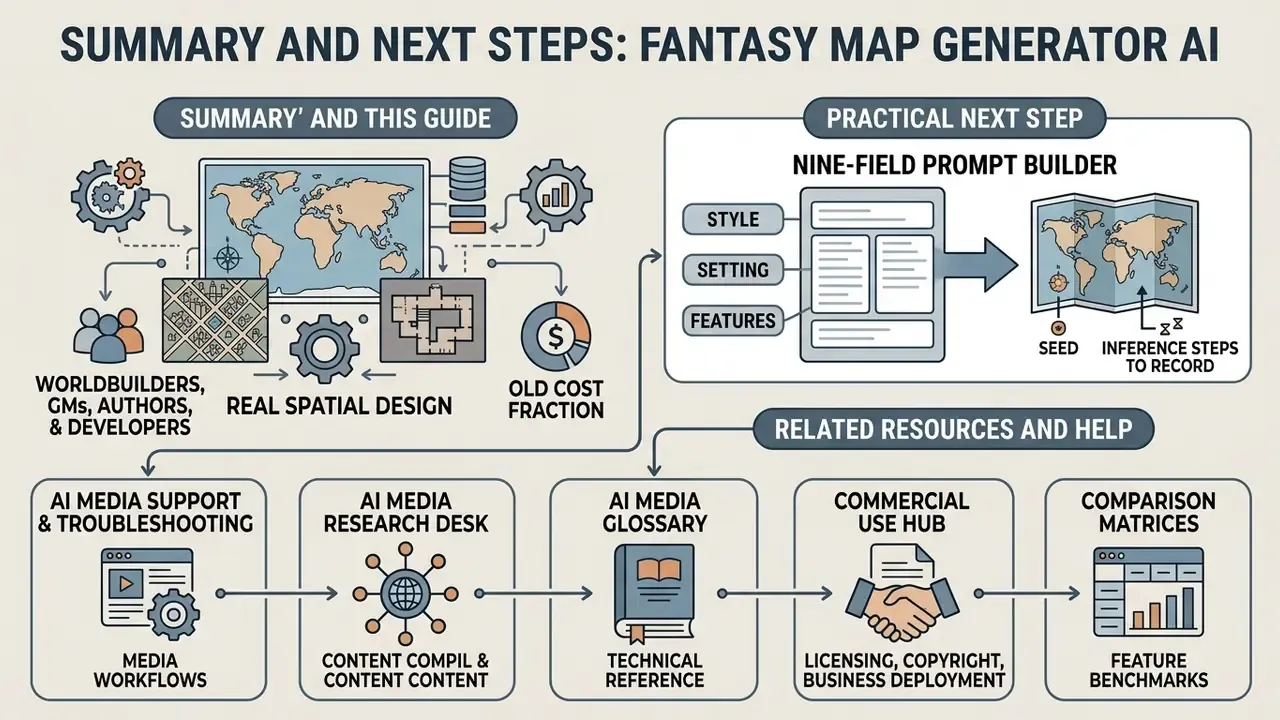
AI fantasy map generators give worldbuilders, game masters, authors, and developers real spatial design capability at a fraction of the old cost. Structured prompts, deliberate choices of medium and setting genre, logged reproducible parameters, and honest attention to licensing terms are what turn a pretty render into a publishable asset. Medieval, industrial, post-apocalyptic, interstellar: the pipeline does not care, as long as you declare the era.
Practical next step: run one map through the nine-field prompt builder, record seed and inference steps, apply at least one documented human edit (a label set, an inpainted region, or a vector border pass), then export in both PNG and SVG so the asset is ready for either a virtual tabletop or a print plate. Start with one map, not thirty.
For help with media workflows, visit AI Media Support and Troubleshooting. Developers building programmatic map generation pipelines can read the documentation in our AI Media API hub.
About This Guide
Compiled by the AI Media research desk, which maintains our glossary of AI generation tools and commercial-licensing documentation. Prompt structure, export formats, and VTT integration were checked against vendor documentation and peer-reviewed generative-cartography research. Legal statements were reviewed against published U.S. Copyright Office guidance and academic commentary; they remain general information, not legal advice. Editorial commentary attributed to Marcus Hale, author.