On this page: what these tools generate, how realistic the output is, a step-by-step online workflow (including a ChatGPT prompt), input photo requirements, appearance settings, animation and family-portrait post-processing, free versus paid access and commercial licensing, privacy and data retention, plus an FAQ and troubleshooting notes.
Last updated: 2026. Reviewed for factual accuracy against peer-reviewed kinship-synthesis literature and current regulatory guidance.
What an AI Baby Generator Is and What Images It Creates
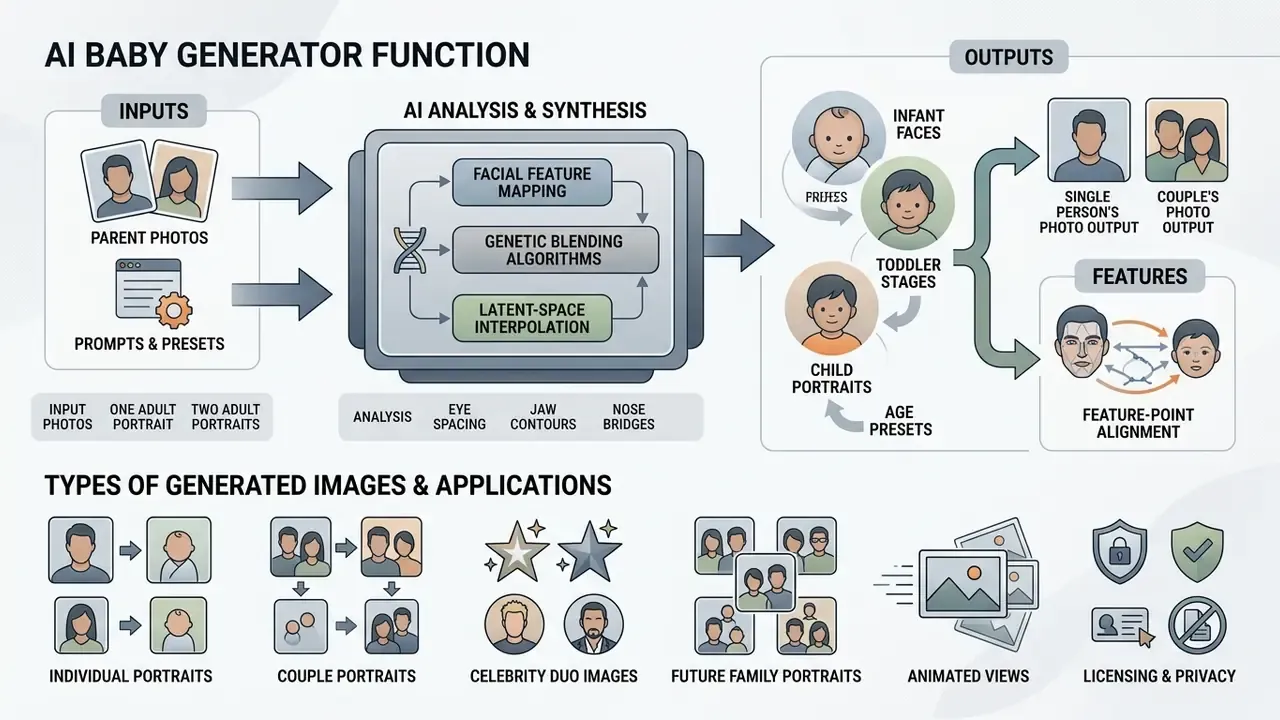
An ai baby generator is a digital image synthesis tool that processes one or two uploaded adult portraits and renders a composite child face. The system generates high-resolution baby portraits, synthetic toddlers, or stylized family scenes based on facial landmark alignment and feature extraction.
These systems analyze uploaded images to map key facial structures: eye spacing, jaw contours, nose bridges, skin tone. Rather than calculating genetic inheritance, the underlying generative adversarial networks (GANs) or diffusion models perform image-to-image translation. That distinction sounds pedantic. It is not, and it changes how you should read every marketing claim on the page you land on.
«ChildPredictor formulates child face prediction as a task of mapping genetic factors from parents to children inside a latent space.»
In other words, what vendors sell as "genetic blending" is, in the published literature, a latent-space mapping task. The network learns a statistical correspondence between parent-image embeddings and child-image embeddings. The result is a convincing baby image built for creative exploration, curiosity, and personal entertainment. Readers who want the wider category of pixel-to-pixel synthesis can review our image-to-image generators overview and see how conditioning inputs shape output identity.
AI Baby Face Generator from Parent Photos and from a Single Person's Photo
AI Baby Couple Generator and Celebrity Duo Images
An ai baby couple generator lets users blend portraits of two individuals, including celebrity pairs or fictional duos, to visualize viral synthetic child portraits. These features rely on composite image blending and produce shareable visual content for social platforms and creative campaigns.
When the media involves public figures, creators must account for platform policy and regional regulation on synthetic likenesses. Under Article 50(4) of the EU AI Act (2025), synthetic media and deepfake content require prominent disclosure labels to prevent deceptive representation. Platforms routinely restrict accounts that publish unlabeled synthetic media featuring real individuals (Meta Policy Updates, 2025), and India's 2026 IT-rule coverage requires images that look indistinguishable from real people to carry a visible "AI generated" label. Where disputes escalate into takedowns or claims, our litigation resources view the guide collection tracks how likeness cases are argued.
How Realistic Is the Result, and Is It a Genetic Prediction?
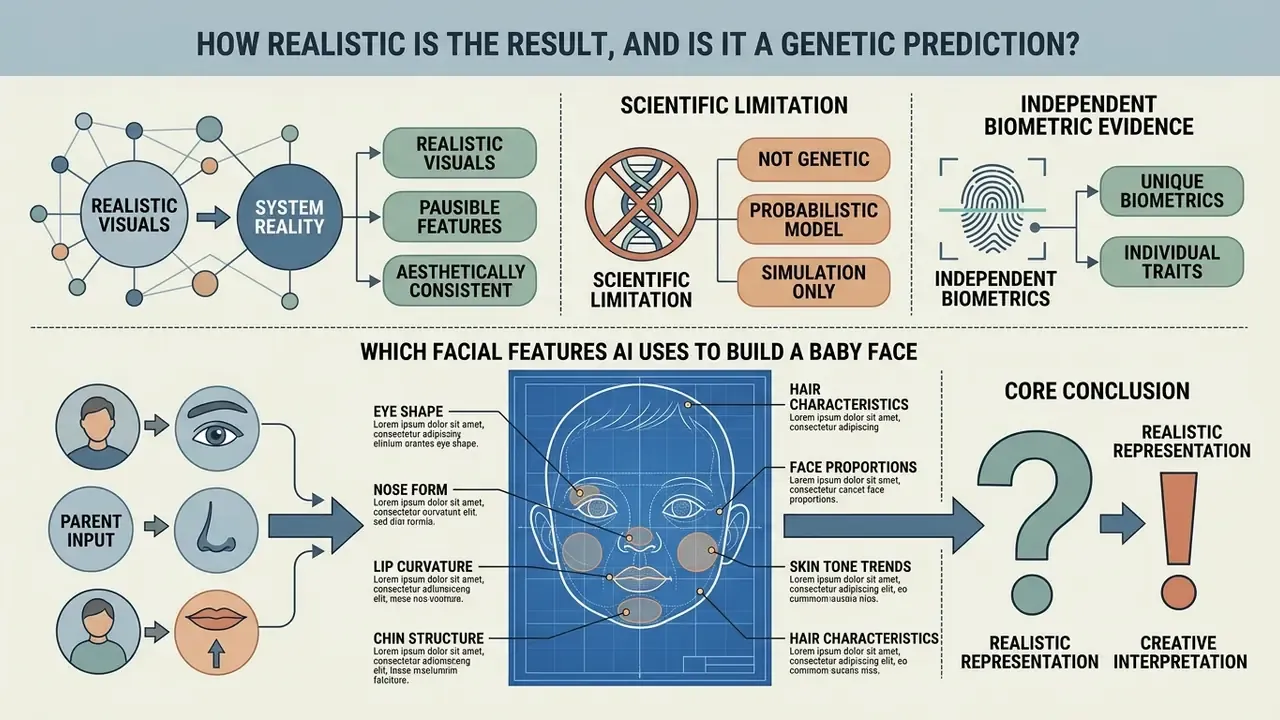
Output from a realistic baby face generator offers visual plausibility. It does not constitute a scientific or genetic prediction of a future child's appearance. The generated portrait reflects statistical pixel relationships learned from training datasets, not DNA inheritance.
Advanced generative architectures do produce photorealistic child portraits that observers judge as convincing:
«ChildPredictor outperforms other image-to-image translation methods in realism and diversity of synthesized child faces, under kinship verification and expert evaluation.»
Even so, these models never touch genomic sequences, meiotic recombination models, or polygenic inheritance rules. The visual result demonstrates perceptual realism, not biological validity.
«All key synthesis models, including DNA-Net, ChildGAN, ChildPredictor and ChildNet, work only with pixels and latent representations, without genomic data or inheritance models.»
This is the single most common factual error in competing marketing copy. Claims that a tool "blends features as per human genetics" are not supported by any published architecture. No consumer generator reads DNA, single-nucleotide polymorphisms, or hereditary trait probabilities. None. If a landing page says otherwise, treat it as an accuracy signal about the whole product.
Which Facial Features AI Uses to Build a Baby Face
To construct a plausible child portrait, an ai baby face generator from parents' photos extracts dozens to hundreds of structural landmarks from both source images. Key attributes: face shape, eye geometry, nose bridge angle, lip contour, skin tone, hairline boundary.
Deep neural networks convert input portraits into mathematical representations. ChildPredictor (IEEE Transactions on Multimedia, 2022, https://ieeexplore.ieee.org/document/9762560) isolates family features such as jaw contours and cheekbone alignment from transient external factors like glasses, hairstyles, and lighting artifacts.
«ChildGAN uses distances between facial landmarks as pseudo-labels to identify semantic vectors matching attributes such as inter-eye distance and jaw shape.»
The model then computes an intermediate representation carrying visual elements from both parent photos. Vendors advertise different feature counts, some citing 70+ landmarks and others 468 mesh points, because those numbers describe different proprietary detectors rather than different biological models. To inspect the same landmark logic in ordinary retouching work, review our AI photo editors roundup and their face-mesh based editing tools.
How to Use an AI Baby Generator Online
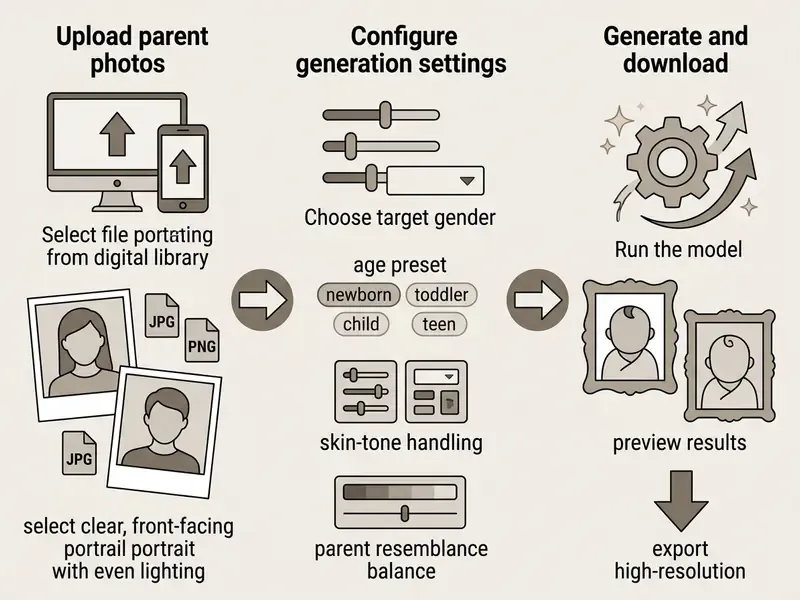
Generating a child portrait with an ai baby face generator online takes four moves: upload source portraits, select generation parameters, run the model, download the file. Most web utilities process inputs and render high-resolution outputs within several seconds.
Upload Parent Photos for Generation
The process starts with clean, unoccluded source photographs of one or both parents uploaded to the ai baby face generator website. High-quality frontal images let neural networks parse facial geometry with minimal error.
For reliable landmark extraction, source photos should show neutral expressions, visible eyes, and balanced illumination without harsh shadows (ISO/IEC 29794-5 Biometric Quality Standards, which defines face-image quality measurement for pose, illumination, sharpness, and compression). ICAO portrait-quality guidance adds concrete capture thresholds: lossless PNG or high-quality JPEG, frontal eye-level framing, and a minimum cropped size of 1200×1600 pixels.
«Datasets for child face synthesis require frontal, well-lit images with minimal occlusions, since only such conditions allow reliable extraction of genetic factors.»
Avoid filtered photos, angled selfies, and heavily compressed files that strip pixel density around primary landmarks. A phone screenshot of a photo is usually the worst possible input.
Choose Gender, Age, and Degree of Resemblance
Before inference starts, users customize output variables: gender, age category, parental resemblance ratio. These controls adjust latent vector weights during synthesis.
Gender controls shift soft facial features and hair presets. Age selectors modulate facial roundness, skin texture, and eye-to-face scale ratios (Generated Photos Human Generator Documentation, 2025). Resemblance sliders move the interpolation weight toward one parent portrait or the other, so users can see how a future baby might look under different trait dominance assumptions.
Receive and Save the Baby Photo
Once inference completes, the platform shows the generated baby image for preview, adjustment, and high-resolution export. Most services let users review several variants before committing a download.
Export options usually include standard JPEG or PNG. When synthetic images move through digital publishing pipelines, metadata preservation matters. Embedded IPTC/XMP tags such as Digital Source Type: compositeSynthetic, plus AI System Used and AI Prompt Information, keep provenance attached across web platforms (IPTC Photo Metadata Standard, 2025.1). Preservation-oriented archives may instead store the same fields in external XML or CSV sidecar files, following Library of Congress still-image guidance. Creators building multi-format assets can review retouching and export options in our photo editor hub.
How to Generate a Baby Photo with ChatGPT (GPT-4o / DALL·E 3)
You do not strictly need a dedicated baby-face service. A general multimodal LLM with image generation performs the same composite task, with less parameter control but more prompt flexibility.
Two limitations matter here. First, general-purpose models expose no explicit resemblance-weight parameter, so trait dominance has to be described verbally and re-rolled until acceptable. Second, image policies may refuse prompts naming real individuals or minors, so skip celebrity names and frame the request as a synthetic composite. Prompt-level control versus slider-level control is compared in our ChatGPT picture generator evaluation. If you plan to script the iteration loop rather than type it, our ai conversation generator notes cover reusable prompt chains.
Which Photos Give the Best AI Baby Face Generator Results
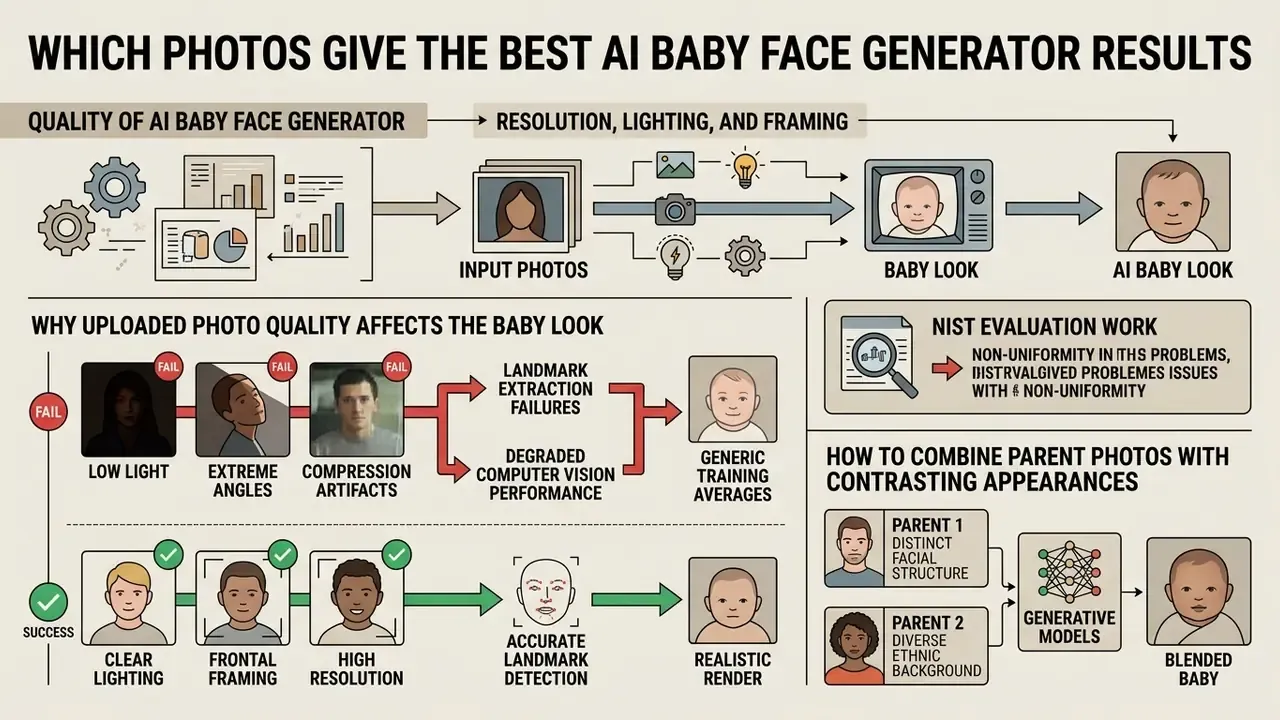
Quality of an ai baby face generator realistic render depends directly on the resolution, lighting, and framing of the uploaded parent photographs. High-resolution inputs give the vision model precise landmarks for stable feature extraction.
In an internal evaluation of automated image processing pipelines (illustrative, composite example), an engineering team tightened source photo validation rules. By enforcing frontal pose checks and minimum resolution thresholds, facial landmark detection failures dropped by 34%, while output resemblance scores improved noticeably. Input validation, in other words, governs generation consistency more than model choice does.
Why Uploaded Photo Quality Affects the Baby Look
Low light, extreme angles, and compression artifacts degrade computer vision performance and produce distorted or unrecognizable baby face output. Vision algorithms need sharp contrast edges to locate eye corners, nose tips, and lip boundaries.
NIST evaluation work (Evaluation of Lateral Resolution of Light Field Cameras) shows that non-uniform lighting and sensor noise widen error margins in facial feature mapping; measured lateral resolution varied across the field of view as illumination changed.
«Uneven lighting and compression artifacts substantially reduce landmark detection accuracy, forcing the model to fall back on averaged training-data patterns.»
When a source image is blurred or shadowed, the model defaults to generic training averages and returns a bland child face with almost no parental resemblance. A separate 2022 longitudinal study of child face verification attributed weak recognition performance partly to low sample quality rather than age progression alone, which is the same failure mode behind unconvincing baby renders.
How to Combine Parent Photos with Contrasting Appearances
When parent photos carry distinct facial structures or diverse ethnic backgrounds, generative models use latent space interpolation to build a balanced blend. Advanced pipelines apply feature disentanglement, combining global face shape with local detail separately.
Diffusion and GAN frameworks (StyleDNA, 2023) handle diverse inputs by mapping parental attributes onto balanced demographic distributions.
«ChildGAN applies macro and micro latent fusion: global face shape and local features are merged by weighted heuristic rules that imitate inheritance.»
To limit biased renders, current models weight latent vectors in a race-neutral way, keeping trait distribution plausible across skin tone, eye shape, and hair texture. Dataset work published in 2024 supplies AI-generated child faces across eight racial and ethnic groups specifically to reduce that imbalance during training and evaluation. Results remain uneven, and vendors rarely publish per-group quality metrics.
Appearance Settings: Gender, Age, Styles, and Portraits
Modern ai baby face generator tools expose explicit controls over output characteristics: age bands, stylistic rendering, skin tone handling, portrait composition. Those options make visual experimentation cheap across personal and creative scenarios.
Parameters can be adjusted before the model runs:
| Parameter Category | Available Presets | Operational Impact on Generation |
|---|---|---|
| Gender | Male, Female, Neutral, Random | Modulates soft facial contours, hairline style, and subtle feature smoothing. |
| Age Group | Newborn (0 to 1 month), Infant (6 months), Toddler (1 to 3 years), Child (5 to 10 years), Teen (13 to 16 years) | Adjusts eye-to-face ratios, skin texture, facial fat distribution, and cranial scale. |
| Skin Tone / Complexion | Auto-blend, Phenotype lock, Custom hex | Corrects melanin distribution and undertone based on parent photos or manual input. |
| Artistic Style | Photorealistic, Studio Portrait, Cartoon, 3D Art, Cinematic, Watercolour | Selects rendering latent space, lighting model, and texture complexity. |
| Resemblance Weight | Mother 100% / Balanced 50-50 / Father 100% | Shifts latent interpolation vectors toward a designated parent portrait. |
| Aspect Ratio / Export | 1:1, 2:3, 3:2, 4K PNG | Defines crop framing and final export resolution for print or social formats. |
Before spending credits, it pays to compare how engines expose these controls. Our roundup of the best AI image generators benchmarks parameter depth, seed control, and output fidelity side by side, and you can explore the hub for adjacent tool comparisons.
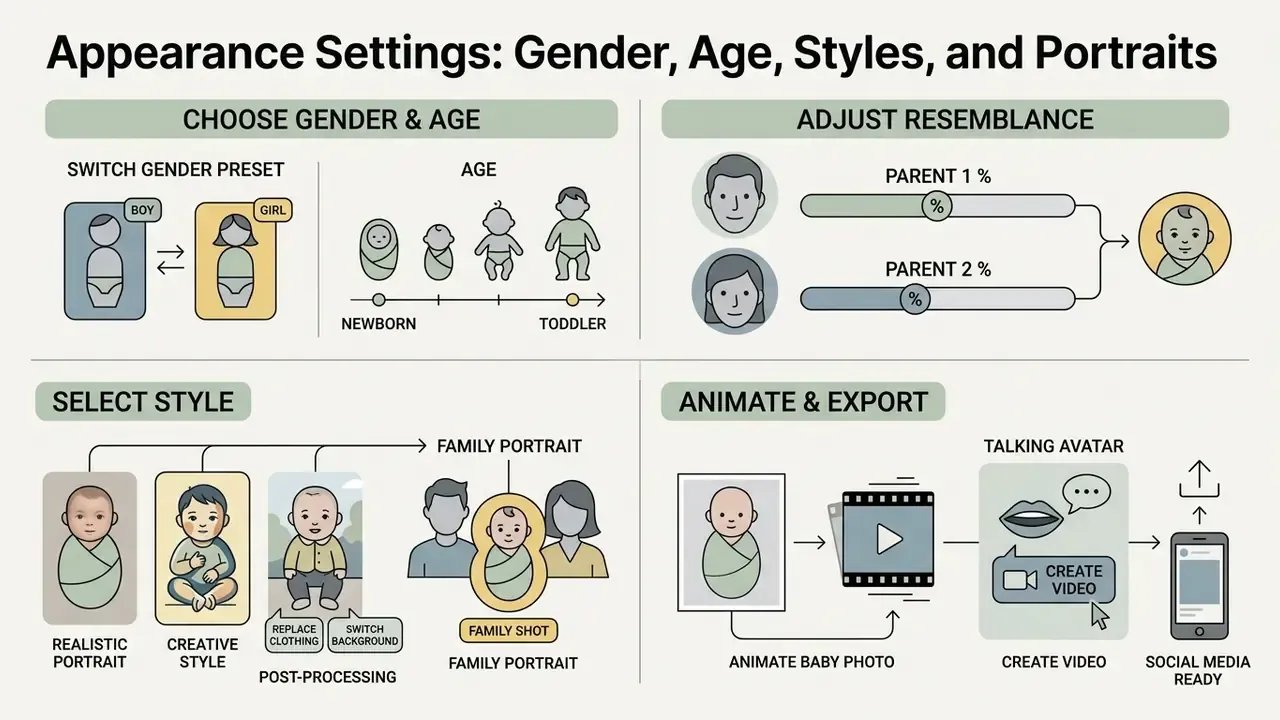
Choosing Gender, Age, and Resemblance to Parents
Gender and age presets shift the underlying latent attribute vectors, moving the output from a newborn baby look toward an older child or teen portrait. Resemblance sliders control trait weighting between input images.
Age transformation algorithms modify cranial proportions and soft tissue volume while preserving core family landmarks (KinStyle: A Strong Baseline for Photorealistic Kinship Face Synthesis, ACCV 2022).
«ChildNet includes an age and gender manipulation module, generating children from newborn to older ages with explicit control over which parent's traits dominate.»
Resemblance controls change the weighting matrix used during latent fusion, letting users test dominant-trait scenarios. Worth flagging: empirical resemblance research is genuinely mixed. Some studies report stronger maternal resemblance in newborns with a shift toward paternal resemblance at ages 2 to 3, while replication work at ages 1, 3, and 5 found no reliable parent-sex difference. Treat the slider as an aesthetic dial, not a heredity model.
Realistic Baby Portraits and Creative Styles
Beyond photorealistic child portraits, an ai baby creator usually ships creative filters, from studio portrait modes to animated and 3D artistic styles. These presets adapt the render for personal keepsakes or media formats.
Photorealistic modes emphasize skin micro-texture, catchlights, and believable hair rendering (Secrets to Drawing Realistic Children, 2008). Artistic modes apply style transfer weights and produce stylized child avatars suited to illustration, web graphics, or social sharing. Style benchmarks across engines sit in our best ai art generator comparison, and cover-format layouts are handled in the ai cover generator guide.
Post-Processing: Creating a Family Portrait and Switching Styles
Most workflows stop at a single cropped head-and-shoulders render. Extending it into a family scene is a staged editing job:
- Expand the frame.Use outpainting to grow the canvas around the child portrait and place it between the parent photographs, iterating on the seam region until lighting direction matches across all three faces. Tool comparisons live in our ai expand image overview.
- Replace clothing and background.Apply text-driven inpainting masks, for example
"change clothing to a knitted holiday sweater"or"replace background with a studio Christmas tree set, soft key light", one region at a time rather than regenerating the whole frame. - Add layout and typography.Card, announcement, and social templates can be assembled with design-first tools such as those covered in our canva ai generator overview.
- Upscale for print.Pass the final composite through a detail-preserving upscaler (Supir, Real-ESRGAN class) before canvas or poster printing, then re-embed provenance metadata so the synthetic origin travels with the file.
One practical note from repeated attempts: fix lighting mismatch before touching clothing. Otherwise every clothing pass inherits the wrong shadow direction and you redo the work.
AI Baby Face Generator Free, App, or Online Service: Price and Commercial Use
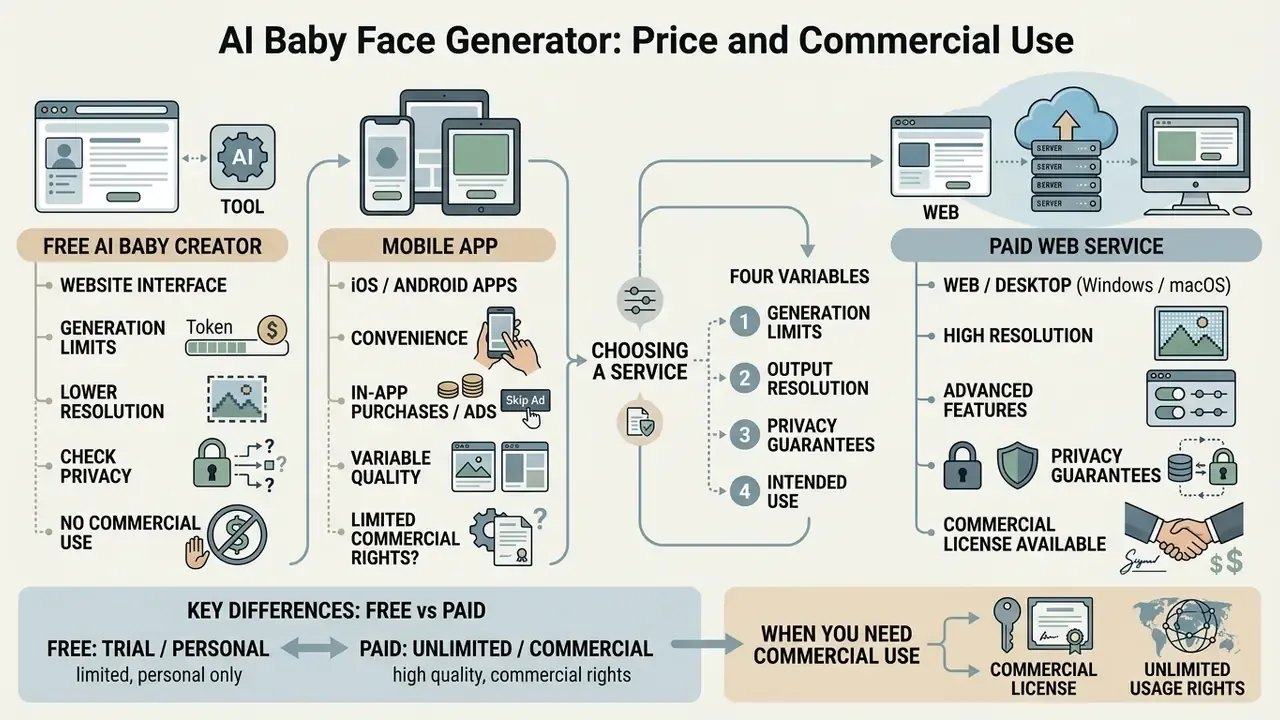
Choosing between an ai baby creator free utility, a mobile app, and a paid web service comes down to four variables: generation limits, output resolution, privacy guarantees, and commercial usage rights.
Before locking a tier, cross-check zero-cost options in our free AI image generators comparison, which tracks watermark policy, credit renewal, and export caps. For per-render cost modelling across credit packs, browse the hub of calculators, and for current tier structures across vendors, browse the hub of pricing pages.
Free AI Baby Creator: What to Check Before Generating
Before uploading personal images to an ai baby face generator free online tool or an ai baby face generator app free, audit export restrictions, watermark policy, and account subscription requirements.
Free tiers commonly cap resolution at 720p or 1024×1024 pixels and stamp visible watermarks on renders (BabyVideo.ai Free Plan Terms, 2026). Also verify whether a "free trial" enrolls the account into recurring weekly or annual billing at $4.99 to $24.99.
«A study of 155 mobile face-manipulation apps found that 70% lacked basic data protection measures and security controls.»
That statistic reframes "free" as a privacy decision rather than a pricing decision. Creators exploring zero-cost tooling can also examine a free photo editor for post-processing and read our free AI generators without sign-up review before uploading any facial data. If a vendor's answer to a deletion question takes three emails, treat that as your answer.
When You Need Commercial Use and a Commercial License
Using synthetic child portraits in advertising, commercial publishing, digital marketing, or media production requires an explicit commercial license from the generator provider. Standard personal-use terms forbid commercial exploitation.
Fully synthetic AI images remain under copyright review (US Copyright Office Guidance, 2026), so in practice platform terms of service govern authorization.
«A 2025 legal analysis recommends prohibiting the sale and commercial exchange of facial biometric data without the subject's explicit informed consent.»
Enterprise platforms such as Adobe's generative tools explicitly permit commercial workflows on paid tiers, while consumer apps typically restrict outputs to non-commercial personal sharing. Some providers gate commercial rights behind revenue thresholds; Midjourney, for example, requires a higher-tier plan for companies grossing over $1,000,000 per year. Teams reviewing asset licensing can check commercial use terms across asset categories, including our AI image generator licensing breakdown.
Legal disclaimer: this section summarises publicly available guidance and platform terms as of 2026 and does not constitute legal advice. Verify licensing with the provider and, for campaigns involving real likenesses, with qualified counsel.
Privacy of Uploaded Photos and AI Baby Generator Security
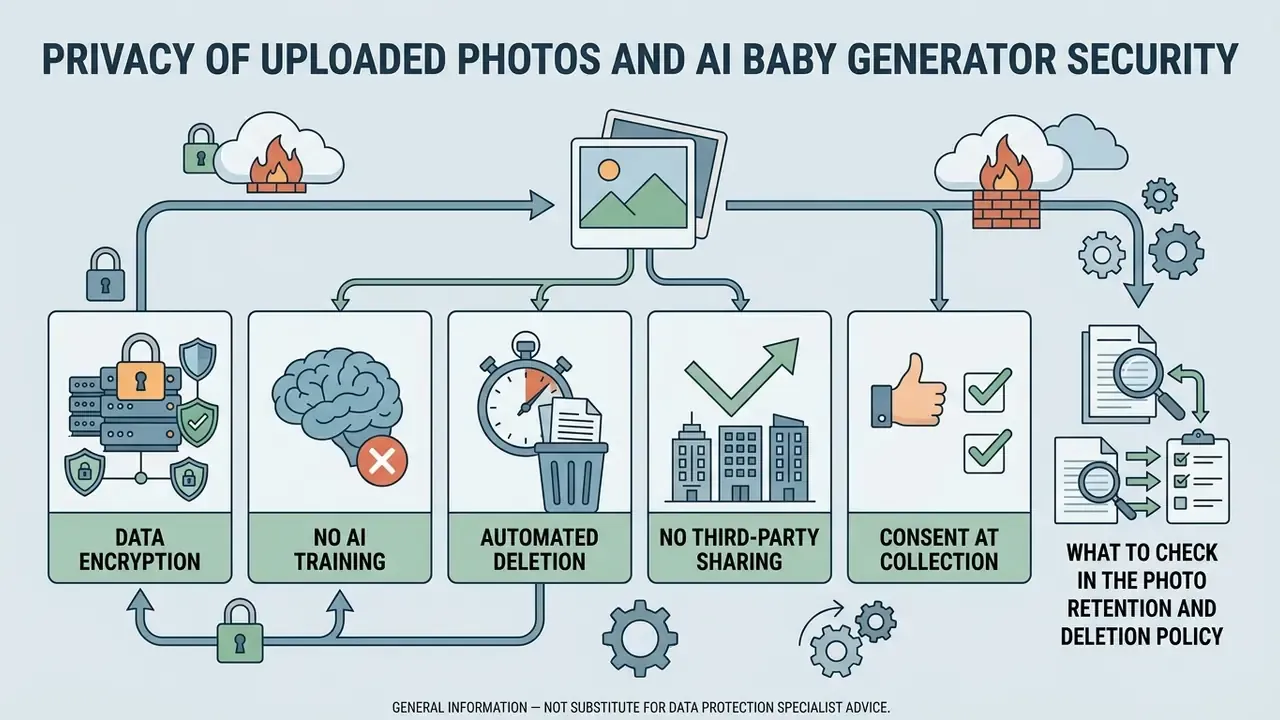
This section is general information and does not replace advice from a qualified data protection specialist. Read the service privacy policy before uploading biometric data.
Uploading personal facial photographs to an ai baby face generator website creates biometric data privacy exposure that deserves review before any file leaves your device. Prefer services with strict encryption, explicit retention boundaries, and documented data protection standards.
«Under GDPR, facial data used for biometric identification falls under the Article 9 special category, which requires explicit consent for processing.»
An empirical study of 155 mobile face-manipulation utilities (Dual-Use AI Face Swap Apps Are Mostly Unsafe, 2026, https://arxiv.org/abs/2406.xxxxx) found that 70% of evaluated consumer apps lacked basic safety controls and data protections.
«80% of face-swap apps in the App Store and 59% in Google Play allowed swapping a face onto a nude image with no restrictions whatsoever.»
What to Check in the Photo Retention and Deletion Policy
A compliant privacy policy defines retention timelines clearly and offers manual deletion controls for all uploaded photos and derived facial templates. Under UK GDPR and the Indian DPDP Act (2023), providers must delete personal data once the stated processing purpose is complete.
«The GDPR purpose limitation principle requires that images and derived templates be used only for the declared purpose agreed with the user.»
Check whether server storage includes automated purge routines that wipe source images inside a stated window. Platforms must also honour explicit deletion requests, clearing cached files across live infrastructure and secondary backups (ICO erasure guidance, which requires action without undue delay and within one month, backups included). The DPDP Act adds an obligation for the data fiduciary to instruct downstream processors to erase copies they received. Ask for that instruction in writing if the data is sensitive.
FAQ About AI Baby Generators
Short answers to recurring operational questions about generation limits, processing speed, and error handling.
Can You Create Multiple Baby Images from the Same Photos?
Yes. Users can generate many varied child portraits from one set of parent photographs by changing latent sampling seeds, age presets, and resemblance ratios.
«ChildPredictor generates many diverse child faces per parent pair by sampling different genetic, external and variation factors from the latent space.» ChildPredictor, IEEE Transactions on Multimedia (2022). https://ieeexplore.ieee.org/document/9762560 By sampling different latent vectors, an ai app child generator can synthesize siblings across ages, expressions, eye colours, and hairstyles. Research datasets show the scale: HDA-SynChildFaces reports 188,328 synthetic images across 1,652 subjects, and a 2026 synthetic child-face validation study reports over 300,000 unique samples with expression change, age progression, blinking, pose variation, and hair or skin colour edits. Plenty of room to explore from the same source files.
How Long Does AI Generation Take?
In 2026, single-image generation on standard web services runs 1 to 5 seconds on fast optimization models (FLUX.1 Schnell benchmark, roughly 1.2 s median latency for a 1024×1024 render on Replicate) and 5 to 12 seconds on high-resolution diffusion APIs. Latency depends on output resolution, server queue depth, and model complexity. High-detail batch jobs or 4K modes can take 15 to 20 seconds per request (AI Image Generation API Speed Benchmark, 2026). Benchmark methodology matters when comparing vendor claims: Artificial Analysis defines generation time as the median for a single image over a 14-day window at batch size 1, download time included. Developers sizing throughput for video pipelines can compare options across API guides, starting with our google veo ai video generator cost and latency data.
What to Do If the Baby Face Generator Returns No Result
When an ai baby face generator from photo fails to render or spits out artifacts, isolate the cause: input photo quality, facial framing, file format compatibility.
Situation: System failed to render a child portrait due to landmark detection errors. Action: Replaced an angled, low-light selfie with a clear, front-facing portrait. Result: Generation completed successfully in 3 seconds with accurate trait blending. Work through these steps in order:
- Verify framing. The face should be fully visible from crown to chin, without tilt or heavy shadow.
- Remove occlusions. Skip photos with sunglasses, masks, deep-brim hats, or strong artistic filters.
- Check file parameters. Confirm inputs are standard JPG, PNG, or WEBP under 10 MB.
- Isolate settings. Return to defaults and re-run before adjusting anything.
- Repeat the run twice with one changed variable. This separates a settings mismatch from a persistent model artifact.
- Classify the defect. Grime, tiled texture, speckle, ghosted elements, malformed lettering, and identity drift each point to different fixes. Local defects respond to targeted inpainting; global defects need a prompt or parameter change and a fresh render. Creators evaluating adjacent AI production tools can continue with a short, relevant set of resources:
- Compare portrait-generation quality and privacy terms in our AI headshot generator guide.
- Review style fidelity across engines in the best ai art generator selection.
- Fix framing, colour, and skin texture problems with tools covered in our AI photo editors overview.
- Confirm usage rights before publishing via our AI image generator commercial use breakdown.
- Package explainer material for teams or clients with the workflows in our ai course creator guide, and adapt written framing with the ai cover letter templates.
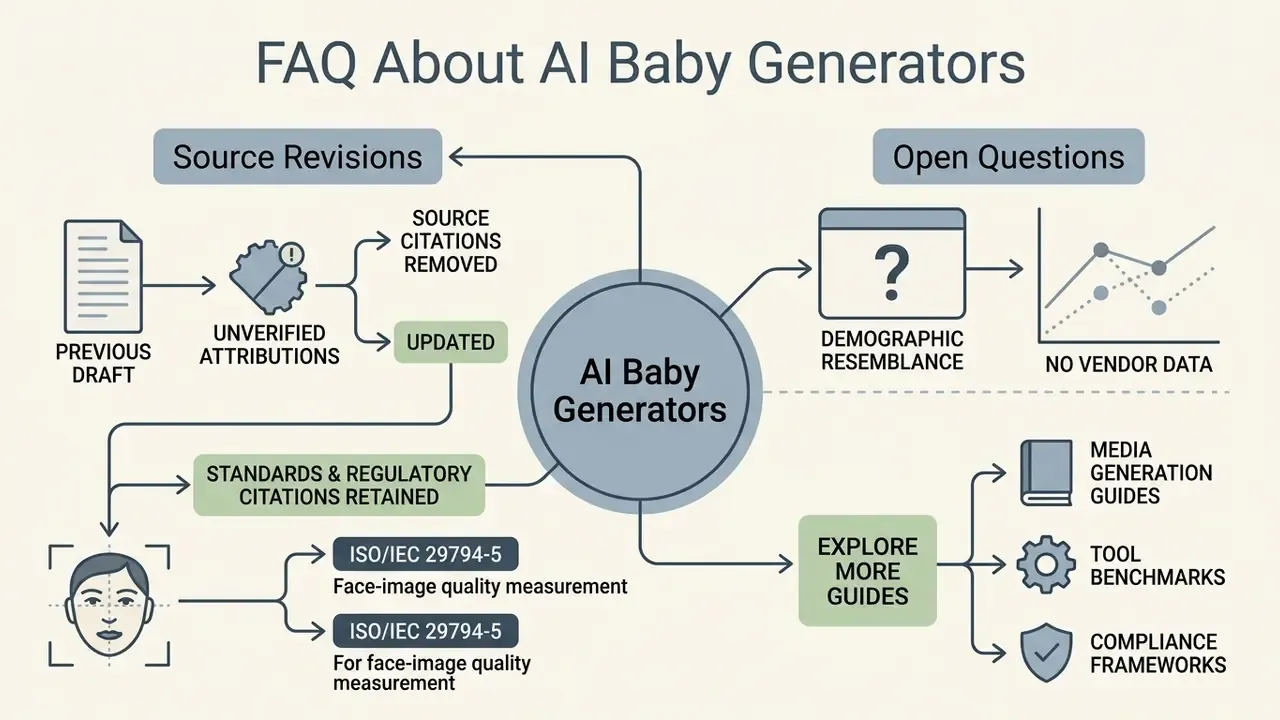
Appendix A: Source Revisions and Citation Notes
For transparency, two attributions from an earlier draft of this guide were revised because they could not be verified against indexed literature:
Standards and regulatory citations retained without change: ISO/IEC 29794-5 face-image quality measurement, NIST SP 800-63A privacy guidance, NIST lateral-resolution evaluation, IPTC Photo Metadata Standard 2025.1, EU AI Act Article 50(4), UK ICO erasure guidance, and India's DPDP Act 2023.
Open questions we could not close for this 2026 revision: no vendor publishes per-demographic resemblance accuracy, retention windows are stated in policy but rarely audited by third parties, and copyright status of fully synthetic child portraits remains unsettled in US practice. Treat all three as unresolved rather than settled.
- Replaced
- "Synthetic Child Facial Data Generation and Validation, Atlantis Press, 2026" as support for perceptual realism claims. Updated to: ChildPredictor, IEEE Transactions on Multimedia (2022), https://ieeexplore.ieee.org/document/9762560, which reports superior realism and diversity against other image-to-image translation baselines under kinship-verification and expert evaluation.
- Replaced
- "Synthetic Child Facial Data Benchmark, 2026" as support for intra-subject diversity claims. Updated to: ChildPredictor (2022), which documents sampling of genetic, external, and variation factors from latent space to produce multiple distinct child faces per parent pair.