An online animation school delivers structured distance-learning instruction in digital art, character movement, storyboarding, 3D modeling, visual effects (VFX), and real-time game asset creation. Modern accredited programs combine asynchronous lecture modules, weekly live critiques, and industry-standard software tools to prepare students for professional roles in film, television, interactive entertainment, and commercial media production.
Choosing the right animation online school requires evaluating program credentials, mentor experience, software accessibility, and total cost of attendance against long-term career goals. Whether you want a full four-year online animation degree, a focused animation diploma online, or a handful of skills-based animation courses, an established institution keeps your portfolio inside the baseline that major studios and game developers actually screen for.
The short version
- Three credential tiers exist. Degrees (3–4 years, roughly $25,000–$50,000+) satisfy visa and corporate HR requirements; diplomas (6–24 months, roughly $6,500–$17,000) compress training into studio skills only; single courses and 6–12-week workshops (roughly $800–$1,500) are upskilling tools.
- Accreditation is program-specific, not brand-specific. Verify institutions through DAPIP/CHEA (US), UKRLP and QAA (UK), or Rosobrnadzor (RU) before paying anything. Gnomon and AnimSchool hold ACCSC accreditation; Animation Mentor is a non-accredited professional training provider.
- Specialized bootcamps compete with universities. Animation Mentor, AnimSchool, iAnimate and Think Tank Training Centre are mentor-led, studio-founded alternatives to degree programs, and often stronger on character animation and rigging.
- Tuition is not the total cost. Budget an additional $1,500–$4,000 for a workstation, tablet, storage and non-student software licences.
- The reel outranks the diploma. No credential guarantees a studio offer. Recruiters see hundreds of near-identical "cookie-cutter" reels built on default school rigs; quadruped, creature and custom-rig work is what separates hired candidates from rejected ones.

Who this guide is for and the vocabulary you need first
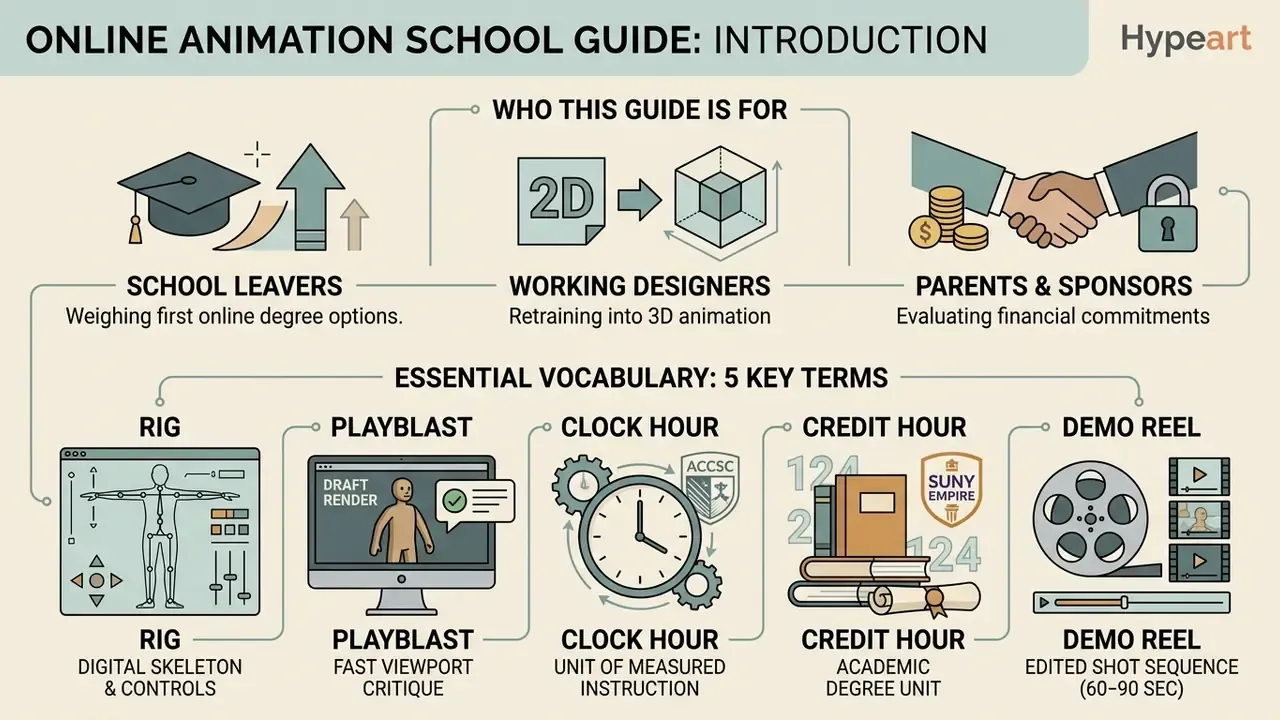
This guide is written for three groups: school leavers weighing a first online animation degree, working designers retraining into 3D, and parents or sponsors paying the bill and asking whether the credential is real.
Before the comparisons, five terms carry most of the confusion. Worth pinning down.
- Rig. The digital skeleton and control interface that lets an animator pose a 3D model. School rigs (Stewart, Bishop, Stella) are shared by thousands of students, which matters later.
- Playblast. A fast, low-quality viewport render used for weekly critique. Most of your study time produces playblasts, not finished frames.
- Clock hour. A unit of measured instruction used by career-college accreditors such as ACCSC. AnimSchool's program, for example, is documented at 316 instructional clock hours.
- Credit hour. The academic unit used by degree-granting universities; SUNY Empire's bachelor's runs 124 credits at $295 each.
- Demo reel. A 60 to 90 second edited sequence of your strongest shots. It is the hiring artefact. Everything else is context.
Keep those five in mind and most marketing pages become readable.
What an online animation school gives you and who it suits
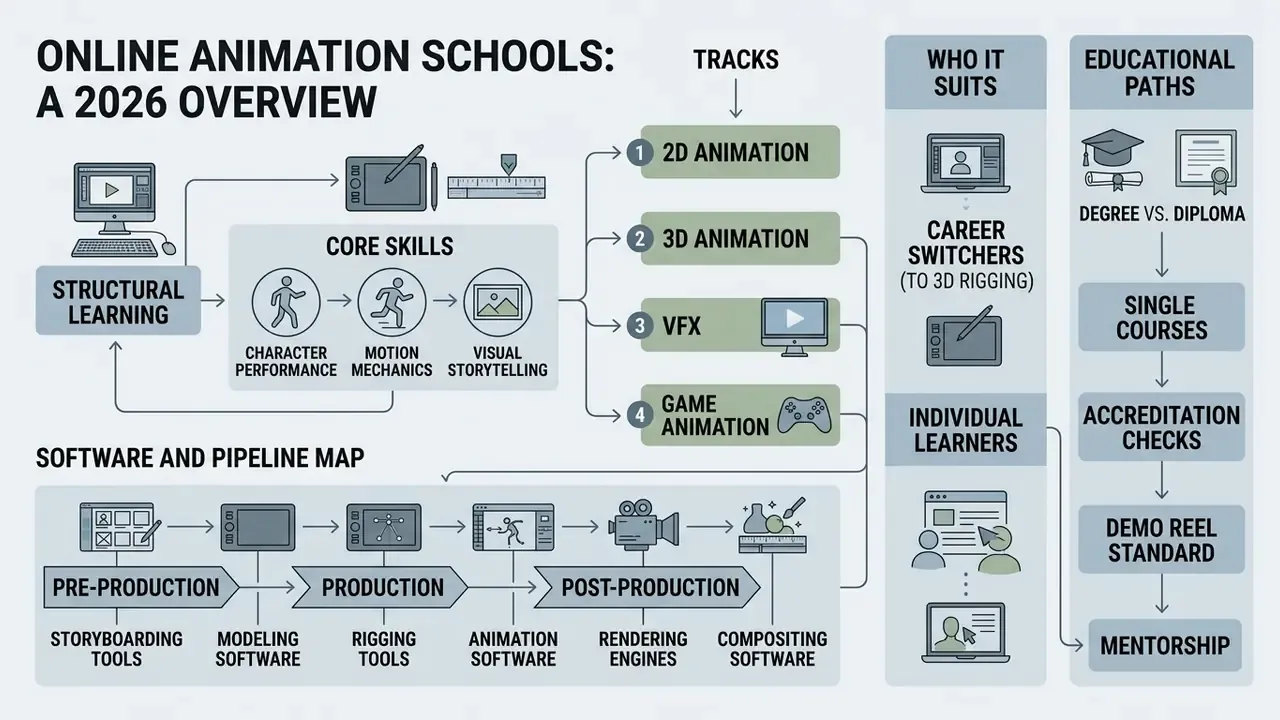
Enrolling in an online animation school provides structured instruction in character performance, motion mechanics, visual storytelling, and digital production pipelines without requiring physical relocation. This flexible model suits self-motivated beginners, transitioning creative professionals, and active industry artists chasing specialized skills in 2D design, 3D modeling, VFX, or real-time game animation.
An animation online school bridges the gap between raw artistic aptitude and studio-ready production capability. According to official program specifications from institutions such as UC Leeds and Buckinghamshire New University, structured animation programs cultivate a specific mix of cognitive and practical skills. Students learn to analyze creative briefs, execute iterative production workflows, evaluate motion physics, and master digital creative tools such as Maya, Blender, Toon Boom Harmony and Unreal Engine, the same categories covered in our reference guide to the modern animation maker toolset.
«Practical and professional learning outcomes include autonomous production of animation projects, technical mastery, and ethical conduct in a professional context.»
Program documentation from Buckinghamshire New University confirms the same structure for fully online delivery, with studio-mirroring assignments, recorded video reviews and written analysis (Buckinghamshire New University BA Animation Specification, 2026).
Professional animation training leans hard on one deliverable: a competitive demo reel. Labor-market data from the U.S. Bureau of Labor Statistics (BLS) shows that while formal credentials establish baseline eligibility, entertainment and media employers prioritize verified portfolio quality when hiring special effects artists and animators.
«Special effects artists and animators earned a median annual wage of $102,030 ($49.06 per hour) in 2025.»
Animation degree, diploma or a single animation course
The difference between an online animation degree, an animation diploma online, and a short animation course comes down to duration, curricular depth, total cost, and credential recognition. Academic degrees stretch theory and practice across three to four years. Diplomas compress technical skills into 6 to 24 months. Standalone courses target one tool or one technique over several weeks.
A full online 2d animation degree or 3D bachelor's program covers animation history, fine art fundamentals, character design, advanced rigging, lighting, compositing, and general education requirements. An animation diploma online drops the general academic subjects and concentrates on core studio skills, which makes it faster and cheaper for career changers. Individual courses work as targeted upskilling modules: Unreal Engine sequence tools, say, or Toon Boom rigging for a 2D artist moving into vector work.
Duration also varies by education system, and that trips people up. The University of Brighton lists BA (Hons) Animation as three years full-time, four with placement. La Salle runs a three-year Diploma in Animation with aptitude-based early admission. Deakin College delivers a Diploma of Film, Television and Animation in 8 to 12 months. So treat the word "diploma" as a duration range, not a fixed level. If you are searching for a 2d animation college online, check the credential level in the registry rather than in the brochure.
Tracks: 2D, 3D, VFX and game animation
Digital animation splits into four primary specializations: 2D frame-by-frame and vector animation, 3D character modeling and rigging, visual effects compositing, and real-time game animation. Each track uses a distinct software stack, its own asset optimization pipeline, and different production rhythms.
- 2D Animation: traditional drawing principles, digital illustration, character concepts, vector rigging and timing in Toon Boom Harmony, Adobe Animate or After Effects.
- 3D Animation: three-dimensional character movement, skeleton rigging, weight distribution, polygonal modeling and character performance in Autodesk Maya or Blender.
- Visual Effects (VFX): combining live-action footage with computer-generated assets, particle simulations, green-screen keying, lighting and compositing in Nuke, Houdini or After Effects.
- Game Animation: cyclic motion loops (walk, run, combat sequences), interactive state machines, hit reactions and engine integration in Unreal Engine or Unity.
Understanding these technical distinctions lets you pick a specialization that matches both creative interest and career ambition. Program audits confirm the split: 2D syllabi require a two-monitor setup with Adobe After Effects, Photoshop and Illustrator; 3D syllabi require Maya, Photoshop and Unreal Engine; game programs add engine coursework plus multi-part thesis projects ("Game Thesis Project 1A/1B/II").
Software and pipeline map: which tool does what in production
| Software | Pipeline stage | Primary function | Track |
|---|---|---|---|
| Autodesk Maya / Blender | Production | 3D layout, keyframe animation, rigging, skinning, rendering | 3D, VFX, Games |
| ZBrush / Mudbox | Asset creation | High-poly sculpting of characters and creatures | 3D, VFX, Games |
| Substance Painter / Mari | Asset creation | Texturing and look development (LookDev) | 3D, VFX, Games |
| Toon Boom Harmony / Adobe Animate | Production | 2D vector rigging, frame-by-frame drawing, timing | 2D |
| Houdini | Production / FX | Dynamics, particles, destruction, procedural simulation | VFX |
| Nuke / After Effects | Post-production | Compositing, keying, integration of CG with plates | VFX, 2D |
| V-Ray / Arnold | Rendering | Lighting, shading, final frame output | 3D, VFX |
| Unreal Engine 5 / Unity | Real-time assembly | State machines, blend spaces, physics blending, cinematics | Games, Virtual Production |
For concept exploration and mood boards, many students now supplement traditional workflows with generative tooling. See our comparison of AI art generators and of AI video generation tools to understand where these systems sit alongside keyframe animation rather than replacing it. If you build visual references from stills, a picture video maker is often faster than a full NLE for a rough animatic, and our overview of pictures of ai explains how to label generated reference honestly in a student portfolio.
How to evaluate the quality of an online animation program
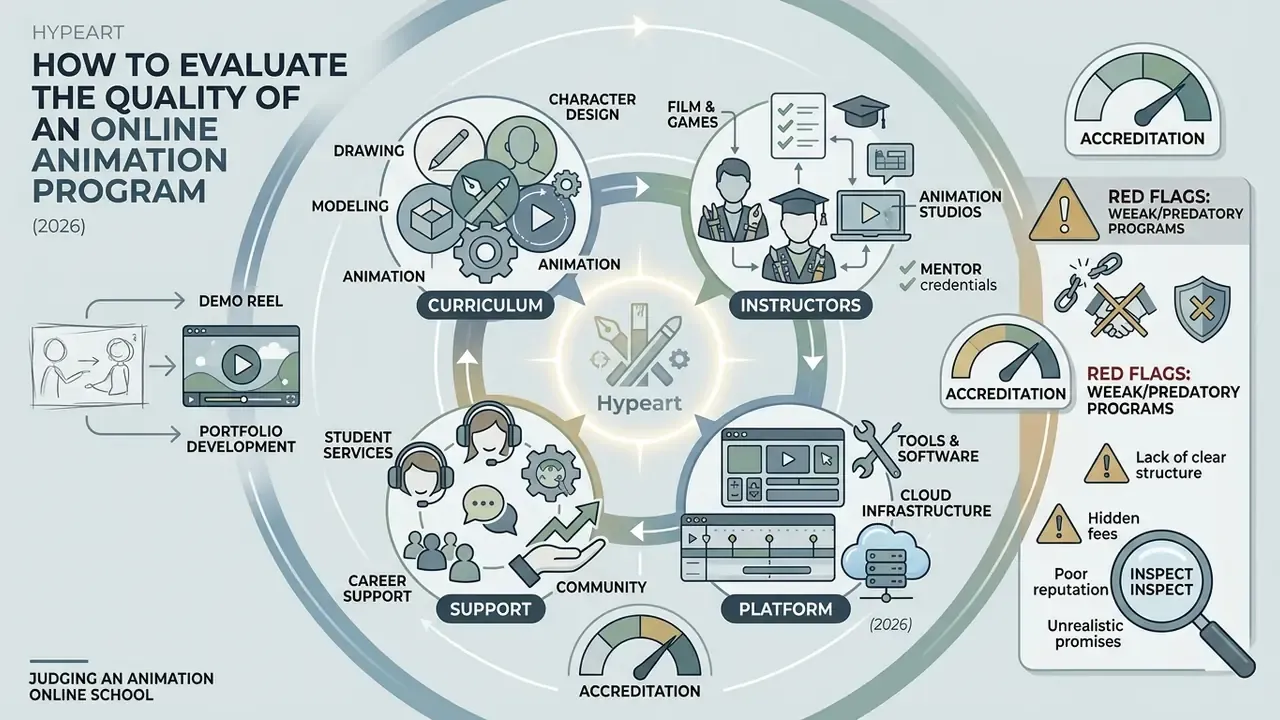
Judging an animation online school means inspecting four things: the curriculum, instructor credentials, platform infrastructure, and student support. Strong online animation schools structure coursework around real studio pipelines and assess students through weekly video critiques and project milestones rather than passive testing.
A rigorous curriculum mirrors a production environment. Anything less is a tutorial library with a payment page.
«Course structure has the strongest influence on student satisfaction in blended learning; all five research hypotheses were confirmed.»
In that same dataset, perceived usefulness of online study significantly predicted both satisfaction and intention to continue across 487 art and design students. The evidence therefore supports a narrower claim than "higher retention and mastery". Programs that sequence learning into clear steps, from foundational drawing to character physics to final scene assembly, measurably raise satisfaction and continuation intent, which are the strongest available proxies for completion. Retention and technical mastery gains still need program-level completion data, and most schools do not publish it. Honest caveat, not a footnote.
Quality should also be benchmarked against published junior-animator competency standards: analysis of briefs and specifications, reference research, reading scripts, animatics and dope sheets, production of animated assets, compositing and rendering, plus both traditional and digital animation methods (Institute for Apprenticeships and Technical Education, 2024–2025; Skills England, 2025–2026). On the delivery side, the National Standards for Quality Online Courses (2025) require documented course design, usable and interoperable technology, and valid assessment design. A program that teaches software without portfolio-ready outputs matching studio tasks fails both tests.
Curriculum: drawing, character design, modeling and animation
A comprehensive animation curriculum covers foundational art principles alongside advanced digital production tools. Leading animation programs open with gesture drawing, perspective, color theory and the 12 principles of animation, then move to 3D character modeling, skeletal rigging, texturing, lighting and final compositing.
Check that the program teaches industry-standard applications rather than outdated or proprietary ones. A complete stack includes Autodesk Maya or Blender for 3D production, Toon Boom Harmony for 2D animation, ZBrush for digital sculpting, Substance Painter or Mari for surface texturing, Houdini for dynamics, and Unreal Engine for real-time scene assembly. Graduates who know these tools enter studio pipelines without foundational software retraining.
University documentation confirms this ordering. VIA University College's 2025 curriculum sequences character design for 3D assets, 2D-to-3D translation, 2D character animation and animation drawing. SVKM's NMIMS moves from Foundation of Animation to 3D Animation & Modelling, then Rigging and Animation in Maya, then Visual Effects Design. Berkeley's advanced digital animation curriculum splits two semesters into story, board, design, model, rig and animate, followed by shading, lighting, compositing, foley and editing.
Mentors from film, games and animation studios
Mentorship from working studio professionals is the single factor most students underrate. Industry mentors who have shipped feature film, VFX or game work give feedback that reflects current production standards, pipeline requirements and artistic expectations. Animation Mentor states that its mentors are almost exclusively referred by working industry professionals and are then interviewed with reel scrutiny, which means studio experience functions as an explicit selection filter for teaching staff.
Weekly video critique sessions, where instructors record screen-over commentary on student work, let learners see frame-by-frame timing errors, weight problems and silhouette weaknesses that they cannot see alone.
«Instructors record webcam, screen, or screen-plus-webcam commentary while pointing at student work; this format is best suited to constructive criticism and critique.»
An accuracy note. The available evidence documents practice standards for screen-recorded critique and portfolio expectations, not a measured acceleration effect. A more defensible formulation: continuous, recorded critique gives students repeatable, reviewable correction notes and aligns the final reel with published studio submission criteria. Riot Games, for instance, tells candidates to submit a few strong pieces, keep motion reels around one minute, and include iterations, sketches, references and notes. Those are exactly the artefacts weekly critique produces.
Red flags: how to spot a weak or predatory program
- Guaranteed employment promises with no reel review or portfolio gate at admission.
- No named instructors, or instructors whose credits cannot be verified on IMDb, MobyGames or studio credit lists.
- No weekly individual critique, only pre-recorded lectures and an automated quiz.
- Accreditation claimed in marketing copy but absent from the national registry.
- No published graduation requirements (credits, GPA, capstone, reel review criteria).
- Tuition quoted only after a "consultation call", with no public per-credit or per-term price.
- Student showcase reels that are years old, or a showcase page that quietly mixes instructor work with student work.
If a school's answers to hardware, licensing or platform questions are vague, our AI Media Support and Troubleshooting hub covers the technical questions worth asking before you sign anything.
Accredited online animation schools: what to verify before you enroll
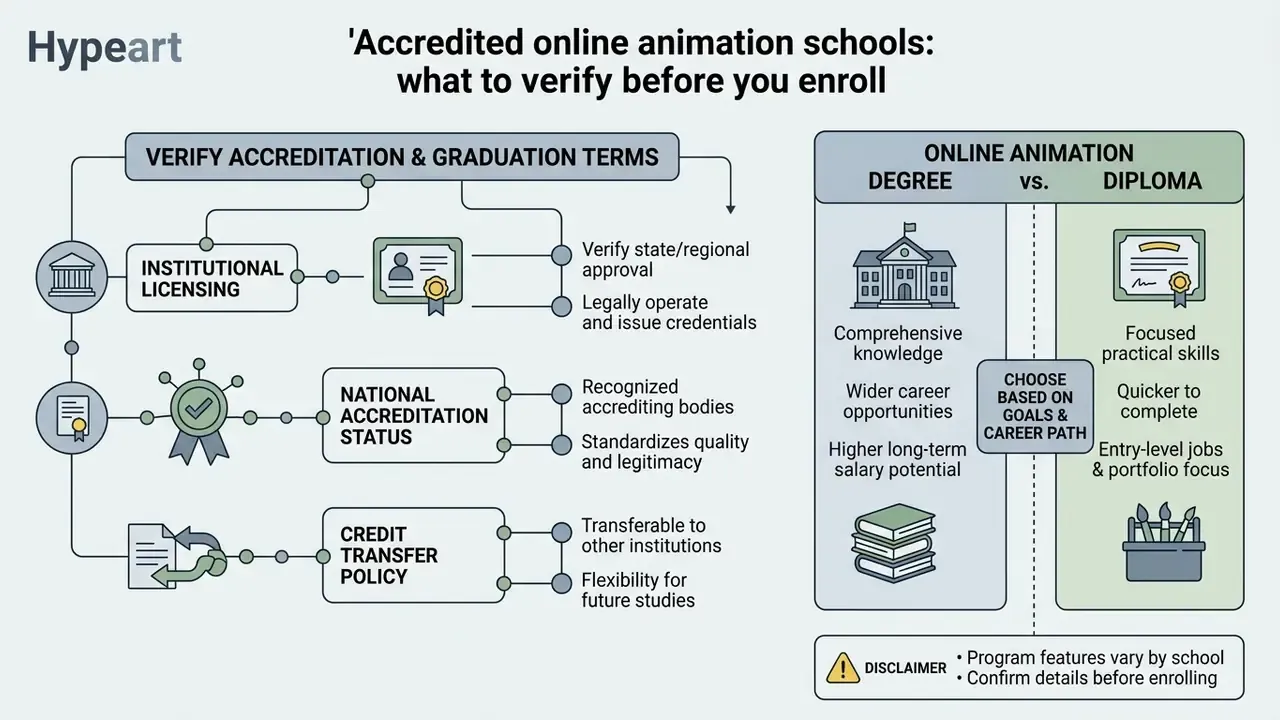
When you assess accredited online animation schools, verify institutional licensing, national accreditation status and credit transfer policy. Accreditation is what makes a degree or diploma hold formal academic and professional value, because it confirms the provider meets audited standards for curriculum design, governance and faculty qualifications.
In the United States, legitimate institutions hold accreditation recognized by the U.S. Department of Education (USDE) or the Council for Higher Education Accreditation (CHEA). Specialized institutions such as Gnomon and AnimSchool hold accreditation through the Accrediting Commission of Career Schools and Colleges (ACCSC).
«AnimSchool and Gnomon are accredited through ACCSC, confirming compliance with standards for curriculum quality and faculty qualifications.»
Gnomon additionally holds institutional approval from the California Bureau for Private Postsecondary Education (BPPE) and was named an ACCSC School of Excellence. Animation Mentor, by contrast, is a professional training provider that is not federally accredited, and that difference matters for credit transfer and visa applications, though not for reel quality. CG Master Academy's accreditation status could not be confirmed from primary sources, so we list it as unverified rather than guessing. Checking these credentials in official government databases is the cheapest protection against unaccredited diploma mills.
When you need an online animation degree and when a diploma is enough
An online animation degree matters when you are targeting regions, large corporate studios or government-backed entities that enforce educational prerequisites, or when applying for international work visas and post-study work permits. An animation diploma online or professional certificate is fully sufficient for freelance practice, boutique creative studios, and game development roles where reel execution outranks academic credentials.
Immigration frameworks often stipulate specific educational levels.
«Canada's PGWP accepts eligible degrees and diplomas from designated learning institutions, while several other pathways require at least a Level 7 bachelor's degree.»
How to verify accreditation and graduation terms
To verify an animation online school's accreditation, search the official database of the recognized educational authority in the school's home jurisdiction:
- United States: the USDE Database of Accredited Postsecondary Institutions and Programs (DAPIP) and CHEA directories. Confirm the accreditor itself is recognized by the Secretary of Education.
- United Kingdom: the UK Register of Learning Providers (UKRLP) plus Quality Assurance Agency (QAA) review reports.
- Russia: the Rosobrnadzor register of accredited organizations. Search by INN, OGRN or name, then check the list of accredited programs, their codes, validity period and region.
- International cross-check: the UNESCO/IAU WHED Portal and the CHEA International Directory show whether an institution or quality-assurance body is recognized in its own country.
Accreditation attaches to specific programs, not to a brand. Verify the exact program code and title, not just the school name.
Beyond institutional accreditation, read the graduation and credential-issuance terms. Legitimate schools publish required course credits, minimum grade point averages, capstone submissions and demo reel review criteria. Avoid providers that promise instant certificates without rigorous project assessment or continuous mentor evaluation.
Checklist0 / 9
How to compare the best online animation schools
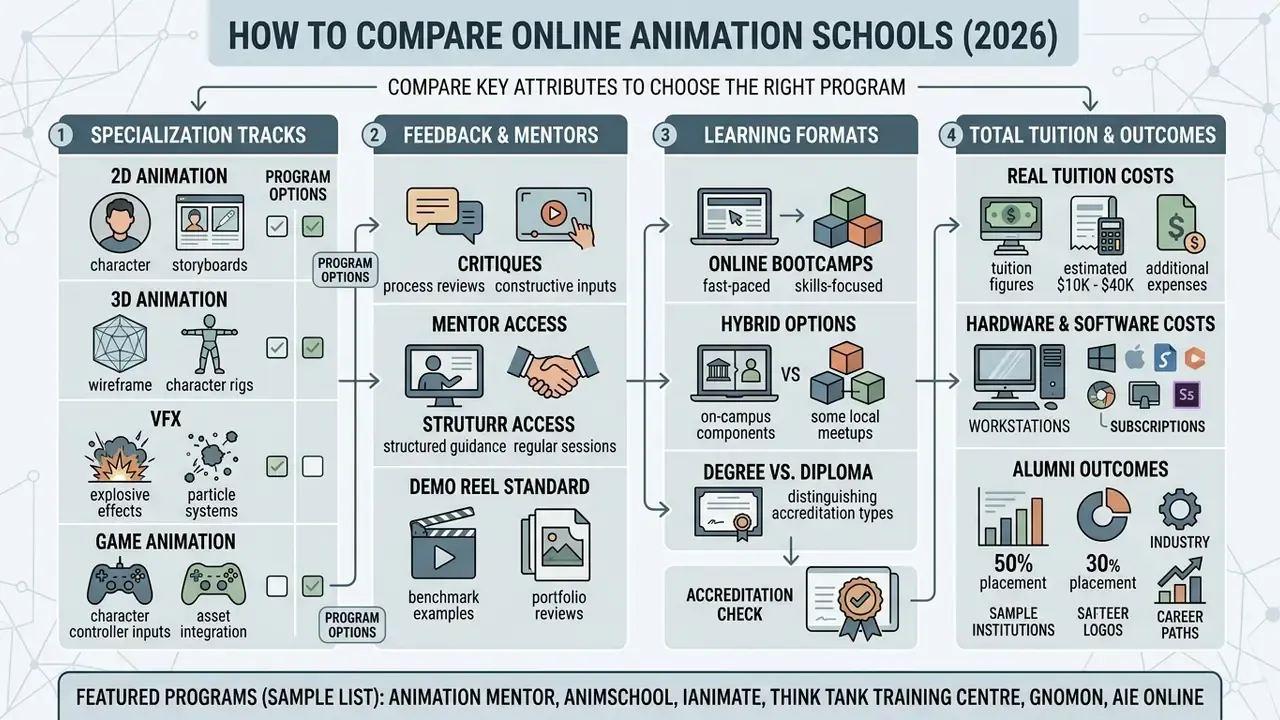
Specialized online bootcamps: Animation Mentor, AnimSchool, iAnimate and Think Tank
Beyond traditional universities, the main training grounds for 3D animators are specialized online schools founded by working studio supervisors from Pixar, DreamWorks, ILM and Blue Sky. They award certificates rather than degrees, yet they dominate character-animation hiring pipelines.
- Animation Mentor.Founded by Bobby Beck, Shawn Kelly and Carlos Baena, whose credits span Toy Story, Monsters, Inc., Star Wars and Pirates of the Caribbean. The core sequence is six consecutive 12-week courses: Animation Basics, Body Mechanics, Advanced Body Mechanics, Introduction to Acting, Advanced Acting, and Polishing & Portfolio. Students get two hours of on-demand lecture weekly, a weekly eCritique, live Q&A with the assigned mentor, and permanent access to the school's proprietary rigs (Bishop, Stella, Stan, Stewart). Workshops add cartoony animation, previsualization, creature locomotion, game animation fundamentals and combat attacks. Alumni community: 5,000+ artists across 105+ countries.
- AnimSchool.Founded in 2010 by Dave Gallagher, animator, rigger and former Character Development Supervisor at Blue Sky Studios. Its decisive advantage over Animation Mentor is a full 3D modeling and rigging curriculum, so a student can build a character from scratch and then animate it. Instructors come from Pixar, DreamWorks, Blue Sky and Sony (Ice Age, Horton Hears a Who!, Cloudy with a Chance of Meatballs, District 9). À la carte classes and multiple payment plans are available; the school is ACCSC-accredited with 316 total instructional clock hours, lecture and critique time included.
- iAnimate.Created by veteran animator Jason Ryan, a supervising animator at DreamWorks. Runs intensive 7-week workshops at roughly $1,000 per block, offers a dedicated game animation curriculum, a rigging curriculum, and a strong roster of rigs including a well-regarded quadruped, which is a real advantage for VFX creature work.
- Think Tank Training Centre.Vancouver-based, online since 2007. Its 16-month Specialized CG Training Program (Asset Creation) covers texturing and look development, modeling for film, character modeling for games, and environments for games, opening with a 14-week foundation term in Maya, Photoshop, Mari, Mudbox, 3D modeling theory, and shading, lighting and rendering in V-Ray.
- Gnomon (Los Angeles and online).More than 100 individual online courses, including Acting for Animators, Character Animation, Creature Animation, Previsualization and Animatics, Character Modeling and Sculpting, and Animation for Games. Graduates work at Walt Disney Animation, ILM, DreamWorks, Digital Domain, Blizzard, Sony Pictures Imageworks and Rhythm & Hues.
- Academy of Interactive Entertainment (AIE Online).Advanced Diploma in 3D Animation & VFX for Film, plus a two-year Diploma in Game Art & Animation that ends in a playable Major Game Project mirroring a real studio production cycle. US campuses are accredited by the Council on Occupational Education (COE); Australian qualifications sit within the Australian Qualifications Framework.
How to choose between them: Animation Mentor for pure character acting and body mechanics; AnimSchool if you want to model and rig as well as animate; iAnimate if you are targeting games or creature work; Think Tank or Gnomon for asset creation, texturing and look development; AIE if you want a diploma-level credential with a shipped game in the portfolio.
Comparing 2D, 3D and game animation tracks
Different top online animation schools excel in different niches. When you compare curricula, align the subject breakdown with the industry path you actually want.
- 2D Animation Trackgesture drawing, character design, storyboarding, vector rigging, frame-by-frame timing and 2D compositing. This is the core of most 2d animation schools online.
- 3D Character Track3D geometry modeling, UV unwrapping, skeletal rigging, inverse kinematics, weight painting, character performance and Maya or Blender lighting. Any credible 3d animation school online will gate progression on body mechanics before acting.
- Game Animation Trackstate machine setup, cyclic motion loops, physics blending, collision hit reactions and direct engine export into Unreal Engine or Unity. An online game animation degree should include at least one playable deliverable.
Delivery format, feedback and student work
Format shapes results. Asynchronous pre-recorded lectures allow flexible scheduling, but they need synchronous webinars or personalized video critique to keep skill progression steady. Guidance for remote teaching recommends short instructional videos, roughly ten minutes per concept, with recordings available for review, while live webinars carry real-time Q&A and attendance tracking.
Satisfaction with a platform, however, is not the same as engagement:
That finding is the practical argument for cohort structure. Fixed deadlines, live critique and peer review counteract the distraction effect that pure self-paced video cannot.
Graduate portfolio showcases remain the most reliable indicator of an online animation school's instructional quality. Look for student reels with clean character motion, convincing weight, appealing silhouettes and composed scenes, not software exercises with a default grey floor. When assembling those reels, students on a budget can start with the tools reviewed in our guide to free video editing software before committing to a paid NLE.
Comparative analysis of representative online animation programs (2025–2026)
| Institution / Program | Qualification type | Format and duration | Core specialization | Feedback format | Indicative cost |
|---|---|---|---|---|---|
| Buckinghamshire New University, BA (Hons) Animation (Online) | BA (Hons) degree | 100% online distance learning, 3 years full-time | 2D/3D animation, VFX, games art, layout | Practical assignments, video reviews, essays | £8,430 per year (fixed, Home/Overseas) |
| SUNY Empire State University, Digital Media Arts | Bachelor's degree | 100% online, 124 credits | Digital imaging, media arts, design, motion graphics | Asynchronous platform, project assessment | $295 per credit (about $36,580 total) |
| CG Spectrum, 3D Animation Diploma / Degree | Diploma / degree | Online, 7 months (diploma) to 2 years (degree) | 3D character animation, Maya pipeline, portfolio | Personalised mentor feedback | $16,664 USD (diploma) / $49,992 USD (degree) |
| The Animation School, Online Diploma in Digital Animation | Diploma | Online full-time, 1–3 years | 3D animation, digital production, VFX | Live online sessions plus independent projects | R123,900 – R157,300 per year (SA / international) |
| UC Leeds, FD Animation | Foundation degree (FD) | Blended / hybrid, Level 4 (1–2 years) | 2D and 3D techniques, animation theory, portfolio | Written analysis (30%) plus practice (70%) | On request / standard UK fee rates |
| Animation Mentor, Character Animation sequence | Certificate of Completion (not accredited) | Online cohort, 6 × 12-week courses (18 months) | Character acting, body mechanics, creature and game workshops | Weekly eCritique plus live mentor Q&A | Per-course pricing; workshops 6–12 weeks |
| AnimSchool, Animation / 3D Character Program | Certificate (ACCSC-accredited school) | Online, à la carte classes, 316 instructional clock hours | Animation plus 3D modeling and rigging | Weekly live class critique from studio artists | Term-based with multiple payment plans |
| iAnimate, Film / Games / Creature workshops | Workshop certificate | Online, 7-week intensive blocks | Game animation, creature and quadruped work, rigging | Weekly mentor critique in live sessions | About $1,000 per 7-week workshop |
| Think Tank Training Centre, Specialized CG Training (Asset Creation) | Program certificate | Online, 16 months (14-week foundation term) | Modeling, texturing (Mari/Mudbox), V-Ray rendering, games environments | Supervised term projects and mentor review | Term-based; on request |
| AIE Online, Diploma of Game Art & Animation | Diploma (COE / AQF) | Online, 2 years | Modeling, texturing, UVW, rigging, animation, playable game project | Studio-style project reviews | On request per campus or region |
Cost of an online animation degree and how to reduce it
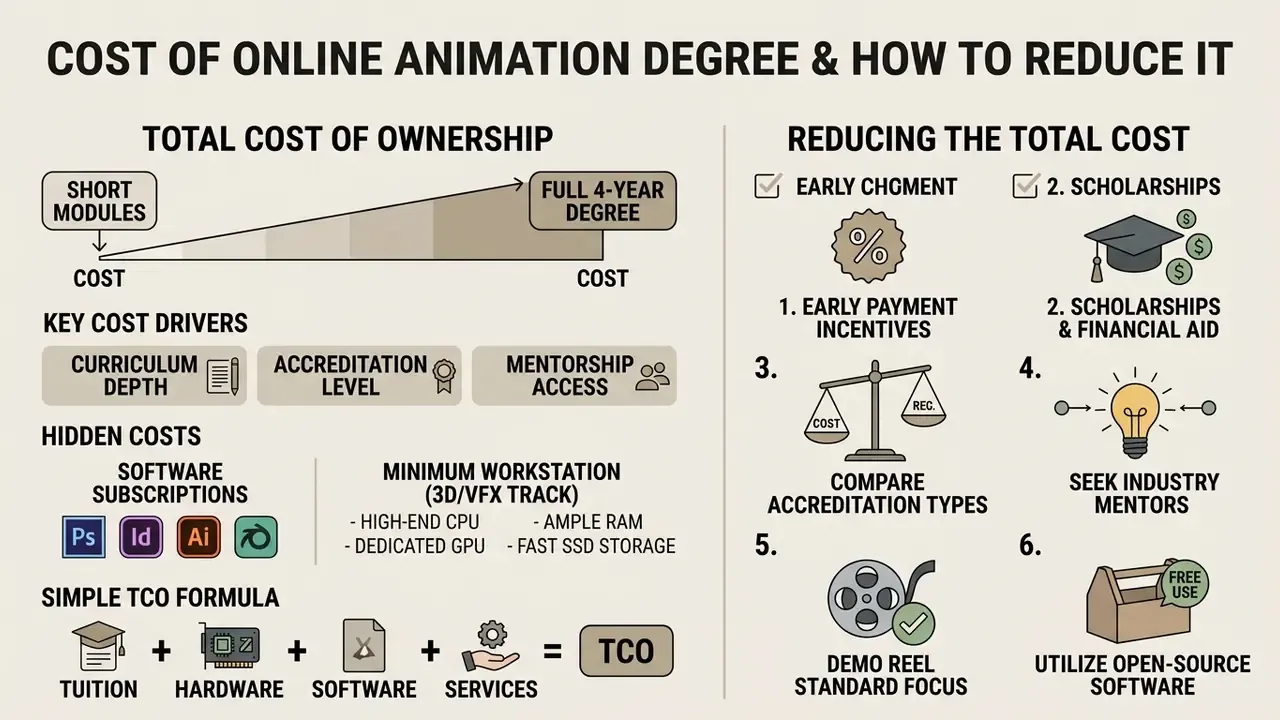
Attending an online animation school costs anywhere from a few hundred dollars for a short skill module to more than $35,000 for a full four-year undergraduate degree. Fee structures, technology requirements and financial support mechanisms are what decide whether a program is affordable for you specifically.
A cheap online animation degree or discounted diploma lets students acquire studio skills while limiting academic debt. Institutions usually price per credit or as a flat annual tuition, which allows part-time learners to spread costs. Regional examples show the spread: Yoobee lists a Diploma in Animation at NZ$27,300 plus NZ$2,400 in resource fees, and a Bachelor of Animation at NZ$27,300 per year (NZ$81,900 total plus NZ$6,400 in fees), while LaSalle charges per semester with subsidised rates for Singaporean citizens and permanent residents. For a broader view of how creative-tool and training budgets stack up, our AI Media Pricing Guides track subscription and licence costs that sit next to tuition.
What drives the price of an animation degree or diploma
Tuition for an online animation degree or diploma is set by a handful of operational variables:
- Institutional status. Public state universities and non-profits generally price below specialized private digital arts academies. That is also why the best online animation degrees are not automatically the most expensive ones.
- Instructional clock hours. Degree programs requiring 120+ credit hours cost far more than focused 300-clock-hour technical diplomas.
«Programs with 120+ credit hours cost substantially more than technical diplomas of roughly 300 hours, reflecting differences in curriculum depth and scope.» AnimSchool Catalog (2026). https://www.animschool.com
- Instructor expertise and critique time. One-on-one video critique from senior studio supervisors commands higher tuition than asynchronous self-study. ANU's animation course allocates 130 hours of total student learning time, of which 48 are contact hours with critique and supervised studio practice, priced at A$3,600 domestic and A$4,980 international.
- Software and infrastructure access. Cloud rendering credits, software licences and virtual workstation access (for example AppsAnywhere) all land in the fee (Buckinghamshire New University Specification, 2026).
Scholarships and financial aid for animator programs
Funding sources fall into four buckets: institutional grants, merit scholarships, early-payment discounts and external corporate sponsorships.
Institutional grants and discounts
- Syracuse University Start Now Grant: up to a 30% discount on undergraduate credits for online learners, applied to the first 15 credits.
«Syracuse University's Start Now Grant provides up to a 30% discount on undergraduate credits for online students.» Syracuse University College of Professional Studies (2025). https://syr.edu
- Vancouver Film School and Miami Dade College:
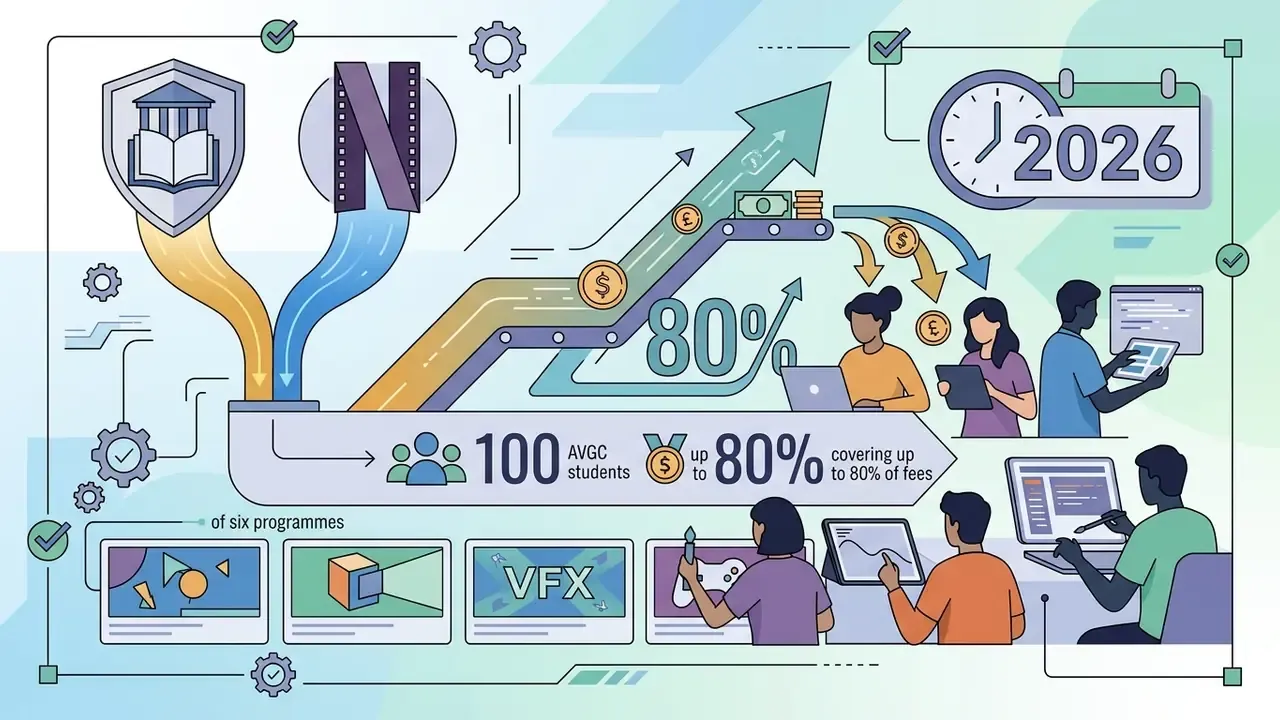
«Vancouver Film School allocates a scholarship fund of CAD 145,000, while Miami Dade College offers Epic Unreal Engine scholarships for game design and animation students.» VFS Scholarship Announcement (2026); Miami Dade College Grants (2026). https://www.vfs.edu
MDC's Epic Unreal Engine award requires admission, a GPA of 3.00 or higher, a reference letter and demonstrated financial need under federal aid standards.

Industry-specific animation scholarships
Cost structure of animation study formats and available discounts (2025–2026)



| Study format | Example program | Duration | Price range | Cost-reduction and financial aid options |
|---|---|---|---|---|
| Single / short course | 2D or 3D module (Chichester, SUNY, Ringling via Kadenze) | 1 term (30 credits / 6–10 weeks) | $800 – $1,500 per module | Corporate discounts, single-course grants (Start Now Grant up to 30%) |
| Mentor workshop block | iAnimate 7-week workshop / Animation Mentor workshop | 6–12 weeks per block | About $1,000 per block | Pay-per-workshop model, à la carte enrolment, no long-term debt |
| Professional diploma | CG Spectrum / AnimSchool / Yoobee / AIE diploma | 7 – 24 months | $6,500 – $16,664 total (NZ$27,300 Yoobee) | Term instalments, up-front payment discounts (5–10%), private and industry scholarships |
| Online bachelor's degree | Buckinghamshire New University / SUNY Empire / Yoobee Bachelor | 3 – 4 years (120–124 credits) | £8,430 per year (about $25,290) to $36,580 total; NZ$81,900 | Government aid (FAFSA in the US), merit scholarships, fixed multi-year tuition rates, grants of $11,000–$15,000 at some providers |
What careers online animation programs open up
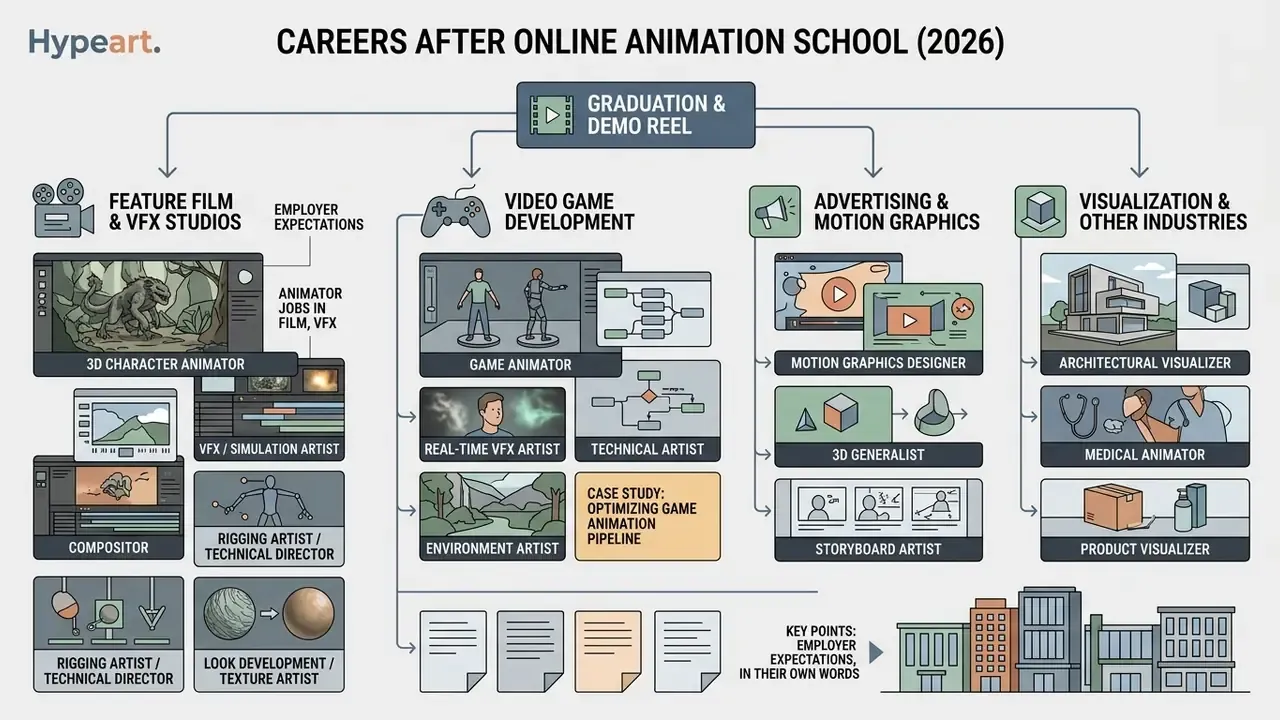
Graduating from an online animation school opens pathways across feature film production, visual effects studios, video game development, advertising agencies, architectural visualization and medical animation.
According to BLS data and industry salary surveys, income varies substantially by specialization and experience:
- Junior 3D animator or graphic artist (entry level): $41,390 to $51,045 per year (graphic artist median $41,390; 3D animator median $51,045; 3D artist median $51,602).
- 3D generalist or character rigging specialist (mid-level): $51,602 to $75,000 per year.
- Senior special effects artist and lead animator (film, VFX, games): median $102,030 per year ($49.06 per hour), with leads at major California and New York studios earning $140,000 and above.
«BLS reports a median annual wage of $102,030 for special effects artists and animators in May 2025, well above the average for all occupations.»
Case study, optimizing a game animation pipeline (illustrative composite)
Situation: A gaming startup needed 3D character combat animations but suffered from inconsistent frame timing and poor engine performance.
Action: It hired a graduate of a 3D game animation program who implemented optimized blend spaces and physics-driven hit reactions in Unreal Engine 5.
Result: Character animation setup time dropped by about 40% and the title's combat demo shipped ahead of schedule.
National employment for animators is projected to grow modestly, so competitive studio positions still hinge on an exceptional reel and specialized technical depth.
«O*NET reports 57,100 special effects artists and animators employed in the US in 2024, projected to reach 58,000 by 2034 (+2%), with roughly 5,000 openings annually.»
Employer expectations, in their own words. AUT's 2025 program documentation maps graduate destinations to VFX artist, animator, motion capture artist, technical director, game designer, concept artist and game-engine coder. UVU's 2026 specification requires graduates to deliver 2D, 3D and hybrid assets, interactive mechanics, team-based production, and asset, animation and code optimization. PNCA states it plainly: employers look for a strong portfolio, technical skills, and the ability to revise work based on feedback.
Studios also increasingly expect junior artists to understand licensing and rights, especially where generative tools touch production art. Our AI Media Commercial-Use Hub covers those constraints, and the AI Litigation and Case Timelines tracker follows the disputes that keep reshaping them.
Animator jobs in film, VFX and animation studios
In feature animation and visual effects, animators work inside highly structured linear pipelines. Work moves from pre-production (storyboarding, visual development) to production (3D layout, character rigging, keyframe animation, lighting) to post-production (compositing, color grading, final rendering). In 3D and VFX specifically the shot path runs storyboards and animatics, then previs, asset creation, layout, rigging and animation, lighting and rendering, assembly and compositing, then final output, with shot approval, colour correction and QC gates controlling frame quality before delivery.
Key specialist roles:
- 3D Character Animator character acting, body mechanics, facial expression and performance timing.
- Rigging Artist / Technical Director digital skeletons, deformers and control interfaces for 3D models. Larger facilities expect scripting fluency here, and pipeline TDs often work directly against internal tooling documented much like our AI Media API Guides.
- VFX / Simulation Artist fire, smoke, water, cloth and hair simulation in Houdini or Maya.
- Compositor integrating rendered 3D elements with live-action plates in Nuke or After Effects, a role that also rewards broader editorial fluency, as covered in our video editor reference.
- Look Development / Texture Artist building surface response in Substance Painter, Mari and V-Ray or Arnold.
One evidence note. The advice to tailor a reel to a single discipline rather than a generic mixture is directly supported by studio guidance. Riot Games instructs candidates to submit a small number of strong, relevant pieces with a motion reel of about one minute, plus iterations and references. JCCC's 2025 outlook report likewise notes that employers prefer an impressive portfolio and strong technical skills over credential volume. A mixed reel of unpolished modeling, animation and motion graphics signals no specialization to any hiring lead.
Game animation and building a games portfolio
Game animation differs from linear film animation in one structural way: motion must respond to player input and real-time engine physics. Game animators build cyclic loops (walks, runs, idle states) and transitions that blend cleanly whatever the player does next.
A competitive game animation portfolio has to demonstrate three things. Concept work supporting it can be prototyped quickly with the tools in our AI art generators comparison before final assets are built by hand.
- Clean cyclic loops: walk cycles, run loops and combat idles viewed from multiple camera angles.
- State machine integration: transitions between idle, locomotion and attack states in Unreal Engine or Unity, using Animation Sequences, Blend Spaces and AnimNotifies.
- Real-time physics: bone-level hit reactions and ragdoll blending with tools such as Unreal Chaos Physics.
«Unreal Engine provides Chaos Physics tools for bone-level simulation, including hit reactions and real-time ragdoll blending.» Epic Games Documentation (2025). https://dev.epicgames.com
In practice that means identifying the hit bone, calling Set All Bodies Below Simulate Physics, then blending Physics Blend Weight up to 1.0 and back down to 0.0. In Unity,
Animation.animatePhysicsexecutes animation inside the physics loop and is only useful with kinematic Rigidbody components.Anatomy of a 60-second demo reel by track
| Segment | 2D animation reel | 3D character reel | Game animation reel |
|---|---|---|---|
| 0:00–0:05 | Name card plus strongest 3-second shot | Name card plus best acting beat | Name card plus best combat hit |
| 0:05–0:20 | Character performance / lip sync | Body mechanics (jump, lift, throw) | Locomotion set: walk, run, strafe, turn-in-place |
| 0:20–0:35 | Effects or vector rig demo | Dialogue shot with clear subtext | Attack combo with hit reaction and recovery |
| 0:35–0:50 | Second character or short film excerpt | Quadruped or creature shot | In-engine capture: state machine transitions, blend spaces |
| 0:50–1:00 | Contact card, credits, software list | Live-action reference split-screen plus contact card | Engine and tool list plus contact card |
| Format | 1080p, H.264, no music louder than the work | Playblast quality acceptable; label shot ownership | Include raw engine capture, not just rendered cinematics |
Keep a lightweight version for email applications: compress it under 100 MB without visible artefacting (see the video compressor guide) and host the master on a stable platform. Many candidates also publish a breakdown version through a YouTube video editor workflow for recruiters who prefer streaming to downloads.
The cookie-cutter demo reel trap
Recruiter warning. Studios such as Pixar, ILM and Riot Games review hundreds of reels every month from graduates of the same online schools. Using default training rigs (Stewart, Bishop, Stella) in standard dialogue exercises makes your portfolio indistinguishable from everyone else's.
The work itself is usually excellent. That is precisely the problem. Differentiation, not competence, is the bottleneck. How to stand out:
- Build or customize your own character. Even one unique rigging element, a tail, an extra limb, a prop constraint, signals technical initiative.
- Include quadruped and creature animation plus environmental interaction. Feature and VFX pipelines at Rhythm & Hues, ILM and Digital Domain constantly need creature work, and roughly four out of five student reels contain only bipedal dialogue shots. iAnimate's quadruped rig and Animation Mentor's newer creature and animal workshops exist for exactly this reason.
- Add live-action reference in the corner of the frame. Your own filmed performance next to the animated shot proves your process, not just your result.
- Ask alumni, not admissions. Search school-specific forums and Discords, then ask graduates from the last two intakes what actually happened after they finished.

How to start studying at an animation school online
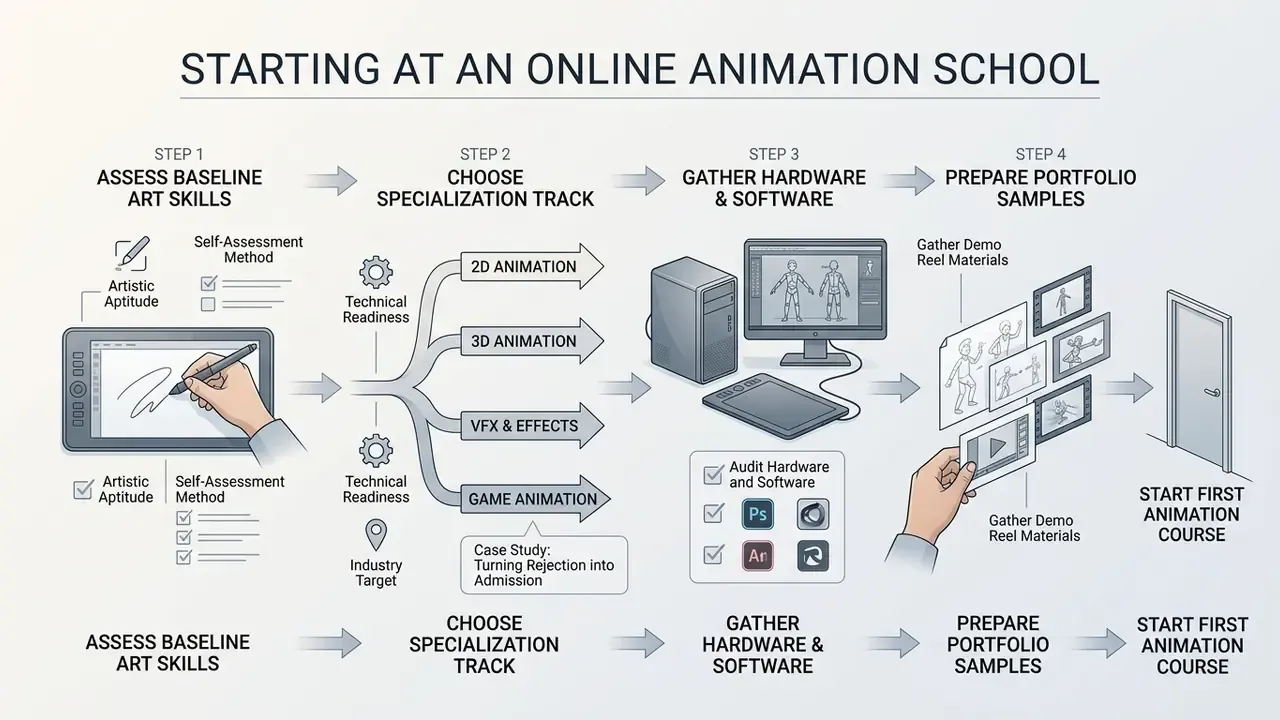
Starting at an animation school online involves four steps: assess your baseline art skills, choose a specialization track, gather the hardware, and prepare portfolio samples for admission review. A structured plan removes most of the first-term friction.
Across the institutions reviewed, online admission follows a consistent flow: submit the application form, upload documents (transcripts, ID, photos or an equivalent learner file), confirm payment or contract, then receive account activation and platform access. Several animation colleges hold no entrance exam at all and admit on school-record average plus portfolio review.
Choose a specialization based on your art skills and career goal
Before applying to online schools for animation, evaluate your technical strengths and long-term preferences with a three-part assessment:
- Artistic aptitude. Strong at freehand drawing, character sketching and visual storytelling? Consider 2D animation or visual development. Prefer spatial design, 3D geometry and technical problem-solving? Target 3D modeling, rigging or game animation.
- Technical readiness. Rate your comfort with digital software, hardware management and self-directed debugging. This one is often the hidden blocker.
- Industry target. Align training with the work environment you want: feature film studios, indie game development, commercial advertising or remote freelance practice.
«Perceived usefulness of online study significantly affects both satisfaction and intention to continue, confirmed on a sample of 487 art and design students.»
A concrete self-assessment method. Published drawing rubrics score line quality (smooth and rhythmically controlled versus stiff and jagged), proportion setup, gesture and likeness, whole-to-part relationships, edges and transitions, and error correction. Competency guides for animation add a motion-mechanics check: can you calculate intermediate positions of a figure, produce key drawings, and hold a smooth flow of movement? Score each item 1 to 4 honestly, then choose the track where your lowest scores are trainable within the program rather than assumed as prerequisites.
Prepare your work and start your first animation course
Once the specialization is set, assemble a starter portfolio of your strongest work. Most accredited online animation schools ask for life drawing sketches, character designs, digital illustrations or simple motion tests at application. Concept-stage exploration can be accelerated with the tools in our AI image generators comparison, but reviewers expect hand-authored fundamentals. Label any generated material clearly and never present it as drawing skill.
Then follow this onboarding roadmap:
Sound and voice work often decide whether an acting shot reads at all. If your school does not supply dialogue tracks, our overview of AI voice generators covers licensing constraints for reel audio, and the photo editor guide is useful for cleaning up concept plates and texture references.
FAQ
Do I need to draw by hand to study 3D animation?
You do not need illustration-level rendering skill, but you do need gesture, proportion and posing literacy, because those are what make a 3D pose read. Every curriculum reviewed here (VIA, NMIMS, Mangalore, Berkeley) places drawing before modeling and rigging for that reason. For 2D and visual development, drawing is non-negotiable.
Is an online animation school taken seriously by studios?
Studios hire from reels. Animation Mentor, AnimSchool, iAnimate, Gnomon and Think Tank alumni work at Pixar, DreamWorks, ILM, Blizzard, Sony Pictures Imageworks and EA. What is not interchangeable with a degree is legal recognition: only accredited institutions support credit transfer and immigration pathways.
Can I break into animation after 30 or 40?
Yes. A significant share of students at animation online schools are working professionals from adjacent fields (graphic design, motion graphics, illustration) retraining while employed. Age is not a screening criterion. Reel quality and pipeline fluency are.
How do I get professional software legally as a student?
Autodesk, SideFX, Foundry, Adobe and Maxon all run educational licence programs requiring verifiable student status. Confirm before enrolment that the school issues the documentation those programs need, and remember that educational licences prohibit commercial use and expire at graduation. Blender and DaVinci Resolve carry no such restriction.
Diploma or degree if my goal is games?
For most game studios, a diploma or certificate plus a strong engine-based reel is enough. iAnimate's game curriculum and AIE's Diploma of Game Art & Animation are built for exactly that. Choose a degree if you need visa eligibility, plan to teach, or target large corporate employers with formal HR education gates.
How long until I can apply for jobs?
Realistically 12 to 24 months of consistent study for a first junior-level reel, based on the program structures compared above. Seven-month diplomas do produce a reel, though most graduates keep iterating on it for several more months. Plan a three to six month job-search window after the reel is finished.
Are AI tools replacing animators?
Current generative systems produce motion that is not shot-directable at studio precision, and studios still hire keyframe animators, riggers and technical directors. The practical impact lands on concept, previs and iteration speed, which is why understanding both classical pipelines and systems such as pika labs ai video generation is more useful than picking a side. Our breakdown of pika labs ai shows where the current limits sit.
What if a school publishes no employment statistics?
That is the norm rather than a red flag on its own, since none of the five leading bootcamps publishes comparable placement rates. Substitute your own evidence: the last two intakes' showcase reels, alumni LinkedIn destinations, and direct questions to graduates in forums.
E-E-A-T block
- Editorial expert profile and methodology for independent evaluation of online animation schools.
- Detail: Author, Marcus Hale, author. All institutional data in this guide comes from primary sources: published program specifications (UC Leeds, Buckinghamshire New University, SUNY Empire, VIA, NMIMS), school catalogues (AnimSchool, CG Spectrum, The Animation School, Think Tank, AIE), government registries (DAPIP, CHEA, UKRLP, QAA, Rosobrnadzor, IRCC) and labour-market datasets (BLS, O*NET). The analytical methodology follows the National Standards for Quality Online Programs (2025), the ICDE Quality Network framework (2023) requiring transparent standards, stakeholder involvement, retention and completion data and continuous improvement, plus the E-E-A-T model from the Google Search Quality Rater Guidelines. Schools are scored on five criteria: transparent accreditation, mentor credentials with verified studio credits, graduate demo-reel quality, curriculum alignment with published junior-animator competency standards, and documented career-track support. Prices and program lengths were current at the date of update and should be reconfirmed with the institution.
General disclaimer. This article is informational and does not constitute immigration, legal or financial advice. Tuition figures, scholarship amounts, accreditation statuses and visa rules change. Verify all of them directly with the institution and the relevant government authority before making a payment or an immigration decision.
Explore more industry definitions, technical guides and educational standards in our AI Media Glossary.