Executive Summary for Decision-Makers
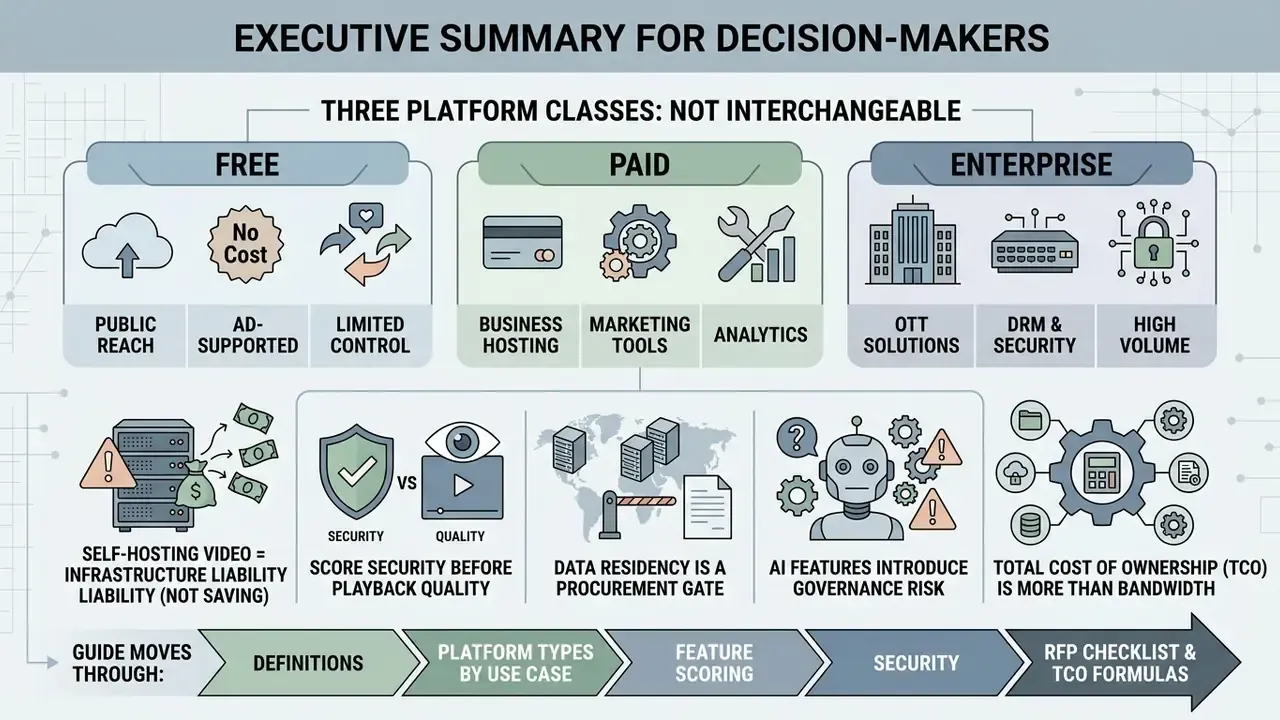
- Three platform classes exist, and they are not interchangeable. Free video sharing platforms buy reach with your data and branding; commercial marketing platforms buy pipeline attribution; enterprise online video platforms buy governance, encryption, and audit trails.
- Self-hosting video is an infrastructure liability, not a saving. Sixty seconds of 1080p video served to ten concurrent viewers consumes roughly the same egress as a thousand text-and-image page views.
- Security should be scored before playback quality. Multi-DRM, SAML 2.0 SSO, SCIM provisioning, dynamic watermarking, signed URLs, and SIEM-ready audit log export separate enterprise-grade platforms from consumer hosting.
- Data residency is now a procurement gate. Regulated organizations must confirm physical server geography, GDPR and Schrems II posture, zero third-party tracking in the player, and IP or geo-fencing controls.
- AI features introduce new governance risk. Automatic speech recognition, semantic search, and generated transcripts must be covered by contractual zero-data-retention and model-training opt-out clauses.
- Total cost of ownership is more than bandwidth. Model egress, storage, seats, live concurrency, DRM and eCDN add-ons, plus internal control costs (SSO integration, GRC workflow, log ingestion) in one formula before signing.
This guide moves through the definition of an OVP, platform types by use case, feature scoring, security and data residency, delivery quality, analytics and AI governance, a vendor comparison matrix, the free versus paid decision, pricing and monetization models, launch and upload specifications, an RFP checklist, and a buyer FAQ.
What Is an Online Video Platform and How Does It Work?
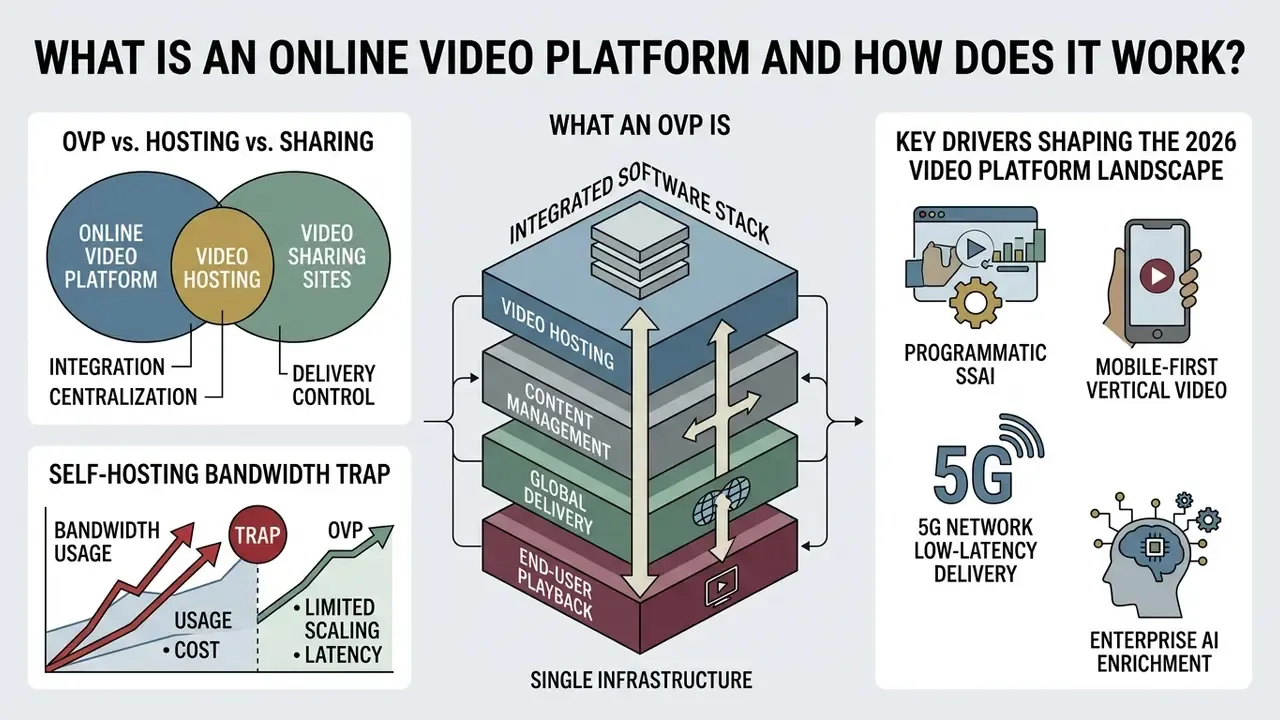
An online video platform is an integrated software stack that centralizes video hosting, content management, global delivery, and end-user playback into a single infrastructure. It lets organizations transcode raw video files into adaptive bitrates, enforce access controls, stream content across devices, and collect session-level viewer analytics.
Modern businesses rely on an online video platform provider to remove technical delivery bottlenecks and keep direct oversight of media assets. Research from Global Market Insights indicates that the global online video platform market reached $2.45 billion in 2023 and is projected to expand at a compound annual growth rate above 18% through 2032 (Global Market Insights, 2023).
«SaaS delivery models accounted for over 69% of the OVP market in 2023, and the sector is forecast to reach $71.91 billion by 2035 at a 17.65% CAGR.»
The Self-Hosting Bandwidth Trap: Hosting raw video directly on standard web servers or CMS infrastructure (for example, direct MP4 files in WordPress) creates severe network bottlenecks. Streaming just 60 seconds of 1080p HD video to 10 concurrent viewers consumes roughly 150 MB of egress bandwidth, the equivalent load of serving over 1,000 standard text-and-image webpages simultaneously. Without adaptive bitrate streaming via a multi-CDN OVP, small traffic spikes will crash origin web servers, exceed hosting limits, and trigger heavy egress penalties.
That growth is driven by demand for enterprise video management, controlled live streaming, and personalized delivery algorithms. According to Global Market Insights, SaaS-based deployment supplied more than 69% of OVP market revenue in 2023, reflecting the structural migration of enterprises toward managed cloud hosting rather than self-operated media servers (Global Market Insights, 2023).
Unlike basic file storage services, specialized online video platform software automates the complete lifecycle of video content, and increasingly interoperates with production tooling such as AI video generators that feed master files into the ingest queue. When media is ingested, the system processes raw streams through automated encoding ladders, optimizes packaging for HTTP Live Streaming (HLS) or Dynamic Adaptive Streaming over HTTP (DASH), and distributes cached segments via Content Delivery Networks (CDNs). The integrated video player executes adaptive bitrate switching on the client side, keeping playback stable while transmitting telemetry back to centralized analytics systems.
Terminology drifts, by the way. Buyers search for online video technology, online video providers, and even the mistyped "online video plattform" while describing the same procurement problem.
Key Drivers Shaping the 2026 Video Platform Landscape
Recent architectural shifts in telecommunications and ad-tech have restructured platform priorities:
- Programmatic Server-Side Ad Insertion (SSAI) Automated ad auctions integrated into the streaming manifest stitch ad content directly into the stream, bypassing browser ad-blockers, combining first-party data with inventory targeting, and maximizing publisher monetization yield.
- Mobile-First Vertical Video Processing A large majority of streaming sessions now start on smartphones. Platforms therefore offer native automated cropping and transcoding pipelines tuned for vertical (9:16) delivery, supporting short-form formats such as Shorts and Reels alongside interactive ad units.
- 5G Network Low-Latency Delivery Dense 5G edge networks allow multi-angle 4K live streaming with sub-second glass-to-glass latency, enabling real-time audience polling, multi-camera sports feeds, and live commerce streams.
- Enterprise AI Enrichment Automated translation, synthetic avatars, auto-chaptering, and engagement scoring shorten production cycles and push video platforms into broader digital transformation and learning-technology programs.
Online Video Platform vs. Video Hosting vs. Video Sharing Sites
The structural differences between dedicated video hosting platforms, online video sharing platforms, and consumer online video sites center on administrative control, branding autonomy, and data privacy.
- Video Hosting Platforms Pure video hosting services prioritize technical delivery, API access, and basic storage without imposing third-party branding or algorithms. They provide essential infrastructure for raw playback but lack advanced governance, marketing integrations, or deep audience management.
- Online Video Sharing Platforms Public online video sharing sites (YouTube, Dailymotion) focus on user-generated content distribution and global reach. Regulatory findings from Ofcom and European audiovisual framework analyses note that video sharing platforms operate under open-access models with ex-post content checks (Ofcom, 2022; European Audiovisual Observatory, 2018). The uploader gives up control over adjacent recommendations, viewer data, and player branding in exchange for public discovery.
«Motives for watching user-generated video cluster into entertainment, information seeking, social interaction and self-expression.»
Core Workflow: Upload, Host, Stream and Embed Videos
The operational architecture of an online video publishing platform follows a standardized pipeline designed to maximize stream quality and minimize latency across mixed device environments.
- Ingest and UploadThe uploader transmits a master media file to an online video portal via dashboard, API, or automated batch protocol. Vendor-published ingestion documentation for enterprise APIs (JW Platform among them) states support for single-file uploads in the 100 GB range and batch URL ingestion of up to 100 assets per request. These are vendor claims and should be validated against your contracted tier during technical due diligence.
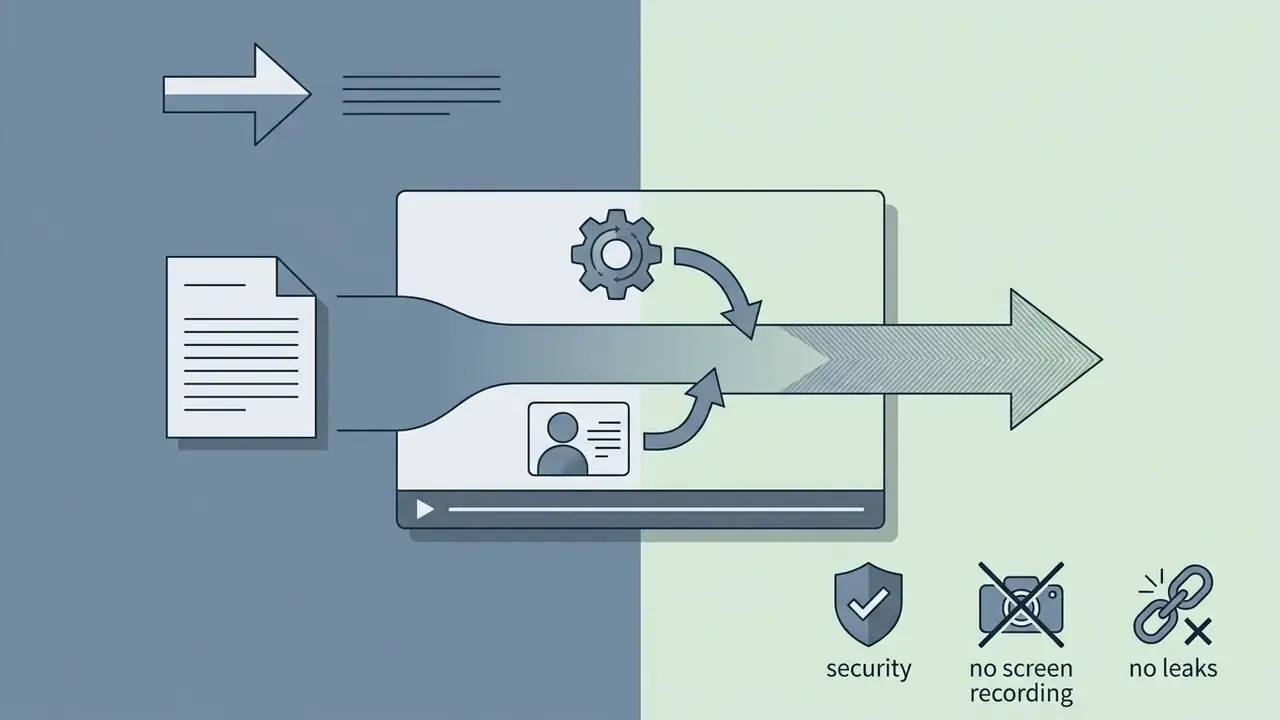
- Transcoding and Content ManagementThe platform encodes the master file into multiple renditions at varying resolutions and bitrates. Metadata, access policies, dynamic watermarks, and Digital Rights Management (DRM) rules are appended to the asset container.
- Hosting and Global DistributionEncoded video segments are archived in origin storage and cached across edge nodes within global CDNs. IETF technical standards (RFC 9317) specify that segment-based HTTP distribution allows edge nodes to serve requests with minimal latency (IETF, 2022).
- Playback and EmbeddingThe video content is embedded onto an online video website using HTML5 container scripts or secure SDKs. The embedded video player executes adaptive bitrate algorithms, matching segment downloads to real-time local network bandwidth.
- Analytics and Telemetry CollectionDuring playback, the player registers viewer events such as session start, buffering interruptions, frame drops, and completion, then transmits telemetry to the platform's analytical engine (Adobe Media Analytics, 2024).
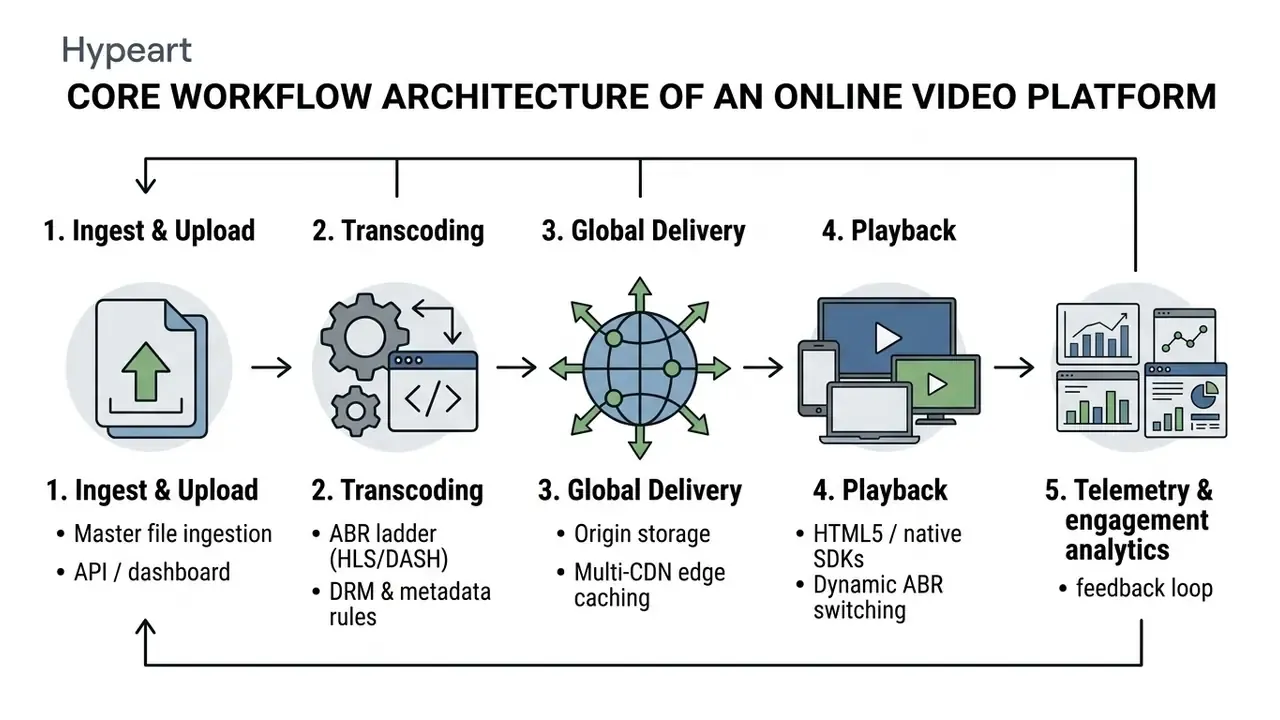
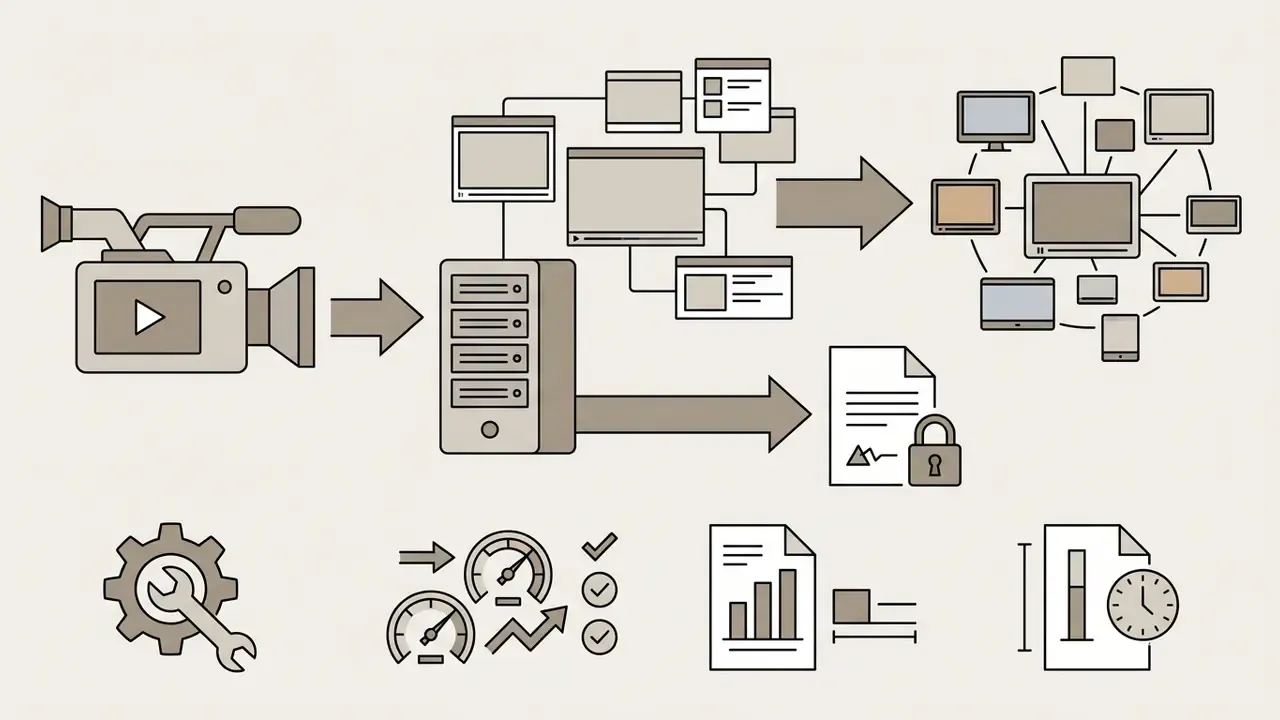
Figure 1 caption: architectural lifecycle of media assets traversing an enterprise online video platform, from ingest to client-side telemetry reporting. Stage 1 accepts the master file, stage 2 builds renditions and attaches rights rules, stage 3 caches segments near the viewer, stage 4 renders playback with client-side adaptation, and stage 5 returns session data to analytics and audit systems.
Types of Online Video Platforms by Business Use Case
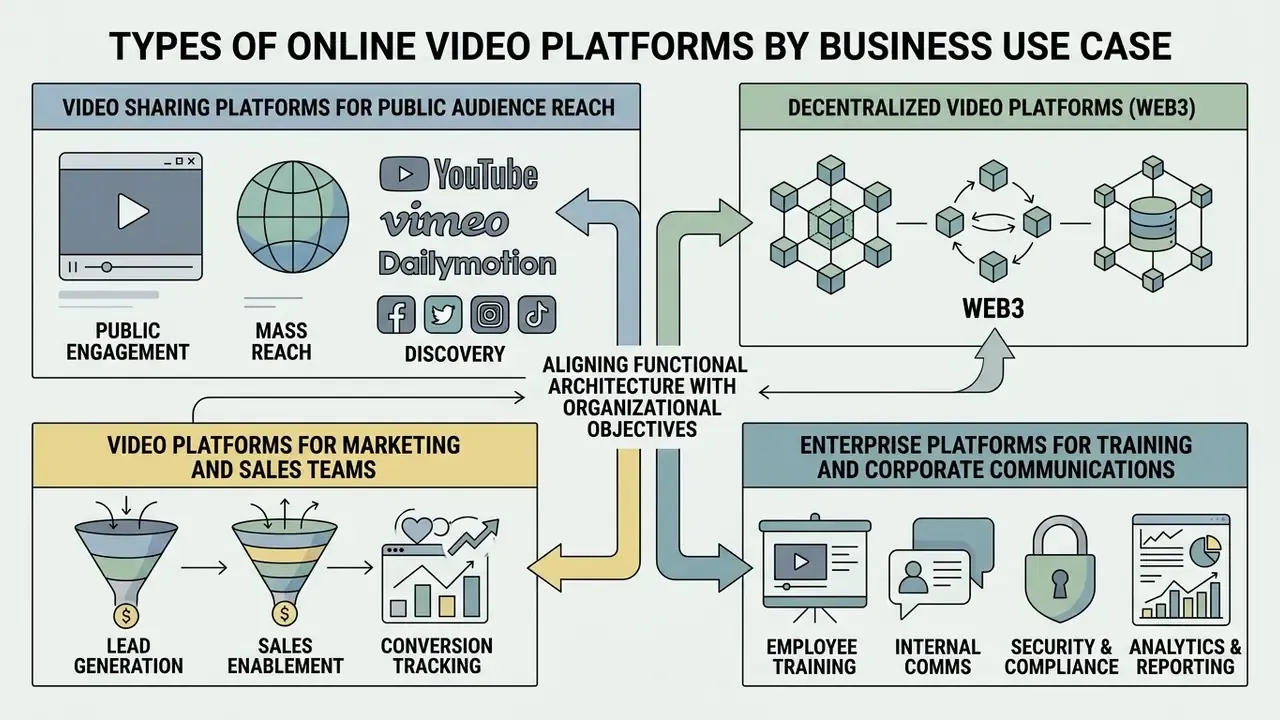
Selecting among online video platforms means aligning functional architecture with organizational objectives. Most organizations sort platform adoption into four business use cases: public audience acquisition, digital marketing and sales enablement, corporate training, and secure internal communications.
Here is an illustrative, composite example rather than a documented client engagement. A commercial bank scaling customer education across digital channels evaluated several deployment patterns. Unlisted assets scattered across consumer platforms created three measurable exposures: no audit trail of who viewed regulated product explanations, no way to withdraw a video after a disclosure change, and competitor content auto-playing after each session.
By moving those assets into a structured, access-controlled educational hub with signed playback tokens and SSO-gated internal training, the institution removed Shadow IT uploads, reduced viewer drop-off, and produced exportable access logs suitable for internal audit review. The risk-adjusted return came less from view growth than from the removal of unlogged distribution paths. Teams can size the underlying infrastructure with the AI Media Calculators to estimate bandwidth and resource requirements for high-scale media deployment.
Video Sharing Platforms for Public Audience Reach
Public video sharing platforms maximize top-of-funnel reach by indexing video content inside recommendation engines and open search interfaces. These online video content platforms operate at global scale, which makes them useful for brand awareness campaigns and broad distribution.


Video Platforms for Marketing and Sales Teams
Video marketing platforms focus on viewer engagement, direct lead capture, closed-loop attribution, and CRM integration. Instead of chasing viral reach, sales and marketing teams use dedicated online video platform software to move prospects through commercial funnels, often pairing hosting with lightweight production tooling such as free video editing software for rapid asset iteration.
Platforms in this class feature custom-branded media players, interactive calls-to-action, lead capture forms embedded into the video timeline, branching paths that qualify leads in real time, and individual viewer heatmaps. Data captured here syncs into enterprise marketing automation systems such as HubSpot, Marketo, Pardot, and Salesforce.
«Likes and comments on short video content positively influence impulsive purchase behavior, acting as a powerful decision heuristic.»
That integration lets sales representatives track specific prospect engagement, for example when a decision-maker watches more than 80% of a target product demonstration, and map that signal to pipeline stages and closed-won revenue. Marketing teams producing adjacent formats (a companion audio series, or a campaign jingle) often reuse the same asset governance rules when they create a podcast or create a song with AI tooling, because rights and retention questions do not change with the file extension.
«Audiovisual features of short video advertising, including pacing, sound design and motion dynamics, correlate systematically with likes, comments and shares.»
To assess deployment rights for generated marketing media, review our guide on commercial use rights.
Enterprise Platforms for Training and Corporate Communications
Enterprise video platforms prioritize administrative governance, secure role-based access, single sign-on authentication, and integration with corporate Learning Management Systems.
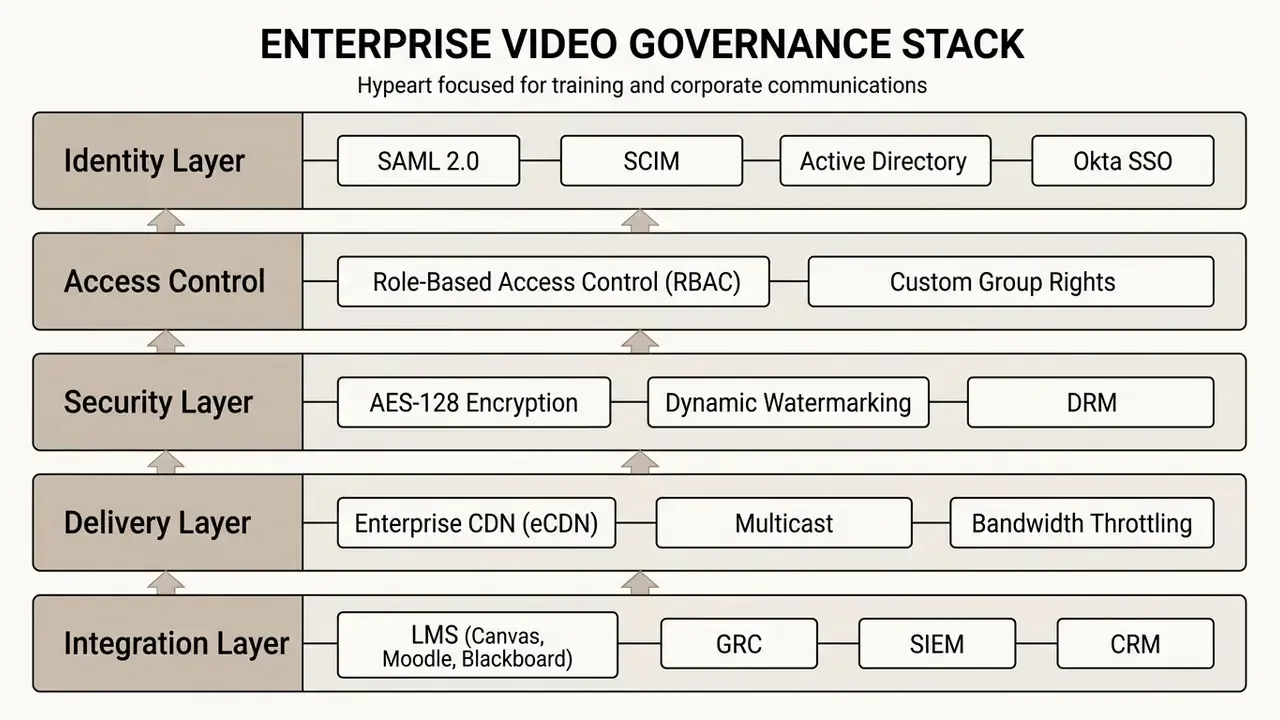
Enterprise environments require strict isolation of corporate intellectual property.
«Across 54 studies, video-based content reliably shaped knowledge and attitudes when length, theoretical framing and audience fit were controlled.»
Platforms built for internal communications deliver company-wide town halls via enterprise CDNs to prevent local network congestion. They also manage secure archives for employee onboarding, regulatory compliance training, and executive messaging, backed by audit-ready access logging and LMS completion reporting. Teams standardizing internal course production frequently combine these archives with AI video generators for content creation to shorten update cycles for compliance modules.
One practical note from mature deployments: the hardest part is rarely the player. It is the offboarding path, where a departing contractor keeps a working share link because deprovisioning never reached the video layer.
Multi-Device OTT App Ecosystems (TV and Mobile Deployment)
Media publishers, commercial training portals, and enterprise broadcasters need distribution beyond web embeds. Modern OTT-focused online video platforms provide turnkey SDKs and REST APIs to deploy branded media applications across 15 or more ecosystem endpoints:
- Connected TV frameworks Native app deployment templates for Apple TV (tvOS), Roku (SceneGraph), Amazon Fire TV, Android TV, and Samsung Tizen OS.
- Mobile and tablet SDKs iOS (Swift) and Android (Kotlin) kits with offline DRM playback downloads and background audio streaming.
- Unified CMS distribution Content managers ingest master files once; the automated encoding engine renders dynamic packaging for web (HLS), Smart TV (DASH), and mobile targets while syncing watch-state progress across devices.
- Commercial terms to verify OTT-class vendors differ sharply on revenue share. Some enterprise providers advertise 0% revenue share with predictable per-plan pricing (Enveu states this publicly as of 2026), while marketplace-oriented platforms retain a percentage of subscription and ad income. Confirm this clause before catalog migration, because re-platforming an app estate costs far more than the initial build.
Key Features to Compare Before Choosing a Video Platform
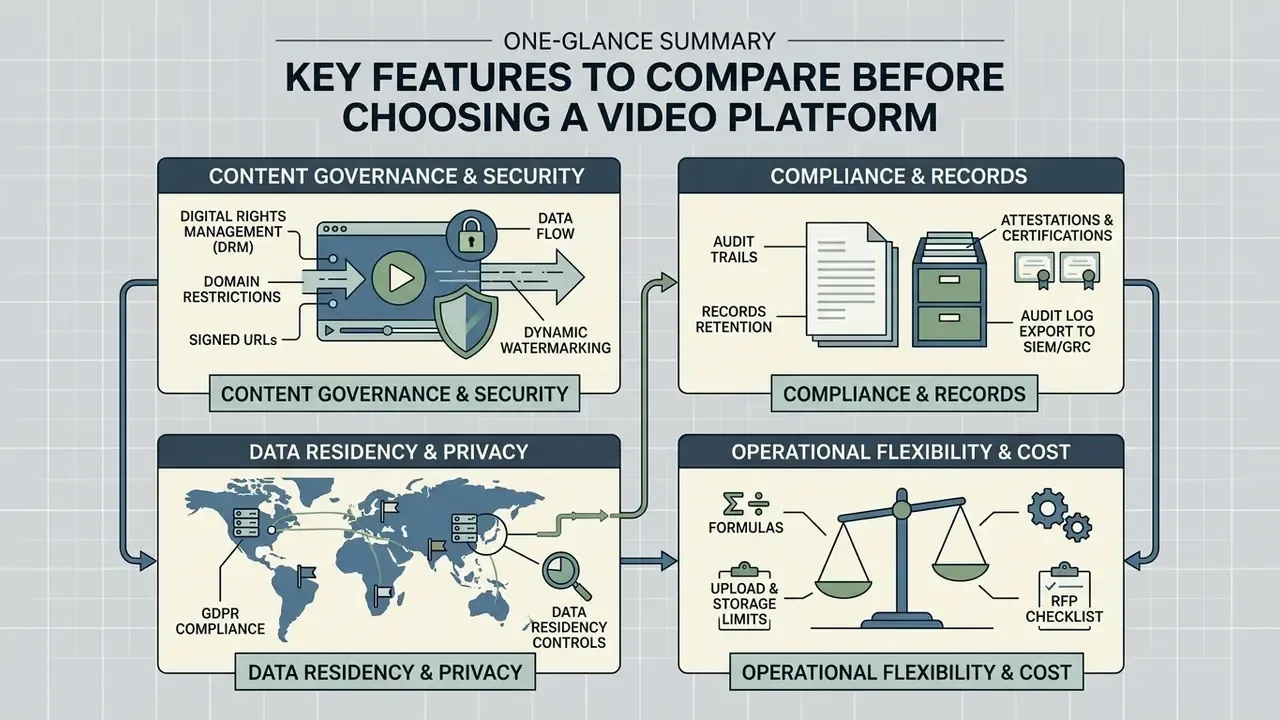
Evaluating an online video platform software provider calls for a structured audit across governance, delivery, analytics, and operational flexibility. For regulated organizations, security and data residency should be scored before playback performance, because a platform that fails a compliance gate cannot be remediated with better encoding.
Security, Privacy and Access Control for Video Content
«PrivaTube executes edge-assisted video delivery inside trusted execution environments (Intel SGX), protecting user data even when an edge node is compromised.»
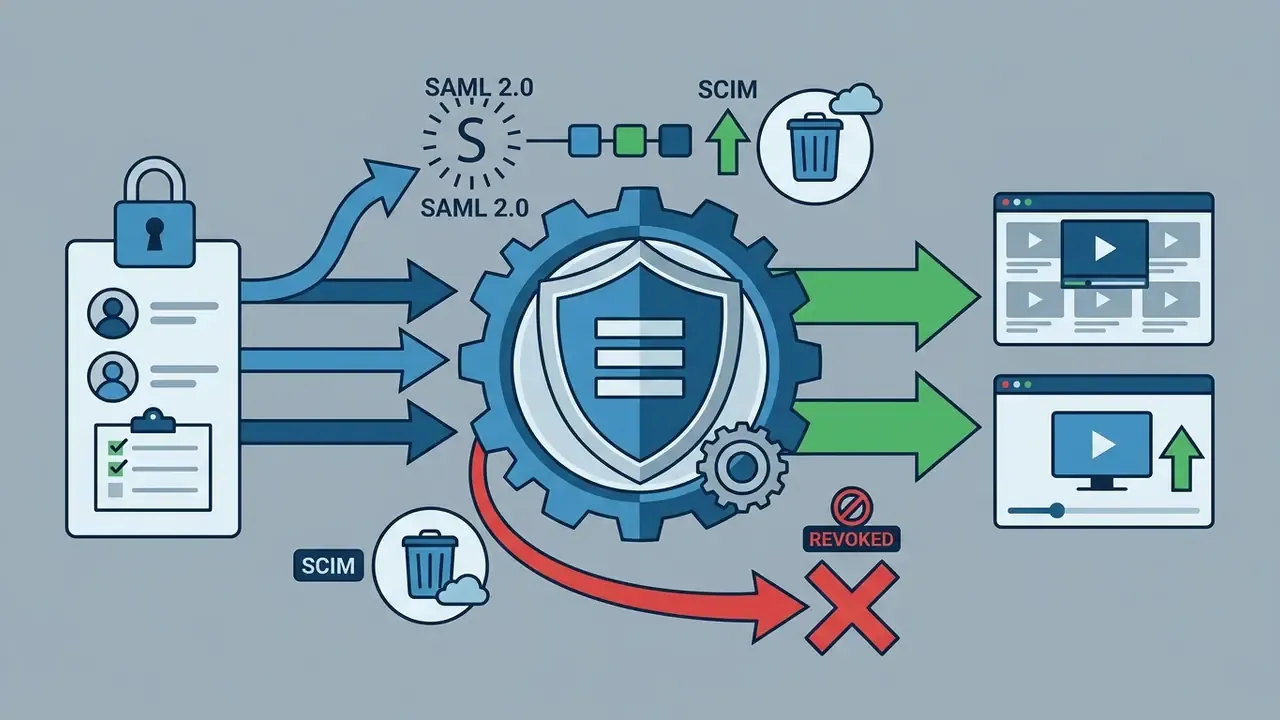
«Peer-assisted streaming can expose confidential user data and content through weaknesses in node verification protocols.»
Compliance, Audit Trails and Records Retention
Financial services, healthcare, and public-sector buyers must extend the security audit into evidentiary territory:
- Attestations and certifications Request the current SOC 2 Type II report and the ISO/IEC 27001 certificate scope statement, not marketing summaries. Verify that the audited scope covers the media pipeline (ingest, transcode, storage, delivery), not only the corporate office.
- Records retention Broker-dealers and regulated advisers evaluating recorded communications, webinars, or client-facing explainer libraries should confirm that retention, immutability, and retrieval features can support books-and-records obligations such as SEC Rule 17a-4 and FINRA Rule 4511 preservation and on-demand retrieval requirements.
- Audit log export to SIEM or GRC Confirm that admin actions, permission changes, share events, and per-viewer playback records can be exported via API or streamed as structured events into Splunk, Microsoft Sentinel, ServiceNow, or an equivalent workflow. A platform that shows logs only in its own dashboard cannot participate in enterprise incident response.
- Access governance evidence Require the ability to demonstrate, for any single asset, who watched it, from which network, at which timestamp, and under which entitlement, with instant revocation on offboarding via SCIM deprovisioning.
- Incident response SLA Document breach-notification windows, forensic support commitments, and key-rotation procedures inside the master service agreement.
Data Sovereignty, Server Residency and GDPR Compliance
For global enterprises and European organizations, the security review extends beyond stream encryption into physical storage architecture and regulatory posture.
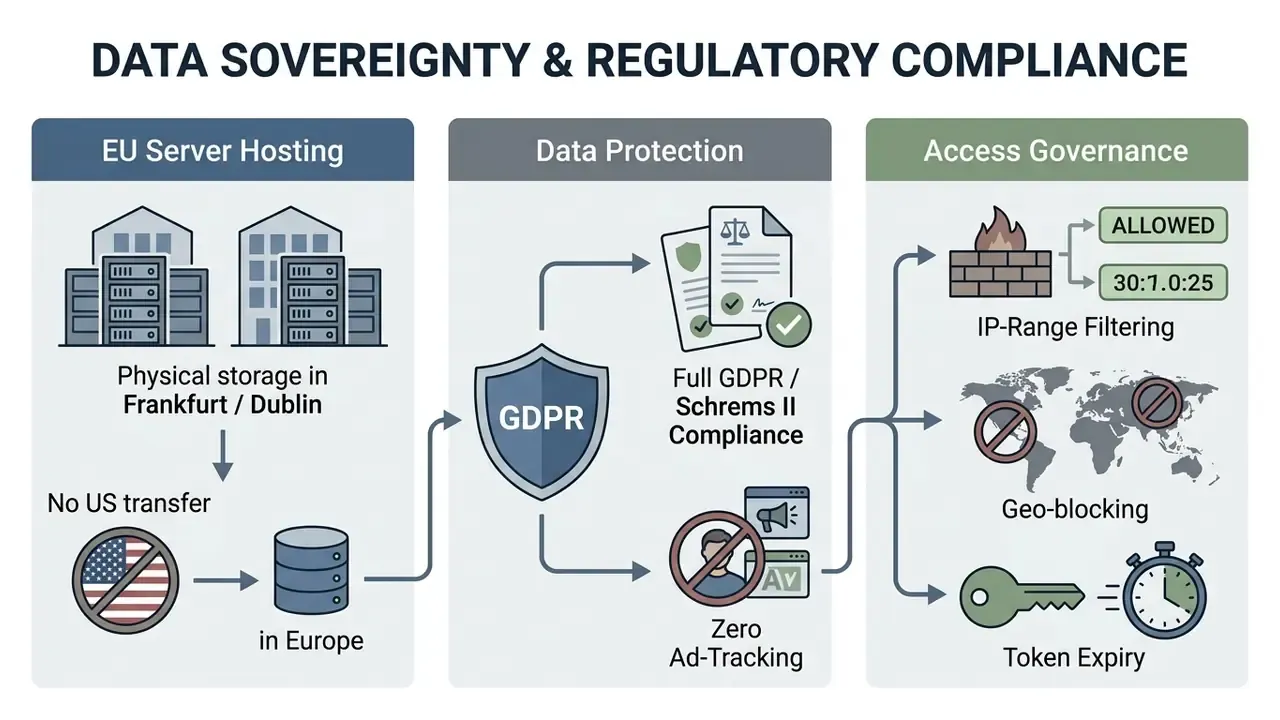
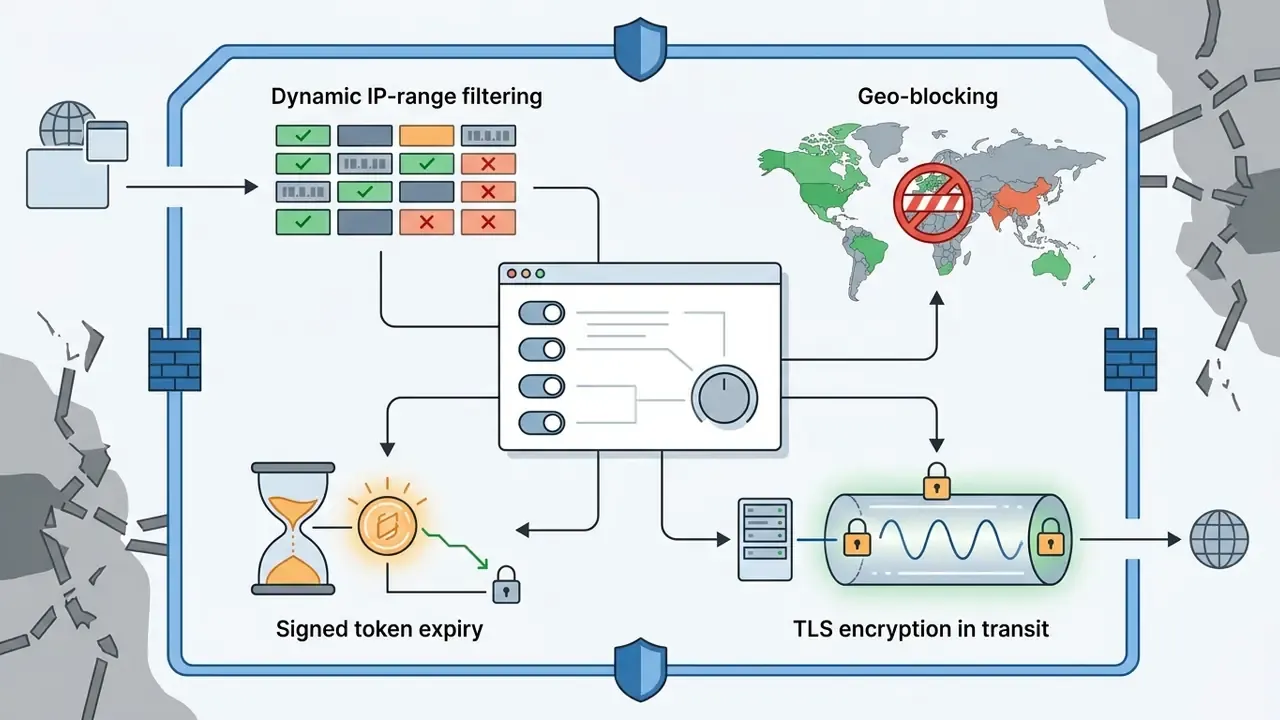
When selecting an enterprise online video platform, compliance teams should audit three residency requirements:
Video Hosting, Playback Quality and Global Delivery
Playback quality shapes viewer retention and brand perception directly.
«Systematic manipulation of video quality parameters in an ecologically valid setting measurably changed whether users continued or abandoned viewing.»
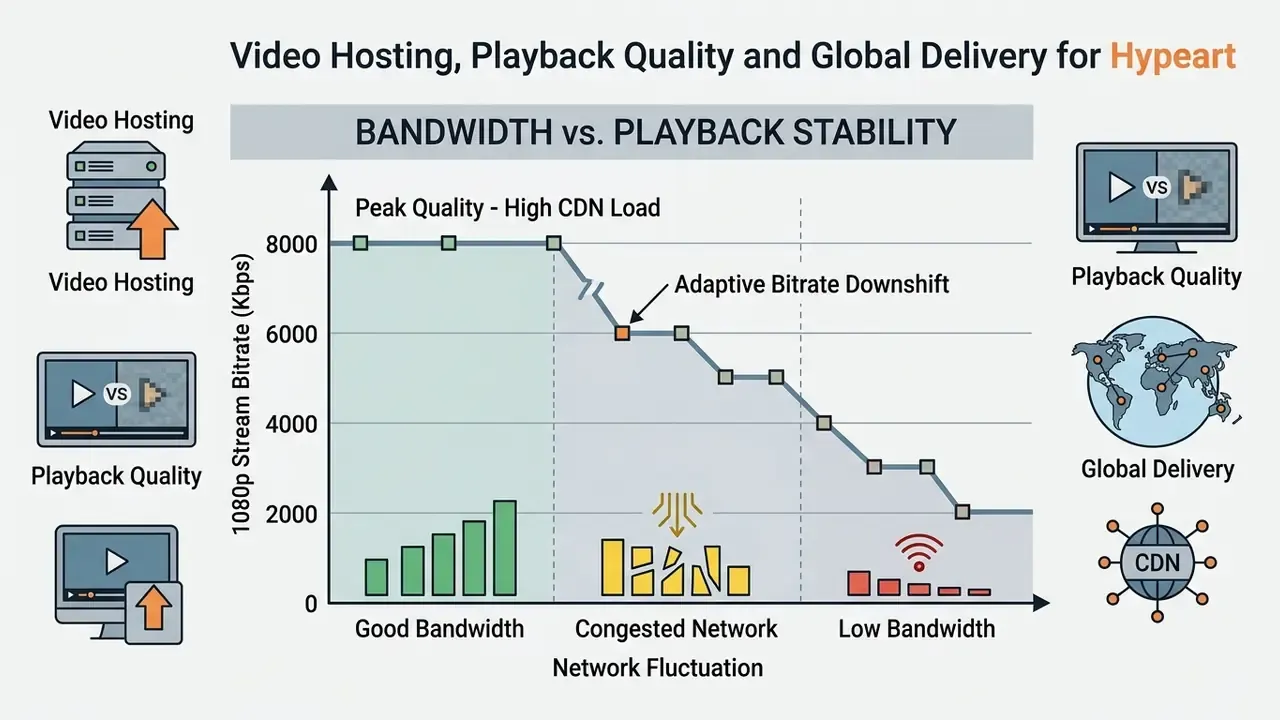
High-performing online video platforms use Adaptive Bitrate (ABR) streaming via HLS or DASH. The player evaluates network conditions continuously, switching between renditions (for example 1080p at 6000 Kbps down to 720p at 2500 Kbps) to keep playback uninterrupted. IETF RFC 9317 flags an important architectural limit: CDNs generate per-request logs but cannot identify playback sessions, selected bitrate, or rebuffering events, which is exactly why client-side telemetry is mandatory for genuine quality-of-experience measurement (IETF, 2022).
«CP-Steering dynamically selects the CDN and transport protocol per session, reducing stalls and raising average bitrate compared with static CDN assignment.»
Multi-CDN delivery architectures steer segment requests across redundant networks, removing single points of failure during high-traffic live events. Teams building the content that flows through those networks often evaluate the best AI video generators alongside their delivery stack.
«Large-scale deployment showed that personalized QoE optimization in adaptive streaming improves user experience by modeling individual preferences and viewing history.»
Analytics, AI and Engagement Tools
Modern video platforms use artificial intelligence to automate asset management and extract viewer intelligence. Vendor engineering documentation from streaming API providers, Mux among them, describes AI-assisted workflows that generate closed captions through Automatic Speech Recognition, index cue text with timestamps, build searchable transcripts, and run semantic search across large libraries. These capabilities are documented as product features, not peer-reviewed benchmarks, so accuracy for domain-specific terminology (financial products, drug names, internal codenames) must be validated on your own corpus before rollout. Platform documentation from Kaltura REACH, ScreenApp, and Deepgrip similarly ties machine captioning to retrieval, speaker identification, auto-clipping, and engagement reporting.
Advanced analytics engines go past total view counts, measuring second-by-second engagement heatmaps, re-watch frequency, sentiment signals, and drop-off points. Teams integrating custom programmatic endpoints can consult the AI Media API Guides to evaluate data export formats and pipeline automation.
AI Governance and Confidentiality Inside the Video Pipeline
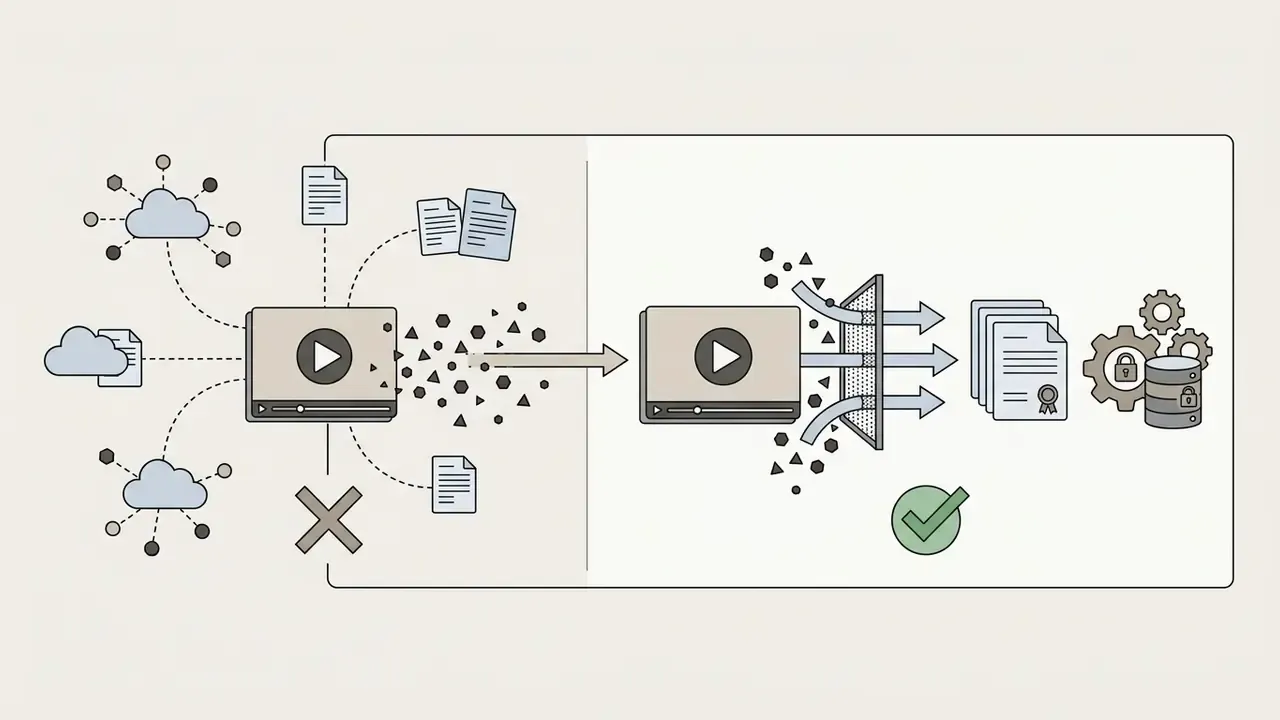
When ASR, summarization, or generative enrichment touches confidential recordings, think board calls, model validation walkthroughs, customer complaints, credit committee sessions, the video platform becomes an AI supply-chain component. Model risk and governance teams should require written answers to the following:
- Model training opt-out Is customer media, transcript text, or telemetry ever used to train, fine-tune, or evaluate vendor or sub-processor models? Require contractual exclusion, not a settings toggle.
- Zero-data retention Are audio buffers, intermediate embeddings, and prompt payloads deleted immediately after inference, and is retention documented with a maximum window?
- Sub-processor transparency Which third-party AI providers process the media, in which regions, under what onward-transfer terms? Every hop belongs in the sub-processor register.
- Transcript accuracy and hallucination risk Generated transcripts and summaries can misstate figures or attribute statements to the wrong speaker. Define whether AI output is a convenience artifact or a record of account, and require human review for anything entering a regulated record.
- Rights in generated artifacts Clarify ownership of transcripts, translations, chapters, embeddings, and derived indexes, and confirm they are exportable and deletable on termination.
- Access scoping for AI features Confirm that semantic search respects RBAC, so a query cannot surface transcript snippets from assets the user is not entitled to view.
- Agentic automation boundaries Some platforms now ship assistants that clip, publish, or distribute content automatically. Anyone planning to create ai agents around a media library should assign each agent an owner, an approved role, access limits, an escalation path, and a shutdown mechanism. The same discipline applies when teams create ai chatbot interfaces that answer questions from internal video transcripts, since retrieval scope becomes an access-control decision.
- Legal exposure tracking Synthetic media and training-data provenance remain contested; our analysis on AI Litigation and Case Timelines tracks active disputes relevant to procurement risk registers.
No evidence, no autonomy. That principle transfers cleanly from model risk management to media tooling.
Leading Online Video Platform Companies and Their Best-Fit Scenarios
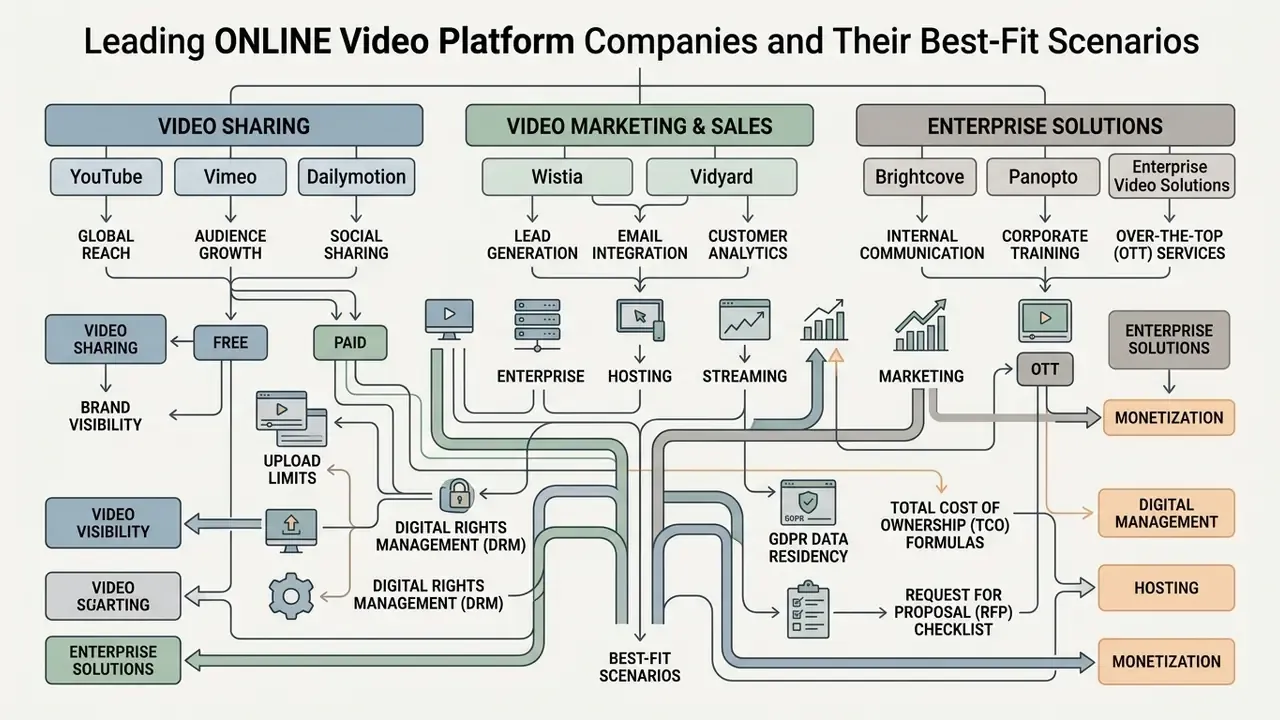
Understanding the commercial landscape means reading the technical positioning and operational strengths of the leading online video platform companies, then matching them to a defined use case.
                   ONLINE VIDEO PLATFORM MARKET POSITIONING
   Enterprise Control & Governance
         ^
         |      [ Panopto ]              [ Brightcove ]
         |   (Corporate/LMS)           (Enterprise / OTT)
         |
         |                                 [ Wistia / Vidyard ]
         |                               (Marketing & Sales)
         |
         |      [ Vimeo ]
         |  (SMB / Creative)
         |
         |                                       [ YouTube ]
         +--------------------------------------------------------> Public Audience Reach
         Low Reach / Controlled Access            Global Reach / Public Discovery
YouTube, Vimeo and Dailymotion for Video Sharing
- YouTube Unmatched for public discovery and brand reach. It provides robust global infrastructure at zero hosting cost, but organizations must accept platform advertising, algorithmic recommendations, and monetization qualification barriers. Under YouTube Partner Program rules published for the 2024-2025 cycle, thresholds are tightening: from February 2027, full monetization requires 1,000 subscribers plus either 8,000 valid public watch hours in 365 days or 20 million Shorts views in 90 days (YouTube Partner Program documentation, 2024-2025).
- Vimeo Balances ease of use with professional customization. The platform restructured pricing in 2024 around seat-based subscriptions (Starter, Standard, Advanced, Enterprise), offering white-label embedding, project review tools, password protection, unlisted links, custom video URLs, and public-video SEO enhancement (Vimeo Pricing Analysis, 2024).
«All paid Vimeo plans carry a 2 TB monthly bandwidth ceiling; accounts created after June 2024 receive lifetime storage limits of 2 TB to 7 TB depending on tier.»
High-traffic enterprises therefore migrate to custom contract tiers once syndication volume grows.
- Dailymotion: Offers specialized content syndication across global publisher networks and native apps, plus onward publishing to social platforms, serving organizations that want secondary distribution outside the primary YouTube ecosystem.
Wistia and Vidyard for Video Marketing and Sales
- Wistia Positioned for digital marketing teams. It features an ad-free, highly customizable HTML5 player (color, thumbnail, controls, fonts, logo, brand kit), timeline-triggered lead capture forms with custom fields, timeline CTAs, and documented synchronization with a broad set of marketing automation and CRM destinations. Wistia's own support documentation names HubSpot, Marketo, Pardot, Oracle Eloqua, Klaviyo, ActiveCampaign, Salesforce, and Mailchimp among them. Marketing teams use Wistia to convert viewers into qualified pipeline, frequently pairing hosting with AI video generation tools for high-volume campaign variants. Public pricing shows a free tier at $0 per month with basic analytics, a Business tier, and custom Enterprise contracts, with per-file charges for library expansion.
- Vidyard Engineered for B2B sales enablement and personalized prospecting. Vidyard's public product documentation describes fully customizable playback, in-video Marketo forms and interactive CTAs, and native embedding inside the sales tools representatives use daily, including Salesforce, Salesloft, and Marketo. Account executives record, send, and track personalized video messages inside email workflows. Published upload guidance lists a free plan with up to 25 hosted videos and paid plans starting in the low double digits per month.
Brightcove, Panopto and Enterprise Video Solutions
«MetaTech Insights projects the OVP market growing from $14.15 billion in 2025 to $71.91 billion by 2035 at a 17.65% CAGR, led by content management, live streaming and analytics.»
Comparative Capability Matrix by Platform Class
| Capability | Public Sharing Platforms (e.g., YouTube) | Marketing & Sales Platforms (e.g., Wistia, Vidyard) | Enterprise Platforms (e.g., Brightcove, Panopto) |
|---|---|---|---|
| Hosting & Delivery | Mass global CDN; optimized for scale and public search | Managed CDN; optimized for site embedding | Multi-CDN and eCDN; optimized for internal networks |
| Player Customization | Restricted; platform branding and ads enforced | White-label; full control over player UI and controls | White-label; deep integration into portals and LMS |
| Security & Access Control | Public, unlisted, or basic private links | Domain restriction, password protection, SSO | Enterprise SAML 2.0 SSO, multi-DRM, SCIM, RBAC |
| Compliance Attestations | Platform-wide policies only; no customer-scoped audit report | Varies by vendor; SOC 2 common on business tiers | SOC 2 Type II / ISO 27001 scoped to media pipeline; DPA plus sub-processor register |
| Audit Trail & SIEM Export | Aggregate channel reports only | Viewer-level engagement export to CRM/MAP | Admin and viewer event logs exportable to SIEM/GRC (Splunk, Sentinel, ServiceNow) |
| Records Retention Support | Not designed for regulated retention | Limited retention configuration | Configurable retention, archival storage, retrieval on demand (17a-4 / 4511 alignment) |
| Data Residency Options | No customer control over cache geography | Region selection on some tiers | Contractual region pinning, EU-only hosting options, geo-fencing |
| AI Data Handling | Platform-defined; no customer opt-out contract | Vendor-dependent; check retention terms | Contractual zero-data-retention and model-training opt-out negotiable |
| Analytics & Telemetry | High-level channel metrics; aggregated demographics | Individual viewer heatmaps, lead scoring, CRM sync | Compliance tracking, LMS scoring, audit trails |
| Multi-Device / OTT Apps | Native apps owned by the platform | Web-first embeds | Branded apps for Roku, tvOS, Fire TV, Android TV, Tizen |
| Monetization Support | Platform ad-share (YPP), channel memberships | Direct CTA integration, paywall embeds | SVOD/AVOD/TVOD/PPV, course licensing, SSAI |
| AI Capabilities | Automated platform captioning, open search indexing | Auto-transcription, AI clip generation, interactive CTAs | Transcript indexing, semantic search, smart tagging, translation |
Free Online Video Platforms vs. Paid Video Hosting
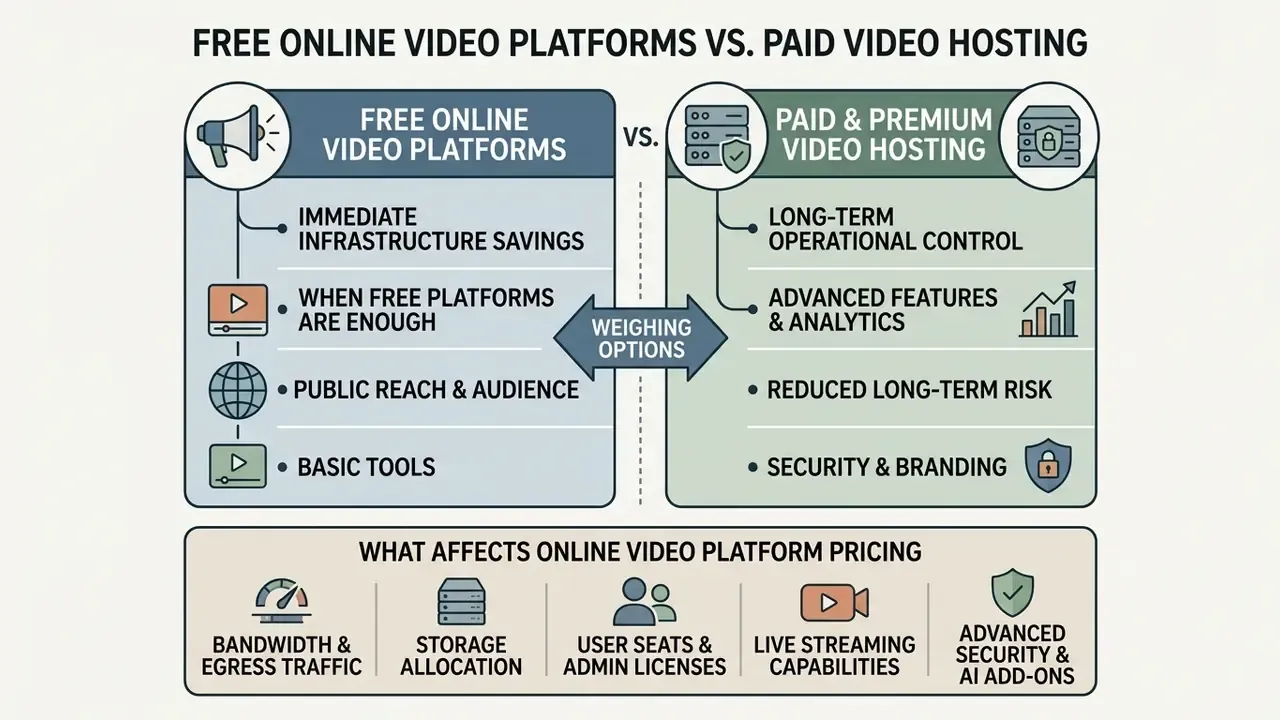
Choosing between free online video platforms and paid video hosting means weighing immediate infrastructure savings against long-term risk and operational control.
When Free Video Platforms Are Enough
Free video sharing platforms fit organizations whose only objective is public reach and brand exposure, with no strict privacy or compliance requirement.
«Audiences on public platforms are driven by entertainment, information seeking and social interaction, the same motives that amplify organic reach.»
A startup launching a public campaign can publish straight to YouTube or Dailymotion, leverage established recommendation algorithms without bandwidth or storage fees, and experiment cheaply with free AI video generators before committing budget. Spanish-language teams testing the same approach often start from guides on how to crear videos con inteligencia artificial gratis before selecting a hosting tier.
Free platforms are sufficient when:
Pricing, Plans and Video Monetization Models
What Affects Online Video Platform Pricing
Online video platform software pricing is driven by five infrastructure components:
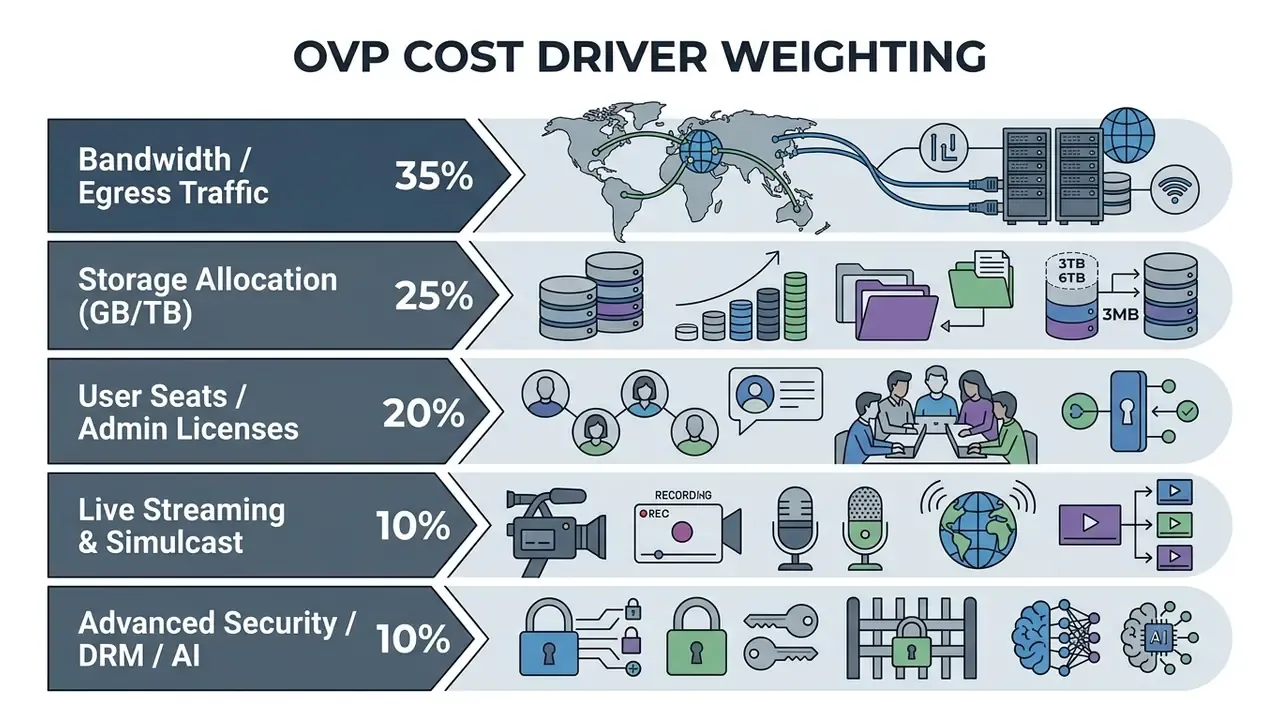
- Bandwidth and egress traffic: The total data volume delivered to viewers. Cloudflare Stream prices delivery transparently by streamed minutes, with storage billed per 1,000 stored minutes, whereas traditional hosts charge per gigabyte or terabyte of egress (Cloudflare Stream Pricing, 2026).
«Exceeding the 2 TB bandwidth allowance in two separate months, or reaching 10 TB in a single month, automatically triggers migration to a higher plan.»
Total Cost of Ownership, Including Control Costs
Vendor list price is only the visible half of the model. A defensible TCO figure for regulated buyers looks like this:
Annual TCO = (Egress GB × unit rate) + (Storage TB × unit rate) + (Seats × seat price) + Live concurrency fees + DRM/eCDN/AI add-ons + Control Costs
Control Costs are the internal expenses procurement teams routinely omit:
- SSO and SCIM integration plus identity engineering hours;
- eCDN or multicast rollout across branch networks;
- SIEM log ingestion volume, priced per GB in Splunk or Sentinel;
- security review, penetration test, and vendor risk assessment cycles;
- GRC workflow configuration and evidence collection for audit;
- migration and re-encoding cost of exiting the platform later.
Modeling those lines next to egress turns a cheap per-minute quote into a comparable multi-year figure. In several shortlists we have reviewed, it reverses the ranking outright.
Ads, Subscriptions and Pay-Per-View Monetization
Organizations monetizing media directly deploy several revenue models:
- AVOD (advertising-based video on demand): Viewers watch free, monetized through pre-roll, mid-roll, or display advertising. Inventory pricing uses metrics such as Cost Per Mille (CPM), Cost Per Completed View (CPCV), Cost Per View (CPV), and viewable variants (VCPM, VCPV). Revenue splits matter: YouTube Partner Program documentation states that creators receive 30% of net YouTube Premium subscription revenue attributable to their content and 45% of revenue from targeted Shorts ad placements (YouTube Partner Program documentation, 2024-2025).
- SVOD (subscription video on demand): Viewers pay a recurring monthly or annual fee for unlimited access to a managed library, whether Netflix or a corporate training portal.
- TVOD (transactional video on demand, pay-per-view): Viewers pay per title, rental window, or live event.
- PVOD (premium video on demand): Viewers pay a premium for early-window access ahead of general release.
- Hybrid monetization: Modern media platforms combine models, pairing ad-supported free tiers with premium ad-free SVOD access, plus PPV for marquee live events, to maximize yield across price-sensitivity segments.
How to Launch and Manage Online Video Publishing
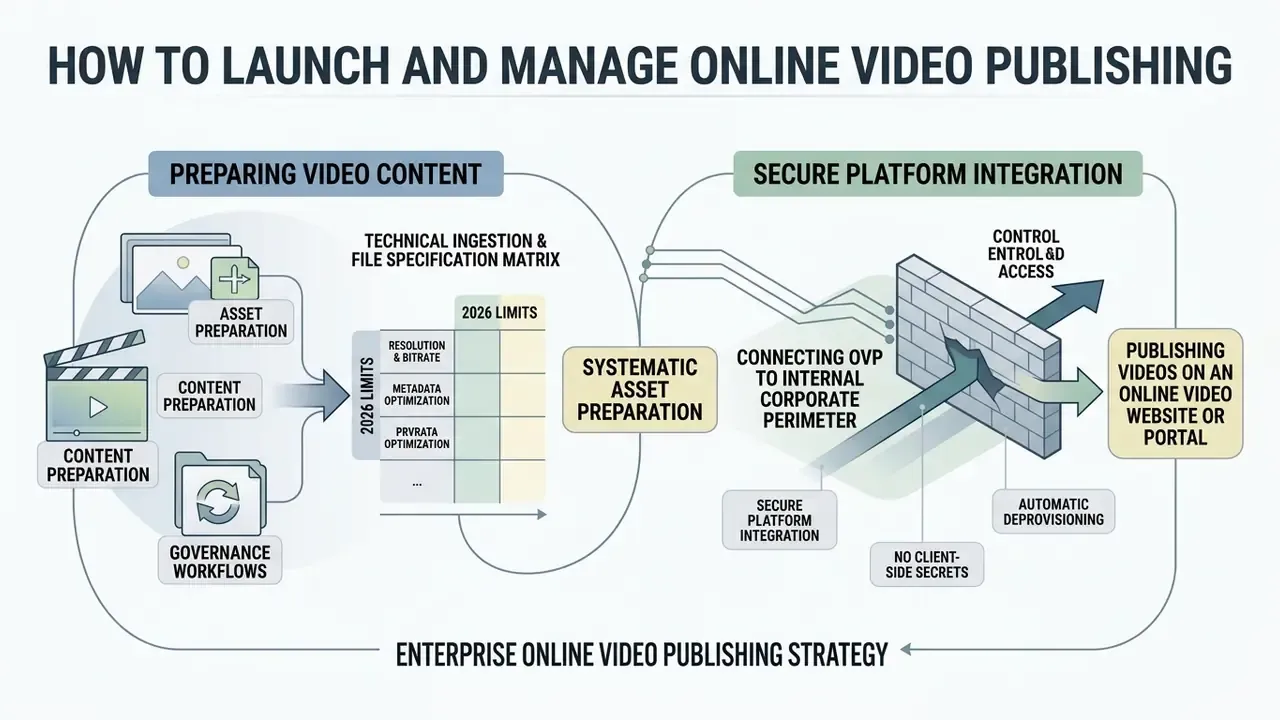
Executing an enterprise online video publishing strategy requires systematic asset preparation, secure platform integration, and governance workflows. Accessibility planning should start at kickoff rather than post-launch: W3C guidance specifies captions, transcripts, audio description, sign-language provision where required, and an accessible media player as baseline deliverables for new audio-visual content (W3C, Making Audio and Video Media Accessible, 2024).
Preparing Video Content for Upload and Playback
Correct encoding before upload cuts platform processing time and prevents playback artifacts.
Technical Ingestion and File Specification Matrix (2026 Limits)
To prevent encoding failures and pipeline latency, media teams must align raw exports with vendor ingestion parameters before batch upload:
| Platform | Max File Size | Max Video Duration | Max Resolution | Aspect Ratios | Supported Container Formats | Default Egress/Bandwidth Cap |
|---|---|---|---|---|---|---|
| YouTube | 256 GB | 12 hours (verified) | 8K (4320p) | 16:9 (auto-pads 4:3, 9:16) | MP4, MOV, AVI, WMV, FLV, WebM | Unlimited |
| Vimeo | 128 GB (syndication) | Restricted by plan | 8K HDR | Any (responsive container) | MP4, MOV, ProRes, AVI | 2 TB/month (base tier) |
| Vidyard | 20 GB | Unlimited (paid) / 30 min (free) | 4K (2160p) | 16:9, 1:1, 9:16 | MP4, MOV, WMV, MKV | Unlimited on paid plans |
| Wistia | 8 GB | 2 hours (paid) / 15 min (free) | 4K (2160p) | Any (customizable player) | MP4, MOV, AVI, 3GP | 200 GB/mo (free) / 2 TB+ (paid) |
| Brightcove | 100 GB (API ingest) | Unlimited | 4K HDR | Custom / adaptive | MP4, MXF, MOV, ProRes | Custom enterprise SLA |
| JW Player | 100 GB | Unlimited | 4K (2160p) | 16:9, 4:3, 21:9 | MP4, MOV, WebM | Tiered GB consumption |
- Container and codec: An MP4 container with H.264 or H.265 (HEVC) video and AAC audio delivers the widest compatibility across legacy and modern devices (NOAA Multimedia Specifications, 2024).
«Encoding-ladder design and adaptation policy directly determine perceived quality and must balance storage cost against available bandwidth.»
- Resolution and bitrate Standard web delivery targets 1080p (1920×1080) at 4,000 to 8,000 Kbps; 1280×720 assets typically land between 1,200 and 4,000 Kbps. High-frame-rate or 4K assets target 12,000 to 20,000 Kbps.
- Metadata optimization Ingestion workflows should append clear titles, descriptive tags, closed-caption files (.VTT or .SRT), transcripts published as findable page text, and explicit accessibility fields to satisfy Web Content Accessibility Guidelines 2.1 and 2.2 (W3C Media Accessibility Standards, 2024). Localization teams commonly pair caption files with AI voice generators to produce multilingual narration from a single master script.
Publishing Videos on an Online Video Website or Portal
Integrating playback into an online video website or corporate portal means balancing embed performance with access governance.
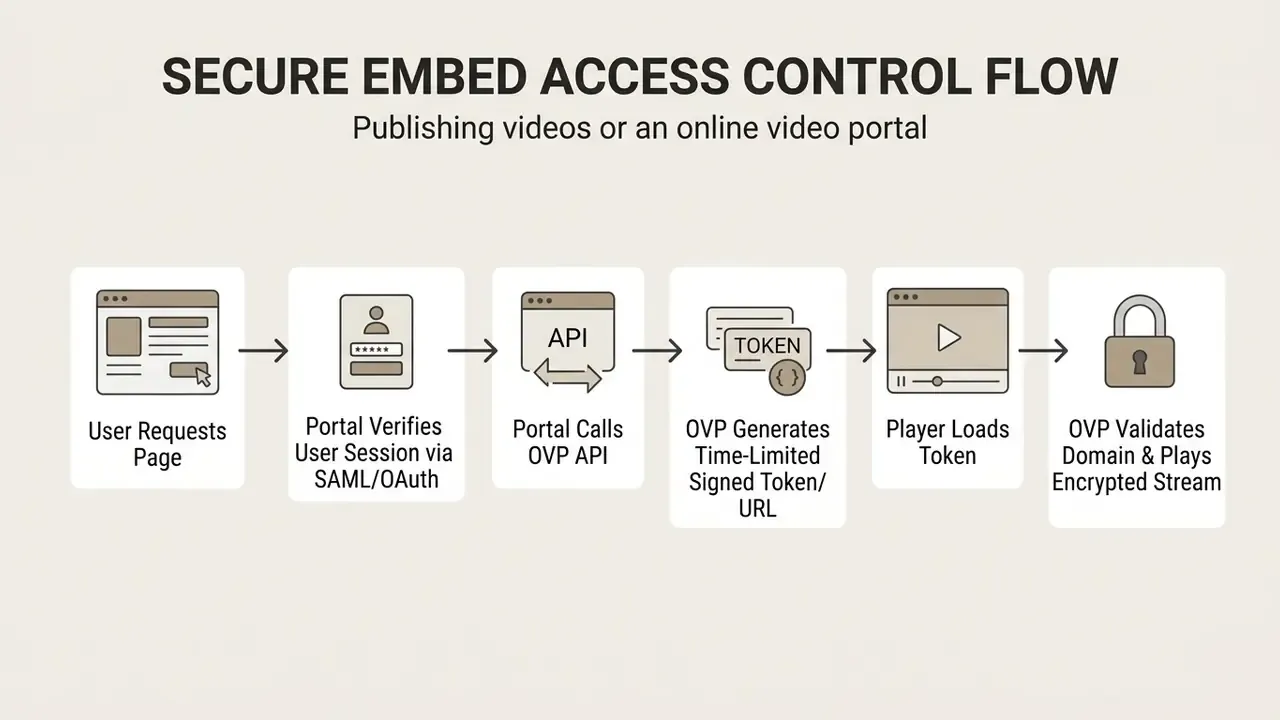
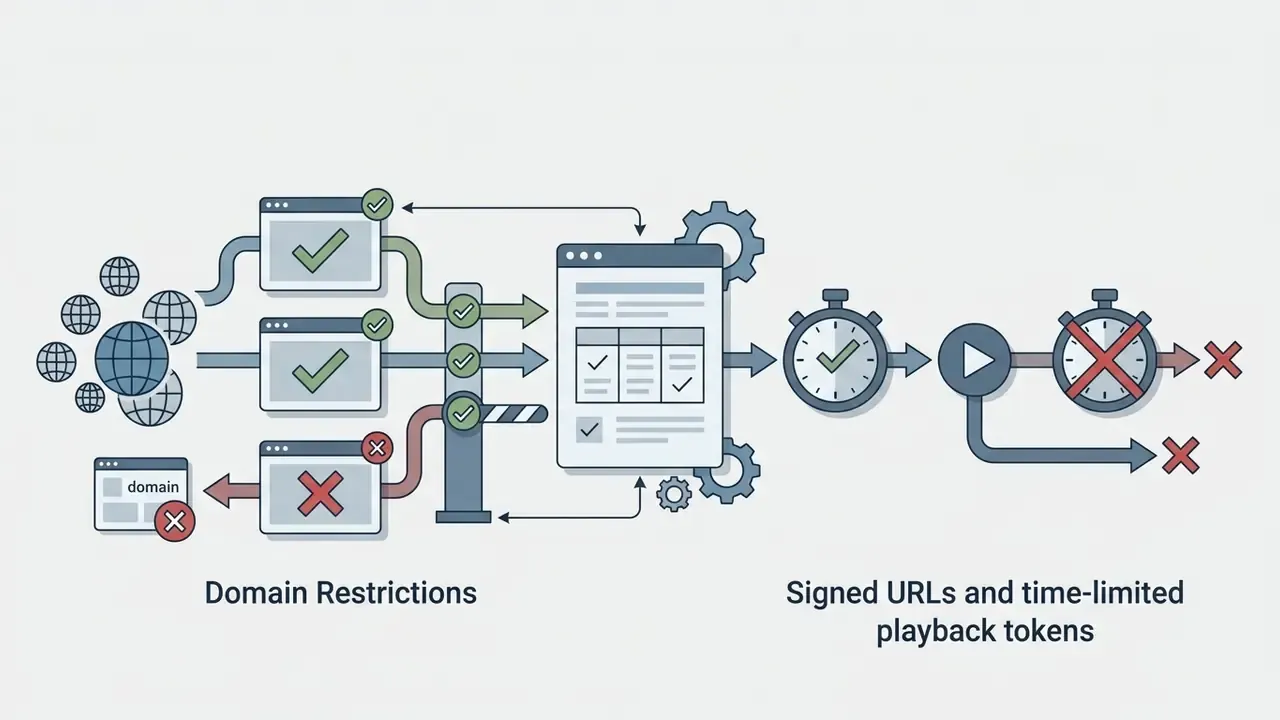
When publishing internal corporate communications, developers use authenticated embed codes. The host application verifies session permissions before requesting a time-limited signed URL from the platform API. The embedded player loads the stream only if the viewer holds an active corporate login session and matches domain-level restrictions (Microsoft Stream Embed Architecture, 2025). Kaltura documentation describes an equivalent pattern: published embed codes require a valid session token, and playback can be restricted to authorized applications and approved pages. Teams that plan to create a website around a media library should design this token exchange before choosing a template, not after.
Connecting an OVP to an Internal Corporate Perimeter
For banks, insurers, and other regulated operators, the integration pattern rather than the feature list determines whether a deployment survives an audit:
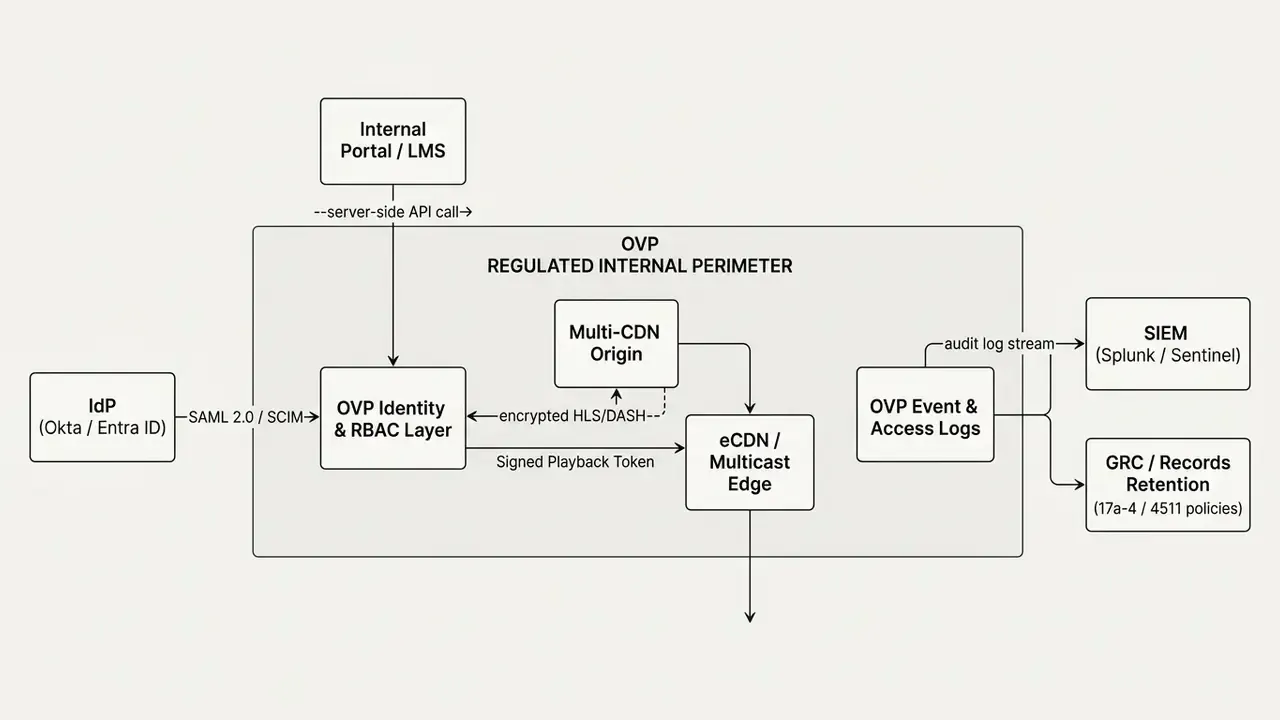
Implementation rules that keep this architecture defensible:
For operational troubleshooting during publishing deployments, consult our AI Media Support and Troubleshooting hub. Teams standardizing an end-to-end production chain, capture through editing, compression, narration, and publication, can align tooling using the AI Media Glossary and the YouTube video editing workflow guide.
Vendor RFP Checklist for Security, Model Risk and Procurement Teams
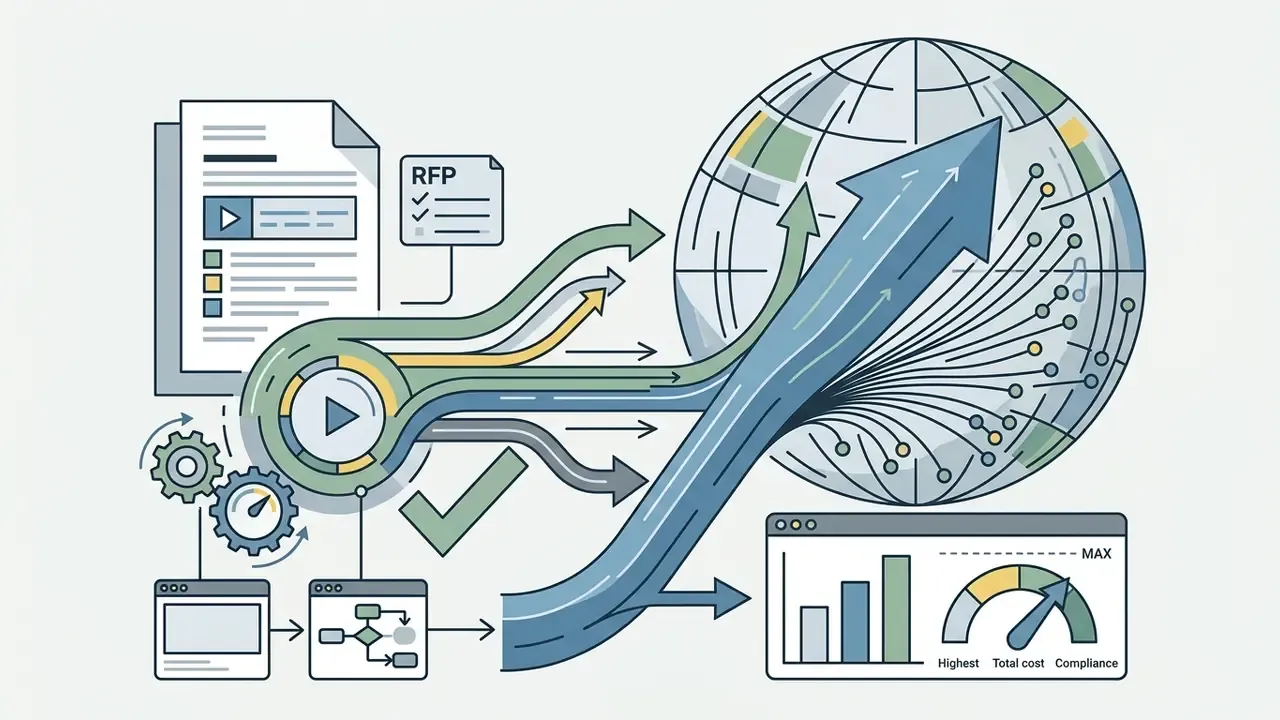
Ask these ten questions in writing, and require documented answers as contract annexes rather than sales assurances:
- Provide the current SOC 2 Type II report and ISO/IEC 27001 certificate, including the exact scope statement covering ingest, transcode, storage, and delivery.
- List all physical data-center locations and sub-processors handling master files, renditions, transcripts, and telemetry, with region pinning options.
- Specify encryption in transit and at rest, DRM systems supported (Widevine, FairPlay, PlayReady), key-management architecture, and key-rotation policy.
- Confirm SAML 2.0 SSO, SCIM provisioning and deprovisioning, RBAC granularity, IP-range filtering, and geo-blocking by country ISO code.
- Describe audit log coverage (admin actions, permission changes, share events, per-viewer playback) and the supported export mechanism to SIEM or GRC platforms.
- State contractual terms on AI data handling: model-training exclusion, zero-data retention windows, and sub-processor AI providers.
- Define retention, immutability, legal-hold, and retrieval capabilities relevant to obligations such as SEC Rule 17a-4 and FINRA Rule 4511.
- Provide incident-response SLAs, breach-notification windows, forensic support commitments, and historical uptime against SLA.
- Document exit terms: bulk export of master files, renditions, metadata, transcripts, and analytics; deletion certification; migration support.
- Disclose the full commercial model: egress and storage unit rates, overage triggers, seat pricing, live concurrency fees, revenue share if any, and price-escalation caps.
Limitations and Open Questions
Three areas remain genuinely unsettled, and honest procurement should say so.
First, AI transcript reliability for domain language is not benchmarked publicly in any way we would accept as evidence. Test on your own recordings, with your own product names.
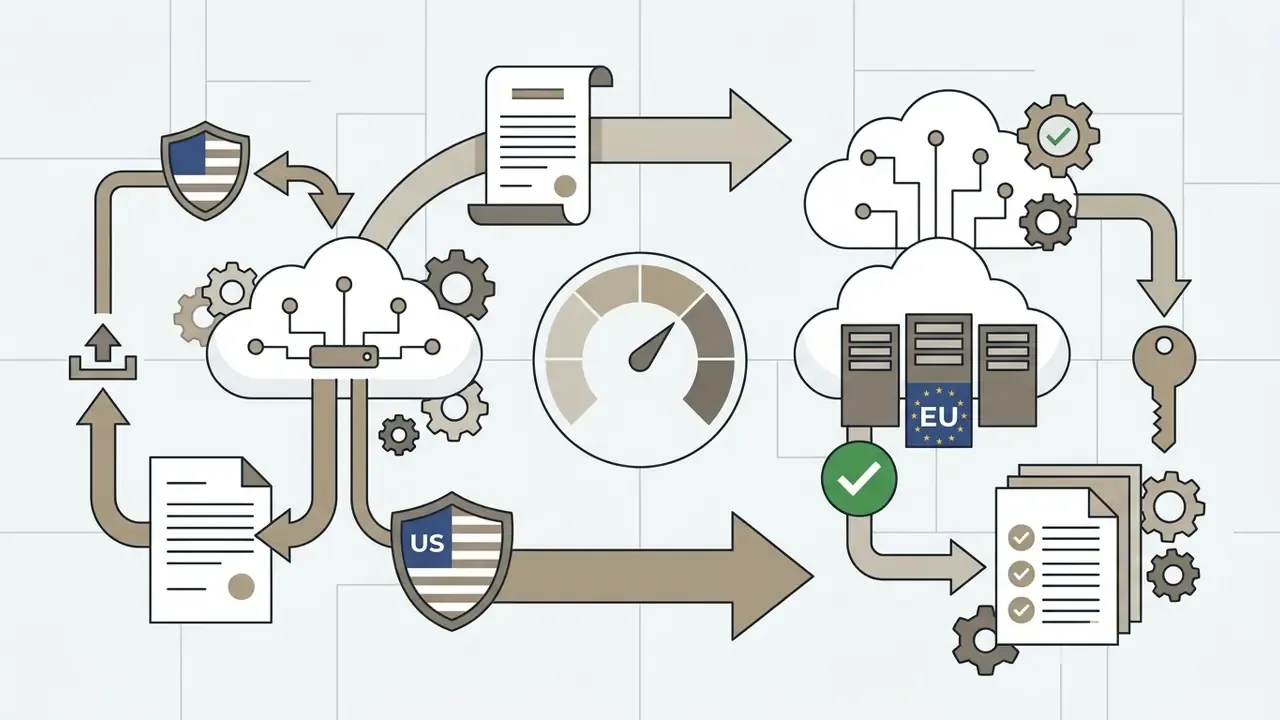
Second, cross-border transfer posture keeps shifting. A transfer-impact assessment signed in 2024 may need rework in 2026, so build re-assessment into the contract cycle rather than treating it as a one-off.
Third, the cost of exit is under-documented across the market. Few vendors publish concrete export throughput for multi-terabyte libraries, which means migration timelines are usually estimates rather than commitments. Ask for a tested figure.
FAQ: Online Video Platform Questions Buyers Actually Ask
What is an online video platform (OVP)?
An OVP is software that hosts, manages, delivers, and monetizes video online. It combines storage and a content library (CMS), transcoding into adaptive bitrate renditions, secure delivery over a CDN, playback across devices, analytics, and monetization in one system.
What are the main types of online video platforms?
Four broad classes: public video sharing platforms (reach-first), marketing and sales video platforms (attribution-first), enterprise OVP and OTT platforms (governance-first), and DIY or open-source stacks assembled by developers. Decentralized Web3 streaming networks form a fifth, emerging class.
What is the best online video platform for business?
For businesses needing secure hosting plus branding, access control, and monetization in one place, an enterprise platform fits best, because CMS, delivery, DRM, compliance logging, and monetization are native rather than add-ons. For pure lead generation, a marketing-focused platform usually delivers faster ROI.
Is an online video platform secure enough for internal or regulated content?
Enterprise-grade platforms offer signed token authentication, geo and IP rules, encrypted delivery, studio-grade multi-DRM, forensic watermarking, and exportable audit logs. Regulated buyers should also verify certification scope, data residency, retention capabilities, and AI data-handling terms.
Can I host video on my own website servers instead?
Technically yes, practically rarely. Video loads origin infrastructure disproportionately: ten viewers watching a minute of HD video approximates the egress of a thousand text page views. Traffic spikes then cause stalls, overage charges, or outages without adaptive bitrate delivery and CDN caching.
How much bandwidth will my video library consume each month?
Use Monthly Viewers × Average Watch Minutes × (Bitrate Mbps / 8) × 0.0075 to estimate gigabytes of egress. Ten thousand views averaging ten minutes at 1080p (5 Mbps) equals roughly 469 GB per month.
Which upload specification usually breaks first?
File size and duration caps. Free tiers commonly cap at 8 to 20 GB per file and 15 to 30 minutes of runtime, while enterprise API ingest typically accepts 100 GB single files. Confirm aspect-ratio handling too, since vertical (9:16) exports may be auto-padded on 16:9-oriented platforms.
Does GDPR affect my choice of video platform?
Yes. Player-embedded third-party tracking, cache geography, and sub-processor location all fall within scope. Organizations handling EU personal data should require documented data-processing agreements, transfer-impact assessments, tracking-free players, and where necessary EU-only storage.
Who should own the video platform decision inside a bank?
In practice, a joint decision works best: business owner for the use case, information security for controls, model risk for AI features, and records management for retention. One accountable owner still signs, but each control domain approves its own section of the RFP response.
Appendix A: Editorial Revision Log (Superseded Formulations)
For transparency, two fragments from the previous revision were replaced rather than deleted, and are retained here:
- Playback-quality citation.Previous formulation: "Empirical behavioral research demonstrates that video quality degradations, startup delays, and rebuffering events lead directly to session abandonment (IMX 2023 Study on Video Quality)." Superseded because the reference lacked method, figures, and a direct quotation; replaced with the cited IMX 2023 ecological-validity finding.
- Publishing-section link cluster.The previous revision closed the publishing section with an undifferentiated list of creative-tool anchors (song, podcast, website, chatbot, and Spanish-language video generation queries). Superseded because the cluster broke topical continuity for enterprise readers. Those references were redistributed into contextually relevant passages: multilingual production, adjacent content formats, portal build planning, and retrieval-scoped assistants, alongside the reference integration architecture for connecting an OVP to a regulated internal perimeter.
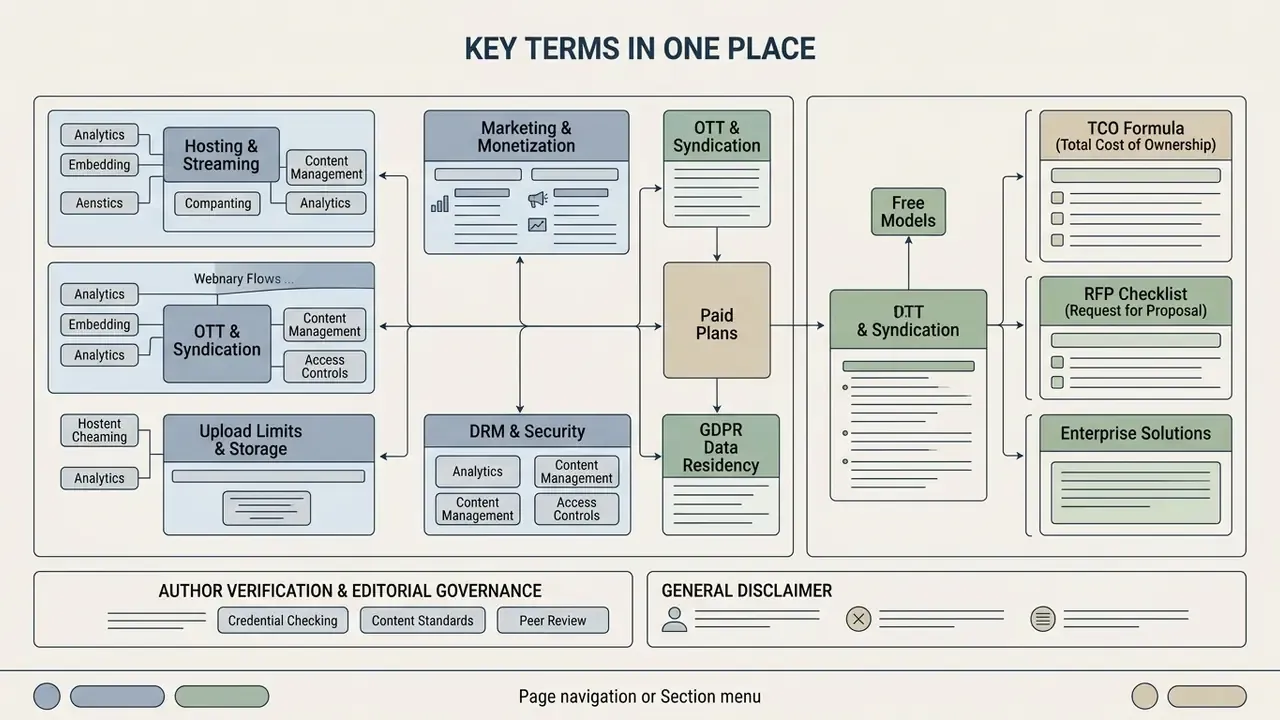
Key Terms in One Place
- ABR (adaptive bitrate) Client-side switching between renditions to keep playback continuous under changing bandwidth.
- eCDN Enterprise content delivery layer, often multicast or peer-assisted, that prevents branch-network saturation during all-hands events.
- Signed URL A time-limited, cryptographically signed playback link that expires independently of the asset itself.
- SCIM Identity protocol that automates user provisioning and, more importantly for auditors, deprovisioning.
- Zero-data retention A contractual commitment that AI inference inputs are deleted immediately after processing, with a documented maximum window.
- Control cost Internal spend required to run a platform safely (identity work, SIEM ingestion, GRC evidence), excluded from most vendor quotes.