A tiktok ai voice generator converts written scripts into spoken narrative tracks for short-form video content without requiring human recording. Enterprise media teams and independent creators use these neural text-to-speech (TTS) systems to scale production, localize scripts, and hold a consistent publishing rhythm across social media channels.
Why should a risk or brand owner care about a consumer-looking tool? Because a voice is now an identity asset, and an unlicensed one can pull a paid campaign off air.
Key Takeaways for Content and Risk Leaders
- Synthetic voice raises throughput, not necessarily affection.Machine-learning analysis of 554,252 TikTok videos found AI-voice adopters published roughly 24% more videos per week, yet independent panel research shows measurable declines in likes, comments, and shares on emotionally driven narratives. Volume and intimacy trade off against each other.
- Free tiers are licensing traps for brands.Free plans commonly cap output at 300 to 5,000 characters and restrict usage to personal, non-commercial contexts. Any paid advertisement or monetized post requires documented commercial rights.
- Voice is now a regulated identity asset.The Beijing Internet Court (2024), Indian High Court injunctions against voice conversion, a US class action against a TTS vendor, and Article 50 of the EU AI Act collectively establish that a copyright license alone does not authorize cloning a real person's voice.
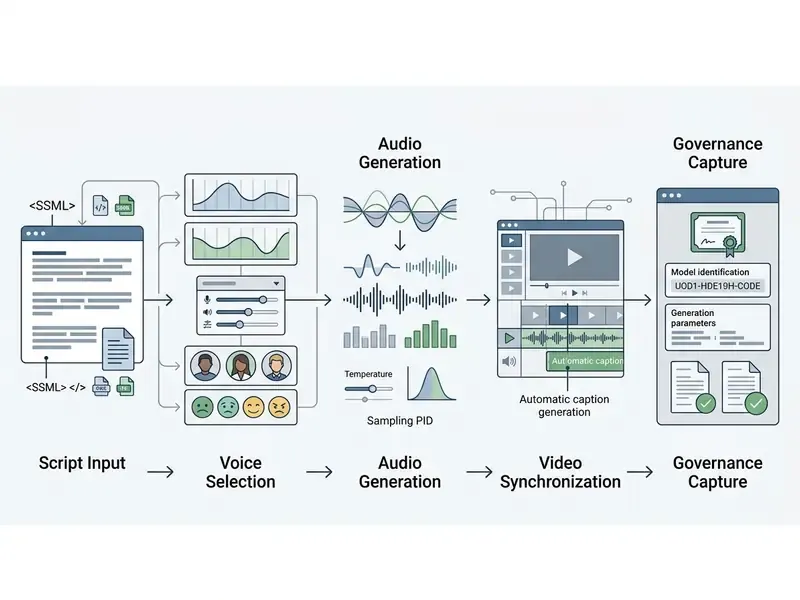
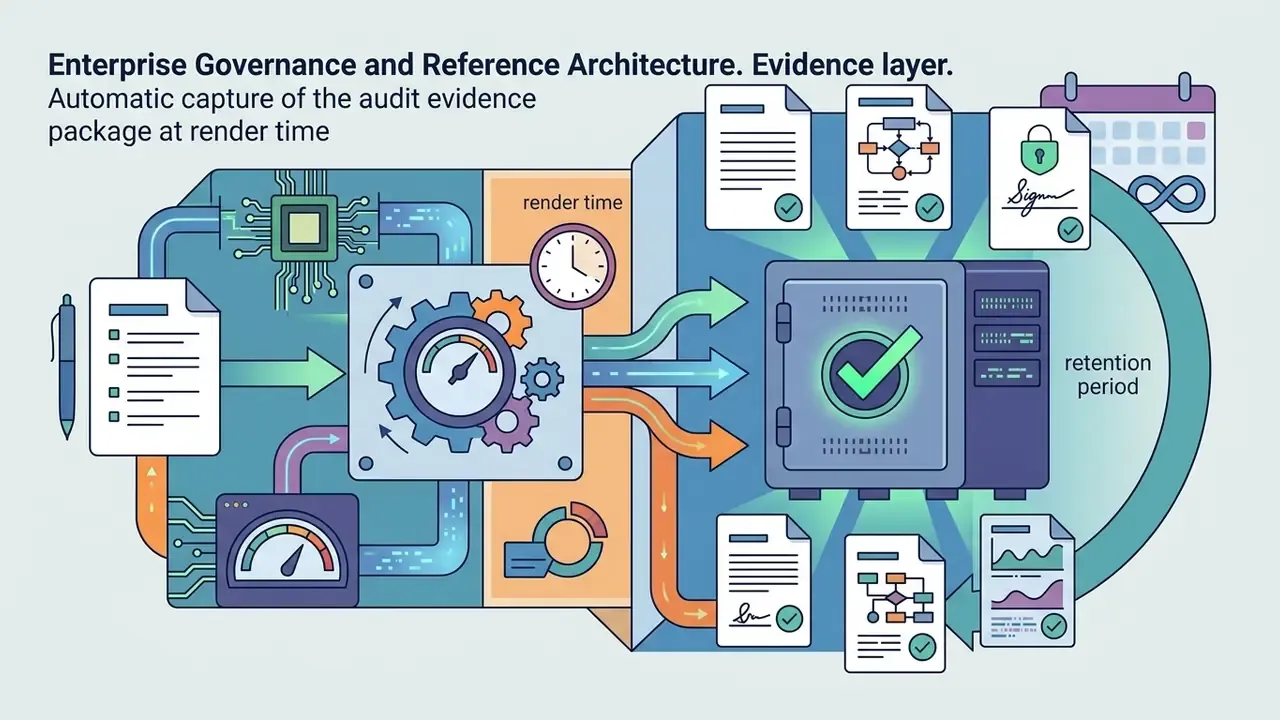
- Governance beats tooling.Before selecting a vendor, define your audit evidence package (script, model ID, generation parameters, consent record, commercial license certificate) and close the Shadow AI gap where staff paste confidential scripts into anonymous public TTS websites.
- Hybrid delivery wins.The most durable pattern pairs synthetic narration for informational segments with human voice for conversion hooks and emotional beats.
How to Use This Guide
Read it in the order your decision actually happens. Creators publishing single-platform clips will get what they need from the mechanics: script preparation, voice parameters, and the CapCut sync steps. Brand, procurement, and model-risk owners should start with the enterprise evaluation matrix and the evidence checklists, then treat the step-by-step section as the operational standard handed to agencies and freelancers. Everything cited here carries its source and year, and where evidence is commercial rather than peer-reviewed, we say so plainly. Uncertainty is flagged, not smoothed over.
What Is a TikTok AI Voice Generator and How Does It Work
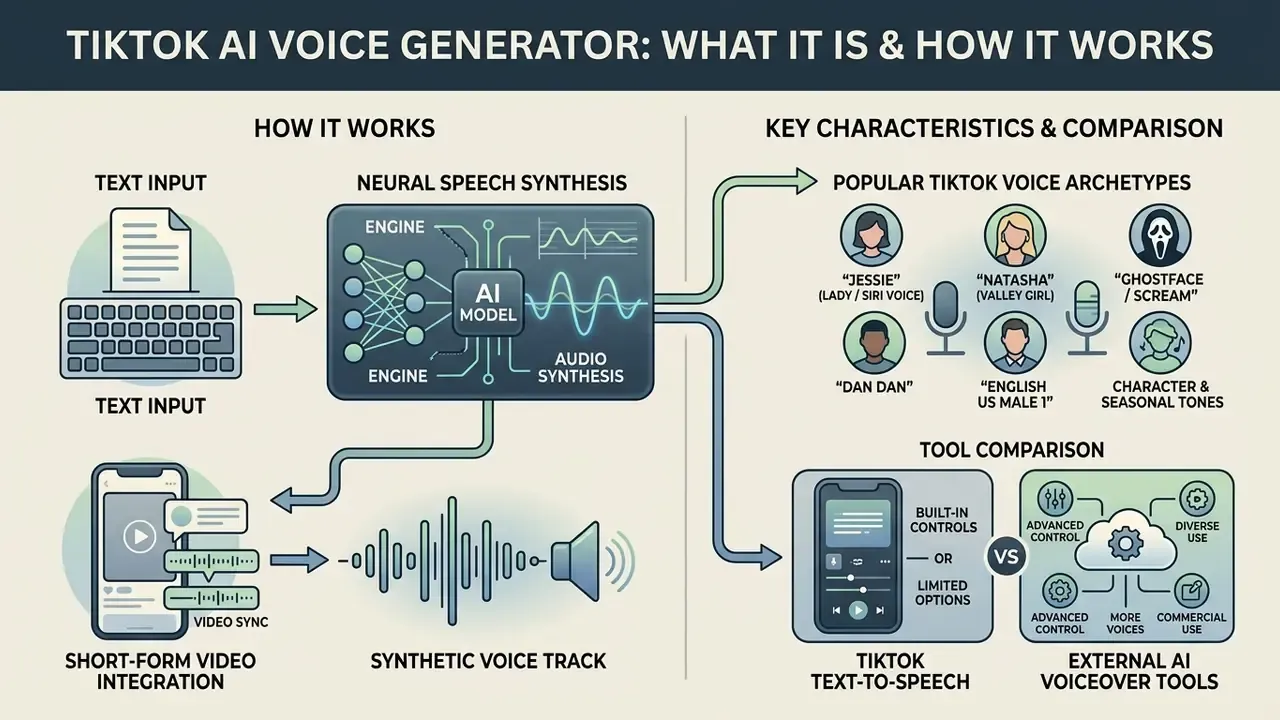
A tiktok ai voice generator is a software application powered by neural speech synthesis that transforms text input into synthetic voice tracks formatted for short-form video posts. These systems parse written scripts, apply linguistic normalization, and render acoustic waveforms using deep neural networks to convert text into quality audio without recording live microphone input.
«AI voice adoption increased video production by 21.8%, with AI absorbing the audio modality and freeing creator resources for text and visuals.»
Modern AI-driven speech tools process script parameters such as pitch, speed, and emotional inflection to produce natural-sounding voiceovers. By removing physical recording constraints, an ai voice generator allows organizations to generate audio rapid-fire for dynamic testing on social platforms. Creators often reference an ai sentence generator to rapidly draft video hooks before sending text to speech models. Teams new to the category can start with the broader technical overview of AI voice generators, which covers voice quality benchmarks, language support, and licensing tiers across the wider market.
Under the hood, the pipeline follows four technical stages: text normalization (expanding numerals, abbreviations, and symbols into spoken forms), linguistic and prosodic prediction (phoneme sequences, stress, and pause placement), acoustic modeling (mel-spectrogram or neural codec token generation), and waveform decoding. Contemporary architectures include Transformer-based autoregressive models, diffusion models, and neural codec language models, several of which operate zero-shot across speakers and languages. Standardized interfaces exist as well: ISO/IEC 14496-3 defines an MPEG-4 TTS Interface, and W3C SSML 1.1 specifies markup such as the <phoneme> element for deterministic pronunciation control.
TikTok Text-to-Speech vs. External AI Voiceover Tools
TikTok provides an in-app text-to-speech overlay function, whereas an external ai tiktok voice generator operates as a standalone software environment or API. Native TikTok text-to-speech reads captions generated inside the video editor, offering quick implementation with limited voice customization. The official in-app workflow is: tap Add post (+), record or upload footage, tap Text, type the caption, then select Text-to-speech.
In contrast, external ai voiceover tools for tiktok videos export standalone audio files (.wav or .mp3) with fine-grained control over vocal timbre, speed, and emotional expression. Independent production pipelines rely on external systems to keep brand voice consistent across multi-platform campaigns, including Instagram Reels and YouTube Shorts. Teams building fully automated pipelines often pair narration engines with text-to-video AI tools so that script, visuals, and audio render from a single brief.
TikTok Ads Manager sits between these two models: its Video Editor includes a Narration tab where advertisers can Add script, then Generate voice and captions, plus a Fix pronunciation control that accepts phonetic respelling before synthesis.
When AI Voice Helps in TikTok Content Creation
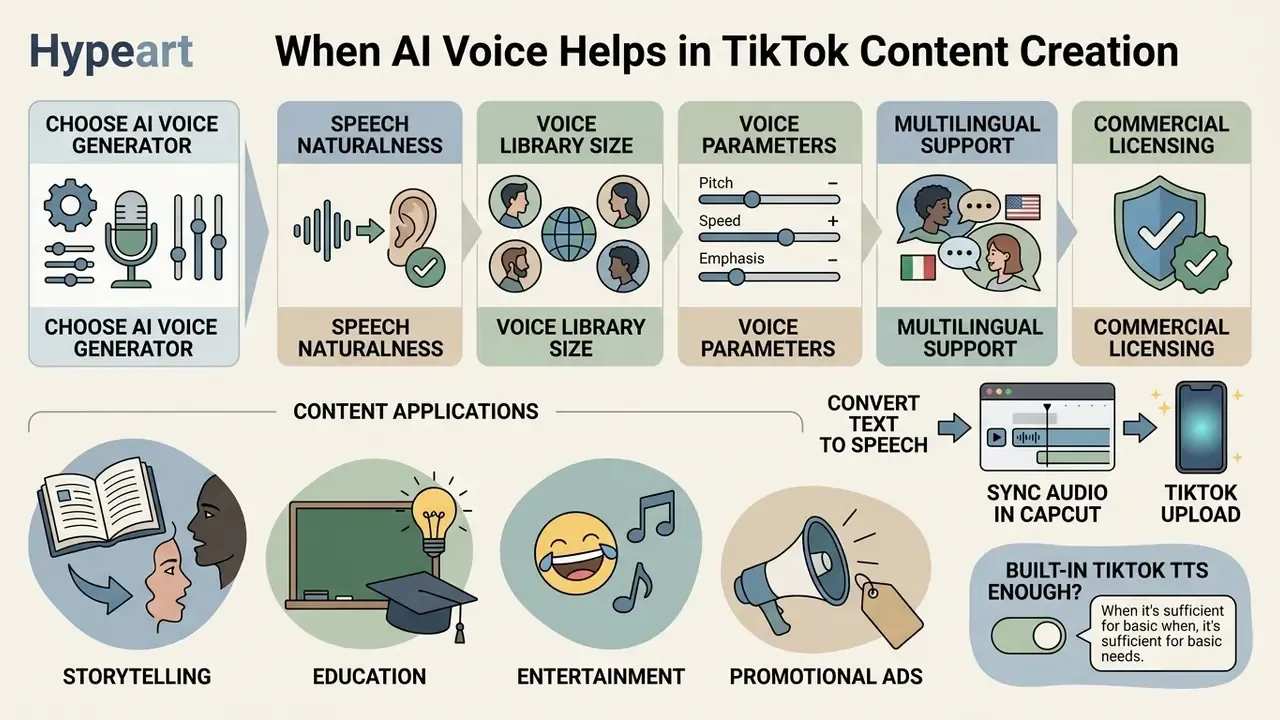
An ai voice for tiktok videos accelerates content creation when creators lack quiet recording environments, professional microphones, or native language fluency. Automated voice tools allow teams to publish fast paced explainers, product summaries, and news updates on tight deadlines.
«Creators using AI voice publish 24% more videos per week and 63% more total content duration; less experienced authors benefit the most.»
How to Choose an AI Voice Generator for TikTok Videos
Voice Naturalness and AI Voice Quality
Naturalness in a tiktok voice ai generator depends on prosodic accuracy, human-like cadence, and the absence of robotic artifacts. Peer-reviewed evaluations report Mean Opinion Scores (MOS) in the high-3 to mid-4 range on a 5.0 scale for current neural systems.
«A codec language model based TTS system achieved a best naturalness MOS of 3.80 out of 5.0 in the official CoVoC evaluations.»
Research-grade evaluation of synthetic speech generally combines MUSHRA-style listening tests with objective metrics: speaker similarity, Mel-Cepstral Distortion (MCD), F0 RMSE for pitch accuracy, intelligibility, and naturalness. When auditing a vendor, ask which of these metrics they publish and on which test set. Vague claims of "ultra-realistic" voices without measurement context are not a procurement signal. They are marketing.
Clear diction and realistic cadence sustain audience attention during the first critical seconds of video playback. High-quality speech models minimize cognitive load, allowing viewers to absorb complex product information without strain.
Voice Styles for Storytelling, Education, and Entertainment
A robust voice library should offer distinct voice styles tailored to specific content categories:
- Storytelling Warm, conversational tones with flexible pacing designed for narrative arcs and emotional pull.
- Educational/Explainers Clear, authoritative delivery with consistent cadence for tutorials and product demos.
- Comedic/Entertainment Exaggerated, deadpan, or stylized voices created for humorous contrast and timing-based punchlines.
- Promotional/Ads Dynamic, confident delivery structured to emphasize call-to-action hooks, with concise scripts that close on a single CTA.
Matching vocal style to visual context prevents audience disconnect and supports steady watch time. A calm corporate read over a frantic meme cut reads as a mistake, and viewers scroll.
Languages, Accents, and Localization for TikTok Videos
Global brand distribution requires multi-language speech generation and regional accent control. Research on accented TTS indicates that model fine-tuning with small datasets enables natural rendering of regional accents like Scottish or Australian English.
«Fine-tuning on 50 to 300 utterances significantly improves naturalness MOS for Scottish and Australian accents compared with baseline models.»
Additional peer-reviewed work demonstrates explicit accent-intensity control and multi-speaker, multi-accent synthesis across seven languages while preserving speaker identity. In practice that means a single brand persona can be rendered in multiple markets without re-casting talent.
Localization capabilities let marketing teams translate master scripts into dozens of target languages while preserving core vocal personas. Commercial platforms currently advertise between 33 and 175 supported languages and dialects, and between 160 and 500+ voices, though these counts are not directly comparable because vendors define "voice" and "language variant" differently. Using localized voiceover models expands reach across international market segments.
| Criterion | Native TikTok Text-to-Speech | External AI Voice Generator |
|---|---|---|
| Voice Library | Limited selection of native app voices | Hundreds of custom male voice & female voice profiles |
| Pacing & Pitch Control | Automated / Preset settings | Granular numeric adjustments (speed 0.5–2.0x, pitch −12 to +12 semitones, emotion) |
| Script Ingestion | Typed on-screen text only | .txt, .docx, .srt import plus SSML markup |
| Export Capabilities | Bound to TikTok video editor | Downloadable .WAV / .MP3 for cross-platform distribution |
| Commercial Rights | Platform-restricted personal usage | Commercial license available on paid enterprise tiers |
| Voice Cloning | Unsupported | Supported (own voice cloning with explicit consent) |
| API & Automation | Unsupported | REST/streaming APIs, batch rendering, webhook publishing |
When Built-in TikTok Text-to-Speech Is Enough
Native TikTok TTS is sufficient for individual creators producing informal, single-platform videos directly inside the mobile app. It provides zero-cost voice generation for quick captions and informal personal posts, and TikTok positions the feature partly as an accessibility tool: typed text is read aloud as it appears on screen, which helps viewers who cannot or prefer not to read captions.
However, native options offer minimal voice parameter adjustments and cannot be exported as standalone audio files for external editing software. There is no voice cloning, no imported audio, and no reusable asset. The narration lives and dies inside that single post.
When You Need an External TikTok AI Voice Generator
An external tik tok voice over generator is required when brands need high-fidelity speech, cross-platform assets, or custom vocal identities. Professional workflows demand external voice tools for:
- Cross-platform syndication (TikTok, YouTube Shorts, Meta Reels).
- Custom voice cloning based on executive or brand ambassador consent.
- Granular SSML markup for exact pause and emphasis control.
- Documented commercial rights for monetized advertising campaigns.
- Repeatable brand-voice consistency across dozens of creatives and markets.
The engagement trade-off must be priced into the decision:
«AI voice use on TikTok reduces likes by 5.4%, comments by 5.2%, and shares by 7.4%, especially in emotionally rich narrative segments.»
«Human voice lowers cognitive load during ad viewing and increases purchase intention; subtitles narrow the gap but do not eliminate it.» — Journal of Retailing and Consumer Services (2024), four experiments. https://www.sciencedirect.com
Illustrative hybrid pattern (directional, not a verified benchmark): a plausible campaign design assigns synthetic voices to data slides, specification read-outs, and disclaimers, while reserving human voice for the opening hook and the closing call to action. Teams testing this split should treat the retention and overhead effects as hypotheses to be measured against their own baseline rather than as published figures. The cited ICIS and Journal of Retailing and Consumer Services studies explain why the split tends to work; campaign-level uplift still requires your own A/B data.
Enterprise Evaluation Matrix: Security, Audit, and Data Retention
Consumer feature comparisons are insufficient for regulated organizations. Procurement, security, and model-risk functions should score vendors against the following criteria before any script leaves the corporate perimeter.
| Enterprise Criterion | What to Verify | Why It Matters |
|---|---|---|
| Security certifications | SOC 2 Type II report, ISO/IEC 27001 certificate, penetration-test summary | Establishes baseline control maturity for a third-party processor of brand and voice data |
| Biometric voiceprint handling | Where voice embeddings are stored, retention period, deletion SLA, whether clones are reusable by other tenants | A voiceprint is a biometric identifier in several jurisdictions; uncontrolled retention creates privacy exposure |
| Data residency | Region pinning for inference and storage; sub-processor list | Required for EU/UK data-transfer positions and sector-specific residency rules |
| Training-data usage | Contractual opt-out from model training on customer inputs and outputs | Prevents confidential scripts and product roadmaps from entering future model weights |
| Access control | SSO (SAML/OIDC), SCIM provisioning, role-based access control, per-seat quotas | Limits who can mint brand-voice audio and clone executive voices |
| Audit log | Immutable log of user, timestamp, input text, model ID, parameters, output hash; export via API | Provides reproducible evidence for regulators, platform appeals, and internal audits |
| Consent management | Native storage of talent consent artifacts, scope, expiry, and revocation workflow | Operationalizes the legal requirement rather than leaving it in a shared drive |
| Commercial licensing | Written grant covering ads, monetization, resale, sub-licensing, and attribution requirements | Determines whether the output can legally appear in a paid campaign |
| Content provenance | Support for synthetic-media labeling metadata and provenance credentials | Supports Article 50 style disclosure duties and platform AIGC labeling |
| Service continuity | Uptime SLA, rate limits, deprecation policy for voices you have built campaigns on | Prevents a discontinued voice from orphaning an entire brand library |
Vendor rights models are not uniform. Some providers state that they do not claim copyright over generated outputs; others grant commercial use only on paid tiers and restrict free-tier output to evaluation and testing. Those are different legal mechanisms, ownership versus permission, and both must be read before publication.
How to Create an AI Voice for TikTok Videos: Step-by-Step Process
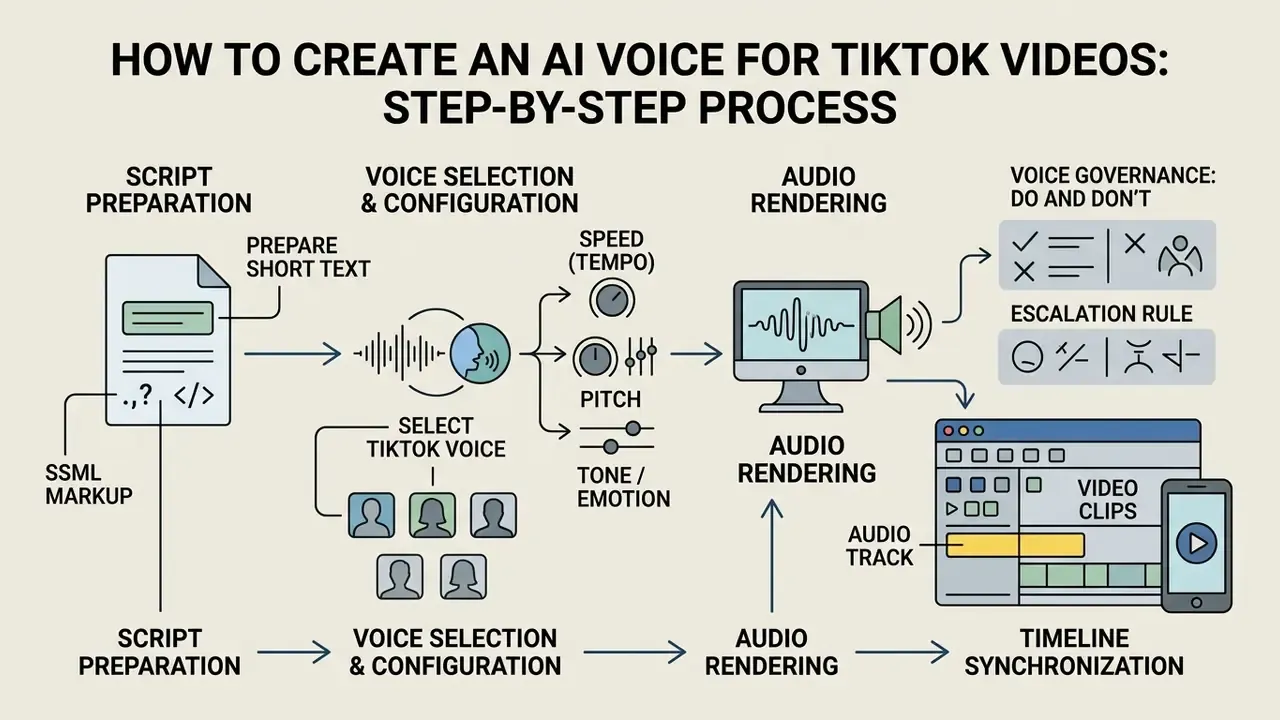
Generating an ai voice tiktok generator track involves script preparation, voice profile configuration, audio rendering, and final timeline synchronization.
Prepare Short Text for Your TikTok Voiceover
Drafting concise scripts optimizes synthetic speech output. Short-form video scripts perform best when structured around single-idea sentences, immediate hooks, and clear phonetic formatting.
SSML Markup Rules for Deterministic Delivery
Speech Synthesis Markup Language turns "hope it sounds right" into a specification. The core elements worth standardizing in a brand style guide:
<break time="400ms"/>forces a deliberate pause before a punchline or a price reveal, instead of relying on comma inference.<phoneme alphabet="ipa" ph="…">locks pronunciation of brand names, tickers, and product SKUs. This is the single highest-value tag for enterprises, because mispronounced brand names are the most visible failure mode.<emphasis level="strong">marks the one word in the sentence that must land, typically the differentiator or the number.<prosody rate="95%" pitch="-1st">applies localized tempo and pitch changes to a clause without affecting the whole track.<say-as interpret-as="date|telephone|characters">prevents "2026" from being read as "two thousand twenty-six" when "twenty twenty-six" is intended.
Voice governance: do and don't.
| Scenario | Do | Don't |
|---|---|---|
| Brand name mispronounced | Add an approved IPA <phoneme> entry to a central lexicon | Re-record with a different voice and hope it guesses correctly |
| Regulatory disclaimer | Keep neutral emotion, 0.95x speed, no emphasis tags | Apply an "excited" preset to risk language |
| Emotional customer story | Assign to human voice or a high-expressivity model with review | Use a monotone corporate preset |
| Price or discount figure | <say-as interpret-as="currency"> plus strong emphasis | Rely on raw numerals inside a fast-paced sentence |
Escalation rule of thumb: when a pronunciation dispute arises (legal entity names, clinical terms, regional place names), route it to a named owner, usually the brand or localization lead, who updates the shared lexicon once. Fixing it per-video is how inconsistency spreads across a library.
Teams utilizing an ai seo content tool should review generated text for natural spoken cadence before rendering audio tracks. Written copy that scans well on a page can still stumble out loud.
Select a TikTok Voice and Configure Delivery Parameters
Choose a voice profile from the platform library that matches your video genre. Select between male voice and female voice profiles, then adjust fundamental delivery controls:
- Speed (Tempo)Set between 1.0x and 1.15x for fast-paced viral formats. Most engines accept 0.5x to 2.0x, where 1.0 is the model's native rate.
- PitchShift semitones slightly (−2 to +2) to achieve ideal vocal resonance. Engine ranges typically span −12 to +12 semitones; anything beyond ±4 usually introduces audible artifacts.
- Tone/EmotionApply emotional presets (energetic, calm, serious) based on narrative context.
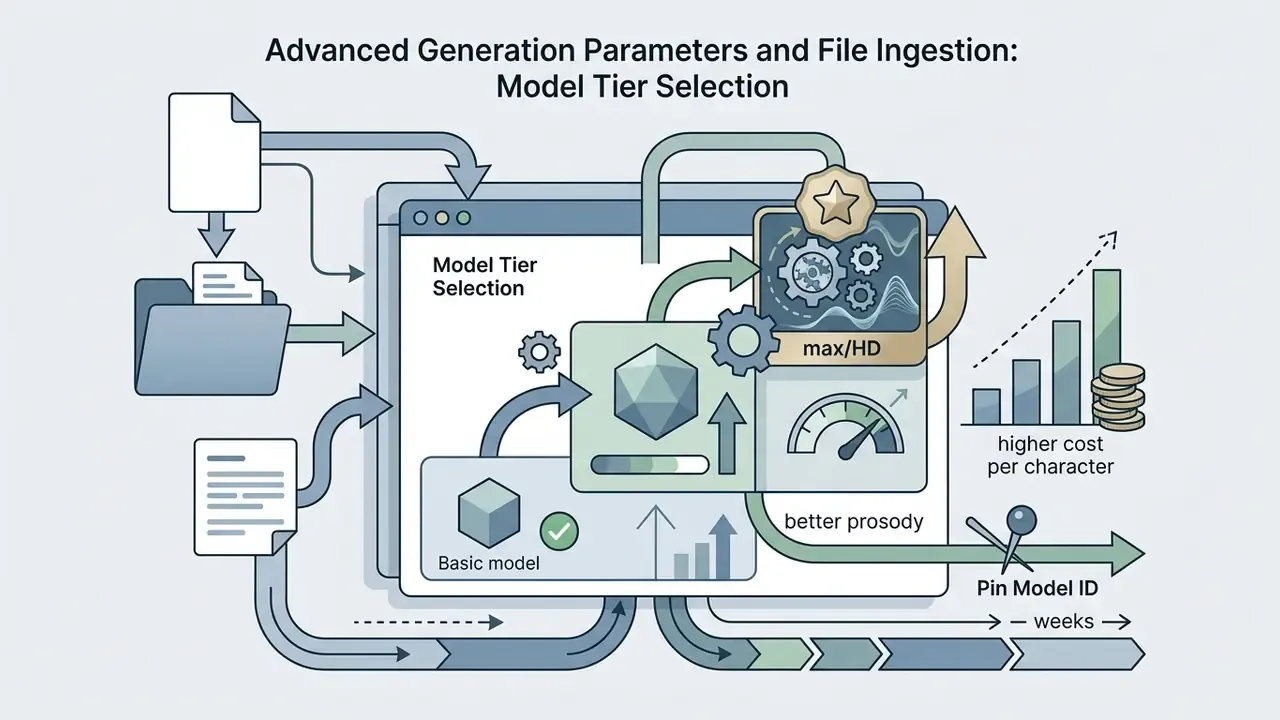
Advanced Generation Parameters and File Ingestion
For precise vocal rendering, enterprise TTS platforms allow parameter adjustments beyond standard pitch and speed:
Reproducibility note: record temperature, top_p, pitch, speed, emotion preset, voice ID, and model ID for every published asset. Without them you cannot re-render a corrected version that still sounds identical, and you cannot demonstrate to an auditor how the output was produced.
Illustrative scenario (directional): a financial media team evaluating synthetic narration for short-form market updates would typically front-load automated script normalization and phonetic tagging for tickers and issuer names before speech rendering, then measure pronunciation error rate and assembly time per asset against its pre-automation baseline. Reported reductions in pronunciation errors and assembly time from such pipelines are internal, unpublished figures and should be validated in your own environment rather than treated as an industry benchmark. Pair the audio output with a documented video editor workflow so corrected renders reach the timeline without manual re-cutting.
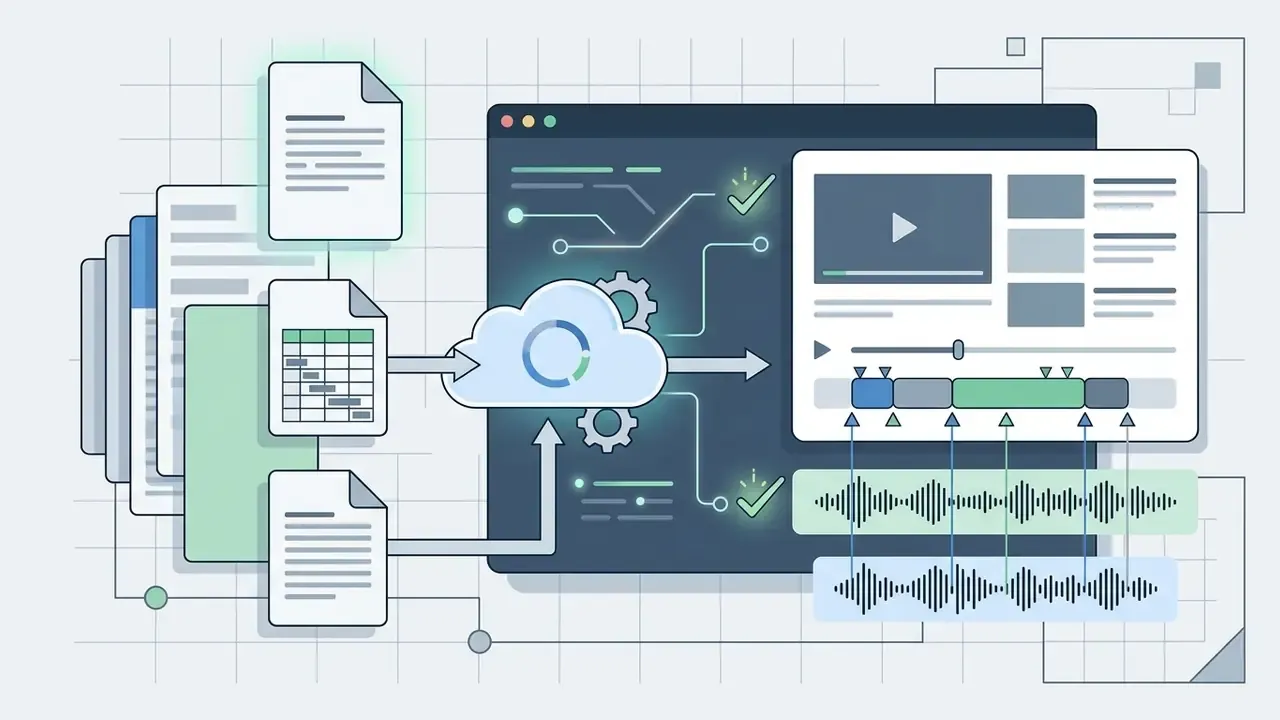
.srt caption files, .docx drafts, or .txt scripts. Importing .srt files preserves timestamp markers, so generated speech matches video cuts automatically.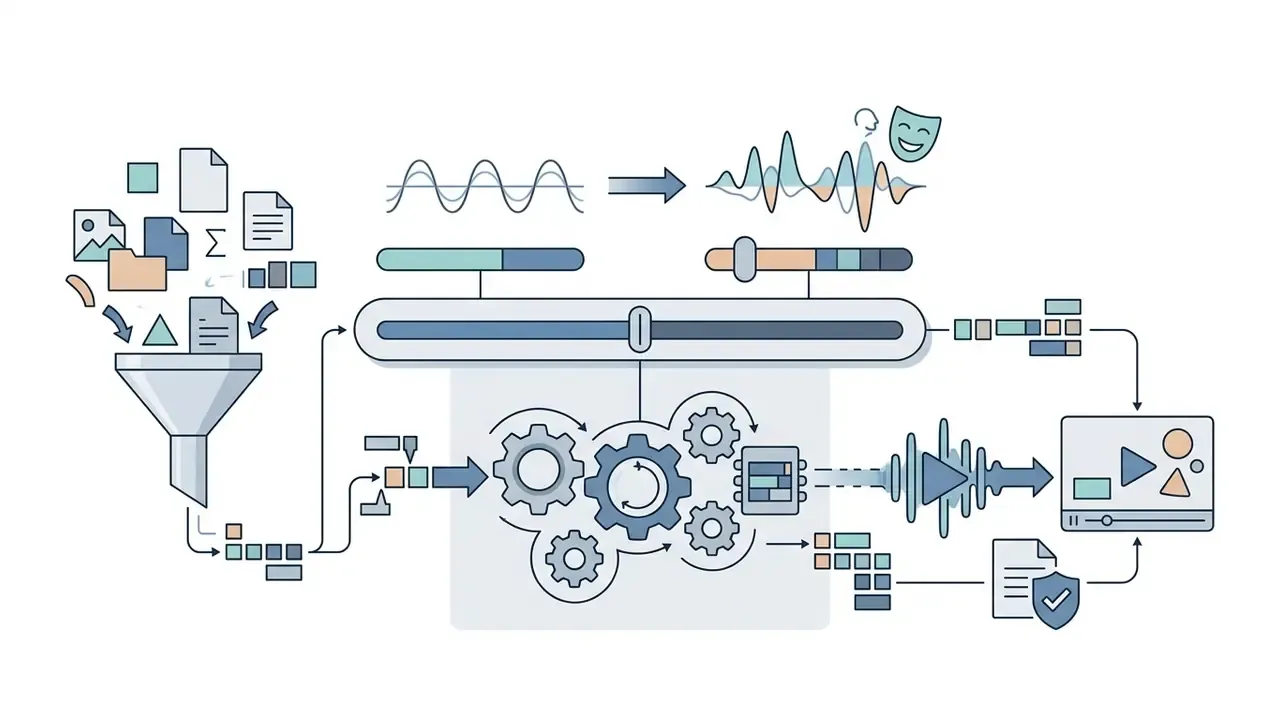
0.2–0.4 for monotonic news or corporate announcements; set to 0.7–0.9 for expressive storytelling and comedic skits.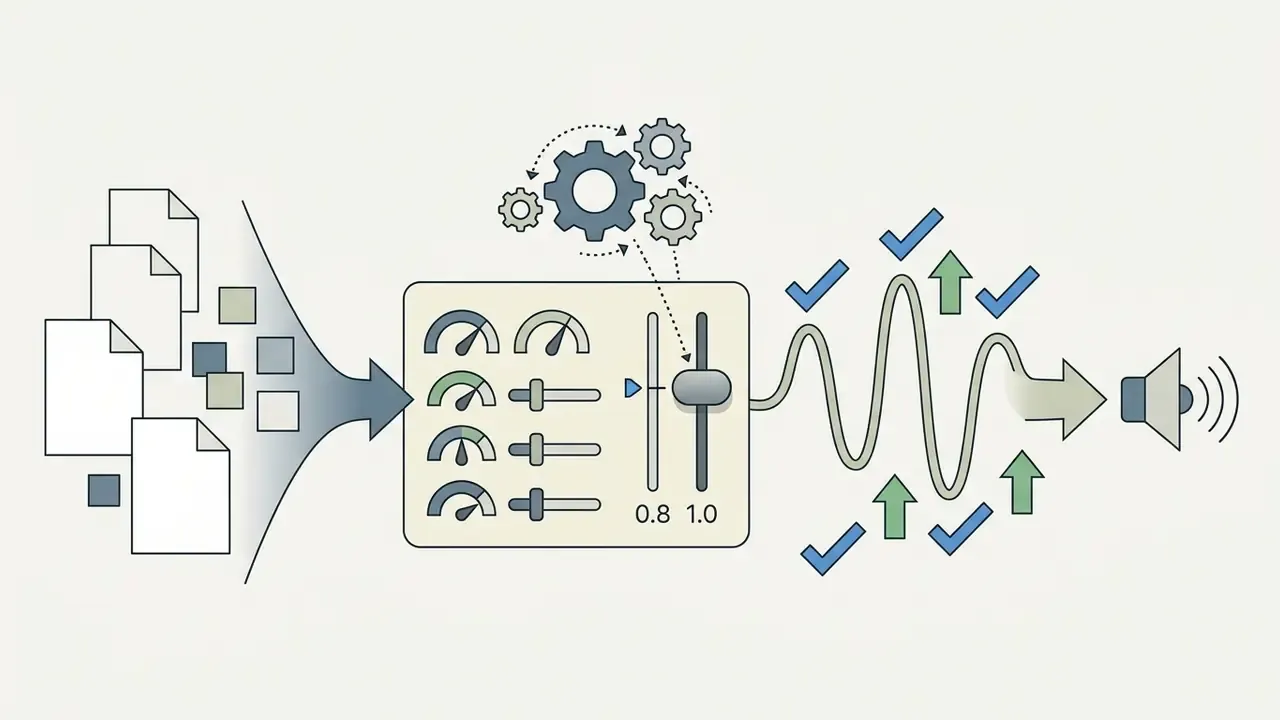
0.9 ensures natural prosodic variation without introduced phonetic artifacts.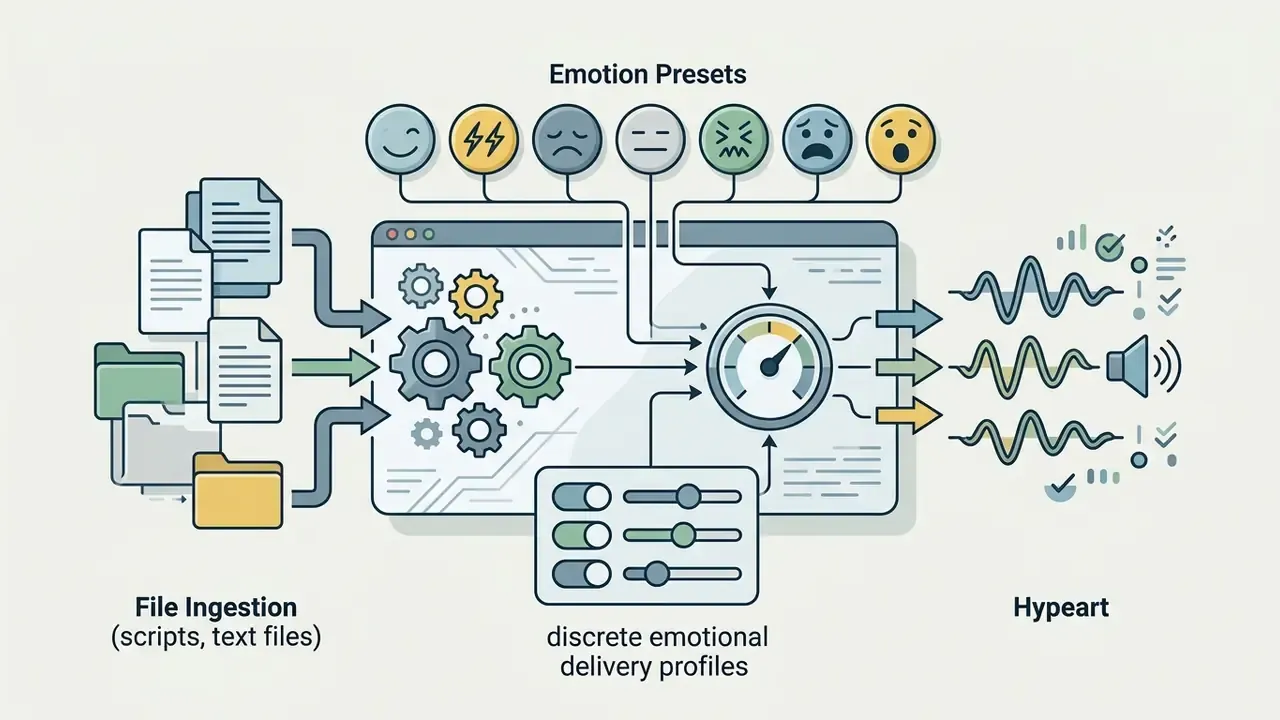
Generate Audio and Add It to Your Video
Execute speech synthesis to generate ai audio files. Preview the rendered sound track to verify diction, emphasis, and pronunciation accuracy. Listen on a phone speaker, not studio monitors, because that is where the audience will hear it.
Export the final audio file and import it into your video editing software (CapCut, Adobe Premiere, or Descript). Align the audio timeline precisely with visual transitions, so voice cues match on-screen actions and viewer focus holds. Premiere Pro's Merge Clips supports up to 16 audio channels against one video clip, Final Cut Pro can auto-analyze and sync audio and video, and Descript allows detaching audio and dragging it into frame-level alignment.
Integrating AI Audio Files into CapCut and TikTok
Once your standalone .mp3 or .wav track is exported, sync it with your visual timeline using this workflow:
- Export FileDownload the generated audio track in uncompressed
.wav(for production rendering) or320 kbps .mp3(for mobile editing). - Import to CapCutOpen your project in CapCut, tap Audio → Sounds → Folder Icon → From Device, and select your exported file.
- Apply "Added Sound" Tag in TikTokIf uploading directly via TikTok's mobile interface, tap Add Sound at the top of the screen, select your device file, and adjust the volume mix so the synthetic narrative tracks cleanly over background music.
- Auto-Caption AlignmentGenerate native video captions from the imported audio track to secure full accessibility and higher watch time for silent scrollers.
For delivery specs, platform transcoding favors AAC-LC audio at 44.1 to 48 kHz, program loudness around −14 LUFS, and true peak below −1 dBTP. Exceeding these targets invites platform-side normalization that flattens your carefully tuned dynamics.
Free TikTok AI Voice Generator Options, Pricing, and Restrictions
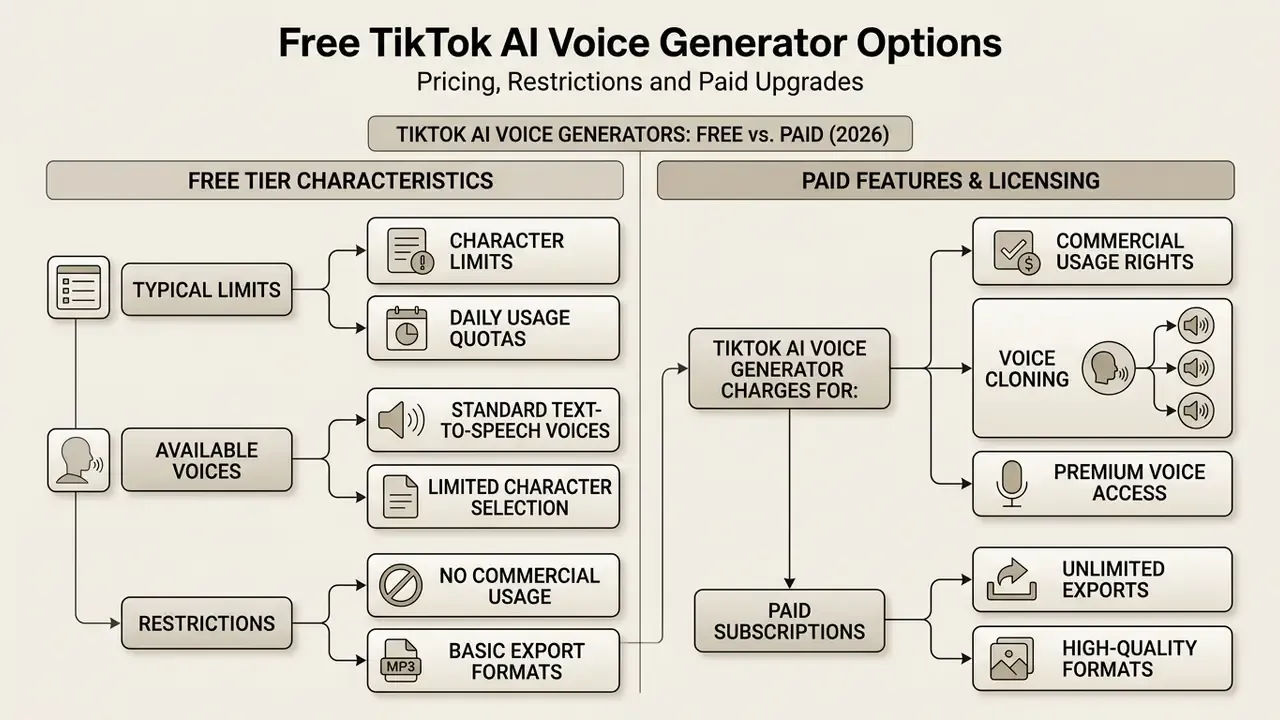
Organizations evaluating a free ai voice generator for tiktok must account for functional caps, usage quotas, and commercial license boundaries. Readers comparing adjacent zero-cost tooling can also review free AI video generators for the same pattern of watermarking and licensing limits. To benchmark operational software costs, consult our AI Media Pricing Guides.
What Is Typically Available in a Free TikTok Voice Generator
A free tiktok ai voice generator or free tiktok voice option generally provides entry-level features designed for testing and personal evaluation.
«In 2023, 45% of companies used AI voice at least once, and 38% integrated TTS tools into their creative workflows.»
Typical free-tier boundaries:
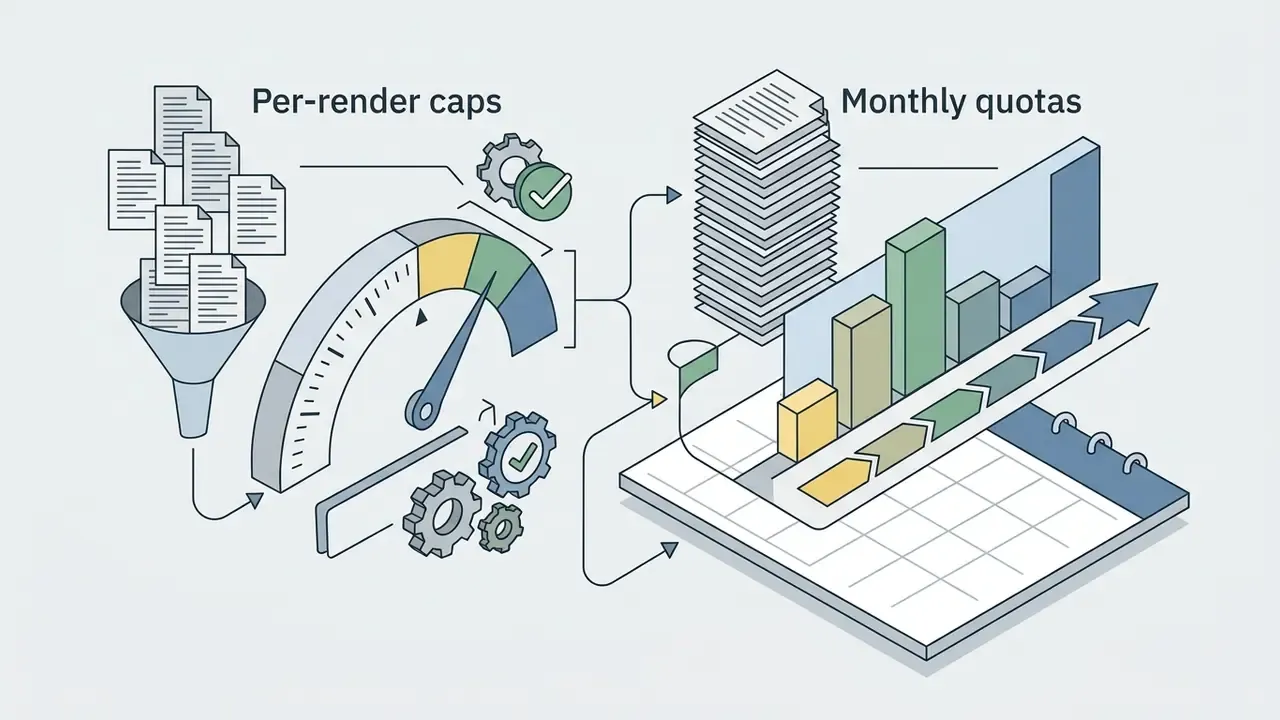
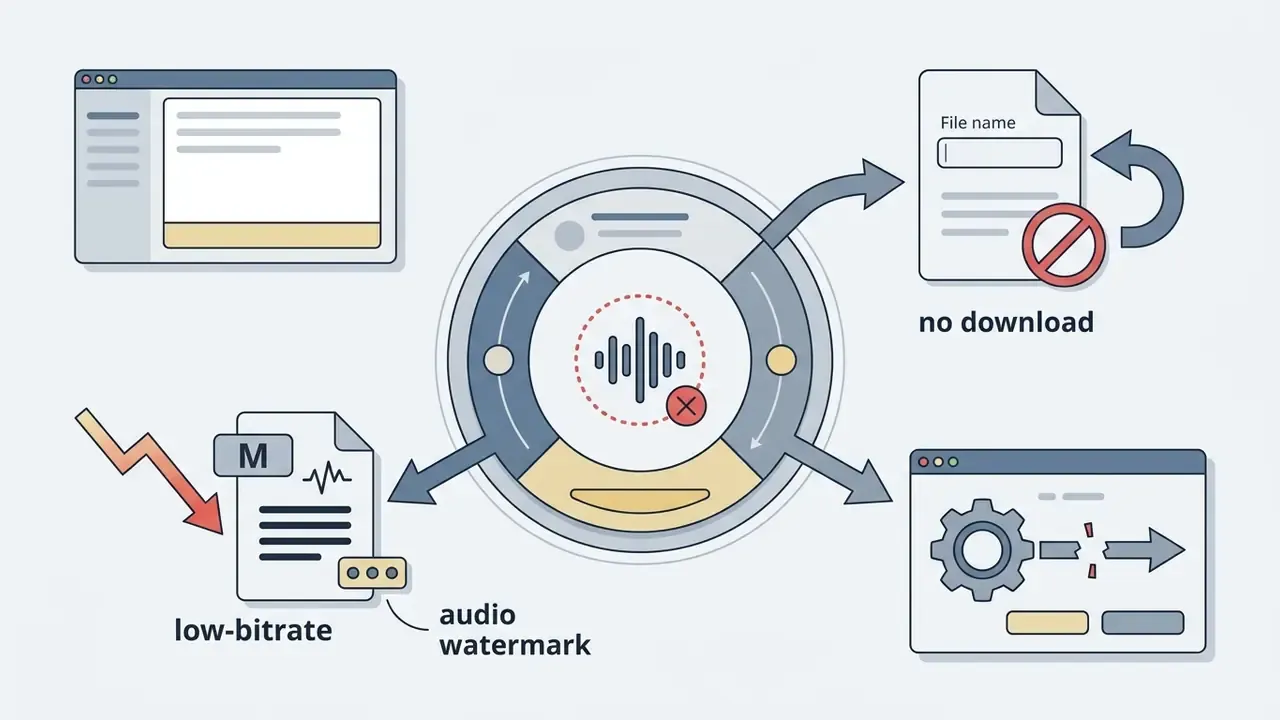
| Platform Tier | Monthly Free Character Quota | Max Script Length per Render | Export Quality & Restrictions | Commercial Rights |
|---|---|---|---|---|
| Canva AI Voice | Variable (Free account tier) | 1,000 characters (~150–200 words) | Integrated in-editor audio; limited raw file export | ❌ Personal Use Only |
| TTS Vibes | Unlimited (Non-premium voices) | 300 characters per render | Standard MP3 output | ❌ Personal Use Only |
| VoiceChanger.video | Unlimited (No registration required) | 500 characters per render | Clean MP3 export (No watermark) | ✅ Stated as granted for ads |
| FineVoice | 5,000 characters / month | Varies by account tier | High-bitrate MP3 / WAV options | ❌ Paid Tier Required |
| Cloud TTS APIs (Google / Azure) | 0.5M–5M characters (voice-family dependent) | API request limits, not UI caps | Full-fidelity WAV/MP3, SSML support | ⚠️ Paid tier for commercial use; free tier often evaluation only |
| Enterprise SaaS | Custom API / Monthly quotas | 100,000+ characters | Uncompressed WAV, custom voice clones, SSML markup | ✅ Documented SLA |
Quotas and limits change frequently. Treat this table as a benchmark of market structure and verify current terms on the vendor's own pricing and licensing pages before procurement.
Features That AI Voice Generators Charge For
Commercial subscription plans unlock production-grade capabilities required for professional deployment:
- Commercial Usage RightsLegal permission to use generated speech in ads and monetized posts.
- Voice CloningAbility to synthesize an individual's own voice from recorded samples (instant cloning on lower paid tiers, professional cloning higher up).
- High-Bitrate ExportLossless WAV audio, 44.1 kHz PCM, or 320 kbps MP3 output.
- Premium Voices and StylesExpressive, character, and singing voices held back from free libraries.
- Advanced API AccessIntegration with automated video publishing workflows via AI Media API Guides.
- Governance FeaturesSSO, audit logs, training opt-out, and data residency, usually enterprise-only.
| Tier Level | Character Quotas | Available Features | Commercial Rights |
|---|---|---|---|
| Free Tier | 300 chars/render – 20,000 chars/mo | Basic voices, standard quality, web preview | ❌ Personal Use Only |
| Starter ($5–$15/mo) | 30,000 – 100,000 chars/mo | Expanded library, high-quality export, instant cloning | ✅ Included |
| Pro ($30–$99/mo) | 100,000 – 500,000 chars/mo | Premium voices, 192 kbps / 44.1 kHz PCM, priority rendering | ✅ Included |
| Enterprise (Custom) | Unlimited / Custom API | Professional voice cloning, SSO, audit logs, dedicated support, custom SLA | ✅ Enterprise Granted |
Cloud-platform metered pricing offers a useful sanity check on per-unit cost: published rates for major cloud TTS families span roughly $4 to $160 per million characters depending on voice class, with free monthly allowances of 1 to 4 million characters for standard and neural tiers. If a consumer tool charges dramatically more per character than metered cloud synthesis, you are paying for interface convenience, curation, and licensing. Decide consciously whether that premium is justified. Production planners can use dedicated AI Media Calculators to model quota burn before committing to a tier.
Risk-Adjusted ROI of Synthetic Voice Production
Finance and content leads usually model only the subscription line. A defensible business case for synthetic narration nets out compliance and engagement costs as well:
Risk-Adjusted ROI =
  ( Production Savings + Throughput Value − Engagement Loss )
  ÷ ( Subscription + Governance Cost + Expected Remediation Cost )
Where:
  Production Savings   = (talent fee + studio + editing hours) × assets avoided
  Throughput Value     = incremental assets published × average value per asset
  Engagement Loss      = baseline engagement × observed decline on synthetic assets
                         (published panel data: ~5% likes/comments, ~7% shares)
  Governance Cost      = legal review + consent administration + audit log retention
  Expected Remediation = P(takedown or claim) × (asset re-production + campaign downtime)
Three practical notes. First, throughput value is the dominant positive term: the UBC panel data supports volume gains, not affection gains, so the case rests on publishing more, not on each video performing better. Second, engagement loss is not uniform, since it concentrates in emotionally driven and identity-led formats, so segment your library before applying a blanket discount. Third, expected remediation is the term most often set to zero and most often wrong. A single ad pulled for unlicensed voice usage can exceed a year of subscription cost once re-production and media waste are counted.
Can You Use TikTok AI Voices in Commercial Content?
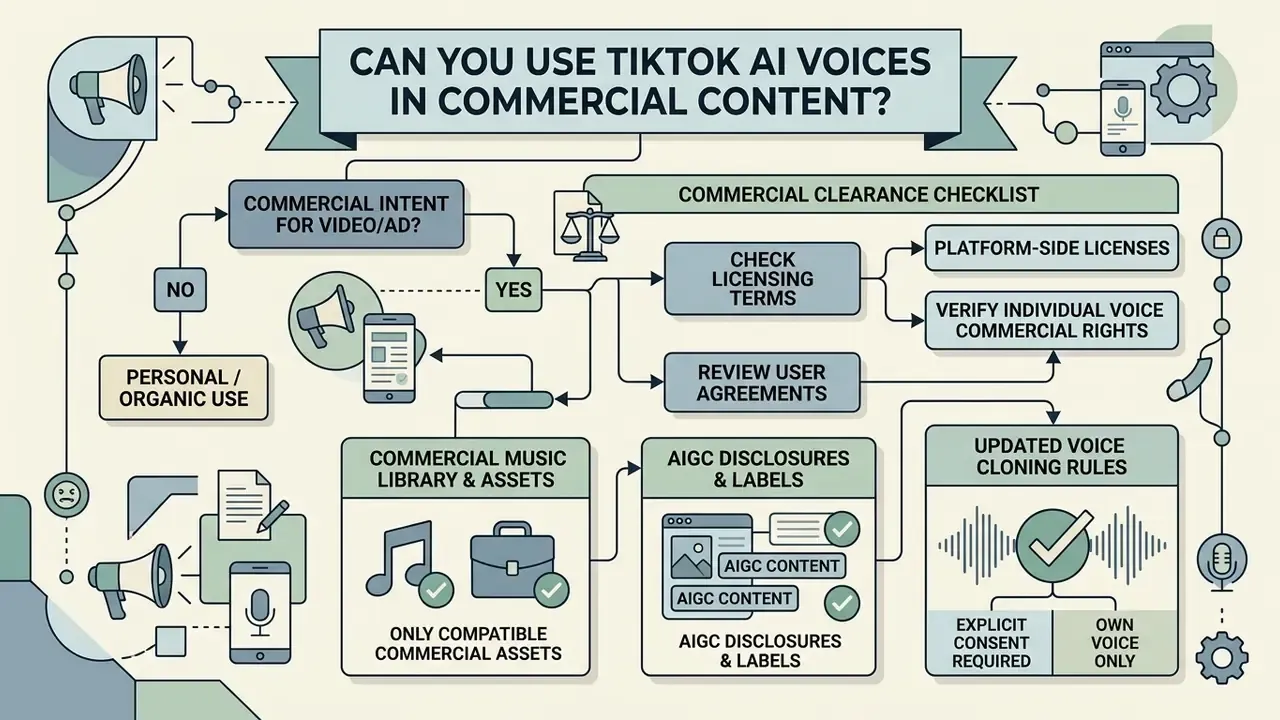
Using synthetic voiceovers in commercial marketing requires verifying end-user license agreements (ToS) and privacy regulations regarding voice identity rights.
Licensing Terms to Check Before Publishing Branded Content or Ads
Before running paid TikTok campaigns with an ai voiceover, review platform guidelines and vendor terms:
- Commercial Clearance Verify that your software subscription explicitly grants commercial monetization rights, and that the grant covers advertising, resale, and sub-licensing if agencies are involved.
- Commercial Music Library Ensure background tracks paired with AI voices use TikTok's pre-cleared Commercial Music Library (CML). TikTok's guidance is explicit that brands must not use copyrighted sound without acquiring all necessary licenses.
- AIGC Disclosures Comply with platform policies on mandatory labels for AI-generated synthetic content, and with branded-content disclosure rules for promotional posts.
- Platform-Side Licenses Note that TikTok's commercial terms grant the platform a worldwide, non-exclusive, sub-licensable license over uploaded commercial content, and its seller-facing AI Voice Library terms extend a similar license over sampled audio and the generated voice for shoppable-video dubbing. That platform license does not substitute for your own rights in third-party voices, music, or trademarks.
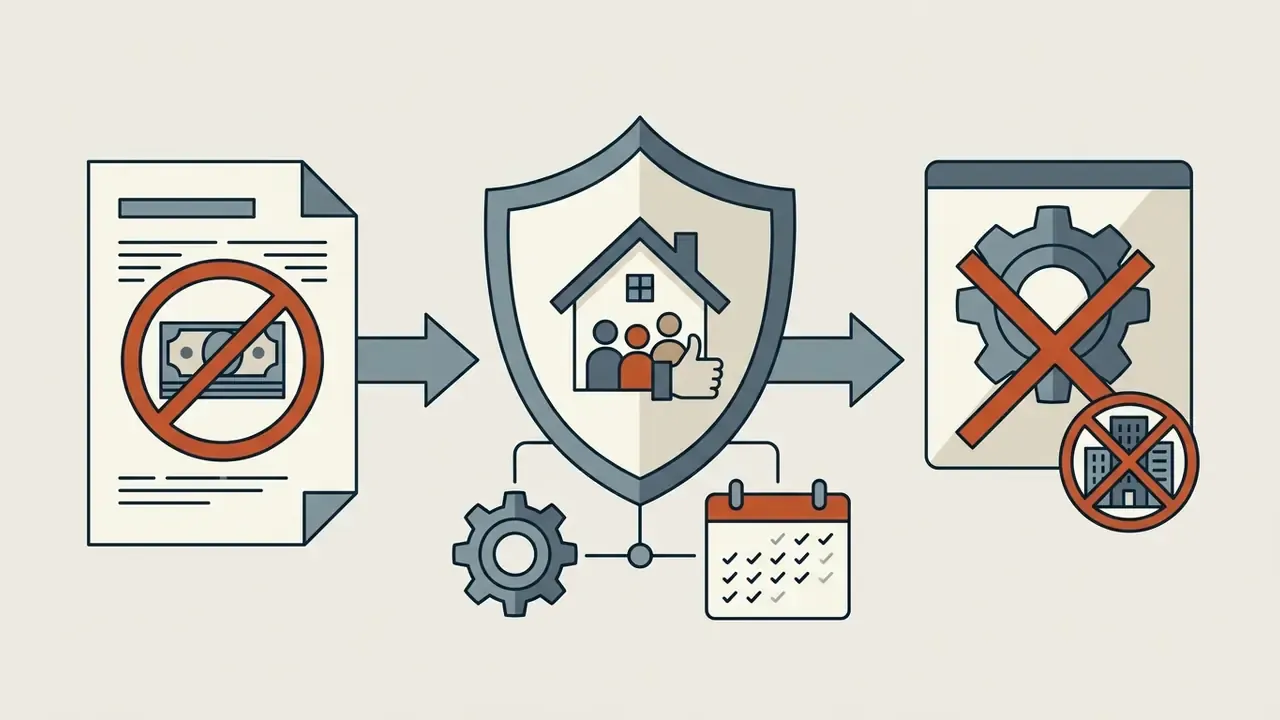
«The Beijing Internet Court ruled that unauthorized commercial AI processing of a person's voice infringes personal rights; a general copyright license is insufficient.»
«In 2024, a class action was filed in the Southern District of New York against LOVO Inc. for using voice actors' voices without permission in TTS services.»
Legal teams should review documented cases tracked in the AI Litigation and Case Timelines hub, and align the commercial position with the frameworks in our AI Media Commercial-Use Hub.
Voice Cloning: Using Your Own Voice and Consent Requirements
Synthetic voice cloning technology generates a replica of a speaker's vocal profile using sample recordings. The technical fidelity is now high enough that consent, not capability, is the binding constraint:
«A multilingual voice cloning system achieved a speaker-similarity MOS of 4.25 and naturalness MOS of 3.97; the cloned voice sounds natural and close to the original with minimal data.»
Using cloned voices requires:

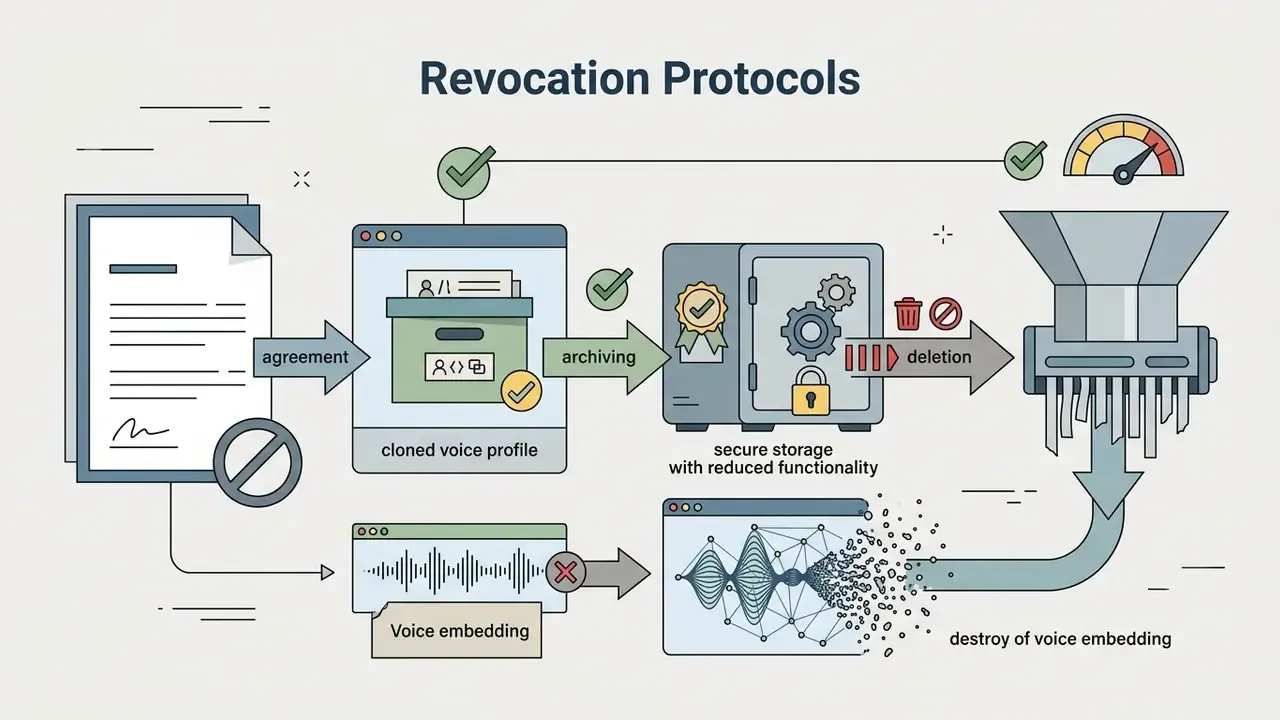
«Indian High Courts have expressly recognised AI voice conversion as a violation of personality rights, extending injunctions to "voice models, voice conversion, synthesised voices" across all media.»
«Existing copyright, privacy, and publicity regimes are inadequate to protect against unauthorized voice cloning; a federal Anti-Impersonation Right Act is proposed.» — Fenwick, Voice Cloning in an Age of Generative AI (2024). https://ssrn.com
Jurisdictional note: Japanese guidance similarly treats the human voice as a personally identifying element protected by personality and publicity concepts, meaning unauthorized cloning can create civil liability independent of copyright.
Illustrative scenario (directional): a risk function reviewing third-party text-to-speech tools for enterprise marketing would typically implement consent tracking per voice profile and verify commercial license documentation before any profile is approved for production use. Teams that have done this report fewer compliance findings in internal model-risk reviews, but those counts are internal and unpublished. Treat the control design as the transferable lesson, not the metric.
Shadow AI Risk in Marketing Teams
The most common synthetic-voice incident is not a lawsuit. It is an unapproved browser tab. "No sign-up required" TTS sites are attractive precisely because they bypass procurement, and that is exactly what makes them a data-governance problem: unreleased product names, pricing, embargoed announcements, and executive voice samples get pasted into services with unknown retention and training policies.
A workable control set:
Use Cases for AI Voice in TikTok Videos
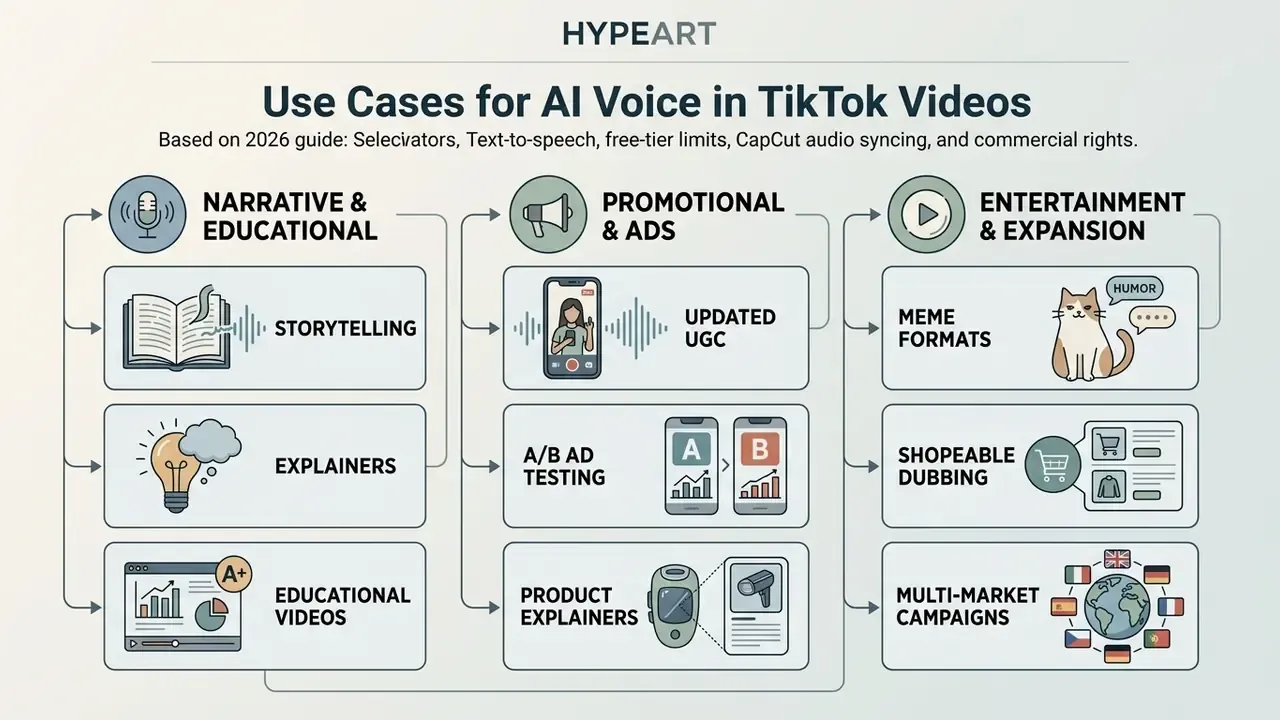
Integrating an ai voice generator tiktok track fits specific content formats across narrative, educational, and promotional channels.
Storytelling, Explainers, and Educational Videos
AI voices excel at structured informational delivery: educational tutorials, market summaries, step-by-step explainers. Clear, uniform diction keeps technical concepts understandable.
«Storytelling-narrated videos produced higher test scores than lecture-narrated videos, with stronger retention and transfer outcomes.»
UGC, Ads, Memes, and Entertainment Formats
For user-generated style (UGC) ads and entertainment clips, synthetic voices offer rapid iteration:
- A/B Ad Testing Render dozens of voiceover variations to evaluate different script hooks at near-zero marginal cost.
- Meme Formats Deploy recognizable deadpan or stylized voices for comedic effect, sometimes layered with a voice changer preset for extra contrast.
- Multi-Market Campaigns Localize top-performing UGC creatives into regional dialects simultaneously. Teams repurposing the same masters to long-form can reuse the audio inside established YouTube video editing workflows.
- Product Explainers and Shoppable Dubbing Narrate specification-heavy commerce clips where consistency matters more than personality.
«AI voice delivers +1.8% retention in the first 3 seconds, but human voice outperforms it by 12–19% in attention after 22 seconds and generates 3.2× more emotional comments.»
FAQ: TikTok AI Voice Generator
Why is TikTok text-to-speech not working on my account?
In-app text-to-speech may become unavailable due to outdated app versions, regional feature rollouts, or account category restrictions (for example, specific commercial business accounts). Updating the app or using an external voice generator resolves most distribution bottlenecks. In self-hosted or API contexts, failures usually trace to a speech service or audio server that is not running, an unsupported voice ID, or a quota that has been exhausted.
How can I make an AI voice sound less robotic?
Improve voice realism by inserting commas and periods to force natural speech pauses, spelling complex words phonetically, and selecting advanced neural voice models with expressive prosody controls. At the parameter level: raise temperature toward 0.7–0.9 for expressive content, keep sentences under 12 words, add explicit tags instead of relying on punctuation inference, and avoid pitch shifts beyond ±4 semitones, which introduce artifacts.
Do I need to install an app to generate TikTok AI voices?
No. Web-based SaaS platforms, browser applications, and HTTP speech APIs let users generate, preview, and download AI voice files without installing desktop or mobile software. For enterprises, prefer an authenticated tenant over an anonymous public tool so that usage is logged.
How do I label AI-generated voices on TikTok?
TikTok requires creators to toggle the "AI-generated content" switch in the post publishing settings when publishing media created or significantly altered by AI tools. For advertising, also apply branded-content disclosure, and retain provenance metadata to support Article 50 style transparency obligations in the EU.
Which voice should I pick for a Reddit story or faceless narration channel?
Upbeat neutral female narration ("Jessie"-type) and general-purpose male narration remain the defaults, because audiences have been conditioned to parse them quickly. Reserve raspy villain and character voices for horror and comedy, where the voice is part of the joke rather than the delivery mechanism.
Can I clone a celebrity, a competitor's spokesperson, or a deceased artist's voice?
No, not without rights. Courts in China and India have treated unauthorized AI voice conversion as an infringement of personality rights, a US class action has targeted a TTS vendor over unlicensed actor voices, and proposed US federal reform would create an explicit anti-impersonation right. A vendor's commercial license covers their voice inventory. It never covers someone else's identity.
How many characters can I generate for free?
It depends entirely on the vendor: common per-render caps are 300, 500, and 1,000 characters, while monthly free quotas range from roughly 1,500 to 20,000 characters on consumer tools, and 0.5 to 5 million characters on cloud TTS free tiers. Free output is almost always personal-use only.
What audio specification should I export for TikTok?
Export AAC-LC at 44.1 to 48 kHz, target program loudness near −14 LUFS with true peak below −1 dBTP, and deliver either uncompressed WAV for editing or 320 kbps MP3 for mobile assembly. Mixing narration 4 to 6 dB above background music generally preserves intelligibility on phone speakers.
Does using an AI voice reduce reach or engagement?
Reach is driven by retention and interaction, not by voice type as such. Panel research does show lower likes, comments, and shares on synthetic-voice videos, concentrated in emotional and identity-led formats, while production volume rises. Informational and localized content shows the smallest penalty.
Enterprise Governance and Reference Architecture
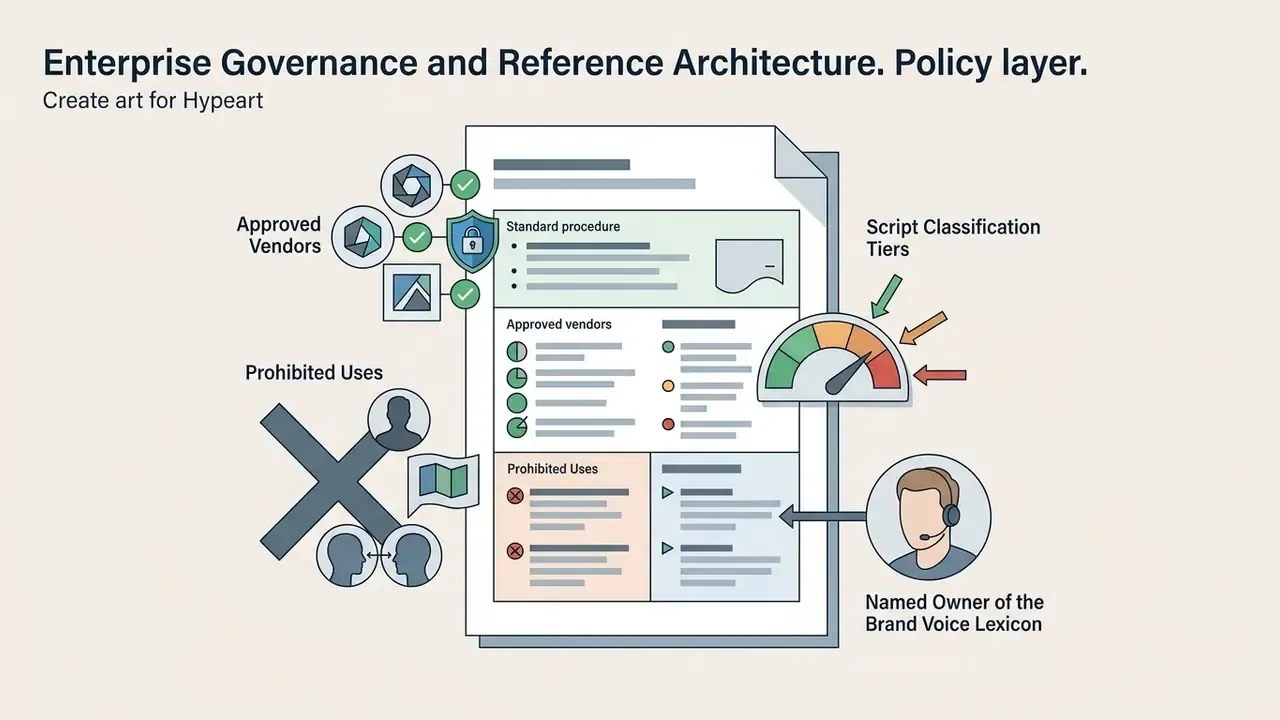
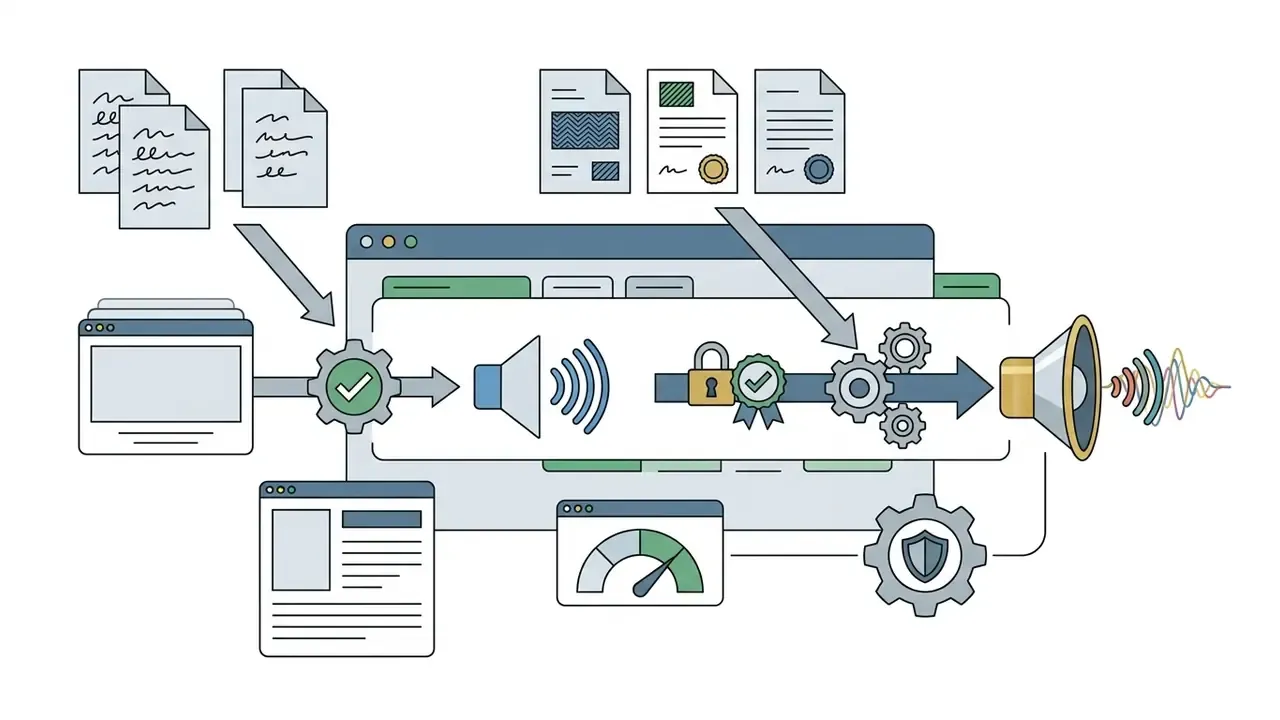
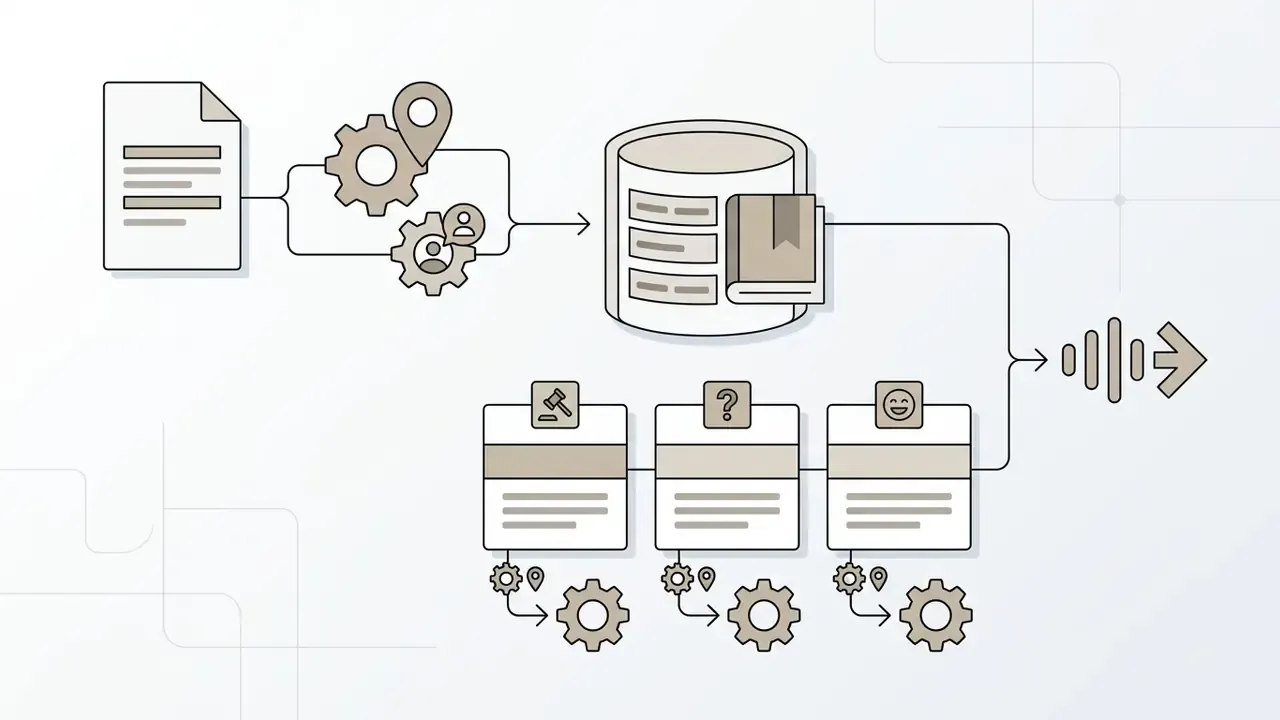
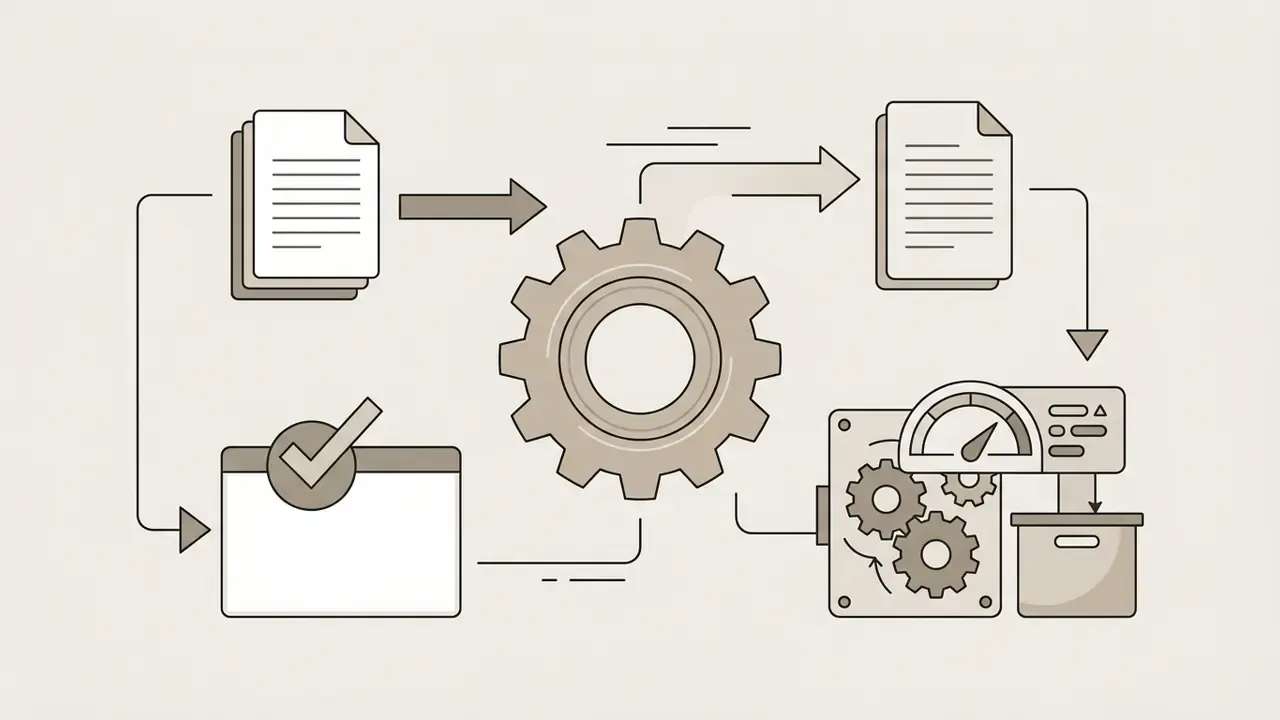
A governed synthetic-voice pipeline has five layers. Implement them in order; skipping straight to tooling is what produces orphaned voices and unlicensed ads.
Next steps for an AI governance or content-risk owner, this quarter:
Checklist0 / 6
Limitations and Open Questions
Two things are worth stating plainly, because the evidence is not settled. First, the engagement penalty for synthetic narration comes from panel and commercial analytics, not controlled brand-level experiments, so the magnitude in your niche may differ materially from the published 5% to 7% range. Second, the legal position on voice identity is moving faster than the tooling: Chinese courts have already split on related facts, US federal protection remains proposed rather than enacted, and platform labeling duties keep expanding. Treat this guide as a control framework with an expiry date, and re-verify vendor terms, disclosure rules, and case law at least twice a year.