That is the lens used here. Not "is Sora impressive", but "can we forecast, attribute and defend the spend".
«In evaluating generative media technologies for institutional workflows, cost structure is inseparable from risk control. Without predictable usage metering, defined audit trails, and strict access limits, AI automation introduces uncontrolled exposure.»
Executive summary: the facts a decision-maker needs first
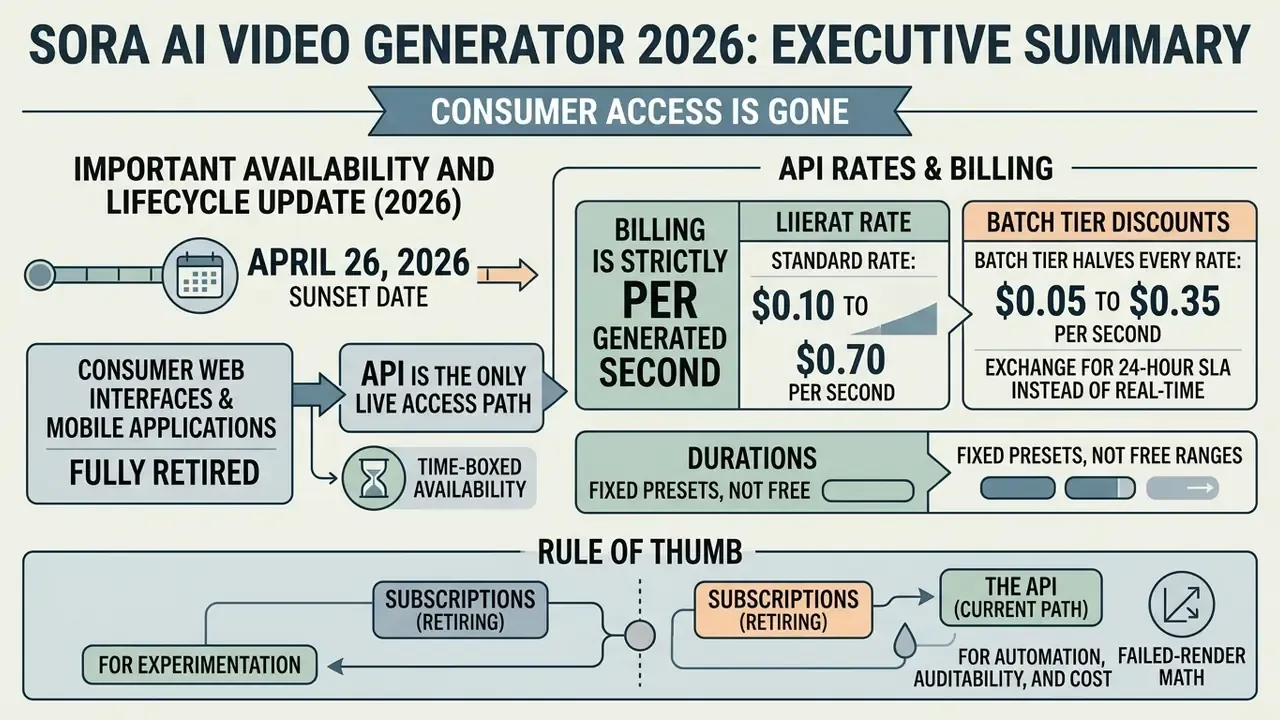
- Consumer access is gone. Sora's consumer web and iOS experiences were discontinued on April 26, 2026. All consumer subscription tiers (ChatGPT Plus, ChatGPT Pro) lost Sora access on that date.
- API is the only live access path, and it is time-boxed. The Sora 2 / Sora 2 Pro API remains operational but is scheduled to sunset on September 24, 2026. Do not architect new long-term pipelines on Sora without a documented exit plan.
- Billing is strictly per generated second.
sora-2costs $0.10/sec (720p).sora-2-procosts $0.30/sec (720p), $0.50/sec (1024p / 1792×1024), and $0.70/sec (1080p / 1920×1080). - Batch tier halves every rate ($0.05 to $0.35 per second) in exchange for a 24-hour SLA instead of real-time delivery.
- Durations are fixed presets, not free ranges. Sora 2 supports 4s, 8s, or 12s; Sora 2 Pro supports 10s, 15s, or 25s. The maximum single-generation length is 25 seconds.
- Rule of thumb: subscriptions were for experimentation; the API is for automation, auditability, and cost attribution. Teams that need compliance controls, usage metering, and migration flexibility should plan around Google Veo 3.1 as the successor engine.
What Sora AI Video Generator Pricing Includes
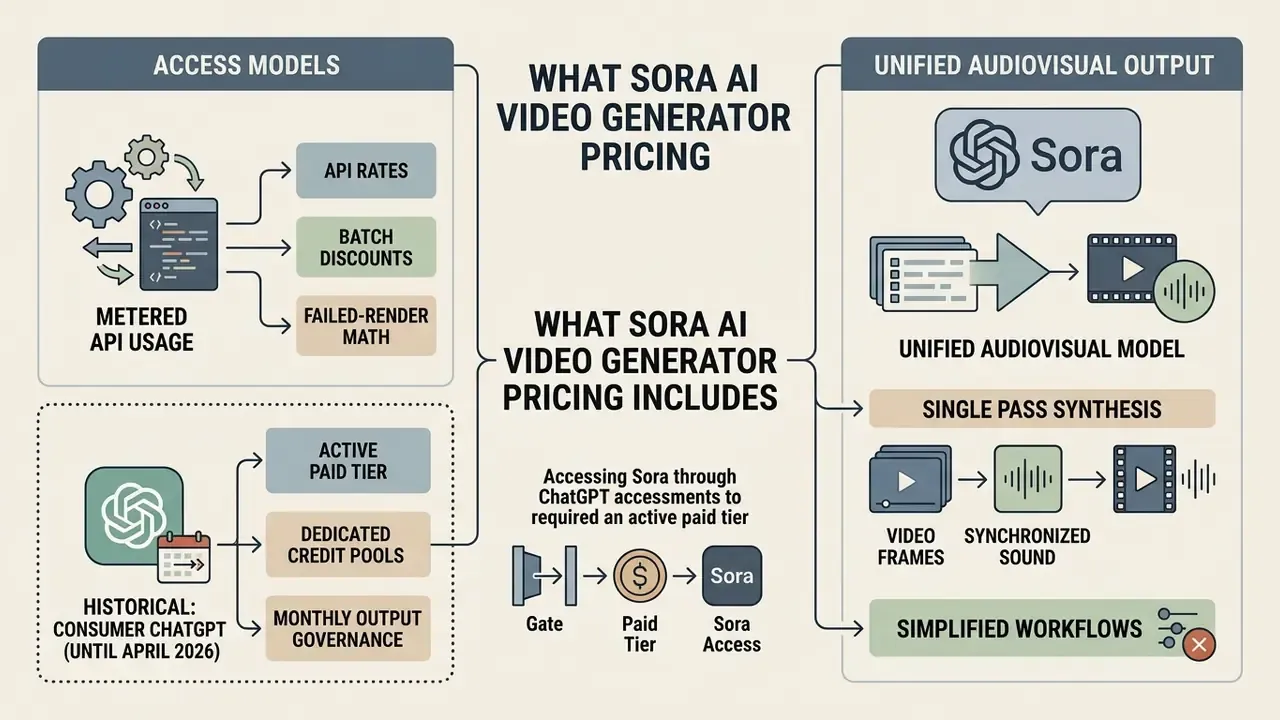
Sora AI video generator pricing covers access to OpenAI's video generation models through metered API usage and, historically until April 2026, through consumer ChatGPT subscriptions. Standard commercial terms package model inference, compute allocations, resolution capabilities, and synchronized audio generation into defined price tiers. For broader category context, see our glossary entry on AI video generators.
Understanding these components keeps the evaluation honest. You are not buying "videos". You are buying GPU seconds with a licence and a retention policy attached.
«Generating a single 10-second Sora clip consumes roughly 40 minutes of GPU time, costing OpenAI an estimated $1.30 in compute.»
That compute reality explains why every tier below is metered by the second rather than by the clip. Duration and pixel count drive GPU occupancy directly, so they drive the invoice.
| Access Mode | Billing Model | Standard Rate | Max Resolution & Aspect Ratios | Video Length Presets | Synchronized Audio | Limits, Credits & Status |
|---|---|---|---|---|---|---|
| Sora 2 (Standard API) | Metered API usage | $0.10 / sec | 720p (1280×720 / 720×1280) | Fixed 4s, 8s, or 12s | Included (native) | Metered per second; RPM tiers from 25 (Tier 1) to 375 (Tier 5) |
| Sora 2 (Batch API) | Metered API usage | $0.05 / sec | 720p (1280×720 / 720×1280) | Fixed 4s, 8s, or 12s | Included (native) | 50% discount; up to 24-hour SLA |
| Sora 2 Pro API (720p) | Metered API usage | $0.30 / sec | 720p (1280×720 / 720×1280) | Fixed 10s, 15s, or 25s | Included (native) | Metered per second; batch at $0.15/sec |
| Sora 2 Pro API (1024p) | Metered API usage | $0.50 / sec | 1024p (1792×1024 widescreen / 1024×1792) | Fixed 10s, 15s, or 25s | Included (native) | Metered per second; batch at $0.25/sec |
| Sora 2 Pro API (1080p) | Metered API usage | $0.70 / sec | 1080p (1920×1080 / 1080×1920) | Fixed 10s, 15s, or 25s | Included (native) | Metered per second; batch at $0.35/sec |
| ChatGPT Plus (historical) | Consumer subscription | $20 / month | Up to 720p (16:9, 9:16, 1:1) | Up to 10 seconds | Included | About 1,000 credits (roughly 50 priority videos per month). Access ended April 26, 2026 |
| ChatGPT Pro (historical) | Professional subscription | $200 / month | Up to 1080p (16:9, 9:16, 1:1) | Up to 20 seconds | Included | About 10,000 credits (roughly 500 priority videos per month) plus relaxed mode. Access ended April 26, 2026 |
Note: API access parameters, priority caps, and credit structures reflect verified OpenAI documentation and published API schedules. The "1024p" API label refers to the 1792×1024 widescreen output; "1080p" is the 1920×1080 tier introduced with Sora 2 Pro. Consumer rows are retained for historical budget reconciliation only.
ChatGPT subscriptions and Sora access (historical context)
Accessing Sora through ChatGPT required an active paid tier, because OpenAI never included video tools in free accounts. ChatGPT Plus ($20 per month) and ChatGPT Pro ($200 per month) served as the primary consumer entry points for video generation until the April 2026 retirement. No credit card, no Sora: there was never a sanctioned way around that.
Subscribers received dedicated monthly credit pools that governed total generation output. Those credits covered multimodal requests across text, ai image and video models inside the OpenAI platform, and unused purchased credits stayed valid for 12 months from the purchase date. Updated: since April 26, 2026, no consumer ChatGPT tier grants Sora access, so these credit pools are no longer a viable procurement route. Finance teams reconciling 2025 and 2026 spend should treat them as closed cost centres and archive the credit-system invoices with the model inventory record.
Video, image, and audio generation within a single plan
Sora functions as a unified audiovisual model that synthesizes video frames and synchronized sound in a single generation step. Users submit natural language prompts, static images, or reference video clips to create videos and other media assets. It is the same paradigm described in our overview of text-to-video AI tools.
Combining visual rendering and audio synthesis in one pass simplifies production workflows and removes separate sound-design line items. Useful, and quietly expensive. Complex multi-prompt pipelines increase GPU compute time and consume subscription credits, or API dollars, at higher rates.
Sora pricing tiers: Free, Plus, Pro, and enterprise access
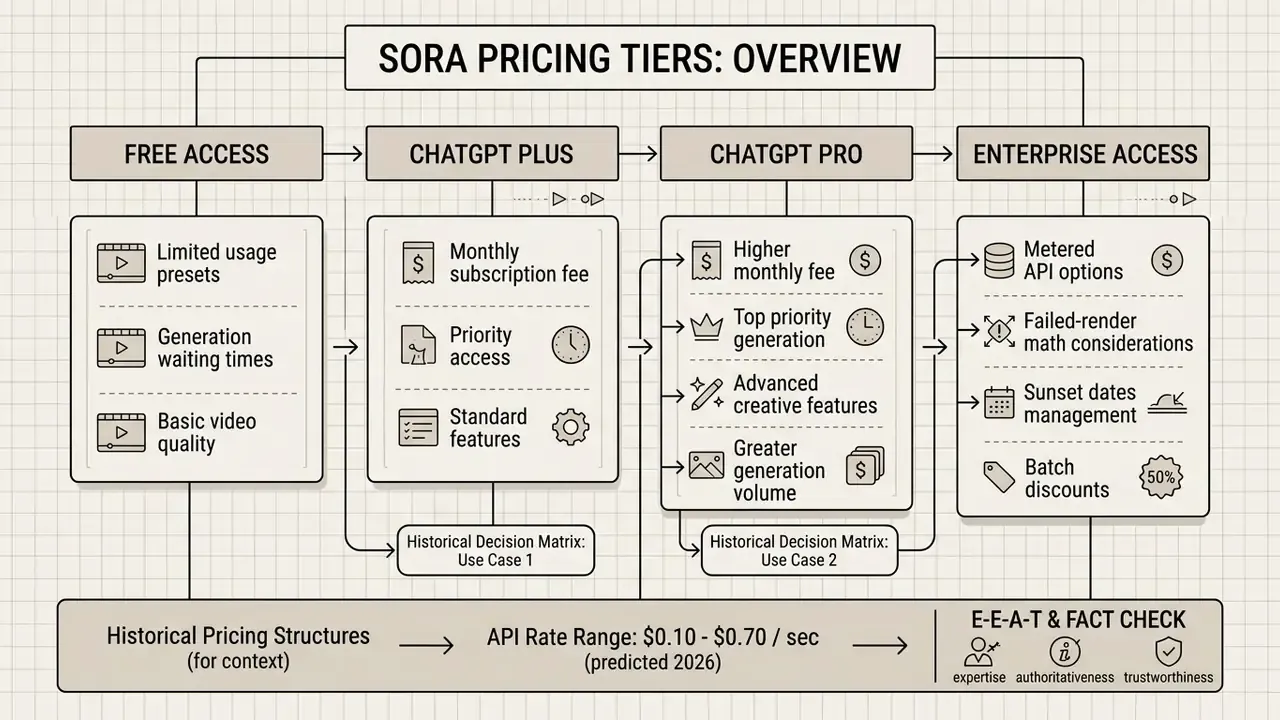
Sora pricing was historically structured across ChatGPT Plus ($20 per month) and ChatGPT Pro ($200 per month) subscriptions, alongside metered API options. Official OpenAI policy excluded free accounts, Enterprise tiers, and Edu workspaces from standard Sora access. As of April 2026 the consumer tiers are retired entirely and only metered API billing remains.
Comparing plan limits still has value. It tells you what a successor engine must replace, and what your teams were quietly relying on.
| Plan Name | Monthly Cost | Included Video Quota | Priority vs. Relaxed | Maximum Resolution | Watermark Removal | Commercial Rights | 2026 Status |
|---|---|---|---|---|---|---|---|
| ChatGPT Free | $0 | 0 (not supported) | N/A | N/A | N/A | No verified information available | Never supported |
| ChatGPT Plus | $20 / month | Up to 50 videos (480p) or fewer at 720p | Priority capped | Up to 720p | Standard | Subject to OpenAI Terms of Use | Sora access ended 26 Apr 2026 |
| ChatGPT Pro | $200 / month | Up to 500 priority videos plus unlimited relaxed | Priority plus unlimited relaxed | Up to 1080p | Watermark-free | Subject to OpenAI Terms of Use | Sora access ended 26 Apr 2026 |
| ChatGPT Enterprise / Edu | Custom | 0 (not included by default) | N/A | N/A | N/A | Requires custom terms / DPA negotiation | Not supported; API-only |
| Sora 2 API (Standard + Batch) | Usage-based | Unlimited within RPM tier | Standard (real-time) vs Batch (24h SLA) | 720p / 1024p / 1080p | No watermark on API outputs | Subject to OpenAI Business Terms | Live until 24 Sep 2026 |
Pricing verified against OpenAI Platform Docs, the OpenAI API pricing page, and the OpenAI Help Center as of September 2026. Standalone legacy Sora web and iOS products were discontinued on April 26, 2026, moving all monetization to the Sora 2 API.
E-E-A-T & Fact Check:
Free access: what the free tier actually provides
OpenAI's official platform specifications confirm that ChatGPT Free tier accounts received zero supported video generations. Testing Sora capabilities required a paid plan or developer API credits, which means a card on file and an organization-level billing owner.
«OpenAI Sora is not available as a standalone product and has no free tier; Free, Enterprise and Edu accounts do not include Sora access.»
Certain third-party applications still claim to provide free Sora access with no credit card. In practice these services rely on unofficial wrappers or substitute models, which presents compliance and data-privacy risk. Teams that genuinely need a zero-cost drafting layer should evaluate legitimate free AI video generators instead of unverified proxies, then cross-check the shortlist against our comparison of free AI video generators by quality and export limits.
When to choose ChatGPT Plus or Pro (historical decision matrix)
Selecting between ChatGPT Plus and Pro depended on required video resolution, output volume, and production speed. Plus suited individual creators producing fewer than 50 short social clips per month at 720p.
Pro targeted professional teams that needed 1080p rendering, 20-second clip durations, and watermark-free exports.
«Pro subscribers received roughly 10,000 credits per month; across 500 priority videos the effective cost per clip landed near $0.40.»
Pro subscribers also gained unlimited relaxed-mode generations after priority credits ran out, which lowered marginal cost for heavy usage. Updated for 2026: both tiers lost Sora entitlements on April 26, 2026, so the live decision is no longer "Plus vs Pro". It is "Standard API vs Batch API", a trade between latency and unit cost rather than between subscription sizes.
What determines the cost of Sora video generation
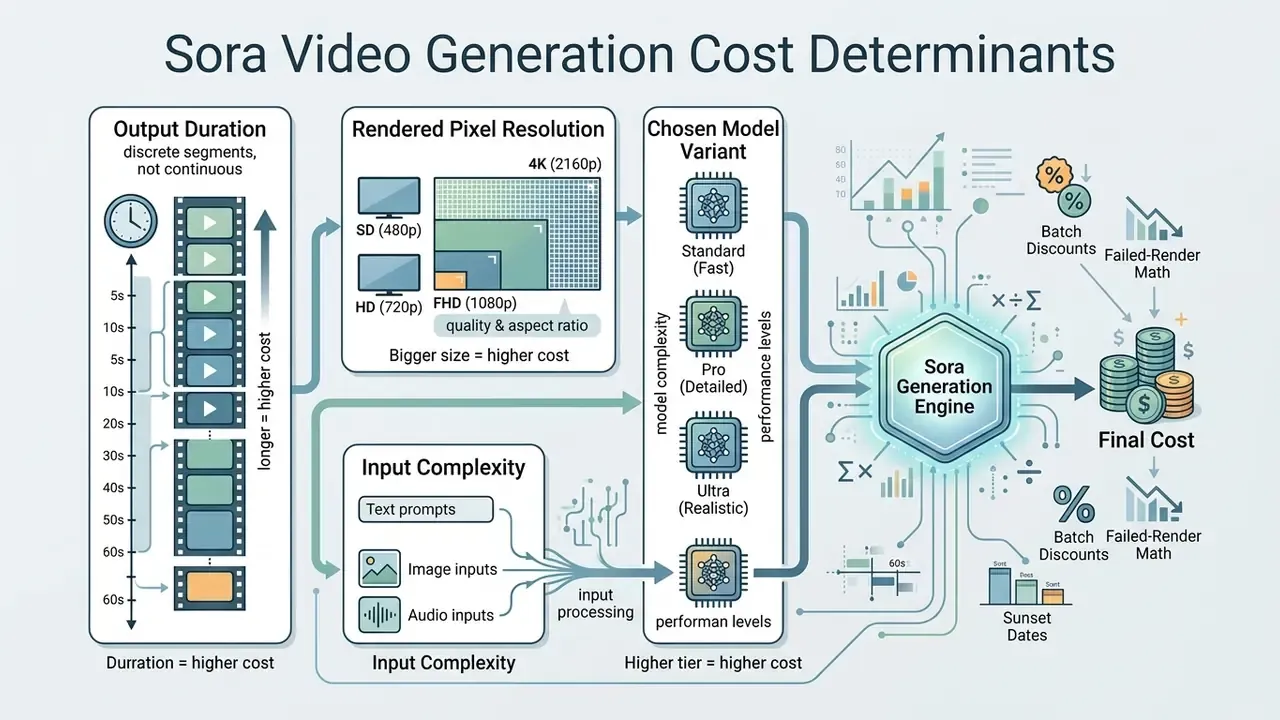
Sora 2 video generation cost is driven primarily by output duration, rendered pixel resolution, and the chosen model variant. Processing multimodal inputs and synthesizing synchronized audio tracks also shifts total compute requirements.
Know the drivers and you can tune the parameters. Skip them, and the credit system spends you.
Clip length, quality, and aspect ratio
Video duration scales generation cost linearly under both API billing and the legacy subscription credit framework. Rendered resolution acts as a multiplier, and 1080p outputs carry markedly higher per-second charges than 720p streams.
«Sora 2 Pro at 720p costs 3× more than standard Sora 2, and the HD tiers 5 to 7× more, making resolution the single largest budget multiplier.»
Aspect ratios such as 16:9 widescreen, 9:16 vertical, and 1:1 square do not alter base per-second API rates. OpenAI's published rate card prices by model and resolution tier only, with no orientation surcharge, and the same $0.10 per second applies to both 1280×720 and 720×1280 outputs (OpenAI API pricing, 2026. https://openai.com/api/pricing/). Larger frame dimensions do increase GPU load during diffusion, which is why the 1792×1024 widescreen tier is priced above 720p even though both are landscape.
Duration is discrete, not continuous. Requesting "7 seconds" is simply not possible. Sora 2 accepts 4s, 8s, or 12s; Sora 2 Pro accepts 10s, 15s, or 25s. Budget models built on average durations will misforecast. Build them on the preset ladder instead, and store the preset choice as a field in your usage logs so per generation cost stays attributable later.
Text prompts, images, and audio as inputs
Generating video from text prompts, static images, or reference clips relies on multimodal transformer architectures. The mechanics are covered in our guide to image-to-video AI tools. Synchronized audio generation is native to Sora 2, which removes separate sound-processing fees from the line item.
Text and ai image inputs do not trigger separate surcharges, though highly complex prompts often need multiple iterations. Refining input parameters during cheap test runs prevents wasted compute on full-resolution renders. OpenAI's Sora 2 prompting guide reinforces the point: prompts carry an explicit size field in {width}x{height} form, so resolution is a deliberate, priced decision made at request time, not a post-hoc export setting.
Sora 2 pricing vs API pricing: subscriptions compared with developer billing
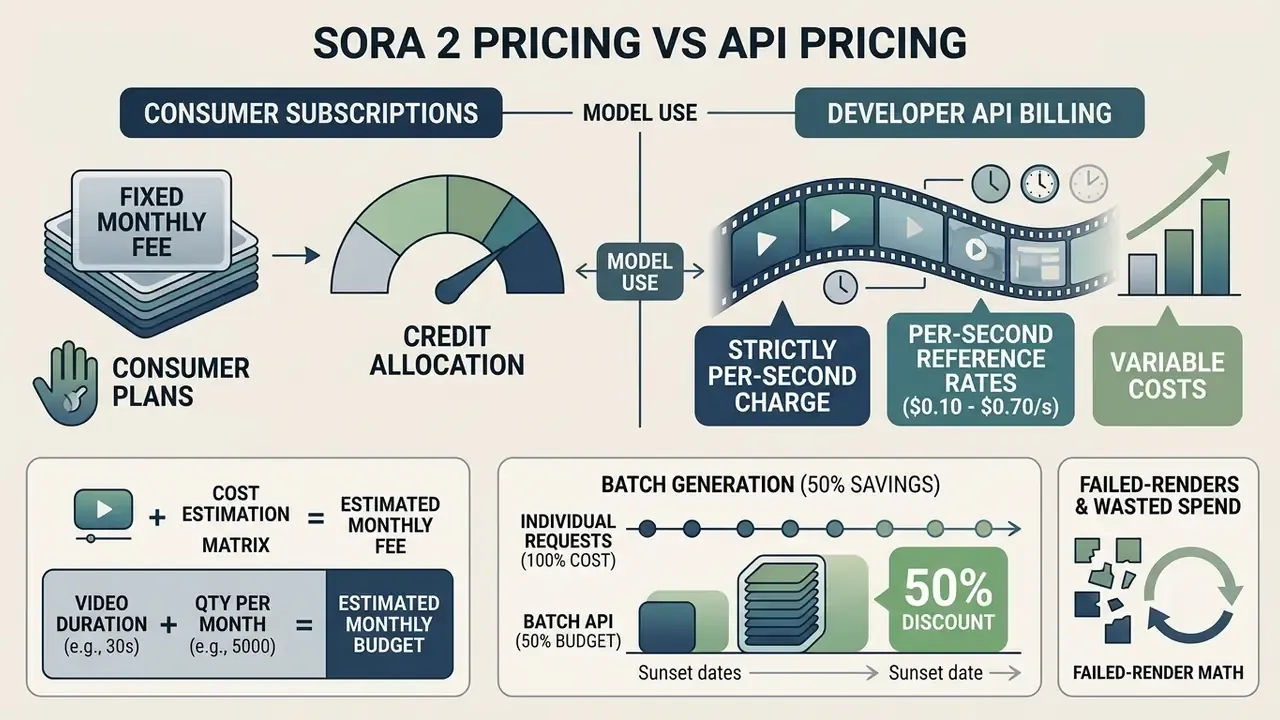
Sora 2 API pricing charges developers strictly per generated second, whereas consumer subscriptions charged a fixed monthly fee for a credit allocation. API metering gives exact usage control and the scalability that automated enterprise integration needs.
Comparing API rates against the retired subscription packages exposes the real trade-off: expense predictability on one side, scaling flexibility on the other.
Cost estimation matrix for Sora 2 API integration
Formula: Total Monthly Spend = (Clips per Month) × (Duration in Seconds) × (Per-Second Model Rate), then multiply by 0.5 if the workload runs on the Batch tier.
| Scenario | Model & Resolution | Preset Duration | Clips / Month | Standard API Spend | Batch API Spend (50% off) |
|---|---|---|---|---|---|
| Social drafting | Sora 2, 720p | 8s | 50 | $40.00 | $20.00 |
| Always-on social feed | Sora 2, 720p | 12s | 200 | $240.00 | $120.00 |
| Marketing hero shots | Sora 2 Pro, 1080p | 10s | 40 | $280.00 | $140.00 |
| Cinematic widescreen set | Sora 2 Pro, 1024p | 15s | 60 | $450.00 | $225.00 |
| Enterprise campaign library | Sora 2 Pro, 1080p | 25s | 100 | $1,750.00 | $875.00 |
Per-second reference rates for your own model: Sora 2 720p = $0.10; Sora 2 Pro 720p = $0.30; Sora 2 Pro 1024p = $0.50; Sora 2 Pro 1080p = $0.70. Batch tier is exactly 50% of the listed Standard rate, with up to 24-hour latency.
Run the matrix twice. Once at target volume, once at target volume plus an assumed retry rate, because retries are where forecasts quietly break. For structured expenditure modelling across platforms, use our cost calculators.
Why consumer plans and API billing cannot be compared directly
Consumer ChatGPT plans bundled video generation into a fixed fee alongside text reasoning, deep research, and ai image generation. API billing isolates video model execution and charges exact pay-as-you-go rates per output second.
«Analysts estimate OpenAI spends about $1.30 generating a 10-second clip, while the standard API rate for the same output is $1.00.»
That gap explains two things at once: the aggressive rate card, and the lifecycle risk behind it. Subsidised inference pricing is not indefinitely sustainable, which is consistent with the announced September 2026 sunset.
Unit economics also demand a distinction between interactive human workflows and automated software pipelines. Enterprise systems that need programmatic triggers must use API endpoints rather than user subscriptions. With consumer access retired, the API is now the only compliant route anyway.
How to estimate a monthly API video generation budget
Calculating a monthly Sora API budget means multiplying projected clip count, the preset duration, and the target model's per-second rate. Generating 200 twelve-second clips on sora-2 (720p) costs exactly $240 per month ($0.10 × 12s × 200). The same library on the Batch tier costs $120.
«At 100 videos per day of 10 seconds each, monthly Sora 2 API spend can reach $182,500, an illustration of extreme scaling.»
Upgrading that 200-clip workload to sora-2-pro at 1080p with a 10-second preset lifts monthly expenditure to $1,400 ($0.70 × 10s × 200). Batch API processing secures a 50% discount for non-real-time asynchronous work. Enforce request-per-minute ceilings too, so a runaway retry loop cannot silently multiply the bill overnight. One uncapped loop can do more damage to a quarterly budget than a bad vendor negotiation.
Batch generation via the Batch API: 50% budget savings
For workloads with no real-time requirement, such as overnight rendering, content library builds and background queues, OpenAI provides a Batch API mode. The advantage is a 50% discount on every generated second, with jobs guaranteed to complete inside a 24-hour SLA.
| Model and resolution | Standard rate | Batch API (50% off) | SLA (completion window) |
|---|---|---|---|
| Sora 2 (720p) | $0.10 / sec | $0.05 / sec | Up to 24 hours |
| Sora 2 Pro (720p) | $0.30 / sec | $0.15 / sec | Up to 24 hours |
| Sora 2 Pro (1024p) | $0.50 / sec | $0.25 / sec | Up to 24 hours |
| Sora 2 Pro (1080p) | $0.70 / sec | $0.35 / sec | Up to 24 hours |
Operational guidance by usage pattern:
| Usage pattern | Recommended tier | Typical monthly cost | Rationale |
|---|---|---|---|
| Drafts and social-bound clips | Sora 2 (Batch) | $5 to $50 | $0.05/sec at 720p with 24h SLA |
| Real-time iteration and review cycles | Sora 2 (Standard) | $10 to $100 | $0.10/sec at 720p, immediate results |
| Client deliverables and hero content | Sora 2 Pro (Standard) | $50 to $500 | $0.30 to $0.70/sec, true 1080p fidelity |
| Bulk overnight rendering | Sora 2 Pro (Batch) | $25 to $250 | $0.15 to $0.35/sec, Pro quality at half price |
Batch should be the default for any pipeline where a 24-hour turnaround is acceptable. Reserve Standard for interactive prompt engineering, where latency, not cost, is the bottleneck.
Enterprise data governance, security, and Shadow AI mitigation
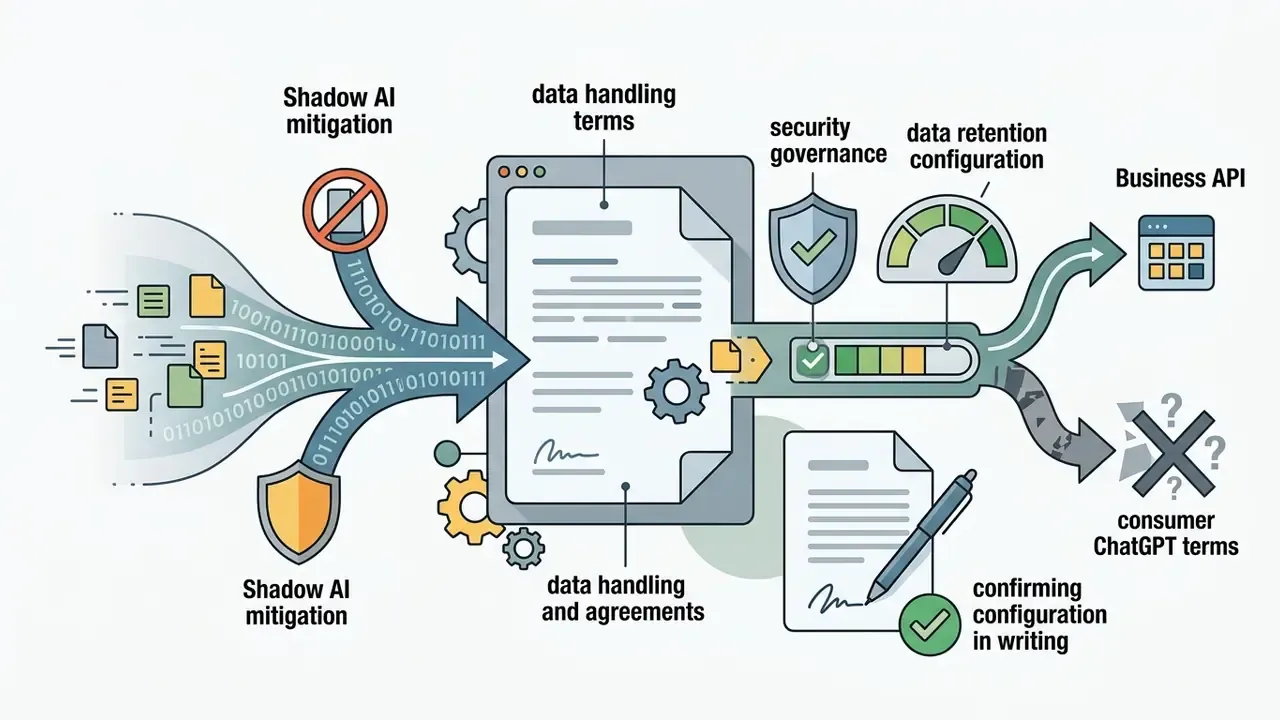
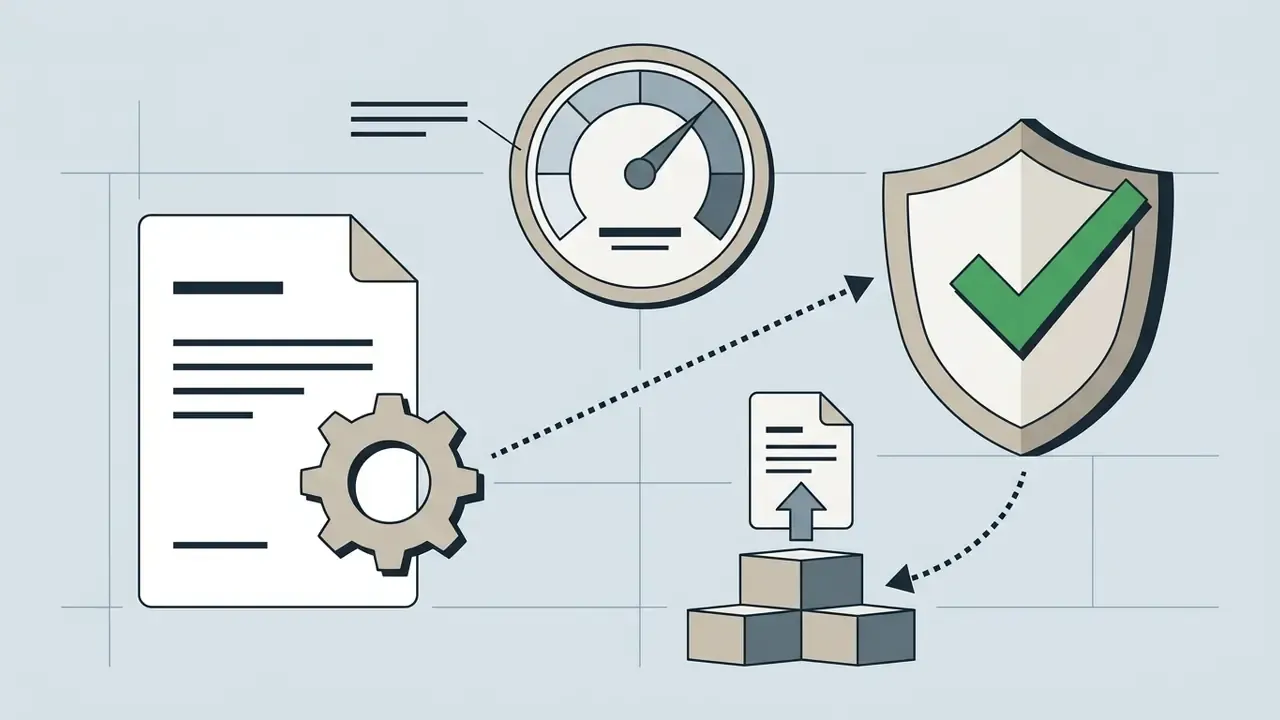
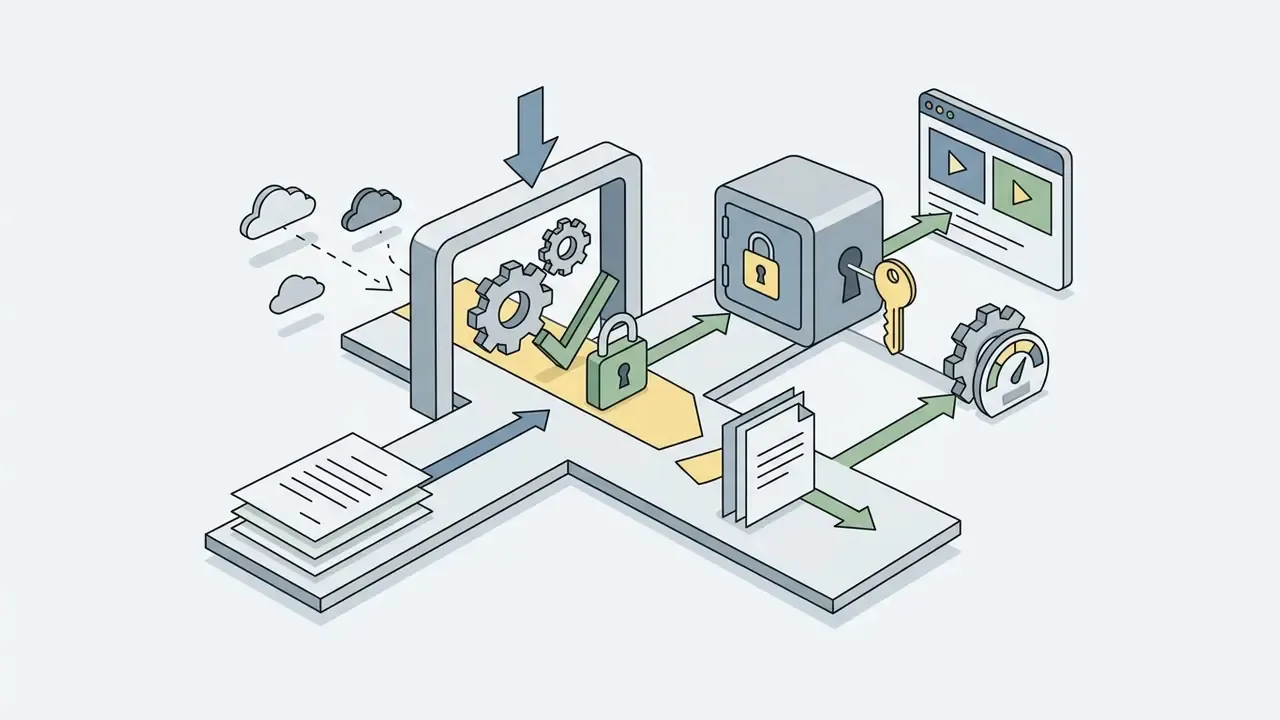
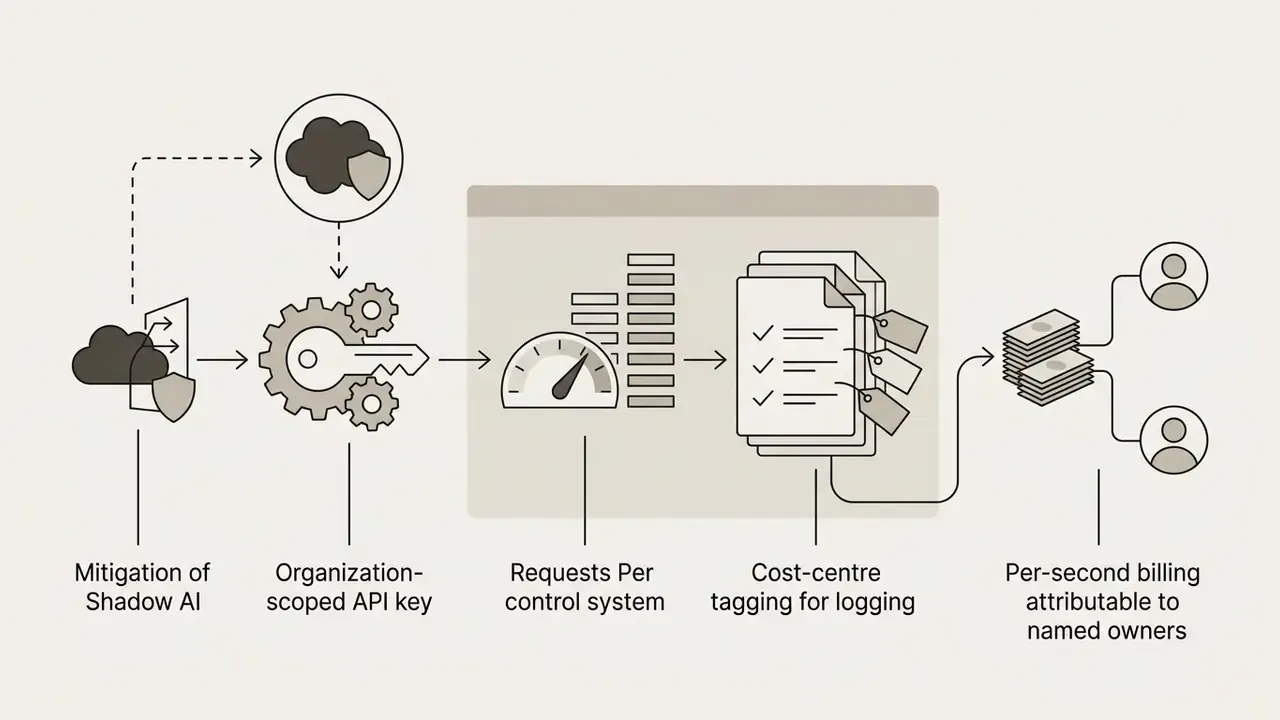
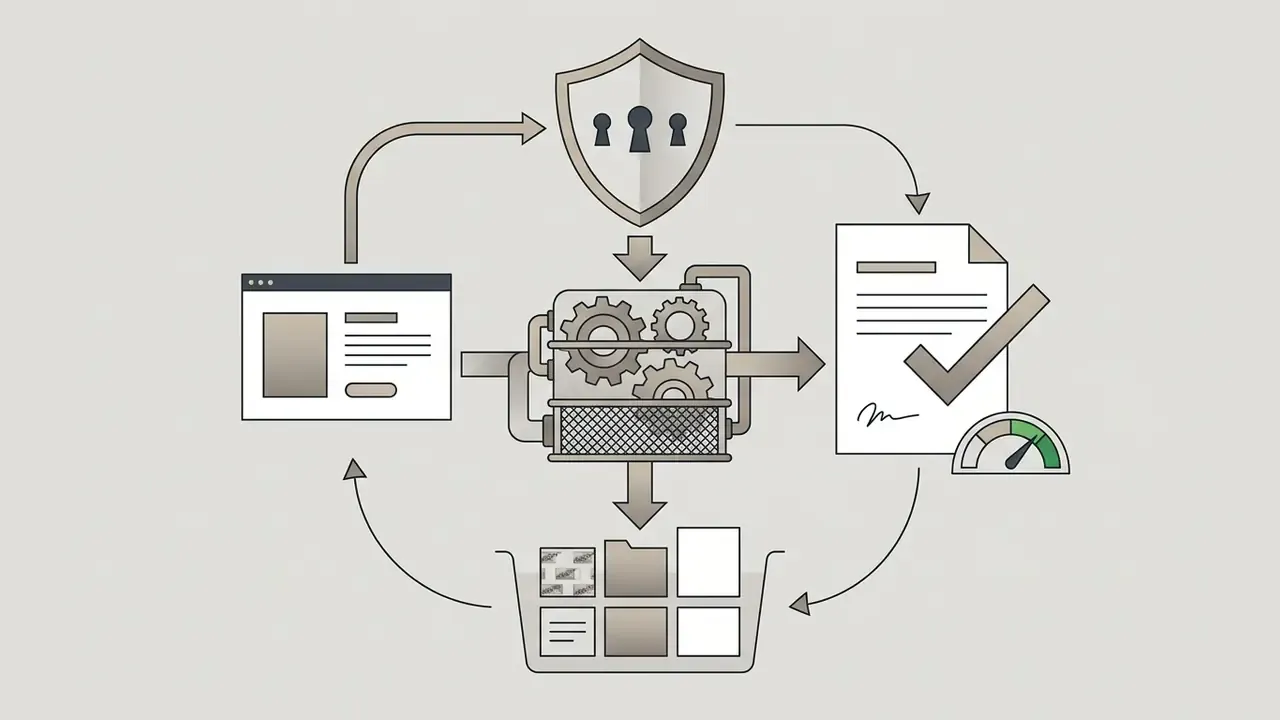
Cost is half the procurement decision. Model risk owners in regulated sectors must also document how prompts, reference images, and generated assets are handled, and prove that no unsanctioned access path exists inside the organization. No evidence, no autonomy.
Shadow AI and compliance checklist for video AI procurement:
Checklist0 / 6
One more line worth adding to the inventory record: the named human who can switch the pipeline off. Escalation paths that exist only in a deck do not survive an audit.
What it costs to produce social media and advertising videos
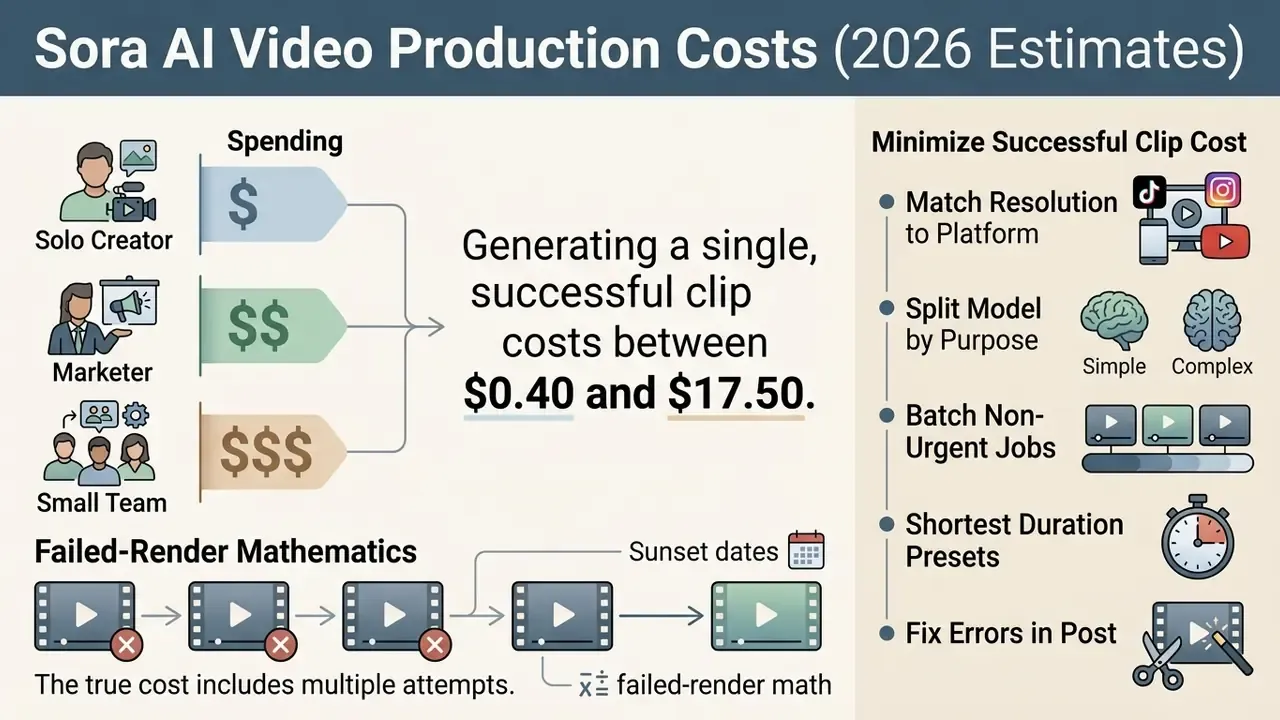
Producing social content and advertising assets with Sora costs roughly $0.40 to $17.50 per rendered clip. Total production expense depends on the model tier, the preset duration, whether Standard or Batch billing applies, and, critically, how many failed takes precede the approved asset.
Workflow governance is what keeps iteration overhead from eating the quality gain.
Budgets for a solo creator, a marketer, and a small team
A solo creator producing 30 eight-second clips per month can run on the Batch tier for $12 per month ($0.05 × 8s × 30). Under the retired Plus quota, the equivalent effective unit cost was around $0.40 per finished asset at full quota utilization.
Marketing teams generating 100 high-definition ad variants monthly should budget $300 to $1,750 per month depending on resolution and preset length. As a worked example, 100 ten-second Pro 1080p clips cost $700 at Standard rates, or $350 on Batch. To review standardized software pricing frameworks, consult our AI Media Pricing Guides.
«Pika Labs offers a free plan with 150 credits per month; Standard is $8 per month with 700 credits, and a 10-second 1080p export costs 80 credits.»
For low-stakes volume work, that credit economics comparison matters. A roughly $0.80 Pika export can substitute for a $7.00 Sora 2 Pro 1080p ten-second render when the distribution channel is a vertical social feed rather than a broadcast placement. Match the tool to the screen, not to the brand name.
How to reduce the cost of a single successful generation
Lower failure rates lower the average cost per successful export. Craft detailed text prompts, then generate short-preset, low-resolution preview drafts before committing budget to a full 25-second 1080p render. Cheap prototyping layers, including free AI video generators for draft iteration, let prompt engineering converge before paid seconds are spent.
Sora vs alternatives: when to choose a different AI video generator
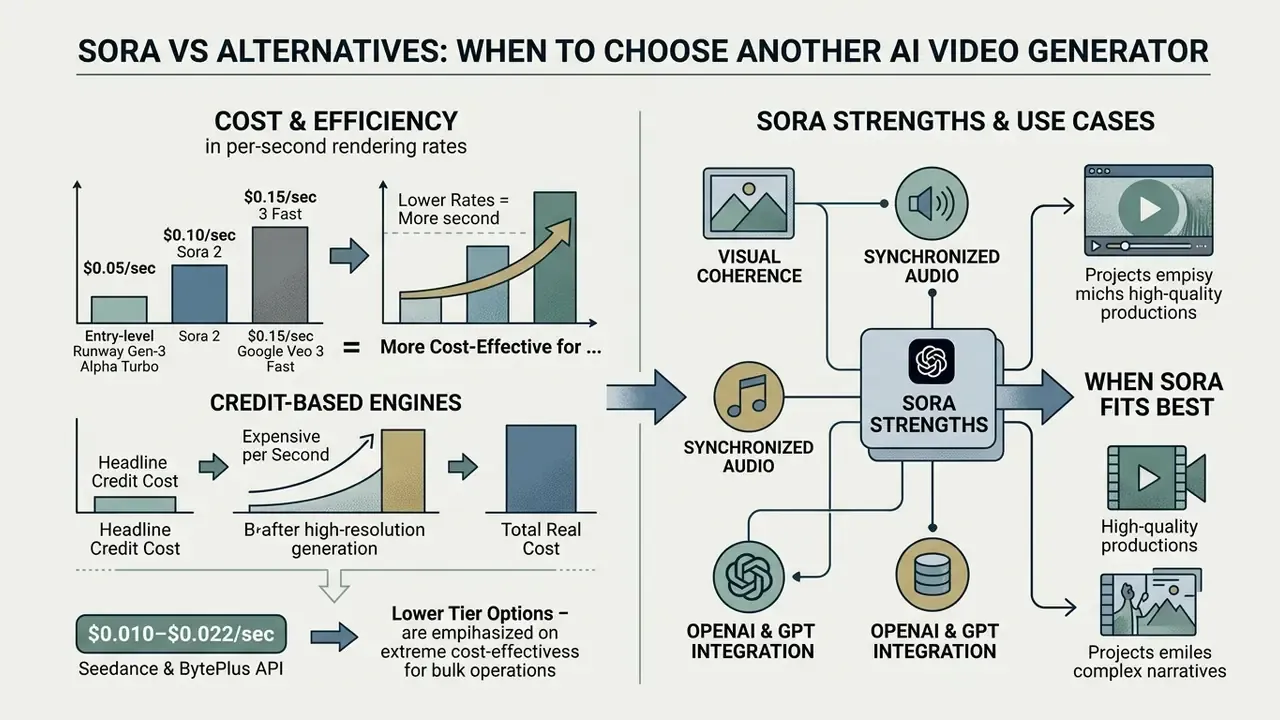
Choosing between Sora and alternative AI video tools comes down to per-second rendering cost, native audio support, ecosystem integration and, in 2026, roadmap longevity. Our side-by-side breakdown of leading AI video generators covers the wider field. Competing ai models such as Runway Gen-3, Google Veo 3 and Veo 3.1, Seedance 2.0, and Pika Labs each use a different subscription or credit structure.
| Tool Name | Base Pricing Model | Monthly Entry Cost | Per-Second Effective Cost | Free Tier Availability | Max Resolution | Synchronized Audio | Roadmap Status |
|---|---|---|---|---|---|---|---|
| OpenAI Sora 2 | Metered API | $0.05 to $0.10/sec | $0.10 / sec (720p), $0.05 Batch | No | 720p | Yes (native) | API sunsets 24 Sep 2026 |
| OpenAI Sora 2 Pro | Metered API | $0.15 to $0.70/sec | $0.30 to $0.70 / sec | No | 1080p (1920×1080) | Yes (native) | API sunsets 24 Sep 2026 |
| Google Veo 3 | Metered API via Gemini / Vertex | $0.15 to $0.40 / sec | $0.15 (Fast) to $0.40 / sec | No | 1080p | Yes (Veo 3 standard) | Active |
| Google Veo 3.1 | Metered API (Lite / Fast / Quality) | $0.03 to $0.40 / sec | $0.03 to $0.40 / sec | No | 1080p and above | Yes | Actively developed, recommended successor |
| Runway Gen-3 Alpha | Subscription plus credit pool | $12 / month (Standard) | $0.05 (Turbo) to $0.10 / sec | Yes (125 one-time credits) | 720p / 1080p | No (visual focus) | Active |
| Seedance 2.0 | Metered API / credits | $49 to $200 / month | $0.010 to $0.022 / sec (API tiers) | Yes (trial credits) | 2K | Yes (native) | Active |
| Pika Labs | Subscription plus credit pool | $8 / month (Standard) | About $0.08 / sec (1080p) | Yes (150 credits per month) | 1080p | Yes (Pikaffects / performance) | Active |
Pricing data cross-referenced with developer model documentation and platform fee schedules.
Comparing prices, credits, and cost per generation
Runway Gen-3 Alpha Turbo sits at the entry level, around $0.05 per second, which makes it cost-effective for rapid visual drafting.
«Runway Gen-3 Alpha Turbo bills at 5 credits per second ($0.05); the Free plan includes 125 one-time credits, and Standard is $12 per month for 625 credits.»
Google Veo 3 Fast ($0.15 per second) and Sora 2 ($0.10 per second) generally deliver stronger prompt fidelity and integrated audio pipelines.
«Google reduced Veo 3 Fast to $0.15/sec from $0.40, and Veo 3 to $0.40/sec from $0.75; with audio, Veo 3 Fast is $0.25/sec.»
Credit-based engines can look cheap at the headline level and turn expensive per second once resolution climbs.
«Seedance 2.0 bills 720p video at roughly 19.5 credits per second ($1.95) on some partner routes, close to 20× standard Sora 2 at comparable resolution.»
Published Seedance and BytePlus API tiers start far lower, around $0.010 to $0.022 per second, so the true per-second figure depends heavily on the reseller route. Price the specific endpoint, not the brand.
For developer pricing on competing engines, see our guide on google veo ai video generator pricing and the technical Google Veo API implementation guide. Additional comparisons cover kling ai video costs and specialized platforms such as kaiber ai video generation.
When Sora fits better than the alternatives
Sora still performs well where visual coherence, synchronized audio, and tight integration with OpenAI's GPT reasoning models matter. Organizations already operating inside the OpenAI API environment gain unified key management, usage dashboards, and one billing governance surface instead of three.
The caveat in 2026 is blunt. Sora cannot exceed 25 seconds in a single generation, cannot output 4K, and stops accepting requests after September 24, 2026. Any project with a lifespan beyond that date should treat Sora as a tactical dependency, never a strategic one.
For creative exploration across other diffusion architectures, review our analysis of openart ai pricing and related generative tools, plus our comparison of free AI video generators for zero-cost experimentation.
How to choose the right Sora plan
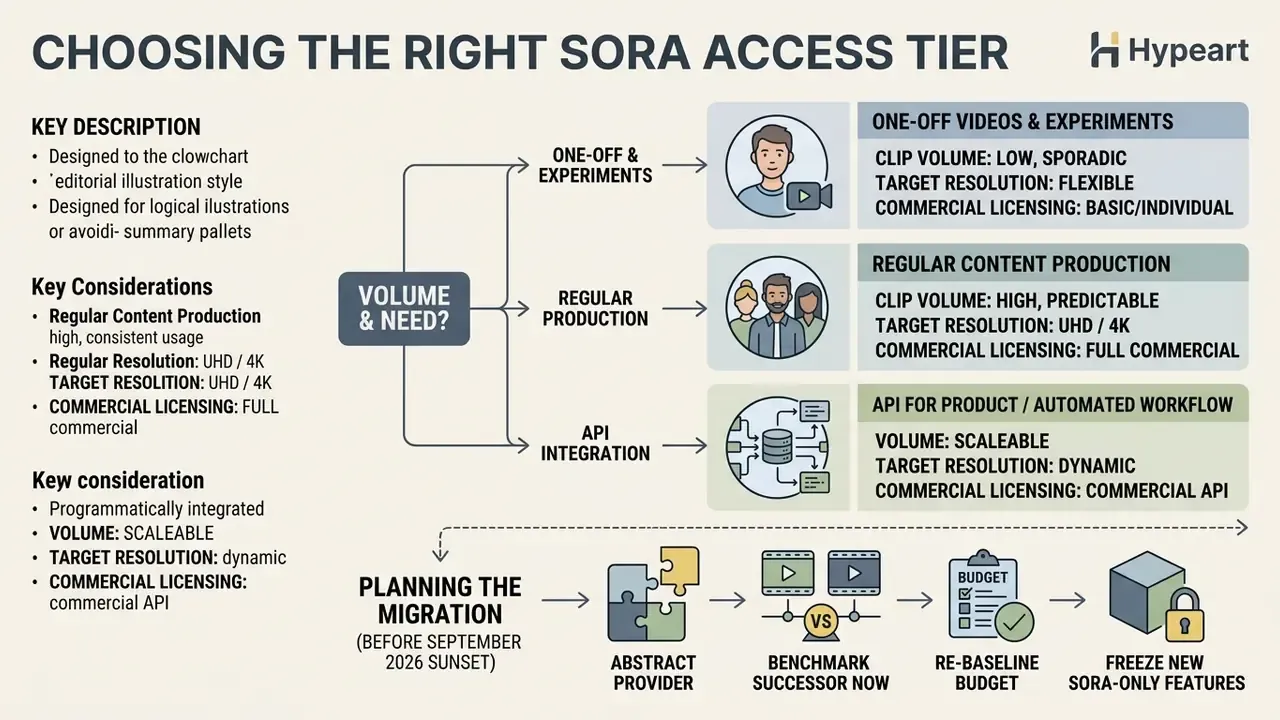
Choosing the right Sora access tier depends on clip volume, target resolution, commercial licensing needs, and software architecture. Decision-makers must weigh Standard real-time metering against discounted Batch processing, and then ask the harder question: does the remaining API lifespan justify integrating at all?
Answer those two together and the alignment between capability, model risk controls, and budget guidelines usually falls out on its own.
Choosing a tier for one-off videos and experiments
For occasional testing and early prompt engineering, sora-2 on the Batch tier at $0.05 per second is the cheapest live entry point. A 4-second concept test costs $0.20. Historically ChatGPT Plus ($20 per month) filled this role by bundling Sora with advanced reasoning and image models, but that path closed in April 2026.
To evaluate interactive content tools and narrow utility generators, explore our review of the ai thank you note generator. Teams testing broader creation suites can consult Hypeart AI Media Decision Support for framework guidance, or browse adjacent tooling such as animation makers.
Choosing a tier for regular content production
Continuous operations shipping daily marketing or educational videos now run on sora-2-pro, typically at 1024p or 1080p. A cadence of one 15-second 1024p clip per day costs about $225 per month at Standard rates, or $112.50 on Batch. Pro-tier API outputs carry no watermark, support the 10s/15s/25s preset ladder, and unlock true 1080p exports.
«OpenAI confirmed that Sora is not included in ChatGPT Team, Enterprise, or Edu plans; corporate users require separate Plus or Pro entitlements, or API access.»
For regulated organizations that exclusion is the decisive procurement fact. Workspace licensing does not confer video generation rights, so an organization-level API agreement is mandatory. Teams building custom estimation models can use our financial calculators to project monthly content expenditure, then pair generation with YouTube video editing workflows for publishing. For strategic software evaluations, examine our categorized AI Media Alternatives by Reason directory.
Choosing the API for a product or automated workflow
Planning the migration before the September 2026 sunset
Any integration built today needs a documented exit path. A workable sequence:
- Abstract the provider.Wrap generation calls behind an internal service interface so the model endpoint is a configuration value, not hard-coded logic.
- Benchmark the successor now.Run identical prompts through Google Veo 3.1 (Lite, Fast, Quality) and record fidelity, audio quality, and per-second cost deltas.
- Re-baseline the budget.Veo 3.1's $0.03 to $0.40 per second band can come out cheaper or dearer than Sora depending on tier. Rebuild the cost matrix rather than assuming parity.
- Freeze new Sora-only featuresafter Q2 2026 and complete the cutover before requests stop being accepted on September 24, 2026.
Sora Pricing FAQ: Frequently Asked Questions
How do I verify that a price actually refers to official OpenAI Sora?
Official OpenAI Sora pricing is published exclusively on openai.com and developers.openai.com. Legitimate developer access uses standardized OpenAI organization keys and the platform billing dashboard.
«Official Sora 2 API rates are published on the OpenAI pricing page: $0.10/sec for 720p and $0.30 to $0.70/sec for Sora 2 Pro depending on resolution.» Source: OpenAI official API pricing page (2026). https://openai.com/api/pricing/ Any third-party service asking for cryptocurrency, advertising "lifetime unlimited Sora access", distributing an APK build, or operating off official OpenAI domains is an unverified wrapper. Treat the marketing copy as a red flag, not a discount.
What are the risks of unofficial services offering Sora for $5 to $25 per month?
Such platforms use unauthorized proxy wrappers or silently substitute a lower-quality open model. Three concrete risks follow:
- Prompt and data leakage. Briefs, reference images, and outputs transit intermediate servers with no contractual data-handling obligations.
- API key and account bans. OpenAI terminates accounts that resell or share access, which can jeopardize unrelated production workloads on the same organization.
- No SLA guarantees. During peak load, cheap and free reseller queues get dropped first, so delivery timelines for paid client work become unpredictable. For regulated organizations the governance failure costs more than the subscription saves. An unsanctioned wrapper is Shadow AI by definition, and it will surface in any model-risk audit.
Is Sora still available in 2026?
The Sora consumer app, web and iOS, was discontinued on April 26, 2026. The Sora 2 API remains live but is scheduled to sunset on September 24, 2026, after which no Sora endpoints will accept new requests. Teams that need a video model with a long-term roadmap should evaluate Google Veo 3.1.
How much does Sora 2 cost per second?
Sora 2 Standard: $0.10 per second at 720p, or $0.05 on Batch. Sora 2 Pro: $0.30 (720p), $0.50 (1024p), $0.70 (1080p) on Standard, or roughly half on Batch ($0.15, $0.25, $0.35). All consumer subscription tiers lost Sora access on April 26, 2026.
How long can Sora 2 videos be?
The Sora 2 API supports 4s, 8s, or 12s. The Sora 2 Pro API supports 10s, 15s, or 25s. Maximum single-generation video length is 25 seconds, so longer sequences require chaining multiple generations and assembling them in post-production.
What is the difference between Sora 2 and Sora 2 Pro?
Sora 2 maxes out at 720p with 4s/8s/12s presets at $0.10 per second, the economical tier for social-bound content and iteration. Sora 2 Pro offers 720p, 1024p (1792×1024), and true 1080p (1920×1080) with 10s/15s/25s presets, plus improved motion rendering and prompt adherence, at $0.30 to $0.70 per second. Use Pro for hero shots and client deliverables; use Standard for drafting at volume.
Does the Batch API really save 50%?
Yes. The Batch tier discounts every Sora 2 and Sora 2 Pro per-second rate by exactly 50%. The trade-off is latency: batch jobs complete inside a 24-hour window instead of in real time, which suits content libraries, overnight rendering, and non-urgent generation pipelines.
What replaces Sora after September 24, 2026?
OpenAI has not publicly committed to a successor for the Sora 2 API. The most actively developed mainstream alternative is Google Veo 3.1 (Lite, Fast, Quality tiers, roughly $0.03 to $0.40 per second on Vertex AI and the Gemini API), alongside various third-party hosting providers. Existing integrations should plan migration before September 2026.
Did ChatGPT Plus or Pro ever include Sora?
Yes, historically. Plus included Sora at no extra cost with monthly caps (up to 50 videos at 480p, fewer at 720p, up to 10 seconds, capped concurrency). Pro provided roughly ten times the usage, up to 1080p, up to 20 seconds, five concurrent generations, and watermark-free downloads. Both entitlements ended on April 26, 2026. A safe next step for governance owners No dramatic decision is needed this quarter. A cautious sequence works better:
- Add every live Sora, Veo, Runway, Pika and Seedance 2.0 endpoint to the AI inventory, with a named owner per entry.
- Attach the per-second rate, retention setting, and cost-centre tag to each inventory record.
- Run a two-week Batch-only pilot at 720p, cap the spend, and measure the failed-render ratio.
- Present the risk-adjusted unit cost, including control overhead, to the model risk committee before scaling. That last point is where most ROI cases still fall apart. Control costs and residual risk belong inside the business case, not in a footnote.
Appendix A: Superseded statements (archived for transparency)
The following statements appeared in earlier versions of this guide and are retained for audit and version-tracking purposes. They are no longer accurate and have been replaced in the main text above.
- "Accessing Sora through ChatGPT requires an active paid tier… ChatGPT Plus ($20/mo) and ChatGPT Pro ($200/mo) serve as the primary consumer entry points for video generation." Superseded: all consumer subscription tiers lost Sora access on April 26, 2026.
- "Sora pricing is structured across ChatGPT Plus ($20/month) and ChatGPT Pro ($200/month) subscriptions" as a present-tense procurement route. Superseded: metered API billing is the only live access path until the September 24, 2026 sunset.
- Raw interactive-block specification for the cost estimation matrix. Superseded: replaced in the main text by a rendered cost matrix, per-second reference rates, and the explicit budget formula.
Footer / Navigation Hub