Last updated: April 2026
Executive Summary
- Price: $1,500 to $5,000 per finished minute for mid-market commercial work; $8,000 to $20,000+ per project for premium enterprise production; $200 to $800 for template-based DIY output.
- Timeline: 3 to 4 weeks for a 60-90-second explainer, 4 to 6 weeks for a 2-3-minute B2B/SaaS video, 5 to 7 weeks for a 3-5-minute L&D or compliance module. Rush delivery typically adds 20% to 30% to the fee.
- Performance: Whiteboard formats are associated with higher recall (15% to 33% over talking-head video), stronger CTA memory, and measurable landing-page conversion lift when used as an embedded explainer.
- Decision rule: Use DIY software for low-stakes internal updates; hire a studio when the message is regulated, externally facing, brand-critical, or architecturally complex.
- Non-negotiable contract terms: written revision scope, itemized budget, interim deliverable approvals, signed NDA or confidentiality annex, and full commercial IP transfer on final payment.
Who Should Read This Guide, and What It Answers
This guide is written for the person who signs the purchase order, not only for the creative lead who briefs it.
If you run marketing operations, learning and development, internal communications, or compliance training in a regulated business, whiteboard animation usually lands on your desk as a procurement question. What does a fair quote look like? Which parts of the process can slip? Who owns the drawings afterwards? And what happens when the script contains pre-release or non-public material?
Three questions drive most buying decisions here. First, is the format right for the message at all? Second, build or buy: template software in-house, or a studio pipeline? Third, how do you separate a real production company from a reskinned template shop before the money moves?
Everything below is organised around those three decisions: what the service includes, why the format works, the production sequence and timings, the cost drivers, and the vendor checks that protect you contractually. Pricing figures are market benchmarks, not quotations. Treat them as a planning band and validate them with itemised proposals.
What Are Whiteboard Animation Services?
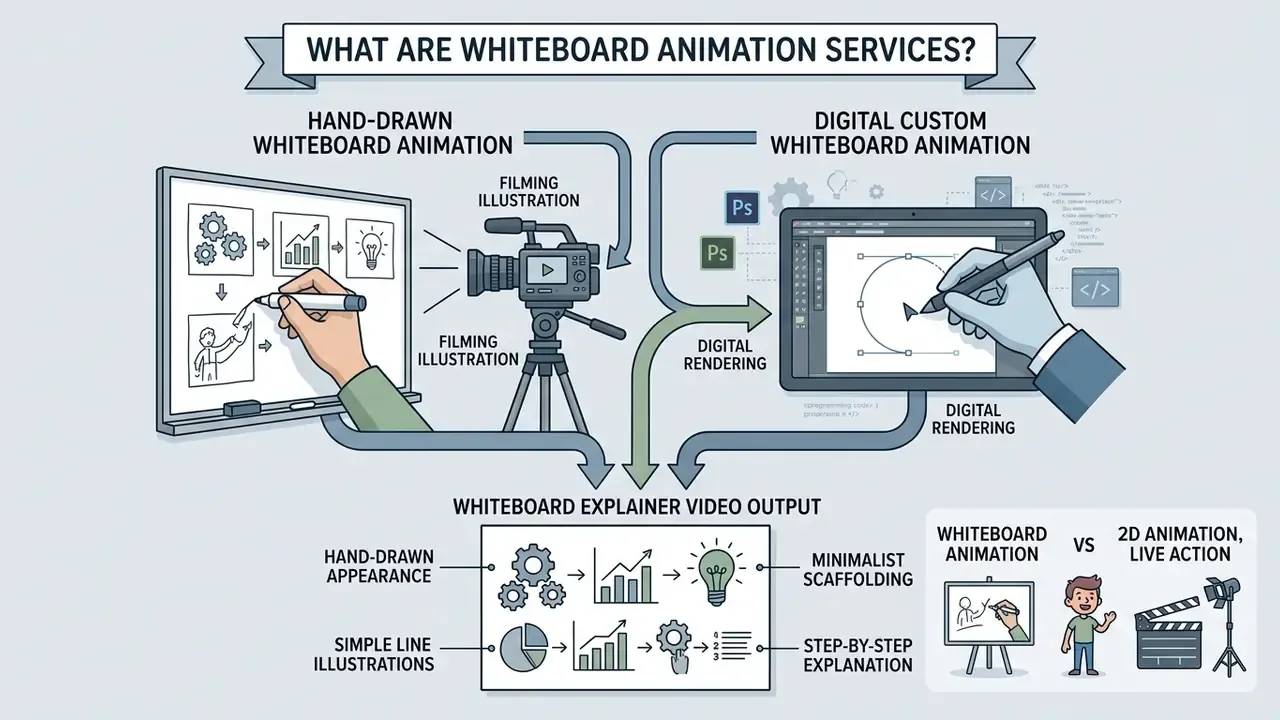
Whiteboard animation services encompass full-service video production in which specialized creative teams script, design, illustrate, and animate sequential drawings on a light canvas synchronized with spoken voice-over narration. These professional services transform abstract ideas, technical workflows, and strategic communications into engaging visual stories that guide the viewer through a clear, step-by-step narrative.
Professional whiteboard animation service providers combine instructional design, copywriting, custom illustration, and audio post-production. Unlike static graphics or generic presentations, a whiteboard video uses progressive drawing movements to build a comprehensive visual mental model as the narration unfolds.
The format's defining traits are consistent across the market: a hand-drawn appearance, simple pen or marker line work, little or no shading, and a visibly unfolding drawing process paired with narration. Because the style is not dependent on trend-driven motion design, whiteboard assets tend to age slowly. A corporate explainer produced in this style often remains usable for three to five years, while stylized motion-graphics packages can look dated within two.
Hand-Drawn and Digital Whiteboard Animation
Hand-drawn whiteboard animation involves physically filming an illustrator drawing on an actual board or paper surface using high-speed cameras, continuous lighting setups, and manual frame synchronization. This traditional technique offers organic line work and authentic hand movements. It also requires heavy camera setups, carries high physical filming error risks, and limits post-production editing flexibility. Production guidance for this approach is explicit about the constraints: the drawing hand and camera must both fit the frame, and lighting must be arranged to eliminate shadows across the drawing surface.
Digital custom whiteboard animation uses vector-based animation software to programmatically render drawing paths and simulated hand motions on screen. This digital approach allows agencies to incorporate branded color palettes, precise line work, custom iconography, and scalable asset libraries. Organizations balancing complex digital media pipelines often consult the AI Media Commercial-Use Hub to evaluate asset licensing standards and commercial usage rights. Digital workflows significantly reduce turnaround time and allow easy revisions without requiring a complete reshoot.
| Criterion | Hand-Drawn (Filmed) | Digital (Vector-Based) |
|---|---|---|
| Line authenticity | Organic, physically drawn strokes | Simulated stroke paths, highly consistent |
| Revision flexibility | Low: often requires re-filming | High: asset-level edits without reshoot |
| Setup burden | Camera, tripod, lighting, board, studio space | Software licence and illustration assets |
| Error risk | Shadows, misframing, drawing mistakes mid-take | Minimal; errors corrected in the timeline |
| Brand control | Limited to physical markers and surfaces | Exact brand hex values, fonts, iconography |
| Typical use | Artisanal brand films, "making-of" pieces | 95% of commercial and L&D production today |
In practice, most studios quote digital by default. If a vendor pushes filmed hand-drawn work, ask why. Sometimes the answer is craft. Sometimes it is simply the only pipeline they own.
Whiteboard Explainer Video vs 2D Animation, Live Action and Talking Head Videos
A whiteboard explainer video focuses on minimalist visual scaffolding, using simple line illustrations and synchronized voice-over to explain abstract concepts without extraneous visual noise. Full 2D character animation relies on frame-by-frame character rigging, detailed environments, and complex motion design, which increases visual depth but often drives production costs and timelines higher. Teams weighing format options before commissioning work can review animation creation tools to understand which techniques are achievable in-house and which require a studio pipeline.
Live action video uses physical camera crews, lighting rigs, real actors, and location logistics, making it ideal for demonstrating tangible products or brand environments. Live action costs, however, can range from $6,000 to $20,000+ per project, whereas whiteboard production typically runs between $1,500 and $5,000 per finished minute. Talking head videos feature a single speaker on camera; while cost-effective, they carry a measurable comprehension penalty for dense material. 3D animation sits further up the scale again and rarely earns its keep for process explanation.
«Participants who viewed whiteboard-animated lessons achieved higher test scores and reported greater enjoyment than viewers of other presentation formats.»
Updated: an earlier version of this section attributed the talking-head comparison to a commercial vendor blog dated 2026. That reference has been replaced with the peer-reviewed experimental source above, which documents sample size and methodology.
| Format | Typical Cost | Typical Production Time | Best Suited For |
|---|---|---|---|
| Whiteboard explainer | $1,500 to $5,000 / minute | 1-3 weeks (simple), 4-6 weeks (custom) | Processes, logic chains, compliance, abstract concepts |
| Custom 2D character animation | $3,000 to $15,000+ / minute | 3-8 weeks | Brand storytelling, emotional onboarding narratives |
| Live action | $6,000 to $20,000+ / project | 4-10 weeks | Physical products, facilities, executive presence |
| Talking head | $1,000 to $5,000 / project | 1-2 weeks | Leadership messages, culture, short updates |
Why Use Whiteboard Animation for Business Communication?
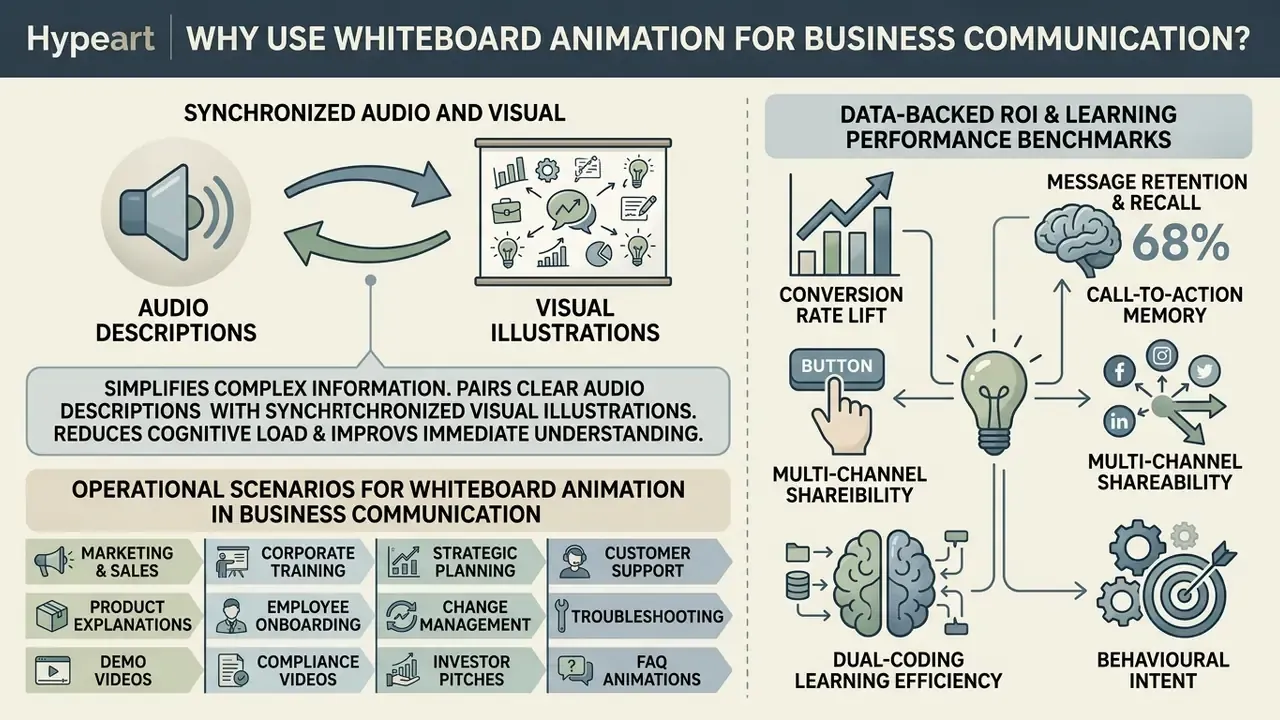
Whiteboard animation simplifies complex information by pairing clear audio descriptions with synchronized visual illustrations, reducing cognitive load and improving immediate retention. Organizations deploy whiteboard video content across marketing campaigns, employee onboarding, training modules, and internal communications to ensure key messages are understood and remembered.
Data-Backed ROI and Learning Performance Benchmarks
Multi-industry marketing data and cognitive research both point to measurable performance lifts when dense messaging is converted into whiteboard animation:
- Conversion rate lift Adding an explainer video to a sales landing page is associated with conversion increases of up to 80% (aggregated video-marketing benchmarks, Wyzowl / Unbounce).
- Message retention and recall Viewers recall 15% to 33% more information from a whiteboard video than from a standard talking-head presentation (Dr. Richard Wiseman, University of Hertfordshire; University of Waterloo retention research).
- Call-to-action memory Audiences are reported to be up to 95% more likely to remember a closing CTA when it is delivered inside a drawing-synchronized video rather than static text.
- Multi-channel shareability Scribe-style animated content is cited as 66% more likely to be shared on social platforms than talking-head corporate clips.
- Dual-coding learning efficiency Combining progressive line-art builds with narration is linked to comprehension gains of up to 400% for dense technical material (Paivio's dual-coding theory).
- Behavioural intent In vendor-reported studies, more than 90% of respondents said a whiteboard video increased their motivation to take the next step, and self-reported confidence to act rose from 36% to 64% after viewing.
These benchmarks combine peer-reviewed cognitive research with industry-aggregated marketing data. Percentage lifts from vendor studies should be treated as directional indicators rather than guaranteed outcomes. Run a controlled A/B test on your own funnel before committing budget forecasts.
One caveat worth stating plainly: the 400% figure is a theoretical ceiling from learning research, not a promise about your next landing page. Treat the two evidence classes separately.
To determine how whiteboard animation aligns with specific organizational communication goals, review the operational application matrix below.
Table: Operational scenarios for whiteboard animation in business communication
| Scenario | Primary Business Objective | Typical Message Type | Role of Whiteboard Animation |
|---|---|---|---|
| Video marketing | Increase audience awareness and drive sales conversion | Product explainer, value proposition, user journey | Visualizes feature benefits, simplifies complex value props, increases view duration |
| Educational video | Improve learning comprehension and procedure compliance | Technical walkthrough, step-by-step instruction, policy guide | Provides visual scaffolding and pairs audio with progressive visual builds |
| Internal communications | Align cross-functional teams around corporate strategy | Strategic roadmap, organizational change, HR policy update | Maps abstract systems, clarifies change management, standardizes messaging |
| Social media content | Capture viewer attention and boost digital engagement | Short explainer snippet, myth-busting, summary highlight | Uses drawing motion to grab fast-scrolling feeds and distill core insights |
Explaining Complex Ideas and Products
Whiteboard explainer videos excel at breaking down complex ideas by leveraging dual-coding theory, presenting information simultaneously through verbal and visual channels. Progressive drawing reveals diagrams piece by piece, preventing visual overload and allowing viewers to construct coherent mental models of complex software platforms, financial products, or technical architectures.
«A randomised experiment found whiteboard animation produced higher affective and cognitive learning outcomes than competing presentation formats.»
«Increasing the number of segments in whiteboard animations did not improve comprehension, whereas metacognitive prompts raised learners' intrinsic motivation.»
The practical implication for buyers: insist on scripts that ask reflective questions and preserve earlier drawings on screen, rather than briefs that simply chop the runtime into more scenes. When describing advanced technological integrations, organizations often reference resources like the AI Media API Guides to map technical architecture before translating complex data flows into simplified visual storyboards.
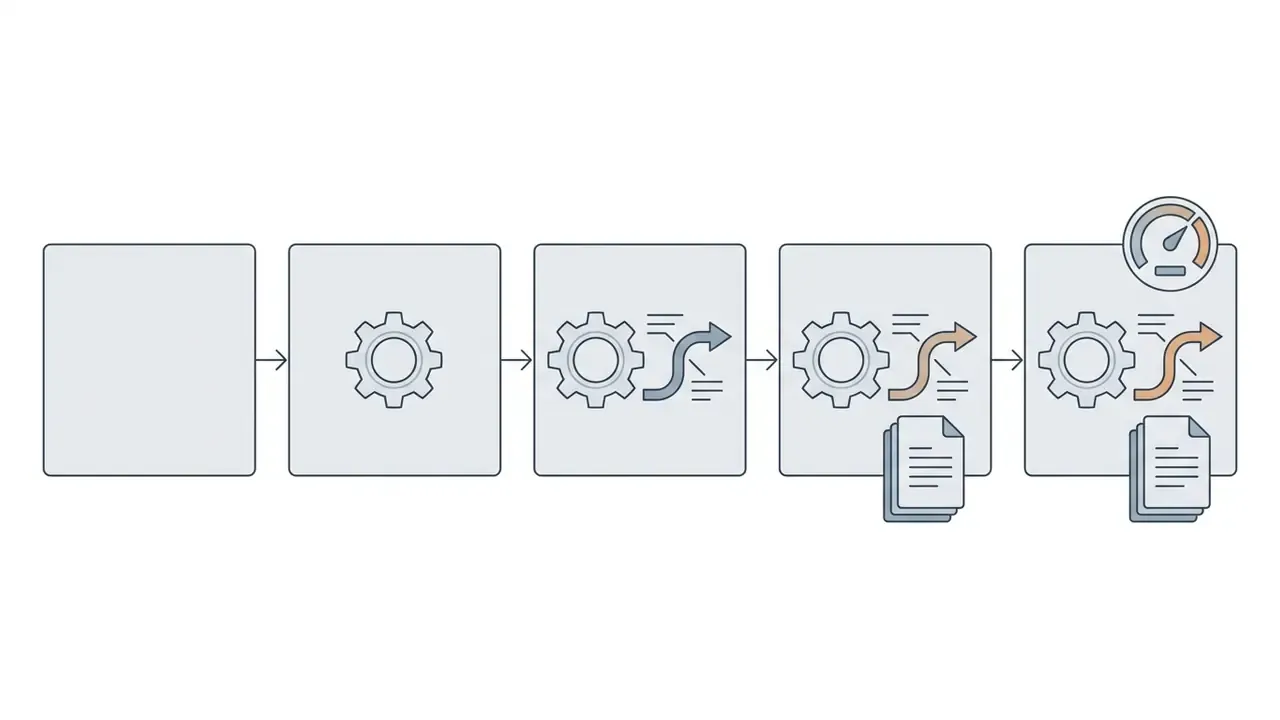
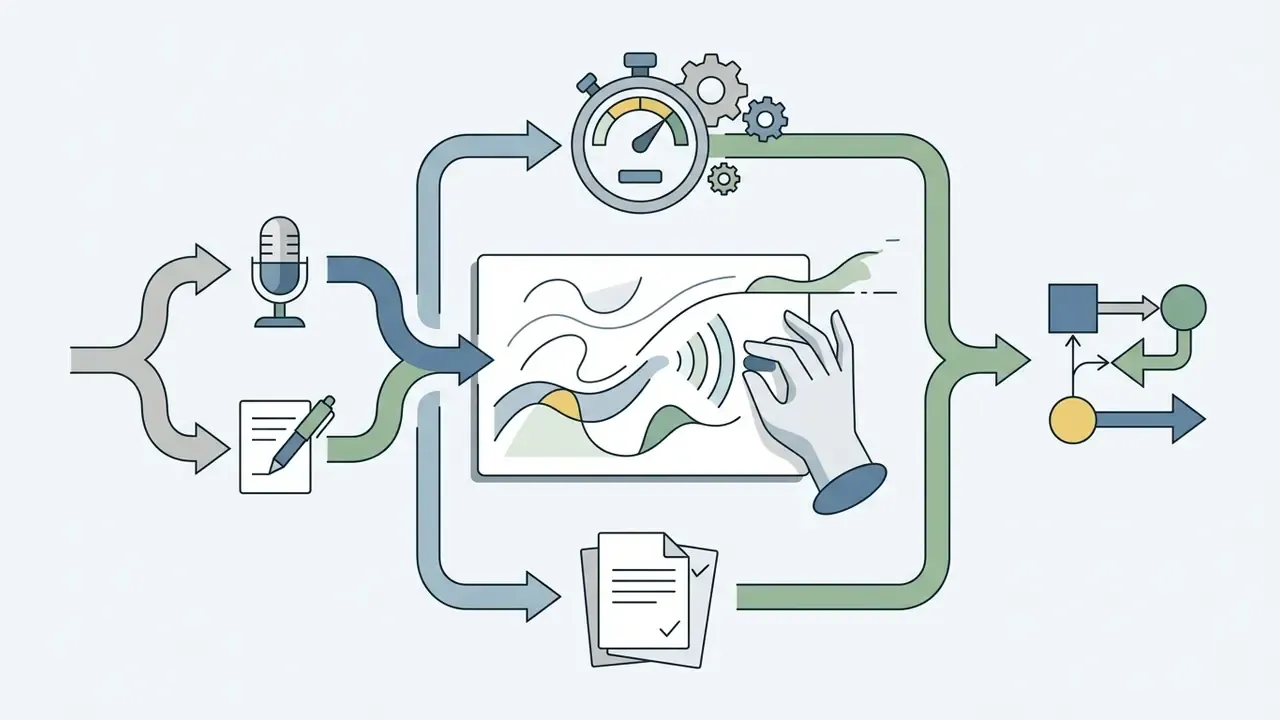
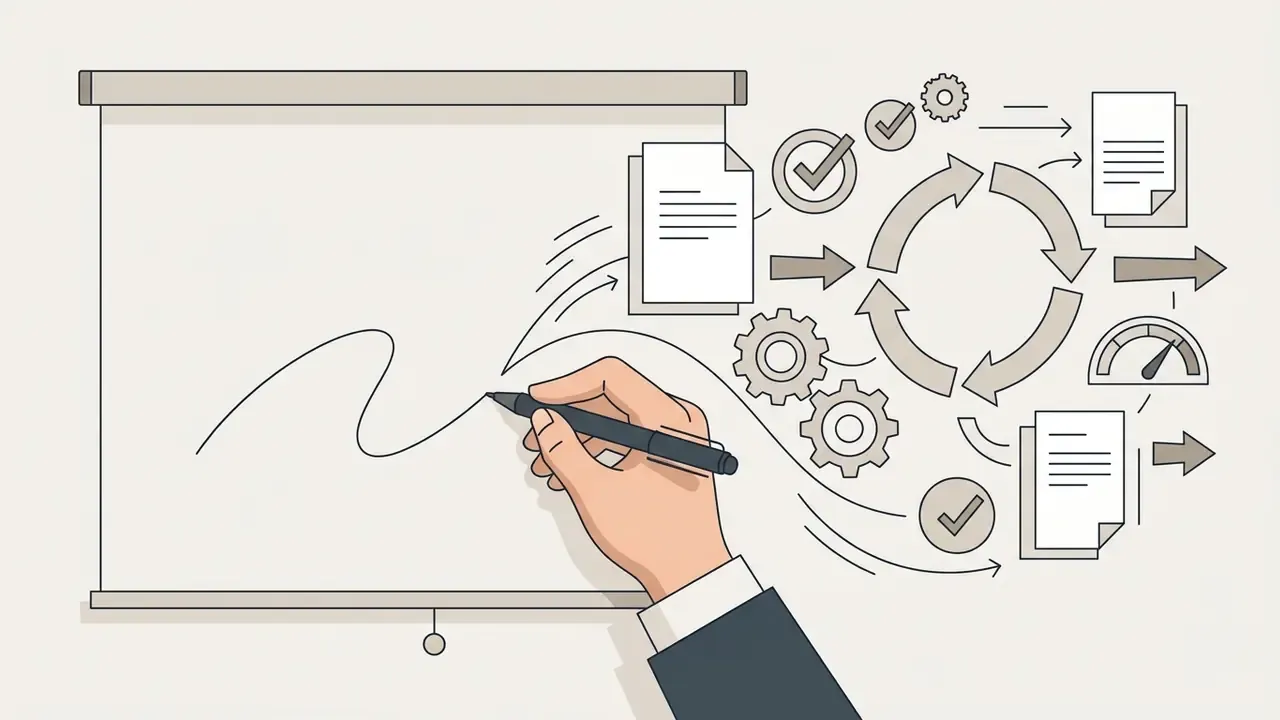
Three visual mechanisms drive this effect:
That third point is easy to underrate. The hand is not decoration; remove it and completion rates usually drop.
Training, Educational Video and Internal Communications
In corporate learning and development, whiteboard educational video formats increase learner engagement during employee onboarding, compliance updates, and system rollouts. Standardizing internal communications with whiteboard videos ensures that policies are communicated consistently across distributed global teams. Common documented deployments include compliance training, first-week onboarding sequences, organisational change messaging, and software or system rollouts.
Case example (financial services, illustrative composite). A Tier-1 US regional bank needed to refresh its annual AML/BSA compliance training across five regional business units. The L&D team converted a dense 40-page policy document into three 90-second whiteboard animation modules with clear narrative cues and a single decision scenario per module. The animated modules achieved a 94% completion rate across 1,200 employees and improved post-training policy assessment scores by 28% compared with the prior slide-deck format. Internal subject-matter-expert time dropped from an estimated 60 hours of live facilitation per quarter to roughly 9 hours of script and storyboard review across the whole project.
Two details made that work. Each module carried one decision, not five. And the policy owner reviewed the storyboard before animation started, which is where most compliance rework gets caught cheaply.
Professional Whiteboard Animation Service vs Animation Software
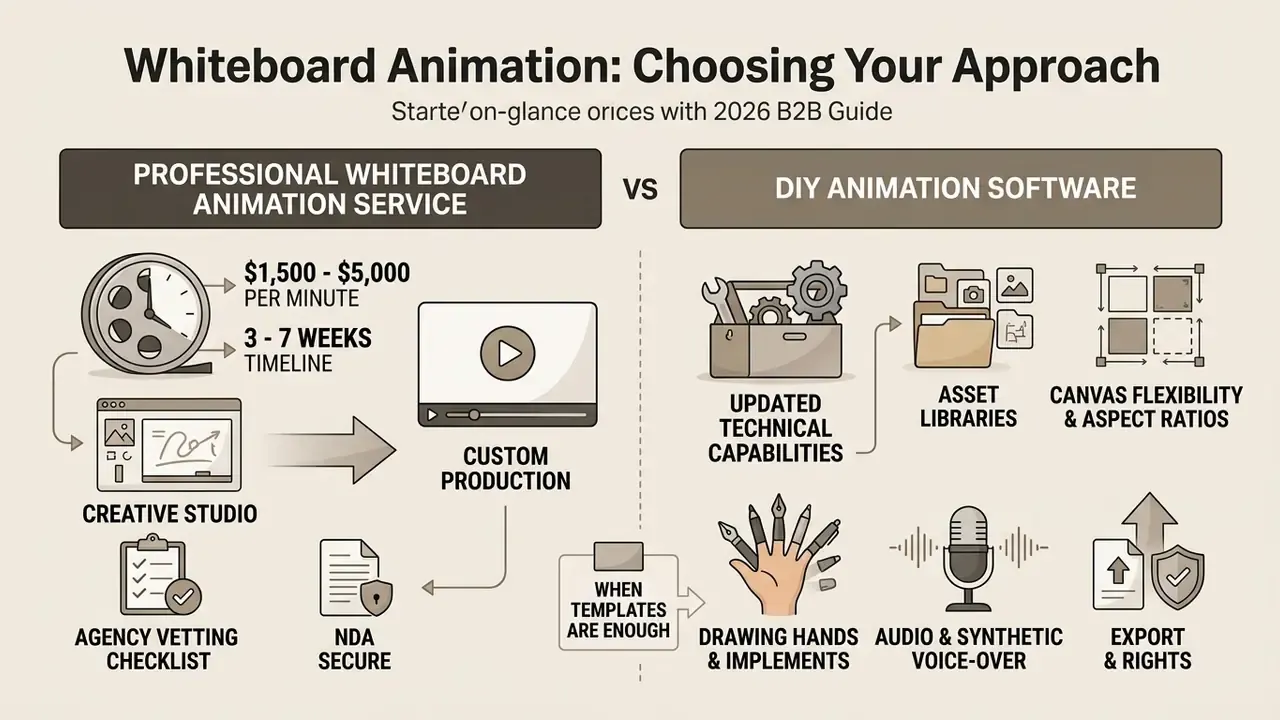
Organizations evaluating whiteboard video production must choose between purchasing DIY animation software or hiring a professional whiteboard animation studio. This is the first decision in the buying process, before budget tiers and agency shortlists matter. Evaluating internal team bandwidth, required visual quality, and message complexity helps determine the best approach.
Review the comparison matrix below to weigh software tools against full-service studio production.
Table: DIY animation software vs professional animation studio
| Evaluation Criterion | DIY Animation Software (e.g., Vyond, VideoScribe, Doodly) | Professional Whiteboard Animation Studio |
|---|---|---|
| Visual uniqueness | Low: relies on shared stock image templates | High: bespoke hand-drawn or custom vectors |
| Scripting and storytelling | Internal effort; requires in-house copywriting | Professional; dedicated copywriters and L&D strategists |
| Audio quality | Basic; internal recording or stock synthetic voices | Broadcast; professional voice actors and custom sound design |
| Production time cost | High internal labour, 15 to 40 hours of staff time | Low internal labour; client role limited to reviews and approvals |
| Compliance and accessibility | Manual configuration required by internal user | Built-in WCAG motion compliance and caption delivery |
| Confidentiality controls | Data stays in a third-party SaaS tenancy; review vendor DPA | Contractual NDA, access control, named-team handling |
| Total direct expense | $15 to $50 per month software subscription | $1,500 to $10,000+ fixed cost per project |
Teams building an internal production capability often benchmark subscription animation tools against free video editing software and a standard YouTube publishing workflow before approving licence spend. The honest comparison is not subscription price versus project fee; it is subscription price plus internal hours versus project fee.
When Whiteboard Animation Templates Are Enough
Animation software tools and pre-built whiteboard animation templates are sufficient for simple, low-stakes internal communication tasks. Software templates work well for routine team announcements, basic educational summaries, or low-budget social media posts.
«DIY whiteboard animation tools such as Benime enabled educational videos that raised engagement and learning outcomes in specific instructional contexts.»
When to Hire a Whiteboard Animation Studio
Hiring a professional whiteboard animation studio becomes necessary when communicating high-stakes corporate messaging, external marketing campaigns, complex B2B sales offerings, or regulated compliance updates. Custom studio production ensures original brand illustration, professional narrative pacing, and broadcast-quality audio engineering.
Beyond craft, there is a measurable commercial argument. Evidence from video marketing research indicates that video content significantly influences digital brand engagement, and that effect strengthens when the asset is distinctive rather than template-derived.
«Video-based electronic word of mouth has a measurable dual influence on brand perception and purchase intention in online environments.»
Enterprise applications also often require strict compliance with motion accessibility standards, such as WCAG 2.2 SC 2.3.3.
«Motion animation triggered by interaction can be disabled, unless the animation is essential to the functionality or the information being conveyed.»
Accessibility guidance further recommends avoiding continuously looping motion and providing a mechanism to pause or disable non-essential animation. Jurisdictional production rules can apply too: Canada's CPTC framework, for example, sets point and location tests requiring key animation to be performed in-country by qualifying personnel, which is relevant to any organisation claiming production incentives. When legal or regulatory disclosures intersect with visual media production, organizations consult resources covering AI Litigation and compliance considerations before publishing externally facing animated claims.
Whiteboard Animation Production Process and Timelines
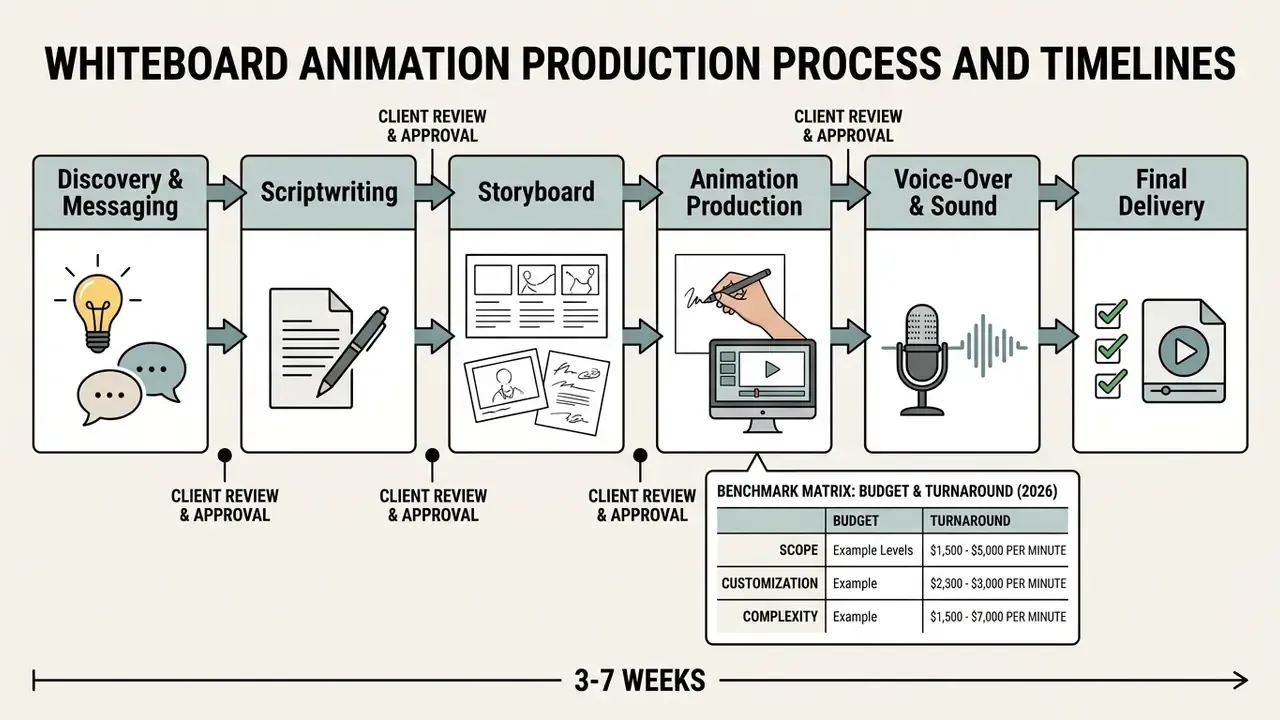
The whiteboard animation production process moves through six structured phases to ensure narrative alignment, visual clarity, and high-quality final execution. A standardized workflow minimizes project risks, manages approval milestones, and prevents costly late-stage revisions.
The core sequential stages of professional whiteboard animation production are represented below.
Whiteboard animation production process: Discovery → Script → Design → Rough Animatic → Animation → Sound Design → Final Product
Phase-by-Phase Schedule and Client Effort
| Phase | Standard Duration | Client / SME Time Required | Sign-Off Deliverable |
|---|---|---|---|
| Discovery and briefing | 3-5 business days | 2-4 hours (kickoff call, source materials) | Approved creative brief |
| Scriptwriting | 5-8 business days | 3-6 hours (2 review rounds) | Locked narration script |
| Design and style frames | 4-6 business days | 1-2 hours | Approved visual style sheet |
| Storyboard and rough animatic | 5-8 business days | 2-4 hours (pacing review) | Approved animatic |
| Voice-over recording | 2-4 business days | 1 hour (talent selection) | Locked audio track |
| Animation | 7-12 business days | 2-3 hours (draft review) | Draft animation |
| Sound design and final mix | 3-5 business days | 1 hour | Final master files |
| Total | 4-6 weeks (2-minute video) | Approx. 12-20 hours internal | Delivered masters plus source files |
Note the internal-hours column. It is the number most buyers forget when they compare a studio quote against "we'll just do it ourselves".
Discovery, Message and Scriptwriting
The discovery phase defines the core communication objectives, target audience, key messaging points, and brand distribution channels. Scriptwriting translates these parameters into spoken narration structured around a hook, core explanation, and clear call to action. Strong providers begin with questions about funnel position, audience pain, and the single desired viewer action. A studio that quotes a price before discussing the script is quoting for a template.
Professional scriptwriters follow spoken-audio standards, using short sentences between 10 and 18 words, formatting clear visual prompts alongside the text, and adding phonetic spelling guides for technical terms.
«Professional audio scripts use short sentences, phonetic cues for technical terms, and clear visual markers for synchronisation with imagery.»
Creative teams often consult specialized terminology databases, such as the AI Media Glossary, to verify correct technical phrasing prior to locking script copy. A reliable script structure for whiteboard work is three-act: the viewer's problem, the solution and its supporting proof points, then a benefit-led call to action.
One more test before you sign off on the script: read it aloud at natural pace with a stopwatch. Roughly 140 to 160 words per minute is the workable band. Scripts that only look short on the page are the most common cause of rushed narration and cramped visuals.
Design, Storyboard and Rough Animatic
During the design phase, illustrators establish custom character designs, visual style sheets, iconography, and color accent guidelines that align with brand standards. Character turnaround and expression sheets specify front, side and back views plus key expressions so continuity holds across scenes. The storyboard sequences visual panels frame by frame alongside corresponding script lines, specifying exact camera pans, zooms, and drawing transitions.
The rough animatic compiles storyboard sketches into a timed video track set against temporary voice-over audio. This milestone is the cheapest place to change your mind. It lets clients evaluate story pacing, visual density, and narrative flow before full illustration and animation production begins. Teams managing educational content pipelines sometimes use tools like an ai flashcard maker to extract key study points when drafting initial storyboard concepts, and reference AI art generator comparisons when auditioning illustration directions for style frames.
Animation, Voice-Over, Sound Design and Final Product
Final production begins by recording professional voice-over artists in sound-isolated studios to establish locked narration audio tracks. Voice-over is recorded against a locked picture or a locked script so that timing does not shift downstream. Digital animators then map visual vectors along automated drawing paths, aligning hand movements, object reveals, and visual transitions precisely with the narration cadence.
Sound designers build multi-track audio mixes combining voice-over, background music, and subtle sound effects to highlight key visual reveals. Updated: industry occupational standards for animation sound design define the role as creating a soundtrack that meets the project's creative, technical and production requirements; dialogue and VO, SFX and music are kept on separate tracks until the final mix, which is then checked on multiple playback systems.
Teams evaluating synthetic narration versus human talent often review comparison guides such as our overview of AI voice generators to assess speech naturalness, language coverage and commercial licensing before committing to final casting. Some teams also trial an ai female voice generator free tier for internal drafts, then book human talent for the external cut. That split approach works well: synthetic for animatics, human for anything that carries a sales or compliance message.
The final product is rendered into web-ready formats (1080p or 4K MP4) with customized aspect ratios for web embedding and social media distribution. Post-delivery, teams typically request captions and SRT files, a silent master for localisation, and vector source assets; video editing tools are then used internally for minor trims, end-card swaps and channel-specific versioning.
How Much Do Whiteboard Animation Services Cost?
Benchmark Matrix: Budget and Turnaround (2026)
| Video Scope and Format | Typical Length | Average Budget Range (USD) | Standard Turnaround | Rush Option |
|---|---|---|---|---|
| Simple product / social snippet | 60-90 sec | $1,500 to $4,000 | 3-4 weeks | 1.5-2 weeks (+25% fee) |
| Commercial SaaS and B2B explainer | 2-3 min | $4,500 to $8,500 | 4-6 weeks | 2-3 weeks (+20-30% fee) |
| Enterprise L&D / compliance module | 3-5 min | $6,000 to $12,000 | 5-7 weeks | 3-4 weeks |
| Multi-video corporate series (5+ clips) | Custom | $15,000 to $40,000+ | 8-12 weeks | Phased milestones |
To evaluate pricing proposals from whiteboard animation companies, review the budget impact drivers detailed below.
Table: Cost factors and budget drivers in whiteboard animation production
| Cost Factor | Low-Budget / Template Tier | Mid-Range Commercial Tier | Premium Enterprise Tier |
|---|---|---|---|
| Target price range | $200 to $800 per video | $1,500 to $5,000 per minute | $8,000 to $20,000+ per project |
| Graphic customization | Pre-made stock asset libraries | Custom line drawings and brand colours | Fully bespoke illustrations and character art |
| Scriptwriting | Client-provided text only | Professional copywriting and editing | Full research, interviewing and strategy |
| Voice-over talent | Automated or amateur voice tracks | Professional voice actor (1 language) | Top-tier talent and multi-language localization |
| Audio mixing | Stock background music track | Custom sound design and SFX mix | Bespoke composition and broadcast mastering |
| Revision terms | 1 strict revision pass | 2 to 3 structured revision rounds | Flexible milestone approvals at each phase |
Budget owners comparing production routes can cross-check figures against the AI Media Pricing Guides, model per-minute scenarios with the AI Media Calculators, and read the market overview of the best AI video generators to estimate the cost delta between outsourced studio work and tool-assisted internal production.
Scope, Customization and Animation Complexity
Project scope depends directly on total video runtime, visual density, and graphic originality. Using custom hand-drawn illustrations increases design labour compared with pre-built stock software libraries, adding roughly 30% to 70% to graphic production costs.
«A high degree of visual and character customisation requires substantially more illustrator hours and more brand-approval iterations.»
Script, Voice-Over, Sound Design and Revisions
Four production elements shape most agency estimates: professional copywriting, voice-over licensing fees, commercial music rights, and included revision rounds. Agencies typically include two to three structured revision iterations per project phase, billing subsequent changes at hourly editorial rates.
Voice-over expenses depend on talent experience, usage duration, and media buy geography. Broadcast music licensing and multi-track sound engineering are quoted as itemized line items. Music rights in particular are acquired separately from the production fee and should never be assumed to be bundled. Creators exploring adjacent asset-creation economics can review the ai filter overview and our guide to online photo editors to see where in-house tooling can absorb small visual tasks without agency hours.
Frequently missed line items to request explicitly:
- Rush surcharge
- typically +20% to +30% of project fee for compressed schedules.
- Localisation
- per-language cost for script adaptation, native voice talent, on-screen text re-lettering and re-render (often 25% to 40% of the original production fee per language).
- Payment structure
- most studios work on 50% upfront and 50% on delivery, or milestone-based staging (brief, animatic, final) for projects above $10,000.
- Out-of-scope hourly rate
- the rate applied once contracted revision rounds are exhausted.
- Source-file handover
- whether editable .AI/.EPS/.AEP files and audio stems are included or billed as an extra.
How to Choose a Whiteboard Animation Agency or Production Company
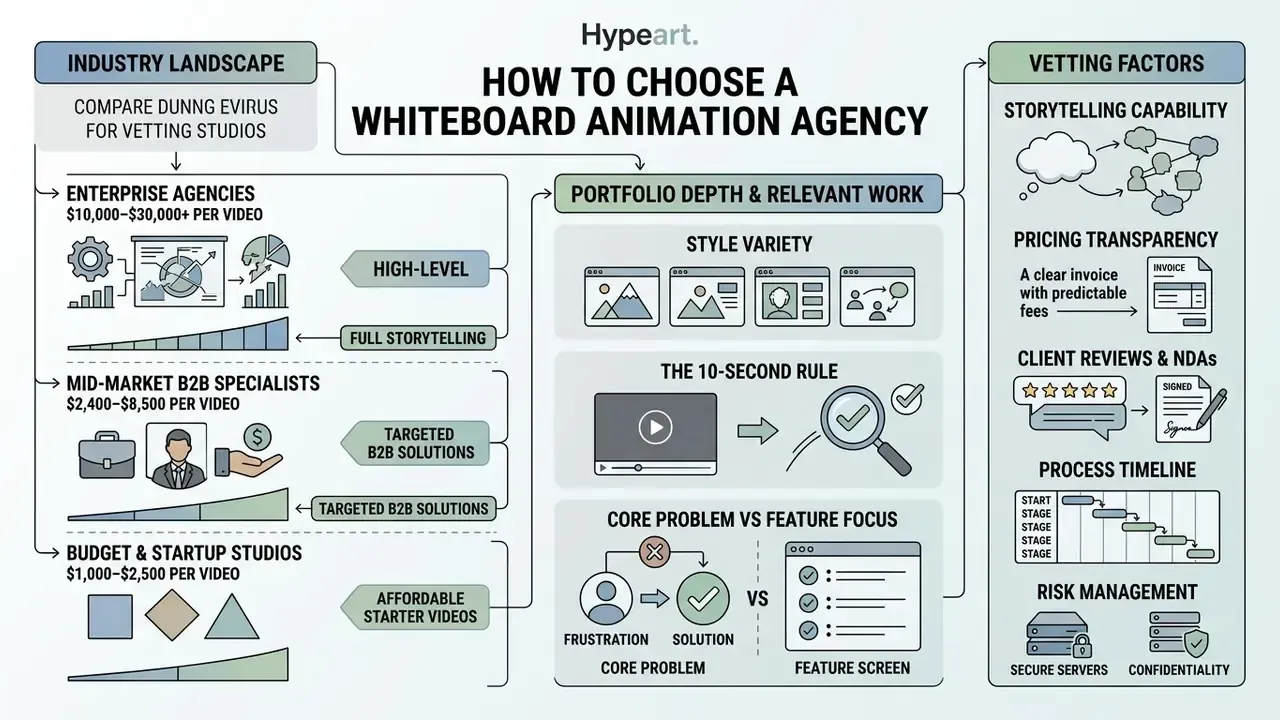
Selecting the right whiteboard animation agency requires evaluating portfolio depth, verifying storytelling capability, inspecting pricing transparency, and reviewing risk mitigation terms. A reliable production partner demonstrates proven experience translating technical subjects into clear visual narratives. Structurally, professional procurement practice recommends three stages: prequalification (can they legally and financially deliver?), technical scoring (portfolio, process, team), and risk-based due diligence (confidentiality, IP, compliance history), with monitoring continuing after award.
Industry Landscape: Vetting Top Whiteboard Studios
To streamline vendor selection, production options fall into three core budget tiers based on project stakes. The named vendors below are widely cited market reference points, not endorsements. Validate current pricing and capability directly.
- Enterprise storytelling agencies, $10,000 to $30,000+ per video.
Reference vendors: The Draw Shop, Epipheo, IdeaRocket, Wienot Films.
Best for: high-stakes corporate positioning, Fortune 500 change management, complex financial-platform launches. Includes deep narrative strategy, C-suite stakeholder interviews and premium sound design.
- Mid-market B2B specialists, $2,400 to $8,500 per video.
Reference vendors: Broadcast2World, Ydraw, Cartoon Media, TruScribe, Yum Yum Videos, Darvideo.
Best for: SaaS explainers, cybersecurity and fintech messaging, healthcare compliance, technical product workflows. Typically offers custom line art, hybrid colour or watercolour whiteboard styles, a dedicated project manager and structured revision pipelines; 4 to 6 week standard turnaround with a two-week rush tier.
- Budget and startup studios, $1,000 to $2,500 per video.
Reference vendors: BreadnBeyond, NextDay Animations, Exaltus.
Best for: early-stage value propositions, nonprofit explainers, short social teasers and tight two-week deadlines. Uses semi-custom asset libraries with fast delivery cycles.
A useful screening signal across all three tiers: studios with 1,000+ delivered projects and published client-retention figures (Darvideo cites 96% retention over 1,500+ videos; Broadcast2World cites 3,000+ projects over 15+ years) have documented pipelines rather than ad-hoc workflows. Ask for the retention number and how it is calculated. If nobody can explain the denominator, discount the claim.
Portfolio Depth, Style Variety and Relevant Work
A robust agency portfolio should showcase artistic style variety, high-resolution drawing quality, and relevant industry case studies.
«Agency portfolio evaluation should verify style variety, line-art quality, and the presence of industry cases relevant to the client's task.»
Scriptwriting, Storytelling and Production Expertise
A superior whiteboard animation firm demonstrates strong storytelling expertise, applying narrative arcs that connect problem identification directly to business solutions.
«Effective whiteboard scripts follow a three-act structure: the audience's problem, the solution, and a benefit-led call to action.»
Questions and Red Flags When Screening Providers
When interviewing potential whiteboard animation video companies, ask targeted screening questions to identify operational capabilities and prevent project delays:
- Who handles scriptwriting, and how do you conduct discovery interviews with our subject-matter experts?
- How many formal revision rounds are included at the script, storyboard, and final animation stages, and what is the hourly rate beyond them?
- Do we retain full commercial usage rights to all custom illustration assets, voice-over tracks, and final renders?
- What is your exact delivery schedule, which milestones require sign-off from our internal team, and how many hours of our time will each stage consume?
- Who will be named on the project, and will the same project manager stay through delivery?
- What confidentiality controls apply to our pre-release materials, and which subcontractors will access them?
Critical red flags during initial screening include vague itemized quotes, reluctance to provide written revision guarantees, lack of niche case studies, refusal to share full interim storyboards prior to animation, willingness to name a price before discussing the script, identical visual style across unrelated clients, absence of questions about goals and audience, vague deadlines paired with promises to "do it very quickly", and any hesitation about signing an NDA.
Data Security, NDA and Confidentiality Requirements
For regulated industries, the security posture of a creative vendor is a procurement condition, not a courtesy. Scripts for compliance, model-risk, product-launch or M&A communications routinely contain material non-public information, internal control descriptions and system architecture details. That material is typically handled by freelance illustrators and voice talent outside the agency's core team.
Verify the following before any source material leaves your environment:
- Mutual NDA before discovery.Signed prior to the first briefing call, covering the agency, its employees, and every subcontractor or freelance illustrator, animator and voice artist.
- Subcontractor disclosure.A written list of third parties who will access assets, with flow-down confidentiality obligations and the geographic location of processing.
- Secure transfer and storage.Access-controlled file exchange rather than open links; no confidential scripts in consumer messaging apps; documented retention and deletion timelines after delivery.
- Information-security evidence.Where available, ISO/IEC 27001 certification or a completed security questionnaire; at minimum, documented access control, device encryption and offboarding practice.
- Data-processing terms for DIY tools.If internal teams use SaaS animation platforms, review the vendor's DPA, tenancy model and AI-training clauses before uploading internal policy documents or unreleased product screens.
- Pre-release embargo controls.Watermarked review copies, named-reviewer access, and contractual restrictions on the agency publishing the work in its own portfolio until an agreed date.
- Post-delivery asset destruction.Written confirmation that working files and source materials are deleted or returned at project close, except where contractually retained for versioning.
Procurement frameworks support this rigor: due diligence on third parties should be proportionate to risk and should assess financial, operational, legal, compliance and reputational exposure, with vendor background checks completed before award and monitoring continuing through delivery.
Agency Verification Checklist
To confirm contractor reliability before signing, verify the operational criteria listed below:
- Named specialist allocationConfirm that experienced scriptwriters, illustrators, animators and a dedicated project manager are assigned directly to your project.
- Written revision scopeEnsure contract terms explicitly detail the number of included revision rounds, deadlines, exclusions, and hourly rates for out-of-scope changes.
- Itemized budget breakdownRequire separate line items for discovery, scriptwriting, custom illustration, voice-over licensing, music rights, sound design, localisation and final rendering.
- Interim deliverable accessRequire formal approval checkpoints at the script, storyboard, rough animatic, and draft animation phases.
- IP ownership transferVerify that full commercial rights to all final video deliverables and custom graphic assets transfer upon project completion and final payment.
- Confidentiality packageConfirm signed mutual NDA, subcontractor flow-down terms, secure file transfer, and post-project deletion commitments.
- Schedule commitmentObtain the delivery calendar in writing, including rush-fee conditions and the consequence of client-side review delays.
- Accessibility deliverablesRequire captions and SRT, a transcript, and WCAG-conformant motion behaviour for any asset used in training or public-facing channels.
Whiteboard Animation Project Brief: What to Prepare Before Contacting an Agency
Preparing a comprehensive creative brief before contacting a whiteboard video agency clarifies project requirements, accelerates discovery, and yields accurate cost proposals. A structured brief ensures external creative teams align with internal strategy from day one, and it is the single cheapest lever for reducing revision rounds later.
Project Brief Preparation Checklist
Gather and organize the following project parameters prior to initiating agency discovery calls:
- Primary objective State the specific goal of the video (for example, increase product demo requests by 20%, or standardize internal compliance training).
- Target audience profile Define viewer demographics, technical familiarity, key pain points, and professional roles, separating primary and secondary segments.
- Core message Distil the central takeaway into one or two concise sentences, plus two or three supporting proof points.
- Source materials Collect product whitepapers, workflow documentation, existing slide decks, and brand style guides.
- Format and technical specifications Specify required runtimes (for example, 90 seconds), display aspect ratios (16:9, 1:1, 9:16), language localization requirements, captioning needs, and LMS/SCORM packaging if applicable.
- Distribution channels List where the final video will be hosted (website landing page, YouTube channel, learning management system, paid social placements).
- References Provide two or three example videos you like, selected for narrative logic rather than visual style alone, and note what specifically works in each.
- Approvals and stakeholders Name every reviewer with sign-off authority, plus legal or compliance reviewers and their turnaround expectations.
- Confidentiality requirements Flag material non-public content, embargo dates, and NDA obligations up front.
- Budget and timeline constraints Define target expenditure limits, firm milestone delivery deadlines, and the KPI you will measure after launch.
One last piece of advice, learned the expensive way by plenty of teams: name the approver before the brief goes out. Projects rarely stall on animation. They stall on the fifth stakeholder who appears at draft review with new opinions.
Frequently Asked Questions (FAQ)
How long does it take to produce a 2-minute whiteboard explainer video?
Standard professional production takes 4 to 6 weeks: scriptwriting in week 1, storyboarding and animatic in weeks 2 and 3, voice-over and line animation in weeks 4 and 5, then sound design plus final revisions in week 6. Rush delivery in 2 to 3 weeks is usually possible for a 20% to 30% surcharge, provided your internal reviewers commit to 24-hour feedback turnarounds.
What is the average cost of whiteboard animation per minute?
Commercial-quality production ranges between $1,500 and $5,000 per finished minute. DIY software costs $15 to $50 per month but requires roughly 20 to 40 hours of internal labour per video. Enterprise-grade agencies charge $8,000 to $20,000+ per full project, and multi-video series typically land between $15,000 and $40,000+.
Do I retain ownership of custom drawings created by an agency?
You should. Professional contracts include full commercial IP transfer upon final payment, granting rights to vector source files, audio stems and master video renders. Confirm whether stock assets, licensed music and voice-talent usage carry separate term limits or territory restrictions.
Can whiteboard animation be delivered in multiple languages?
Yes. Plan for script adaptation, native voice talent, re-lettering of on-screen text and a fresh render per language. Localisation commonly costs 25% to 40% of the original production fee per additional language, so request a silent master and editable source files at handover.
Which industries get the most value from whiteboard video?
SaaS, cybersecurity, fintech and banking, EdTech, healthtech, and regulated B2B services. In short, sectors where product logic is more complex than average and requires sequential explanation.
How many revision rounds should be included?
Two to three structured rounds is the market standard, allocated across script, storyboard or animatic, and draft animation. Anything beyond that is normally billed per round or at an hourly editorial rate, which should be stated in the contract.
Will the agency sign an NDA before seeing our materials?
A professional studio will sign a mutual NDA before discovery and extend confidentiality obligations to freelance illustrators, animators and voice talent. Refusal or delay at this stage is a disqualifying red flag for regulated buyers.
Is DIY software ever sufficient for external marketing?
Occasionally, for short social teasers or myth-busting snippets. For externally facing conversion assets, the shared stock libraries used by template tools undermine brand distinctiveness, and synthetic narration rarely carries the emotional register a sales explainer needs.