About this analysis. This guide is maintained by the editorial team behind the AI Media risk and licensing hub, working under the governance-focused author of Marcus Hale, author Every legal, environmental, and market claim below is tied to a named primary source: U.S. Copyright Office policy reports, peer-reviewed marketplace research, and published life-cycle assessments, so that risk, compliance, and creative leaders can verify each data point independently. Last substantive update: current edition, reflecting U.S. Copyright Office guidance issued in 2025-2026 and the C2PA v2.4 provenance specification.
Why is ai art bad? A balanced short answer
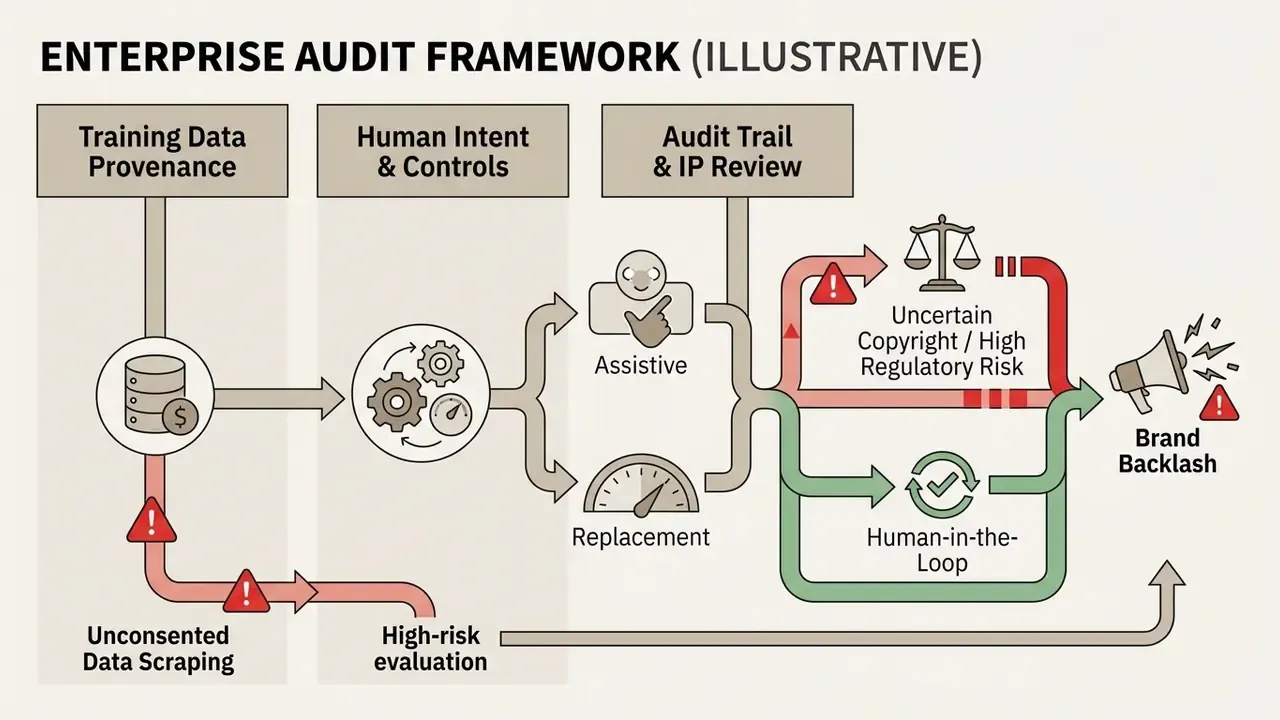
AI art is not inherently bad as a pure technological capability, but its unmonitored deployment creates material risks when trained on unconsented creator data, substituted for human labor without transparency, or used commercially without enforceable copyright ownership. Whether synthetic image generation helps or harms depends directly on deployment context, data provenance, human oversight, and legal exposure. Context does most of the work here.
AI art isn’t automatically bad, but its use can cause harm
Generative image models work well as assistive tools for ideation, concept iteration, and rapid prototyping when guided by deliberate human direction. Harm appears when organizations treat automated outputs as autonomous replacements for human creators, bypass consent mechanisms, and push unverified residual risk into commercial workflows. So the honest framing is not «technology good, technology bad». It is: who directed the work, whose data trained the system, and what happens when a customer finds out?
The reputational component of that harm is measurable rather than theoretical.
«Participants valued works labelled as AI-generated roughly 62% lower than identical works labelled as human-made.»
The main concerns behind AI-generated images
The primary objections to AI-generated images center on legal uncertainty about copyright ownership, the uncompensated ingestion of protected artistic works, creative homogenization, and market distortion. Scaling synthetic media also raises environmental resource costs and accelerates the automated spread of misleading visuals across digital channels.
Five recurring problem clusters appear consistently across EU and U.S. policy material: the legality of training-data collection, the uncertain protectability of outputs, labor substitution, style imitation without remedy, and the energy and water footprint of training plus inference. Notice what unites them. Each one is a question about human input and accountability, not about pixel quality.
| Use Scenario | Possible Benefit of AI Art | Main Risk or Concern | When a Human Author Is Needed |
|---|---|---|---|
| Brainstorming & Visual Ideas | Rapid exploration of compositional layouts and color palettes. | Ingestion of unconsented training data and accidental style imitation. | Developing a distinctive visual identity and selecting final creative directions. |
| Social Media Graphics | Accelerated content production cycles for routine digital posts. | Brand backlash, public distrust, and propagation of misleading visual claims. | Reviewing sensitive communications, corporate announcements, and brand assets. |
| Commercial Illustration | Lower upfront production costs for high-volume graphic assets. | Lack of copyright protection and potential third-party IP infringement claims. | Creating core campaign imagery, trademarked logos, and proprietary brand graphics. |
| Concept Art & Drafting | High-speed visual iteration during early project design phases. | Visual artifacts, anatomical errors, and stylistic homogenization across projects. | Finalizing asset details, establishing production-ready logic, and emotional storytelling. |
Historical context: is AI art simply the “new photography”?
Defenders of generative AI often draw parallels to historical technological disruptions, notably the invention of photography in the 1820s and the earlier arrival of the printing press. Nineteenth-century critics argued in almost identical language that camera mechanics lacked «soul» and would render painters obsolete.
«The fear has sometimes been expressed that photography would in time entirely supersede the art of painting.»
An 1855 issue of The Crayon went further, insisting that «invention and feeling constitute essential qualities in a work of Art» and that photography «can never assume a higher rank than engraving». History did not validate that prediction: painting was not superseded, and photography developed into an independent art form with its own canon and market. The analogy therefore deserves serious treatment rather than dismissal.
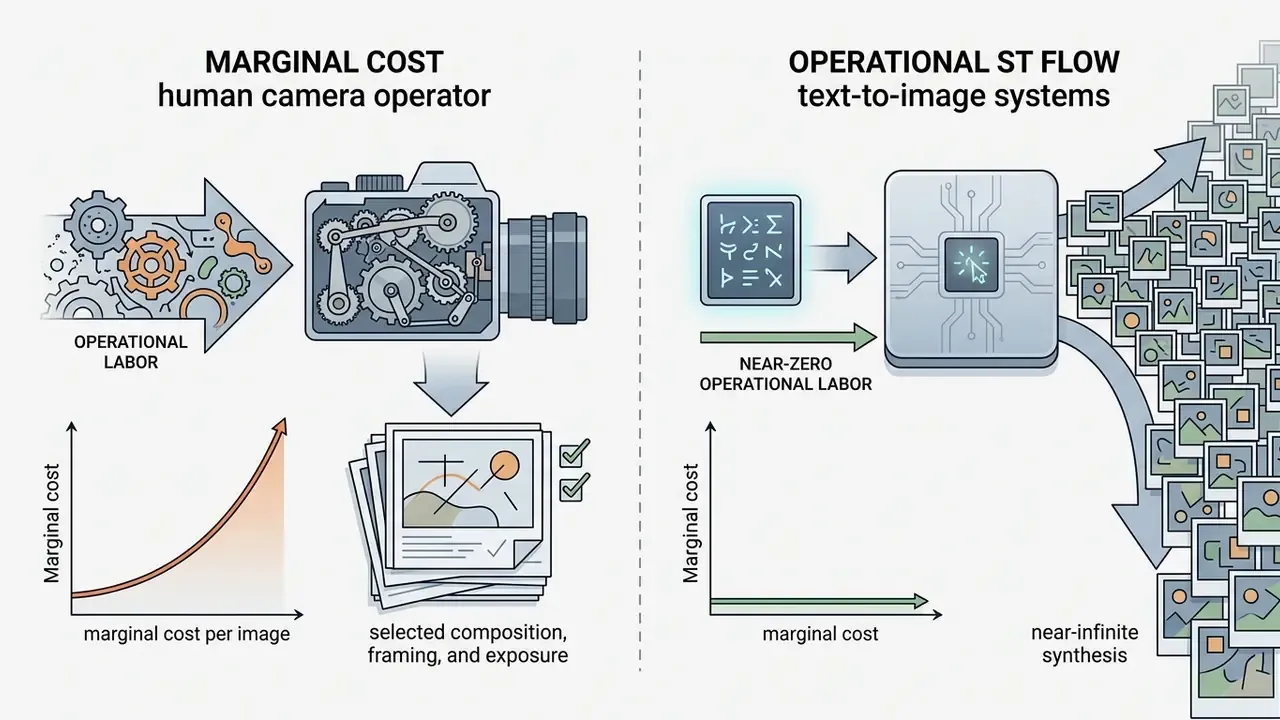
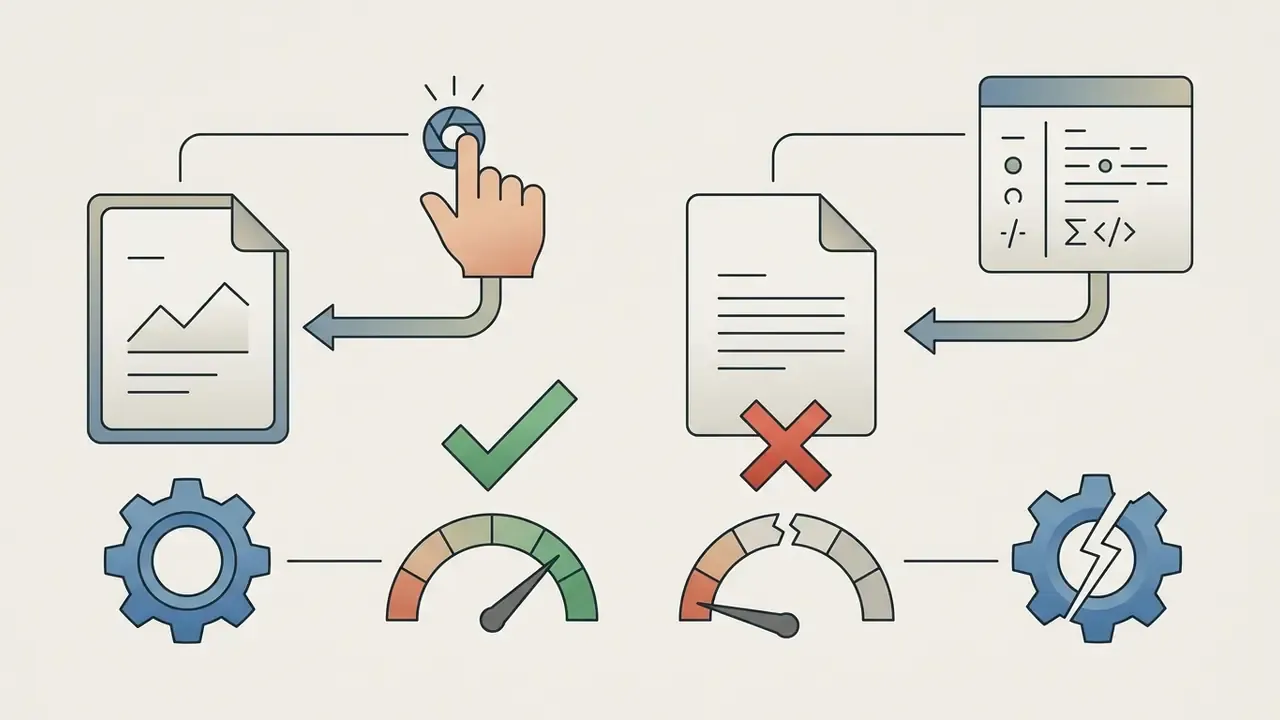
Three structural differences still limit how far it can be carried:
The honest conclusion: the photography analogy is instructive about cultural panic and misleading about economics and law. New tools rarely erase old ones. They do reorganize who gets paid, who owns the result, and whose consent is required, and those three questions are precisely where AI art remains unresolved.
How AI image generation works and why training data matters
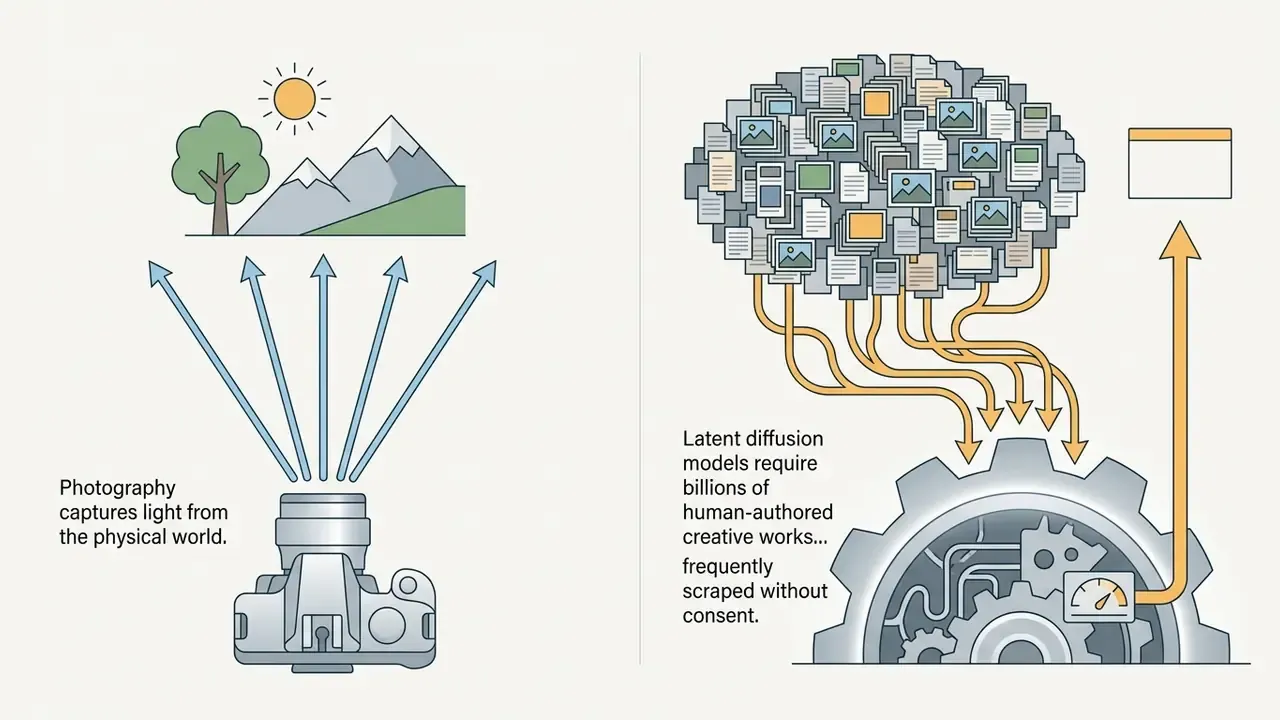
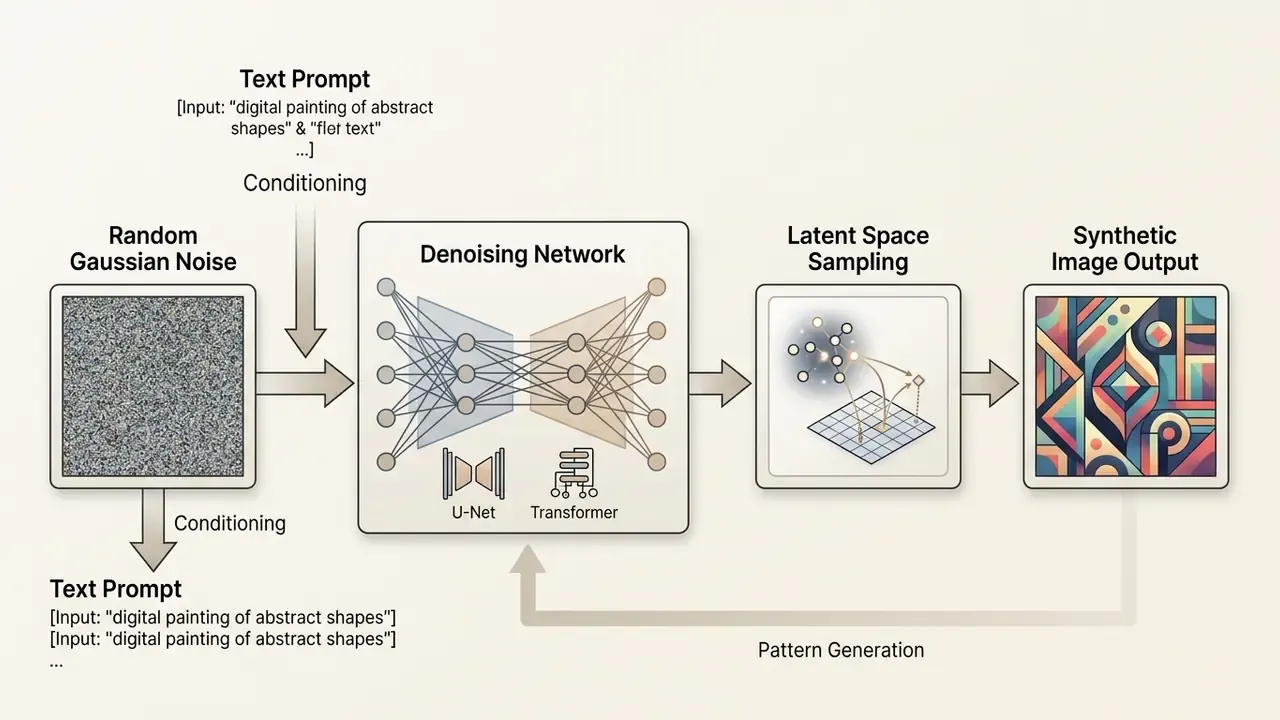
Text-to-image systems generate visual outputs by executing probabilistic sampling across high-dimensional latent spaces derived from massive web-scraped datasets. Training data provenance is therefore the critical determinant of whether an AI model operates ethically or exposes users to legal liability.
AI models generate patterns from existing visual material
Modern text-to-image architectures, including latent diffusion models, work by systematically reversing a noise process across learned statistical distributions. Readers who want to see how individual AI image generators differ in their data sourcing and licensing posture can compare them side by side.
Rather than demonstrating conscious visual understanding, these systems reconstruct spatial relationships and texture patterns from correlations mapped across billions of image-text pairs. Latent diffusion compresses the image into a lower-dimensional latent space, adds noise, and trains a denoising network to reverse that corruption step by step, an approach that preserves output quality while sharply reducing compute cost relative to pixel-space diffusion. The generative step is best described technically as stochastic sampling from a learned probability distribution: the model infers latent structure and draws new instances from it. That is pattern recognition and recombination. Not deliberation, and not intent.
Why artists object to the use of their work in training
Visual artists object to model training practices because large-scale dataset creation routinely scrapes personal portfolios, copyrighted illustrations, and private image galleries without consent, attribution, or financial compensation. Web-scale corpora such as LAION-5B, used to train widely deployed open models, were later shown to contain both copyrighted works and, according to independent investigations, illegal material, which intensified the ethical dispute over provenance.
«Stable Diffusion reproduced the styles of 70 professional artists with an average CLIP-classification accuracy of about 81% when their work appeared in training data.»
Updated: the earlier version of this paragraph cited the same study without the accuracy figure or the classification methodology; the quantified version above replaces it (see Appendix A).
Litigation has tracked these objections closely. In January 2023, Sarah Andersen, Kelly McKernan, and Karla Ortiz filed a putative class action in the Northern District of California against Stability AI, Midjourney, and DeviantArt. A judge trimmed the case in October 2023, plaintiffs filed an amended complaint in November 2023, and direct infringement claims have remained alive through subsequent procedural stages, with trial scheduled for September 8, 2026. Artist advocates have consistently pushed for opt-in licensing rather than the opt-out removal flows offered by some vendors.
«All 459 surveyed artists demanded mandatory, detailed disclosure of which specific works were used to train AI models.»
AI-generated work is not simply a copy, or fully independent creation
Synthetic outputs occupy a complex middle ground between direct visual copying and autonomous human authorship. Diffusion systems synthesize new pixel combinations rather than storing raw raster images, yet their outputs remain mathematically dependent on statistical features extracted from human-created reference material. The system cannot claim the result as fully its own, because nothing in it originated outside the training distribution.
«Models begin reproducing a recognizable artist style once that artist’s works appear roughly 200 to 600 times in the training data.»
That threshold matters legally as well as technically: it explains why style imitation is reproducible and targetable, yet difficult to characterize as copying of any single protected work.
E-E-A-T Fact Check: Legal Frameworks and Ownership Status
Official guidance from the U.S. Copyright Office (Copyright and Artificial Intelligence, Part 2: Copyrightability, 2025) confirms that purely AI-generated outputs lacking sufficient human creative control are ineligible for copyright protection under U.S. law. Register of Copyrights Shira Perlmutter has stated in official policy testimony that text prompts alone do not constitute human authorship, meaning unedited machine outputs receive no copyright protection on generation. Congressional Research Service summaries reach the same conclusion, citing the 2023 Midjourney graphic-novel decision in which the text and arrangement were protectable but the individual AI-generated images were not. European official positions align on the underlying principle: content generated without human intervention should not receive copyright protection, while AI-assisted content shaped by human creativity may qualify. Organizations evaluating IP strategy can review detailed case tracking through the AI Litigation and Case Timelines resource and consult the AI Media Commercial-Use Hub for enterprise risk frameworks.
Can you use AI-generated art commercially?
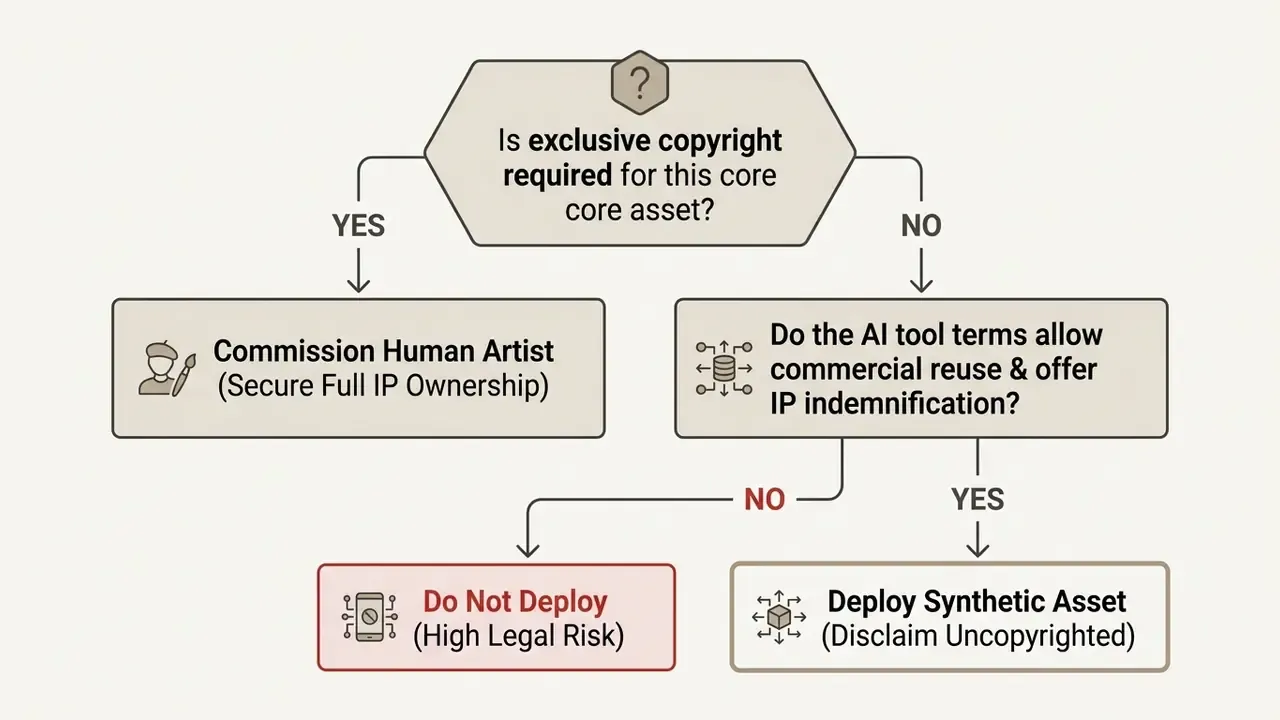
Deploying synthetic imagery within commercial campaigns requires rigorous risk management, licensing verification, and brand reputation assessment. Unedited synthetic outputs cannot be copyrighted, which exposes core brand assets to unchecked public duplication.
Check the AI tool’s terms before using generated images
Commercial usage permissions vary significantly across software vendors and subscription tiers. Read the tier, not the homepage.
«Purely AI-generated material lacking sufficient human control over expressive elements is not protected by copyright.»
Enterprise tools may offer contractual intellectual property indemnification for specific non-beta generation features, whereas consumer platforms frequently restrict commercial rights or gate them behind revenue thresholds (Midjourney Commercial Terms; Adobe Firefly Business Terms, 2026). Three concrete patterns recur in vendor documentation:
- Revenue-tier gating. Midjourney grants commercial rights to paid subscribers, but businesses grossing more than $1,000,000 USD per year must hold a Pro or Mega plan to use outputs commercially. Buyers comparing options can review how Midjourney image generation stacks up against alternatives on licensing terms as well as output quality.
- Beta-feature exclusion. Adobe Firefly permits commercial use of outputs from features that are not labeled beta, and offers contractual IP indemnification to eligible enterprise customers for selected outputs.
- Contract-specific indemnification. Enterprise agreements from large model providers generally permit commercial use of outputs, but indemnification applies only where the specific offering explicitly includes it. It is never a universal grant.
Teams formalizing procurement rules can review platform-by-platform terms in the AI image generator commercial use guide, and compare concrete licensing behaviour in vendor-specific reviews such as the Canva AI Generator overview, the Microsoft AI Image Generator overview, and the Google AI Image Generator overview. Budget owners modelling total cost, including review labour and rework, can sanity-check assumptions with the AI Media Calculators.
Shadow AI: unlicensed generation inside the organization
A risk category absent from most consumer-facing discussions is Shadow AI: employees generating visual assets on personal accounts, free tiers, or unapproved consumer plans using corporate devices and corporate brand material. The exposure is threefold.
First, consumer tiers frequently withhold commercial rights, so an asset that reaches a paid campaign may be unlicensed from the moment it is created. Second, uploaded reference material (unreleased packaging, internal mockups, customer imagery) may be retained or used for model improvement under consumer terms, creating confidentiality and privacy incidents. Third, no audit trail exists, so when a third party alleges infringement the organization cannot demonstrate provenance, prompt history, or human contribution.
Practical mitigations are procedural rather than technical: maintain an approved-tool register with documented licensing tiers, block unapproved generative endpoints on managed devices, require prompt-and-source logging for any asset entering production, and mandate registration disclosure review before copyright filings. Under current U.S. Copyright Office registration practice (Works Containing Material Generated by Artificial Intelligence, 2026), applicants must explicitly disclose and disclaim AI-generated content exceeding a de minimis threshold, which is impossible to do accurately if generation happened off the record.
Consider whether the image could harm trust in your brand
When hiring an artist is the stronger commercial choice
Commissioning human creators is the safer, more strategic choice when a business requires exclusive legal ownership, complex multi-channel campaign coordination, or custom brand identity assets. A human-authored work can be fully registered with copyright authorities, protected against unauthorized commercial copying, and integrated into long-term corporate IP portfolios.
Logos deserve a separate warning. Identity marks are exactly where the ownership gap bites hardest, so teams evaluating an ai logo generator, a lightweight ai logo maker, or an ai logo maker free online should assume the raw output is unprotectable by copyright and plan for human redesign plus trademark filing. World Intellectual Property Organization guidance further notes that artist-brand partnerships work best when aligned with brand image and belief systems, and that trademarking names early plus managing performer rights supports genuine exclusivity, neither of which a prompt-only asset can deliver. Developers building custom visual pipelines can review integration specifications in the AI Media API Guides and access workflow assistance through AI Media Support and Troubleshooting.
Enterprise Legal Alert: Copyright Disclaimers and Registration Limits
Enterprise GenAI visual asset audit checklist
Risk, compliance, and model-validation teams can use the following checklist before approving any synthetic visual asset for production. It is designed to slot into existing model risk management (MRM) frameworks rather than replace them.
1. Licensing and rights
Checklist0 / 4
2. Training-data provenance
Checklist0 / 4
3. Output validation (MRM extension)
Checklist0 / 4
4. Transparency and provenance
Checklist0 / 3
5. Governance and ESG
Checklist0 / 3
Creative and quality problems in AI-generated art
Despite surface-level visual polish, synthetic imagery frequently suffers from anatomical errors, structural inconsistency, and a lack of narrative depth. Without rigorous human refinement, fully automated outputs struggle to deliver original visual storytelling.
AI can produce visual mistakes and inconsistent details
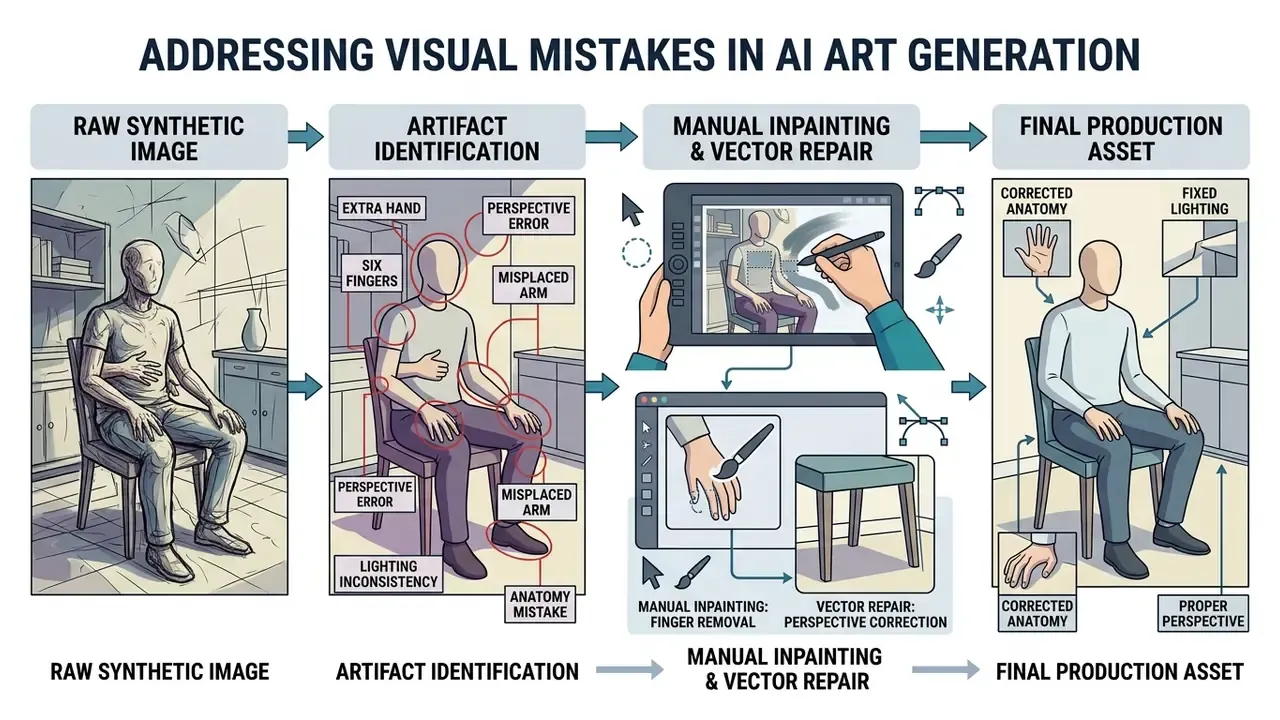
Diffusion models regularly generate localized visual artifacts, including impossible hand anatomy, broken lighting logic, inconsistent edge boundaries, and surreal texture bleeding. Correcting these errors requires extensive human intervention, post-processing, and manual paint-overs before the asset reaches production standards.
Peer-reviewed work has begun formalizing the failure taxonomy (anatomical implausibilities, stylistic artifacts, functional implausibilities, physics violations, sociocultural implausibilities) and quantifying the correction burden: a 2026 evaluation found that current AI editing tools adequately handled only about one-third of real user requests, with human edits preferred 66.0% of the time versus 25.8% for AI edits. Recurring boundary defects include chromatic shifts, texture mismatches, visible seams, unintended changes outside the target region, and identity drift across iterations. Anyone who has tried to keep one character consistent across six frames knows the feeling.
Model collapse: how synthetic saturation degrades future AI quality
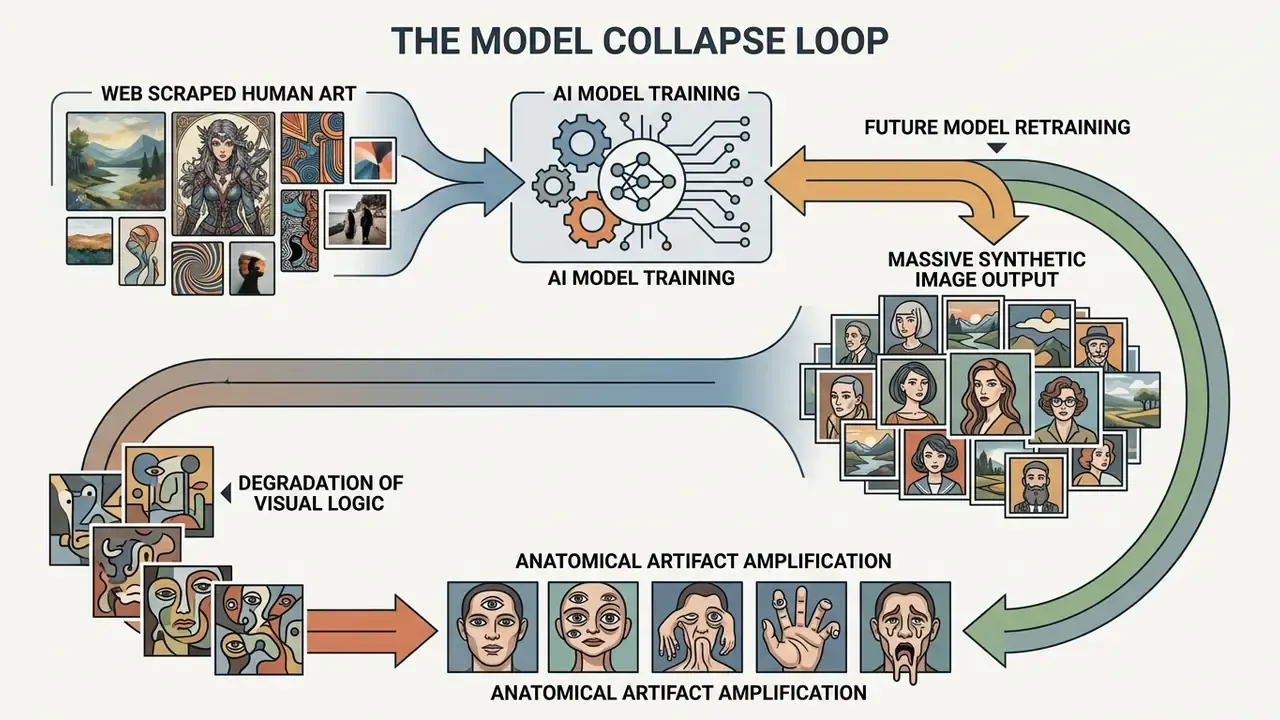
As synthetic media floods digital index networks, web-scraping crawlers increasingly ingest AI-generated images to train next-generation models. Computer-science researchers term this feedback loop model collapse. When recursive generative models consume synthetic outputs rather than authentic human visual data, statistical variance narrows. Over successive generations, models lose edge coherence, introduce compounding anatomical distortions, and produce visually homogenized, low-diversity outputs.
The practical consequence for buyers is a slow-moving quality risk that sits outside any single vendor’s control: the raw material of future models is being contaminated by the output of current ones. Independent art-market research already documents declining visual novelty over time in AI-adopting work, with outputs becoming measurably more similar to one another, an empirical signal consistent with the collapse mechanism. Aesthetic analyses point in the same direction, arguing that generative systems privilege recurring features such as symmetry, saturation, beauty, and spectacle, which compounds homogenization even before recursive training effects are counted.
Generated art may lack personal intent and lived experience
Machine learning models generate imagery by matching statistical correlations, entirely lacking emotional context, personal history, or intentional philosophical framing. An AI can’t hold a grudge, lose a parent, or spend a decade refining one line. Controlled psychological studies show that when consumers evaluate identical artworks, outputs explicitly labeled as AI-generated receive significantly lower valuations for perceived creativity and emotional resonance than human-authored works.
«Identical artworks labelled AI-generated were valued about 62% lower than the same works labelled human-made.»
«Fewer than 30% of non-expert viewers correctly identified AI images as machine-made in blind tests, yet valuation fell sharply once labelling was applied.» A Critical Assessment of Modern Generative Models’ Ability to Replicate Artistic Styles (2025 preprint), read together with the Columbia Business School study (2024). Preprint URL not available in the source brief.
The combination is the important part: audiences frequently cannot detect synthetic imagery, but once they are told, perceived value drops. That gap explains why undisclosed use is commercially tempting and reputationally dangerous at the same time. Scholarship on authenticity reaches a compatible conclusion: value migrates from the material object to authorship, provenance, and cultural context, and signaling genuine human involvement measurably increases recognition of a work relative to presenting it as off-the-shelf tool output. Collector research likewise records an «emotional gap» toward AI art and reports low collector demand, alongside the finding that galleries still lack a uniform definition of what counts as AI art.
Efficiency can conflict with the value of making art
Prioritizing generation speed over the iterative visual discovery process treats artistic creation as mere friction to be eliminated. This focus on rapid throughput risks reducing creative expression to standardized commercial output, diminishing the cultural value derived from deliberate human craftsmanship.
Empirical latency comparisons illustrate how completely the constraint has shifted: embedded generation pipelines now report averages near 1.3 seconds per image against 3.8 seconds for baseline Stable Diffusion, and multi-agent design systems compress poster production from days into minutes. Yet the same literature concedes that iterative refinement, the actual «form-finding», reintroduces latency because every adjustment triggers another round of evaluation. Speed optimizes throughput; it does not optimize discovery.
Proponents frame generative tools as the «democratization of creativity». Critics answer that this introduces an accessibility fallacy: confusing instantaneous visual generation with genuine artistic expression. As one widely shared reader comment on the debate put it, art by definition implies skill and effort, and minimizing both redefines the category rather than widening access to it. The same objection applies to text: an ai love letter tool produces fluent sentiment without a sender who felt it, and a purely mechanical utility like an ai lottery generator makes the contrast obvious, since nobody claims authorship of a random number set. True artistic authorship requires deliberate technical skill, emotional processing, and decision-making overhead that automated prompt generation intentionally bypasses. Access to output is not the same as access to authorship.
Teams seeking to evaluate alternative generation tools can compare feature sets, review the best AI art generators by image quality and licensing, and inspect pricing models via the AI Media Pricing page.
Environmental and social concerns around generative AI
Scaling global generative AI infrastructure imposes measurable environmental costs through data center resource consumption, while introducing social risks tied to automated visual disinformation.
Image generation has resource and infrastructure costs
Operating large-scale diffusion models requires intensive compute resources across training and inference phases. Life-cycle assessments report that executing a standard multi-pass synthetic image query consumes approximately 2.9 Wh of electricity and 28.6 mL of cooling water, making large-scale automated generation substantially more resource-intensive than traditional web search queries (United Nations University / ICEF Report, 2026).
«Inference accounts for roughly 78% of large generative models’ life-cycle CO₂ emissions and about 10 TWh of electricity annually worldwide.»
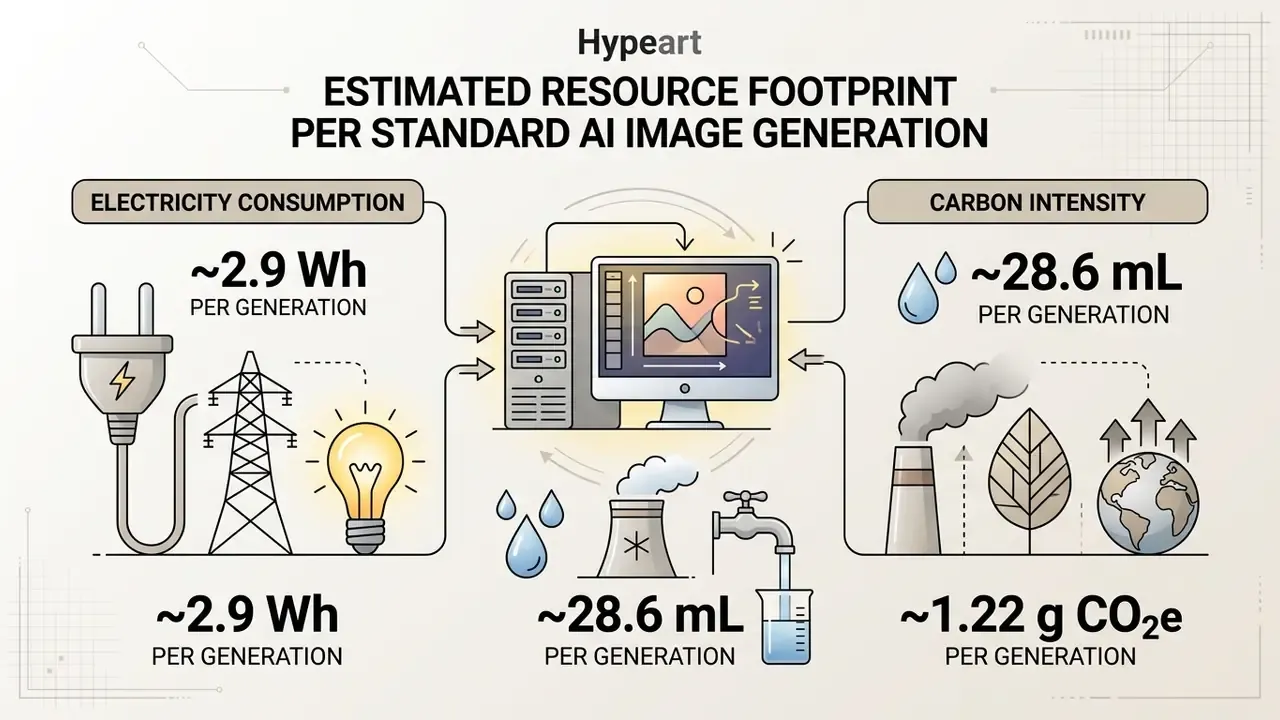
«Training GPT-4 is estimated to have consumed about 28,800 MWh and emitted roughly 6,912 metric tons of CO₂.»
Wider infrastructure figures place these per-image numbers in context. Lawrence Berkeley National Laboratory estimated the indirect water footprint of U.S. data centers at roughly 800 billion liters annually (2024), while IEA-linked analysis cited in 2025 literature attributes about 182 million tons of CO₂ to global data-center electricity generation in 2024. Model-specific life-cycle work has put the development emissions of Stable Diffusion v1 at approximately 15,000 kg CO₂. France’s telecommunications regulator ARCEP concluded in 2026 that data centers are the single most influential component of generative AI’s environmental impact.
One caution on arithmetic: estimates diverge by method and boundary, because task-level measurements, model life-cycle assessments, and national infrastructure accounting measure different phases and are not directly additive. NIST’s Generative AI Profile for the AI Risk Management Framework (2024) formally lists environmental impact as a named risk category, which makes these figures reportable rather than merely interesting for institutions with ESG obligations.
AI images can make misleading visual content easier to spread
High-fidelity synthetic image models lower the technical barrier for constructing plausible fake news imagery, forged documentation, and fraudulent social media visual assets. The same capability has been documented in more severe abuse categories, including non-consensual deepfakes and illegal sexual imagery, which is why platform-level detection and provenance policy has moved from optional to expected. Video widens the surface further: an ai lip sync tool can attach fabricated speech to a real executive’s face, which turns a static image problem into a fraud and market-integrity problem.
«An analysis of 30,824 AI images on Instagram and Twitter found photorealistic synthetic photos frequently depicting public figures with no explicit indication of artificial origin.»
«During the 2024 U.S. presidential election, 15.3% of Instagram memes analysed were synthetic; AI memes combined with human curation produced significant engagement gains.» The Meme Is the Message (2024). URL not available in the source brief.
Why AI art is bad for artists’ work and livelihoods
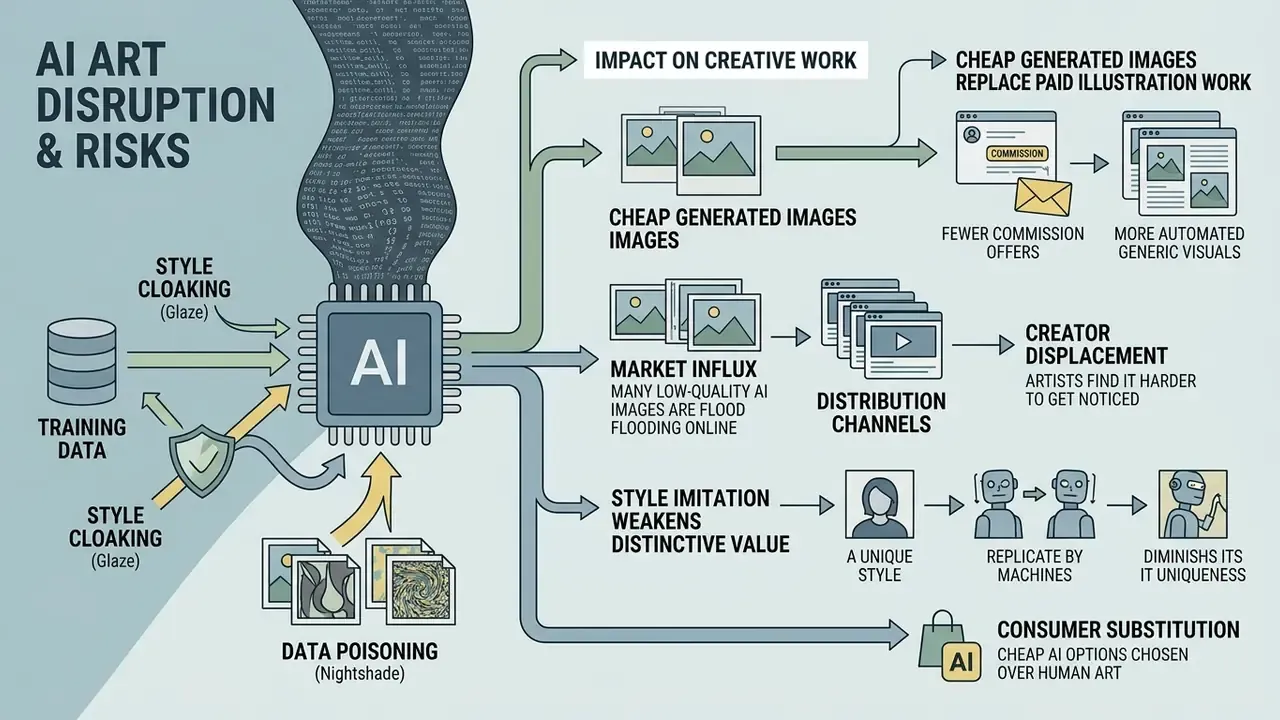
Generative image systems disrupt creative labor markets by automating entry-level illustration tasks, undercutting commission rates, and flooding distribution channels with cheap synthetic content. That economic shift reduces commercial opportunities for independent illustrators while commoditizing personal visual styles.
Cheap generated images can replace paid illustration work
Commercial entities increasingly substitute custom editorial and commercial illustration contracts with automated image generators to reduce operational expenses.
Empirical marketplace metrics show that generative AI causes systemic displacement of human artists while expanding total transactional volume. A landmark Stanford Graduate School of Business study examining 3.2 million images across 62,000 creators on a platform hosting nearly 500 million assets (Goldberg & Lam, 2025) found that after AI-generated content was permitted and labeled in December 2022:
- Market influx monthly uploaded image volume surged by 78%, driven almost exclusively by generative-AI production and an 88% increase in active AI-utilizing sellers.
- Creator displacement active human (non-AI) artists on the platform fell by an additional 23%, squeezed out by rapid, low-cost synthetic substitution.
- Consumer substitution overall platform sales grew by 39%, while purchases of non-AI images declined, evidence that buyers treat synthetic images as substitutes for human originals rather than as complements.
«Our results show GenAI is likely to crowd out non-GenAI firms and goods.»
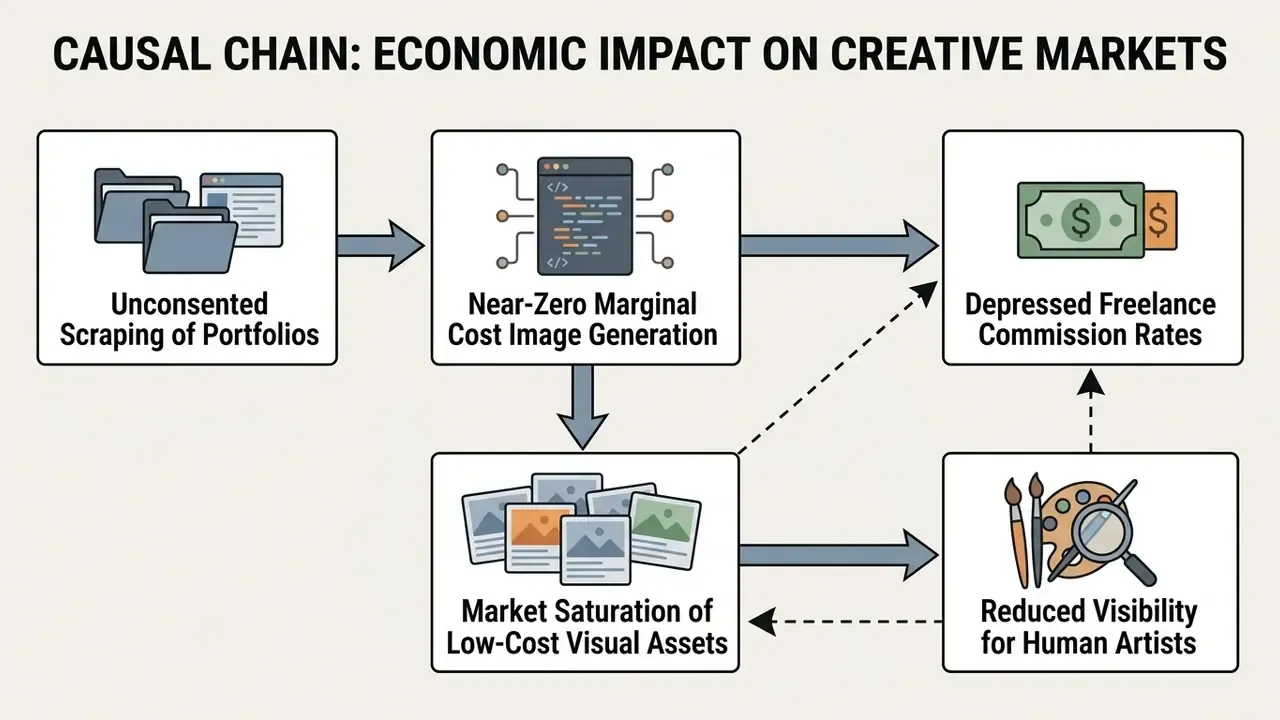
Read the chain node by node: portfolios are scraped without consent; models trained on that material generate images at near-zero marginal cost; the flood of cheap visual assets depresses commission rates; and the remaining human artists become harder for buyers to find. Each arrow is a hypothesis supported by at least one cited study above, not a settled causal estimate.
Style imitation can weaken an artist’s distinctive value
Fine-tuned low-rank adaptations (LoRAs) and targeted style prompts allow third parties to replicate a living artist’s visual signature without authorization. Because current U.S. copyright law protects specific expressive works rather than general artistic «style», creators face significant difficulty preventing commercial competitors from generating cheap style imitations (U.S. Copyright Office Digital Replicas Report, 2025). That report expressly declines to include «style» as protected subject matter under a federal digital-replica framework, which pushes affected artists toward rights of publicity, unfair-competition claims, and impersonation theories rather than copyright.
Creator guidance from 2026 warns that prompts naming a living artist, or distributing models labeled with an artist’s name, can generate personal-rights exposure for the user as well as the platform. Artists and buyers investigating whether a specific asset imitates protected work can screen candidates with AI image detectors.
Technological countermeasures: how creators actively resist unconsented scraping
Because legislative policy lags behind rapid deployment, human creators rely on technical data-poisoning defenses to disrupt automated model training:
- Style cloaking (Glaze). Developed at the University of Chicago, Glaze applies imperceptible mathematical perturbations to image pixels before online publishing. The shifts are invisible to human viewers but cause training algorithms to misclassify the visual style. The 2023 USENIX Security paper reports that artists judged mimicry attempts to have failed to capture their style in 94.3% of tested cases on Stable Diffusion.
- Data poisoning (Nightshade). Nightshade alters pixel-feature associations within uploaded images. When such images are scraped into a training corpus, Nightshade corrupts the model’s latent-space logic. Project materials report that fewer than 100 poisoned samples can corrupt a single prompt in SDXL, with contamination spreading to related concepts (prompts for one object returning another entirely).
«Adversarial perturbations do not reliably protect artists from generative AI, and Glaze protections can be bypassed.»
Earlier work reached a similar conclusion from a different angle: the IMPRESS evaluation platform demonstrated that cloaking-style protections can be detected and neutralized under certain preprocessing pipelines. The practical takeaway for artists is that these tools raise the cost of unconsented mimicry rather than eliminating it, and that registration of works with copyright authorities remains the only defense that supports a legal remedy. Technology alone is no longer treated, even by its authors, as a substitute for licensing law.
More content does not always mean more opportunities for creators
The exponential increase in synthetic image production saturates social media recommendation algorithms and digital asset marketplaces. As automated systems flood feeds with synthetic imagery, organic human artwork faces reduced digital visibility, making project discovery and audience building harder for independent creators.
A 2023 submission to the U.S. Copyright Office described how image generators can flood search engines and social platforms with thousands of spam images mimicking a single artist’s style, creating market confusion and distorting public perception of that artist’s body of work. The Office has itself framed the economic mechanism in supply terms: generative AI shifts supply upward at near-zero marginal cost, lowers prices for access to creative works, and dilutes markets for works of the same kind as the training data, making human works harder for audiences to find. The UK Government’s copyright and AI report records the same stakeholder evidence, that AI content floods markets and reduces demand for human-created work.
Is AI art good or bad? A practical way to decide
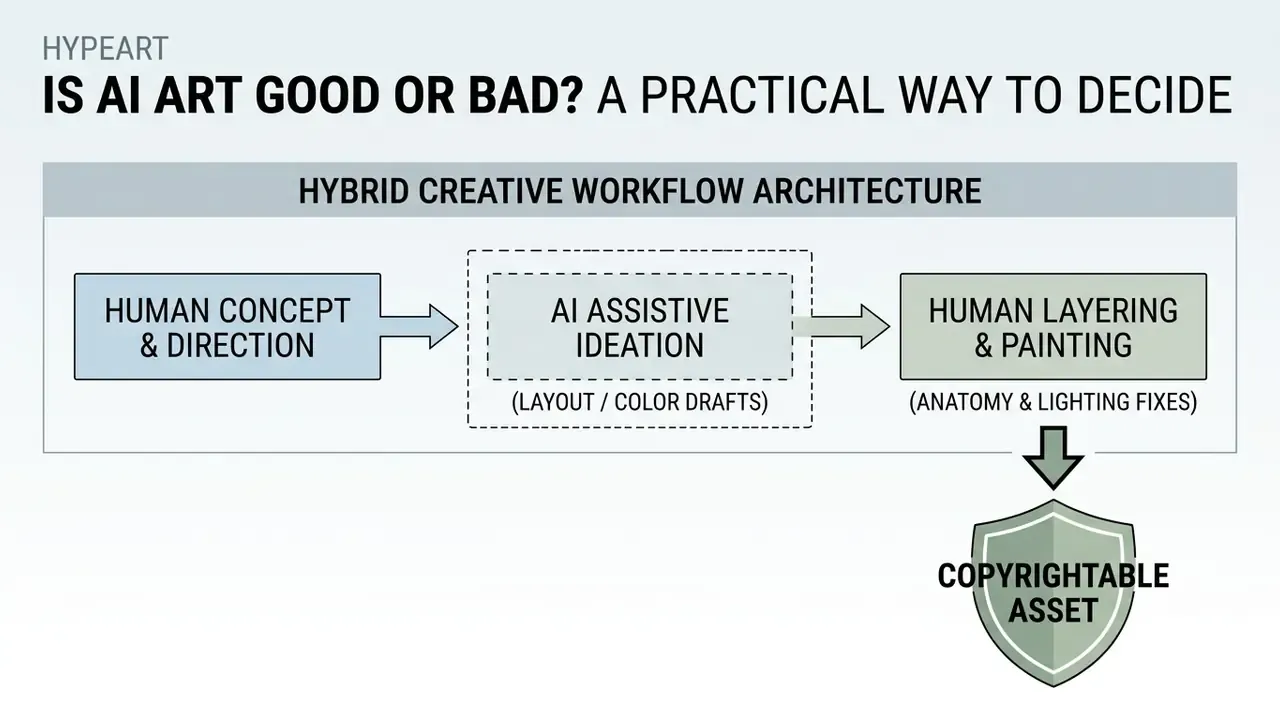
Whether generative image technology is appropriate depends on one variable: is it deployed as an assistive tool under direct human editorial control, or as an autonomous substitute that eliminates human creative judgment?
Use AI as a tool, not a replacement for human creativity
Integrating generative systems as assistive software, for initial thumbnail sketches, color palette exploration, or layout composition tests, lets human artists accelerate routine drafting phases without surrendering creative ownership. Teams experimenting at this stage often begin with free AI art generators before committing budget to licensed enterprise tiers.
«Gig workers were willing to pay up to 29.7% of their earnings for AI assistance with content generation, yet measured quality gains were modest and uneven.»
Keeping human control over final composition, intent, and visual polish is what preserves cultural authenticity, legal protectability, and artistic integrity. Readers building a shortlist can review the capability landscape through the AI art generators reference, and compare adjacent production tools such as the online photo editor guide for post-generation retouching work.
Published hybrid workflows show what human-in-the-loop practice looks like concretely. Adobe positions its Firefly sketch generation as an assistive step (generate, then refine style and prompt) rather than autonomous authorship. The PromptPaint research system lets an artist paint, mask, and steer text-to-image generation through brush-like controls, keeping direction with the human. A 2026 paper on AI-generated textures describes concept-art pipelines in which artists produce base textures with AI models and then integrate them into a traditional workflow. Conversational sketch agents allow iterative creation and modification with the artist in the loop at each step. Institutional policy converges on the same principle: university marketing guidance permits AI for brainstorming art direction and generic graphic elements, but requires that all AI-generated material be vetted, refined, edited, and approved by a human before publication. Governance frameworks reinforce it. EU AI Act Article 14 requires that high-risk systems be effectively overseen by natural persons during use, while the NIST AI Risk Management Framework 1.0 structures the same expectation around mapping, measuring, and managing risk wherever error consequences are material.
The decision rule that follows is simple. If the output must be copyrightable, must carry exclusive brand identity, must withstand regulatory scrutiny, or must survive public disclosure of its origin, commission a human author. If the output is an internal draft, an exploratory variation, or a disposable layout test, and the human retains control, review authority, and an audit trail, assistive generation is defensible.
One caveat worth stating plainly: I’m not claiming this rule settles the ethics. It settles the procurement question. The consent problem in training data sits upstream of any workflow choice, and it remains open.
Frequently Asked Questions (FAQ)
Why is AI art considered bad for independent illustrators?
AI image generators lower entry barriers for rapid visual asset creation, leading some clients to substitute custom human commissions with low-cost synthetic outputs. Models trained on unconsented creator portfolios also enable style imitation without financial compensation to original artists. Stanford Graduate School of Business research found active non-AI artists on a major image marketplace declined by 23% after generative content was admitted, even as total sales rose 39%.
Can a company copyright an AI-generated logo or marketing asset?
No. Under U.S. Copyright Office rulings, purely AI-generated visual elements cannot be copyrighted. A company can only claim copyright over original human-authored modifications, selections, or arrangements applied to the synthetic base asset, and must explicitly disclaim non-de minimis AI content in registration filings.
How do technical tools like Glaze and Nightshade protect human artists?
Glaze applies imperceptible pixel perturbations that prevent diffusion models from accurately learning an artist’s style. Nightshade intentionally poisons training data by corrupting feature associations within models that scrape protected images without authorization. Both raise the cost of mimicry, but 2025 independent research found that such perturbations can be bypassed, so treat them as friction rather than guaranteed protection.
What are the environmental impacts of scaling AI image generation?
Generating synthetic images requires substantial data center power and water infrastructure. Research estimates that producing a single standard synthetic image consumes roughly 2.9 Wh of electricity and 28.6 mL of cooling water (UN University / ICEF, 2026), with inference accounting for the majority of a large model’s life-cycle emissions.
Isn’t AI art just the next photography?
Partly. The cultural objections are nearly identical to those raised against photography in the nineteenth century, and those objections proved wrong about painting’s survival. The differences are structural rather than aesthetic: diffusion models depend on scraped human-authored training data, operate at near-zero marginal labor cost, and, unlike a photograph, produce outputs that current U.S. guidance treats as uncopyrightable when generated from prompts alone.
Does using AI-generated art create legal exposure even if the tool permits commercial use?
Yes, exposure can remain. Vendor permission governs the contract between you and the vendor; it does not resolve third-party infringement claims, publicity-rights claims over imitated likeness or style, or the fact that unedited output may be unprotectable and freely copyable by competitors. Confirm whether written indemnification applies to the specific feature and plan you used.
What is “Shadow AI” and why does it matter for visual assets?
Shadow AI describes employees generating imagery on unapproved consumer accounts using corporate devices or confidential reference material. It creates unlicensed-asset risk, confidentiality exposure through uploaded inputs, and, critically, an absent audit trail, which makes accurate copyright-registration disclosure impossible after the fact.
Will AI-generated images get worse over time?
They may, in specific respects. Researchers describe model collapse: when crawlers increasingly ingest synthetic images to train new models, statistical variance narrows and artifacts compound across generations. Independent art-market analysis already records declining visual novelty and increasing similarity among AI-adopting outputs.
Appendix A: earlier wording and revision notes
For transparency, the following earlier formulations have been superseded in the main text. They are retained here so readers can see exactly what changed and why.
- Training-data citation (original wording).«Research shows that diffusion models can imitate identifiable digital artists with high classification accuracy once an artist’s work appears repeatedly within training data (Casper et al., 2023, arXiv:2311.12832).» Replaced with a version reporting the 81% CLIP-classification accuracy figure and 70-artist sample, because unquantified claims weaken verifiability.
- Labor-market claim (original wording).«Empirical labor studies show that while overall employment metrics fluctuate, freelance platform postings for image-creation tasks experienced a notable drop following the widespread adoption of text-to-image tools (Ifo Institute Working Paper, 2025).» Replaced with the Stanford Graduate School of Business marketplace metrics (+78% image volume, +88% AI sellers, −23% non-AI artists, +39% sales), plus retained Ifo Institute findings with their actual near-zero short-run earnings estimate.
- Brand-backlash claim (original wording).«Major global retail and entertainment brands have faced consumer boycotts after replacing human artists with synthetic promo art, leading several organizations to issue public apologies and establish explicit human-only creative policies.» Replaced with named, dated cases (LEGO, Selkie, Baggu/Collina Strada, Gucci) so the claim can be verified.
- Environmental framing.Per-image figures are retained as published by United Nations University / ICEF (2026). Readers should note that per-query, per-model, and national infrastructure estimates use different measurement boundaries and cannot simply be summed.
- Provenance framing.The statement that provenance tracking is «opt-in rather than an absolute defense» is now supported directly by C2PA’s own whitepaper language («not a cure-all for misinformation») and by 2026 U.S. Department of Defense analysis distinguishing provenance signals from proof of authenticity.