- ROI must be risk-adjusted. Subscription price is the smallest line item. Add editorial time, legal and compliance review, plus audit support to the denominator; otherwise your business case will not survive an internal audit.
Using a purpose-built AI content creator allows businesses, marketing teams and content producers to cut text preparation time by up to 40% and materially increase publication throughput. Modern generators have evolved from simple text autocomplete into complex systems that manage the full content-marketing cycle: research and brief, drafting, publication in the CMS, and lead capture in the CRM.
One caveat before the tooling. Every claim below about speed assumes a reviewer sits between the model and the audience.
«Over recent years, content automation has proven one thing: generative models are most effective as digital assistants operating under strict human control. The governing principle of enterprise adoption is simple. No demonstrated quality and no controlled risk profile means no autonomy for the generator in production.»
What Is an AI Content Creator and What Problems Does It Solve
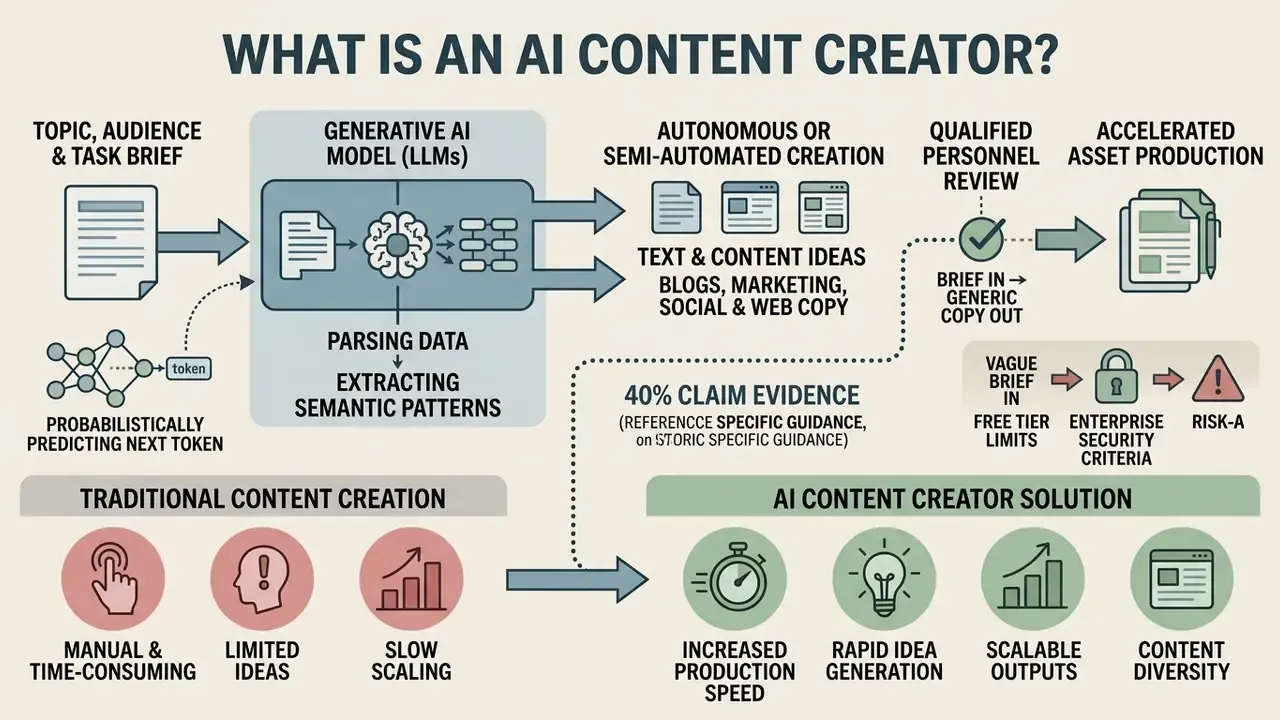
An AI content creator is a software system built on generative artificial intelligence (large language models, or LLMs) designed for autonomous or semi-automated creation of texts, ideas and marketing assets according to defined parameters. Enterprise-grade generators combine natural-language-processing algorithms, tone-of-voice control mechanisms and CMS integration modules.
Before the functional discussion, one bridge is worth building. In regulated industries, marketing copy is not "just content". A generated product description, a paid-ad claim or an email disclosure sits inside the same governance perimeter as any other model output. It can misstate a fee, imply a guarantee, or leak non-public information. That is why the selection criteria below mix marketing metrics with model-risk vocabulary: provenance, human review, audit trail, control cost.
The core purpose of ai content generator content creation is accelerating asset production for content marketing, social media, email campaigns, product cards and web pages. According to the US National Institute of Standards and Technology (NIST AI 600-1, National Institute of Standards and Technology, 2024. https://nvlpubs.nist.gov/nistpubs/ai/NIST.AI.600-1.pdf), generative AI emulates the structure and characteristics of input data in order to synthesise original content. The human remains the decisive actor: setting the frame (prompts), performing fact-checking, and editing the generated content.
Evidence for the 40% claim:
«Workers with ChatGPT access completed tasks 40% faster, and independent evaluators graded their output 18% higher.»
NIST's 2024 guidance also requires that AI-generated content be reviewed by qualified personnel before organisational use, with validation of scope, inputs, assumptions and outputs. In practice this converts "productivity gain" into "net productivity gain after control overhead", which is the number your CFO actually needs. We have seen finance teams lose roughly a third of the headline gain to review time alone. Not a reason to stop. A reason to budget honestly.
How an AI Content Generator Creates Text and Ideas
A modern ai content generator produces text and content ideas by probabilistically predicting the next token from the supplied context and instruction (prompt). The quality and accuracy of the final text depend directly on the completeness of the request and the constraints you set.
«AI generators rely on large training corpora, including books, web pages and code, to predict the next token and build coherent text.»
The model parses the supplied topic, target audience and task, extracting semantic patterns from its training distribution. For ideation, the tool uses related search-intent exploration and generative association. To obtain a professional ai generated content creator result, the prompt must contain role, context, target audience, output format and constraints. That structure is documented in Adobe's official prompting guidance for Generate Content (Adobe, 2026) and mirrored in Harvard University IT's AI Basics prompt checklist (2026), which requires stating what you want, what you do not want, relevant context, and tone, audience and format.
Put differently: vague brief in, generic copy out. There is no third option.
What Content Can Be Created With AI
AI tools produce blog articles, social posts, ad copy, product cards, email sequences and landing pages. Generators adapt structure and style to the requirements of a specific channel.
- Marketing copy and advertising search ads, headline variants, calls to action (CTA) and creative concepts. This is where an ai content generator for marketing earns its licence fee fastest, because variant volume is the whole point.
- Blogs and SEO articles long-form guides, informational overviews, comparison pieces and outlines for future publications. A best ai article generator shortlist usually lives here.
- Email communications welcome flows, triggered messages, promotional campaigns and B2B outreach.
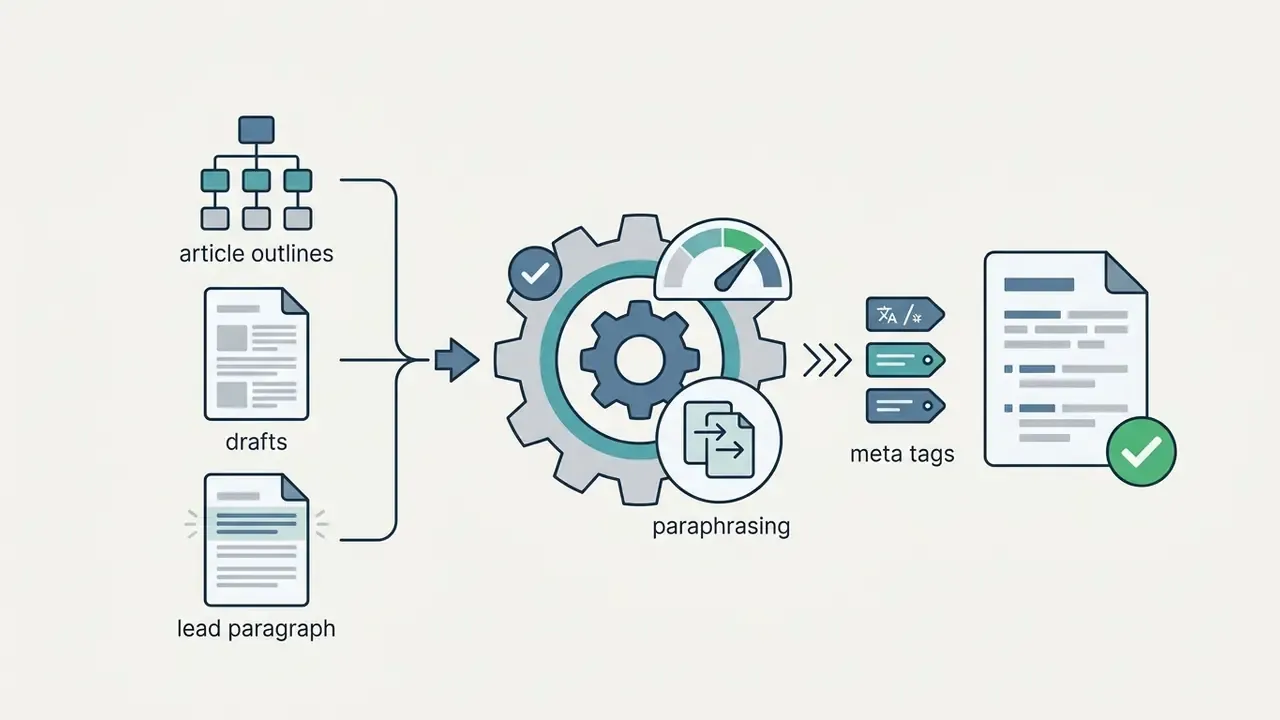
- Web pages and ecommerce product descriptions, meta tags, landing pages and FAQ blocks, the standard territory of an ai content creation website build-out.
- Product data attributes titles and description attributes, which Google requires to be labelled separately as AI-generated in structured product feeds.
For visual assets that accompany web content, teams typically pair a text generator with AI-based image generators, and use a specialised line art generator for branded illustration systems. If your workflow includes photo assets, our reference material on online photo editors and commercial workflows covers licensing and export constraints.
Who Benefits From AI Tools for Content Creation
Both ai tools for content creation free and commercial editions deliver the most value to marketers, content producers, agencies and digital product owners. Each segment solves a different class of problem.
- Marketersautomate ad-variant production, accelerate A/B hypothesis testing and research.
- Content producers and bloggersgenerate content plans, overcome blank-page paralysis and prepare drafts.
- Agenciesscale text production across multiple clients without a linear increase in headcount; brand-voice isolation per client becomes a hard requirement, not a nice-to-have.
- Website ownerspopulate catalogues, write SEO copy and keep knowledge bases current.
- Regulated-industry teamsproduce first drafts under a documented review chain, where the audit trail matters as much as the copy.
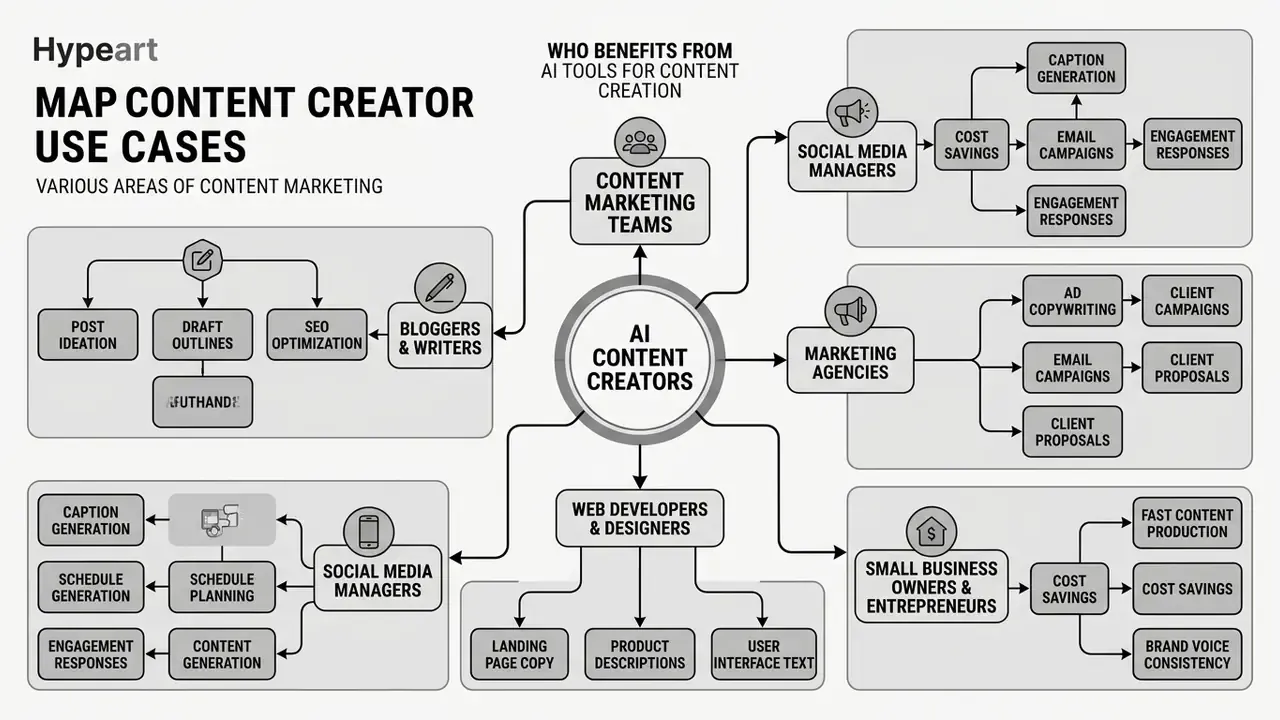
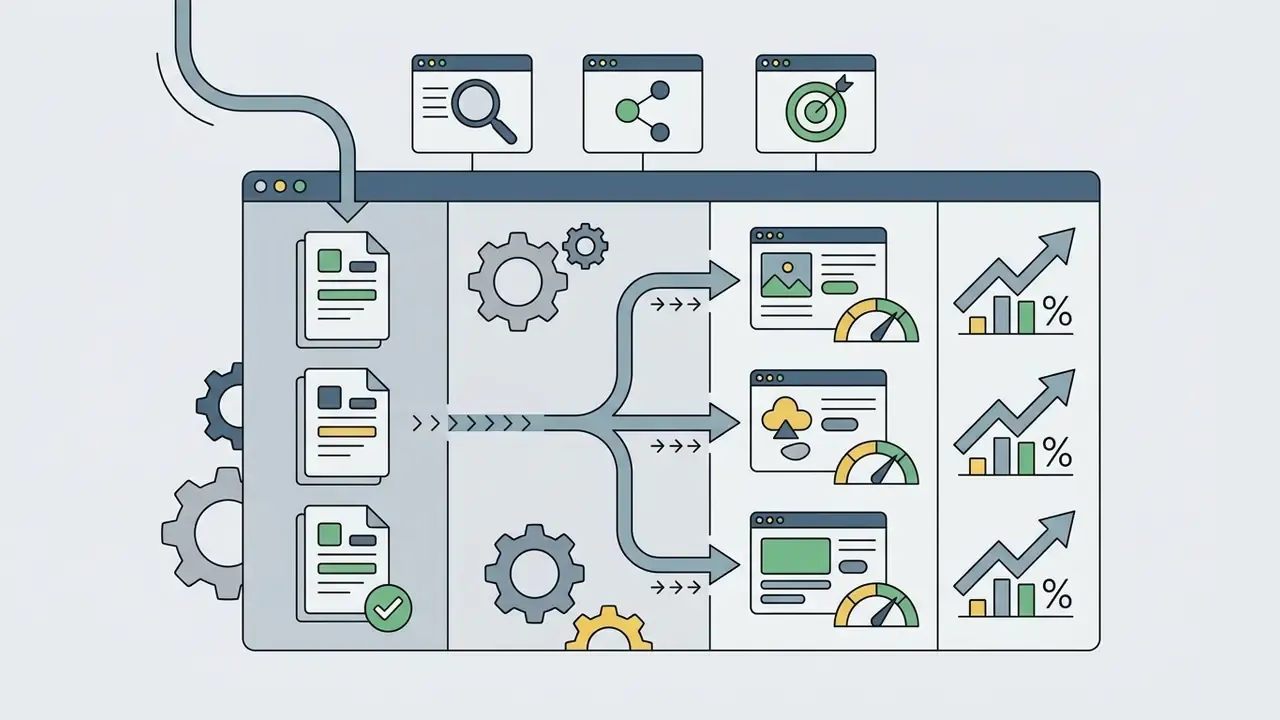
Text transcription of the use-case mind map:


How to Choose the Best AI Content Generator for Your Needs
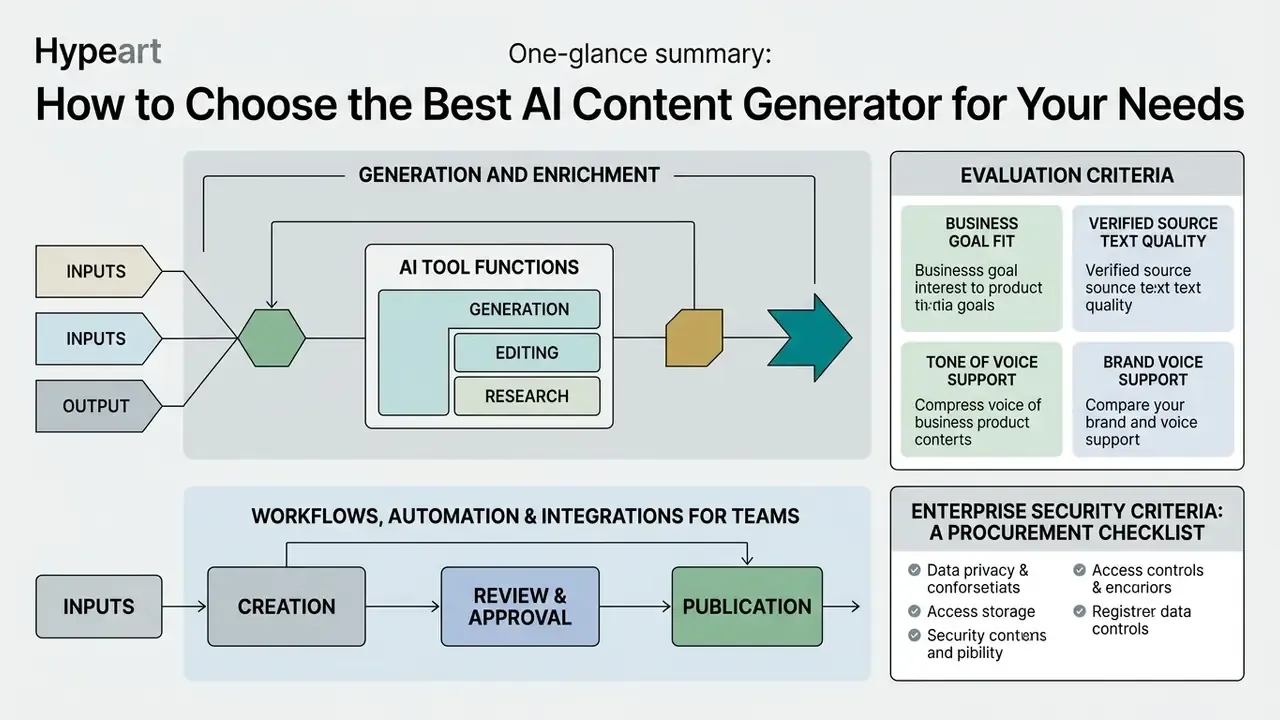
Selecting the best ai content generator requires evaluating fit against business goals, generation quality, brand-voice support and built-in safety processes. Popularity should never be the only decision factor.
«93% of companies review AI-generated content before publishing, a key indicator of enterprise adoption maturity.»
NIST's risk-management work on generative systems (NIST AI RMF Generative AI Profile, 2026) shows that enterprise buyers of ai content generator software must assess data lineage transparency, role separation and the availability of an audit trail. Effective tooling integrates into the team's existing workflow rather than forcing a parallel process.
Enterprise Security Criteria: A Procurement Checklist
Use this checklist before a pilot, not after it. Any "no" answer should be logged as a residual risk with a named owner.
Checklist0 / 9
AI Tool Functions: Generation, Editing and Research
«AI-assisted editing significantly reduces grammatical and spelling errors (p<0.01 across all comparisons of independent versus AI-assisted writing).»
The research module assembles topic theses; the editing module brings the draft to corporate standards. Editing is architecturally distinct from generation, and ACL's tutorial work on text-editing models treats it as a separate model family. That is why a mature stack usually combines a generator, an editor and a verifier rather than expecting one model to do all three well.
Text Quality, Tone of Voice and Brand Voice
Quality of generated content is assessed by grammatical correctness, absence of semantic duplication, logical coherence and accurate tone-of-voice transfer. Brand Voice configuration preserves a company's distinctive style across every channel.
Rather than citing a single universal 5-point scale, use a documented rubric of separate dimensions. Published evaluation methods define linguistic quality through grammaticality, non-redundancy, focus and coherence (GRUEN), while LLM-as-judge rubrics such as G-EVAL score each declared criterion from 1 to 5 with explicit intermediate evaluation steps. Established human-evaluation practice adds multiple annotators and 7-point Likert or ranking designs. Practical takeaway: define your own criteria list (accuracy, brand-voice fidelity, business-rule compliance), then score each separately. A single aggregate "quality score" is not auditable.
«67% of companies report improved content quality when using AI; in controlled tests, most consumers prefer AI-written copy provided it has been edited.»
For enterprise buyers it is critical to upload internal brand books and style guides so the tool generates in the correct register without heavy editorial rework. Jasper builds a Brand Voice from up to 8 samples (text, files or URLs); Copy.ai applies brand voice inside Chat and Workflows with Teamspace-level access control; Writesonic trains a Writing Style from files, URLs or pasted text.
A small observation from practice: brand voice fails first in disclaimers. Models soften them, and legal notices quietly lose their teeth.
Workflows, Automation and Integrations for Teams
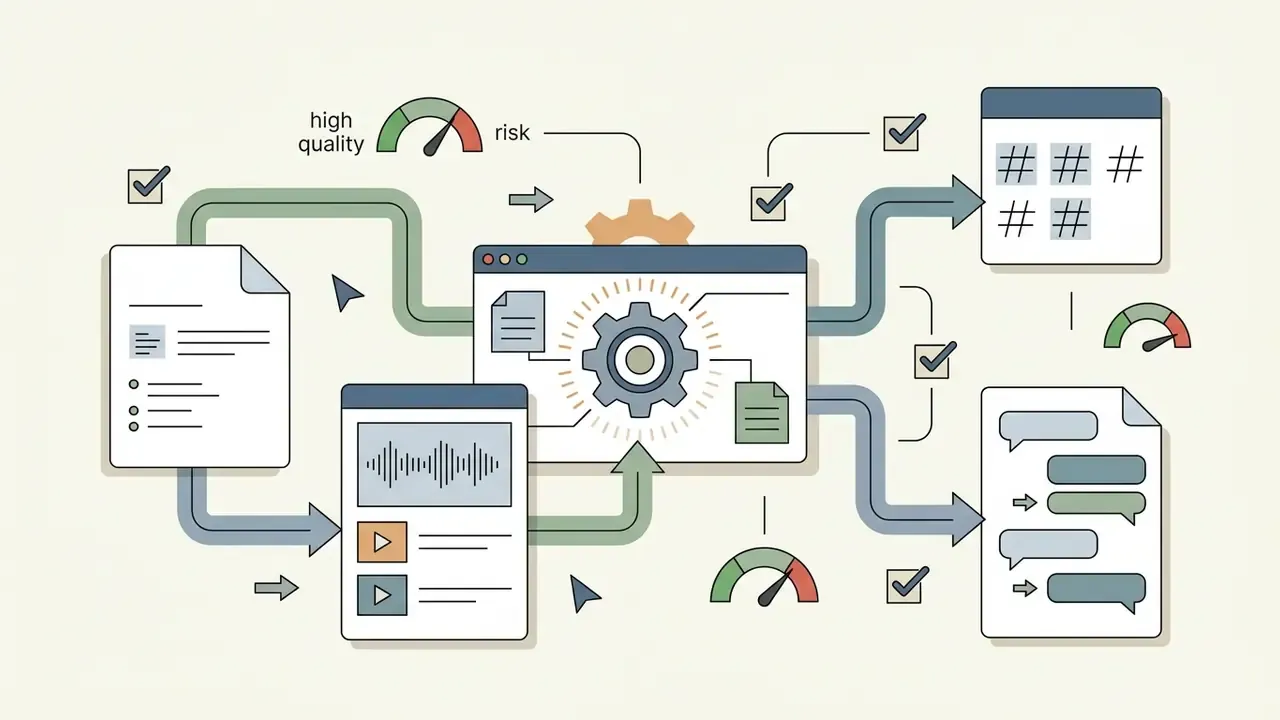
Effective team work with AI rests on automating routine operations and integrating the generator directly with CMS, CRM and project-management systems. This eliminates manual content hand-off.
«At Wine Access, a hybrid workflow (AI draft plus human editor) outperformed purely human writing by 9.36% on purchase likelihood and 8.48% on bottles sold.»
In one illustrative fintech deployment, an end-to-end process was built: the AI platform generated product-description drafts, automatically routed them to a subject-matter editor and, after approval, published the finished content to the CMS via API. This compressed the publication cycle from 5 days to 4 hours while satisfying regulatory audit requirements, because every stage produced a timestamped record.
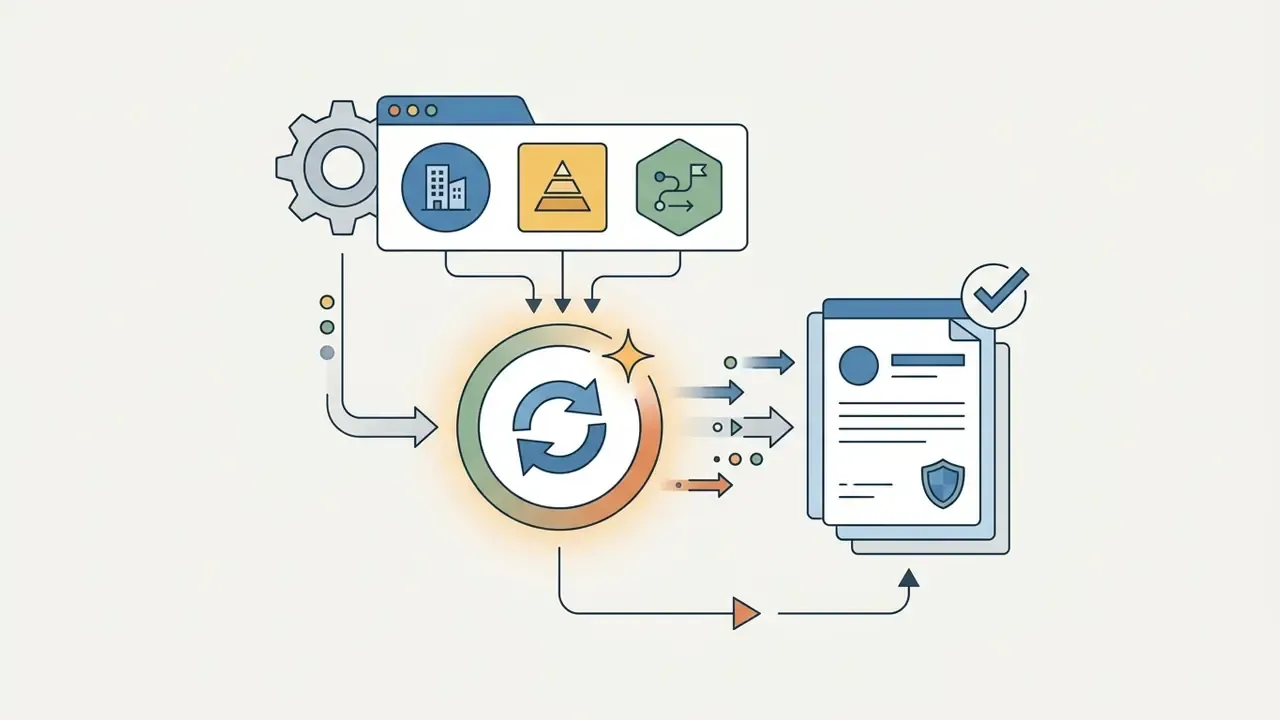
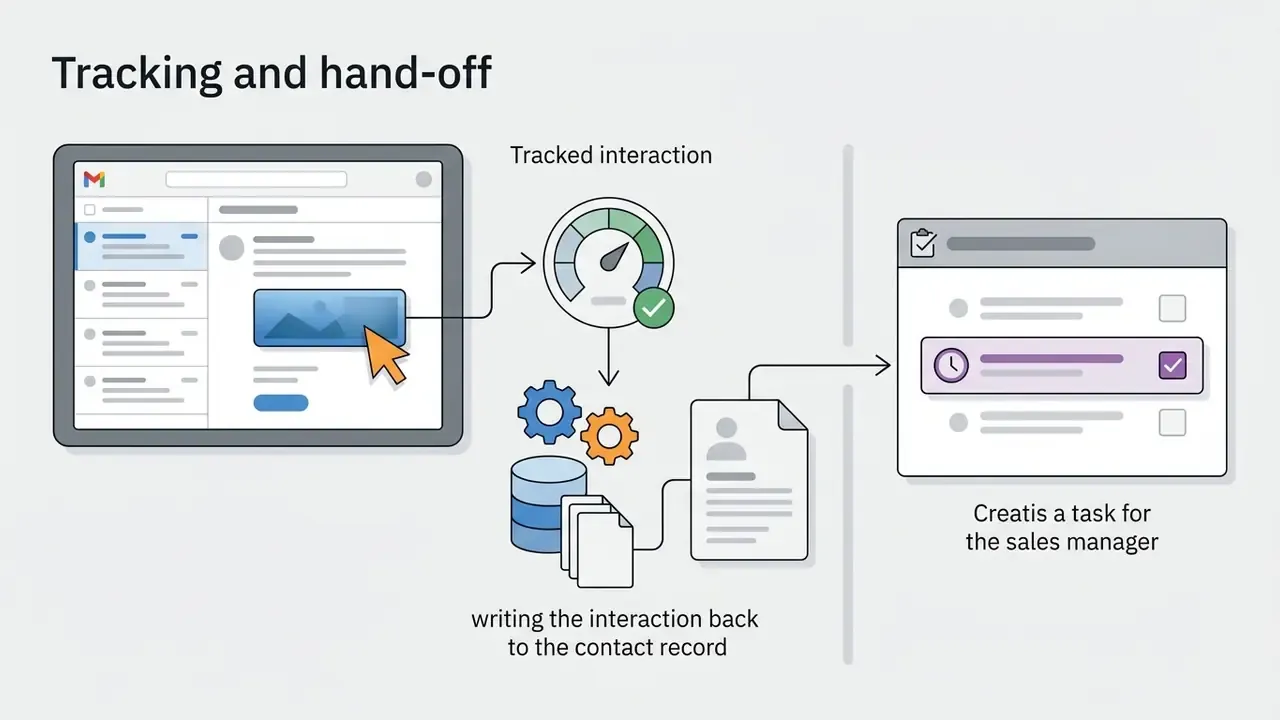
End-to-end pipeline: from generation to a logged lead in the CRM
Audit trail: what must be logged for every published asset
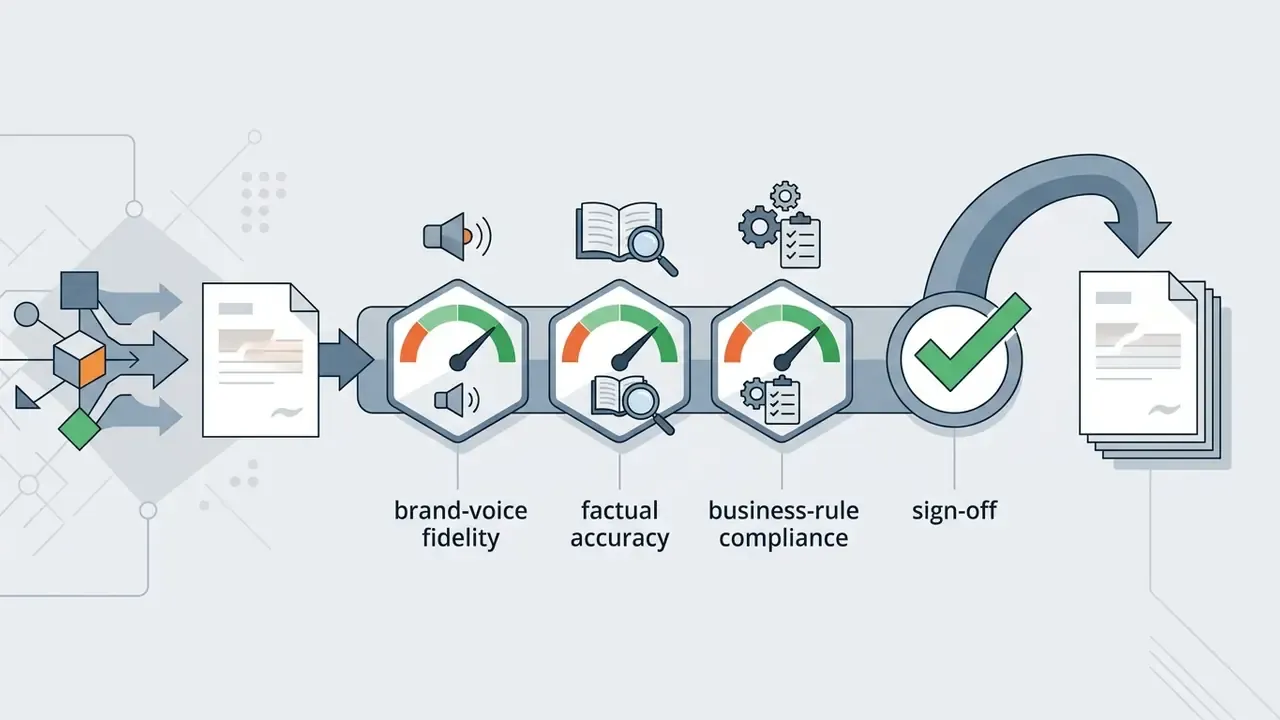


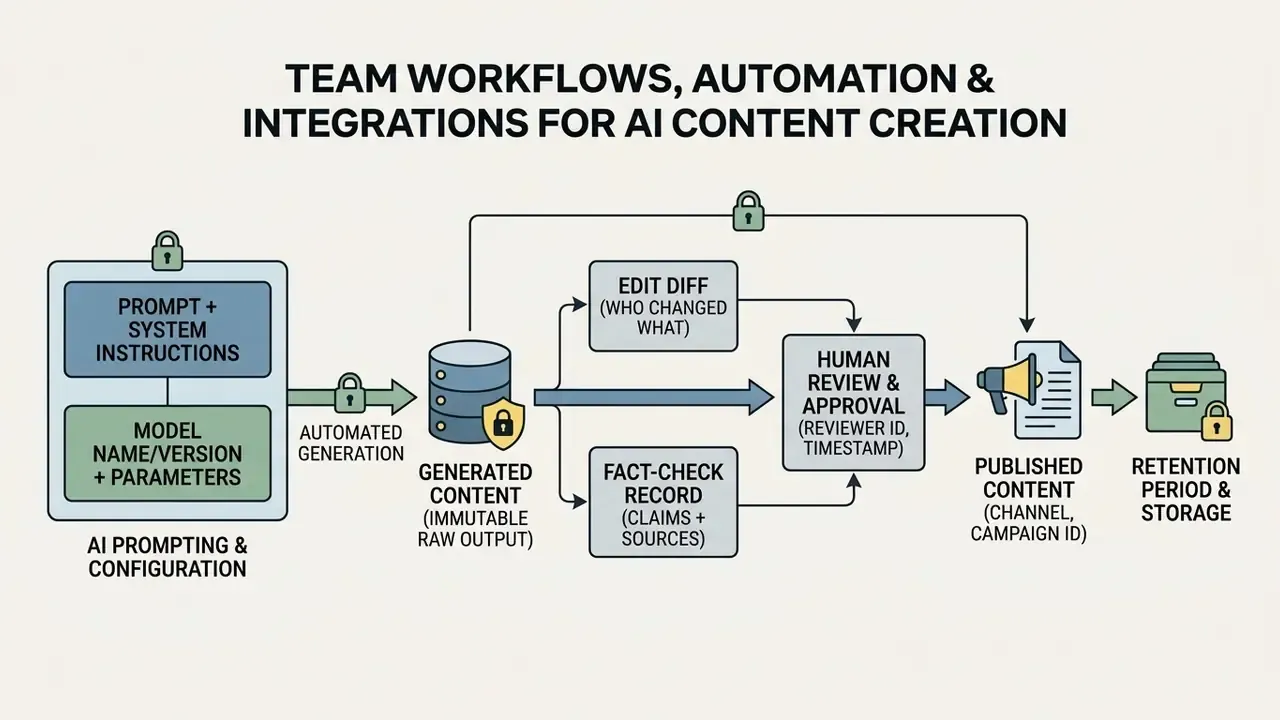
This record set is what makes a generation workflow reproducible for internal audit, and it maps directly onto NIST's requirement for provenance techniques and pre-deployment testing of generative outputs. If your auditor cannot reconstruct a published claim from these fields, the workflow is not production-ready, whatever the dashboard says.
When building multimedia pipelines, text generators are combined with narrow-purpose services. For repurposing recorded webinars and product demos into distribution assets, teams use AI video generators and clip-extraction tools such as long video to short video ai free; for deliberately raw, native-looking social creatives, some teams use a low quality video maker as a stylistic choice rather than a quality compromise. Where file weight affects page speed, our guidance on video compression and quality loss is the relevant reference, and engineering teams can compare options for programmatic generation endpoints before wiring anything into production.
Best AI Content Creation Tools: Comparison of Popular Solutions
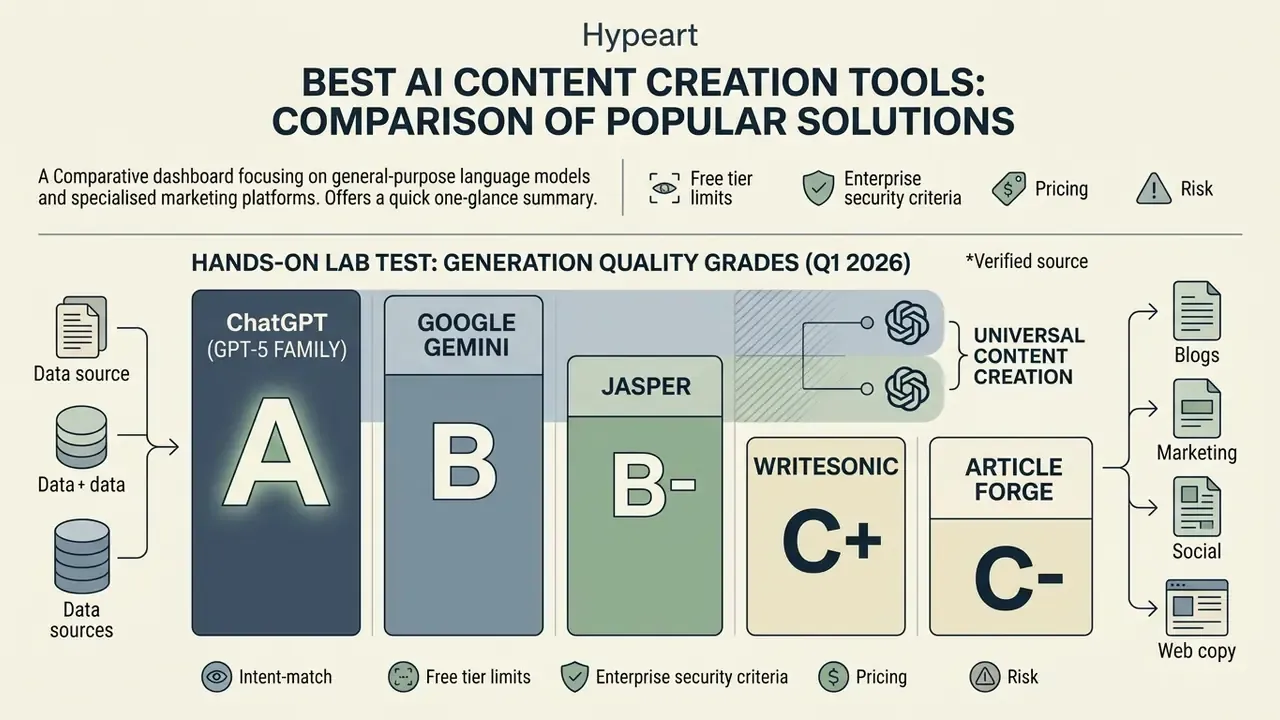
The best ai content creator title is split between general-purpose language models and specialised marketing platforms. The right choice depends on priority: universal research, high-volume advertising production, or deep SEO optimisation. Anyone searching for the best content generator ai is really asking which editorial workload they are willing to absorb.
| Service | Primary use case | Free access | SEO functionality | Languages / Tone presets | Automation / API | Enterprise access (SSO/RBAC) | Data privacy | Price range |
|---|---|---|---|---|---|---|---|---|
| ChatGPT | Universal generation, research, ideation | Yes (capped limits) | Basic (prompt-driven) | 50+ languages / free-form tone by prompt | API (OpenAI Platform) | SSO plus roles on Business and Enterprise | No-training commitment on business tiers | Free / $20 / Enterprise |
| Google Gemini | Workspace-native work, analytics | Yes (basic) | Basic (search-grounded) | 40+ languages / free-form tone | API (Google AI Studio) | Google Workspace admin, SSO | Workspace data controls | Free / Gemini Advanced |
| Jasper | Marketing campaigns, Brand Voice | 7-day trial | Surfer SEO integration | 30+ languages / brand voices from 8 samples | Workflows, API | Workspace visibility, roles | No public-model training on business plans | From $39/user/mo |
| Copy.ai | GTM automation, sales, copywriting | Yes (2,000 words/mo) | Basic templates | 25+ languages / brand voice from content analysis | Event-triggered workflows, API | Teamspaces: Admin, Editor, Collaborator | Enterprise agreements available | Free / from $49/mo |
| Writesonic | SEO articles, ecommerce descriptions | Yes (limited credits) | Built-in SEO module plus separate SEO checker | 25+ languages / audience and voice presets | API, Zapier, CMS | Team seats | Standard SaaS terms | Free / from $19/mo |
| Frase | SERP analysis, SEO briefs, optimisation | No (demo only) | Advanced SERP/GEO, one-click auto-optimise | English-first | One-click optimisation, credits | Team plans | Standard SaaS terms | From $15/mo |
| Clearscope | Relevance scoring and content grading | No | Professional SERP, Content Grade | English-first | Docs and WordPress integration | Team seats | Standard SaaS terms | From $170/mo |
| Rytr | Fast short-form copy, microcopy | Yes (10k characters/mo) | Minimal | 25+ input languages / 20+ tone styles, 30 templates | Limited API | Basic | Standard SaaS terms | Free / low-cost paid |
| Article Forge | Automated draft generation | 5-day trial | "SEO automation" positioning, auto headings and links | 3+ languages / basic settings | API available | Basic | Standard SaaS terms | Subscription |
Data current as of 2026. The table shows a market split into universal platforms (ChatGPT, Gemini), marketing suites (Jasper, Copy.ai, Writesonic, Rytr), SEO specialists (Frase, Clearscope) and fully automated draft factories (Article Forge). Rytr fits microcopy and volume short-form but is weak for long-form and deep SEO analysis; Article Forge produces consensus-level facts with no original experience or information gain, so it is unsuitable where E-E-A-T matters.
Hands-on Lab Test: Generation Quality Grades (Q1 2026)
We generated a 1,200-word article on "B2B Marketing Strategies" in five services with an identical CO-STAR prompt, then scored the raw output through independent SEO analysers and a two-reviewer editorial rubric (accuracy, intent coverage, brand-voice fidelity).
- ChatGPT (GPT-5 family): intent-match grade A. Best coherence and argument flow; every numeric claim required manual fact-checking, and two statistics were unverifiable.
- Jasper: intent-match grade B−. Usable structure, but substantial editing needed: filler transitional phrases, missing niche terminology, consensus-level claims instead of perspective.
- Google Gemini: grade B. Strongest at surfacing current, real-world references; occasional structural drift from the requested outline.
- Writesonic: grade C+. SEO vocabulary applied unevenly; the H2/H3 architecture did not cover the full LSI and subtopic set, and suggested secondary keywords were weak.
- Article Forge: grade C−. Fastest end-to-end draft, but averaged "consensus data", no information gain, and heading logic required rebuilding.
Reading of the test: no tool shipped publication-ready output. Not one. The differentiator is not raw text quality but how much editorial and verification labour each draft consumes, and that is exactly the variable that belongs in your ROI model.
For teams whose content plan includes visual assets, the same evaluation logic applies to the best AI image generators and to AI art generators compared by quality and licensing.
ChatGPT and Google Gemini for Universal Content Creation
ChatGPT and Google Gemini represent the class of multi-purpose assistants able to cover research, brainstorming and drafting in any format. They offer the largest context windows and the greatest flexibility in information handling.
According to OpenAI and Google documentation for 2026, current flagship model families support multimodal inputs and context windows of up to 1 million tokens (Gemini 3.1 Pro is documented at 1,048,576 tokens). This allows uploading books, reports and analytical datasets for immediate synthesis of key theses. OpenAI's help centre also documents plan-based message limits, from virtually unlimited on Enterprise for eligible base models to 15 requests per month on top-tier reasoning models, plus separate limits for file uploads, image generation, voice and data analysis.
Verified source:
«General-purpose LLMs are effective at question formulation and data extraction in systematic reviews, as confirmed by analysis of 2022–2024 scientific publications.»
Evidence remains inconsistent for literature search and study selection, which is a useful caution for anyone using a general model as a research engine. It is strong at framing and extracting, weaker at deciding what is relevant.
Practitioner survey: trust in AI models (n=250 SEO specialists and content marketers)
- 68% name ChatGPT (OpenAI) the most reliable tool for initial research and structuring.
- 19% prefer Google Gemini for its direct link to a current search index.
- 13% use specialised platforms (Jasper, Copy.ai) because of strict Brand Voice requirements.
This mirrors an independent industry poll in which 68% of 168 respondents named ChatGPT the most reliable and trustworthy AI chat tool. A consistent pattern across two separate samples, though both are self-selected audiences already engaged with AI tooling. Treat it as a signal, not a mandate.
Jasper, Copy.ai and Writesonic for Content Marketing
The specialised services Jasper, Copy.ai and Writesonic are engineered for content-marketing tasks: producing ad copy, building email sequences and scaling campaigns with tight brand-voice control.
Jasper allows uploading corporate style guides and learning from product materials, and its ad workflow turns a campaign brief into platform-specific ads for Google, LinkedIn and Meta, grounded in Brand Voice and Knowledge Base assets. Copy.ai focuses on sales and marketing automation, launching multi-step workflows triggered by CRM events, with Teamspaces controlling Public, Private and Personal access. Writesonic offers templated mass generation for product cards and SEO material, with a separate SEO checker run after drafting.
Where each tends to fail in testing: Jasper drifts to consensus phrasing on niche or highly technical topics; Copy.ai's strength is orchestration rather than long-form prose quality; Writesonic's keyword suggestions need a second SEO source. Rytr, by contrast, is a legitimate choice for CTAs, ad variants, Google Ads copy and product descriptions across 20+ tone styles and 25+ input languages, but it struggles with creative depth and specialist expertise, the same limitation as Jasper.
Frase and Clearscope for SEO Articles and Web Content
Frase and Clearscope concentrate on search-results (SERP) analysis, identifying gaps in competitor material and preparing content with a high probability of ranking.
Clearscope grades text on its own Content Grade scale, measuring relevance and comprehensiveness by analysing term frequency and importance (1 to 10) across top-ranking pages, and exposes the heading structures of the top 30 results for a query. Frase auto-assembles structured briefs from SERP analysis, flags uncovered subtopics by importance, and runs Auto-Optimize section by section in SEO Focus, GEO Focus or Balanced mode; its Content Diagnostic checks topic coverage, structure, authority signals and meta tags before publishing.
Context worth keeping in view while optimising:
«Analysis of 600,000 pages showed the correlation between share of AI text on a page and its Google position is just 0.011, effectively zero.»
E-E-A-T methodology for verification and comparison:
For teams extending into multimedia, the same criteria apply to text-to-video AI tools and looping assets built with services in the loop video online category; plan and pricing details for our own toolset are on the pricing overview.
Generative Content Risk and Control Matrix
| Risk | How it materialises in content work | Control / mitigation |
|---|---|---|
| Hallucinated facts | Invented statistics, misquoted regulations, fabricated citations | Claim-by-claim verification against primary sources; reviewer sign-off recorded in the audit log; no numeric claim published without a linked source |
| Confidential data leakage (Shadow AI) | Staff paste pricing, client or unreleased product data into a consumer chat window | Enterprise tier with no-training guarantee; blocklist and allowlist at network level; approved-tool register; staff training and a clear "what never goes in a prompt" rule |
| IP and copyright exposure | Output reproduces protected phrasing, likeness or third-party brand assets | Provenance and licence review; commercial-use terms checked per asset type; human rewrite of any near-verbatim passage |
| Brand and tone breach | Off-register claims, guarantee language, non-compliant disclaimers | Brand Voice trained on approved corpus; prohibited-phrase list; compliance reviewer for regulated claims |
| Scaled low-value content | Mass publication without added value, treated as spam by search engines | Editorial gate on information gain; original data, examples or expert input required per asset |
| Non-reproducible output | Auditor cannot reconstruct how a published claim was produced | Log prompt, system instructions, model version, parameters, raw output, edits and approver |
| Vendor concentration | Roadmap or pricing change breaks the pipeline | Exportable assets and brand voices; abstraction layer over model APIs; documented fallback model |
Free AI Tools for Content Creation: Capabilities and Limits
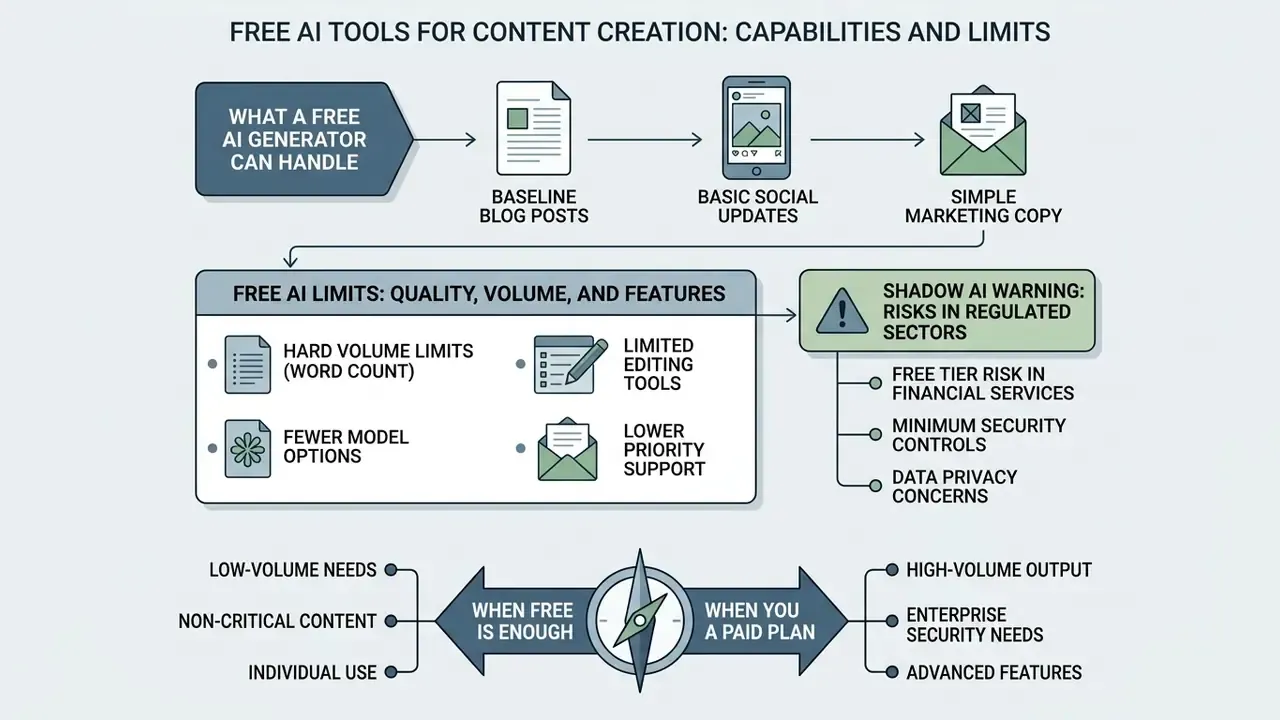
Using the best free ai content generator covers baseline content needs at zero cost, but free tiers always carry hard limits on volume, model selection and available features. Searches for content creation ai free and best free ai content creation tools peak among small teams testing a first workflow, which is exactly the right use.
Verified data:
«67% of small businesses already use AI for content and SEO; 68% report growth in content-marketing ROI thanks to AI tools.»
Free versions serve as a launchpad for testing hypotheses. As task volume and security requirements grow, companies inevitably hit the ceiling of free plans, and that ceiling is usually reached on the governance side well before the volume side.
What a Free AI Content Generator Can Handle
A free ai to create content free tool effectively covers initial ideation, short posts, article outlines and paraphrasing of small fragments. For bloggers hunting the best free ai text generator that works for blogs, the honest answer is that outlines and first drafts are the sweet spot.
- Building outlines and detailed structures for upcoming material.
- Writing short social notes, announcements and descriptions.
- Generating headline options, email subject lines and ad offers.
- Editing, correcting grammar and light paraphrasing.
- Summarising transcripts and long articles into briefing notes.
- Populating an editorial calendar from a topic list.
The same free-tier logic applies to visual assets. See our comparison of free AI image generators for watermark, resolution and licence limits, plus the reference on free photo editors and export restrictions.
Free AI Limits: Quality, Volume and Available Features
The main constraints of ai tools for content creation free are daily request caps, reduced context windows, no access to advanced models and no team features. Anyone comparing content creation ai tools free should read the limits page before the feature page.
For example, ChatGPT's free tier applies floating limits on messages to flagship models, with separate limits for file uploads, image generation, voice and data analysis; when the cap is hit, the system downgrades the user to a weaker model, reducing depth of reasoning. Copy.ai's free plan is commonly capped at 2,000 words per month, with manual export to the CMS. Official API documentation shows free tiers marked "not supported" for RPM and TPM plus batch queues on premium models, and cloud document-AI free tiers processing only the first two pages per request. Adobe Firefly's free access allocates generative credits that expire after a month, with limited daily generations on curated models.
Shadow AI warning: free-tier risk in financial services and other regulated sectors
When Free Is Enough and When You Need a Paid Plan
Free functionality suffices for individual authors, small personal blogs and one-off tasks. A paid subscription becomes necessary once you have recurring content plans, data-protection requirements and team collaboration. The trigger is rarely word count. It is usually the first confidential input.
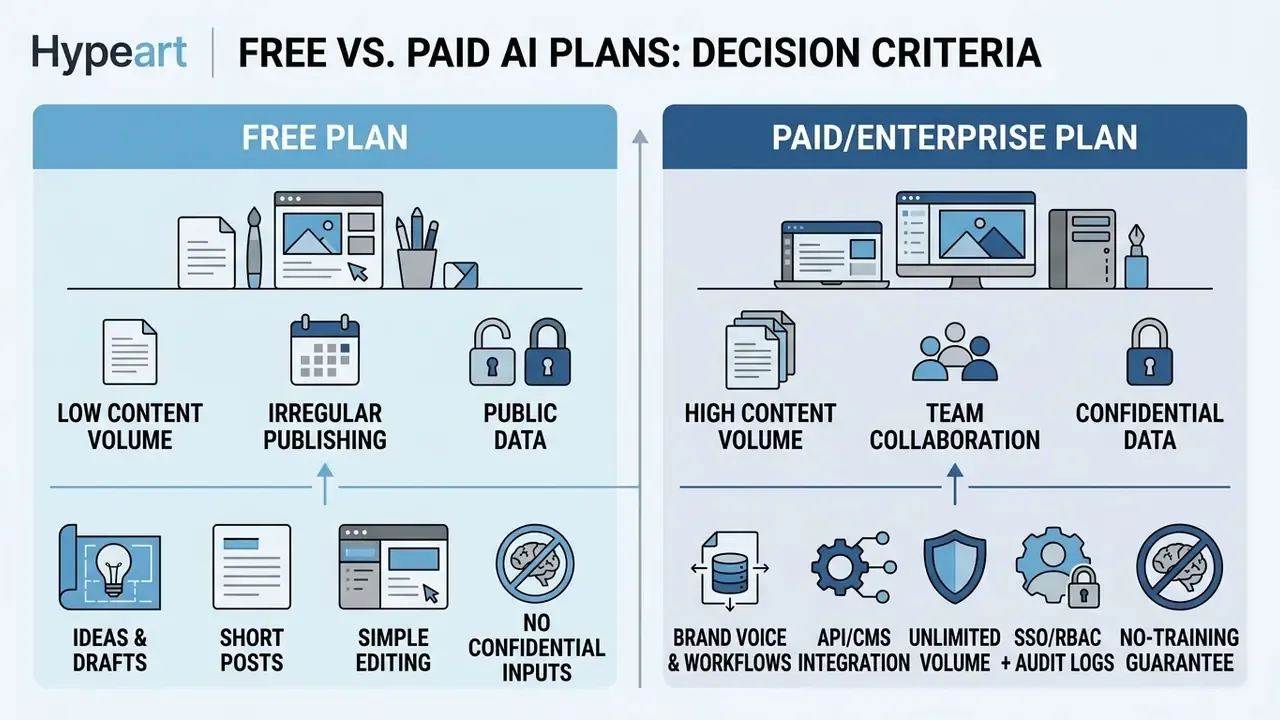
As format coverage expands, for example when communications or interview-based content enter the plan, the stack acquires adjacent tools such as live video call free online solutions, which then need the same centralised subscription and access governance as the text generators.
AI Content Generator Pricing: Assessing Cost and Payback
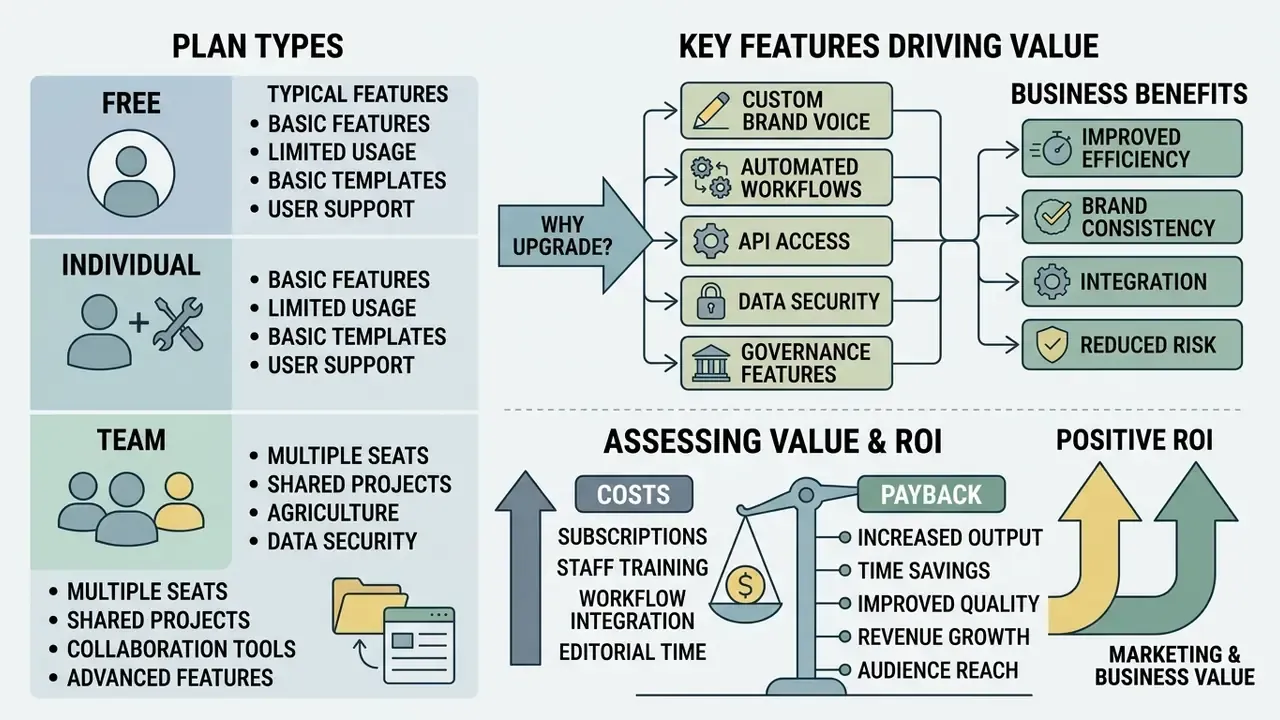
Assessing cost and ROI for ai content generator software requires accounting not just for subscription fees but for staff training, workflow integration and editorial time spent on verification.
Adobe reports an average net ROI of 7.1x over a three-year period for generative AI in content processes at large enterprises (Adobe Generative AI ROI Report). Caveat: this is a vendor-side benchmark; independent aggregated ranges for mature deployments cluster nearer 5 to 7x, and the figure should be treated as an upper reference rather than a planning assumption until validated against your own baseline. Independent industry data supports the direction of travel:
«65% of companies see better SEO results thanks to AI, and 68% report growth in content-marketing ROI, from a Semrush survey of more than 1,500 marketers.»
The economic effect comes from a multiple increase in published volume without expanding the copywriting headcount, provided review capacity scales with it. That proviso is where most business cases quietly break.
Disclaimer: this information is general in nature and does not replace professional advice. Prices and plan terms change; verify current details on official vendor sites.
| Tier | Typical price | Generation limits | Brand voice & styles | Integrations & API | Team access |
|---|---|---|---|---|---|
| Free Plan | $0 | 2,000 to 10,000 words or credits/mo | None or 1 basic | None | 1 user |
| Individual / Pro | $15 to $49 / mo | 50,000 words to unlimited | 1 to 3 brand voices | Basic (WordPress, Chrome) | 1 user |
| Team / Business | $49 to $149 / user / mo | Unlimited / pooled credits | Unlimited | Advanced, API, Zapier | Roles (Admin, Editor, Viewer) |
| Enterprise | Custom quote | Contract-defined | Unlimited plus governed corpus | Private networking, SSO/SCIM | Full RBAC plus audit export |
Template structure of AI service pricing tiers, current for 2026. Final payback equals saved person-hours minus total cost of software, integration, review and audit support. Note that usage-metered "AI credit" models and per-seat models produce very different cost curves at scale, so model both before signing.
What Typically Comes With Free, Individual and Team Plans
Free tiers offer basic single-user generation. Individual subscriptions lift word-volume limits, unlock faster models and add priority support. Vendor documentation confirms that individual AI features are tied to the subscription owner and are not shared.
Team and Enterprise tiers add a unified admin panel, centralised billing, access-rights separation, shared folders, custom brand books, seat management and a dedicated account manager. Per-member usage accounting matters here: on some platforms each seat holds its own quota, so one heavy user does not throttle the team; on others credits are pooled. Confirm which model applies before forecasting cost, because the difference can be a full budget cycle.
Which Features Justify a Paid Subscription
A paid tier is justified by process-automation features (workflows), custom Brand Voice, API access and direct integrations with external systems.
- Custom Brand Voice a generator trained on your material writes without robotic clichés.
- Automated workflows one-click generation of a content chain (article, then social posts, then email).
- API access generate content directly inside your own CMS or mobile application; vendor platforms expose agent SDKs and realtime APIs beyond chat-only use.
- Data security contractual guarantee that corporate data is not used to train public models, the single most common reason regulated organisations upgrade.
- Governance features SSO/SCIM, RBAC, exportable audit logs, region selection.
How to Assess the Value of an AI Tool for Marketing and Business
Value is calculated through reduced production time (time-to-market), increased publication volume and audience-engagement metrics.
The assessment method has five steps:
- Measure the baseline time and cost of producing one content unit with humans only.
- Deploy a pilot with a fixed test group (Control versus Test) over a defined cycle, so seasonality does not distort results.
- Account for total cost of ownership (subscription, integration, editorial time, compliance review, audit support).
- Calculate metric uplift (conversions, traffic, number of assets shipped, revision cycles avoided).
- Compute risk-adjusted ROI:
Where is incremental value (saved person-hours plus attributable revenue uplift), is the cost of review, fact-checking and compliance sign-off, is audit and evidence-retention support, and is the expected cost of residual risk (correction, retraction, regulatory or reputational loss multiplied by probability). Report payback period alongside ROI: a 7x three-year figure with an 18-month payback is a very different decision from the same ratio with a 34-month payback.
Marketing teams frequently combine text tools with media generators. You can compare options with our calculators, or evaluate a local ai video generator for on-premise media production without sending confidential material to external servers, a meaningful control where data residency is contractual.
How to Create High-Quality AI-Generated Content for Websites and Marketing
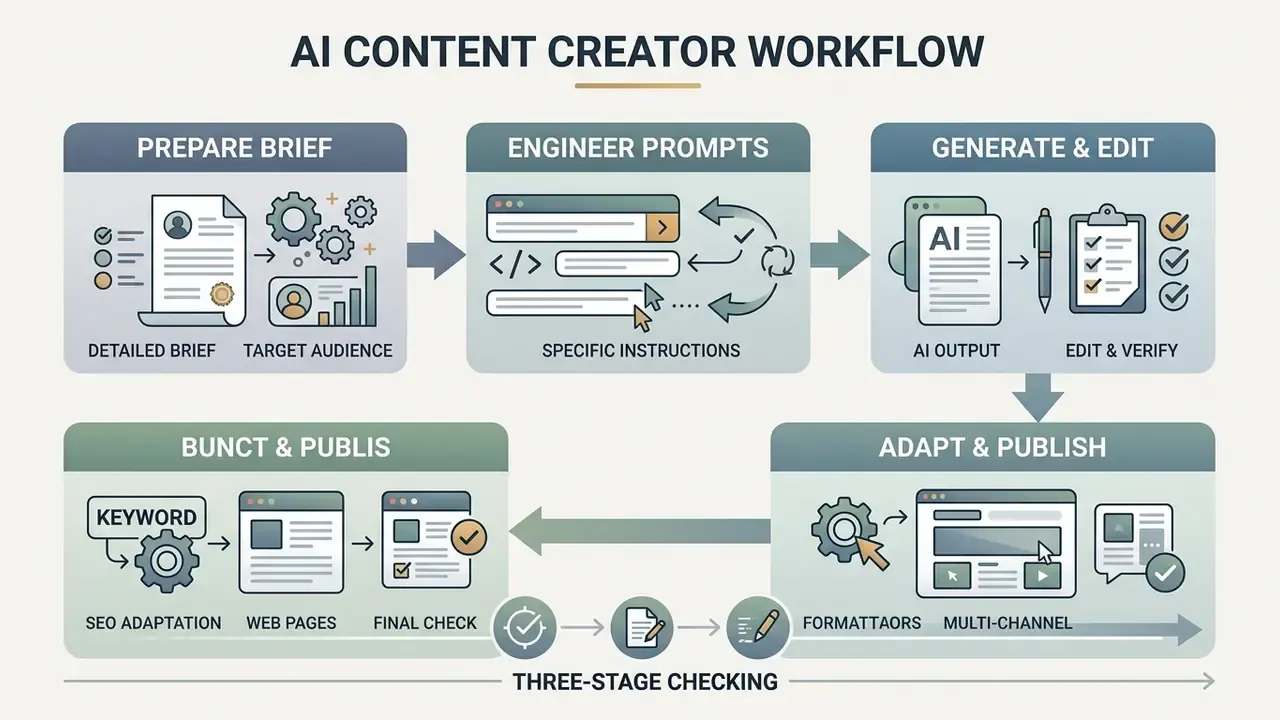
Getting a genuinely strong ai website content creator result requires a defined methodology: a detailed brief, prompt engineering, three-stage fact-checking and SEO adaptation. The same discipline applies whether you ai create content for a landing page or for a regulated product disclosure.
Google's search guidance states that using AI to create content does not violate search policy provided the final material is made for people (people-first content) and is genuinely useful, accurate and substantive. Automated mass production without added value is classified as spam. Google's 2026 guidance restates the priority order as accuracy, quality and relevance, and notes that no special machine-readable file (such as llms.txt) is required for indexing.
«On Facebook, AI-created content scored significantly higher on CTA quality than human-created content (W=23,572.5, p<0.001), based on assessments by 892 participants.»
Industry governance frameworks add the procedural layer: define approved use cases, set acceptable error margins, keep human oversight, test for bias, enforce brand compliance and disclose AI use where required.
How to Prepare a Brief and Prompts for an AI Writer
Effective prompting requires a structuring framework. The most validated method is CO-STAR (Singapore Government Prompt Engineering Playbook, 2026).
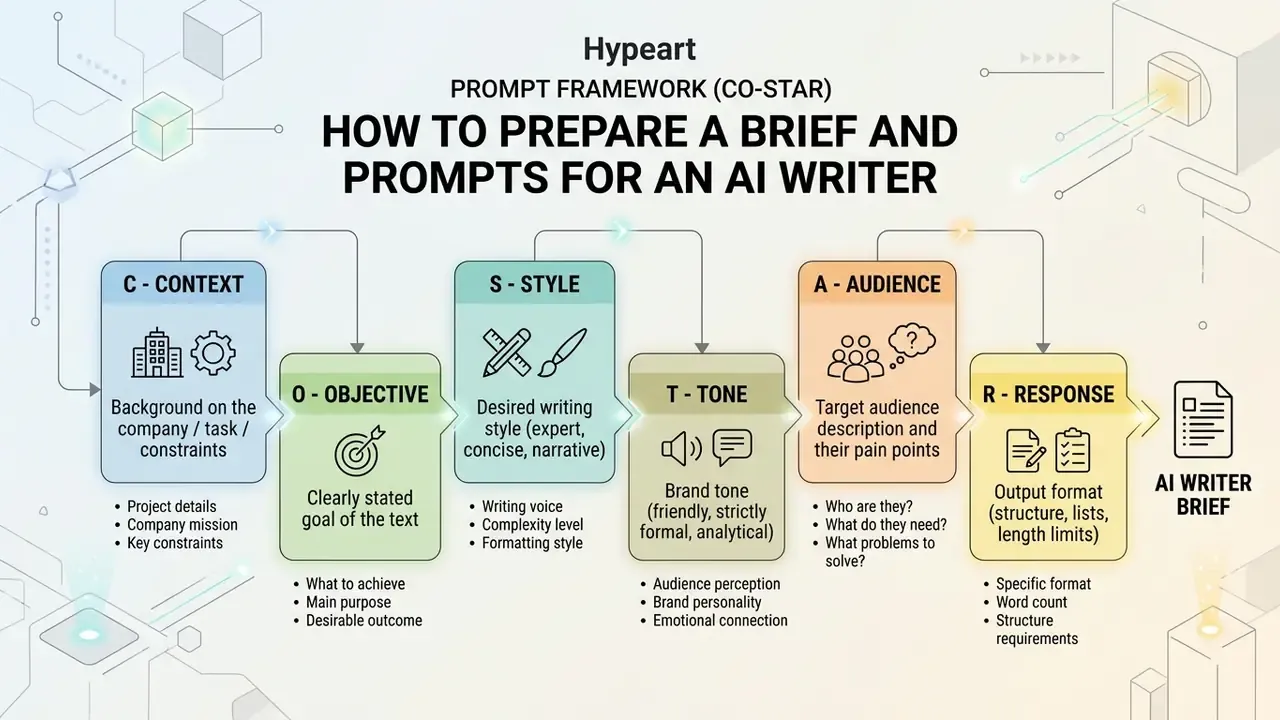
Example of a correct request for an ai web content creator:
"Act as a B2B copywriter. Write an introduction for an article on cybersecurity in fintech services. Audience: CISOs and Heads of Risk. Tone: analytical, pragmatic. Avoid clichés such as 'in today's world' and 'maximum'. Format: 2 paragraphs, up to 100 words, focused on 2026 regulatory risk."
Add three reinforcements to any brief: (1) an explicit "do not include" list covering banned claims, competitor mentions and guarantee language; (2) one or two gold-standard examples of approved copy; (3) the source material the model must ground itself in, so it paraphrases your facts instead of inventing plausible ones. Skip the third and you will spend the saved time on fact-checking anyway.
Why AI Text Must Be Edited and Verified
«Workers with ChatGPT access completed tasks 40% faster, and independent evaluators graded their output 18% higher, while the expert review stage remained mandatory.»
The documented workflow is three steps: break the output into individual claims; verify each claim against authoritative or primary sources; then revise for clarity, rhythm and human flow, rechecking facts and citations afterwards. Editors verify names, figures, dates and quotations directly. "Humanising" means restructuring paragraphs, varying sentence length, sharpening word choice and adding real business cases and examples from the team's own practice. Not sprinkling typos, to be clear.
«Access to generative AI causally increases the average novelty and usefulness of output, but reduces variance, so the strongest writers lose their relative advantage.»
Practical implication for content leaders: AI raises the floor and compresses the ceiling. If differentiation is your strategy, reserve senior human authorship for the assets that must be distinctive, and use generation where consistency matters more than originality.
How to Adapt Generated Content for SEO, Websites and Campaigns
Adapting text for search engines and paid channels includes keyword integration, H1 to H4 structure optimisation, meta tags and internal linking.
Ahrefs' large-scale analysis of 600,000 pages showed the correlation between the share of AI text on a page and its search position is just 0.011, effectively zero. Search algorithms rank pages on intent coverage and information originality, not on whether a human or a model typed the words.
«Among Google's top-3 results, 5.3% of pages are fully AI-generated and 9% contain more than 80% AI content, so the engine does not penalise text origin.»
To improve SEO performance:
- Break text into atomic semantic blocks with a direct answer in the first sentences.
- Implement structured data and lists to improve capture in SGE and featured snippets.
- Add links to authoritative sources and to your own narrow-topic material.
- Place target terms in the title, main heading, alt text and link text; keep all links crawlable.
- Express visual content in text and prefer semantic markup, which Google's own developer guidance treats as a ranking-readiness requirement.
- Label AI-generated product attributes separately in feeds where Google requires it.
When building a full site content plan, review our AI Media Commercial-Use Hub for licensing rules on generated assets, and specifically the guidance on commercial use of AI images. For disputes and rights questions, view the guide; for platform and workflow questions, see the overview or compare available solutions on the market.
FAQ: AI Content Creator Questions Buyers Ask
What is an AI content creator, in one sentence?
A generative-AI system that produces text, ideas and marketing assets from your prompt and context, emulating the structure of its training data. Designed to draft, not to publish unsupervised.
Can AI-generated content rank on Google?
Yes. Google permits AI-assisted content when it is helpful, accurate and people-first; it penalises scaled content produced primarily to manipulate rankings. Correlation between AI share and position is effectively zero (0.011).
Which is the best free AI content generator?
For general drafting and ideation, the free tiers of ChatGPT and Gemini go furthest; Rytr's free allowance (around 10k characters per month) suits high-frequency short-form copy. Anyone searching for the best free ai for content creation should still assume free tiers are unsuitable for confidential inputs.
How much editing does AI output need?
In our Q1 2026 test, no tool produced publication-ready text. Budget for claim-level fact-checking on every numeric statement plus a structural edit; the strongest outputs graded A on intent match still failed on unverifiable statistics.
Is it safe to paste company data into an AI content tool?
Only under an enterprise agreement with a documented no-training guarantee, tenant isolation and audit logging. Consumer free tiers should be treated as public channels. Full stop.
How do I calculate ROI honestly?
Use the risk-adjusted formula above: include editorial time, compliance review, audit support and expected residual-risk cost, then report payback period alongside the ratio.
Final Checklist for Selecting and Deploying an AI Content Creator
- Define the primary intentuniversal assistant (ChatGPT, Gemini), marketing suite (Jasper, Copy.ai, Writesonic, Rytr), SEO specialist (Frase, Clearscope) or automated draft factory (Article Forge).
- Fix the security rulesconfirm contractually that the vendor does not use your confidential data to train public models; verify SOC 2, SSO/SCIM, RBAC, logging and data residency.
- Implement human-in-the-loopassign named owners for fact-checking, brand-voice control and compliance sign-off, with risk-tiered review depth.
- Design the integrationsconnect generators to your CMS, CRM and task planners via API to eliminate manual hand-off, and extend the same governance to adjacent formats such as AI voice generators and video tooling.
- Instrument the audit traillog prompt, system instructions, model version, raw output, edits and approver for every published asset.
- Close the Shadow AI gappublish an approved-tool register, provide a sanctioned enterprise alternative and review usage logs monthly.
- Model the economics twiceper-seat versus metered credits, and ROI with control costs included.
- Re-verify quarterlymodel names, limits and prices change fast; re-run your grading test on the same benchmark brief each quarter.
To explore the terminology base and the full catalogue of available tools, browse the hub.
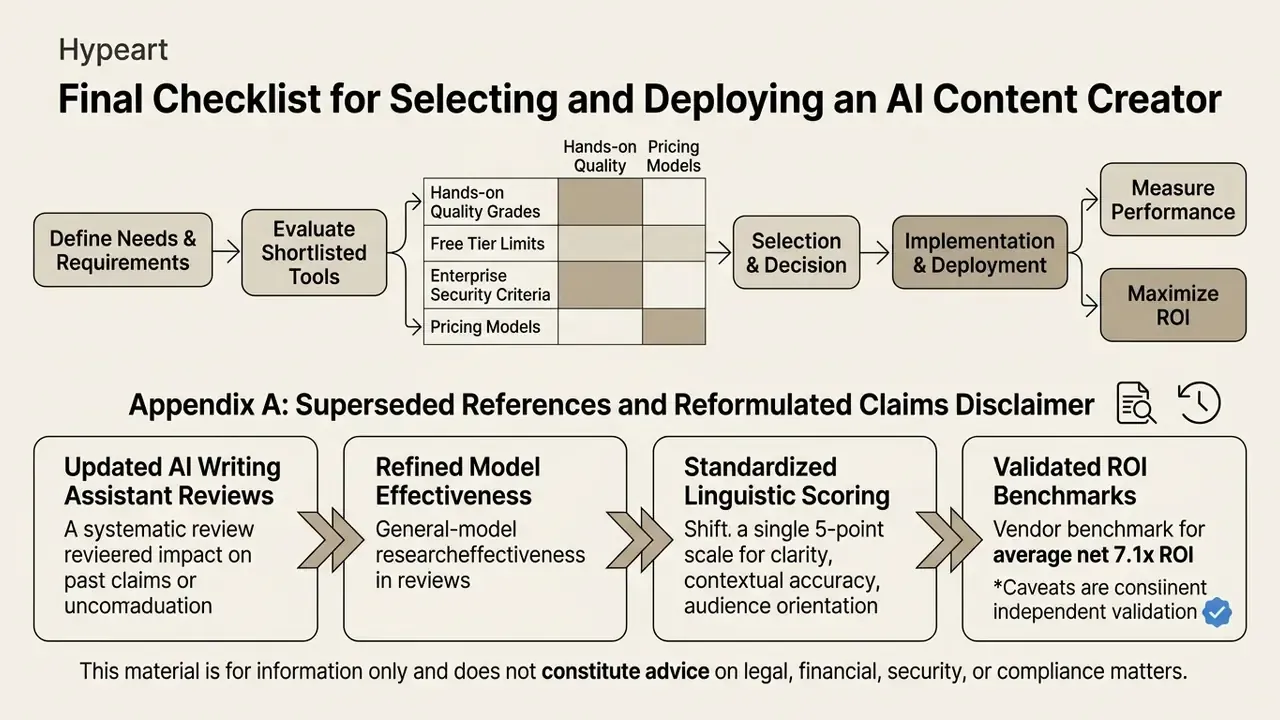
Appendix A: Superseded References and Reformulated Claims
Retained for transparency of revision history:
- "A Systematic Review of AI Writing Assistants, 2025" was previously cited in support of AI writing-assistant productivity. Not verifiable with methodology or figures; superseded in the main text by CHI 2024, The Value, Benefits, and Concerns of Generative AI-Powered Assistance in Writing (p<0.01 on error reduction).
- "Generative AI in Systematic Reviews, 2025" was previously cited for general-model research effectiveness; superseded by Scientific production in the era of LLMs, arXiv (2025), which also documents inconsistent reliability for literature search and study selection.
- "Linguistic quality is scored on a single 5-point scale with contextual accuracy and audience orientation" was reformulated in the main text as a multi-dimension rubric (grammaticality, non-redundancy, focus, coherence; per-criterion 1 to 5 scoring; multiple annotators), because a single aggregate score is not auditable.
- "Average net ROI of 7.1x" (Adobe) is retained with an explicit vendor-benchmark caveat and an independent 5 to 7x aggregated range; it requires validation against your own baseline.
Disclaimer
This material is informational and does not constitute legal, financial, security or compliance advice. Tool selection, data-handling decisions and model-risk classification must be validated by your organisation's own legal, information-security and model-risk governance functions. Vendor prices, model names, limits and contractual terms change frequently, so verify all figures on official vendor pages before procurement. Marcus Hale, author.