Generative neural networks for audio have moved out of the experimental category and into the everyday toolset of media production. In 2026, a systematic AI music creator lets you generate original compositions, purpose-built background tracks, adaptive loops and even discrete sound effects from a text description. Game developers, video producers and corporate content teams use these systems to accelerate production, cut stock-licensing costs and remove the bottleneck of briefing a composer for every asset.
One thing has not changed. Rights.
Executive summary in five points
- What it is.An AI music creator turns a text prompt (or a MIDI-like symbolic input) into a finished audio file, controlling genre, tempo, instrumentation, mood, arrangement and duration. Quality is now measurable: MusicGen scored 84.8/100 in subjective testing against 80.5 for the strongest baseline.
- The legal core.In the United States, purely AI-generated audio is not protected by copyright. Your right to use it comes from the platform's Terms of Service, not from authorship. Commercial safety therefore depends on the tier you paid for, not on the file itself.
- BGM is not distribution.Almost every paid plan allows use as background music in video, podcasts, ads and games. Uploading a generated track to Spotify or Apple Music as a standalone single is allowed by some vendors (SOUNDRAW Artist tiers) and explicitly forbidden by others (Beatoven.ai, free Suno and Udio tiers).
- Vendor selection.Check five things before you subscribe: stem export, written commercial licence, Content ID policy, dataset provenance (look for Fairly Trained certification or in-house-only catalogues), and enterprise controls (SOC 2, GDPR, "your prompts are not used for training", API access, IP indemnification).
- Economics.The real cost of AI music is subscription plus validation labour plus risk management, not just the monthly fee. Model it against your current stock-library spend per finished minute of content.
What is an AI Music Creator and what kind of music does it produce
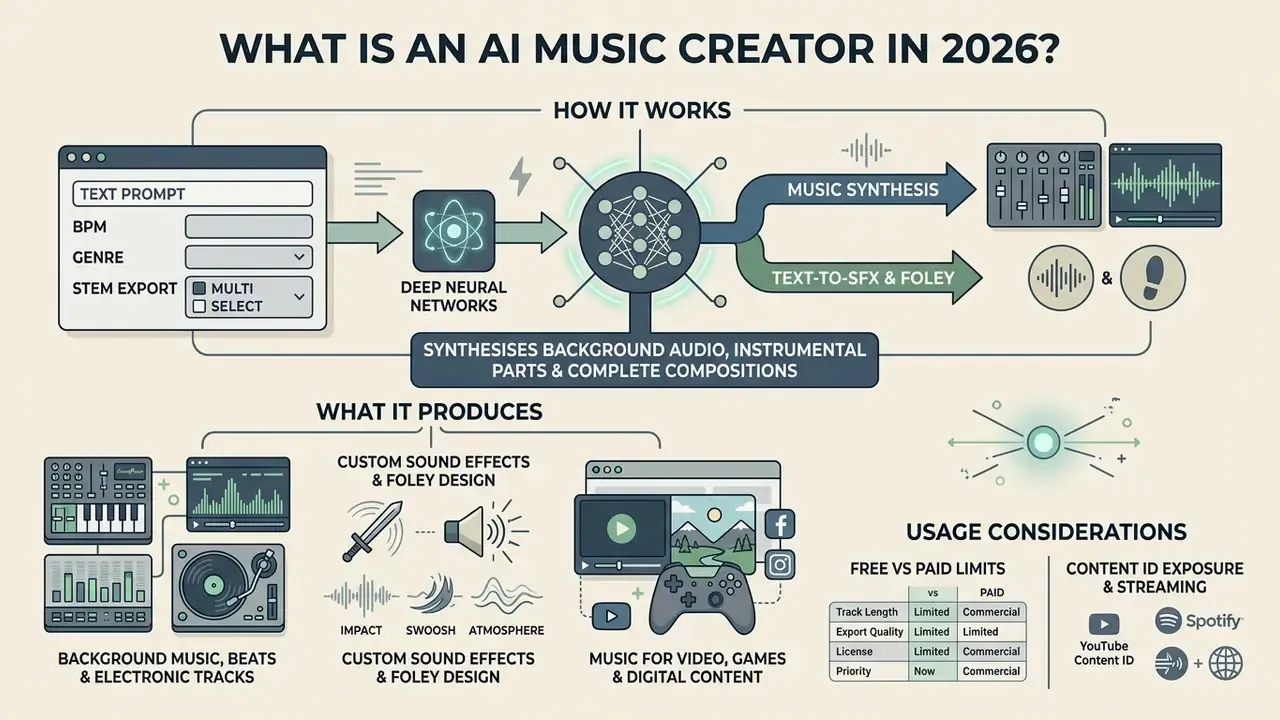
AI music creator is a software system built on deep neural networks that synthesises background audio, instrumental parts and complete compositions from a text prompt or a set of parameters. Modern generators rely on autoregressive token models and latent-space diffusion architectures, the lineage that runs through Google's MusicLM and Meta's MusicGen (Google Research, 2023; Meta AI, 2023). Functionally, the tool covers three jobs: generating original audio, extending or continuing existing samples, and arranging musical layers.
«MusicGen reached an average subjective score of 84.8 out of 100 against 80.5 for the strongest baseline.»
An ai music creation platform converts natural-language requests into numeric representations of musical tokens. The system analyses harmonic structure, spectral characteristics and rhythmic patterns, then renders a finished audio file as MP3 or WAV at sampling rates up to 48 kHz. That allows a complete ai music creation cycle without engaging an external composer. You can either pick a ready-made ai music generator or configure your own music generator pipeline to generate music on the exact spec a project needs.
The mechanism itself is simpler than it looks. The network reads a sequence (notes or audio tokens), predicts the most probable continuation as a numeric matrix, and decodes that matrix back into notes and a rendered waveform. Everything a creator experiences as "style", "groove" or "mood" is the statistical shadow of that continuation task, conditioned on your prompt.
Worth saying plainly: the model is not composing in the human sense. It is completing a pattern, very convincingly.
Background music, beats and electronic tracks
Text-to-SFX and Foley sound design from a prompt
Beyond whole compositions, current platforms ship Text-to-SFX modules. Acting as a digital Foley artist, the model synthesises discrete, high-fidelity noises: footsteps on gravel or snow, cloth rustles, door slams, explosions, rain, forest ambience, UI clicks, directly from a textual description. This removes the need to dig through generic sample libraries and lets you match an effect precisely to a video timeline or an interactive event in a game engine.
Practical prompt anatomy for SFX differs from music prompts. Name the object, the material, the action and the space. For example: Heavy wooden door closing in a stone cathedral, long natural reverb tail, no music, mono. Because provenance matters as much for effects as for music, look for vendors that document watermarking and metadata for generated audio. NIST guidance on synthetic-content provenance (NIST AI 100-4, 2024) treats digital watermarking and metadata recording as the core methods for tracking the origin of generated audio.
Music for video, games and digital content
Music for interactive systems and video content has to account for contextual dynamics and support seamless looping. Specialised systems generate tracks whose intensity adapts to on-screen events or gameplay state.
Tracks for the video category are built around shot and cut timing, while game music is designed through vertical layering: separate instrument stems that the engine can mute or introduce independently. Research from 2024 shows the direction of travel. A video-game study used MusicGen to dynamically generate background music from text descriptions for user-generated levels, and the AIVA engine has been integrated into games as a bespoke music engine that composes to the action.
Can you use AI music in commercial projects
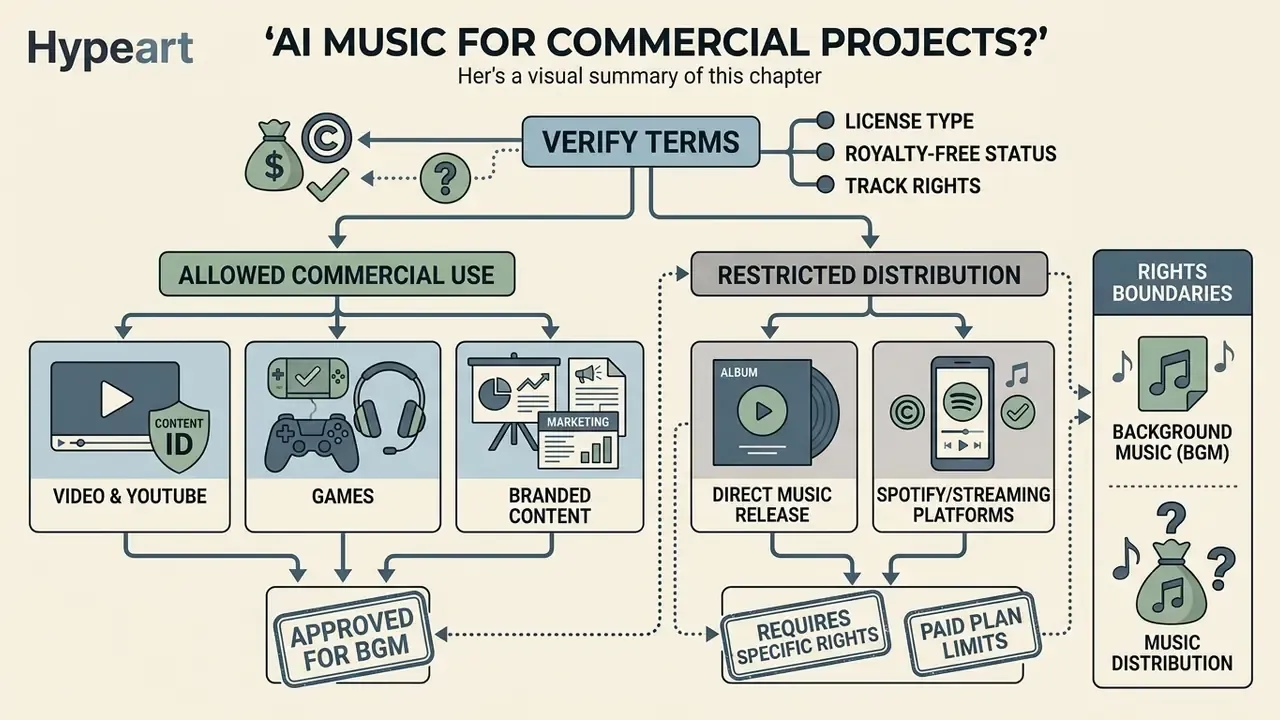
The legal status of music created by artificial intelligence has specific characteristics. In the United States and several other jurisdictions, output produced without substantial human involvement is not eligible for copyright protection at all.
The practical right to commercially use a generated file is therefore governed by the contractual agreement (Terms of Service) of the platform, not by classic authorship. The user receives contractual rights under a license, frequently labelled royalty free or royalty-free, which removes any obligation to pay recurring composer royalties.
License, royalty-free and rights to a generated track
The U.S. Copyright Office confirmed in its official guidance of 16 March 2023 and in its report of 29 January 2025 that works created by AI without sufficient human creative contribution are not protected by copyright (U.S. Copyright Office, 2025).
«The use of AI tools to assist rather than stand in for human creativity does not affect the availability of copyright protection.»
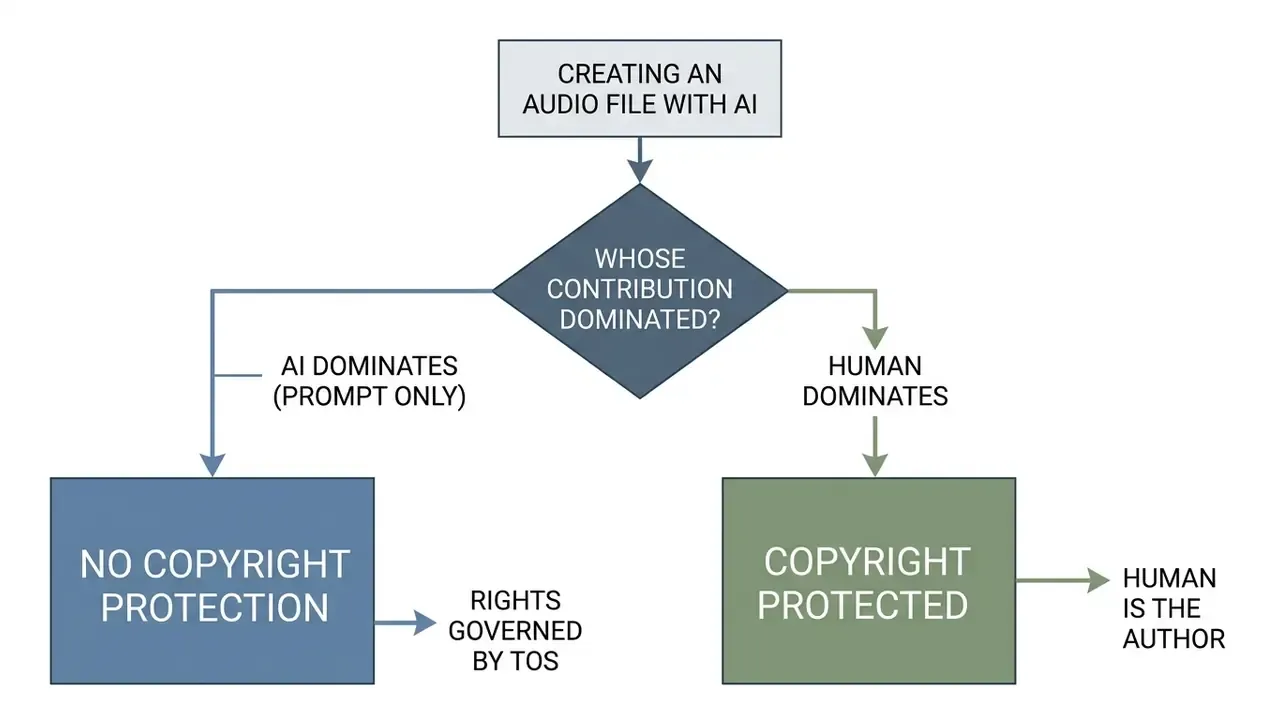
Accordingly, royalty free in an AI context means the platform contractually waives claims to royalties. It does not mean a registered copyright is transferred to you. What you get is permission to use the track within the scope of the license attached to your plan. Beatoven.ai states this explicitly: the user receives a non-exclusive perpetual licence to use and monetise the track, while the vendor remains the owner of the generated recording.
A second contractual layer matters just as much: what the model was trained on. SOUNDRAW's position is that its AI learns only from music its own producers write and record in-house, which is why it can issue a worldwide commercial licence with no "grey area" on the master side. That distinction, licensed or in-house training data versus scraped catalogues, is the single strongest predictor of whether a vendor can defend your use downstream. Hybrid models are emerging too. Suno's 2026 licensing deal with BMG covers training on BMG repertoire with artist and songwriter opt-in for both inputs and outputs, and STIM's 2025 AI licence framework routes compensation from both training and downstream outputs using neutral third-party attribution technology.
Rights boundaries: BGM use versus distribution on Spotify
When commercialising generated audio, keep two legal scenarios strictly separate:
- Allowed: services such as SOUNDRAW on dedicated Artist tiers explicitly cover distribution and monetisation on Spotify, Apple Music and TikTok, with 100% of song royalties retained by the user.
- Not allowed: Beatoven.ai states plainly that direct distribution to streaming platforms is prohibited, and that its stems may only be used for sampling inside your own remixes. Free tiers of Suno and Udio likewise prohibit commercial exploitation of any kind.
- Use as background music (BGM).Publishing the track inside YouTube videos, Shorts, Reels, podcasts, adverts, audiobooks, livestreams and games is permitted by most services on a paid plan, with no royalty payments.
- Direct distribution as a music release.Uploading a generated track to digital distribution platforms (Spotify, Apple Music, Deezer) as a standalone single or album is not permitted by every vendor.
There is also a royalty-collection trap on the distribution path. The U.S. Copyright Office has advised The Mechanical Licensing Collective that AI-generated music without sufficient human authorship does not qualify under the section 115 blanket licence:
«Musical works generated without sufficient human authorship are not eligible for royalty distribution under section 115.»
In practice: even where a platform permits distribution, you should not assume mechanical royalties will flow for a purely AI-authored composition. Adding documented human authorship, original lyrics, recorded vocals, hands-on arrangement and mixing decisions, is what moves a release from "unprotectable output" to "protectable work with an identifiable human author".
Video, YouTube, games and branded content
Publishing on YouTube, TikTok or inside a commercial game carries the risk of automated claims through Content ID. Content ID is a fingerprint-matching system for reference recordings. It does not detect "AI-ness", but it will match audio that resembles a registered reference, and in 2024 YouTube extended the toolkit with synthetic-singing identification so partners can detect AI content that simulates a singing voice.
To minimise commercial risk:
- Use only paid tiers where the right of commercial use is explicitly stated in the user agreement.
- Keep the original prompt files, generation logs, licence PDFs (Beatoven, for example, delivers a licence with a track ID for dispute resolution) and subscription receipts as evidence for YouTube support.
- Avoid naming popular performers in prompts ("in the style of Drake"), since this can trigger claims under name-and-likeness or right-of-publicity rules in addition to any copyright question.
- Confirm that the destination is covered. YouTube monetisation, paid advertising and client delivery are sometimes carved out separately from "general commercial use".
For legal precedent and regulatory background, see our hub on AI Litigation and Case Timelines and the AI Media Commercial-Use guide.
Fact check: verifying licence terms and ToS
Official rules of the leading audio-generation platforms set hard boundaries on commercial use:
- Sunounder its Terms of Service, the free Basic plan grants non-commercial rights only (reported as 50 credits per day, no stem separation). Commercial rights transfer to the user only for tracks created while a paid subscription (Pro, from $10/month, or Premier, from $30/month) is active.
- Udiothe free tier is capped (reported at 10 credits per day and 100 per month, with output length limited to roughly 2 minutes 10 seconds) and prohibits commercial monetisation. Monetised video or game use requires an active paid plan.
- SOUNDRAWthe Creator tier (from about €5.83/month) covers commercial and background-music use plus distribution and monetisation with MP3 downloads. WAV and stems appear on Artist Pro and above, and Enterprise adds API access for teams of 10 or more.
- Beatoven.aia non-exclusive perpetual licence for video and audio content, monetisation permitted, streaming distribution prohibited, licence with track ID issued per download.
- U.S. Copyright Office policyfollowing Thaler v. Perlmutter (D.D.C. 2023) and the Office's guidance, generated audio files are not automatically protected by copyright. The final media product built around them (film, game, podcast) still retains full protection for its human-authored elements.
- Fairly Trained certification and ethics initiativescommercial platforms increasingly submit training datasets to independent audit. Fairly Trained certification (held by Beatoven.ai) confirms the model was trained on licensed or in-house material with compensation paid to contributing musicians. SOUNDRAW, alongside Roland and UMG, supports the aiformusic initiative, which sets principles for the responsible use of AI in music. For a corporate buyer, this materially reduces exposure to collective actions from rightsholders and major labels.
Enterprise due-diligence checklist for an AI music vendor
For procurement, model-risk and AI-governance owners, licence wording is necessary but not sufficient. Verify:
Checklist0 / 7
Ownership, evidence and the audit trail
What parameters can you set when generating AI music
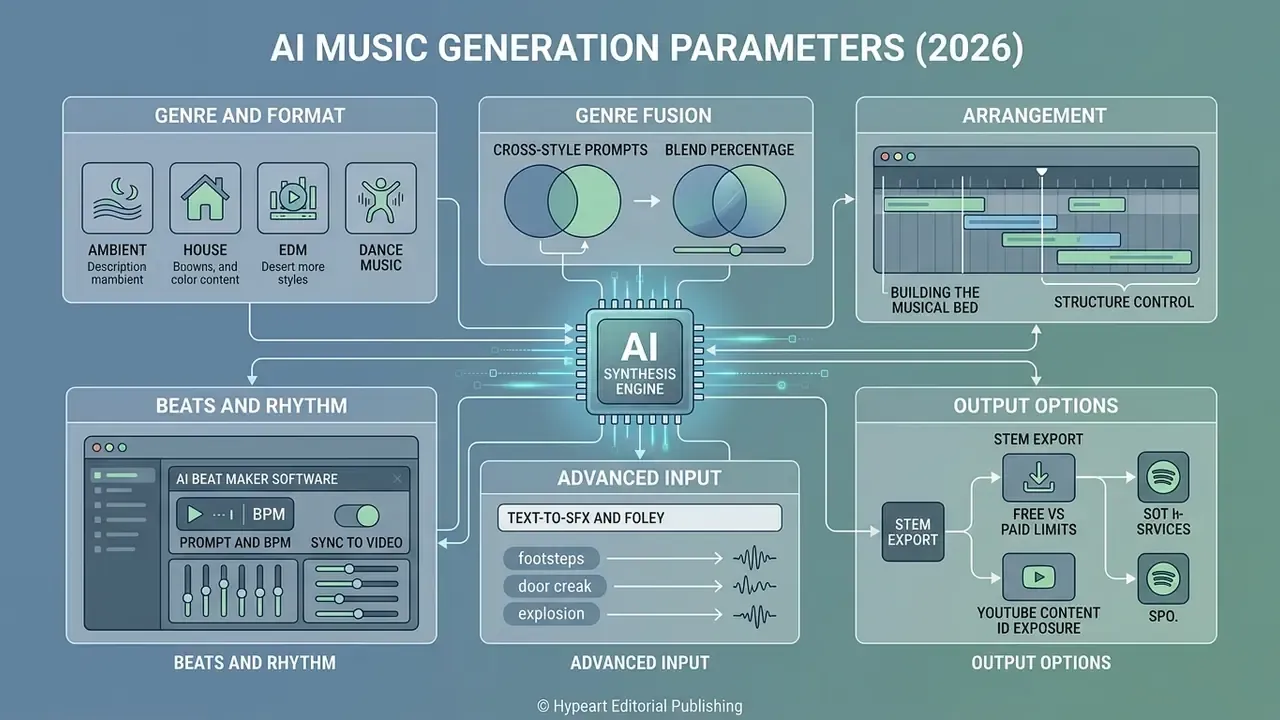
A modern ai background music generator tools stack gives the user granular control over musical attributes before synthesis begins. Text-to-music supports parametric configuration covering style, instrumentation, key, structure and length. Product APIs typically expose duration explicitly, from a few seconds up to 360, while research models often default to fixed 30-second clips.
«ACE-Step 1.5 and Stable Audio 3 Medium reliably follow instructions on key and triple-metre beat grouping, beyond the model's base distribution.»
An additional ai music arrangement generator layer lets you mark up the timeline by section. Work with ai electronic music generator, ai edm generator and ai house music generator is built on precise numeric values for tempo and sound character. "120 BPM" outperforms "fast" every time, because numbers in a prompt are held far more literally than adjectives.
Genre and track format: ambient, house, EDM and dance music
Accurate genre targeting comes from combining style tags with a numeric tempo. An ai ambient music generator free tool configures long attack and release envelopes, producing smoothed pads and minimal rhythmic density.
With ai house music generator and ai edm generator, the model uses a strict 4/4 cadence and foregrounds synth plucks, warm basslines and percussion. ai dance music generator and ai electronic music generator prompts work best when you name specific instruments, a Roland TB-303 or a TR-909 drum machine, to recreate an authentic timbre. For EDM, explicit structure tags (build-up, beat drop, bass drop) and texture terms (pluck, pad, Reese bass, super saw) carry more weight than mood words alone.
Genre fusion and cross-style prompts
Advanced models support blending genres that would rarely meet in a studio (Genre Blending). Name two or three base styles and assign each a role in the mix:
- Example prompt:
Cinematic orchestral hybrid with heavy trap 808 sub-bass, 140 BPM, epic build-up, aggressive mood, no vocal. - How it is processed: the model takes the harmonic grid of the first genre (orchestral) and overlays the rhythm section and drum kit of the second (trap). This is the fastest route to distinctive trailer beds, fight-scene cues and high-energy game music: Hip-Hop plus Orchestra, Trap plus Lo-Fi, Drum & Bass plus Choir.
- Refinement rule: change one variable at a time, genre pair, then BPM, then instrumentation, otherwise you cannot attribute the improvement.
Arrangement, beats and building the musical bed
Structural control is handled by arrangement mark-up. An ai music arrangement generator reads textual commands that define the intro, verses, drops and final fade, and current tools accept narrated, time-ordered instructions plus an explicit song length (for example "60 seconds" or auto mode).
«MusicLayout produces a discrete temporal description of sections, intro, drop, bridge, and uses it as a prefix for audio-token prediction, improving long-range structure.»
ai beat maker software and mobile ai beat maker app products enable layer-by-layer synthesis. The user lays down a bass part and a drum kit, after which the ai music background generator builds the surrounding harmony. Layer features analyse the mood, tempo and harmonic structure of the existing project before adding new instrument performances, so the resulting background music stays coherent across the whole file.
The table below summarises the key controls over neural audio generation:
| Parameter | Description and value range | Effect on the final audio file |
|---|---|---|
| Genre / style | Ambient, House, EDM, Orchestral, Lo-Fi | Sets the base harmonic model, instrument set and timbral colour. |
| Tempo (BPM) | 60 to 180 BPM (numeric) | Defines playback speed and rhythmic pulse; 110 to 130 BPM reads as upbeat, 130 to 160 as driving. |
| Instrumentation | Synth pads, kick drum, electric bass, strings | Lists the priority synths and acoustic instruments in the mix. |
| Mood | Energetic, calm, dark, melancholic | Shapes modal structure (major or minor) and dynamic range. |
| Arrangement | Intro, buildup, drop, bridge, outro | Marks temporal development and the order instruments enter. |
| Duration | 10 to 360 seconds | Sets the final runtime on export. |
| Genre fusion | Combination of 2 to 3 tags (e.g. Lo-Fi plus Metal) | Hybridises spectral character and arrangement logic across styles. |
| Foley / SFX mode | Textual noise descriptor (e.g. footsteps on snow) | Switches generation from music to discrete sound-effect synthesis. |
How to create a track in an AI Music Creator: from prompt to download
Producing a musical fragment with generative AI follows a sequence: prepare the text prompt, configure parameters, generate, review, validate, export. Using an ai background music generator online requires no deep knowledge of music theory.
The user starts the ai music creation run, the network begins to generate music through the ai music generator interface, and the finished generated asset becomes available through the download button for integration into the project.
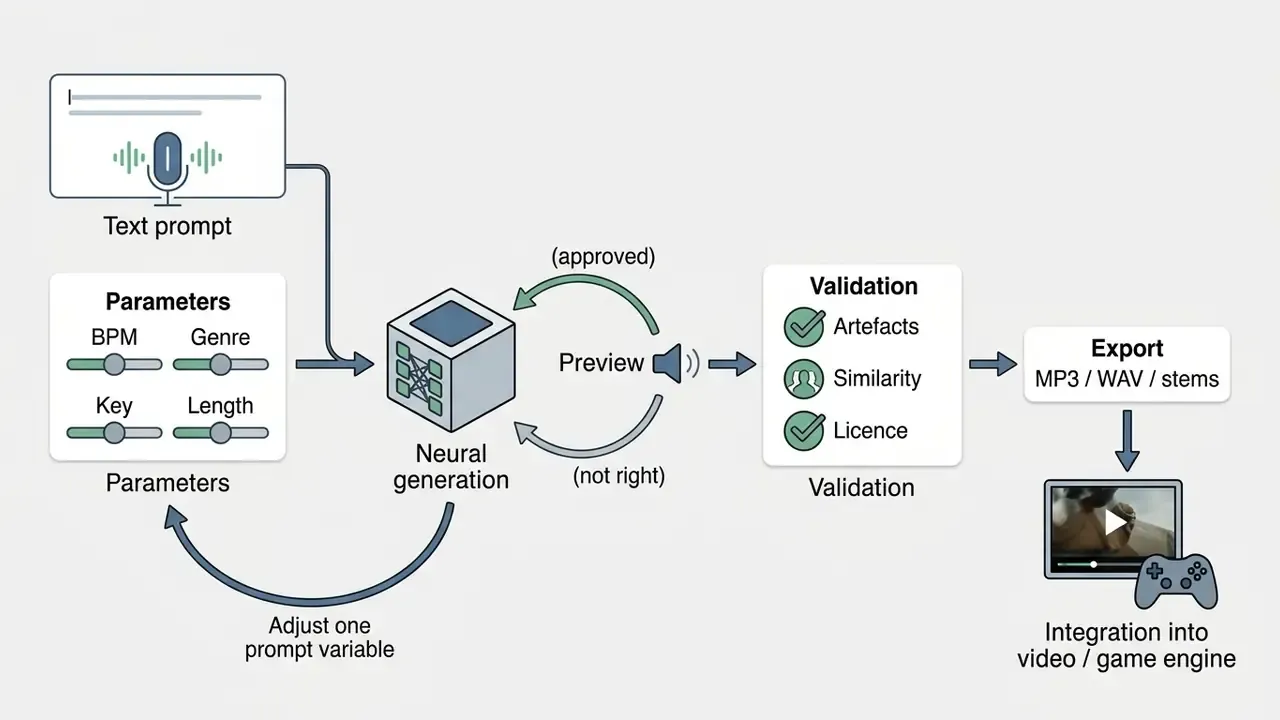
Read the diagram as six steps: write the brief, set the numeric parameters, generate variants, audition them, validate the winner against artefacts and licence status, then export and drop the file into the edit or the engine.
Describe the mood and the job the music must do
An effective prompt is structured, not poetic. Use the order genre and style, then mood, then instrumentation, then tempo in BPM, then use case, with three to five concrete descriptors and exact numbers.
Example prompt for a background bed:
Upbeat corporate house music, 120 BPM, synth bass, clean electric guitar, optimistic mood, background music for video demo, no vocal.
Avoid contradictory terms, state BPM numerically rather than as "fast" or "slow", and name a key ("A minor") when harmonic consistency across several cues matters. For a voice-over bed, add explicit restraint: understated repetitive motif, soft low-mid instrumentation, consistent even dynamics, seamless loop, instrumental.
Generate several variants and pick the track
After the prompt is submitted the system produces two to four variants that differ in the random seed of the generative core. This is where audio-quality validation begins.
Preview each candidate and assess the mix, the absence of harmonic artefacts and the tonal balance (sound). If no generated variant fits, adjust individual words in the prompt without rebuilding the whole parameter set, since single-variable edits make the cause of any improvement traceable. Treat variants as numbered slots and keep the seed of anything you might need to reproduce later. Reproducibility is cheap now and expensive in hindsight.
Validate the output before you export
This step is routinely skipped and is the most common source of downstream problems in commercial pipelines. Before export, check:
- Artefacts. Digital clipping, metallic ringing on cymbals, phase smearing in the low end, abrupt cuts at the end of the file.
- Loop integrity. For games and Shorts, verify that the loop point is inaudible and that the tail does not clash with the head.
- Unintentional similarity. Run the candidate against a reverse-audio or fingerprint check if the prompt referenced a recognisable era or artist. A melody that "feels familiar" is a commercial risk, not a compliment.
- Licence trail. Confirm the file was generated while the paid plan was active, and archive the licence document, track ID, prompt and timestamp with the project files.
Download the music and add it to video, a game or your content
The final step is exporting the audio to your device. The download option offers several formats depending on the destination.
Compressed MP3 (128 to 320 kbps) is fine for rapid publication to social platforms. For professional video editing and mixing inside a DAW, use uncompressed WAV (24-bit, 48 kHz), the lossless choice for post-production and mastering. Advanced tiers offer multitrack stems, separate drum, bass, keys, vocal and FX files, which give you free rein to rebalance the cue inside the edit, mute a layer under dialogue, or reuse a single element as a transition. Align stems from the first frame of the project so that sync never drifts, and import them straight into Ableton, Logic, FL Studio, Unity or Unreal. If the delivery format changes late in the process, an online video converter will usually be faster than re-rendering the whole timeline.
How to choose an AI music generator: free access, features and tooling
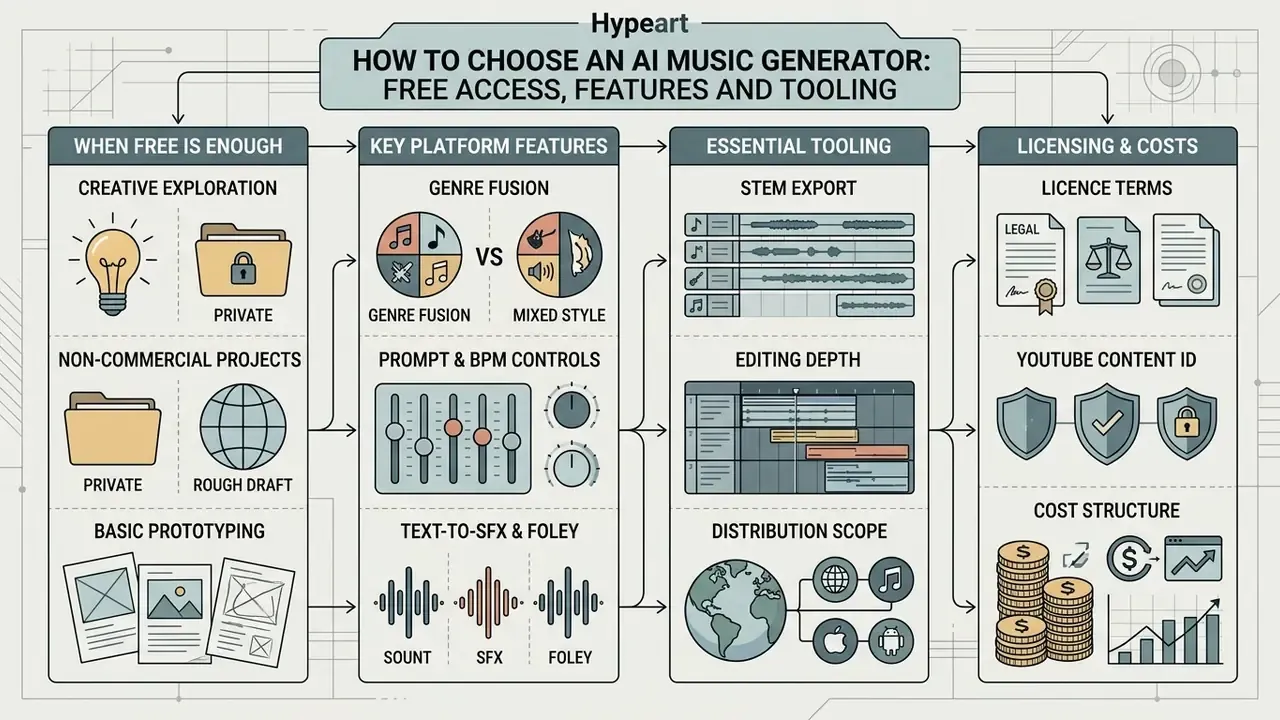
The generative-audio market offers a wide spread of platforms differing in limits, synthesis quality and legal terms. When selecting an ai background music generator free option, weigh download restrictions and commercial rights before anything else.
Many services grant access to free ai music and free music catalogues, but professional use requires analysing the subscription. If you need an ai game music generator free, check for hidden watermarks and audio idents. Review the available ai beat maker apps and professional ai background music generator tools before committing.
Be sceptical of unqualified quality claims. Evaluation methodology in this field is still unsettled. A 2023 survey of AI-music evaluation found that assessments vary by task and produce no single accepted metric for musical quality:
«FAD proved inconsistent across synthetic and real human-preference data; the new MAD metric reaches 0.84 correlation with reference ratings versus 0.49 for FAD.»
When a free AI music generator is enough
Free tiers suit non-commercial use, prototyping, student projects and rough video edits. free ai music tools are a fair way to learn a platform's interface and prompt behaviour before paying.
Services such as ai ambient music generator free, ai background music generator free and ai game music generator free usually grant a daily or monthly credit allowance (commonly 10 to 50 generations per day; Canva's free music offering is reported at 900 credits per month and up to 10 tracks per day with a 180-second cap and personal-use-only terms). The exported free music file is often limited to lower-bitrate MP3, and the licence typically forbids monetisation outright.
One caveat that catches teams out: a free-tier file used in a client deliverable does not become licensed retroactively when someone upgrades next month.
What to check in an AI beat maker and background music generator
Before buying a paid subscription to ai beat maker app or ai beat maker software, run a functional audit:
For a wider selection framework, see our comparison of AI tools for media production, the AI tool comparison pages where you can see the overview, and the plan-level pricing overview.
The table below compares free and paid tiers of AI generators:
| Criterion | Free tier | Paid subscription |
|---|---|---|
| Monthly limit | 10 to 100 credits (capped, often daily) | Unlimited or 1,000 plus credits |
| Export formats | MP3 (128 to 192 kbps) | WAV (24-bit, 48 kHz), MP3 320 kbps |
| Stem separation | Unavailable | Available (separate tracks) |
| Commercial rights | Prohibited (personal, non-commercial) | Full commercial package |
| Watermarks | May be present in the audio | Absent |
| Streaming distribution | Prohibited | Vendor-dependent (allowed on artist tiers only) |
| API / team controls | Unavailable | Available on business and enterprise plans |
The practical read on that table: free tiers are for learning the prompt language, paid tiers are for anything a client, a store page or an ad account will ever touch.
Cost structure: modelling the economics of AI music
A realistic total cost of ownership for AI background music has four components:
TCO per finished minute = (subscription ÷ approved minutes delivered) + validation labour + integration labour + risk provision
- Subscription €5 to €35 per month for individual tiers. Enterprise and API plans are quoted per seat or per call.
- Approved minutes delivered the number of cues that actually survive review, not the number generated. A 3:1 generation-to-approval ratio is a conservative planning assumption for branded work.
- Validation labour the artefact, similarity and licence checks described above, typically 5 to 15 minutes per cue.
- Risk provision the cost of a claim dispute, a re-edit, or a takedown. Vendors with audited datasets and indemnification reduce this line item. Free tiers with prohibited commercial use raise it to the value of the entire campaign.
Compare that figure against your current spend per finished minute on stock libraries and bespoke composition, including the search time that background-music sourcing consumes, which several production teams cite as the largest hidden cost. To run the numbers on your own volume, view the guide to our cost models.
Use cases: AI background music for creators, video and games
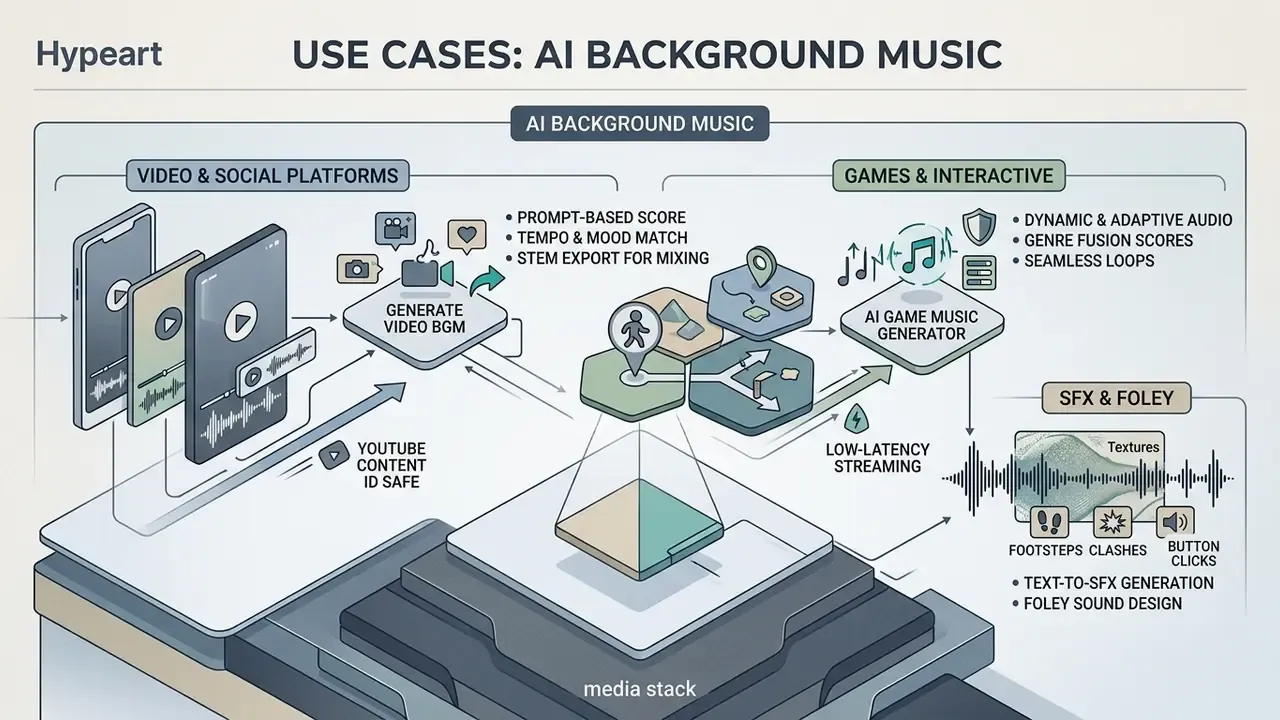
Generated audio now spans the whole media stack, and the right generation model depends on the shape of the final product.
Professional creators integrate ai background music generator for videos into pipelines for videos, short-form story content and full game worlds. ai game music generator and ai game music generator online services deliver continuous, adaptive audio accompaniment.
AI game music for games, streams and interactive projects
The games industry needs adaptive audio systems that react to game state.
ai game music generator and ai game music generator online tools export seamless loops and individual musical layers. When threat level rises, the engine (Unreal Engine or Unity) introduces a generated percussion layer, producing a smooth transition without interrupting playback. That is the classic combination of vertical layering and horizontal resequencing controlled through audio middleware. A 2019 study integrating adaptive music into two games reported higher player-perceived immersion and stronger music-to-world correlation than the original soundtracks, and a 2024 ACM paper described systems that generate continuous streams and shift mood, style and tension without stopping the music.
«text2midi, the first end-to-end system generating MIDI from text descriptions, allows chord progressions and drum patterns suitable for adaptive game loops to be specified directly.»
Symbolic MIDI output is particularly valuable here. It can be re-orchestrated at runtime, transposed to match a scene, or fed into middleware as a parameterised cue rather than a fixed render.
Updated (previously an absolute claim). Versions marketed as ai game music generator no copyright are intended to reduce the likelihood of DMCA muting on Twitch, but no vendor can guarantee that a livestream will never be flagged. Fingerprint-matching systems act on audio similarity and platform policy, not on the origin of a file. Streamers should keep licence documentation with a track ID, use paid tiers, and check the vendor's stated dispute process. The original wording, "guarantees the absence of stream blocks", is preserved in Appendix A as a corrected claim.
The ecosystem of companion AI audio tools
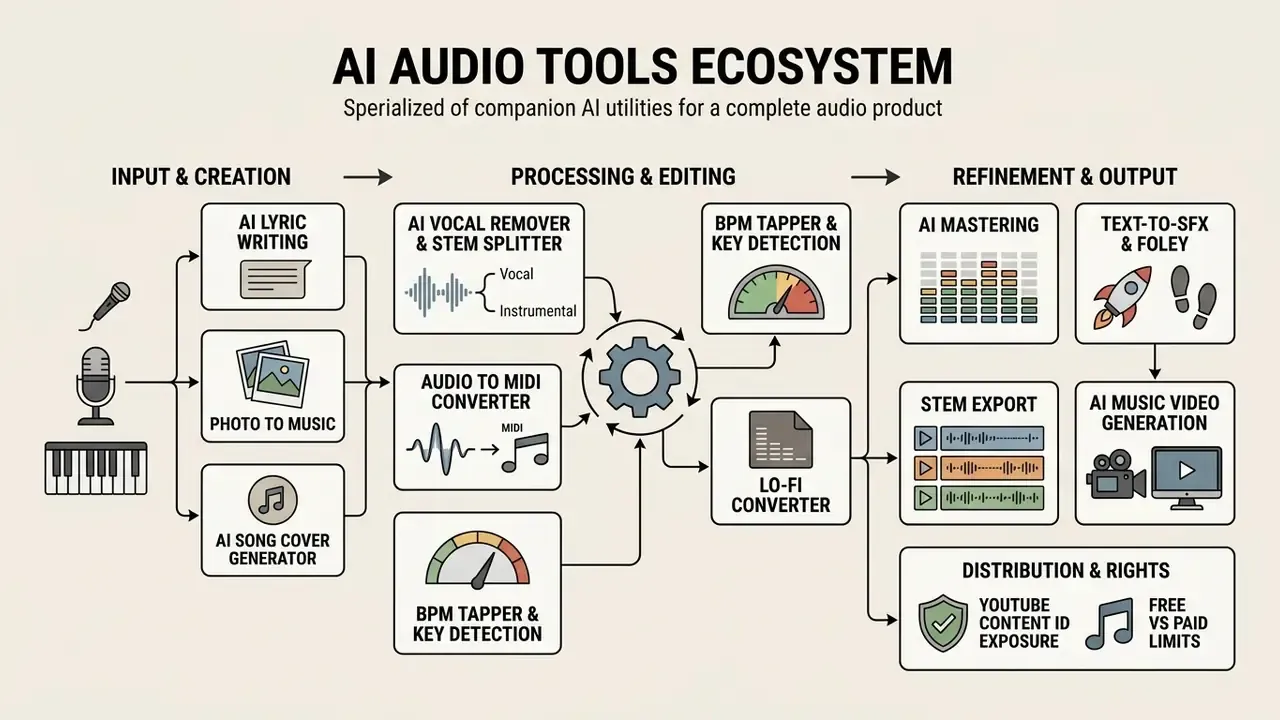
A complete audio product usually passes through a full processing cycle built from narrow, specialised AI utilities:
- AI Vocal Remover and Stem Splitter. Isolate vocals from instrumentals to obtain a clean a cappella, a karaoke instrumental, or an individual element to sample and reimagine. Modern splitters output up to six stems, and some pipelines also export a dedicated click track.
- Audio to MIDI converter. Neural recognition of played notes, converting an audio track into MIDI for further editing in a DAW (Ableton, Logic Pro, FL Studio).
- AI lyric writing. Lyric generators that adapt the rhythmic shape of each line to a chosen metre and genre, pop hook, rap verse or rock ballad, and iterate until the mood matches the track.
- AI mastering. Level balancing, clarity enhancement and depth, so the cue sits correctly at platform loudness targets.
- Photo to Music and image-to-audio. Turning cover art or concept art into a musical prompt by analysing colour, composition and mood.
- BPM tapper and key detection. Utilities for matching a generated cue to existing footage or to a DJ set.
- AI song cover and lo-fi converters. Re-voicing a track or slowing it with reverb to test alternative moods quickly.
- AI music video generation. Producing visuals for a finished track, closing the loop between audio and text-to-video AI production.
Trimming the delivery is part of the same chain: an online video cutter is often all you need to fit a generated cue to a 30-second ad slot, and an online video downloader helps archive approved reference edits alongside the licence pack. Teams new to the workflow frequently pair audio practice with an online video editing course before scaling output.
FAQ about AI Music Creator
Can an AI music creator produce DJ sets and click tracks
Continuous DJ sets require dedicated automatic mixing algorithms (beatmatching and key matching) that go beyond one-shot track generators, although research has moved fast here. A 2018 open-source system was described as the first fully automatic and comprehensive DJ system capable of building seamless mixes from a song library, and a 2022 paper used a GAN to learn and synthesise transitions from real-world DJ mixes. A specialised ai dj music generator can already generate individual dance tracks at a fixed tempo with structured 16 to 32 bar intros and outros designed for mixing. For a metronome track, an ai click track generator produces a precise signal on a defined BPM grid with an accent on the downbeat, used for studio recording and live performance, and increasingly exported alongside separated stems. For further audio work, see the guide to AI voice generators.
Can music be used as a basis for AI art and image generation
Updated (previously overstated). Cross-modal generation between audio and images is an active research area rather than a fully solved production feature. Systems such as ai art generator from music and ai image generation background music use neural embeddings (CLAP, ImageBind) to analyse the spectral and emotional characteristics of an audio signal (audio), then convert those features into conditioning vectors for a diffusion model that renders imagery matching the mood and rhythm of the track. CVPR 2024 work on visual-audio diffusion latent aligners and 2024 to 2025 papers such as Sound2Vision and MACS demonstrate audio-to-image generation. None of the sources cited in this article benchmark commercial-grade music-to-image quality, so treat outputs as creative exploration rather than a deterministic pipeline. For adjacent workflows, see character and avatar generators.
Do you need musical training to use an AI music generator
No formal music education is required to work effectively with modern AI music generators. A 2025 peer-reviewed paper on multimodal AI music generation states that such systems are designed for individuals of all backgrounds and require no formal music training, and vendor documentation confirms that describing mood, genre or lyrics in plain language is enough to create music that fits a brief. The tools are built for natural-language control: describe the task, genre and mood in a text prompt. That said, understanding a handful of basic terms (BPM, verse and chorus structure, the names of core instruments, major and minor) lets you write sharper prompts and reach a usable result in fewer iterations.
Can I upload AI-generated music to Spotify or Apple Music
It depends entirely on the vendor. SOUNDRAW's Artist tiers explicitly permit distribution and monetisation on Spotify, Apple Music and TikTok with 100% of song royalties retained. Beatoven.ai prohibits direct distribution to streaming services and allows only sampling of its stems inside your own remixes. Free tiers of Suno and Udio prohibit commercial exploitation altogether. Separately, note that a purely AI-authored composition may not qualify for mechanical royalties under section 115 in the United States.
Will I get a Content ID claim for AI-generated music
It is unlikely on a properly licensed paid tier, but not impossible. Content ID matches audio fingerprints against registered references and applies the claimant's policy to matched uploads. If a claim appears, dispute it using the track ID supplied in your licence and the vendor's support form. Keep prompts, generation logs and receipts, since repeated erroneous claims can also cost a claimant their Content ID access, and documented evidence works in your favour.
What is the safe next step for a team piloting AI music
Start narrow. Pick one content type, one paid vendor, one named owner, and a 30-day window. Log every generated cue with its prompt, licence and reviewer. At the end of the window, compare cost per approved minute against your current stock spend and count the disputes, if any. If the evidence holds up, widen the scope. If it does not, you have lost a month, not a campaign. Questions during the pilot can go to our support team, where you can browse the hub, or straight to the integration docs if you want to automate generation and browse the hub for endpoints.
Appendix A: editorial notes, corrections and source status
Transparency about what changed and what remains unverified is part of the standard we hold this article to.
About this article. Written and maintained by the editorial team behind our AI tooling glossary, which reviews generative media platforms against their published Terms of Service, pricing pages and primary regulatory documents before publication. Licence terms change frequently, so re-verify your vendor's current agreement before any monetised release. Reference definitions live in our glossary, where you can explore the hub.
Legal disclaimer. This material is informational and does not constitute legal advice. Copyrightability, licensing and royalty entitlement for AI-generated audio differ by jurisdiction and by contract. Consult qualified counsel for decisions involving commercial distribution, advertising or enterprise deployment.
- Replaced citation.
- The earlier version cited "Music Evaluation Lab, 2026" with the URL
https://arxiv.org/abs/2601.00000. That identifier does not resolve to an existing preprint and has been removed. The claim about controllability of ACE-Step 1.5 and Stable Audio 3 Medium is now attributed to Do Text-to-Music Models Really Follow Instructions? A Counterfactual Evaluation of Key and Beat Grouping (2026), with the URL withheld until the identifier is verified. Readers requiring a currently resolvable alternative should consult Stability AI's published Stable Audio documentation. - Citations pending URL verification.
- MusicLayout (2024 to 2025), Aligning Text-to-Music Evaluation with Human Preferences (2025), Music Arena (2024 to 2025) and text2midi (2024) are cited by title and year only. Placeholder identifiers supplied during research did not resolve and were deliberately not published.
- Reformulated performance claim.
- Original wording: "final editing speed increased by 40%." No methodology, baseline or sample size was available, so the claim is now presented as an internal, self-reported estimate.
- Reformulated absolute claim.
- Original wording: "versions of ai game music generator no copyright guarantee streamers the absence of broadcast blocks on Twitch." No vendor can guarantee this. The corrected text describes risk reduction plus documentation practice.
- Reformulated capability claim.
- Original wording implied that multimodal music-to-image synthesis is an established production capability. The corrected text scopes it as an active research area with named 2024 to 2025 papers.
- Verified as accurate.
- U.S. Copyright Office guidance (16 March 2023 and 29 January 2025), Thaler v. Perlmutter (D.D.C. 2023), and the summarised Suno and Udio Terms of Service positions were checked against primary sources and retained.