Last reviewed and updated: 2026. Written for marketing, communications, procurement, and risk stakeholders who commission animated video at enterprise scale, including regulated buyers in banking, insurance and fintech.
And, worth saying plainly, that is also why the format attracts governance attention. A compliance module is a controlled document. So is the animation that explains it.
Executive Summary: Four Rules for Commissioning Corporate Animation
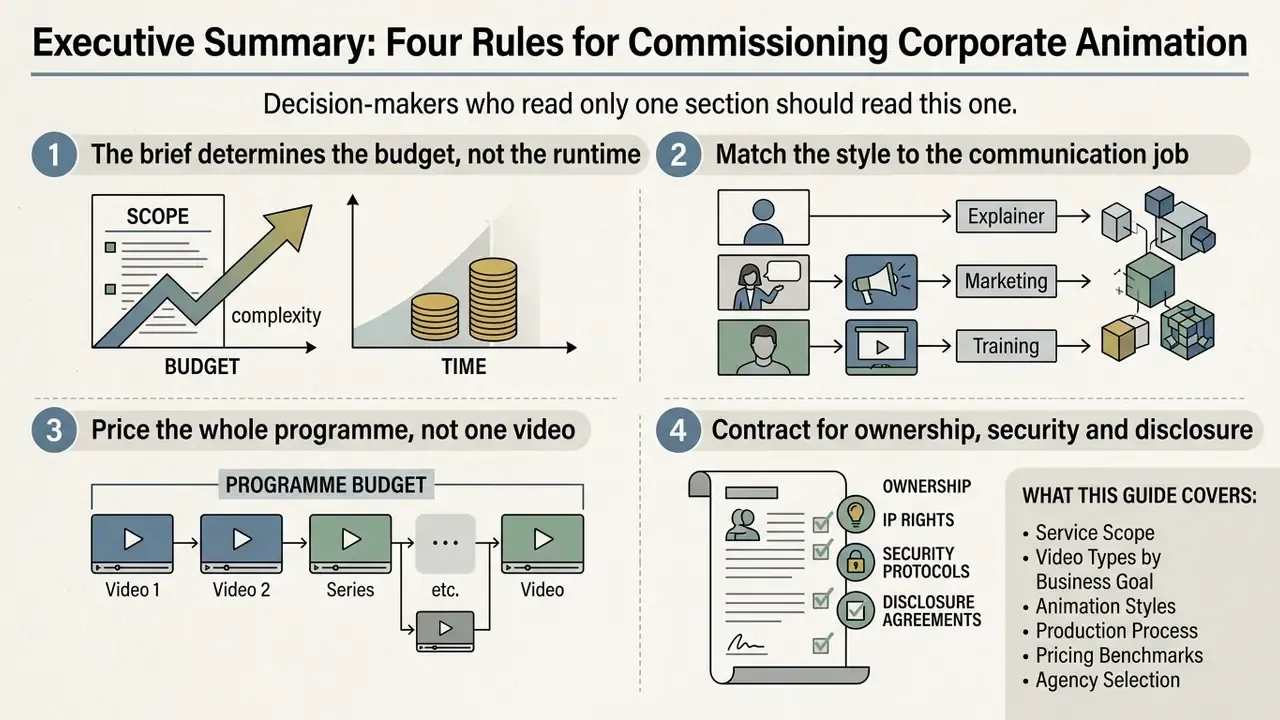
Decision-makers who read only one section should read this one.
- The brief determines the budget, not the runtime. A vague brief forces extended strategy cycles, and those cycles are the single largest driver of cost spread and schedule slippage on animated projects. Lock the business goal, audience, and visual style before a single frame is designed.
- Match the style to the communication job. Motion graphics for data, APIs and dashboards. 2D vector for workflows and processes. 3D for hardware, infrastructure and physical systems. Character animation for behavioural and soft-skills training. Whiteboard for step-by-step instruction.
- Price the whole programme, not one video. Survey data across 242 explainer video production companies shows a median project cost of $5,400, a trimmed mean of $8,457 and a mean of $10,983, with quotes ranging from $600 to $250,000. Localisation, late-stage animation revisions and broadcast music rights are the line items buyers underestimate most often.
- Contract for ownership, security and disclosure. Written copyright assignment, explicit revision limits per approval gate, subcontractor disclosure, and documented information-security controls (NDA, ISO 27001 or SOC 2, prohibition on uploading confidential material into public AI tools) are non-negotiable in regulated sectors.
What this guide covers: service scope, video types by business goal, animation styles, production process, pricing and timelines, agency selection and market comparison, red flags, IP and security, FAQ, and an AI-versus-agency decision matrix.
What Animated Video Production Services Include
Professional animated video production services cover the full lifecycle of visual storytelling: strategic discovery, scriptwriting, design systems, motion animation, audio engineering, and platform-specific encoding. A specialized animated video creation company supplies the structured creative and technical workflow that turns a complex business idea into a reproducible video asset, one you can version, audit and re-render next quarter.
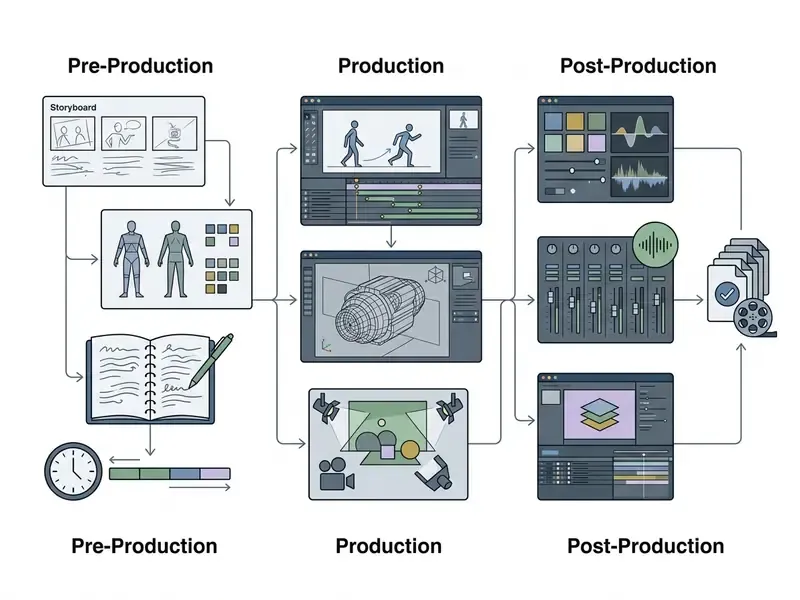
Industry pipeline documentation is unusually consistent on the three-phase architecture. Falmouth University describes the 2D animation pipeline as three sequential stages, pre-production, production, post-production, with the storyboard acting as the control document for camera, staging, transitions, poses and visual effects. Studio-side documentation extends the same logic: concept and story, script, character design, storyboard, concept art, voiceover, animatic, then modelling, rigging, layout, animation, simulation and effects, shading and lighting.
Strategy, Script and Creative Development
Creative development begins by defining measurable business goals, target buyer personas, and primary distribution channels, before anyone writes a line of narration. The creative team then drafts a literary script that balances narrative pacing with explicit visual cues.
Scriptwriting for B2B SaaS and enterprise environments tends to follow a four-part structure: problem identification, operational friction, strategic shift, and solution proof. Creative directors build mood boards and visual metaphors so brand guidelines and messaging strategy stay in the same lane. In practice the sequence runs from business objective and KPI, to audience definition through buyer personas, to a literary script, a director's script, style development, and finally an animatic, with every stage gated by client approval. Teams evaluating automated drafting tools can review our guidance on script generator ai solutions.
One small caution from experience: personas written for a paid-media campaign rarely survive contact with an animation brief. They are too broad. Name the single decision the viewer must make.
Design, Animation, Audio and Final Delivery
The design phase converts approved text into bespoke visual assets, vector graphics, and character rigs tuned to the brand identity. Motion designers then animate those assets using keyframe manipulation, character rigging, and kinetic typography.
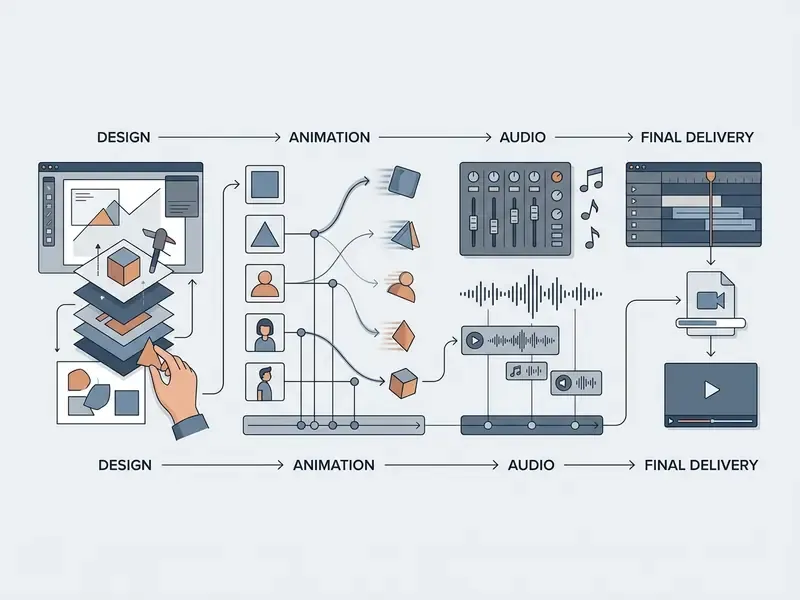
Audio engineers record professional voiceover narration, mix original or licensed background scores, and design spatial sound effects. Post-production teams encode final masters into platform-specific aspect ratios, add captions, and export assets for web, social media, and enterprise learning management systems. Standard delivery workflows sequence voiceover recording before music remixing and soundtrack assembly, then layer visual and sound effects, subtitles, and encoding into required output formats, with 1280×720 (720p) still cited as a baseline web export for general online distribution. For web-based creation workflows, explore our analysis of modern animation maker software.
Animated Videos by Business Goal and Use Case
Modern enterprises deploy animated business video production across distinct operational departments to accelerate buyer conversion, streamline internal communication, and improve information retention. Working with a dedicated animated marketing video company keeps video assets tied to sales-funnel metrics rather than to a creative award reel.

Animated Explainer Videos for Complex Products and Technology
«Adding shoppable video to product pages lifted conversion from 3.96% to 5.75%, a 45.1% relative gain measured across 50,476 visitors.»
The methodological caveat matters. This was a single controlled funnel experiment with a defined traffic sample and a regional context, not a universal benchmark. Treat 45.1% as an indication of achievable order-of-magnitude impact on product-page conversion, and model your own baseline (3% to 4% is typical for many e-commerce and SaaS trial funnels) before signing off on ROI projections. Teams comparing production routes can start with our overview of AI video generators, then decide where custom animation is genuinely required.
In B2B SaaS marketing, the structural consensus across current production playbooks is narrower than the marketing hype suggests. Homepage and landing-page explainers work best when built around one persona, one funnel stage, one core problem and one call to action, in the 60 to 90 second range. Longer product-page walkthroughs extend this into a six-beat arc, hook, problem, solution, how it works, proof, CTA, with the "how it works" segment typically landing in the 45 to 70 second window. Consideration-stage assets map to persona pain; decision-stage assets map to integration proof and a "book a demo" endpoint.
A practical note for financial-services buyers: explainer scripts describing a credit model, a KYC flow or an AML alert queue usually need a compliance read before styleframes, not after. That single sequencing choice removes a whole revision round.
Corporate and Training Animation for Internal Communication
An animated corporate video production company creates instructional content, compliance modules, and executive announcements that deliver consistent training across distributed global teams. Animation removes the logistics of scheduling live filming and allows rapid updates when policies or regulatory mandates change, which is a decisive advantage for banks, insurers and fintech operators whose control descriptions and model documentation shift every reporting cycle.
Data from Panopto's 2024 Workforce Training Report (produced with NewtonX) shows that 52% of surveyed enterprise organizations rely on video as their primary training modality.
«Organizations that prioritise video-based training are 40% more likely to achieve training cost savings, 46% more likely to deliver timely information, and 26% more likely to optimise operational productivity.»
"Animation standardizes compliance training across global teams while lowering maintenance costs when regulations update." L&D Executive Survey, Panopto 2024
Academic evidence supports the specific formats used in instructional animation, not just video in general:
«70% of surveyed medical students used whiteboard animation in their studies, and a significant association was found between perceived animation quality and learner satisfaction (P < 0.001).»
Practical enterprise applications documented in internal-communications material include company updates and culture messages, policy and process walkthroughs, onboarding sequences (company overview, role description, department overview, policy modules, employee testimonials, executive messages), success stories and training quizzes. For regulated organisations the real operational value is version control: one master animation, an auditable revision history, and localised variants that can be re-rendered when a control or a disclosure requirement changes.
Marketing, Sales and Commercial Animated Videos
«After implementing motion graphic promotional video, the @senji_id account recorded a 5.31% increase in reach and a 7.9% increase in engagement, validated by media and marketing expert review.»
Commercial outcome benchmarks. Aggregated client-outcome data reported by animation studios in the explainer segment (Digital Brew benchmark data) shows why revenue teams keep funding the format:
- 75% of surveyed clients reported a positive sales lift attributable to explainer video content.
- 86.7% confirmed the video delivered a measurable positive return on investment.
- Vendor case studies in the same segment report a 45% increase in demo requests on a product-launch explainer (2.5M views) and a 35% reduction in app onboarding drop-off after replacing static onboarding screens with 3D animation.
Self-reported vendor data, of course. Useful for direction, not for board-level attribution.
Table 1: Comparative breakdown of animated video types by strategic objective, target audience, core message, and distribution channels.
| Video Type | Primary Objective | Target Audience | Core Message Focus | Primary Distribution Channels |
|---|---|---|---|---|
| Explainer Video | Simplify product value and drive trials | Prospects and mid-funnel evaluators | Problem framing, workflow solution, value proof | Homepage hero, landing pages, product launch hubs |
| Corporate Video | Communicate identity, culture and vision | Investors, recruits, broad stakeholders | Company mission, market positioning, executive vision | Investor relations pages, event keynotes, corporate site |
| Training Animation | Standardize skill adoption and compliance | Internal staff, partners, global teams | Standard operating procedures, policy compliance | Learning Management Systems (LMS), intranet portals |
| Marketing Video | Build brand awareness and engagement | Target audience segments | Teaser benefits, visual hooks, brand narrative | Paid social channels, YouTube pre-roll, content feeds |
| Sales Demo Video | Accelerate deal closing and conversion | Qualified leads and procurement teams | Feature walkthroughs, ROI proof, technical integration | Direct sales outreach, pricing pages, proposal decks |
| Commercial Spot | Drive immediate campaign response | Broad consumer or business market | Offer proposition, emotional hook, explicit CTA | Connected TV (OTT), digital ad networks, high-reach media |
Animation Styles: 2D, 3D, Motion Graphics and Mixed Media
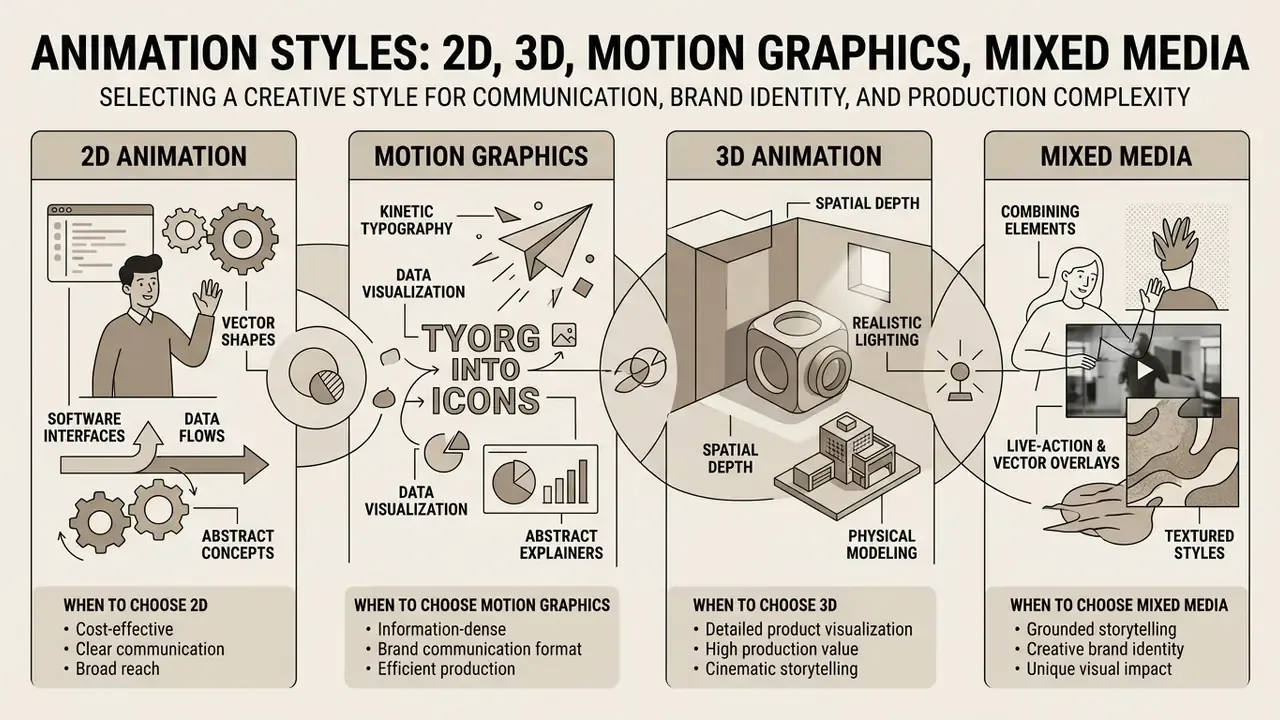
Choosing a creative style means balancing communication clarity, brand identity guidelines, and production complexity. Partnering with a specialized 2d animation video production company or 3d animation video production company keeps the visual execution aligned with the technical requirements of the brief.
When to Choose 2D Animation and Motion Graphics
2D vector animation and kinetic motion graphics suit software interfaces, data flows, and abstract conceptual frameworks. Motion graphics use animated typography, UI elements, vector icons, and data charts to present information with high visual precision, which is exactly what a dashboard walkthrough or an AML alert workflow demands.
«Instagram advertising predominantly uses 2D animation, while YouTube and Facebook more frequently deploy 3D; stop motion is the least common style across all three platforms.»
That distribution has a practical consequence. If the same master asset must run across Meta feeds and YouTube pre-roll, a 2D-led system with selective 3D inserts is usually cheaper to version than a full 3D build. Teams converting existing static brand assets into motion can review our overview of image-to-video AI tools before commissioning custom design.
Public-sector design standards treat motion graphics as a communication format, not decoration. Canada's federal design standard defines motion graphics as animated shapes, text and images with or without audio, and requires the official identity to appear whenever the asset communicates a programme, service, call to action, hashtag or URL; assets with no government message or call to action are exempt from the wordmark requirement. The takeaway for corporate brands is similar: flat vector systems remain the most accessible and reproducible format for dense informational content. For teams weighing animation approaches, review our compare framework for creative media tools.
When 3D, Character Animation or Mixed Media Fits the Brief
3D animation delivers spatial depth, realistic lighting, and the precise physical modelling required for industrial machinery, consumer hardware, and medical device demonstrations. Custom character animation adds emotional resonance and a character-driven narrative, which works well for soft-skills training and brand storytelling.
The learning-science justification for animation over text-only material is well established:
«A median effect size of 1.39 has been recorded for learning outcomes when words and pictures are combined, compared with text alone.»
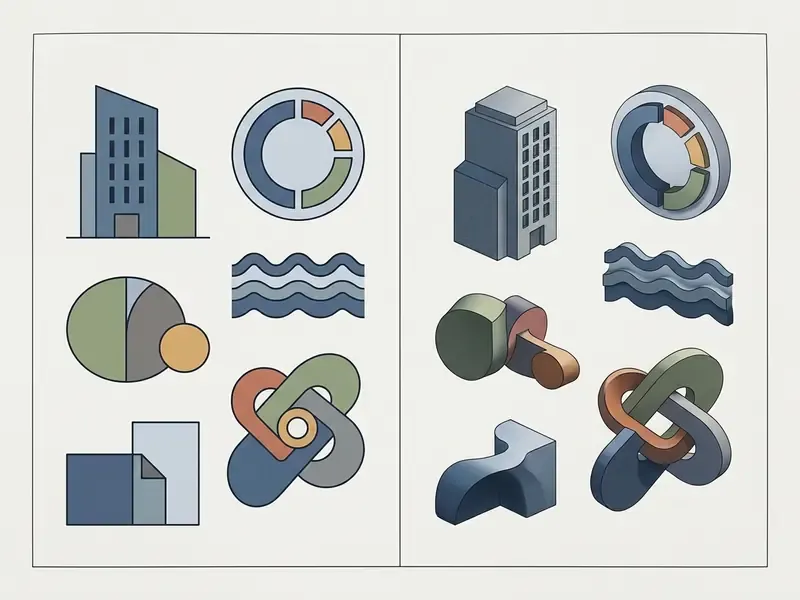
Mixed media production combines live-action footage with kinetic vector overlays, so brands can ground a narrative in a real environment while animation carries the data layer. Research published in Hybrid Animation: Integrating 2D and 3D Assets (2025) outlines five selection criteria: target visual fidelity, line mileage complexity, rendering schedule limits, physical asset availability, and budget allocation. The same source lists five integration criteria that decide whether a hybrid piece looks intentional or improvised: style matching, registration, frame rate and image format, timing, and image sizes.
Table 2: Style selection matrix matching visual mediums to product complexity, emotional narrative, visual detail, and brand alignment.
| Animation Style | Product / Concept Complexity | Emotional Narrative Emphasis | Required Visual Detail | Brand Guideline Alignment |
|---|---|---|---|---|
| 2D Vector Animation | Moderate to High (SaaS workflows) | Moderate (relatable scenarios) | Clean, stylized vector graphics | Highly flexible; adaptable to corporate guidelines |
| Motion Graphics | Very High (data, APIs, metrics) | Low (focused on clarity and logic) | High precision UI and typography | Optimal for modern, tech-focused corporate identity |
| Whiteboard Animation | Moderate (step-by-step logic) | Low to Moderate (educational) | Minimalist line art and drawn scenes | Best for academic, training, and instructional tones |
| 3D Animation | Highest (hardware, infrastructure) | Moderate (visual awe and realism) | Photorealistic textures and depth | Ideal for premium, engineering, and industrial brands |
| Character Animation | Moderate (behavioral scenarios) | Highest (empathy and story arcs) | Expressive rigs and fluid motion | Best when brand personality and human connection drive ROI |
| Mixed Media | Variable (abstract plus real world) | High (human context plus data) | High (integrated live footage and overlays) | Excellent for distinctive campaigns and hybrid brand systems |
The Animated Video Production Process From Brief to Launch
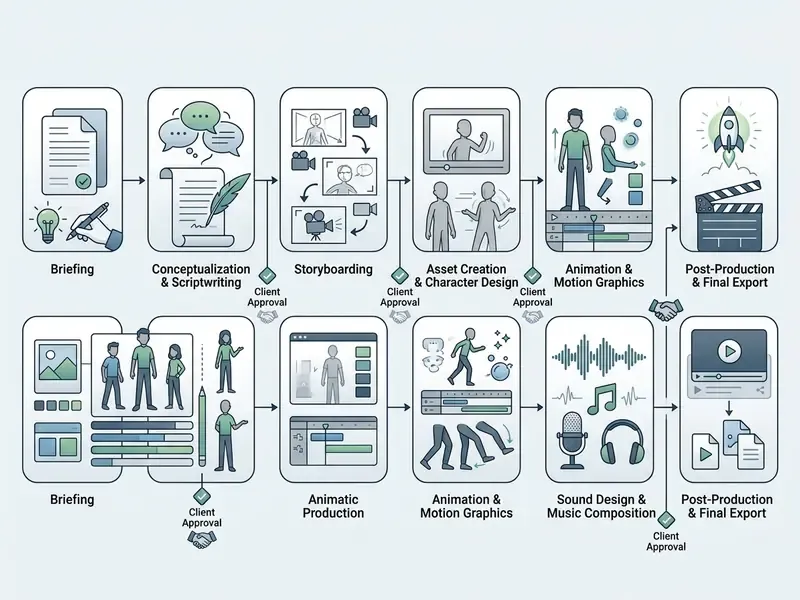
A commercial video project needs an organized production pipeline with clear client sign-off gates. Managing risk across the video production workflow is what prevents scope creep and keeps final assets inside technical specification.
Brief, Goals, Audience and Scriptwriting
Pre-production opens with a discovery brief capturing business objectives, audience demographics, target deployment platforms, and core messaging constraints. Scriptwriters then convert brief parameters into a formal visual script, structured as concise scenes with parallel voiceover and visual direction columns.
Institutional briefing guidance converges on the same requirement set. Imperial College London structures an effective brief around the five W's and HOW, with purpose, context and audience clarity established up front. The World Bank's 2024 policy-brief guidance is more specific about audience: define the prospective reader, their knowledge level, the information they need to make a decision, and their openness to recommendations before drafting. Queen's University briefing-note guidance requires every document to answer two explicit questions, "Who is the intended reader?" and "Why is this here?" University of Florida IFAS scriptwriting guidance formalises the two-column page layout with visual commands and shot notes alongside narration, in an introduction, body, conclusion structure. Teams planning automation workflows can examine our analysis of text-to-video AI and script to video pipelines.
Client Onboarding Checklist: Source Assets to Supply Before Kick-off
Delays here compound through every downstream gate. Supply the following before the discovery call:
- Vector logo files (.AI, .EPS or .SVG) with clear-space and minimum-size rules.
- Brand book and colour palette with HEX, RGB and CMYK values, plus licensed brand typefaces.
- Product UI screenshots, Figma files or design tokens for accurate interface reproduction.
- Approved technical glossary of product, regulatory and internal terminology, including terms that must not be used.
- Existing video, motion or presentation references internal stakeholders already consider "on brand".
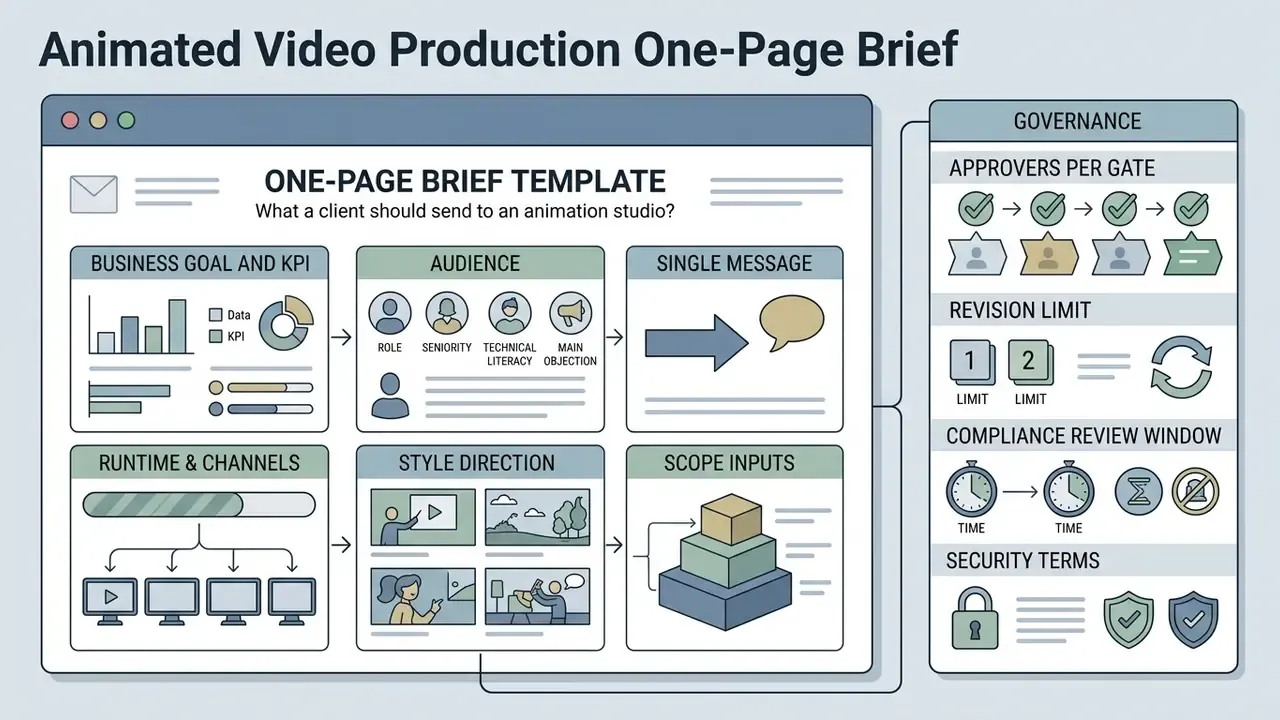
- Buyer persona documentation
- role, decision objective, objections, technical literacy.
- Legal and compliance constraints
- mandatory disclaimers, prohibited claims, sign-off authority list.
- Distribution matrix
- channels, aspect ratios, language versions and accessibility requirements.
Storyboard, Style Development and Asset Creation
Once the script is approved, artists develop styleframes, meaning fully rendered visual keyframes that establish the final look, colour palette, typography, and visual depth.
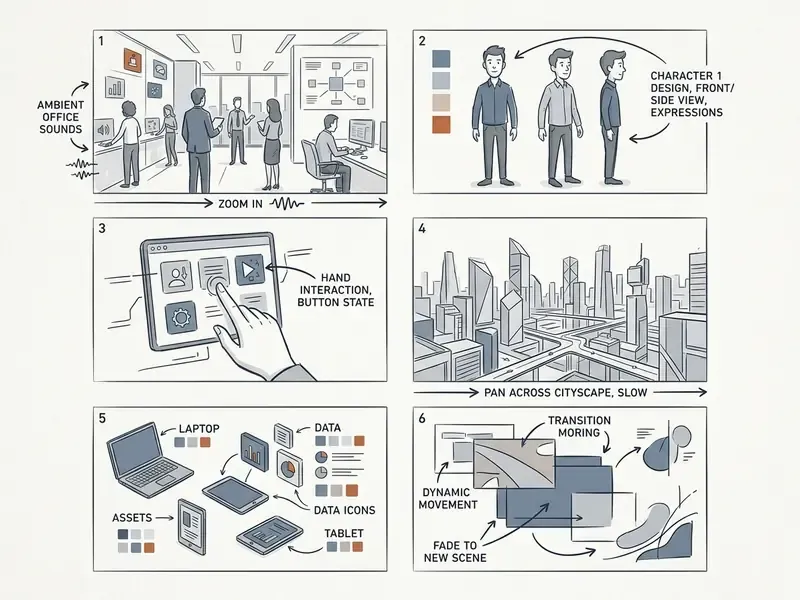
The team then builds a scene-by-scene storyboard, mapping visual compositions, character poses, and camera transitions against audio timing. Production storyboards are structured as shot-by-shot panels with frame numbers, scene and shot identifiers, camera direction, timing and audio cues, using panels matched to the final delivery aspect ratio. Styleframes follow the mood board and turn direction into finished-looking key images that lock colour, composition and typography. Designers then construct custom vector assets, background environments, and character rigs, organizing, renaming and positioning vector layers specifically for import into motion design software.
Boring work, honestly. It is also where most rescue costs are avoided.
Animation, Voiceover, Revisions and Delivery
Production moves into active motion assembly, syncing character animation and graphical movement to a scratch voiceover track. Professional voice actors record final audio in acoustically treated environments; teams weighing synthetic narration for internal or multilingual versions can compare options in our guide to AI voice generators. Sound engineers mix the final read alongside licensed background tracks and custom sound effects, after which editorial finishing, colour correction, captioning and QA take place using professional video editing tools before packaging and final delivery.
A regional fintech firm needed a 90-second animated explainer to launch a compliance monitoring feature. The team set a 2D motion graphics concept, closed storyboard approval within two weeks, and finalized voiceover integration during production. The completed video launched across product landing pages and lifted qualified demo requests through the launch cycle.
Sequential Production Stages and Client Approval Gateways
- Discovery BriefingDocument business goals, audience personas, budget limits, and deadlines. (Client Approval Gate 1)
- Strategy and ConceptDefine creative approach, visual metaphors, and distribution plan.
- ScriptwritingDraft visual script with parallel audio and narration cues. (Client Approval Gate 2)
- Storyboard and StyleframesDesign visual keyframes, vector style guide, and shot compositions. (Client Approval Gate 3)
- Asset Creation and RiggingBuild character rigs, UI mockups, backgrounds, and vector layers.
- Animation and KeyframingAnimate visual elements, camera moves, and scene transitions.
- Audio EngineeringRecord professional voiceover, perform sound design, and mix final audio. (Client Approval Gate 4)
- Final Mastering and LaunchRender platform exports, generate closed captions, and deploy media assets. (Client Approval Gate 5)
Animated Video Pricing, Budget and Production Timeline
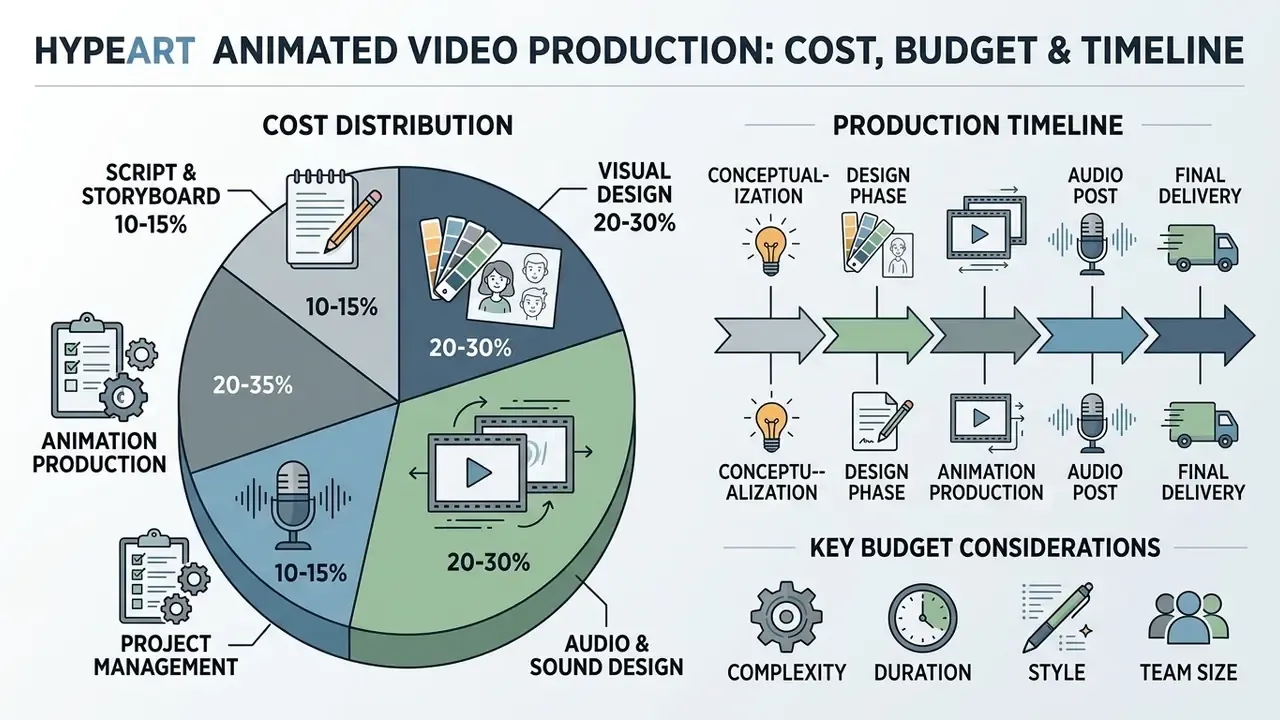
Understanding cost drivers and project scoping lets marketing and procurement leaders budget accurately for animated corporate video services. Production costs move with artistic complexity, runtime, and the depth of creative strategy required.
What Affects the Cost of Animated Video Production
«A survey of 242 explainer video production companies found a mean project cost of $10,983, a trimmed mean of $8,457 and a median of $5,400.»
The same dataset shows quotes from $600 for template-driven output to $250,000 for complex enterprise campaigns. Published pricing guides current for 2026 break the market into tiers: small-studio motion graphics from $1,000 to $4,000, professional 2D character animation $8,000 to $20,000, and 3D animation $15,000 to $50,000 plus, with a median near $9,680 for a 60-second explainer.
Public-sector procurement records give unusually transparent line-item evidence. A U.S. state commission's video production estimate priced a fully animated package at $16,055, with $2,250 allocated specifically to animation revisions and music licensing itemised separately. Another state schedule fixes $6,000 for animated videos up to 90 seconds, then adjusts longer or more complex animated videos by projected work hours, a clean demonstration that runtime and complexity are labour proxies rather than arbitrary multipliers. A third state media unit publishes a minimum production time of 7 to 10 business days for the simplest deliverables.
How to Scope a Project for an Accurate Quote and Timeline
Accurate scoping means decomposing deliverables into explicit work packages, fixing review turnarounds, and locking script requirements before animation begins. Production schedules typically span 6 to 14 business weeks, depending on asset complexity and client sign-off efficiency. Pricing and scheduling guides current for 2026 break that into 1 to 2 weeks for script and storyboard, 1 to 2 weeks for design and style frames, 3 to 5 weeks for full animation, and roughly 1 week for sound, voiceover and final delivery. Public 12-week production schedules follow the same shape: pre-production in weeks 1 to 3, production in weeks 4 to 9 or 4 to 11, post-production in weeks 10 to 12, with total budgeted costs in documented examples of £33,846 and £36,497 concentrated in production roles (production manager, character designer, key animator, computer animator).
Updated: scoping methodology. Rather than leaning on a single jurisdiction's IT procurement note, the defensible position is that public-sector scoping frameworks across domains converge on one sequence: define scope and objectives, elicit high-level requirements, decompose and group requirements into work packages, estimate effort, resources and cost, then build the schedule baseline from the decomposed items. A large-scale IT development scoping practice guide states this order explicitly; a state transport department's project development manual requires scoping to output objectives, design criteria, alternatives, a cost estimate and a schedule; and U.S. Department of Energy estimating guidance requires the work breakdown structure to decompose scope into schedule activities and work packages that can be individually scheduled, costed, monitored and controlled.
Applied to animation, that means no quote without a scene count, an asset list, a character and rig count, a revision-round limit, and a named approver per gate. If a vendor will quote without those five inputs, the number is a placeholder.
Table 3: Primary budget drivers and their quantitative impact on animated video production timelines and costs.
| Cost and Timeline Factor | Low-Budget / Template Scope | Standard Professional Scope | Enterprise / High-Fidelity Scope |
|---|---|---|---|
| Animation Style | Basic whiteboard / flat 2D templates | Custom 2D vector and motion graphics | Full 3D modeling, character rigs, mixed media |
| Script and Strategy | Client-supplied final script | Full agency scriptwriting and concept messaging | Deep audience research, multi-variant campaign scripts |
| Design Customization | Pre-made stock icons and vector scenes | Bespoke visual assets and custom brand guidelines | High-detail environments, custom UI mockups, 3D assets |
| Character Rigging | No characters or static vector cutouts | 1–2 custom characters with basic movement | Multiple complex characters with expressive lip-syncing |
| Audio and Licensing | Stock music track and automated AI voice | Single professional voiceover artist and licensed score | Multiple voice actors, custom score, global broadcast rights |
| Localisation | Subtitles only, machine-translated | 1–3 languages, professional voice and text re-render | 10+ languages, local legal review, market-specific edits |
| Revision Cycles | 1 basic revision round per stage | 2 structured revision rounds per milestone gate | Extended iterative review rounds and legal review gates |
| Typical Timeline | 2–4 business weeks | 6–8 business weeks | 10–14+ business weeks |
How to Choose an Animated Video Agency or Production Company
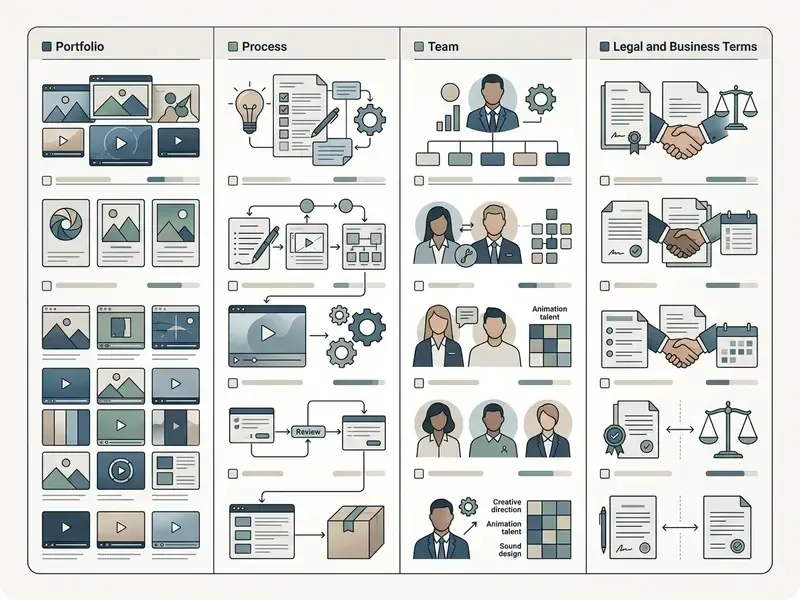
Selecting an animated video agency means evaluating creative portfolios, verifying industry domain expertise, examining project management discipline, and settling transparent contractual terms. Contracting with a verified animated corporate video company reduces both financial and legal exposure.
Market Reference: Enterprise Animation Studios Compared
Buyers rarely evaluate "an agency" in the abstract. They evaluate a shortlist. The table below summarises commonly reported entry price points, turnaround and positioning for studios that appear most often on enterprise shortlists. Figures are publicly reported ranges, not fixed rate cards. Treat every number as a starting point for a scoped quote.
Table 4: Reference comparison of frequently shortlisted animation and video production studios by reported entry price, turnaround, and best-fit use case.
| Studio | Reported Entry Price | Typical Turnaround | Style Focus | Best Fit For |
|---|---|---|---|---|
| Demo Duck | ~$15,000–$20,000 (up to $60,000+) | 6–12 weeks | 2D, 3D, live action, hybrid | Premium 2D/3D hybrid explainers for EdTech, SaaS and large enterprise |
| Yum Yum Videos | ~$6,000–$7,500 | 4–8 weeks | Hand-crafted 2D, whiteboard, motion graphics | Custom 2D with character-led storytelling; healthcare, finance, education |
| Vidico | ~$15,000 per project or ~$3,999–$7,999 per month | 4–8 weeks | Productized animation plus live action | Product videos for tech startups and scale-ups |
| Wyzowl | ~$2,500 | ~6 weeks | Productized 2D explainer | Fixed-price, scope-controlled 2D explainers; recognisable house style |
| Levitate Media | Quote-based (credit programmes on larger projects) | Project-dependent | 2D, 3D, live action, mixed media | Strategy-led programmes where format selection is part of the engagement |
| Digital Brew | Quote-based | 4–6 weeks (2D); 6–10 weeks (3D) | Premium 2D/3D explainer and motion graphics | Polished SaaS, healthcare and financial services explainers |
| Lemonlight | ~$3,500 | Weeks (on-demand model) | High-volume live action plus animation | Volume campaign content at predictable unit cost |
| Superside | ~$6,000+ per month (subscription) | Days to weeks per asset | Subscription motion and design | Always-on motion output for in-house marketing teams |
| Sandwich | ~$60,000+ | Custom (weeks to months) | Live action and product films | Flagship launch films where production value is the message |
| Thinkmojo | Quote-based (premium tier) | Project-dependent | Animation, live action, screencast | B2B tech and Fortune 500 brand video |
How to read this table. Fixed-price productized studios (Wyzowl-style) cut negotiation overhead but constrain visual differentiation. Premium studios (Sandwich, Demo Duck, Thinkmojo) justify their multiple when production value is the message. Subscription models (Superside) win on throughput for teams shipping continuous motion assets, though a single one-off video is an expensive way to start there. Many mature programmes run a hybrid: one or two flagship pieces per year with a premium studio, and a productized or in-house pipeline for everything else.
Evaluate Portfolio, Industry Experience and Client Results
Working through an animated marketing videos companies shortlist means looking past visual style to industry relevance and documented client outcomes. Reviewing case studies inside your sector confirms the team understands technical terminology and regulatory constraints. Standard portfolio-evaluation dimensions, relevance, effectiveness, efficiency, impact and sustainability, translate directly: does the case match your industry, deliverable type and project scale; is the work recent; is the process documented; and are results expressed numerically with a defined measurement period and calculation method?
A beautiful animation is not automatically an effective business video. When reviewing a reel, ask:
- Does the video make the message easier to understand, or only more attractive?
- Is the pacing controlled, and does narration carry the argument without on-screen text doing all the work?
- Does the style genuinely fit the client's brand system, or the studio's house style?
- Is there a clear narrative structure, and does the video guide the viewer toward one specific action?
- Can the studio show work at comparable complexity and inside a comparable regulatory environment?
A healthcare technology provider engaged an animated video creation agency to produce a series of patient data security videos. The agency built a clean motion graphics approach, translating HIPAA compliance requirements into clear visual summaries. The final series reduced client onboarding inquiry times by 35%. Explore enterprise commercial workflows in our AI Media Commercial-Use portal.
Check the Agency's Strategy, Team and Production Process
An experienced animated video agency keeps an integrated team structure: creative directors, copywriters, art directors, motion animators, sound designers, and dedicated project managers. If the sales conversation covers only style and never audience, distribution, measurement or maintenance, the finished video will look competent and underperform commercially.
Competency standards published by the U.S. Office of Personnel Management hold that technical production roles must be assessed with observable skill frameworks, job-related work samples, and structured scoring rubrics rather than self-declared expertise:
«Assessment of technical roles should rest on observable competencies, work samples and structured scoring rubrics, not self-declared expertise.»
Role-level standards give buyers a concrete benchmark. Published occupational standards for an Art Director (Animation and Gaming) set a minimum qualification of a graduate with 3 to 5 years of experience at NSQF Level 5, with compulsory skill units including "conceptualise creative style" and "manage the production process." Screen Ireland's art department guidance defines the art director's function as realising the production designer's and director's visual vision on set; in animation terms, owning the translation from styleframe to shipped scene. Ask which named individual holds that responsibility on your project, and ask for their work samples rather than the studio reel.
Questions to ask before signing: Who is the video for? Where will it run? What must viewers understand afterwards? What action should they take? Is this one asset or a content system? How will success be measured, and who reports it?
Red Flags: Templates, Unclear Pricing, Missing Revision Terms and Security Gaps
When evaluating an animated video company or a set of animated video making companies, watch for signals that predict delivery risk:
- Unadapted stock templates. Heavy reliance on generic stock characters and pre-made vector scenes erodes brand differentiation.
- Ambiguous revision terms. Contracts that never specify the exact number of revision rounds per milestone gate invite change orders. Standard design-contract templates fix the revision count, the surcharge for extra revisions, and the handover of source files. The absence of those clauses is the clause.
- Unclear intellectual property transfer. No explicit written assignment of visual assets, source files, and final masters.
- Undisclosed subcontracting. Agencies that outsource core animation or scripting to unvetted third parties without telling the client.
- No written order or unit pricing. Verbal scope agreements and "we'll figure out the extras later" pricing.
- No documented information-security posture. No NDA before the brief, no answer on where project files sit, no policy on AI tool usage.
Under 17 U.S.C. § 204(a) of the U.S. Copyright Code, copyright transfer requires a signed, written instrument; oral agreements do not convey exclusive operational rights. The transfer instrument should specify subject matter, scope of rights, permitted uses, term, territory, price and the handover procedure for materials.
Official guidance from Japan's Ministry of Economy, Trade and Industry animation transaction guideline requires the client to issue a written order stating the standard unit price and contract terms, to name the contracting parties correctly, and to avoid drawing unintended third parties into the agreement. New Zealand Government Procurement's syndicated buyers guide for video and filming production services requires an NDA, a signed agreement, a rate card and a Letter of Accession before direct supplier engagement. South Carolina's Risk Analysis Framework for Service Contracts adds a control most private buyers skip: pre-solicitation risk research, contract review, and documented proof that contractor insurance matches contract requirements. Review legal framework documentation in our resource on AI Litigation and Case Timelines.
Vendor Information-Security Checklist (Regulated Industries)
For banks, insurers, fintechs and healthcare organisations, the video vendor becomes a data processor the moment they receive a product roadmap, a control description or an unreleased UI.
- Signed NDA before the discovery brief , covering subcontractors and freelancers by name.
- Certification evidence ISO/IEC 27001 certification or a current SOC 2 Type II report, with the scope statement, not a logo on a website.
- Explicit AI-usage clause prohibition on uploading confidential scripts, financial data, customer material, unreleased UI or internal documentation into public generative AI tools, plus a disclosure obligation for any AI-assisted asset delivered.
- Data residency and retention where project files, raw voice recordings and review links are hosted, and the deletion timeline after final delivery.
- Access control named individuals with access, MFA on review platforms, expiring share links rather than open URLs.
- Subcontractor register every third party touching the asset, with the same obligations flowed down, mirroring the METI transparency requirement.
- Insurance verification professional indemnity and cyber cover matching contract value.
- Audit trail for compliance content versioned approvals per gate, so a regulator or an internal auditor can reconstruct who approved which claim, and when.
FAQ About Animated Video Production
Can One Animated Video Be Repurposed for Social and Multiple Platforms?
Yes. A master animated video can be systematically re-edited into platform-specific aspect ratios (16:9 for YouTube, 9:16 for mobile Shorts and Reels, 1:1 and 4:5 for social feeds), short teaser clips, and kinetic GIFs. Platform specification sheets require the same creative to be exported in separate crops or renders per placement, with distinct duration caps, which is why safe-zone planning belongs in the storyboard rather than in post. Planning for repurposing during pre-production keeps critical visual elements inside central safe zones. According to web accessibility guidance published by the U.S. Department of Energy, web-deployed animations that move, blink, scroll or auto-update must provide pause, stop or hide controls and a text equivalent, must not autoplay sound without audio controls, and must not flash more than three times in one second. For adaptive delivery, ISO/IEC 23009-1:2022 (MPEG-DASH) defines the media presentation descriptions and segment structure used for HTTP-based streaming. Calculate asset requirements using our AI Media Calculators, and plan file-size targets with our guide to video compressors.
When Is an AI Video Tool Suitable Instead of an Animation Agency?
AI video generation tools and automated templates fit low-stakes internal presentations, rapid visual concept testing, and lightweight social content where brand precision is not critical. Teams mapping that territory can start with our comparison of the best AI video generators and our overview of free AI video tools. Hiring a professional animated video maker company or animated video creation service remains the right call for high-stakes enterprise explainers, major brand campaigns, regulatory compliance modules, and any project bound to strict corporate visual identity guidelines. Organizations integrating automated video APIs can consult our technical documentation on AI Media API Guides and our implementation analysis for Google Veo AI Video Generator. Decision Matrix: AI/SaaS vs Freelancers vs Professional Agency Table 5: Production route decision matrix comparing AI/SaaS platforms, freelance producers, and full-service animation agencies.
| Criterion | AI / SaaS Platforms | Freelancers (marketplaces, referrals) | Professional Agency |
|---|---|---|---|
| Typical cost | $0–$1,000 per month (self-serve); done-for-you tiers from ~$1,000 | $500–$3,000 per project | $5,000–$50,000+ per project |
| Turnaround | Minutes to 72 hours | 2–4 weeks | 6–12 weeks |
| Customisation ceiling | Constrained by templates, stock libraries and avatar models | Depends entirely on the individual's skill and bandwidth | Fully bespoke design, rigging and sound; brand-system compliant |
| Process discipline | Self-managed; no gates unless you build them | Informal; single point of failure on illness or overload | Documented approval gates, PM ownership, QA, escalation path |
| IP and licensing clarity | Platform ToS-dependent; generated-asset ownership can be ambiguous | Contract-dependent; source files often not transferred by default | Written assignment of masters and negotiated source-file rights |
| Data security | Highest exposure: prompts and uploads may leave your perimeter | Variable; rarely certified, often personal devices | NDA, ISO 27001 / SOC 2, named access, subcontractor register |
| Best use case | Internal comms, drafts, concept tests, high-volume simple social | Low-budget hypothesis testing, single-asset needs | Hero content, brand campaigns, SaaS explainers, compliance modules |
Shadow AI and Governance Risk in Video Production
For banks, insurers and fintechs, the AI-versus-agency question is a control question, not a cost question.
- Data leakage. Pasting an unreleased product spec, a model description or customer data into a public generative tool can expose confidential material to logging and, depending on terms, to model improvement. This is the primary Shadow AI vector inside marketing and L&D teams.
- Provenance and labelling obligations. Under the EU AI Act and the associated Code of Practice, AI-generated or manipulated video content must be marked in a machine-readable, detectable form. Unlabelled synthetic assets in regulated communications create compliance exposure, not just a reputational headache.
- Ownership ambiguity. Rights in fully machine-generated frames are less settled than rights in commissioned artwork with a signed assignment under 17 U.S.C. § 204(a).
- Visual hallucination and factual drift. Generated UI, charts, medical imagery or numerical overlays can be plausibly wrong, which is unacceptable in disclosure or training content an auditor may review.
- Vendor and model volatility. Model lifecycles are short. Google's Gemini API documented Veo 3.1 as an eight-second model with native audio and video extension, while OpenAI announced a shutdown date for its Sora 2 video models and Videos API. Building a durable content pipeline on one deprecating endpoint is an operational risk.
- Required governance posture. NIST's AI Risk Management Framework and synthetic-content guidance expect documented, traceable, validated AI use with risk controls: an approved-tool list, a data-classification rule for what may never be uploaded, and a labelling standard for published output. Practical rule for regulated teams: use AI tools inside the perimeter for drafts, storyboard exploration, temp voice and internal-only assets under a written policy. Use a contracted agency with security certification and written IP assignment for anything that reaches customers, regulators or a board pack. Unresolved, and worth stating: labelling standards for synthetic corporate video are still moving, and cross-border expectations are not aligned. Treat today's policy as a version, not a settlement.
What source assets does a client need to supply before production begins?
Clients should provide vector brand assets (.AI or .EPS logos), brand style guidelines with HEX, RGB and CMYK values, licensed brand typefaces, product UI screenshots or Figma files, clear buyer personas, an approved technical glossary, mandatory legal disclaimers, and any pre-approved messaging frameworks or technical documentation. The full onboarding checklist sits in section [12].
How long does a typical 60-second animated video project take?
A standard professional 60-second animated video project usually runs 6 to 8 weeks from discovery brief to final delivery, and 6 to 14 weeks across the wider market depending on style. Budget roughly 1 to 2 weeks for script and storyboard, 1 to 2 weeks for design and style frames, 3 to 5 weeks for animation, and about a week for audio and mastering. Timelines hinge on client feedback turnaround at major gates. Add roughly one week for every additional 30 seconds of animation.
Who owns the intellectual property and source files upon project completion?
Ownership terms depend on the master services agreement. Professional agencies transfer full copyright ownership of the final rendered masters upon full payment, through a signed written instrument as required by 17 U.S.C. § 204(a). Rights to raw working source files, such as Adobe After Effects projects or 3D character rigs, must be negotiated explicitly in the contract, along with music licence territory and term.
What is the difference between corporate video and commercial video?
Corporate video serves internal and stakeholder audiences, covering training, internal communications, recruitment, compliance and customer education, where the objective is behaviour change and comprehension. Commercial video targets external consumers or buyers and is engineered for persuasion and purchase, for example OTT spots and paid social ads. Many vendors produce both, yet the production discipline, rights clearance and review process differ.
How much do revisions cost once animation has started?
Considerably more than at script stage. Public procurement estimates itemise animation revisions as a separate four-figure line inside a five-figure animated package, because a copy or sequencing change after keyframing, lip-sync and sound design can require re-animating and re-mixing whole scenes. Lock the script at the second approval gate and the storyboard at the third.
How should we budget for multilingual versions?
Treat localisation as a programme line, not an extra. Each language adds voice talent (priced per minute of finished audio, with premium talent at a multiple of baseline), on-screen text re-rendering, timing adjustment for language expansion, subtitle QA, and, for regulated content, local legal review. Design the master with text in editable layers and generous safe zones to cut per-language cost.
Who should own an animated compliance video internally?
One named owner, ideally in the control function that owns the underlying policy, with communications acting as producer rather than approver. Practically: the policy owner approves factual accuracy, legal approves claims and disclaimers, communications owns tone and distribution, and the vendor holds the versioned audit trail per gate. Ambiguous ownership here is the most common reason a compliance animation drifts out of date and quietly becomes a finding.
Technical and Commercial Resource Navigation
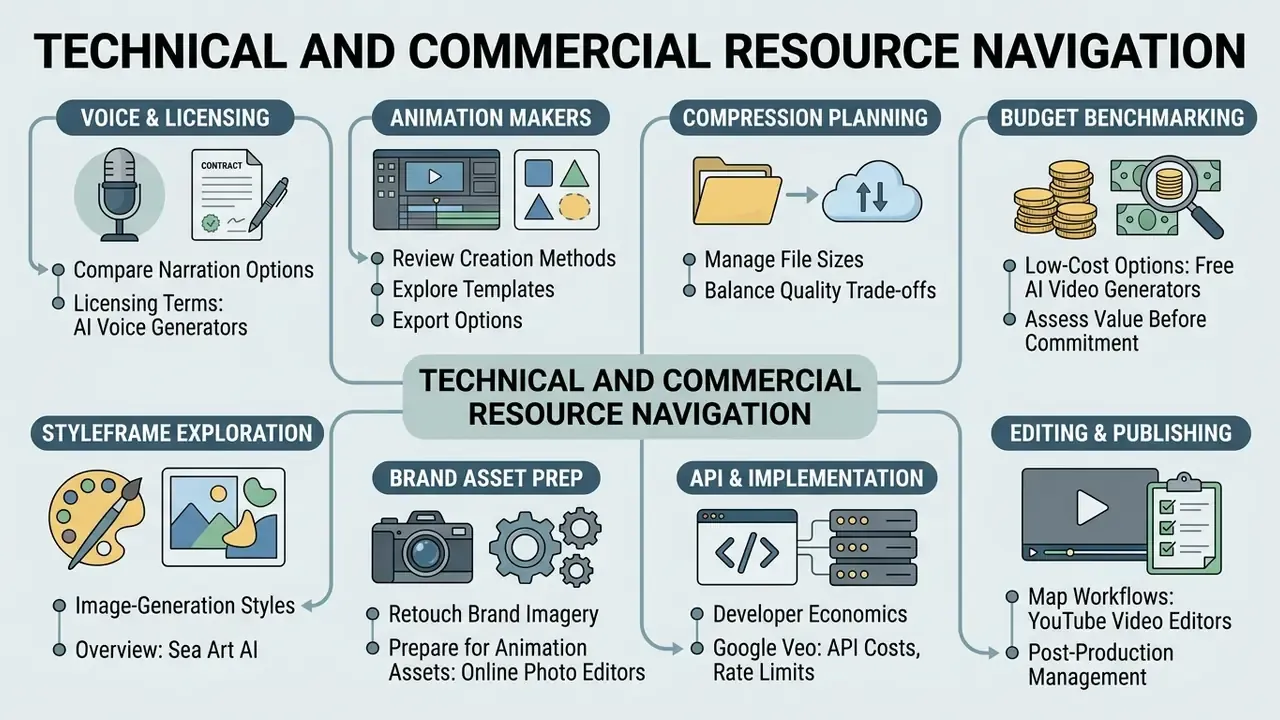
For additional technical frameworks, production workflows, and licensing guidance relevant to enterprise video programmes, explore our specialized hub resources:
- Compare narration options and licensing terms in our guide to AI voice generators.
- Review creation methods, templates and export options in our overview of animation makers.
- Plan delivery file sizes and quality trade-offs with our guide to video compressors.
- Benchmark low-cost options before committing budget with our comparison of free AI video generators.
- Map publishing and editing workflows in our guide to YouTube video editors.
- Review developer economics, API costs and rate limits in our Google Veo implementation guide.
- Prepare and retouch brand imagery for animation assets with our guide to online photo editors.
- Explore image-generation styles for styleframe exploration in our overview of sea art ai.
- Understand licensing and commercialisation constraints in our guidance on how to sell ai art.
- Review adjacent digital-distribution and rights mechanics in our guide to sell video games online.
- Access platform support and service desk guidelines via our dedicated support portal.
One-Page Brief Template: What to Send a Studio Before the First Call
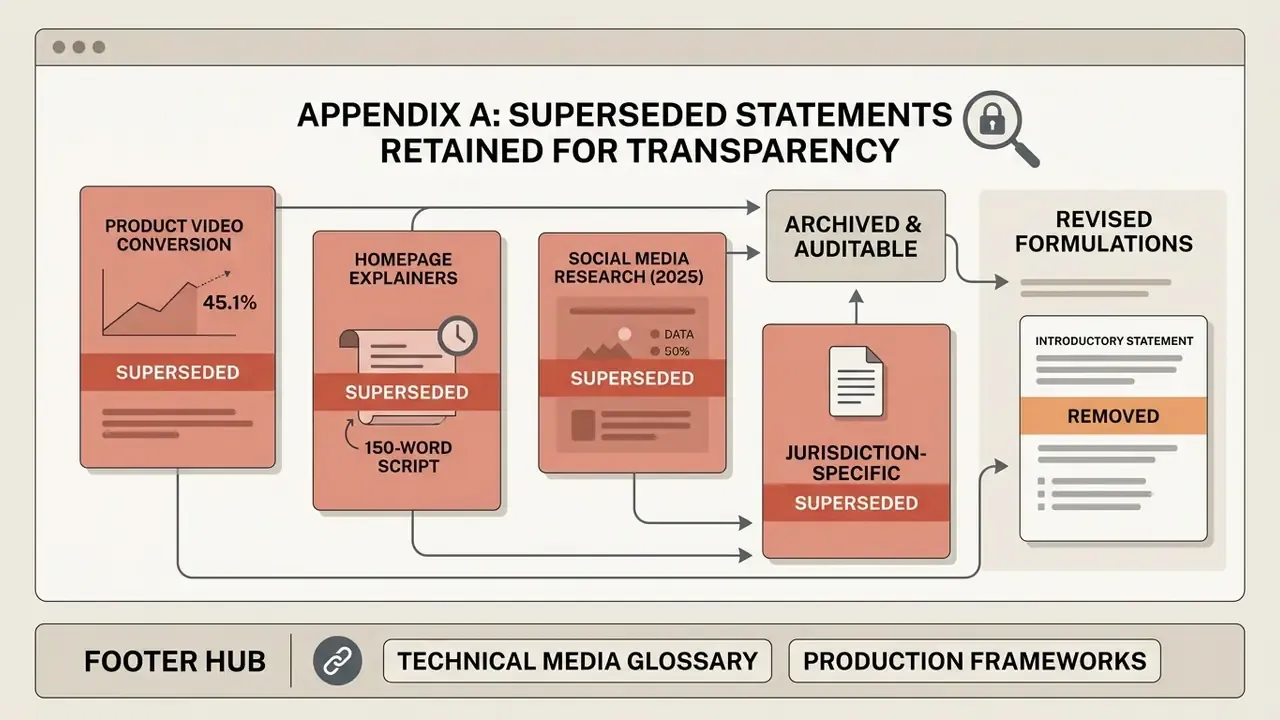
Appendix A: Superseded Statements Retained for Transparency