Last updated: September 2026 · Scope: U.S. market data (SOC 27-4032), global freelance marketplaces · Reviewed against: BLS OEWS/OOH, O*NET Online, active job postings published January to September 2026.
Executive Summary
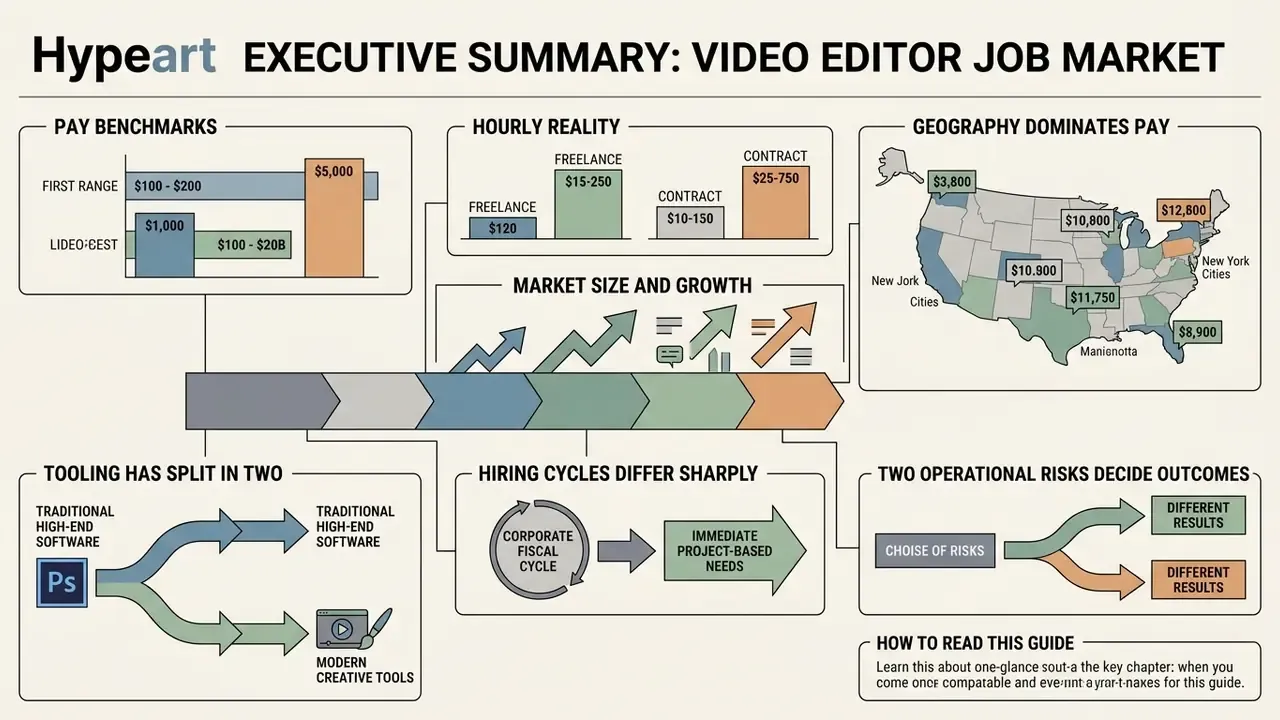
- Market size and growth. Film and video editors hold roughly 29,240 to 32,080 salaried U.S. positions. Employment for film and video editors and camera operators is projected to grow 3 percent from 2025 to 2035, producing about 5,600 openings per year. Most of that is replacement demand, not rapid expansion.
- Pay benchmarks. National median annual wage: $66,600 (OEWS, May 2023), rising to a projected $75,420 (OOH, May 2025). The distribution runs from $40,280 (10th percentile) to $148,550 (90th percentile).
- Hourly reality. Short-form and social editors bill $17 to $28 per hour; mid-level agency and digital-media editors bill $23 to $53 per hour; AI data-annotation and test-edit gigs bottom out at $1 to $2 per hour.
- Geography dominates pay. Washington, D.C. (+70.5%) and Chicago (+54.9%) sit far above the national average, while Dallas (−32.1%) and Houston (−35.9%) sit far below. California's employment location quotient is 2.98, nearly three times the national concentration.
- Tooling has split in two. Premiere Pro, After Effects, Final Cut Pro and DaVinci Resolve remain the core non-linear editing (NLE) stack. CapCut, Descript, Riverside, Frame.io, Canva and Adcreative.ai now appear as mandatory secondary tools in podcast, social and performance-ad roles.
- Hiring cycles differ sharply. Full-time: 3 to 6 weeks. Remote: 2 to 4 weeks, with SLA and file-security screening. Freelance: 1 to 2 weeks, portfolio plus a paid test edit.
- Two operational risks decide outcomes. "Ghost jobs" quietly burn candidate capacity (filter to past week, insist on posted pay bands), and ungoverned AI use exposes employers to IP leakage. See the data governance section below.
How to read this guide. The first three parts serve candidates building a search and skill plan. The later parts serve hiring managers, operations leads and risk owners who must scope roles, govern contractors and budget post-production. Both tracks share the same underlying data.
Terms used in this guide
Worth pinning these down before the numbers start moving.
- NLE (non-linear editing system). The primary timeline application: Premiere Pro, Final Cut Pro, DaVinci Resolve, Avid Media Composer.
- Mogrt. A Motion Graphics Template, an After Effects composition packaged for reuse inside Premiere Pro by an editor who does not open After Effects.
- LUT (look-up table). A colour transform applied to footage, used to normalize log camera output or to apply a house look.
- Conform. The stage where an approved cut is rebuilt at full resolution against broadcast or platform delivery specs.
- SLA (service-level agreement). The written turnaround, response window and revision cap attached to a role or contract.
- Ghost job. A live posting with no active hiring intent behind it, often reposted on a cycle and published without a pay band.
- Shadow AI. Use of unapproved public generative or transcription services on confidential material, outside any data-processing agreement.
- Location quotient. The concentration of an occupation in a geography relative to the national average. A value of 1.00 equals the national norm.
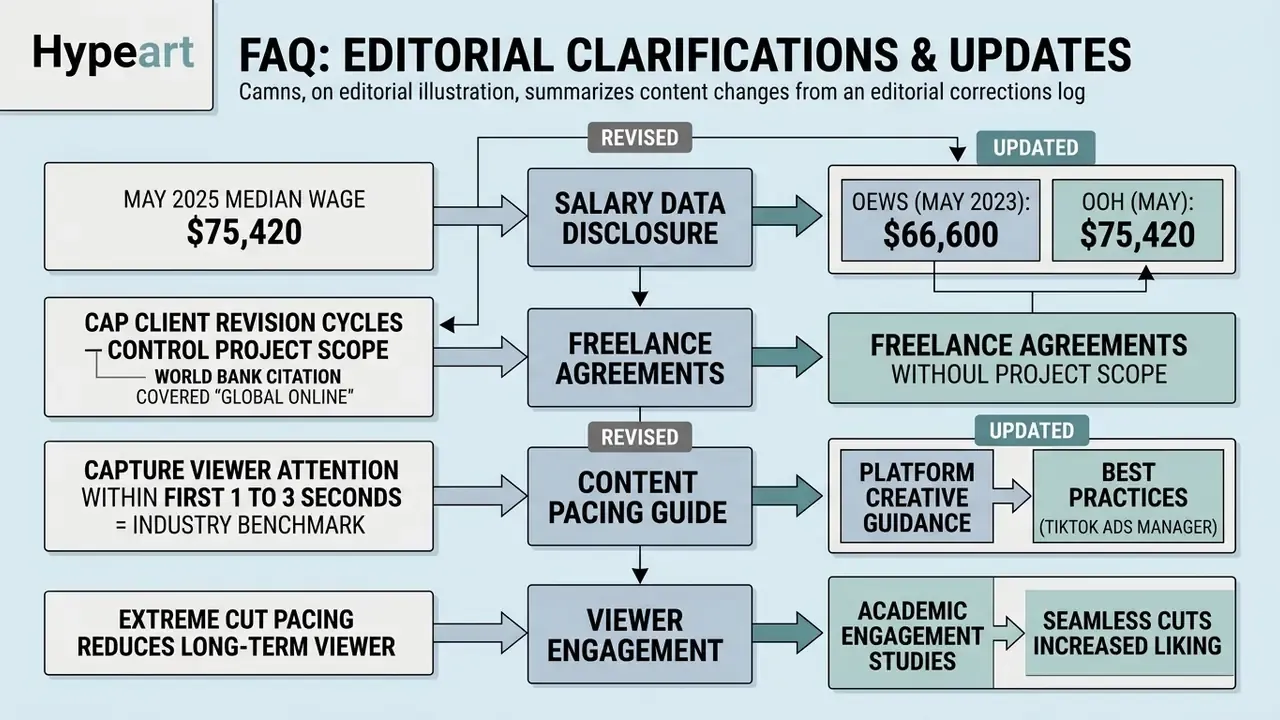
Finding a video editor job in the current media landscape means evaluating technical specialization, employment structure and market compensation across channels that behave very differently. The U.S. Bureau of Labor Statistics (BLS) estimates that film and video editors hold approximately 29,240 to 32,080 salaried positions across the United States, with a median annual wage of $66,600 in the May 2023 OEWS release and a projected median of $75,420 in the May 2025 Occupational Outlook Handbook update (Updated: the two figures come from different releases and reference dates, and should not be quoted interchangeably) [BLS 2026]. Overall employment for film and video editors and camera operators is projected to grow 3 percent from 2025 to 2035, generating roughly 5,600 annual job openings driven mostly by occupational replacement needs [BLS 2026].
Comparable pressure shows up outside the United States. In Russia, average salary offers for video editors reached 79.6 thousand rubles per month, a 45 percent year-over-year increase, which suggests short-form content demand is repricing the role in more than one market (Kommersant, 2026). Different currency, same driver: volume.
Where to find current video editor job openings
| Search Dimension | Parameter Options | Practical Interpretation for Job Seekers |
|---|---|---|
| Employment Format | Full-time, Part-time, Fixed-term Contract, Freelance | Defines whether the position includes corporate benefits, tax withholding, or project-based scope under independent contractor terms. |
| Work Environment | On-site, Hybrid, Remote (Domestic), Remote (Global) | Distinguishes roles requiring localized studio hardware access from remote pipelines requiring self-hosted infrastructure. |
| Content Specialization | Narrative/Film, Broadcast, Advertising, Social Short-form, Corporate | Matches candidate portfolio alignment with specific industry delivery specs and pacing standards. Entry-level candidates can build matching samples using free video editing software. |
| Employer Category | Studio, Marketing Agency, Streaming Platform, Corporate In-house, Individual Creator | Indicates budget stability, internal escalation paths, and expected turnaround timelines. |
| Seniority Level | Assistant / Junior, Mid-level, Senior, Post-Production Supervisor | Aligns candidate experience with baseline wage percentiles and team management responsibilities. |
One caveat that job seekers routinely miss. Official occupational taxonomies operate only at the occupation level: BLS Standard Occupational Classification 27-4032 defines "Film and Video Editors" as a single code and does not subdivide by employment format, content type or employer category. The dimensions above are marketplace tags, not regulatory categories. Useful for filtering, never a substitute for reading the actual scope of work.
Specialized and industry-specific job platforms
Beyond general-purpose aggregators (LinkedIn, Indeed, Glassdoor, ZipRecruiter, SimplyHired), landing a video editor role usually means monitoring the vertical platforms where studios, production houses and creative agencies post first:
- Film, TV and media production Stage 32, ProductionHUB, Mandy, Videopixie.
- Creative agencies and design communities Behance, Dribbble, Viedit.
- Direct freelance contracts and gig marketplaces Upwork, Fiverr, ProductionHUB.
Freelancing as a video editor is extremely common and frequently produces higher effective hourly rates, while network and broadcast staff positions usually deliver stronger benefits without guaranteed job security. Both channels reward the same two assets: a verifiable reel and a documented delivery record. Everything else is negotiation.
How to find video editor jobs in the last week and the last month
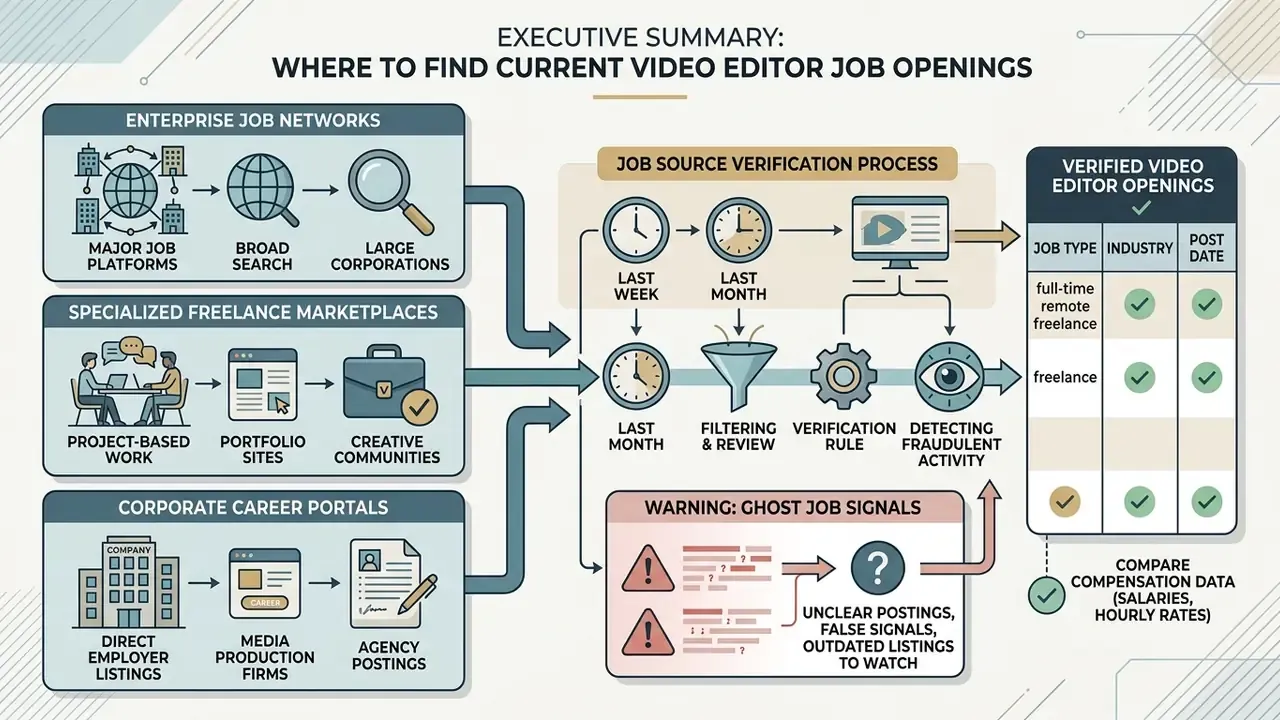
Filtering job search queries by publication date prevents candidate fatigue and improves application response rates. Enterprise job boards offer built-in parameters to isolate postings published within the "past week" or "past month". On LinkedIn, the Date posted filter exposes both windows directly in the search interface and through an editable URL parameter. Bayt.com documents an equivalent "Freshness Filter" in CV Search, and Recruit Robin exposes a "Last Updated" filter with the same presets. Appending temporal parameters straight to search URLs narrows the index to active hiring windows.
Because the national market generates roughly 100 to 120 new salaried openings per week across all US sectors [BLS 2026], a weekly checking cycle catches primary hiring windows before applicant pools overflow. Monthly checking is not useless, but by day 25 you are competing against several hundred submitted reels. Candidates comparing platform capabilities and enterprise feature matrices often consult our AI Media Comparison Matrices to evaluate automated assembly tools. When technical issues arise during platform submissions, detailed guidance sits in our AI Media Support and Troubleshooting hub.
Warning: filtering "ghost jobs"
Full-time, remote and freelance: which filters to choose
Choosing between full-time, remote or freelance video editor jobs comes down to two variables: income stability and operational independence. Full-time corporate hiring cycles typically span 3 to 6 weeks and involve multi-stage technical reviews, portfolio verification and cultural alignment interviews [BLS 2026]. Remote roles ask candidates to demonstrate asynchronous communication discipline, file security compliance and clear service-level agreement adherence. Employers screen explicitly on turnaround time, response expectations and file hygiene, and they do check.
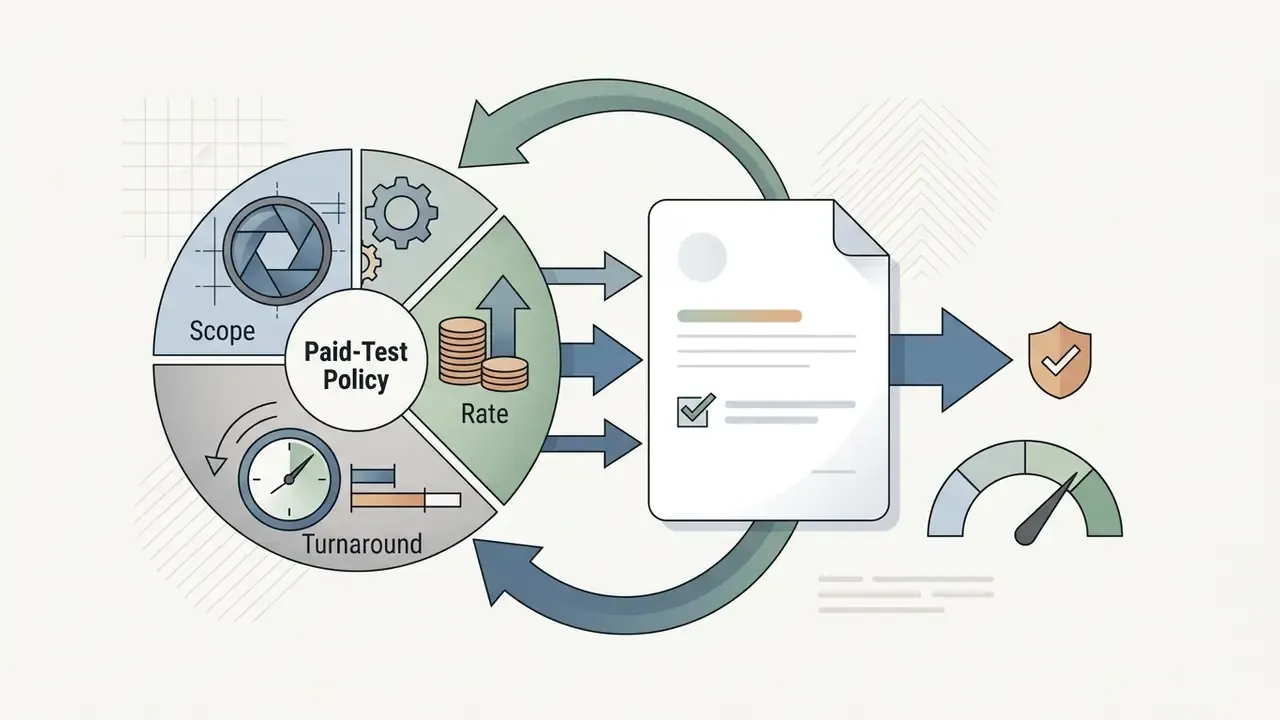
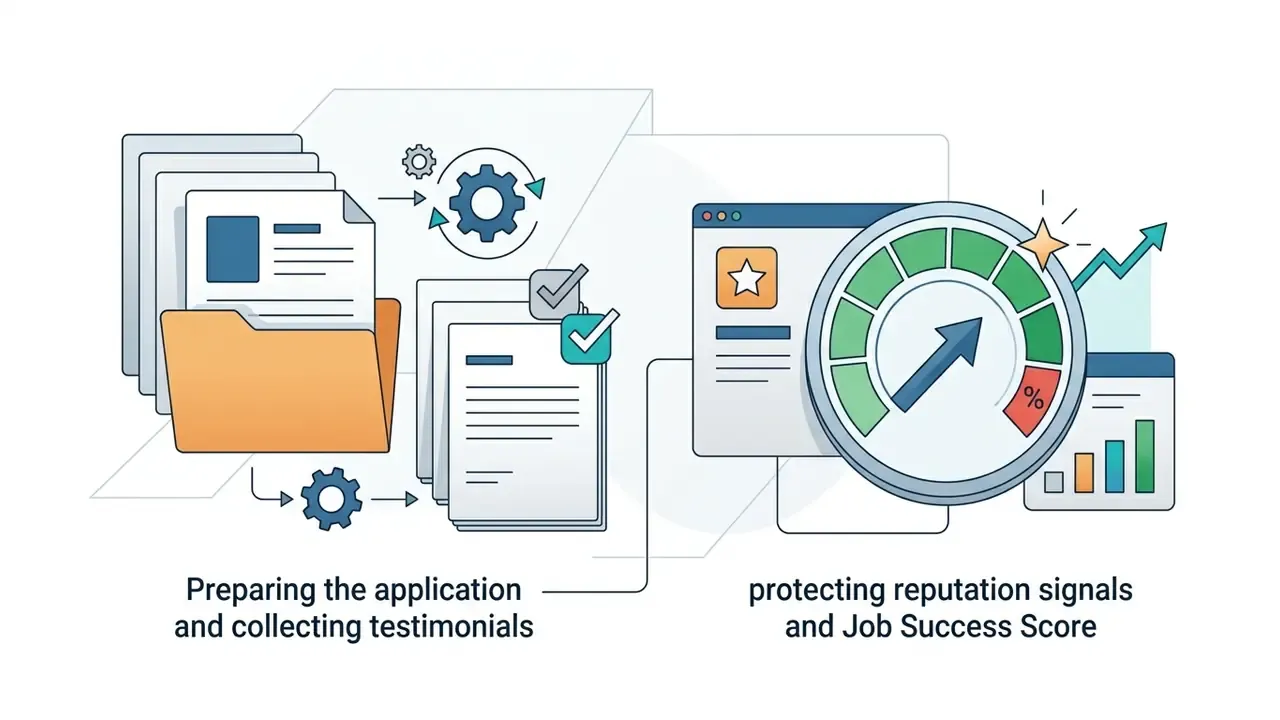
Freelance contracts trade long-term stability for speed of sourcing. Client selection cycles average 1 to 2 weeks, weighted toward portfolio quality, a paid sample edit and platform reputation signals such as Job Success Score.
Freelance agreements commonly cap client revision cycles at two rounds to control project scope and preserve margin. That is a widely reported contracting practice rather than a documented statistical norm, and the exact distribution of revision caps across contracts still needs primary survey data. Teams looking for commercial licensing standards for asset usage can review our AI Media Commercial-Use Hub, while budget modeling can be tested through our AI Media Calculators.
What the work of a video editor includes
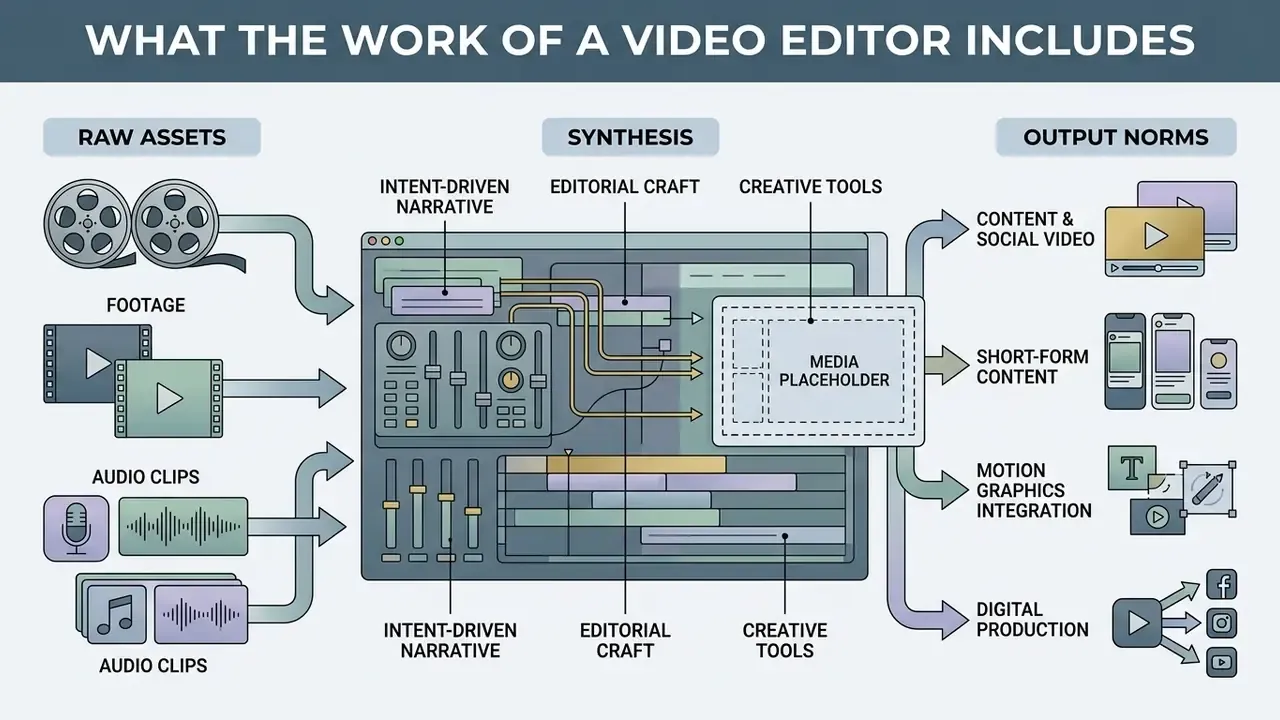
A video editor's job is the synthesis of raw audio and visual assets into a coherent, intent-driven narrative. Standard occupational tasks under SOC 27-4032 include reviewing raw footage, organizing sequence bins, executing structural cuts, synchronizing multi-track audio, performing color correction and exporting finalized master files [BLS 2026]. According to O*NET task importance metrics, working with specialized software systems carries an importance rating of 97 out of 100, while creative problem-solving rates at 93 [O*NET 2026].
Output norms. In mid-length production cycles, a staff video editor is usually expected to deliver one to two finished 5 to 10 minute videos per day, or a single polished 15 to 30 minute segment per week, depending on graphics depth and the number of revision rounds. Tight-deadline periods in film, broadcast and event coverage regularly run into nights and weekends. Scope changes should be assumed, not treated as exceptions.
Task profiles cluster by niche. Marketing editors adapt branded assets across channels and absorb stakeholder feedback. Social editors produce captioned vertical cutdowns and derivative clips from a single recording session. Media editors conform color and audio to broadcast and platform standards. Commercial production editors maintain project files, manage raw footage and prepare hand-off versions for third-party sound mix and grading. Same job title, four different weeks.
Professional post-production leans on efficient asset preparation, including reducing raw delivery overhead with tools outlined in our guide to video compressors. Editorial workflows also fold in automated transcription and research summaries via an ai summary generator to speed up narrative logging, and increasingly pair timeline work with AI video generators for B-roll, filler and concept previews.
Digital video editor, motion graphics and production
Digital video editors in commercial production handle visual composition well beyond basic sequence cutting. Responsibilities include implementing Motion Graphics Templates (Mogrts), 2D and 3D visual effects, compositing lower thirds and executing broadcast-compliant color grading. Professional suites use specialized color match systems, LUT curves and multi-wheel primary grading. Adobe documents Basic Correction, Curves, Color Wheels and Color Match as the standard shot-matching path for maintaining visual consistency across camera formats [[Adobe Help 2026]].
Audio work inside digital editing workflows covers secondary noise reduction, spectral editing, dynamic compression and dialogue normalization. Blackmagic documents Fairlight for soundtrack finishing and Fusion for in-suite visual effects, which is one reason single-suite pipelines keep gaining ground in smaller teams. Teams implementing motion elements often source scalable vector assets through an ai svg generator, generate scratch narration or localized voice tracks with an AI voice generator, and build full sequence storyboards before committing timeline resources.
Skills and software companies hiring video editors look for
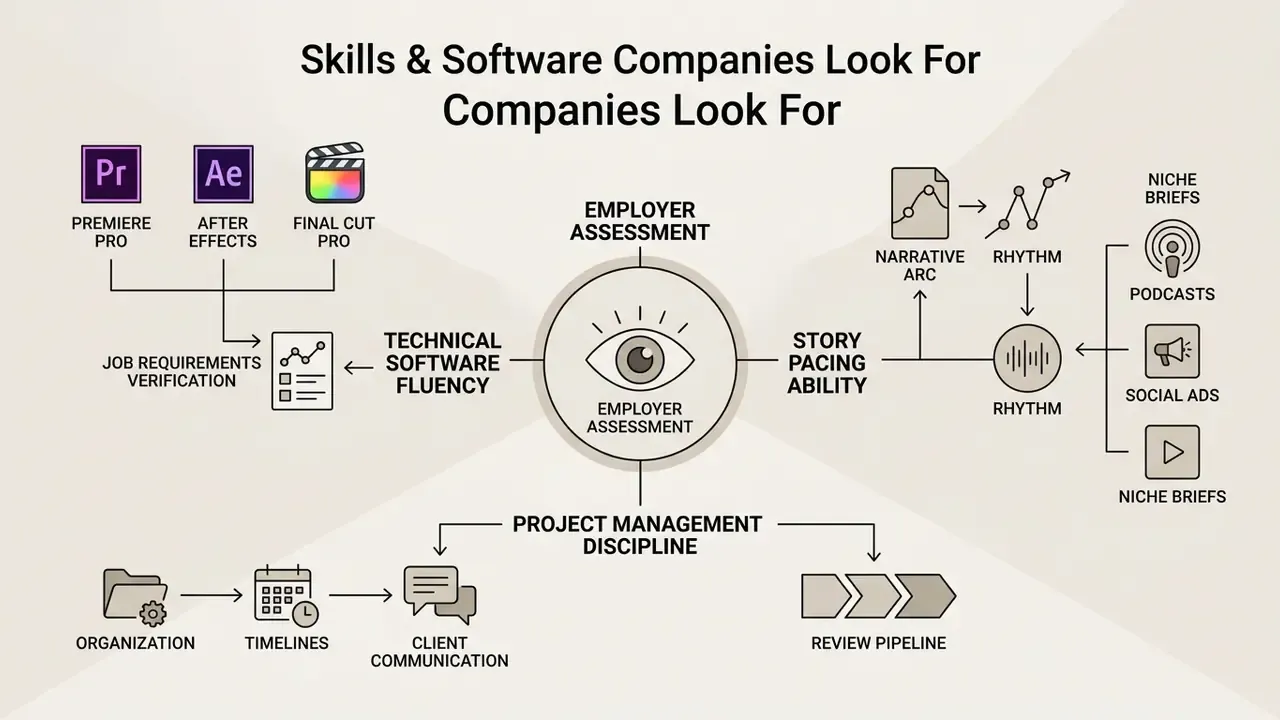
Employers hiring video editors assess three things: technical software fluency, story pacing ability and project management discipline. Primary requirements in enterprise job postings emphasize proficiency in non-linear editing software, motion graphics programs, audio workstation integration and, increasingly, emerging AI editing utilities [O*NET 2026].
Soft-skill requirements are just as explicit in 2025 and 2026 postings: storytelling judgement, collaboration with marketing and design teams, deadline management under shifting scope, and the ability to turn an ambiguous brief into clear visual output. Editors also have to absorb critical feedback that contradicts their own stylistic preference. Reputation and delivery reliability remain the two decisive career assets in both staff and freelance tracks, and neither shows up on a software list.
Requirement Verification Protocol
Developers and technical operations leads integrating automated video rendering pipelines can consult our AI Media API Guides and our technical Google Veo API implementation guide to assess scalable backend infrastructure. Creative departments building static campaign companions to video deliverables benchmark options through our comparison of the best AI art generators.
Premiere Pro, After Effects and Final Cut Pro in job requirements
Adobe Premiere Pro remains the most frequently requested primary non-linear editing system in enterprise and agency job postings. Adobe After Effects is the dominant motion-graphics requirement attached to commercial editing roles, appearing in postings that specify compositing, title design and animated typography (Updated: the previously cited "over 70% of commercial editing roles" figure is not supported by a primary source and has been replaced with a qualitative frequency statement pending a published posting-share study) [O*NET 2026]. Apple Final Cut Pro and Blackmagic DaVinci Resolve serve as robust alternatives, with DaVinci Resolve gaining adoption for native color grading and Fairlight audio post-production [[Blackmagic 2026]].
Interoperability matters as much as tool count. Premiere Pro exchanges projects with After Effects through Dynamic Link and with Final Cut Pro through XML-based project exchange, which is exactly why mixed-suite studios often hire for two NLEs rather than one.
Modern job listings increasingly cite generative AI tools as desirable secondary skills. Video creator roles frequently pair traditional NLE experience with generative platform familiarity: Runway, Kling, Veo, Midjourney, ElevenLabs. In AI-native content roles, those tools have moved from "plus" to mandatory. Candidates who want to streamline template creation often implement pre-built structures through an ai template generator. To test zero-cost generative tools before committing budget, creative leads refer to our comparison of the best free AI video generators.
Data governance, IP and Shadow AI in editorial workflows
Video post-production moves large volumes of unreleased, embargoed or personally identifiable footage: investor-relations recordings, unlaunched product footage, customer testimonials, internal training material. Once editing is distributed to remote staff or contractors, the security perimeter travels with the media files. Two failure modes dominate: uncontrolled asset distribution, and Shadow AI, meaning the use of public generative or transcription services that retain uploaded content under permissive terms.
Governance controls to specify in the role scope or contract:
- IP assignment and moral-rights waiver. Written assignment of all deliverables, project files and intermediate assets to the commissioning entity, with explicit treatment of pre-existing contractor templates and licensed stock.
- NDA with media-specific clauses. Coverage of raw footage, transcripts, unreleased scripts, thumbnails and performance data, not only "confidential information" in the abstract.
- Approved-tool list. An explicit allow-list of NLEs, transcription services and generative tools, plus a matching deny-list for consumer AI services without an enterprise data-processing agreement.
- AI-content disclosure and provenance. A required manifest of any generative asset used in a deliverable, including tool, prompt provenance where applicable and licensing terms. This matters for copyright registrability questions and advertising-claim review.
- Asset isolation and transport. Project-scoped cloud folders with expiring links, no personal storage accounts, encryption in transit and at rest, and time-bound access revoked at contract close.
- Vendor assurance. For agency and studio partners handling regulated-industry footage, request SOC 2 Type II evidence or equivalent, plus documented sub-processor lists.
- Deletion and retention. A defined retention window, certified deletion of local caches and proxies, and confirmation of removal from any AI service history.
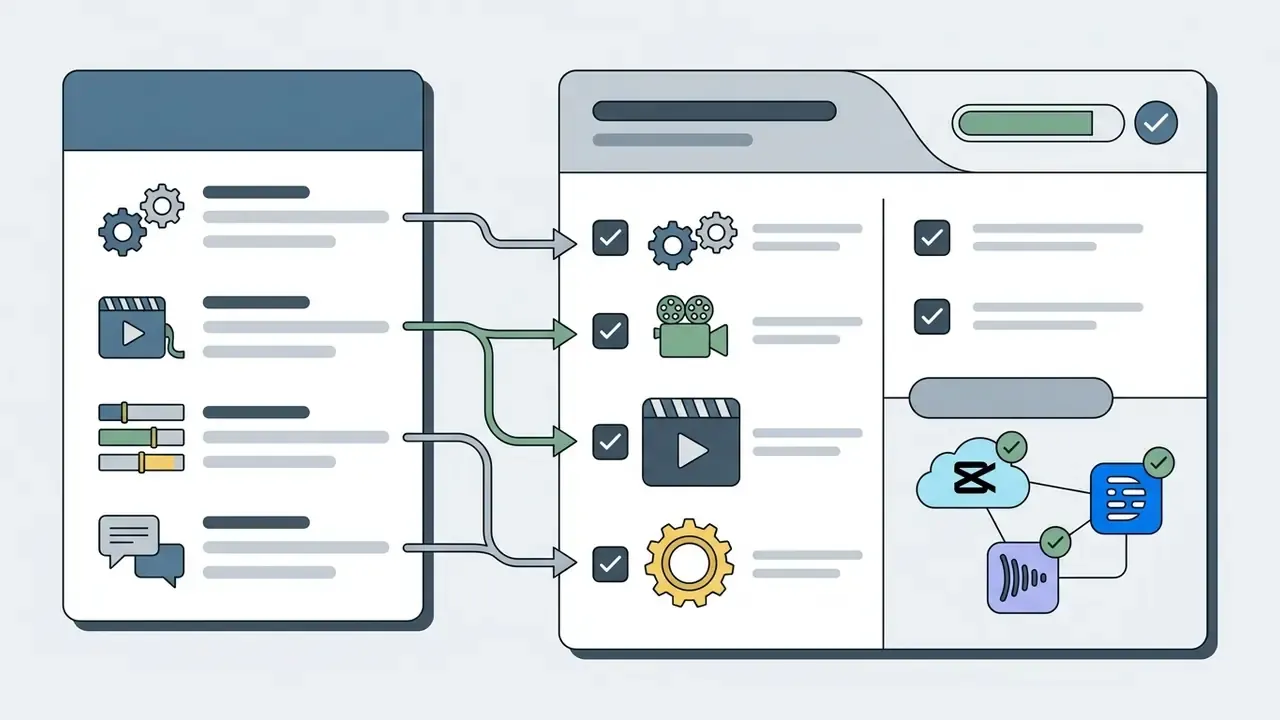
Onboarding compliance checklist for a remote or freelance editor:
- Signed NDA and IP assignment executed before any footage transfer.
- Approved-tool attestation signed, including a Shadow AI prohibition clause.
- Named review pipeline (for example Frame.io) with role-based permissions, replacing ad-hoc file sharing.
- Written SLA: turnaround per deliverable, response window, revision cap, escalation contact.
- Payment governance: milestone schedule, invoice cadence, late-payment terms, currency and tax documentation (W-9 or W-8BEN, or the local equivalent).
- Access de-provisioning date scheduled at contract start, not at contract end.
That last point looks pedantic until the first time nobody remembers who still holds a share link to unreleased footage. Legal exposure here is evolving quickly, and teams tracking copyright and training-data disputes that affect generative asset use in commercial deliverables can follow our AI Litigation and Case Timelines database.
This section describes general operational practice. It is not legal advice; contract terms, IP assignment and data-protection obligations should be reviewed by qualified counsel in the relevant jurisdiction.
Companies hiring video editors: evaluating employer and project
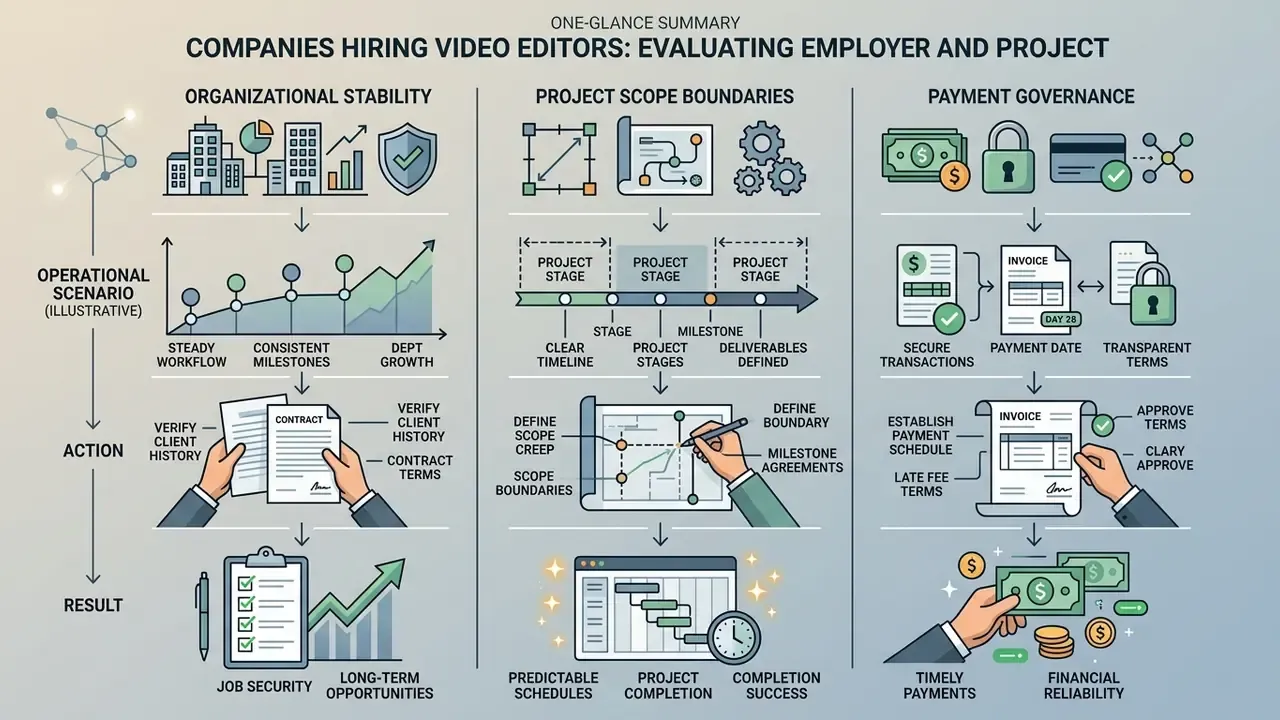
Evaluating companies hiring video editors means reviewing organizational stability, project scope boundaries and payment governance. Structured vendor-performance methodologies can be adapted as an evaluation checklist for media engagements. The U.S. Federal Contractor Performance Assessment Reporting System (CPARS), for instance, grades contract relationships across Technical/Quality, Cost Control, Schedule/Timeliness, Management and Business Relations, Subcontracting and Regulatory Compliance (Updated: CPARS is a government contracting system; its application to video-editing engagements is an analytical adaptation, not an established hiring standard). Comparable public frameworks use weighted multi-factor scoring with explicit thresholds. Newfoundland and Labrador's Contractor Performance Evaluation System, for example, treats 66 to 100 points as satisfactory, 50 to 65 as deficient and below 50 as unsatisfactory. Applying criteria of this kind helps candidates filter high-risk clients and unstable employers, and helps employers document contractor performance factually rather than by reputation.
Editors assessing an employer's technology maturity, which is a decent proxy for workflow stability, can benchmark the stack against our comparison of the best AI video generators before accepting a role that promises "AI-first" production.
| Employer Category | Primary Video Content | Typical Work Format | Primary Editor Role | Mean Compensation Range (US) |
|---|---|---|---|---|
| Motion Picture & Film Studio | Feature films, documentaries, premium streaming series | Full-time staff or long-term union contract; on-site/hybrid | Narrative assembly, pacing structure, multi-department coordination | $86,500 to $107,000+ [BLS 2026] |
| Advertising / Marketing Agency | Commercials, brand campaigns, product promo spots | Full-time agency staff or fixed project contract; hybrid | High-impact editing, motion graphics, strict brand compliance | $81,000 to $97,000+ [BLS 2026] |
| Streaming & Social Media Platform | Platform original clips, user highlights, social promo ads | Full-time staff or hybrid contract; remote options | Algorithmic retention optimization, fast-turnaround cutting | $78,000 to $82,500 [BLS 2026] |
| Corporate In-house Team | Internal communications, training, investor relations | Full-time corporate staff; remote/hybrid options | Clear information presentation, brand consistency maintenance | $59,000 to $100,000+ [BLS 2026] |
| Individual Creator / Small Studio | YouTube series, TikTok clips, educational courses | Freelance contract or per-gig basis; fully remote | End-to-end post-production, thumbnail design, audio clean-up | Variable per project [World Bank 2023] |
When assessing legal obligations, copyright disputes and intellectual property terms in digital media contracts, team managers reference our AI Litigation and Case Timelines database. For static visual branding and thumbnail production attached to video deliverables, teams consult our online photo editors guide.
Video editor salary, hourly rates and application preparation
The information in this section is general in nature and does not replace consultation with a qualified employment-law or tax-planning professional. Compensation figures are market benchmarks, not offers or guarantees.
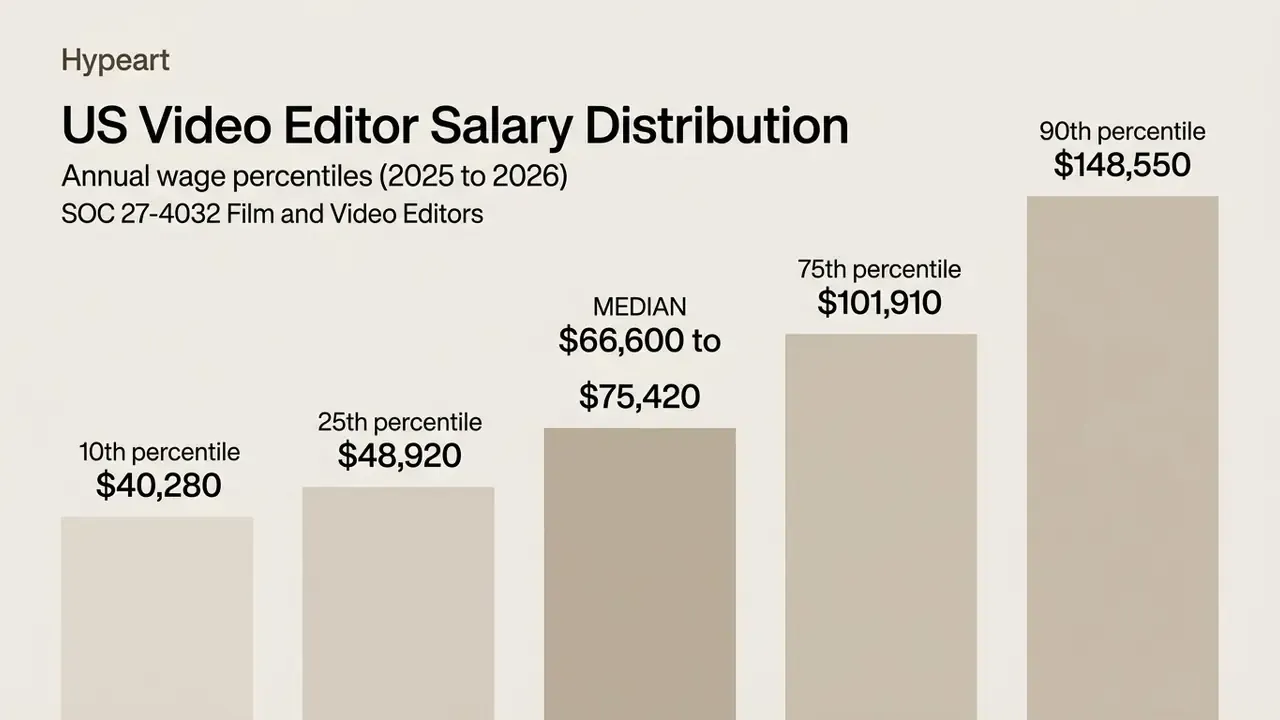
Compensation for video editor jobs varies sharply by industry sector, geography and professional experience. According to official BLS data, the national wage distribution for film and video editors spans from the 10th percentile at $40,280 to the 90th percentile at $148,550, with a national median annual wage of $75,420 in the May 2025 OOH update [BLS 2026].
By seniority, 2026 market summaries place assistant and junior editors at roughly $39,000 to $52,000, mid-level editors at $50,000 to $75,000, and senior editors and post-production supervisors at $80,000 to $120,000 and above, with freelance and remote bands wider at both ends. Mind the methodological difference: BLS reports an occupation-wide national distribution, while job-site aggregates segment by self-reported experience level. The two will rarely agree exactly.
Hourly rates by project type
For fixed-scope and gig contracts, market hourly rates cluster into three tiers:
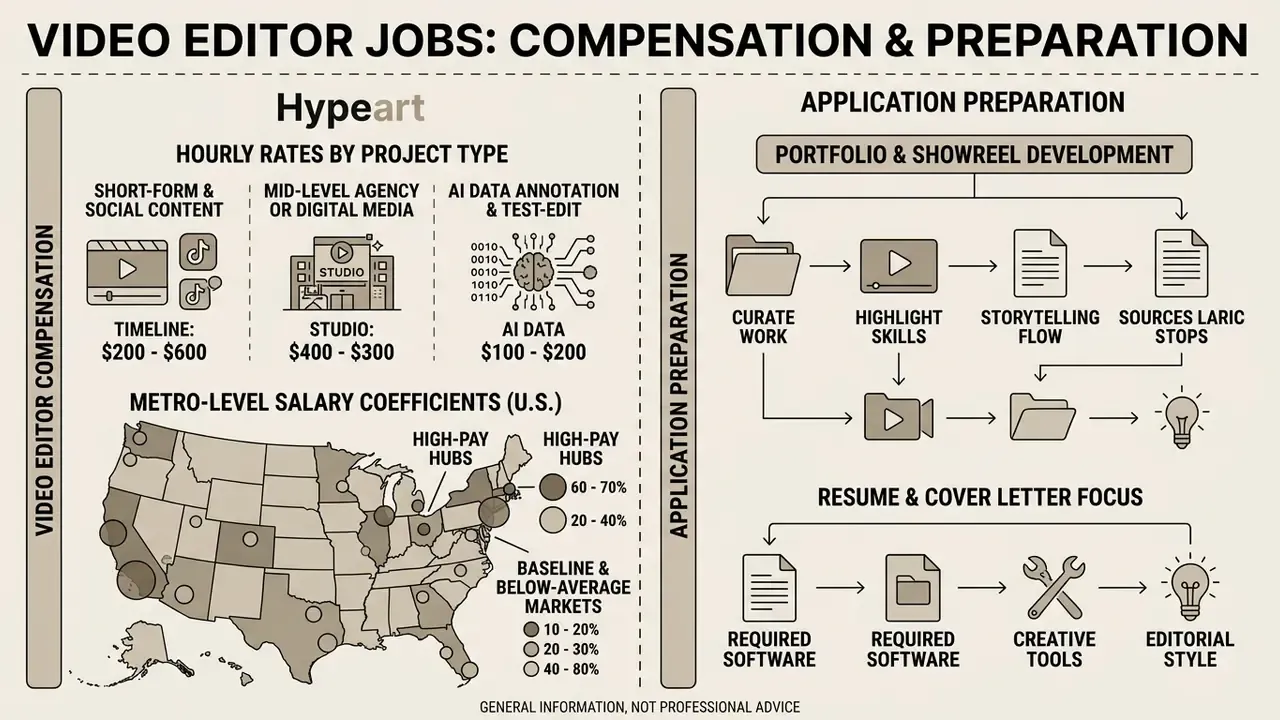
- Short-form and social content editor $17 to $28 per hour (TikTok, Reels and Shorts cutting, captioning, trend-driven pacing).
- Mid-level agency or digital media editor $23 to $53 per hour (commercial video, corporate storytelling, motion graphics, multi-platform versioning).
- AI data annotation and test-edit work $1 to $2 per hour (baseline labeling and validation of video sets for AI model training).
Monthly contract retainers show up too. Contract editors producing social, advertising and marketing cuts for education and mid-market brands have been posted at roughly $2,000 per month, while senior in-house content and video managers reach $125,000 to $130,000 per year. Same craft, an order of magnitude apart in price. The difference is usually ownership, not keystrokes.
Metro-level salary coefficients across the United States
Employer or studio headquarters location produces substantial variance against the national median of $75,420:
- High-pay hubs Washington, D.C. at $128,000 per year (+70.5%); Chicago, IL at $116,000 (+54.9%); Orange County, CA at $94,000 (+25.3%); New York City, NY at $83,000 (+10.3%).
- Baseline and below-average markets Los Angeles, CA at $64,000 (−14.5%); Fairfax, VA at $64,000 (−15.2%); Alexandria, VA at $60,000 (−20.1%); Miami, FL at $56,000 (−25.5%); Dallas, TX at $51,000 (−32.1%); Houston, TX at $48,000 (−35.9%).
State-level BLS means confirm the same directional spread:
- California: mean annual wage of $101,600 (location quotient 2.98) [BLS 2026]
- New York: mean annual wage of $107,160 (location quotient 2.71) [BLS 2026]
- Florida: mean annual wage of $61,490 [BLS 2026]
- Texas: mean annual wage of $56,040 [BLS 2026]
Metro averages and state means can diverge, and here they do. Los Angeles sits below the national metro average while California's state mean sits well above it, because state figures absorb high-paying studio and streaming employment across several counties. Read both numbers before relocating.
Comparing pay with adjacent post-production roles
| Specialization | Median income (US) | Key difference in stack and tasks |
|---|---|---|
| 3D Animator | $85,000 to $88,000 | Three-dimensional animation, character rigging (Maya, Blender) |
| Motion Graphics Designer | $73,000 to $77,000 | Complex 2D and 3D motion design and compositing (After Effects, Cinema 4D) |
| Video Manager / Producer | $73,000 to $76,000 | Ownership of shoot process, pipeline, vendors and budget |
| Video Editor (SOC 27-4032) | $75,420 | Rough and fine cut, narrative structure, color correction, audio |
| 2D Animator | $56,000 to $68,000 | Vector 2D animation and storyboarding (Animate, Illustrator) |
| Graphic Designer | $57,000 to $61,000 | Static brand, print and web assets; supports video graphics packages |
For employers, that comparison cuts two ways. A motion-graphics hire costs roughly the same as an editor but does not cover narrative assembly, while a video manager replaces coordination overhead rather than timeline hours. Hiring the wrong one of the three is an expensive way to learn the distinction.
Total cost of engagement: full-time versus freelance
Headline salary understates true cost on both sides. A full-time in-house editor adds employer payroll taxes and benefits, Creative Cloud or Resolve Studio licensing, a color-accurate workstation and display, storage and backup capacity, and cloud review seats. A freelance engagement shifts those costs to the contractor, who must price them into an hourly rate alongside client acquisition time, contract administration and self-employment tax. In exchange, the employer picks up procurement overhead, onboarding time and governance controls. Neither structure is cheaper by default; the deciding variable is usually annual volume. Budget models comparing the two can be tested through our AI Media Calculators.
Preparing the application
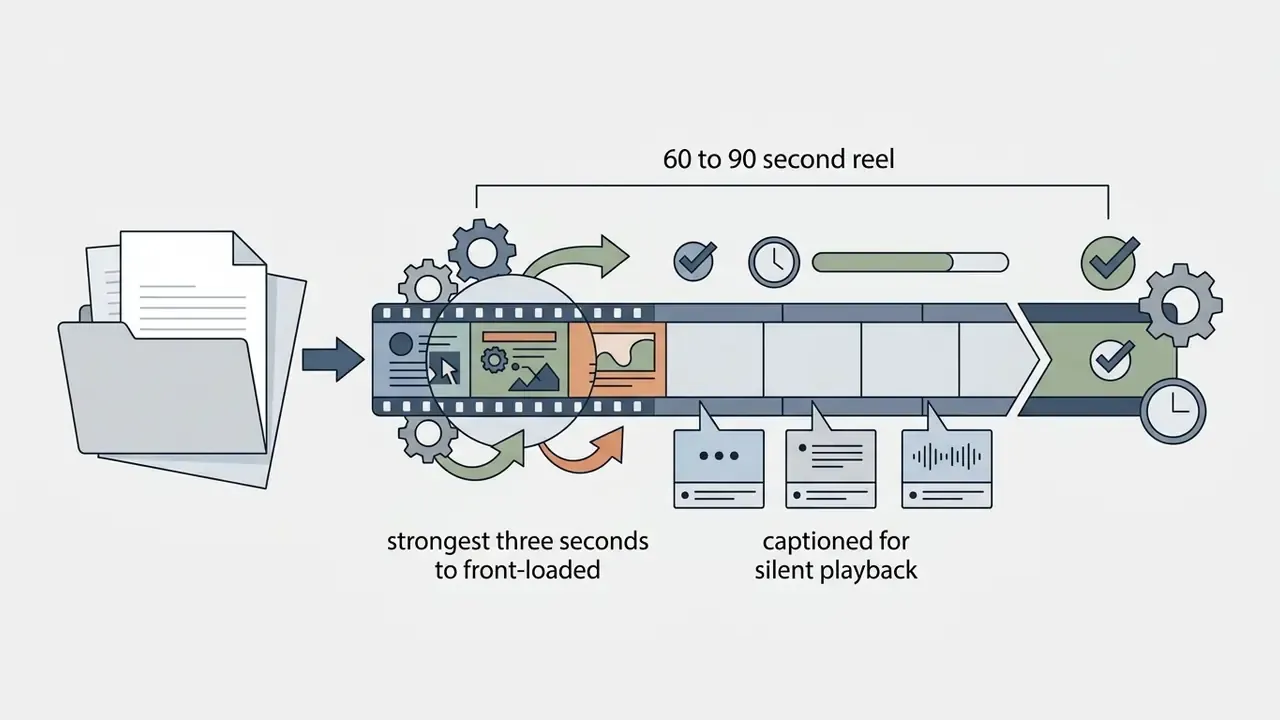
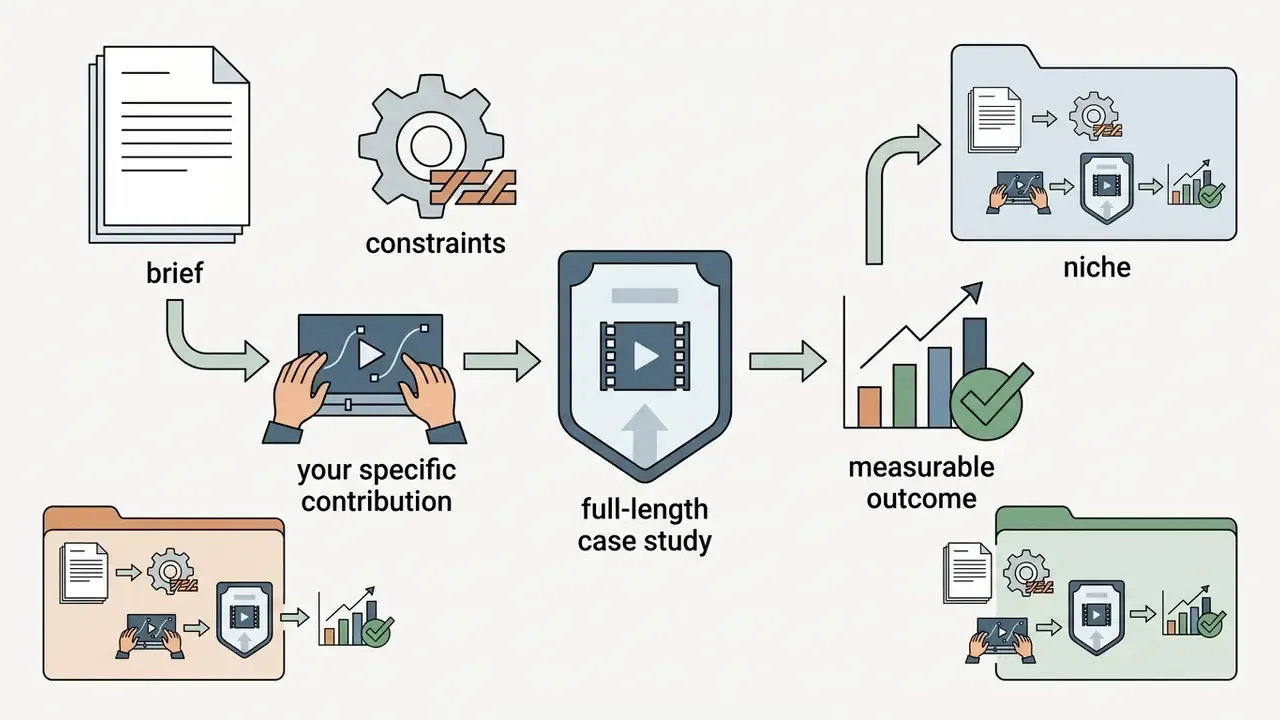
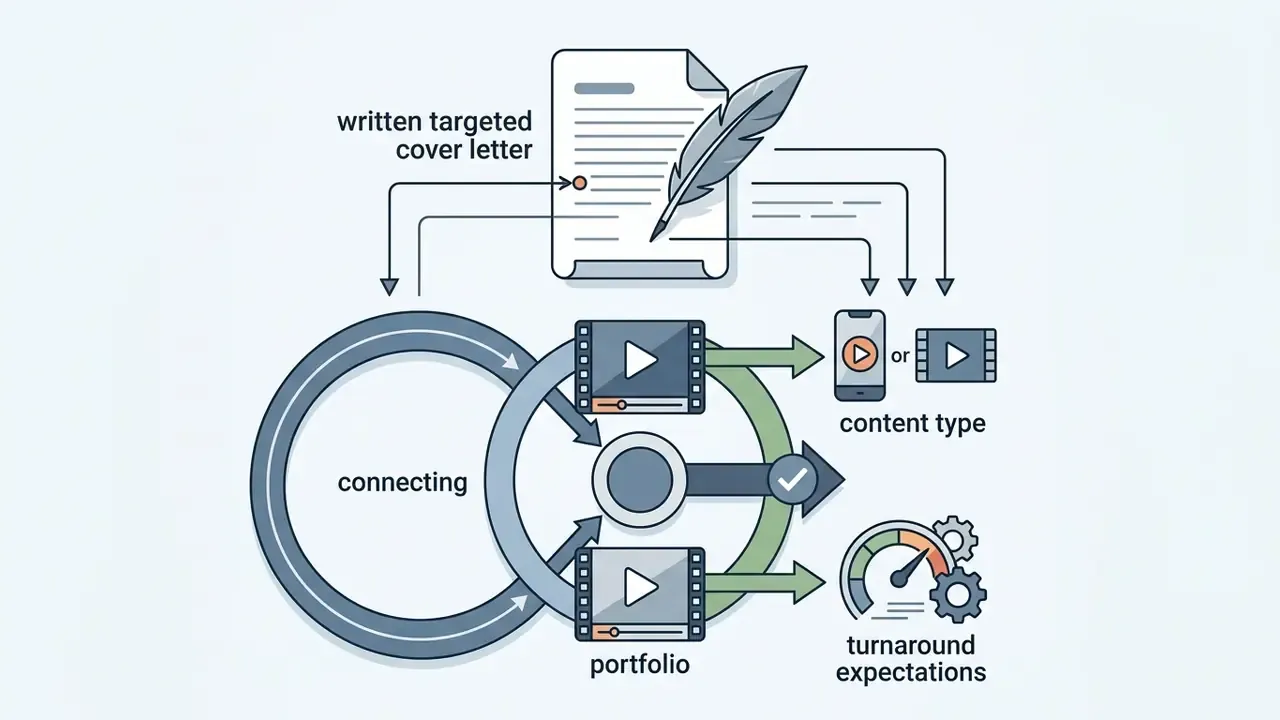
An effective application for a video editor position needs three parts: a concise portfolio demo reel of 60 to 90 seconds, role-specific project breakdowns, and a targeted cover letter that names your technical tool mastery. Candidates without paid software access can still assemble a competitive reel using our free video editing software comparison, and can extend the skill profile with text-to-video AI tools that now appear in AI-native content roles.
One correction to a habit I see constantly: candidates lead with their most cinematic frame instead of their most relevant one. For a performance-ads role, the boring converting cutdown beats the drone shot every time.
Candidates looking for broader terminology definitions and technical reference guides can explore our complete platform glossary.

FAQ: Frequently asked questions about video editor jobs
What is the average video editor salary in the United States?
According to U.S. Bureau of Labor Statistics data, the median annual wage for film and video editors is $75,420 in the May 2025 OOH update, and $66,600 in the May 2023 OEWS release. Entry-level positions at the 10th percentile start around $40,280, while senior editors in high-paying sectors such as film studios and advertising agencies earn above $120,000, up to $148,550 annually [BLS 2026].
Is a specialized degree required to work as a video editor?
A bachelor's degree in film, broadcasting or digital media is preferred by traditional media corporations and studios [BLS 2026]. In agency, freelance and social media editing roles, though, practical portfolio proof, technical proficiency in non-linear editing software and a high-quality demo reel carry equal weight. A high-school diploma is the common baseline requirement, and a meaningful share of 2026 postings are explicitly marked "no degree required".
Which software appears most often in job postings?
Adobe Premiere Pro and Adobe After Effects are the most consistently requested tools in enterprise and agency job listings [O*NET 2026]. Apple Final Cut Pro and Blackmagic DaVinci Resolve are widely recognized alternatives, with DaVinci Resolve showing strong growth for professional color grading workflows. Secondary tools now appear almost as often in digital-media roles: CapCut, Descript, Riverside, Frame.io, Canva and Adcreative.ai.
What is the difference between full-time and freelance video editing?
Full-time roles offer steady salary, healthcare benefits and corporate infrastructure, but involve a structured hiring process lasting 3 to 6 weeks. Freelance video editor gigs provide schedule autonomy and higher hourly billing rates, at the cost of ongoing client acquisition, contract management and personal tax filings.
"Algorithmic management on content marketplaces produces income volatility and limits workers' ability to contest platform-set terms."
Source: SSRN Working Paper, Content Marketplaces as Digital Labour Platforms (2023). https://www.worldbank.org/en/topic/digitaldevelopment
What hourly rate should a video editor quote?
Benchmark against project type rather than seniority alone: $17 to $28 per hour for short-form social cutting, $23 to $53 per hour for agency and digital-media commercial work, and premium day rates for broadcast and narrative finishing. AI annotation and test-edit gigs at $1 to $2 per hour should be treated as data work, not editing work.
How do I tell whether a video editor posting is real?
Prioritize listings under seven days old that publish a pay band, appear on the employer's own careers portal and name a specific content type and toolset. Treat repeated reposts, missing compensation data, postings older than 30 days without updates and a published ghost score above 60% as reasons to deprioritize.
What should employers require from a remote editor handling confidential footage?
A signed NDA with media-specific clauses, written IP assignment covering project files and intermediate assets, an approved-tool attestation prohibiting public AI services without a data-processing agreement, project-scoped storage with expiring access, a generative-asset disclosure manifest, and a certified deletion step at contract close.
Appendix A: Editorial corrections log