Evaluating whether a video file is synthetic or authentic requires a systematic approach rather than reliance on single visual glitches. As generative diffusion architectures like OpenAI's Sora, Google's Veo, Runway, and Kling advance, low-level visual artifacts become harder to spot. Understanding which AI video generators exist, and how each architecture fails, is the first step toward interpreting forensic evidence correctly. Determining if a video is AI generated requires combining cryptographic provenance checks, forensic frame inspection, temporal motion analysis, audio-visual synchrony evaluation, and automated detection tools.
Last updated: 2026. Reviewed for alignment with NIST AI 100-4, C2PA 2.4, and current published detection benchmarks.
How to Tell If a Video Is AI Generated: A Quick Verification Workflow
To verify whether a video is AI generated, follow a structured six-step forensic workflow starting with source validation and ending with cross-detector evaluation. Relying on a single visual anomaly leads to high false-positive rates, because digital compression, social media re-encoding, and editing software produce artifacts that mimic synthetic generation. A standardized verification pipeline ensures that every video file undergoes rigorous, repeatable testing before an analytical verdict is reached.
That repeatability is the part auditors ask about. Not the glitch you noticed.
Here is how to detect AI generated videos in a defensible order:
- Intake and Cryptographic Hashing: Secure the raw video file, preserve original bitstreams, and compute SHA-256 cryptographic hashes to establish chain of custody. U.S. Department of Defense guidance on deepfake threats instructs analysts to duplicate media before analysis and hash both the original and the working copy, making evidence integrity the first controlled step after intake.
- Provenance and Source Analysis: Trace the original upload link, examine C2PA metadata, and extract visible or steganographic watermarks.
- Frame-Level Visual Forensic Review: Inspect detected facial regions, ocular symmetry, hand anatomy, and background text rendering across individual frames.
- Kinematic and Physics Inspection: Evaluate spatio-temporal continuity, momentum conservation, gravitational acceleration, and object boundary transitions.
- Audio-Visual Synchrony and Spectral Checks: Compare acoustic formants against vocal articulation and verify frame-accurate lip-sync alignment.
- Automated Neural Detection and Synthesis: Run multi-model AI video detectors, aggregate confidence scores, and reconcile model output against physical evidence.
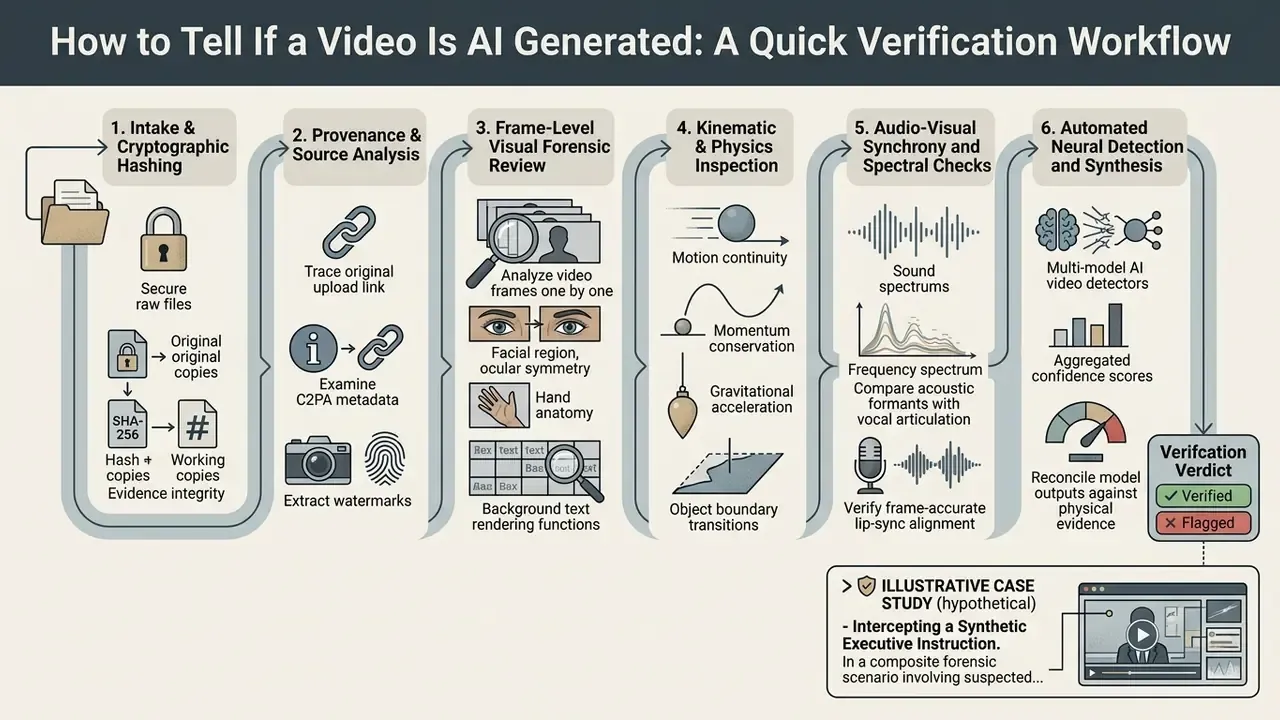
⚑ ILLUSTRATIVE CASE STUDY (hypothetical) - Intercepting a Synthetic Executive Instruction
In a composite forensic scenario involving suspected deepfake executive communications, an enterprise risk team intercepts a high-risk video file circulated on social channels. The team hashes the media file immediately to preserve forensic integrity, cross-references C2PA provenance manifests, and runs a frame-by-frame spatio-temporal optical flow analysis.
Outcome: facial textures look photorealistic under casual review, yet temporal inter-frame volatility and phase-coherence anomalies in the voice track expose synthetic speech synthesis. The finding is logged with hash values, detector confidence bands, and analyst annotations, preventing an unauthorized payment and producing an auditable evidence package for the second-line risk function.
This scenario is illustrative and does not describe a real client engagement.
Start With the Original Video File or Source Link
Verification must always begin by acquiring the original video file or locating the earliest upload link across social media platforms. Social media networks apply aggressive lossy compression algorithms, downsampling, and re-encoding routines during upload. These platform pipelines systematically strip original EXIF and C2PA metadata while creating compression artifacts that confuse both human analysts and automated systems.
According to Interpol's Global Guideline - False Facades (2026), source verification performs three indispensable functions in digital forensics: gatekeeping, contextualizing, and corroborating evidence. Securing the highest-resolution raw video file ensures that subtle spatial noise patterns, optical flow vectors, and cryptographic signatures remain intact for forensic processing.
Classic open-source verification methodology reinforces the same discipline: establish provenance, source, date, and location before any model-based analysis. Practically, that means locating the earliest upload using keyword and date filtering, comparing thumbnails across reposts, and cross-checking the claim against official channels. SDAIA's Deepfakes Guidelines (2026) mandates the same sequence, requiring verification of source trustworthiness and context before a detector is ever executed.
One small habit pays for itself: ask the sender for the file, not the link. Two minutes of friction, far better evidence.
Combine Manual Review With AI Video Detection
An accurate verdict requires pairing human forensic inspection with automated AI video detector software. Controlled behavioral testing shows that unaided human judgment sits close to coin-flip territory on realistic material.
«Participants reached only 65.64% overall accuracy on a structured audiovisual deepfake task, marginally above chance.»
A 2024 systematic review of human deepfake detection reached a convergent conclusion: accuracy improves measurably when reviewers receive AI-based decision support and feedback training, and the improvement is strongest for video stimuli rather than still images. In other words, the human plus model ensemble, not either component alone, is the operative unit of reliability.
Automated tools excel at identifying high-frequency pixel anomalies, mathematical second-order inter-frame differences, and unnatural spectral distributions that are invisible to the naked eye. Human analysts, conversely, excel at contextual reasoning, situational logic, and spotting physical law violations. Combining manual review with neural classification minimizes both false positives and false negatives.
A repeatable hybrid procedure, as documented in 2025 forensic practice, looks like this:
- Manual frame-by-frame inspection with timestamped annotations and comparative screenshots.
- Automated detector execution across at least two independent model families.
- Reconciliation: where frame-level labels conflict, derive the clip-level verdict from aggregated frame labels and retain an explicit "inconclusive" category rather than forcing a binary answer.
That third step is where most teams quietly cheat. Resist it. An honest "inconclusive" protects the institution better than a confident guess.
Visual Signs That a Video May Be AI Generated
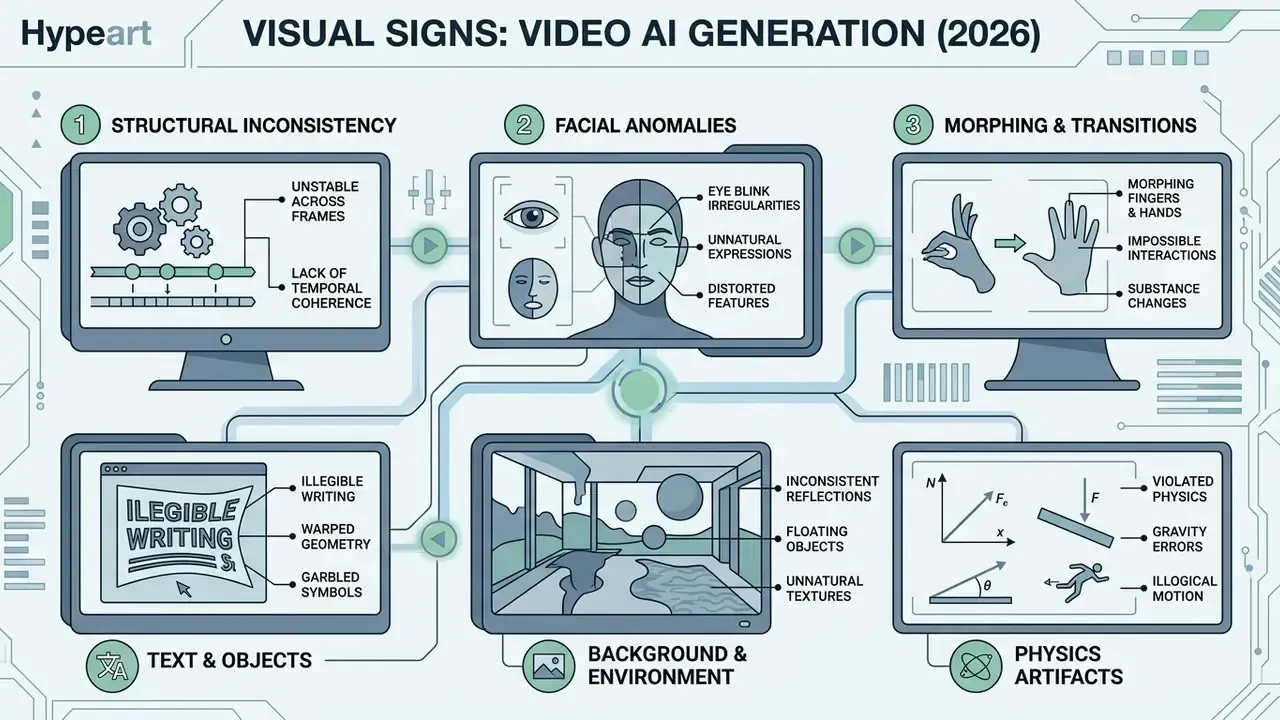
Visual anomalies in synthetic media occur when generative neural networks fail to maintain structural consistency across spatial and temporal domains. Key visual indicators include unnatural facial dynamics, warped background details, distorted text rendering, and impossible physical object interactions. These are also the fastest cues for anyone learning how to spot AI generated videos without specialist software.
Check Faces, Eyes, Expressions and Hands
Facial features and human hands remain primary weakness areas for video generation models. Neural networks often generate static micro-expressions, asymmetrical gaze directions, or irregular blinking dynamics. Early research by Li et al. (In Ictu Oculi, 2018) highlighted missing or abnormal eye-blinking dynamics as a core marker of synthetic face generation. Modern generative systems have improved blink generation, yet fine-grained temporal micro-expressions and ocular catchlight reflections still show inconsistencies under frame-by-frame inspection.
«Participants struggled to identify the specific manipulation type: when they perceived a video as fake, they frequently attributed it to visual rather than acoustic artifacts.»
That asymmetry matters operationally. Reviewers over-weight the face and under-weight the soundtrack, which is precisely why the audio branch of the pipeline must be executed independently rather than "by feel". Complementary work on head-pose inconsistencies (Exposing Deepfakes Using Inconsistent Head Poses, ECCV 2018) showed that face-swap pipelines leave the synthesized face and the original head motion physically misaligned, a cue still visible in modern low-effort forgeries.
Hand anatomy presents severe geometric challenges for generative models. Key physical indicators include:
- Incorrect digit counts (six fingers, missing thumbs).
- Unnatural joint articulation and impossible knuckle bending angles.
- Hands fusing into held objects or disappearing into clothing pockets during motion.
- Fingers warping or changing length across sequential frames.
Rings, watches, and manicures drift too. Jewellery that changes shape between frames is one of the cheapest tells available to a reviewer with a scrub bar.
Look for Distorted Text, Objects and Background Details
Generative video models process text and background details as spatial pixel patterns rather than symbolic glyphs or structured 3D environments. Consequently, on-screen text in synthetic videos typically displays malformed characters, shifting fonts, or unreadable gibberish.
As documented in Simple Visual Artifact Detection in Sora-Generated Videos (2025), background details in synthetic clips frequently exhibit spatial-temporal drift. The same paper organizes artifacts into four operational labels: boundary and edge defects, texture or noise issues, movement and joint anomalies, and object mismatches or disappearances. Those four labels map cleanly onto a triage checklist. Many of these defects are most pronounced in output from free AI video generators, where shorter sampling schedules and lower latent resolutions amplify texture and boundary failures.
Look closely at background architecture, vehicle license plates, window frames, and fine background textures. In authentic videos, background elements maintain structural integrity when the camera pans. In AI-generated videos, background patterns often "swim", warp, or spontaneously alter their geometry. GeneVA: A Dataset of Human Annotations for Generative Text-to-Video Artifacts (2025) catalogues exactly this class of spatio-temporal defect, including malformed text-like regions and object appearance that mutates across frames.
Signage is the giveaway most people miss. Pause on any shop front in the background and read it twice.
Watch for Morphing and Impossible Interactions
Morphing occurs when an object smoothly transforms into a completely different entity without a physical cause. Because generative diffusion models predict video frames by denoising latent vectors, they frequently struggle with object permanence and physical boundaries.
Research from PHANTOM: Physics-Infused Video Generation (CVPR 2026) revealed that modern generative models routinely create physical glitches, including solid objects interpenetrating, human limbs passing through furniture, and unsupported objects floating in mid-air. Benchmark evaluations in Physion-Eval (2026) demonstrated that over 83% of tested exocentric generated clips, and roughly 93% of egocentric clips, contained at least one physical violation during complex object interactions. The violations were categorised as object-permanence failure, material or state inconsistency, and contact or interaction failure.
A complementary detection route is geometric rather than perceptual:
«A monocular depth-based detector surfaces geometric errors where depth estimates in adjacent frames are inconsistent with any plausible camera motion.»
Related reconstruction work (RePHO: Recovering Physically Plausible Human-Object Interactions, 2026) formalises two measurable metrics, penetration depth and object floating, that can be extracted from monocular video and used as quantitative physics evidence rather than subjective impressions. Numbers survive review meetings. Impressions do not.
To streamline visual asset evaluation across different marketing channels, review standardized AI Media Workflows to establish controlled generation standards.
Motion, Physics and Audio Clues in AI Videos
Motion dynamics and audio-visual synchrony provide robust forensic signals for evaluating suspected synthetic media. Single frames may look convincing. Maintaining physical acceleration, conservation of momentum, and precise acoustic phase alignment across an entire sequence is a far harder computational problem for generative architectures.
| Forensic Dimension | Authentic Video Characteristics | AI-Generated Video Indicators | Forensic Detection Method |
|---|---|---|---|
| Gravitational Acceleration | Constant downward acceleration (9.81 m/s²) | Reduced effective gravity (1.0 to 2.2 m/s²), floating motion | Trajectory extraction and kinematic velocity mapping |
| Temporal Motion | Smooth, continuous optical flow without abrupt frame jumps | Inter-frame jitter, boundary tearing, sudden object warping | Optical flow variance and second-order frame differences |
| Ocular Dynamics | Symmetrical gaze, natural blink duration (100 to 400 ms) | Asymmetrical reflections, missing blinks, unnatural gaze drift | Facial landmark tracking and eye-aspect-ratio (EAR) plotting |
| Audio-Visual Sync | Exact acoustic formant alignment with lip articulation | Phoneme-viseme delay, mouth shape inconsistency | Automated lip-reading versus ASR transcription cross-check |
| Acoustic Spectrum | Natural room reverberation, organic pitch variation | High-frequency spectral cuts, robotic prosody, phase anomalies | Mel-frequency cepstral coefficient (MFCC) analysis |
| Geometric Depth | Depth maps evolve consistently with camera path | Depth estimates in adjacent frames incompatible with camera motion | Monocular depth estimation and inter-frame depth coherence |
Check Motion, Gravity and Temporal Consistency
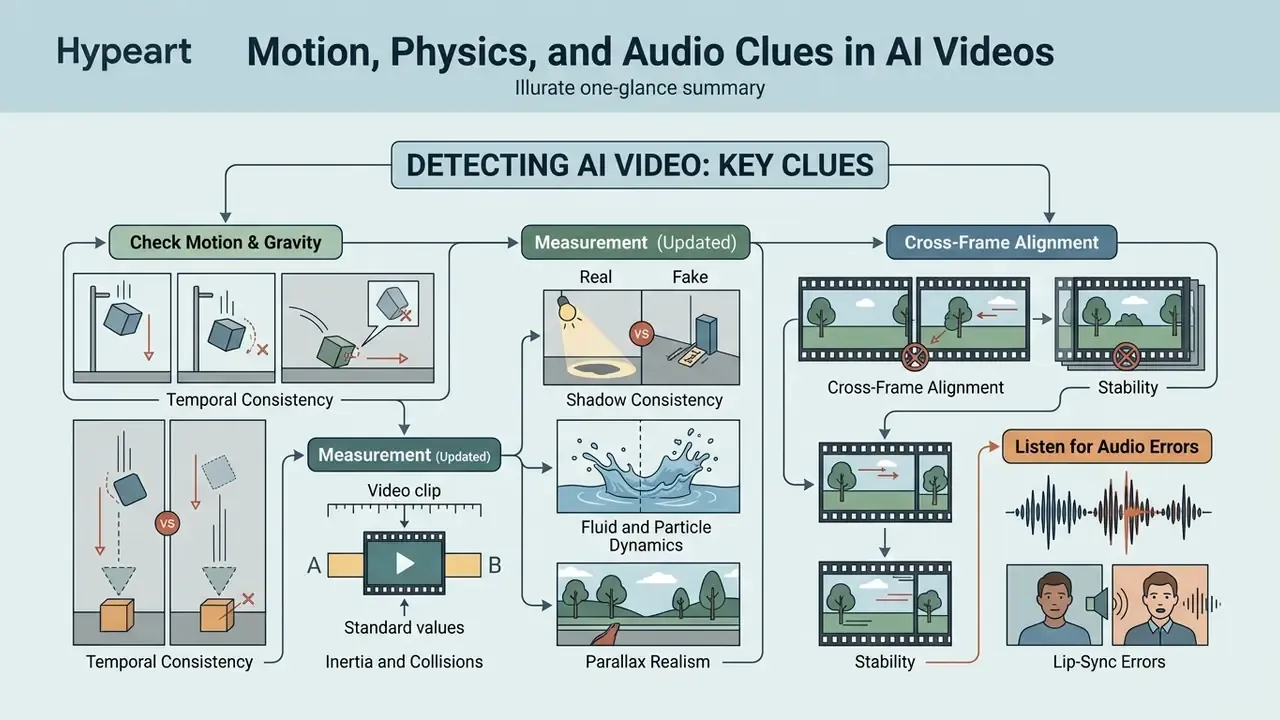
Kinematic inconsistencies offer some of the most reliable evidence of artificial video synthesis. Generative models frequently violate basic laws of Newtonian physics, including gravity, inertia, and momentum conservation. A 2026 physical benchmark study revealed that state-of-the-art video generators under-accelerate falling objects, producing effective gravitational pulls of only 1.0 to 2.2 m/s², roughly 10 to 20% of Earth's standard 9.81 m/s².
«Detectors that explicitly model temporal dependencies via CNN+LSTM architectures improve accuracy on out-of-domain video by up to 16 percentage points.»
Measurement note (Updated): effective-gravity estimates vary with the estimation method. Some studies measure frame-to-frame temporal coherence, others directly fit Newtonian trajectories, so reported severity differs across papers. Use the metric comparatively (this model versus that model) rather than as an absolute physical constant.
When analyzing motion across sequential frames, evaluate:
- Inertia and Collisions
- Objects stopping instantly without energy transfer, or bouncing without reaction force.
- Shadow Consistency
- Shadows changing direction, length, or intensity independently of light source movement.
- Fluid and Particle Dynamics
- Water, smoke, fire, and dust moving with unnatural fluidity, running backwards, or disappearing abruptly.
- Parallax Realism
- Foreground objects moving at speeds inconsistent with camera distance and lens focal length.
- Cross-Frame Alignment Stability
- Paradoxically, excessive stability is also a tell. Cross-modal research from 2026 reports abnormally constant visual-textual alignment across frames in generated video, unlike the natural fluctuation of camera footage.
Listen for Audio and Lip-Sync Errors
Audio deepfakes and AI voice synthesis often contain distinct acoustic and articulatory anomalies. Modern voice generators can match vocal timbre closely, yet they still struggle with natural speech prosody, respiratory breaks, and acoustic room coupling.
Primary acoustic indicators include high-frequency spectral discontinuities, unnatural voice regularity, excessive phase coherence, smoothed prosody, measurable shifts in LFCC, CQCC and MFCC features, and missing breath intakes between long sentences. Jitter-shimmer, harmonic-to-noise ratio (HNR), and cepstral peak prominence (CPP) provide further quantitative separation between organic and synthesized speech.
«Speech-content analysis methods verify whether the semantics of the utterance are consistent with visual cues and contextual information.»
Lip-sync deepfakes exhibit their own articulation mismatches. Forensic tools evaluate lip-sync authenticity by running speech-to-text models on the audio track and comparing the phonetic timing against automated visual lip-reading algorithms. Substantial alignment gaps flag synthetic manipulation. Parallel IEEE work on mouth inconsistencies (2024) exposes lip-synced forgeries by measuring whether visible articulation matches expected speech dynamics frame by frame.
Plosives are worth a second listen. Real "p" and "b" sounds move air. Cloned ones often arrive suspiciously clean.
When assessing synthetic voices in multimedia workflows, consult our guide on AI voice generators to understand commercial licensing and voice fidelity standards.
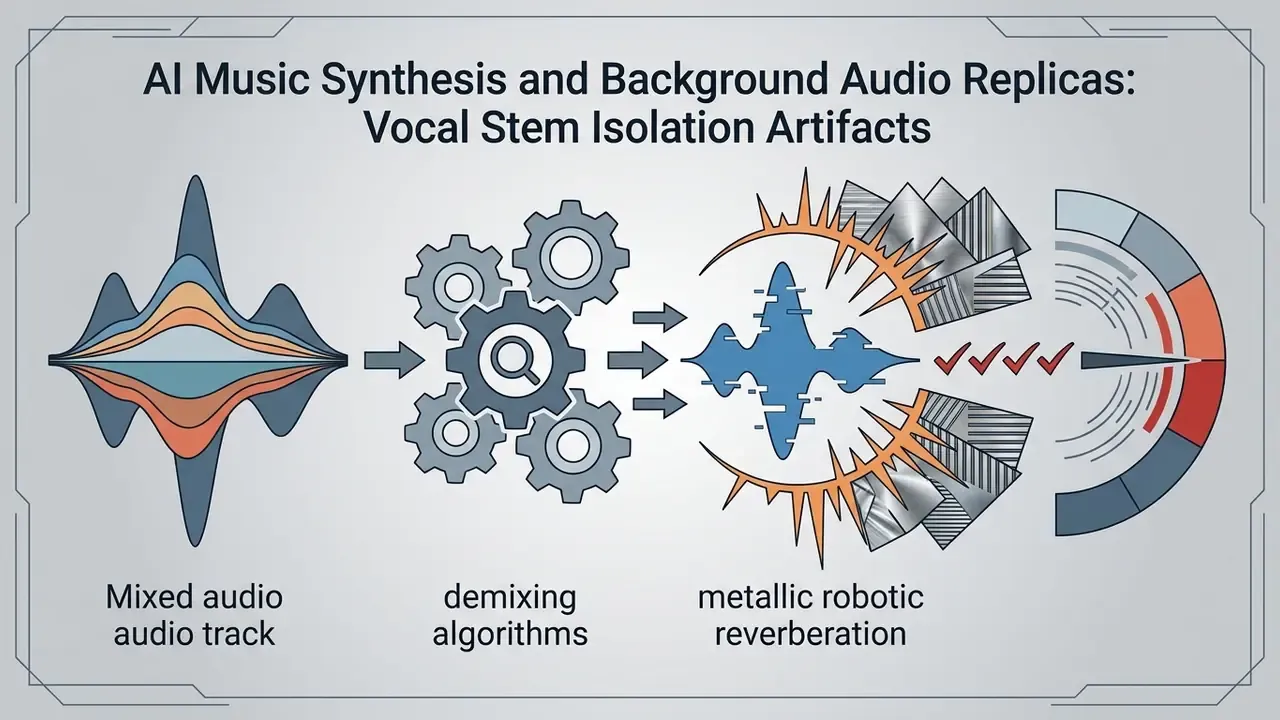
AI Music Synthesis and Background Audio Replicas
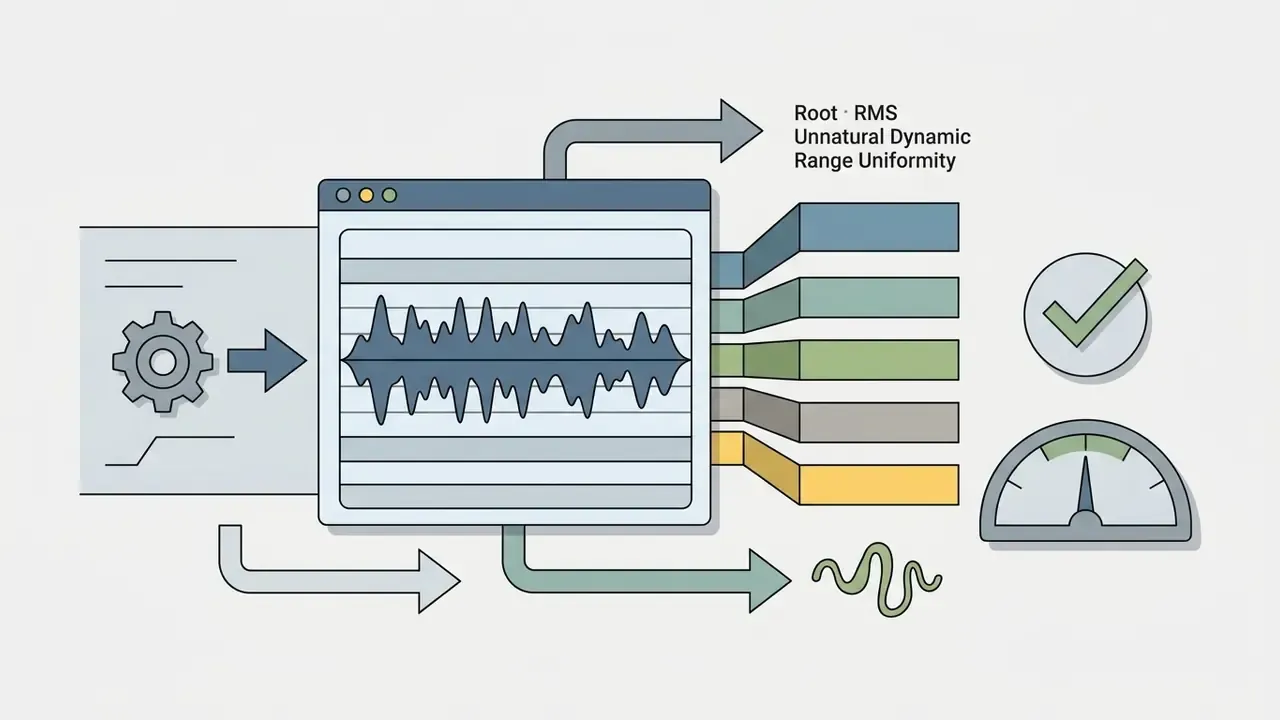
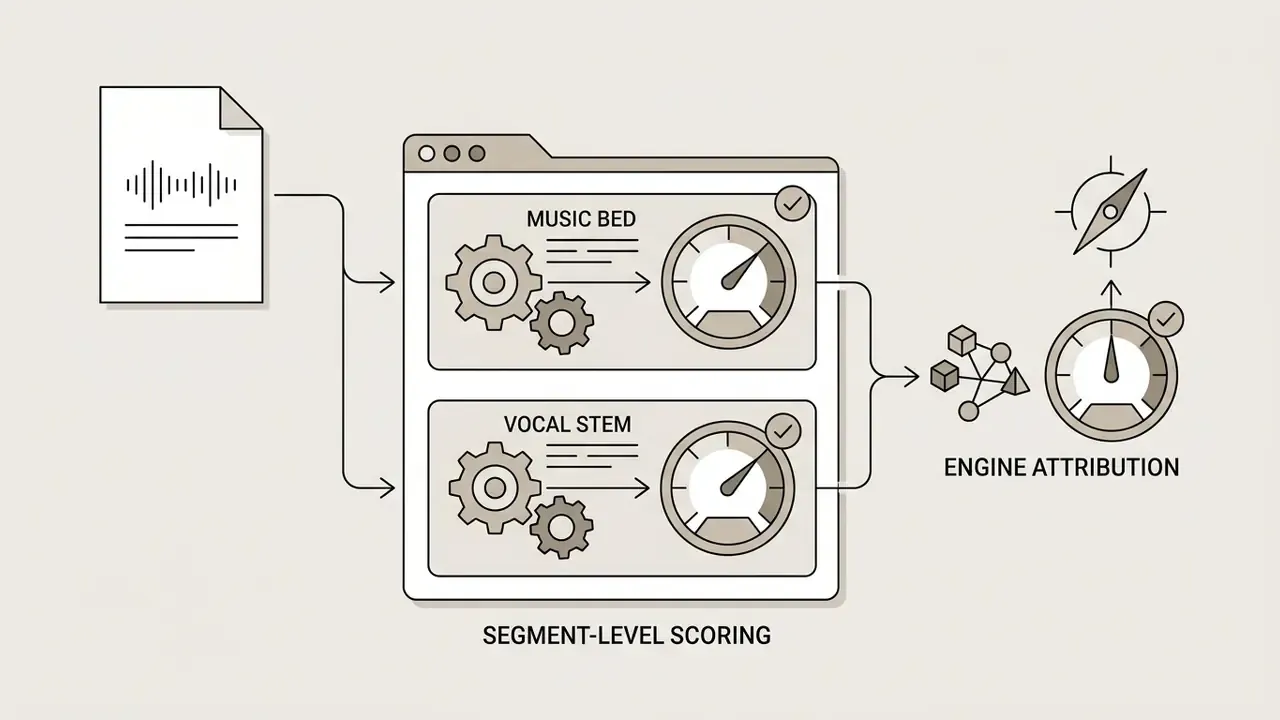
Forensic audio inspection must account for non-verbal synthetic audio, including AI-generated background music, cloned vocal tracks, and artificial ambient noise. Trust and safety queues increasingly triage AI-generated music and vocal replicas alongside speech, because unauthorized digital replicas of a performer's voice carry separate legal exposure. Synthetic music engines (such as Suno or Udio) leave distinct acoustic artifacts:
Verify Watermarks, Metadata and the Original Source
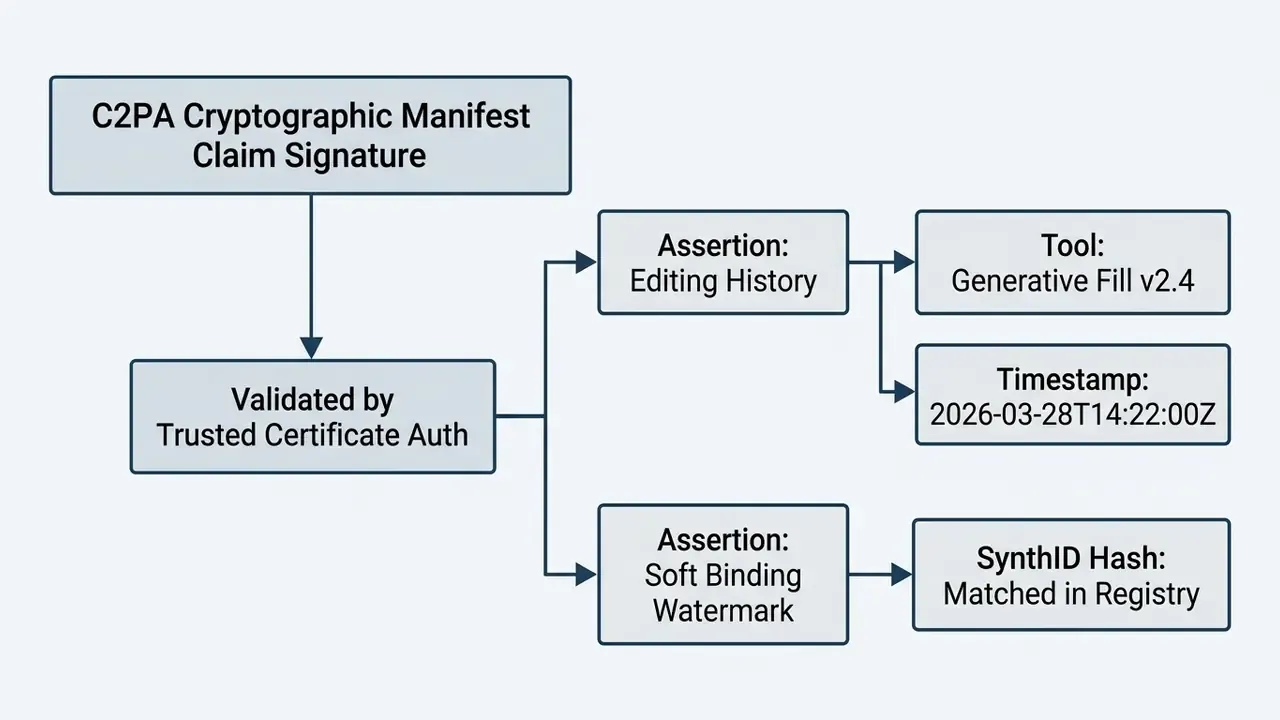
Technical validation relies on examining embedded provenance data, digital signatures, visible watermarks, and container compression footprints. Cryptographic standards provide verifiable proof of origin when the evidence survives inside the source file.
Search for Watermarks and Generator Attribution
Major AI platforms embed visible or imperceptible watermarks into generated video output to track provenance:
- Visible Watermarks Logos or semi-transparent icons placed in video corners by systems like Runway, Pika, or Sora. C2PA 2.4 treats a visible watermark as a human-readable provenance cue, and supports per-segment manifest boxes for live video validation.
- Invisible Digital Watermarks Embedded imperceptible signals, such as Google DeepMind's SynthID, which write mathematical patterns into video frame noise channels. Verification is performed by uploading the file to Gemini or the SynthID Detector portal.
- Steganographic Audio Markers High-frequency acoustic signals embedded into synthetic voice tracks.
- Durable Content Credentials A 2025 U.S. Defense Information Systems Agency paper describes watermarks that link content provenance to a database fingerprint, enabling retrieval even after metadata loss.
According to NIST AI 100-4 (2024), digital watermarking and recorded provenance metadata provide valuable transparency, though they are not foolproof guarantees against deliberate removal or adversarial cropping.
«Watermark-based approaches can offer strong guarantees when correctly embedded, but remain vulnerable to removal through cropping or re-generation.»
A practical caution for governance teams: absence of a watermark tells you almost nothing. Presence of a valid one tells you a great deal.
Treat Metadata and Compression as Supporting Evidence
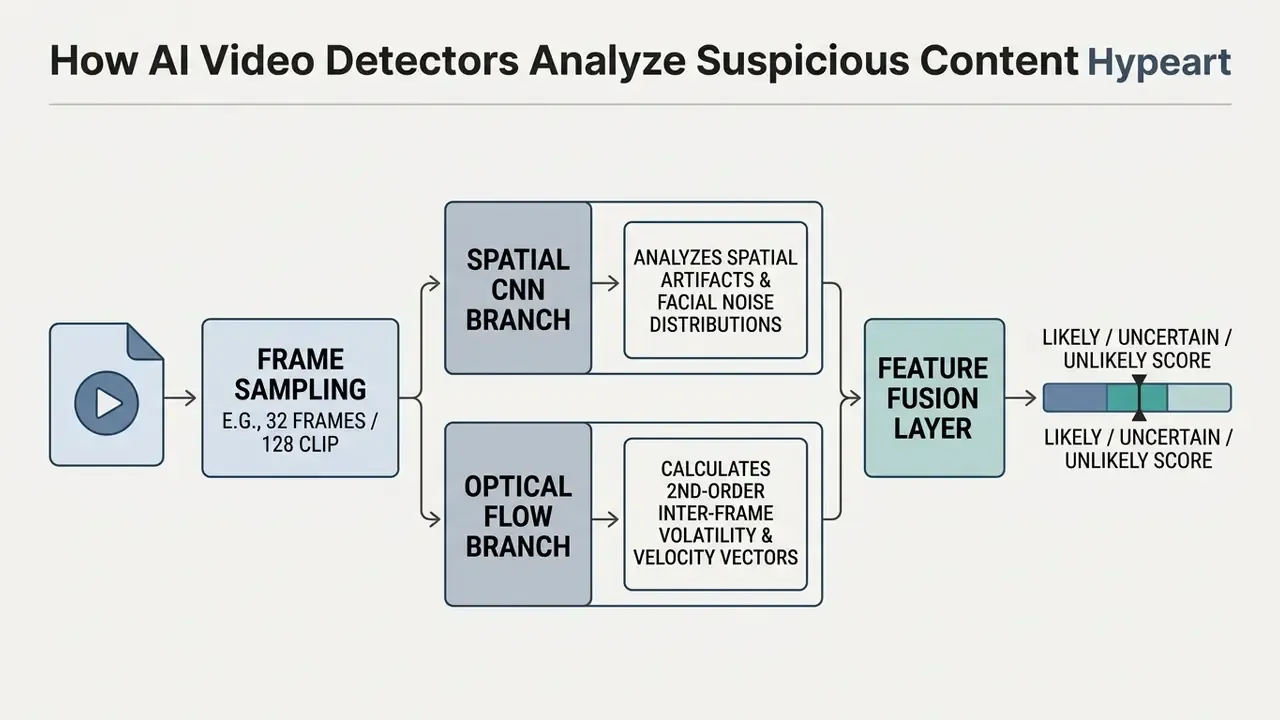
How AI Video Detectors Analyze Suspicious Content
Automated AI video detectors rely on deep neural networks trained to detect statistical, temporal, and spectral anomalies across video frames. Understanding how these tools process content helps analysts interpret detection results accurately, and helps model validators challenge them properly.
Supported AI Video Generation Architectures (2026 Coverage)
Modern detection engines must continuously update their spatial and temporal feature extractors to account for novel diffusion and autoregressive video architectures. Vendor experience shows a predictable blind window of a few weeks between a generator's public release and reliable detection of its outputs. Verification pipelines routinely analyze output from:
| Architecture Category | Major Supported Models & Engines | Key Synthetic Footprints |
|---|---|---|
| Open-Sora & Commercial Giants | OpenAI Sora 2, Google Veo 3.1, Runway Gen-4.5, Adobe Firefly Video, Higgsfield | Temporal boundary tearing, second-order frame volatility |
| Asian Autoregressive Models | ByteDance Seedance 2.0, Kling AI 1.5, MiniMax Hailuo, Wan 2.5, Tencent HunyuanVideo, Haiper AI | Micro-texture over-smoothing, spectral boundary cuts |
| Generative Avatar & Lip-Sync Engines | HeyGen, Synthesia, D-ID, DeepBrain AI, Colossyan, Descript | Phoneme-viseme phase lag, boundary blending artifacts |
| Open-Source & Real-Time Frameworks | Luma Ray 3.14, Stable Video Diffusion, Pika 2.2, PixVerse, Genmo Mochi, Grok Imagine, InVideo AI, Pictory | Physical acceleration collapse, background parallax drift |
Because detection runs on pixel and motion content, these checks still function when metadata has been stripped and no watermark survives. That is the normal condition for socially redistributed video, so plan for it rather than treating it as an exception.
What Detection Tools Check Frame by Frame
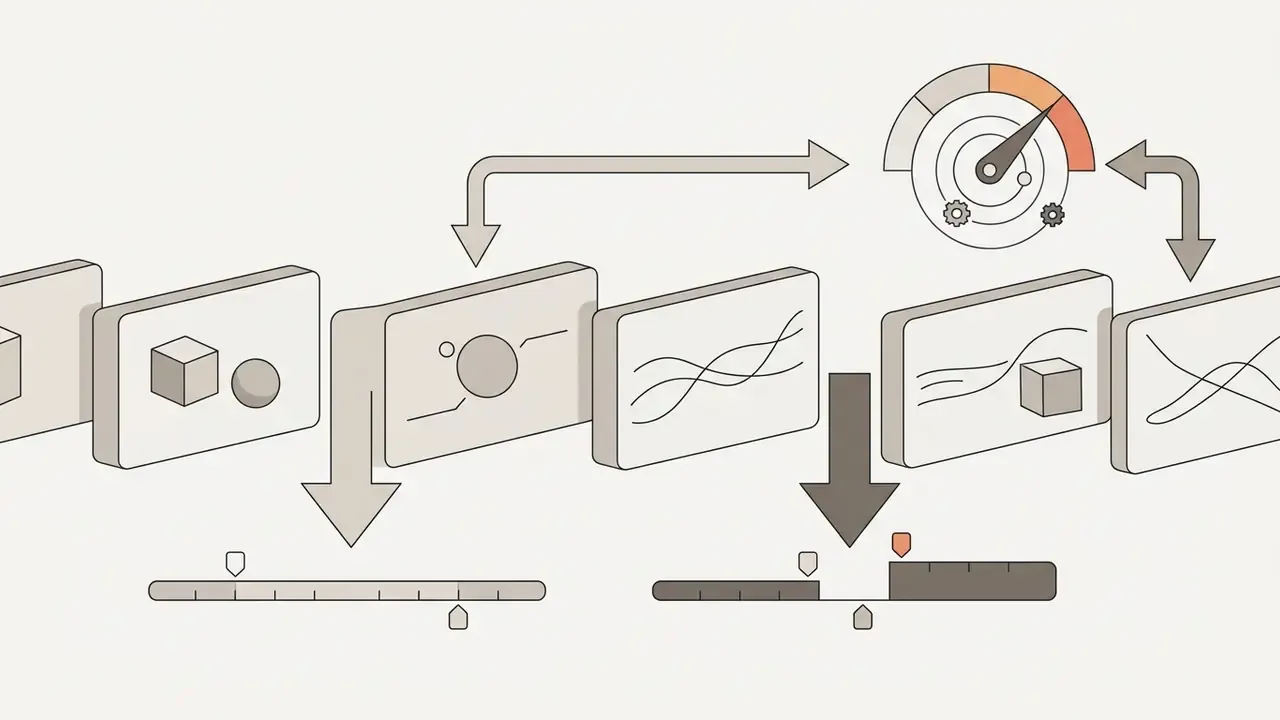
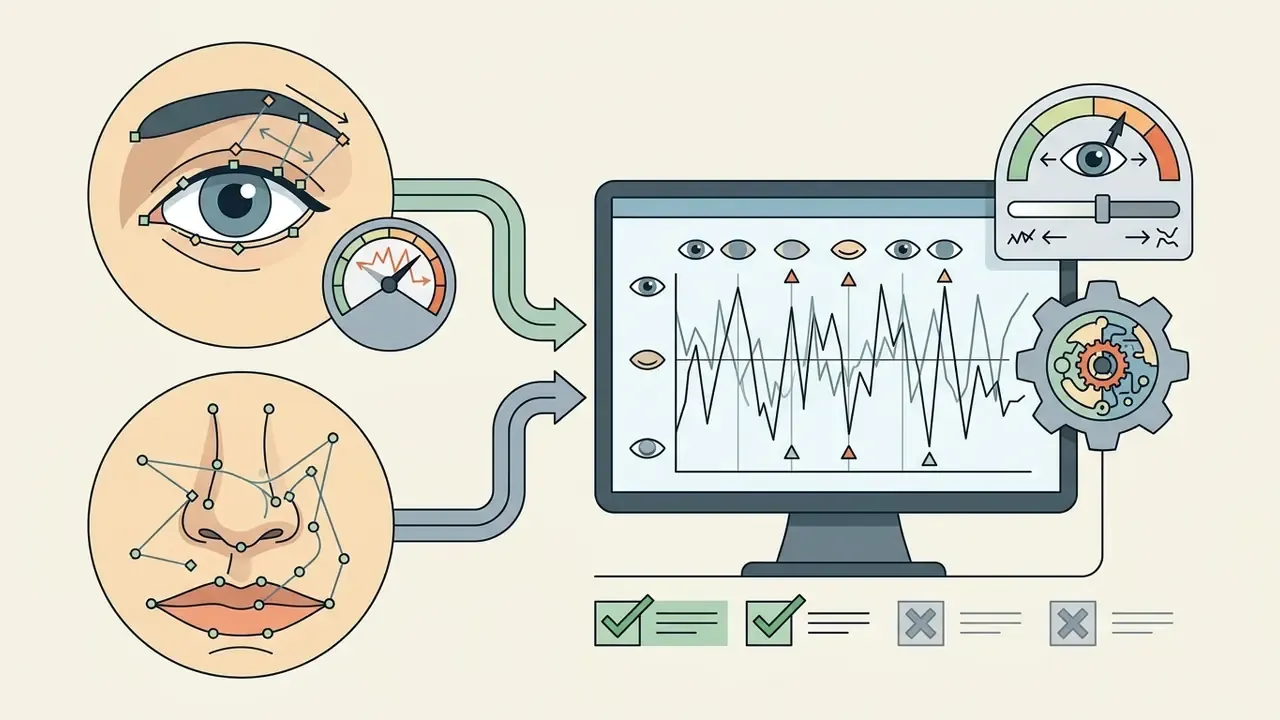
Frame-level detectors evaluate individual RGB images extracted from the video sequence. Advanced architecture patterns like those introduced at ICCV 2025 (D3: Training-Free AI-Generated Video Detection) sample frame sequences at uniform intervals to compute both first-order inter-frame differences and second-order central-difference volatility metrics. Real footage is measurably more volatile than generated footage. CVPR 2026 pipelines commonly sample 32 frames from the first 128, resize to 256×256, and train on a subset of those samples.
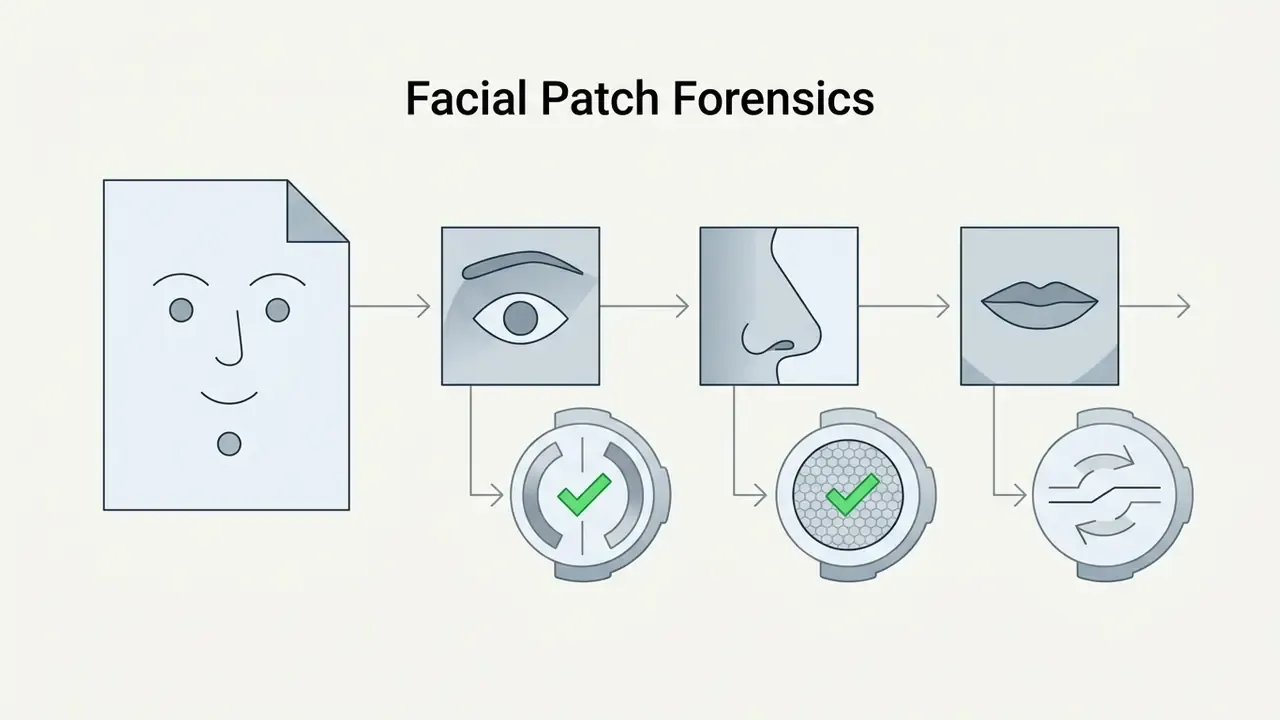
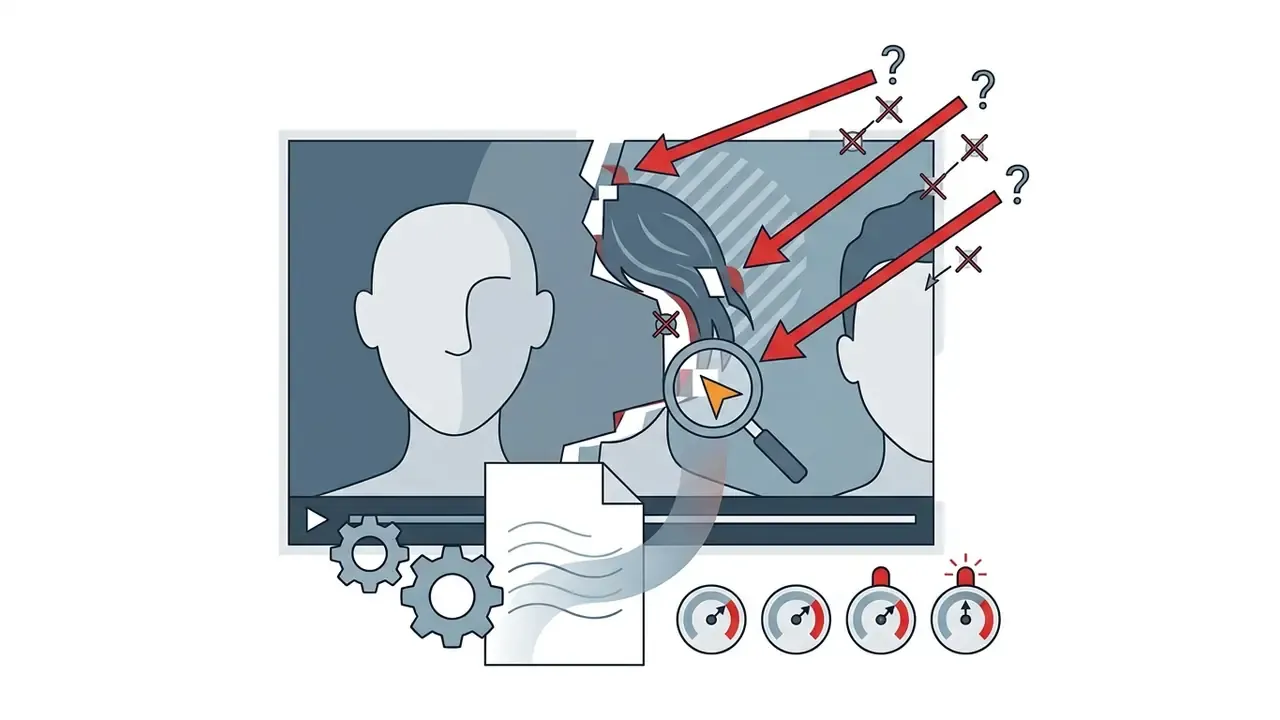
Key frame-level targets include:

How to Read Likely, Uncertain and Not Likely Results
Commercial and open-source detection platforms typically categorize results into probability confidence bands:
- Likely AI-Generated (above 85% confidence): High signal strength across spatial, temporal, and motion feature vectors. Indicates strong statistical alignment with known generative model outputs.
- Uncertain (35% to 85% confidence): Ambiguous signal metrics caused by low resolution, heavy social media compression, aggressive filtering, or novel generative architectures outside the detector's training set.
- Likely Authentic / Not Likely (below 35% confidence): Low artifact density, with features aligning to physical camera capture models.
Critically, the displayed number is a signal-strength estimate. It is not the probability that a model authored the clip, and not a percentage of manipulated frames. A high band never proves synthetic authorship. A low band never proves authenticity, unedited state, or truthful context.
«Video-model AUC degrades by roughly 50% on in-the-wild data; even after fine-tuning, peak accuracy reaches only about 0.75 for video.»
Automated classification outputs must always be cross-referenced with source material, physical checks, and context before consequential decisions. The asymmetry between human and machine performance on ordinary footage is stark:
«On everyday mobile-phone video, humans reached 0.784 accuracy while AI detectors fell to near-chance at 0.537.»
Independent false-positive research adds a further governance constraint. Across published evaluations, detector false-positive rates on genuine human material have ranged from near 0% to over 60% depending on tool, threshold, and population. Ensembling three independent detectors reduced false positives toward zero in one 2025 education study. Never escalate on a single tool's verdict.
Model Risk Governance for Third-Party Detectors (SR 11-7 Context)
For regulated institutions, an AI video detector is a model, and its output is model output. That places it inside the perimeter of established model risk management expectations (Federal Reserve and OCC supervisory guidance SR 11-7 / OCC 2011-12) rather than treating it as a factual finding.
Practical validation controls for second-line risk functions:
| Validation Dimension | Required Evidence | Recommended Cadence |
|---|---|---|
| Conceptual soundness | Documented feature basis (spatial, temporal, spectral), training-data lineage, known architecture coverage | At onboarding and after each vendor model release |
| Outcomes analysis | Institution-specific benchmark on representative, compressed, real-world media, not vendor benchmarks | Quarterly |
| False-positive / false-negative profile | ROC and AUC curves, threshold selection rationale, documented tolerance for each decision use case | Quarterly |
| Performance drift | Re-test against newly released generators; track band-migration of previously scored cases | Monthly watch, quarterly formal |
| Bias and subgroup testing | Accuracy disaggregated by demographic appearance, language, resolution, and capture device | Semi-annual |
| Override and escalation logging | Analyst rationale for accepting or rejecting a detector band; retention of hashes and manifests | Per case |
NIST's Guardians of Forensic Evidence work frames the same sequence for evidentiary settings: source verification and provenance reconstruction precede analytic-system evaluation, and analytic systems are assessed with ROC and AUC metrics rather than headline accuracy. A 2026 review of forensic reliability concluded that no evaluated detector met the reliability threshold required for standalone evidentiary use. That is why probabilistic detector bands should be logged as corroborating indicators within an audit trail, never as the determinative finding submitted to a regulator, court, or law-enforcement body.
Ownership matters as much as accuracy. Name the owner of the detector, the approved role it plays in the workflow, its access limits, its escalation path, and the conditions under which it is switched off. No evidence, no autonomy.
For organizations evaluating enterprise content verification pipelines, examine comparative tool performance in our AI Media Comparison portal.
Choosing an AI Video Detector for Personal and Business Review
Selecting an appropriate detection approach depends on operational volume, required processing speed, budget constraints, and accuracy requirements.
| Scenario | Primary Input Format | Key Evidence Evaluated | Processing Speed | Indicative Cost | Primary Operational Use Case |
|---|---|---|---|---|---|
| Manual Expert Forensics | Raw video file (.mp4, .mov) | Kinematics, C2PA manifests, visual glitches, acoustic spectrum | 10 to 15 minutes per case | Analyst time (from roughly $5 per case upward) | High-stakes litigation, regulatory audits, executive fraud review |
| Online Web Detectors | File upload or public media URL | Frame artifacts, basic temporal flow, metadata presence | 3 to 10 seconds per clip | Free tier to low per-scan fee | Journalism triage, ad-hoc file checks, content moderation |
| Enterprise API Pipelines | Asynchronous HTTP / webhook stream | Multi-layer spatial and temporal neural scoring, live stream telemetry | Real time to under 2 seconds | Volume-tiered contract pricing | KYC remote onboarding, social platform moderation queues |
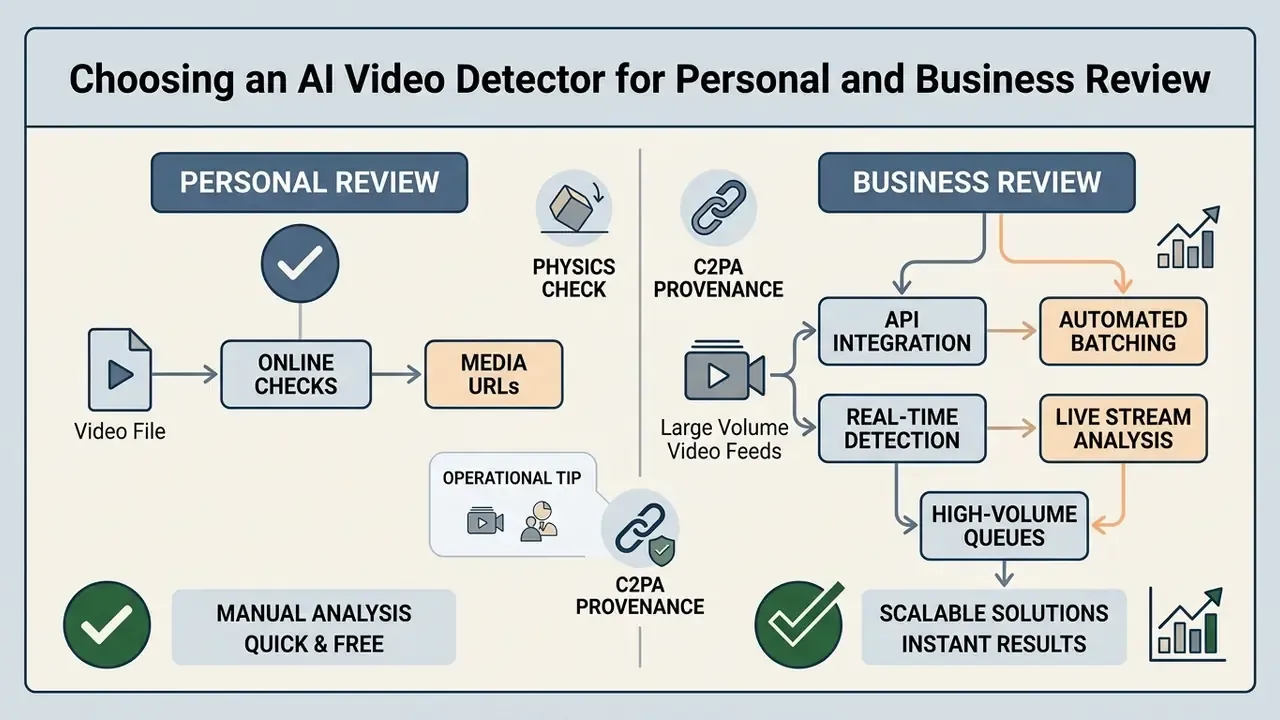
Read the table as a sequence, not a menu. Most institutions run online triage at intake, API scoring in the queue, and manual forensics only on escalated cases. Unit economics collapse if manual review sits at the front.
Buyers comparing detector claims should also understand the generation side of the market. Our review of leading AI video generators and of free AI video generators maps which architectures your detector must cover in practice.
Online Checks for Video Files and Media URLs
Web-based detection portals and analytical suites accept direct uploads of raw media containers, primarily .mp4, .mov, .avi, .mkv, and .webm formats, typically capped at 50 MB to 100 MB for browser triage. Alternatively, analysts can paste direct media links from major hosting and social platforms, including YouTube, TikTok, Instagram Reels, X (formerly Twitter), Facebook Video, and Vimeo.
When evaluating content directly via platform URLs, the intake engine automatically extracts the stream bitstream. Because native video platforms re-encode files using aggressive H.264 and AV1 compression, web checkers must isolate optical flow vectors from compression noise to deliver reliable confidence scores.
Online services process clips by extracting representative keyframes, running lightweight CNN or transformer classification models, and returning an immediate confidence score. Fast and convenient for one-off checks, yes. Free online portals also limit file size, strip complex multi-frame optical flow analysis, and rarely produce a transparent audit trail.
«Aggregating multiple independent human judgments raises accuracy by 14 to 15 percentage points relative to individual assessments.»
That finding is the practical argument for multi-reviewer verification on any consequential online check. One analyst plus one free detector is the weakest viable configuration.
Note the hard limit of any link-based check. Re-encoding and platform redistribution routinely destroy metadata and content credentials, so a social URL frequently cannot represent the original file state. Where source access is limited, request the original upload for full analysis.
Teams that also produce video internally should align review standards with production standards. Our AI video creation tutorial and the AI thumbnail maker reference show which generative steps enter your own asset library, and therefore what your reviewers will encounter as legitimate internal content.
API and Real-Time Video Detection for Large Queues
Enterprise platforms, financial institutions, and trust-and-safety teams require API-driven detection infrastructure capable of processing high-volume media queues asynchronously.
API solutions (such as Copyleaks AI Video API, Resemble AI, or Sensity API) accept media stream URLs, process videos asynchronously, and return JSON payload responses via webhooks. Documented enterprise patterns include public-URL intake with a 201 Created acknowledgement followed by webhook delivery, batch submission of up to 50 files per request, and full create, get, list and delete lifecycle endpoints for retention control. Vendor benchmarks should be read critically. NVIDIA, for example, documents a synthetic-video detection micro-service evaluated on 4,000 videos at 85.64% accuracy, a useful figure precisely because the evaluation set size is disclosed.
Modern identity verification pipelines integrate API stream telemetry to execute real-time presentation attack detection (PAD) during remote KYC onboarding, supporting compliance with NIST SP 800-63A standards, which require live facial capture plus liveness and presentation-attack detection. A 2026 World Economic Forum paper on identity verification against deepfakes recommends API-exposed context telemetry, camera-path verification, active dynamic liveness challenges, transport-aware stream scoring, and continuous temporal-consistency monitoring.
Developers integrating automated video processing pipelines should review the Google Veo API Guides and the broader AI Media API Guides to understand generative video parameter controls and delivery architectures. Reviewers handling long evidence files also benefit from tooling such as AI that takes structured notes on video, and AI to summarize long public clips before a formal frame-level pass.
When AI Video Detection Matters Most
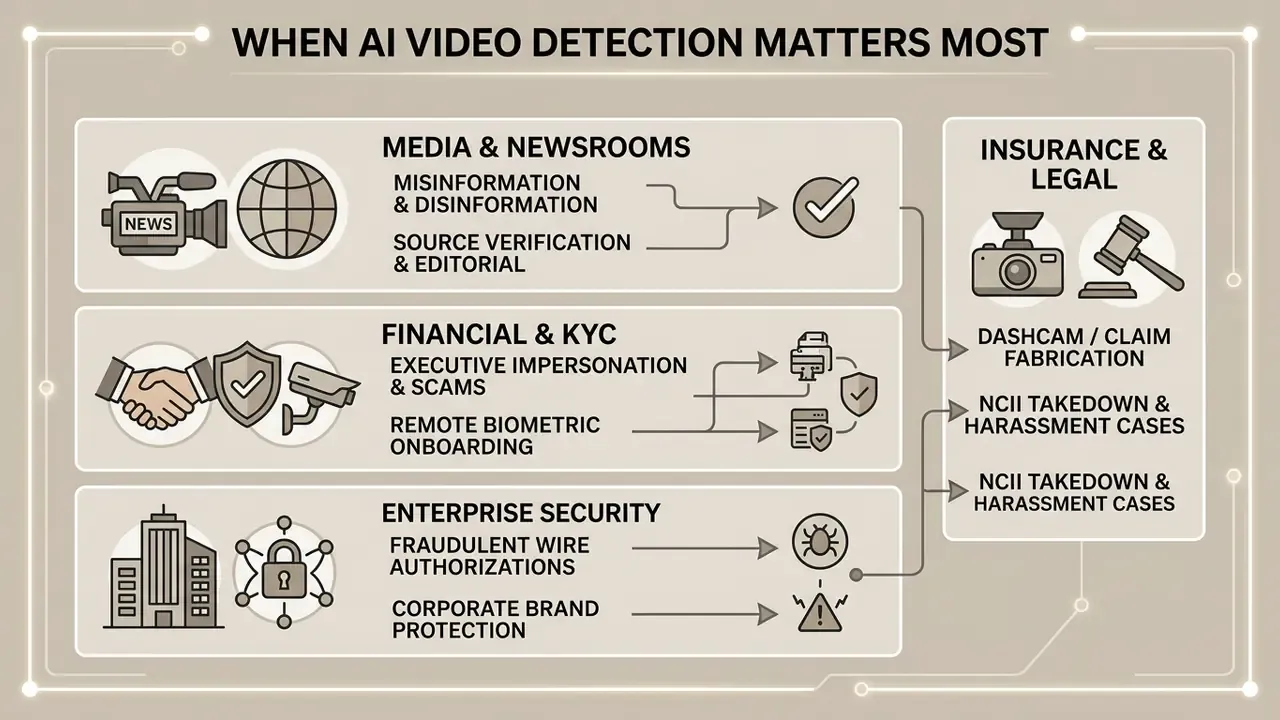
Detecting synthetic media is critical across regulated industries, newsrooms, legal environments, and corporate security operations where unverified video files create severe operational, financial, and reputational exposure.
Identity, Impersonation and Fraud Investigations
Deepfake technology poses direct threats to corporate security and financial risk management. Scammers use real-time voice cloning and generative video streams for executive impersonation, authorizing fraudulent wire transfers or tricking helpdesks into resetting privileged credentials.
«AV-Deepfake1M contains over 1.1 million videos spanning 2,068 subjects, covering audio-only, visual-only, and audiovisual manipulations for robustness testing.»
Official assessments converge on the same threat surface. FinCEN (2024) documents deepfake voices and videos used in family-emergency scams and fraudulent identity documents deployed to circumvent verification. INTERPOL (2024) reports synthetic media bypassing online KYC liveness checks to create false identities supporting credit, benefit, and tax-refund fraud. Europol (2024) notes AI-faked identity documents used to open financial accounts and argues for stronger end-to-end authorization checks rather than reliance on detection alone. NIST SP 800-63A-4 (2024) explicitly references fake video feeds used to impersonate real persons during enrollment, and NIST SP 1800-42A (2026) requires liveness and deepfake detection during mobile driver's licence provisioning to prevent biometric replay.
In remote digital identity proofing (KYC), synthetic video feeds are used to bypass liveness checks. Financial institutions deploy passive liveness detection, dynamic challenge-response prompts (for instance, requesting specific head rotations), and temporal stream analysis to confirm that a live human is present during account opening.
One control beats all of them, though: a callback on a known channel plus dual authorization. Detection reduces volume. Process design removes the loss.
Organizations assessing risk profiles across generative media tools can reference verified licensing frameworks in our guide to AI Media Commercial-Use.
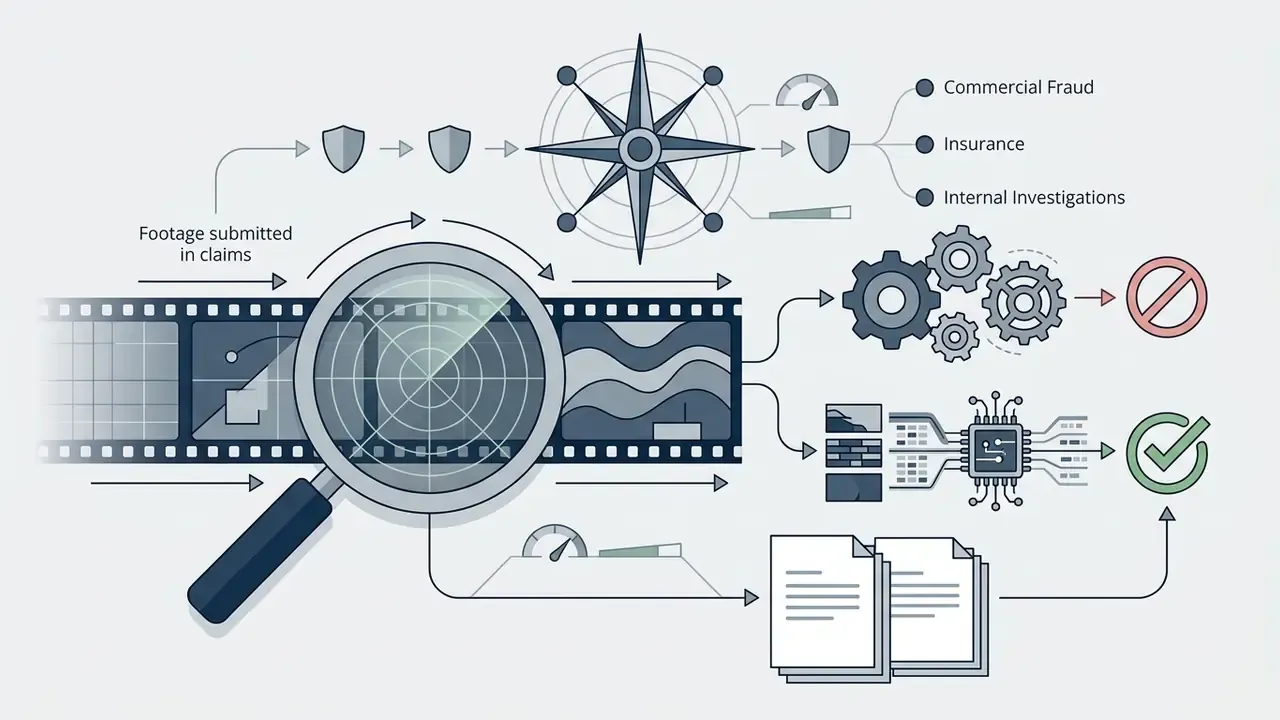
Commercial Fraud, Insurance, and Forensic Claims Review
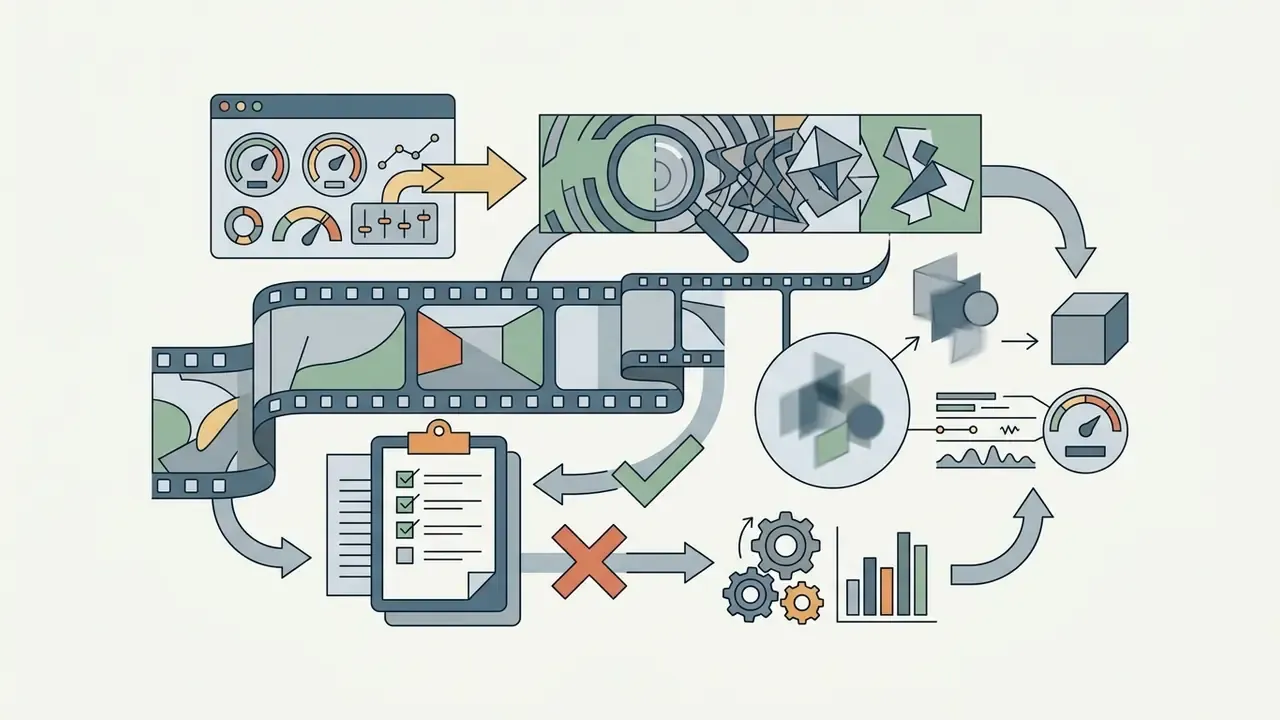
Synthetic video detection extends beyond corporate fraud into civil, insurance, and legal investigations:




FAQ: Can You Always Tell If a Video Is AI Generated?
Can you always tell if a video is AI generated?
No. You cannot always tell if a video is AI generated with 100% certainty. As generative models improve, visual and acoustic artifacts decrease. When video files are heavily compressed, downsampled, or very short, available forensic evidence drops sharply, which produces inconclusive detector results. High-confidence evaluation requires combining source validation, physical checks, and multi-model neural detection.
«Knowing that a video may be AI-generated shifts viewing from passive watching to active anomaly search, without improving objective accuracy.» Source: How do people watch AI-generated videos of physical scenes? (2024-2025), eye-tracking study of 40 participants.
What is the most reliable sign that a video is AI generated?
The most reliable sign is a combination of temporal motion anomalies, physical law violations (unnatural gravity, floating objects), and lip-sync misalignment. Single static frame artifacts can be smoothed out by newer models. Maintaining physical momentum and exact audio-visual alignment across time remains extremely difficult for current AI systems.
How do I know if a video is AI generated without special software?
Work through five checks in order: find the earliest upload, read all on-screen text twice, watch hands and jewellery across frames, listen for missing breaths, and test whether objects obey gravity. If two or more checks fail, treat the clip as unverified and escalate. This is also the quickest way to identify AI videos circulating in a feed.
Do free AI video detectors work reliably?
Free online AI video detectors offer a useful first-pass screening layer, but they are not reliable on their own. Studies show that open-source and free web detectors experience sharp accuracy drops, up to 50% performance degradation, when tested on heavily compressed social media clips or on media produced by brand-new generative models outside their training data.
«Video-model AUC drops by roughly 50% on in-the-wild data drawn from 88 websites across 52 languages, compared with laboratory benchmarks.» Source: Deepfake-Eval-2024: A Multi-Modal In-the-Wild Benchmark (2026).
Why are short clips and low-quality videos harder to verify?
Short clips, under three seconds, and heavily compressed low-bitrate video files are the hardest scenarios for forensic verification. At low bitrates (roughly 150 kbps versus a high-quality 6 Mbps master), lossy compression destroys high-frequency spatial details, smooths facial micro-textures, and distorts optical flow vectors. Published video-forensics work found that at about 150 kb/s, detection required roughly twice the sequence length to match performance achieved on 4 to 6 Mb/s footage, an explicit bitrate-versus-duration tradeoff.
Short clips also provide too few sequential frames to evaluate physical acceleration, blinking frequency, or acoustic-viseme synchrony. On low-quality short clips, detectors frequently return "Uncertain".
«The CharadesDF dataset of everyday mobile-phone video pushes AI detectors down to near-chance (about 0.537), while humans hold at about 0.784.» Source: Human-AI Ensembles Improve Deepfake Detection in Low-to-Medium Quality Videos (2024-2025).
In such cases, analysts must rely primarily on external source context, reverse image searches, and original file provenance rather than visual content inspection alone. Screen recordings, beauty filters, frame interpolation, stabilization, and dubbing can each produce generation-like artifacts in genuinely authentic footage, so an inconclusive result should remain recorded as inconclusive until a stronger source is obtained.
Why can two copies of the same clip return different verdicts?
Downloads, reposts, screen recordings, edits, and platform transcoding all change frames, audio, metadata, codecs, and compression structures. A detector report reflects only the evidence preserved in the exact file or stream analyzed, which is why the earliest, highest-bitrate copy is always the preferred exhibit.
How do I report a deepfake or malicious AI video?
If you encounter a deepfake or synthetic video used for fraud, impersonation, or harassment, report the content directly to the hosting platform's trust and safety team. In cases involving financial fraud, identity theft, or extortion, archive the raw video file, preserve URL records, and submit a report to relevant law enforcement agencies, such as the FBI Internet Crime Complaint Center (IC3) or the FTC. Where non-consensual intimate imagery is involved, platform removal obligations under the TAKE IT DOWN Act may apply, and the takedown request should reference the preserved hash values.
To benchmark model generation performance against analytical standards, review independent evaluations in AI Media Benchmarks and Review Proof.
Technical Summary and Recommended Next Steps
Establishing whether a video file is AI generated requires a structured, multi-layered verification strategy:
- Secure Ground-Truth Files: Obtain the highest-resolution raw video file available before platform compression occurs, and hash both the original and the working copy.
- Audit Cryptographic Provenance: Check for C2PA manifests, SynthID watermarks, or digital signature metadata. Understanding image-to-video AI tools helps explain hybrid pipelines where a genuine still photograph is animated into synthetic motion.
- Execute Physical and Temporal Audits: Inspect facial boundaries, eye-blink dynamics, digit counts, text stability, and gravitational motion consistency.
- Evaluate Audio-Visual Synchrony: Cross-check speech acoustics against visual lip movement using automated alignment tools, and score background music and vocal stems separately.
- Run Multi-Model Detectors: Deploy at least two independent neural classifiers, then contextualize confidence scores against physical and source evidence.
- Document the Decision: Record which evidence groups were available, which were unavailable, which signals conflicted, and what additional material would change the conclusion.
Operational Artifacts to Standardize
- Forensic Verification Checklist (PDF/XLSX): a six-point triage sheet covering face, eyes, hands, text, background, and physics, sized for a single-page reviewer workflow.
- Audit Trail Summary Template: fields for file hash, intake timestamp, provenance findings, detector name and version, confidence band, analyst override rationale, and final disposition, formatted for supervisory review.
- Detector Validation Register: per-model record of benchmark date, in-house accuracy, false-positive tolerance, and drift test results, maintained under model risk management policy.
Limitations and Open Questions
Be candid with your board about what remains unresolved. Three gaps stand out.
First, no published detector currently meets a standalone evidentiary threshold, so verdicts stay probabilistic. Second, benchmark figures on physics violations and effective gravity vary with prompt sets and estimation methods, meaning cross-paper comparisons are weak evidence. Third, the blind window after each generator release is real and largely unmeasured in production conditions; if your queue relies on a single vendor, that window is your exposure.
A reasonable next step is modest, not dramatic: run one quarter of in-house benchmarking on your own compressed media, document the false-positive tolerance for each decision use case, and only then decide whether automation belongs in the decision path or in triage.
For teams building scalable media verification, content moderation, or risk management workflows, explore our dedicated research portals:
- Evaluate standard operational procedures across AI Media Workflows.
- Calculate operational verification overhead using specialized calculators.
- Map licensing and usage-rights exposure across generative tools in our AI Media Commercial-Use hub.
- Trace earlier publications of a suspect keyframe with AI reverse-image-search tools.
- Benchmark expected compression degradation before attributing artifacts, using reference profiles from our video compressor guide.
- Review generation-side coverage requirements in our comparison of free AI video generators.
- Understand API delivery architecture and parameter control via the Google Veo implementation guide.
- Standardize publishing and evidence-export pipelines using our YouTube video editor workflow reference.
Legal and Evidentiary Disclaimer
This article is provided for general informational purposes and does not constitute legal, compliance, financial, or forensic advice. Outputs of AI video and audio detectors are probabilistic estimates, not determinations of authorship, intent, or publication history. Before submitting synthetic-media findings to regulators, courts, insurers, or law-enforcement agencies, obtain independent corroboration and consult qualified legal and forensic professionals. Do not submit media you are not authorized to analyze.
Appendix A: Revision and Source-Audit Log
Retained for transparency; superseded statements remain visible alongside their updated replacements.
| Original statement (retained) | Status | Updated version in main text |
|---|---|---|
| "Empirical testing published in a 2024 systematic review demonstrated that human accuracy in identifying synthetic media reaches a pooled baseline of only 65.14% (95% CI 55.21-74.46)." | Updated: pooled figure describes post-intervention accuracy in the review; source not originally named. | Named behavioural study: 65.64% overall accuracy across 110 participants (Understanding Human Perception of Audiovisual Deepfakes, 2024), with the 65.14% pooled review figure retained as the AI-supported and trained condition. |
| "According to a 2026 systematic review of synthetic speech detection, primary acoustic indicators include high-frequency spectral discontinuities…" | Updated: generic attribution replaced with an identified source; indicator list preserved and expanded. | Acoustic indicator list retained, attributed to Understanding Audiovisual Deepfake Detection (2024) plus published acoustic-anomaly feature studies (LFCC, CQCC, MFCC, jitter-shimmer, HNR, CPP). |
| "Benchmark evaluations in Physion-Eval (2026) demonstrated that over 83% of tested generated clips contained at least one physical violation…" | Retained with measurement note: figure corresponds to exocentric glitch rates (about 83%) versus egocentric (about 93%); sensitive to prompt set and model version. | Same claim, now disaggregated and flagged as directional pending broader replication. |
| "A 2026 physical benchmark study revealed… effective gravitational pulls of only 1.0 to 2.2 m/s²." | Retained with measurement note: supported as 10 to 20% of Earth gravity; severity varies by estimation method. | Same claim, framed as a comparative metric rather than an absolute constant. |
| Closing link block referencing thumbnail creation, teacher slide decks, and e-commerce product photography. | Relocated and reframed: moved out of the closing block and placed in contextual positions where production-side provenance is relevant to reviewers. | Retained as labeled contextual references alongside provenance, reverse-image-search, compression-benchmarking, generator-coverage, API implementation, and commercial-use resources. |
| "Why Short Clips and Low-Quality Videos Are Harder to Verify" positioned after the FAQ block. | Relocated: content preserved and expanded with bitrate-versus-sequence-length evidence. | Now an FAQ entry, placed before the technical summary. |
| Enterprise case study presented as a "recent forensic investigation". | Relabeled: no verifiable engagement could be cited. | Presented as an explicitly hypothetical composite scenario. |
Social Media, News and Misinformation Review
In newsrooms and editorial teams, verifying user-generated content before publication is essential to prevent the spread of misinformation. AI-generated video clips depicting political events, natural disasters, or industrial accidents can trigger market volatility and public panic.
Journalistic verification workflows combine geolocation checks, reverse video image searches, historical weather cross-referencing, and AI detection models. Editorial teams should also understand which text-to-video AI tools can produce the specific scene type under review, since prompt-driven scene synthesis leaves different footprints than face-swap editing.
Under European Union Digital Services Act (DSA) guidelines and VLOP obligations, platforms are increasingly required to detect, label, and flag manipulated media, using watermarks, metadata identifiers, cryptographic provenance, logging, or fingerprints, to preserve digital information integrity. The EU AI Act's transparency provisions further require disclosure when image, audio, or video content constitutes a deep fake.
Beyond the European Union's DSA mandates, North American compliance relies on strict synthetic media enforcement laws. Platforms and enterprise verification workflows must align with the TAKE IT DOWN Act (targeting automated identification and removal of non-consensual synthetic imagery) and the NO FAKES Act (protecting individuals' voice and visual likeness rights from unauthorized AI replication). Automated verification API queues serve as a critical first line of compliance defense for platform Trust and Safety teams. Comparable labeling obligations exist elsewhere. India's 2024 advisory, for instance, requires labeling or permanent metadata identifiers for synthetic audiovisual information capable of being used as misinformation.
Education and training functions face the same pressure in a lower-stakes form. Teams building awareness material with an ai slide generator for teachers should label synthetic examples explicitly, so training assets never become tomorrow's unlabeled evidence.