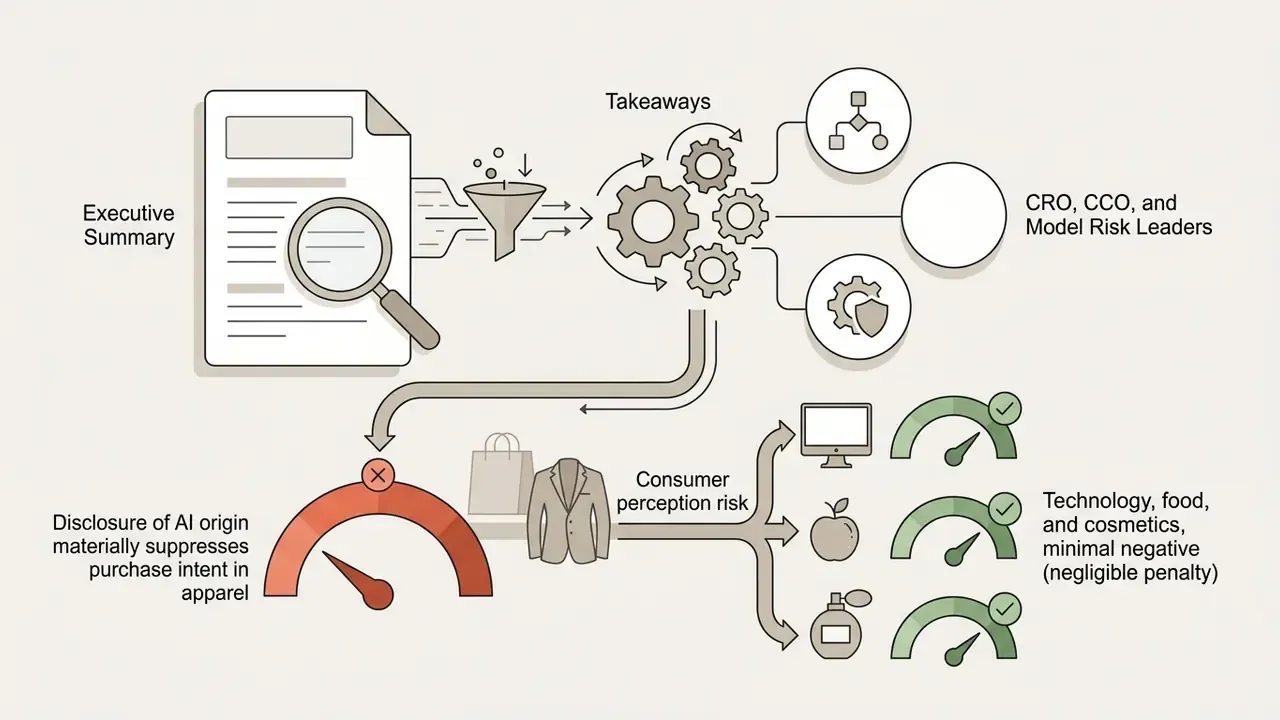
«98% of consumers agree authentic images are essential in establishing trust, while 78% believe an AI-generated image cannot be authentic.»
Executive Summary: Key Takeaways for CRO, CCO, and Model Risk Leaders
On this page: platform positioning, then tiering, privacy and token economics, onboarding and the prompt library, models, editing and Motion, the comparison matrix, commercial and legal checks, enterprise security and Shadow AI controls, open questions, and the FAQ.
What Leonardo AI Image Generator Is and Which Tasks It Fits
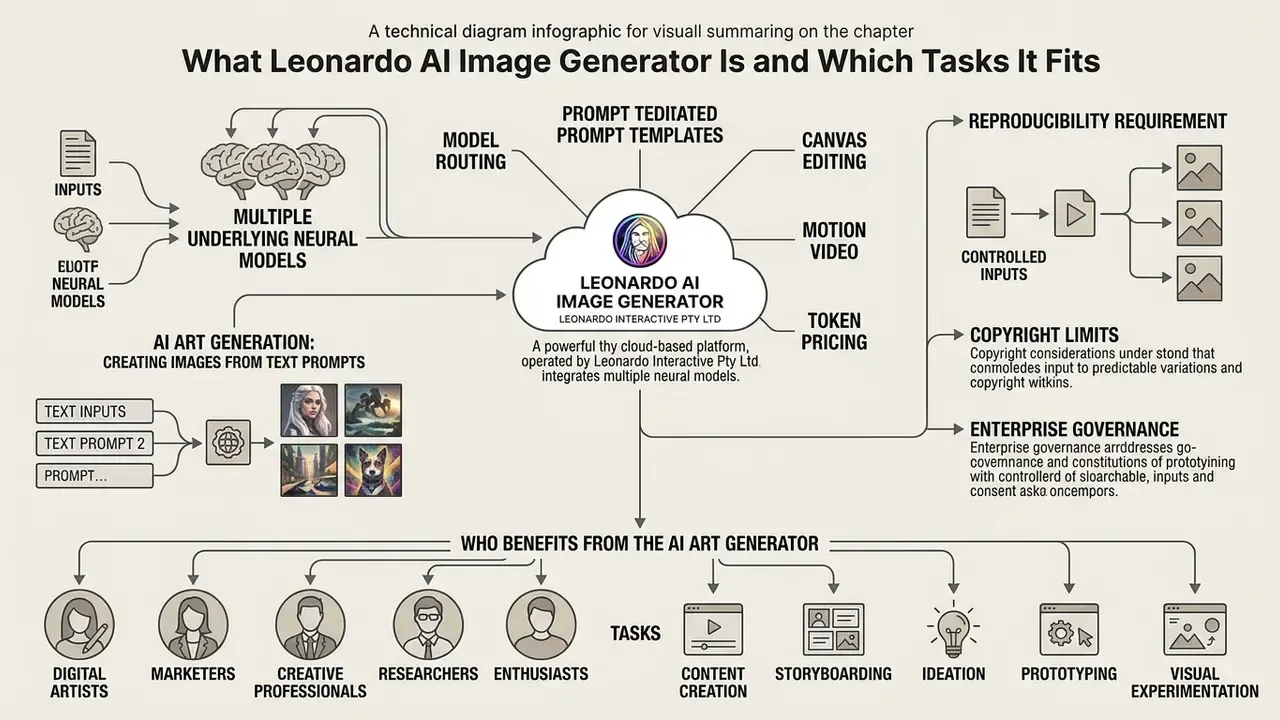
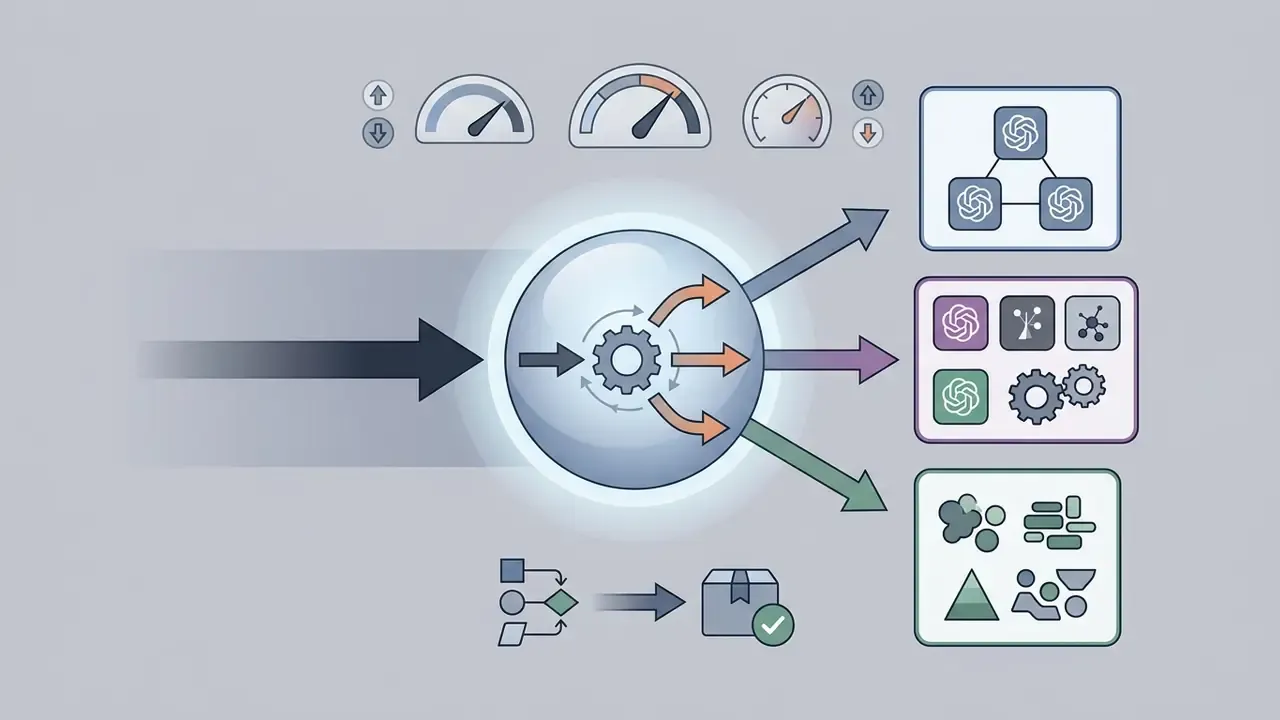
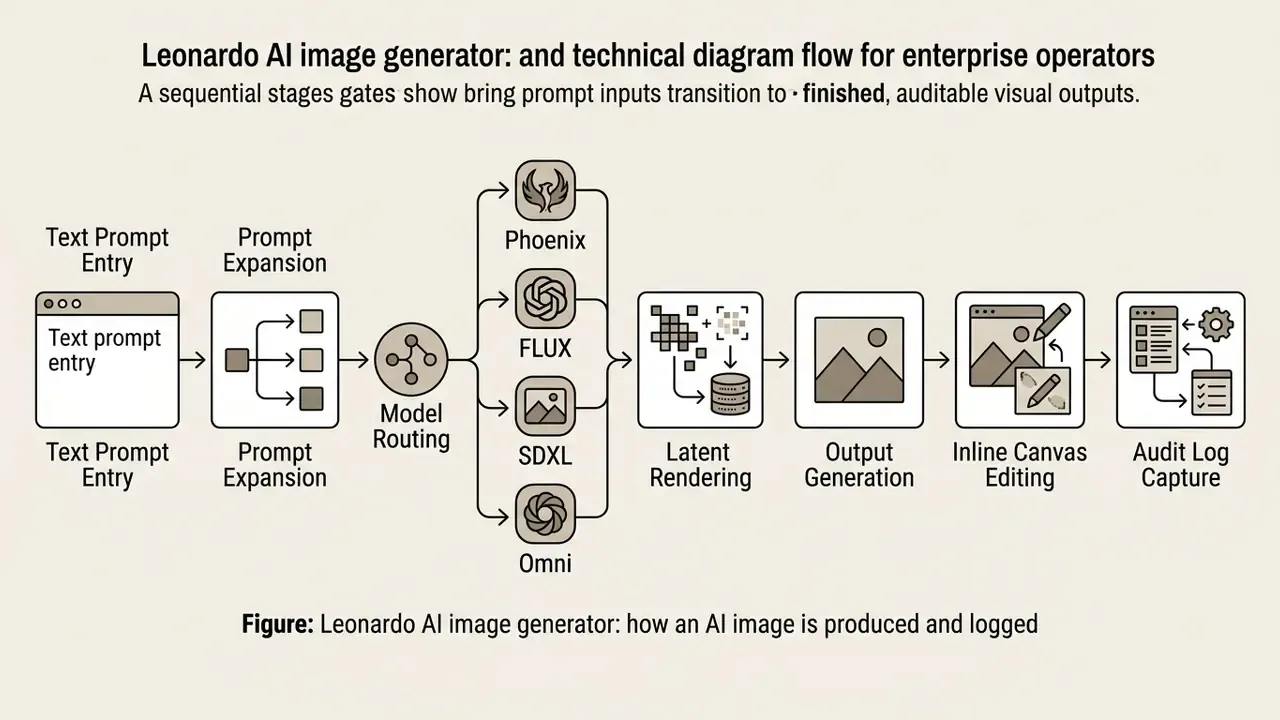
The leonardo ai image generator is a cloud-based ai art generation platform operated by Leonardo Interactive Pty Ltd that folds multiple underlying neural models into one creative production interface. Instead of locking an organisation into a single static architecture, this leonardo ai art tool behaves like a model router, enabling rapid leonardo ai art generation across distinct baselines such as Phoenix, FLUX, SDXL, and custom fine-tuned Elements. Creative teams, marketing groups, and product design units use it to produce leonardo ai generated art, photorealistic campaign mockups, lifestyle photography, and branded digital assets. Some studios also lean on it for leonardo ai generative art experiments that never leave the ideation stage.
Official documentation confirms a model-discovery endpoint that returns model ID, name, and description. In plain terms: the model inventory can be enumerated programmatically, which is a prerequisite for any institution maintaining a formal AI model register (Leonardo.Ai API FAQ, accessed 2026). Leonardo's own marketing material positions the service across graphic design, fashion, advertising, and product photography, including banners, product images, short videos, and variation sets for A/B testing.
Organisations comparing platforms can review structured assessments of AI image generators for commercial use before committing procurement budget, or simply explore the hub for the broader landscape of enterprise generative media infrastructure. An enterprise image generator lets teams scale synthetic media output while keeping administrative oversight in one place. Integrating that pipeline into regulated operations, however, requires verifying whether output parameters satisfy institutional compliance standards. Governance leaders should establish how the platform handles input logging, public versus private training exposure, and asset ownership before authorising widespread use across commercial lines of business.
Leonardo AI Art Generation: Creating Images from Text Prompts
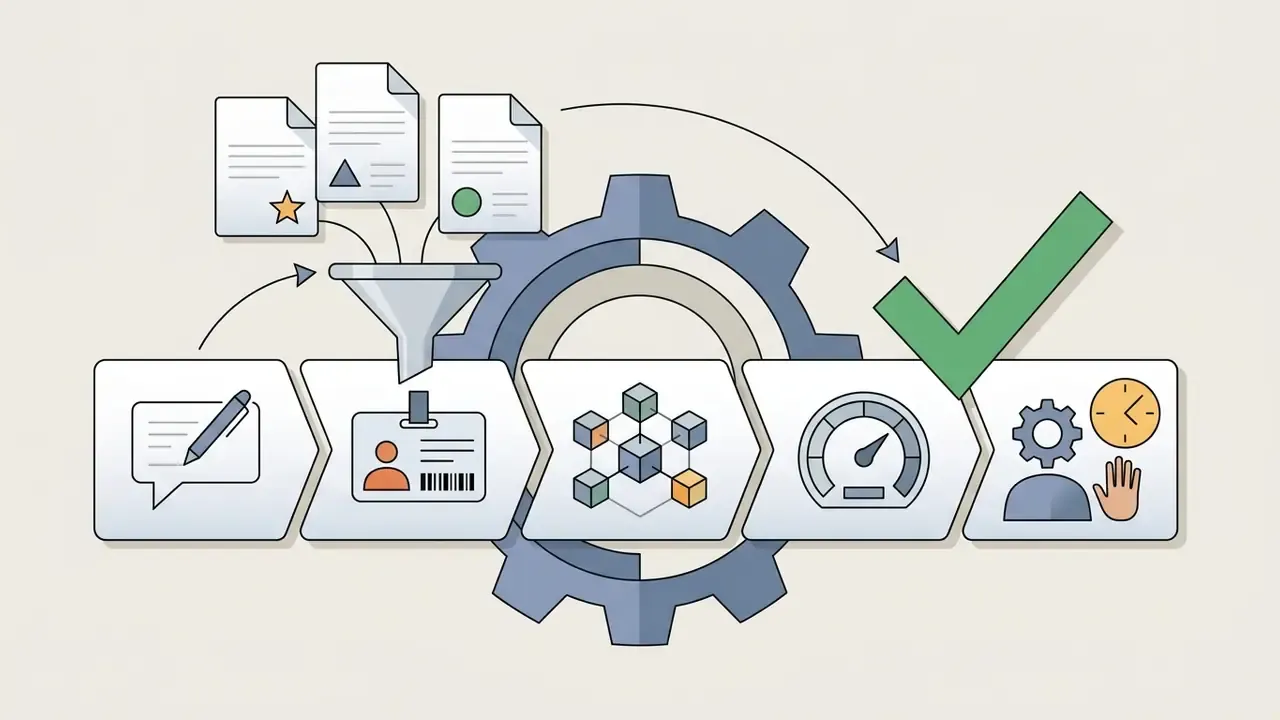
Leonardo AI art generation converts natural-language prompt strings into high-fidelity synthetic assets through model-specific diffusion and conditioning pipelines. Execution relies on a user prompt input, supported by prompt-enhancement endpoints (enhancePrompt) and image guidance parameters, which is tokenised and routed to a selected base model such as Phoenix or SDXL (Leonardo.Ai Docs, accessed 2026). When a user fires a leonardo ai create image request, the platform maps text tokens against visual latent spaces, balancing classifier-free guidance scales against style presets to output predictable leonardo ai generated artwork.
«The pipeline combines CLIP tokenization, latent diffusion with probabilistic denoising, and VAE decoding with ethical filtering at output.»
Technical teams onboarding non-specialist stakeholders can pre-read the terminology of AI art generators to align vocabulary across machine learning, marketing, and compliance. Compliance reviewers who prefer a broader vocabulary refresh can open the hub instead.
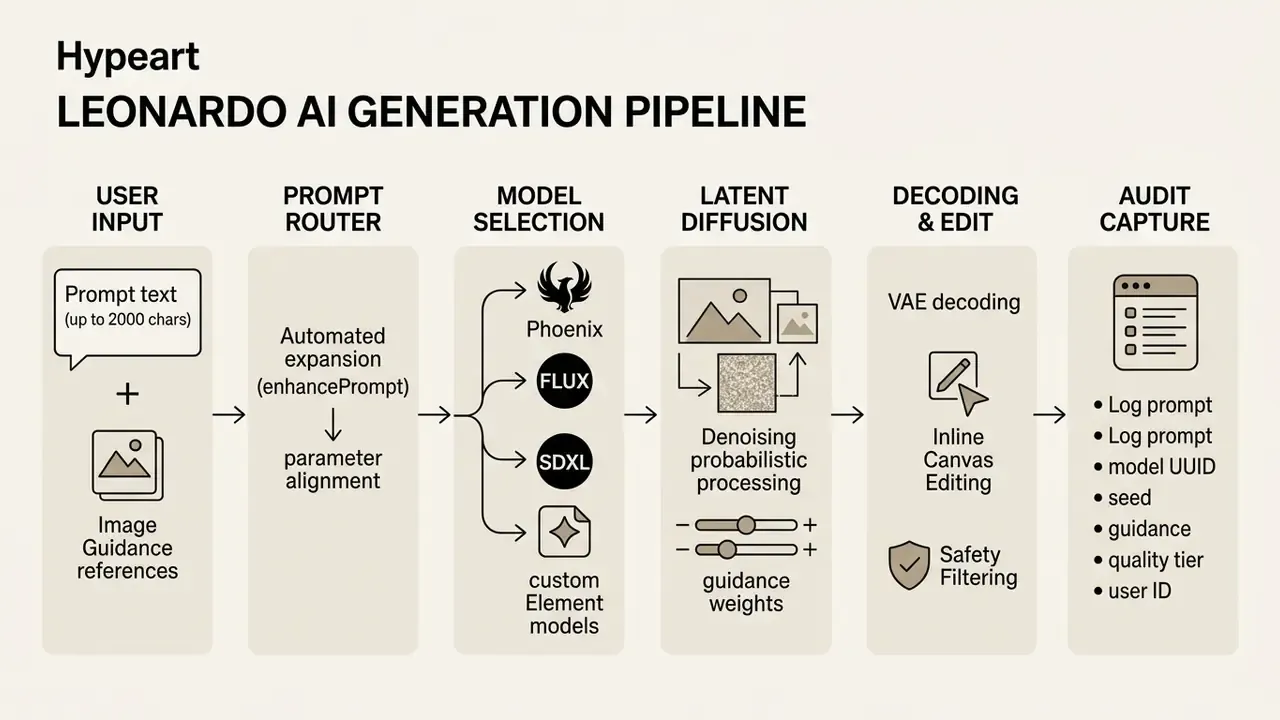
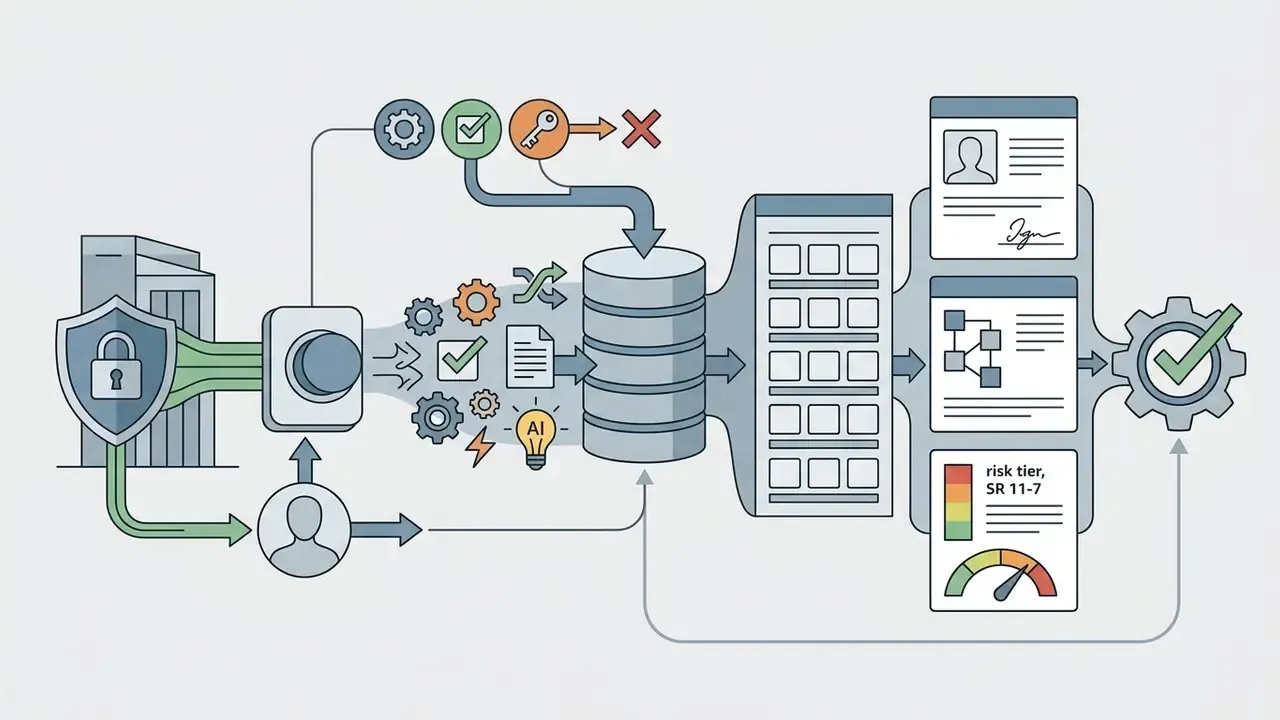
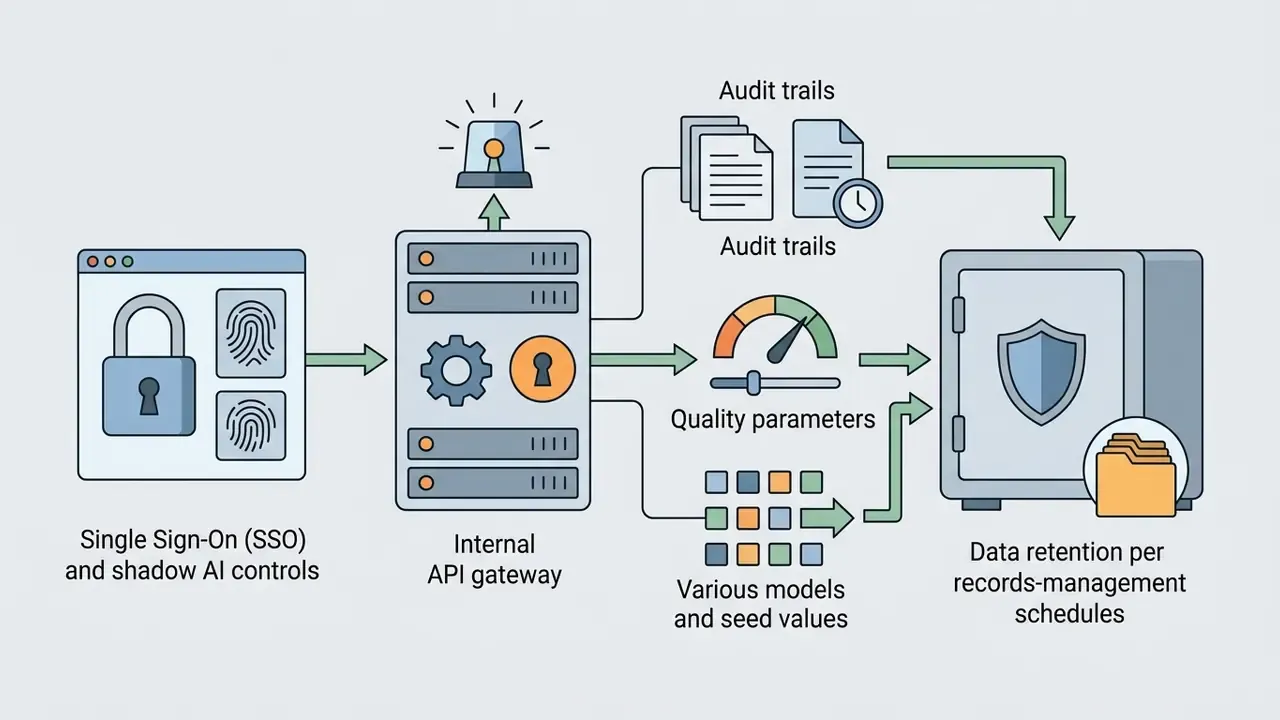
Reproducibility requirement. For regulated deployments, step 6 is not optional. Supervisory model risk guidance expects outputs to be reproducible and documented (Federal Reserve SR 11-7 and OCC Bulletin 2011-12, Supervisory Guidance on Model Risk Management). Practically, that means fixing the seed, pinning the explicit model identifier, and recording the API quality parameter. Worth flagging: Leonardo migrated GPT Image-1.5 and Ideogram 3.0 from a mode parameter to quality on 4 May 2026, and that change will silently alter outputs in any pipeline hard-coding deprecated fields (Leonardo.Ai API deprecations, 2026). Institutions routing generations through a central API gateway gain prompt and completion logging by default, and eliminate per-seat blind spots.
Who Benefits from the AI Art Generator Leonardo
The ai art generator leonardo serves creative directors, digital marketing specialists, concept artists, and corporate brand managers who want visual production to stop being a bottleneck. Teams use this ai art generator to synthesise marketing stock imagery, spin variations for digital ad testing, and model early product concepts without paying for a full photography shoot. Designers add moodboards, alternate product options, and brand-consistent asset families. Concept artists push it toward character, environment, and packaging exploration. Governance officers building a shortlist can start from our comparison of leading AI image generators.
During an illustrative operational trial at a regional financial services firm, a design team wired a generative asset pipeline into localised ad collateral production. By setting centralised prompt boundaries and enforcing private asset toggles, the team reported materially shorter campaign iteration cycles while staying inside corporate risk tolerance. (Observed internally in a composite, hypothetical scenario. The magnitude of acceleration was not independently audited and should not be treated as a benchmark. Measure your own baseline cycle time before and after deployment.)
Tiers, Privacy, and Token Economics: What to Verify Before the First Generation
How to Assess Free Access for AI Art Generation
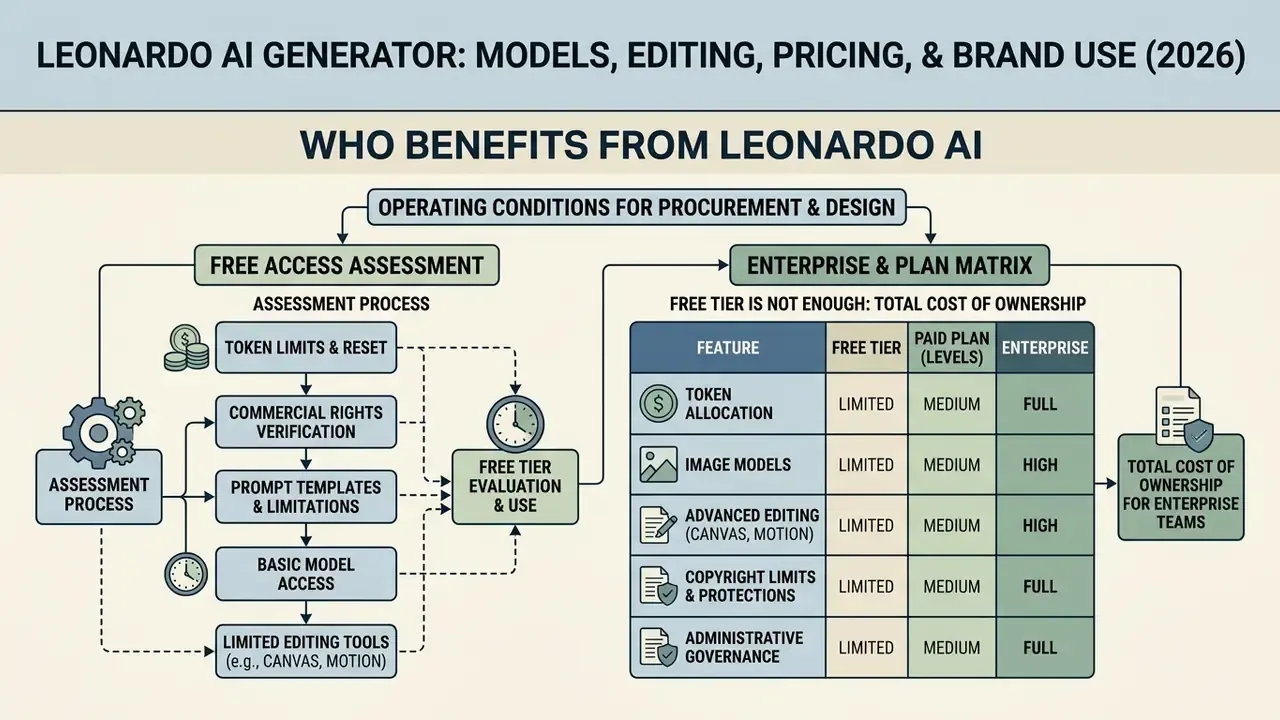
The leonardo ai free image generation site gives prospective users a daily allocation of fast tokens: 150 tokens resetting every 24 hours, with no rollover (Leonardo.Ai Pricing, accessed 2026). In practice that allowance supports roughly 10 to 30 images, depending on model, resolution, and whether Alchemy or upscaling is switched on. Enough to test prompt responsiveness and sample baseline leonardo ai art quality. Not enough to run a campaign.
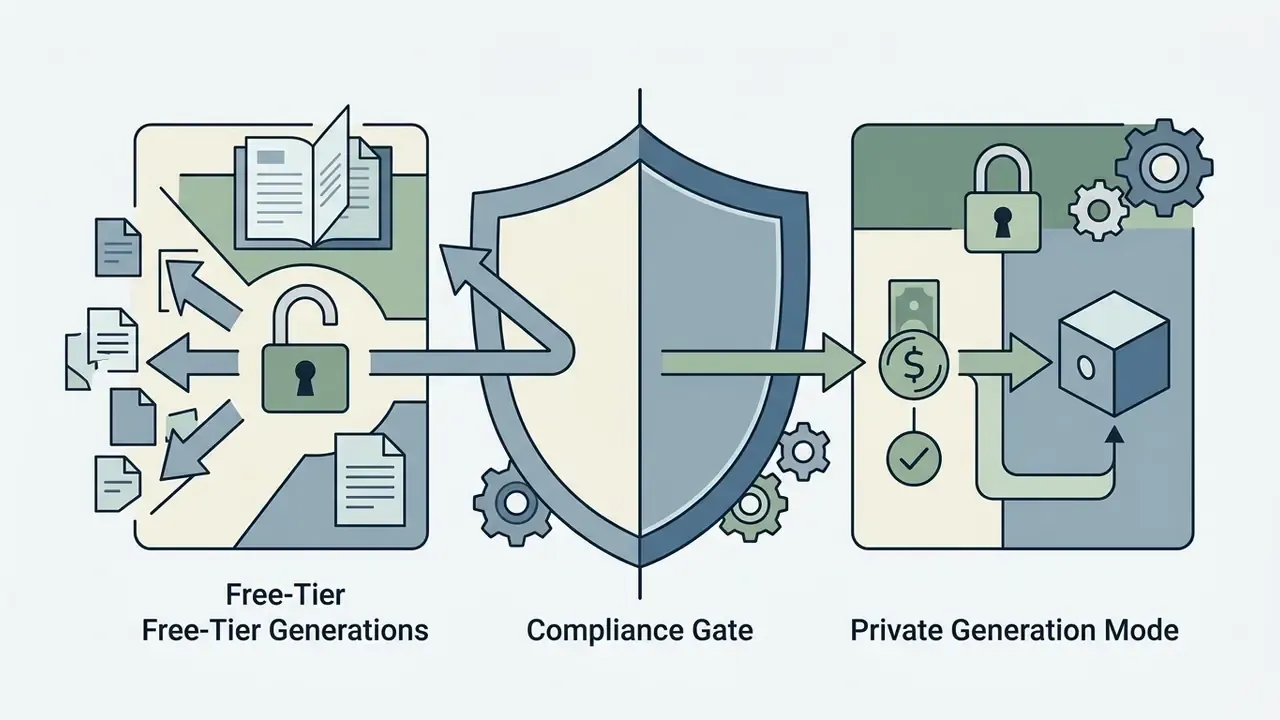
One condition deserves emphasis. Every asset generated on the free tier is public by default, visible in the community feed, and covered by broad platform usage rights.
Secondary 2026 reviews also report a free-plan resolution ceiling near 1536x1024 with upscaling limited to 2x, and they disagree on whether the free plan exposes all standard models or only community models. Where third-party summaries conflict, treat the official pricing and help-centre pages as controlling. Anyone searching for an ai image generator free leonardo shortcut should read those pages first, not a review aggregator.
When the Free Image Generator Is Not Enough: Plan and Token Matrix
A free ai image generator leonardo workflow breaks down the moment requirements include confidential generation, high-resolution export, or sustained commercial volume. Paid subscriptions remove public visibility enforcement and unlock Private Generation Mode, where assets stay confidential (Leonardo.Ai Pricing, accessed 2026). Organisations weighing alternatives can consult our comparison of free AI image generators and our review of free AI art generators for output limits, watermark policies, and licensing terms.
| Plan | Price (USD) | Fast token allowance | Private Mode | Team access |
|---|---|---|---|---|
| Free | $0 | 150 / day (public assets only, no rollover) | Not available | No |
| Apprentice | $12 / month | 8,500 / month | Included | No |
| Artisan | $30 / month | 25,000 / month | Included | No |
| Maestro | $60 / month | 60,000 / month | Included | Up to 5 seats |
Verify current allowances against leonardo.ai/pricing before procurement. Token pools and seat counts get revised periodically. Large institutions that need SSO, contractual indemnities, custom DPAs, or committed API throughput should request enterprise terms directly rather than stapling together individual paid seats.
Total cost of ownership for enterprise teams. Licence cost alone understates spend, sometimes badly. A defensible estimate looks like this:
TCO per approved asset =
   (subscription cost + API token cost)
 + (human editing hours x blended creative rate)
 + (compliance review hours x blended risk/legal rate)
 + (archival & audit-log storage overhead)
 ÷ number of assets that pass brand + legal review
Because only reviewed assets count in the denominator, the dominant lever is first-pass acceptance rate. That is precisely why prompt standardisation and localised editing, rather than full regeneration, produce most of the realised savings.
Getting Started in Leonardo AI and Creating Your First Image
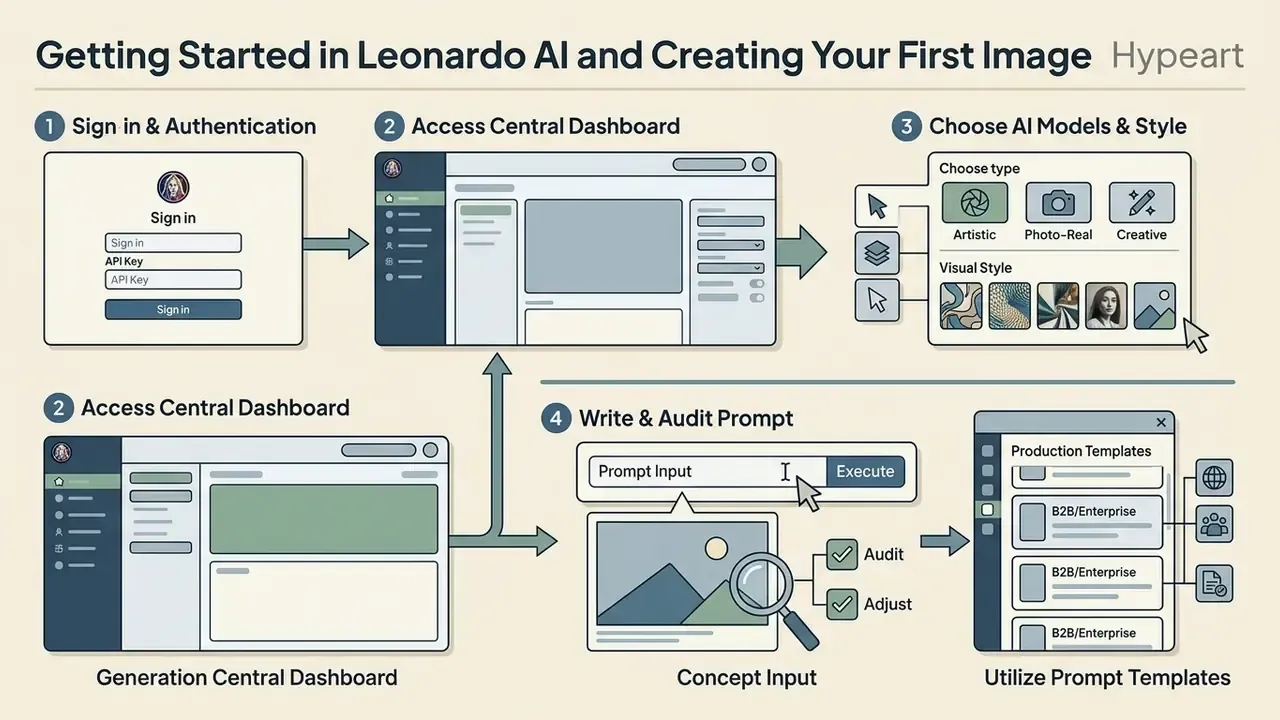
To start generating assets, users sign in to the web application or authenticate against the API, then open the central dashboard to begin leonardo ai image creation. Building that first workflow involves four decisions: pick a foundational model, configure dimensions, write descriptive prompt criteria, and run the generation to review leonardo ai create ai art generation images. The platform can auto-select a model for you. Manual selection returns more parameter control, which is the preferred posture for brand-critical work.
Choosing AI Models for the Task and Visual Style
Selecting the correct ai models governs output fidelity, style adherence, and credit expenditure. The platform exposes proprietary architectures such as Phoenix, a general-purpose model supporting custom style UUIDs, alongside Lucid Origin and Lucid Realism, which share the same UUID-based style layer. SDXL-derived models instead rely on built-in presets: 3D Render, Photography, Illustration, Sketch (Leonardo.Ai Docs, accessed 2026). Match operational intent to model capability. Photorealistic campaigns need photorealism-tuned baselines; conceptual storyboards do better with dynamic illustration models. Custom Elements (LoRAs) trained on SDXL bases at 1024x1024 are the right route when subject fidelity, a specific product, mascot, or packaging form, matters more than stylistic breadth.
«Images generated with higher computational expenditure received higher appeal ratings across 100 participants, although gains diminished at maximum parameter settings.»
Teams that need stylistic conversion of existing brand assets rather than net-new creation should evaluate image-to-image transformations and dedicated ai image style tooling, where the source composition stays intact and only the treatment shifts. Corporate portrait programmes can compare purpose-built AI headshot generators against general-purpose models.
Writing the Prompt and Auditing the Generated Image
A leonardo ai create image request works best when the prompt is broken into distinct visual components: subject, contextual background, lighting, and framing (Leonardo.Ai prompt formatting guide, 2025). Image Guidance accepts up to six reference images at Low, Mid, or High strength, where Low maximises creative freedom and High maximises resemblance to the reference. That is the controlling trade-off in brand-consistency work.
Once the platform renders the leonardo ai generated art, inspect the output for structural artefacts, brand alignment, and text rendering accuracy. Text is still the usual failure point. If flaws are minor, move the asset into post-processing instead of burning credits on a fresh batch.
«Users rarely achieve the intended result on the first attempt; effective prompting is an iterative skill combining linguistic creativity with visual literacy.»
Production-Ready Prompt Templates for B2B and Enterprise Teams
Standardised, copyable templates reduce variance across operators and make first-pass acceptance measurable. Store approved templates centrally and version them alongside the model UUID they were validated against.
📋 TEMPLATE 1 — Executive Headshot (corporate portrait)
Model: PhotoReal / Lucid Realism | Style: Portrait UUID | Aspect: 16:9 | Quality: high
prompt: Corporate executive portrait of a female financial director in a modern
glass office, natural sunlight, shallow depth of field, photorealistic, subtle
rim lighting, professional attire, neutral corporate palette, 8k detail
--no distortion, extra fingers, oversaturation, painterly effect, visible logos
--guidance 7.5 --seed 420912
📋 TEMPLATE 2 — Product Mockup (packaging / device on surface)
Model: Phoenix (Style UUID: brand palette) | Aspect: 1:1 | Image Guidance: Content Reference (High)
prompt: Studio product photograph of a matte-finish payment terminal on a
brushed concrete surface, soft top-left key light, controlled specular
highlights, seamless light-grey backdrop, commercial catalogue composition
--no text, watermark, reflections of people, cluttered background, warped edges
--guidance 8 --seed 771203
📋 TEMPLATE 3 — Campaign Banner Variation (A/B testing set)
Model: FLUX.2 Pro or Ideogram 3.0 | Aspect: 4:5 and 16:9 | Quality: high
prompt: Lifestyle banner of a young professional reviewing a mobile banking
dashboard in a bright co-working space, candid framing, editorial colour grade,
generous negative space on the right for headline placement
--no illegible UI text, distorted hands, brand marks, heavy vignette
--guidance 6.5 --seed 100455
📋 TEMPLATE 4 — Concept Storyboard Frame
Model: SDXL derivative with Illustration preset | Aspect: 21:9
prompt: Storyboard frame, wide establishing shot of a bank branch interior
redesign, loose ink-and-wash illustration, clear silhouette hierarchy,
annotation-friendly flat lighting
--no photorealism, clutter, text labels --guidance 5 --seed 330871
Governance tip: fix --seed for every approved asset, then record the seed, model UUID, and guidance value in the asset register. Without a fixed seed an audit cannot reproduce the output, and reproducibility is a standing expectation under SR 11-7-aligned model documentation.
Which AI Models and Editing Tools Are Available in Leonardo AI
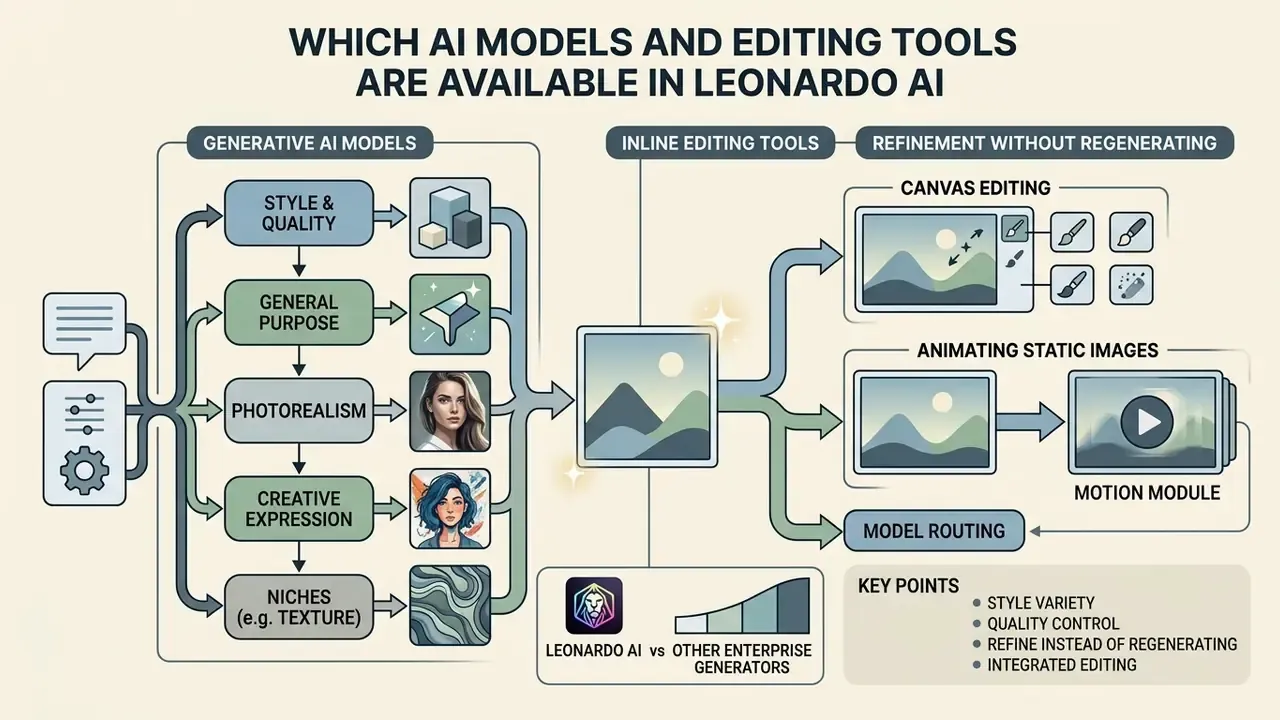
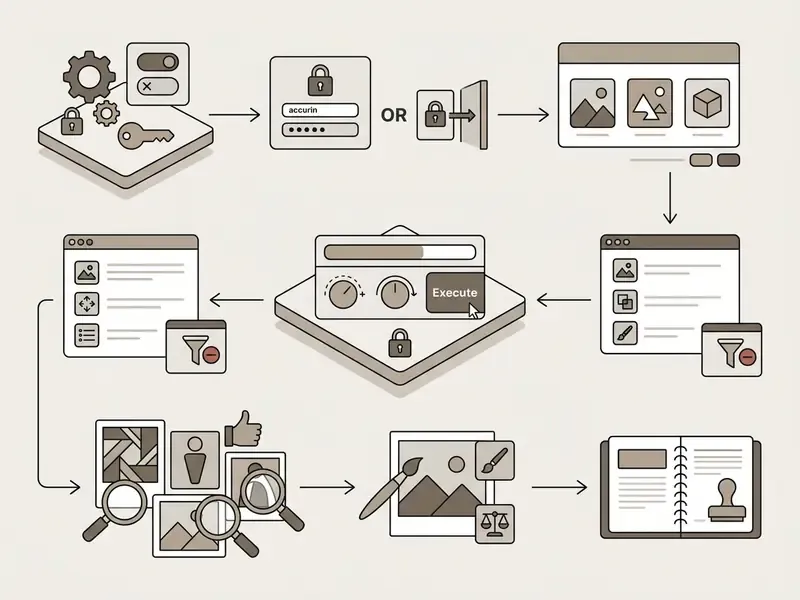
The platform ships a broad suite of generative ai models plus inline editing tools designed to refine synthetic media without restarting a generation task from zero. Enterprise pipelines depend on those capabilities to fix localised regions, extend image boundaries, animate approved frames, and hold visual consistency across a campaign.
How AI Models Affect the Style and Quality of an AI Image
The choice of foundational ai models dictates stylistic fidelity, edge resolution, and aesthetic coherence in any generated leonardo ai image. Architectures apply different conditioning approaches. Phoenix leans on style UUIDs such as Moody, Portrait, or Pro B&W photography; standard SDXL variants use built-in presets; Alchemy-enabled generations expose a separate style set covering Anime, Creative, Dynamic, Environment, Photography, Raytraced, 3D Render, and Sketch (Leonardo.Ai Docs, accessed 2026).
Measuring quality without hand-waving. Rather than relying on taste alone, review boards can score outputs against a structured index:
«A six-dimensional AI-art evaluation index covering beauty, colour, texture, detail, line, and style differentiates quality between models and configurations.»
Earlier research on computational aesthetics points in the same direction: allocating more inference processing to rendering raises subjective appeal and visual detail, though returns flatten past optimal sampling thresholds, as measured across a 100-participant study (Behaviour & Information Technology, 2024). Operationally, Fast mode suits ideation volume. Ultra and high-quality tiers belong to assets that will actually reach production, because token cost climbs faster than perceived gain beyond a certain point.
Editing Instead of Regenerating the Image
Canvas-based editing modules, Inpainting and Outpainting above all, let creators alter specific elements of a leonardo ai image while preserving the surrounding composition. Mask operations isolate a defective region, a warped logo or a mangled hand, and regenerate only the masked pixels, with generation confined to the white masked area while the context image stays intact (Leonardo.Ai Help Center, accessed 2026). Canvas accepts an uploaded image, a prior generation, or a Community Feed image as its base, and Canvas 2.0 adds Alchemy and Prompt Magic support so edits match the style quality of the original render.
Two constraints deserve documentation. The API reference states that all models except Leonardo Lightning XL, Leonardo Anime XL, and Phoenix can be used with Canvas Inpainting, while the Canvas 2.0 help article says favourite platform models, including custom models, work in Canvas. That looks like a product-version difference rather than a contradiction, so validate model-to-canvas compatibility empirically before standardising a workflow.
Localised editing cuts token expenditure sharply and improves visual continuity, since a small correction no longer triggers a fresh batch. For resolution and clarity refinement, operators often pair canvas work with AI image enhancement tools. For aspect-ratio adaptation across channels, AI outpainting and image expansion tools preserve composition without cropping brand-critical elements, and a dedicated ai image resizer handles the mechanical export sizes for paid social. Two more adjacent utilities are worth naming: an ai image remover for stripping unwanted objects or background clutter from an approved frame, and an ai image replacer when a product variant must be swapped inside an otherwise signed-off composition.
Animating Static Images with the Motion Module
The platform converts approved stills into short MP4 clips through its Motion tooling, governed by a Motion Strength parameter. For corporate decks and paid social placements, Motion Strength between 3 and 5 is the pragmatic band. It produces perceptible parallax and ambient movement while limiting the geometric deformation that shows up at higher settings, especially on logos, typography, and hands.
A repeatable workflow: generate and approve the still, finish all inpainting corrections before animating (motion amplifies existing artefacts), animate at low-to-mid strength, then review frame by frame across the first and last half-second where warping concentrates. Export, and log the source image ID next to the motion parameters. Animation consumes extra tokens per clip, so reserve it for assets that already cleared brand and legal review. Teams assembling clips into longer publishable sequences can plan downstream assembly using our YouTube video editing workflow guide or open the hub for adjacent production playbooks.
Leonardo AI vs Nano Banana and Other Enterprise Generators
Comparing enterprise ai tools means weighing parameter flexibility, model selection, editing depth, and, for regulated buyers, security and indemnification posture. Leonardo ai offers a full multi-model creative suite with granular canvas controls. Nano banana is Google's native Gemini image generation architecture, optimised for conversational creation and modification (Google AI Studio and Gemini API docs, 2026). The current Nano Banana family spans Nano Banana 2 Lite, Nano Banana 2 (a generalist with 4K generation and strong text rendering), Nano Banana Pro (studio-grade precision), and the legacy Gemini 2.5 Flash Image. Worth noting: Leonardo itself exposes Nano Banana and Nano Banana Pro among its Omni models, so the real choice is often "router plus editor" versus "direct model access".
| Evaluation Criterion | Leonardo AI Platform | Nano Banana (Gemini Native) | Midjourney | Adobe Firefly |
|---|---|---|---|---|
| Primary architecture | Multi-model router (Phoenix, Lucid, FLUX, SDXL, GPT Image, Seedream, Nano Banana, Element LoRAs) | Native Google Gemini multimodal model family | Proprietary single-family model line | Proprietary models trained on licensed stock and public-domain data |
| Editing suite | Inline Editor, Canvas inpainting and outpainting, Motion video | Conversational prompt-based image modification | Vary Region, pan and zoom, remix | Generative Fill and Expand, deep Creative Cloud integration |
| Control depth | Guidance scale, seed, quality tier, Prompt Magic, Style UUIDs, up to 6 reference images (Low/Mid/High) | Aspect ratio, image size, conversational context | Stylize, chaos, weights, seeds | Structure and style reference, effects, content controls |
| Training-data provenance clarity | Model-dependent; multi-vendor routing complicates single-source attestation | Google-governed datasets | Not publicly itemised | Explicitly marketed as licensed-stock origin |
| IP indemnification for enterprise | Not marketed as a standard consumer-tier commitment; confirm contractually | Governed by Google Cloud and Gemini enterprise terms | Not marketed as standard | Marketed for enterprise customers under Adobe terms |
| Data privacy controls | Explicit Public and Private toggle; private mode on paid tiers | Google Cloud and Gemini API data governance | Public galleries by default on lower tiers; private modes higher up | Enterprise data handling under Adobe agreements |
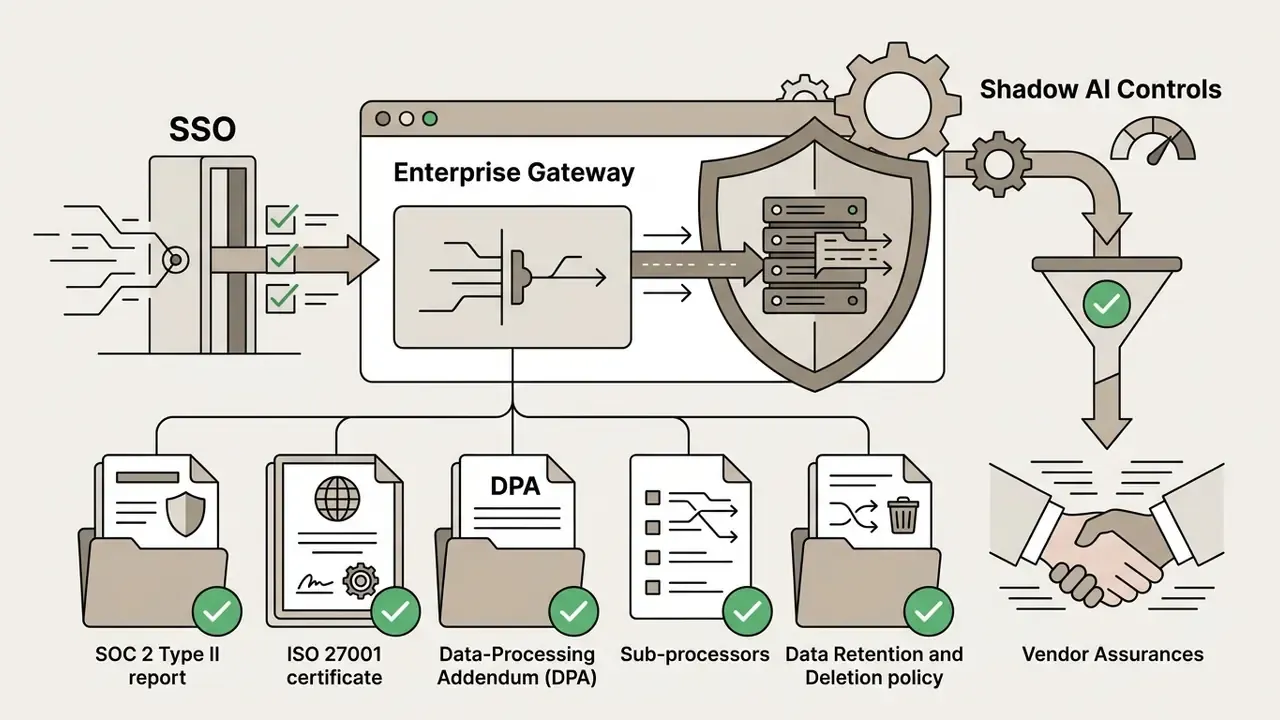
| Enterprise identity & security posture | Team seats on higher tiers; SSO/SAML, SOC 2 Type II and ISO 27001 status must be confirmed with the vendor before rollout | Inherits Google Cloud enterprise controls | Limited enterprise identity tooling | Inherits Adobe enterprise identity and compliance programme |
| Target user group | Enterprise creative teams, marketing groups, studios | Developers, conversational AI workflows, general users | Art-directed creative communities | Enterprise design teams inside Creative Cloud |
Evaluation teams must decide which requirement dominates: Leonardo's multi-model parameter control, Nano Banana's conversational flexibility, Midjourney's art direction, or Firefly's provenance-first licensing story. Regulated buyers should treat the security and indemnification rows as questions to put in writing to each vendor, not as settled facts. Certification scope changes, and public marketing pages rarely state audit period or Trust Services criteria. For a side-by-side of art-focused platforms, see our comparison of the best AI art generators for brands, or see the overview of enterprise visual generation frameworks.
Is Leonardo AI Suitable for Commercial Brand Visuals?
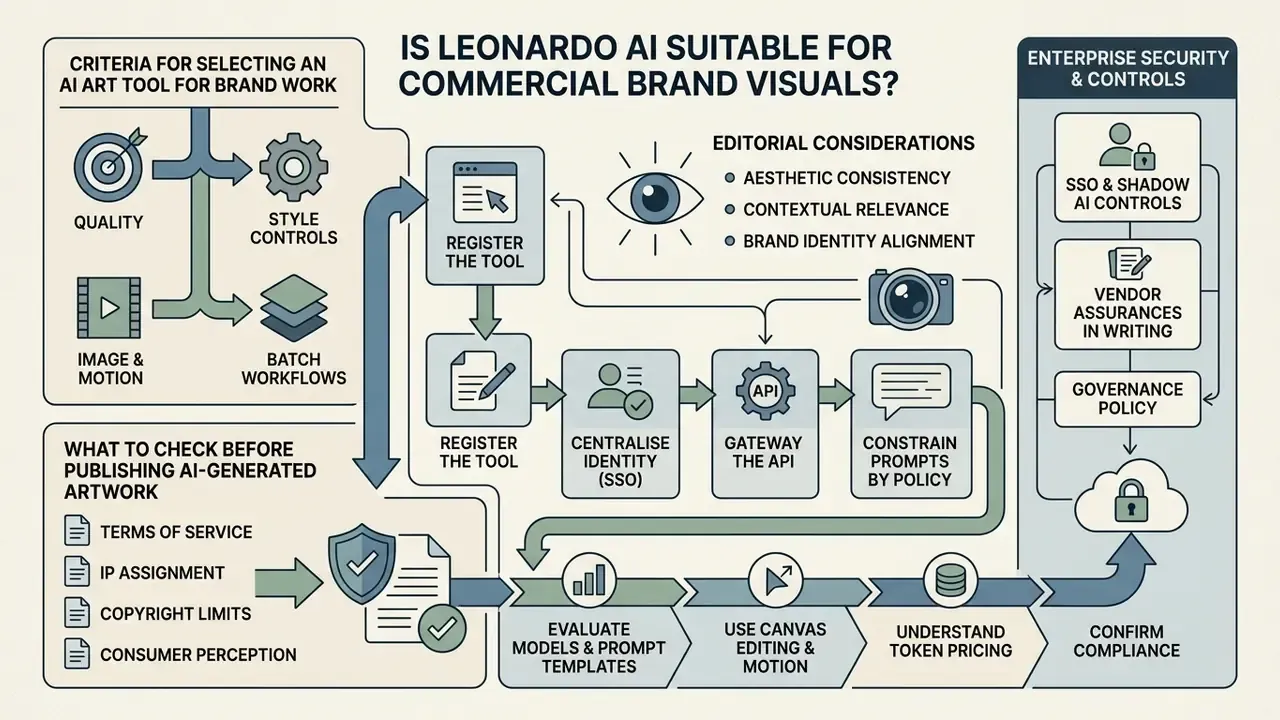
Deciding whether the platform fits commercial brands means reading three things together: the terms of service, the intellectual property assignment, and the consumer perception data on synthetic media.
Criteria for Selecting an AI Art Tool for Brand Work
When selecting an enterprise leonardo ai art generation tool, brand risk officers weigh visual fidelity, copyright compliance, and trust impact. Advertising research complicates the picture: high-quality synthetic visuals can match camera photography in click-through performance, yet 78% of consumers consider AI-generated images inherently less authentic and 66% prefer brands using unedited photography (Getty Images VisualGPS Report, 2024. https://www.cxnetwork.com/cx-experience/articles/ai-generated-images-in-advertising).
«In the apparel category, correct disclosure of AI origin produced a statistically significant 0.499-point drop in purchase intention (p = .015); technology, food, and cosmetics showed no comparable effect.»
A practical acceptance rubric for brand-facing assets should score five dimensions. First, technical quality: resolution, artefact absence, colour fidelity, legibility. Second, brand fit: adherence to brand guidelines, tone, and cultural sensitivity, with documented human oversight as required by the IAB Generative AI Playbook for Advertising (2025). Third, originality: no close imitation of protected styles, characters, or trade dress. Fourth, semantic accuracy: the image must not misrepresent a product, feature, or claim. Fifth, provenance: content credentials, metadata, and edit trail intact and verifiable, consistent with NIST-aligned provenance guidance.
Regional message alignment sits inside brand fit, not outside it. Enterprise teams shipping the same visual family across markets often route on-image copy through an ai image translator so localisation does not silently break layout or claim wording. Disclosure practice matters too: institutional guidance such as Harvard's AI marketing guidelines requires AI-generated imagery to be clearly labelled in brand communications.
What to Check Before Publishing AI-Generated Artwork
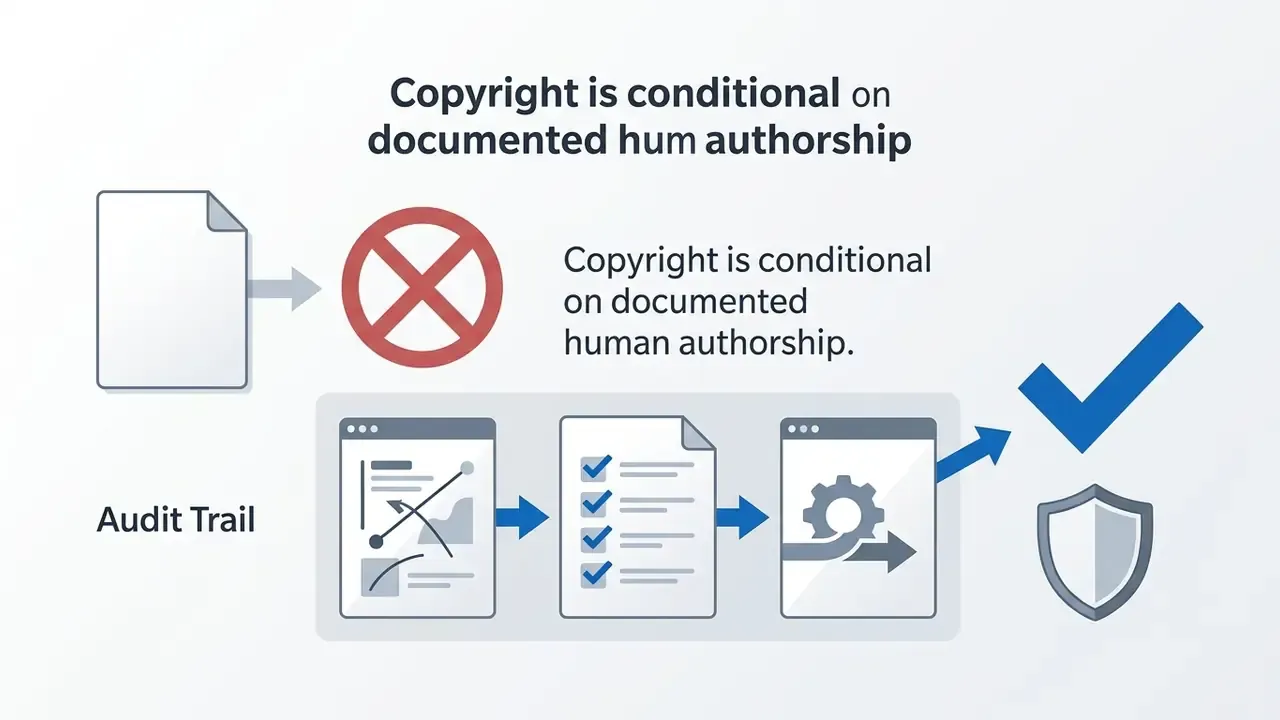
Before publishing any leonardo ai generated artwork in a commercial campaign, legal teams must verify copyright enforceability and platform licensing terms. Under US Copyright Office guidance, purely machine-generated visual outputs lacking substantial human authorship cannot be registered (USCO Report on Copyright and Artificial Intelligence, Part 2, January 2025. https://www.copyright.gov/ai/).
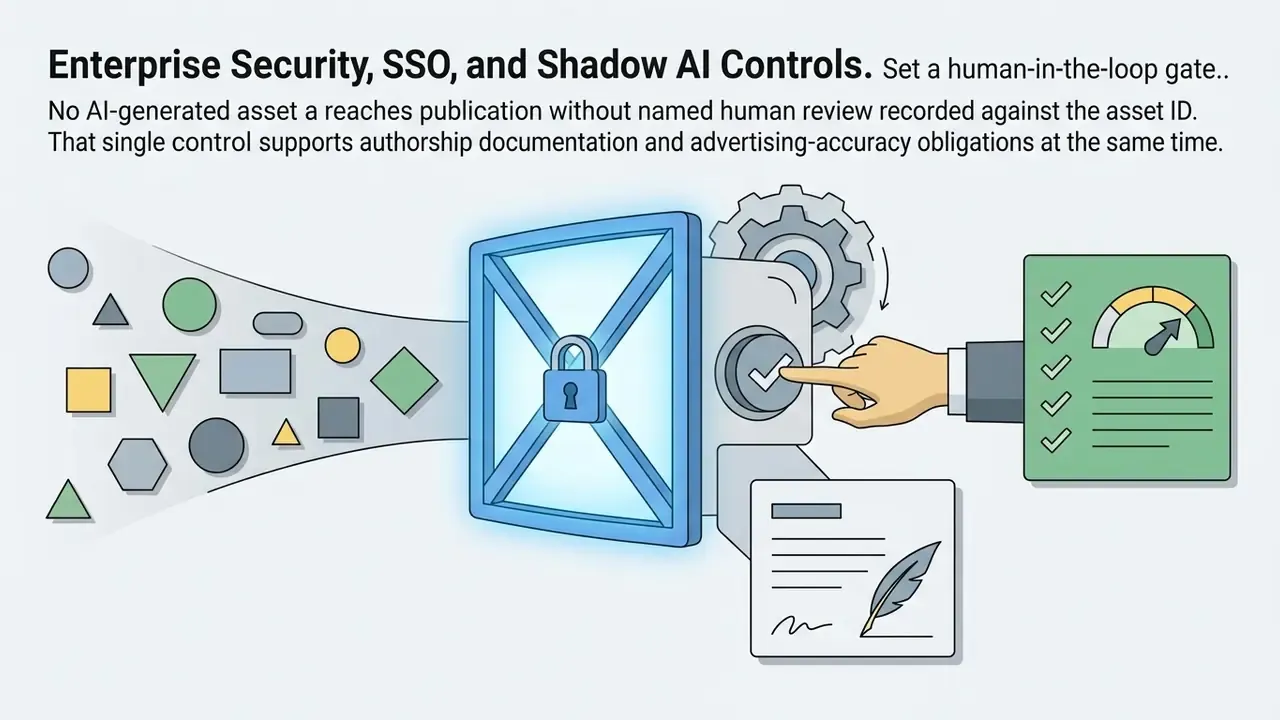
So to establish protectable ownership, document the human creative interventions: manual canvas editing, compositing, prompt engineering sequences. Compliance functions verifying the origin of third-party or inherited assets before reuse can apply AI image detectors as a screening step, remembering that detection is probabilistic and should support provenance metadata rather than replace it.
Jurisdiction changes the answer, too. European Parliament research indicates that purely AI-generated outputs without substantial human intervention are not eligible for copyright in the EU and may fall into the public domain, which undermines exclusivity assumptions in pan-regional campaigns. Teams mapping the litigation landscape around synthetic visual IP can compare options before drafting internal policy.
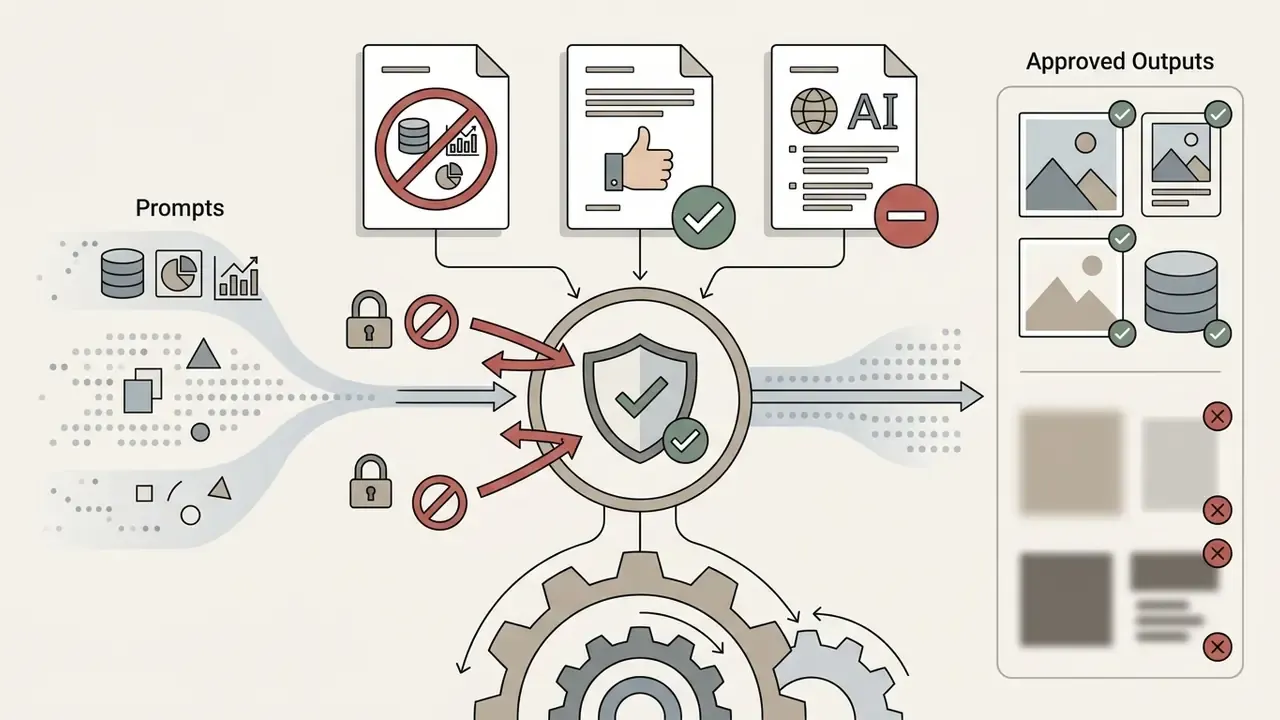
Separately, account for residual generation risk. A model may unintentionally render protected trade dress, a recognisable logo, or a likeness resembling a real person. Mitigations: negative prompts targeting logos and text, mandatory human review of every publishable frame, documented model releases for any human-resembling subject, and contractual clarity on who carries indemnity if a claim lands. One distinction gets missed often. Trademark permission from a brand owner is a separate legal instrument from platform terms. A platform may permit "commercial use" while the mark owner still requires a licence.
Enterprise Security, SSO, and Shadow AI Controls
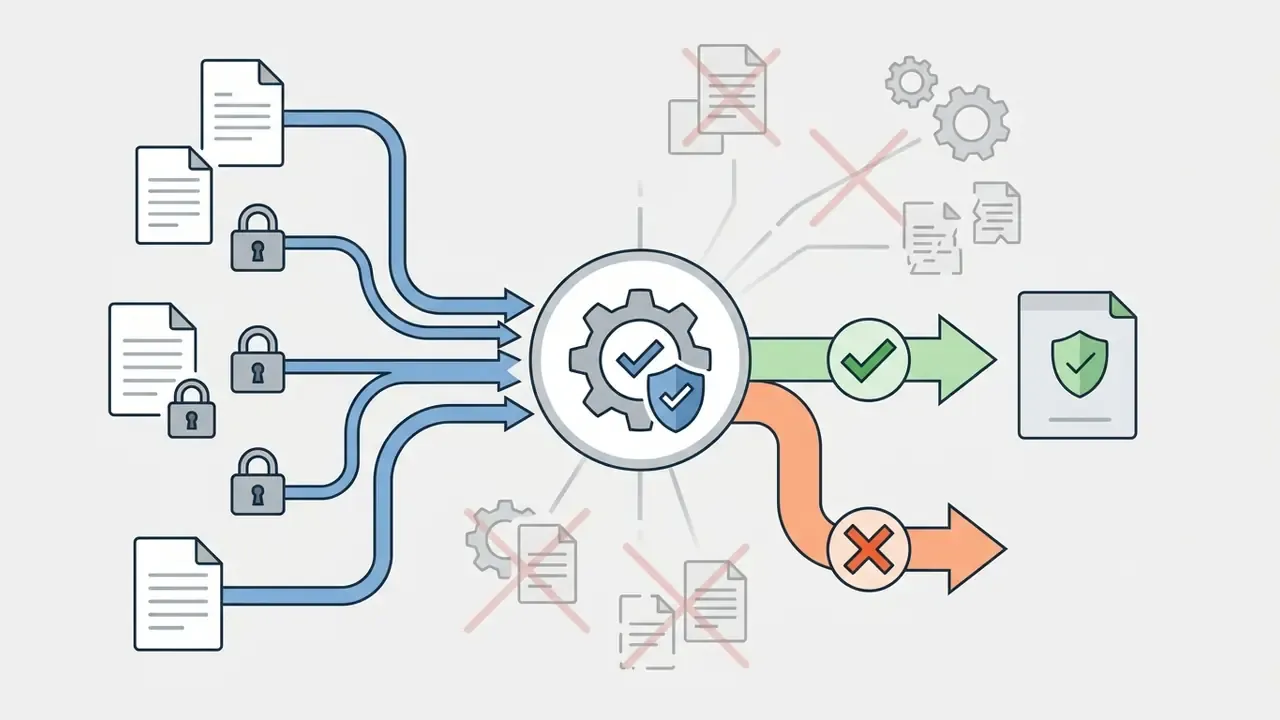
For institutions in regulated sectors, the operative risk is rarely the model. It is uncontrolled adoption. Free-tier accounts opened with corporate email addresses generate public assets and push prompts containing confidential campaign, product, or customer detail outside sanctioned channels. A defensible control set includes six moves:
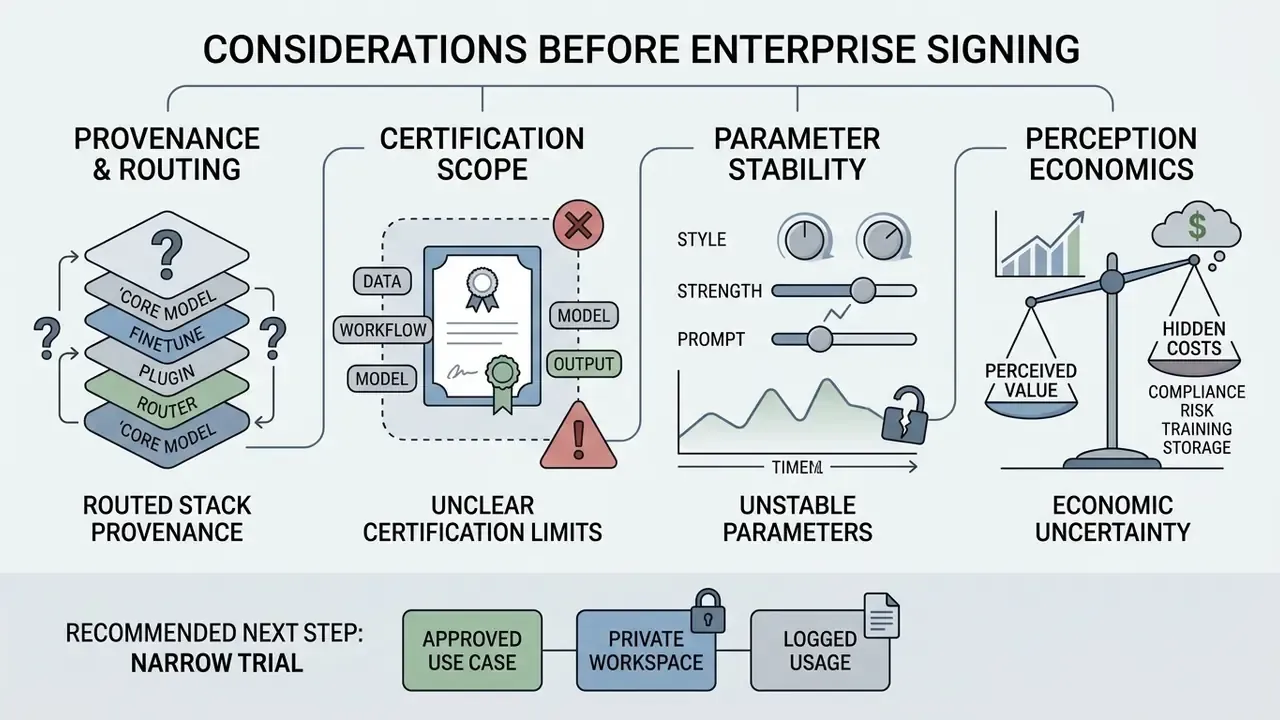
Limitations and Open Questions Before You Sign
FAQ: Leonardo AI Image Generator
Is there an official Leonardo AI app image generator for mobile devices?
Yes. Leonardo Interactive Pty Ltd publishes official mobile applications for Apple iOS (App Store ID 1662773014) and Android (Google Play listing "Leonardo.Ai - Image Generator", package ai.leonardo.leonardo, developer LEONARDO INTERACTIVE PTY LTD, support email [email protected]). The leonardo ai app image generator authenticates against the primary platform account, so users can run generations, edit canvas assets, upscale, animate, and check credit balances from a phone (Leonardo.Ai Support, accessed 2026).
Where can I find the official leonardo ai art generator link?
The verified web application endpoint is app.leonardo.ai, reachable from the corporate landing page at leonardo.ai. API documentation and technical reference material sit at docs.leonardo.ai, and support runs through the in-product help centre or [email protected]. Verify domain certificates before entering enterprise credentials, and disregard third-party sites advertising regional workarounds or "no VPN" access to the leonardo ai art generator, since those claims appear nowhere in official documentation.
Can free-tier images generated on Leonardo AI be used commercially?
Under Leonardo AI's Terms of Service, free users own their outputs and keep commercial usage rights. The catch is visibility: free generations are public by default, granting the platform and community members non-exclusive, perpetual rights to view, copy, adapt, and distribute those assets, including use for service improvement (Leonardo.Ai Terms of Service, updated 25 November 2024). Some third-party 2026 reviews describe the free tier as non-commercial. Where secondary sources conflict, the official pricing and terms pages control. Commercial enterprise campaigns belong on paid tiers with Private Mode enabled.
How does Leonardo AI compare to other enterprise image generators?
Leonardo AI runs as a multi-model creative suite with model switching (Phoenix, Lucid, FLUX, SDXL, GPT Image, Seedream, Nano Banana), custom LoRA training through Elements, an inline canvas editor, and Motion video output. Competing systems such as Midjourney and rival AI image generators concentrate on single-family prompt generation, while Adobe Firefly emphasises licensed stock-dataset origin and Creative Cloud integration. On measured performance, a large 2024 marketing benchmark evaluated seven models, including DALL·E 3, Midjourney v6, and Firefly 2, across 10,320 images and reported that AI-generated visuals outperformed human-produced content on aesthetic scoring, with up to 50% higher click-through rate in an accompanying field study. The DOI for that benchmark is not publicly indexed in our source set, so treat the figures as indicative and re-verify them before quoting in procurement documentation.
How many tokens does a generation consume, and how should we budget?
Token cost varies by model, resolution, quality tier, image count, and post-processing such as upscaling, Alchemy, or Motion. The free plan provides 150 fast tokens per 24 hours with no rollover, practically 10 to 30 images. Paid pools scale from 8,500 monthly tokens on Apprentice to 60,000 on Maestro. Budget with the TCO formula in Section 6, which weights human editing and compliance review hours alongside licence cost, because in regulated environments those hours usually exceed token spend.
Which parameters must be logged for model risk and audit purposes?
At minimum: full prompt and negative prompt text, model identifier or UUID plus version, seed, guidance scale, quality parameter, reference-image IDs with guidance strength, output asset ID, operator identity, timestamp, and a summary of human edits (inpainting masks, compositing, retouching). That set makes an output reproducible and supports both copyright authorship documentation and supervisory model documentation expectations under SR 11-7 and OCC 2011-12.
Can Leonardo AI animate images into video?
Yes. Approved stills convert into short MP4 clips through the Motion tooling, with realism governed largely by Motion Strength. Keep strength between 3 and 5 for corporate material, finish inpainting before animating, and review the opening and closing frames where deformation concentrates. Section 14 sets out the full workflow.
Appendix A: Editorial Change Log and Retained Fragments