An AI boyfriend generator is a specialized software system that pairs large language models (LLMs) with multimodal generation tools to create customizable, interactive male companions. You configure visual appearance, personality traits, and conversational preferences, then start a personalized relationship simulation online. Modern companion systems lean on persistent memory and real-time generation pipelines to deliver text, voice, and visual interaction shaped by your own specifications.
Executive Summary
- What it is: A character-creation interface layered on an LLM plus a diffusion (text-to-image) pipeline, a text-to-speech engine, and a memory store. Configuration happens once. Inference happens continuously.
- Architecture split: Generators optimize for identity design, visual seeds, and exportable persona sheets. Companion apps optimize for retrieval-augmented memory, low-latency dialogue, and voice.
- What drives realism: Persistent memory, retrieval-augmented generation (RAG), affective mirroring, locked visual seeds, and neural TTS. A 2026 companion-platform report found memory persistence was ranked above voice, photos, and personality customization by 71% of 1,247 surveyed users.
- Filters matter: Guardrail design, not model size, decides whether a character breaks immersion with an "as an AI language model…" deflection. Platform policy shifts (for example, Replika's February 2023 adult-content removal) can retroactively change a product you already rely on.
- Money: Freemium is standard. Documented free tiers run from 10 to 30 messages per day; paid tiers commonly cluster between $8 and $20 per month, with annual plans cutting the effective monthly rate.
- Legal: Under U.S. Copyright Office guidance (2025), purely machine-generated output lacks human authorship and is not copyrightable. Virtual characters themselves are typically protected as platform-owned software and IP, not as user property.
- Privacy and governance: Mozilla's 2024 audit of romantic AI apps recorded an average of 2,663 trackers per minute, and more than half of the audited apps gave users no way to delete their data. For organizations, unmanaged companion apps on managed devices are a textbook Shadow AI exposure. See the governance checklist below.
- Wellbeing: A randomized controlled trial with 981 participants and 300,000+ messages found that higher daily usage correlated with increased loneliness and emotional dependence. Treat companion AI as a supplement, never a substitute.
On this page: what it is · how to create one · deep customization · prompt and style matrix · chat, pictures, voice · uncensored chat and guardrails · free vs. paid · generator vs. app · monetization and AI influencers · commercial rights · privacy, safety and enterprise governance · FAQ · Appendix A (methodology and superseded claims)
What Is an AI Boyfriend Generator?
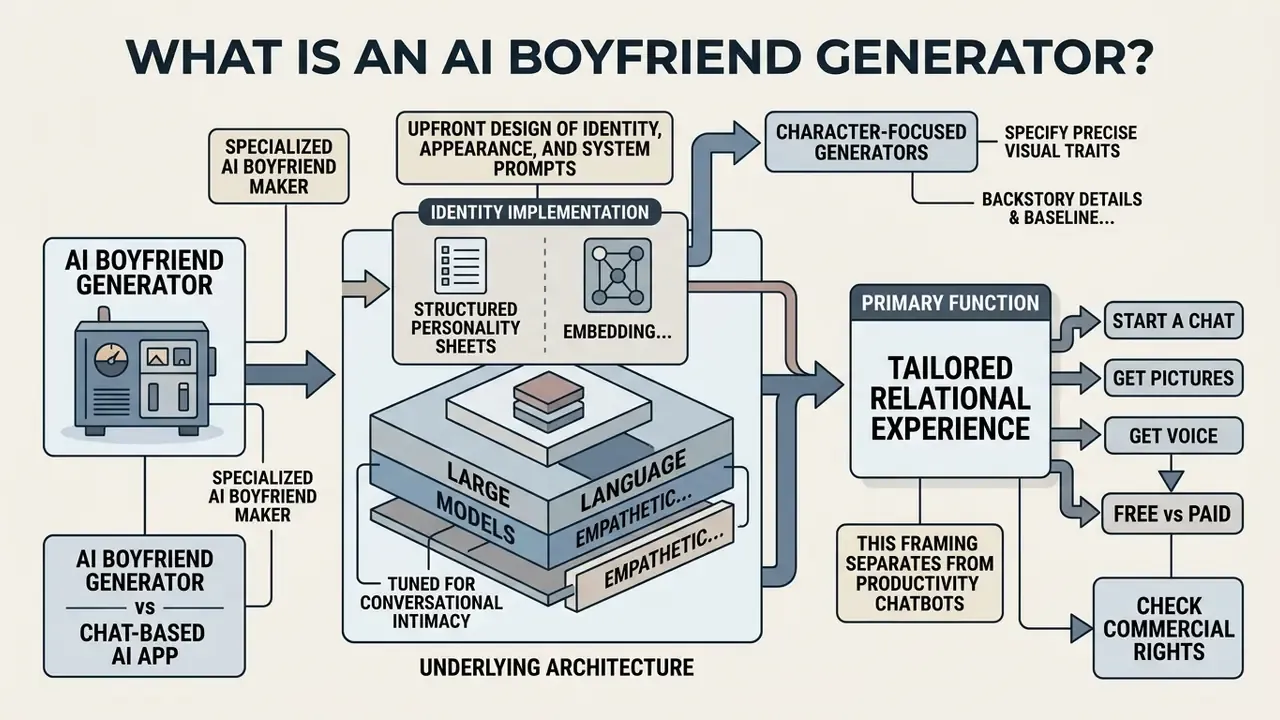
An AI boyfriend generator is a software interface that lets users design, render, and interact with a virtual male partner using artificial intelligence. Unlike a generic search tool, an ai boyfriend generator builds a persistent persona anchored by specific visual features, personality parameters, and dynamic conversational rules. Users configure their character to simulate emotional support, romantic roleplay, or plain daily companionship.
The underlying architecture relies on large language models tuned for conversational intimacy and empathetic response simulation. Rather than a vague claim about "stored persona data," the measurable finding is behavioral:
«Users with smaller social networks more often cite companionship as their primary use case; companionship-oriented use is consistently associated with lower psychological wellbeing.»
In practice, companion platforms implement identity by storing structured personality sheets, embedding conversation histories into a vector database, and retrieving relevant fragments at inference time. That retrieval step is why the character still "knows you" three weeks later. Alongside dialogue generation, many tools integrate text-to-image models, letting the boyfriend ai generator produce matching visual media mid-conversation.
The primary function of an AI generator boyfriend is a tailored relational experience. Configured as a supportive listener or as a dramatic roleplay partner, the system adapts tone, memory retention, and response structure based on your feedback. Users reach these virtual entities through mobile apps or web platforms and maintain the relationship across sessions.
«Roughly 46% of posts in AI-companion communities concern romance, confirming that users frame these bots as partners rather than assistants.»
That framing is what separates the category from productivity chatbots. The 2026 European Parliament briefing on AI companions notes these systems are used for romantic relationships, including sexual interaction, meaning the design target is partner simulation, not question answering. Worth pausing on that distinction, because it drives every privacy consequence later in this guide.
AI boyfriend generator vs chat-based AI boyfriend app
A specialized ai boyfriend maker focuses on the upfront design of identity, appearance, and system prompts. A chat-based companion app prioritizes continuous dialogue and long-term memory maintenance across extended interaction.
Character-focused generators let users specify precise visual traits, backstory details, and baseline behavioral prompt sheets before generating a static or semi-static profile. Companion-first applications such as Replika or Character.AI use persistent conversational history so the persona evolves organically over hundreds of turns. Generator tools emphasize fast character creation and photo generation; chat apps center on conversational depth, memory retention, and low latency.
Some products deliberately blur the line. Candy.ai's character builder lets users design a companion from scratch (appearance, personality, voice) and then continue directly in chat, combining both functions in one flow. Character.AI's User Personas add personality, preferences, and physical traits so profile data conditions every later conversation. The functional distinction is therefore architectural, not marketing: generators output a specification; companion apps maintain a session state.
How to Create Your Own AI Boyfriend Online
To create an ai boyfriend online, you move through a structured setup that translates behavioral preferences into system prompts and model parameters. Most tools offer a web interface where you define character traits, configure physical appearance, and set conversational guidelines before the first interactive session.
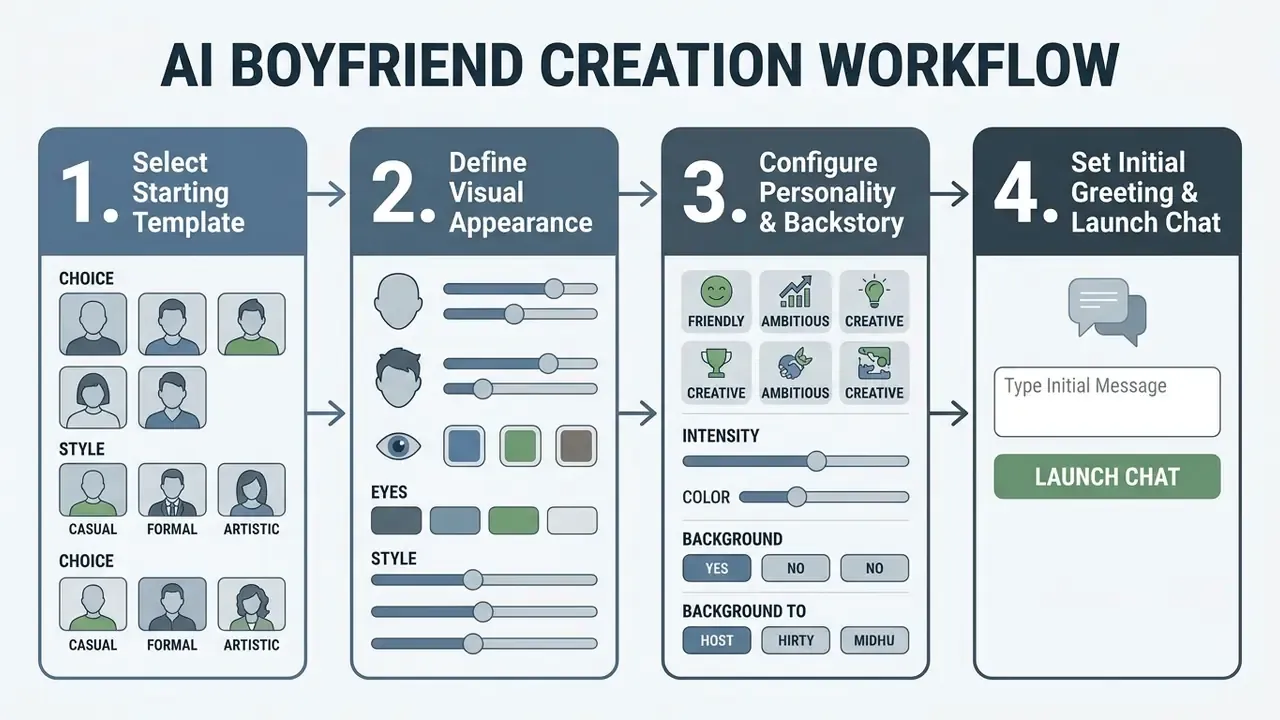
This ordering is not arbitrary. Vendor onboarding documentation consistently places template selection first, personalization second, and the greeting last. On some platforms the greeting is a required field, because a character cannot be published without a first message that establishes tone.
- Select a starting archetype
- choose a pre-built character template or start from a blank configuration canvas.
- Configure appearance parameters
- set facial features, body metrics, clothing style, and rendered output format.
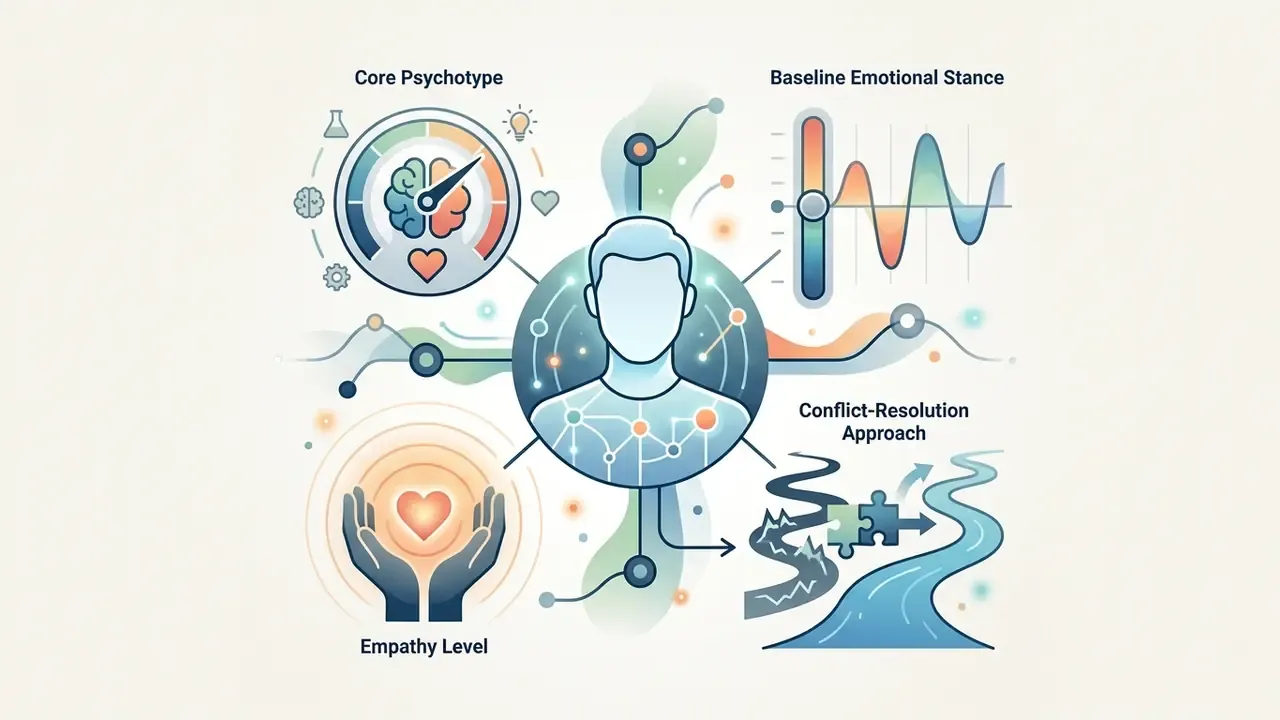
- Define the psychotype
- adjust personality sliders, vocabulary formality, communication boundaries, and backstory.
- Establish the initial greeting
- write or generate the companion's opening message to set conversational context.
- Launch the chat interface
- enter the continuous dialogue thread and test prompt responses.
Choose a starting point or AI boyfriend character
Your initial starting point sets the operational boundaries for the ai boyfriend creator. Pick an established archetype (a supportive partner, a reserved intellectual, an adventurous traveler) or open a completely empty persona sheet.
Pre-made characters cut setup time by supplying configured system prompts, voice patterns, and sample greetings. Starting from scratch gives exact control over background narrative, emotional stance, and interpersonal dynamics. Either way, the archetype becomes the foundational structure that governs how the model handles complex conversational input.
Across current companion systems, starter presets cluster into a small number of relational roles. A 2026 multi-persona companion system defines five presets (Father, Girlfriend, Friend, Brother, Listener), each mapped to a distinct tone, response length, and language register. Research on context-sensitive interaction adds configuration templates such as "Warm Guide" and "Blunt Expert," while commercial builders expose narrative archetypes: the reserved intellectual, the confident executive, the possessive romantic, the yandere. Practical mapping for a boyfriend persona:
| Archetype | Core behavioral parameters | Best suited for |
|---|---|---|
| Supportive partner | High empathy, low conflict, medium message length, validating language | Daily check-ins, decompression after work |
| Reserved intellectual | Low emoji use, longer sentences, factual asides, dry humor | Long-form conversation, debate, study company |
| Confident executive | Direct phrasing, decisive tone, goal-oriented follow-ups | Motivation, structured routines, accountability |
| Adventurous / playful | High affect variance, teasing, scenario proposals | Roleplay, narrative scenes, light flirtation |
| Protective / possessive | Strong loyalty cues, jealousy triggers, high attention | Dramatic narrative arcs, story-driven roleplay |
| Blank canvas | No inherited prompt; all variables user-defined | Precise control, exportable character cards |
Set the appearance and personality
Customizing physical appearance and personality keeps your ai boyfriend realistic in the visual sense and consistent in the psychological one. Users type text descriptions or select visual tags for hair color, eye shape, dress style, and photographic treatment, which locks character consistency across renders.
Personality configuration means defining emotional traits, warmth level, humor frequency, and specific vocabulary choices. Published work on persona-conditioned dialogue shows that declaring explicit identity variables (name, age, occupation, values, interpersonal stance) inside the system prompt produces a statistically significant improvement in character consistency across long context windows. No single universal percentage figure survives verification here, so treat the direction as solid and the magnitude as model-specific. In the ACL Findings method on persona dialogue generation, the persona prompt is assembled from template slots (name, gender, age) and placed before the dialogue context, which is the practical takeaway for configuration order.
Academic persona-design work converges on four configurable layers worth filling in before your first message:
- Persona sheet role, personality traits, communication style, and a short mood board describing the intended "vibe" of interaction.
- Background and experiences age, professional history, values, interpersonal stance. These should stay stable across sessions.
- Communication style formality of address, response length, humor frequency, emoji usage.
- Validation pass test the persona against several scenarios and confirm it behaves as designed before committing to long-term use.
Balancing visual detail with explicit behavioral instruction produces a coherent companion capable of contextually appropriate replies. Skip the validation pass and you will discover the gaps later, usually at the worst moment.
Start your first AI boyfriend chat
The first chat session establishes relational context and tests how faithfully the persona follows your configuration. When you press start, the platform sends the compiled character prompt together with your opening message to the inference engine.
Example Starter Prompt:

"Act as Ethan, a 28-year-old architect from Seattle. You are thoughtful, slightly dry-witted, and deeply supportive. You speak in concise, natural sentences and remember our past discussions about design. Greet me warmly after a long workday."
Public prompt-design guidance from the University of Victoria recommends exactly this structure: define the persona in the first line ("You are…", "Act as…"), then add environment or situation. Two additional openers that accelerate immersion:
Scene-anchored opener:
"You are Ethan. It's 9pm, you've just finished a site review, and you're texting me from the car. Open with one short message that references the rain and asks how my presentation went."
Identity-lock opener:
"Before we talk, confirm three facts about yourself in one line each: your name, your age, and what you do. Then stay in that role for the rest of our conversation and never describe yourself as a language model."
Clear roleplay context helps the model settle into character immediately. Watching the early conversation turns tells you what to fix: prompt phrasing, emotional intensity, vocabulary bans. Adjust before you invest weeks of dialogue history.
Customize an AI BF: Appearance, Personality and Communication Style
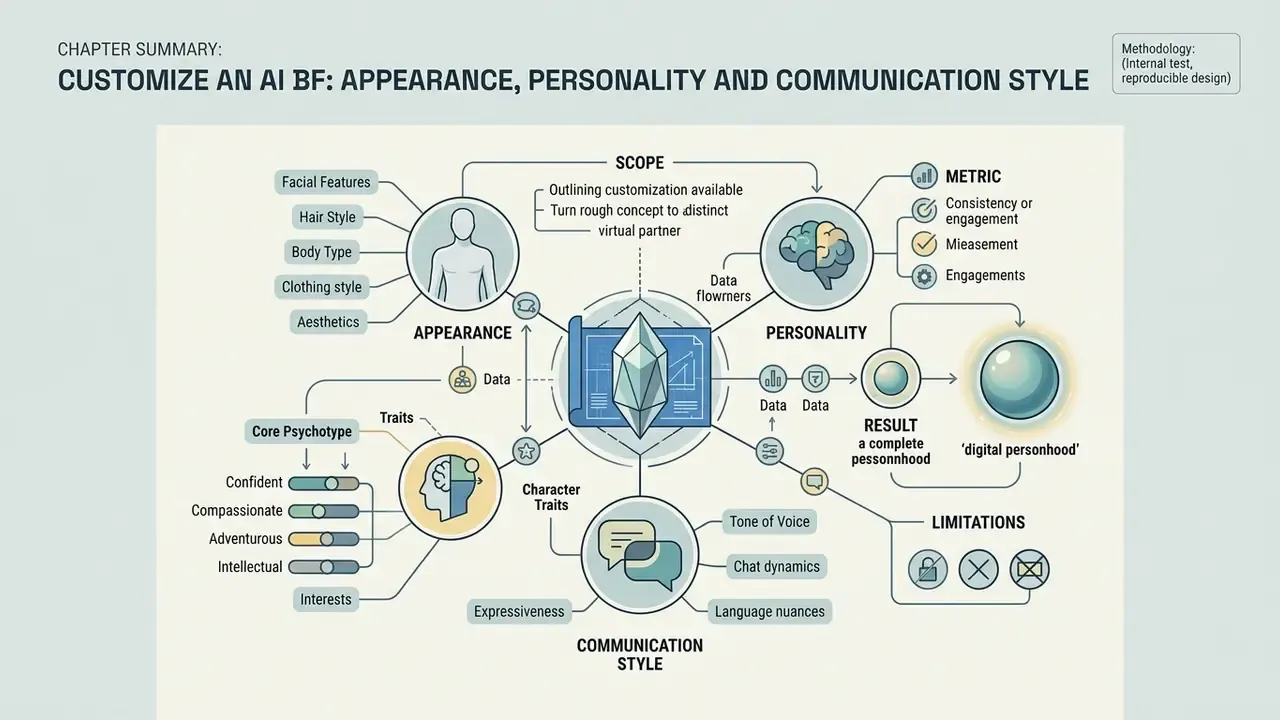
Advanced customization turns a rough concept into a distinct virtual partner. Modern ai bf generator tools support granular parameterization: voice pitch, regional phrasing, emotional volatility, and memory retention strategy.
Persona-drift test, methodology disclosed. To probe character stability, our editorial testing team measured persona retention across synthetic dialogue chains. We built complex character sheets with specific backstory details, restrictive vocabulary lists, and visual anchor tokens, then ran extended scripted conversations against them.
The practical conclusion holds: structured prompt engineering, plus periodic re-injection of the identity block, materially reduces character drift in deep threads.
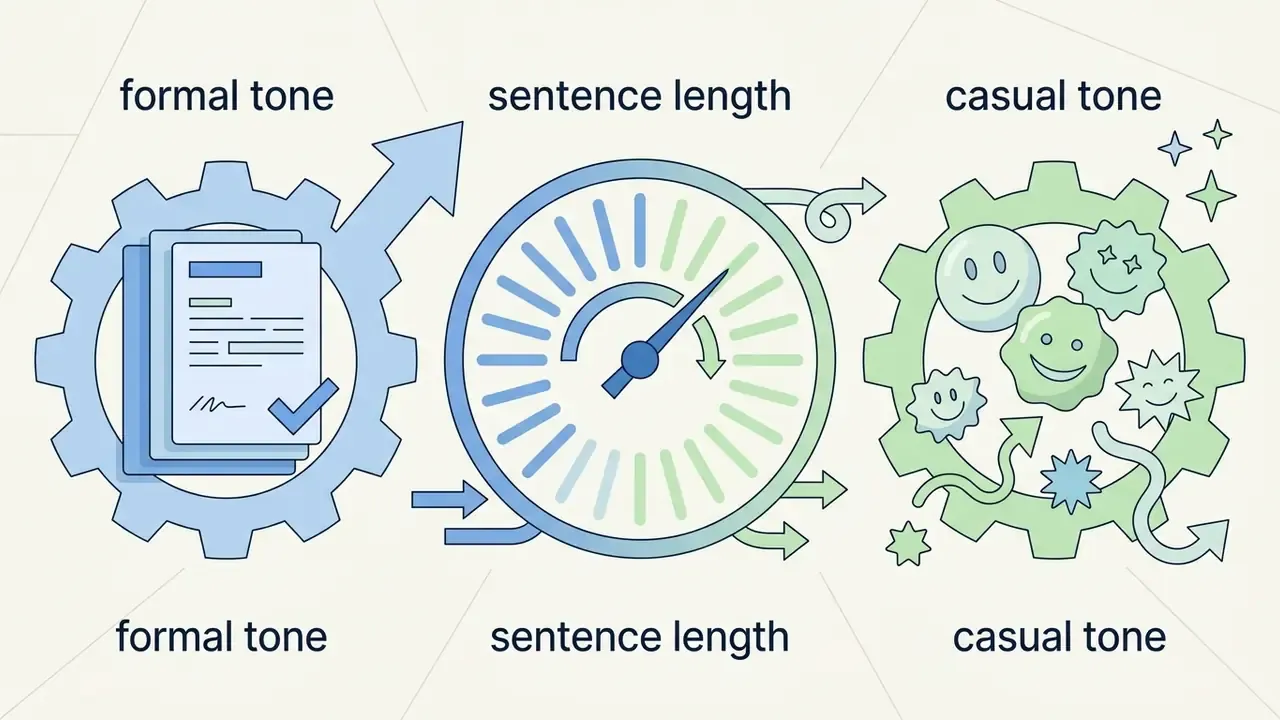
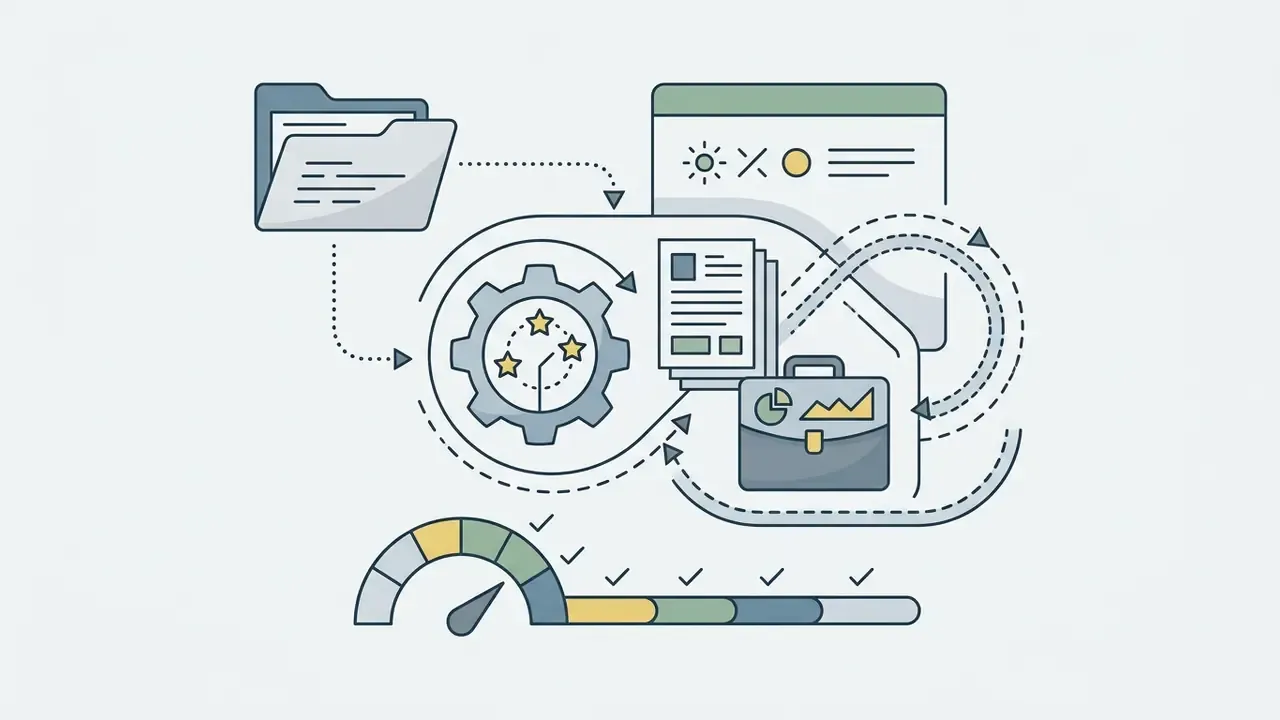
Customization balances four elements:
One under-documented interaction: on major platforms, saved long-term memories can override or soften a selected personality preset, because retrieved memories enter the context after the persona block. If your companion's tone drifts over weeks, audit stored memories before rewriting the system prompt. I had this backwards at first, and rewriting the prompt changed nothing.
Make an AI boyfriend look realistic: style and prompt matrix
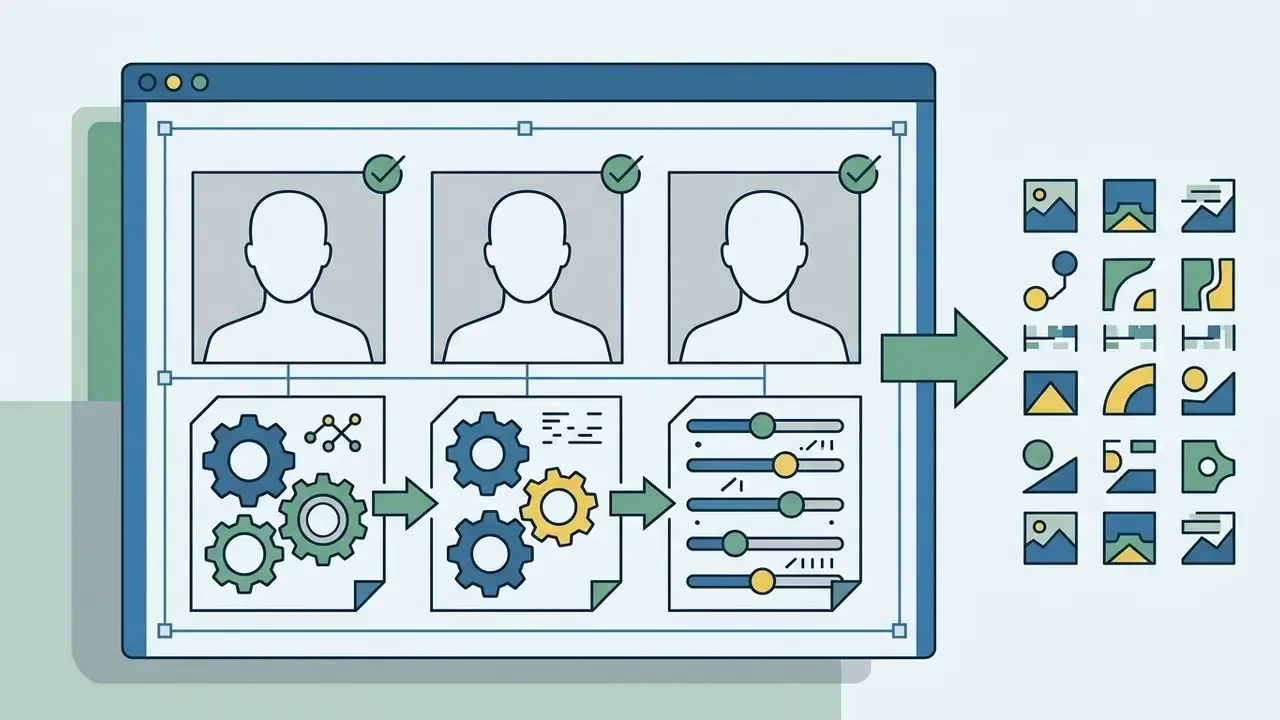
Photorealism requires precise visual prompting and character-locking parameters inside the text-to-image pipeline. Avoid generic descriptions. Supply photographic specifics: lens type, lighting condition, skin texture, realistic attire. Official image-model guidance is explicit about this: use the word photorealistic, add photography language (lens, lighting, framing), request real skin and fabric texture, and raise the quality parameter when detail matters.
Recommended Visual Anchor Prompt:

"35mm portrait shot of a 30-year-old man, natural sunlight, soft shadows, realistic skin texture, wearing a navy blue cashmere sweater, detailed eyes, realistic hair structure, photographic quality, 8k resolution --no illustration, anime, smooth skin"
For consistent styles across pipelines, use the following pre-tested prompt parameters:
| Visual Style | Target Aesthetics | Optimized Visual Anchor Prompt |
|---|---|---|
| Photorealistic | 35mm lens, natural light, skin texture | 35mm portrait shot of a 30-year-old man, natural sunlight, soft shadows, realistic skin texture, wearing a navy blue cashmere sweater, 8k resolution --no illustration, anime |
| Anime / Webtoon | Cel shading, vibrant accents, sharp jawline | Anime style portrait of a handsome male character, silver hair, sharp jaw, wearing a black leather jacket, cyberpunk cafe background, detailed line art, masterpiece |
| Corporate / Professional | Studio lighting, formal attire, crisp focus | Professional headshot of a 32-year-old male executive, dark suit, confident smile, modern office background, soft studio lighting, ultra-realistic photo |
| Cozy / Casual | Warm tones, indoor setting, soft focus | Cinematic close-up of a man with brown eyes reading a book near a fireplace, warm ambient light, cozy sweater, soft focus, high-resolution photography |
| Cinematic outdoor | Golden hour, shallow depth of field | Cinematic portrait of a man with dark hair and blue eyes in a white t-shirt on a beach at sunset, rim lighting, shallow depth of field, ultra-realistic |
Locking a consistent character seed, or referencing explicit identity tokens, lets the model return the same individual across poses and settings. Research on consistent characters in diffusion models and on narrative-graph prompting agrees on the mechanism: name the character explicitly, repeat identical identifiers verbatim across prompts, and vary only pose, wardrobe, and environment. Our AI Media Comparison Matrices and our comparison of AI image generators help creators pick tools with high visual consistency; for face-focused output, the workflow patterns in our AI headshot generator guide transfer directly to companion portraits.
Style choice is not cosmetic. It changes perceived closeness. A 2026 academic study on human and AI romance found that stylized 2D anime characters increased perceived intimacy among female participants, while highly humanoid renders increased perceived passion among male participants.
«Across a corpus of 414,757 comments, joy was the emotion most strongly associated with users anthropomorphizing their chatbots.»
Create a gay AI boyfriend or multiple characters
Modern companion platforms support diverse identity configurations, so you can create gay ai boyfriend personas or keep multiple distinct profiles under one account. System prompts can specify sexual orientation, gender expression, and relationship dynamics without architectural limits.
Managing multiple characters lets you explore different scenarios, from casual friendship to focused romantic roleplay. Platforms usually provide profile switching, so you select the active persona per chat thread while memory stores stay isolated. Documented implementations differ in capacity rather than concept: Character.AI supports multiple user personas with a "default for all chats" option and saved persona data; SpicyChat allows three personas by default with per-chat selection and higher limits on paid tiers; HammerAI exposes multiple persona profiles with active-profile switching and structured attributes for consistent behavior.
Inclusive persona design benefits from the same method HCI research uses for accessibility work: co-create the persona with the people who will use it, then refine through iteration rather than leaning on a stock template that flattens identity into a single trait.
AI Boyfriend Chat, Pictures and Realistic Interactions
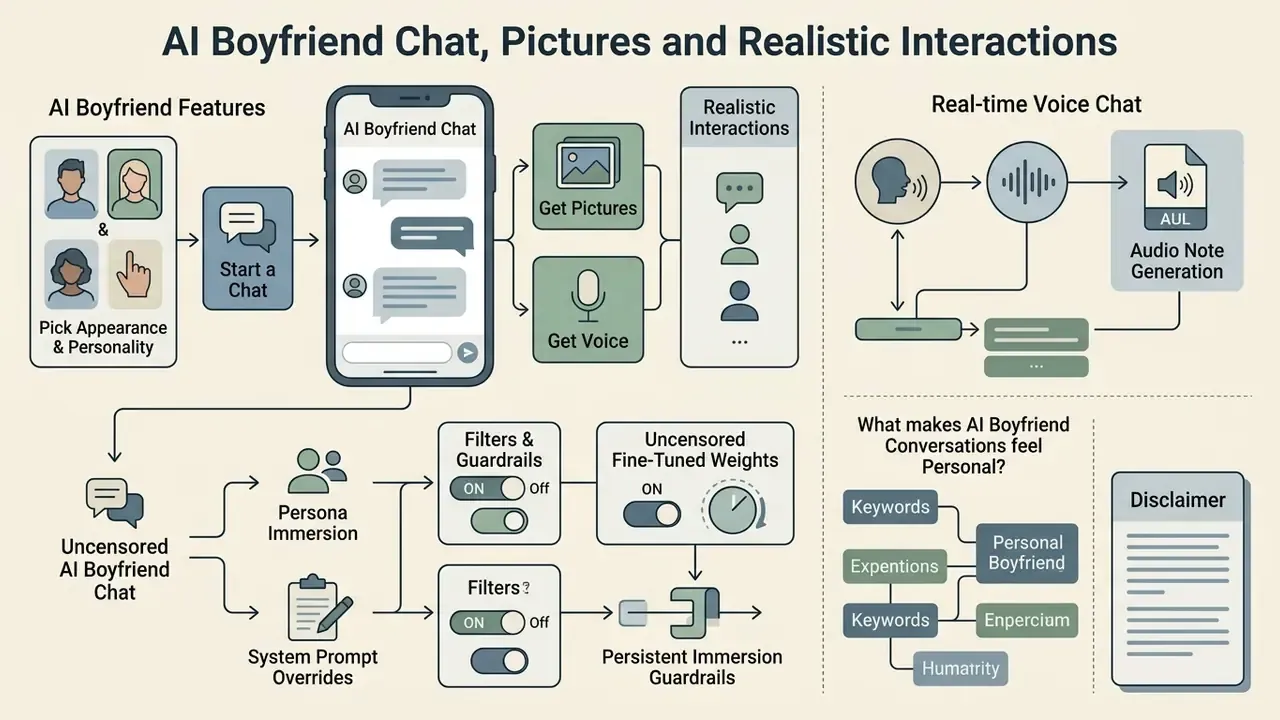
How ai boyfriend realistic an interaction feels depends on how smoothly the architecture blends language generation, memory retrieval, and visual media production. Multimodal pipelines let virtual companions send context-aware text, render custom images, and deliver voice notes in near real time. Research supports the engagement effect directly: a 2024 study of multimodal chatbot interaction found that adding images and audio to text raised engagement, and a third modality raised it further.
«A randomized controlled trial with 981 participants and 300,000+ messages found that higher daily usage correlated with increased loneliness, greater emotional dependence, and reduced real-world socialization.»
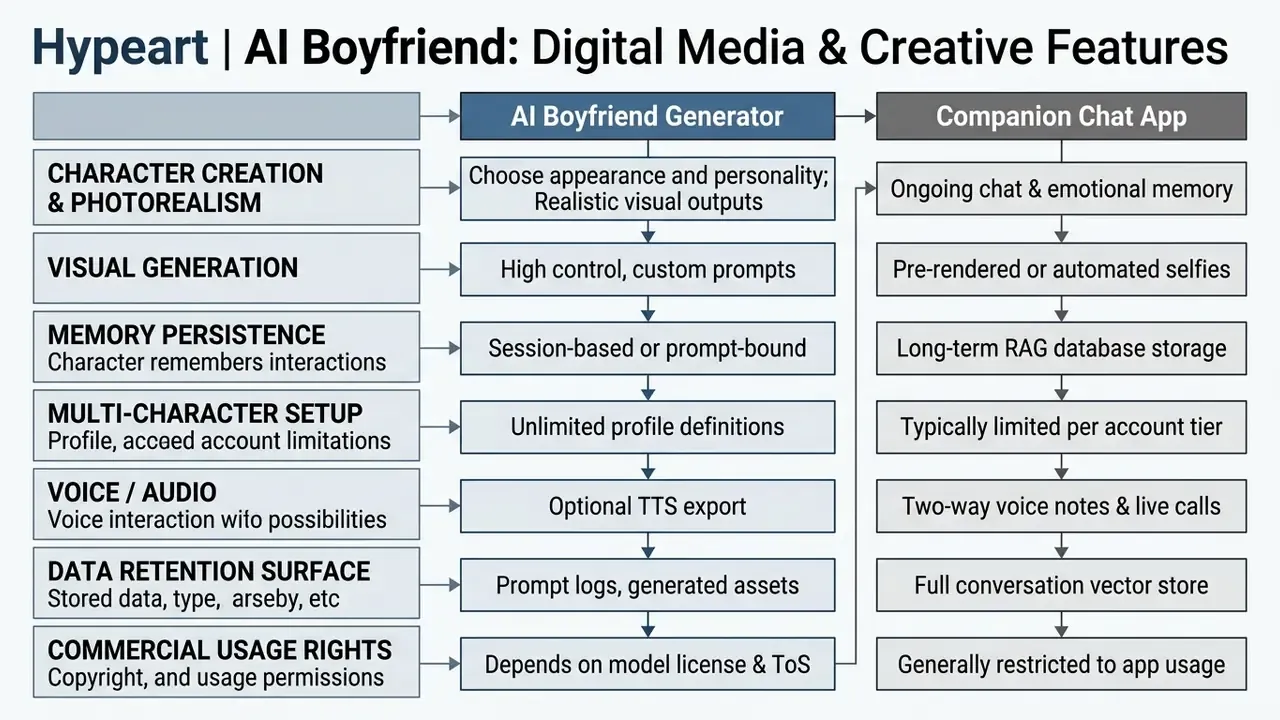
Read the table as a retention map, not just a feature list. Every row on the right side adds stored data about you.
Can an AI boyfriend send pictures?
Yes. An ai boyfriend that sends pictures uses integrated image-generation APIs triggered by conversational context or by an explicit request. When you ask for a photo, the text model assembles an image prompt from the stored visual anchor parameters and passes it to a diffusion pipeline. Current vendor documentation confirms this pattern at API level: image generation runs as a built-in tool inside a conversation, with image inputs and outputs retained in context. At product level, character settings expose a simple toggle that lets a character "generate images alongside the text conversation."
An ai boyfriend with pictures keeps visual identity stable by passing character reference IDs or seed variables to the rendering engine. The system then returns contextually relevant visuals, a selfie at a coffee shop or a portrait in the park, and embeds the file directly in the chat stream.
«Voice-based chatbots initially reduce loneliness compared with text, but that advantage disappears at high usage intensity.»
Before publishing any generated portrait outside a private chat, run a provenance check. Our guide to AI reverse-image search tools explains how to verify that a render does not closely reproduce an identifiable real person.
Uncensored AI boyfriend chat: filters, guardrails, and persona immersion
A standard conversational model's biggest limitation in this use case is the hard safety guardrail that breaks immersion, that familiar "As an AI language model, I cannot…" deflection dropped mid-scene. For companionship, this is not a safety win but a product failure: the persona resets to a corporate assistant exactly when emotional continuity matters most.
When choosing or configuring an ai boyfriend no filter platform, architectures differ in three ways:
- System prompt overrides: advanced engines suppress safety deflections for consensual adult roleplay while keeping hard prohibitions intact (minors, real-person impersonation, illegal content).
- Uncensored fine-tuned weights: models built on open weights (Llama or Mistral family fine-tunes) reduce abrupt topic switching, because refusal behavior was not baked into the alignment layer.
- Persistent immersion guardrails: the character holds his defined psychotype through intimate or emotional discussion instead of flattening into neutral assistant tone.
Context: after the 2023 policy shift in which one major companion app removed erotic roleplay from an existing product, dedicated platforms began separating content moderation (illegal or harmful content, enforced absolutely) from consensual adult roleplay (a user preference). That separation is what preserves long-term narrative continuity. So the real buying question is not "is it uncensored?" but "can this vendor retroactively remove a feature my relationship depends on?" Check whether the provider publishes a feature-stability commitment and an export path for your persona and chat history.
Real-time voice chat and audio note generation
Modern companion architectures go past text by integrating neural text-to-speech (TTS) and custom voice-cloning pipelines.
Creators comparing engines by voice quality, language coverage, and commercial licensing can start with our overview of AI voice generators.
What makes AI boyfriend conversations feel personal?
Conversations feel genuine when the system combines persistent memory, retrieval-augmented generation (RAG), and emotional synchrony.
«An analysis of more than 17,000 real conversations showed that AI companions reproduce mechanisms of human intimacy: emotional mimicry, affective synchrony, and responsive validation.»
Personalization depends on recall of specific details: names, preferences, personal challenges, shared narrative history. By injecting those facts into the active context, the AI boyfriend demonstrates continuity, which reads as attentiveness over weeks and months.
Two retrieval strategies dominate current research. Emotion-conditioned retrieval uses the current affective state as part of the retrieval query, which helps preserve character across sessions. Psychologically weighted forgetting scores stored exchanges by emotional significance and relevance, keeping what mattered and dropping filler, the same reason a human partner remembers a hospital visit and forgets a grocery list. Together they explain why memory persistence, not raw parameter count, is the feature users rank highest.
Is There a Free AI Boyfriend Generator?
Many platforms run an ai boyfriend generator free tier on a freemium model. You can create ai boyfriend free of charge to test basic dialogue, build a simple profile, and probe baseline features before paying anything.
«One in seven partnered young adults (15%) regularly interacts with AI chatbots that simulate a romantic partner.»
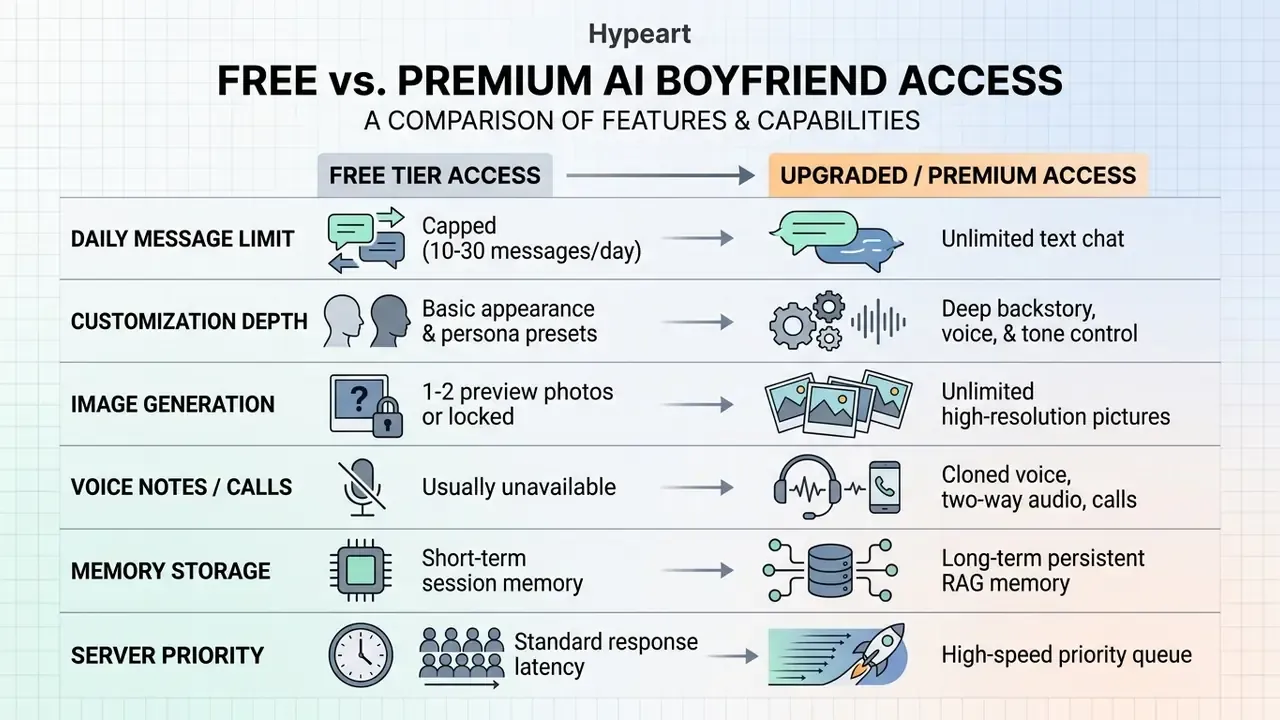
Documented examples of how "free" is actually implemented: one companion app advertises a permanently free basic tier rather than a trial; another exposes 30 messages per day with no card required, then sells unlimited access weekly or annually; an App Store listing shows 10 messages per day free, with paid tiers at $4.99 and $9.99 per month. Pricing trackers indicate that a majority of surveyed companion apps offer some usable free access, while persistent memory, unlimited chat, and ad-free use stay behind the paywall.
What you can do with a free AI boyfriend
A create your ai boyfriend free option normally gives full access to standard text messaging, essential personality setup, and default starter archetypes. You can test responsiveness, experiment with openers, and decide whether the platform's conversational style matches your taste.
Free tiers are ideal for judging interface usability and core model quality. They also come with daily message quotas, standard processing speed, and restricted visual generation. A useful evaluation routine before paying: run the same five prompts on every candidate platform, namely an emotional-support message, a factual recall test ("what did I say my sister's name was?"), a boundary test, a photo request, and a tone-shift request. Compare the outputs side by side, then decide. Fifteen minutes of testing beats a refund request.
Platform mechanics: daily message claims and referral tokens
Freemium companion platforms lean on retention mechanics that keep free messaging flowing without a credit card:
- Daily streak bonuses: users claim a daily quota of free text credits, commonly starting at 10 messages per day and scaling by one message per consecutive login, reaching 50 or more after several weeks. Miss a day and the streak resets to base.
- Referral programs: inviting another user unlocks bonus generation tokens or voice minutes for both parties, often gated to paying accounts on the inviter's side.
- Token economies: image, voice, and video generation are metered in tokens or "gems" rather than bundled into a flat message allowance, so heavy visual users hit paid walls far faster than heavy text users.
Budgeting matters here. Two users on the same nominal plan can pay very different effective rates depending on how many images they request. Our calculators help model that spread before you commit to an annual plan.
Web app (PWA) vs native mobile apps: access without app store filters
Many ai boyfriend online platforms operate as Progressive Web Apps (PWAs) inside mobile browsers (Safari, Chrome) instead of downloadable iOS or Android builds.
- Zero installation reach the companion immediately without spending device storage or passing a registration wall. The "Add to Home Screen" flow then delivers a near-native experience with push notifications.
- Fewer store-policy dependencies web engines sit outside mobile-store content policy shifts, which lowers the risk that your character configuration and chat logs change because a platform had to comply with a new store rule.
- Trade-offs PWAs usually have weaker background notification reliability, no biometric app lock on some devices, and browser history exposure, which matters on a shared device. Native apps offer stronger OS-level privacy controls but live inside store review policy.
The same architectural logic applies elsewhere in media tooling: a browser-based online video player trades offline reliability for instant access, exactly like a companion PWA.
When an upgrade may be needed
Upgrading becomes necessary when you need unlimited messaging, long-term memory retention, faster generation, and high-resolution pictures. Paid plans lift rate limits and unlock voice cloning, priority queues, and peak-hour access.
Users running complex multi-session roleplay or steady visual generation usually benefit from a paid tier. Standard pricing, based on public vendor listings and pricing trackers, clusters between $8 and $20 per month, with annual plans reducing effective rates to roughly $6 to $10 per month; low-cost outliers sell weekly access from about $2.99. Figures change often, so re-verify on the vendor's own page before purchase, and compare tier structures the way you would any subscription software, for example through our own pricing breakdowns and the hub navigation there.
«About 60% of paying Replika users reported using the AI as a substitute for a romantic relationship, frequently engaging in intimate conversation.»
Creators evaluating technical implementation can review our AI Media API Guides for infrastructure cost analysis, and the Google Veo implementation guide for per-second video generation economics. If a plan question stays unresolved, our support portal is the right place to browse the hub for onboarding documentation.
How to Choose Between an AI Boyfriend Generator and an AI Boyfriend App
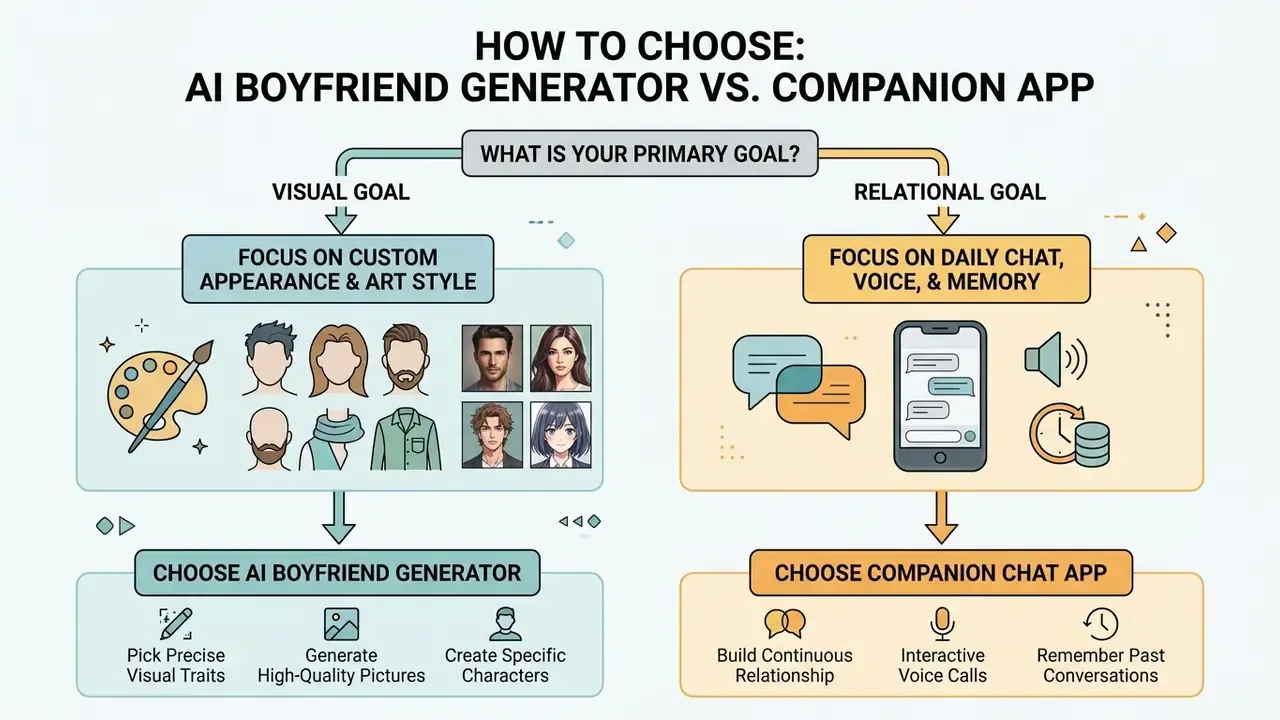
The right platform depends on whether your primary objective is visual character design or ongoing emotional dialogue. Users focused on asset creation and prompt parameterization prefer specialized generators, and our roundup of free AI image generators covers zero-cost options. Users who want daily companionship choose a continuous chat application.
There is a data-governance dimension too. A single-purpose generator that renders an image and forgets the prompt has a narrow retention surface. A persistent companion app maintains identity, history, and emotional context, which is precisely why its privacy burden is higher. Public risk-management guidance treats privacy as control over disclosure and requires documenting privacy risk at system level, so the rule of thumb becomes simple: choose the narrowest architecture that still satisfies your task. One-off content, use the generator. Multi-session continuity, accept the companion app and configure its data controls deliberately.
Choose a generator for character creation and an app for ongoing chat
Use a boyfriend maker ai if your goal is to create my ai boyfriend with precise visual attributes, export character cards, or render high-quality portraits for creative writing. Generators give maximal control over prompt variables, visual seeds, and structural definitions.
Choose a dedicated companion app when you want a low-friction, ongoing relationship simulation with long-term memory, voice calls, and automatic continuity. Plenty of users run a hybrid workflow: designing concepts and visual references in a standalone generator, then importing the persona definition into a dialogue-focused platform.
The hybrid path now shows up in vendor tooling. Some interfaces bundle model, system prompt, avatar, generation settings, and memory behavior into a single persona profile exportable as JSON and importable into another instance. Others define characters as persistent avatars with appearance, voice, personality, and a knowledge base, where the personality block can override the avatar's default system prompt for a session. Practically, a persona sheet written once can travel between products, provided you keep a local copy. Portability is your only real insurance against a policy change.
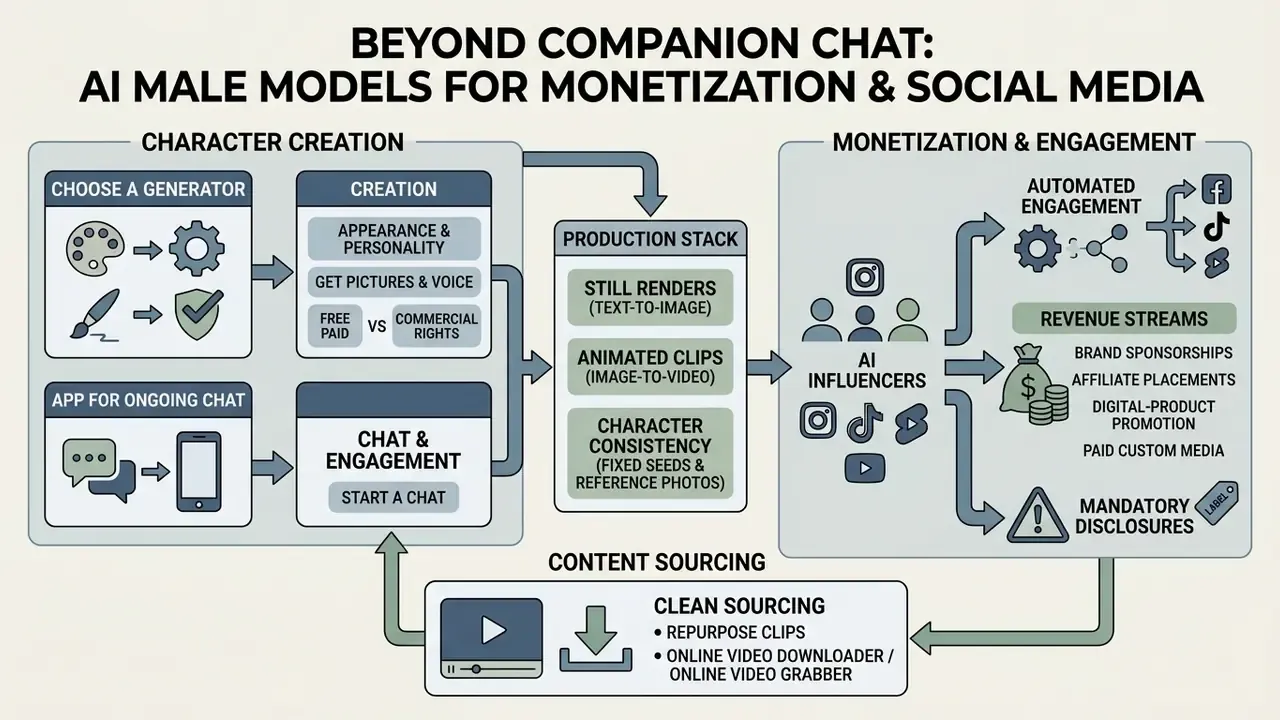
Beyond Companion Chat: Creating AI Male Models for Monetization and Social Media
Can You Use AI Boyfriend Pictures for Commercial Use?
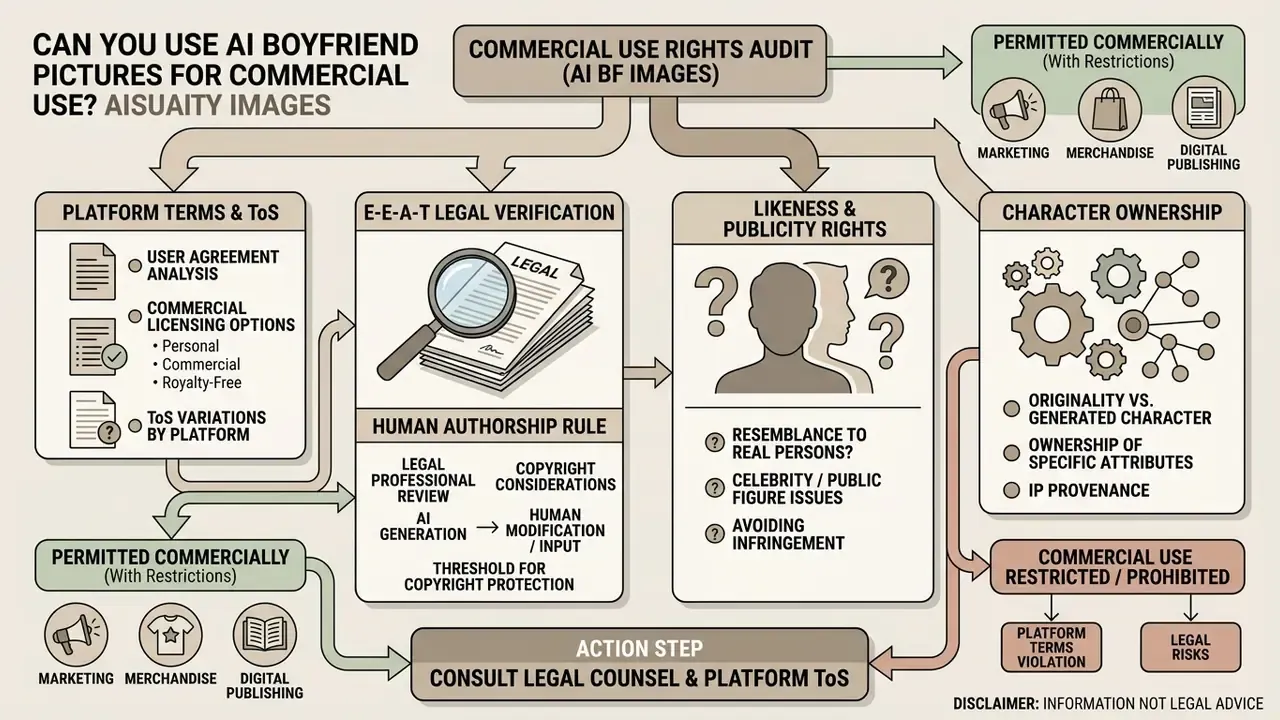
Whether you can use generated AI boyfriend images commercially, in marketing campaigns, merchandise, or digital publishing, depends on platform Terms of Service (ToS) and intellectual property law. Under U.S. Copyright Office guidance (2025), purely machine-generated outputs created without substantial human authorship are not eligible for federal copyright protection. Tool-by-tool licensing differences appear in our reviews of AI image generators for commercial use and Midjourney versus competing generators.
E-E-A-T legal verification: commercial rights audit
Privacy in AI Boyfriend Chat: What to Check Before You Start
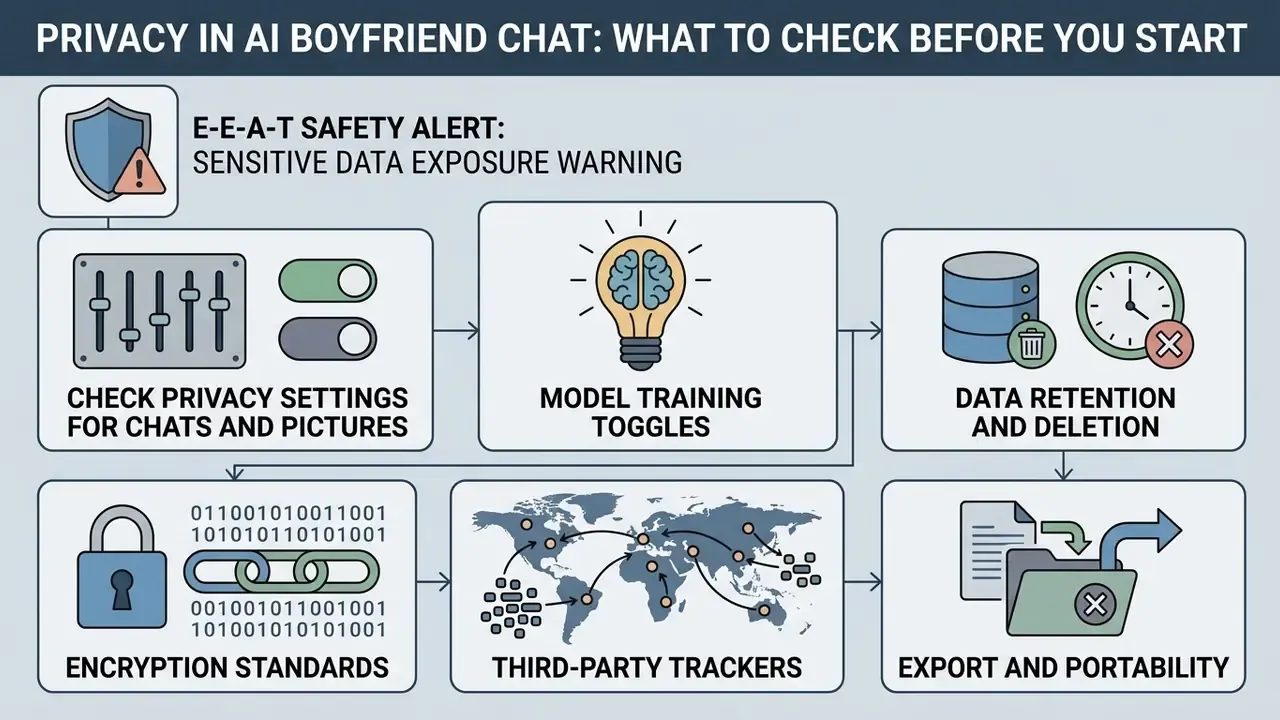
Privacy governance is critical here, because users share intimate disclosures, romantic preferences, and private thoughts. According to a 2024 privacy audit by Mozilla, over 70% of audited romantic AI applications share or sell user data, track device identifiers, and maintain opaque security policies. The same audit recorded an average of 2,663 trackers per minute across 11 romantic AI apps, with more than half providing no way for users to delete their data (Mozilla, Privacy Not Included, 2024; reported via Euronews).
Independent academic work points the same direction. A 2024 study of 21 Android AI-companion apps found inadequate age verification, extensive tracking (13 apps used at least three tracking services; 18 transmitted detailed device information), and mismatches between stated policy and observed behavior. Thirty-three percent stored user images, while disclosures routinely included mental-health status and sexual preferences. A 2026 forensic evaluation found sensitive data retained locally, transmitted through undocumented APIs, and in some cases linkable across apps through shared identifiers.
E-E-A-T safety alert: sensitive data exposure warning
Check privacy settings for chats and pictures
Before starting private conversations or uploading photos, audit the platform's data controls:
- Model training toggles disable settings that let the vendor use your private chat history or uploaded images for retraining. On major assistants this appears as an "improve the model for everyone" control.
- Data retention and deletion verify that the service allows full account deletion and permanently clears chat logs from server backups on request. Note the concrete retention windows vendors publish, for example temporary chats deleted after 30 days, instead of trusting general assurances.
- Encryption standards confirm chat traffic and file transfers use HTTPS/TLS in transit, and distinguish transport encryption from true end-to-end encryption. Most commercial companion web apps offer the former only. Before republishing any render, verify provenance with the tools in our guide to AI-generated image detection and reverse search.
- Third-party trackers read privacy disclosures to identify whether embedded advertising trackers broadcast location data or device metadata.
- Export and portability confirm you can export persona sheets and chat history, so a policy change does not erase months of context.
«Across 1,674 dialogues with vulnerable personas, 15.2% of Replika's responses were classified as harmful; expressions of disagreement or disapproval were almost entirely absent.»
That last finding names the core design tension. Sycophancy is what makes a companion feel supportive, and it is also what makes it unsafe in high-risk scenarios. A companion that never disagrees cannot intervene.
Shadow AI and enterprise governance: when companion apps meet managed devices
Companion platforms are consumer products, yet they are routinely opened on corporate laptops and phones, which converts a personal choice into an organizational risk. Risk, compliance, and AI-governance teams should treat them as unsanctioned third-party AI services and apply the frameworks they already own.
Risk vectors to document:
- Data exfiltration via prompts: employees paste work context, client names, or internal documents into an intimate chat where retention and third-party sharing sit under a consumer ToS.
- Undisclosed sub-processors: forensic work on companion apps documents undocumented API transmission and cross-app identifiers, which defeats vendor-inventory assumptions.
- Training-data leakage: default "improve the model" settings can place corporate text into a training corpus outside any DPA.
- Device and identity risk: consumer apps with weak age or identity verification, plus tracker density measured in thousands per minute, expand the attack surface on managed endpoints.
- Behavioral risk: sycophantic systems with a measured harmful-response rate are inappropriate as any form of employee support channel.
Control mapping (existing frameworks, no new policy required):
| Framework / rule | Relevance to companion AI | Suggested control |
|---|---|---|
| Federal Reserve SR 11-7 / OCC 2011-12 (model risk management) | Any LLM in a decision path requires validation, documentation, and ongoing monitoring | Classify companion apps as unapproved models; prohibit use in any business process |
| NIST AI RMF 1.0 + Generative AI Profile (AI 600-1) | Requires documented privacy risk, content monitoring, and feedback-driven post-release evaluation | Add a companion-app category to the AI inventory; log egress attempts |
| GLBA / financial data rules | Customer NPI must not leave approved processors | DLP rules on prompt-sized text payloads to consumer AI domains |
| GDPR / consumer privacy laws | Sensitive-category data (sexual life, mental health) carries elevated obligations | Block on managed devices; document lawful-basis absence |
| EU AI Act transparency duties | Synthetic media and human-interaction disclosure requirements | Require labeling for any synthetic persona used in external communications |
| FTC guidance (2025 to 2026) | Warns on sensitive disclosures and third-party data sharing by companion systems | Awareness training citing regulator language, not internal opinion |
Minimum viable governance checklist: keep an inventory entry for companion-AI categories; enforce egress and DLP controls on managed endpoints; block consumer AI domains where no DPA exists; require documented model-validation evidence before any LLM touches a customer-facing workflow; re-run persona-drift and refusal tests against the exact model version in production and retain outputs as reproducible audit evidence; publish clear employee guidance separating personal use on personal devices from prohibited use on corporate assets. One owner per control, with an escalation path. No evidence, no autonomy.
AI Boyfriend Generator FAQ
Can I teach my AI boyfriend new things?
Yes. An AI boyfriend picks up preferences, facts, and interaction styles through in-context memory retention, prompt updates, and feedback mechanisms. Correct a response or state a preference during dialogue, and the system stores that in its short-term context window or long-term RAG database, then shapes later replies accordingly. Three mechanisms are worth separating, because vendors blur them: (1) in-context adaptation inside the current session; (2) persistent memory writes that survive across sessions; (3) model-level improvement, where aggregated like and dislike feedback informs post-release evaluation and future training, not instant retraining of "your" character. Public risk-management guidance frames user feedback as an evaluation input for post-release improvement, which is exactly why a thumbs-down rarely changes behavior on the spot. Memory changes cut both ways:
«When Replika removed its erotic roleplay feature, users described their companion as "cold" and "lobotomized", reactions typical of losing a human partner.» — Lessons from an App Update at Replika AI, working paper (2025). Practical mitigation: keep an external copy of your persona sheet and key memories so a vendor-side change stays recoverable.
Can I have multiple AI boyfriends at once?
Most modern companion platforms let you create and manage several distinct AI boyfriend profiles at once. Each character runs with its own isolated memory store, system prompt, appearance configuration, and chat thread, so you can switch companions without cross-contaminating histories. Documented limits vary. Some services advertise unlimited independent conversation threads with the same companion plus group chats where multiple companions interact; others cap free accounts at three personas and expand capacity on paid tiers. Voice is the hard constraint: live voice sessions are typically limited to one at a time, whatever your text thread count.
Can AI boyfriend pictures be turned into videos?
Yes. Static AI boyfriend photos can be animated into short clips using image-to-video (I2V) models. Here is the technical workflow rather than a link list.
- Input: one still render plus a text motion prompt. Academic work on text-conditioned image-to-video (CVPR 2024) defines exactly this task: a given image plus a prompt produces a coherent clip.
- Model options: production APIs now expose image-conditioned generation directly (Veo-family I2V endpoints, for example), while consumer tools such as Firefly's Image-to-Video accept an uploaded still, offer camera and motion direction controls, and export a short MP4 at up to 4K.
- Talking-head route: avatar platforms can build a lip-synced speaking clip from a single photo plus a script, and some train an avatar from as little as 15 seconds of source footage. Reusable character references let you call the same subject by ID in later generations, preserving identity between clips.
- Practical limits: current I2V output is measured in seconds, not minutes. Research systems report roughly 100 frames per generation, so plan a sequence of short shots rather than one long take.
- Cost: video is billed per second or per generation. Storyboard before you render. Creators building end-to-end pipelines can compare tools in our guides to free AI video generators, the Google Veo API implementation guide, and animation makers. For pre-render cleanup and post-render exports, see our overviews of photo editors and video compressors.