- Last updated current 2026 review cycle covering U.S. Copyright Office guidance (2024 to 2025), EU AI Act implementation materials, and vendor terms published through 2026.
- Editorial scope written by the Hypeart.ai AI governance and media-compliance desk, combining intellectual-property research with hands-on model-risk review of commercial image and video generators.
- Platform independence Hypeart.ai is not owned by, funded by, or commercially affiliated with any AI model provider named in this analysis. Vendor terms are summarised from publicly available policy pages.
Executive Summary for Risk, Legal and Compliance Leaders
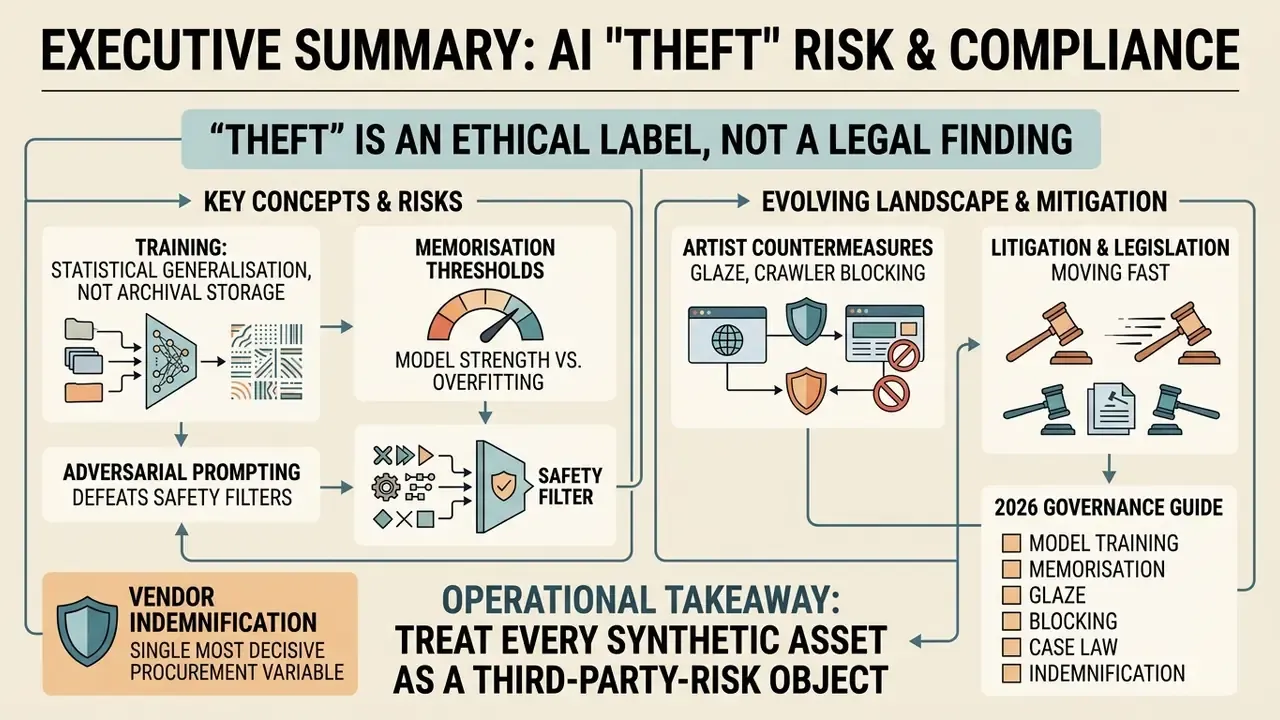
- "Theft" is an ethical label, not a legal finding. U.S. copyright analysis separates three distinct categories: unauthorised dataset ingestion (a reproduction question), substantial similarity in outputs (an infringement question), and plagiarism (an attribution and professional-ethics question).
- Training is statistical generalisation, not archival storage. Model weights hold optimised parameters, not compressed copies of source files. But memorisation is a real, measurable failure mode: outputs scoring SSCD ≥ 0.75 against a training image are classified in the literature as memorised replications.
- Adversarial prompting defeats safety filters. Published jailbreak research recorded copyright-relevant or policy-violating generations in 89% (Midjourney), 88% (Copilot) and 83% (Gemini) of targeted attempts, and drove ChatGPT's block rate from 84% down to roughly 11%.
- Vendor indemnification is the single most decisive procurement variable. Platforms trained on licensed corpora (for example Adobe Firefly, built on Adobe Stock and public-domain material) offer enterprise indemnification; most consumer-tier generators explicitly disclaim non-infringement warranties.
- Artists now have technical countermeasures. Glaze and Nightshade (University of Chicago) apply imperceptible perturbations; robots.txt and Robot Exclusion Protocol directives, plus Cloudflare's free AI-crawler blocking, restrict GPTBot, CCBot and Bytespider at the network edge.
- Litigation and legislation are moving fast. Andersen v. Stability AI, Getty Images v. Stability AI (12 million allegedly scraped photographs), Disney v. Midjourney, the LibGen dataset controversy and California's AB 412 (AI Copyright Transparency Act) all push toward mandatory dataset disclosure.
- Operational takeaway: treat every synthetic asset as a third-party-risk object. Sanitise prompts, screen similarity, add a human creative layer, retain prompt, seed and model-version logs in the model inventory, and route exceptions through Legal and Model Risk Management before publication.
Who Should Read This, and Which Decision It Supports
This analysis is written for people who sign off, not for people who scroll. Chief risk officers, compliance heads, model-risk leads and marketing operations owners in banks, insurers and mature fintech firms all face the same awkward moment: a campaign asset, an app illustration or a product video was produced by a generative model, and someone has to attest that it is safe to publish.
Three decisions sit behind the question "is AI art theft?":
Everything below is organised around those three questions. Note the audience assumptions here are working hypotheses drawn from public regulatory material and buyer-side interviews, not validated market research, and they should be tested against your own analytics before they drive budget.
1. Is AI Art Theft: The Short Answer to the Main Question
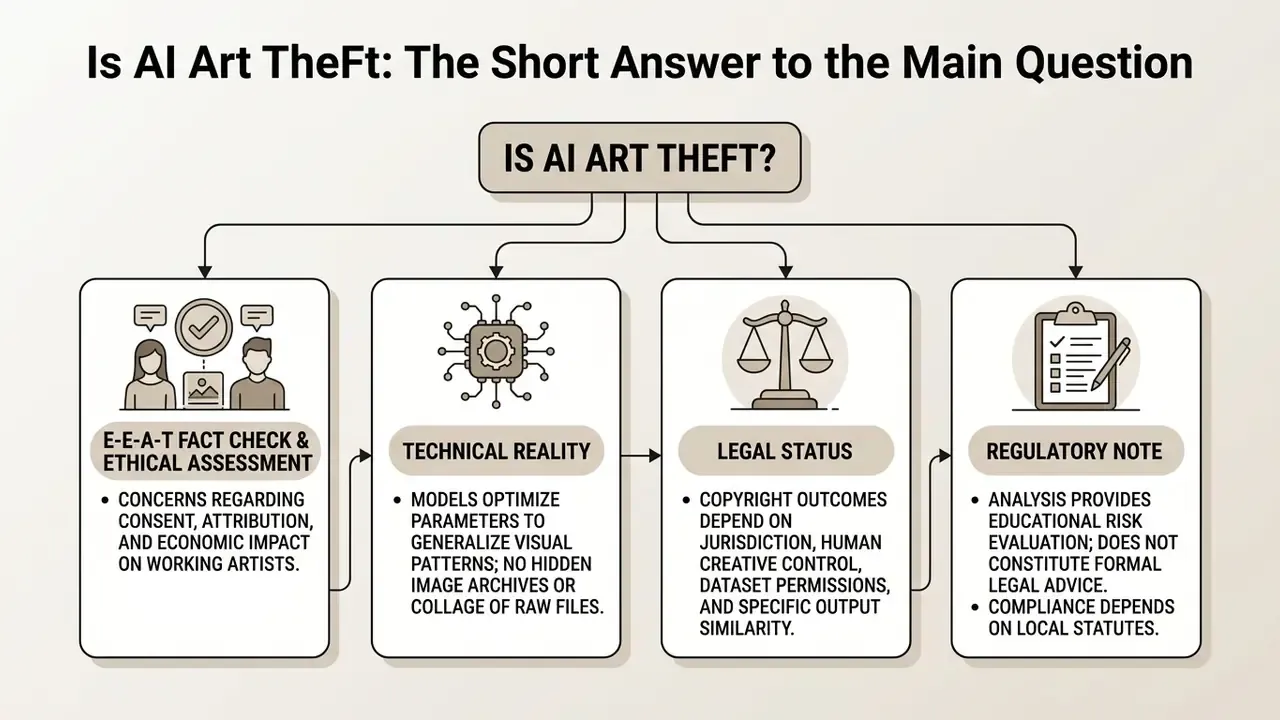
Labeling generative AI as "art theft" is an ethical and colloquial classification rather than an established legal finding under United States copyright law. Legally, whether a model infringes intellectual property depends on whether dataset ingestion violates exclusive reproduction rights and whether generated outputs exhibit substantial similarity to specific protected works.
«"Theft", "copyright infringement" and "plagiarism" are three separate categories; AI discourse conflates them, while the law requires proof of substantial similarity.»
Commercial institutions evaluating whether AI art is theft must distinguish between ethical grievances and statutory copyright infringement. Teams that need to translate this distinction into signed-off usage rights can start from our review of commercial use of AI images, which maps licence scope against publication channels. While the popular phrase AI stealing art suggests a physical or digital taking, generative models do not remove original files from their creators. Instead, software systems analyze visual patterns across massive web-scraped datasets. Determining whether AI actually steals art requires analyzing training-data acquisition under fair use doctrines, text-and-data-mining (TDM) exceptions, and output similarity.
So the honest answer is layered. Not a theft in the criminal sense. Not innocent either.
1.1 Why Artists Call Model Training the Use of Stolen Work
Working artists view the unauthorized ingestion of their visual portfolios as an exploitation of creative labor without consent, attribution, or compensation.
Organizations such as CARFAC-RAAV in Canada, European Visual Artists (EVA), and the National Association for the Visual Arts (NAVA) in Australia emphasize that harvesting images from public galleries violates creators' economic and moral rights. CARFAC-RAAV stated in 2024 that using artworks in training data without consent, compensation, or credit conflicts with rights under the Canadian Copyright Act. NAVA's 2025 position demands transparent training datasets, meaningful consent, attribution, and payment. Peer-reviewed survey work quantifies the same sentiment:
«459 surveyed artists demand disclosure of training data and oppose model creators owning derivative AI works.»
When commercial AI companies train models on proprietary portfolios without opt-in agreements or royalty mechanisms, creators argue that their intellectual property is expropriated to build competing automated software. Illustrators interviewed by regional broadcasters describe the mechanism bluntly: crawlers scrape the open web, the work is absorbed into a dataset, and the resulting model competes for the same commissions. As one representative of the Concept Art Association put it, "as the crawlers steal from them in the present, the data that they take is used to replace them and devalue them in the future."
That is the grievance in one sentence. Whether it maps onto a cause of action is a separate matter, and courts are still working through it.
Field case (media organisation, illustrative composite). A large media group deployed an internal generative tool without auditing the source dataset, which produced public complaints from independent illustrators whose portfolios had been ingested without consent. The risk team suspended the deployment, ran an inventory audit using an AI Media Commercial-Use Hub, and established explicit opt-in data-sourcing protocols to insulate the brand from reputational fallout. Total delay: eleven weeks. Cost of the delay was lower than the cost of the apology that would have followed.
1.2 A Historical Parallel: Painting Versus Photography
The current conflict echoes the mid-nineteenth-century crisis triggered by photography. Painters at the time accused the camera of "stealing visual reality" and destroying the profession of portraiture; critics argued that a mechanical device could not produce art because no human hand shaped the image. Over the following decades photography matured into an independent medium with its own authorship doctrine, while painting shifted decisively toward impressionism and expressionism, territory the camera could not occupy.
The analogy is instructive but not exculpatory. Photography did not ingest the canvases of living painters as raw material; generative models do ingest the portfolios of living illustrators. The historical lesson is therefore narrower than technology advocates claim: new media can coexist with older ones, but coexistence in the AI era depends on licensing, consent and disclosure mechanisms that photography never needed.
1.3 Why AI Training Is Not Always the Same as Copying an Image
Generative AI training optimizes billions of mathematical parameters to learn abstract visual distributions rather than storing or copying original image files.
Developers do reproduce digital images during initial data ingestion, and that stage is where consent and reproduction-right exposure concentrates, but the ultimate objective is model generalization across large data volumes. Unlike traditional file duplication, generative diffusion models convert visual inputs into high-dimensional vector representations. Human operators guide the output through text prompts, iterative refinement, and selection, creating a process distinct from direct file replication. UNESCO's 2024 guidance on generative AI underlines the same dependency: the prompt must supply context, and the result reflects what the user specifies rather than an automatic extraction of a source file.
Two clarifications worth keeping in the same paragraph, since executives conflate them constantly. Does AI use other people's art? Almost certainly yes, at the ingestion stage, for any web-scale model. Does AI art steal art in the sense of retaining and re-serving the file? Generally no, except in the memorisation cases described below.
2. How AI Image Generators Use Other People's Images
Modern AI-based image generators convert text prompts and pixel arrays into shared mathematical embedding spaces, conditioning image generation on learned statistical distributions rather than direct file lookups. Readers comparing specific products by output quality, licence terms and control features can use our comparison of the best AI art generators and the free-tier equivalent as a starting inventory.
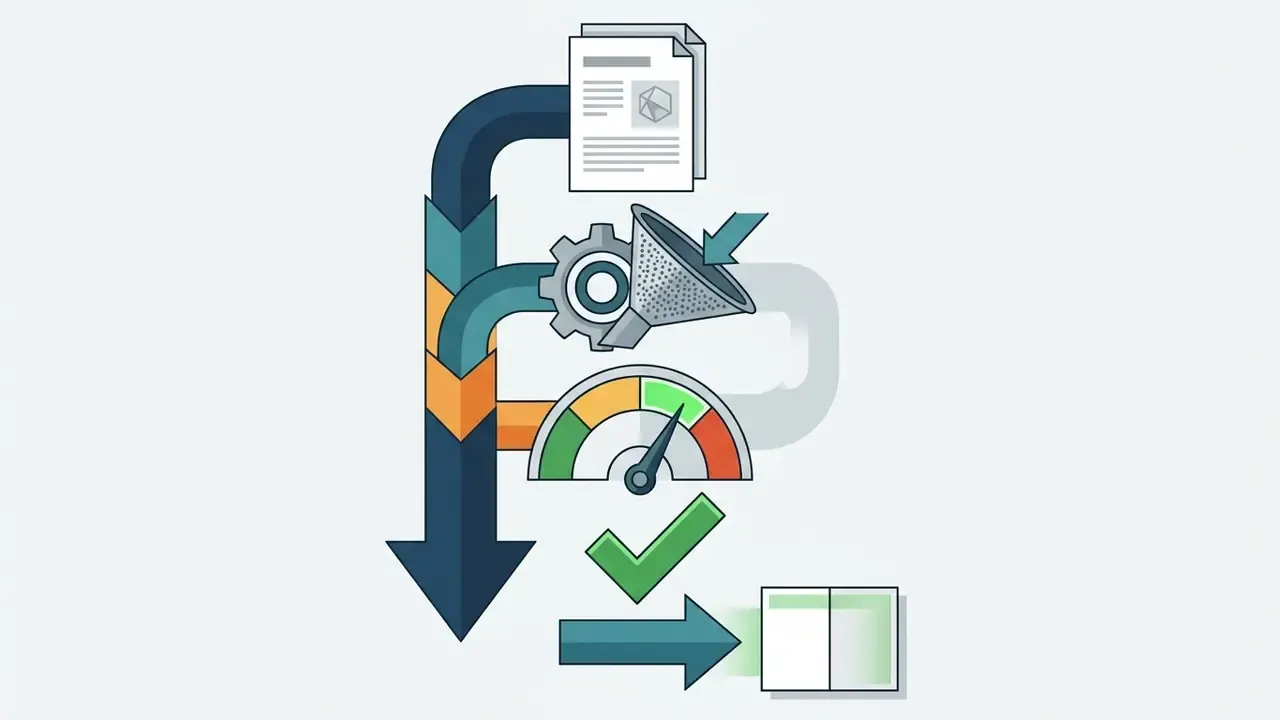
To assess how AI is said to "steal" art, risk leaders must analyze the multi-stage machine-learning pipeline. Generative models utilize paired image-caption datasets to map visual characteristics to semantic descriptions. Stable Diffusion, for example, uses CLIP to project the text prompt into a joint text-image embedding space and then denoises toward a latent representation that is semantically close to that prompt. When a user issues a prompt, the system samples from random noise and iteratively denoises the latent representation to match the text description.
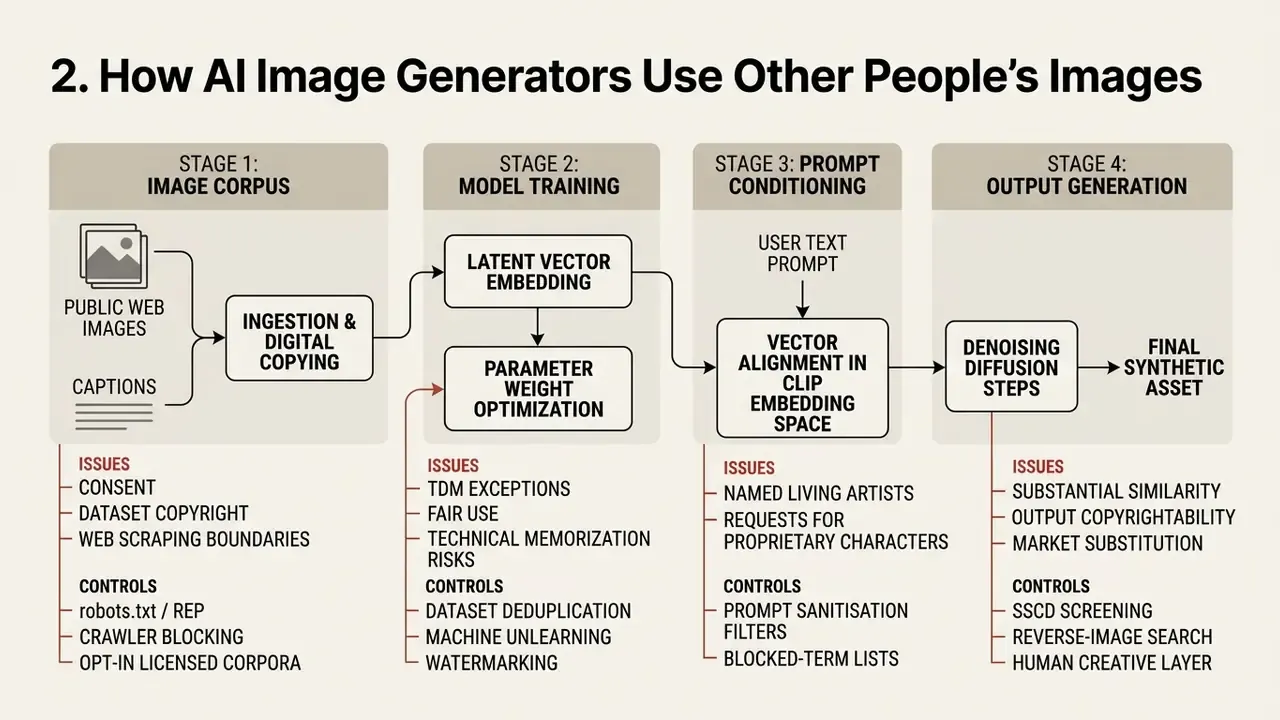
Schema description: visual pipeline tracking data flow from scraped source images through vector embeddings, prompt conditioning, and final image output, highlighting legal and risk control points at each stage. Alt text for the published diagram should carry the phrase "how does ai steal art".
2.1 What Happens to an Artist's Work During Training
During training, digital artworks are ingested, resized, converted into numerical coefficients, and processed through loss-minimization algorithms to update parameter weights.
The original image files do not remain inside the neural network's final weight parameters. Published NeurIPS work on multimodal architectures shows that a visual backbone produces embeddings which a learned projection matrix converts into vectors consumed by the language model, and the image file itself is never stored in the weights. (Note: the specific NeurIPS paper identifier should be cited by full title, authors and year in any legal filing that relies on this point; the general mechanism is corroborated by the U.S. Copyright Office description of JPEG images represented as numerical coefficients and of visual embeddings mapped into token space.) Model weights store learned mathematical parameters rather than file archives, which separates dataset storage from the final executable software file. The U.S. Government Accountability Office describes training in the same terms: large datasets are used to fit model parameters, not to build a retrievable image library.
Does that settle the consent question? No. It relocates it. The exposure sits in stage one, where copies were made, and in stage four, where similarity can surface.
«Rightsholders can apply watermarking, machine unlearning and dataset deduplication to reduce the risk of training-data reproduction.»
2.2 When a Generated Image Becomes Too Similar to an Original Work
An AI output becomes dangerously similar to an original work when model overfitting or training-data memorization occurs during generation.
«State-of-the-art diffusion models can memorize and regenerate individual training images when prompted with the corresponding captions.»
Peer-reviewed CVPR work from 2024 defines memorisation as generated images displaying "extreme similarity" to training samples, including near-copies, and ties detection to pixel-level similarity measures. GAN research presented at ICIP (2021) documented the parallel effect when stochasticity is removed from training and the generator produces samples nearly indistinguishable from the data. Overfitting happens when an image is repeated frequently in the dataset or when prompts tightly match original captions.
Technical evaluations published on OpenReview (2025) classify outputs with a Self-Supervised Copy Detection (SSCD) similarity score of 0.75 or higher as memorized replications, using paired training-image similarity plus generation-to-generation similarity. https://openreview.net (threshold reproduced as stated by the cited evaluation; enterprises should validate the metric against their own reference corpus before adopting it as a hard control limit.)
Deliberate prompting makes this far more than a theoretical edge case:
«Under targeted or adversarial prompting, Midjourney generated protected content in 89% of cases, Copilot in 88% and Gemini in 83%.»
For organisations, the operational conclusion is that a similarity threshold must be enforced after generation, not assumed from vendor safety claims. Screening finalists with an AI reverse image search workflow converts an abstract memorisation risk into a documented, repeatable control. One practical detail from review work: memorised material tends to appear in a single element, a logo, a face, a distinctive background object, so crop-level screening catches what full-frame screening misses.
3. AI Art Theft Examples: Which Situations Cause the Most Disputes
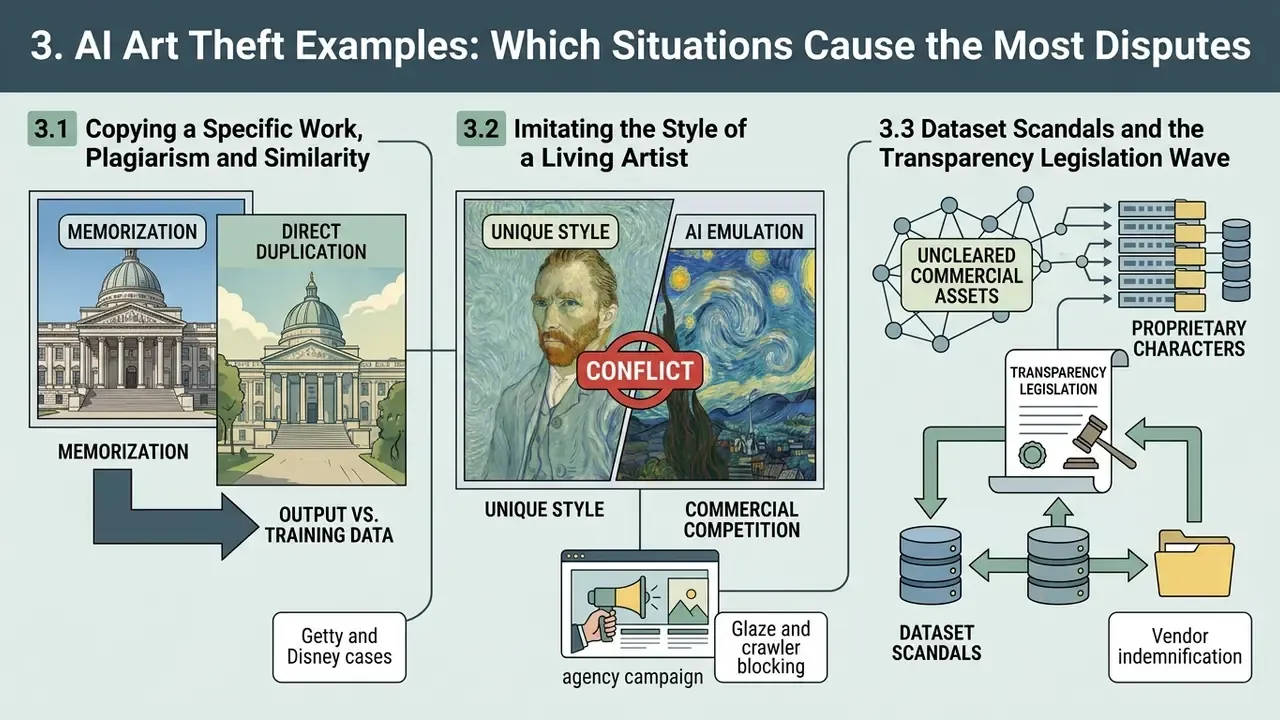
High-profile industry disputes focus on output memorization, direct duplication of proprietary characters, living-artist style emulation, and uncleared commercial asset distribution.
Commercial organizations must systematically categorize scenarios where AI art theft claims emerge. Evaluating allegedly stolen AI art requires auditing input prompts, model weights, and final visual outputs against established intellectual-property standards.
| Scenario Category | Perceived Theft & Risk | Primary Legal Exposure | Pre-Publication Clearance Control |
|---|---|---|---|
| Exact Work Replication | High: direct output resemblance to specific copyrighted artwork | Direct Copyright Infringement; DMCA violations | Run reverse-image search; verify SSCD similarity < 0.60 |
| Living Artist Style Emulation | Moderate-High: prompts using living artist names (for example, "in the style of [Artist]") | Publicity Rights, False Endorsement, Unfair Competition | Strip artist names from prompts; use generic descriptors |
| Proprietary IP Generation | High: recreating trademarked or copyrighted corporate characters | Trademark Infringement, Unfair Trade Practices | Screen outputs for trademarked visual elements |
| Commercial Publishing of AI Art | Variable: publishing raw AI assets without human creative modification | Lack of copyright ownership; third-party liability | Ensure human design layering; audit provider Terms of Service |
| Social Publication Without Disclosure | Moderate: posting synthetic assets as human-made work | Consumer-protection and labelling exposure (EU AI Act Art. 50 drafts) | Apply provenance metadata; document AI involvement |
Beyond enforcement, researchers are modelling compensation mechanisms rather than prohibition:
3.1 Copying a Specific Work, Plagiarism and Similarity
Unlawful copying requires establishing defendant access to the original work and proving substantial similarity between protectable expression elements.
In landmark litigation such as Andersen v. Stability AI (N.D. Cal., filed 13 January 2023, covering copyright infringement, DMCA violations, publicity-rights and unfair-competition claims) and Getty Images v. Stability AI (UK High Court), plaintiffs argue that unauthorized ingestion combined with substantial output similarity violates exclusive copyrights. Under the U.S. Arnstein test, courts evaluate whether protected expressive details, rather than general concepts, were copied.
«Probabilistic analysis shows that where evidence of access to the work is strong, the similarity threshold required to infer copying falls.»
Korean Copyright Commission guidelines explicitly warn that prompts naming specific artworks or characters create high infringement risks, listing requests to remake an existing cartoon, film or game scene as direct risk signals. Teams weighing platform-level exposure can review how Midjourney compares with competing generators on licensing, moderation and commercial terms before standardising on a single vendor.
3.2 Imitating the Style of a Living Artist
Under U.S. copyright law, an artist's style is an unprotected concept, though prompting living artists' names triggers publicity rights and false endorsement risks.
The ArtSavant study evaluated 372 artists across multiple diffusion models. Despite limited legal protection for raw artistic style under 17 U.S.C. § 102(b), using living artists' names commercially creates reputational damage and exposes firms to state-level right-of-publicity claims. Marketplace rules increasingly codify the same restriction: Adobe Stock's generative-AI content guidelines instruct contributors not to include the names of artists, real people, imaginary characters or third-party IP in prompts, titles or keywords. Selecting tooling from a shortlist of the best AI art generators with documented prompt-moderation policies reduces the chance that a named-artist prompt ever reaches production.
Field case (agency campaign, illustrative composite). A digital marketing agency used specific living artist names in prompts for a client campaign. The client faced public criticism and a formal cease-and-desist letter alleging unfair competition. The agency implemented an internal prompt-screening filter informed by our AI Media Comparison Matrices, removing named creators from every future commercial workflow. The fix took an afternoon. The reputational cleanup took a quarter.
3.3 Dataset Scandals and the Transparency Legislation Wave
Dataset provenance has become the central evidentiary battleground. In Getty Images v. Stability AI, the claimants alleged unauthorised scraping of more than 12 million protected photographs together with their metadata and watermarks, an argument that treats the ingestion event itself, not only the output, as the actionable act. In parallel, Disney v. Midjourney focuses on the direct generation of protected characters, moving the dispute from abstract style questions to concrete trademark and character-copyright enforcement. In the text and multimodal domain, reporting on the LibGen database showed millions of copyrighted books used to train large language models, which prompted authors' organisations to publish searchable indexes so writers could check whether their work appeared in the corpus. Teams tracking procedural milestones can follow our AI Litigation and Case Timelines rather than reconstructing dockets manually.
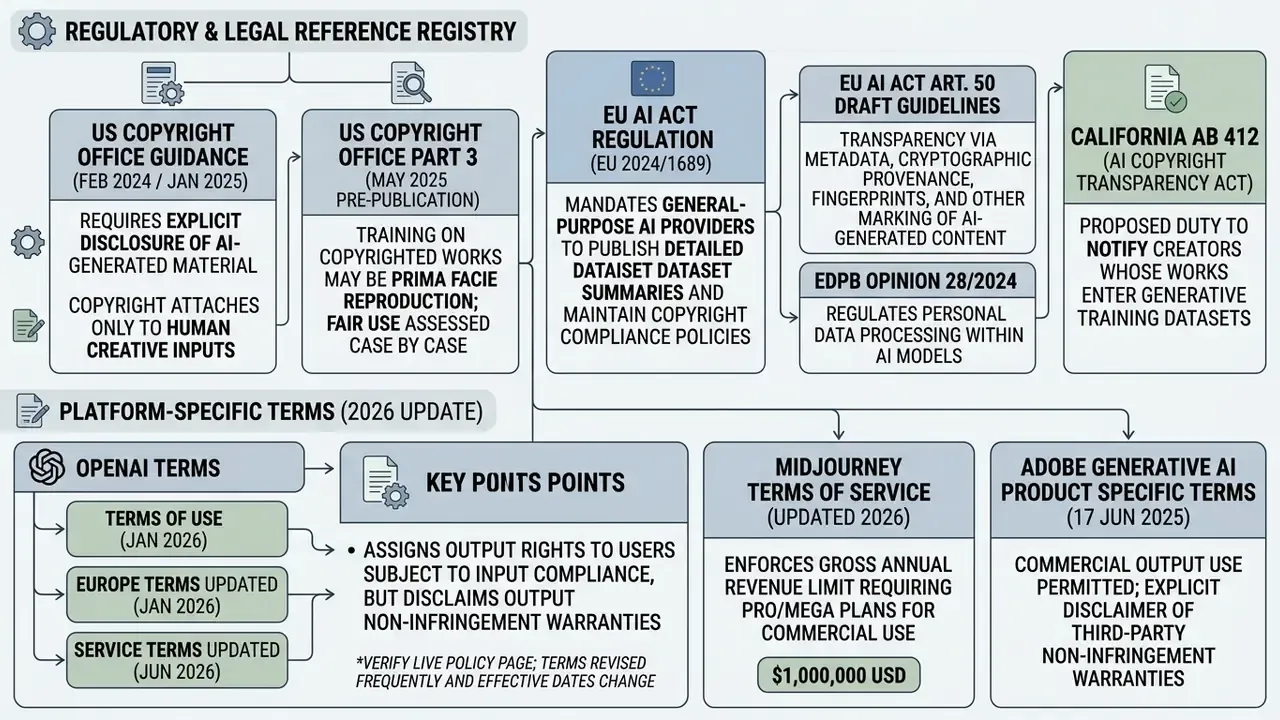
Legislators have responded with disclosure duties rather than prohibitions. California's AB 412 (AI Copyright Transparency Act) would require developers to tell creators whether their work was included in a generative training set. The EU AI Act (Regulation (EU) 2024/1689) obliges general-purpose AI providers to publish sufficiently detailed training-data summaries and maintain copyright-compliance policies, while EDPB Opinion 28/2024 (18 December 2024) governs personal-data processing inside AI models. European legal scholarship pushes the analysis further:
«Training generative models exceeds the scope of text-and-data-mining exceptions and requires explicit rightsholder authorisation.»
For enterprises, the practical implication is procurement-level: any vendor unable to describe its dataset lineage today will be unable to satisfy disclosure obligations tomorrow. Ask for the lineage document during due diligence, not after the campaign ships.
4. Copyright and Legal Risks When Using AI-Generated Art
Commercial deployment of AI-generated art creates a dual risk profile: pure machine outputs cannot be protected by copyright, yet they remain vulnerable to third-party infringement claims.
Corporate legal teams must review guidance from regulatory bodies when evaluating whether generative AI steals art. While developers market AI tools for commercial expansion, output ownership remains strictly constrained by statutory human authorship requirements. That asymmetry deserves emphasis: you can be liable for an asset you cannot own.
4.1 Who Can Own an AI-Generated Work
Copyright ownership in AI-assisted works attaches exclusively to human creative contributions, leaving raw machine outputs in the public domain.
The U.S. Copyright Office Part 2 Report (January 2025) clarifies that text prompts alone do not provide sufficient creative control to confer human authorship. For copyright protection to exist, a human must contribute original expressive elements, such as creative selection, arrangement, visual modification, or hybrid digital editing. Applicants must also identify and disclaim AI-generated portions that exceed a de minimis threshold. Comparative practice differs: in Li v. Liu (Beijing Internet Court, 27 November 2023) the court held that an AI-generated image could be copyrightable and credited the person who authored the prompts, a divergence that matters for multinational asset portfolios.
4.2 Why the Generator's Policy Matters More Than "Free" or "Commercial" Marketing
A platform's formal Terms of Service govern usage rights, commercial limits, and liability disclaimers, overriding marketing phrases like "free commercial use."
While OpenAI allows commercial output utilization across free and paid tiers, and its help documentation states that users may reprint, sell and merchandise DALL·E output regardless of whether the credit was free or paid, its terms require users to hold necessary rights to all input prompts. Conversely, Midjourney's commercial terms mandate that enterprises generating over $1,000,000 USD in annual gross revenue purchase Pro or Mega subscriptions, and its Terms of Service grant Midjourney a broad royalty-free licence over inputs and outputs. Adobe's Generative AI Product Specific Terms permit commercial use but place sole responsibility for output creation and use on the customer, expressly disclaiming warranties that output will not violate third-party rights. Furthermore, major providers disclaim third-party non-infringement warranties, which places full liability on the commercial user.
The same trap appears in adjacent formats. Tools advertised as unlimited free image to video converters often couple generous quotas with the weakest licence language in the market, because the free tier is a data-collection channel rather than a commercial product.
«Even with safety filters in place, adversarial prompts cut ChatGPT's block rate from 84% to about 11%, with violations reaching 76% of attempts.»
Because contractual assurances do not survive adversarial prompting, downstream verification is mandatory: pair every publication workflow with AI image detection and reverse-search checks rather than relying on vendor moderation alone. Reviewing an AI Media Pricing Guides overview helps organizations calculate true licensing costs, including the tier upgrades that commercial thresholds silently trigger.
4.3 Protection Against Claims: The Commercial Indemnification Model
To avoid infringement claims, commercial organisations increasingly select platforms built on "ethically sourced" datasets. Adobe Firefly, for example, is trained exclusively on content Adobe holds rights to, meaning the Adobe Stock library plus openly licensed and public-domain material, and Adobe offers enterprise customers indemnification: a contractual undertaking to assume defence costs and damages if a third-party rightsholder brings a claim over generated output. That structure functions as a commercial safe harbour, shifting legal risk from the customer's balance sheet to the vendor's.
Indemnification is not a blanket guarantee. It typically applies only to specified enterprise plans, only to outputs generated inside supported products, and only where the customer has complied with prompt and content policies (for instance, not naming living artists or uploading third-party reference images). Legal teams should read the indemnity clause together with the warranty disclaimer, because the same document that offers indemnity often disclaims any warranty that output is protectable by copyright.
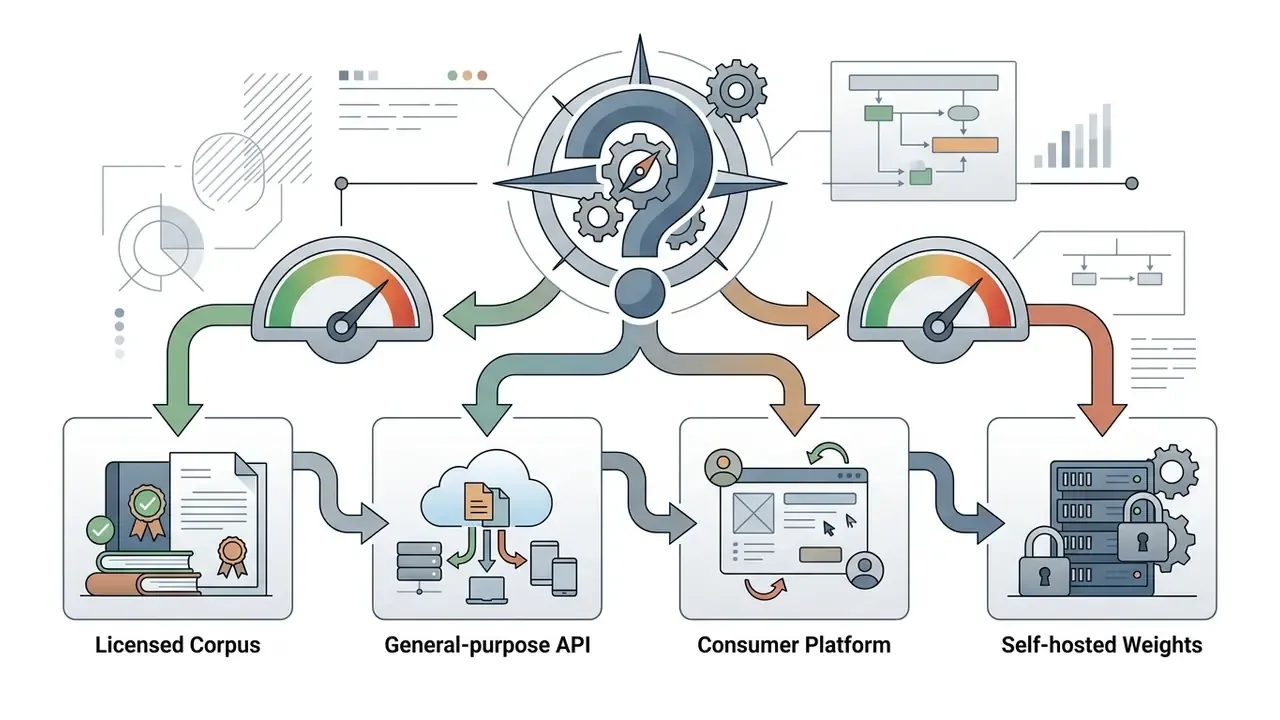
| Vendor Posture | Training-Data Sourcing | Output Rights Position | Indemnification for Enterprise Customers | Practical Risk Profile |
|---|---|---|---|---|
| Licensed-corpus platforms (for example Adobe Firefly) | Owned or licensed stock plus public domain | Commercial use permitted; user solely responsible for use | Offered on qualifying enterprise or business plans, subject to policy compliance | Lowest contractual exposure; strongest fit for regulated industries |
| General-purpose API vendors (for example OpenAI) | Large mixed corpora; limited public dataset disclosure | Output rights assigned to user; user must hold rights to inputs | Business and enterprise agreements may include limited protections; consumer tiers do not | Moderate; depends entirely on the executed contract, not marketing pages |
| Consumer creative platforms (for example Midjourney) | Web-scale corpora; disputed provenance | Ownership subject to plan tier; broad platform licence over inputs and outputs | Generally none; revenue-threshold plan rules apply | Highest; unsuitable as sole source for brand-critical assets |
| Self-hosted open-weight models | Depends on the chosen checkpoint and any fine-tuning data | Governed by model licence plus your own dataset rights | None by definition; risk retained internally | Controllable but fully self-insured; requires documented dataset lineage |
Procurement rule of thumb: if the contract does not name indemnification explicitly, assume the enterprise carries 100% of third-party IP risk.
5. How Artists Can Protect Their Work From Scraping and Crawling
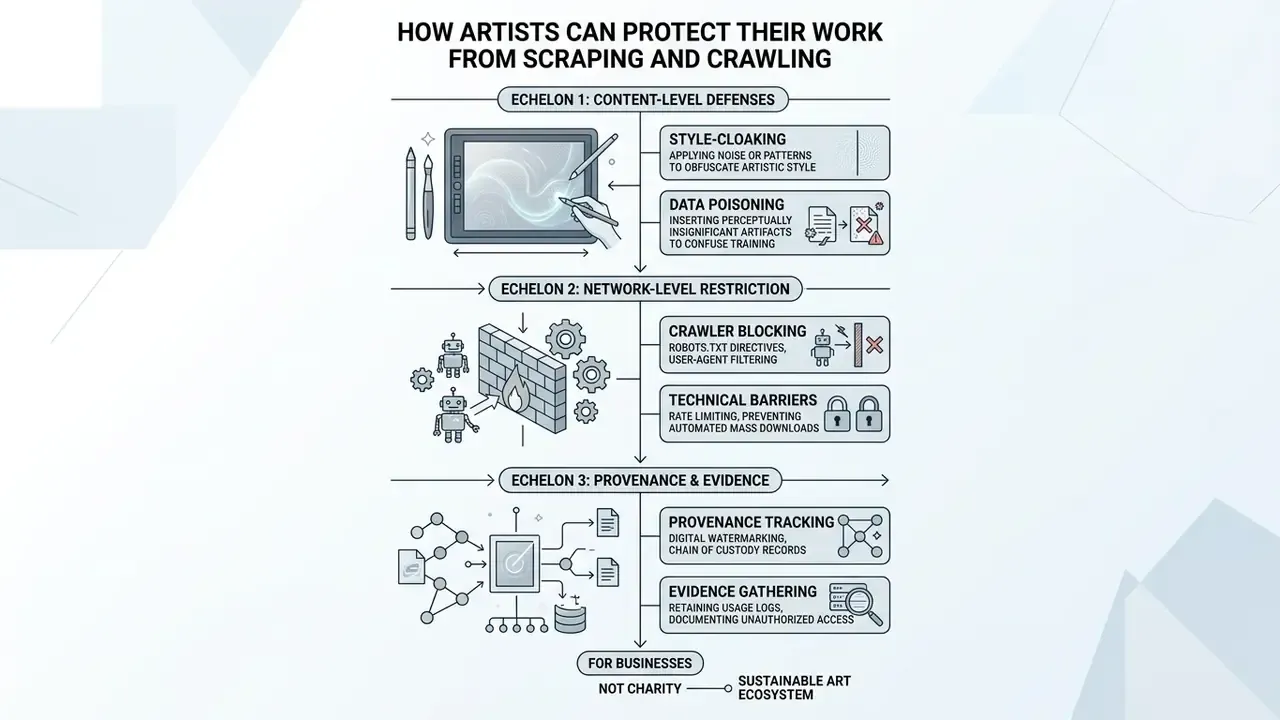
Artists are not limited to litigation. Two technical echelons of defence are available today, plus an evidentiary third, and awareness rather than availability is the binding constraint. A University of California San Diego cybersecurity survey of independent artists found that nearly all respondents wanted AI systems to stay away from their images, yet most did not know which technical mechanisms existed or how to apply them; over 60% of interviewed artists were unaware of robot exclusion protocols.
Echelon 1: style-cloaking and data poisoning. Glaze and Nightshade, both developed at the University of Chicago, add minimal pixel-level perturbations that are barely perceptible to the human eye. Glaze cloaks stylistic signatures so that a scraped image teaches the model the wrong style; Nightshade goes further and corrupts the concept-to-image association, distorting the latent space if poisoned samples enter a training run. Illustrators who publish portfolios online increasingly run every upload through such a tool before posting.
Echelon 2: network-level crawler restriction. A robots.txt file implementing the Robot Exclusion Protocol (REP) instructs crawlers to stay away from specified paths, and can name AI-specific agents such as GPTBot, CCBot and Bytespider. Because compliance is voluntary, enforcement tooling matters: Cloudflare offers a free AI-crawler blocking feature that stops non-compliant bots at the edge. As one of the UCSD study's co-authors observed, this remains "a cat-and-mouse game", since as blocking becomes more comprehensive, more aggressive crawlers attempt to circumvent it.
Echelon 3: provenance and evidence. Artists should retain dated originals, embed provenance metadata, and register substantial works where local law permits, so that any future substantial-similarity argument rests on documented priority rather than social-media timestamps. Where a portfolio is edited or composited, keeping layered project files in a standard photo editing workflow provides the clearest evidence of independent human authorship.
For businesses, this section is not charity. If your brand assets, product photography or illustration library are being scraped, the same three echelons protect your own intellectual property from ingestion by competitors' models. Banks with distinctive visual identity systems have already started applying crawler controls to their brand-asset CDNs, which costs almost nothing and closes an easy channel of dilution.
6. Can You Use AI Art in Commercial Projects?
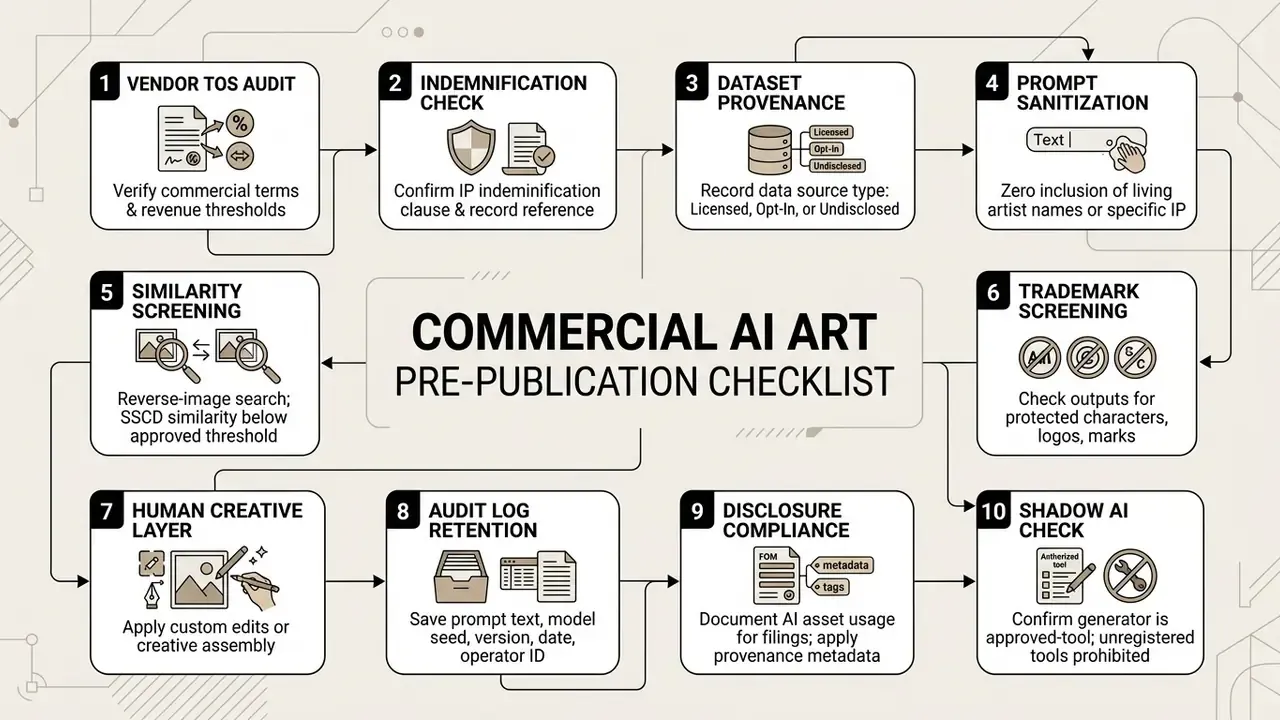
Using AI art commercially is permissible when enterprises establish strict governance protocols, verify vendor licence terms, exclude artist names from prompts, and record generation logs.
Enterprise risk leaders must evaluate every commercial synthetic asset through a documented risk-mitigation framework. Using synthetic imagery in brand packaging, advertising, or digital products without clear verification exposes firms to potential litigation and asset forfeiture.
6.1 Verifying the Generator and Its Terms Before Publication
Before publishing synthetic graphics, commercial teams must audit vendor platform terms, licensing tiers, and usage boundaries.
Different AI tools impose distinct operational limits. Organizations using Bing AI image creation, the Canva AI Generator, Microsoft's AI image generator or Midjourney should review platform-specific commercial rights, export restrictions and data-retention policies before the first asset ships. The same applies to free image to video tiers, where output resolution limits and licence scope frequently differ from the paid plan on the same account. Style-specific tools deserve extra scrutiny: our review of Ghibli-style AI image generators shows how closely some presets track a protected studio aesthetic, which is precisely the category at issue in character-focused litigation. Enterprise developers building custom workflows can inspect our AI Media API Guides to ensure API calls comply with institutional risk limits.
6.2 How to Reduce the Risk of Claims From Artists
Risks can be reduced by using generic style descriptions, running reverse-image similarity searches, keeping generation logs, and incorporating substantial human design work.
6.3 Extending Controls to Dynamic Media
The same governance standards must extend across animated and video assets, where a single memorised frame can propagate through an entire sequence. Teams moving from stills to motion, whether through image to video ai pipelines, animation makers, Google Veo API implementations or free AI video generators, should apply frame-level similarity screening, retain seed and model-version metadata per shot, and verify that synthesised voices comply with AI voice generator licensing terms. Cost-driven experiments with image to video free services belong in a sandbox, never in a production brand pipeline.
Publishing workflows should route final cuts through the same clearance gate as static imagery; teams distributing on social platforms can standardise the process inside a documented YouTube editing workflow. Adult-content and unmoderated environments, including the image to video nsfw category described in our glossary purely for risk-classification purposes, should be prohibited outright on corporate infrastructure. They combine unclear dataset provenance with likeness-rights and safety exposure that no indemnification clause will cover, a risk highlighted by 2026 litigation alleging that inadequate safeguards allowed the generation of explicit imagery of identifiable individuals.
7. Audit Trail, Model Risk Management and GRC Integration
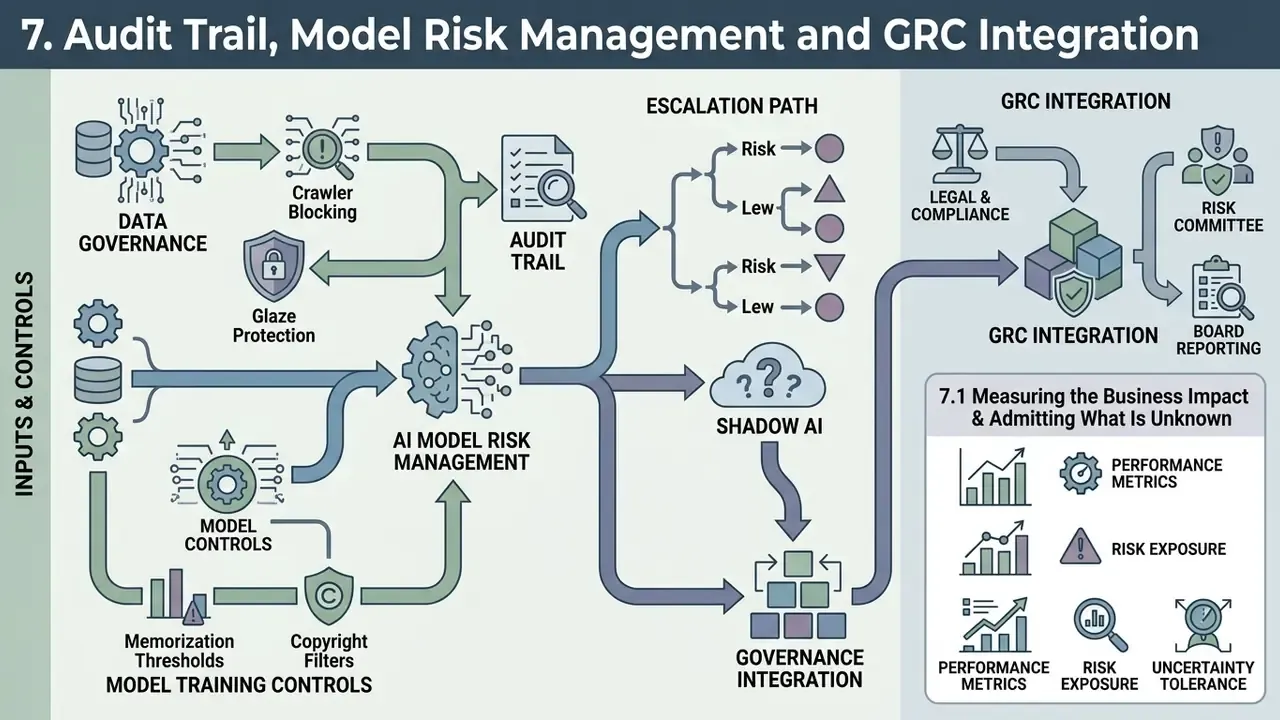
For regulated enterprises, including banks, insurers, healthcare providers and listed companies, the governance question is not "is AI art theft?" but "can we evidence our controls to an examiner?" Synthetic media should be treated as a model output subject to the institution's model risk management (MRM) framework.
Minimum reproducible audit record per published asset:
| Field | Purpose | Retention Owner |
|---|---|---|
| Prompt text (raw and sanitised) | Demonstrates absence of named artists or protected IP | Creative operations |
| Negative prompt and exclusions | Evidence of preventive control design | Creative operations |
| Model name, version, checkpoint | Ties output to a specific tested model state | Model inventory (MRM) |
| Seed and sampler settings | Enables exact regeneration for dispute defence | Model inventory (MRM) |
| Similarity screening result (SSCD, reverse-image) | Proves post-generation verification occurred | Compliance |
| Human modification record (layered files, edit log) | Establishes protectable human authorship | Design lead |
| Vendor ToS version and indemnity clause reference | Documents contractual risk transfer | Legal and Procurement |
| Approver identity and timestamp | Establishes accountability chain | Business owner |
Escalation path. Assets clearing all automated checks publish under standing delegated authority. Assets with borderline similarity scores, third-party reference uploads, or style-adjacent prompts escalate to Legal. Assets involving recognisable persons, protected characters, or unindemnified vendors escalate to the Model Risk Committee. Records should be pushed into the enterprise GRC platform (ServiceNow, MetricStream, Archer or equivalent) alongside the model inventory entry, so that internal audit and prudential examiners can reconstruct any published asset without contacting the creative team.
Shadow AI. The most common control failure is not a bad prompt. It is an unregistered tool. Employees generating brand assets on personal consumer accounts bypass every control above and import unknown licence terms into corporate deliverables. Maintain an approved-generator register, block unapproved endpoints where feasible, and include synthetic-media provenance in periodic attestation cycles.
7.1 Measuring the Business Impact, and Admitting What Is Unknown
Controls cost money, so someone will ask for the number. Three metrics travel well in a risk committee pack: the share of published synthetic assets with a complete audit record (target 100%), median clearance time per asset (a proxy for whether the control is survivable in practice), and the proportion of assets produced on indemnified platforms. A fourth is harder but more honest: the count of exceptions escalated and their outcomes, which shows whether the escalation path functions or is quietly bypassed.
What remains genuinely unresolved? Whether U.S. fair use covers web-scale training. Whether memorisation thresholds like SSCD 0.75 will be treated as evidentially meaningful in court. Whether disclosure statutes will apply retroactively to models already deployed. Anyone claiming certainty on those three points is selling something. Plan for reversibility instead: choose vendors you can exit, keep dataset lineage documentation, and avoid making an unindemnified generator the single source of a flagship brand asset.
8. FAQ: AI Stealing Art, Copyright and Commercial Use
Is AI art legally considered theft?
No. Under U.S. law the relevant questions are whether reproduction occurred during dataset ingestion (assessed against fair use) and whether an output is substantially similar to a protected work. "Theft" describes the ethical objection; infringement is the legal test.
Can we register a copyright in a logo generated by AI?
Only for the human-authored elements. The U.S. Copyright Office requires disclosure of more-than-de-minimis AI-generated material and excludes it from the claim. A logo produced entirely from a prompt is generally unregistrable; a logo where a designer performed substantial original selection, arrangement and modification may be registrable as to those contributions. Trademark rights, by contrast, depend on use in commerce and distinctiveness rather than authorship, so an AI-assisted mark can still function as a trademark even where copyright is thin.
Does using a licensed-dataset generator eliminate our risk?
It materially reduces training-data exposure and, where indemnification applies, transfers residual financial risk to the vendor. It does not remove the need for output screening, trademark checks, or disclosure compliance.
Is "in the style of [artist]" illegal?
Style as such is generally not protected by U.S. copyright. However, naming a living artist commercially can support right-of-publicity, false-endorsement and unfair-competition claims, breaches many marketplace policies, and creates reputational harm. Use descriptive parameters instead.
What similarity threshold should we enforce?
Published research treats SSCD ≥ 0.75 as indicative of memorised replication. Conservative commercial practice sets an internal ceiling well below that, commonly under 0.60, and pairs the metric with reverse-image search on full frames and crops.
Do artists have any way to stop scraping?
Yes, partially: Glaze and Nightshade perturbation tools, robots.txt and REP directives naming AI agents, and edge-level crawler blocking such as Cloudflare's free AI-crawler feature. Compliance by crawlers is imperfect, which is why legislative transparency measures like California AB 412 and the EU AI Act's dataset-summary duty matter.
Which pending cases should we monitor?
Andersen v. Stability AI (training and output claims), Getty Images v. Stability AI (12 million photographs, UK), Disney v. Midjourney (protected characters), and the LibGen-related text-corpus disputes. None had produced a final controlling rule at the time of this 2026 review.
Who is accountable internally when a published AI asset draws a claim?
The business owner who approved publication, supported by Legal for contractual posture and by Model Risk for the model inventory entry. If your process cannot name that person from the audit record, the process is not yet a control.
Appendix A: Superseded Formulations (Retained for Transparency)
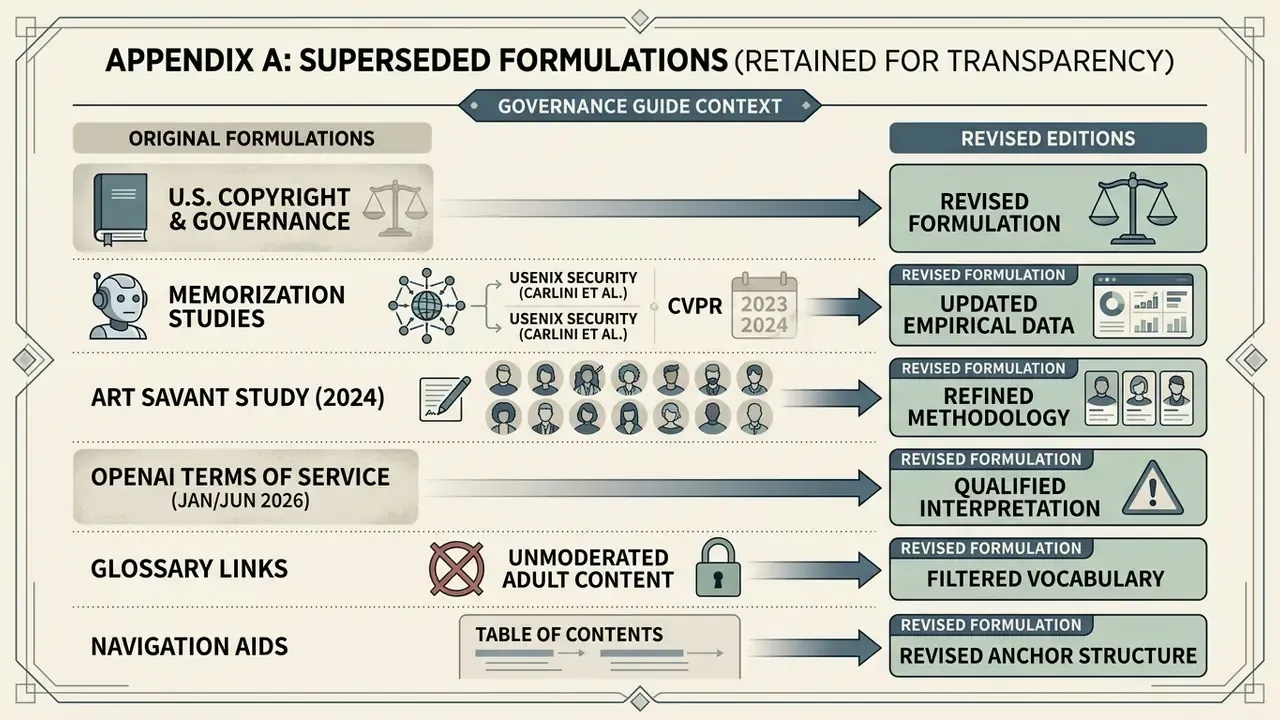
The following earlier formulations were revised in this edition. They are preserved so readers can trace the correction history:
- Original: "As noted in the U.S. Copyright Office Part 3 Report (2025), developers reproduce digital images during initial data ingestion…" Corrected to the Part 2 Copyrightability Report (January 2025) for the copyrightability point, with Part 3 (May 2025, pre-publication) cited separately for training-stage reproduction analysis.
- Original: "Studies published in USENIX Security (Carlini et al., 2023) and CVPR (2024) confirm that state-of-the-art diffusion models can memorize and reproduce training samples under specific conditions." Expanded with the full title and URL of the USENIX paper; the CVPR reference is now described by its definitional contribution rather than treated as an unnamed citation.
- Original: "The ArtSavant empirical study (2024) evaluated 372 artists across multiple diffusion models…" Expanded with the full paper title, arXiv identifier and the DeepMatch accuracy figure.
- Original: "OPENAI TERMS OF SERVICE (Updated Jan/Jun 2026)" presented without qualification. Retained but annotated with an instruction to verify the live effective date at the reader's own review date.
- Original: Anchor text pointing to unmoderated adult-content generation glossary entries inside the risk-mitigation section. Reframed in section 6.3, where the terminology reference is retained strictly as a risk-classification pointer alongside an explicit prohibition rationale, with no promotional framing.
- Original: An anchor-linked table of contents. Replaced with a decision-oriented reader orientation block, since the anchor list duplicated the section headings without adding analytical value.