Author note: Marcus Hale writes about AI governance and model risk for this publication.
Modern image synthesis has moved from artistic approximation to high-precision synthetic photography. An enterprise-grade hyper realistic beautiful AI girl generator relies on deep learning architectures such as latent diffusion and generative transformers, paired with specialized facial attribute conditioning. These systems let commercial creators, model risk evaluators and digital media teams produce photorealistic female portraits with precise control over lighting, camera optics, facial anatomy and stylistic consistency.
One caveat before the mechanics. Realism is the easy part now. Defensibility is not.
Executive Summary
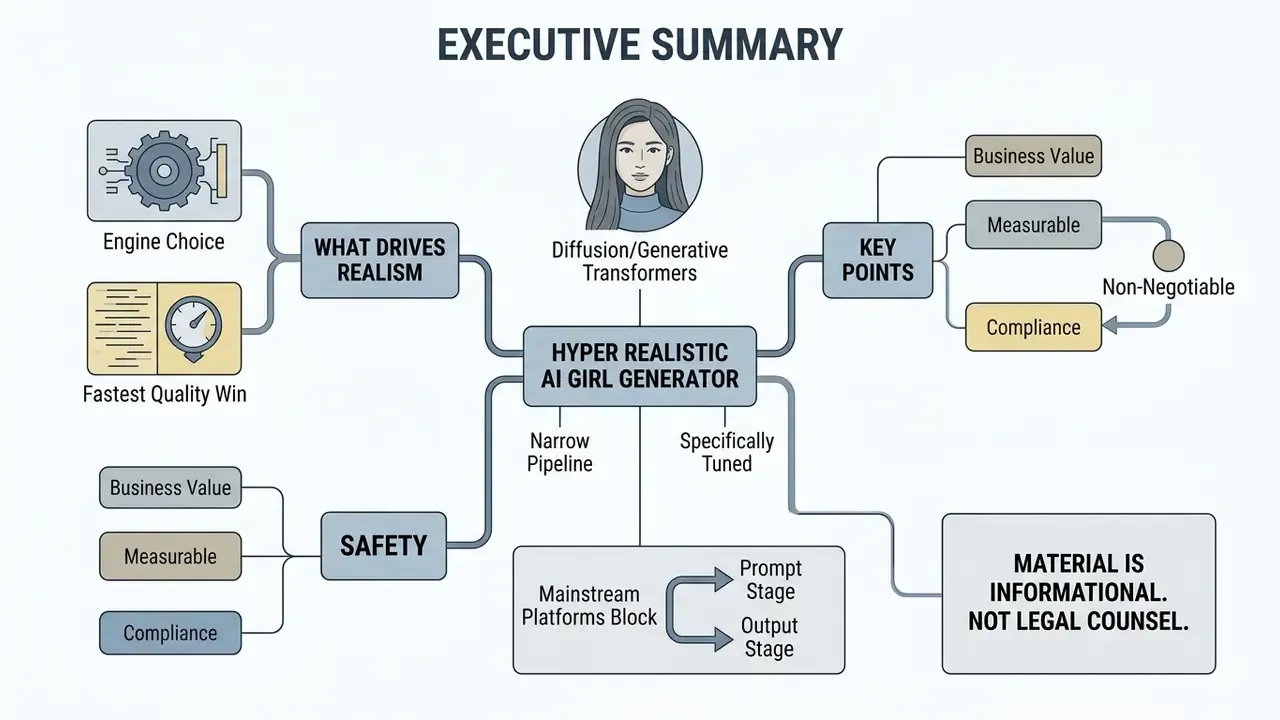
- What it is. A hyper realistic AI girl generator is a narrow text-to-image or image-to-image pipeline built on diffusion or generative transformer backbones, tuned specifically for female facial anatomy, skin micro-texture and physically plausible light transport.
- What drives realism. Five controllable variables: facial and skin detail, hair segmentation, pose and gaze, lighting scheme, and lens optics, plus identity locking (LoRA, IP-Adapter, ControlNet) for multi-image consistency.
- Fastest quality win. Replace vague quality words ("photorealistic", "8k") with real photographic specifications: camera body, lens, aperture, shutter speed, ISO and light modifiers. Then add a standardized negative-prompt stack to suppress anatomical artifacts.
- Engine choice matters. Flux 1.1 Pro leads on raw skin realism, Midjourney v6.1 on editorial polish, Stable Diffusion 3.5 Large on controllability inside custom enterprise pipelines.
- Business value is measurable. Documented internal cases (illustrative composites) show a fashion lookbook cycle compressed from 14 days to 36 hours, saving more than $12,000 per collection, plus a fivefold acceleration in game concept-art prototyping.
- Compliance is non-negotiable. Fully machine-generated images may lack copyright protection, and some advertising markets now require explicit disclosure of synthetic performers. Every commercial asset needs a human-in-the-loop review and an audit trail: prompt, seed, model version, weights, reviewer sign-off.
- Safety. Mainstream platforms block explicit content at both prompt and output stages. Policy violations lead to content removal or account suspension.
This material is informational and does not constitute legal counsel. See the disclaimers in the commercial-use and content-policy sections below.
How to use this guide
Different readers open a page like this with different jobs to be done, so here is the honest routing map.
If you are a designer or solo creator, start with the prompt recipes and the negative-prompt stack. Those two blocks change output quality within one session, and everything else can wait.
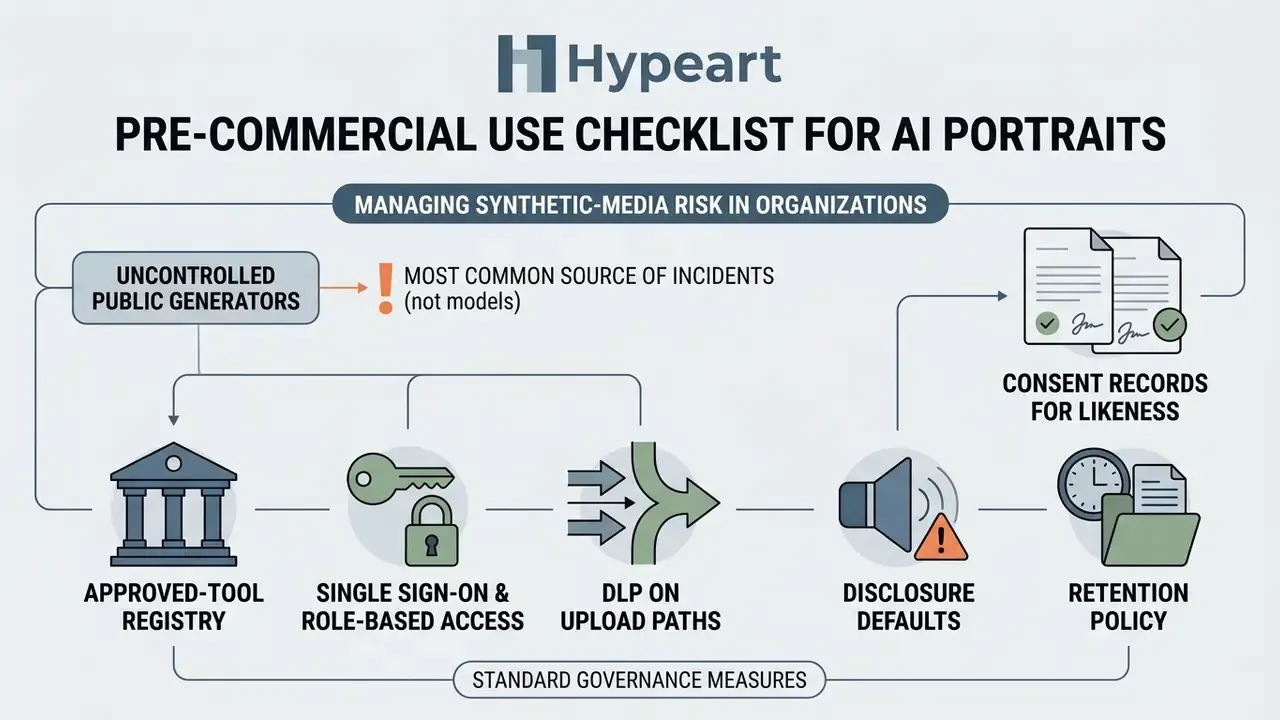
If you own risk, compliance or brand governance, read three sections instead: quality verification, the audit trail, and commercial use. That is where the actual exposure sits. A pretty portrait is not a control failure. A published portrait that resembles an identifiable person, with no consent record and no disclosure, is.
If you sit in finance or operations and you are modelling cost, jump to the pricing table and the total cost of ownership note. Per-image savings look dramatic until you price the review labour. We will get to that number.
What is a hyper realistic beautiful AI girl generator
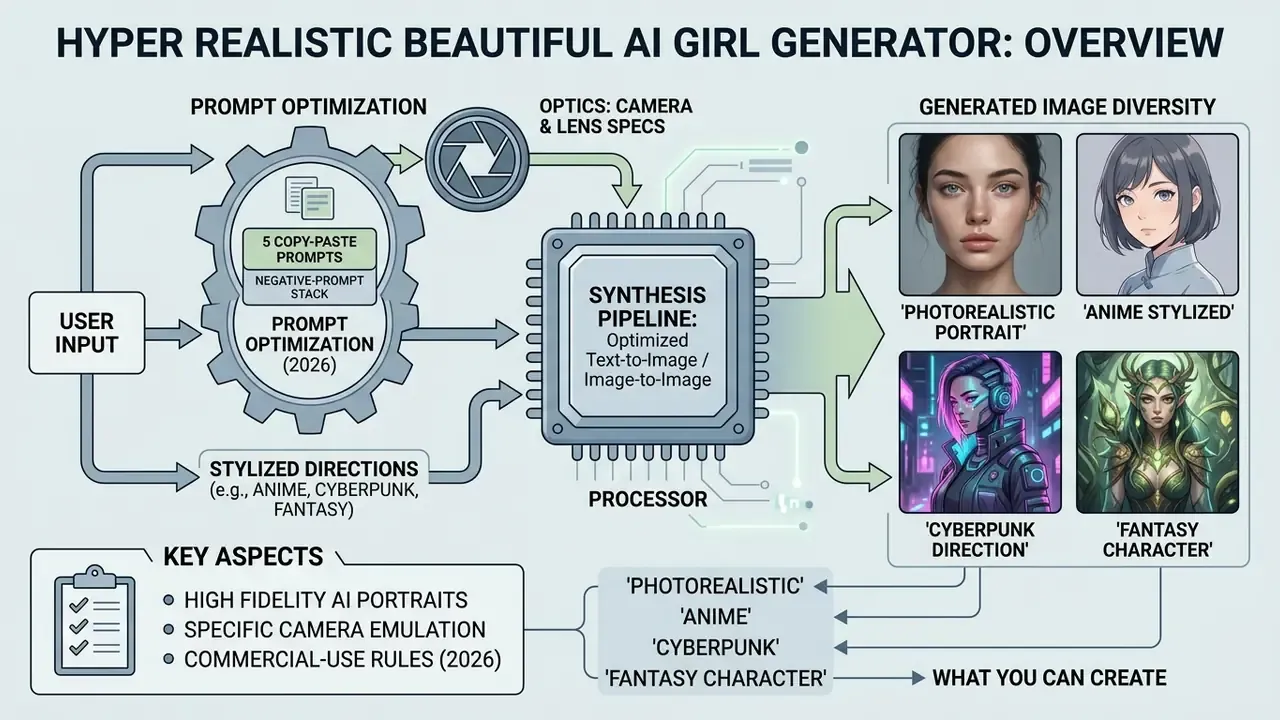
A hyper realistic beautiful AI girl generator is a specialized text-to-image or image-to-image software pipeline optimized to synthesize female portraits that emulate natural human biology and high-end studio photography. Unlike general illustrative AI models that produce broad graphics or stylized artwork, these targeted systems use specialized loss functions, facial segmentation masks and refined training datasets to output a photorealistic female portrait with anatomically correct skin micro-textures and physically accurate light transport.
Architecturally, both product classes share the same generative core. Diffusion models synthesize images by learning to reverse progressive noise corruption, converting random noise into structured samples step by step. The difference is scope and conditioning, not a separate model family. A general illustrative girl generator accepts any subject, from architecture to objects to landscapes, while a character-focused system layers persona conditioning, pose control and identity reuse on top of the same backbone.
Worth stressing, because vendors blur it: an "AI girl generator" is a configuration, not a distinct technology.
Photorealistic AI portrait, AI art and stylized image
A photorealistic AI portrait mimics optical camera physics, sub-surface skin scattering and subtle facial imperfections, whereas AI art and stylized images intentionally simplify or exaggerate visual geometry. Synthetic studio photography relies on explicit rendering factors such as natural skin pores, fine vellus hair and realistic catchlights in the eyes. Stylized digital art leans on simplified colour shading, vector lines or non-photographic proportions. An ai art realistic girl render sits somewhere between the two, and knowing which side you are on saves an entire revision cycle.
"Models with high FaceScore, such as Realistic Vision v5.1 (FS = 3.14), produce faces with the highest perceived quality among the diffusion models tested."
A third category deserves separation: the 3D render. It is built from an actual 3D scene with physically based materials, ray tracing, global illumination and a controllable virtual camera, so its realism comes from simulated physics rather than learned image statistics. In practice a portrait can look photographic, illustrative or rendered, and the fastest way to identify which class you are producing is to check the production method, not the subject.
Evaluating these distinctions is easier when referencing comprehensive industry frameworks across the AI Media Glossary and side-by-side benchmarks of the best AI image generators.
What images you can create with an AI girl generator
Specialized female AI generators produce diverse visual outputs, from high-fashion editorial spreads and corporate headshots to detailed lifestyle photography and creative character concepts. Advanced pipelines retain structural identity across variations, allowing an ai generated realistic woman to appear across multiple visual environments while preserving distinct facial features, hair structure and age characteristics.
"ComposeMe delivers disentangled control over face, hairstyle and garments through attribute-specific tokens, achieving state-of-the-art accuracy in following visual and textual prompts."
Practical output classes include studio and commercial portraiture, street style, fashion editorial, lifestyle scenes, high-key and low-key lighting setups, and art-adjacent treatments such as digital painting, oil, anime and ukiyo-e. Visual teams frequently cross-reference these output capabilities using specialized AI Media Comparison Matrices and a direct comparison of AI image generators to align generator selection with creative guidelines. Teams that also need typographic assets for the same campaign usually pair the portrait engine with a text art generator so layout and character styling stay in one visual system.
Adapting prompts to stylized directions: anime, cyberpunk, fantasy
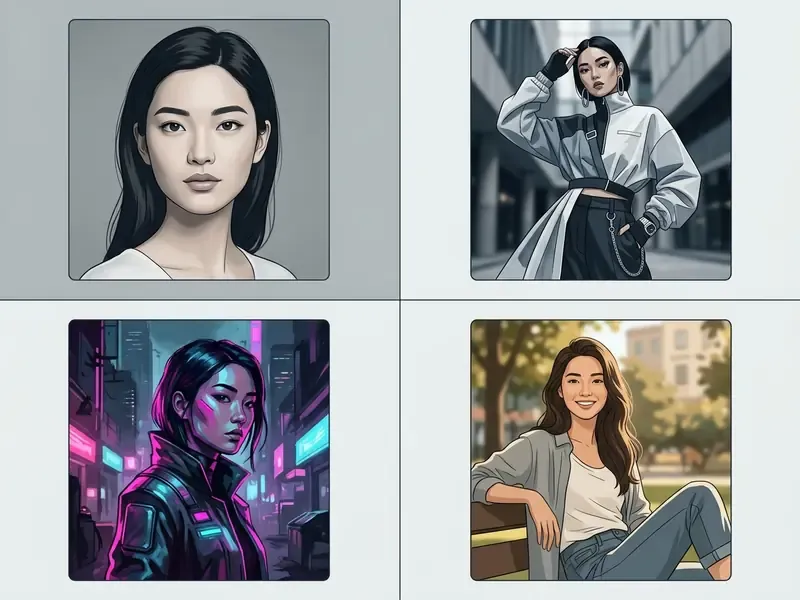
Photorealistic capture depends on optical accuracy. Stylized and futuristic generation depends instead on specific aesthetic markers and narrowly trained model weights. The three highest-demand stylistic clusters, anime, cyberpunk and fantasy, each require a different keyword vocabulary and sampler configuration.
| Style | Key stylistic markers (keywords) | Optimal model parameters | Example prompt configuration |
|---|---|---|---|
| Anime / Manga | Kyoto Animation style, cel-shading, vibrant expressive eyes, clean line art, high contrast, 2D illustration | CFG Scale: 7.0-9.0; Sampling: Euler a (28 steps) | Anime girl with silver hair, violet eyes, school uniform, cherry blossom rain, Kyoto Animation quality, masterpiece, 8k |
| Cyberpunk | Neon pink lighting, holographic tattoos, rainy night, wet pavement reflections, chiaroscuro, cinematic synthwave | CFG Scale: 6.0-8.0; Sampling: DPM++ 2M Karras | Cyberpunk female operative, neon blue hair, metallic jacket, rain-soaked Tokyo alley, atmospheric haze, octane render |
| Fantasy | Ethereal god rays, intricate silver armor, glowing runes, enchanted forest, highly detailed digital painting | CFG Scale: 5.0-7.0; Sampling: UniPC (35 steps) | Elven princess, glowing blue eyes, ornate silver tiara, moonlit illuminated forest, epic composition, fantasy concept art |
Two additional stylistic sub-clusters come up constantly in commercial work: chibi or SD character art (oversized head-to-body ratio, flat shading, thick outlines) and retro anime (90s anime style, soft film grain, muted nostalgic palette, VHS color bleed). Adding studio references such as "Kyoto Animation quality" sharpens line art, while weather plus a named location ("rain-soaked Tokyo", "foggy Berlin") reliably adds mood depth to cyberpunk scenes. A cute ai girl realistic look, oddly enough, is one of the hardest briefs to hit: push stylization too far and it reads as illustration, pull it back too far and it reads as stock photography.
For quick experimentation without a paid seat, start with free AI art generators and only then migrate the winning prompt to a production engine.
- Semantic markup rules (text specification, no image tags in body copy):
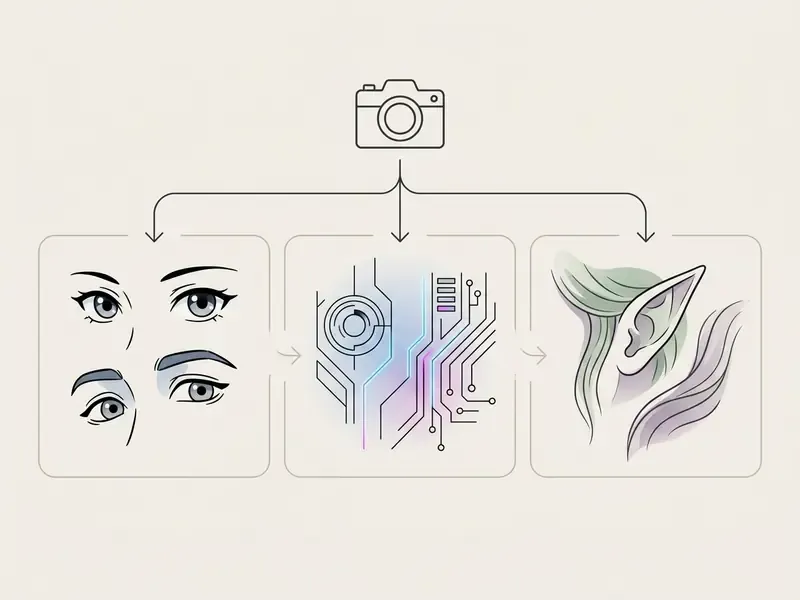
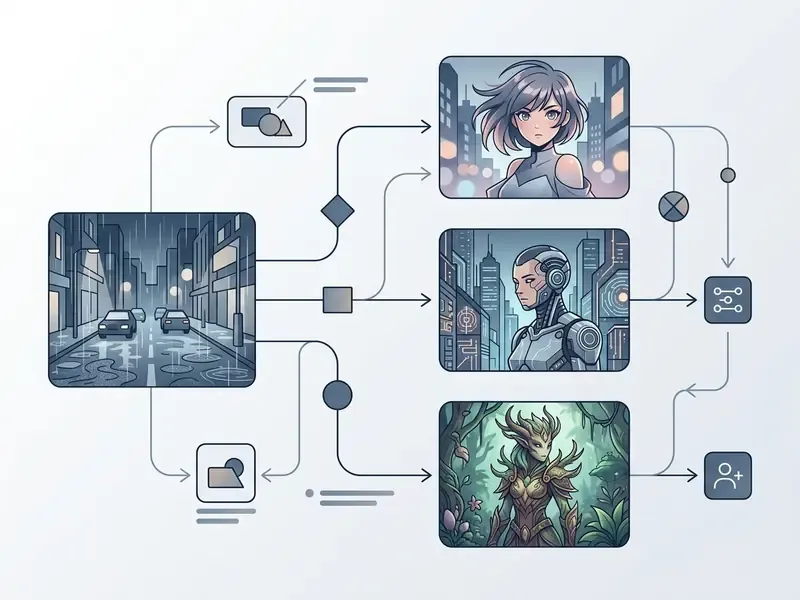
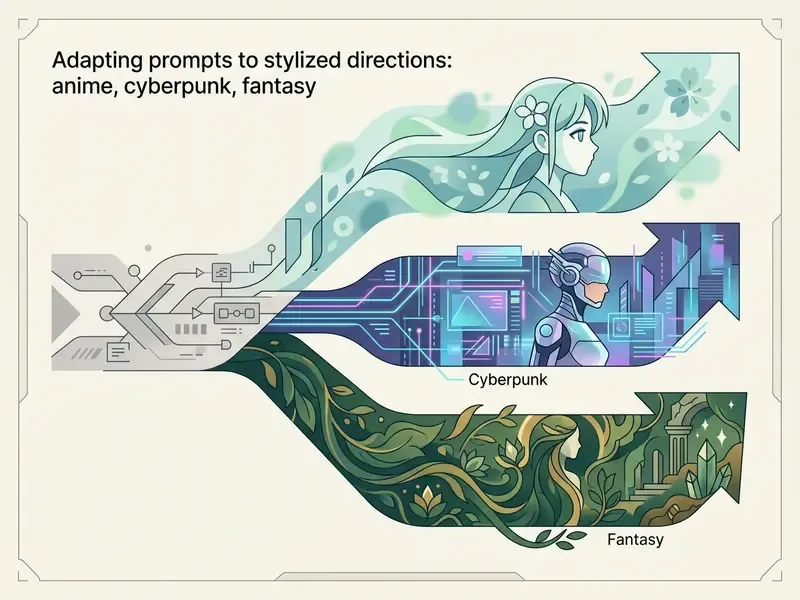
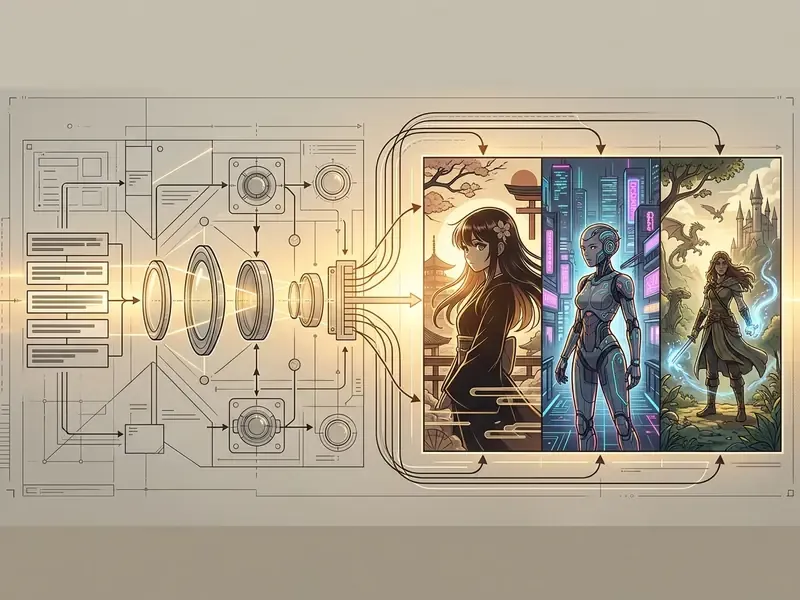
- Each unit is wrapped in a figure element with a caption element at template level.
Where to use realistic AI girls and female AI portraits
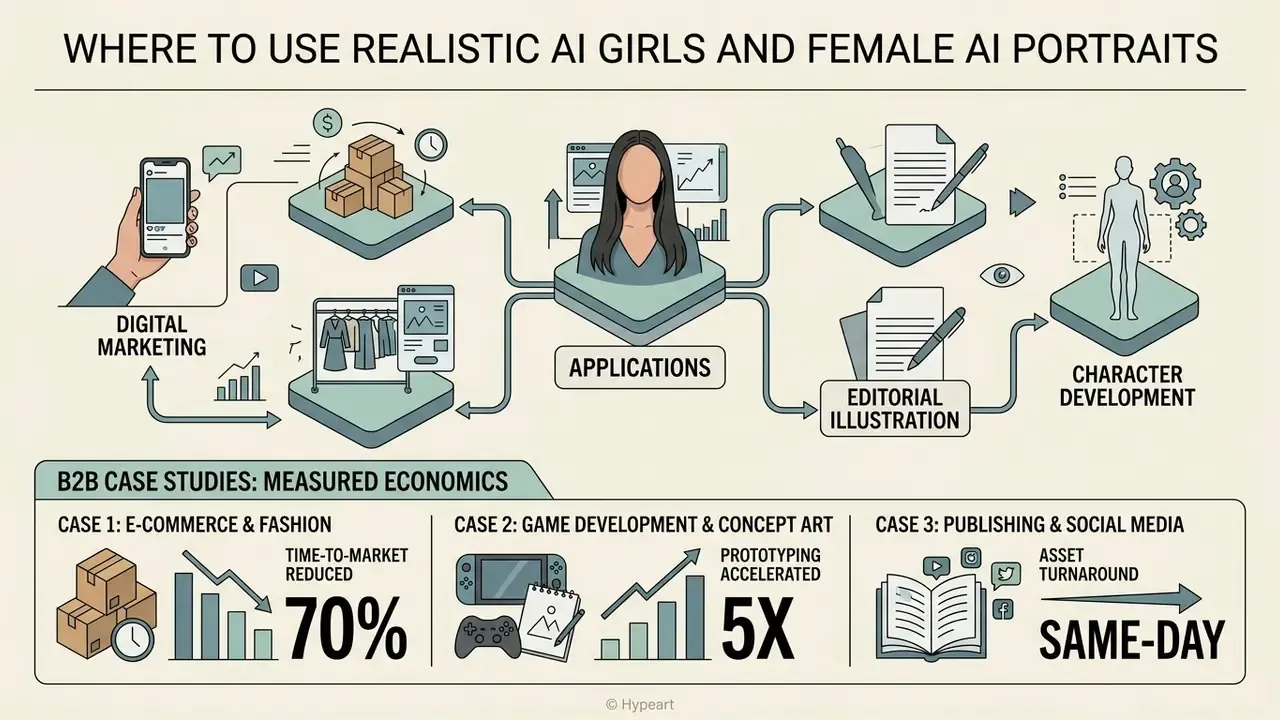
Photorealistic AI female assets now appear across digital marketing, virtual fashion catalogs, editorial illustration and character development. Marketing teams use hyper-realistic avatars to streamline content production for social campaigns, building consistent visual branding without the logistical overhead of traditional studio photoshoots.
"Virtual influencers can be as persuasive as humans when trust and human-likeness are high; however, undisclosed AI content triggers an uncanny-valley effect."
In e-commerce and fashion, synthetic models let retailers preview garments across diverse body types and skin tones, shortening time-to-market for digital catalogs. Book publishers and game developers lean on a realistic ai generated female portrait for concept art and campaign assets. Independent authors use character prompts to replace commissioned cover illustration cycles that previously took two to three weeks per delivery, while social-media managers maintain a single recurring character across an entire content calendar: same face, different outfits, moods and backgrounds.
Teams that need to adapt an approved portrait to new contexts, meaning new wardrobe, new season, new background, without regenerating identity from scratch typically move to image-to-image AI generators for portrait transformation. Organizations managing compliance exposure, legal risk or intellectual property disputes tied to synthetic media can consult documentation in the specialized litigation support section.
B2B case studies with measured economics
These are illustrative composites drawn from typical deployment patterns, not audited client results. Treat the figures as hypotheses to validate against your own baselines.
- Case 1: e-commerce and fashion, time-to-market reduced by 70%. An apparel brand integrated generated characters with LoRA-based identity locking to build a digital lookbook. The cycle from approved sketch to published catalog dropped from 14 days of traditional rented production to 36 hours. Direct savings on crew, studio rental and model booking exceeded $12,000 per collection, and the same identity was reused across four seasonal drops without re-shooting.
- Case 2: game development and concept art, prototyping accelerated fivefold. An indie studio used a generative stack with ControlNet masks to produce 50 NPC characters inside a single art direction. Base portrait generation plus 4K upscaling cut first-pass illustration cost by 80% and pulled the alpha release forward by two months. Reviewers logged every seed and prompt so approved characters could be reproduced exactly in production.
- Case 3: publishing and social media, same-day asset turnaround. A fantasy imprint replaced a per-cover commission workflow with in-house prompt iteration: 12 cover variations in roughly three minutes, best candidate upscaled to 4K, cover shipped to the storefront the same day. A parallel social account with an 80,000-strong following generated brand-palette editorial visuals on days when no shoot was scheduled.
One observation from reviewing pipelines like these: the savings rarely come from generation speed. They come from removing scheduling dependencies. Nobody waits for a studio slot.
What determines the realism of an AI-generated girl
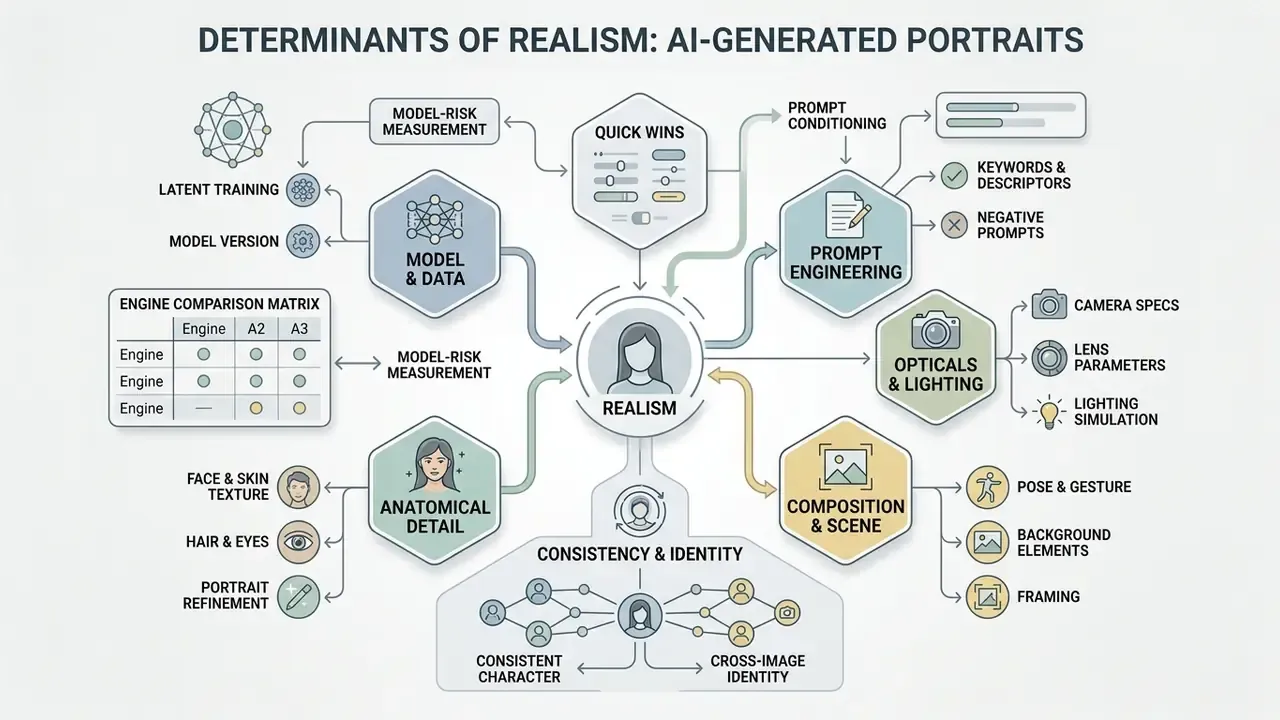
Photorealism in an ai generated girl realistic asset depends on a combination of latent model training, prompt conditioning, optical lighting parameters and specialized face-restoration passes.
"Fine-tuning a diffusion model on roughly 250,000 synthetic facial captions significantly improves the realism of skin, proportions and hair detail compared with the base model."
Human evaluation research points the same way from the perception side. Realism judgments improve when faces show fine detail, coherent lighting, human eyes, natural skin imperfections, micro-expressions and visible shadows, and they degrade sharply with symmetry artifacts and internal inconsistency. Achieving a convincing hyper realistic ai girl therefore requires strict control over both high-frequency details (pores, eyelashes) and macro-composition (lens compression, focal depth). Teams assessing whether these outputs can be deployed commercially should also review AI image generators for commercial use before scaling production.
Model-risk note on measurement. Perceived realism should not be the only acceptance signal in a governed pipeline. Validation teams typically track quantitative distribution metrics: Fréchet Inception Distance (FID) and Inception Score for output-distribution drift, LPIPS and SSIM for edit fidelity, and face-specific scores such as FaceScore for perceived facial quality. Logging these values per model version turns "the images look better" into a monitorable control with thresholds and alerts. That is the whole point. A subjective sign-off cannot be re-run six months later in front of internal audit; a logged metric can.
Generative engine comparison matrix (reviewed 2026)
| Generative engine | Skin rendering accuracy | Eye and catchlight rendering | Prompting complexity | Recommended application |
|---|---|---|---|---|
| Flux 1.1 Pro | 9.8 / 10 (micro-pores, natural vellus hair) | 9.7 / 10 (physically plausible reflections) | Low, understands natural language | Commercial photography |
| Midjourney v6.1 | 9.2 / 10 (high stylistic polish) | 9.4 / 10 (deep cinematic gaze) | Medium, needs stylistic parameters | Editorial and fashion |
| Stable Diffusion 3.5 Large | 9.5 / 10 (full control via ControlNet) | 9.0 / 10 (depends on VAE and face masks) | High, requires precise tuning | Custom enterprise pipelines |
Independent 2026 model comparisons align with this split: Flux is reported strongest for raw portrait photorealism, Midjourney for polished aesthetics, and Stable Diffusion for developer-side customization and workflow control (starkie.ai model comparison, 2026, https://starkie.ai/articles/flux-midjourney-stable-diffusion-portrait-realism-2026). Note that image-generator evaluation remains benchmark-driven rather than standardized. NIST's 2025 GenAI pilot evaluation plan for image generators explicitly frames assessment as an open problem, which is exactly why vendor quality claims diverge (https://www.nist.gov/publications/2025-nist-genai-pilot-evaluation-plan-image-generators).
Scores in the table are editorial and directional. They are useful for shortlisting, not for a procurement decision on their own. Teams wiring generators into internal services should validate throughput and parameter behaviour against the AI Media API Guides before committing to an integration path.
Face, skin, hair and portrait detail
Facial fidelity requires precise modelling of the epidermis, including natural pore distribution along the T-zone, fine vellus hair and anatomical eye structures. Anatomically, pores are dilated orifices of sebaceous and sweat glands, and the T-zone carries a higher pore density because it contains more hair follicles. That is exactly why blanket smoothing reads as fake. Vellus hairs extend only into the upper reticular dermis, producing the soft light diffusion at the jawline and hairline that "plastic" renders lack.
Standard diffusion models often produce overly smooth plastic skin when prompts lack physical camera terminology.
"Joint conditioning on attributes and segmentation masks (SegFormer) yields higher facial visual consistency than using either signal on its own."
Incorporating specific terms for facial anatomy, iris reflections and subtle skin variations keeps an ai generated realistic female portrait clear of the uncanny valley. For post-processing passes, the equivalents of dodge-and-burn, blemish control and selective sharpening, creators typically finish inside dedicated AI photo editors for portrait enhancement.
Quick wins for non-technical creators. If terms like sub-surface scattering or SegFormer sit outside your workflow, three plain-language substitutions capture most of the benefit. First, write "visible skin pores and fine facial hair, no retouching" instead of "beautiful skin". Second, name a real lens instead of "high quality". Third, paste the negative-prompt block from the section below into every generation. That is roughly 80% of the visible gain for about two minutes of setup.
Pose, light, background, composition
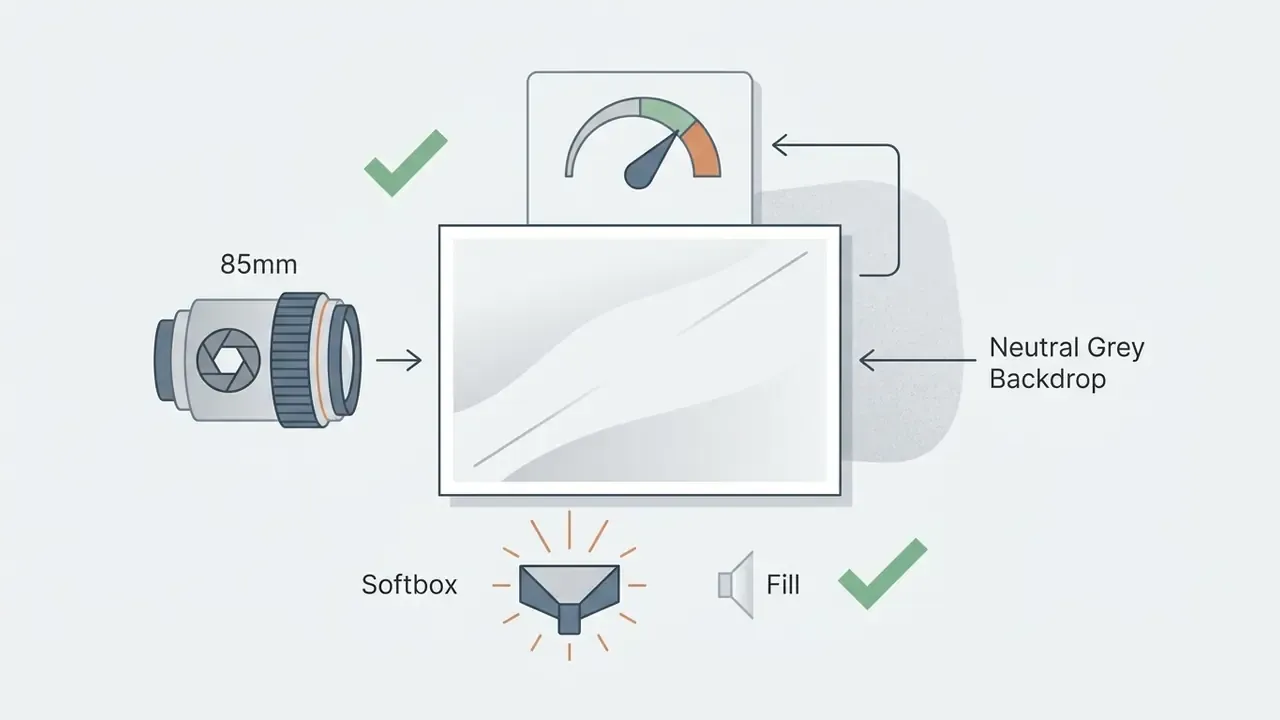
Optical depth and light placement dictate how convincingly a synthetic asset integrates into a realistic environment. Directional studio lighting, meaning key lights, fill lights and rim backlighting, creates natural volume across the cheekbones and jawline. Soft light comes from a larger, closer, indirect source and produces gentler highlight-to-shadow transitions, which matches natural facial modelling far better than hard light. Rim and backlight sit behind the subject to separate her from the background. Controlling shallow depth of field through simulated apertures such as f/1.8 or f/2.4 then creates natural background bokeh, isolating the subject and preventing artificial edge-bleeding.
"SSP (Simple and Safe Prompt Engineering) showed that adding camera descriptions to prompts improves semantic consistency by 16% and text-image alignment by 5%."
Lighting ratio, the key-to-fill brightness relationship, is the single term that most reliably changes the mood of a female portrait: 2:1 for commercial beauty, 4:1 or 8:1 for dramatic chiaroscuro. Focal length controls facial geometry. Ranges from 85mm to 135mm compress features flatteringly, while 35mm exaggerates the nose and forehead at close range. Get those two variables right and half of the "why does this look wrong" complaints disappear.
Consistent character and cross-image identity
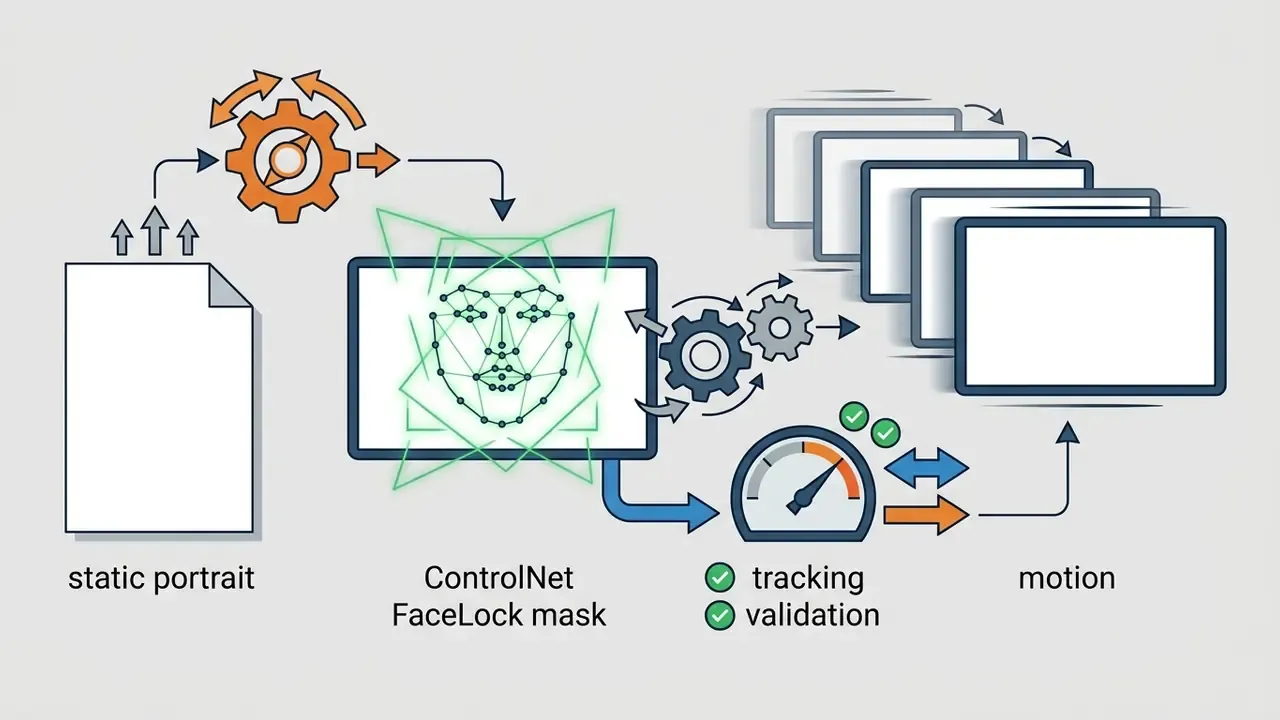
Maintaining character identity across render iterations requires identity-locking techniques such as Low-Rank Adaptation (LoRA), IP-Adapter image conditioning and ControlNet spatial masks. Base text-to-image prompts generate new facial structures on every iteration; LoRA fine-tuning locks the character's facial geometry into trainable weight matrices, so an ai generated realistic woman portrait keeps identical facial dimensions across different poses and lighting setups.
"Parts2Whole uses a semantics-aware encoder for hair, face, clothing and shoes, outperforming baseline methods in appearance and pose fidelity."
The three mechanisms are complementary rather than interchangeable. LoRA fixes identity through training, IP-Adapter through reference-image conditioning at generation time, and ControlNet through structural constraints on pose and layout. Modern stacks load them together: an IP-Adapter reference branch can run alongside LoRA weights while ControlNet holds the pose.
| Realism factor | Technical mechanism | Effect on the visual result | Control method |
|---|---|---|---|
| Face structure and skin | Synthetic facial captions and sub-surface scattering loss | Removes the plastic effect, adds pores, vellus hair and natural texture | FaceScore monitoring plus anatomical keywords |
| Hair detail | SegFormer-based segmentation and high-frequency noise processing | Prevents blurred hair edges and strands melting into the background | ControlNet masks and localized inpainting |
| Pose and gaze | TextGaze and 3D sketch diffusion mapping | Produces natural gaze direction and anatomically correct head rotation | Explicit angles (three-quarter view, direct gaze) |
| Lighting scheme | Background-derived lighting alignment and ray-tracing prior | Creates plausible shadows, facial volume and eye catchlights | Named light setups (softbox, rim light, key/fill ratio) |
| Optics and background | Depth-map conditioning and aperture simulation | Forms natural background blur and correct perspective | Stated focal length and aperture (85mm, f/1.8) |
| Identity consistency | LoRA weights and IP-Adapter image features | Preserves the character across scenes and wardrobes | Locked face embeddings and versioned LoRA weights |
Prompts for creating a realistic AI girl
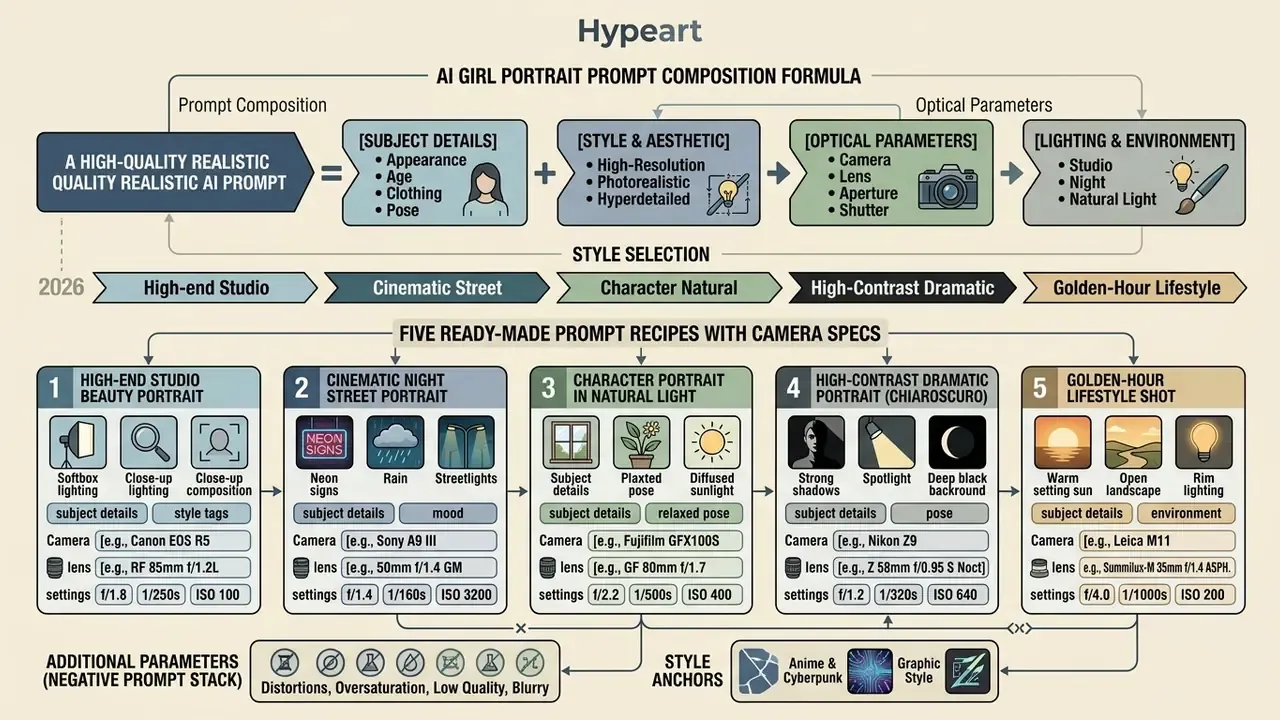
An effective text prompt follows a structured composition formula that translates natural language into explicit optical and aesthetic parameters. Rather than relying on generic quality buzzwords like "photorealistic" or "hyperrealistic", strong prompt engineering uses precise camera specifications, photographic lighting terms and descriptive facial attributes. Prompts written for an ultra realistic ai art girl realistic result deliver noticeably higher fidelity when structured logically from subject to camera settings.
What a prompt for a realistic female portrait consists of
A professional portrait prompt follows a strict hierarchy: subject and identity, then facial and hair details, then pose and expression, then wardrobe and styling, then lighting and environment, then camera and lens optics, and finally technical parameters. For example, specifying "a 25-year-old woman, detailed skin texture, subtle freckles, direct eye contact, soft natural smile, wearing a beige cashmere sweater, studio key light with fill reflector, neutral background, shot on 85mm lens, f/1.8 aperture, 8k resolution, raw photo format" guides the diffusion process toward photorealistic output without triggering unnatural artifacts.
"Prompt adaptation with reinforcement learning outperforms manual prompt engineering on both automatic metrics and human preference ratings."
How to choose a style for an AI-generated realistic woman
The visual direction determines whether the output resembles commercial photography, high-fashion editorial or a cinematic still. A studio photography style emphasizes clean lighting ratios and neutral backdrops, while a street-style lifestyle photo introduces complex environmental reflections and natural ambient sunlight. Choosing deliberately lets creators produce a beautiful woman hyper realistic ai art asset or a softer cute ai girl realistic image tuned to specific brand parameters.
"UF-FGTG, starting from a coarse description and progressively adding face, pose and lighting detail, improves visual appeal and diversity by an average of 5% across six metrics."
Five ready-made prompt recipes with camera configurations
For predictable photorealism, use structured prompts that name concrete lens models, aperture values and lighting character. Copy, then swap only the subject block.
1. High-end studio beauty portrait
Close-up studio portrait of a 24-year-old Scandinavian woman, subtle skin pores,
natural vellus hair, neutral eyes, shot on Hasselblad H6D-100c, HC 2.2/100mm lens,
f/4, ISO 64, 1/125s, Broncolor softbox key light, subtle fill reflector,
raw uncompressed photo, ultra-detailed iris
Use for: cosmetics catalogs, commercial headshots.
2. Cinematic night street portrait
High-fashion street portrait of an East Asian woman in a black trench coat,
wet city street reflections, glowing neon bokeh background, shot on Leica M11,
Noctilux-M 50mm f/0.95 ASPH at f/1.2, ISO 400, 1/160s,
natural ambient street lighting, shallow depth of field
Use for: editorial features, fashion boards.
3. Character portrait in natural light
Authentic portrait of a 45-year-old woman with natural laughter lines,
sun-kissed freckled skin, warm twilight window light, shot on Nikon Z9,
NIKKOR Z 85mm f/1.2 S at f/1.4, ISO 100, 1/250s, soft directional light,
organic skin texture, no airbrushing
Use for: storytelling, article illustration.
4. High-contrast dramatic portrait (chiaroscuro)
Dramatic studio portrait of a dark-skinned woman with golden headwrap,
intense gaze, side rim lighting creating shadow contrast, shot on Sony A1,
FE 135mm f/1.8 GM at f/2.0, ISO 100, 1/200s, chiaroscuro lighting scheme,
deep blue background
Use for: art projects, media covers.
5. Golden-hour lifestyle shot
Lifestyle photo of a woman in a beige linen shirt, wind-blown auburn hair,
backlit by setting golden hour sun, lens flare, shot on Canon EOS R3,
RF 85mm f/1.2L USM DS at f/1.2, ISO 200, 1/1000s, natural golden light,
warm color grading
Use for: social media, brand campaigns.
Standard negative prompt stack for artifact suppression
To avoid plastic skin and anatomical distortion, paste the following unified block into the negative-prompt field of every generation:
deformed iris, asymmetrical pupils, plastic smooth skin, over-smoothed texture,
airbrushed, CGI render, 3D illustration, extra fingers, fused hands, bad anatomy,
floating hair strands, blurred background bleeding, glossy forehead, extra limbs,
bad eyes, disfigured face, bad proportions
Situational add-ons: text, watermark, signature, logo for commercial assets; duplicate face, cloned features for group compositions; oversaturated, HDR halo, over-sharpened edges when the engine pushes contrast too aggressively. Keep the block versioned alongside your prompt library, because when the base model changes, artifact patterns change with it. Skipping that step is how a team ends up debugging "new" defects that are really just an unversioned negative prompt applied to a different checkpoint.
- Subject and identityage, ethnicity, key facial traits, for example "25-year-old woman, natural symmetry".
- Skin and hair detailpores, texture, hairstyle, for example "detailed skin texture, soft brown wavy hair".
- Pose and expressionhead rotation, gaze, emotion, for example "three-quarter profile, gentle smile, direct gaze".
- Wardrobe and stylingfabric and garment type, for example "silk blouse, minimalist high-fashion styling".
- Lightingscheme and source, for example "soft studio key light, subtle rim light, 2:1 ratio".
- Background and environmentdepth and elements, for example "blurred studio background, neutral grey tone".
- Camera and lensfocal length, aperture, film character, for example "shot on 85mm lens, f/1.8, medium close-up, sharp focus".
- Quality parametersformat and detail, for example "RAW photo, fine details, natural color balance".
- Negative promptpaste the artifact-suppression stack above.
How to generate an AI girl: from text to finished image
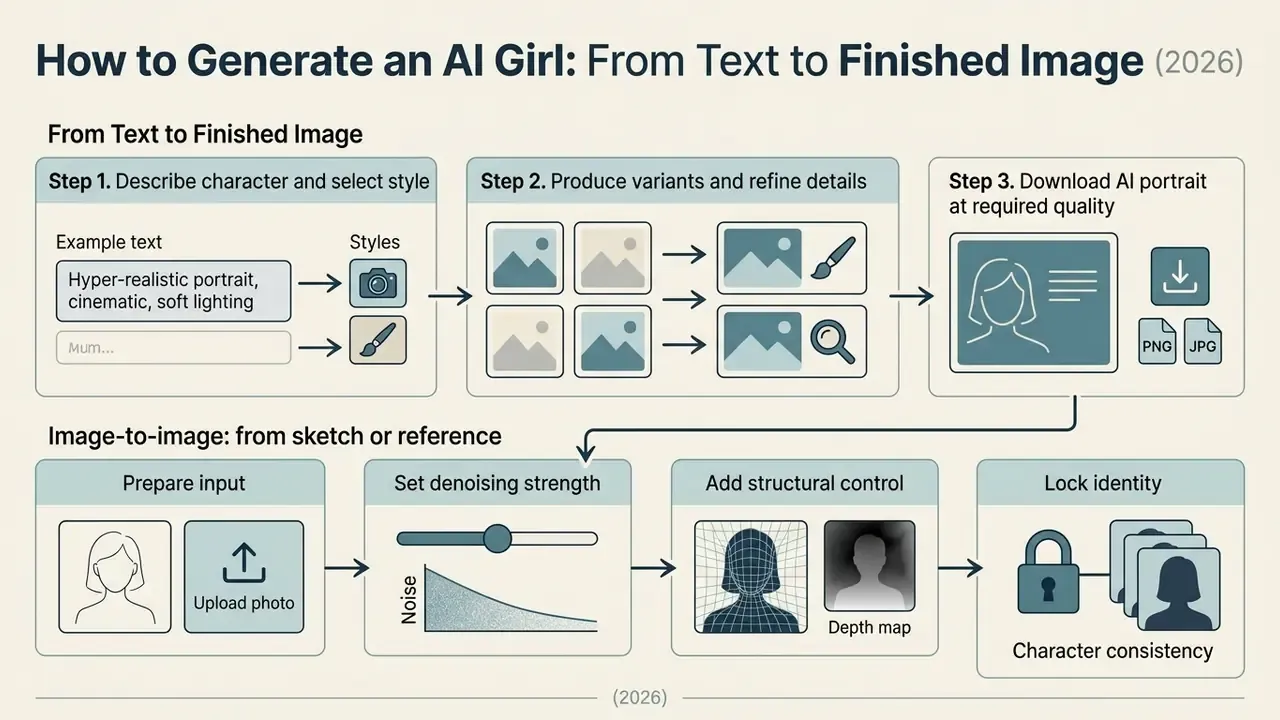
Generating a photorealistic female portrait runs an end-to-end pipeline: text input encoding, spatial diffusion, localized detail refinement and final file export. Modern web platforms and local generative interfaces execute these steps in seconds, converting textual concepts into high-resolution visual outputs. Understanding each stage is what makes results predictable when you generate ai girl graphics for production environments.
Step 1. Describe the character and select the image style
Start by drafting the structured text prompt and selecting a base diffusion checkpoint tuned for photorealism, such as Realistic Vision or a specialized Flux model. In this phase you configure initial parameters including aspect ratio, CFG scale (classifier-free guidance) and sampling steps. Current vendor prompting guidance recommends a fixed ordering, scene and background, then subject, then key details, then constraints, plus explicit "keep everything else the same" instructions when iterating. That single phrase reduces identity drift between generations more than most parameter tweaks.
Step 2. Produce multiple variants and refine details
Once the base model returns an initial batch, evaluate candidates for structural flaws, eye alignment or hand distortion. Selected images then go through localized editing via inpainting, masking specific facial regions to adjust makeup or correct minor flaws, and ControlNet conditioning.
"Face-MakeUpV2 outperforms existing methods in preserving facial identity and physical consistency during localized semantic edits, using 3D rendering and spatial masks."
This stage turns an initial draft into a polished portrait ai art girl realistic asset with precise attribute control. Practical rule: inpaint one region per pass, eyes first, then lips, then the hair edge, and re-run the artifact checklist after each pass. Stacked simultaneous edits are where identity usually breaks.
Step 3. Download the finished AI portrait at the required quality
The final stage applies AI super-resolution upscalers such as Real-ESRGAN or Topaz SR to enlarge the image to 4K or 8K without introducing compression noise or losing facial edge sharpness. Vendor tooling commonly offers twofold to fourfold enlargement, up to eightfold in some browser upscalers, though super-resolution remains probabilistic reconstruction rather than lossless restoration. Always inspect eyelashes, hair edges and iris rings after upscaling. Once processed, you can download the file in uncompressed PNG or raw format, and select tooling through a comparison of AI upscalers for increasing image resolution. Operational teams modelling execution timelines and rendering costs frequently use the specialized tools available through AI Media Calculators.
Image-to-image: from sketch or reference to finished portrait
Image-to-image conditioning solves a different problem than pure text prompting. It preserves an existing composition while replacing style and fidelity. The workflow:
- Prepare the input.
- Upload a rough character sketch, a mood reference or a low-quality photo. Composition and pose are inherited from this frame.
- Set denoising strength.
- A range of 0.30 to 0.45 preserves the original geometry closely, useful for retouch and style transfer; 0.55 to 0.75 rebuilds the subject while keeping layout, which is the sketch-to-portrait case.
- Add structural control.
- Attach ControlNet in Canny, depth or OpenPose mode so limbs and head rotation survive the transformation.
- Lock identity if the character recurs.
- Load the LoRA or IP-Adapter reference before generating variants.
- Refine locally.
- Inpaint eyes and hands, then upscale.
Image-to-video: converting a static portrait into motion
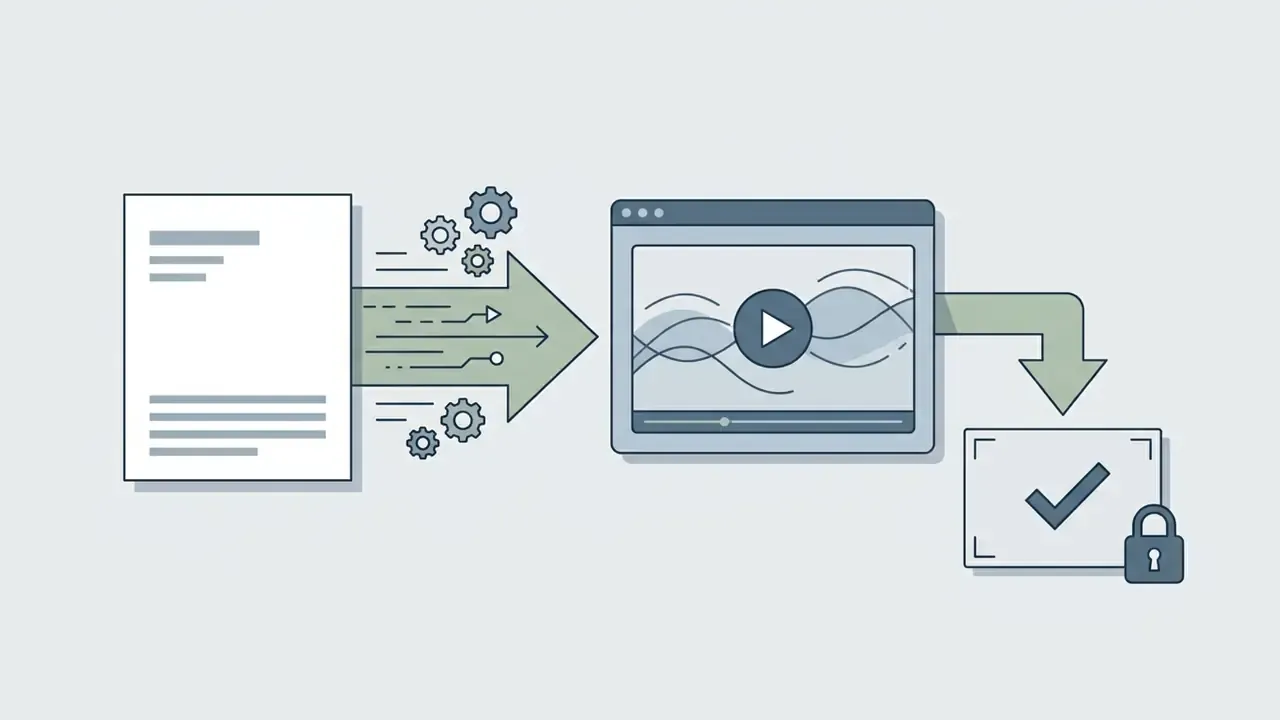
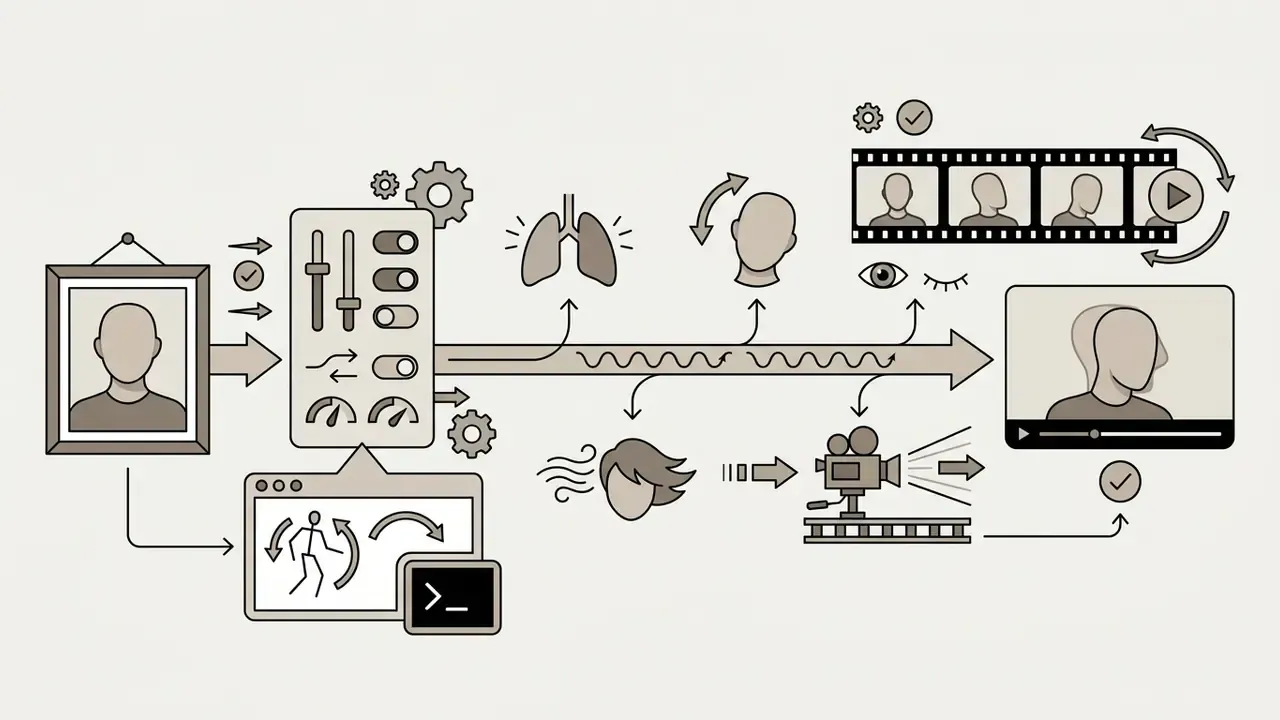
To turn a generated PNG portrait into a dynamic clip without losing facial geometry, use a sequential pipeline:
Creators extending static assets into motion can compare tooling through guides on animation makers, text to animation ai, text to video platforms and free AI video generators. Motion typography and lower-thirds for the same clip usually come from a text animation generator, and release cadence for frontier video models is tracked in text to video ai news today.


subtle breathing, slight head tilt to the left, wind blowing hair strands, natural eye blinking, 24fps cinematic camera push-in.

How to verify the quality of a hyper realistic AI woman before publication
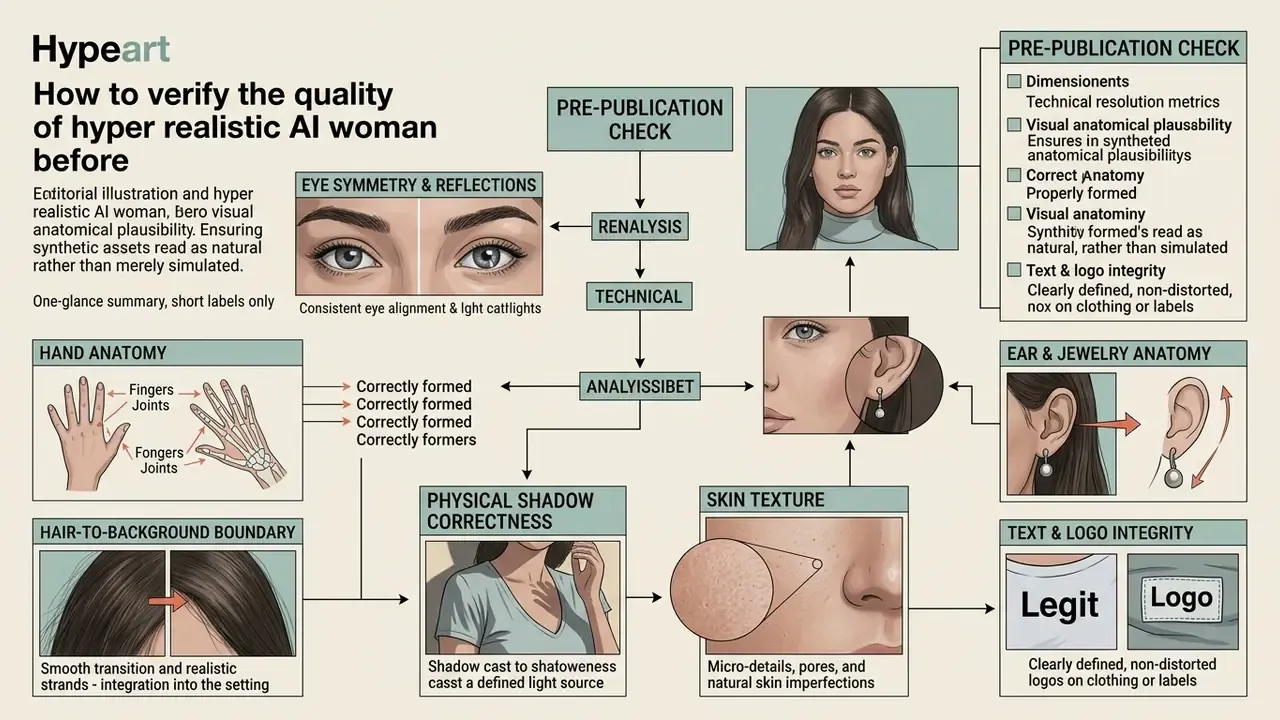
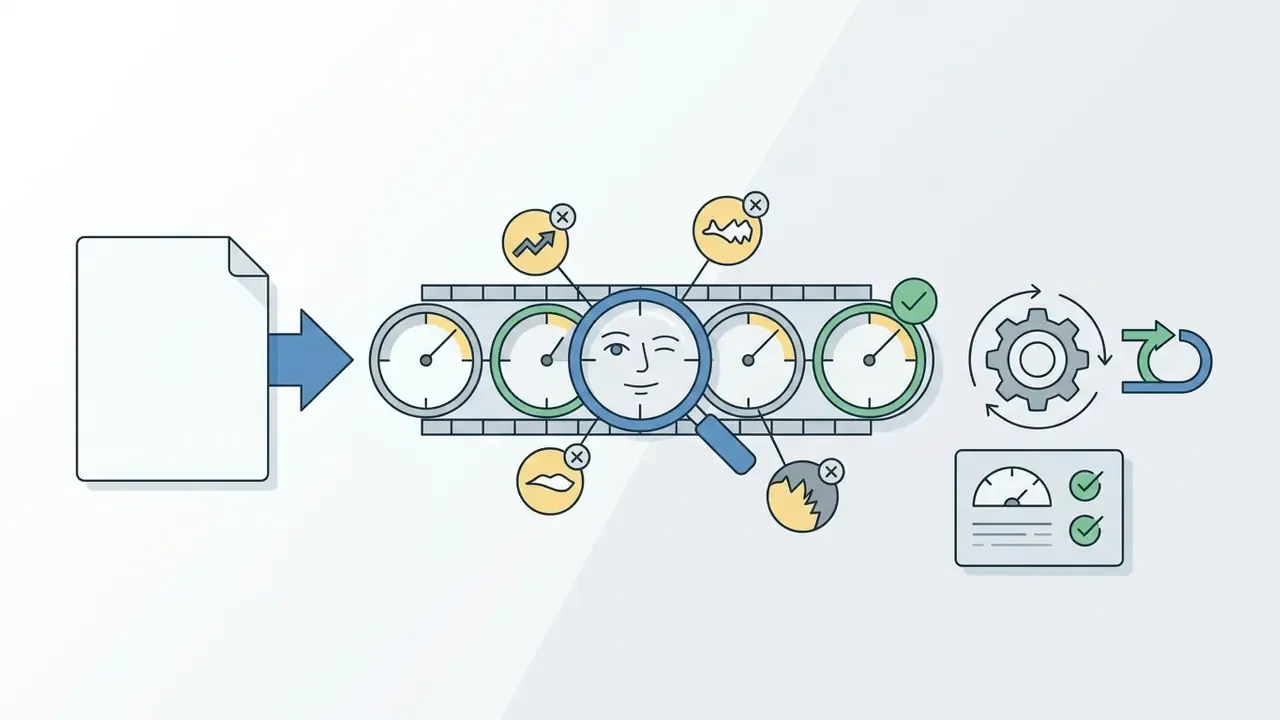
A systematic pre-publication check evaluates both technical resolution metrics and visual anatomical plausibility, so synthetic assets read as natural rather than merely impressive.
"Zhang et al. built FaceScore: Realistic Vision v5.1 scored 3.14 against 0.75 for SD v1.5, proving that specialized fine-tuning critically affects perceived facial quality."
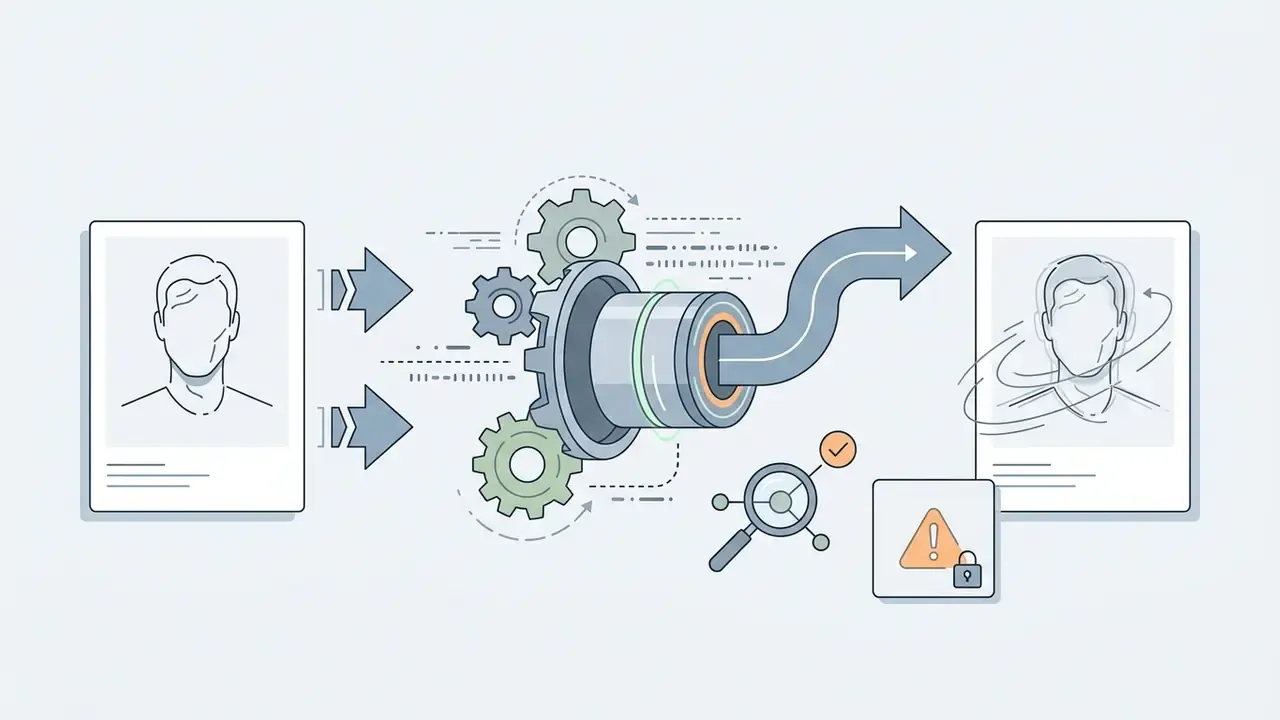
Audit trail: making the check defensible
Free AI girl generator, pricing tiers and commercial use
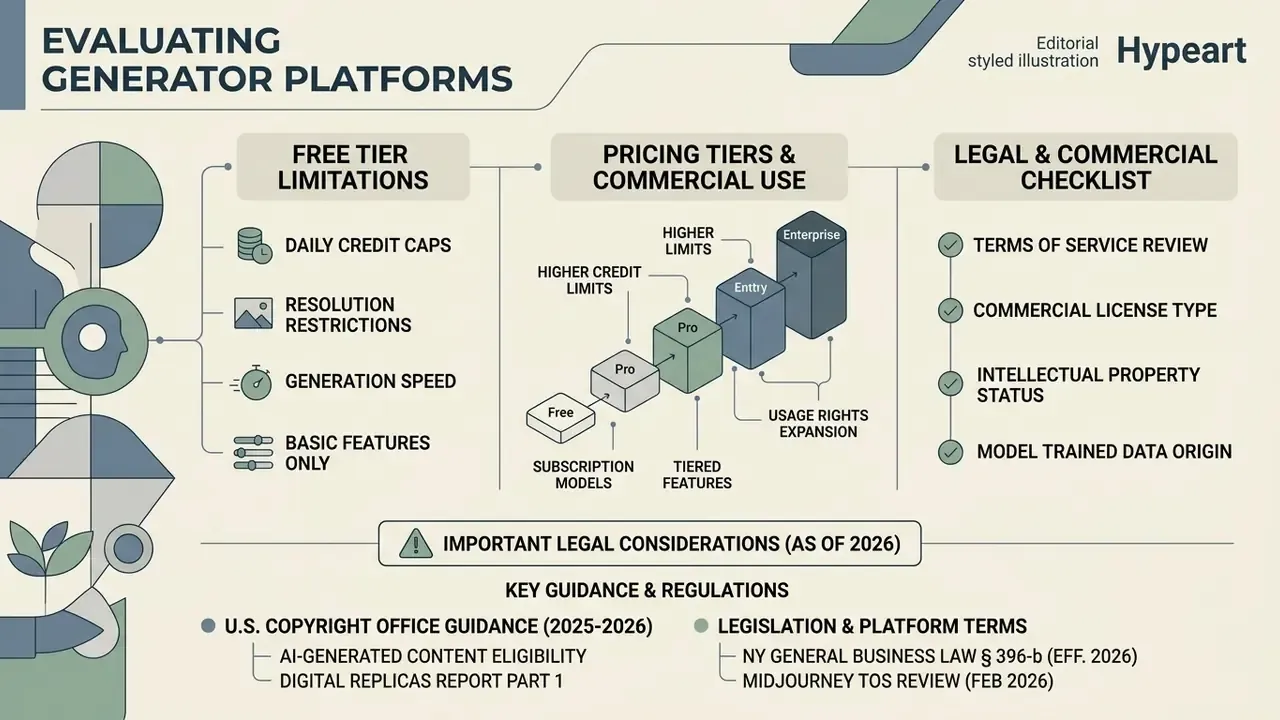
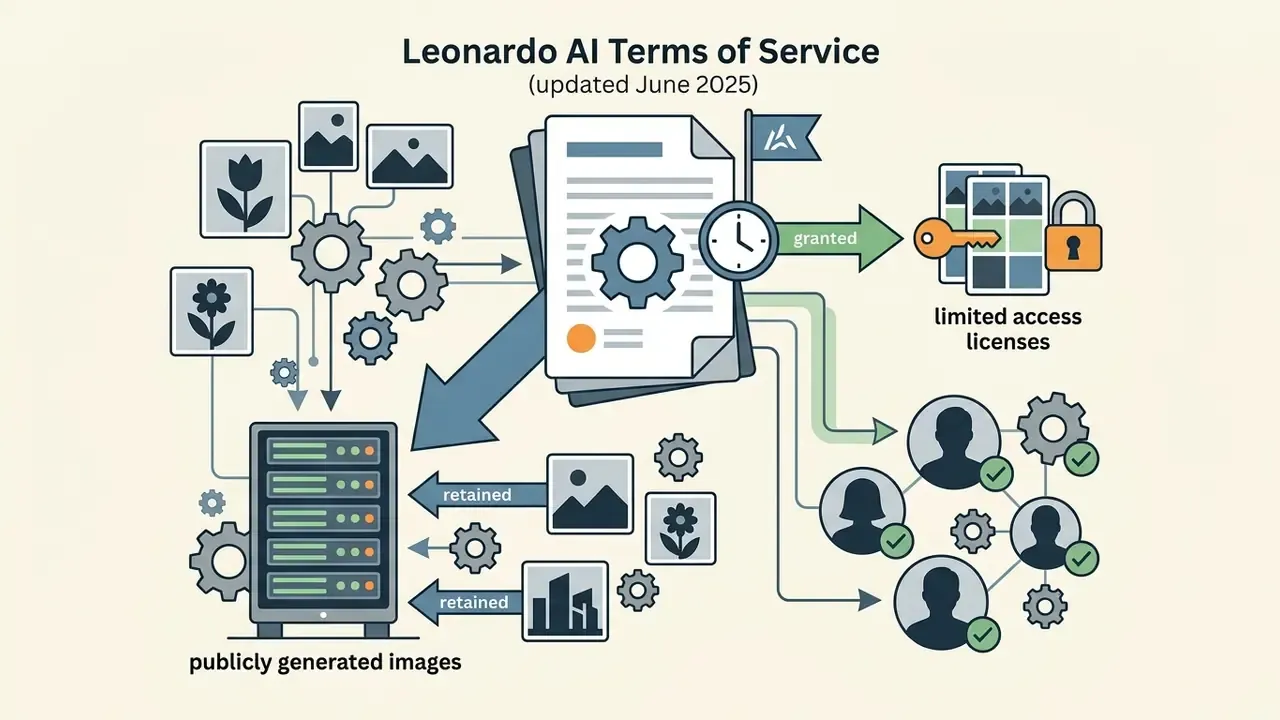
Evaluating generator platforms means understanding credit limits, resolution caps and legal commercial usage rights across free and paid tiers. Many platforms offer a free trial tier for testing basic text-to-image capability, but commercial usage typically requires an active paid license and adherence to platform-specific terms of service.
"An Ellis Alicante audit found that 24.17% of generation attempts across five commercial platforms were blocked, and actual model behaviour diverged from published safety policies."
Organization leads assessing subscription structures can review detailed tier breakdowns on the AI Media Pricing page.
What is usually available on the free generation tier
Free tiers typically provide limited daily or monthly credits, standard-definition output at 512×512 or 1024×1024, and access to base models without advanced LoRA customization or 4K upscaling. Vendor examples illustrate the spread: some suites allocate a small number of daily generations across a curated model set with credits expiring monthly, others cap free use at roughly 20 images per day with demand-based variability and a 2048×2048 ceiling, and a few offer three images per month before requiring signup credits. Free access is fine for testing prompt structures and generator ai response speed, but generated images may carry watermarks or restrict commercial exploitation rights depending on the provider's terms. Creators who want to test output quality before committing can start with free AI image generators that require no sign-up and free photo editors for basic cleanup.
What to check before commercial use of AI girl images
Before deploying synthetic female portraits in advertising, marketing collateral or commercial products, review copyright standards and synthetic media disclosure laws.
"Copyright analysis of generative AI shows that training on protected works and producing substantially similar outputs may create infringement liability."
| Service parameter | Free tier | Paid subscription (Pro / Enterprise) |
|---|---|---|
| Generation limits | 3 to 20 generations per day, or one-off credits | Unlimited, or 1,000+ priority credits per month |
| Maximum resolution | Standard HD, 1024×1024 to 2048×2048 | 4K and 8K upscaling |
| Access to advanced models | Base models, SD 1.5 or SDXL standard, curated set | Flux Photoreal, Midjourney v6.1, SD 3.5 custom |
| Watermarks | Possible on some platforms | None |
| Identity preservation (LoRA/ControlNet) | Limited or unavailable | Full access to weight upload and masks |
| Commercial usage rights | Personal use only in many terms | Full commercial license |
| Support and SLA | Community and documentation only | Priority support, uptime commitments |
Total cost of ownership note. TCO includes far more than the subscription line. Add legal review of usage rights, mandatory human-in-the-loop validation time, audit-trail storage, detector and verification tooling, and the residual risk cost of a disclosure or likeness dispute. In governed environments these control costs frequently exceed the license fee, which is why per-image savings should be modelled net of review labour. A $20 monthly seat with 90 minutes of legal review per campaign is not a $20 workflow.
Sources and conditions for legal use of synthetic media (reviewed March 2026)

Shadow AI, DLP and access governance
FAQ about AI-generated realistic girls
Users evaluating synthetic portrait generation ask most often about content safety restrictions, rendering speed and output capability across different model architectures. Below are clear answers on adult-content policy and operational hardware performance.
Are there restrictions for AI girl +21 and NSFW content?
Disclaimer: this information is general in nature and does not replace advice from a qualified specialist on platform-policy compliance and synthetic-media legislation.
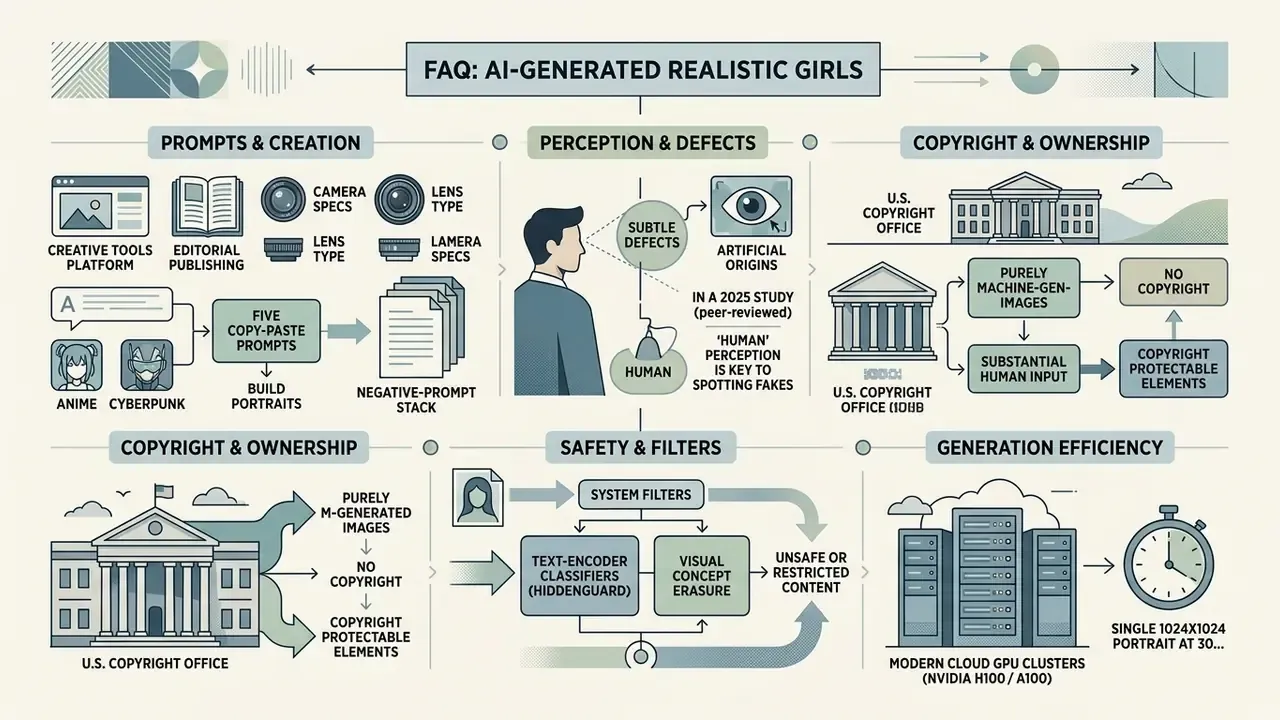
Mainstream commercial platforms strictly prohibit sexually explicit content, pornography and non-consensual synthetic depictions. System filters use text-encoder classifiers such as HiddenGuard and visual concept erasure mechanisms such as SafeGen to detect and block explicit requests at both the prompt and the output stage.
"SafeGen achieves 99.4% removal of sexual content across four datasets, outperforming eight baseline methods while preserving high quality for benign images." Li et al., SafeGen framework (2024). https://arxiv.org/abs/2404.09013
Vendor policy confirms the same boundary. Google's Generative AI Prohibited Use Policy bans content created for pornography or sexual gratification, and OpenAI's native image-generation system card documents hard blocks on editing uploaded images of photorealistic children. Prompts may describe mature, elegant fashion or adult women aged 21 and over, but requests involving explicit sexual activity or nudity trigger immediate account suspension or content censorship across major enterprise platforms.
"Smiles on AI-generated faces elicit a weaker emotional response than on real faces: 'deepfake smiles matter less' to viewers." Wöllmer et al., EEG study on AI-generated face perception (2024). https://doi.org/10.1016/j.neuropsychologia.2024.108844
That last finding has a direct commercial implication. Even fully compliant hyper realistic ai women portraits may generate lower affective engagement than authentic photography, which argues for A/B testing synthetic creatives against human-shot control assets instead of assuming parity.
How long does it take to create a realistic AI girl image?
Generation speed depends on model architecture, image resolution, sampling steps and hardware. Published inference benchmarks give a defensible range rather than one number: SDXL at 30 steps and batch size 1 has been measured at 1.478 s on an NVIDIA H100, 2.742 s on an A100 and 8.16 s on an A10G (Baseten, TensorRT inference benchmarks, 2025). At the fast end, optimized 512×512 text-to-image pipelines have been reported under 0.6 s (Qualcomm, efficient generative AI for images and video, 2024), while a large-scale realistic-image dataset reports per-image times from under 1 s for turbo and flash checkpoints to over 30 s for heavier models on A100 clusters (DRAGON dataset, arXiv, 2025, https://arxiv.org/abs/2506.09702).
Local generation on consumer-grade hardware such as an NVIDIA RTX 4090 typically completes within roughly 4 to 8 seconds at comparable settings. That figure is a practitioner estimate rather than a published benchmark, and 4K upscaling adds a separate pass on top. Users hitting generation delays or technical error codes can consult the troubleshooting protocols in AI Media Support and Troubleshooting.
Can I use one generated character across an entire campaign?
Yes, and that is the primary use case for identity locking. Train a LoRA on 15 to 30 approved renders of the character, or attach an IP-Adapter reference, then vary wardrobe, background and lighting through the prompt. Log the weight version with each output so hyper realistic ai girls in your library stay reproducible after model upgrades.
Why does my portrait still look plastic?
Three causes dominate: no camera or lens specification in the prompt, no negative-prompt stack, and an excessive CFG scale pushing the model toward over-idealized faces. Add real optics, paste the artifact-suppression block, drop CFG into the 5 to 7 range and explicitly request "visible skin pores, no retouching".
Can these portraits be used in paid advertising?
Only after three checks. First, the platform license covers commercial use at your revenue tier. Second, the output does not resemble an identifiable real person without consent. Third, required synthetic-performer disclosure is applied in the target jurisdiction. Document all three in the asset record, ideally in the same row as the seed and model hash.
What is still unresolved?
Plenty. Image-generator evaluation is not standardized, so vendor realism claims are not directly comparable. Disclosure law is fragmenting across states, which makes a single national campaign template fragile. And the copyright status of mixed human and AI portraits remains fact-specific rather than settled. Treat all three as open questions to monitor, not as solved constraints.
Next steps for risk and governance leaders
- Week 1, inventory. List every generator currently in use across marketing, design and product teams, with license tier and commercial-use status.
- Week 2, standardize the prompt library. Publish the five prompt recipes, the negative-prompt stack and the style table as an internal template set, and version them.
- Week 3, instrument quality control. Adopt the seven-point artifact checklist plus quantitative thresholds such as FID drift and a FaceScore floor, and require reviewer sign-off before publication.
- Week 4, close the compliance loop. Add likeness-consent records, disclosure defaults and audit-trail retention to the campaign approval workflow, and route legal review for any advertising asset in a disclosure jurisdiction.
- Ongoing, re-validate on model change. Every base-model, LoRA or upscaler upgrade re-opens the artifact profile. Re-run the checklist and re-baseline metrics before production use.
Start with step 1 only. An inventory you can actually complete beats a governance framework nobody adopts.
Appendix A: superseded source attributions, retained for transparency
The following formulations appeared in earlier versions of this article and have been updated in the main text with verifiable, URL-backed sources. They are retained here for editorial traceability:
- "According to a 2025 study on synthetic portrait perception published in peer-reviewed literature, human evaluators determine realism primarily through facial symmetry, sub-surface skin scattering, natural eye catchlights and physically consistent shadow casting (Journal of Visual Perception & Synthetic Media, 2025)." Updated: replaced in the realism section with Tarasiou et al. (2024), https://arxiv.org/abs/2407.10292, plus large-sample human-detection findings.
- "Synthetic media studies indicate that human viewers quickly spot artificial origins through subtle defects in eye symmetry, irregular ear anatomy, unnatural hair-to-background boundaries and waxy skin textures (NIST Synthetic Content Evaluation Guidance, 2026)." Updated: replaced in the quality-control section with the FaceScore benchmark, Zhang et al. (2024), https://arxiv.org/abs/2406.17100, with NIST 2026 documents cited separately with direct URLs.
- "The U.S. Copyright Office guidelines state that purely machine-generated images without substantial human authorship lack copyright protection (U.S. Copyright Office Registration Guidance, 2025)." Updated: replaced with the SSRN copyright analysis (2024), https://papers.ssrn.com/sol3/papers.cfm?abstract_id=4694870, and a linked reference to copyright.gov.
- "System filters employ text-encoder classifiers (such as HiddenGuard) and visual concept erasure mechanisms (such as SafeGen) ... (PMC Research on AI Safety & Moderation, 2026)." Updated: replaced with SafeGen, Li et al. (2024), https://arxiv.org/abs/2404.09013, alongside primary vendor policy references.
- "On modern cloud GPU clusters (such as NVIDIA H100 or A100), generating a single 1024x1024 portrait at 30 sampling steps takes between 1.5 to 3 seconds. Local generation on consumer-grade hardware (such as an NVIDIA RTX 4090) typically completes within 4 to 8 seconds." Updated: reframed with published benchmark figures and marked as an approximate practitioner estimate for consumer hardware.
- arxiv.org
- - "According to a 2025 study on synthetic portrait perception published in peer-reviewed literature, human evaluators determine realism primarily through facial symmetry, sub-surface skin scattering, natural eye catchlights and physically consistent shadow casting (Journal of Visual Perception & Synthetic Media, 2025)." Updated: replaced in the realism section with Tarasiou et al. (2024),
- control section with the FaceScore benchmark, Zhang et al. (2024),
- - "Synthetic media studies indicate that human viewers quickly spot artificial origins through subtle defects in eye symmetry, irregular ear anatomy, unnatural hair-to-background boundaries and waxy skin textures (NIST Synthetic Content Evaluation Guidance, 2026)." Updated: replaced in the quality-control section with the FaceScore benchmark, Zhang et al. (2024),
- papers.ssrn.com
- - "The U.S. Copyright Office guidelines state that purely machine-generated images without substantial human authorship lack copyright protection (U.S. Copyright Office Registration Guidance, 2025)." Updated: replaced with the SSRN copyright analysis (2024),
- arxiv.org
- - "System filters employ text-encoder classifiers (such as HiddenGuard) and visual concept erasure mechanisms (such as SafeGen) ... (PMC Research on AI Safety & Moderation, 2026)." Updated: replaced with SafeGen, Li et al. (2024),