Three things to know before you apply:
- Format defines your economics. Salaried photo editors in photographic services earn a median of $21.58/hour (about $44,880/year), while 1099 contractors in wedding and event work are frequently paid per image, roughly $0.15–$0.30 per frame, with no guaranteed volume.
- Remote is common but not universal. About 44.1% of arts and media workers reported some telework in February 2023, yet 59.5% of arts and media roles still offer no routine telework. That makes location terms the single most negotiable clause in an offer.
- Deconstruct the job description before the interview. Verify the software stack, daily image quotas, portfolio-usage rights, W-2 vs. 1099 classification, and the scope of any unpaid skills-assessment demo (never more than 5–10 sample images, or 2–3 hours of work).
Where the Openings Actually Sit in 2026
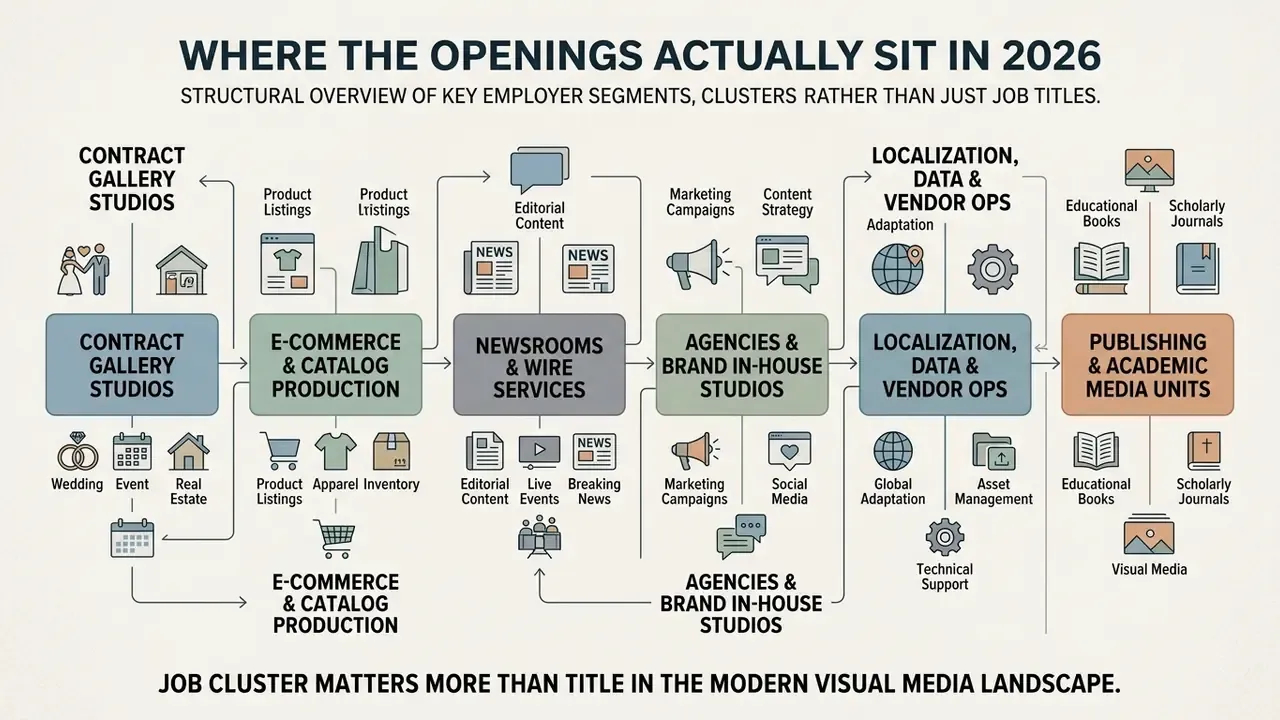
Before you refine search filters, it helps to know which employer segments are posting. Six clusters generate most of the volume:
- Contract gallery studios (wedding, event, real estate). Highest share of genuinely remote work, almost always 1099, almost always piece-rate.
- E-commerce and catalog production teams. Steady quotas, platform specs, frequent part-time and seasonal spikes around Q3 and Q4 catalog drops.
- Newsrooms and wire services. Fewest remote seats, strictest ethics rules, fastest clocks.
- Agencies and brand in-house studios. Hybrid dominant, color-critical proofing on premises, campaign deadlines.
- Localization, data and vendor operations. Image QA and metadata work bundled with language or annotation tasks.
- Publishing and academic media units. Small teams, long archives, heavy rights and permissions work.
A blunt point: your title matters less than which cluster you sit in. The same skill set pays $11 an hour in one and $34 in another.
Finding a photo editor job in today's visual media landscape requires understanding how traditional image retouching integrates with digital asset management and automated workflows. Organizations hiring image professionals evaluate candidates on technical precision, policy compliance, and deadline discipline. Across 2025–2026 postings, employers consistently ask for Photoshop and Lightroom fluency, deadline discipline, rights and attribution handling, and cross-team collaboration. Increasingly they also want the judgment required to audit AI-assisted output before it ships.
Types of Photo Editor Jobs and Career Paths
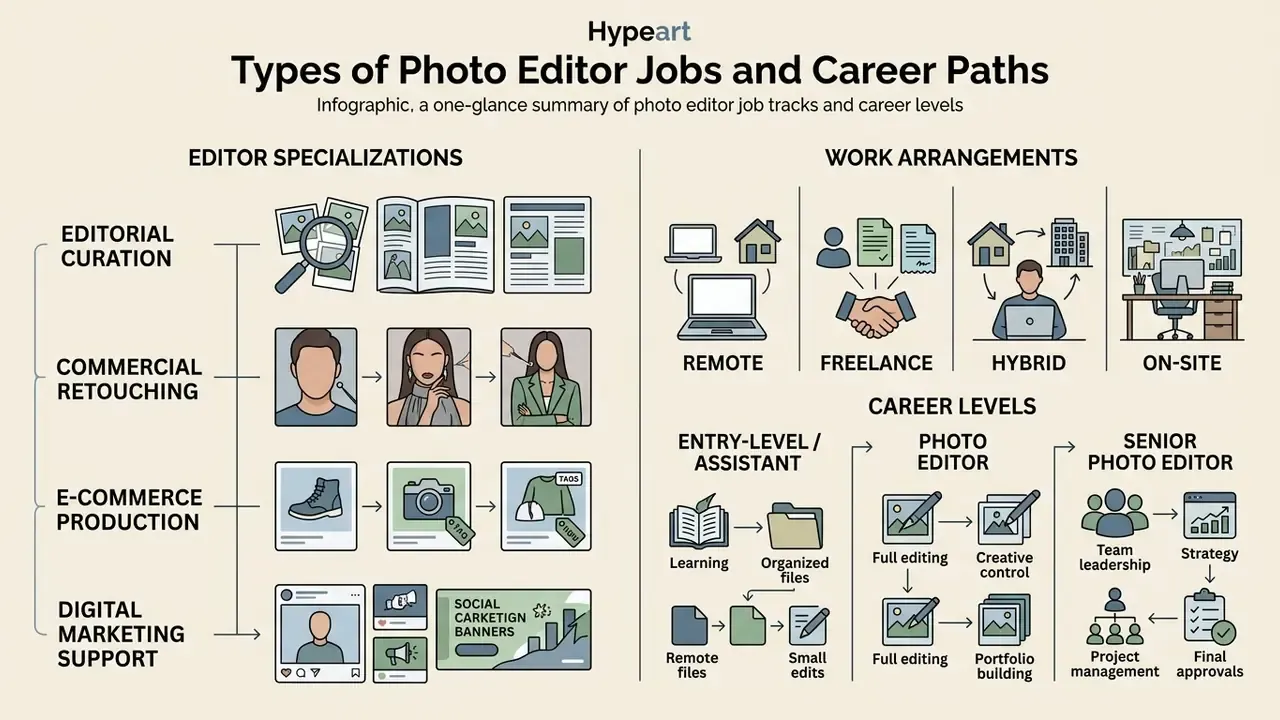
Photo editor jobs encompass distinct specialization tracks, including editorial curation, commercial retouching, e-commerce production, and digital marketing support. While photo editor careers share core competencies in visual evaluation and software proficiency, specific daily duties vary based on publishing medium, organization scale, and production velocity.
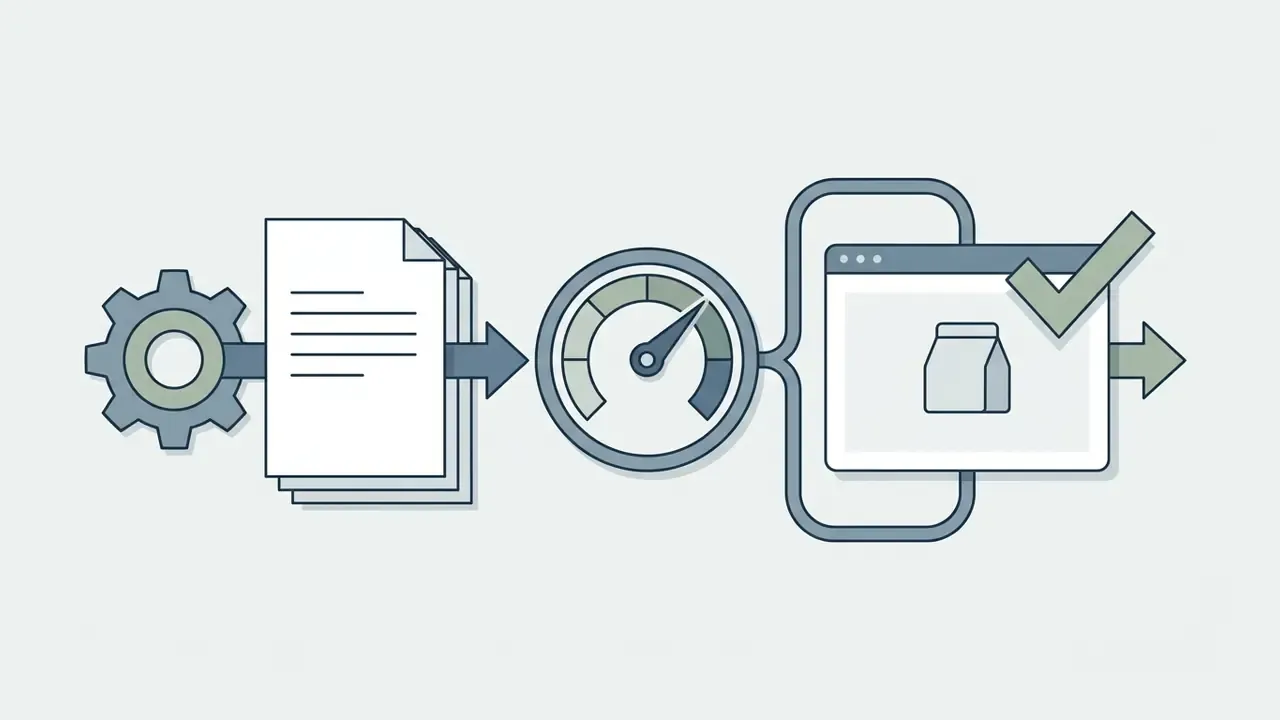
Recent job descriptions separate the market into four practical workflows:

Titles also carry meaning. "Photo editor" is more publication- and curation-oriented. "Image editor" is used more broadly for technical correction, optimization, and export across print, web, and social channels. "Assistant editor" designates a support role covering file organization, resizing, archive maintenance, and basic retouching. Some sources use "photo editor" and "image editor" interchangeably; the scope ultimately depends on outlet size and medium. Readers who want a neutral definition of the tooling category can consult our reference guide to online photo editors.
Remote, Freelance, Hybrid and On-Site Photo Editing Work
Work arrangements for photo editing positions span remote, hybrid, on-site, and freelance models. Each one defines specific team interaction patterns, scheduling constraints, and operational boundaries.
Photo Editor Work Arrangements at a Glance
| Remote & Freelance | On-Site & Hybrid |
|---|---|
| Digital delivery and DAM synchronization | Direct photographer collaboration |
| Asynchronous team review cycles | Tethered shooting and live event review |
| Task-based deadline tracking | Hardware-calibrated color management |
| Self-provisioned hardware, licenses, and secure transfer | Employer-provided workstations and physical archiving |
Operational contrasts between distributed and premises-based photo editing work.
- Remote photo editing jobs: remote jobs photo editor professionals process digital assets off-site using cloud storage and digital asset management (DAM) platforms. According to the U.S. Bureau of Labor Statistics Current Population Survey, in February 2023 approximately 44.1% of workers in arts, design, entertainment, sports, and media occupations reported teleworking at least part of the time, with 15.0% working fully remote.
"In February 2023, 44.1% of arts and media workers reported partial or full telework, with 15.0% working entirely remotely."
Remote roles require secure file transmission, reliable local computing hardware, and disciplined time management. Employers should define working hours, contact channels, and equipment and security rules in writing before the first assignment. A distributed editor handling embargoed campaign assets or unpublished client galleries is a data-handling role as much as a creative one. Practical remote security baselines include encrypted transfer (SFTP or enterprise cloud with access logging), device-level disk encryption, a prohibition on personal consumer upload sites for client RAW files, watermarked proofing links with expiry dates, and documented deletion of local copies after delivery. Editors comparing distributed toolchains can review the current landscape of AI photo editors.
- Freelance photo editing contracts: freelance photo editor employment operates on a contract or project basis. Independent contractors handle image retouching, batch processing, or specialized color correction for multiple clients. Freelancers keep autonomy over working hours but assume responsibility for client acquisition, hardware procurement, software licensing, and self-employment taxes. Income depends on order volume rather than a guaranteed salary, and interaction with the team is contractual and task-scoped.
- Hybrid photo editing roles: hybrid structures combine scheduled in-office collaboration with remote execution days. According to BLS CPS findings, hybrid arrangements represent roughly 24% to 30% of arts and media roles (BLS CPS Telework Tables, 2023). Official policy definitions place hybrid work anywhere between 10% and 90% of hours performed remotely, with some public-sector policies capping telework at 50% of the weekly schedule and fixing the split in advance. Editors attend in-person planning sessions, color-critical proofing, or studio shoots, while performing high-volume retouching remotely.
- On-site studio and newsroom positions: these roles require physical presence at photographic studios, corporate headquarters, or newsrooms, and they enable immediate collaboration with photographers, art directors, and production teams. According to the BLS Occupational Requirements Survey, 59.5% of arts and media roles do not offer routine telework, reflecting environments that demand live tethered capture support or physical archiving.
"BLS ORS 2025 data show 59.5% of arts and media workers have no ability to work remotely on a regular basis, reflecting on-premises physical requirements."
Entry-Level, Assistant and Senior Photo Editor Roles
Career progression in photo editing follows a structured hierarchy based on technical autonomy, project scope, and supervisory responsibility. Typical experience bands cited in 2026 hiring templates run from 1+ years for junior support roles to 8 years for senior leads managing calendars, assigning photographers, and owning post-production.
- Entry level photo editor jobs: entry level photo editor jobs and junior positions focus on foundational image processing, basic color correction, file organization, cropping, and background cleanup under direct supervision. Candidates practicing before their first paid contract can build technical fundamentals with free photo editors before committing to subscription licenses. According to BLS ORS data, 66.0% of arts and media jobs require on-the-job training, which lets entry-level hires develop studio-specific skills while adhering to brand style guides.
"ORS records that 66.0% of arts and media jobs require on-the-job training, while prior work experience is required in 60.5% of cases."
Candidates exploring generative image creation alongside traditional retouching can review our comparison of the best AI art generators, the free-tier alternatives in our free AI art generator comparison, and the neutral category definition of an ai art generator.
- Assistant photo editor positions: assistant editors manage asset ingestion, permissions, caption verification, stock image sourcing, and preliminary image culling. They support photo editors with research, commissioning, rights and permissions, captions, budgets, and production coordination. In practice they bridge technical file preparation and creative direction between staff photographers and senior editorial leads.
- Senior photo editor and visual lead roles: senior editors oversee visual strategy, establish retouching guidelines, assign tasks to staff and freelance photographers, manage production budgets, and clear usage rights. They review complex composite work, enforce compliance standards, solve high-complexity image-production problems, and lead creative production teams. Portfolios at this level must demonstrate leadership and editorial judgment, not only technical polish.
The core distinction across levels is responsibility: juniors execute assigned edits, assistants coordinate editorial production, and senior leads make decisions and manage people and processes.
Comparison of Photo Editor Job Formats by Location, Team Interaction, and Conditions
| Job Format | Primary Location | Team Interaction Pattern | Typical Hours Structure | Operational Considerations |
|---|---|---|---|---|
| Remote employee | Home / off-site | Asynchronous via chat, cloud DAM, and email | Full-time or part-time; telework all hours | Requires high-speed internet, secure data handling, and self-directed workflow discipline (BLS CPS, 2023). |
| Hybrid employee | Mix of office and home | Scheduled in-person reviews with remote editing days | Standard full-time; 30–40% teleworked hours | Balances studio collaboration with uninterrupted retouching focus (BLS ORS, 2025). |
| On-site editor | Studio / newsroom | Continuous direct interaction with photographers and directors | Fixed shifts; on-site physical presence | Essential for live studio tethering, physical proofing, and strict security environments (BLS ORS, 2025). |
| Freelance editor | Independent / off-site | Contractual per project or client assignment | Variable; project-based or hourly scope | Income fluctuates with client volume; requires independent business management (BLS OOH, 2024). |
| Part-time editor | Remote or on-site | Support-focused; task-specific handoffs | Reduced schedule (for example, 15–25 hours/week) | Common during peak seasonal publication schedules or catalog production cycles (BLS OOH, 2024). |
| Full-time editor | Remote, hybrid, or on-site | Integrated into daily creative and marketing operations | Standard 35–40 hours per week | Provides stable compensation, benefits, and defined organizational career advancement (BLS OEWS, 2024). |
Summary of primary employment formats for photo editing professionals based on federal labor studies and industry benchmarks.
What Photo Editors Do: Images, Content and Production Tasks
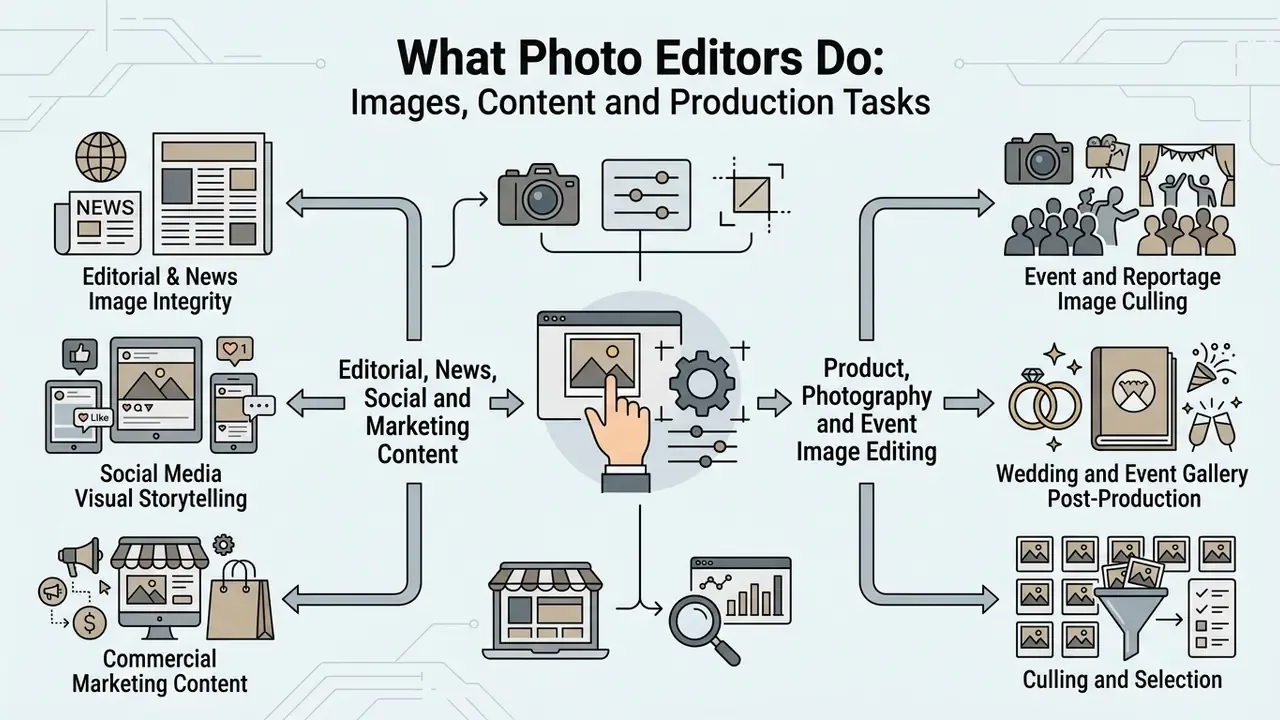
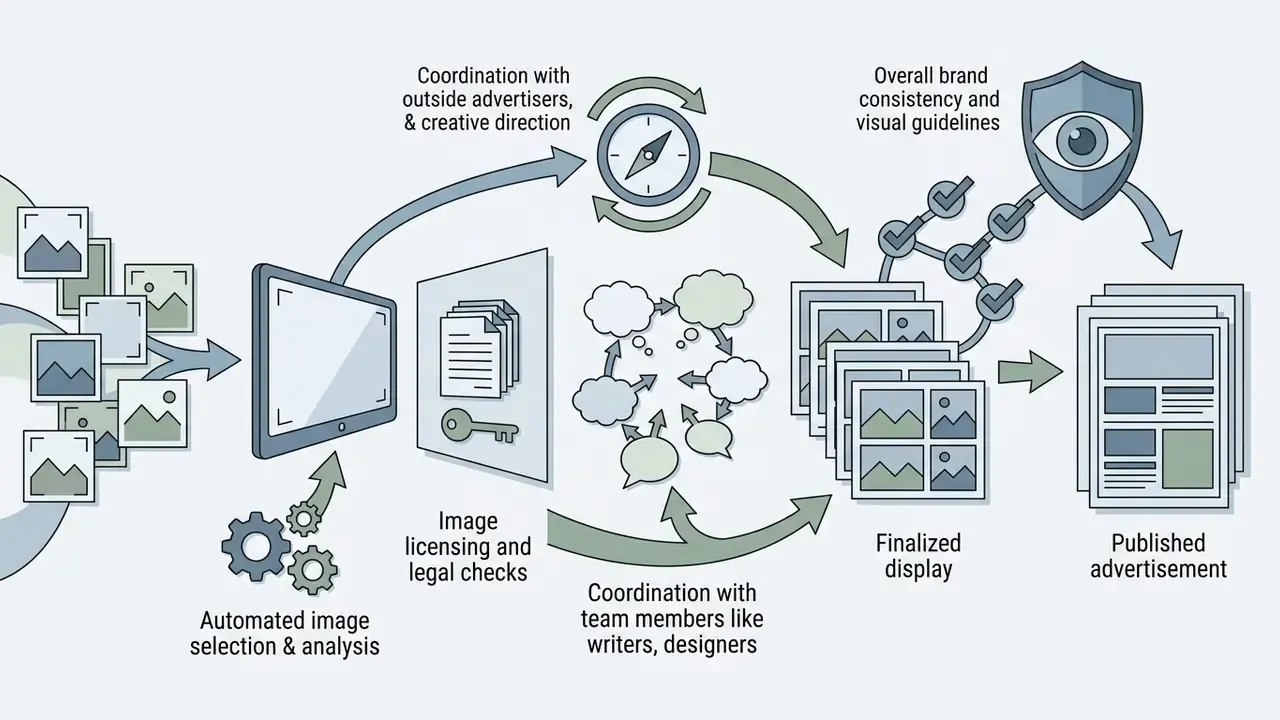
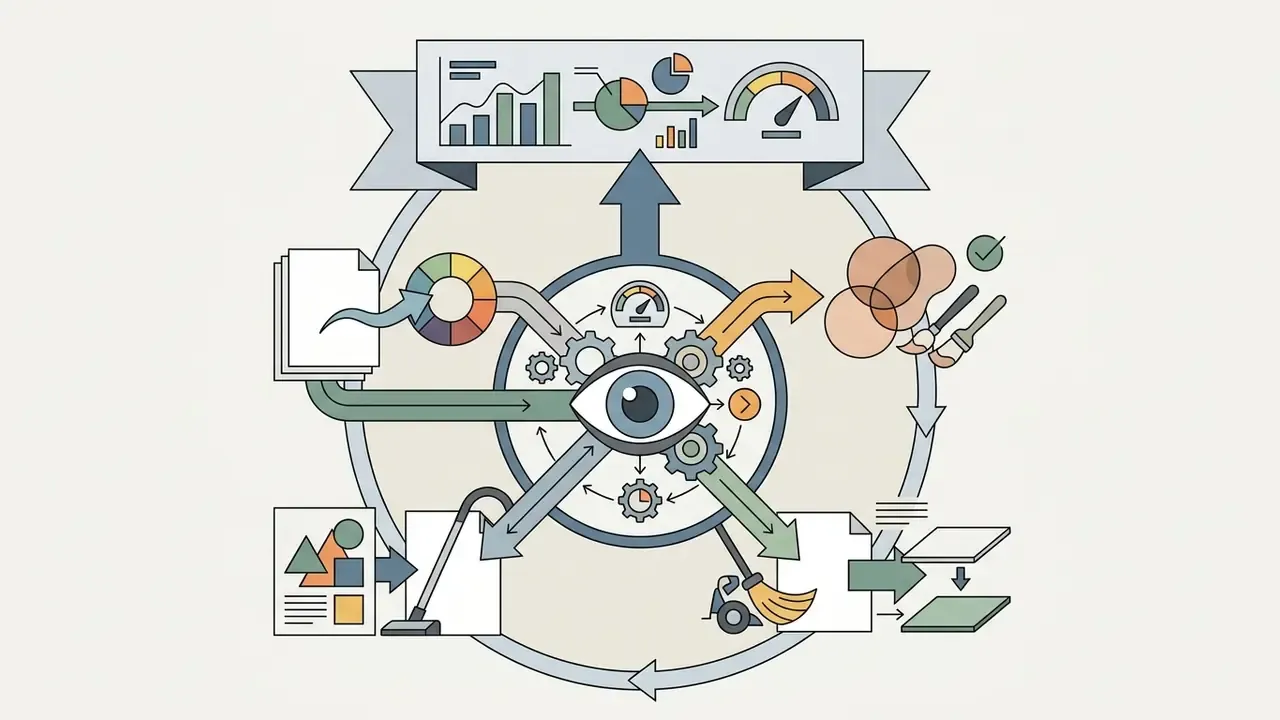
A photo editor job centers on selecting, refining, and preparing visual assets for distribution across digital, broadcast, and print channels. Editors turn raw captures into publishing-ready images while protecting technical fidelity, brand alignment, and legal compliance. In practice, the production loop covers four repeatable stages: selection and curation, correction and retouching, coordination with photographers and stakeholders, and archive plus quality control for print, web, and campaign delivery.
Editorial, News, Social and Marketing Content
Photo editing responsibilities shift significantly between journalism, social media publishing, and commercial marketing campaigns. In every one of them the work is collaborative rather than solitary.
"BLS ORS data show that more than basic people skills are required in 82.7% of arts and media jobs, underscoring the team-based nature of editorial work."
Where newsroom ethics prioritize truthfulness and anti-manipulation, brand guidelines prioritize consistency, platform fit, and storytelling format. Candidates should be able to articulate that difference in an interview without hesitating.

Product, Photography and Event Image Editing
Commercial product catalogs and high-volume event photography demand specialized batch workflows and strict technical standards.
- E-commerce and product catalog processing: e-commerce photo editors process large volumes of product imagery requiring near-absolute visual uniformity. Catalog teams working with legacy or low-resolution source files frequently rely on AI image upscaling to meet platform minimums without a reshoot. Technical standards set by platforms such as Amazon and GS1 mandate precise color accuracy, neutral backgrounds, controlled exposure, and the elimination of distracting reflections.
"The GS1 Product Image Specification Standard (2025) requires controlled white balance, no color casts, balanced contrast and exposure, realistic reflections, and no over-sharpening."
Amazon's published specifications add concrete file thresholds: clear, non-pixelated images at a minimum of 500 px on the longest side, with 1,000+ px recommended for zoom, in JPEG, TIFF, PNG, or non-animated GIF (Amazon Seller Central, 2026). Accurate color rendition is widely treated by retail production teams as a safeguard against returns caused by online-to-physical color discrepancies. That operational claim appears in vendor and platform guidance rather than in federal statistics, so treat it as an industry rationale pending independent return-rate data. Adobe's e-commerce photography guidance likewise recommends that studios document resolution, format, backgrounds, lighting, and shot types, and keep consistent angles, framing, and compressed fast-loading files (Adobe, 2026).
- Event and reportage image culling: event photo editing, covering corporate gatherings, weddings, and live sports, involves filtering thousands of raw captures down to a curated deliverable set. Editors perform rapid culling, exposure balancing, noise reduction, and batch color adjustments. Public-sector style guidance for event imagery emphasizes cropping out background distractions, avoiding unnatural saturation, and preventing dark or blown-out frames, which means event editing is corrective rather than product-standardized (University of Adelaide Event Photography Guide, 2026; South Australian Tourism Commission Event Photography Style Guide, 2026). Speed, narrative sequencing, and stylistic consistency across varied lighting conditions define success in event post-production (Eventbrite Event Photography Guide, 2026).
Wedding and Event Gallery Post-Production
Event photo editors manage high-volume image batches requiring rapid culling and consistent color profiles across difficult lighting. This is currently the single largest source of remote, contract-based editing work in the U.S. market, and it runs on its own economics and vocabulary.
- Culling and selection filtering thousands of raw exposures down to a polished deliverable set, typically 10%–20% of total captures. Editors reject technical failures (missed focus, blinks, severe motion blur), then rank the remainder by story relevance across the ceremony, portrait, reception, and detail segments.
- Batch color matching applying custom catalog presets in Lightroom or Capture One to align skin tones, white balance, and exposure across multiple camera bodies, mixed tungsten-and-daylight venues, and flash-versus-ambient sequences. Consistency across the gallery matters more than perfection on any single frame.
- Style consistency contract studios evaluate editors primarily on their ability to reproduce a house look, meaning a defined tone curve, saturation ceiling, and highlight-rolloff behavior, rather than on personal creative interpretation.
- Delivery portals managing client proofing galleries and syncing final high-resolution assets inside cloud-based studio portals under strict turnaround SLAs, often 48 hours to 7 days per gallery.
- Stills vs. film deliverables studios that publish separate piece rates for images, films, and reels expect editors to declare which deliverable classes they can service, since rate cards and turnaround expectations differ per class.
- Content-scope disclosure before signing, ask what sits in the queue. Some outsourced editing pipelines mix in boudoir, adult, or synthetic imagery, and editors deserve a written scope note. If terminology in a contract is unfamiliar, our neutral glossary entries on ai art nsfw and ai art hentai explain what those content categories cover and why platform licensing and commercial-use terms differ for them.
Skills and Tools Employers Look for in Photo Editors
Employers filling a photo editor vacancy seek a combination of technical software expertise, visual judgment, and collaborative communication skills.
Photo Editor Skill Matrix
| Technical & Software Mastery | Visual & Operational Competencies |
|---|---|
| Adobe Photoshop (layers, masks, compositing) | Color theory and calibrated color management |
| Adobe Lightroom / Capture One catalog work | High-volume culling and catalog management |
| AI-assisted selection, cleanup, and generative fill auditing | Usage rights, metadata, and license tracking |
| RAW processing, batch export presets, workflow automation | Attention to detail, time management, stakeholder communication |
Competency map compiled from 2026 photo editor and retoucher hiring templates.
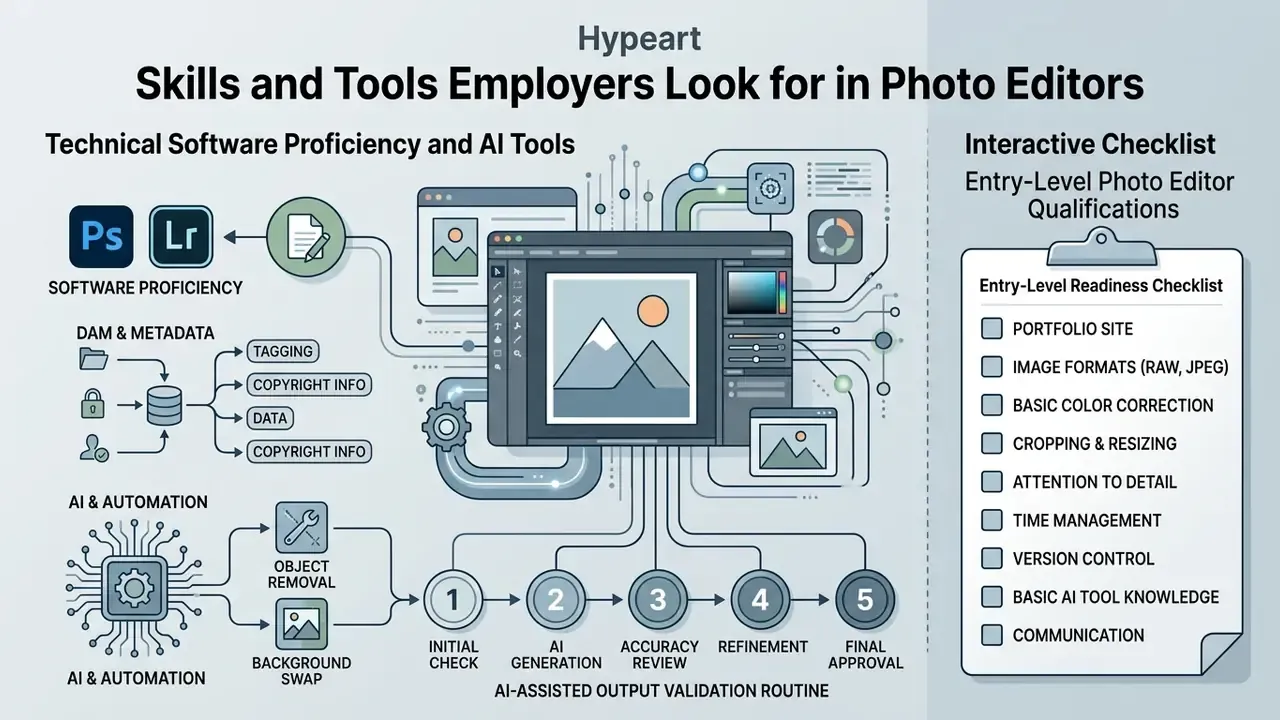
Technical Software Proficiency and AI Tools
The tool stack breaks down into three functional groups: editing applications, digital asset management, and enterprise AI assistants.
- Adobe Creative Cloud ecosystem (editing): mastery of Adobe Photoshop and Adobe Lightroom remains the universal standard across corporate, agency, and publication environments. Photoshop handles advanced layer-based compositing, detailed retouching, and precise masking, while Lightroom handles batch catalog management, non-destructive global adjustments, and RAW conversion (Rework Job Templates, 2026). One 2026 retoucher template also quantifies expected output at 50+ images per day under e-commerce standards. Adobe's own documentation distinguishes Lightroom from Lightroom Classic as separate desktop and cloud product lines, and specifies production features such as artboard PDF export with JPEG quality settings and optional ICC profile embedding. Small details, yes, but they matter in print-bound workflows.
"Editors in photographic services (NAICS 541920) earned a median hourly wage of $21.58 and a mean annual wage of approximately $60,360."
Teams requiring advanced image expansion or canvas extending can compare enterprise tools using our AI Expand Image guide.
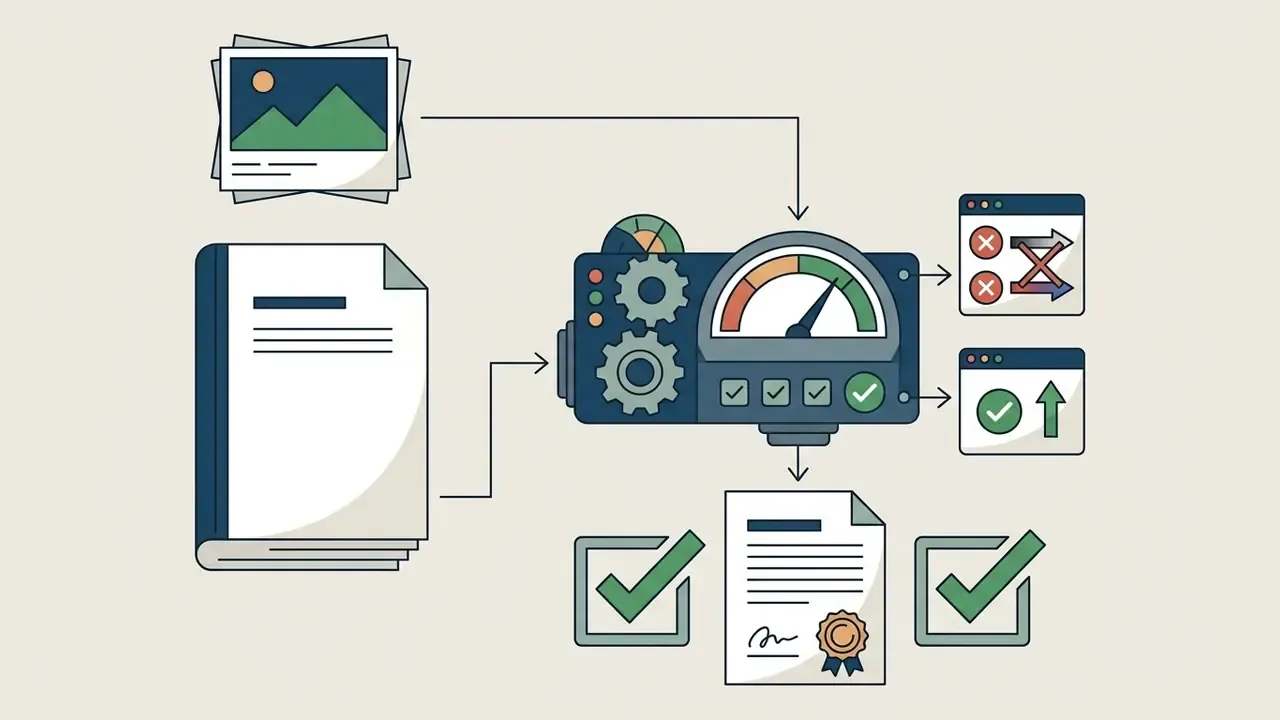
- Digital asset management (DAM) and metadata tracking: enterprise employers mandate familiarity with DAM systems (for example, Cantemo, Widen, Canto) to manage file ingestion, IPTC metadata tagging, copyright tracking, and cloud archiving (Tech:NYC / JPMorgan Chase Posting, 2026). Editors must track image licensing limits to protect organizations against copyright infringement, and record usage-rights metadata at ingest rather than at delivery. Delivery-time metadata is guesswork dressed as process.
- Emerging generative AI and automated tools: modern workflows increasingly incorporate AI-assisted tools for background removal, automated culling, generative fill, and smart object selection; a practical overview of the category sits in our guide to AI photo editors. Employers expect editors to evaluate, direct, and audit AI outputs to protect quality control, brand compliance, and ethical safety (Canadian Government GenAI Guidance, 2024). Published governance guidance converges on three controls for professional AI image use: disclosure that AI was used, watermarking of generated content, and documented incident and audit processes with human oversight. Editors responsible for tool selection can review our comparison of AI image generators, our evaluation of the Canva AI Generator, and the licensing options catalogued in the AI Media Commercial-Use Hub.
A five-step validation routine for AI-assisted output. Employers increasingly ask candidates how they check generated or auto-retouched frames. A defensible answer covers: (1) inspect at 100% for anatomical, text, and reflection artifacts; (2) verify that no factual visual element was added or removed in editorial contexts; (3) confirm the generation source and licensing terms permit commercial use; (4) log the tool, prompt, and model version in asset metadata for audit; (5) route any ambiguous frame to a named human approver before publication.
Owner, limit, log, escalation. That is the whole discipline, compressed.
Interactive Checklist: Entry-Level Photo Editor Qualifications
Use this as a self-audit before applying to junior or assistant roles.
Entry-Level Readiness Checklist
| Competency Area | What to Demonstrate | Ready? |
|---|---|---|
| Photoshop fundamentals | Layers, masks, healing/clone/patch, non-destructive adjustment layers, 100% artifact review | ☐ |
| Lightroom / catalog work | Import, keywording, preset creation, sync across a 500+ image set, batch export | ☐ |
| Culling judgment | Separating technical rejects from story selects; documented rationale for a 10%–20% keep rate | ☐ |
| Color management | Monitor calibration, working color spaces, sRGB vs. Adobe RGB export decisions | ☐ |
| DAM & metadata | IPTC captioning, copyright fields, license expiry tracking | ☐ |
| AI auditing | Artifact detection, disclosure practice, provenance verification | ☐ |
| Client communication | Working to a style guide, revision-round etiquette, deadline reporting | ☐ |
| Portfolio evidence | Before/after sets, one full gallery showing consistency across 30+ frames | ☐ |
Self-assessment grid mapped to entry-level requirements in 2026 job templates.
Candidates who need professional application imagery for LinkedIn or portfolio pages can compare options in our guide to AI headshot generators.
Compensation, Hours and Conditions in Photo Editor Employment
Understanding compensation drivers and working conditions helps candidates evaluate photo editor hiring offers effectively.
Compensation and Wage Benchmarks
| Benchmark | Figure | Source |
|---|---|---|
| Photographic services median (NAICS 541920) | $21.58/hr (about $44,880/yr) | BLS OEWS, May 2023 |
| Photographic services mean (NAICS 541920) | $29.02/hr (about $60,360/yr) | BLS OEWS, May 2023 |
| All-occupation national mean hourly wage | $23.80/hr | BLS OEWS, May 2024 |
| Arts, design, entertainment, sports, media mean | $63,040/yr | BLS OEWS, May 2025 |
| Entry-level photo editor range | $38,000–$48,000/yr | Industry hiring templates, 2026 |
| Senior / lead photo editor range | $70,000–$95,000+/yr | Industry hiring templates, 2026 |
| Metro premium (New York, San Francisco) | +20% to +30% | Industry hiring templates, 2026 |
| Piece-rate contract editing (gallery stills) | $0.15–$0.30 per image | Contract studio rate cards, 2026 |
Wage reference points spanning federal statistics and commercial rate cards.
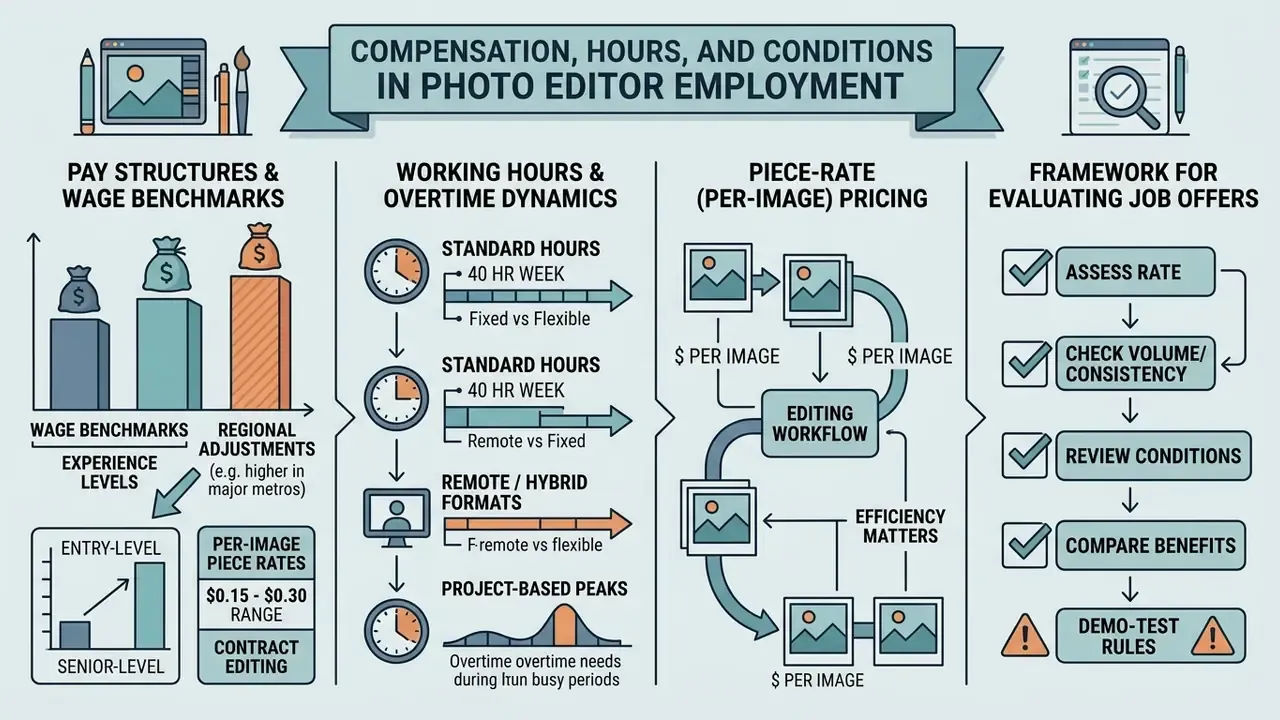
Pay Structures, Wage Benchmarks and Hours
- Base earnings benchmarks: according to the May 2023 BLS Occupational Employment and Wage Statistics (OEWS) survey, editors working specifically within NAICS 541920 (Photographic Services) earned a median hourly wage of $21.58 (about $44,880 annually) and a mean hourly wage of $29.02 (about $60,360 annually) (BLS OEWS NAICS 541920, 2023).
"For comparison, the national mean hourly wage across all occupations was $23.80 in May 2024, placing photographic-services editors somewhat below the overall average."
Broader arts, design, entertainment, sports, and media occupations reported a mean annual wage of $63,040 in May 2025 across total employment of roughly 550,190 workers (BLS OEWS, 2025). Job-posting aggregates report a similar order of magnitude: an average U.S. photo editor rate of $21.72/hour based on 155 postings collected over 36 months (Indeed, updated August 2025). In Canada, official wage survey data list C$20.67 low, C$33.65 median, and C$65.00 high per hour, with British Columbia (C$41.34) and Ontario (C$31.25) above Quebec (C$28.57) and Manitoba (C$23.17) (Job Bank, December 2024). Because one figure is a posting aggregate and the other an official survey of a different national labor market, the two are not directly comparable. Worth repeating, since candidates routinely quote them side by side.
- Experience and regional adjustments: industry job metrics indicate entry-level salaries typically range from $38,000 to $48,000 per year, while senior editors managing teams or complex commercial post-production earn between $70,000 and $95,000+ annually (Rework Job Templates, 2026). Positions in major metropolitan hubs like New York and San Francisco offer a 20% to 30% premium to offset higher living costs.
"Film and video editors and camera operators earned median annual wages of $74,990–$75,420 in May 2025." Source: BLS Occupational Outlook Handbook, Film and Video Editors and Camera Operators (2025). https://www.bls.gov/ooh/
That adjacent-occupation benchmark helps explain the realistic ceiling for senior visual leads who add motion deliverables to their skill set. Organizations analyzing production costs can review software operational expenses in our AI Media Pricing Guides, model scenarios with our AI Media Calculators, and evaluate zero-cost alternatives in our comparison of free AI image generators.
- Working hours and overtime dynamics: standard full-time photo editor employment involves 35 to 40 hours per week (BLS CPS, 2023). Australian editorial industry agreements likewise codify a 38-hour standard week, with 50-hour weeks permitted in film work and separate rate tables for entry-level and offshore classifications. Peak seasonal catalog drops, breaking news cycles, and wedding season workflows are widely reported by hiring templates and studio rate cards to require overtime or weekend shifts. That pattern shows up in employer job descriptions and contract terms rather than in federal hours statistics, so candidates should request written overtime and weekend-coverage terms instead of trusting industry norms.
Piece-Rate (Per-Image) Pricing in Contract Editing
For freelance and 1099 independent contractors, particularly in high-volume wedding, real estate, and event photography, compensation is frequently calculated on a piece-rate basis rather than an hourly wage. Salary aggregators rarely surface these rates, which is why many first-time contractors accept terms without modeling their effective hourly income.
- Standard event rates: entry-level to mid-tier gallery editing typically pays between $0.15 and $0.30 per image for standard Lightroom color correction and culling. Published contract rate cards sit inside this band; one active New York studio listing quotes approximately $0.18 per gallery still for 1099 editors (Candid Studios photo editor posting, 2026).
- Volume realities: a standard wedding gallery deliverable of 700 edited images at a $0.18/image rate yields roughly $126 per project. Contractors must therefore treat turnaround speed as their primary earnings lever. Processing 100–150 images per hour translates to an effective rate of about $18–$27 per hour, while 60 images per hour on the same rate drops effective earnings to roughly $10.80 per hour, below the statutory minimum wage in many states if the work were classified as employment.
- Rate card segmentation: studios that publish separate piece rates per deliverable class (images, films, reels) expect editors to specialize. Ask whether culling is compensated separately from editing, whether rejected frames count toward the paid total, and whether revision rounds sit inside the per-image rate.
- Contract terms (1099 vs. W-2): piece-rate contracts rarely offer guaranteed hours or volume. Public listings frequently state this openly: "1099 independent contractor, not W-2, no guaranteed hours." Editors carry their own software licensing, hardware maintenance, health coverage, and self-employment taxes, plus the full risk of a slow booking season. Model your annual income on the low end of promised volume, not the high end.
- Ramp and access: some contract studios unlock training reimbursement, career-ladder progression, and full portal tooling only after hire, meaning the pre-hire period offers no compensation and no platform access. Confirm what "post-hire unlock" actually includes in writing.
| Offer Dimension | Data Benchmark | Key Verification Questions | Risk / Value Consideration |
|---|---|---|---|
| Base pay model | Photographic services mean: $29.02/hr ($60,360/yr) (BLS OEWS). | Is pay hourly or fixed salary? How is overtime calculated during high-volume production? | Hourly pay protects against unpaid overtime during peak seasonal catalog cycles. |
| Piece-rate (1099 contract) | Industry benchmark: $0.15–$0.30 per image (contract studio rate cards, 2026). | Are there guaranteed minimum monthly volumes? What is the turnaround time per gallery? Is culling paid separately? | Low volume or slow editing speeds can drop effective earnings below state minimum hourly wages. |
| Work location & telework | 40.5% of arts/media jobs routinely allow telework (BLS ORS). | Is remote status permanent or subject to managerial recall? Are hardware stipends provided? | Unclear hybrid policies can result in uncompensated travel or unexpected mandatory office returns. |
| Software & tool provision | Industry standard: Adobe Creative Cloud, Capture One, DAM (Rework). | Does the employer provide software licenses, or is the editor expected to cover subscription costs? | Requiring editors to supply enterprise software licenses reduces effective compensation. |
| Production volume expectations | Commercial benchmarks: 30–50+ edited assets per day (Rework). | What are daily image quotas? Is automated AI culling integrated into the workflow? | Unrealistic quotas without AI assistance lead to burnout and elevated error rates. |
| Rights & portfolio ownership | Contractual intellectual property clauses (Workable). | Can processed work be displayed in personal portfolios, or is it covered by strict NDA? | Restricted portfolio usage rights hinder future career mobility and freelance client acquisition. |
| Data handling obligations | Remote-work policy guidance requires defined equipment and security rules. | Which transfer method is mandated? Are local copies permitted, and for how long? | Undefined security terms shift breach liability onto the editor handling client RAW files. |
Evaluation criteria for job seekers assessing photo editor offer conditions against federal labor benchmarks.
How to Find and Evaluate Photo Editor Vacancies
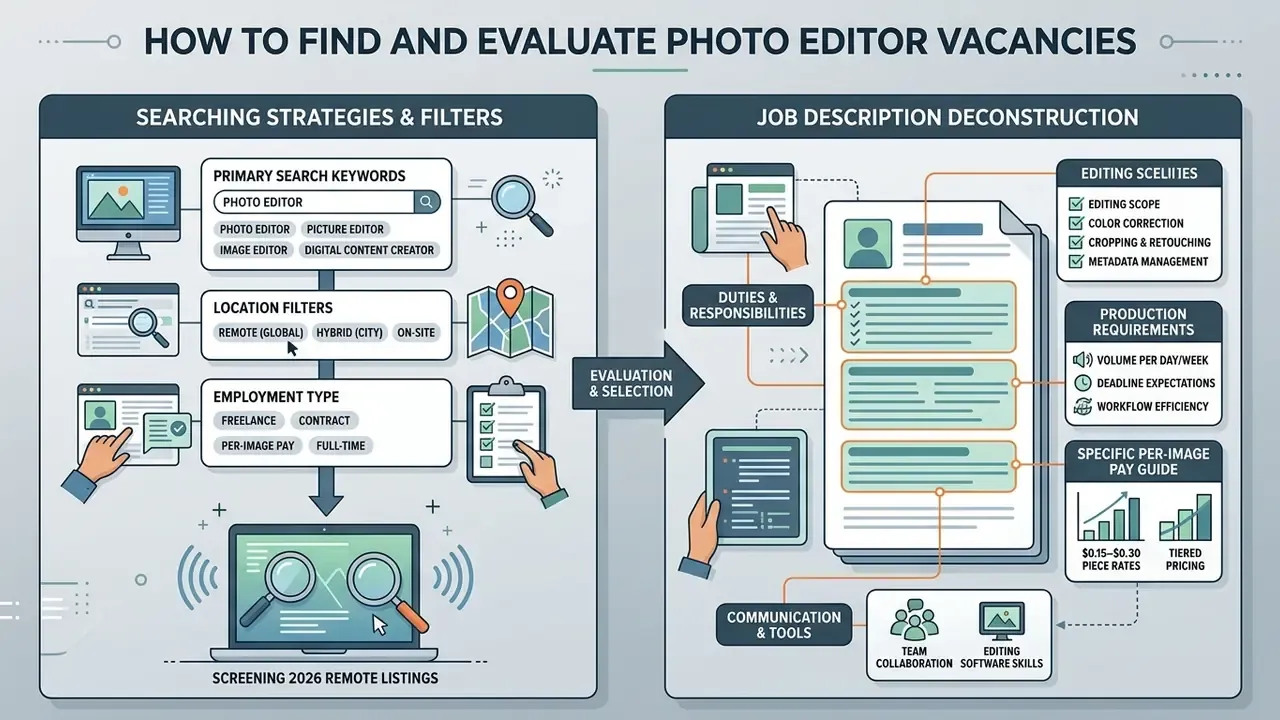
Finding suitable photo editor jobs requires targeted search strategies, precise keyword filtering, and critical deconstruction of job descriptions.
Searching Platforms and Applying Search Filters
Candidates searching job boards (Indeed, LinkedIn, Glassdoor, specialized creative networks) should use structured search strings to filter listings effectively.
"In April 2023, arts and media workers who teleworked averaged 35.4 hours per week, with remote work accounting for roughly one-third of total work time."
That distribution is a useful sanity check. A posting advertising "fully remote" while describing daily tethered studio support is probably mislabeled, and filtering by format alone will surface false positives.
When researching multi-platform content creation tools or enterprise image solutions, creators can reference our AI Media Comparison Matrices to evaluate alternative software stacks.

photo editor jobs, entry level photo editor jobs, jobs photo editor, photo editor careers, photo editor employment, photo editor hiring, photo editor job, photo editor vacancy, wedding photo editor, piece rate photo editor.
Remote, Hybrid, On-site, or specific regional metro areas (New York, California, London).
Full-time, Part-time, Contract, or Freelance.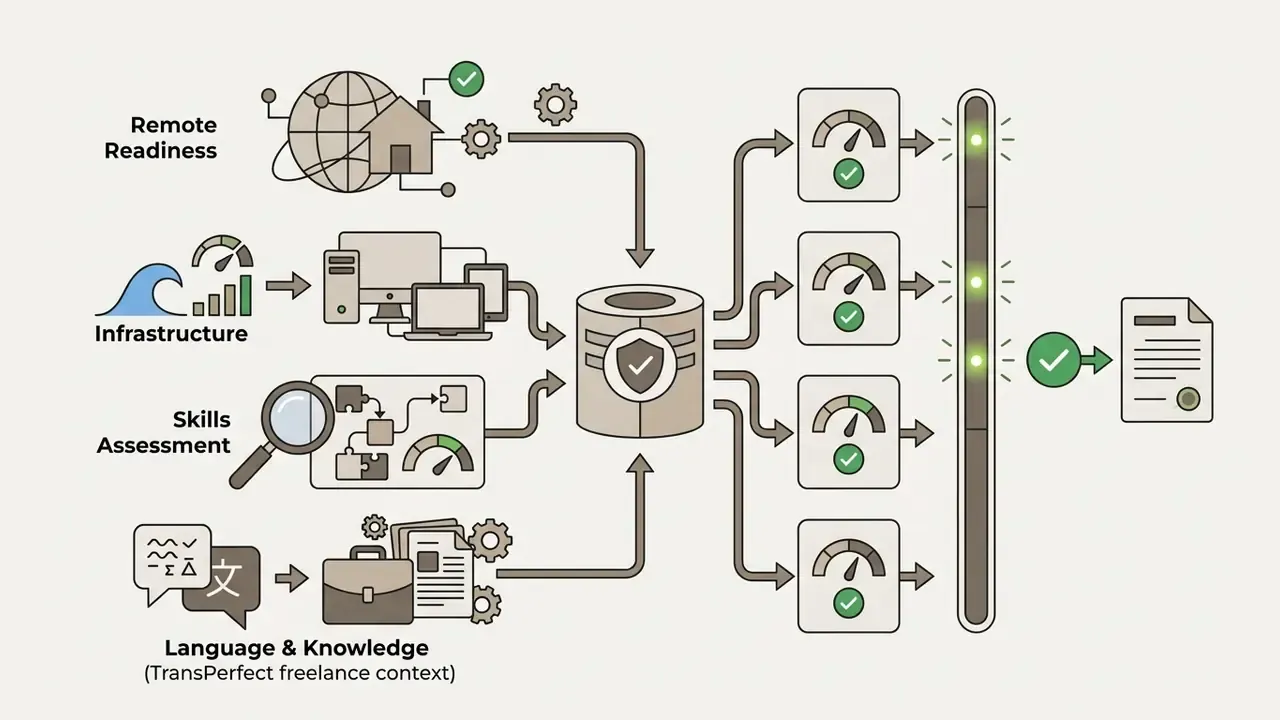
What to Check in a Photo Editor Job Description
When analyzing a photo editor job description, candidates should deconstruct four critical components before submitting an application. A useful discipline is to map every posting to five fields (overview, responsibilities, qualifications, benefits, application steps) plus explicit compliance and classification notes.
Job Description Deconstruction Steps
| Core Analysis Field | Critical Verification Items |
|---|---|
| 1. Scope & deliverables | High-volume batch work vs. custom composite retouching; daily quotas; gallery turnaround SLAs |
| 2. Required software stack | Adobe suite, Capture One, DAM systems, AI-assisted tools; who pays for licenses |
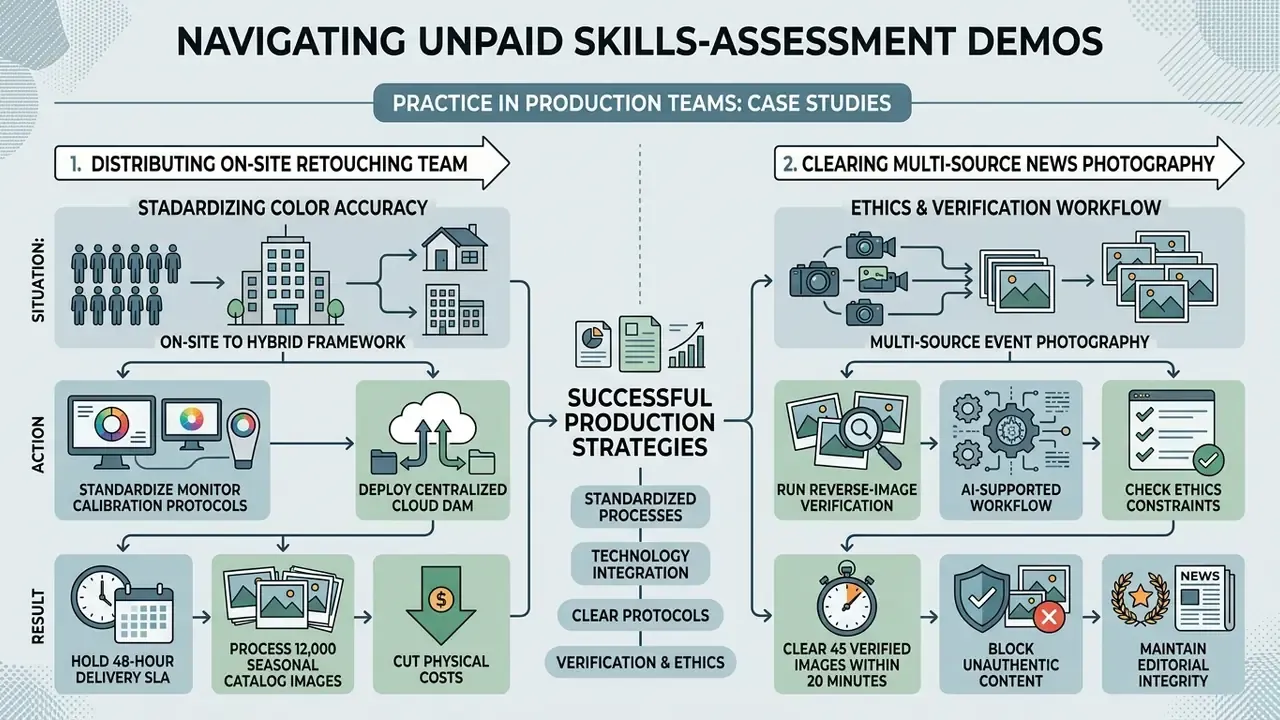
| 3. Test assignment terms | Unpaid work limits, sample-asset provenance, copyright ownership of the submitted edit |
| 4. Operational boundaries | On-call expectations, weekend coverage, recall-to-office clauses, guaranteed volume |
Four-field deconstruction grid for screening photo editor postings.
Contract stop-flags worth escalating before signature: unlimited revision rounds at no additional fee; assignment of all portfolio rights with no display carve-out; "volume at the studio's discretion" paired with a minimum-availability requirement; unpaid mandatory retraining; clawbacks against completed galleries for subjective style rejection; and indemnity clauses making the editor liable for the client's downstream licensing errors.
Practice in Production Teams: Case Studies
FAQ for Photo Editor Applicants
Do I need a degree to work as a photo editor?
Not always. BLS ORS data indicate that a bachelor's degree is required for 44.4% of arts and media jobs, while 66.0% of positions involve on-the-job training.
"BLS ORS records that a bachelor's degree is required in 44.4% of arts and media jobs, while 66.0% of positions involve on-the-job training." Source: BLS Occupational Requirements Survey Factsheet (2025). https://www.bls.gov/ors/ A demonstrable portfolio showing consistency across a full gallery frequently outweighs credentials for contract and entry-level roles.
How do I protect my rights on an unpaid test assignment?
Get the scope in writing, confirm the frames are test assets rather than billable client work, ask whether the studio claims ownership of your submitted edit, and reserve the right to display the before/after in your portfolio. Cap your own investment at 5–10 images or 2–3 hours.
Is piece-rate editing worth it compared with hourly work?
It depends entirely on throughput. At $0.18 per image, 100–150 images per hour yields $18–$27 per hour; below roughly 80 images per hour the model underperforms typical hourly photographic-services pay of $21.58 median. Track your real speed on a full gallery before accepting a rate.
Which software should I learn first?
Adobe Lightroom for catalog, culling, and batch correction, then Adobe Photoshop for compositing and detailed retouching. Capture One and DAM metadata handling follow, and AI-assisted culling plus generative fill auditing round out the 2026 stack.
Are photo editor jobs genuinely remote?
Partly. About 44.1% of arts and media workers reported telework in February 2023, with 15.0% fully remote, but 59.5% of arts and media roles offer no routine telework. Contract gallery editing is the most reliably remote segment; newsroom and tethered studio work is the least.
What should a freelance editor charge for a wedding gallery?
Benchmark against $0.15–$0.30 per delivered image for standard color correction and culling, then adjust upward for skin retouching, sky replacement, multi-body color matching, or 48-hour turnaround SLAs. Quote per gallery once you know your images-per-hour rate.
Conclusion and Strategic Next Steps
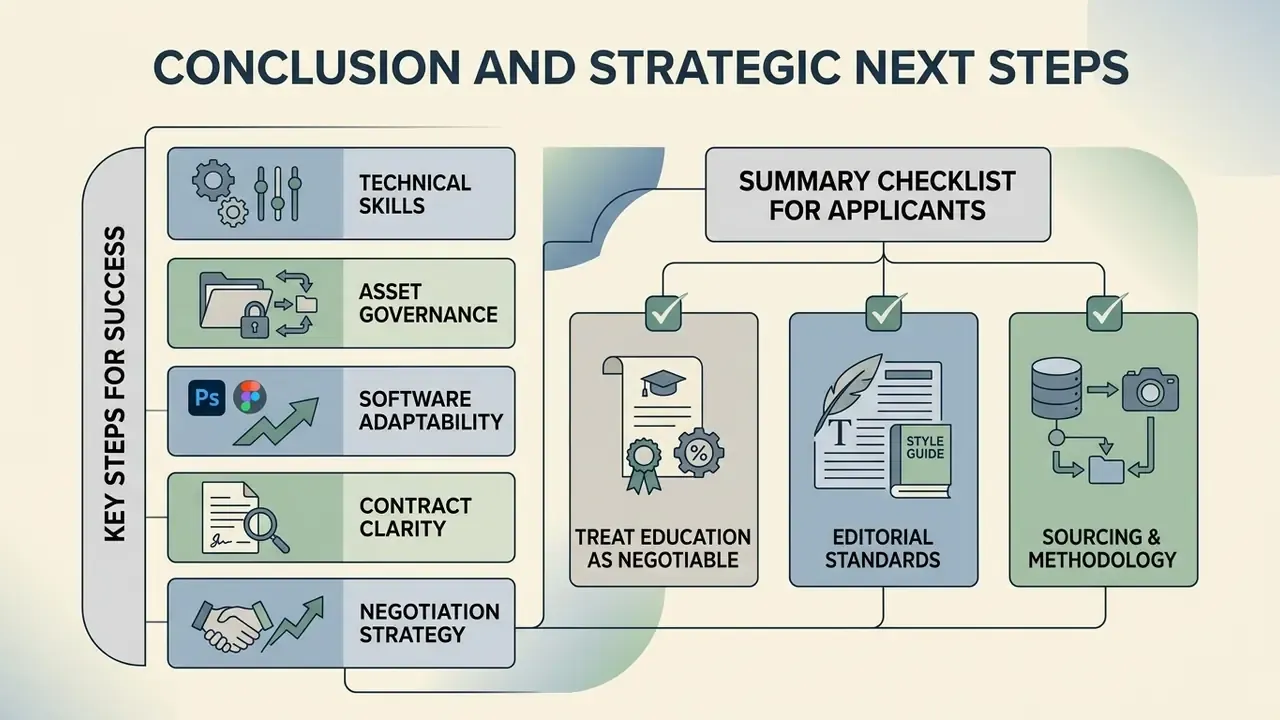
Succeeding in the photo editor job market means balancing technical image manipulation skills with disciplined asset governance, software adaptability, and clear contractual evaluation. Whether you target entry-level assistant roles, remote freelance contracts, or senior visual leadership positions, aligning technical capability with documented industry standards is what turns a portfolio into leverage.
Summary Checklist for Applicants
- Benchmark compensation expectations against established labor statistics ($60,000–$63,000 mean annual baseline for experienced media editors; $21.58/hour median in photographic services; $0.15–$0.30 per image for contract gallery work).
- Master industry-standard tools including Adobe Photoshop, Lightroom, and DAM metadata structures, and prepare portfolio-ready application imagery using resources such as our guide to AI headshot generators.
- Build familiarity with AI-assisted culling and retouching workflows while keeping rigorous quality control, disclosure practice, and ethical standards.
- Calculate your images-per-hour throughput before accepting any piece-rate contract, and confirm whether culling and revisions are compensated.
- Cap unpaid skills-assessment demos at 5–10 images and secure written scope, ownership, and portfolio-display terms.
- Evaluate offers across pay models, hardware allowances, remote work stability, data-handling obligations, and portfolio usage rights before signing.
Editorial Standards, Sourcing and Methodology
General disclaimer: salary ranges, contract terms, and the regulatory or ethical standards referenced here (including AP, AFP, GS1, and platform specifications) are provided for reference only and vary by jurisdiction, employer, and publication medium. This article is not legal, tax, or employment advice.
Footer navigation and hub links:
Explore centralized reference terms and definitions in our AI Media Glossary, tool comparisons in our Comparison Matrices, and licensing analysis in the Commercial-Use Hub.