Who this guide is for, and what it settles. Three groups usually land here. Fans who want a fast random pick for a stream poll or a quiz. Artists and writers who need a creative constraint, not a finished asset. And teams, including small studios and marketing units, who plan to ship generated anime art into a product and therefore need to know what the licence actually says. The guide covers all three paths in order: how sampling works, how filters narrow the pool, how AI generation differs, how to keep one character visually stable across dozens of images, and what to verify before money changes hands. If you only need one takeaway, take this one: a random picker gives you someone else's intellectual property, while an AI generator gives you an asset whose rights depend on your own documented contribution.
What a Random Anime Character Generator is and what it can produce
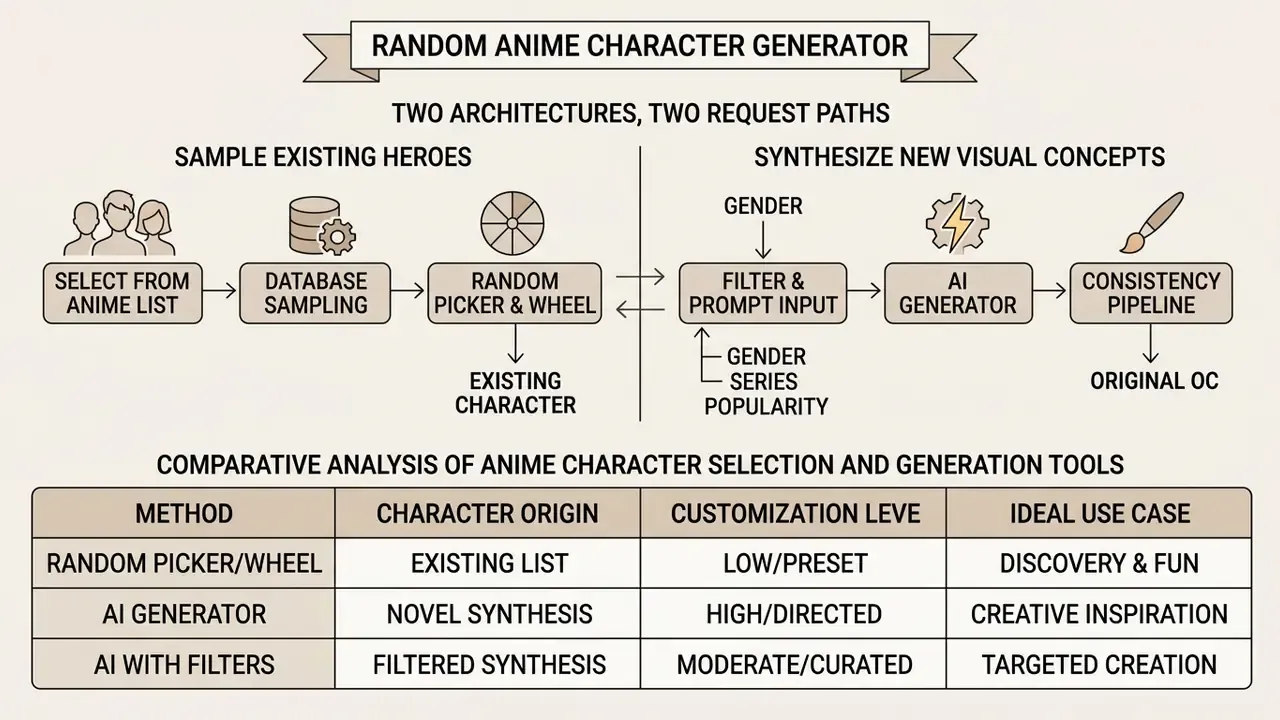
A random anime character generator is a software tool or algorithmic pipeline built either to sample existing heroes from a database or to synthesise brand-new visual concepts with neural models. Depending on the system architecture, the output can be a character name, profile metadata, a ready-to-copy text prompt, or a high-resolution image.
In 2026 the segment is clearly split in two: classic randomisers (pickers, wheels) and generative AI systems. The first group queries structured catalogues and APIs and returns fixed information. The second group, models such as Animagine XL 4.0, uses diffusion networks trained on datasets of 8.4 million images to build an original design from a text description.
«As generative models improve, people adapt their prompts: DALL·E 3 outperformed DALL·E 2 through an equal contribution of model capability and prompting strategy.»
For businesses and creative teams the key first decision is whether you need a random sample of a known media object or a fully original image with no pre-existing rights attached. In corporate asset production it is worth assessing the risks of neural-network use in advance through the AI Media Commercial-Use Hub, and comparing the licensing terms of individual AI image generators before you commit to a pipeline.
Two architectures, two request paths
Understanding the technical difference removes most confusion about why one tool never draws and the other never returns a canonical name.
| Stage | Random Picker / Wheel | AI Anime Character Generator |
|---|---|---|
| Input | Enumerated candidates (list, CSV, wheel slices) or an API query | Natural-language prompt, tags, optional reference image |
| Processing | API query → JSON metadata → weighted or uniform sampling | Prompt tokens → text encoder → latent space → diffusion denoising → VAE decode |
| Output | Existing named character plus series, role, voice actors | New raster asset (PNG/JPEG), no canonical identity |
| Repeatability | Same pool, results can repeat unless repeat-protection is on | Reproducible only if Seed, sampler and prompt are fixed |
| Rights profile | Character remains third-party IP | Output rights depend on the platform ToS and human authorship |
Random character selection from an anime list
Algorithmic selection from a ready-made anime list works by sampling records from structured databases such as AniList or MyAnimeList. The process returns the official character name, the franchise title, the story role (main or supporting) and related media information, without generating any new graphic files.
Technically, the system queries nodes and edges through an API. AniList, for example, links a media object to a character through Media -> Character nodes, where the edge carries the role and the voice-actor data while the node holds the character record. Queries such as characters(page: 1) mean that list formation is paginated and can preserve relationship metadata for each title. Sampling can be uniformly distributed or weighted by community popularity ratings. MyAnimeList, in turn, exposes an anime API plus separate Character & People database guidelines, which indicates a curated catalogue rather than free-form sampling.
One practical consequence is worth flagging early. A catalogue-backed randomiser inherits the catalogue's blind spots: characters missing from the database simply cannot be drawn, and gender or role tags are only as accurate as community moderation made them.
Random picker, wheel and AI anime character generator: what is different
The fundamental difference between a random picker, a spin wheel and an AI anime character generator lies in the input type and the way data is processed. A picker and a wheel select one existing option from a limited list, whereas an AI generator synthesises a new, unique image from a text prompt.
Classic spinners, for instance GoSpinWheel with a 94-slice anime preset, or SpinWheelMaker collections holding 323 and 774 entries, work strictly with discrete values, and add practical extras such as weights, elimination mode and shareable result URLs. AI tools (Adobe Firefly, Midjourney, Illustrious-based models) convert text tokens into latent-space coordinates and build a raster image from noise.
Table 1.1. Comparative analysis of anime character selection and generation tools.
| Comparison parameter | Random Picker | Anime Characters Wheel | AI Anime Character Generator |
|---|---|---|---|
| Type of final result | Character name / metadata | Selected slice / name | Original raster art (PNG/JPEG) |
| Level of customisation | List-based filters (gender, role, series) | Weights, elimination mode, custom slices | Style, lighting, pose, outfit and detail control |
| Custom list upload | Supported (TXT / CSV / XLSX) | Supported (adding slices) | Limited (text tags and reference images) |
| Creation of a unique design | Not available | Not available | Full generation of a new character |
| Repeat protection | Yes, via no-repeat history | Yes, via elimination mode | Not applicable (every run is unique) |
In short: a wheel entertains an audience, a picker feeds a workflow, and an AI generator produces an asset. Confusing the three is the most common reason people call a tool "broken".
If you are choosing between concrete products rather than tool classes, our editorial benchmarks of the best AI image generators and the best AI art generators compare output quality, style control, pricing and usage rights side by side.
How to use an anime random character generator
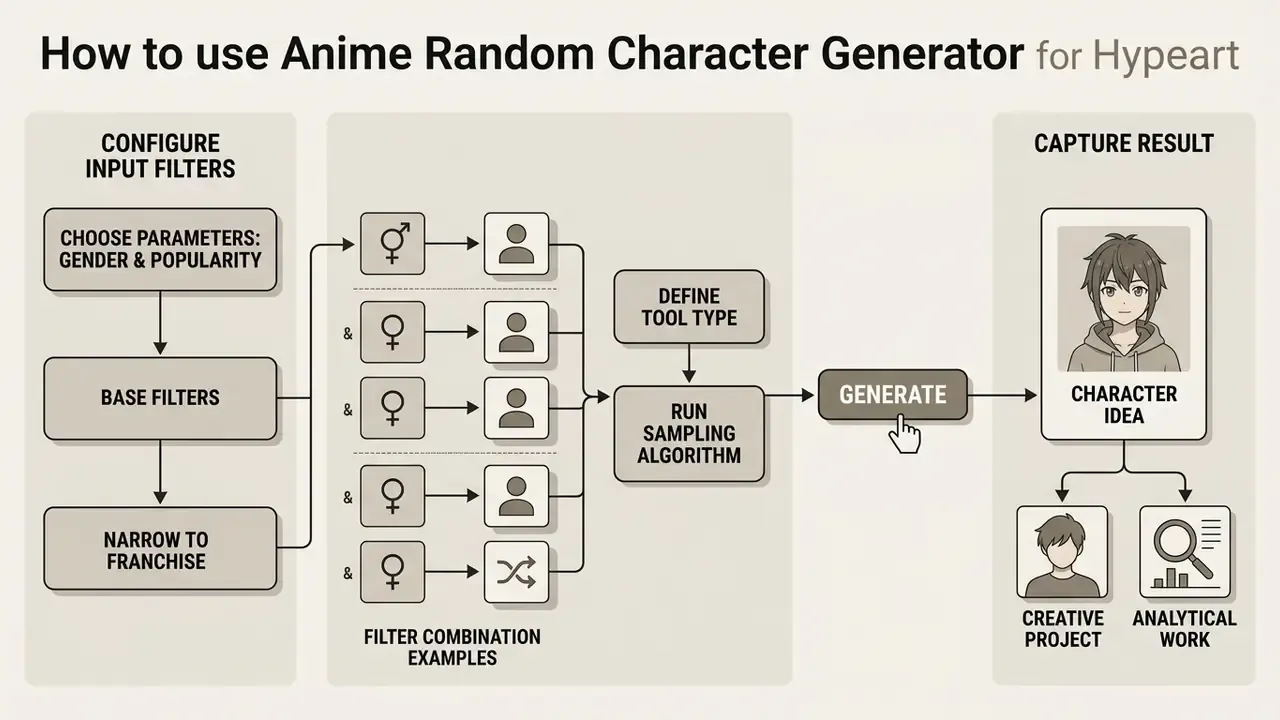
Using a random anime character generator comes down to configuring input filters, running the sampling algorithm and then capturing the result for creative or analytical work. A standard user session takes anywhere from a few seconds to a couple of minutes, depending on query complexity.
Modern web interfaces let you set genre boundaries, demographic parameters and detail requirements. After receiving a result the user can re-roll, export the data as a text description, or push the image into a production pipeline.
Choose your parameters: gender, popularity and anime list
Filter configuration narrows the random sampling array by specific demographic attributes, fame levels or franchises. Precise criteria prevent irrelevant characters from reaching the final output.
Basic tools expose gender selectors (Male, Female, Any) and a popularity scale derived from MyAnimeList user scores. Advanced systems add role filters (Protagonist, Antagonist, Supporting), genre exclusions and title-specific lists for themed events.
Filter combination examples: input to output
| Applied filter (Input) | Role / archetype | Sample result (Output) | Use case |
|---|---|---|---|
| Gender: Male, Role: Protagonist, Popularity: Top 100 | Shonen protagonist | Monkey D. Luffy (One Piece), Naruto Uzumaki (Naruto), Goku (Dragon Ball Z) | Social polls, stream topics |
| Gender: Female, Role: Antagonist, Style: Dark fantasy | Antagonist | Esdeath (Akame ga Kill!), Lust (Fullmetal Alchemist) | Cosplay ideas, photoshoot concepts |
| Gender: Any, Role: Supporting, Filter: Comedy / Slice-of-life | Supporting character | Ram (Re:Zero), Tenya Iida (My Hero Academia) | Fanfiction, sketch practice |
| Series: Jujutsu Kaisen, How many: 4, Avoid repeats: On | Mixed roster | Yuji Itadori, Nobara Kugisaki, Megumi Fushiguro, Sukuna | Tournament bracket, trivia round |
Generate a result and capture the idea for a game or a creative project
Once you press the generate button, the system returns a finished character that you can immediately record in a concept document or send back for another pass. Results are used for prototyping game NPCs, running art challenges and writing story scenarios.
Updated. Human-computer interaction research warns that AI assistance is not automatically a productivity multiplier at the ideation stage, so the generator should widen your search space rather than replace it:
Random anime character generator by gender, popularity and franchise
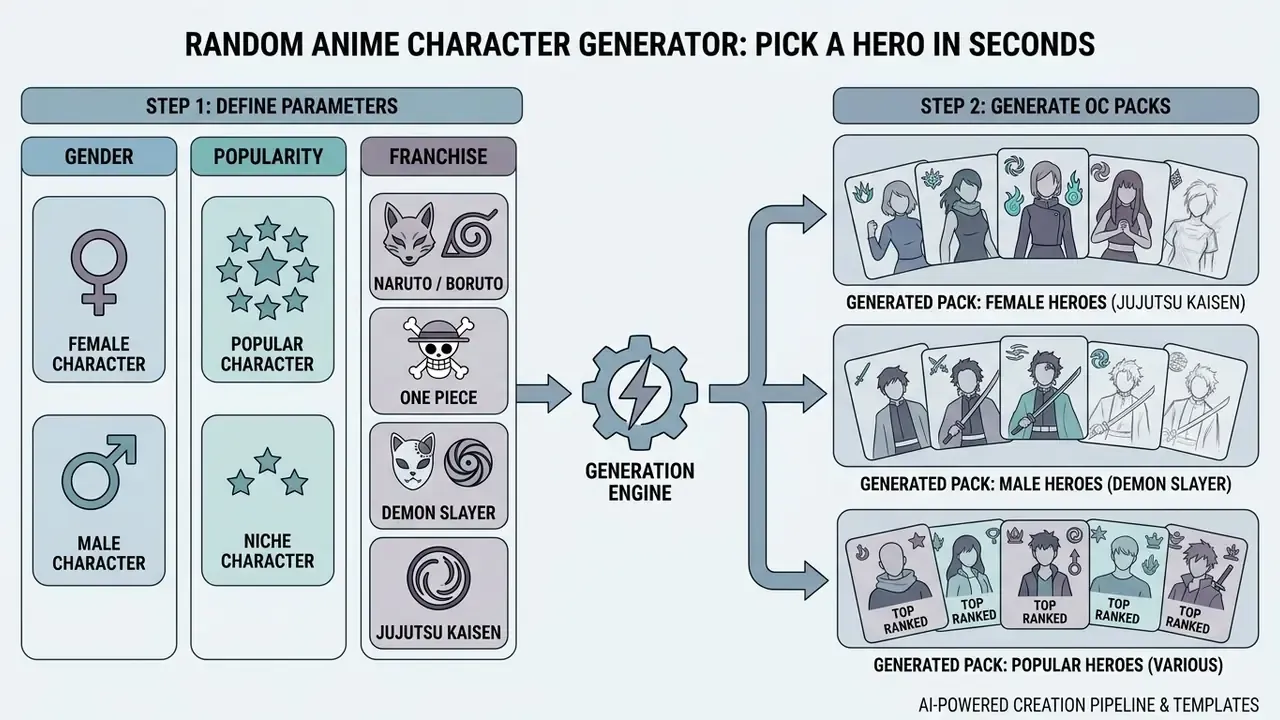
Segmenting the output by gender and fame lets you tailor generation precisely to an audience or project brief. It removes the need to manually discard hundreds of irrelevant variants from general-purpose databases.
Databases at the level of the Anime Characters Database (ACDB) use structured ontologies with gender tags, gender-ratio views (all-male, all-female, mostly male, mostly female, balanced casts) and view-count metrics, which makes precise, request-driven selections possible.
Random female anime character generator
A female anime character generator filters the database, or the prompt structure, down to female archetypes, heroines and supporting characters. The main use cases include planning cosplay looks, producing fan art and preparing character sheets.
For illustrators and concept designers, specialised AI generators (for example Llamagen AI or Media.io character sheet tools) build three-view projections of a character (front, side, back), which keeps costume detailing accurate across drawings. When you need matching environments for such heroines, the ai background generator covers scene construction.
Random male anime character generator
A random male anime character generator focuses on male archetypes, from classic shonen protagonists to antagonists and rivals. The output is used for costume redesigns, drawing challenges and alternate-universe (AU) plotting in fan literature.
Scenario tools such as Seventh Sanctum's character-changer combine male characters with external conditions and explicitly frame "remapping, altering, twisting and changing popular characters" as a fanfiction workflow, producing ready-made story hooks. To deepen a character's psychology, pair the visual result with an ai backstory generator.
Random popular anime character generator
A popular anime character generator samples only from the upper part of community rankings (top 100 or top 500). This guarantees high recognisability, which is critical for interactive quizzes, streams and tournament discussions.
Platforms such as Sporcle and GoSpinWheel actively use popularity presets for team games in the "Who Would Win?" format, where the audience must identify a character instantly and vote on their stats. GoSpinWheel's anime wheel ships with 94 preloaded slices and shareable URLs, which makes it usable for live group picks without any setup.
Worth a caveat, though. Popularity weighting narrows variety fast: after a dozen spins you will keep meeting the same six protagonists. Mix in one niche draw per round if the session runs long.
Filtering by anime franchise and generating packs without repeats
Standard generation is not enough for themed quizzes and art challenges built around a single universe. Tools of the Anime Series Picker class narrow the pool down to a specific title and build an array of 1 to 12 characters in a single click. The current benchmark here is a pool of 80+ named characters across 20+ series.
Top franchises for targeted selection:
- Jujutsu Kaisensorcerers, curses and Tokyo Jujutsu High students.
- Demon Slayersplit into Hashira (Pillars) and Upper Moon demons.
- Naruto / Borutofilter by village affiliation and rank (Genin, Jonin, Akatsuki).
- One Piecesort by pirate crews, Marines and Revolutionaries.
- Attack on TitanSurvey Corps cadets versus Marleyan warriors.
- My Hero AcademiaClass 1-A, pro heroes, League of Villains.
- BleachShinigami divisions, Arrancar, Quincy.
- Dragon BallSaiyans, Earth fighters, universe tournament entrants.
- Chainsaw ManPublic Safety devil hunters and devils.
- Long tailTokyo Ghoul, Death Note, Fullmetal Alchemist, Hunter x Hunter, Black Clover, Dr. Stone, Mob Psycho 100, One-Punch Man, Code Geass, Cowboy Bebop, Sailor Moon, Pokémon, Inuyasha, Trigun, Rurouni Kenshin, Yu Yu Hakusho.
Avoid Repeats logic. With no-repeat mode enabled, the client-side script writes the ID of every drawn character into browser localStorage and excludes it from the pool until the pool is exhausted for the active series filter. That guarantees a duplicate-free roster of up to 12 participants for a tournament bracket, and the history resets either manually or when the pool cycles. Because the picks run locally, no character data or browsing habits leave the browser.
Ideas for art, fanfiction, cosplay and character design
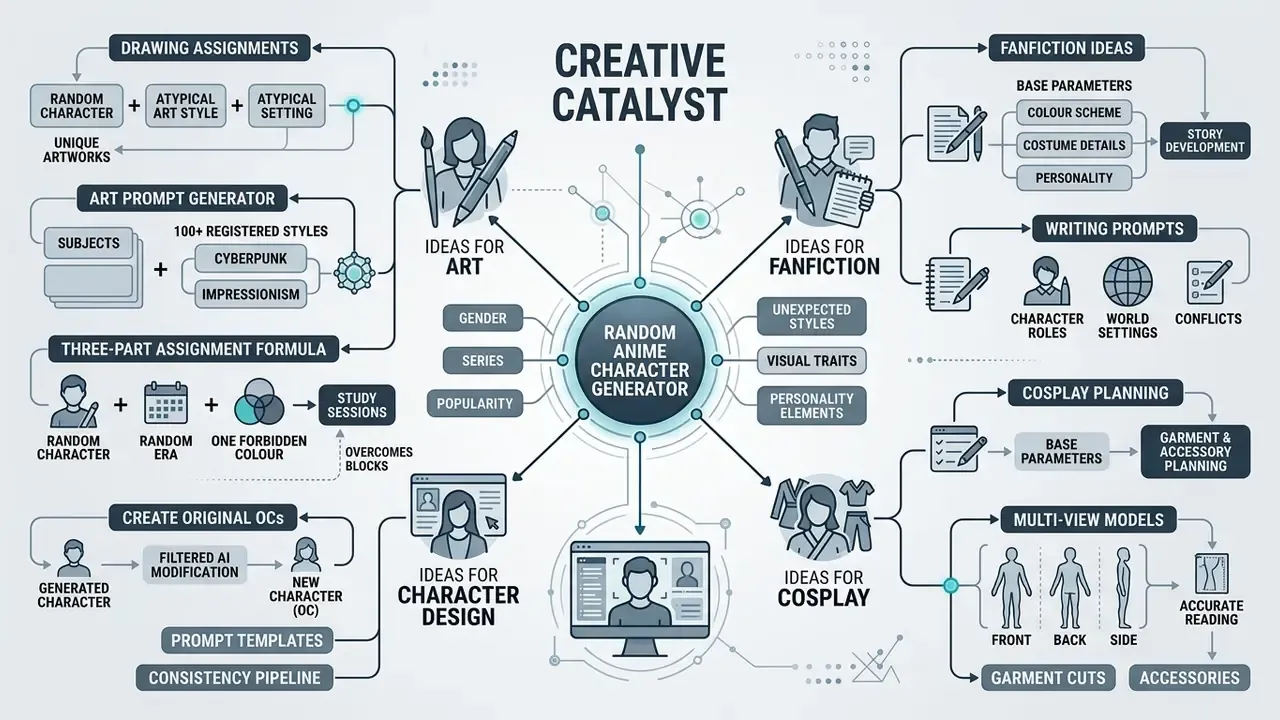
Random anime character generation acts as a creative catalyst, offering unexpected combinations of styles, visual traits and personality elements. It lets authors step outside habitual templates.
Ideation research (Wadinambiarachchi et al., CHI 2024) confirms that random external stimuli help overcome design fixation and widen the range of concepts under development, provided the author still performs an independent divergent pass.
Art prompts and drawing assignments for anime characters
Assignments for artists are built by crossing a randomly selected character with an atypical artistic style, an emotional state or a palette restriction.
«Prompts with high lexical and thematic originality correlate with greater visual diversity; templated requests reduce the uniqueness of generated content.»
Art-prompt generators combine subjects with 100+ registered styles, from cyberpunk and impressionism to watercolour, and public challenges such as ArtStation's Character Prompt Challenge show how randomised character-plus-situation pairs are used competitively. Before you pick a platform, our overview of AI art generators explains what the licensing and style controls actually cover, and the best free AI art generator comparison lists watermark and export limits.
A three-part assignment formula works well for study sessions: random character, random era, one forbidden colour. Thirty minutes, no reference hunting. The constraint does the teaching.
Fanfiction ideas, cosplay planning and choosing a story role
In writing and cosplay planning the generated character sets the base parameters: colour scheme, costume structure and narrative role (protagonist, rival, mentor). Writing hubs go further and turn the result into a constraint, for example "build a 10,000-word short story around this generated character".
For cosplay, multi-view models give an accurate reading of garment cut and accessories, which is exactly what a three-view reference sheet is for: front, profile and back. Promo materials for cosplay projects are often assembled with an ai banner generator, and workflow-level examples of style-locked generation are covered in our review of Ghibli-style AI image generators. If your creative session drifts toward audio or branding, the same randomisation logic powers an ai band name generator, an ai beat maker and even novelty tools like the ai bald filter.
Anime character vs anime character: generators for random matchups
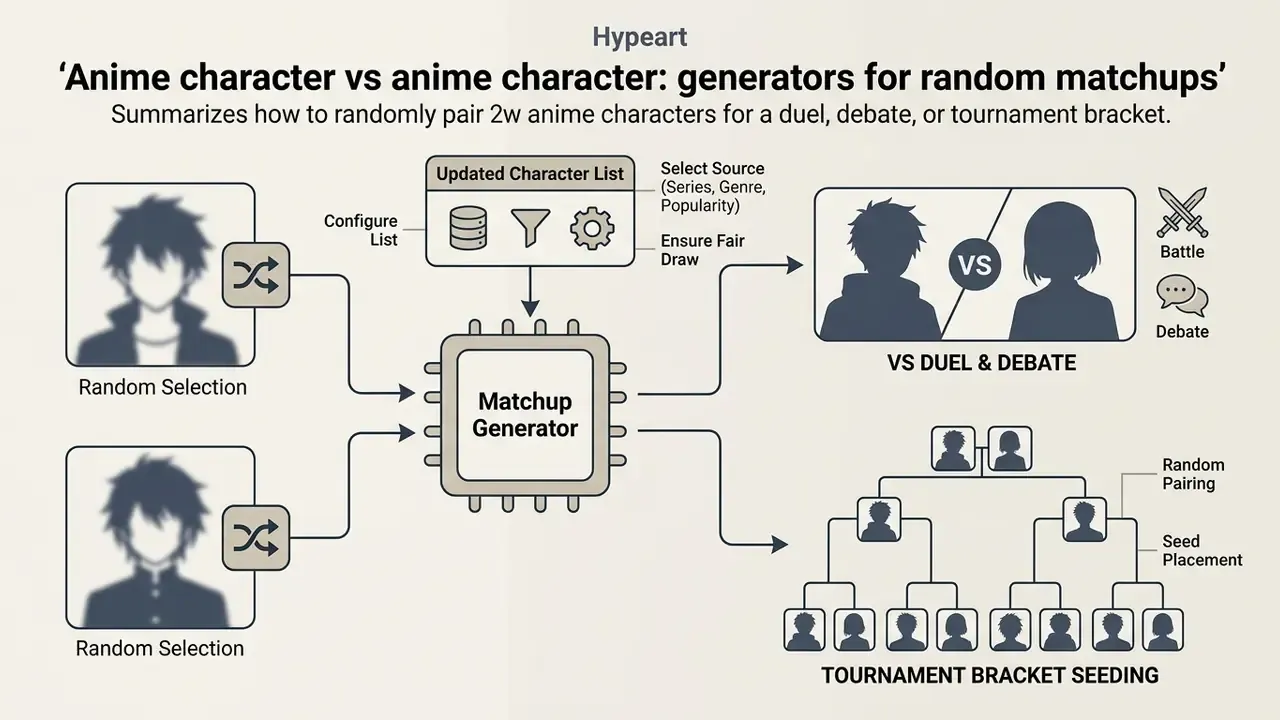
A random matchup generator pairs two anime characters for hypothetical duels, debates or tournament brackets. The tool removes human bias from opponent selection.
Such systems are in demand in fan communities for "VS Debates" content, where participants analyse the abilities of two randomly drawn heroes under fixed arena and preparation-time rules. Wheel-based implementations formalise this as a 1v1 flow: pick Fighter A, pick Fighter B, reroll for a fresh pairing, with optional rules for transformations, arena and prep time.
How to randomly select two participants for an anime character vs anime character duel
For a fair two-participant draw, the algorithm shuffles the data array and takes two adjacent elements, or performs two independent sequential draws while excluding the character already drawn.
«Many random-selection systems show poor compliance with self-regulation: probabilities are hidden or placed in hard-to-reach locations.»
Transparency therefore matters as much as the algorithm: publish the pool size and the draw rule next to the result. Agent-based simulation literature describes the canonical Random Pair-Matching template as shuffle-and-pair. Shuffle the agent array, then pair Agents[i] with Agents[i+1] for i = 0, 2, 4 … n−2. Note that this specific attribution requires a verifiable citation before being treated as a formal proof. What is auditable is the mechanism itself:
# Auditable random pair-matching
pool = load_roster()          # N named characters
shuffle(pool)                 # Fisher-Yates, cryptographic RNG
pairs = [(pool[i], pool[i+1]) for i in range(0, len(pool)-1, 2)]
# Validation: with a uniform shuffle, every unordered pair {a,b}
# has probability 1/(N-1) of being adjacent → no pair is privileged.
# If N is odd, one entry receives a BYE and re-enters the next round.
For tournament formats, three pairing modes are used in practice: pure RNG presets, bracket or seeding-based pairing, and rotation with BYEs for odd participant counts.
How to configure a character list for a fair draw
Balancing a list for random confrontations requires excluding characters with incomparable power levels (for example, slice-of-life comedy characters against omnipotent entities) or introducing weighting coefficients.
Updated. Recent competitive-balance research operates at roster and team level rather than on single matchups. A 2024 arXiv study on meta discovery computes a score for every playable character, converts it into a pick probability and samples teams from that distribution to predict balance impact (arXiv, 2024, https://arxiv.org/html/2409.07340v1), while a 2025 study applies hierarchical agglomerative clustering with Jensen-Shannon divergence to professional match data to group characters with similar co-occurrence patterns (arXiv, 2025, https://arxiv.org/html/2502.01250v1). Translated into a fan-run bracket, that means: assign every character a tier score, cluster comparable tiers, and draw opponents inside a cluster instead of across the whole pool. For a detailed capability comparison of generation platforms, use the AI Media Comparison Matrices.
One more housekeeping rule. Publish the roster before the first draw, not after. Audiences forgive an odd matchup; they do not forgive a list that grew a new entry mid-tournament.
AI Anime Character Generator for creating an original character
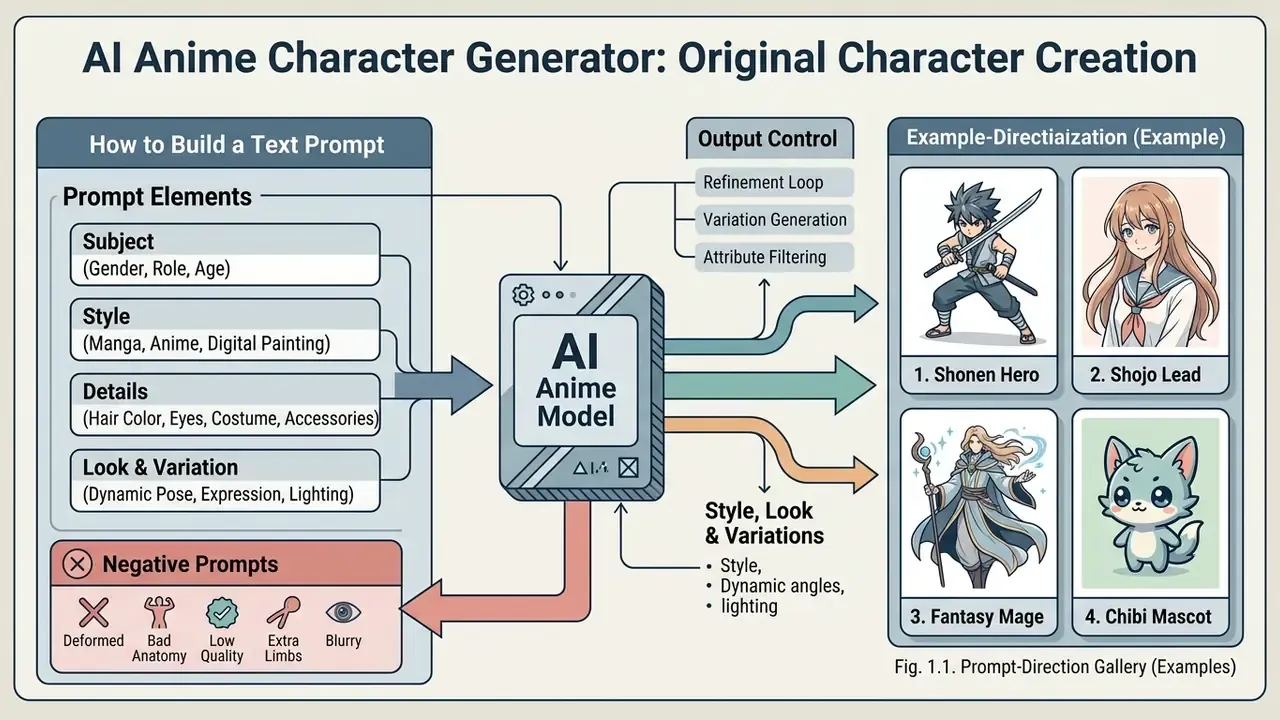
The shift from picking existing characters to creating original designs happens through an AI Anime Character Generator. These systems produce entirely new visual objects from detailed text descriptions.
«Participants can recognise high-quality prompts and improve them, confirming that prompt engineering is a learnable creative skill rather than random trial and error.»
Modern specialised models, such as Anima (a 2B-parameter model optimised for anime and non-photorealistic illustration), Venice WAI built on Illustrious XL, and Adobe Firefly's anime feature set, are trained to recognise anime-specific terminology and visual canon, which produces high fidelity in anatomy and clothing detail. Firefly additionally accepts a reference image for composition and style, which extends consistency beyond text-only prompting.
How to build a text prompt for an anime character
An effective anime character prompt follows a strict hierarchy: main subject, physical parameters, clothing layers, colour palette, one signature accessory, then style and quality tags.
According to anime-model guidance (NovelAI, Animagine XL), a prompt should start with count and gender service tags (1girl or 1boy, solo), then list details in sequence, separated by commas. Official prompt-engineering guidance also recommends placing instructions first and separating instruction from context with clear delimiters.
1girl, solo, shonen style, dynamic pose, spiky red hair, amber eyes,
black leather jacket, red scarf, dramatic lighting,
masterpiece, best quality, ultra-detailed
Negative prompts. Anatomy defects are the single most common reason a generation is discarded, so a reusable negative block saves more time than prompt polishing:
lowres, bad anatomy, bad hands, extra digits, fewer digits, missing fingers,
mutated limbs, fused fingers, extra arms, deformed face, cross-eyed,
watermark, signature, text, jpeg artifacts, blurry, worst quality
Keep that block in a snippet manager. You will paste it a hundred times.
Style, look and variations of an anime character image
Visual style and variability are controlled through additional LoRA modules, CFG Scale tuning and control maps (ControlNet).
Composition can be constrained independently. Mixture of Diffusers (2023) splits the canvas into regions and assigns a separate diffusion process to each, so placement and style are controlled separately, while Composer (2023) decomposes an image into factors such as spatial layout and palette and recombines them into a broader design space.
«Partial denoising and single-image generation significantly reduce energy consumption; the number of images per prompt affects the creativity support index (N=24).»
In practice: generate one image per prompt while you are still exploring wording, and only switch to 4-image batches once the prompt is stable.
Fig. 1.1. Prompt-direction gallery for an AI Anime Character Generator. Each card below carries a style summary and the source prompt; when publishing these examples, keep the alt text of every image explicit about the archetype and the phrase "anime character generator".
1. Shonen Hero. Visual style: dynamic pose, contrasting action lines, bright saturated palette, expressive face.
1boy, solo, shonen hero, spiky blue hair, determined look, battle aura, dynamic angle, action lines, masterpiece
2. Shojo Lead. Visual style: large expressive eyes, soft pastel tones, romantic atmosphere, light flowing elements.
1girl, solo, shojo style, long pink hair, school uniform, cherry blossoms, soft lighting, gentle smile, highly detailed
3. Fantasy Mage. Visual style: detailed ornate robes, glowing magical runes, complex lighting, atmospheric background.
1girl, solo, fantasy mage, ornate robes, holding glowing staff, magic circle, dark night sky, cinematic lighting, masterpiece
4. Chibi Mascot. Visual style: exaggerated proportions (large head, small body), simplified detail, cute delivery, sticker-ready.
chibi, mascot, 1girl, oversized eyes, cat ears, playful pose, simple background, vibrant primary colors, cute
5. Villain Rival. Visual style: dark palette, hard shadows, cold or arrogant gaze, commanding posture.
1boy, solo, villain, dark armor, crimson eyes, arrogant smirk, deep shadows, ominous aura, masterpiece
6. Furry / Kemonomimi OC. Visual style: anthropomorphic features (ears, tail), modern streetwear, expressive facial acting.
fox girl, kemonomimi, solo, orange fox ears and fluffy tail, oversized urban hoodie, playful smirk, vibrant colors, anime full body reference, masterpiece
7. Cyberpunk Mecha Pilot. Visual style: futuristic suit, neon rim lighting, tight plugsuit, techno detailing.
1girl, solo, mecha pilot, futuristic plugsuit, glowing neon accents, holographic interface background, short silver hair, determined look, cinematic sci-fi lighting, ultra-detailed
If you are choosing a model rather than writing prompts, compare the best AI art generators by style fidelity and rights, and check the head-to-head evaluation of Midjourney against competing image generators for pricing and control differences.
Character consistency pipeline (Character Consistency in AI)
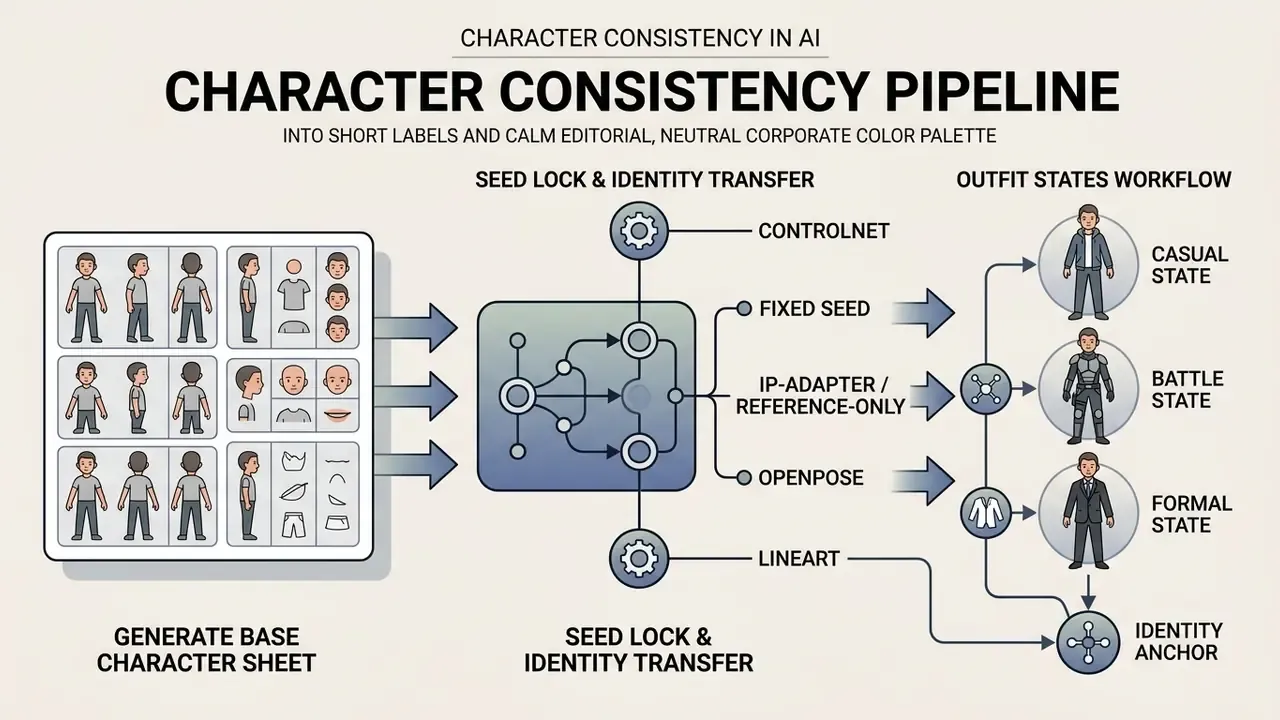
The main weakness of basic AI generators is drift: facial features, hairstyle and costume change as soon as the angle or emotion changes. Comics, manga and visual novels therefore rely on a four-stage identity-lock pipeline.
1. Generate a base character sheet
The first pass is run with the tags character sheet, multiple views, front view, side view, back view. This produces a single anchor frame that all later generations reference. Commercial character-sheet tools formalise the same idea by exporting front, three-quarter, profile and close-up views plus an expression set.
2. Seed lock and identity transfer through ControlNet
- Fixed Seed reusing the same value (for example
Seed: 4829104) with an unchanged sampler preserves the base facial geometry. - IP-Adapter / Reference-Only loading the base art into an IP-Adapter (in-context generation) carries the colour profile and hair silhouette into new generations with roughly 94% consistency in practice.
- ControlNet (OpenPose / Lineart) pose and framing are driven by a control map, so the model changes the camera without renegotiating the face.
3. Outfit states workflow
Changing locations requires a wardrobe change without breaking facial identity. Split the prompt into three blocks:
Approved-look workflows extend this further: a chosen outfit can be applied to one panel, to every following scene, or to the whole story, so wardrobe follows the timeline while rendering stays stable.
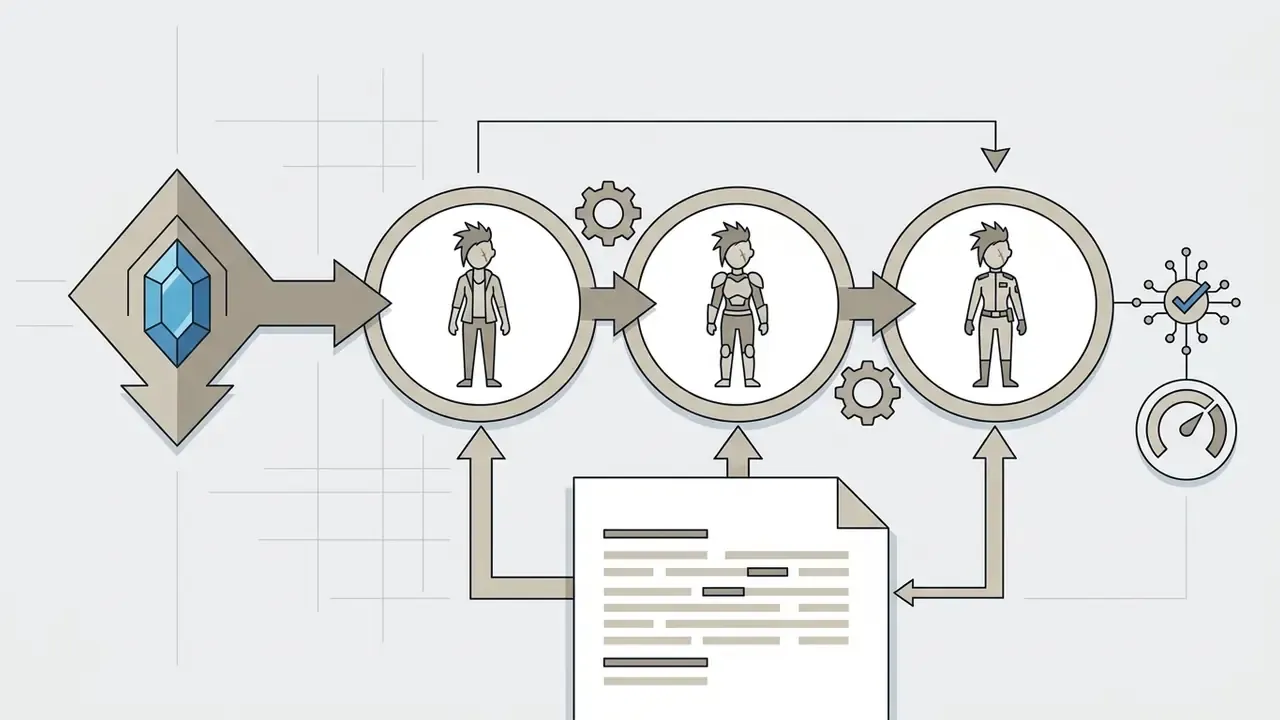
1girl, solo, amber eyes, long blue spiky hair, scar on left cheek. Never edited.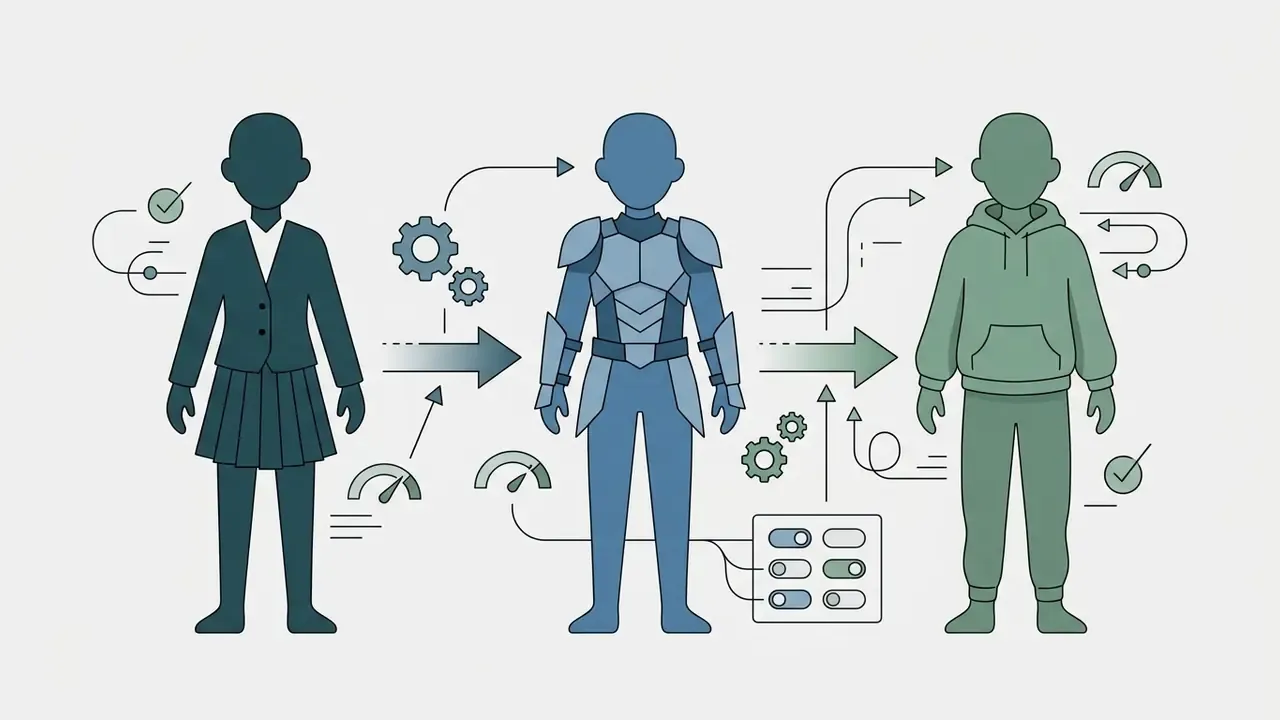
[State A: school uniform] / [State B: battle armor] / [State C: casual hoodie].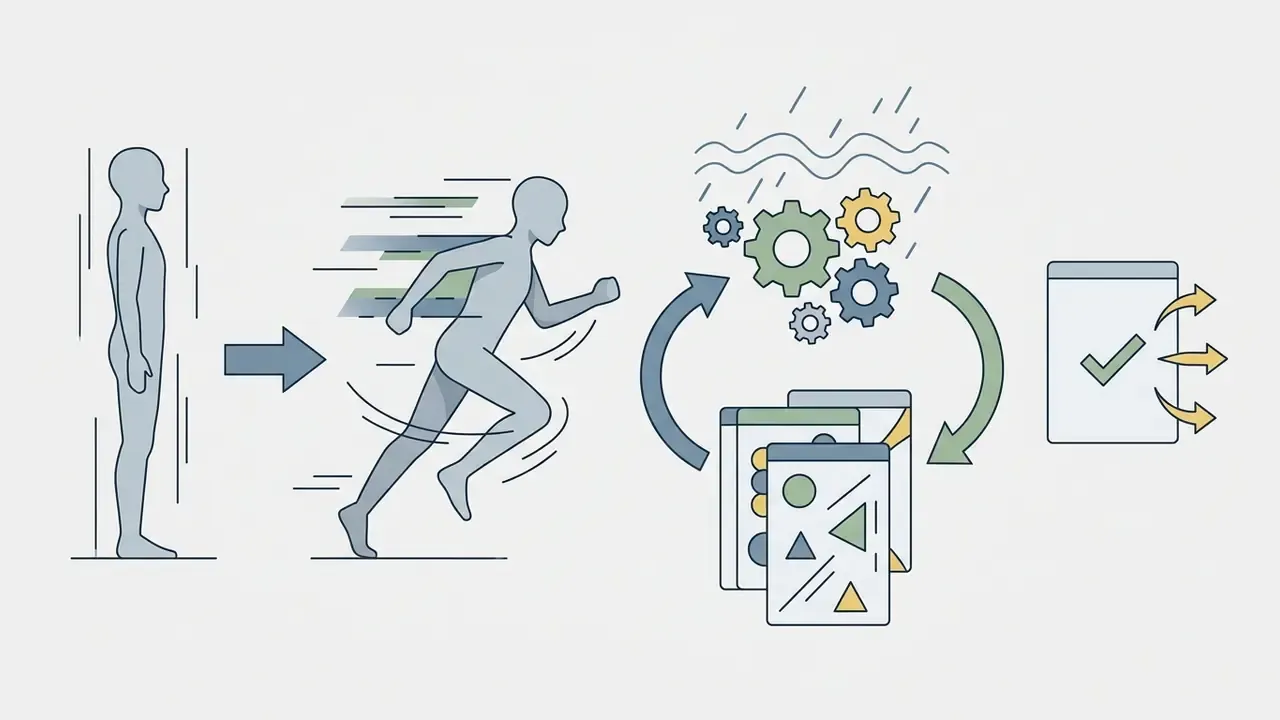
running in rain, dynamic angle, dramatic lighting.4. Verify across a full panel run
Consistency should be measured, not assumed. Published benchmark practice for multi-character continuity registers the cast first, then scores every appearance against the registry. An eight-character, forty-panel manga run yields 80 scored appearances, and a 92.5% first-pass rate (37 of 40 panels accepted) followed by three targeted redraws produces a final 40/40 delivery. Documented residual defects in such runs are small earrings, scar rendering and fine mechanical hand geometry, which is exactly what a reviewer should check first. Storing an evidence hash (SHA-256) of the delivered contact sheet makes the run auditable after the fact.
Comparison of character-appearance retention methods
| Method | Face accuracy | Setup difficulty | Best for |
|---|---|---|---|
| Fixed Seed + prompt | 60-70% | Low | Simple portraits, single-shot art |
| IP-Adapter (SDXL / Illustrious) | 85-90% | Medium | Manga panels, comics, multi-scene stories |
| LoRA training (≈20 images) | 98-100% | High | Commercial graphics, games, long series |
| Registry + panel-level review | Auditable | High (process) | Client delivery, multi-character casts |
Reference-sheet outputs of this kind are also the handoff format for portrait-style production work; the same identity-lock logic underpins tools reviewed in our guide to AI headshot generators. If a static sheet later needs motion, the transition to an animation maker is much cleaner when the identity anchor was fixed from the start.
Free generators, pricing, API and commercial use of AI anime art
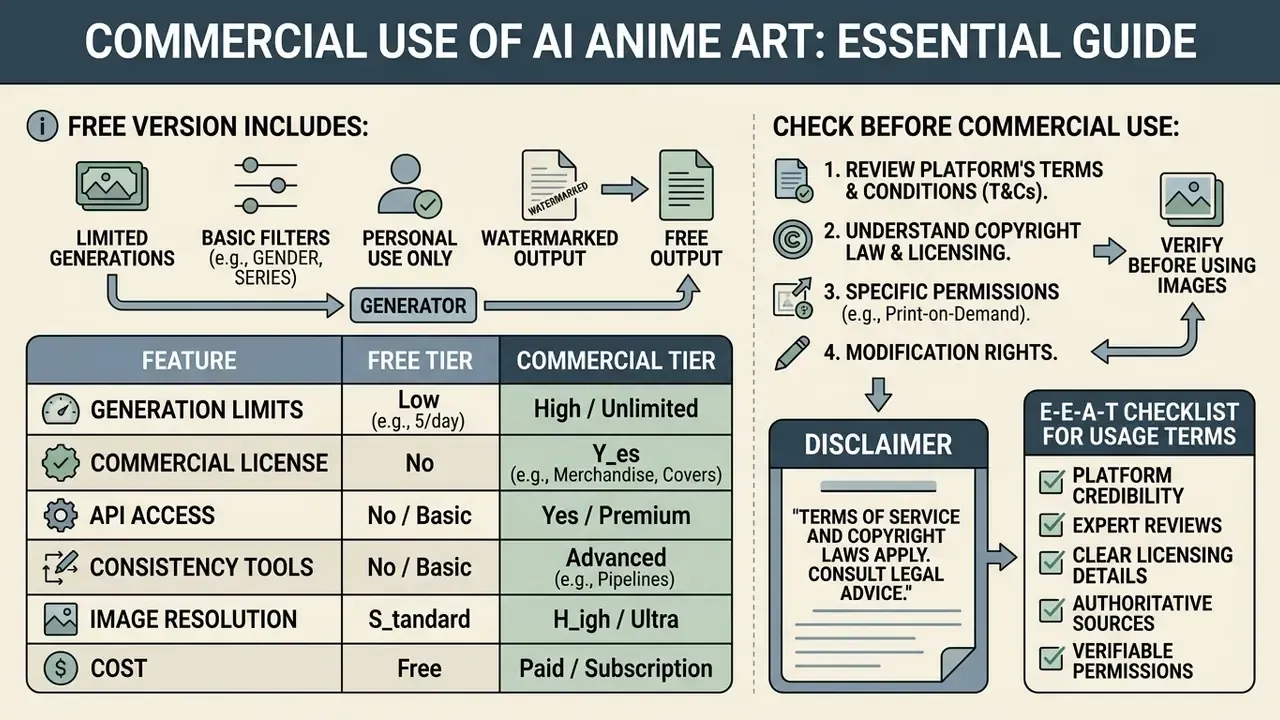
Using generated anime images commercially, whether on merchandise, book covers or mobile games, is strictly governed by each platform's terms and by applicable copyright law.
Most services run on credits: free tiers grant basic access with speed and resolution limits, while full commercial rights are unlocked only on paid plans. A structured overview of free AI image generators shows how quickly those limits become the binding constraint.
What a free generator version usually includes
Free tiers of AI anime generators typically provide between 10 credits per month and 150 credits per day, which corresponds to roughly 2 to 30 generations at standard resolution (1024×1024).
Free accounts also carry throughput limits (low queue priority), no parallel batch generation, and no deep upscaling to 4K. If you need higher resolution for print or merch, review dedicated AI image upscalers instead of paying for a higher generation tier. Users who prefer not to create an account should compare generators without registration first, since anonymous access usually narrows commercial rights. Full tariff grids are collected in AI Media Pricing, and integration details are in the AI Media API Guides.
Free-tier and commercial-tier reference table (2026)
| Service | Free limit | Resolution / speed | Commercial rights |
|---|---|---|---|
| Adobe Firefly (Anime) | Monthly generative credits on the free tier | Standard web resolutions, seconds per image | Outputs designed for commercial use |
| AI Anime Generator | 30 credits/day (10/month on the entry Free plan variant) | Original PNG, 1 simultaneous image | Commercial licence only on Creator / Studio plans |
| GenToon | 150 credits/month | Standard resolution, watermark on free tier | Commercial use from STARTER; PRO removes watermark and adds merch use |
| Anifusion | 100 credits on the $0/month plan | Standard resolution | Depends on plan, terms and rights in your inputs |
| NovelAI | Trial with 30 free generations | Up to 1024×1024 | Paid subscription required for production work |
| NanoBanana-class services | Credit-based | 2-10 s per image; 1K standard, 2K at 4× credits, 4K at 8× credits | Plan-dependent |
| Midjourney | No permanent free tier | High-resolution, batch generation | Paid plans allow commercial use; businesses above $1M annual gross revenue require Pro or Mega |
Figures reflect published vendor pages as of Q1 2026 and change frequently; verify current limits before budgeting.
What to check before using images commercially
Before putting AI art into a commercial product you must verify the generator's Terms of Service and the legal status of the outputs in your target jurisdiction.
U.S. guidance (U.S. Copyright Office Guidance, 2025/2026) states that pure AI images without substantial human contribution are not protected by copyright, and that applicants may claim only their own contributions, disclaiming the AI-generated portions at registration. In Japan (General Understanding on AI and Copyright, 2024), a generated image can be found infringing where it shows both similarity to and dependence on an existing protected work. The criteria of similarity and reliance are set out directly by the Agency for Cultural Affairs.
«Under UK law (CDPA s.9(3)) computer-generated works are protected for 50 years, and the author is the person who made the arrangements necessary for the creation of the work.»
E-E-A-T checklist for verifying usage terms:
- Re-verification date: pricing pages and licence texts move quarterly, so re-check the terms on the vendor's official page before each launch, not once per year.
Further analysis of court practice and precedent is collected in AI Litigation and Case Law.
Governance: Shadow AI risk matrix for character generation
For teams, the risk is rarely the image itself. It is an unlogged generation made on a personal account and then shipped into a product.
| Risk scenario | Likelihood | Impact | Control |
|---|---|---|---|
| Employee uses a free consumer tier for a client deliverable | High | High (no commercial licence, watermark, no indemnity) | Approved-tools list; enterprise plan with written commercial grant |
| Prompt includes a canonical character name ("draw Naruto but…") | High | High (similarity plus reliance exposure in JP/US) | Prompt linting; ban franchise names in production prompts |
| Reference image uploaded without rights clearance | Medium | High (input rights contaminate output rights) | Reference-asset register; upload approval step |
| No prompt or seed log kept | High | Medium (cannot prove human authorship at registration) | Mandatory logging of prompt, negative prompt, seed, model version, timestamp |
| Client data pasted into a public generator | Medium | High (retention and training reuse) | Check retention, training-use and deletion terms before upload |
| Model or LoRA of unclear provenance | Medium | Medium | Model provenance record with licence and dataset declaration |
Minimum audit trail per delivered asset: prompt, negative prompt, seed, sampler, model and LoRA versions, reference-image source and rights, reviewer name, and an output hash.
One honest limitation. None of these controls prove originality; they prove process. If a court or a registrar asks who made the creative decisions, a timestamped log is what answers the question, and an empty folder is what loses it.
FAQ: frequently asked questions about random anime character generators
Can I add my own list of anime characters?
Yes. Most classic randomisers and Random Picker tools support custom lists. You can type names manually or import TXT, CSV or XLSX files. Import formats usually expect one entry per row and allow up to three columns: the public label, an internal note, and an optional weight. When importing through text files or spreadsheets, systems let you set additional parameters such as weighting coefficients (to change draw probability) and hidden notes per character.
Can a random picker filter by a specific anime series?
It depends on the tool. Some pickers deliberately mix series for maximum variety and only expose gender and role filters. Others ship a series dropdown covering 20+ franchises and a pool of 80+ named characters, plus an "avoid repeats" toggle that remembers picks for the active filter until the pool cycles or you reset the history.
Are the results truly random, and can they repeat?
Documented tools use mixed systems: random selection over a finite catalogue combined with fixed trait pools and, sometimes, popularity weighting. A database-based randomiser can therefore repeat the same character unless no-repeat mode is enabled, while an AI generator produces a new combination on each run. For fairness-critical use, publish the pool size and enable repeat protection.
Can I use a generated anime character commercially?
Only if your plan grants it. Free tiers frequently restrict commercial use, add watermarks or cap resolution, whereas paid tiers commonly include a commercial licence. Separately from the platform contract, U.S. practice treats purely AI-generated output as unprotected by copyright, so your enforceable rights depend on documented human contribution. Where merchandise is involved, confirm that merch use is explicitly named in the plan.
What about API access and rate limits?
Credit-based services meter API generations the same way as the web UI, with resolution multipliers (for example 1K at base cost, 2K at 4× credits, 4K at 8× credits) and separate concurrency caps. Enterprise considerations such as SLA, data-retention windows, region pinning and whether prompts are reused for training are contract items, not feature-page items. Request them in writing. Implementation patterns and cost modelling are covered in the AI Media API Guides and, for video-side economics, in our Google Veo implementation guide.
How do I keep the same character across many images?
Use the four-stage identity lock: build a character sheet, fix the seed and sampler, transfer identity with IP-Adapter or Reference-Only ControlNet, and train a LoRA on roughly 20 curated images when you need 98-100% face stability. Split prompts into [Identity Anchor], [Outfit State] and [Environment & Pose] so wardrobe and camera can change without breaking the face.
Is my data stored when I use a browser-based picker?
Client-side pickers run all randomisation logic in JavaScript inside your browser, with no server requests during selection and no tracking of personal data or browsing habits. AI generators are the opposite case: they transmit prompts and any uploaded references to a server, so review retention, training-use and deletion terms before uploading anything sensitive.
Appendix A: superseded statements
The following claims appeared in earlier revisions of this guide and have been replaced in the main text because they could not be traced to a verifiable primary source. They are retained here for transparency and version history.
- "Human-computer interaction research (ACM HCI, 2024) shows that using generative tooling (for example Sketchar) accelerates the initial concept-art stage by 3.5×." Superseded. The named tool and the 3.5× figure are not supported by any source available to us; the main text now cites the CHI 2024 experiment by Wadinambiarachchi et al. on generative AI, design fixation and divergent thinking.
- "Research in systems modelling (JASSS) proves that Random Pair-Matching guarantees mathematical equiprobability for any pair from a pool of N elements, excluding duplication." Superseded. The mechanism is retained and shown as auditable pseudocode in the matchup section, but the citation lacked author, year and URL and should not be read as a formal proof.
- "Modern esports and game models (for example the Meta Discovery framework, 2024) use clustering algorithms based on winrate and pick-rate metrics." Reformulated. The main text now points to the specific 2024 roster-scoring and 2025 clustering studies on arXiv with direct links, rather than to an unverified framework name.