Stable Diffusion AI Image Generator: Controlled Deployment, Model Governance, and Commercial Use
Page type
Commercial-Use Matrix
Last checked
Source status
Manual check
«In evaluating generative AI architectures for enterprise deployment, control must strictly precede autonomy. Stable Diffusion provides open-weight transparency, but translating model checkpoints into risk-adjusted business value requires disciplined model governance, verified licensing compliance, and auditable infrastructure.»
— Marcus Hale, author.
Last updated: August 2026 · Review scope: architecture, model selection, deployment, prompt engineering, governance, licensing.
Executive Summary for Risk, Compliance, and Creative Leadership
Architecture determines controllability.Stable Diffusion is an open-weight latent diffusion model: all inference happens locally against downloadable weights, which means prompts, reference imagery, and outputs can be fully contained inside an air-gapped perimeter. Closed APIs such as Midjourney and DALL·E 3 structurally cannot offer that option.
Model choice is a hardware and quality trade-off, not a brand choice.SDXL (~3.5B parameters) remains the most mature ecosystem for LoRA and ControlNet; Stable Diffusion 3.5 Large (8.1B, MMDiT/Rectified Flow) delivers superior prompt adherence and typography; SD 3.5 Large Turbo trades marginal fidelity for 4-step sampling latency. Half-precision (FP16) and quantized (FP8/INT8) loading, plus --medvram/--lowvram flags, reduce the hardware floor from 12 GB to as little as 2.4-6 GB VRAM.
Licensing is revenue-gated, and the gate is USD $1,000,000.SD 1.5 and SDXL ship under CreativeML OpenRAIL-M; SD 3.x/3.5 ship under the Stability AI Community License, which permits free commercial use only below USD $1M in annual revenue. Above that threshold an Enterprise License is mandatory before production deployment.
Outputs are only as defensible as the audit trail.Purely AI-generated visuals lacking human creative authorship are ineligible for US copyright registration (Thaler v. Perlmutter). Reproducibility evidence (prompt, negative prompt, seed, sampler, model hash, LoRA weights) plus C2PA provenance manifests are what convert a generated asset into an auditable, registrable, and legally defensible corporate artifact.
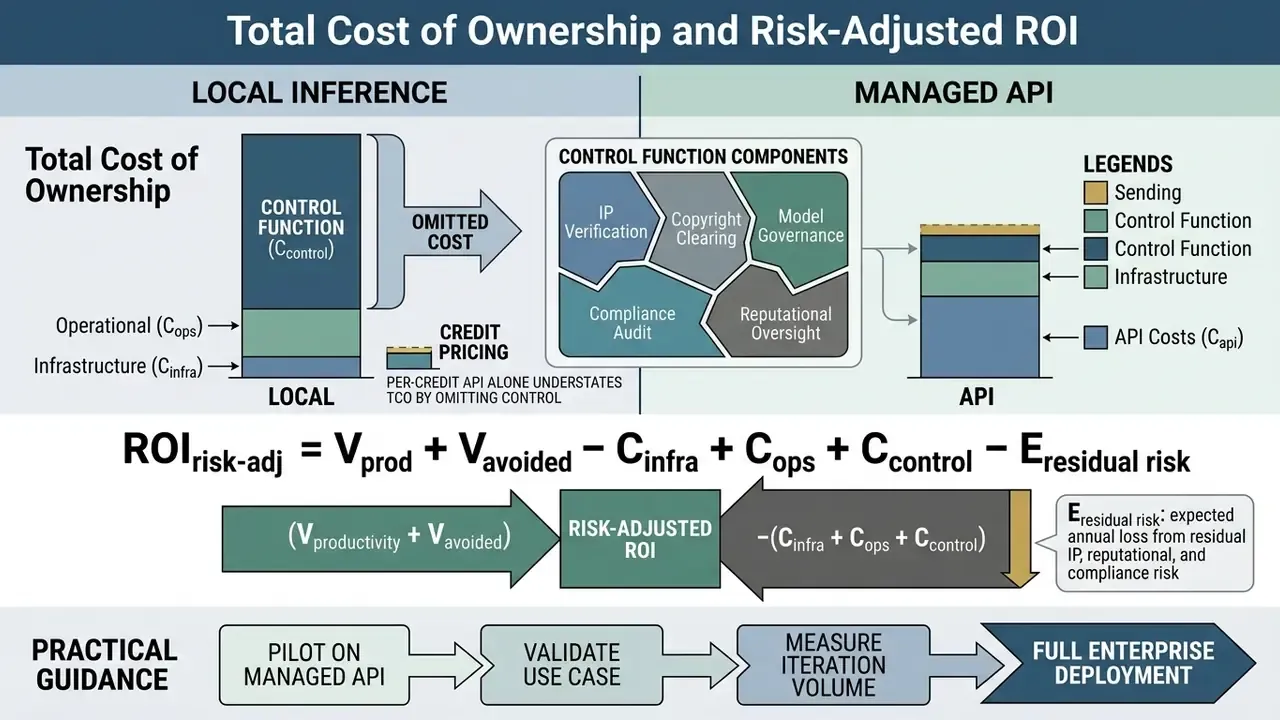
Total cost of ownership is dominated by controls, not GPUs.For regulated institutions, validation, monitoring, checkpoint vetting, and legal review typically exceed raw compute cost. Budget the control function explicitly before comparing an on-premise pipeline against per-credit API pricing (~$0.01/credit on the Stability AI platform).
Who This Guide Is For and How to Read It
Three readers usually land here at the same time, with different questions.
A creative or marketing owner wants to know whether an open-weight diffusion ai generator can produce campaign-grade visuals without a per-seat subscription. An engineer wants the VRAM floor, the sampler settings, and the install path. A risk or compliance owner wants to know what enters the model inventory, who signs off, and what evidence survives an examination.
This guide answers all three, in that order. If you are building the business case, start with the model comparison and the total-cost section. If you are writing the control standard, the governance, audit-trail, and licensing sections are the operative ones. If you just want a first render tonight, the local deployment and prompt sections are self-contained. One request from the compliance side: log your parameters from the very first test image. Retrofitting a reproducibility record after 400 assets have shipped is painful, and slightly embarrassing.
What is Stable Diffusion AI Image Generator and How It Generates Images
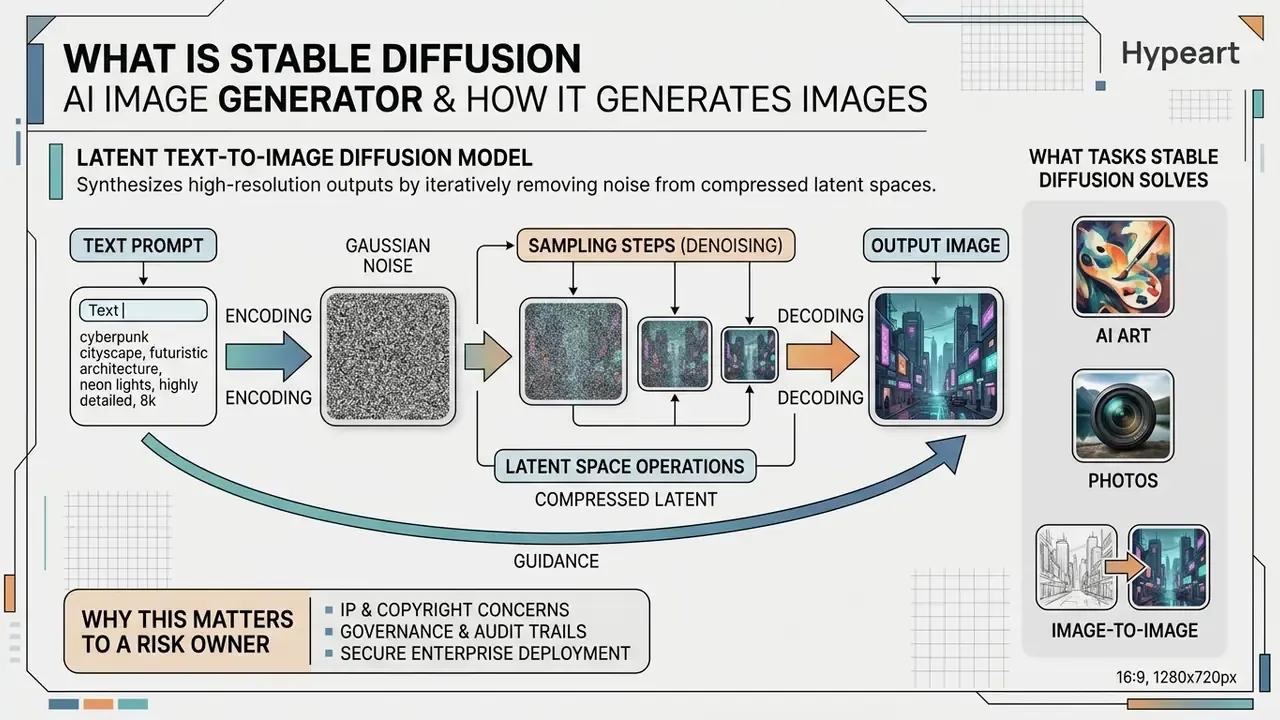
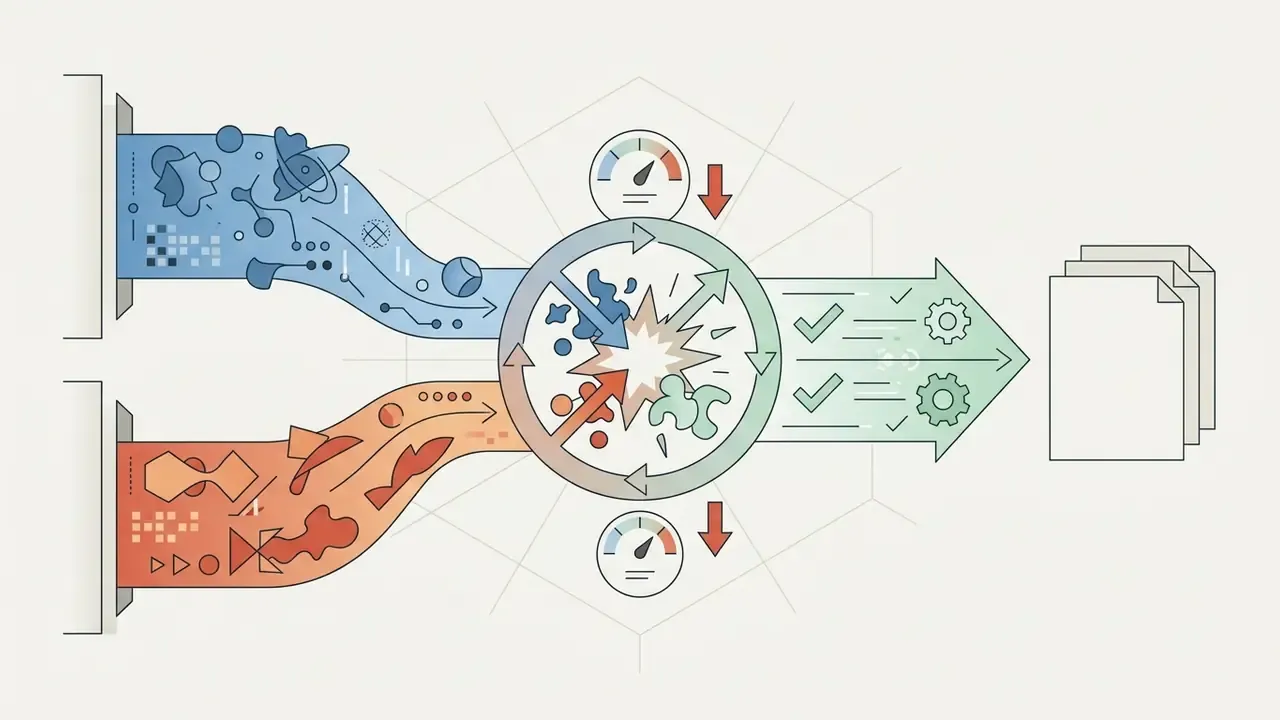
Stable Diffusion is an open-weight, latent text-to-image diffusion model that synthesizes high-resolution visual outputs by iteratively removing noise from compressed latent representations guided by textual embeddings. Unlike pixel-space generative AI systems, it operates inside a lower-dimensional latent space to minimize computational load while preserving fine-grained structural detail.
«Operating in latent space reduces computational complexity while preserving fine detail, more efficient than pixel-space diffusion models.»
Why this matters to a risk owner, not just an engineer. Because the entire generative trajectory is deterministic given a fixed seed, sampler, checkpoint hash, and prompt pair, latent diffusion is reproducible by construction. That single architectural property is what makes Stable Diffusion auditable: a validator can re-derive an identical asset months later from logged metadata. And because the weights are downloadable rather than API-gated, data locality becomes a configuration decision your institution controls, not a vendor promise you must accept on trust.
How diffusion models transform text prompts into AI images
A text-conditioned sd ai generator converts a text prompt describing visual elements into mathematical embeddings using a transformer-based text encoder. As established by Rombach et al. (High-Resolution Image Synthesis With Latent Diffusion Models, CVPR 2022), a Variational Autoencoder (VAE) compresses training images into a lower-dimensional latent space, where a U-Net or Multimodal Diffusion Transformer (MMDiT) executes iterative denoising. During inference, sampling begins with pure Gaussian noise zT, which the model denoises over multiple timesteps. Cross-attention layers inject text embeddings into feature maps, guiding the trajectory toward a clean latent state z0 that the VAE decoder expands into the final sd ai image generator visual output.
In formal terms, the training objective teaches a network ϵθ(zt,c,t) to predict the noise ϵ that was added to a clean latent z0 at timestep t, conditioned on text embedding c. At inference the process runs in reverse: structure emerges in the early steps, and fine texture resolves in the late steps. Deep learning practitioners comparing platform behaviour across vendors can benchmark architectures against other AI image generators before committing to a stack.
To refine specialized image workflows, teams can evaluate custom tools across established workflows to structure visual pipeline requirements.
«Conditioning-signal adjustments applied at later diffusion steps yield superior semantic alignment compared with early-stage interventions.»
— Grimal et al., Text-to-Image Alignment in Denoising-Based Models (2024).
The practical consequence is that late-step guidance, including negative prompting and regional conditioning, exerts disproportionate influence on semantic fidelity. Step scheduling is therefore a tunable quality lever, not a fixed constant you inherit from a tutorial.
What tasks Stable Diffusion solves: AI art, photos, and image-to-image
The stable diffusion ai image generator supports diverse creative and technical visual operations, including ai art, photorealistic asset creation, concept illustration, and image-to-image editing. Using initial input images paired with text descriptions (SDEdit framework), the ai diffusion image generator modifies lighting, textures, and composition while preserving underlying geometry. Teams focused on transforming existing images rather than generating from scratch can compare dedicated image-to-image editing implementations.
Beyond standard text-to-image generation, specialized adaptations extend these capabilities into complex production domains:
Image Editing and Inpainting: Methods like Dual Contrastive Denoising Score (DualCDS) use intermediate self-attention features for zero-shot text-guided edits without auxiliary training.
«DualCDS exploits spatial features from intermediate self-attention layers to enable flexible editing while preserving structure.» — Dual Contrastive Denoising Score (2024).
Pattern Generation: Frameworks like Tiled Diffusion constrain latent dynamics to synthesize seamless tiling textures for design and manufacturing.
«Tiled Diffusion imposes constraints on latent dynamics at every diffusion step to synthesize seamless, repeatable patterns.» — Tiled Diffusion (2025 preprint).
Domain Adaptation: Studies adapting stable diffusion xl to Synthetic Aperture Radar (SAR) imagery show that LoRA fine-tuning preserves physics-based geometric constraints while maintaining prompt control.
«A hybrid strategy, full UNet tuning plus LoRA on text encoders, better preserves SAR geometry while retaining prompt control.» — SAR Image Generation via SDXL Adaptation (2025).
Outpainting and Canvas Extension: Prompt-guided expansion of existing frames beyond original borders, comparable to dedicated AI outpainting tools used for banner and billboard reformatting.
Face and Identity Transfer: ControlNet and IP-Adapter style conditioning allow style and colour changes while preserving geometric structure. This is also the capability carrying the highest policy risk, and it requires explicit consent controls before any external publication.
For broader category analysis across visual automation platforms, users can browse the hub to review foundational terminology and architectural standards.
Which Stable Diffusion Models to Choose for Image Generation
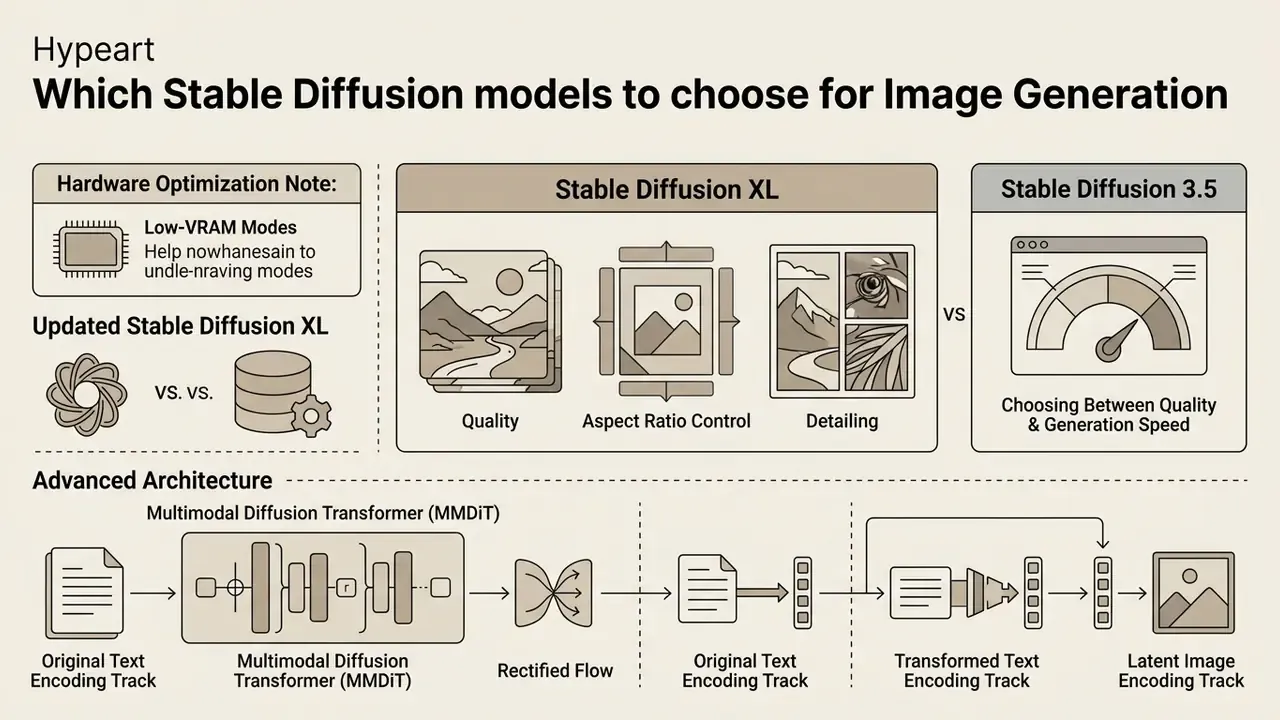
Selecting an optimal stable diffusion model requires balancing model parameter counts, hardware resource constraints, target resolution, and sampling latency. Organizations evaluating an ai image generator diffusion tool must match specific checkpoint variants to operational requirements.
Dimension
Stable Diffusion XL (SDXL)
Stable Diffusion 3.5 Large
Stable Diffusion 3.5 Large Turbo
Model Architecture
Latent Diffusion with U-Net and dual text encoders
An additional variant, Stable Diffusion 3.5 Medium (2.5B parameters), targets consumer hardware directly and supports a wider output envelope of roughly 0.25-2 megapixels. It is the pragmatic middle path when resolution flexibility matters more than peak fidelity.
Stable Diffusion XL: quality, aspect ratio, and detailing
Stable Diffusion XL (SDXL) serves as an established foundation for high-resolution 1024×1024 image synthesis, featuring multi-aspect ratio conditioning. SDXL natively incorporates target-size and crop-size conditioning parameters, allowing teams to generate non-square outputs such as 1152×896, 1344×768, 1536×640, or 832×1216 without introducing composition distortion or object duplication. Hugging Face documentation notes that most SDXL checkpoints perform best near the 1024-pixel area buckets; 768×768 and 512×512 render, but at measurably lower quality.
Empirical studies on specialized style generation demonstrate that SDXL prompt structure directly affects quantitative quality metrics, and the effect is measurable rather than anecdotal:
«A short prompt produced FID 227.69 versus 263.48 for a long prompt; CLIP scores were 0.3214 and 0.3280 respectively.»
— SDXL Icon Generation Benchmark Study (2024).
In other words, concise class-conditioned input often aligns closer with the underlying training distribution than verbose keyword stacking. Counter-intuitive, certainly, for teams who assume longer prompts equal more control. Note the trade-off: the longer prompt scored marginally higher on CLIP text alignment while scoring worse on distributional realism (FID), so the "right" prompt length depends on whether your acceptance criterion is photographic plausibility or literal prompt compliance. SDXL Base 1.0 also ships with a paired Refiner checkpoint, architecturally identical but trained for text-conditional img2img detail enhancement on pre-existing images.
Stable Diffusion 3.5: choosing between quality and generation speed
The diffusion 3.5 family introduces Flow Matching architecture alongside advanced distillation techniques, offering explicit trade-offs between execution speed and rendering detail. Stability AI's latest version suite includes three primary configurations:
Stable Diffusion 3.5 Large: An 8.1B-parameter flagship model delivering maximum prompt adherence, complex multi-subject composition, and detailed typographic output, positioned by Stability AI for professional use at 1 megapixel.
Stable Diffusion 3.5 Medium: A 2.5B-parameter variant optimized to operate on consumer hardware with configurable resolution bounds (0.25 to 2 Megapixels).
Stable Diffusion 3.5 Large Turbo: A distilled variant utilizing Latent Adversarial Diffusion Distillation (LADD) that generates high quality images in just 4 sampling steps without classifier-free guidance.
«LADD distils SD3 (8B) into SD3-Turbo, matching state-of-the-art generators in only four sampling steps without classifier-free guidance.» — Latent Adversarial Diffusion Distillation (LADD) (2024).
Advanced Architecture: Multimodal Diffusion Transformer (MMDiT) and Rectified Flow
Unlike legacy UNet-based models (SD 1.5 / SDXL), the Stable Diffusion 3.x and 3.5 families replace the convolutional backbone entirely with a Rectified Flow Transformer. Rectified flow reformulates generation as transport along near-straight probability paths between noise and data, which is why far fewer sampling steps are required to reach a converged image than in classical DDPM-style schedules.
Constructed as a Multimodal Diffusion Transformer (MMDiT), the backbone manages three parallel feature-processing tracks:
Inside each transformer block, bidirectional cross-attention allows text encodings to shape latent image features while image representations simultaneously update text embeddings. This symmetric exchange is the architectural break from earlier DiT designs, where text conditioned the image but never the reverse. Practically, that symmetry is what resolves the historic multi-subject attribute-binding failures ("a red cube on a blue sphere") and enables the legible typographic rendering that SD 3.5 is known for.
For enterprise selection purposes, the governance implication is also worth logging: because the SD 3.x backbone differs fundamentally from SDXL, LoRA and ControlNet adapters are not portable between the two families. A validated SDXL adapter inventory does not transfer to SD 3.5. It must be re-trained and re-validated, and that work belongs in the migration budget rather than in a footnote.
When evaluating multi-model performance metrics across generative engines, organizations can consult our AI Media Comparison Matrices for structured benchmarks.
Original Text Encoding Trackprocesses raw token representations from CLIP ViT-L and OpenCLIP BigG.
Transformed Text Encoding Trackhandles contextual representations derived from the T5-XXL text encoder.
Latent Image Encoding Trackoperates directly on the compressed latent state zt.
Where to Use Stable Diffusion: Online Platform or Launch Locally
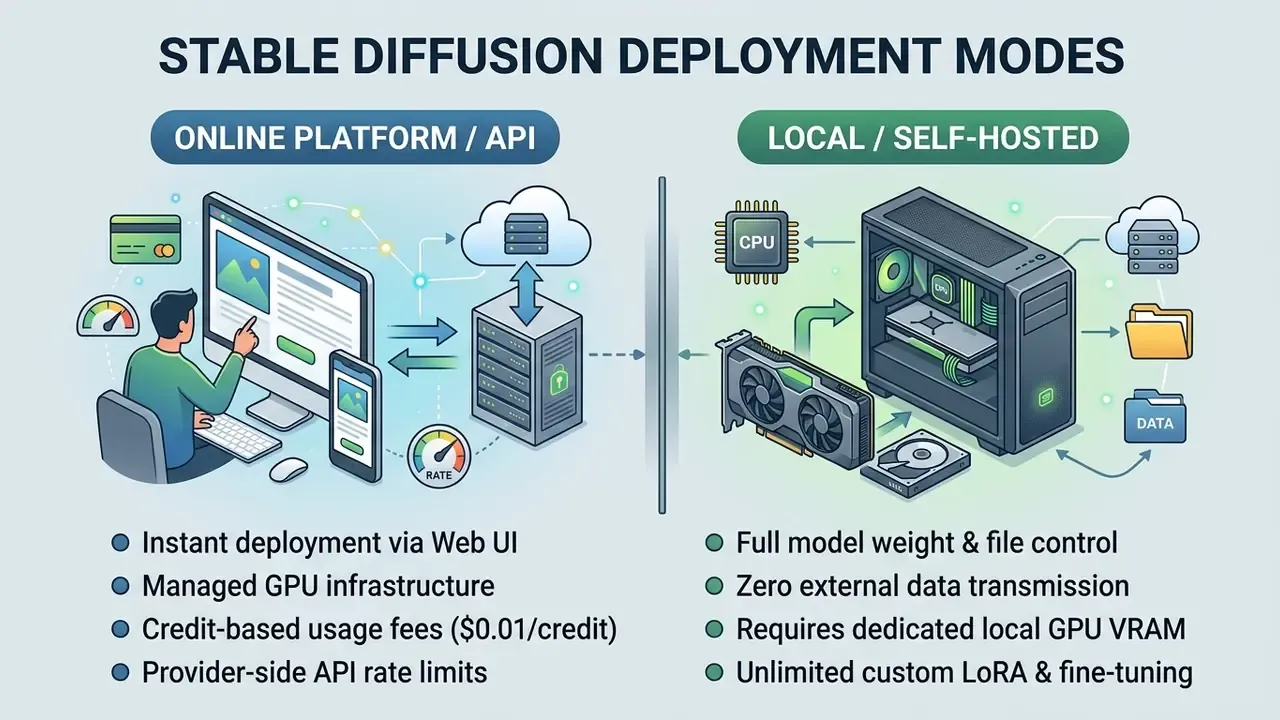
Deploying a stable diffusion ai image generation platform involves choosing between managed cloud APIs and self-hosted local infrastructure based on data privacy, fine-tuning requirements, and upfront capital expenditures.
Online AI image generator: fast start without local installation
An online ai generator stable diffusion service allows teams to launch visual generation workflows immediately without provisioning GPU hardware. Cloud platforms like the Stability AI API offer structured credit models, where new developer accounts receive a one-time allocation of 25 credits, followed by credit-based billing at approximately $0.01 per credit. Third-party GPU rental providers report cold-start times of roughly 3-5 minutes for an instance plus 1-2 minutes for the web GUI, with first-launch times of 10-20 minutes where dependencies and base checkpoints must be downloaded.
Cloud setups abstract hardware management and software dependencies, delivering initial API access in minutes. However, commercial users must evaluate provider terms regarding data retention and prompt logging. For instance, while enterprise services like AWS Bedrock guarantee that customer prompts are not stored, reviewed, or used for base model training, standard public APIs may subject inputs to external processing policies. Teams evaluating zero-friction entry points can also review no-sign-up AI image generators, with the caveat that anonymous free AI tools rarely offer contractual data-handling guarantees suitable for regulated environments.
Stable Diffusion locally: control of models, files, and fine-tuning
Running stable diffusion locally using open source interfaces such as ComfyUI or Automatic1111 grants complete operational control over model weights, pipeline code, and generation parameters. Placing model checkpoints directly on local storage enables air-gapped security, ensuring sensitive prompts and generated media never cross external network perimeters. ComfyUI's documentation confirms it runs locally, on a private server, or in the cloud, while the AUTOMATIC1111 repository documents local installation, configurable model folder locations, and browser-based execution on the host machine.
Local execution allows developers to swap specialized checkpoints, integrate custom Low-Rank Adaptation (LoRA) modules, and attach ControlNet layers for exact structural guidance. Note also that the Stable Diffusion v1.5 model card distinguishes the pruned checkpoint (suitable for further fine-tuning) from the EMA-only checkpoint (intended for inference). Choosing the wrong artifact silently blocks downstream training, and the error surfaces only when your first LoRA run fails to converge.
Step-by-Step Local Deployment Guide (Automatic1111 and ComfyUI)
How to Create Your First Image in Stable Diffusion in a Few Steps
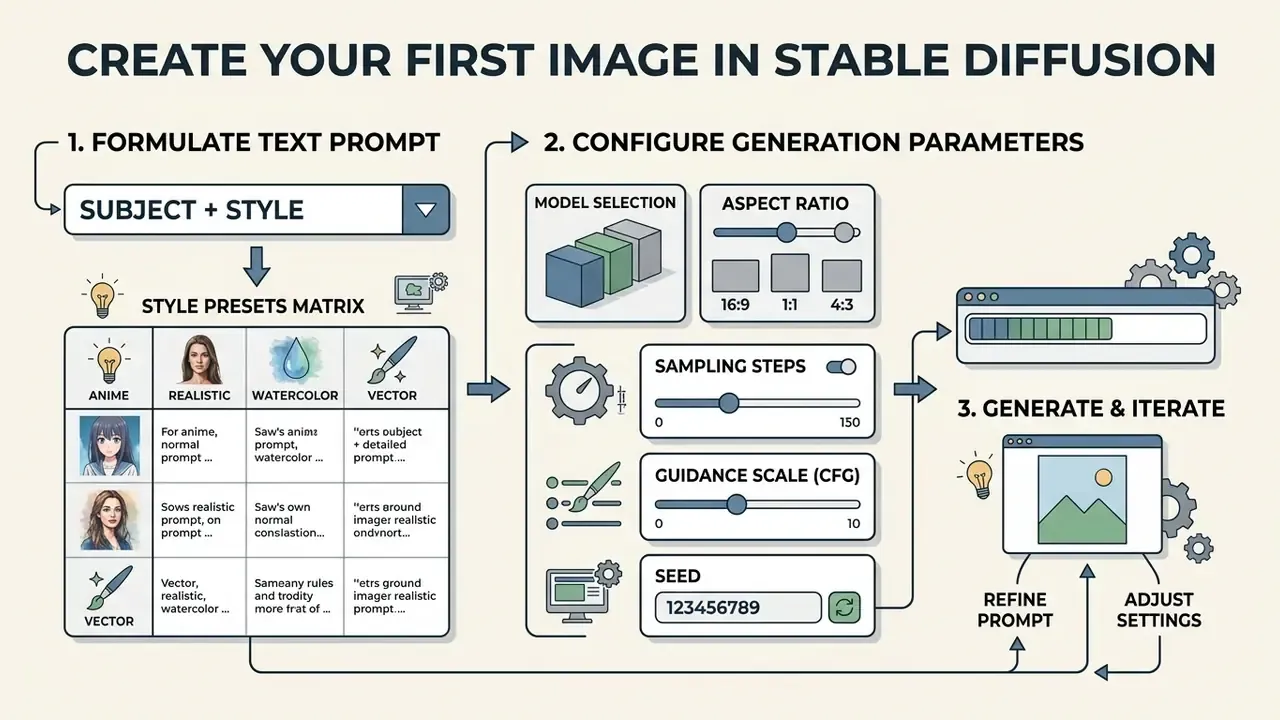
Executing a successful stable diffusion ai image generation workflow requires systematic prompt construction, parameter selection, and iterative refinement. The sequence below scales from a first test render to a production pipeline with structural conditioning. Treat it as one continuous industrial workflow rather than a beginner exercise, since the same parameter log becomes your reproducibility evidence later.
Formulate Text PromptDefine subject, environmental context, visual medium, lighting, and camera perspective using structured terminology. Expected result: a reusable prompt template, not a one-off sentence.
Configure Generation ParametersSelect model checkpoint (for example SDXL or SD 3.5), set target aspect ratio (for example 16:9), define sampling steps (28-50 steps), and set CFG scale. Expected result: a named preset your colleagues can reproduce.
Generate and RefineRun an initial generation batch, evaluate candidate outputs, apply negative prompts to eliminate artifacts, and export final high-resolution assets. Expected result: one approved asset plus the rejected variants kept for comparison.
Log the RunCapture prompt, negative prompt, seed, sampler, steps, CFG, checkpoint hash, and adapter weights as structured metadata before the asset leaves the pipeline. Expected result: an auditable record attached to the file.
Formulate a text prompt describing the subject and style
Drafting an effective text prompt requires structuring key visual elements in logical sequence: subject, context or background, medium (photograph, vector illustration), lighting, composition or viewpoint, and visual detail. Official guidance from major AI research groups converges on this ordering. Google's Vertex AI image prompt guide instructs users to start with subject, then context and background, then style, refining iteratively; OpenAI's image-model guidance recommends a consistent order of background and scene, then subject, then key details, then constraints, and notes that photorealistic prompts respond better to lens, aperture feel, lighting, framing, and viewpoint terms; Adobe Firefly documentation uses the same blocks of subject, style, angle, lighting, and camera detail.
Avoid overloading prompts with redundant buzzwords such as "hyperrealistic" or "4K". Empirical prompt evaluations demonstrate that structured, specific descriptions yield more predictable spatial compositions and cleaner visual outputs than unstructured keyword chains:
«Short structured prompts produced FID 227.69 versus 263.48 for long prompts, at comparable CLIP scores (0.3214 vs 0.3280).»
— SDXL Icon Generation Benchmark Study (2024).
A practical iteration discipline: begin with subject plus medium plus style only, add no more than two keywords per round, and generate at least four images per batch so you can separate prompt effects from seed variance. Two keywords per round sounds slow. It is faster than debugging a 40-token prompt where nothing is attributable.
Studio product photograph of [subject], 85mm lens, f/1.8 aperture, softbox studio lighting, neutral background, crisp focus, high detail texture
CFG: 5.0-6.5 | Steps: 35
Cinematic Concept Art
Cinematic still of [subject], volumetric fog, dramatic rim lighting, anamorphic lens flare, 8k resolution, color graded, moody environment
CFG: 7.0 | Steps: 40
Clean Vector / UI Graphic
Flat vector illustration of [subject], minimal line art, solid pastel colors, isolated on white background, SVG aesthetic, sharp geometric shapes
CFG: 8.0 | Steps: 25
Anime / Stylized Character
Anime illustration of [subject], cel shading, clean linework, expressive eyes, dynamic pose, detailed background, studio-quality key art
CFG: 7.0-9.0 | Steps: 30
Cyberpunk Environment
Cyberpunk street scene with [subject], neon signage, wet asphalt reflections, night, dense atmosphere, teal and magenta palette, wide angle
CFG: 7.5 | Steps: 35
Fantasy Matte Painting
Epic fantasy matte painting of [subject], golden hour light, vast scale, painterly brushwork, atmospheric perspective, intricate detail
CFG: 6.5 | Steps: 40
Editorial Portrait
Editorial portrait of [subject], 50mm lens, shallow depth of field, single key light with soft fill, neutral wardrobe, natural skin texture
CFG: 5.0 | Steps: 30
For image-to-image and inpainting work, reuse the same token structure but reduce denoising strength to 0.25-0.45 to preserve source geometry, and mask only the region you intend to alter. Teams building Ghibli-adjacent or other recognizable house styles should review the style-accuracy and usage-rights trade-offs documented in our Ghibli-style AI image generator comparison before shipping commercial work.
Configure model, aspect ratio, and generation parameters
Before initiating generation, configure the core technical parameters within your selected interface:
Model Selection Choose an appropriate checkpoint matching your task, for example SDXL Base 1.0 for general illustration, or SD 3.5 Large for text rendering.
Aspect Ratio Match output dimensions to target delivery channels: 1024×1024 for 1:1 square assets, 1344×768 for 16:9 landscape banners, 1536×640 for ultrawide 21:9, or 832×1216 for portrait layouts. Keep edge dimensions on multiples of 8 or 16 for clean latent alignment.
Sampling Steps Set standard diffusion models to 28-50 steps to ensure complete noise convergence (50 is a documented safe default for SDXL); distilled models such as SD 3.5 Turbo require exactly 4 steps, and LCM-LoRA pipelines run at 4-8 steps.
Guidance Scale (CFG) Set Classifier-Free Guidance between 4.5 and 7.5 for standard models; LCM-LoRA pipelines expect 1.0-2.0. Excessive CFG values (>12) often cause color oversaturation and visual distortion.
Seed Randomize while exploring; lock the seed the moment a composition is worth reproducing. The seed is the cheapest reproducibility control you have.
Generate variants and refine the best images created
Initiate generation in batches of four to evaluate stochastic variations produced by different random seeds. Once an optimal composition is identified, lock the random seed and perform targeted iterations.
Published refinement methods formalize this loop: IIDM repeats inference for K refinement rounds, restarting progressive denoising from the synthesized image; Test-time Image Refinement (2025) cycles generate, assess, refine, regenerate across K=3 iterations; Divide, Evaluate, and Refine (2023) allows up to K=5 iterations with early termination once an alignment score of 0.8 is reached; and ILVR (2021) defines iterative latent-variable refinement guided by a reference image. The operational takeaway is to fix an iteration ceiling and an acceptance threshold before starting, rather than iterating indefinitely. Open-ended iteration is how a two-hour task becomes a two-day task.
For advanced image editing, workflows can integrate specialized tools to ai remove background or ai remove text from initial outputs, allowing clean asset isolation before final design assembly. Post-production commonly continues with an AI image enhancer for micro-detail recovery and an AI image upscaler when print or large-format delivery requires resolutions beyond the native 1-megapixel latent output.
How to Improve the Quality of Stable Diffusion AI Generated Images
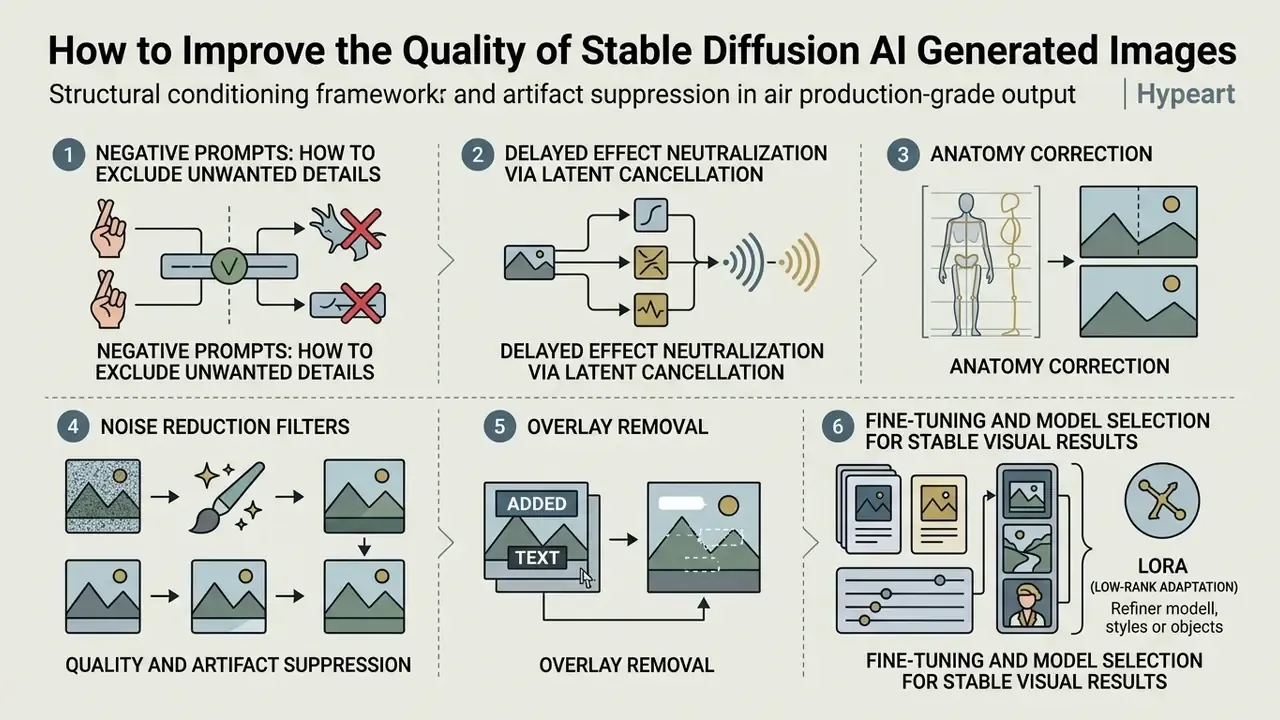
Achieving consistent, production-grade output across stable diffusion ai generated images relies on artifact suppression and structural conditioning frameworks.
Negative prompts: how to exclude unwanted details
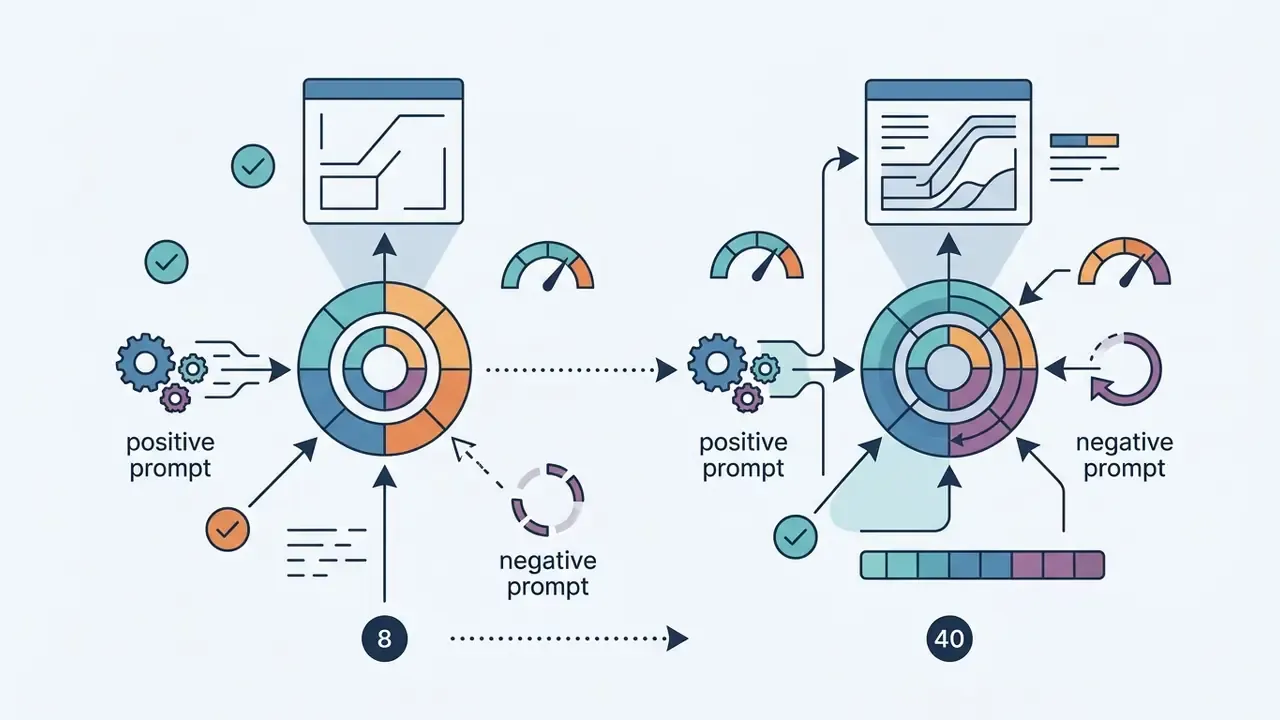
A negative prompt explicitly defines visual concepts, artifacts, or structural features that the denoising process should suppress. Systematic analysis of negative prompts reveals two core operational behaviors:
«Negative prompts begin to exert influence only after positive prompts have already rendered the corresponding content in latent space.»
— Systematic Analysis of Negative Prompts in Diffusion Models (2024).
To prevent common rendering defects, practitioners group standard negative keywords into three targeted functional clusters:
Keep these clusters versioned as named presets rather than pasted ad hoc. In a governed pipeline the negative prompt is part of the reproducibility record, not a stylistic afterthought.
Delayed EffectNegative prompts exert measurable influence only after positive prompts have rendered corresponding baseline structures in latent space, which is why suppression terms behave differently at 8 steps than at 40.
Neutralization via Latent CancellationNegative prompts function by introducing opposing latent vectors that cancel out unwanted features during intermediate denoising steps.
Anatomy Correctionbad anatomy, bad hands, extra fingers, missing fingers, deformed limbs, fused digits, extra limbs.
Fine-tuning and model selection for stable visual results
To achieve consistent visual identity across repeated commercial generations, organizations utilize specialized adaptation layers rather than relying on prompt engineering alone. The common architectural pattern in official Diffusers documentation is a frozen backbone plus targeted adapters, which preserves the validated production model while adding controllable behaviour:
LoRA (Low-Rank Adaptation) Fine tunes lightweight adapter weights on top of a frozen base model, allowing teams to train custom visual styles, corporate brand aesthetics, or specific character identities using small image datasets (15-50 images).
ControlNet Imposes structural condition maps such as Canny edge detection, depth maps, segmentation masks, or human pose skeletons over the diffusion process. ControlNet locks geometry without altering base model style parameters, and keeps base weights frozen via zero-initialized control layers.
DRaFT (Reward Fine-Tuning) Optimizes differentiable reward functions by backpropagating through the last K sampling steps.
«DRaFT optimizes differentiable reward functions via truncated backpropagation through the final K steps, substantially improving aesthetic quality.»
— DRaFT: Reward Fine-Tuning via Truncated Backpropagation (2024).
DisenBooth: Disentangles subject identity embeddings from pose and background features during fine-tuning, preserving subject consistency across varied environments.
«DisenBooth separates subject-identity embeddings from identity-irrelevant factors, preserving character consistency across different environments.» — DisenBooth: Disentangled Subject-Driven Fine-Tuning (2024).
Self-Attention Guidance (ICCV 2023): Uses intermediate self-attention maps with adversarial blur guidance to stabilize sampling and improve perceptual quality without retraining.
Noise Consistency Regularization (2025): Adds prior-consistency and subject-consistency losses during LoRA fine-tuning, preserving identity while retaining background diversity.
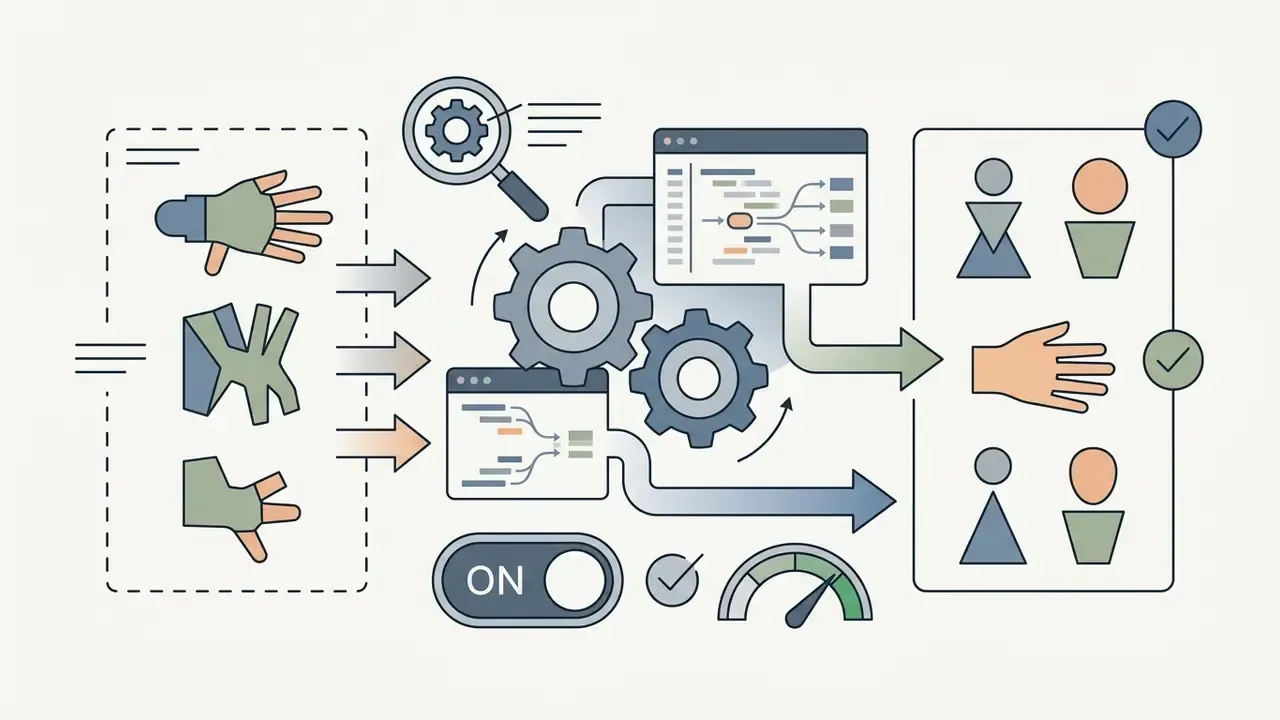
One integration caveat repeatedly breaks pipelines: an adapter or ControlNet checkpoint must match the exact base model family and the scheduler it was trained against. A mismatch does not error loudly. It silently degrades output, which is precisely the failure mode that slips past informal QA and into published assets.
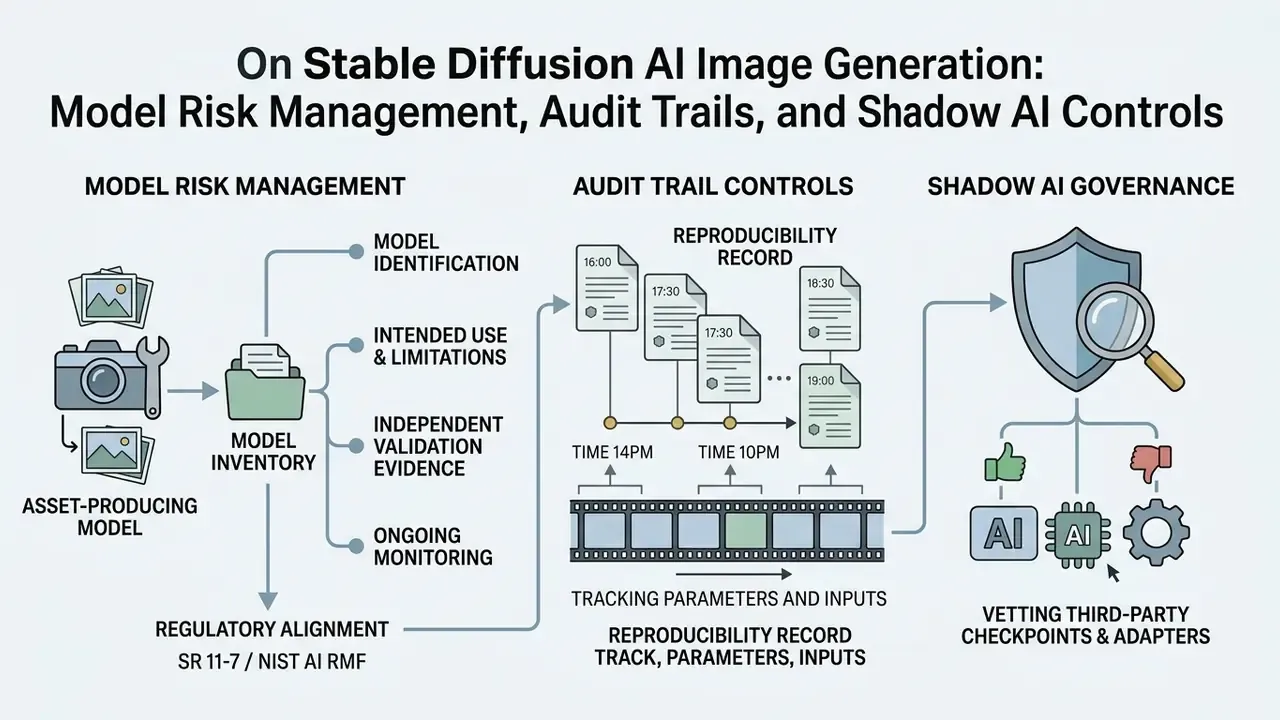
Model Risk Management, Audit Trails, and Shadow AI Controls
For regulated institutions, a generative image pipeline is not a creative tool but an asset-producing model that must enter the model inventory. The controls below translate Stable Diffusion's technical properties into the evidence that internal audit, model validation, and external examiners expect.
Placing Stable Diffusion in the model inventory (SR 11-7 / NIST AI RMF alignment)
Under supervisory model risk management expectations (Federal Reserve / OCC SR 11-7) and the NIST AI Risk Management Framework, a governed deployment requires four artifacts at minimum:
NIST's AI RMF additionally flags intellectual-property risk where generative outputs reproduce training data, and recommends reviewing and removing copyrighted material from training corpora where appropriate. That control applies directly to any internal LoRA fine-tune built on scraped reference imagery, which is exactly where most in-house brand adapters begin.
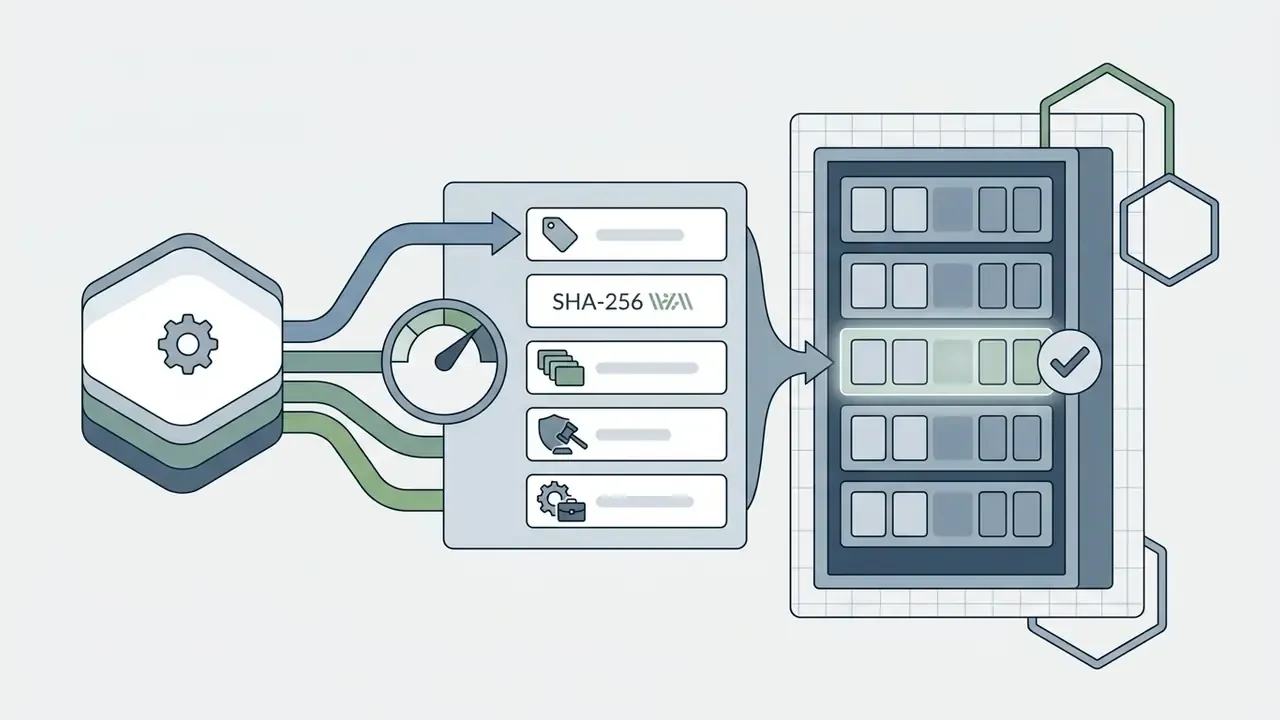
Model identificationcheckpoint name, SHA-256 hash, version, license regime, and the business process it serves.
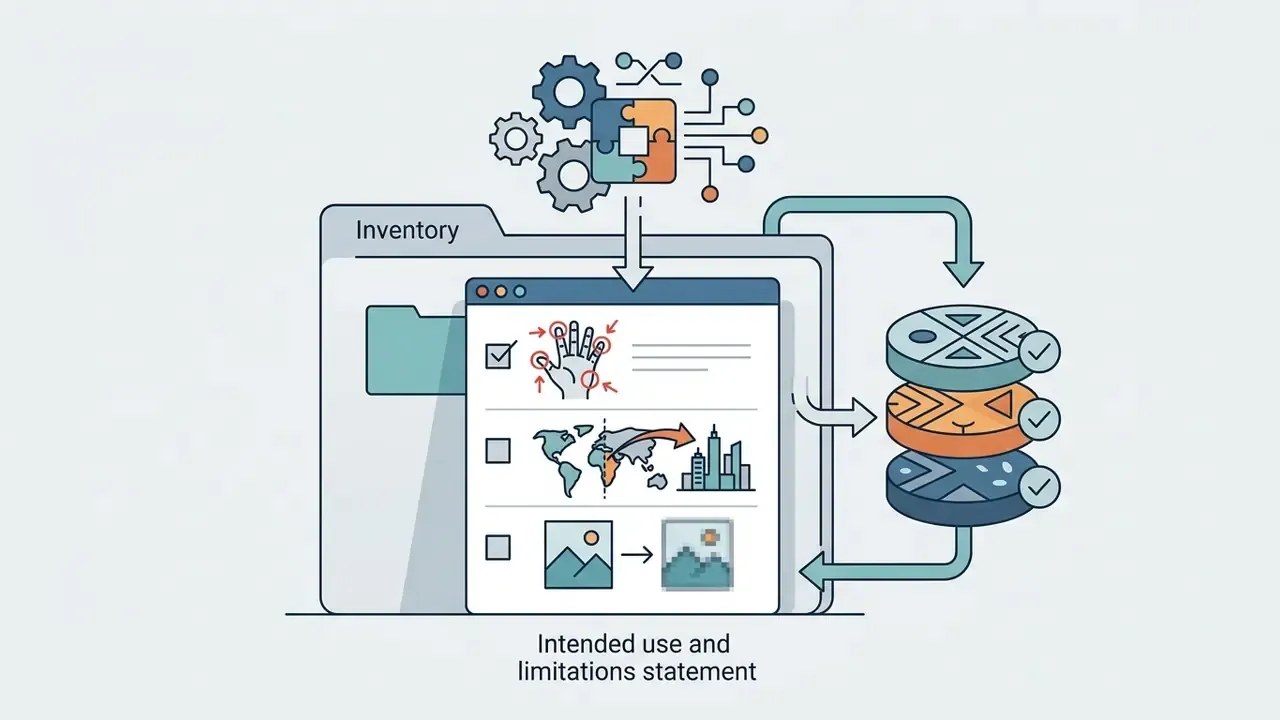
Intended use and limitations statementexplicitly documenting known failure modes, including limb and hand rendering defects, Western-cultural bias inherited from predominantly English-language training data, degradation when output resolution deviates far from native training resolution, and inability to guarantee factual or brand-accurate depiction.
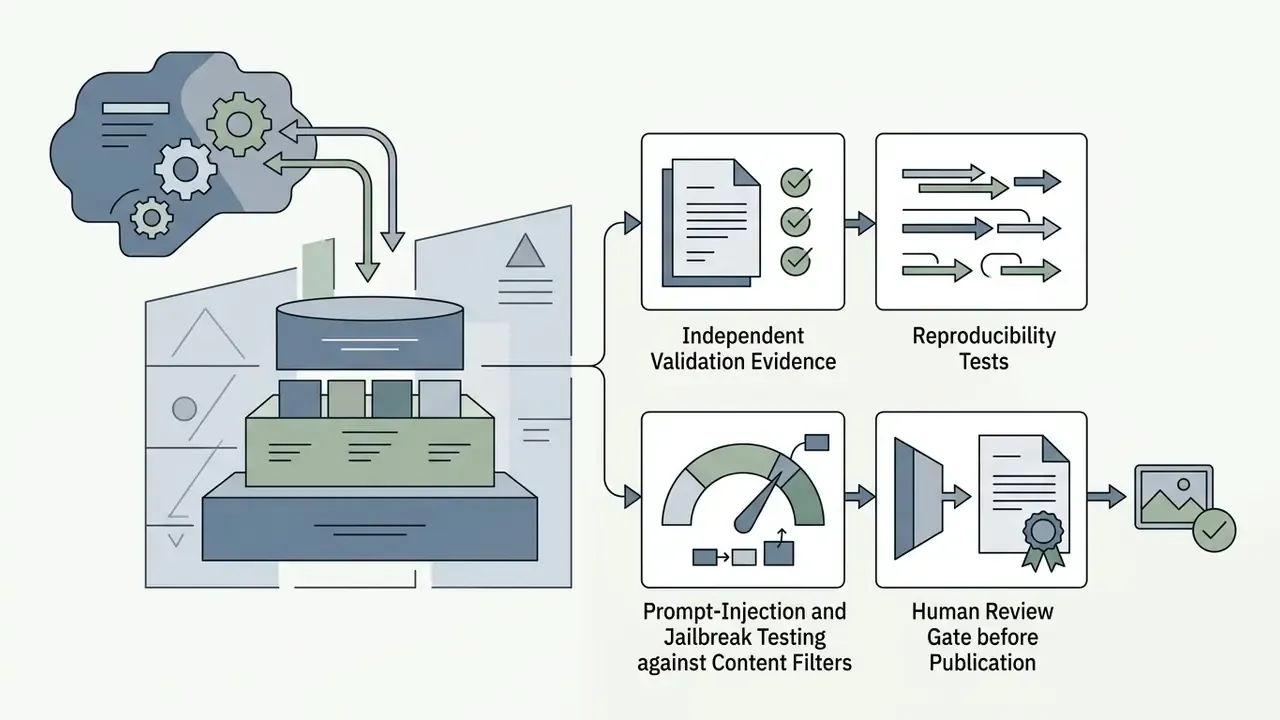
Independent validation evidencereproducibility tests, prompt-injection and jailbreak testing against content filters, and a human review gate before publication.
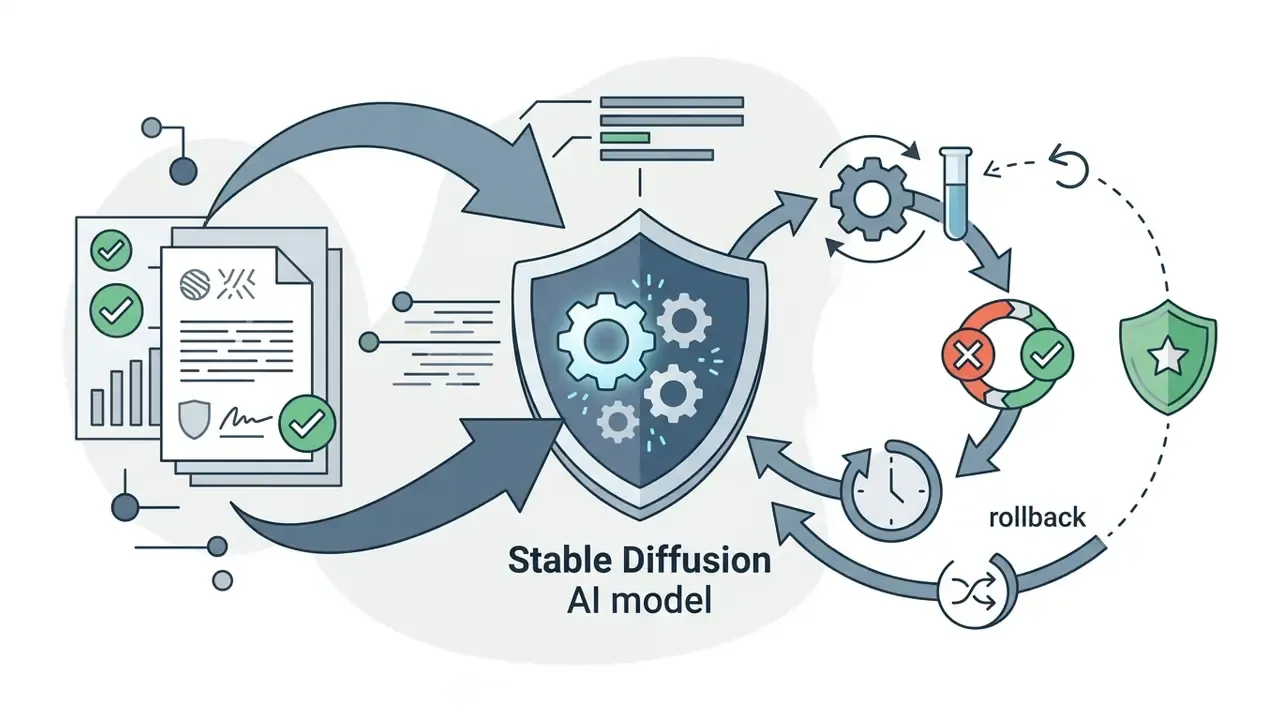
Ongoing monitoringperiodic re-testing after any checkpoint, adapter, or dependency change, with rollback to the last validated configuration.
Audit Trail Controls: the reproducibility record
Because latent diffusion is deterministic given fixed inputs, 100% reproducibility is achievable, but only if the pipeline writes the record. Persist the following structured manifest alongside every published asset:
Field
Example value
Why an auditor needs it
prompt
Studio product photograph of a matte black card, 85mm lens...
Establishes human creative direction (copyright relevance)
negative_prompt
text, watermark, extra fingers, lowres
Documents artifact-suppression controls applied
seed
284519377
Primary determinant of reproducibility
sampler / scheduler
DPM++ 2M Karras
Sampling trajectory cannot be reproduced without it
steps / cfg_scale
35 / 6.0
Quality parameters under change control
model_name + model_hash
sd_xl_base_1.0 / 31e35c80fc
Proves which licensed artifact produced the asset
lora_modules + weights
brand_style_v3:0.65
Identifies internally trained adapters and their datasets
controlnet_inputs
depth_map_v2.png
Records structural conditioning source assets
operator_id + timestamp
jdoe / 2026-08-19T14:22Z
Human accountability and change history
human_edit_log
Photoshop: composition crop, typography set
Evidence of human authorship for registration
review_status
approved_by: legal_brand_review
Publication gate evidence
Store this manifest both as sidecar JSON in your DAM and, where downstream distribution matters, embedded as signed C2PA metadata (see the provenance subsection below). Treat prompt libraries and negative-prompt presets as versioned configuration artifacts under the same change control as the checkpoints themselves.
Shadow AI Governance: vetting third-party checkpoints and adapters
The largest operational risk in an open-weight ecosystem is not the base model. It is the thousands of community checkpoints and LoRAs on public hubs, downloaded informally by staff on personal machines. A minimum control set:
Checklist0 / 8
Total Cost of Ownership and Risk-Adjusted ROI
Comparing "free local inference" against per-credit API pricing understates cost by omitting the control function, which in regulated institutions is usually the dominant line item. Use the structure below to build a defensible business case.
where Eresidual risk is the expected annual loss from residual IP, reputational, and compliance exposure (probability multiplied by impact), estimated jointly with legal and operational risk.
Cost / value component
Local self-hosted pipeline
Managed cloud API
Compute (CAPEX/OPEX)
Workstation or server GPU with at least 12 GB VRAM, plus power, cooling, refresh cycle
Usage-based; Stability AI platform bills in credits at ~$0.01/credit after a one-time 25-credit allocation
Reduced scope but still required: vendor due diligence, output review, data-handling assessment
Legal and IP review
Dataset provenance review for internal fine-tunes; output clearance
Output clearance; contractual review of training-data and indemnity terms
Data residency value
High; air-gapped operation keeps prompts and reference assets internal
Depends on provider commitments (Bedrock, for example, states prompts are not stored or used for training)
Latency / throughput control
Full control; no rate limits
Provider rate limits and queueing
Productivity value
Unlimited iterations at marginal cost; custom LoRA brand consistency
Fast start, zero infrastructure lead time
Practical guidance: pilot on a managed API to validate the use case and measure real iteration volume, then model the break-even against self-hosting once monthly generation volume and fine-tuning requirements are known. Institutions above the $1M revenue threshold should secure Enterprise licensing before production launch. Retrofitting a license after assets have shipped is a compliance finding, not a procurement task.
One caveat on the formula. Most first-pass ROI models we see omit Eresidual risk entirely, because nobody wants to be the person who assigns a number to reputational exposure. Assign a conservative range instead of zero, and record the assumption.
Stable Diffusion for Commercial Tasks: Who Is the AI Generator For
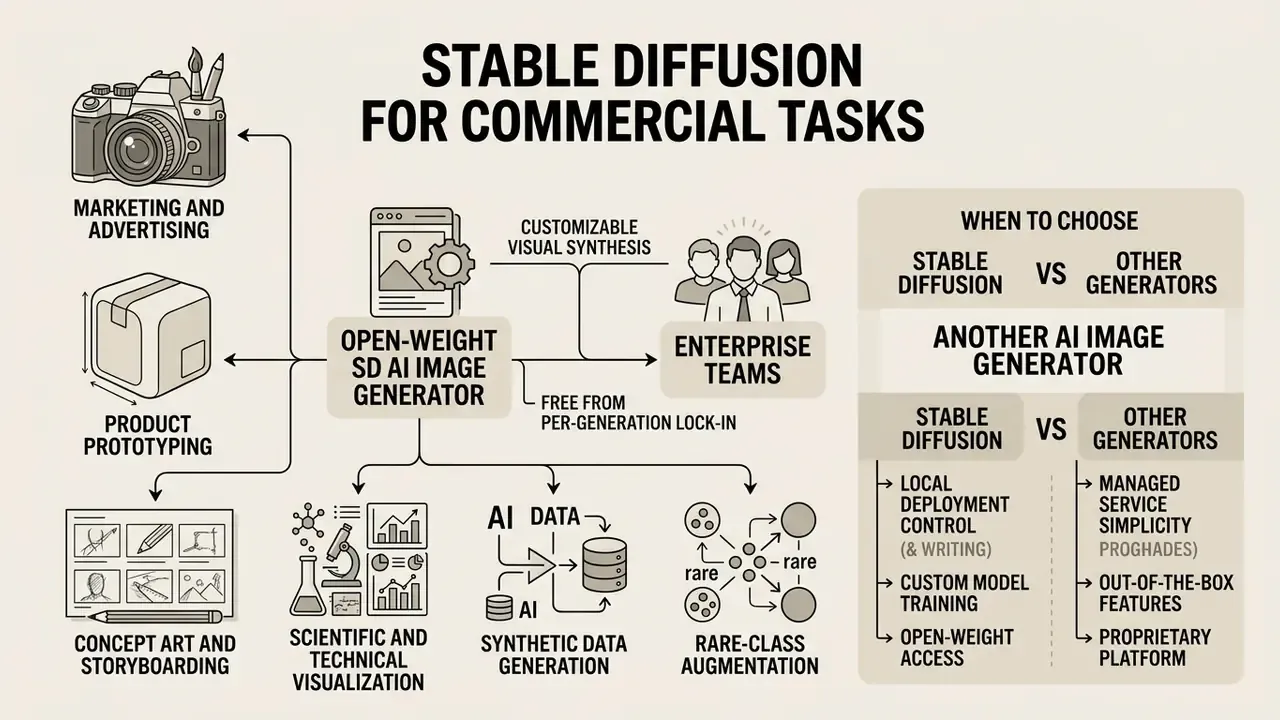
An open-weight sd ai image generator provides enterprise teams with customizable visual synthesis capabilities free from per-generation platform lock-in.
Use cases: concept art, content, and visual prototypes
Commercial adoption of stable diffusion ai art generator technology spans multiple operational domains:
Marketing and AdvertisingRapid production of ad creative variations, social media graphics, website imagery, and promotional campaign visuals, documented by AWS as direct use cases for SD 3.5 Large across media, gaming, advertising, and retail. Teams building out this function can compare tooling among AI image generators for marketing and platform-native options such as the Canva AI generator.
Product PrototypingGenerating preliminary physical product concepts, packaging mockups, and industrial design references before committing to CAD or photography spend.
Concept Art and StoryboardingPre-visualization of environments, mood boards, and narrative scenes for media production, a workflow where reviewers should also compare dedicated AI art generators for style breadth.
Scientific and Technical VisualizationIllustrative rendering for research communication and training material, including domain-adapted pipelines in medical and remote-sensing research.
Synthetic Data GenerationCreating high-resolution 1024×1024 training datasets to train downstream computer vision models.
«SynthVLM uses SDXL to synthesize 1024×1024 images from 1M filtered captions, eliminating the low-resolution limitation of existing datasets.»
— SynthVLM: High-Resolution Synthetic Dataset via SDXL (2024).
Rare-Class Augmentation: LoRA plus ControlNet pipelines are used in published 2025-2026 work to synthesize layout-locked examples of under-represented classes for classifier training.
Teams exploring specialized domain applications can evaluate our detailed analysis of ai rendering generator tools for spatial design workflows.
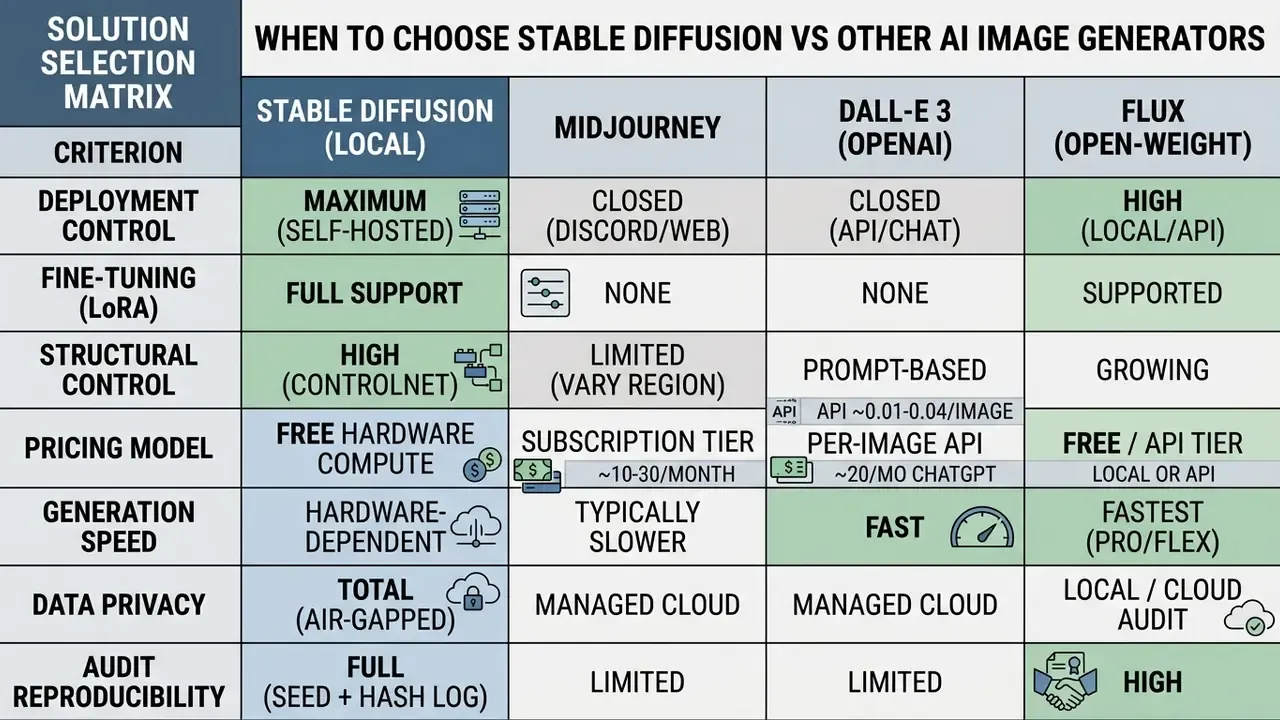
When to choose Stable Diffusion vs another AI image generator
Stable Diffusion is the optimal choice when organizations require local data privacy, custom LoRA model fine tuning, deterministic reproducibility for audit, and direct code-level integration. Conversely, platforms like Midjourney image generation excel at out-of-the-box artistic styling and emotion-driven brand work, while DALL·E 3 offers simplified natural language prompt handling and strong prompt alignment for casual users. The same trade-off is visible when evaluating ChatGPT picture generation, the Microsoft AI image generator, and the Google AI image generator. Note that published price and speed comparisons diverge because they benchmark different model versions, local versus API execution, and different hardware; re-run the comparison on your own configuration before relying on the numbers.
For comprehensive comparative evaluations across standalone creative tools, review our benchmark guide on the best AI art generators.
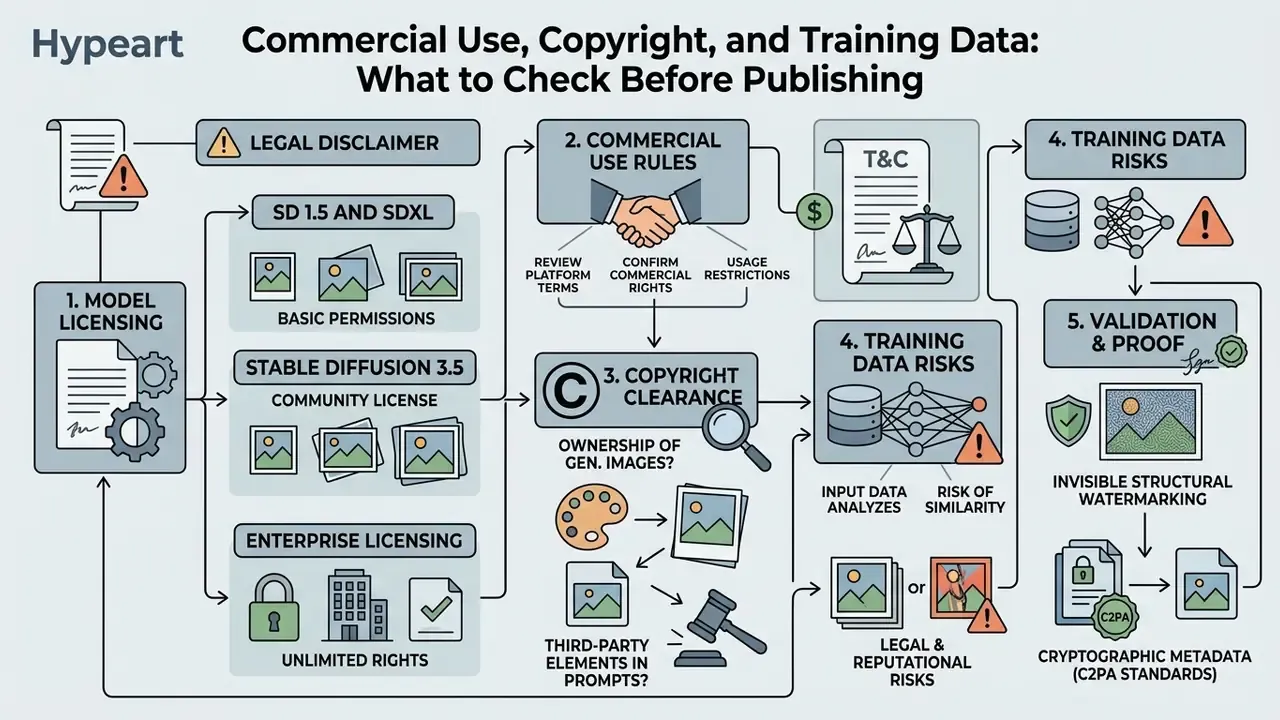
Commercial Use, Copyright, and Training Data: What to Check Before Publishing
Deploying generative models within enterprise workflows requires strict model risk management, intellectual property evaluation, and licensing compliance.
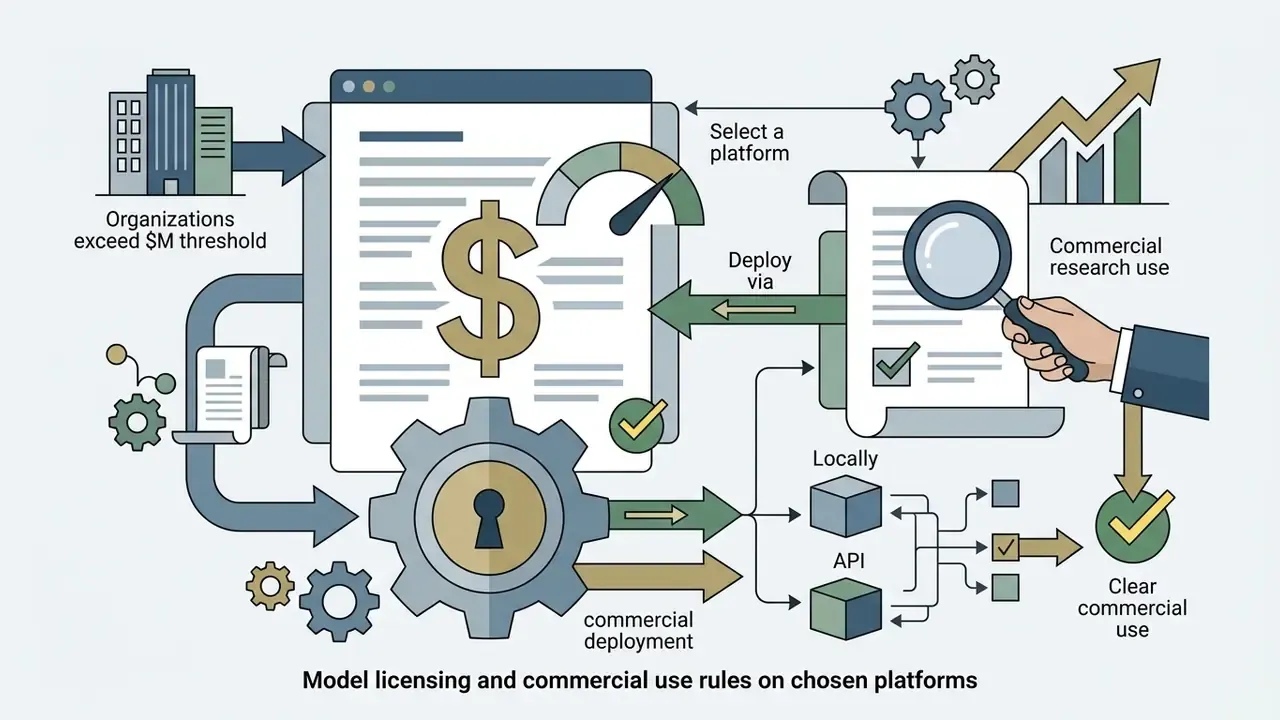
Model licensing and commercial use rules on chosen platforms
Commercial deployment rights depend strictly on the specific model checkpoint version and deployment architecture:
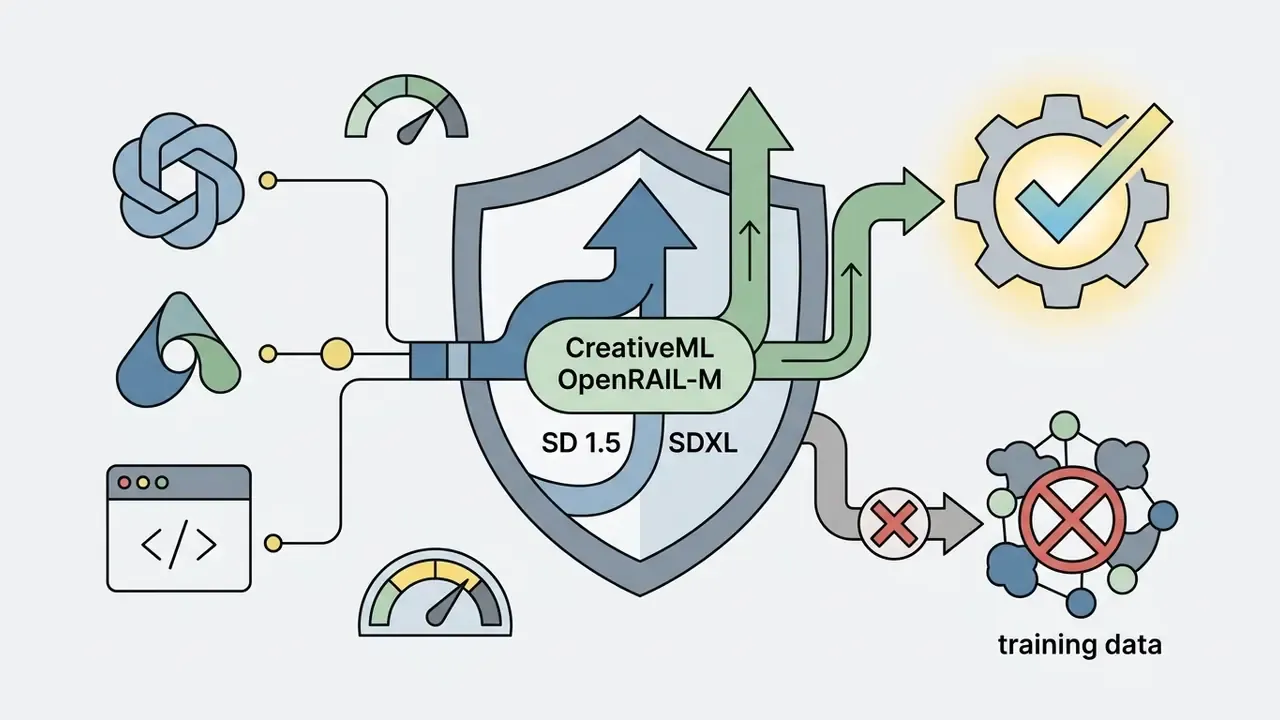
SD 1.5 and SDXLReleased under CreativeML OpenRAIL-M licenses, permitting broad commercial use of outputs, subject to standard use-restriction and distribution obligations. Note that the model license explicitly does not license the underlying training Data, only the model and its derivatives.
Stable Diffusion 3.5 (Community License)Stability AI permits free commercial deployment for individuals and corporate entities with annual aggregate revenues below USD $1,000,000.
Enterprise LicensingOrganizations exceeding USD $1M in annual revenue must acquire a paid Enterprise License from Stability AI prior to commercial deployment of Core Models. Commercial research use additionally requires registration.
«The Community License permits commercial use of SD3 and SD3.5 for organizations with annual revenue below USD $1M without licensing fees.»
Stability AI further states that users retain ownership of generated outputs and will not be asked to delete resulting images or fine-tunes where they remain compliant with the license and Acceptable Use Policy. Where older documentation and newer license pages appear to conflict, the governing rule is determined by the specific checkpoint version and hosting terms, not the brand name: SD 1.x and SDXL under OpenRAIL-M are broadly permissive, while SD 3.x Core Models are revenue-gated.
Training data, existing images, and legal/reputational risks
Commercial users must navigate evolving legal standards regarding model training data and copyright eligibility:
Training Dataset Litigation: Foundation models trained on public datasets such as LAION-5B, from which Stable Diffusion's image and caption pairs were drawn and filtered by language, resolution, watermark probability, and aesthetic score, remain subject to ongoing copyright litigation, most prominently Getty Images v. Stability AI in the US and UK. Congressional Research Service analysis notes several dozen lawsuits over training-data copying, with some uses potentially qualifying as fair use and others not. Outcomes remain case-specific and unresolved, so organizations must assess institutional risk appetite accordingly. Separate reporting has also found that LAION datasets contain substantial private and sensitive material, which is itself a privacy-risk consideration independent of copyright.
Copyright Ownership of Outputs: Under US Copyright Office guidance and federal court rulings (Thaler v. Perlmutter), purely AI generated images lacking human creative authorship are ineligible for copyright registration. Establishing copyright protection requires human selection, arrangement, or creative modification, which is exactly why the human_edit_log field in your audit manifest carries legal, not merely operational, value.
«Human authorship remains a mandatory legal requirement for copyright registration of visual works.» — US Copyright Office, AI Policy Report. https://www.copyright.gov/ai/
Restricted Content Filters: Enterprise deployments must implement content safety filters to prevent generating unauthorized trademarks, non-consensual imagery, or policy-violating content. Specialized review guides examine compliance boundaries for sensitive generation types, including ai nsfw generator and ai porn image risk considerations.
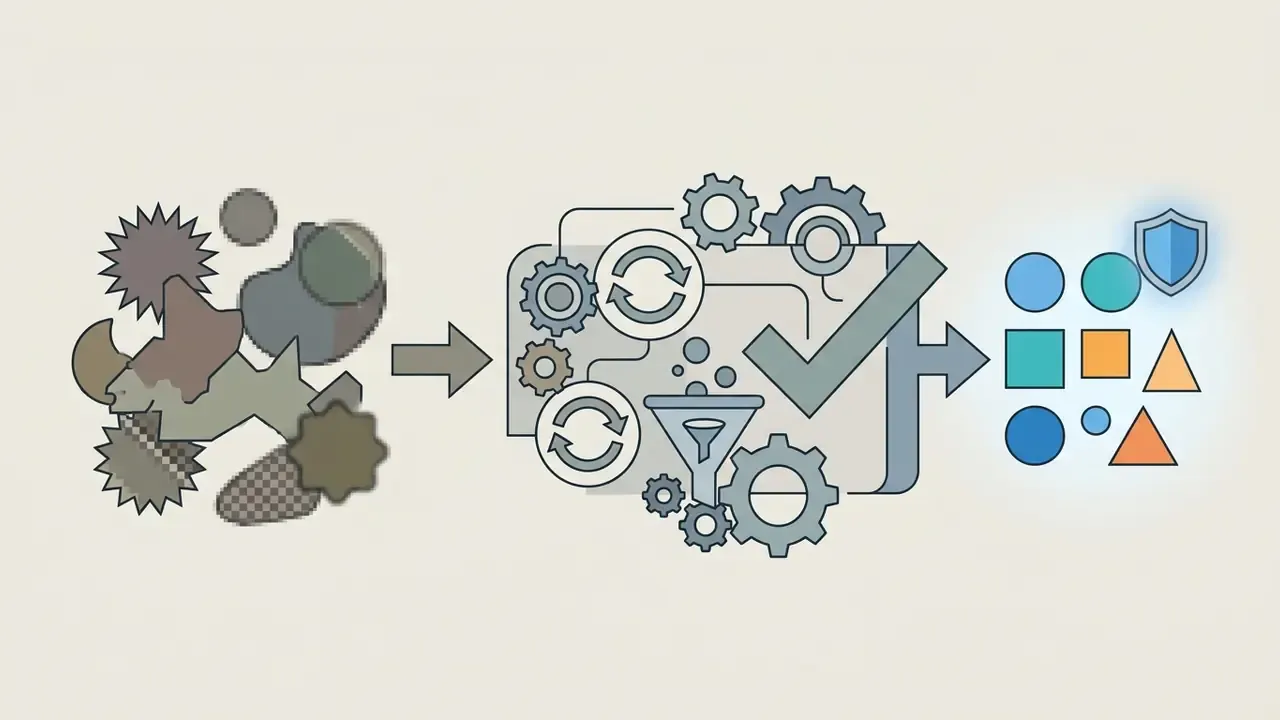
For brand verification workflows, organizations can utilize an ai reverse image utility to audit visual uniqueness prior to public distribution, and an AI image detector to verify whether inbound third-party assets are themselves synthetic.
AI Asset Provenance: Invisible Watermarking and C2PA Compliance
E-E-A-T Legal and Licensing Verification
FAQ: Frequently Asked Questions About Stable Diffusion AI Image Generator
How should Stable Diffusion be classified in a bank's model inventory under SR 11-7?
Treat the generation pipeline, not the individual checkpoint, as the registered model. Register the base checkpoint hash, all adapters (LoRA, ControlNet), the sampler configuration, and the human review gate as one bundled model entry with a documented intended-use statement, known limitations, independent validation evidence, and a monitoring plan. Because outputs are marketing or design artifacts rather than credit or capital decisions, most institutions assign a lower materiality tier. The reproducibility, content-safety, and IP controls still apply, and NIST AI RMF guidance explicitly covers IP risk from outputs that reproduce training data.
What metadata must be logged to make a generated image reproducible for auditors?
At minimum: prompt, negative prompt, seed, sampler or scheduler, steps, CFG scale, resolution, base model name and SHA-256 hash, every adapter with its weight, all ControlNet conditioning inputs, operator ID, timestamp, the human edit log, and the review approval record. Persist this as sidecar JSON in the DAM and, where assets are distributed externally, as a signed C2PA manifest embedded in the file. Given fixed inputs, latent diffusion is deterministic, so a complete manifest allows a validator to regenerate a byte-comparable asset months later.
How do we prevent Shadow AI, with staff pulling unvetted checkpoints from public hubs?
Combine technical and supply-side controls: enforce a safetensors-only allowlist to eliminate pickle-payload execution risk, restrict downloads to verified Stability AI, CompVis, and official Hugging Face organizations, require SHA-256 registration and license classification at intake, test each artifact against your prohibited-content taxonomy, block outbound egress from inference hosts after provisioning, and reconcile model directories against the approved manifest on a schedule. Most importantly, publish a sanctioned internal endpoint with an approved prompt library. Shadow AI is almost always unmet demand rather than deliberate circumvention.
Can our institution use Stable Diffusion 3.5 commercially without an Enterprise License?
Only if annual aggregate revenue is below USD $1,000,000 under the Stability AI Community License. Above that threshold, an Enterprise License must be in place before commercial deployment of Core Models; commercial research use additionally requires registration. Older SD 1.5 and SDXL checkpoints under CreativeML OpenRAIL-M are not revenue-gated in the same way, which is why license classification must be recorded per checkpoint rather than per vendor. Confirm current terms at https://stability.ai/license and route the determination through counsel.
Are images generated by Stable Diffusion protected by copyright?
Not on their own. US Copyright Office guidance and Thaler v. Perlmutter establish that human authorship is a prerequisite for registration, so a purely AI-generated output is ineligible. Protection attaches to human creative contribution: selection, arrangement, compositing, retouching, typography, or substantive modification. That is why the human edit log is a legal artifact and not only an operational one. Stability AI separately states that users retain ownership of outputs under its license, but vendor ownership language and statutory copyrightability are distinct questions.
Does Stable Diffusion cost anything, and is there a genuinely free AI tier?
The weights themselves are free to download, and local inference costs only electricity plus the GPU you already own. So yes, there is a free AI path, provided you accept the hardware and maintenance burden. Managed access differs: the Stability AI platform grants a one-time 25-credit allocation to new developer accounts, then bills roughly $0.01 per credit. What is never free in a regulated setting is the control layer around the model, which is why the total-cost section above separates compute from validation, monitoring, and legal review.
Can Stable Diffusion run fully offline in an air-gapped environment?
Yes. Internet access is required only to obtain the code and weights initially. After setup, inference runs entirely on the local GPU through the local web interface at http://127.0.0.1:7860, with no outbound calls required. For regulated deployments, block egress from the inference host post-provisioning and disable auto-updating extensions so that dependency changes go through change control rather than arriving silently.
What hardware do we actually need, and is 12 GB VRAM mandatory?
No. Full-precision inference is demanding, but half-precision (FP16) and quantized (FP8/INT8) weight loading, combined with --medvram or --lowvram flags, bring SDXL down to roughly 4-6 GB VRAM with negligible visual degradation. Distilled SD 1.5 checkpoints compiled via TensorRT can run within about 2.4 GB. Published VRAM figures diverge because some count only the diffusion core and others include the text encoders, so profile your own configuration before finalizing an infrastructure budget.
How reliable is the invisible watermark for detecting our own generated assets?
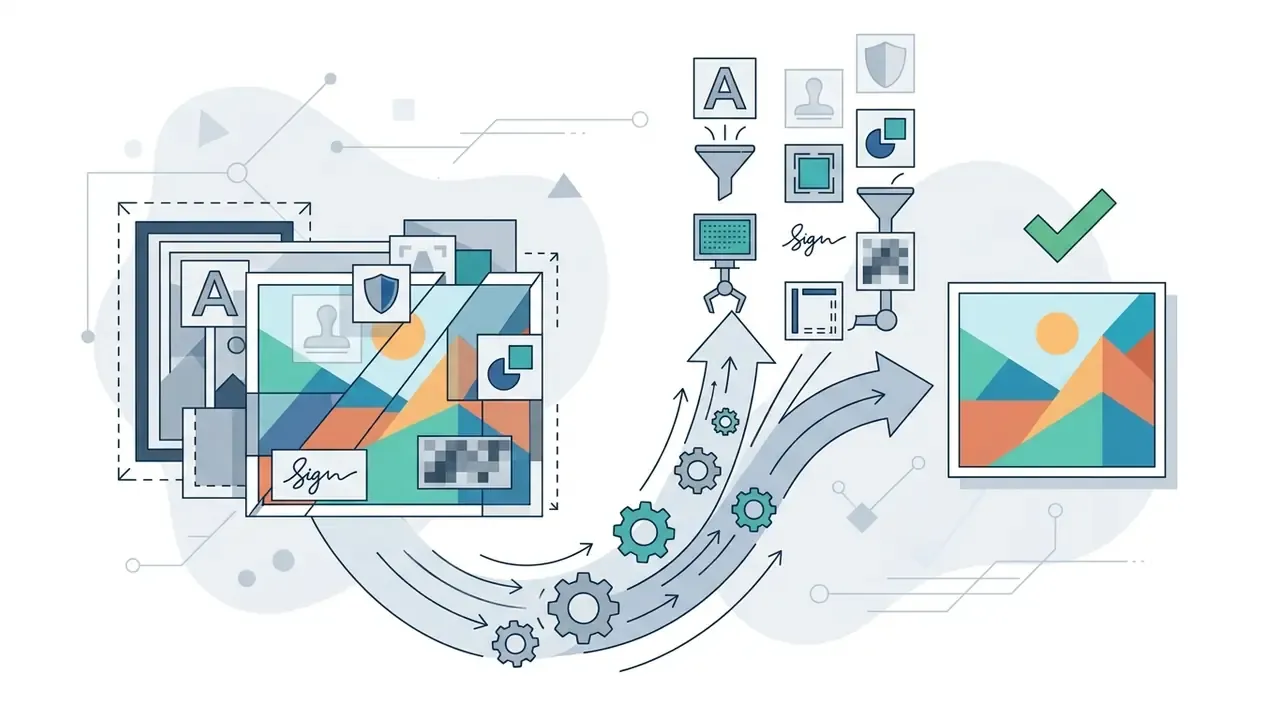
Useful but not sufficient. Reference Stable Diffusion scripts embed an invisible frequency-domain watermark, but it loses efficacy when images are resized, rotated, cropped, or heavily compressed, all routine operations in a publishing workflow. Layer cryptographically signed C2PA provenance manifests on top, and maintain your own hash registry of published assets rather than relying on steganographic marking alone.
What common spelling variants like Stable difusion and Stable difussion mean
Common search queries containing typographical errors such as "Stable difusion" or "Stable difussion" refer directly to the official open-weight stable diffusion model family initially developed by the CompVis Group at LMU Munich and expanded by Stability AI. These misspellings typically stem from informal forum references, transcription from memory, and the fact that the same model family is published across multiple official hubs (CompVis, Stability AI, Hugging Face) under different repository names and version numbers. Unfortunately, misspelled-brand queries are also a reliable magnet for unofficial mirror sites distributing modified or malware-bearing checkpoints. To ensure software security and model integrity, download model weights solely from verified repositories on Hugging Face or official Stability AI channels, prefer .safetensors artifacts, and verify file hashes before loading. Readers new to the terminology can start with our AI art generator glossary entry, and those tracking the legal landscape can review emerging generative-AI precedent in the litigation hub.
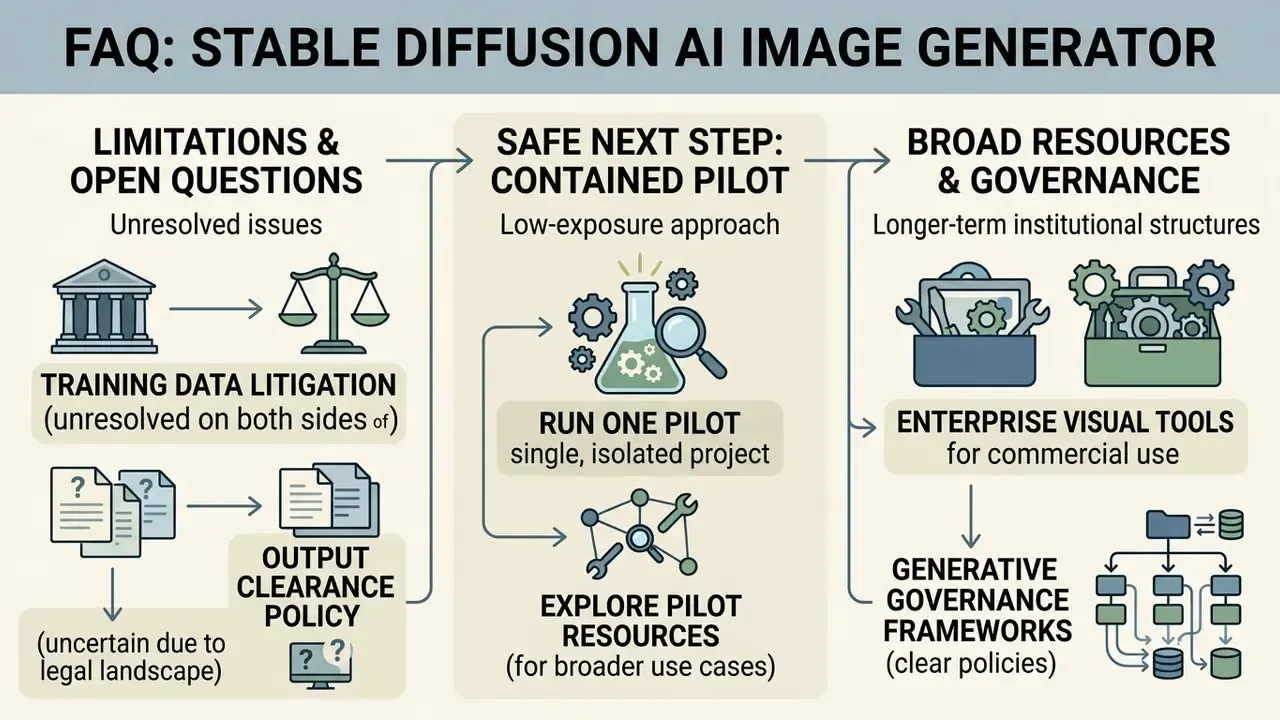
Limitations, Open Questions, and a Safe Next Step
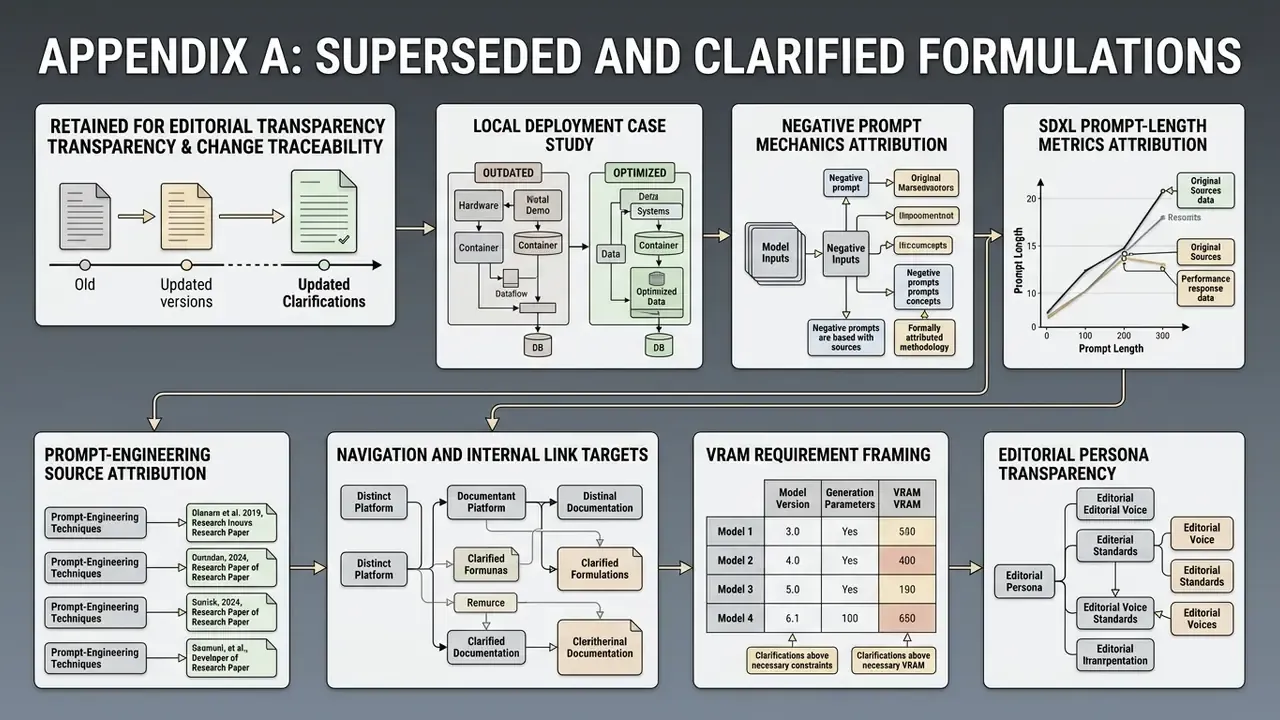
Appendix A: Superseded and Clarified Formulations
Retained for editorial transparency and change traceability. Each item below shows the earlier formulation and the clarification applied in the current version.
Local deployment case study. Earlier formulation: "In a representative hypothetical case, a financial marketing team… reduced visual iteration time from four days to six hours while maintaining complete compliance with data protection policies." Clarified: the scenario is now explicitly labelled illustrative and constructed for guidance, the compliance claim is qualified by an external disclaimer, and directional support is attributed to published 2025 advertising-workflow research rather than presented as verified internal outcome data.
Negative prompt mechanics attribution. Earlier formulation: "Empirical research on negative prompt mechanics (2024) reveals two core operational behaviors." Clarified: attributed to Systematic Analysis of Negative Prompts in Diffusion Models (2024) with a direct quotation of the delayed-effect mechanism.
SDXL prompt-length metrics attribution. Earlier formulation: "When evaluating icon generation benchmarks, shorter prompts paired with class conditioning achieved lower FID scores (227.69) compared to longer prompts (263.48)." Clarified: attributed to the SDXL Icon Generation Benchmark Study (2024), with the CLIP-score counter-trend (0.3214 vs 0.3280) now disclosed so the trade-off is not overstated.
Prompt-engineering source attribution. Earlier formulation: "Official guidance from AI research groups highlights that adding precise descriptors… improves output alignment." Clarified: named to Google Vertex AI, OpenAI image-model guidance, and Adobe Firefly documentation.
Navigation and internal link targets. Earlier formulation: a spelling-variants answer pointed a generic navigational anchor at the litigation hub, and the article opened with an anchor-linked table of contents. Clarified: the glossary link now carries the terminology intent, the litigation hub is referenced with a descriptive anchor, and the anchor-based contents list was replaced with a short reader-orientation section.
VRAM requirement framing. Earlier formulation: the model table presented 8 GB-12 GB consumer GPU and 9.9 GB+ as hard requirements. Clarified: half-precision and quantized low-VRAM pathways are documented, and the source of published-figure variance (core weights versus inclusion of text encoders) is disclosed.
author transparency. Earlier formulation: the opening quotation was labelled "author." Marcus Hale, author.