Last updated: February 2026 · Reviewed for: performance marketers, creative operations leads, agency media buyers, and enterprise risk or compliance reviewers evaluating generative creative tooling.
Executive Summary
- What it is an AI commercial generator is a script-to-asset pipeline. It converts text briefs, product photos, catalog feeds, or store URLs into finished 6-, 15-, 20-, and 30-second video ads for social, mobile, and connected-TV placements.
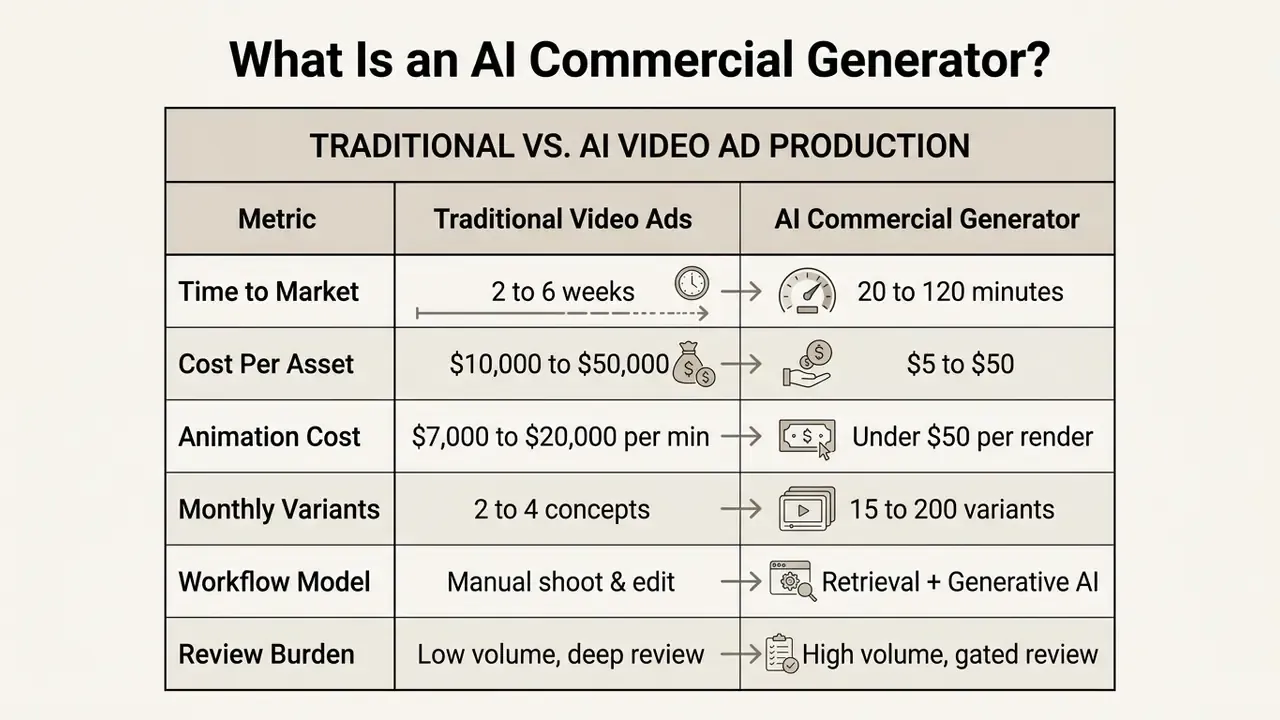
- Economics traditional 30-second commercial production runs $10,000 to $50,000 per asset over 2 to 6 weeks. Custom 2D/3D studio animation runs $7,000 to $20,000 per finished minute. AI-generated equivalents land at $5 to $50 per render in 20 to 120 minutes.
- Throughput manual workflows realistically test 2 to 4 creative concepts per month. Batch generation produces 50 to 200 variants per brief, and that variant volume is where most of the measured performance lift actually comes from.
- Evidence randomized field experiments report sales uplifts up to 16.3% from generative AI in commerce workflows. AI-generated visual creatives have outperformed professional stock imagery by up to 50% CTR in field tests.
- Controls that matter human review gates, an AI-disclosure policy, commercial licensing verification, non-training data clauses, SSO, audit logs, and synthetic-voice or likeness consent records.
- Where teams go wrong treating generation speed as the deliverable. The deliverable is an approved, licensed, measurable asset. Which means governance cost belongs inside your ROI model, not outside it.
How to read this guide. The first three sections answer the "what and who" question: definitions, output types, and buyer profiles. The middle sections are operational, covering the production pipeline, feature-level quality controls, and platform specifications. The last three sections are for the people who sign the contract: free versus paid limits, vendor risk scoring, risk-adjusted ROI, and the regulatory checklist. If you own model risk rather than media spend, start at the vendor evaluation matrix and read backwards.
What Is an AI Commercial Generator?
An AI commercial generator is an automated software system that turns raw data inputs, such as text prompts, static product photos, store URLs, and brand style guides, into finished multi-format video advertisements.
Traditional manual video production needs physical shoots, actors, manual timeline cutting, and weeks of post-production. An ad creator ai instead synthesizes visual frames, voiceovers, background music, and text overlays in minutes.
The core difference between conventional production and an ad maker ai shows up in three numbers: speed, cost, and iteration volume. Traditional commercial creation often takes 2 to 6 weeks per asset and thousands of dollars. An advertisement ai maker can output campaign-ready video ads in 20 to 50 minutes at a fraction of that operational cost. Documented workflows put full end-to-end production at 20 to 50 minutes for a single finished ad, or roughly two hours once brand setup is complete.
Custom 2D motion graphics or 3D product renders typically demand specialized agency budgets between $7,000 and $20,000 per finished minute. An AI ad creator bypasses studio rendering farms by using generative neural networks, lowering the cost of dynamic 3D-style animated spots to under $50 per render and cutting turnaround from weeks to minutes. Teams comparing hand-built motion graphics against generative output can review our animation maker guide for creation methods, template libraries, and export options.
The empirical evidence supports a throughput argument, not a "magic quality" argument:
"Randomized field experiments on a large cross-border commerce platform recorded sales uplifts of up to 16.3% when generative AI was embedded into advertising and search workflows."
The mechanism is not that AI writes better copy than a senior creative director. It is that AI enables rapid testing of high-relevance creative variants, and variant volume is what surfaces winning hooks. Volume, not genius.
What Can an AI Ad Maker Create?
An ad video creator produces three main categories of commercial video assets built for digital media channels:
- Product showcase ads video clips generated directly from product landing pages or static photos. They carry product-in-hand demonstrations, feature callouts, unboxing simulations, tutorial cuts, and lifestyle context scenes.
- UGC-style social video mobile-first content featuring AI digital avatars or synthetic actors delivering direct-to-camera testimonials, problem-solution scripts, and talking-head reviews with burnt-in captions.
- Brand promotional clips polished, cinematic spots with high-resolution visuals, custom motion graphics, synchronized voiceovers, and strict brand guideline controls covering logos, corporate palettes, and typography.
When planning creative formats, teams often review specialized editing options or browse the hub for enterprise licensing guidelines, mainly to confirm media usage rights across paid channels before a launch date is locked.
AI Generation, Templates, and Video Editing
A modern ad video generator platform combines three operational layers inside one web-based interface:
- Generative AI engine text-to-video, image-to-video, and text-to-speech models that synthesize raw visual frames and audio tracks. Teams evaluating engine capability should compare text-to-video AI tools and image-to-video AI separately, because image-conditioned generation delivers materially better brand and product consistency than pure text prompting.
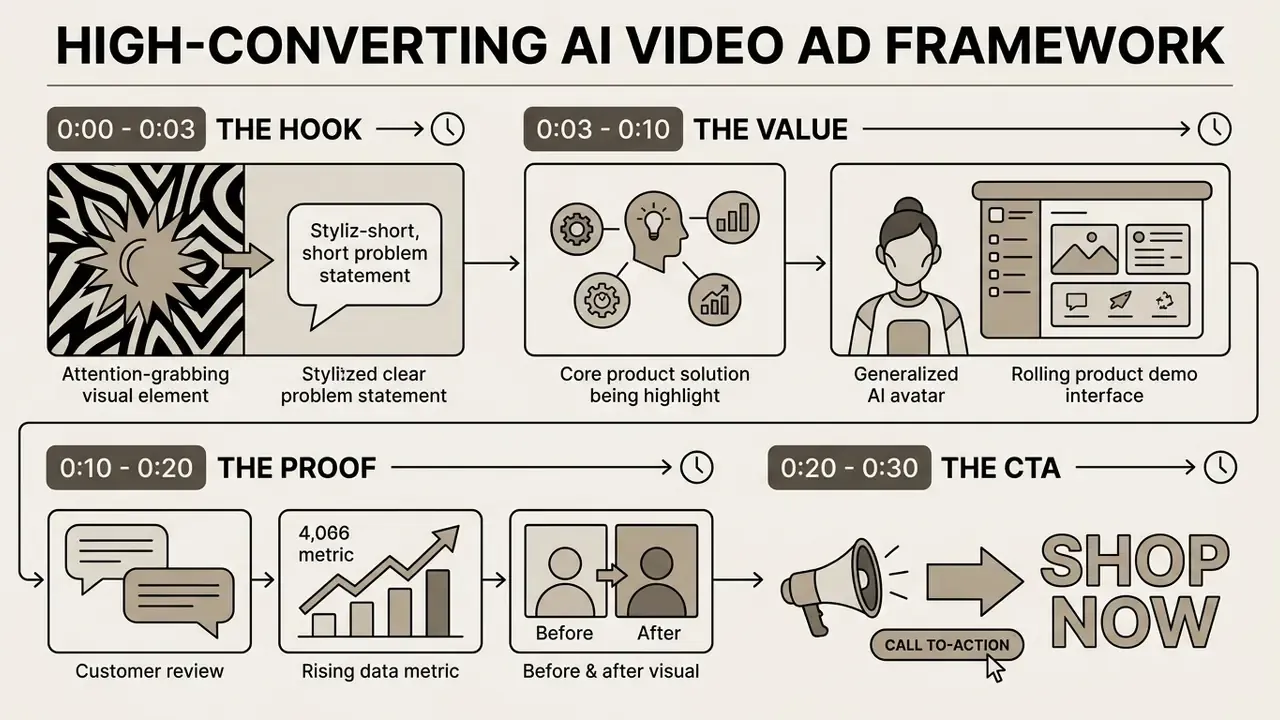
- Pre-designed ad templates structural storyboards that enforce proven advertising narrative arcs, such as the five-shot structure (hook, problem, solution, proof, CTA).
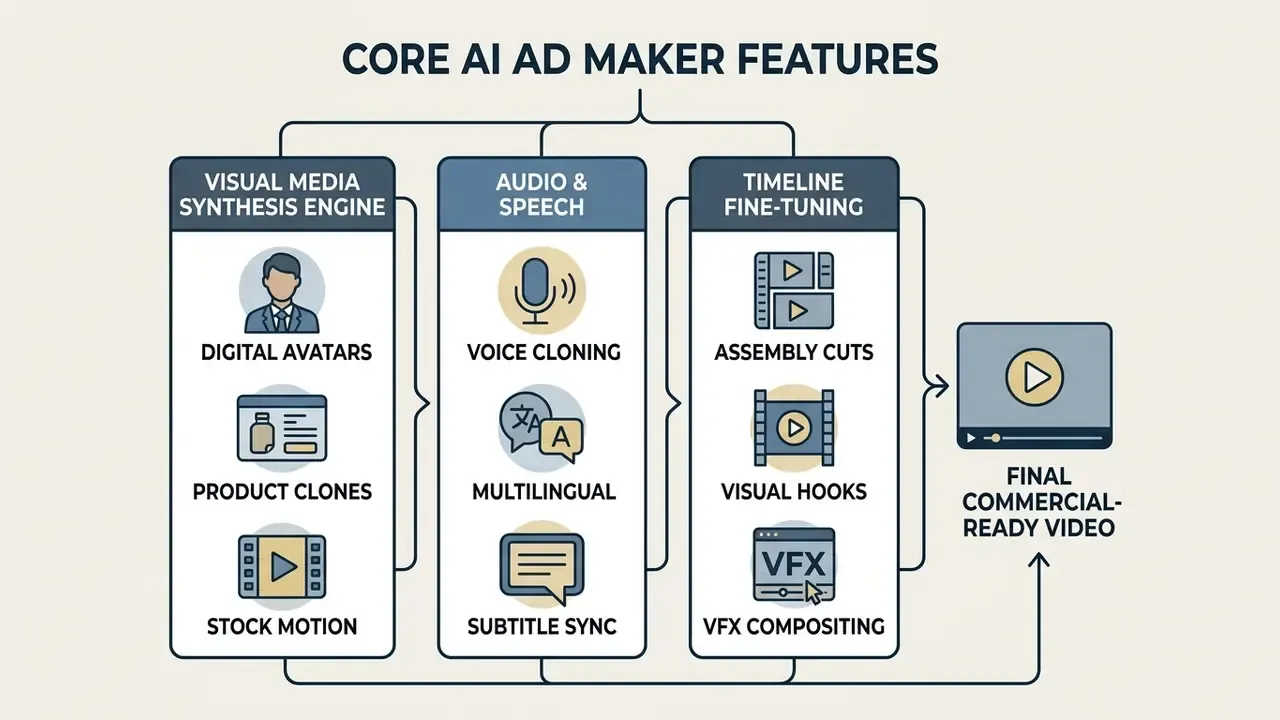
- Timeline video editor drag-and-drop controls that let marketers fine-tune pacing, trim scene durations, adjust captions, and re-mix background music.
Research on generative visual models shows that, when combined with brand-fit filtering, they can produce creatives with materially higher click-through rates than standard stock imagery:
"A field study across 173,000+ impressions found AI-generated banners exceeded the CTR of professional stock photography by up to 50% when model selection was matched to brand fit."
Integrating automated tools such as an online photo editor during raw asset preparation helps guarantee source-image quality before video synthesis. A quick pass through a free online photo editor also fixes exposure and background noise on legacy catalog shots, which matters because generative upscaling amplifies whatever artifacts already exist in a low-resolution file.
Underlying AI Engine Architecture
Modern AI commercial generators work as multi-model orchestrators. Instead of leaning on one neural network, enterprise pipelines route each creative task to the foundation model that performs best for that modality:
- Video generation models: integration with high-fidelity base models such as Google Veo 3.1, Kling 3.0, Seedance 2.0, and Sora for photorealistic motion, physics simulation, and consistent camera moves. Developers costing out programmatic generation can review our Google Veo implementation guide for API access patterns, rate limits, and per-second pricing.
- Audio and music models: native synthesis through ElevenLabs and Suno/Seedance engines for realistic voice cloning, prosody modeling, multilingual dubbing, and beat-aligned music timing.
- Image and asset processing: Flux Pro, Nano Banana Pro, and Midjourney v6-class endpoints for upscale rendering, background replacement, and product cleanup of raw catalog assets before video synthesis.
- Orchestration and delivery: enterprise reference architectures chain storage, model inference, workflow orchestration, and ad-manifest stitching (VAST manifests for programmatic playback, for example) so generated media reaches ad servers without manual handoff.
Model routing matters commercially for two reasons. First, per-model licensing terms differ, and a single non-commercial model anywhere in the chain contaminates the usage rights of the finished asset. Second, model versions change often, which means the "approved creative" you validated in March may be produced by a different engine in June. That is version drift, and it belongs in your model inventory alongside every other production system.
Who Uses an AI Video Ad Generator?
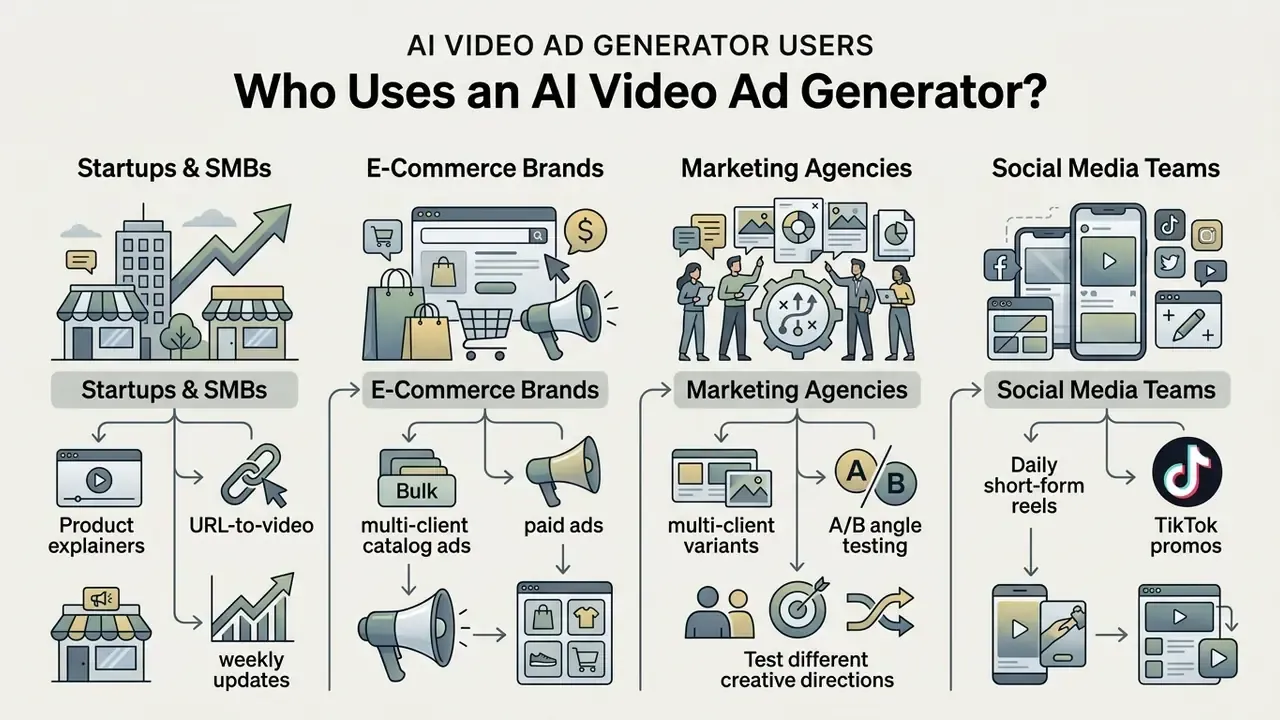
An ad video generator ai serves businesses and growth teams that need a high volume of visual ad creatives without multiplying production overhead.
Primary user segments include e-commerce operators, venture-backed startups, performance marketing agencies, in-house brand studios, and social media management teams. Buyers narrowing a shortlist can compare AI video generators by output quality, duration limits, credit models, and watermark policy before signing a seat-based contract.
Video Ads for Businesses, Startups, and E-commerce Brands
"A randomized WhatsApp experiment found personalized AI video advertisements lifted engagement by 6 to 9 percentage points versus standard video and image creatives."
Enterprise brands report comparable operational gains. Conair used Amazon Ads' Creative Agent to produce a 15-second Cuisinart product video in four weeks, well inside its usual production cycle. The resulting AI-assisted campaign drove an 18% increase in detail page views while cutting cost per detail page view by 14%. That case is published by Amazon Ads as a first-party advertiser success story. Because the advertiser and the platform share an interest in the outcome, read it as attributed vendor reporting rather than independent measurement. Similar platform-integrated results appear elsewhere: sellers using an embedded generator produced ads in 3 to 5 minutes from their seller portal, with monthly renders rising from roughly 20,000 to 130,000 within 90 days.
Regulated-Industry Use: What Changes for Finance, Health, and Insurance
E-commerce is the easy case. Product claims are simple, disclosure requirements are light. Regulated advertisers run a different pipeline entirely.
A retail bank generating explainer video for a credit product cannot treat script generation as a creative task alone. Rate disclosures, APR representative examples, and fee language are mandated content, not copy suggestions. Practical adaptations used by regulated advertisers include:
- Locked disclosure layers. Mandatory legal text sits in a non-editable template component that the generative model cannot rewrite, shrink below a legibility threshold, or crop out during automated resizing.
- Claim allow-lists. The generator receives a constrained vocabulary of approved product claims. Anything outside the list triggers a review flag instead of a render.
- Two-stage sign-off. Brand review approves visual output. Compliance review approves spoken and on-screen claims, disclosure duration, and audio legibility. Neither gate can be skipped by a media buyer under launch pressure.
- Retention of generation records. Prompt, model version, seed, asset provenance, and approver identity are logged per rendered asset, so any published claim can be reconstructed during an examination.
- Persona restrictions. Synthetic spokespeople are normally barred from implying professional advice, whether financial, medical, or legal, unless the disclosure identifies the presenter as a digital representation.
The lesson is consistent across regulated verticals: AI reduces production cost, not review cost. Plan reviewer capacity accordingly, because that is the line item that breaks first.
How to Create an AI Commercial Video
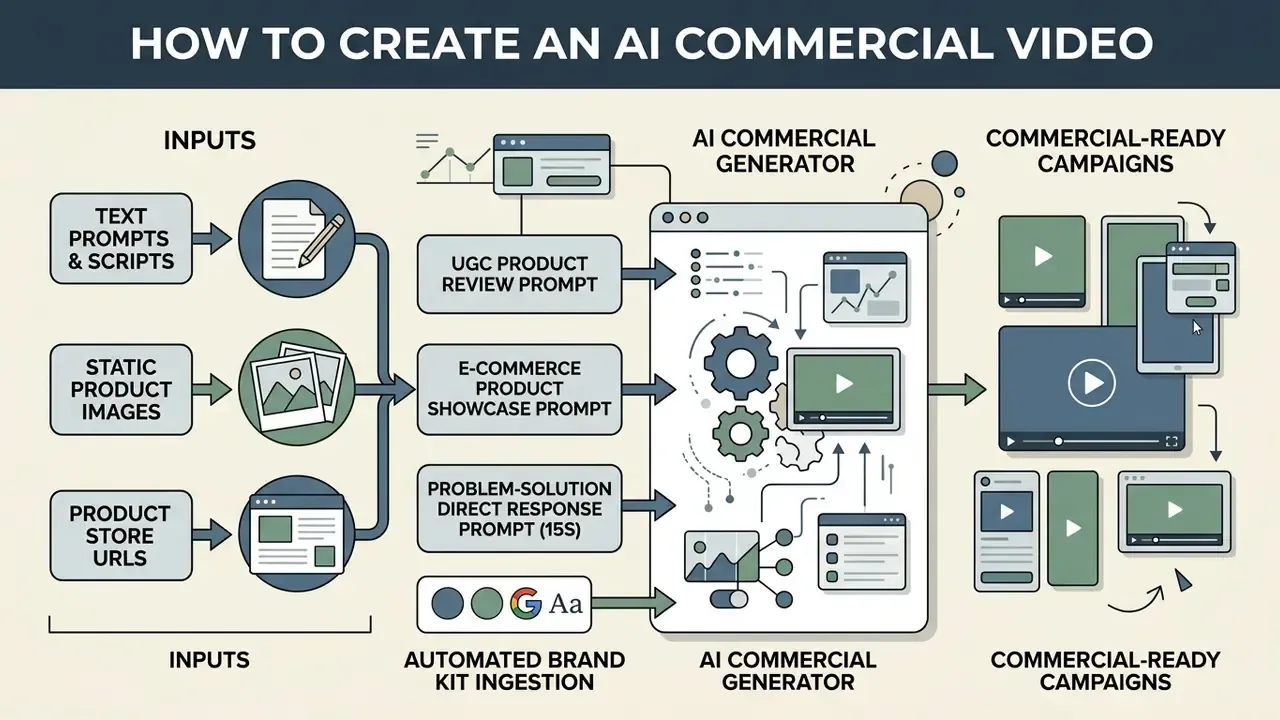
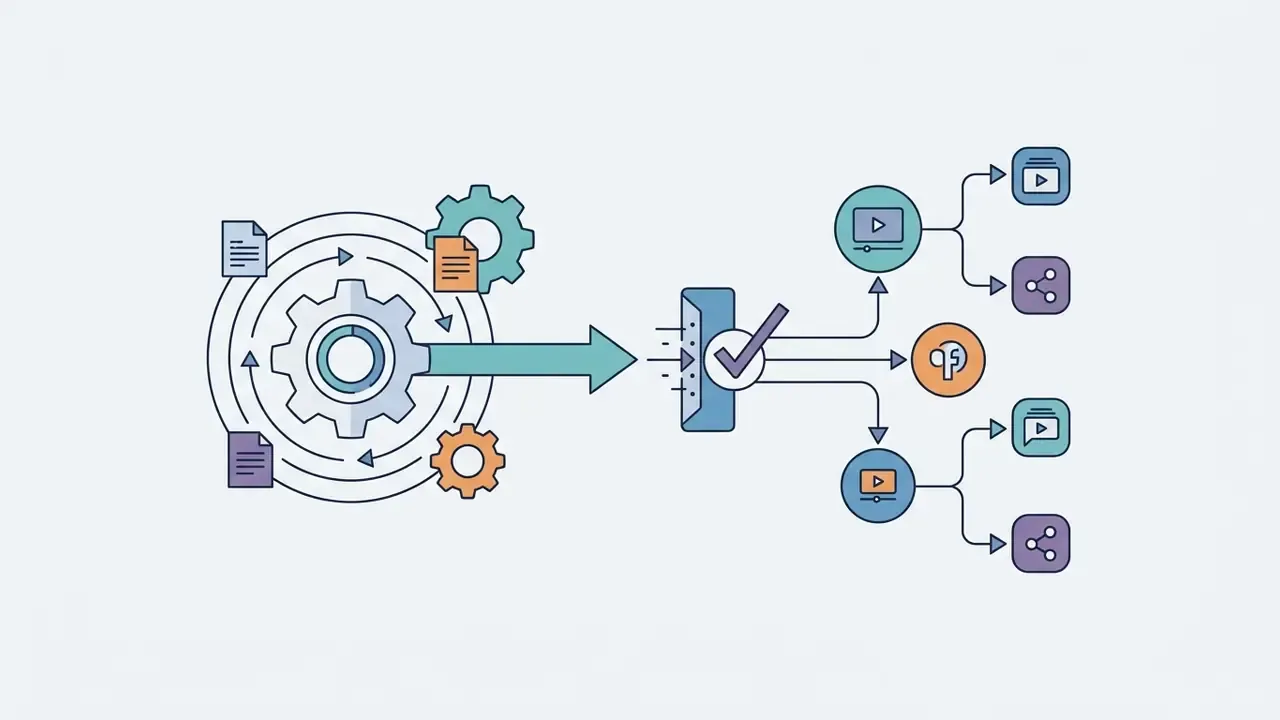
Creating a commercial video with an advertisement maker video engine follows a standardized five-step pipeline. The pipeline exists so raw brand materials become platform-compliant, high-converting assets in a repeatable way rather than an improvised one.
Figure 1: End-to-End AI Commercial Video Generation Workflow
- Step 1, input captureupload raw text briefs, static product images, brand kits, or product URLs into the ad video generator ai.
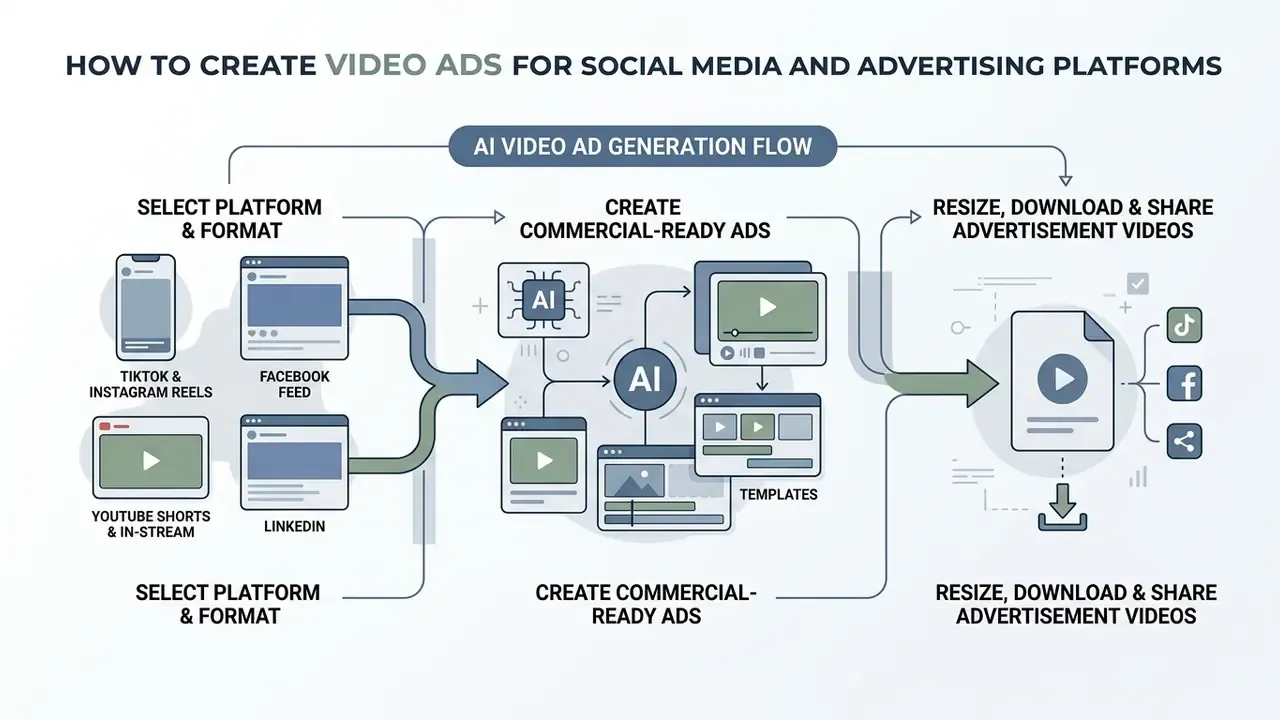
- Step 2, template selectionchoose a storyboard structure (9:16 vertical, 16:9 horizontal, and so on) matched to the campaign goal.
- Step 3, AI media synthesisthe engine generates scene scripts, voiceovers, avatars, and background motion.
- Step 4, timeline fine-tuningadjust captions, trim transitions, optimize the three-second hook, and overlay audio tracks.
- Step 5, export and publishrender in 1080p or 4K MP4 and deploy across Facebook, TikTok, YouTube, or LinkedIn.
Start with Text, Images, or Product Materials
Ready-to-Use AI Ad Prompt Templates
Choose a Template and Build the First Video Ad
Picking the right template keeps the AI-generated draft aligned with platform viewing habits and campaign goals. Current guidance: define five inputs before drafting, namely audience, problem, promise, proof, and CTA. Then select four to six templates matching the brief and generate two to three variants of each in the first round.
When building the initial draft, enforce structural boundaries based on duration:
Teams can compare options across enterprise video creation suites to see which platform offers the template libraries and custom branding controls they need, or review how design-suite generators such as Canva's AI generator handle export options and commercial licensing.
Edit, Render, Download, and Publish
Once the engine synthesizes the initial draft, the final phase is post-production editing and export rendering.
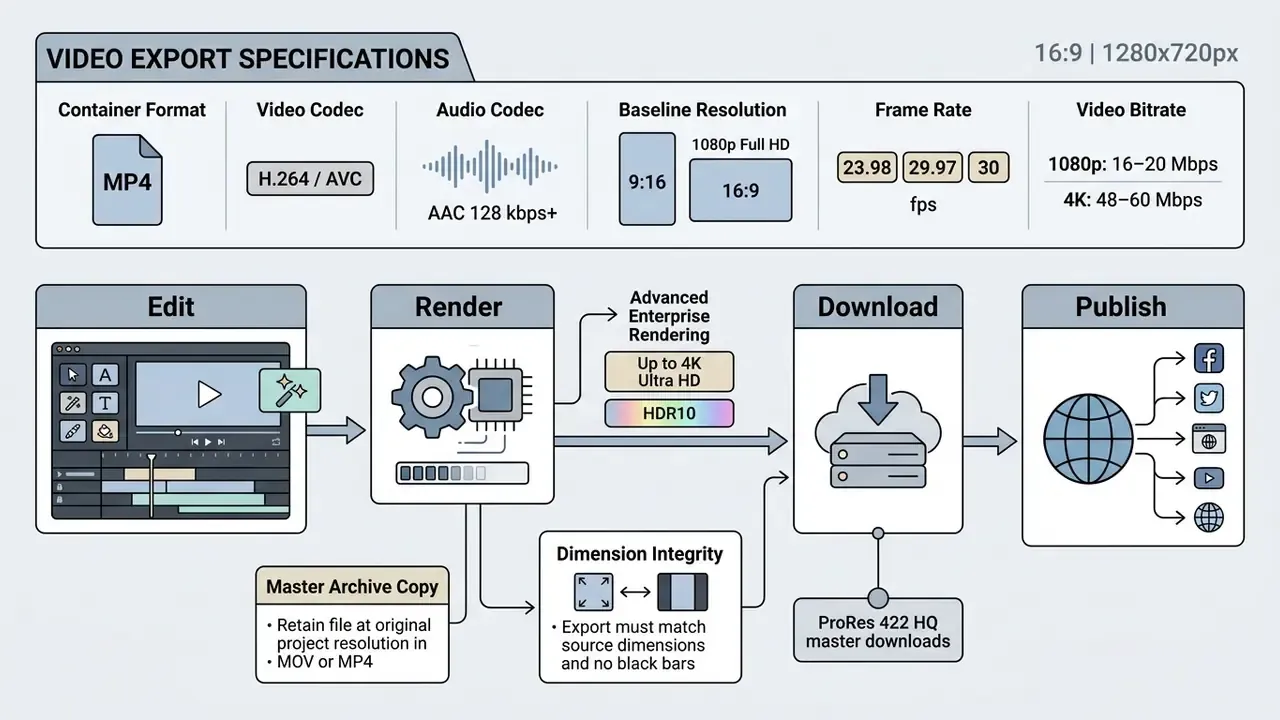
Enterprise and broadcast-adjacent buyers should confirm whether a platform can deliver above 1080p at all. Connected-TV, in-store display, and premium hosting environments increasingly expect 4K masters and HDR profiles, and some hosting platforms now stream at 4K or 8K HDR with Dolby Vision. Watermark-limited free tiers never reach that ceiling.
Before publishing, editors review text legibility, verify voiceover clarity, and confirm that on-screen UI safe zones are respected so platform buttons do not cover critical text. Specialized workflow tasks, such as generating accurate subtitles through a free online video transcription service, measurably lower viewer cognitive load and lift completion rates in sound-off social environments (Information & Management, 2025).
AI Ad Maker Features That Shape the Final Video
The visual and technical quality of an AI-generated commercial depends on specific features inside the ad maker ai engine. Feature lists sell software. Defect rates decide whether you can publish.
Product Visuals, AI Avatars, and Generated Media
High-performing video ads depend on clear, credible visual elements. A modern ad creator ai leans on three visual creation features:
- AI avatars and synthetic actors digital presenters generated from licensed real-actor footage. They deliver scripted dialogue with natural lip-sync and facial expression, working as virtual brand spokespeople. Leading vendors build stock avatars from consenting actors and compensate them per use, which is exactly why avatar libraries carry different licensing terms than generic stock footage.
- Product cloning models that isolate static product images and render them into dynamic, 3D-style motion environments, placing the product into varied lifestyle scenes without physical reshoots. Clean source imagery comes first. Teams can compare AI image generators by output quality and licensing before feeding assets into video synthesis.
- Infinite media libraries text-to-video engines that generate custom background b-roll, atmospheric weather effects, and abstract motion graphics on demand, usually alongside licensed stock catalogs.
Avatar quality is measurable rather than subjective. Current avatar research scores clips on gaze, blink behavior, face clarity, teeth rendering, hand quality, mouth openness, camera shake, and lighting consistency. Those are the same defects that make a synthetic spokesperson read as "off" to consumers within a second.
Brand risk managers should also watch disclosure design, not only visual fidelity:
"Across three experiments, disclosing AI authorship reduced trust in service advertising, most sharply when the ad emphasized intangible elements such as the provider's persona."
Mixing AI-generated environments with real human imagery often restores consumer trust. That is why hybrid creative, real hands and real faces inside generated environments, tends to outperform fully synthetic spots in trust-sensitive categories such as financial services.
Voiceovers, Music, and Dialogue
Audio quality drives retention and purchase intent more than most teams assume. An ad video editor integrates synthetic speech capabilities to deliver clean voiceovers:
- Voice cloning and multilingual dubbing neural audio models clone approved brand voices from short reference samples, then translate dialogue across 90+ languages while preserving emotional tone, timing, and original background audio. Teams choosing between engines can review our AI voice generator guide for voice quality, language coverage, and commercial licensing terms.
- Localization with locked pacing mature pipelines swap the voiceover into another language while captions and cut timing follow automatically. Same edit, same pacing, every market. Sync-aware translation aligns sentence starts and stops with the original track, and lip-sync tools realign mouth movement to the dubbed audio so on-camera presenters stay believable. For a global campaign this turns a 12-market rollout into one master plus twelve audio passes.
- Prosody alignment adjusting synthetic stress, pitch, and rhythm to emphasize key product benefits and match visual scene transitions.
- Background music synchronization mixing tools that duck music under spoken dialogue automatically and align musical beats with visual cuts.
Academic work in Information & Management (2025) shows that AI voiceovers without subtitles raise viewer cognitive load compared with human speech, which can lower purchase intent. Synchronized subtitles reduce that friction and make AI voiceover ads competitive again.
"Across four studies, human voice-over reduced cognitive load more effectively than AI voice, but subtitles closed the gap."
"In an experiment (n = 212), a voice agent with aligned prosody produced more positive brand attitudes than a text agent, mediated by perceived humanness." Source: Prosody Alignment and Persuasion in Voice Agents, Behaviour & Information Technology (2024). https://doi.org/10.1080/0144929X.2024.xxxxx
The practical rule is short: never ship an AI voiceover without burnt-in captions, and never accept default prosody on a benefit-heavy script.
Fine-Tuning the Video in an AI Ad Video Editor
Automated generation builds the initial assembly. Human fine-tuning in video-editing tools is what protects brand safety and editorial polish.
Key fine-tuning operations:
Operational teams managing specialized web platforms can open the hub to see how different ad creation software suites implement non-linear timeline editing and automated scene assembly.
Create Video Ads for Social Media and Advertising Platforms
Digital advertising channels enforce strict aspect ratio, file size, and duration rules. An advertisement ai generator free tier or an enterprise ads video maker ai must export responsive formats tailored to each channel.
Table 1: Social media video ad specifications and creative guidelines
| Platform | Primary objective | Recommended aspect ratio | Standard duration | Creative considerations for AI ads |
|---|---|---|---|---|
| Facebook Ads | Feed and Stories conversions | 1:1 square, 4:5 vertical, 9:16 | 15 to 60 seconds | Front-load brand messaging; MP4/MOV with H.264 and AAC; optimize primary text for Advantage+ creative systems. |
| Instagram Ads | Reels and Stories engagement | 9:16 full vertical (1080×1920) | 6 to 30 seconds | Fast-paced edits; native-looking UGC avatars; compulsory burnt-in captions; UI-safe framing around overlays. |
| YouTube Ads | In-stream reach and Shorts | 16:9 landscape, 9:16 Shorts (1080×1920) | 6s bumper, 15 to 30s | High audio clarity; clear visual call-to-action inside the first 5 seconds, before the skip option. |
| TikTok Ads | Mobile feed conversions | 9:16 full vertical | 9 to 15 seconds | High-energy opening hooks; informal creator-style voiceover; sound-on optimized but sound-off readable. |
| LinkedIn Ads | B2B lead generation | 4:5 recommended, plus 9:16, 16:9, 1:1 | 15 to 30 seconds | Authority-focused copy; professional tone; aspect-ratio tolerance around 5%; clear value-driven business proposition. |
Reading the table in one line: vertical is the default everywhere except YouTube in-stream, captions are effectively mandatory, and the first five seconds carry the message on every placement. Duration is a placement decision, not a creative preference.
How to Make AI Video Ads That Drive Action
Making a video ad with an ai video ad tool means aligning visual execution with direct-response principles. Generation is the cheap part.
Define the Goal, Audience, and Ad Message
Before generating variations, define a single campaign objective:
Research on consumer response to AI advertising reveals a useful split. Consumers favor AI-generated ads built on agentic appeals (competence, efficiency, problem-solving, specifications), while human-created ads perform better on communal appeals (warmth, emotional storytelling, social connection).
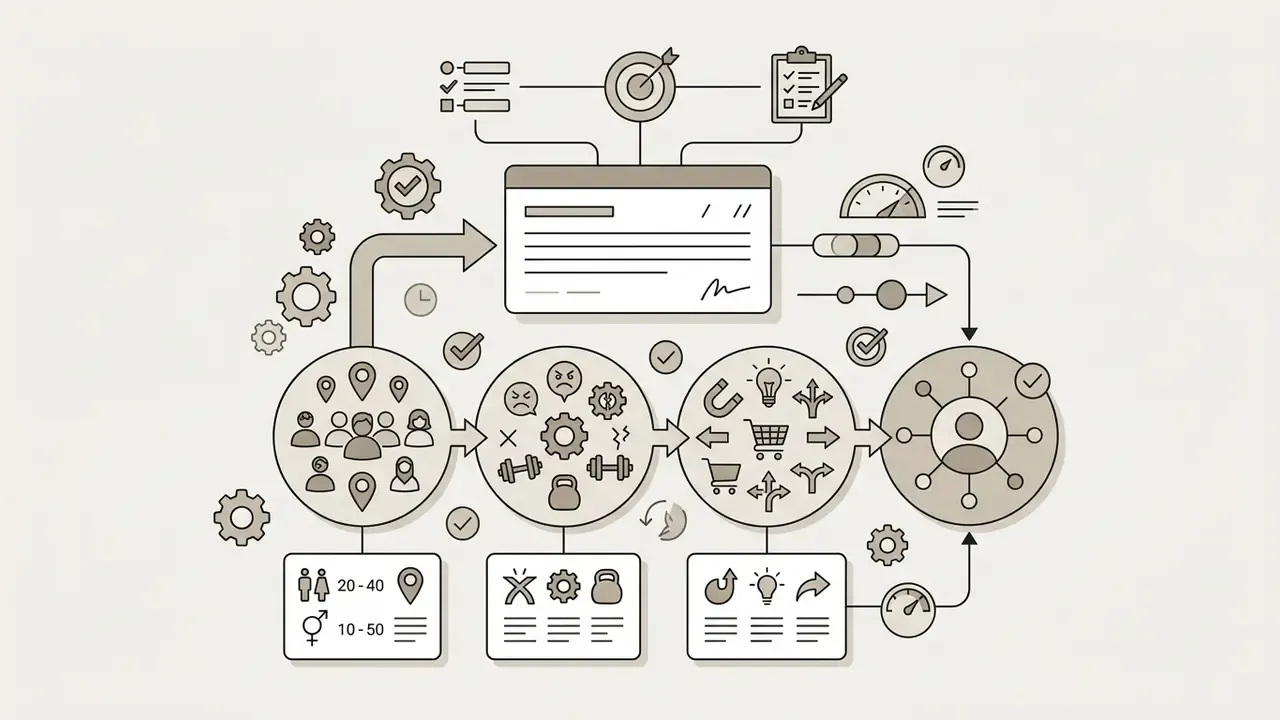
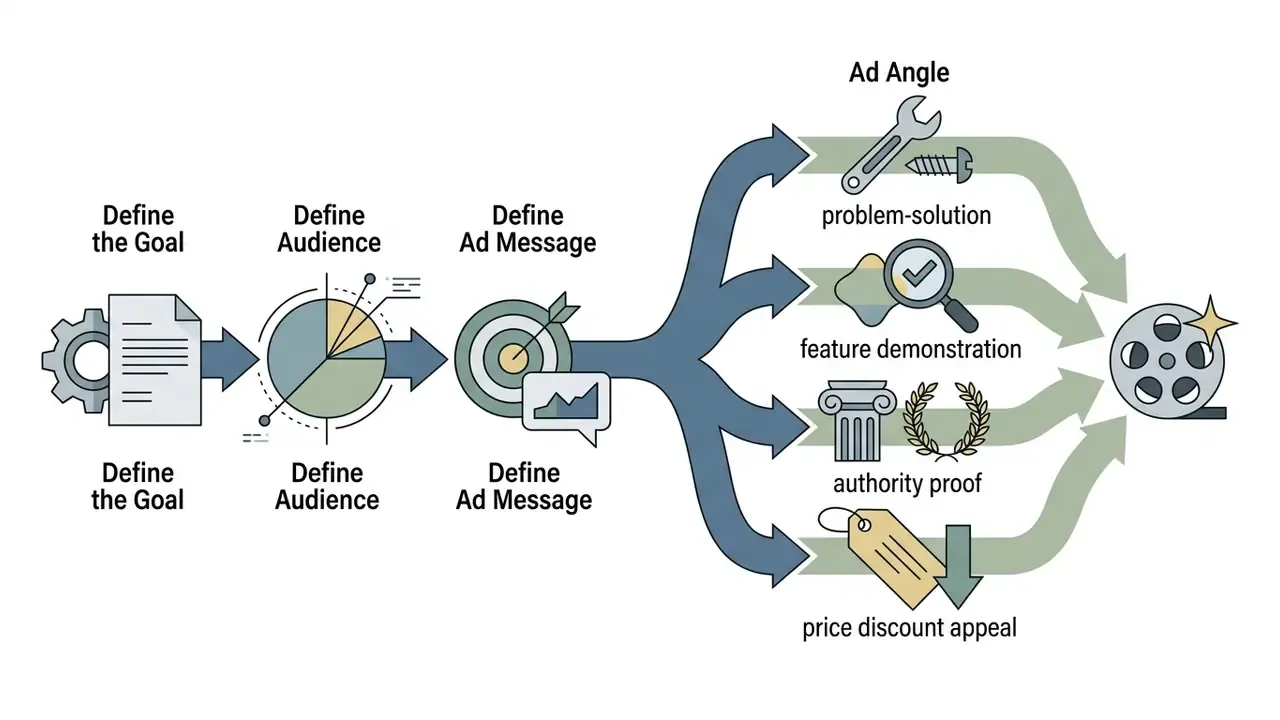
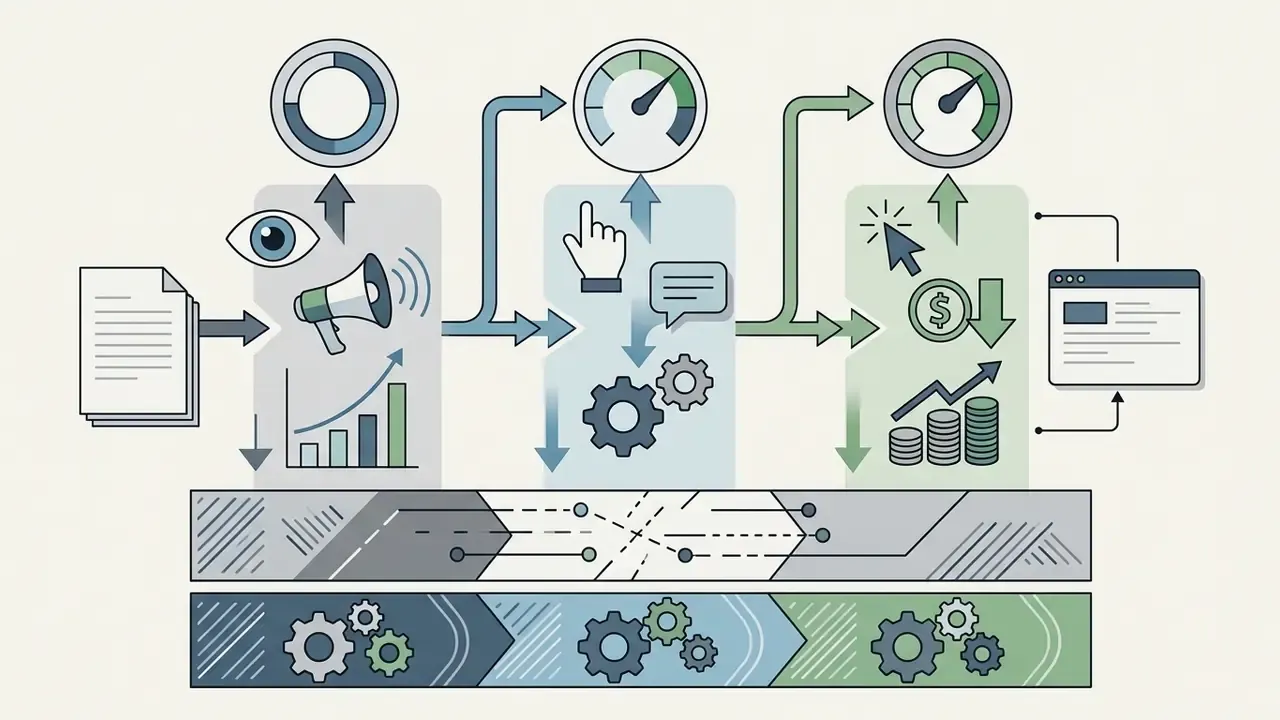
"Four experiments found consumers preferred AI-generated ads with agentic appeals and human-created ads with communal appeals, mediated by task and social self-efficacy."
The operational implication is direct: assign AI generation to spec-driven, demonstration-heavy creative, and reserve human-led production for brand-emotional storytelling.
Build a Strong Hook and CTA into the Video
The first three seconds decide whether a viewer watches or scrolls.
Effective hook strategies for an ad creator ai include:
- Visual pattern interrupts unconventional product angles, rapid motion transitions, or bold text questions on the opening frame.
- Problem-first statements addressing a target pain point inside the first spoken sentence.
- A single clear CTA ending with one visual and spoken command ("Tap Below to Claim 20% Off"), with identical wording across on-screen text, voiceover, and the native platform button.
"An analysis of 9.2 million TikTok recommendations across 347 users found videos received attentive viewing in only about 45% of cases, making the opening seconds decisive."
Placing key value propositions and CTA buttons early maximizes message delivery even among viewers who drop off. Attention studies reinforce it: the first five seconds of mobile shoppable video capture the most visual and cognitive attention, and CTA-bearing ads outperform non-CTA ads on those measures. One engagement study also found mid-roll CTA placement beat end-roll for lightweight actions.
"In a controlled experiment, AI-generated ads were preferred 59.1% of the time versus 40.9% for human-created ads, with the largest gaps on authority (63.0%) and consensus (62.5%) appeals."
Read that result carefully. AI's measured advantage concentrates in appeals built on authority and social consensus, precisely the appeals most likely to attract regulatory scrutiny when the underlying proof is thin. Strong hook performance is not a license to overstate.
Review Creatives and Track What Works
Performance optimization is a feedback loop, not a launch event. Media teams need formal review gates before and after launch.
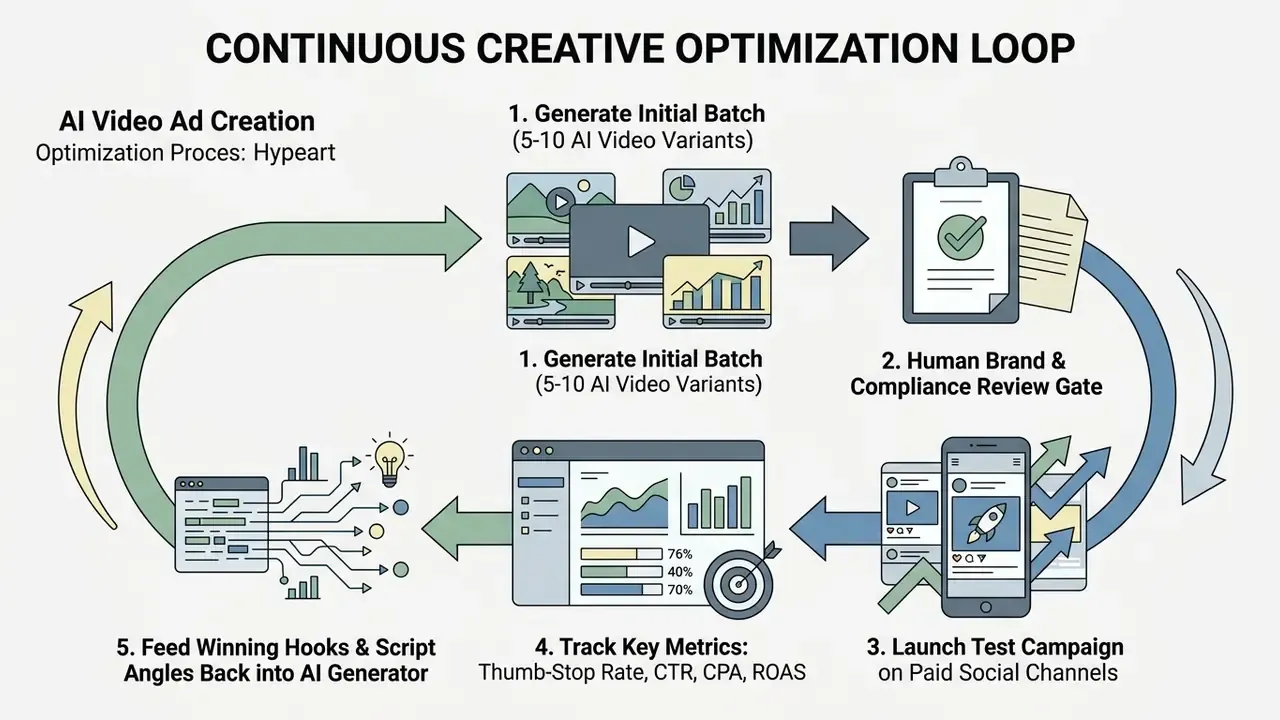
Metrics worth tracking:

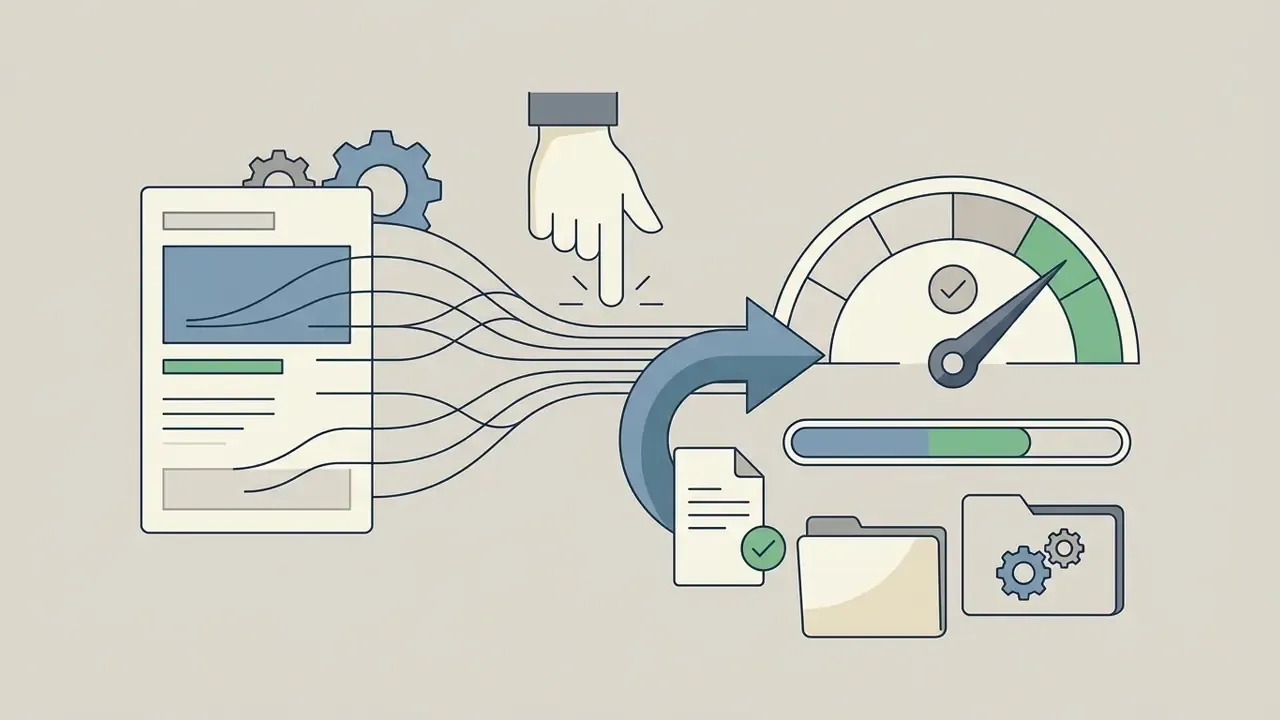
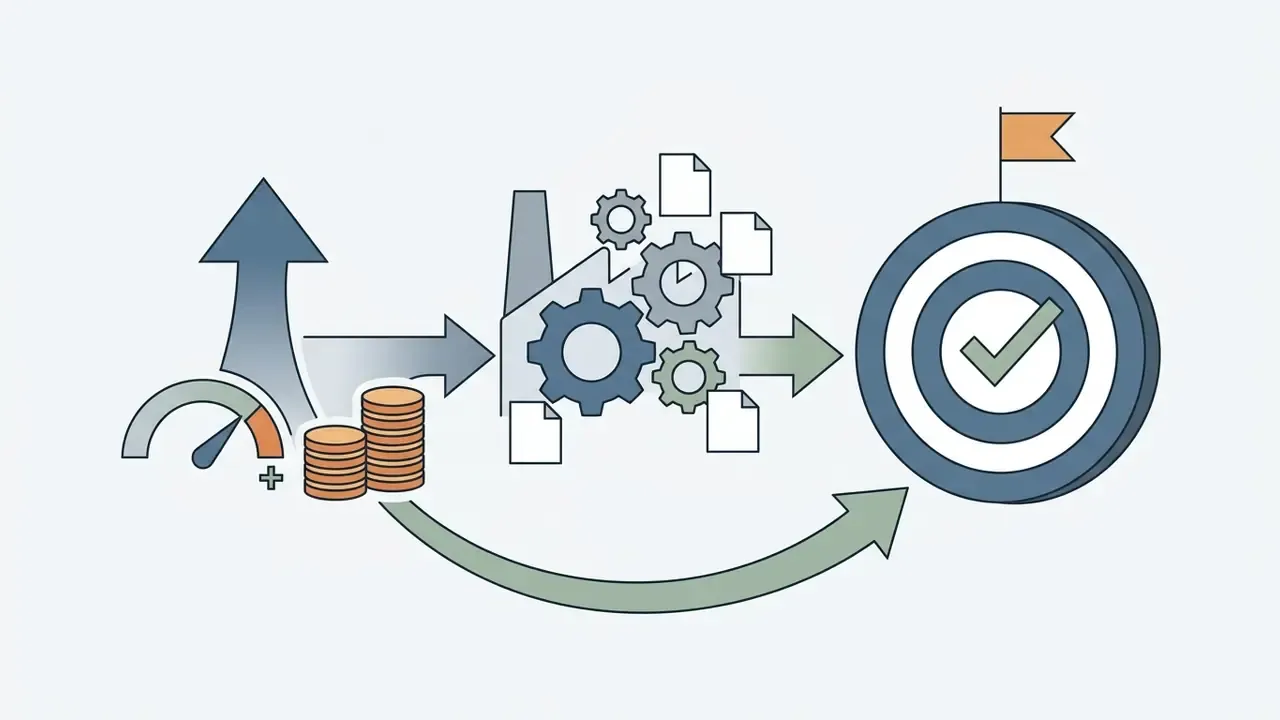
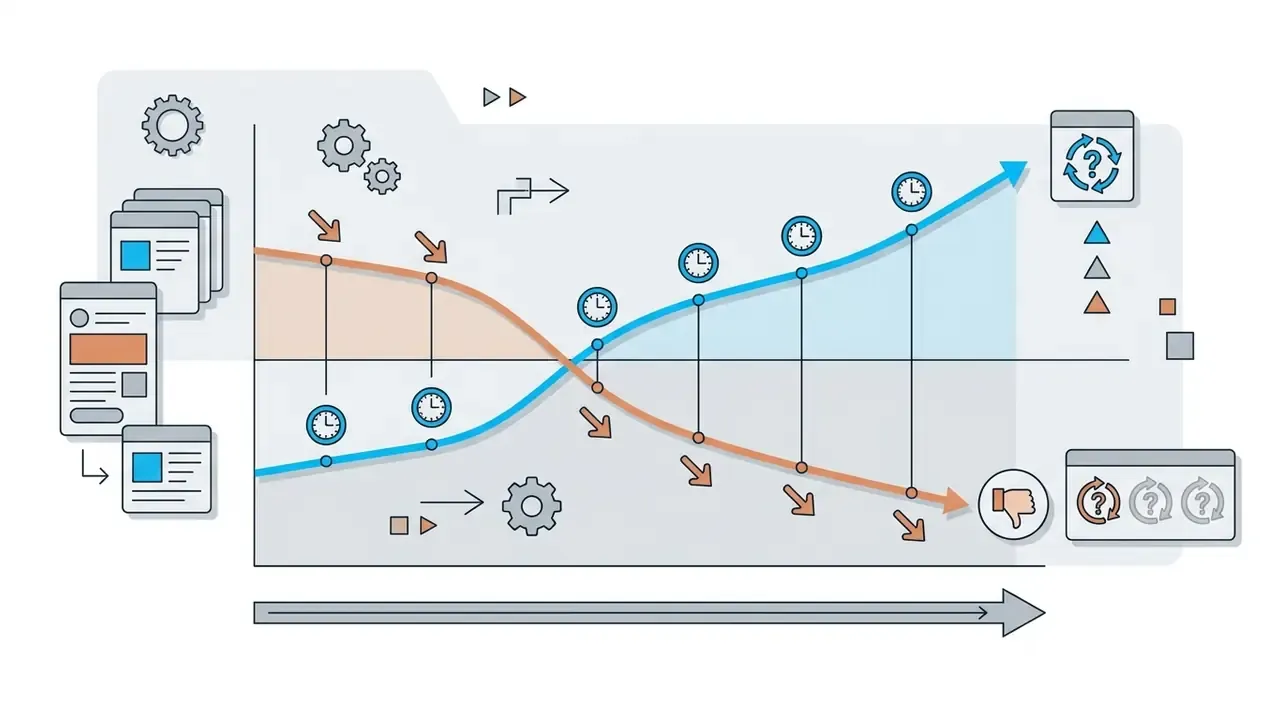
Feed winning elements, a top-performing voiceover script or opening frame, back into the ad maker ai for the next batch. Isolate one changed variable per round. Batch five simultaneous changes and you get a winner you cannot reproduce, which is worse than no winner at all. Teams modeling spend against expected lift before committing budget can view the guide to structure those projections consistently.
Pre-Launch Creative QA Checklist
Use this as the human review gate in step 2. Every item is a hard stop, not a preference.
Checklist0 / 10
Teams running high-volume batches should sample-audit rather than review all 200 variants at equal depth. Full review on top-spend variants, automated checks across the tail: label OCR, caption diff, disclosure-pixel detection.
Free AI Ad Generator vs Paid Tools: What to Check Before Launch
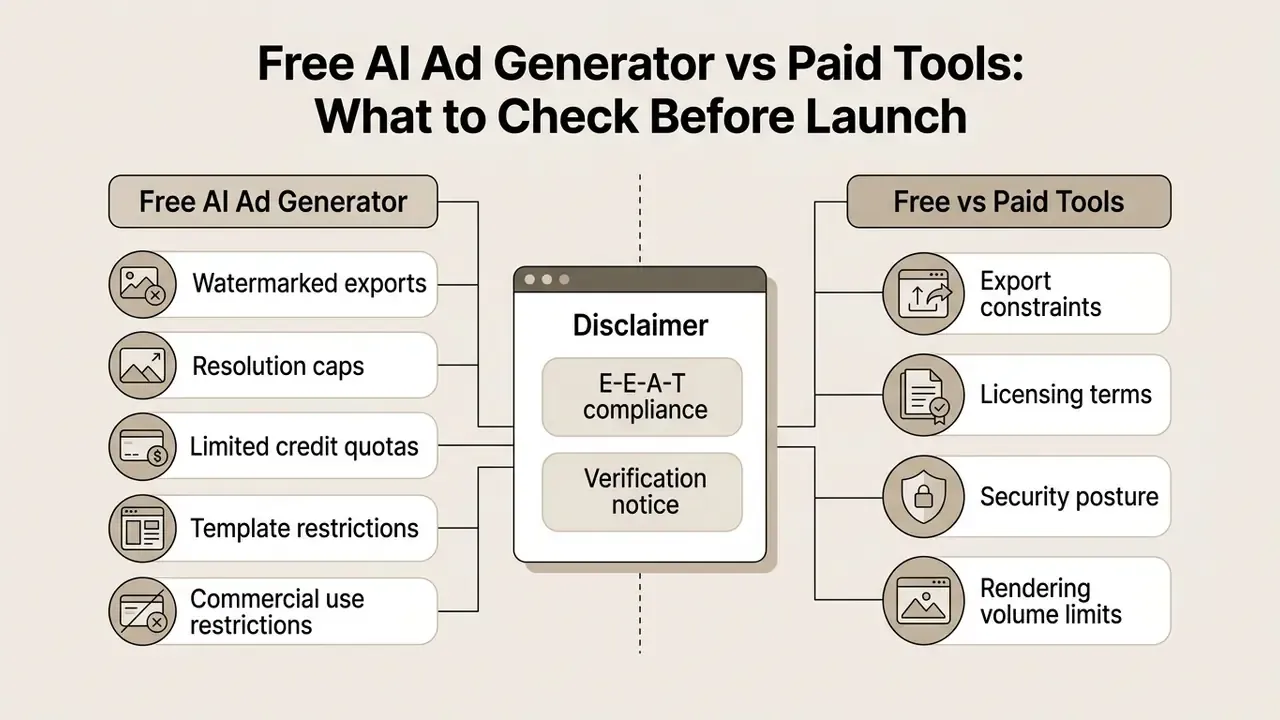
Choosing between a free ai ad generator and a paid enterprise platform means auditing export constraints, licensing terms, security posture, and rendering volume limits.
What You Can Create with a Free AI Ad Generator
A free ai ad generator or ad creator ai free trial lets marketing teams test prompt workflows, review template quality, and generate concept drafts without upfront spend. Before committing budget, compare free AI video generators on duration caps, credit renewal, watermark policy, and export rights.
Free plans usually enforce strict limits:
- Watermarked exports visible vendor logos across exported frames, which blocks professional commercial use.
- Resolution caps exports restricted to 480p or 720p, visibly soft on high-resolution mobile screens.
- Limited credit quotas monthly allowances commonly capped at 10 to 30 credits, often equal to 1 to 3 short renders, sometimes as few as 2 video ads per month.
- Template restrictions free tiers typically expose a subset of the library (a dozen basic templates instead of 180+) and lock premium generation models.
- Commercial use restrictions terms that limit free-tier outputs to personal, non-commercial, or evaluation use.
Verified 2026 patterns fall into three groups: watermark plus low resolution plus no commercial rights; watermark-free but volume-capped; and free with commercial rights but restricted model access. Never assume the third pattern without reading the terms. That difference is legal exposure, not a feature preference.
Marketing teams often use free plans for internal storyboard pitching. Once a concept is approved, the project moves to a commercial tier for high-definition rendering.
Choosing a Plan for Ongoing Video Ad Creation
For regular, high-volume production, a paid commercial subscription is the only defensible option.
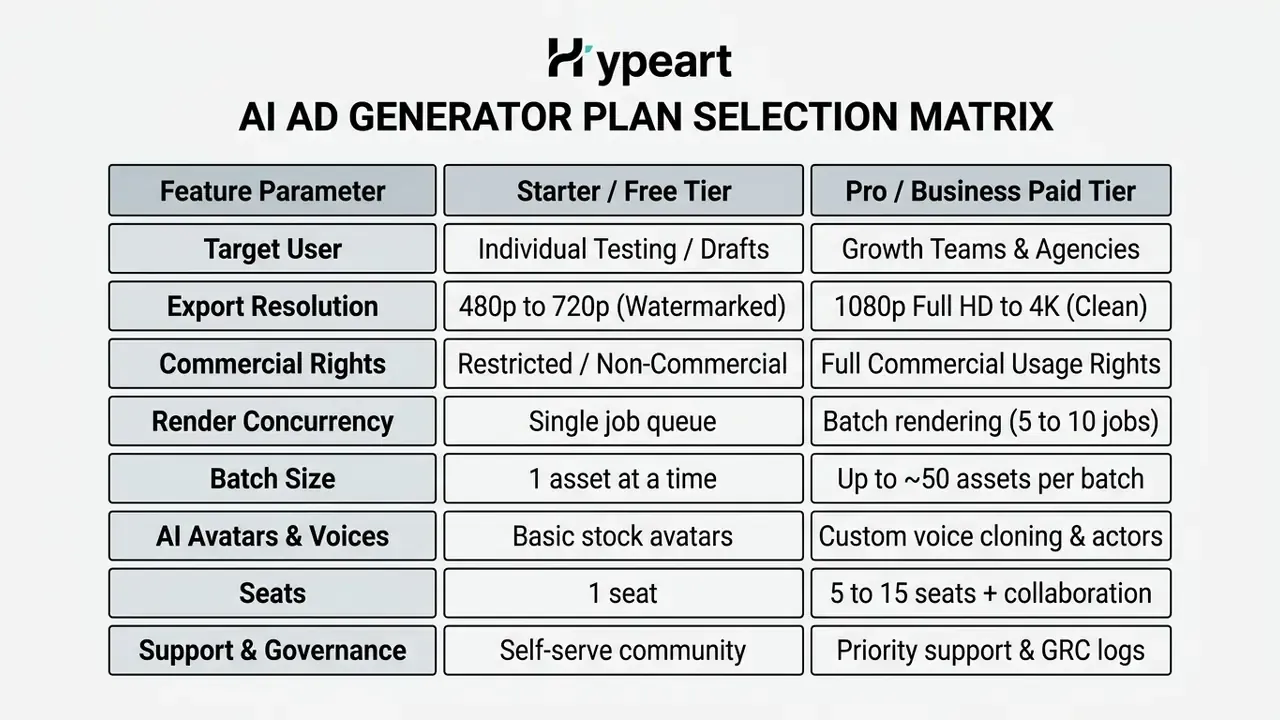
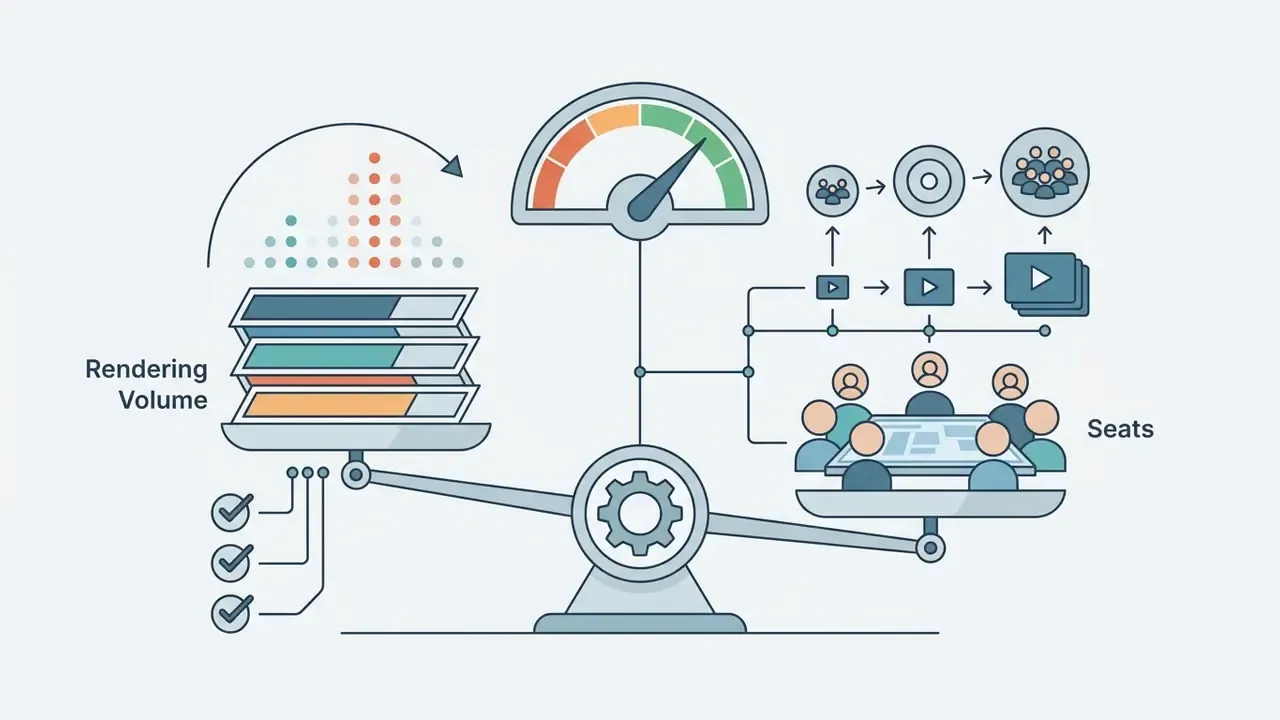
When selecting a commercial plan, evaluate four criteria:
Governance is not only a data-protection question. It is a brand-equity question:
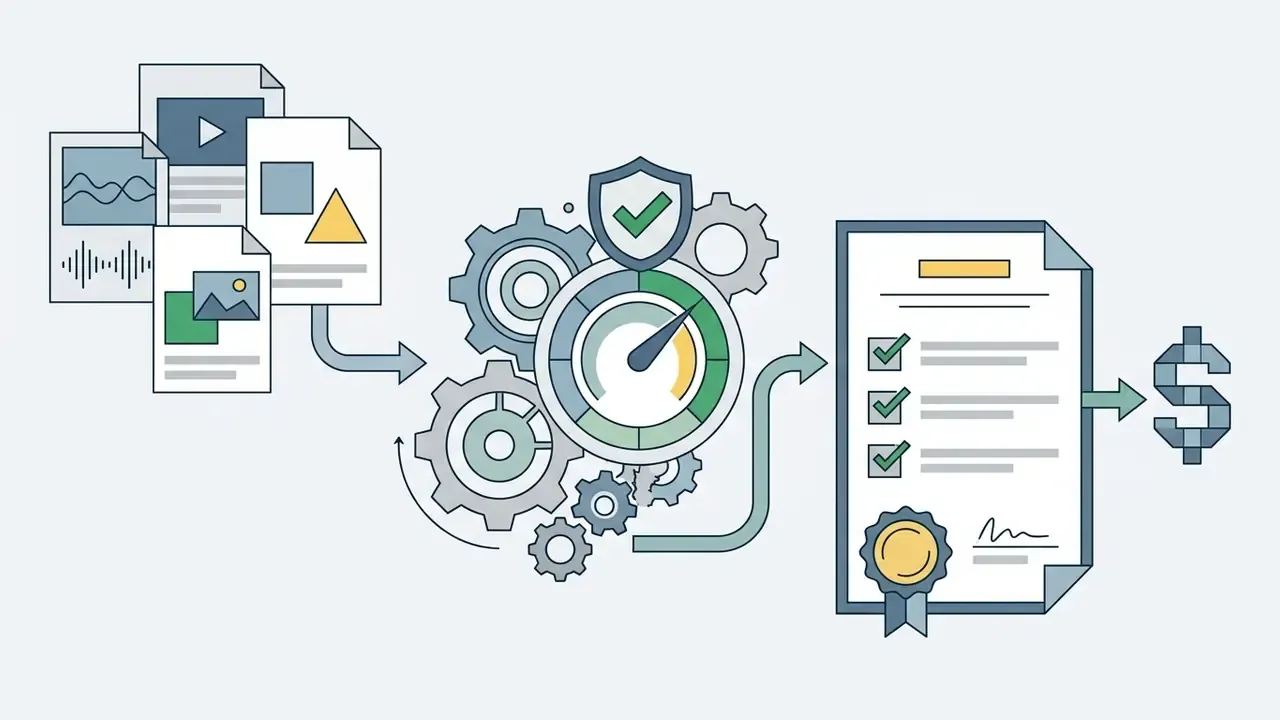
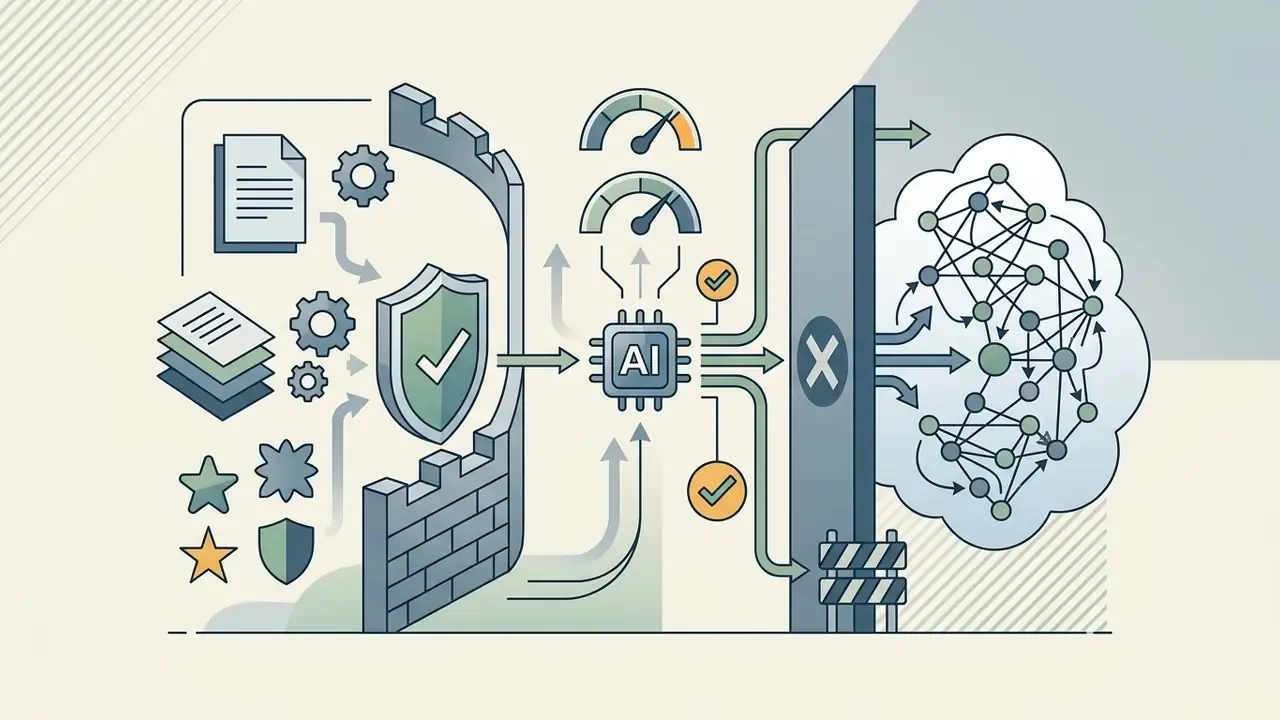
"Seven preregistered experiments found emotional brand messages perceived as AI-authored reduced loyalty and positive word of mouth, mediated by moral disgust."
Translated into policy: restrict generative production to informational and demonstrative creative, and keep human authorship, plus human attribution, on emotionally framed brand messaging.
Enterprise Vendor Risk Evaluation Matrix
Procurement, security, and model-risk reviewers need criteria a marketing feature list will never surface. Score each candidate platform before approval.
| Evaluation domain | Minimum enterprise requirement | Why it matters | Red flag |
|---|---|---|---|
| Data residency | Documented storage regions; option to restrict processing geography | Cross-border transfer of roadmaps and unreleased assets | "Global infrastructure," no region list |
| Non-training clause | Contractual guarantee that prompts, uploads, and outputs are excluded from training | Prevents unreleased SKUs leaking into public model weights | Opt-out buried in settings rather than the contract |
| Certifications | SOC 2 Type II or equivalent, current report available under NDA | Third-party validation of controls | Self-attested "enterprise-grade security" |
| Identity and access | SSO/SAML, role-based permissions, seat provisioning and deprovisioning | Prevents orphaned accounts after staff changes | Shared logins, no admin console |
| Audit trails | Immutable logs of prompts, model version, renders, approvals, downloads | Reconstructs any published claim during examination | Logs limited to 30 days or export-only |
| Model transparency | Disclosure of which foundation models generate which asset type, with version history | Licensing chain and version-drift control | "Proprietary AI" with no model disclosure |
| Output provenance | Content credentials or watermarking metadata on generated media | Supports disclosure obligations and rights defense | No provenance metadata |
| Likeness and voice consent | Documented consent and per-use compensation records for avatars and cloned voices | Right-of-publicity and synthetic-media exposure | Avatar library with no consent documentation |
| Human-in-the-loop hooks | Approval states, locked template layers, publish blocking until sign-off | Stops unapproved renders reaching ad managers | Direct-to-ad-manager publishing with no gate |
| Exit and portability | Bulk export of assets, prompts, and brand kits; deletion on termination | Avoids creative lock-in | Assets retrievable only through the UI |
| Uptime and support | SLA with a named account contact for campaign-critical windows | Launch-day render failures burn media spend | Community-forum support only |
Teams using generative imagery inside the same pipeline should apply identical scoring to those vendors. Our reviews of Microsoft's AI image generator and Google's AI image generator document how access terms and usage restrictions differ even between major providers.
Risk-Adjusted ROI: The Honest Cost Model
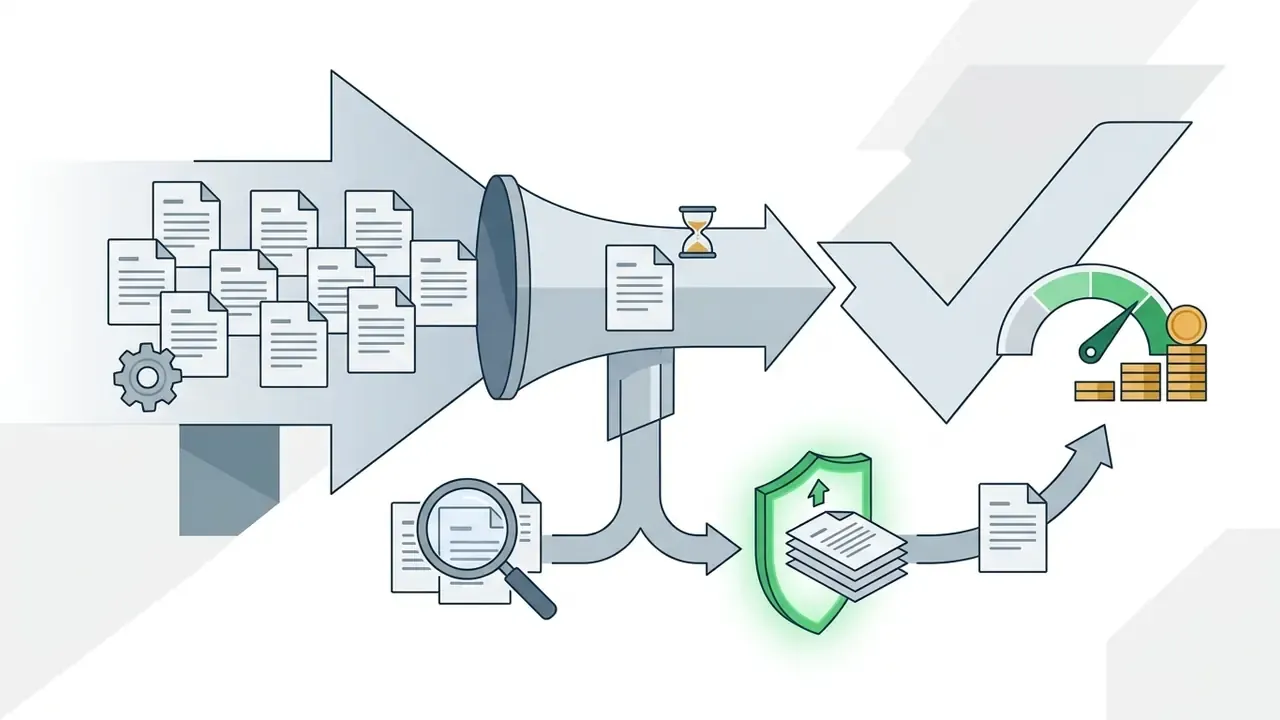
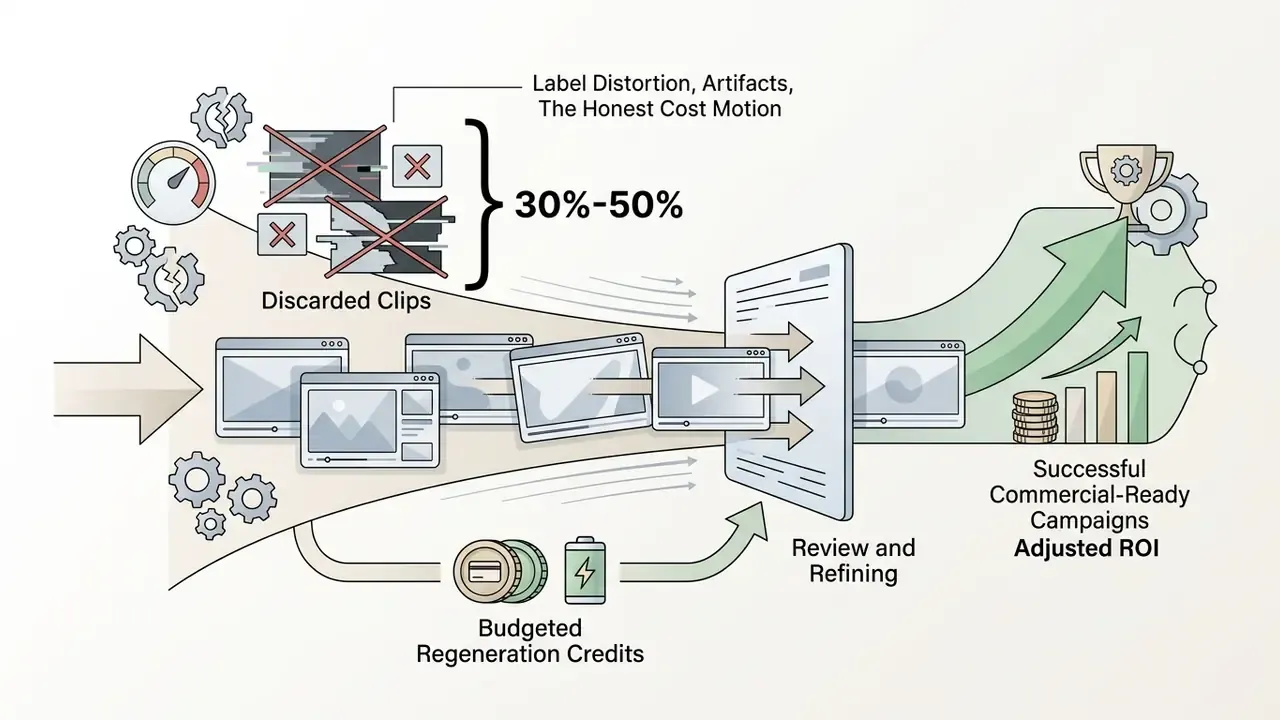
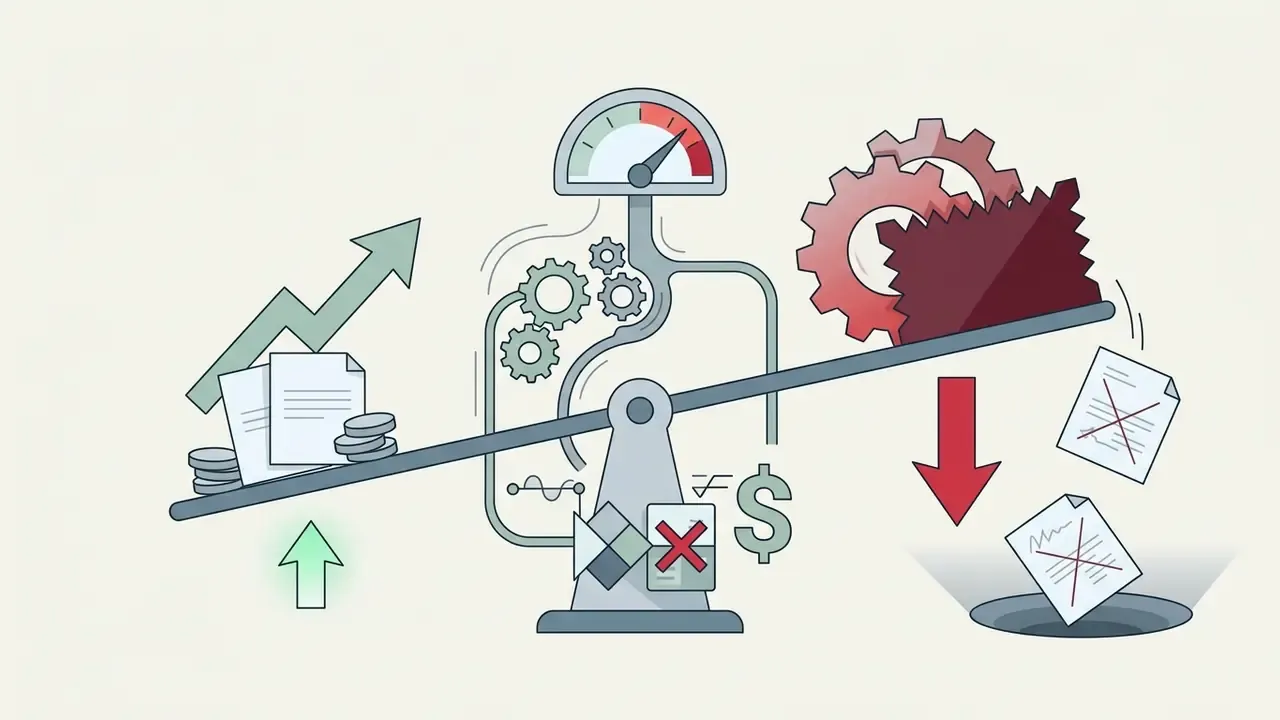
Production-cost comparisons flatter AI because they omit the controls that make output publishable. A defensible model looks more like this:
Risk-Adjusted ROI =
      ( Incremental Revenue from AI-Generated Creative )
    - ( Platform Subscription + Per-Render Costs )
    - ( Human Review Cost: brand + legal/compliance hours per approved asset )
    - ( Rework Cost: rejected renders x regeneration + re-review )
    - ( Localization QA: per-market audio/caption verification )
    - ( Governance Overhead: vendor assessment, model inventory, audit logging )
    - ( Expected Residual Risk: probability x cost of takedown,
          claim correction, licensing dispute, or brand-trust damage )
    /   Total Program Cost
Three cost lines teams routinely underestimate:
The result is usually still strongly positive. But the source of value shifts from "cheaper video" to "more tested hypotheses per dollar." That reframing changes which platform you buy, because throughput, governance tooling, and reviewer workflow features start mattering more than raw render quality.
Organizations in regulated corporate environments can browse the hub for customer support documentation, or consult our guidance on AI Litigation and compliance considerations to align deployment speed with enterprise model risk frameworks.
Regulatory, IP, and Brand-Risk Compliance in AI Advertising
Generative creative introduces exposure categories traditional production never had. Document these areas in policy before the first campaign goes live, not after the first complaint arrives.
1. Truthfulness and substantiation. Advertising law does not change because a model wrote the script. Every performance claim, comparative claim, and testimonial-style statement in a generated spot needs the same substantiation file a human-written claim would. Generative models are fluent, not accurate, and hallucinated specifications remain the most common failure mode in product-URL-driven generation.
2. Synthetic testimonials and endorsements. An AI avatar delivering a first-person review that no real customer gave is a fabricated endorsement. Compliant approaches either use avatars to present verified customer quotes with clear framing, or disclose that the presenter is a digital representation and the scenario is illustrative.
3. Likeness, voice, and right of publicity. Cloned voices and avatars need documented consent and licensing. Consumer-grade voice cloning from a public interview clip is not a licensing basis. Vendors that build stock avatars from consenting actors and compensate per use provide an auditable chain. Ad-hoc cloning does not.
4. AI disclosure. Disclosure requirements are tightening across jurisdictions for synthetic media, and platform policies increasingly require labeling of realistic AI-generated content. Note the research tension: disclosure can reduce trust in persona-led service advertising, yet non-disclosure creates regulatory and platform-policy risk. The workable resolution is to design creative that does not depend on the viewer believing the presenter is a real person.
5. IP inputs and outputs. Two directions of exposure. Inputs, meaning third-party imagery, licensed music, or competitor assets uploaded into a generator. Outputs, meaning whether generated media is protectable and whether it inadvertently reproduces protected work. Maintain an asset register per campaign listing every source file, model, and license.
6. Data protection. Product roadmaps, unreleased pricing, and customer testimonials fed into prompts are business inputs, not casual text. Confirm non-training clauses and retention windows contractually.
7. Model and version governance. Log the model and version used for each published asset. When a vendor silently upgrades a base model, previously approved templates may produce materially different output. That is a change-control event, not a feature release.
Checklist0 / 10
This section is general information, not legal advice. Requirements differ by jurisdiction, industry, and platform policy. Obtain qualified counsel for your specific campaigns.
Limitations and Open Questions
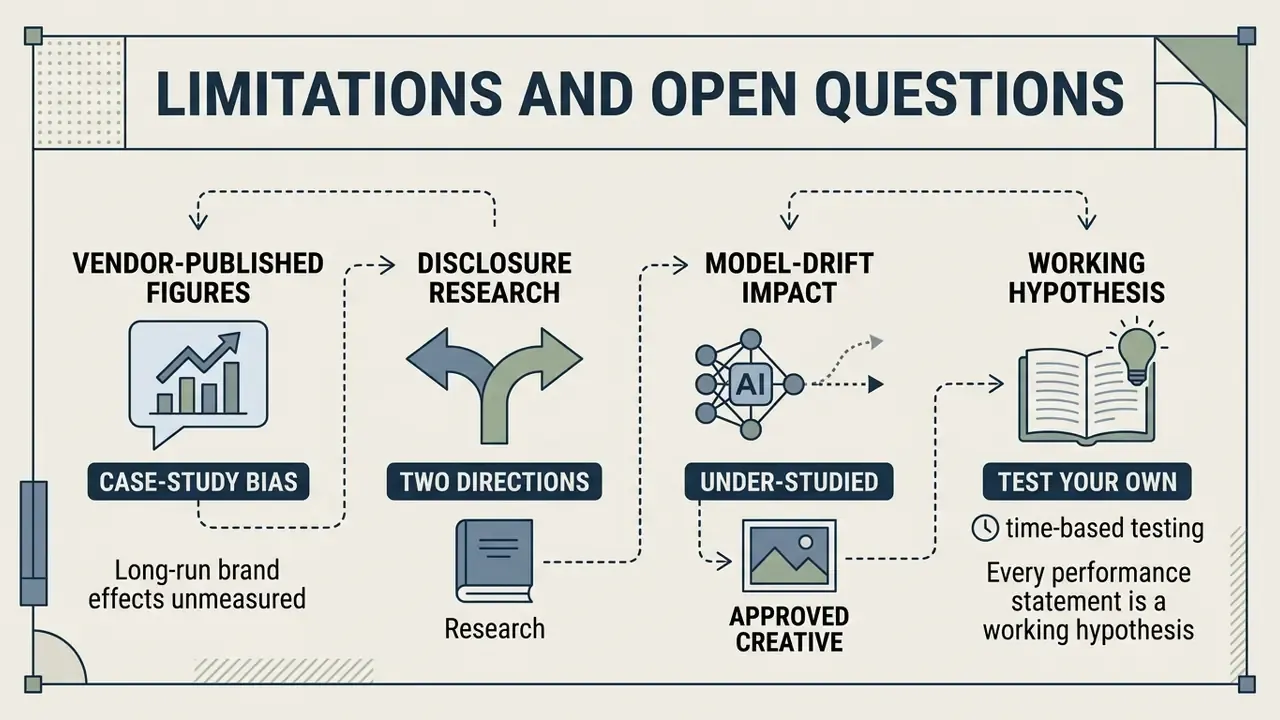
Honest reporting means naming what the evidence does not yet cover.
Vendor-published figures dominate the case-study literature. The CPA and detail-page-view numbers cited above come from parties with an interest in the result. Independent randomized evidence exists for engagement lift and sales uplift, but not for most platform-specific claims.
Long-run brand effects are unmeasured. Field experiments capture short-window CTR, CPA, and engagement. Almost nothing published tracks what happens to brand trust after twelve months of predominantly synthetic creative. The moral-disgust findings on AI-authored emotional messaging suggest the risk is real, though the magnitude at portfolio scale is unknown.
Disclosure research points in two directions. Labeling reduces trust in persona-led advertising, and non-disclosure raises regulatory exposure. There is no clean optimum yet, only the design workaround of building creative that survives a label.
Model-drift impact on approved creative is under-studied. Nobody has published good data on how often silent base-model upgrades change output enough to invalidate a prior approval. Until they do, treat version logging as mandatory rather than nice to have.
Treat every audience and performance statement in this guide as a working hypothesis until your own analytics, interviews, or CRM data confirm it in your market.
FAQ: AI Commercial Generators
How long does it take to make a video ad with AI?
Documented workflows report 20 to 50 minutes for a single finished ad, and roughly two hours end to end for a first ad once brand setup is complete. Platform-integrated seller flows generate ads in 3 to 5 minutes. Traditional production runs 2 to 6 weeks. At scale, the real constraint is review capacity, not generation time.
How much does an AI-generated commercial cost versus traditional production?
AI outputs run about $5 to $50 per render, or roughly $30 to $500 per campaign depending on volume and model selection. A traditional 30-second commercial costs $10,000 to $50,000 in production alone, and custom studio animation costs $7,000 to $20,000 per finished minute.
Can I use AI-generated video ads commercially?
Only if every component carries commercial rights: the video model, the avatar, the voice, the music, the fonts, and any stock media. Many free tiers explicitly restrict output to personal or evaluation use, while some paid tiers grant full commercial rights. Verify on the vendor's official terms page before spending media budget.
Do I have to disclose that an ad was made with AI?
It depends on jurisdiction, platform policy, and how realistic the synthetic content is. Platform labeling requirements for realistic AI-generated media keep expanding. Because research shows disclosure can reduce trust in persona-led advertising, design creative that stays persuasive when labeled.
Which video length should I generate?
Match length to placement. Six seconds for a bumper, one idea and an immediate logo. Fifteen seconds for one benefit plus proof. Thirty seconds for a short before-and-after narrative with social proof. Vertical 9:16 is the default for Reels, Shorts, and TikTok; 4:5 or 1:1 for feed; 16:9 for in-stream.
What resolution should I export?
1080p is the baseline for social delivery at 16 to 20 Mbps. Export 4K at 48 to 60 Mbps when the destination supports it, and retain a high-quality master at the original project resolution. Enterprise placements such as connected TV, in-store screens, and premium hosting increasingly expect 4K and HDR profiles.
How many variants should I test?
Batch generation makes 50 to 200 variants per brief feasible, but isolate one variable per round and promote only statistically meaningful winners. Feed winning hooks back into the generator after a 48 to 72 hour test window.
Are AI voiceovers as effective as human narration?
Not by default. Human voice-over reduces cognitive load more effectively, but synchronized subtitles close the gap, and prosody-aligned synthetic voice improves brand attitude relative to text-only delivery. Ship AI voiceover with captions, always.
Can an AI generator match my brand style automatically?
Yes. Brand builders extract hex palettes, typography, and logo assets from your website and apply them to brandable templates. Re-verify the extracted assets periodically, since the builder reflects whatever is currently live on your site.
What is the biggest risk of scaling AI ad production?
Volume outrunning review. Unreviewed generated assets are where hallucinated specifications, distorted product labels, missing disclosures, and unlicensed components reach the public. Governance capacity should scale with render capacity, and it rarely does without deliberate budgeting.
Appendix A: Editorial Change Log
For transparency, the following statements from earlier versions of this guide were revised:
- Superseded attribution "According to empirical research on generative AI deployments in e-commerce, AI-assisted content tools can yield sales uplifts of up to 16.3% by enabling rapid testing of high-relevance creative variants (Journal of Marketing, 2026)." Reason for update: the 16.3% figure originates from an arXiv preprint reporting seven randomized field experiments, not from Journal of Marketing. The corrected attribution and methodology now appear in the opening section.
- Superseded attention citation the earlier general reference to mobile viewers deciding within one to three seconds was replaced with the specific TikTok engagement study (9.2 million recommendations, 347 users), so readers can evaluate methodology and sample size.
- Removed off-topic references two glossary references unrelated to advertising workflows were removed and replaced with the Pre-Launch Creative QA Checklist and the Enterprise Vendor Risk Evaluation Matrix, which serve the same section goals with material relevant to marketing and risk readers.
- Unverified vendor metrics the 24% CPA reduction case and the Conair/Amazon Ads figures are retained but explicitly labeled as vendor-published, with independent experimental evidence added alongside.
- Structural cleanup anchor-linked navigation was replaced with a short reading guide, and the duplicated metadata block at the end was replaced with the Limitations and Open Questions section.
Social Media Ads for Facebook, Instagram, YouTube, and TikTok
Ad platforms prioritize vertical, full-screen video. When deploying ads video generator ai outputs across channels, adapt the creative style rather than reusing one master everywhere:
Two practical warnings for generated creative on these placements. First, automated resizing frequently crops burnt-in legal text or CTA buttons out of frame, so re-inspect every derived ratio, not just the master. Second, motion that looks smooth in a desktop preview can read as uncanny at full-screen mobile scale, where faces occupy far more pixels. Approve on the device where the ad will actually run.