The four decisions this guide is built to settle. Not features. Decisions.
If you only read one section, read the security and vendor due diligence discussion before you upload anything confidential. Everything else is recoverable. A leaked draft policy is not.
An ai ebook generator combines long-form text generation, automated layout design and multi-format exporting into a single digital workflow. Modern platforms let creators, business leaders and marketers turn a simple prompt or a raw document into a structured, publication-ready ebook in minutes rather than weeks.
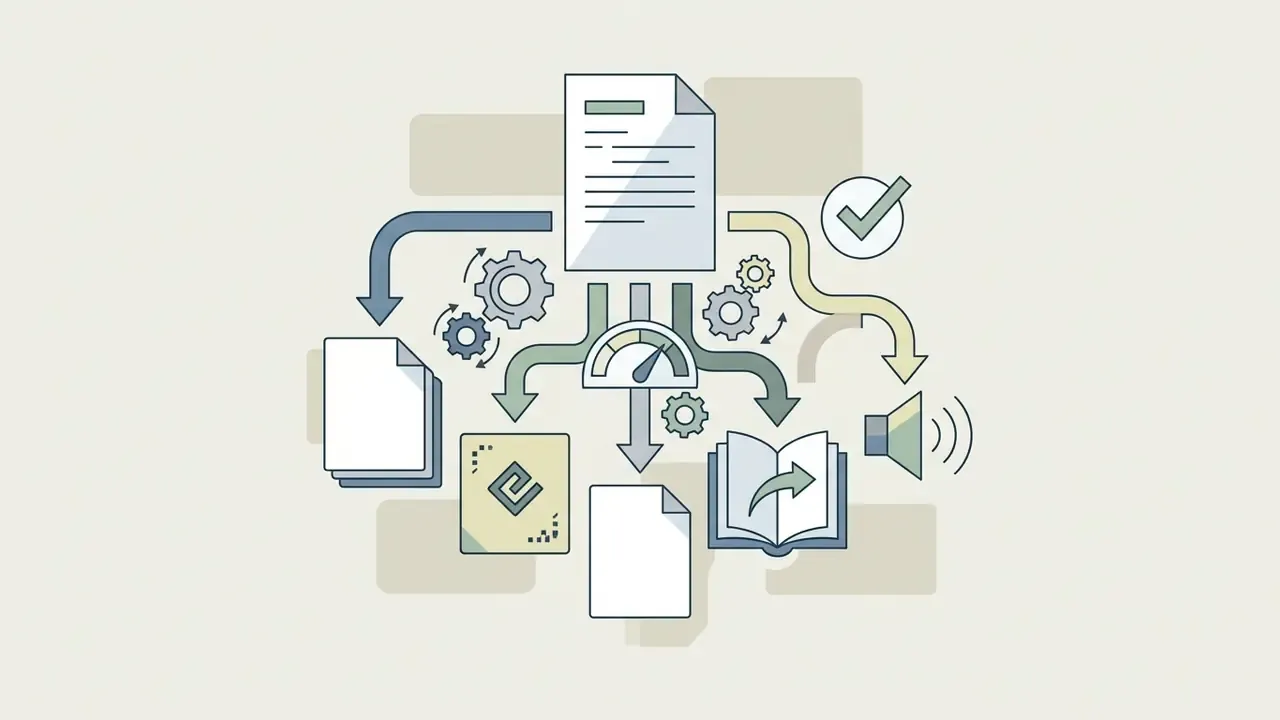
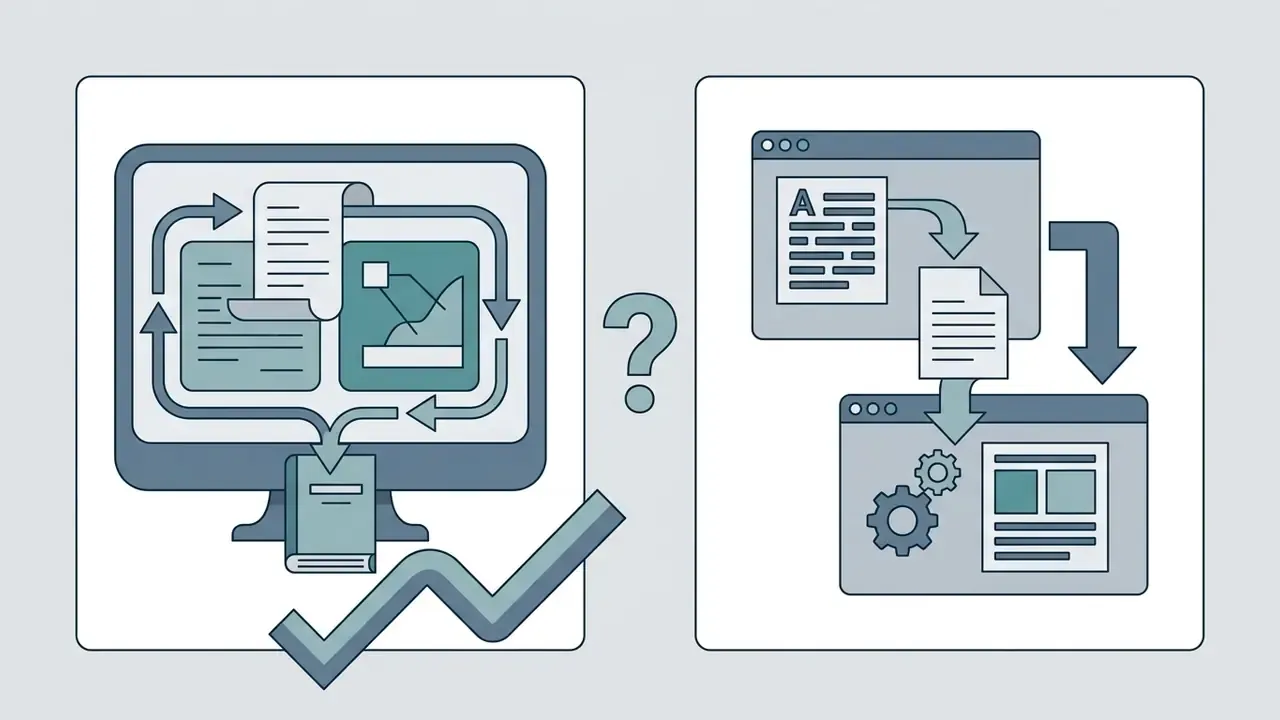
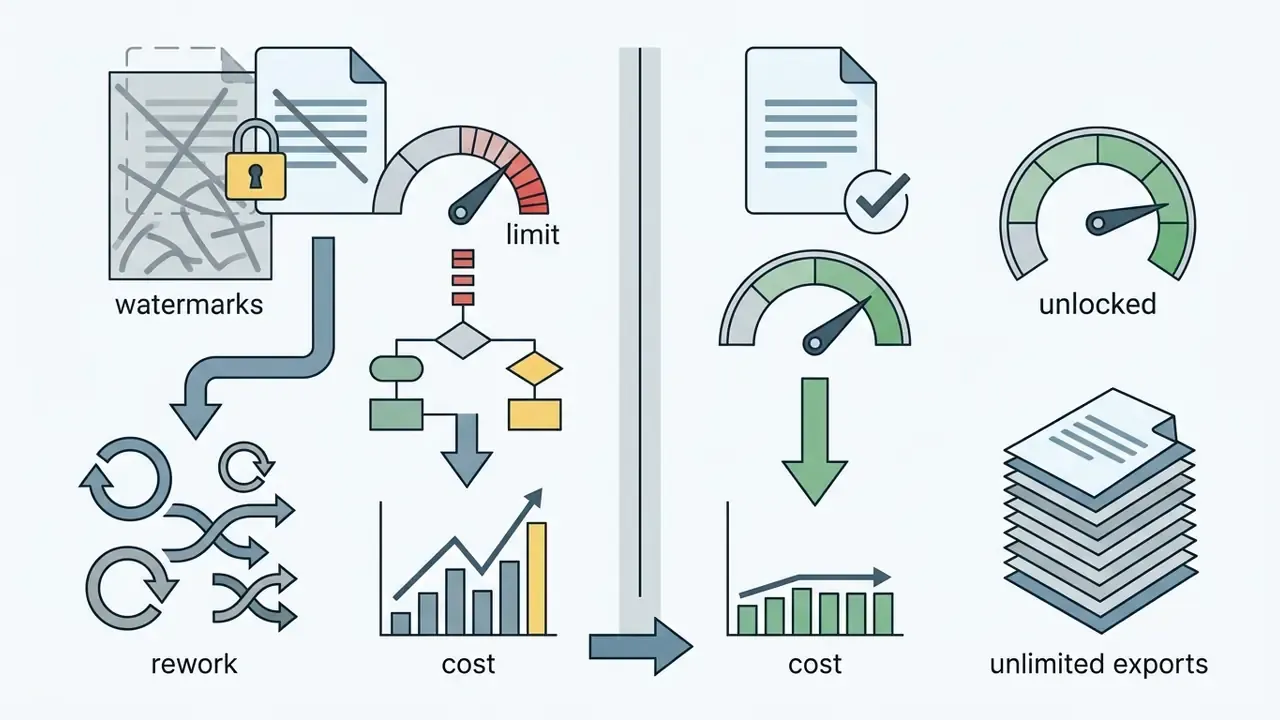
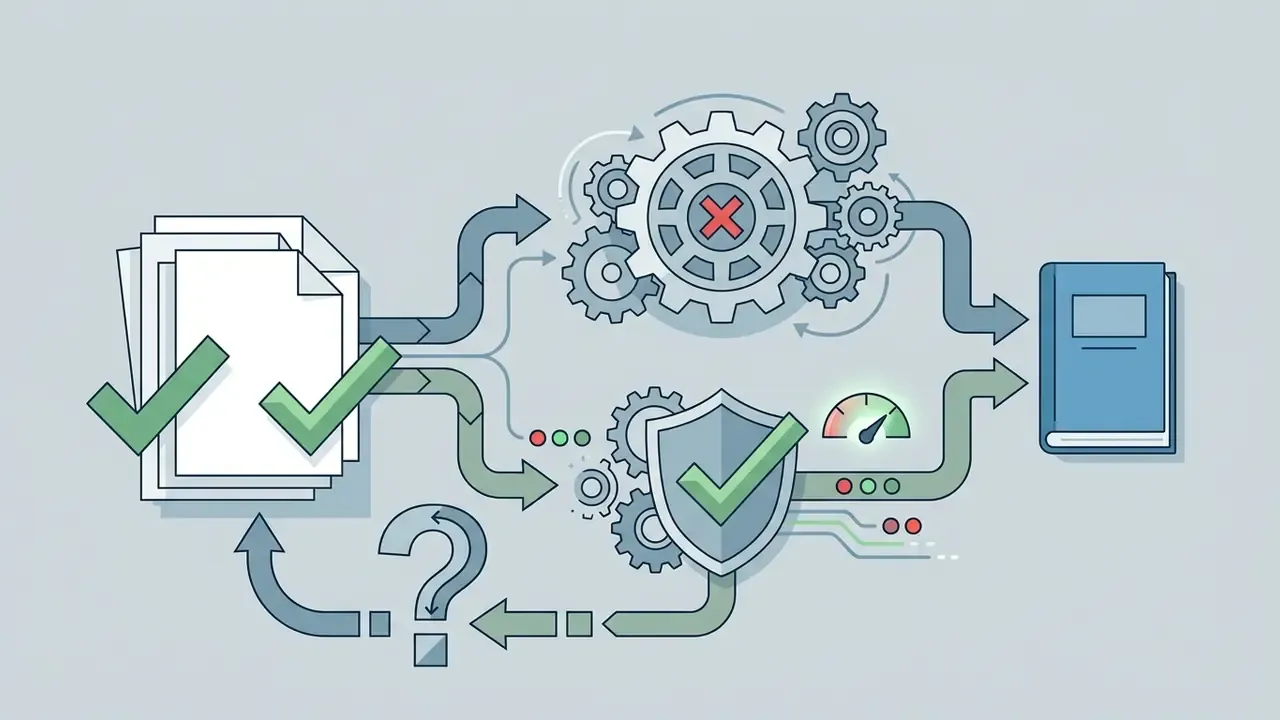
Whether you need a targeted lead magnet, an educational course workbook, a narrated audiobook, or a complete digital book formatted for print-on-demand, an ai ebook creator compresses production time while keeping editorial control where it belongs: with a named human.
What is an AI ebook generator and what can it create?
An ai ebook generator is an integrated software tool that transforms natural-language prompts or uploaded files into fully formatted electronic books. Unlike a text editor, which only records what you type, an ai ebook creation platform automates structural outlining, chapter drafting, typography selection, page layout and digital file export.
Traditional word processors still expect you to hand-tune headers, margins, page breaks and visual elements. Online design tools go the other way: pretty static templates, no long-form text generation. An ai ebook generator platform sits between those two worlds, unifying writing, design and technical formatting in one automated pipeline.
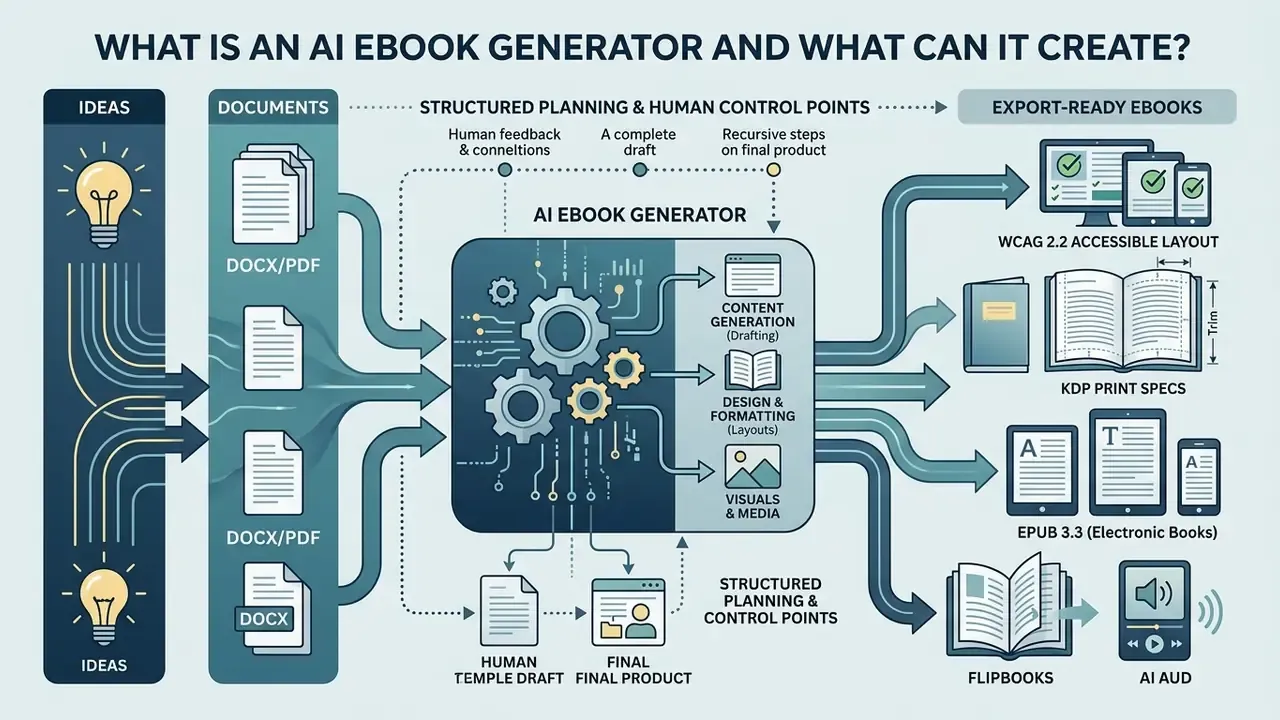
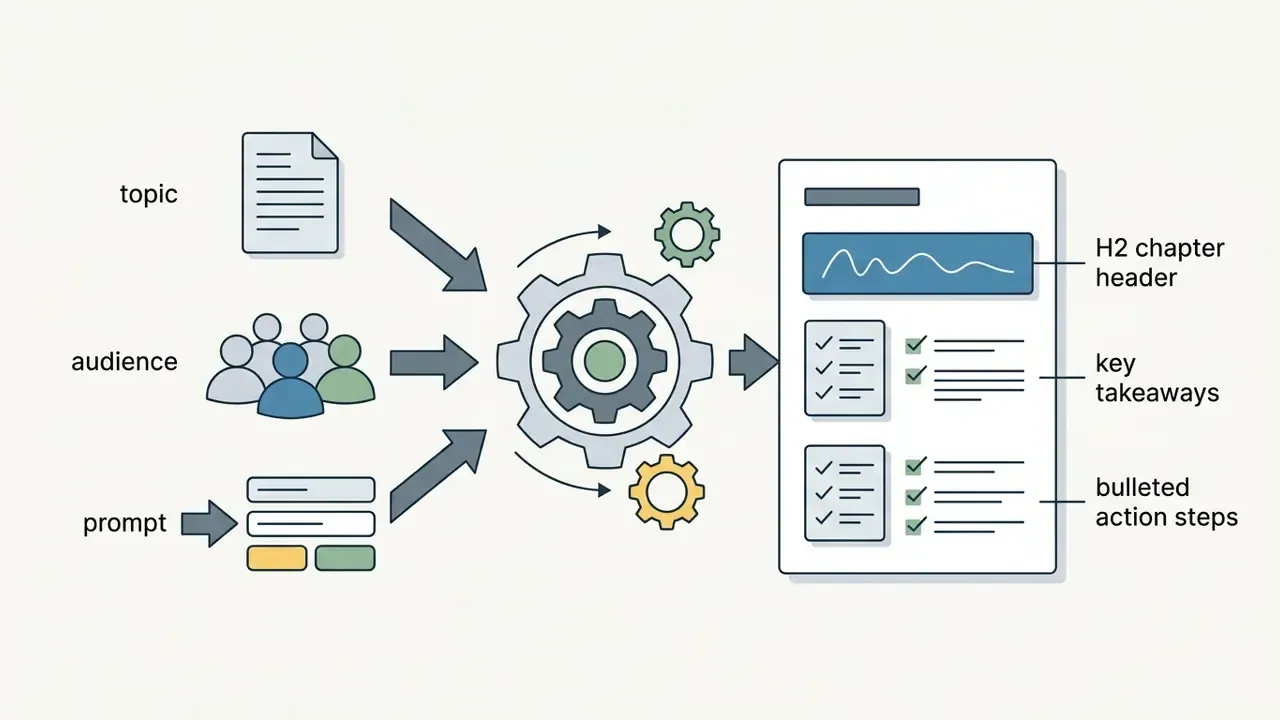
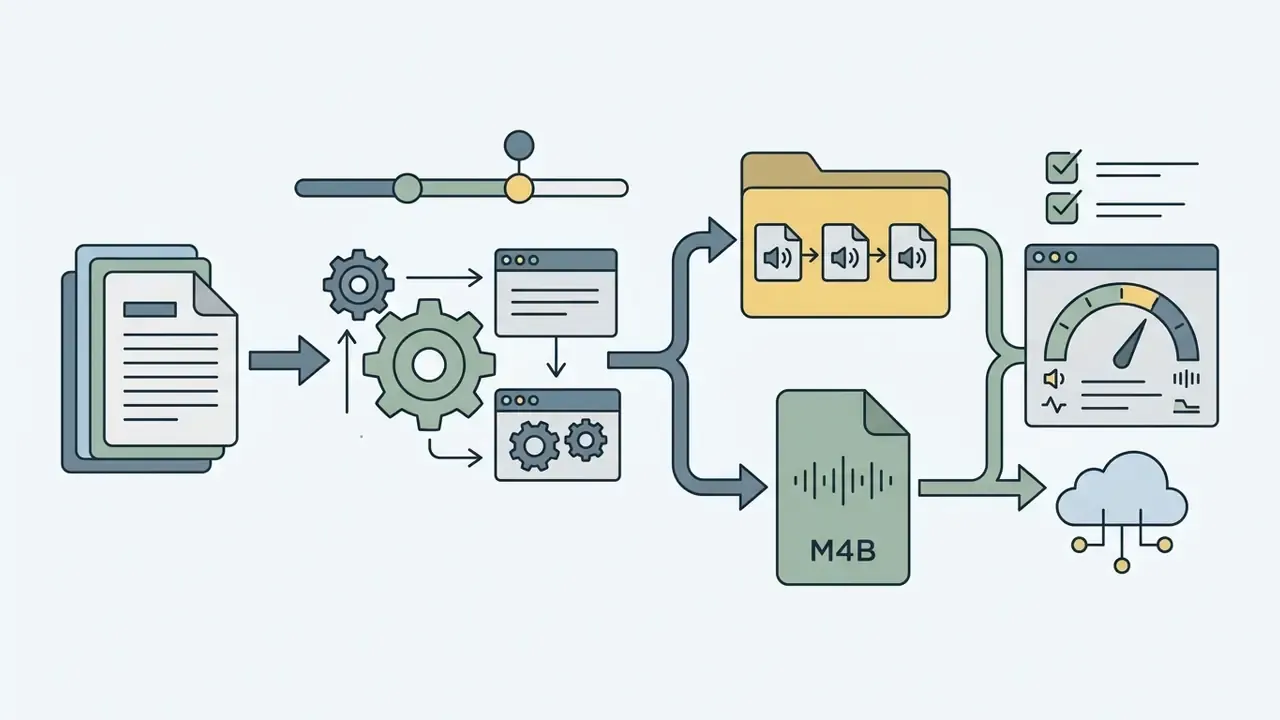
Figure 1: End-to-end operational architecture of an ai ebook generator.
| Stage | What happens | Human control point |
|---|---|---|
| 1. Input | Topic, prompt, DOCX, PDF, URL or transcript | Choose approved sources only |
| 2. Planning | AI proposes chapter outline and takeaways | Reorder, delete, add gaps |
| 3. Drafting | Chapter prose generated section by section | Rewrite, do not just accept |
| 4. Layout | Theme, typography, pages, image slots | Contrast and spacing checks |
| 5. Review | Fact-check, accessibility, validation | Named approver signs off |
| 6. Export | PDF, EPUB, DOCX, flipbook, MP3/M4B | Channel-specific settings |
Notice how many of those rows are human rows. Four of six.
AI for ebook creation: from idea to complete draft
The core process of ai for ebook creation starts with structured natural-language planning. Modern large language models use hierarchical generation to convert a high-level concept into a detailed chapter breakdown, then fill that breakdown in passes.
Research on long-form document planning shows that decomposing the task into recursive sub-steps (composition, reasoning, retrieval) lets models hold logical coherence across tens of thousands of words.
«WriteHERE dynamically decomposes the writing task into sub-tasks, composition, reasoning and retrieval, recursively invoked as the text unfolds.»
Rather than spraying unstructured text, an ai tool to create ebook project builds a hierarchical scaffold. The scaffold defines the reader promise, sets each chapter goal, and lists subtopics. Only then does the model populate sections with an opening hook, core concepts, practical steps, worked examples, common mistakes, a summary and a bridge to the next chapter.
A practical drafting sequence, borrowed from ordinary professional outlining practice, runs like this: (1) write a one-sentence reader promise; (2) brain-dump 20–40 candidate topics; (3) cluster related topics into chapters; (4) order chapters by logical progression or narrative beats; (5) give each chapter one key takeaway, 3–5 subtopics and supporting evidence; (6) set a word target per chapter so pacing stays even. Step 6 sounds fussy. It is the step that prevents a book with a 4,000-word chapter two and an 800-word chapter seven.
Quality is no longer purely theoretical, either. Fine-tuning visibly shifts reader perception:
The implication for authors is blunt. Raw default-model prose is average. Constrained prompting, style grounding and human reconstruction close most of the perceived quality gap, and the last stretch of that gap is where your reputation lives.
Content generation, design and formatting in one ebook tool
An ai ebook maker combines content drafting with automated desktop publishing. Good platforms remove manual typesetting by adjusting typography, margins, header placement and line spacing on the fly, then giving you overrides where the automation guesses wrong.
According to the W3C EPUB 3.3 Recommendation, digital publication layouts must accommodate both reflowable screen sizes and pre-paginated fixed displays. EPUB Accessibility 1.2 adds that fixed-layout content must preserve logical reading order and text alternatives.
«EPUB 3.3 defines reflowable and pre-paginated rendition layouts for digital publications.»
Integrated ai ebook creation software handles most of those specifications for you. When generating ebooks with ai, the platform formats headers, embeds images with descriptive alternative text, and balances page spreads. The result is a polished digital document that meets professional publishing standards without a separate graphic design suite in the loop.
The efficiency gains are measurable at industrial scale:
«AI-assisted editing reduced manuscript processing time by 30–50%, while automated content generation cut production costs by roughly 40% in China's publishing sector.»
One caution on that number. Cost reduction of 40% at the drafting stage does not survive if review and remediation costs triple. Count the whole pipeline.
What types of ebooks can you create with AI?
An ai ebook creation tool supports several content archetypes, each tied to a business, educational or publishing goal. Platforms adapt tone, page count, visual density and layout to the audience you declare.
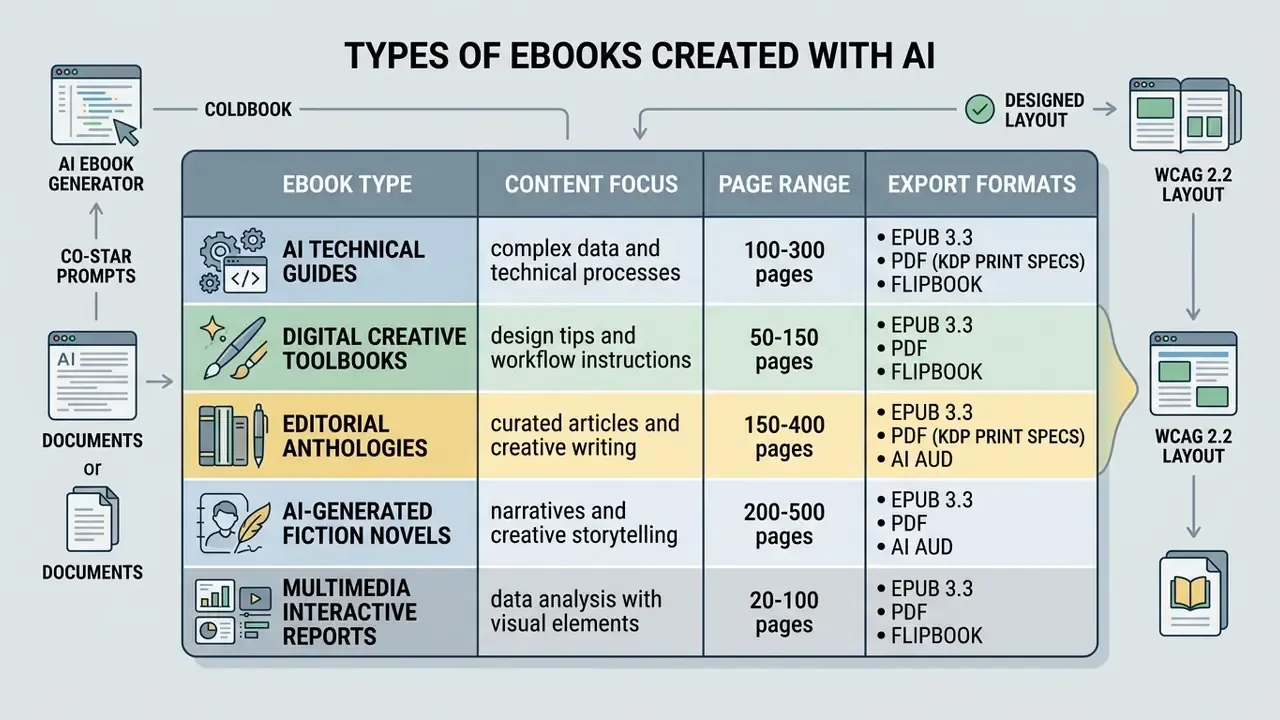
Typical AI ebook archetypes, page ranges and business goals
| Ebook type | Typical length | Primary audience | Business goal | Best output format |
|---|---|---|---|---|
| Lead magnet / mini-ebook | 8–15 pages | Cold traffic, newsletter subscribers | Email capture | PDF plus gated flipbook |
| How-to guide | 5–15 pages | Mid-funnel researchers | Education, soft conversion | PDF / HTML5 |
| Course workbook | 10–20 (up to 40–80) pages | Students, coaching clients | Engagement, completion | Interactive PDF, DOCX |
| Corporate playbook / policy manual | 20–60 pages | Internal staff, auditors | Standardization, compliance | Accessible PDF (PDF/UA), DOCX |
| Commercial book | 80–300 pages | Retail readers | Direct sales, authority | EPUB 3.3 plus print PDF plus audiobook |
Lead magnets, guides and marketing ebooks
Lead magnets are concise digital assets built to capture contact details or establish authority. Marketers routinely use an ai tool create ebook solution to convert existing blog posts or research notes into an 8-to-15-page downloadable resource. The common repurposing pattern: pick 5–15 thematically related posts, merge them into one source document, and let the generator restructure them into a handbook that can be shared, embedded, gated behind a form, or sold outright.
«Among publishers that adopted AI, 38% use it to generate headlines, 36% for writing support and outlining, and 34% for marketing copy.»
An ai ebook generator free plan or a paid tier both accelerate this, mostly by imposing skimmable structure: callout boxes, brand colors, structured summaries, a single conversion path per chapter. Marketers assembling a full multi-channel asset set often pair ebook production with visual tooling. A comparison of the best AI art generators helps decide which engine produces on-brand chapter illustrations and cover art at volume, and which one quietly limits commercial rights.
Course workbooks, educational materials and professional documents
Educational and corporate materials demand structured layouts, clear pedagogical progression and interactive elements. Course workbooks usually span 10 to 40 pages, with exercise fields, reflection prompts, answer spaces, progress trackers and lesson-level learning objectives.
Municipalities and global institutions lean on standardized document templates to distribute policy and training playbooks. The City of San José, for instance, publishes AI training playbooks and agency templates in PDF, DOCX and PPTX, while the EU Digital Strategy portal publishes a standardized template for public summaries of general-purpose AI training content. An ai tool for ebook creation generates the equivalent instructional manual: step-by-step procedures, quizzes, downloadable summary sheets, consistent ebook templates across a series.
For internal enterprise documentation, keep export targets accessible. U.S. Section 508 requires accessible PDFs for federal compliance, and PDF/UA plus WCAG 2.1 AA alignment is the practical baseline for training material distributed across a large workforce. Retrofitting accessibility after 60 pages of layout is miserable work. Ask anyone who has done it.
Publishing-ready books, ebooks and digital products
Commercial digital products need strict adherence to publishing standards, full manuscript coherence and precise metadata. Writers use an ai to create ebooks for digital storefronts and self-publishing marketplaces such as Amazon KDP.
The commercial reality in 2026 is expansion plus dilution, not automatic profit.
«Titles with observable sales grew 19.2×, while quarterly revenue grew only 8.9×, the market filled with books faster than with money.»
Professional authors read that trend as a threat at least as much as an opportunity:
«51% of UK novelists believe AI will eventually replace their work entirely; 85% expect income to fall because of AI, while 33% already use AI for supporting tasks.»
Success in a diluted market therefore depends on human editing, not generation speed. Platforms require formatted EPUB files with logical reading order, correct metadata tags and a high-resolution cover. Authors preparing a professional presence around a launch often refresh bio imagery too. The guide to AI headshot generators covers portrait quality, licensing and privacy trade-offs.
Specialized industry blueprints
Genre-specific blueprints change the structure the AI produces, not only the topic. The archetypes most requested in 2026:
- Cookbooks and recipe collections automated ingredient matrices, yield and prep-time fields, step-by-step cooking timers, nutrition callouts, dedicated plating-image slots per recipe spread.
- Course workbooks and training packs interactive form fields, progress checklists, reflection prompts, exercise callouts, quiz pages with answer keys, per-lesson learning objectives.
- Real estate and business guides embedded property maps, agent contact cards, dynamic ROI and mortgage calculators, comparison tables, disclosure pages.
- Children's books and picture books short-line typography, high-contrast illustration pairing, fixed-layout EPUB with reading-order metadata.
- Fiction and romance novels beat-sheet outlining, character consistency sheets, scene expansion, chapter pacing checks.
- Catalogs, magazines, lookbooks and newsletters grid-based spreads, product SKU tables, price fields, QR-linked ordering pages.
- Whitepapers and analyst reports executive summary, methodology box, chart placeholders with alt text, formatted reference list.
How to create an ebook with AI: prompt, file and outline workflow
Creating a professional ebook with an ai ebook generator follows a six-stage workflow. Follow it and you get structural quality, accurate styling and compliance with publishing guidelines. Skip stage three and you get a fluent, confident, slightly wrong book.
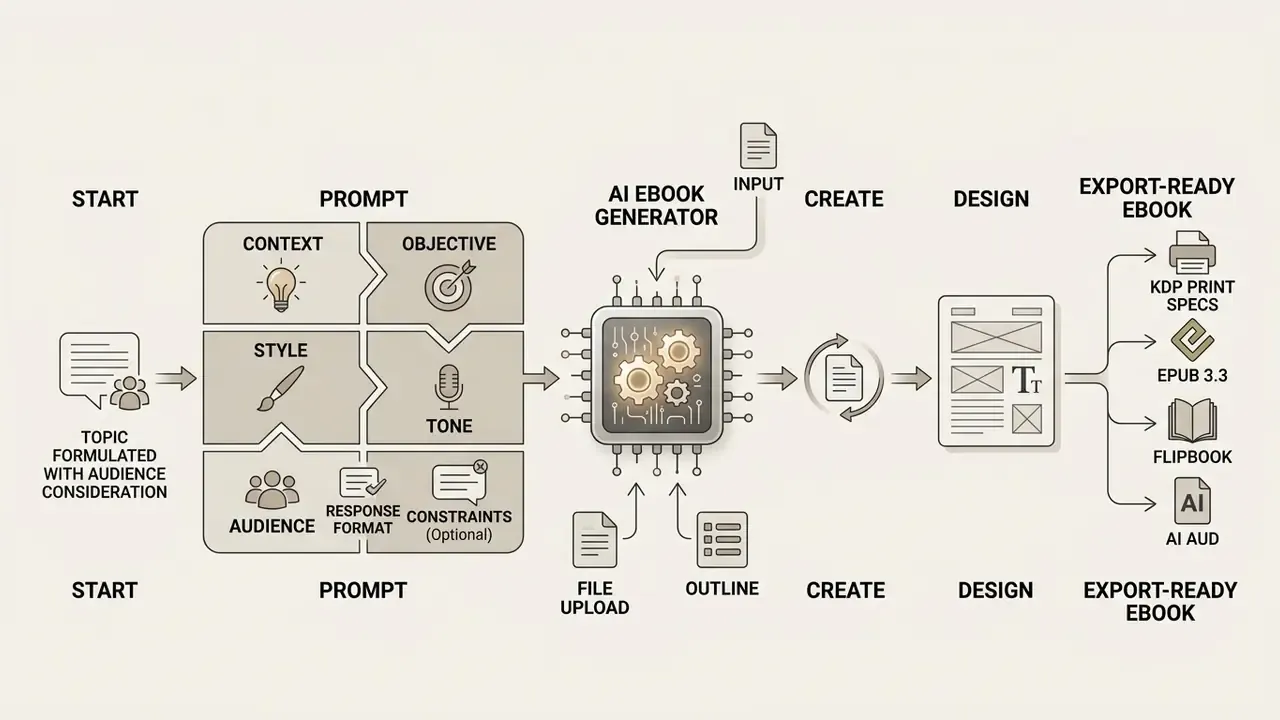
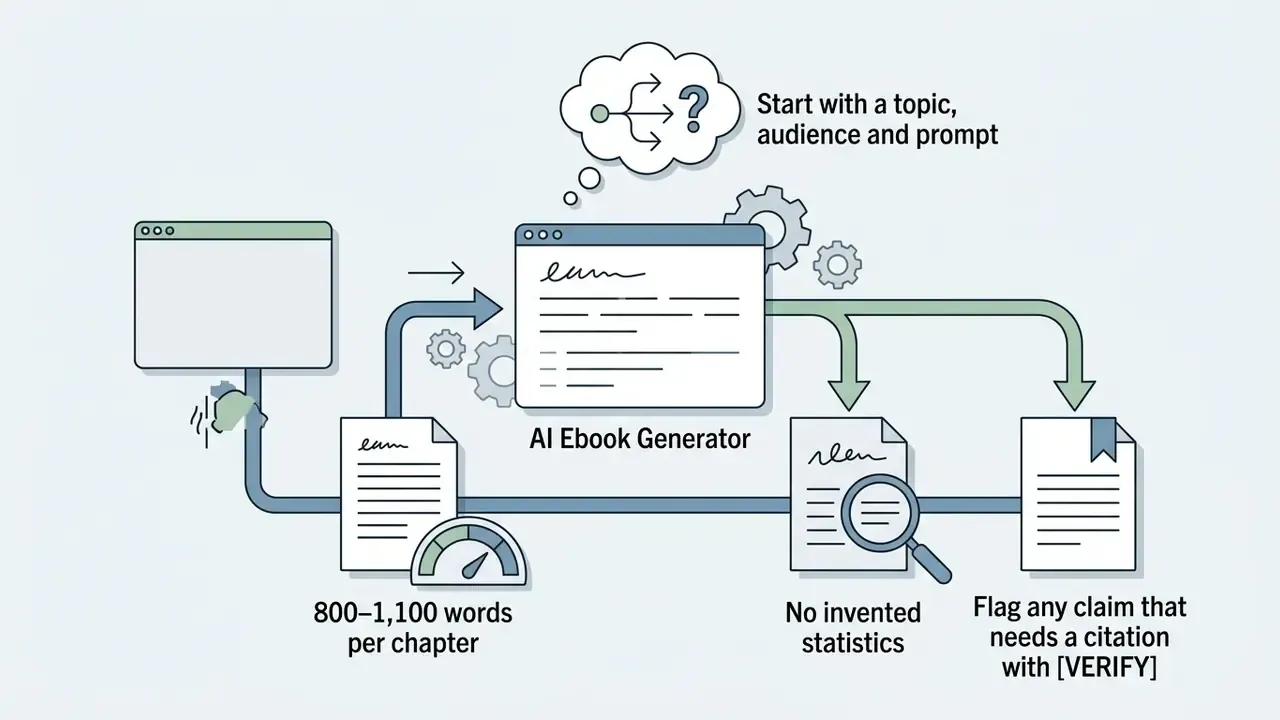
Start with a topic, audience and prompt
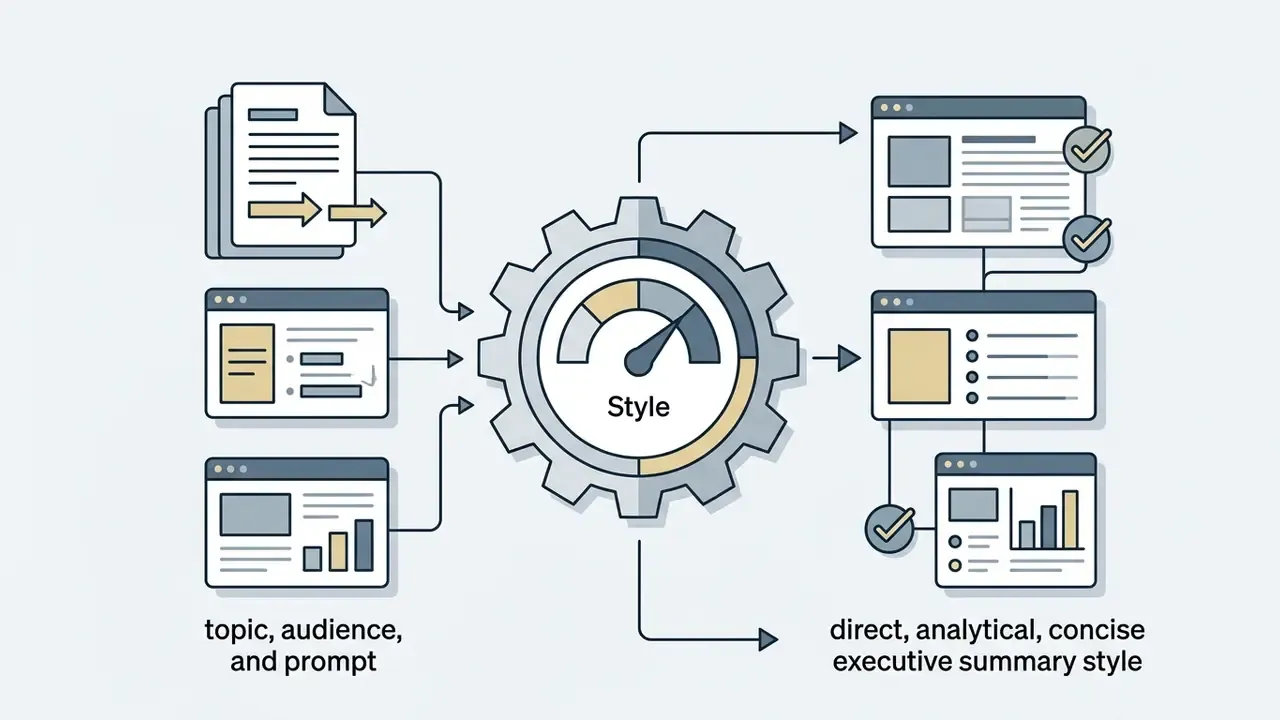
The foundation of successful ai ebook creation is structured prompt engineering. Declaring the audience, the operational goal, the tone and the structural constraints is what prevents generic output. Vague prompt in, vague book out.
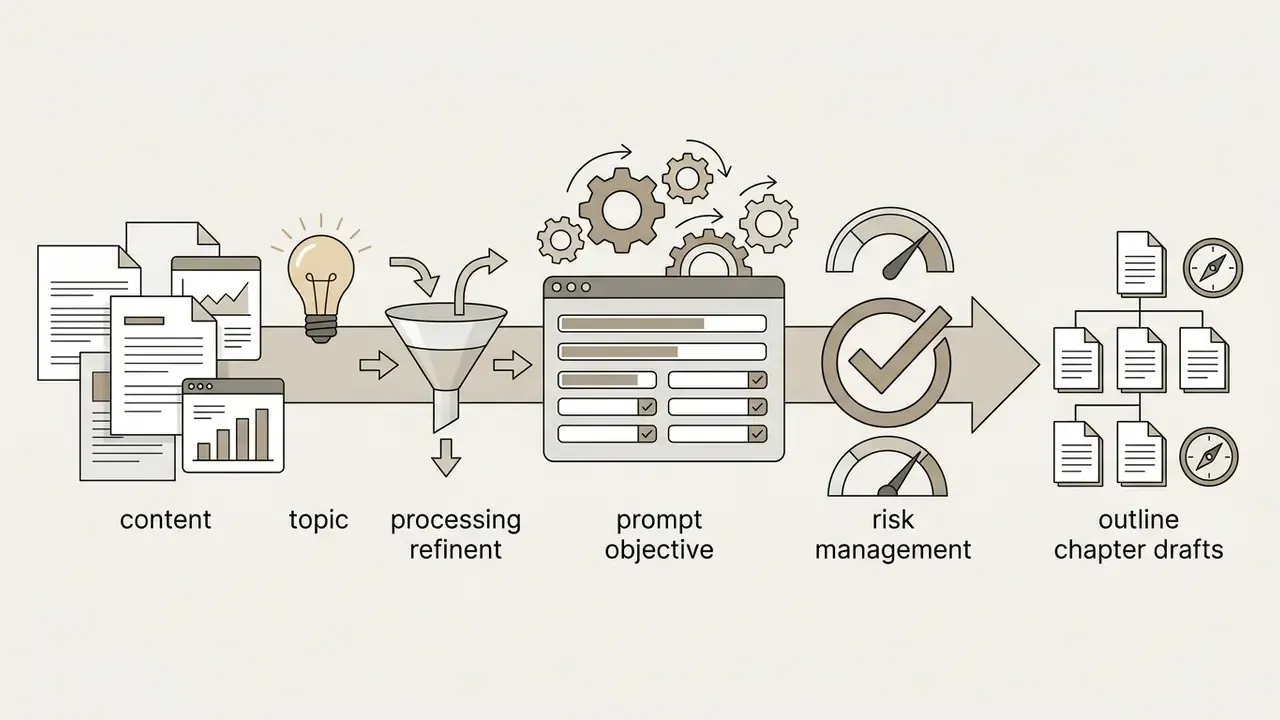
The CO-STAR structure (Context, Objective, Style, Tone, Audience, Response) was popularized by the winning entry of Singapore's GPT-4 prompt engineering competition and is described in NIST SP 1353 ipd, Quick-Start Guide for Using Artificial Intelligence (initial public draft, 2026), published at csrc.nist.gov. NIST's formulation notes that the audience field sets abstraction level and precision, while tone aligns register to that audience. Related frameworks converge on the same six-part logic: the Singapore Government Prompt Engineering Playbook separates audience specificity from tonality, and The Prompt Canvas (arXiv, 2024) groups prompts into persona/audience, goal and steps, context and references, format and tonality.
CO-STAR prompt structure for AI ebooks
Set those parameters and the ai ebook design generator matches your reader's technical background instead of averaging across the internet. The [VERIFY] constraint earns its place in regulated environments: it forces the model to surface unverified claims rather than bury them inside confident prose.
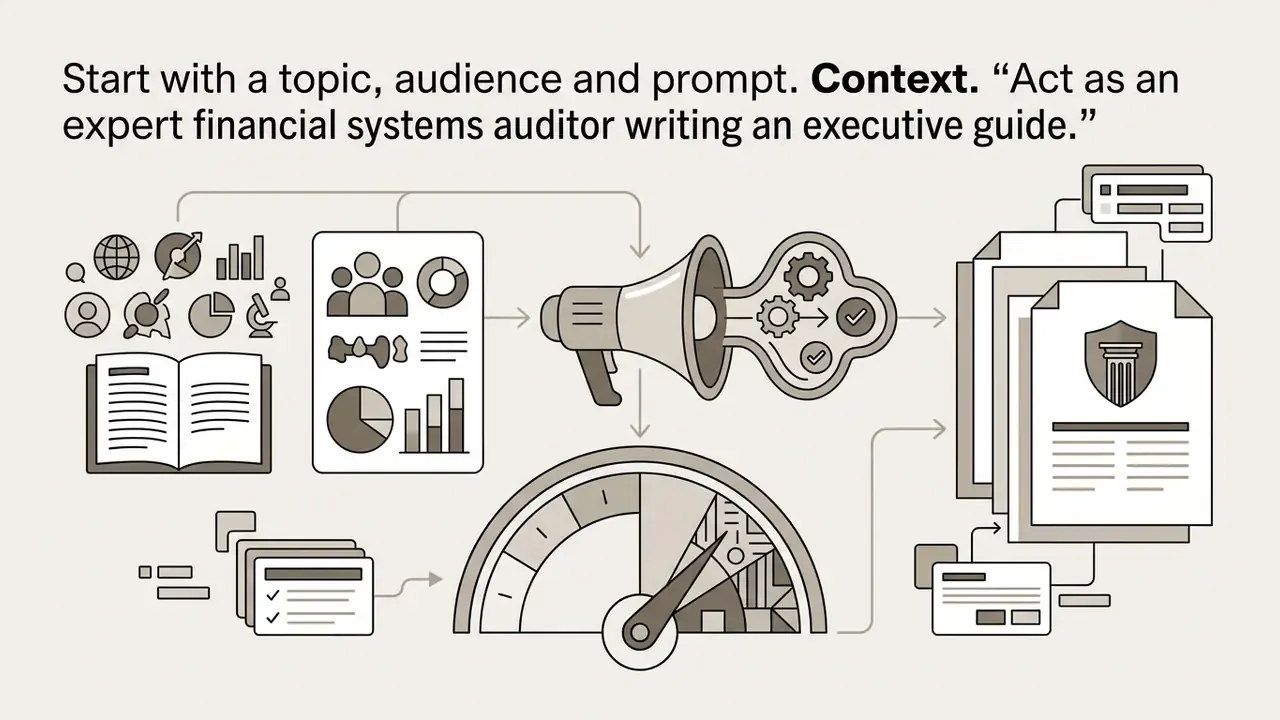
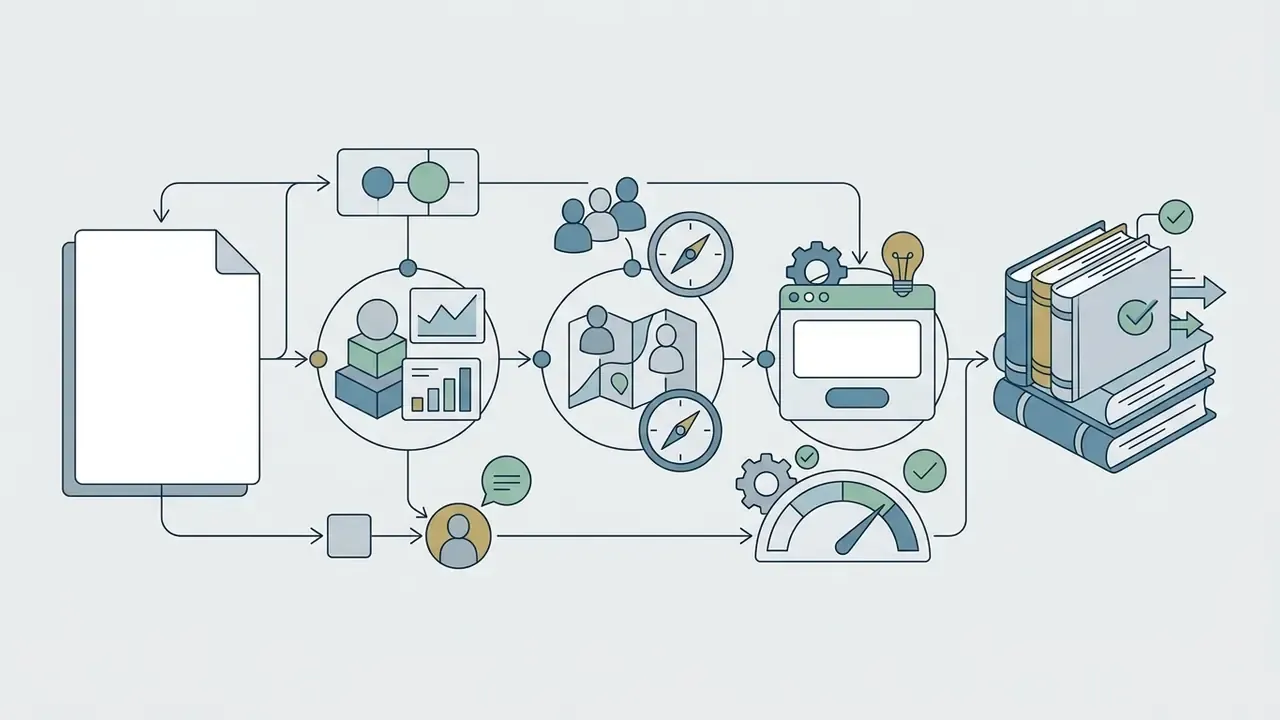
Upload a file, document or existing content
Generate and edit the AI outline, chapters and draft
After processing your prompt or files, the ai ebook creator tool returns an editable structural outline. Review it. Reorder it. Delete the chapter that exists only because the model likes symmetry. Then draft prose.
«Writers who actively rewrote AI text ("reconstructors") reported higher perceived ownership and produced higher-quality final work.»
That study separates three engagement patterns: text reproducers who paste AI output nearly unchanged, integrators who blend AI passages with their own, and reconstructors who rewrite substantially. Reconstruction is not only better for quality. In the U.S. it is also the behavior that creates the human authorship copyright protection depends on.
Illustrative mini-case (composite, not a real client engagement). A financial technology team needed to convert 12 disparate technical research notes into an executive compliance guide. They uploaded the raw DOCX files into an ai ebook generator app, restructured the auto-generated 8-chapter outline, and added bank-specific case studies by hand. The unified EPUB and PDF guide was finished in two days and passed internal compliance review on first submission. Logged artifacts: prompt version v3, 12 source file hashes, 3 named reviewers, one sign-off date. That last line is the part auditors ask about.
A three-stage editing discipline maps cleanly onto professional publishing practice: structural revision of the outline (order, gaps, dead spots, pacing), line-level copyediting of chapter prose (style, punctuation, standardized units, abbreviations, symbols, tables, references), then a final proof pass on the laid-out file to catch figure placement errors, broken headers and footers, widows and orphans.
Build pages with layout, theme colors and images
Once the manuscript is frozen, the ai ebook design generator applies visual layout, typography and color. Visual choices have to satisfy contrast and readability requirements, not just taste.
«WCAG 2.2 sets a minimum contrast ratio of 4.5:1 for normal text and 3:1 for large text and graphical/UI components.»
WCAG 2.2 also constrains spacing: line height at least 1.5×, paragraph spacing 2×, letter spacing 0.12×, word spacing 0.16× must all remain usable. Color must never be the sole carrier of meaning, and W3C's EPUB Accessibility: Fixed Layout Challenges and Best Practices extends that with a recommendation to test inversion, high-contrast modes and color-vision filters. Visual systems commonly apply the 60-30-10 palette rule (60% dominant background, 30% structural typography, 10% accent), with 14–16 px body text and a deliberately small set of font families, as recommended in the University of Denver Design Guide for Visual Presentations.
For cover art and chapter imagery, judge generators on licensing as hard as on aesthetics. The overview of Canva AI Generator features, pricing and commercial licensing is a useful reference point, and light cleanup can be handled with a free photo editor before placement.
Build sequence, in order:
Customize, export and publish an AI-generated ebook
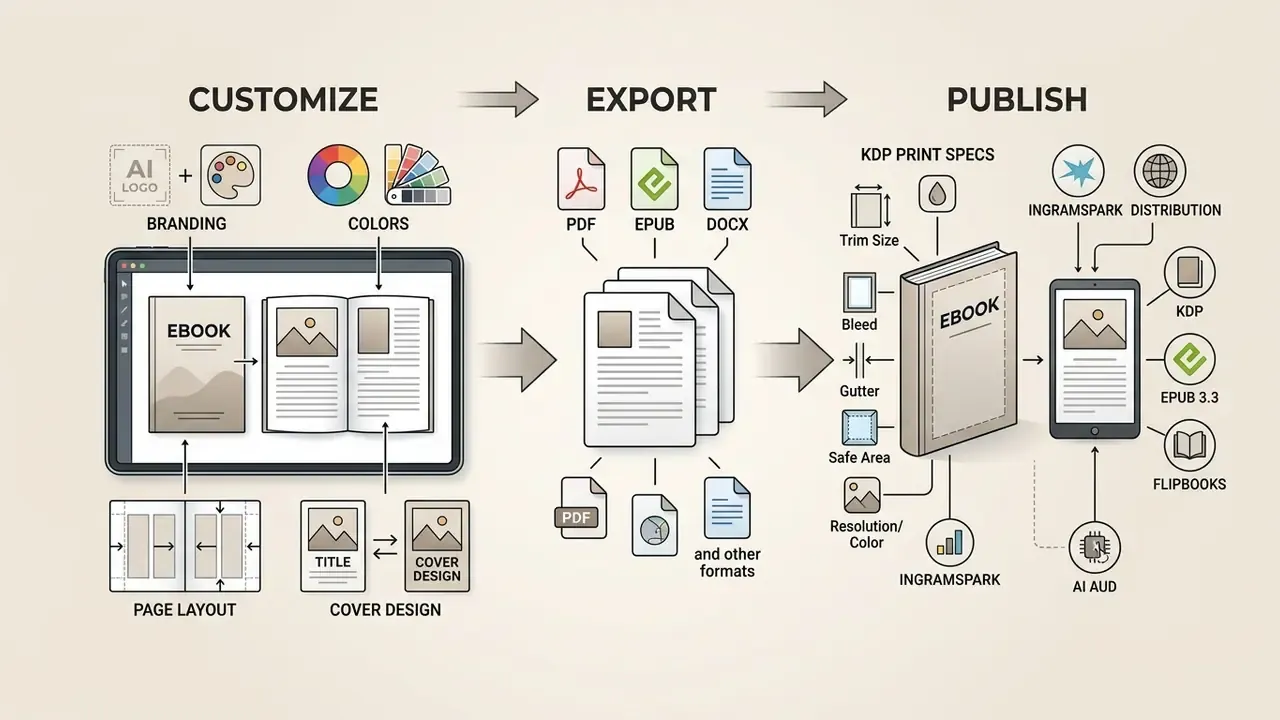
After drafting and styling, you tailor brand elements, export valid file types and configure distribution. Three separate jobs, often collapsed into one rushed afternoon.
Customize the cover, branding, colors and page layout
Branding features inside an ai ebook generator platform let teams upload logos, set a primary palette and configure page furniture. In practice, brand configuration maps a primary color to interactive and structural elements (CTA buttons, links, selections, chapter dividers, cover typography), while heading and body colors are set separately so contrast compliance survives. Cover customization in flipbook-oriented tools can add cover textures (leather, cardboard, cloth, silk, wood), binding styles and hard-cover options.
Persistent headers, footers, author bio blocks and a proper copyright page keep brand identity consistent across every exported file. Custom domains for hosted editions keep ebook URLs on your own brand rather than a vendor subdomain, which matters more than it sounds when a compliance officer checks where the asset lives. Teams standardizing chapter visuals across a series can start with the comparison of Google AI Image Generator features, access and usage rights when evaluating rights terms.
Export to PDF, EPUB, DOCX and other formats
Export options must match the reading device, print environment or editing workflow. A professional ai ebook creator software suite covers five specifications, and the pdf epub pair carries most commercial projects.
Technical comparison of ebook export formats
| Format specification | Primary layout behavior | Ideal target environment | Technical characteristics |
|---|---|---|---|
| PDF (Portable Document Format) | Fixed pre-paginated layout | Desktop viewing, high-resolution printing, digital lead magnets | Preserves exact typography, absolute page dimensions and vector placements across screens. Supports PDF/A, PDF/X and PDF/UA conformance targets. |
| EPUB 3.3 (Electronic Publication) | Reflowable dynamic layout | E-readers (Kindle, Apple Books, Kobo), mobile screens | Reflows text to screen size, supports accessibility tags, font resizing and screen-reader navigation. Packaged as application/epub+zip. |
| DOCX (Microsoft Word) | Editable structural manuscript | Human copyediting, peer review, legal and compliance audit | Retains text hierarchy, heading styles and editable tables for secondary processing. |
| HTML5 flipbook | Web-native paginated view | Landing pages, embeds, gated web distribution | Page-turn animation, full-text search, zoom, embedded media, shareable link and QR code, per-page analytics. |
| MP3 / M4B audio | Linear time-based narration | Audible/ACX, podcast feeds, in-app listening | Chapter-marked audio rendered from the finalized manuscript with neural TTS voices. |
Understanding those differences is what keeps a file from rendering badly on an e-reader, or from being rejected at upload.
Preparing print-ready PDFs for Amazon KDP and IngramSpark
For physical print-on-demand, page geometry must be set before layout is finalized. Retrofitting margins after design is the single most common cause of rejected uploads.
- Standard trim sizes 6" × 9" for standard non-fiction and business books; 5.5" × 8.5" for novels; 8.5" × 11" for workbooks and manuals.
- Bleed adjustments add 0.125" (3.2 mm) to top, bottom and outer edges for any background image or color block that runs to the page edge.
- Gutter (inner) margins scale with page count, roughly 0.375" for short books up to 0.75" and beyond for 500–700 page volumes, so text is not swallowed by the binding.
- Safe area keep live text at least 0.25" from trim edges to survive cutting tolerance.
- Resolution and color 300 DPI raster images; CMYK for interiors and covers destined for offset or POD printing, sRGB for digital-only editions.
- Typography embed all fonts; body text 10–12 pt with 1.2–1.45 leading; avoid hairline rules that vanish in print.
- Front and back matter title page, copyright page, a table of contents whose wording matches headings exactly, and blank verso pages where chapter openers must fall recto.
Dedicated formatting tools automate most of this. Pick a trim size and they set margins, page numbers, headers, footers, widow and orphan handling and spread balancing, then output a KDP-ready PDF alongside a validated EPUB from the same project.
Interactive web ebooks, audiobooks and reader analytics
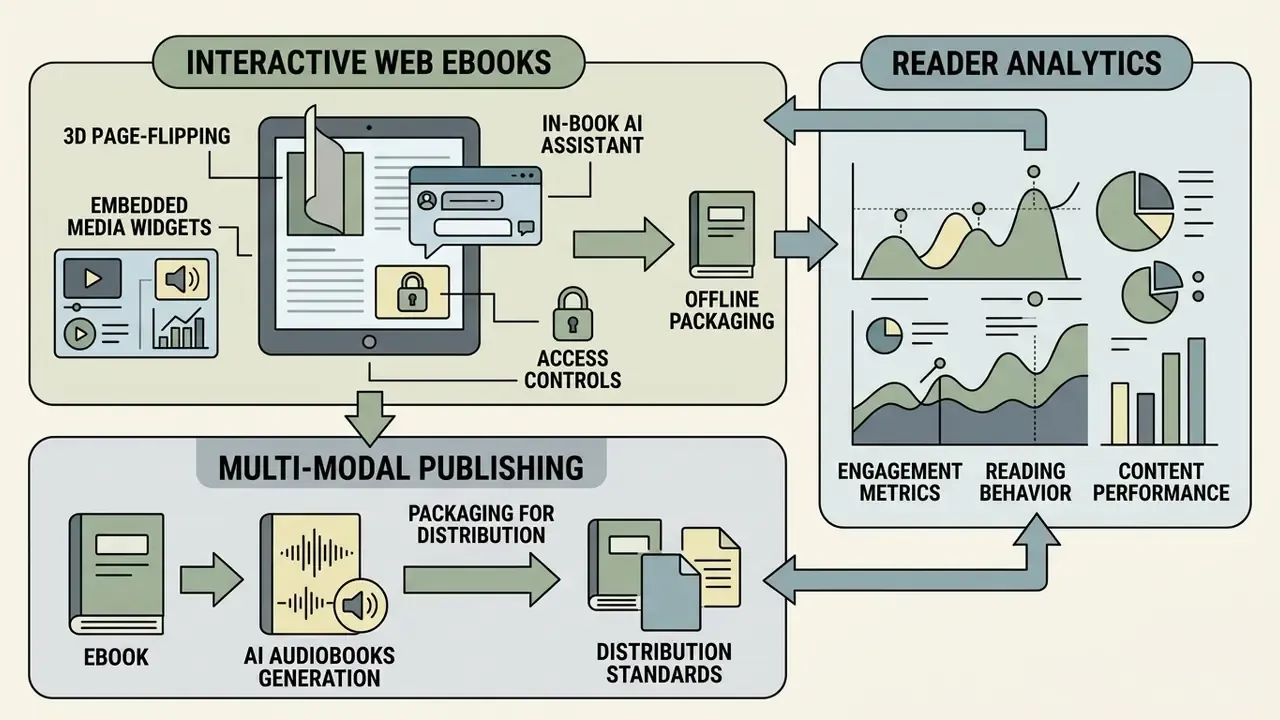
A finished ebook in 2026 is rarely one file. The same approved manuscript is increasingly rendered into four artifacts: a print-ready PDF, a reflowable EPUB, an interactive web edition and a narrated audiobook.
Interactive web ebooks: flipbooks, embedded media and in-book AI assistants
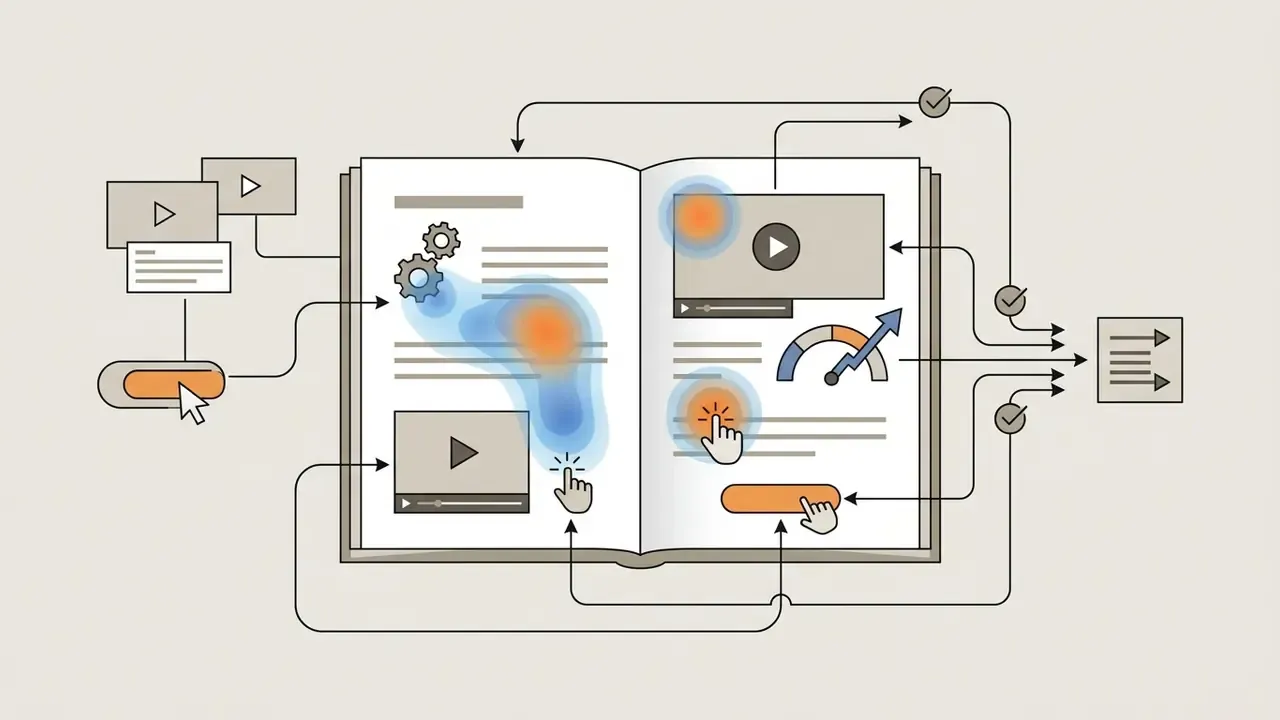
Digital-first ebooks can move well past static pages using web-native HTML5 flipbook formats:
Teams producing embedded animation or explainer segments can compare production approaches in the guide to animation makers, and shrink heavy assets using the video compressor guidance so page load stays tolerable on a mobile connection.
Multi-modal publishing: transforming ebooks into AI audiobooks
Modern platforms extend beyond text and layout by integrating neural text-to-speech. Writers synthesize a fully narrated audiobook directly from the finalized manuscript, inside the same workflow that produced the PDF and EPUB.
What a production-grade audiobook pipeline provides:
- Voice selection across 10+ expressive tones, including gender, accent and pacing variants; some platforms ship 13 or more voice options per language.
- Multilingual narration across 30+ languages, so one manuscript can ship localized audio editions.
- Automated chapter pacing and markers, with pronunciation dictionaries for names, tickers, acronyms and technical terms.
- Sample-and-regenerate loops so an author can re-render one mispronounced paragraph without re-recording the whole book.
Vendor telemetry suggests audio has moved from rarity to routine final step: a growing share of books built on AI platforms are exported to more than one format, with audio treated as a standard deliverable rather than an upsell. Treat that as vendor-reported, not independently audited. Before committing to a voice, check licensing and quality using the AI voice generator guide, because narration rights and commercial-use terms vary sharply between vendors.
Measuring reader engagement with embedded analytics
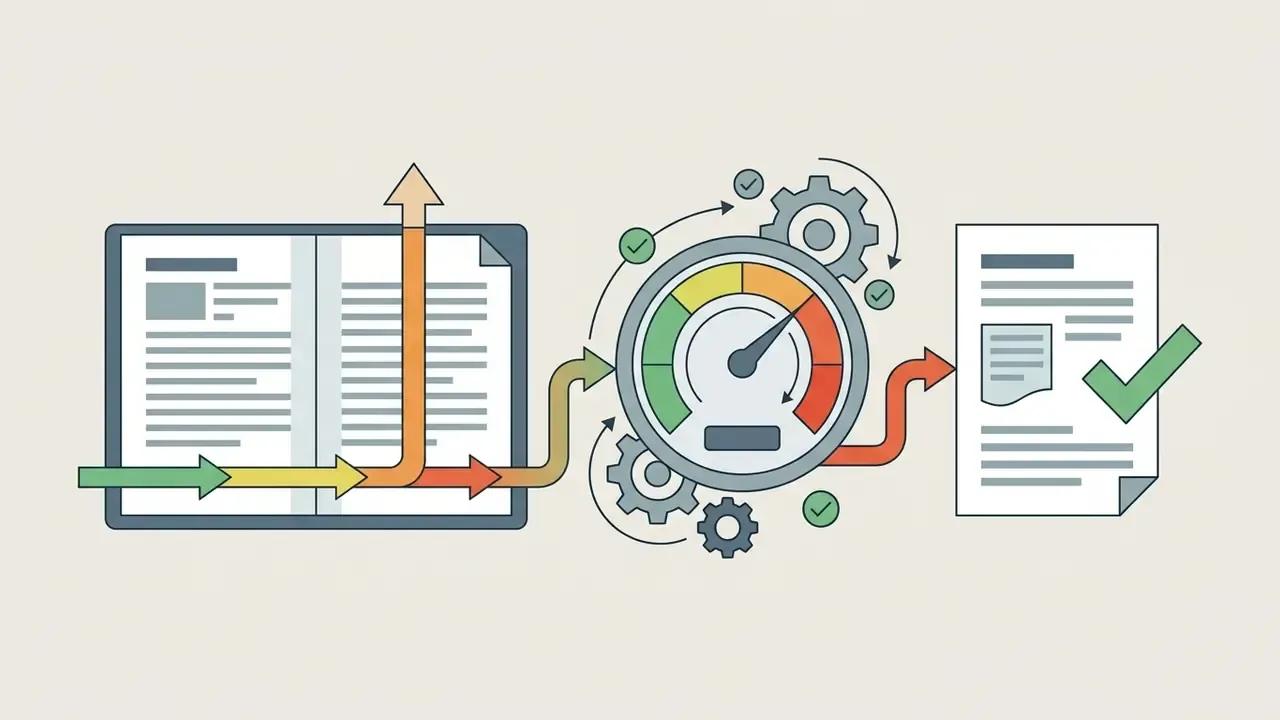
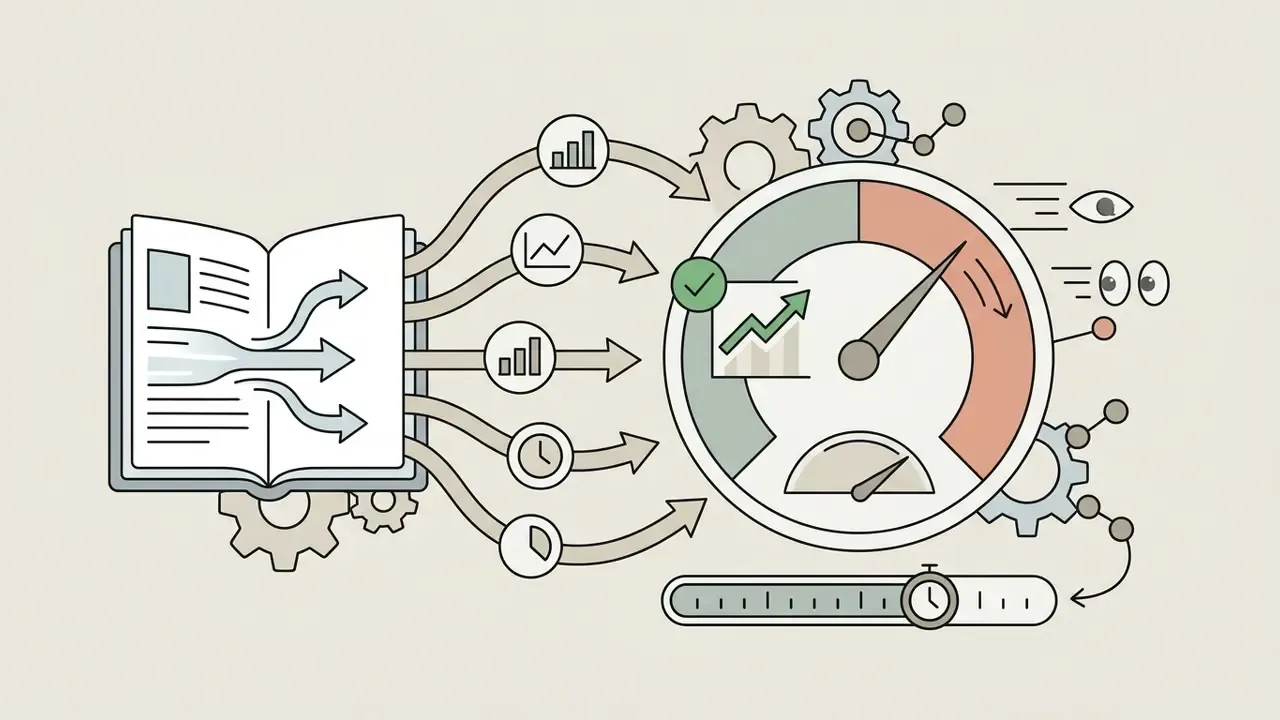
Unlike a downloadable offline PDF, a cloud-hosted ebook produces telemetry. That turns a book into a measurable marketing asset:
Practical use: if 60% of readers abandon at chapter three, the fix is editorial, not promotional. Analytics converts a hunch into a decision.
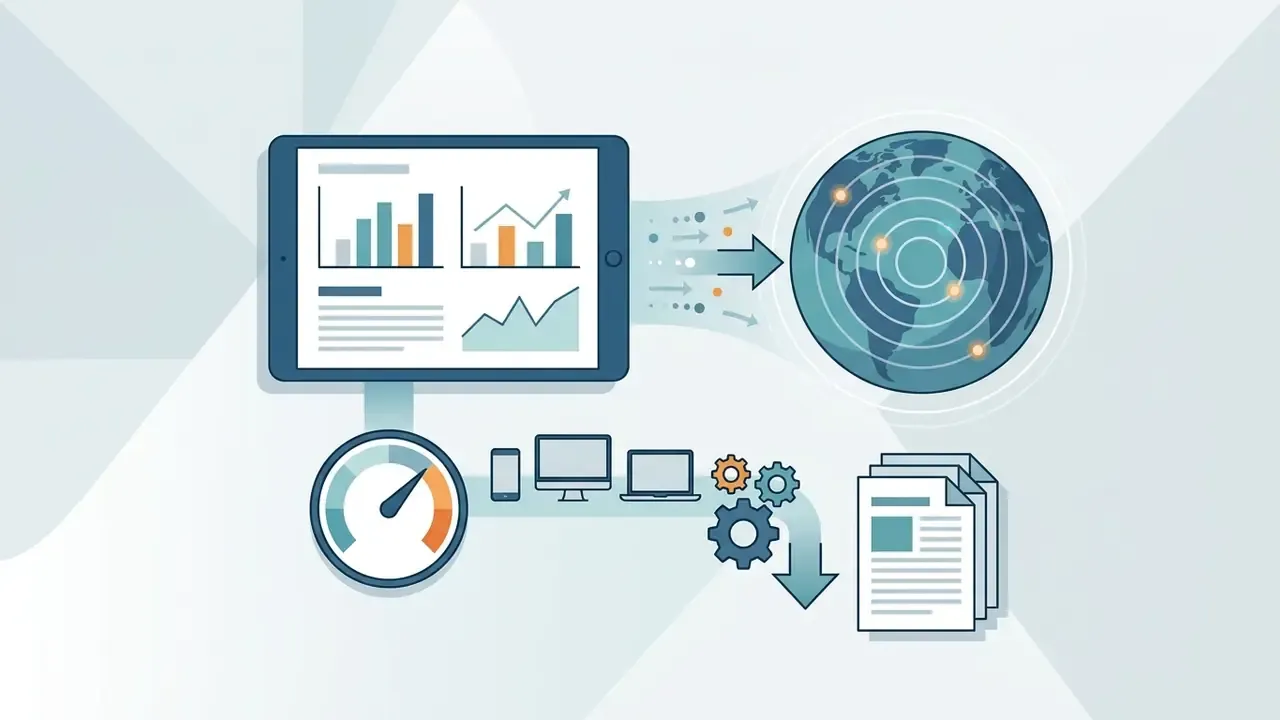
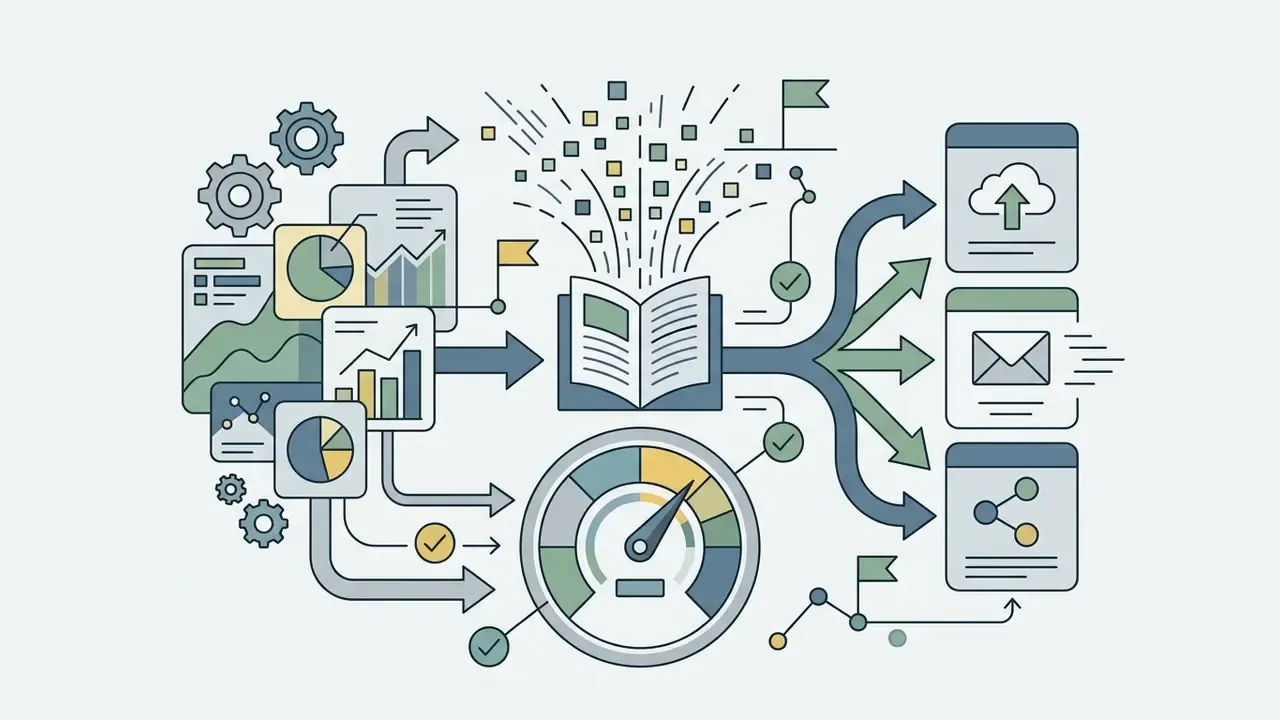
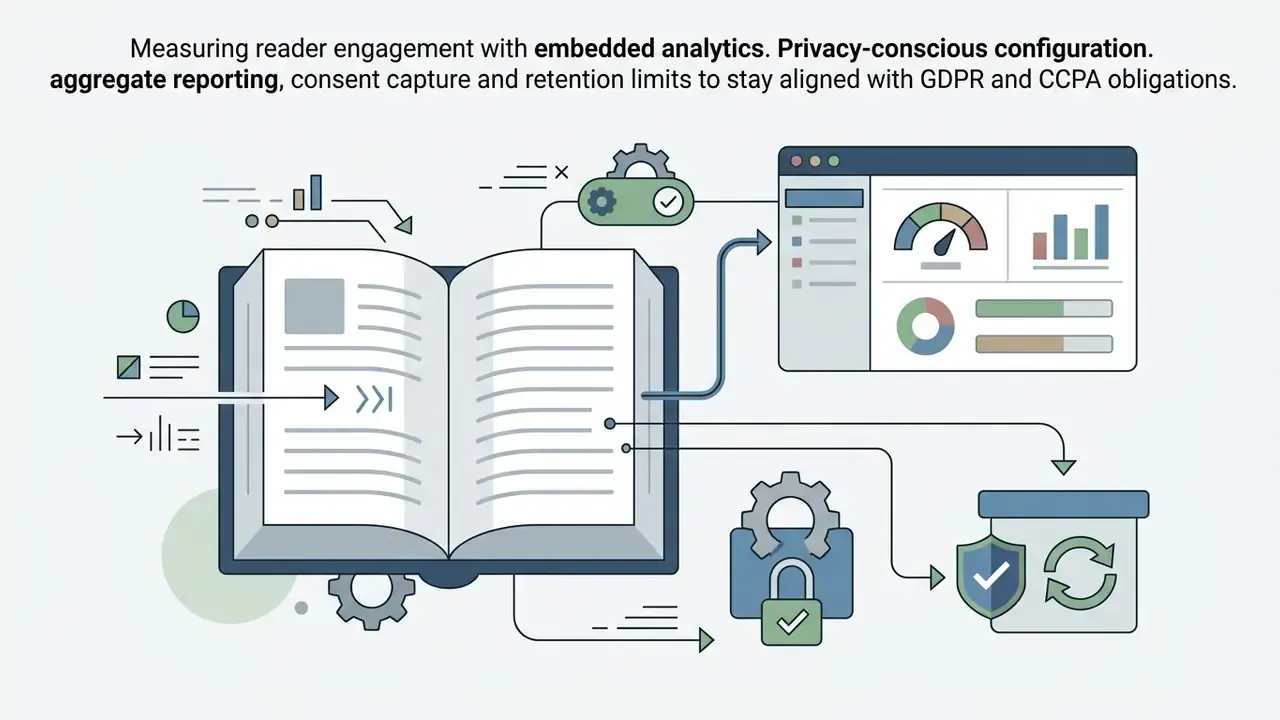
Format selection logic: which artifact do you actually need?
Run this decision tree before spending export credits.
- Selling on Amazon KDP or Apple Books? Reflowable EPUB 3.3 (validated with EPUBCheck) plus a print-ready PDF at 6"×9" with bleed and page-count-scaled gutters. Complete the AI-disclosure step at upload.
- Capturing emails from cold traffic? A PDF lead magnet, 8–15 pages, delivered by email automation, optionally with a gated HTML5 flipbook for on-page reading and analytics.
- Corporate training or policy distribution? Accessible PDF (PDF/UA plus WCAG 2.2 AA) plus DOCX for reviewer markup, hosted behind SSO with version history and named approvers.
- Website or intranet content hub? An interactive HTML5 flipbook with embedded video, in-book AI assistant and per-page analytics.
- Commuting or accessibility-first audience? An AI audiobook (MP3 per chapter or chapter-marked M4B) generated from the approved manuscript.
- Manuscript still under editorial review? DOCX only. Do not typeset until structural edits are frozen.
- Multi-market launch? Generate localized text first, then re-render each artifact per locale so pagination, contrast and narration are validated per language.
To model quota and credit consumption across those artifacts before you commit, browse the hub of cost calculators.
How to choose an AI ebook creator tool or software
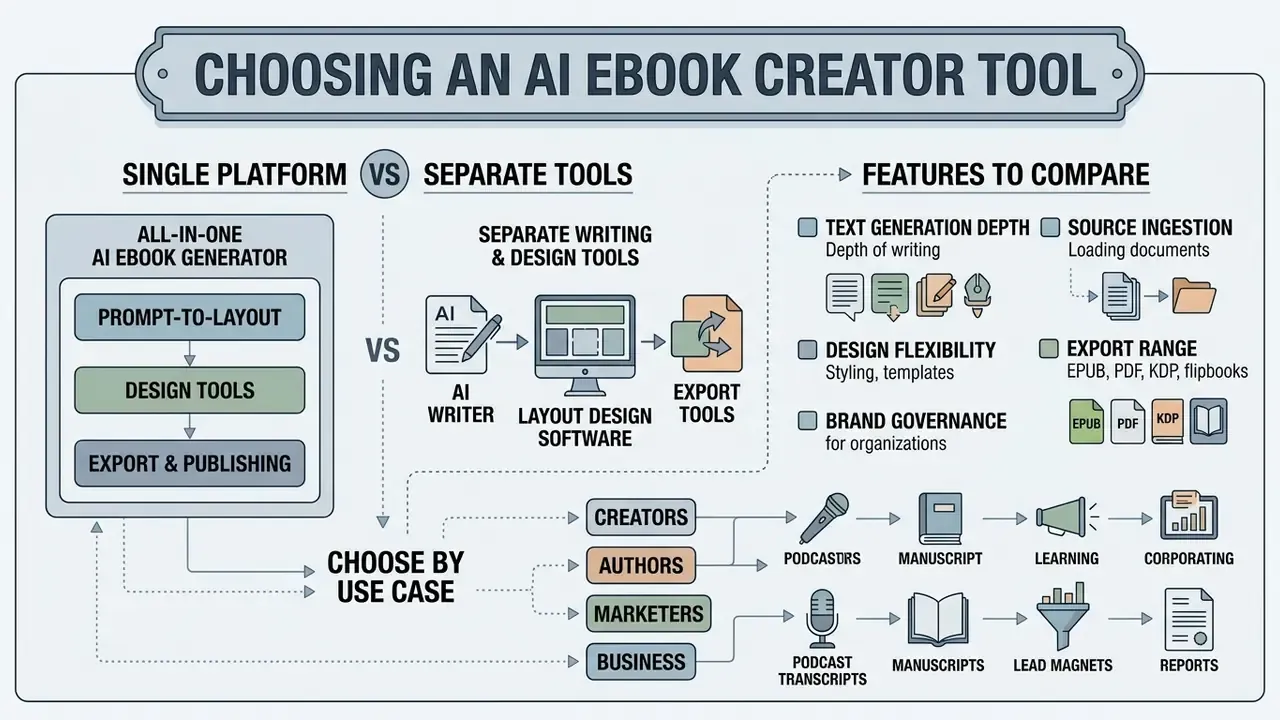
Choosing among ai ebook creator tools means testing platform capability against your operational requirements, team skill, publishing goals and, for organizations, governance posture. Pricing, covered in the next section, is one criterion among these. Not the decision itself.
All-in-one AI ebook generator vs separate writing and design tools
You are choosing between an integrated ai ebook generator platform and a modular multi-tool workflow.
Integrated suites handle prompting, drafting, styling and exporting in one browser workspace. Less tool switching, faster execution, fewer handoff errors.
«Half of publishing professionals in Ibero-America, 50%, use generative AI in everyday work, mostly for supporting tasks.»
Modular workflows draft text in a dedicated language model and assemble layout in traditional publishing software. That buys finer typographic control at the cost of manual effort. Public tutorials typically show drafting in a general-purpose assistant, then layout and export in a design suite. No independent benchmark currently measures speed, cost or quality between the two approaches, so the honest framing is a trade-off between integration and control rather than a proven winner. If someone tells you otherwise, ask for the benchmark.
Features to compare: templates, editing, images and export formats
When evaluating ai ebook creator software, compare five operational criteria:
- Text generation depthcan it expand a prompt into a multi-chapter manuscript, or only produce summaries and paragraph-level assistance?
- Source ingestionDOCX, PDF, Google Docs, website URLs, audio and video with transcription.
- Design flexibilityaccessible ebook templates, custom visual themes, adjustable font pairings, genre-specific blueprints.
- Export rangenative unwatermarked PDF, EPUB 3.3, DOCX, HTML5 flipbook and audio.
- Brand governancelogo uploads, custom palettes, header and footer styling, custom domains, saved template libraries.
Two criteria most buyers forget. Language coverage, where 30+ languages is now common across ai ebook generator tools. And validation output: does the platform tell you whether its EPUB passes EPUBCheck, or do you discover the problem at upload, on launch day?
Enterprise data security, Shadow AI and vendor due diligence
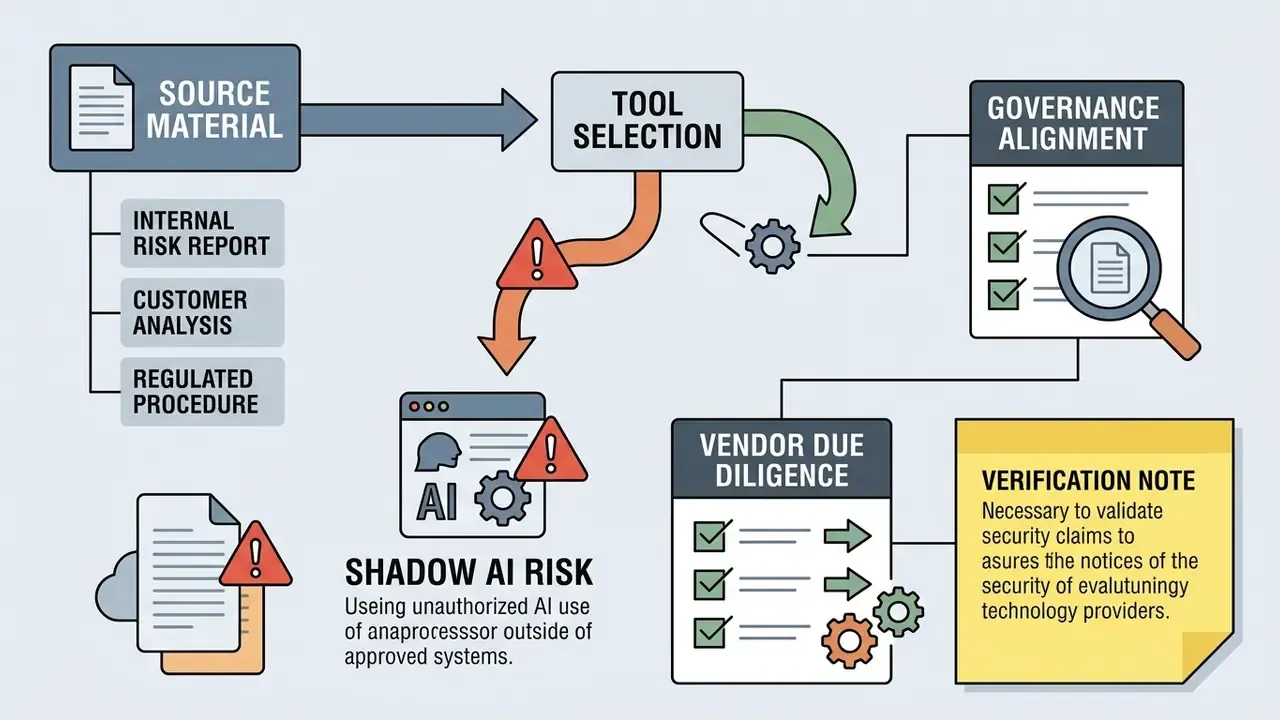
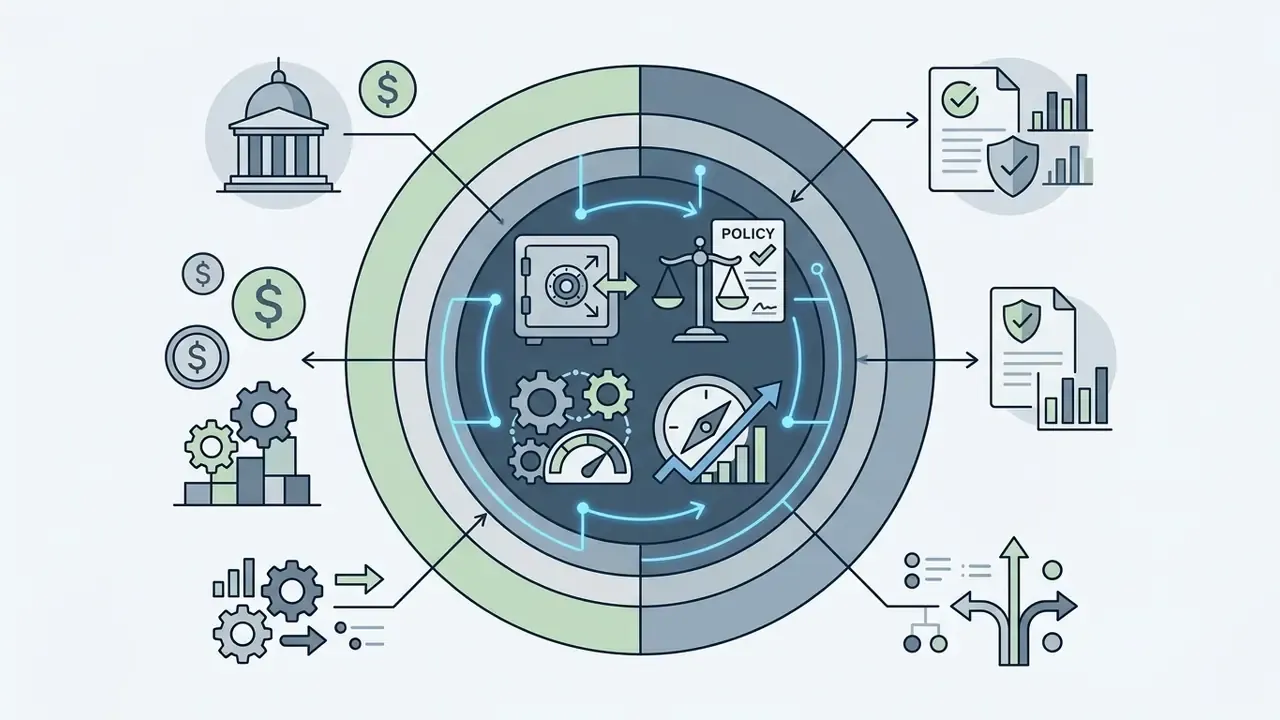
If your source material is an internal risk report, a customer analysis or a regulated procedure, tool selection stops being a productivity decision. It becomes a control decision. Uploading a confidential DOCX into an unvetted consumer ebook maker is a data-transfer event, and it will be described that way in the incident report.
Minimum vendor requirements before any internal document is uploaded
| Control area | What to require | Why it matters |
|---|---|---|
| Data retention | Contractual zero data retention, or a bounded retention window with deletion evidence | Prevents indefinite storage of confidential manuscripts |
| Model training | Written commitment that customer inputs are not used to train shared models | Stops proprietary text leaking into future outputs |
| Certifications | SOC 2 Type II, ISO/IEC 27001, penetration-test summary | Independent assurance instead of marketing claims |
| Access control | SSO/SAML, role-based workspace permissions, least-privilege sharing | Limits who can read draft or unpublished material |
| Data residency | Region selection and a current sub-processor list | Supports GDPR, CCPA and local banking-secrecy obligations |
| Logging | Exportable activity logs (who prompted, uploaded, approved, exported) | Enables audit reconstruction |
| Provenance | Content credentials or documented lineage of generated assets | Aligns with NIST AI RMF provenance expectations |
| Exit | Bulk export of projects and assets, deletion on termination | Avoids vendor lock-in of institutional content |
Shadow AI risk. The practical failure mode is not a hostile vendor. It is an employee pasting a draft policy into a free tool to "save an hour." Mitigations that actually work: publish a short list of authorized generators, make the approved path faster than the unapproved one, block uploads of classified document types at the DLP layer, and require a lightweight registration entry for any new AI tool touching internal content. NIST's guidance frames this as choosing an authorized tool before entering the task and data. The order matters more than the policy wording.
Governance alignment. U.S. Department of Energy generative-AI reference guidance requires clear documentation of who creates content, who contributes and who can access it, plus copyright awareness for generated output. NIST's AI RMF generative-AI profile emphasizes documenting training-data sources and tracing provenance. The European Commission's 2026 Code of Practice on Transparency of AI-generated Content pushes toward machine-readable marking of AI-generated text, which makes disclosure a design requirement for branded ebooks distributed in the EU, not an afterthought bolted on at launch.
Verification note. Confirm vendor privacy and security claims against current contractual terms and audit reports at the time of procurement. Marketing pages change faster than certifications do. If you need precedent for how these disputes play out, compare options in the litigation tracker.
Free AI ebook generator, pricing and commercial use
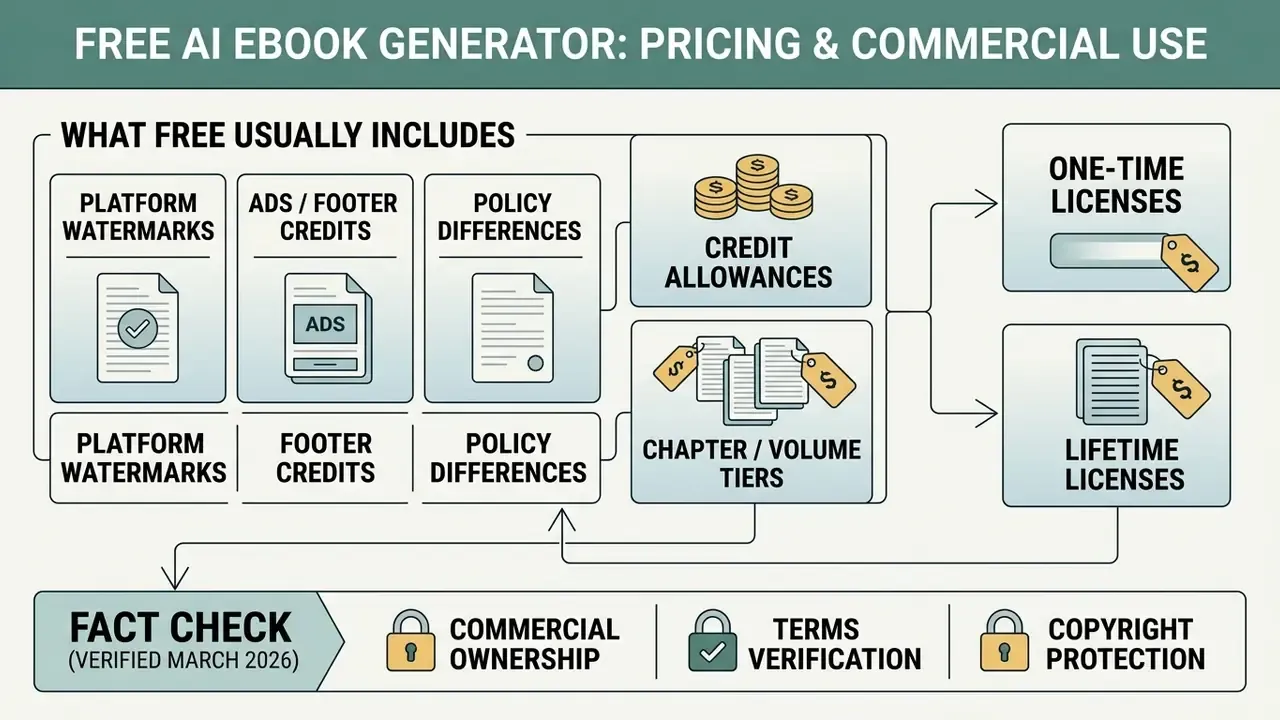
Understanding pricing models, generation limits and usage rights keeps published assets both compliant and cost-effective. Mostly it keeps you from discovering a watermark after the launch email goes out.
What a free AI ebook generator usually includes
Most ai ebook generator free tiers exist so you can judge output quality before paying. A typical ai free ebook generator plan includes:
- Initial generation credits, commonly 1 ebook per month, or 5 chapters plus 5 more monthly, or a fixed AI-point allowance (one platform grants 500 AI points per month, roughly one short ebook at about 200 points per 100 words).
- Standard visual page templates and basic themes.
- PDF-only download, with EPUB and DOCX reserved for paid tiers.
- Daily or per-project caps on hosted editions and page counts.
For a personal project or a first quality test, an ai ebook maker free plan or an ai ebook creator free tier is usually enough to generate a short draft and decide whether the prose is worth editing.
How to review AI-generated ebook content before publishing
An ai ebook generator accelerates drafting. It does not accelerate accuracy. Published material still needs human review to correct factual errors, hold tone consistent and fix formatting breakage.
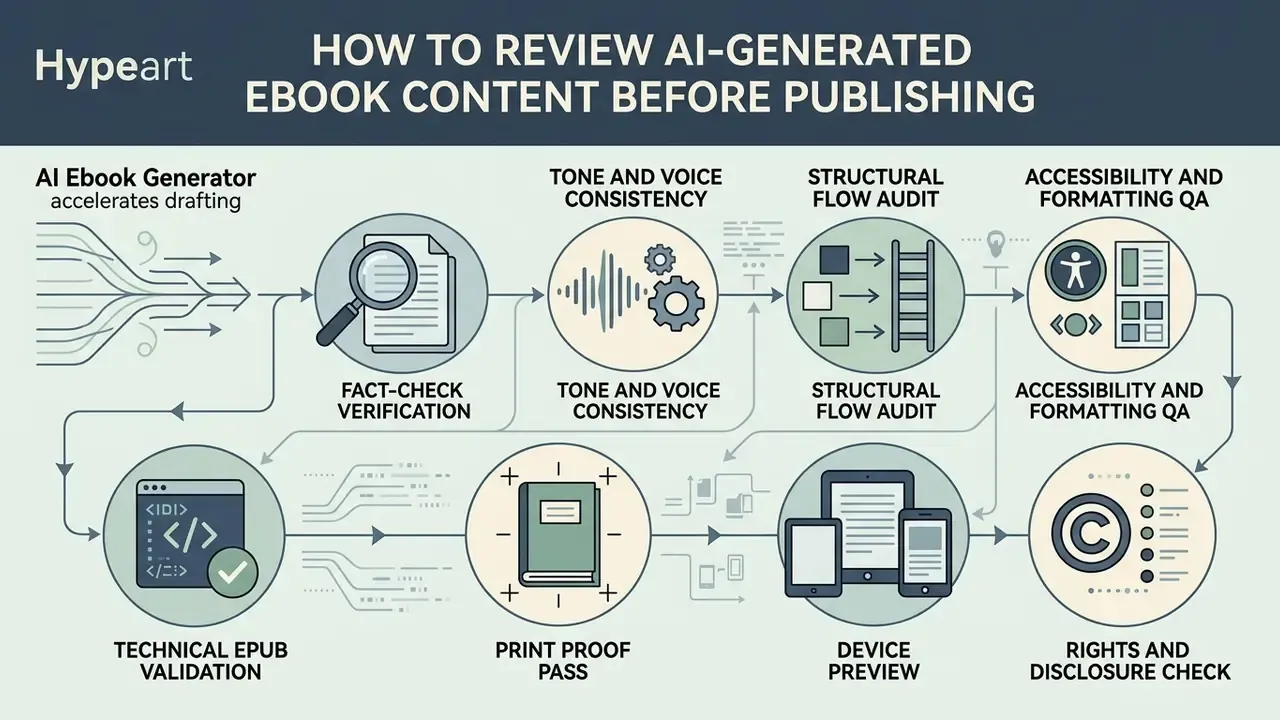
Language models generate plausible but incorrect statements, and they fabricate references. The clearest documented case is instructive:
«GPT-3, tasked with writing an academic review, technically met ICMJE authorship criteria, yet systematically produced non-existent or erroneous references.»
Audit trail checklist (for regulated and enterprise publishing)
Where a published document may be examined by internal audit or a regulator, editorial QA is not sufficient. Log the following per project, ideally automatically, because manual logging decays within a quarter.
- Prompt versions full text of each prompt used, with timestamps and the model version that answered.
- Source inventory filenames, hashes, owners and classification level of every uploaded document, plus URLs of external sources.
- Model and tool registry entry vendor, model version, region, retention setting, and the approval reference for using it.
- Change history which sections were AI-generated, which were human-rewritten, and by whom. The reproducer, integrator and reconstructor distinction, made explicit.
- Fact-check register each material claim, the verifying source, and the reviewer who signed it off.
- Human-in-the-loop sign-off named approver, role, date, and scope of approval (content, legal, brand, accessibility).
- Disclosure record what was declared to which platform, and when.
- Accessibility attestation WCAG 2.2 AA and PDF/UA check results plus EPUBCheck output attached to the release.
- Retention and disposal where artifacts and logs are stored, and for how long.
One editorial principle carries this whole section: no evidence, no autonomy. A generator that cannot show you its sources should not be the last hand on the file.
Businesses publishing commercial digital assets can explore broader legal and usage guidance in our AI Media Commercial-Use Hub.
FAQ
What is an AI ebook generator and how does it work?
It is a tool that turns a text prompt or an uploaded document into a complete, designed ebook: content, structure, layout, export. You supply a topic or file, the AI returns an editable outline, you refine it, the platform drafts chapters and lays out pages, then you export PDF, EPUB, DOCX, a web flipbook or audio.
Can I sell an ebook written with AI?
Usually yes, subject to two things: the vendor's commercial-use terms (some grant ownership, others only a license) and the marketplace's disclosure rules. Amazon KDP requires you to declare AI-generated text, images and translations at upload, even after heavy editing.
Can AI-generated books be copyrighted?
Purely AI-generated text without sufficient human authorship is not eligible for U.S. copyright protection, and AI-generated portions must be identified at registration. Substantive human rewriting, structuring and editing is what creates protectable authorship. Another reason to be a reconstructor rather than a copy-paster.
Which format should I export, PDF or EPUB?
Both, for most commercial projects. PDF preserves fixed layout for print and desktop reading. EPUB 3.3 reflows for e-readers and supports screen-reader navigation and font resizing. Add an HTML5 flipbook for web distribution and analytics, and audio if your audience listens rather than reads.
How long should an AI-generated ebook be?
Match length to purpose: 8–15 pages for a lead magnet, 5–15 for a how-to guide, 10–20 (up to 40–80) for a workbook, 80–300 for a commercial book. Longer is not better. Completion rate is the metric that matters.
Can I add my own branding?
Yes. Expect logo upload, brand color mapping to buttons, links and accents, custom fonts, headers and footers, cover textures and binding styles in flipbook tools, and custom domains so hosted URLs stay on your brand.
Can several people work on the same ebook?
On cloud platforms, yes: real-time co-editing, inline comments, autosave with version history, role-based permissions and shared template libraries. For regulated teams, those same features supply the audit evidence you will need later.
Can I turn my ebook into an audiobook?
Yes. Neural TTS engines render the approved manuscript into narrated audio with selectable voices, chapter markers and MP3 or M4B packaging suitable for Audible/ACX-style distribution and podcast feeds.
Is a free plan enough?
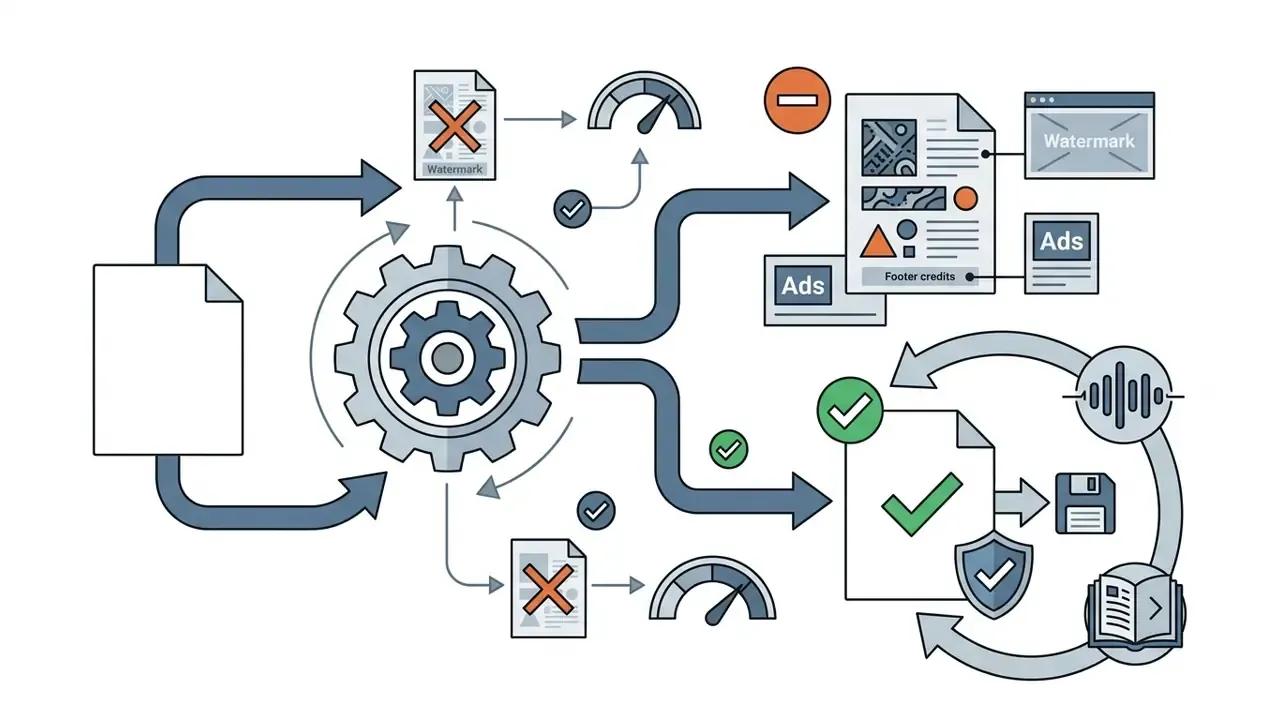
For evaluation and short drafts, yes. Free tiers typically cap output at one ebook or a handful of chapters per month, restrict export to watermarked PDF, and withhold interactive editing. Paid tiers unlock EPUB and DOCX, unwatermarked exports, premium templates, higher audiobook allowances and priority support.
What should a bank check before letting staff use one of these tools?
Retention terms, training-use commitments, SOC 2 or ISO evidence, SSO and role-based permissions, data residency, exportable logs, and a documented exit path. Then register the tool, name an owner, and make the approved path the fastest one available.
Summary and Next Steps
An ai ebook generator is an efficient, scalable way to turn concepts, prompts and raw source documents into professionally styled, exportable ebooks. Combining automated outlining, long-form drafting, WCAG-compliant page design, print-ready PDF geometry, interactive web editions, AI narration and multi-format export, these tools compress digital publishing for marketers, authors and organizations alike.
To maximize published quality: choose software aligned with your use case and security posture, apply a structured CO-STAR prompt, reconstruct rather than reproduce the AI draft, design to WCAG 2.2 contrast and spacing minimums, set trim size and bleed before layout freezes, enforce human fact-checking with a logged audit trail, and validate final EPUB and PDF output before distribution.
Next steps. (1) Pick your primary distribution channel and let it dictate your export set. (2) Write one CO-STAR prompt with a [VERIFY] constraint. (3) Run the pre-publishing checklist and EPUBCheck before you upload anything. Small sequence, large difference.
Appendix A: source corrections and revised statements
For transparency, the following statements from earlier versions of this guide were revised. Original wording is retained here; the corrected version appears in the main text above.
| Original statement | Issue | Revised position in main text |
|---|---|---|
| "According to W3C EPUB 3.3 standards… (W3C, 2026)" | Date error. EPUB 3.3 became a W3C Recommendation in 2023 | Cited as W3C, EPUB 3.3 (2023), https://www.w3.org/TR/epub-33/ |
| "W3C WCAG 2.2 guidelines require… (W3C, 2026)" | Date error and missing URL | Cited as W3C, WCAG 2.2 (2023), https://www.w3.org/TR/WCAG22/, with spacing requirements added |
| "…decomposing tasks into recursive sub-steps… (Zhao et al., 2024)" | Citation lacked title, method detail and locator | Replaced with a direct quotation and full title of the WriteHERE paper (arXiv preprint, 2024) |
| "34% of publishers actively use generative AI… (ePublishing, 2024)" | Figure correct but stripped of context | Expanded with the 38% / 36% / 34% task breakdown from ePublishing, State of AI in the Publishing Industry (2024) |
| "(Amazon Self-Publishing Market Analysis, 2026)" | Unidentifiable source | Replaced with Generative AI Floods and Dilutes the Market for Books (2026 preprint, 14,419 titles) and the Cambridge Minderoo Centre author survey (2025) |
| "…three distinct user engagement patterns (Luther et al., 2026)" | No title, no outcome reported | Replaced with full title and the reconstructor-quality finding |
| "(Documentation.ai, 2026)" for brand color mapping | Source not verifiable as research | Rewritten as a descriptive account of standard branding behavior, without a research citation |
| "(Generate Ebook, 2026)" for three billing models | Source not verifiable as research | Replaced with named, published vendor pricing examples across credit, chapter and lifetime models |
| "NotebookLM… (Google, 2026)" | No specific document | Attributed to NotebookLM and Gemini API documentation with described capabilities |
| "CO-STAR framework (NIST SP 1353 ipd, 2026)" | Needed provenance clarity | Attributed to NIST SP 1353 ipd (initial public draft, 2026), with a note on CO-STAR's origin in Singapore's prompt-engineering competition, plus corroborating frameworks |
| "(Ithaka S+R, 2024)" on hallucination | Generic, no example | Supplemented with Osmanovic-Thunström & Steingrimsson (2023) fabricated-reference case and WaTech plus Council of Europe review requirements |
Earlier versions of this guide also promoted consumer novelty tools inside the body copy. Those in-body anchors were deprioritized in favor of production-relevant references: AI voice generation for narration, art and image-rights comparisons for covers and chapter visuals, animation and video-compression guidance for interactive editions, reverse-image search for provenance checks. The novelty entries remain available through the glossary index below, where readers looking for them can still find them.