"Model governance in synthetic media requires moving from visual intuition to algorithmically verifiable evidence. Before deploying generative visual pipelines, enterprise risk leaders must treat every synthetic asset as a statistical model output governed by provenance, data lineage, and defined usage controls."
Why should a bank's risk committee care about picture generators? Because a marketing team, a claims unit, and a KYC analyst can all touch the same technology in the same quarter, with very different consequences. An AI-generated image is a digital visual asset produced by machine learning algorithms that process text inputs or visual conditioning parameters to synthesize new pixel arrangements. Unlike traditional digital photography or manual illustration, synthetic generation relies on statistical distributions learned from web-scale image and text datasets. Understanding the underlying mechanics, the operational controls, and the commercial boundaries is essential for any organization evaluating generative media for production use.
Executive Summary for Risk, Compliance, and Creative Leads
What This Guide Covers, and in What Order
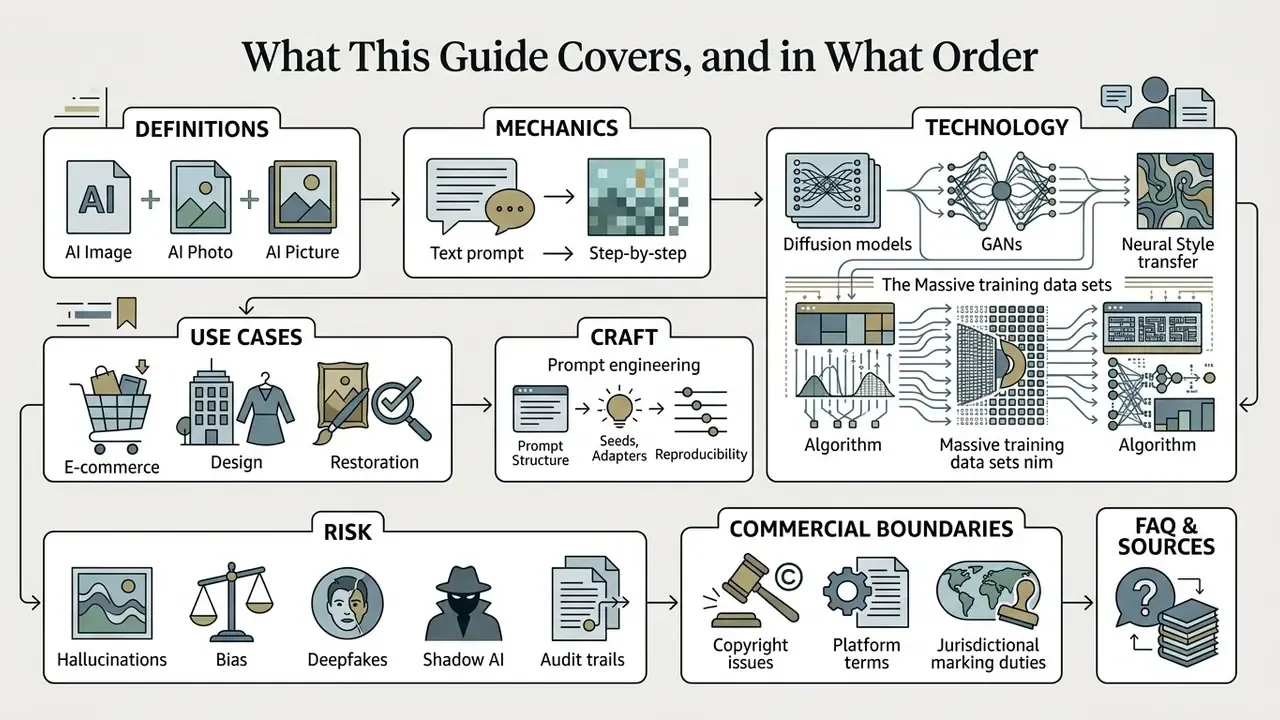
The sequence below mirrors how a governance review usually unfolds, from vocabulary to sign-off:
- Definitions: what an AI image, an AI photo, and an AI picture actually are.
- Mechanics: how a text prompt becomes pixels, step by step.
- Technology: diffusion, GANs, neural style transfer, and the training data behind them.
- Use cases: marketing, e-commerce, design, restoration, verification.
- Craft: prompt structure, seeds, adapters, reproducibility.
- Risk: hallucinations, bias, deepfakes, Shadow AI, audit trails.
- Commercial boundaries: copyright, platform terms, jurisdictional marking duties.
- FAQ and sources.
Read it end to end if you own the policy. Skip to risk and commercial use if you only need the sign-off gate.
What Are AI-Generated Images?
An AI-generated image is a visual artifact created substantially by artificial intelligence algorithms, such as latent diffusion models or generative adversarial networks, that map input conditioning into synthesized pixel arrays. The ai generated image meaning centers on algorithmic synthesis: neural networks generate visual content from learned statistical patterns rather than capturing physical photons through a lens or recording manual brushstrokes. The broader ai generated images definition covers a spectrum of synthetic visual media, from photorealistic renderings to stylized digital artwork. So the short answer to what are ai images: outputs of a model, not records of a moment.
Standards bodies and regulators prefer a wider umbrella term. NIST describes synthetic content as information "such as images, videos, audio clips, and text" that has been significantly altered or generated by algorithms, while Utah's 2024 statute defines "synthetic visual media" as an image or video substantially produced by generative artificial intelligence. Advertising frameworks add a third lens: the IAB classifies a "synthetic image" as any image generated from AI prompts, text-to-image or image-to-image, even when a human later edits or composites it.
That definitional spread is not academic trivia. A marketing asset can sit outside one definition and squarely inside another, which changes your disclosure duty.
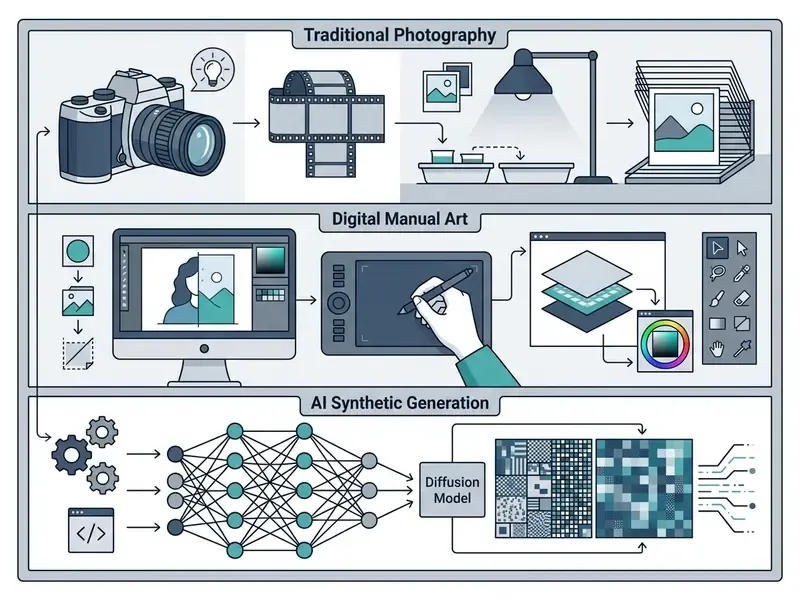
AI image, AI photo, and AI picture: what the terms mean
Generated from scratch or enhanced from an existing image
Text-to-image generation synthesizes entirely new images from scratch by initializing a random noise tensor and iteratively refining it under text prompt conditioning. Image-to-image workflows, inpainting, and outpainting instead modify an existing image by conditioning the neural network on source pixel data alongside text instructions. Text-to-image pipelines create unconstrained visual concepts; image-to-image techniques preserve structural layouts or facial geometries from the source file. Both are "images created" by a model, yet only one starts from a blank statistical canvas.
The technical distinction is input conditioning and the spatial scope of synthesis:
| Mode | Required inputs | What the model preserves | What it synthesizes |
|---|---|---|---|
| Text-to-image | Prompt only (plus seed) | Nothing from a source file | The entire frame |
| Image-to-image | Source image + prompt | Coarse structure, layout, silhouette | Style, texture, details |
| Inpainting | Image + mask + prompt | Everything outside the mask | Only the masked region |
| Outpainting | Image + expanded canvas + mask + prompt | The original frame | Content beyond the original borders |
Historical milestones in synthetic media show how generation models evolved from basic pixel manipulation to complex cross-modal synthesis, as documented in analyses of the first ai generated visual outputs. Teams focused specifically on canvas extension can compare dedicated AI outpainting tools for expanding images against general-purpose generators.
How Do AI Images Work From a Text Prompt?
An AI image generator transforms a text prompt written in natural language into a structured visual output through a multi-stage neural network pipeline. Answering how do ai images work means examining how text encoders convert words into mathematical vectors, which then condition iterative denoising in latent space. The system draws on visual patterns learned during training to synthesize object relationships, lighting, and textures that match the description. Put bluntly: how does ai images work is a question about probability, not artistry.
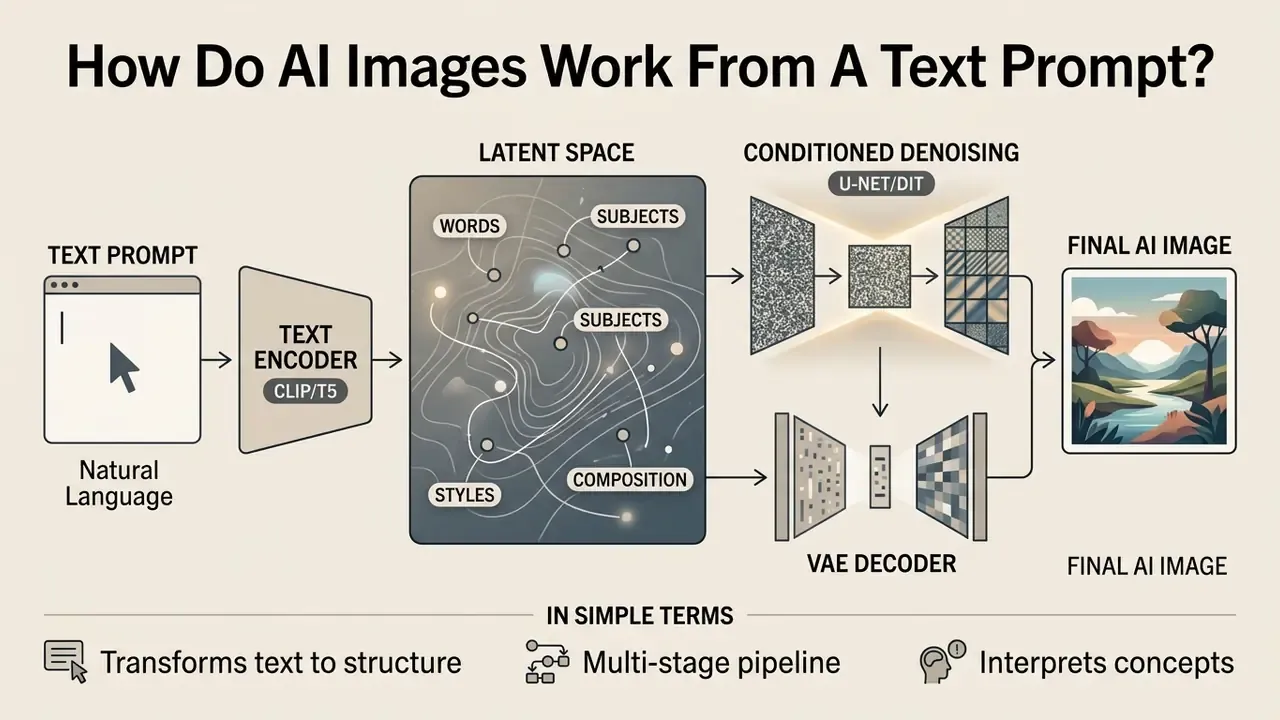
How AI models interpret words, subjects, styles, and composition
AI models interpret input text by routing prompt tokens through pre-trained text encoders such as CLIP or T5, which convert words into dense embedding vectors inside a shared multi-modal space. Those embeddings let the system map language concepts, including subjects, artistic styles, and compositional directives, onto corresponding visual feature maps. Cross-attention layers in the generator backbone then weigh tokens to balance object placement, lighting parameters, and perspective.
Updated (supersedes the earlier unquantified formulation). Research indicates that early denoising steps lean heavily on global token conditioning to build overall composition, while later steps lean on learned visual priors to finish granular textures. The division is pronounced enough that text guidance can be dropped in the second half of sampling:
Encoder behavior also has measurable limits. Studies presented at EMNLP 2023, using a corpus of 18,100 compositional prompts, documented information loss inside text encoders when a scene contains multiple interacting objects and attributes. That is the technical root cause of attribute bleeding, the reason "a red cube on a blue sphere" so often arrives with the colors swapped.
How an image generator turns patterns into new images
An image generator produces new visual content by executing a learned conditional reverse process that converts structured noise into clean pixel arrangements. Modern systems use machine learning algorithms trained on paired image-text datasets to approximate the probability distribution of visual features. During generation, the model predicts and removes mathematical noise at each step, keeping synthesized pixels aligned with the prompt's statistical conditions. That is the honest answer to how do ai generated images work and how ai images are created: repeated estimation, not inspiration.
Three synthesis families explain how a pixel value is ultimately decided. Coordinate-based pixel synthesis computes each RGB value independently from a shared latent vector and the pixel's (x, y) position. Latent diffusion decomposes image formation into sequential denoising steps inside a compressed latent space, then decodes back to pixels. Autoregressive models predict each pixel or token conditioned on previously generated neighbors in raster order.
Illustrative case (hypothetical composite, not a documented client engagement). A mid-sized financial services firm evaluated generative image automation to accelerate digital ad production across retail banking channels. Marketing compliance introduced fixed prompt templates plus automated structural validation checks before any asset entered the queue. Asset delivery moved roughly 40% faster in that pilot while brand-safety rules held. The lesson worth keeping: the control layer, not the model, determined whether the pilot could ship.
What Technology Is Behind AI Image Generation?
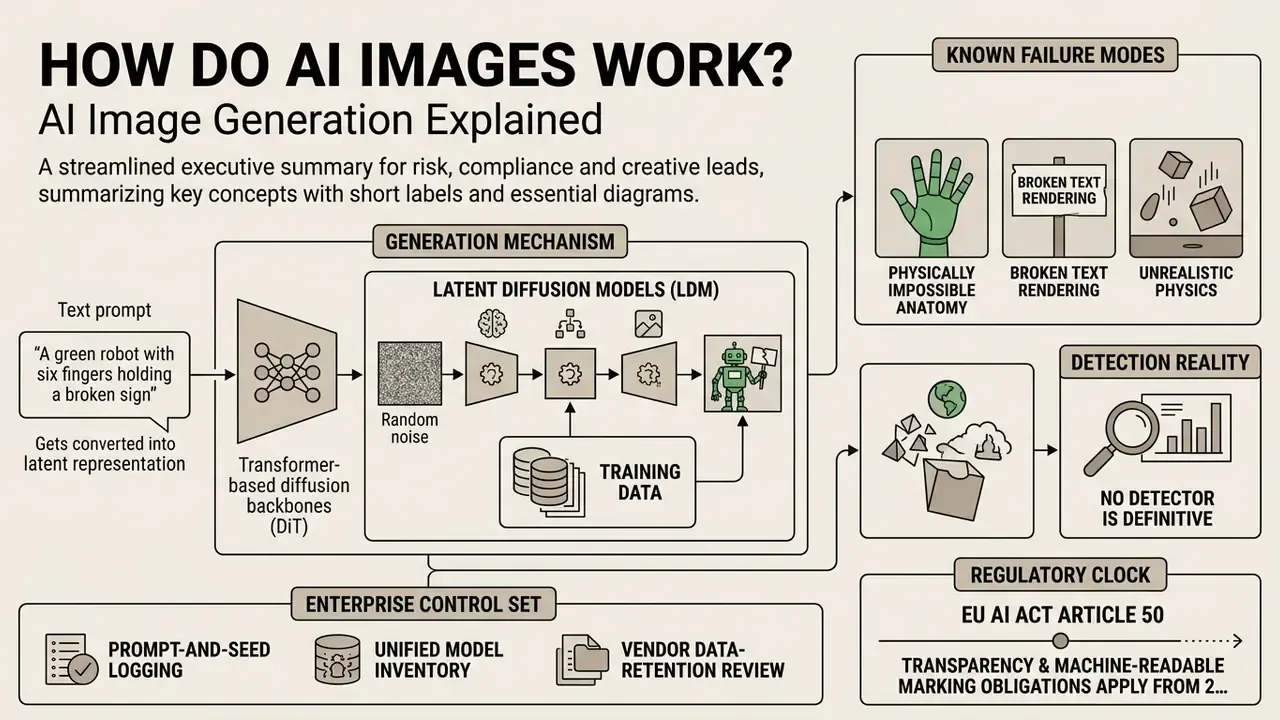
The core of ai image generation technology explained across modern platforms is a small set of generative ai architectures: latent diffusion models, generative adversarial networks (GANs), and Transformer-based diffusion backbones (DiT). These learning algorithms rely on neural networks trained on very large datasets to internalize spatial relationships, color science, and structural geometry. Artificial intelligence (AI) here is statistics at industrial scale, nothing more mystical.
A frequent misconception in older explainer content claims that "most image generating AI models use a generative adversarial network". That described the 2020–2021 state of the art. Flagship 2024–2026 systems, including Midjourney v6, DALL·E 3, Stable Diffusion 3, Ideogram, and Google ImageFX, are diffusion or diffusion-transformer systems, not GANs. If a vendor deck still says otherwise, ask when it was last revised.
The training data behind the models
Early convolutional neural networks (ConvNets) and today's diffusion models were both trained on very large labeled datasets, such as ImageNet, which indexes more than 14 million annotated image URLs, alongside massive open web crawls of images paired with descriptive captions. Annotation was originally done by hand to specify content categories, and training was tuned until specific classifications were learned reliably. This lineage matters for governance: dataset provenance drives both the legal exposure of outputs and the demographic distributions a model reproduces. Which is exactly why data lineage documentation belongs in the model-risk file for any generative visual system, not in a footnote.
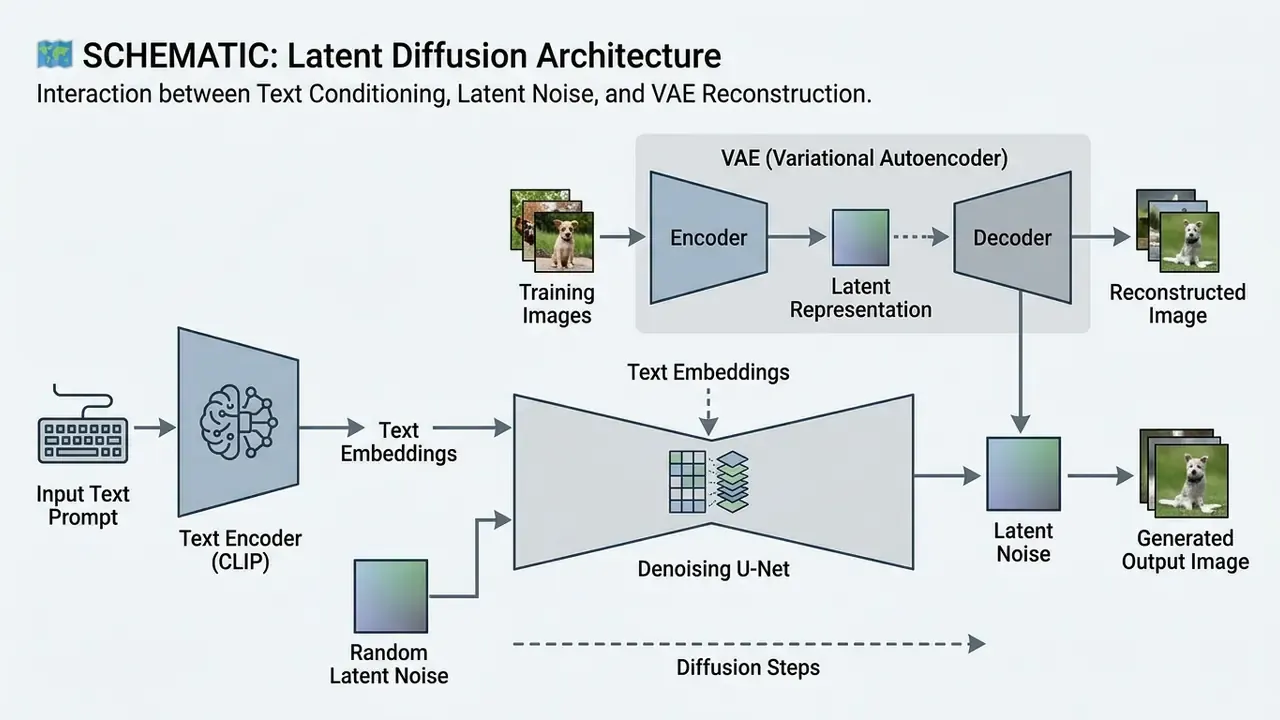
Diffusion models: creating an image by refining visual noise
Diffusion models generate high quality images by learning to reverse a forward Gaussian noise process across a series of discrete timesteps. Formally, the forward chain applies q(xₜ|xₜ₋₁) = N(xₜ; √(1−βₜ)·xₜ₋₁, βₜI) under a variance schedule β₁…β_T until the signal is destroyed, and the model learns the reverse Gaussian transition p_θ(xₜ₋₁|xₜ) that reconstructs data from pure noise (Ho et al., Denoising Diffusion Probabilistic Models, NeurIPS 2020).
In Latent Diffusion Models (LDMs), the forward process progressively adds noise to an image representation inside a compressed latent space created by a Variational Autoencoder (VAE). At generation time, the model starts from a tensor of pure Gaussian noise and iteratively subtracts predicted noise under text embedding guidance. Working in a lower-dimensional latent space cuts computational overhead sharply while preserving semantic structure:
Architectural scaling choices also change text alignment in measurable ways, which matters when procurement teams compare model tiers:
GANs and neural style transfer: alternative generation methods
Generative Adversarial Networks (GANs) use a dual-network setup: a generator network creates synthetic images while a discriminator network judges their authenticity against training samples. Think of a painter learning by copying famous works while a stubborn critic keeps comparing the copy to the original. GANs deliver rapid single-pass inference, which makes them efficient for real-time image-to-image tasks, though they still suffer from mode collapse and training instability. Neural Style Transfer (NST) uses convolutional layers to separate and recombine the semantic content of a target image with the stylistic features of a reference artwork; 2023 reviews classify NST into image-iteration-based and model-iteration-based methods, with later variants increasingly built on GAN backbones. Platform evaluations such as the flux ai image analysis detail how modern diffusion architectures absorbed performance advantages from these earlier generative paradigms.
| Technology | Input Data Conditioning | Generation Mechanism | Inference Speed | Style & Structural Control | Typical Enterprise Output |
|---|---|---|---|---|---|
| Diffusion Models (LDM / DiT) | Text prompts, depth maps, control masks | Iterative latent denoising via U-Net or Transformer backbones | Moderate to slow (1–5 seconds) | High precision via cross-attention and ControlNet | High-resolution marketing graphics, realistic portraits |
| Generative Adversarial Networks (GANs) | Random noise vectors, source images | Adversarial generator versus discriminator optimization | Fast (under 0.5 seconds) | Moderate, architecture-dependent | Real-time facial filters, domain-specific image translation |
| Neural Style Transfer (NST) | Content image plus style reference image | Feature map matching via CNN loss optimization | Variable, resolution-dependent | Direct style matching, low compositional variance | Stylized visual filters, art texture overlays |
The matrix confirms the trade-off: latent diffusion architectures offer superior compositional flexibility and text alignment for general asset creation, while GANs keep a latency advantage in specialized single-pass processing. Procurement teams turning this architectural view into vendor selection can review the best AI image generators by output fidelity, control surface, and licensing terms.
Quality is not fixed by architecture alone. Reward-based post-training is now a practical lever:
What Can AI Image Generators Create and Where Are AI Images Used?
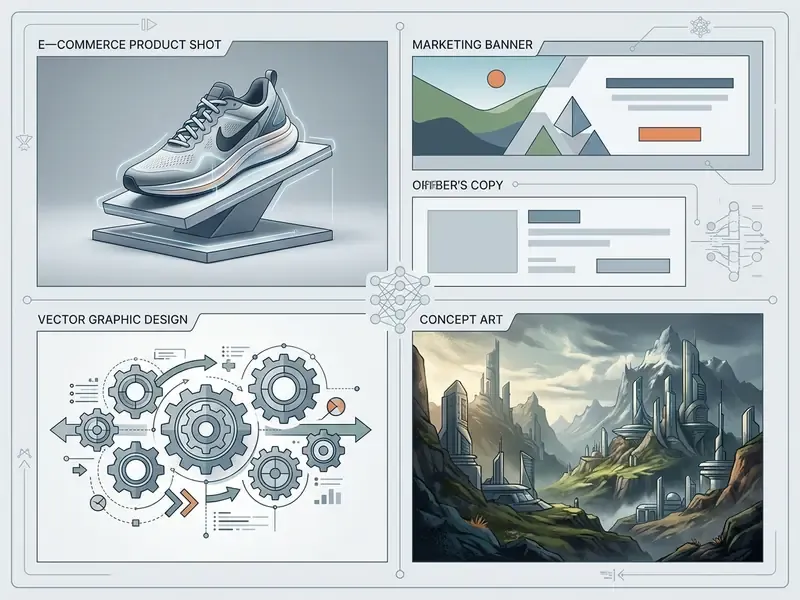
Modern ai image generator systems produce a wide range of visual formats: commercial product visualizations, digital illustrations, marketing materials, and conceptual design prototypes. Organizations across sectors deploy generated visual assets to streamline production pipelines and lower creative iteration costs. The current tool landscape spans Midjourney v6, DALL·E 3, Stable Diffusion 3, Ideogram, and Google ImageFX (Google DeepMind), each with distinct licensing terms, safety filters, and text-rendering capability.
AI art, design, and image-to-image editing
Designers and concept artists fold ai art tools into early ideation and storyboarding. Image-to-image editing lets creators inpaint specific regions, expand image boundaries through outpainting, or swap backgrounds while retaining subject geometry. Teams standardizing this stage can evaluate dedicated image-to-image generators against general text-to-image platforms. Creative teams exploring dynamic art workflows can review specialized tool performance in evaluations of platforms such as the fotor ai image generator. For enterprise content pipelines, it also helps to browse the hub and inspect feature matrices across design editing solutions.
Academic coverage of professional practice stays thin relative to adoption. A 2025 review of AI integration in the design process identified only 15 directly relevant studies, while a separate 2025 systematic review mapped 50 papers published between 2020 and 2026 on generative AI in art and creativity. Architectural design literature documents image-to-image conversion of rough sketches into detailed façade, layout, and massing visualizations during preliminary design.
Popular practical use-cases
Beyond campaign production, four consumer and commerce scenarios account for most everyday generator usage:
- Image restoration and upscaling. Models trained on large photographic corpora can sharpen blurred captures, raise effective resolution, and reconstruct damaged or missing regions of scanned family photographs. Teams preparing assets for print or large-format placement usually pair restoration with dedicated AI image upscalers.
- Object removal and inpainting. Mask-based editing removes an unwanted object, bystander, or reflection, then regenerates a plausible background matching surrounding lighting and texture. Same mechanism, different label, when used for logo cleanup or compliance redaction.
- Virtual try-on and e-commerce prototyping. A garment reference plus a customer photo produces a try-on visualization, and a single product shot can expand into a full set of angles, contexts, and background environments for marketplace listings.
- Professional headshots from selfies. A batch of casual selfies becomes business-grade portraits for résumés, LinkedIn profiles, and internal directories. Buyers comparing quality, privacy handling, and pricing can consult the guide to AI headshot generators.
Content governance in highly regulated sectors
Organizations in regulated industries face content constraints far beyond generic platform moderation. Financial-services, insurance, pharmaceutical, and gambling advertisers must ensure synthetic imagery does not imply guaranteed returns, fabricate testimonials, depict non-existent products, or place brand marks in misleading contexts. Practical controls include a pre-approved prompt library maintained by marketing compliance, blocklists for regulated claim language and prohibited visual motifs, mandatory human sign-off for any asset containing people, currency, documents, or performance charts, and archived generation records that survive a later regulatory inquiry. Teams wiring these controls into publishing pipelines can explore the hub for review and approval templates, or study platform-level constraints in the Canva AI Generator overview and the Microsoft AI Image Generator overview.
How to Create Better AI Images With an Image Generator
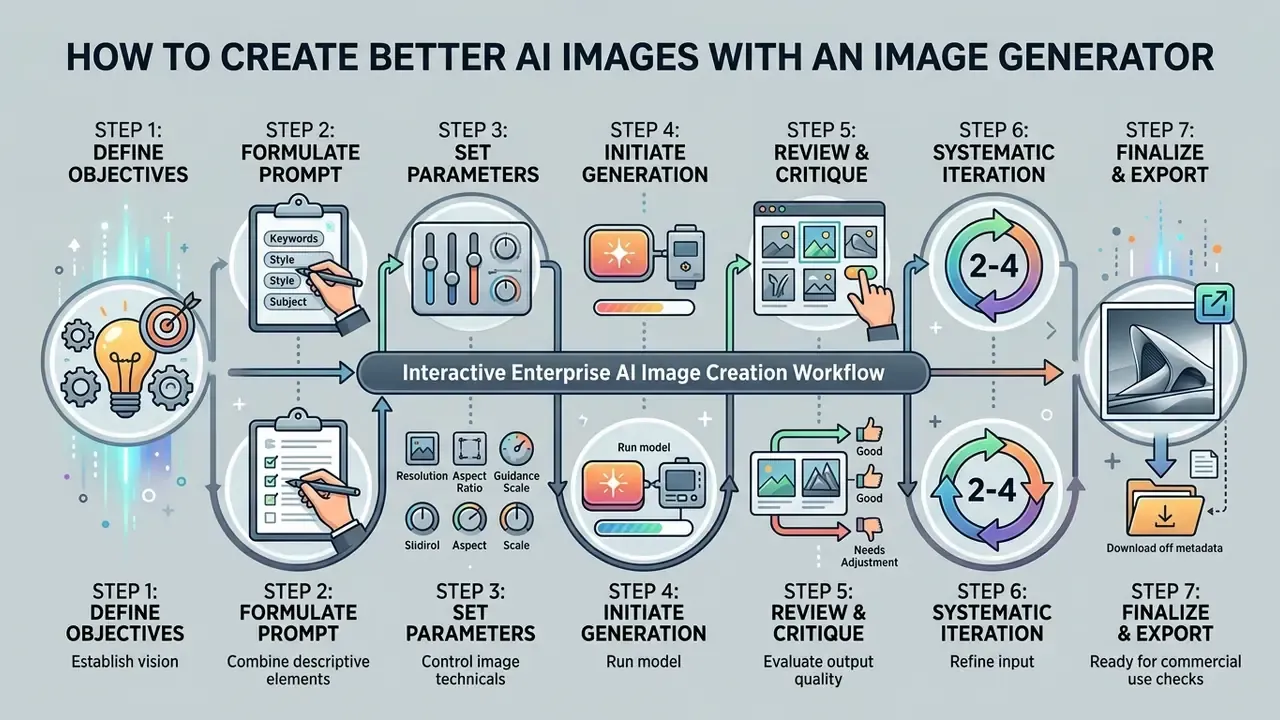
Consistent, high-quality synthetic images come from structured prompt engineering, precise control parameters, and systematic iteration. Operators have to move past trial-and-error prompting toward reproducible workflows. In governed environments, prompt engineering is best framed not as a creative trick but as generation quality control and reproducibility management: every published asset should trace back to a recorded prompt, model version, seed, and named reviewer.
Interactive Enterprise AI Image Creation Workflow
Checklist0 / 7
Start with a specific text prompt and a clear style
A well-structured text prompt splits visual attributes into explicit, non-conflicting clauses instead of piling up loose description. Effective prompt engineering frameworks order instructions predictably: core subject, surrounding setting, lighting parameters, camera perspective, stylistic constraints (Leonardo AI Prompting Guide, 2024). Lighting instructions work best when they name source, direction, quality, and balance rather than one mood adjective.
PROMPT STRUCTURING FORMULA:
[Subject & Action] + [Environment & Setting] + [Lighting & Atmosphere] + [Camera Viewpoint & Lens] + [Style & Material Constraints]
EXAMPLE:
"A professional executive portrait in a modern glass office, soft natural morning window light, 85mm lens perspective, shallow depth of field, corporate editorial style, photorealistic."
Strip out contradictory instructions. Asking for harsh direct flash and soft diffused shadow in the same clause guarantees attribute competition during cross-attention conditioning. One light source, one camera viewpoint, one style family per run.
Expect iteration rather than a single perfect result:
Design-guideline research from CHI 2022 adds a concrete reproducibility rule: generate 3 to 9 seed variations per prompt to see the model's representative output range before you judge the prompt itself. Where raw output is directionally right but technically thin, post-processing with AI image enhancers is usually faster than re-rolling.
Refine results with models, reference images, and iterations
Exact visual outcomes require adapter modules on top of base ai models. ControlNet supplies spatial edge maps, depth guides, or pose skeletons to enforce strict geometric layout. IP-Adapter injects visual features from a reference image into cross-attention layers to preserve style or character identity without retraining the base network (Tencent AI Lab, 2023). The original UNet and text cross-attention layers stay frozen while newly added image cross-attention layers carry the reference signal. That freezing detail is what makes fine tuning cheap enough for production teams.
More recent work generalizes the pattern to arbitrary multimodal conditioning:
For edit passes, state explicitly what must change and what must stay untouched: identity, geometry, layout, lighting, labels, logos, watermarks. Then regenerate one variable at a time, passing the previous output forward to limit drift. Creators wanting comparative analysis across generation tools can view the guide to evaluate model precision across enterprise options, while teams handling retouch and composite work can review dedicated AI photo editors for the correction stage.
Limitations and Risks of AI-Generated Images
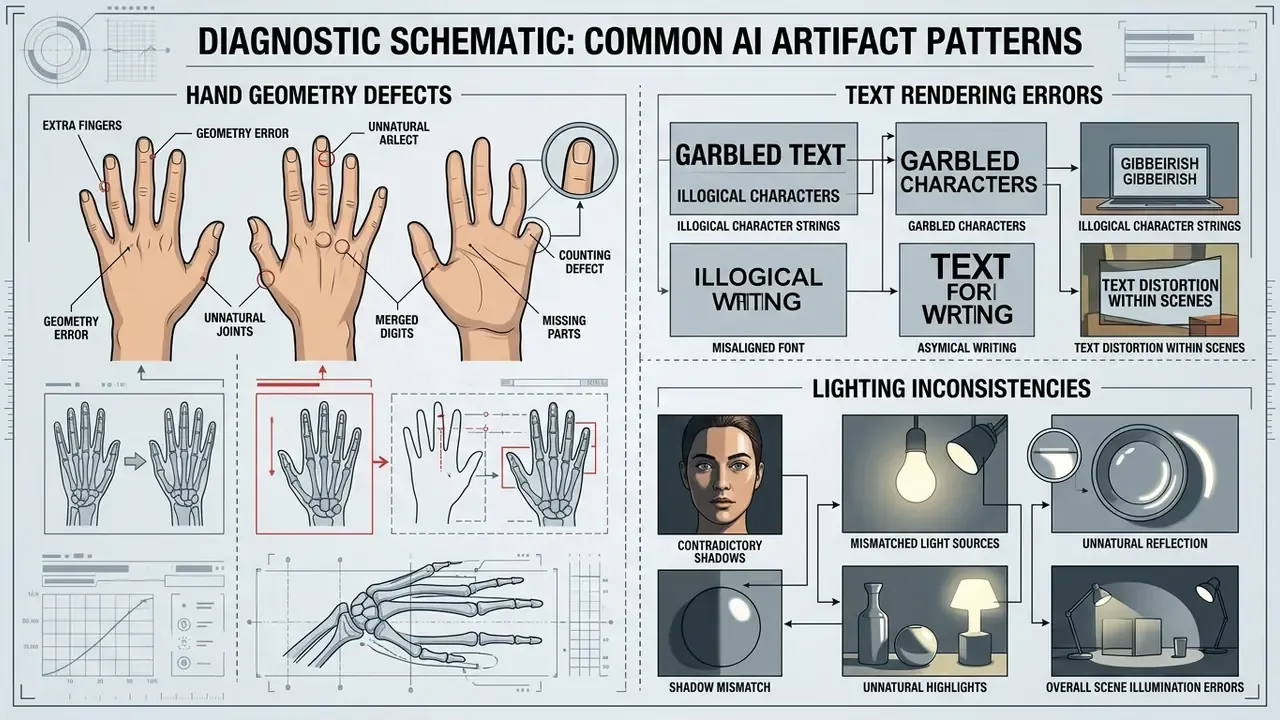
Hallucinations, quality issues, and bias in generated images
AI image hallucinations occur when generative models synthesize visually plausible but physically impossible features: incorrect hand anatomy, unnatural object joins, erroneous light reflections. The canonical manifestation is a failure of spatial body topology, a generated hand rendered with six fingers, an extra limb joint, or refraction that no physical lens could produce. Documented medical-imaging cases go further, reporting hallucinated non-existent bones, fused bone structures, and inaccurate cervical vertebrae, attributed to insufficient training coverage of specialized anatomy. With enough prompt refinement and localized inpainting most such artifacts can be repaired; they cannot be prevented at the architecture level.
Updated (supersedes the earlier unquantified PhyBench formulation). Quantitative benchmarks confirm that physical plausibility remains a systematic weakness:
Training datasets scraped from the open web also carry historical demographic bias. Unconditional occupational prompts reliably produce skewed gender and skin-tone distributions unless explicit balancing constraints are applied. And the research coverage of the problem is itself uneven:
Bias here is structural rather than incidental. Historical bias, representation bias, and evaluation bias compound across the dataset lifecycle, and underrepresented groups appear in outputs at rates that do not match the deployment population. For a bank running imagery across a diverse customer base, that is a fair-treatment question, not only an aesthetic one.
Deepfakes, misinformation, and authenticity checks
Realistic synthetic imagery brings reputational and fraud risk: deepfakes, fabricated evidence, visual misinformation. Mitigation leans on technical provenance standards, primarily Content Credentials (C2PA) and invisible watermarking. Organizations screening inbound media can also deploy commercial AI image detectors or trace asset reuse with AI reverse-image-search tools.
Verification is business-critical in several specific domains:
- Identity documents and ID cards. Detecting synthetic or manipulated ID photography during KYC and onboarding, to block identity theft and fraudulent applications.
- Insurance and legal evidence. Confirming that damage photography, claim documentation, and exhibits submitted in proceedings were captured rather than generated.
- Profile pictures on social and dating platforms. Identifying fake avatars used for catfishing, romance fraud, and coordinated inauthentic behavior.
- Marketplace product images. Verifying that sellers supply authentic product photography rather than synthetic renders that misrepresent the goods.
- News photography. Screening submitted images before publication to protect editorial integrity.
Watermark quality is now measurable, which matters for procurement:
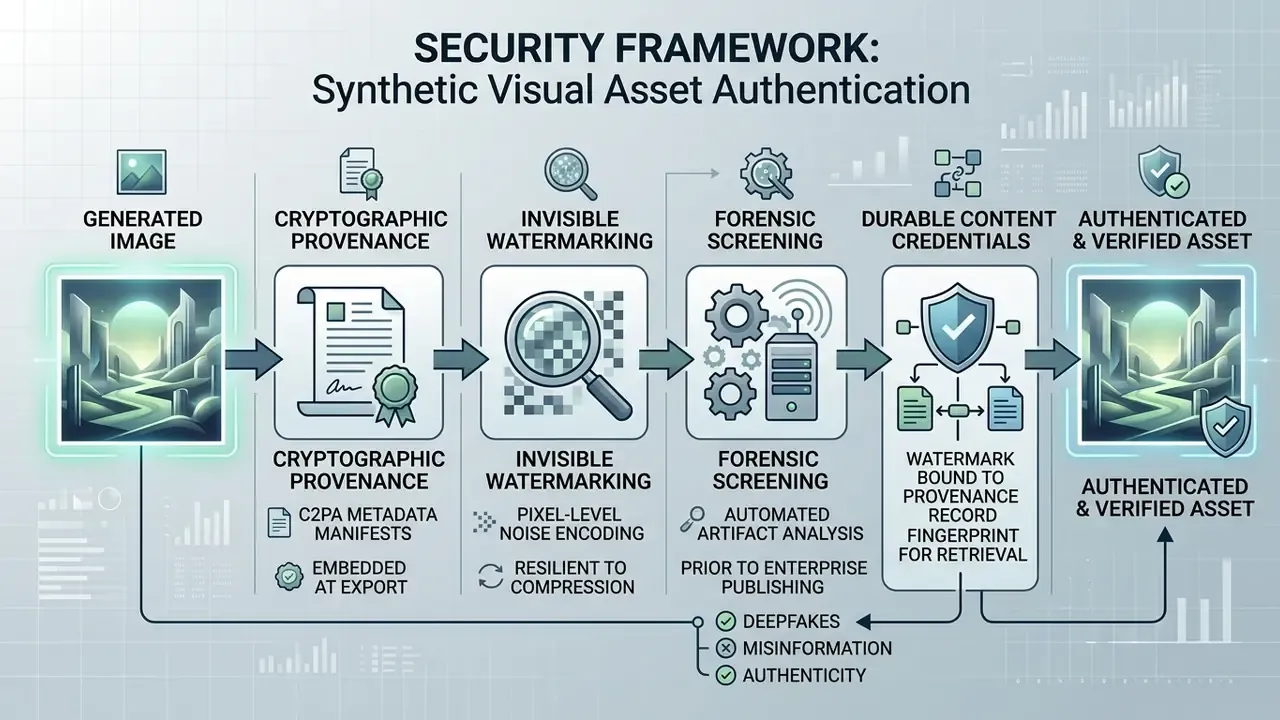
NIST guidelines (NIST AI 100-4, 2025) stress that robust asset verification combines cryptographic metadata provenance with invisible watermarking layers, notes that embedded metadata may carry a URI pointing to extended provenance records, and records that C2PA is progressing through ISO/TC 171/SC 2 standardization. Government audit reporting adds a practical caveat: invisible watermark patterns can disappear when media is modified, and missing or incomplete metadata is an indicator of alteration rather than proof of synthesis.
Comparative benchmarking clarifies which detection strategy deserves budget first:
Confidential data exposure and Shadow AI
For regulated enterprises, the biggest generative-imaging risk is often not the output. It is the input. Prompts, reference photographs, product renders, customer documents, and screenshots submitted to public generators may be retained by the vendor, reviewed by human moderators, or, depending on the terms of service, reused to improve models. Unsanctioned staff use of consumer generators ("Shadow AI") therefore opens an uncontrolled egress path for confidential material, intellectual property, and personal data.
Practical mitigations for risk and security functions:
- Maintain an approved-vendor list with documented data-retention and training-opt-out terms; block unapproved generator domains at the network edge.
- Prohibit uploading customer data, unreleased product imagery, internal documents, or identifiable employee photographs into non-contracted tools.
- Prefer enterprise or private-deployment tiers where inputs are contractually excluded from model training.
- Route sensitive workloads to self-hosted or VPC-isolated models where residency requirements apply.
- Run periodic discovery scans for unsanctioned AI tool usage and bring generative imaging inside DLP policy scope.
Audit trail, seed logging, and model inventory
Model-risk frameworks require that a generative visual pipeline stay auditable after the fact. At minimum, keep a unified model inventory recording each deployed generator, version, hosting location, adapter modules (ControlNet, IP-Adapter, LoRA weights), and business owner. Alongside it, keep an asset-level audit trail capturing the exact prompt and negative prompt, seed value, sampler and step count, guidance scale, reference-image hashes, timestamp, requesting user, reviewer approval, and the provenance manifest attached at export. Seed and configuration logging is what converts an otherwise non-reproducible creative act into verifiable audit evidence. It is also the fastest route to root-cause analysis when a published asset is challenged months later.
Can You Use AI-Generated Images Commercially?
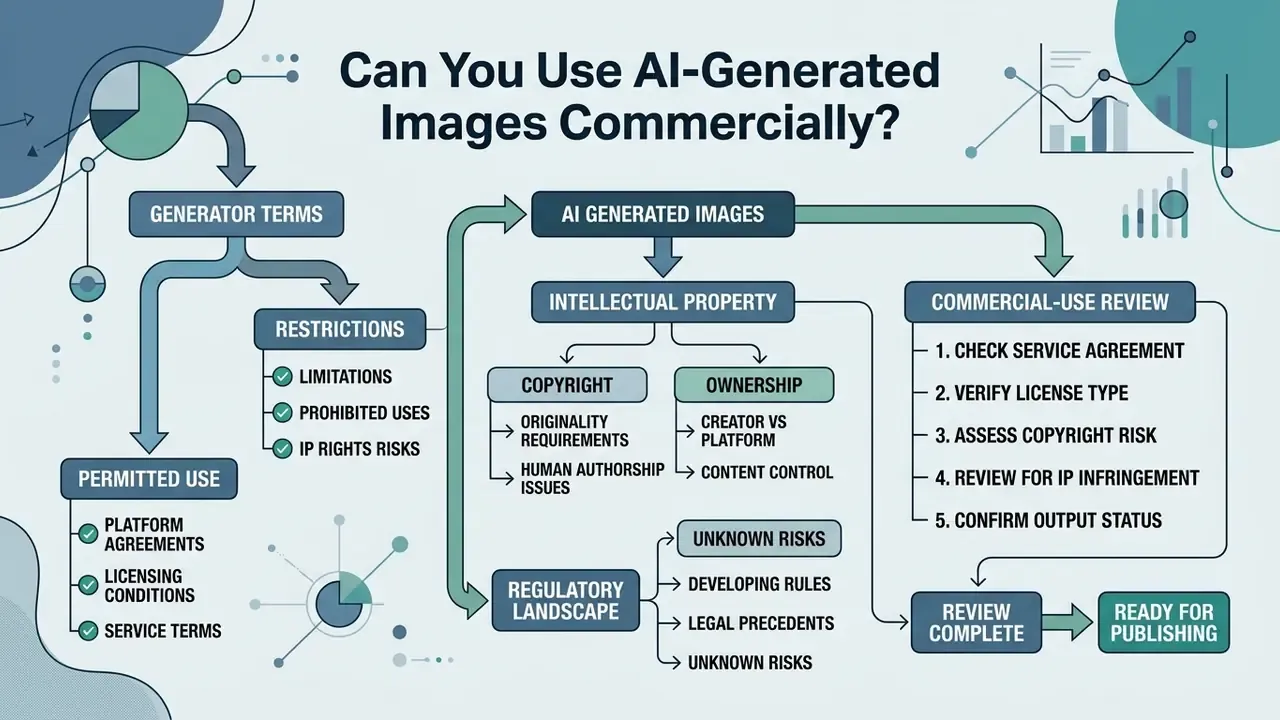
Commercial use of generated content is permitted under most platform service agreements, yet purely synthetic outputs face distinct intellectual property and regulatory constraints. Organizations deploying AI visual assets should establish legal clearance procedures before public publication, not after the campaign goes live.
Copyright, ownership, and generator terms
«The U.S. Copyright Office and EU legal frameworks maintain a consistent principle: copyright protection attaches exclusively to human expressive authorship. Mere text prompting does not satisfy the legal threshold for authorship.»
Three jurisdictional layers matter for a 2026 rollout:
- European Union. Regulation (EU) 2024/1689 (EU AI Act) requires synthetic visual media to be marked with machine-readable metadata and detectable labels from 2 August 2026, with Article 50 deepfake disclosure duties for deployers and a carve-out ensuring disclosure does not impair the display of artistic works. A 2025 European Parliament study notes that purely AI-generated output lacks EU copyright protection and effectively falls into the public domain unless other rights are implicated. A transition window to 2 December 2026 applies to certain pre-existing systems.
- United States. Beyond the Copyright Office position, state-level marking duties are advancing. California's AB 3211 requires AI-generated images, video, and audio to carry watermarks:
«California Bill AB 3211 requires AI-generated images, video, and audio to be marked with watermarks.» referenced in PECCAVI (arXiv:2506.22960), 2025. https://arxiv.org/abs/2506.22960
USPTO guidance from 2024 separately confirms that AI-assisted inventions are not categorically unpatentable, provided inventorship traces to a human contribution.
- Platform terms. Vendor agreements diverge sharply. Midjourney's Terms of Service grant the company a perpetual, worldwide, royalty-free, sublicensable license to user content and outputs; other providers reserve different rights over inputs, outputs, and training reuse. Read the terms per vendor and per subscription tier. Do not assume parity.
Organizations planning commercial deployments can explore the hub to review compliance workflows for digital asset management, and compare licensing posture across vendors such as the Google AI Image Generator and the Bing AI image service.
A commercial-use review before publishing an AI image
Before synthetic visual assets enter marketing or commercial products, legal and compliance teams should complete a formal commercial-use review. The check verifies tool terms of service, screens for trademark exposure, and confirms that no individual's likeness rights are used without explicit consent. Assets destined for print, out-of-home, or packaging usually also pass through AI image upscalers before release, so the resolution uplift step belongs in the same record.
COMMERCIAL-USE CHECKLIST:
1. Platform Terms: Verify commercial license rights under the generator's active Terms of Service and subscription tier.
2. IP Clearance: Scan output for protected trademarks, proprietary designs, or copyrighted characters.
3. Rights of Publicity: Confirm no identifiable real individuals appear without executed model releases.
4. Transparency Marking: Attach C2PA metadata tags establishing synthetic provenance; apply watermarking where required by jurisdiction.
5. Data Confidentiality: Confirm that no confidential, customer, or personal data was submitted as prompt or reference input, and that vendor terms exclude inputs from model training.
6. Audit Record: Archive prompt, seed, model version, adapter configuration, and reviewer approval with the published asset.
7. Sector Disclosure: Apply regulated-industry claim review and AI-disclosure language where advertising rules require it.
Legal counsel evaluating platform risk profiles can compare options to analyze intellectual property risks tied to commercial AI deployment.
FAQ About AI Images
Can an AI image detector reliably identify every generated image?
No AI image detector identifies every generated image with full accuracy. NIST's synthetic-content guidance reports detector accuracy ranging from roughly 50% to 91% across cited studies, with results shifting by compression, corruption, and content type, and notes that metadata alone is neither tamper-evident nor reliably attributable.
Updated (supersedes the earlier unquantified INP-X formulation). Passive pixel-based tools degrade sharply under routine post-processing such as cropping, resizing, Gaussian blurring, or localized editing:
«Under an inpainting-exchange operation, detector accuracy falls from over 91% to about 55% on a 90,000-image benchmark.» AI-Generated Image Detectors Overrely on Global Artifacts (INP-X Benchmark), 2026. https://arxiv.org/abs/2602.00192
Invisible watermarking offers higher reliability than passive pixel analysis, but software detectors should still be treated as probabilistic indicators rather than proof of origin. Heavily retouched photography, airbrushed portraits, and AI-assisted editing of genuine captures all inflate false positives. Enterprise verification therefore combines provenance metadata, watermark decoding, and human review rather than trusting one confidence score.
What are AI pictures, and does the term mean anything different from an AI image?
Functionally, no. AI pictures is casual language for the same class of outputs; the ai pictures meaning in everyday use covers generated illustrations, memes, avatars, and graphics alike. What are ai generated photos narrows the category to photorealistic outputs meant to look like camera captures. For governance documents, pick one term, define it once, and stay consistent, because inconsistent vocabulary is how assets slip past review.
Will AI image generators replace human artists?
AI image generators act as productivity tools that augment human workflows rather than replacing creators outright. Industry surveys (ACM, 2024; UNESCO, 2025) suggest creative professionals mostly use generative AI to speed up preliminary ideation, layout generation, and repetitive asset variations. Editorial note: those survey figures come from secondary industry reporting without a verifiable public dataset; the peer-reviewed findings below are the stronger evidence base.
A 2024 ACM study of professional and non-professional users found 59% of art and design participants using image-generation tools, mainly for graphic, advertising, product, and web design work. A 2024 PNAS Nexus analysis of more than 4 million artworks reported a 25% increase in human creative productivity and a 50% rise in favorites-per-view where text-to-image tools were adopted. Meanwhile, a 2024 survey of 459 artists documented strong demand for training-data disclosure and clear concern about labor displacement. Measured productivity gains and practitioner sentiment do not move in the same direction.
«Some users experience AI as a co-author and others as a tool; the iterative prompting process itself remains an integral part of the creative act.» Mahdavi Goloujeh et al., Is It AI or Is It Me? Understanding Users' Prompt Journey with Text-to-Image Generative AI Tools, CHI 2024. https://doi.org/10.1145/3613904.3642861
Human creative intent, emotional resonance, brand judgment, and conceptual originality remain central to artistic production. Creators mapping tools onto that judgment can review the best AI art generators by style control, output quality, and licensing.
Are AI images copyrightable if I wrote a very detailed prompt?
No. Prompt detail alone does not establish authorship under current U.S. Copyright Office guidance. Protection attaches to human expressive contributions: original composition decisions, manual editing, arrangement, or the human-authored elements of a composite work. Any more-than-de-minimis AI-generated material must be disclosed and excluded from the registration claim.
What must an enterprise do before 2 August 2026 to stay compliant in the EU?
At minimum: inventory every generative image system in use, confirm the provider marks outputs in machine-readable form, implement deployer-side disclosure for deepfake-style content depicting real persons or events, attach C2PA Content Credentials at export, and document the disclosure workflow so it can be evidenced during supervisory review. Artistic and creative works still require disclosure, but in a manner that does not impair display or enjoyment of the work.
Which technology should we choose for a real-time product feature?
If sub-second latency is the binding constraint, GAN-based image-to-image models stay competitive for narrow single-pass transformations such as filters or domain translation. If controllability, text alignment, and resolution matter more than latency, latent diffusion or diffusion-transformer models are the default. Vendor guidance for high-volume pipelines also recommends starting at low quality settings and raising fidelity only where the output demands it.
Technical Appendix & Methodological Sources
The findings and technical parameters in this guide derive from peer-reviewed research, industry standards, and regulatory frameworks published between 2020 and 2026:
- Optimizing a Text-to-Image Diffusion Model With a Given Reward Function (DRTune): Wu et al., 2024. https://arxiv.org/abs/2405.00760
- Is It AI or Is It Me? Understanding Users' Prompt Journey with Text-to-Image Generative AI Tools: Mahdavi Goloujeh et al., CHI 2024. https://doi.org/10.1145/3613904.3642861
- PECCAVI (watermarking and U.S. state marking obligations, incl. California AB 3211): arXiv:2506.22960, 2025. https://arxiv.org/abs/2506.22960
- Denoising Diffusion Probabilistic Models (DDPM)
- Ho et al., NeurIPS 2020. https://proceedings.neurips.cc/paper/2020/file/4c5bcfec8584af0d967f1ab10179ca4b-Paper.pdf
- High-Resolution Image Synthesis With Latent Diffusion Models
- Rombach et al., CVPR 2022. https://openaccess.thecvf.com/content/CVPR2022/papers/Rombach_High-Resolution_Image_Synthesis_With_Latent_Diffusion_Models_CVPR_2022_paper.pdf
- Towards Understanding the Working Mechanism of Text-to-Image Diffusion Model
- Yi et al., NeurIPS 2024. https://arxiv.org/abs/2405.15330
- On the Scalability of Diffusion-based Text-to-Image Generation
- Li et al., 2024. https://arxiv.org/abs/2404.02883
- *EMMA
- Your Text-to-Image Diffusion Model Can Secretly Accept Multi-Modal Prompts*: 2024. https://arxiv.org/abs/2406.09162
- *PhyBench
- A Physical Commonsense Benchmark for Evaluating Text-to-Image Models*: 2024. https://arxiv.org/abs/2406.11802
- Survey of Bias in Text-to-Image Generation
- Wan et al., 2024. https://arxiv.org/abs/2404.01030
- Knowledge-Intensive Factuality (T2I-FactualBench)
- 2024 Multi-round VQA Study.
- *InvisMark
- Invisible and Robust Watermarking for AI-generated Image Provenance*: Xu et al., 2024. https://arxiv.org/abs/2411.07795
- *AI-generated Image Detection
- Passive or Watermark? (ImageDetectBench)*: Guo et al., 2024–2025. https://arxiv.org/abs/2411.13553
- AI-Generated Image Detectors Overrely on Global Artifacts (INP-X)
- 2026 Forensic Benchmark. https://arxiv.org/abs/2602.00192
- Reducing Risks Posed by Synthetic Content
- NIST AI 100-4, 2024–2026.
- EU AI Act
- Regulation (EU) 2024/1689, Article 50 Transparency Obligations (applicable 2 August 2026; transition to 2 December 2026 for certain existing systems).
- US Copyright Office
- AI Policy Guidance (2023) and Copyright and Artificial Intelligence, Part 2 Report (2024–2026).
- USPTO
- Guidance on Use of Artificial Intelligence-Based Tools in Practice, Federal Register, 2024.
- ImageNet
- large-scale annotated image dataset (14M+ indexed image URLs) used in foundational ConvNet and generative model training.
Appendix A: A 90-Day Controlled Rollout for Generative Imaging
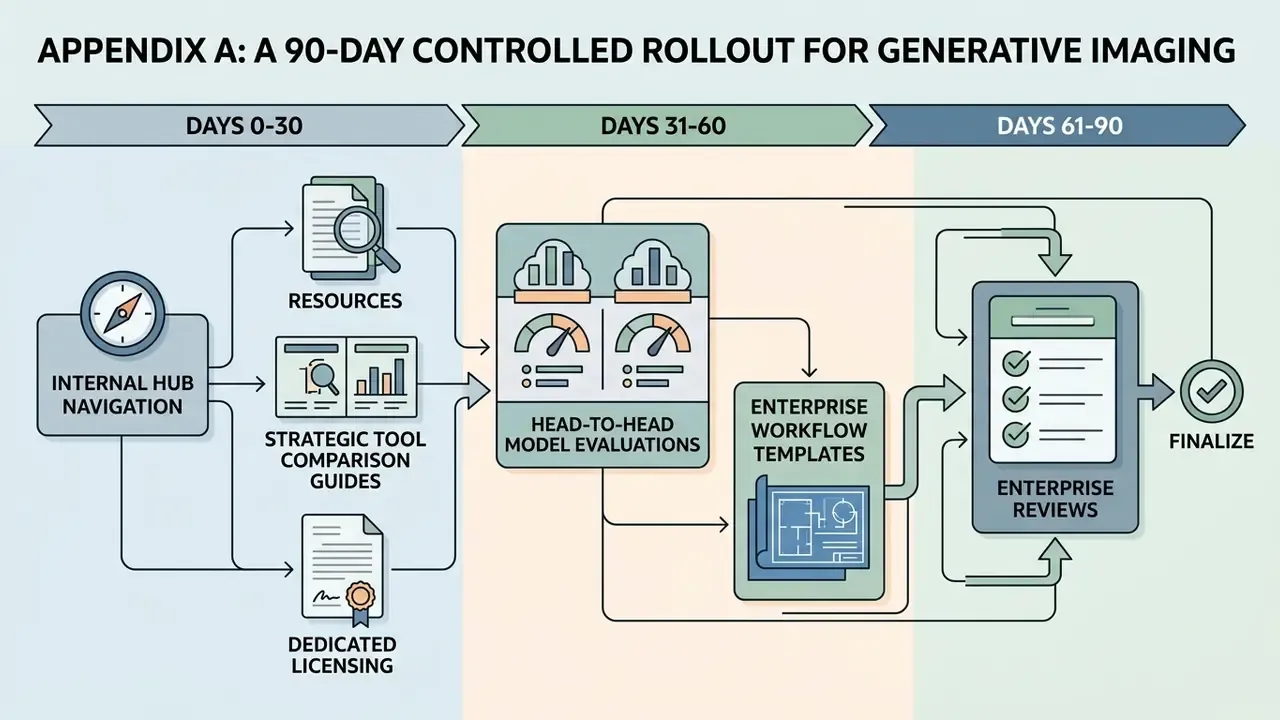
This is an illustrative sequence, not a regulatory requirement. It assumes an institution that already runs a model-risk framework and now needs to bring image generation inside it.
Days 1 to 30: discover and classify.
Run a discovery scan for generator usage across marketing, product, HR, and claims. Add every tool found to the model inventory, even the free ones someone signed up for last quarter. Classify use cases by exposure: internal-only mockups, customer-facing marketing, anything touching identity documents or claim evidence. That last tier should be restricted from day one.
Days 31 to 60: control and contract.
Review vendor data-retention and training-opt-out language for each approved platform. Block the rest at the network edge. Stand up prompt-and-seed logging, C2PA marking at export, and an approval gate for assets containing people, currency, documents, or performance figures. Write the escalation path: who decides when an output is borderline, and who can pull a published asset.
Days 61 to 90: validate and measure.
Validate outputs against three questions. Are they reproducible from the logged prompt, model version, and seed? Are demographic distributions acceptable for the customer base being served? Can an auditor reconstruct the chain from brief to published asset in under an hour? Then price the programme honestly: include control costs, review labor, and residual risk in the ROI model, because excluding them is how generative pilots look profitable and fail governance review.
One caveat worth stating plainly. Detection and marking standards are still moving, so any control set adopted in 2026 should be scheduled for review rather than treated as settled.