Top Recommended Tools by Category (2025)
Selecting the best AI tools for content creation in 2025 depends on your primary content medium, required volume, and necessary brand controls. Short version first, detail later.
- Best for General Drafting & IdeationChatGPT, versatile reasoning, research, file analysis, and data interpretation. From $20/user/month.
- Best for Brand-Aligned Marketing CopyJasper and Copy.ai, with built-in brand voice, style-guide enforcement, and multi-channel campaign workflows. From $59/month and $29/month respectively.
- Best for Search Engine OptimizationSurfer SEO, offering SERP-driven briefs, entity suggestions, real-time scoring, and AI Search (AEO) guidelines. From $49/month.
- Best for Answer Engine Optimization (AEO/GEO)Frase.io and Perplexity Pro, for extraction-ready answer briefs and AI-citation tracking. From $14.99/month.
- Best for Originality & Authenticity AuditingGrammarly Authenticity Suite, covering Humanizer, AI Detector, Plagiarism Checker, Citation Finder, and Authorship reports. From $12/user/month.
- Best for Quick Social VisualsCanva AI, with template integration, Magic Edit, brand kits, and accessible design tools. From $15/month.
- Best for Presenter Video & AvatarsSynthesia, with high-realism Express-2 avatars, 140+ languages, and corporate training video at scale. From $29/month.
- Best for Synthetic VoiceoversMurf AI (timeline-synced projects, 300+ voices) and ElevenLabs (emotional depth, zero-shot cloning, 29+ languages). From $19/month and $5/month.
- Best for Text-Based Audio/Video EditingDescript, with Studio Sound, Overdub correction, and automatic transcripts. From $12/user/month.
- Best for Social Media OperationsBuffer AI Assistant and SocialBee CoPilot, for channel-specific rewriting, strategy calendars, and engagement-based scheduling. From $6/channel/month and $29/month.
To perform custom ROI estimates and license calculations for your team's specific volume requirements, you can open the hub of interactive planning utilities.
Governance First: How to Build an AI Content Creation Workflow Without Sacrificing Quality
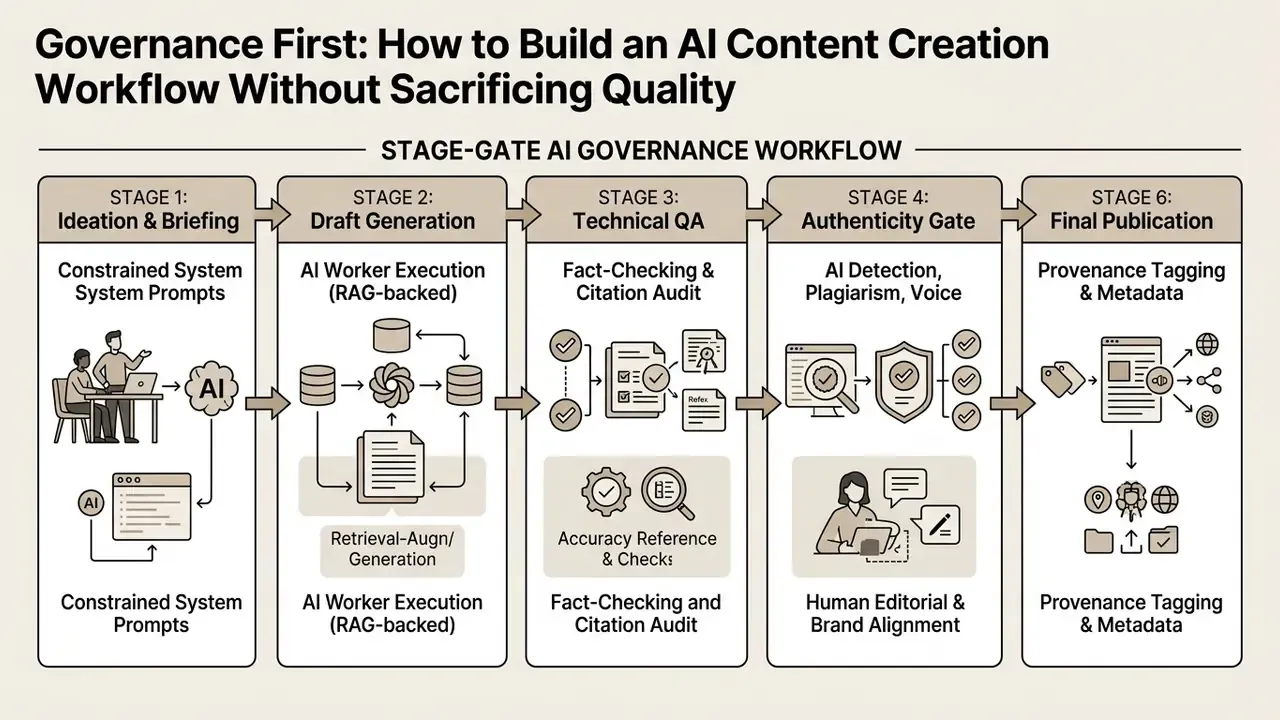
From Content Ideas to Publishing: A Practical AI-Assisted Process
A mature AI-assisted workflow divides content production into six distinct operational stages: scoping, constrained prompting, generation, technical validation, authenticity auditing, and human-in-the-loop editing. During scoping, content strategists define the core thesis, target audience, structural outline, and primary keyword targets.
The productivity case for this structure is measurable rather than anecdotal. Controlled experiments on high-skilled knowledge work show that assisted task throughput rises sharply when an AI assistant is available, with the largest gains concentrated among less experienced staff. That is precisely the population most likely to miss a factual or tonal error without a formal gate.
«Across three randomized experiments with 4,867 developers, access to an AI assistant increased completed tasks by 26%, with the largest effect among less experienced participants». The Effects of Generative AI on High-Skilled Work, SSRN (2024). https://doi.org/10.2139/ssrn.4945566
Stage-Gate Content Production Pipeline: Inputs, Controls, and Exit Criteria
| Stage | Primary Input | Control Mechanism | Accountable Role | Exit Criterion |
|---|---|---|---|---|
| 1. Scoping & Briefing | Thesis, audience, keyword and entity targets | Approved brief template; restricted data classes | Content strategist | Signed brief with named source materials |
| 2. Constrained Prompting | System prompt, style guide, RAG corpus | Sequential prompting; no free-form PII input | Writer / prompt owner | Prompt logged for audit trail |
| 3. Draft Generation | Model output (text, image, audio, video) | Approved-tool allowlist; token/credit budget | Writer | Draft stored with model + version metadata |
| 4. Technical QA | Claims, statistics, citations, links | Primary-source verification; RAG faithfulness check | Fact-checker / SME | Zero unverified numerical claims |
| 5. Authenticity Gate | Full draft text and assets | AI detection, plagiarism scan, citation finder | Managing editor | Originality and attribution report attached |
| 6. Publication | Approved final asset | Provenance metadata, disclosure labels, versioning | Publisher / compliance | CMS record with reviewer sign-off |
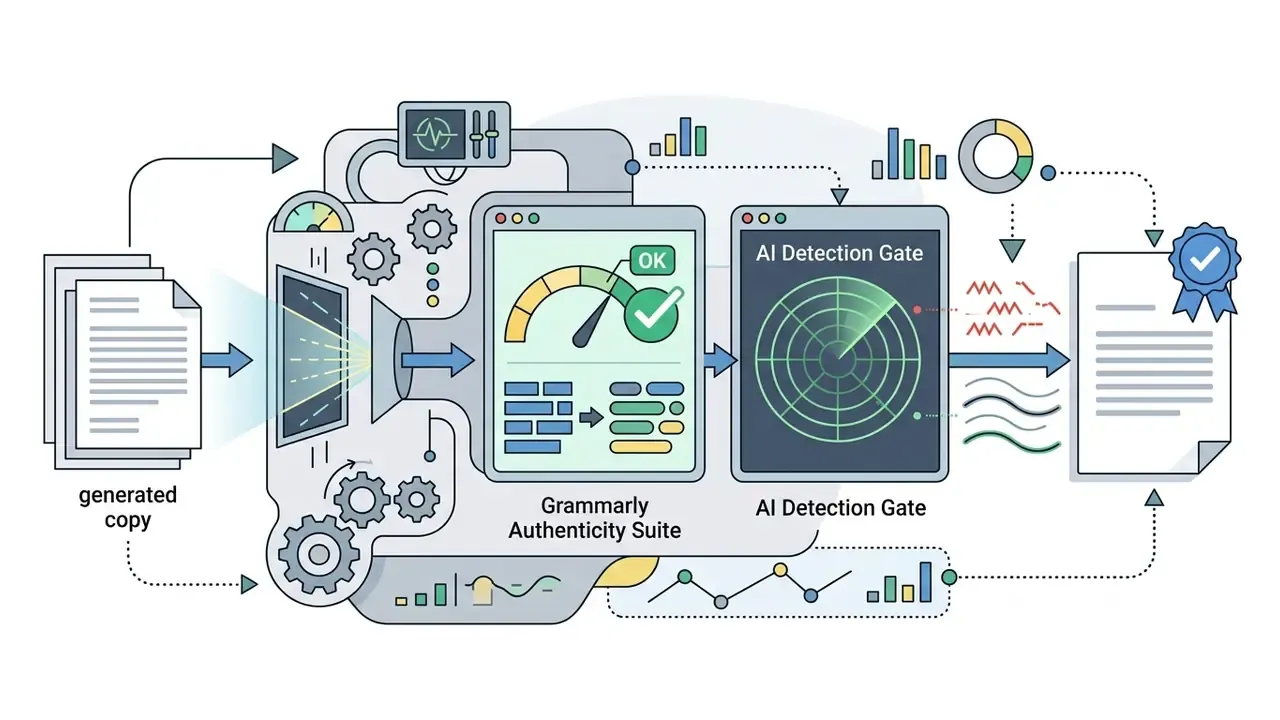
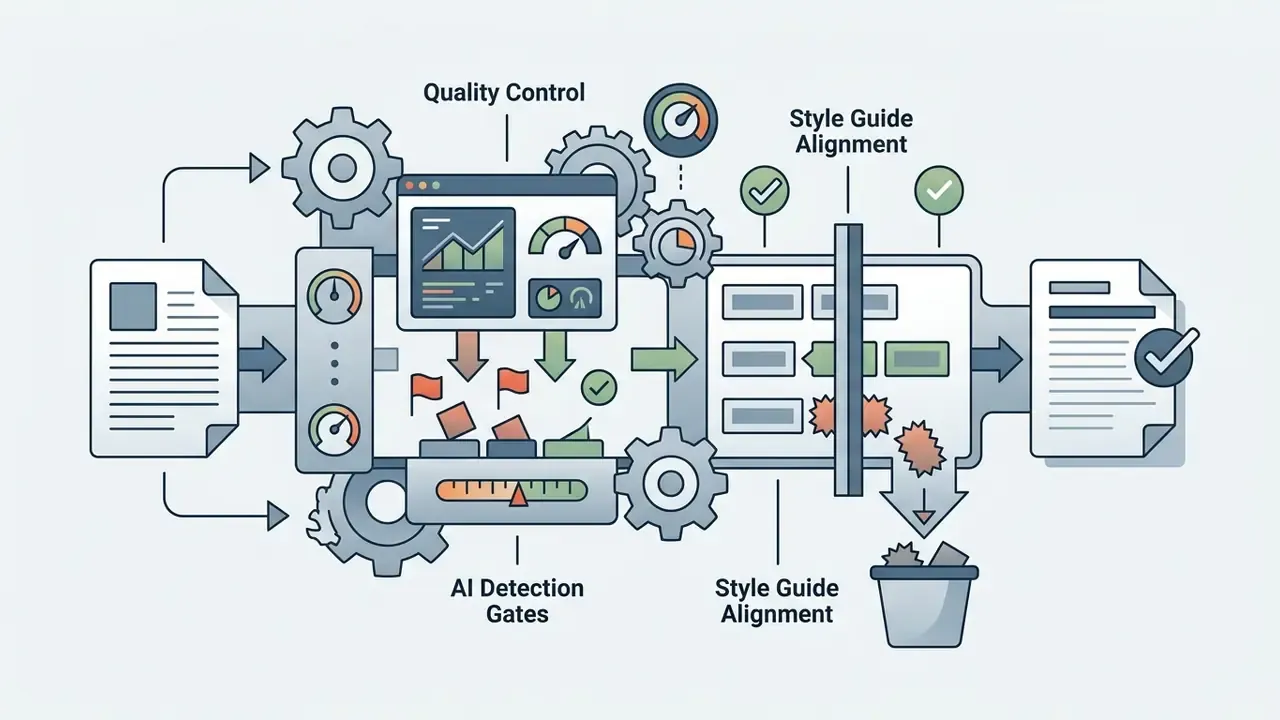
Quality Control: Grammarly Authenticity Suite and AI Detection Gates
Deploying high-volume AI workflows without pre-publication auditing risks search engine demotion and brand erosion. Route every generated draft through a structural authenticity gate before human editing, not after.

Human Editing, Fact Checking, and Brand Voice Review
Human editing remains the single most critical quality gate in any AI-assisted workflow. Independent evaluations confirm that unsupervised LLM text generation can introduce factual hallucinations, outdated statistics, and repetitive phrasing.
«NIST GenAI guidance classifies hallucination as a systemic risk and recommends mandatory human control points for all production LLM pipelines». NIST GenAI Guidance (2025). https://www.nist.gov/publications/2025-nist-genai-text-challenge-evaluation-plan
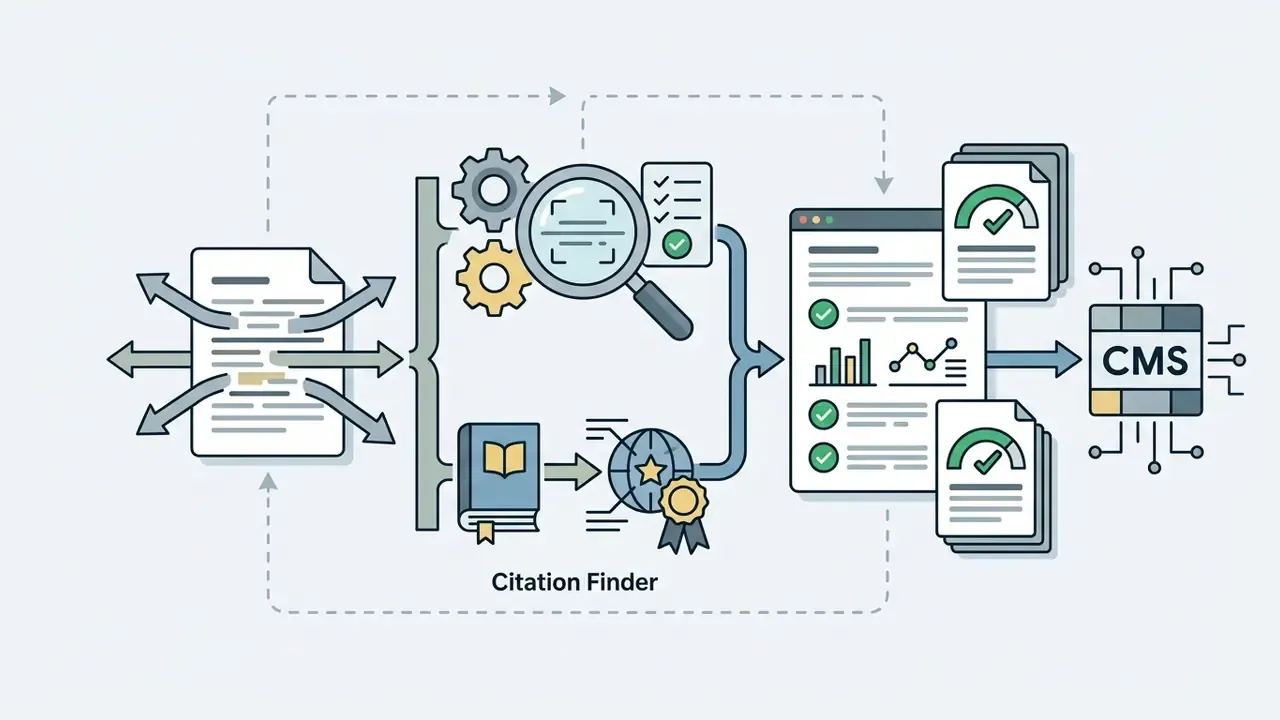
Editors must verify every factual assertion against reliable primary sources and confirm that all cited links point to verified publications. Tedious? Yes. Also non-negotiable.
Brand voice review does something the checklist cannot: it ensures the output reflects the institution's own perspective rather than generic online consensus. Editors should refine sentence cadence, cut filler, and inject proprietary research or case examples. To review complete licensing and usage guidelines for commercial publishing, creators can view the guide on enterprise deployment rights.
Security, Privacy, and Compliance Matrix by Vendor
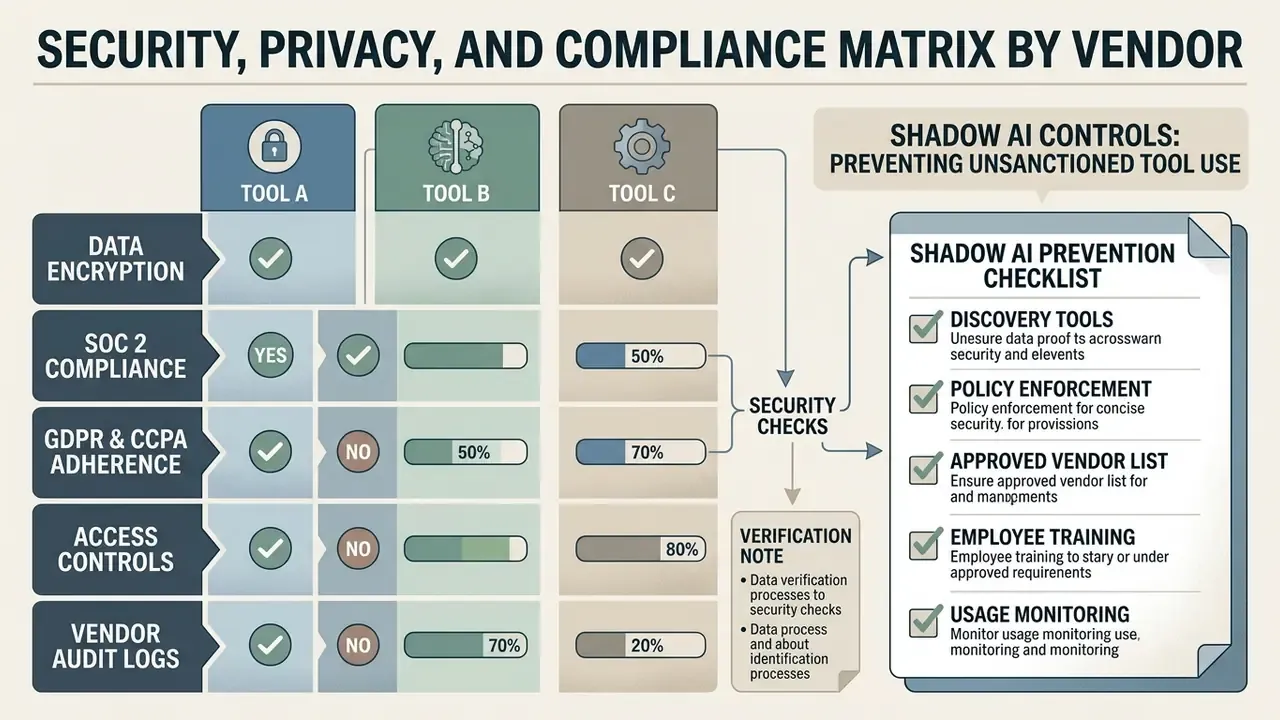
For regulated industries, capability comparisons are secondary to data-handling terms. Before a platform enters a pilot, governance leads should confirm five controls: training opt-out, independent security attestation, encryption posture, private or regional deployment options, and enterprise identity integration.
Data Protection and Enterprise Control Availability Across Leading AI Content Platforms (2025)
| Platform | Training Opt-Out on Business Tiers | Independent Security Attestation | Encryption (At Rest / In Transit) | Private / Regional Deployment | Enterprise SSO & RBAC |
|---|---|---|---|---|---|
| ChatGPT (Business / Enterprise) | Documented for business and enterprise workspaces | SOC 2 attestation published by vendor | Yes / Yes | Regional data residency options on enterprise agreements | Yes (SAML SSO, workspace roles) |
| Jasper (Business) | Enterprise-grade governance tier | Vendor-published security program | Yes / Yes | Not standard; contract-dependent | Yes (enterprise governance + API access) |
| Copy.ai (Enterprise) | Custom enterprise terms | Vendor-published security program | Yes / Yes | Not standard; contract-dependent | Yes on enterprise implementation |
| Surfer SEO | Content inputs limited to briefs and drafts | Confirm in DPA | Yes / Yes | No | Available on higher tiers |
| Canva (Teams / Enterprise) | Administrative controls on generative features | SOC 2 / ISO 27001 claimed by vendor | Yes / Yes | No | Yes (SSO, brand controls, admin roles) |
| Synthesia (Enterprise) | Enterprise agreement terms | Enterprise security documentation available | Yes / Yes | Shared workspaces, organizations, API rate controls | Yes (SSO, organization-level governance) |
| Murf AI / ElevenLabs | Voice-cloning consent controls required | Confirm in DPA; enterprise tiers documented | Yes / Yes | Enterprise-only | Enterprise-only |
| Grammarly (Business) | Business-tier privacy controls | SOC 2 Type II claimed by vendor | Yes / Yes | No | Yes (SSO, admin policy enforcement) |
| Descript | Business-tier terms | Confirm in DPA | Yes / Yes | No | Business tier only |
Shadow AI Controls: Preventing Unsanctioned Tool Use
The largest practical risk in content operations is not a weak model. It is an unapproved one. Staff pasting client data into consumer-tier chat interfaces creates exposure that no editorial checklist can catch after the fact.
Mapping AI Content Tools to NIST AI RMF and Model Risk Management
Content generation sits inside the same model-risk perimeter as any other inferential system once its outputs reach customers or regulators. Mapping tool usage to the four NIST AI Risk Management Framework functions converts an editorial process into an auditable control environment.
NIST AI RMF Alignment for Generative Content Platforms
| RMF Function | Content Operations Activity | Evidence Artifact | Owner |
|---|---|---|---|
| Govern | Approved-tool allowlist, disclosure policy, acceptable-use rules, training records | Policy document, attestation log, tool register | AI governance lead |
| Map | Inventory of content use cases by risk tier (marketing copy vs. regulated disclosure) | Use-case register with data-class labels | Model risk / content strategy |
| Measure | Hallucination sampling, RAG faithfulness and answer-relevance scoring, brand-voice similarity scoring, AI-detection rates | Monthly QA sample report with thresholds | Managing editor + validation |
| Manage | Escalation on failed gates, prompt-template versioning, incident logging, vendor re-review | Incident tickets, change log, remediation records | CRO / operational risk |
Practical thresholds used by mature content teams include a maximum tolerated unverified-claim rate of zero for regulated assets, a sampled hallucination rate under 2% for general marketing content, and a brand-voice similarity floor set against the top decile of historical performing assets. Any breach triggers re-generation with a revised prompt template rather than silent manual correction. That preserves the audit trail, which is the part validators actually ask for.
TCO and Risk-Adjusted ROI Calculation
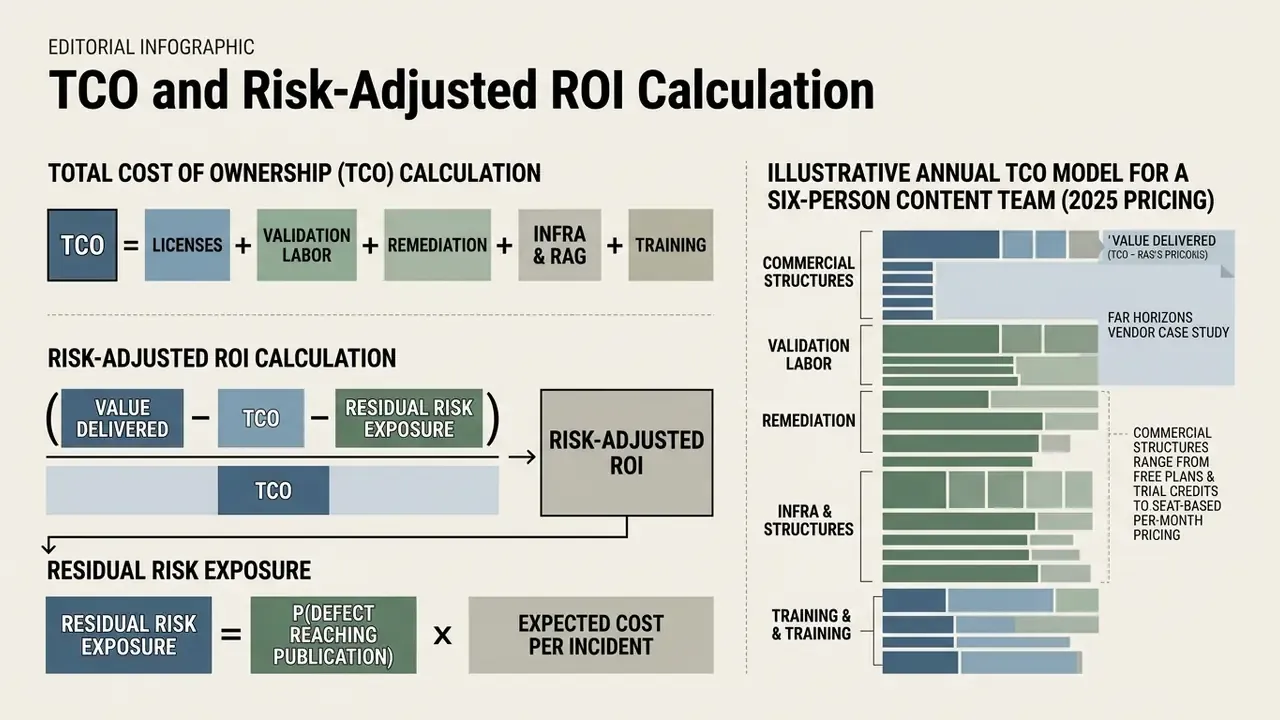
License fees are the smallest component of AI content cost. Realistic business cases price the control layer explicitly.
Total Cost of Ownership:
TCO = Licenses + Validation_Labor + Remediation + Infra_RAG + Training
Risk-Adjusted ROI:
Risk-Adjusted ROI = (Value_Delivered - TCO - Residual_Risk_Exposure) / TCO

Residual_Risk_Exposure = P(defect reaching publication) x Expected_Cost_per_Incident
Illustrative Annual TCO Model for a Six-Person Content Team (2025 Pricing Inputs)
| Cost Component | Basis | Annual Estimate | Notes |
|---|---|---|---|
| Licenses | 6 seats across LLM, brand-voice, SEO, design, audio, authenticity tools | $14,000 to $22,000 | Annual billing typically 15–30% below monthly rates |
| Validation labor | 1.5 hrs editorial + fact-check per 1,000 published words | Largest line item | Scales linearly with volume; the primary ROI lever |
| Remediation | Re-generation, corrections, retractions, republishing | 3–8% of validation labor | Rises sharply without an authenticity gate |
| RAG / infrastructure | Vector store, embedding refresh, API token consumption | Usage-dependent | Token rate cards vary by model and modality |
| Training & governance | Prompt standards, disclosure policy, annual attestation | Fixed overhead | One-time build, recurring refresh |
The observable ROI mechanism is compression of review cycles rather than elimination of writers. Enterprise automation research indicates that embedding brand voice scoring through vector similarity analysis allows teams to hold high alignment with top-performing historical content while expanding output volume.
«A RAG architecture with embedding-based brand-voice scoring delivered 89% similarity to top historical assets while content volume grew 240%». Far Horizons, Content Automation Case Study (2025). https://farhorizons.ai/research/content-automation
Note on interpretation: Far Horizons is a vendor case study rather than a peer-reviewed source. Treat the volume and similarity figures as a directional benchmark for pipeline design, and validate the ranking or engagement effects of AI-assisted content against your own analytics before including them in a business case.
Commercial structures range from limited free plans and trial credits to seat-based per-month pricing and usage-based token rate cards. Enterprise deployment costs must account for control mechanisms, human editing overhead, and system validation alongside software license fees. Teams publishing generated visuals should also budget for licensing review, because the commercial use terms for AI image generators differ materially by vendor and jurisdiction. To explore cost structures across different production configurations, you can compare options across standard tiering models.
How We Evaluated the Best AI Tools for Content Creation in 2025
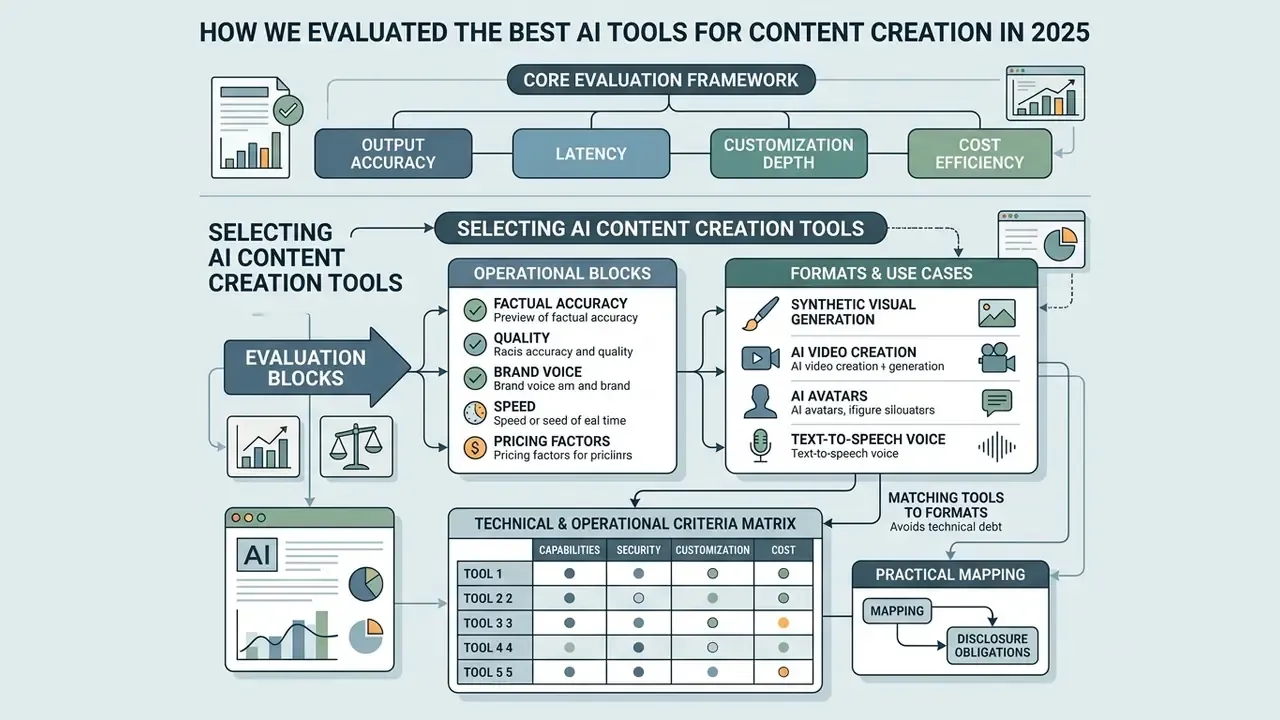
Evaluating generative AI platforms in 2025 requires a multi-dimensional framework spanning output accuracy, latency, customization depth, and cost efficiency. Selecting the best ai tools for content creation 2025 depends on applying standardized, repeatable evaluation criteria across text, visual, video, and audio workflows: the same prompt, the same brief, and the same scoring rubric for every candidate, so that differences in output reflect the tool rather than the tester. Where claims about long-term quality effects appear below, they are attributed to published research rather than asserted.
Empirical studies show that while large language models (LLMs) can enhance drafting speed, unmonitored deployments introduce risks around factual hallucination and stylistic homogenization.
«AI-assisted stories are roughly 5% more similar to each other than stories written without AI, indicating reduced collective content diversity». Doshi & Hauser, Science Advances (2024). https://doi.org/10.1126/sciadv.adn5290
Consequently, evaluation frameworks split into five core operational blocks: factual accuracy and quality, generation capabilities, brand-voice fidelity, user experience (UX) and learning curve, and enterprise workflow integration. Each block is scored against published rubrics: creativity, coherence, relevance, and interest for long-form text; prompt adherence and aesthetic fidelity for imagery; realism and identity consistency for avatars and synthetic voice.
Selection Matrix for AI Content Creation Tools in 2025 Based on Technical and Operational Criteria
| Content Modality | Output Quality Baseline | Generation Speed | Brand Voice Flexibility | Free Plan Access | Paid Plan Range | Learning Curve | Workflow Automation Support |
|---|---|---|---|---|---|---|---|
| Written Text | High semantic coherence; requires human fact-checking for technical domains. | Sub-second to 15 seconds per 1,000 words. | High (via system prompts, RAG, and style guides). | Available (rate-limited base models). | $20 to $200+ / seat / month. | Low (natural language interface). | Extensive (REST APIs, webhooks, Zapier, native CMS). |
| Visual Graphics | High aesthetic resolution; prompt adherence varies by engine; in-image typography remains error-prone. | 5 to 30 seconds per image render. | Moderate (custom style fine-tuning, brand kits). | Limited credit allocations. | $10 to $120 / month. | Moderate (prompt engineering required). | Moderate (Creative Cloud APIs, web extensions). |
| Video Content | High 1080p/4K rendering; variable avatar expression. | 30 seconds to 5 minutes per render minute. | High (custom avatars, synthetic voice cloning). | Restricted (watermarked outputs). | $20 to $100+ / seat / month. | Moderate to high (timeline editing tools). | Moderate (script-to-video pipelines, API triggers). |
| Synthetic Audio | High naturalness; variable accent precision and pitch dynamics. | Near real-time stream generation. | High (voice cloning, emotional tone toggles). | Trial access (non-commercial). | $5 to $99+ / month. | Low (script editor interface). | High (LMS, CMS, and SSML script integrations). |
Content Formats and Use Cases to Match With the Right Tool
Matching specific content formats to specialized platform architectures prevents technical debt and reduces manual rework. Written formats such as blog posts, product descriptions, ad copy, and social media posts rely primarily on natural language generation engines optimized for context retention and broad lexical diversity. Research demonstrates that general LLMs handle ideation and drafting for short-form copy and long-form structure reasonably well.
«ChatGPT essays received higher quality ratings from teachers than student-written essays, while also exhibiting greater lexical diversity». Herbold et al., arXiv (2023). https://arxiv.org/abs/2305.13242
Synthetic visual generation, AI video creation, AI avatars, and text-to-speech synthetic voices demand distinct technical stacks. High-stakes technical documentation or financial reporting requires tools configured with retrieval-augmented generation (RAG) to reference ground-truth data stores. Visual and video formats require diffusion models and temporal frame-consistency engines. Teams shipping upscaled or archival footage should also evaluate a dedicated best ai video upscaler rather than relying on a generator's export settings.
A practical mapping also determines disclosure obligations. Standard marketing copy, blog drafts, and social posts generated with AI as a drafting aid are generally treated as low-disclosure uses. Synthetic spokespersons, cloned voices, and AI-generated audio-visual segments are disclosure-sensitive in most current advertising frameworks and should carry explicit labeling. Aligning each content format with purpose-built tools, and with the correct disclosure tier, lets teams keep production velocity without compromising technical or regulatory reliability.
Quality, Brand Voice, Speed, and Pricing Factors
Balancing output quality, brand voice alignment, operational speed, and pricing models determines the total cost of ownership for AI platforms. General LLMs produce fluent text, yet maintaining a consistent brand voice across marketing teams requires explicit style guide integration, custom system prompts, or fine-tuned model weights. Brand-voice depth is plan-dependent: editable voice, tone, and style controls, unlimited brand voices, and knowledge-asset libraries typically appear only on business or enterprise tiers.
Free-tier evaluation deserves separate scrutiny, because free plans gate the underlying model quality itself, not only volume. Before standardizing on a tool, confirm generation caps, export formats, watermark policy, and which base model version the free tier actually serves.
Best AI Content Creation Tools 2025: Comparison Chart
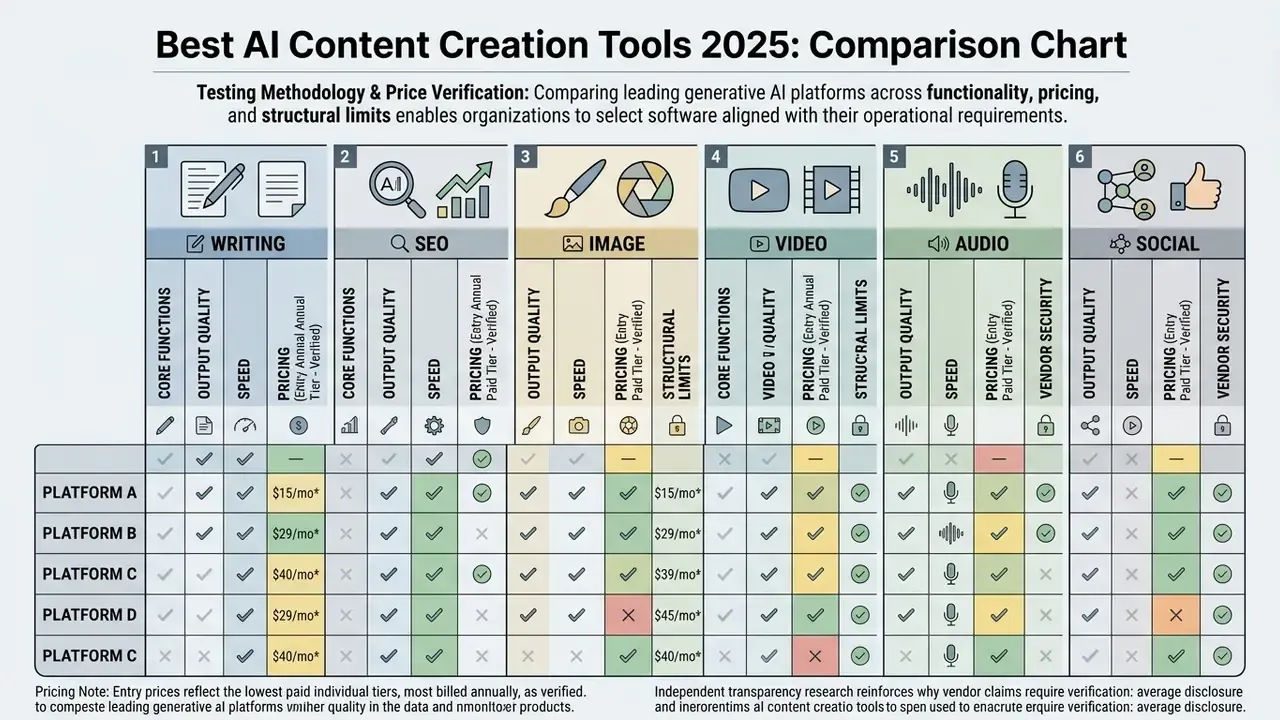
Comparing leading generative AI platforms across functionality, pricing, and structural limits enables organizations to select software aligned with their operational requirements. The following matrix details eleven platforms for text, image, video, audio, and authenticity workflows in 2025.
Comprehensive Platform Comparison of Popular AI Content Creation Tools (2025)
| Platform | Primary Use Case | Key Features | Free Plan Availability | Starting Paid Price | Primary Limitation | Target User |
|---|---|---|---|---|---|---|
| ChatGPT | General drafting, ideation, data analysis, research. | Current GPT-5 family models, custom GPTs, file analysis, web search, dashboards from business data. | Yes (rate-limited access). | $20 / user / month (Plus). | Requires explicit prompt engineering for consistent style; free tier caps messages per rolling window. | General teams, researchers, writers. |
| Jasper | Brand-aligned marketing content and campaigns. | Jasper IQ brand voice, style guide enforcement, audience profiles, team workflows, API on Business. | No (7-day trial available). | $59 / month (billed annually; $69 billed monthly). | Higher cost floor for small teams; dependent on underlying LLMs. | Enterprise marketing, copywriters. |
| Copy.ai | GTM workflows, ad copy, social variations. | Automated workflow builder, multi-channel copy generation, 20+ integrations on enterprise. | Yes (limited credits). | $29 / month (Chat tier). | Advanced multi-step workflows require higher-tier plans; growth tiers priced at agency scale. | Growth marketers, sales teams. |
| Surfer SEO | SEO content briefs, AEO guidelines, real-time optimization. | Topical mapping, content editor, entity insertion, AI Search guidelines, Auto-Optimize, audit. | No (7-day Pro trial). | $49 / month (Discovery). | Focuses strictly on search optimization rather than general copy. | SEO strategists, content managers. |
| Canva AI | Quick visual graphics and social media design. | Magic Design, Magic Media, Magic Edit, brand kits, template auto-generation. | Yes (basic features; Magic Edit excluded). | $15 / month (Pro seat). | Generative raster edits lack full vector control; in-image text frequently misspells. | Social media managers, non-designers. |
| InVideo | Prompt-to-video creation and social video drafts. | Text-to-video generation, stock script fitting, multi-shot editor, AI avatars and actors. | Yes (watermarked exports). | $20 / seat / month. | Requires manual script adjustments for complex narratives. | Video creators, social marketers. |
| Synthesia | Presenter-led training videos and AI avatars. | 1080p/30fps Express-2 avatars, 140+ languages, brand kits, organizations, SSO on enterprise. | Yes (limited trial minutes). | $29 / month (Starter). | Less suited for cinematic artistic storytelling; renders take roughly 3–5 minutes. | L&D managers, corporate communicators. |
| Murf AI | Synthetic voiceovers and multi-language dubbing. | 300+ voices across 33+ languages and accents, pitch range -50 to 50, voice cloning, Murf Dub. | Yes (10 mins render limit). | $19 / month (Creator). | Advanced timing synchronization requires manual timeline edits. | Podcasters, video editors, educators. |
| ElevenLabs | Ultra-realistic voice cloning and dubbing. | Voice Isolator, emotion and pacing control, 29+ languages, lip-sync accuracy. | Yes (10,000 characters / month). | $5 / month (Starter). | Voice usage credits exhaust quickly on high-resolution or long-form audio. | Audio creators, video dubbing teams. |
| Grammarly | AI revision, plagiarism and authenticity audit. | Humanizer, AI Detector, Citation Finder, Plagiarism Checker, Authorship reports; Docs/Word/Gmail/Slack. | Yes (basic edition). | $12 / user / month. | Advanced AI-detection and authorship metrics require Business tier. | Editors, compliance officers. |
| Descript | Text-based audio/video editing. | Studio Sound, Overdub voice correction, automatic transcripts, filler-word removal. | Yes (export-hour limit). | $12 / user / month. | Multi-track timeline handling can lag on long files; limited advanced timeline control. | Podcasters, video editors. |
«The AI Index reports accelerating enterprise adoption of generative AI alongside a rising count of documented AI incidents». Stanford HAI AI Index (2025). https://hai.stanford.edu/research/ai-index-report
Independent transparency research reinforces why vendor claims require verification: average disclosure scores across major foundation model providers remain low, which makes contractual terms and published rate cards, not marketing pages, the correct evidence base for procurement decisions.
Best AI Writing and Research Tools for Blog Posts and Marketing Copy
AI writing tools provide automated support for ideation, structural drafting, long form content production, and marketing copy generation. Modern writing assistants use advanced natural language processing to accelerate content production while allowing human writers to focus on high-level strategy and editorial oversight.
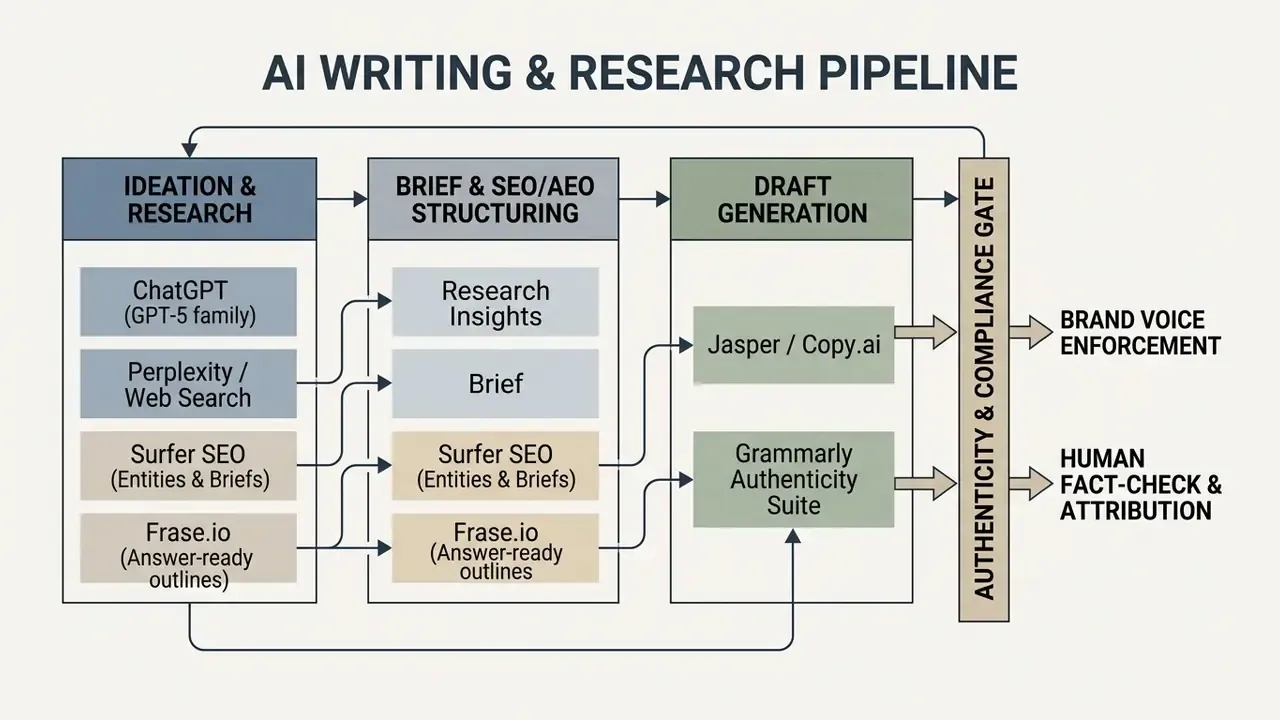
ChatGPT for Idea Generation, Drafting, and Content Research
ChatGPT serves as a foundational platform for brainstorming content ideas, summarizing complex research materials, and writing initial article drafts. Built on advanced LLM architectures, including the current GPT-5 model series, the interface processes large context windows. That lets users analyze long documents, connect business data, build interactive reports, and generate detailed content plans from short text prompts.
Experiments in creative ideation demonstrate that access to LLM-generated suggestions increases individual creativity scores by 6% to 7% and improves overall draft quality, with the largest gains observed among novice writers.
«Less creative writers showed a 10–11% improvement in story quality when using GPT-4 ideas, while the effect on more skilled writers was substantially smaller». Doshi & Hauser, Science Advances (2024). https://doi.org/10.1126/sciadv.adn5290
When applied to technical research, however, standalone LLM outputs can contain factual inaccuracies or fictitious citations.
«AI-generated scientific abstracts scored a mean quality of 4.72 versus 8.09 for human-written abstracts (P<.001), and three of 30 contained erroneous conclusions». Journal of Medical Internet Research (2023). https://www.jmir.org/2023/1/e48115
Use ChatGPT as an ideation and structural drafting partner, then keep rigorous human verification for every factual assertion. No evidence, no autonomy.
Jasper and Copy.ai for Brand-Aligned Marketing Content
Jasper and Copy.ai specialize in generating marketing content tailored to specific brand guidelines, audience profiles, and multi-channel campaign strategies. Jasper wires brand voice controls, style guide rules, audience profiles, and product context directly into its output engine through Jasper IQ, which helps marketing teams hold tonal consistency across ad copy, product descriptions, and long-form articles. Its ad-copy workflow generates platform-optimized headline, body, and CTA variants in a single pass.
Copy.ai focuses on go-to-market (GTM) workflow automation, providing templates for multi-variant ad copy, social media copywriting, and cold outreach sequences, plus a workflow builder that chains steps such as URL scraping, summarization, metadata drafting, and asset generation. Both platforms build upon underlying foundation LLMs, so their value lies in wrapping raw model capabilities in structured marketing workflows, reducing the prompt engineering burden for non-technical teams. Teams evaluating specialized writing software alongside visual tools can compare options across functional categories, including adjacent categories such as the best ai website builders used for campaign landing pages.
In one enterprise rollout reviewed for this guide, a national financial services firm implemented a structured brand voice pipeline within Jasper to unify messaging across 12 product teams. The scope covered non-advisory marketing assets only: campaign landing copy, product explainer pages, and internal enablement one-pagers, with all rate, fee, and product-terms language pulled from an approved RAG corpus rather than generated. Information security approval was conditional on three controls: enterprise SSO, a documented training opt-out, and a prohibition on entering customer data into prompts. By establishing centralized prompt templates and automated style scoring, the team reported a 40% reduction in draft review cycles while maintaining a 92% brand alignment score across 300 monthly marketing assets. These figures are self-reported by the deploying organization and were not independently audited. Treat them as a directional benchmark, and calibrate expected review-cycle savings against your own baseline editing hours.
Optimizing for Answer Engines (AEO) and Generative Search (GEO)
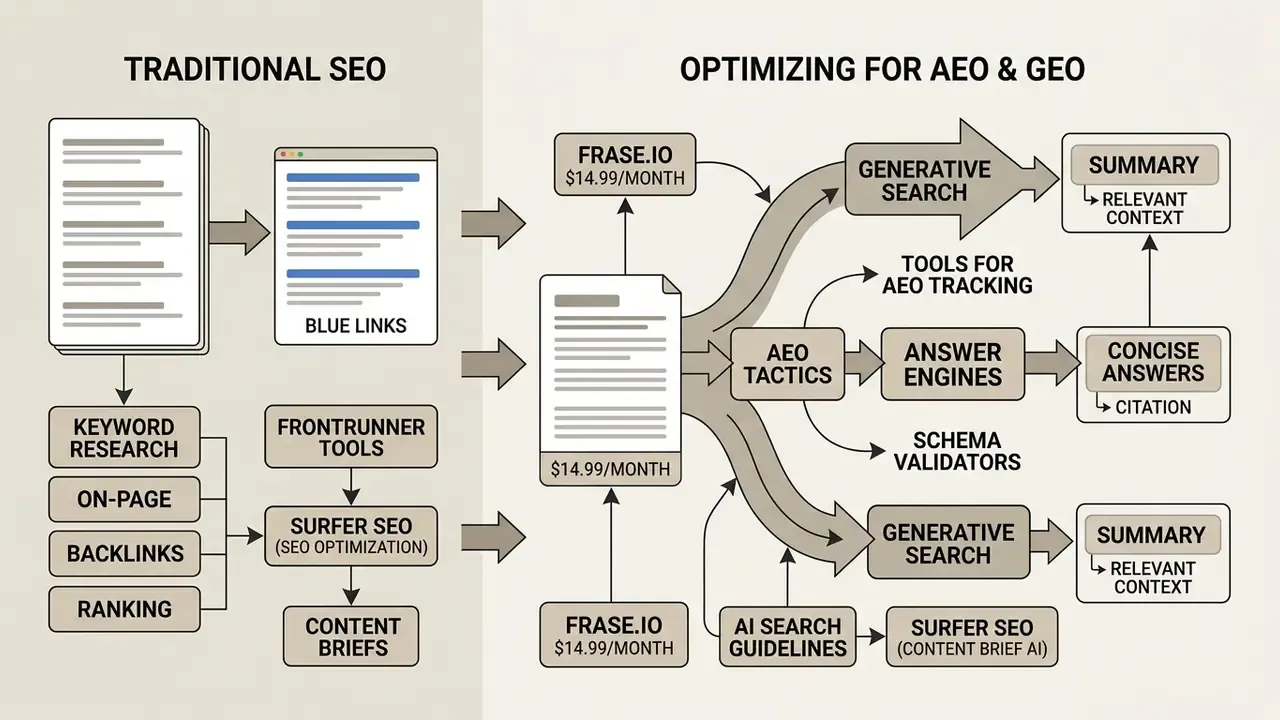
Traditional SEO optimizes for blue links on a results page. In 2025, a growing share of informational queries is answered directly inside AI environments: ChatGPT Search, Google Gemini, Microsoft Copilot, and Perplexity, which synthesize responses from multiple sources and cite a subset of them. Content must therefore be engineered for structural extraction, not only for ranking.
Key AEO requirements:
Tools for AEO and GEO tracking:
- Surfer SEO AI Search guidelines surface which entities to include for classic SEO and what information to add for AI Search visibility, with one-click Auto-Optimize applying both.
- Frase.io ($14.99/month) synthesizes multi-document answer briefs and outlines designed to be extracted and cited by LLMs.
- Perplexity Pro works as a monitoring instrument: query your target topics and record whether your domain appears in the citation set, and which competing sources displace it.
- Schema validators confirm that markup parses before publication, since malformed schema silently removes eligibility for structured answers.
A practical AEO audit runs monthly: sample 20 priority queries, record which answer engines cite your domain, log the specific passage quoted, and feed gaps back into the brief template. Because answer engines reward clarity and verifiability, AEO work compounds with the governance gates described above rather than competing with them. That alignment is convenient, and slightly unusual in this field.
Surfer SEO for SEO Optimization and Content Briefs
Surfer SEO evaluates search engine results pages (SERPs) to generate data-driven content briefs, keyword density recommendations, and structural guidelines for long-form articles. By analyzing top-ranking pages for a given query, Surfer SEO identifies relevant natural language processing (NLP) entities, structural heading patterns, and optimal word counts required to compete in organic search.
The platform's workflow moves from Topical Map (topic and cluster discovery) to Research & Create Outline, then to Write & Optimize, then to internal linking. Its Content Editor provides real-time optimization scoring as writers draft content, flagging missing semantic terms, weak entity coverage, and structural gaps, with guidance on term density, prominence, and proximity. Surfer SEO also integrates directly with Google Docs, WordPress, Zapier, Google Search Console, and external writing platforms, so content creators can align drafting workflows with search engine optimization standards without leaving their primary writing environments. Higher tiers add API access for programmatic brief generation.
Known limitations from testing: keyword suggestions occasionally surface terms that do not match the search intent of the target query, and the SERP Analyzer has a steeper interface learning curve than the editor. Treat the optimization score as a coverage indicator, not a publication gate.
Best AI Tools for Image, Video, and Audio Content Creation
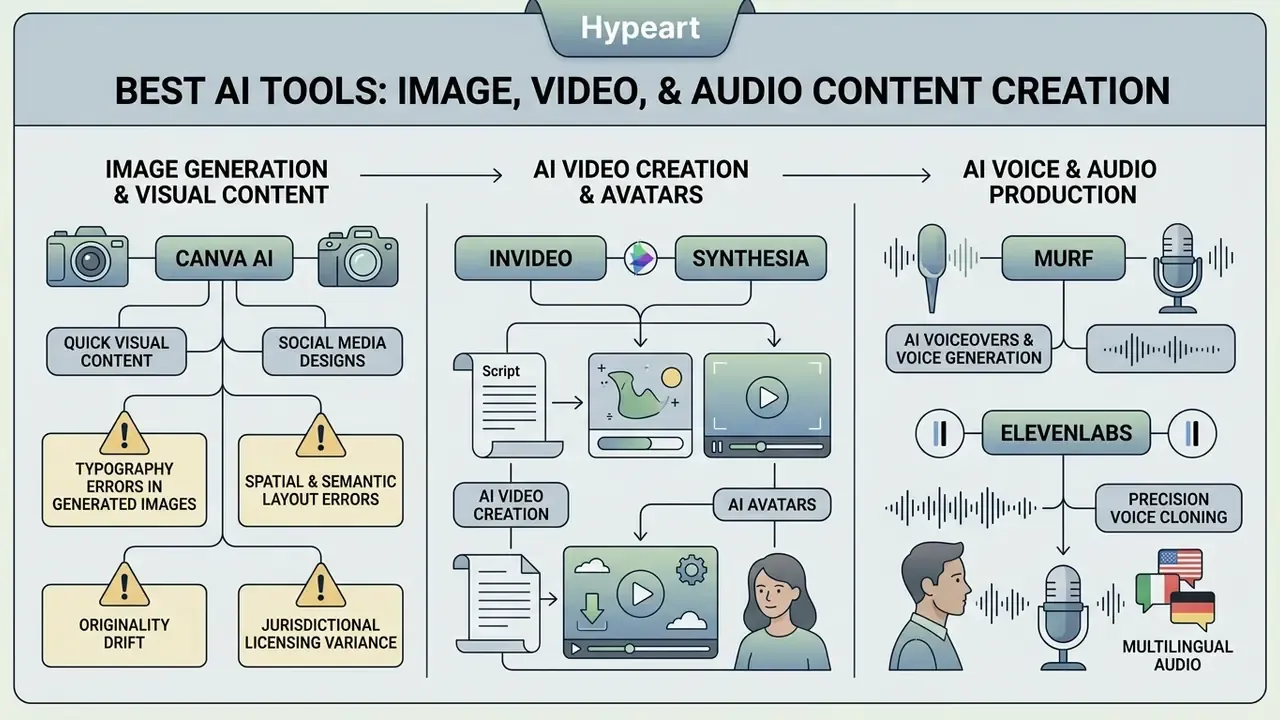
Visual, video, and audio generation tools have advanced from experimental novelties into core production engines for visual graphics, synthetic videos, and professional voiceovers. Combining diffusion models and synthetic speech synthesis lets creative teams produce multimedia assets at a fraction of traditional studio costs.
InVideo and Synthesia for AI Video Creation and Avatars
InVideo and Synthesia address distinct segments of the synthetic video generation landscape. InVideo specializes in rapid text-to-video generation, converting text scripts into multi-shot video drafts complete with stock footage, text overlays, and background audio. Its flexible timeline editor lets creators refine video sequences quickly for social media marketing and promotional clips, and prompt-to-draft turnaround in testing ranged from roughly 30–90 seconds to a few minutes depending on length. Readers weighing alternative engines can review our comparison of AI video generators, teams editing on phones can check the best app to edit videos, and developers evaluating programmatic generation can consult the Google Veo API implementation guide.
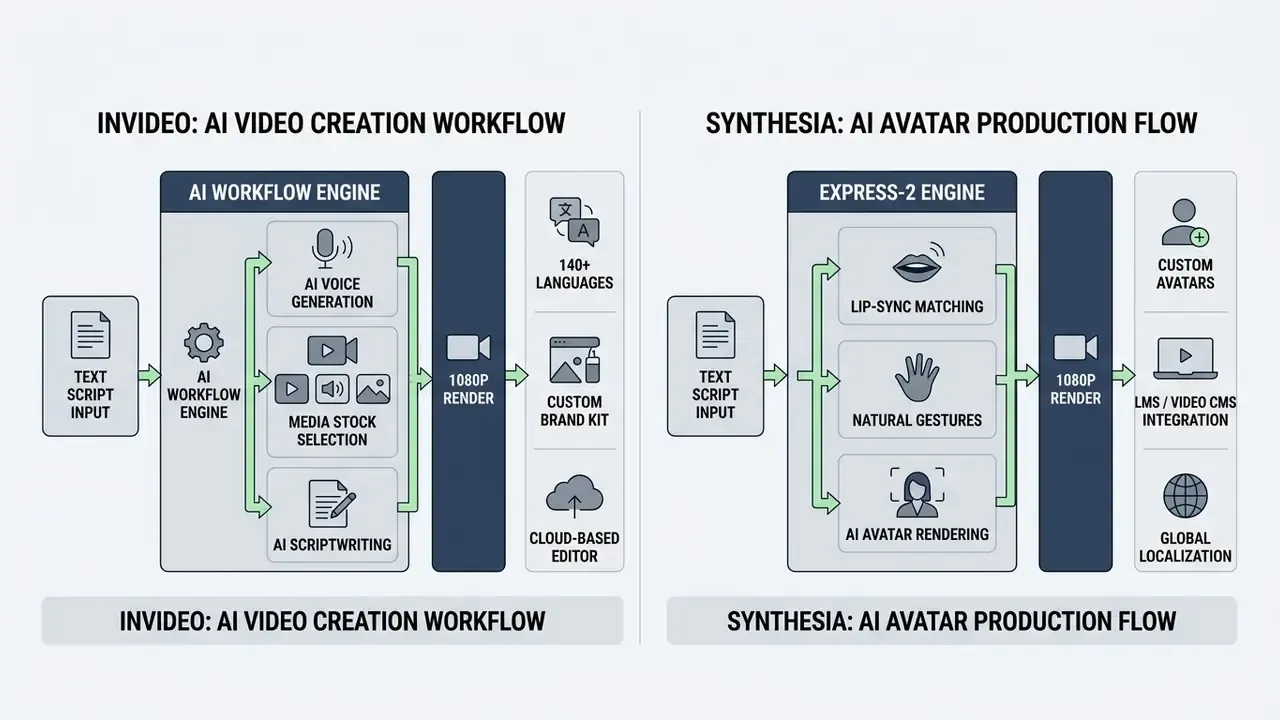
Synthesia focuses on enterprise presenter-led video creation using realistic AI avatars and synthetic speech generation. Built on its Express-2 avatar engine, Synthesia produces 1080p/30fps video outputs of arbitrary length with synchronized lip movements, consistent avatar identity, natural co-speech gestures, and multi-language support across 140+ languages (Synthesia avatar documentation). Its workflow converts text, scripts, uploaded files, or URLs into an editable draft; generation typically takes about three to five minutes. Enterprise case studies report that converting text documentation into presenter-led video content via Synthesia cuts production timelines from weeks to minutes, which makes it effective for corporate training and internal communications.
«Organizations move from multi-month video production cycles to generating professional training videos in minutes using Synthesia's AI avatars». AWS Case Study: Synthesia (2025). https://aws.amazon.com/solutions/case-studies/synthesia
Teams standardizing on avatar video should note the disclosure implications: synthetic spokespersons and cloned voices are disclosure-sensitive in most current advertising and public-communication frameworks, and documented consent is required for any likeness used. Production teams needing dedicated post-processing capabilities can evaluate our guides to animation makers and video compressors for delivery optimization.
Murf for AI Voiceovers and Voice Generation
Murf AI provides synthetic voice generation and text-to-speech conversion for e-learning modules, video narration, advertising clips, and podcast production. The platform hosts a library of over 300 natural-sounding voices across 33+ languages and regional accents, with fine-grained controls for pitch (an integer range of -50 to 50 via its API), speed, emphasis, and emotional tone.
Synthetic Voiceover Output Characteristics: Murf AI Configuration Reference
| Parameter | Available Range / Option | Typical Production Setting | Audible Effect |
|---|---|---|---|
| Pitch | -50 to 50 (API integer) | +3 to +5 for corporate narration | Raises perceived energy without chipmunk artifacting |
| Speed | Adjustable per block | -5% for technical explainers | Improves comprehension of dense terminology |
| Emphasis | Word-level tagging | Applied to key terms and figures | Prevents monotone delivery on data-heavy scripts |
| Export | MP3 / WAV | 192 kbps MP3 for web, WAV for post | Balances fidelity against delivery weight |
| Dubbing (Murf Dub) | 25+ languages and accents | Source-voice preservation enabled | Retains original tone and meaning across locales |
Through its API and cloud editor, Murf supports precise timeline synchronization between voice tracks and visual media. Its AI dubbing capabilities let content creators translate existing video voiceovers into multiple target languages while preserving the original speaker's pitch profile and tonal inflection. Creators building complete multimedia pipelines can review the extended guide to AI voice generators for quality, language support, pricing, and commercial licensing detail, or compare shortlists in our best ai voice generator roundup.
ElevenLabs for Precision Voice Cloning and Multilingual Audio
Murf AI excels at structured, timeline-based audio projects. ElevenLabs leads on emotional depth and zero-shot voice cloning. Operating on deep generative audio architectures, the platform replicates vocal pitch, cadence, and subtle breath accents from as little as one minute of clear reference audio.
- Primary use case high-emotion podcast production, synthetic audiobook narration, and instant multilingual dubbing across 29+ languages with lip-sync accuracy.
- Enterprise edge a built-in Voice Isolator strips room noise from raw recordings, while dynamic emotion and pacing controls let operators tune excitement paragraph by paragraph. Brand voice training supports a consistent narrator identity across a content library.
- Pricing free plan available (10,000 characters per month); Starter plan from $5/month.
- Operational caution character credits deplete quickly on long-form or high-resolution audio, and voice cloning requires documented consent from the voice owner. Budget credits per finished minute, not per script word.
Descript for Text-Based Audio and Video Editing
Best AI Tools for Social Media Content and Workflow Automation
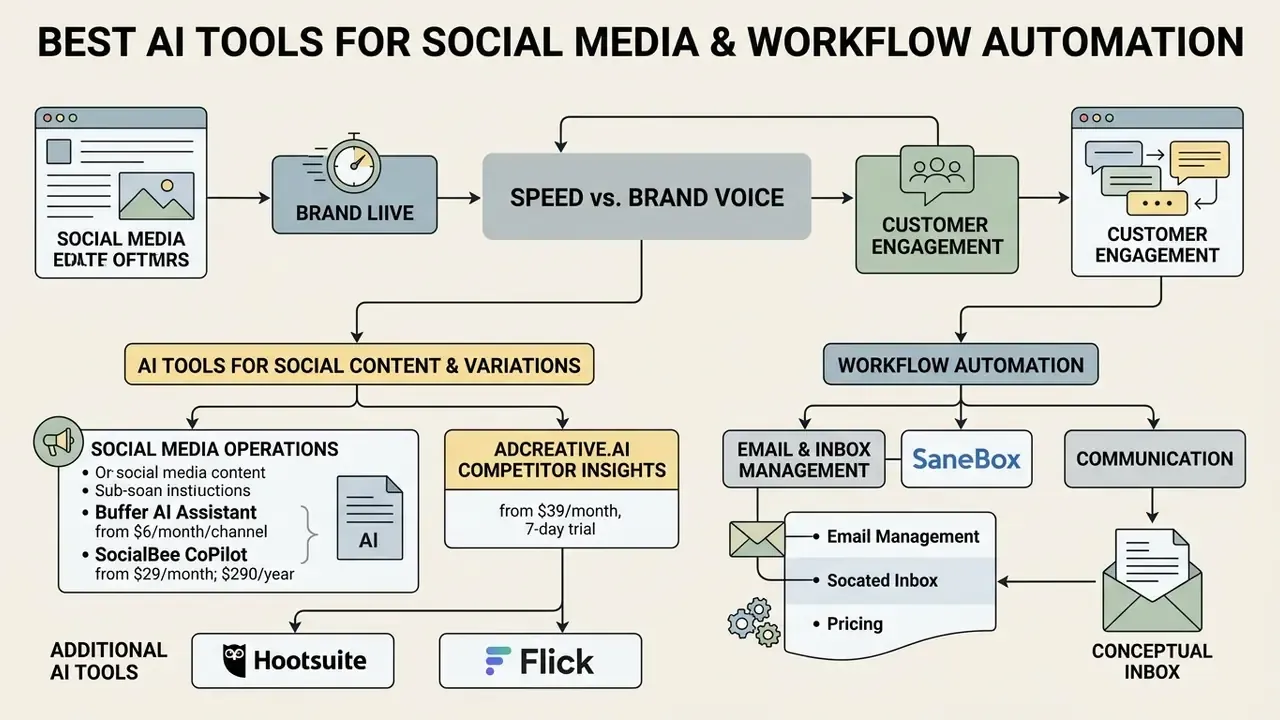
Automating social media management requires balancing creation speed with brand voice consistency and customer engagement. Modern AI tools let social media teams transform a single long-form asset into dozens of channel-specific post variations, automating repetitive scheduling and formatting tasks.
AI Tools for Email and Inbox Management
Content operations lose measurable hours to inbox triage rather than writing. Three tools recur in production stacks:
- SaneBox filters and prioritizes incoming mail by learned preference, isolating low-priority threads so editorial time stays on production.
- Boomerang AI-assisted scheduling, send-later, reminders, and follow-up suggestions for outreach-heavy roles such as PR and partnerships.
- HubSpot email creation, sending, and tracking with AI-powered analytics inside a broader marketing stack, useful when content and lifecycle campaigns share ownership.
Evaluate these against message volume, automation requirements, and integration depth with existing marketing tooling, and confirm that mail contents are excluded from model training before deployment in a regulated environment.
Workflow Automation for Repetitive Content Tasks
Connecting AI generation engines directly to Content Management Systems (CMS), customer relationship management (CRM) platforms, and social distribution channels eliminates manual copy-pasting and accelerates publishing cadence. Enterprise content automation relies on middleware platforms like Zapier, Make, or custom API webhooks to trigger AI actions based on specific workflow events.
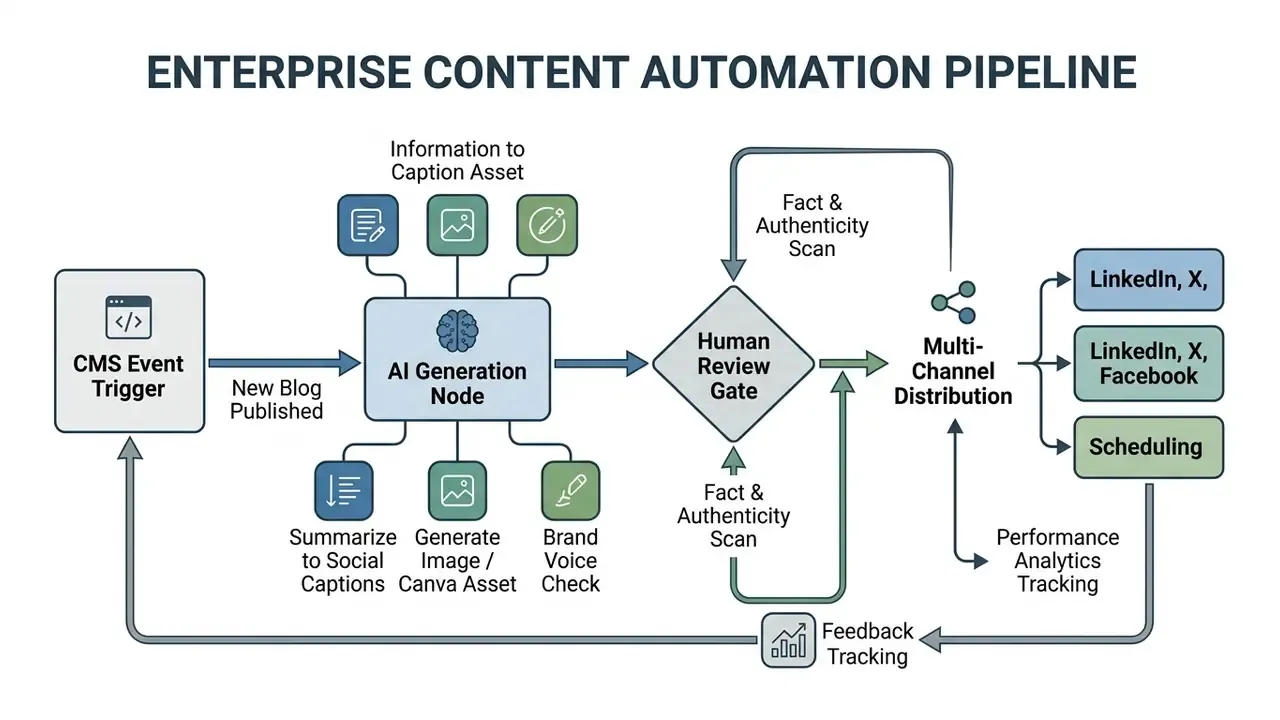
Documented enterprise AI content workflows automate document categorization, tagging, personalization, review routing, and summarization across connected content systems, with human approval gates preserved at the publish step. Publishing a new blog post, for instance, can automatically trigger a workflow that extracts key takeaways, drafts three LinkedIn post variations, generates an optimized social header image, and queues the assets for editorial approval. Automated workflows reduce operational overhead while preserving the human approval gates that protect brand quality. Developers building custom automation pipelines can see the overview of available API architectures.
Best Free AI Content Creation Tools and Safe Pilot Testing
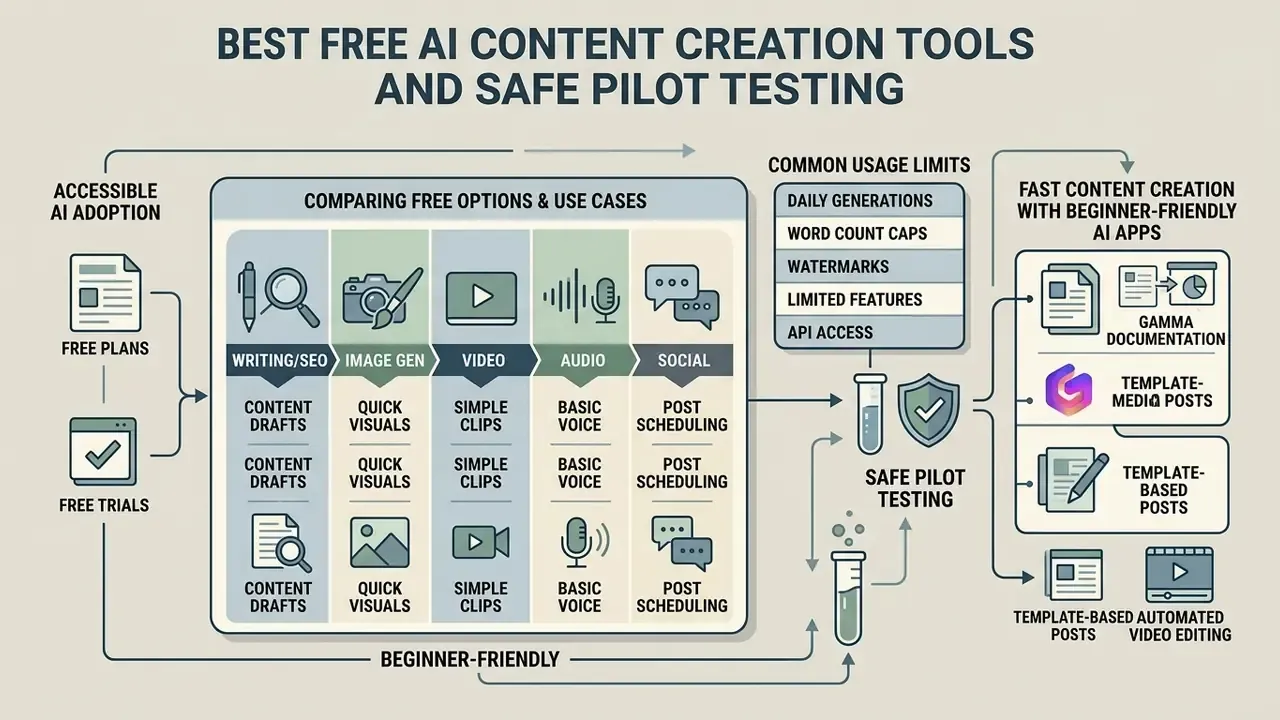
Entering the AI content creation space does not require immediate financial investment in premium enterprise tiers. Numerous platforms offer robust free plans, free trials, and open-access interfaces that allow teams to run controlled pilots before procurement, provided the pilot is scoped to non-sensitive data.
[CHECKLIST] Free Plan and Pilot Safety Audit
- [ ] Confirm generation credit caps per month (e.g., 400 AI credits, 2 tasks/day, or 3 tasks/hour).
- [ ] Verify export resolution, format restrictions, and watermark rules (clean PNG vs mandatory platform mark).
- [ ] Check which underlying model version the free tier serves (base model vs advanced reasoning model).
- [ ] Inspect commercial usage licensing terms (personal use only vs full commercial rights).
- [ ] Review data privacy settings and confirm opt-out of model training on uploaded assets.
- [ ] Restrict pilot inputs to synthetic or public data; never load client PII into a free tier.
- [ ] Record the tool, owner, and pilot end date in the AI tool register to prevent silent shadow adoption.
Free Plans, Free Trials, and Common Usage Limits
Navigating free AI tools requires understanding the structural constraints vendor platforms place on non-paying accounts. Free plans typically employ one of three gating mechanisms: rolling-window or monthly credit quotas, daily query limits, or feature restrictions such as lower export resolutions and mandatory watermarks. Readers evaluating no-cost video tooling can review our breakdown of free AI video generators for duration caps, credits, and watermark policy.
ChatGPT's free tier, for example, limits use of its most advanced model to a set number of messages per rolling multi-hour window, with separate caps on data analysis, file and image uploads, and image creation. Google's free tiers are governed by model-specific rate limits and product-level monthly ceilings, with some consumer plans capping daily image generation and monthly research runs. Canva AI provides free design capabilities but reserves Magic Edit and higher generative allowances for Pro, Teams, Nonprofit, and Education accounts. Reviewing export restrictions and commercial usage terms ensures that teams do not build workflows around tools that block commercial deployment. For a detailed breakdown of no-cost generation tools, creators can examine our comparison of free AI art generators, and teams working with images should confirm limits in the guide to free photo editors.
Beginner-Friendly AI Apps for Fast Content Creation
For users seeking immediate results without complex setup, several web applications provide intuitive interfaces and low learning curves. Platforms like Gamma generate formatted presentations, document outlines, websites, and social posts directly from text prompts in seconds (Gamma documentation), though free exports may carry a platform watermark.
Similarly, the Google Gemini API via Google AI Studio offers free-tier access for developers and content creators seeking raw text and multimodal processing without monthly subscription fees; its generateContent endpoint is documented as best suited to non-interactive tasks returning a full result in one response. Collaborative document tools such as Bit.ai add AI-assisted document, note, and wiki creation with minimal setup. Choosing tools with straightforward user interfaces lets newer creators focus on prompt refinement and content strategy rather than mastering complex software parameters. Artists interested in stylized visual outputs can review our Ghibli-style AI image generator comparison for style accuracy, controls, and usage rights.
- Gamma documentation
FAQ About AI Content Creation Tools in 2025
Are New AI Content Creation Tools Better Than Popular Platforms?
New niche AI startups frequently introduce specialized features and novel user interfaces, but mature platforms consistently lead in underlying model capabilities, operational security, and enterprise support. Top AI startups can scale revenue rapidly, and benchmark data shows the fastest cohort reaching roughly $100M ARR within about 18 months, often at negative gross margins with fragile retention. Mature providers, meanwhile, invest heavily in baseline safety evaluations, compliance certifications such as SOC 2 and ISO 27001, and reliable infrastructure (Bessemer AI Benchmarks, 2025). Unestablished tools often wrap existing foundation APIs without adding proprietary safety controls or long-term data privacy guarantees.
«41% of executives name content creation and management as the leading generative AI use case, while 57% cite quality and trust as a core problem». Adobe & Econsultancy, Digital Trends: Content Creation and Management in Focus (2024). https://www.adobe.com/digital-trends Organizations evaluating new market entrants should prioritize vendors that offer clear data protection terms, published training opt-outs, and verified uptime SLAs. To analyze head-to-head platform comparisons across major providers, teams can explore the hub of technical evaluations, including our assessments of ChatGPT image generation and Midjourney.
Should You Use One AI Platform or Several Specialized Tools?
Deploying a hybrid tech stack, combining a primary general-purpose LLM with specialized tools for dedicated visual, video, audio, authenticity, and SEO tasks, delivers higher overall output quality than relying on a single all-in-one platform.
«Reference architectures recommend a modular approach: a central LLM platform for shared infrastructure, with specialized solutions for tasks carrying high quality requirements». Google Cloud AI Architecture guidance. https://cloud.google.com/architecture/ai-ml-platform Published internal-developer-platform architectures assign separate tools to model observability, data validation, CI/CD, and workflow orchestration. That is practical evidence that a single platform reduces interface fragmentation but does not replace task-specific depth. All-in-one platforms simplify subscription management; specialized generators still outperform generic tools in niche domains such as avatar realism, vocal inflection, and technical SEO auditing.
How Do We Prevent AI Content From Being Demoted by Search Engines?
Search guidance treats AI-assisted content under the same standards as human content: it must demonstrate original value, effort, expertise, and accuracy. Mass-produced or lightly paraphrased material is explicitly rated lowest quality. The practical safeguards are verifiable primary sourcing on every factual claim, expert review attribution, disclosure where automation materially contributed, and original data, testing, or case detail that cannot be reconstructed from existing search results.
What Must Be Disclosed When Publishing AI-Generated Content?
Current frameworks separate drafting assistance from synthetic representation. Standard marketing copy and blog drafting with AI assistance typically require no consumer-facing label, while AI-generated or cloned voices, synthetic spokespersons and avatars, and manipulated audio-visual material generally require explicit disclosure. Public-sector guidance goes further, recommending visible signposting or watermarking of AI-generated material. Document your disclosure tiering in policy rather than deciding asset by asset.
How Should Hallucination Risk Be Measured Rather Than Assumed?
Sample rather than spot-check. Draw a fixed monthly sample of published assets, verify every numerical and citation-bearing claim, and record a defect rate. For RAG-backed pipelines, log faithfulness (is the claim supported by retrieved context) and answer relevance (does the output address the brief) per sampled output. Set a threshold, escalate breaches to prompt-template revision, and keep the log as evidence for model-risk review.
Who Owns an AI Content Agent Inside a Regulated Institution?
One named person, with a documented role description. In practice that means an accountable owner for each approved tool, an escalation contact for failed gates, defined access limits, and a shutdown path if output quality degrades. Ownership recorded as "marketing" rather than an individual tends to fail the first audit question.
Final Pre-Publication and Governance Checklists
Before any AI-assisted asset ships, confirm the following consolidated gates. They restate the per-stage controls above in a single sign-off form for editors, reviewers, and procurement.
Checklist0 / 16
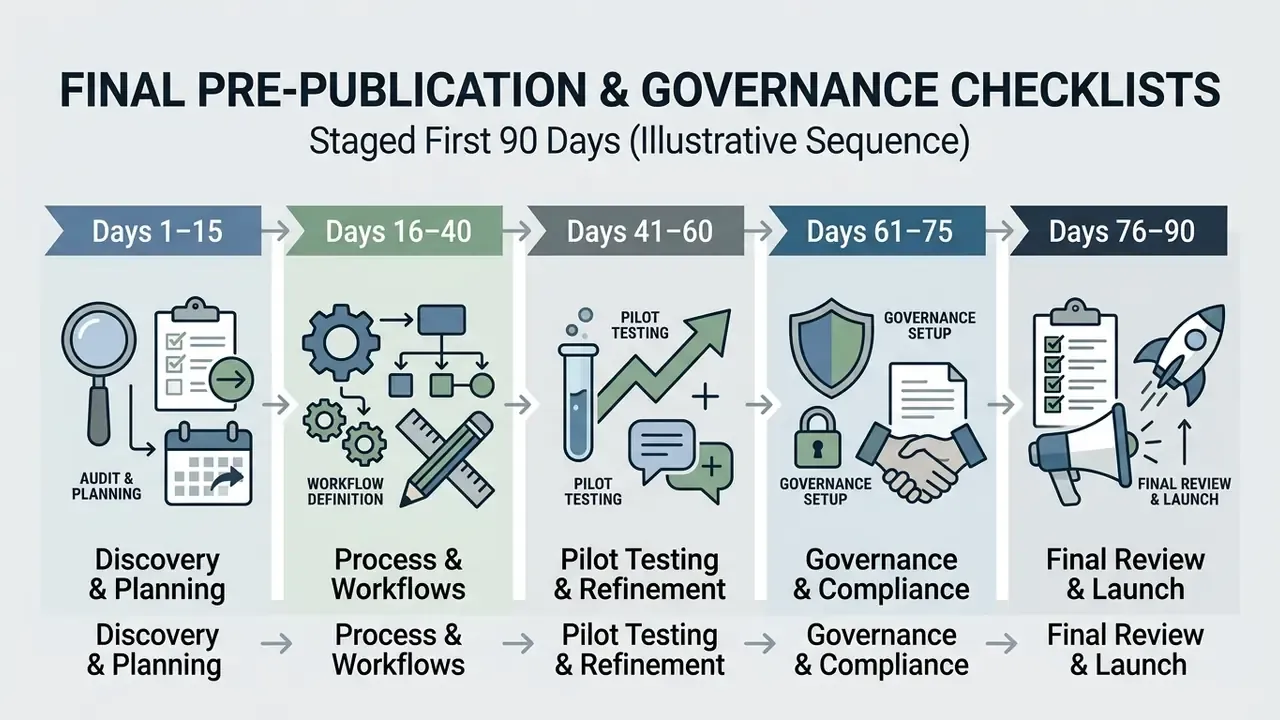
A Staged First 90 Days (Illustrative Sequence)
Appendix A: Pricing Tier Notes and Verification Log
Because third-party roundups frequently propagate discontinued rates, the table below records what was verified, against which source type, and where discrepancies exist.
Pricing Verification Log (2025 specifications, re-confirmed in early 2026)
| Claim | Verification Basis | Status | Note |
|---|---|---|---|
| ChatGPT Plus at $20 / user / month | OpenAI published pricing page | Supported | Business tiers are seat-based and priced separately; enterprise usage may follow token rate cards. |
| Jasper from $59 / month | Jasper pricing page | Supported with qualification | $59 applies to annual billing; monthly billing is $69. Older guides citing $39 reflect a discontinued tier. |
| Surfer SEO from $49 / month | Surfer pricing page and pricing FAQ | Supported with qualification | Discovery tier at $49; higher tiers scale to $999+/month. A previously advertised $19 tier is no longer current. |
| Copy.ai from $29 / month | Copy.ai pricing page | Supported | Growth and enterprise tiers priced at agency scale with custom implementation. |
| Synthesia Express-2 avatars, 140+ languages, 1080p/30fps | Synthesia product documentation | Supported | Starter $29/month; Creator $89/month; Enterprise adds unlimited minutes, SSO, and organization controls. |
| ElevenLabs from $5 / month, free 10,000 characters | ElevenLabs pricing page | Supported | Character credits, not minutes, are the billing unit; long-form audio consumes credits quickly. |
| Grammarly from $12 / user / month | Grammarly pricing page | Supported | Advanced AI-detection and authorship reporting require Business tier. |
| Descript from $12 / user / month | Descript pricing page | Supported | Free tier limited by export hours; per-seat AI credit allocations apply on paid tiers. |
| Capability baselines and price schedules current | Editorial verification cycle | Supported | All figures verified for 2025 deployment specifications and re-checked in early 2026; re-verify quarterly, as audio and multimodal API rates carry scheduled future changes. |
Modality cost reference: API-based pipelines price per modality rather than per seat. Published Gemini API rates illustrate the pattern: text input free on the free tier and $0.20 per 1M tokens paid, with output at $2.50 per 1M tokens; image input free on the free tier and $0.45 per 1M tokens paid (approximately $0.00012 per image); video input at $1.00 or $0.002/min on the paid tier; and audio input at $0.75 with output at $3.75, both scheduled to change on a published future date. When modelling RAG infrastructure cost, separate current pricing from future-effective pricing in the forecast.
Appendix B: Operational Glossary
- AEO (Answer Engine Optimization) structuring content so AI answer engines can extract and cite it directly.
- GEO (Generative Engine Optimization) the broader practice of earning visibility inside generative search surfaces rather than only classic SERPs.
- RAG (Retrieval-Augmented Generation) grounding model output in an approved document corpus retrieved at query time.
- Faithfulness the degree to which a generated claim is supported by the retrieved context.
- Answer relevance the degree to which output addresses the actual brief or query.
- Brand-voice similarity vector-space distance between a draft and a reference set of high-performing brand assets.
- Authenticity gate a pre-publication control combining AI detection, plagiarism scanning, and citation verification.
- Provenance metadata embedded or attached data recording how an asset was produced, including model and version.
- Shadow AI unsanctioned use of generative tools outside the approved allowlist and identity perimeter.
- Residual risk exposure probability of a defect reaching publication multiplied by expected cost per incident.
- Digital worker an AI agent with a named owner, approved role, access limits, escalation path, audit trail, and shutdown mechanism.
Social Media Operations: Buffer AI and SocialBee
General visual generators create individual assets. Operational SMM needs automated cross-channel distribution and calendar discipline:
When choosing among social media AI tools, weigh the number of accounts managed, required analytics depth, and integration with your existing CMS and approval workflow. A scheduler that bypasses the authenticity gate reintroduces exactly the risk the gate was built to remove.