Why should a risk or compliance leader care about a logo tool? Because it is usually the first generative system a marketing team adopts without telling anyone. Low stakes on the surface, real exposure underneath: prompt confidentiality, licence terms, and IP ownership.
Last updated: 2026. Reviewed for legal accuracy against U.S. Copyright Office guidance published in 2025.
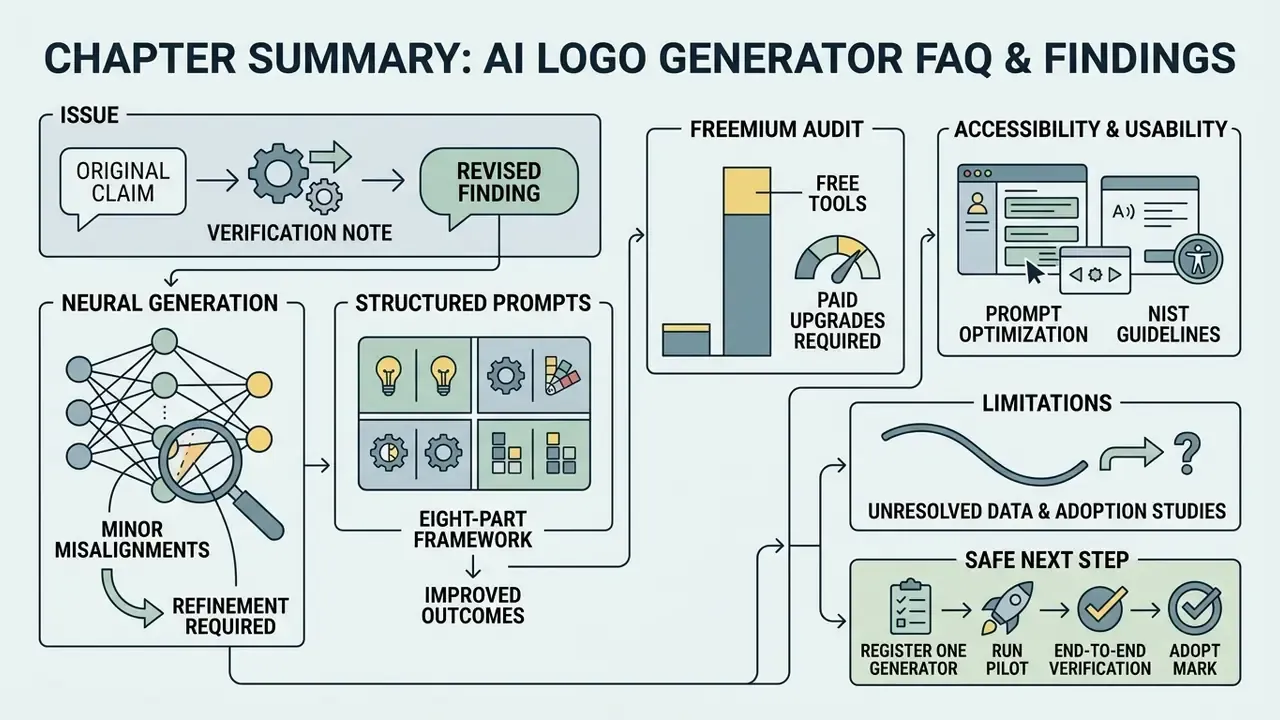
Key takeaways for governance, brand and founder teams
- Cost structure has inverted.Traditional identity work runs from $5 to $500 on freelance marketplaces, and from $10,000 to $100,000+ for agency identity systems. AI logo platforms deliver comparable structural ideation for $0 to $200. The budget question shifts from "can we afford a logo" to "how do we validate and protect it."
- Copyright and trademark are separate legal instruments.Purely AI-generated marks are not copyrightable in the United States. They can still be registered as trademarks if they identify a commercial source and do not collide with existing registrations.
- Vector files are the real paywall.Nearly every platform lets you generate and preview for free. Scalable SVG, EPS and PDF assets, plus a full commercial licence, sit behind one-time fees or subscriptions.
- Production readiness requires a human pass.Kerning, optical line weight, node cleanup, CMYK conversion and trademark clearance stay manual in every serious workflow.
- Governance is cheap at this stage.Registering the tool, logging prompts, and naming an owner costs almost nothing before launch. It costs considerably more after signage is printed.
Data privacy and Shadow AI notice
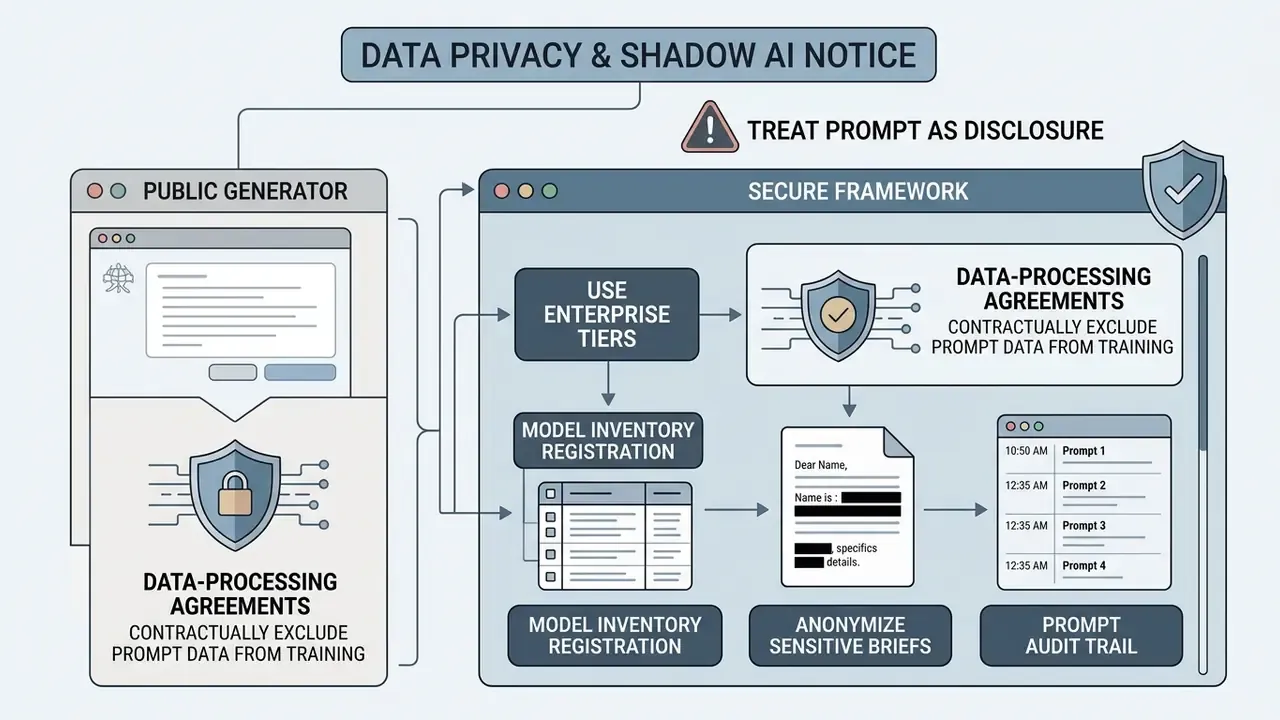
Before entering brand data into any public generator, treat the prompt field as an external disclosure channel. Unannounced product names, merger codenames, or pre-registration trademarks typed into a consumer-tier AI service may be retained, logged, or used for model improvement, depending on the vendor's terms.
Practical controls for regulated organizations:
- Use enterprise tiers with data-processing agreements that contractually exclude prompt data from training corpora. Consumer free tiers rarely offer that guarantee.
- Register the tool in your internal model inventory. An unlisted logo generator used by a marketing team is textbook Shadow AI: unlogged, unreviewed, outside model-risk oversight.
- Anonymize sensitive briefs. Generate structural concepts under a placeholder codename, then apply the confidential brand name locally in a vector editor after export.
- Retain a prompt audit trail. Prompts, seeds, timestamps and operator identity support later copyright disclaimers, trademark filings, and internal audit requests.
One small observation from practice: the teams that get burned are almost never the ones that ran a formal review. They are the ones that typed a codename into a free tool during a Friday afternoon sprint.
Decision ownership: who signs off on an AI-generated mark
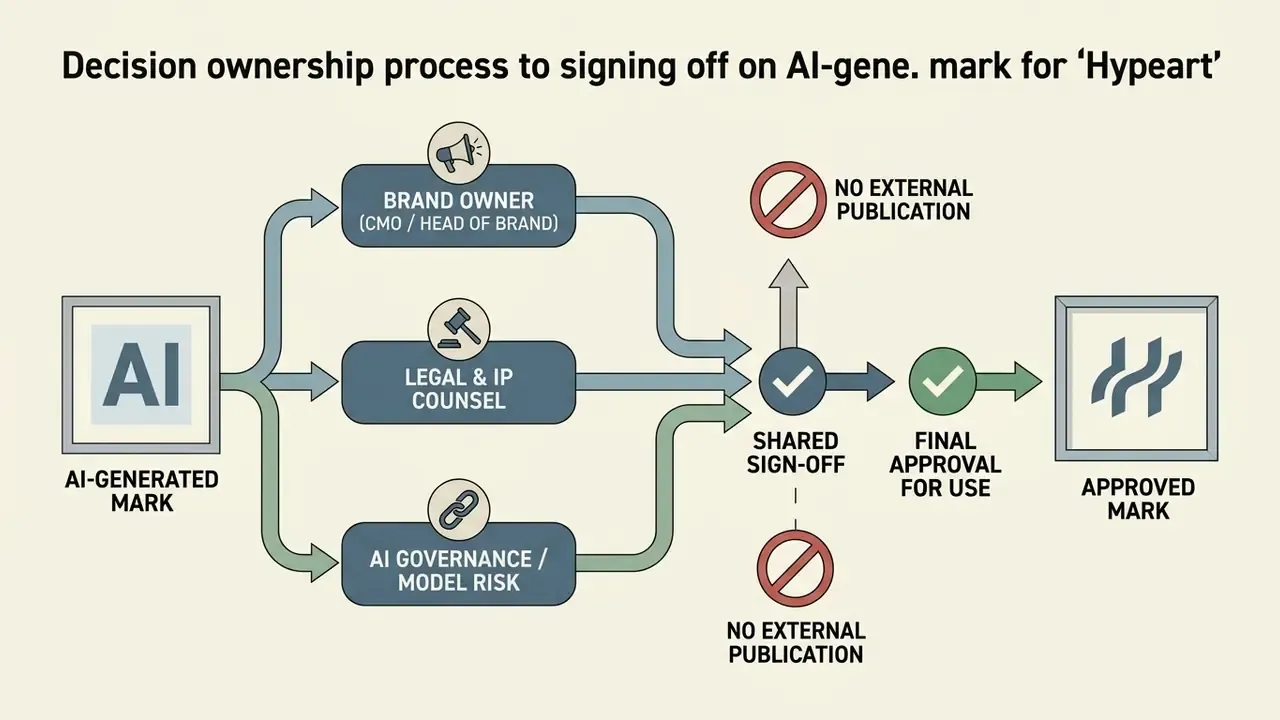
A logo looks like a marketing artefact. Operationally, it is a shared decision with three owners, and unclear ownership is exactly the pain point that shows up later in audit.
- Brand owner (CMO or Head of Brand). Accountable for fit with positioning, accessibility contrast, and the final visual choice among generated logo options.
- Legal and IP counsel. Accountable for clearance search, copyright disclaimers, and licence review of the vendor's terms.
- AI governance or model risk. Accountable for tool registration, data-handling tier, prompt retention, and the escalation path when output resembles an existing mark.
A workable rule: no external publication of a generated mark until all three have signed off in one shared record. Escalate to legal whenever a reverse image search returns a visually close registered mark, or when the vendor's terms are silent on ownership. Teams that want to see how other tooling decisions are documented can compare options in our support library.
What an AI company logo generator does for a business
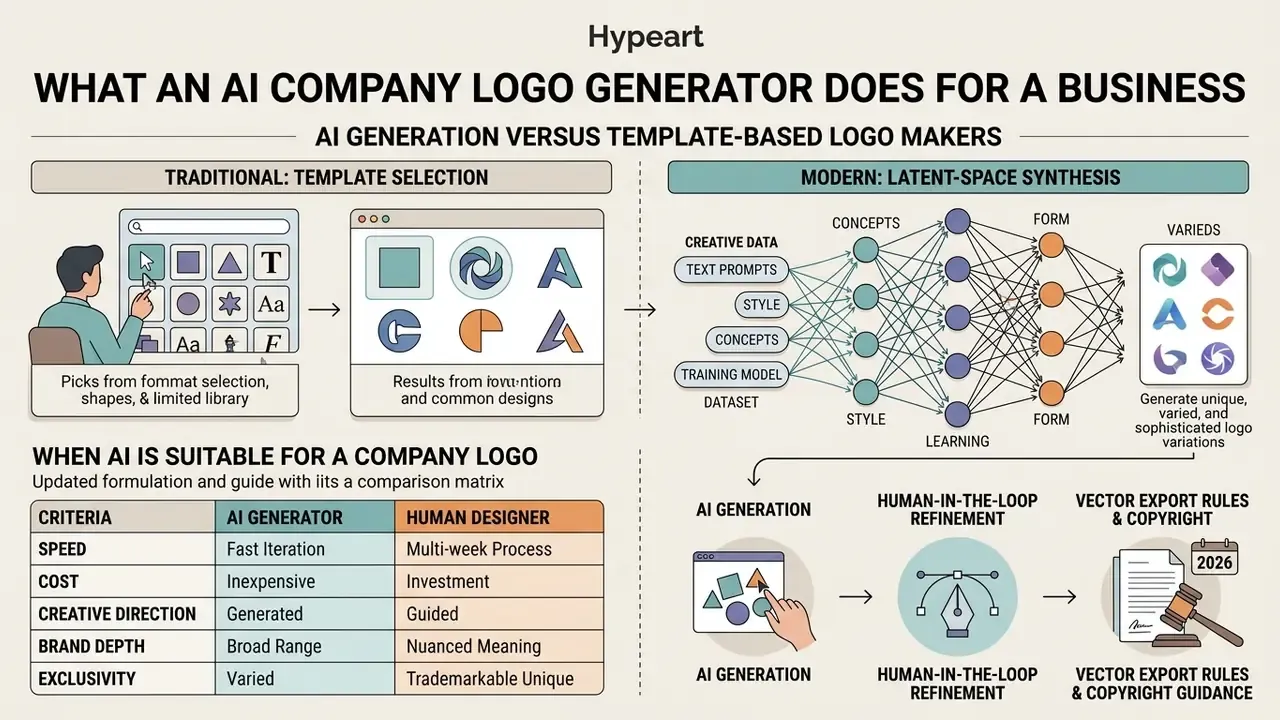
Building a brand identity historically forced a stark financial choice. Spend $5 to $500 on generic marketplace freelancers with unpredictable output quality, or allocate $10,000 to $100,000+ for an agency-level identity system with research, naming and rollout guidelines.
The stakes are not theoretical. Nike's Swoosh was purchased from designer Carolyn Davidson for $35 in 1971 and became one of the most valuable marks in commercial history. Tropicana's packaging overhaul, by contrast, remains a standing case study in how visual misalignment can erode brand equity within weeks.
Generative AI closes that structural gap. It delivers agency-grade structural ideation at a fraction of the cost, typically $20 to $200 for a full asset package, so founders can validate marks before committing capital to trademark registration, signage and packaging runs.
An ai company logo generator is an automated visual synthesis platform that converts textual business descriptions into graphical brand identity marks. Using diffusion models and latent space representations, these tools map industry context, brand names, and colour preferences into structured visual compositions.
Unlike traditional graphic design software, an ai business logo creator produces non-deterministic design candidates in seconds. The platform interprets user constraints to generate emblem marks, wordmarks, monograms, or icon-based combinations. That removes early-stage design friction for startups and digital products, and it establishes a baseline visual identity with no design experience at all.
«IDEA-Bench covers 100 real-world design tasks and 275 test cases, including visual identity preservation and style-conditioned generation.»
That benchmark scope matters commercially. Identity preservation is precisely the capability a business needs when one mark must survive a favicon, an embroidered polo shirt, a vehicle wrap, and an app icon without losing recognizability.
AI generation versus template-based logo makers
Generative systems synthesize novel raster or vector images from statistical weights. Template-based logo makers assemble pre-drawn stock graphics into fixed layouts.
In template builders, thousands of companies pick from the same finite library of icons, fonts, and layout grids. This constraint leads to visual duplication across competing markets. That is a genuine legal problem, not an aesthetic one: distinctiveness is a prerequisite for trademark registration, and a mark assembled from a shared stock pool may fail that test.
An advanced ai logo generator samples from continuous parameter space instead, creating bespoke compositions tailored to specific prompt inputs. Teams that want to see how far that parameter space stretches across visual styles can review our evaluation of AI art generators.
Figure 1. Architectural difference: preset selection versus latent-space synthesis
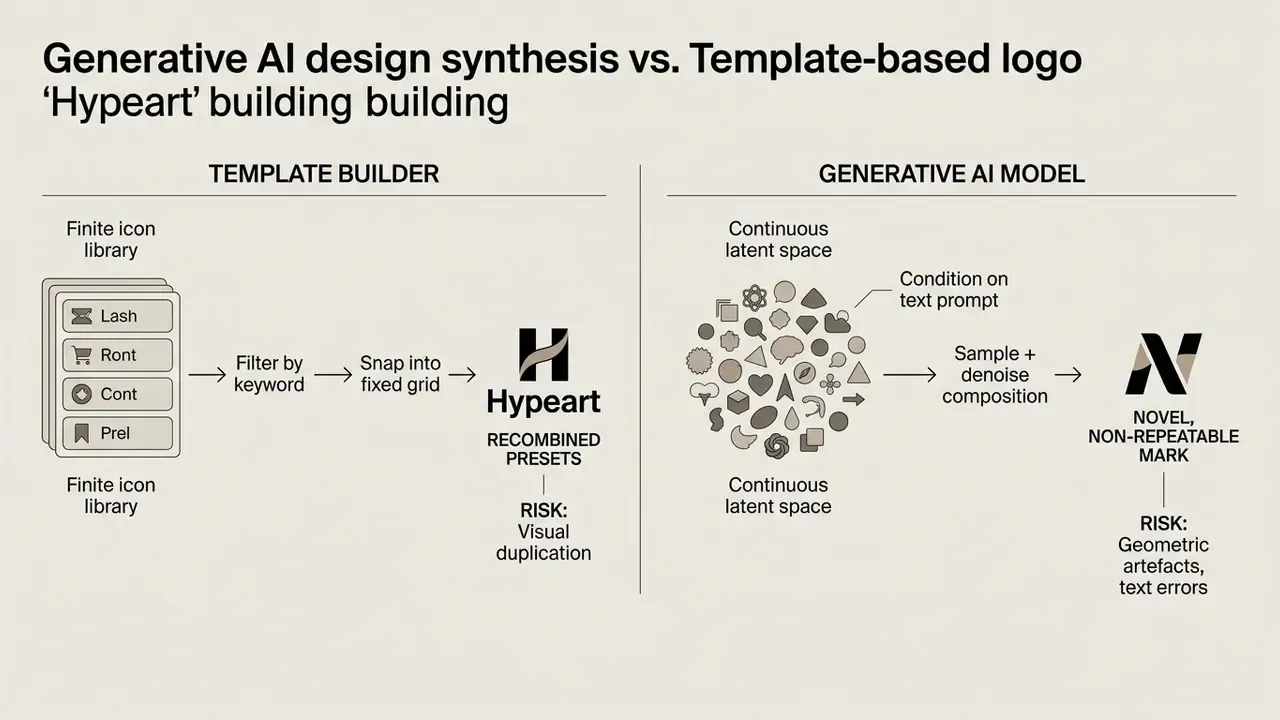
Recent design benchmarks show that modern diffusion architectures handle complex compositional instructions, style transfer, and identity preservation across multi-step prompts.
«GenAI-Bench contains 1,600 compositional prompts and over 15,000 human ratings of leading model outputs, including Stable Diffusion, DALL·E 3 and Midjourney.»
Where template builders restrict customization to fixed parameters, logo generators read natural language context and balance typography against graphic weight dynamically. Users who need broader image work often pair these systems with an online photo editor or a mobile ai photo editor app to refine backgrounds, crop mockups, or adjust lighting after export.
When AI is suitable for a company logo
Generative tools are strongest for early-stage validation: minimum viable products, pitch decks, digital channel avatars, and internal brand concepts.
When speed and low upfront capital matter most, an ai logo generator gives founders a functional visual identity the same afternoon. But automated design models carry no regulatory awareness and run no trademark search. Peer-reviewed work on co-creative design tools suggests output quality depends more on how the operator iterates than on the model itself.
«Users who iteratively engage with AI suggestions reach richer creative outcomes than those accepting the first generated output.»
| Aspect | AI Company Logo Generator | Template-Based Logo Maker |
|---|---|---|
| Creation Method | Generates novel visual marks from text prompts, brand briefs, and neural style weights. | Assembles static stock icons, predefined typography, and fixed layout grids. |
| Customization Level | High fluid customization via prompt iteration, seed modification, and element sliders. | Bounded adjustments restricted to preset colour palettes and font fields. |
| Uniqueness of Logo Options | High statistical variation; outputs sample from learned latent representations. | Moderate to low; identical stock components are shared across public user bases. |
| Speed of Generating Logo Ideas | Multiple distinct concept iterations in seconds to minutes. | Manual browsing, filtering, and positioning of pre-existing templates. |
| Readiness for Branding | Conceptual outputs need human review for text legibility, vector scaling, trademark check. | Pre-assembled vector layouts are structurally clean but risk repetition with competitors. |
| Trademark Distinctiveness | Higher likelihood of a registrable, distinctive mark, subject to clearance search. | Elevated risk of non-distinctiveness where stock components are widely reused. |
Teams comparing specific engines before committing to a workflow can review platform-level evaluations of Canva's AI generator, Midjourney and ChatGPT image generation, or view the guide hub for side-by-side matrices.
How to create a business logo with AI
Creating a professional mark with generative AI needs a structured workflow, from text conditioning through final file export. To ai create a business logo efficiently, supply accurate brand metadata, set structural constraints, refine candidates, and export high-resolution assets. An enterprise deployment illustrated this during a financial-services rebrand test. The team entered structured parameters into an ai brand logo creator workflow using an internal codename rather than the confidential product name. It produced 48 distinct candidates in roughly 15 minutes, shortlisted three concepts, and handed them to compliance and design for vector cleanup and registry clearance. Illustrative example, not a documented client engagement.
- Enter company name and brief.Input the exact brand name, slogan, industry sector, and core positioning statements.
- Select visual parameters.Choose between icon marks, initials, monograms, or typographic wordmarks.
- Generate candidate batches.Run the ai company logo maker model to produce initial design batches.
- Customize and refine.Adjust typography, colour palette, element spacing, and icon composition.
- Export production assets.Download transparent PNGs, scalable SVG vectors, and PDF print packages.
Enter the company name, brand name and logo brief
Output quality tracks brief specificity almost linearly. The model treats the company name, industry context, and visual keywords as conditioning variables that steer layout synthesis.
Avoid generic instructions such as "modern logo." Specify audience, style boundaries, colour choices, and explicit exclusions.
Figure 2. Anatomy of an effective AI logo brief
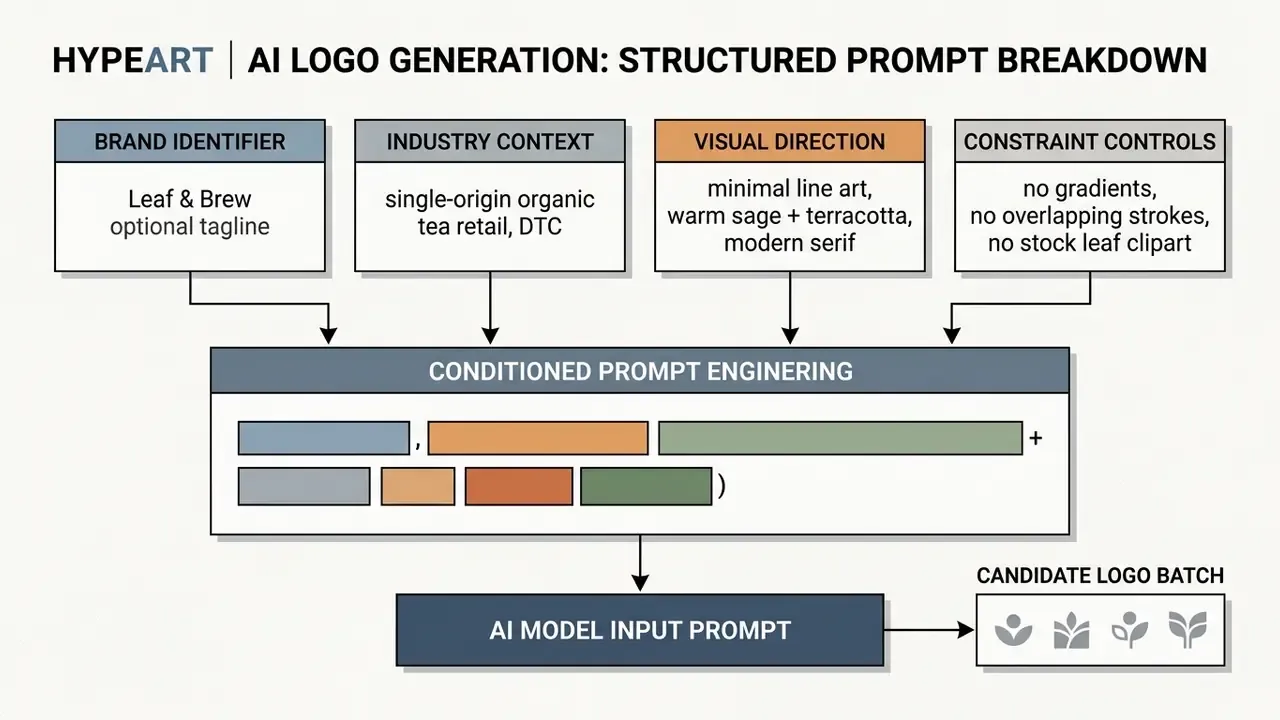
Prompt engineering practice recommends four core components:
- Brand Identifier. Exact spelling of the company name, plus an optional tagline.
- Industry Context. The specific niche, for example decentralized finance, commercial logistics, or an artisan bakery.
- Visual Direction. Style parameters such as geometric line art, corporate sans-serif, or high-contrast monochrome.
- Constraint Controls. Explicit exclusions: "no gradient fills, no complex overlapping lines."
«Users rarely accept the first output for consequential tasks. They progressively enrich prompts with domain terminology and stylistic constraints.»
Industry colour strategy matrix for prompts. Colour is the fastest semantic signal in a mark, and non-designers routinely under-specify it. Encode the palette explicitly:
- Tech, SaaS and Finance. Navy blue, cyan, charcoal. Signals trust, stability, computational logic.
- Eco, Organic and Wellness. Sage green, earthy ochre, warm sand. Signals growth, sustainability, health.
- Luxury and Legal. Deep black, muted gold, pure white. Signals exclusivity, authority, prestige.
- Consumer Goods and Food. Crimson red, warm amber, fresh yellow. Signals energy, appetite, urgency.
- Healthcare and Public Sector. Clinical teal, cool grey, soft blue. Signals care, neutrality, competence.
With an ai company name and logo generator, structured inputs stop the network from inventing irrelevant industry metaphors or unreadable text renders. Consumer niches behave the same way: a pet-care brand testing marks alongside an ai pet portrait workflow still needs explicit palette and exclusion rules, or every candidate arrives as a generic paw print.
Choose logo style, icon, initials or letters
Choosing the structural format defines layout mechanics before generation starts. Most systems support four foundational structures:
- Icon Logo. A distinct graphic symbol combined with supporting business text.
- Initials and Monograms. Stylized letterform combinations built from the brand's starting characters.
- Lettermarks. Custom typographic treatments focused strictly on the company name, no standalone icon.
- Combination Marks. Integrated lockups where graphics and text interact directly.
Figure 3. Four base logo structures in AI generators
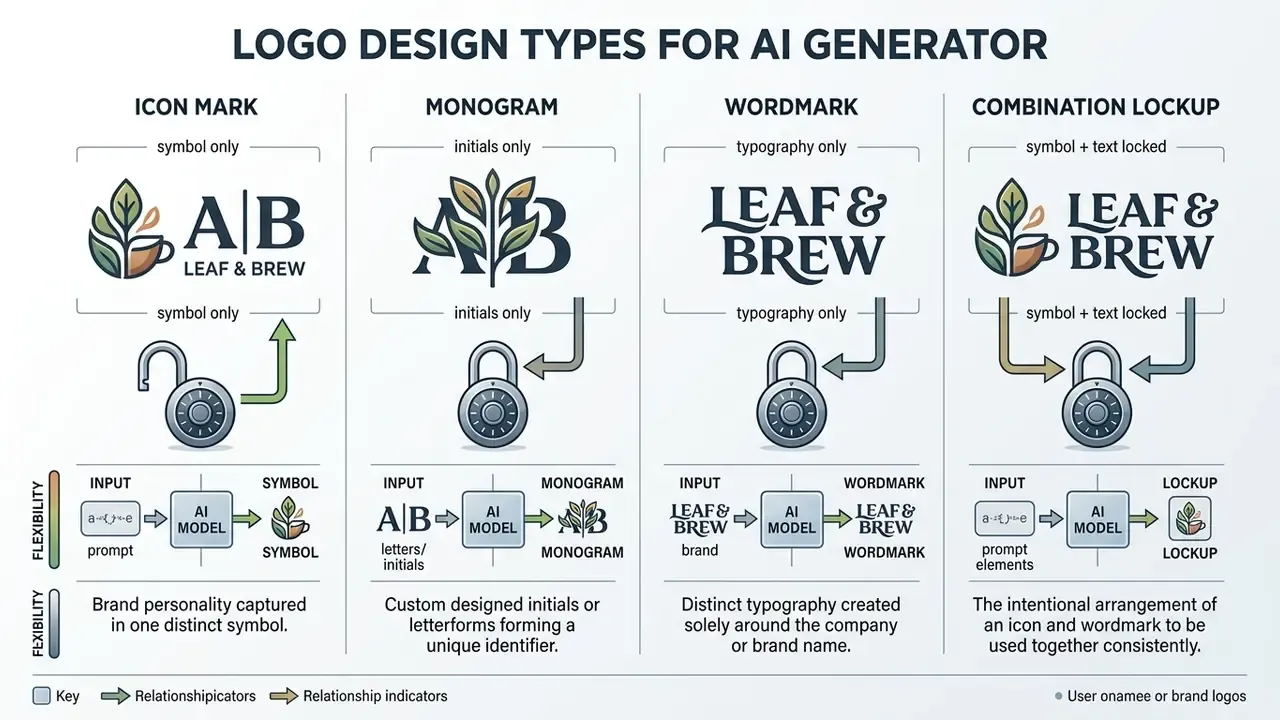
For initials and monogram work, an ai initials logo generator or ai letter logo generator applies character-level control to keep letterforms legible. Prompts that state font weight, line thickness and kerning explicitly produce noticeably cleaner glyphs. An ai icon logo generator behaves differently again: it rewards silhouette instructions over typographic ones, since there is no text to protect.
Recent preprint research describes letter-aware attention control inside multimodal diffusion transformers, aimed at multilingual logo design without retraining the base model. Treat that as a promising direction rather than settled capability. We could not verify the publication record for the specific paper cited in an earlier draft, so it is flagged in Appendix A.
If branding also needs founder imagery, teams often pair the logo workflow with an AI headshot generator, and sometimes an ai photo restoration pass to bring legacy archive photography up to current standards.
Generate, edit and download the final logo
Once the brief and style preferences are set, the ai company name logo generator runs the generation pass. The tool returns a grid of candidates, and you promote promising directions into post-generation editing.
During editing, adjust the controls that the prompt could not reach:
- Colour Palette Adjustment. Move from RGB digital palettes to brand-compliant HEX or CMYK values.
- Typography Modifications. Swap font families, adjust text scale, modify line spacing.
- Graphic Element Re-alignment. Reposition the icon relative to the wordmark: top, left, or integrated.
Once customized, the platform prepares output assets. This is the moment to verify commercial usage rights for AI-generated assets, not after files reach the packaging vendor. Professional deployment means several asset types: high-resolution transparent PNG for web, scalable SVG or EPS for print, and a PDF brand summary. Teams benchmarking visual engines can also review our comparison of the best AI art generators.
Bridging AI output and production: human-in-the-loop refinement
Raw neural output rarely yields production-ready vector typography without geometric anomalies. Mature workflows use a hybrid "AI plus designer" pipeline instead of treating generation as autonomous:
- Automated vector cleanup.Exports pass into Illustrator, Affinity Designer or Inkscape, converting auto-traced Bézier curves into clean, low-node paths that render predictably at any scale.
- Human designer fine-tuning.Designers correct kerning, optical line weights, baseline alignment, and character consistency that diffusion models systematically misread. Several platforms now sell this as an add-on, precisely because the gap is predictable.
- Manual IP risk review.Search USPTO, EUIPO and relevant national registries, then run reverse-image and visual-similarity audits before launch. A reverse image search workflow is the cheapest first-pass filter against accidental replication.
- Sign-off and documentation.Record who approved the mark, which prompt and seed produced it, and which human modifications were applied. That record supports both trademark filing and copyright disclaimers.
Step four is the one teams skip. It is also the one auditors ask about first.
How to get better AI-generated logo designs
«Models perform better on prompts that encode objects, attributes, relations and logical operations, the same requirements a logo brief imposes.»
Controlled inputs reduce random layout drift and align output with brand guidelines. Where budget matters, our AI Media Calculators help estimate credit consumption before a marketing team burns a month's allowance on exploratory batches.
Give AI a clear business and brand direction
To produce relevant logo ideas, the generator needs commercial context and competitive positioning. Generic prompts push the model toward overused tropes: gear icons for technology, leaf graphics for anything eco.
Establish three persistent context blocks before generating:
- Market Category.Define the exact sub-sector, not the broad industry.
- Target Demographic.Specify the customer profile, for example enterprise procurement officers or Gen-Z retail buyers.
- Visual Differentiation.Name the styles direct competitors use, then instruct the model to avoid them.
Whether operators use an ai generator business logo tool, an ai generator for business logo workflow, or a broader ai business design generator suite, grounding the system in explicit business constraints is what prevents forgettable marks.
An ai image generator for company logo work responds to the same grammar as any other text-to-image system. The difference is tolerance: a mark that is 90% right is still wrong, because it will be reproduced thousands of times.
Refine designs instead of choosing the first generated logo
Professional workflows almost never accept the first batch. Good branding runs a loop: generate, evaluate, isolate the flaw, modify the parameter, regenerate.
«Users progressively add adjectives, domain terminology and compositional cues until the output matches their intent.»
Figure 4. Iterative refinement loop
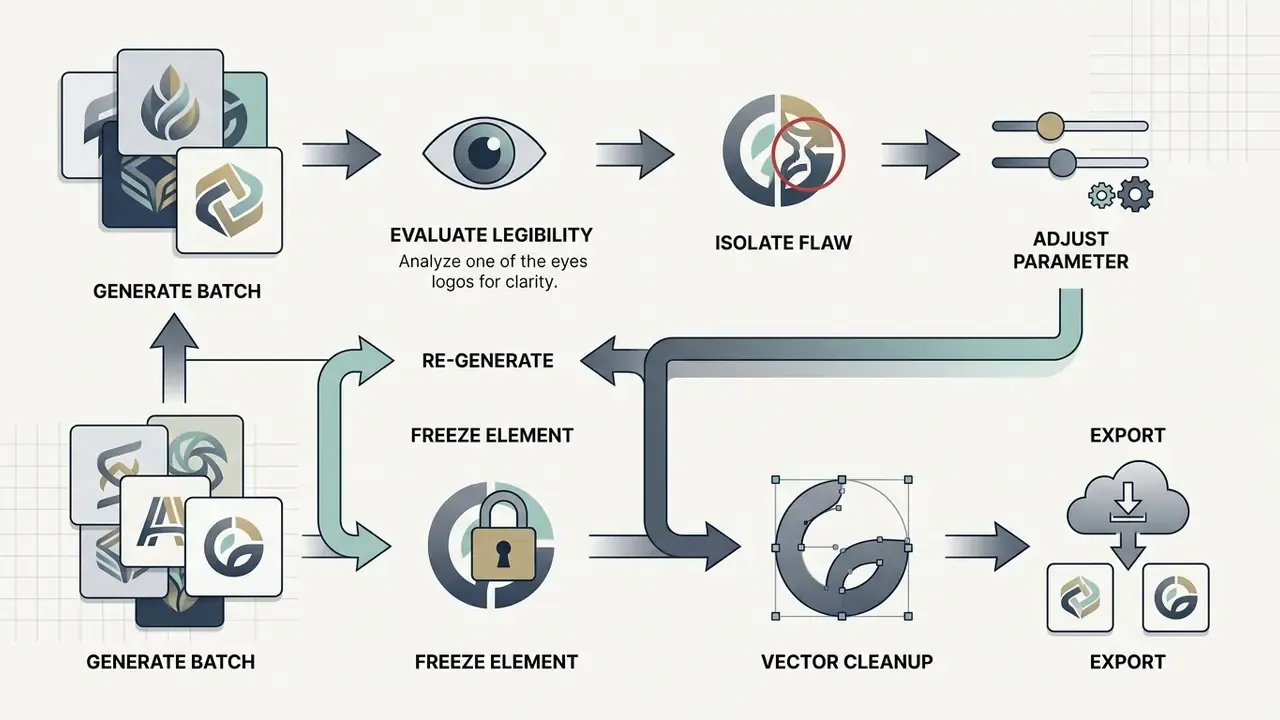
During evaluation, test candidates against technical criteria:
- Scalability. Does the icon stay clear at a 16×16 pixel favicon?
- Contrast. Is the mark readable in monochrome print?
- Typographic Integrity. Are all characters rendered accurately, with no distorted letterforms or floating artifacts?
- Clear space. Does the lockup survive photography, video thumbnails, and dense UI?
If a candidate has strong icon balance but weak typography, freeze the icon and regenerate or hand-edit the text. When the identity extends into motion, animated headers, intro stings, social teasers, move the finished vector into an animation maker or an ai photo animator, and compare engines among free AI video generators.
- Text Verification. Confirm exact spelling, character alignment, and legibility at high and low resolution.
- Originality and Trademark Search. Run a reverse image search and check relevant registries for active conflicting marks.
- Terms of Service Compliance. Verify that your tier grants full commercial usage rights and, if needed, exclusive licensing.
- Vector Integrity Test. Confirm exported SVG or PDF files contain clean path vectors, with no embedded low-resolution raster.
Free AI company logo generator: what is included and what may cost extra
«Cost, image quality and copyright are the three leading barriers reported when evaluating AI tools for design work.»
Free generation, previews and downloadable logo files
Free tiers work as visual prototyping environments, nothing more. You can test concepts on an ai logo creator free online platform or an ai letter logo generator free tool before committing capital.
Typical free plan inclusions:
- Unlimited or credit-limited generation of concept thumbnails.
- In-browser editing for colour and layout tweaks.
- Low-resolution raster downloads, often 300×300 pixel PNG files with watermarks or flat backgrounds.
- Public-by-default galleries on some platforms, which is a material confidentiality risk for unannounced brands.
Figure 5. Free preview versus paid vector package
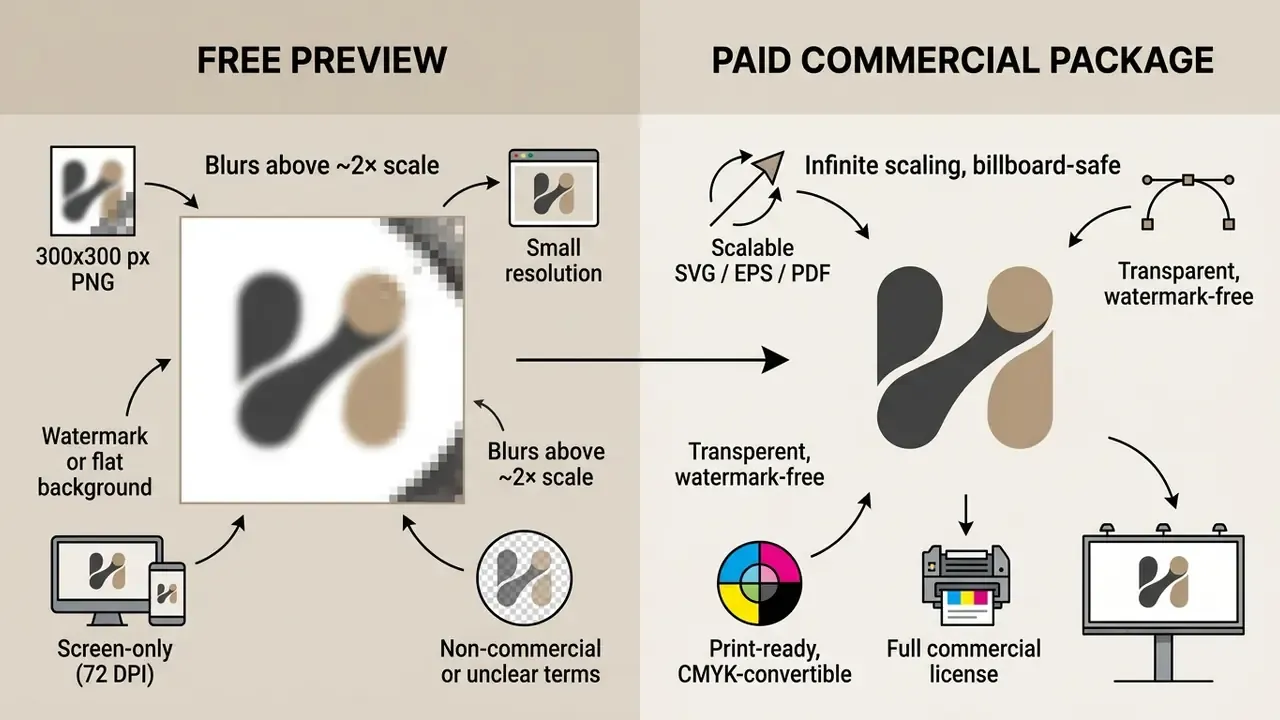
Those files are fine for basic mockups, pitch slides, or internal review. They lack the scalability required for responsive websites, large-format print, or merchandise. Users who need to clean up exported raster drafts without new spend can work through our guide to free photo editors or a general-purpose ai photo editor.
Pricing packages and branding add-ons
Paid tiers unlock production files, commercial rights, and automated brand assets. Platforms usually offer either a one-off file purchase or a subscription.
Commercial packages commonly include:
- Vector File Kits. Scalable SVG, EPS and PDF files for professional printing and unlimited scaling.
- Full Commercial Licence. Rights to use the mark across digital media, broadcast, print and retail packaging.
- Automated Brand Kits. Generated style guides with colour hex codes, font pairings, and social header templates.
- Exclusivity or buyout options. Removal of the icon from the vendor's public library, so no competitor licences the same symbol.
| Feature / Capability | Free Preview Tier | Paid Commercial Tier |
|---|---|---|
| Concept Generation | Free concept generation with daily credit caps. | Priority processing with expanded generation runs. |
| Preview Resolution | Low-resolution on-screen display, frequent watermarks. | High-resolution previews, no watermarks. |
| Export File Formats | Basic compressed PNG or JPG at low resolution. | Scalable SVG vector, high-res transparent PNG, print PDF. |
| Commercial Usage Rights | Restricted to non-commercial, personal, or evaluation use. | Full commercial usage rights, exclusive licence options. |
| Brand Assets Kit | Not included, basic hex code display only. | Complete brand guide, social banners, stationery templates. |
Generic tiers tell only half the story. Real evaluation compares asset delivery formats, vector rights, and recurring cost commitments:
| Platform | Best for | Free preview / render | Full vector package (SVG/EPS) | Commercial rights and licensing | Pricing model |
|---|---|---|---|---|---|
| LogoMaker | SMBs needing rapid physical printing | Yes (unlimited design time) | Included (SVG, EPS, PDF, PNG, JPG) | Full design rights transfer on download | About $40 one-time |
| Looka | Complete visual brand identity kits | On-screen preview only | Included in premium tier | Full ownership on paid tier | About $65 one-time or $96 per year |
| Canva AI | In-house marketing asset creation | Yes (raster downloads, credit-capped) | Pro tier only (SVG export) | Standard Canva content licence | Free tier, or about $15 per month Pro |
| Midjourney / DALL·E 3 | Raw conceptual visual exploration | Requires paid subscription | No native vector (raster PNG) | Terms depend on plan and provider | About $10 to $30 per month |
| Design.com | Large-volume catalogue browsing | Yes (watermarked) | Included (SVG, EPS, PDF) | Full rights plus optional exclusivity buyout | About $15 to $29 per month |
| Adobe Express | Prompt-based drafts inside a familiar editor | Yes (transparent PNG) | Limited, PNG-first workflow | Adobe generative credit terms | Free tier, or paid Express plans |
Vendor pricing, credit limits and licence wording change frequently. Verify current terms on the provider's own pricing page before procurement sign-off.
For a closer look at individual engines and their licence language, see our overviews of Microsoft's AI image generator and Bing AI image creation.
Commercial use, ownership and rights to an AI-generated logo
Legal ownership matters more than aesthetics once a mark goes commercial. Under current frameworks, the copyright status of purely machine-generated visuals differs sharply from human-created art.
Figure 6. Rights decision tree for an AI-generated logo
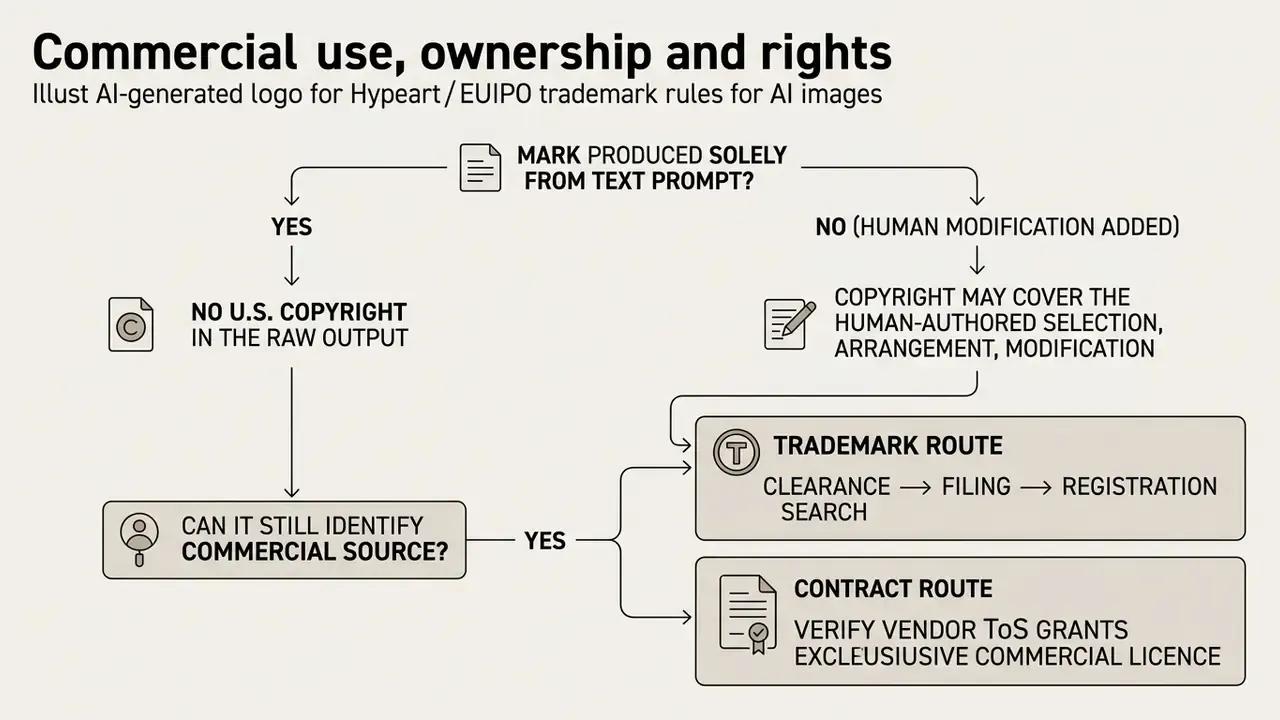
According to guidance from the U.S. Copyright Office, current through 2026, works generated solely by artificial intelligence in response to text prompts lack human authorship and cannot receive copyright protection. Prompts alone count as unprotectable instructions.
«Prompts do not, at this stage of technology, provide sufficient human control to make the user of an AI system the author of the output.»
Copyright can still attach to human-authored elements added to an AI draft: custom vector modifications, original text arrangements, or complex creative compilations. Registration filings must disclaim the AI-generated portions.
Fact check and rights verification
International practice varies more than most teams expect. The UK framework accommodates "computer-generated works" by assigning initial rights to the person making the necessary arrangements. U.S. and EU approaches focus strictly on direct human authorship, and EU-level activity in 2026 concentrates on training opt-outs and rights-management tooling rather than one harmonized ownership rule.
«The Beijing Internet Court recognized an AI-generated image as copyright-protected, attributing authorship to the human who crafted the prompt, a divergence from U.S. and EU positions.»
So commercial control comes from three sources, not one: contract terms, human design modification, and trademark registration. For deeper licence analysis across platforms, view the guide collection or our breakdown of commercial use of AI image generators.
FAQ about AI business logo generators
Can AI generate a business name and logo together?
Yes. Integrated platforms run naming and visual creation in one workflow. An ai business name logo generator or ai brand name and logo generator accepts industry keywords, brand values, and style descriptors. A language model synthesizes brandable names first. Once you pick one, the platform feeds that string into the logo engine and returns matched options immediately. Vendors including Turbologo, Renderforest and SologoAI document this naming-to-logo chain explicitly. When using an ai company name logo generator, run an independent business registry, domain and trademark check before locking the name. A brandable name that collides with an existing registration costs far more to unwind than any design fee.
Can I use an AI logo for a channel and social media?
Yes. AI-generated marks work well for channel avatars, cover headers, and social branding packages. An ai channel logo maker optimizes assets for platform-specific display rules. The recurring requirements:
- Profile avatars. 1:1 square at 1080×1080 pixels for Instagram, Facebook, LinkedIn and YouTube.
- Channel banners. Wide formats adapted for desktop and mobile, for example YouTube at 2560×1440 with a safe central area.
- Post formats. Square 1080×1080, portrait 1080×1350, vertical 1080×1920. Export an icon-only variant that survives circular cropping.
«42% of surveyed participants used AI tools for static images, 59% of professionals versus 28% of non-professionals, primarily for web and advertising design.» Source: CSCW Companion survey of 380 participants, ACM CSCW (2024). https://dl.acm.org/doi/10.1145/3678884.3681851 Across public channels, prioritize character legibility, contrast, and a badge-only variant reserved for avatars. Teams choosing an engine for avatars can compare leading AI art generators or an ai pfp generator for personal profile marks. Creators publishing video align channel art using the workflow in our YouTube video editor guide.
Do I need design experience to use an AI logo maker?
No. No prior graphic design experience or specialized software knowledge is required to make a logo with these tools. Modern platforms replace vector paths and manual kerning with natural language prompts, style presets, and sliders. The interface walks non-designers through structured steps: pick an industry category, define a palette, click layout variants. Usability, formally, means specified users achieving goals with effectiveness, efficiency and satisfaction in a defined context. Prompt scaffolding plus instant visual feedback is what delivers that for novices. An adoption study using the UTAUT2 model reports that average workplace use of AI tools rose from 2.21 to 3.45 after training (F = 28.73, p < 0.001, partial eta squared = 0.44), which is a large effect. We were unable to confirm the exact publication record, so treat the numbers as indicative rather than authoritative. The practical implication holds either way. Brief structured training, teaching the four-part prompt anatomy above, raises output quality faster than switching tools. Developers integrating generation into internal pipelines can review implementation patterns in our Google Veo API guide and the broader AI Media API Guides.
Can we enter a confidential brand name into a public AI logo generator?
Not without an enterprise agreement. Free and consumer tiers often reserve the right to retain prompts, and some platforms publish results to public galleries by default. For unannounced products, generate structure under a codename and apply the real wordmark locally after export. Register the tool in your model inventory to avoid Shadow AI exposure.
Does an AI vendor cover us if someone sues over the logo?
Only if the contract says so. IP indemnification appears in enterprise agreements from some major providers and is absent from most consumer plans. Read the indemnity clause, note its monetary cap and exclusions, and confirm whether it survives your own modifications to the output.
Can an AI-generated logo be trademarked?
Yes, subject to the ordinary requirements. The mark must function as a source identifier, be distinctive, and avoid conflict with existing registrations. Because trademark law protects source identification rather than authorship, the absence of copyright in raw AI output does not block registration. Distinctiveness is where template-assembled marks fail more often than genuinely generated ones.
What file formats should a business insist on?
Vector first: SVG and EPS, with PDF for print handoff. Add transparent PNG for digital placement and JPG for legacy contexts. A logo delivered only as a raster file is not a professional deliverable, because it cannot scale from favicon to signage without degrading.
Appendix A: revised claims and verification notes