«In controlled enterprise workflows, automated video synthesis is only as valuable as its evidence chain and decision ownership. Deploying an AI doodle maker means aligning generative speed with model risk management, licensing audit trails and human review.» Marcus Hale, AI Governance & Model Risk Editorial Lead. (Marcus Hale, author)
Last reviewed and updated: August 19, 2026. Editorial ownership: AI Governance & Model Risk desk. Methodology: vendor documentation review, peer-reviewed literature screening, and hands-on workflow testing across whiteboard, blackboard and glassboard rendering engines.
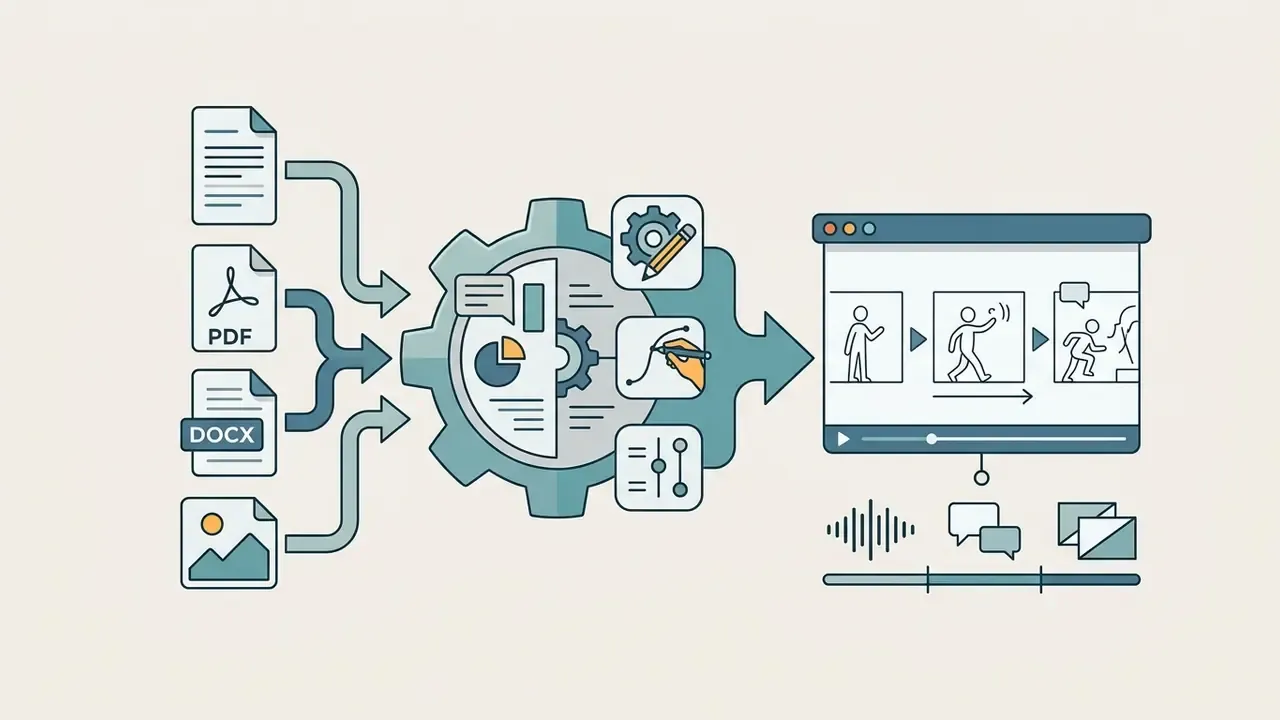
A doodle video creator is a specialized video synthesis tool that automates the generation of whiteboard, blackboard, or sketch-style animation videos. By converting text scripts, prompts, or uploaded documents into sequenced hand-drawn illustrations, these systems let organizations explain complex ideas without an illustrator on staff. Modern platforms use artificial intelligence to automate storyboarding, vector path generation, voiceover synchronization and scene layout, compressing production timelines from days to minutes.
Why should a risk or compliance leader care about a sketch-animation tool? Because the moment a policy PDF is pasted into a cloud generator, the tool stops being a creative toy and becomes a data processor with a publishing pipeline attached.
Executive Summary
Who Should Read This, and What Decision It Supports
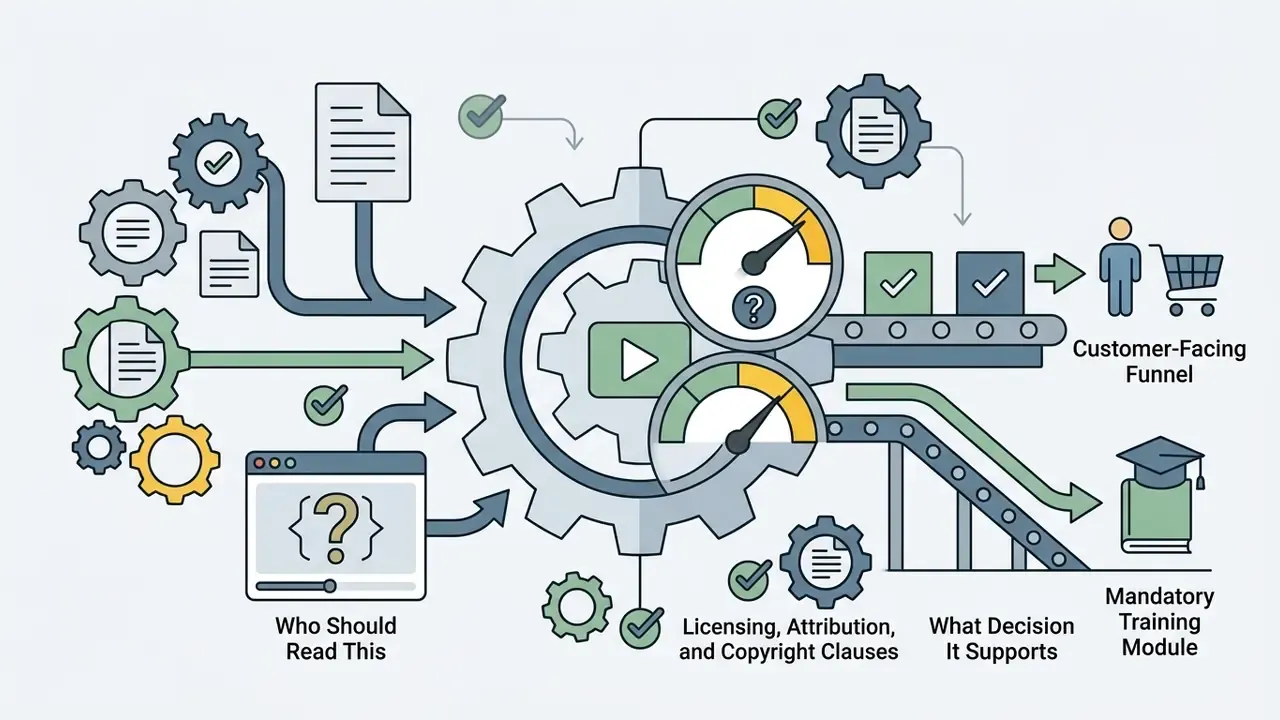
This guide is written for people who own consequences, not just content calendars: heads of model risk, compliance officers, AI governance leads, and the finance transformation teams that fund internal training video production.
Three practical decisions sit behind the search intent:
The audience statements above remain hypotheses until validated by analytics, interviews, CRM data or verified customer research. We label them that way deliberately. A guide that pretends to know your risk appetite is a guide worth ignoring.
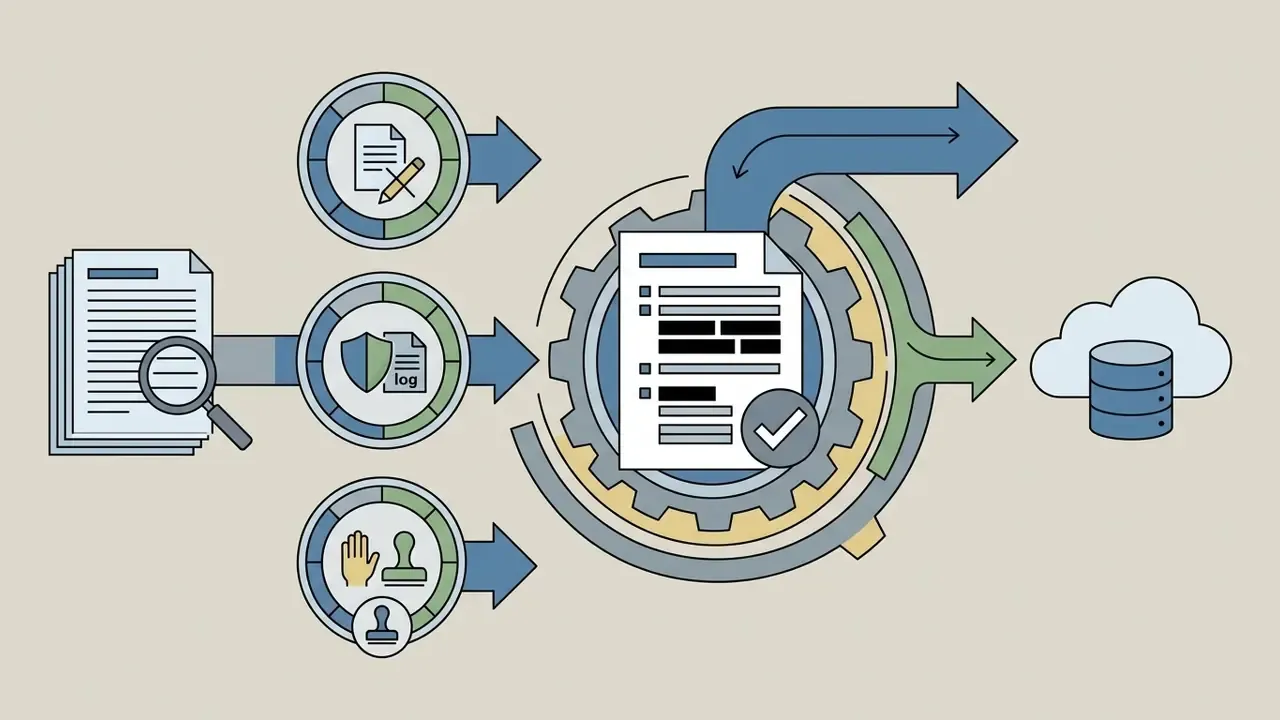
What Is a Doodle Video Creator and How Does It Work?
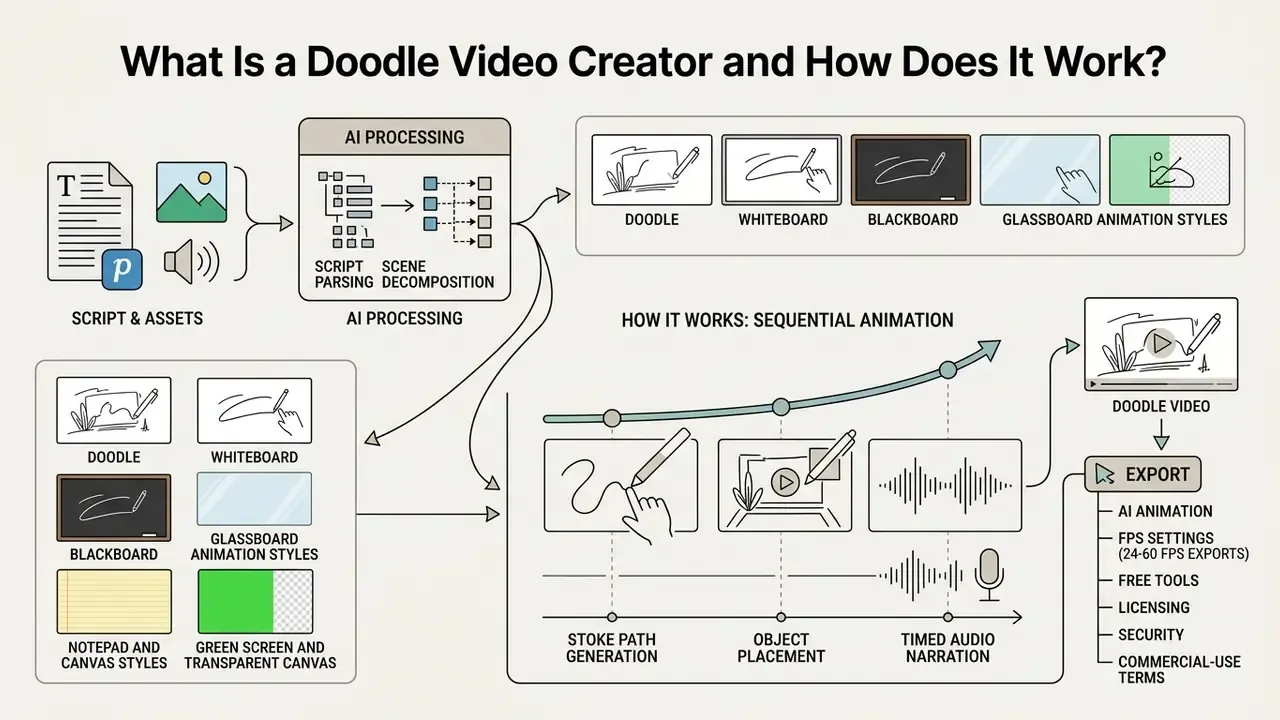
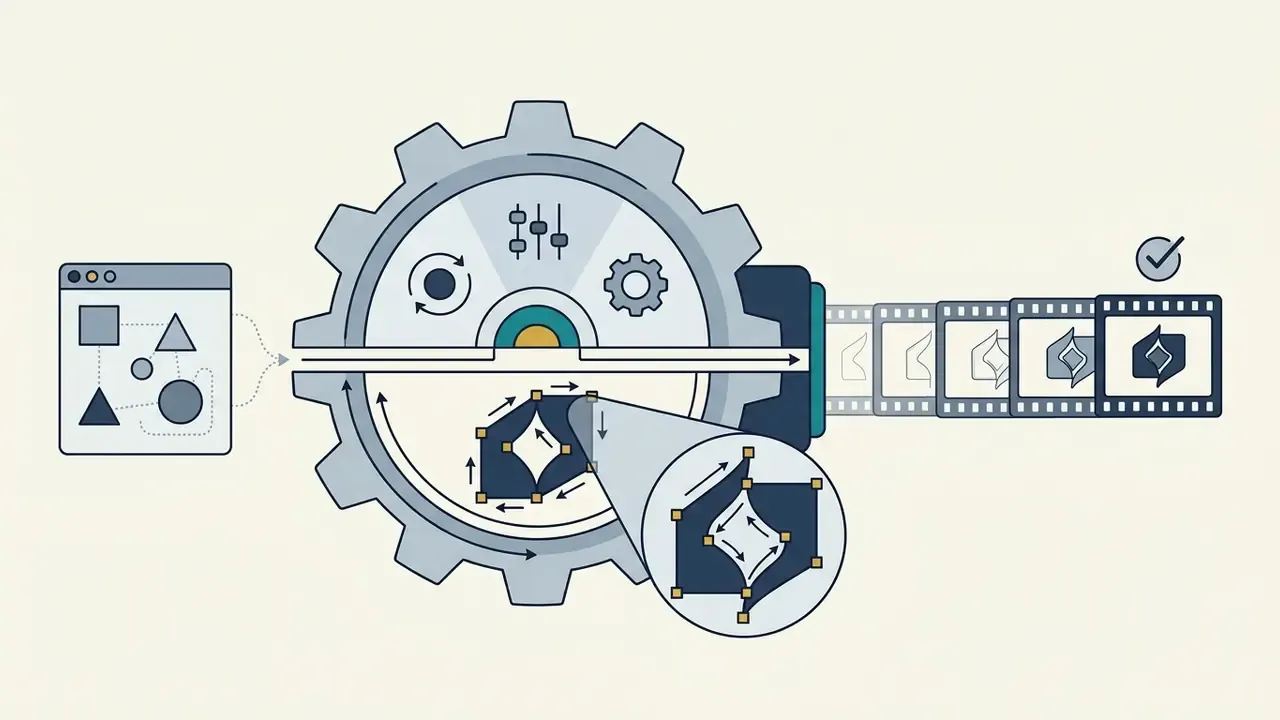
A doodle video creator acts as an automated video maker that generates line-art visuals, sequential stroke paths and timed audio narration on a virtual canvas. The software converts structured textual input or reference media into an animated doodle animation video by assembling vector elements and applying simulated hand-drawing effects.
Doodle, Whiteboard, Blackboard and Glassboard Animation Styles
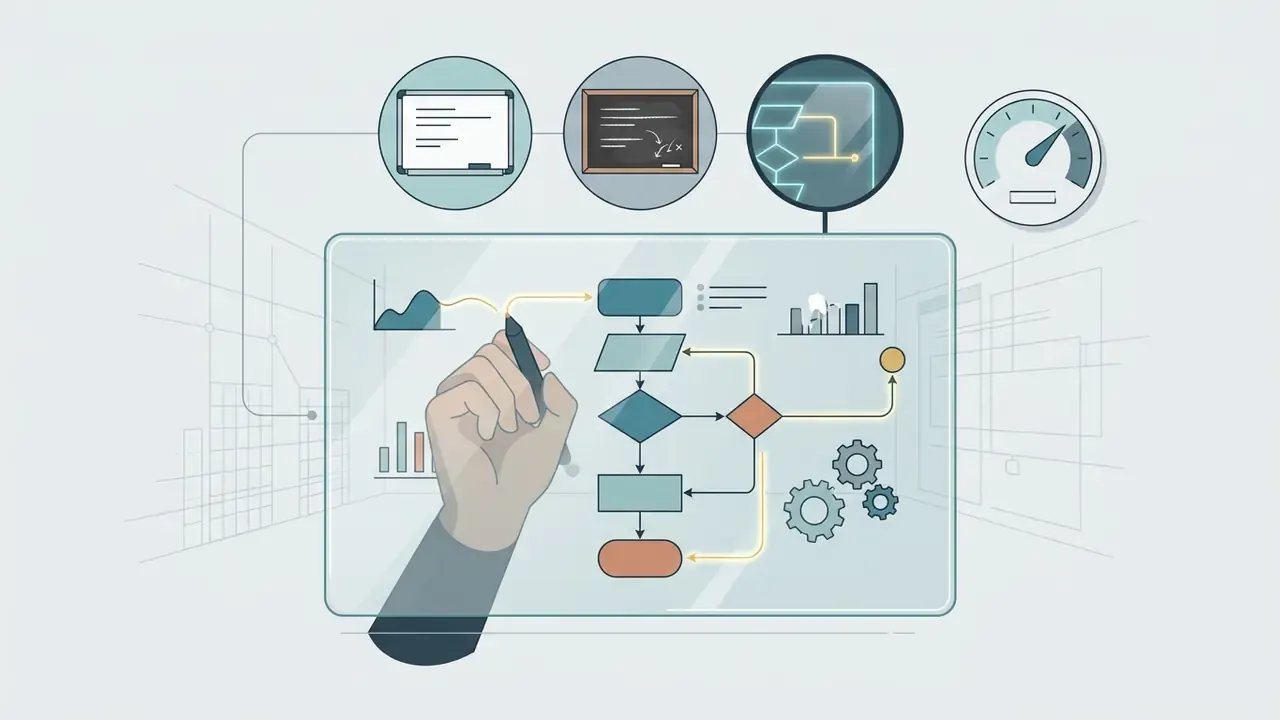
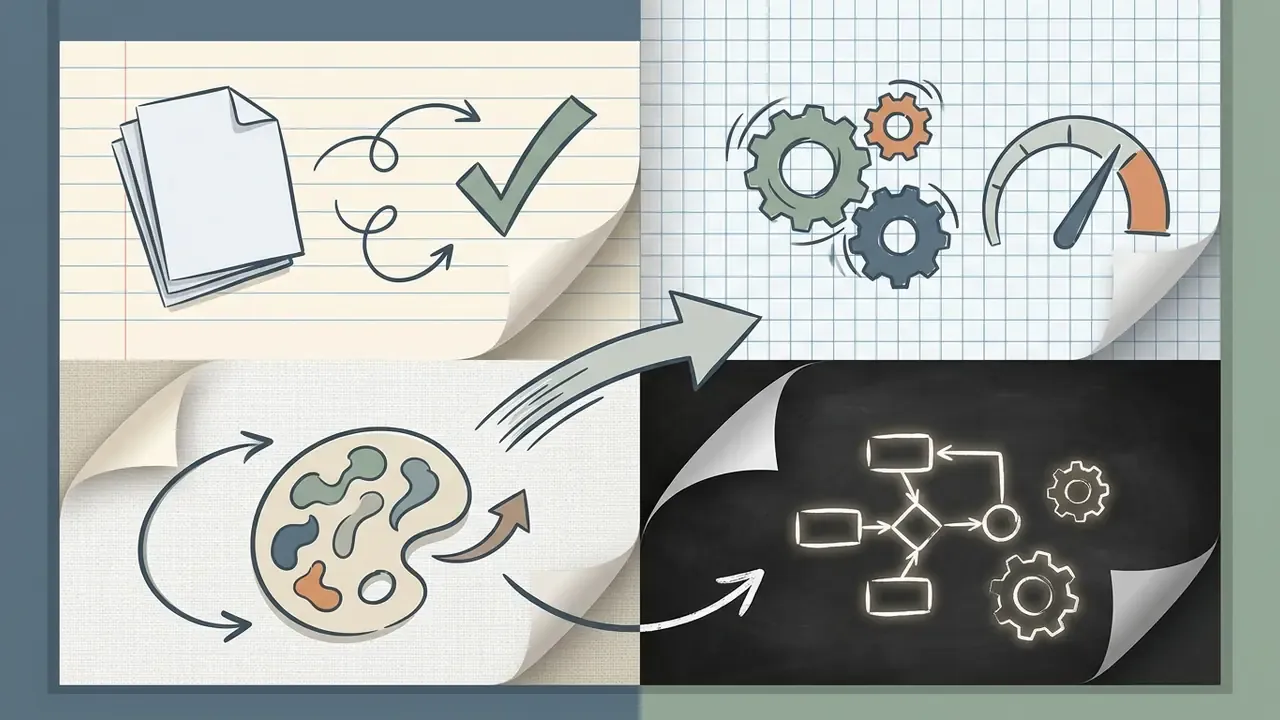
Doodle video creators offer distinct visual canvas environments to match specific communication goals and audience expectations:
When evaluating creative assets, teams often examine how general visual generation tools compare across platforms. You can review our AI Media Comparison Matrices to score tool capabilities against different design requirements.
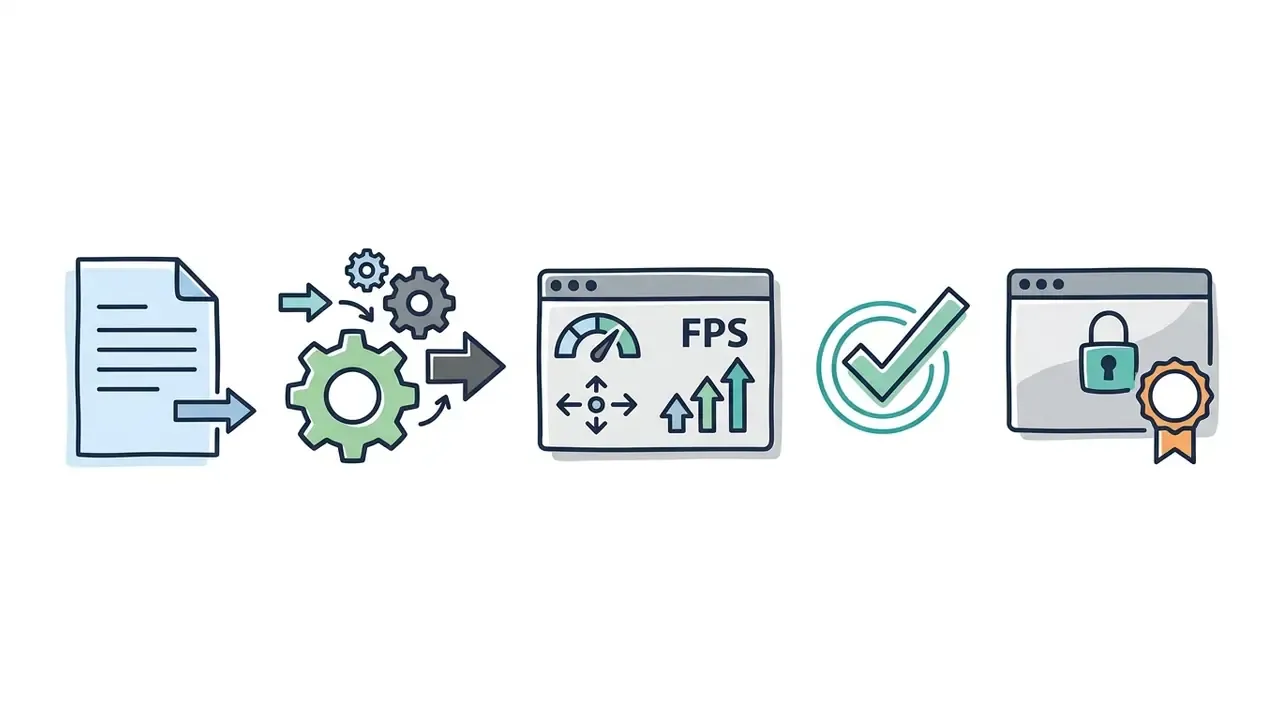
How AI Turns Text and Images Into Doodle Videos
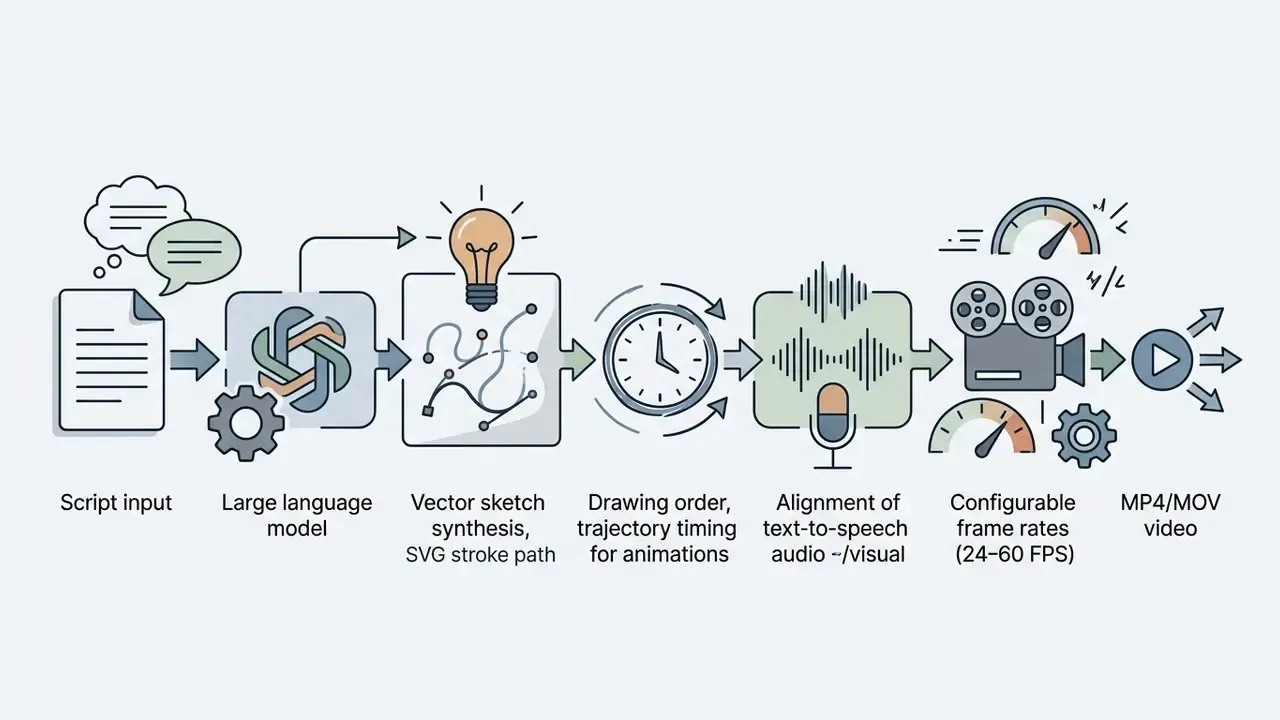
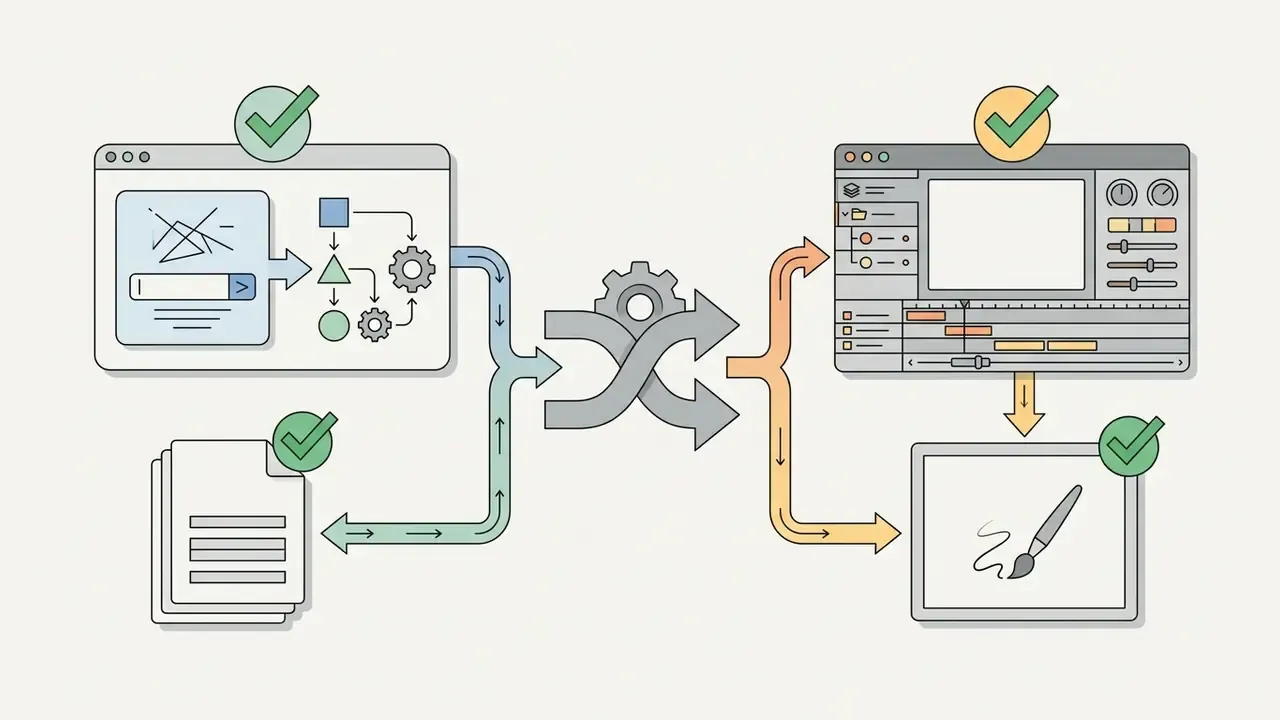
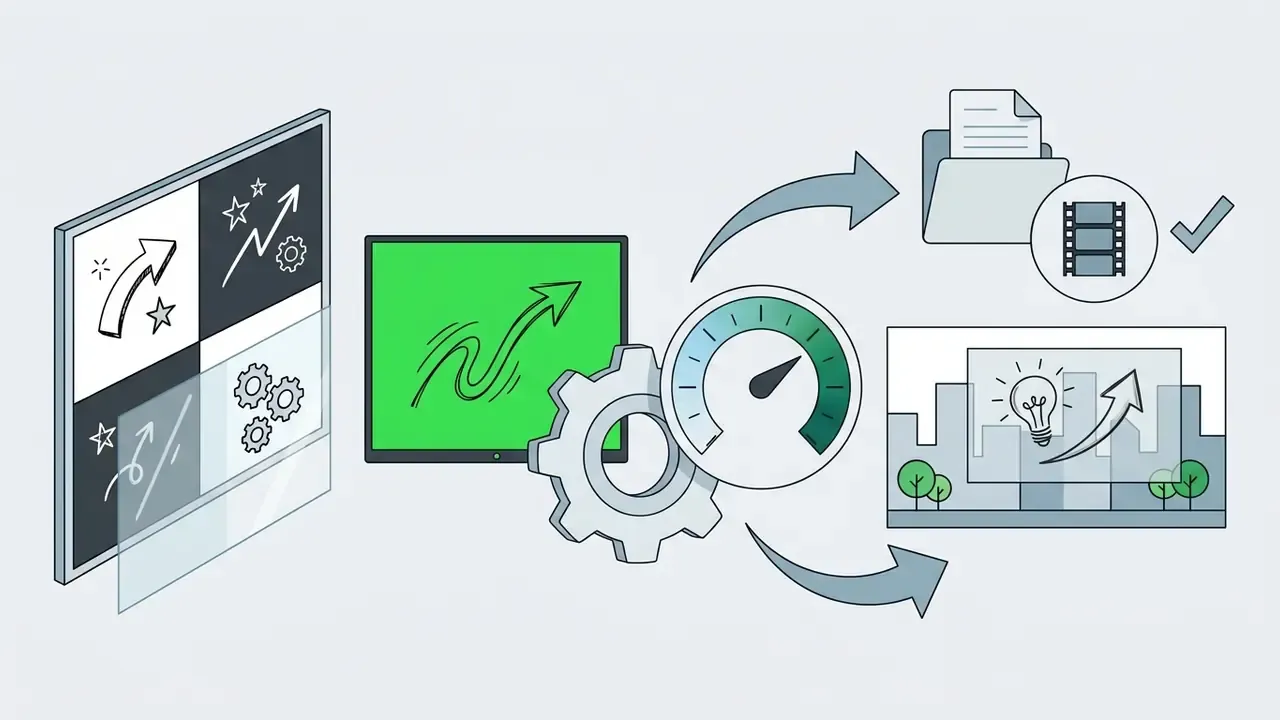
An ai doodle video generator converts raw text prompts, scripts, PDFs, or raster images into structured vector animations through a multi-stage neural pipeline built on text-to-video AI tools:
- Script Parsing and Scene DecompositionLarge language models analyze textual input to identify key entities, actions and temporal beats, breaking the narrative into discrete visual scenes.
- Asset Selection and Vector Sketch SynthesisSystems query built-in asset databases or use diffusion-based vector models (such as DiffSketcher or SwiftSketch) to generate stroke control points and SVG paths from text descriptions.
«Across 1,400 prompts, models systematically confuse object attributes, violate spatial relations and fail numeracy-heavy scenes.»
This is exactly why automated asset selection needs a human check before publication. Attribute binding failures, say drawing the wrong object in the wrong color, or placing an icon on the wrong side of a label, are a documented systematic property of current generative pipelines rather than an occasional glitch. Anyone curious about why is ai art still uneven at line-level precision will recognize the same failure modes here.
- Path Trajectory and Animation Generation Algorithms calculate sequential stroke trajectories, simulating natural drawing motion across keyframes instead of rendering static pixel grids. Research on differentiable motion trajectories moves stroke control points frame by frame specifically to reduce flickering in vector sketch animation.
- Raster Image-to-Vector Conversion When users upload custom images, neural edge detection and graph-based primitive reconstruction transform raster graphics into clean vector line art. That reconstruction step, described in deep vectorization research for technical drawings, is what makes an uploaded schematic drawable stroke by stroke.
- Audio-Visual Synchronization Text-to-speech (TTS) engines generate vocal tracks while alignment algorithms bind hand-drawing completion rates directly to spoken word timestamps.
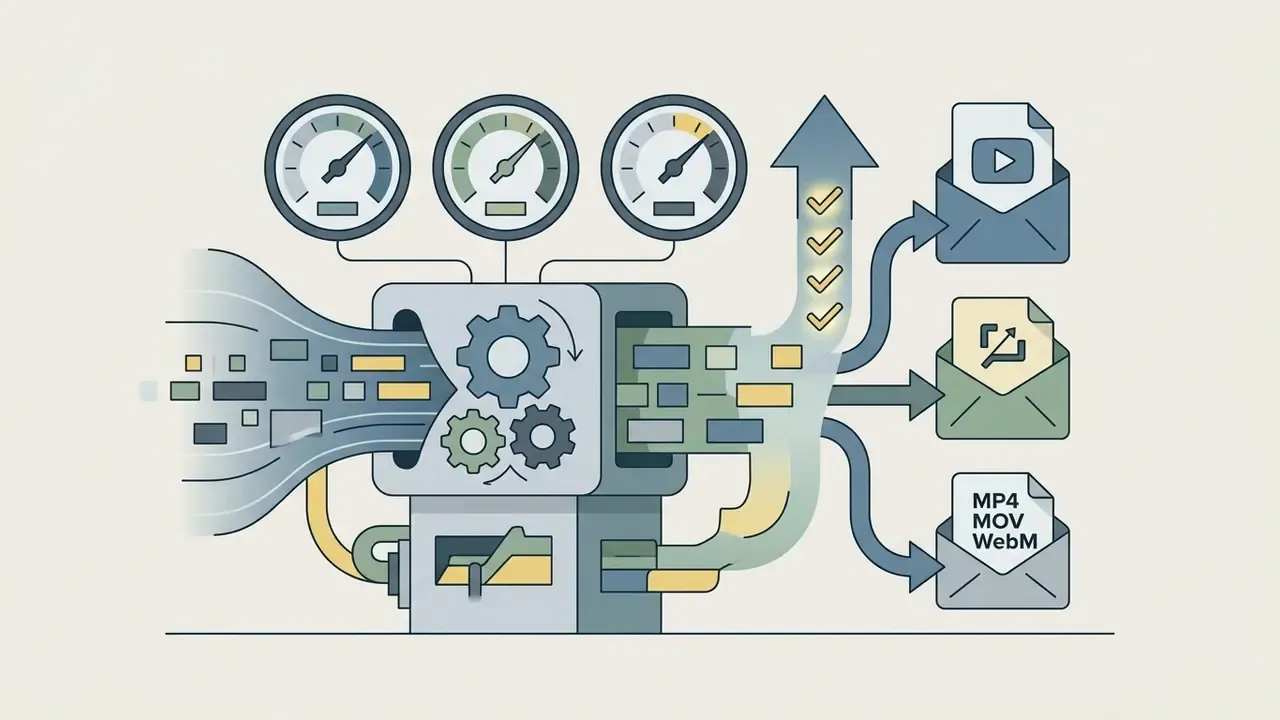
- Render and Encode The composited timeline is rasterized at the selected frame rate and resolution, then encoded into MP4 (H.264/H.265), MOV or WebM containers, with keyframe distance settings governing the quality-to-file-size ratio.
For specialized guidance on visual tool performance and vector conversion, consult our comprehensive AI Media Glossary.
- Step 1: Input ProcessingPaste a prompt, upload PDF/DOCX/PPT, or import a web URL into the generator.
- Step 2: Script DecompositionAI breaks the narrative into numbered scene blocks and visual cues.
- Step 3: Vector Asset SynthesisThe system generates SVG paths or retrieves vector doodles from the asset library.
- Step 4: Timeline and Hand AnimationDrawing speed and hand-stroke trajectories are mapped to audio timecodes.
- Step 5: Voiceover and Audio SyncText-to-speech audio is generated and aligned with visual keyframes.
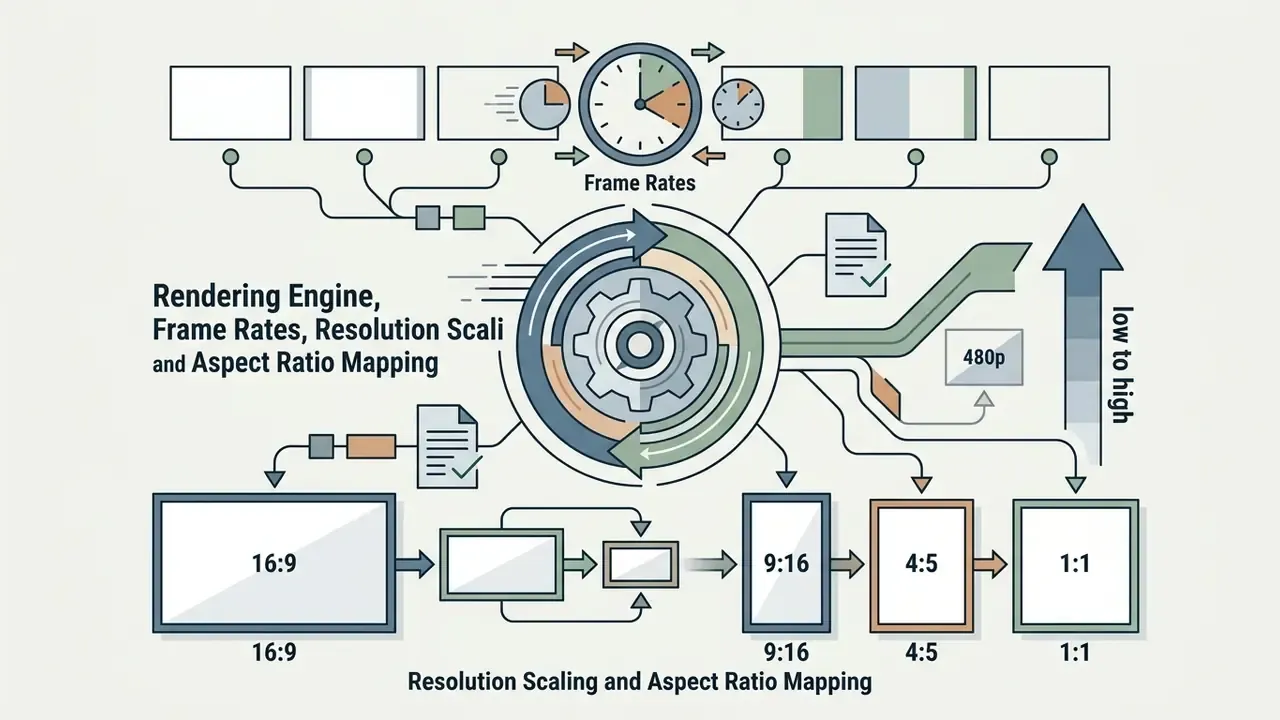
- Step 6: Render ConfigurationSelect frame rate (24 to 60 FPS), resolution (480p to 4K), aspect ratio and quality preset before rendering.
- Step 7: Rendering and ExportThe final composition is rendered into standard MP4 (or MOV/WebM) for distribution and optional API-based publishing.
Features to Look For in an AI Doodle Video Maker
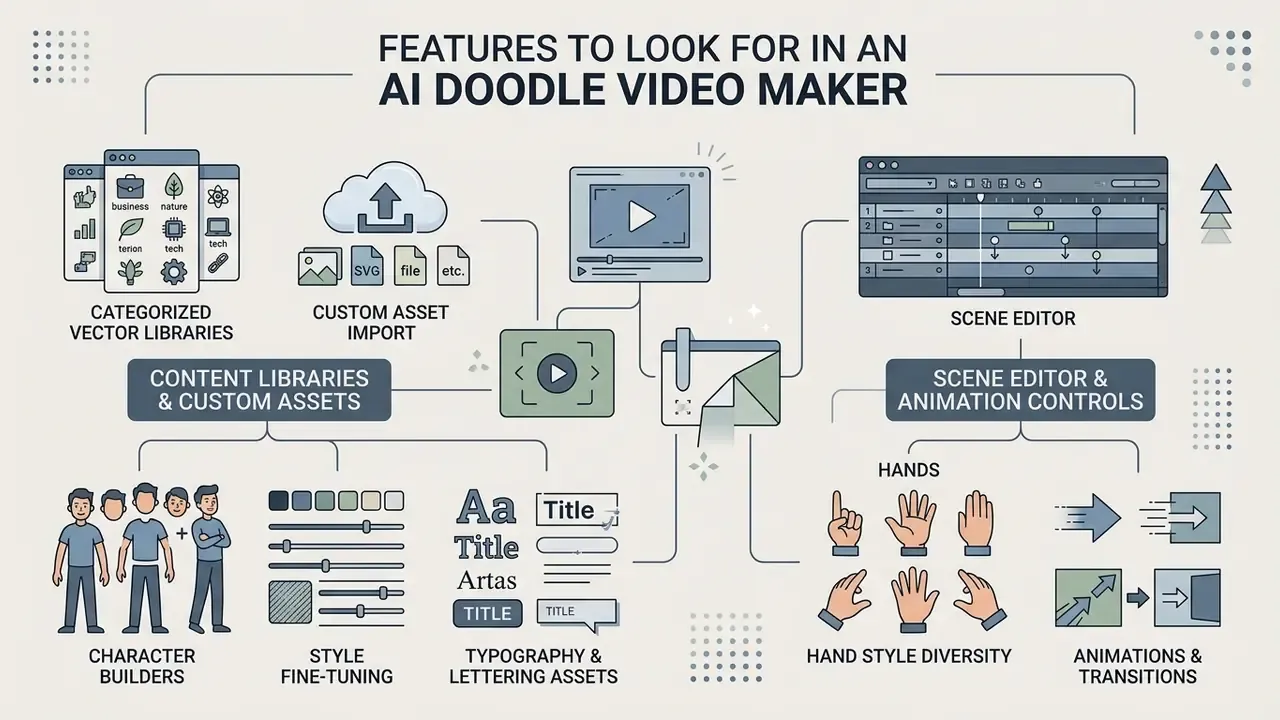
Evaluating an ai doodle maker means assessing both core editing capability and the automation controls underneath. A professional doodle video editor has to balance automated text-to-sketch generation with precise manual control over scene composition, timing and media asset integration.
Templates, Doodle Libraries and Custom Characters
A robust doodle animation video maker provides comprehensive libraries of pre-built scenes, industry-specific vectors and customizable character models:
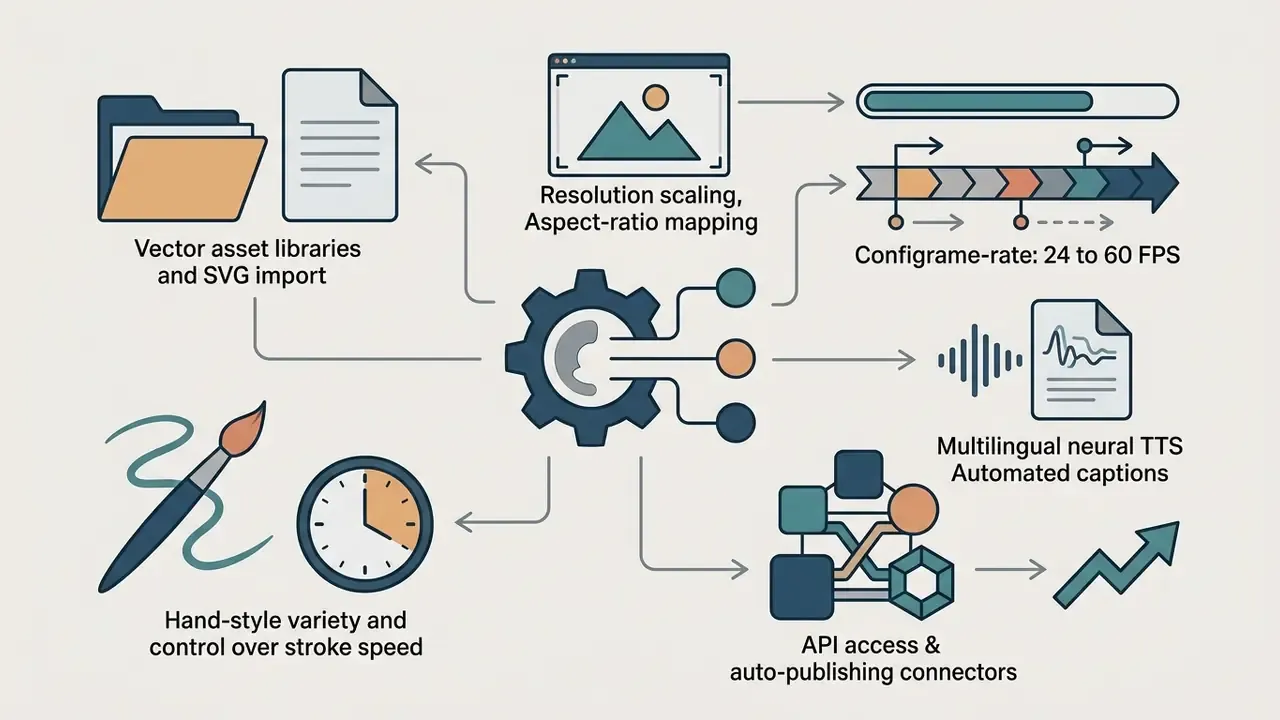
- Categorized Vector Libraries Access to thousands of line-art assets, icons, symbols and props formatted in clean vector (SVG) structures. Mature desktop suites ship with hundreds of hand-drawn characters at roughly 20 poses each, plus dozens of background scenes and topic-specific props.
- Custom Asset Import Support for importing external SVG files, so path tracing algorithms can draw proprietary logos, technical diagrams and custom graphics. Some import engines silently reject unsupported SVG features (gradients, filters, clipping masks), so pre-flighting files matters more than it sounds.
- Character Builders Tools that let users assemble characters with distinct poses, expressions and outfits, keeping visual continuity across multiple scenes. Modular builders bundled with production suites advertise tens of millions of unique pose-and-outfit combinations.
- Style Fine-Tuning Advanced platforms support fine-tuning illustration models on 10 to 20 reference images to hold branding consistent across generated assets.
- Typography and Lettering Assets Headline lettering usually needs a dedicated pass. A word art generator or a native text layer produces cleaner, editable titles than a diffusion model asked to draw letters.
Organizations that also need photo editing and graphic customization can explore our guide to online photo editors and their commercial workflows.
Scene Editor, Hands, Animations and Transitions
The scene editor is the primary canvas where creators refine visual sequencing and spatial layout:
- Hand Style Diversity Selection options for drawing hands, including left-handed and right-handed variants, masculine and feminine models, multiple skin tones and sizes, cartoon versus realistic hands, and handless drawing modes.
- Stroke Path and Speed Controls Fine-grained sliders for drawing duration, line thickness, sketch order and brush style per element.
- Layer and Motion Controls Timeline controls for keyframe animations that change position, size, cropping, rotation and opacity over time, plus camera panning, zooming and object movement across the canvas.
- Scene Transitions Erase effects, hand-sweeps, board flips, camera slides and smooth fades that keep narrative flow between scene changes, with adjustable duration and feather parameters.
Rendering Engine, Frame Rates and Custom Vector Paths
Professional video output requires precise control over temporal resolution and element tracing:
Teams that need to shrink large 4K masters for internal LMS delivery can review our guide to video compressors and quality loss before publishing.

Standalone AI Generators vs Integrated Production Suites
When selecting software, organizations pick between two architecture models:
- Standalone AI-Native GeneratorsFocused on end-to-end prompt-to-video generation, using cloud LLMs and diffusion models for rapid one-click output. Entry pricing is low (free tiers or token packs from roughly $0 to $16 per month), input modes include prompt, script and document upload, and features such as AI images, lip-synced avatars and API access are built in.
- Integrated Production SuitesBundled desktop and cloud ecosystems (Voomly Cloud containing Doodly, Toonly and Talkia, for example) that offer multi-app workflows: modular character builders supporting tens of millions of pose variations, dedicated eCover creators, standalone voiceover engines, hosting players and video funnels. Pricing runs higher per seat (published tiers around $49 per month Standard and $79 per month Enterprise), and assembly stays largely manual drag-and-drop rather than script-driven.
The practical trade-off: standalone generators win on speed and cost per asset, suites win on granular manual control, offline rendering and unlimited installs across machines. Hybrid teams frequently draft in an AI-native generator, then refine draw paths and hand styles inside a suite editor.
Enterprise Security, Data Retention and PII Controls
Because doodle generators accept internal policy documents, regulatory manuals and product roadmaps as input, procurement should treat them as data processors:
- Zero Data Retention (ZDR) Options Confirm in writing whether uploaded PDFs and DOCX files and prompts are retained, logged or used for model training. Prefer vendors offering contractual ZDR or short, documented retention windows.
- PII Masking Before Upload Redact customer names, account numbers, internal system identifiers and employee data before a document enters a generation pipeline. Where possible, upload a sanitized abstract rather than the source record.
- Certifications and Sub-Processors Request SOC 2 Type II or ISO/IEC 27001 evidence, the sub-processor list (including which foundation-model API is called), data residency region, and encryption posture in transit and at rest.
- Access Control and Audit Trails Enterprise plans should provide SSO/SAML, role-based seats, per-render audit logs and retention of approval records, which is the same evidence chain any model risk function expects.
- Governance Framework Alignment Map generation, review and publication controls to a recognized framework such as the NIST AI Risk Management Framework (AI RMF), with named human owners for the "Measure" and "Manage" steps. Hallucinated on-screen text in a compliance video is a control failure, not a cosmetic defect.
No evidence, no autonomy. That principle applies to a rendering pipeline as much as to a credit model.
Voiceover, Music, Subtitles and Video Export
Integrated audio and rendering capabilities remove the need for third-party post-production software:
- AI Voiceover (TTS) Built-in text-to-speech supporting multiple languages, accents and emotional tones, with word-level timing output. Mature platforms advertise 50 to 160+ voices and translation into dozens of languages, and audio output formats commonly include MP3, WAV, AAC, FLAC and Opus. Compare vendor options in our overview of AI voice generators.
- Audio Tracking and Music Libraries Multi-track audio timelines supporting royalty-free background music loops, sound effects and custom voice recordings with auto-ducking. Recording narration directly inside the editor removes a file-handoff step, which is where version confusion usually starts.
- Automated Subtitling Automatic generation of WebVTT or SRT closed captions aligned with the audio track. Accessibility requirement, not an optional extra.
- Flexible Export Parameters Output support for standard resolutions (720p, 1080p Full HD, up to 4K), multiple aspect ratios (16:9 landscape, 9:16 vertical, 1:1 square, 4:5 portrait) and major formats (MP4, MOV, WebM).
| Feature Category | Basic / Entry-Level Features | Advanced / Enterprise Features | Operational Value |
|---|---|---|---|
| Asset Libraries | Fixed pre-built vector icons, static PNG imports | SVG vector path import, custom character fine-tuning, modular pose builders | Ensures brand compliance and proprietary asset drawing. |
| Scene Editing | Standard right-hand overlay, fixed drawing speed | Diverse hand models, customizable sketch paths, node-level draw anchoring, camera pans | Prevents visual monotony and directs viewer focus. |
| AI Generation | Basic text-to-doodle matching from internal tags | Document-to-script synthesis (PDF/DOCX/PPT), neural image-to-sketch, prompt auto-enhancers | Cuts pre-production scripting and layout effort. |
| Motion Controls | Preset animation only | Motion-strength slider, keyframe curves, per-element stroke timing | Keeps technical diagrams stable while allowing dynamic character scenes. |
| Audio & TTS | Single-voice text-to-speech, single audio track | Multi-language neural TTS (50 to 160+ voices), word-level audio-visual sync, auto-ducking | Automates localization and removes manual voiceover editing. |
| Export & Ratios | 720p/1080p MP4 export, fixed 16:9 ratio, fixed 30 FPS | 4K export, 480p to custom resolutions, 24 to 60 FPS selection, 16:9 / 9:16 / 1:1 / 4:5, transparent MOV | Supports cross-platform publishing across web, social and mobile. |
| Distribution | Manual file download | API access, webhooks, scheduled auto-posting to TikTok/Reels/Shorts | Removes manual upload steps in multi-channel workflows. |
| Security & Governance | Standard TLS, shared cloud storage | SOC 2 / ISO 27001 evidence, zero data retention option, SSO/SAML, audit logs, data residency | Enables use with internal policy and regulated training content. |
After mapping these criteria against your workflow, shortlist platforms using our comparison of the best AI video generators and the Advanced / Enterprise Features column above as a scoring rubric. Developers embedding rendering into internal portals can review implementation economics in our Google Veo API implementation guide.
How to Create a Doodle Animation Video Step by Step
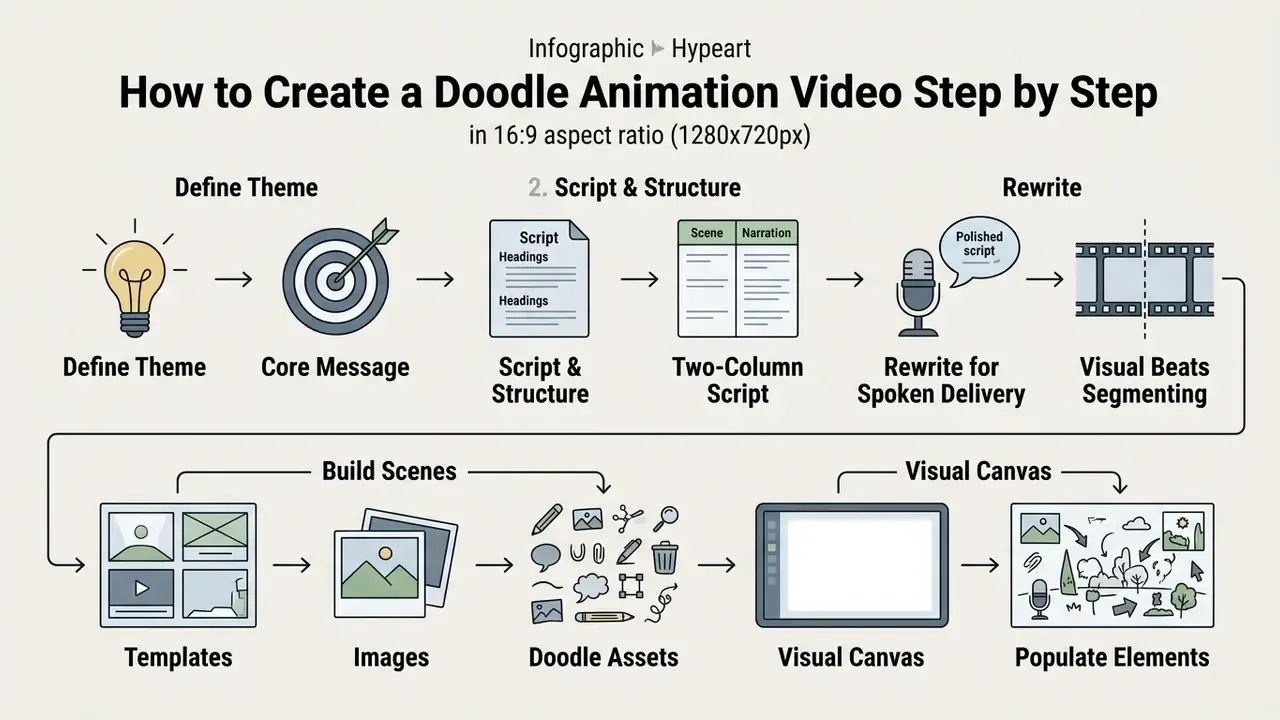
Creating a professional doodle animation video takes structured pre-production, visual assembly and precise audio-visual alignment. A systematic method protects retention and message clarity. Research-based motion-graphics workflows describe six stages, namely narrative analysis, storyboard sketching, styleframe design, element creation, scene animation, and compilation with rendering. The steps below map directly onto that sequence.
Write the Script and Define the Video Theme
When drafting scripts with automated text tools, teams often review our insights on animation makers and AI-assisted creation methods, plus the practical limits of a word ai generator for long-form narration copy.
Build Scenes With Templates, Images and Doodle Assets
- Select Visual CanvasChoose Whiteboard, Blackboard or Glassboard based on tone and target audience.
- Populate ElementsDrag pre-built vector assets from the library or use an ai doodle maker prompt to auto-generate custom scene layouts.
- Position and ScaleArrange graphics to maintain natural reading order, left to right, top to bottom.
«Cohen's d was 1.342 for the pure animation group versus 0.695 with a presenter; hand gestures returned gaze to key areas of interest.»
Practically, that supports two layout decisions. Keep the canvas free of a presenter overlay when the goal is comprehension of a diagram, and use the drawing hand deliberately as a pointer that re-anchors attention on the element being explained.
- Set Draw OrdersAssign sequential numbers to each element within a scene to define which graphic is drawn first, second and third.
- Anchor Custom PathsFor uploaded logos or schematics, set node anchors manually so tracing follows the design's real construction logic instead of an algorithmic outline sweep.
For additional asset creation strategies, explore our overview of free photo editors and their export restrictions.
Preview, Adjust Timing and Export the Finished Video
- Import or Synthesize Audio: Record custom voiceover narration or generate neural TTS tracks. Capture room tone if you plan to blend recorded narration with generated segments.
- Align Drawing Timestamps: Match element drawing speeds so a graphic finishes rendering precisely as the voiceover names the concept. Where the editor supports merged clips, synchronize the video layer against the audio channel set instead of nudging by ear.
- Refine Scene Transitions: Apply hand-swipe or erase transitions between major narrative shifts, keeping transition durations between 0.5 and 1.5 seconds. Avoid abrupt joins in continuous sounds, and overlap audio slightly across cuts to preserve aural continuity.
- Run a Low-Resolution Preview Pass: Render a fast draft to detect stroke warble, jitter or artifacting before committing to a full-quality render.
- Audit and Export: Preview the full video for visual overlaps or audio drift, confirm composition and export frame rates match, then render to 1080p MP4 (24 or 30 FPS for classic whiteboard pacing, 60 FPS when camera motion is heavy) for final distribution.
Checklist0 / 10
Illustrative workflow example (not an independently audited case study; figures are internal, self-reported and unverified): a financial risk team evaluating automated explainer production for compliance training standardized a two-column scripting protocol and added structured SVG draw-order checks across 14 training modules. The team reported materially fewer visual-drift corrections per module and a drop in post-production editing effort from roughly a full working day to a few hours per module. Treat these as directional expectations for what process standardization can achieve, not as benchmark metrics. Verified figures would require a documented methodology, a defined error taxonomy and a named organization.
How to Get Better Results From an AI Doodle Video Generator
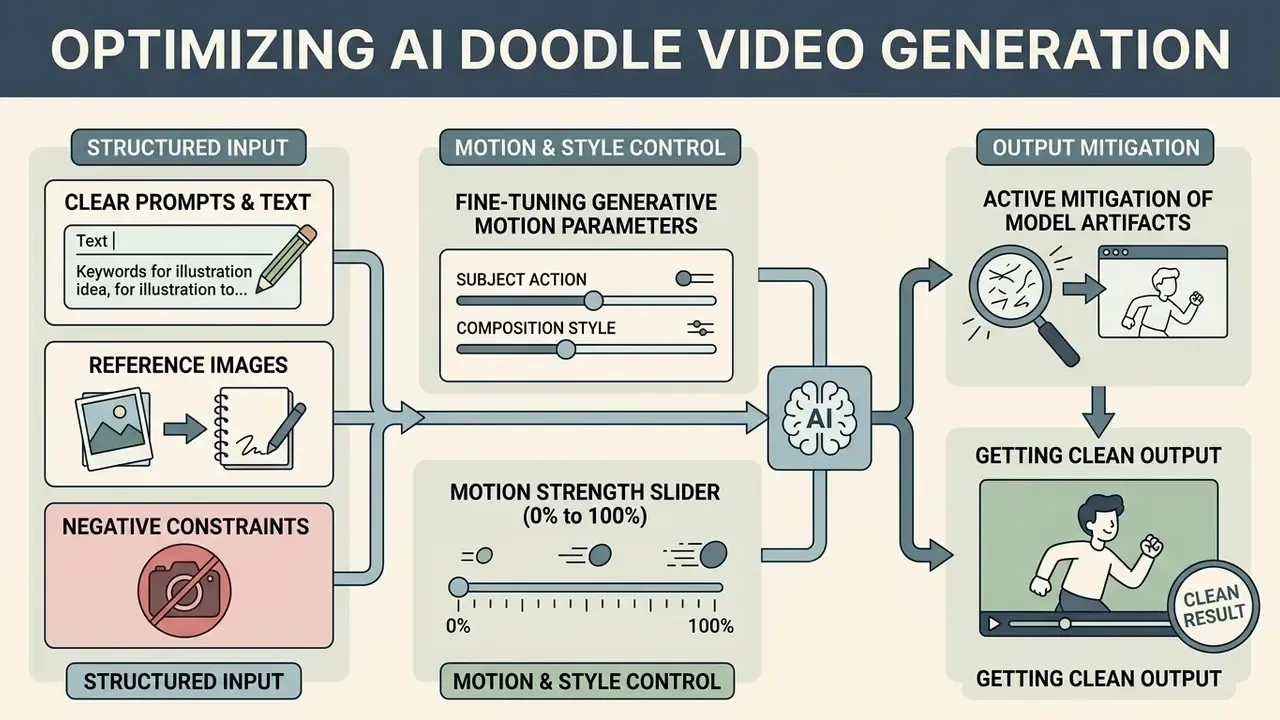
Getting clean output from an ai doodle video generator takes structured prompt engineering, style control and active mitigation of model artifacts. Generative video frameworks still struggle with spatial placement, multi-object motion and on-screen text rendering.
Use Clear Prompts, Text and Reference Images
To produce clean vector sketches without visual distortion, structure prompts using five explicit parameters:
Write instructions positively and concretely; state what should appear rather than only what should not. When uploading reference images for image-to-doodle conversion, use high-contrast images with clear silhouettes so line-tracing algorithms extract clean vector control points. Assign each reference an explicit role too: what must be preserved, what may be transformed, what style may be borrowed, and what must not be borrowed.
Fine-Tuning Generative Motion Parameters
When using text-to-video diffusion engines, prompt structure has to be paired with manual control parameters:
- Subject
- The primary object, character or concept (for example, "a financial auditor").
- Action or State
- What the subject is doing ("reviewing a digital ledger with a magnifying glass").
- Composition
- Spatial framing ("centered minimalist composition, wide angle").
- Style
- Specific visual medium ("clean whiteboard doodle, black marker line art, vector sketch, isolated on white background").
- Negative Constraints
- Elements to exclude ("no photorealism, no complex shading, no solid color fills, no background clutter").
- Motion Strength Slider (0% to 100%)
- Controls displacement intensity of visual strokes between keyframes. Lower values (10% to 30%) keep static whiteboard stability, ideal for technical diagrams, org charts and regulatory flowcharts. Higher values (60% to 90%) introduce dynamic stroke evolution, better for character actions and narrative sequences.
- Prompt Auto-Enhancers
- Built-in LLM refiners append negative constraints and style qualifiers ("clean vector line-art, uniform stroke weight") to brief inputs before submitting to the pipeline. Review the enhanced prompt when the tool exposes it, since auto-appended style tokens occasionally override brand-specific instructions.
- First-Frame Anchoring
- Where image-to-video anchoring exists, align the first frame closely with your reference asset and keep prompt language focused on style rather than motion. That is the most reliable lever against drift.
- Clip Length Discipline
- Start with shorter segments, roughly 60 to 90 frames, and stitch them, rather than requesting one long generation. Vendor limits reinforce this: some editors cap single generations at 20 seconds, and quotas often weight longer clips more heavily against daily allowances.
Keep Style, Scenes and Audio Consistent
Visual and auditory consistency prevents distraction and preserves professional presentation standards:
- Maintain Fixed Line Weights Keep all assets within a scene at similar stroke thicknesses and line styles.
- Enforce Palette Discipline Limit accent colors to one or two brand colors so key points stand out without cluttering the canvas.
- Preserve Continuity Rules Keep action, props, screen position and eyelines consistent across adjacent scenes. If an action begins before a cut, continue it into the next scene.
- Stabilize Audio Levels Normalize voiceover volume and keep background music ducked at -18 dB to -22 dB during spoken narration, holding dialogue, ambience and music at equal levels scene to scene.
«DEVIL metrics reach Pearson correlation above 0.90 with human ratings, capturing systematic mismatches between prompted motion and actual video dynamics.»
In other words, "the animation moved differently than I described" is a measurable, reproducible model behavior. Plan a review pass for motion fidelity instead of assuming the prompt was obeyed.
- Standardize Transition Logic: Reserve dramatic pan and zoom effects for major topic shifts, and use standard hand-draw actions for intra-scene elements.
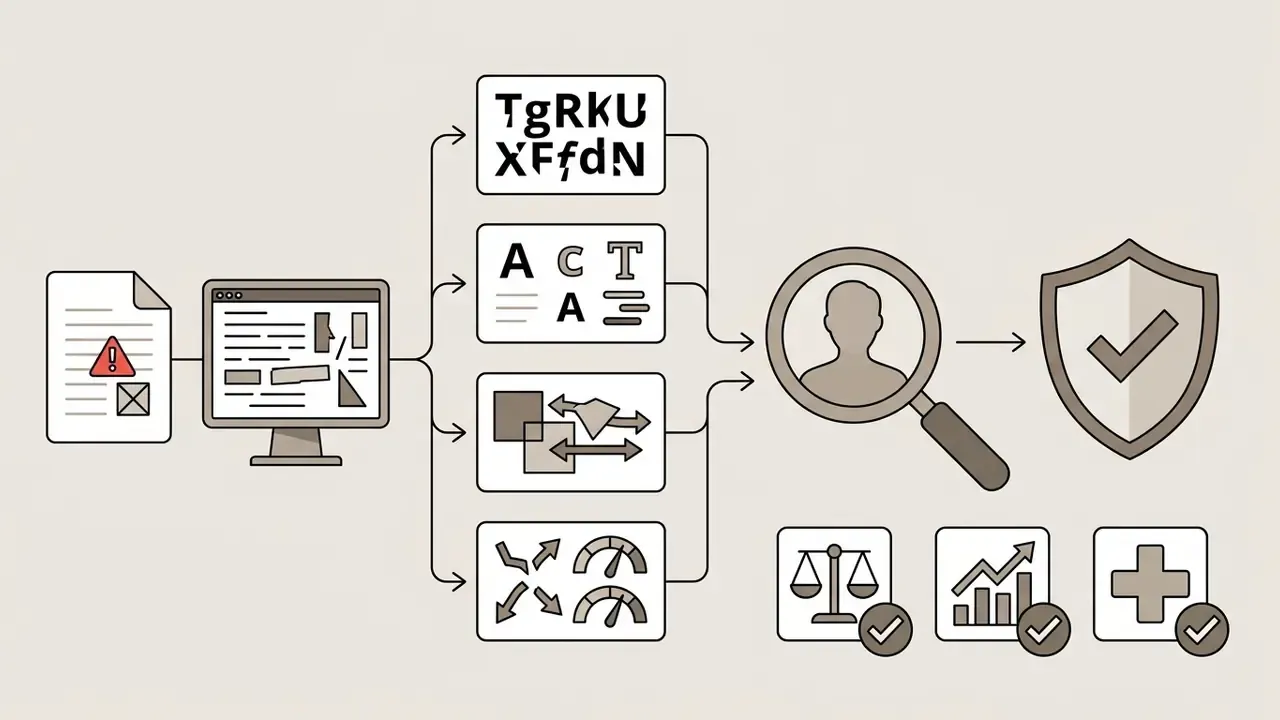
E-E-A-T Verification & Model Risk Note: Academic evaluations of text-to-video models show that generative tools frequently fail at rendering legible on-screen text and holding spatial consistency across keyframes.
«All evaluated models scored below 0.43 on text-rendering accuracy; instability is high across architectures and prompt categories.» T2VTextBench, arXiv preprint (2025). https://arxiv.org/abs/2501.12909
«A pronounced gap between high audiovisual quality and weak semantic reliability: failures in text rendering, speech coherence and physical plausibility.» Zhou et al., AVGen-Bench, arXiv preprint (2026). https://arxiv.org/abs/2503.18942
Always verify feature capabilities, export limits and text rendering accuracy against official platform documentation before deploying generated assets in production. For any on-screen label that carries regulatory, financial or safety meaning, add the text as an editable native text layer rather than trusting generated pixels, and log the human reviewer who approved it.
To analyze production costs and projected rendering overhead, teams can use our AI Media Calculators.
Pricing and Commercial Use: What to Verify Before Publishing
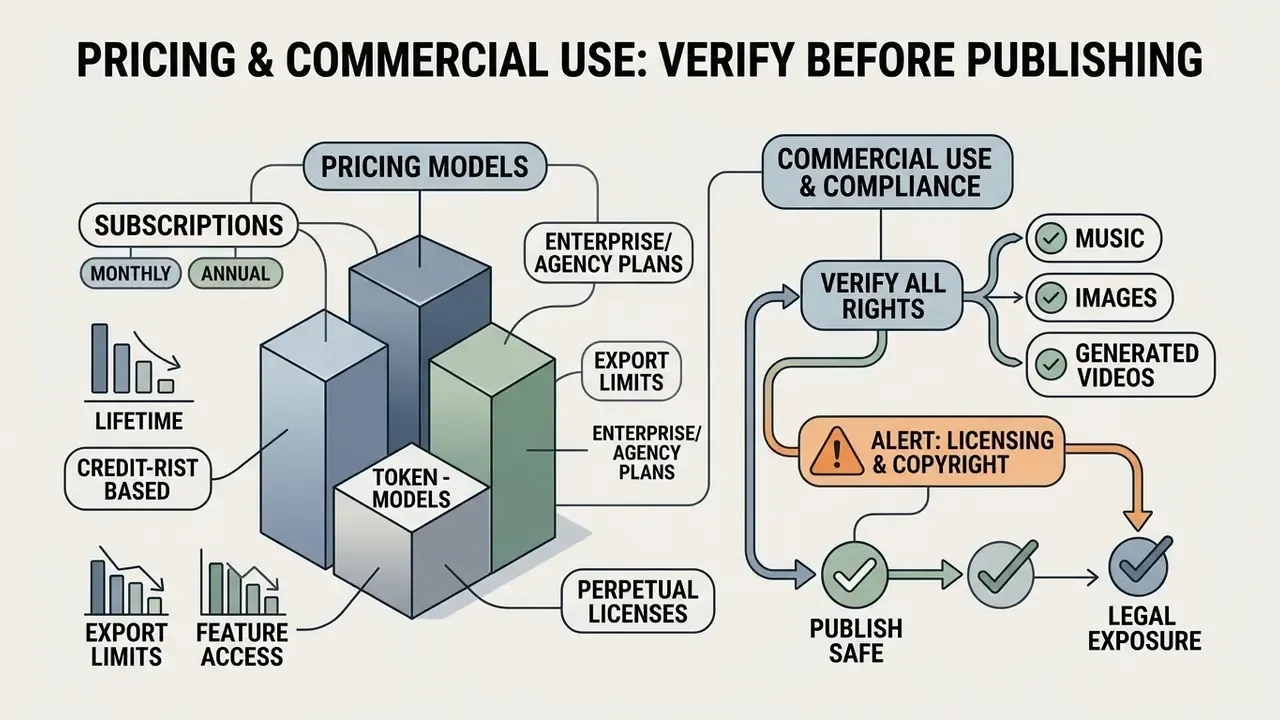
Deploying doodle videos for corporate communications, client projects or marketing campaigns carries legal and financial exposure. Organizations should verify subscription structures, asset licensing terms and IP ownership parameters before the first publish, not after.
Pricing Plans, Feature Access and Export Limits
Commercial doodle video creators generally operate under four pricing patterns:
- Monthly and Annual Subscriptions Roughly $15 per month to $79 per month for AI-native generators, with established desktop suites publishing higher tiers (around $49 per month Standard and $79 per month Enterprise). Subscriptions unlock 1080p and 4K exports, remove watermarks, grant full vector library access and include commercial usage licenses.
- Credit-Based Token Models Users buy credit packs to pay for AI-generated scripts, custom image-to-sketch conversions or neural voiceover minutes on a pay-as-you-go basis. Credit packs typically scale in fixed increments and can be spent across content types, but unused credits and rate limits vary sharply by vendor.
- Enterprise and Agency Plans Custom pricing with multi-seat team management, dedicated API integrations, custom character training, unlimited installs and formal indemnification guarantees.
- Perpetual or Lifetime Licenses Some suites sell one-time access with free ongoing updates. Verify whether "lifetime" covers cloud rendering credits and asset library refreshes, or only the local application binary.
One budgeting note that governance teams tend to raise first: total cost of ownership includes the control layer. Review time, subject-matter expert sign-off and audit logging are real line items, and leaving them out of the ROI model quietly overstates the savings.
For a detailed breakdown of subscription models across visual software platforms, review our AI Media Pricing Guides and the licensing breakdown in our Canva AI Generator overview.
Commercial Use Rights for Music, Images and Generated Videos
ALERT: Commercial Licensing & Copyright Compliance
Free Doodle Video Maker Options: Limits, Downloads and Access
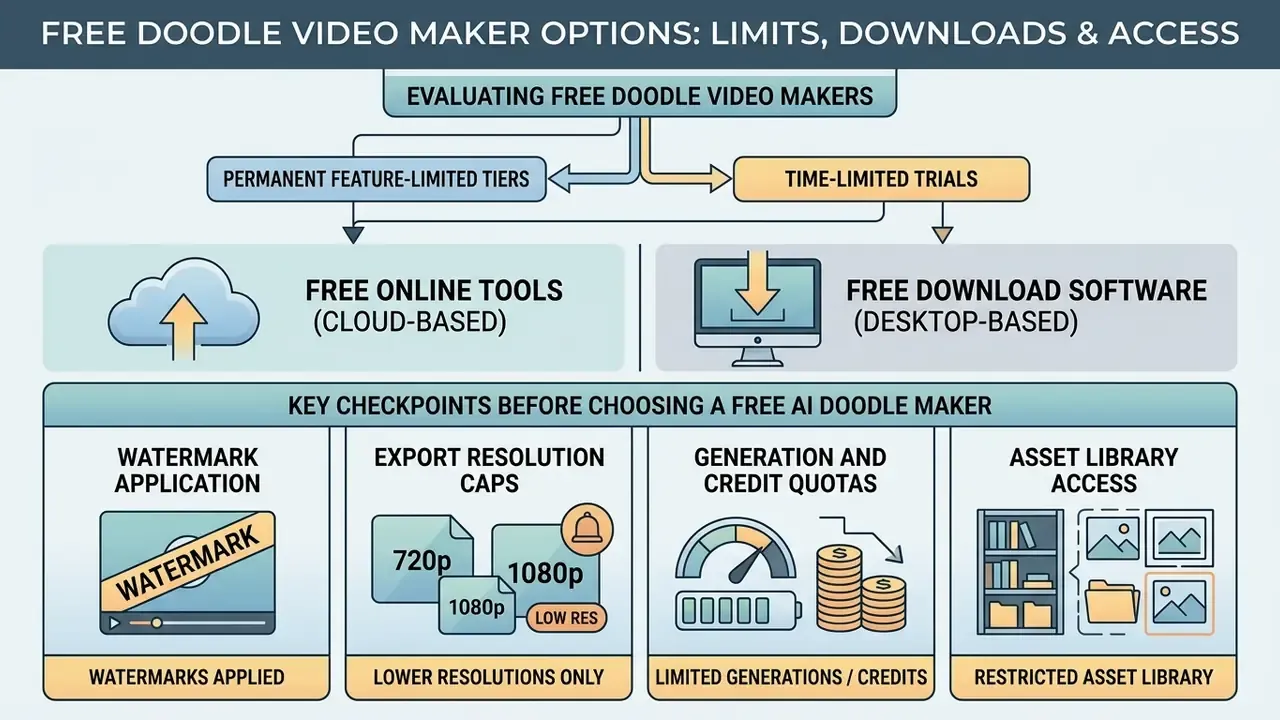
Evaluating a free doodle video maker means separating permanent feature-limited tiers from time-limited trials. Most vendors structure free access to showcase the editing interface while restricting commercial rights, resolution and export capability.
Free Online Tools vs Free Download Software
Creators comparing local and platform-native editing tools can review feature sets in our guide to YouTube video editors and publishing workflows.
What to Check Before Choosing a Free AI Doodle Maker
Before committing to a free ai doodle video generator, inspect these operational constraints:
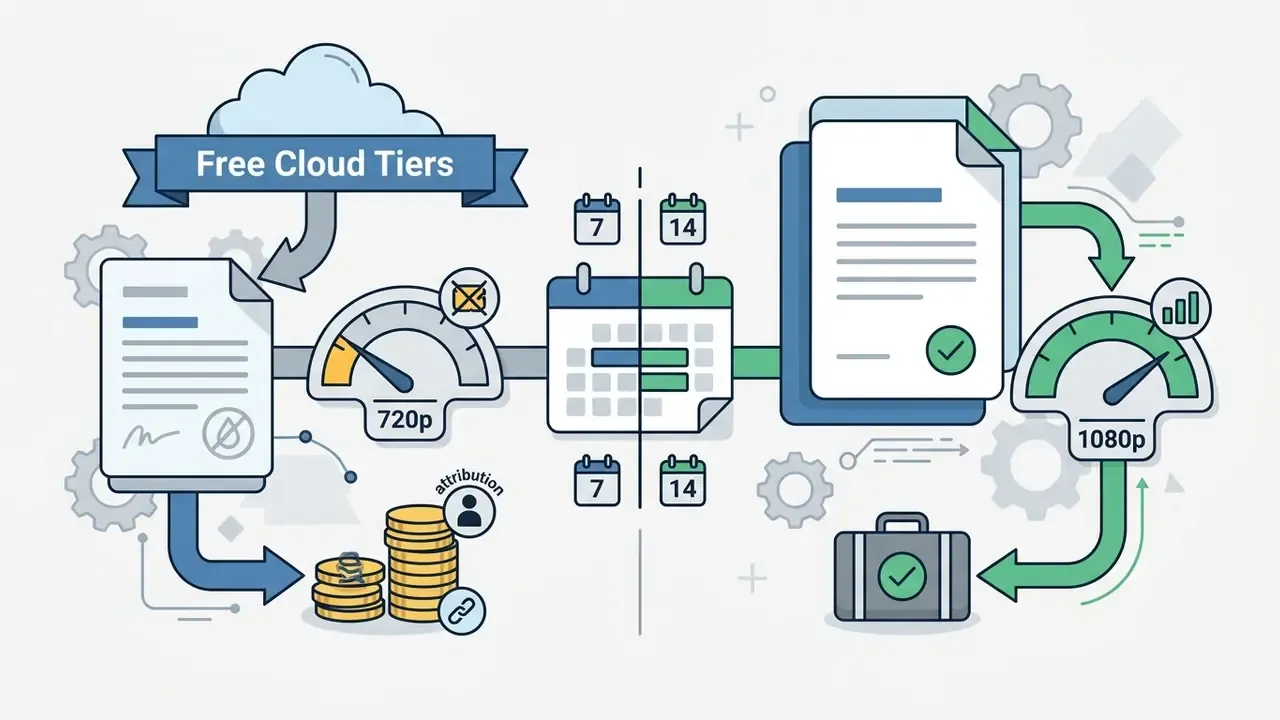
- Watermark ApplicationCheck whether the platform embeds permanent brand watermarks on exported MP4 files, and whether the watermark can be removed retroactively after upgrading.
- Export Resolution CapsDetermine if free exports stop at 720p or support 1080p Full HD, and whether frame-rate selection is locked.
- Generation and Credit QuotasVerify monthly AI generation credits, daily clip limits, rolling 24-hour quotas, or duration caps (often 1 to 2 minutes on free plans, sometimes with longer clips consuming multiple quota units).
- Asset Library AccessConfirm whether free users reach full vector libraries or only a small subset of standard icons, templates and stock media.
- Commercial LicensingReview terms to confirm free outputs are permitted for public publishing, monetized channels or commercial marketing, and whether attribution or a backlink is mandatory.
- Data Handling on Free TiersFree plans are the most likely to reserve rights to use submitted content for product improvement. Never upload confidential documents through a free tier.
| Platform / Tool Option | Access Model | Watermark Status | Max Free Resolution | Commercial Rights Included? | Key Limitations |
|---|---|---|---|---|---|
| Standard Cloud Free Tier | Permanent Free Tier | Mandatory Watermark | 720p HD | No (personal or educational only) | Monthly video and minute caps, restricted asset library, 30 FPS lock. |
| Attribution-Required Free Commercial | Free / Credit-Based | Often watermark-free | 1080p HD | Yes, only with visible credit plus backlink | Removing attribution voids the license; audit trail of credit placement required. |
| Desktop Trial Software | 7-day or 14-day Trial | Watermark-free on some trials | 1080p HD | No (evaluation only) | Time-limited access, desktop installation required. |
| Open-Source / Free Sketch Tools | Permanent Free Software | No Watermark | Native System Resolution | Yes (CC0 / public domain assets) | No automated AI script-to-video pipeline; manual assembly required. |
| Verify With Vendor | Any tier | Check current terms page | Check current terms page | Check current terms page | Quotas, watermarks and rights change without notice; record the retrieval date. |
For a side-by-side scoring of duration limits, credit systems and export restrictions, see our comparison of the best free AI video generators.
Best Uses for Doodle Animation Videos
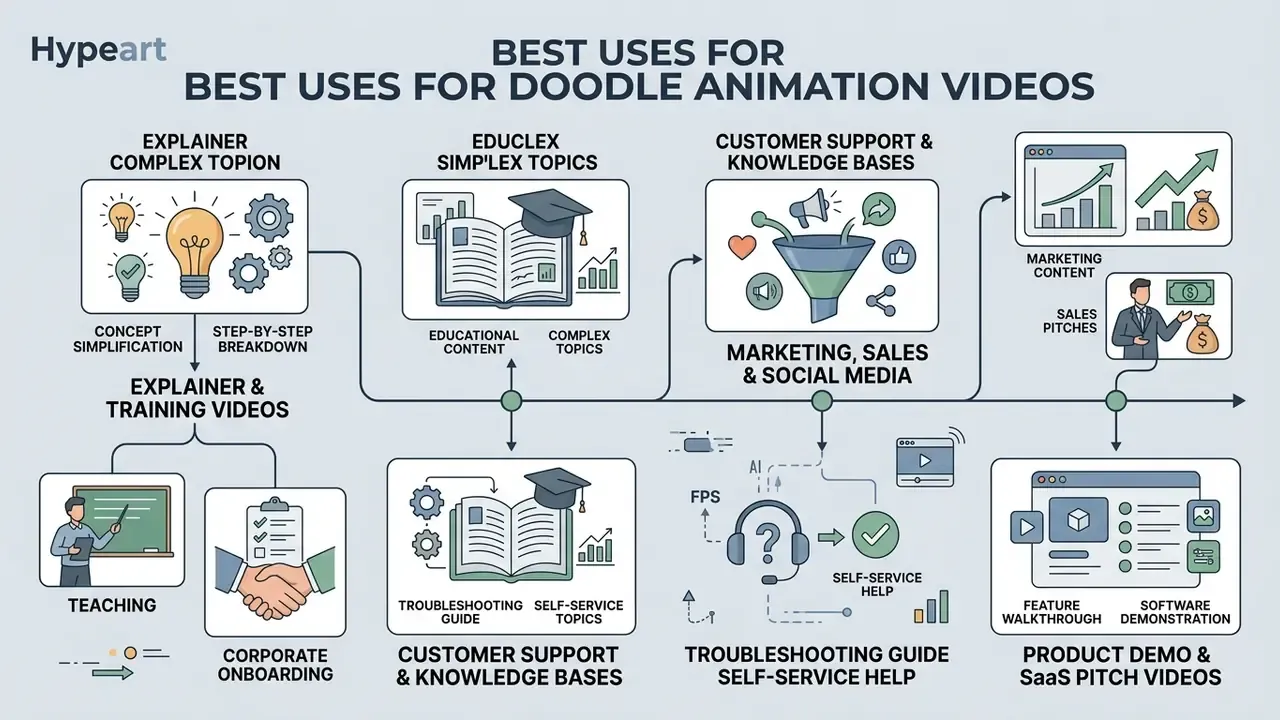
Doodle animation videos perform well wherever a complex, abstract or process-heavy topic needs a step-by-step breakdown.
Explainer, Teaching and Training Videos
Rather than leaning on a single unsourced retention percentage, the current evidence base for whiteboard-style instruction reads like this:
«Whiteboard animations significantly outperformed audio and text formats on retention, engagement and enjoyment across 621 participants.»
Progressive drawing, where the illustration appears stroke by stroke in step with narration, is the mechanism most consistently linked to better recall than static slideshows or talking-head formats. It paces information delivery and limits extraneous cognitive load. The effect size depends on the audience and the comparison condition, so treat "whiteboard beats slides" as directional, something to validate on your own learners rather than a fixed guarantee.
- Corporate Onboarding and Compliance: Turning dense policy documents and control frameworks into digestible visual workflows.
«143 dental students viewed 10,919 videos in one academic year; views correlated positively with biochemistry and nutrition exam results.»
- Academic and Higher Education: Breaking down scientific concepts, mathematical proofs and historical timelines into progressive visual beats. Two design principles do most of the work here: segmenting, which splits explanation into learner-paced chunks, and signaling, where the drawing hand and a single accent color mark what matters. Both are standard recommendations in multimedia learning research, and both are cheap to implement in a doodle editor.
«Explanation videos improved test performance on average, but the effect was significantly larger for students with higher GPA at comparable visual attention.»
That asymmetry matters for corporate training design. A doodle explainer alone may widen rather than close knowledge gaps, so pair it with retrieval practice, a short quiz or a job aid for lower-prior-knowledge audiences.
- Customer Support and Knowledge Bases: Guiding users through software navigation, troubleshooting steps and product setup.
«Learners who watched videos containing misconceptions reported equally high confidence in understanding but held more misconceptions than controls.»
This "illusion of understanding" is the strongest argument for subject-matter-expert review of AI-generated explainer scripts. A fluent, well-animated video containing an error will be believed more confidently than a text document containing the same error. That is a governance problem dressed as a production convenience.
Organizations that need technical help with video integration can access our AI Media Support resources.
Marketing, Sales and Social Media Content
In commercial funnels, doodle videos grab attention quickly and hold watch-through:
- Crowdfunding and Pitch Decks:

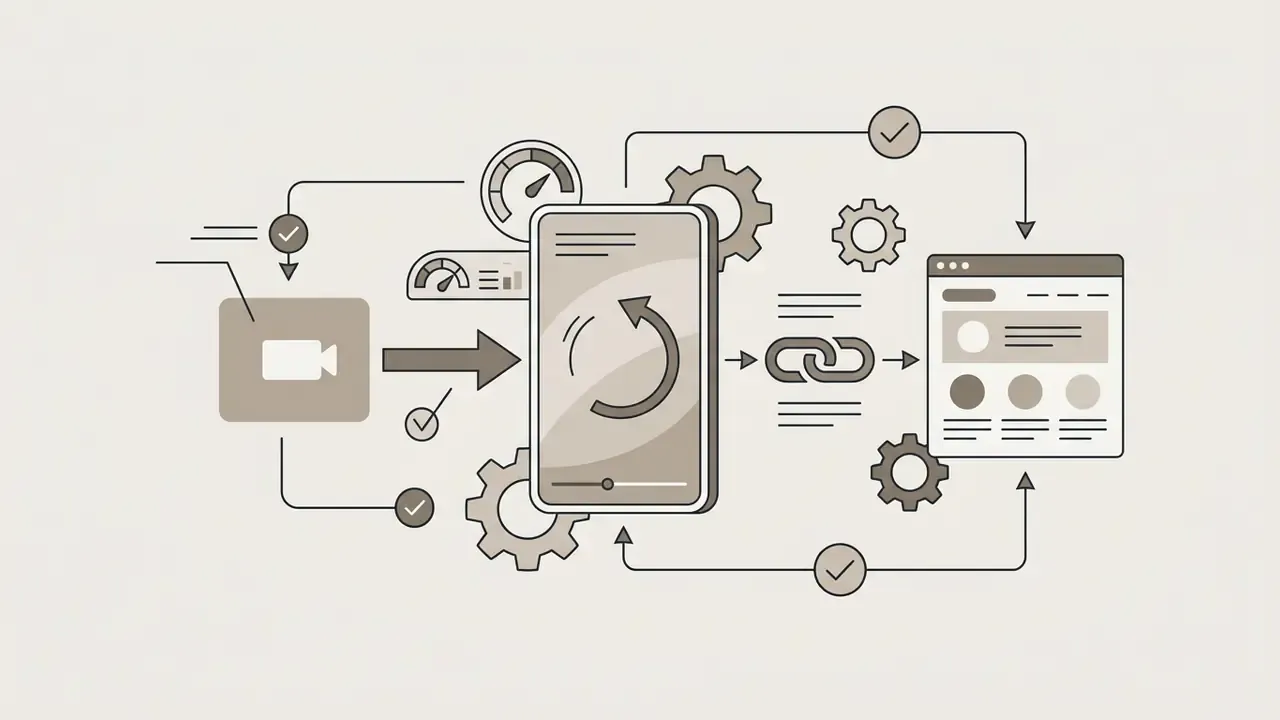
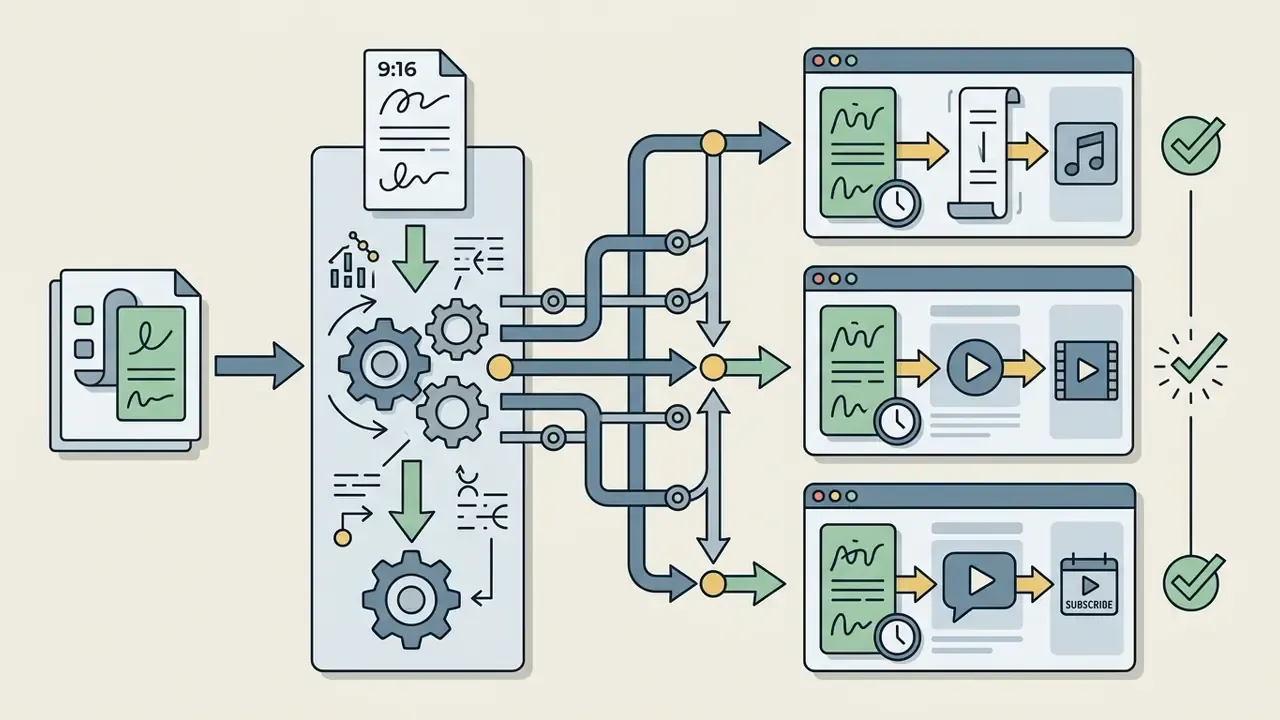
«Video pitches increase funds raised; longer videos have larger effects; informational content matters while background music does not.»
The practical implication for doodle pitch videos: spend the budget on script density and clarity of the explanatory visuals, not on soundtrack selection.
Teams exploring wider automated marketing workflows can review our analysis of how AI art and video generators compare for campaign asset production. And yes, the bigger question keeps coming up in creative operations reviews: will ai create more roles than it displaces? The honest answer is unresolved, and anyone selling certainty on that point is selling something else.
Limitations and Open Questions
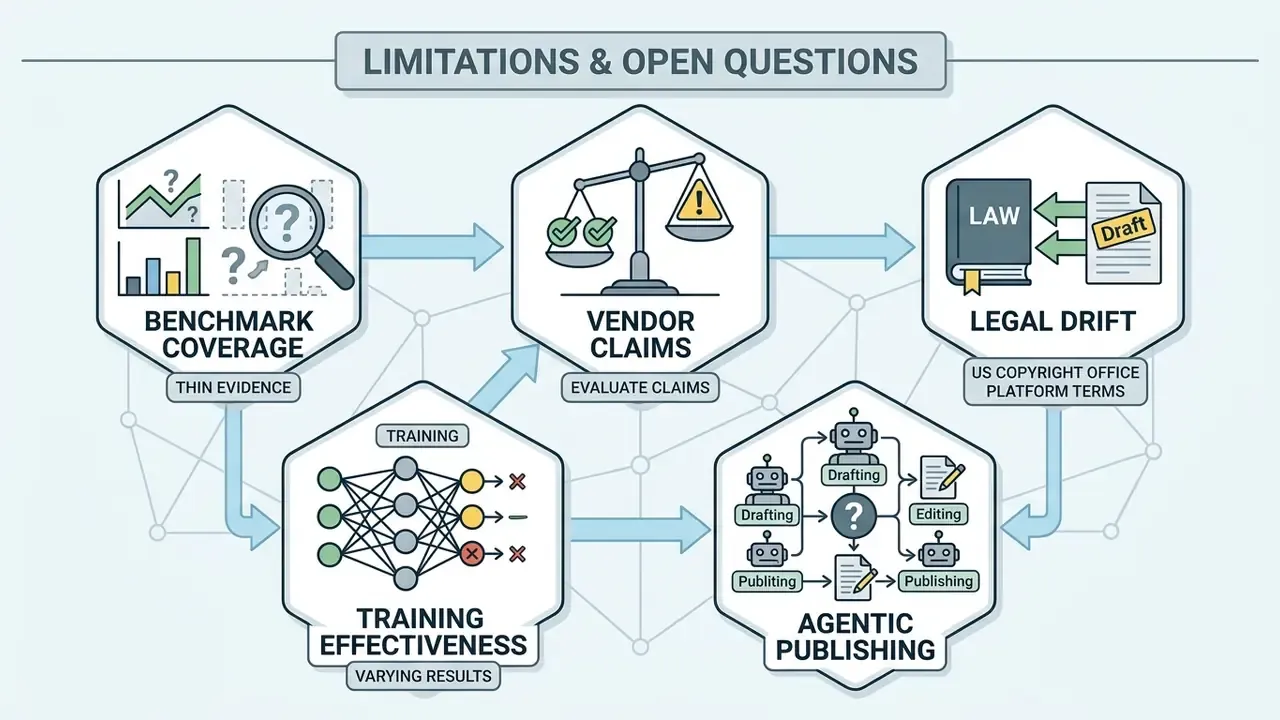
Where the evidence is thin, say so.
- Benchmark coverage. Public text-to-video benchmarks measure general video generation, not vector sketch fidelity specifically. Stroke-level accuracy for line art lacks a widely accepted metric.
- Vendor claims. Asset counts, voice counts and pose combinations come from vendor marketing pages. They are plausible but not independently audited.
- Legal drift. US Copyright Office guidance and platform terms both move. A licensing note verified in early 2026 may be stale by the next quarter.
- Training effectiveness. Comparative studies use student populations more often than regulated corporate learners, so transfer to compliance training is an inference, not a finding.
- Agentic publishing. Auto-posting connectors edge toward agentic behavior. Ownership, escalation path and shutdown mechanism for that agent are usually undocumented in the product itself.
Doodle Video Creator FAQ
What is the difference between a traditional doodle video maker and an AI doodle video generator?
A traditional doodle video maker, such as a classic desktop editor like Doodly or VideoScribe, relies on manual drag-and-drop timeline assembly. You select assets, set draw paths and align audio yourself. An ai doodle video generator automates pre-production: it takes text prompts, script files or PDFs and generates scene scripts, selects vector graphics, assigns draw trajectories, synthesizes voiceover and aligns timeline keyframes.
Do I need design or drawing skills to use an AI doodle maker?
No illustration skill is required. AI doodle makers use pre-built vector libraries, automated text-to-image tracing engines and algorithmic pathing to render drawings on screen. The skills that actually matter are scripting discipline, meaning splitting narration into visual beats, and reviewing output for factual and textual accuracy.
What frame rate and resolution should I export a doodle video at?
Use 24 to 30 FPS for classic hand-drawn pacing on static whiteboard content. Choose 60 FPS when the composition includes fast camera pans, zooms or many simultaneously animating elements, since higher temporal resolution suppresses stroke jitter. Export 1080p for web and LMS delivery, 4K when the video will be re-framed or shown on large screens, and always match export frame rate to composition frame rate to avoid audio drift.
Can I make the software draw my own logo or technical diagram?
Yes, if the tool supports SVG import or custom draw-path mapping. Upload the asset, then anchor the draw order node by node so tracing follows the design's real construction sequence. Some import engines reject SVG features such as gradients, filters and clipping masks, so flatten and simplify files before upload.
Can I create a doodle animation video for free without watermarks?
Most commercial cloud free tiers apply a platform watermark and cap output at 720p. Watermark-free 1080p or 4K normally requires a paid monthly or annual plan. That said, open-source graphic tools, some "free forever" web tools and software evaluation trials may allow watermark-free exports, sometimes on the condition that you credit the platform with a visible backlink.
How does a doodle video maker compare to tools like Doodly?
Doodly is a well-established desktop whiteboard video creator driven by manual drag-and-drop library controls and timeline editing, with published tiers around $49 per month Standard and $79 per month Enterprise and bundled access to a wider suite (Toonly, Talkia, People Builder, Voomly). Modern 2026 AI-native doodle generators add automated script-to-video generation, neural text-to-speech, document parsing (PDF/DOCX import), lip-synced avatars, API access and AI image-to-sketch conversion, often starting at free or low token-based tiers. Choose the suite for granular manual control and offline rendering; choose the AI-native generator for throughput and cost per asset.
How do I protect confidential or banking data when using an AI doodle maker?
Treat the generator as an external data processor. Redact PII, account identifiers, customer names and internal system references before uploading any document, and prefer a sanitized abstract of the policy over the source file. Contractually require zero data retention or a short retention window, confirm inputs are not used for model training, request SOC 2 Type II or ISO/IEC 27001 evidence plus the sub-processor and data-residency list, and enforce SSO/SAML with per-render audit logs. Never route confidential material through a free tier, and map the review-and-approval chain to a recognized framework such as the NIST AI Risk Management Framework so each published video has a named human owner.
Can I use created doodle videos for commercial and client work?
Yes, provided you hold an active paid plan that grants commercial usage rights and every embedded stock audio track, vector asset and font is licensed for commercial distribution. Verify whether the vendor transfers copyright ownership or grants only a usage license, whether attribution is mandatory, and whether the underlying illustrations stay the vendor's property with reuse sold as an add-on. Confirm the platform's Terms of Service on client work and advertising monetization before publishing.
Can AI-generated doodle videos be copyrighted?
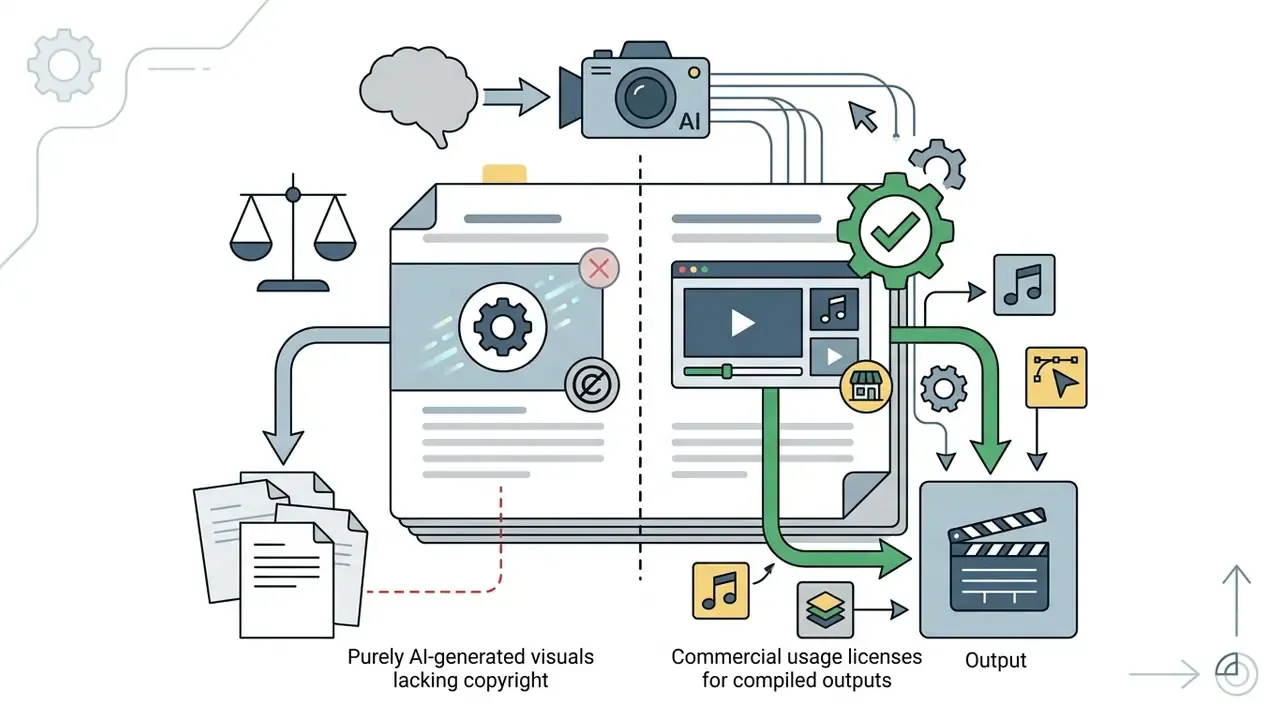
Purely AI-generated visual output lacking human expressive control is not registrable under current US Copyright Office guidance, and AI-generated portions beyond a de minimis contribution must be disclosed and excluded in a registration application. Human-authored elements can still support protection for those contributions: your script, scene sequencing, selection and arrangement, edited text layers and recorded narration. Document your human authorship steps if copyright matters to the project.
What is a safe first step if my institution has not approved any AI video tool yet?
Start narrow. Pick one non-sensitive internal topic, run a single module through a vendor trial with fully sanitized input, and record the control evidence you would need for audit: prompt log, reviewer name, approval date, licensing clause and retrieval date. That small artifact set tells you more about production readiness than any feature comparison. For developers integrating video generation into enterprise applications, explore our AI Media API Guides and review usage terms in our AI Media Commercial-Use Hub.
Appendix A: Editorial Revision Log
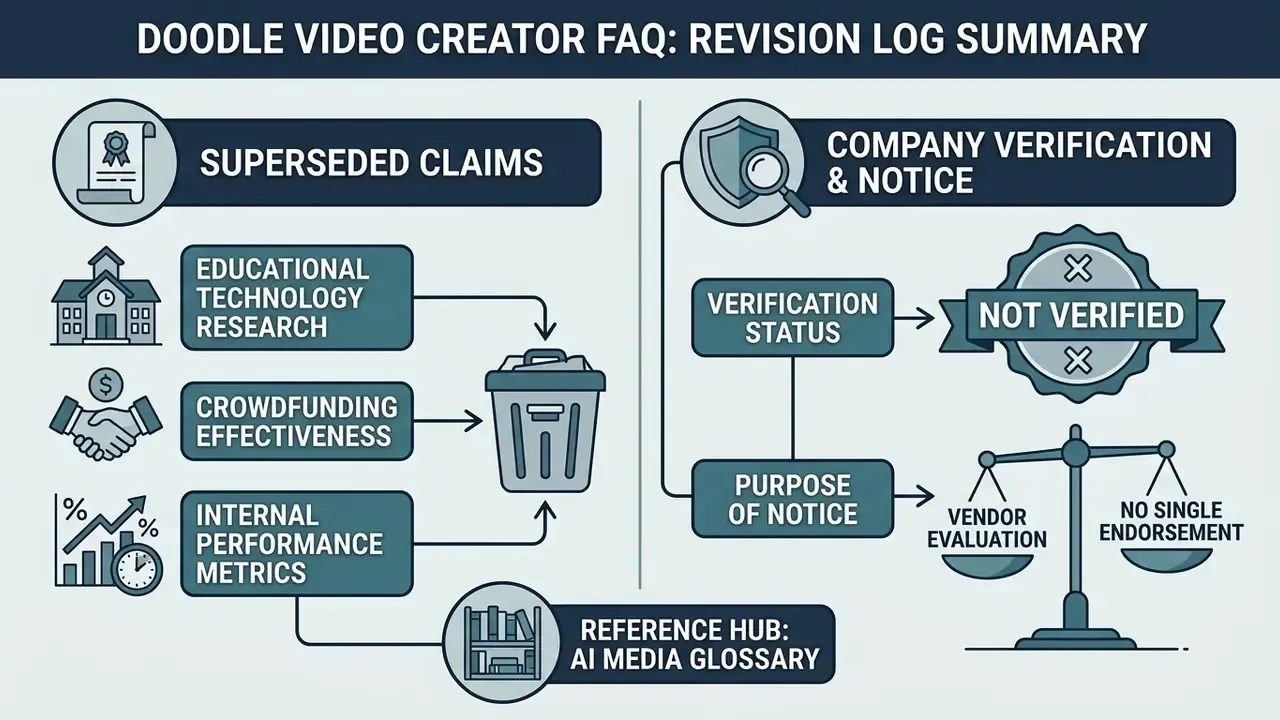
Company USP & Verification Notice
Company Verification Status: As of August 19, 2026, verification status for hypeart.ai indicates no verified information available. No operating US corporate registry record, product catalog or SOC 2 compliance certification has been verified for hypeart.ai. Any platform integrations referenced in editorial comparisons remain strictly hypothetical.
Why this notice appears: this article evaluates vendor categories rather than endorsing a single provider, and the same verification standard we recommend for procurement, meaning corporate registry, product documentation and security certifications, is applied here to our own reference entity as a worked audit example.
Reference hub: AI Media Glossary