Generative artificial intelligence has expanded beyond static imagery into synthetic motion synthesis. In mid-2025, Microsoft integrated OpenAI's Sora model into its consumer ecosystem, introducing Bing Video Creator. This mobile-first feature allows users to transform natural language text prompts into dynamic video clips directly within the Bing environment.
Why should a risk officer care about a free consumer toy? Because it is already on employee phones. For CROs, heads of model risk, digital transformation leaders, marketing teams, and enterprise architects, assessing tools like Bing Video Creator means balancing creative upside against model risk, data lineage, and intellectual property constraints. This guide provides a detailed operational, technical, and regulatory examination of Bing Video Creator, evaluating its capabilities, access controls, cost mechanics, prompt engineering practices, and commercial applicability in 2026.
Executive Summary
- What it is Bing Video Creator is a free, Sora-powered text-to-video miniapp inside the Bing mobile app, launched June 2, 2025 (Microsoft Bing Blog, 2025).
- Output specification 5-second clips, vertical 9:16 aspect ratio, MP4 delivery, up to three concurrent renders per account, 90-day cloud retention.
- Cost model Standard-speed generation is free and effectively unlimited; the first 10 Fast renders are free, after which each Fast render costs 100 Microsoft Rewards points.
- Rewards math Desktop Bing searches earn 5 points each with a 150-point daily cap, meaning roughly 1.5 free Fast generations per day at zero financial cost (TechCrunch, 2025).
- Quality reality check Sora leads peer models on motion smoothness (73.67 in T2VEval) but scores only 0.65/1.0 on world-knowledge integration and 0.57 on causal consistency (T2VWorldBench, 2025).
- Access control Sign-in requires a personal Microsoft Account (MSA); corporate Microsoft Entra ID accounts are excluded from consumer access.
- Commercial risk Consumer Bing terms carry a personal, non-commercial baseline and provide no IP indemnification. The Copilot Copyright Commitment does not extend to Bing Video Creator outputs.
- Provenance Outputs carry C2PA content credentials per Microsoft's launch documentation; independent 2026 hands-on tests report no visible watermark on downloaded files.
- Verdict Excellent for internal storyboarding, concept validation, and social prototyping. Unsuitable, without secondary governance controls, for regulated financial communications or paid advertising.
Who Should Read This, and What It Answers
This analysis is written for two overlapping groups: the people who will be asked to approve or block the tool, and the people who actually want to use it tomorrow morning.
It answers eight practical questions:
- What exactly powers bing video creator (openai sora), and how does that architecture shape output quality?
- Which formats, durations, and queue limits apply in the current build?
- How does the consumer Bing surface differ from paid Sora API access and from Runway, Pika, or Veo?
- Where is the tool available, and how do you verify the legitimate bing video creator app download source?
- What does it really cost once Microsoft Rewards points enter the picture?
- Which prompt parameters move the needle, and which are wasted characters?
- What do the consumer terms permit commercially, and what do they quietly withhold?
- Which controls should security and model-risk teams put in place before anyone publishes a clip?
1. What Bing Video Creator Is and How It Relates to OpenAI Sora
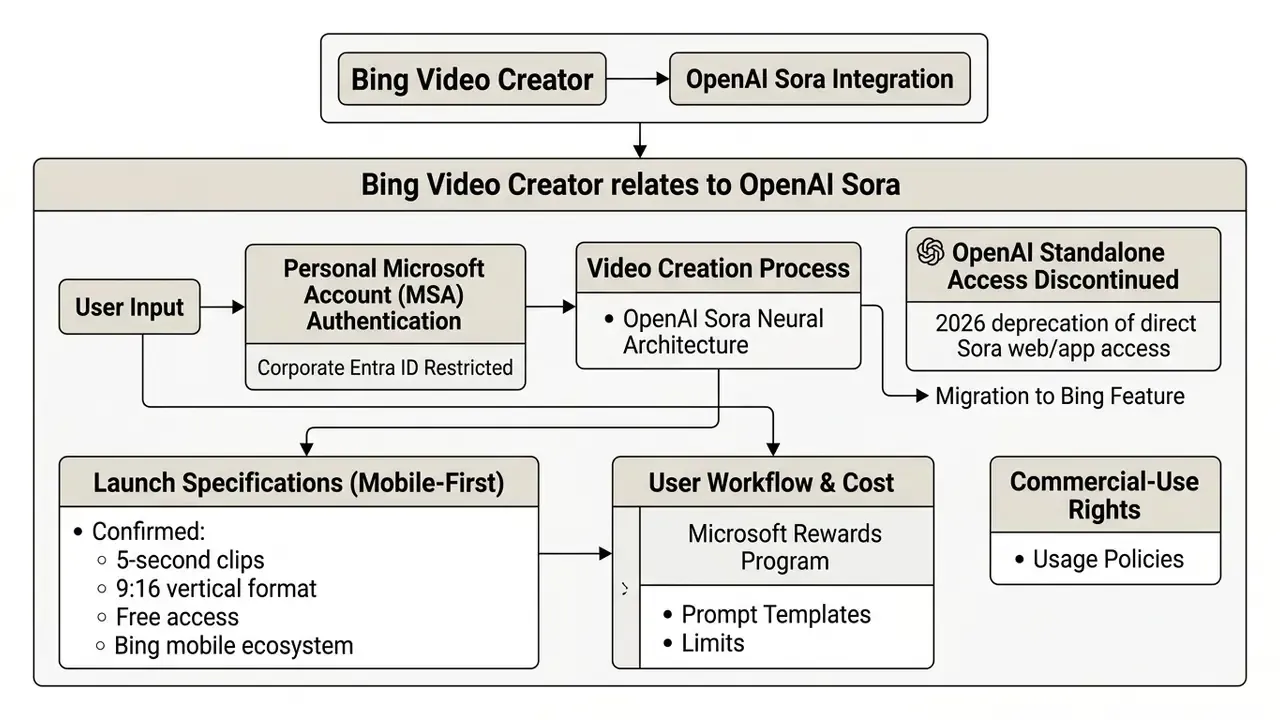
Bing Video Creator is Microsoft's consumer-facing text-to-video tool designed to generate short synthetic video clips from natural language descriptions. Built as a native miniapp within the Bing ecosystem, it exposes advanced video generation capabilities without requiring complex local hardware or specialized command-line interfaces (Microsoft Bing Blog, 2025. https://blogs.bing.com/search/June-2025/Introducing-Bing-Video-Creator).
The underlying technical engine powering Bing Video Creator is OpenAI Sora (referenced in Microsoft explainer documentation as Sora 2). Sora is a diffusion transformer model that operates on space-time patches of visual latent codes.
«Sora is trained jointly on videos and images of variable durations, resolutions and aspect ratios, as a transformer operating on spacetime patches of video and image latent codes.»
Rather than treating video as a sequence of flat frames, the Sora architecture processes visual data across temporal and spatial dimensions at once. That is why motion in Bing outputs tends to feel continuous rather than frame-stitched, and also why the same architecture still stumbles on multi-step physical causality (see section 2).
Microsoft positioned bing video creator (openai's sora) as a free AI video generator to democratize short-form video creation. By embedding Sora into the Bing mobile architecture, Microsoft built a high-accessibility consumer surface for video ai synthesis, moving text-to-video AI tools out of restricted developer research previews and into mainstream deployment.
Understanding how synthetic video models sit alongside enterprise compliance standards takes structured frameworks, not enthusiasm. Consult our AI Media Commercial-Use Hub for expanded analysis on generative licensing structures.
2. What Kind of Videos Bing AI Video Creator Generates
Bing AI Video Creator specializes in short-form, motion-dense video synthesis derived from text-to-video prompts. At launch, the tool standardizes output to 5-second clips rendered in a vertical 9:16 aspect ratio, matching mobile formats such as vertical social feeds and app teasers (Microsoft Bing Blog, 2025). Microsoft has publicly signalled that horizontal 16:9 support is on the roadmap, but as of this update the vertical lock remains in force in the mobile app.
The model excels at smooth motion trajectories and visually appealing aesthetics. Empirical benchmark data from T2VEval (2024) evaluates Sora's core capabilities across standardized metrics:


«In T2VEval, Sora scored 73.67 on dynamic smoothness and 72.03 on text-video alignment, the strongest results among the tested models.»
Despite high aesthetic scores, technical evaluations flag hard limits. According to T2VWorldBench (2025), Sora averages 0.65 out of 1.0 on world knowledge integration, dropping to 0.57 on causal consistency.
«None of the evaluated models consistently generate correct videos for prompts requiring the integration of complex world knowledge.»
So the clips look convincing while multi-step physical interactions (objects breaking, liquids pouring, cause-and-effect chains) may show anomalies. Text rendering inside generated clips is also unstable, as documented in T2VTextBench (2025), where synthetic on-screen text often suffers spatial distortion or temporal flickering.
Practical implication for content teams: treat Bing Video Creator as an atmosphere and motion engine, not a titling or infographic engine. Overlay any legible text, logo lock-up, or pricing claim in post-production using conventional video editing tools instead of asking the model to render it. If your deliverable is a chart rather than a mood shot, a dedicated ai graph generator will serve you far better than any diffusion model.
3. How Bing Video Creator Differs From Standalone Sora Access (and From Runway, Pika, Veo)
The primary distinction between bing video creator (sora) and direct OpenAI Sora access centers on pricing structures, interface complexity, and operational parameters.
Direct access to Sora historically required premium OpenAI subscriptions (ChatGPT Plus at $20/month or ChatGPT Pro at $200/month) or direct API usage billed per second of generated video (OpenAI, 2024). Standalone OpenAI Sora web and app interfaces were later discontinued, shifting direct developer usage strictly toward scheduled API endpoints.
By contrast, bing video creator (openai's sora) delivers a consumer-accessible model embedded inside Microsoft's infrastructure:
- Cost ModelBing Video Creator offers free standard-speed generation, whereas native Sora usage required paid subscriptions or per-second token billing (sora-2 at $0.10/sec; sora-2-pro at $0.30/sec at 720p, $0.50/sec at 1024p, $0.70/sec at 1080p).
- Duration and FormatBing constrains outputs to 5-second, 9:16 vertical clips. Direct Sora API calls support up to 20 seconds at resolutions up to 1080p in multiple aspect ratios (16:9, 1:1, 9:16) (OpenAI Technical Documentation, 2024).
- Queue LimitsBing Video Creator caps active jobs at three concurrent generations per account; Sora Pro tiers permitted up to five.
- InterfaceBing abstracts model parameters into a simple prompt bar inside the bing app, while developer tools allow fine-grained control over seed values, frame rates, and camera paths.
- AuditabilityAPI access provides request logs, keys, and quota telemetry. The consumer Bing surface provides no administrative logging. For governance teams, that single line is the most consequential difference in this whole guide.
Competitive benchmarking: how Bing Video Creator compares with other AI video generators
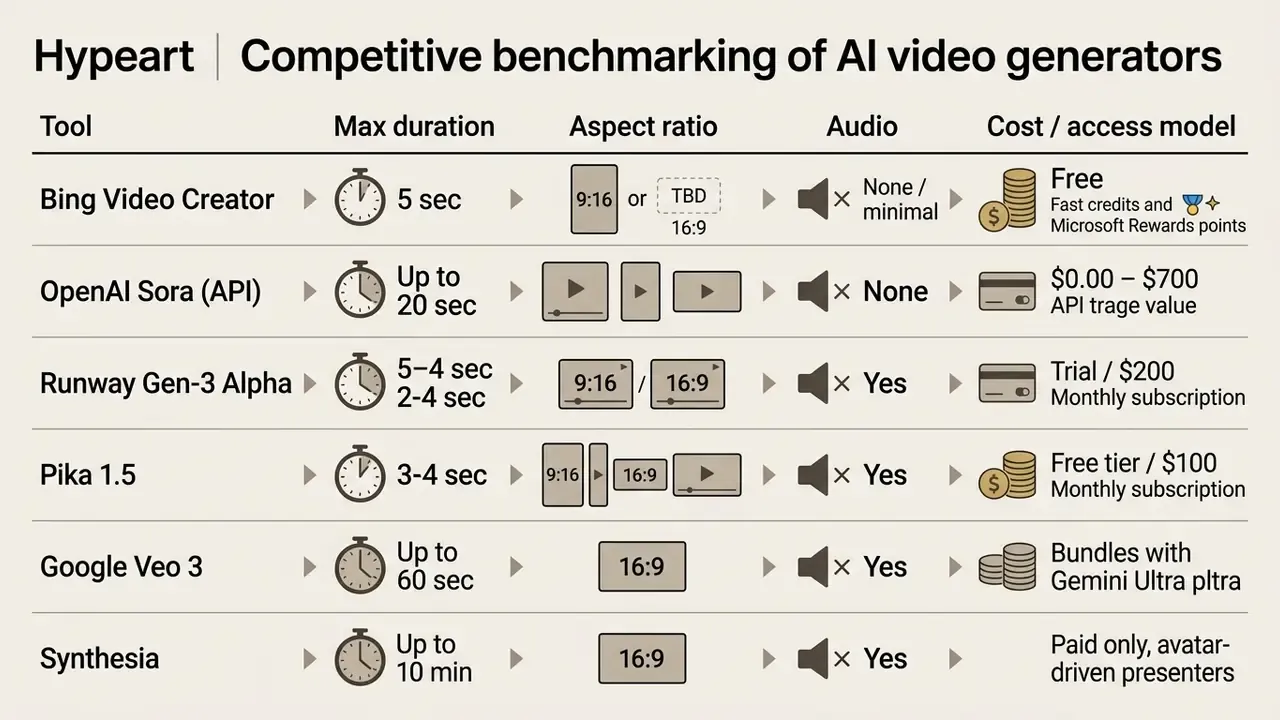
Read this table as a positioning map, not a quality ranking. Bing Video Creator wins decisively on cost of first experiment: no card, no trial clock, no watermark negotiation. It loses on duration, aspect flexibility, native audio, and timeline editing. Runway and Pika are the pragmatic mid-tier for creators who need horizontal output plus sound; Google Veo 3 is the current reference point for physics fidelity and object permanence; Synthesia sits in a different category entirely (avatar-led corporate explainers rather than generative b-roll).
Organizations comparing developer API access models against consumer web interfaces can review our detailed breakdown in the AI Media API Guides, our Google Veo implementation guide, and our comparison of free AI video generators with attention to credit limits and export rights.
4. Where Bing Video Creator Is Available: App, Android, and Mobile Access
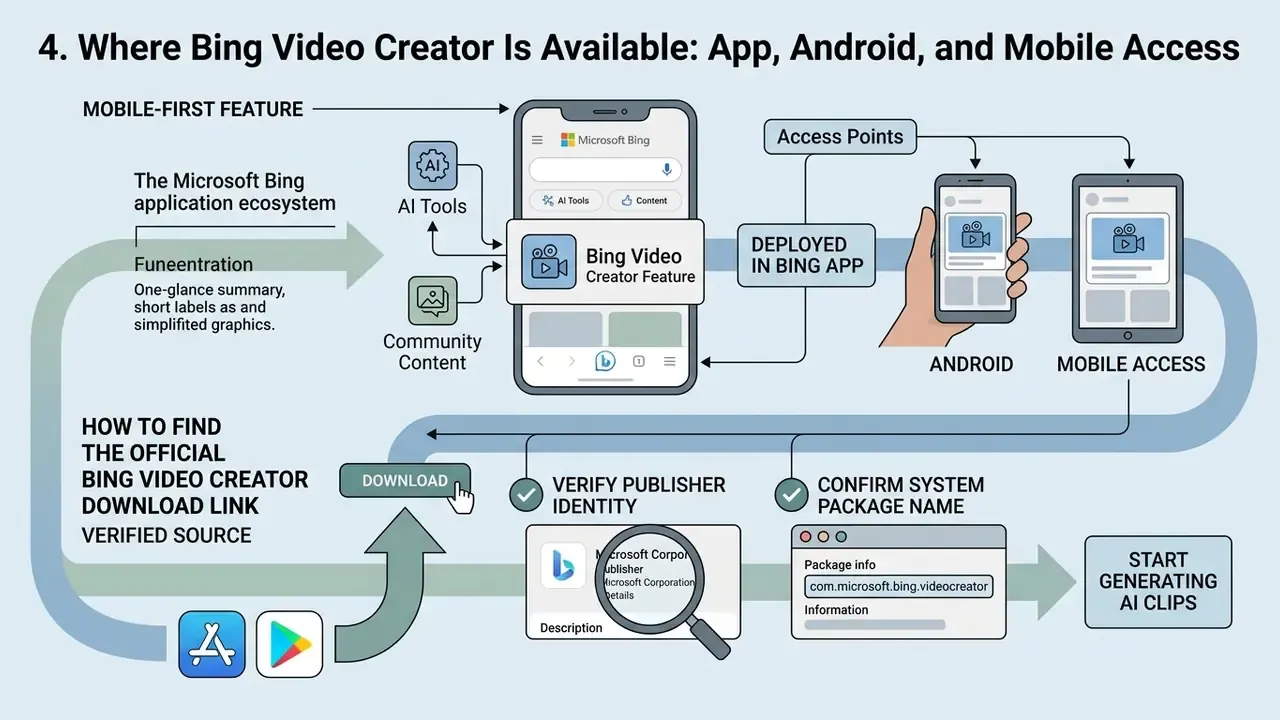
Bing Video Creator is deployed primarily as a mobile-first feature inside the Microsoft Bing application ecosystem. Microsoft started the rollout on June 2, 2025, prioritizing iOS and Android before expanding web access via Bing.com/create and Copilot Search (Microsoft Bing Blog, 2025. https://blogs.bing.com/search/June-2025/Introducing-Bing-Video-Creator).
To reach the tool on mobile devices, users install the official bing video creator android app package (listed as "Microsoft Bing Search" in mobile app stores) and sign in with a personal Microsoft Account (MSA). Consumer access is explicitly disabled for corporate Microsoft Entra ID accounts, which prevents unauthorized enterprise data transfers into consumer model queues. Readers evaluating the wider category can review our reference material on AI video generators.
Geographic availability spans worldwide markets, with explicit exclusions in China and Russia due to local regulatory and service constraints. This exclusion appeared in Microsoft's launch communication and was independently corroborated by launch-day reporting (Microsoft Bing Blog, 2025; TechCrunch, June 2, 2025; WebNots, June 6, 2025). Availability is enforced by market and region signals, so VPN circumvention is both unreliable and a terms-of-service violation.
Figure 1. Verifying the official Bing application on Android (three-panel walkthrough).
Panel 1: the Google Play listing for "Microsoft Bing Search", publisher Microsoft Corporation, package com.microsoft.bing. Panel 2: the Microsoft Account authentication screen showing "Sign in with Microsoft" then "Sign in or create an account" then "Choose the account you want to sign in with". Panel 3: the Bing mobile app menu (bottom-right grid icon) with the Video Creator tile visible under "All apps".
When visual reporting or dashboard-style documentation is required alongside synthetic media assessments, teams usually pair generated clips with a conventional YouTube video editing workflow to map operational deliverables cleanly.
5. How to Find the Official Bing Video Creator App Download Link
Securing an authentic bing video creator download link means going through official application repositories, never through mirrors, forum posts, or modified APK bundles.
To verify app authenticity on Android:
- Navigate directly to the Google Play Store (not through a search ad or forum mirror).
- Search for "Microsoft Bing Search".
- Check that the listing shows a Microsoft support contact plus a plausible install base and update cadence.
Google Play Protect certification, Play Integrity signals, and developer identity verification confirm that the bing video creator app play store entry comes from Microsoft's verified distribution channel (Google Play Security Standards, 2026). Play's app verification warns about or blocks potentially harmful applications installed from the open internet or third-party markets, which is precisely the attack surface that side-loaded "Bing Video Creator APK" packages exploit. Do not click third-party download links or install unverified package files.
On iOS, the equivalent check is the App Store seller field, which must read Microsoft Corporation. There is no legitimate standalone "Bing Video Creator" application on either store. The feature ships inside the Bing search app, and any bing video creator app link claiming otherwise deserves suspicion.
For technical troubleshooting or mobile authentication assistance, review our operational guide on AI Media Support and Troubleshooting.
com.microsoft.bing.6. How to Create Your First Video in Bing Video Creator
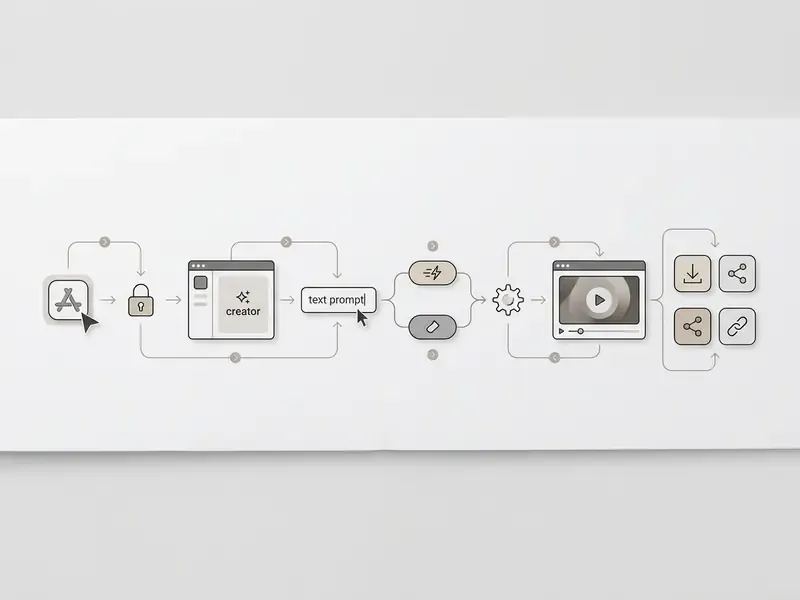
Generating synthetic clips via bing video creator ai follows a standardized input-to-render workflow. Once authenticated inside the bing video creator app, the sequence runs from textual description to downloadable video output.
Figure 2. End-to-end generation pipeline (flow diagram).
Step-by-Step Generation Protocol
https://blogs.bing.com/search/June-2025/Introducing-Bing-Video-Creator
Once the MP4 sits on local storage, standard post-production applies: trim, stack several 5-second clips into a longer sequence, add a voice track, compress for delivery. Useful adjacent references include our guides to free video editing software, AI voice generators for narration, and video compressors for platform-specific file size targets.
Field case (illustrative, regional banking institution). A regional bank wanted to evaluate generative video tools for internal employee training prototypes. The model risk team built an isolated sandbox using personal Microsoft test accounts to benchmark Bing Video Creator. Over two weeks, they measured prompt fidelity, generation latency, and output safety filters across 50 standardized prompts. Visual quality scored well. The absence of administrative logging and audit trails, however, made the consumer tool unsuitable for direct operational deployment without secondary governance controls.
To estimate computing resource costs across generative media initiatives, teams can use our interactive AI Media Calculators.
7. What the Bing Video Creator App Interface Looks Like
The bing video creator app interface is built for mobile speed, minimizing configuration in favour of prompt-driven output.
Key visual elements include:
- Prompt input field A primary text box at the top of the interface supporting detailed multi-sentence inputs.
- Customize panel A settings icon exposing aspect ratio, duration, and generation speed. In the current build, aspect ratio and duration are locked; only speed is user-selectable.
- Generation speed selector A toggle between Standard (free) and Fast (Rewards-backed) render queues.
- Creation status monitor A display area showing queued, processing, or completed renders. Three jobs process concurrently, no more.
- "My Creations" gallery A persistent grid of outputs generated within the last 90 days.
- Integrated player A simplified playback window with looping previews, direct MP4 downloads, and system share sheets. For post-processing the downloaded file, see our comparison of free video editing software.
For teams assembling motion-graphic sequences from multiple 5-second fragments, our overview of animation makers covers export chains and template-based assembly.
8. Why Your Video May Fail on the First Attempt
Generative failures or processing delays in bing video creator usually come from three structural constraints:
- Content moderation blocksMicrosoft applies strict SafeSearch filters to input prompts. Prompts containing disallowed terms, violence, explicit imagery, real public figures, or trademarked characters trigger automated policy rejections (Microsoft Safety and Security Terms, 2026). Named-person and brand prompts are pre-moderated aggressively. That is a deliberate impersonation control, not a bug.
- Queue capacity exhaustionThe platform enforces a hard concurrency limit of three active generations. Submitting a fourth prompt while three jobs run produces immediate queuing errors. Microsoft Q&A threads document exactly this rejection pattern.
- Backend latency and server loadStandard-speed generations rely on unreserved compute. Under peak load, free standard queues can show long delays, "try again later" errors, or session timeouts. Changing session state or simply waiting usually clears the condition.
Why the moderation layer is this aggressive: the impersonation risk
Realistic video synthesis carries identity-impersonation exposure by default. As Matt Psencik, director of security and product design research at Horizon3.ai, told CNET:
«As AI-generated video becomes nearly indistinguishable from reality, it's only a matter of time before these tools are regularly weaponized to impersonate real people at scale.»
Psencik also notes that recent model generations are "beginning to erase the line between 'clearly AI-generated' and 'convincingly real'" in object permanence, realistic physics, and visual fidelity. That trajectory explains both Microsoft's hard pre-moderation of names and brands and its decision to attach C2PA provenance credentials to every output. For compliance functions, the takeaway is blunt: prompt rejections are a control, and visual plausibility is not evidence of authenticity.
9. Is Bing Video Creator Free or Paid: Cost, Rewards, and Limits
A critical governance question is the true cost model behind bing video creator free usage. Microsoft runs a freemium framework that combines unbilled standard access with a point-based priority tier (Microsoft Bing Blog, 2025). For category-level context on credit ceilings and export restrictions across comparable tools, see our reference on free AI video generators.
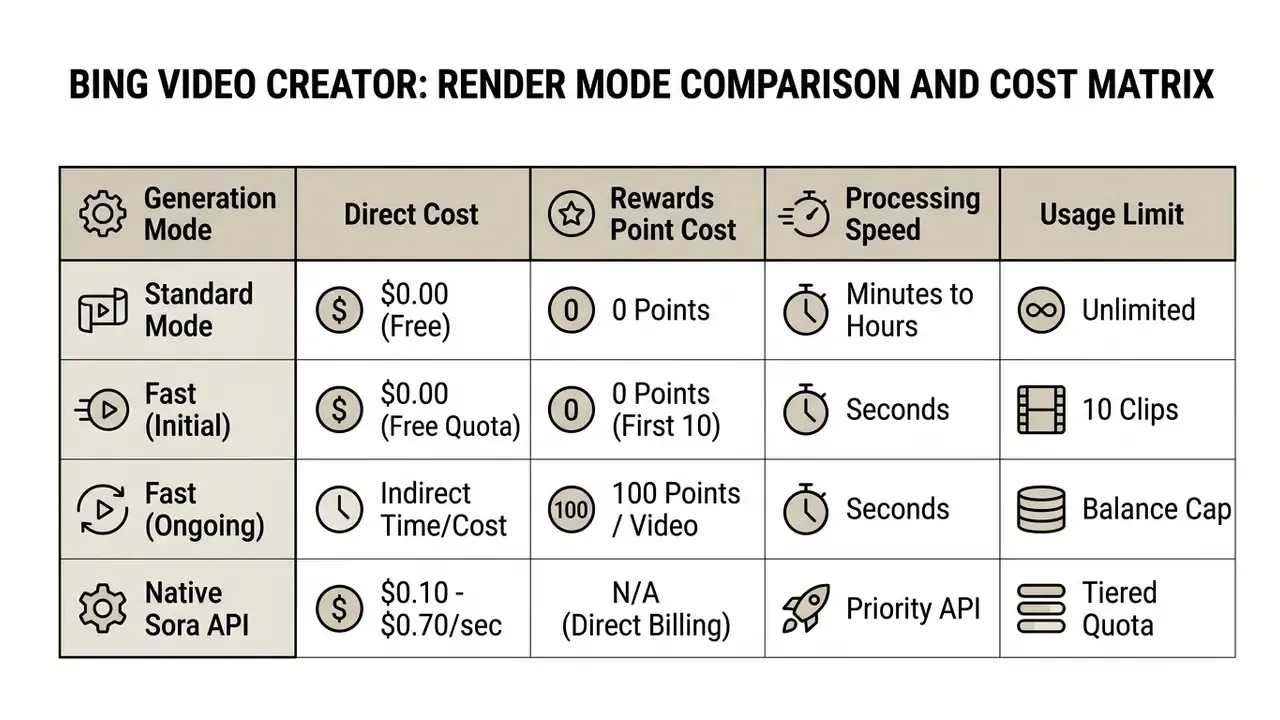
Under this architecture, bing video creator cost is zero for standard generation. On initial sign-in, users receive 10 free Fast creations. Once that quota is spent, fast processing requires redeeming 100 Microsoft Rewards points per clip. If the point balance empties, the system falls back to Standard mode without interrupting access (Microsoft Bing Blog, 2025).
One nuance worth flagging: Microsoft's product page says the Fast point cost may vary by video settings, while the June 2025 launch blog states a flat 100 points per Fast creation. Treat 100 points as the working baseline, then verify the displayed cost in-app before confirming a render.
To analyze financial trade-offs across commercial creative platforms, see our comprehensive AI Media Pricing Guides.
10. How Microsoft Rewards Points Work for Video Generation
Microsoft Rewards is an engagement-based loyalty program that converts search activity into computational priority.
Users accumulate points through daily activity across Microsoft services:
- Running desktop and mobile searches on Microsoft Bing (Level 1 accounts earn for up to 10 searches daily; Level 2 up to 30).
- Purchasing products or services through the Microsoft Store.
- Using the Edge browser and taskbar web search.
- Completing daily quizzes, promotional challenges, trivia, and Xbox quests (Microsoft Support, 2026).
Inside Bing Video Creator, redeeming 100 Rewards points upgrades a clip from the standard unreserved queue to the Fast pipeline. Enabling Rewards spending authorizes deduction from the balance each time Fast creation runs, until the user reverts to Standard or the balance empties.
The concrete Rewards arithmetic (how to keep generating free Fast clips)
This mechanic creates an "attention pricing" model where compute is subsidized by search engagement rather than subscription fees. Call it a gamified loyalty loop: Microsoft converts search sessions into GPU priority. For casual users, accumulating points daily is trivial. For teams needing dozens of renders per day, the model breaks down fast, and paid alternatives become cheaper once you price staff time honestly. Compare monetization structures of rival services in our comparison of free AI video generators.
11. Capabilities and Limitations of Bing Video Creator
Evaluating bing video creator features requires auditing both platform controls and model-level visual behaviour.
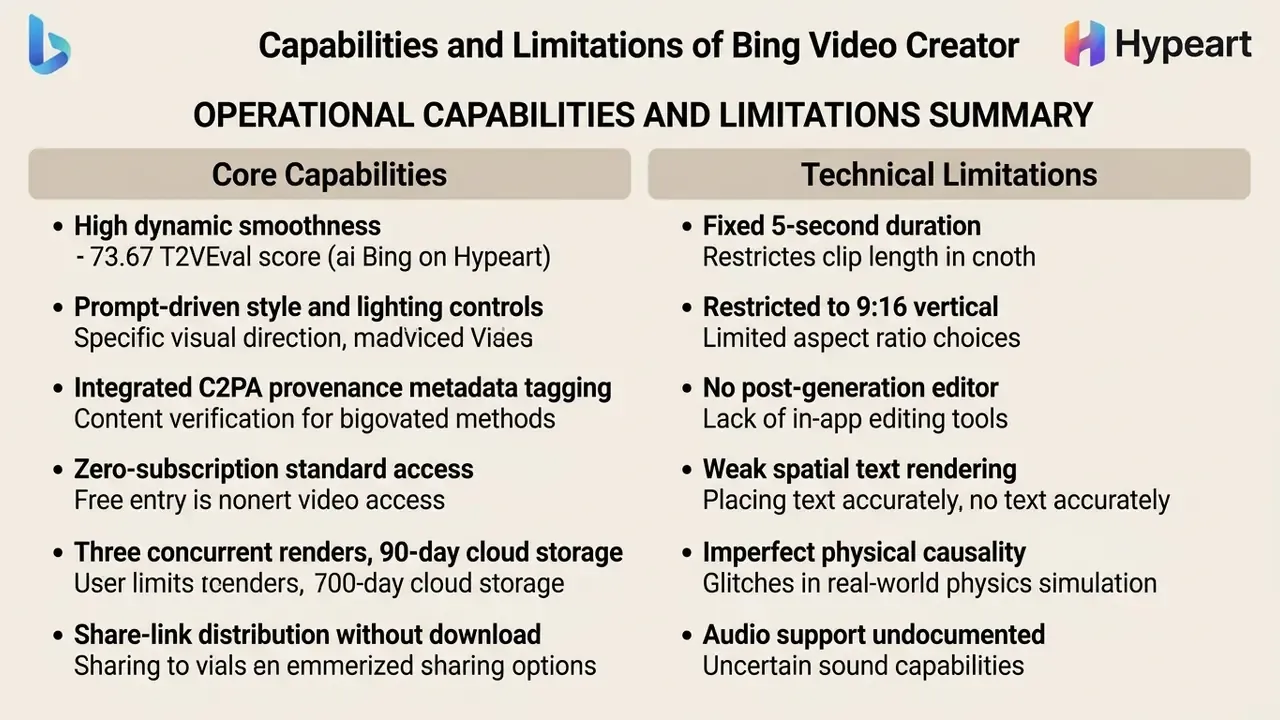
Outputs from Bing Video Creator carry C2PA (Coalition for Content Provenance and Authenticity) credentials. This cryptographic metadata embeds provenance tags into generated MP4 files, identifying the content as synthetically generated (Microsoft Bing Blog, 2025; corroborated by PCMag, June 5, 2025). Note the discrepancy worth documenting in any internal assessment: Microsoft documents C2PA content credentials, while at least one independent 2026 hands-on test reported no visible watermark on the downloaded file. Provenance therefore lives in metadata, not in a burned-in overlay, and metadata can be stripped by re-encoding. Which is exactly why a compliance review should never rely on the watermark alone as a detection control.
On audio, the picture is genuinely unsettled. Third-party launch testing (WebNots, Dirox) reported silent output, and Microsoft's launch materials do not specify an audio track. Where ambient audio does appear, synchronization remains a known weakness across the model class:
«BRITE is the first T2V benchmark measuring audio correctness and audio-visual synchronization: footsteps, impacts and other sounds frequently fail to align with the visual action.»
Field case (illustrative, fintech marketing group). A fintech marketing team wanted short video teasers for social outreach and ran a pilot testing Bing Video Creator against competing text-to-video products. With rigid prompt structures, they produced 20 promotional clips in two days at zero direct compute cost. Legal review then found that the lack of explicit commercial indemnification in consumer Bing terms ruled out using the clips in paid ad campaigns. The team migrated the visual concepts to enterprise-licensed pipelines and kept the pilot assets for internal storyboarding only.
Creative teams building a broader synthetic media stack can cross-reference our overview of Microsoft AI Image Generator for the still-image equivalent of these licensing constraints.
12. Which Video Elements You Can Control Through the Prompt
Text prompts are the primary control mechanism in Bing Video Creator. Drawing on the HunyuanVideo-1.5 Handbook (2025) and vendor prompt engineering standards, prompts reach maximum fidelity when structured across six explicit parameters:
[Subject] + [Action] + [Setting/Environment] + [Camera Movement] + [Lighting] + [Aesthetic Style]
«Detailed prompts with explicit style, lighting and camera-movement modifiers improve model alignment with user intent.»
Recommended Prompt Structure
- Subject and action Define the central entity and its motion ("A metallic drone hovering smoothly...").
- Setting and environment Detail background and environmental conditions ("...over a deserted neon-lit rain-slicked street...").
- Camera angle and movement Specify framing and lens dynamics ("...low-angle tracking shot, slow pan left...").
- Lighting and atmosphere Dictate light sources and mood ("...volumetric blue dusk lighting, intense reflections...").
- Style and medium Define output characteristics ("...photorealistic 35mm film grain, cinematic composition").
- Audio directions (conditional) Where ambient audio is generated, describe it explicitly ("ambient city traffic and soft rain"). Microsoft's launch documentation does not confirm native audio generation and multiple independent tests report silent clips, so plan to add sound in post-production rather than depend on the model.
Microsoft's own guidance matches this schema: be specific, use adjectives, include action, set the scene, add style, mood, and lighting terms.
13. Limitations of a Free AI Video Generator
While bing video creator free access removes the entry barrier, several operational boundaries stay put:
- Duration constraintsClips cannot exceed 5 seconds, which caps narrative depth. Workaround: build each prompt around a single decisive moment, then stitch clips externally.
- Aspect ratio lockOutput is limited to 9:16 vertical, so 16:9 widescreen delivery needs manual cropping or padding.
- Absence of granular editingNo keyframe timeline, motion brushes, or region-specific repainting. Post-processing must happen in dedicated video editing tools.
- Causal hallucinationsAs established in T2VWorldBench (2025), generations may show physical inconsistencies during complex collisions or fluid dynamics.
- On-screen text failureT2VTextBench (2025) is the first benchmark dedicated to on-screen text accuracy in text-to-video models; all evaluated models showed substantial gaps in legibility and temporal stability. Source: T2VTextBench, arXiv (2025). https://arxiv.org/abs/2501.12037
- Complex prompt degradationHeavily layered prompts get simplified by the model, with finer details silently dropped.
- No administrative telemetryNo usage logs, no seat management, no retention controls. The decisive constraint for regulated environments.
14. How to Write Prompts for High-Quality Bing Video Creator Output
Optimizing prompt engineering for Bing Video Creator means moving from vague natural language requests to specific descriptive parameter sets. Research on automatic prompt adaptation confirms that generative models score higher on alignment when prompts contain structured aesthetic modifier clusters.
«Automatic prompt adaptation via supervised fine-tuning and reinforcement learning outperforms manual prompt engineering on both quality metrics and human preference.»
Practical Prompt Engineering Rules
- Avoid ambiguity Replace generic adjectives like "cool" or "amazing" with concrete terms such as "cinematic lighting," "8k macro shot," or "hyper-detailed photorealism."
- Incorporate motion cues Define temporal progression with action verbs ("drifting," "accelerating," "dissolving," "cascading," "glimmering").
- Constrain scene complexity With only 5 seconds available, one subject and one action beat three of each.
- Iterate deliberately Change one variable per attempt (lighting, then camera, then style) so you can attribute the improvement.
- Specify audio directions where applicable Include explicit sound descriptions ("ambient city traffic noise and soft rain sounds"), while planning for a silent deliverable.
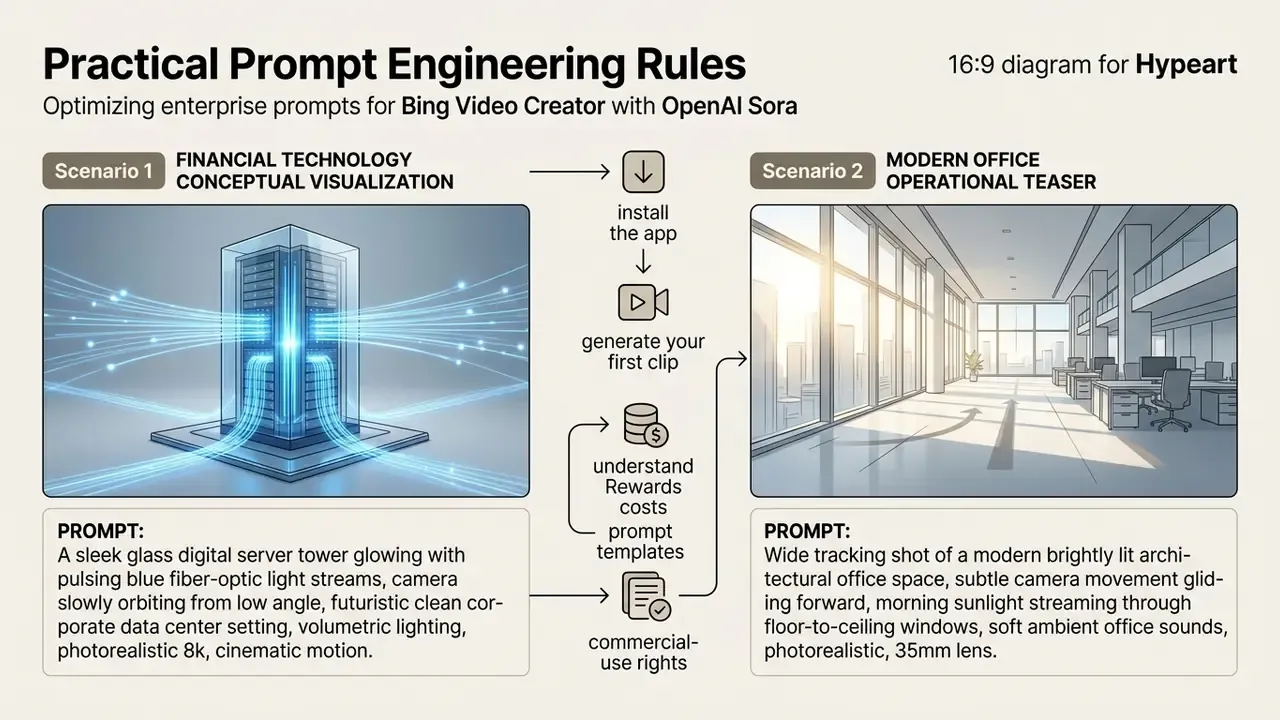
Universal prompt templates for everyday tasks
Enterprise prompts are only half the picture. The templates below cover the highest-volume practical cases. Swap the bracketed variables and keep the parameter order intact.
1. Product showcase
2. Dynamic social content for Reels and TikTok
3. Abstract background loop
4. Nature scene
5. Character-based scene
A clip alone rarely ships. Distribution copy matters too, and the same prompt discipline transfers: an ai headline generator helps draft the hook above the video, while an ai hashtag generator handles platform tagging without guesswork. Narrow-domain generators follow identical licensing logic, whether it is an ai guitar tab generator for music education content, an ai haircut generator, or an ai hairstyle generator for retail visual mock-ups. Different domain, same three questions: who owns the output, who indemnifies it, and where are the logs?
Enterprise teams tracking intellectual property risk and regulatory developments around synthetic content can reference our AI Litigation and Case Timelines and our comparison of AI video generators to pick a tool with the control surface each workflow demands.
15. Is Bing Video Creator Suitable for Commercial Use
Deciding whether Bing Video Creator outputs are fit for commercial deployment means auditing Microsoft's consumer licensing terms against enterprise risk frameworks. For the still-image analogue of the same analysis, see our breakdown of Bing AI commercial-use terms.
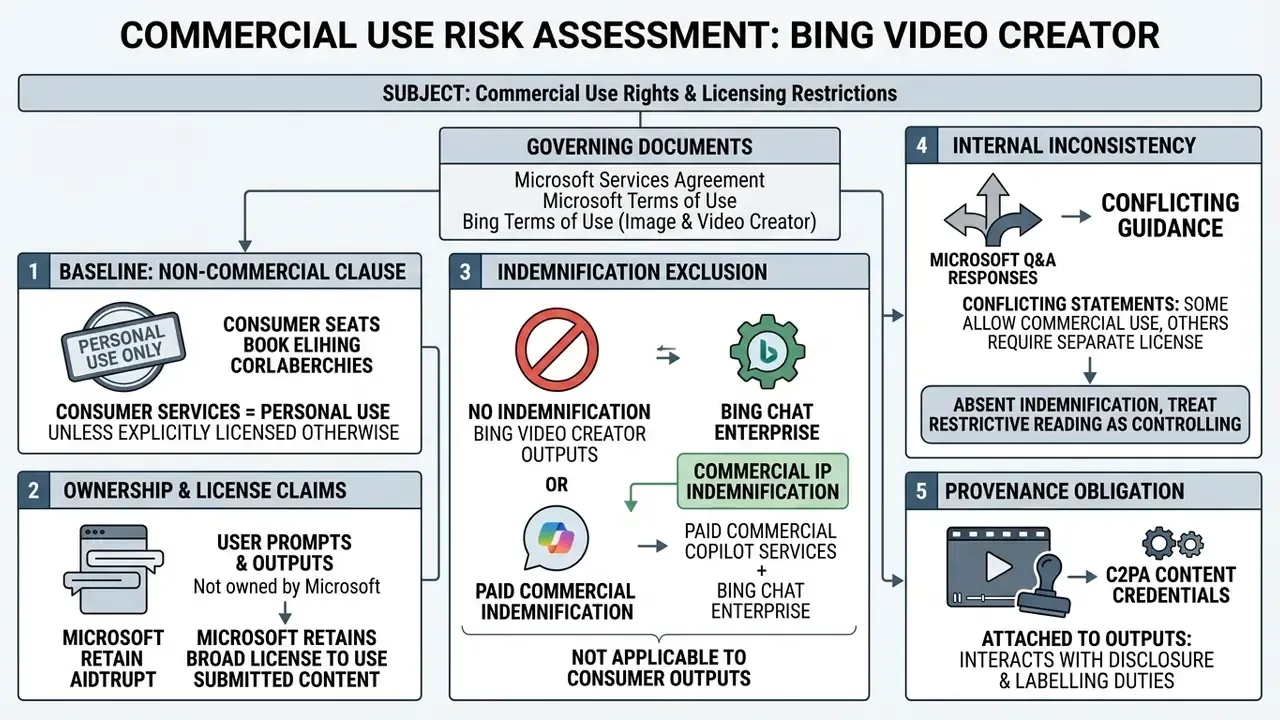
Several third-party guides, including Apidog's FAQ, state plainly that "Microsoft allows commercial use, subject to content guidelines". That assertion is not supported by the consumer terms as written, and it is precisely the kind of secondhand claim that produces downstream legal exposure. Ownership of output is not the same thing as indemnified commercial use. OpenAI's own terms, by contrast, explicitly assign output rights to the user while separately limiting rights over publicly shared video. The distinction matters more than most marketing leads expect.
Commercial Feasibility Assessment
Adoption pressure is real and should be anticipated rather than wished away. Research on user acceptance of Sora specifically found that:


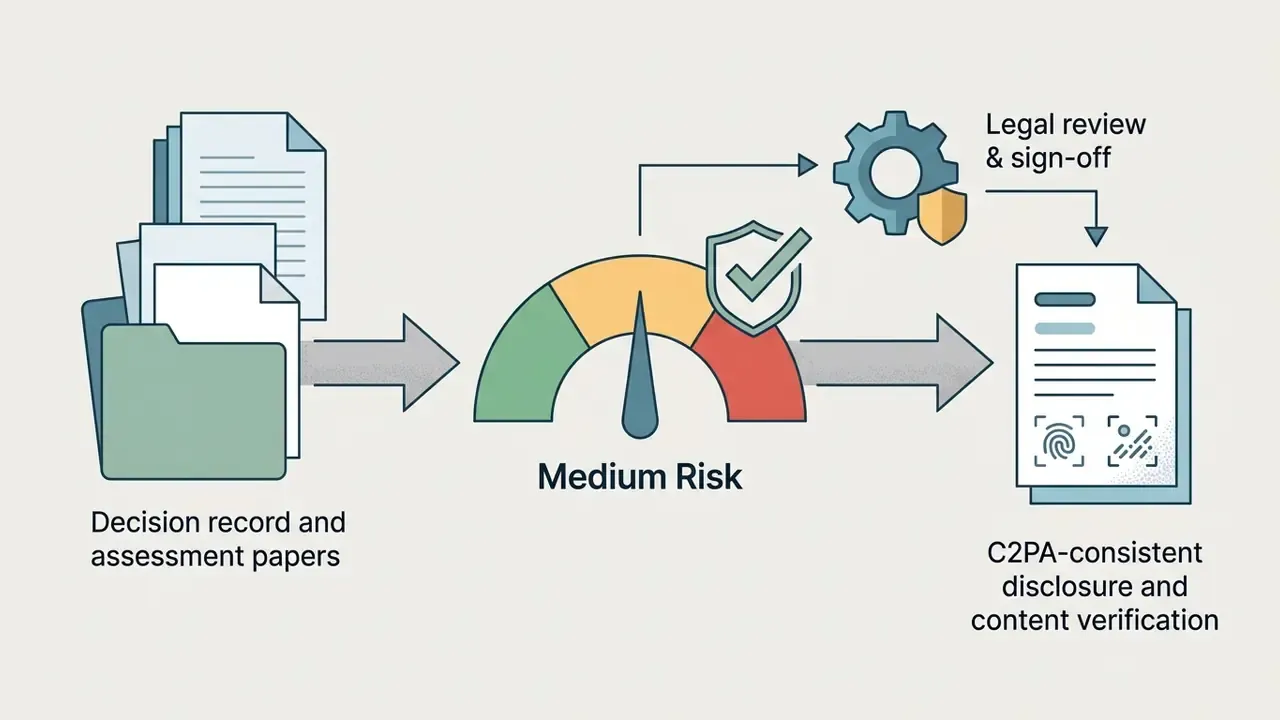

«Perceived realism was the strongest predictor of willingness to use Sora, stronger than novelty or expected usefulness.»
In governance terms: the more convincing the output, the more likely employees will route work through an unmanaged consumer tool. Policy must ship with a sanctioned alternative, or it gets bypassed. Quietly, and quickly.
Field case (illustrative, enterprise risk management framework). An enterprise risk team built a formal vendor assessment framework for marketing AI software. Reviewing consumer generative web tools, they found no enterprise data privacy protection, no logging APIs, and no explicit IP indemnification. To mitigate model risk, the CCO issued a governance directive: consumer AI tools such as Bing Video Creator were restricted to non-commercial conceptual storyboarding, while every customer-facing video asset had to pass through enterprise-contracted generative vendors offering explicit IP indemnity.
To cross-evaluate competitive video and media generation suites against enterprise licensing requirements, explore our detailed AI Media Comparison Matrices.
16. Shadow AI Control Checklist for IT Security Teams
Because Bing Video Creator is gated behind a personal Microsoft Account rather than Entra ID, it is structurally a Shadow AI vector. It runs outside tenant policy, outside DLP inspection, outside audit logging. The controls below close the most common gaps.
- Block or monitor consumer MSA sign-in on managed devices.Enforce tenant restriction policies so managed endpoints cannot authenticate to consumer Microsoft services with personal accounts.
- Inventory the Bing mobile app in MDM.Treat
com.microsoft.bingas a managed application on corporate mobile devices, and decide explicitly whether it is permitted, permitted-with-restrictions, or blocked. - Add prompt content to your DLP taxonomy.Prompts are user inputs licensed broadly to the vendor. Classify product names, unreleased roadmap terms, client names, and internal codenames as prohibited prompt content.
- Create a sanctioned sandbox path.Provide a documented, isolated test environment (separate accounts, no production data) so evaluation work does not drift onto unmanaged personal devices.
- Require provenance retention.Mandate that any downloaded MP4 keeps its original C2PA metadata and is stored with prompt text, date, tool version, and requester recorded.
- Log the 90-day expiry into asset management.Any clip intended for reuse must be downloaded and archived internally before Microsoft's retention window closes.
- Define an escalation trigger for external publication.No synthetic clip reaches a customer-facing channel without legal review and a named approver.
- Review quarterly.Model versions, terms, watermarking behaviour, and aspect-ratio support have all changed within a single year. Re-verify assumptions on a fixed cadence.
Owner, limits, evidence, shutdown. Same four questions you would ask of any digital worker.
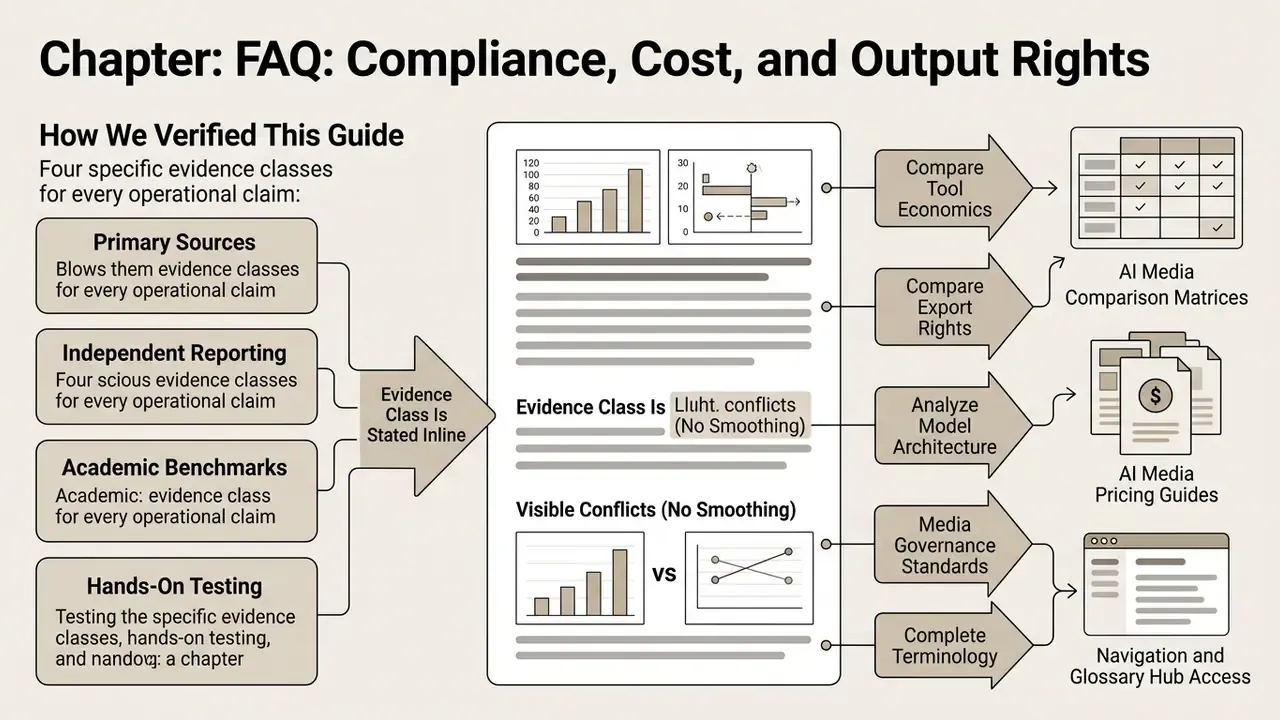
17. FAQ: Compliance, Cost, and Output Rights
Is Bing Video Creator genuinely free?
Yes for Standard-speed generation, which is unmetered. Fast generation is free for the first 10 clips, then costs 100 Microsoft Rewards points each, earned through search activity rather than money.
How many free Fast clips can I realistically produce per day?
About 1.5, using desktop Bing search alone: 5 points per PC search, capped at 150 points per day, at 100 points per Fast render. Mobile searches, quizzes, and Xbox quests raise that ceiling.
How does output quality compare with paid Sora?
The underlying model family is the same, but paid API access permits longer clips (up to 20 seconds), higher resolution (up to 1080p), and multiple aspect ratios. Bing is capped at 5 seconds, 9:16.
Can I use the videos in a paid advertising campaign?
Not safely. Consumer Bing terms carry a personal, non-commercial baseline and offer no IP indemnification. Use enterprise-licensed pipelines for anything customer-facing or paid.
Does Microsoft own my prompts or my videos?
Microsoft does not claim ownership of prompts or creations, but retains a broad license to use submitted content in connection with its businesses. Do not submit confidential material.
How long are my videos stored?
90 days in "My Creations". Download anything you intend to keep.
Can I generate videos featuring real people or copyrighted characters?
No. Pre-moderation rejects prompts naming real individuals, public figures, and trademarked characters.
Do the clips have a visible watermark?
Microsoft documents C2PA content credentials in the file metadata. Independent 2026 testing reported no visible burned-in watermark. Metadata can be stripped by re-encoding, so do not rely on it as a detection control.
Is there audio?
Microsoft's launch documentation does not specify a native audio track, and multiple independent tests reported silent output. Plan to add sound in post-production.
Can I use a corporate Entra ID account?
No. Access requires a personal Microsoft Account (MSA); corporate Entra ID sign-ins are excluded from consumer access.
Is it available everywhere?
Rollout is global with explicit exclusions in China and Russia.
Will longer or horizontal videos arrive?
Microsoft has signalled that 16:9 support and extended durations are on the roadmap. Re-verify before building a workflow dependency on them.
18. Appendix A: Editorial Revision Log
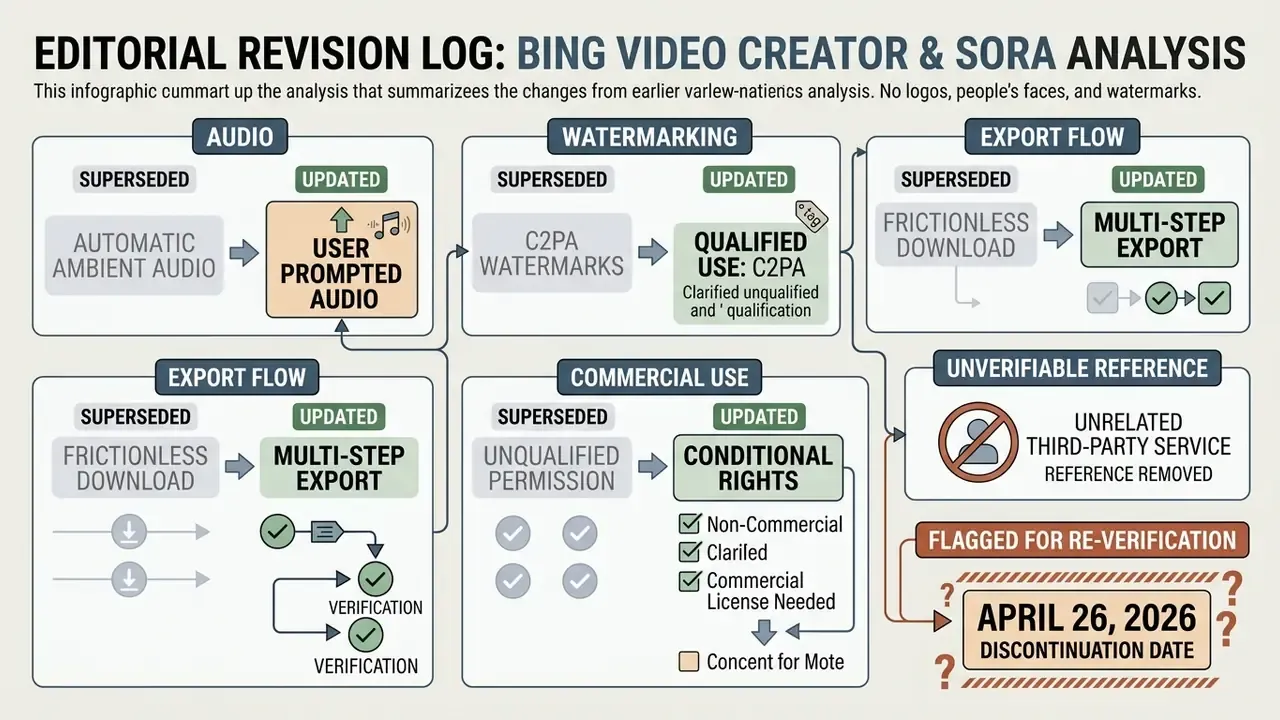
How We Verified This Guide