Remote video editor jobs now cover three very different worlds: salaried in-house studios, part-time agency seats, and freelance contract work sold by the asset. The craft looks the same from the outside. The economics do not. A distributed production team may cut moving images, sync audio, style captions and export platform variants across four time zones before breakfast, and the person doing that work could be a W-2 employee, a monthly retainer contractor, or someone paid $13 per clip.
That gap is the whole reason this guide exists.
«In controlled media production, editorial autonomy still needs asset governance. An editor balances creative execution against platform compliance, delivery windows and a verifiable project scope.»
— Marcus Hale, author
What this guide answers in 60 seconds




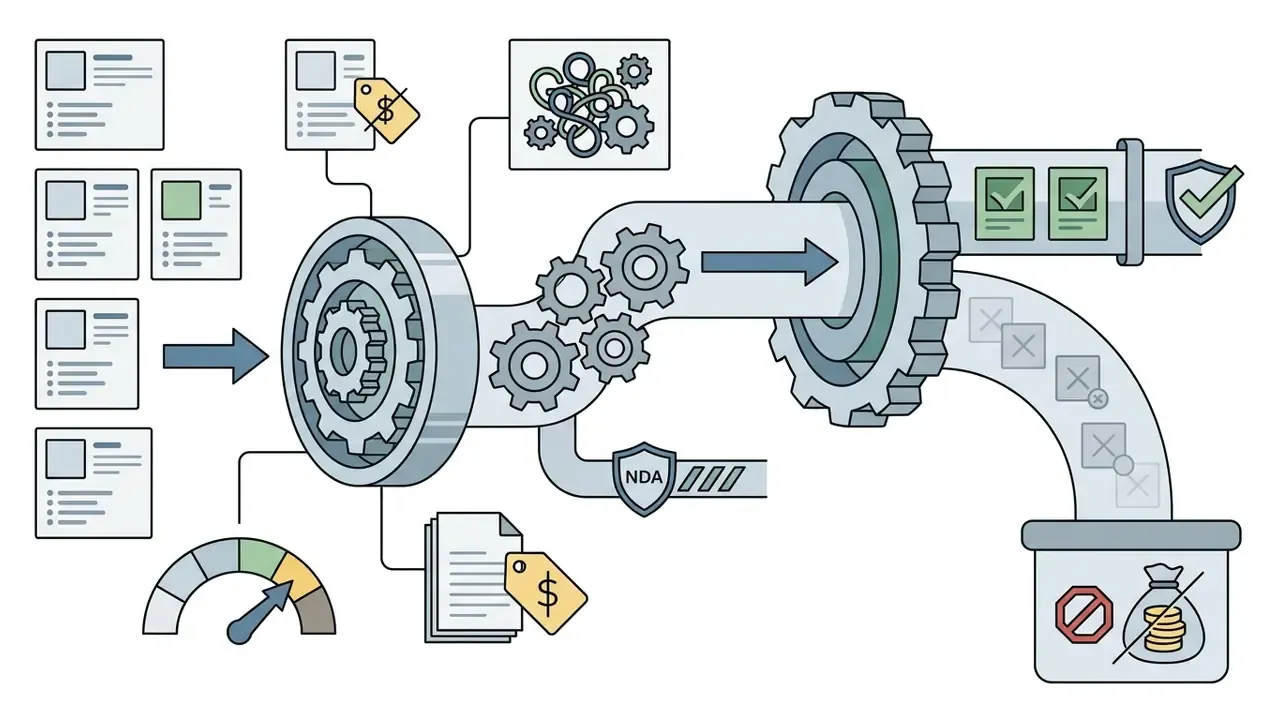
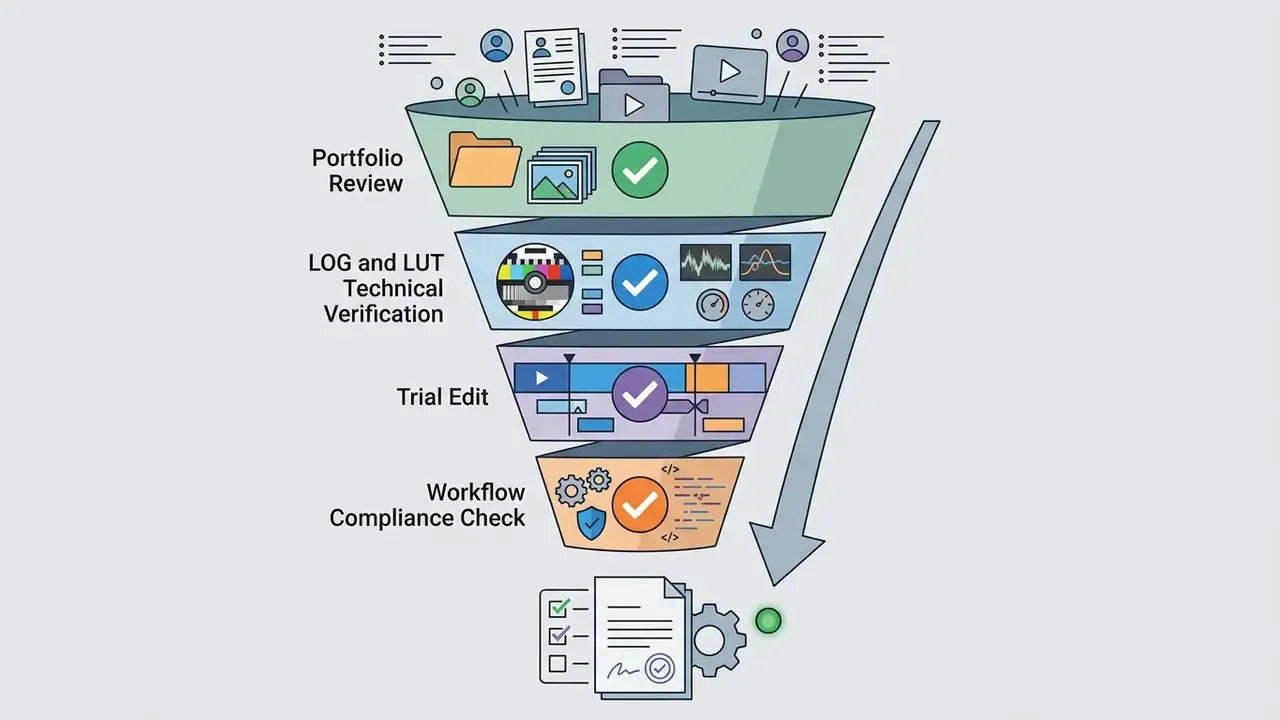

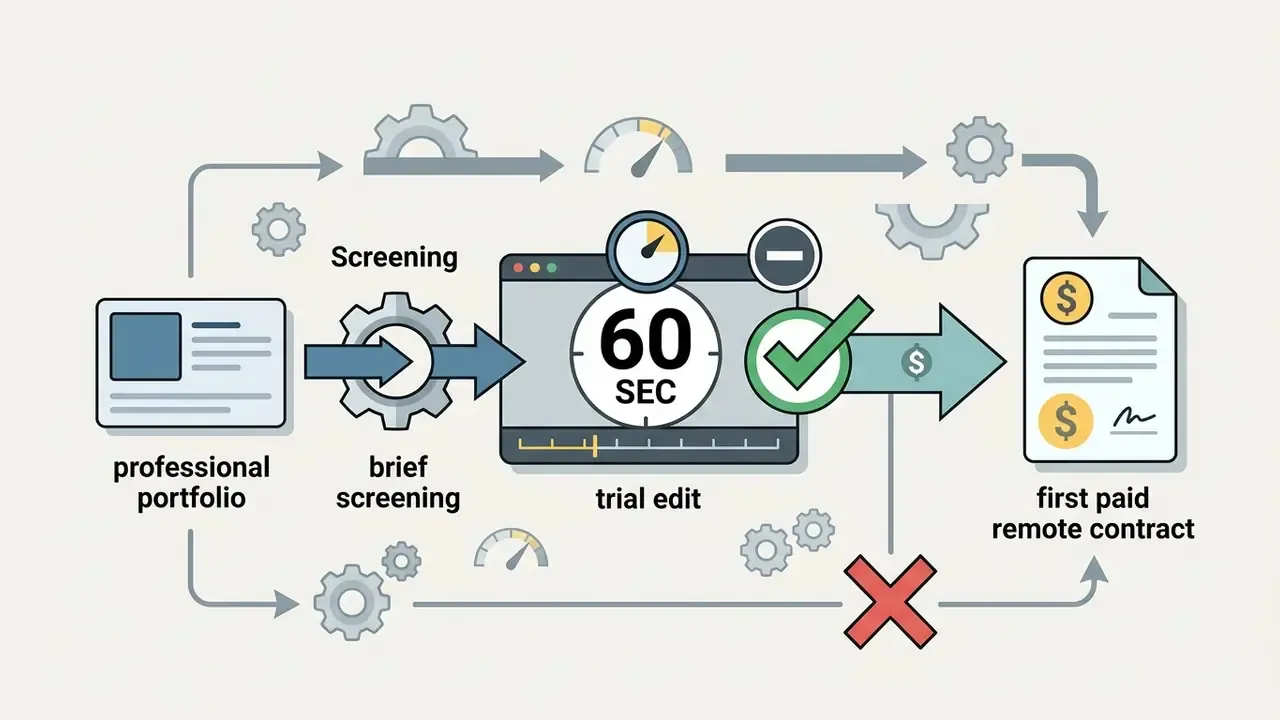
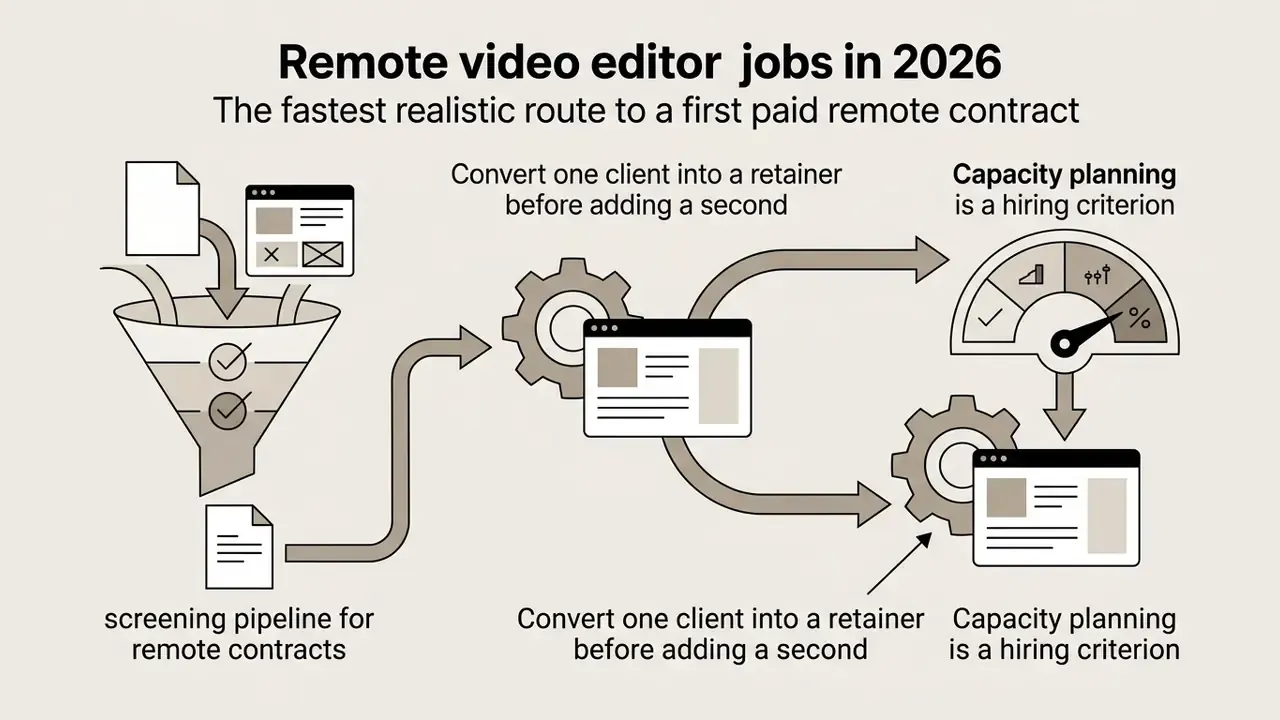
The fastest realistic route to a first paid remote contract
Not a motivational list. Just the sequence that produces callbacks, based on how agency postings actually screen.
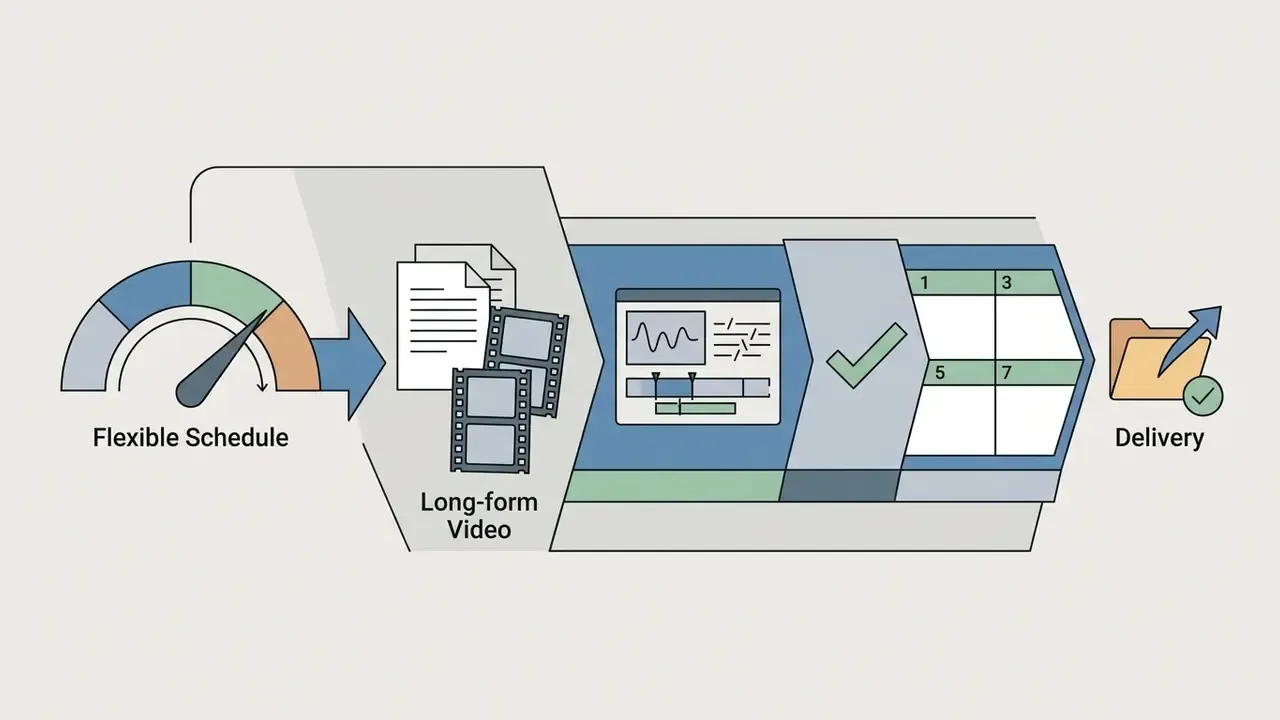
Figure 1, described in text: live remote listings cluster into four bands. Full-time salaried roles dominate enterprise media, streaming and in-house brand studios, with posted ranges observed from $55,000 to $130,000 per year. Part-time and hourly roles cluster between $17 and $50 per hour. Project contracts appear as day rates ($280 per day observed in youth-culture media) or flat monthly retainers (a $6,000 per month hybrid motion graphics contract observed in the market). Freelance gig work covers per-asset and batch pricing, including those $400-per-30-video agency contracts.
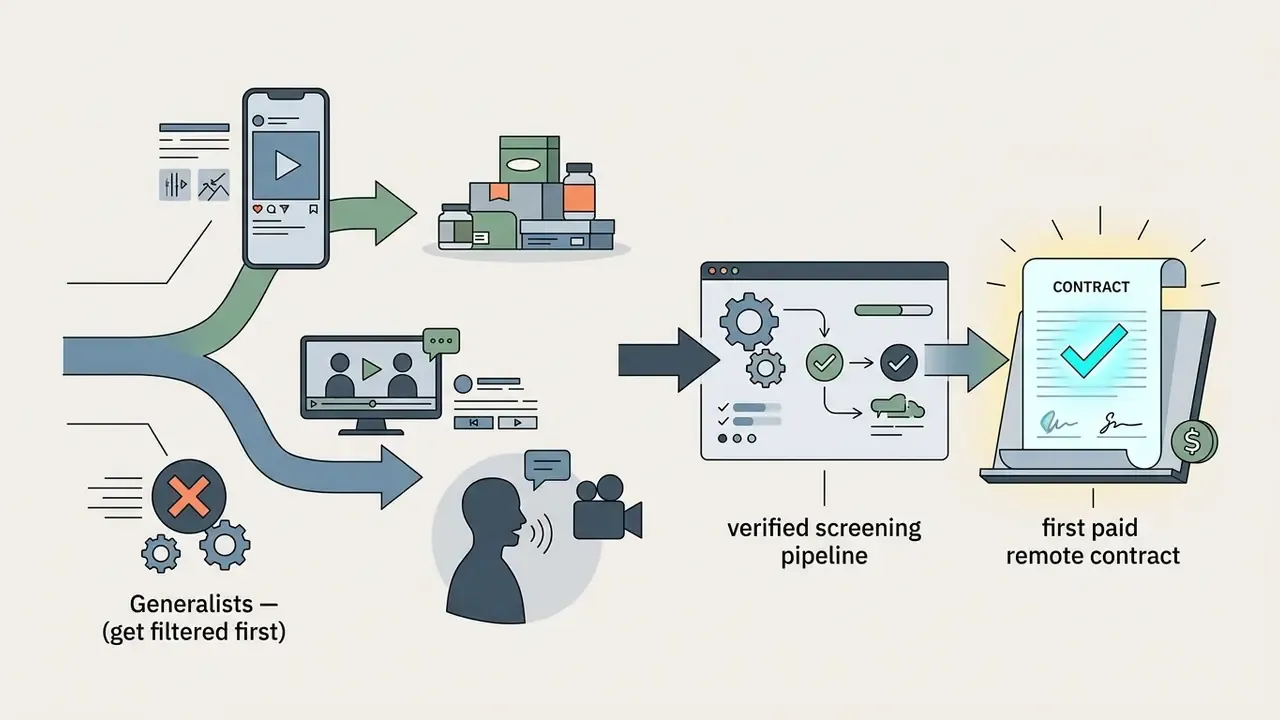



Remote video editor jobs: roles, formats and video content
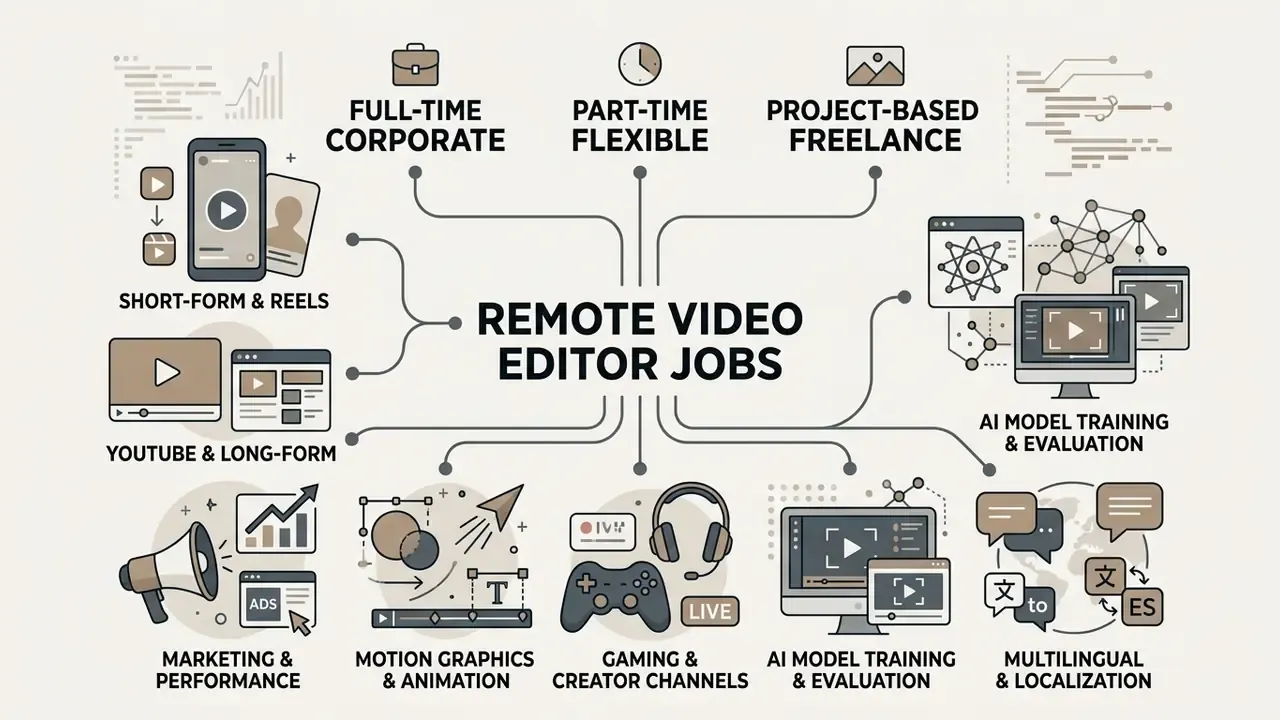
Remote video editor jobs are built around three primary employment formats: full-time corporate staff positions, part-time schedule-flexible roles, and project-based freelance contracts. The format dictates operational scope, the volume of edited videos you ship, the compensation model, and how much daily autonomy you actually hold.
Full-time roles fold editors into brand, marketing or entertainment post-production pipelines. You manage a continuous video content calendar, follow brand guidelines to the pixel, and coordinate with cross-functional media teams. Part-time positions trade total output for predictable weekly hours, which suits editors running a targeted publishing schedule for one or two channels.
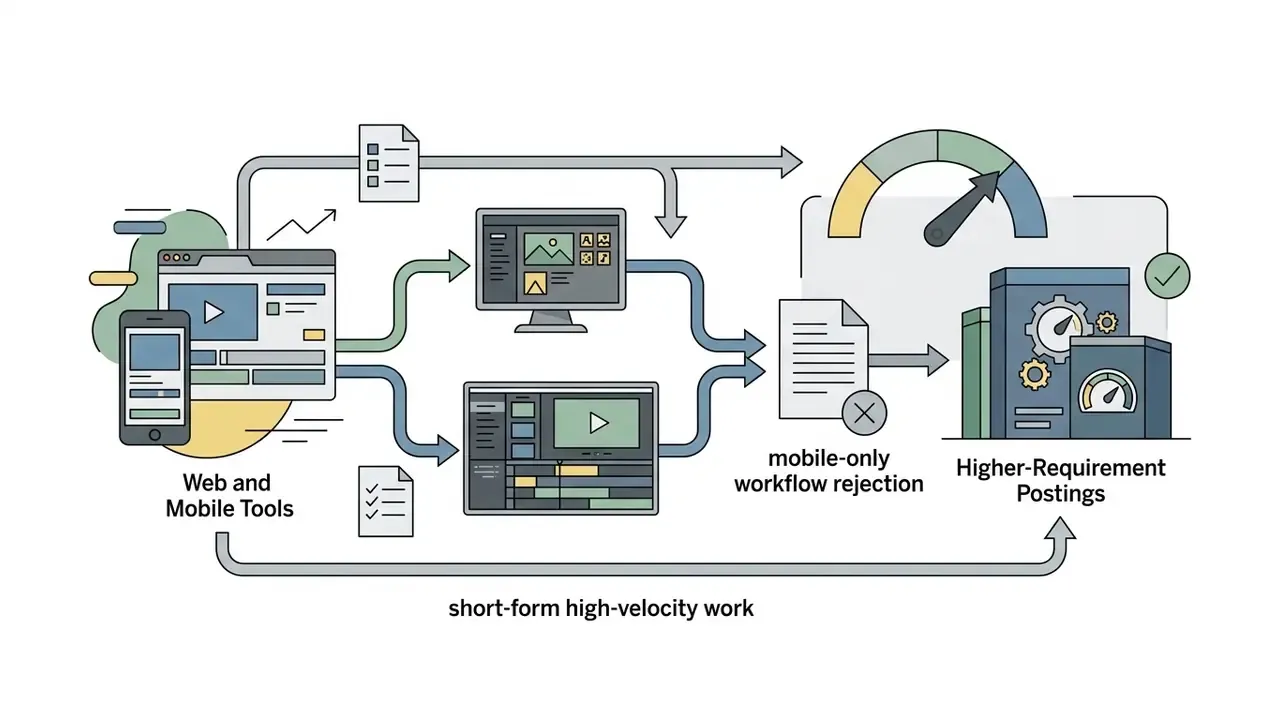
Freelance and contract roles run on deliverables instead of hours. Organizations hire remote video editor talent for campaign assets, short-form social packages, or specialized motion graphics work. Independent contractors keep high operational independence, and carry the full weight of software licensing, hardware, and tax administration. Editors without an employer-funded software budget usually benchmark license costs against the options in our free video editing software comparison and the subscription breakdowns in our AI Media Pricing Guides before committing to a stack.
The distribution of jobs for video editors reflects a dual market. Traditional enterprise production still runs on payroll employment. Digital marketing and social publishers lean hard on contract networks to scale output, because output volume changes month to month.
«Film and video editors: 29,240 employed in the United States, mean annual wage $83,470.»
Demand concentrates in a handful of content specializations. Before choosing a track, review the baseline definitions and video editing tools used in each pipeline:
Table 1. Remote video editor employment formats compared. Task scope, schedule, payment structure and autonomy by contract type.
| Employment Format | Primary Client / Employer | Task Scope and Output | Schedule and Availability | Payment Structure | Autonomy Level |
|---|---|---|---|---|---|
| Full-Time Remote | Enterprise brands, streaming media, agencies | Continuous pipeline: brand campaigns, series, recurring social assets | Fixed business hours (35+ hrs/week), core meeting availability required | Annual salary with benefits package | Moderate, constrained by corporate approval tiers |
| Part-Time Remote | Mid-sized agencies, boutique studios, creators | Defined weekly asset count, specific channel management | Fixed weekly hour cap (under 35 hrs/week) | Hourly rate or pro-rated monthly salary | Moderate to high, deliverable-focused schedule |
| Contract (Project-Based) | Corporate marketing teams, production houses | Specific project scope: corporate videos, campaign assets | Flexible hours bound by strict milestone deadlines | Fixed project fee, day rate, or milestone payments | High, contractor controls method, manner and means of work |
| Freelance Gig Work | Global clients via digital platforms, direct clients | Ad-hoc edits, short clips, batch short-form packages | Self-determined schedule, asynchronous delivery | Hourly rate, per-asset fee, batch contract, or platform escrow | Very high, governed by client SLAs and ratings |
Read that table as a trade-off curve rather than a ranking. Salaried roles buy stability with approval layers. Batch freelance work buys freedom with volume risk. Part-time retainers sit in between and, in practice, are where most editors first build predictable monthly income.
Companies hiring remote video editors and job openings
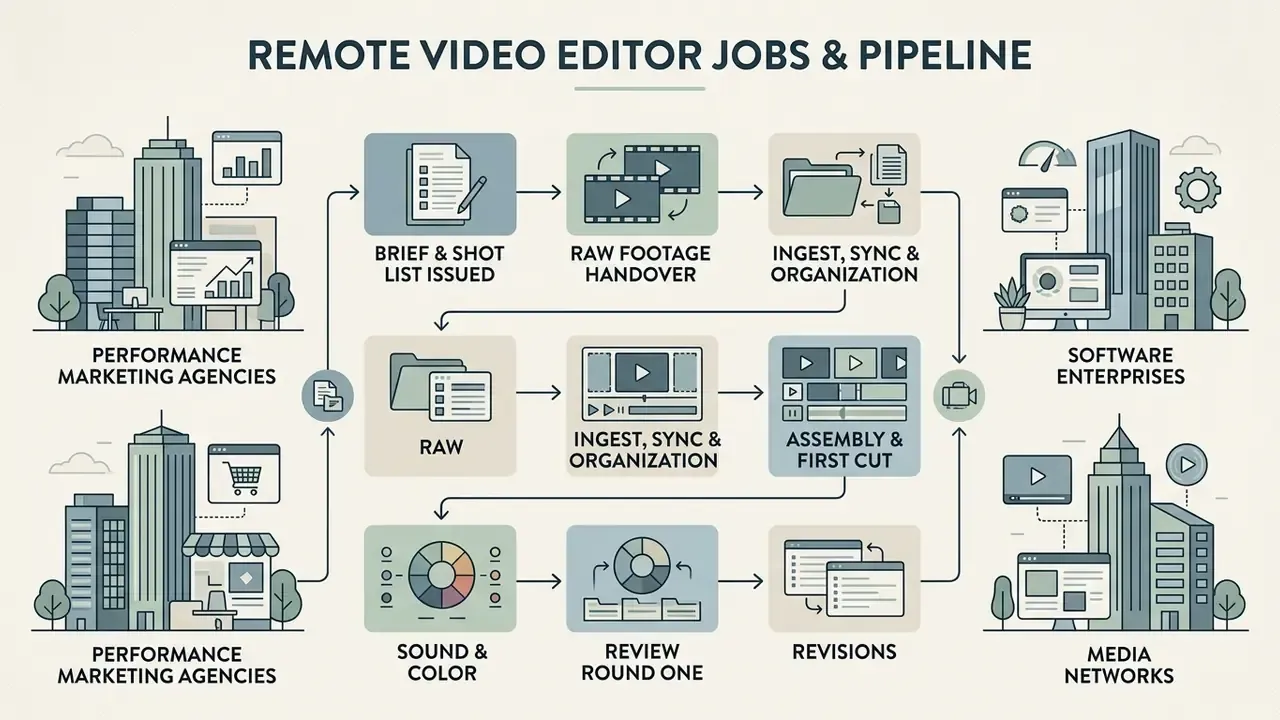
Companies hiring remote video editors range from performance marketing agencies and e-commerce brands to software enterprises and media networks. These organizations publish remote video editor job listings on specialized career portals, industry boards, and their own talent hubs. The direct company page almost always carries the best signal.
Hiring activity concentrates in four commercial sectors:
- Performance marketing and ad agencies. High-volume openings for editors who can produce direct-response ad variations for social platforms. Observed examples include social-first agency networks recruiting "algorithm-fluent performance editors," VSL editors hired for eCommerce and DTC brands, and content agencies contracting freelancers for Reels and event recaps for local businesses.
- Media networks and streaming platforms. Enterprise publishers list senior editor and post-production roles for long-form originals and episodic series. Examples: podcast and social video producers hired at $81,000 to $105,000 per year in digital media, contract editors paid a $280 day rate at youth-culture publishers, and defense or news YouTube channel editors inside larger media groups.
- Software and tech enterprises. Technology firms recruit editors for product demos, customer case studies and internal communications. Observed listings include B2B SaaS fleet-technology brands hiring a combined "Video Editor / Motion Designer," professional-services software companies hiring senior video producers to own end-to-end production, and AI research marketplaces hiring editors who also evaluate AI editing tools. Product-demo work often pairs editing with UI presentation, so an ai mockup generator becomes part of the daily kit.
- Creator and digital media brands. High-growth channels and DTC brands post dedicated YouTube and short-form editor roles to run daily publishing. Observed: seafood and food-and-beverage brands building long-form channels at $125,000 to $130,000 per year, supplement and wellness brands hiring short-form ad editors, pet-health brands hiring Spanish-language localization producers, and founder-led podcast channels above 450k subscribers.
One quiet detail worth noticing: brand-side listings increasingly ask editors to internalize positioning language, not just visual style. When a brief arrives without a clear voice document, editors sometimes reconstruct one from public materials, the same way teams draft positioning with an ai mission statement generator before writing hooks. Rough, but it beats guessing.
How assets move through a remote post-production pipeline
Figure 2, described step by step:
- Brief and shot list issued.The creative director or channel owner sends the campaign brief, shot list, brand guidelines, caption style guide and reference edits before any footage exists.
- Raw footage handover.Files arrive through Google Drive, Dropbox, Frame.io, or an enterprise S3 bucket. The editor confirms receipt. SLAs typically begin at confirmed receipt of footage and approved brief, not at contract signature.
- Ingest, sync and organization.Multi-camera sync, audio alignment, proxy generation, bin structure. Folder naming conventions get agreed here, not later.
- Assembly and first cut.Narrative or hook-first assembly, pacing, B-roll integration, caption styling.
- Sound and color.Dialogue cleanup and leveling, SFX and music integration, then LOG or flat footage grading and LUT application to a brand-consistent Rec.709 output. Scratch music beds are sometimes generated in-house, occasionally with an ai midi generator, and replaced with licensed tracks before final delivery.
- Review round one.Client feedback delivered through a time-coded review tool inside a defined window, commonly 1 to 3 business days.
- Revisions.Contracted rounds executed, usually 24 to 48 hours per round.
- Delivery and archive.Platform-specific exports (9:16, 1:1, 16:9), labeled folder handover, project file transfer where contracted, archive of source media.
- Payment trigger.Invoice issued at approved delivery or per contracted milestone.
Evaluating remote video editor job openings means verifying operational parameters before you submit anything. Does the posting name a software stack? Does it define delivery expectations and a compensation range? Reviewing workflow guidance such as our YouTube video editor workflows guide gives useful context on how client content pipelines are actually run, and our AI Media Support and Troubleshooting hub covers the export, render and codec failures that tend to blow up a first delivery.
How to search remote video editor job listings by role and location
Finding targeted remote video editor job openings requires structured query logic and disciplined location filtering. Generic keyword searches return noise unless refined by exact role titles and regional parameters. Anyone searching "online jobs video editing" already knows this.
Where the listings actually live. Coverage differs sharply by platform type, so a serious search runs at least three categories in parallel:
| Platform category | Representative destinations | What it is best for |
|---|---|---|
| General professional networks | LinkedIn, Indeed, SimplyHired | Volume, full-time and part-time W-2 roles, quick-apply agency contracts |
| Remote-specific aggregators | Working Nomads, remote boards with ghost-score filters, Dynamite Jobs | Worldwide and location-flexible roles, many never cross-posted to LinkedIn |
| Production and entertainment boards | ProductionHUB, EntertainmentCareers | Post-production, broadcast, episodic and studio-adjacent contracts |
| Creative portfolio marketplaces | Behance, Working Not Working, Twine | Inbound work from art directors and creative agencies |
| Freelance marketplaces | Upwork (including enterprise talent clouds), Fiverr Pro, Contra | Per-asset gigs, escrow protection, retainer conversion |
| Direct employer channels | Corporate careers pages, agency "work with us" pages | Highest signal on pay, benefits and genuine hiring intent |
To filter results effectively:
- Target specific role titles. Search exact professional titles: Senior Video Editor, Motion Graphics Designer, Video Producer, Short-Form Video Specialist, VSL Editor, Performance Video Editor. Generic terms bury the good listings.
- Apply geographic filters. Constrain by United States, by state (California, New York, Texas), or by Worldwide Remote. On federal portals, the location field accepts city, county, state, ZIP code, country or "remote," multiple locations stack, and the default city radius is 25 miles.
- Filter by employment classification. Toggle Full-Time, Part-Time or Contract to match your schedule and tax situation.
- Set a minimum salary floor. One filter, and a large share of unfunded speculative postings disappears.
- Search descriptions, not just titles. Plenty of editing roles are titled "Content Creator," "Veditor" or "Motion Designer." Description-level search surfaces them.
Platform location settings genuinely affect visibility. Federal and corporate portals distinguish site-specific telework from fully remote positions, and state-level remote filters keep you inside compliant tax and legal territory. It helps to compare submission pipelines across platforms so your application tracking does not fragment across six inboxes.
Detecting ghost jobs in remote video editing listings
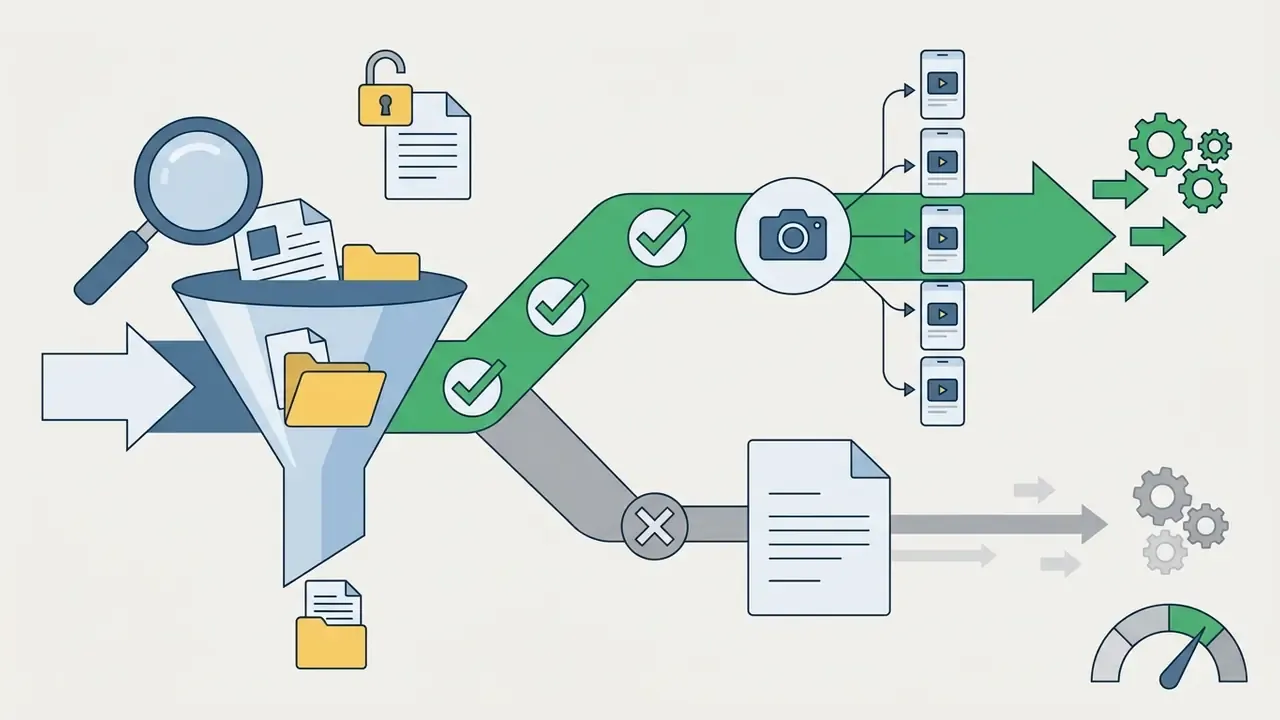
A meaningful share of aggregated remote editing postings stays open without any active hiring. Some remote boards now publish an explicit "ghost score," calculated from listing age, repost frequency, open roles versus team size, how quickly roles close, and whether pay is disclosed. Scores above 60% get flagged as probable ghosts. Before you spend three hours on a tailored submission, run the listing through this audit:
- Listing age above 30 days with no repost updates. Signals an abandoned or already-filled pipeline. On production boards, the "30+ days ago" tag is the single most common marker of stale inventory.
- Missing pay transparency. Postings that omit an hourly or project range carry a materially higher probability of being passive talent-pool collection or market research rather than a funded requisition.
- Unusually broad scope. One junior role demanding Premiere Pro, After Effects, 3D animation, copywriting, media buying and analytics usually means an automated HR template, or an agency fishing for a unicorn.
- High repost frequency against a small team. Companies under 20 employees continuously refreshing the same senior editor listing tend to accumulate portfolios without allocated budget.
- Duplicate listings for one brand. Six near-identical postings for the same short-form ad role, published the same day, reflect aggregator duplication rather than six open seats.
- No named hiring contact and no company page. Legitimate agency contracts almost always name a creative director or producer by the screening stage.
How to act on a high ghost score: do not skip the listing entirely. Send a lightweight application, a portfolio link plus two lines, and never invest in a custom unpaid test edit until a named human has scheduled a call.
Freelance remote video editor jobs and work from home projects
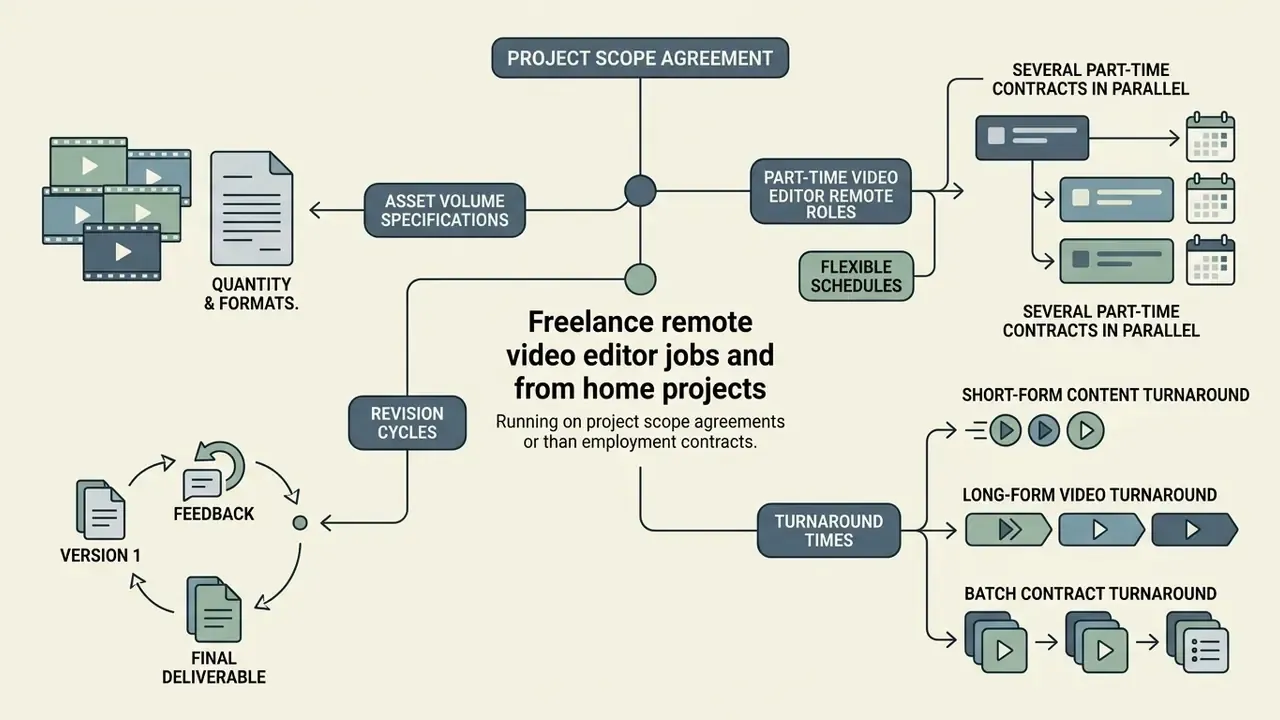
Freelance remote video editor jobs run on project scope agreements, not employment contracts. Independent editors execute defined work-from-home assignments: asset ingestion, narrative assembly, color correction, platform delivery. The scope document is the job.
Scoping differs sharply between short-form campaigns and long-form productions. Short-form freelance projects prioritize hook execution, vertical 9:16 framing, visual engagement and sound-off captions. Editors on YouTube or corporate projects focus on narrative continuity, multi-camera sync, audio leveling and metadata-ready exports. Mixing the two in one pricing model is how margins quietly vanish.
International labor research gives useful scale context for anyone weighing a freelance video editor job against payroll work:
«Online gig work represents 4.4 to 12.5 percent of the global labor force, roughly 154 to 435 million people across 545 online platforms.»
«Creative and multimedia tasks account for roughly 17 percent of vacancies on major online platforms, while demand for gig work rose 41 percent between 2016 and 2023.» — World Bank, Online Labour Index analysis in Working Without Borders (2023). https://www.worldbank.org/en/topic/jobsanddevelopment/publication/working-without-borders-the-promise-and-peril-of-online-gig-work
When evaluating freelance video editor jobs remote, audit the brief for these risk factors:
- Defined revision cycles. Contract templates for editing work usually specify a first-cut date, a client feedback window and a final delivery date. The number of included revision rounds must be written in, never assumed. Postings that promise "a clear revision process, no endless back and forth" are signalling a capped-round model.
- Established feedback turnaround windows, commonly 1 to 3 business days for client reviews in template agreements.
- Clear IP transfer terms on final payment, plus explicit permission to reuse non-confidential work in a public reel.
- Batch economics. If the brief is a package, say 30 clips per contract, divide the fee by asset count and by realistic hours per asset before you accept.
Estimate remote project scope the way agencies do it: break the job into tasks and subtasks, assign hours per task, then price direct costs separately (stock licensing, music, voiceover). Teams generating temporary assets during storyboarding often speed that phase up with a scratch voice pass from an AI voice generator before final VO is recorded. If you would rather not do the arithmetic by hand, our AI Media Calculators cover per-asset and effective hourly math for exactly this situation.
One more thing that sounds small and is not: the social copy shipped alongside each cut. Many short-form contracts now bundle caption text and platform descriptions into the editing deliverable, and editors draft first versions with an ai message generator before human polish. Price that work, or it becomes free labour.
«Project success in freelance remote editing depends on the initial scope boundaries. Unclear revision limits turn profitable contracts into margin losses.»
— Industry operations analysis, editorial review 2026
Part-time video editor remote roles and flexible schedules
Part-time video editor remote roles offer structured hours while leaving room for other clients or personal commitments. These positions typically cap weekly hours below 35, the statistical threshold separating part-time from full-time employment, and set explicit turnaround expectations for recurring deliverables.
Contractual Service Level Agreements define part-time production velocity:

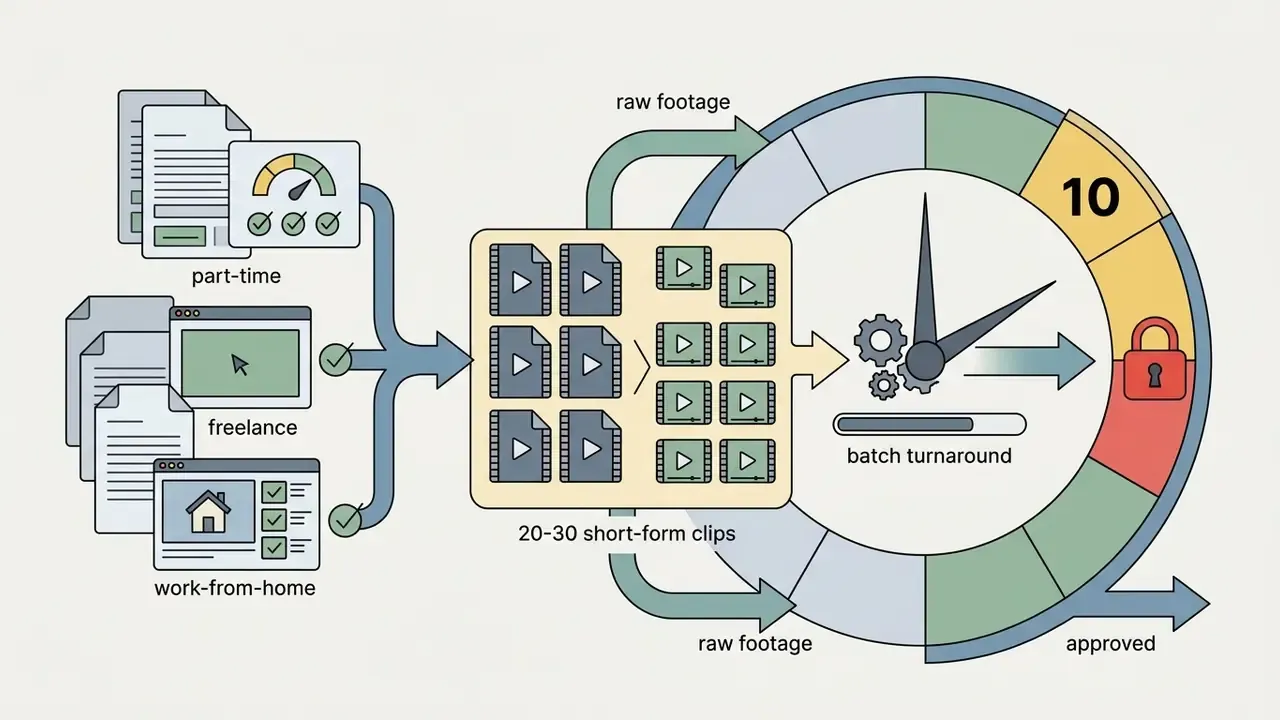

Part-time contracts handle flexibility by tying deadlines to formal footage receipt instead of fixed daily hours, and by naming the time zone plus the approval channel (email or client portal) used for sign-off. Agreements often include expedited service clauses that apply a premium surcharge for rush deliveries outside standard windows. Updated: published freelance video contract templates and rate guides place rush premiums in a wide band, commonly +25% to +50%, and up to +100% for same-day or overnight delivery with a separate expedited SLA. That figure comes from template convention, not from any regulator or wage survey, so confirm the multiplier and its trigger conditions in the signed agreement.
Running several part-time contracts in parallel works when milestones, not hours, are staggered. Put first-cut dates for different clients on different weekdays. Reserve fixed revision blocks. Refuse overlapping batch deadlines. Agency postings explicitly warn that an editor cannot "go dark mid-contract," which makes honest capacity planning a hiring criterion in itself.
Skills and tools employers expect from remote video editors
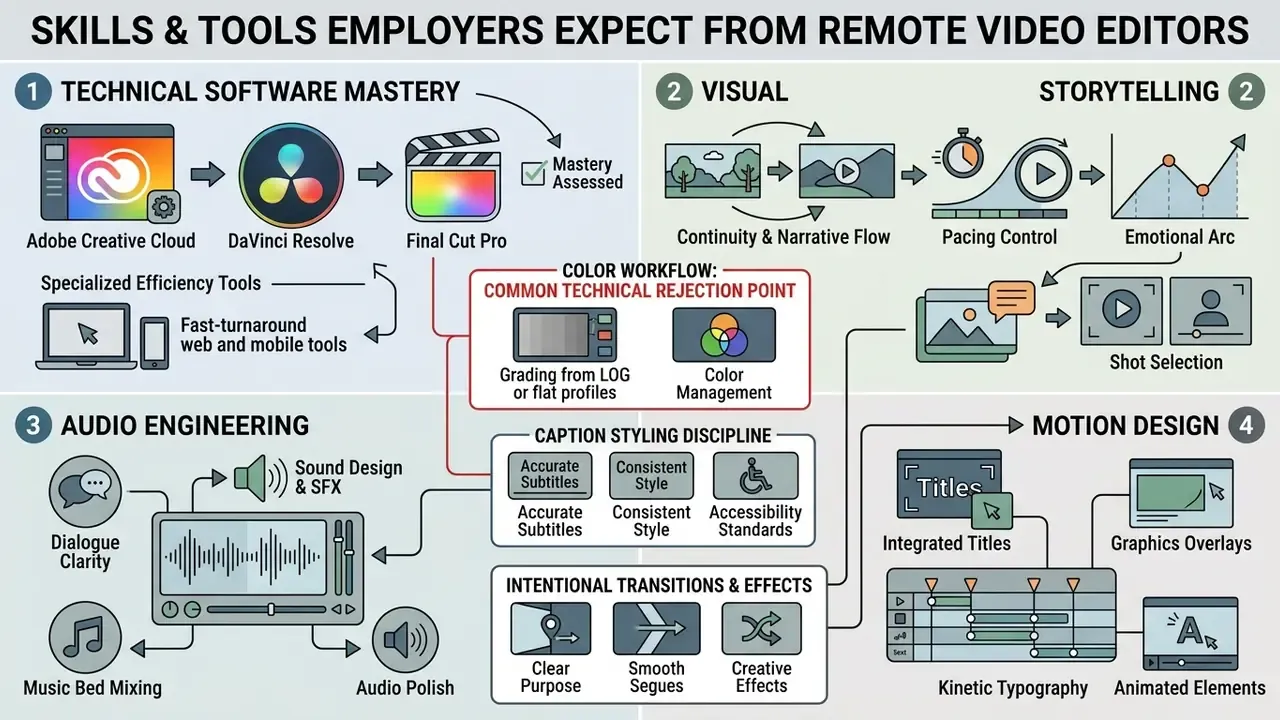
Employers recruiting for remote video editor job openings assess four things: technical software mastery, visual storytelling, audio engineering, and motion design. Most postings ask for 2 to 5+ years of professional experience and the ability to work independently inside deadline-driven asynchronous teams.
«Film and video editors typically need a bachelor's degree in film or broadcasting; employment is projected to grow 3 percent over the decade.»
Core software requirements cluster around industry-standard non-linear editing (NLE) platforms:


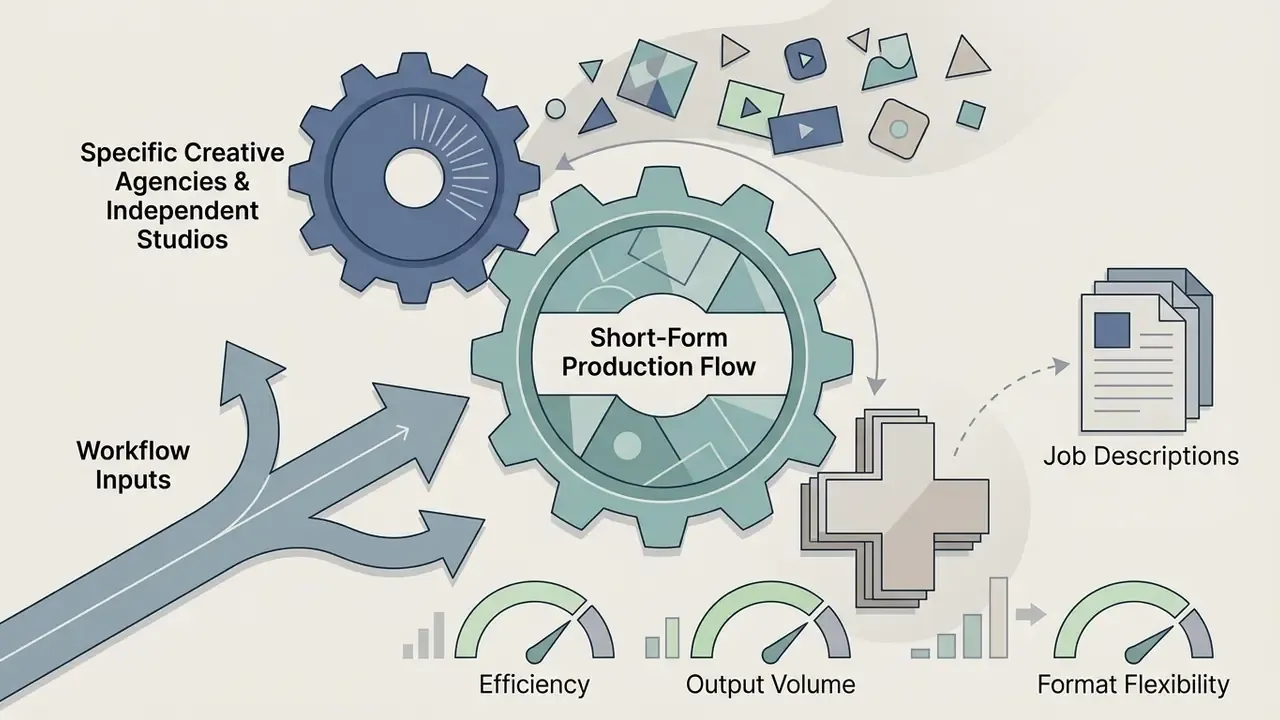
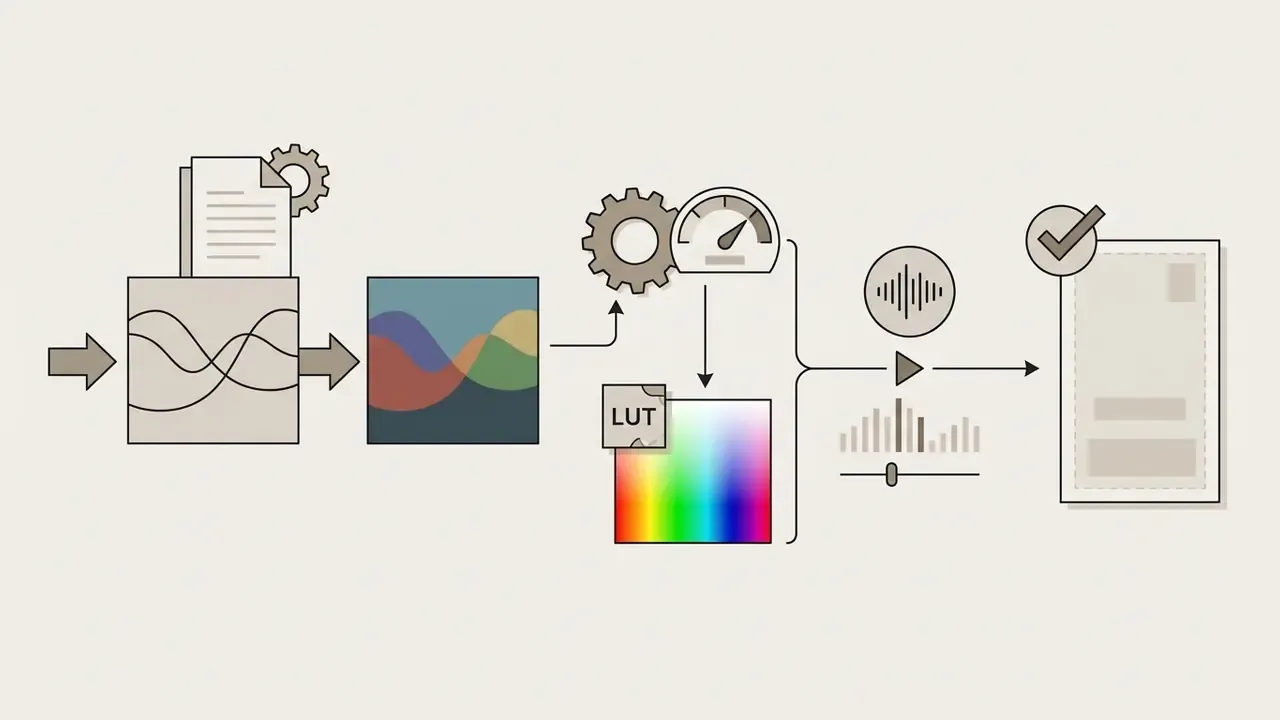
Color workflow: the most common technical rejection point
Short-form agency job descriptions are far more specific about color than about software brand names. Recurring hard requirements:
- Correctly applying and building LUTs so footage looks graded rather than filtered.
- Grading from LOG or flat profiles, not only correcting Rec.709 camera-baked footage.
- Holding natural, on-brand color across multiple client styles without making every brand look identical.
- Caption styling discipline: font, placement inside platform safe zones, timing, readability. Template overuse reads as a negative signal.
- Intentional transitions and effects, explicitly "not overdone."
Beyond the timeline, remote editors need supporting workflows. Compression techniques covered in our video compressor guide keep upload and download times sane across distributed networks. Thumbnail and still-frame prep is usually handled in a photo editor. Studios pushing hundreds of assets a month sometimes automate parts of ingest and delivery through an api integration rather than clicking through it manually.
Employers judge visual storytelling on editorial pacing, narrative structure, color consistency and sound design. You need to turn unscripted raw footage into a structured piece that holds attention. Audio management means cleaning background noise, balancing dialogue, integrating SFX, and mixing music to broadcast standards, plus working knowledge of music licensing in some roles.
What a hiring-ready showreel actually contains
Portfolio showreels are the primary screening mechanism for remote roles. Nothing else gets looked at first.
- Duration 60 to 90 seconds, with your strongest edits inside the first 10 seconds.
- Supporting samples 5 to 8 full-length project examples showing narrative range and technical execution, each annotated with your role, the client context and the deliverable spec.
- Short-form applications are different. Agency short-form postings frequently ask for exactly 5 examples of Reels or TikTok work only, plus an active Instagram handle and your stated average turnaround time per video. Sending a cinematic sizzle reel to a short-form ad role is a routine disqualifier.
- Ordering best and most recent first. Host on something fast and link-accessible: Vimeo, Frame.io, a portfolio site, or a clean cloud folder.
NDA, IP protection and footage security in remote editing engagements
Remote editing moves unreleased product footage, executive interviews, medical and financial material, and pre-launch creative across third-party infrastructure. Both sides need a defined control set before the first file transfer. Not after.
For the editor, confirm before accepting files:
- Which NDA applies, and for how long. Mutual or one-way, duration, and whether it prohibits all portfolio use or only pre-release material.
- Portfolio carve-out in writing. Explicit permission to show non-confidential, published work. Without it, months of paid work produce zero public proof.
- Approved transfer channels. Frame.io, enterprise Google Drive or Dropbox with expiring links, or a client-provided S3 bucket. Personal messaging apps and consumer file-sharing links are not acceptable for confidential media.
- Retention and deletion duty. How long you may keep raw media and project files after delivery, and whether certified deletion is required.
- Device and account hygiene. Full-disk encryption, unique credentials with MFA on delivery platforms, separate client folder structures per brand.
- AI tool restrictions. Many enterprise clients prohibit uploading unreleased footage, scripts or brand assets into public generative tools. Confirm whether AI upscaling, transcription, caption generation or voice cloning is permitted, and on which infrastructure. Unauthorized "shadow AI" use is one of the fastest-growing contract-breach risks in creative work, and the disputes are getting documented: see our AI Litigation and Case Timelines for how these cases have progressed.
For the hiring team, minimum contractor controls:
- Signed NDA and IP assignment executed before footage access, with work-for-hire or assignment-on-payment language.
- A named approval channel and time-coded review tool, so feedback and sign-off stay auditable.
- A written AI-use policy naming approved tools and prohibited data categories.
- Deletion confirmation and archive handover as a payment-release condition.
Editors checking whether a specific generative tool is contractually safe for client deliverables can start with the licensing terms summarized in our AI Media Commercial-Use Hub and the tool-level notes on Canva AI generator commercial terms.
How to evaluate salary, contract terms and apply for remote video editor jobs
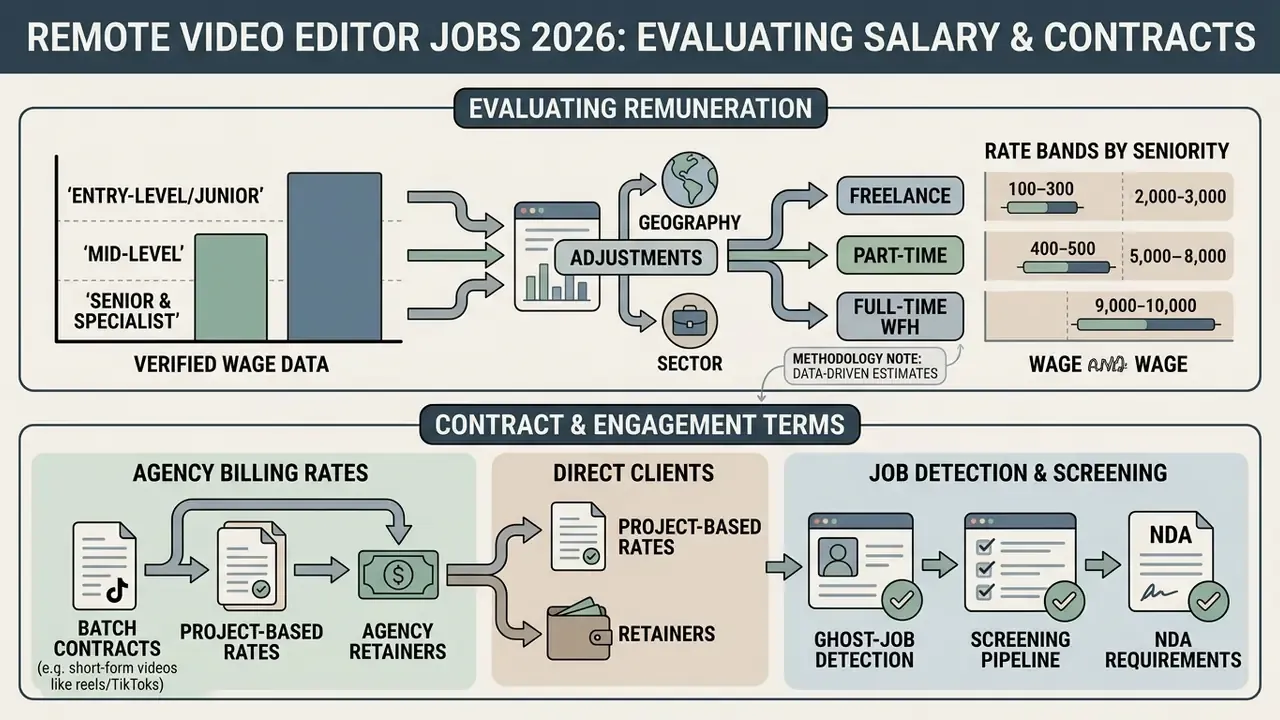
«National median annual wage for film and video editors (SOC 27-4032): $75,420; mean annual wages reach $92,070 in motion picture and video and $82,310 in streaming media distribution.»
«Mean annual wage for all occupations: $69,770 (May 2025).» — U.S. Bureau of Labor Statistics, National Occupational Employment and Wage Estimates. https://www.bls.gov/oes/current/oes_nat.htm
Against that baseline, film and video editors sit roughly 8% above the all-occupation mean at the median, and closer to 20% to 30% above it in motion picture, video and streaming subsectors. Which is the real lesson here: sector predicts a remote offer better than job title does.
Rate bands by seniority and contract type
- Note on methodology official wage tables publish percentiles for an occupation, not seniority tiers. The hourly bands below are market-observed freelance and contractor ranges compiled from 2026 rate guides and live listings. Read them as negotiation reference points cross-checked against the BLS percentiles above, not as government statistics.
- Entry-level and junior editors roughly $17 to $45 per hour. Observed posted hourly ranges include $17 to $26 and $18 to $28, or about $40,000 to $55,000 annual equivalent.
- Mid-level remote editors $45 to $85 per hour, roughly $60,000 to $85,000 annually. Posted full-time bands of $55,000 to $75,000 are common in in-house marketing teams.
- Senior and specialist motion editors $85 to $150+ per hour, or $90,000 to $140,000+ annually. Observed senior in-house bands include $78,100 to $117,100 and $125,000 to $130,000.
- Agency billing rates $100 to $250 per hour when the work is resold to a client.
- Project-based rates, direct clients short-form social clips $50 to $400 per video; 8 to 12 minute YouTube edits $300 to $1,500 per asset; corporate interview edits $400 to $2,000; ad creative $250 to $1,200; corporate promotional videos $500 to $2,500+ per project.
- Short-form batch contracts, agency retainers $400 to $1,200 per contract, typically structured as 30 short-form clips per contract, which resolves to roughly $13 to $40 per edited asset with a fixed 10-day batch turnaround. Stacking concurrent contracts ($400 to $2,000+ per month) is how editors scale this model.
- Commercial day rates $280 to $600 per day for high-velocity agency contractors handling rapid social campaign iterations.
- Offshore and regional remote rates $6 to $12 per hour for freelance roles posted in Southeast Asia, and $1,200 to $2,100 per month for contractors in Egypt, Lebanon and comparable markets, against $45 to $85 per hour for US-based mid-level remote editors. Also observed: $2,000 per month contract editing roles in US education, and weekly rates of $1,000 to $1,200.
- Enterprise dedicated contracts flat monthly retainers around $6,000 for hybrid motion graphics and editor roles owning end-to-end channel production.
- Critical reconciliation the $50 to $400 per short-form video figure is accurate for direct clients buying one asset at a time. It does not hold inside agency batch retainers, where the same deliverable resolves to $13.33 to $30 once the package fee is divided by asset count. Price batch work per asset and per hour before signing. Every time.
Self-assessment: are you a fit before you apply?
| Validation Item | Verification Criteria | Operational Rationale |
|---|---|---|
| Employment Status | Explicitly stated as W-2 employee, 1099 contractor, or freelance | Determines tax obligations, legal protections and benefit eligibility. Platform-based freelancers frequently lack contract transparency and cannot build client relationships off-platform, per OECD research below. |
| Software Stack | Specifies required NLEs (Premiere Pro, DaVinci, After Effects, CapCut) | Confirms hardware and license compatibility before you apply. |
| Content Format | Defines output type (Shorts, YouTube, corporate, motion graphics, localization) | Prevents skill mismatches between short-form fast edits and long-form narrative. |
| Geographic Rules | Confirms US state-specific remote versus globally distributed work | Verifies compliance with state labor laws and timezone meeting schedules. |
| Pay Transparency | Displays fixed salary range, hourly rate or project budget, plus asset count for batch contracts | Filters out underfunded offers below official BLS benchmarks and exposes weak per-asset economics. Pay opacity also compounds structural inequality, as noted below. |
| Color Workflow Rules | Stated requirements for LOG or flat footage grading versus standard Rec.709 LUT application | Prevents onboarding failure if your hardware, software or skill set cannot execute custom color work. |
| Asset Delivery Structure | Mandates exact folder naming, project file handover, and Frame.io or Drive delivery rules | Protects you from scope creep at final handover and clarifies what releases payment. |
| Revision and Rush Terms | Included revision rounds, per-round turnaround, rush surcharge multiplier | Converts vague "quick revisions" language into a priced, bounded obligation. |
| IP and Portfolio Rights | Grants permission to showcase non-confidential edits in reels | Essential for building verifiable public proof of work. |
| Ghost-Job Signals | Listing age, repost frequency, named hiring contact, team size against open roles | Prevents unpaid effort on postings with no hiring budget. |
«On one major platform studied, women earned only 68 percent of what men earned.»
«Online freelancers on digital labour platforms often face limited contract transparency and restricted ability to build direct client relationships off-platform.» — OECD SME and Entrepreneurship Paper No. 45, Self-Employed Online Freelancers on Digital Labour Platforms (2023). https://www.oecd.org/en/publications/oecd-sme-and-entrepreneurship-papers_2071293x.htm
Those two findings are practical, not abstract. They are the reason to publish a fixed rate card, insist on written scope, and convert platform clients into direct contracts wherever the platform's terms allow it.
The remote editor hiring and screening pipeline
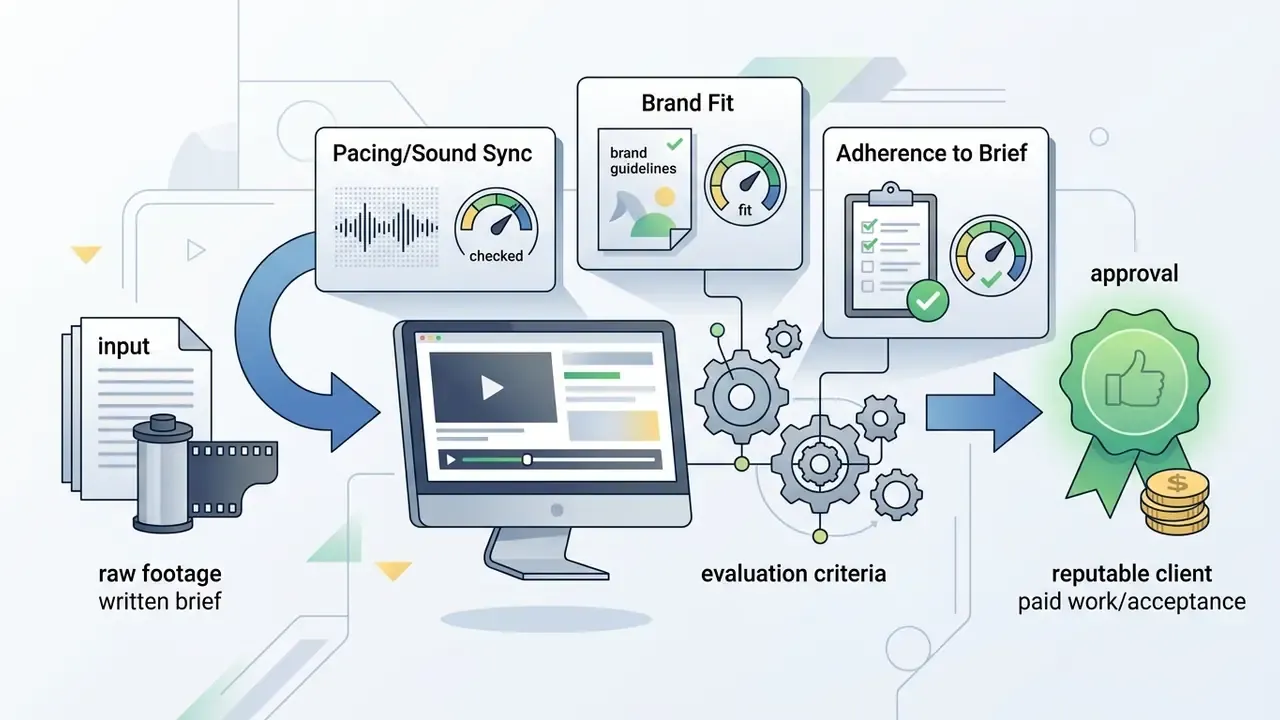
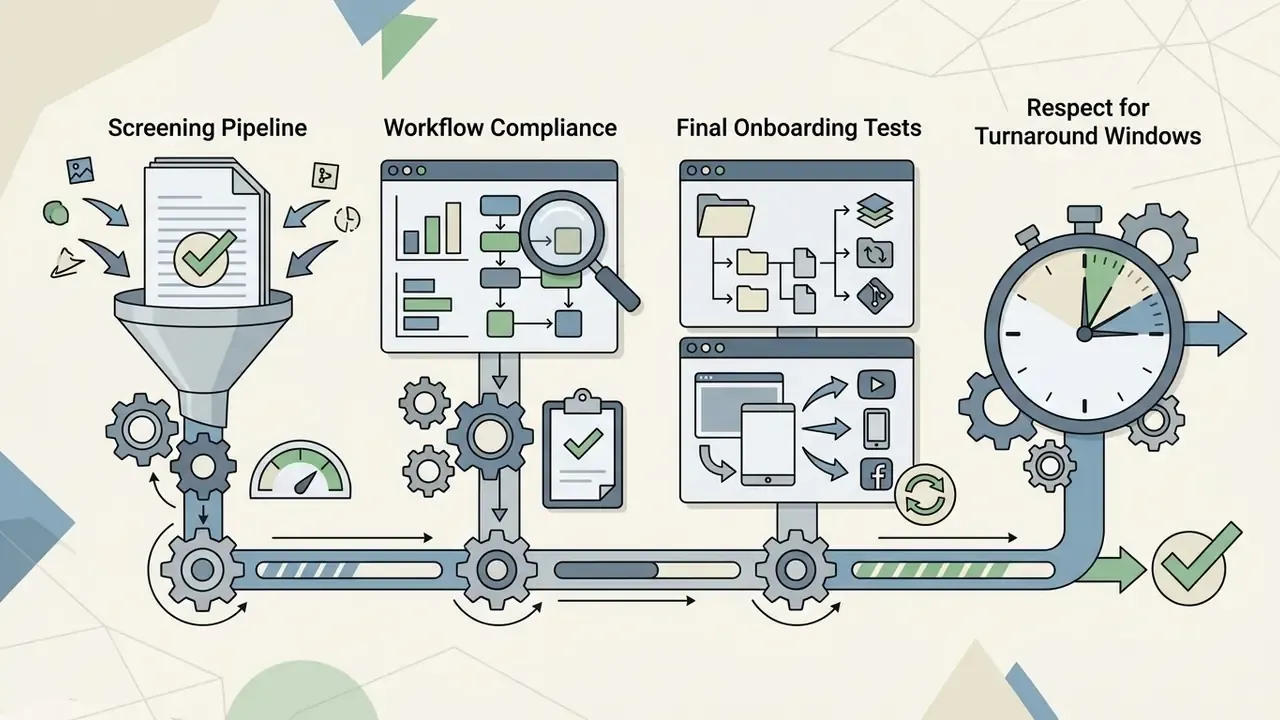
Applying for remote editing positions means walking a fairly consistent four-stage process. Agency postings describe it almost word for word: "We review your work first. If it fits what we do we schedule a call. After that we send a trial edit. If that goes well we bring you on."
Preparing application materials
Tailor, do not blast. Submit a concise one-page PDF resume (one page for under 10 years of experience) with a direct clickable link to a hosted portfolio in the header. Highlight measurable outcomes: view counts, retention or conversion lifts, monthly asset output volume. Then adapt per listing. Swap the top three portfolio samples to match the client's format, and state your turnaround and current capacity explicitly. Agencies hire on reliability signals about as much as on craft, sometimes more.
FAQ: remote video editor jobs
Is a degree required for remote video editing work?
Official occupational data indicates film and video editors typically hold a bachelor's degree in film or broadcasting. In practice, a large share of remote short-form and agency listings are explicitly marked "no degree required" and screen on portfolio plus trial edit instead.
What is the difference between a W-2 employee and a 1099 contractor role?
A W-2 employee has set hours, employer-withheld taxes and benefit eligibility. A 1099 independent contractor has no set hours in the agreement, controls the method and means of the work, invoices for payment (hourly, monthly, per service or in installments), and carries their own tax administration and software licensing. Classification rules vary by jurisdiction, so verify with a qualified professional.
How many revision rounds should a freelance contract include?
Whatever is written down. Template agreements commonly cap included rounds and bill extras hourly, with 24 to 48 hour turnaround per round. Never accept "unlimited revisions until happy."
Can I show client work in my showreel?
Only with an explicit portfolio carve-out in the NDA or contract. Ask for it during negotiation, and for pre-release material ask again after public launch.
Are $13-per-video batch contracts worth taking?
It depends entirely on hours per asset. Thirty clips at $400 is decent pay if each clip takes 20 minutes from organized footage with a repeatable template. It is poor pay if each clip needs bespoke grading and three revision rounds. Time a pilot batch before committing to a monthly retainer.
How do international editors compete with US-based rates?
By specializing rather than discounting. Localization, multilingual captioning, AI-assisted throughput, and named-vertical expertise (fitness, supplements, SaaS demos, education) command materially higher rates than generic "video editing" in the same region.
How do I get paid safely on cross-border work?
Use escrow or milestone payments for first engagements, invoice on approved delivery as defined in the contract, and confirm currency, payment method and payment window in writing before file handover. Cross-border tax and withholding rules vary by country.
What is the fastest way to spot a scam or unfunded listing?
No named contact, no pay range, a request for an elaborate unpaid "test project," pressure to move to a personal messaging app, or a 30-day-old repost from a tiny team with many open roles.
Where do companies looking to hire a remote video editor post first?
Usually their own careers page, then a specialist production board, then the large aggregators. Editors who track five or six company pages directly tend to see roles two to three weeks before those roles hit general search.
Recommended resources and tools
Grouped here so the main guide stays readable. These are the reference pages editors use when scoping, pricing and delivering remote projects:
- Workflow and pipeline YouTube video editor workflows guide · video compressor guide · animation maker guide
- Assets and post-production support online photo editor guide · free photo editor guide · AI voice generator guide · AI headshot generator guide
- Tool selection and comparison free AI video generator comparison · best AI art generator comparison · free AI art generator comparison
- Licensing and commercial use Canva AI generator commercial terms · Google AI image generator usage rights · AI reverse image search for asset provenance · AI image expansion for reframing assets
- Implementation and developer economics Google Veo API implementation and cost guide
Reviewing commercial licensing guidelines before dropping third-party visual or audio assets into client projects is a contractual requirement in most enterprise agreements, not an optional courtesy. Checking pricing structures and utilization metrics supports accurate rate calculation, and technical submission questions are worth resolving before the delivery deadline rather than during it.
Verification and sources
Job market conditions, wage ranges and hiring standards in this guide are cross-referenced against occupational datasets, regulatory publications and live listing data. Listings and salary signals were last reviewed during the 2026 editorial cycle.
- U.S. Bureau of Labor Statistics (OEWS): Occupational Employment and Wage Statistics, May 2025, Film and Video Editors (SOC 27-4032) national wage tables and all-occupation mean wage. https://www.bls.gov/oes/current/oes_nat.htm
- U.S. Bureau of Labor Statistics (OEWS): Occupational Employment and Wages, May 2023, employment level and mean wage for SOC 27-4032. https://www.bls.gov/oes/current/oes274032.htm
- U.S. Bureau of Labor Statistics: Occupational Outlook Handbook, Film and Video Editors and Camera Operators, education requirements and employment projections. https://www.bls.gov/ooh/arts-and-design/film-and-video-editors-and-camera-operators.htm
- World Bank Group
- Working Without Borders: The Promise and Peril of Online Gig Work (2023), global platform labor scale, task composition, demand growth and pay-gap findings. https://www.worldbank.org/en/topic/jobsanddevelopment/publication/working-without-borders-the-promise-and-peril-of-online-gig-work
- OECD Publishing
- Self-Employed Online Freelancers on Digital Labour Platforms, SME and Entrepreneurship Paper No. 45 (2023), contract transparency and platform power asymmetry. https://www.oecd.org/en/publications/oecd-sme-and-entrepreneurship-papers_2071293x.htm
- OECD Publishing
- Handbook on Measuring Digital Platform Employment and Work (2023), operational definitions for platform contracts and independent work.
- Live listing observation
- remote job boards, production boards and aggregator postings reviewed for posted pay ranges, batch contract structures, turnaround requirements, screening steps and ghost-score methodology.
Appendix A: editorial corrections log
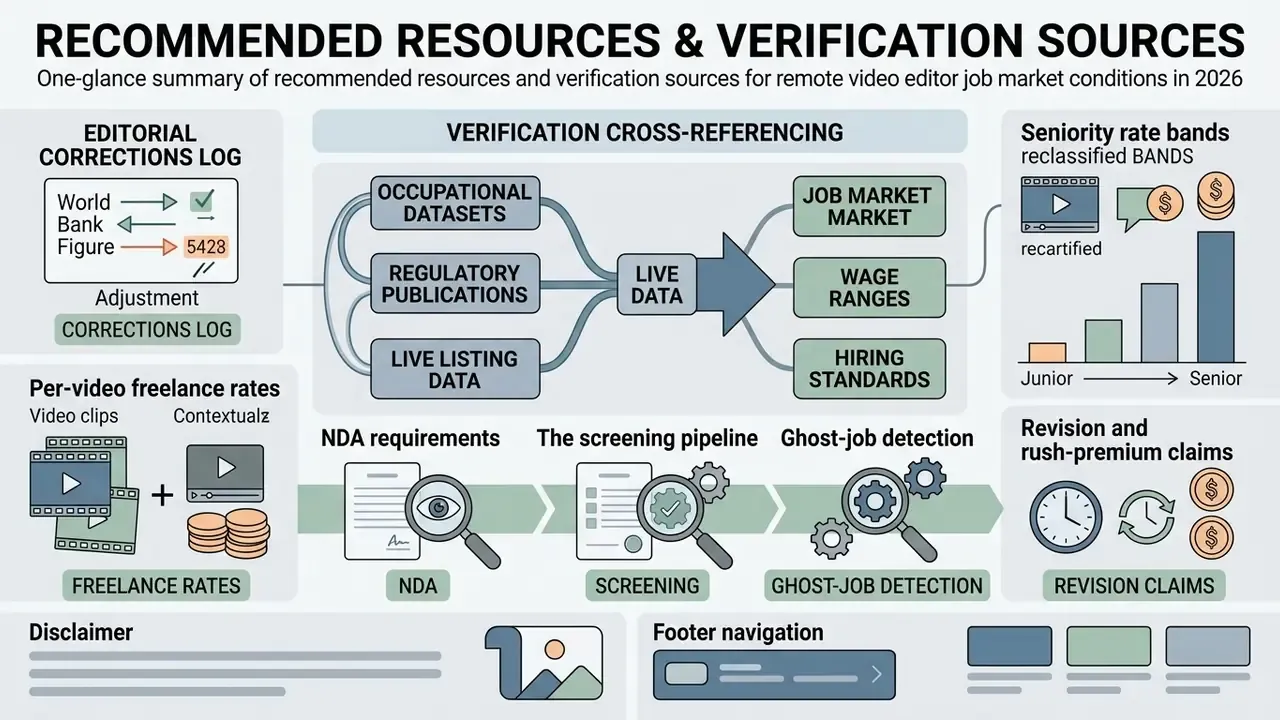
- World Bank figure, corrected. An earlier version stated that "online gig work accounts for up to 12% of the global labor force, with creative and multimedia tasks representing roughly 17% of all platform-based project vacancies worldwide." That phrasing merged two separate findings and suppressed the lower bound. The corrected figure is a range of 4.4% to 12.5% (154 to 435 million people across 545 platforms), reported separately from the 17% creative-and-multimedia task share.
- Per-video freelance rates, contextualized. The $50 to $400 per short-form video range remains valid for direct-client engagements, and is now annotated to reflect agency batch retainers where effective per-asset pay falls to roughly $13.33 to $30.
- Seniority rate bands, reclassified. Hourly bands by seniority are labeled as market-observed negotiation reference points rather than government statistics, because official wage data publishes occupational percentiles, not seniority tiers.
- Revision and rush-premium claims, sourced. "1 to 2 free revision rounds" and the "+25% to +50% rush surcharge" are presented as contract-template conventions requiring written confirmation, not as industry standards.