Last updated: April 2026 · Reading time: ~22 minutes
The automated transformation of textual reporting into synthetic video content, commonly referred to as video generation ai news, has moved out of experimental media labs and into structured enterprise workflows. Media publishers, bank communications teams, and investor-relations functions now deploy ai video generation tool news systems to ingest raw text, structured financial disclosures, or breaking wire feeds. The output is a publishable video asset with narrated voiceover, a virtual anchor, and an automated visual storyboard.
Why should a risk or compliance leader care about a media workflow? Because the moment a synthetic presenter reads your earnings numbers, you own a model, an identity asset, and a disclosure obligation. That is governance work, not marketing work.
Executive summary for decision-makers
How to read this guide: the five decisions on the table
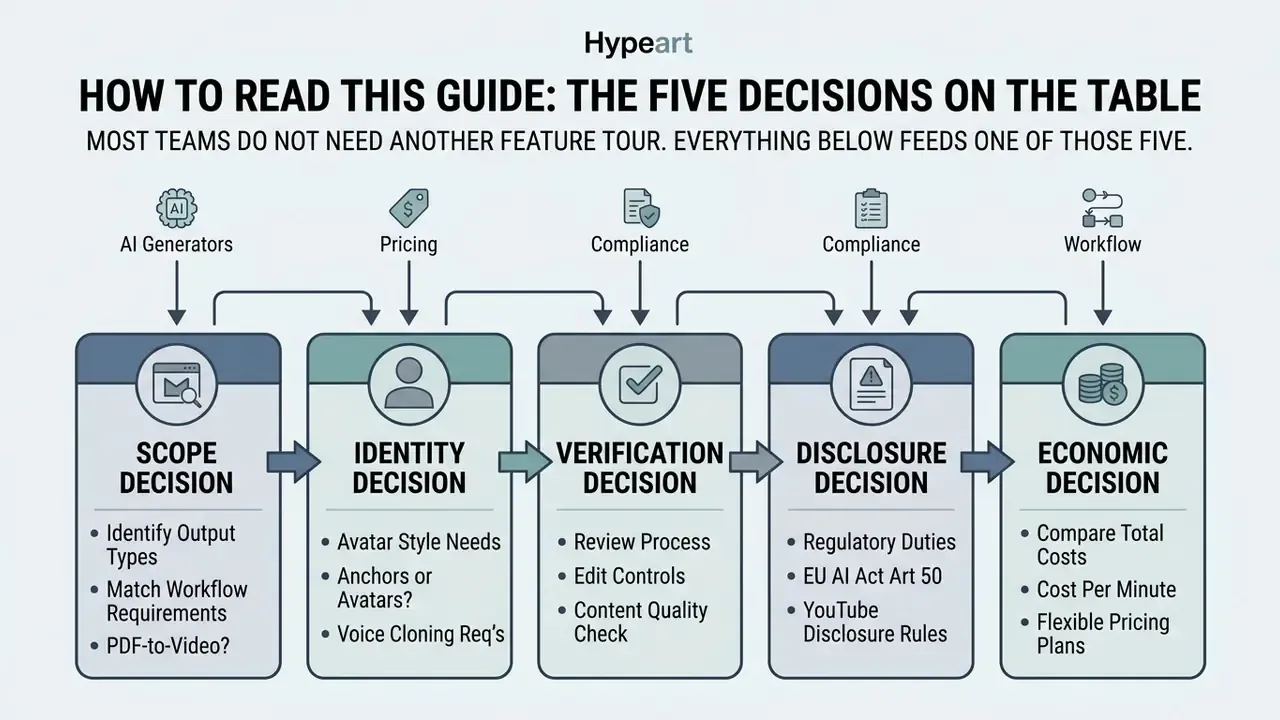
Most teams do not need another feature tour. They need to know which decisions carry residual risk, and who signs them off. Five sit at the centre.
- Scope decision. Which news formats are eligible for synthetic production, and which are permanently excluded? Eyewitness footage, investigative reconstructions, and anything presented as documentary evidence usually belong in the exclusion list.
- Identity decision. Who owns the presenter identity, where is the consent record stored, and what happens to that digital twin when the depicted employee leaves? Treat the asset like biometric data, because functionally it is.
- Verification decision. What is the minimum evidence a named editor must review before export: numeric diff, source page pointer, pronunciation check, provenance flag?
- Disclosure decision. Which labels, watermarks, and metadata fields are mandatory per channel and per jurisdiction, and who tests that they survive re-encoding?
- Economic decision. What is the fully loaded cost per published minute, including verification time that automation never removes?
Everything below feeds one of those five. Keep them visible while you read.
1. What video generation AI news is and which tasks it solves
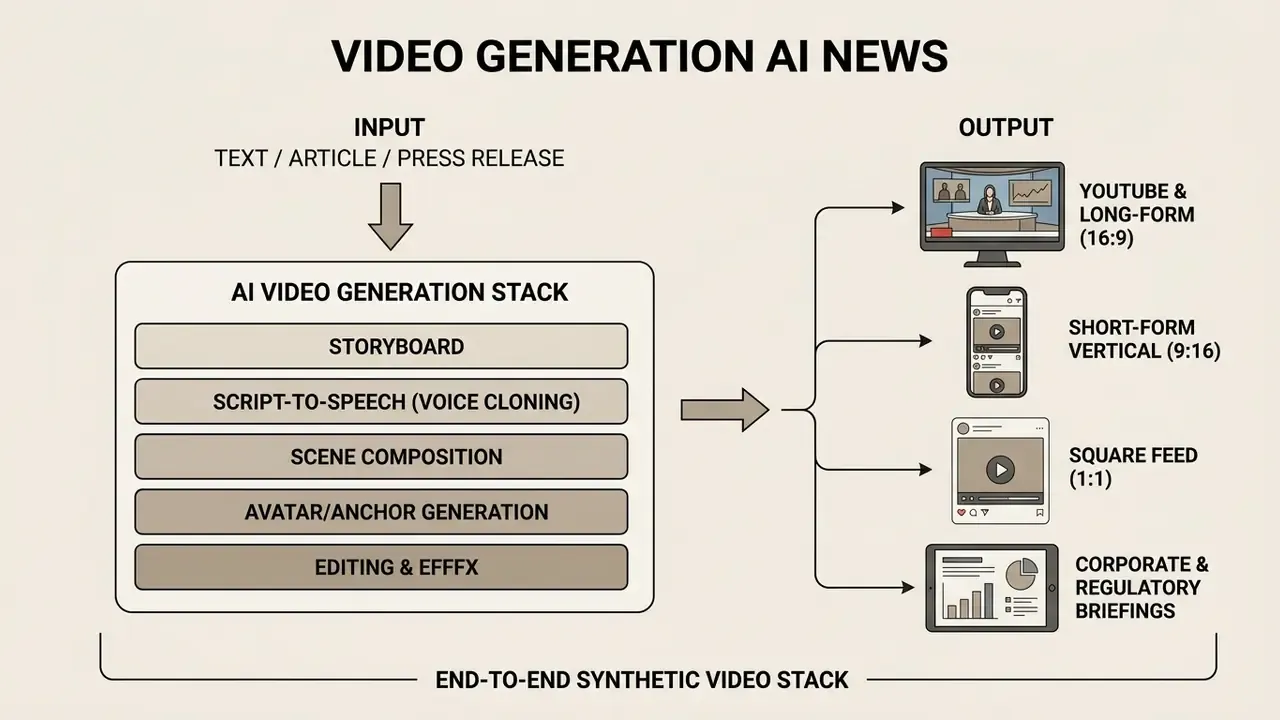
Video generation AI news is an end-to-end synthetic video stack. It ingests textual sources, such as wire service reports, corporate press releases, or CMS articles, and converts them into narrated, broadcast-ready news segments. Rather than replacing reporting, an ai video generation tool news platform orchestrates text-to-speech, synthetic avatar generation, and automated timeline assembly. The process compresses production cycles from hours to minutes while holding compliance and brand consistency in place.
In practice, three institutional tasks dominate adoption. First, converting existing written coverage into video-first distribution assets without a second production round. Second, automating high-frequency, structured formats (markets, weather, municipal updates, earnings) that need no field footage. Third, localising a single master script into dozens of language variants inside the same news cycle.
Public broadcasters have tested the same logic. German broadcaster SWR piloted AI automation of parts of its news-clip workflow in 2024, and the Associated Press has framed automation as a way to remove laborious manual steps such as shot-listing, so journalists spend more time on newsgathering. Note the framing: fewer manual steps, not fewer editorial judgments.
2. From text, article, or press release to news video
Converting raw text into structured video relies on a multi-stage prompt engineering and narrative transformation pipeline. When a user submits text prompts, PDF reports, or live article links, the video ai generator news pipeline extracts core factual claims, structures them into distinct scenes, and generates matching scripts, voiceovers, and visual assets. Readers new to this tool class can start with our primer on text-to-video AI.
Modern text-native pipelines formalise this in three prompt layers: the raw user prompt (topic, link, or pasted copy), a structured prompt (scene list, duration per beat, required on-screen data), and a rewritten prompt passed to the downstream video model. Enterprise systems validate that input against underlying data sources to prevent hallucinated claims before rendering generated news video outputs. Vendor guidance for models such as Google Veo stresses the same point from the other direction: audio and scene descriptions must be specified explicitly, never inferred.
One practical detail that teams underestimate. Numerals survive parsing far less reliably than prose, so a basis-point figure can quietly become a percentage point in the spoken track. Check the numbers, then check them again.
4. Which features an AI news video generator needs
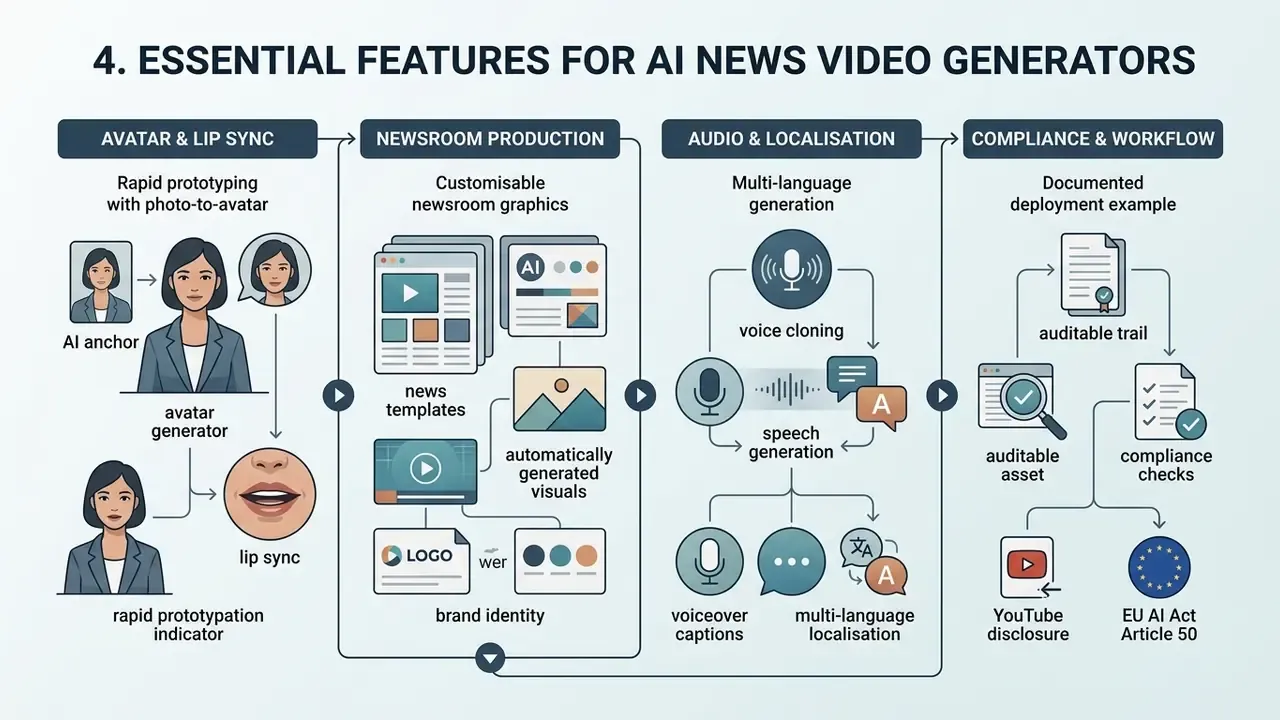
An enterprise-grade news video generator must combine avatar synthesis, precise lip sync, customisable newsroom graphics, multi-language speech generation, and auditable asset licensing. In regulated and commercial environments, raw video quality is secondary to predictable model behaviour, lower-third rendering accuracy, and explicit metadata tagging.
5. AI news anchor, avatar generator, and realistic lip sync
An ai news anchor serves as the visual face of synthetic broadcast segments. Modern anchor generator architectures use deep neural models to map synthesised phonemes to facial vertex movements, which is what delivers frame-accurate lip sync.
Organisations can deploy stock presenters from vendor libraries (commercial catalogues currently range from roughly 400 to 1,100 plus presets) or build custom digital twins. Vendor documentation for leading platforms states that a digital twin can be trained from a clip as short as 15 seconds of high-definition footage. That figure is vendor-published rather than independently benchmarked, and enterprise buyers should validate identity stability on their own footage during procurement. Teams comparing engines can review our overview of the AI video generator category.
Documented deployment example (illustrative, composite). A media production unit at a regional fintech firm needed to scale daily market updates without expanding studio bandwidth. The team deployed a photorealistic presenter model trained on a short high-definition clip of their lead analyst, paired with an auditable script ingestion API. The automated pipeline produced 20 localised daily briefings. The firm reported an internal reduction in production time of roughly 85 percent, a self-reported operational metric rather than an audited one, while keeping presenter identity controls locked across every release. At agency scale, vendor case material describes a sharper shift, from 1 to 2 videos per client per year to 50 to 60 videos per day per client. Treat that as an upper bound, not a planning baseline.
6. Newsroom templates, generated visuals, and brand identity
Professional news presentation leans on recognised broadcast conventions: newsroom backdrops, lower thirds for speaker identification, animated headline tickers, and brand-compliant graphics. Advanced platforms let teams upload full brand kits, including proprietary fonts, colour palettes, logos, and custom stock video assets, so every generated news video matches institutional identity guidelines.
Broadcast-oriented graphics kits typically package show title cards, lower thirds, and breaking-news graphics as broadcast-safe transparent PNG sequences for vMix, OBS, and NLE ingestion, with editable fields for speaker names, headlines, ticker text, and reporter credits. For synthetic pipelines, the practical requirement is narrower than it looks: those same fields must be populated programmatically from the script's metadata, not typed by hand for every bulletin. Manual typing is where the misspelled ticker symbol appears at 07:58.
7. Voiceover, captions, and multi-language localisation
Automated voice synthesis requires natural-sounding ai voiceovers with controllable cadence, pitch, and emotional tone suitable for formal journalism.
That finding sets a hard editorial rule. Audio, footage, and headline must be verified as one unit, because an accurate script paired with mismatched visuals reproduces the exact signature of manipulated content. Integrated captioning systems transcribe spoken audio into word-level synchronised subtitles and export standard SRT or VTT files. Caption tooling increasingly supports secondary exports (TXT, DOCX, PDF, JSON) for editorial review trails. For a deeper look at speech engines, see our guide to the AI voice generator category.
Multi-language translation engines then let global institutions generate localised ai news video broadcasts across dozens of target languages from a single master text script, in multiple languages, with lip-sync re-rendering applied per language so mouth geometry matches the dubbed track rather than the original. Skip that re-render and the segment looks dubbed, which quietly costs credibility in exactly the markets you were trying to serve.
| Functional block | Technical requirements | Quality and versioning standards |
|---|---|---|
| AI news anchor and lip sync | Photorealistic 1080p/4K avatars; frame-accurate phoneme alignment; photo-to-avatar fallback | Zero identity drift across frame sequences; custom avatar creation from short source clips; documented consent record |
| Voiceover and audio | Neural TTS; multi-voice speaker models; voice cloning from ~30 s samples; adjustable words-per-minute rate | Human-sounding cadence; precise SSML pitch and pause control; neutral news delivery tone |
| Newsroom graphics | Editable lower thirds, overlay tickers, brand kit integration, custom asset ingestion | Broadcast-safe margins; transparent PNG sequence export; automated caption positioning |
| Localisation and captions | Multi-language translation (100 plus languages at professional tiers, up to 175 plus at enterprise tiers); word-level synchronised captions | Export to SRT/VTT; customisable font size, background contrast, and safe zones |
| Document ingestion | PDF, DOCX, URL and CMS feed parsing with table and quote extraction | Numeric fidelity check against source; citation trail per scene |
| Provenance and governance | C2PA metadata embedding, synthetic-content flags, audit logs | Machine-readable AI marking per EU AI Act Article 50; per-user action history |
8. Which news videos you can generate with AI
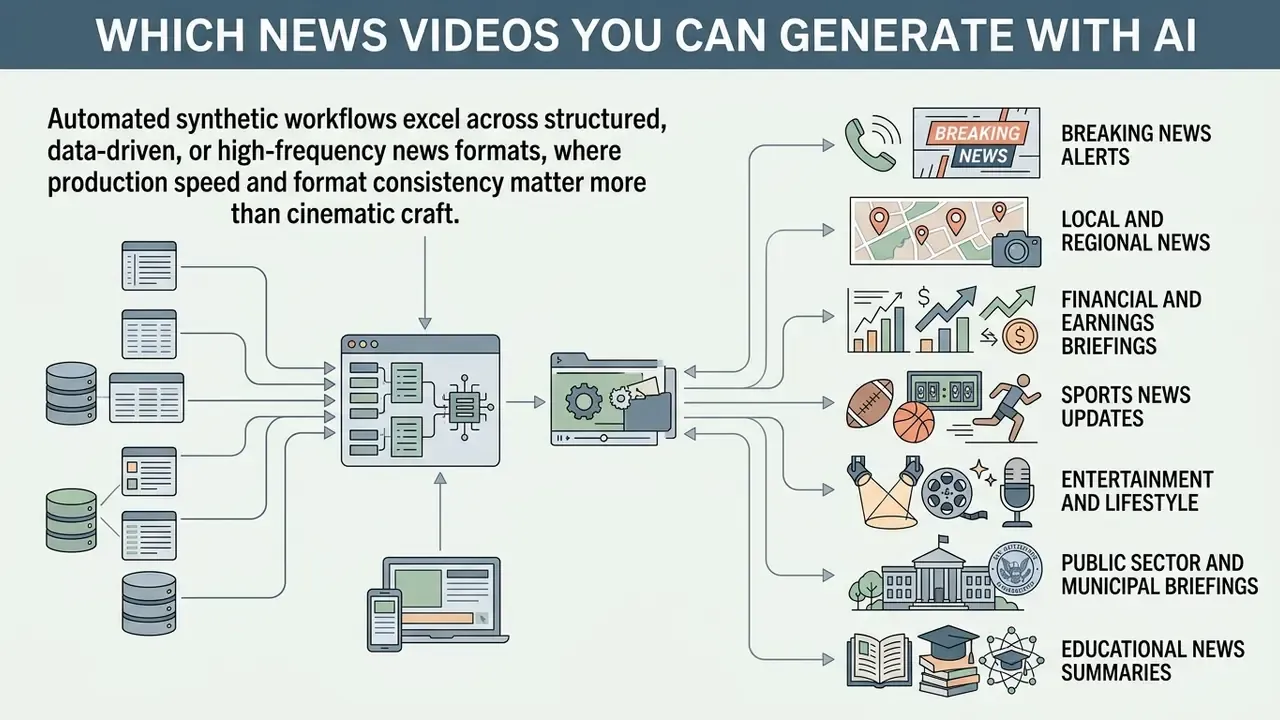
Automated synthetic workflows excel across structured, data-driven, or high-frequency news formats, where production speed and format consistency matter more than cinematic craft.
That discomfort does not block adoption. It does define where synthetic video is defensible: formats where the data is verifiable and the presenter is clearly labelled, rather than eyewitness or investigative reporting, where synthetic footage would misrepresent evidence. BBC editorial guidance, for one, permits AI in graphics and production work but prohibits generative AI from directly creating news content, and forbids manipulation of factual video beyond minor crop, brightness, and contrast adjustments.
9. Breaking news, local news, recurring bulletins, sports, entertainment, and public sector
Synthetic media pipelines let hyper-local reporting units and 24/7 digital news desks publish rapid updates without full camera crews:
- Breaking news alerts converting text wire alerts into short 30-second broadcast clips within minutes of an event, with urgent visual cues, scrolling tickers, and bold headline overlays.
- Local and regional news automating daily weather summaries, municipal coverage, and real-estate market updates from structured regional data feeds. Content-automation vendors in local media report that the overwhelming majority of delivered automated items publish without manual intervention, which is what makes hyperlocal volume economically viable.
- Financial and earnings briefings translating corporate earnings tables and regulatory filings into clear, data-forward animated summaries for investors.
- Sports news updates automatic ingestion of structured match protocols with animated score-overlay lower thirds, tight scene pacing, and fixture segments generated straight from league data feeds.
- Entertainment and lifestyle casual TTS delivery tone, dynamic social-quote cards, culture and release calendars, and looser visual treatment than hard news, with a stricter defamation review gate, since celebrity coverage carries elevated legal exposure.
- Public sector and municipal briefings certified, access-controlled avatars, official caption contrast standards (targeting WCAG 2.1 AA/AAA), and direct triggering from civil-protection or emergency text bulletins, with mandatory labelling so synthetic delivery is never mistaken for documentary footage of an official event.
- Educational news summaries structured, text-forward explainers that reuse the broadcast grammar of news to frame factual or instructional content.
- Corporate announcements formal, brand-aligned segments for press releases, product launches, leadership messages, and internal policy changes and company updates. These get watched more reliably than the equivalent all-staff email, which is a low bar, admittedly.
Teams analysing platform-specific cost structures and feature trade-offs can consult our detailed AI Media Comparison guide and our ranking of the best AI video generators for benchmark analytics.
11. How to create a news video with an AI tool
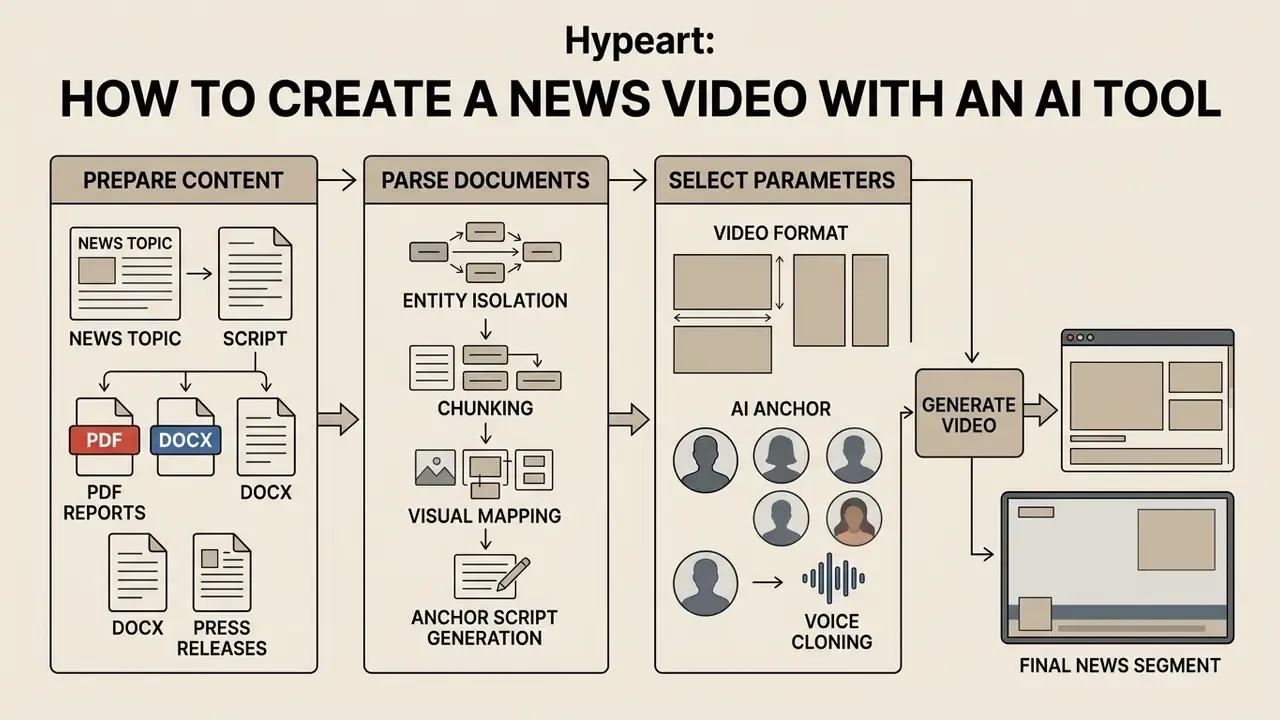
Producing a high-quality segment using an ai video generation tool news platform takes a structured, multi-step workflow. To move from raw information to a broadcast ready asset, creators must balance automated script processing with human editorial control.
12. Prepare the news topic, script, or source material
12.1 Parsing PDF reports, DOCX documents, and press releases into a video sequence
Turning a flat PDF or quarterly report into a news segment runs through three data-processing stages:
- Document structure parsing (entity isolation)OCR plus an LLM parser extracts key claims, metric tables, and speaker quotes from the PDF or DOCX file, discarding footnotes, page furniture, and technical markup. Table cells are preserved as structured values, so figures can later be rendered as on-screen graphics rather than re-typed.
- Chunking and visual mappingthe extracted text is segmented into semantic scenes of roughly 8 to 12 seconds each. Every claim is paired with a relevant visual asset, whether a chart lifted from the source PDF, a generated data visualisation, or licensed stock footage, plus a citation pointer back to the source page.
- Anchor script generationthe LLM rewrites bureaucratic or dense financial language into natural spoken delivery for the AI presenter, while preserving every exact figure, date, and proper name. A numeric diff check between the source table and the final script is the minimum acceptable control before rendering.
The same pipeline handles URL ingestion. An article link is fetched, boilerplate is stripped, and the body text enters stage two unchanged.
13. Choose the style, AI news anchor, and generation parameters
The practical reading is uncomfortable for vendors. Presenter photorealism is not the dominant selection driver. Perceived usefulness of the bulletin and a consistent publication cadence outweigh marginal gains in avatar fidelity, which argues for investing in script quality and schedule reliability before upgrading to 4K digital twins.
14. Edit the news clips and publish the finished video
After initial rendering, the creator opens the timeline in the ai video editor to refine transitions, adjust lower-third timing, and correct phoneme or transcription errors in the automated captions. Caption workflows typically round-trip through SRT/VTT/ASS files, where text, segmentation, punctuation, and speaker labels are corrected before styling is applied and the final render is produced with embedded or sidecar subtitle tracks.
Control checks to clear before releasing an AI-generated news clip.
Teams standardising their post-production stack can compare options in our overview of video editing tools.
Pre-publication audit (four-part gate). Before release, every synthetic news clip should clear a documented four-part review:
- fact-checking every date, figure, quote, and label against the primary source;
- naturalness evaluation of the synthesised speech, with particular attention to proper names, tickers, and foreign-language terms that TTS engines mispronounce;
- legibility review of lower thirds, tickers, and captions against contrast and safe-zone requirements;
- provenance labelling, confirming that AI-disclosure flags, watermarks, and C2PA metadata are present and intact.
This structure follows the provenance and content-transparency approaches set out in NIST AI 100-4, Reducing Risks Posed by Synthetic Content (NIST, 2024), and the deepfake verification questions in NIST's 2025 verification trifold: was provenance verified, how was the media supplied, what editing or compression occurred.
Once verified, the editor exports the finished videos in standard MP4 formats, HD or 4K, 16:9, 9:16, or 1:1, for direct publishing or CMS integration.
Checklist0 / 6
This information is general in nature and does not substitute for legal advice on copyright, media-asset licensing, or regulatory compliance.
15. How to choose an AI video generation tool for newsrooms
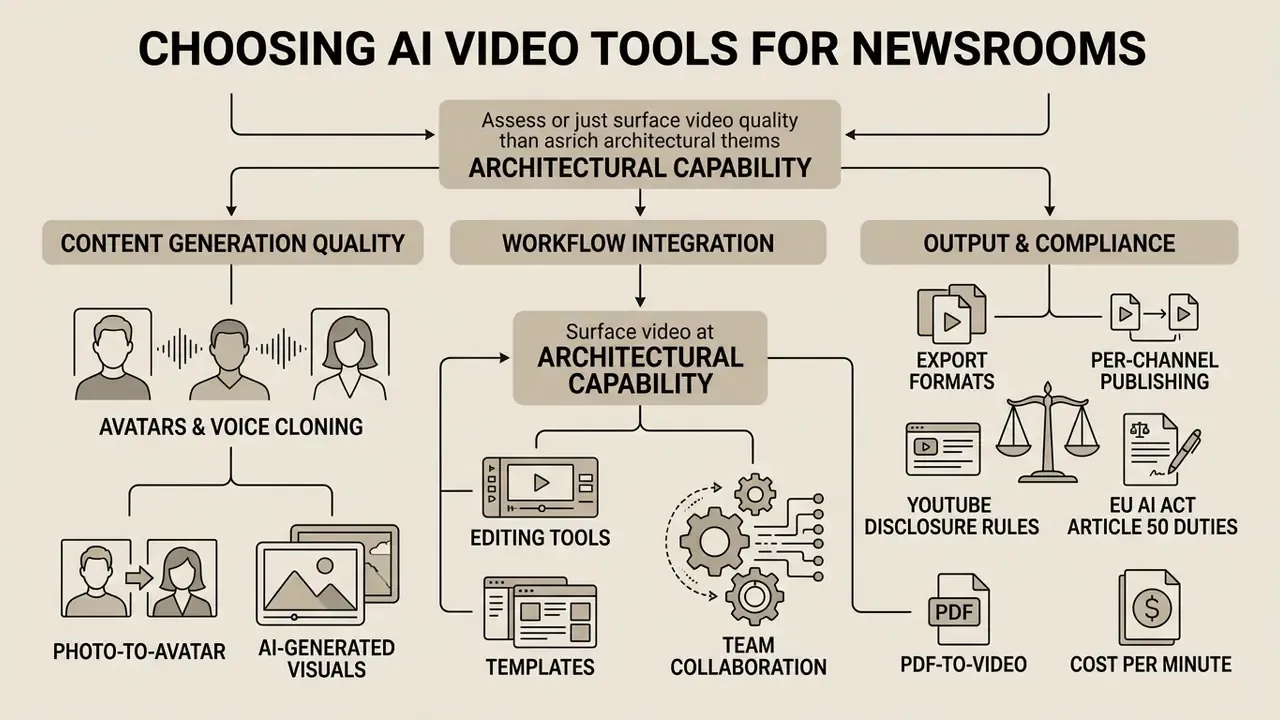
Selecting an enterprise news tool means assessing architectural capability, not surface video quality. Decision-makers should weigh model stability, collaboration security, asset rights, and API automation readiness.
16. Quality of avatars, voices, and AI-generated visuals
Evaluating avatar realism involves facial movement fluidity, eye-contact preservation, and natural gesture rendering. Voice engines must deliver high fidelity without robotic artifacting, and support granular control of pauses, emphasis, and technical pronunciations. Synthetic visual generation models must hold character and scene consistency across cuts, avoiding jarring jumps between news segments.
That uncanny-valley finding carries a direct procurement consequence. Pushing realism to an intermediate level can score worse with audiences than either a clearly stylised presenter or a fully photorealistic one. Vendor specifications also deserve literal reading. Some platforms publish concrete output parameters, for example 1920x1080 at 25 to 30 fps for standard avatars with 4K available for custom identities, or 1080p at 30 fps with full-body gesture rendering. Lip-sync accuracy, by contrast, is almost always described qualitatively ("matched", "frame-accurate", "natural") with no published numeric error metric. So benchmark on your own scripts, numerals, tickers, and multilingual proper nouns included.
17. Editing, templates, and team collaboration
Enterprise media workflows need real-time collaboration. Effective tools provide multi-user project spaces, role-based access controls, version history, and transcript-based video editing. Editors should be able to alter a news video simply by changing the underlying text script, which triggers precise re-renders of the matching audio and lip-sync sequences. Template governance matters at scale: broadcast-oriented systems organise templates in a hierarchy per show, channel, and station, so a graphics change propagates predictably instead of being re-applied by hand, station by station.
18. Export, publishing, and per-channel formats
Publishing efficiency depends on direct export integration with content management systems and social media APIs. Top-tier platforms support distribution to YouTube, Facebook, and TikTok, alongside high-bitrate MP4 exports for broadcast playout systems. Teams building their own distribution layer should map the documented endpoints: Meta Page video publishing via POST /<PAGE_ID>/videos, Instagram's container workflow at /<IG_ID>/media, TikTok's Content Posting API (FILE_UPLOAD or PULL_FROM_URL, plus direct post), and YouTube Data API videos.insert. Editorial teams focused on a single primary channel can follow our practical guide to the YouTube video editor workflow.
For teams planning custom API pipelines, our dedicated AI Media API Guides detail integration protocols and endpoint architectures, including cost and rate-limit modelling in the Google Veo implementation guide.
| Evaluation criterion | Entry level (SaaS tool) | Professional level (Pro Studio) | Enterprise level (Enterprise API) |
|---|---|---|---|
| Avatar quality | Preset stock avatars | Customisable avatars plus lip sync; photo-to-avatar | Personal 4K digital twins with identity locking |
| Language support | 20 to 40 base languages | 100 plus languages with voice cloning | Up to 175 plus languages with automated localisation |
| Team access | Single user | Shared folders and projects | SSO, RBAC, full user action audit |
| Commercial rights | Limited by standard terms | Full rights to generated output | Contractual rights clearance and indemnification |
| Document ingestion | Paste text only | PDF and URL import | PDF, DOCX, CMS feeds, structured data APIs |
| API integration | None | Basic webhooks | Full REST/gRPC API with provenance hooks |
No matching rows Clear one or more filters to restore the matrix.
19. AI news generator pricing and commercial use
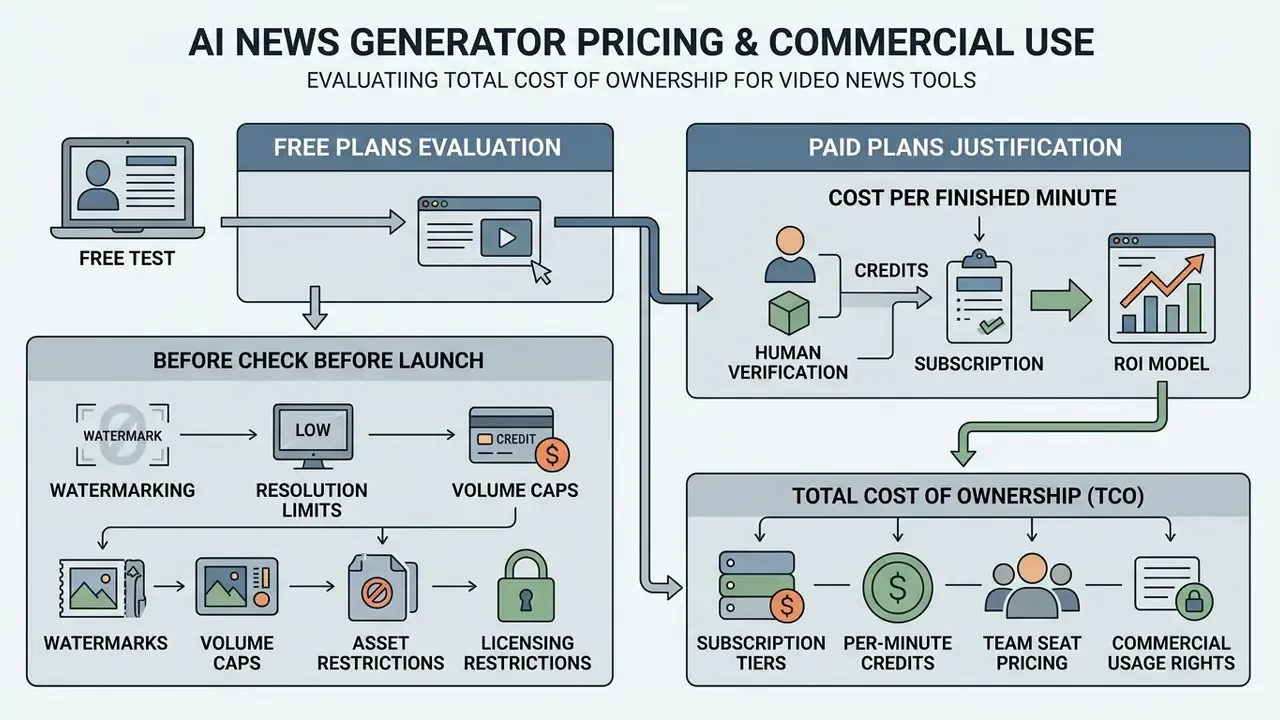
Evaluating total cost of ownership for a video news tool means analysing subscription tiers, per-minute rendering credits, team seat pricing, and the underlying commercial usage rights.
20. What to check in a free AI news generator before launch
Many services offer a free ai tier. These entry-level options carry strict operational constraints that usually rule out commercial broadcast use:
- Watermarking mandatory platform logos overlaid on exported frames.
- Resolution limits exports commonly capped at 720p.
- Volume caps published free-tier limits in the market cluster around a handful of videos per month and roughly three minutes per video.
- Asset restrictions limited access to professional newsroom templates and high-fidelity, realistic ai avatars, although some vendors do expose large avatar, voice, and template libraries even on free plans, under strict export limits.
- Licensing restrictions terms that explicitly prohibit commercial monetisation or news distribution.
Organisations planning commercial deployments should evaluate licensing structures within our AI Media Commercial-Use Hub, and review adjacent rights questions in our analysis of commercial use of AI image generators. Free-tier feature ceilings across the category are catalogued in our comparison of the best free AI video generators.
21. When paid plans are justified for news content production
Upgrading to enterprise paid plans makes sense when daily publication schedules demand high rendering volume, unbranded HD or 4K output, custom avatar training, and full commercial monetisation rights. Commercial plans normally cover copyright indemnification for underlying stock media libraries, and provide SLA-backed rendering priority, which deadline-driven news organisations cannot do without.
Market pricing observed in vendor documentation takes three shapes: flat monthly subscriptions (creator tiers commonly start near $10 to $24 per month, mid-tier plans in the $39 to $59 range), one-time credit packs (roughly $39 to $169), and negotiated enterprise agreements priced on minutes rendered, seats, and indemnification scope. For detailed breakdowns of credit pricing models and subscription tiers, refer to our comprehensive AI Media Pricing Guides.
21.1 Cost per finished minute and ROI model including human verification
The decisive number is not the render price. It is the fully loaded cost per published minute, which includes the human-in-the-loop gate. A defensible planning model looks like this:
| Cost component | Traditional studio segment (per finished minute) | Synthetic pipeline (per finished minute) |
|---|---|---|
| Presenter / talent time | Scheduled talent plus studio booking | $0 (licensed digital twin, amortised) |
| Studio, lighting, camera crew | Largest single line item | $0 |
| Render / platform credits | Not applicable | Low single-digit to low double-digit dollars, tier-dependent |
| Script preparation (editorial) | Editorial hours | Editorial hours (largely unchanged) |
| Post-production editing | Editor hours per minute | Minutes, via transcript or prompt editing |
| Verification and fact-check (mandatory) | Included in editorial review | Must be added explicitly: 10 to 20 minutes of editor time per bulletin |
| Localisation per extra language | Full re-record | Incremental render plus lip-sync pass |
ROI formula. Savings per bulletin = (traditional production cost) − (platform credits + editorial script time + verification time + labelling/QA time). Because verification time does not scale down with automation, the economics improve with volume and localisation breadth, not with a single flagship video. A desk publishing one weekly segment will rarely clear the licence cost. A desk publishing 20 localised daily briefings, as in the fintech example above, turns the fixed licence into a per-minute cost well below studio equivalents.
Audience-economics caveat. Subscription economics still gate the upside. At $10 per month and 20-month average retention, lifetime value sits near $200 per subscriber, and paywall studies have recorded visit declines of around 51 percent after introduction. Volume of synthetic video alone does not create reader revenue. Relevance and trust do. Teams estimating budgets can model scenarios with our AI Media Calculators.
Limitations and open questions
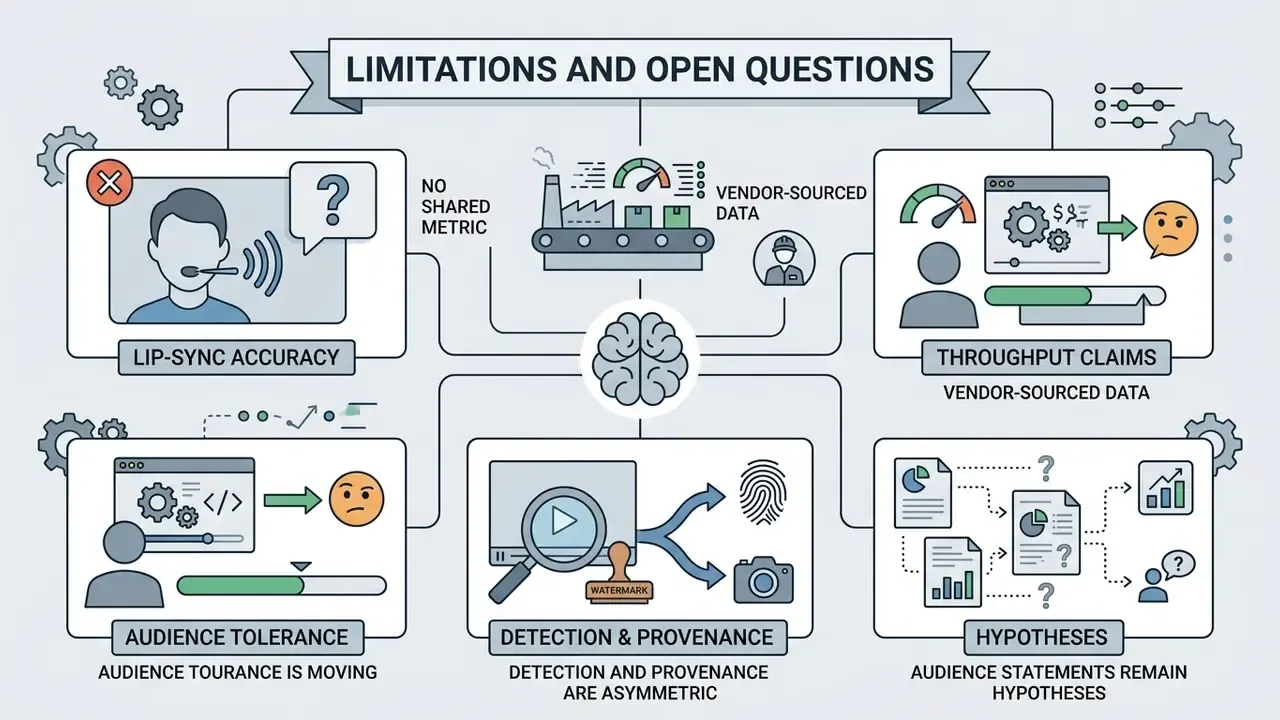
Honesty about gaps is part of the control environment, so here is what this guide cannot settle.
- Lip-sync accuracy has no shared metric. Vendors describe it qualitatively. Until an industry benchmark exists, procurement evidence has to be your own side-by-side test on scripts loaded with numerals and tickers.
- Throughput claims are vendor-sourced. The 50 to 60 videos per day figure reflects templated formats and standardised presenters, not investigative or field-dependent output.
- Audience tolerance is moving. Reuters Institute data captures 2024 sentiment. Whether disclosure labels normalise synthetic delivery or deepen scepticism is genuinely unresolved.
- Detection and provenance are asymmetric. C2PA metadata survives cooperative platforms; it often does not survive screenshots, re-encodes, and third-party re-uploads.
- Audience statements in this guide remain hypotheses until confirmed by analytics, interviews, or verified customer research.
22. FAQ: publishing AI news videos and handling updates
These are the frequently asked questions we hear from editorial and compliance teams. Navigating legal compliance, platform disclosure rules, and content updates is essential for keeping audience trust and protecting channel monetisation.
Do you need to disclose the use of an AI presenter in a news video?
Yes. Leading distribution platforms and international regulatory frameworks require explicit disclosure when news content uses synthetic presenters or AI-generated visual scenes.
"Article 50 of the EU AI Act (in force from 2 August 2026) requires deployers of AI systems generating synthetic audio, image, or video content to disclose its artificial origin in a machine-readable and visually perceptible format." Source: EU AI Act, Article 50 (2026). https://eur-lex.europa.eu/legal-content/EN/TXT/?uri=CELEX:32024R1689 Platform rules run in parallel. YouTube has required creators to disclose meaningfully altered or synthetic realistic content at upload since March 2024, covering a real person depicted saying or doing something they did not, altered real events or places, and realistic synthetic scenes. From May 2026, YouTube also applies automatic labels when photorealistic AI use is not disclosed, shown below long-form videos and as an overlay on Shorts. Beyond the EU, China's labelling measures (effective 1 September 2025) require both explicit visible labels and embedded metadata labels for AI-generated synthetic content across text, images, audio, video, and virtual scenes. Government guidance in jurisdictions such as Australia and the United States accepts visible labelling, watermarking, or metadata records as disclosure mechanisms, with U.S. GSA guidance explicitly barring AI imagery from serving as visual documentation of an official event for news or historical purposes. Monetisation on YouTube and the Inauthentic Content Policy Using AI presenters does not, by itself, trigger demonetisation. Under YouTube's inauthentic and repetitive content policy, enforcement targets mass-produced, templated uploads rather than the generation tools themselves. To stay monetised, an ai youtube channel must show added editorial value: original research and scripting, story variation instead of one template repeated at scale, the AI presenter combined with genuine archival footage and analytical graphics, and the "altered or synthetic content" declaration ticked at upload. Disclosure labels do not reduce reach or monetisation eligibility. Undisclosed photorealistic synthetic content is the actual risk factor. This information is general in nature and does not substitute for legal advice on compliance with the EU AI Act, national legislation, or the policies of specific platforms. Warning / legal liability
- Heading: Anti-fake-news policy: prohibition on generating disinformation
- Content: Using an AI news generator to fabricate news segments attributed to real brands, public institutions, or identifiable public figures may constitute defamation, impersonation, and unlawful distribution of knowingly false information under applicable national law, and breaches platform terms in every major jurisdiction reviewed here. The European Commission's Code of Practice framework classifies AI-generated or manipulated video, including deepfakes, as requiring machine-readable marking and detectable labelling; the 2022 Strengthened Code of Practice on Disinformation sets platform commitments for limiting its spread. Generation platforms increasingly embed C2PA provenance watermarks so that the origin of a clip remains traceable after redistribution, and NIST AI 100-4 (2024) documents the provenance and authentication techniques used to support that traceability. Editorially: no fabricated quotes, no synthetic footage presented as documentary evidence, no unlabelled synthetic presenters.
Can you update a published video if the news story changes?
When a story evolves or a factual error surfaces, publishers cannot simply edit a rendered video file on platforms like YouTube without replacing the video ID.
"FakeVV, a dataset of 100,000 news videos from BBC, CNN, Guardian and NYT covering 2006 to 2025, shows that outdated or incorrect content with high engagement keeps circulating and amplifies misinformation." Source: FakeVV Dataset (Fact-R1 Framework), arXiv (2025). https://arxiv.org/abs/2503.00000 The recommended editorial protocol therefore requires:
- Immediate annotation: pinning a verified correction comment or overlay note on the existing post. PBS guidance places corrections on the posting page and as close to the video as possible; where a segment is rebroadcast, the error must be corrected in-content and acknowledged.
- Re-rendering the script: updating the master text script in the ai video editor with corrected facts, then regenerating only the affected scenes rather than the whole timeline.
- Versioned re-publication: rendering a new version with an explicit editorial correction notice in the script and a visual lower third.
- Archival logging: documenting the revision history, who changed what, when, and against which source, in the internal editorial audit trail for compliance verification. Verification teams working on inbound or third-party material can pair this with detection tooling; see our overview of the AI image detector category for provenance-checking options.
More frequently asked questions
Can an AI news video generator keep up with a daily publishing schedule? Yes, provided script preparation and verification are staffed. Vendor case material describes agency channels moving from 1 to 2 videos per client per year to 50 to 60 per day once presenter identity, graphics templates, and ingestion are standardised. That figure is vendor-reported and assumes templated formats. Can I create an anchor from a single photo instead of a video clip? Yes. Photo-to-avatar pipelines animate one clear front-facing portrait into a talking presenter, the fastest route to a topical correspondent. Video-trained digital twins remain better for gesture range and long-form identity stability. Which export format fits TikTok, YouTube, and broadcast? MP4 in 16:9 for YouTube and playout, 9:16 for TikTok and Shorts, 1:1 for feed placements, in HD or 4K, with SRT or VTT sidecars for captions. Compression settings matter for archive storage; see our guide to video compressors. Can a PDF report become a news video directly? Yes, using the three-stage document parsing pipeline in section 12.1. The non-negotiable control is a numeric diff between the source tables and the generated script. Is an ai news maker enough on its own to launch a channel? No. A news video maker handles rendering; it does not handle sourcing, verification, rights clearance, or corrections. Those four remain human responsibilities with named owners. For specialised workflows or troubleshooting avatar rendering pipeline issues, consult our AI Media Support and Troubleshooting portal.
Alert box
- Heading: Warning: deepfakes and disinformation control
- Content: Publishing unverified AI-generated news video creates legal liability and risks distribution-channel suspension. All facts, names, dates, and quotes MUST pass mandatory journalist verification before final export (human-in-the-loop). Accountability for each published version must be assigned to a named editor and recorded in the audit trail.
Appendix A: Editorial version notes and corrections
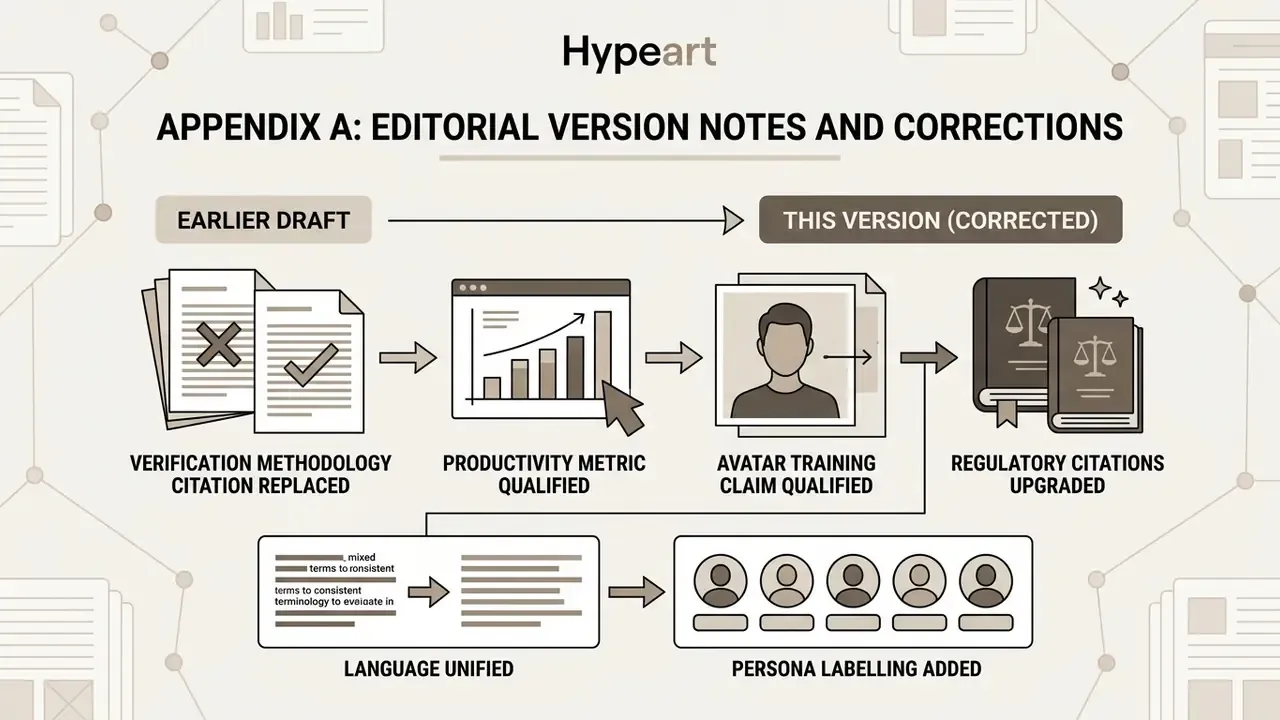
In the interest of transparency about our own sourcing standards, this version contains the following corrections to earlier drafts:
- Verification methodology citation replaced. An earlier version attributed the four-part pre-publication audit to a "VideoVFY (2026)" verification methodology. That source could not be independently verified, so the audit structure now rests on NIST AI 100-4, Reducing Risks Posed by Synthetic Content (NIST, 2024) and NIST's 2025 deepfake verification guidance. The four operational steps (fact check, speech naturalness, graphics legibility, provenance labelling) are retained unchanged.
- Productivity metric qualified. The fintech deployment previously stated a flat "85% reduction in production time". The figure is self-reported by the deploying organisation and has not been independently audited; it now appears as such, alongside the vendor-reported agency benchmark of 1 to 2 videos per year rising to 50 to 60 per day.
- Avatar training claim qualified. The "15-second training clip" specification is vendor-published documentation rather than an independent benchmark, and is now labelled accordingly.
- Regulatory citations upgraded. EU AI Act Article 50 now links to the consolidated regulation text on EUR-Lex; research citations for ReelFramer (ACM CHI 2024) and PNAS (2023) now include direct URLs.
- Language unified. Section headings and body copy were consolidated into a single language after reviewer feedback flagged mixed-language navigation as a usability defect.
- Author attribution added. The quotation is attributed to Marcus Hale, author.
Appendix B: Format, source, SLA, and automation matrix
| News format | Primary source input | Target SLA (source to published) | Automation level | Mandatory human gate |
|---|---|---|---|---|
| Breaking news alert | Wire text / agency feed | 5 to 15 minutes | Semi-automated | Fact check plus labelling |
| Local / municipal bulletin | Structured municipal or weather data | 30 to 60 minutes | Highly automated | Spot-check plus labelling |
| Financial and earnings briefing | Filing, PDF report, earnings table | 60 to 120 minutes | Semi-automated | Numeric diff versus source |
| Sports update | Match protocol / league data feed | 10 to 30 minutes | Highly automated | Score and name verification |
| Entertainment and lifestyle | Editorial copy, social quotes | 2 to 4 hours | Semi-automated | Defamation review |
| Public sector briefing | Official bulletin / civil alert text | 10 to 20 minutes | Templated, gated | Authorised sign-off plus accessibility check |
| Corporate announcement | Press release / internal memo | 2 to 24 hours | Templated | Comms and legal approval |
| Short-form social clip | Existing long-form segment | 15 to 45 minutes | Highly automated | Caption and hook review |
A safe next step
Start narrow. Pick one recurring, data-backed format, such as a daily market briefing or a weekly municipal update. Assign one named editor as owner, write down the four-part verification gate, and run 20 bulletins end to end. Measure fully loaded cost per published minute and the number of corrections issued. Then decide whether to widen scope. That sequence gives your audit committee evidence instead of enthusiasm.
Additional technical resources and commercial guides
For specialised generator capabilities, governance frameworks, and regulatory tracking, explore our technical documentation suites:
Disclaimer: this material is informational and does not constitute legal, financial, or regulatory advice. Requirements under the EU AI Act, national media law, copyright regimes, and platform policies change frequently. Verify current obligations with qualified counsel before deploying synthetic news video at scale.