Why should a risk owner care about pictures of cars? Because the same upload button that previews a wheel swap can also push pre-launch surfacing into a third-party model.
Executive Summary
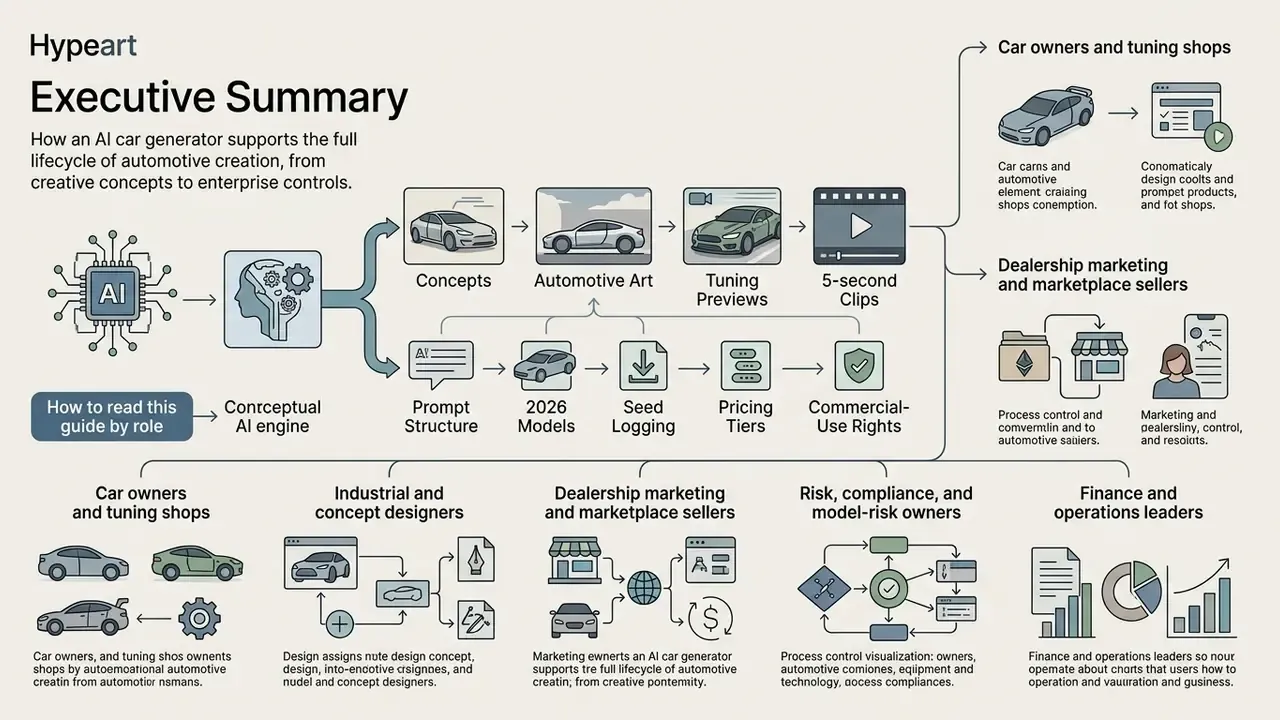
This guide covers the full lifecycle of automotive generative AI, from creative prompt construction to enterprise governance controls, so both design teams and risk owners can act on the same document.
- Two operating layers. Consumer and creator workflows (tuning previews, automotive art, social clips) run on public SaaS generators; enterprise and industrial workflows (styling reviews, CAD-adjacent ideation, dealership catalogs) require vendor validation, data-retention controls, and reproducibility logging.
- Three output classes plus motion. Stylized ai car art, photorealistic concept renders, and 3D-compatible previews, now extended by image-to-video generation producing 5-second MP4 clips at 1080p/4K, 24/30 fps.
- Model landscape 2026. Image: FLUX.1 Kontext Pro, Midjourney v7, Nano Banana 2 Pro, GPT Image 2, Seedream 4. Video: Google VEO 2/3.1, Kling 3.0 Pro, Luma Ray 2, Hailuo AI, Runway Gen-4 Turbo, Seedance 2.0. Structure-preserving editing: Stable Diffusion XL with ControlNet.
- Measured gains. Domain-tuned diffusion pipelines report an 87.7% FID improvement and a 72.2% LPIPS reduction versus generic checkpoints (industry and computational-design benchmarks, 2025-2026).
- Governance essentials. Seed locking, prompt versioning, JSON generation metadata, human-authorship documentation, trademark clearance, dataset licence checks (for example CC BY-NC 4.0 restrictions), Zero Data Retention, SSO/RBAC, SOC 2, and alignment with NIST AI RMF and ISO/IEC 42001.
- Hard limit to communicate internally. Generated vehicle imagery is an aesthetic artifact, not an engineering-validated assembly. Aerodynamic, crash, and packaging claims require CFD and FEA validation.
How to read this guide by role
Different readers arrive with different questions, so the document is deliberately layered rather than linear.
- Car owners and tuning shops. Start with the editing and photo-reference sections, then check licence terms before publishing client previews.
- Industrial and concept designers. Focus on input paradigms, prompt structure, and the styling-versus-geometry split between general engines and dedicated automotive pipelines.
- Dealership marketing and marketplace sellers. Read the scene-restaging use cases, the resolution and aspect-ratio requirements, and the pre-publication legal checklist.
- Risk, compliance, and model-risk owners. Jump to vendor validation, Shadow AI mitigation, reproducibility metadata, and the validation boundary statement.
- Finance and operations leaders. Treat the credit, concurrency, and licence tables as the cost side of any business case, since control costs rarely appear in the first ROI slide.
What an AI Car Generator Is and What Images It Produces
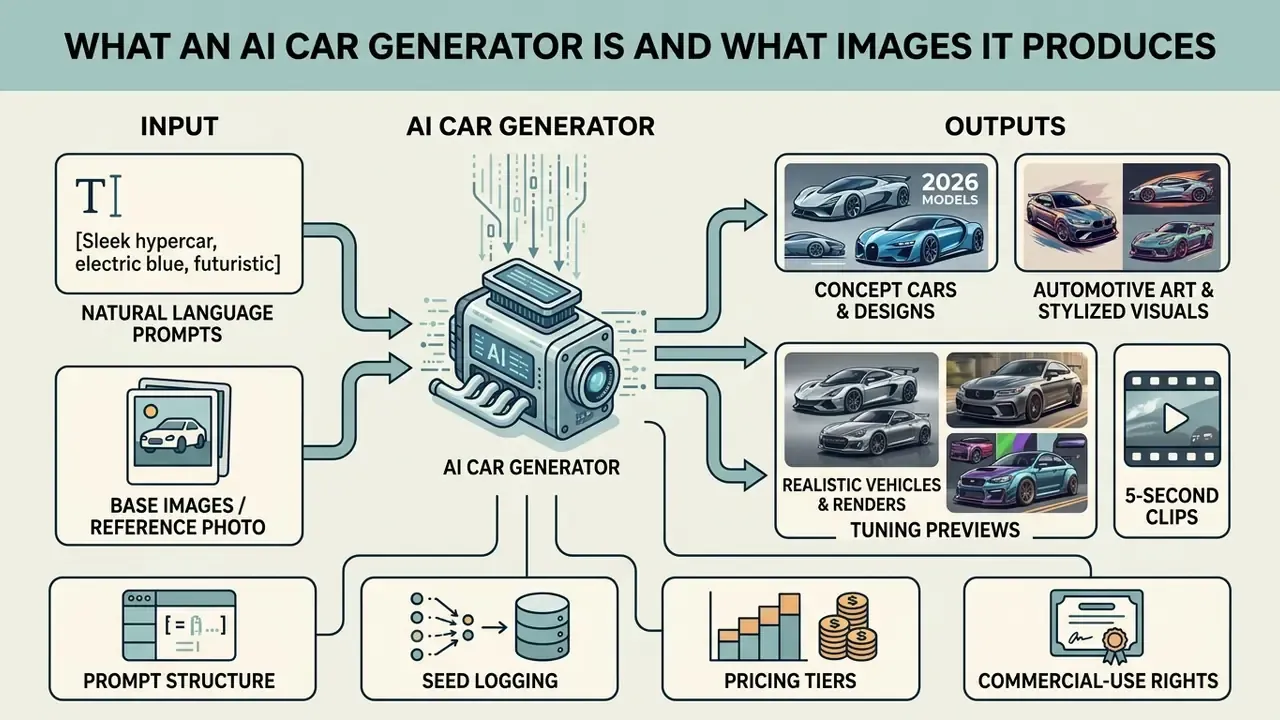
An ai car generator is an automated visual synthesis system designed to interpret user inputs, such as natural language prompts or base images, and produce high-resolution vehicle designs. These platforms process semantic attributes including body style, paint finish, aerodynamic trim, and environmental lighting to generate detailed 2D renderings, animated clips, or 3D-compatible visual assets.
«Diffusion models trained on automotive datasets achieve an 87.7% improvement in FID and a 72.2% reduction in LPIPS compared with general-purpose models.»
Prompt-guided diffusion architectures trained on automotive datasets achieve up to an 87.7% improvement in Fréchet Inception Distance (FID) and a 72.2% reduction in Learned Perceptual Image Patch Similarity (LPIPS) compared with generic diffusion models. FID measures how close generated image statistics sit to a real reference set; LPIPS measures perceptual difference. By embedding domain-specific constraints, an ai car image generator converts abstract aesthetic concepts into structured, high-fidelity visual representations.
Methodological note. The FID and LPIPS deltas above originate from computational-design benchmarking published in 2025-2026 and depend on dataset composition, resolution, and evaluation protocol. Teams reproducing these figures should re-run measurements on their own reference set before citing them in internal model documentation. One number copied into a board deck without its protocol is a governance defect, not a shortcut.
Concept Cars, Realistic Vehicles and AI Car Art
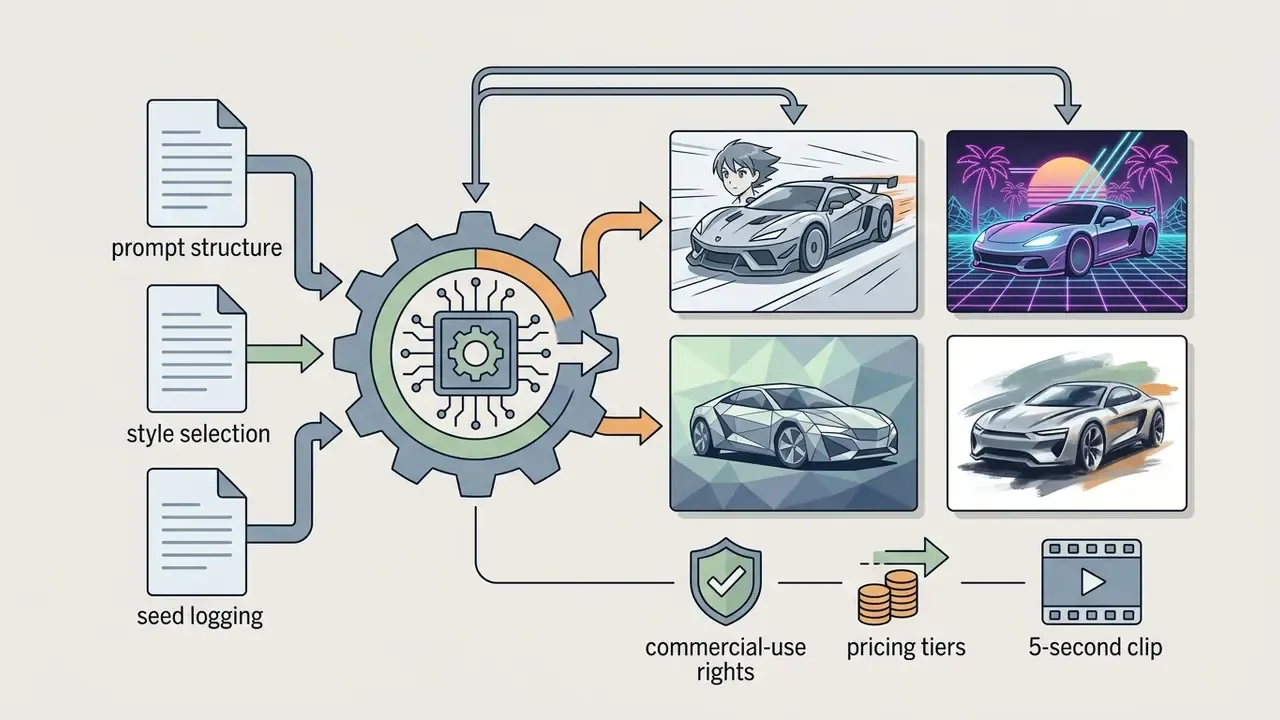
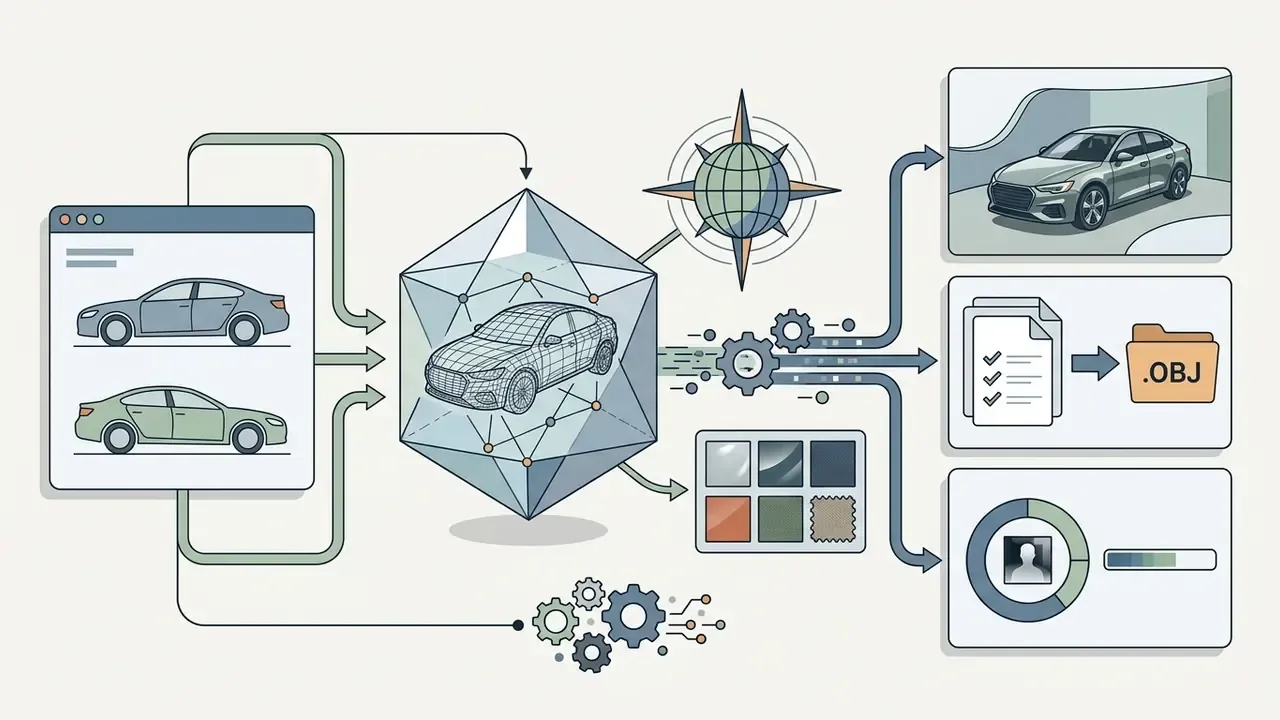
Visual outputs generated by automotive AI tools are categorized into three primary classes: stylized ai car art, realistic production concepts, and 3D geometric previews. Each class fulfills distinct requirements across conceptual ideation, marketing visualization, and engineering design workflows.
«Designers rank novelty and efficiency first, but they fear fixation on visual templates when working with generative AI.»
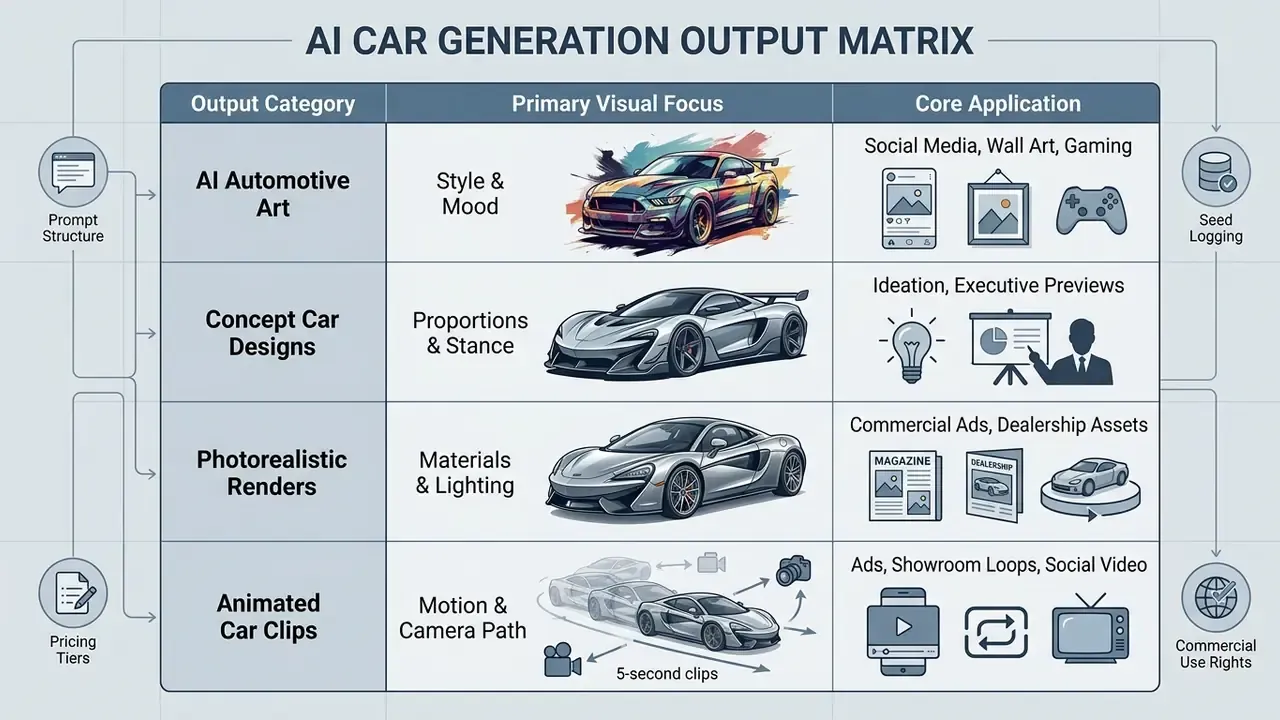
Readers selecting a platform after reviewing output classes can consult a structured comparison of the best AI art generators covering image quality, style control, pricing, and licensing.
Generating a Car From Text or From a Reference Photo
Automotive AI models operate through two primary input paradigms: text-to-image synthesis and image-to-image transformation. Choosing between these modalities depends on whether the task requires unconstrained creative exploration or strict structural preservation.
Text-to-image workflows convert descriptive text prompts into visual latent spaces. This method suits exploration of novel body configurations, experimental aerodynamics, or imaginative themes. Image-to-image generation, by contrast, uses an uploaded car photo or CAD sketch as a structural baseline. The model retains fundamental proportions and wheel placement while modifying surface textures, body kits, or environment backdrops based on supplementary text instructions.
«DALL-E generates images that match user intent more accurately than Midjourney in vehicle design tasks.»
Practically, this means model choice is a controllability decision rather than a quality ranking. Prompt-obedient models suit brief-driven styling reviews, while aesthetically opinionated models suit exploratory mood generation. Teams comparing controllability trade-offs can review an evaluation of Midjourney against competing generators by quality, pricing, controls, and licensing, plus a broader guide to online photo editors for downstream retouching of image-to-image results.
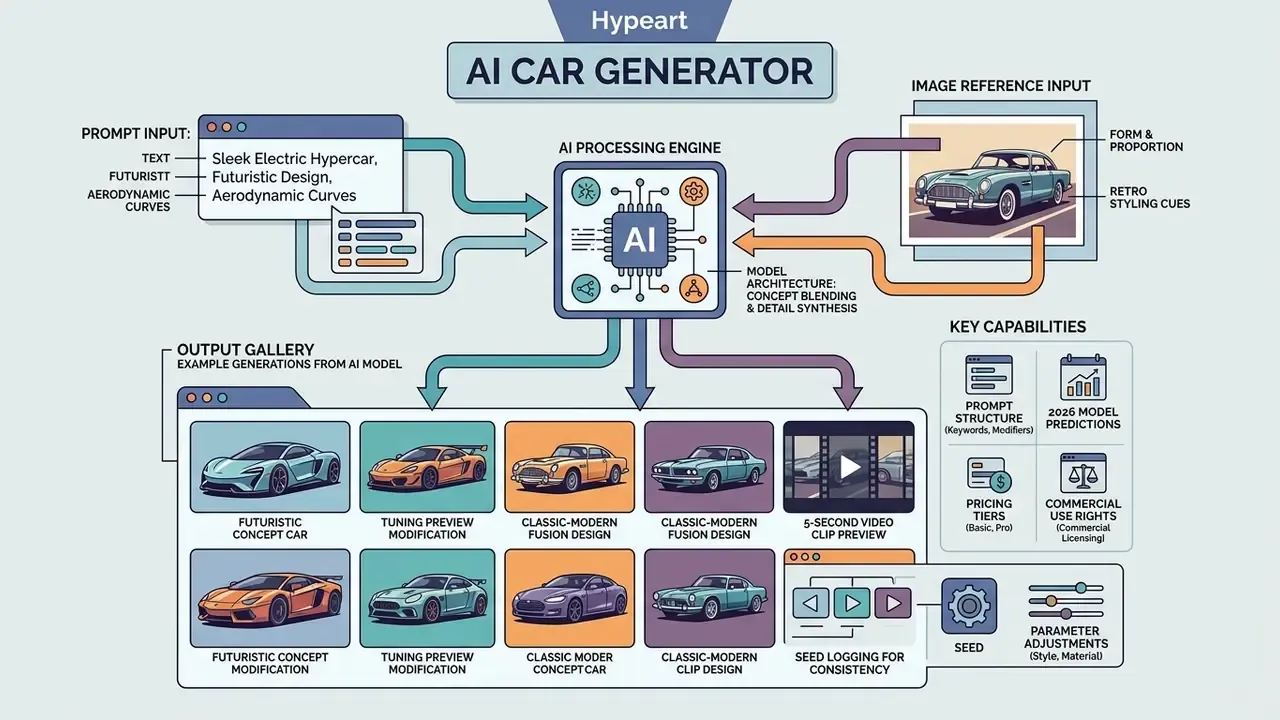
Reference descriptions for the gallery samples:
- Concept car: showcase-style vehicle with radical proportions, aerodynamic bodywork, and an experimental lighting signature, staged as a motor-show reveal.
- Sports car: low stance, aggressive front intake, two-door performance silhouette, wide staggered wheels, motion-oriented composition on track or coastal road.
- Classic car: long hood and short deck proportions, chrome trim, period-correct wheels, heritage paint, presented in a studio or historic streetscape.
- Futuristic transport: smooth organic surfaces, integrated LED strips, transparent canopy, no exhaust cues, reflective studio or night-city backdrop.
- AI car art: stylized automotive image where the brief explicitly fixes vehicle type, era, materials, lighting, environment, and art style to keep output predictable.
AI Car Design Generator Capabilities: Creation, Editing and Animation
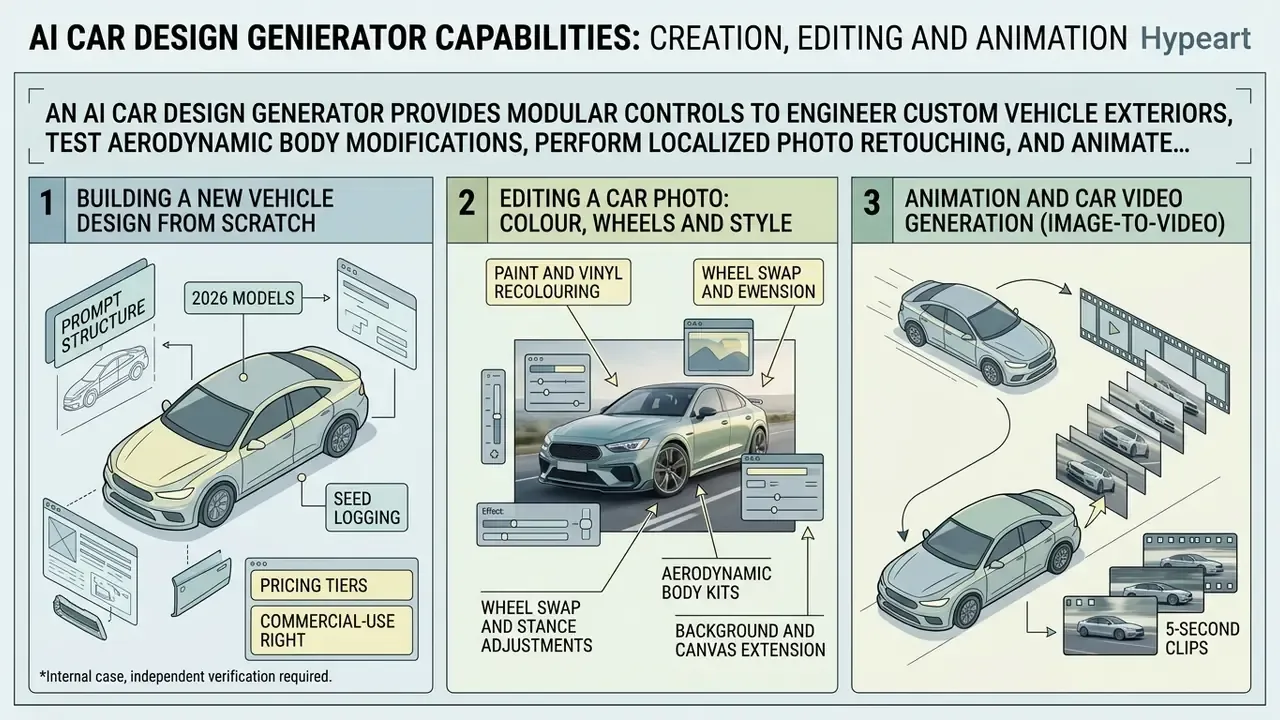
An ai car design generator provides modular controls to engineer custom vehicle exteriors, test aerodynamic body modifications, perform localized photo retouching, and animate finished renders into short video clips. These platforms combine parametric style selection with deep neural inpainting and motion-model inference to execute fine-grained visual edits.
Building a New Vehicle Design From Scratch
Generating a vehicle exterior from scratch requires defining core structural parameters within an ai car creator interface. Users establish body type (sedan, SUV, hypercar), era styling (retro 1970s, modern, futuristic), wheel geometry, and exterior aerodynamic packages. Vendor-documented input fields commonly include brand, model, model year, variant or body style, trim, paint description, camera angle, and zoom type, while "era" and "body kit" are usually encoded through prompt text rather than dedicated form fields.
Modern platforms functioning as an ai car maker or ai car model generator process these user inputs through specialized neural pipelines.
«A generative-AI approach to car front-end design substantially improves designer efficiency, cutting both time and material cost in product development.»
Editing a Car Photo: Colour, Wheels and Style
Local photo modification using an ai car edit generator or ai car modification generator relies on neural inpainting algorithms. This workflow preserves the target vehicle's structural frame while altering designated sub-regions based on binary masks and text inputs: the masked area is resampled while surrounding pixels preserve context for seamless blending.
Creators who need conventional retouching alongside generative edits can review a practical guide to online photo editors and their commercial workflows.
- Paint and vinyl recolouring. Replaces surface paint layers with matte, metallic, pearlescent, or custom wrap textures without distorting light reflections.
- Wheel swap and stance adjustments. Modifies rim size, spoke design, tire profile, and suspension drop height while maintaining realistic wheel-well clearance.
- Aerodynamic body kits. Inpaints customized front splitters, side skirts, rear diffusers, and carbon-fiber spoilers onto existing vehicle geometry.
- Background and canvas extension. Expands narrow dealership photos into wide-format banners; see the comparison of AI image expansion tools for outpainting and background generation options.
Documented editing workflows recommend a clear front three-quarter or side photo, a localized edit selection (paint, wheels, tint, suspension height, body kit, cleanup), then iterative follow-up prompts and 4K export. A workable example: "nardo gray, 19-inch BBS LMs, lowered 2 inches."
Animation and Car Video Generation (Image-to-Video)
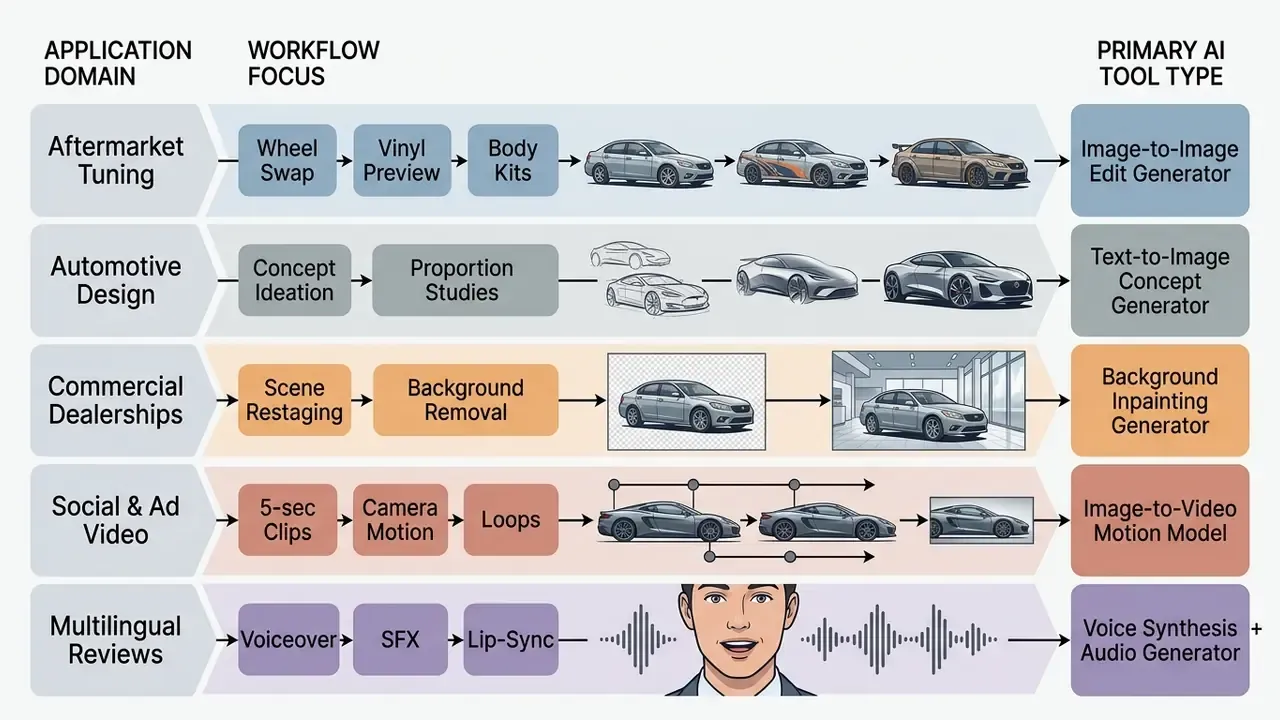
Current services do more than render stills. They also transform an approved image into a dynamic 5-second clip through image-to-video pipelines, using specialized motion models: Luma Dream Machine / Ray 2, Google VEO 2 and VEO 3.1, Kling 3.0 Pro, Hailuo AI, Haiper, Runway Gen-3 / Gen-4 Turbo, Seedance 2.0.
Core scenarios for automotive video generation:
- Cinematic camera movement.A camera flight around the body: 360-degree orbit, low-angle tracking shot, dramatic rear pull-away.
- Environment motion.Animated surroundings, including neon movement, road motion blur at speed, rotating wheels, and rain beading on the clearcoat.
- Showroom and presentation.Short advertising micro-clips for dealerships and social channels without the cost of a physical shoot, including loop clips for storefronts and product cards.
- Concept reveal.Bringing a concept car to life for pitch decks: headlights switching on, doors opening, environment shifting behind the body.
A typical clip cycle takes 3 to 5 minutes, after which the system offers several motion candidates. Export runs to MP4 (1080p or 4K) at 24 or 30 fps; some platforms support video upscaling to 4K and add a background audio track after generation.
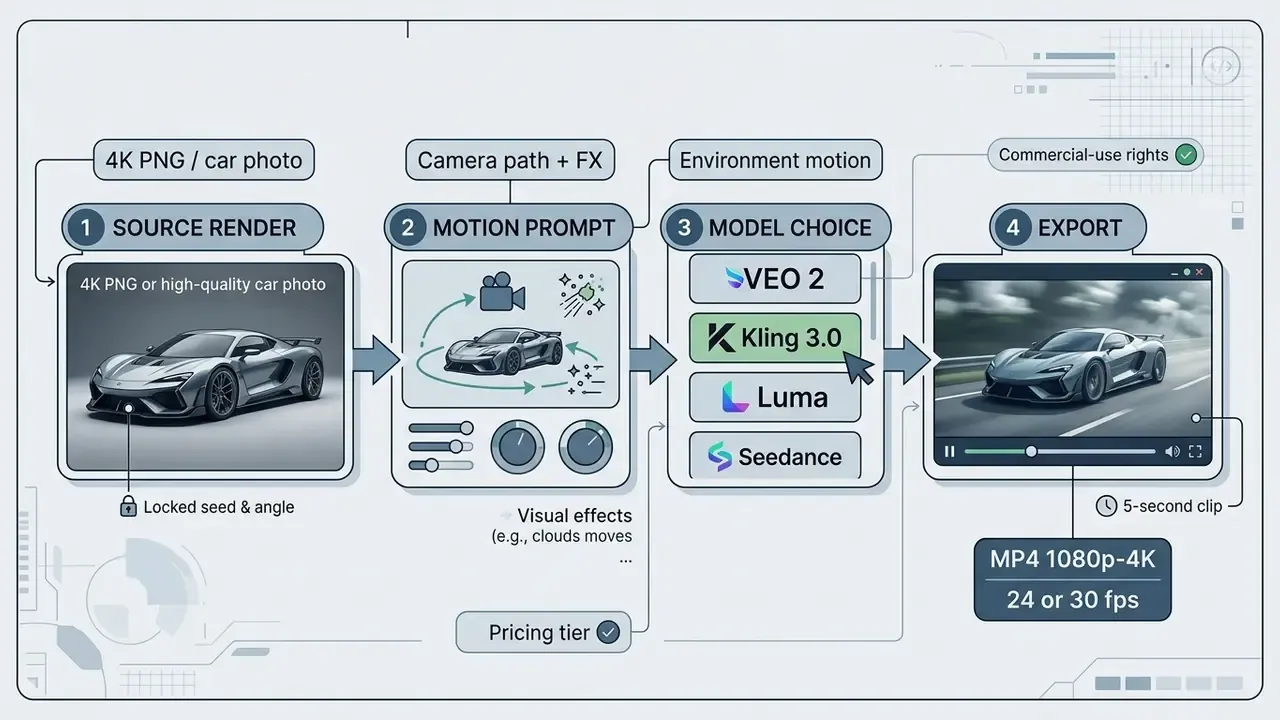
Technical teams planning API-level video generation can review an implementation guide to Google Veo capabilities, API access, cost and limits, and creators testing zero-budget options can compare free AI video generators by duration limits, credits, watermarks, and export rights.
How to Create a Car Image With an AI Car Generator Online
Using an ai car generator online involves a structured three-stage pipeline: defining the initial concept, configuring model style parameters, and executing high-resolution exports.
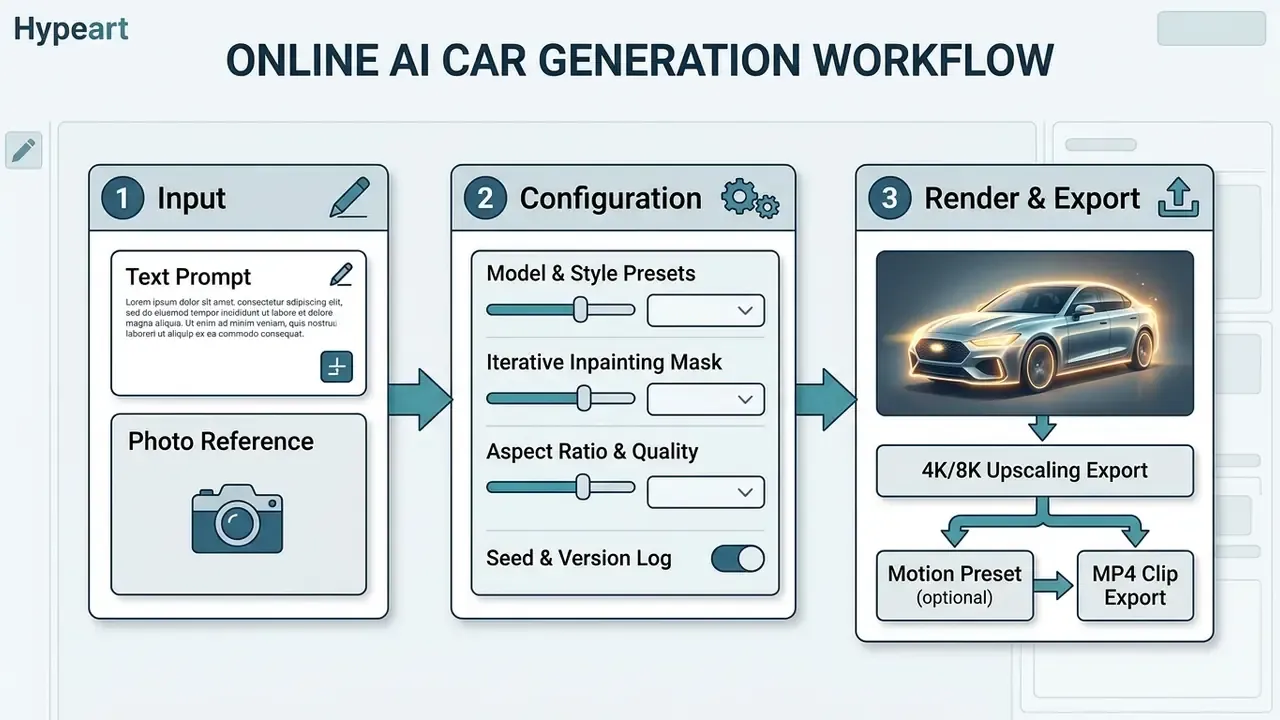
Describe the Car in a Prompt or Upload a Car Photo
To initiate generation in an ai car generator from photo or prompt system, select the input channel matching your asset requirements:
- Text prompt channel.Enter a structured sentence detailing vehicle classification, paint finish, wheels, environment, lighting, and camera angle.
- Photo upload channel.Upload a high-resolution three-quarter front or side profile photo of the target vehicle. Ensure clean lighting and unobscured body panels.
- Reference masking.When using an ai car edit maker, brush over the specific region, wheels or hood for instance, intended for AI modification.
Choosing between text and reference. For concrete, identity-critical subjects, a customer's actual vehicle, a homologated body, a brand-consistent catalog car, reference control preserves geometry and layout, and prompts should be phrased as "change only X, keep everything else the same." For abstract or exploratory concepts, text-only generation produces wider ideation spread, after which the best candidate becomes the reference for the next iteration.
Select the Model, Style and Car Design Parameters
Once inputs are positioned, adjust the generator's internal configuration settings:
- Base AI model. Select between photorealistic diffusion checkpoints, hyper-concept art models, structure-preserving ControlNet pipelines, or 3D mesh preview engines.
- Style presets. Choose rendering profiles such as studio industrial photography, neon cyberpunk, clay render, low-poly, cinematic, or vintage heritage.
- Reference strength. Where available, tune adherence sliders plus effect layers for colour tone, lighting, and camera angle.
- Aspect ratio and composition. Set canvas dimensions, for example 16:9 widescreen for desktop banner presentation, 1:1 square for catalog thumbnails, 9:16 for vertical social video.
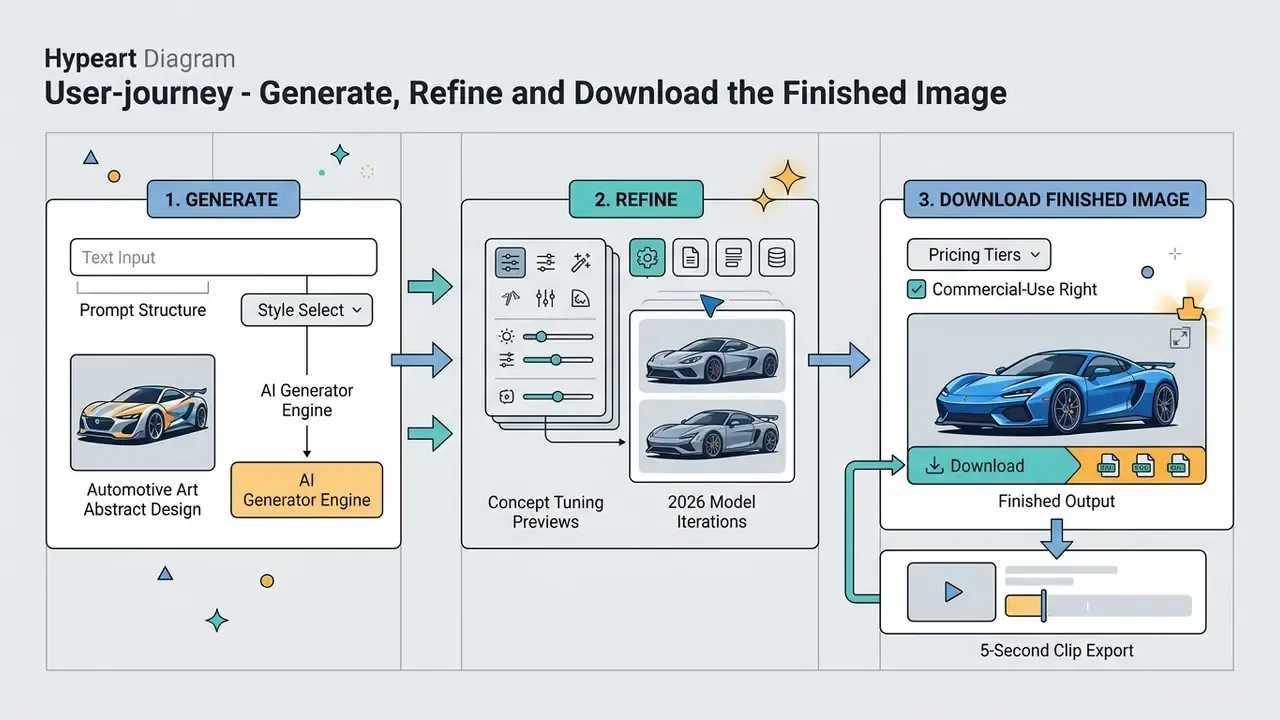
Generate, Refine and Download the Finished Image
Click Generate to trigger latent space sampling. Evaluate the output candidates against geometric alignment criteria:
- Inspect optics, grille mesh symmetry, and wheel roundness for diffusion artifacts.
- Apply secondary inpainting prompts to fix localized discrepancies.
- Execute high-resolution upscaling (2x or 4x) to produce 3840x2160 (4K) print-ready files in PNG or TIFF format; generative upscalers commonly cap output at 6144x6144 px or a comparable megapixel ceiling.
- Where the deliverable is motion, pass the approved still into the image-to-video stage and export MP4 at 1080p or 4K, 24 to 30 fps.
- Archive the accepted candidate together with prompt text, seed, model version, and settings.
Teams assembling clips into publishable content can follow a workflow guide to YouTube video editors and publishing processes.
How to Write a Prompt for a Realistic and Custom Car Image
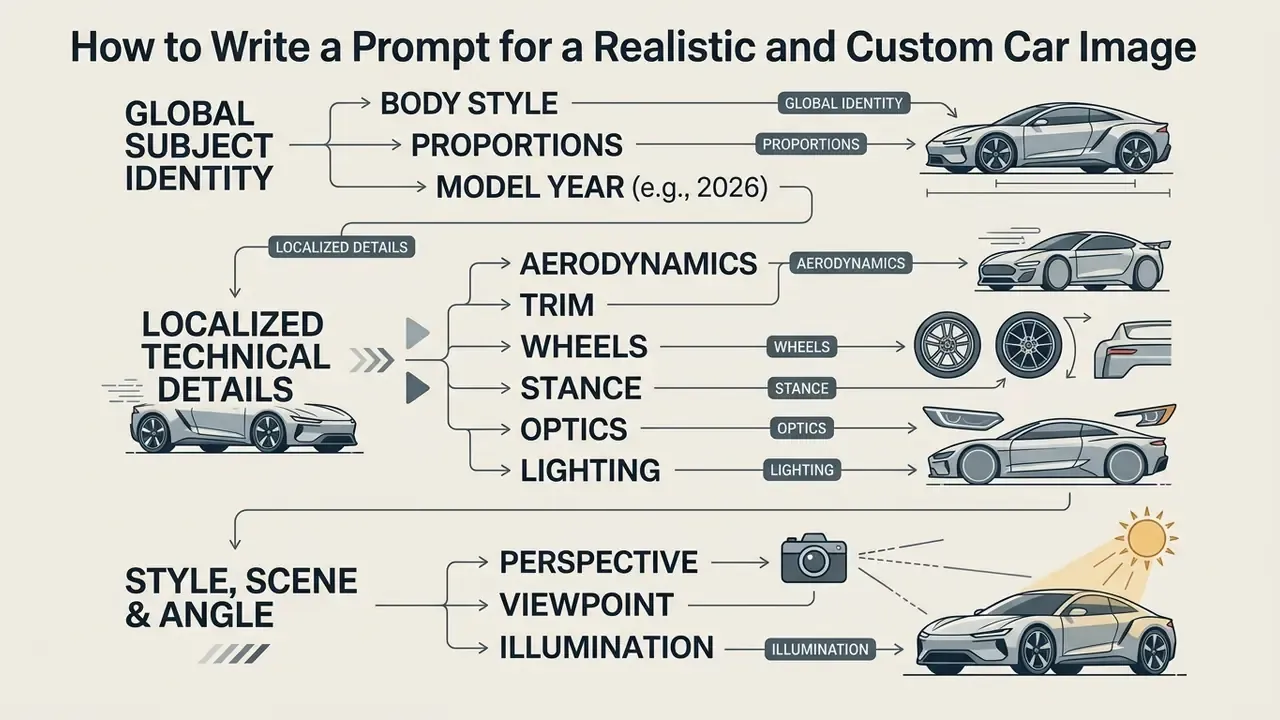
Formulating an effective text query for ai car image generation tools requires structured keyword positioning: order prompts from global subject identity to localized technical specifications, surface materials, camera optics, and environmental illumination, then close with explicit exclusions.
«Structured prompts encoding vehicle type, styling language and aerodynamic requirements deliver both visual coherence and physical plausibility in generated designs.»
Practitioner prompt-engineering documentation converges on the same pattern: scene, subject, key details, constraints. Photographic vocabulary supports realism, explicit negative constraints suppress unwanted elements and stray text, and a high-quality generation setting matters when fine detail matters. Stepwise decomposition (theme, composition, content detail, light and shadow, iteration) improves controllability further.
Which Vehicle Details Belong in the Text Description
Refining Style, Scene and Angle in AI-Generated Car Images
To move beyond generic renders, add photographic staging and camera control parameters to the prompt:
- Perspective and viewpoint. Use photographic terms like eye-level front three-quarter view, low-angle side profile tracking shot, or studio top-down overhead angle.
- Illumination. Define light behavior with phrases like golden hour natural sunlight, softbox studio illumination with rim lighting, or wet asphalt reflecting neon city lights.
- Camera optics. Control rendering depth using parameters like shot on 85mm f/1.4 lens, shallow depth of field, sharp focal sharpness on front grille, crisp reflections.
- Background discipline. Keep the backdrop neutral or non-competing when the deliverable is a catalog or inventory image, and reserve environmental storytelling for campaign assets.
Prompt parameters for video generators:
- Motion track and dynamics. FPV drone chasing shot, slow-motion side panning, 360-degree orbit around the body, wheel spin at high speed, dramatic rear pull-away.
- Lighting motion. Reflections sliding across the hood, headlights turning on in the dark, neon signage flickering on wet asphalt.
- Environment dynamics. Tire smoke drifting, dust trail behind an off-road SUV, rain streaks running along the door panel.
Prompt Reproducibility: Seed Locking and Generation Metadata
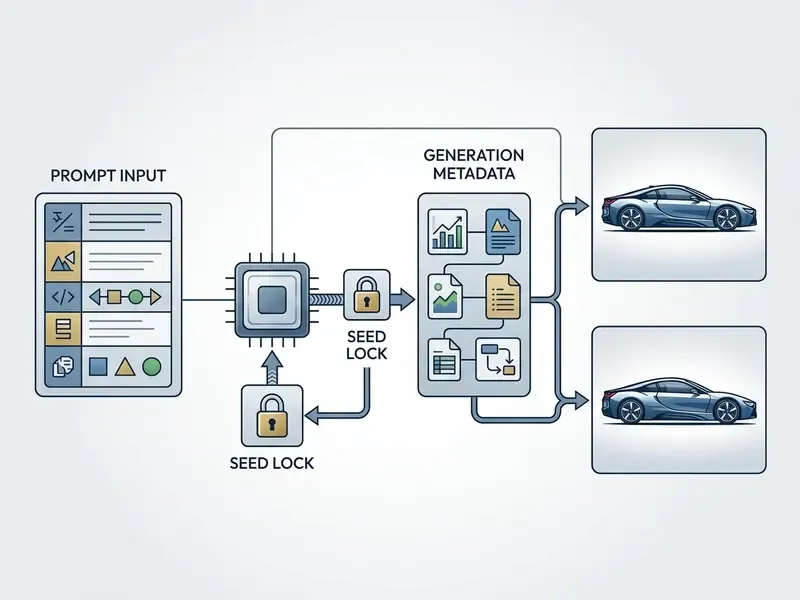
For regulated, brand-controlled, or audit-exposed workflows, prompt text alone is insufficient evidence. Reproducibility requires locking the stochastic parameters and archiving them with the asset.
- Seed locking.Fix the random seed before variant generation so a candidate can be regenerated later with near-identical output. Sweep seeds only when exploring, never when finalizing an approved asset.
- Deterministic settings capture.Record model name and version, guidance or adherence value, sampler, step count, aspect ratio, resolution, upscaler, and reference-image hash.
- Prompt versioning.Store prompts as versioned artifacts (v1, v2, approved), including negative constraints, so lineage between brief and output stays traceable.
- JSON metadata archive.Attach a generation manifest to the exported file and retain it in the model or asset registry alongside reviewer sign-off.
{
  "asset_id": "car-render-2026-0412",
  "model": "flux1-kontext-pro",
  "mode": "image-to-image",
  "seed": 884213771,
  "guidance": 4.5,
  "steps": 34,
  "reference_hash": "sha256:9f2c…",
  "prompt_version": "v3-approved",
  "export": {"format": "TIFF", "resolution": "3840x2160"},
  "human_review": {"reviewer": "design-lead", "date": "2026-04-12"}
}
Formula: [Subject] + [Exterior Details] + [Color/Materials] + [Camera/Lighting] + [Environment]
Example: "Photorealistic front three-quarter view of a modern electric hypercar, aggressive stance, exposed carbon-fiber front splitter, sharp LED matrix headlights, metallic Nardo Gray paint, 21-inch matte black forged wheels, studio lighting with soft highlights, shot on 70mm lens, 4k resolution, clean background."
Video prompt: "Slow 360-degree orbit around the same hypercar, reflections sliding across the hood, wheels spinning, wet asphalt with neon reflections, cinematic 24fps, 5-second clip."
How to Choose AI Car Image Generation Tools and Models
Selecting between general multimodal AI engines and dedicated ai car image generation tools depends on requirements for structural fidelity, API access, and workflow integration. The choice also changes how prompts are interpreted: general engines treat the prompt as a creative brief and tolerate loose phrasing, while dedicated automotive pipelines expect domain vocabulary (variant, trim, angle, zoom type) and punish ambiguity with geometry drift.
«General-purpose generative models fall short of designer expectations in semantic understanding and image generation for specific domains such as automotive.»
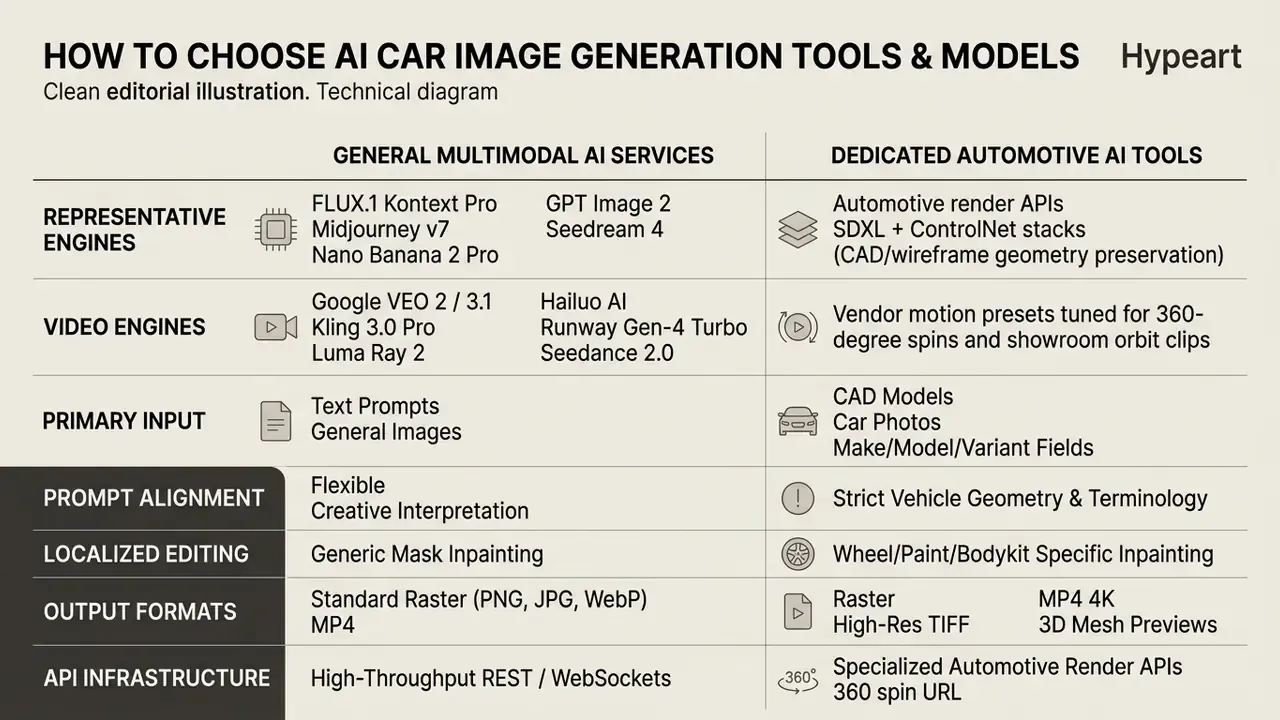
How to read this choice by task layer. Documented multi-agent automotive frameworks split responsibilities: a styling agent produces high-resolution renders (SDXL plus ControlNet), a CAD agent retrieves or generates 3D geometry against datasets such as DrivAerNet++, a meshing agent prepares CFD-ready meshes, and a simulation agent estimates aerodynamic performance. So "best tool" is meaningless without naming the layer: styling, geometry, meshing, or simulation. Name the layer first.
Text Generation, Photo Generation and AI Car Edit Maker
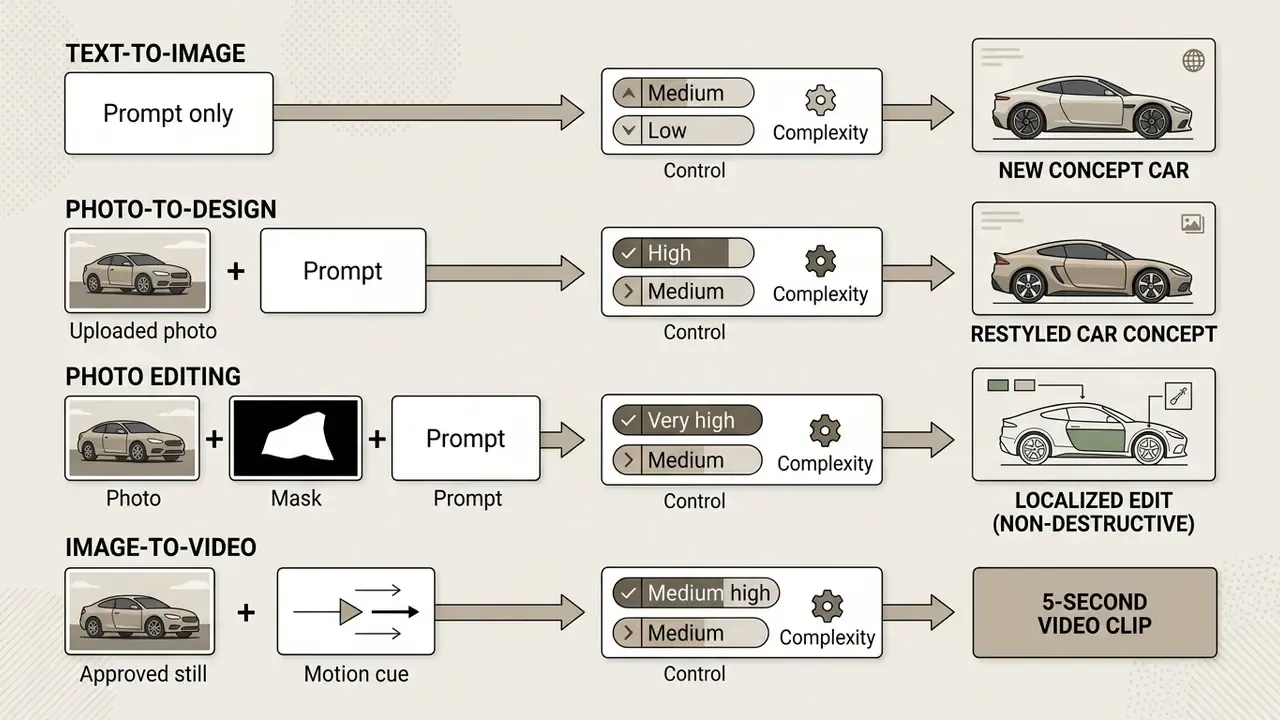
- Text-to-image engines. Best suited for rapid conceptual ideation, exploratory design briefs, and artistic visual creation. High aesthetic output, lower precision over structural body dimensions.
- Photo-to-design and image control. Ideal for styling reviews and vehicle restyling. Accepts existing car photos to maintain vehicle identity while applying customized aesthetic layers.
- AI car edit maker systems. Required for aftermarket tuning and vehicle personalization. Uses region-specific masking to swap wheels, adjust suspension height, or repaint individual body panels.
- Image-to-video motion engines. Convert an approved render into a 5-second animated clip with a defined camera path and environmental motion.
Output Parameters: Detail, Style and Image Export
When evaluating output quality from an ai car image generator, assess five technical verification criteria:
Buyers weighing output quality against price can consult a comparison of the best AI art generators and a review of Google AI Image Generator terms covering features, access, pricing, restrictions, and usage rights. Companies evaluating wider creative suites across corporate marketing workflows can explore the hub for structured tool comparisons.
Enterprise Vendor Evaluation and Validation
Before an automotive generator enters a corporate toolchain, the vendor itself must pass validation. Minimum evidence set:
- Corporate identity check.Registered legal entity, jurisdiction, resolvable domain, and a published contact of record.
- Security attestation.SOC 2 Type II or ISO/IEC 27001 report, penetration-test summary, incident-response SLA.
- Data handling.Documented Zero Data Retention option, explicit statement that customer uploads are excluded from model training, configurable retention windows, and regional data residency.
- Access governance.SSO (SAML or OIDC), RBAC, audit logs exportable to SIEM, per-seat and per-project quota controls.
- Commercial terms.Written commercial licence for outputs, indemnity scope, and clarity on whether video rights differ from still-image rights.
- AI management alignment.Mapping of vendor controls to NIST AI RMF functions and ISO/IEC 42001 clauses, plus model-change notification commitments.
| Vendor validation item | Status recorded during this review |
|---|---|
Legal entity and domain resolution for hypeart.ai | Not verifiable at the time of review; the domain did not resolve via DNS lookup |
| Verified pricing model | Not available |
| SOC 2 attestation | Not available |
| Documented commercial US offering | Not available |
Where a vendor cannot supply the items above, the correct governance outcome is to treat it as unvetted and block corporate data uploads until verification completes. To review developer access pricing and API integration costs for vetted platforms, technical teams can browse the hub.
Corporate Risk and Shadow AI
Unmanaged use of public car generators is a data-exfiltration channel, not only a licensing question. Three risk clusters dominate:
- Confidential geometry leakage. Uploading pre-launch CAD exports, clay-model photos, or wireframes into a public image-to-image service can transfer proprietary surfacing into a third-party environment and, absent a no-training clause, into future model weights.
- Customer and collateral data. Dealership and insurance photos may contain plates, VIN stickers, faces, addresses, and location metadata; DLP rules should strip EXIF and block regulated fields before upload.
- Unlogged decision artifacts. Assets produced on personal accounts cannot be reproduced, attributed, or defended in an audit, which breaks the human-authorship and provenance chain needed for both copyright and internal review.
Mitigation checklist. Approve an enterprise tenant with Zero Data Retention; route all generation through SSO with RBAC and per-project quotas; enforce DLP patterns for CAD extensions and identity fields; maintain an approved-model register with versions; log seeds and prompt manifests centrally; require human sign-off on every externally published asset; and run periodic discovery scans for unsanctioned generative endpoints. None of this is exotic. It is inventory discipline applied to pictures.
Free AI Car Generator: Tiers, Limits and Commercial Use
Evaluating economic access models for an ai car generator free service requires analyzing platform credit allocations, functional limitations, concurrency caps, and commercial licensing terms.
What the Free Generation Tier Includes
Free tiers of an ai car generator online free or ai car generator free platform typically allow users to test core prompt-to-image capabilities before upgrading:
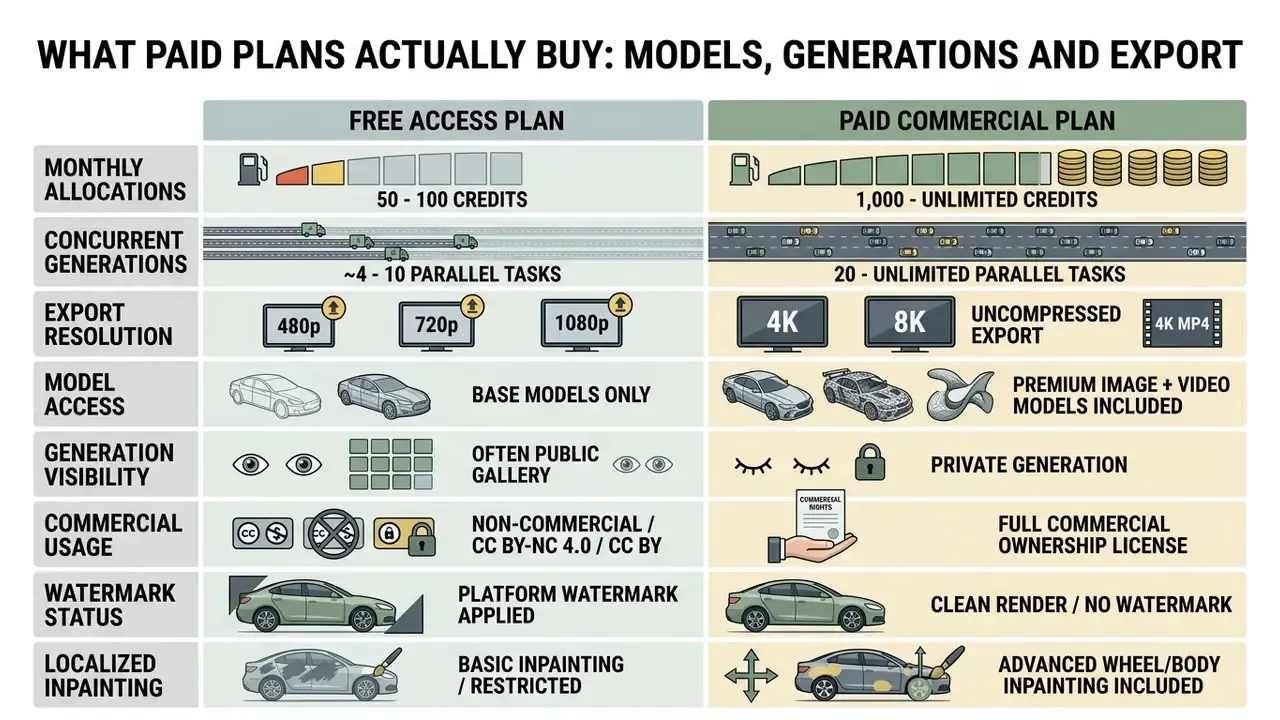
- Credit limits. Platforms grant recurring monthly credits, commonly 50 to 100 credits, for example 100 credits per month on some 3D-oriented tools, or a one-time welcome allocation such as 125 credits on certain video tools.
- Watermarks and resolution. Free renders often include visible platform watermarks and restrict export resolutions to 480p through 1080p depending on the product.
- Model restrictions. Access is typically restricted to base diffusion models, excluding premium checkpoints, high-speed servers, or specialized 3D and video engines.
- Concurrency caps. Free and entry plans limit parallel generations, frequently 4 to 10 concurrent tasks, which directly constrains batch ideation.
- Licence constraints. Some free outputs are released under attribution or non-commercial terms rather than full commercial ownership.
Creators comparing entry-level access can review a guide to free photo editors and their export limits and a comparison of free AI art generators by output quality, limits, styles, watermarks, and licensing.
What Paid Plans Actually Buy: Models, Generations and Export
Paid subscription tiers for an ai car design generator free platform unlock advanced features required for commercial production:
- High-resolution exports. Native 4K and 8K uncompressed exports without watermarking, plus 4K video output where motion models are included.
- Priority processing. Fast-track rendering queues on high-performance GPU hardware, plus higher concurrency, from 20 to unlimited parallel tasks on studio tiers.
- Premium model access. Flagship image and video checkpoints, for example Kling 3.0 Pro, Seedance 2.0, Runway Gen-4 Turbo, Midjourney v7, are usually gated behind mid or top tiers.
- Batch generation and inpainting. Automated generation of multiple design variants plus advanced brush-masked inpainting.
- Privacy controls. Paid tiers frequently switch generation visibility from public to private, which is decisive for pre-launch automotive work.
Teams optimizing delivery weight of large render sets can also consult a guide to video compressors and quality loss before publishing 4K automotive clips. Finance owners modelling seat counts and credit burn against control costs can open the hub for cost estimation.
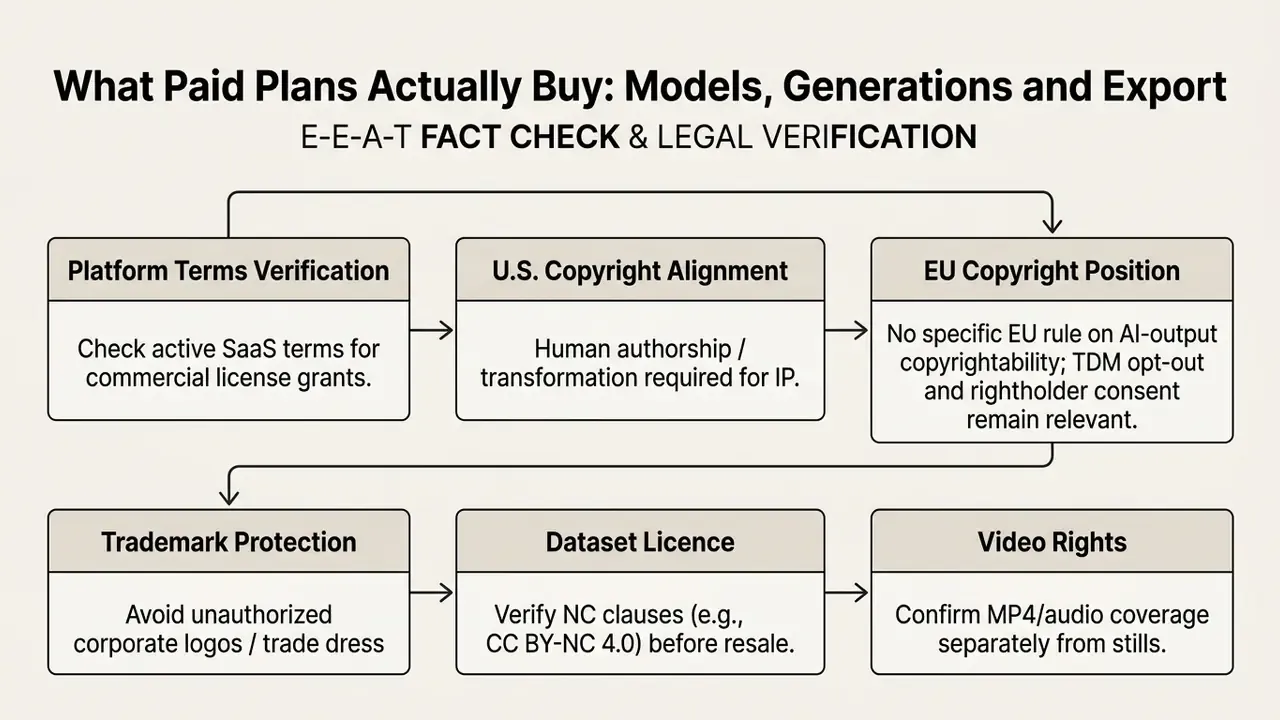
How to Verify Commercial Terms for AI Car Art
Deploying generated automotive imagery in client campaigns or commercial advertising requires verifying IP rights and platform terms:
- Human authorship standards. According to guidance from the U.S. Copyright Office (2026), raw AI outputs generated without substantial human creative input or manual modification generally fall into the public domain and lack copyright protection. https://www.copyright.gov/ai/
- Dataset licence constraints. Training and reference datasets carry their own terms.
«The DrivAerNet++ dataset is distributed under CC BY-NC 4.0, which prohibits commercial use without specific permission from the rightsholders.» DrivAerNet++, arXiv / MIT (2024)
- Platform terms of service. Commercial usage rights depend on subscription tier. Paid plans typically grant commercial ownership, whereas free generations may be licensed under non-commercial or attribution Creative Commons terms (CC BY-NC 4.0 or CC BY 4.0). Some vendors add revenue thresholds, for example company use above USD 1M annual gross revenue requiring a higher plan.
- Trademark and brand rights. AI outputs featuring recognizable corporate logos or proprietary vehicle designs, trademarked grille forms or protected trade dress for instance, remain subject to third-party trademark and design-right protections. Teams generating their own marks instead of borrowing existing ones can compare an ai logo generator or a mobile ai logo maker for original branding.
- Video versus still rights. Confirm explicitly whether the commercial licence covers animated MP4 output, background music, and synthetic voice tracks, since these are frequently governed by separate clauses.
Pre-publication legal checklist for automotive content
| # | Check | What we confirm | Action on failure |
|---|---|---|---|
| 1 | Logo and badge scan | No third-party logos, badges, or wordmarks | Inpaint or replace the detail |
| 2 | Trade dress similarity | Grille shape, lamps, and silhouette do not reproduce a protected design | Rework proportions or prompt |
| 3 | Human authorship record | Edits, selection, and human refinement are documented | Add and log the creative contribution |
| 4 | Platform tier licence | Active plan grants commercial rights to image and video | Upgrade the plan or switch tools |
| 5 | Dataset / reference licence | References and datasets carry no NC restriction | Replace the reference |
| 6 | Personal data in source photo | No plates, faces, VIN, or geotags | Retouch and strip EXIF |
| 7 | Audio and voice rights | Music and synthetic voice licensed for advertising | Replace track or voice |
| 8 | Provenance archive | Prompt, seed, model, and reviewer stored | Regenerate with logging enabled |
Readers assessing platform-level licensing can also review an overview of Canva AI Generator commercial terms and of Microsoft AI Image Generator covering access, features, limitations, and commercial-use terms.
What Teams Actually Use an AI Car Generator For
Automotive generative systems support diverse application workflows, ranging from aftermarket vehicle modification previews to commercial media production and multilingual video content.
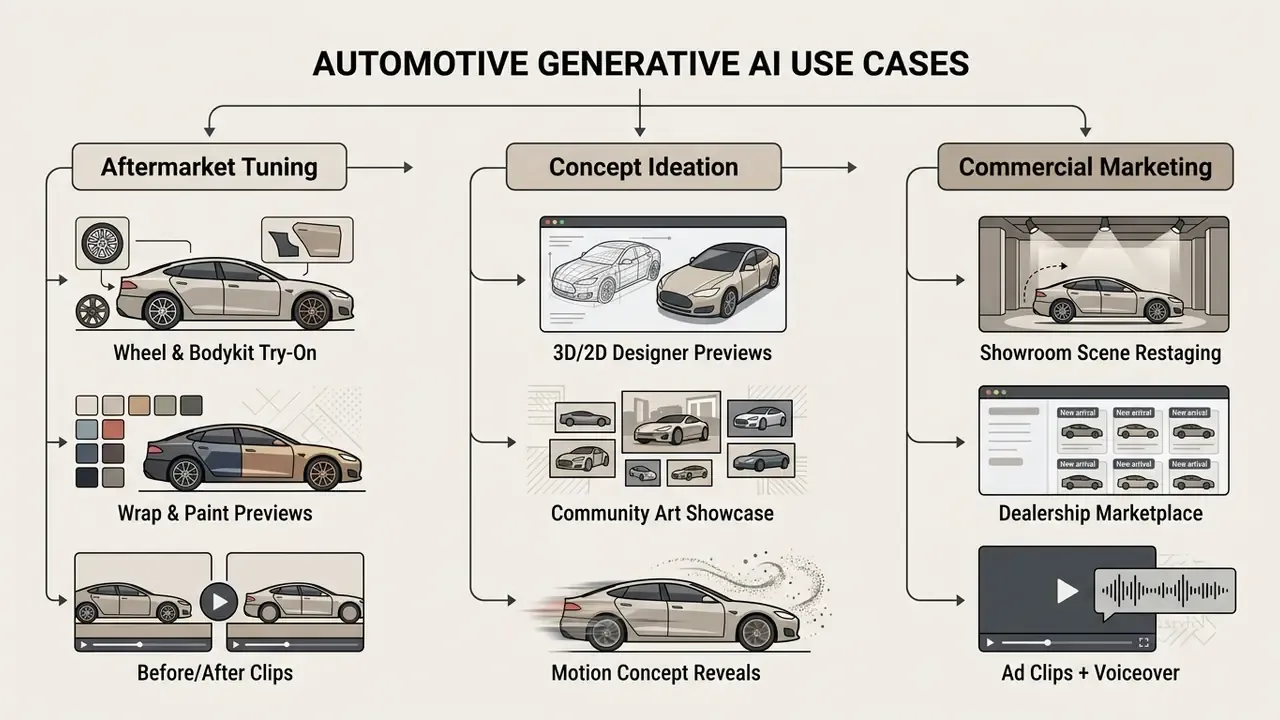
Visualizing Tuning and New Parts on Your Own Car
Car owners and aftermarket tuning shops utilize an ai car modification generator to preview custom parts on a vehicle photo prior to installation.
«GAN models translating sketches into car front-end images allow rapid creation of variants aligned with a specific designer intent.»
- Wheel and stance fitting. Uploading a side photo of a client vehicle allows users to test different rim styles, finishes, and lowered suspension stances.
- Vinyl wrap and paint previews. Test matte, satin, or patterned wrap textures directly on original body panels, a workflow already productized in commercial wrap visualizers.
- Body kit fitting. Preview custom front bumpers, side skirts, and carbon splitters on client photos to streamline purchase decisions.
- AR-adjacent personalization. Documented studies describe remote appearance control covering body colour, door handles, headlights and taillights, and rims before physical work begins.
Internal case, independent verification required. An aftermarket tuning garage implemented a photo-based AI visualization workflow to display custom wheel fitments for clients. Generating realistic 4K previews during consultations shortened the decision cycle and reduced styling-related dissatisfaction reported after installation. The uplift figures observed internally, roughly a third higher consultation-to-order conversion, reflect one shop's own sales tracking, are not drawn from peer-reviewed research, and should be validated against your own baseline before use in marketing claims.
Concepts for Designers, Car Communities and Content Creators
Industrial designers, digital concept artists, and content creators leverage an ai car photo generator or ai concept car creator to accelerate early design exploration.
«A diffusion-based system accepts textual and visual inputs, generates concepts, and reuses them as new sources of inspiration for further iteration.»
- Design ideation. Generates diverse volume and proportion studies to spark creative directions before CAD modeling begins; documented studio workflows sketch in 3D, add 2D detail, then use a generative model to explore variations and produce view-consistent renderings.
- Community engagement. Automotive bloggers and digital artists publish unique hypercar visual concepts for audience engagement.
- Asset creation. Produces background visuals and concept renders for digital gaming environments or media production.
- Audio and sound design. For finished advertising creatives, authors combine generated MP4 clips with AI sound-effect generators (engine growl, exhaust note, turbo whistle) and a background music bed added after video generation.
- Multilingual reviews and voiceover. Speech generators can overlay expert concept commentary in 30 or more languages for international automotive portals, while ai lip sync models synchronize an on-camera presenter with the dubbed track. See the guide to AI voice generators covering voice quality, language support, pricing, and commercial licensing.
- Motion graphics and animation. Static renders can be sequenced into explainers and spec reels; a practical overview of animation makers covers creation methods, templates, AI features, pricing, and export options.
Design teams evaluating complementary software options can browse the hub to review licensing tiers.
Car Images for Listings, Brands and Campaigns
Commercial automotive dealers and digital marketing agencies deploy generative AI to stage commercial inventory photos and build marketing collateral.
- Automotive scene restaging. Replaces cluttered dealership lot backdrops with studio lighting setups or cinematic scenic highways; dealer-focused vendors ship AI background libraries that match vehicle angles and blend cut-outs, shadows, and showroom scenes.
- Campaign mockups. Advertising teams generate stylized background imagery, mood boards, and scene-by-scene storyboards for vehicle promotional materials, then pair the hero render with an ai landing page builder for model-launch microsites.
- Marketplace inventory optimization. Dealerships standardize inventory photos across digital marketplaces to maintain consistent visual branding, including 360-degree spins and colour-matched variants generated from make and model inputs. Listing teams frequently pair this with AI image expansion tools to fit multiple marketplace aspect ratios from one source photo.
- Sales team collateral. Staff portraits and brand assets for dealer pages can be produced with an AI business headshot generator or an ai linkedin photo generator free alongside vehicle imagery for a consistent look. Follow-up correspondence, trade-in offers, and appointment confirmations are often drafted with an ai letter generator, which keeps tone consistent across the dealer group.
Teams reviewing broader legal policies around digital asset commercialization can examine relevant documentation regarding litigation risks and compliance standards.
FAQ: Common Questions About AI Car Generators
What is an AI car generator and how does it work?
An AI car generator is a specialized neural-network service, usually built on diffusion models or GANs, that creates vehicle visualizations from a text prompt or an uploaded photo. The model interprets the specified body, colour, lighting, and style parameters and returns a finished image, or in image-to-video mode a short animated clip.
Can an AI car generator be used for free?
Yes. Most platforms offer a free trial mode with a monthly generation limit measured in credits. Free tiers may apply watermarks, cap export resolution at 480p to 1080p, reduce the number of parallel tasks, and restrict commercial use.
How do I preview new wheels or a new colour on a photo of my own car?
Use photo-based generation, image-to-image or inpainting. Upload a car photo, ideally a side or three-quarter angle, mask the target region such as wheels or body panels, and enter a text instruction describing the change, for example "20-inch matte black BBS wheels, lowered 2 inches."
Who owns the copyright to generated car images?
According to U.S. Copyright Office guidance (2026), images produced entirely by AI without substantial human creative input are not protected by copyright. Commercial usage rights are also governed by the specific platform's rules (paid versus free plans), dataset licences, and the trademarks held by vehicle manufacturers. The EU currently has no dedicated rule on the copyrightability of AI outputs.
What is the difference between AI car art and a realistic concept car?
AI car art prioritizes artistic stylization, anime, retrowave, low-poly, digital painting, and aesthetic expression. A realistic concept car respects physical proportions, optical behaviour, material properties, and plausible aerodynamic surfacing close to production vehicles.
Can a generated car image be turned into a video?
Yes. Image-to-video mode accepts an approved render or a real photo and adds camera movement, wheel rotation, motion blur, and environmental animation. A typical result is a 5-second clip, generation takes 3 to 5 minutes, and export runs to MP4 at 1080p or 4K, 24 or 30 fps.
Which models are used for automotive generation in 2026?
For images: FLUX.1 Kontext Pro, Midjourney v7, Nano Banana 2 Pro, GPT Image 2, Seedream 4. For video: Google VEO 2/3.1, Kling 3.0 Pro, Luma Ray 2, Hailuo AI, Runway Gen-4 Turbo, Seedance 2.0. For preserving CAD geometry and wireframes: Stable Diffusion XL with ControlNet.
Can engine sound, music and voiceover be added to a car clip?
Yes, though usually as a separate step after video generation. Background music and sound effects such as engine growl and exhaust note are added in an editor, while narration is produced by speech models supporting 30 or more languages. Confirm that the licence covers both the video and the audio track.
How do I make results reproducible for audit?
Record the seed, model version, guidance value, step count, sampler, aspect ratio, reference-image hash, and prompt version, and store all of it in a JSON manifest next to the exported file together with the human review record.
Is it safe to upload corporate CAD files and customer photos to a public generator?
Without a corporate tenant, no. Require Zero Data Retention, a written prohibition on training with uploads, SSO and RBAC, exportable audit logs, and SOC 2 or ISO 27001 attestation. For customer photos, strip EXIF, plates, and VIN before upload.
Conclusion
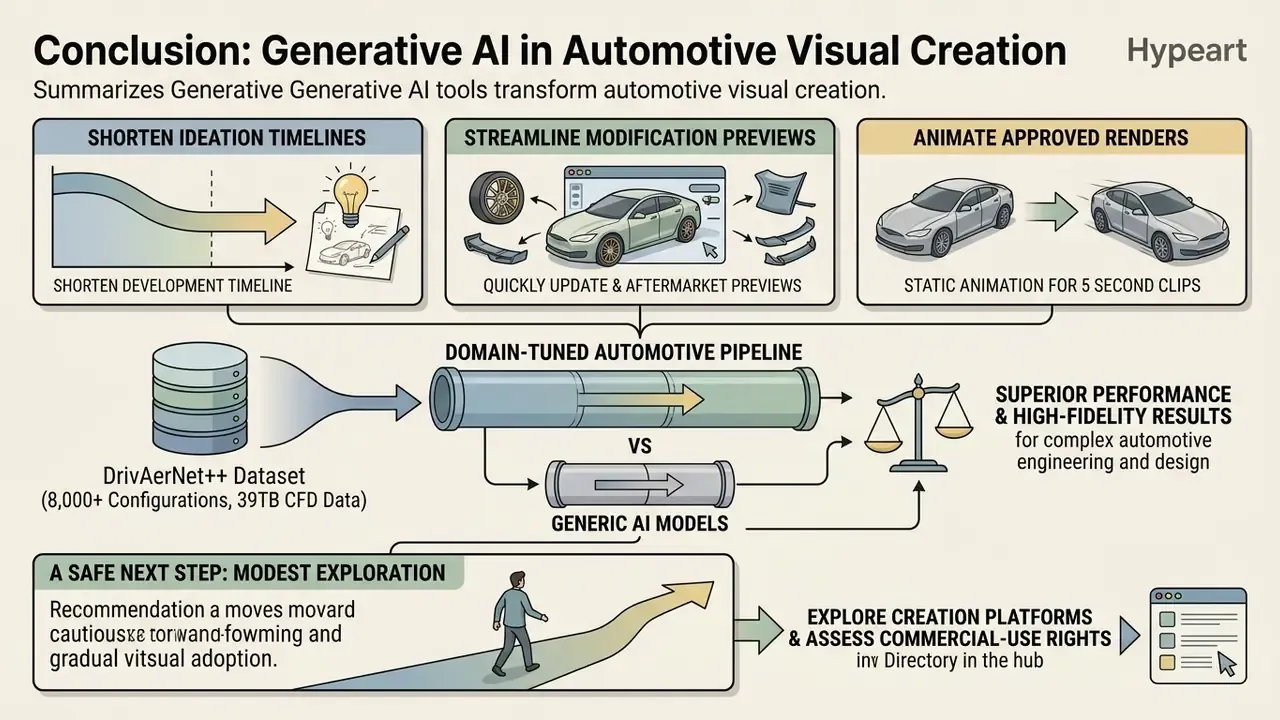
Generative AI tools transform automotive visual creation by shortening early design ideation timelines, streamlining aftermarket modification previews, animating approved renders into short-form video, and enabling automated commercial scene restaging.
That scale of open engineering data explains why domain-tuned automotive pipelines outperform generic checkpoints, and why the licence terms attached to such datasets directly shape what may be commercialized. By combining structured prompt engineering with precise photo reference controls, seed-locked reproducibility, and vendor-level governance, enterprise users and independent creators can generate photorealistic automotive assets while keeping oversight of copyright, trademark, data-privacy, and visual quality standards. One dividing line stays explicit in every review: generative output governs how a vehicle looks, never how a vehicle performs.
A safe next step is modest rather than sweeping. Pick one workflow, a dealership inventory set or a single styling review, run it inside an approved tenant with seed logging for four weeks, then measure output acceptance rate, rework hours, and control cost before widening access.
For further exploration of available creation platforms, readers can browse the hub to assess commercial-use terms, and support resources are available to compare options across enterprise workflows. Definitions, tool profiles, and adjacent generator guides are collected in the reference library, where you can also compare options by capability and licence.