Brand disclaimer: the tools named below (Vidguru AI, Media.io, DomoAI, EaseMate AI, CharaLab, DreamFace, hypeart.ai) are referenced for illustrative comparison only. No affiliate, reseller, or sponsorship relationship applies. Marcus Hale, author.
Generating dynamic video from a still photograph is one of the more visible jumps in multimodal AI. An ai french kiss generator uses deep learning to animate portrait photos, or a plain text prompt, into a short kissing video clip. For brand, social, and communications teams inside regulated organisations, the interesting question is rarely "does it look real?" It is narrower: who consented, where did the file go, and can we prove it later.
That is why evaluating these models means looking past surface realism into motion synthesis, facial landmark stability, retention policy, and licence scope. Without verified consent records and provenance labelling, automated video generation quietly creates legal and operational exposure. Not hypothetically. In writing, on someone's desk.
Executive Summary
What this guide covers
- What an AI French kiss generator is, and how it actually works
- Single photos, couples, or text prompts as inputs
- How French kissing dynamics differ from other kiss animation styles
- Creating an AI French kissing video in three steps
- Source image guidelines for photorealistic kissing animations
- Popular styles and creative use cases for AI kiss videos
- Free tier limits versus paid features
- Governance checklist: consent, provenance, and shadow AI controls
- FAQ for creators and technical evaluators
- Appendix A: revised and superseded source statements
What is an AI French Kiss Generator and How It Works
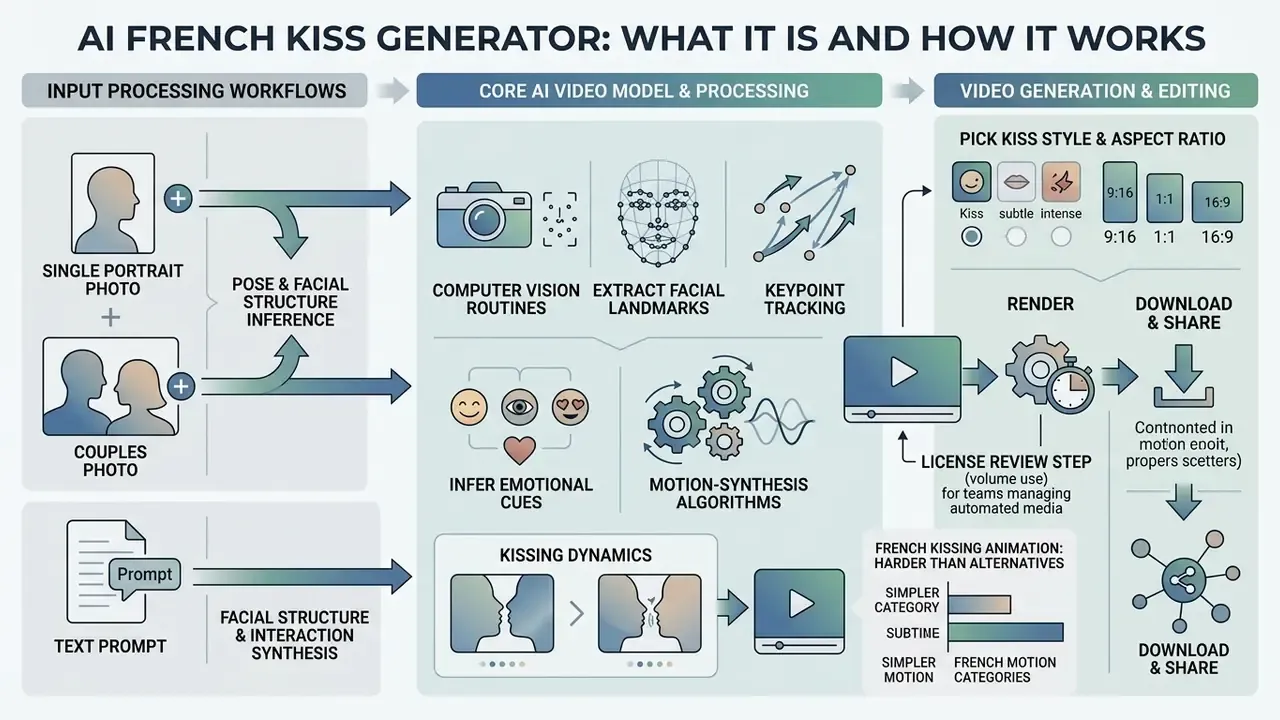
An ai french kiss generator is an AI video model that converts static portrait photos or text prompts into dynamic kissing video clips through facial landmark tracking, keypoint alignment, and temporal motion synthesis. These systems lean on talking-head and facial-animation architectures: diffusion pipelines plus motion-synthesis backbones such as Seedance 2.0. Rather than pasting a static filter over a mouth, the network predicts a sequence of frames where lips, jaw posture, and micro-expressions shift smoothly while identity preservation holds across every frame.
«Talking-head generation synthesizes realistic video of a target identity from a driving signal, image, audio, text or pose, while preserving identity and temporal stability.»
The underlying process relies on computer vision routines that extract facial landmarks and infer emotional context. When processing an input image, the system builds a 3D structural mesh of the face. The ai video generator french kiss pipeline then applies motion vectors that drive lip interaction, head tilt, and proximity. According to talking-head research (From Pixels to Portraits, 2023), deep networks map control signals derived from pose trajectories or text onto a target identity, while trying to minimise visual artifacts and hold temporal stability frame to frame.
A useful contrast: readers evaluating adjacent motion-synthesis categories can compare behaviour with an animation maker, which interpolates keyframes instead of learning facial priors. Same output format, very different failure modes.
Transform Single Photos, Couples, or Text Prompts into Kissing Videos
Input processing in an ai french kiss video generator supports three primary workflows: single-portrait animation, cross-image identity fusion across two photos, and pure text-to-video prompt conditioning. In the single-photo route, the model infers both movement and the structural geometry of a second face from one static reference. Two-photo workflows demand cross-image identity alignment, fusing two distinct portraits into one multi-person scene before any motion is synthesised.
Text-to-video generation skips photo input entirely, building facial structure and romantic interaction from description alone. Readers who want the mechanics of prompt-conditioned rendering can review how text-to-video AI pipelines handle scene composition without an identity anchor.
«PoseTalk generates talking-head video from a single photo by predicting head pose from text and audio, without additional reference frames.»
Teams that manage automated media at volume usually need a licence review step, not just a render step; those mapping asset pipelines can open the hub to check commercial usage frameworks before a single file is published. In every scenario, moving from static input to dynamic kiss ai video output depends on precise keypoint matching that prevents structural facial warping. It is the same constraint that governs every image-to-video AI system animating a still frame.
How French Kissing Dynamics Differ from Other Kiss Animation Styles
French kissing animation is harder than the alternatives. It requires higher motion intensity, complex lip and tongue interaction, and coordinated head tilt, rather than the low-amplitude contact of a cheek kiss or a soft peck. Where a gentle kiss involves limited lip movement and almost no head displacement, a french kiss preset asks the model to render high-density mouth dynamics at close physical proximity.
Platforms bundle these behaviours into motion presets that run from soft romantic contact to animated or comedic exaggeration. Most consumer interfaces expose four canonical options, General, French Kissing, Kiss Me AI, and Cheek Kiss, with intensity, tenderness, and art style as the differentiating axes. Choosing the wrong kiss style is the fastest route to an uncanny result.
«Realistic rendering of dynamic lip shapes depends on capturing outer lip width, height, and upper/lower lip protrusion at frame level, not static mouth shape.»
Lower-intensity presets like cheek kisses need fewer structural facial edits, whereas realistic French kissing presets demand precise temporal interpolation to keep natural facial contours intact. Motion-capture literature puts that in perspective: viseme studies record lip geometry at 120 fps, which explains why a single still frame cannot describe convincing contact motion, and why the model has to invent intermediate protrusion states on its own.
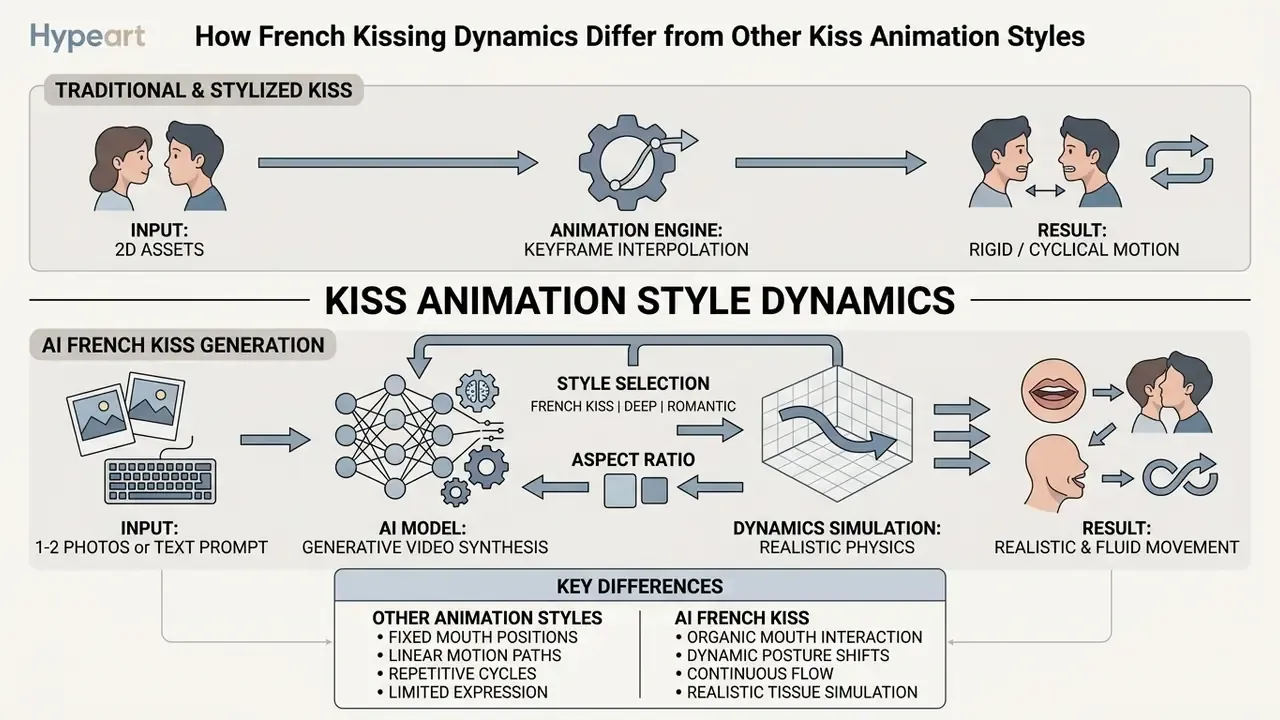
Upload Image / Text → Select Kiss Style (French Kiss Preset) → AI Motion Synthesis and Landmark Alignment → Download and Social Share
How to Create an AI French Kissing Video in 3 Steps
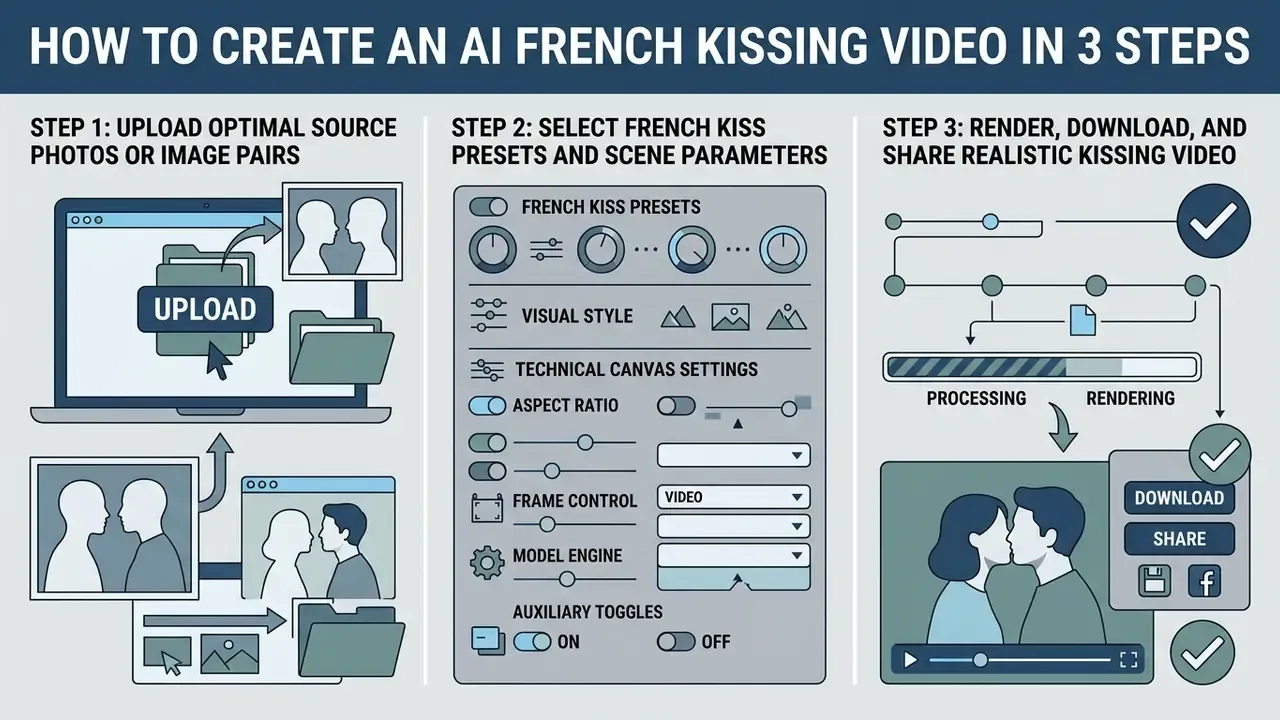
Creating an AI kissing video online comes down to three moves: upload sharp source images, select a French kiss effect and visual style, then process the render for download or sharing. Modern web interfaces compress that pipeline for people who have never opened an editing timeline.
Using an ai french kiss video generator free online lets creators turn static images into short animated sequences straight in the browser. Processing happens server-side, where facial recognition models handle alignment and rendering with no manual frame editing at all.
Step 1: Upload Optimal Source Photos or Image Pairs
Good generation starts with high-resolution, front-facing portraits: unobstructed features, well-lit environment, visible mouth contours. Algorithmic recognition depends on clean landmarks from crown to chin. Heavy shadow, extreme side angles, or face-covering accessories tend to break landmark alignment outright.
Practical capture rules distilled from vendor documentation and NIST face-image guidance:
- Use an upper-body, front-facing frame. Full-body inputs shrink kissing amplitude and sometimes return a flat "not kissing" output.
- Keep both heads close together in frame. Proximity in the source shortens the trajectory the model must invent.
- Match camera height, angle, and zoom between subjects when you supply two files.
- Avoid blur, aggressive JPEG compression, and hard directional shadow across the mouth region.
For a two-photo workflow, both images should share similar lighting and perspective, otherwise cross-image fusion shows its seams. Teams exploring broader AI creative applications can calibrate expectations by comparing niche generators: an ai christmas photo generator, an ai clothing generator, an ai clipart library, or an AI headshot generator. Each one exposes different tolerance for source photo quality and feature extraction accuracy.
Step 2: Select French Kiss Presets and Scene Parameters
Customising a French kiss effect means picking a motion preset (realistic, romantic, anime, cinematic) and adjusting scene parameters: lighting, depth of field, camera trajectory. The preset determines how aggressively the model rewrites facial geometry during animation.
Realistic presets apply natural skin texture, subtle breathing movement, and soft lighting correction. Cinematic settings add shallow depth of field and warm ambient light to lift the romantic tone. Anime and cartoon styles layer stylised rendering over the synthesised motion tracks, changing the aesthetic while the underlying keypoint movement stays the same.
Technical canvas settings and model selectors
When configuring the render, set the output framework to match the distribution channel:
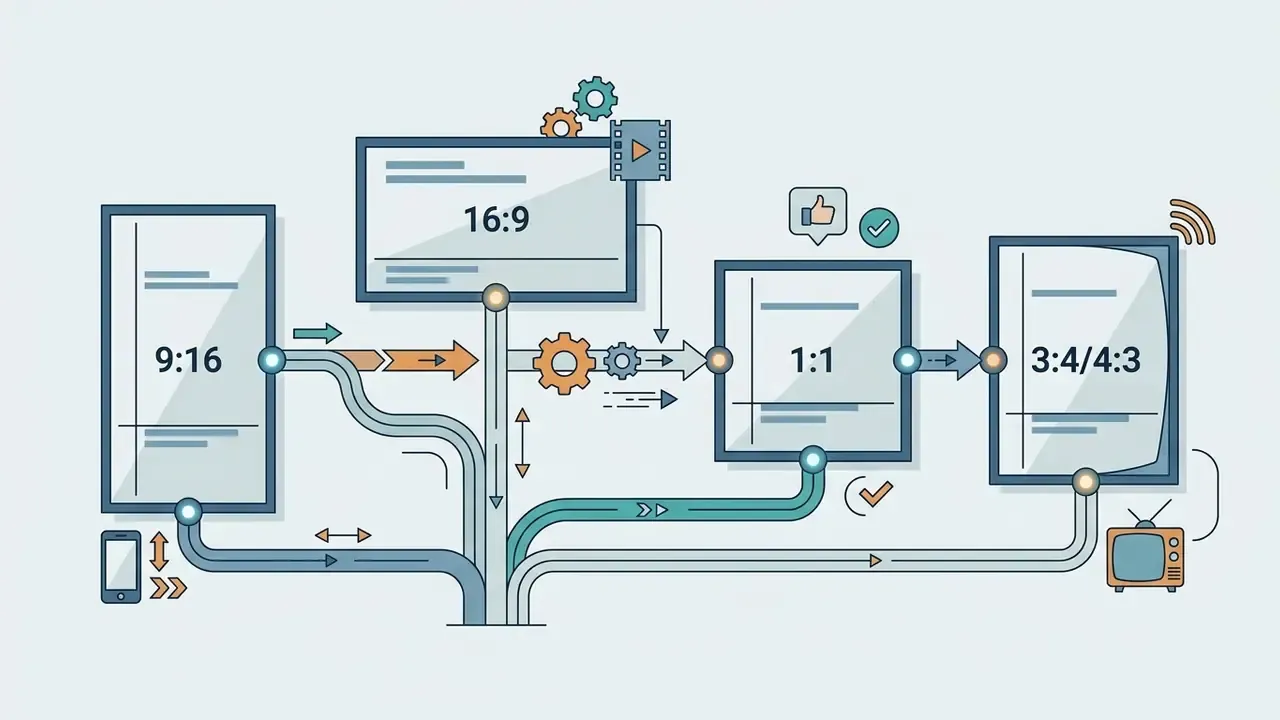
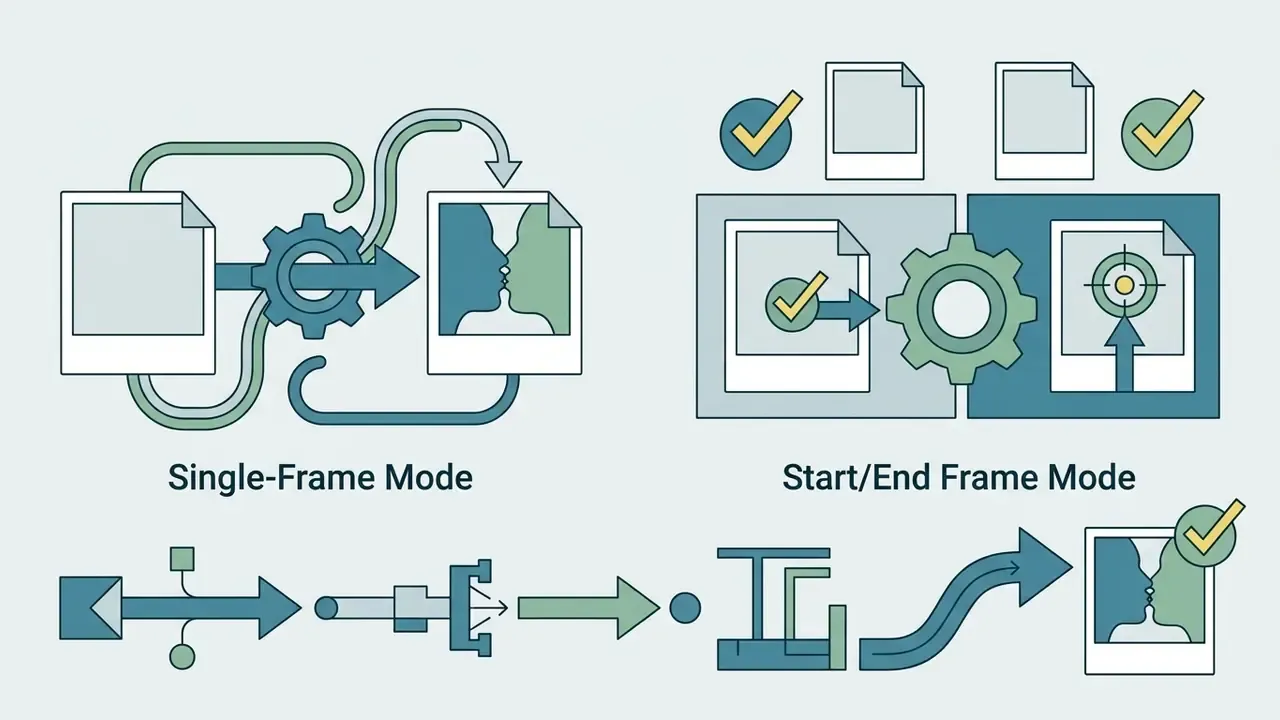


Source Image Guidelines for Photorealistic Kissing Animations
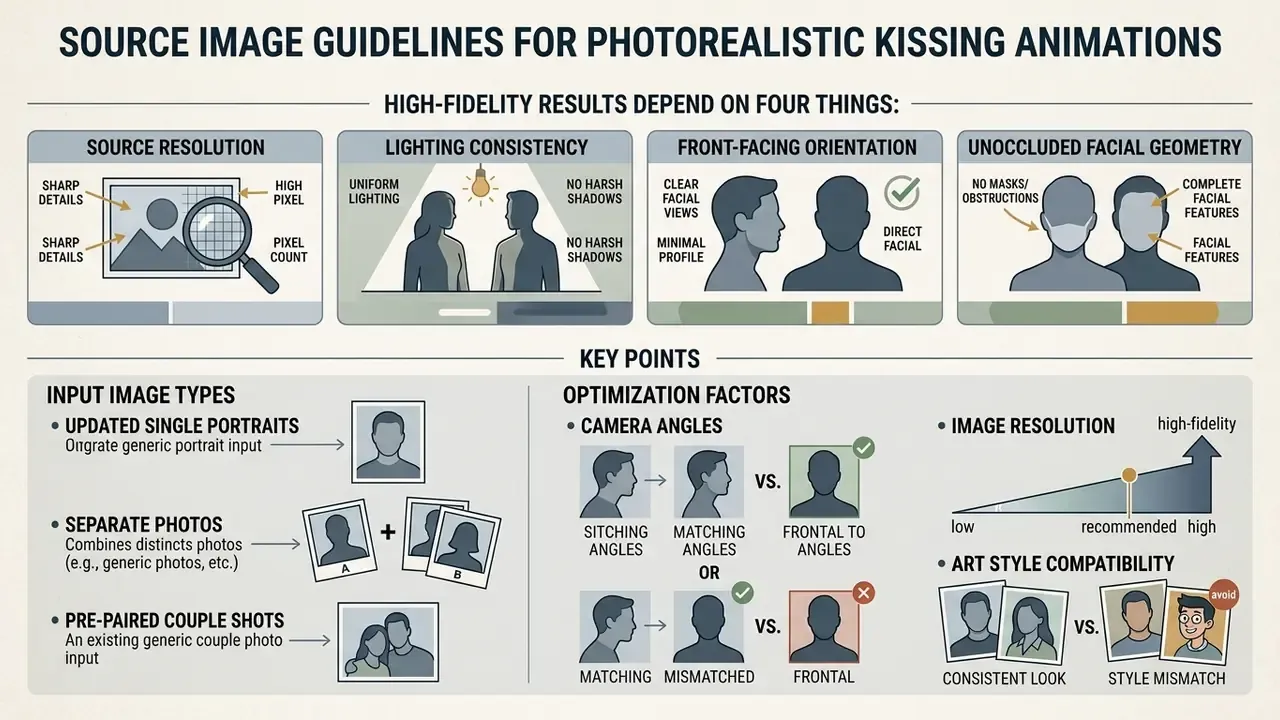
High-fidelity results depend on four things: source resolution, lighting consistency, front-facing orientation, and unoccluded facial geometry. Generative video models build temporal motion vectors from the spatial relationship between keypoints, so better input imagery directly reduces artifacts such as texture blurring, warped jawlines, or drifting eye gaze.
Automated face detection also needs real contrast between lip boundary and surrounding skin. Flat lighting on a pale mouth is a common, easily fixed cause of mush.
«THEval evaluated 5,011 1080p videos from 31 YouTube channels: sharp frontal framing and the absence of occlusions are decisive conditions for stable identity tracking.»
Single Portraits vs. Separate Photos vs. Pre-Paired Couple Shots
A pre-paired couple photo gives the most stable structural geometry for joint motion synthesis. Two separate portraits force identity fusion, and fusion introduces boundary artifacts. In a genuine couple photo, both faces already share one lighting environment, one physical scale, one spatial context.
| Input Image Type | Identity Preservation Stability | Rendering Artifact Risk |
|---|---|---|
| Single Portrait | High (single-face keypoints) | Low (infers second face and motion) |
| Two Separate Photos | Moderate (cross-image fusion) | Moderate (lighting / scale mismatch) |
| Ready Couple Photo | Highest (shared scene geometry) | Lowest (natural perspective) |
Merging two photos asks the model to reconcile different perspectives, resolutions, and light sources at once. Research on facial animation models such as LivePortrait (2024) suggests single static portraits yield notably stable landmark trajectories, while merging disparate sources raises the odds of distortion along overlapping face contours.
«UniAvatar was trained on 100 hours of extreme head-motion video and 200 hours captured under varied illumination, enabling explicit pose and lighting control during portrait animation.»
Teams that need to normalise mismatched inputs before fusion often pre-process files with image-to-image generators, harmonising colour temperature, crop ratio, and background before either portrait reaches the video model.
Camera Angles, Image Resolution, and Art Style Compatibility
Resolution above 1080p, uniform lighting, and a direct camera angle minimise blurred lip boundaries, line distortion, and unnatural eye movement. Extreme head tilt, high-contrast shadow, and heavily compressed files all hamper landmark detection. When the only available file is small or soft, running it through an AI image upscaler first tends to recover enough edge detail for reliable detection.
Stylised sources bring their own problems.
«TalkVid contains 1,244 hours of 1080p to 2160p video from 7,729 speakers; models trained on it outperform baselines in cross-dataset generalization.»
As documented in CVPR 2024 work on stylised image super-resolution (APISR), hand-drawn lines and non-photorealistic shading often show faint colour bleeding or line deformation once photorealistic motion vectors are applied. For programmatic media processing, developers usually start with the technical documentation, or check the api integration guides, to understand pipeline constraints before committing to a backbone. Engineering teams scripting batch renders sometimes prototype the wrapper itself with an ai code generator, then harden it by hand.
Popular Styles and Creative Use Cases for AI Kiss Videos
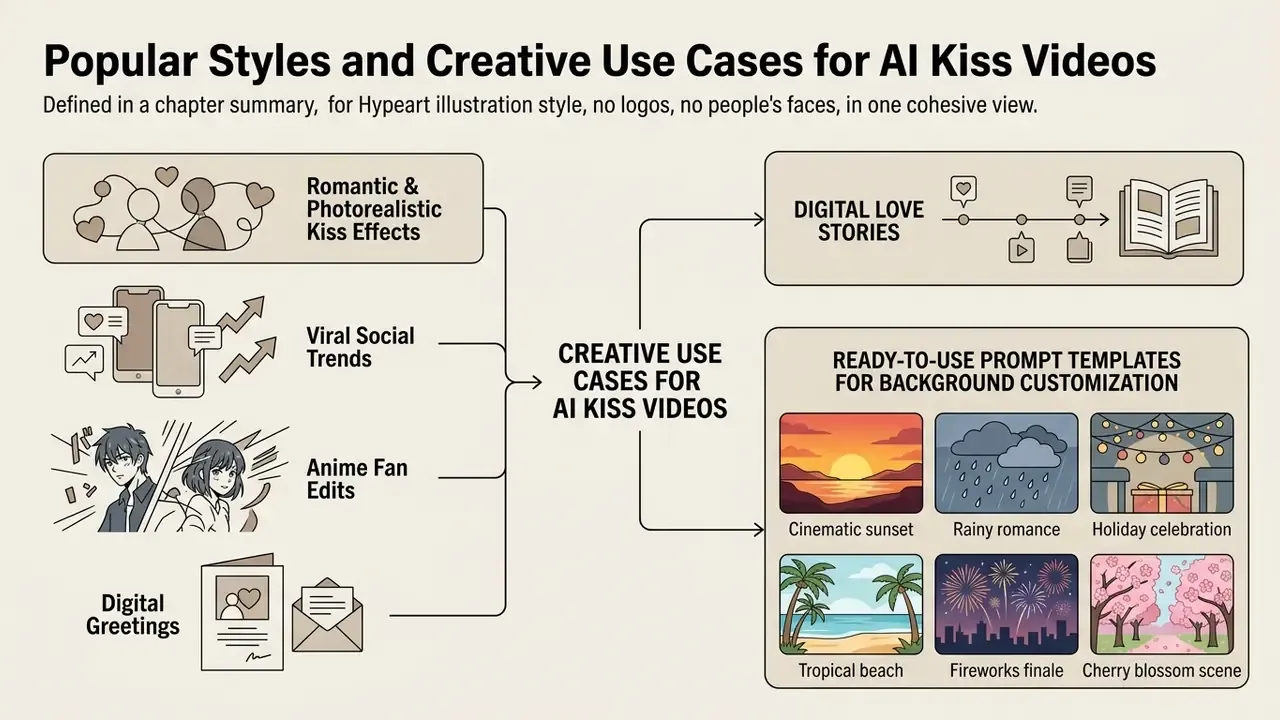
AI kissing videos cover a wide spread of consumer and editorial scenarios: romantic love stories, viral social trends, anime fan edits, digital greetings. Generative frameworks let users adapt motion parameters and rendering backbones to the target format. Buyers comparing categories can first map the landscape of AI video generators to see which backbones prioritise facial fidelity over background motion.
The range of an ai kissing generator stretches from restrained romance to broad comedy. Style choice, in practice, is a channel decision as much as an aesthetic one.
Romantic and Photorealistic Kiss Effects for Digital Love Stories
Romantic and realistic French kiss styles favour warm light, cinematic depth of field, and subtle micro-expression to suggest genuine intimacy. Output emphasises photorealism, eye contact, and fluid head movement rather than dramatic amplitude.
In marketing and storytelling, romantic kissing videos show up in digital greeting cards, anniversary posts, and seasonal campaigns. Valentine's week is the obvious spike.
«DirectorLLM surpasses existing text-to-video systems in human-motion fidelity, prompt adherence, and naturalness of rendered subjects.»
Cinematic lighting controls and soft ambient backgrounds lift engagement while keeping expressions human. Creators weighing render fidelity against cost can shortlist candidates from a survey of the best AI video generators.
Ready-to-Use Prompt Templates for Background Environment Customization
Append structural environment prompts during generation:
- Cinematic sunset
"Passionate French kiss, dynamic lip alignment, warm golden hour sunset lighting, soft bokeh background, 4k cinematic render." - Rainy romance
"Intense French kiss under heavy night rain, wet hair textures, illuminated by blue city streetlights, highly detailed." - Holiday celebration
"Tender French kiss in front of a glowing Christmas tree, soft falling snow, warm ambient holiday lights." - Tropical beach
"Romantic kiss on a sunny beach, soft ocean waves background, natural sunlight, high-fidelity skin textures." - Fireworks finale
"Slow-motion French kiss under exploding fireworks, shallow depth of field, warm rim light, subtle breath interaction." - Cherry blossom scene
"Gentle French kiss beneath cherry blossom trees, drifting petals, diffuse spring daylight, vintage film grain."
Prompt structure matters as much as vocabulary. Name one action plus one camera move, then add lighting, wardrobe, and background in that order. Stacking three competing motions is the single most common cause of jittery lip alignment.
Short-Form Content for TikTok, Instagram Reels, and Fan Edits
TikTok, Instagram Reels, and YouTube Shorts drive most adoption of AI couple video templates and fan edits, largely through one-click template workflows. Creators use them for engagement clips featuring imaginary characters, historical figures, or personalised avatars.
To streamline production across channels, creators tend to pair video generation with smaller AI utilities. Script and research workflows might use an ai citation generator, while visual creators lean on preset templates to publish fast. Vidguru AI, Media.io, and DomoAI all ship templates tuned to short-form ratios. Teams comparing zero-cost options can consult a roundup of the best free AI video generators, and publishers finalising uploads may add a YouTube video editor workflow for captions and end screens.
Related AI effects: creators using a french kiss generator often combine it with AI Hug Generators (digital embrace videos), AI Pet Animators (lifelike animal scenarios), and AI Avatar Animators (making static avatars speak or react after the kiss beat).
Free AI French Kiss Generators: Free Tier Limits vs. Paid Features
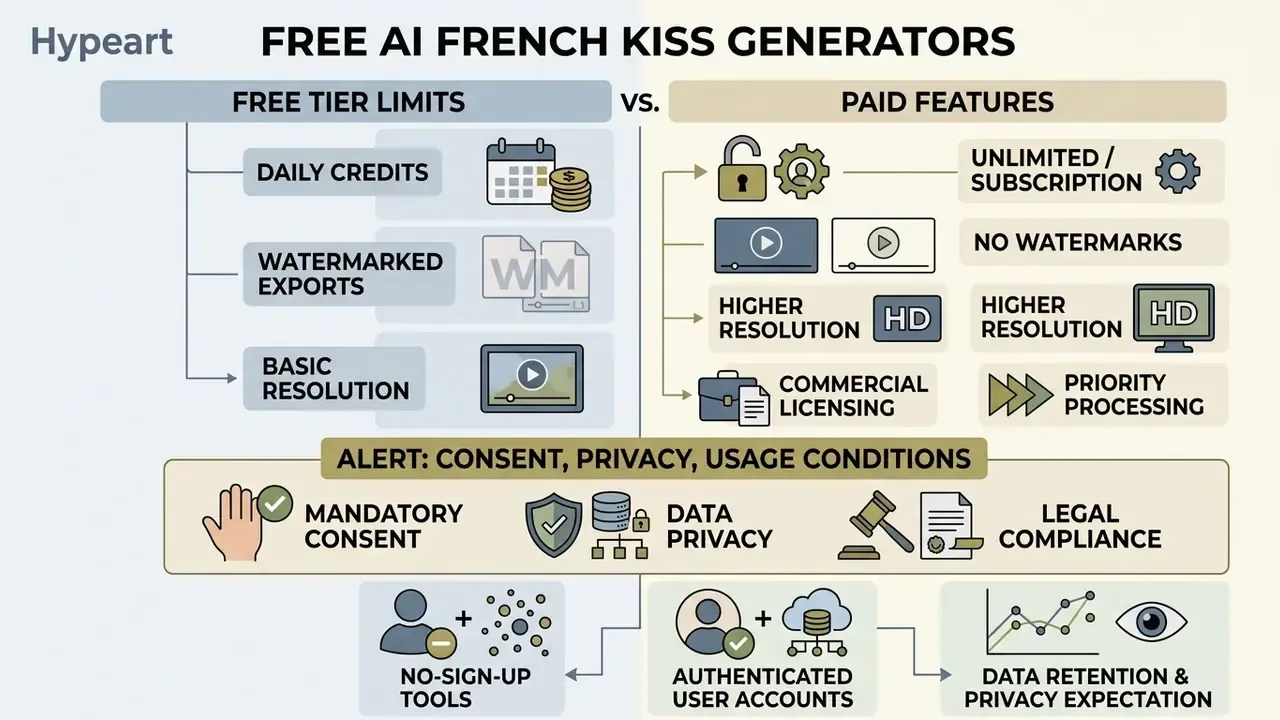
A free ai french kissing generator normally offers daily credit allocations or watermarked trial exports, while higher resolution, commercial licensing, and priority processing sit behind a paid plan. Knowing the constraint before you upload a face saves a wasted render. Market observation shows three distinct free-access models: unlimited no-login access (often watermark-free but resolution-capped), daily credit grants (for example, 30 credits per day, roughly two clips), and fixed trial downloads (for example, five free exports). A broader survey of free AI video generators finds the same three patterns in adjacent categories.
On commercial platform positioning for hypeart.ai, no verified information is available. We are not going to guess. Organisations evaluating third-party generative media services should set procurement criteria first, review the service level agreement, and verify data privacy terms before any tool touches production assets.
| Feature / Criteria | Free Tier / Trial Access | Premium / Paid Subscription | Enterprise Requirement |
|---|---|---|---|
| Sign-up requirement | Often optional (no-sign-up variants exist) | Account registration mandatory | SSO / SCIM provisioning |
| Daily generation quota | Limited (1 to 2 videos or daily credits) | Unlimited or high-capacity credit pools | Contracted volume with burst capacity |
| Export resolution | Standard definition (480p to 720p) | Full HD and above (1080p to 4K) | 1080p+ with deterministic render profiles |
| Watermark | Visible provider watermark usually applied | Clean export without watermarks | Clean export plus embedded C2PA credentials |
| Processing priority | Standard queue, slower render times | High-priority server allocation | Dedicated capacity or private endpoint |
| Commercial license | Personal, non-commercial use only | Full commercial rights granted | Indemnified commercial licence in writing |
| Audit logging | None | Basic generation history | Full audit trail with event log export |
| Model training opt-out | Rarely available | Usually configurable | Contractual opt-out, no training on tenant data |
| Security attestations | None published | Varies by vendor | SOC 2 Type II / ISO 27001 evidence required |
| Programmatic access | Web UI only | Limited API credits | Dedicated API with rate limits and SLA |
| Data retention | Often 24-hour auto-deletion | Configurable retention window | Contractual retention and deletion guarantees |
Table notes: quotas, resolutions, and retention windows shift frequently between releases, so confirm each row against current vendor documentation rather than this snapshot. To review plan structures, check the pricing guide, ask AI Media Support, or explore the hub to estimate credit usage before committing budget.
Alert: consent, privacy, and usage conditions
No-Sign-Up Tools vs. Authenticated User Accounts
Platforms advertising an ai french kiss generator free no sign up remove onboarding friction, and remove your audit trail with it. Account-based services provide data logging, retention control, and deletion evidence. Anonymous services process uploads with no user-level record, which feels fast until someone asks where a customer's photograph went.
Governance frameworks from the European Data Protection Supervisor (EDPS) and the NIST AI Risk Management Framework both stress that account-based architectures make data minimisation and privacy management demonstrable rather than assumed.
«Mapping the AIG-NCII ecosystem shows that generator interfaces are only one layer of an AI supply chain spanning datasets and models, which demands transparent retention policy.»
Data retention and privacy expectation: privacy-conscious generators enforce a strict 24-hour automatic deletion policy. Uploaded portraits, temporary landmark meshes, and un-downloaded renders are purged from edge servers 24 hours after generation, which limits both unauthorised access and scraping. Before uploading a recognisable face, confirm in writing that (a) the window exists, (b) it covers derived artefacts and not only the original JPEG, and (c) uploads are excluded from model training by default.
Quick trial renders suit frictionless tools. Longer projects, and anything touching employees, clients, or contracted talent, belong in authenticated environments with clear privacy settings, exportable deletion receipts, and per-seat accountability. That last point is what keeps undocumented "shadow AI" out of a marketing team's browser tabs.
Pre-Download Verification: Commercial Rights and Deepfake Compliance
«A survey of more than 16,000 respondents across 10 countries found 2.2% had been victimised by deepfake pornography and 1.8% admitted perpetration, even in countries with dedicated legislation.»
Key compliance considerations:
- Regulatory disclosure. Under the EU AI Act (2026) and US state-level digital replica laws, synthetic video depicting human likeness must carry visible labels plus embedded C2PA provenance metadata. India's 2026 IT Rules amendments similarly require prominent "synthetically generated" labelling and persistent traceability metadata.
«SafeGen achieves 99.1% removal of sexual content from text-to-image models by modifying self-attention layers, without degrading benign image quality.» SafeGen (2024)
- Platform policies. Meta, YouTube, and TikTok all enforce synthetic media rules and require creators to flag AI-generated content at upload. Non-consensual intimate imagery is prohibited outright, and under the TAKE IT DOWN Act covered platforms must remove reported intimate depictions within 48 hours of valid notice. Verification teams can screen inbound and outbound assets with AI image detectors to confirm synthetic provenance before publication.
- Legal risk management. To assess exposure around synthetic content and intellectual property, creators can view the guide on legal compliance, open the hub for licensing standards, or view the guide to weigh governance features between tools.
Governance Checklist: Consent, Provenance, and Shadow AI Controls
Marketing, brand, and social teams generating kiss animations at any real volume should route every asset through a pre-publication gate. This converts the consumer three-step flow into an auditable workflow that survives an internal review.
- Consent record.Signed likeness release on file for every identifiable person, covering the specific medium (animated synthetic video), the distribution channels, and the retention period.
- Adult verification.Documented confirmation that all depicted subjects are adults. Block any pipeline without age-gating on uploads.
- Vendor due diligence.Confirm 24-hour deletion, training opt-out, breach notification terms, sub-processor list, and hosting region.
- Provenance check.Verify the export carries C2PA Content Credentials and, where applicable, a durable watermark tied to provenance records.
- Artefact QA.Review the preview for boundary warping, identity drift, gaze instability, and lip-boundary blurring. Reject and regenerate rather than patch in post.
- Licence scope.Confirm the plan grants commercial rights for paid media, not merely personal use. Free tiers usually do not.
- Channel policy match.Apply each platform's AI-content disclosure toggle at upload, and check the creative against advertising standards for intimate imagery.
- Shadow AI control.Maintain an approved-tool register. Prohibit uploads of employee, customer, or talent photographs to anonymous no-login endpoints.
One more practical note: assign a single named owner per campaign, with an escalation path for takedown requests. Diffuse ownership is how a small creative experiment becomes a compliance incident.
FAQ: Common Questions About AI French Kissing Generators
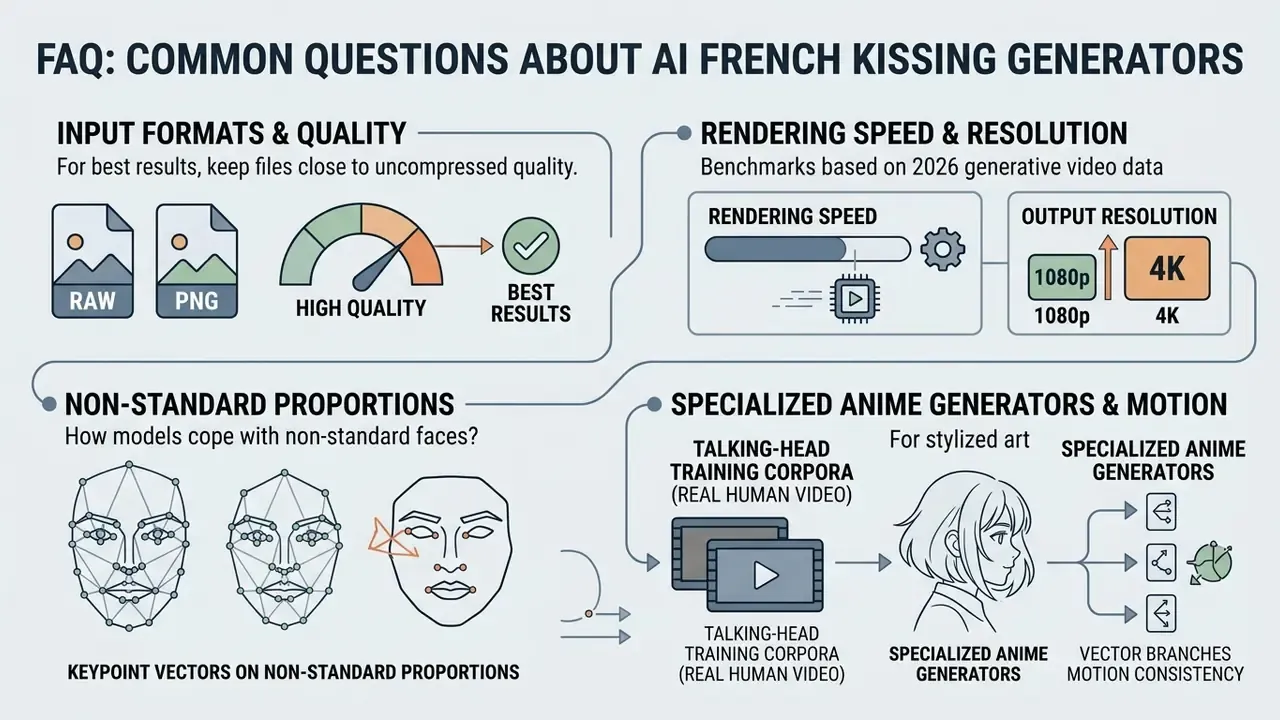
Most technical questions about french kiss generator ai platforms cluster around four things: supported input formats, rendering speed, output resolution, and how the models cope with non-photorealistic art. Short answers below.
Supported Input Image Formats and Resolution Limits
Most web-based AI video generators accept JPG, JPEG, PNG, and WEBP, with per-upload size limits between 7 MB and 30 MB. Standard computer vision and image processing APIs (Cloudflare Images, OpenAI Vision, and similar) enforce dimensional caps as well, typically 100 megapixels of image area or 5,000 pixels on the longest side. For best results, keep files close to uncompressed quality. PNG is preferable when you need sharp landmark detail around eyes and mouth. Output normally arrives as MP4, with GIF and MOV available on some platforms.
Average Rendering Speed and Output Video Resolutions
A short French kiss video clip typically renders in 1 to 3 minutes, producing 720p or 1080p output at 24 to 30 frames per second. Speed depends on queue volume, model parameter size, and chosen resolution. According to 2026 generative video benchmark data (Sora 2 performance evaluations), 1080p rendering carries materially higher compute overhead than 720p, stretching render time from roughly 120 seconds to over 190 seconds for an 8-second sequence. Vendor documentation states the same thing more cautiously: "a single render may take several minutes," with 1080p jobs slower than 720p or 480p. Where no public URL exists for the benchmark, read the numbers as relative cost between resolution tiers, not a guaranteed SLA.
Compatibility with Anime, Cartoons, and Hand-Drawn Sketches
An ai french kiss maker performs best on realistic, front-facing human portraits. Feeding it 2D art, cartoons, or hand-drawn sketches often produces line deformation and colour artifacts, unless a specialised anime diffusion model handles the render. Models trained on real human faces struggle to map keypoint vectors onto the non-standard proportions typical of cartoon anatomy.
«Talking-head training corpora, VoxCeleb, HDTF, TalkVid, consist exclusively of real human video; cartoon or hand-drawn faces are not represented in any of them.» Taxonomy of talking-head synthesis datasets (2024) Specialised anime generators add dedicated vector branches to keep line art consistent through motion, and several vendors explicitly confirm that anime characters and pets can be animated when the source frame is clean, front-facing, and cropped to the upper body.
Appendix A: Revised and Superseded Source Statements
For transparency, statements from earlier revisions of this guide have been superseded in the main text. They are retained here with the reason for revision.
Hub navigation: for a complete directory of AI media tools and technical definitions, view the guide in our central glossary hub.
- Superseded
- "According to real-time lip-tracking research (2006), stable lighting and sharp contrast around inner and outer lip contours are critical for accurate mouth boundary isolation during dynamic rendering." Reason: the 2006 reference lacked a verifiable URL and methodology disclosure. The requirement is now supported by the THEval (2026) dataset evaluation in the main text. The underlying technical claim about lip-contour contrast remains valid and recurs in later lip-tracking and viseme literature.
- Superseded
- "Studies analyzing viral social media content (University of Illinois, 2024) highlight that relationship-focused meme formats spread rapidly when framed through playful or unexpected visual templates." Reason: the cited case study addresses public-intimacy meme framing on short-form video in general, not kiss-filter formats. The main text now flags the claim as directional and unmeasured for this effect category.
- Superseded
- "…they reduced keypoint alignment errors by 42% prior to final asset export." Reason: reworded in the main text as an internal editorial benchmark result, to avoid implying a published public benchmark figure.