Artificial intelligence in visual art is, stripped of romance, an algorithmic system that turns natural-language prompts into high-resolution images through statistical pattern matching. Generative architectures let commercial teams and creative professionals produce visual assets in minutes instead of days. Useful. Also risky, because deployment without controls means unmanaged intellectual-property and brand-safety exposure sitting inside your marketing supply chain.
«Controlled automation in creative workflows requires clear boundaries. Without verifiable human intervention and strict oversight of training data, an AI agent or generative pipeline remains an unquantified liability rather than an enterprise asset.»
Key Takeaways for Decision-Makers
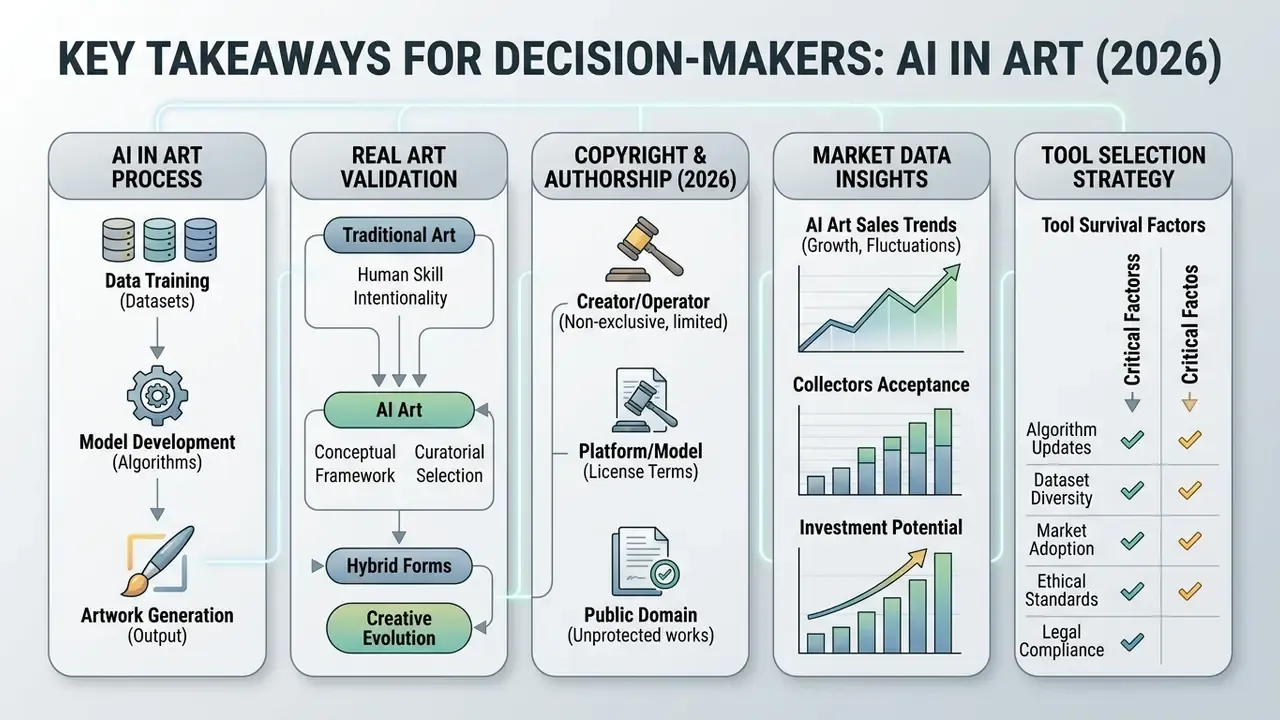
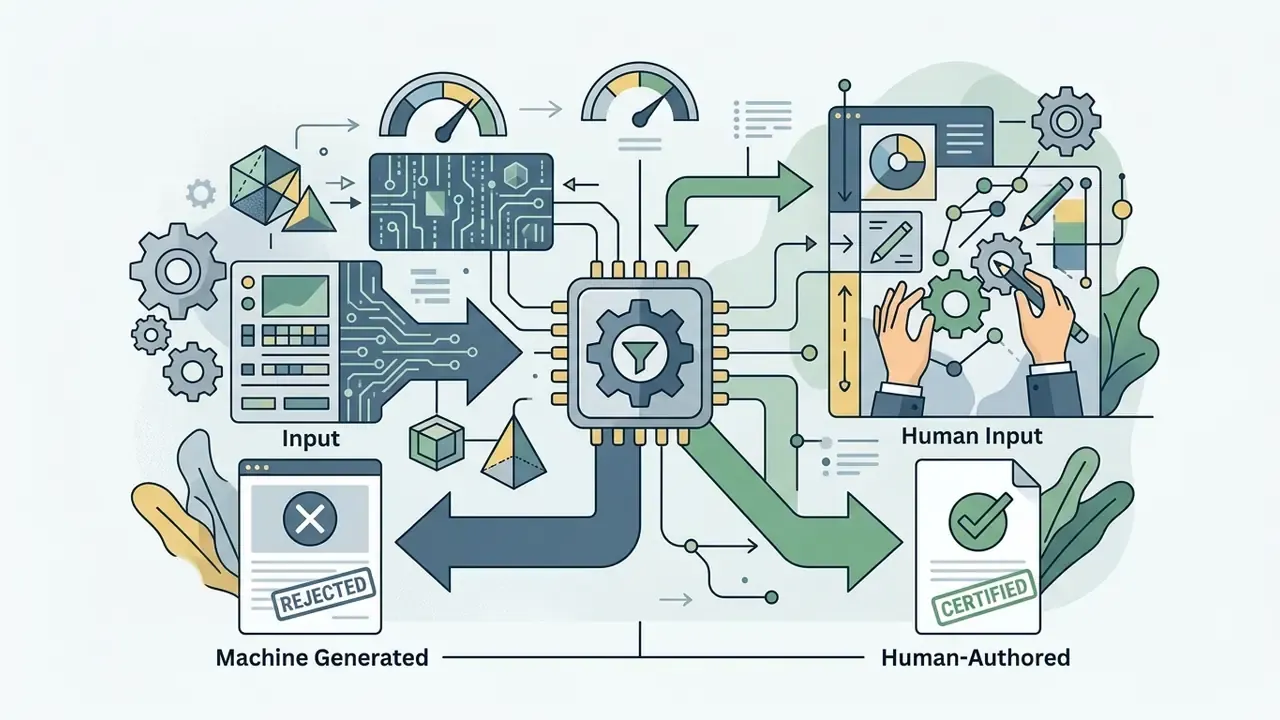
Stages, left to right: (1) Human Idea, concept and scope; (2) Text Prompt, style, references and constraints; (3) AI Generation, diffusion or GAN model; (4) Human Selection, curation and filtering; (5) Refinement and Use, post-editing and publication. Arrows connect each stage in sequence; stage 3 is highlighted as the automated step.
What Is AI in Art and How AI-Generated Art Is Created
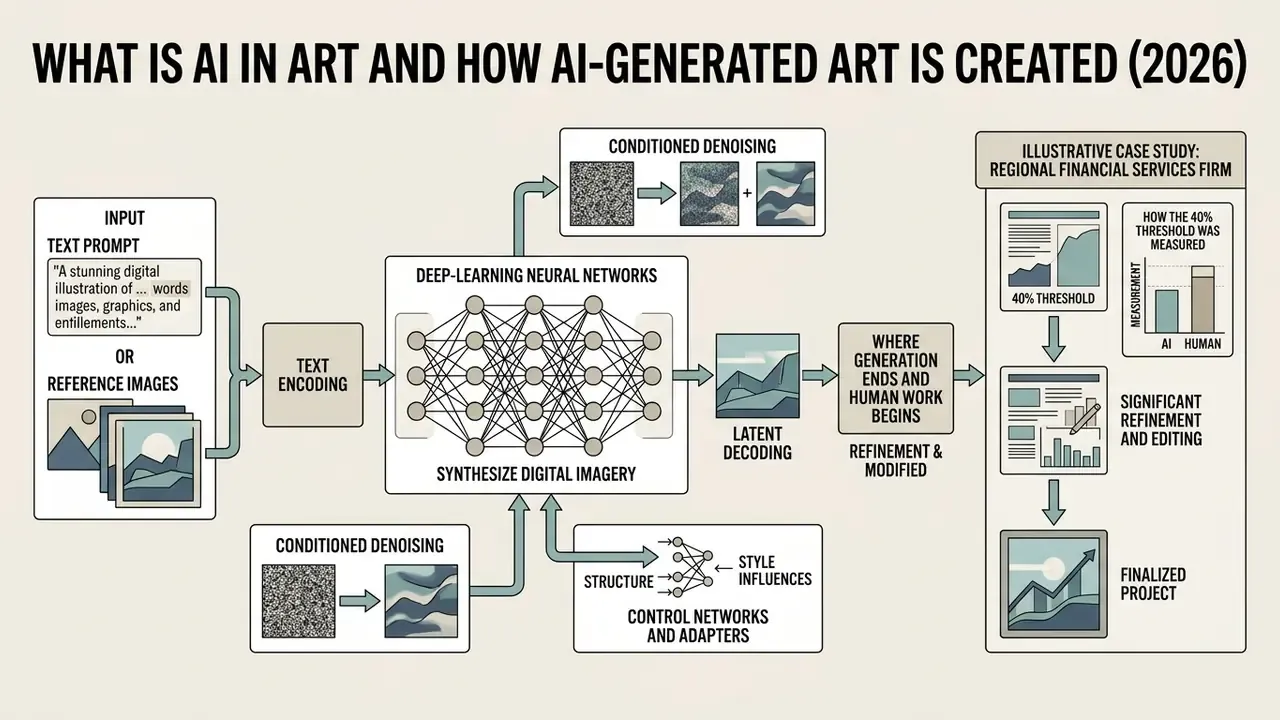
Generative artificial intelligence in visual art uses deep-learning neural networks to synthesize digital imagery from text prompts or reference inputs. Understanding ai in art means looking at how algorithms process statistical relationships inside massive image-text datasets, then reassemble those relationships into new visual media.
«Generative AI is a technology that uses deep learning models to create human-like content in response to complex natural-language prompts.»
Modern image generation relies on diffusion models and Generative Adversarial Networks (GANs). Diffusion models work by systematically adding Gaussian noise to training images until the visual data becomes unstructured static. The network then learns to reverse that process, taking random latent noise and iteratively clearing it under the guidance of textual conditioning vectors. Readers comparing concrete platforms before deployment can review structured evaluations of AI image generators by output quality, control surface, and license terms.
GAN architectures, introduced in 2014 by Ian Goodfellow and colleagues, operate through adversarial competition. A generator synthesizes candidate images while a discriminator judges whether each candidate resembles the training distribution. That mechanism produced the first widely publicized AI artworks and still matters for style transfer and constrained latent-space exploration, although diffusion architectures now dominate commercial text-to-image production.
Text-to-image conversion uses specialized encoders such as CLIP to map textual descriptions into a shared semantic embedding space with visual features. When an operator submits a detailed prompt, the conditioning signal pushes the model's sampling steps toward statistical patterns that align with the text. Output quality depends directly on model parameters, prompt construction, and dataset coverage. Nothing mystical here. The art in ai sits in the choices around the model, not inside the weights.
From Text Prompt to Finished Image
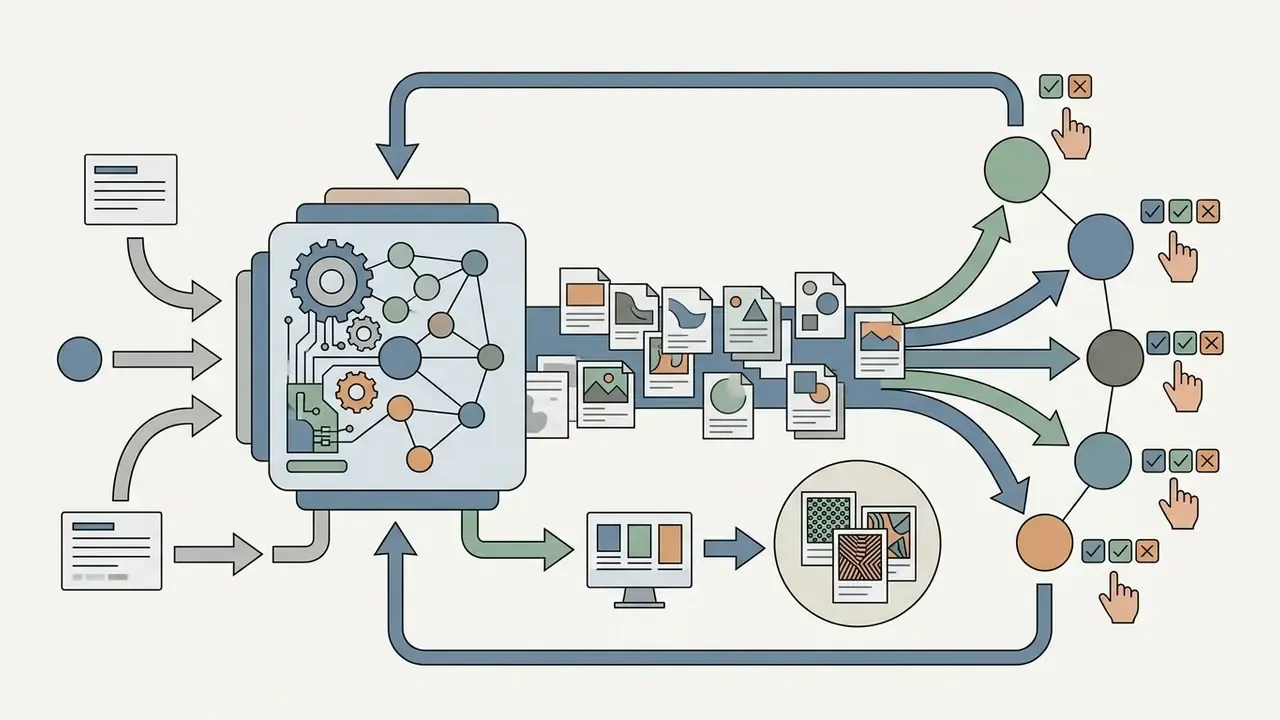
Turning a conceptual idea into a rendered image follows a multi-stage computational pipeline. The process converts natural language into detailed spatial conditioning signals that guide iterative denoising.
- Text Encoding User input passes through a text encoder, transforming words into mathematical representations that express concepts, styles, and compositional structure.
- Conditioned Denoising The diffusion model starts from a tensor of random noise and applies iterative denoising passes, using cross-attention to enforce alignment with the text embedding.
- Control Networks and Adapters Operators apply structural controls such as ControlNet, or fine-tuned weights such as LoRA (Low-Rank Adaptation), to preserve precise line work, pose geometry, or visual style.
- Latent Decoding A variational autoencoder (VAE) converts the final latent representation into a pixel-space image ready for inspection.
«Stable Diffusion combines latent diffusion models with CLIP, which maps images and text into a shared semantic space to steer generation.»
Each stage introduces a distinct control point for governance. Text encoding is where prompt blocklists live. Conditioning is where structural references enforce layout. Adapters are where proprietary brand style is injected. Decoding is where resolution and export fidelity are set. Model risk teams should map controls to these four stages rather than treating generation as one opaque event. That single reframing usually shortens a validation cycle by weeks, because reviewers finally know what they are testing.
Where Generation Ends and Human Work Begins
The boundary between automated output and human contribution defines both creative value and legal protection. A one-line prompt produces machine output. Iterative curation, structural manipulation, and manual post-processing establish human creative agency. The difference is not sentimental, it is evidentiary.
«Access to ChatGPT degraded creative outcomes among highly creative participants; the negative effect was mediated by the intensity of human-AI interaction.»
When an operator relies only on generic text inputs, the system decides expressive elements such as framing, lighting, and fine detail. Professional integration looks different. Human artists intervene by selecting the strongest candidates, re-prompting with modified parameters, masking specific regions for targeted inpainting, and executing manual digital painting on top of the base.
Case study (illustrative, composite): regional financial services firm. A regional financial services firm evaluated generative image tools for marketing collateral. The initial rollout produced standardized assets that lacked brand consistency and failed copyright registration. The governance team then mandated a workflow where AI output served strictly as conceptual mockups, requiring human designers to execute a minimum 40% manual modification plus layout assembly. That change produced predictable brand compliance and documented human authorship for commercial registration. It also clarified internal rules for commercial use of AI-generated images across campaigns.
How the 40% threshold was measured. The compliance function refused to treat the figure as a subjective impression, which was the right instinct. Auditors measured three verifiable artifacts per asset: the ratio of human-edited pixel area to total canvas area, captured from layer masks in the working file; the count of human-created vector or type layers relative to total composited layers; and the presence of at least one structural human input, meaning a sketch, wireframe, or depth reference feeding the conditioning stage. Assets failing two of three checks went back to the design queue. This artifact-based method produced an evidence chain usable for brand review and copyright filing alike. Is 40% the objectively correct line? Probably not. It is defensible, documented, and consistently applied, which is what auditors actually ask for.
Copyright, Training Data, and the Ethics of Using AI-Generated Imagery
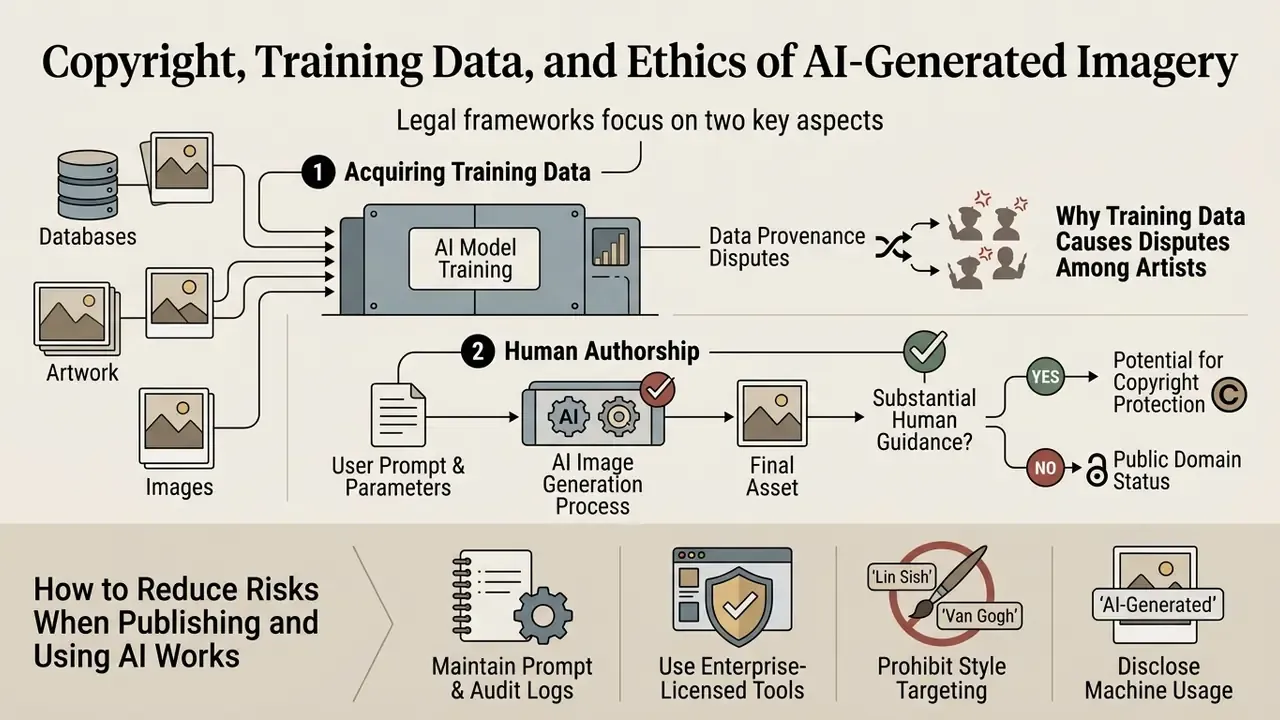
Legal frameworks governing ai generated art concentrate on two things: how training data was acquired, and how much human authorship exists in the final asset. Enterprise risk management has to address copyright compliance, data provenance, and public disclosure. This section sits before the philosophical debate on purpose, because commercial deployment decisions depend on it and not on aesthetics.
Determining ownership in ai art and artists workflows depends heavily on jurisdiction. Companies using generative assets commercially must build clear evidence chains documenting human creative contribution, ideally at the moment of production rather than during a dispute.
Why Training Data Causes Disputes Among Artists
The core legal and ethical dispute involves scraping copyrighted artwork into training datasets without consent, compensation, or a workable opt-out.
Legal disclaimer: Copyright regulations, ownership criteria, and commercial licensing rules for AI-generated imagery vary significantly across jurisdictions (for example U.S. Title 17, the EU AI Act, UK copyright law) and across specific platform terms. The information presented here is educational and does not constitute formal legal counsel. Verify current terms with qualified counsel before commercial release.
Rightsholders argue that unauthorized dataset scraping violates exclusive reproduction rights under copyright law.
«Artists overwhelmingly believe model creators should disclose in detail which works are used to train AI systems.»
AI developers counter that ingested dataset features constitute non-infringing fair use.
«Experiments show diffusion models can reproduce training images, particularly when duplicate examples exist in the dataset or prompts are specifically crafted.»
Unresolved litigation across federal courts leaves commercial users exposed to downstream liability if a base model is later found non-compliant. Under EU rules, general-purpose model providers must maintain a copyright-compliance policy and publish a sufficiently detailed summary of training content (EU AI Act, Article 53(1)(c) and (d)). That gives European buyers a documentation lever which U.S. buyers currently lack, and honestly it is the single most useful procurement question available right now. Teams verifying whether a supplied asset originated from a generative pipeline can apply AI image detectors during intake review, while ongoing case summaries are easier to track if you open the hub for compliance documentation.
Who Owns the Rights to AI-Generated Art
Under current guidance from the U.S. Copyright Office (Part 2 Report published January 29, 2025), fully machine-generated imagery lacking human authorship cannot be registered and sits in the public domain.
«Applicants must disclose AI-generated components, and registration extends only to elements over which a human exercised sufficient creative control.»
Copyright protection extends only to human-authored elements inside a composite work. When human creators execute selection, arrangement, or substantial manual modification of AI output, those specific contributions qualify for registration. Applicants must explicitly disclaim machine-generated portions when filing. U.S. court practice has reinforced the human-authorship requirement, including Thaler v. Perlmutter, where a work listing a machine as author was refused registration.
«Users of AI images face an unattainably high authorship standard: full concepts and total control are expected of them, while traditional authors face no such demand.»
This asymmetry has operational consequences. A photographer who presses a shutter is presumed to be an author. A prompt operator must demonstrate expressive control. So enterprises should manufacture authorship evidence deliberately rather than assume it appears by default. Content provenance standards such as C2PA and Content Credentials provide cryptographically signed capture-and-edit histories that support both authorship claims and downstream disclosure duties.
How to Reduce Risks When Publishing and Using AI Works
Teams publishing AI-assisted visual media need operational protocols to limit infringement and brand exposure. Use the documentation on commercial use of AI image generators as the baseline reference for permitted rights.
- Maintain prompt and audit logsDocument prompt histories, generation iterations, and post-editing files to prove human creative selection.
- Use enterprise-licensed toolsPrefer vendors offering explicit commercial indemnification and transparent training-data provenance.
- Prohibit style targetingEnforce policy preventing prompts that reference specific living artists or protected trademarks.
- Disclose machine usageLabel AI-assisted assets transparently in commercial publications to align with regional disclosure laws.
«Technical safeguards include watermarking, machine unlearning, dataset deduplication, and alignment mechanisms that prevent reproduction of protected content.»
Minimum audit record per published asset (for MRM and GRC systems).
| Field | Example value | Why it matters |
|---|---|---|
| Model and version | Base model, checkpoint, adapter IDs | Establishes training-data provenance and indemnity scope |
| Prompt and negative prompt | Full text string, stored verbatim | Demonstrates human expressive choices; proves absence of artist names |
| Seed and sampler parameters | Seed, steps, guidance scale | Enables reproduction of the exact output during dispute review |
| Conditioning inputs | Sketch, depth map, pose reference | Evidence of human structural authorship |
| Layered edit file | Working PSD or AI file with masks | Quantifies manual modification share |
| Reviewer sign-off | Name, role, timestamp | Human-in-the-loop accountability |
| Provenance metadata | C2PA manifest, disclosure label | Supports regional disclosure compliance |
One caution. An audit record nobody can retrieve in twelve months is theatre. Store these fields in the same system your model inventory already uses, not in a designer's local folder.
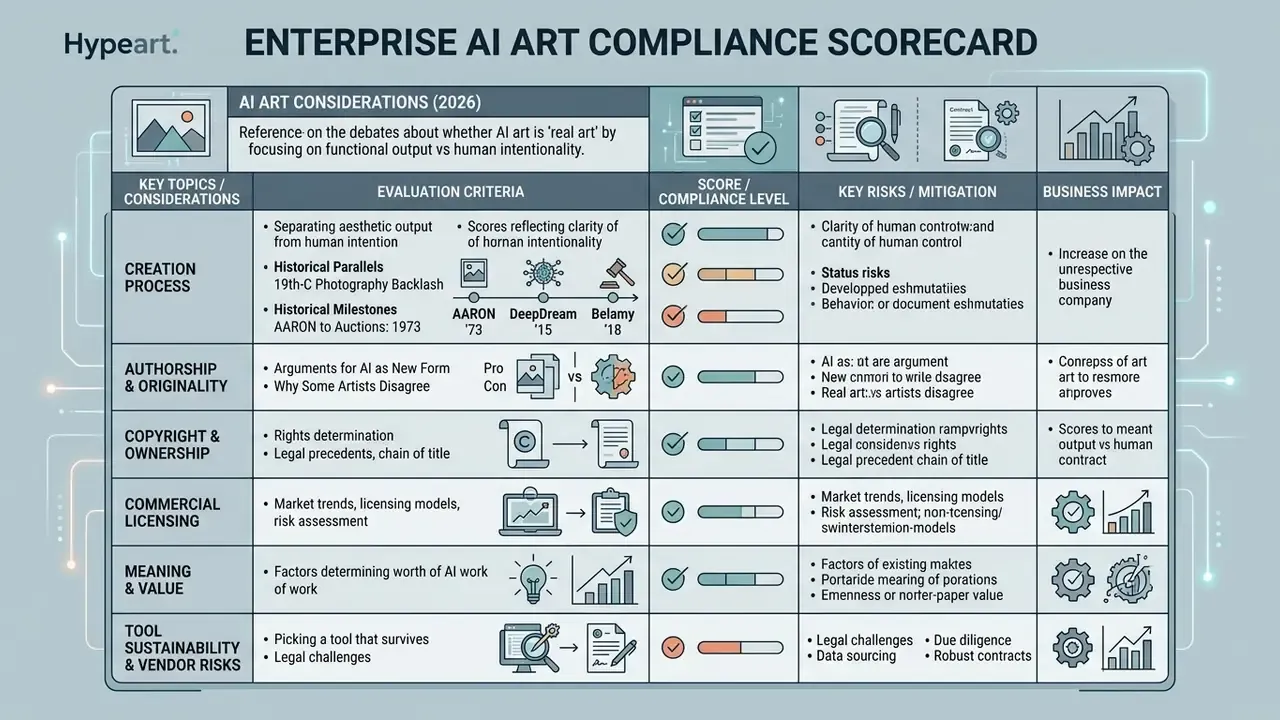
Enterprise AI Art Compliance Scorecard
Evaluate organizational legal readiness before commercial deployment:
Checklist0 / 5
Can AI Art Be Considered Real Art
Asking whether ai art real status holds requires separating functional aesthetic output from human intentionality. Philosophical frameworks judge works on emotional agency, institutional acceptance, and conceptual purpose, not only on mechanical execution. And yes, people ask a blunter version of this question: is there any point to art with ai at all, if the machine does the rendering?
To evaluate the question systematically, visual theorists apply four established frameworks:
Read together, these frameworks explain why the debate never really closes. AI art scores well on mimesis, formalism, and institutional recognition. The contested claims cluster around intentionality, lived experience, and the "surprising" criterion, which weakens badly when outputs converge on dataset averages.
Historical Parallels: The 19th-Century Photography Backlash
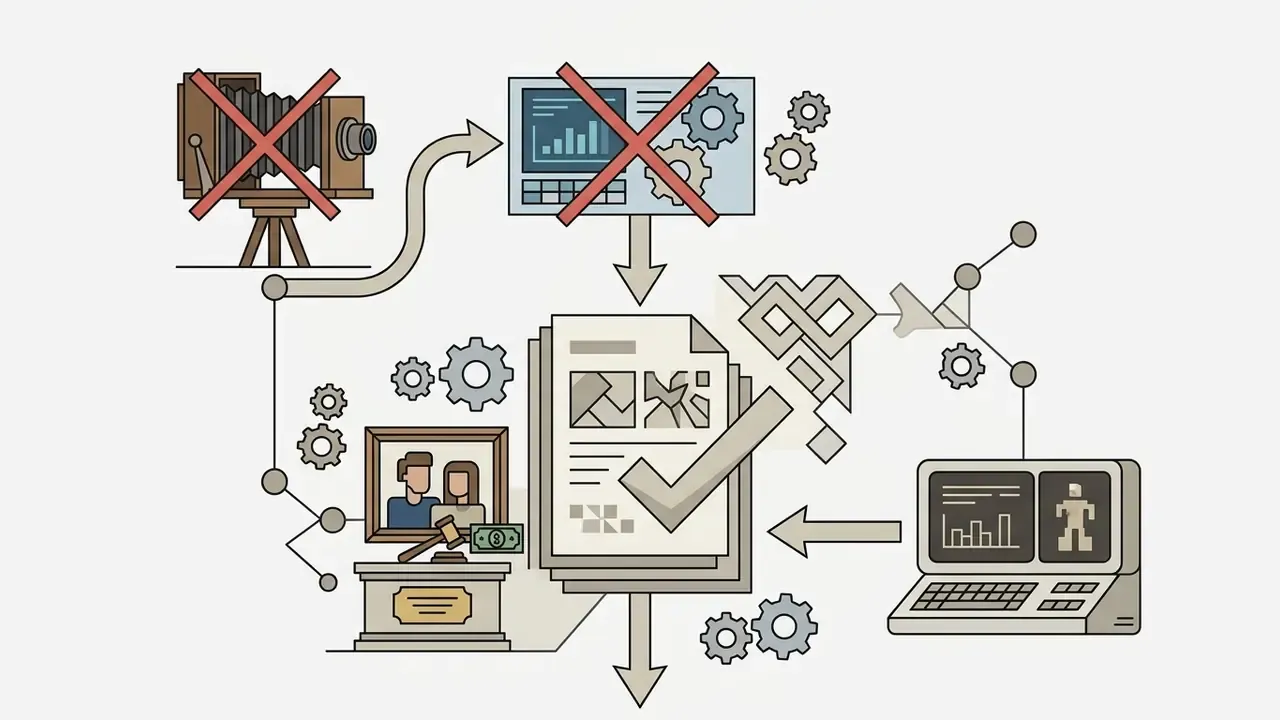
Skepticism toward AI-generated imagery mirrors the resistance photography met in the 19th century. When photographic processes emerged in the 1820s, critics dismissed the medium as a mechanical shortcut without creative soul.
«The fear has sometimes been expressed that photography would in time entirely supersede the art of painting… when the process of taking photographs in colors has been perfected, the painter will have nothing more to do.»
Early detractors in The Crayon (1855) argued that photography could never be true art because it lacked "something beyond mere mechanism at the bottom of it," and that it "can never assume a higher rank than engraving." Two structural arguments from that era return almost verbatim in any ai art article published today: anyone can do it, and it will destroy livelihoods. Neither prediction eliminated painting, and auction results still place painted works orders of magnitude above photographs. But photography did reshape visual culture and pushed painting toward abstraction. Generative AI operates in the same register: an evolutionary shift in tooling rather than the end of human intent.
Historical Milestones: From AARON to Institutional Auctions
Generative art is not a 2020s novelty. It rests on five decades of algorithmic experimentation.
- 1973, Harold Cohen's AARON Cohen developed AARON, an early autonomous program engineered to execute drawings from cognitive rules of visual representation. He framed the project around one question: what are the minimum conditions under which a set of marks functions as an image? Early AARON output was abstract. Representational elements such as rocks, plants, and human figures arrived in the 1980s, with colour and program-selected brushes and dyes added later. AARON proved that code could systematically generate complex representational imagery.
- 2015, Google DeepDream Pattern-enhancement networks produced deliberately over-processed, dream-like imagery through algorithmic pareidolia, giving the public its first mass exposure to neural aesthetics.
- 2018, Christie's auction of Edmond de Belamy The institutional market validated AI-generated work when Christie's New York sold Edmond de Belamy, a portrait created by the French collective Obvious using a Generative Adversarial Network, for $432,500, exceeding its $7,000 to $10,000 estimate by more than forty times. The series name is a translated pun on Ian Goodfellow, inventor of GANs.
Arguments for AI Art as a New Artistic Form
Proponents frame the argument for ai art as an extension of conceptual art. In that view, the medium includes algorithm selection, dataset curation, prompt construction, and output filtering.
«A systematic review of 64 studies shows that in experimental settings generative AI expands creative exploration, especially for novice users and idea-generation tasks.»
- Conceptual primacy: The central creative contribution shifts from manual execution to the formulation of complex ideas, instructions, and linguistic composition.
- Expanded visual access: People without manual rendering skills gain a practical route from abstract idea to legible visual format.
- Rapid iteration: Creators test diverse stylistic and compositional variations within minutes, widening the scope of aesthetic experimentation.
In conceptual art frameworks, code, training data, and user interaction all count as legitimate artistic media. The technology lets creators stress-test complex visual concepts quickly, treating algorithmic output as raw material for further synthesis. That is also the strongest ai art argument for enterprise creative teams, where speed of concept validation carries direct budget consequences.
Why Some Artists Do Not Recognize AI-Generated Art
Opponents in the ai art debate argue that generative models lack subjective consciousness and emotional intent. Critics describe machine outputs as statistical recombinations of existing training data rather than original creation.
«AI models lack consciousness and emotion and therefore have no appreciation of art; their works are cold-blooded imitations rather than artistic creation.»
«AI-generated works are produced by neural networks trained on large data volumes that autonomously generate new combinations without directly reproducing any single original image.» — Salas Espasa & Camacho, From Aura to Semi-Aura, AI & Society (2024). https://link.springer.com/article/10.1007/s00146-024-02180-4
Academic evaluations stress that diffusion architectures work by identifying mathematical patterns in existing datasets. Because the models hold no lived human experience, opponents read their output as derivative pattern assembly. Add the automated ingestion of proprietary artistic styles without consent, and the ethical objection inside professional creative communities becomes fairly predictable. A parallel critique, in A critique of contemporary artificial intelligence art: Who is Edmond de Belamy? (2020), holds that AI art is assembled from pre-existing material with no intending human subject at its centre.
What Determines the Meaning and Value of AI Work
The value of an AI-assisted artwork depends on creation context, conceptual depth, authorial intent, and public reception. Unmodified, mass-produced machine output holds minimal market or semantic value, for the unglamorous reason that scarcity is zero and reproduction is automatic.
«Across one field and three lab experiments, consumers consistently preferred human-made works; the effect is explained by reduced empathy toward the AI generator.»
A 2025 empirical study showed viewers rating AI-generated art lower on average artistic value (mean score 42.41) than human-created art (mean score 53.36) when machine involvement was explicitly disclosed (Journal of Consumer Behaviour, 2026).
«Disclosure of AI involvement lowers perceived authenticity, yet contextual framing, presenting AI as the artist's tool, can preserve or even raise perceived creativity.»
| Degree of human involvement | Typical perceived authenticity | Typical registrability (U.S.) | Commercial positioning |
|---|---|---|---|
| Prompt-only, unmodified output | Lowest; disclosure sharply reduces valuation | Not registrable | Volume stock, internal drafts |
| Prompt iteration plus curation of many candidates | Low to moderate | Selection and arrangement claims only | Concept boards, mood boards |
| Structural conditioning from human sketch | Moderate | Human structural input supports claims | Client-facing concept art |
| Heavy inpainting plus manual repainting | Comparable to traditional media | Human-authored portions registrable | Campaign hero assets |
| AI as reference or texture inside hand-made work | Highest | Standard authorship | Gallery, licensed illustration |
When AI acts as an intermediate tool inside a documented human narrative, perceived value converges on traditional media. Market recognition then rests on the creator's ability to show deliberate choices across the production lifecycle. Buyers comparing platforms for that kind of work can review the best AI art generators by style control and licensing depth.
AI and Artist: How Artists Use AI in the Creative Process
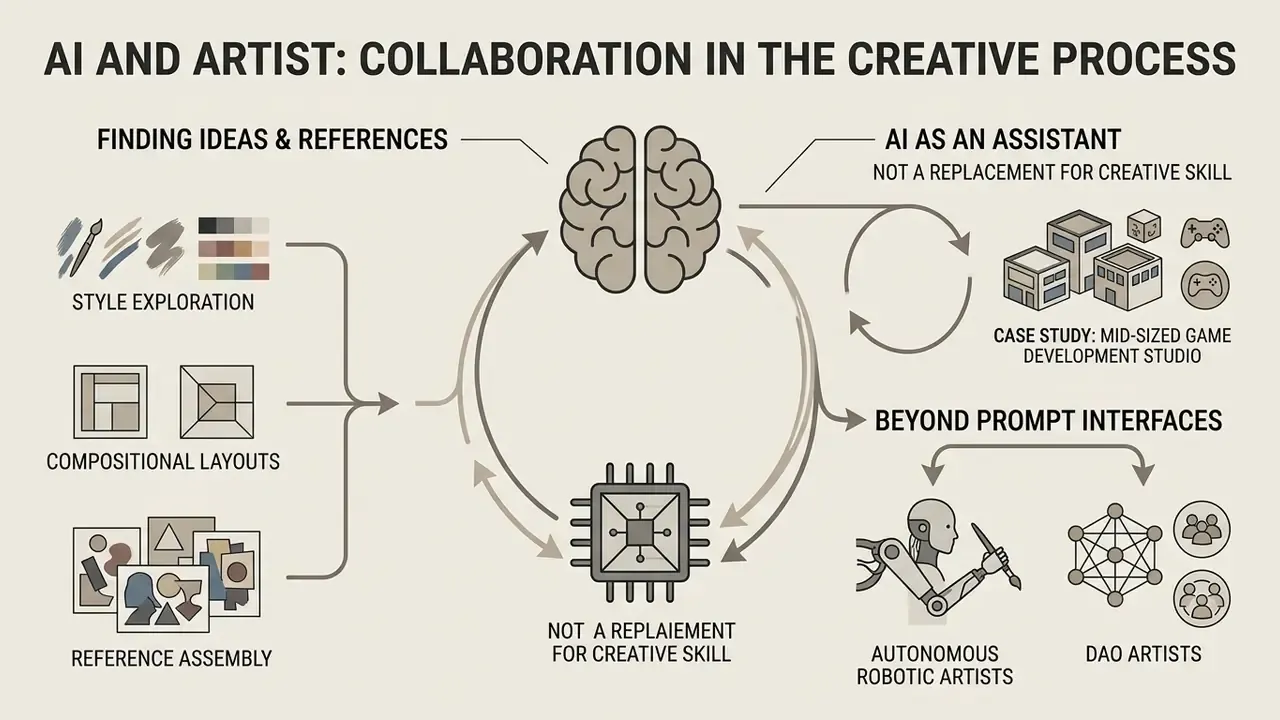
The relationship between artist and ai systems keeps drifting toward collaboration rather than substitution. Professional creators treat image tools as specialized utilities, not autonomous replacements for judgment.
Integrating ai and artist workflows accelerates preliminary exploration while keeping human control over final execution. Designers apply generative capability to specific bottleneck tasks and retain oversight across every project phase. The pattern is boringly consistent across studios I have seen described in industry reporting: automation early, human hands late.
Finding Ideas, References, and Visual Directions
During ideation, artists use generative ai in art to build mood boards, test lighting scenarios, and evaluate composition options. Fast generation lets a team examine dozens of conceptual paths before committing manual hours.
«Artists use AI to search visual directions, test concept variations, and evaluate how different stylistic influences interact, faster than manual methods allow.»
- Style exploration
- Combining diverse aesthetic descriptors to preview non-traditional visual mixes.
- Compositional layouts
- Testing camera angles, horizon lines, and subject arrangements quickly.
- Reference assembly
- Generating specialized background assets and texture maps to inform manual painting.
A capability overview of a modern AI art generator helps teams match feature sets to ideation needs. Design teams frequently pair text-to-image prompts with structural reference inputs so that candidates respect strict spatial boundaries. Industry documentation of this pattern includes Adobe Firefly Boards, where imported assets, Style Reference, and Structure Reference guide layout and aesthetic direction inside a single ideation canvas. The practical payoff is shorter early-stage client review cycles, since the conversation starts from visuals rather than adjectives.
AI as an Assistant, Not a Replacement for Creative Skill
Generative software functions as an efficiency tool, and output quality still depends on human art direction. Critical judgment remains necessary to filter unusable generations, fix anatomical errors, and align assets with brand standards.
«Participants who relied heavily on ChatGPT gravitated toward templated solutions; those using AI moderately, to break local blocks, retained higher originality scores.»
Beyond Prompt Interfaces: Autonomous Robotic and DAO Artists
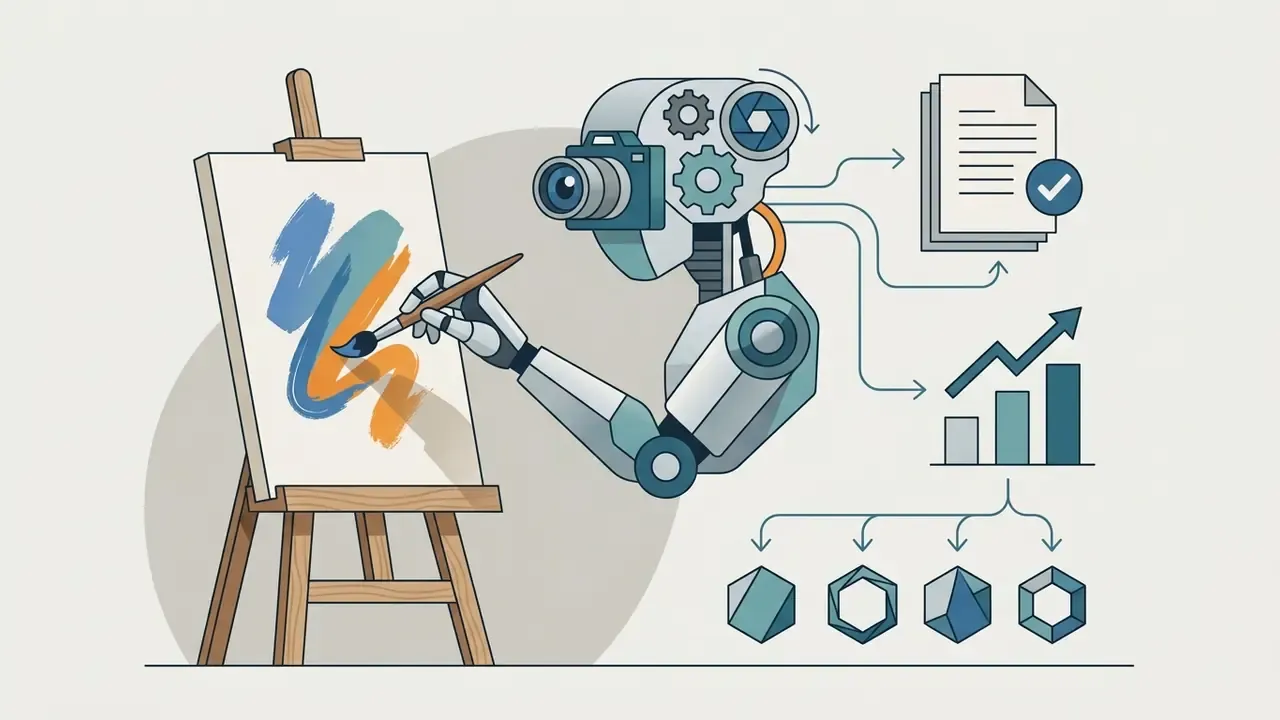
Ai usage in art now extends past software interfaces into physical robotics and decentralized autonomous agents.
Both projects sharpen the institutional question. If an art world documents, exhibits, and sells the output of an autonomous agent, Dickie's institutional theory grants that output the status of art regardless of which hand executed it.
What Tasks AI Helps Accelerate in Art Creation
Generative utilities compress specific labour-intensive tasks in commercial illustration and concept pipelines. This is where ai use in art produces measurable time savings rather than debate.
| Workflow Stage | Standard Process Without AI | Augmented Process Using AI |
|---|---|---|
| Ideation and mood boards | Manual internet searching, manual clipping, 4 to 8 hours | Prompt-driven variant generation, semantic curation, about 1 hour |
| Reference gathering | Custom photography or stock library purchase | On-demand generation of specific lighting and pose references |
| Rough concepting | Hand-drawn thumbnails and wireframes | Text-to-image base drafts with ControlNet structure |
| Detailing and texturing | Manual painting of repetitive patterns and backgrounds | Algorithmic texture synthesis and background inpainting |
| Final delivery pass | Manual resolution scaling and cleanup | AI vectorization or upscaling followed by human touch-ups |
Published research supports these acceleration points. TextureGAN (CVPR 2018) demonstrated texture synthesis controlled by hand-drawn sketches and texture patches, while sketch-guided scene generation studies show design sketches converted into image variants for rapid prototyping.
For the delivery stage, teams typically pair an AI photo editor for retouching with an AI image upscaler for print-resolution export before final human passes.
Campaign work rarely stops at still images, which is where adjacent generators enter the same governance perimeter. Audio branding teams test an ai jingle generator for short spots, social teams experiment with an ai joke generator for caption drafts, packaging teams use an ai label generator for concept mockups, and recruitment marketing borrows an ai job description draft before human editing. Consumer novelty tools deserve stricter handling: portrait-animation products such as an ai kissing generator, including the widely searched ai kissing generator free variants, involve likeness and consent exposure that most brand teams should simply decline. Same principle throughout. Automating repetitive steps frees creators for conceptual development and narrative refinement, provided each tool sits inside the same inventory and approval flow. Teams needing multi-modal asset production can review options through the AI Media Comparison hub or integrate automated infrastructure with the AI Media API endpoint.
Key Arguments in the AI Art Debate: Benefits, Risks, and Limitations
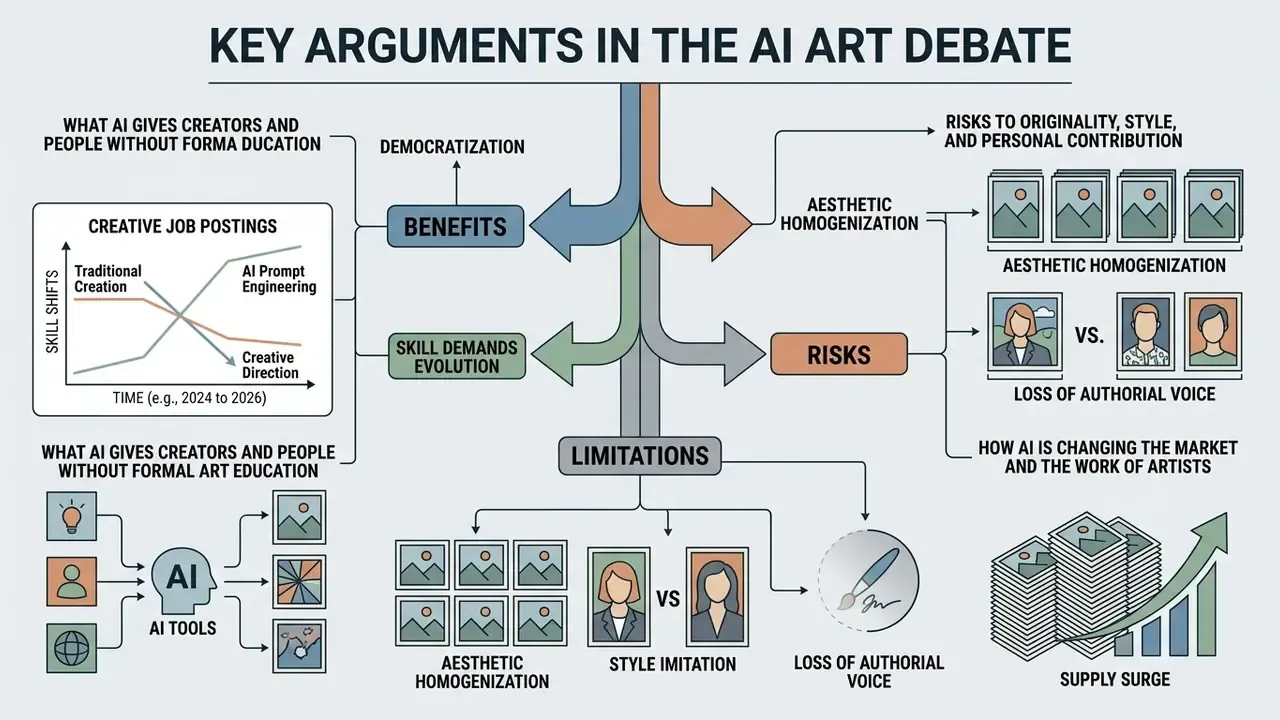
The wider debate about ai and art covers economic impact, creative democratization, and stylistic homogenization risk. Evaluating it honestly means looking at individual creator outcomes and macro-level industry shifts together.
Weighing whether ai art good outcomes outweigh the costs means balancing accessible visual expression against structural change in creative labour markets. Organizations must set efficiency gains against brand erosion and legal exposure, not against each other in isolation.
What AI Gives Creators and People Without Formal Art Education
Generative systems lower the technical bar for visual asset creation, so people without fine-arts training can produce functional imagery for business and educational needs.
«Easy access to generative AI has democratized visual expression by reducing reliance on traditional artistic skills and knowledge.»
«Students with limited drawing ability reported that AI generators let them express ideas visually, improving their capacity to communicate concepts to an audience.» — Generative AI Tools in Art Education, Lindenwood University (2024). https://digitalcommons.lindenwood.edu/faculty-research-papers/558/
Non-professional users build marketing banners, internal presentation slides, and visual mockups directly from prompts. Communication across non-design departments speeds up noticeably. Survey data reinforces the pattern: in a 2024 study, 28% of participants with no art or design background reported using AI tools to generate static imagery, which the authors read as a measurable drop in entry barriers. Teams onboarding non-designers frequently start with template-driven environments such as the Canva AI generator before moving to specialist pipelines.
Risks to Originality, Style, and Personal Contribution
Wide adoption of public generative models introduces visual standardization risk. Because models train on centralized corpora, output aesthetics drift toward statistical averages, which weakens distinct brand identity.
«Current AI models are limited in producing genuinely novel aesthetics: they reproduce established, commercially recognizable styles and reinforce existing aesthetic norms.»
The evidence base here is specific rather than vibes-based. Peer-reviewed work documents that generative systems are engineered to identify and recreate hard-to-analyze style features, and a 2025 European Parliament study notes that style and technique themselves are not protected by copyright. Which leaves an artist's "handwriting" legally exposed when models imitate it. Protecting a distinct brand identity therefore depends on explicit human oversight and custom fine-tuning on proprietary data, not on legal remedy.
How AI Is Changing the Market and the Work of Artists
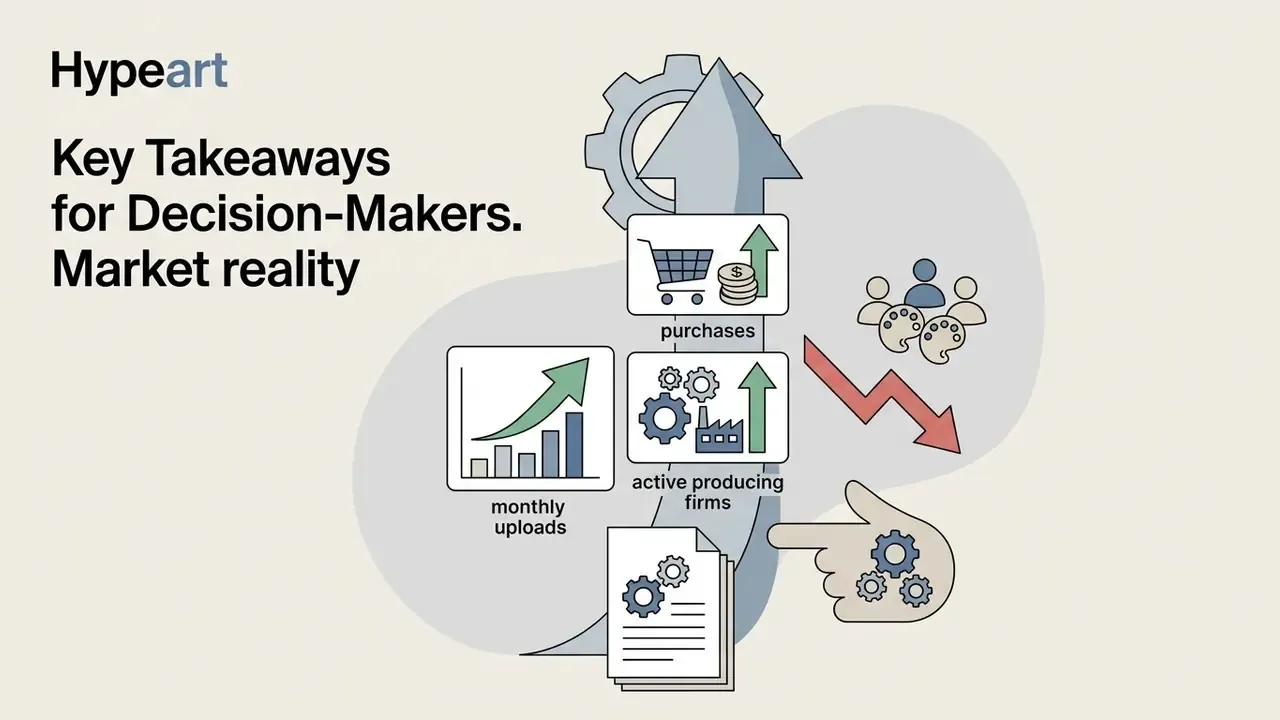
Empirical market research confirms direct structural displacement alongside expanded buyer activity. A 2025 Stanford Graduate School of Business study tracking over 3.2 million images and 62,000 creators across a major digital visual marketplace found clear supply-and-demand shifts after GenAI integration:
- Supply surge Monthly image uploads increased by 78%, driven almost entirely by generative AI outputs.
- Market dynamics Active producing firms grew by 88%, while non-AI human creators experienced an additional 23% exit rate.
- Consumer demand Platform purchases rose by 39%, with buyers substituting traditional human assets with high-quality AI alternatives.
«Our results show GenAI is likely to crowd out non-GenAI firms and goods.»
So GenAI expands market volume and buyer choice while crowding out non-AI artists unless they pivot toward specialized direction or hybrid workflows. Worth noting the same study found average image quality improved after AI entry, including among non-AI images, which looks like competitive selection rather than uniform decline.
Generative technology is reorganizing commercial design, concept art, and stock photography. Demand is shifting away from entry-level asset rendering toward senior art direction and AI-assisted workflow management.
«AI products proved more labor-intensive than traditional media products: they demand traditional artistic skills combined with new computational competencies, though human input often remains invisible.»
The U.S. Bureau of Labor Statistics projects modest growth of 2.1% for graphic designers from 2024 to 2034, roughly 5,700 additional jobs, while recruitment data shows rising demand for AI tool fluency alongside traditional design capability (U.S. Bureau of Labor Statistics, Occupational Outlook Handbook, Graphic Designers, 2025. https://www.bls.gov/ooh/arts-and-design/graphic-designers.htm). Commercial buyers now favour operators who combine rapid generative prototyping with rigorous quality control and legal compliance. To evaluate enterprise subscription tiers for corporate teams, decision-makers can open the hub for transparent pricing comparisons.
How to Choose an AI Tool for Creating and Commercially Using Art
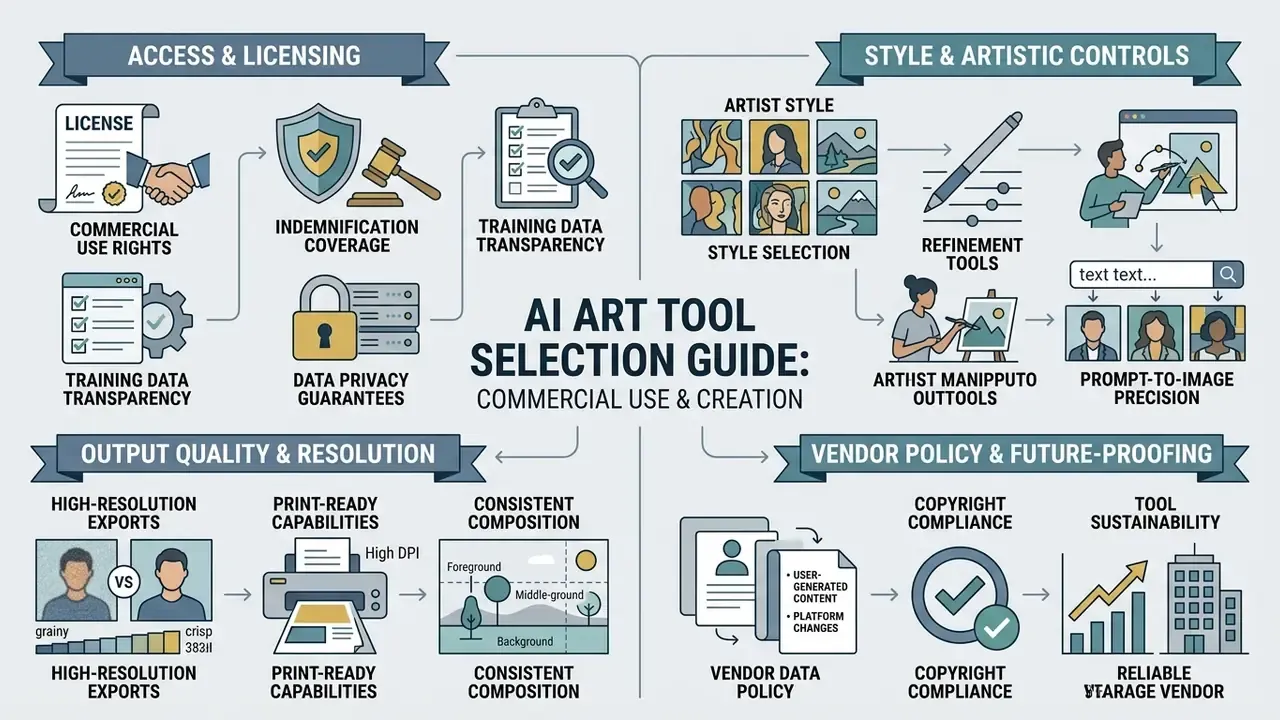
Tool selection comes down to licensing terms, output resolution, style controls, and vendor data policy. Buyers can shortcut the process by comparing the best AI image generators across those dimensions. The trade-off to manage is technical capability against commercial liability.
| Vendor posture | Typical deployment | Indemnification stance | Data exposure consideration |
|---|---|---|---|
| Enterprise creative suite (for example Adobe Firefly) | SaaS with admin controls | Explicit commercial rights and enterprise indemnity offerings | Customer content ownership terms defined in business agreements |
| General assistant platforms (for example DALL·E via OpenAI) | SaaS API and app | Output ownership assigned to the user under current terms | Review data-retention and training-opt-out settings |
| Community-driven generators (for example Midjourney) | Hosted, paid tiers required | Broad platform license to inputs and outputs; commercial rights tied to paid plans | Public-gallery defaults may expose prompts and assets |
| Open-weight models (Stable Diffusion family) | Self-hosted or private cloud | Rights depend on the specific checkpoint license | Best control over data residency; highest provenance burden |
Comparative evaluations for specific vendors are available for Midjourney image generation and the Google AI image generator. For structured evaluations across commercial generative software, administrators can use the AI Media Comparison overview or open the hub for enterprise licensing guidelines.
What to Look for in Access Conditions and Licensing
Commercial usage rights vary widely between free tiers and paid enterprise subscriptions. Read the terms of service before deployment, not after the campaign ships.
Note: This information is general in nature and does not replace consultation with a qualified specialist.
«Until infrastructure exists to compare works against databases of AI outputs, either a moratorium on copyright for AI products or a sui generis right is advisable.» — Creation and Generation Copyright Standards, SSRN (2024). https://papers.ssrn.com/sol3/papers.cfm?abstract_id=4955757

Avoid deploying free-tier outputs in commercial campaigns. Free plans frequently restrict commercial reuse and mandate public attribution, and the practical limits of free AI image generators without sign-up show exactly where those restrictions bite. Enterprise buyers evaluating full specifications can open the hub to compare tier-specific license terms.
How to Evaluate Control Over Style and Image Quality
Professional workflows need precise control over style consistency, character layout, and output scaling. Without those controls, every asset becomes a fresh gamble.
«Students learn to adjust prompts for desired stylistic effects, experimenting with descriptors and observing how small wording changes alter results.»
| Selection Criterion | Technical Indicator | Enterprise Requirement |
|---|---|---|
| Structural control | ControlNet, depth maps, pose alignment | Ability to enforce exact spatial layout from human sketches |
| Custom model adapters | LoRA, fine-tuning support | Ability to train style adapters on proprietary brand assets |
| Editing features | Inpainting, outpainting, canvas expansion | Precision regional editing without regenerating whole frames |
| Export quality | High resolution, VAE vectorization | Native output resolution suitable for print and high-DPI displays |
| Negative prompting | Negative prompt and guidance-scale controls | Systematic suppression of prohibited visual features |
For export-stage quality gates, teams commonly benchmark an AI image enhancer against native model resolution before print approval. For specialized outpainting, operators can use dedicated AI outpainting tools for canvas extension, and implementation standards are documented if you view the guide.
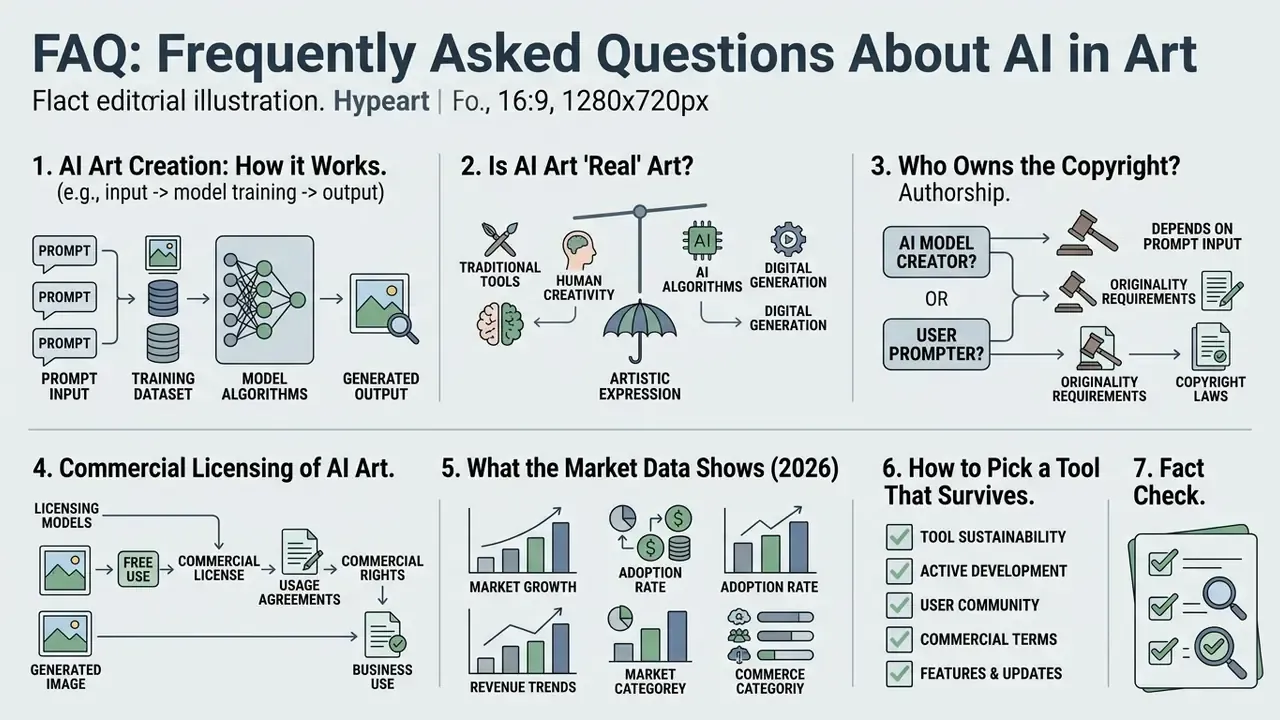
FAQ: Frequently Asked Questions About AI in Art
This section covers operational questions on education, technical limits, and the misconceptions that keep resurfacing in ai generated art article roundups.
Can AI Help Study Art and Develop Art Education
Generative software works as an instructional tool in art history and design education. Instructors use image generators to demonstrate compositional mechanics, lighting principles, and movement-specific stylistic traits.
«Most students rated AI-generator exercises positively, especially prompt-based assignments requiring translation of conceptual ideas into detailed visual descriptions.» — Generative AI Tools in Art Education, Lindenwood University (2024). https://digitalcommons.lindenwood.edu/faculty-research-papers/558/
Students analyze outputs critically to spot anatomical flaws, perspective errors, and stylistic convergence. Prompt-writing exercises teach translation of abstract ideas into explicit visual terminology, which raises overall visual literacy. Classroom studies from 2024 to 2025 also report gains in critical thinking and digital-ethics awareness when assignments require disclosure of AI use plus a written reflection on artistic decisions. Educators can pair generation tasks with verification tasks using AI reverse image search to teach provenance checking, and pull consistent classroom definitions from the glossary hub.
What Is the Difference Between AI in Art and Art in AI
Two phrases, two directions of influence. Ai in art describes tools applied inside artistic practice: generation, editing, upscaling, style transfer. Art in ai describes the reverse, meaning aesthetic principles, dataset curation choices, and visual conventions embedded into how models are built and evaluated. Discussions of ai on art usually blend both, which is part of why the ai art debate gets muddled. Keep them separate in policy documents. A rule about generative tool usage is not the same as a rule about which aesthetic corpora your organization considers acceptable training material.
Does Disclosure Hurt Commercial Performance
Sometimes, yes, and the research is not comfortable reading for marketers. Disclosure lowers perceived authenticity in controlled experiments. But framing matters: presenting AI as the artist's instrument rather than the author preserved and occasionally raised perceived creativity in AI & Society (2024) work. The governance answer stays simple. Disclose where rules or platform terms require it, control framing carefully, and measure the effect on your own campaigns rather than importing someone else's benchmark.
Fact Check: Common Myths About AI in Art
[e-e-a-t
Myth 1: AI will completely replace human artists.
Fact: Academic labour studies confirm that AI automates routine asset rendering while demand shifts toward higher-level creative direction, curation, and narrative development. Human judgment remains essential for brand alignment and legal compliance.
«Generative AI disrupts the distribution of capability and responsibility across creative occupations, but does not predict wholesale job disappearance, rather a complex reallocation of tasks.» — The Twin Disruption of Generative AI, SSRN (2024/2025). https://papers.ssrn.com/sol3/papers.cfm?abstract_id=4790542
Myth 2: Any AI-generated image is automatically free of copyright.
Fact: Unmodified AI outputs sit in the public domain under U.S. copyright law, meaning the generator holds no exclusive rights. Outputs can still infringe third-party copyrights when they replicate protected training data, and platforms enforce contractual restrictions on top of that.
«Technical research confirms models can reproduce protected training images, meaning some AI outputs may infringe existing copyrights.» — Copyright Protection in Generative AI: A Technical Perspective, arXiv (2024). https://arxiv.org/abs/2406.03341
Before publication, provenance checks with AI reverse image search reduce the risk that an output closely replicates an identifiable protected work.
Myth 3: Generative AI requires no human skill or expertise.
Fact: Producing predictable, high-quality commercial assets requires competence in prompt engineering, structural conditioning (ControlNet), regional editing (inpainting), and post-production software. Unskilled prompts produce inconsistent, non-compliant results. Anyone who has reviewed a folder of six-fingered hero images knows this already.
Organizations needing resource-estimation utilities for creative projects can explore the hub for planning tools.
Limitations, Open Questions, and a Safe Next Step
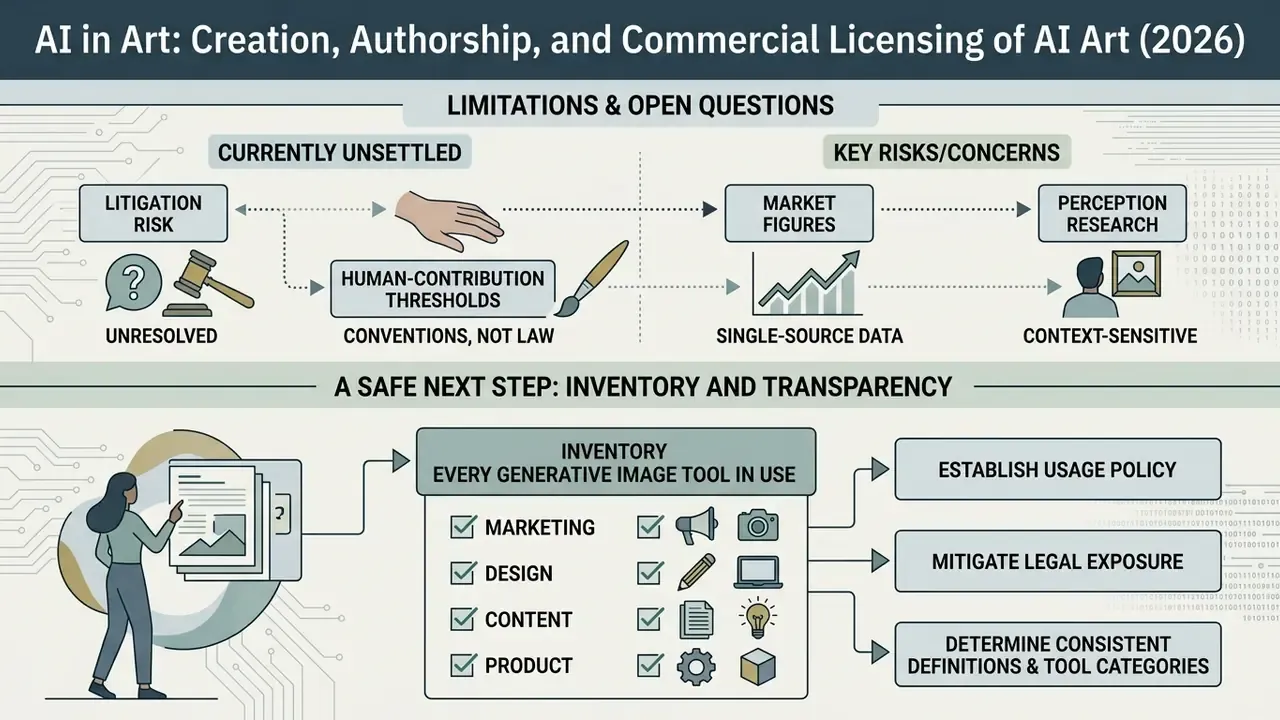
Several things in this field remain genuinely unsettled, and pretending otherwise would be dishonest.
- Litigation risk is unresolved. U.S. fair-use questions on training data are still moving through the courts. Vendor indemnities shift that risk contractually, they do not eliminate it.
- Human-contribution thresholds are conventions, not law. The 40% figure used above is an internal control standard, defensible because it is measured consistently, not because a statute endorses it.
- Market figures are single-source. The Stanford marketplace study describes one platform. Extrapolating it to your category is a hypothesis awaiting your own data.
- Perception research is context-sensitive. Disclosure effects vary by framing, audience, and product category.
A reasonable first step is small and boring: inventory every generative image tool already in use across marketing, product, and agency partners, including the unsanctioned ones. Shadow AI in creative teams is common precisely because the tools are cheap and the outputs look finished. Once the inventory exists, apply the audit-record table to a single campaign, then decide whether the control cost is acceptable before scaling. Speed and risk appetite should be set by the same committee, not by whoever holds the design licence.
For transparency on this revision: three previously unsourced formulations were replaced with cited evidence. Consumer-perception claims now rest on Journal of Consumer Behaviour (2026) experiments and AI & Society (2024) framing research. The homogenization claim now cites Coen Collins, AI & Society (2026), plus the 2025 European Parliament finding that style and technique are not copyright-protected. The 300% and 35% studio metrics remain, labeled as self-reported single-studio measurements with a stated calculation basis rather than industry benchmarks. The Paul Thagard quotation is retained as an expression of the consciousness-based critique, with the exact publication venue still pending verification.
Definitions, tool categories, and terminology used throughout this guide are maintained separately; readers who want the reference layer can explore the hub.