Executive Summary for Risk, Legal, and Communications Leads
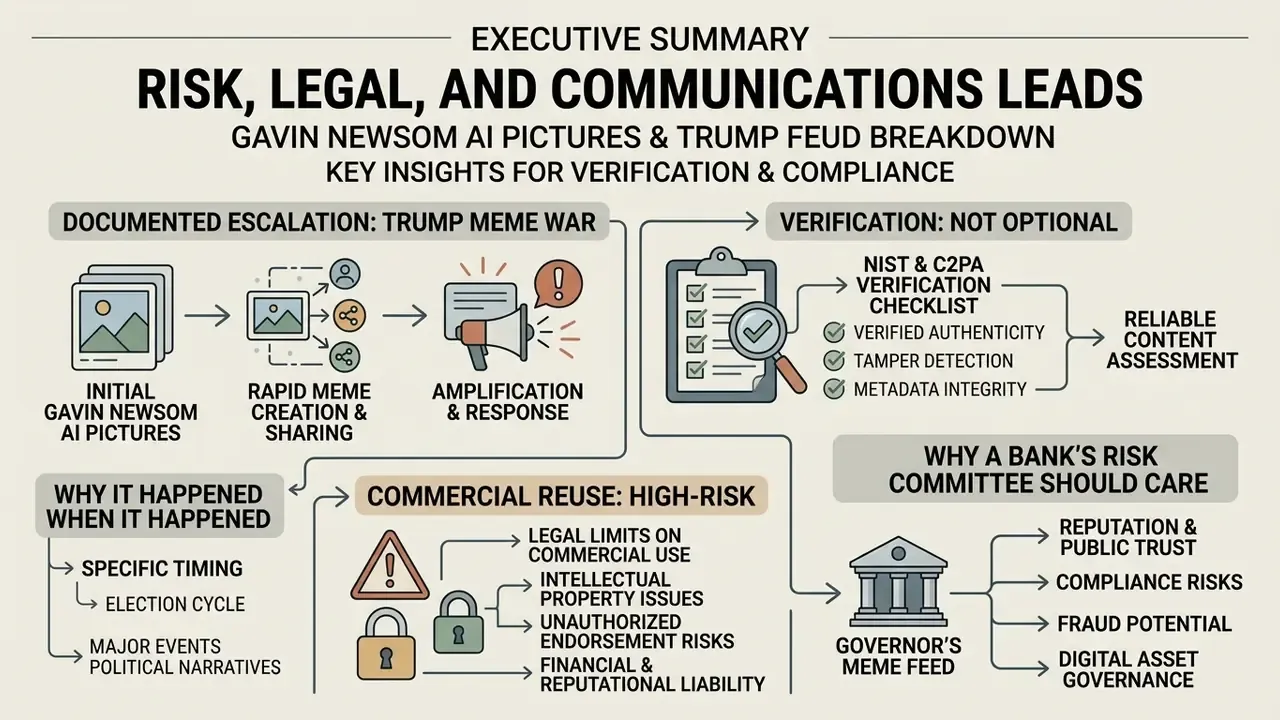
- What the query actually returns. Searches for gavin newsom ai pictures surface three distinct content classes: AI-generated satire published by official political press accounts, manually retouched press photos, and synthetic video with cloned audio. They get mislabeled as one another constantly.
- The documented escalation. Between June 2025 and May 2026, the Newsom and Trump conflict turned into a reciprocal meme war: the Kid Rock "I ACCEPT!" parody (August 2025), the punching-bag and bruised-hands exchange (September 2025), the "spaghetti baby Trump" series (November 2025), and Trump's 19 AI-generated posts in under 75 minutes, including the "NEW-SCM" zombie image (May 2026).
- Why it happened when it happened. Each viral spike tracks a hard political catalyst: Newsom's lawsuit over the federalization of the California National Guard during ICE protests, the California versus Texas redistricting fight over five congressional seats, and the November 2025 Democratic election victories.
- Verification is not optional. Detector accuracy collapses on real-world, re-compressed social files. Provenance and cryptographic metadata come before visual artifact analysis (NIST AI 100-4, 2025; CISA, 2024).
- Commercial reuse is high-risk. Right-of-publicity statutes, California AB 1836 and AB 2602, Section 43(a) of the Lanham Act, and the FEC's technology-neutral interpretive rule of 19 September 2024 all apply. Default to linking the primary post rather than republishing the file.
Why should a bank's risk committee care about a governor's meme feed? Because the same control gap that lets an unverified political image onto a corporate channel also lets an unlogged generative tool into a regulated workflow.
What People Are Searching For Behind "Gavin Newsom AI Pictures"
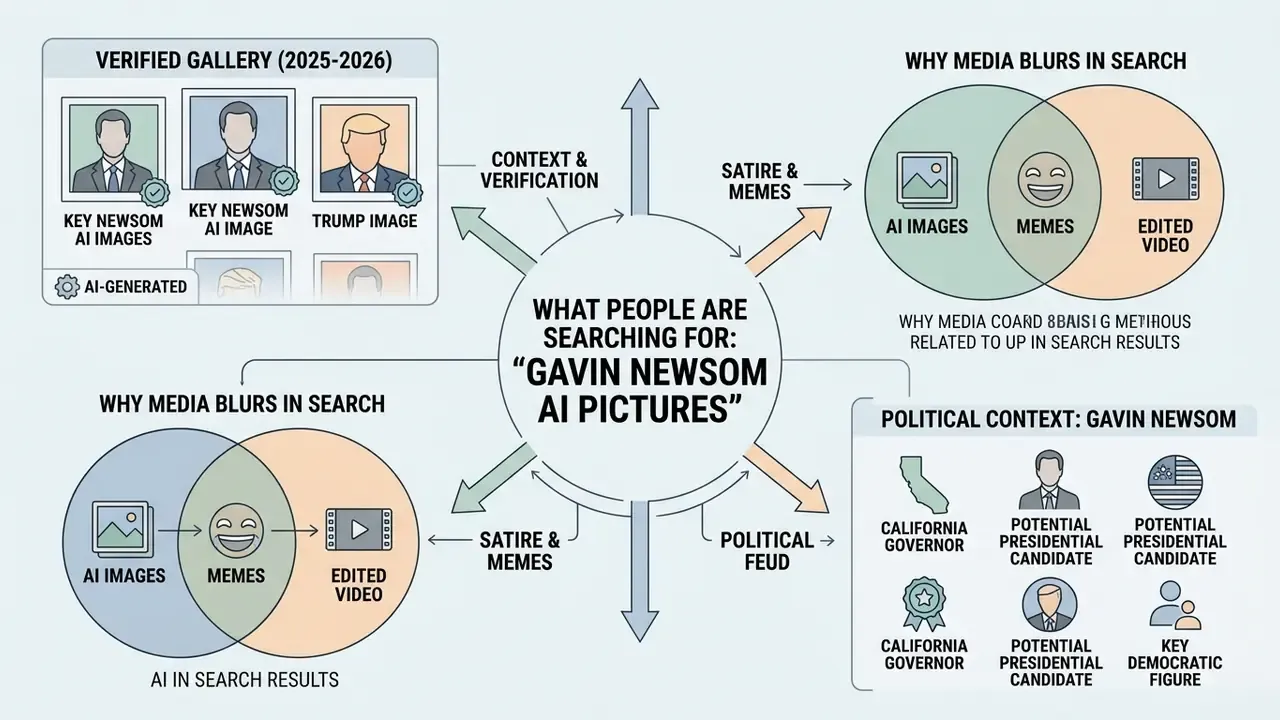
Search queries for gavin newsom ai pictures reflect a distinct mix of user intent: audiences want verified context on viral synthetic images, satirical political memes, and modified campaign videos involving California Governor Gavin Newsom and former President Donald Trump. Rather than one static image, users run into three primary categories of content: AI-generated caricatures published by official political press accounts, altered photos shared across social platforms, and synthetic election-related deepfakes. A fourth, smaller demand strand, explicit or abusive AI imagery of public officials, became visible in January 2026, when Newsom publicly urged an investigation into X over sexually explicit AI deepfakes. For regulated brands, that strand is a hard blocklist item: adult-oriented tool categories such as a sexy ai video generator or generic sexy ai videos have no place in a corporate media stack, and access to them belongs in your shadow-AI inventory.
Understanding these queries requires categorizing how ai-generated visuals, satirical memes, and press photos interact within US political discourse. When users search for newsom ai images, gavin newsom ai images, or the frequent misspelling gavin newsome ai images, they are usually investigating specific viral events: Newsom's press office circulating exaggerated visuals of Trump, or Trump's Truth Social account posting synthetic depictions of Newsom.
| Content Category | Primary Media Type | Generating Mechanism | Verification Method |
|---|---|---|---|
| Satirical Political Memes | Still images and parody covers | Generative AI models (diffusion, Midjourney) | Official account provenance check and press release cross-referencing |
| Manipulated Press Photos | Retouched still photos | Manual photomontage, digital filters | Reverse image search and C2PA metadata inspection |
| Synthetic Political Video | Short clips and lip-sync video | Multimodal AI voice and video synthesis | Frame-by-frame rendering analysis and audio spectral verification |
| Fabricated Screenshots | Fake Truth Social or X posts | Template forgery, satire accounts | Platform archive lookup and account authenticity check |
Why AI Images, Memes, and Edited Video Blur Together in Search Results
Search engines and social platforms bundle synthetic images, manual photomontages, and edited video clips together because they serve an identical function in political communication: rapid memetic engagement. On X and Truth Social, one viral post often combines authentic video footage with synthetic AI audio, or places a generative image next to a cropped news headline. AFP fact-checkers documented exactly this hybrid in 2026, identifying a Trump video about Newsom that spliced real footage with AI-generated speech.
According to the Political Deepfakes Incidents Database (PDID), researchers group ai-generated media and low-tech "cheapfakes" into a unified analytical category, because both influence voter perception through shared political narratives.
Platform moderation reinforces the blur. X's "misleading media" policy covers content that is significantly altered, fabricated, or shared with false context, collapsing AI images, photomontage, memes, and edited video into a single enforcement bucket. California's 2024 election-deepfake statutes take the same approach, treating human edits and machine generation as equivalent risks when either can mislead voters. Basic editing suites and AI video generators are routinely used to add captions and overlays to generative outputs, which blurs the line between pure AI synthesis and ordinary digital editing even further.
The consequence is that visual intuition fails at scale:
Readers who need to triage suspect files quickly can start with our comparison of AI image detectors, keeping in mind that detector output is one signal among several, not a verdict. Treat it the way a model validator treats a single performance metric: informative, insufficient.
Who Gavin Newsom Is in This Political Context
Gavin Newsom is the 40th governor of california and a prominent leader within the democratic party, whose online communication strategy leans hard on high-frequency, meme-driven tactics. As governor, newsom has built a dual identity in the artificial intelligence landscape: he signed landmark California legislation regulating AI deepfakes and digital replicas on 17 and 19 September 2024, while simultaneously using AI-generated visuals in political communications to needle conservative opponents.
In national politics, newsom is viewed as a strategist who adopted Trump-style aggressive messaging to capture public attention and contest conservative dominance on social platforms. Operating through his official press office and campaign communications, his team uses satirical posts to frame policy debates, pull in national media, and answer attacks from donald trump directly.
The memes did not appear in a vacuum. The August and September 2025 escalation coincided with two concrete confrontations. First, Newsom sued the administration over the federalization of the California National Guard deployed against protests targeting US Immigration and Customs Enforcement (ICE), arguing that the President had acted without the governor's consent and exceeded his constitutional authority: "The president is not a king and is not above the law." Second, California advanced a ballot initiative to redraw congressional maps and potentially add up to five Democratic seats, answering a Trump-backed Texas map projected to deliver Republicans the same five-seat gain. California voters approved the redistricting measure in the 4 November 2025 special election, and the meme output spiked within twenty-four hours.
How the Newsom and Trump Feud Escalated on Social Media
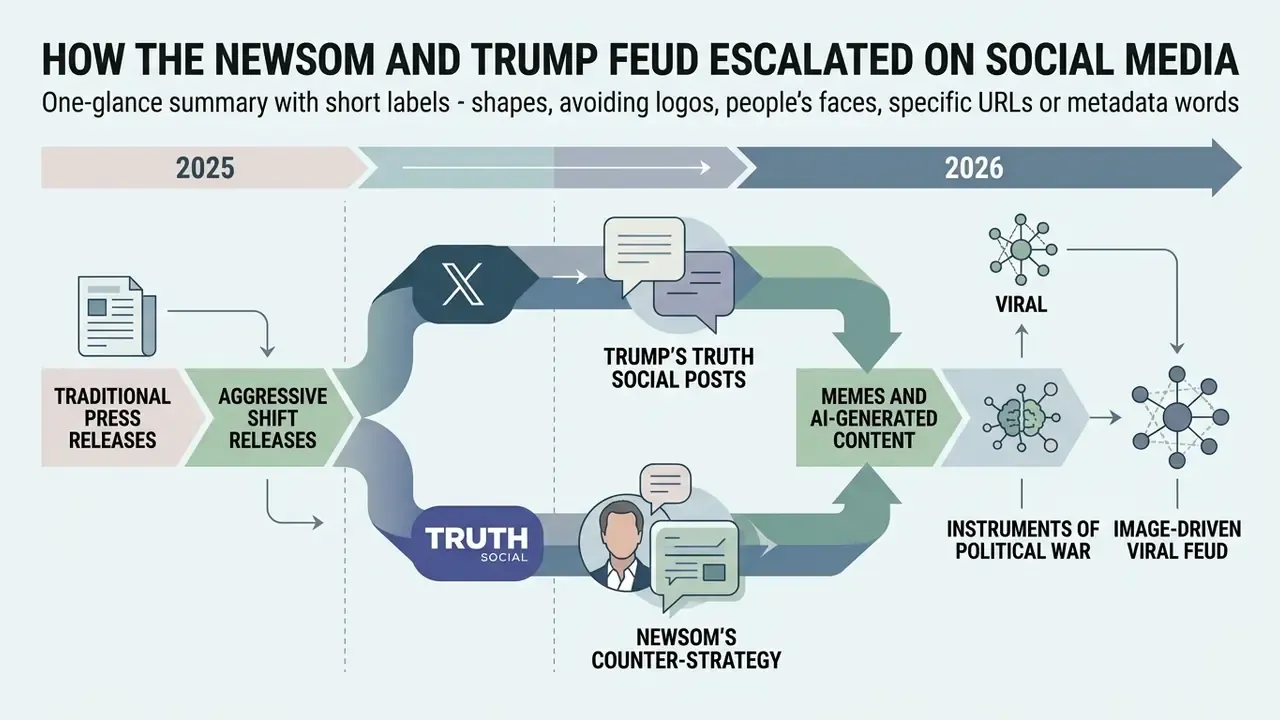
The digital conflict between Gavin Newsom and donald trump moved from traditional press releases into an aggressive, image-driven viral feud across X and Truth Social. Between 2024 and 2026, the interaction shifted toward direct visual counter-trolling, where each escalation by one party drew synthetic images, edited clips, or stylized memes from the other.
This escalation shows how political war is increasingly fought through algorithmic attention capture. newsom mirrored Trump's posting style systematically, with all-caps headlines, rapid-fire responses, and satirical imagery, to disrupt traditional news cycles and push democratic counter-punches straight to a national audience.
Timeline: Key Stages of the Visual Conflict (2025 to 2026)
The timeline below is rendered as an ordered list with machine-readable time elements, separating primary sources from downstream amplification.
| Date | Event | Media Artifact | Verification Status |
|---|---|---|---|
| 9 to 11 June 2025 | Los Angeles ICE protests; Newsom posts meme-driven content and short clips reaching over 1 million views | Real press photographs plus captioned memes | PolitiFact confirmed the June 9 photos were authentic San Francisco Chronicle images, contradicting AI chatbots that labeled them fake |
| 13 to 20 August 2025 | Press office adopts all-caps Trump-style posting; Kid Rock parody endorsement; fake Time cover with a crown (5.6M views); ultra-muscular Newsom with flag; mock playing cards | AI-generated satire from an official account | Self-declared parody, published by @GovPressOffice |
| 20 August 2025 | Trump answers on Truth Social with the "Newscum" nickname | Text post | Authentic account post |
| 3 to 4 September 2025 | Punching-bag face-swap video; "Trump 2028" hat post; Newsom's reply clips ("I've fallen, and I can't get up!"); bruised-hands meme | Edited video plus retouched still | Snopes identified the retouched Trump image as a manipulated real photo; Newsom's office accepted responsibility |
| 5 November 2025 | After Democratic wins in New York City, California, Virginia and New Jersey, Newsom posts AI images of Trump as a baby in a stroller and a child crying while being fed spaghetti | Fully synthetic images | Reported by The Independent, 5 November 2025 |
| 14 January 2026 | Newsom urges an investigation into X over sexually explicit AI deepfakes | Regulatory action | Documented public statement |
| 29 January 2026 | Newsom's team mocks Trump's posting blitz of nearly 60 posts in an hour | Counter-memes | Authentic account activity |
| March 2026 | Official press office posts an AI image of Vladimir Putin walking Trump on a leash | Fully synthetic image | Published from the official account |
| 6 to 8 May 2026 | A fake Truth Social post and a fake X post attributed to Newsom circulate | Fabricated screenshots | Fact-checkers confirmed both were fabrications; the X account was a satire profile, not the governor's office |
| 17 to 20 May 2026 | Trump publishes 19 AI-generated posts in under 75 minutes; "NEW-SCM" plate plus zombie Newsom | Synthetic image series | Documented by multiple outlets; Newsom's reply reposted with hashtag |
| 15 June 2026 | Newsom alleges a politically motivated DOJ investigation, extending the feud beyond memes | Political statement | Public allegation |
How Memes and AI-Generated Content Became Instruments of Political War
Synthetic imagery and memes have moved from novel internet jokes to structured instruments of political communication and voter mobilization. A peer-reviewed analysis of 239,526 political Instagram images found that meme format predicted engagement more strongly than synthetic imagery alone, with AI-generated memes producing a significant interaction effect when paired with human curation. The same dataset showed a clear partisan split: Democrat-leaning accounts used AI mainly for in-group support, while Republican-leaning accounts used it more for out-group attack. Updated: the previously unsourced "230,000 images" claim is replaced by this dataset figure.
In this online war, political teams deploy AI images to reinforce in-group solidarity and mock opponents, with AI image generators providing unprecedented speed. A full parody cover can be produced faster than a press release clears legal review. That asymmetry, speed of creation versus speed of review, is the same asymmetry compliance teams face inside banks.
Industry practitioners read the shift through emotional activation rather than persuasion:
"Political feuds like this are no longer just disagreements. They've become engagement engines. The goal is not persuasion anymore, it's emotional activation."
"AI-generated imagery accelerates that process because it compresses outrage, identity, humor, fear, and tribal alignment into something instantly shareable. From a Psycho-Aesthetics perspective, the image itself becomes secondary to the emotional participation it creates." Ravi Sawhney, OK! / AOL (2026)
Sawhney's warning maps directly onto institutional risk: "as synthetic political media becomes more common, we are entering an era where emotional resonance may matter more than factual consensus in determining what spreads." Emotional resonance, not accuracy, is what pushes a synthetic image into a corporate feed at 11pm on a Tuesday.
Experimental evidence supports the caution that audiences cannot self-police:
Which AI Images Are Linked to Gavin Newsom and Donald Trump
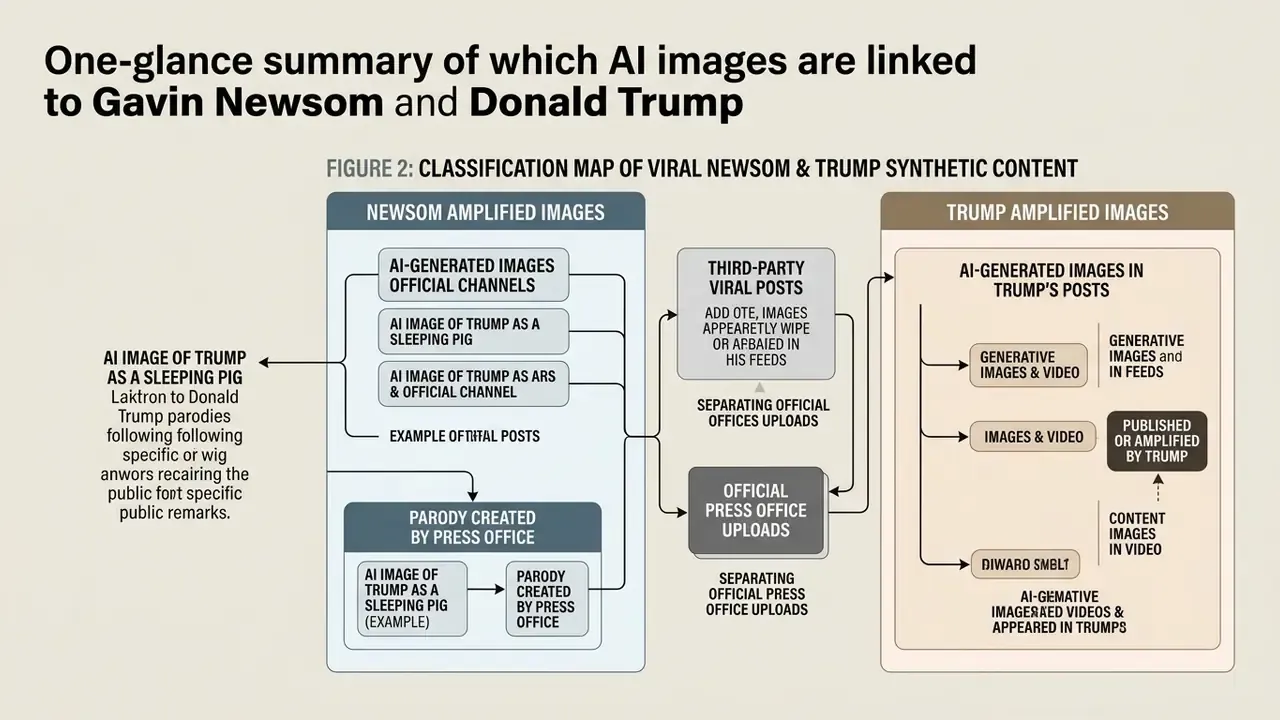
The visual repository surrounding Gavin Newsom and Donald Trump includes specific, heavily publicized generative images and altered photographs. Examples range from AI caricatures placing Trump in absurd scenarios to synthetic depictions of Newsom generated by conservative accounts during debates over California state policy.
Analyzing these visuals means separating official press office uploads from third-party viral posts. Users searching for gavin newsome ai images or gavin newsom ai images meet both self-aware political satire and deceptive fabrications built to mislead voters. The two demand very different responses.
Figure 2. Classification map of viral Newsom and Trump synthetic content. A two-axis chart plots degree of synthesis (retouched photo, then hybrid audio-video, then fully generated) against political intent (transparent satire, ambiguous mockery, deceptive misinformation). The "Quiet Piggy" pig image, the crowned Time cover, the "NEW-SCM" zombie plate, the spaghetti baby series, the bruised-hands splice, and the fabricated Truth Social screenshots each occupy a distinct quadrant, which illustrates why a single moderation or citation rule cannot cover the whole spectrum.
Images and Memes Published or Amplified by Newsom
newsom has authorized or amplified several viral ai-generated images through official press channels. In August 2025, his press office posted a series of exaggerated visuals on X: a mock Time magazine cover featuring Newsom wearing a crown (5.6 million views), an ultra-muscular portrayal of Newsom holding an American flag, and satirical trading cards mocking opponents including Kristi Noem. Related AI images of Newsom riding sharks and dinosaurs circulated in parallel, largely from supporter accounts rather than the press office itself.
The most direct act of parody came the same month. After Trump posted a synthetic image of Taylor Swift appearing to endorse him with the caption "I accept!", followed by the blunt line "I HATE TAYLOR SWIFT!", Newsom's press office published an AI-generated graphic of musician and prominent Trump supporter Kid Rock endorsing Newsom, captioned "I ACCEPT! GCN", then followed it with a post reading "I HATE KID ROCK!" Reporting at the time noted engagement in the millions. During the same campaign the office adopted Trump-style nicknames for critics: after Fox News host Dana Perino criticized the strategy on air, the account replied by calling her "Dana 'Ding Dong' Perino," labeled Fox host Trey Gallagher "Bird Brain Trey Gallagher," and dubbed Vice President JD Vance "Just Dance Vance" in an all-caps post about the redistricting "maps war."
Following Trump's public "Quiet, piggy" remark to a journalist, newsom circulated AI-assisted images portraying Trump as a pig inside a gilded Oval Office.
The September 2025 exchange shows how fast satire slides into edited-photo territory. After Trump posted a face-swapped clip of "Newsom" weakly hitting a punching bag stamped with Trump's face, plus a separate post mocking Newsom's hands during an Oval Office briefing ("something wrong with him"), Newsom answered on X with a clip of the President on the floor shouting "I've fallen, and I can't get up!", an image of Trump throwing a tantrum behind bars, and a meme splicing Trump's remarks with footage of the President's own bruised, makeup-covered hands. One image in that series was a retouched real photograph rather than a generated one. Snopes classified it as manipulated media, and the press office accepted responsibility. Worth pausing on that detail: the riskiest artifact in the whole exchange was not AI at all. It was a photo edited by hand, the kind of local retouch any slim photo editor online free tool can produce in a minute.
The November 2025 series was the clearest case of synthetic content used as a victory lap. After Democratic wins in New York City, California, Virginia and New Jersey, Newsom posted AI-generated images depicting Donald Trump as a baby in a stroller and as a child crying while being fed spaghetti, published the day after his own redistricting initiative passed. By March 2026 the format had expanded to geopolitical satire, including an AI image of Vladimir Putin walking Trump on a leash. These posts were explicitly designed as satirical parody rather than pass-as-real news photography, a distinction that matters legally, as the next section explains. Teams building explainer decks or annotated timelines from this material should compare tooling in our guides to animation makers, the slidesgo ai presentation maker, and a slideshow video maker, and should always retain source attribution inside the slide itself, not only in the speaker notes.
AI-Generated Images and Video in Trump's Posts
donald trump and aligned conservative accounts have deployed ai-generated images and edited video content targeting Newsom in much the same way. On Truth Social, trump s account shared synthetic imagery depicting Newsom in psychiatric facility settings, wearing branded political apparel of opponents ("Trump 2028"), or overlaid onto altered California license plates.
In May 2026 the pattern peaked. Trump released a rapid series of 19 AI-generated posts in under 75 minutes, ranging from surreal to cinematic: himself walking alongside a shackled alien at a military base, aboard a spacecraft, and seated at a desk pressing a giant red button while explosions filled the screens behind him. Newsom's reaction to the alien image was a single line: "The President of the United States just posted this. Do you think he's lost it?" As part of the same spree, Trump posted a doctored California license plate reading "NEW-SCM" paired with an image portraying the governor as a zombie-like figure. Newsom's team counter-attacked within the hour, reposting the graphic with the caption: "Even a Zombie Newscum still looks healthier than our current President. #PrayersforGrandpa."
These posts frequently blend genuine news footage with synthetic AI audio or digital filters. Empirical research published in the OpenFake dataset study quantifies both the scale and the ceiling of automated detection:
The same body of work indicates that Republican-leaning accounts more often deploy generative visuals for out-group attacks, while Democratic-leaning accounts lean on generative tools for satirical framing and in-group mobilization. The 2025 to 2026 exchange illustrates that pattern almost point for point.
How to Tell an AI-Generated Image From a Photomontage or Meme
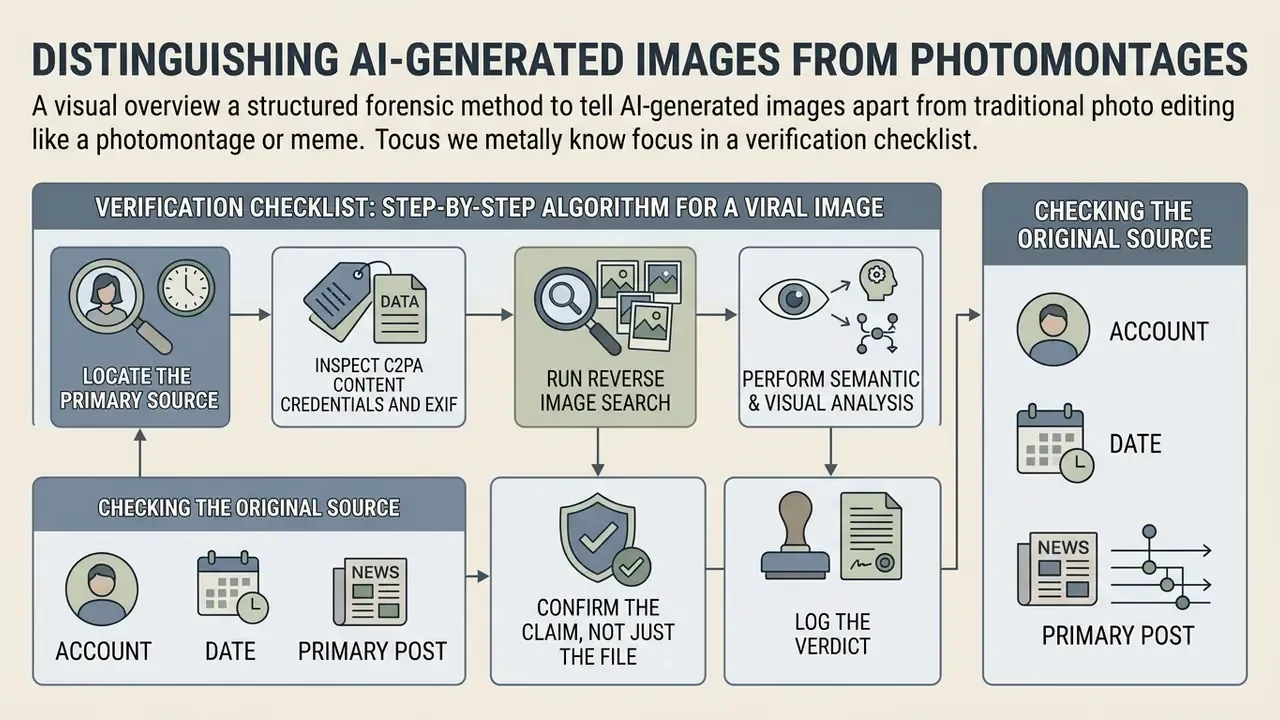
Distinguishing an ai-generated image from traditional photomontage, a manual edit, or an untouched photograph requires a structured forensic method. Because modern diffusion models produce near-photorealistic output, visual inspection alone cannot verify whether a post contains synthetic media.
Standards from the National Institute of Standards and Technology (NIST AI 100-4, 2025) and INTERPOL (2026) specify that verification must prioritize source provenance and cryptographic metadata before assessing visual artifacts. NIST directs analysts to compare creation time, creation location, attribution data, dimensions and resolution against the claim being made. INTERPOL groups detection features into semantic, spatial, frequency, reconstruction-error, and deep-learning classes. Neither framework offers a single rule that separates satire from deception. That judgment rests on provenance and context.
Combining provenance checks with reverse image lookup prevents the opposite error too: misidentifying authentic press photography as a deepfake, exactly what AI chatbots did with Newsom's genuine June 2025 Chronicle photos.
Checking the Original Source: Account, Date, and Primary Post
The first step in verifying any viral image is tracing it back to the original social media post. Authentic press photographs of Governor Newsom or President Trump originate with accredited news organizations such as the Associated Press, Reuters, or the San Francisco Chronicle, and they arrive with verified timestamps and standardized caption metadata.
To evaluate whether a viral image is an altered post or a synthetic creation:
The Canadian Centre for Cyber Security's 2025 guidance on public content provenance and the US Department of Defense's 2025 paper on multimedia integrity converge on one conclusion: signed metadata supports reliable provenance assessment even when the file itself has been altered downstream.
- Locate the earliest upload using AI reverse image search tools.
- Confirm whether the publishing account is an official government entity (
gov), a recognized news outlet, or an unverified satire account. The May 2026 fabrications circulated precisely because a satire profile was mistaken for the governor's press office. - Cross-reference the image against primary news registries and, where available, embedded content credentials that track origin and edits.
Visual Indicators in AI Images and Edited Video
When metadata is stripped during platform re-uploads, technical and visual artifact analysis becomes necessary. Generative models still stumble on complex physical structures, lighting physics, and fine textures. A 2024 research taxonomy organizes the cues into five families: anatomical, stylistic, functional, physics-violating, and sociocultural anomalies.
Key visual indicators include:
- Anatomical inconsistencies irregular hand geometry, unnatural finger counts, distorted ear cartilage, asymmetrical facial features.
- Text and background distortions garbled background lettering, warped straight lines, bent architectural edges, mismatched reflections in glass and metal.
- Skin texture and lighting anomalies overly smooth, waxy skin with no visible pores, implausible facial symmetry, directional shadows that contradict the primary light source.
- Motion mismatch (video) subject movement that does not track background parallax, or lip movement misaligned with cloned audio.
Traditional forensic signals such as PRNU noise patterns and error level analysis still help separate manual photomontage from full generation. Basic retouching in AI photo editors alters colors, proportions, or skin tone locally, whereas full generative synthesis produces structural rendering artifacts spread across frequency domains. For frame-level review of suspect clips, an open-source timeline tool such as the shotcut video editor is enough to step through cuts, isolate splice points, and export the exact frame you cite in the audit ticket.
Fact check and verification standards:
Can Gavin Newsom AI Images Be Used in Commercial Materials?
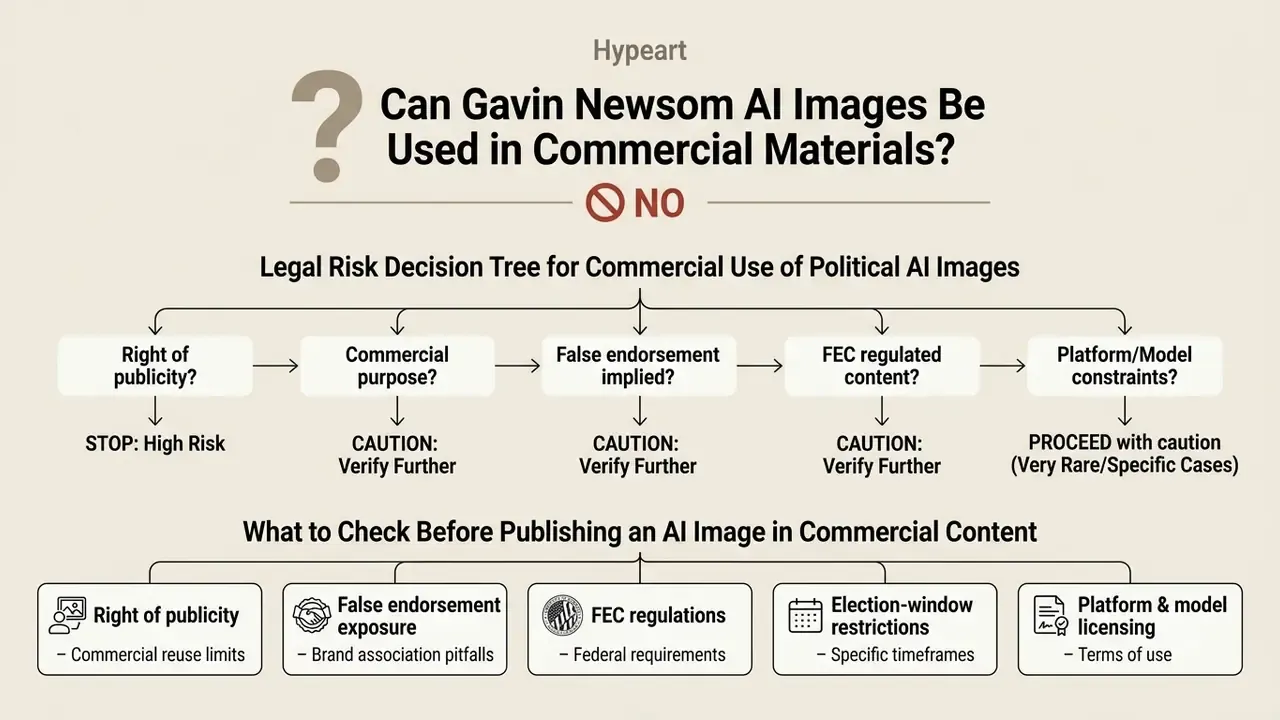
Reusing gavin newsom ai pictures or gavin newsom ai images in advertising, marketing campaigns, or corporate media introduces serious legal, regulatory, and reputational exposure. In the United States, public figures, including political officials such as Governor Gavin Newsom and President Donald Trump, are protected under state right-of-publicity statutes, trademark endorsement law, and deepfake disclosure mandates.
Commercial entities must separate non-commercial news reporting, protected under the First Amendment, from commercial promotion. Using a politician's AI-generated likeness to market a product or service without explicit consent creates immediate liability for false endorsement under Section 43(a) of the Lanham Act.
Congressional Research Service analysis (LSB11052, 2026) notes that the right of publicity is not comprehensively protected by current federal law, so liability depends on the state of publication. The US Copyright Office has separately confirmed that AI outputs are copyrightable only to the extent of separable, identified human contribution, meaning a company cannot rely on owning a generated political portrait.
Figure 3. Legal risk decision tree for commercial use of political AI images. Branch 1: intent (news reporting or commentary leads to editorial safe harbor; advertising or promotion continues). Branch 2: commercial benefit (none means low risk; direct or indirect continues). Branch 3: consent or license (documented means conditional; absent means elevated). Branch 4: jurisdiction (California AB 1836 and AB 2602 plus election-window rules mean high). Output: risk tier plus required control (label, legal sign-off, or prohibition).
What to Check Before Publishing an AI Image in Commercial Content
Before any ai-generated political image enters commercial or brand material, compliance should complete a mandatory review:
- Right of publicity and commercial use. Confirm whether the image uses the recognizable likeness of Newsom or Trump. California law penalizes unauthorized commercial exploitation of digital replicas.
- False endorsement exposure.Evaluate whether an average consumer could infer that the politician endorses or sponsors the product. FTC enforcement against AI impersonation raises the stakes for deceptive likeness use in advertising.
- Federal Election Commission (FEC) regulations.The FEC's technology-neutral reading of the fraudulent-misrepresentation ban applies squarely to AI media.
Organizations managing multi-channel media budgets can review transparent tier structures in our AI Media Pricing Guides, compare vendor capabilities side by side, and benchmark exposure using our AI Media Calculators.
When to Link the Primary Source Instead of Republishing the Image
To cut legal exposure while keeping editorial context, link directly to the primary social media post rather than hosting or republishing raw AI files. Embedding an official post preserves original metadata, attribution, and publication context in one move.
Best practices for citing political AI content:
- Link to the verified primary X or Truth Social URL rather than mirroring the asset.
- Cite the generative model name, prompt text, and generation date where known, the citation convention recommended in state and academic AI-attribution guidance.
- Retain an internal record of the prompt and output, or a shareable transcript, in place of the file itself.
- Label any embedded media clearly as "AI-Generated Satire" or "Digital Parody" so consumers are not misled.
Attribution discipline is a security control, not merely an editorial nicety:
For comprehensive guidance on commercial rights, visit our AI Media Commercial-Use Hub. Enterprise teams integrating media synthesis endpoints into corporate workflows can inspect technical documentation in our developer api hub, including how content credentials survive, or fail to survive, an automated export.
Why Newsom Uses AI Images and Memes as Political Strategy
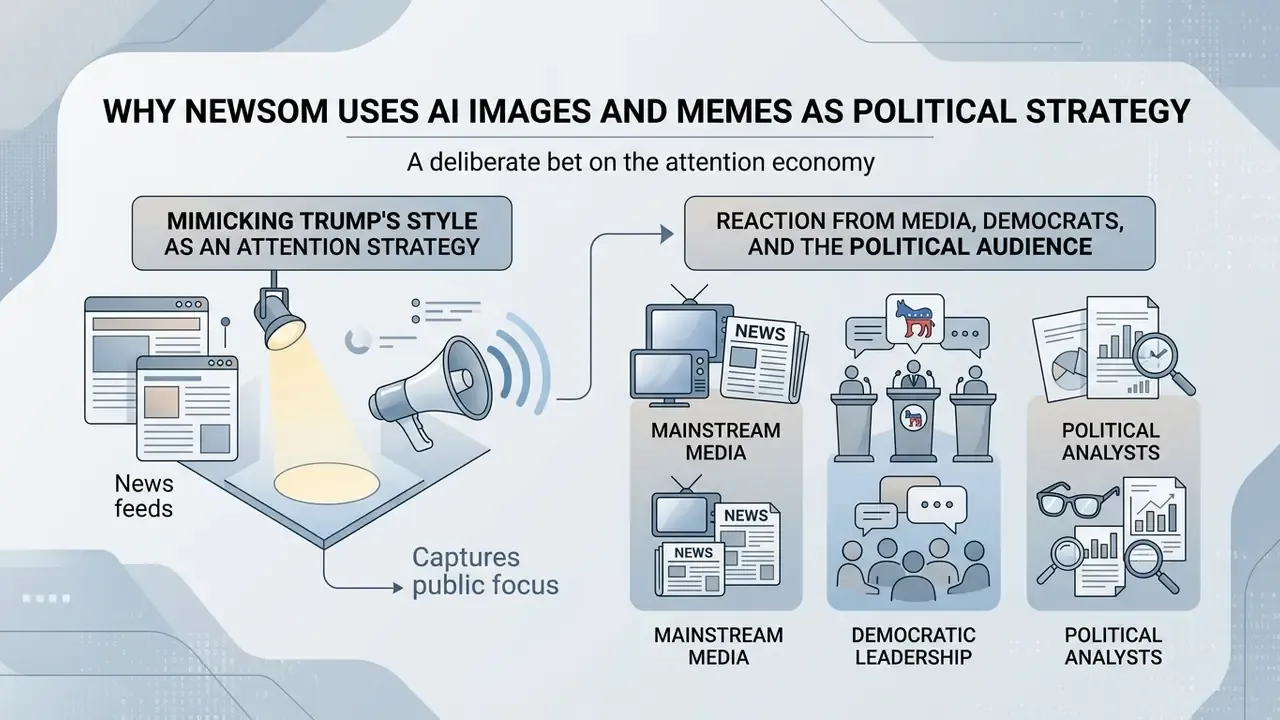
Governor Gavin Newsom's use of ai-generated media reflects a deliberate bet on the attention economy. By folding satirical memes into official communications, newsom aims to break through traditional coverage, reach younger digital-native audiences, and counter opponent narratives in real time. Reporting in August 2025 noted that the office used AI for visuals while stating it did not use AI to write post text, a division of labor that keeps human intent behind the message and machine speed behind the image. Governance people will recognize that split immediately: it is a human-in-the-loop control, whether or not anyone called it that.
This approach marks a shift in democratic political communication. Rather than relying on formal speeches alone, newsom is using algorithmically optimized media to maximize engagement across X, Instagram, and national television cycles, while positioning himself as a regulator of deceptive political AI through the September 2024 bill signings. Whether both roles can hold at once remains an open question, and honestly the evidence is still thin.
| Metric / Dimension | Traditional Political PR | Meme and AI-Generated Strategy |
|---|---|---|
| Response time | 12 to 24 hours (formal press releases) | 5 to 15 minutes (rapid social posts) |
| Audience reach | Legacy news viewers and subscribers | Algorithmic viral reach across social networks |
| Narrative control | Filtered through newsroom editors | Direct unfiltered broadcast to followers |
| Production cost | Photography, design, review cycles | Prompt-level generation at near-zero marginal cost |
| Compliance risk | Low (vetted by legal and communications) | High (trademark, copyright and deepfake exposure) |
Mimicking Trump's Style as an Attention Strategy
By borrowing elements of Trump's online persona, aggressive capitalization, three-initial sign-offs ("GCN"), phrases such as "Thank you for your attention to this matter," personal nicknames, and viral visual parody, newsom captures media attention cheaply. NPR documented the style shift in August 2025, noting the use of manipulated images for viral reach. ABC7 News reported that the account gained roughly 250,000 followers after 1 August and logged more than 1.5 million profile visits in the same window. (Note: those follower and visit figures come from a single outlet and should be read as a media-reported estimate, not a platform-audited metric.)
Political analysts in POLITICO labeled the tactic "AI populism." By using generative visuals to mirror opponent attacks, Newsom turns defensive policy debates into offensive visual entertainment, forcing mainstream networks to cover Democratic counter-messaging. During the Texas redistricting fight, that converted a technical mapping dispute into a nationally trending feud within days.
Reaction From Media, Democrats, and the Political Audience
Reaction to the AI-driven strategy from mainstream media, fellow democrats, and commentators remains split:
- Mainstream media. POLITICO characterized the feed as algorithm-first and heavy on "AI-generated slop," while the BBC noted the uppercase, meme-driven style echoed Trump's own behavior. Both framed the output as aggressive online trolling rather than conventional government communication.
- Democratic leadership. Some party strategists praised the tactic as a forceful answer to conservative social dominance; others warned that reliance on synthetic content lowers the standards of public discourse. Republican critics called it "desperate."
- Political analysts. Researchers stress that meme strategies boost short-term profile engagement while raising long-term cynicism about visual authenticity, the "liar's dividend" problem, where the mere existence of convincing fakes lets authentic evidence be waved away.
That last point is the one that should worry a financial institution. If your customers stop trusting images by default, your own proof-of-identity and proof-of-document flows inherit the doubt.
For teams planning structured publishing workflows around political commentary, review our operational guide for YouTube video editors and our overview of AI video generators, which explains where disclosure metadata survives export and where it quietly disappears.
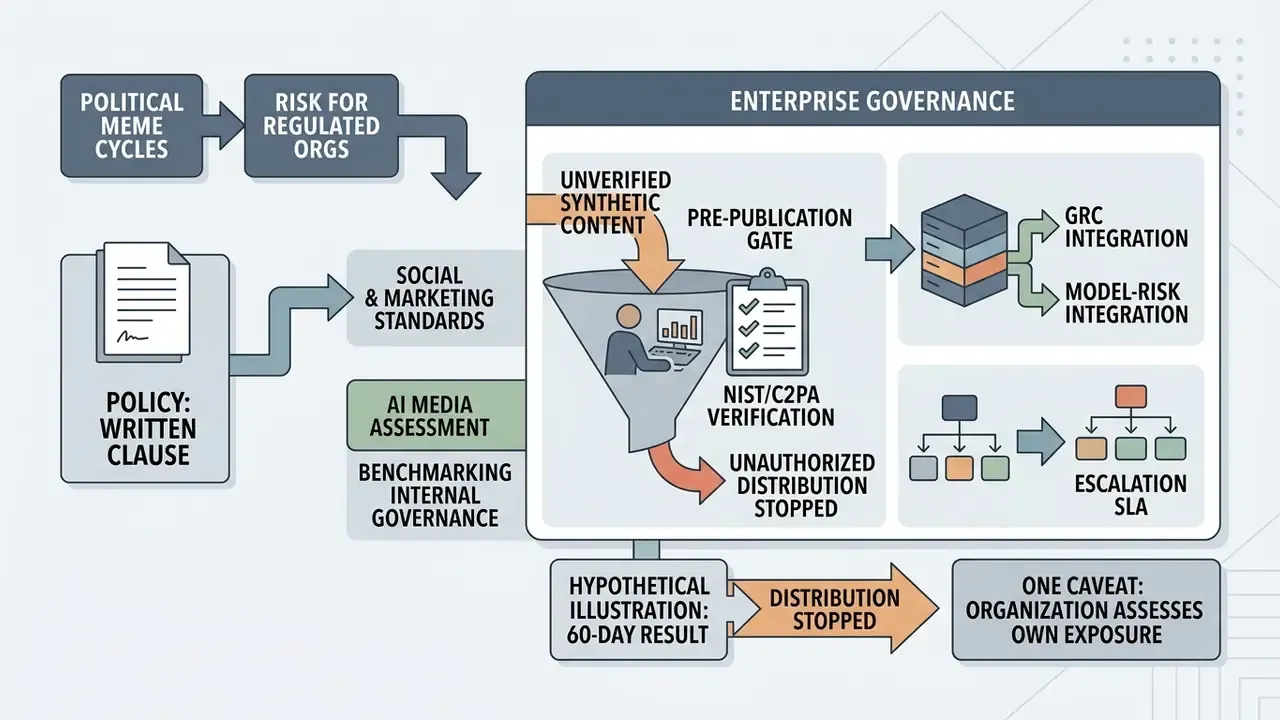
Enterprise Governance: Building a "No Unverified Synthetic Media" Control
FAQ About Gavin Newsom AI Pictures
What do queries for "Gavin Newsom AI pictures" usually refer to?
Queries for gavin newsom ai pictures mostly refer to AI-generated satirical images and altered memes circulated by Governor Gavin Newsom's official press office or posted by opponents. The most widely covered examples include the crowned fake Time cover and muscular Newsom portrait (August 2025), the Kid Rock "I ACCEPT!" parody endorsement, AI images of Trump as a crying baby fed spaghetti (November 2025), and Trump's "NEW-SCM" zombie image of Newsom from his 19-post AI spree in May 2026.
Is it legal to create and post AI images of Governor Gavin Newsom?
Non-commercial political satire or commentary involving public officials is generally protected speech under the First Amendment, and many free AI image generators permit parody output under their terms. However, California laws, including AB 2602, AB 1836, and the election-deepfake statutes signed on 17 and 19 September 2024, restrict undisclosed deceptive deepfakes in campaign advertising within 120 days before and 60 days after an election, and prohibit unauthorized commercial exploitation of digital replicas.
How can I verify if a photo of Gavin Newsom or Donald Trump is AI-generated?
Trace the image to its primary source with reverse image search, check for C2PA cryptographic metadata using AI image detectors and credential inspectors, and confirm whether accredited outlets such as AP or Reuters published the photo. Then inspect for rendering artifacts: anatomical errors in hands, blurred or garbled text, impossible background symmetry, inconsistent light-source reflections. Remember that an image can be an authentic photograph that was retouched, as Snopes found with the September 2025 Trump face image, rather than fully generated.
Why do Gavin Newsom and Donald Trump use AI memes on social media?
Both deploy AI memes and stylized visuals to capture attention, bypass traditional gatekeepers, and drive viral engagement. As Ravi Sawhney frames it, such feuds now operate as "engagement engines" whose goal is emotional activation rather than persuasion. Satirical AI imagery lets political teams answer opponent narratives within minutes, mobilize supporters, and stay visible in the algorithmic cycle, which is why the biggest spikes align with the National Guard lawsuit, the redistricting fight, and election nights.
What political events triggered the biggest Newsom and Trump AI meme spikes?
Three catalysts stand out: Newsom's lawsuit challenging the federalization of the California National Guard during ICE protests (summer 2025); the redistricting battle in which California pursued a ballot initiative worth up to five Democratic congressional seats against a Texas map projected to add five Republican seats (August to November 2025); and the Democratic sweep of the November 2025 races in New York City, California, Virginia and New Jersey, which prompted the "baby Trump" spaghetti series.
Can enterprise companies use political AI images in marketing or social media?
No. Using AI-generated images of recognizable political figures in commercial marketing carries high legal risk: right-of-publicity claims, false-endorsement exposure under Section 43(a) of the Lanham Act, FEC exposure under 52 U.S.C. § 30124, and brand-safety violations. If you are evaluating tooling for legitimate business creative instead, review our benchmark of the best AI art generators and their licensing terms. Avoid political likenesses without formal legal authorization.
What should a company do if an employee reshares a political deepfake from a brand account?
Treat it as an operational-risk incident, not a communications slip. Remove or annotate the post, document the provenance findings, notify Compliance, issue a correction that links the fact-checker's verdict, and log the event in the GRC register. The escalation SLA outlined above, 15-minute triage, 60-minute determination, 4-hour external response, gives regulated industries a defensible baseline.
How does synthetic-media governance connect to existing model risk management?
Directly. A generative image tool used by marketing is still a model with an owner, an approved use, an access boundary, and an audit trail. Add it to the same AI inventory that covers credit scoring, fraud detection, and KYC or AML screening, then apply proportionate validation. That single step usually reveals more shadow AI than any survey. For technical assistance or compliance questions on synthetic media deployment, see AI Media Support and Troubleshooting, or compare zero-cost options in our analysis of free AI art generators.
Appendix A: Editorial Corrections and Superseded Claims
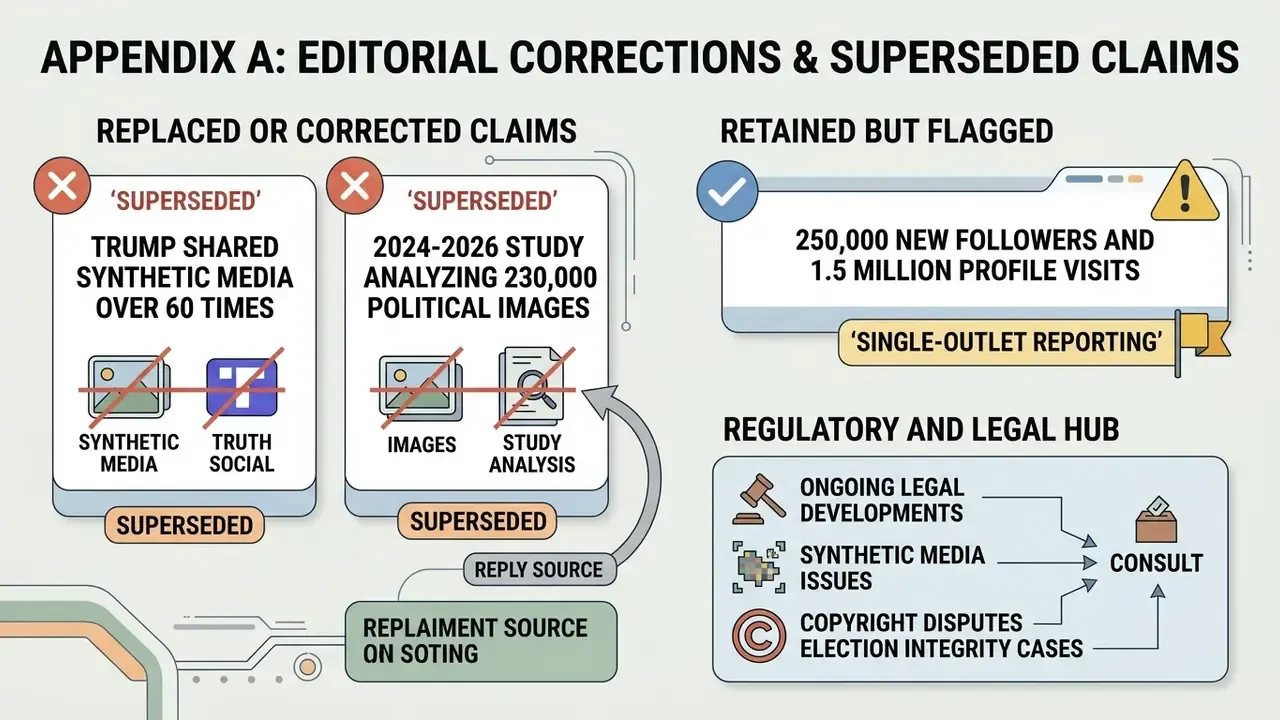
For transparency, this article previously carried three figures that are now attributed or replaced:
- "Trump shared synthetic or manipulated media over 60 times on Truth Social" is superseded. Now attributed to PolitiFact's analysis of 36 AI-using posts (21 self-promotional, 12 opponent-targeting, 3 policy) and The New York Times' count of 62 or more AI images or videos shared since late 2022.
- "A 2024 to 2026 study analyzing over 230,000 political social media images" is superseded by the peer-reviewed dataset of 239,526 political Instagram images, which measured meme format as the dominant engagement predictor and identified the partisan in-group versus out-group split.
- "250,000 new followers and 1.5 million profile visits" is retained but flagged as single-outlet reporting (ABC7 News, 23 August 2025) rather than platform-audited data.
Additional Regulatory and Legal References
For ongoing legal developments on synthetic media, copyright disputes, and election integrity cases, consult our tracked timeline at AI Litigation and Case Timelines. For adjacent tooling documentation used in verification and publishing workflows, see our reviews of photo editors, free photo editors, and video compressors.