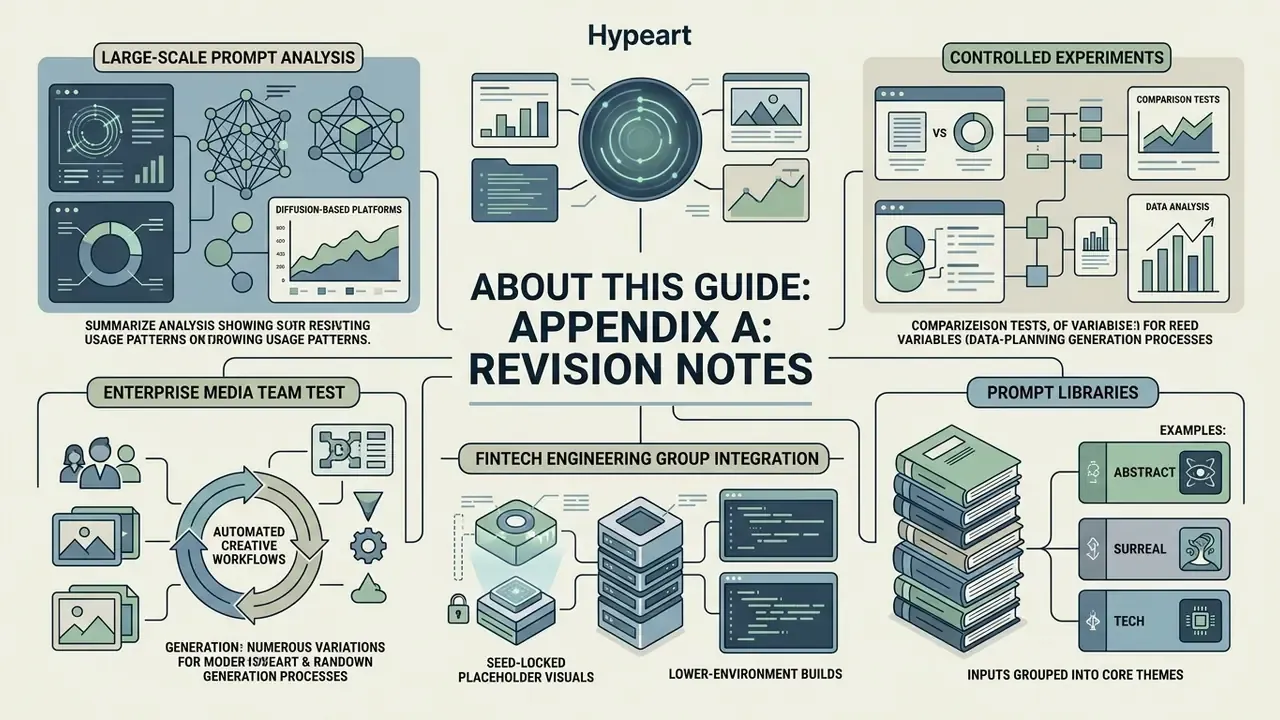
A random picture generator produces unpredictable visual assets in two ways: it either pulls an existing photograph from an indexed database, or synthesizes new media with a neural model. Design teams, product squads, and individual creators use these systems to surface ideas, fill UI placeholders, and make digital artwork without the friction of manual search. Simple on the surface. Slightly less simple once someone in compliance asks where the picture came from.
Executive Summary
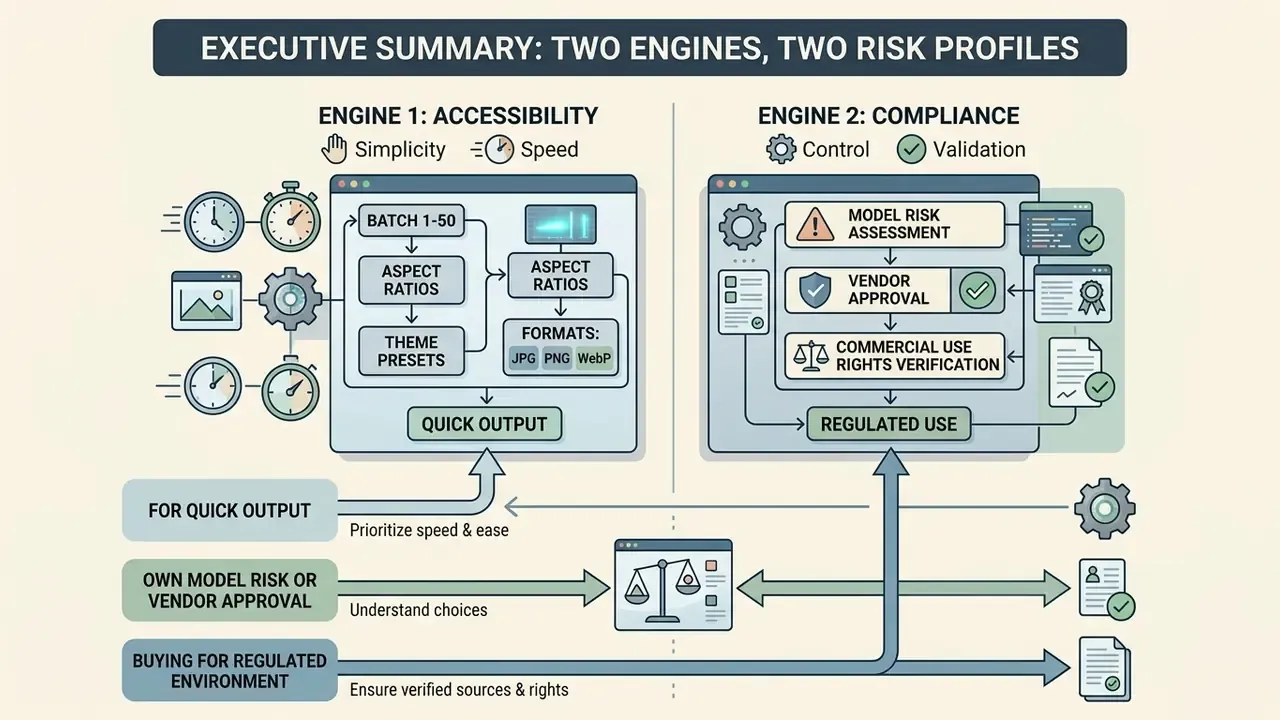
- Two engines, two risk profiles. Random picture generators either retrieve an existing photo from an indexed catalog (pseudo-random index sampling) or synthesize a new image from latent noise or a text prompt. Retrieval inherits stock contributor licenses. Synthesis inherits model-training and authorship questions.
- Batch output matters. Production-grade tools let you render a single frame for prompt testing, or 1 to 50 images in one pass for moodboards, sprite sheets, and A/B creative sets.
- Format and ratio control drive delivery cost. Standard presets are 1:1, 4:3, 3:4, and 16:9. WebP delivers 25 to 35% smaller files than legacy formats.
- Copyright is conditional. The U.S. Copyright Office (2025) confirms that purely machine-authored output is not copyrightable. Commercial clearance depends on platform Terms of Service and source licenses.
- Randomness needs guardrails. Controlled research shows unstructured AI imagery can increase design fixation, so random pictures work best as catalysts, not conclusions.
- Compliance controls are included. Work through the pre-deployment compliance and model-risk checklist further down this page before generated assets reach production or marketing.
How to Use This Guide
Different readers need different depth, so read selectively rather than top to bottom.
- If you just want output: go to the generation workflow section and the parameter console. Ten minutes, four settings, done.
- If you own model risk or vendor approval: start with the compliance checklist and the Shadow AI section, then come back for the licensing detail. The controls matter more than the feature list.
- If you are buying for a regulated environment: treat every vendor throughput claim in this guide as a benchmark, not a service level, and verify the base model behind the interface.
One framing point before the detail. A random generator is stochastic by design, so you cannot control its output directly. What you can control is the record: prompt, seed, model version, license, and reviewer. That record is the actual control surface.
What Is a Random Picture Generator?
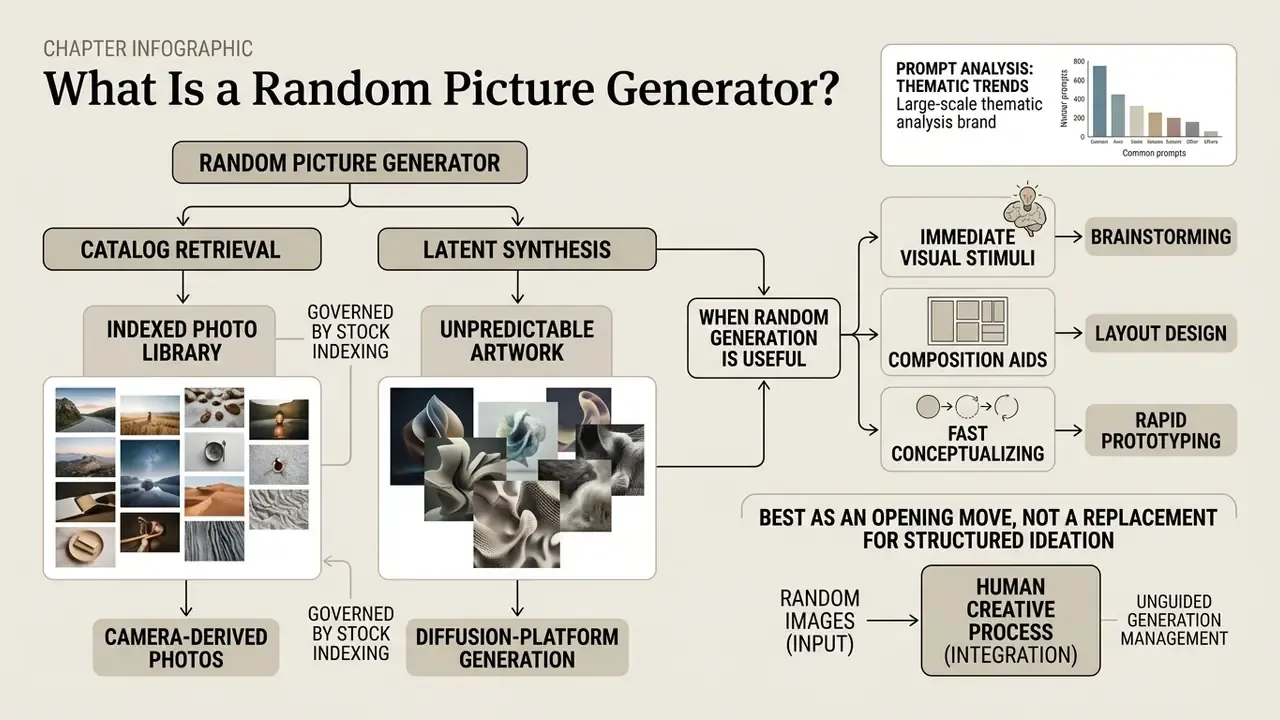
A random picture generator is a software system that outputs unpredictable images, photographs, or digital artwork, either by sampling an indexed photo library or by initializing a neural model from random noise. These tools let users skip manual asset sourcing and get instant visual content across very different subject categories.
Random images, photos, and AI art
"Some contemporary generators are 'greedy', they turn almost any input, even a very short one, into a polished work of art."
Users who want camera-derived photos receive outputs governed by stock indexing. Users who generate AI art receive synthetic media created pixel by pixel. The difference sounds academic until a legal review asks which of the two you published. Teams moving from concept to tool selection can compare capabilities across the best AI image generators before standardizing a pipeline. For broader terminology, see the openart ai and open art ai entries.
When random generation is useful
Random generation supplies immediate visual stimuli for brainstorming, layout design, and rapid prototyping. Web developers call random photo endpoints to fill image placeholders in wireframes so frontend work never waits on a creative handoff.
Unguided generation still needs management during creative ideation. Updated: controlled experiments with 60 participants measured idea count, originality, and idea variety, and found that unstructured AI image support during early design phases increases design fixation across all three metrics.
"Participants who used an AI image generator showed higher fixation, produced fewer ideas, and demonstrated lower originality than the control group."
So random pictures work best as an opening move, not as a replacement for structured human ideation. Use them to start the argument, not to settle it.
Interactive Generation Console: Parameters You Should Expect
Before the workflow, orient yourself around the control surface. A credible random picture generator exposes four control groups, quantity, ratio, theme, and seed, and shows the provenance of every returned asset. If a tool hides any of the four, treat its output as unverifiable for commercial pipelines.
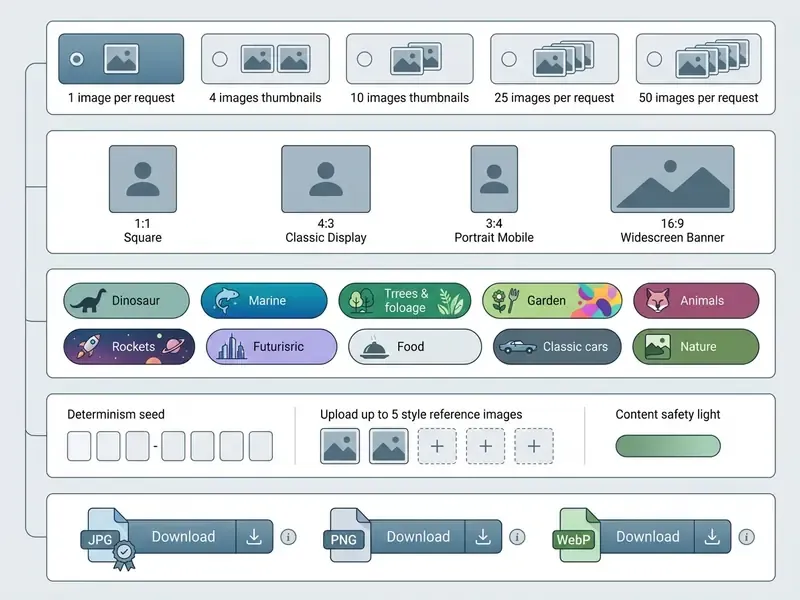
Reference implementations back each of these controls. Amazon Titan Image Generator accepts up to five reference images for style transfer or object preservation and caps text prompts at 512 characters, while its safety filters "cannot be configured or turned off" (AWS AI Service Cards: Amazon Titan Image Generator, Amazon Web Services, 2024, https://docs.aws.amazon.com/pdfs/ai/responsible-ai/titan-image-generator/titan-image-generator.pdf). On the retrieval side, Lorem Picsum exposes dimension-based random images plus /seed/{value} URLs for repeatable results (Lorem Picsum, 2026, https://picsum.photos/).
A small practical note. The seed field is the one control most consumer tools quietly omit, and it is the one an auditor will ask about first.
How to Generate Random Images
To generate random images, pick a target subject category, configure format parameters, run the request, and download the file. A structured execution flow is what keeps generated assets inside your technical resolution and licensing requirements.
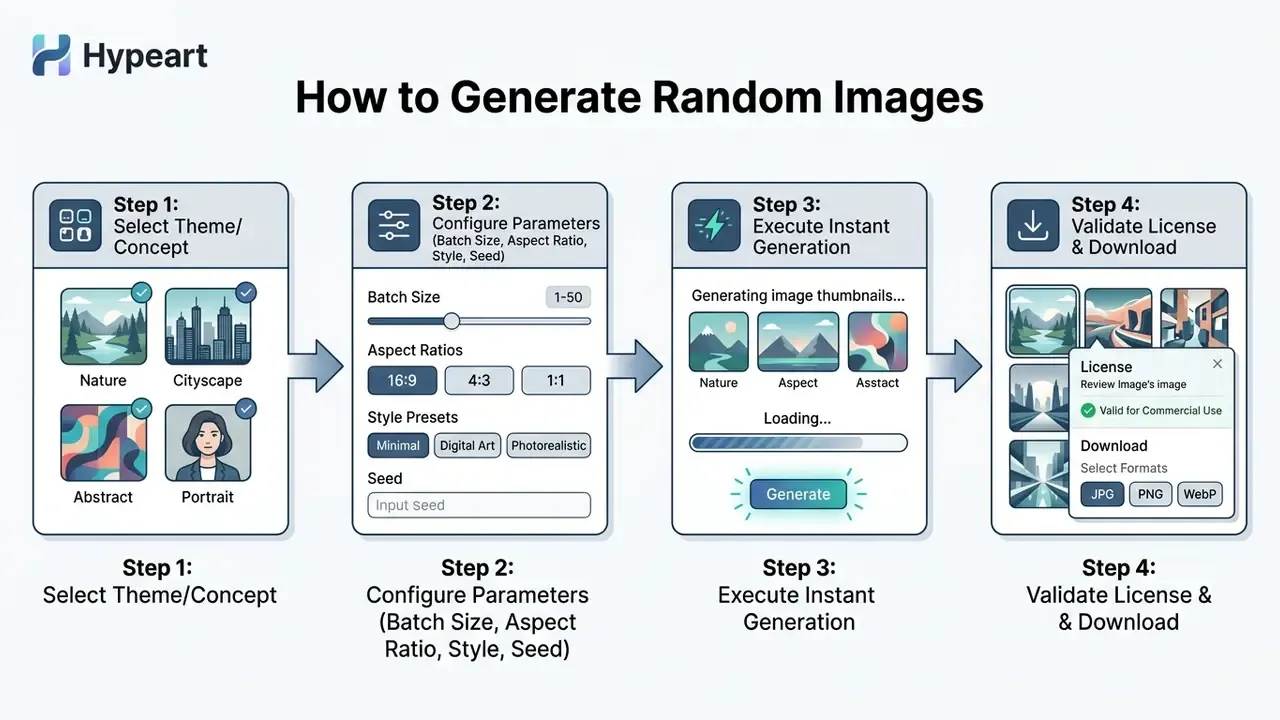
- Select theme or concept: decide whether the output needs realistic photos, abstract patterns, or character concepts.
- Configure settings: set resolution bounds, aspect ratios, style presets, and safety filters.
- Set batch quantity (1 to 50 units): run single frames for precise prompt testing, or batch-render up to 50 randomized images at once for fast moodboard curation and wider visual choice. Single-frame mode is the default on most retrieval services. Batch mode is what makes variant testing and sprite-set curation viable in one pass.
- Execute generation: initialize the random seed or submit a minimal prompt to synthesize the image.
- Download and deploy: choose the export format (JPG, PNG, or WebP) based on production storage and bandwidth limits.
Choose a theme or image idea
Selecting a subject theme sets structural boundary constraints for the random generator. Common defaults include portraits and people, nature landscapes, architectural spaces, fantasy concept art, and minimalist product mockups.
Targeted categories prevent fully unconstrained randomness and keep output inside project scope. Prompt libraries published in 2026 group inputs into six to ten recurring buckets, portraits and people, landscapes and nature, product photography, anime and illustration, architecture and interiors, plus abstract and conceptual art, which improves relevance while preserving visual variety. Note: this grouping reflects vendor-published prompt collections rather than peer-reviewed benchmarking, so treat relevance gains as directional, not measured. Dataset-level analysis supports the variety trade-off more directly:
"Prompts with higher lexical and thematic originality are associated with more visually diverse outputs, measured by image-similarity metrics."
Category-level randomness behaves the same way in retrieval systems. Choosing "dogs", "alpine scenery", or "cityscapes" from a dropdown narrows the sampling pool while keeping the surprise inside it.
Customize settings and generate random pictures
Configuring generator parameters gives teams control over aspect ratio, image resolution, and stylistic rendering. Professional platforms let users enter seed numbers for reproducible randomness, or upload style-transfer references so a whole batch stays on brand.
"Most users can judge the quality of a prompt but lack the stylistic vocabulary needed for high-quality results, this skill is non-intuitive and requires practice."
Download and use the result
Exporting random images means choosing a file format that balances visual fidelity against web performance. JPEG stays the default for complex photographic images thanks to universal browser support.
PNG is the better pick for vector-style graphics and UI elements that need transparency. Assets bound for print or high-DPI displays usually pass through AI image upscaling and quality enhancement first. RFC 9649 defines WebP as an efficient web format with both lossy and lossless compression, cutting file size by 25 to 35% versus legacy formats (IETF, RFC 9649, 2024, https://datatracker.ietf.org/doc/rfc9649/; Google for Developers, 2026, https://developers.google.com/speed/webp).
Batch size also carries an energy cost, which matters for teams reporting on sustainability metrics:
"Generating a single image with partial denoising consumes significantly less energy than batch generation with full denoising, without sacrificing creative value."
For moving-image workflows, review our guide to online video production.
Ideas for Using Random Pictures
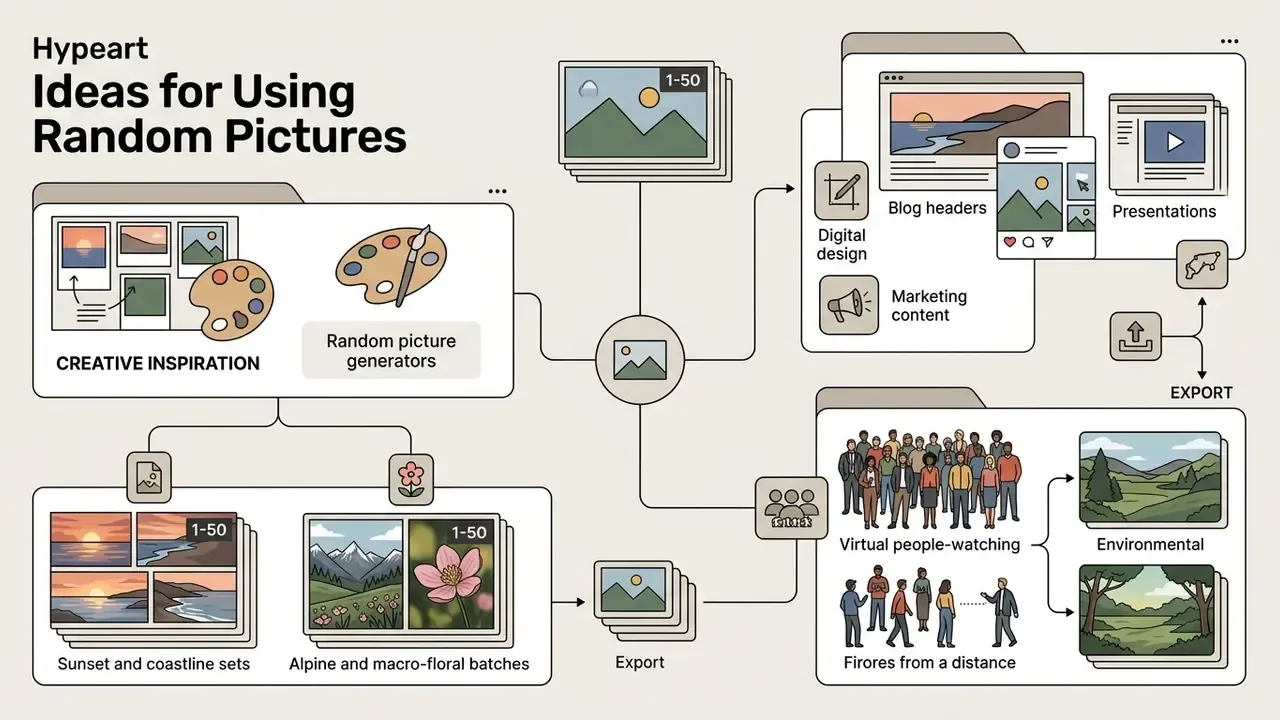
Random pictures solve real asset shortages in digital design, creative writing, and marketing. Matching the task to the right visual medium improves both production velocity and audience response.
Creative and artistic inspiration
Artists and writers use random visual prompts to break cognitive blocks and force unexpected associations. A common brainstorming pattern: display one random image for 60 seconds while participants write down immediate thematic associations, no editing allowed.
Forced-analogy frameworks link a random visual object to a technical problem, which pushes non-linear problem solving.
"Analysis of more than 3 million prompts showed that users focus on surface aesthetics, style, mood, colour palettes, rather than complex narrative content."
That finding doubles as a warning. Without a structured exercise, random imagery drifts toward mood instead of meaning. The frameworks below add the missing constraint layer.
- Creative writing challenges: run a two-tiered exercise. Level 1 (literal description): write a 200-word scene describing the generated image. Level 2 (indirect analogy): write a story where the image represents an off-screen emotional motif without ever naming the visual object. Level 2 is harder because it forces inference instead of transcription.
- Multi-disciplinary art applications: musicians map spatial image balance to chord progressions and build a short melodic phrase from a single frame. Painters use the same frame as a timed sketching reference. Textile artists and quilters extract palette HEX codes from abstract outputs to calculate geometric fabric ratios and seed a new quilt block.
- Storyboard sequencing: generate a batch of six images, shuffle them, then arrange them into a narrative order. The sequencing constraint produces plot decisions a single image never will.
These exercises stop teams from converging on standard design patterns too early. Creators picking a tool for such workflows can weigh output quality and licensing across the best AI art generators or the best free AI art generators.
Relaxation, mindfulness, and daily creative warm-ups
Placeholders and visual content
"A study with 133 crowdworkers and 14 interviews revealed a systemic mismatch between user expectations and Stable Diffusion outputs regarding gender and nationality."
Treat randomized faces as unreviewed content. Sample the batch, check demographic skew, and never ship a synthetic portrait as a customer testimonial. Explore cost models through our AI Media Pricing Guides and size resource allocation with the AI Media Calculators.
| Use Case Scenario | Recommended Image Type | Operational Benefit | Key Implementation Risk |
|---|---|---|---|
| Creative brainstorming | Abstract AI art, stylized illustrations | Stimulates divergent concept mapping | Design fixation on the first visual outputs |
| UI prototyping | Seeded photos, gray dimension cards | Keeps wireframes aligned without manual sourcing | Uncleared recognizable human faces in mockups |
| Digital marketing | High-resolution photography, product renders | Speeds up multi-variant creative testing | Asset misalignment with implicit brand values |
| Educational exercises | Animals, storyboards, nature assets | Encourages narrative sequencing and drawing | Exposure to unmoderated user-generated inputs |
| Mindfulness and relaxation | Coastal landscapes, alpine vistas, floral macros | Lowers cognitive load, refreshes visual focus | Passive distraction during high-priority deadlines |
| Craft and textile design | Abstract colour fields, geometric patterns | Supplies palette HEX codes and block ratios | Palette drift from print-safe colour gamut |
Readers evaluating zero-cost options can shortlist tools through our comparison of the best free AI image generators.
Random Picture Generator for Kids and Restricted Environments
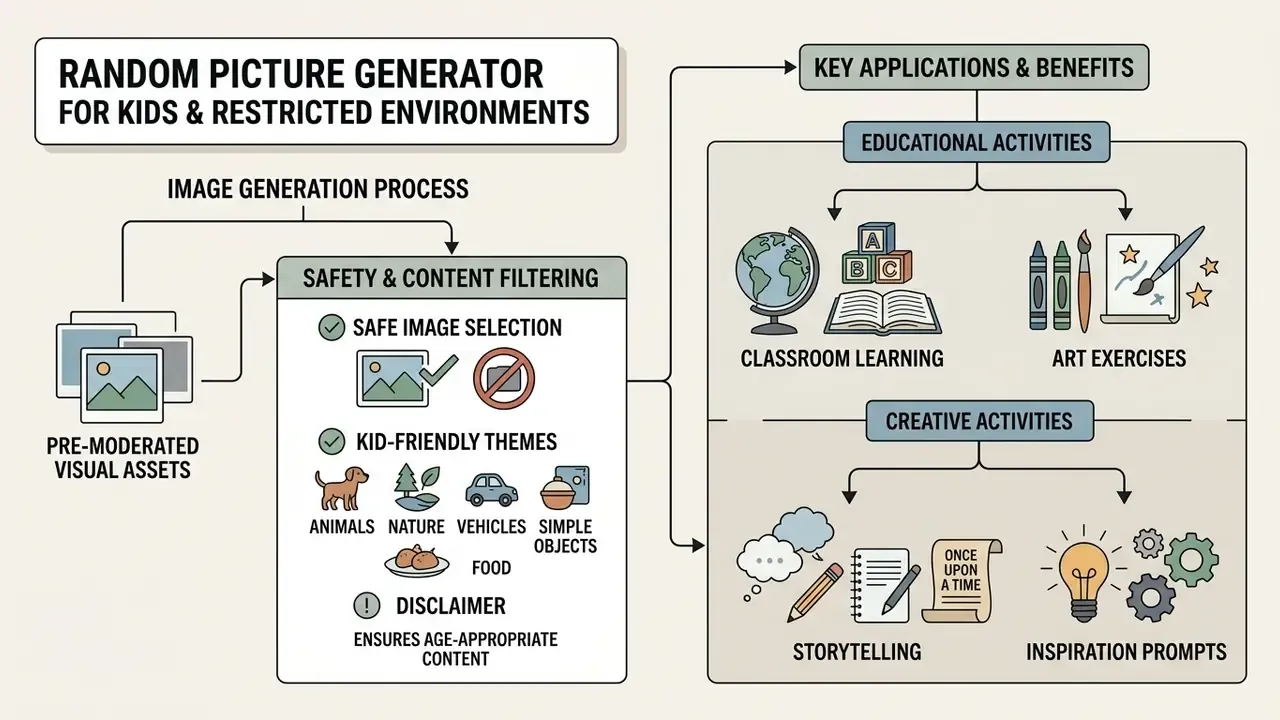
A random picture generator for kids supplies safe, pre-moderated visual assets for classroom learning, storytelling, and art exercises. Educational deployment demands strict content filtering and data privacy protection, the same control pattern enterprises apply to any restricted, PII-sensitive environment.
Kid-friendly themes and safe image selection
Child-oriented picture generators restrict output categories to safe topics: animals, fairy-tale characters, space exploration, nature. Production interfaces usually expose these as one-click preset pills, for example Animal Fun, Nature Scene, Space Adventure, Colorful Art, Ocean Friends, Forest Magic, Garden Party, Dinosaur Friends. Platforms serving users under 13 must operate inside pre-moderated content boundaries and enforce SafeSearch filtering, with a visible default filter level and an option to lock filtering on a device.
Official guidance updated in 2026 by the Japanese Ministry of Education explicitly prohibits students from entering personally identifiable information (PII), including personal names or photographs, into generative prompts. Systems have to enforce input sanitization to protect student privacy and block unauthorized data processing.
"Harm is caused predominantly by a small number of models trained on pornographic content, released with open weights and without sufficient safeguards."
The operational takeaway: safety in child and classroom deployments is decided by model provenance and release conditions, not by the front-end theme list. Verify which base model powers the generator before approving it for minors. A cheerful "Dinosaur Friends" button tells you nothing about the weights behind it.
Educational and creative activities
Random images support elementary learning through visual storytelling, vocabulary building, and drawing prompts. Exercises like "Snapshot Stories" show students a random visual scene and ask them to write what happened before and after it.
Story-dice activities use random picture cards as prompts for group discussion or comic strip creation. Picture-sequence tasks add a scaffolded prompt chain: name what is shown, say what is happening, open with "Once upon a time..." and answer "What happened next?" Comic-strip assembly then asks children to order scenes from a story they heard into images. These structured activities build creative writing and observational skills inside safe instructional parameters.
Free Access and Commercial Use of Random Images
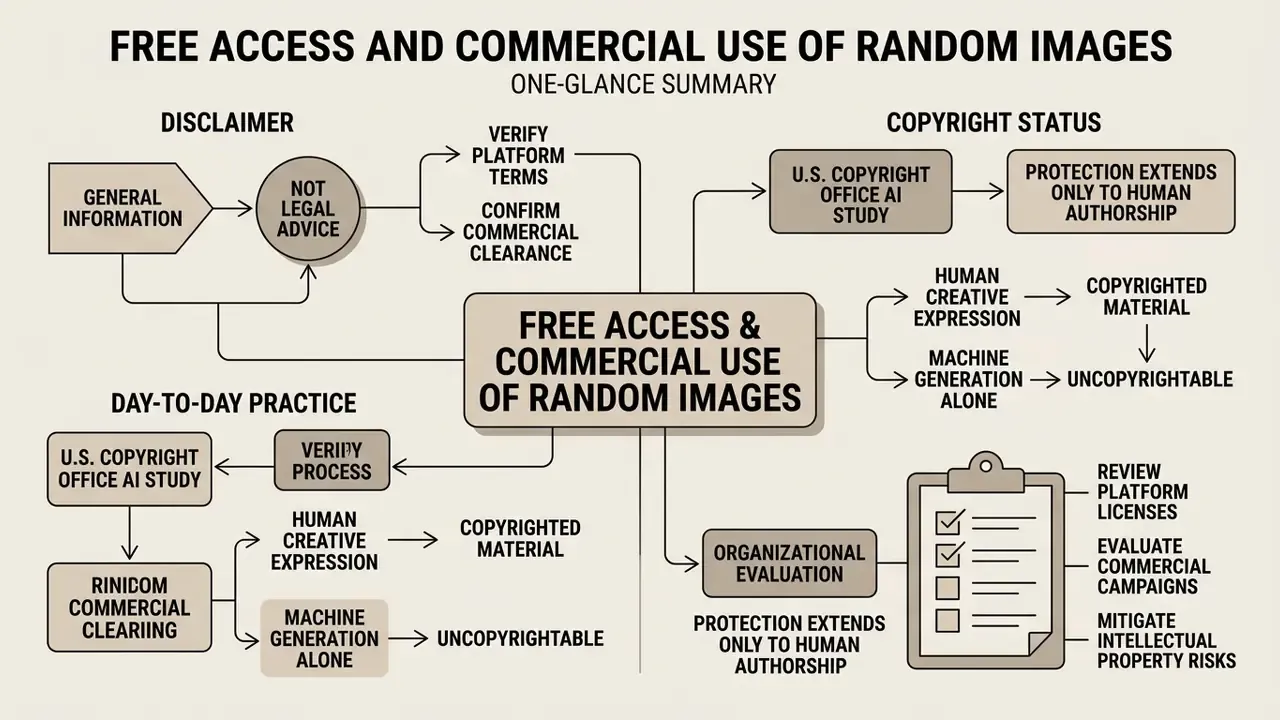
Deciding whether random images are cleared for commercial use means verifying specific platform terms and the underlying copyright position. Free generation access does not automatically grant commercial redistribution or trademark rights. Those are separate questions, and they are frequently answered in the last paragraph of a Terms of Service page nobody read.
The U.S. Copyright Office AI Study (Part 2, 2025) reaffirmed that copyright protection covers only works with sufficient human authorship. Prompts alone do not confer ownership over an AI-generated image.
Two further positions shape day-to-day practice. Creative Commons holds that AI-generated outputs should not receive copyright or related rights because they lack a human author and originality. The Congressional Research Service notes that fair-use analysis weighs whether a use is commercial, and that outputs can still infringe if they are substantially similar to protected works. Stock marketplaces add another layer: Adobe Stock's 2026 contributor rules require generative-AI content to be marked explicitly at submission, plus certification that fictional people or property are not based on recognizable subjects.
When random images go into commercial campaigns, organizations should evaluate platform licensing agreements and residual copyright exposure together, not separately. Provenance verification through AI image detectors and AI reverse-image search is a practical pre-publication step for confirming that a "random" asset is not a near-duplicate of a licensed original. Review our dedicated guide to commercial use of AI image generators policies, and track ongoing legal developments in AI Litigation and intellectual property frameworks.
Pre-Deployment Compliance and Model-Risk Checklist
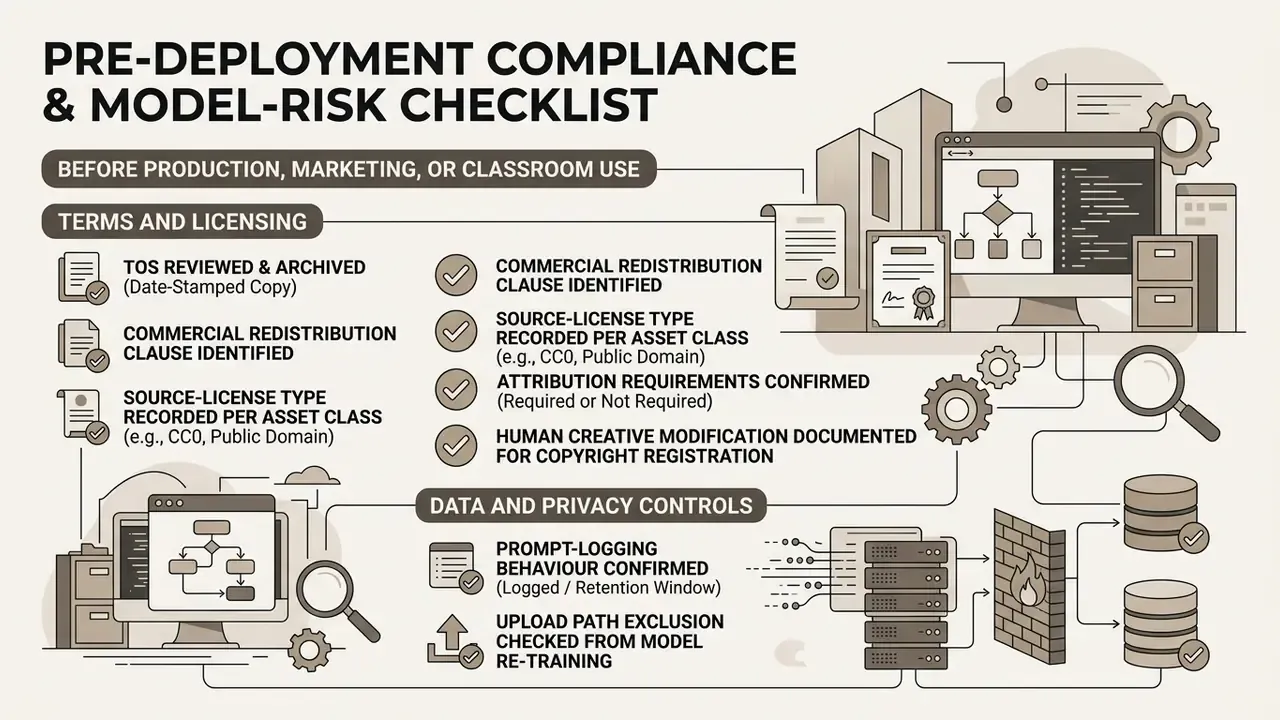
Copy this checklist into your internal ticket before a random picture generator touches a production, marketing, or classroom environment. It maps the four control domains most model-risk and governance functions ask about: licensing, data, determinism, and inventory.
1. Terms and licensing
Checklist0 / 4
2. Data and privacy controls
Checklist0 / 4
3. Determinism and auditability
Checklist0 / 4
4. Inventory and oversight
Checklist0 / 4
Because generative output is stochastic, the audit trail is the control, not the picture. Recording seed, model version, and prompt is what turns an unpredictable generator into a reviewable, reproducible process. One more thing worth budgeting honestly: review hours. ROI models that ignore the cost of human sign-off tend to look excellent right up to the first audit finding.
Shadow AI and Platform Verification
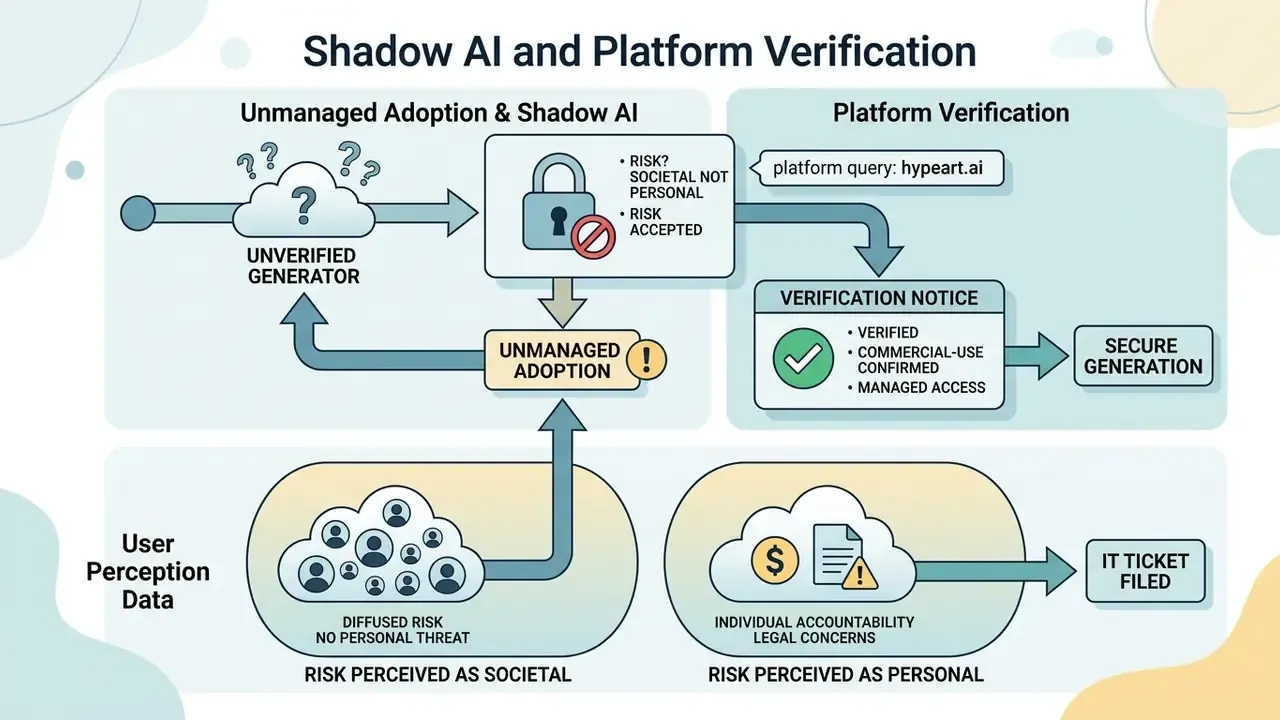
Unverified consumer generators are the most common Shadow AI entry point in creative teams. They are free, need no account, and leave no procurement trace. Before any such domain touches work assets, confirm registration records, ownership, published terms, and model provenance.
Platform verification notice, company query: hypeart.ai. As of August 2026, official domain registration and operational records for hypeart.ai show: no verified information available. Any product capabilities or service offerings associated with this domain must be treated as unverified hypotheses, and the domain handled as unapproved Shadow AI until documentation exists.
User perception data helps explain why unmanaged adoption spreads so fast:
"Users are broadly aware of societal risks, but only a minority regard the technology as a personal risk to themselves; those who have tried it rate its future importance lower."
If risk feels societal rather than personal, nobody files a ticket. That gap, not malice, is what puts unapproved generators inside regulated workflows.
Other Random Image Generators to Explore
Specialized random image generators serve narrower functional needs, from synthetic face creation to vector output. Reading the technical specifications is how teams pick the right tool for a production pipeline instead of the loudest one.
- Random people generators tools like This Person Does Not Exist use StyleGAN3 architecture to output fictional 1024x1024 HD human faces for avatars and UI mockups, typically returning up to eight faces per click with filters for age and expression. For business portraits, compare purpose-built AI headshot generators.
- Autoregressive visual models advanced systems generate images through randomized autoregressive sampling and now compete directly with diffusion pipelines on synthesis quality (Randomized Autoregressive Visual Generation, ICCV 2025).
- Raster-to-vector converters specialized utilities process raster PNG or JPG outputs into scalable SVG, EPS, or DXF formats for print and high-density displays. Reference-driven pipelines are covered in our guide to image-to-image generators, and print preparation usually needs AI image upscaling.
- Random object, character, and animal generators the shared technical pattern is synthetic image synthesis constrained to a single semantic class. Animal-style output is documented on multi-class face and art generators, while object- and character-specific tools currently lack formal primary documentation.
- Adjacent open-source stacks teams standardizing on self-hosted media pipelines often pair image tooling with an open source ai video generator free option, a maintained open source ai video generator, and an open source video editor for post-production. Self-hosting shifts the licensing question from vendor terms to model weights, which changes the review, it does not remove it.
Output quality still trails skilled human work, which matters whenever random generation is proposed as a replacement rather than a catalyst:
"Visual artists received the highest creativity ratings, followed by non-artists, then AI with human guidance, and finally autonomous AI."
To weigh technical performance metrics, see our AI Media Comparison Matrices and head-to-head reviews such as Midjourney versus alternative image generators. Developers can wire these workflows in through the AI Media API Guides, and operational teams can reach help via AI Media Support and Troubleshooting.
Random Picture Generator FAQ
Where do random pictures in generators come from?
Random picture generators either retrieve visual assets from indexed stock photo databases or create them with neural networks trained on public image datasets. Generative models synthesize new images by applying statistical patterns learned in training to an initial random noise vector. Retrieval-based services usually draw from free-to-use photo libraries, so provenance, meaning time, place, and manner of creation, should be recorded per asset.
How many random images can I generate at once?
Most production tools default to a single image and allow batches of up to 50 per request. Single-frame mode suits precise prompt testing and lower energy consumption. Batch mode suits moodboards, sprite sets, and multi-variant creative testing. Total generation volume is often unlimited, but per-request batch caps and rate limits vary by platform.
Can users upload their own pictures to a random image gen tool?
Yes. Many image-to-image generators accept user-uploaded source photos as input seeds. The tool then applies randomized style transfers, structural variations, or prompt-guided edits while keeping the composition of the original upload.
Can I submit my own pictures to be included in the random generator database?
Yes. Platforms that accept submissions generally require you to host source photos on a public repository, Unsplash or Flickr for example, under CC0 or public domain terms, then send the public image URL to the operator. Alternatively, use an image-to-image (img2img) upload interface for one-off generation. License the picture properly before submitting, and strip all metadata and PII first.
Which aspect ratios and formats should I choose?
Use 1:1 for avatars and social tiles, 4:3 for classic displays and slides, 3:4 for mobile portrait layouts, and 16:9 for banners and video thumbnails. Export JPEG for complex photographs, PNG where transparency or crisp UI edges matter, and WebP when delivery size is the constraint, since it cuts files by roughly 25 to 35% versus legacy formats.
Is an image created by a random picture generator covered by copyright?
Under U.S. Copyright Office guidance, images generated entirely by AI without substantial human creative modification are not eligible for copyright protection. Commercial usage rights, separately, are governed by the terms of service of the generator platform you used.
Can I use these images as placeholders in a website I'm building?
Yes, provided the source license permits it. Retrieval services built for placeholders return dimension-specific images by URL and support seeded requests, so the same mock renders identically across builds. Replace placeholders with cleared assets before launch, and never ship a recognizable face that has not been licensed.
How is data privacy preserved when using random picture generators?
Privacy holds up when you choose platforms that do not log input prompts, encrypt asset metadata, and exclude uploaded content from model re-training datasets. Educational environments should block the input of personal names or real photos outright. Provenance records themselves need access control too, since they can contain timestamps, device identifiers, and location data.
About This Guide
This guide is maintained by the editorial governance desk covering AI media licensing, provenance, and deployment risk. Sources are limited to primary standards bodies (IETF, NIST, U.S. Copyright Office), official vendor documentation (AWS, Adobe, Google, OpenAI), and peer-reviewed or preprint academic research. Vendor performance claims are labelled as benchmarks rather than guarantees. Material is re-reviewed whenever a cited standard, statute, or platform term changes.
Appendix A: Revision Notes