Executive Summary: What the Image Proves and What It Cannot
- A shroud of turin ai image is a probabilistic rendering, not a measurement.The cloth supplies a faint silhouette, relief ridges and stain boundaries. Everything photorealistic (skin texture, iris colour, symmetry) is generated from training priors.
- AI output carries zero evidentiary weight on authenticity.The 1988 radiocarbon benchmark (1260 to 1390 AD, published in Nature) and the 2022 WAXS hypothesis (compatible with 55 to 74 AD under strict storage assumptions) are material-science questions. Pixel generation cannot touch them.
- Commercial deployment is a rights and disclosure problem.Source photographs may be rights-controlled (STERA, Inc.), purely machine-generated output is not registrable under U.S. Copyright Office guidance, and synthetic religious imagery needs a visible label plus embedded C2PA provenance.
Why This Matters to Risk and Compliance Leaders
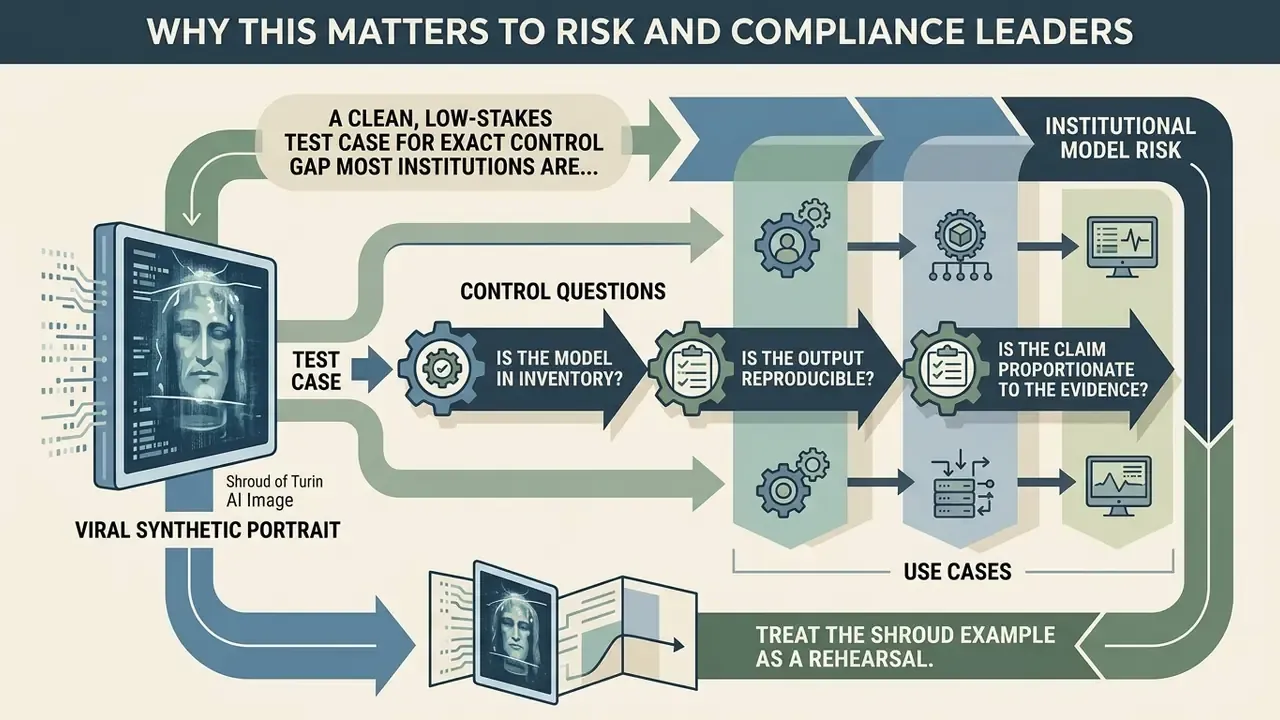
A viral synthetic portrait is a clean, low-stakes test case for the exact control gap most institutions are still closing: a generative model produces a confident artefact, a business unit publishes it, and nobody can reconstruct how it was made. Swap the Shroud for a credit-narrative summary or a KYC adverse-media snapshot, and the failure pattern is identical.
Three control questions travel across all three use cases:
- Is the model in inventory? If a marketing team generated the asset in a consumer tool, it is shadow AI by definition, and the institution owns the consequences without owning the record.
- Is the output reproducible? Without seed, model version and prompt, the artefact cannot be validated, re-tested or defended in an audit.
- Is the claim proportionate to the evidence? "AI-generated interpretation" is defensible. "The true face, confirmed" is not, and the distance between those two captions is where reputational and regulatory exposure lives.
Treat the Shroud example as a rehearsal. The tooling, escalation paths and disclosure stack described below are the same ones needed for agentic workflows in reconciliations, AP and AML triage. The stakes just happen to be visible here.
What Is a Shroud of Turin AI Image and How the Portrait Is Built
A shroud of turin ai image is a synthetic visual output produced by generative neural networks that process visual patterns from photographs of the Turin Shroud. The algorithm interprets low-contrast intensity variations across the linen cloth and synthesises a high-resolution, three-dimensional human portrait. This is a form of image-to-image generation: the source raster acts as a conditioning layer, not as a set of measured anatomical coordinates.
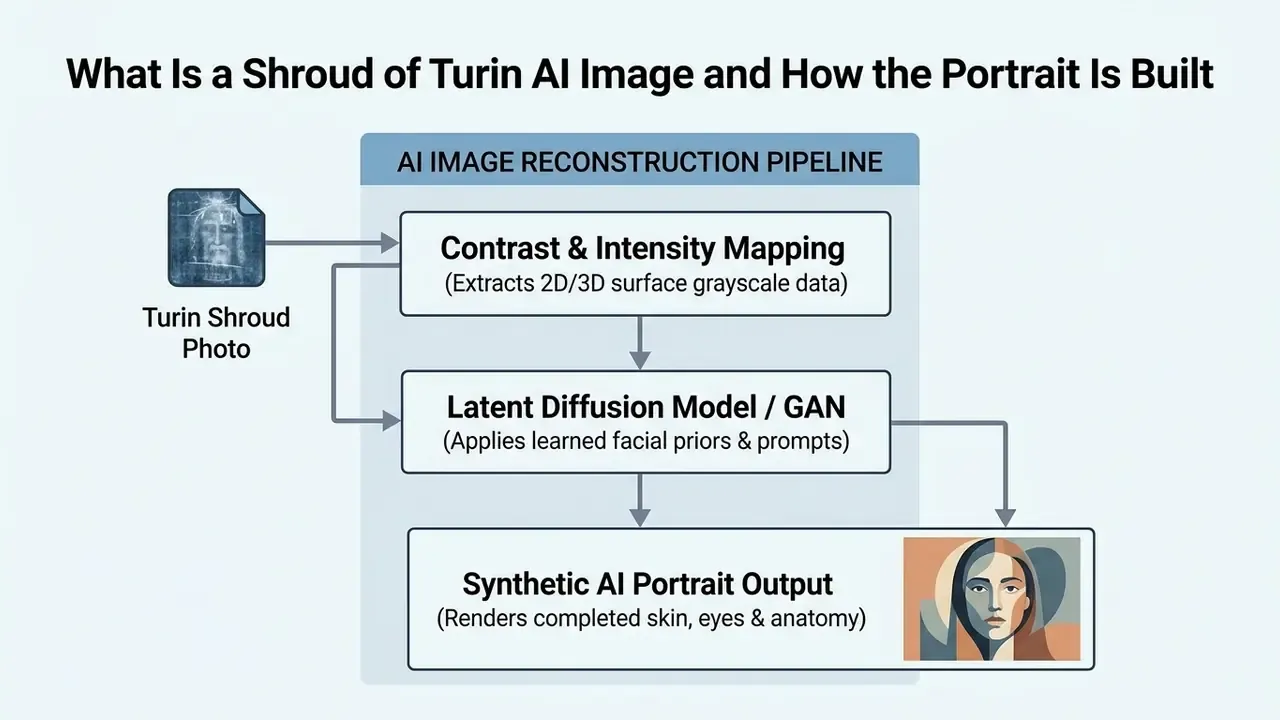
Modern generative models perform no direct physical scanning of the original burial cloth. Instead, systems such as Midjourney or Stable Diffusion ingest digital scans or photographic negatives of the turin shroud as prompts or conditioning layers. Readers comparing capabilities and licence terms across platforms can review dedicated coverage of AI image generators before selecting a pipeline. The artificial intelligence model maps grayscale intensity variations to estimate facial depth, then uses training-set patterns to generate features the degraded fabric never contained.
The resulting ai generated image differs fundamentally from an archaeological restoration. Forensic restoration maps physical data within strict bounds. Generative algorithms fill structural gaps using statistical probabilities distilled from millions of internet images. Same output format, entirely different epistemic status.
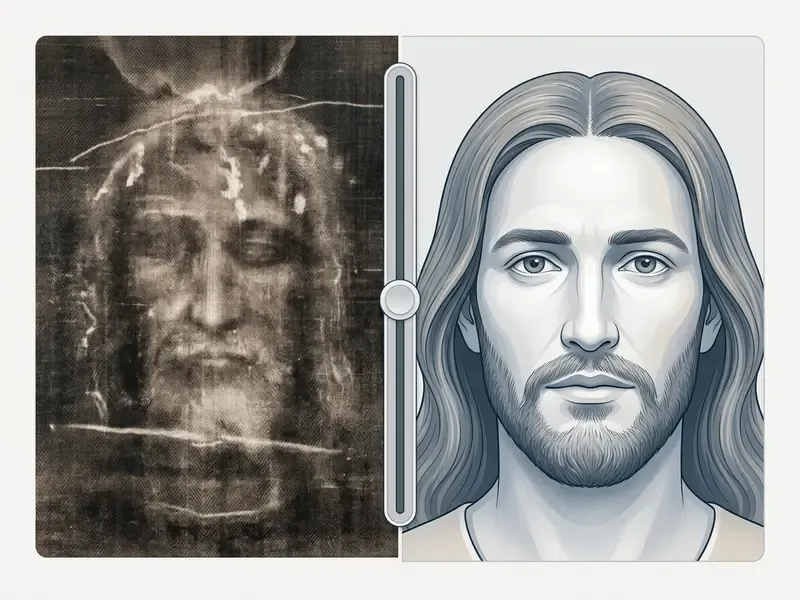
Textual difference key (must remain indexable in the DOM): the original negative shows only a faint frontal silhouette, a nose-bridge ridge, moustache and beard boundaries, and diffuse stain regions. The AI render adds continuous skin tone, defined irises, eyelid structure, hairline density, ear geometry and bilateral symmetry, none of which exist on the linen.
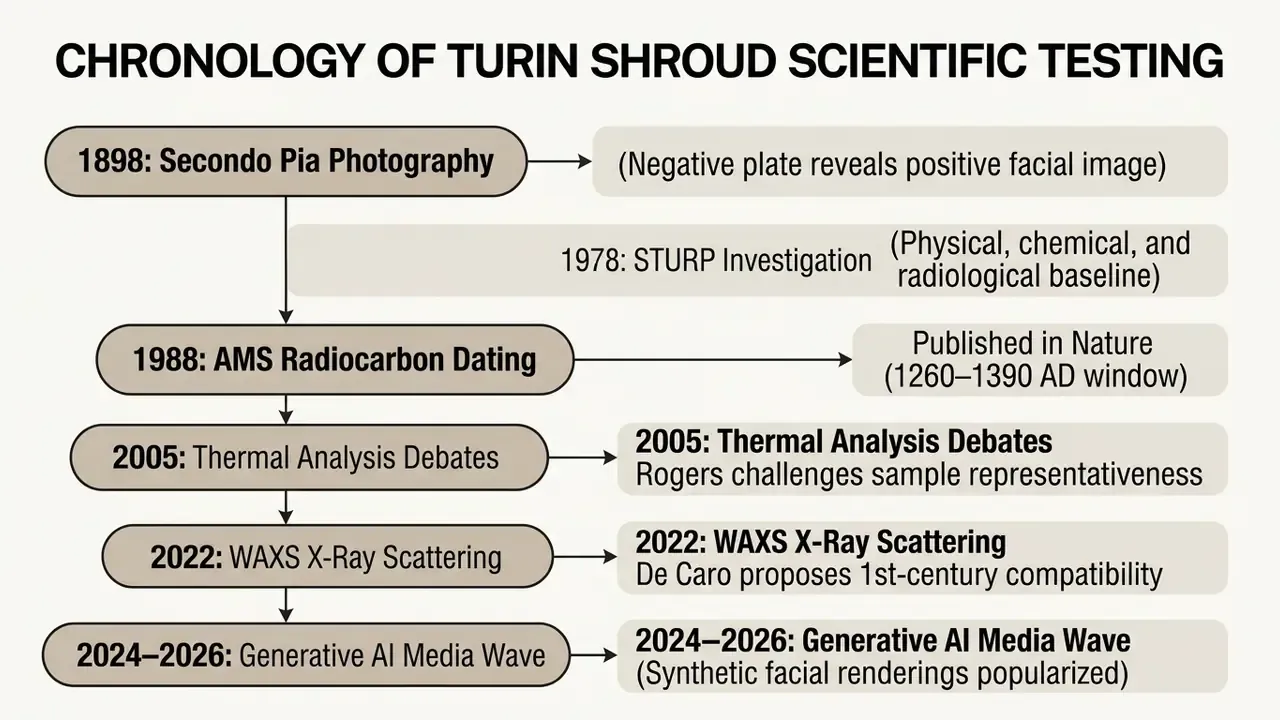
The 1898 Baseline: Secondo Pia and the Photographic Negative Effect
The idea of the Shroud as a "photographic asset" dates to May 1898, when the amateur photographer and lawyer Secondo Pia took the first photograph of the cloth. Developing the glass plate, Pia found that the dark negative revealed a photorealistic positive image of a human face. The result was so unexpected that contemporaries accused him of error or outright fabrication. Later photographic campaigns reproduced the same effect.
Modern AI processing does not discover that image anew. It ingests 2D grayscale intensity maps derived from Pia's baseline and from later technical campaigns, then converts heightmap variance into 3D facial geometry. Every "reveal" published in 2024 therefore rests on a photographic artifact chain more than 120 years long, not on fresh optical access to the relic.
This distinction matters for data lineage. A model conditioned on a high-contrast, digitally enhanced derivative of an 1898 or 1931 plate inherits the contrast decisions, banding artifacts and scanning losses of every intermediate step. Input data quality, not model capacity, is the binding constraint here. Anyone who has fought with a poorly scanned archival PDF will recognise the pattern instantly.
What Data AI Takes From the Image on the Shroud
Generative algorithms extract a basic facial silhouette, major structural proportions and surface relief information from high-contrast photographs of the shroud. Grayscale intensity values on the cloth correspond roughly to spatial distance, which lets software construct a preliminary 3D heightmap of the nose, forehead, cheekbones and beard line.
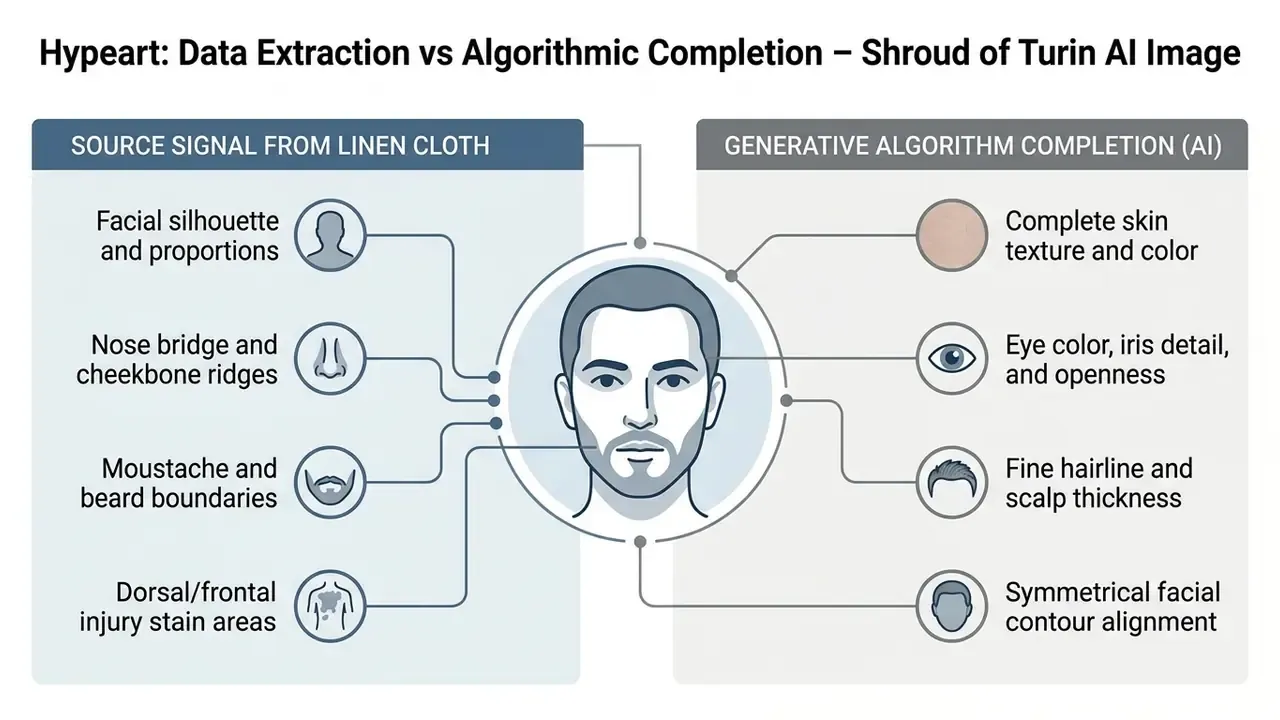
Input data from the linen cloth remains severely limited by fabric degradation, weave distortion, banding artifacts and faint contrast. A wide angle visual analysis confirms that details such as eye colour, exact skin texture and fine facial symmetry are entirely absent from the physical artifact. The network invents these elements by sampling probability distributions learned from training data, not by reading physical parameters off a roughly 2,000-year-old or at least several-hundred-year-old textile.
«Models generate 5,000 images across roughly 460 religious prompts and reproduce stereotypical traits rather than artifact data.»
That empirical finding sits at the core of the input-quality problem. When the conditioning signal is sparse, the model does not abstain. It defaults to the statistical centre of its training distribution, confidently.
It is worth noting that the most rigorous recent digital work treats the Shroud as a surface-data problem rather than a portrait. In a 2026 Archaeometry study, Cicero Moraes combined parametric body modelling, cloth-dynamics simulation and contact-area mapping. He reported that a low-relief scenario matched the cloth contours better than a projection of a full three-dimensional human body, and framed the output explicitly as a digital reconstruction of image formation, not recovery of the artifact's original physical state.
Illustrative governance scenario (composite editorial construction, not a cited case study). Consider an engineering team that pushes low-contrast archival scans through an unconstrained diffusion model. The first run produces photorealistic facial detail, and stakeholders read it as verified forensic output. The mitigation is structural rather than cultural: apply boundary-conditioning controls that isolate original fabric intensity data, render algorithmic completion in a visually distinct layer, and record seed, model version and prompt in the asset's audit trail. That separates artifact signal from generative fill in a way a reviewer can check. (Updated formulation; the earlier wording appears in Appendix A.)
Why an AI Portrait Is Not a Photograph of Jesus Christ
An ai image of shroud of turin is an algorithmic hypothesis, not an authentic historical photograph of jesus christ. No verified contemporary portraits or physical descriptions of Jesus survive from the first century. There is no reference set to score against.
Generative models lean heavily on Western iconographic traditions embedded in their training sets.
«AI systems reproduce stereotypical Western Christian imagery: symmetrical features, light skin, stylised garments.»
Prompted to produce an ai image of jesus from shroud, the model blends low-contrast cloth patterns with established depictions from Renaissance painting and modern digital art. Critics of the 2024 wave objected specifically that the circulated faces showed a pale, European complexion instead of a historically plausible Middle Eastern one.
Output from an AI image generator reflects societal expectation and prompt engineering, not validated historical fact. Presenting a generated image as an objective portrait misreads how machine-learning systems synthesise visual information. It also transfers an unearned authority to the file, which is exactly the risk a disclosure regime exists to block.
Is AI Reconstruction Connected to the Authenticity of the Turin Shroud?
Digital image generation can neither confirm nor disprove whether the Turin Shroud is the authentic burial cloth of Jesus. Algorithmic processing works exclusively on digital visual data and stays independent from material testing, chemical analysis and historical dating.
Before the laboratory record, one mechanism deserves naming, because it drives most of the confusion. Newsrooms publish a generative portrait because a dating study happened to be in the news. The visual then circulates as if it were the study's conclusion. That inversion, image as proof of text, is the central misinformation risk in this subject area.
Reports occasionally suggest that a new ai image of jesus from the shroud of turin delivers fresh evidence of authenticity. Scientific consensus requires physical material evidence, peer-reviewed methodology and reproducible laboratory results. Synthetic rendering alters neither fabric properties nor historical provenance.
«A 2025 content analysis records systematic aggrandizement: cautious findings of "compatibility" are transformed into "proof" of authenticity.»
What Carbon Dating Says About the Age of the Linen Cloth
The definitive radiological study occurred in 1988, when three independent laboratories performed carbon dating using Accelerator Mass Spectrometry (AMS). The joint study, published in Nature, dated the sampled linen threads to between 1260 and 1390 AD at a 95% confidence interval, with a central estimate near 1325 AD.
«Three independent laboratories dated the linen threads to 1260–1390 AD at the 95% confidence level.»
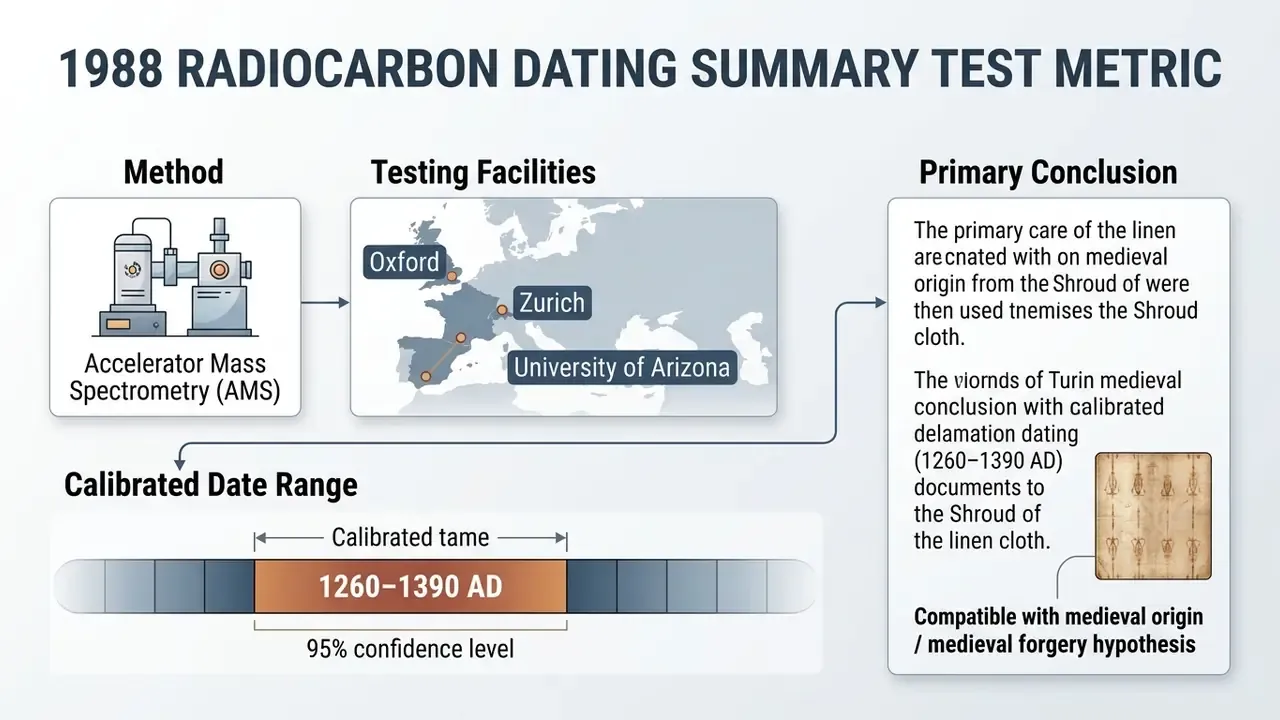
Material analysis published since then has complicated the simplest "painted forgery" reading of that date.
«2023 Raman spectroscopy found no typical medieval pigments in the image zones, while recording blood proteins.»
The 1988 results supported the medieval forgery hypothesis, placing the textile's creation in the 14th century. Subsequent peer-reviewed papers in journals such as Thermochimica Acta questioned whether the tested corner sample suffered from patch repairs, reweaving or chemical contamination, yet the radiocarbon study remains the baseline benchmark for empirical dating. A 2019 analysis in Archaeometry noted that the raw 1988 data were later released and re-examined, which keeps the methodological debate alive without producing a competing consensus date.
The substantive disagreement is therefore narrow and specific: the measurement itself is stable, but interpreters dispute whether it dates the whole cloth or only the sampled edge.
What Liberato De Caro Studied and Why Results Are Interpreted Differently
In 2022, the Italian researcher Liberato De Caro, affiliated with the Istituto di Cristallografia of the Consiglio Nazionale delle Ricerche (IC-CNR) in Bari, published a study with colleagues using Wide-Angle X-ray Scattering (WAXS) to evaluate structural degradation in natural flax cellulose. Dr De Caro reported that the degradation profile of the Shroud sample matched control textiles from Masada Israel, dated between 55 and 74 AD.
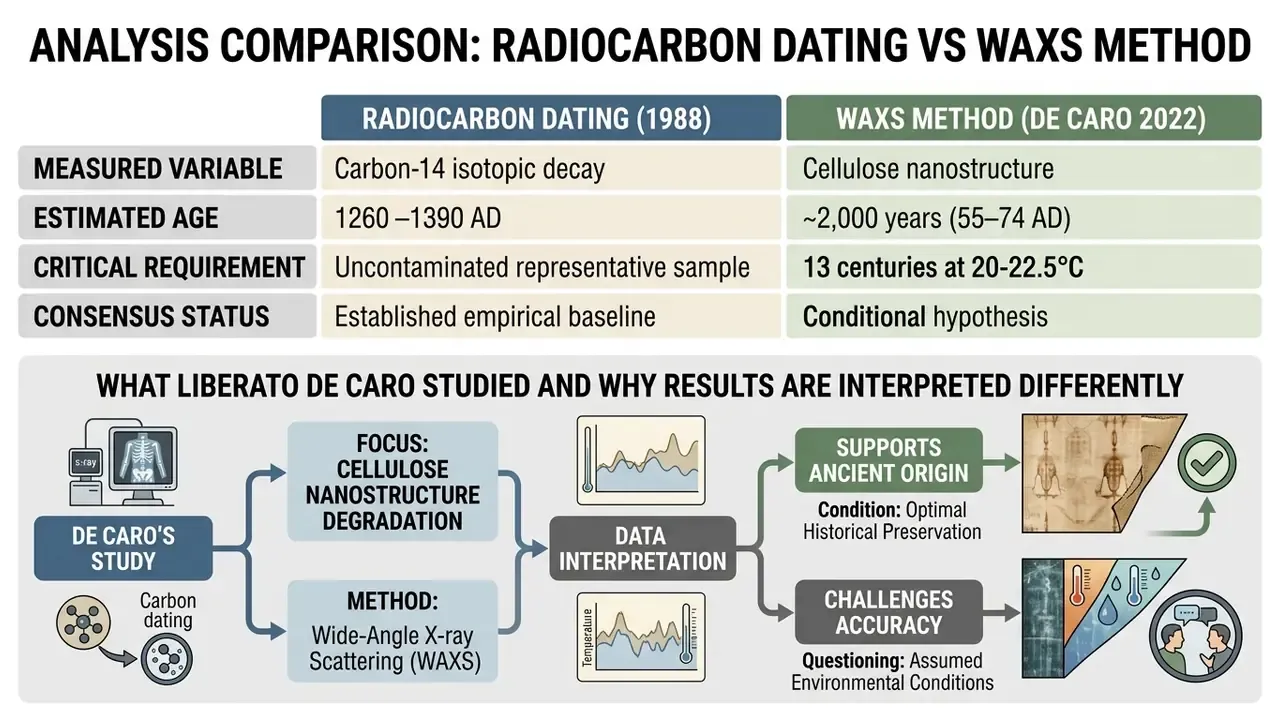
On that basis, Liberato De Caro suggested the fabric could be roughly 2,000 years old, originating from the time of Jesus 2,000 years ago. International material scientists respond that the conclusion requires the cloth to have been stored at constant temperature (20.0 to 22.5 °C) and relative humidity (55 to 75%) for more than 13 centuries. Because such climate stability is unverified across the historical record, the scientific community treats the 2,000-year estimate as a conditional hypothesis rather than conclusive proof of its authenticity.
«The WAXS method yields first-century compatibility only under the assumption of stable storage across thirteen centuries.»
De Caro's team also argued that the earlier carbon measurement was unreliable because «fabric samples are usually subject to all kinds of contamination, which cannot be completely removed from the dated specimen», and noted that a seven-century-old cloth showing the observed degradation level would have had to sit at a room temperature close to the maximum values recorded on Earth. The paper itself concludes that further investigation is required to verify a precise date. Worth repeating: the authors did not claim closure.
Alongside the WAXS structural findings, botanical analyses identifying Middle Eastern pollen grains such as Gundelia tournefortii embedded in the flax fibres support a geographical origin outside medieval Europe. The artifact's documented European record begins in 1354 at Lirey, France, before it was housed at the Cathedral of St. John the Baptist in Turin, where it remains today. Botanical and X-ray data offer conditional hypotheses aligning the textile's creation with 1st-century Judaea, nothing stronger. The relic's devotional status shows in papal attention: Pope Benedict XVI prayed before the cloth in Turin in 2010, and Pope Francis made a pilgrimage to venerate it in 2015.
E-E-A-T primary source fact check
This information is general in nature and does not replace consultation with a qualified specialist. Dating interpretations in this section reflect published positions of the cited researchers, not editorial conclusions about the artifact's origin.
How Closely an AI Image Can Convey the "True Face" of Jesus
The probability that an ai picture of jesus from shroud of turin reproduces the actual true face of Jesus is low. Forensic studies show that facial approximations built from incomplete physical impressions carry high rates of visual inaccuracy: controlled identification experiments reported 403 wrong identifications across 592 scenarios, and recognition performance above chance level was rare. Researchers also warn that resemblance ratings are not a valid accuracy measure, because a non-target face can score as high as the true target, sometimes higher. Newer computerised workflows reach better geometric fit, with one study reporting mean facial deviation around 1.79 mm and recognition of 91.67%. Those results, though, measure reconstruction from known skulls, not verification of an unknown historical individual.
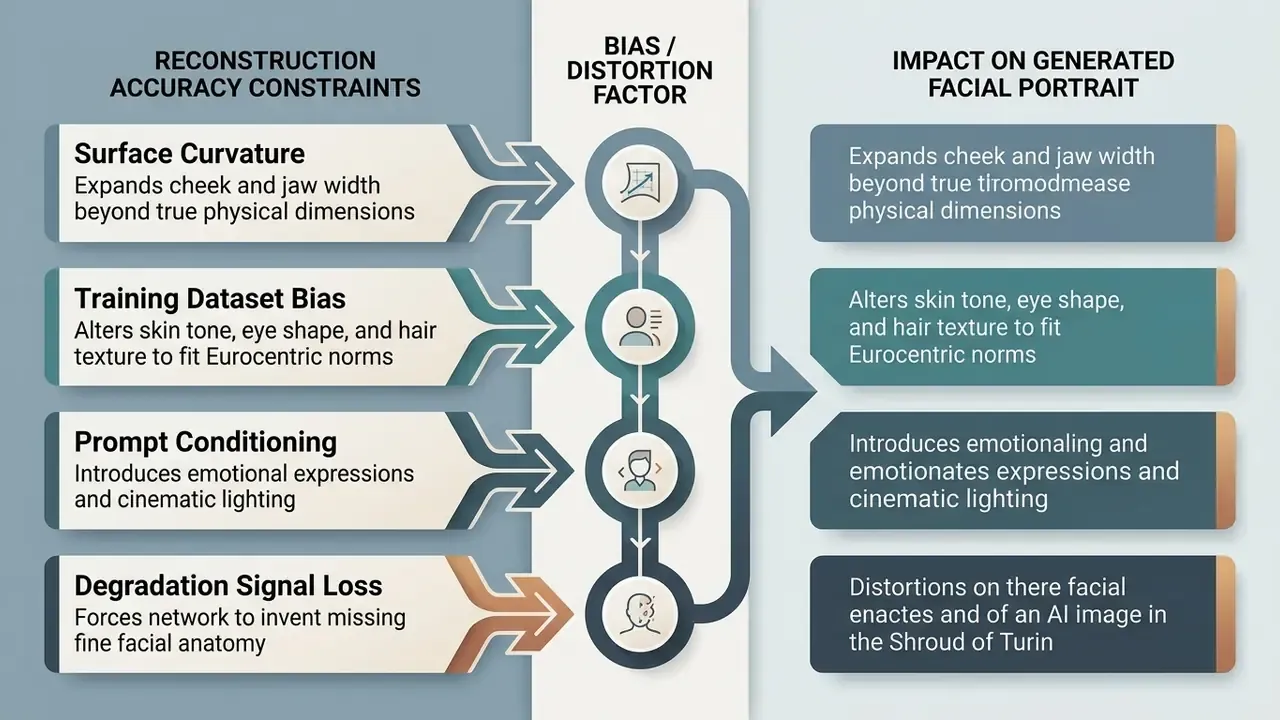
When software builds an ai image of jesus from the shroud, missing data forces the model to interpolate key features. Forensic evaluations of facial reconstruction software show that subjective aesthetic choices shift output appearance substantially, which makes mathematical verification impossible. Publishers who first need to establish whether a circulating asset is synthetic at all can apply AI image detectors as a first-line check, keeping in mind that detector confidence is itself probabilistic.
«A qualitative analysis of 25 AI biblical videos identified four distortion mechanisms: psychologisation, scenic condensation, anachronism and genre formatting.»
What Distortions Appear When Artificial Intelligence Processes the Image
Visual distortions arise from cloth drape mechanics, prompt sensitivity and training-set bias. The physical impression on the Shroud is a two-dimensional projection of a three-dimensional body, so flattening produces lateral expansion.
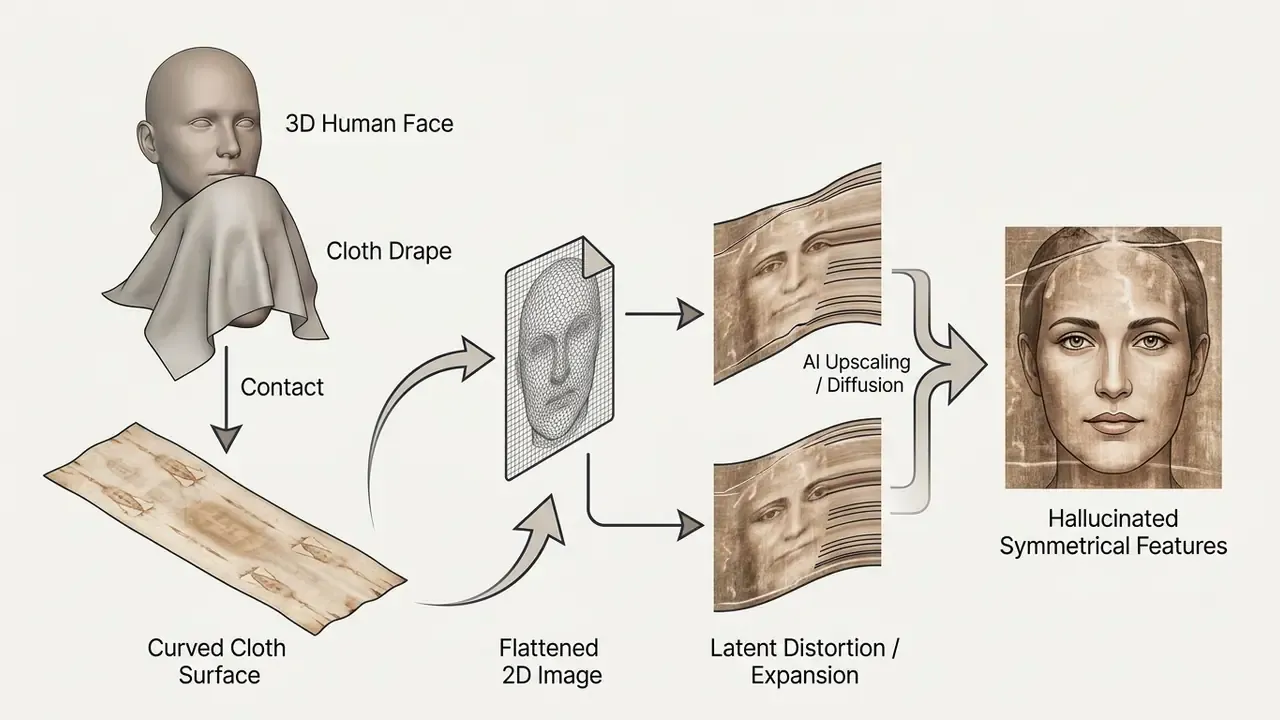
Processed through an ai image of the shroud of turin pipeline, diffusion algorithms "correct" these distortions by applying human facial templates. The network reshapes broad contours, sharpens jawlines and generates symmetrical structures. Those additions are machine-learning hallucinations, not recovered historical data.
Three compounding drivers explain the effect:
- Incomplete input. The cloth image is faint and partial, so the model fills missing regions from learned priors. Output changes with contrast and pre-processing choices alone, before anyone touches the prompt.
- Prompt ambiguity. Under-specified prompts increase invention; highly specific prompts steer expression, wound rendering and lighting toward the operator's expectation.
- Dataset weighting. Western-skewed face datasets shift skin tone, proportions and grooming away from the evidence on the linen.
The Mirror Effect: Why AI Jesus Looks Like Renaissance Jesus
As the AI ethicist Dr. Joseph Vukov puts it, generative networks act as a mirror held up to human perception. Because Midjourney and Stable Diffusion train on sets heavily weighted with Renaissance art and Western iconography, output reflects centuries of cultural expectation rather than an authentic historical face.
«An AI holds a kind of mirror up to our humanity… it may do a good job giving insight into our perception of a historical figure.»
Pope Benedict XVI made a comparable observation about written reconstructions of Jesus, noting that such portraits reveal the ideals of their authors more than the icon itself.
«Those who read a certain number of these reconstructions one after another will immediately notice that these are much more the snapshots of the authors and their ideals than they are the unveiling of an icon.»
For a governance audience the theological observation has a precise technical equivalent. A model's output distribution is a compressed record of its training corpus. When the corpus is five centuries of European devotional painting, the "reveal" is a statistical summary of that painting tradition. Which explains why the result feels familiar to viewers, and why familiarity is not corroboration.
How to Caption an AI Picture of Jesus From the Shroud Correctly
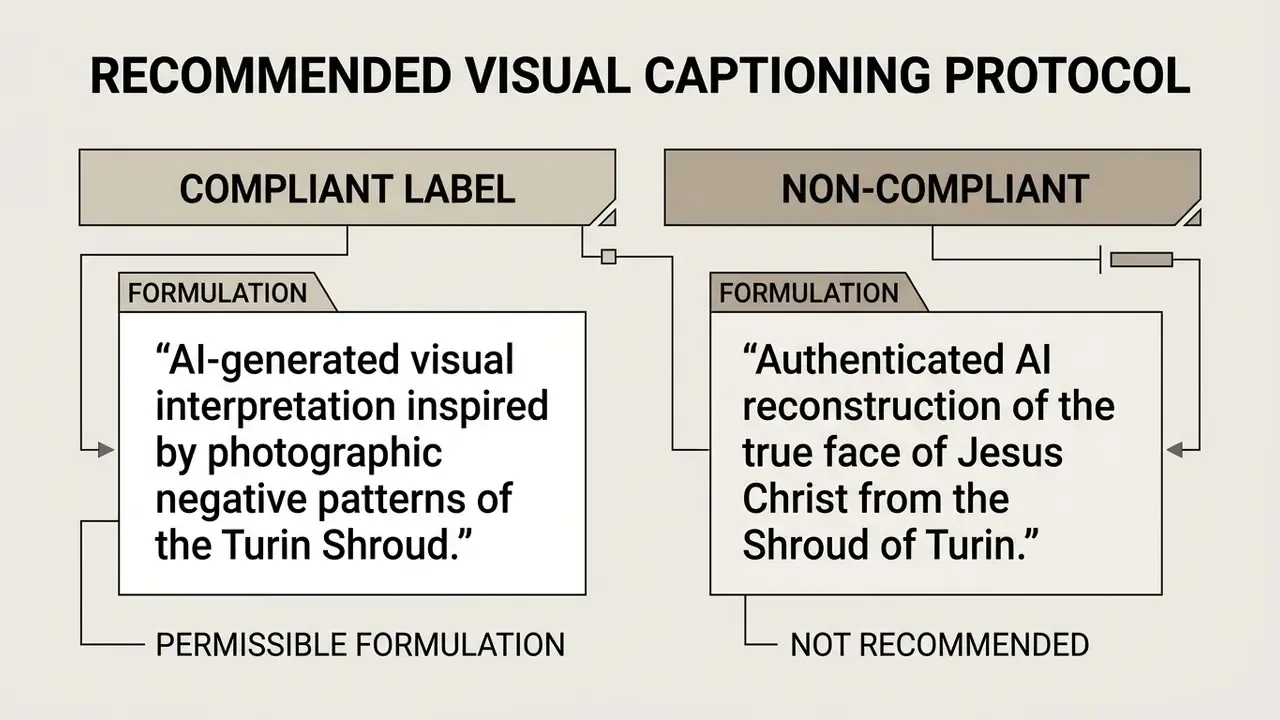
Organisations publishing an ai image shroud of turin need clear disclosure to prevent reader misrepresentation. Prominent labelling is the common denominator of current transparency frameworks. The EU Code of Practice on Transparency of AI-Generated Content (European Commission, 2026) requires clear, prominently visible labels for deepfake images together with metadata recording generation or manipulation. The NIST draft guidance on synthetic content (2026) lists visible labels, watermarks and disclosure fields as standard practice. The Australian Government's "Be clear about AI-generated content" guidance (2026) specifies three disclosure methods: visible labels, watermarking and metadata recording. (Updated: specific instruments now named; the earlier generic formulation is retained in Appendix A.)
«A 2026 study records that AI models systematically blend doctrines of different Christian denominations, returning averaged "safe" answers.»
That finding reinforces why captions must be precise rather than devotional. The same averaging tendency that flattens doctrine also flattens historical specificity, so the caption becomes the only reliable carrier of context.
Captions should state plainly that the asset is a synthetic rendering based on artistic and algorithmic interpretation. Avoid definitive claims that an ai picture of jesus from the shroud of turin proves historical appearance or validates relic authenticity. One sentence of honest framing costs nothing and removes most of the downstream risk.
Provenance Infrastructure: C2PA, Watermarking and Metadata
Visible captions solve the human-reader problem. They do not survive screenshotting, re-encoding or syndication. Enterprise pipelines therefore need machine-readable provenance alongside the label.
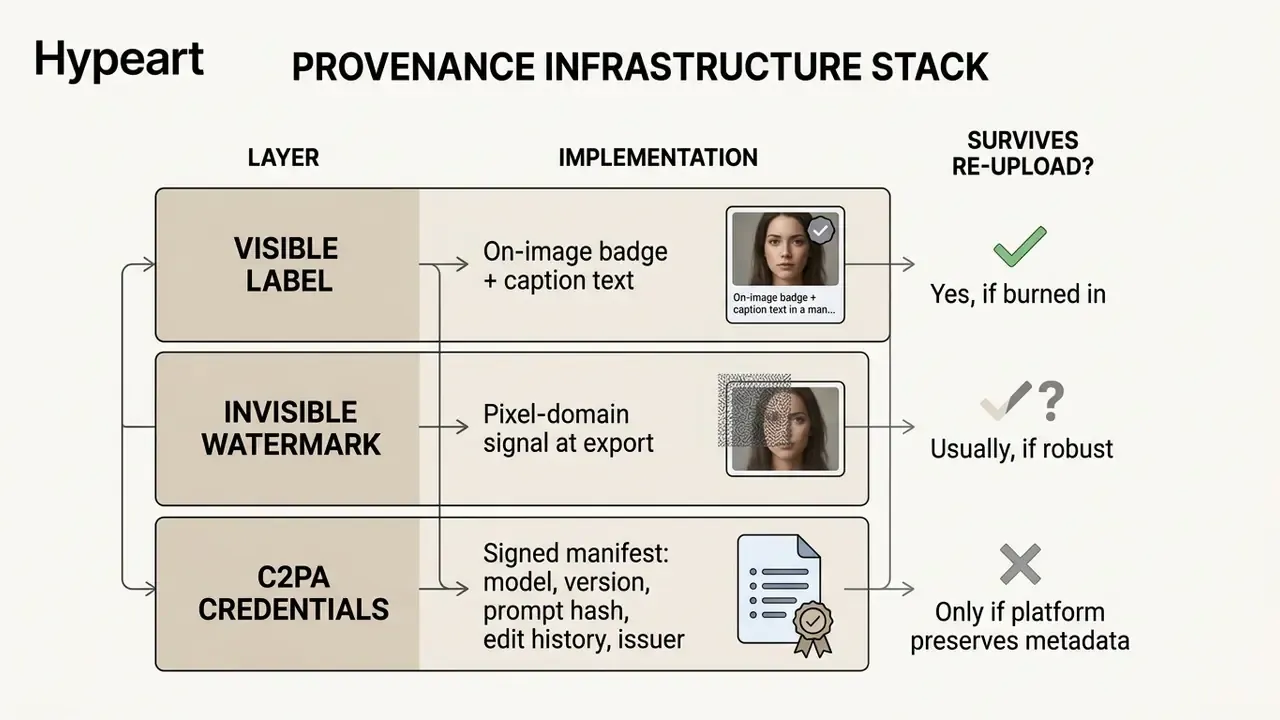
Practical implementation notes for regulated publishers:
- Bind the manifest at generation, not at publication. A C2PA Content Credential issued after manual retouching loses the record of which layer was synthetic.
- Record model, version and seed. Reproducibility is the difference between an auditable asset and an unverifiable one. Store the prompt hash rather than the raw prompt when the prompt is commercially sensitive.
- Burn the visible label into the raster for social distribution. Metadata stripping is default behaviour on many platforms.
- Log downstream edits. If an ai image enhancer or upscaler touches the asset, append the step to the manifest instead of re-exporting a clean file.
Can a Shroud of Turin AI Picture Be Used in Commercial Projects?
This information is general in nature and does not replace consultation with a qualified legal specialist. Copyright, publicity and licensing outcomes depend on jurisdiction and on the specific assets involved.
Commercial deployment of a shroud of turin ai picture across advertising, media merchandise or digital platforms raises specific intellectual property and brand risk questions. The historical textile is ancient; photographic reproductions and derivative commercial images are not, and they remain subject to copyright law and usage agreements.
Teams considering digital asset creation can see the overview of platform licensing options to shape a risk management strategy. Creators working with an ai image editor should also keep clear logs of prompt history and manual edits, which is the only practical way to evidence human authorship later.
(do not render as HTML image markup).
Alt text for the accompanying graphic: "commercial use checklist shroud of turin ai image licensing and ethics".
Checklist0 / 10
Which Rights to Check Before Publishing or Selling an Image
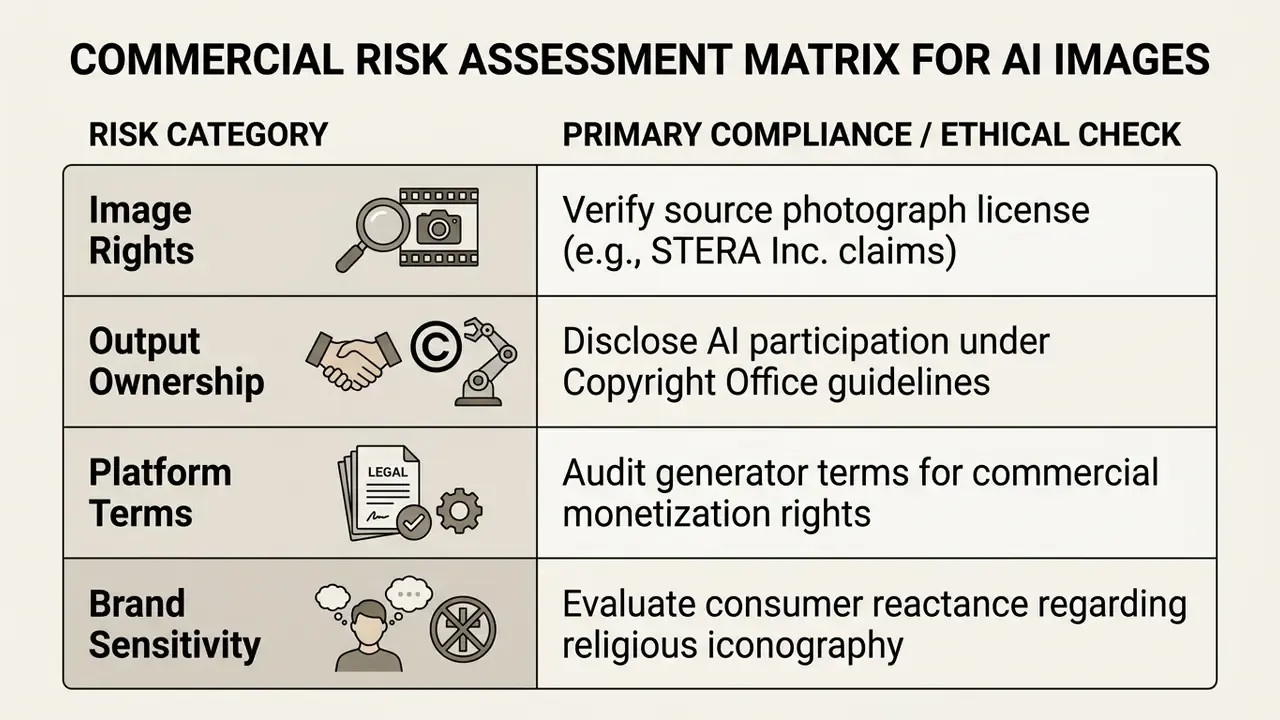
Before publishing or monetising an ai picture, organisations must clear underlying photographic rights, verify AI platform terms and confirm alignment with copyright office guidance.
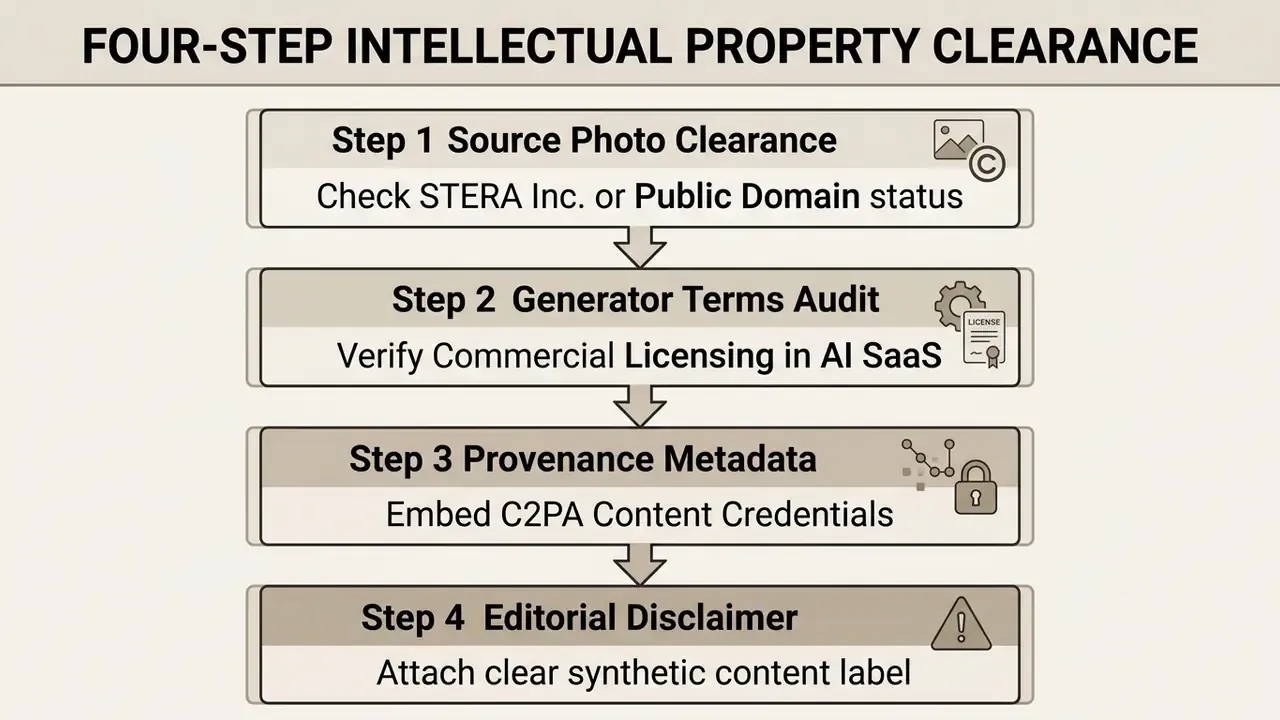
- Source photograph rights. Organisations such as STERA, Inc. assert copyright control over specific high-resolution technical photographs taken during scientific expeditions, stating that all Shroud and STURP photographs are ©1978 STERA Inc. and that reproduction, sale, licensing or distribution requires a written agreement, with terms varying by use, territory and print run. Commercial archives take a similar line: Bridgeman Images catalogue entries for the 1931 Shroud photographs state that the artwork is in copyright and require rightsholder permission. Using a copyrighted photograph as the input reference for generation can create legal exposure even when the output looks novel.
«The "generative AI supply chain" concept spans scraping, model training and prompt design, and liability can arise at each stage.»
- AI platform licensing. Commercial permissions depend on the generator's terms of service. Vendors generally require that users own or hold rights to uploaded material, and several treat copyrighted or trademarked religious imagery as restricted content absent documented permission.
- Copyrightability of AI output. Under U.S. Copyright Office guidance, purely machine-generated visual outputs lacking substantial human creative input cannot be registered, and AI-generated material that is more than de minimis must be explicitly excluded from any registration claim. The Congressional Research Service further notes that commercial use is only one fair-use factor, alongside the amount used and market harm.
- Competing public domain position. A public-domain argument exists in the United States for faithful photographic reproductions of two-dimensional public domain works. For instance, «the file "Shroud of Turin 001.jpg" on Wikimedia Commons is tagged PD-Art and available for free reuse». Wikimedia Commons, File:Shroud of Turin 001.jpg. https://commons.wikimedia.org/wiki/File:Shroud_of_Turin_001.jpg The same platform warns that reuse may be restricted outside the U.S. The divergence from STERA's claim turns on jurisdiction and on whether an image counts as a faithful reproduction or as a separately copyrighted photograph.
- Cross-border checklists. Japan's Agency for Cultural Affairs published an AI-and-copyright checklist in July 2024 requiring rights clearance and verification that output does not reproduce protected material in commercial use. Australia's OAIC guidance notes that generated images can involve personal information, triggering privacy obligations including lawful collection and human verification of outputs. A 2026 Singapore legal-sector guide advises against prompting generative systems to reproduce third-party content and recommends reverse image search for visual assets before use.
- Publicity and brand risk. The U.S. Copyright Office's Digital Replicas report observes that state publicity rights typically cover commercial uses, creating separate exposure for advertising, merchandise and media branding. Reputational risk rises further when religious symbols appear in commercial or synthetic media without consent, because audiences may read the usage as disrespectful, misleading or appropriative. There is no official church approval available to underwrite that judgement for you.
- Enterprise pipelines and legal monitoring. Organisations scaling synthetic media can standardise automated workflows to enforce metadata tagging, while legal teams tracking intellectual property developments can compare options on generative copyright precedent.

Illustrative governance scenario (composite editorial construction, not a cited case study). Picture a financial-services marketing department preparing a campaign built on an AI-generated historical motif derived from public-domain imagery. A pre-market compliance review flags that the training and reference inputs cannot be traced, and the asset is swapped for a human-authored vector design. The value of the review is procedural, not anecdotal: an untraceable input chain cannot be warranted to a distribution partner, and that alone is sufficient grounds to reject the asset under institutional risk standards. (Updated formulation; the earlier wording appears in Appendix A.)
Risk Escalation Matrix for Synthetic Religious Imagery
Publishing decisions on religiously sensitive synthetic assets should not sit with a single function. The matrix below assigns decision rights by tier.
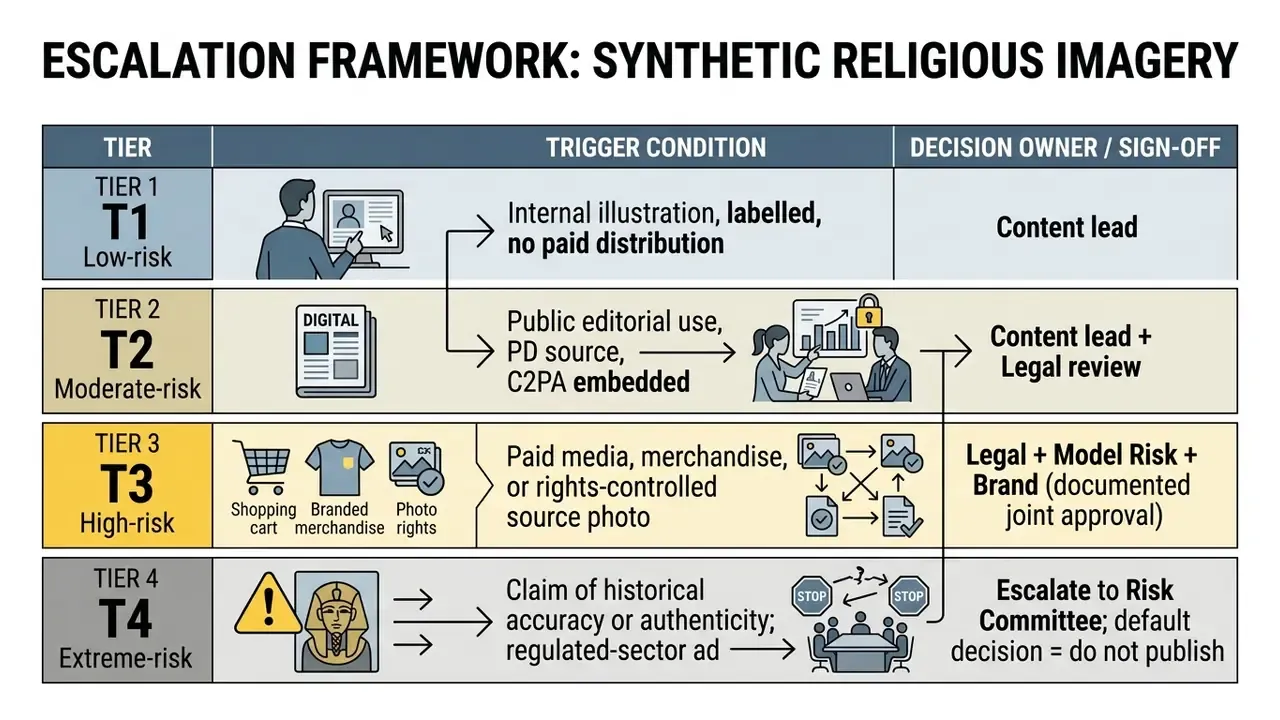
Triggers worth hard-coding into the workflow: any caption containing "true face", "authenticated", "proven" or "real photograph"; any source image whose licence cannot be evidenced in writing; any asset aimed at a market with religious-content advertising rules; and any output that a detector flags inconsistently across runs.
Model Validation Checklist for AI Risk Officers
For institutions operating under model-risk governance expectations, a generative visual model used on historical or religious subject matter should be documented like any other model in inventory. No exceptions for "it's just marketing imagery".
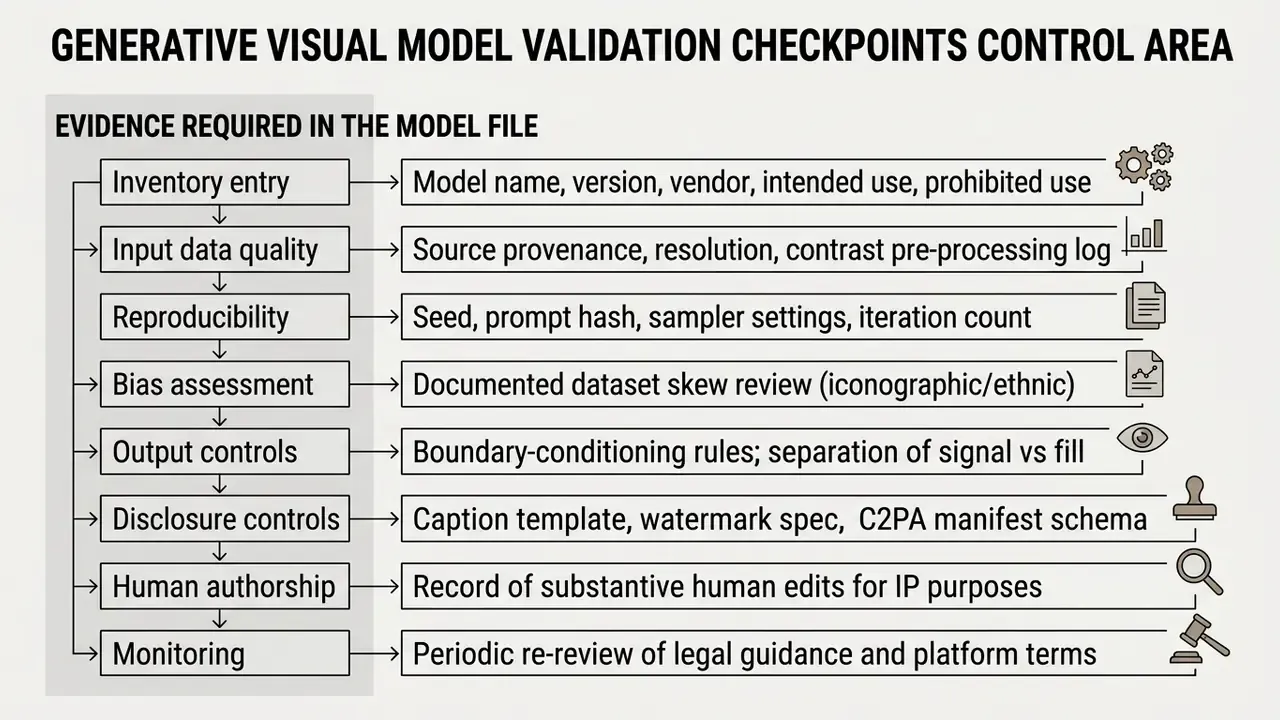
The governing principle is easy to state and hard to enforce without tooling: an unreproducible image cannot be validated, and an unvalidated image should not carry an institution's name.
A reasonable next step, deliberately modest: pick one published synthetic asset from the last quarter and try to reconstruct it from your own records. If the seed, model version and licence trail are not there, you have found the gap before an auditor does.
FAQ: Shroud of Turin AI Image
Does an AI image prove that the Turin Shroud is genuine?
No. An AI image is a digital synthesis produced by a machine-learning model. It processes visual inputs from photographs but cannot evaluate fabric age, chemical composition or physical origin.
How does an AI portrait differ from a scientific reconstruction?
A forensic reconstruction relies on physical measurements, tissue depth data and strict anatomical constraints, without inventing unobserved features. An ai image of jesus shroud of turin type portrait uses probabilistic models to generate skin texture, eye detail and expression from external training data.
Can an AI image of the Shroud be legally copyrighted?
Under current U.S. Copyright Office guidance, visual assets generated entirely by artificial intelligence without significant human creative modification are not eligible for registration. Substantive human editing can change the analysis, which is why edit logs matter.
Which AI tools produced the 2024 viral images?
The widely circulated renderings came from Midjourney v6, published by the Daily Express and the Daily Mail, and Gencraft, used by The Sun. Variants differed in eye colour, clothing and visible wounds, which by itself demonstrates the stochastic nature of the output.
Why does the AI face look like traditional paintings of Jesus?
Because training corpora are weighted toward Renaissance and Western devotional art. The model reproduces the statistical centre of that corpus, so resemblance to familiar iconography is an artefact of the dataset rather than corroboration from the cloth.
Where is the Shroud of Turin kept, and what is the Church's position?
The cloth entered the documented European record in 1354 at Lirey, France, and is kept at the Cathedral of St. John the Baptist in Turin, Italy. The Holy See has held legal ownership since 1983 but has issued no formal authenticity ruling. Benedict XVI prayed before it in 2010, Francis in 2015.
What about the pollen evidence?
Botanical analyses report Middle Eastern pollen grains embedded in the flax fibres, which researchers cite against a purely European origin. Like the WAXS result, this is supporting circumstantial data, not a dating method in itself.
Can we publish an AI Shroud image in a paid advertisement?
Only after Tier-3 clearance: a documented licence for the source photograph, generator terms permitting commercial monetisation, embedded provenance, a compliant caption, and brand-sensitivity sign-off for the target market. If the claim edges toward historical accuracy, treat it as Tier 4 and expect a "no".
Is the shroud of turin ai image usable as an internal training illustration?
Usually yes, at Tier 1, provided the label stays attached and the asset never leaves internal channels. The failure mode is drift: an internal slide gets screenshotted into a public deck, and the caption does not travel with it.
Appendix A: Superseded Formulations
Glossary and Tool Reference
Consolidated tool references, kept separate from the legal analysis above so that rights guidance stays unmixed with product commentary.
Whether you are assessing the shroud of turin ai image wave as a media story or as a control-design exercise, the reference material for licensing and permitted commercial scenarios is collected in one place: see the overview.
- Image enhancement and resolution
- specialised workflows for ai image enhancement; high-resolution options via ai image enhancer 4k; free platform tiers through ai image enhancer.
- Upscaling and outpainting
- resolution scaling with an ai image enlarger; canvas extension and background generation with AI outpainting tools.
- Generator comparisons
- best AI art generators, free AI art generators, ChatGPT image generation, Google AI Image Generator, Microsoft AI Image Generator, Bing AI image creation, Canva AI Generator and Ghibli-style generators.
- Post-processing and portraiture
- online photo editors, free photo editors and AI headshot generators.
- Platform and category overviews
- compare options across model suites, or browse the terminology in the glossary.