For a US financial-services reader, the question is rarely "can it write a caption?" It is: who owns the output, where does the data go, and what evidence exists if a regulator asks how a published sentence came to be.
Last verified: August 26, 2026.
Executive Summary
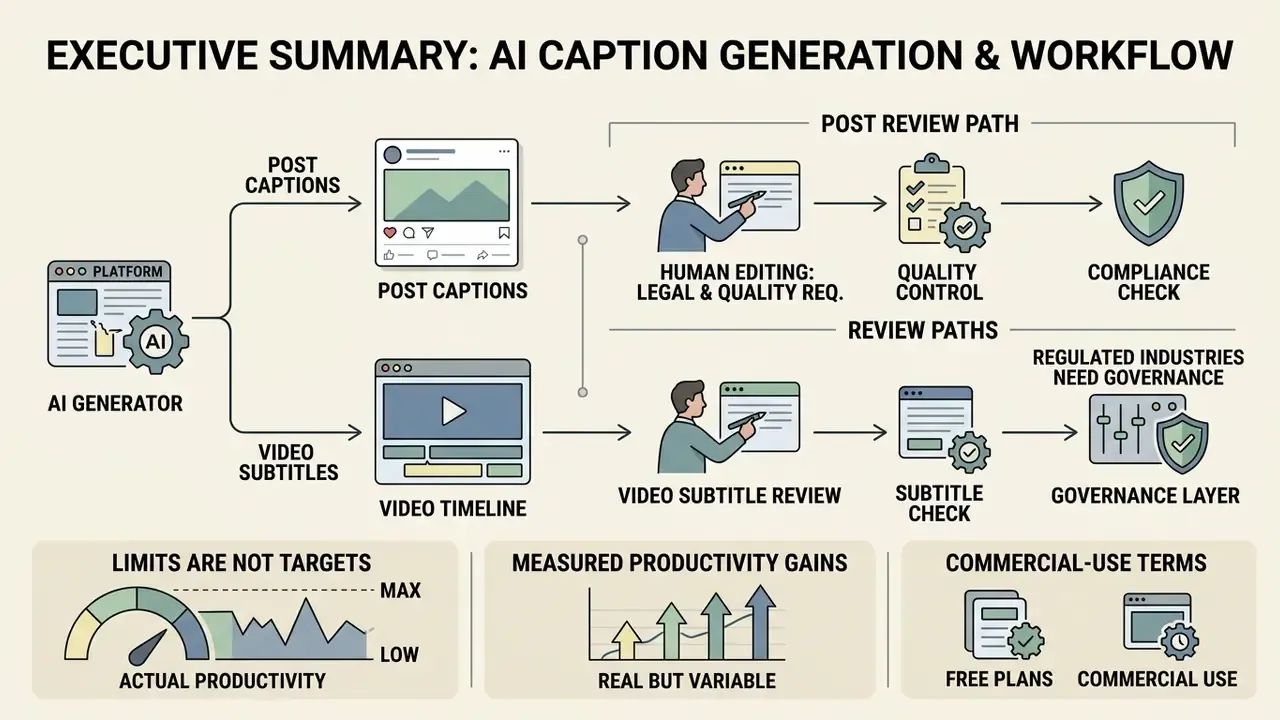
- Two different outputs, two different review paths. Post captions are marketing metadata optimized for search and engagement; video subtitles are time-synchronized accessibility assets that must satisfy W3C, WCAG and Section 508 expectations. One tool can produce both, but they need separate quality gates.
- Limits are not targets. Instagram allows 2,200 characters, yet engagement research and platform practice point to a 138–150 character sweet spot. LinkedIn allows 3,000 characters, while concise 15–25 word updates typically outperform walls of text.
- Measured productivity gains are real but variable. Documented figures range from 17 minutes saved per published caption to a 30–40% cut in total production time, alongside measurable drops in cognitive load (NASA-TLX 2.93 to 2.16 in one controlled study).
- Human editing is a legal and quality requirement, not a nicety. Under United States Copyright Office guidance (2025), purely machine-generated text is generally not copyrightable. Automated captions also fail accessibility requirements unless verified accurate.
- Regulated industries need a governance layer. Before deployment in banking, insurance or healthcare communications, confirm zero data retention, SSO/IAM integration, audit trails, Word Error Rate (WER) benchmarks, and inclusion of the underlying speech-to-text and language models in the organization's model inventory.
How to Read This Guide by Role
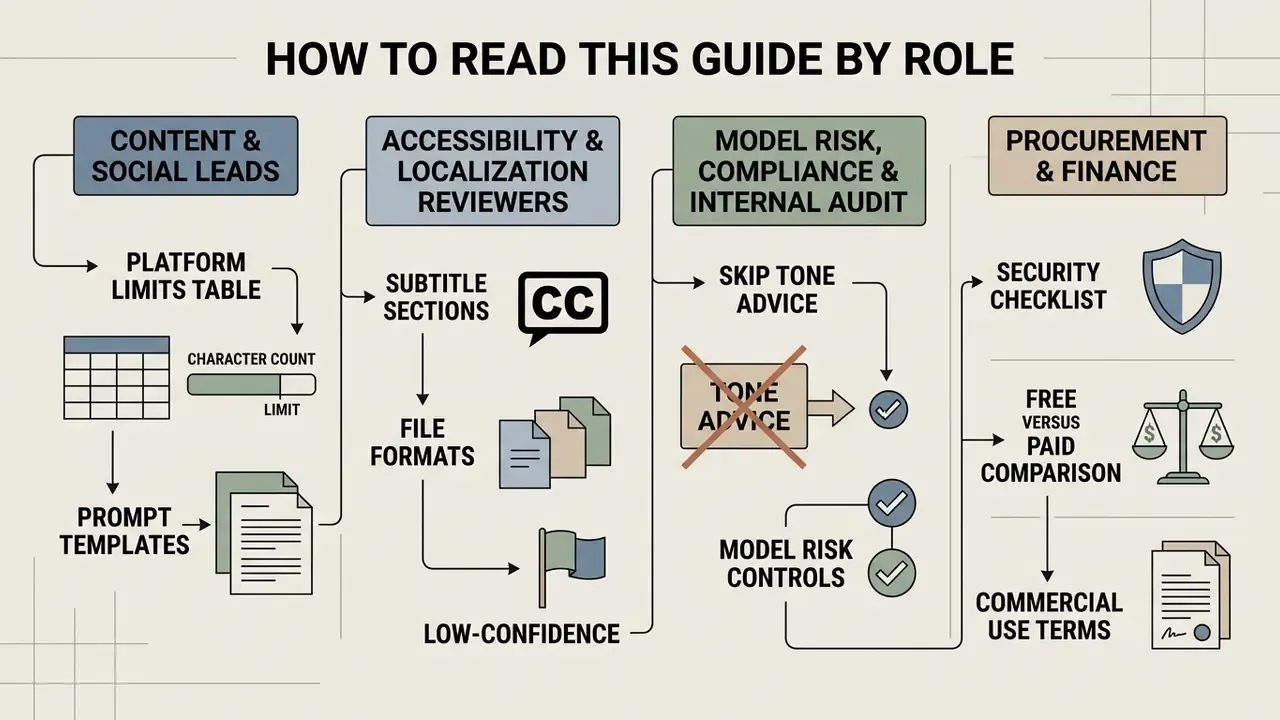
Different readers need different parts of this page, so here is the shortest path for each.
Content and social leads should start with the platform limits table and the prompt templates. Those two blocks change output quality within an hour of reading.
Accessibility and localization reviewers should focus on the subtitle sections: file formats, low-confidence word flagging, characters per line, and the 99% accuracy expectation used in institutional captioning guidance.
Model risk, compliance and internal audit readers can skip the tone advice. The governance, model-inventory and audit-evidence sections carry the material that matters for a validation file.
Procurement and finance should go straight to the security checklist, the free-versus-paid comparison, and the risk-adjusted ROI formula. One caution: the ROI formula only works if you keep the review-cost term in it.
What an AI Caption Generator Does
An ai caption generator processes multimedia inputs to generate timed on-screen subtitles or post metadata designed for platforms like Instagram, TikTok and LinkedIn. It converts spoken dialogue into text via automatic speech recognition, or turns unstructured image descriptions into targeted promotional copy using large language models. Search demand for the category arrives in many spellings, including "ai caption genrator" and "ai caption creater", which is a decent signal of how fast the tooling went mainstream.
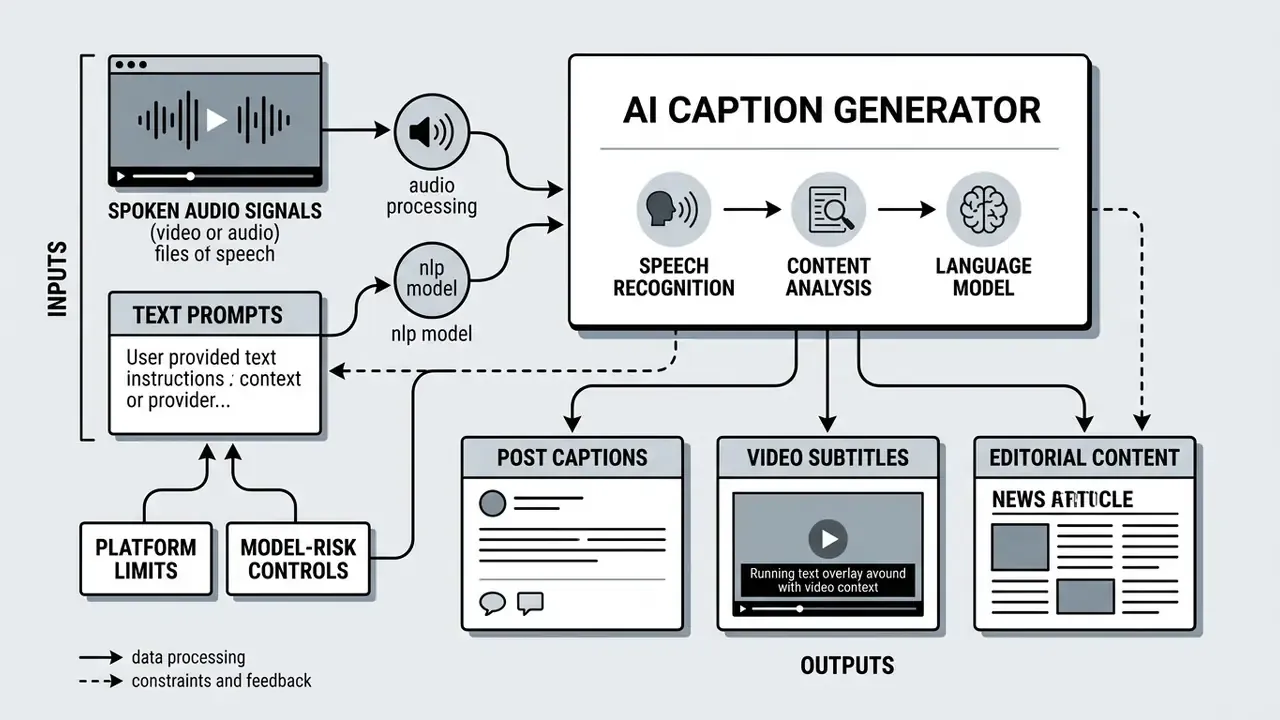
Modern tools process both structured prompts and visual context. It is the same pipeline logic that powers image-to-video AI tools, where a static asset plus a text instruction becomes a timed output. An ai text caption generator analyzes user parameters such as brand voice, target audience and keyword preferences, then produces contextually relevant post copy within seconds.
Before configuring any tool, it helps to know what each destination channel actually expects, so the platform limits and sweet-spot table further down is the practical starting point.
Inputs That Help AI Generate Better Captions
A caption generator ai delivers higher accuracy and stylistic alignment when supplied with detailed contextual prompts, target platform specifications, preferred brand voice and specific target keywords. Explicit constraints prevent generic outputs and cut human editing time.
Key conditioning parameters include:
- Target social network adjusts character limits, hashtag formatting and structural expectations (LinkedIn behaves nothing like TikTok).
- Core description establishes the factual context or main message of the visual asset.
- Keyword sets guide search optimization and ensure domain-specific terminology appears.
- Tone of voice sets the stylistic boundary, from formal enterprise register to humorous consumer copy.
- Language parameters control output translation and localized character sets.
Controlled-generation research describes a concrete pipeline rather than an abstract claim about "precision."
"A system that accepts a brand image, brand personality and attributes such as hashtags, URLs and mentions generates captions that are relevant both to the image and to the brand's style."
In practical terms, the highest-value input is not a longer prompt but a structured one: visual subject, plus brand personality descriptor, plus attribute set (hashtags, mentions, links), plus platform constraint. Systems conditioned on all four need fewer editorial passes than systems handed a bare topic. Public style guidance points the same way: IPTC-aligned metadata practice and U.S. Department of Defense caption style guidance both recommend structuring descriptive inputs around the five Ws (who, what, when, where, why) and selecting several keywords from those elements.
Why Use an AI Caption Generator for Social Media
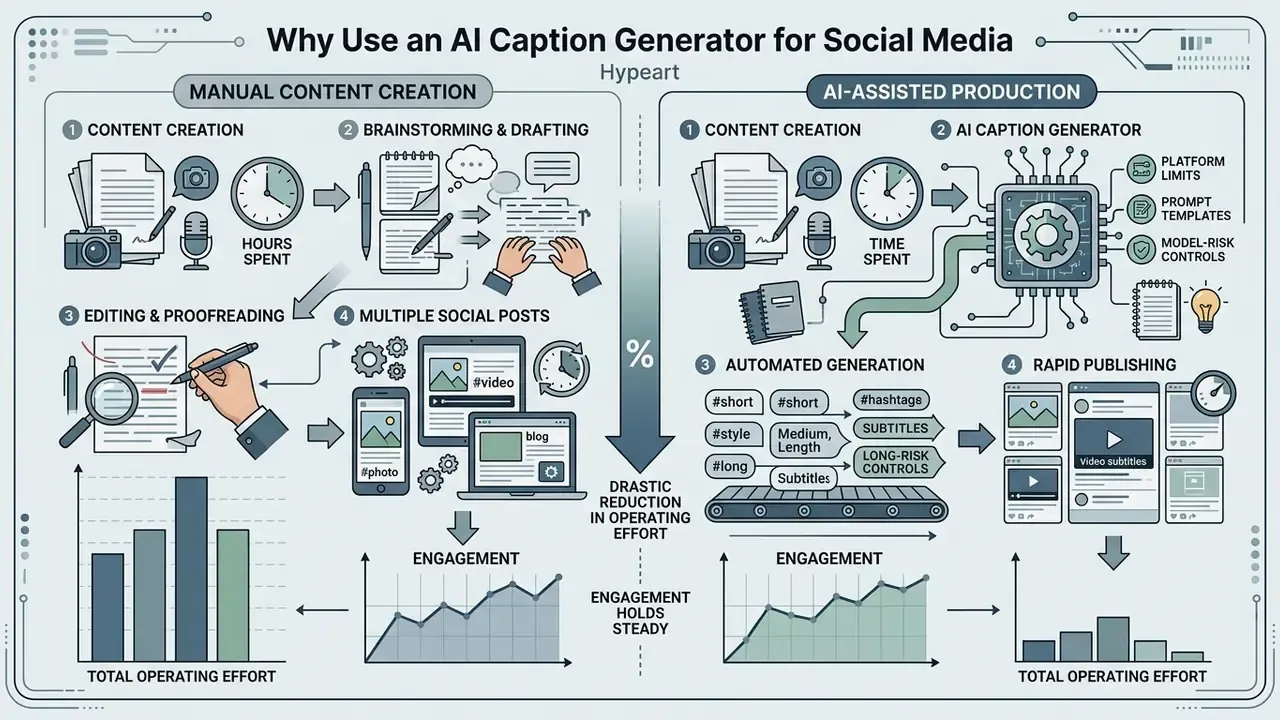
Using an ai caption generator for social media accelerates content production cycles and enables cross-platform customization without expanding editorial headcount. Enterprise marketing teams run these systems to publish consistent messaging across multiple digital channels, often pairing text output with AI video generators so copy and creative are produced in the same cycle.
Save Time on Caption Creation
An ai post caption generator compresses copy drafting from minutes to seconds per post, which lets content teams hold a high posting cadence without creative fatigue. Initial drafting is the primary bottleneck in most digital publishing workflows. Blank page, blinking cursor, deadline.
Reported time savings vary by measurement method, so treat the following as a range rather than a single benchmark.
"AI caption generation reduced content production time by roughly 30–40% and improved likes, shares and comments by roughly 25%."
Additional practitioner measurements found in vendor and operator reporting include 17 minutes saved per published caption (about 8.5 hours per month at one post per day), a 38% reduction in drafting time when the generator provides a starting point rather than a blank page, and 40–60 minutes saved per day on content creation. These come from vendor-side measurement and are not independently replicated. The underlying methodologies also differ (percentage reduction, minutes per caption, minutes per day), so they are not directly comparable.
Cognitive load reduction has, oddly enough, been measured more rigorously than raw time savings.
Match Captions to Content, Brand and Audience
An ai caption generator social media engine tailors copywriting tone and structural layout to specific brand personalities and audience demographics. That adjustment keeps posts contextually appropriate across platforms with very different norms.
A 2025 study on consumer engagement published in SAGE Journals found that aligning text captions with visual brand personality drives consumer interactions directly. Brand guides for automated tools specify behavioral principles, terminology guardrails and prohibited vocabulary.
"AI-written captions on lifestyle content improved perception and increased engagement, measured in likes, even when AI-generated images themselves were rated below human-made visuals."
Enterprise-grade tools integrate with social listening engines and past publishing histories, tuning output against a brand's historical high performers and live industry conversation. In practice that is three layers of conditioning: a static brand voice document (principles, banned and preferred vocabulary, annotated examples), a dynamic corpus of the account's own best posts, and a live trend signal drawn from listening data. Tools that expose all three survive editorial review with fewer rewrites than tools conditioned on a prompt alone.
Academic work on caption length points in a less intuitive direction. The 2024 university study Captivate Your Audience: Suggestions for Enhancing Social Media Engagement Through Captions reported an inverted U-shaped relationship between caption length and engagement, with an optimum near 600 characters in Instagram and Facebook datasets. A separate 2022 analysis found higher engagement for text that reads easily, runs longer than 31 words or 321 characters, and carries more hashtags. So the honest reading is that the relationship is non-linear rather than "short always wins". That optimum is dataset-specific, though, and should be re-tested against your own account analytics before anyone writes it into a house style.
How to Use an AI Caption Generator
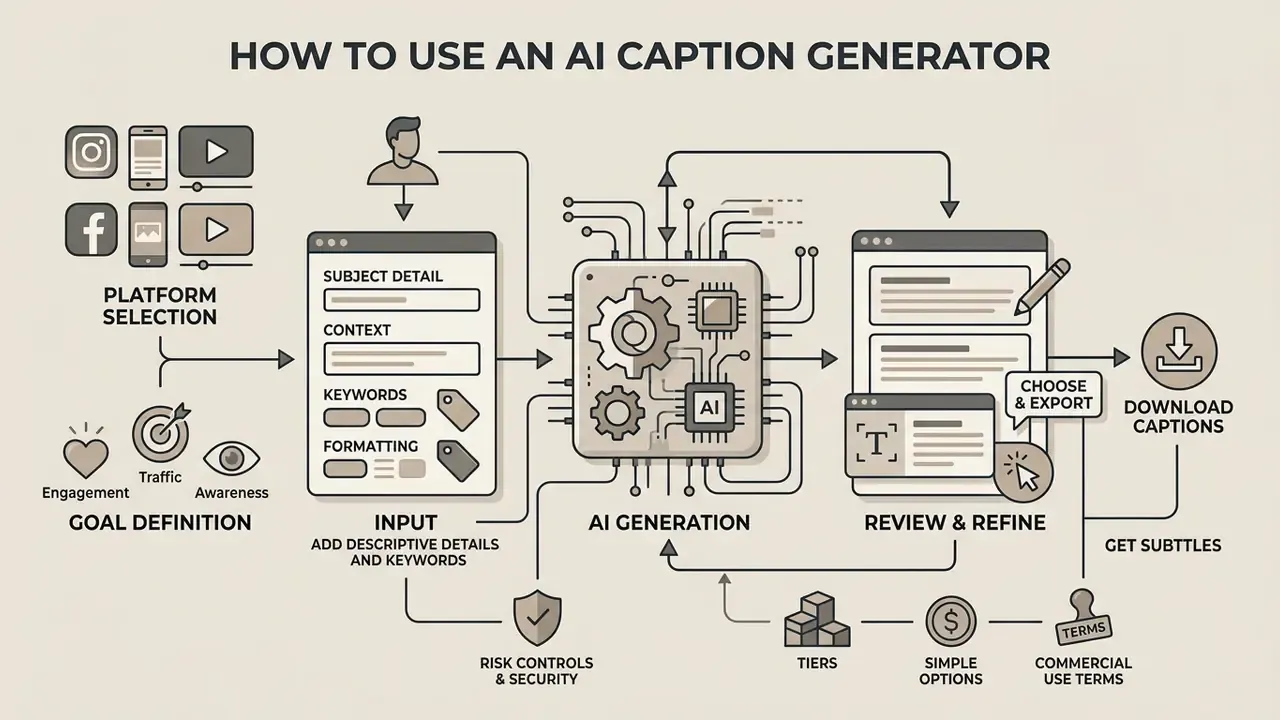
Operating an ai caption generator tool involves selecting the destination platform, entering factual source context, choosing stylistic constraints, running generation, and performing final human editorial checks.
Process flow: five-step AI caption generation workflow
- Select social network and goal.Define the destination platform (LinkedIn, Instagram, TikTok) and the objective: engagement, conversion or awareness.
- Select style and language.Choose tone of voice (professional, playful, concise) and output language.
- Input description and keywords.Provide factual context, target keywords and core visual details.
- Generate captions.Run the ai caption creator algorithm to produce multiple candidate options.
- Edit and export.Review candidates for factual accuracy, refine phrasing, then copy or download the final text.
Add a Description and Keywords
A clear, factual description plus a targeted keyword set prevents hallucinated details and keeps generated text tied to the actual visual.
IPTC's Photo Metadata field guide defines the caption/description field as text reporting who, what and why, and treats keywords as free text separated by delimiters, warning against overly long single values. Complementary institutional guidance is more prescriptive. The World Bank image schema defines description as covering who, what and why, while keywords capture salient aspects, optionally from a controlled vocabulary. LSE metadata guidance instructs users to place the most relevant keywords first, separated by commas only. Shutterstock's contributor rules require factual descriptions covering the five Ws with between 7 and 50 relevant, non-repetitive keywords.
When feeding an ai text caption generator, structure the input logically:
- Primary subjectstate the main subject or visual focal point clearly.
- Core contextadd essential campaign or event details.
- Target keywordslist 3 to 10 relevant keywords separated by commas, primary search terms first.
- Formatting constraintsspecify line breaks, emoji usage and tag placement.
Generate, Edit and Download Captions
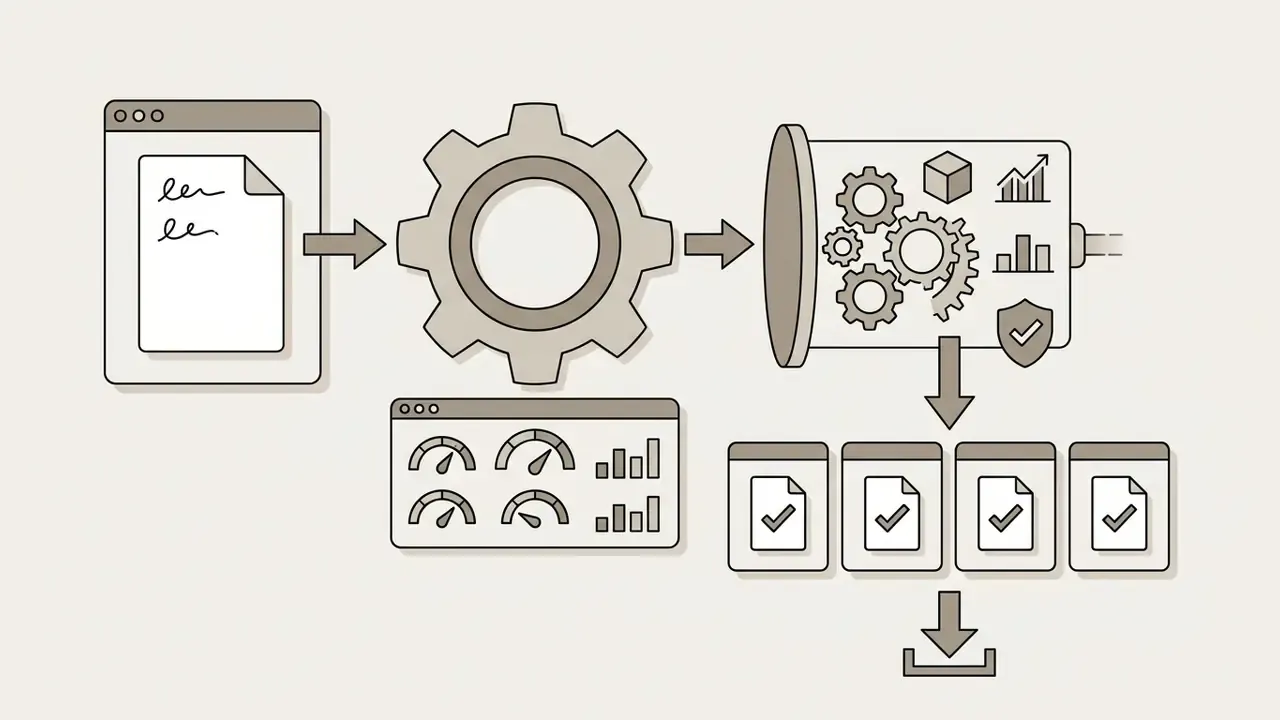
Running a caption ai generator yields multiple text variations, so editors can compare hook options and copy lengths before publication. Human oversight stays mandatory in this phase, and in most teams the step lives inside the same session as the video editor workflows used to finish the accompanying creative.
Standard post-processing workflow:

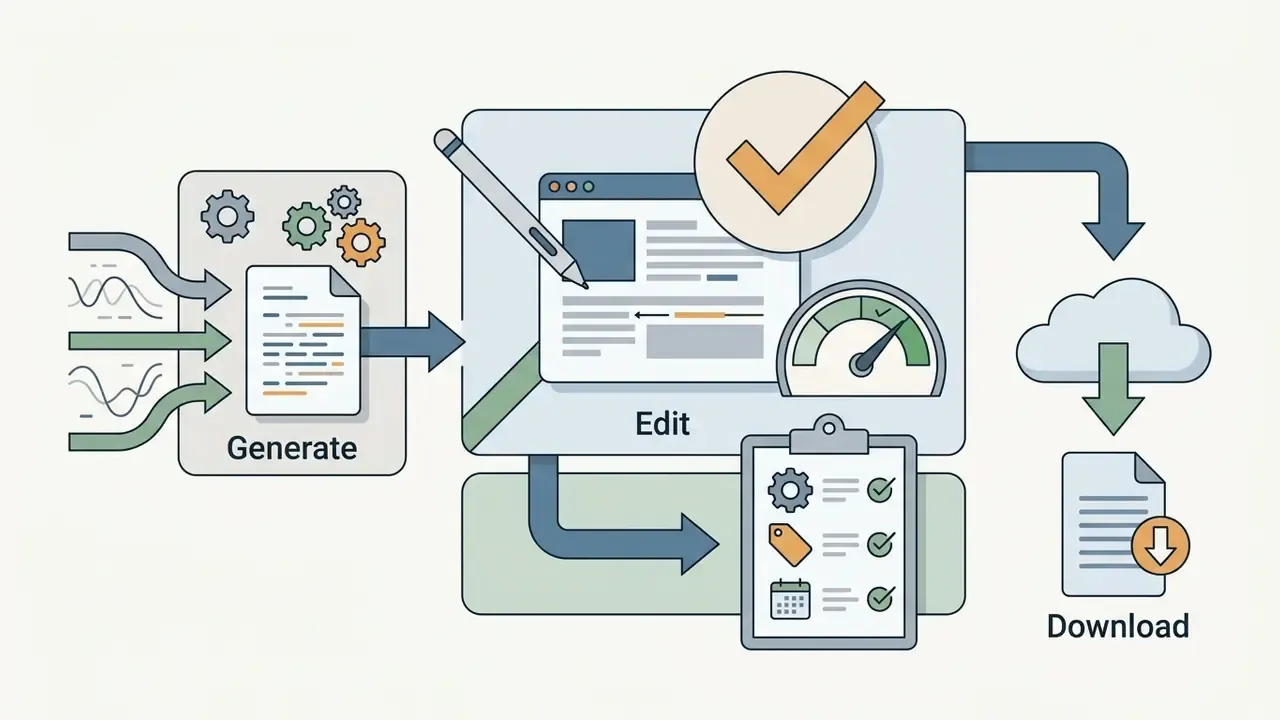
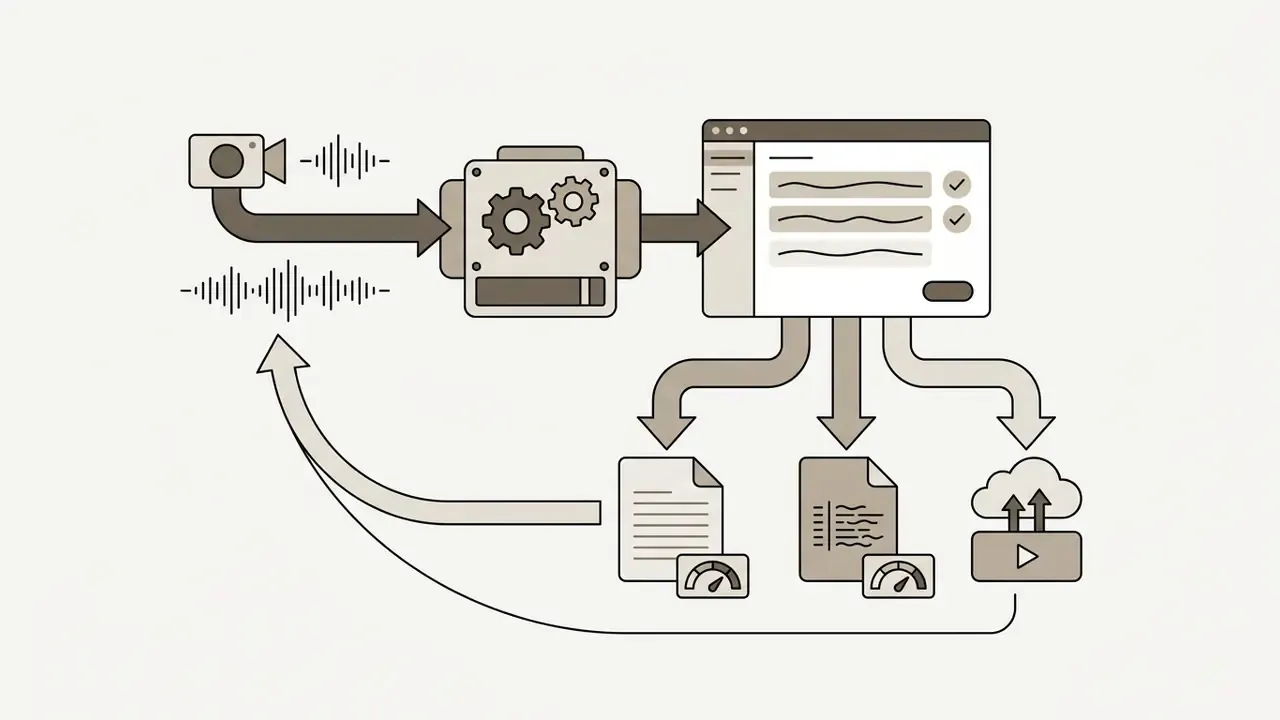
.SRT, .VTT, or plain .TXT for description transcripts) for video upload.The 4-Point Fact Rule is the single highest-leverage editing habit available, because generic phrasing is the dominant failure mode of automated copy. "Elevate your workflow with smarter tools" passes no point. "Cut render time 42% on 4K exports, Berlin studio pilot, full breakdown in comments" passes three.
Tools evaluated in our comparison hub, which you can browse the hub to review, illustrate how post-generation editing features shape enterprise adoption.
Ready-to-Use AI Prompt Templates
To get immediate results from an ai text caption generator, copy and adjust these frameworks. Each one encodes a platform constraint, a fact anchor and an explicit CTA, so raw output needs less rewriting.
- Hook-first social post
"Write a 150-character Instagram caption for [PRODUCT/TOPIC]. Start with an engaging hook question, include 2 high-volume keywords ([KEYWORD1], [KEYWORD2]), and end with a direct CTA asking followers to comment." - B2B LinkedIn insight
"Transform this technical update: [INSERT RAW TEXT] into a 3-paragraph LinkedIn post. Use a strong thesis statement in line 1, 3 bullet points with stats, and ask a professional commentary question." - Content repurposer (rewrite)
"Rewrite this existing post caption for TikTok: [INSERT OLD CAPTION]. Keep it under 100 characters, adjust tone to energetic, and highlight the main benefit in the first 3 words." - Feature-to-benefit pros/cons
"Summarize the key updates of [FEATURE/PRODUCT] into a bulleted Pros and Cons list optimized for a Facebook community post." - Extend/expand unblocker
"Continue this half-finished caption in the same voice: [INSERT FRAGMENT]. Add one concrete metric, one audience-specific detail, and stop at 220 characters." - Compliance-safe variant
"Rewrite this caption for a regulated financial audience: [INSERT CAPTION]. Remove all performance promises and superlatives, keep factual product naming, and append this required disclosure verbatim: [INSERT DISCLOSURE]."
Commercial tools ship these as named presets ("Extend/Expand", "Improve", "Summarize", "Pros and cons list", "Rewrite", "Inspirational quotes"), but the underlying prompt structure is portable to any model. That portability matters when an organization standardizes on an approved internal endpoint instead of a public consumer app.
AI Captions for Instagram, TikTok, YouTube and Other Platforms
Platforms maintain distinct character constraints, truncation thresholds and engagement behaviors, and those dictate optimization rules. Maximum limits describe what the field accepts. The sweet spot column describes what audiences actually read.
| Social Network | Max Character Limit | Ideal Sweet Spot | Typical Truncation Point | Primary Caption Format | Key Optimization Focus |
|---|---|---|---|---|---|
| 2,200 characters | 138–150 characters | ~125 characters | Narrative copy and hashtags | First-line visual hook, readable line spacing | |
| TikTok | 2,200 characters | Under 150 characters (hook in first 50) | ~50–100 characters | Concise text and timed overlay | First 2-second hook, keyword discoverability |
| YouTube | 5,000 (description) | 1–2 keywords in first 2 sentences; 300–500 word body | ~150 characters | Subtitles (.SRT/.VTT/.TXT) and description | Primary keyword density, UTF-8 subtitle sync |
| 3,000 characters | 15–25 words (concise professional insight) | ~140–210 characters | Professional insight post | Clear paragraph structure, single key takeaway | |
| 63,206 characters (≈33,000 practical) | Organic: short text; paid ads: 5–19 words | ~477 characters | Community or brand update | Conversational tone, direct discussion prompt | |
| 500 characters (description) / 100 (title) | Title: 40 characters; description: 50 characters | Feed shows title and first line only | Searchable Pin description | Search keywords front-loaded, no hashtag stuffing | |
| X (Twitter) | 280 characters (standard) / 25,000 (Premium) | 71–100 characters | 280-character card | Short declarative post | Single claim per post, link placement |
Note: the "sweet spot" column reflects platform recommendations and engagement analyses, not hard technical limits. Validate against your own account analytics before locking in a house style.
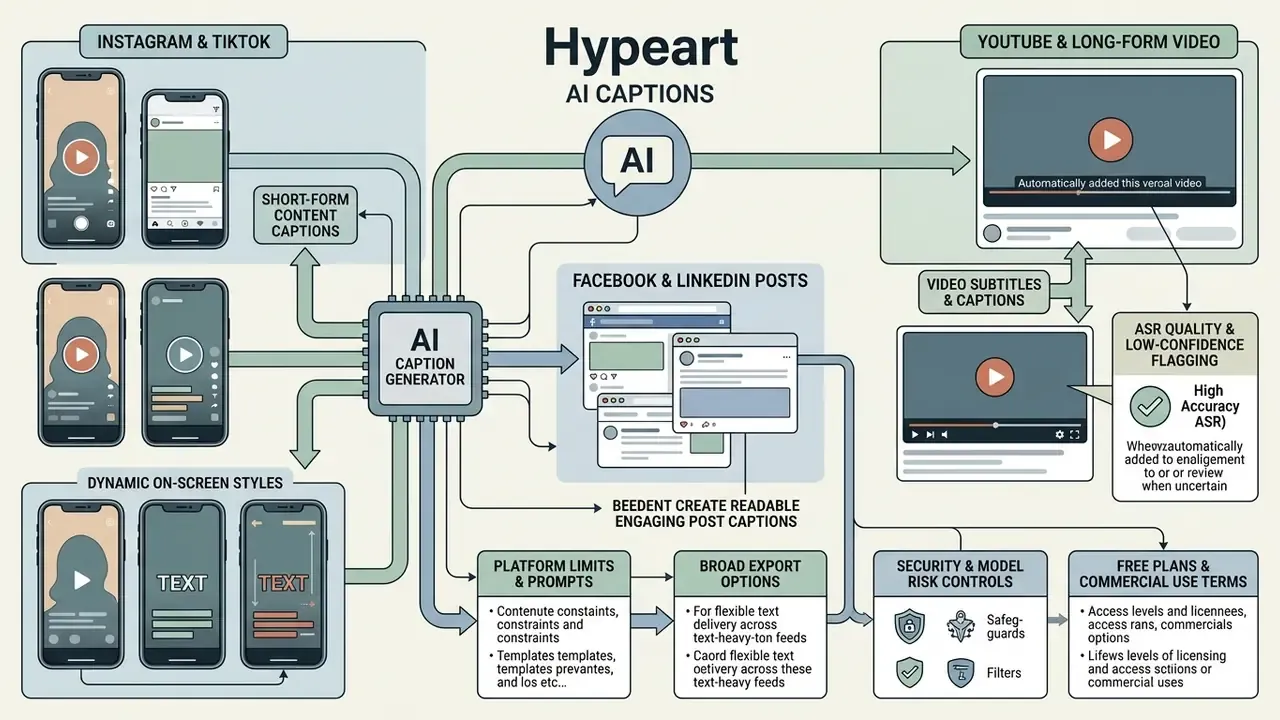
Instagram and TikTok Captions for Short-Form Content
Captions for short-form video on Instagram and TikTok must land a hook within the first one or two lines, before feed truncation hides the rest behind a "more" prompt.
The CHI 2024 TikTok caption study reported that user-generated captions on the platform commonly appear for roughly 40 frames up to a maximum of about 6 seconds. Meaning: the opening words carry the entire message. Practitioner guidance aligns with that constraint, keeping on-screen text overlays to 5–10 words and fitting caption openers into the first one to two lines before truncation.
When running a caption maker ai for short-form media, short concise openings beat long introductory statements. Combining on-screen subtitles generated through tools like pika ai video with concise post text keeps sound-off viewers engaged. Short-form creators increasingly pair this with text-to-video AI tools, generating visual and caption from the same brief so hook and footage stay aligned.
YouTube Captions and Subtitles for Videos
YouTube workflows prioritize speech-to-text accuracy, subtitle file formatting and search-driven descriptions with targeted keywords. Official YouTube creator documentation specifies that descriptions should feature 1 to 2 core keywords within the first two sentences, and that each description should be unique. Creators publishing at volume typically standardize this inside broader YouTube video editing workflows so description, chapters and subtitle upload happen as one publishing action.
For on-screen subtitles, YouTube supports plain UTF-8 encoded files such as .SRT and .SBV. Basic versions ignore styling markup; transcripts should use blank lines to separate caption blocks, brackets for sounds, and >> for speaker changes. Automated subtitles from an ai captions generator must be checked for synchronization and technical terminology before final export, because automatic speech recognition mangles domain jargon with impressive confidence.
Facebook and LinkedIn Captions for Posts
LinkedIn and Facebook reward structured, readable formats that communicate professional value or spark community discussion, no short-video gimmicks required. Official LinkedIn creator guidance recommends concise paragraphs, a conversational tone and one clear takeaway per post, with authenticity, consistent cadence and genuine participation in comments treated as ranking-relevant behaviors in 2025–2026 guidance. Facebook business guidance is older and less prescriptive, mostly emphasizing professional tone and a brand voice that stays consistent across channels.
Professional B2B posts produced by an ai post caption generator benefit from clear formatting: open with a bold thesis, expand with bulleted supporting facts, close with a direct question to prompt comments. Teams evaluating enterprise video assets alongside text strategy can also review our guide to pika labs ai video tools.
Choose Caption Style, Language and Length
Configuring style, language and character length inside an ai caption generator keeps generated content aligned with brand guidelines and regional audience requirements.
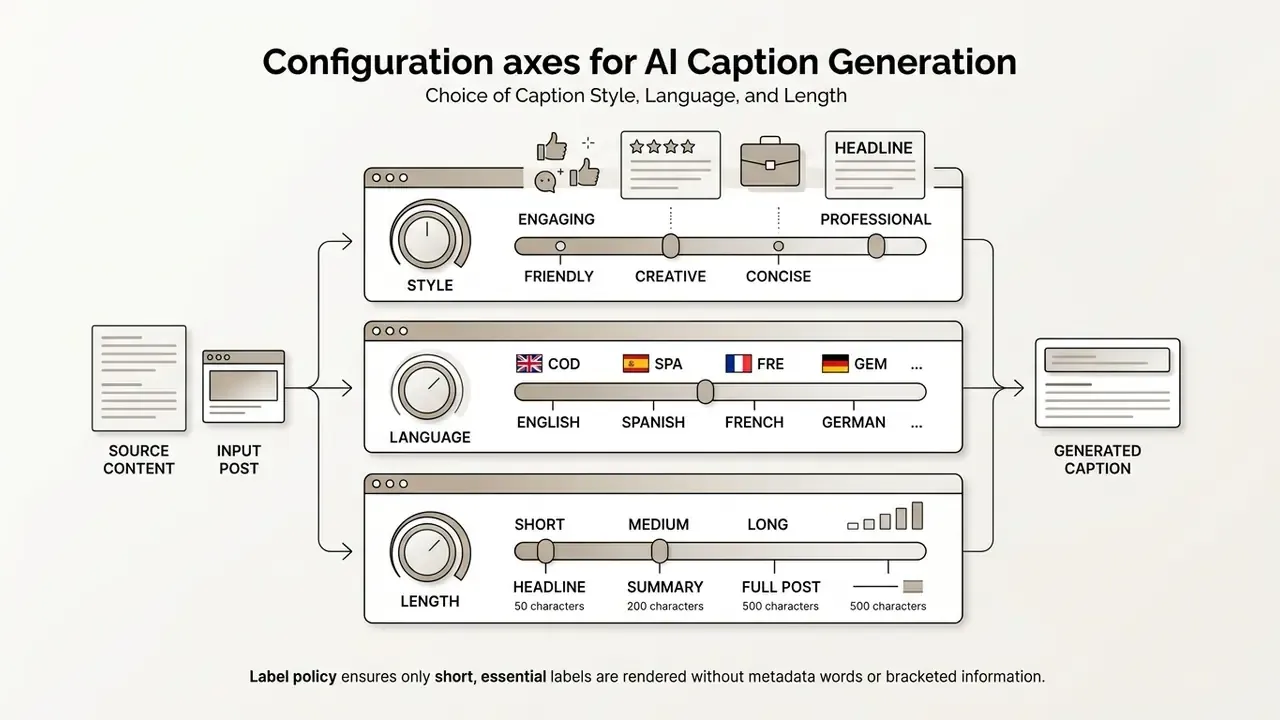
Funny, Professional and Brand-Friendly Caption Styles
The chosen copy style shapes how audiences read brand authenticity and credibility. An ai funny caption generator leans on wordplay, light sarcasm and pop culture references, which suits consumer lifestyle brands. Professional settings want direct, evidence-based phrasing instead.
"In a cartoon-captioning experiment, audiences preferred AI-generated options in 64.9% of 462 pairwise decisions, citing humor and fit with the visual narrative."
Tone mapping across common business categories:




Tone is a per-touchpoint decision, not a per-brand one. The same organization may correctly use playful copy on a community post and strictly factual copy in a paid advertorial. Regulated brands should hard-restrict the playful register in any post touching products, pricing or performance. No exceptions worth defending.
When publishing visual assets across platforms like Pinterest, social managers can cross-reference media asset workflows using a pinterest video downloader online guide to streamline cross-posting.
Caption Length and Language for Each Platform
Caption length drives reader retention, while multi-language selection widens accessibility across markets. Modern ai caption generator tools let users toggle output between short (one or two sentences), medium (paragraph) and long-form narrative copy.
Enterprise Governance, Security and Shadow AI
Caption generation looks like a low-risk marketing task until unreleased product names, embargoed financial figures or customer identifiers get pasted into a public consumer tool. In regulated organizations, that is the dominant risk vector, not output quality.
Shadow AI is the primary exposure. Unsanctioned use of public caption generators by marketing, HR or branch staff moves non-public information outside the control perimeter, often into services whose consumer terms permit training on submitted content. The mitigation is not prohibition, which pushes usage further underground, but provisioning an approved endpoint with equivalent convenience.
Minimum security controls to require from a vendor:
Procurement checklist: AI caption generator security review
Checklist0 / 10
Teams verifying whether third-party or agency-supplied assets are machine-generated before publication often pair this checklist with AI image detectors and AI reverse-image-search tooling as part of the same intake control.
Compliance, Model Risk Management and Audit Readiness
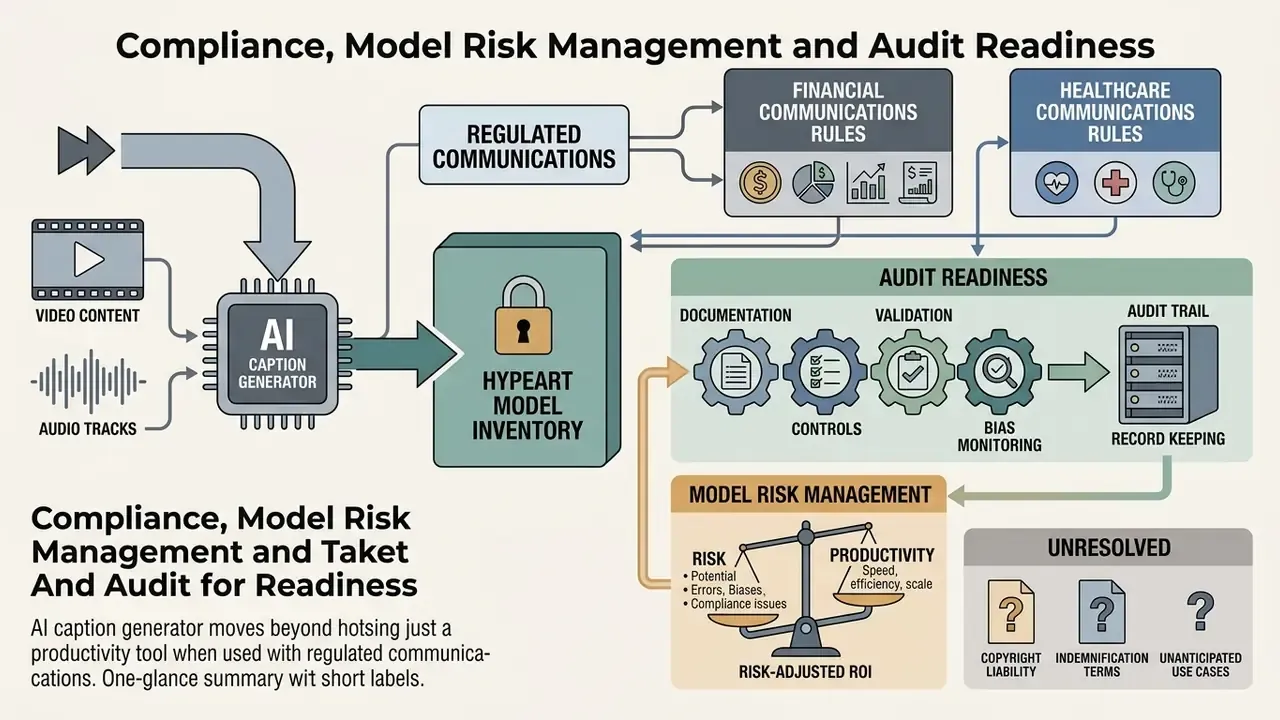
Where captions and subtitles accompany regulated communications, the generator stops being a productivity tool and becomes a model in the organization's inventory.
Bring the models into scope. Two distinct models are usually involved: a speech-to-text (ASR) model for subtitles and a language model for post copy. Established model risk management supervisory guidance, the framework articulated in OCC Bulletin 2011-12 and the Federal Reserve's SR 11-7, expects identification, documentation, validation and ongoing monitoring of models used in decision-relevant processes. The NIST AI Risk Management Framework explicitly lists text generation and editing among AI use cases requiring governance. Practically, register both models with owner, purpose, version, vendor and a defined validation cadence.
Define measurable quality metrics. Marketing "engagement" is not a control metric. Usable ones include:
| Control area | Metric | Practical threshold |
|---|---|---|
| Subtitle accuracy | Word Error Rate (WER) on a held-out sample | ≤1% for accessibility deliverables (the ≈99% accuracy target used in institutional captioning guidance) |
| Terminology fidelity | Domain-term error rate on a curated glossary | Zero tolerance for product, rate and entity names |
| Timing conformance | Lines per screen, characters per line, minimum display duration | ≤2 lines, 32–45 chars/line, ≥1–2 seconds |
| Text safety | Toxicity and brand-safety screening rate | 100% of outputs screened pre-publication |
| Factual grounding | Hallucination rate against source brief | Sampled review; every unsupported claim logged |
| Reproducibility | Prompt, model version and parameters retained | Retrievable for every published asset |
Free AI Caption Generator, Plans and Commercial Use
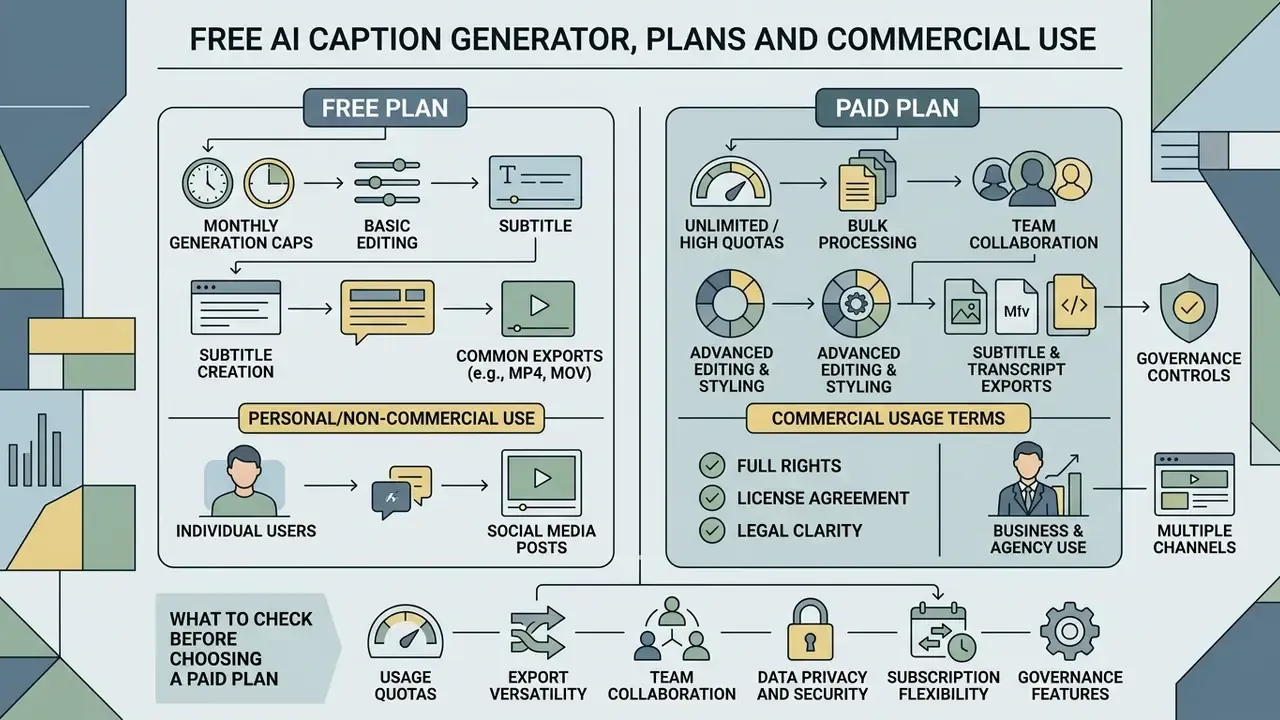
Comparing free and paid plans means analyzing monthly generation caps, subtitle export capabilities, advanced editing features, governance controls and legal commercial usage rights. When assessing vendors or architectures like those covered in our AI Media API Guides, set explicit criteria for text fidelity, latency and data-handling terms at this stage of the decision, not after contract signature.
| Feature / Capability | Typical Free Plan | Typical Paid Tier (Pro / Enterprise) |
|---|---|---|
| Generation volume | 5 to 50 queries per month | 500+ queries to unlimited |
| Export formats | Plain text copy only | Plain text, SRT, VTT, TXT, hardcoded MP4 |
| Watermark constraints | Optional watermark on video exports | No watermarks on exports |
| Language support | Basic languages (5–10) | 100+ languages and regional accents |
| Brand tone controls | Standard presets | Custom brand voice guidelines and historical-post tuning |
| Subtitle QA features | Manual text editing only | Low-confidence word flagging, karaoke/box animation presets, speaker labels |
| Audit trail | None | Exportable prompt and output logs with model version |
| Security assurance | Consumer terms, retention often permitted | SOC 2 Type II, zero data retention, tenant isolation, SSO/SCIM |
| Commercial rights | Personal or non-commercial only (varies by vendor) | Full commercial licensing rights |
What a Free Caption Generator Can Include
An ai caption generator free tier normally grants baseline access to the core caption writing algorithms, standard tone presets and a limited monthly quota. Most ai free caption generator services run a freemium model, and searches for a caption ai generator free option usually land on exactly these tiers.
Comparable published limits show the spread. One subtitle tool's free trial allows 1 video export per month at 10 minutes per video with 5 overlay captions and 5 font styles. Another grants 30 free minutes monthly with a 30-minute file cap and one translation per file. Several caption editors ship a fixed lifetime credit allowance, for example 60 to 200 credits, before upgrade prompts appear. Watermark policy is inconsistent by vendor rather than standardized: some free plans export clean video, others burn in a mark.
Entry-level web tools let users generate post copy or short video subtitles without upfront payment, but cap monthly usage (50 generations per month is common) or add watermarks to exported video. The Canva AI Generator overview covers how design-suite quotas and export permissions interact. Basic interfaces permit simple text corrections before copying out the result. To estimate subscription costs for team deployments, managers can view the guide on cost estimation tools, and teams testing adjacent free tooling can compare options in the free AI video generator roundup.
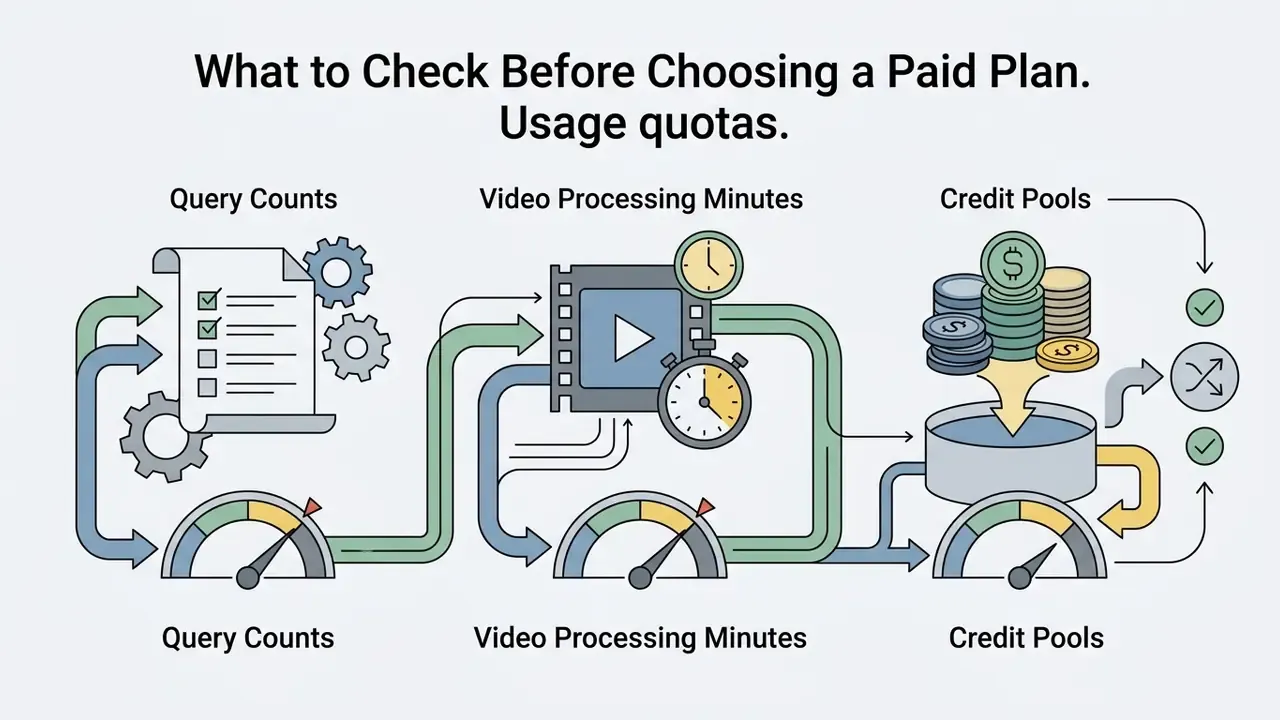
What to Check Before Choosing a Paid Plan
Before upgrading, enterprise buyers and creator teams should audit operational limits, security protocols and seat license terms systematically. Skipping step 5 below is the most common regret we hear about.
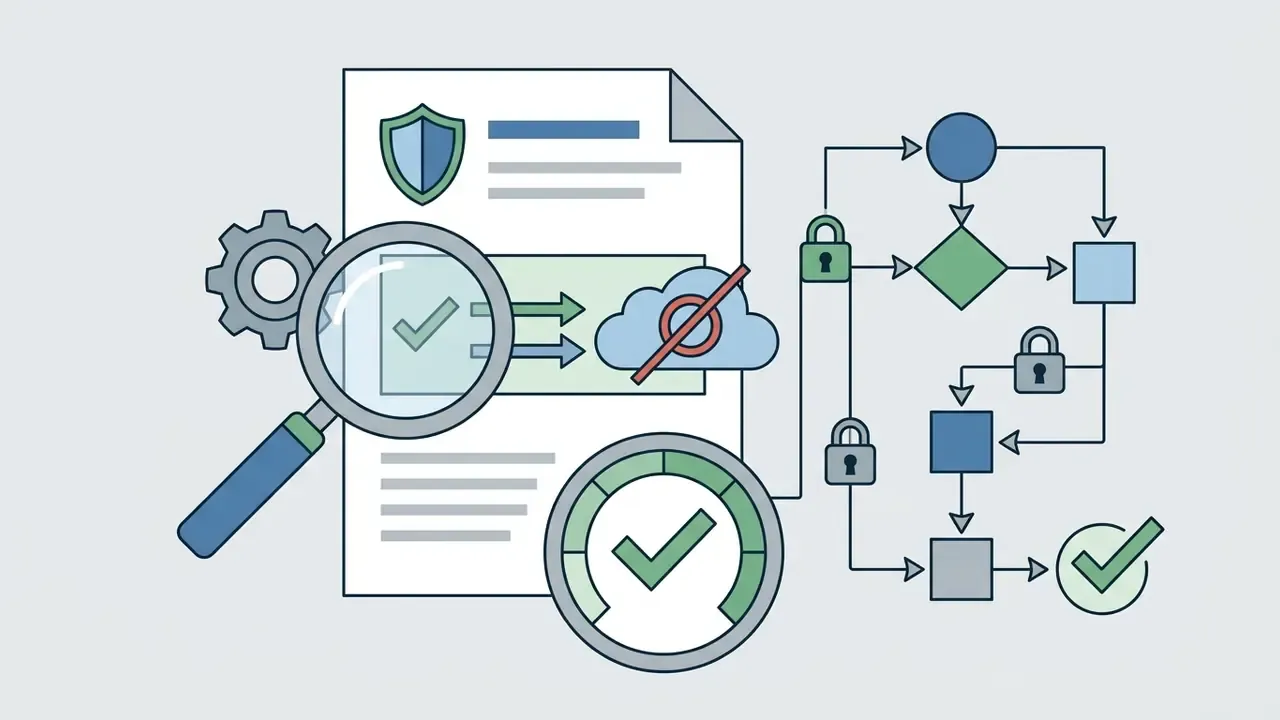
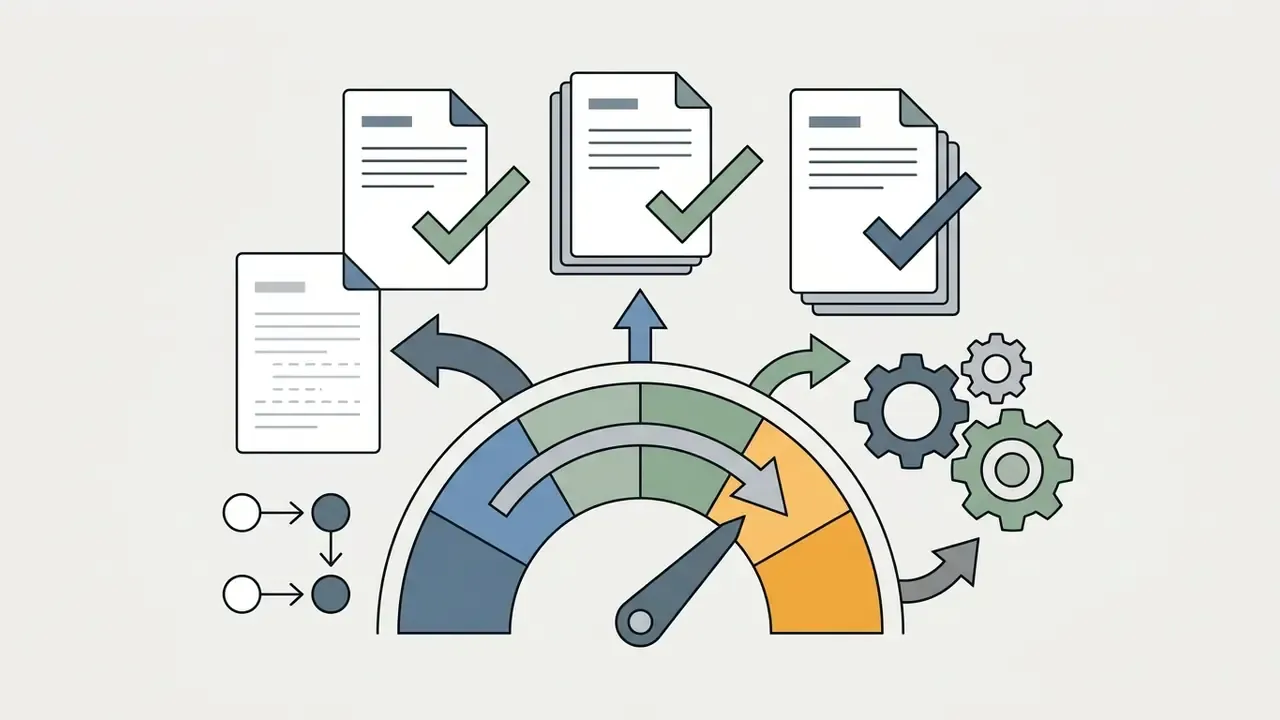
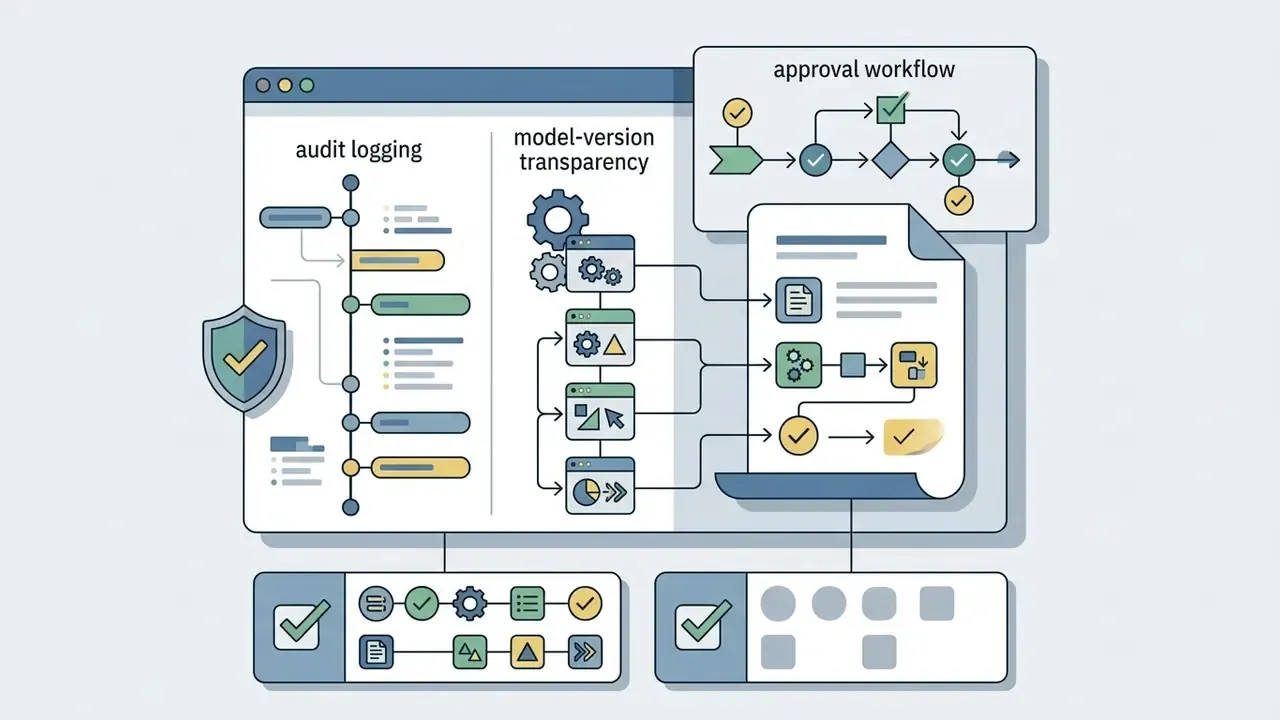
Key evaluation criteria:
For a detailed breakdown of operational plan structures, readers can see the overview of available tier configurations.

.SRT, .VTT, .TXT) alongside plain text.

Commercial Use of AI-Generated Captions
Commercial deployment of AI-generated captions in advertising and branded publishing requires verifying that your subscription tier grants full commercial usage rights. Under United States Copyright Office guidance (2025), purely machine-generated text lacking human creative selection or arrangement is generally not eligible for copyright protection. The Office's policy guidance states that copyright protects only the human author's contributions in mixed works, and that AI-generated portions must be identified on registration. Congressional Research Service analysis (2025) similarly notes that AI-generated material lacks human authorship where the system determines the expressive elements. In the EU, published materials treat purely AI-generated output as ineligible for copyright and potentially in the public domain, while commercial text-and-data-mining sits under Article 4 of the DSM Directive.
Disclosure carries measurable audience effects, not only legal ones.
"Labeling content as AI-generated reduced affective and behavioral engagement, particularly for emotional content; later disclosure improved reception of AI-assisted but not fully AI-created content."

AI Caption Generator FAQ
Do I Need to Sign Up to Start Creating Captions?
Many entry-level caption generator ai tools allow immediate web-based drafting without mandatory registration, although downloading subtitle files or saving project templates usually requires a free account. Web-based tools often show instant browser previews to reduce friction for new users; readers exploring adjacent no-signup tooling can compare options among free AI image generators and free photo editors. Advanced capabilities such as exporting .SRT tracks, removing watermarks or storing brand tone presets do require signup. The pattern is inconsistent across vendors: several caption tools advertise generation with no login at all, while others allow instant preview but gate the finished MP4 download behind an account.
How Many Caption Options Can AI Generate per Run?
A standard ai generator for captions typically returns between 3 and 8 unique options per run, depending on user settings and decoding configuration.
"Participants reviewed multiple AI candidates alongside quality ratings and iteratively refined the selected caption, which reduced mental workload." SciCapenter user study, 15 STEM PhD students (2023–2025) Systems use beam search and temperature sampling to vary phrasing, sentence length, hooks and emoji placement across candidates. Captioning research notes that candidate count is method-dependent rather than standardized: beam search is the default multi-caption sampling approach, and diversity can be forced by conditioning on different high-level summaries of the source. Users pick the variant that fits the campaign objective, or rerun with refined prompt parameters. Simple as that.
How Accurate Are Automatically Generated Video Subtitles?
Vendors advertise up to 99.9% accuracy, but that figure assumes clear, single-speaker audio without background noise. Real-world Word Error Rate usually lands between 2% and 10%, rising sharply with accents, crosstalk and domain jargon. Institutional accessibility guidance targets 99% accuracy with correct synchronization and non-speech sound cues, which in practice requires human review. Choose editors that flag low-confidence words so correction effort concentrates where the model is uncertain.
Can AI-Generated Captions Be Used in Regulated Financial or Healthcare Communications?
Only inside a controlled workflow. Requirements typically include a named human reviewer of record, a locked disclosure block appended outside the generated text, terminology validation against an approved glossary, retained records of prompt, model version and approver, plus screening for performance or outcome claims the model may invent. Where the caption accompanies video, the subtitle file must also satisfy accessibility conformance. Confirm the specific obligations with your compliance function.
How Do We Prove a Published Caption Is Reproducible for an Audit?
Retain four artifacts per published asset: the source brief, the exact prompt and parameters, the model and version identifier, and the diff between raw output and published text with the approver's name and timestamp. Generative models are not deterministic by default, so reproducibility in an audit context means demonstrating the provenance and control path, not regenerating byte-identical text. Enterprise tiers with exportable audit logs turn this into a configuration task rather than a manual archaeology project.
Who Owns the Rights to AI-Generated Captions and Subtitles?
Ownership sits on two layers. Contractually, your plan's terms determine whether you may use output commercially, and free tiers frequently restrict use to personal projects. Legally, copyright protection attaches to human contributions: under U.S. Copyright Office guidance (2025), purely machine-generated text is generally not protectable, while your selection, arrangement and editing can be. EU materials treat purely AI-generated output as ineligible for copyright. Document human editing if protectability matters to you.
What Is the Difference Between an AI Caption Generator and an AI Subtitle Generator?
An AI caption generator writes the text accompanying a social media post, the description shown in the feed. An AI subtitle generator produces synchronized text overlaid on video during playback, whether closed captions or subtitles. Different audiences, different standards, different file outputs. Tools increasingly bundle both, but evaluate each capability on its own merits.
Can I Reuse the Same Caption Across Multiple Platforms?
You can, though platform-specific versions consistently perform better. A 2,200-character Instagram caption with a hashtag block does not translate to LinkedIn, where hashtag use is minimal and professional framing matters, or to X, where 280 characters is the standard ceiling. Use the rewrite prompt template above to adapt one approved message per channel instead of publishing a single generic version everywhere. Organizations reviewing broader commercial application policies can view the guide on enterprise usage rules, and teams producing motion assets alongside captions can review the animation maker overview.
Appendix A: Editorial Change Log
A Safe Next Step
If you are evaluating ai caption creation at institutional scale, start narrow. Pick one channel, one content type and one reviewer of record. Run 20 captions through the workflow, log drafting hours, review hours and every correction the reviewer makes. Then compute risk-adjusted ROI with the review term included, and decide whether to widen scope or stop. That pilot costs a fortnight and produces exactly the evidence a model risk committee will ask for.
Navigation footer: for complete system documentation and architectural definitions, see the overview.
Social Media Post Captions vs Video Subtitles
Social media post captions provide external metadata and descriptive text accompanying a post. Video subtitles offer synchronized, timed text overlays representing spoken dialogue and audio cues directly on screen. Post captions frame narrative context, drive search discoverability through embedded keywords, and carry calls to action.
The distinction matters commercially and legally. Post captions are judged by engagement metrics; subtitles are judged by accuracy, timing and regulatory conformance. That difference is why the two asset types travel through separate review workflows in mature content operations. A marketing editor signs off on the first. An accessibility or compliance reviewer signs off on the second.
In contrast, video subtitles target accessibility and sound-off consumption. According to W3C Web Accessibility Initiative standards (2024), synchronized media captions must accurately capture speech, speaker identifications and critical sound effects to fulfill compliance requirements.
While an ai generator for captions can produce both asset types, subtitles require precise timestamp alignment, whereas post captions focus on marketing copy structure. Institutional captioning guidance is even more explicit about the target: Mt. San Antonio College's captioning principles (2025) set a 99% accuracy threshold with synchronized, short caption lines that also include non-speech sounds. Ninety-nine percent sounds generous until you count words: at that rate, a 3,000-word webinar transcript still carries roughly 30 errors, and one of them will land on a product name.