Marketing teams, product designers, and independent creators use an ai generator pixar workflow to synthesize character portraits, conceptual movie posters, and stylized promotional assets. Before any of that reaches a customer-facing channel, three things matter: the model architecture, the legal boundary, and the prompt framework. That is the order most teams get wrong.
Executive Summary: Key Takeaways Before You Generate
| Decision Area | What Matters Most | Practical Action |
|---|---|---|
| Terminology | No vendor ships an official "Pixar" model; tools are general diffusion systems with 3D-style conditioning. | Describe rendering attributes (subsurface scattering, rim light) instead of naming a studio. |
| Output quality | Style fidelity depends on prompt structure and conditioning weights, not on brand keywords. | Use the four-part prompt order: scene, subject, details, constraints. |
| Poster production | AI models render garbled typography; posters need a manual text pass. | Generate at --ar 2:3, reserve negative space, add titles in Figma or Photoshop. |
| Legal exposure | Style is generally unprotected; specific characters, logos and names are protected expression and trademarks. | Keep characters original; never place studio branding in paid media. |
| Copyright ownership | Purely machine-generated output lacks human authorship in the US. | Document human creative contribution before claiming or registering rights. |
| Data governance | Public web generators may retain uploads and use inputs for model improvement. | Route corporate assets through enterprise API endpoints with opt-out and DPA in place. |
| Auditability | Regulated teams must reproduce any published asset on demand. | Log prompt, seed, model version, adapter weights, and C2PA provenance metadata. |
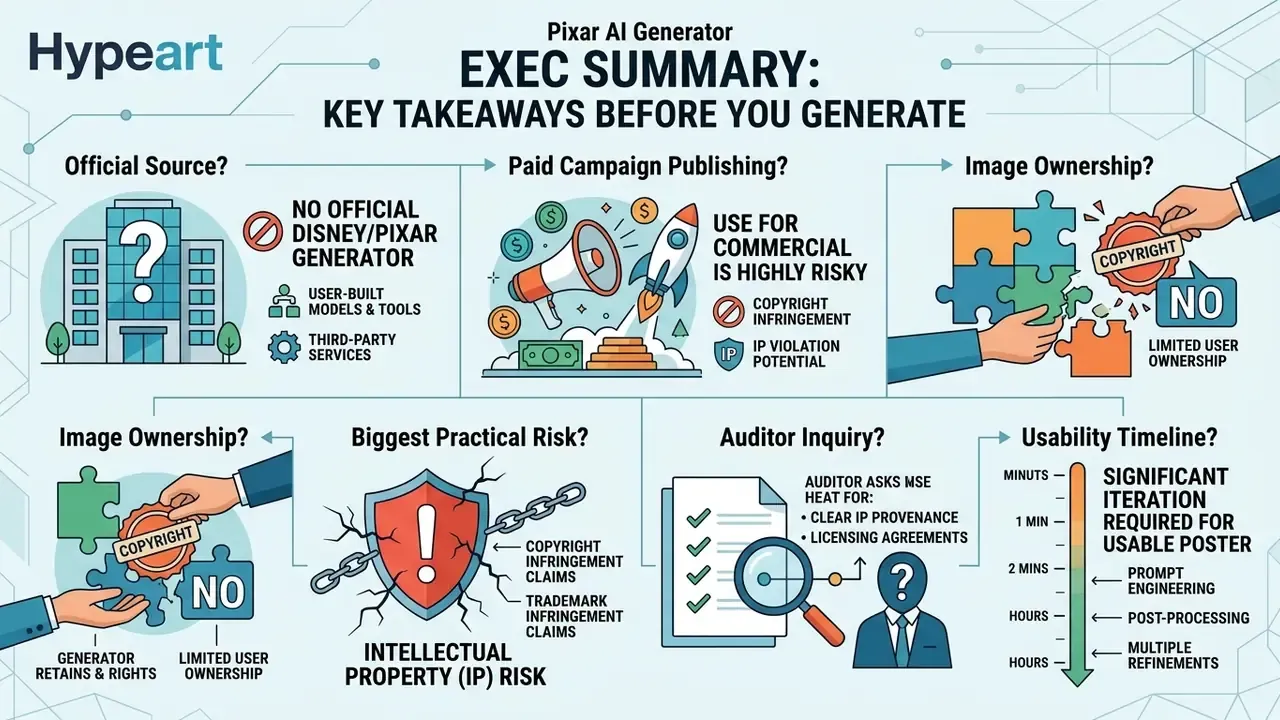
Fast answers for decision-makers
- Is there an official Disney or Pixar generator? No. Every tool marketed as an ai disney pixar generator is third-party software trained on general image data.
- Can we publish the output in a paid campaign? Sometimes. Original characters plus a paid commercial tier plus a legal sign-off. Skip any of the three and you are guessing.
- Who owns the image? In the United States, purely machine-generated pixels are difficult to protect. Human editing, compositing, and typography create the protectable layer.
- What is the biggest practical risk? Not aesthetics. It is an employee uploading a customer photo or an unreleased product render into a consumer web tool.
- What does an auditor ask for? The prompt, the seed, the model version, and the name of the human who approved publication.
- How long does a usable poster take? Roughly two to three minutes of generation, then twenty minutes of honest design work.
What is a Pixar AI Generator and What Images Does It Create
A pixar ai generator refers to a text-to-image or image-to-image diffusion system configured to synthesize stylized three-dimensional artwork. These tools produce expressive character designs, cinematic scenes, custom avatars, and conceptual movie posters from structured text descriptions or from an uploaded photograph.
Modern image generation rests on Denoising Diffusion Probabilistic Models (DDPMs) and latent space architectures. Put simply: the model learns to remove noise, not to paint.
«Diffusion models generate images by iteratively removing Gaussian noise through learned Markov chains with reverse transitions.»
Rather than retrieving pre-rendered 3D assets from a library, an ai image generator pixar translates text embeddings into latent representations, then progressively denoises them into an image that mirrors the lighting, texture, and volumetric depth of feature animation. There is no mesh, no rig, no camera. Only a flattened frame that looks like there was one. Readers can explore broader terminology across generative tooling in our AI Media Glossary, and compare rendering engines side by side in our review of the best AI art generators.
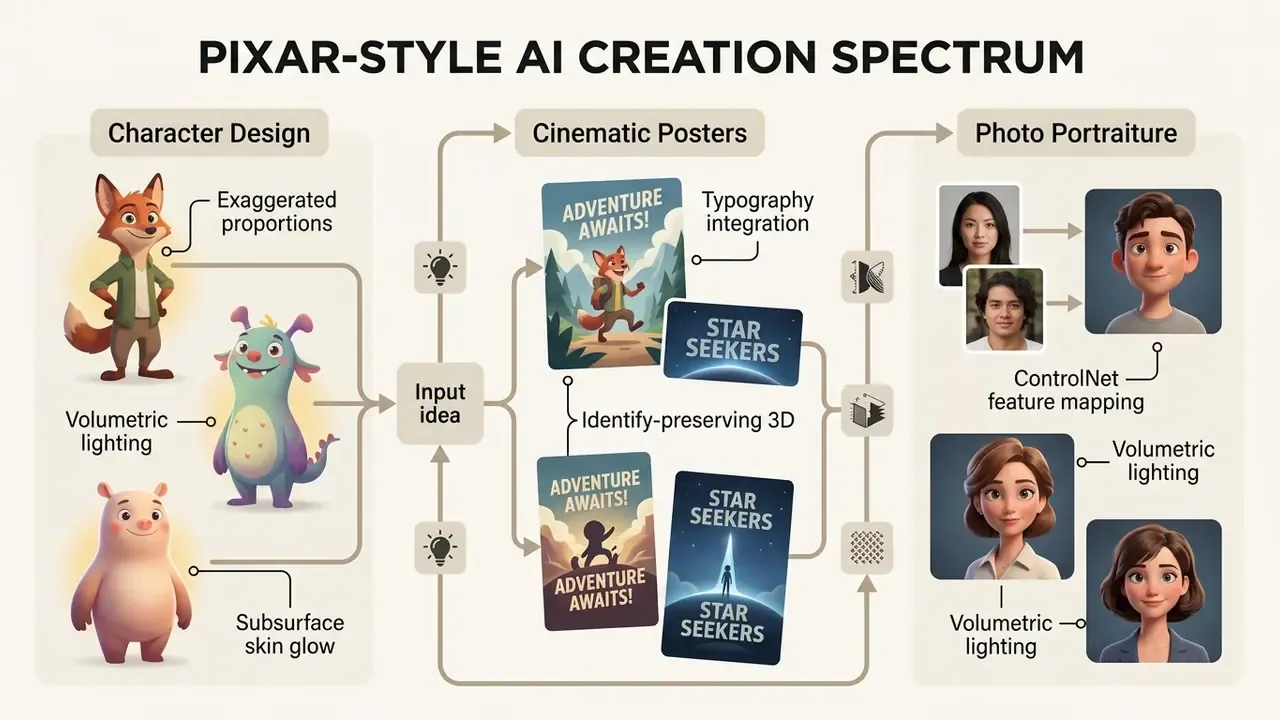
Pixar-Style Art: Key Visual Features of 3D Animation
The visual identity of pixar style artwork rests on four rendering characteristics. Name them in your prompt and the hit rate climbs noticeably.
- Global Illumination and Lighting Warm key lights against cool ambient fill produce soft bounce lighting, ambient occlusion, and believable shadow falloff.
- Subsurface Scattering Light penetrates translucent surfaces such as skin, ears, and cheeks, creating a soft internal glow. This single attribute separates convincing ai art pixar renders from plastic-looking ones.
- Exaggerated Facial Proportions Enlarged expressive eyes, rounded cheeks, slightly oversized heads, and simplified anatomical geometry improve emotional readability.
- Cinematic Camera Depth A shallow depth of field keeps the subject sharp while the background dissolves into smooth bokeh.
An ai pixar art generator query returns better results when the prompt spells out these physical rendering attributes instead of leaning on a studio name. Studio-side research supports the point. Pixar's own 2026 SIGGRAPH talk paper documents stylized pastel production built on FX-driven assets, non-photorealistic character shading, and bespoke compositing. Prompt engineering can approximate the lighting and surface description. It cannot reproduce the pipeline.
Disney Pixar AI: Style Does Not Equal Official Products
Generating ai pixar art inspired by digital animation techniques does not produce official Disney or Pixar products. These generative tools sit outside studio pipelines entirely. No sponsorship, no endorsement, no licensed asset library.
Under United States copyright law, generic visual styles and artistic concepts are not eligible for copyright protection. Protection attaches to original creative expression, not to ideas, stock features, or trivial variations. Trademark protection applies only where use is likely to confuse consumers about source or sponsorship (Duke University Center for the Study of the Public Domain, 2024. https://web.law.duke.edu/cspd/mickey/). Federal courts have drawn the same line. In Daniels v. The Walt Disney Co. (9th Cir. 2020) the court found that emotion-based character concepts lacked consistent, identifiable traits and were therefore unprotectable (https://cdn.ca9.uscourts.gov/datastore/opinions/2020/03/16/18-55635.pdf). A parallel dismissal in Mandeville-Anthony v. The Walt Disney Company (C.D. Cal. 2011) turned on the absence of substantial similarity in protectable elements such as plot, character, theme, and setting.
Copyright and trademark can also coexist in the same visual material. A studio-like character design triggers both regimes once its look functions as a source identifier (U.S. Copyright Office, 37 CFR 202.10. https://www.copyright.gov/title37/202/37cfr202-10.html). So an ai image generator disney pixar style produces original synthetic imagery inspired by 3D animation conventions, provided the output stops short of replicating trademarked character designs. That "provided" carries all the weight.
E-E-A-T Fact Check:
Teams weighing licensing questions before publication should review our practical guidance on the commercial use of AI-generated images and the adjacent analysis of Ghibli-style AI image generators, where the same style-versus-character distinction applies.
Production Efficiency: 3D Animation Pipeline vs. Latent Diffusion
Synthesizing stylized assets through diffusion compresses a multi-stage production timeline from days into seconds. The comparison below explains why marketing, product, and concept teams adopt diffusion for exploratory visuals while keeping classical pipelines for shipped animation.
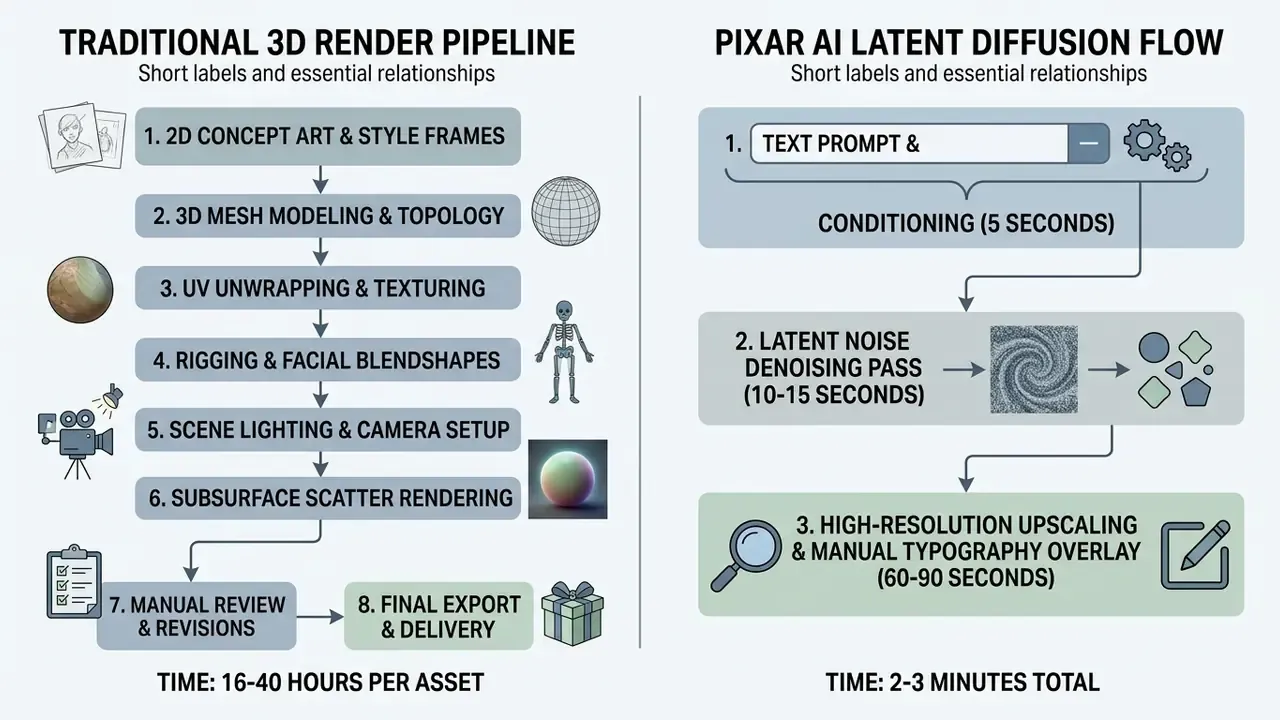
The trade-off is control, not speed. A hand-built pipeline guarantees deterministic geometry, reusable rigs, and shot-to-shot continuity. Diffusion delivers one flattened frame whose composition has to be re-derived on every generation. Hybrid teams therefore use diffusion for pitch boards and social assets, and reserve full 3D production, or a dedicated animation maker, for anything that needs animated continuity.
One caveat worth stating plainly. Speed savings evaporate if legal review, brand review, and logging are not built into the same workflow. Two minutes of generation plus three weeks of approval is not a two-minute process.
How to Create Pixar-Style Images from Text or Photos
Creating a pixar style image online involves four moves: pick an input modality, structure the prompt, set diffusion parameters, and render. Vendor documentation describes the same two modes. Text-to-image generates from a description, while image-to-image transforms an existing picture under textual guidance and preserves structure (Microsoft Learn, 2025 to 2026; OpenAI Platform. https://platform.openai.com/docs/guides/tools-image-generation).
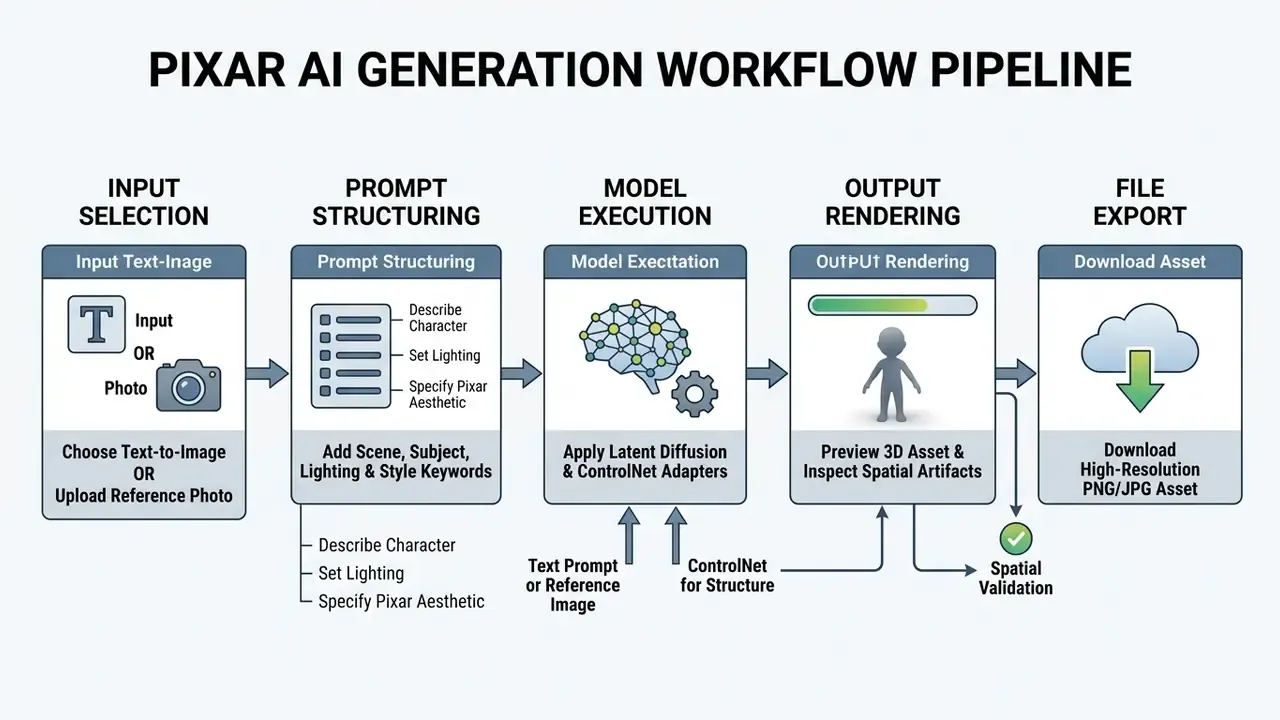
Accessibility note for implementation: render this sequence as a numbered HTML list in the DOM with a text transcript for each step, and use alt text containing the phrase "ai pixar generator online".
Generating Pixar-Style Art from a Text Prompt
Synthesizing artwork with a disney pixar ai art generator rewards structured prompt construction. Official prompting guidance recommends four sequential segments and a description kept to one to three clear sentences (OpenAI, Image generation guide, 2026. https://openai.com/academy/image-generation/):
- Environment and Scene: Define the background setting, time of day, and atmospheric conditions.
- Main Subject: Specify physical traits, attire, pose, and emotional state.
- Lighting and Rendering: Describe illumination, such as volumetric sunlight, warm rim lighting, or soft global illumination.
- Technical Constraints: State framing, aspect ratio, and composition details.
«Users frequently rely on style keywords and multi-component descriptions, covering subject, form, and intent, to steer generative outputs.»
Cloud vendors converge on the same taxonomy. Amazon Nova Canvas best practices list subject, environment, pose, lighting, camera framing, and medium as core prompt elements, while Google Vertex AI groups prompts into subject, context, and style. A dedicated ai video generator or an image diffusion interface turns complex prompts into high-resolution drafts in seconds. Conversational front ends such as the ChatGPT picture generator accept the same four-part structure, which makes the skill portable across tools.
Transform Photos into Pixar-Style Portraits
Converting a real photograph into a stylized 3D avatar requires the image-to-image path. An ai pixar photo generator processes uploaded portraits using structural guidance such as ControlNet combined with facial identity embeddings. UniPortrait reports high face fidelity through a decoupled ID-embedding module and an ID routing mechanism for identity-preserving single- and multi-ID portrait generation (UniPortrait, arXiv preprint 2024, presented in the ICCV 2025 proceedings cycle. https://arxiv.org/abs/2408.05939). Related 2026 work such as ID-ControlNet injects compact face-identity embeddings into a frozen latent diffusion backbone, holding identity consistent without per-subject fine-tuning.
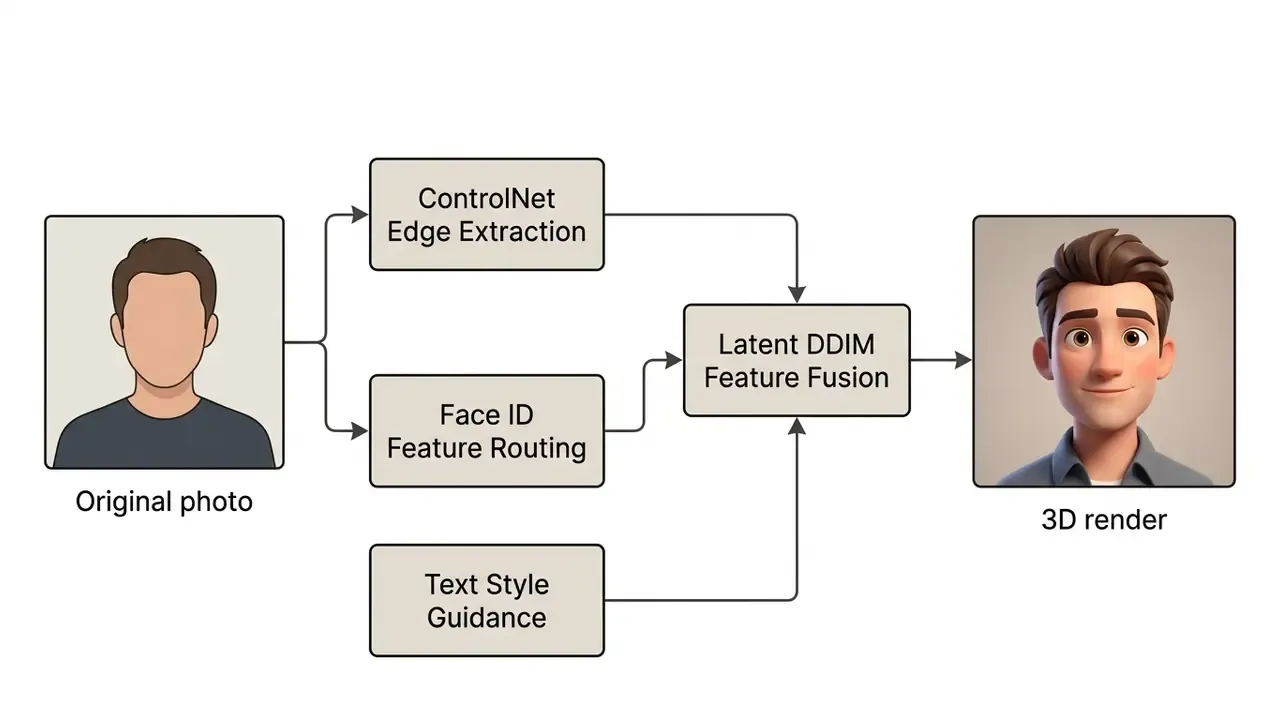
This dual-stream architecture isolates underlying facial geometry, including eye placement, nose bridge structure, and smile lines, while applying stylized 3D skin textures, enlarged eyes, and soft studio illumination. A disney pixar ai photo generator flow lives or dies on that separation. Get the weights wrong and you get a stranger with familiar hair.
«MagicStyle preserves facial identity and fine textural detail by transferring color and texture patterns from the reference style image, outperforming baseline stylization methods.»
The output keeps the subject recognizable while rebuilding their appearance as an animated character. Teams that need business-grade likenesses rather than stylized ones should compare the same conditioning stack in our guide to AI headshot generators, and evaluate image-to-image generators when the reference photo must drive composition.
Prompts for Pixar AI: Characters, Family Portraits, and Posters
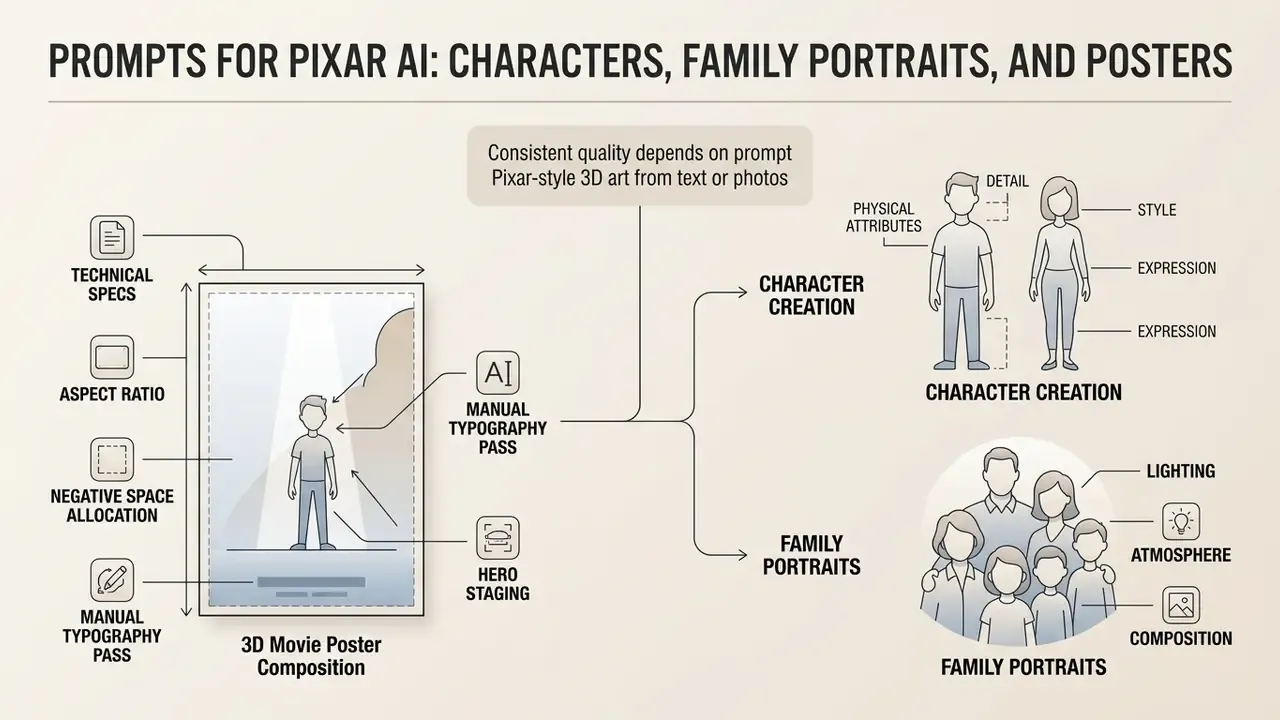
Consistent quality from a disney pixar picture generator depends on specificity. Generic queries return flat, incoherent, oddly lit renders. Vocabulary is the bottleneck, not model capability.
The table below lists operational templates for an ai pixar character generator across common production tasks, including consumer scenarios and brand-safe corporate variants.
| Production Task | Prompt Structure Template | Key Rendering Attributes |
|---|---|---|
| Character Design | 3D animated character portrait of a [age, profession], [hair style, clothing], expressive friendly smile, warm studio key light, soft subsurface skin scattering, clean pastel background, cinematic 8k render. | Subsurface scattering, exaggerated facial expressions, clean focal contrast. |
| Social Avatar | Close-up 3D cartoon avatar of a [gender, traits], vibrant lighting, soft focus background, highly detailed eyes with light reflections, smooth rendered textures, stylized 3D digital art. | Catchlight reflections in eyes, smooth geometric contours, shallow depth of field. |
| Pet Poster | Cinematic movie poster featuring an adventurous [pet breed] wearing a small jacket, heroic pose, dramatic golden hour lighting, volumetric dust particles, epic sky background, 3D animated film still. | Heroic camera angle, atmospheric volumetric lighting, detailed fur texturing. |
| Family Portrait | A cozy 3D animated family portrait of [number] people sitting together in a warm living room, cheerful expressions, soft ambient illumination, detailed clothing textures, heartwarming film style. | Multi-subject spatial balance, warm color palette, consistent group character styling. |
| 3D Environment | Wide angle cinematic view of a whimsical [location], vibrant color palette, intricate architectural details, soft global illumination, morning mist, rendered in high-end 3D animation style. | Volumetric fog, complex environmental reflections, global illumination bounce. |
| Sci-Fi / Space Adventure | Cinematic 3D animated film still of a whimsical robot and a young astronaut exploring a glowing alien flora cave, bioluminescent mushrooms, soft teal and amber volumetric lighting, 8k render. | Bioluminescent ambient lighting, reflective metallic surfaces, high-contrast atmospheric depth. |
| Fantasy / Magical Creature | A cute tiny forest dragon with big shiny eyes sitting on a glowing crystal, soft subsurface scattering, enchanted forest background, warm golden hour sun rays, detailed scales, 3D film visual style. | Translucent skin and scale rendering, magical dust particles, exaggerated expressive eyes. |
| Action / Racing Scene | High-speed dynamic shot of a colorful stylized racing car drifting on a futuristic wet track, neon reflections, cinematic motion blur, heroic low camera angle, 3D animated movie render. | Directional motion blur, dynamic camera tilt, high-gloss surface reflections. |
| Brand-Safe Corporate Mascot | 3D animated original mascot character holding a generic product box, no logos or trademarks, brand palette of [hex colors], neutral studio backdrop, soft key light, marketing-ready render, 2:3 vertical. | Palette-locked color grading, logo-free surfaces, neutral background for compositing. |
A small observation from repeated testing: the word "cinematic" does less work than a concrete light description. "Warm rim light from the upper left" beats it every time.
Technical Specs for 3D Movie Poster Composition
For production-ready posters, enforce these composition standards during setup:
- Aspect Ratio Set the ratio to
--ar 2:3, or 4:5 for vertical social feeds. Square crops flatten cinematic character staging, and 2:3 remains the dominant theatrical one-sheet ratio. - Negative Space Allocation Add keywords such as "clean top third for title card" or "spacious upper background" so the model leaves a low-contrast area for font overlays.
- Manual Typography Pass Diffusion models still render garbled text. Export the clean raw render as PNG and set the title in Figma or Adobe Photoshop, using bold sans-serif or rounded 3D display fonts with soft drop shadows. Proofread it. No current model guarantees correct spelling inside an image.
- Hero Staging Place one or two original characters front and center in a readable pose, then add a themed background that supports the story without crowding the frame.
| Output Target | Recommended Ratio | Reserved Negative Space | Typography Handling |
|---|---|---|---|
| Theatrical-style poster | 2:3 | Top third + lower 15% credit block | Manual pass in Photoshop/Figma |
| Instagram / TikTok feed | 4:5 | Top 20% for headline | Manual pass, safe-area aware |
| Story / Reels vertical | 9:16 | Top and bottom 12% (UI overlap) | Manual pass, avoid UI zones |
| Web hero banner | 16:9 | Left or right third for copy | Manual pass, live text in HTML |
| Avatar / profile crop | 1:1 | None (tight framing) | No typography |
When testing prompt variants, reference our AI Media Comparison Matrices and the ranked overview of the best free AI art generators to judge model fidelity across engines. If your campaign runs in more than one language, the localization mechanics differ again; our notes on an ai video generator arabic text to video workflow explain why non-Latin type almost always needs a manual pass.
Free Pixar AI Generator: Capabilities, Limits, and Output Quality
A pixar ai generator free tier is a reasonable way to test model behavior. It is a poor foundation for a campaign. Free plans impose hard technical constraints against paid commercial tiers.
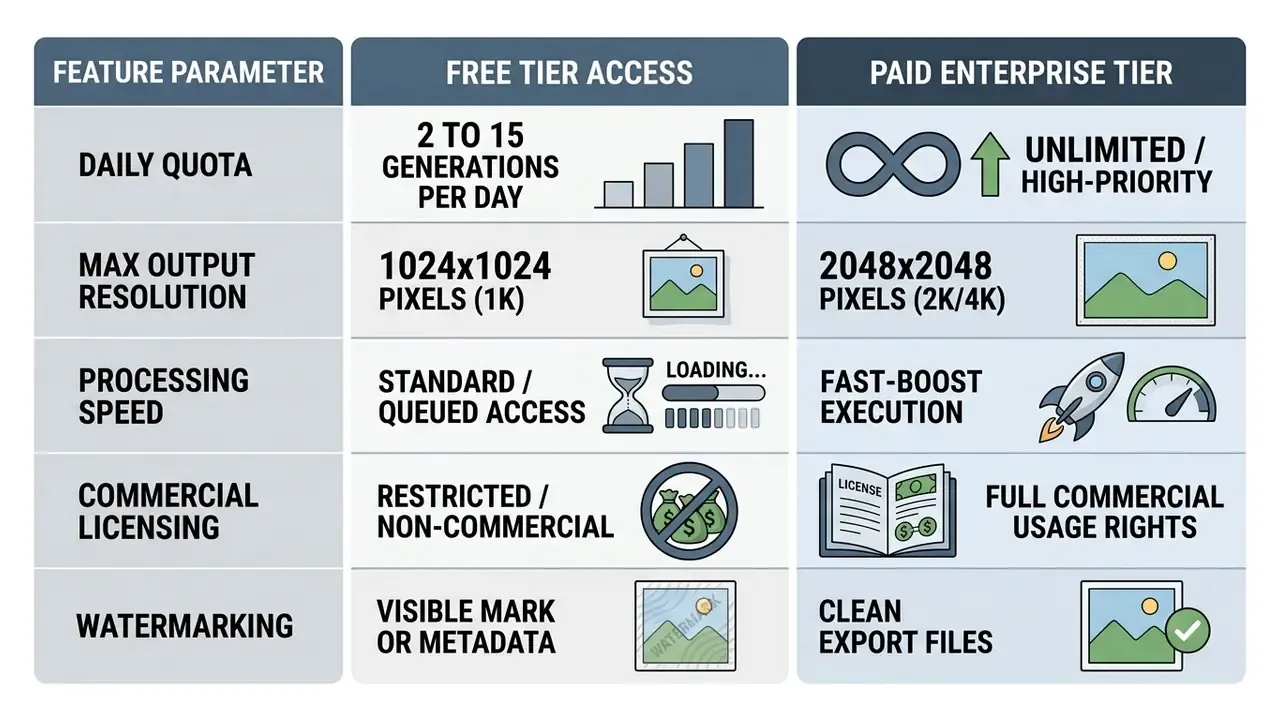
«The MHP dataset contains 918,315 human preference annotations across four dimensions on 607,541 images, showing that preference is multi-dimensional rather than a single score.»
What to Check Before Creating and Downloading Images
Before downloading assets from a free ai image generator pixar style tool, work through four checks:
- Resolution Thresholds: Verify that the export meets the minimum pixel dimensions for its destination. Published requirements differ by use case. PMC image specifications require 300 dpi for halftone graphics and reject images below their intended display size (National Library of Medicine, PMC image specifications). FADGI sets 250 ppi as the 4-star benchmark for document imaging and notes that exceeding 400 ppi is not required for 4-star compliance (FADGI Technical Guidelines, 2023. https://www.digitizationguidelines.gov/). Stock marketplaces such as Adobe Stock apply a minimum 4 MP requirement for submitted photos. Where a render falls short, an upscaling or outpainting pass, covered in our guide to AI tools that expand images, costs less than regenerating the concept.
- Visual Compression Artifacts: Inspect faces, hands, and background boundaries for diffusion noise, blur, or structural warping. Publication standards require disclosure of artifacts introduced during capture or processing, and digitization guidelines require comparing the output against the source for dimensions, orientation, and missing content.
- Licensing Rights: Confirm whether the free tier permits commercial distribution or restricts use to personal experimentation. Free access is not an unrestricted license. Some repositories still gate format or resolution behind a separate request.
- Watermark Integration: Determine whether the platform embeds a visible logo or invisible C2PA provenance metadata, and whether stripping that metadata breaches the terms of service.
Review cost breakdowns and plan structures across tools in our AI Media Pricing Guides, estimate spend with our AI Media Calculators, and use a general-purpose photo editor or free photo editor for the retouching pass that always follows generation.
Enterprise Deployment, Shadow AI, and Auditability
Consumer web generators and enterprise API endpoints are not the same product at two price points. They differ in data handling, licensing, and evidence. Risk, compliance, and procurement teams should score them on the axes below, not on daily image quotas.
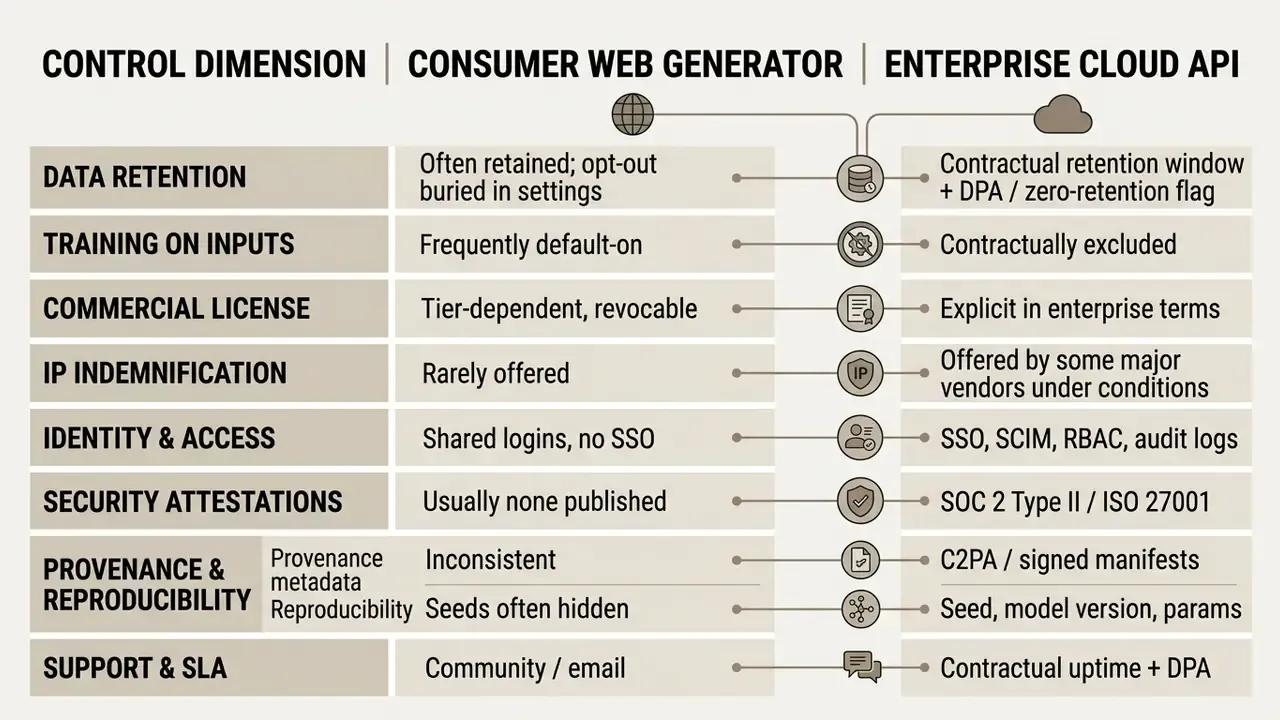
Shadow AI, Data Privacy, and DLP Controls
The dominant operational risk in stylized image generation is not aesthetic. It is unmanaged uploading. When an employee turns a staff photo, an unreleased product render, or a customer image into a 3D avatar on a public site, biometric and confidential data leave the perimeter under consumer terms. Nobody signed off on that.
Practical mitigations:
- Classify inputs before upload. Employee likenesses, customer imagery, and unreleased product assets should never touch consumer tiers. Treat facial images as biometric-adjacent data under applicable privacy law.
- Configure opt-out and retention. Verify whether prompts and uploads feed model improvement, how long they persist, and whether a zero-retention mode exists.
- Enforce DLP and egress rules. Block or gate unsanctioned generator domains, and route approved usage through one reviewed endpoint so activity is logged.
- Publish an allow-list. A short list of approved tools with documented terms reduces Shadow AI better than a blanket ban, which simply pushes usage onto personal phones.
- Screen prompts. Prohibit third-party brand names, character names, and confidential project codenames. This is also where an unfiltered ai video generator becomes a governance problem rather than a creative one.
Documented harms from text-to-image systems include exactly this exposure category, sitting right next to IP misuse.
«Documented risks of text-to-image models include misinformation, copyright infringement, and unauthorized use of protected characters or trademarks.»
Auditability and Reproducibility Checklist
Regulated environments must be able to reconstruct any published asset on request. Model-risk frameworks require documentation, validation, and inventory for models in use (Board of Governors of the Federal Reserve System, SR 11-7. https://www.federalreserve.gov/supervisionreg/srletters/sr1107.htm). The NIST AI Risk Management Framework adds mapping, measurement, and governance functions for generative systems (NIST AI 100-1, 2023. https://www.nist.gov/itl/ai-risk-management-framework).
Log the following for every asset that reaches a public channel:
- Prompt and negative promptin full, including style tags.
- Seed valueand sampler or scheduler settings.
- Model and adapter versions, covering base checkpoint, LoRA, ControlNet or IP-Adapter weights and strengths.
- Source-image hashfor any image-to-image or reference input.
- C2PA or provenance manifestattached to the exported file.
- Human contribution recorddescribing edits, compositing, and typography work.
- Reviewer sign-offfor brand, legal, and accessibility checks.
- Inventory entrylinking the tool to an owner, a purpose, and a review date.
An honest caveat: the eighth item is the one most teams skip, and it is the one auditors open first. Teams industrializing this pipeline can reference our AI Media API Guides and the implementation notes in our Google Veo API guide for how versioning and cost logging work at endpoint level. A reverse-image check, compared in our overview of AI reverse-image-search tools, is a cheap pre-publication control for near-duplicates of protected artwork.
Can You Use Pixar-Style AI Images Commercially?
Commercial use of assets from a disney pixar ai image generator means reconciling three layers at once: platform terms of service, copyright law, and trademark limits.
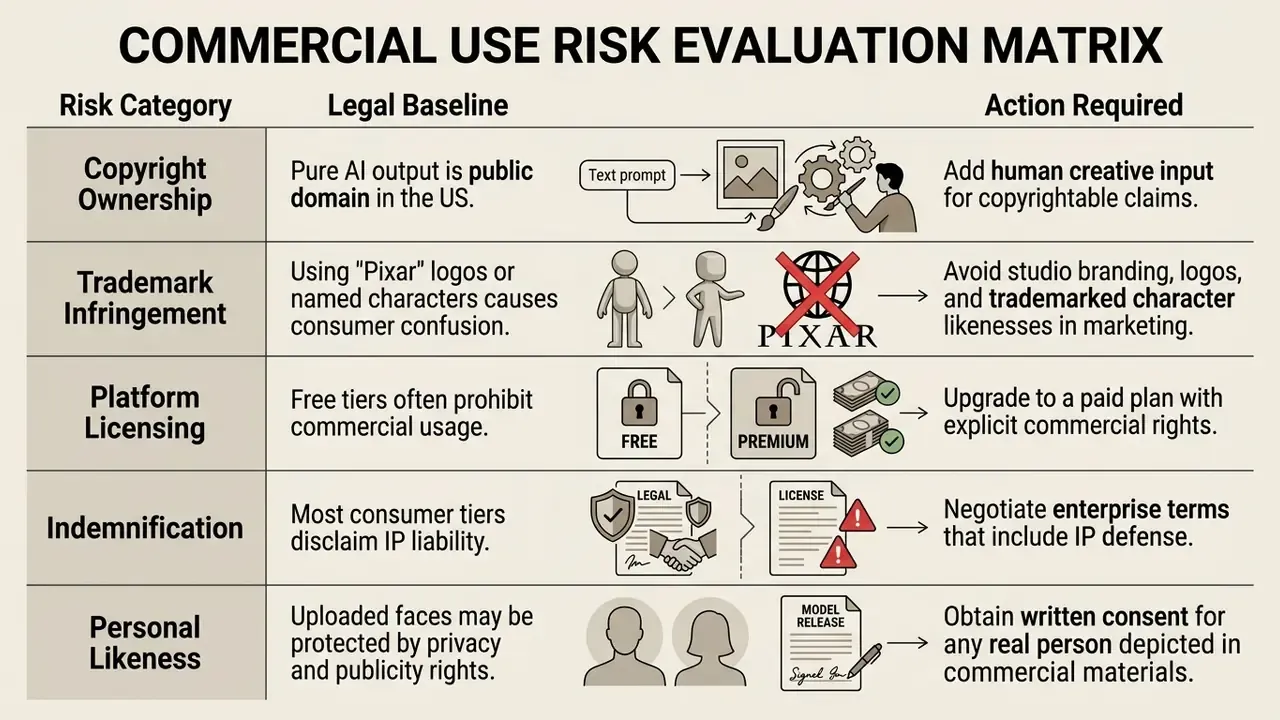
«Many jurisdictions do not recognize AI as an author, and works autonomously generated by AI may lack copyright protection; users must examine local law and platform licensing terms.»
The U.S. Copyright Office position runs in the same direction. Registration requires human authorship, and prompts alone are generally not enough to establish it. In practice, a purely machine-generated poster is hard to protect. The same poster, after substantive human composition, retouching, and typography, can support a claim limited to the human-authored contributions.
Platform terms differ sharply, so read the plan you actually bought. Midjourney grants paid users broad rights to their outputs but requires a Pro or Mega plan for companies above roughly $1,000,000 in annual gross revenue (MidJourney Docs, 2025 to 2026. https://docs.midjourney.com/). OpenAI's advertising terms prohibit use of OpenAI names, marks, or logos in marketing without written approval. Studio-character usage exists only where a specific license does: a 2025 agreement reported between Disney and OpenAI covers Disney, Pixar, Marvel, and Star Wars characters for Sora and ChatGPT Images under defined deal terms, not as a default user right (OpenAI, 2025. https://openai.com/index/disney-sora-agreement/). Absent such a license, design original characters. It is cheaper than litigation and usually better branding anyway.
A disney pixar style ai art generator can produce synthetic work that performs strongly in digital campaigns.
«AI-generated banner advertisements achieved up to 50% higher click-through rates than professional stock photography in a field study exceeding 173,000 impressions.»
Even so, the assets must stay genuinely original and clear of existing studio IP. Performance upside does not offset an injunction, and a takedown mid-flight destroys the media plan you optimized for weeks. To assess exposure around generative IP, inspect case documentation in our AI Litigation and Case Timelines. Enterprise workflows can integrate scalable endpoints through our AI Media API Guides, and design teams standardizing brand-safe templates can review the licensing terms of the Canva AI generator.
E-E-A-T Alert Box:
For safer production paths, favor tools that document licensing explicitly, including image-to-image generators for commercial use and the paid-tier rights described in our Midjourney evaluation.
FAQ About Disney Pixar AI Generator
Can I convert a Pixar-style static image into a 3D animated video?
Yes. Stills from an ai pixar style image generator can be imported into image-to-video diffusion platforms such as Wan, Veo, Kling, or Sora to produce short animated clips. These video models infer spatial geometry from the source frame and apply temporal motion smoothing. Expect drift in fine detail across frames, especially in hands and text.
«AIGCBench evaluates video generation algorithms across 11 metrics in four dimensions: control-video alignment, motion effects, temporal consistency, and video quality.» Fan et al., AIGCBench: Comprehensive Evaluation of Image-to-Video Content Generated by AI (2024). https://arxiv.org/abs/2401.01651 Creators exploring video synthesis can test an ai video generator free no sign up tool, review image-to-video AI tools for motion fidelity, or plan endpoint integration with our Google Veo implementation guide.
How do I keep my facial features recognizable when transforming a photo to Pixar style?
Use an image-to-image workflow with a ControlNet OpenPose or IP-Adapter (InsightFace) node set between 0.55 and 0.75. That range preserves structural geometry, including eye distance, nose bridge height, and jawline contour, while letting the model overwrite surface textures with stylized 3D skin shaders and volumetric lighting. Lower weights drift toward a generic character. Higher weights give you a photo wearing a cartoon filter, not a 3D render. Generate three to five variants and select for identity first, style second.
Does a Pixar AI generator work on mobile devices?
Most disney pixar ai generator online platforms are web applications tuned for mobile browsers on iOS and Android. You can enter prompts, upload reference photos, and download rendered graphics straight from a phone without desktop software. Vendor FAQs confirm mobile-browser support on phones and tablets, though upload size limits (commonly 20 MB) and lower default resolutions apply. For anything heading to print, finish on a desktop.
Which AI model produces the highest quality Pixar-style art?
DALL-E 3 (inside ChatGPT and Microsoft Designer) and Midjourney v6 currently deliver strong spatial coherence and prompt adherence for 3D animation aesthetics. Open-source Stable Diffusion XL paired with specialized 3D cartoon LoRA weights gives maximum local control over lighting and character consistency, and community model cards note that trigger phrases such as "pixar style" or "Pixar 3D" behave differently per checkpoint. Anyone comparing an ai pixar image generator against adjacent looks can also evaluate Ghibli-style AI image generators before committing to a stack.
Can I edit generated Pixar images in professional graphics software?
Yes. PNG or JPEG exports import cleanly into AI photo editors such as Adobe Photoshop or Figma. Designers routinely adjust color balance, outpaint backgrounds, clean up diffusion artifacts, and set custom typography to turn a raw render into a finished promotional asset. Vendor documentation treats download as the handoff point, since no mainstream generator edits natively inside Photoshop or Figma, so plan the post-processing step into the schedule rather than discovering it on deadline.
What should a compliance team verify before approving a Pixar-style generator?
Confirm five items. First, published security attestations such as SOC 2 Type II or ISO 27001. Second, contractual data retention plus a documented opt-out from training on inputs. Third, explicit commercial-use language in the plan you purchased, not the plan on the marketing page. Fourth, whether the vendor offers IP indemnification and under what conditions. Fifth, whether provenance metadata (C2PA) and reproducibility parameters (seed, model version) are exposed for audit. Record the answers in the model inventory with an owner and a review date.
Are AI-generated Pixar-style assets safe for paid advertising?
They can be, under four conditions: original characters, no studio branding, no real person depicted without consent, and a license tier that permits commercial distribution. Add a pre-flight reverse-image check and a legal sign-off for anything entering paid media. Keep the generation log. If a rights holder raises a claim eighteen months later, that log is the only thing that answers quickly. For platform-specific issues during production, our AI Media Support notes cover common export and quota failures.
Appendix A: Source Corrections and Revision Log
Transparency about revised citations is part of our editorial standard. The following weak or unverifiable references from the previous version of this page have been superseded in the main text:
| Previous reference | Issue identified | Replacement in current text |
|---|---|---|
| (Fan et al., 2024), bare parenthetical | No quotation, methodology, or URL | Direct quotation with full title and arXiv link |
| (OpenAI Developers, 2026) | Undated vendor reference | OpenAI image generation guide (2026) plus Xie et al. (2023) empirical prompt analysis |
| (UniPortrait, ICCV 2025) | Conference year required clarification | Cited as arXiv preprint (2024) presented in the ICCV 2025 cycle, with link |
| (Deng et al., 2024), bare parenthetical | No findings reported | MagicStyle quotation with reported outcome and link |
| (SSRN Marketing Study, 2025) | Anonymous, no figures | Full title with 50% CTR uplift and 173,000-impression sample |
| (FADGI Standards, 2023), "300 DPI / 4MP" | Conflated three separate standards | Split into PMC 300 dpi halftone, FADGI 250 ppi 4-star, Adobe Stock 4 MP |
| (AIGCBench, 2024), bare parenthetical | No methodology stated | Quotation describing 11 metrics across four dimensions |
| (Duke CSPD, 2024) | Needed verifiable link and doctrinal support | Retained with URL, reinforced by Elements of Style (SSRN) and 37 CFR 202.10 |
Appendix B: Model Risk Assessment Checklist for Visual Generative Tools
Use this checklist during vendor review. Any "no" answer needs a documented compensating control or an accepted-risk sign-off with a named owner.
Checklist0 / 15
Explore technical terms, pricing tables, and legal frameworks in our AI Media Glossary. Reviewed and updated for 2026 by the editorial team with input from Marcus Hale, author.
This article is informational and does not constitute legal, financial, or compliance advice. Copyright, trademark, privacy, and licensing outcomes vary by jurisdiction and by the specific terms of each platform. Obtain qualified professional advice before deploying generative visual assets in regulated or commercial contexts.