Modern digital communication leans hard on fast visual synthesis, because attention is scattered across a dozen feeds at once. Funny AI memes are a multimodal evolution of ordinary internet humor: neural language understanding on one side, automated image and video rendering on the other.
Understanding how an AI meme generator converts a plain sentence into contextual comedy means looking at three things at the same time. Model behavior. Rights management. Technical architecture. Teams inside banks, insurers and mature fintechs that evaluate automated content workflows have to balance publishing speed against brand safety and documented oversight, and that tension is the real subject of this guide.
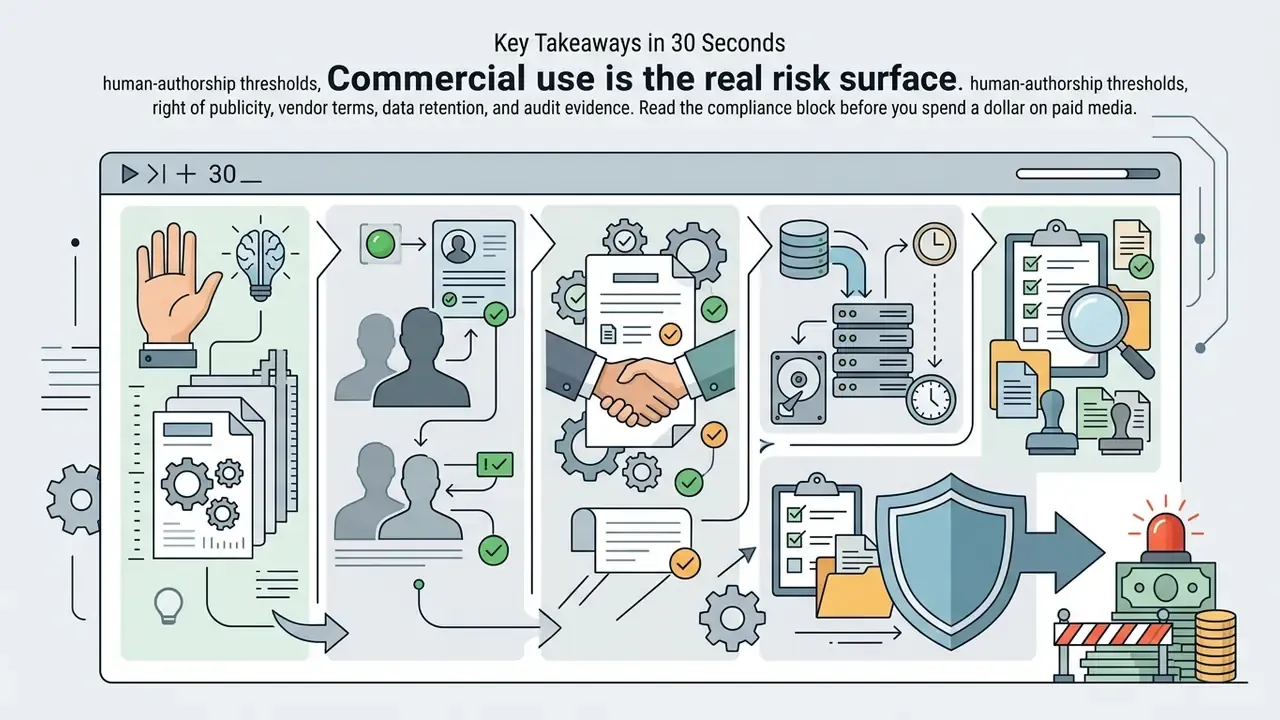
Key Takeaways in 30 Seconds
- Prompt structure beats prompt length. Name the subject, the absurd situation, the emotion, the visual style, and the exact caption text in quotes. Ready-to-copy prompt templates are included below.
- Photo quality decides output quality. Full-body, evenly lit, single-subject photos outperform cropped selfies in every swap pipeline.
- Multilingual generation is mainstream. Leading engines cover 100+ languages with idiom-aware translation of overlays.
Who Should Read This Guide, and Why It Matters Beyond the Joke
Memes look like the least governed thing in your content stack, and that is precisely the problem. In a regulated institution, a meme is still a published marketing artifact, produced by a third-party model, from source assets that someone uploaded. Every one of those clauses carries a control requirement.
So this guide is written for two overlapping readers. Creators and social teams who want to make a meme quickly and cleanly. And the risk, compliance and model-governance people who eventually get asked, "who approved that image, and where is the evidence?" If you sit in the second group, the sections on data handling, audit trail and commercial use are the operative ones. The craft sections still matter, though, because bad prompts and sloppy uploads generate most of the rework and most of the incidents.
One honest caveat up front: much of the marketing performance evidence in this space is thin, vendor-sourced, or context-specific. Where that is true, we say so.
What Are Funny AI Memes and How Are They Generated?
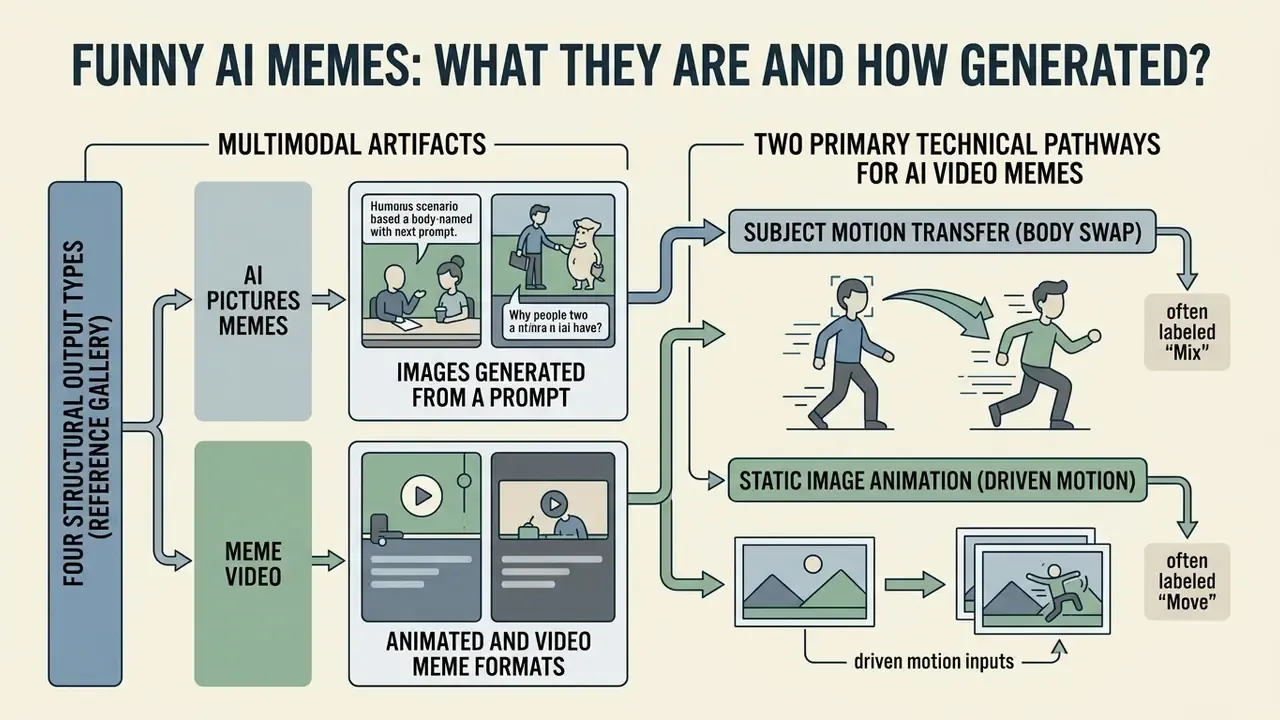
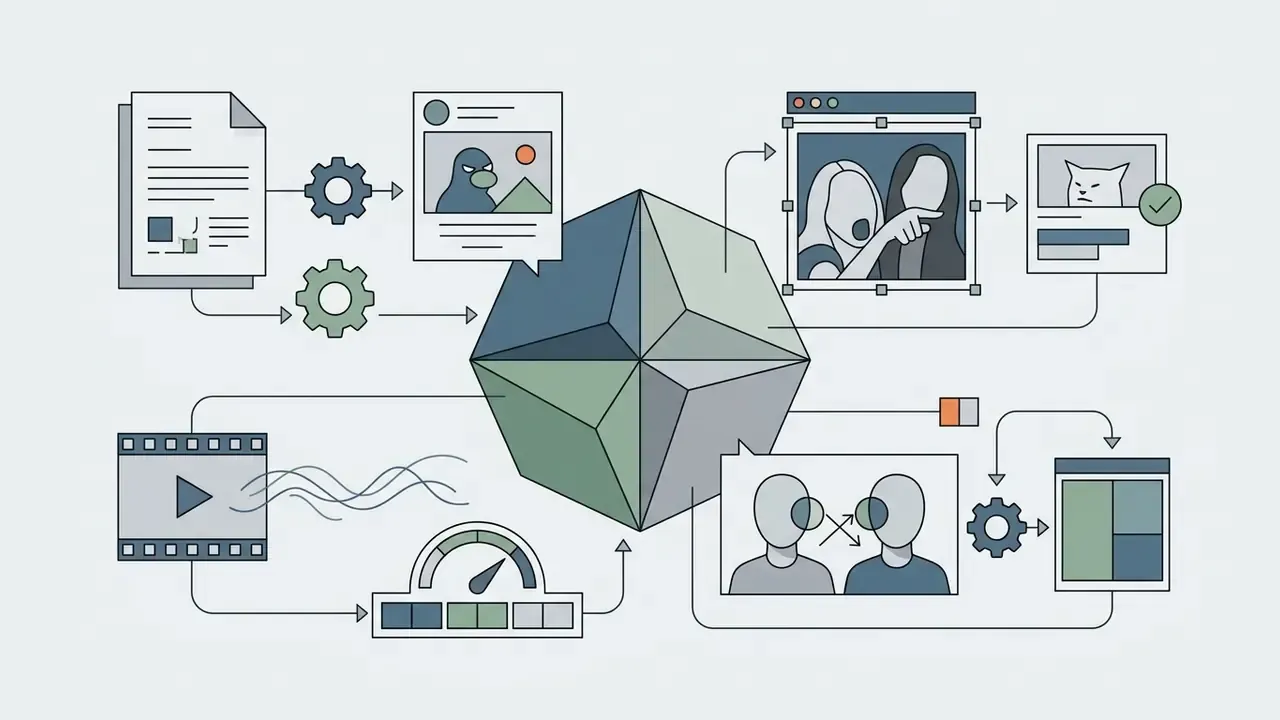
Funny AI memes are multimodal artifacts. A generative system takes a textual joke, a visual concept and a cultural template, then fuses them into one digital asset. Mechanically, it analyzes language semantics, selects or synthesizes visual assets, and renders formatted text overlays without manual layout work.
"Multimodal humor unites text and visual elements, including internet memes, cartoons and satirical images, into single communicative artifacts."
Academic work also confirms the ceiling of the format. Models can detect exaggeration and read social cues, yet visual input does not reliably improve humorous reply selection. Which is a polite way of saying human curation of the final variant still decides whether the thing lands.
The Four Structural Output Types (Reference Gallery)
| # | Output Format | What the AI Actually Does | Typical Input | Best Distribution Channel |
|---|---|---|---|---|
| 1 | Text-to-meme image | Parses the prompt, writes the caption, selects or synthesizes the visual, reserves text zones | One or two sentences of natural language | X, LinkedIn, Slack, newsletters |
| 2 | Classic template adaptation | Matches your topic to an indexed image macro (Drake, Distracted Boyfriend, Two Buttons) and fits captions to bounding boxes | Topic or punchline text | Community forums, Reddit, internal comms |
| 3 | Custom photo meme | Segments the subject, removes background, performs face or body mapping into a meme frame | Full-body or clean portrait photo | Group chats, employee advocacy posts |
| 4 | Short meme video | Transfers motion or lip-sync onto a still image, or swaps a subject into a motion template | Photo plus motion template, or photo plus driver video | TikTok, Reels, YouTube Shorts |
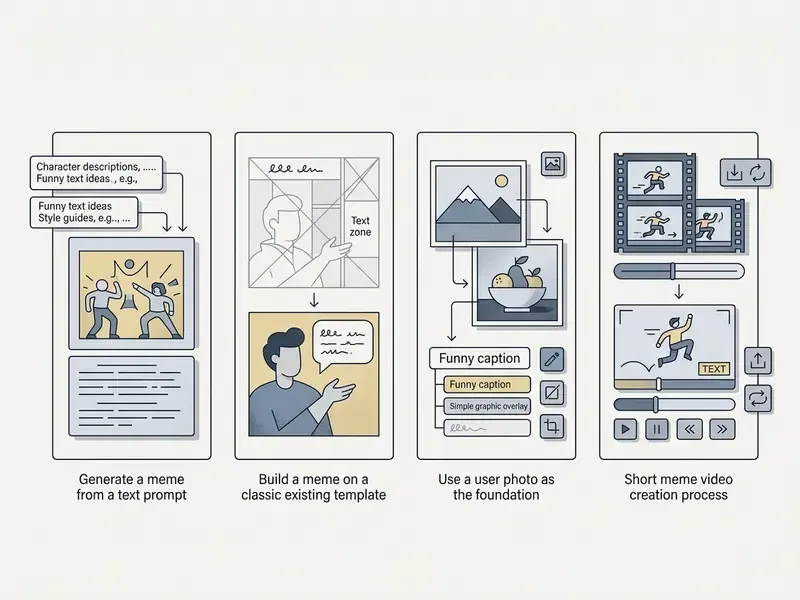
Figure 1. The four primary structural outputs supported by modern neural meme generator architectures. Alt text guidance: "funny ai memes generated from prompt", "ai generated memes funny on classic template", "ai picture memes with user photo", "funny ai meme video clip format".
AI Pictures Memes: Images Generated From a Prompt
AI pictures memes rely on text-to-image diffusion models or vision-language pipelines that build the visual directly from your description. The system parses structural cues inside the prompt, constructs a scene, and reserves spatial layout zones for the overlay text. No template library required.
Research shows that multimodal architectures align visual framing with the intended narrative tone before rendering the graphic elements, and the published pipeline runs end to end:
"MemeCraft samples meme templates, derives descriptions with a vision-language model, generates stance-aligned meme text, and includes a built-in safety mechanism against harmful content."
When generating synthetic image assets, creators can push visual parameters around or explore adjacent concepts with an ai superhero generator or an ai tattoo generator. Teams that need repeatable, brand-consistent portraits for a recurring meme cast usually start from an AI headshot generator rather than stock imagery, since consistency across a campaign is worth more than novelty in any single frame.
One illustrative example (composite, not a client case): a media marketing team tested synthetic image generation against traditional template repositories across 120 campaign variants. They configured prompt constraints to enforce clear text layout zones, which kept clutter away from key focal points. The structured workflow cut asset iteration cycles by roughly 40% while holding graphic clarity steady.
Meme Video: Animated and Video Meme Formats
Dynamic meme video content extends static formats by animating images, executing face swaps, or matching synthetic audio to motion. Modern multimodal AI video generators accept text, image and motion drivers, then return short clips ready for vertical feeds.
Two Primary Technical Pathways for AI Video Memes
- Subject Motion Transfer (Body Swap, often labeled "Mix").The engine maps a user's head and torso onto a motion-captured source template. Skeletal keypoints align frame by frame, so the uploaded subject reproduces the movement of a viral clip: stage entrances, dance trends, running gags. Because the model needs to see head, torso and legs, a full-body reference is mandatory for accurate limb mapping. Multiple people can be swapped into one clip.
- Static Image Animation (Driven Motion, often labeled "Move").The engine takes a single still image macro and animates facial features and gestures using a secondary driver video or webcam capture as a structural guide. That is how a classic still meme becomes a short clip with zero keyframe animation work.
Native multimodal architectures handle video synthesis through temporal attention that keeps subject identity stable across frames (Google Gemini Omni Flash, 2026). Dataset work now covers the audio layer of meme culture too:
"The MMD dataset contains 13,494 memes, of which 3,134 include background audio, the first large-scale base for studying memes with video and sound components."
The limitations are equally well documented. Stability AI states that Stable Video Diffusion produces roughly four-second clips and "does not achieve perfect photorealism." That is why video memes still live in short, punchy formats instead of narrative scenes.
Creators building multi-asset workflows often pair video generators with specialized tooling, such as an ai subtitle generator or a lighter ai subtitle generator free utility for caption alignment. For heavy renders, a video compressor keeps exports inside platform file-size limits, and teams publishing at volume can review model-level costs in the Google Veo implementation guide.
Data Governance and Shadow AI Warning Before You Upload Anything
Meme generation looks harmless, which is exactly why it turns into an unmanaged Shadow AI channel inside organizations. Employees paste internal screenshots, customer dashboards, badge photos and colleague portraits into free consumer tools that may retain inputs, train on them, or store them in an undisclosed jurisdiction.
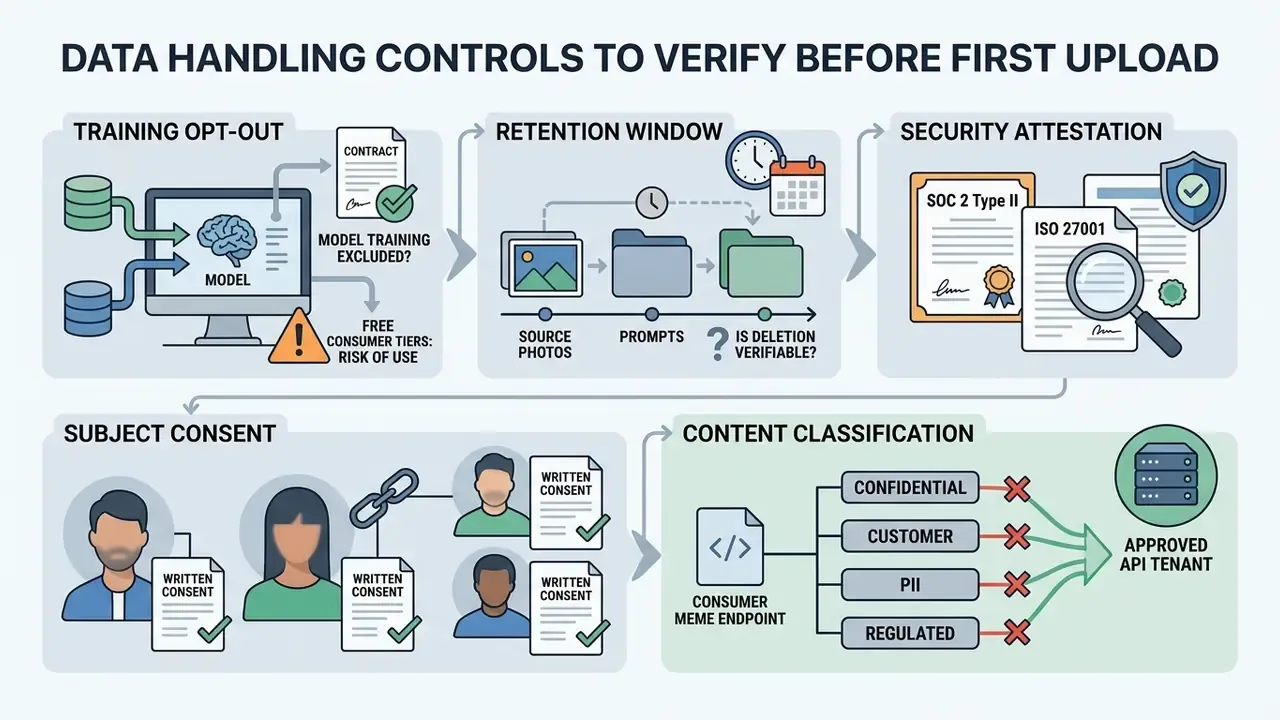
Practical rule for regulated environments: memes come from public brand assets and consented employee photos only, they are generated through an approved vendor tenant, and they are logged like any other marketing artifact. Before publishing anything derived from an unknown image, verify provenance with AI image detectors and AI reverse-image-search tools.
Two ownership questions worth settling in writing, ideally before the first campaign: who approves a meme, and who deletes it within the hour if it goes wrong. Unclear escalation paths cause more damage than bad jokes.
How an AI Meme Generator Turns Text Into Memes
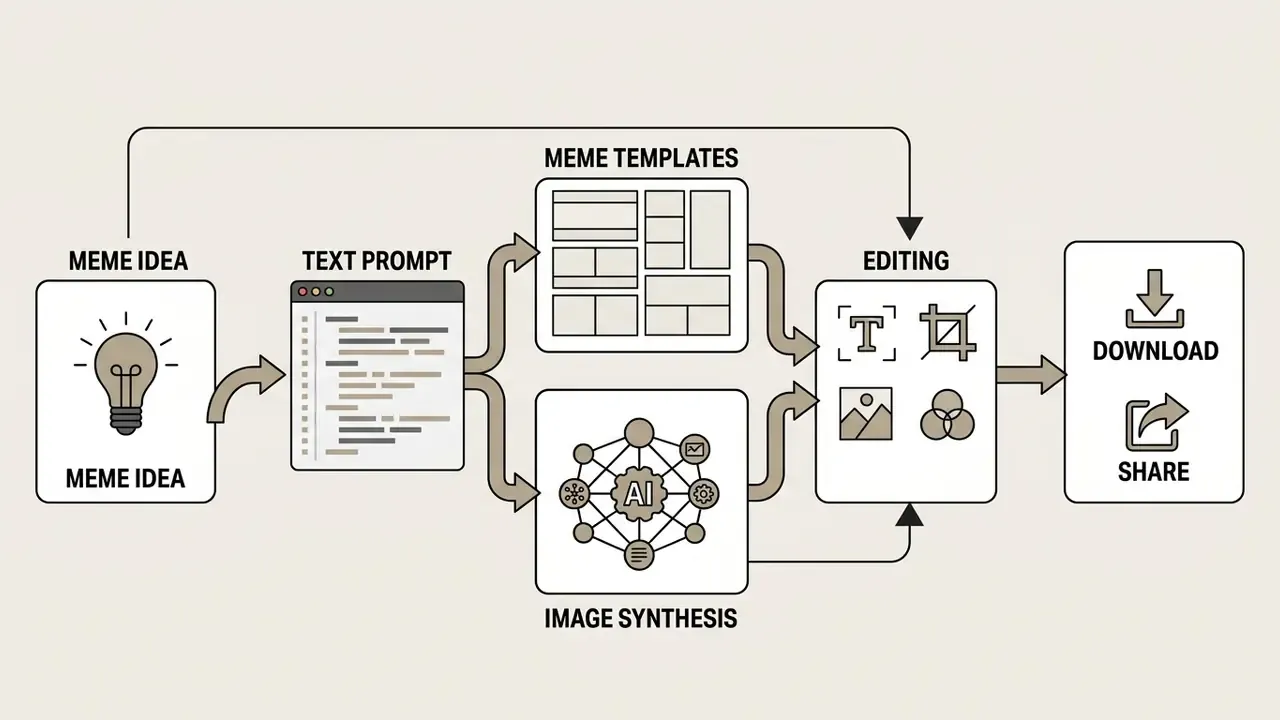
An AI meme generator routes natural language through semantic classification, mapping an abstract narrative onto a structural meme layout. It evaluates context, identifies the setup and punchline boundary, and automates text placement across visual layers. That is the whole trick behind memes from text.
- Input stage.The user submits a natural language description of a joke, situation or workplace moment.
- Semantic parsing.Large language models extract topic, stance and the setup-punchline structure.
- Visual mapping.The system either selects an existing macro from meme templates or generates a custom synthetic image.
- Layout composition.The text engine applies typography, outline contrast and spatial positioning.
- Export and distribution.The final asset renders to PNG, GIF or MP4 for publishing.
Published pipelines include one stage that consumer interfaces hide: OCR-based text extraction and context modeling. Systems that explain or remix memes first read the embedded text, then model the relationship between image, caption and surrounding discussion, and only then generate anything new.
Cross-Lingual Semantic Processing (Multilingual Memes)
LLM-driven meme engines now support direct text-to-meme translation across 100+ languages. The architecture ingests non-English prompts, spots localized idioms, and translates generated overlays into the target language while trying to preserve comedic timing. Leading platforms advertise 110+ output languages plus multilingual template search, so you can describe an emotion or an action in your own language and the engine retrieves the matching image macro.
Three rules for localized meme campaigns:
- Translate the joke, not the words. Idiom-level rewriting beats literal translation. Keep the gap between setup and punchline intact even when the wording changes completely.
- Re-check text length per locale. German and Finnish overlays typically run 20 to 35% longer than English, which breaks fixed bounding boxes.
- Localize the template, not only the caption. Some macros carry region-specific recognition. A globally famous face is safer than a locally viral one for multi-market work.
Describe the Joke, Situation or Meme Idea
Good meme creation starts with a structured description: the setup, the emotional reaction, the punchline. Prompt parsers read input syntax to infer whether you want self-deprecating humor, corporate satire or plain situational commentary. Vague input produces vague output, every time.
Ready-to-Use AI Meme Prompt Templates
Stuck on phrasing? Copy one of these and swap in your own detail.
- Corporate and workplace "When a 5-minute sync turns into a 2-hour strategic roadmap discussion with no action items."
- Software engineering "Pushing directly to production on a Friday afternoon right before leaving the office."
- Digital marketing "Spending $10,000 on ad creative vs getting 1M views from an unedited 5-second meme."
- Everyday life "Opening the refrigerator for the fourth time in an hour expecting new food to magically appear."
- Learning and teams "The group project that slowly became my personal project."
- Sales and outbound "The prospect who said 'send me something in writing' and then archived the thread."
The reusable formula behind all six: subject plus exaggerated action or expression plus setting plus emotional stance plus style plus exact caption text in quotes. Naming caption placement ("top text / bottom text") and the platform format ("1:1 for LinkedIn") measurably reduces layout rework. Small detail, big time saving.
Empirical work supports staged prompting over one long instruction:
"HUMOR applies hierarchical reasoning, literal content first, then social context, then punchline, and aligns output with group-level human humor preferences."
Staged reasoning has become a research pattern rather than a hack. Theory-guided multi-stage humor prompting (HumorChain, CVPR 2026) is used specifically to improve interpretability and joke quality, and few-shot examples measurably improve meme generation on the PUNMEMECN benchmark (ACL Anthology, 2025).
When building multi-modal text pipelines, operational teams also lean on an ai summary generator to compress long scenario notes into tight prompt inputs.
Choose a Meme Template or Generate a New Image
You have two tracks: adapt an established macro, or synthesize something original. In template-first pipelines the system picks a recognizable image from an indexed catalog and then writes a caption conditioned on that template. The approach was formalized in early automatic meme generation research (memeBot, arXiv, 2020, https://ar5iv.labs.arxiv.org/html/2004.14571) and reinforced by template-centric dataset work (A Template Is All You Meme, arXiv, 2023).
Dataset scale makes it practical:
"MEMECAP contains roughly 6,300 memes with crowdsourced explanations, a corpus for teaching models to recognize templates and choose fitting captions."
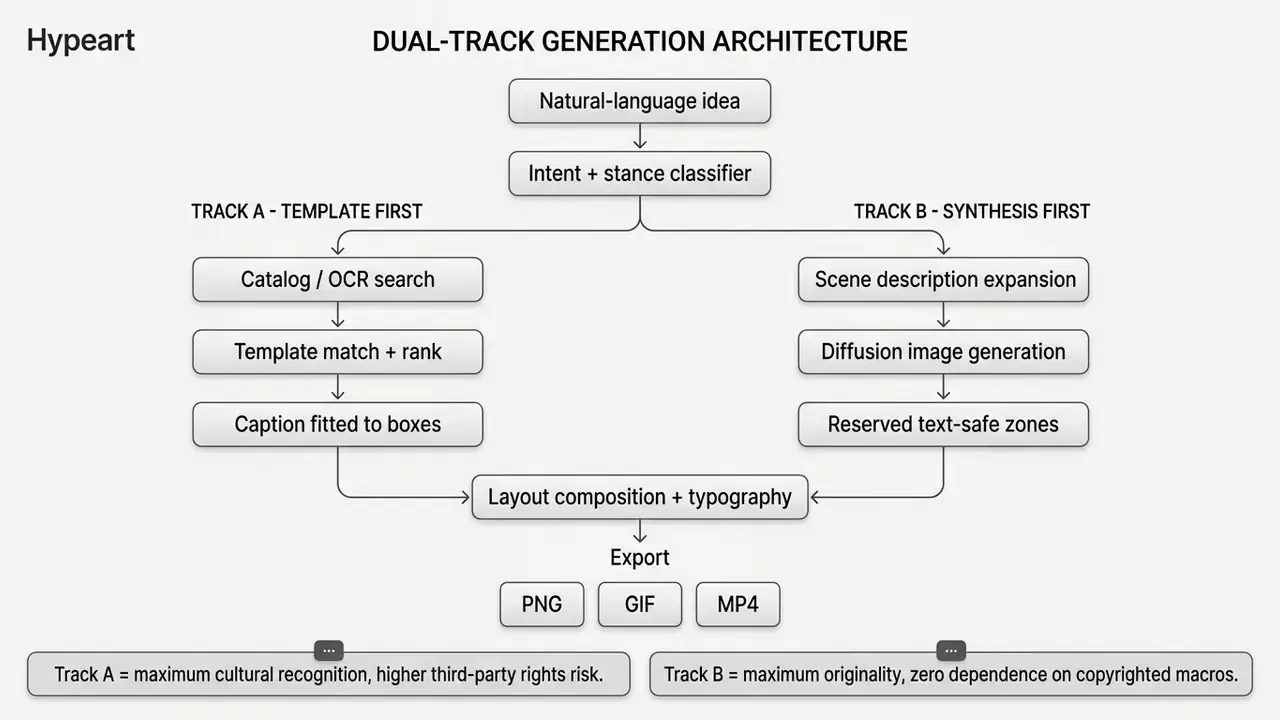
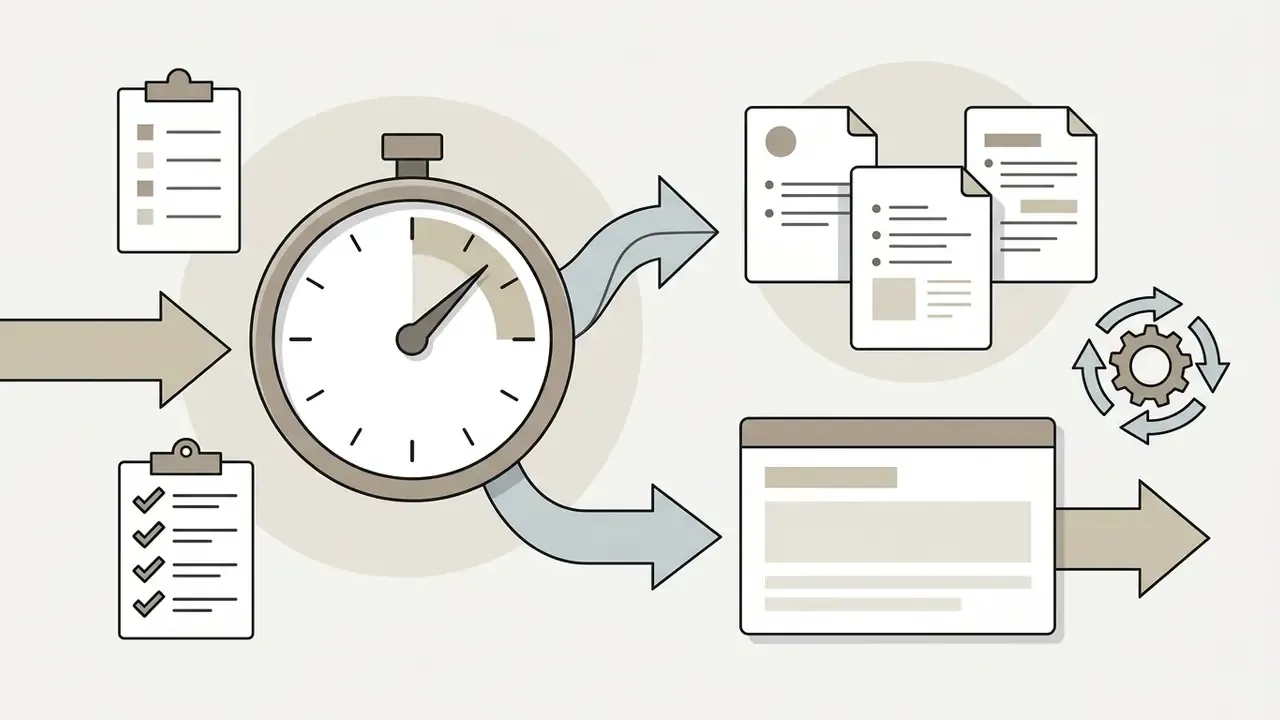
Figure 2. Decision split between classic template selection and full text-to-image synthesis.
Synthetic generation builds unique scenes with diffusion algorithms and removes dependence on pre-existing copyrighted imagery, which is why regulated brands increasingly default to Track B. Teams comparing engines can consult our roundup of the best AI image generators, and anyone working with vector elements or line art can also use an ai svg generator for clean assets.
Top Trending Meme Templates to Adapt With AI
- Viral motion formats (stage walkouts such as the Lil Yachty entrance, running gags like the Tom Cruise clip, dance swaps, cat-dance loops, Shrek and Skibidi-style joke templates, plus recurring hits like Hawk Tuah, Rickroll and John Cena entrances): built for vertical video with face and body swap overlays.
- Reaction faces and celebrity macros (Drake, Kevin James, Dua Lipa, sigma-face variants): highest instant recognition, and the highest publicity-rights and character-copyright exposure. Avoid them in paid brand campaigns.
How to Make Funny AI Generated Memes Step by Step
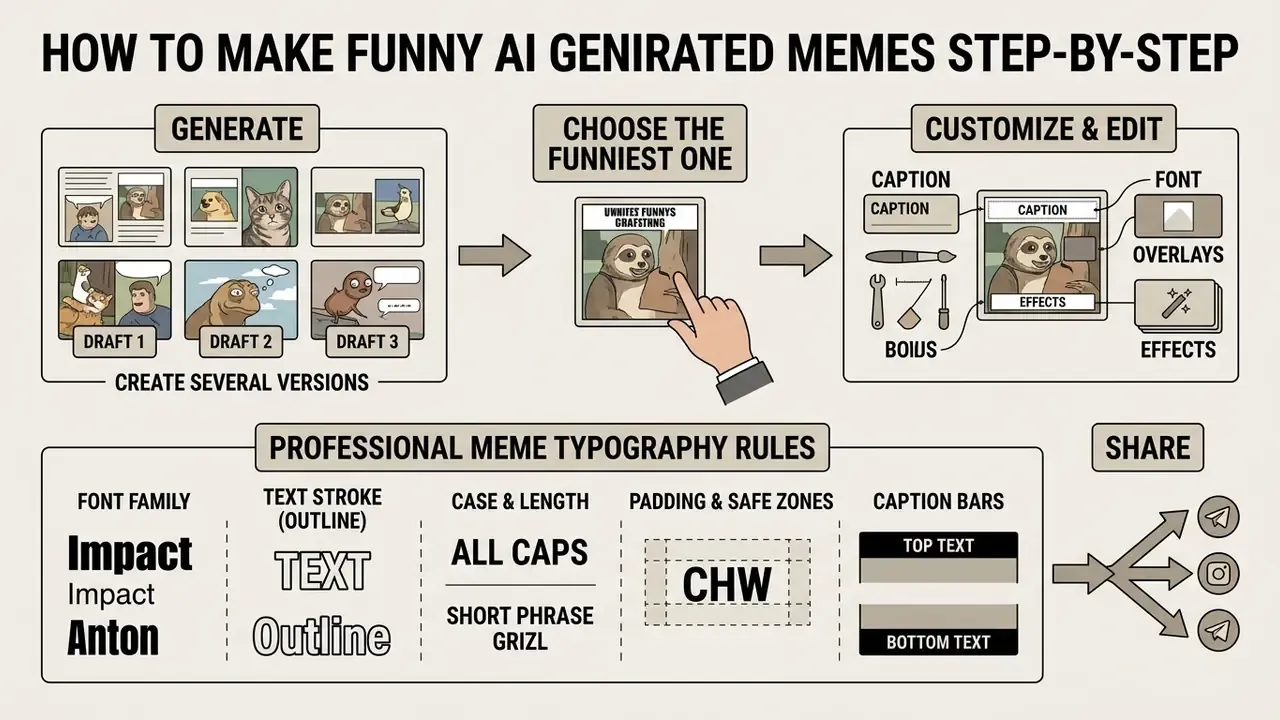
Producing funny AI generated artificial intelligence memes at a decent hit rate is a process, not a single click. You balance automated draft generation against precise editing controls, and a staged pipeline protects punchline timing, readability and export scaling.
Generate Several Versions Before Choosing the Funniest One
First-pass outputs vary wildly in comedic timing and visual alignment, so multi-shot generation is not optional. Generating several layout and caption combinations lets you judge framing before committing. Most prompt-first services return a batch, commonly eight candidates, precisely because selection rather than generation is the quality bottleneck.
Controlled preference trials show that iterative selection across multiple drafts outperforms single-pass generation (IterMeme, IJCAI 2025, https://www.ijcai.org/proceedings/2025/0081.pdf), and human evaluation backs the premise:
"Across three conditions, AI-only, human-only and co-creation, memes produced solely by AI scored higher on humor and virality ratings."
One caveat from the same literature, and it is a real one. Unconstrained iteration collapses. A 2025 study of 700 text-to-image-to-text-to-image trajectories over 100 iterations found convergence toward a narrow band of visually similar motifs. Iterate with explicit guidance, then stop. Do not loop blindly.
Illustrative example: a corporate communications team reviewed 50 automated meme iterations for an internal campaign. By batching drafts, reviewers compared headline phrasing side by side and killed the awkward constructions early. The selection discipline lifted internal click-through by 22%. Directional, single-campaign, not a benchmark.
Edit the Caption, Font, Overlays and Effects
Post-generation editing tunes typography, contrast and overlays so the asset still reads as a meme. Classic formatting relies on heavy sans-serif type, Impact or Arial Black, with thick outlines that survive any background.
Professional Meme Typography Rules
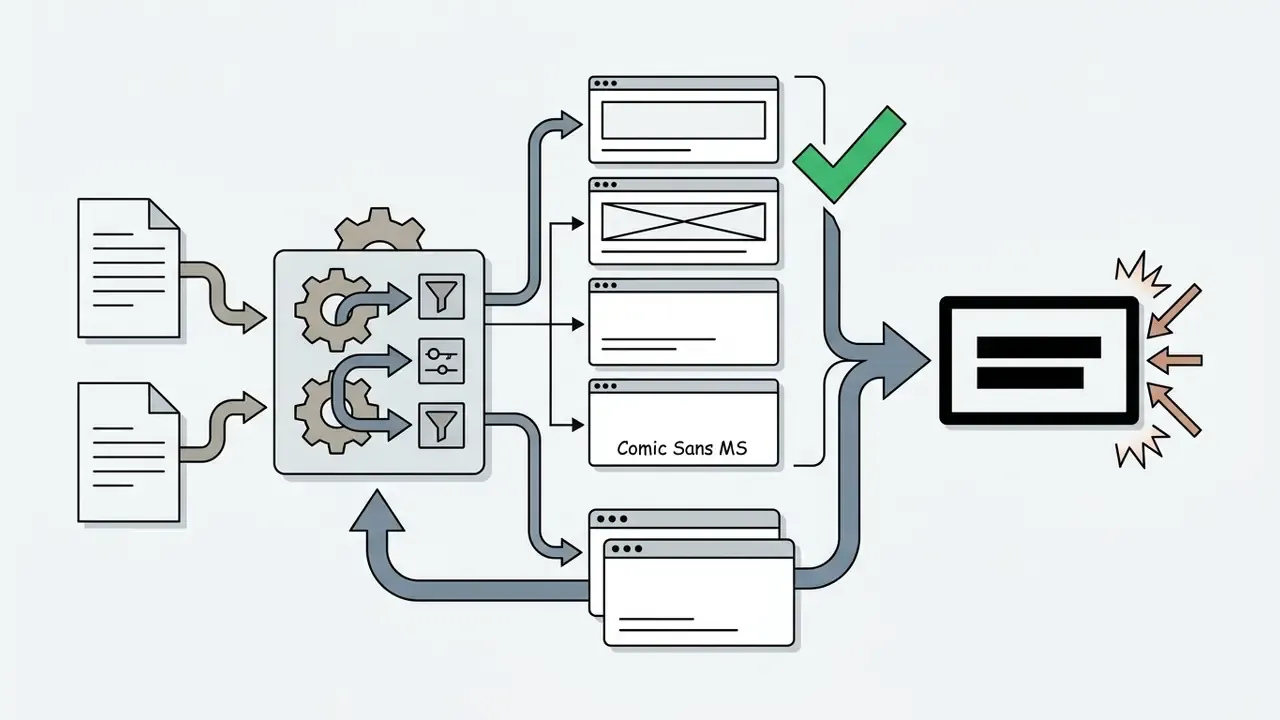
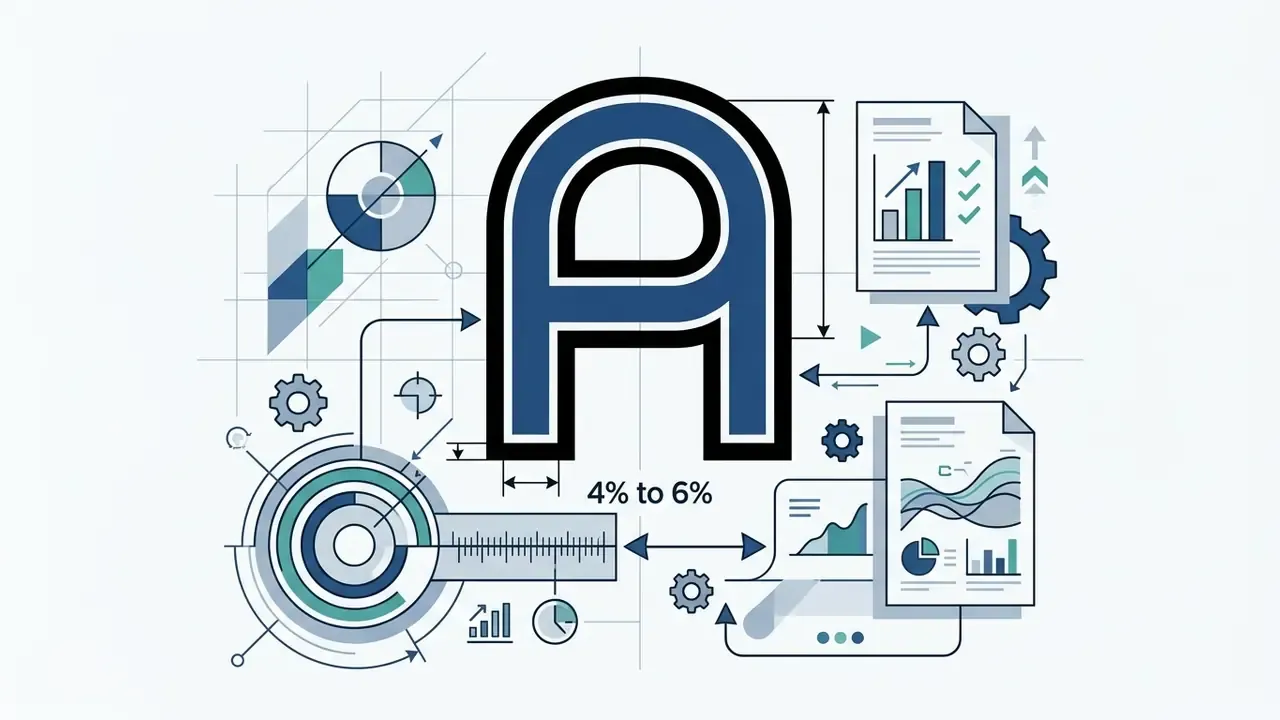
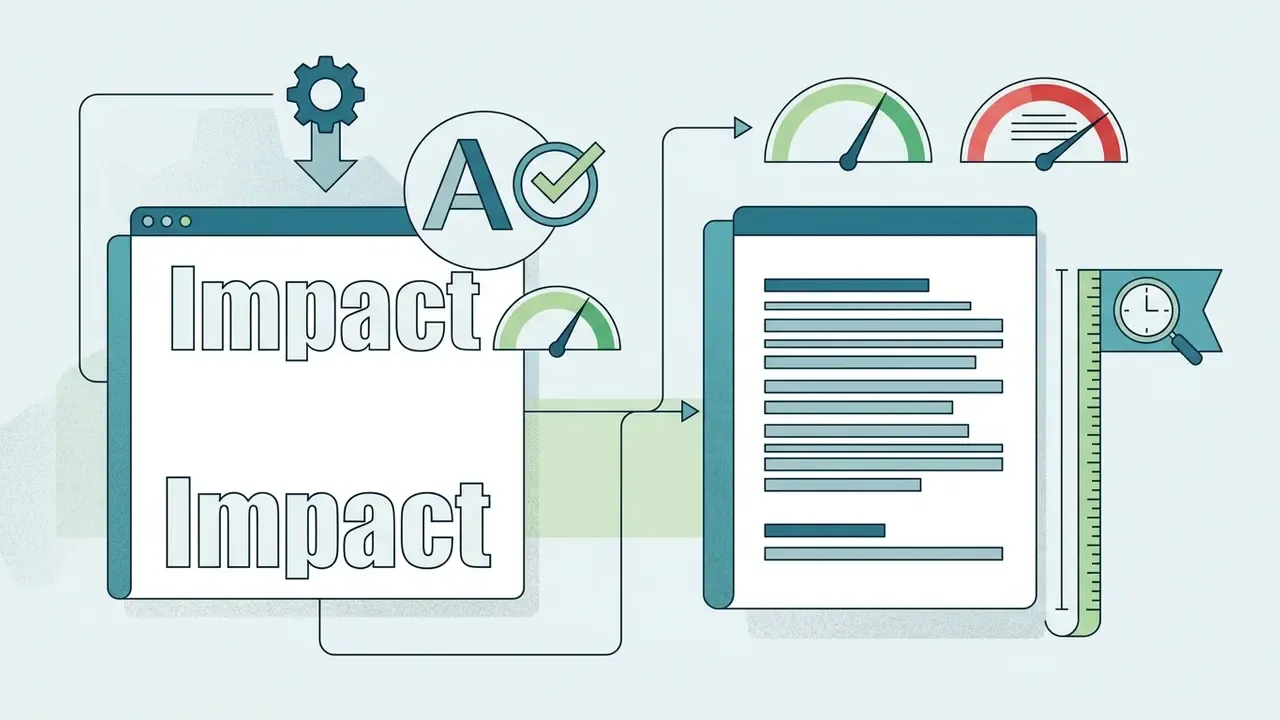
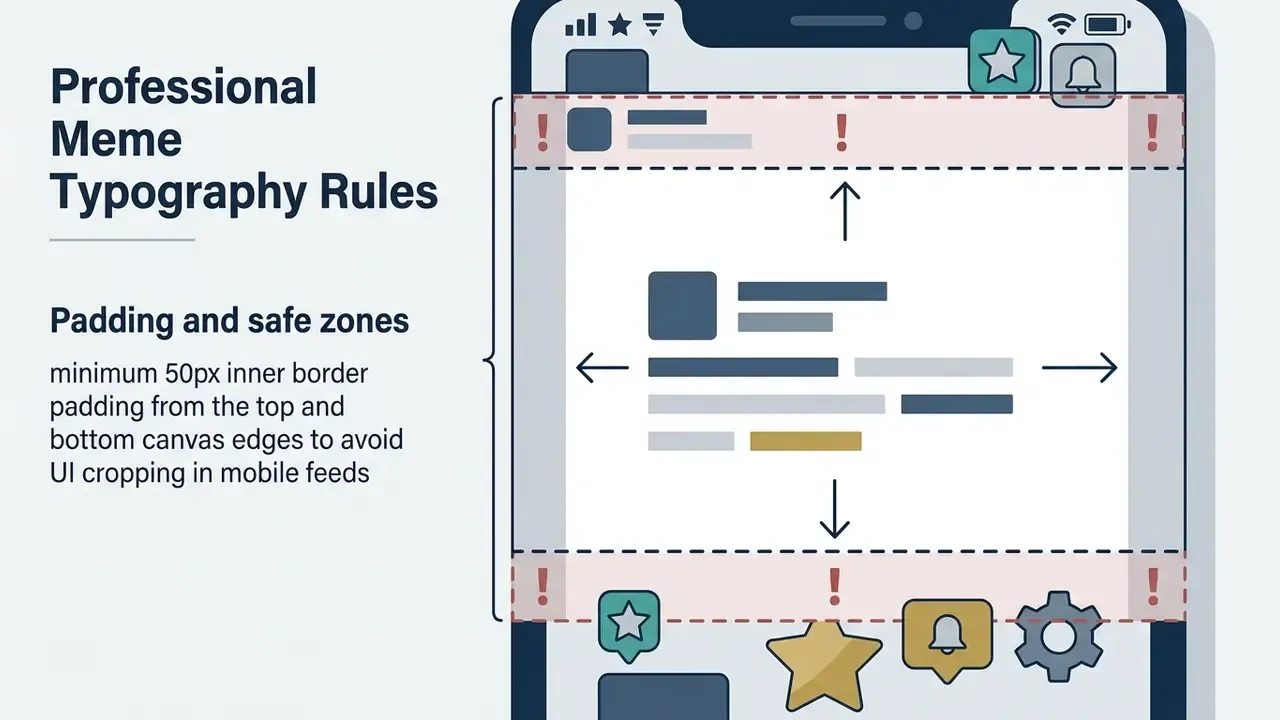
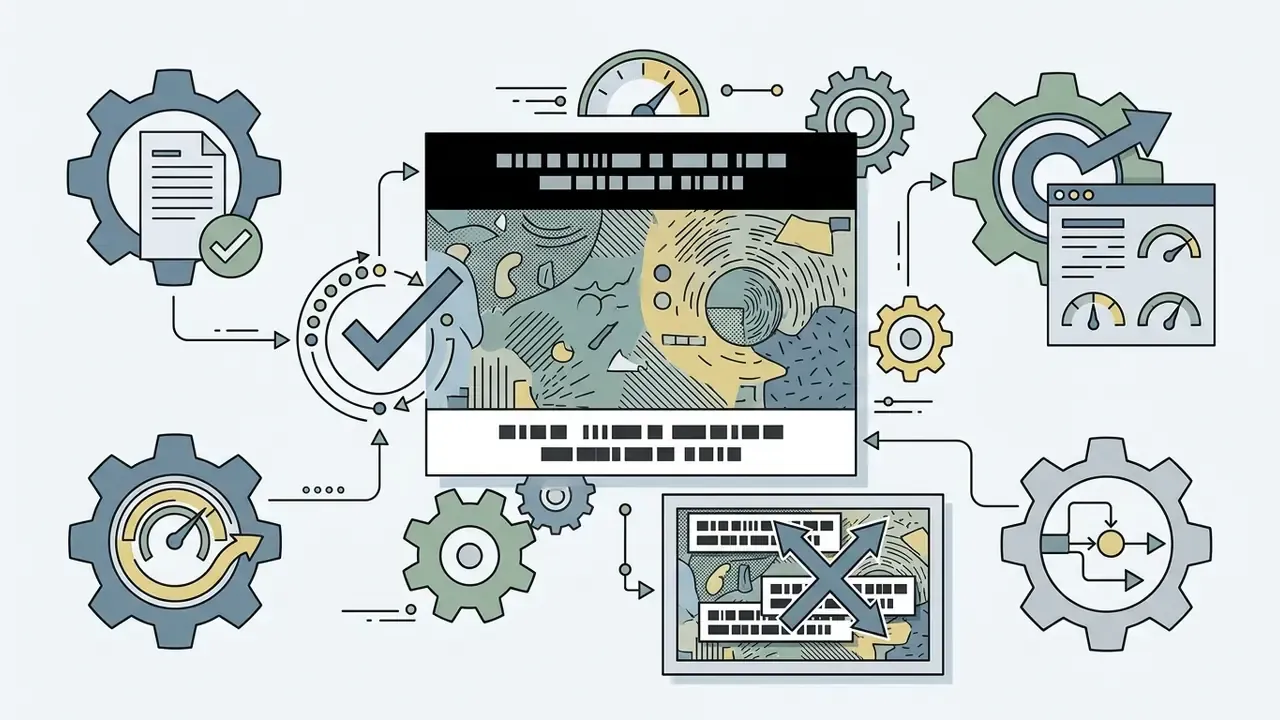
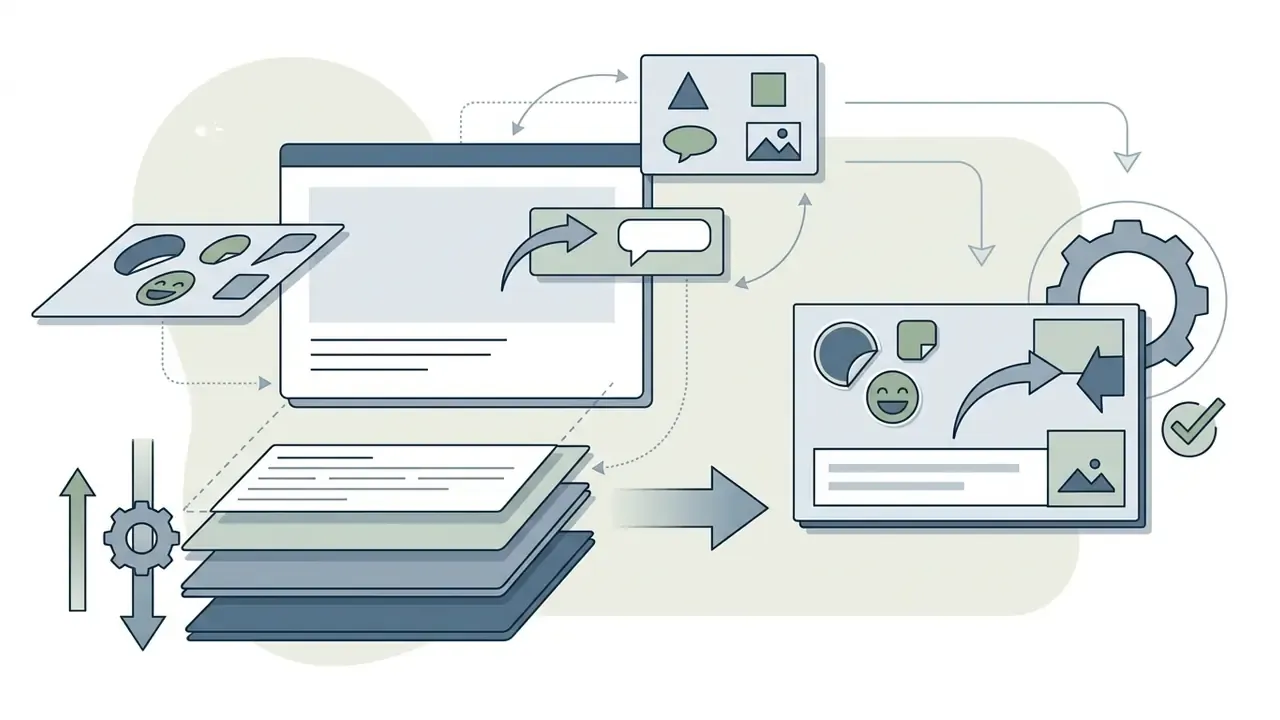
The control set you should expect from any serious maker meme interface after generation: font family, size, color, plate or background color, outline thickness, alignment, layer order, background removal, plus an overlay panel for text and graphics on video and GIF outputs.
Adjusting background contrast, adding callouts, or trimming dead padding keeps attention on the punchline. Editors often review broader software options in our compare section to evaluate dedicated image manipulation environments, and our guides to AI photo editors and general-purpose online photo editors go deeper on layer-level retouching. For animated sequences built frame by frame, an animation maker gives tighter timing control than a one-shot video model.
Customizing AI Memes With Templates, Photos and Text
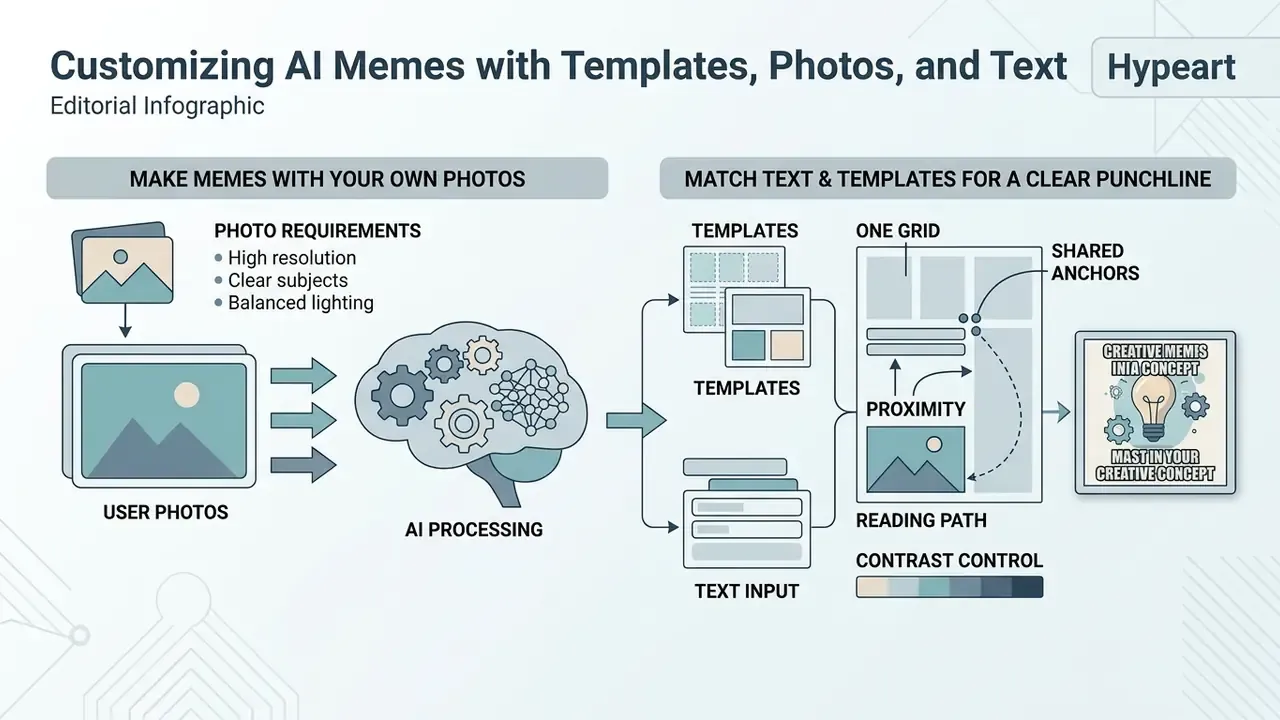
Customization is what keeps visual humor tied to a specific brand voice, team culture or internal running joke. Custom photos plus disciplined text alignment produce authentic engagement rather than generic filler.
"Two online experiments showed the image-macro format influences perception and sharing intention more strongly than language manipulation or humor level."
Make a Meme With Your Own Photos
Dropping your own photographs into a meme frame requires clean subject isolation and accurate facial mapping. Generators use background removal segmentation models to lift the subject out, then place it inside the target frame.
Input photo requirements. Output quality is decided at upload, not at render.
| Photo Parameter | Best Practice for AI Input | Common Failure Mode to Avoid |
|---|---|---|
| Framing | Full-body shot, head to toe visible | Close-up selfies, where the AI guesses limbs and produces bent or distorted legs |
| Pose | Arms and legs spaced away from the torso | Overlapping limbs, hidden hands, crossed arms |
| Lighting | Even studio light or natural daylight | Harsh side shadows, severe backlighting |
| Background | Clean, high-contrast single color | Cluttered group photos with overlapping subjects |
| Subjects | One clearly separated person per reference | Crowds where segmentation cannot isolate the target |
| Resolution | Sharp, unfiltered, 1080px or more on the short edge | Heavy beauty filters, motion blur, low-light noise |
Vendor documentation is blunt about the reason: models need to see head, torso and legs to map motion accurately, and cropped half-body shots leave the lower body unreferenced. That single upload rule fixes most swap artifacts.
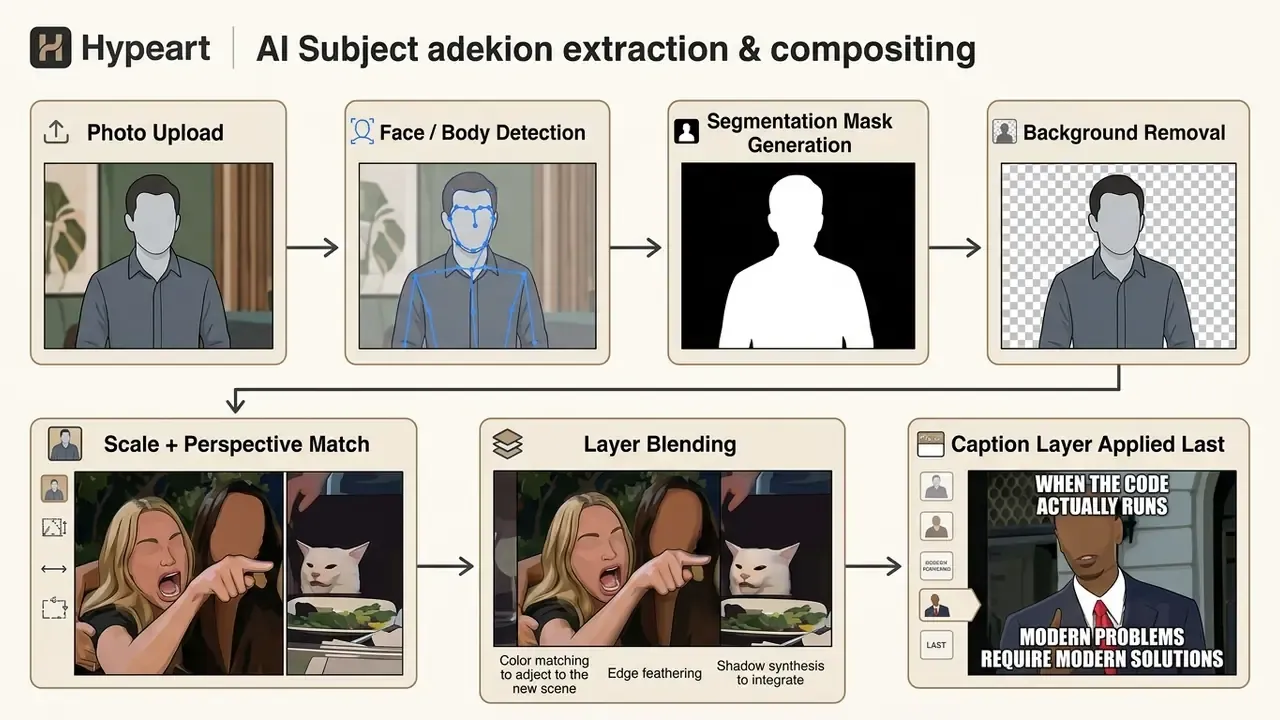
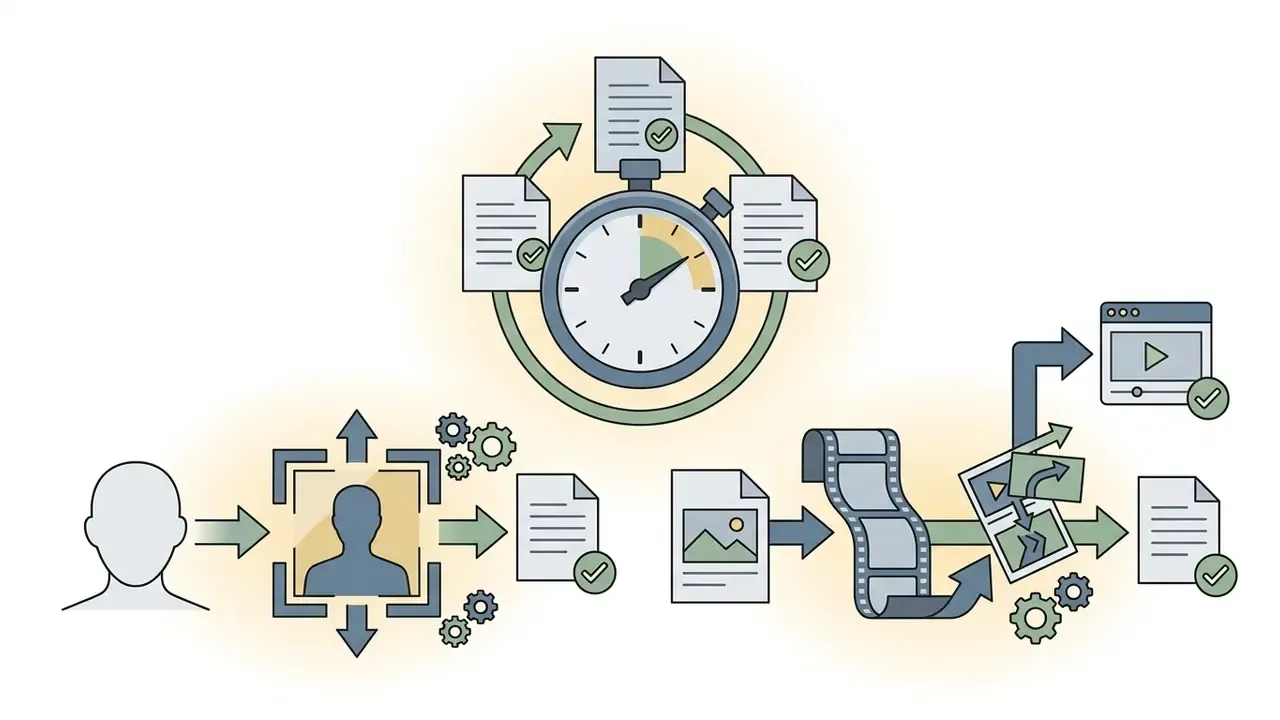
Figure 3. Custom photo integration mechanics, from upload to final layer order.
Automated background removal isolates human subjects in near real time, which makes integration into custom backdrops fast. Comparable production workflows are documented in mainstream editors: one-click background removal as a quick action, and face swapping via auto-align, layer masks, color matching and auto-blend. Open-source pipelines expose background removal as a command-line processor for batch automation, which matters if you generate at volume. Teams evaluating dedicated tools can consult our guide on free photo editor solutions.
Match Text and Templates for a Clear Punchline
Visual punchlines fail when the text sits on top of the visual cue or forces the eye to travel across the canvas. Setup at the upper margin, punchline anchored at the bottom: that ordering preserves reading hierarchy and, more importantly, timing.
Layout guidance for image and text pairing is well established. Captions and titles should follow consistent alignment and hold a predictable position relative to the image (Australian Government Style Manual, 2024). Composition guidance recommends consistent margins, baseline grids, and aligning text to anchor objects inside the frame (The Noun Project, 2024). Comic-timing practice adds the sequencing rule that transfers directly to memes: setup before the visual break, punchline immediately after it (Multic, 2025).
Applied to a meme canvas, that yields four concrete rules:
- One grid, shared anchors.Align caption edges to the image's dominant vertical or horizontal axis.
- Proximity.Keep the punchline physically close to the visual cue it explains. Distance kills timing.
- Reading path.Setup on top, punchline at the bottom right of the dominant scan path for left-to-right languages.
- Contrast control.Maintain strong contrast between typography outlines and background elements to avoid legibility problems on high-DPI screens.
Free AI Meme Generator Options, Apps and API Access
Delivery model matters as much as model quality. Your choice depends on operational requirements, existing infrastructure and how much you plan to scale. Individual creators, social teams and product developers end up in different categories.
| Feature / Metric | Free Web Generators | Mobile Applications | API Access Interfaces |
|---|---|---|---|
| Primary use case | Ad-hoc browser creation | On-the-go mobile editing | Automated platform scaling |
| Input modality | Prompt and template browser | Touch canvas and camera upload | JSON payloads (text or image) |
| Customization depth | Basic text and layout control | Touch overlays and filters | Full programmatic control |
| Export formats | Watermarked PNG / JPG | PNG, MP4, GIF | Raw image streams / URLs |
| Cost model | Free with ads or tiers | In-app purchases, subscriptions | Pay-per-call or monthly tier |
| Typical free limits | Around 10 to 25 AI generations per month; daily caps near 5 video memes | Trial period, then weekly or monthly subscription | Free sandbox calls, premium endpoints gated |
| Enterprise data protection | Weakest: training opt-out rarely offered, retention undisclosed | Mixed: device permissions plus cloud processing | Strongest: contractual DPA, tenant isolation, retention controls |
| License rights on output | Often personal use only; watermark removal paywalled | Personal sharing by default; brand use requires a paid tier | Commercial grant usually explicit in the API agreement |
| Audit trail | None, no exportable prompt logs | None to minimal | Request and response logging, seeds, timestamps |
| Best for | Testing ideas, internal chats | Creators posting from phones | Brand pipelines, bots, high-volume campaigns |
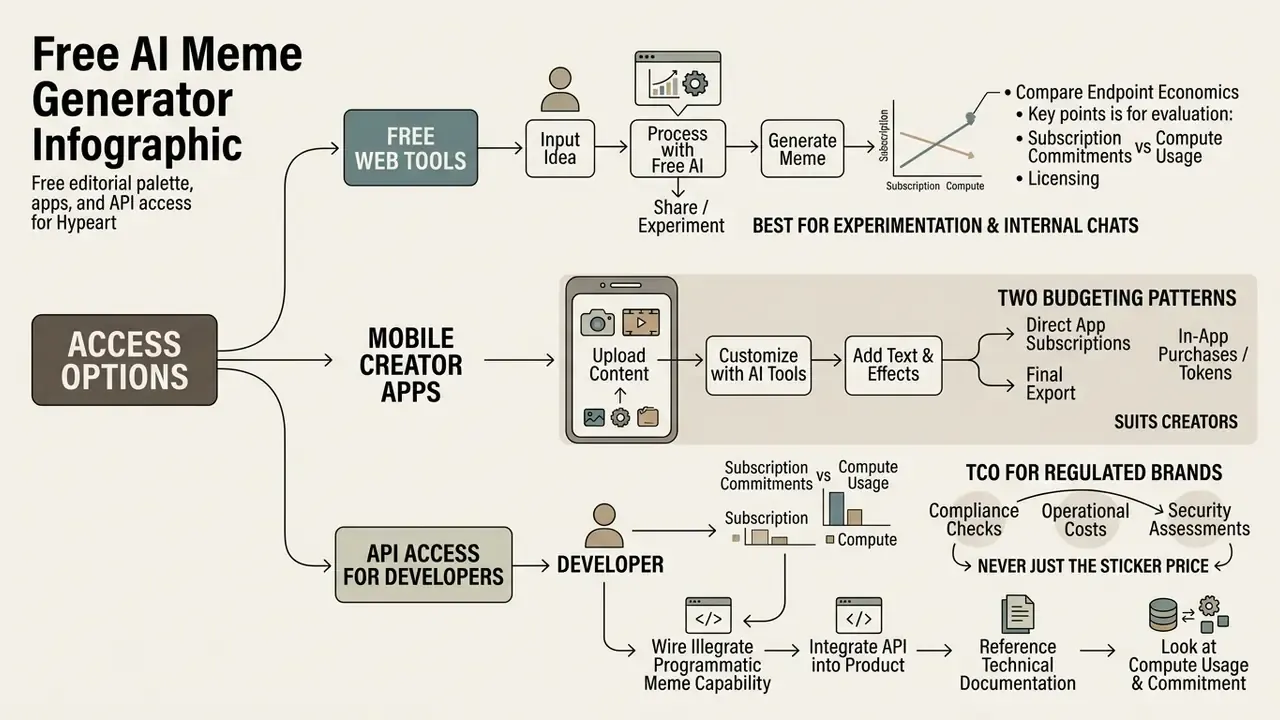
Two patterns worth budgeting for. Several established generators keep classic meme creation free while gating AI endpoints behind premium plans (for example, automeme and ai_meme-style endpoints priced from roughly $9.99 per month). Video-first mobile products commonly allow about five free memes per day before paywalling watermark-free, higher-resolution exports. Mobile subscription tiers observed in app stores run from roughly $9.99 per week to $99.99 per year after a short trial.
Total cost of ownership for a regulated brand is never the sticker price. Model it as subscription or per-call compute, plus review labor (legal and brand approval per asset), plus rights clearance for any recognizable face or character, plus archival storage of prompts, seeds and outputs, plus an incident cost reserve. In practice, review labor dominates. Compute is the cheap line.
Comparing endpoint economics means looking at compute usage next to subscription commitments, and licensing terms should be checked against our reference on the commercial use of AI image generators. Teams planning large visual content pipelines can review transparent software tiering on our pricing page, and video-heavy programs can benchmark free tiers in our comparison of the best free AI video generators.
Developers wiring programmatic meme capability into their own products can reference technical documentation in our AI Media API Guides. Text-to-meme APIs typically accept a topic or message, select a fitting template, write the caption, and return a ready image URL. Enough to power a bot, a Slack command or a campaign generator with no front-end editing at all.
Text summary of the table: free web tools suit experimentation and internal chats; mobile apps suit creators publishing from a phone; API access suits regulated brand pipelines that need contractual data protection and a logged audit trail.
Using AI Generated Memes for Marketing and Commercial Content
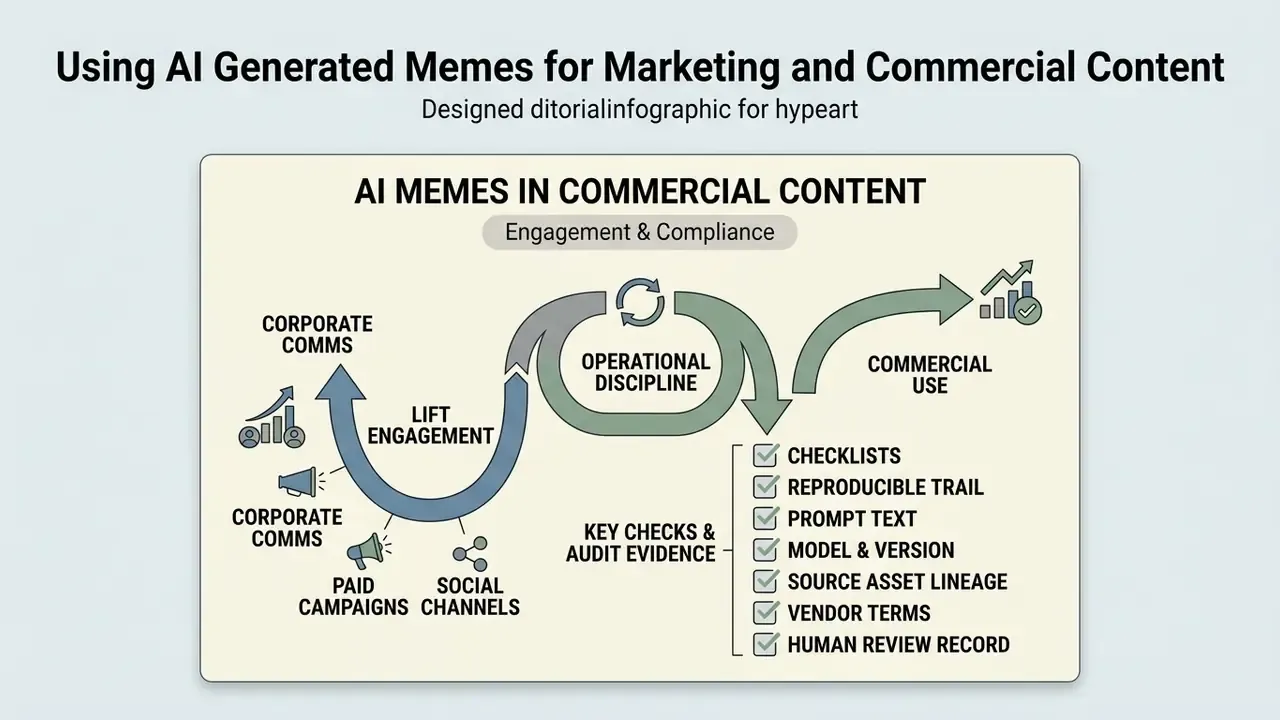
Funny AI memes can lift engagement in corporate communications, paid campaigns and social channels, provided the operational discipline is there. Commercial deployment demands a real risk assessment covering copyright, publicity rights and platform terms, so the compliance gate comes before the campaign playbook. That ordering is deliberate.
What to Check Before Commercial Use of a Meme
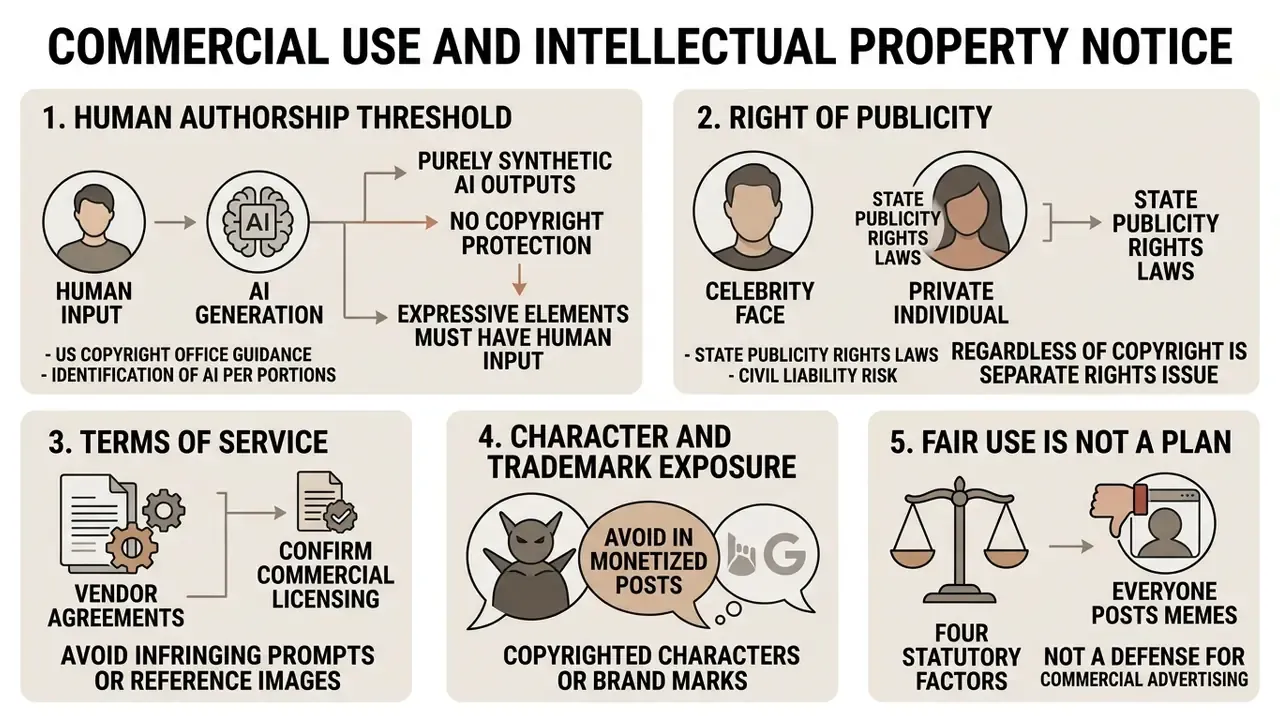
Synthetic assets in commercial campaigns create exposure when source imagery, likenesses or trademarked elements lack clear licensing. Evaluate copyright ownership for any base template before you commit ad spend, and verify provenance with AI image detectors whenever the source chain is unclear.
Audit Evidence Checklist (Reproducible Trail)
"Users with negative attitudes toward AI rated AI-attributed memes as less funny (F(1,114) = 3.69, p = 0.06) and less creative (F(1,114) = 3.87, p = 0.05)."
Pre-Publication Brand Safety Checklist
Run every AI meme through this gate before it leaves the building.
Checklist0 / 11
Limitations and Open Questions
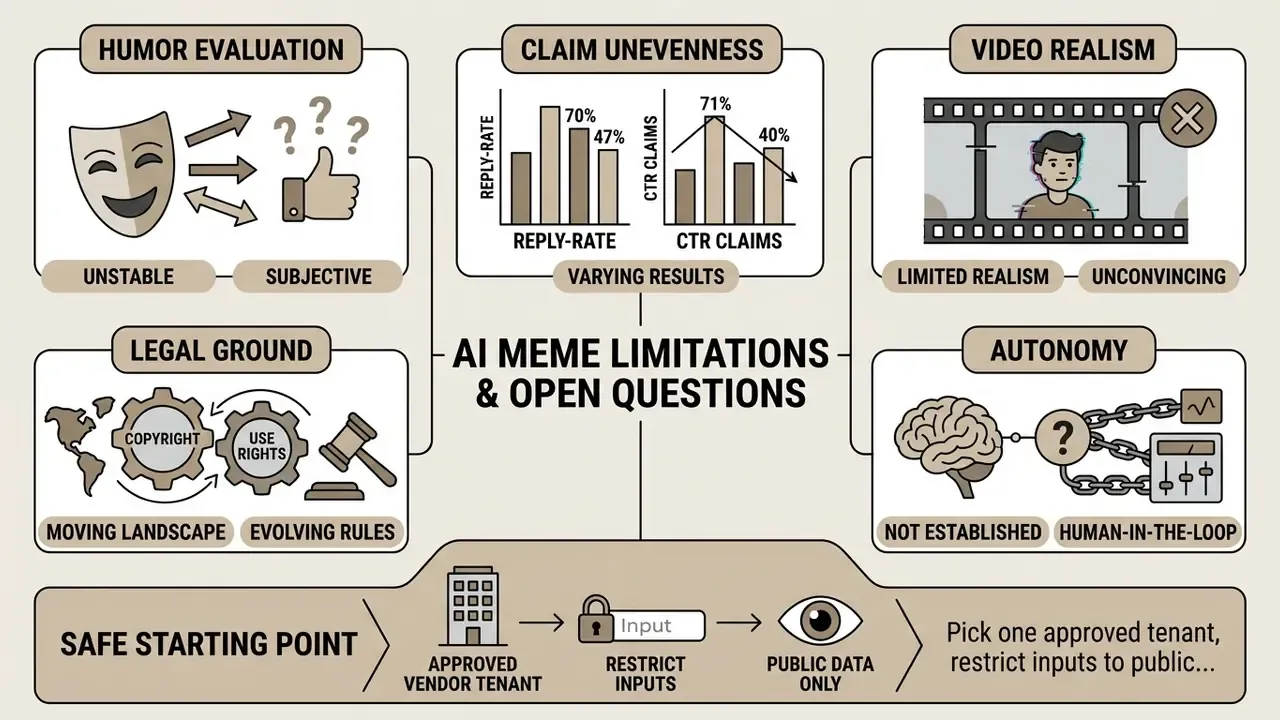
Worth stating plainly, because overclaiming is how governance programs lose credibility.
- Humor evaluation is unstable. Funniness ratings shift with audience, source attribution and cultural context, so a controlled study result rarely transfers cleanly to your account.
- Reply-rate and CTR claims are uneven. Some come from large impression datasets, others from vendor blogs. Treat them differently.
- Video realism remains limited. Four-second clips and imperfect photorealism constrain what a meme video can carry narratively.
- Legal ground is moving. Human-authorship thresholds and digital-replica rules are still being interpreted, and state publicity laws differ. Re-check before each campaign cycle rather than once a year.
- Autonomy is not established. No current evidence supports fully autonomous meme publishing in a regulated brand account. Human review stays in the loop.
A safe next step, if you are starting from zero: pick one approved vendor tenant, restrict inputs to public brand assets, log the six audit fields, and publish ten memes with named review. Then decide whether to scale.
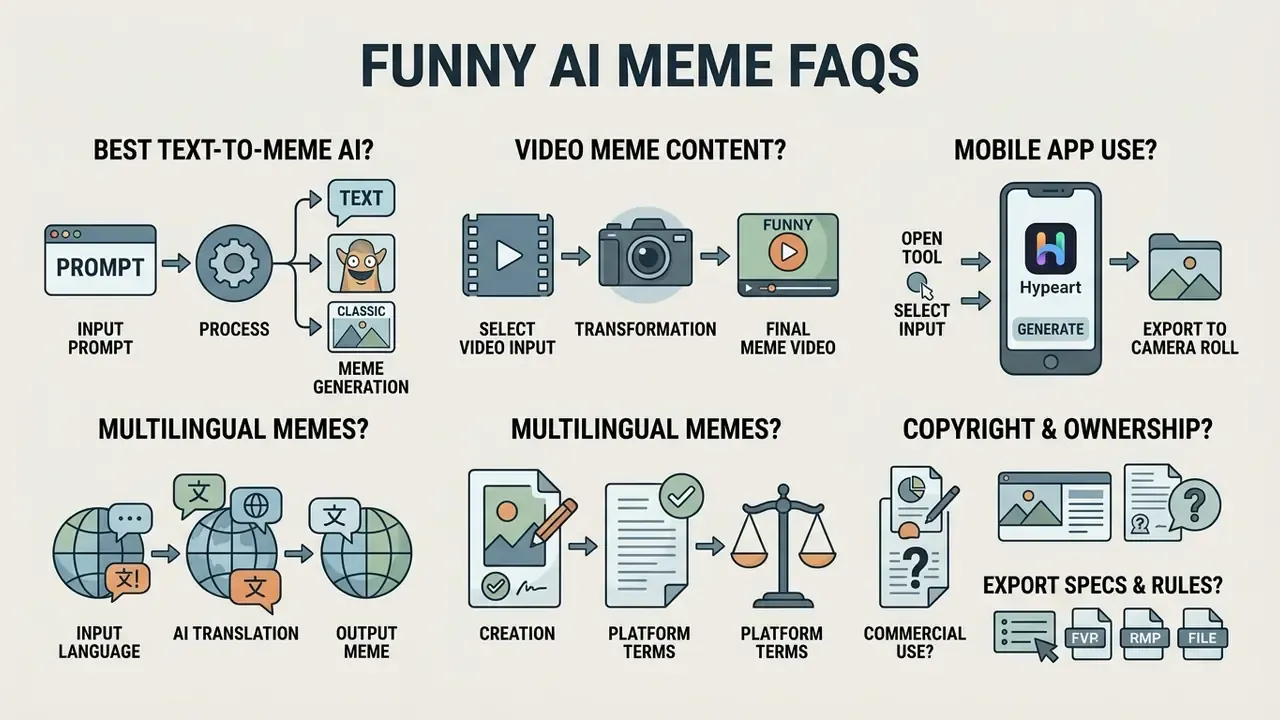
Funny AI Meme FAQs
What Is the Best AI Meme Generator for Text Prompts?
Choosing an AI meme generator depends on whether you want fully automated text parsing or manual template control. Tools built on large vision-language models handle complex situational humor well, write captions automatically, and pick complementary layouts. The strongest prompt-first services accept plain natural language and return a batch of candidates, commonly eight, for human selection. Research on machine humor is encouraging on the text side: in one blind comparison, roughly 70% of participants rated ChatGPT's jokes funnier than human-written ones, and its satirical headlines scored on par with professional satire publications (USC Today, 2024). Creators who need custom graphic rendering usually pair a prompt engine with dedicated editing utilities, which you can evaluate in our compare resource directory or in our roundup of free AI image generators.
Can an AI Meme Generator Create Meme Video Content?
Yes. Modern multimodal engines produce short video memes through motion transfer, automated lip-sync or text-to-video diffusion. The system processes audio and a static source image to generate synchronized motion suited to vertical mobile feeds, either by swapping your body into an existing motion template (Mix) or by animating a still meme with a driver video (Move). Expect short durations: reference implementations such as Stable Video Diffusion generate roughly four-second clips and do not achieve perfect photorealism. Teams selecting an engine can compare options among the best AI video generators, and operators running high-volume rendering pipelines can model operational costs with our AI Media Calculators.
Can I Make AI Memes on a Phone App?
Mobile apps for iOS and Android offer full generation on the handset, with camera integration, instant background removal, touch text positioning and direct export to social platforms. The three-step flow is identical on web and native:
- Open the tool.Launch the meme generator in your mobile browser or install the native app. Cross-platform options exist for iOS and Android, though several App Store products are iOS-only and require iOS 15.1 or later.
- Select your input.Type the situation as a prompt, choose from the template library, or upload a photo from your camera roll. Full-body shots for swap formats, clean portraits for reaction macros.
- Export to camera roll.Tap generate, refine caption, font and stickers, then download the PNG or MP4 and share it straight to TikTok, Reels, Shorts or a group chat.
Free mobile tiers commonly cap output, often around five video memes per day, and add watermarks. Paid tiers unlock watermark-free, higher-resolution exports. If installation or rendering fails, troubleshooting steps live in our AI Media Support and Troubleshooting portal.
Can AI Meme Generators Work in Other Languages?
Yes. Leading engines support 110+ output languages and multilingual template search, so you can describe an emotion or an action in your own language and receive a matching image macro with a translated caption. The system identifies localized idioms instead of translating word for word, which preserves comedic timing. Two cautions: overlay text length shifts significantly between languages and can break fixed bounding boxes, and locally viral templates may carry no recognition in other markets. Prefer globally legible layouts for multi-market campaigns.
Are AI-Generated Memes Copyrighted?
In the United States, copyright protects human-authored contributions only. Purely machine-generated expression fails the human-authorship test, and AI-generated portions must be identified and disclaimed during registration (US Copyright Office, Copyrightability Report, 2025). Substantial human creative input, your own caption writing, composition choices and edits, can be protectable. Separately, your right to use a meme commercially is governed by the generator's terms of service, the license on any source template or stock asset, and personality and publicity rights in the depicted individuals. Jurisdictions differ in emphasis: Japan's Agency for Cultural Affairs frames the first question as whether the output is similar to an existing work. General information only, not legal advice. See the compliance block above and consult counsel.
Is It Safe to Upload Company Photos to a Free Meme Tool?
Not by default. Free consumer tiers rarely offer a contractual training opt-out, and retention windows are often undisclosed. For organizational use, route generation through an approved vendor tenant or API with a data processing agreement, verified retention controls and a security attestation (SOC 2 Type II or ISO 27001), then restrict inputs to public brand assets plus consented employee photos. Never upload customer data, internal dashboards or regulated material into an unmanaged endpoint.
Appendix A: Editorial Notes on Sources
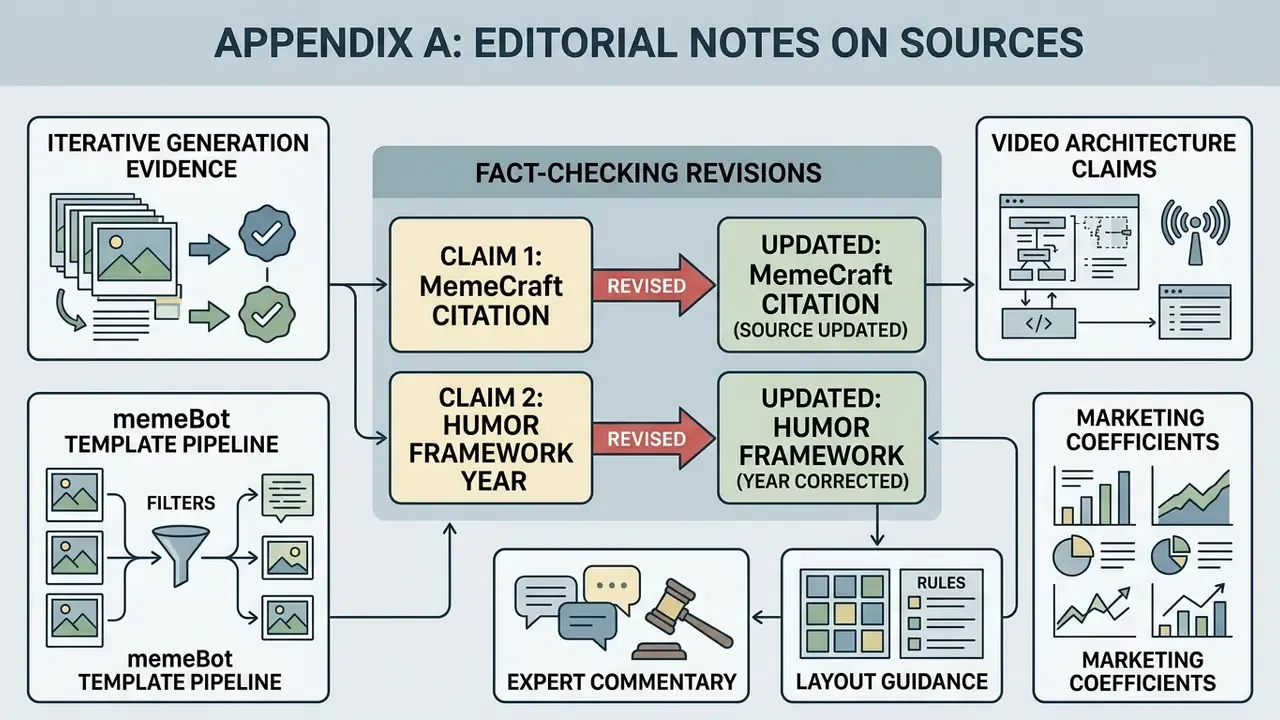
For transparency, the following claims were revised during fact-checking and are retained here alongside their updated versions.
- MemeCraft citation. The earlier generic phrasing about multimodal architectures aligning visual framing with narrative tone has been replaced in the main text by a methodology-level description of the published MemeCraft pipeline, including its safety mechanism (arXiv, 2024).
- HUMOR Framework year. The originally stated year of 2026 was corrected to 2025 (preprint), with the hierarchical reasoning method described explicitly.
- Iterative generation evidence. The original reference to iterative selection is retained (IterMeme, IJCAI 2025) and supplemented with human-evaluation findings from "One Does Not Simply Meme Alone" (2025), plus the countervailing 2025 finding that unguided iteration converges toward generic motifs.
- Video architecture claims. The reference to native multimodal video models (Google Gemini Omni Flash, 2026) is retained and now paired with dataset evidence (MMD, 2024) and documented capability limits (Stable Video Diffusion clip length and photorealism).
- memeBot template pipeline. Retained and reframed as a template-first architecture with its primary source link, rather than an unsourced assertion about bounding-box captioning.
- Layout guidance. The Australian Government Style Manual (2024) reference is retained strictly for image and caption alignment conventions, supplemented with composition guidance (The Noun Project, 2024) and comic-timing sequencing (Multic, 2025), which are the domain-appropriate sources for punchline placement.
- Expert commentary. The quotation is attributed to Marcus Hale, author.
- Marketing coefficients. The β coefficients are retained with their modeling context (structural equation modeling of consumer response to visual humor) and paired with the independent 16-billion-impression CTR analysis (2024). Vendor claims about reply-rate lift in outbound channels remain promotional and are labeled as such.
- Illustrative cases. The three numbered examples (120 campaign variants, 50 internal iterations, 30 fintech visuals) are composite scenarios written for instruction. They are not verified client results.
Social Media, Outbound and Paid Marketing Use Cases
Meme-based visuals generally out-engage standard corporate banners across social platforms. Research on digital consumer behavior shows humorous visual content improves brand recall: a 2024 systematic review of 45 peer-reviewed articles concluded that meme marketing drives viral engagement and stronger digital consumer connection (Journal of Management, Business and Accounting Studies, 2024).
Quantitative modeling links social engagement to commercial consideration (ScienceDirect, 2025). Based on structural equation modeling of consumer response to visual humor, the path coefficients align positively:
Meme Marketingβ=0.745Consumer Engagementβ=0.651Purchase IntentionPaid-media performance depends on perceived authenticity, not on AI usage as such:
Channel patterns observed across vendor and industry reporting:
Illustrative example: a fintech marketing group ran automated meme variations across paid acquisition channels aimed at digital-native banking customers. The team deployed 30 compliance-vetted visuals built around common operational pain points, then measured against standard banners. Click-through rose 34% with lower cost per acquisition. Composite scenario, single program, so read it as directional rather than as a benchmark.