Automating the production of advertising materials has moved out of the hypothesis stage and into standard operating practice for digital marketing. Enterprise measurement studies of generative content workflows, including the Adobe/Forrester Total Economic Impact model built on eleven customer interviews, report that deploying generative advertising systems lowers direct content-production costs and shortens the hypothesis-testing cycle, with modelled net ROI reaching up to 5.7x in content-heavy organisations. Worth pausing here. Those are projections from a vendor-commissioned model, not universal benchmarks, so treat them as an upper bound and validate against your own cost baseline before anyone quotes them in a steering committee deck.
«Without strict source verification, documented intellectual-property rights and control over deviations from the brand book, autonomous ad generation creates unmanageable operational risk. An effective AI ad generator does not replace the marketer. It works as a controlled digital executor with clearly defined access boundaries, an audit trail and explicit liability limits.»
— Marcus Hale, author.
Executive Summary for Decision-Makers
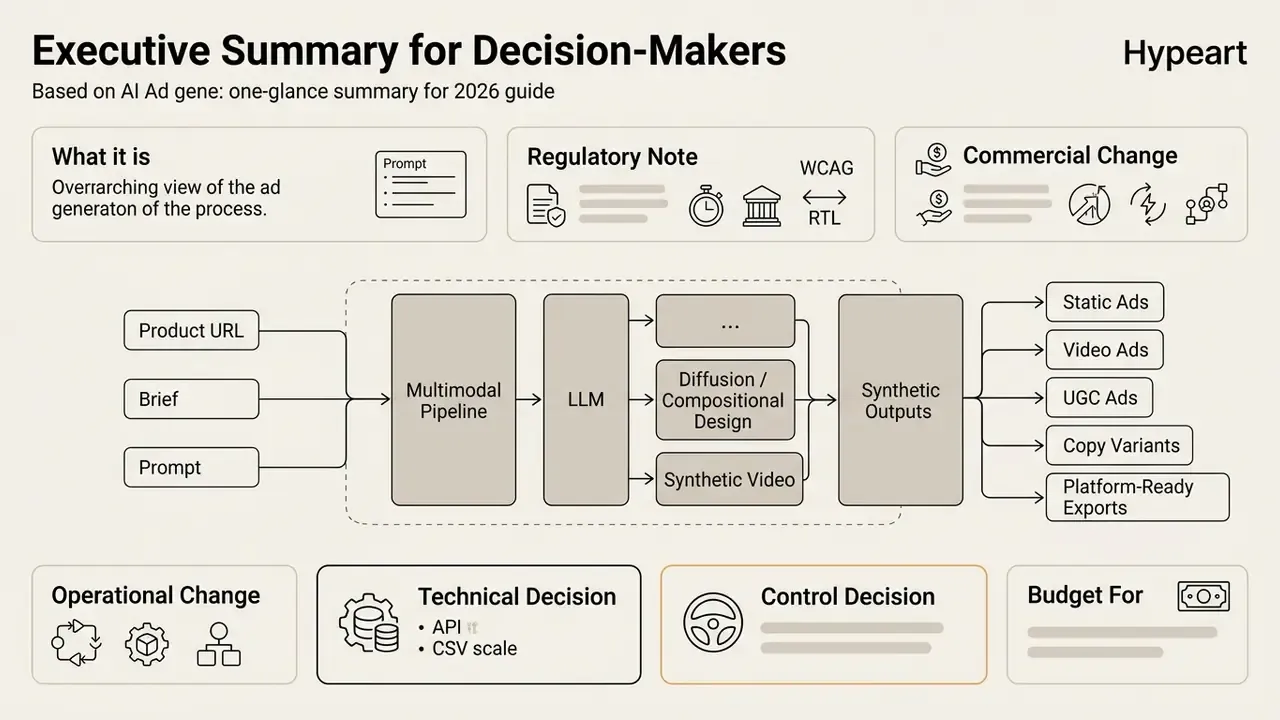
- What it is. An AI ad generator is a multimodal pipeline (LLM plus a diffusion or compositional design model plus synthetic video) that turns a prompt, a brief or a product URL into static banners, video ads, UGC-style creatives and ad copy.
- What it changes commercially. Documented field evidence: AI-generated banners outperformed professional stock photography by up to 50% CTR across more than 173,000 impressions; personalised AI video ads lifted engagement by 6–9 percentage points; LLM-written ad copy beat human copy in 59.1% of paired comparisons.
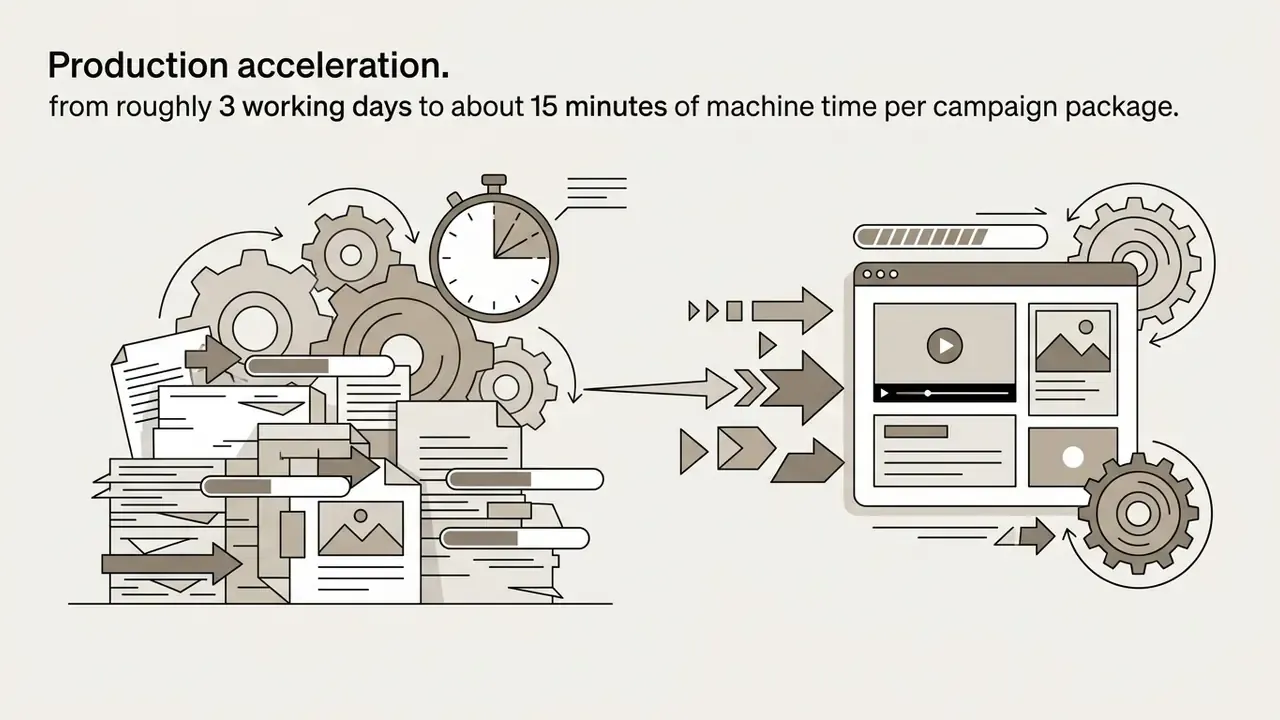
- What it changes operationally. Klarna cut image-production time from six weeks to seven days and reduced external supplier spend by roughly 25%, saving about $10 million a year. In practice, a full multi-format package moves from around three days to roughly fifteen minutes of machine time plus human review.
- The technical decision that matters most. Choose layered, editable output (independent text, logo, CTA and background layers, exportable as HTML, PDF or PNG) over flat raster generation, where text is baked into pixels and cannot be corrected or re-priced.
- The control decision that matters most. In regulated industries (banking, lending, insurance, healthcare), generation must sit inside a model-risk and human-in-the-loop framework: prompt and version logging, legal and compliance sign-off before publication, a reproducible audit trail, and vendor terms guaranteeing data isolation and no training on your data.
- What to budget for. Not just licences. Total cost of ownership includes validation, bias and claim monitoring, legal review, and the residual cost of non-compliance. Model risk-adjusted ROI, not gross production savings. If you want to sanity-check the arithmetic before procurement, our calculators cover unit cost per creative and review-hour load.
What an AI Ad Generator Is and What Ads It Creates
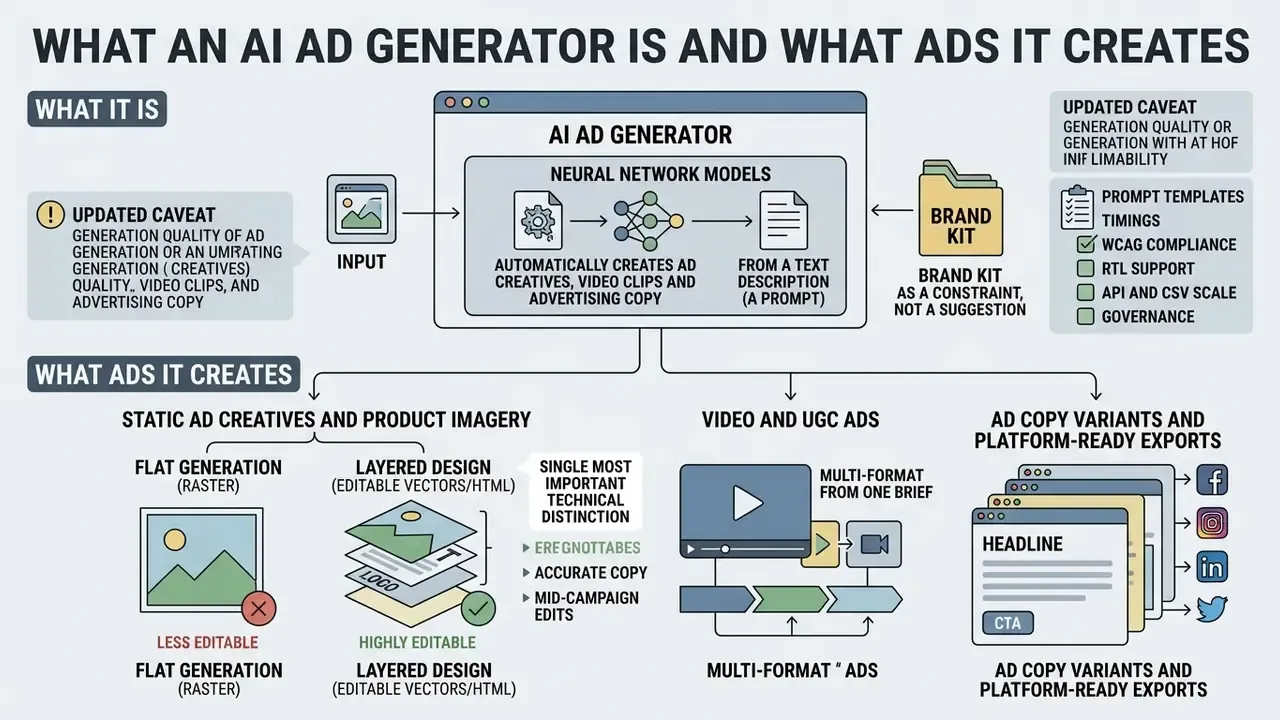
An AI ad generator is a software system built on neural network models, designed to automatically create ad creatives, video clips and advertising copy from a text description (a prompt) or a link to a product. A modern advertisement AI generator uses combined multimodal architectures, joining diffusion image models, transformers for text generation and synthetic video generators.
From a technical standpoint, AI ads are built by extracting semantic entities from the brand's landing page, matching them against a library of high-converting patterns, and then synthesising a unique media file. Microsoft Advertising documents exactly this flow: ad copy is written, images are recommended, and video and display banner assets are assembled from a website URL plus a text prompt. The IAB's Generative AI Playbook for Advertising frames the same workflow with governance, bias-testing and disclosure controls attached to the output.
Research by Hartmann, Exner and Domdey, published in the International Journal of Research in Marketing, provides the strongest field evidence available for image performance:
«In a field study spanning more than 173,000 ad impressions, AI-generated banners outperformed professional stock photography on click-through rate by up to 50%.»
Static Ad Creatives and Product Imagery
Layered design (editable vectors/HTML) vs flat generation (raster)
This is the single most important technical distinction when choosing a tool. Avoid "flat" raster generation, where text is baked directly into the pixels of the image. Pure diffusion models guess at glyphs, which produces spelling artefacts: a CTA that reads "Shp Now," or a discount rendered as "30$ off" instead of "$30 off". Worse, it makes the price impossible to change without regenerating the whole frame. The ad fails before it ever serves.
A mature AI ad generator instead composes each ad as a layered design file (layered design, HTML5 or vector). The headline, price, logo, CTA button, product cut-out and the neural-network background each live on an isolated layer. Practical consequences:
- Accurate copy. Every headline, price point and CTA is placed as real, editable text rather than guessed pixels.
- Mid-campaign edits. When the offer changes from −20% to −30%, you update one text layer and re-export in about five seconds. The layout survives; the background is not regenerated.
- Multi-format from one brief. A 300×250 display unit, a 1080×1080 square and a 1080×1920 story can be re-composed from the same content object.
- Brand kit as a constraint, not a suggestion. Colours, fonts and logo placement are enforced across every unit.
- Survivability under review. Flat outputs rarely survive brand or compliance review, because reviewers cannot correct a single word without a new generation cycle.
A useful way to classify the market:
| Tool class | Output object | Text handling | Layout control | Resizing |
|---|---|---|---|---|
| Template tools (e.g. Canva-type) | Filled version of an existing layout | Real text in template slots | One layout per template | One template per dimension |
| Image generators (diffusion, e.g. Nano Banana-type) | Flat raster image, no layers | Pixel text, often garbled | Unpredictable, no structural control | Fixed aspect ratios |
| Compositional AI ad generators (e.g. Sivi-type) | Layered design file, independent elements | Real text on editable layers | Original composition per prompt | Any dimension, layout re-composed |
AI Video Ads, UGC and Creator-Style Advertising
AI video ads are short promotional clips generated from text scripts, a set of static frames, or dynamic video avatars with speech synthesis. UGC-style (user-generated content) ads imitate organic user content: unboxing, mobile-app interface walkthroughs, vertical reviews shot in a handheld register.
According to Microsoft Azure AI Speech documentation and the Creatify platform (2026), text-to-speech avatar technology converts a script into a video stream of a photorealistic person speaking with a natural-sounding voice, supporting plaintext or SSML input, avatar style and video formatting. Newer avatar models generate an ad from a single image plus an audio clip or script, with zero-shot rendering and no multi-angle footage. The systems build conversational facial movement, gesture and background scoring, creating the impression of a real author being present.
Where the claim needs qualifying (Updated): "realistic" is a production descriptor, not a measured quality metric. The strongest available evidence on perceived quality actually runs the other way for voice. A 2024 peer-reviewed multi-study comparison of human versus AI voice-over in short-form video advertising found that human voice-over reduced cognitive load more effectively and produced higher purchase intention than synthetic voice-over. Where warmth, urgency or emotional modulation carries the message, human narration still wins, and that finding should shape which parts of the pipeline you automate first.
Where personalisation is the variable, however, generative video performs strongly:
For planning complex multi-scene edits, use a video montage maker; for assembling narrated brand explainers from a script, a general-purpose video maker covers scene templates and export presets. Social-first teams experimenting with humour formats often keep a video meme maker in the same toolchain, while sales-enablement variants of the same offer usually land better as a video presentation built in a video presentation maker. For platform-native publishing workflows, the guide to YouTube video editors covers export and distribution steps, and teams testing volume before committing budget can start from a comparison of free AI video generators.
Ad Copy Maker AI: Text, Offers and CTAs
Ad copy maker AI is a specialised module built on large language models that algorithmically produces selling headlines, ad body text, descriptions and calls to action for a defined target audience. The module works against psychological triggers such as time scarcity, social proof or expert authority, and typically structures output using AIDA, PAS or Before-After-Bridge frameworks.
The study "LLM-Generated Ads: From Personalization Parity to Persuasion Superiority" (arXiv / ACM Web Conference, 2024–2026) provides the clearest paired-comparison data available:
Aggregated across conditions, AI-structured copy beat human-written variants in 59.1% of comparisons, while the system generates dozens of segment-specific variants in seconds. NIST's 2024–2026 generative-AI documentation adds the governance layer that vendor material tends to omit: benchmarking, bias and fairness testing, authenticity and secure-development requirements apply to copy generators as much as to image models.
| Ad format | Inputs | Output | Recommended channels |
|---|---|---|---|
| Static Ads | Product URL, source photo, style prompt | 1:1 / 4:5 image with text and logo | Facebook Feed, Instagram Grid, Google Display |
| Video Ads | Text script, brand assets, audio track | Finished MP4 with narration and animation | YouTube, Connected TV, Facebook Video |
| UGC Ads | Character description, script, URL, claims review | Vertical 9:16 video with AI avatar | TikTok, Instagram Reels, YouTube Shorts |
| Product Ads | Product feed (SKU, price, availability, URL), style rules | Dynamic banner with live pricing | Google Shopping, Remarketing, Amazon Ads |
Once formats are clear, the next decision is tooling: compare the best AI art generators for image quality and licensing, or weigh platform-native options such as Google's AI image generation terms and Microsoft's AI image generator conditions.
Risk Governance for AI-Generated Advertising in Regulated Industries
Marketing teams in banks, lenders, insurers and fintechs cannot deploy generation as a pure productivity tool. Advertising output is a regulated communication. In the United States it falls under FTC advertising-substantiation rules, CFPB and Fair Lending expectations for credit marketing, and, for investment products, SEC and FINRA communication standards. Model behaviour also falls within model-risk management frameworks such as the Federal Reserve's SR 11-7, which requires a model inventory, validation, ongoing monitoring and documented ownership.
Three risk classes matter most in practice:
- Hallucinated product terms.A generator that paraphrases a landing page can invent an APR, a fee waiver, a guarantee or a "no credit check" claim that does not exist. This is the highest-severity failure mode in financial advertising.
- Data leakage via URL parsing and prompts.Scraping internal or pre-release pages, or pasting customer data into a prompt, can push confidential material into a third-party model. Shadow AI, meaning marketers quietly using unapproved consumer tools, multiplies this exposure.
- Discriminatory targeting or imagery.Generated audiences, personas or synthetic ambassadors can encode proxies for protected characteristics, creating Fair Lending and reputational risk even when no rule was written intentionally.
A fourth class deserves a mention, if only because it surfaces late: vertical-specific advertising restrictions. Gambling adjacency is the classic example. Creatives promoting anything close to video poker online sit under platform-level category bans, licence checks and age-gating rules that no generator enforces for you. The model will happily produce the banner. The ad account will reject it, or worse, approve it into a jurisdiction where it should never have run.
Risk and control matrix
| AI risk | Concrete failure example | Primary control | Owner |
|---|---|---|---|
| Fabricated product terms | Banner states "0% APR for 24 months" not offered | Stop-word/claim allowlist plus mandatory legal HITL sign-off before export | Marketing Compliance |
| Unsubstantiated performance claims | "Save 40% guaranteed" in a generated headline | Claim-substantiation register linked to each approved copy variant | Legal / Compliance |
| Data leakage in prompts or scraping | Pre-launch pricing page parsed by a public tool | Enterprise tenancy, zero data retention, URL allowlist, DLP on prompt fields | InfoSec / IT |
| Discriminatory imagery or targeting | Synthetic personas skewed by protected attributes | Bias review of persona sets, demographic-proxy checks on audience prompts | Model Risk / Fair Lending |
| IP and likeness infringement | Voice clone or lookalike used without consent | Written consent records, digital-replica register, disclosure text | Legal |
| Unlogged, non-reproducible output | Auditor cannot reconstruct who approved which asset | Immutable prompt, model, version and approval log | Model Risk / Internal Audit |
| Brand-book drift at scale | 400 variants shipped with off-palette CTA colour | Brand kit enforced as hard constraint, automated pre-export brand check | Brand / Creative Ops |
| Accessibility non-compliance | Disclaimer at 2.9:1 contrast in a public campaign | Automated WCAG contrast and legibility gate | Creative Ops |
| Category or jurisdiction restriction | Restricted-vertical creative served in a banned market | Placement allowlist by product category and geography | Marketing Compliance |
Where disputes over generated assets are a live concern (likeness, style similarity, dataset provenance), it is worth tracking how these matters are actually resolved in practice. You can compare options for how claims around AI-generated advertising material have been framed and defended.
Human-in-the-loop and the audit trail
Generation speed is only usable if approval is auditable. The IAB playbook recommends small-scale controlled testing with defined acceptable error margins before scale-up. A workable enterprise chain looks like this:
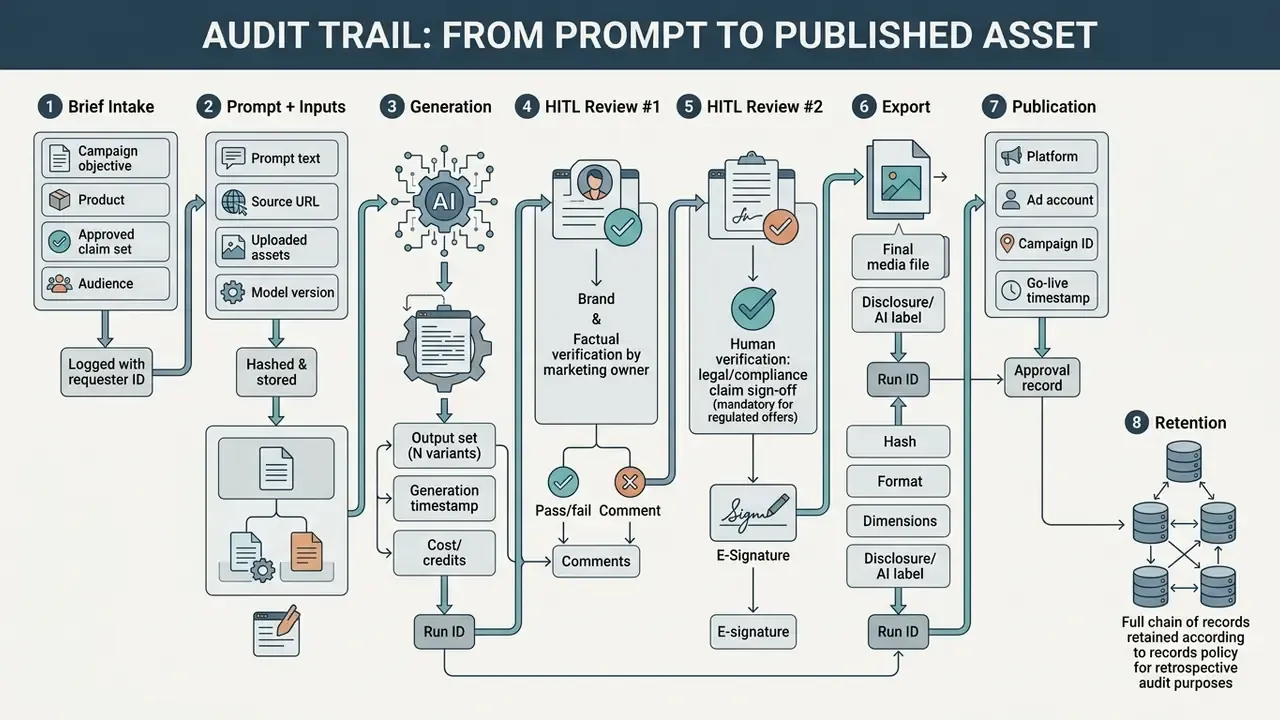
Two rules make this survive an audit. No asset reaches an ad account without a recorded reviewer identity, and every published file must be traceable back to the exact prompt and model version that produced it. Everything else is commentary.
How an AI Ad Generator Works: From Idea or URL to Finished Ad
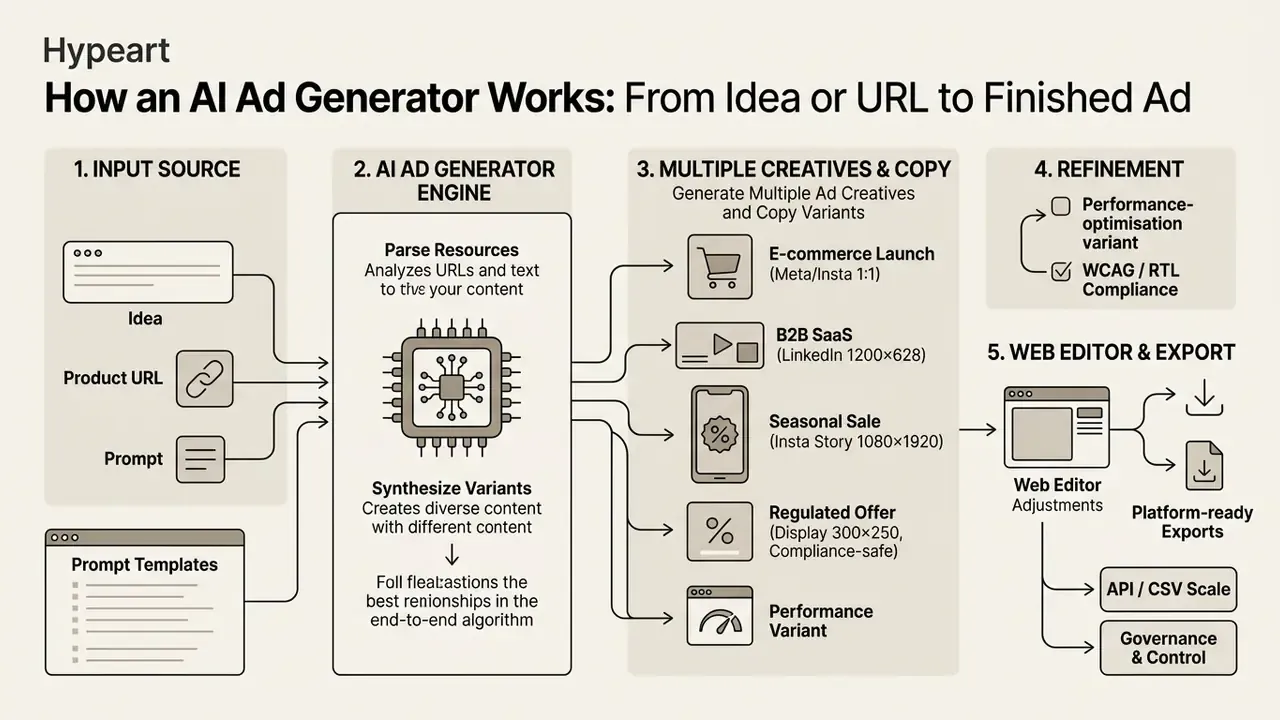
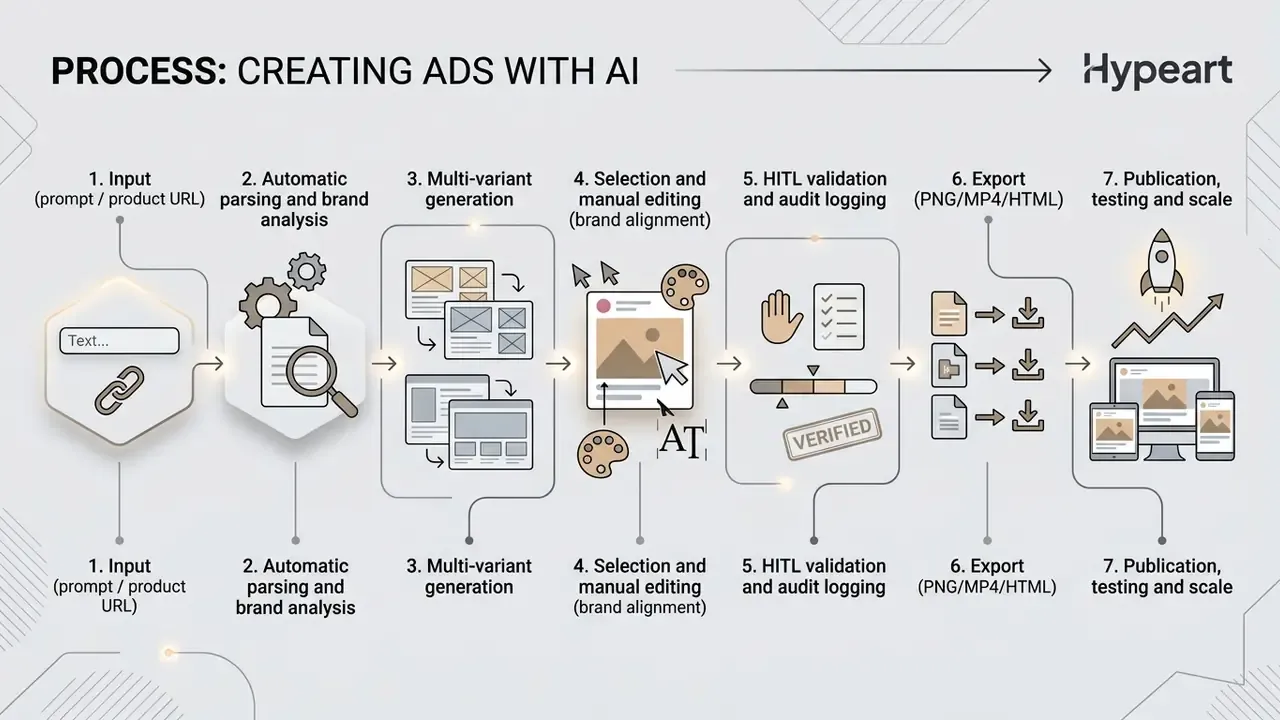
An ads generator with AI follows an end-to-end algorithm: the system accepts primary input, parses the specified resources, synthesises variants and provides a web editor for final correction before export. Automating this compresses the path from brief to campaign launch from several days to roughly 5–10 minutes of machine time. That figure is consistent with vendor-published step timings and with the Klarna case (six weeks down to seven days for image production), not with an independently audited benchmark.
Practical deployment requires coordination between marketing and IT security, so it is worth mapping tooling against Google Veo API implementation costs and limits before committing to an infrastructure pattern.
Add a Prompt, an Idea or a Product Link
The first generation step passes the system a target URL, a text description of the campaign or a set of product parameters. When a link is supplied, ad create AI runs page scraping: it extracts the product name, key attributes, prices, logos and existing photography.
Guidance from Google Cloud's Prompt Engineering for AI Guide (2026), Adobe Campaign's Generate Content prompting guide (2026) and Microsoft's prompt-engineering guidelines (2026) converges on the same brief structure. Adobe formalises it as CO-STAR: Context, Objective, Style, Tone, Audience, Requirements. Microsoft adds an explicit requirement for business purpose, target audience and a named data source or reference artefact. Where this needs evidence: these are vendor methodology documents, not controlled experiments. The frameworks are consistent with each other, but their comparative effectiveness has not been independently measured. The practical rule holds regardless: the more precisely the campaign intent is described at the start, the less costly the subsequent manual rework of creatives.
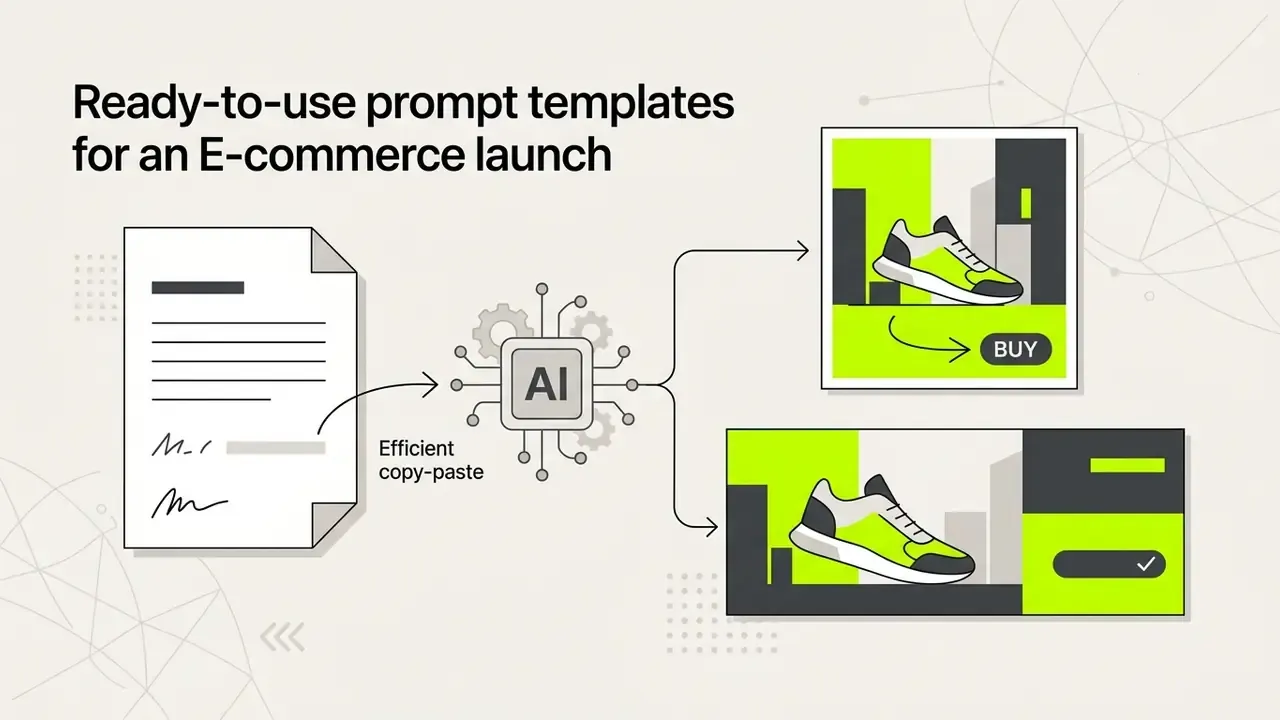
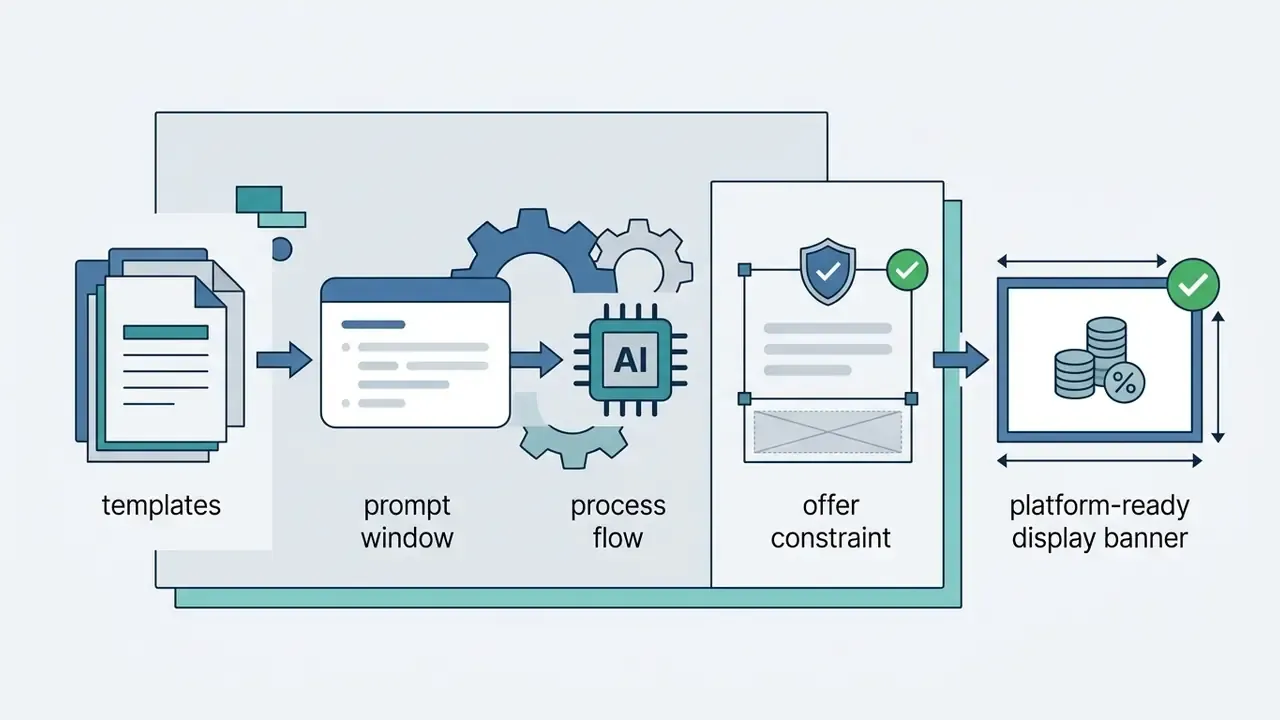
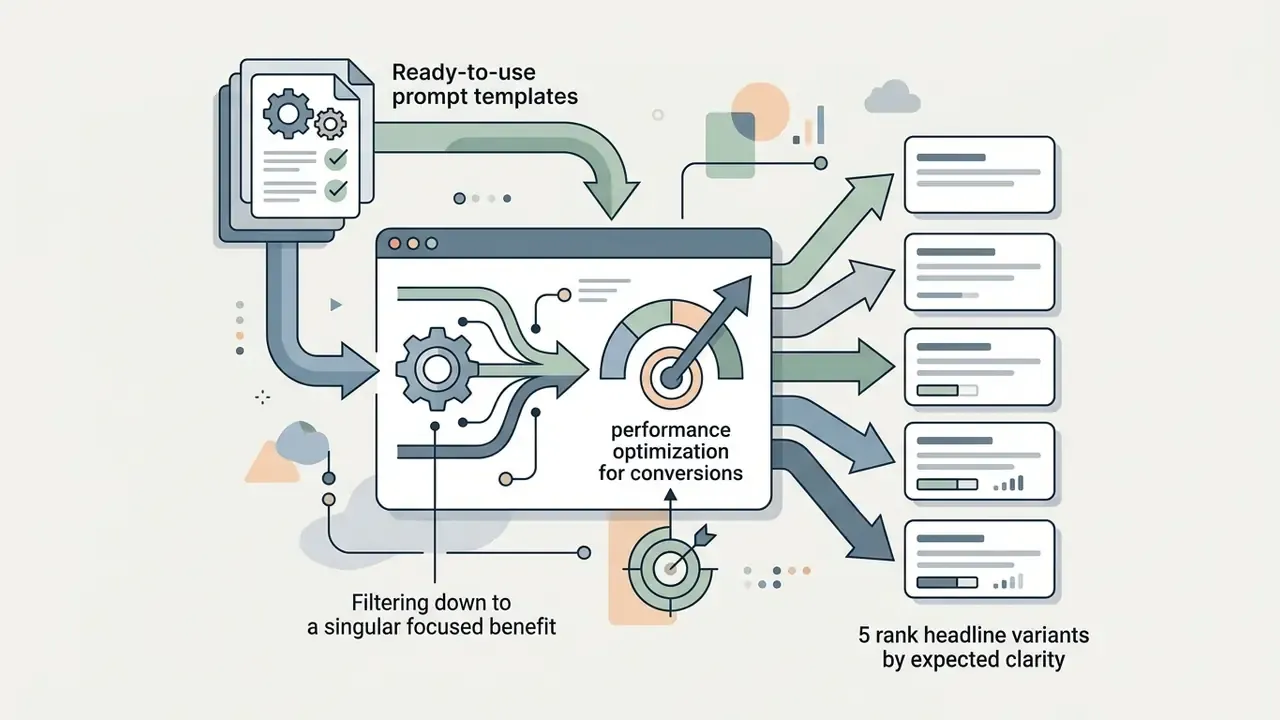
Ready-to-use prompt templates (copy-paste)
Prompts that specify offer, audience and mood consistently outperform prompts that describe visuals. The generator handles the visual layer. Your job is the marketing brief.
Generate Multiple Ad Creatives and Copy Variants
At the generation stage the model produces between 4 and 16 independent banner and copy variants. An AI ad copy generator with image suggestions simultaneously selects visual treatments that align semantically with the proposed headline.
The mechanism is combinatorial: the model varies product angles, colour accents, CTA placement and text structure. Google Ads formalises the same logic at the platform level for Demand Gen and dynamic creative. Advertisers can upload up to 5 short headlines, up to 15 marketing images and 5 logos, and the platform selects combinations dynamically; Google's own guidance stresses that headlines must differ meaningfully and images must be visually distinct, including multiple angles of a single product. Amazon defines Dynamic Creative Optimisation as rapidly building many iterations from one base creative and tailoring parts of the ad to audience, context and past performance. The result is a broad hypothesis set for later testing with no additional designer effort, and it pairs well with text-to-video generation when the same offer must be tested in motion.
Edit the Design, Validate, and Prepare the File for Publication
After autogeneration the user moves into a vector or raster online editor for precise adjustment. At this stage you check font legibility, logo placement accuracy and adherence to platform safe zones. Adobe's documented flows support share-for-review, invite-to-edit and export paths (File, then Export, then Export As, plus EDL and Final Cut Pro XML handoff for video). Browser-based canvases apply AI edits such as background removal, resizing and relighting, then save results as stacked versions or standalone assets with full history, which is exactly the behaviour an audit trail needs.
Mandatory validation gate. In regulated environments no file leaves this step without two recorded approvals: a brand and factual check by the marketing owner, and a legal or compliance claim sign-off for any offer that touches price, rate, term or guarantee. Finished materials are then exported in target formats (PNG, JPG, MP4, HTML5, PDF) with layers preserved or as compressed media files.
AI Ad Formats and Sizes for Social Media and Display
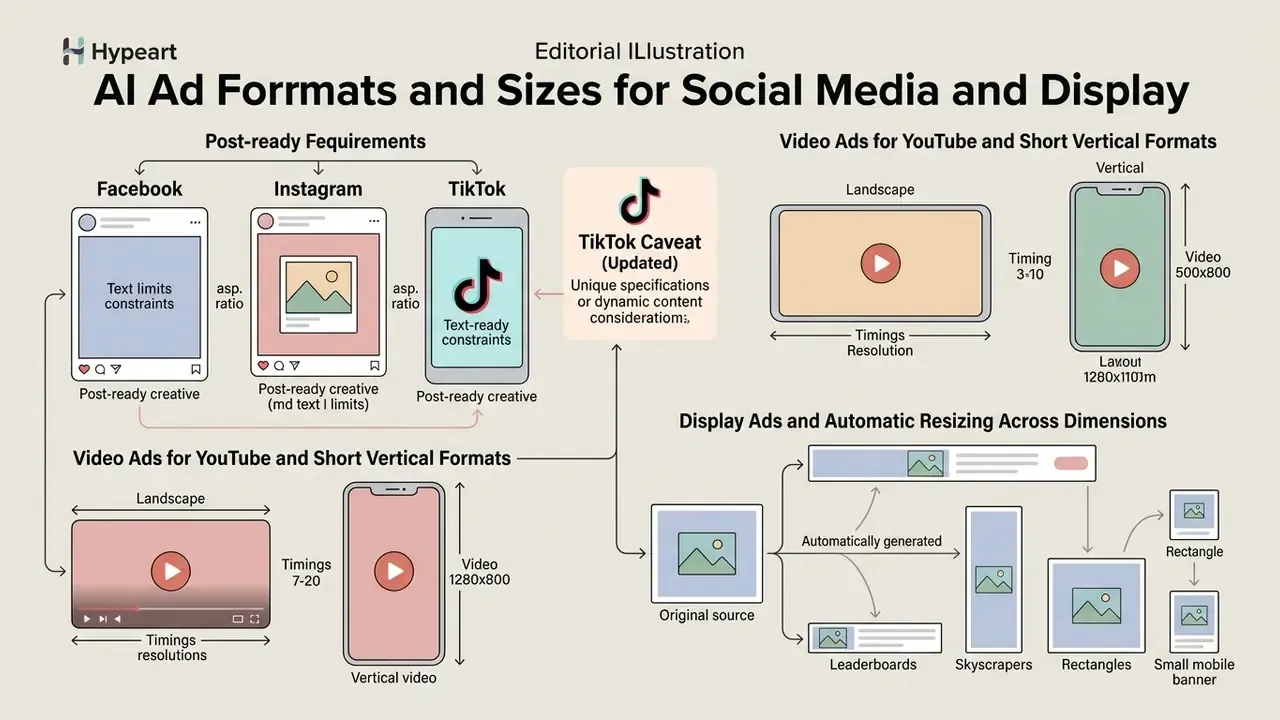
Different advertising channels impose hard technical requirements on creatives: aspect ratio, text length and the ratio of graphics to empty space. An advertising AI generator automatically adapts the base design to the technical specification of the selected placements, preventing distorted proportions or cropped key elements.
To optimise media budgets in video channels, source file weight should be reduced before upload. A detailed breakdown of formats and compression trade-offs is available in the guide to video compressors, covering file-size reduction, format support and quality loss.
Ads for Facebook, Instagram and TikTok
Video Ads for YouTube and Short Vertical Formats
For YouTube Ads and Shorts the decisive factor is the hook, meaning the first three seconds. Google Ads Demand Gen accepts square 1080×1080 video assets with a minimum duration of five seconds and supports common containers (MP4, MOV, AVI, WMV, FLV); audio-only files are rejected. Video campaigns are not created through the Google Ads API and video ads are reported separately, which affects how you automate delivery.
On narration, the evidence is specific rather than anecdotal. The 2024 peer-reviewed comparison of human versus AI voice-over across four short-video studies found human narration lowered cognitive load and raised purchase intention relative to synthetic voice. Practical reading: automate scripting, framing and captioning aggressively; treat voice as the component most worth keeping human when the message depends on warmth or urgency. When synthetic narration is the right trade-off, the guide to AI voice generators sets out voice quality, language coverage, pricing and commercial licensing terms, and the free AI video generator comparison shows where duration limits and watermarks will constrain short-form testing.
Display Ads and Automatic Resizing Across Dimensions
Display networks use the classic IAB standards: Leaderboard (728×90), Wide Skyscraper (160×600), Inline Rectangle (300×250), plus 300×600, 970×250 and 970×90. The resizing algorithm inside an ad creative generator AI rebuilds the layout grid for the target orientation: on narrow rails elements stack vertically, on wide units they run horizontally. Automatic resize relies on aspect-ratio matching, scale-to-fit with preserved proportions, and safe-area recomposition, with key text and logo elements preserved and the layout rebuilt rather than stretched. IAB Europe's 2026 technical standards remain the baseline for cross-format adaptation, including newer AR, VR and 360 experiences.
AI Ad Creator Capabilities for Branded, Scalable Campaigns
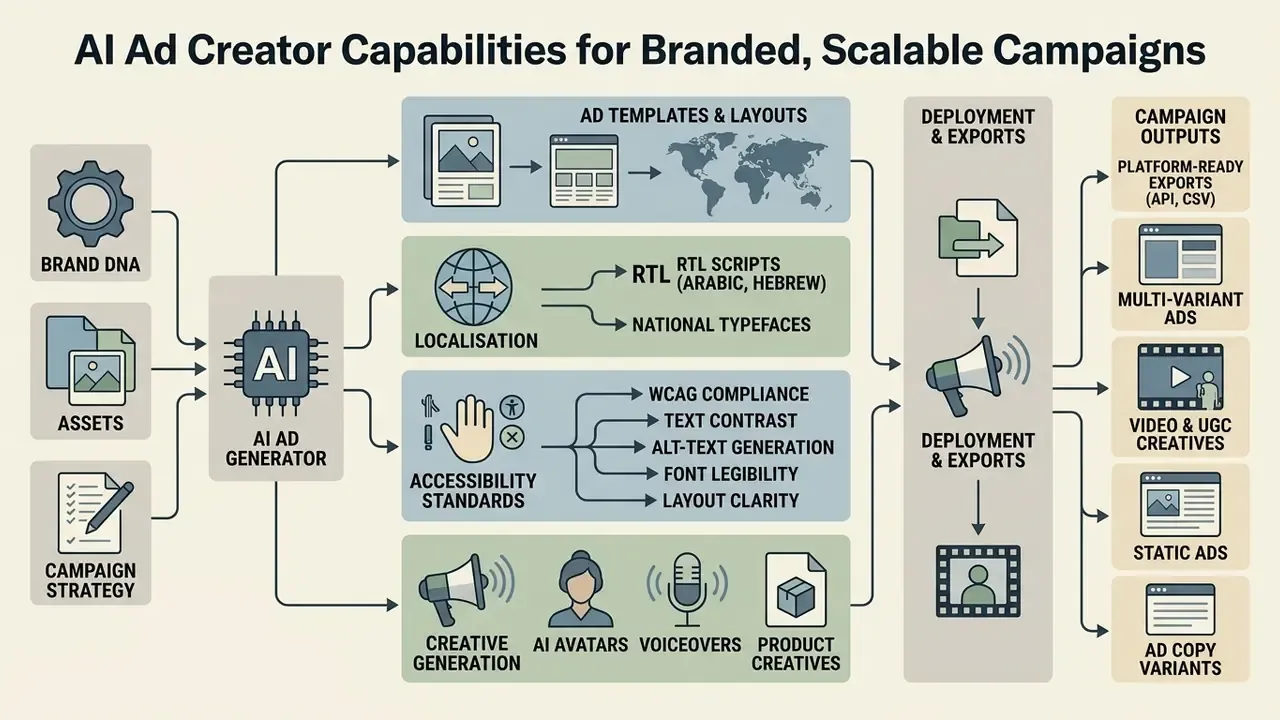
Large brands and marketing agencies use an ad AI creator not for one-off generations but to deploy scalable content-manufacturing systems. Capabilities include unified identity enforcement, work with synthetic ambassadors, batch production of hundreds of variants in a single click, and custom models trained on brand-specific content. Adobe Firefly Services describes the goal precisely: scaling a few hero assets into thousands of renditions personalised by segment, channel and region.
The economics of that scale are documented:
«Klarna reduced image production time from six weeks to seven days and cut external supplier costs by 25%, saving roughly $10 million per year.»
Brand DNA, Templates and Ad Design Configuration
Brand DNA technology automatically extracts the corporate palette (HEX codes), typefaces, logos and stylistic rules from the company website or an uploaded brand book. Systems such as BrandGene, Cuppa.ai's Brand Kit and Apify's Brand DNA analyser build a structured profile (primary and secondary colours, typography detection, CSS variables, reusable marketing templates) and apply it as a fixed constraint set for the generative models. Vendor scope differs. Some extract and auto-apply the kit to every generated image, others only extract and pre-configure templates, which is a question to settle during procurement rather than after the first campaign ships off-palette.
Because of this, ad generator branded templates AI customization eliminates accidental drift from corporate style: the model invents new compositions but strictly preserves button colour, spacing and trademark usage rules. For identity components themselves, the Canva AI generator overview covers design features, export options and commercial licensing in the same workflow.
Localisation specifics: RTL scripts (Arabic, Hebrew) and national typefaces
When creatives are generated for international markets, the failure mode is broken typography. Teams routinely paste Arabic into layouts designed for English and destroy the composition. Modern AI ad generators support right-to-left (RTL) scripts and change layout geometry accordingly: the CTA moves to the left, headline alignment flips to the right edge, and reading order is mirrored across the whole grid. The system loads language-appropriate font families automatically per locale, covering Arabic and Persian naskh styles, Thai and Khmer scripts with tall ascenders, Devanagari and CJK sets, which prevents dropped glyphs, clipped diacritics and tofu boxes.
Mature platforms cover 70+ languages in one brand setup, including English, Arabic, Hebrew, Urdu, Persian, Simplified Chinese, Japanese, Korean, Hindi, Bengali, Tamil, Telugu, Thai, Vietnamese, Spanish, Portuguese, French, German, Russian, Turkish, Indonesian and Swahili. Two operational rules apply: never machine-translate a legal disclaimer without local review, and always regenerate the layout for RTL rather than mirroring an existing LTR export, because logos and product images should not be flipped.
Advertising accessibility and WCAG standards
Professional AI ad generators check produced banners against the Web Content Accessibility Guidelines, which matters for public-sector, EU and US enterprise campaigns:
- Text contrast. Automatic analysis of the text-to-background contrast ratio, with a 4.5:1 minimum for body text and 3:1 for large display text. Generated gradients are the most frequent source of failures.
- Alt-text generation. AI writes descriptive tags for screen readers, required for display networks, email placements and landing pages carrying the same creative.
- Font legibility. Decorative typefaces are excluded from small disclaimers, minimum sizes are enforced, and letter-spacing is checked at export dimensions.
- Layout clarity. Reading order, focus hierarchy and touch-target sizing are validated before export, and WCAG-compliant PDFs can be produced for offline variants.
AI Avatars, Voiceovers and Product Creatives
The use of digital avatars and voice cloning is governed by legislation including the ELVIS Act (Tennessee, 2024) and the U.S. Copyright Office's 2024 report Copyright and Artificial Intelligence, Part 1: Digital Replicas, which defines a digital replica as a highly realistic, digitally created or altered video, image or audio recording of an identifiable person. Any commercial use of a person's digital double requires documented consent and adherence to disclosure rules. The Partnership on AI's 2024 synthetic-media case study adds the operational requirement: transparent disclosure mechanisms plus written permission for voice replication.
Synthetic product photoshoots let a physical item be placed into virtual interiors without a real shoot, and can be paired with an avatar presenter for UGC-style spots. For adjacent work on corporate portraiture and likeness handling, see the guide to AI headshot generators, which covers portrait quality, customisation, pricing, privacy and professional use. For background expansion of existing product shots, the comparison of AI outpainting tools covers business-use rights.
Batch Generation, Inspiration Libraries and Agency Workflows
Batch generation lets marketers produce dozens of creatives from one request via API or dashboard. Scaling infrastructure such as the OpenAI Batch API processes pre-uploaded request files asynchronously and writes results to an output file within 24 hours; Amazon Ads' Asset Library API supports POST /assets/batchRegister with status polling through GET /assets/batchRegister/{requestId}. Vendor design APIs advertise generation of hundreds of visuals per second across multiple sizes.
Scaling through CSV and IDE plugins (Cursor, Copilot, Claude skills). To launch thousands of dynamic ads (e-commerce catalogues, multi-language rollouts, personalised segments) generators integrate directly into developer environments or marketing scripts via REST API. The working pattern: upload a CSV containing 1,000 SKUs (title, price, discount, image URL, destination URL), and an AI agent, whether a Claude skill or an agent running inside Cursor, GitHub Copilot, Windsurf or Cline, generates a full package of roughly 4,000 adapted banners (four formats per product) and distributes them into folders through the API. Published examples put 1,000 product ads in 5 languages × 4 sizes, from a single CSV, at under one hour end to end. Because the output remains layered, a mid-flight price change is a text-layer update and re-export, not a 4,000-file regeneration.
One governance point that gets skipped: an agent with API write access to an ad account is a digital worker, and it needs an owner, a scoped role, a rate limit and a kill switch. No evidence, no autonomy. Log every batch run under a named human, and cap what the agent can publish without review.
Inspiration libraries hold curated repositories of high-converting mechanics, layout patterns and merchandising references attached to context, letting agencies assemble mood boards and test new hypotheses quickly. Their commercial effect is measurable beyond creative velocity:
«A quasi-experiment on a shopping platform found AI-structured product articles increased sales of associated brands by roughly 20%, driven by improved search relevance.»
E-E-A-T verification checklist for an AI ad generator service
- Commercial licence. Confirm an explicit right to commercial use of generated images and video in the Terms of Service, including paid placements on Meta, Google, LinkedIn and TikTok.
- No watermarks. Verify that the chosen tier guarantees export of a clean media file without platform branding.
- API and integrations. Assess REST API availability for batch generation and for connections to GRC, DSP and CMS platforms.
- Copyright transparency. Note the U.S. Copyright Office position: material generated entirely by AI without substantial human contribution is not protected by copyright.
- Data handling. Require zero data retention, no training on customer data, tenant isolation, and documented deletion timelines.
- Security attestations. Ask for SOC 2 Type II or ISO 27001, penetration-test summaries and a documented incident-response process.
- Editability. Confirm the output is a layered, editable file, not flat raster. This is the single strongest predictor of whether creative survives compliance review.
- Provenance and labelling. Check support for AI content labels and provenance metadata, and confirm the terms do not permit stripping them.
- Support and escalation. Verify response-time commitments and named escalation contacts before go-live; you can compare options for the level of coverage each tier includes.
Free vs Paid AI Ad Generators, and Enterprise Procurement Criteria
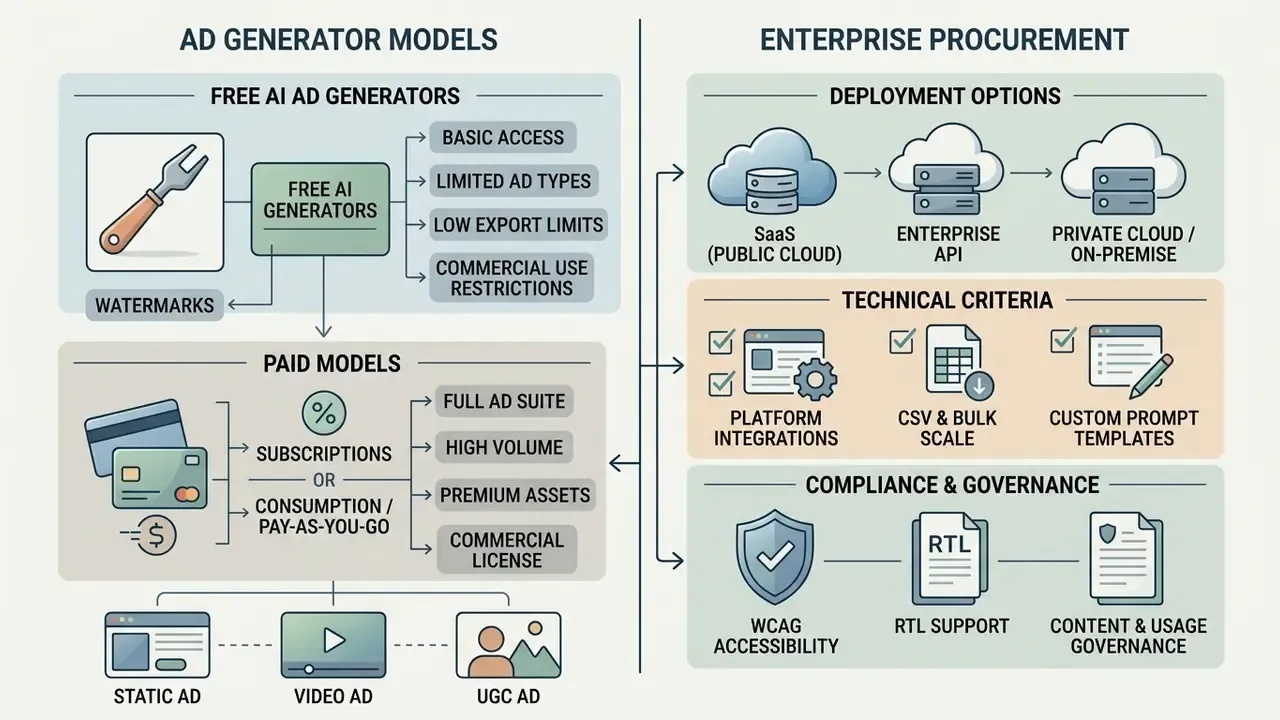
The market offers several financial models: ad generator AI free tiers with basic access, subscriptions, and pay-as-you-go consumption billing. Understanding the limits of free plans prevents hidden costs when commercial campaigns launch. Before selecting a tool, it is worth reviewing an industry overview of capabilities. The comparison of free AI art generators sets out output quality, limits, watermarks and licensing side by side, and for current tier boundaries you can view the guide.
Deployment models: SaaS vs Enterprise API vs private cloud
For regulated buyers the free-versus-paid question is secondary. The deployment model is the real decision.
| Criterion | Consumer SaaS | Enterprise SaaS / API | Private cloud / on-prem |
|---|---|---|---|
| Data retention | Often retained, sometimes used for improvement | Contractual zero data retention available | Fully controlled by the buyer |
| Training on your data | Frequently permitted by default terms | Contractually excluded | Not applicable |
| Tenant isolation | Shared | Dedicated tenant / VPC options | Full isolation |
| Attestations | Rarely available | SOC 2 Type II, ISO 27001, DPA, sub-processor list | Buyer's own control environment |
| Access control | Individual logins | SSO/SAML, SCIM, RBAC, audit logs | Integrated with internal IAM |
| Audit trail | Minimal | Exportable prompt/version/approval logs | Full custody |
| Model governance | Opaque model swaps | Version pinning, change notification | Buyer-controlled model inventory |
| Commercial rights | Tier-dependent, sometimes non-commercial | Explicit commercial and indemnity terms | Buyer-owned |
| Typical fit | Individual testing, SMB | Brand and agency production at scale | Banking, insurance, healthcare, defence |
Procurement should require, at minimum: written zero-retention terms, no-training warranties, a named sub-processor list, model-version pinning with change notice, exportable audit logs, SSO and role-based access, and IP indemnification for generated output.
What a Free AI Ad Generator Typically Includes
A free ad maker free AI usually provides a starter credit pack, access to standard static templates and export at base resolution. Verified examples from vendor documentation: Sivi grants 12 credits on signup (1 credit per small or medium ad, 1.5 for large sizes) with full editor access, all IAB sizes, brand kit and commercial use permitted; Creatify's free plan includes 10 monthly credits, up to 2 video ads or 20 image ads, with watermarked exports; CreativesGen offers 15 images with no watermark and no time limit; HeyGen's free tier allows up to 3 videos per month; AdCreative.ai provides a 10-credit trial rather than a permanent free plan.
Most free tiers cap available video seconds, omit automatic URL parsing and restrict professional AI avatars. For tools that avoid friction at the evaluation stage, the Bing AI image creation guide documents access requirements, capabilities and commercial terms without a paid commitment, and the ChatGPT picture generator evaluation compares access and control trade-offs.
Subscription or Pay-as-You-Go: Choosing a Billing Model
Subscription pricing (commonly $12 to $49 per month for entry tiers, rising to $599 to $999 for team and enterprise plans) suits teams with steady, predictable production volume, delivering the lowest unit cost per generation under regular use. Academic work on B2B subscription offers notes the trade-off explicitly: if usage stays below the allotted amount, the customer still pays the full fee.
Pay-as-you-go, billing by consumption metrics such as impressions, credits, API calls or spend managed, is optimal for project work or seasonal launches. You pay only for assets actually produced, with no monthly commitment. Costs rise directly with launch volume, which makes PAYG cheaper at low or irregular volume and more expensive than a subscription once production stabilises at high throughput. Developers planning to embed generation into their own services should review the AI Media API documentation and the Google Veo API cost and limits guide.
Watermarks, Export and Commercial Use of AI Ads
| Comparison parameter | Free plan | Subscription | Pay-as-you-go |
|---|---|---|---|
| Generation limit | 10–15 credits, one-off or monthly | 100–1,000 credits / month | Purchased credit packs |
| Watermark | Present in most services | Absent | Absent |
| Video and avatar access | Limited or closed (e.g. 3 videos/month) | Full within plan limits | Billed per render second |
| Commercial rights | Vendor-dependent; sometimes non-commercial only | Full commercial rights | Full commercial rights |
| Team features | Absent | Shared folders, brand kits, roles | Depends on API tier |
| Audit logs / SSO | Absent | Higher tiers only | Enterprise API tiers |
| Layered/editable export | Sometimes flat only | PNG, JPG, PDF, HTML with layers | Format set defined by API |
How to Build AI Ads You Can Test and Scale
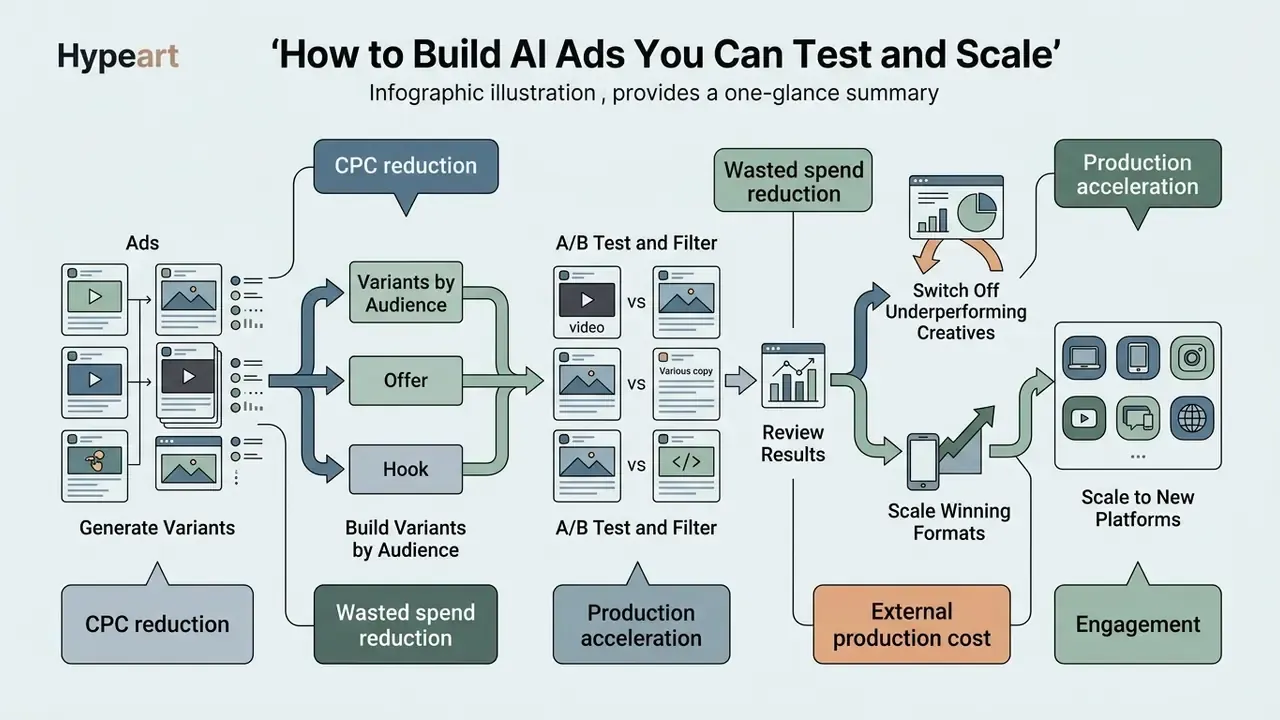
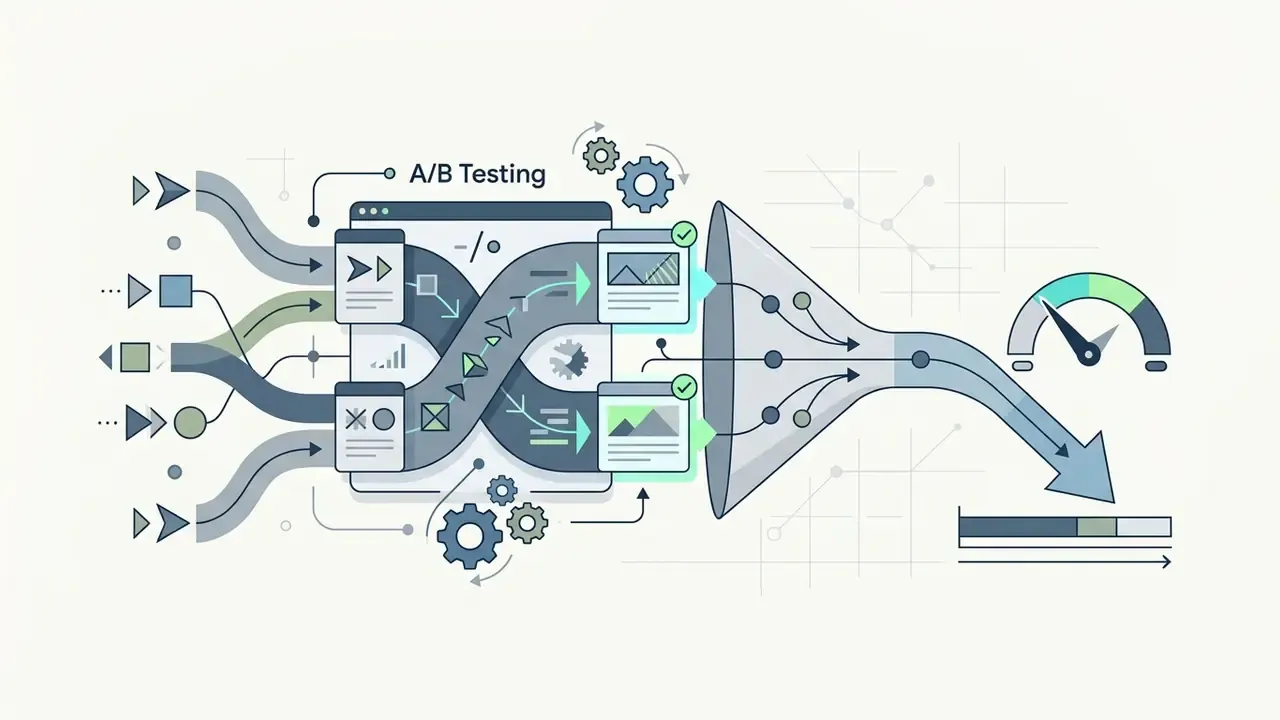
The principal advantage of AI in advertising is systematic A/B testing across large variant volumes. The process rests on isolating variables in sequence: test the headline, then the visual treatment, then the CTA format. The IAB's playbook frames the discipline as small-scale controlled testing on one use case first, with iterative creative variation once early signal arrives, rather than remixing several elements at once.
The baseline evidence on AI-versus-human copy is worth holding in mind when designing the test matrix:
Parity at baseline, superiority under specific persuasion principles. Which means the win comes from the framing you choose, not from generation itself. Teams testing motion variants of the same offer can extend the matrix with animation makers, covering creation methods, templates, AI features and export options, and can explore the hub for head-to-head tool shortlists.
Build Variants by Audience, Offer and Hook
A variability strategy requires 3 to 5 distinct hooks (headlines or opening seconds) for the same product. Adjust the emotional register: one variant focuses on time saved, another on status, a third on demonstrated safety. Celtra's creative-testing guidance draws a useful line between A/B testing one variable on the same audience and split testing whole creatives across different audiences, markets or placements. The two answer different questions and should not be mixed in one report.
The highest-expected-effect variables to test first are the hook (the first three seconds of video, or the headline of a static unit) and offer framing (free trial, money-back guarantee, risk-free).
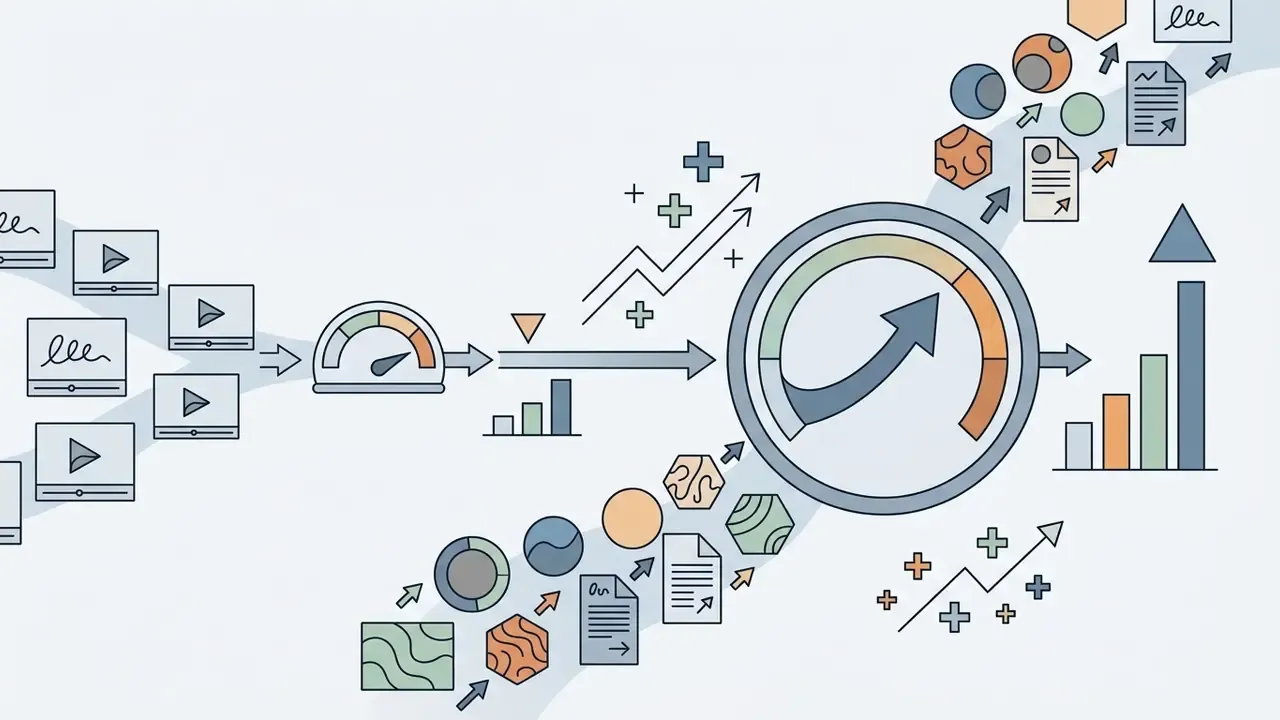
Median business outcomes reported across AI-creative deployments:
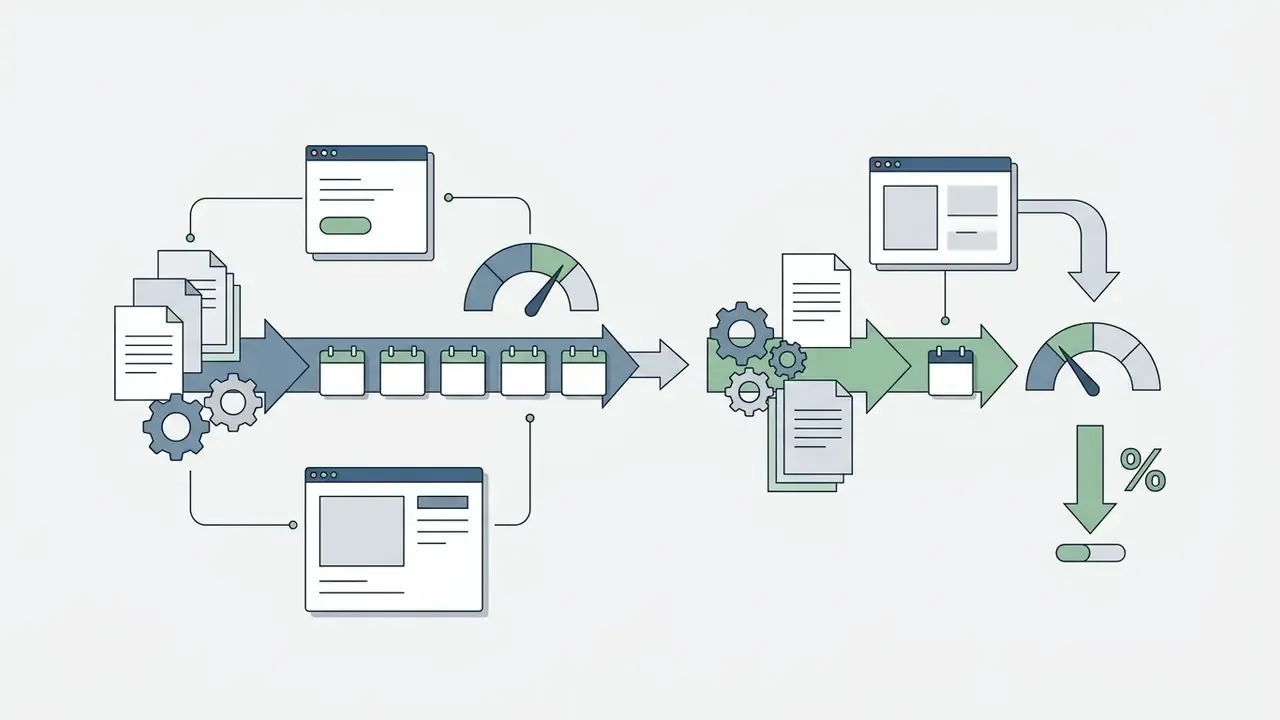
These are directional medians drawn from vendor case studies and published field experiments, not audited averages. Treat them as hypotheses to reproduce against your own baseline.
Review Results and Switch Off Underperforming Creatives
Standard test discipline allocates each variant at least 1,000 impressions, roughly 72 hours, or a budget equal to 2 to 3 times the target CPA, and declares a winner at 90 to 95% confidence. CTR, conversion and cost-per-action data are aggregated through end-to-end analytics. Google Ads defines a conversion as a valuable action after an ad interaction, tracked via tags or Google Tag Manager with offline conversion import for CRM outcomes, and the Google Ads API exposes conversion metrics at campaign, ad group, ad and conversion-action level. That is the mechanism which makes creative-level comparison possible at all.
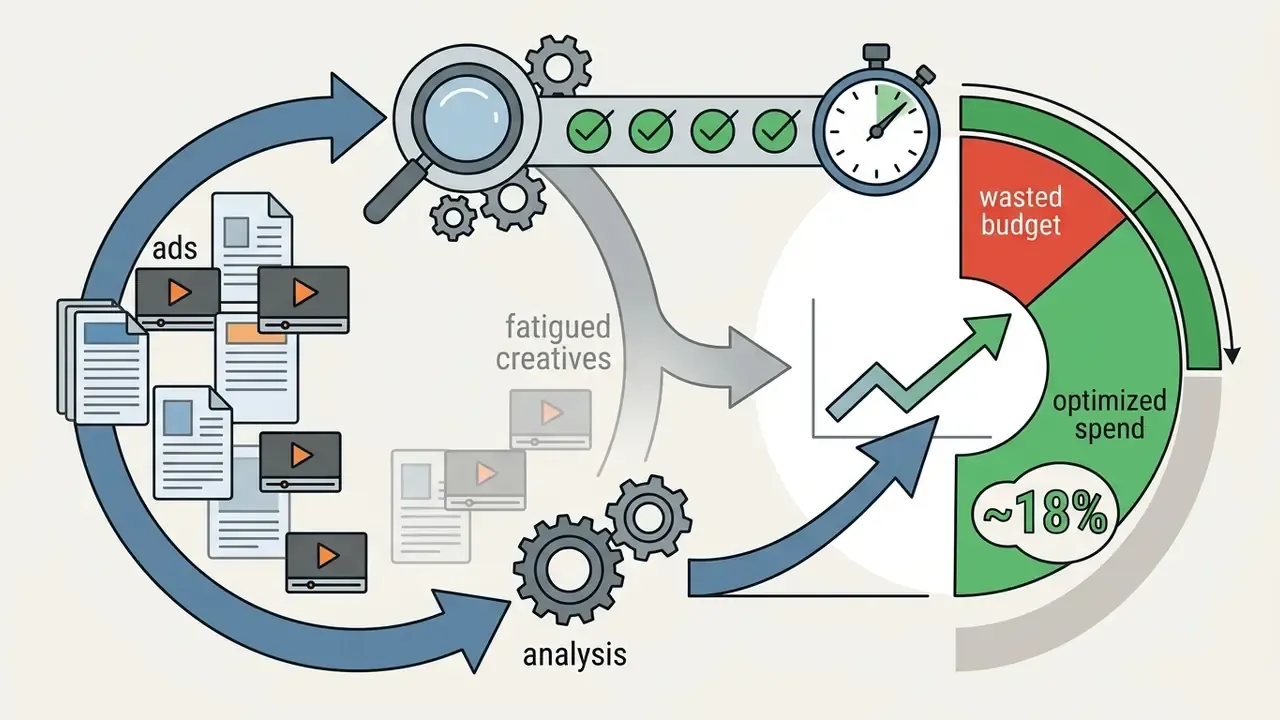
Variants performing below the campaign median are switched off. Systematically culling weak creatives protects the media budget from fatigue-driven waste. In regulated environments, add one more step: log the reason for pausing each asset, so performance decisions stay distinguishable from compliance-driven withdrawals during an audit.
Scale Winning Formats to New Platforms
Winners are ported to new placements through batch resizing and duplication. A combination proven on Meta is adapted to 9:16 for TikTok and to Google Display banner dimensions. Where the platform allows it, carry the creative across as a saved creative or post ID so accumulated social proof and engagement are not lost, and give the new channel its own 3 to 5 day test window (or spend up to roughly 3 times target CPA) before promoting it into the scaling lane.
Budget on winning combinations is increased in steps of 20 to 30% every 2 to 3 days so the platforms' learning algorithms are not disrupted, with CPA, CTR and frequency monitored to catch fatigue early. Horizontal duplication into new audiences generally beats aggressive vertical budget jumps on a single ad set. For cross-platform adaptation at volume, the comparison of free AI video generators is a practical starting point for evaluating duration limits and export constraints per channel.
Risk-Adjusted ROI: How to Model the Real Economics
Gross production savings overstate the business case. A defensible model separates four cost layers: A workable formulation:
Risk-adjusted ROI = (Production savings + Incremental revenue from faster testing − Tool cost − Retained human cost − Control cost − Expected residual risk cost) ÷ (Tool cost + Control cost)
Two practical notes. First, incremental revenue from faster testing is real but must be measured, not assumed: it comes from running more hypotheses per period, so tie it to observed CPA or ROAS improvement rather than to variant volume. Second, control cost is largely fixed, which means risk-adjusted ROI improves with throughput. The business case for enterprise deployment strengthens as volume rises, and rarely justifies itself at low volume. That asymmetry is the part most pilot business cases get wrong.
- Direct tool cost.Licences, credits, API consumption, render seconds, overage.
- Human cost retained.Prompt authoring, art direction, editing, and the review time of marketing, brand, legal and compliance reviewers. Usually the largest hidden line in regulated organisations.
- Control cost.Model validation and re-validation, bias and claim monitoring, audit-log storage, vendor due diligence, security review, staff training.
- Residual risk cost.Expected cost of a compliance failure, a withdrawn campaign, an IP or likeness dispute, or reputational damage, expressed as probability multiplied by impact.
FAQ
Can an AI ad generator be used for free in commercial advertising?
It depends on the specific service's licence agreement. Some services grant commercial rights on a free tier (Sivi states commercial use is allowed on its free plan, with no watermark), while others require a paid plan to remove watermarks and permit legal use in ad accounts (Magichour restricts free use to personal, non-commercial purposes; the GigaChat API requires a paid package for commercial use). Always read the current Terms of Service before a paid launch.
Does an AI ad generator replace a professional designer or media buyer?
No. The tool automates routine assembly, resizing and variant generation. Strategic planning, audience selection, analytics configuration, brand judgement and final quality control remain with people. In regulated industries a human approval step is mandatory, not optional.
Are generated ad images protected by copyright?
Under current U.S. Copyright Office practice, material created exclusively by artificial intelligence without substantial human creative contribution is not eligible for copyright protection. Mixed human and AI works can be protected in respect of the human-authored parts.
Disclaimer. This information is general in nature and does not replace consultation with a lawyer on copyright in AI-generated content.
What is the difference between layered and flat generated ads?
Flat (raster) output bakes text into pixels, which produces spelling artefacts and makes prices and offers uneditable. Layered output keeps the headline, price, CTA, logo and background on separate editable layers, so a mid-campaign offer change takes seconds and the ad survives brand and compliance review.
How long does it actually take to produce a campaign package?
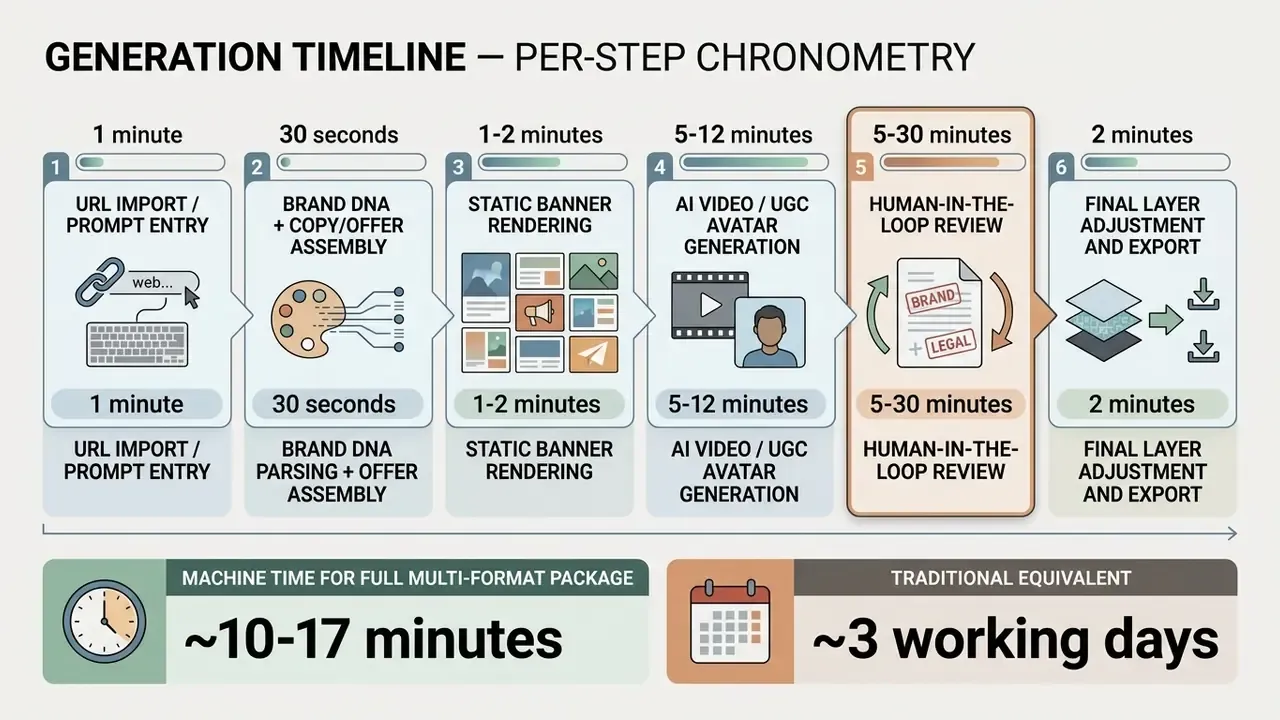
Roughly 1 minute for URL or prompt input, 30 seconds for brand parsing and copy assembly, 1 to 2 minutes to render ten or more static variants, 5 to 12 minutes for an AI video or avatar UGC clip, and about 2 minutes for final layer adjustment and export. Human review time is organisation-dependent and is usually the longest step in regulated environments.
Can AI ad generators handle Arabic, Hebrew and other RTL languages?
Mature platforms support 70+ languages including right-to-left scripts, mirroring layout geometry (CTA moves left, headlines align right) and loading locale-appropriate typefaces automatically to prevent dropped glyphs and broken diacritics. Legal disclaimers should still be reviewed locally rather than machine-translated.
How do I generate thousands of ads programmatically?
Through a REST design API or an AI agent integrated into a development environment. The common pattern is a CSV of SKUs (title, price, discount, image and destination URLs) processed into a full package, for example 1,000 products across 5 languages and 4 sizes, with assets written into structured folders via the API, typically inside an hour. Give that agent a named owner and a publishing cap.
What should a bank or insurer require from a vendor before deployment?
Written zero data retention and no-training warranties, tenant isolation, SOC 2 Type II or ISO 27001 attestations, a named sub-processor list, model-version pinning with change notice, exportable prompt and approval audit logs, SSO with role-based access, IP indemnification, and layered editable output so compliance edits do not require regeneration.
Do generated ads meet accessibility requirements?
Professional generators check contrast (4.5:1 minimum for body text, 3:1 for large text), produce alt text for screen readers, enforce minimum legible font sizes, exclude decorative typefaces from disclaimers, and can export WCAG-compliant PDFs. Automated checks reduce but do not eliminate the need for a manual accessibility review on public-facing campaigns.
Should we automate voice-over as well?
Selectively. A 2024 peer-reviewed multi-study comparison found human voice-over lowered cognitive load and raised purchase intention relative to AI voice-over in short-form video ads. Automate scripting, framing and captions first; keep human narration where warmth, urgency or emotional nuance carries the offer.
What is a safe first step for a regulated buyer?
Pick one non-regulated campaign family, run it end to end with full prompt and approval logging, and measure both cycle time and review hours. If the audit trail holds and reviewers can edit without regeneration, extend to regulated offers with legal sign-off wired into the export gate. Small scope, real evidence, then autonomy.
Additional Resources
For a detailed view of commercial licensing terms across image tools, review the Canva AI generator overview and the Google AI image generator terms. For head-to-head tool selection, compare the best AI art generators and the Midjourney evaluation against competing tools. Developer economics for video generation are covered in the Google Veo implementation guide, and the full set of terms and technical guides is available in our glossary of AI advertising terms, where you can explore the hub.