Executive Summary
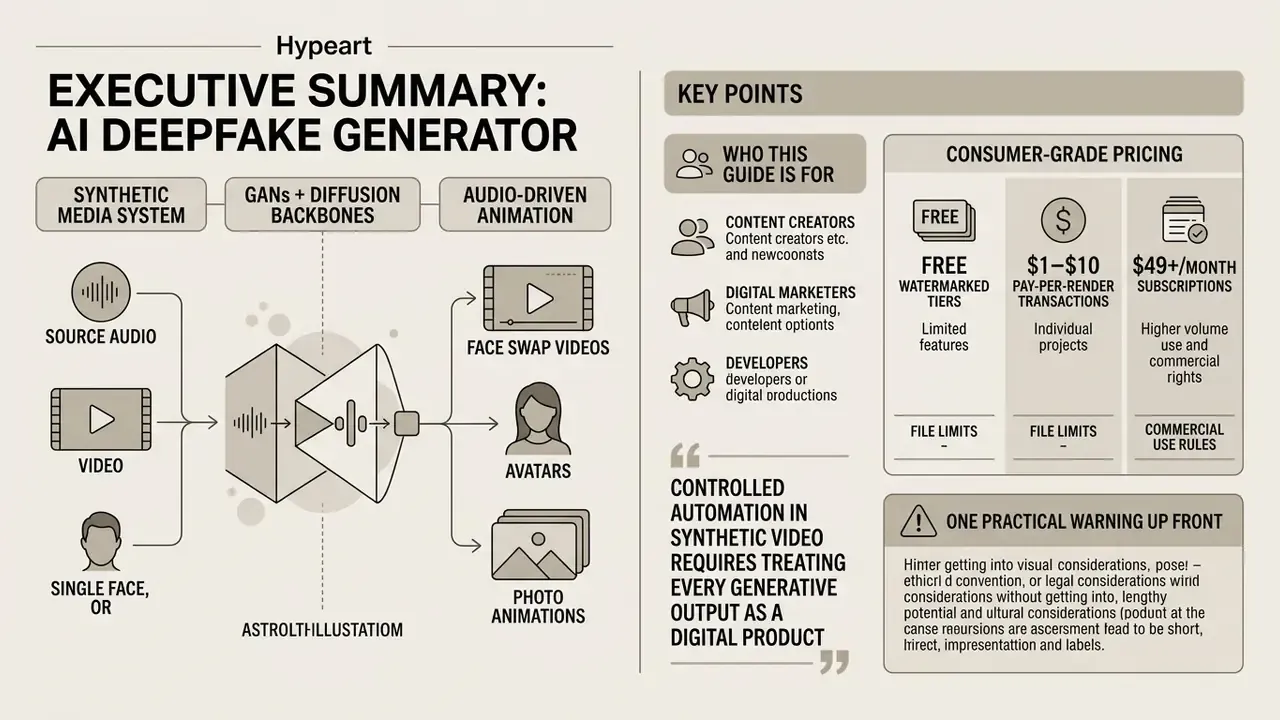
An AI deepfake generator is a synthetic media system that uses generative adversarial networks (GANs), latent diffusion backbones, and audio-driven animation models to swap faces, clone voices, and animate static portraits across photo, GIF, and video formats. For enterprise buyers, the question is no longer "which tool renders the prettiest face swap". It is which vendor can evidence consent management, zero-data-retention (ZDR), machine-readable provenance labeling, and auditable rendering logs.
Consumer-grade pricing now spans free watermarked tiers, $1–$10 pay-per-render transactions, and $49+/month enterprise API licences. Meanwhile the EU AI Act's Article 50 transparency duties become enforceable from 2 August 2026, which turns disclosure into a compliance obligation rather than a courtesy. Treat every generated asset as a controlled digital product with documented lineage, explicit likeness consent, and a human review gate before publication.
Who this guide is written for. Risk and control owners at US banks, insurers, and mature fintech firms who are being asked to approve synthetic video for marketing, internal training, or customer communications. Also for finance and operations leaders who inherit the invoice after a marketing team has already bought a $10 render. The guide covers capability scope, consent and provenance controls, vendor evidence requirements, the production pipeline itself, pricing reality, and the privacy questions that come with uploading biometric media to a cloud pipeline.
One practical warning up front. In most institutions, the first synthetic video is created long before anyone writes a policy for it.
What Is an AI Deepfake Generator and What Can It Create?
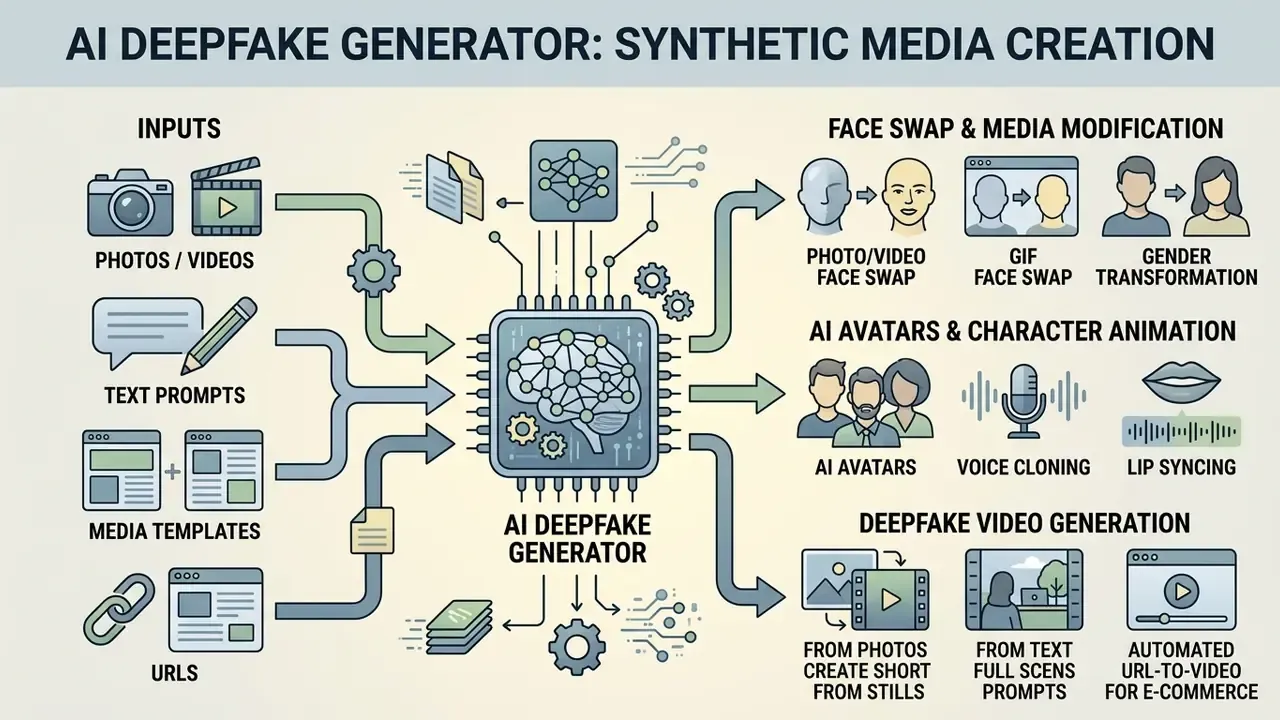
An ai deepfake generator is a software system powered by neural networks that creates or modifies synthetic video, photo, and audio media by swapping facial features, animating static portraits, or cloning voices. According to the U.S. Government Accountability Office (GAO, 2024), deepfakes encompass media manipulated with AI to replace faces, alter expressions, or synthesize speech, operating across single-frame and multi-frame video environments (GAO-24-107000).
«Deepfake generation techniques are systematised across four domains: image, video, audio, and multimodal content, corresponding to the type of media manipulated.»
The U.S. Department of Defense frames the same category more broadly, describing deepfakes as fully or partially synthetic multimedia produced with AI/ML pipelines. That is precisely why governance teams should classify photo, GIF, video, and voice outputs under a single synthetic-content control regime instead of treating each tool as a separate purchase. Modern platforms integrate image-to-video diffusion, identity-transfer loss functions, and audio-to-lip synchronization to deliver realistic video outputs for corporate communications, localized marketing, and media production.
A note on vocabulary. Buyers will encounter the same capability marketed as an ai deep fake generator, an ai deepfakes generator, or simply an ai fake video maker. The label changes; the control surface does not.
AI Face Swap for Photos, Videos and GIFs
AI face swapping transfers facial identity from a source photo onto a target video, photo, or animated GIF while preserving the background, lighting, and target performance. The underlying process relies on facial landmark extraction, identity embedding vectors, neural alignment, and boundary blending.
Academic frameworks like DeepFaceLab (Perov et al., 2020) and subject-agnostic architectures like FSGAN (Nirkin et al., ICCV 2019) established multi-frame identity mapping. Recent diffusion-based systems such as VividFace (2024) and DreamID (2025) handle temporal coherence and multi-face swaps involving up to four faces per scene without structural boundary flickering.
«VividFace applies hybrid image-and-video training through VidFaceVAE, delivering temporal consistency and identity preservation in video face swapping.»
«DreamID trains on a Triplet ID Group and uses Stable Diffusion Turbo for 1–4 step inference, achieving high identity similarity while retaining source attributes.» Source: DreamID: High-Fidelity and Fast Diffusion-Based Face Swapping (arXiv preprint, 2025). https://arxiv.org
Earlier video-specific work such as NICe (Face Swapping Consistency Transfer with Neural Identity Carrier, 2021) explicitly modelled inter-frame incoherence as noise and suppressed it. That is why frame-level flicker is now measured as a distinct quality metric rather than described as a subjective impression. When executing a multi-face swap on a video face, identity vector matching ensures that source facial geometry aligns accurately with target head poses and occlusion boundaries.
GIF Face Swap and AI Gender Transformation
Beyond static photos and MP4 sequences, modern face swap algorithms process animated GIF containers and cross-gender identity mapping. GIF face swapping extracts individual frame buffers, aligns target facial landmarks across loop points, and re-encodes the asset preserving transparent layer boundaries. That workflow matters for meme-driven social campaigns, reaction assets, and short looping product teasers where MP4 playback is not supported natively.
Gender swap workflows use latent vector shifting within GAN space to transform masculine or feminine facial characteristics such as jawline structure, eyebrow density, and skin texture, while retaining core identity metrics. Because gender transformation alters attribute vectors rather than replacing an identity outright, output realism depends heavily on hairline continuity and neck-to-jaw blending. Frontal source photos with even illumination produce the fewest boundary artifacts. Practitioners refining portrait inputs before a swap frequently pair these tools with an AI headshot generator to standardise framing and lighting across a batch of source faces.
AI Avatars, Voice Cloning and Lip Sync
AI avatars and voice cloning generate dynamic talking-head videos from a single reference image plus an audio or text file. Text-to-speech (TTS) engines clone a target voice from audio samples as short as 3 to 20 seconds, producing natural prosody across multiple languages (MultiTalk, 2026). Independent 2025 pipeline documentation reports longer reference requirements of 10–20 minutes for production-grade dubbing clones. So the 3–20 second figure should be read as a minimum viable sample, not a quality guarantee. That claim still needs vendor-specific benchmarking.
«TalkVid contains 1,244 hours of video from 7,729 speakers across 15 languages at resolutions up to 2160p, supplying the diversity needed to train realistic talking avatars.»
Neural models like Wav2Lip and StyleTalker align inner-mouth dynamics with cloned audio. 3D-aware frameworks like NeRFFaceSpeech use Neural Radiance Fields to maintain volumetric consistency during lateral head turns (NeRFFaceSpeech, 2025).
«NeRFFaceSpeech applies audio-correlated vertex dynamics of a parametric face model together with ray deformation to produce realistic 3D motion from a single image.»
Multilingual dubbing pipelines combine transcript translation, synthetic voice cloning, and audio-driven lip sync to generate localized video face outputs for international training and marketing programs. Cross-language lip synchronization remains an active research problem rather than a settled standard. Published work demonstrates transferring English lip motion onto Hindi audio through landmark prediction, which means localisation quality varies by phoneme set and should be validated language by language.
Enterprise platforms supply access to extensive pre-rendered asset libraries, featuring over 1,000 localized AI avatars and more than 10,000 synthetic voices across 50+ international languages and regional dialects. For model-risk teams, library scale is a double-edged metric. It accelerates production throughput, yet every stock avatar and cloned voice must still trace back to a licence record proving that the underlying performer consented to synthetic reuse.
Deepfake Video Generation from Photos, Text and Templates
Deepfake video generation transforms static photos, natural-language text prompts, or pre-structured templates into fully rendered video clips. Conditional identity swap models, such as Latent Flow Diffusion (CVPRW, 2024), accept a source identity image and a target motion video, an image-to-video diffusion configuration, and generate continuous video streams using text-to-video diffusion backbones for prompt-conditioned scenes.
Enterprise systems like Adobe Firefly and Canva implement text-to-video diffusion and template-driven motion scripts to output standardized MP4 files (Adobe AI Video Guide, 2025). Teams use an ai deepfake video generator or an ai deepfake image maker to automate short-form video creation, applying predefined motion layouts to maintain temporal stability across visual frames. When the brief calls for vertical social output, an ai deepfake reels generator preset usually just locks aspect ratio, duration, and caption placement on top of the same rendering pipeline. Marketing teams also search for an ai deepfake generator from photo when the only available asset is a single executive headshot.
Automated URL-to-video generation for e-commerce. Advanced commercial generators integrate URL scraping scripts. By inputting a product page link, for example a Shopify or WooCommerce store URL, the platform extracts product images, text descriptions, and specifications, then automatically scripts an AI avatar presenter to deliver a tailored video ad with synchronized lip-sync and localized voiceover in seconds. Retail and marketplace teams use this pipeline to convert an entire catalogue into short vertical ads without briefing a studio, then localise the same script across the vendor's language library. Governance note: URL scraping imports third-party imagery and claims into the render, so brand-safety review and substantiation checks must sit downstream of the automated script.
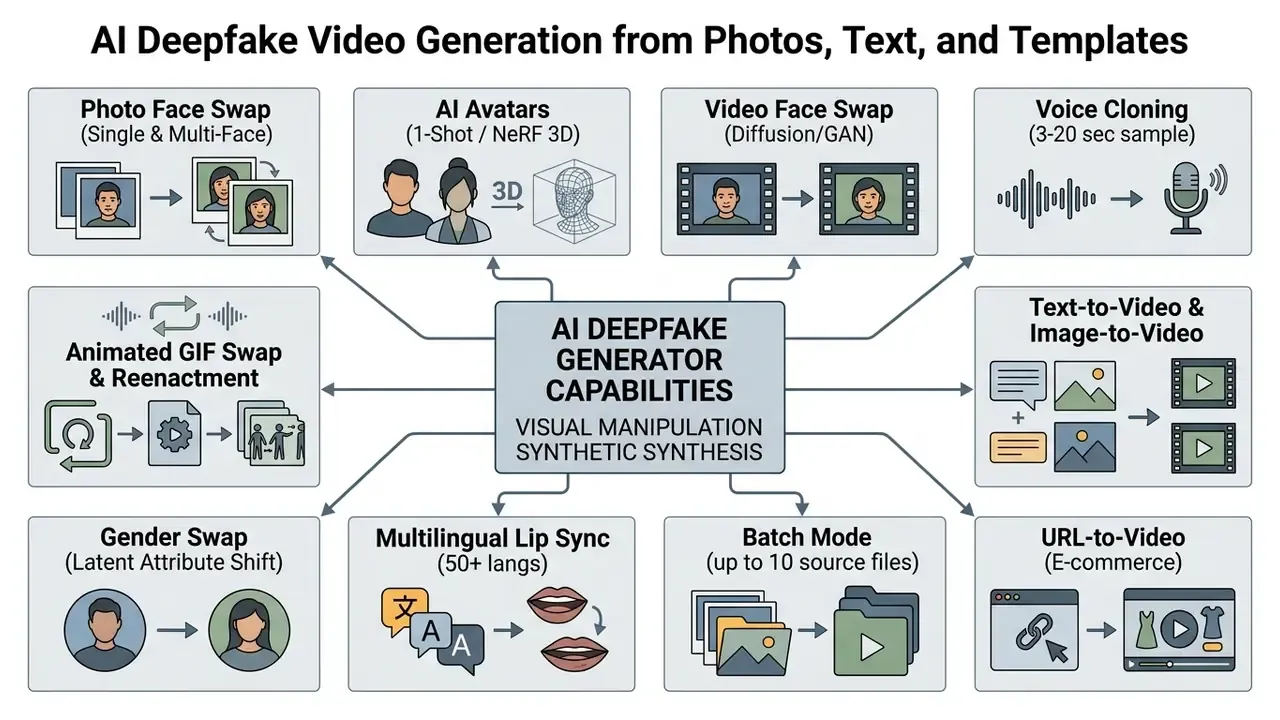
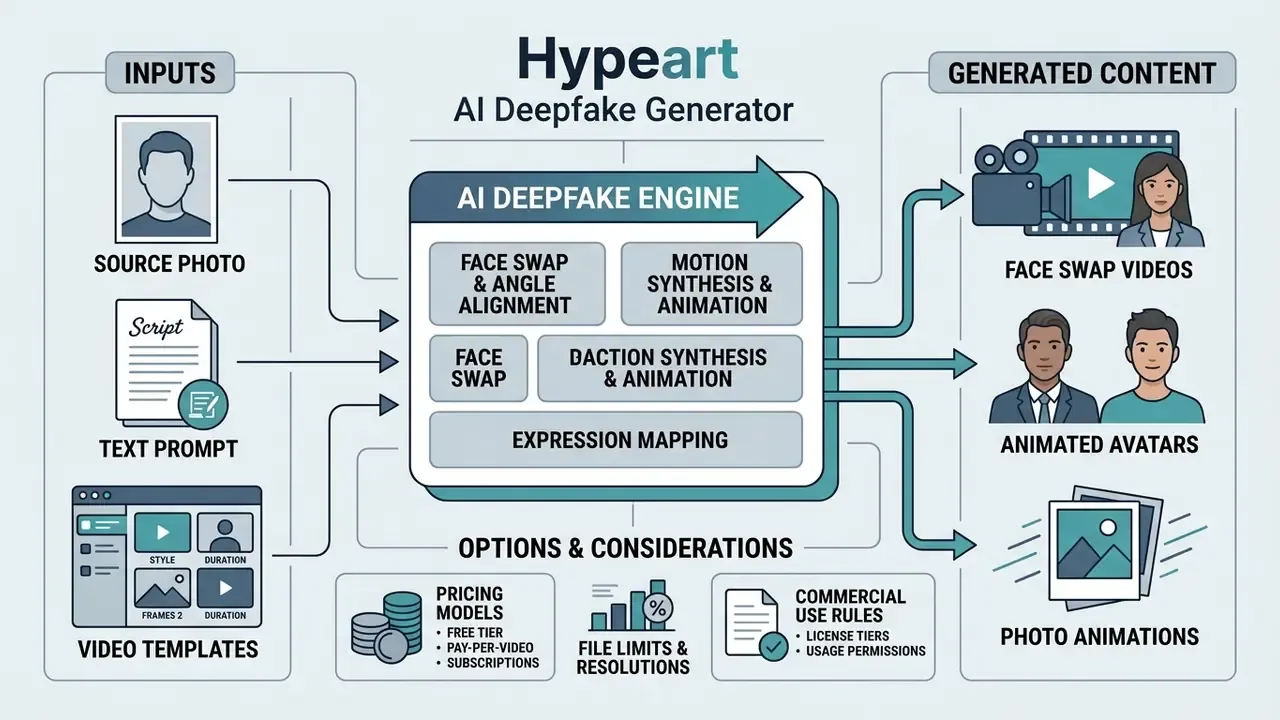
- Semantic requirements: render as a text-based figure with a caption reading "Capabilities architecture of an AI deepfake generator showcasing visual manipulation and synthetic synthesis workflows", and alternative text "ai deepfake generator architecture flowchart". All node labels must exist in the text layer, not only inside an image.
Responsible Use of AI Deepfake Video Generators
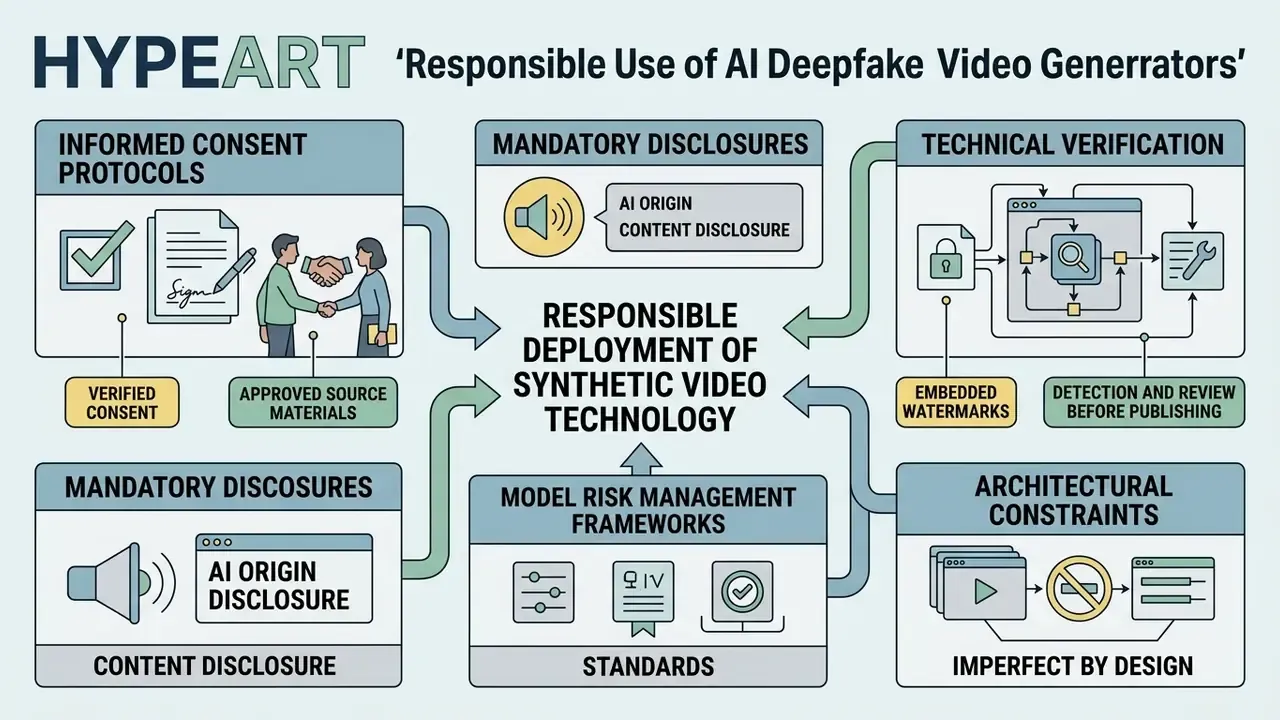
Responsible deployment of synthetic video technology mandates strict adherence to informed consent protocols, mandatory AI origin disclosures, and embedded technical verification marks. Regulatory frameworks prioritize consumer transparency, requiring deployers to maintain verifiable evidence chains for all generated assets. This section sits before tool selection deliberately. For regulated organisations, disclosure and consent obligations determine which vendors are even eligible for evaluation.
Consent, Approved Source Materials and Content Disclosure
Deploying synthetic media featuring real individuals requires documented, explicit consent covering specific usage contexts, distribution channels, and duration limits. Under Article 50 of the European Union AI Act, enforceable from 2 August 2026, deployers of systems that generate or manipulate deepfake image, audio, or video content must disclose the artificial origin of the media in a clear, distinguishable manner (EU AI Act Regulation 2024/1689). Machine-readable marking duties for providers of synthetic audio, image, video, and text follow on the Commission's published implementation timeline. Visible labels and embedded metadata are therefore complementary requirements, not interchangeable ones.
«GAN- and diffusion-based deepfakes keep becoming more realistic, while detection methods systematically lag behind in generalising to new techniques.»
Because detection lags generation, disclosure and provenance metadata carry the compliance burden that automated detectors cannot yet reliably discharge.
+-----------------------------------------------------------------------------------+
|               RESPONSIBLE AI COMPLIANCE & GOVERNANCE CHECKLIST                    |
+-----------------------------------------------------------------------------------+
  [ ] EXPLICIT CONSENT: Documented written permission secured from all likeness owners.
  [ ] SCOPE LIMITS: Consent specifies channels, territories, duration and renewal date.
  [ ] CONTENT DISCLOSURE: Visible label identifying media as artificially generated.
  [ ] MACHINE-READABLE LABELS: C2PA metadata / digital provenance manifest attached.
  [ ] WATERMARKING: Robust, invisible or visible digital watermark embedded in export.
  [ ] PRE-PUBLISHING REVIEW: Human-in-the-loop audit for bias, accuracy, and safety.
  [ ] VENDOR EVIDENCE: SOC 2 / ISO 27001 report and zero-data-retention clause on file.
  [ ] MODEL INVENTORY: Generator registered in the model inventory with owner and tier.
+-----------------------------------------------------------------------------------+
Federal Communications Commission (FCC, 2024) regulations mandate upfront disclosures when synthetic or cloned voices are used in outbound communications, including a clear and conspicuous notice at the start of each call. Explicit content disclosure lets audiences distinguish authentic recordings from synthetic media. Saudi Arabia's SDAIA deepfake guidance (2025) adds a data-governance layer: minimum data collection, secure transfers, anonymisation, privacy by design, automated deletion, and consent management.
Synthetic media under model risk management frameworks. Banks and insurers already own a validation vocabulary for this problem. A deepfake generator ingests data, applies a statistical transformation, and produces an output used in a business process. That places it inside the conventional definition of a model under supervisory model-risk guidance (SR 11-7 and OCC 2011-12 style frameworks). Practically, that means registering each generator in the model inventory, assigning a tier based on external-communication exposure, documenting input data lineage (source portraits, cloned voices, scraped product pages), defining performance and failure criteria (identity fidelity, flicker, mislabelled output), and scheduling periodic revalidation whenever the vendor upgrades its backbone model. Treating a synthetic-video vendor as an unmanaged SaaS purchase is the single most common control gap uncovered in audits of marketing-led AI adoption.
Watermarks, Detection and Review Before Publishing
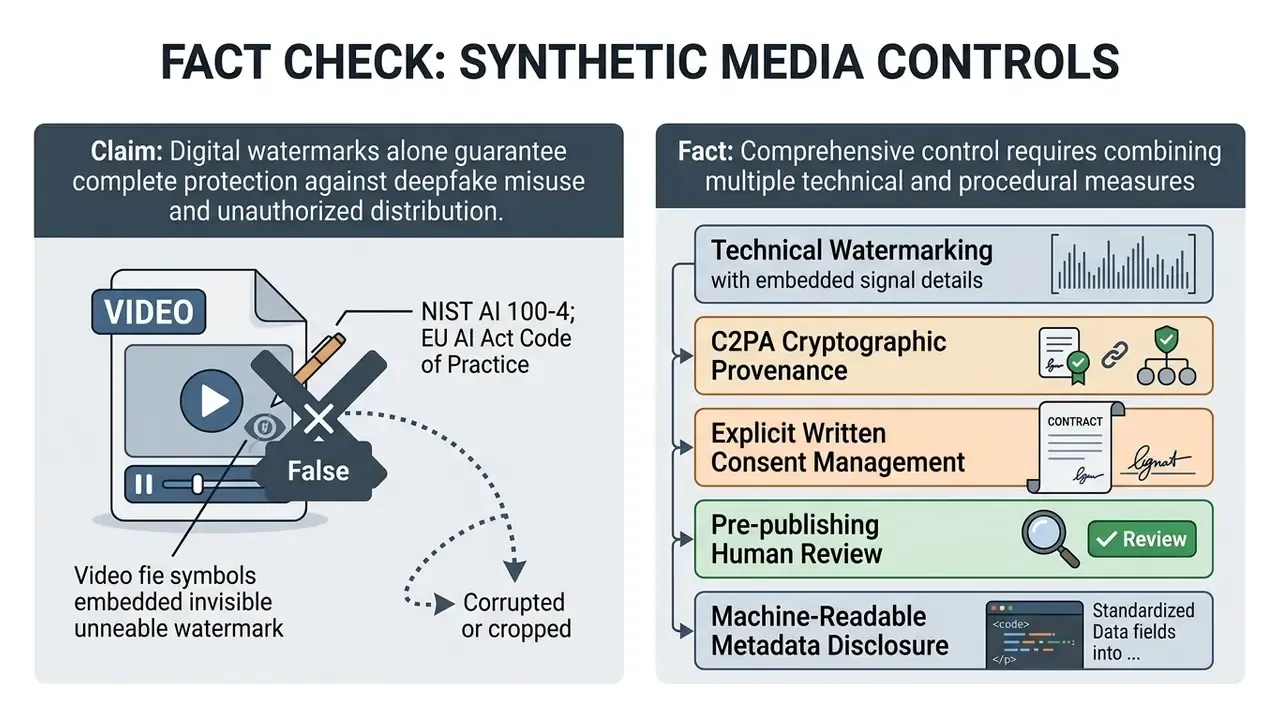
Technical controls for synthetic media provenance combine visible labels with machine-readable digital watermarks and cryptographic metadata. The Coalition for Content Provenance and Authenticity (C2PA v2.4, 2026) defines open technical standards for embedding tamper-evident content credentials directly into MP4 and JPEG manifests (C2PA Specifications). Where the c2pa.watermarked.bound action is asserted, the specification requires an accompanying soft-binding assertion in the manifest. That is what makes the watermark verifiable rather than merely present.
«Deepfake detectors trained on older datasets do not generalise to new generators: without retraining on DeepSpeak they fail to classify current deepfakes.»
Consider an illustrative case. A financial advisory firm publishing automated video market updates deployed C2PA content credentials alongside digital watermarks across all AI-generated presenter clips. During a routine compliance review, the automated verification system flagged an altered copy of one video that had been edited without authorization, preventing distribution of unverified financial advice. Verification teams typically pair provenance manifests with AI image detection tools and reverse-lookup workflows such as AI reverse image search to trace redistributed derivatives.
Safety via architectural constraints, or "imperfect by design". Certain consumer platforms intentionally apply spatial smoothing or cap output facial fidelity below hyper-realistic thresholds. This structural degradation keeps generated media easily identifiable as synthetic to human reviewers, limiting high-risk impersonation while preserving entertainment utility. Vendors adopting this stance describe it openly as declining to "push the limits" so that outputs stay enjoyable yet identifiable as fake, and they pair the fidelity cap with invisible watermarks that mainstream detection tools can read. For risk owners, an "imperfect by design" vendor is a defensible choice for satire, gaming, and cultural content. It is an unsuitable choice for executive communications, where fidelity expectations and impersonation exposure both run higher.
«FaceVid-Forensics-100K spans 100,000 videos across 33 synthesis methods with text annotations along four forensic dimensions: texture, lighting, motion, and physics.»
NIST's 2025 "Is This a Deepfake" guidance closes the loop procedurally. Where deepfake risk exists, video should be authenticated before publication, with provenance treated as the traceable development history of the asset and authentication treated as the release gate. Teams building repeatable release pipelines often document these gates alongside their editing and publishing steps, for example within a YouTube video editing workflow.
How to Choose an AI Deepfake Maker: Enterprise Vendor Evaluation and Risk Criteria
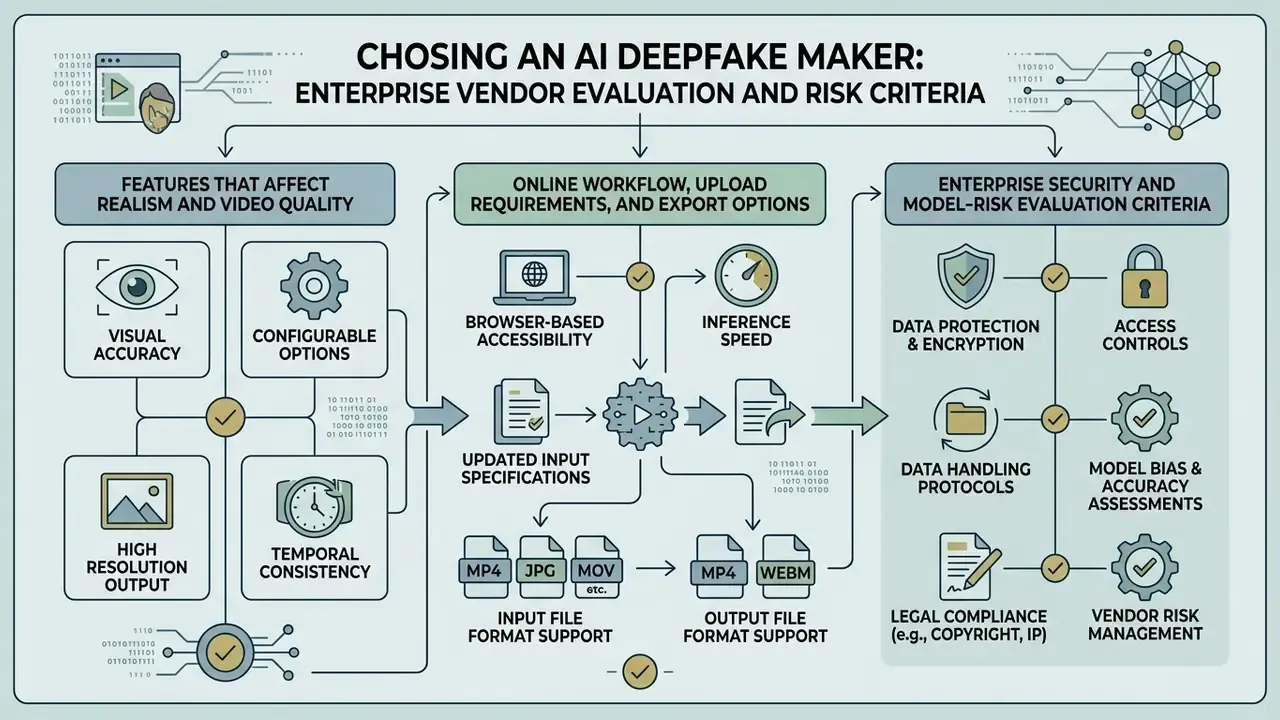
Choosing an ai deepfake maker requires evaluating browser-based accessibility, input and output file format support, inference speed, visual rendering accuracy, configurable export parameters, and, for regulated buyers, verifiable security posture. Organizations must balance generation quality against system throughput and risk-adjusted operational controls. That is why shortlists should be built against the same criteria used to compare AI video generators generally. An effective ai deepfake creator provides clear audit logs, predictable credit or subscription pricing, and precise rendering controls for high-resolution video exports.
One filter saves weeks. Ask for evidence artefacts in the first call, not in the security review three months later.
Features That Affect Realism and Video Quality
Realism in synthetic video depends on identity preservation, temporal motion stability, boundary artifact suppression, and lighting consistency. Updated: face warping and boundary artifacts frequently occur when localized facial regions are synthesized at a lower resolution than the surrounding target frame, as documented in FaceForensics++ benchmark evaluations (Rössler et al., ICCV 2019) and in the CVPR workshop work on exposing deepfakes through warping artifacts.
«Diffusion models outperform GANs in stability and image quality, which makes them the preferred backbone for high-fidelity face swapping in current systems.»
Advanced diffusion backbones, such as Stable Diffusion Turbo used in DreamID, resolve these limitations by combining explicit Triplet ID Group supervision with single-step to four-step inference (DreamID, 2025).
«AUHead uses action units (AU) as an intermediate representation: the audio signal is converted into AU sequences that drive a diffusion generator for emotionally expressive talking heads.»
High-fidelity platforms preserve natural blinking, subtle eye movements, and lighting continuity across high-motion sequences, preventing spatial distortion during complex facial expressions.
«On the HDTF dataset, Teller reaches FID 21.35 and FVD 173.46 with a generation time of 0.92 seconds per second of video, approaching real-time quality.»
Contemporary forensic benchmarks also track facial landmark trajectories over time, confirming that as static texture artifacts decline, kinematic inconsistency becomes the dominant realism failure. That makes landmark-trajectory stability a useful acceptance test for procurement pilots, and a better one than eyeballing a vendor demo reel.
Online Workflow, Upload Requirements and Export Options
Online deepfake creation relies on cloud-based GPU pipelines that remove the need for local hardware configuration.
Updated input specifications. Typical input requirements mandate source image uploads in JPEG, PNG, or WEBP formats with resolutions of at least 4 megapixels, and file size commonly capped at 50 MB for images. Target video clips accept MP4, MOV, or GIF containers, with total file sizes up to 200 MB for browser-based processing and a frequent 50 MB ceiling on drag-and-drop web widgets. Frontal portrait orientation remains the baseline capture requirement (FISWG Standards, 2011). API tiers diverge sharply. One documented detection and generation API permits direct uploads up to 500 MB with signed URLs expiring after one hour, while another caps image and video uploads at 10 MB and requires URL-based transfer above 1 MB. Integration teams should confirm limits per endpoint rather than per brand.
Rendering engines process frame extraction, alignment, and face replacement before exporting files at targeted resolutions ranging from 720p to 4K at 30 frames per second (Clipchamp Export Documentation, 2026). Web-based platforms like Kapwing and Swapface offer fast-rendering modes alongside granular export adjustments for video codecs (H.264, HEVC), frame rates, and target bitrates of 5,000 to 8,000 kbps. Where source files exceed a platform's upload ceiling, pre-processing with a video compressor preserves usable resolution while meeting the MB limit.
| Tool / Category | Primary Use Case | Free Tier Availability | Generation / Export Limits | Watermark Conditions | Export Formats & Resolution | Commercial Rights Included? |
|---|---|---|---|---|---|---|
| Fliki | AI talking avatars and video | Free-forever plan available | Capped monthly credits / short clips | Watermark applied on free tier | 1080p MP4 (paid tiers) | Included on paid plans |
| Synthesia | Corporate AI avatars and dubbing | Free trial plan offered | Restricted video duration | Watermark applied on trial | 1080p MP4 | Subject to enterprise licensing |
| AvatarSDK | 3D photo-to-avatar creation | First avatar export free | Single model export credit | Clean export for first avatar | GLB, glTF, FBX | Standard commercial use permitted |
| VEED Instant Avatar | Custom avatars and video edits | Free web trial | Limited preview duration | Watermark applied on free exports | MP4, WebM | Requires paid account upgrade |
Note: features, pricing structures, and export terms vary across vendors. Consult explicit licensing terms on the vendor's official pricing page before commercial deployment.
Enterprise Security and Model-Risk Evaluation Criteria
Consumer feature parity is not a procurement decision. The table below reframes vendor evaluation for CRO, model-risk, and compliance stakeholders, who need evidence artefacts rather than marketing claims. It applies equally whether the tool is sold as an ai deep fake maker, an ai deepfakes maker, or an enterprise video platform with a face-swap module.
| Evaluation Criterion | What to Request as Evidence | Why It Matters for Risk Owners | Disqualifying Answer |
|---|---|---|---|
| SOC 2 Type II / ISO 27001 | Current audit report plus bridge letter | Establishes control maturity over media storage and access | "Audit in progress" with no scope document |
| Zero-data-retention (ZDR) | Contract clause with deletion SLA in hours | Prevents biometric persistence in vendor storage | Retention "as long as necessary" |
| No-training guarantee | Written warranty excluding customer media from base-model training | Blocks likeness leakage into future model weights | Opt-out buried in default settings |
| Deployment model | VPC, single-tenant, or on-premise API option | Keeps executive biometrics inside controlled boundaries | Shared multi-tenant only |
| SSO / SCIM and RBAC | IdP integration documentation | Stops shadow-AI account sprawl | Personal email sign-up only |
| Provenance support | C2PA manifest and watermark configuration options | Satisfies EU AI Act machine-readable marking duties | No metadata export |
| Audit logging | Exportable render logs with user, prompt, and asset IDs | Supplies audit evidence and incident reconstruction | Logs unavailable to customers |
| MRM readiness (SR 11-7 style) | Model card, versioning notes, change notification policy | Enables revalidation when the backbone model changes | Silent model swaps |
| Sub-processor register | List of GPU and cloud sub-processors with regions | Supports transfer-impact assessment under GDPR | Undisclosed sub-processors |
Practitioners moving from a pilot to production should benchmark shortlisted vendors against neighbouring categories as well. Implementation economics documented in the Google Veo API guide is a useful reference point, so that render costs, latency, and licence terms are compared on a single sheet rather than in three separate decks.
How to Create a Deepfake Video with AI
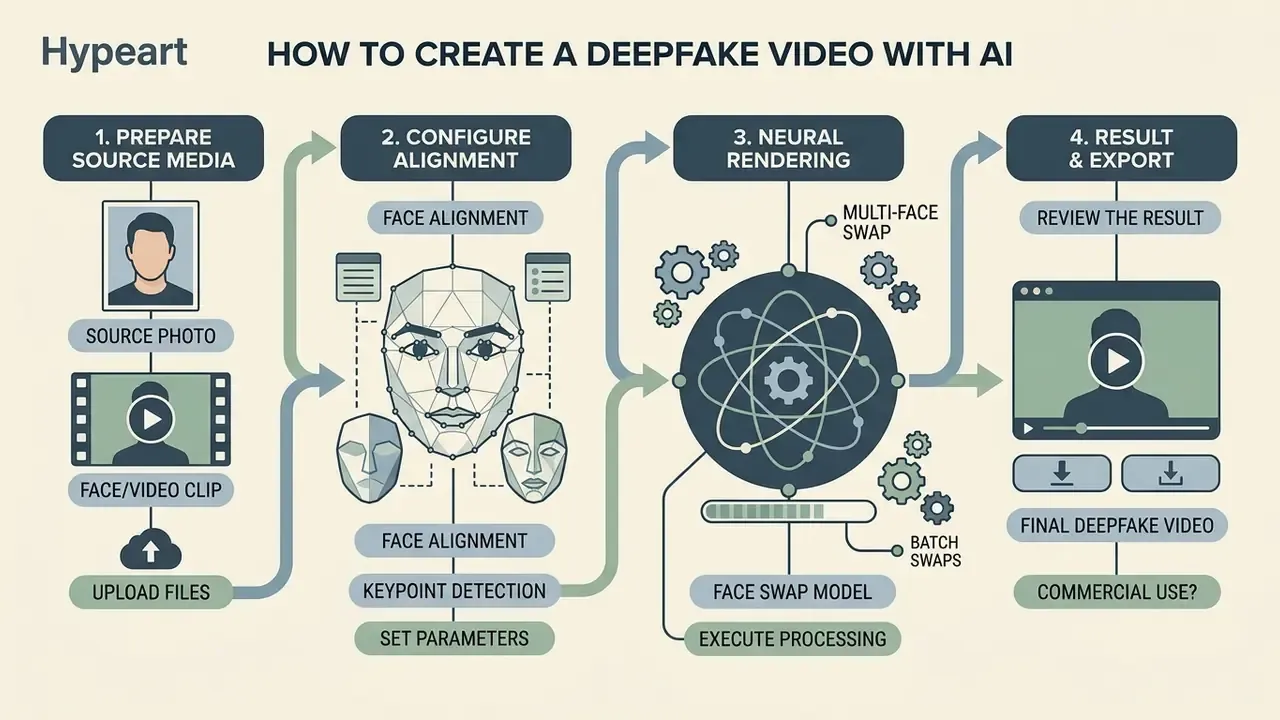
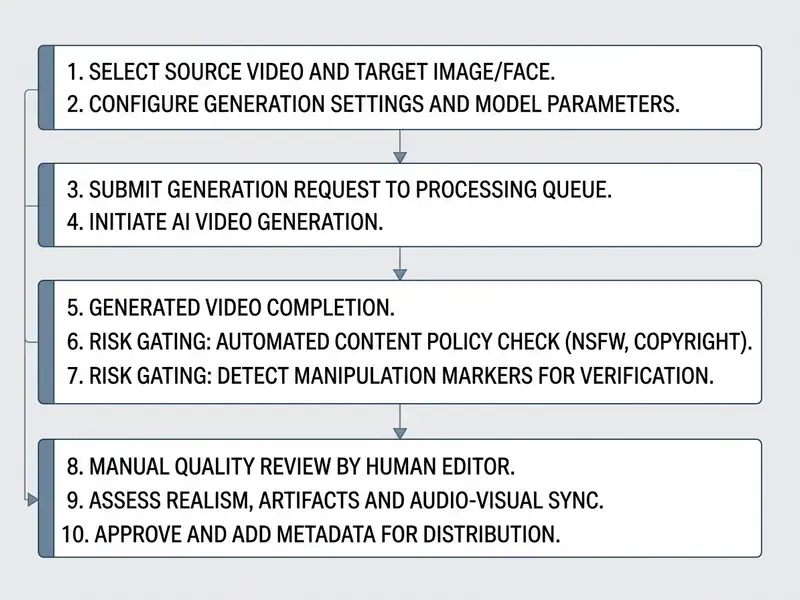
Creating a deepfake video involves a governed pipeline: selecting media formats, preparing high-quality input files, setting alignment parameters, executing neural rendering, passing a human review gate, and exporting the finalized file. Using an ai deep fake video maker or an ai video deepfake generator requires structured media preparation to ensure accurate face swapping and boundary integration.
Prepare a Source Photo, Face and Video Clip
Source media quality directly governs final video rendering precision. Face source photos must feature direct frontal positioning, neutral or natural lighting free of severe shadows, clear ear-to-ear visibility, and an unoccluded facial oval (NIST SP 800-122 / ANSI-NIST, 2010). Capture guidance from FISWG (2011) adds two operational thresholds: effective, non-interpolated camera resolution of 4 megapixels or higher, and head width occupying roughly 50% of the frame for frontal captures.
Target video clips require consistent frame rates, stable camera angles, and minimal motion blur. Removing physical occlusions such as eyeglasses, scarves, stray hair, hands, or mobile phones prevents landmark alignment failures and reduces boundary blending artifacts during model inference.
Upload Files, Generate the Face Swap and Review the Result
The operator uploads the source portrait and target video clip into the platform interface or API endpoint. Parameters such as target face index for multi-face clips and gender matching filters are configured before generation starts (WaveSpeed AI API Documentation, 2026). Production APIs typically expose target_index, target_gender, output_format, base64 output, and synchronous-wait options, and some return a single-frame preview swap before committing to full-sequence rendering.
1. Select Output Format & Media Type (Photo Swap, GIF Swap, Video Swap, or Avatar).
2. Upload High-Resolution Source Portrait (>= 4MP, frontal, unoccluded, <= 50 MB).
3. Upload Target Video Clip (MP4/MOV/GIF, <= 200 MB, stable lighting and frame rate).
4. Configure Rendering Parameters (Target face index, gender filter, lighting, resolution).
5. Initiate AI Generation & Render Pipeline (single-frame preview first, where supported).
6. Conduct Frame-by-Frame Side-by-Side Preview Inspection.
7. HUMAN-IN-THE-LOOP RISK GATE: verify consent record, brand rules, disclosure label,
   provenance manifest and risk-appetite sign-off before release.
8. Export Final Video File (H.264/MP4, target bitrate 5000-8000 kbps) with C2PA credentials.
Executing multi-face and batch swaps. When processing group portraits or scene files with multiple subjects, the pipeline executes face index detection. Operators assign individual source identity vectors to specific detected face IDs (Index 0 through N), and video length is typically locked once detection completes so that the index map stays stable across frames. For volume workflows, Batch Mode allows uploading up to 10 source photo variations simultaneously, mapping them against a single target video sequence in an automated queue. That is the standard approach for A/B testing creative variants or localising one master asset across regional presenters. Each queued job should inherit the same consent and disclosure metadata as the master. Otherwise batch throughput quietly outruns governance coverage.
During execution, neural autoencoders or latent diffusion backbones swap the facial identity, adjust skin tone, and balance ambient illumination. Operators review frame previews side by side with original footage to verify identity fidelity and catch temporal flickering before committing to full-video rendering.
Edit, Export and Share the Generated Video
Free AI Deepfake Generator, Pricing and Commercial Use
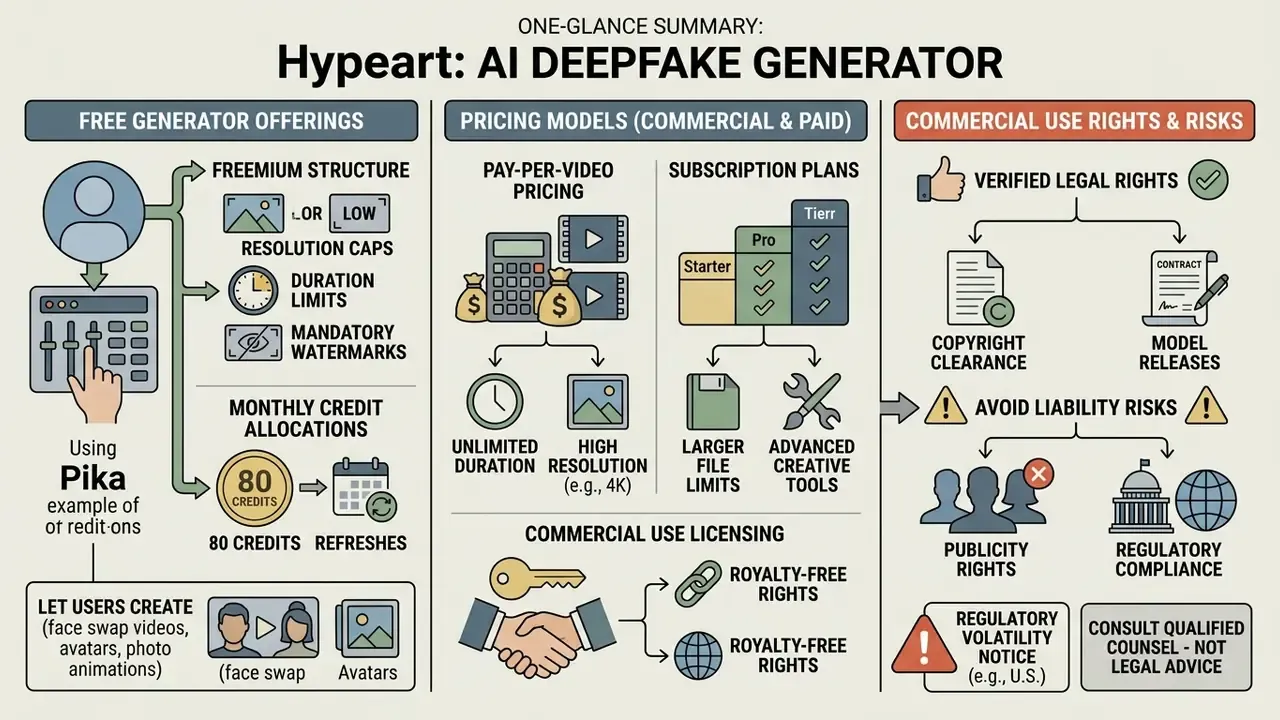
Commercial models for an ai deepfake generator free offering typically use a freemium structure defined by resolution caps, duration limits, and mandatory watermarks. Moving to commercial deployment requires paid subscription tiers, usage-based credit packages, transactional pay-per-render purchases, or enterprise API licences that convey explicit commercial rights.
What Is Included in Free AI Deepfake Video Makers?
Free tiers provided by an ai deepfake creator free platform or an ai deepfake maker free utility let users evaluate basic features, but they impose structural limits on production use. Comparative reviews of free AI video generators show free access commonly restricting outputs to 60 seconds or less, capping rendering resolution at 480p or 720p, and embedding visible digital watermarks on exported files. An ai deepfake video maker free plan is therefore a testing environment, not a production channel.
Certain providers, such as Pika, distribute monthly credit allocations, for example 80 free credits, for trial testing. Services like Kapwing restrict watermark-free MP4 downloads to paid Pro tier accounts (Kapwing Pro Documentation, 2026). Other vendors decline free generation entirely, stating plainly that GPU prices make free renders unsustainable and offering a public showcase instead. Organizations testing early pilots often rely on an ai deepfake video generator free tool for internal proof-of-concept work before committing capital to scalable enterprise plans. That practice should still route through the model inventory, because "pilot" uploads of executive headshots carry the same biometric exposure as production ones.
How to Check Commercial-Use Rights Before Exporting
| Plan Tier | Average Cost | Video Render Allocation | Watermark Policy | Maximum Export Resolution | Commercial Licensing Status |
|---|---|---|---|---|---|
| Free tier | $0 / month | 1–3 minutes / 80 credits | Mandatory visual watermark | 480p – 720p | Non-commercial, personal evaluation only |
| Mobile micro-pay | $1.00 – $2.00 / video | Single export credit | Watermark removed | 1080p HD | Standard commercial use |
| Pay-per-video (web) | $10.00 / video (crypto or flat card payment) | Single video render | Watermark removed | Up to 4K Ultra HD | Personal, satire or commercial per vendor terms |
| Starter / Pro | $9.99 – $29.99 / month | 15–30 minutes / credits | Watermark removed | 1080p Full HD | Standard commercial use permitted |
| Business / API | $49.99+ / month or usage-based | Unlimited / API credit volume | Watermark removed | 4K Ultra HD / raw export | Full enterprise commercial and API rights |
Transactional note: pay-per-render vendors position themselves explicitly against subscriptions ("pay only for the videos you create"), and mobile applications now undercut web pricing by roughly 90%, from about $1 per video with card or in-app payment and no account requirement. Some web tiers accept cryptocurrency only, which is typically a disqualifier for corporate procurement because it defeats invoice-level auditability.
GPU computing and refund policy note: because cloud GPU hardware nodes are allocated immediately upon pipeline execution, rendering fees are generally non-refundable once generation initiates. Vendors state that purchases are final because GPU processing starts as soon as a job is submitted, and account re-crediting typically applies only in cases of verified server-side pipeline failure. Model-risk teams should reflect this in budget controls, since failed creative direction, unlike failed infrastructure, is not recoverable.
«Peer-reviewed literature from 2023–2026 contains no systematic academic analysis of pricing structures or commercial terms for online deepfake generators.»
Because no academic price benchmark exists, all figures above should be treated as vendor-published values verified at the date of this update, not as a stable market rate. To estimate operational expenditure for high-volume video processing, teams model asset production costs with AI Media Calculators, review structured tiering via AI Media Pricing, examine platform capabilities using an AI Media Comparison, and check legal guidelines under AI Media Commercial-Use.
How to Get Realistic and Private Deepfake Results
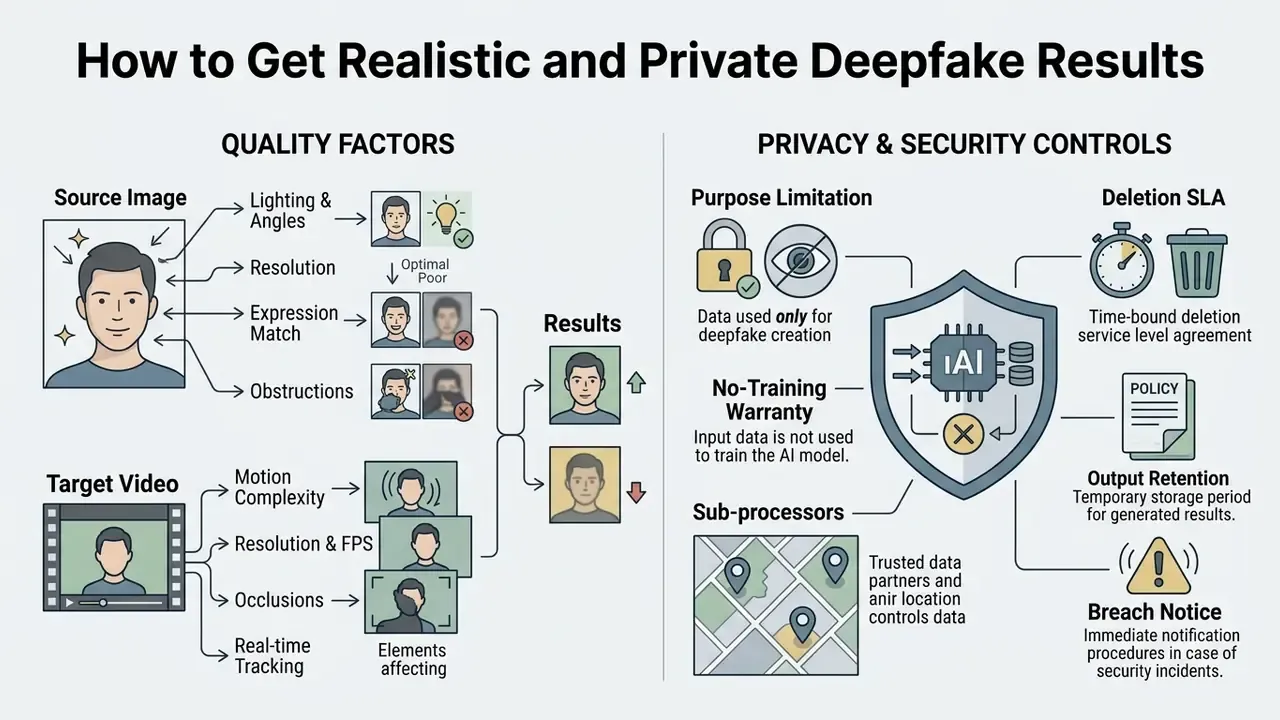
Achieving photorealistic results while safeguarding confidential media requires combining optimal source inputs with strict data retention controls. Deployment pipelines must enforce biometric privacy standards, minimizing exposure to third-party data scraping or unverified cloud retention.
Source Image and Video Factors That Affect Face Swap Quality
Face swap fidelity is primarily determined by input resolution, facial angle matching, lighting balance, and low compression distortion. Evaluative benchmarks like FaceForensics++ establish that source images with frontal camera orientation, zero physical occlusion, and high pixel density yield the lowest identity transfer error rates (ICCV, 2019). That benchmark also paired videos with similar large face sizes, similar frame rates, and at least 480p resolution to avoid swap failures.
«DeepSpeak includes over 50 hours of authentic recordings from 500 participants and more than 50 hours of deepfakes produced by 14 video synthesis engines and three voice-cloning engines.»
[INCORRECT INPUT]                     [CORRECT INPUT]
- High face angle (> 45 deg)           - Frontal orientation (0-15 deg)
- Direct shadows & uneven lighting     - Uniform frontal illumination
- Heavy compression / Low resolution   - Uncompressed, high resolution (>= 4MP)
- Occlusions (Glasses, hair, phone)    - Clear, unoccluded facial oval
- Mismatched frame rates               - Matched frame rate and face scale
When source and target media share similar lighting conditions and large facial proportions, diffusion engines eliminate unnatural boundary line artifacts (Luo et al., CVPR 2026). That work reports lighting error and face pose error as explicit evaluation metrics, and a WACV 2025 method confirms that disentangling pose, expression, and lighting from the target image is what suppresses artifacts under high pose variation and colour mismatch. High-definition inputs let the generator map fine anatomical structures accurately, including eyelids, skin pores, and lip textures. Which is a longer way of saying: no ai fake maker recovers detail that the camera never captured.
Privacy Settings for Uploaded Photos and Videos
Uploading facial images and voice samples transfers sensitive biometric identifiers to cloud infrastructure, which makes retention settings a control question rather than a preference.
«Deepfake face replacement is perceived as a significantly more effective privacy protection than blurring or pixelation, while integrating better into the scene.»
Leading generative platforms operate under varied data retention protocols. OpenAI policy specifies that deleted personal data is purged from active systems within 30 days, while specialized platforms like Pose AI delete source uploaded files immediately after generation completes and classify extracted facial geometry explicitly as biometric data excluded from training (Pose AI Privacy Policy, 2026). Meta AI exposes user-triggered deletion of chats and created media rather than a fixed retention window. So "deletion available" and "deletion guaranteed within N hours" are materially different contractual positions.
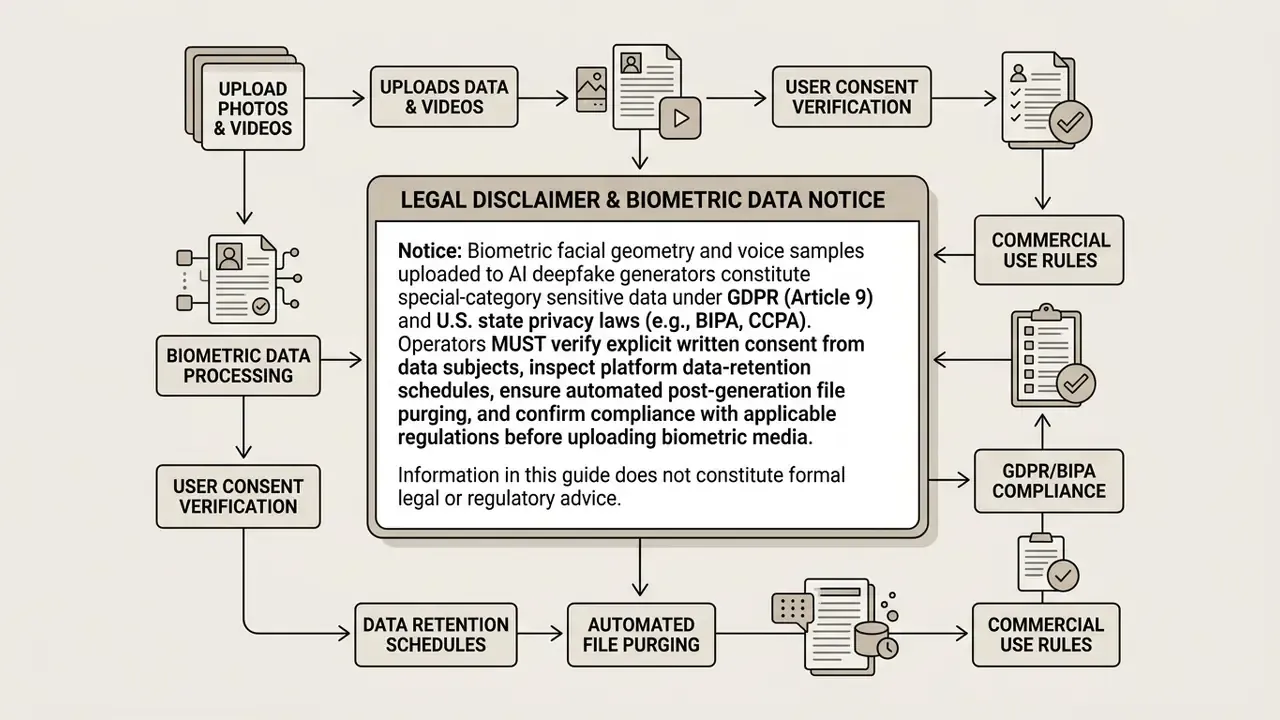
This section provides general information and does not replace advice from a qualified data-protection specialist or legal adviser.
Checklist0 / 8
NIST privacy guidance reinforces the notice dimension: applicants must receive explicit notice at collection, and organisations collecting biometric data are expected to publish detailed information about how that data is processed (NIST SP 800-63A; SP 800-122).
Here is an illustrative composite from model-risk practice. During an internal review at a regional financial institution, a team discovered that staff were uploading executive headshots to unauthorized public deepfake web utilities to generate video announcements. The risk team established a controlled internal sandbox using local API endpoints, enforcing zero-data-retention agreements and automatic file purging. The intervention closed that specific shadow-AI exposure path while keeping internal security mandates intact. Notably, the cost driver behind the shadow usage was the same one visible in the pricing table above. Staff chose $1–$10 transactional tools precisely because they required no account, no procurement, and no approval. Convenience beat policy, as it usually does.
Enterprise operators should consult developer documentation via the api overview and review legal precedents detailed in AI Litigation and compliance resources.
FAQ About AI Deepfake Generators
How Long Does It Take to Generate and Download a Deepfake Video?
Generating a deepfake video typically takes 1 to 10 minutes for short clips of 5 to 30 seconds on cloud-based web applications, depending on model architecture, input resolution, and server queue volume.
«Teller generates one second of video in 0.92 seconds, and DreamID reduces inference to 1–4 steps via SD Turbo, bringing short-clip generation close to real time.» Source: From Pixels to Portraits: A Comprehensive Survey of Talking Head Generation (arXiv, 2026); DreamID (arXiv, 2025). https://arxiv.org Rendering performance varies by system complexity. Vendor-reported standard-quality cloud processing completes in roughly 15 to 30 minutes per minute of rendered video, whereas high-fidelity 4K output using multi-step diffusion models may require 1 to 3 hours per minute of video. These duration figures are vendor-published operational estimates rather than peer-reviewed benchmarks, and should be validated against your own queue conditions. API response times for single-frame image face swaps are reported between 142 milliseconds and 2 seconds in laboratory benchmark conditions (deepfakedetectionapi.ai / Sensity API documentation, 2026), which is a TensorRT-class inference figure for a single frame, not a guaranteed latency for any browser interface. Readers comparing architectures can review AI video generation methods in more depth.
Is There a Genuinely Usable AI Deepfake Generator Online Free?
Yes, with caveats. An ai deepfake generator online free tier or an ai deepfake video maker online free widget is generally suitable for feasibility testing: short duration, watermarked output, 480p to 720p resolution, and non-commercial terms. What free tiers rarely provide is the evidence layer regulated buyers need, meaning audit logs, deletion SLAs, no-training warranties, and C2PA metadata export. For any asset that carries a real person's likeness or leaves the building, budget for a paid tier or an enterprise API.
How Are Deepfake Generators Validated Under Model Risk Frameworks Such as SR 11-7?
Treat the generator as a model, not a utility. Register it in the model inventory with a named owner, tier it by exposure (internal training video versus external customer communication), and document input lineage covering source portraits, cloned voices, templates, and any scraped e-commerce content. Define measurable acceptance criteria: identity fidelity, temporal flicker, lip-sync alignment, correct disclosure labelling. Set a revalidation trigger whenever the vendor upgrades its diffusion backbone, since silent model swaps invalidate prior testing. Retain render logs and human-review sign-offs as audit evidence. The control that fails audits most often is not image quality. It is the absence of a documented approval gate between generation and publication.
How Should a Zero-Data-Retention Agreement With a B2B Vendor Be Structured?
Specify four things in writing: a deletion window for source uploads measured in hours, a separate retention rule for generated outputs and preview frames, an express warranty that customer biometric media will not be used to train base or fine-tuned models, and a named sub-processor register with regions and transfer bases. Add audit rights permitting you to request deletion evidence and processing logs, and confirm the vendor acknowledges your organisation as the controller responsible for likeness consent. Vendors offering only shared multi-tenant processing with retention framed as "as long as necessary" should be excluded from regulated use cases regardless of output quality.
What File Formats and Size Limits Do Online Deepfake Tools Accept?
Image inputs commonly accept JPG, JPEG, PNG, and WEBP, with a typical 50 MB per-file ceiling and a recommended minimum of 4 megapixels effective resolution. Video and animation inputs accept MP4, MOV, and GIF, with browser widgets often limited to 50 MB and cloud pipelines to 200 MB. Input resolution up to 4K is supported by several vendors, with output delivered as high-quality MP4. API limits diverge from web limits, with documented ceilings ranging from 10 MB per file (URL upload required above 1 MB) to 500 MB for direct uploads with one-hour signed URLs. Confirm the specific endpoint contract before building an integration.
Are Deepfake Renders Refundable If the Result Is Unsatisfactory?
Generally no. Cloud GPU nodes are allocated the moment a job is submitted, so vendors state that purchases are final once processing has begun. Re-crediting is normally offered only when a render fails due to a verified server-side error. The practical mitigation is procedural. Validate identity fidelity on a single-frame preview or a short test clip before committing a full-length, high-resolution render, and standardise source-image quality so that avoidable failures such as occlusion, extreme pose, or heavy compression are caught before payment.
Is Commercial Use of AI Deepfake Output Legal?
It is lawful in many jurisdictions when the likeness owner has given documented consent, the content is disclosed as AI-generated, and the use is not deceptive. Copyright protection extends only to human-authored elements, publicity rights require consent for real-person likenesses, and advertising rules require truthful, clearly disclosed endorsements. Prohibited categories, including non-consensual intimate imagery, impersonation fraud, and misinformation, remain prohibited regardless of vendor terms. Consult qualified counsel for your jurisdiction and distribution footprint.
Appendix A: Editorial Change Log and Superseded Phrasing
For transparency, the following formulations from earlier revisions of this guide were revised in the current version:
- Artifact citation (superseded)"Face warping artifacts frequently occur when localized facial regions are synthesized at a lower resolution than the target background frame (CVPR, 2019)." Replaced with an attributed reference to FaceForensics++ (Rössler et al., ICCV 2019) and the CVPR workshop work on warping-artifact detection.
- Upload requirements (superseded)"Typical input requirements dictate frontal portrait images in JPEG or PNG formats with resolutions of at least 4 megapixels." Replaced with a specification including WEBP support and explicit 50 MB image and 200 MB video ceilings.
- Cross-linking paragraph (revised, not removed)the earlier generic list of adjacent utilities has been reframed inside the export section, where campaign collateral (captions, brochures, business cards, product renders) is tied to the same consent and licence record as the master video.
- Related-tools paragraph (revised)the previous unstructured tool list now sits alongside detection, provenance, and publishing-workflow resources relevant to synthetic-media governance, so that each link answers a control question rather than filling space.
- Latency claim (qualified)the 142-millisecond API figure is retained but reframed as a laboratory or API benchmark rather than a guaranteed web-interface latency. The 15–30 minutes per minute of rendered video figure is retained and labelled as a vendor-published operational estimate pending independent verification.
- Case examples (relabelled)institutional examples are now marked as illustrative composites rather than documented client outcomes.
Key Terms in One Place
- Face swap replacement of facial identity in a target photo, GIF, or video while preserving background and performance.
- Identity embedding the numeric vector representing a face, used to transfer identity between frames.
- Temporal flicker frame-to-frame inconsistency in a rendered sequence, now measured as a distinct quality metric.
- C2PA content credentials tamper-evident provenance metadata embedded in the exported file manifest.
- Soft binding a watermark or fingerprint assertion that makes a provenance claim verifiable after re-encoding.
- Zero-data-retention (ZDR) a contractual commitment to purge uploaded media within a stated window.
- Model inventory the register of models in use, with owner, tier, lineage, and revalidation schedule.
- Digital replica a realistic false depiction of a real person, subject to publicity and consent rules.