Executive Summary
- What it is An AI newsletter generator maps topic, audience, and tone inputs into responsive HTML email layouts through a multi-agent pipeline (research, copywriting, design, validation).
- Measured impact Documented AI-assisted newsletter workflows cut per-issue production time from roughly 6 hours to under 2 hours. AI-generated banner creatives have outperformed professional stock photography in controlled field tests.
- Where AI still fails Editing studies show only about 61% of AI revisions actually improve a text. That single number is why edit-based human review stays mandatory rather than optional.
- Tool categories Copywriting assistants, design and layout makers, integrated ESP platforms, and link-curation summarizers, plus monetization-oriented creator platforms.
- For regulated teams Free public SaaS tiers are rarely deployable in banking, insurance, or healthcare. Enterprise selection hinges on zero data retention terms, PII/NPI masking, SSO/SAML, prompt version control, immutable audit logs, and archiving aligned with SEC and FINRA record-retention duties.
- Realistic ROI Any credible business case subtracts control overhead (compliance review, model risk validation, residual-risk exposure) from raw copywriting time savings.
What this guide covers, in order: how the technology works; why teams use AI for newsletters; the four tool categories with a platform comparison; selection criteria for SMEs and for regulated enterprises; enterprise security and data governance; free plans and their real ceilings; a practical six-step workflow; and a FAQ.
What Is an AI Newsletter Generator and How Does It Work?
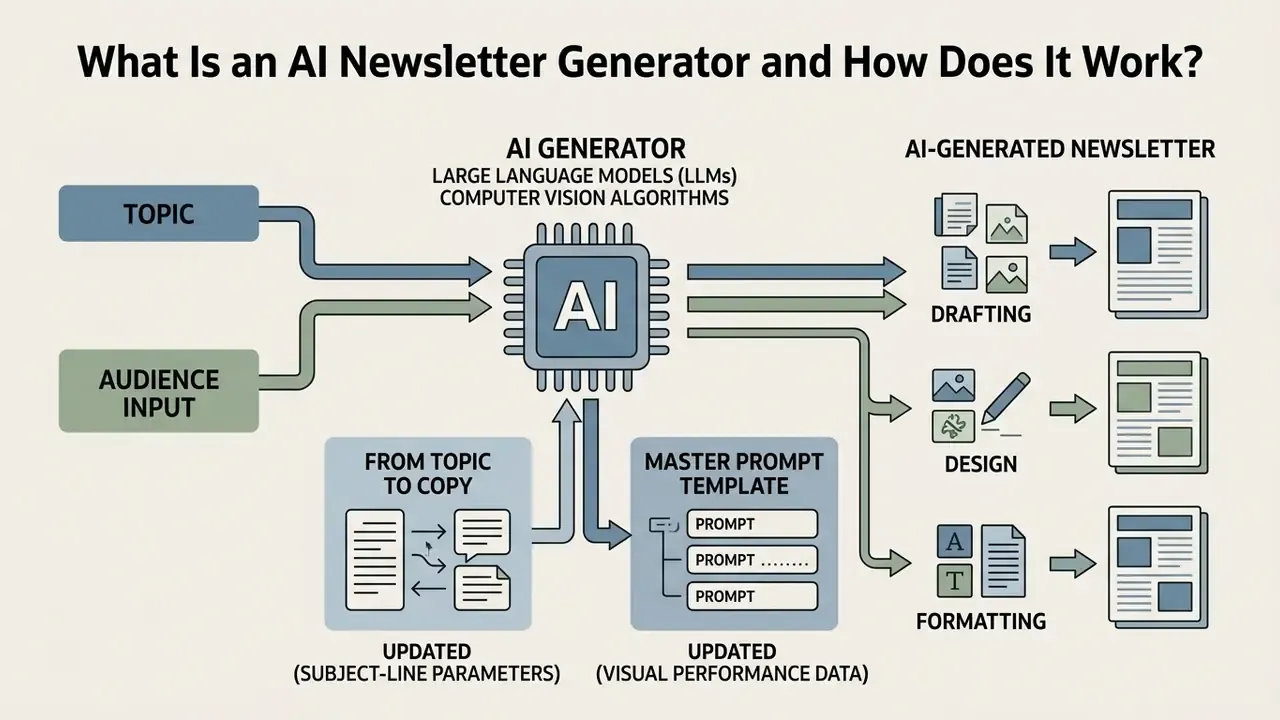
An AI newsletter generator is a software application that uses large language models (LLMs) and computer vision algorithms to automate the drafting, design, and formatting of email campaigns. The technology transforms raw inputs, such as a prompt, a target persona, or a content URL, into structured email layouts containing subject lines, body copy, visual elements, and calls to action. Rather than producing unstructured text, an ai newsletter generator maps content directly into responsive HTML email templates built for web and mobile clients.
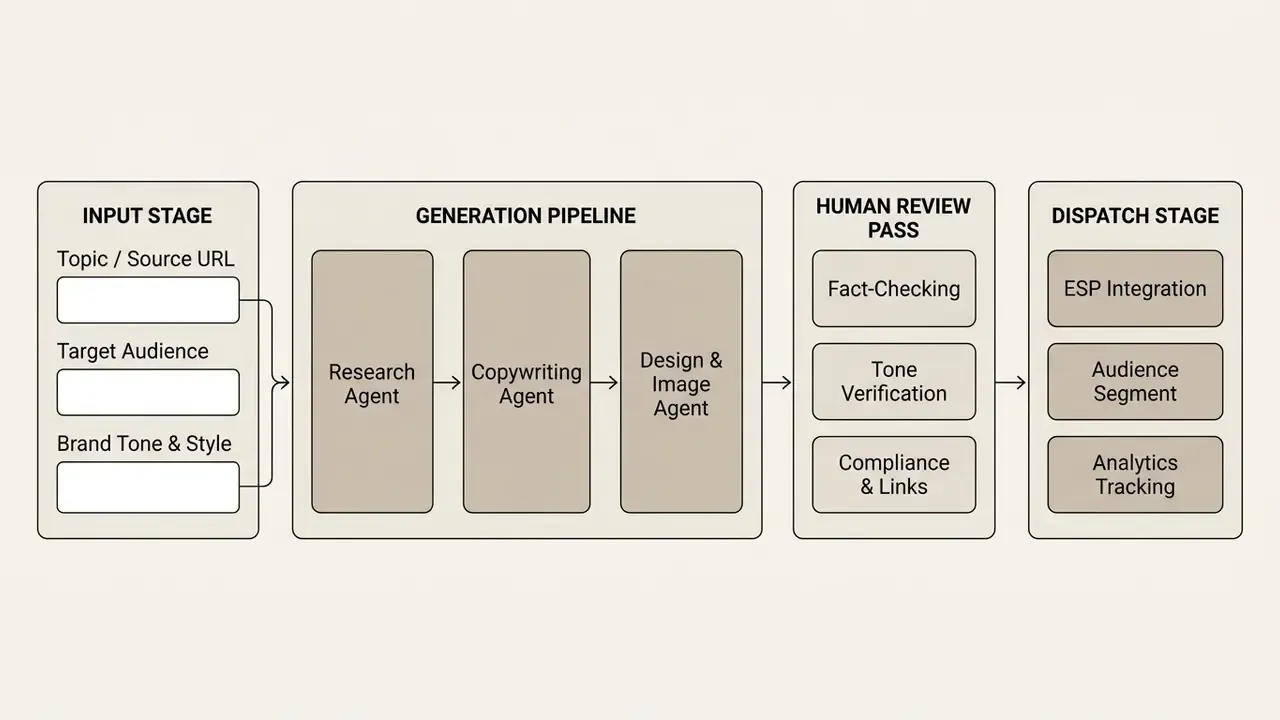
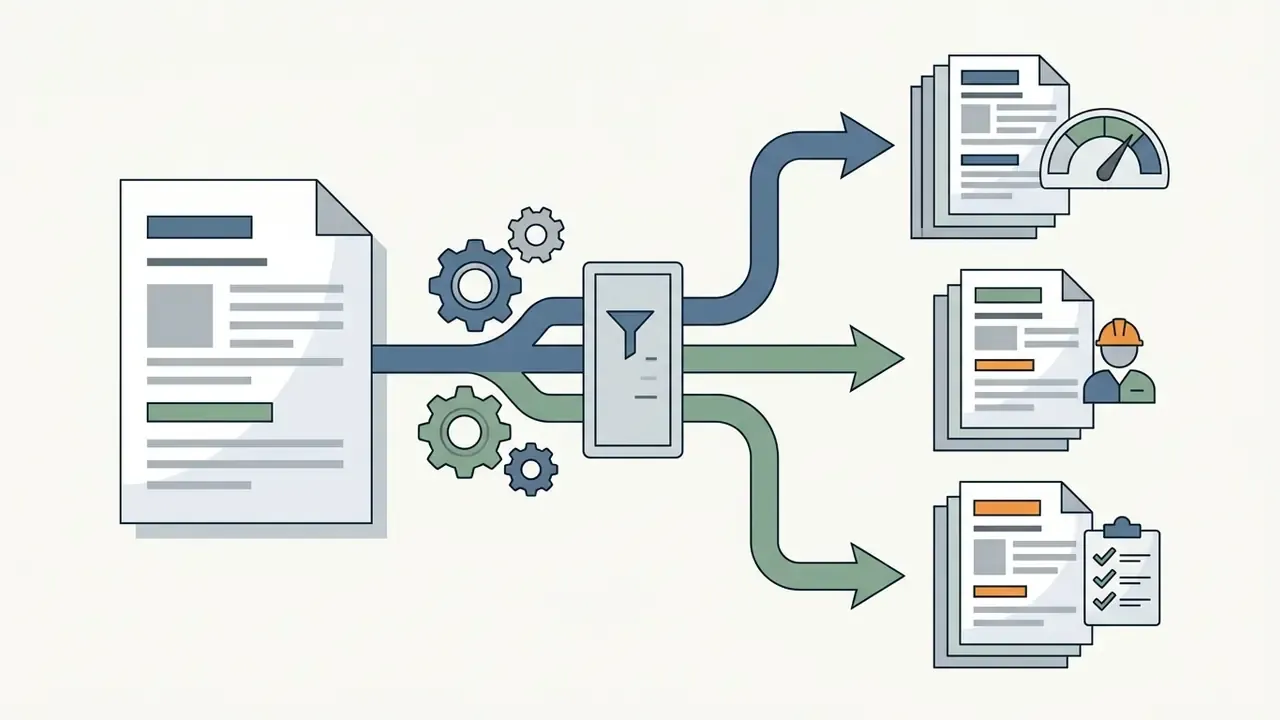
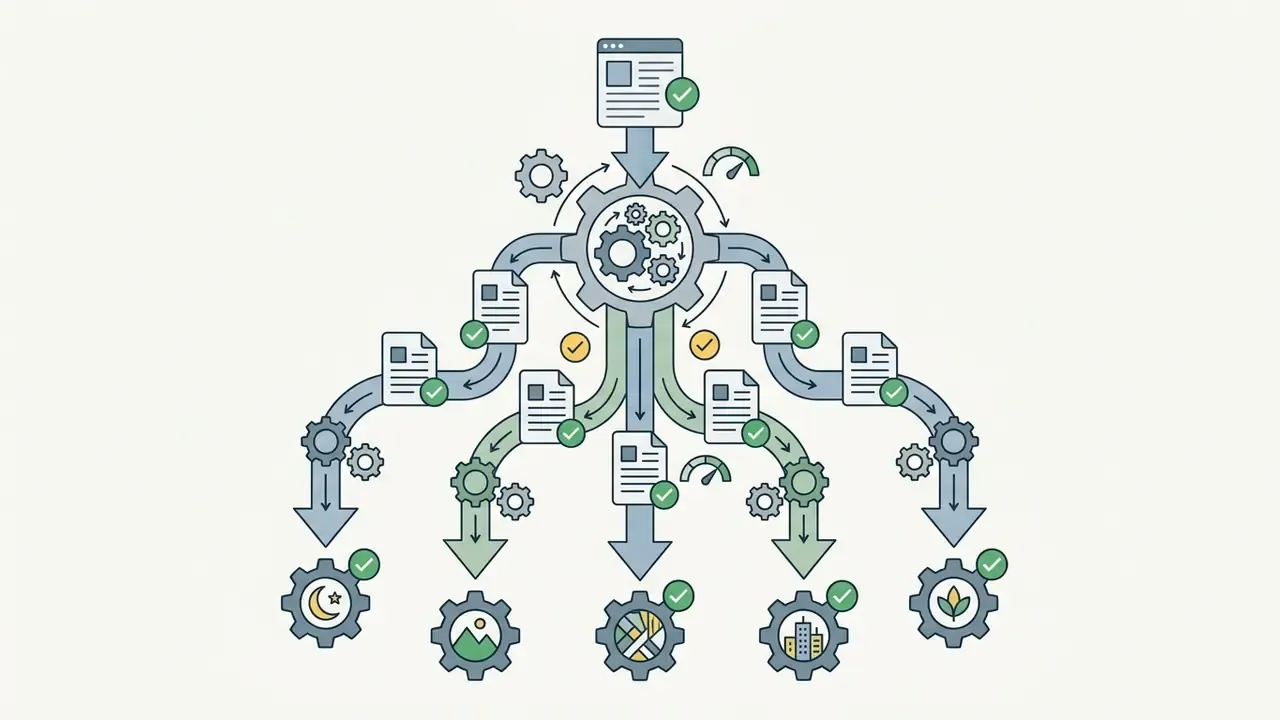
Operating as a multi-stage pipeline, an ai newsletter generator tool ingests source data, applies brand guardrails, generates visual assets, and formats output for export or direct dispatch through an Email Service Provider (ESP). Modern systems use specialized sub-agents: a research agent scans selected sources, a writing agent crafts copy matching the established brand voice, a design agent structures the layout, and a validation module checks links and formatting.
«A multi-agent pipeline combines research, writing, design and validation agents to produce a send-ready draft in the publisher's own brand style.»
By standardizing this sequence, organizations remove repetitive drafting work while keeping explicit editorial oversight on every issue. Vendor documentation from platforms such as beehiiv describes the same logic at the interface level: insert an AI block, enter a prompt specifying tone, structure, and target audience, then generate and refine copy while the surrounding template layout stays untouched.
From Topic and Audience Input to AI-Generated Newsletter Copy
An ai newsletter generator converts initial topic and audience inputs into structured newsletter copy by running a sequence of constrained prompt steps. Users supply core variables: primary subject, target audience segment, desired tone, and campaign goal. The model then processes those inputs against predefined templates to draft logical sections, scannable headlines, concise body paragraphs, and actionable buttons.
«Technical parameters for subject-line generation include a 30–45 character limit, formatting requirements and language consistency.»
Institutional writing guides converge on a similar range. Purdue's email best-practice material recommends roughly 40 characters (about seven words) for mobile display, while Arizona State University's brand guide targets around 25 characters for maximum scannability. Treat 25–45 characters as the working band, then A/B test inside it. When prompt templates specify exact length parameters, target key performance indicators (KPIs), and subscriber pain points, the resulting ai generated copy needs far fewer editorial revisions before publication.
What the Generator Can Create: Copy, Images, Templates and Email Layout
«In a field study with more than 173,000 impressions, AI-generated banners achieved a 50% higher click-through rate than professional stock photography.»
Beyond imagery, newsletter creator ai platforms automatically embed responsive formatting rules: descriptive alt-text tags, role="presentation" attributes for decorative table structures, minimum 14px body type, and mobile-friendly tap targets of at least 44×44 pixels. Template standards published by enterprise vendors add further constraints, namely clean responsive HTML, inline CSS, and no JavaScript, since most email clients strip scripts entirely.
Why Use AI to Create a Newsletter?
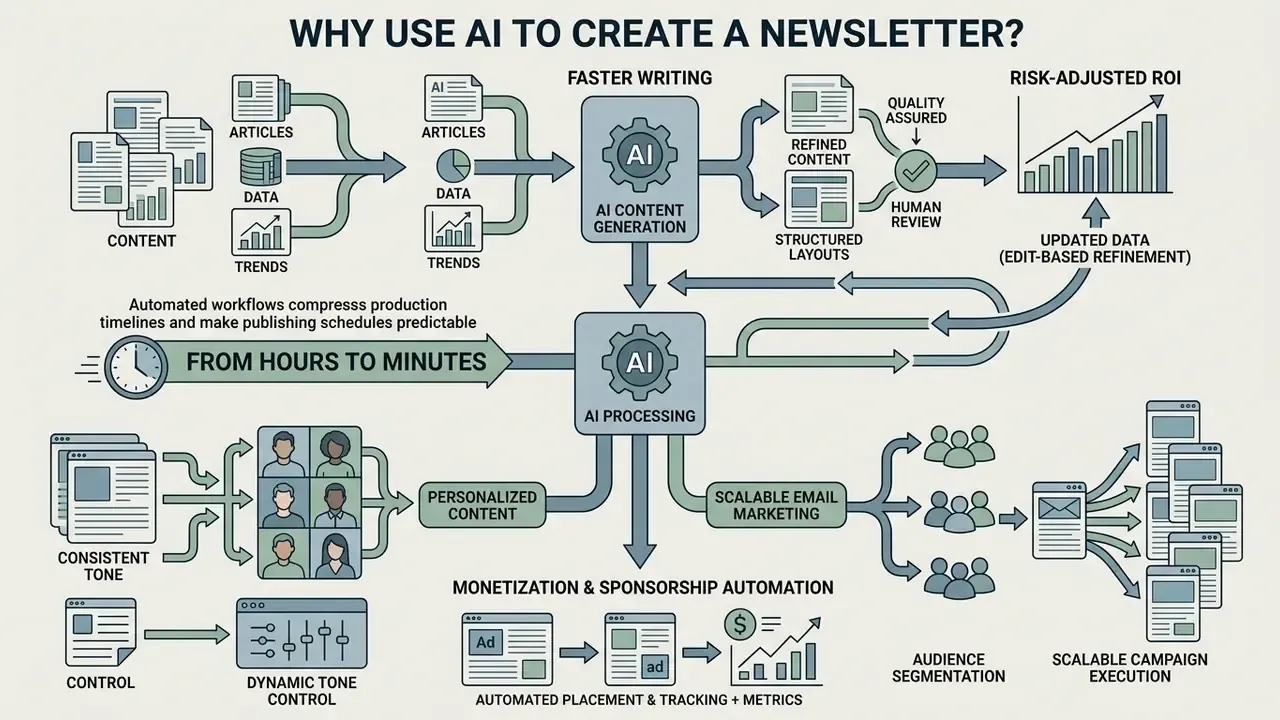
Organizations use ai to create newsletters because automated workflows compress production timelines from hours to minutes and make publishing schedules predictable. AI-powered drafting removes blank-page friction, speeds up research, and lets a small team run a sophisticated email program without adding headcount.
Speed is only part of it. Applying ai to create newsletter workflows also helps marketing teams hold one tone across multiple authors and split campaigns by subscriber segment. Automated tools read historical performance metrics, customer relationship management (CRM) data, and brand style guides, then generate targeted email copy that lifts reader engagement and retention.
Faster Newsletter Writing Without Losing Content Quality
Using ai to create a newsletter shortens the editorial timeline while structured human-in-the-loop editing protects accuracy. A 2025 systematic review of 24 empirical studies on generative AI writing applications found that AI assistance sped up drafting, idea generation, revising, and editing, with measurable gains in vocabulary, grammar, and coherence (PLOS ONE Systematic Review, 2025). The same body of research carries a useful counterweight: in a PLOS ONE analysis of 83 AI-produced revisions, only 61% improved the text, 14% actively worsened it, and 24% changed nothing. Acceleration and accuracy are separate variables. Worth repeating.
Observational case data quantifies the production gain:
«After adopting an AI-assisted workflow, per-issue writing time fell from 6 hours to 2 hours, while open rates rose from 15% to 42%.»
By automating the first draft, writers move their attention from raw text generation to positioning, factual verification, and brand refinement.
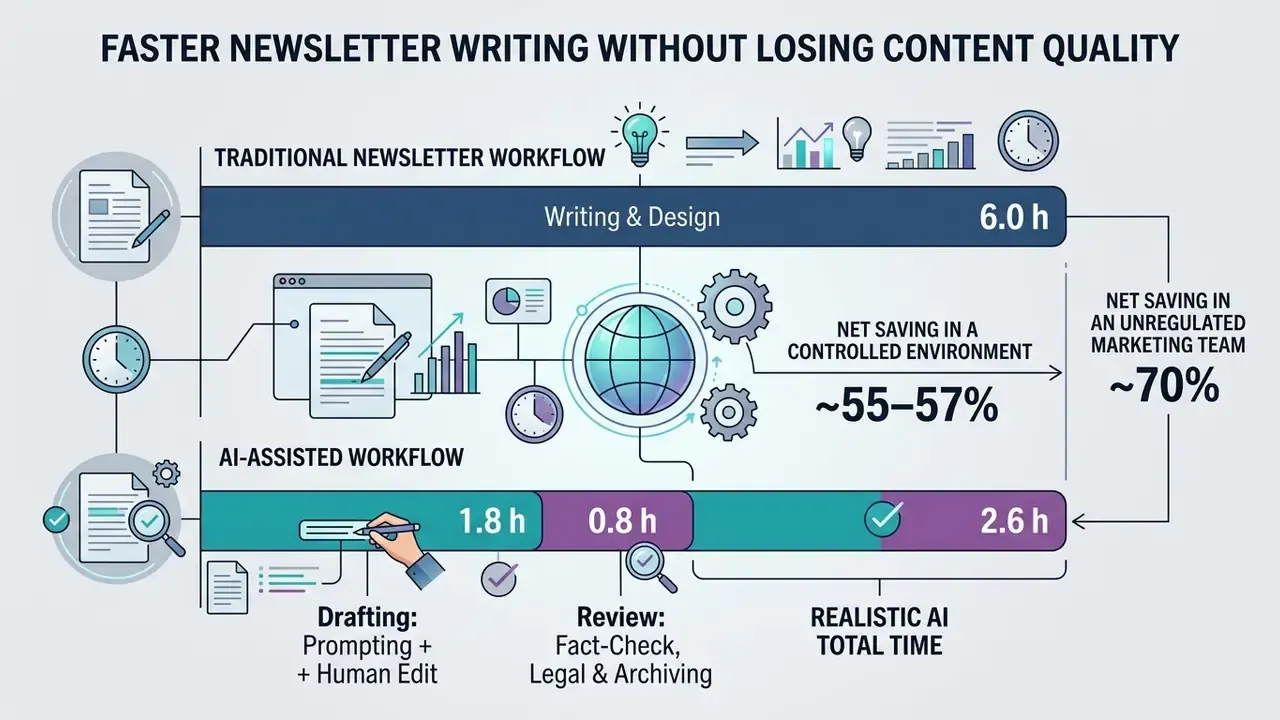
Risk-adjusted ROI. Headline "70% faster" figures ignore control overhead, which is unavoidable in banking, insurance, healthcare, and legal publishing. Use this model instead:
Risk-Adjusted ROI = (Hours Saved × Blended Editorial Rate)
                  − (Compliance Review Hours × Compliance Rate)
                  − (Model Validation & Monitoring Cost, amortized per issue)
                  − (Tooling & Licensing Cost per issue)
                  − (Expected Residual Risk Cost)
where Expected Residual Risk Cost =
      Probability of a factual/compliance defect reaching subscribers
      × Estimated cost per incident (remediation + notification + reputational)
| ROI Input | Unregulated Marketing Team | Regulated Financial Publisher |
|---|---|---|
| Drafting hours saved per issue | 4.2 h | 4.2 h |
| Added compliance/risk review | 0.2 h | 0.8–1.5 h |
| Model validation & monitoring | Not applicable | Amortized MRM effort per campaign |
| Archiving and retention overhead | Minimal | Mandatory immutable archive |
| Practical net time saving | ~65–70% | ~35–55% |
«Iterative draft refinement raises the share of copy meeting business requirements by 16–36% compared with single-pass generation.»
Related alignment research reports that edit-based selection produced outputs preferred by expert writers in 66% of comparisons overall, rising to 72.2% when the reward gap exceeded one point. This hybrid model lets creators publish high-volume newsletters quickly while keeping factual errors and off-brand phrasing out of subscriber inboxes.
Personalized Content, Consistent Tone and Scalable Email Marketing
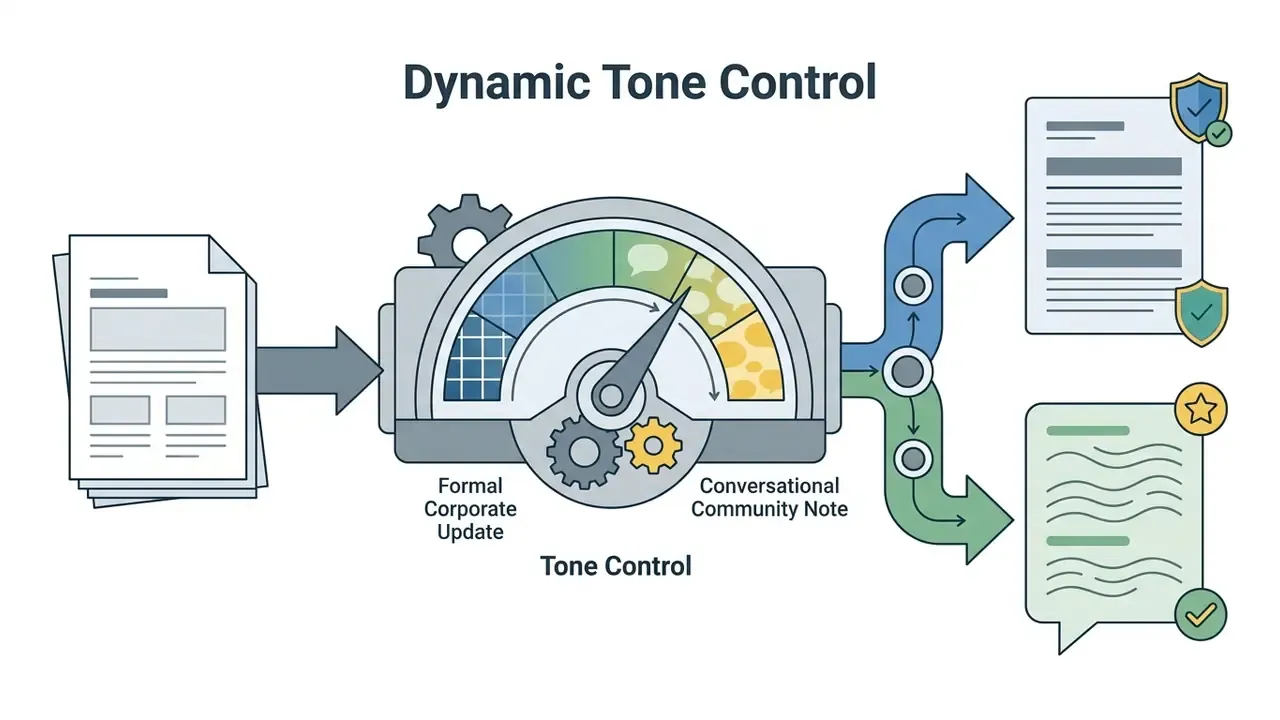
An ai email newsletter generator enables precise personalization and brand voice management as a subscriber base grows. By setting explicit brand voice rules, prohibited phrase lists, and situational tone profiles (analytical for market updates, persuasive for product announcements), organizations keep ai generated messages inside strict communication guidelines. Practitioner style guidance draws a distinction worth borrowing: voice is the fixed brand personality, tone is the situational adjustment per audience and per message.
Personalization at scale moves engagement metrics in ways that are now measurable.
«In a randomized controlled trial with more than one million users, personalized AI subject lines built from search logs increased open rates and repeat sessions.»
Scaling email operations with AI lets organizations deliver targeted content to segmented lists without multiplying editorial workload. The constraint shifts from writing capacity to review capacity, which is a very different management problem.
Monetization and Sponsorship Automation
Generative AI also compresses the revenue cycle for media creators and publishers by automating ad copy adaptation and dynamic sponsorship insertion. For creator-led newsletters, this is often the difference between a hobby list and a commercial media asset.
- Sponsor Copy Matching AI engines ingest sponsor landing pages and condense raw product features into native 50-word sponsor spots written in the creator's voice, removing much of the manual rewrite loop.
- Dynamic Paywall Teasers Automated systems read engagement history to generate customized "cliffhanger" previews for non-paying subscribers, driving paid-tier conversion.
- Automated Ad A/B Testing AI drafts multiple variations of affiliate placement text to lift click-through rates without hijacking the editorial section.
- Referral and Upsell Sequencing Generators produce variant referral prompts and renewal reminders tuned to subscriber tenure, which is where most creator platforms concentrate their monetization tooling.
Platform capability differs sharply here. Substack and beehiiv build monetization into the publishing layer (paid subscriptions, ad networks, referral programs), while CRM-first platforms such as HubSpot offer no native tooling for selling paid newsletter subscriptions or managing sponsorship inventory. Disclosure duty stays with the publisher: sponsored placements need clear labeling regardless of who, or what, wrote the copy. Teams monetizing generated visuals should also check licensing terms in our AI Media Commercial-Use hub before a sponsor asset goes out to a full list.
Types of AI Newsletter Creation Tools
The ecosystem of ai newsletter tools splits into four functional categories: specialized AI copywriting software, layout and design generators, full email marketing platforms with native AI, and link-curation summarizers that turn sources into digests. The right category depends on whether you need text generation, visual layout help, automated curation, or one delivery ecosystem for everything.
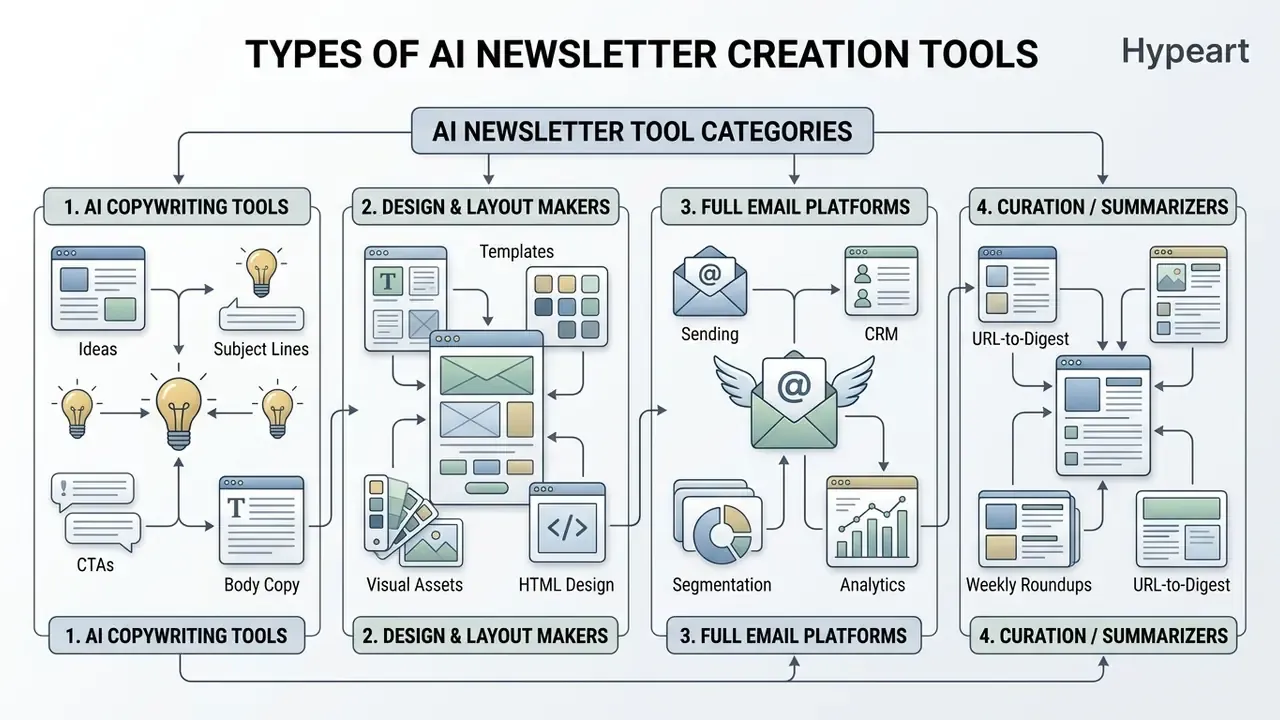
Knowing the boundaries prevents a familiar budget leak: three overlapping licences that each cover 40% of the workflow. Niche copywriting assistants excel at ideation and phrasing variants, while full-stack email platforms wire the generation engine straight into subscriber databases, delivery infrastructure, and compliance tooling.
Automated Curation and Summarization Tools
A fourth class sits between research and drafting: curation engines that ingest links and return structured digests. Products here (TLDR-style summarizers, RSS-to-digest builders, and research sub-agents inside publishing platforms) are tuned for weekly industry roundups rather than campaign design. They rarely handle sending, and documented workflows still require manual source selection, editorial review, and quality tuning. The curation loop is weekly and supervised, not autonomous.
Email Platforms with AI, Audience Data and Sending Features
Full-featured email marketing platforms embed generative AI directly into delivery, segmentation, and analytics. Platforms such as Mailchimp, beehiiv, and ActiveCampaign connect generation engines to live subscriber behavior, which enables automated workflow triggers and dynamic content placement.
Integrated platforms accept plain-language prompts to build custom segments, forecast campaign performance, and optimize dispatch time per reader. Mailchimp's Analytics AI analyzes campaign performance, audience behavior, and revenue, while its segment builder converts plain-language audience descriptions into behavioral and engagement-based segments. ActiveCampaign's Active Intelligence generates campaigns, automations, and segments from natural-language prompts, then feeds the resulting segments into automation workflows. Combining creation and delivery in one environment lets teams draft, design, review, segment, and send without shuttling data between systems, which also shortens the audit trail you later have to reconstruct.
How to Choose the Best AI Newsletter Generator
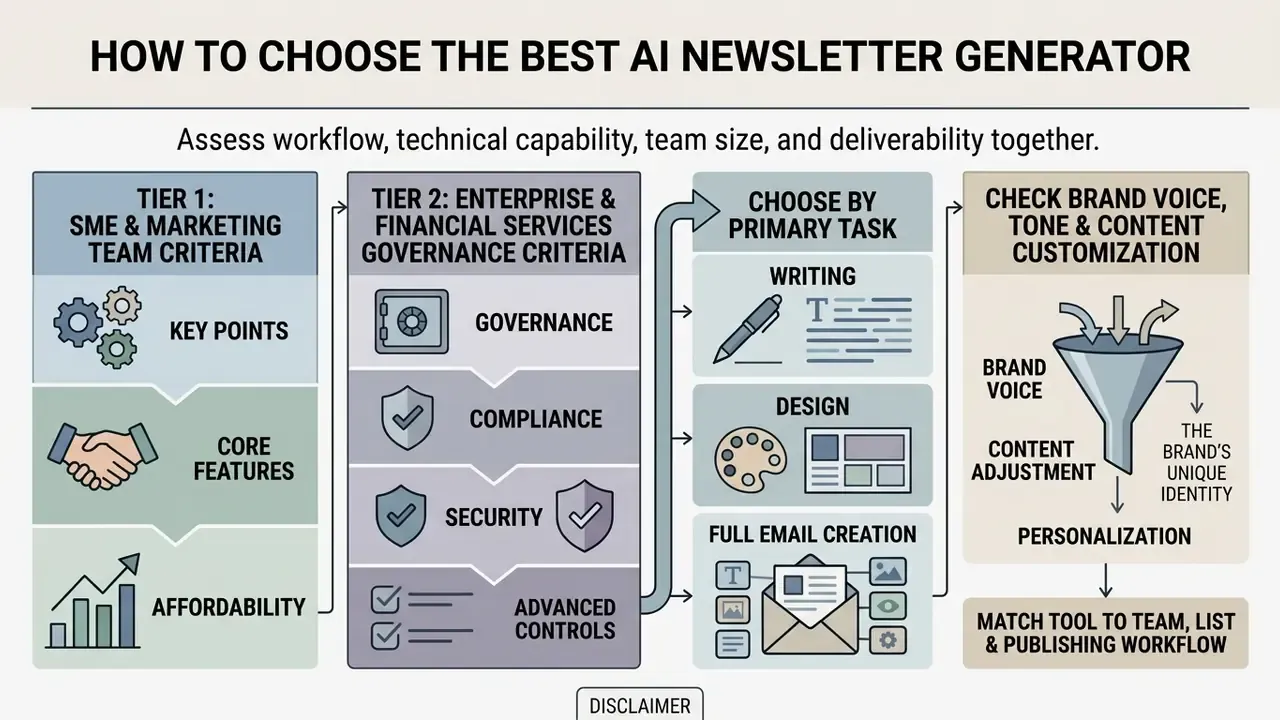
Selecting the best ai newsletter generator means assessing workflow, technical capability, team size, and deliverability requirements together. Decision-makers should check whether a candidate offers real brand voice controls, clean integration with existing software, and scalable subscriber management. Because requirements diverge sharply between a solo publisher and a supervised financial institution, the criteria below are split into two tiers.
Tier 1: SME and Marketing Team Criteria
| Evaluation Metric | Solo Creator Focus | Marketing Team Focus |
|---|---|---|
| Primary Need | Rapid drafting & low cost | Role-based permissions & auditability |
| Brand Control | Basic tone selection | Multi-voice style guides & asset kits |
| Integration | Direct ESP export or copy-paste | Deep CRM, API & SSO integration |
| Compliance | Basic unsubscribe links | ISO 42001, SOC 2, CAN-SPAM, GDPR |
| Deliverability | Shared IP, provider defaults | SPF/DKIM/DMARC control, dedicated IP warmup |
A systematic selection process keeps chosen software aligned with both current production capacity and longer-term marketing goals. Clear criteria also prevent the expensive pattern of migrating twice in eighteen months and burning sender reputation on the way.
Tier 2: Enterprise and Financial Services Governance Criteria
| Governance Requirement | Why It Matters | Evidence to Request from Vendor |
|---|---|---|
| Zero data retention (ZDR) | Prevents prompts containing customer data from training third-party models | Contractual ZDR clause and sub-processor list |
| PII / NPI handling | Non-public personal information must never enter an unbounded prompt | Data-flow diagram, masking/tokenization support |
| Deployment isolation | Shared multi-tenant inference may be unacceptable for supervised entities | VPC, private endpoint, or on-premise option |
| Immutable audit trail | Reconstructing who generated, edited, and approved each issue | Exportable logs with actor, timestamp, prompt, model version |
| Prompt & model versioning | Reproducibility of an output during examination or dispute | Version history and rollback capability |
| SSO / SAML / SCIM | Identity governance and rapid deprovisioning | Admin documentation and test tenant |
| Independent certification | Third-party assurance rather than self-attestation | SOC 2 Type II report, ISO/IEC 27001, ISO/IEC 42001 |
| Records retention alignment | Marketing communications are often retained records | Archiving integration and retention configuration |
Choose by Primary Task: Writing, Design or Full Email Creation
Pick an ai newsletter generator tool based on your actual bottleneck, not on feature counts. If the editorial team stalls on ideation and copywriting, a specialized text generation tool returns the most per dollar. If design formatting and mobile rendering eat your technical hours, an ai newsletter design generator delivers faster relief.
For organizations consolidating a tech stack, end-to-end email marketing platforms are usually the better fit. These systems handle the whole lifecycle: prompt drafting, template layout, domain authentication (SPF, DKIM, DMARC), list hygiene, and conversion tracking. Pricing tiers across categories are collected in our pricing reference if you want to browse the hub before shortlisting.
Check Brand Voice, Tone and Content Customization
Holding a distinct identity requires an ai newsletter creator that accepts granular voice settings and style parameters. Advanced platforms let administrators upload sample campaign archives, corporate style guides, and terminology glossaries to shape custom tone models. Verification methods differ by vendor: HubSpot applies a stored brand identity inside the email editor; Klaviyo auto-generates sample content in a Voice tab so editors can judge fit and then hand-edit descriptors and writing rules; Adobe Journey Optimizer exposes per-email tone selection such as informative, playful, or persuasive.
When testing customization, verify two things specifically. Can the system make fine-grained tone shifts (informative to persuasive) without rewriting the facts? And does it support negative constraints, meaning prohibited buzzwords and banned claims? Effective systems expose an explicit "apply brand identity" control that enforces colors, fonts, and tone rules across every generated draft.
Match the Tool to Your Team, List and Publishing Workflow
Selection has to account for collaboration needs, CRM connectivity, and list scale. Enterprise environments need role-based access governance, approval workflows, compliance logging, and solid API access to connect email software with broader data warehouses. Contemporary CRM research adds four further requirements for AI-assisted systems: centralized customer information, data accessibility and integrity, continuous monitoring for data drift, and standardized integration interfaces.
Organizations governed by formal risk management standards must also verify vendor data security practices.
The standard specifies requirements to establish, implement, maintain, and continually improve an AI management system inside an organization. Confirming that a vendor aligns with it protects confidential subscriber data and, less obviously, protects sender reputation.
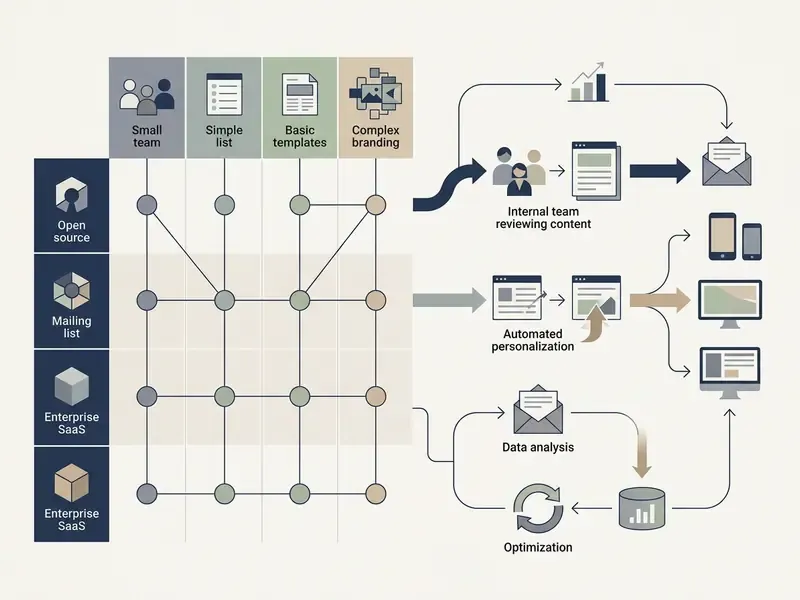
| Primary Use Case | Recommended Tool Type | Representative Platforms | Key Functional Strengths | Export / Dispatch Method |
|---|---|---|---|---|
| Copywriting & Ideation | Standalone AI copywriter | Klaviyo Composer, Hoppy Copy, Jasper | Prompt flexibility, headline variants, tone tuning | Markdown, plain text, HTML |
| Visual Layout & Design | AI newsletter design maker | Visme, Venngage, BeeFree | Responsive HTML grids, banner generation, asset kits | HTML export, ESP template sync |
| Full Lifecycle Dispatch | Integrated ESP platform | Mailchimp, beehiiv, GetResponse, MailerLite | Native AI drafting, list segmentation, send optimization | Direct ESP dispatch |
| Dynamic Personalization | CRM-embedded AI engine | HubSpot Breeze, ActiveCampaign, Adobe Journey Optimizer | Real-time user data integration, behavioral triggers | Automated API triggering |
| Curation & Digests | Summarization agent | TLDR-style tools, RSS-to-digest builders | URL ingestion, key-takeaway extraction | Copy into ESP or API push |
Enterprise Security and Data Governance Rules for AI Newsletters
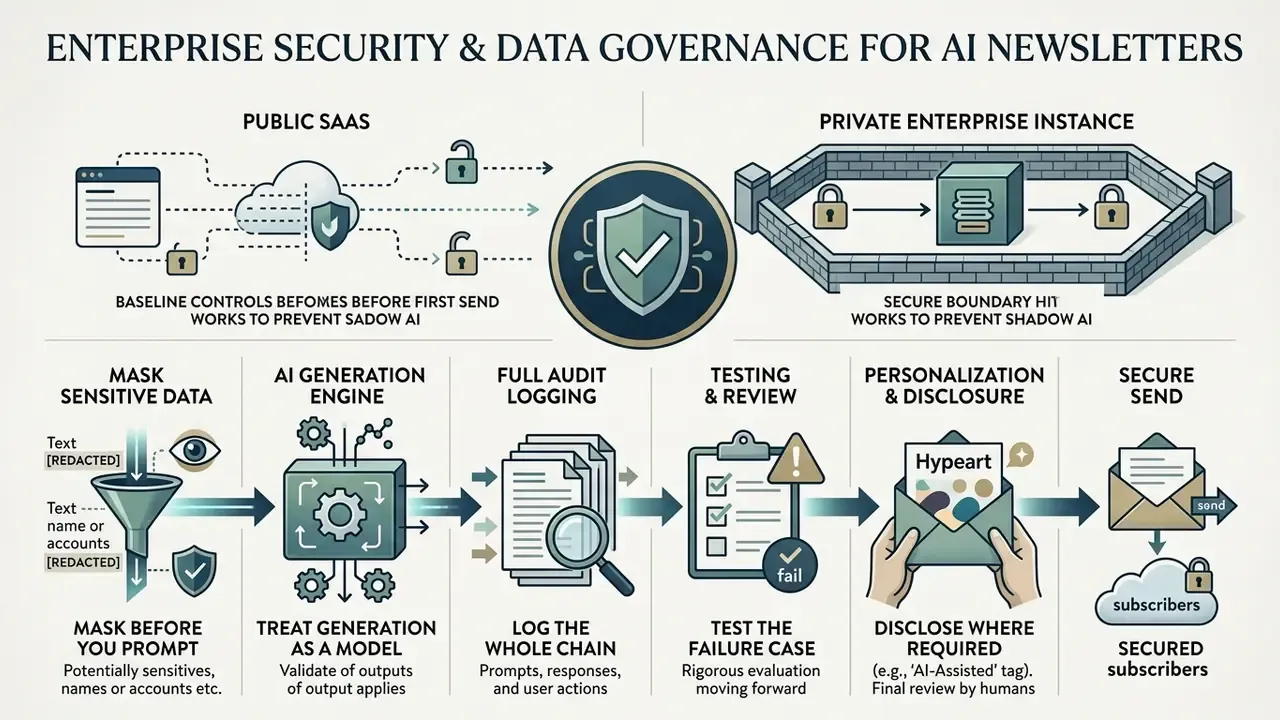
Regulated organizations, meaning banks, insurers, broker-dealers, and healthcare providers, face a different failure mode than creators. The risk is not a bland subject line. It is an unapproved rate claim, a leaked customer record sitting inside a prompt, or an output nobody can reproduce during an examination.
Public SaaS vs Private Enterprise Instance
| Control Dimension | Public SaaS Free/Low Tier | Private Enterprise Instance |
|---|---|---|
| Prompt data retention | Often retained for abuse monitoring or product improvement | Contractual zero retention, configurable logging |
| Model training on your data | Frequently opt-out rather than off by default | Contractually excluded |
| Network isolation | Public internet, shared tenancy | VPC peering, private endpoints, IP allowlists |
| Identity | Email/password, optional MFA | SSO/SAML, SCIM provisioning, RBAC |
| Audit evidence | Basic activity feed | Immutable, exportable audit log with model and prompt versions |
| Assurance | Marketing claims | SOC 2 Type II, ISO/IEC 27001, ISO/IEC 42001 |
| Suitable for PII/NPI | Generally no | Yes, with masking and documented data-flow approval |
Baseline Controls Before First Send
- Prevent Shadow AI. Publish an approved-tool list and block unsanctioned generators at the network and browser-extension layer. Most incidents start with a marketer pasting a customer list into an unapproved chatbot.
- Mask before you prompt. Strip names, account numbers, balances, and health identifiers. Use tokens and merge tags instead of literal values.
- Log the whole chain. Store prompt, model identifier, model version, generated output, every human edit, and the approval decision. Under record-retention regimes such as SEC Rule 17a-4 and FINRA communication rules, marketing communications may need preservation in a non-rewriteable, non-erasable format.
- Treat generation as a model. Supervisory model risk expectations (for example OCC Bulletin 2011-12 and SR 11-7 in US banking) push firms toward documented purpose, limitations, monitoring, and independent review, even for content models.
- Test the failure case. Deliberately prompt for a rate, yield, or eligibility claim and confirm the guardrail blocks or flags it. If a generator invents an APR, a compliance breach is one careless approval away.
- Disclose where required. Several public-sector frameworks, including Canada's guidance on generative AI use, require disclosure of the AI tool used plus verification that published content is accurate, current, complete, and unbiased.
Limitations and Open Questions
Best Free AI Newsletter Generator Options and When Free Plans Are Enough
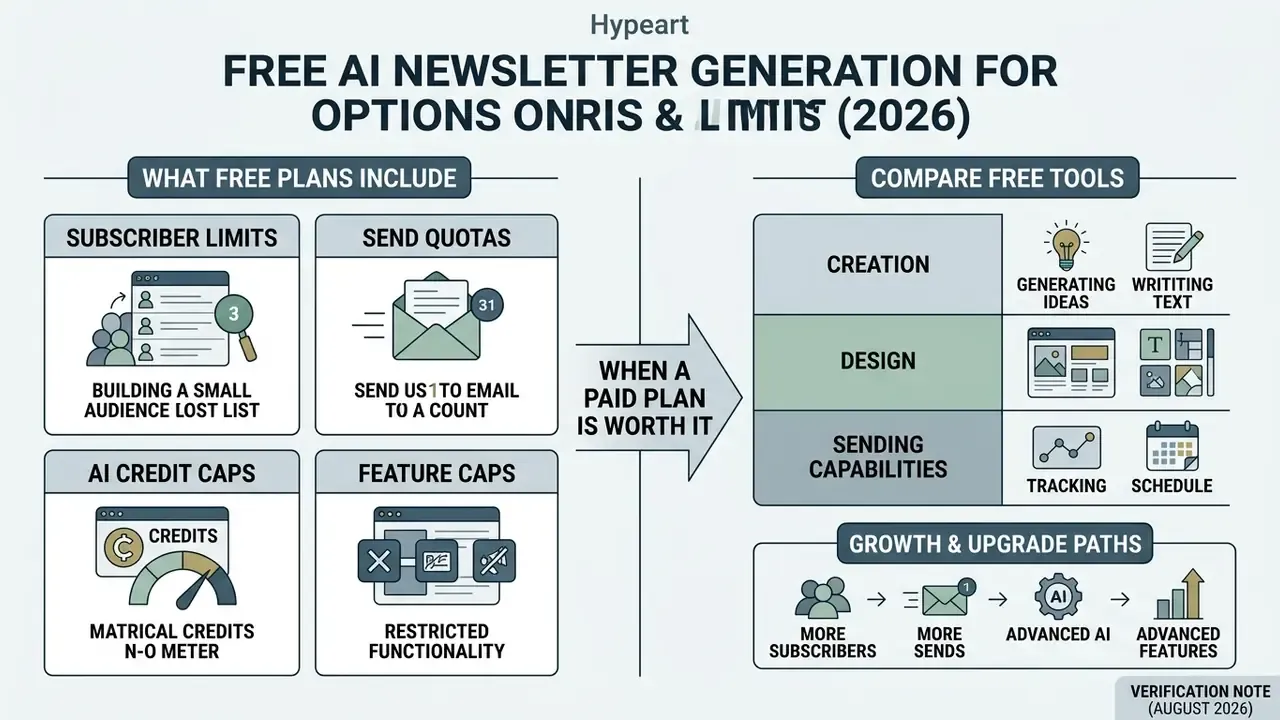
Trying a free ai newsletter generator lets creators and small businesses launch campaigns without upfront spend. Free options are the cheapest way to test drafting speed, sample design templates, and judge whether the interface fits your rhythm before a monthly commitment.
The boundaries are real, though: subscriber caps, monthly send limits, restricted access to advanced AI features, and vendor branding in the footer. Knowing these parameters up front makes upgrade planning less painful. Enterprise readers should note the corollary. Free tiers typically lack SSO, audit export, and zero-retention terms, which disqualifies them for customer data in supervised environments.
When a Paid Plan Is Worth It for Newsletter Growth
Moving from free to paid becomes necessary when limits start constraining list growth, campaign frequency, or revenue. Hitting a subscriber cap or needing multi-user credentials are the two clearest signals.
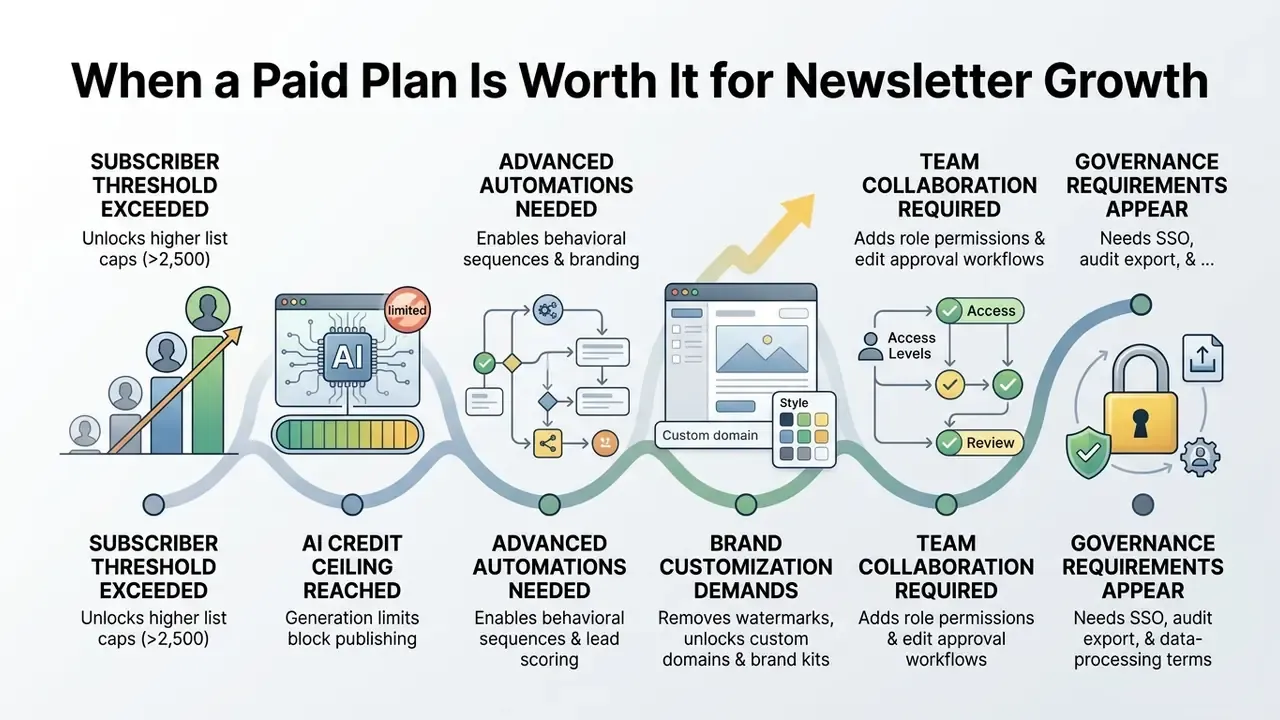
Product-analytics research on freemium conversion supports these triggers: users who complete a core value action within the first seven days convert at two to three times the rate of those who do not, and paywall exposure, pricing-page clicks, and checkout starts act as measurable upgrade-intent signals.
Paid subscriptions unlock the growth mechanics that matter: send-time optimization, multivariate A/B testing, dedicated IP warmup, and revenue attribution at campaign level.
«The Causal Alignment framework shows that embedding A/B tests into content generation enables iterative, causally grounded optimization of marketing communications.»
When campaigns drive sales or paid subscriptions directly, the efficiency and deliverability gains of a paid plan pay for themselves quickly.
Compare Free Tools by Creation, Design and Sending Capabilities
Comparing free tiers means checking how each tool balances content generation, design flexibility, and direct dispatch.
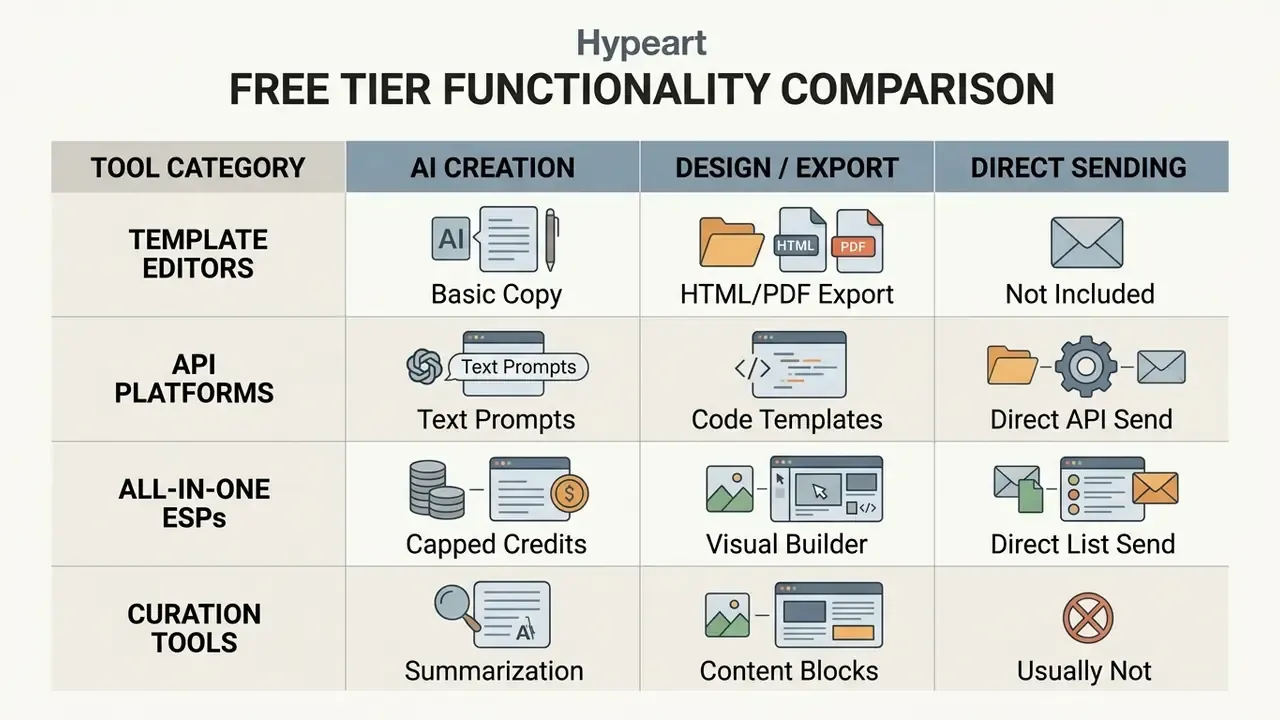
Some platforms, Canva or Microsoft Word for the Web among them, offer strong design creation and PDF export but no delivery engine. Conversely, specialized delivery platforms like Twilio SendGrid provide free dispatch via email APIs and almost no visual builder. Integrated platforms such as beehiiv or Hostinger Reach combine generation, design, and sending inside capped free tiers, which makes them the pragmatic pick for non-technical users.
How to Create a Newsletter with AI: A Practical Workflow
Learning how to create a newsletter using ai well is mostly about building a repeatable production loop. Instead of improvising prompts, disciplined teams run a six-step framework that ties strategy to dispatch.
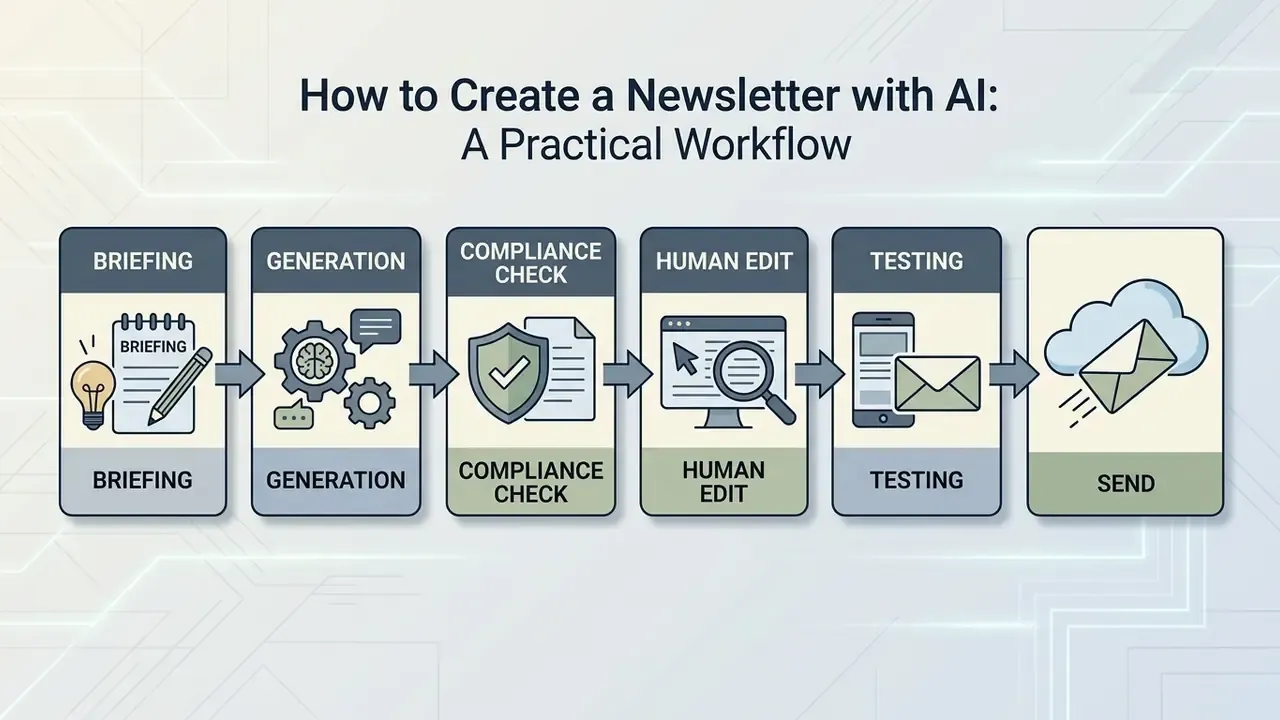
Following this sequence keeps every issue accurate, compliant with data privacy law, and aligned with what subscribers actually signed up for.
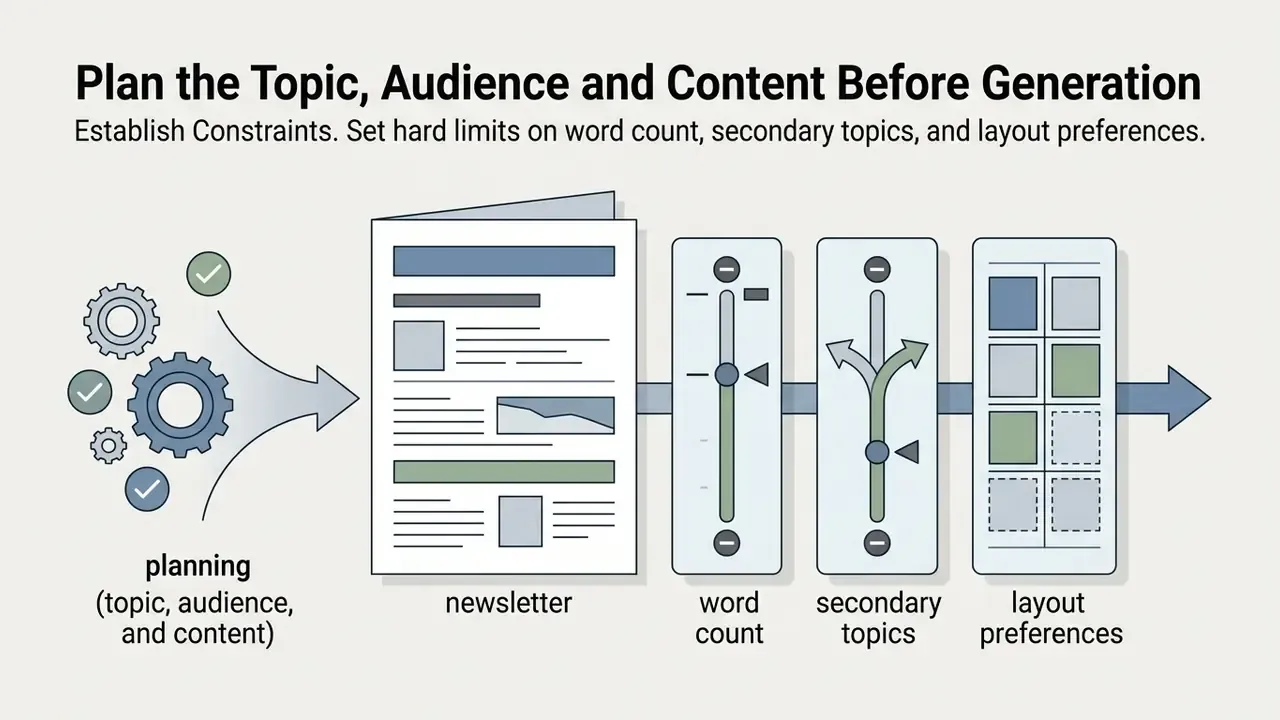
Plan the Topic, Audience and Content Before Generation
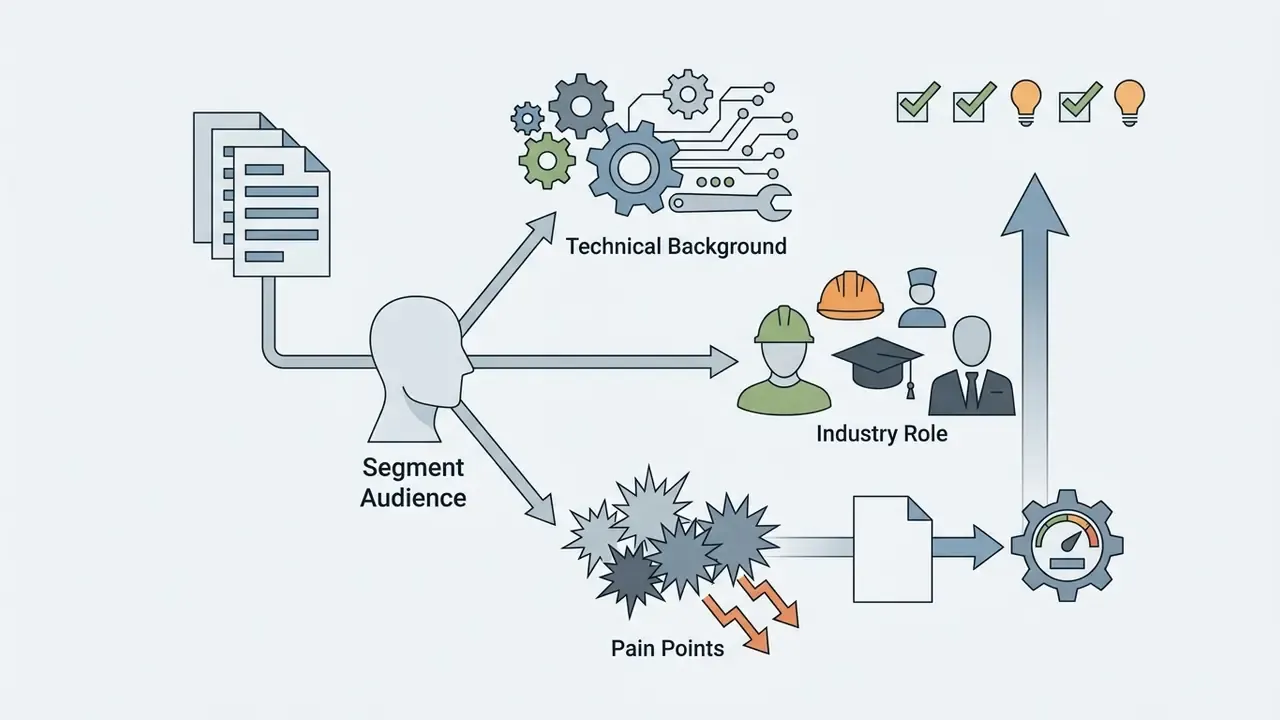
Before typing a prompt, define four briefing parameters: core topic scope, target audience segment, primary campaign objective, and target engagement metrics.
Structured briefing is the main defense against generic output. Aligning topics with reader search intent and demonstrated interest lifts post-click engagement and downstream conversion.
Updated (topic alignment evidence):

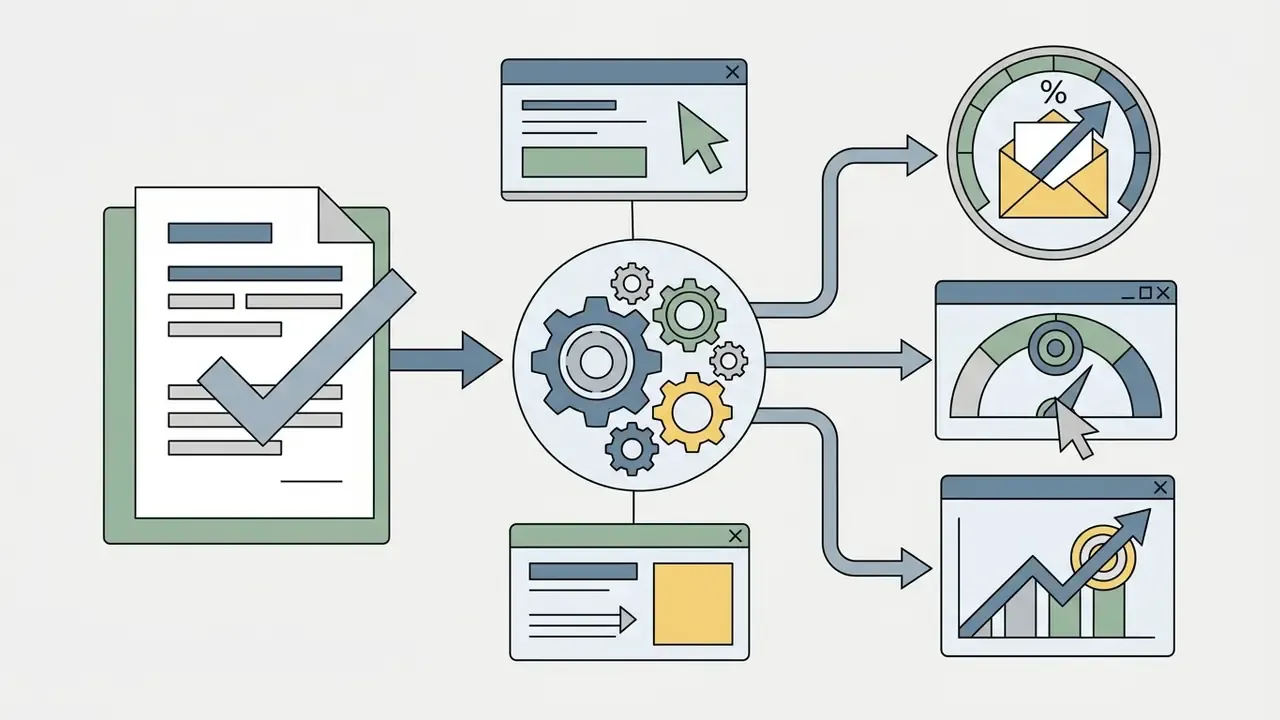
«A quasi-experiment found AI-structured articles raised brand sales by roughly 20% by improving semantic alignment between content and search queries.»
Public-sector campaign brief templates model the same discipline: one business goal, supporting marketing goals, and explicit "metrics for success" mapped to each goal. Boring, and effective.
Automated Link Curation and Digest Workflows (URL-to-Summary)
For weekly industry roundups, mature workflows skip manual drafting and use web-scraping sub-agents:
- URL IngestionPaste up to five source links into the AI interface, or connect an RSS feed and let the agent shortlist candidates.
- Extraction & FilteringThe LLM parses raw HTML, discarding navigation, cookie banners, and advertisements to isolate core facts.
- Key Takeaway SynthesisThe model condenses each article into a standard three-bullet format (The News, Why It Matters, The Impact).
- Deduplication & OrderingOverlapping stories merge, then rank by relevance to the declared subscriber segment.
- Editorial VerificationThe human editor confirms each summary matches its source, that no paywalled text was reproduced verbatim, and that attribution links remain intact before scheduling.
This is where curation tools earn their keep. Even so, documented workflows stay weekly and supervised, with humans choosing topics and tuning quality rather than delegating judgment.
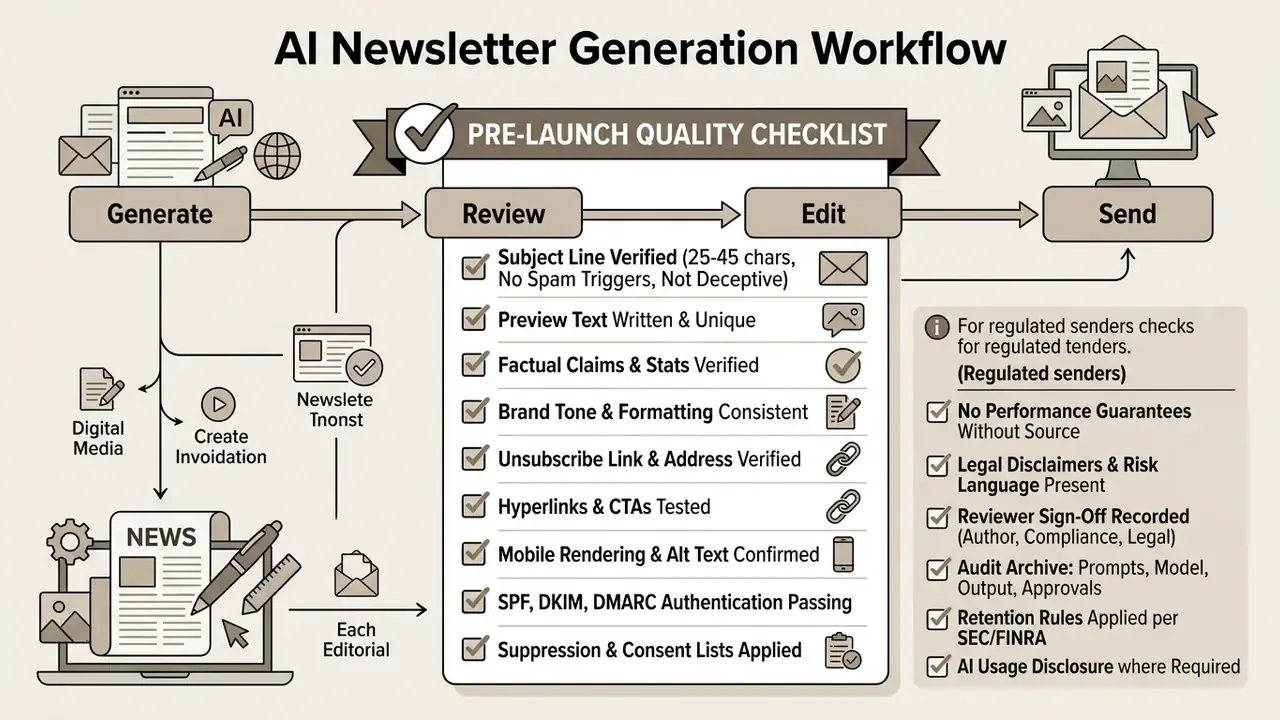
Generate, Review, Edit and Send the Newsletter
With the brief set, run the generation phase using an ai to create newsletter workflow, then apply quality assurance before the campaign goes live.
- Draft Generation Feed structured briefs into the generator to produce subject lines, preview text, section copy, and layout drafts.
- Factual Verification Cross-check every generated claim, statistic, quoted name, date, and external reference against a primary source.
- Editorial Refinement Polish for readability, inject authentic voice, vary sentence cadence, and smooth transitions. Span-level rewriting of weak passages beats blanket acceptance of AI edits.
- Technical Validation Test inline hyperlinks, verify merge tags, inspect mobile rendering across clients, and run automated anti-spam checks.
Compliance verification is not negotiable before distribution.
«Under FTC rules, commercial email must carry truthful header information, the sender's valid physical postal address and a working unsubscribe mechanism.»
Opt-out requests must be honored within ten business days, and subject lines must not deceive.
Teams running multi-media campaigns can extend the same review discipline to video and animation assets. Tools such as AI video generators and the pollo ai video generator are commonly used to build lightweight GIF previews for email bodies, with one caveat: most clients do not autoplay embedded video, so you need a static fallback frame plus alt text.
A safe next step. Do not roll this out list-wide. Pick one recurring newsletter, apply the prompt template and the RACI matrix, log every artifact for four issues, then compare gross and net time savings against the pre-AI baseline. If the audit trail holds up under an internal review, widen scope. If it does not, you have learned that cheaply.
Appendix A: Superseded Reference Notes
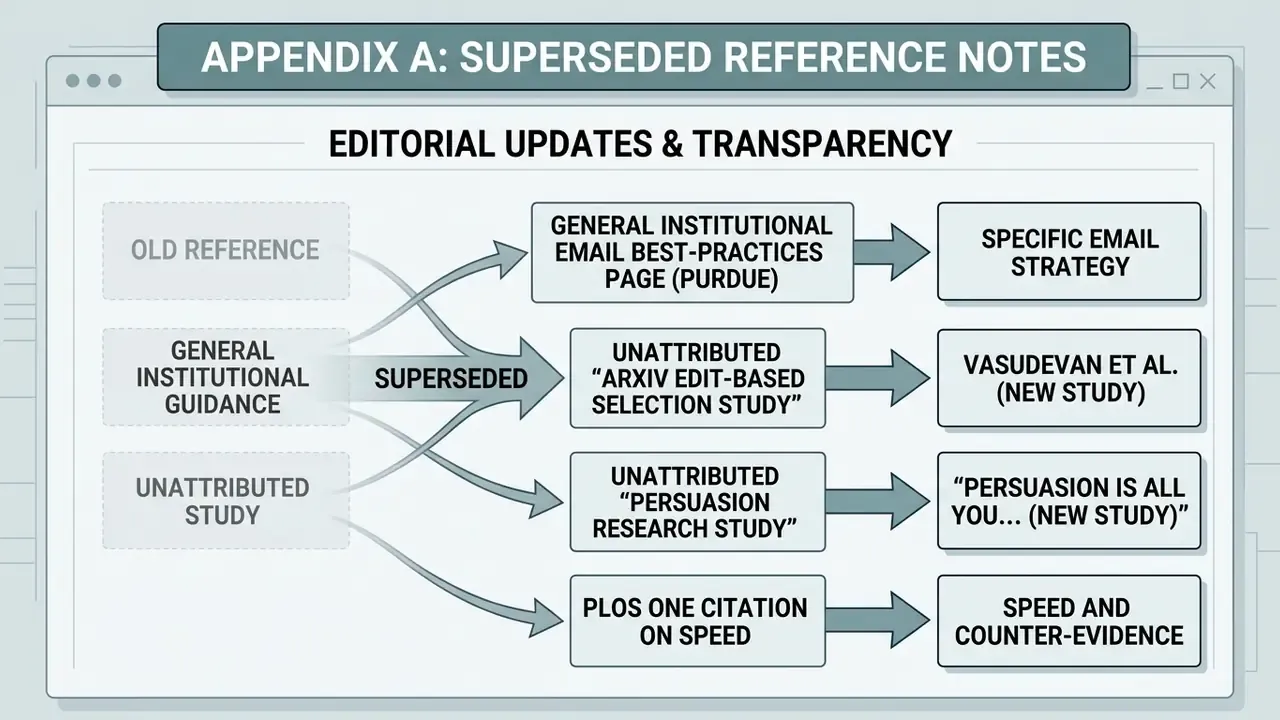
For transparency about editorial changes made during this update:
- The earlier subject-line guidance cited a general institutional email best-practices page (Purdue) without methodology or comparative data. It is retained above as secondary institutional guidance and superseded as the primary source by Loukili et al. (2024), which compares GPT-3.5, PaLM 2, and BERT under explicit character and formatting constraints.
- The earlier reference to an unattributed "arXiv Edit-Based Selection Study" is superseded by Vasudevan et al. (2024), which reports a 16–36% improvement in requirement-compliant copy from iterative refinement across three documented case studies.
- The earlier reference to an unattributed "Persuasion Research Study" is superseded by "Persuasion is All You Need" (2024), which reports an approximate 20% sales lift from AI-structured content.
- The PLOS ONE citation has been expanded from a general claim about speed to include the counter-evidence on revision quality (61% improved, 14% worsened, 24% neutral across 83 revisions).
Appendix B: Technical Specifications & Platform Resources
Organizations evaluating adjacent software utilities, developer integrations, and media creation tools can reference the guides below. They sit outside the newsletter workflow itself and are grouped here to keep the main guidance uncluttered.