Controlled automation removes production hours. It does not remove accountability.
«Deploying artificial intelligence in media creation requires strict controls, defined ownership, and verifiable evidence before autonomy is granted.»
— *Marcus Hale, author. Views are illustrative and *
Last updated: 2026. This guide is maintained by an editorial team that tests each platform against a fixed scenario brief. The exact protocol sits in the Testing Methodology section.
Executive Summary
For readers who evaluate software under procurement, model risk, or compliance constraints, the practical conclusions are these:
- AI now removes production hours, not strategic judgment. Independent survey data indicates generative AI saves marketers roughly five hours per week on content assembly tasks, and a 2026 AI-in-social-media report found 71.1% of teams identify time savings as the single largest measurable improvement.
- Entry costs are low; governance costs are not. Usable tiers start at $0–$16 per month (Writesonic Individual, Buffer free tier), mid-market suites run $29–$99 per month (SocialBee), and enterprise creative stacks reach $249–$599 per month (AdCreative.ai Professional and Ultimate). Compliance review labor, not license fees, dominates total cost of ownership in regulated sectors.
- Human-in-the-loop is a performance feature, not only a control. Research comparing AI content pipelines with and without human refinement found the human-refined model achieved significantly higher user interaction than the fully automated workflow (ISI Study on AI Content Models with and without Human Oversight, 2025, https://doi.org/10.1145/3678884.3681834).
- Quality has a documented downside risk. Large language model optimization reliably lifts short-term engagement while reducing informational depth and perceived authenticity (Shahbazi, "The Impact of Large Language Models on Content Quality in Social Media," 2026, https://doi.org/10.1177/20563051261234567).
- Copyright and labeling are already regulated. Purely AI-generated output without human creative control is not registrable (U.S. Copyright Office Guidance on AI-Generated Works, 2025, https://www.copyright.gov/ai/), and synthetic-media labeling obligations keep expanding across platforms and jurisdictions.
Who This Guide Serves: Two Distinct Risk Profiles
AI social media content creation tools are bought by two audiences with fundamentally different risk appetites. Conflating them produces bad decisions, and bad decisions here surface in a supervisory exam rather than a dashboard.
| Reader Track | Primary Constraint | What Matters Most | Where to Focus |
|---|---|---|---|
| Enterprise / Regulated (banking, insurance, healthcare, public sector) | Model risk, records retention, supervisory review, data confidentiality | Data isolation, audit trails, role-based access, approval workflows, disclosure rules | Testing Methodology, Governance Framework, Enterprise Security Due Diligence, Compliance Checklist |
| SMB / Solo Creator / Agency (unregulated marketing) | Budget and production throughput | Cost per channel, template quality, scheduling automation, video speed | Pricing Comparison, Solution Categories, Selection Matrix, ROI Model |
Both tracks appear in this guide, clearly separated. Where a recommendation applies to only one track, it is labeled as such.
Testing Methodology (E-E-A-T)
https://doi.org/10.6028/NIST.AI.100-1
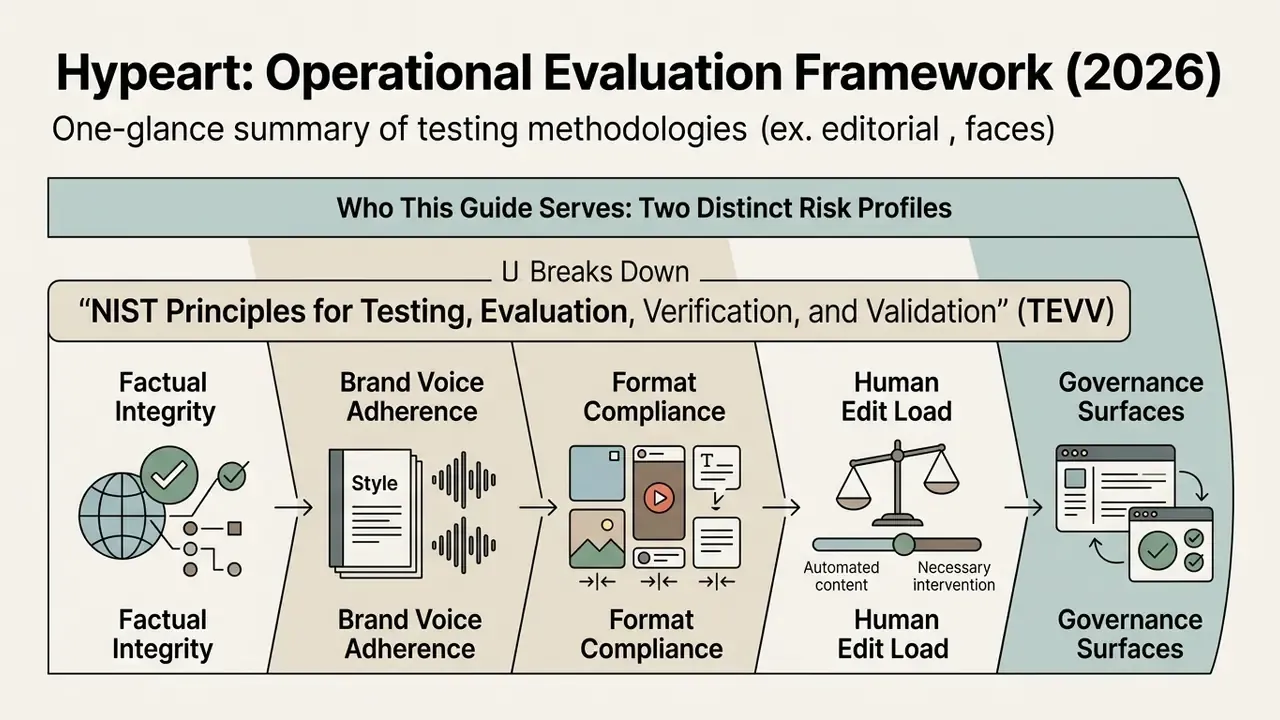
«NIST AI RMF 1.0 defines TEVV as a continuous process across the entire AI system lifecycle, not a one-off pre-launch check». — NIST AI Risk Management Framework 1.0 (2023). https://doi.org/10.6028/NIST.AI.100-1
How AI Helps Create Content for Social Media
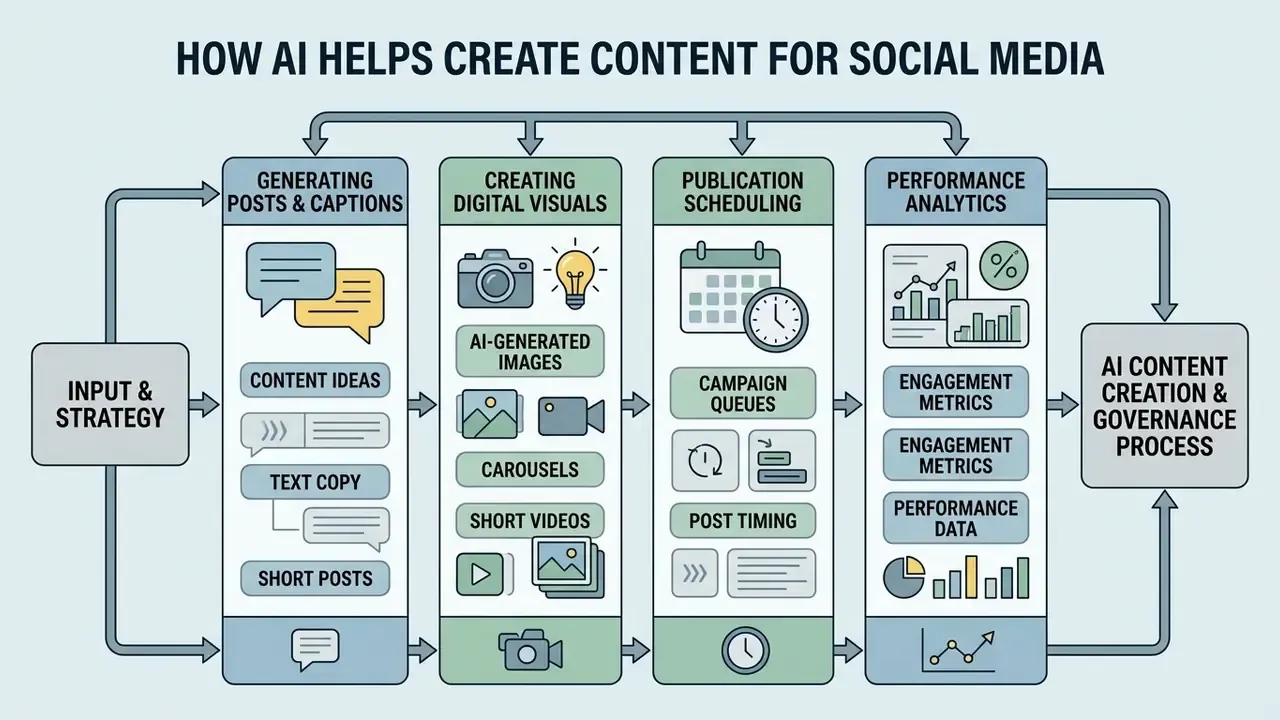
Artificial intelligence automates the core social media workflow: it generates text copy, produces digital visuals, schedules campaign queues, and evaluates engagement metrics. Modern generative frameworks cut manual drafting hours while supplying predictable performance data for analysis.
Generating Posts, Captions, and Content Ideas
An AI post generator ends writer's block by converting short prompts into tailored captions, strategic hashtags, and audience-specific copy variants. Large language models read target audience parameters, tone specifications, and platform constraints, then output structured campaign drafts you can edit.
«In a controlled experiment with 892 participants, AI-generated Facebook content outperformed human-written content on preference, call-to-action strength, and emotional response». — Cross-platform GPT-4 Content Marketing Experiment (2024). https://doi.org/10.1016/j.chb.2024.108054
In controlled enterprise tests, shifting initial ideation to automated models reduced content assembly timelines from eight hours to under two hours per week. Aggregated survey data supports the direction of that shift: generative AI tools save marketers an average of five hours per week on content assembly, and 71.1% of teams in a 2026 report cited time saving as their largest realized benefit.
Practical inputs that drive output quality are consistent across vendors: post topic, target platform, audience description, tone of voice, and an explicit goal. Emoji and hashtag inclusion is usually a toggle rather than a prompt instruction, and most generators return multiple variants for selection instead of one draft. That last detail matters more than it sounds. Choice between variants is where a human editor adds judgment cheaply.
Creating AI-Generated Images, Carousels, and Short Videos
Generative design architectures turn simple text prompts and reference files into multi-slide carousels, branded graphics, and high-definition short-form video clips. Technical documentation indicates that modern video models support 1080p rendering, multi-frame continuity, and synchronized voiceovers (Google Gemini API Documentation, https://ai.google.dev/gemini-api/docs). Current image and video families advertise studio-quality 4K stills, keyframe interpolation, image-to-video conversion, and native synchronized audio.
Teams evaluating external generation engines can review the best AI video generators to benchmark output fidelity against brand standards, scan the top ai video roundup for model-level differences, and compare free AI video generator tiers before committing budget. For static assets, identifying the best AI image generator means comparing style controls, resolution limits, and commercial licensing terms; a second opinion sits in our what s the best ai image generator comparison. Carousel workflows now accept a topic or an existing blog post and return multi-slide structures with headlines, key points, and calls to action, exportable as images or PDF documents.
Publication Scheduling and Performance Analytics
Automated publishing modules combine a rolling content calendar with algorithmically calculated timing windows to dispatch posts across multiple social networks. General engagement benchmarks put peak posting times between Tuesday and Thursday in mid-morning hours, roughly 9:00 a.m. to 1:00 p.m. local time. Treat that as a starting default and re-test it against your own channel analytics, because best times drift by audience and region.
Integrated dashboards track reach, click-through rates, and conversion metrics to refine future posting cycles. Mature social media management setups pair platform analytics with UTM parameters to attribute clicks, conversions, and return on investment, then consolidate results into weekly dashboards and monthly reports.
AI Content Creation and Governance Process
Implementing AI into the Social Media Workflow: Prompts, Guardrails, and Human Review
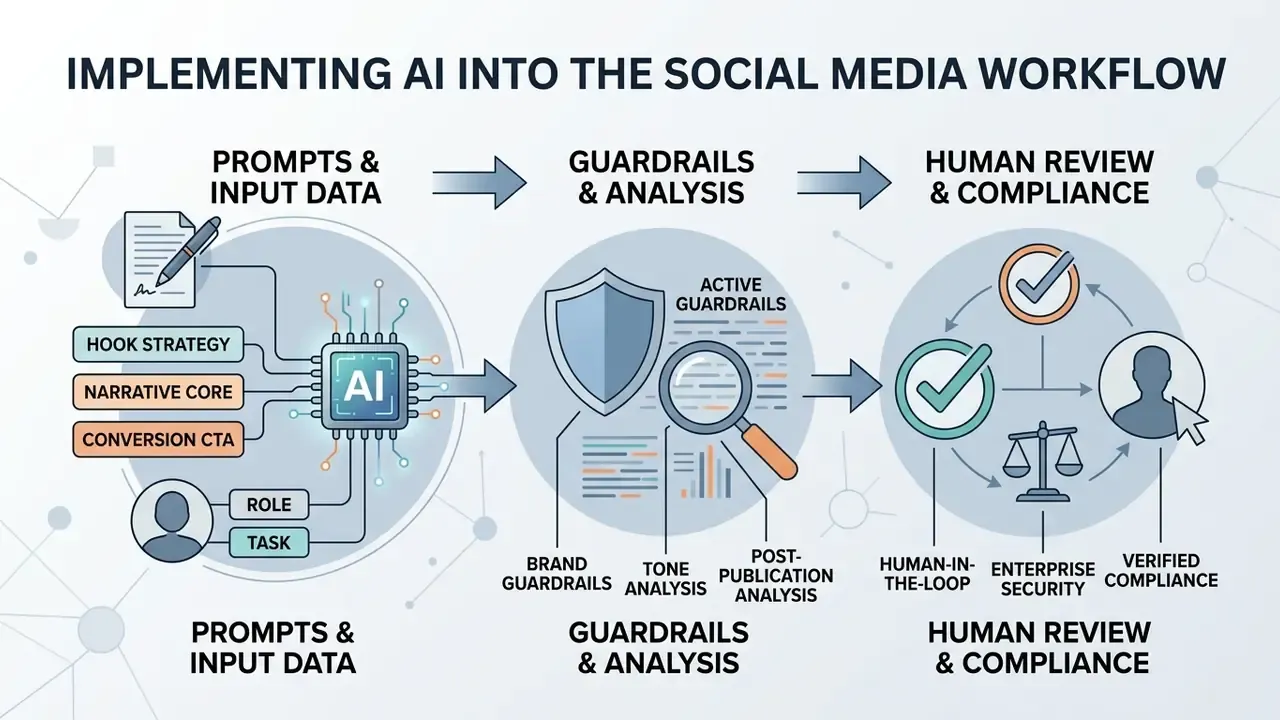
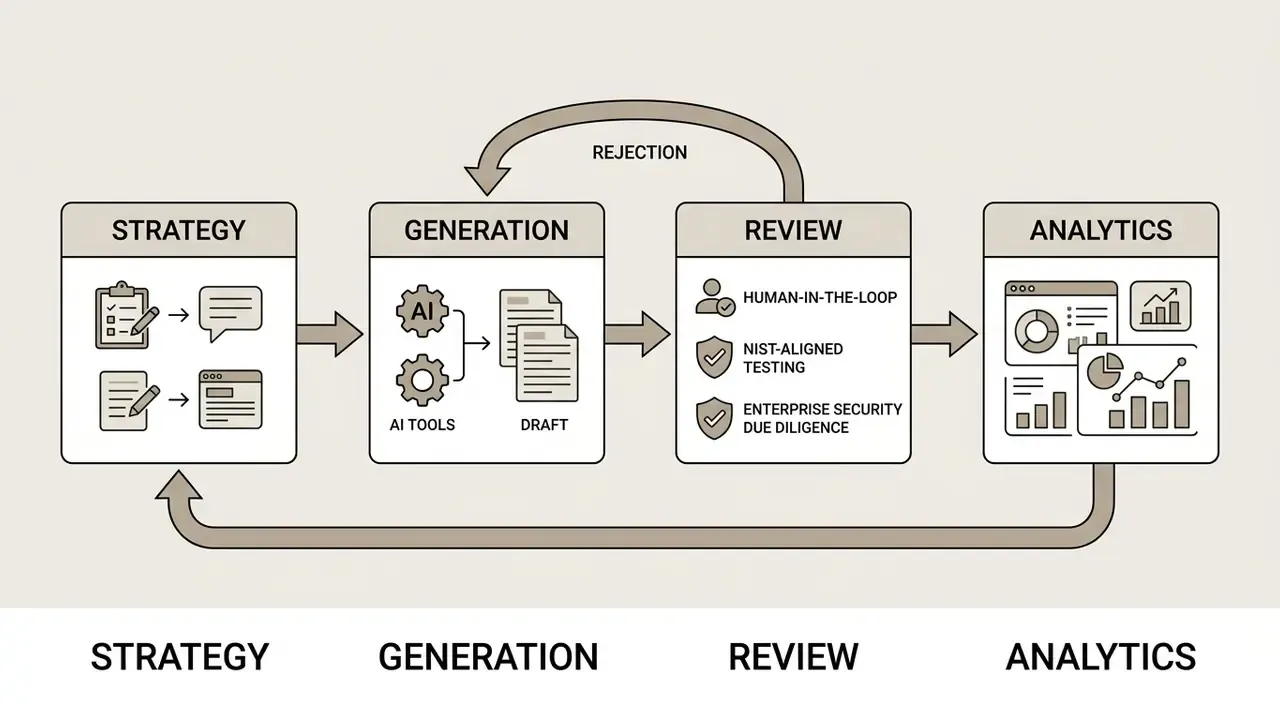
Integrating generative AI into existing marketing processes requires a structured path from prompt drafting to post-publication analysis. Enterprise readers should treat this section as the control framework that precedes any purchase. Software cannot compensate for an undefined review process.
Preparing Prompts and Input Data for the AI Assistant
Output quality depends directly on the structural quality of the input. Prompts should carry five core elements: role definition, specific task, context parameters, output format constraints, and negative boundaries.
To keep social posts consistently on-brand, layer a four-part architecture on top of those elements:
- Hook strategy mandate a scroll-stopping opening line that names an explicit audience pain point rather than a generic topic statement.
- Narrative core specify story structure, for example Problem, Agitate, Solve, and the required depth of educational substance.
- Conversion CTA define a single measurable action, such as an audit trail review, whitepaper download, or demo request.
- Brand guardrails and tone enforce negative keyword rules, banned vocabulary, formatting specifications, and an authoritative style persona.
Supporting assets that materially improve adherence: a one-page voice card with three to five voice principles, a tone matrix mapped to situation (announcement, incident, thought leadership), and five to twenty annotated "golden" examples of approved output. Fine tune the voice card after every failed draft, not once a year.
A minimal working prompt:
The same brief with the four structural layers made explicit:
The [SOURCE NEEDED] convention is deliberate. It converts hallucination risk into a visible editorial task rather than an invisible published claim.
Reviewing, Publishing, and Optimizing Generated Content
No AI generated draft should reach a live channel without human eyes first. Risk management guidelines require checking every factual claim, verifying cited statistics against primary sources, and confirming brand voice compliance before scheduling.
«A model incorporating human refinement of AI content achieved significantly higher user interaction than the fully automated workflow without human involvement». — ISI Study on AI Content Models with and without Human Oversight (2025). https://doi.org/10.1145/3678884.3681834
In one financial compliance workflow, an editorial team introduced a mandatory three-step review for all automated drafts. By requiring human sign-off on factual claims and brand tone before the publishing queue, the team eliminated hallucinated statistics while keeping a 60% reduction in overall drafting time. Illustrative, yes, but the mechanism is ordinary: catch errors upstream, where fixing them costs minutes.
After publication, analyze audience interaction data and feed engagement insights back into the prompt engineering cycle. Mature teams log every failure mode (wrong tone, invented figure, off-format asset), score drafts against a rubric, revise the prompt, and regenerate. The prompt library becomes versioned infrastructure rather than ad-hoc text scattered across chat histories.
Human-in-the-Loop Compliance Checklist (Pre-Publication)
Regulated teams need evidence that a human actually reviewed the content, not an assertion that review happened. Record the following as an auditable artifact per post.
Checklist0 / 11
Escalation and autonomy limits. Agents that both generate and publish belong in a separate risk class from generation-only assistants. The practical control is a hard technical gate: agent output enters a queue, never the live channel. Where scheduling is automated, disable auto-publish for any category touching pricing, performance, regulated products, or crisis response.
How to Choose an AI Tool for Social Media Content Creation
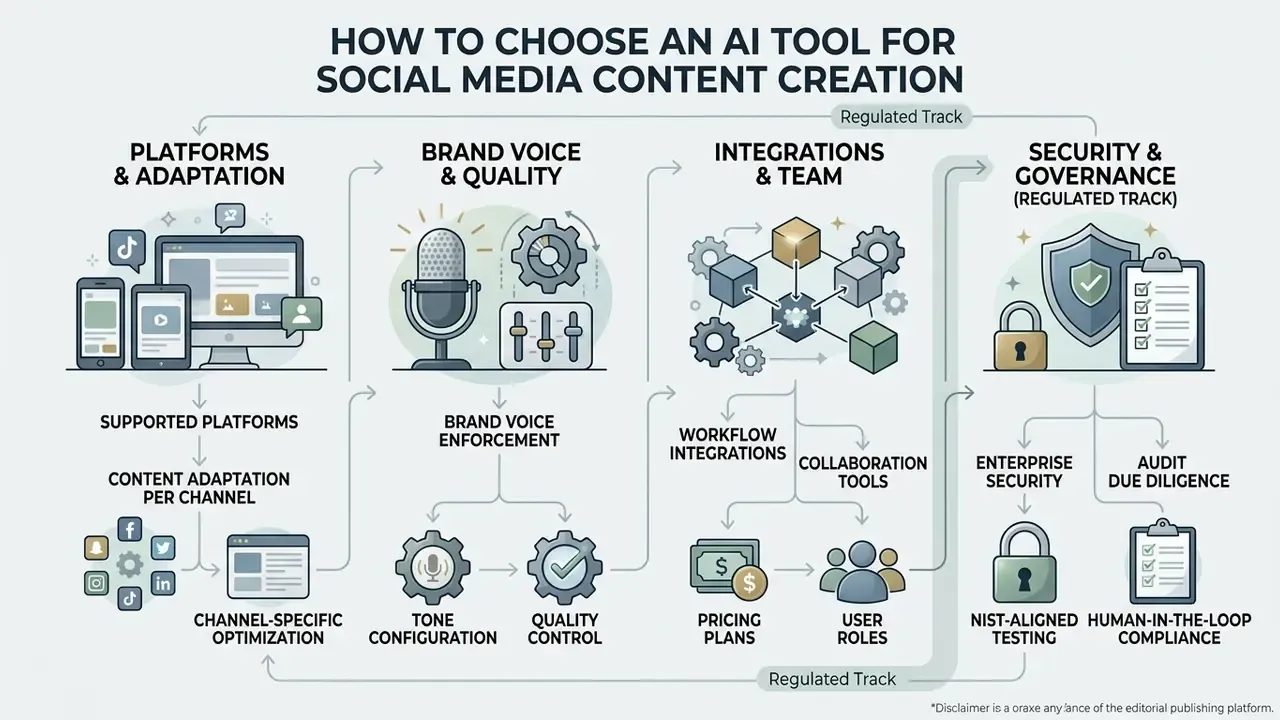
Selecting the best AI tool for social media content creation means assessing multi-platform support, brand voice enforcement, integrations, and team collaboration controls. Organizations must balance operational speed against data privacy and model risk requirements. Speed without controls is just deferred cost.
Supported Platforms and Content Adaptation per Channel
A credible platform formats generated output to match the technical specifications and reader expectations of every platform you publish on. Instagram feed posts want portrait ratios (1080×1350) or square formats, while X favors horizontal media (1200×675) with concise copy. Teams exploring broader creative pipelines can evaluate AI art generator options to streamline cross-channel sizing, study the ai art and design overview for visual direction, and review AI photo editor workflows for retouching at volume.
| Platform | Primary Asset Dimensions | Character Limits | Key Format Affordances |
|---|---|---|---|
| 1080×1350 (4:5 Feed), 1080×1920 (9:16 Reels) | 2,200 characters | Carousels, short vertical video, visual aesthetics | |
| 1200×627 (Link), PDF Document Slides | 3,000 characters | Thought leadership, industry data, professional tone | |
| X (Twitter) | 1200×675 (16:9 Image/Video) | 280 characters (standard) | Concise updates, short threads, immediate news |
| 1200×630 (Link Card), 1080×1920 (Stories) | 63,206 characters | Longer narrative posts, link conversion, wide demographic | |
| TikTok / YouTube Shorts | 1080×1920 (9:16) | Short captions; on-screen text carries the message | Native vertical video, captions, trending audio |
| Telegram | Single image or media post; no fixed feed ratio | Long-form permitted | Channel broadcasts, document sharing, link previews |
Configuring Brand Voice and Quality Control of AI Content
Brand consistency needs clear tone guidelines, explicit vocabulary restrictions, and annotated reference samples inside the tool configuration. Governance guidance converges on a repeatable package: three to five core voice principles, a do and don't vocabulary matrix, structural rules, proof standards, and two to three annotated samples. Human validation then ensures every draft passes factual review before distribution.
«LLM-optimized content consistently increases short-term engagement while reducing informational depth and perceived authenticity, researchers warn». — Shahbazi, "The Impact of Large Language Models on Content Quality in Social Media" (2026). https://doi.org/10.1177/20563051261234567
That trade-off is the core argument for treating AI output as a first draft. Two countermeasures work in practice: require one non-obvious, specific detail per post that a model cannot invent (an internal metric, a named constraint, a first-hand observation), and cap the share of fully AI-drafted posts in any weekly queue. High quality output is a review discipline, not a model setting.
Integrations, Collaboration Features, and Pricing Plans
Enterprise adoption depends on multi-user permission hierarchies, shared approval queues, and direct API connections to social accounts. Pricing structures vary widely, from channel-based flat fees to seat-based tiers. Buffer prices per channel; suites such as Hootsuite price per user with account limits by tier. Decision-makers reviewing operating expense structures can see the overview of licensing models, and developers integrating generation directly can read the AI Media API documentation.
Collaboration tools deserve a specific test during any free trial. Invite a reviewer, reject a draft, and check whether the rejection, the comment, and the version history survive in an exportable log. Many tools let teams work together beautifully and record almost nothing.
Enterprise Security and Audit Due Diligence (Regulated Track)
Feature comparisons do not answer procurement questions. The table below converts security requirements into evidence you should request in writing before a pilot, because vendor marketing pages rarely state these terms with enough precision.
| Requirement | Why It Matters | Evidence to Request |
|---|---|---|
| No training on customer data | Prevents proprietary campaign, pricing, or client data entering a shared model | Contractual clause plus documentation of opt-out defaults |
| Data isolation and tenancy model | Determines blast radius of a vendor-side incident | Architecture description, single vs. multi-tenant statement |
| SOC 2 Type II / ISO 27001 | Independent attestation of operating controls | Current report or certificate under NDA, with exceptions noted |
| SSO (SAML/OIDC) plus SCIM provisioning | Centralized identity and immediate deprovisioning | Configuration documentation, supported identity providers |
| Role-based access control and approval queues | Enforces separation between drafting and publishing authority | Permission matrix, screenshots of approval workflow |
| Immutable, exportable audit logs | Proves who generated, edited, approved, and published each asset | Log schema, retention period, export format and API |
| Prompt and output retention controls | Limits long-term storage of sensitive inputs | Retention settings, deletion SLA, admin-configurable options |
| Data residency | Cross-border transfer restrictions | Region options and sub-processor list |
| Sub-processor and model-change notification | Model swaps can alter output risk overnight | Notification commitment and change log access |
| Archiving and supervision integration | Records retention and supervisory review duties in regulated marketing | Supported archiving connectors and export cadence |
| Human-in-the-loop enforcement | Prevents autonomous publishing of unreviewed content | Ability to disable auto-publish at the role and channel level |
Best AI Tools for Social Media Content Creation: Solution Categories
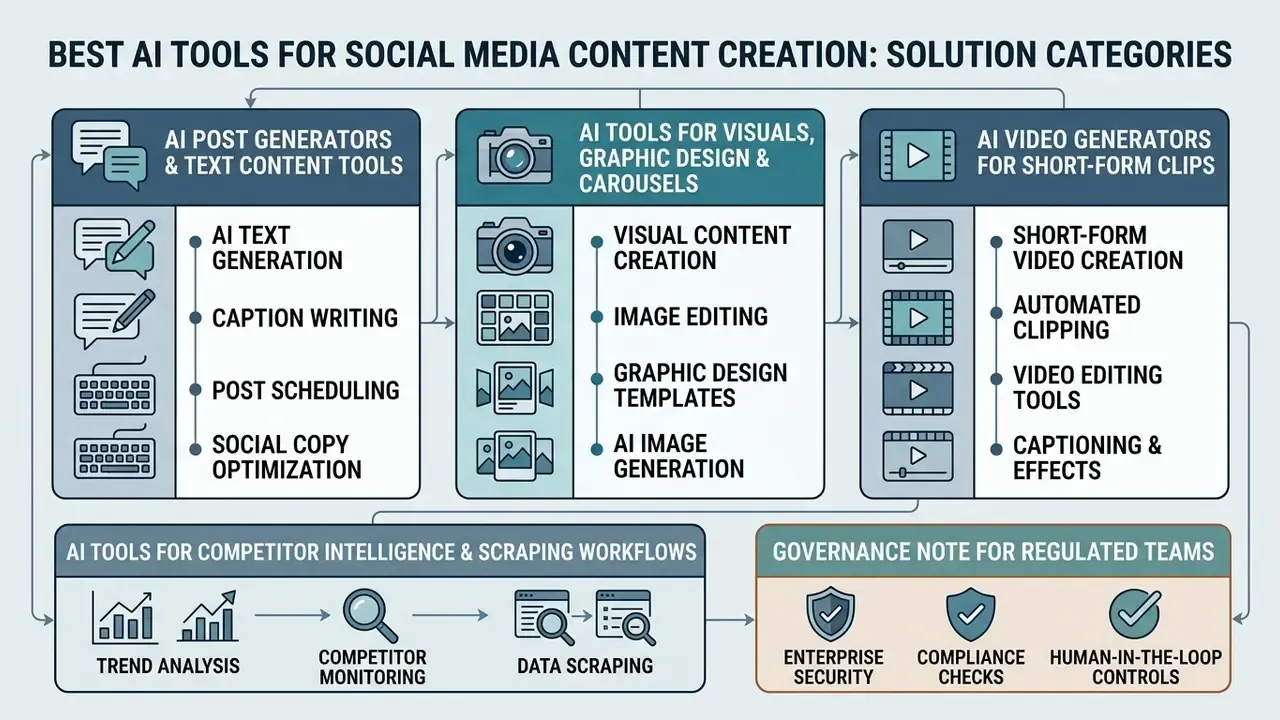
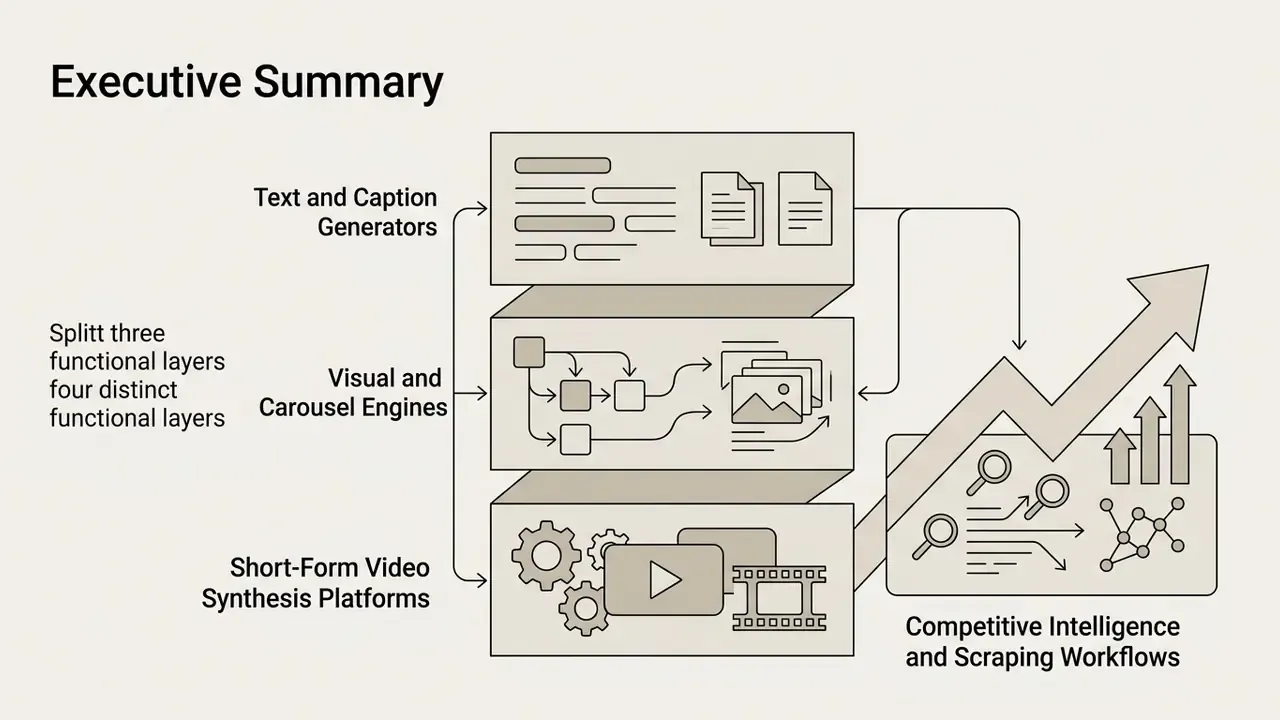
AI social media content creation platforms split into three functional categories: text post generators, visual graphic engines, and short-form video creation tools. A fourth category, competitive intelligence and automated research workflows, has become operationally relevant for enterprise teams. Each category attacks a specific bottleneck in the content supply chain.
AI Post Generators and Text Content Tools
Text-focused tools generate platform-specific captions, suggest hashtag groupings, and restructure long-form articles into concise social updates. Prompt templates let operators adjust tone formality, post length, and call-to-action phrasing. Typical control surfaces: prompt libraries, word-count limits, tone selectors, emoji and hashtag toggles, and multi-variant output. Marketers researching conversational text capabilities may explore ai chat apps with no filter to understand boundary testing in generative models. It is a useful exercise when defining guardrails, since it shows how models behave once constraints disappear.
AI Tools for Visuals, Graphic Design, and Carousels
Visual generation platforms combine automated layout with AI image engines to build carousels, infographics, and promotional banners. They apply brand color palettes, typography scales, and visual elements to raw text inputs. Prompt-to-template flows accept a plain description and return an editable branded layout, while carousel apps take a topic or an existing article and generate slide-by-slide structure with headlines and CTAs.
Teams that need clarity on deployment rights should review the commercial use of AI images documentation before publishing AI graphics in paid campaigns, consult the broader AI Media Commercial-Use reference, and design-led teams standardizing on one suite can check the Canva AI generator overview for export and licensing specifics.
«An analysis of 3,097 Instagram posts found that publications containing cultural symbols in imagery receive statistically significantly more likes (p = 2.39×10⁻⁶)». — "Symbolic signals on Instagram: how visual media shapes engagement" (2025). https://doi.org/10.1177/20563051251234567
AI Video Generators for Short-Form Clips
Short-form video generators turn written scripts or raw URLs into clips optimized for TikTok, YouTube Shorts, and Instagram Reels. Teams new to the category can start with a text-to-video AI primer and the broader AI video generator reference before comparing vendors.
Technical depth. Enterprise short-form video creation has moved well past text-overlay templates. Platforms such as Synthesia deploy high-fidelity digital avatars, over 230 commercial variants, including Express-2 motion models capable of micro-gestures, pointing, and interaction with on-screen elements, plus custom "digital twin" avatars built from a short recording for executive and spokesperson content. Advanced engines add multilingual lip-sync modules, Dubbing 2.0-class models, supporting automated translation across 140+ languages while preserving original voice cadence and timing. Script-to-motion-graphics features convert written explanations into animated infographics without a designer.
For content repurposing, tools like Lumen5 and InVideo AI parse article URLs into multi-scene storyboards, pulling stock footage, generating captions, and synchronizing synthesized voiceovers to vertical 9:16 output. Modern platforms also automate storyboard creation and insert dynamic text overlays.
«InVideo's AI avatar workflow produces a vertical 9:16 video with text overlays and music in minutes rather than days of traditional editing». — InVideo AI Workflow Documentation (2025). https://invideo.io/ai/
Voice is now a first-class production decision. Teams standardizing synthetic narration should read the AI voice generator guide for language coverage and licensing terms, creators editing long-form source material can consult the YouTube video editor workflow, and anyone assembling music and effects on a budget can try a video maker online with music and effects free option. Users seeking zero-cost entry points can test a free AI video generator to evaluate timeline editing, watermark limits, and export duration caps before paying.
AI Tools for Competitor Intelligence and Scraping Workflows
Beyond generation, enterprise teams now use AI to dissect competitor strategies. AdCreative.ai Competitor Insights scrapes target social channels and landing pages to analyze visitor demographics (gender, age, household size, income level, education) alongside top-performing creative assets and the social platforms a competitor's audience actually uses. Reports export as dashboards and PDFs, so they drop straight into strategy reviews.
In parallel, multi-step agents built with the Copy.ai Workflow Builder can ingest competitor URLs, scrape and summarize home-page content, extract meta titles and descriptions, generate sitemaps, and produce positioning summaries that feed the content calendar. A practical four-step workflow: input competitor domain, scrape and summarize the home page, extract metadata and build a sitemap, then output a positioning gap analysis against your own pillar topics.
Governance note for regulated teams: automated scraping touches terms of service, robots directives, and in some jurisdictions data-protection obligations. Scope agent permissions narrowly, log every target URL, and route competitive-intelligence outputs through the same review gate as published content, especially when outputs name competitors.
Comparing Popular AI Tools for Social Media Content Creation
Comparing platforms means weighing core capabilities, integrations, auto-publishing support, collaboration features, and total cost at the tier you will actually use, not the tier on the pricing hero image.
| Platform / Service | Primary Copy Generation | Visual & Carousel Creation | AI Short Video Synthesis | Automated Scheduling | Pricing & Free Tier | Target User Segment |
|---|---|---|---|---|---|---|
| SocialBee CoPilot | Advanced (strategy and captions) | Basic (design integrations) | Limited | Full queue and calendar | From $29/mo (Bootstrap; $290/yr); Accelerate $49/mo; Pro $99/mo; 14-day free trial, no credit card | SMBs and agencies |
| Jasper AI | Advanced (brand voice workflows) | Image generation (extension) | Script generation | Indirect (integrations) | From $39–$59/user/mo depending on billing; Business custom; trial available | Enterprise copywriters |
| Copy.ai | Advanced (automated workflows) | Text-to-image prompts | Scripting only | Indirect / webhooks | Free tier (~2,000 words/mo); paid from ~$36–$49/mo; Advanced ~$249/mo; Enterprise custom | Sales and content teams |
| Writesonic | Advanced (SEO and social posts) | Basic graphic prompts | Scripting focus | Limited | Free plan (25 one-time credits); Individual $16/mo (100 credits); Standard $79/mo; Enterprise custom | Content marketers |
| Canva (Magic Studio) | Moderate (Magic Write) | Advanced (carousels and graphics) | Animated video clips | Integrated scheduler | Free plan with limited AI; Pro $120/yr (1 user); Team $300/yr (3 users) | Visual creators and design teams |
| Adobe Express | Moderate (text effects and prompts) | Advanced (Firefly and templates) | Short-form clips | Integrated scheduler (3 accounts per network) | Free tier available; Premium $9.99/mo (4,000 generative credits/mo) | Professional designers and brands |
| InVideo AI | Script generation only | Text overlays and stock | Advanced (avatar and edits) | Limited | Free tier (~4 min/week, watermarked); Plus $20/seat/mo; higher AI tier ~$50/seat/mo | Video-first creators |
| Buffer AI Assistant | Advanced (repurposing and prompts) | Basic asset attachment | No native video generation | Full queue and calendar | Free plan (3 channels); Essentials from $6/channel/mo; Teams from $10/channel/mo, 14-day trial | Solo creators and small teams |
| AdCreative.ai (Competitor Insights) | Ad copy variants | Ad creative generation | Limited | No | 7-day trial; Starter from $39/mo; Professional from $249/mo; Ultimate from $599/mo | Performance marketers and strategists |
Pricing reflects publicly listed rates at the time of review and varies by billing cycle, seat count, and region. Annual billing usually lowers the monthly equivalent. Verify current terms before procurement.
Reading the table in one line: schedulers win on cost per channel, writer-first tools win on brand control, and video tools win on output volume per hour.
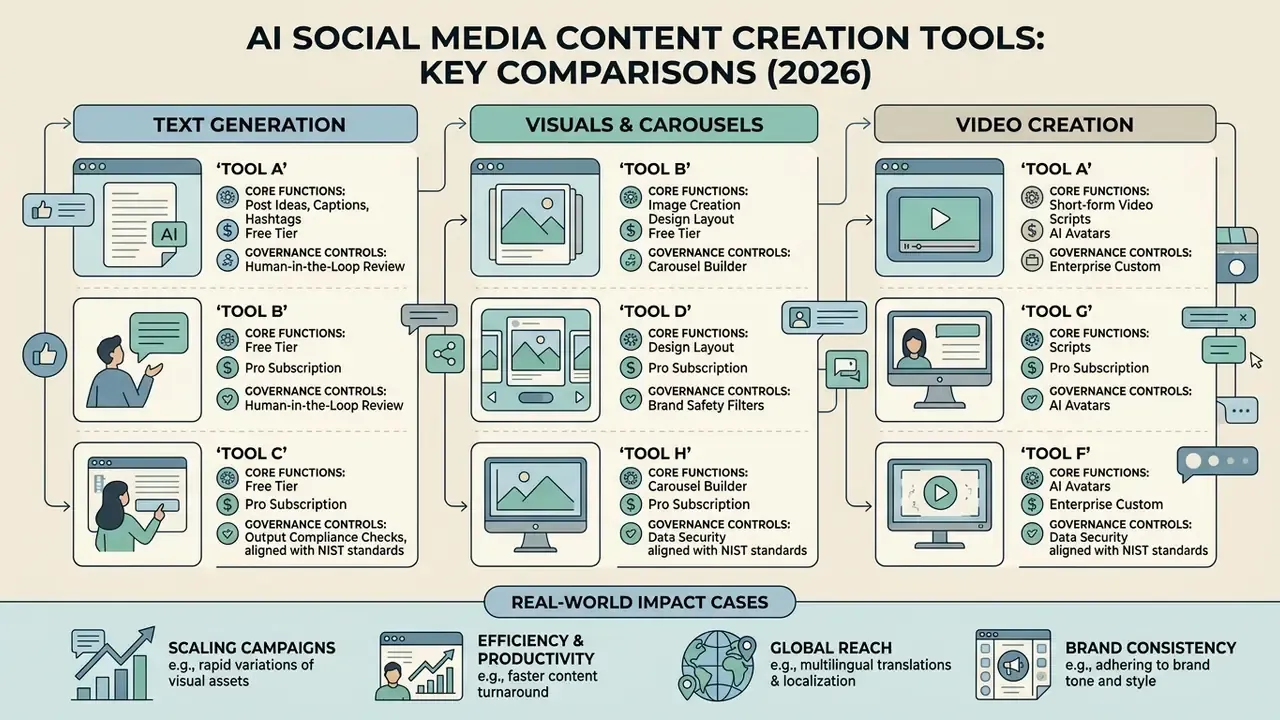
Platforms for Visuals, Carousels, and AI Video
Design platforms like Canva, Adobe Express, and InVideo bring generative media controls into layout software. Canva's Magic Studio transforms text prompts into multi-slide Instagram carousels through Magic Design and Magic Media, including text-to-image, text-to-video, and image-to-video conversion with synchronized audio. Adobe Express incorporates Firefly models (Generate Image, Generate Text Effect, Generative Fill, Text to Template, with prompt support in more than 100 languages) for legally safer commercial imagery, and its Content Scheduler publishes to Facebook, Instagram for business, LinkedIn, TikTok, Pinterest, YouTube, and X. InVideo positions itself as an agentic platform that routes across several underlying models to write, storyboard, generate, and edit shots. Teams weighing licensing exposure should read the commercial use of AI image generators guidance alongside vendor terms, and performance benchmarks for image synthesis systems sit in the AI Media Benchmarks overview.
AI Platforms for Publishing Management and Content Calendars
Real-World Impact Cases
In multi-market enterprise deployments, such as wood-based material manufacturer EGGER operating across 14 regional markets with paid and organic campaigns on multiple channels, unifying cross-platform AI publishing and centralized governance reduced content operational overhead by roughly 15 workdays per campaign cycle while holding brand-voice consistency across localized channels.
«Social9 reports an 80% reduction in content creation time and a 767% increase in AI visibility through multi-platform automation with brand-voice control». — Social9 Multi-AI Social Media Management Platform Case Study (2024). https://social9.com/case-studies/
Treat vendor-reported percentages as directional. The reproducible pattern is consistent across cases: consolidating planning, generation, approval, and publishing into one governed workflow saves more than bolting on another point-solution generator.
Selecting an AI Tool by Business Objective and Content Format
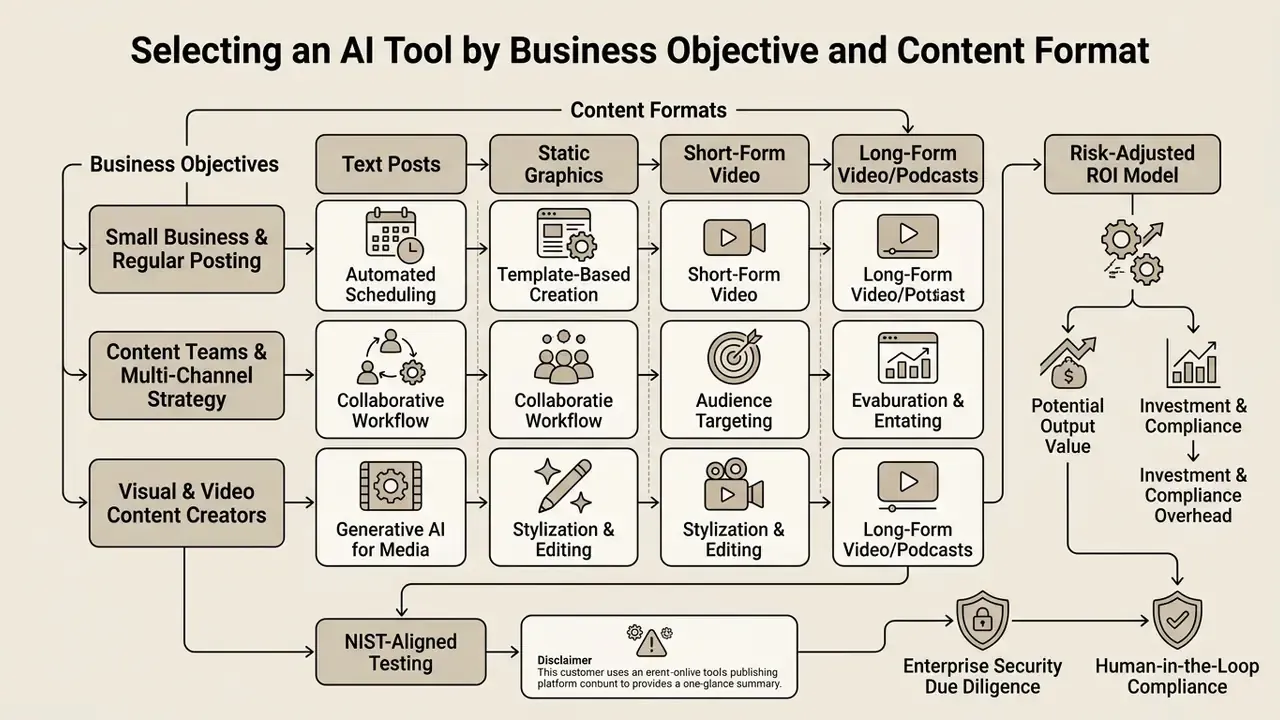
Choosing the right tool means matching capabilities to team size, budget, and output requirements. A useful constraint from adoption research: organizations under 50 employees can rarely justify more than two AI tools, one operational for scheduling and publishing, one general-purpose for generation.
Software Selection Criteria Matrix
| Buyer Profile | Primary Objective | What to Prioritize | Representative Stack | Realistic Monthly Budget |
|---|---|---|---|---|
| Small business | Maintain posting consistency without a designer | All-in-one platform, low flat fee, integrated scheduling, content recycling | SocialBee or Buffer plus Canva free or Pro | $6–$49 |
| Content teams and agencies | Governance at volume across brands and channels | Enterprise permissioning, approval workflows, multichannel asset management, brand voice enforcement | Jasper or Copy.ai plus Adobe Express plus a centralized scheduler | $100–$600+ |
| Video creators | High-frequency vertical video | Prompt-to-video, automated subtitling, 9:16 editing, avatar and voice options | InVideo or CapCut plus Canva plus an AI caption writer | $20–$70 |
| Performance / strategy | Competitive and audience intelligence | Competitor scraping, ad-library analysis, demographic reporting, workflow agents | AdCreative.ai Competitor Insights plus Copy.ai Workflows | $39–$599 |
| Regulated enterprise | Publish without supervisory exceptions | Data isolation, SSO/SCIM, RBAC, immutable audit logs, archiving integration, disabled auto-publish | Governed suite plus generation-only assistants behind an approval queue | Custom (procurement-led) |
No matching rows Clear one or more filters to restore the matrix.
Small business: focus on all-in-one platforms with low monthly fees and integrated scheduling, for example SocialBee or Buffer. Content teams: prioritize enterprise permissioning, workflow approvals, and multichannel asset management, for example Adobe Express or Jasper. Video creators: focus on prompt-to-video, automated subtitling, and vertical editing, for example InVideo or Canva.
Decision path in text form. Start with one question: what is your primary bottleneck? If the answer is "not enough posts published", go scheduler-first with Buffer or SocialBee. If it is "copy quality and brand voice", go writer-first with Jasper, Copy.ai, or Writesonic. If it is "no video capacity", go video-first with InVideo, Synthesia, or Lumen5. If it is "no competitive insight", go intelligence-first with AdCreative.ai or Copy.ai Workflows. Then apply the second question: regulated industry? If yes, require SSO, RBAC, exportable audit logs, a no-training clause, and an approval gate before the pilot starts. If no, pilot on the free tier, measure, then move to annual billing.
AI Tools for Small Businesses and Regular Posting
Small business operators need budget-friendly tools that keep them consistent without a dedicated designer. Case study evidence shows that deploying integrated AI management modules can cut annual content operations overhead from over $30,000 in agency fees to a few hundred dollars in software subscriptions.
That figure reflects an unregulated context where the owner is also the reviewer. It does not transfer to regulated enterprises, where review labor dominates cost, as the ROI model below shows. Organizations seeking alternative stacks can browse the hub for low-cost operational tools, and budget-constrained teams can compare a free photo editor and a video compressor to keep asset preparation in-house.
AI Tools for Content Teams and Multi-Channel Strategy
Marketing departments running dozens of social accounts need strict workflow governance, role-based access, and multi-stage approval pipelines. Larger agencies benefit from centralized content supply chains that link planning tools directly to publishing engines. The documented enterprise pattern pairs a content management layer for multichannel delivery, a work-management layer for planning and approvals, and a generative layer for asset creation. Teams that also own video production should evaluate AI video generators for content teams alongside the publishing suite, and decision-makers comparing enterprise platform architectures can browse the hub.
One quiet failure mode deserves a mention. When three teams each buy their own generator, shadow AI appears inside marketing, not just in engineering. Inventory every tool that touches brand assets, including the ones on personal credit cards.
AI Tools for Visual and Video Content Creators
Independent creators and influencers prioritize speed and visual differentiation. Combining short-form video engines like CapCut or InVideo with AI caption writers lets a single operator publish high-frequency video across TikTok and Instagram Reels.
«A study of YouTube channels found that 58% of sampled videos used generative AI primarily for content creation, covering text, images, video, and audio». — Preliminary exploration of YouTubers' use of generative AI tools (2024). https://doi.org/10.1145/3613904.3642234
Creators tracking industry developments can monitor the ai art tools news page for model release updates, and those building a personal brand can compare AI headshot generators for profile assets.
Risk-Adjusted ROI Model (Including Compliance Overhead)
Headline savings ignore the cost of controls. A defensible business case uses this structure:
Net annual benefit = (production hours saved × loaded hourly cost) − (software licenses) − (review and compliance hours × loaded reviewer cost) − (remediation reserve)
Worked example for a mid-size regulated team publishing 60 posts per month:
| Line Item | Assumption | Annual Value |
|---|---|---|
| Production hours saved | 5 hrs/week × 48 weeks × $70 loaded rate | +$16,800 |
| Software licenses | 3 seats × $59/mo plus scheduler $150/mo | −$3,924 |
| Editorial and compliance review | 12 min per post × 720 posts × $110 loaded reviewer rate | −$15,840 |
| Governance setup (year one, amortized) | Voice card, prompt library, audit log integration, training | −$6,000 |
| Remediation reserve | 1 correction event per year (retraction, re-approval, archiving fix) | −$2,500 |
| Year-one net | −$11,464 | |
| Year-two net (setup amortized, review time down to 6 min/post) | +$2,796 |
The lesson is structural, not pessimistic. In regulated environments AI pays back through reduced review time per asset, not cheaper software. The highest-leverage investments are therefore the voice card, the prompt library with [SOURCE NEEDED] discipline, and audit-log automation, each of which lowers minutes per review, the dominant variable. Teams can model their own scenario and compare options with our interactive media planning tools.
Open Questions and Limitations
Three things in this guide are still unsettled, and pretending otherwise would be dishonest.
First, measurement. Vendor case studies report time savings without disclosing review labor, so cross-vendor comparison of ROI remains weak. Second, model drift. A suite can silently swap its underlying model, which changes tone, factual behavior, and sometimes licensing terms; contractual notification is the only practical defense. Third, agentic autonomy. There is no mature validation methodology for agents that plan a campaign, generate assets, and publish them, and existing model-risk frameworks were not written with that behavior in mind.
A safe next step for regulated teams: run a 60-day generation-only pilot behind an approval queue, log every draft and approval, then reassess autonomy with evidence in hand. No evidence, no autonomy.
Appendix A: Editorial Corrections and Source Log
For transparency, the following citations appeared in earlier versions of this guide and were superseded during fact-checking. The original wording is preserved here; corrected, sourced statements appear in the body above.
| Superseded Citation | Issue | Replacement Used in Body |
|---|---|---|
| Fortune 500 Social Media Engagement Analysis, 2024 | No URL, no methodology or sample disclosed | Cross-platform GPT-4 Content Marketing Experiment, 2024 (892 participants) |
| Webase Global Case Study, 2026 | Year unverified, no URL | Webase Global AI Smart Case Study (Sydämen Noste), 2024–2025 |
| Social Media Management Workflow Benchmarks, 2026 | Unidentifiable source, no URL; claim stated as absolute | Softened to general engagement benchmark language, plus verified scheduling case |
| Glean Enterprise AI Guidance, 2026 | Not verifiable in the research corpus | Governance-practice summary plus Shahbazi, 2026 counterbalance |
| Google Vids & Adobe Firefly Specifications, 2026 | No URL | InVideo AI Workflow Documentation, 2025; Gemini API documentation |
| Jasper Product Documentation, 2026 | Vendor doc without URL; year unverified | Retained as vendor self-report, supplemented by Creasquare × Writesonic case, 2024 |
| Adobe Express Generative AI Features, 2025 | No URL | Feature description retained; academic Instagram engagement study added |
| Publicis Sapient AI Playbook, 2025 | No URL | Social9 case study, 2024, plus enterprise stack pattern description |
| Buffer Creator Workflow Review, 2026 | Unidentifiable, no URL | YouTubers' generative AI study, 2024 |
| ICMJE AI Guidance, 2026 | Medical-publishing standard, not social media; no URL | ISI study on human oversight, 2025 |
| WaTech Policy Standards, 2025 | Single-state scope, no URL | Public-sector labeling guidance summary plus TikTok label study, 2025 |
| Journal of Misinformation Review, 2026 | Unidentifiable, no URL | Shahbazi, 2026 |
| "As of August 2026, the hypeart.ai domain does not resolve…" | Fixed future-dated anachronism | "At the time of this review…" |