Evaluating the best ai text to image with high quality output means balancing visual photorealism, exact text rendering, instruction adherence, and clear commercial licensing terms. Modern ai text to image conversion tools have moved from speculative novelties into production engines for visual content across design, marketing, and media workflows. Choosing among the best ai text to image generators depends on your actual priority: photorealistic accuracy, complex typography, fast web generation, open-source customization, or auditable deployment inside a regulated environment. Those five goals rarely live in one product.
Executive Summary: Risk, Quality, and Governance at a Glance
For decision-makers who want the verdict before the methodology, the selection logic runs along three axes: measured output quality, contractual protection, and operational controllability.
- Highest measured prompt adherence and reasoning
gpt-image-1/ DALL-E 3 (0.77 and 0.71 on R2I-Bench), the sensible default for mixed text-and-image briefs. - Highest photorealism and multilingual text fidelity Google Imagen 3 / Gemini 2.0, strongest for product, architectural, and multilingual campaign imagery.
- Strongest commercial and legal posture Adobe Firefly, trained on licensed Adobe Stock and public-domain content, with enterprise indemnification and embedded Content Credentials (C2PA).
- Strongest typographic accuracy Ideogram 4.0, with bounding-box layout control and dense multilingual text rendering for logos, packaging, and poster layouts.
- Maximum control and data isolation self-hosted Stable Diffusion (SDXL / SD3), the only configuration where no prompt or reference asset ever leaves your infrastructure. That matters directly for banking, insurance, and fintech teams managing Shadow AI risk.
- Key governance caveat every generation intended for external publication should be logged with prompt text, seed, model version, and sampling parameters. Without that record, the asset simply cannot be reproduced for audit or model-risk review.
«High-quality output is multi-dimensional, and no single model dominates all aspects of fidelity, alignment, reasoning, and text rendering simultaneously.»
How We Tested the Best AI Text to Image Generators
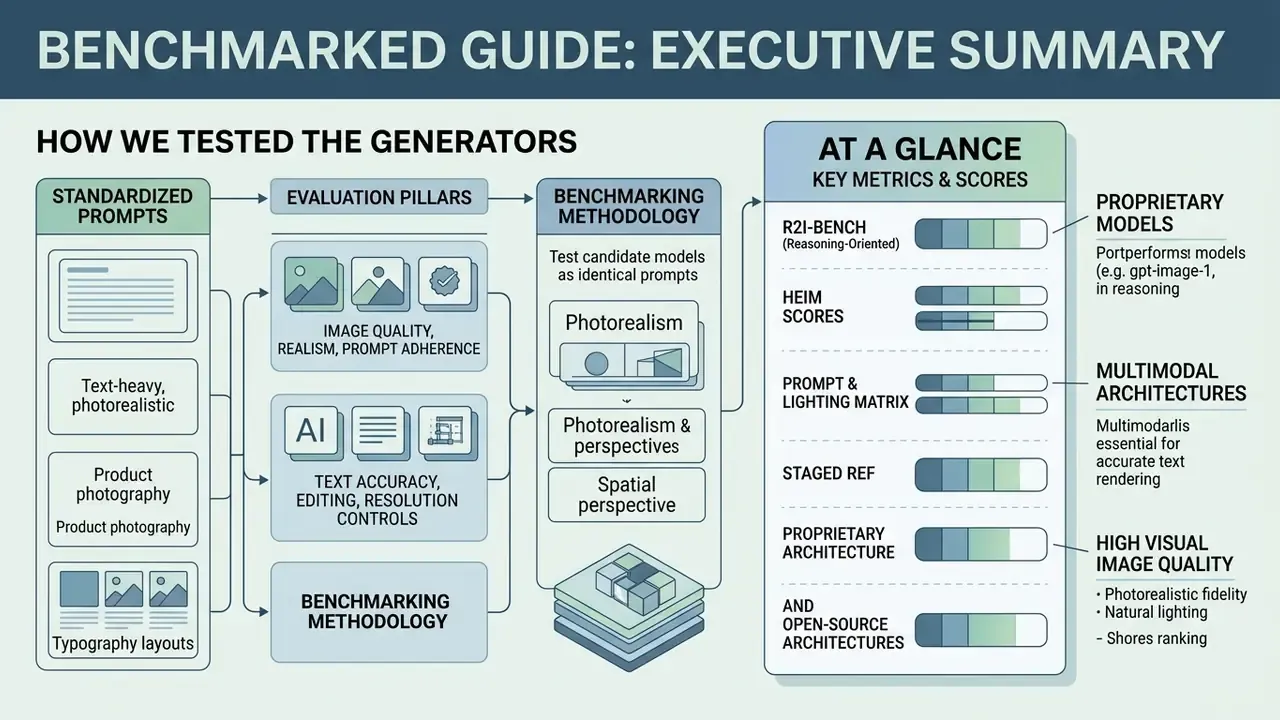
Image Quality, Realism, and Prompt Adherence
High visual image quality combines photorealistic fidelity, natural lighting, coherent spatial perspective, and strict adherence to the written prompt. Diffusion architectures currently hold a measurable lead in raw fidelity metrics.
«Diffusion models like Imagen and ERNIE-ViLG 2.0 achieve FID scores of 7.27 and 6.75 on MS-COCO, far below autoregressive CogView's 27.10.»
In reasoning-oriented evaluations such as R2I-Bench, proprietary models including gpt-image-1 and DALL-E 3 reach overall reasoning and prompt adherence scores of 0.77 and 0.71 respectively, against 0.45 for open-source baselines like SD3-medium (R2I-Bench, arXiv 2025; reference identifier pending publication verification).
«All open-source models score below 45% overall accuracy on R2I-Bench; gpt-image-1 reaches 0.77, outperforming SD3-medium by 71% across all reasoning categories.»
So the search for the best ai text to image realistic setup is really a search for architectures that interpret spatial relations, object counts, and layered attribute assignments without artifacts or anatomical distortion. NIST's GenAI Pilot Evaluation Plan for Image Generators treats prompt following, visual fidelity, and safety as separate scored dimensions. That separation explains a pattern every reviewer eventually notices: a model can win on aesthetics and still fail an instruction-compliance test outright.
Text Accuracy, Editing, and Resolution Controls
Accurate text rendering inside generated images depends on multimodal architectures that map character sequences directly to visual layouts. Older diffusion backbones guess at letters. Newer stacks spell them.
«STRICT tests show GPT-4o and Gemini 2.0 outperform all diffusion models in character accuracy, word accuracy, and instruction adherence across English, Chinese, and French.»
Precise image editing, supported by inpainting, outpainting, canvas extension, and aspect ratio selection, lets creators adjust existing images without losing original visual fidelity. Resolution ceilings differ structurally too. Some platforms generate natively at 4K (SenseNova-U1.5 reports native resolutions up to 4K), while others reach 4K only through a separate upscaling pass: Vertex AI Imagen's upscaleConfig with 2x and 4x factors, or Adobe Firefly's 2x/4x upscale controls in the Edit tab. Worth checking before you promise a print-ready deliverable.
Best AI Text to Image Tools at a Glance
Picking the best ai for text to image workflows means matching operational needs against model capabilities, text accuracy, editing flexibility, and cost structure. The market spans conversational multimodal assistants, specialized typography generators, and self-hosted open-source models. For creators comparing visual media stacks, evaluating workflow integrations across best photo editor solutions and complementary systems rounds out the production chain.
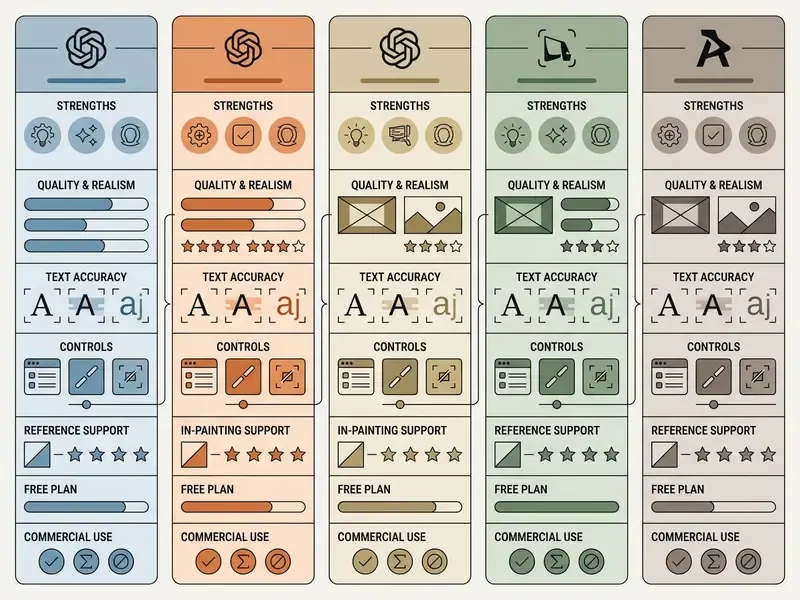
Readers building a shortlist can extend this matrix with our full breakdown of AI image generators, which tracks release cadence, model availability, and plan-level restrictions across vendors.
Best AI Image Generator Overall for Everyday Creation
ChatGPT image generation powered by gpt-image-1 and DALL-E 3 remains the most versatile option for everyday creation, mostly because of its conversational interface and stronger instruction understanding. Users can simply describe what they need in plain language, with no parameter flags or syntax to memorize. OpenAI's own image documentation notes that square images at standard quality generate fastest, which makes this stack efficient for high-volume routine requests. When building multi-platform campaigns, teams often pair a conversational engine with specialized tools, for instance combining a text-to-image model for hero assets with an AI outpainting tool to reformat the same asset across placements.
Among the best ai tools for generating images from text, this is also the easiest to govern at the desk level, since prompts and edits stay in one traceable thread.
Best AI for Realistic Images and Product Shots
Google AI image generator models such as Imagen 3, alongside CyberLink Promeo, sit at the top for realistic ai images and commercial product photography with studio-grade lighting. According to CyberLink's product documentation, the AI Product Lighting framework allows positioning up to five independent light sources with customized color, intensity, distance, and radius over a reference photo, giving precise reflection and shadow control (CyberLink Documentation, 2024). This is a vendor specification, not an independently benchmarked result, so treat the light-count ceiling accordingly.
In one reported operational deployment for an e-commerce catalog overhaul, a design team generated roughly 1,200 standardized product shots using studio lighting presets and surface reflections. By replacing physical staging with multi-light AI staging, the team reported cutting photo production turnarounds from about three weeks to two days. The figures come from a practitioner account rather than an audited case study, so read them as direction, not guarantee. The catalog visuals held consistent shadows across every digital channel, and that is the operationally important part. Consistency, not raw speed, is what makes generated product imagery usable at catalog scale.
- CyberLink Documentation, 2024
Best AI Tools for Art, Design, and Accurate Text
Midjourney image generation leads on artistic aesthetic quality, while Ideogram 4.0 delivers the most reliable text rendering inside visual layouts.
«In a blind test of 20 prompts rated by three designers, Midjourney v7 scored 9.2/10 overall; outputs felt "deliberate and art-directed rather than algorithmic."»
Ideogram 4.0 uses bounding-box layout controls and dense multilingual text rendering, with the vendor reporting over 95% typography accuracy and strongest results in English (Ideogram Technical Report, 2025). That 95% figure comes from vendor testing and lacks independent replication, though outside evaluators land in the same direction:
«Industry evaluators single out Ideogram as best for text in images, confirming its superiority over general diffusion models for logos and typographic layouts.»
For designers producing embedded slogans, logo mockups, or poster typography, Ideogram removes the letter distortion that general diffusion backbones still produce. Midjourney, by contrast, documents text support only for words placed inside double quotation marks from v6 onward, which is a prompt feature rather than a layout system. Useful, but not a substitute for real typographic control.
Commercial Use, Ownership, and Responsible AI Image Generation
«The US Copyright Office (2025) confirms that purely AI-generated images without substantial human modification cannot be registered for copyright protection.»
The Office's Part 2 report clarifies further that protection extends only to human-authored contributions: creative arrangement, selection, or substantive modification. Applicants must identify and disclaim AI-generated portions during registration. Prompting alone does not establish authorship. In parallel, 2026 European Union policy materials stress machine-readable training opt-outs for rights holders and clear labelling of AI-generated content, so a globally distributed campaign may carry disclosure duties even where copyright is unavailable.
Vendor Indemnification and Ownership Comparison
Legal exposure differs sharply between platforms, and the difference is contractual rather than technical. Marketing, risk, and procurement should compare four variables before approval: training-data provenance, indemnification scope, ownership assignment, and provenance metadata.
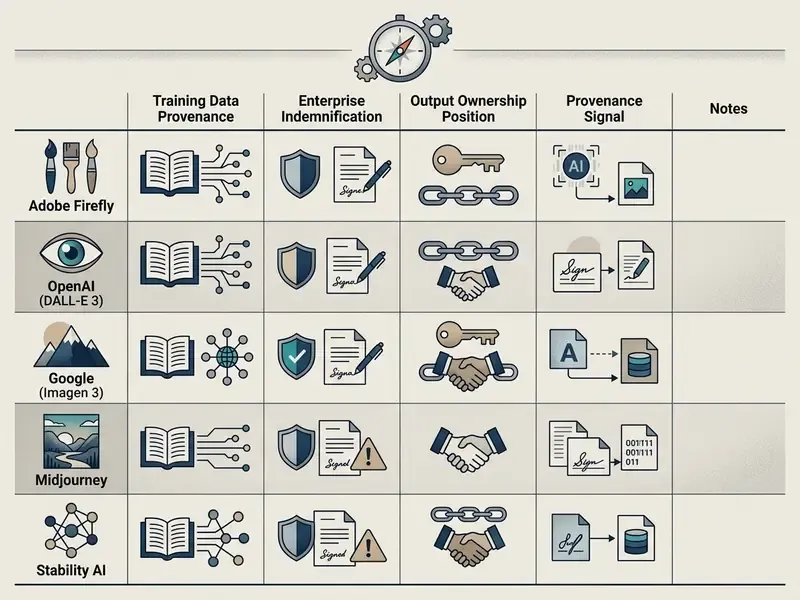
Teams deciding whether a given output may be published at all should also read our practical guide to the commercial use of AI image generators, which maps plan tiers against publication rights.
Enterprise Security, Data Residency, and Shadow AI Controls
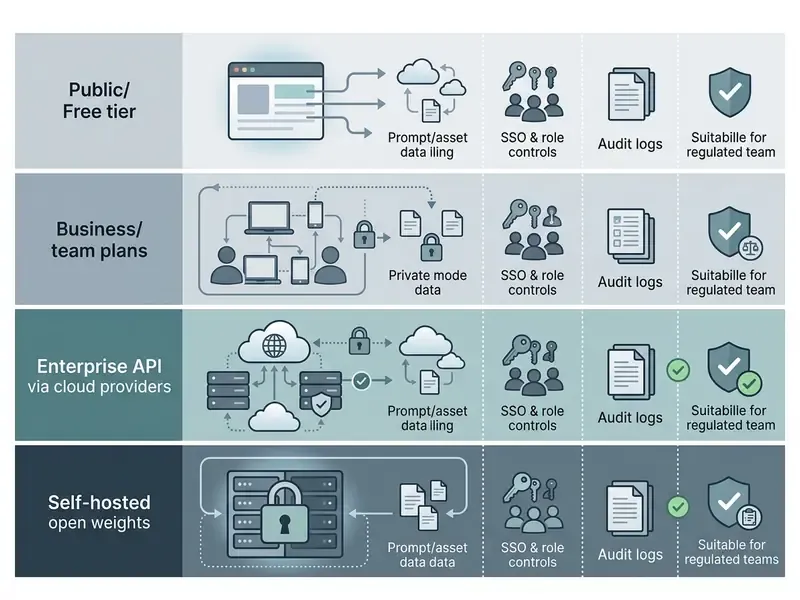
Verification steps belong in the procurement questionnaire, not the creative brief: current SOC 2 Type II report and ISO/IEC 27001 certificate scope; whether customer prompts and uploads are excluded from model training by default or only on request; data residency and retention windows; subprocessor lists; DLP and SSO/SCIM compatibility; and whether the vendor supports zero-retention API modes. Corporate GenAI policies already assume this posture, since most permit only enterprise-approved tools and prohibit public AI services for work content.
Pre-Purchase Risk Assessment Checklist
Reproducibility and Audit Logging for Model Risk Management
Generated imagery used in investor communications, regulated advertising, or client reporting must be reproducible on demand. Seed behaviour is the technical foundation. NIST SP 800-90A defines a seed as entropy input to a deterministic random bit generator, which is why a fixed seed reproduces an identical random stream while a random seed guarantees variation. Some vendor APIs expose seeds directly; others hide or ignore user-set seeds. Reproducibility, then, is a property of the product implementation, not of the concept.
A defensible generation record holds six fields: exact prompt text including negative prompts, seed value, model identifier and version string, sampler and step count, resolution and aspect ratio, and all reference assets with their hashes. Store these alongside the exported file, route generation through an API rather than a browser session, and visual production becomes an auditable pipeline. For provenance checks on inbound or third-party assets, our overview of AI image detectors explains what current detection tooling can and cannot confirm.
When distributing visual media across mobile apps or web platforms, technical compliance matters as much as licensing: preserve C2PA metadata through export pipelines, keep file weights inside performance budgets (our comparison of the best video compressor covers the same trade-off for motion assets), and confirm alt-text and contrast requirements for accessibility. To review head-to-head model comparisons and licensing evaluations, readers can explore the hub for versus comparisons across generative platforms.
What Makes an AI Image Generator Produce High-Quality Output
An ai image generator produces high quality output through the interaction of core model architecture, parameter scale, sampling algorithms, and conditioning mechanisms. Modern architectures use latent diffusion or unified multimodal transformer backbones that process visual tokens and textual embeddings together. Understanding the mechanics helps you configure prompts, resolution parameters, and style references for the best results rather than lucky ones.
Known limits are quantified, not anecdotal:
«On M³T2IBench (10,000 prompts, 78 categories), all models show average accuracy below 70% and bias above 1, meaning systematic over- or under-generation of object instances.»
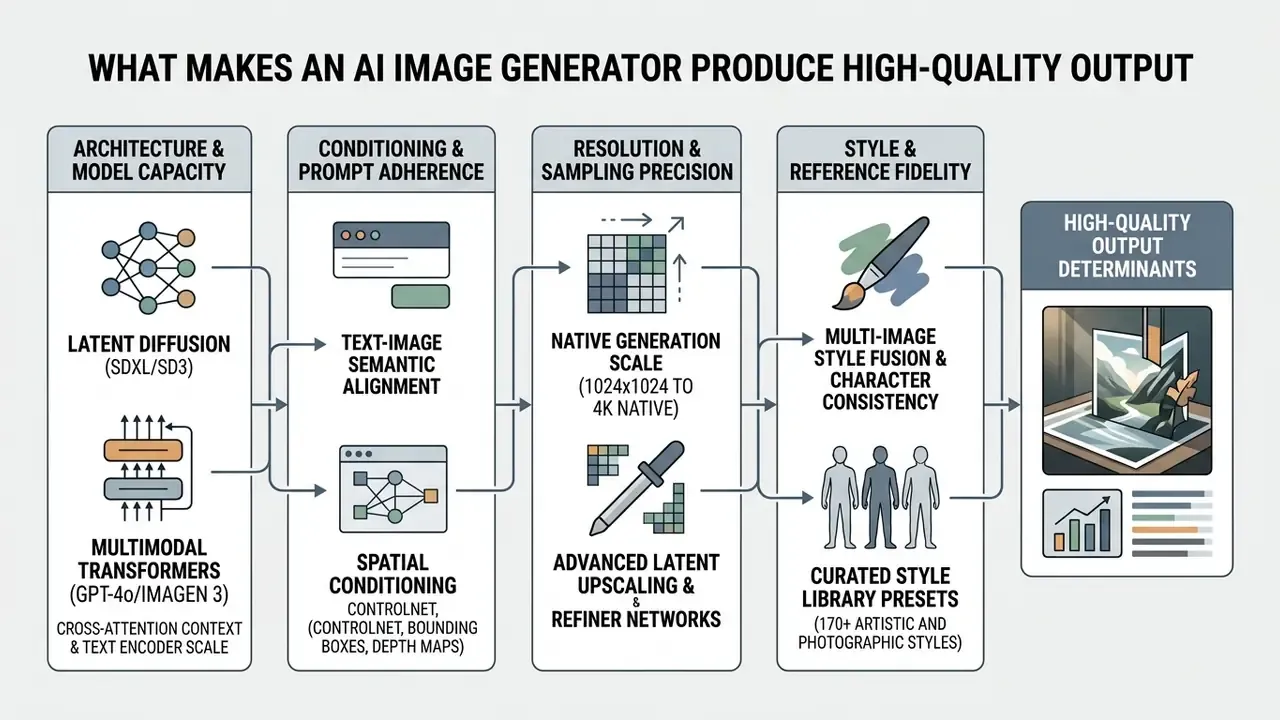
Core Rendering Mechanics: Diffusion vs. Autoregressive Backbones
Modern text-to-image engines use two distinct rendering paradigms. Knowing which one you are prompting explains most of the behaviour you observe.
- Latent Diffusion Models (SDXL, SD3, FLUX, Midjourney).Generation starts from a field of pure Gaussian noise. Across a sequence of sampling steps, typically 20–50, the model predicts and subtracts noise patterns under cross-attention guidance from text embeddings, until a crisp image emerges. Practical consequence: step count, sampler choice, and guidance scale change the result materially, and early steps decide composition while late steps decide texture. NIST's taxonomy describes this as a forward process, a reverse process, and a sampling procedure, applicable to generation, denoising, inpainting, and super-resolution alike.
- Autoregressive Transformers (GPT-4o Image, Imagen-class multimodal stacks).The network treats the visual field as a sequence of image tokens and predicts the scene chunk by chunk, in raster-like order, much like text completion. Practical consequence: instruction following and embedded text tend to be stronger, because the model reasons sequentially over symbolic content. Generation is often slower, and you may get one image instead of a grid of variations.
A useful mental model: diffusion sculpts the whole frame at once and gets progressively sharper, while autoregression writes the picture in order and rarely contradicts what it has already written.
AI Models, Resolution, and Image Generation Features
Performance across top models depends on parameter size, training dataset curation, and native generation resolution. Architecture choices are visible in the output long before you read the technical report.
«SDXL's UNet backbone is three times larger than prior Stable Diffusion versions, trained across multiple aspect ratios, achieving results competitive with black-box state-of-the-art generators.»
Current generation models increasingly include native 2K and 4K output alongside batch image generation features that process many prompts at once. Ideogram documents spreadsheet-driven batch generation; Topaz Gigapixel documents batch processing that applies different models and output sizes across many files in a single pass. Still, no single engine wins everywhere:
«HEIM evaluates 26 models across 12 aspects, including alignment, aesthetics, reasoning, bias and fairness, finding no single model excels in all dimensions simultaneously.»
If your bottleneck is resolution rather than ideation, our comparison of AI image upscalers covers 2x, 4x, and 8x pipelines and flags where each starts introducing artifacts.
Reference Images, Style Control and Consistent Results
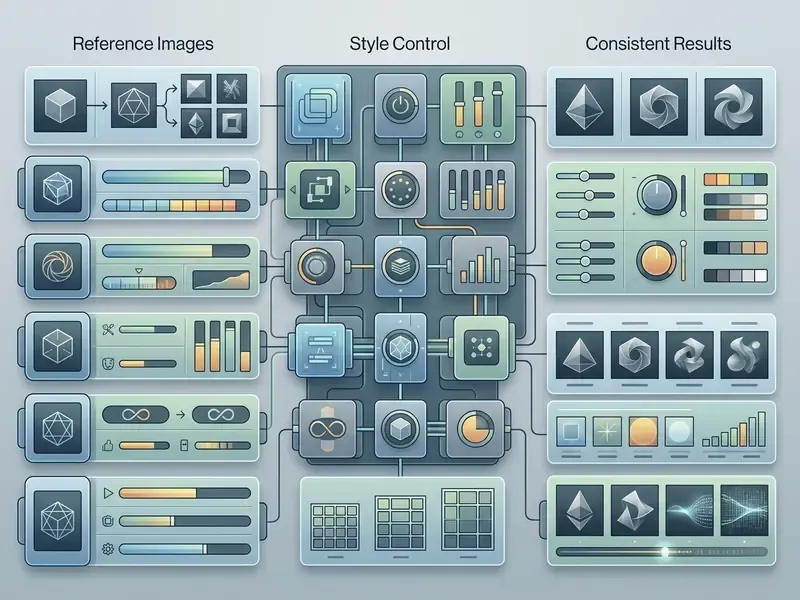
Visual consistency across many generations depends on reference images and style-matching presets. Tools such as NovelAI and Ideogram accept up to three reference photos to lock character features, mood, or brand colour palettes across consecutive outputs. NovelAI exposes Character Reference, Style Reference, and combined modes with an explicit Strength slider, while Ideogram pairs a curated style library with saved personal styles and temporary Quick reference styles. Multi-reference editing in newer models such as FLUX.2 defines a subject from one or more references and then varies scene, pose, and context around it. That is what lets a marketing team ship a cohesive campaign set without subject drift or aesthetic wobble. Workflows that start from an existing asset rather than a blank prompt are covered in our guide to image-to-image AI generators.
Best Free Text to Image AI Generators and Free Plans
Free AI Tools for First-Time Users and Simple Prompts
For beginners getting started with AI visual creation, web tools like Microsoft Designer and Gemini generate instantly from a simple prompt. You simply describe a subject, click generate, and four options arrive in seconds. No configuration, no parameter study, which is why these count as the best free text to image ai app options for students and casual creators. Our roundup of free AI image generators compares quotas, watermark policies, and export limits side by side for anyone who wants to test before committing budget.
One practical caution for organizational users. A free tier is also the easiest route for confidential material to leave the perimeter, so free-plan experimentation should stay limited to non-sensitive prompts. That rule is boring. It also prevents most incidents.
When a Paid Plan Improves Image Quality and Control
Paid plans unlock higher output resolution, faster GPU queues, precise inpainting editors, private generation modes, and batch API access.
«ChatGPT Plus (~$20/month) includes DALL-E 3 and gpt-image-1; Midjourney ranges from ~$10 to ~$120/month; Adobe Firefly paid plans start at ~$8/month.»
Enterprise economics behave differently from seat pricing. Production pipelines are usually costed per generated image through the API, so total cost of ownership equals (image volume × per-image or per-token rate) + retry overhead for rejected outputs + upscaling passes + moderation and review labour + governance tooling. A realistic planning rule: assume two to four generations per accepted asset on complex briefs, and model upscaling as a separate line item, because several platforms treat 4K as post-processing rather than native output. For structured cost modelling across media tooling, see the overview of our calculators.
Vendor documentation confirms the feature deltas that justify an upgrade. OpenAI's API exposes multi-turn editing and an n parameter for multiple images per request, Batch API support for high-volume automation, and flexible sizing with width and height divisible by 16 within a 1:3 to 3:1 aspect range, up to a documented maximum of 3840×2160 (resolutions above 2560×1440 are marked experimental). Recraft's paid API similarly bundles high-resolution raster and vector outputs, batch jobs, prompt-based editing, inpainting and outpainting, and asynchronous processing. Developers can compare options for API access across model providers and review implementation economics in our API access guide for generative media.
Choose the Best Text to Image AI for Your Use Case
Selecting the right text to image generator depends on whether your project serves regulated corporate communications, marketing campaigns, art direction, e-commerce, or personal experimentation. Industries need different feature combinations: vector export for graphic designers, indemnified commercial rights for corporate branding teams, full audit logging for financial services. There is no universal best text to image ai model, only a best fit per constraint.
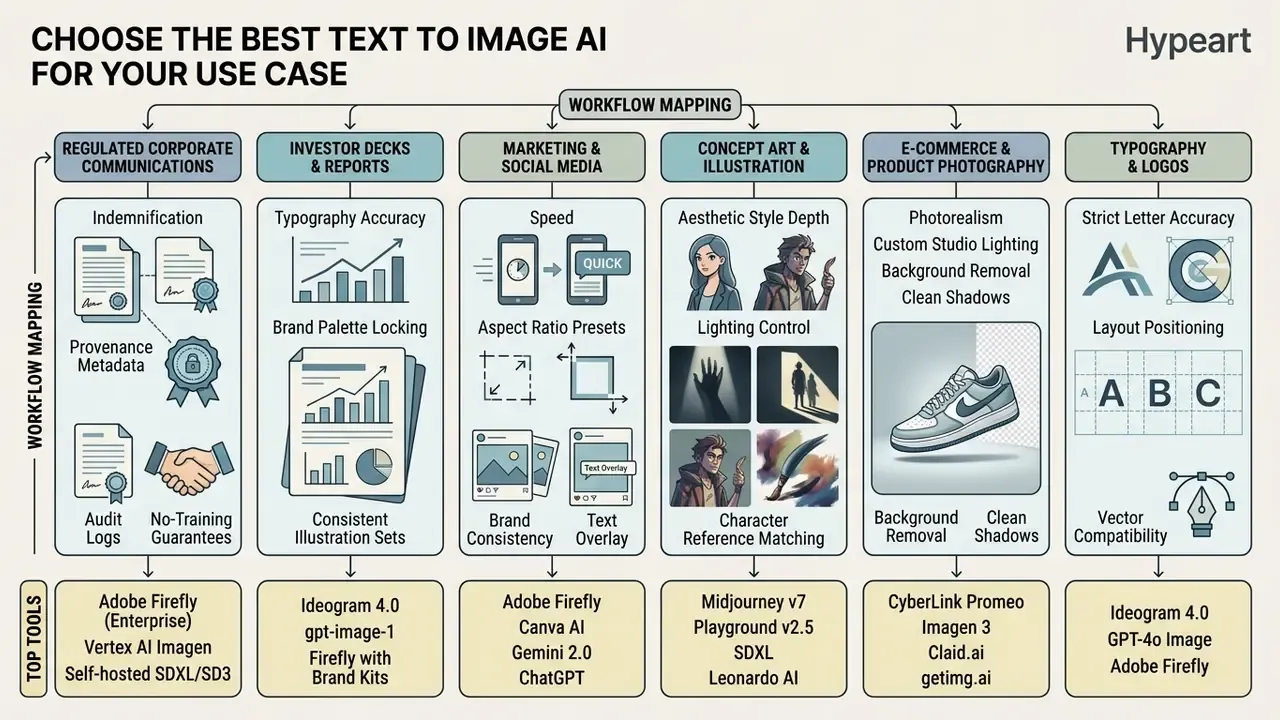
Design teams working on marks and wordmarks should also read our reference on AI logo generators, since logo work carries trademark exposure that generic image licensing terms simply do not address.
AI Art Generators for Concept Art and Different Styles
Digital artists and concept directors rely on the best AI art generators to explore different styles, from oil painting and anime through architectural rendering. Midjourney v7 and Playground v2.5 handle complex lighting effects and stylistic nuance particularly well, which is why both keep appearing in lists of the best text to ai art generator options.
«Playground v2.5 achieves FID 4.48 on MJHQ-30K versus 7.07 for Playground v2 and 9.55 for SDXL+refiner, outperforming across all categories, especially people and fashion.»
Research on professional practice supports a division of labour rather than replacement. A 2025 study on conceptual design found generative AI mainly supports problem definition and idea generation, while idea selection and evaluation stay predominantly human-led. Studio workflows mirror that finding: Midjourney generates a wide spread of visual directions, then an art director narrows the field. Readers chasing a specific stylistic target can review our breakdown of Ghibli-style AI image generators for style-accuracy and rights considerations.
Autonomous AI Agents and Integrated Production Workflows
Enterprise design workflows are shifting from standalone generation to autonomous AI agents that handle end-to-end visual execution rather than single files. Instead of downloading and re-uploading individual assets, agentic visual workflows let teams:
- Generate in-context assets. Prompt an agent to draft a ten-slide pitch deck or landing page structure in which AI visual assets are created, formatted, and embedded inside the layout automatically.
- Maintain cross-asset consistency. Agent systems read global context across a report or campaign brief and pass consistent seeds, palettes, and style variables into every generated illustration. That is precisely the consistency problem manual prompting handles badly.
- Automate API micro-tasks. Wire models such as FLUX or DALL-E into web forms and internal tools through automation platforms or native webhooks, producing personalized visuals triggered by user input in real time.
- Produce multi-format deliverables. Export one approved visual system into PDF, PNG, PPTX, and HTML5 outputs, which is how AI-assisted design suites already position first-draft generation for presentations, documents, and print.
The governance caveat matters here more than anywhere else. An agent that autonomously embeds imagery into a client-facing report also autonomously creates publication risk. In regulated environments, agentic pipelines need the same generation record attached to every embedded asset (prompt, seed, model version, references) plus a human approval gate before distribution. No evidence, no autonomy.
How to Generate High-Quality AI Images From a Text Description
Generating high-quality output takes a structured workflow spanning prompt construction, reference selection, parameter configuration, and post-generation refinement. A standardized process reduces output variance and yields predictable assets. Structure matters because impressive-looking images still fail on countable and symbolic content:
«HRS-Bench finds existing models "often struggle to generate images with the desired count of objects, visual text, or grounded emotions," even when outputs appear impressive at a glance.»
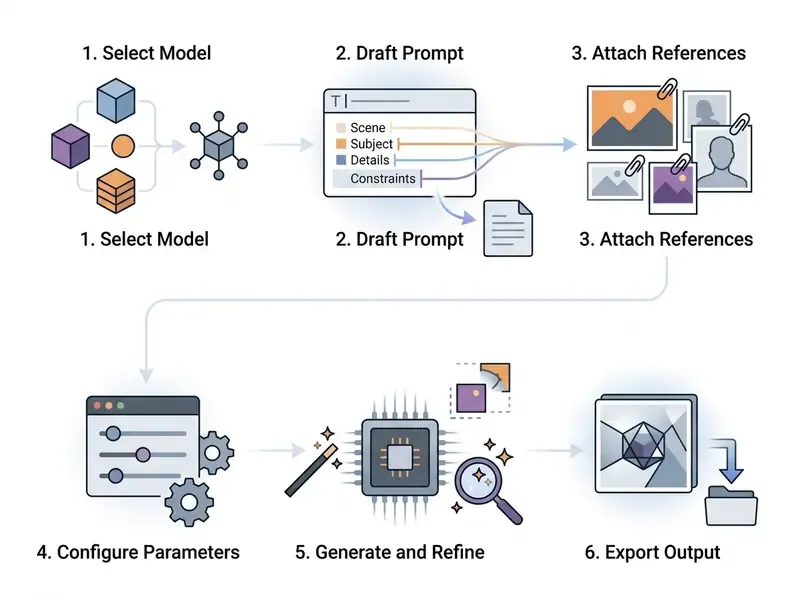
- Select the AI Model
- Choose a generator specialized for your target output (Midjourney for aesthetics, Ideogram for text, Imagen 3 for photorealism, self-hosted SDXL for data isolation).
- Draft a Structured Written Prompt
- Order the prompt as
[Setting/Background] -> [Primary Subject] -> [Specific Details/Lighting] -> [Style/Camera Angle] -> [Constraints]. Keep it to one to three clear sentences; OpenAI's prompting guidance recommends exactly this ordering, with short labeled segments for complex requests. - Attach Reference Photos
- Upload character (
--cref) or style (--sref) images to enforce consistency, and state explicitly what must be preserved versus changed. With multiple references, identify each one and describe how they interact. - Configure Generation Settings
- Set the aspect ratio (16:9 for web headers, 9:16 for mobile stories), output resolution, seed value, and batch count (1–8 variations). Running three to nine different seeds on a new prompt is the fastest way to learn what that prompt can actually return, since output is stochastic rather than fixed.
- Click Generate and Inspect Results
- Review variants for prompt adherence, object counts, anatomical correctness, embedded text accuracy, and lighting balance. Check the countable elements first. They fail most often.
- Refine via Inpainting and Upscaling
- Use an ai image editor or upscaler to repair minor defects and expand the canvas to 4K, then log the final generation parameters beside the exported file.
Write a Text Prompt That Produces Better Results
An effective text prompt relies on descriptive specificity, not quality buzzwords. Skip vague terms like "hyperrealistic" or "ultra HD"; describe concrete lighting conditions, camera lens properties, and surface textures instead. Research on prompt guidelines found that rephrasing the same keywords rarely changes output quality, whereas adding precise subject and style tokens does.
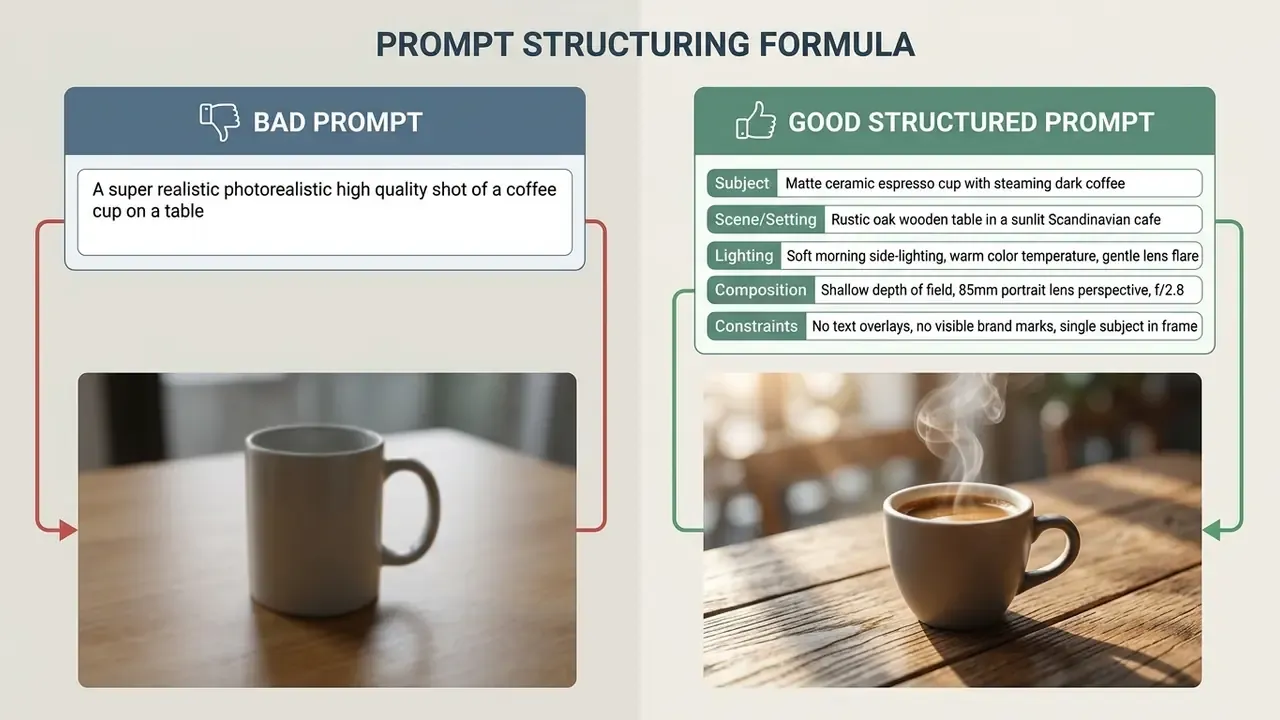
Camera Composition & Cinematic Lighting Reference Matrix
For precise spatial framing without vague quality buzzwords, apply standardized photography presets inside the prompt structure. This matrix trades guesswork for reusable vocabulary that behaves consistently across diffusion and autoregressive engines.
| Parameter Category | Preset Terms | Practical Use Case |
|---|---|---|
| Framing & Angle | Macro Shot, Close-Up, Wide-Angle 24mm, Low-Angle (Shot from Below), High-Angle (Shot from Above), Bird's-Eye View, Eye-Level Product Shot | High-detail product textures, architectural scale, dramatic portrait angles, flat-lay catalog frames. |
| Depth of Field | f/1.4 Bokeh, Deep Focus, Tilt-Shift, Shallow Depth of Field, Narrow Depth of Field | Background blurring for subjects, miniature effect, sharp commercial catalogs, editorial portraiture. |
| Lighting Styles | Volumetric Rim Light, Soft Studio Softbox, Golden Hour Side-Lighting, Backlight Silhouette, Dramatic Low-Key, High-Key Bright | E-commerce product isolation, cinematic storytelling, moody editorial art, clean corporate imagery. |
| Color Palettes | Desaturated Muted, Warm Tone, Cool Tone, Vibrant Pastel, Monochromatic High-Contrast, Analog Film Grain | Brand guideline matching, retro visual aesthetics, sleek SaaS graphics, financial-report illustration sets. |
| Style Frames | Photographic, Cinematic, Digital Art, Isometric, Line Art, 3D Render, Low Poly | Switching between realistic and diagrammatic registers inside one visual system. |
Pair one entry per row rather than stacking synonyms. A prompt specifying Wide-Angle 24mm plus Volumetric Rim Light plus Desaturated Muted will outperform one that piles on six overlapping adjectives.
Refine Generated Images With Editing and Image-to-Image Tools
Post-generation editing tools, including inpainting, outpainting, and image-to-image synthesis, let creators repair targeted errors without regenerating the whole frame. Inpainting masks a specific region to change one element, say replacing an object or correcting a text label. Canvas expansion, or outpainting, extends the visual boundary while preserving central composition; teams can compare options for image expansion in our commercial-use hub. Vendor documentation treats these as distinct operations, since Amazon Bedrock's Stability image services list inpaint, directional outpaint, and Creative Upscale to 4K as separate calls, while img2img workflows frame them as one family differentiated by masking and denoising strength.
The Staged Iterative Generation Loop
High-complexity commercial projects rarely land on a single pass. Professional creators use a staged generation loop to lock parameters progressively instead of re-rolling the frame and losing what already worked:
The loop's real value is reproducibility. Each stage produces an approved artifact that becomes the input constraint for the next, so a campaign of forty assets inherits one locked visual system instead of forty independent aesthetic gambles. For final polish and platform-specific corrections, our guide to the best photo editor for mac covers desktop post-processing inside an AI pipeline, and dedicated AI image enhancers handle denoising and detail recovery.
FAQs About AI Text to Image Generators
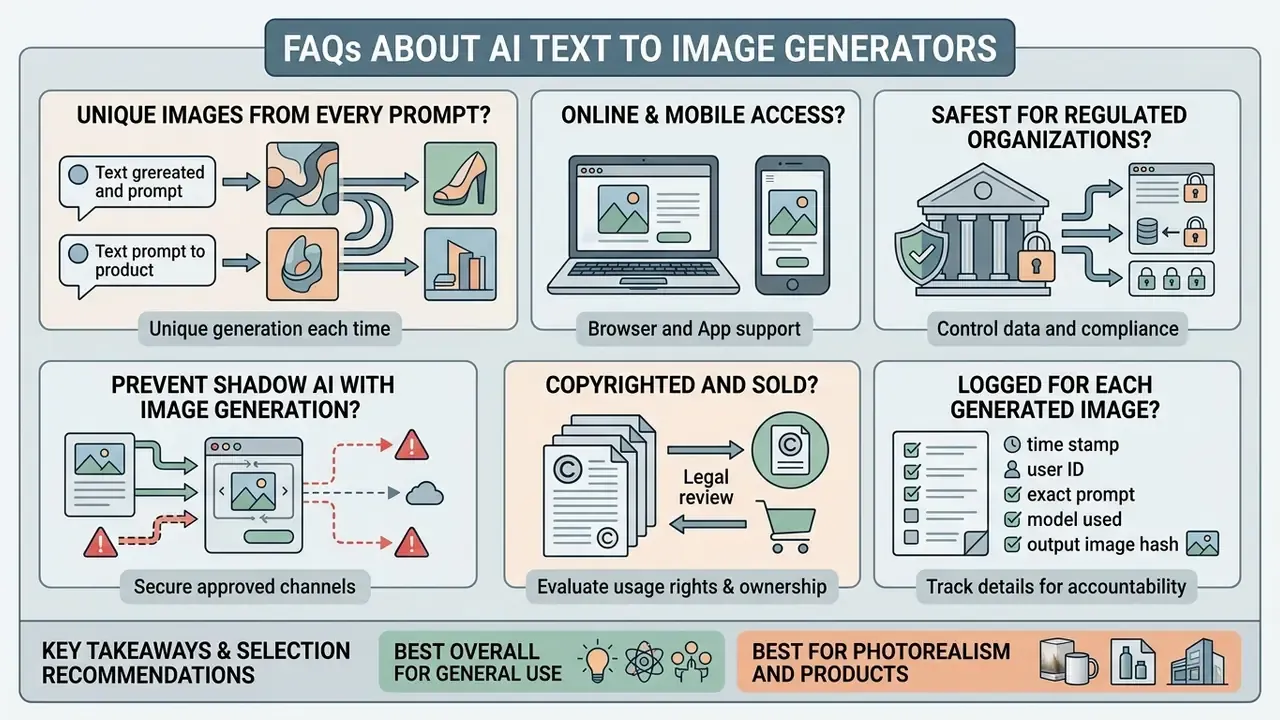
Does the AI Create Unique Images From Every Prompt?
Yes. AI image generators produce a unique image per request by sampling random noise vectors guided by the input text description. Because generation is stochastic, entering the exact same text prompt several times returns visually distinct variations, unless a fixed random seed is explicitly set. Note the asymmetry: randomness produces novelty, a fixed seed produces reproducibility, and only reproducibility is auditable.
Can I Use an AI Image Generator Online and on Mobile?
Yes. Major generators offer web interfaces and dedicated mobile apps. Adobe Firefly works in the browser on desktop and mobile and ships a Firefly app for iOS and Android. Google's documentation states that Gemini image generation works in the Gemini web app and in the Gemini tab of the Google app on iPhone and iPad, but is not currently available inside the standalone Gemini mobile apps. OpenAI documents image generation through its API, with ChatGPT image capabilities reported across desktop, web, and mobile. Teams assembling a cross-device toolchain can also review our reference on online photo editors for downstream retouching, or our comparison of the best video editor for handheld motion work.
Which AI Image Generator Is Safest for a Regulated Organization?
The safest configuration satisfies four conditions at once: contractual commercial rights at your purchased tier, indemnification covering your publication use case, a documented no-training commitment for prompts and uploads, and full request-level logging. In practice that points to enterprise API deployments through a cloud provider or self-hosted open-weight models, with Adobe Firefly as the strongest managed option where licensed training data and indemnification are the governing concern.
How Do We Prevent Shadow AI With Image Generation?
Publish an approved-tool list, block consumer endpoints at the network and DLP layer, provide a sanctioned alternative that is genuinely fast enough to use, and train teams on one rule: reference uploads count as data transfers. Most incidents are not malicious. They are a designer dropping a customer photo or an internal dashboard screenshot into a free web tool to "match the style."
Can AI-Generated Images Be Copyrighted and Sold?
Outputs generated wholly by AI are not copyrightable in the United States. Protection extends only to human-authored contributions such as creative arrangement, selection, or substantive modification, and AI-generated portions must be disclaimed on registration. Selling is a separate question governed by your platform licence: many vendors permit commercial use while explicitly not assigning ownership, and some tie export rights to the plan active at the time of generation or export.
What Should Be Logged for Each Generated Image?
Prompt text including negative prompts, seed value, model identifier and version, sampler and step count, guidance scale, resolution and aspect ratio, all reference assets with hashes, the generating account, and the timestamp. Store it with the exported asset, so the image can be regenerated on request years later.
Key Takeaways & Selection Recommendations
- Best overall for general use ChatGPT (
gpt-image-1/ DALL-E 3), the strongest balance of natural language understanding, reasoning, and conversational editing. - Best for photorealism and products Google Imagen 3 and CyberLink Promeo, with superior studio lighting controls and photorealistic texture rendering.
- Best for graphic design and text Ideogram 4.0, currently the leader in accurate embedded typography and layout design.
- Best for commercial safety Adobe Firefly, offering corporate indemnification and training limited to licensed and public domain content.
- Best for open-source control Stable Diffusion (SDXL/SD3), with uncapped local generation, ControlNet depth mapping, custom fine-tuning, and complete data isolation.
- Best for regulated deployment enterprise API access through a cloud provider, with request-level logging, IAM-based access control, and contractual non-training commitments.
- Non-negotiable operating rule no external publication without a stored generation record and a human approval step.
Unresolved questions remain, and it is worth naming them. Vendor typography claims lack independent replication. Free-tier limits shift without notice. And no public benchmark yet scores how well a model respects regulated disclaimers or brand marks, which means your own hard-case tests still carry more weight than any leaderboard.
For a broader analysis of media generation benchmarks and technical evaluations, review our AI Media Benchmarks and Review Proof hub. To see our complete collection of software comparisons, explore the hub for detailed tool breakdowns.
This article is informational and does not constitute legal, compliance, or investment advice. Verify vendor terms, security attestations, and jurisdictional copyright rules with qualified counsel before commercial deployment.