Why does a consumer photo filter belong in a governance conversation? Because in a bank or a mature fintech, the same tool that makes a cute avatar can quietly move a customer photograph or an unreleased product render to an unvetted endpoint. That is the practical hook for compliance and model-risk readers.
Last updated: February 2026. Reviewed for factual accuracy, source verification, and legal framing.
Executive Summary: What Decision-Makers Need to Know
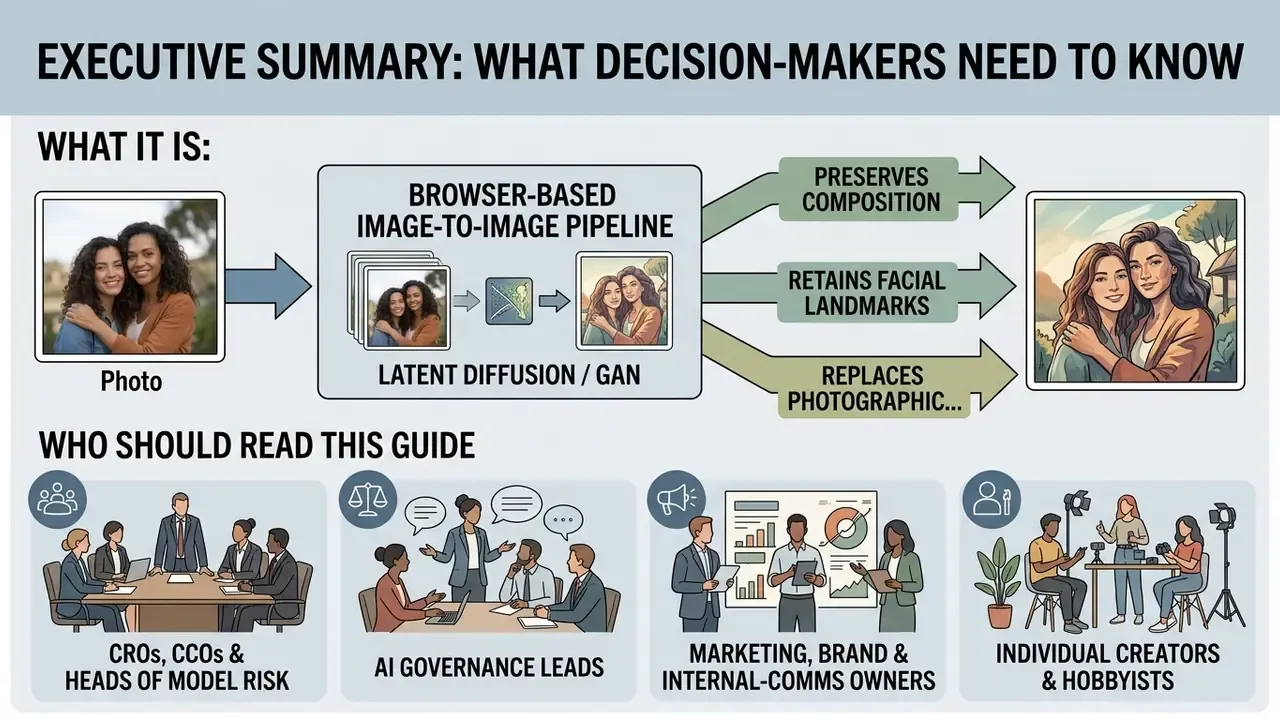
- What it is: a browser-based image-to-image pipeline (latent diffusion or GAN) that preserves composition and facial landmarks in an uploaded photo while replacing photographic texture with painterly, anime-style shading.
- How it works in practice: upload, select the Ghibli preset (or write a manual prompt), generate in roughly 5 to 20 seconds, review for artifacts, then export as PNG or JPEG, optionally upscaled to 2K or 4K.
- Why business leaders should care: consumer Ghibli converters are a textbook Shadow AI vector. Employees upload customer photos, ID scans, product renders, and internal event pictures into public endpoints with unverified retention policies.
- Legal position: artistic style is generally unprotectable, yet characters, logos, story assets, and the source photograph itself remain protected. Purely AI-generated output normally lacks human authorship and therefore copyright registrability, while liability for infringing output stays case-specific.
- Practical takeaway: treat these tools as third-party model endpoints subject to inventory, data-lineage, vendor-diligence, and audit-trail controls. Not as harmless photo filters.
- Creative coverage: the same pipelines power profile pictures (PFPs), memes, 4K wallpapers, sketch colorization, and image-to-video animation.
Who should read this guide
- CROs, CCOs and Heads of Model Risk who need an inventory answer for generative image endpoints already reachable from any corporate browser.
- AI governance leads extending existing model-risk frameworks to generative and agentic tools, including small, "harmless" ones.
- Marketing, brand and internal-comms owners deciding whether stylized assets can ship in paid media or packaging.
- Individual creators and hobbyists who simply want a clean Ghibli-style portrait and a clear answer on free tiers.
All audience statements above remain working hypotheses until validated with analytics, interviews, or CRM evidence.
What Is an AI Photo to Ghibli Style Converter Online?
An ai photo to ghibli style converter online is a web-based image translation tool that pushes uploaded photographs through generative neural networks to apply an anime aesthetic. Instead of stacking traditional pixel filters or static color overlays, these systems analyze structural features in the source photo and re-synthesize the scene using painterly textures, soft lighting, and simplified geometry. Users normally reach these tools through a browser to upload images, generate artwork, and export high-resolution results without specialized design software, a workflow closely related to browser-based AI photo editors and traditional online photo editors.
The underlying process relies on image-to-image translation models, such as fine-tuned latent diffusion checkpoints or generative adversarial networks (GANs).
«FID is the metric that most closely reflects human perception of realism among all automatic evaluation metrics for diffusion models.»
Architecturally, three families dominate the category. Classical neural style transfer separates content and style representations through convolutional feature losses. CycleGAN-type translation learns unpaired domain mapping between photographs and anime frames. And latent diffusion editing denoises a latent encoding of the source photo under style conditioning. Anime-finetuned latent models such as Animagine XL are documented as high-resolution checkpoints trained specifically to generate and modify anime-themed imagery. Consequently, ai generated ghibli images keep the identifiable subject matter of the input photo while presenting a distinct ghibli style art aesthetic.
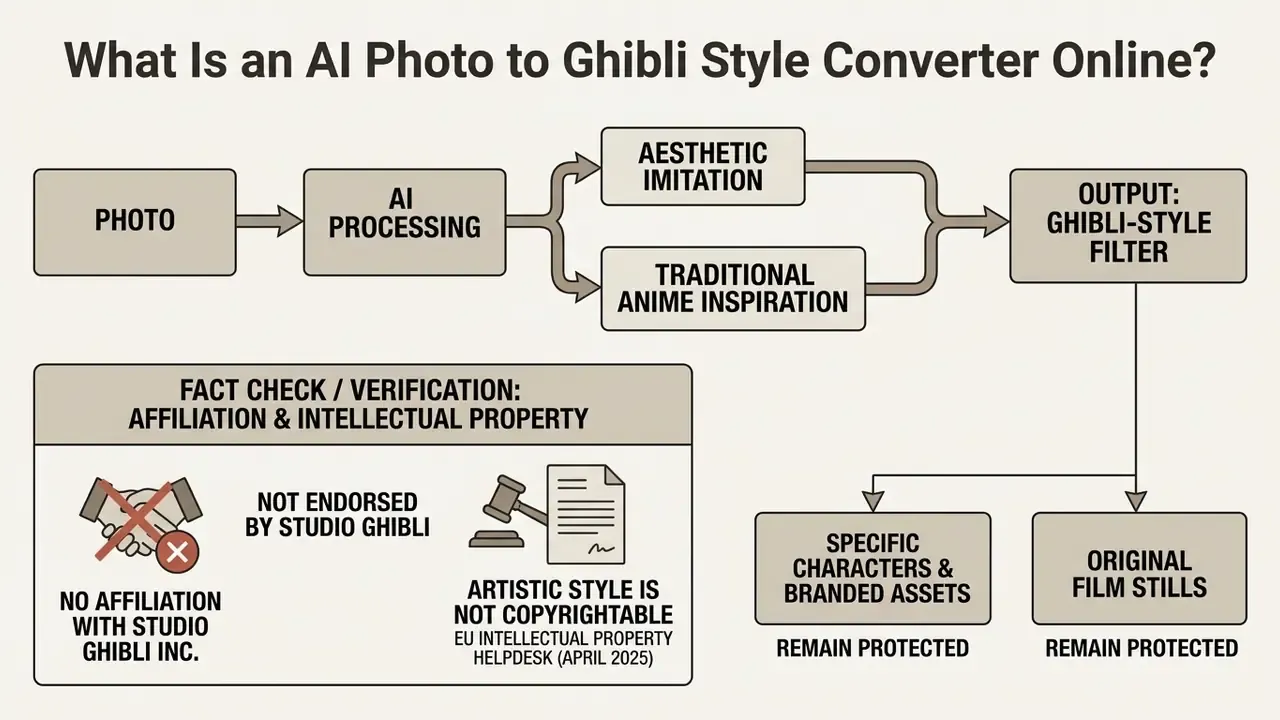
Ghibli-inspired style versus official Studio Ghibli artwork
The visual signature of official Studio Ghibli productions comes from hand-painted gouache and watercolor backgrounds, muted natural palettes, soft atmospheric illumination, and expressive character design. An ai convert photo to studio ghibli style tool, by contrast, generates an algorithmic interpretation of those visual tropes. The output reflects a ghibli inspired aesthetic produced by neural networks trained on broad anime datasets rather than proprietary film frames.
AI systems that produce studio ghibli styles work as stylistic mimickers, not licensed reproductions. Worth repeating, because procurement decks often blur that line.
«A style adapter can be trained on as few as 9–50 example images; the adapted model reached a CSD style score of 0.34 versus 0.22 for base Stable Diffusion.»
Legal frameworks separate generalized artistic styles from protected intellectual property. Updated: instead of a generic regulatory paraphrase, the more defensible framing comes from current doctrinal analysis.
«The claim that “style cannot be copyrighted” is legally unstable: an aggregate of expressive choices may itself constitute protectable expression, and substantial-similarity tests map poorly onto style.»
What AI changes in the uploaded photo
When an ai ghibli filter processes an image style ghibli request, the neural network rewrites several distinct layer attributes. The model simplifies skin textures, softens ambient shadows, and swaps complex photo noise for clean line work and flat color shading. Background elements such as sky gradients, foliage, and architectural structures become painterly textures resembling gouache brushstrokes. Lens realism, sensor grain, and depth-of-field falloff are discarded and replaced with cel-style outlines and layered ambient light.
Despite these dramatic stylistic changes, the ai convert photo to ghibli style workflow keeps the subject recognizable.
«CartoonER received significantly higher user preference than CartoonGAN (8.9%) and AnimeGANv2 (17.5%), owing to controllable texture and abstraction parameters.»
Facial recognition research (Taigman et al., CVPR 2014) shows that fiducial-landmark alignment and piecewise affine warping anchor core facial geometry (eye spacing, nose bridge, mouth ratio) during neural transformations. Modern identity-preserving pipelines extend this with explicit identity losses and reference-image conditioning, as documented in ConsistentID (2024) and PortraitBooth (CVPR 2024).
«DualStyleGAN evaluated structural similarity, color consistency and contour clarity across 140 anime portrait pairs, combining automatic metrics with aesthetic selection.»
How to Convert a Photo to Ghibli Style with AI Online
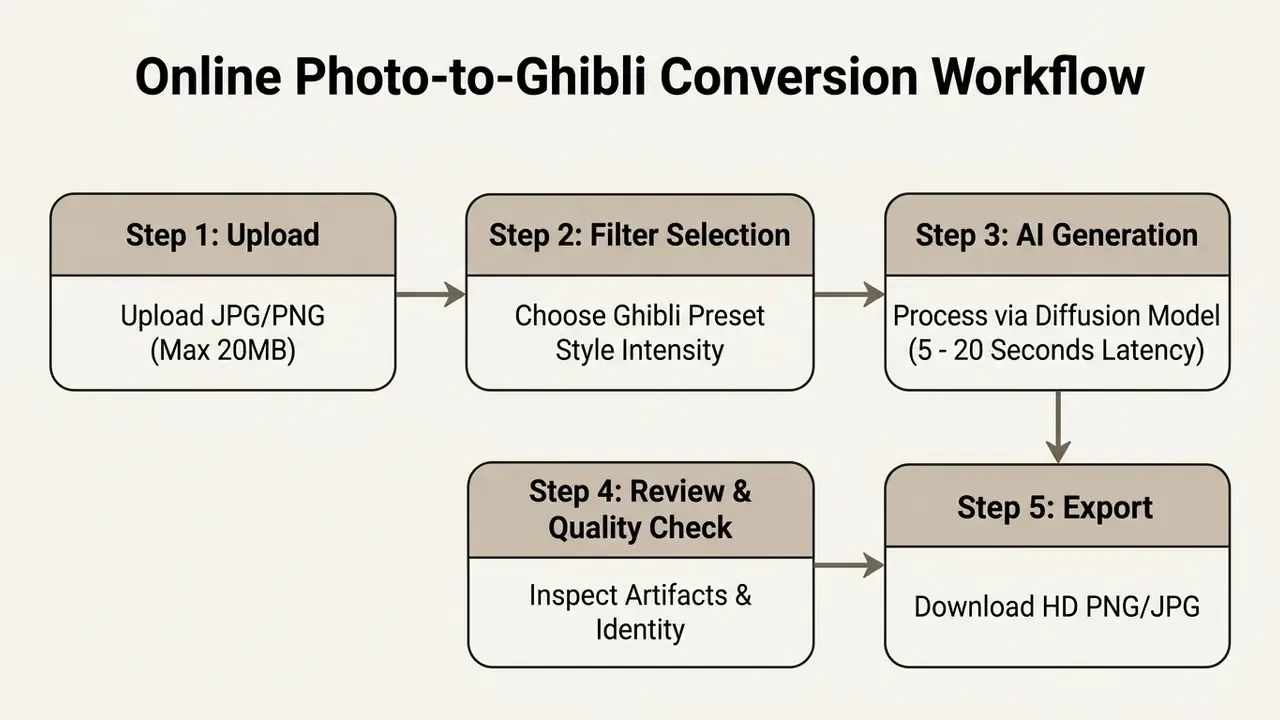
Converting a photo to anime artwork on an ai convert photo to ghibli style online platform follows a streamlined five-stage web workflow. Users drag and drop an image, select the desired style intensity, start neural generation, inspect the output, and export the file. The same interaction pattern applies to general-purpose image-to-image AI generators.
Upload an image and apply the Ghibli filter
The conversion sequence starts with an ai ghibli filter photo upload. Most web-based converters accept common raster formats including JPEG, PNG, and WebP, typically setting file size ceilings between 5 MB and 20 MB; enterprise endpoints extend this to HEIC and 50 MB. Users pick their image through a browser interface, with no drawing skill and no heavy image editing software required.
Once uploaded, the platform applies a studio ghibli filter preset. The system configures internal diffusion parameters, chiefly denoising strength (how far the output may drift from the source) and style conditioning weight, to map the input photo onto target aesthetic features. Lower denoising values preserve composition and identity; higher values return a more heavily reinterpreted illustration. Readers curious about broader creative workflows can explore the ai digital art section to compare generative media pipelines.
Generate, review and download the artwork
Clicking the generate ghibli button starts model processing. The network computes latent transformations over 5 to 20 seconds and returns a preview of the stylized artwork. Users then judge the output against five widely used perceptual criteria for generated imagery: technical defects, AI artifacts, unnaturalness, discrepancy from the source, and overall aesthetics.
When the preview looks right, the user proceeds to download the final file, and many platforms add a direct share link for social posting. Standard export choices include web-ready JPEG or lossy and lossless PNG, with vendor tiers commonly published as 1K, 2K, 4K, 6K and 8K outputs (1K generally meaning 1024 px on the long edge, higher tiers produced through upscaling). For technical implementations that need automated document structuring, reviewing an ai diagram generator offers useful insight into procedural asset rendering.
Advanced customization: using custom prompts and multimodal models
One-click web converters apply hardcoded style tokens. Advanced users, though, can lean on general-purpose multimodal models such as ChatGPT-4o, Midjourney v6, Flux.1 Kontext, Grok, or Google Gemini 2.0 for granular creative control. This route matters whenever you need to change a single element (hair color, season, time of day, clothing) instead of accepting a fixed preset.
To transform an image manually via multimodal LLMs or text-to-image engines:
- Upload the source assetattach your photograph to the model interface (in ChatGPT, use the “+” attachment control, then select image creation).
- Apply structural preservation tokensinstruct the model to anchor facial geometry, pose, and the main composition elements.
- Inject aesthetic modifierscopy and adapt the standardized prompt structure below.
- Iterate selectivelyre-prompt with one variable changed at a time, so quality shifts stay attributable to a specific instruction.
Useful modifier add-ons: maintain the original colors and background details (for documentary fidelity), golden-hour rim light, cumulus cloud sky (for cinematic mood), 2:3 portrait ratio, clean margins (for print or PFP crops). Comparative evaluations of these engines sit in our reviews of the ChatGPT picture generator and the Midjourney AI image generator.
Animate static Ghibli art into video clips
Beyond static conversion, modern generative media pipelines let users animate transformed Ghibli artwork into moving clips for YouTube Shorts, Reels, and storytelling projects.
- Generate the base frame produce your high-resolution static Ghibli artwork with the image converter.
- Import to an image-to-video engine load the generated asset into a video diffusion model (Runway Gen-2, Luma Dream Machine, Sora, or Google Veo, see the Google Veo implementation guide).
- Add motion conditions provide a simple movement prompt such as "gentle wind blowing through hair and trees, camera slow pan right, subtle eye blinking, anime loop".
- Export render in 1080p at 24 fps to match traditional animation frame rates.
Creators assembling longer sequences from multiple stylized frames can review our guide to animation makers for keyframing and export considerations.
Popular Creative Use-Cases: PFPs, Memes, Wallpapers and Sketches
Turning photographs into Studio Ghibli-style artwork serves several distinct creative applications across personal branding and digital media:
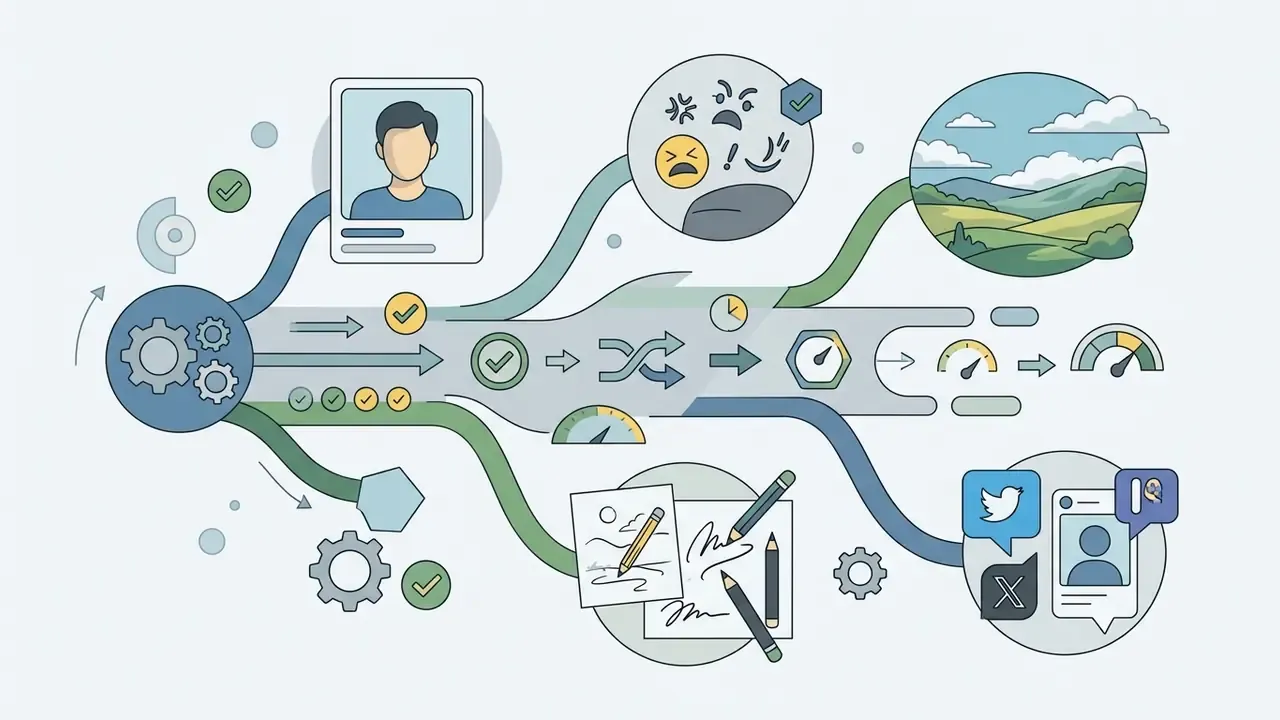
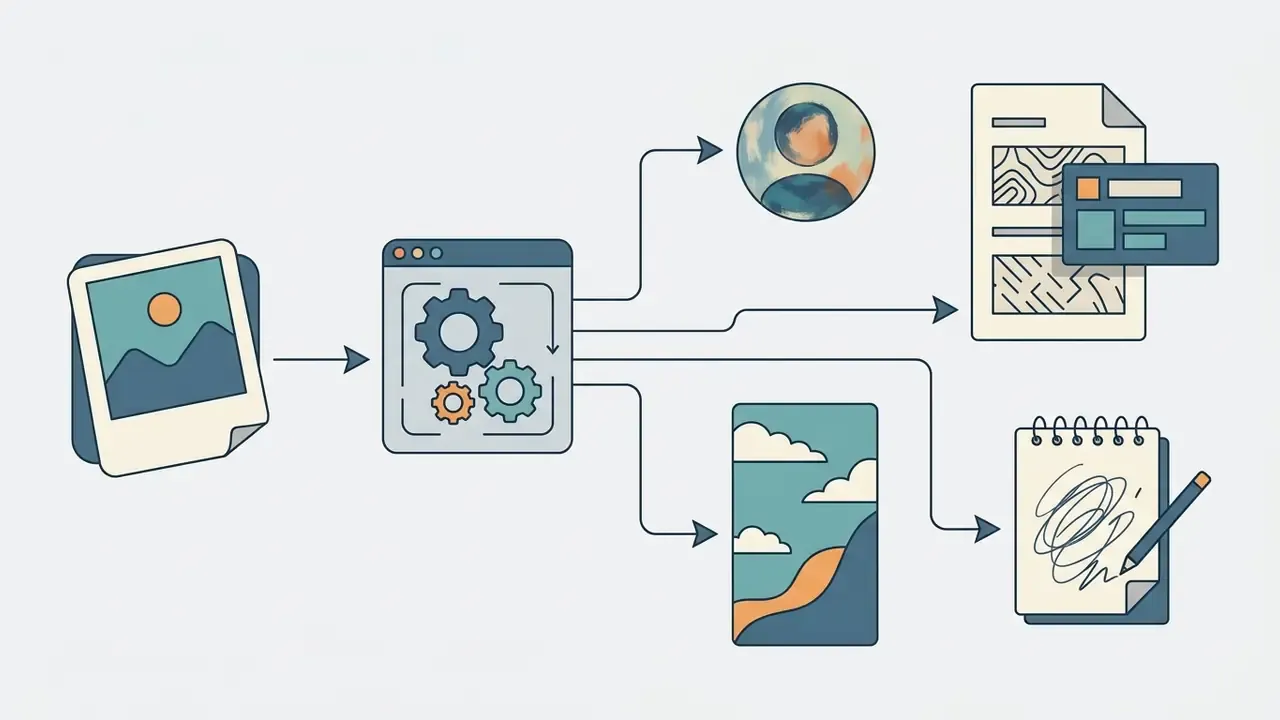
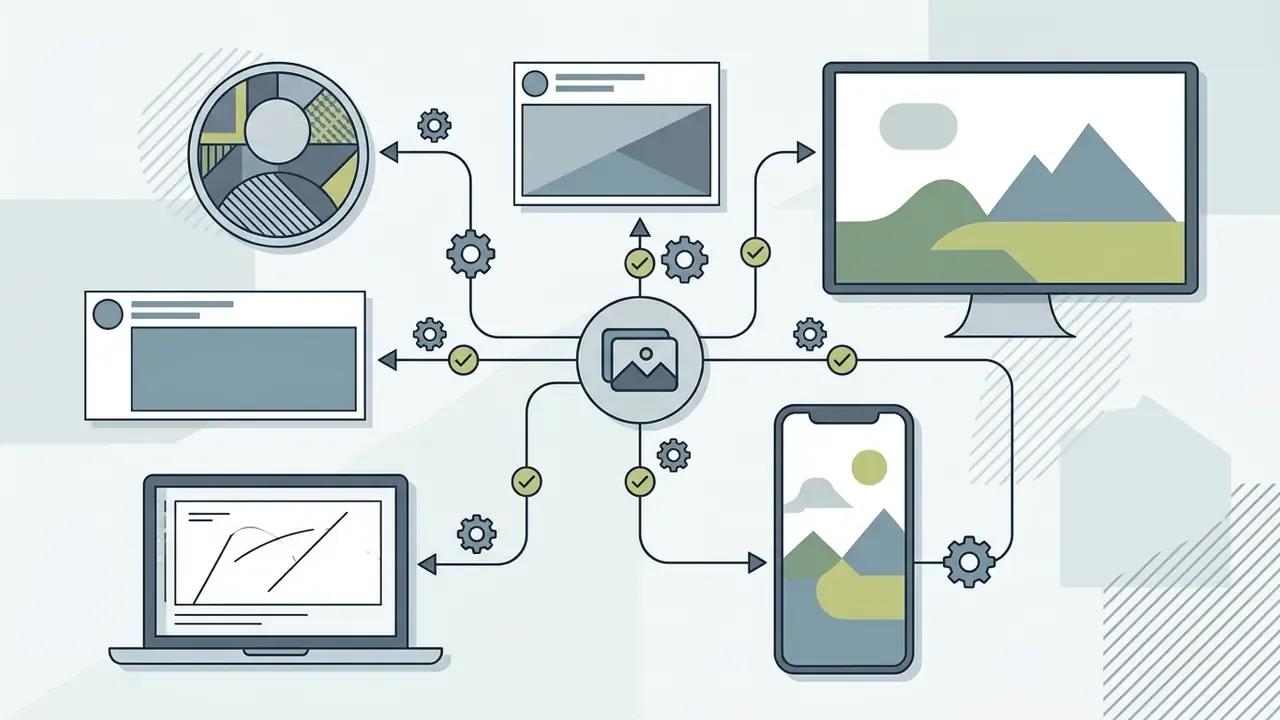
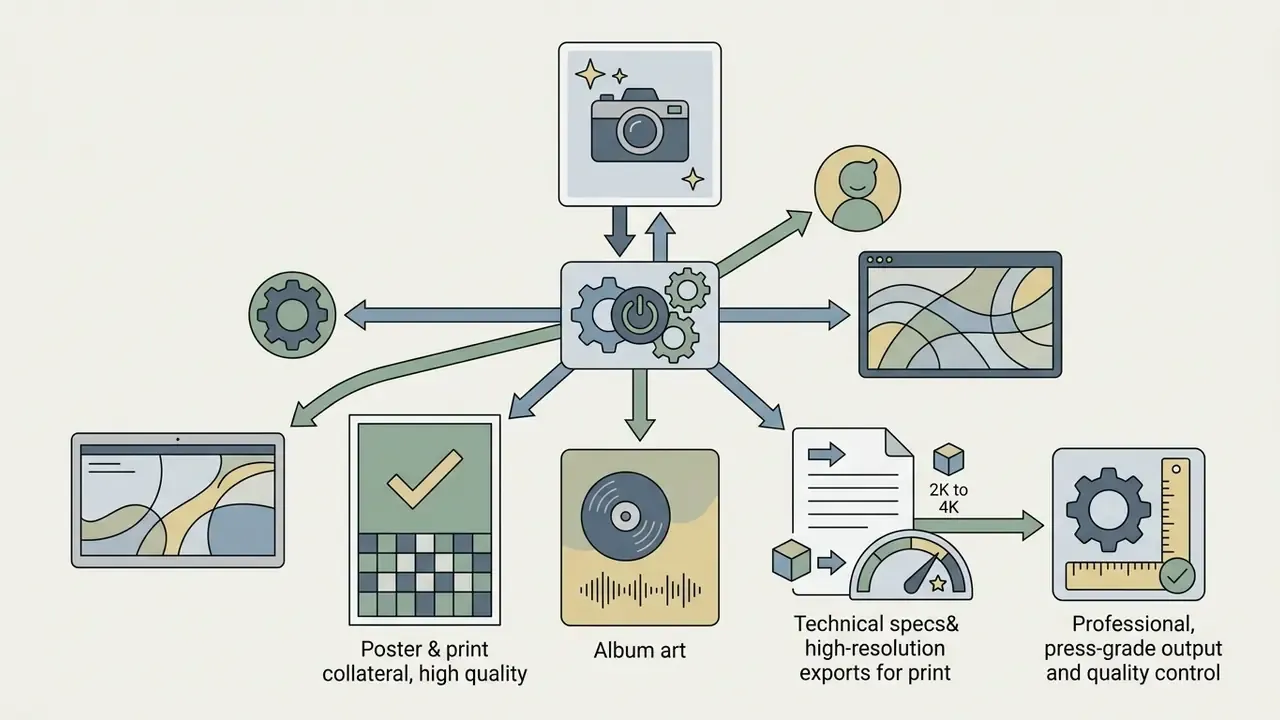
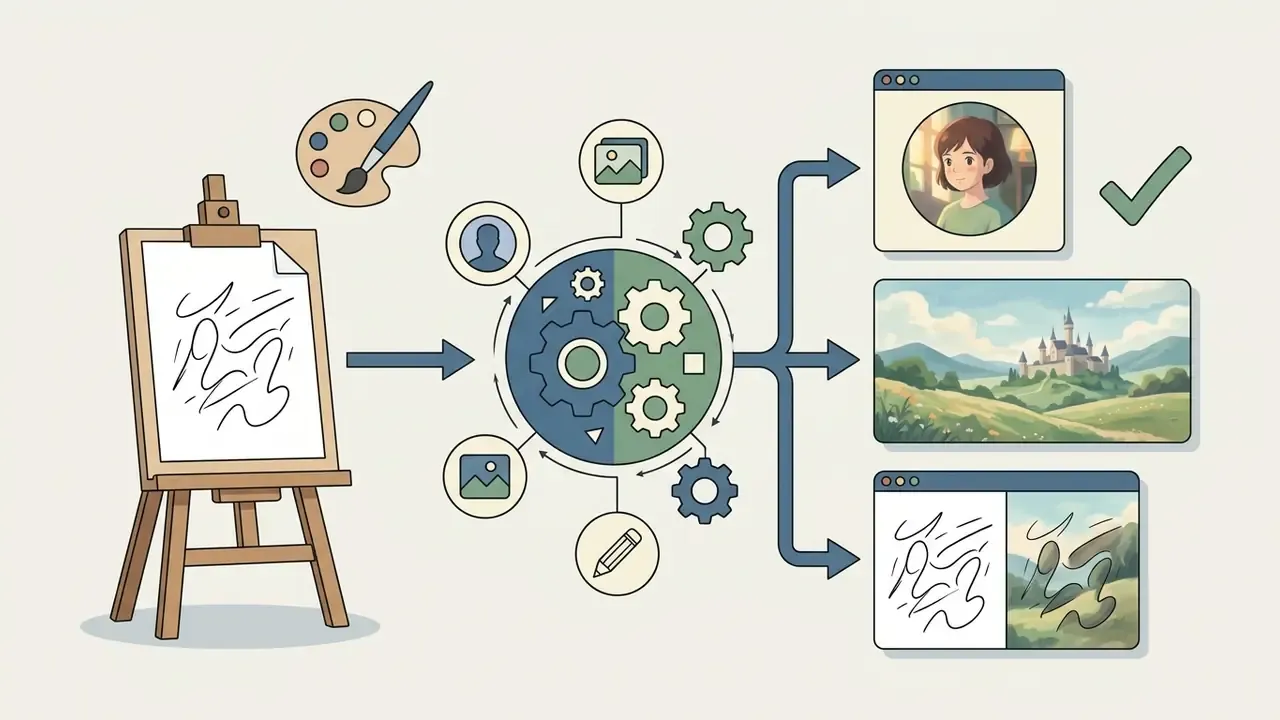
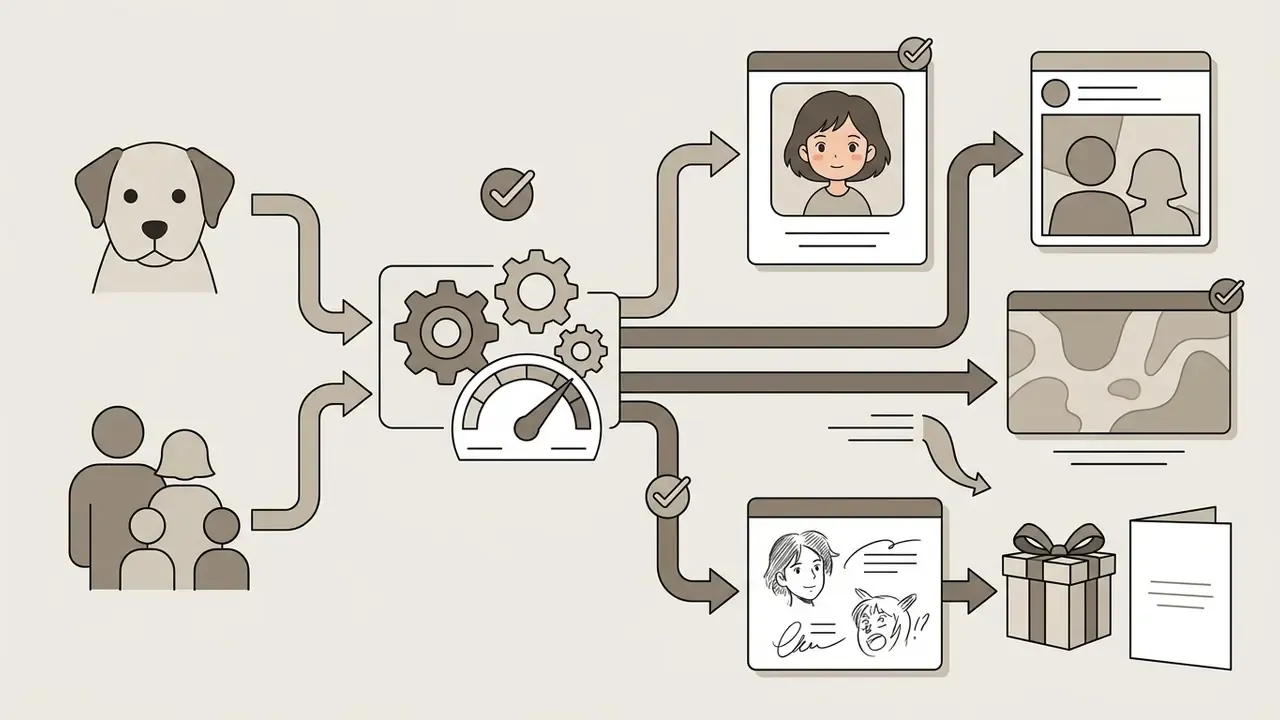
For organizations, that same list doubles as a risk map. PFP and meme use rarely touches confidential data, whereas product renders, event photography, and customer imagery routinely do.
Which Photos Work Best for Ghibli-Style Transformation? Data Input Constraints and Distortion Risks
Stylization quality depends heavily on the optical quality, composition, and lighting of the source photograph. In model-risk language, on the input distribution the model was trained to handle. Photos with clear subject separation, even natural lighting, and minimal background clutter deliver the most consistent Ghibli-style transformations, while out-of-distribution inputs (harsh shadows, motion blur, heavy compression) push artifact rates upward. Buyers benchmarking control depth across platforms can consult our comparison of the best AI image generators.
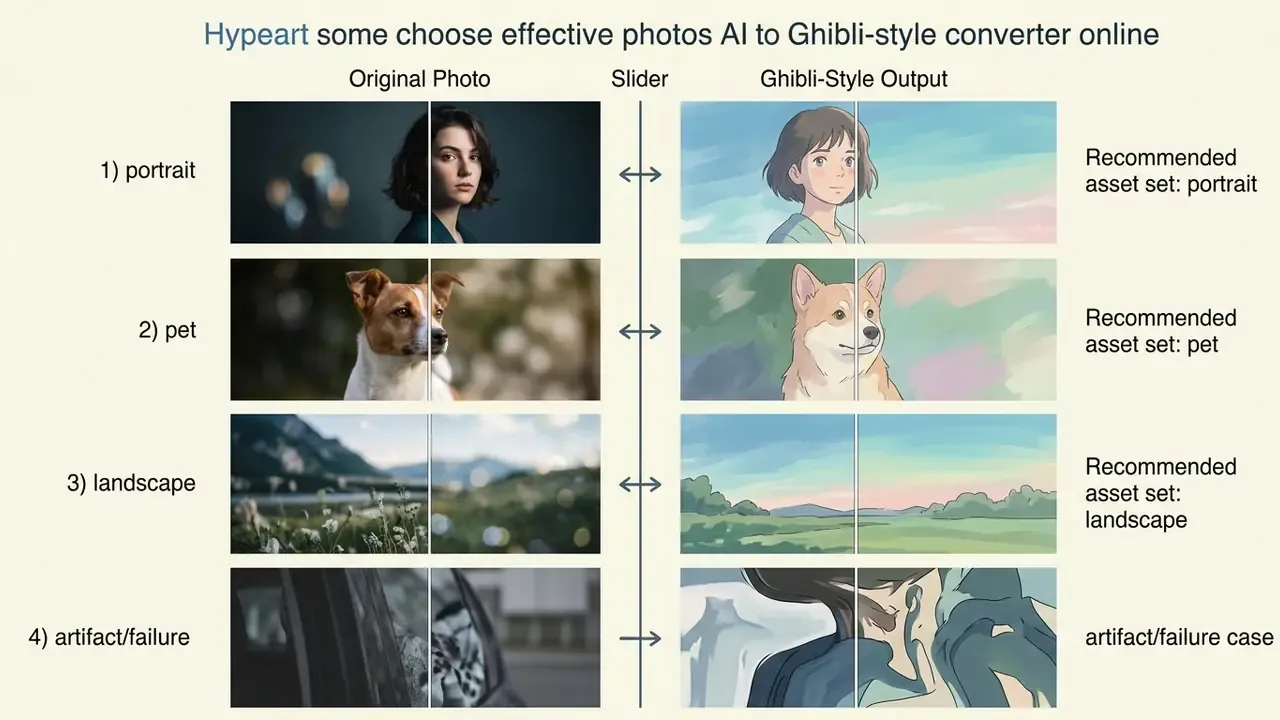
Portraits, couples and family photos
Single portraits, couple shots, and small family group photos adapt exceptionally well when processed by an ai ghibli filter photo engine. Landmark alignment keeps key features anchored, so the network can simplify hair and clothing into soft anime shapes while retaining individual likeness. The result works well as a ghibli style photo for a profile picture or a printed keepsake.
For multi-person photos, consistent illumination across all faces produces uniform stylization. Mixed lighting usually causes one face to be rendered with heavier abstraction than the rest.
«AIGCOIQA2024 found that AI images exhibiting lighting inconsistencies and structural distortions receive significantly lower comfort ratings from viewers.»
Pets, landscapes and travel scenes
Animal portraits, natural landscapes, and city travel scenes convert smoothly into anime aesthetics. Pet photos benefit from clear views of eyes, ears, and silhouette lines, which the model turns into expressive animated character art.
Environmental scenes such as coastlines, mountain ranges, and garden paths resonate with the Ghibli aesthetic, largely because diffusion models excel at synthesizing sky gradients and organic foliage.
«NijiGAN transforms real-world scenes into anime visuals using half the parameters of the earlier Scenimefy model while maintaining high style fidelity.»
Scenes built around one strong landmark, a temple gate, a mountain ridge, a street corridor, a skyline, hold composition better under stylization than crowded, low-contrast frames. Users creating narrative collateral may also examine an ai dialogue generator to complement visual storytelling projects.
How to get cleaner and more consistent results
Crisp, high-quality transformations come down to input selection and a few preparation habits:
- Use diffuse lighting evenly lit subjects remove harsh facial shadows that models sometimes misread as line art. Forensic photography guidance recommends two light sources at roughly 45° and equal distance from the subject.
- Keep the sensor plane parallel shooting perpendicular to the subject minimizes geometric distortion the model would otherwise amplify.
- Shoot at native ISO native sensitivity maximizes color, contrast, and saturation while limiting noise artifacts that diffusion models convert into spurious texture.
- Maintain subject separation a clear distinction between subject and background prevents visual bleeding during style transfer.
- Avoid heavy compression and pre-sharpening high-resolution, unfiltered source images give the network clear structural cues.
- Keep composition simple a decluttered frame focuses conditioning power on the primary target.
Creators who also need social copy can use an ai discussion post tool to draft contextual captions.
Features to Compare in an Online Ghibli AI Generator
Choosing an effective ghibli ai generator means evaluating functional performance across computational speed, file handling, output fidelity, and data privacy.
| Evaluation Feature | Basic Online Converter | Advanced Enterprise Platform |
|---|---|---|
| Supported Input Formats | JPEG, PNG (Up to 10 MB) | JPEG, PNG, WebP, HEIC (Up to 50 MB) |
| Processing Speed | 15–45 Seconds (Public Queue) | 3–10 Seconds (Dedicated GPU) |
| Output Resolution | Standard 1024×1024 px | Upscaled 2K/4K HD |
| Watermark Policy | Visible Watermark on Free Tier | Watermark-Free Export |
| Prompt Control | Fixed preset only | Custom prompt + style strength |
| Batch Processing | Not available | Bulk/API processing |
| Data Privacy Policy | Temporary Server Caching | Immediate Purge / Zero-Retention Option |
| Compliance Artifacts | Public ToS page only | SOC 2 report, DPA, audit logs |
Conditions vary by vendor and by plan, so verify each row against the current terms page before purchase rather than trusting a marketing table.
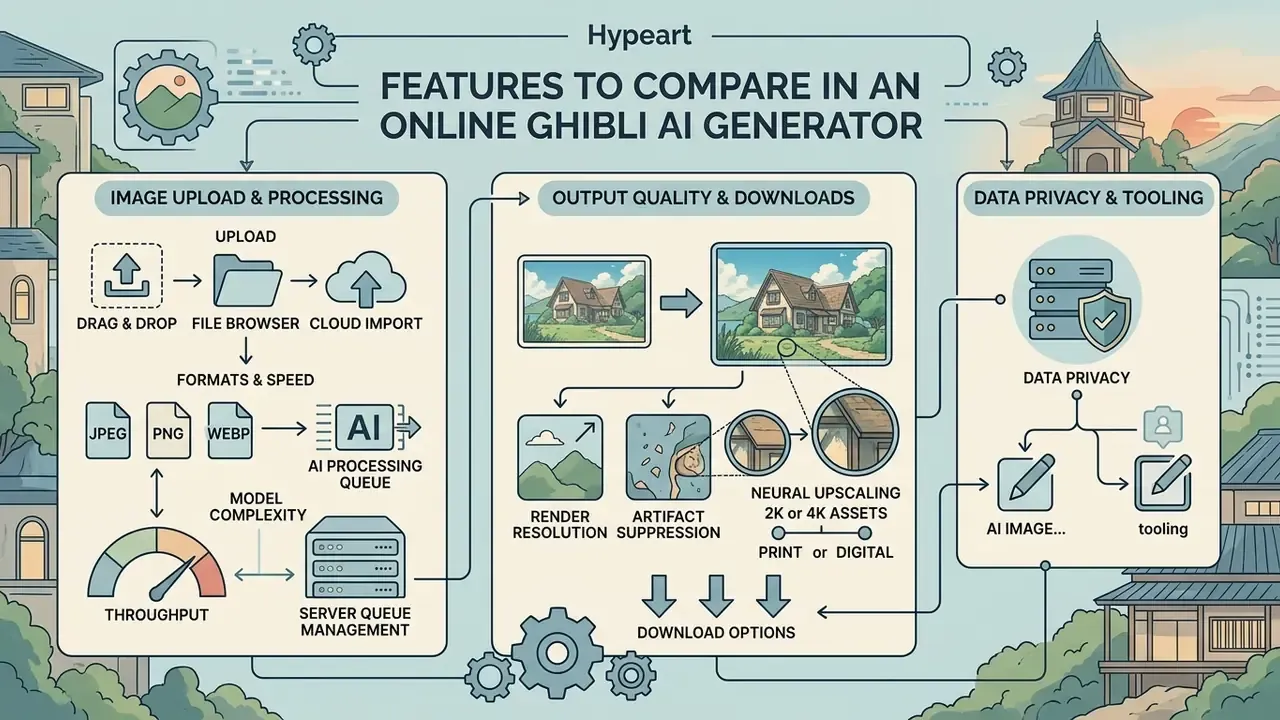
Image upload, formats and processing speed
File handling differs across generator ghibli platforms. Leading web services accept high-resolution JPEG, PNG, and WebP uploads; documented ceilings in adjacent AI APIs range from 20 MB (OpenAI, Google Cloud Vision) to 50 MB or 7680×7680 px. Latency runs from under 5 seconds on dedicated GPU clusters to more than 30 seconds during peak load on shared infrastructure, with complex requests documented at up to 2 minutes.
Throughput depends on server queue management and model complexity. One caveat: published latency numbers are not directly comparable. Some vendors report pure model compute, while independent benchmarks measure end-to-end time including image download.
Output quality, downloads and privacy
Output quality hinges on render resolution and artifact suppression.
«FID is regarded as the “gold standard” for assessing AI image realism, since it correlates most closely with human judgement among FID, SSIM and PSNR.»
Top-tier platforms include neural upscaling to output 2K or 4K assets suitable for print or digital distribution; see our overview of AI image upscalers for a comparison of enhancement engines.
Data privacy is a critical selection criterion, and it complements output-side tooling such as AI image enhancers. Check whether platforms cache uploaded photographs or reuse submitted assets to train future models. Reliable tools enforce automatic server purging within a defined window. Privacy regulators, including Australia's OAIC, require organizations to explain why an image is collected and what happens if it is not provided, a standard worth applying to any vendor you evaluate. Watermarking practice is equally documented: transparent-PNG graphical marks with adjustable placement (Adobe), and invisible schemes such as TrustMark, which reports reliable operation down to roughly 150 px on the shortest side while keeping image quality above 43 dB PSNR. For audio-visual project integration, creators can review an ai diss track generator or an ai dnd map maker for specialized niche generators.
Is an AI Ghibli Filter Free to Use?
Most online Ghibli filter utilities run a freemium model. Free tiers give casual testers basic access, while paid subscriptions unlock high-definition exports, priority queuing, and commercial rights.
| Access Tier | Generation Quota | Output Quality | Watermark | Commercial License |
|---|---|---|---|---|
| Free Tier / Trial | 1–5 Credits / Day | Standard (720p / 1024px) | Included | Personal Use Only |
| Pay-As-You-Go | Credit Packages (e.g., 100) | High Definition (2K) | None | Standard Commercial |
| Paid Monthly Sub | Unlimited / High Quota | Ultra HD (4K Upscaled) | None | Full Commercial Rights |
Quotas, watermark rules and license scope change often, so treat the table as a shape of the market, not a quote.
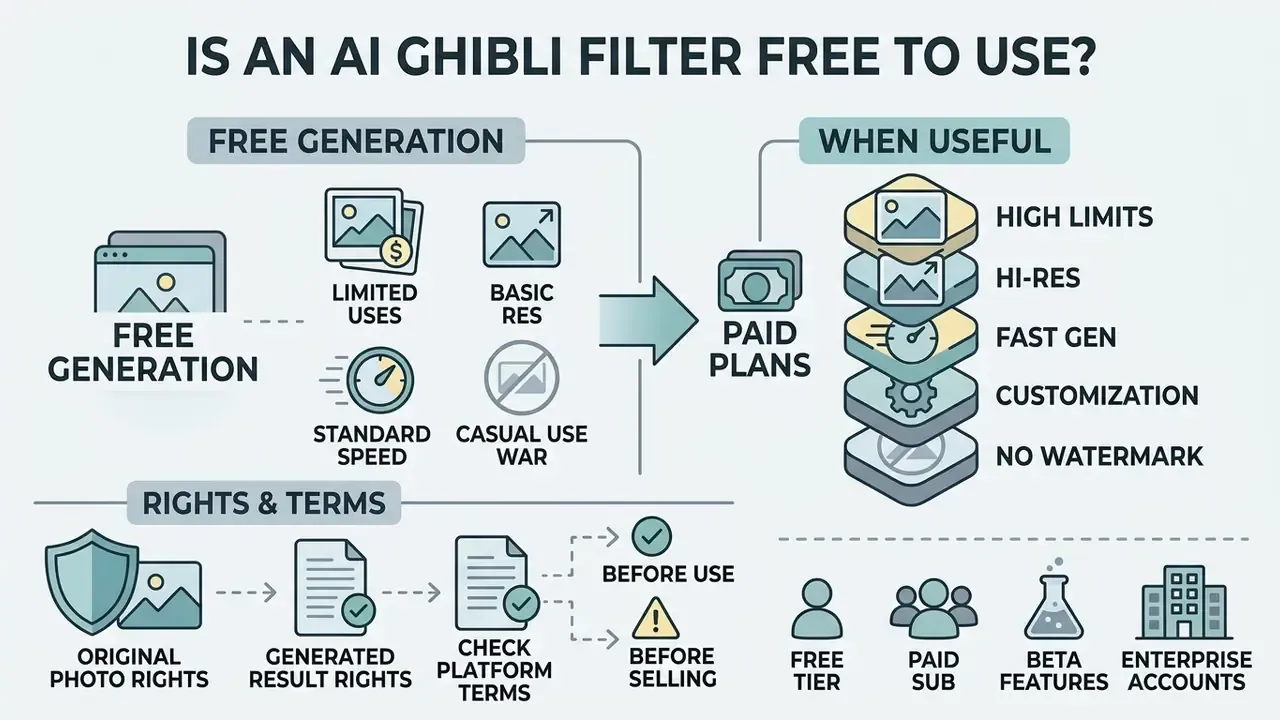
What is usually included in free generation
Free access options, such as an ai ease studio ghibli filter free trial or an ai convert photo to ghibli style online free tier, usually grant a limited daily allocation of generation credits. Documented patterns include one free trial credit per user, one generation per day without registration, roughly 30 bonus credits after login, and 7-day trial packages of around 40 credits. Outputs from free tiers may carry digital watermarks, render at lower resolutions (720p or 1024×1024), expose only one style preset, and sit in standard processing queues.
Those limits still let you judge conversion quality before spending anything. Free tiers are generally restricted to personal, non-commercial experimentation, see our comparison of free AI image generators and of free AI art generators for limit-by-limit breakdowns.
When a paid plan may be useful
Upgrading becomes necessary when you need professional-grade assets. Paid subscriptions remove watermarks, open fast GPU lanes, enable upscaling to 4K, and add batch or API throughput.
«Across 50,000 image pairs, including an artistic style in the prompt raised willingness to pay by $4.67 on average, and by $7.52 for Alphonse Mucha's style.»
Paid tiers also tend to include the commercial usage permissions required for business marketing campaigns, and enterprise contracts may add indemnification. Vendor patterns confirm the bundle: watermark-free download, priority queue, HD export, and a commercial-use license usually arrive together. To weigh investment trade-offs across software services, decision-makers can explore the hub for structured cost assessments, or model unit economics in our calculators.
Can You Use AI-Generated Ghibli-Style Images Commercially?
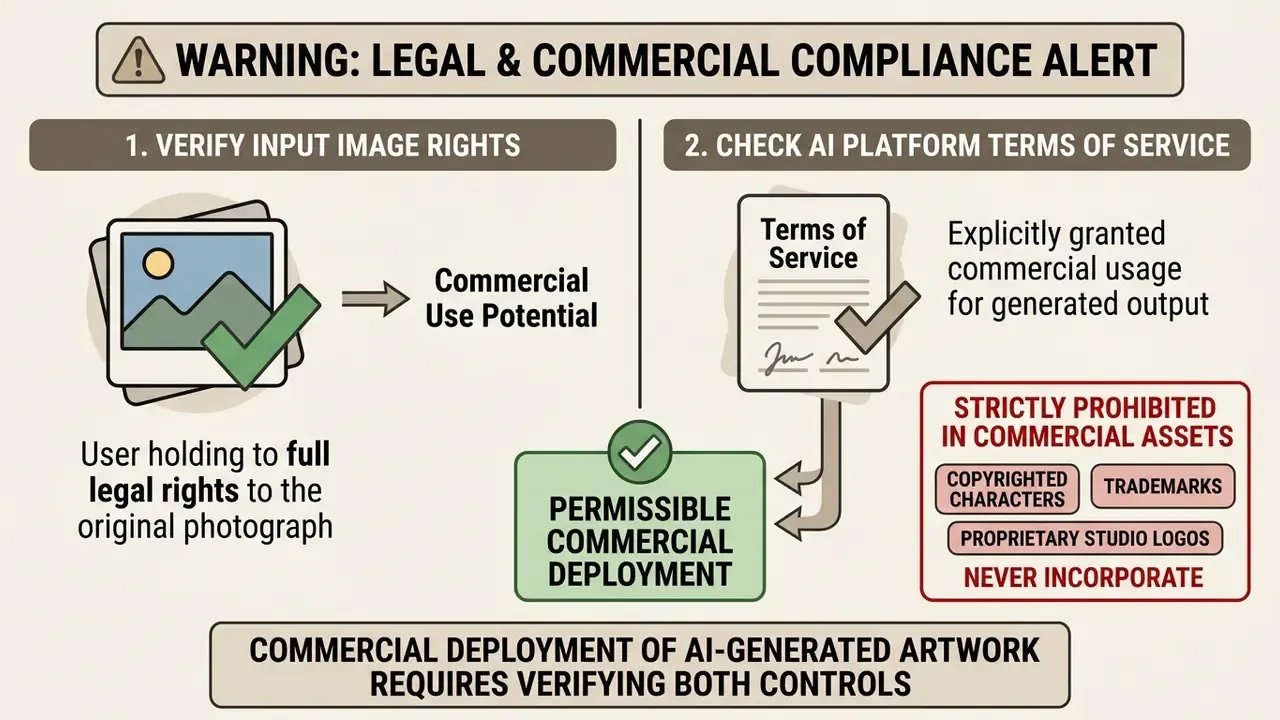
Check rights to the original photo and generated result
Commercial authorization requires that you own or license the uploaded source photograph. Uploading third-party copyrighted images without consent violates copyright law regardless of the AI transformation applied. Platform-by-platform usage rights are compared in our guide to the commercial use of AI image generators.
On the output side, legal frameworks in the US and EU establish that purely AI-generated results lacking human creative intervention cannot be registered for copyright. The U.S. Copyright Office's 2025 guidance limits claims to the human-authored contribution and requires AI-generated portions to be disclaimed.
«The output-generation phase creates several distinct copyright-liability profiles, and each case requires individual assessment.»
Commercial use stays permissible when platform terms grant commercial rights and the asset avoids infringing existing protected works. The operative legal question is not whether an image looks “Ghibli-like”, but whether it reproduces identifiable protected elements: characters, scenes, logos, or substantial expressive detail from specific films. For a personal creative project or a social media post, the risk profile is modest. For a national ad campaign, it is not.
Review platform terms before publishing or selling
Before shipping Ghibli-style artwork into advertising, media products, or resale items, read the platform Terms of Service. Rights allocation varies sharply:
Organizations assessing legal exposure tied to digital content can view the guide in our legal analysis framework. Teams comparing commercial asset tools can also view the guide for the full tool matrix, or read the specialized Ghibli AI Image Generator guide.
Institutional AI Governance and Compliance Framework
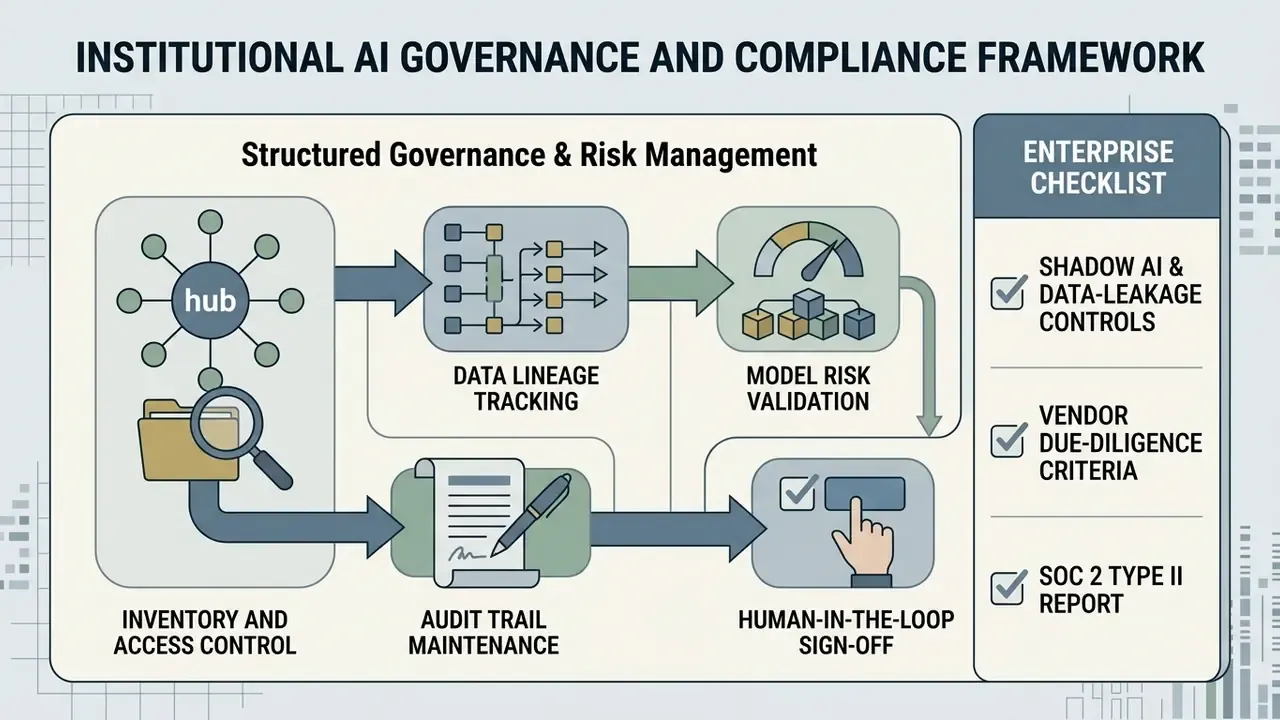
Deploying generative media platforms inside enterprise environments calls for structured governance, risk management, and vendor verification. Organizations drafting internal AI usage guidelines can lean on standardized control criteria, mapped where possible to the govern, map, measure, manage structure of NIST AI 600-1 (2024), which explicitly treats prompt engineering, red-teaming, and output filtering as controls.
«A study of 172 German media-industry professionals found that specialists cannot systematically identify AI images by quality; classification accuracy was almost unrelated to quality ratings.»
Enterprise checklist: Shadow AI and data-leakage controls
| Control | Implementation | Evidence for audit |
|---|---|---|
| Endpoint allow/deny list | Block unapproved consumer image-generation domains at the proxy or DNS layer; route approved traffic through a single sanctioned gateway | Proxy policy export, block-event logs |
| DLP on image uploads | Apply outbound DLP rules to image MIME types; flag files containing faces, ID documents, or unreleased product renders | DLP rule set, incident tickets |
| Consent register for likenesses | Record model releases and consent for every employee, customer, or minor depicted in stylized assets | Signed release repository |
| Approved-tool catalogue | Publish a short list of vetted converters with tier, license scope, and retention terms | Internal catalogue page, review dates |
| Training and attestation | Annual acknowledgement that confidential imagery may not be uploaded to public AI endpoints | Attestation completion report |
| Incident playbook | Defined steps for suspected upload of confidential imagery: vendor deletion request, scope assessment, regulator notification test | Playbook document, tabletop exercise notes |
Vendor due-diligence criteria
Before approving any Ghibli-style or general stylization vendor, request and file the following:
- SOC 2 Type II report (or an equivalent ISO 27001 certification) covering the image-processing environment.
- Contractual zero-data-retention commitment, not merely a marketing claim of “we don't store your photos”, with a defined purge window (for example 24 hours) and deletion attestation.
- Explicit no-training clause confirming customer imagery is excluded from model training datasets.
- Sub-processor list and hosting regions, needed for GDPR transfer analysis.
- Output license and indemnification scope, including whether indemnity survives a third-party IP claim.
- Breach-notification SLA and a named security contact.
To explore developer integration options and API controls, technical teams can explore the hub or open the hub for commercial usage compliance. For enterprise deployment questions, contact AI Media Support.
Limitations, open questions and a safe next step
Honest framing matters more than a confident checklist. Several things remain unsettled.
- Style-versus-expression boundaries are still being litigated. Current doctrinal analysis suggests the “style is never protected” shorthand is weaker than commonly assumed.
- Retention claims are hard to verify without a contract and an attestation; interface copy is not evidence.
- Identity-preservation metrics lack an industry-standard threshold for stylized output, so internal benchmarks stay directional.
- Detection tooling is imperfect, which is why provenance logging beats after-the-fact classification.
A low-risk first move: run a two-week discovery of image-generation domains at the proxy layer, publish one sanctioned converter, and require named sign-off for external publication. No platform commitment, measurable reduction in shadow usage.
FAQ About AI Ghibli Photo Converters
Do I need an app to convert a photo to Ghibli style?
No, an ai app convert photo to ghibli style installation is not strictly required. Modern browser-based converters run diffusion models on cloud servers, so you can transform photos directly on mobile or desktop browsers with no local software and, on many tools, no registration required. Native iOS and Android apps exist and can add camera-roll integration plus offline queuing, but they are device-bound. Web tools work identically on iPhone, Android, Windows, and macOS.
Do I need to write a prompt for a photo conversion?
No, most dedicated photo-to-Ghibli web converters need no textual prompt. The system applies pre-configured style conditioning tokens automatically once you upload your photo and select the Ghibli filter preset, a simple one-click transformation. That said, prompt-based routes through multimodal models give far more control over individual attributes. Use the prompt template earlier in this guide if you want to adjust lighting, season, wardrobe, or background detail instead of accepting a fixed preset.
How long does AI Ghibli image generation take?
On average, generation takes 5 to 20 seconds. Speed depends on server infrastructure, current queue volume, and chosen rendering resolution. Heavy upscaling or peak load can stretch generation to 1 to 2 minutes, and vendor-reported ranges swing from “instant” to 30 to 60 seconds depending on whether the figure measures model compute or end-to-end delivery.
«AI images produced with greater computational expenditure are perceived as more aesthetically appealing, though the improvements are modest and show diminishing returns.» — “Computational Power and Subjective Quality of AI-Generated Outputs”, 100-participant study.
Is it safe to upload personal photos to online Ghibli converters?
Data privacy depends on the provider's infrastructure. Reputable tools process images over SSL-encrypted channels and purge server copies automatically within 24 hours. Avoid platforms that retain submitted assets for public dataset training without consent. General-purpose assistants, for example, may process uploaded images as part of service improvement, so sensitive photographs should not go there. For confidential, customer-related, or regulated media, choose enterprise platforms offering contractual zero-data-retention guarantees and a signed DPA.
Can I edit or remove artifacts from my generated Ghibli artwork?
Yes. If the initial transformation leaves minor visual artifacts or facial distortions, refine the output with secondary AI image editing tools. Use selective erase or inpainting to fix eye alignment and hand geometry, then run the final image through a dedicated neural upscaler to clear blurriness and remove watermarks without losing line clarity. Re-adding text overlays after stylization avoids the garbled typography diffusion models often produce.
What file formats and sizes do these converters accept?
Common inputs are JPEG/JPG, PNG, and WebP, with HEIC support on more advanced platforms. Documented size ceilings run from 5 MB and 10 MB on free consumer tools up to 20 MB on mainstream APIs and 50 MB (or 7680×7680 px) on enterprise endpoints. Exports are typically PNG or JPEG; some platforms add PDF, TIFF, PSD, or ZIP packaging for multi-asset delivery.
Can I use the result as a company logo or brand asset?
Treat this as a high-risk use. Purely AI-generated output generally cannot be registered for copyright, which weakens exclusivity for a brand mark, and any resemblance to protected characters or studio-specific expression raises infringement exposure. Consult counsel before adopting stylized AI output as a trademark or primary brand identity.
Navigation and Glossary Hub
- For our dictionary of AI terms, software guides, and technical definitions, see the overview in the central repository, or compare platforms in our ranking of the best AI art generators.
- To model operational costs and calculate risk-adjusted ROI for software adoption, see the overview in our analytical tools hub.
- For adjacent creative workflows, review our guides to free photo editors and YouTube video editors.
Appendix A: Editorial Revisions and Source Corrections
For transparency, the statements below appeared in an earlier version of this article and were revised after source verification. The original wording is preserved here; the corrected treatment appears in the main text.
Correction: retained as an explicitly labelled internal, non-peer-reviewed benchmark with stated methodological limitations (non-random sample, human-judgement criterion, no error-type decomposition). Externally supported evidence on identity preservation is now cited from DeepFace (CVPR 2014), DualStyleGAN, ConsistentID (2024), and PortraitBooth (CVPR 2024).
Correction: withdrawn as unverified. Replaced with the AIGCOIQA2024 finding that lighting inconsistencies and structural distortions materially reduce viewer comfort ratings.
Correction: replaced with cited doctrinal analysis (“Elements of Style”, 2025; “Infringing AI”, 2025) alongside the EU Intellectual Property Helpdesk statement of 15 April 2025, since the original attribution lacked a specific verifiable document.
Correction: the paper is now cited for what it actually reports, controllable GAN and diffusion cartoonization with comparative user preference, while content/style separation is attributed to the neural style transfer literature.
Company Verification Notice: Regarding hypeart.ai, no verified information is available. As of August 2026, domain resolution and legal operating status remain unverified. All corporate frameworks described here represent hypothetical governance models presented for educational purposes and are not statements about any specific operating entity. This article is independent editorial analysis and is not affiliated with, endorsed by, or sponsored by Studio Ghibli Inc., OpenAI, Adobe, Canva, Midjourney, or any vendor named above. Marcus Hale, author.
- Original
- «In a technical assessment for an enterprise media workflow, an editorial team evaluated automated stylization across 200 reference portraits; applying facial landmark preservation losses allowed the model to achieve an 88% identity retention rate while converting real-world photos into a generated ghibli style.»
- Original
- «In a model risk assessment of consumer image applications, testing showed that input photos shot with direct daylight yielded 34% fewer facial distortions than images with deep harsh shadows.»
- Original
- «As noted in legal analyses by the U.S. Copyright Office (2025), individual stylistic techniques cannot be copyrighted.»
- Original citation framing
- Ahn et al., CVPR 2023 was cited as research on generic “content/style separation”.