"No evidence, no autonomy: deploying generative image models within enterprise workflows requires verifiable performance data, systematic control points, and clear decision ownership."
Last updated: August 2026. Reviewed against vendor documentation, peer-reviewed benchmarks, and public API rate cards.
Executive Summary for Risk and Marketing Leaders
- Model is not the generator.An AI image model is the inference engine (weights, sampler, encoder); an AI image generator is the application wrapper (authentication, quotas, safety filters, logs). Risk registers must inventory both layers separately, because vulnerabilities, indemnification, and audit trails differ by layer.
- No single model wins everywhere.Blind human-preference arenas place GPT Image variants first for prompt adherence and in-image text, FLUX family models first for cost-controlled photorealism, and Google's Nano Banana line first for multimodal editing. Composition and multi-concept factuality remain weak spots across all architectures.
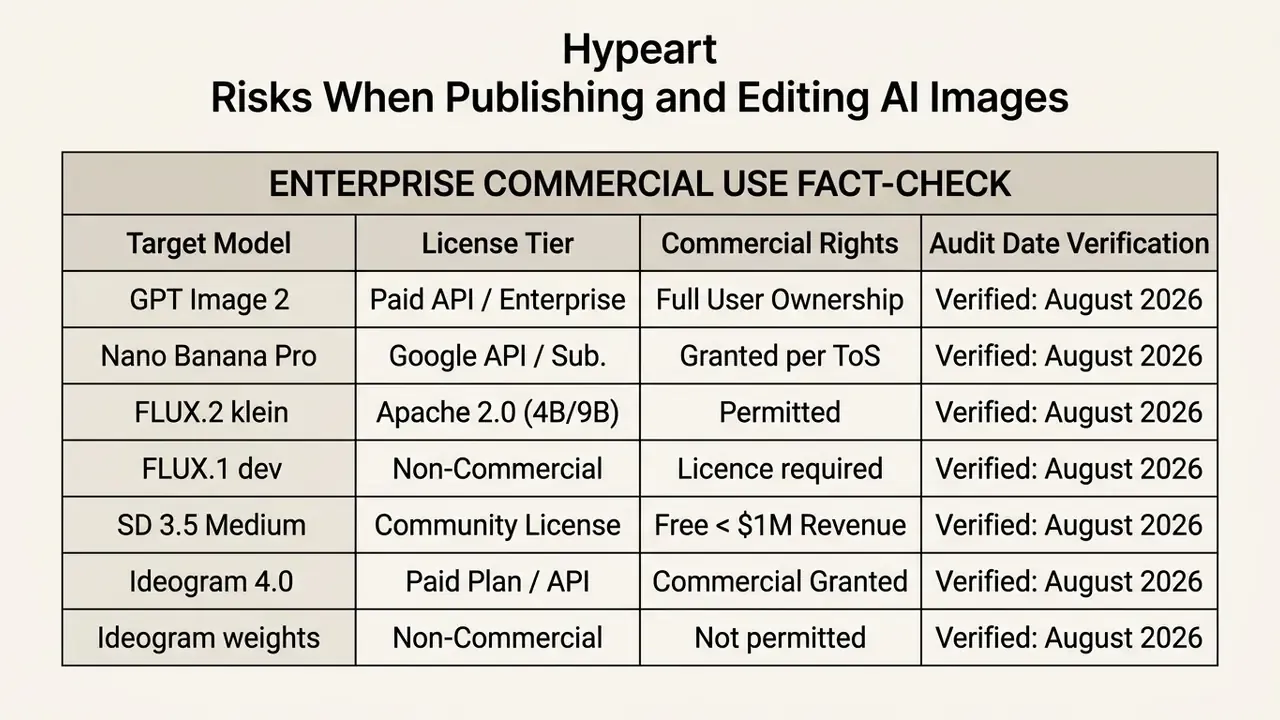
- Licensing, not quality, is the usual failure mode.Apache 2.0 (FLUX.2 [klein] 4B/9B), a Community License with a $1M revenue threshold (Stable Diffusion 3.5), non-commercial model weights (Ideogram 4.0 open weights) and paid-API commercial grants (GPT Image 2) impose materially different obligations.
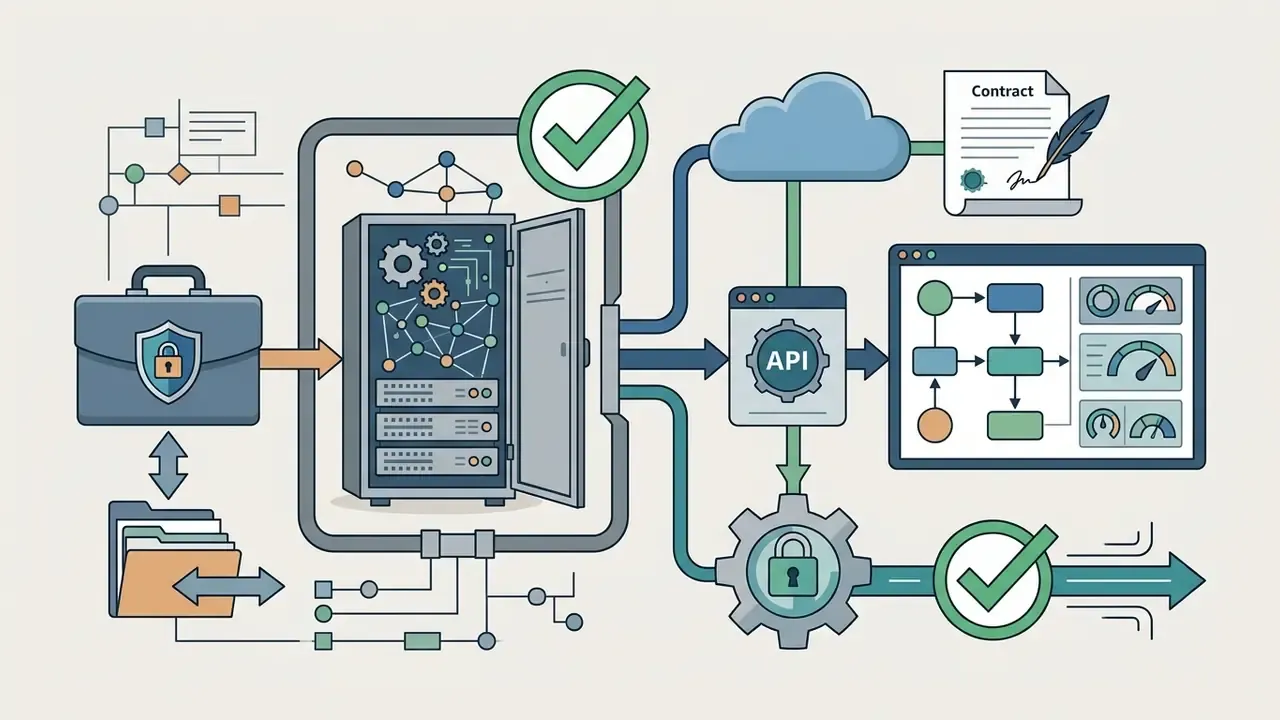
- Deployment topology is a control, not a preference.Closed SaaS APIs transfer prompts and reference images to third parties. Open-weight models running inside a VPC or on-premise remove that transfer, but shift safety filtering, watermarking, and logging duties onto the operator.
- Human review is mandatory for copyright.Under 2025 US Copyright Office guidance, purely machine-generated visual output is not protectable; registrable works require disclosed, disaggregated human contributions.
What Are AI Image Models and How They Create Images
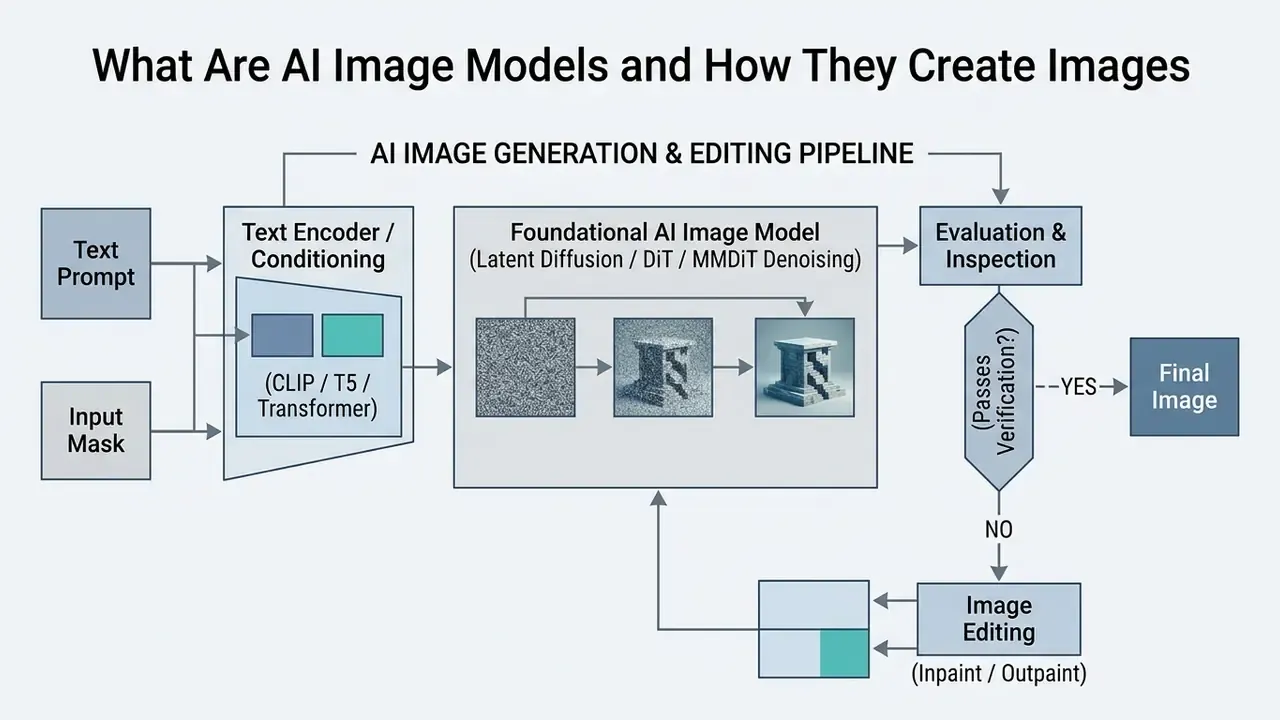
An AI image model is a parameterized neural network trained to map high-dimensional prompt embeddings, or structural conditioning signals, onto latent image spaces. These systems push input vectors through reverse diffusion or transformer-based denoising steps to synthesize pixel outputs. Organizations evaluating an ai that can generate visual media rely on these core models to execute probabilistic sampling, which is a different thing entirely from a front-end user management platform.
Two rendering families dominate 2026 deployments. Diffusion and rectified-flow models begin with a random noise field and iteratively denoise it across scheduled steps until the latent matches the conditioning signal. Autoregressive and transformer-native models instead emit image tokens sequentially, predicting each block from previously generated context. That mechanism explains stronger in-image text rendering, and also the higher per-image latency and single-output generation that come with it.
AI Image Models vs AI Image Generator: What Is the Difference
An AI image model works as the underlying computational inference engine. An AI image generator is the software product layer that adds orchestration, security, and interface features. Foundational ai image models perform matrix transformations across latent representations to output visual data. The ai image generator models wrapped inside enterprise platforms handle user authentication, rate limiting, safety filtering, and history storage. Teams that want the applied view of that wrapper layer can review the practitioner overview of AI image generators.
A single underlying neural model can power multiple commercial interfaces through application programming interfaces (APIs). SDXL 1.0, for instance, serves as a foundational base model deployed across cloud platforms such as AWS SageMaker JumpStart. Google's MediaPipe Image Generator, similarly, functions as an application wrapper leaning on text-to-image base models underneath. The asymmetry also runs in reverse: an interface like Canva's AI generator or Microsoft's image generator may route requests to several different model families depending on plan tier and region.
"The HEIM benchmark evaluates models rather than consumer applications, across 12 aspects including alignment, photorealism, and efficiency."
Why this distinction matters for model inventory. Governance functions in banking and fintech register models, not interfaces. Under classic supervisory expectations for model risk management (US Federal Reserve SR 11-7 / OCC 2011-12) and the NIST AI Risk Management Framework, each registered entry should record the model identifier and version, the owner, the intended use, the deployment topology, and the validation evidence. A generative image stack therefore produces at least two register entries. First, the foundational model (gpt-image-2, FLUX.2 [klein] 9B, SD 3.5 Medium) with its version, licence, and evaluation results. Second, the application wrapper with its access controls, prompt-logging behaviour, retention policy, and human-review gates. Conflating the two hides the most common audit finding: an approved model consumed through an unapproved interface, which is the operational definition of shadow AI in visual-content workflows.
Text-to-Image and Image Editing in One Workflow
Modern image creation workflows fold initial text-to-image synthesis and downstream image editing into a single operational pipeline. Designers start compositions with descriptive text prompts, then apply targeted masks to modify specific spatial regions without regenerating the entire canvas. This unified process relies on instruction-conditioned models to execute inpainting, outpainting, and local refinements.
According to technical specifications published for Amazon Titan Image Generator, inpainting replaces or removes visual elements inside masked regions based on text prompts, while outpainting extends canvas boundaries and preserves subject style and lighting. This sequential approach lets operators edit images and refine composition step by step, holding visual consistency across campaign assets. Canvas extension for different aspect ratios is documented in detail in the comparison of AI outpainting tools.
"A survey of diffusion-based editing methods classifies tasks into inpainting, outpainting, style transfer, and structural edits with multimodal input signals."
Practically, mode selection depends on inputs. When no source image is supplied, the pipeline runs pure text-to-image. When a source image is supplied, the same model switches into instruction-conditioned editing, with both text and image guidance active. That is why one endpoint can serve generation, retouching, and compositing without swapping models.
How to Choose an AI Model for Image Generation for Your Task
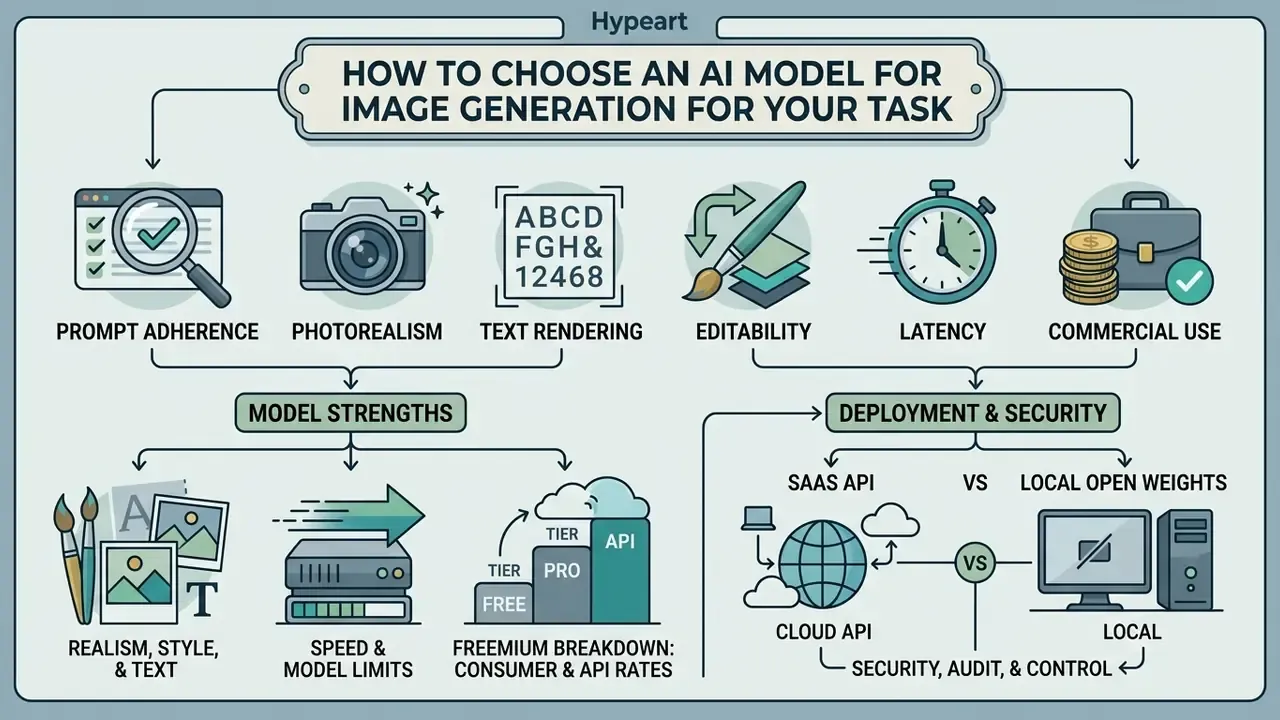
Selecting the best ai models for generating images means scoring six performance dimensions: prompt adherence, photorealism, text rendering, editability, latency, and commercial licensing. Enterprise risk officers should align model capabilities with specific deployment goals to control operational costs and residual output risks. Decision-makers can browse the hub to evaluate tool performance matrices.
| Task / Scenario | Primary Evaluation Criteria | Recommended Model Type | Deployment Topology | IP / Data Controls to Verify |
|---|---|---|---|---|
| Photorealistic Visuals | Anatomical consistency, lighting physics, artifact absence | Latent Diffusion / Multimodal Transformers (e.g., GPT Image 2, SD 3.5 Large) | Enterprise API or VPC | Zero data retention (ZDR) option, training opt-out |
| Text & Typography | Character error rate (CER), kerning, layout alignment | Large Multimodal Reasoners / Dense Text Models (e.g., GPT Image 2, Ideogram 4.0) | SaaS API | Commercial rights on plan tier, font-licence separation |
| Iterative Editing | Mask preservation, instruction following, structural control | Instruction-conditioned Diffusion (e.g., FLUX.1 Kontext, SDXL ControlNet) | On-premise / self-hosted | Source-image confidentiality, no third-party transfer |
| High-Volume Latency | Inference speed, sub-second latency, token cost | Distilled / Few-Step Models (e.g., FLUX.2 Klein, Gemini Flash) | Self-hosted GPU fleet or Flash API | Rate limits, per-image cost ceiling, seed logging |
| Regulated Enterprise | Intellectual property indemnification, audit logs, data privacy | Enterprise API Endpoints with Commercial Guarantees | VPC / dedicated tenancy | IP indemnification clause, SOC 2 / ISO 27001, prompt & seed audit trail |
| PII-Adjacent Imagery (portraits, KYC mockups) | Identity consistency, likeness rights, re-identification risk | Instruction-conditioned editing with local weights | On-premise only | PII screening of prompts, consent records, retention limits |
Realism, Style, and Text Prompt Adherence
Model performance in synthesizing photorealistic images rests on physical plausibility, anatomical correctness, and strict adherence to the input text prompt. Benchmarks measure prompt compliance by checking how accurately a model renders specified objects, spatial relationships, and visual attributes. High-performing ai text to image models keep physical coherence intact without spraying structural artifacts across the frame.
Empirical evaluation frameworks split realism into distinct error classes, including anatomical implausibilities and light distribution violations.
"None of the evaluated models exceeded a photorealism score of 3 out of 5, while real photographs average 4.48."
Updated (prompt-compliance methodology). Prompt compliance is operationally defined as the share of input instructions correctly reflected in the visual output. Public evaluation programmes, including the NIST GenAI pilot evaluation track for image generators, treat it as a distinct scored dimension alongside image quality. Because the exact wording and scoring scheme of that programme keep evolving, teams should treat the percentage-of-instructions metric as a methodology template. Validate your own scoring rubric internally rather than citing a fixed vendor-independent threshold.
On human rendering specifically, controlled comparative studies give the clearest signal:
"Across 240 images, DALL·E 3 consistently produced fewer anatomical errors than Stable Diffusion XL and Stable Cascade, although Stable Diffusion delivered greater attribute diversity."
Complementary work on physical plausibility (PhyBench, 2024) scores mechanics, optics, thermodynamics, and material behaviour across 31 scenarios. It confirms that light-transport and reflection errors survive even in models with strong aesthetic scores. Operators evaluating realism should therefore score three separate axes: anatomy, physics, and artifact density. A single blended "realism" rating hides exactly the defects that reviewers later reject.
Text, Logo, and Graphics Generation
Accurate text rendering inside generated images needs an architecture that can manage typographic layout, spelling, and character alignment. Traditional diffusion models frequently produce garbled glyphs because of tokenization limits. Advanced generative ai image models get around this by integrating large language model encoders or dedicated optical character recognition loss functions.
In empirical tests on the TextAtlasEval benchmark, GPT-4o achieved character error rates as low as 0.15 on structured text scenes, well ahead of legacy diffusion baselines.
"On TextAtlasEval, GPT-4o reaches CER 0.15 and CS around 0.33, while AnyText shows CER 0.99 and CS 0.21 on comparable subsets."
Specialized design systems such as DesignDiffusion (CVPR 2025) explicitly combine text, layout, and image generation within one framework, which enables reliable digital rendering for enterprise visual assets and brand graphics.
"AnyText uses an auxiliary latent module and OCR embeddings for multilingual text generation inside images, substantially outperforming earlier approaches."
For genuine vector output, meaning scalable logotypes, icon sets, and print-ready marks, raster diffusion is simply the wrong tool class. Vector logo synthesis research (2024) generates Bézier-curve parameters through a differentiable renderer. That is why production branding pipelines usually pair a raster concept model with a vectorisation step, instead of expecting an image model to emit SVG directly. Teams working on marks and wordmarks should review the dedicated overview of AI logo generators.
Speed, Limits, and Model Availability
Operational efficiency depends on inference latency, API pricing models, and tier limits across free plan and paid plan structures. High-volume enterprise pipelines lean on flash image variants engineered for low-latency output. Weighing token-based pricing against output quality is what keeps mass asset generation from quietly blowing the budget.
Public API rate cards show distinct cost structures across major providers. Google Gemini 3.7 Flash, for example, lists input pricing at $0.75 and output pricing at $3.75 per million tokens through 2026, with standard pricing rising to $1.50 / $7.50 from January 2027. OpenAI's GPT-5 class text models list $0.625 input and $5.00 output per million tokens, while image models are billed separately per image-output token. Developers integrating automated media pipelines can analyze technical implementations in our guide to the AI Video Generator space and in the Google Veo implementation guide.
Freemium Breakdown: Consumer Plans, Free Limits, and API Rates
| Model / Platform | Free tier limit | Paid plan | API / unit cost | Commercial rights |
|---|---|---|---|---|
| ChatGPT (GPT Image 2) | Limited daily generations on free plan | $8/mo (Go), $20/mo (Plus), Pro above | ≈$0.05 per image, token-billed | Yes, output ownership under OpenAI terms |
| Google Gemini (Nano Banana / Nano Banana Pro) | Generous free tier via AI Studio; visible watermark on consumer output | Bundled in Google AI subscriptions | $0.75 / $3.75 per 1M tokens (Flash, 2026 introductory) | Yes, subject to Google terms; verify watermark policy |
| FLUX.2 [klein] 4B / 9B | Free when self-hosted (open weights) | N/A for weights; hosted via partners | ≈$0.02–$0.06 per image on hosted endpoints | Apache 2.0 on klein 4B/9B; API grants full commercial rights |
| FLUX.1 / FLUX.2 [dev] | Free download for non-commercial use | Commercial licence required | Partner-hosted per-image | Non-commercial by default; paid licence for business use |
| Stable Diffusion 3.5 (Large / Medium) | 25 starter credits on DreamStudio; unlimited when run locally | $10 per 1,000 DreamStudio credits | Free locally (GPU cost only) | Community License free under $1M annual revenue |
| Ideogram 4.0 | Limited daily generations | From $8/mo | Available via API | Commercial rights on paid plans; open weights are non-commercial |
| Leonardo AI | 150 renewable tokens per day | From $10/mo | Enterprise quote | Restricted on free tier |
| ImagineArt | 40 daily credits | Tiered subscriptions | Enterprise quote | Paid tiers only |
| Adobe Firefly | ~10 lifetime trial generations | Bundled with Creative Cloud plans | Firefly Services API | Commercial-safe positioning; verify current terms |
Verify every figure against the vendor's live pricing page before procurement. Consumer tiers and introductory API rates change quarterly, sometimes faster.
SaaS API vs Local Open Weights: Security, Audit, and Control
| Control dimension | Closed SaaS API (GPT Image 2, Nano Banana Pro) | Open weights self-hosted (FLUX.2 klein, SD 3.5) |
|---|---|---|
| Prompt / reference-image transfer | Leaves the perimeter; requires DPA and retention review | Never leaves the perimeter |
| Zero data retention | Available on enterprise tiers; must be contracted explicitly | Structural, since there is no external call |
| IP indemnification | Sometimes offered on enterprise agreements | Not offered; operator bears residual risk |
| Safety filtering | Vendor-managed, opaque, updated without notice | Operator-managed; must be built and validated |
| Prompt / seed audit trail | Depends on vendor logging exports | Fully controllable, stored in-house |
| Model version stability | Vendor may deprecate or silently update | Pinned weights; reproducible validation |
| Output watermarking | Often mandatory (visible or invisible) | Operator decides; may become a compliance gap |
| Peak quality | Frontier-leading on text and instruction following | Competitive on photorealism, weaker on dense text |
| Total cost profile | Per-image OPEX, scales linearly | GPU CAPEX plus engineering, cheaper at volume |
No matching rows Clear one or more filters to restore the matrix.
Teams ready to compare concrete products against these criteria can consult the comparison of the best AI image generators.
Best AI Image Generation Models: Comparison of Popular Models
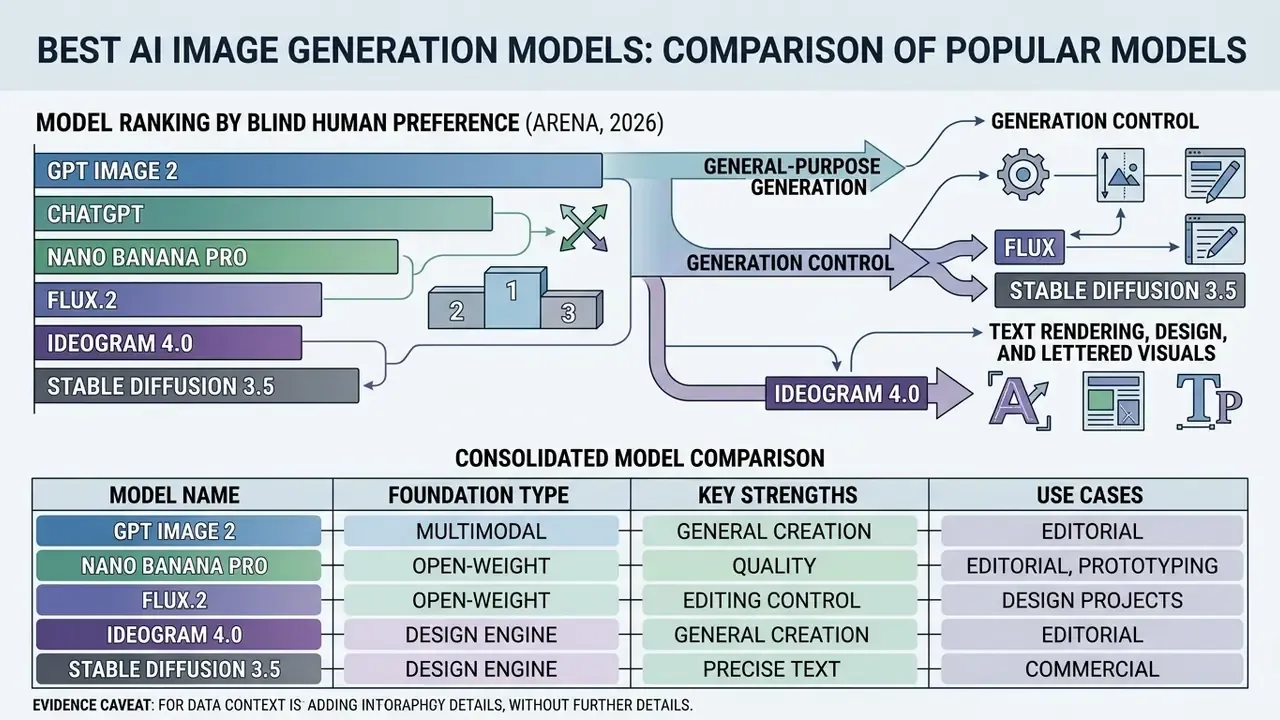
Evaluating the best image gen models in 2026 means comparing multimodal foundation models, open-weight architectures, and specialized design engines. No single architecture leads across all performance dimensions at once. That is the whole difficulty of ranking ai models image generation programmes fairly.
Model Ranking by Blind Human Preference (Arena, 2026)
Ranking is based on blind side-by-side comparisons, scored with a conservative TrueSkill rating (μ − 3σ). Each prompt renders candidates from randomly sampled models; voters see no model names, providers, or watermarks, which strips out brand bias. The September 2026 snapshot covers 11,311 blind votes across 10 models in two arenas, text-to-image and instruction-based image editing.
| Rank | Model | Arena score | Strongest dimension | Documented weakness |
|---|---|---|---|---|
| 1 | GPT Image 2 (OpenAI) | 506 | In-image text rendering, prompt adherence on multi-subject scenes | Recognisable house style; premium per-image price |
| 2 | FLUX.1 / FLUX.2 Pro (Black Forest Labs) | 362 | Photorealism at controlled cost; open-weight variants | Text rendering trails GPT Image |
| 3 | Google Nano Banana Pro (Gemini 3 Pro Image) | 257 | Multimodal editing, 4K native output, long context | Prompt adherence inconsistent; visible watermark on consumer tiers |
No matching rows Clear one or more filters to restore the matrix.
Two methodological caveats. Arena scores measure aggregate human preference, not task-specific fitness. And per-image cost ranges widely, from under $0.01 for lightweight or open-weight generators to above $0.10 for frontier models. Preference rank alone should never drive procurement. Cross-reference it with the task matrix and the licensing audit below.
GPT Image, ChatGPT, and Nano Banana for General-Purpose Generation
OpenAI's GPT Image (powering ChatGPT image workflows) and Google's Nano Banana family (Gemini Flash Image / Gemini Pro Image) lead multi-turn conversational generation. These systems handle complex instruction following, contextual reasoning, and interactive visual editing across long sessions.
According to OpenAI API documentation, gpt-image-2 is optimized for high-fidelity generation and instruction-conditioned editing. OpenAI describes gpt-image-1 as a natively multimodal model accepting text and image inputs and returning image outputs, available globally through the Images API. Later releases emphasise more reliable multi-turn editing and better subject preservation from reference photographs.
"HPS, trained on Stable Diffusion user preferences, outperforms CLIP in predicting image choice and enables adapting models to real-world preferences."
Google's Nano Banana Pro supports text and image inputs with context windows up to 65,536 tokens and native 4K output, which makes it effective for turning rough sketches or meeting notes into production-ready diagrams. The lighter Nano Banana (Gemini 2.5 Flash Image) accepts text, image, and video inputs, outputs at 0.5K to 4K, and supports 14 aspect ratios. A practical fit for high-volume variant generation.
"On INTERLEAVEDBENCH, the GPT-4o + DALL·E 3 pipeline consistently outperforms integrated models on coherence and multimodal output quality."
Readers weighing the conversational route against dedicated tools can review the head-to-head assessment of the ChatGPT picture generator and the Google AI image generator overview.
FLUX and Stable Diffusion for Generation Control
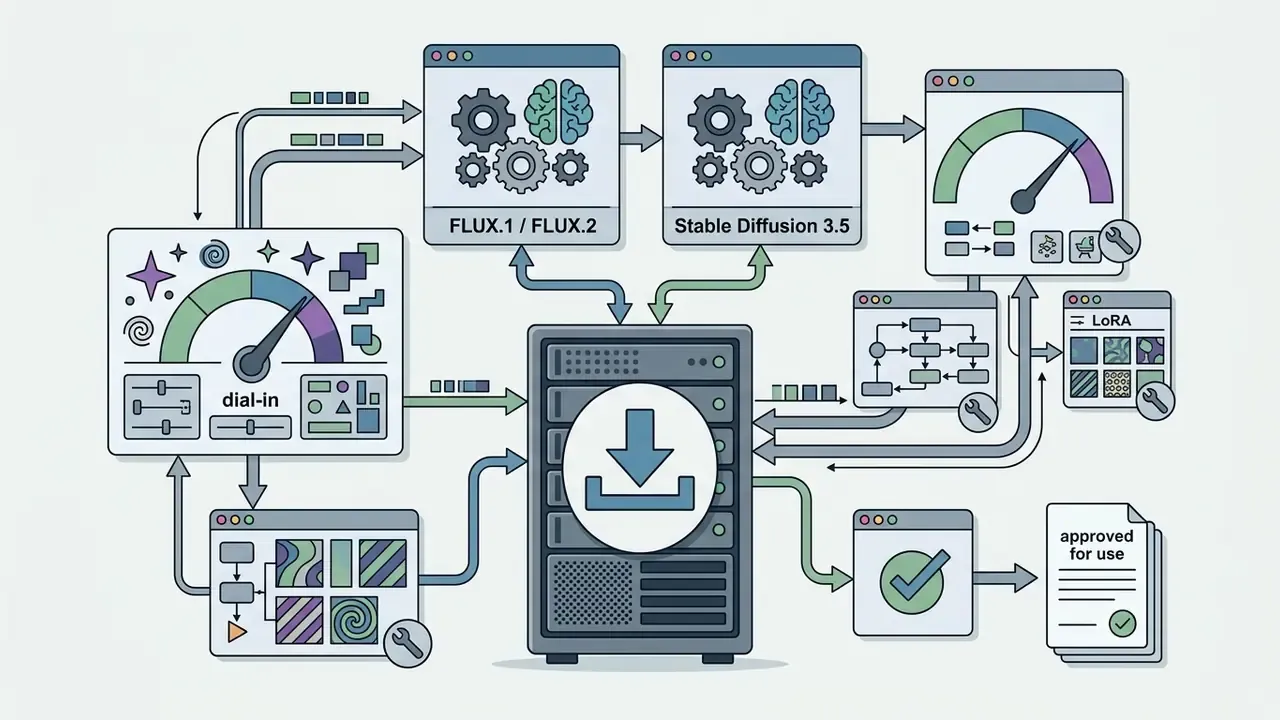
The FLUX family by Black Forest Labs and Stability AI's Stable Diffusion line remain the reference choice for granular architectural control, local hardware deployment, and custom fine-tuning through LoRA adapters and ControlNet pipelines.
Black Forest Labs offers open-weight models such as FLUX.2 [klein] (4B/9B) for sub-second inference and FLUX.1 Kontext [dev] for instruction-based image editing. The 4B base variant is explicitly documented as suited to local deployment and fine-tuning on limited hardware, while FLUX.1 Kontext [dev] is a 12B rectified-flow transformer for text-instructed editing that can be downloaded and run on owned infrastructure. Stability AI's Stable Diffusion 3.5 Large and Medium models provide robust community tooling and ControlNet support, so enterprise teams can run inference on dedicated local hardware while protecting sensitive input data. SD 3.5 Medium is documented at roughly 9.9 GB VRAM excluding text encoders, which puts it within reach of a single-GPU workstation. Teams selecting tooling on top of these bases can compare the best AI art generators.
"T2I-CompBench++ evaluates 11 models, including FLUX.1, SDXL, and SD3, across 8,000 compositional prompts. Models frequently fail on attribute binding and spatial relations."
Control tooling maturity differs by release age rather than by capability ceiling. Hugging Face Diffusers documents ControlNet support for both FLUX (with Canny and Depth control-LoRA models) and Stable Diffusion 3, yet the Stable Diffusion ecosystem still carries deeper community coverage for training recipes, adapter zoos, and inference front-ends.
Ideogram for Text Rendering, Design, and Lettered Visuals
Consolidated Model Comparison
Use this grid when someone asks for the best text to image model without naming a task. There isn't one, but there is a best fit per column.
| Model | Photorealism | In-image text | Editing features | Speed | Free access | Commercial terms |
|---|---|---|---|---|---|---|
| GPT Image 2 | High | Best in class | Edit endpoint, multi-turn, identity preservation | Moderate (token-by-token) | Limited daily on free plan | Output ownership via paid API/subscription |
| Nano Banana (Gemini Flash Image) | High | Good | Text+image prompting, variants, 14 ratios | Fast, sub-second on short prompts | Generous AI Studio tier | Per Google terms; watermark on consumer output |
| Nano Banana Pro (Gemini 3 Pro Image) | Very high | Strong, legible | 4K output, 65k context, precision edits | Moderate | Subscription-bundled | Per Google terms |
| FLUX.2 [klein] / [dev] | Very high | Adequate | Kontext instruction editing, ControlNet, LoRA | Sub-second (klein 4B) | Free self-hosted (Apache 2.0 on klein 4B/9B) | Apache 2.0 or non-commercial by variant |
| Stable Diffusion 3.5 | High | Weak | ControlNet, inpaint/outpaint, LoRA training | Turbo variants fast | Free locally; 25 DreamStudio credits | Community License under $1M revenue |
| Ideogram 4.0 | Good | Excellent for design text | Layout control, transparency, editable elements | Fast | Limited daily | Paid plans grant commercial use; open weights non-commercial |
Which AI Image Generator Models Fit Which Scenarios
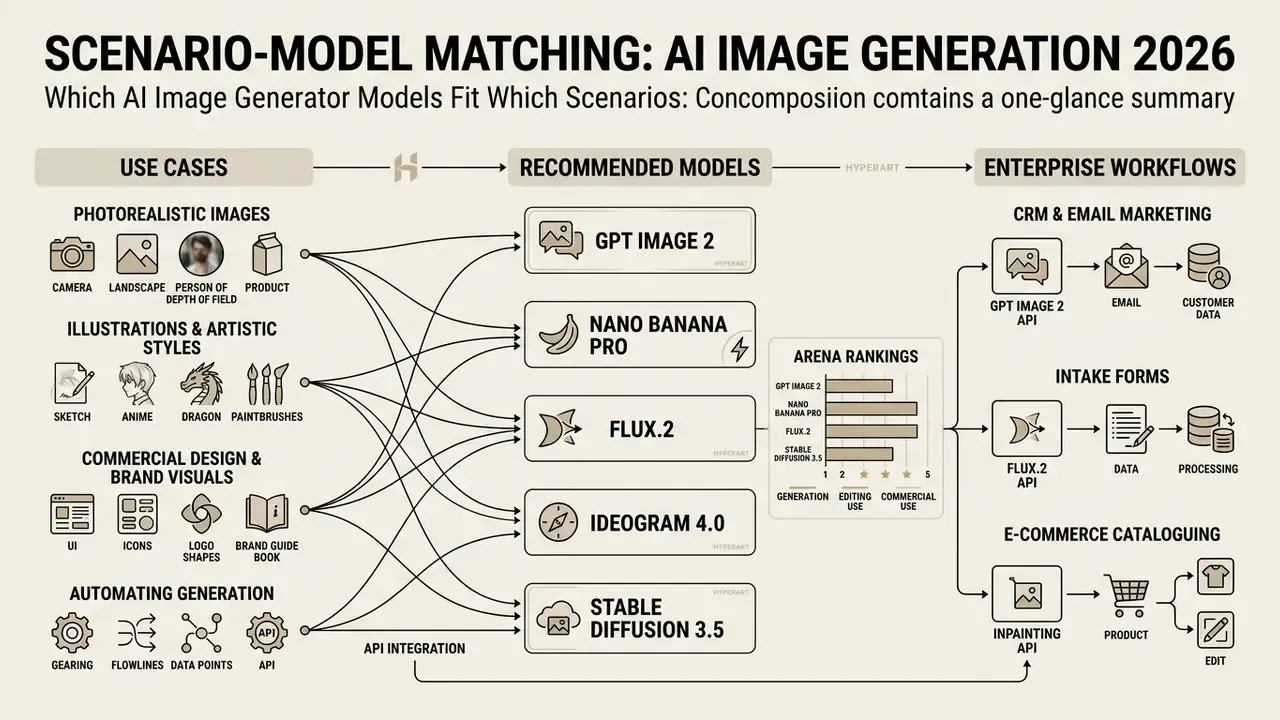
Matching an image gen model to a specific enterprise workflow prevents resource misallocation and keeps visual output consistent across channels.
Photorealistic Images, Portraits, and Product Scenes
Synthesizing photorealistic images, executive portraits, and architectural interiors needs models trained on balanced physical light distributions. Synthetic portraits also have to keep facial geometry stable across multiple renders. Corporate teams standardising on identity-consistent output should review the dedicated guide to AI headshot generators.
In a 2025 comparative study on synthetic media detection, human raters correctly identified AI-generated portraits 72.7% of the time, against 76.2% for posed group photos and 73.4% for candid groups. Single-subject portraits, in other words, achieve higher relative realism.
"A study of 240 images showed DALL·E 3 producing fewer anatomical errors than SD XL and Stable Cascade, though group scenes remain difficult for all models."
Interior and architectural scenes show an even wider spread. Detection accuracy in a 2025 interior study ranged from 29.04% for FLUX.1-dev (hardest to identify as synthetic) up to 86.73% for Kolors, while a 2024 architecture paper scored DALL·E 2 interiors at mean realism 2.92/5 versus 3.75/5 for real photographs, with lower marks for spatial and ambiance accuracy. For enterprise teams producing corporate headshots, specialized deployment frameworks can be evaluated in our best AI art generator guide.
Illustrations, Anime, Fantasy, and Artistic Styles
Artistic assets, anime visuals, and stylized vector graphics benefit from open-weight models that support fine-tuned style adapters. Those models let creative teams enforce a custom brand aesthetic across campaign imagery instead of re-prompting forever.
Evaluation benchmarks such as InstaStyle use CLIP-based style consistency metrics to verify that generated images match reference artwork. Open-weight ecosystems like Stable Diffusion XL and FLUX allow developers to freeze base model weights and swap lightweight LoRA style modules per genre.
"PickScore, trained on more than 500,000 user-preference examples, reaches 70.5% accuracy in predicting image choice, above human agreement (68.0%) and CLIP-H (60.8%)."
Commercial Design, UI/UX, Icons, and Brand Visuals
Commercial design workflows demand strict adherence to brand guidelines, exact icon placement, and a clear layout structure. Using image creation models for UI/UX wireframing puts a premium on layout stability rather than raw beauty.
Enterprise design systems published by organizations such as Red Hat specify strict rules for AI-generated iconography: a fixed initial icon set, a mandated sparkle position, and compulsory pairing with text such as "with AI" or "by AI." Apple's Human Interface Guidelines remain the platform baseline for interface structure, while Figma's 2026 brand-guidelines generator converts inputs into enforceable rules for colour, type, layout, imagery, and voice. Organizations building automated asset workflows can compare options across enterprise design frameworks, and publishing teams can review the YouTube editing workflow guide for downstream asset handling.
Automating Generation Inside Enterprise Workflows
Isolated manual generation does not scale. In 2026 the practical value comes from wiring image models into existing systems of record, so asset creation becomes an event-driven step rather than a creative errand. Three patterns cover most enterprise demand.
Each pattern needs the same three control points, whatever the vendor: a service account with scoped credentials instead of a personal login, structured logging of prompt, seed and model-version triples for reproducibility, and a deterministic human-approval gate before public distribution. Automation without those controls turns a creative tool into an unmonitored publication channel. That is precisely the scenario model-risk functions are chartered to prevent.
- CRM and email marketing (HubSpot / Salesforce + GPT Image API).A segment-membership change fires a webhook; the pipeline renders a personalised banner from a locked brand template, writes the asset URL back to the contact record, and routes anything containing customer-identifying content to human review before send.
- Intake forms (Google Forms + no-code orchestrator + FLUX.2 API).A client brief submitted through a form triggers concept-art generation with a fixed seed and style LoRA; outputs land in a Slack channel for designer triage, with prompt, seed, model version, and requester logged automatically.
- E-commerce cataloguing (Shopify + inpainting API).New SKU photographs enter an inpainting job that replaces cluttered backgrounds with studio white, runs an upscaling pass, and blocks publication until a rules engine confirms resolution, aspect ratio, and absence of third-party logos.
Commercial Use: What to Verify Before Using AI Images in Business
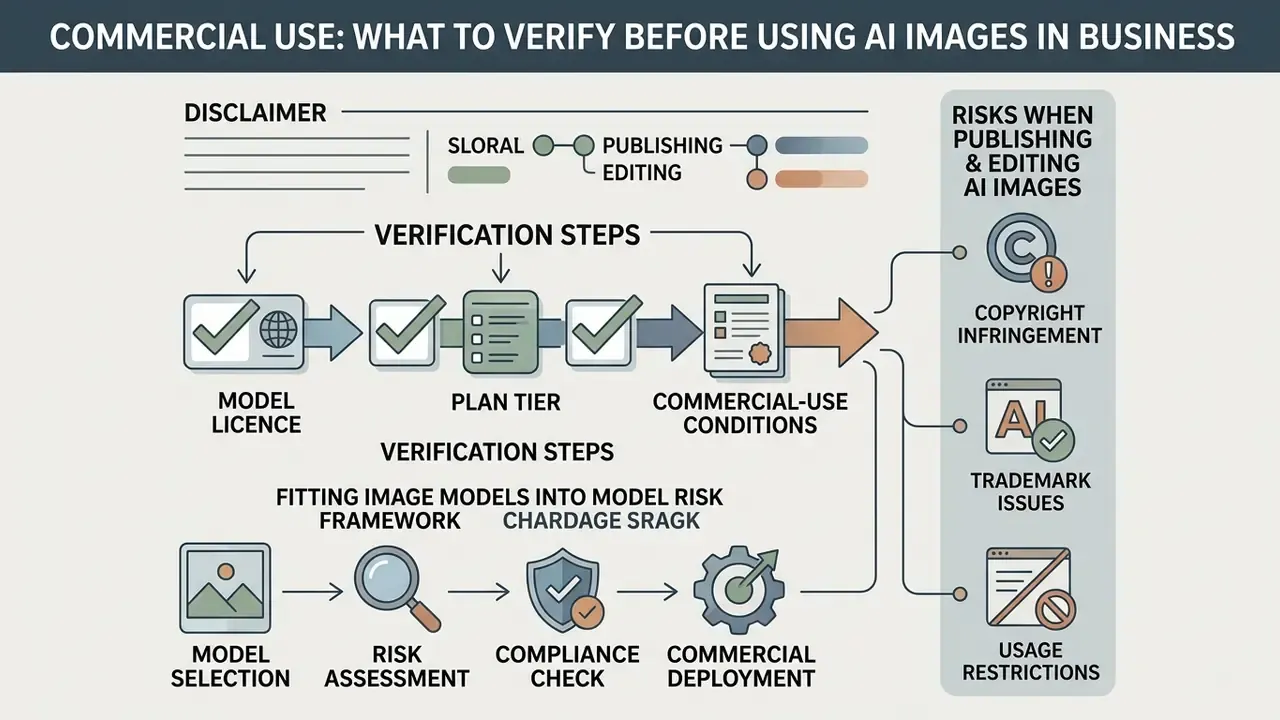
Deploying generative ai image assets commercially requires an audit of model licensing, data privacy, and intellectual property exposure. Three documents, usually: the licence, the plan terms, and the acceptable-use policy.
Model Licence, Plan Tier, and Commercial-Use Conditions
Commercial usage rights differ sharply between a free plan and a paid plan. Publishing outputs generated under a non-commercial or research license exposes the organization to direct legal liability.
Consider an illustrative composite case. A mid-sized e-commerce retailer generated product promotion banners with an open-weight model under a non-commercial research license. During a compliance audit, internal counsel identified the licensing mismatch, which forced removal of 1,200 asset listings and a full re-generation of the visual catalog through licensed commercial API endpoints. The transition delayed the campaign launch by three weeks, and it eliminated the residual copyright risk.
The licence families that matter in practice are few. Permissive open-source terms (Apache 2.0 on FLUX.2 [klein] 4B/9B) allow commercial use with attribution obligations only. Revenue-threshold community licences, such as Stability AI's Community License for SD 3.5, permit commercial use below $1M annual organisational revenue and require an enterprise agreement above it. Non-commercial model agreements, including Ideogram's open weights and FLUX non-commercial variants, forbid business use of the weights, while the vendor's paid API or subscription grants commercial rights separately. Hosted-API terms (OpenAI, Google) assign output rights to the customer, bind usage to acceptable-use policies, and on consumer tiers may impose watermarking.
Risks When Publishing and Editing AI Images
Under US Copyright Office guidance issued in 2025, purely AI-generated visual outputs lacking human creative contribution are not eligible for copyright protection. Applicants registering works containing AI elements must disclaim and disaggregate the machine-generated components, and mere prompting does not establish authorship when the model determines the expressive elements. European Parliament studies published in 2025 reach a parallel conclusion: outputs without meaningful human creative input are not eligible for EU copyright protection and may effectively fall into the public domain. Before publication, teams can screen assets with AI image detectors and verify provenance through AI reverse image search.
"The study documented a broad tendency of diffusion models, including Stable Diffusion XL, to reproduce training-data elements even under indirect prompts."
Trademark exposure is distinct from copyright exposure, and it gets overlooked more often. Filings submitted to the US Copyright Office between 2023 and 2025 note that AI outputs can infringe trademarks or trade dress, including distorted logotypes, recognisable protected product silhouettes, and packaging likenesses, even when training data was licensed or public-domain. The practical mitigations are procedural: prohibit brand names and competitor product names in prompts unless authorised, run reverse-image and logo-detection screening on candidate assets, maintain a blocklist of protected marks in the orchestration layer, and record the human editing contribution that supports any registration claim. Organizations deploying assets in high-stakes campaigns should consult legal counsel and see the overview of generative media legal risks.
"A benchmark for removing copyrighted content from diffusion models uses a mixed semantic-and-style metric validated by artists and human raters."
"A detector built on a 3B-parameter MLLM reaches 91.8% accuracy in identifying risky images, substantially outperforming existing detection methods." T2I-RiskyPrompt: Safety Evaluation, Attack, and Defense in Text-to-Image Models (2024). https://arxiv.org/abs/2406.09264
Fitting Image Models into the Model Risk Framework
For a regulated institution, a generative image capability is not a marketing toy. It is a model in production. Supervisory expectations for model risk management (SR 11-7 / OCC 2011-12) require identification, documentation, validation, and ongoing monitoring proportionate to risk. The NIST AI Risk Management Framework adds mapping, measurement, and management of context-specific harms.
Applied to image generation, that translates into five concrete artefacts:
- a register entry per model version and per interface;
- a documented intended-use statement with prohibited uses (no synthetic evidence, no customer likenesses without consent, no regulated disclosure imagery);
- a validation report containing prompt-compliance scoring, text-accuracy CER results, and safety-filter test outcomes;
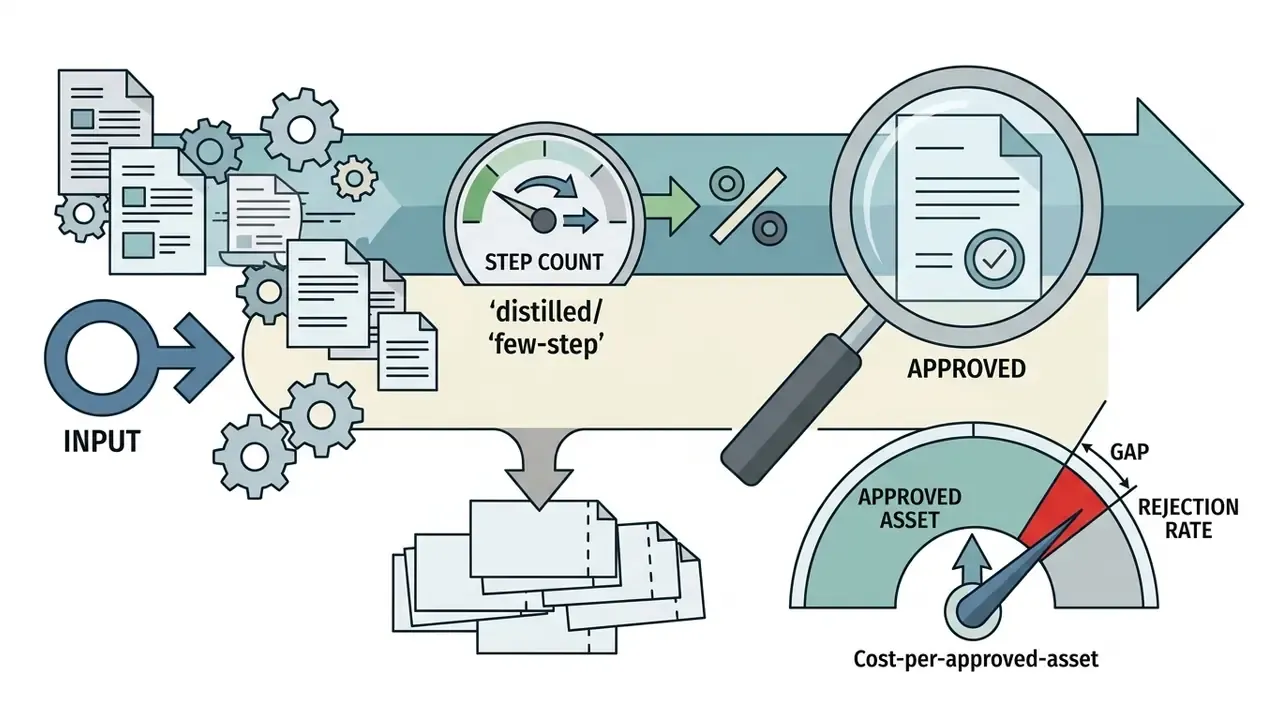
- a monitoring plan covering vendor version changes and drift in rejection rates;
- an issue-escalation path to the compliance officer for any asset flagged during review.
NIST SP 800-218A additionally recommends that acquired AI models and components be scanned and tested for vulnerabilities and malicious content before use. That step gets skipped routinely when open weights are pulled from public hubs straight onto engineering laptops.
How to Get Quality Results: Model Choice, Prompting, and Refinement
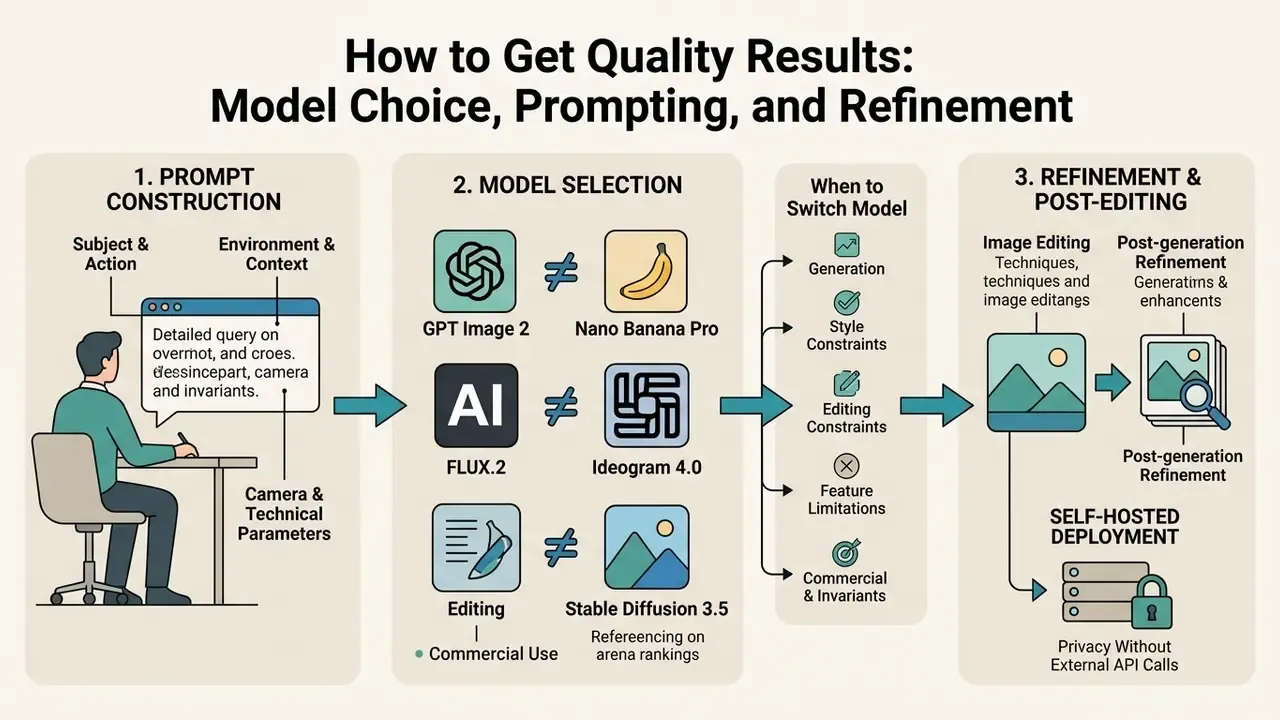
Predictable visual output comes from a structured three-stage pipeline: prompt construction, model selection, and post-generation editing. Each stage carries its own validation criterion.
How to Write Text Prompts for AI Image Generation
Effective prompt construction follows a standardized sequence: primary subject, environmental context, framing and lighting, then explicit constraints.
Vendor guidance from Amazon Nova and OpenAI recommends structuring prompts systematically:
- Subject & ActionDefine the primary entity clearly.
- Environment & ContextDescribe background, mood, and lighting conditions.
- Camera & Technical ParametersSpecify viewpoint, lens focal length, and rendering style.
- Exclusions & InvariantsState explicit exclusions, for example "no watermarks, preserve facial geometry".
"Pick-a-Pic collected more than 500,000 user-preference examples: PickScore predicts choice with 70.5% accuracy, above the 68.0% human agreement rate."
Two vendor-specific divergences are worth noting. OpenAI's guidance permits explicit negation and preservation instructions ("no extra text", "preserve identity, layout, and label placement") and recommends consistent segment ordering with line breaks. Amazon Nova Canvas, in contrast, caps prompts at 1,024 characters and advises against negation words such as "no", "not", and "without", recommending instead that unwanted elements simply be omitted and that refinement proceed one change at a time under a fixed seed. Teams running several models should therefore maintain per-model prompt templates rather than one house style. Slightly tedious, yes, and cheaper than debugging blind.
When to Switch the Image Gen Model Instead of Rewriting the Prompt
Iterating on prompt text yields diminishing returns once a task exceeds a model's architectural capability. Operators should change the underlying model when they hit persistent failures in text rendering, complex spatial logic, or sub-second latency constraints.
When prompt revisions fail to clear a structural defect after three iterations, switching from a general diffusion model to a specialized reasoner resolves it faster than more rewriting. Dense text goes to GPT Image 2; structural ControlNet alignment goes to FLUX.1.
"RankDPO raised SDXL's average GenEval score from 0.55 to 0.61 and SD3-Medium's from 0.70 to 0.74, particularly in two-object and colour-attribution categories."
Decision rule in practice: prompt iteration addresses wording, ordering, and format problems, while a model change addresses capability ceilings such as instruction comprehension, text fidelity, latency, and cost. Governance frameworks treat the two as different interventions, because a model change resets the validation evidence and requires re-verification that safety and security controls still hold.
How to Refine Output Through Image Editing
Post-generation image editing isolates corrections to specific regions and leaves verified areas untouched. Operators use inpainting masks to modify individual elements while keeping overall scene lighting stable.
Modern editing workflows combine generative upscaling (2x/4x spatial detail synthesis) with vector adapters. Note the caveat documented by vendors themselves: generative upscaling is not interpolation. It can alter source pixels while synthesising fine detail, so upscaled assets need re-inspection rather than automatic approval. Practitioners selecting tooling for this stage can review the comparison of AI image upscalers.
Enterprise teams also apply generative unblurring during post-processing; technical parameters for those workflows are detailed in our guide to ai unblur image software, and complementary restoration options appear in the overview of AI image enhancers. To rescue legacy corporate photography or clean up compression artifacts, organizations lean on ai stock image processing standards, conventional photo editors, and ai stl generator spatial modeling frameworks.
Self-Hosted Deployment: Privacy Without External API Calls
For organisations with strict confidentiality requirements, think banks handling customer imagery, healthcare communications, or unreleased product design, open-weight models running inside the corporate perimeter remove third-party data transfer entirely. Candidate models include FLUX.2 [klein] 4B/9B (documented as suited to local deployment and fine-tuning on limited hardware) and Stable Diffusion 3.5 Medium (approximately 9.9 GB VRAM excluding text encoders).
Reference sequence:
- Provision a GPU host meeting the model's documented VRAM floor; pin driver and CUDA versions for reproducibility.
- Clone a maintained inference front-end, for example
git clone https://github.com/AUTOMATIC1111/stable-diffusion-webui, or use the vendor's reference inference code for FLUX variants. - Place model weights in
.safetensorsformat into the front-end's model directory (/models/Stable-diffusionfor the front-end above); prefer.safetensorsover pickled checkpoints and scan artefacts before loading, per NIST SP 800-218A guidance on acquired components. - Pin the weight hash and record model name, version, and hash in the model register.
- Configure local logging of prompt, seed, sampler, step count, guidance scale, and operator identity to satisfy audit-trail requirements.
- Add an operator-managed safety filter and, where policy requires, an invisible provenance watermark. Neither arrives automatically with open weights.
- Confirm licence compliance before commercial use: Apache 2.0 for FLUX.2 [klein] 4B/9B; the Stability AI Community License for SD 3.5 only while organisational revenue stays below $1M annually.
Governance and Operational Checklist
STAGE 1 - INTENT & AUTHORISATION
STAGE 2 - MODEL SELECTION & CONFIGURATION
STAGE 3 - GENERATION
Checklist0 / 9
10.[ ] Execute initial generation and inspect for structural artifacts
STAGE 4 - VERIFICATION
11.[ ] Verify text rendering and character error rate (if applicable)
12.[ ] Check anatomy, physical plausibility, and artifact density
13.[ ] Run logo / trademark and reverse-image screening on candidate assets
14.[ ] Apply inpainting / outpainting for local edits, preserving verified regions
15.[ ] Perform generative upscaling and re-inspect (upscaling may alter source pixels)
STAGE 5 - RELEASE CONTROL
16.[ ] Document the human creative contribution supporting any registration claim
17.[ ] Verify commercial license terms for the exact model version and plan tier
18.[ ] Obtain human-in-the-loop sign-off; escalate flagged assets to compliance
19.[ ] Write prompt, seed, model version, reviewer, and decision to the audit log
20.[ ] Apply provenance metadata / watermark per policy before publication
Listing 1: Operational and governance checklist for enterprise AI image generation and commercial release.
Which Best Image Generation AI Model to Choose: A Short Decision Map
Choosing among the best image generation ai models comes down to matching operational constraints to documented model strengths:
- For conversational integration and complex reasoning: select GPT Image 2 or Nano Banana Pro. Both deliver superior prompt adherence, interleaved multimodal capability, and strong text rendering.
"T2I-FactualBench shows Stable Diffusion v1.5 scoring 40.5 on basic concept memorisation but falling to 13.4 on multi-concept composition."
Publisher positioning. Hypeart AI Media Decision Support maintains structured comparison hubs for generative media tooling: model capability matrices, licence audits, and pricing verification. The intent is simple, letting procurement and risk teams evaluate enterprise software choices against documented evidence instead of vendor claims. Organizations seeking decision support can consult Hypeart AI Media Decision Support.

Limitations and Open Questions
Honesty about gaps is part of the control environment, so here is what this guide cannot settle.
Arena rankings shift monthly and rest on aggregate preference, not on regulated-task performance. There is still no public benchmark scoring image models on the things a bank actually cares about, such as brand-guideline conformance, likeness safety, or trademark collision rates. Vendor text-accuracy claims remain unreproduced externally. Indemnification language differs contract by contract, and none of the frontier providers publishes a standard clause that survives procurement review unchanged.
Two further questions stay unresolved in 2026. First, provenance: C2PA-style metadata and invisible watermarks are inconsistently applied across providers and are frequently stripped by downstream image pipelines, so provenance cannot yet be treated as a reliable control on its own. Second, validation cadence: no supervisory guidance specifies how often a generative image model should be re-validated after a silent vendor update, which leaves institutions to set their own trigger, usually any version change or any material drift in the review rejection rate.
Treat every audience assumption and internal benchmark in this guide as a hypothesis until your own analytics, interviews, or CRM data confirm it.
FAQ
What is the difference between an AI image model and an AI image generator?
The model is the neural network performing inference. The generator is the product layer exposing it through prompts, settings, quotas, and safety filters. One model can appear in many generators, and one generator can route to several models.
Which AI image generator is best right now?
By blind human preference as of September 2026, GPT Image leads with an arena score of 506, followed by FLUX variants (362) and Google's Nano Banana Pro (257) across 11,311 votes. By task, GPT Image leads in-image text, FLUX leads cost-controlled photorealism, and Nano Banana Pro leads multimodal editing.
Are AI image generators free?
Partly. Open-weight models such as FLUX.2 [klein] and Stable Diffusion run locally at zero licence cost. Hosted providers offer limited free tiers: 150 tokens per day on Leonardo AI, 40 daily credits on ImagineArt, 25 starter credits on DreamStudio, and limited daily generations in ChatGPT. Frontier hosted models typically bill $0.01 to $0.10 per image.
Can I use AI-generated images commercially?
Usually yes, but permission comes from the specific licence and plan tier, never from the tool category. Apache 2.0 variants permit commercial use outright, community licences may impose revenue thresholds, and open weights from design-focused vendors are often non-commercial while their paid API grants commercial rights.
Can AI-generated images be copyrighted?
Not in their purely machine-generated form under 2025 US Copyright Office guidance. Protection attaches only to disclosed, disaggregated human contributions. EU analyses reach a comparable conclusion for outputs lacking meaningful human creative input.
Which model renders text inside images most accurately?
Transformer-native multimodal models currently lead. GPT-4o-class systems reach character error rates around 0.15 on TextAtlasEval structured-text scenes, versus 0.99 for AnyText on comparable subsets. Design-specialised systems such as Ideogram 4.0 add layout and typography controls on top.
How should image models be recorded for model risk management?
Create separate register entries for the foundational model version and for the application interface. Each entry carries owner, intended use, deployment topology, validation evidence, and monitoring plan, consistent with SR 11-7 / OCC 2011-12 expectations and the NIST AI Risk Management Framework.
When should I change models instead of rewriting the prompt?
After roughly three failed prompt revisions on the same structural defect: persistent garbled text, broken spatial logic, unmet latency budgets. Preference-optimised or task-specialised models show measurable gains, and RankDPO raised SDXL's GenEval average from 0.55 to 0.61.
Appendix A: Superseded Formulations