«Access to ChatGPT reduced task completion time by 40% and increased output quality by 18%.»
Achieving consistent editorial quality requires integrating large language models (LLMs) with systematic human oversight, structured prompting, and rigorous verification controls. Institutional guidance on responsible AI adoption in knowledge work reinforces that prompt discipline and reviewer accountability, not raw model access, determine final quality (Harvard University Information Technology AI Basics, 2026).
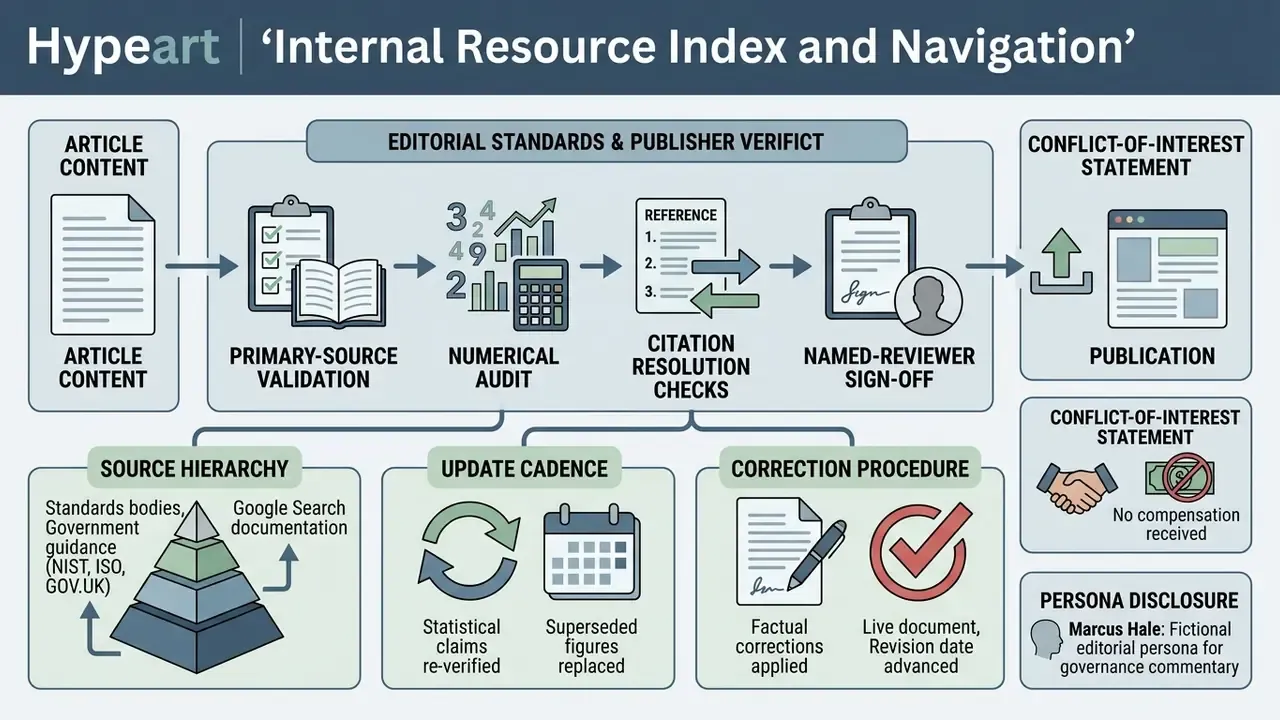
Last updated: February 2026. Reviewed by: editorial standards team (fact verification, source validation, compliance screening).
Who This Guide Serves and What It Decides
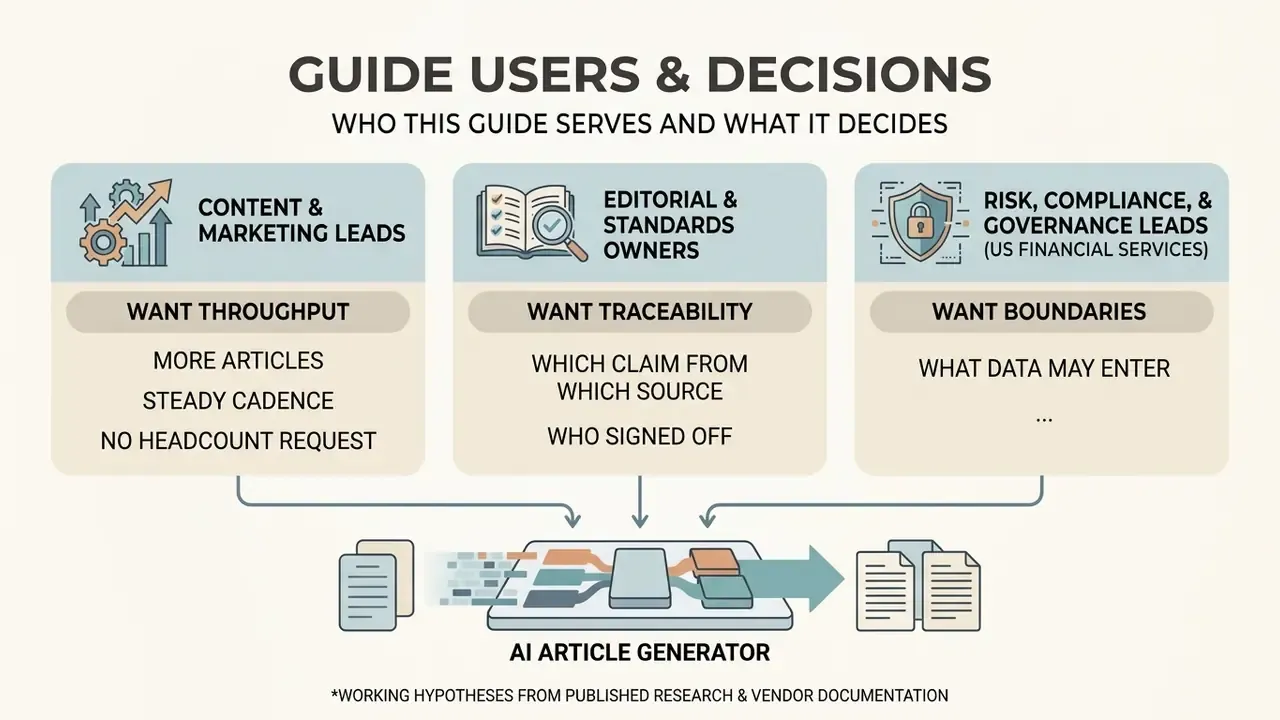
Three reader profiles keep showing up in the questions behind this topic, and each needs a different answer from the same tool.
- Content and marketing leads want throughput: more articles, steady cadence, no headcount request. Their decision point is quota, export format, and CMS integration.
- Editorial and standards owners want traceability: which claim came from which source, and who signed off. Their decision point is audit logging and reviewer roles.
- Risk, compliance, and governance leads in US financial services want boundaries: what data may enter the prompt, how long it is retained, and whether the vendor trains on it. Their decision point is contractual language, not word count.
These profiles are working hypotheses drawn from published research and vendor documentation. They should be confirmed against your own analytics, interviews, and CRM data before any procurement case is built on them. The rest of this guide follows that sequence: capability, workflow, quality control, cost, and the residual risk you still carry after all of it.
What Is an AI Article Generator and Which Tasks It Solves
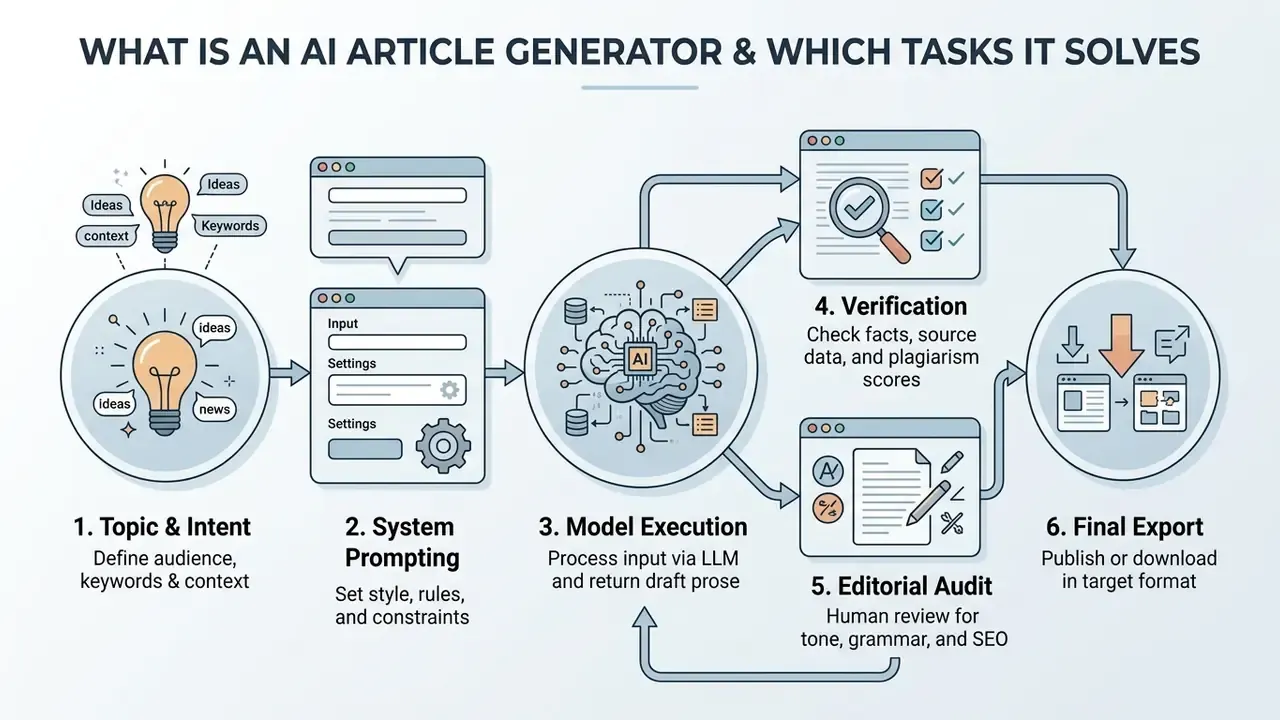
An ai article generator is an automated software application powered by large language models that synthesizes written prose from user-defined prompts, contextual inputs, and parametric knowledge. These systems process natural language instructions to output structured text across diverse formats, serving as an ai article creator for technical, commercial, and editorial teams. Enterprise organizations deploy these tools to eliminate initial drafting friction, summarize empirical data, and maintain steady publishing cadences without expanding core headcount.
«AI content generators rely on complex algorithms and training data to produce human-like responses to user queries.»
Specialized AI Article Generator vs. Basic ChatGPT
Teams evaluating budget frequently ask why a dedicated generator is necessary when a general-purpose chatbot is available at no cost. Fair question. The distinction sits in structural control, source grounding, export fidelity, and audit capability rather than in raw language quality.
| Comparison criterion | Basic ChatGPT (Free/Plus) | Specialized AI Article Generator |
|---|---|---|
| Article structure | Produces linear prose, frequently skipping H3/H4 levels | Enforces H1 to H4 hierarchy and generates a ready section index |
| Primary source handling | Hallucinated references and invented links remain possible | RAG module bound to specific PDFs, knowledge bases, and document chunks |
| Export options | Manual copy-paste of plain text | Direct export to DOCX, PDF, Markdown, HTML with preserved tags |
| Data formatting | Basic bulleted lists | Automated tables, comparison matrices, and JSON-schema output |
| Citation formatting | Inconsistent, style rules must be re-prompted each session | Automated APA, MLA, Chicago formatting from stored DOI metadata |
| Team workflow | Single-user chat thread | Shared workspaces, role permissions, comment threads, version history |
| Governance and audit | No retention controls or reviewer logs by default | Audit trails, reviewer sign-off, retention policy, private deployment options |
- Summary: General chat interfaces are excellent exploratory drafting environments. Specialized generators add the structural enforcement, source binding, and audit logging that regulated and high-volume publishing operations require.
Which Articles and Content an AI Article Writer Creates
Modern ai article writer platforms produce varied content formats adapted to technical documentation, marketing, and educational publishing. According to product framework documentation from enterprise platforms, an article generator automatically builds ecommerce product descriptions, long-form blog posts, promotional ad copy, and SEO category copy (WRITER, 2025; Shopify, 2026). National Institute of Standards and Technology (NIST) benchmarks evaluate these text-to-text workflows across open-ended synthetic content tasks, validating their capacity for structured long-form prose (NIST AI 700-1, 2025).
«Participants used ChatGPT to draft press releases, analysis memos, and marketing copy, with quality graded by blind reviewers.»
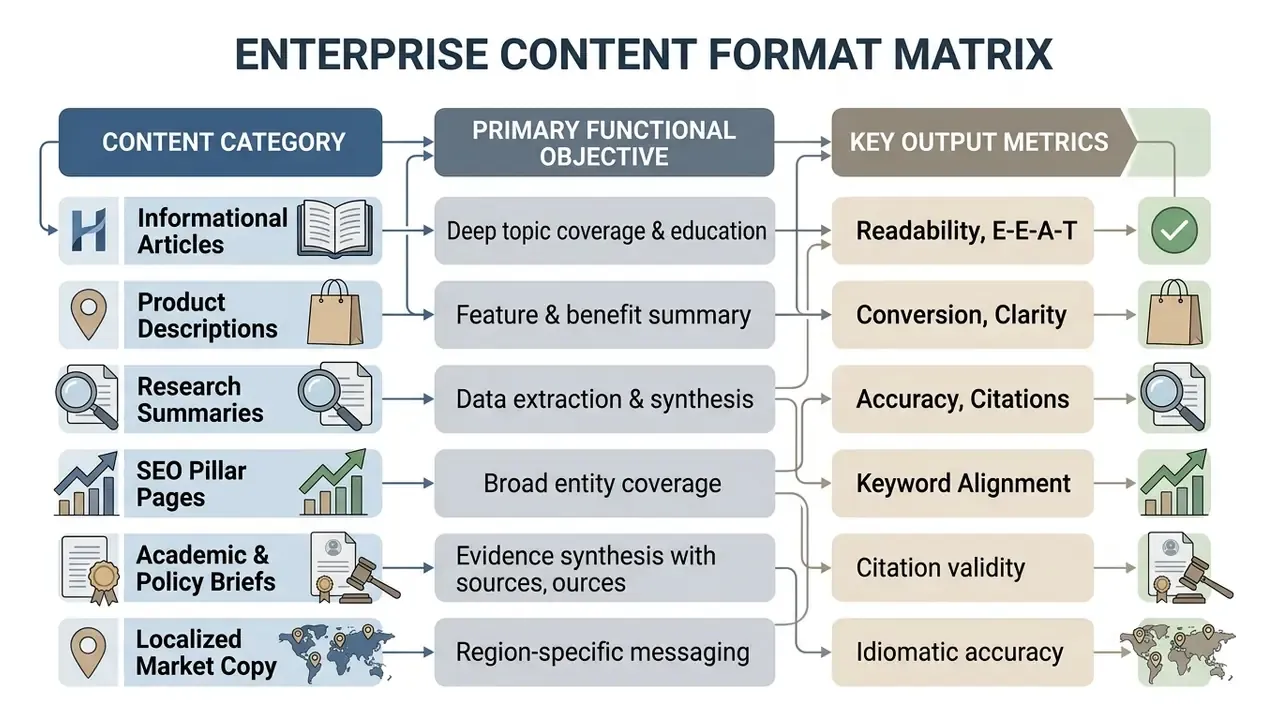
In commercial implementations, an ai article maker assists editorial teams by generating initial structural frameworks for complex topics. Teams working across digital publishing operations frequently manage cross-media workflows, pairing text generation with asset production. That is why editorial leads reviewing visual toolchains consult the reference material on online photo editors, AI voice generators, and the practical notes on an ai photo editor when standardizing multimedia production.
A digital marketing team deployed an article creator ai to generate 1,200 standardized product summaries for an ecommerce migration. By enforcing explicit structural rules in the system prompt, the team completed initial drafting in three weeks rather than four months. Editorial staff reviewed each output against primary source specifications, reducing production costs by 62% while maintaining factual consistency across catalog listings. Comparable commercial production decisions, including licensing scope for generated assets, are documented in the guide to Canva AI Generator commercial licensing.
Financial services case (human-in-the-loop, illustrative composite): A mid-size lender's investor-communications team applied an article generator to draft quarterly market commentary and internal product explainers. The workflow bound every draft to approved source documents, meaning filings, rate tables, and risk memos, through retrieval grounding. Two compliance reviewers validated each numerical claim, and any statement lacking a source citation was blocked from export. Drafting time per commentary dropped from 6.5 hours to 2.4 hours, while the compliance review layer added 40 minutes per document. Net production savings reached 47%, and the audit log retained reviewer identity, timestamp, and source mapping for each published paragraph. The team never permitted model output to reach customer-facing channels without documented sign-off. That last rule did most of the risk work.
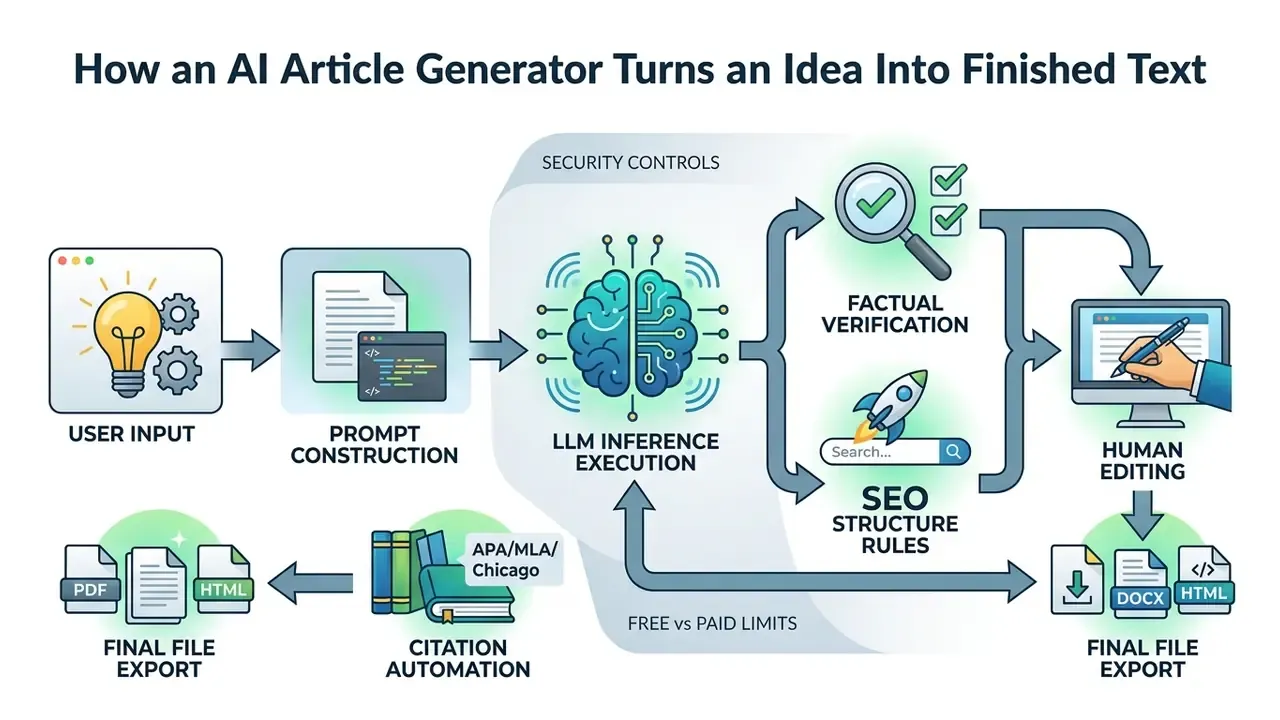
How an AI Generator Turns an Idea Into Finished Text
An ai generator article workflow transforms abstract user prompts into structured prose by running inputs through transformer-based language models. Modern inference pipelines separate system instructions from context using explicit delimiters like ### or """ to prevent instruction drift (OpenAI API Prompting Guide, 2026). Advanced deployment environments enforce deterministic outputs using JSON Schema definitions via Structured Outputs, ensuring generated articles adhere strictly to predefined section schemas (Azure OpenAI Documentation, 2026). Teams wiring generation into an existing CMS usually start from the api reference before touching prompt design.
«Researchers generated 92 news articles with GPT-4o using simple prompts; every text contained deliberately false claims for verification testing.»
That experimental design illustrates both the speed of the pipeline and its principal hazard: fluent prose is produced with equal confidence whether the underlying claim is true or fabricated. Generation quality therefore depends on what enters the context window and on what verification stage follows. No confidence signal comes attached to the output. None.
How to Create an Article With an AI Article Generator
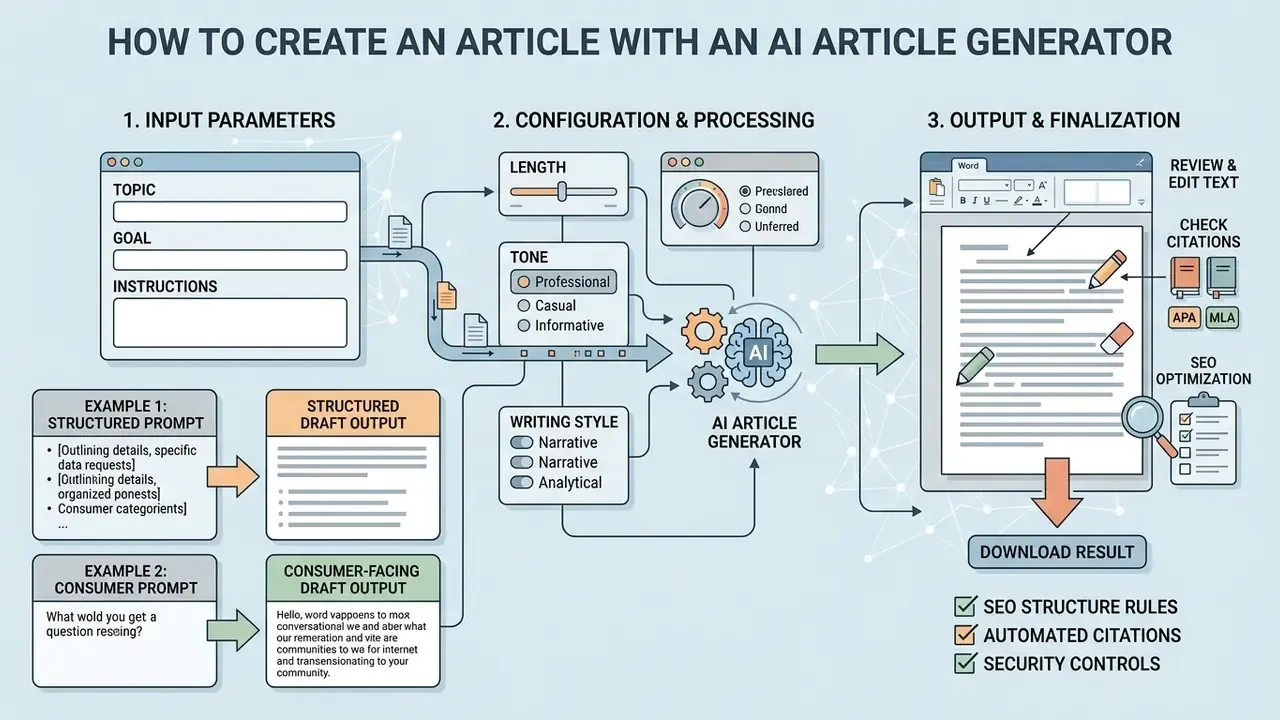
Operating an ai article generator online tool effectively requires a systematic process combining precise prompt setup, parameter configuration, and post-generation editing. Relying on raw LLM output without contextual constraints often yields generic prose or factual errors.
«Include target keywords, subtopics, real-world examples, statistics, and the desired tone in the prompt to obtain accurate, relevant material.»
Establishing an operational pipeline ensures outputs align with search quality expectations and corporate brand guidelines.
Enter the Topic, Goal, and Instructions for the Article
The quality of generated prose correlates directly with the specificity of input instructions. System parameters should explicitly state the primary target topic, target reader profile, underlying content objectives, and non-negotiable boundaries (Harvard University IT AI Guidance, 2026). Google Cloud prompt engineering standards recommend placing role definitions, context parameters, output constraints, and formatting rules in system instructions prior to user prompt execution (Google Cloud System Instructions Guide, 2026).
«Participants working with ChatGPT on clearly specified tasks finished 40% faster while output quality rose 18%.»
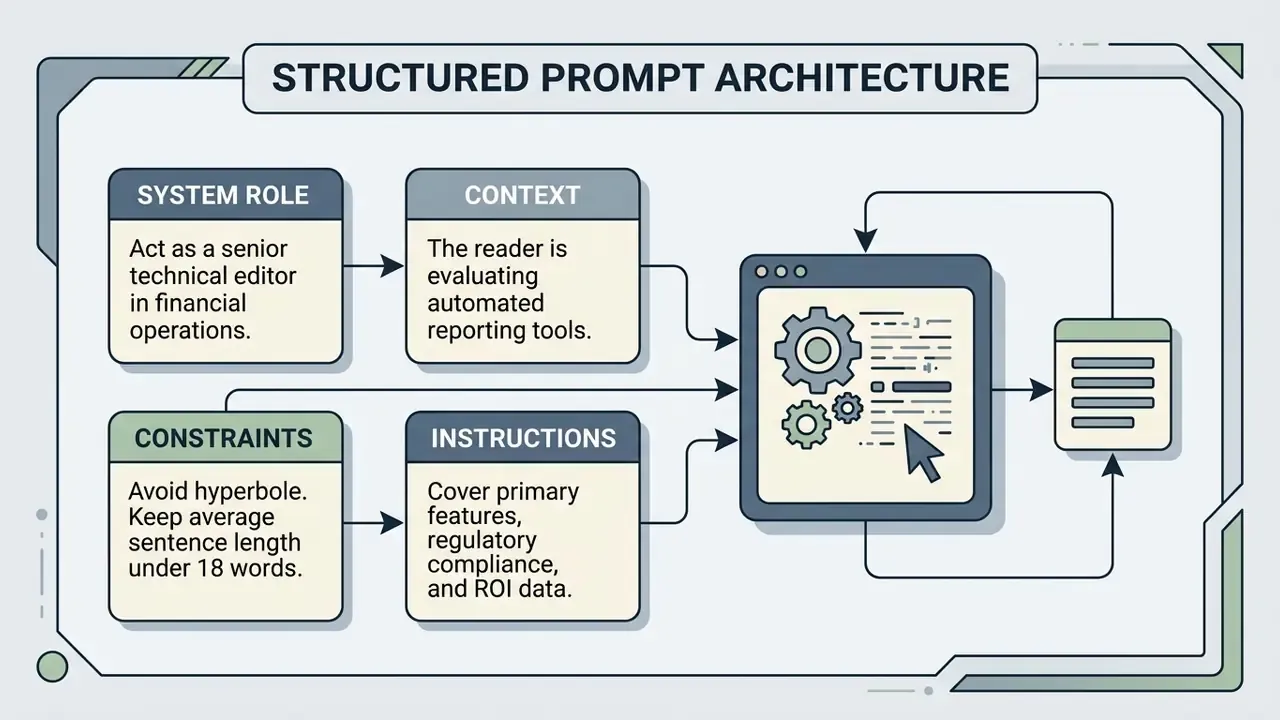
Worked Example 1: Structured Prompt and Resulting Draft
Prompt input:
Role: Lead IT analyst.
Task: Write a 200-word introduction on migration to cloud-native architecture.
Audience: CTOs and DevOps engineers.
Tone: Rigorous, analytical.
Constraints: No filler, active voice, include one quantitative metric.
AI output draft:
Worked Example 2: Consumer-Facing Prompt and Resulting Draft
Prompt input:
Role: Consumer technology writer.
Task: Write a 150-word how-to introduction on cleaning a laptop keyboard.
Audience: Non-technical home users.
Tone: Direct, friendly, no jargon.
Constraints: Short sentences. Include one safety warning.
AI output draft:
Both drafts required editorial passes. The first needed the 42% figure verified against the underlying report, and the second needed the safety instruction validated against the manufacturer's cleaning guidance. Neither was publishable as generated, though both were usable as scaffolding, which is exactly the point.
Configure Length, Tone, and Writing Style
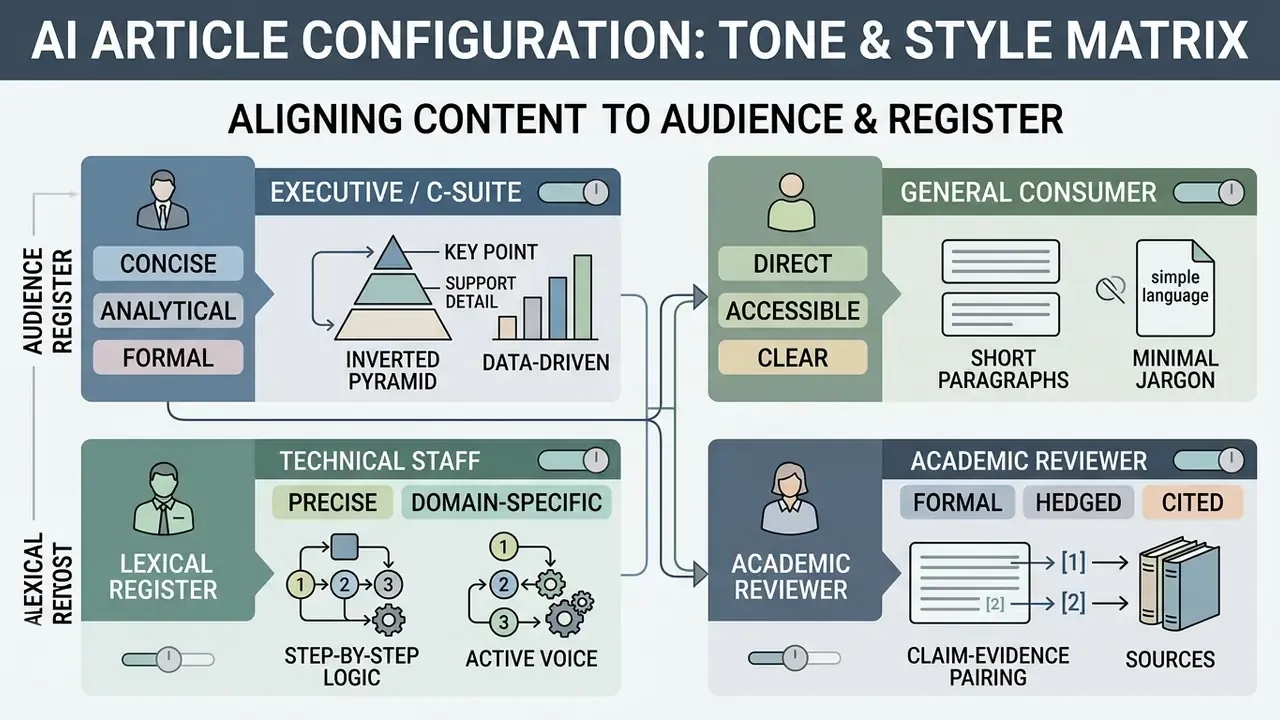
Adjusting model parameters for length, tone, and writing style tailors output prose to specific audience profiles. Editorial standards published by the UK Government Digital Service emphasize using clear language, active voice, and short sentences to optimize comprehension (GOV.UK Writing Style Guide, 2026). Similarly, the Australian Style Manual establishes that tone is governed by lexical selection, grammatical mood, and formality level (Australian Government Style Manual, 2026).
«Journalism students in Spain rated ChatGPT texts above journalist-written copy for readability, informativeness, and structure, with a mean score of 4.92 of 5.»
«Leading LLMs reach average linguistic acceptability of 0.68 across ten languages, including Arabic, Japanese, and Swahili.»
Style controls therefore behave unevenly across locales. Register instructions transfer well in high-resource languages and degrade in low-resource ones, which makes native-speaker review mandatory for localized editions. A tone parameter is a request, not a guarantee.
Review, Edit, and Download the Result
Following initial generation, editorial teams must execute a manual review process to correct grammatical inconsistencies, verify facts, and refine stylistic nuances.
«The Grammarly group showed significantly greater gains in grammatical accuracy, coherence, and syntactic complexity, with effect sizes d = 1.40 to 1.75.»
AI Article Creator Capabilities for Content Operations
An article creator ai incorporates functional modules beyond basic text generation, enabling content teams to manage complex publishing projects efficiently. Advanced platforms integrate multi-draft generation, targeted paragraph expansion, structural rewriting, and multi-document ingestion within unified user interfaces. Survey data on knowledge work confirms this feature consolidation reflects actual practice rather than vendor positioning.
«By 2024, 34.6% of surveyed employees used LLMs in work tasks, primarily for templates and first drafts.»
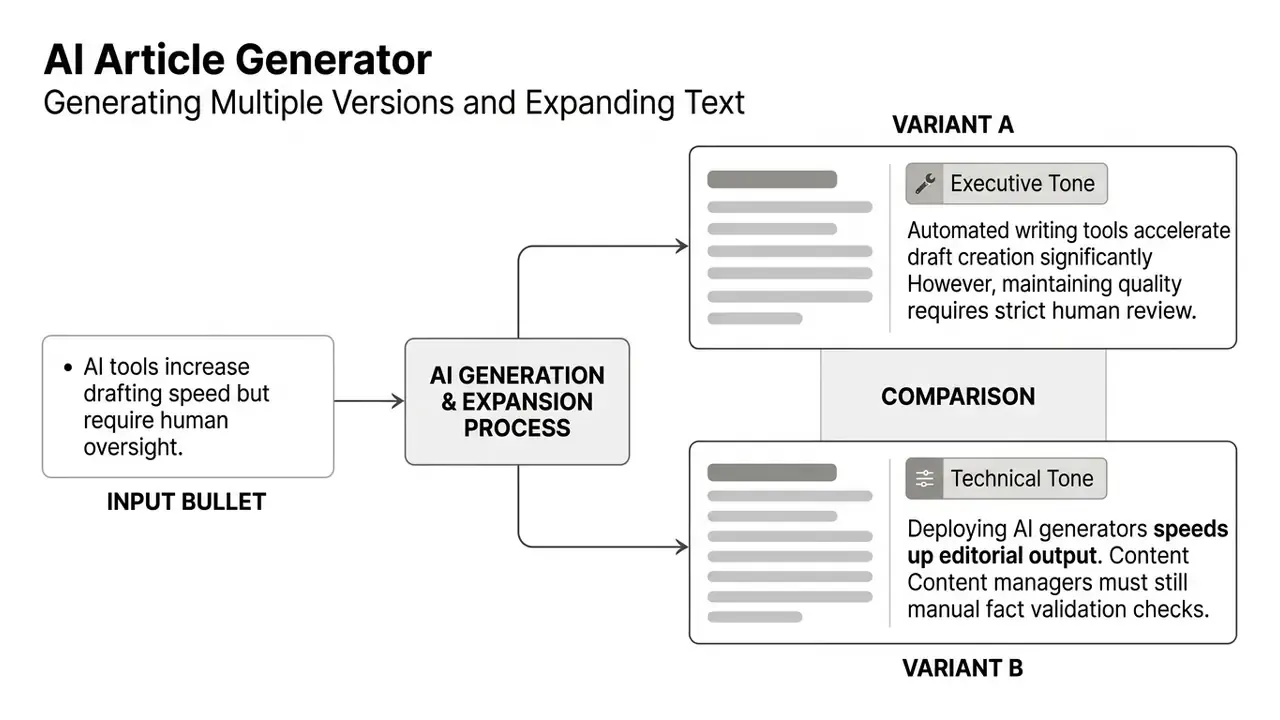
Generating Multiple Versions and Expanding Text
Generating multiple draft variants allows editorial teams to compare competing narrative approaches and select optimal phrasing. Enterprise writing platforms such as Google Workspace's Gemini let users output alternative draft variations simultaneously, offering comparative choices for headline structures and introduction paragraphs (Google Workspace AI Features, 2026). Paragraph expansion tools take concise bullet points or summary sentences and elaborate on them while maintaining original factual meaning.
Collaboration, Roles, and Version Control in Editorial Teams
Multi-variant generation only produces value when the team can compare drafts inside one shared environment. Production-grade platforms support simultaneous editing sessions, where writers, subject-matter reviewers, and compliance officers work on the same document with distinct permission scopes.
| Role | Permission scope | Typical responsibility |
|---|---|---|
| Author | Generate, edit, comment | Prompt construction, draft assembly, structural edits |
| Subject-matter reviewer | Comment, suggest, approve section | Technical accuracy, terminology, source adequacy |
| Compliance or legal reviewer | Comment, block export | Regulatory language, disclosure requirements, claim risk |
| Managing editor | Full edit, publish, revert | Tone consistency, final sign-off, version restoration |
| Localization lead | Edit translated variant | Idiomatic accuracy, cultural adaptation, regional legal notes |
Real-time collaboration reduces the handoff latency that traditionally consumed more time than drafting itself. Comment threads replace email review cycles, version history restores any prior state, and export locks prevent unreviewed drafts from leaving the workspace. For distributed teams, assigning a named reviewer to every generated section is the single most effective control against unverified claims reaching publication. It is also the cheapest one to implement.
Rewrite, Grammar, and Improving Existing Articles
Automated rewriting features assist editors in restructuring awkward phrasing, adjusting sentence complexity, and correcting syntax errors. A study evaluating AI writing software recorded significant improvements in text coherence and syntactic variation when applying automated feedback loops, with the experimental group outperforming controls at effect sizes of d = 1.40 to 1.75 (Grammarly L2 Writing Study, 2024). Editors can isolate specific paragraphs to change tone from casual to professional without altering core factual statements.
An enterprise communications team updated 300 technical help articles using an article maker ai rewriting suite. Editors processed existing drafts through automated syntax checkers while manually reviewing technical accuracy against engineering documentation. The refined articles achieved a 24% increase in user comprehension scores over two quarters. Teams running broader media transformation projects frequently benchmark adjacent generation stacks through the comparison of the best AI art generators, and procurement leads often see the overview before consolidating vendors.
Working With Files, Sources, and Multilingual Content
Modern generation platforms integrate Retrieval-Augmented Generation (RAG) capabilities, allowing models to ingest external PDF documents, spreadsheets, and text files during inference. RAG architecture links generation output directly to uploaded document chunks, reducing factual hallucinations and grounding prose in verified data (Multilingual RAG Benchmark Study, 2025).
«With Google Search-based RAG, unevaluated claims decrease, yet both correct and incorrect verdicts rise because retrieved results are often irrelevant.»
Retrieval therefore reduces one failure mode while introducing another. Irrelevant retrieved passages can produce confidently wrong verdicts, and curated, permissioned corpora outperform open web retrieval for regulated content. For a KYC or credit-policy explainer, the corpus should be the internal policy library, nothing wider.
Furthermore, platforms supporting more than 20 world languages allow organizations to translate and localize articles across global publishing channels (Wordplay Feature Specifications, 2025).
«The WMT 2024 quality estimation task confirmed that high-quality automatic translation is attainable, supporting multilingual content creation and localization workflows.»
Automated Academic Citations and Source Handling
For analytical and scholarly material, an ai article creator connects to publication databases (Web of Science, Scopus, PubMed) and to built-in reference generators. Unlike a general-purpose language model, a specialized generator automates reference formatting against international standards:
- APA (7th ed.)
- sociology, psychology, business research.
- MLA (9th ed.)
- humanities, literature, philology.
- Chicago Manual of Style
- history and multidisciplinary long-form work.
- IEEE
- engineering and computer science documentation.
- Vancouver
- biomedical and clinical writing.
The generator reads DOI metadata from uploaded PDFs and assembles a correctly ordered bibliography at the end of the article, while in-text markers stay synchronized with the reference list after edits. Rubric files can also be uploaded so the draft is scored against the assignment or client brief before export.
Mandatory verification step: every automatically generated citation must be opened and confirmed. University guidance treats an unlocatable DOI or PDF as evidence of fabrication and requires at least two independent, human-authored sources to substantiate a claim (University of Pretoria AI Guidelines, 2026). Citation automation accelerates formatting; it does not transfer responsibility for source existence.
How to Achieve Quality Articles and SEO-Friendly Structure
Publishing quality articles that achieve high search engine rankings requires structuring content for both human readers and search crawlers. Generating search-optimized prose requires incorporating primary research, building strict heading hierarchies, and executing multi-stage fact verification.
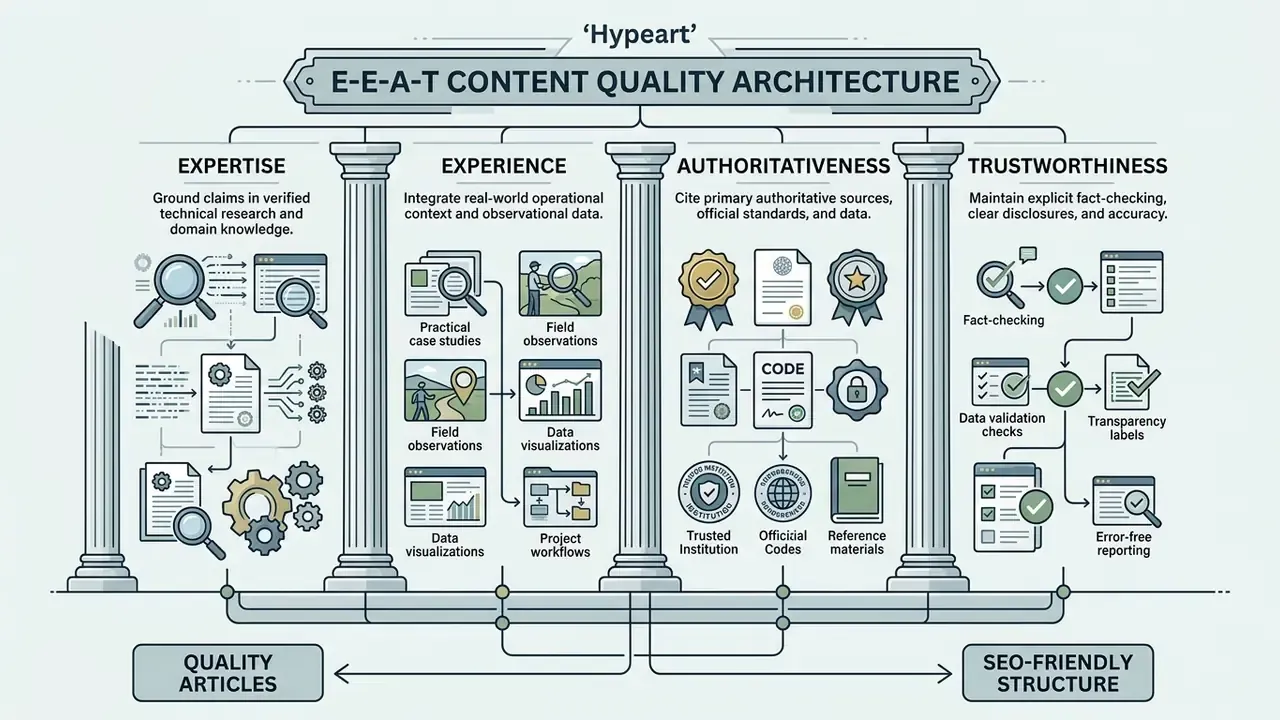
«5.3% of pages ranking in Google's top three are fully AI-generated; pages with under 50% AI content receive two to three times more organic impressions.»
The distribution matters more than the binary question of AI involvement. Hybrid documents with substantial human contribution outperform fully automated pages by a wide margin.
Add Research and Specific Context to the Prompt
Supplying primary research data directly within system prompts prevents generic outputs and grounds generated text in verified facts. Southern Methodist University prompting guidelines emphasize requesting explicit evidence checks, expert perspectives, and cited primary documentation when constructing complex prompts (SMU Generative AI Research Guide, 2023). Injecting empirical data ensures the model synthesizes accurate technical prose rather than extrapolating unsupported claims.
«Include concrete subtopics, practical examples, current statistics, and sources in the prompt to obtain accurate, relevant material.»
One practical habit from newsroom-style workflows: paste the three source paragraphs you intend to rely on directly into the prompt, then instruct the model to cite only from them. Coverage narrows, accuracy climbs.
Check Structure, Headings, and SEO Before Publishing
Search engines evaluate document structure through hierarchical heading tags, H1 through H4. The Google Developer Documentation Style Guide specifies organizing web content logically without skipping heading levels, so H2 headings define major subtopics while H3 headings narrow specific concepts (Google Developer Style Guide, 2026). Structured headings allow search engine crawlers to parse topic coverage effectively while improving document accessibility for users.
«About 19% of content in Google's top 20 is likely AI-generated, and the March 2024 Core Update cut the share of low-quality AI pages by 45%.»
Structural compliance alone does not protect thin content. The same update that spared well-sourced hybrid pages removed large volumes of unedited automated output.
Edit for Uniqueness, Factual Accuracy, and Plagiarism
Maintaining high-quality standards requires testing generated articles using an independent plagiarism checker alongside manual fact verification.
«GPT-4.0 paraphrased texts scored 91.3% on AI detection; after "humanizing" through Undetectable.ai the score fell to 27.8% (p < 0.0001).»
Detection tooling is therefore an incomplete control. Scores collapse once text passes through obfuscation layers, which is precisely why human fact-checking remains the operative safeguard rather than detector output. Fact-checking protocols established by academic institutions require cross-checking statistics, definitions, and claims against at least two independent primary sources prior to publication (University of Pretoria AI Guidelines, 2026).
FACT CHECK AND EDITORIAL VERIFICATION PROTOCOL
- Primary source validation: Cross-reference every factual claim, metric, and date against two independent primary sources. Unverifiable statements must be removed.
- Plagiarism detection: Scan all drafts through specialized text-matching engines to verify original phrasing and prevent accidental attribution errors.
- Prompt alignment audit: Confirm the generated text addresses every instruction, constraint, and structural requirement specified in the initial prompt.
- Numerical accuracy review: Audit all statistical data points, financial metrics, and formulas manually to eliminate computational hallucinations.
- Citation existence check: Open every reference, confirm the DOI resolves, and treat unlocatable sources as fabricated.
- Audit logging: Record reviewer identity, timestamp, source mapping, and approval status for each published section.
«GPT-4o assigns correct verdicts to claims in roughly 70% of cases; a substantial share is misjudged or left unevaluated for lack of evidence.»
Hallucination Escalation Workflow for Critical Documents
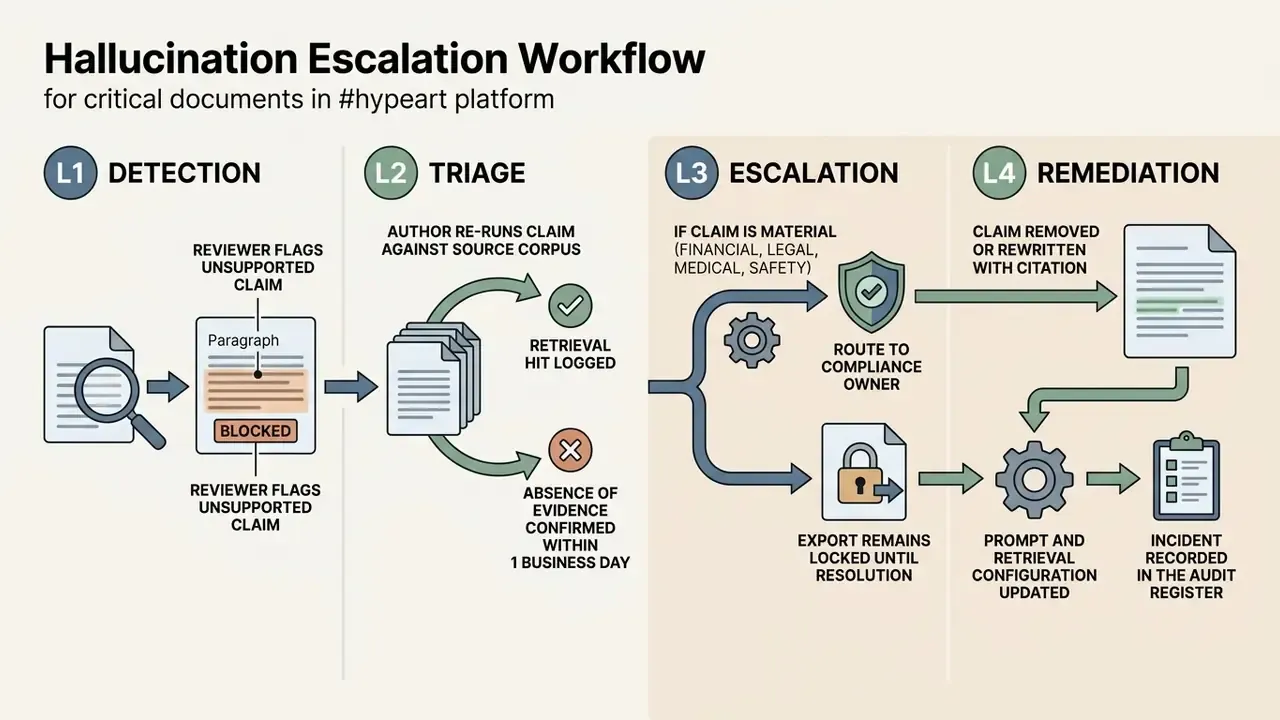
Recurring L3 events should trigger a review of the retrieval corpus and prompt constraints rather than repeated manual correction, since persistent hallucination patterns usually indicate missing source coverage. Where disputed claims carry legal exposure, the reference material in the litigation hub is worth a look before republication; you can also browse the hub for jurisdiction-specific notes.
Free AI Article Generator: What Is Available and How to Evaluate a Plan
Evaluating an ai article generator free option requires understanding functional limits imposed by platform providers. Free access models allow content teams to test interface usability and basic model output before committing budget to commercial subscription tiers.
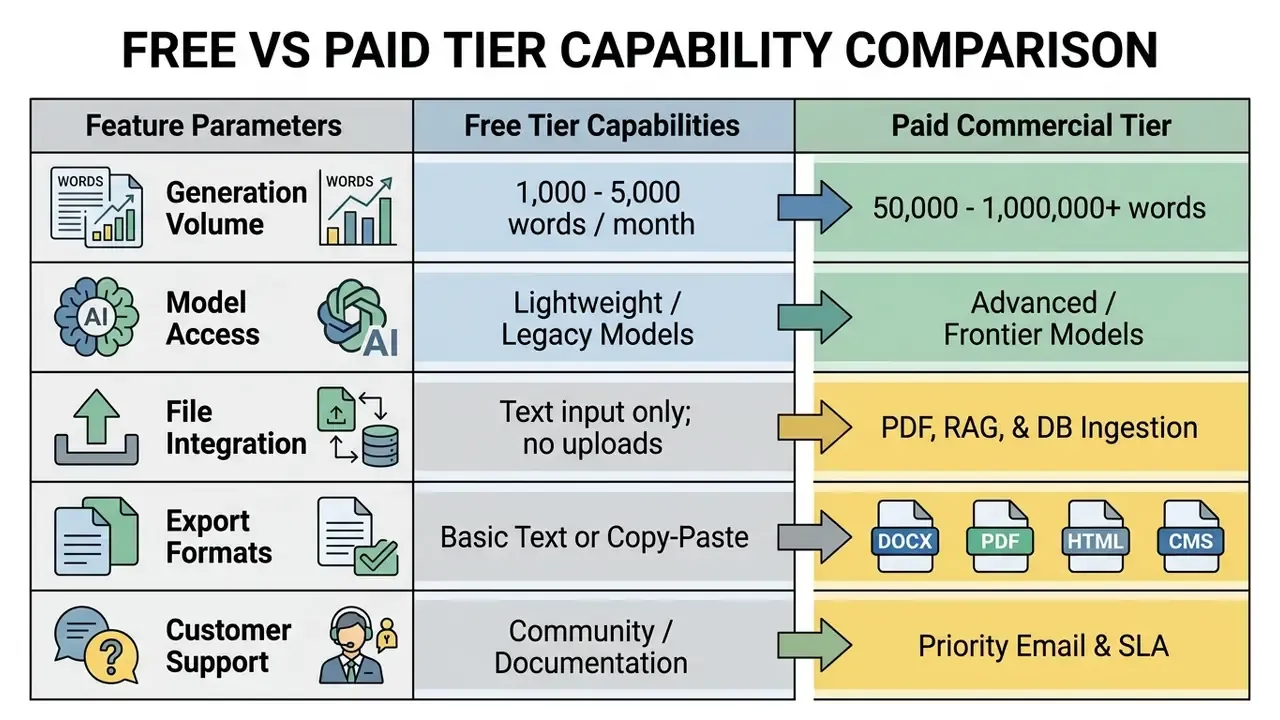
«Employees typically begin with public LLM interfaces and then migrate to integrated, data-connected tools, functionality characteristic of paid systems.»
Security and Compliance Parameters by Tier
Word quotas rarely decide enterprise procurement. Data handling terms do.
| Security parameter | Typical free tier | Enterprise commercial tier |
|---|---|---|
| Training on customer data | Often permitted by default | Contractually excluded; opt-out documented |
| Data retention | Indefinite or unspecified | Configurable, zero-retention options available |
| Deployment model | Shared multi-tenant cloud | Private tenancy, VPC, or on-premise |
| Certifications | Rarely published | SOC 2 Type II, ISO/IEC 27001, HIPAA/BAA where applicable |
| Access control | Single account, shared login risk | SSO/SAML, SCIM provisioning, role-based permissions |
| Audit logging | Absent | Full prompt and output logs with export |
| Regional data residency | Not offered | EU, US, or APAC region selection |
| DPA and subprocessor list | Generic terms of service | Signed DPA with named subprocessors |
Procurement teams evaluating adjacent generative tooling apply the same criteria across media formats, which is why the commercial-terms breakdowns for Microsoft AI image generation and Google AI image generation are reviewed alongside text platforms. For a consolidated licensing perspective, view the guide.
What to Check in the Free Online Version Before You Start
Before selecting an ai article generator free online tool, users should review daily character input caps, available model architectures, and export format restrictions. Free online utilities frequently restrict message inputs to 1,000 to 4,000 characters and limit output generation to basic text models (MiniMax AI Documentation, 2026). Understanding these technical limits prevents workflow interruptions during document creation. Equally important: confirm whether free-tier prompts feed model training, since that single clause can disqualify a tool for any internal or client-confidential material. Shortlists titled "best free ai article generator" rarely publish that detail, so read the terms rather than the ranking.
When a Free AI Article Generator Fits Regular Content Creation
A free article generator ai tier is sufficient for low-volume content drafting, basic concept outlines, and individual research tasks. Products offering free access limits fit periodic administrative work, such as generating internal process documentation or drafting short blog posts (Scribe Tools Overview, 2026). An article generator ai free plan also works well for testing tone presets before a paid rollout. Enterprise organizations requiring high-volume generation, custom brand alignment, and API integrations require dedicated commercial plans; to compare quotas and seats, view the guide. Teams comparing entry-level tiers across formats often cross-reference the analysis of free photo editors, free AI video generators, and specialized utilities such as an ai pfp generator to understand where vendors typically place paywalls.
| Tier Parameter | Free Tier Access | Commercial Paid Tier |
|---|---|---|
| Monthly Word Quota | 5,000 words | 50,000 to 1,000,000 words |
| Model Selector | Basic standard models | Advanced frontier models |
| Document Ingestion | Not supported | PDF and document upload |
| Export Options | Text, basic HTML | DOCX, PDF, Markdown, API |
| Support Level | Standard docs | Priority support SLA |
| Data Retention Control | Not configurable | Zero-retention or regional residency |
| Team Seats and Roles | Single user | Multi-seat with role permissions |
- Feature summary: Free plans suit periodic drafting, while paid commercial subscriptions unlock high-volume production, file uploads, direct CMS export, and the security controls required for confidential material.
Time and Budget Savings Calculator (Widget Specification)
Place an interactive "Time and Budget Savings Calculator" widget at this position.
- Input fields Articles per month (slider: 1 to 100); average article length (words: 500 to 5,000); writer rate (dollars per hour); review rate (dollars per hour); expected review time per article (minutes).
- Core formula
Savings = (Articles × Drafting hours per article) × 0.65 × Writer rate - True-cost adjustment
Net savings = Savings − (Articles × Review hours × Review rate) − Subscription cost - Output display gross hours saved, human-in-the-loop review overhead, subscription cost, net monthly savings, and payback period in months.
Total cost of ownership must include the review layer. In the financial-services case above, drafting savings of 4.1 hours per document were partially offset by 0.67 hours of compliance review, a ratio that still produced a 47% net gain but would invert entirely if a senior compliance officer reviewed every low-value page. Tier the review depth by claim materiality, or the model risk cost eats the productivity gain. Cost projections for mixed media pipelines can be modeled with the internal calculators toolkit.
Can You Use AI-Generated Articles for Business and Websites?
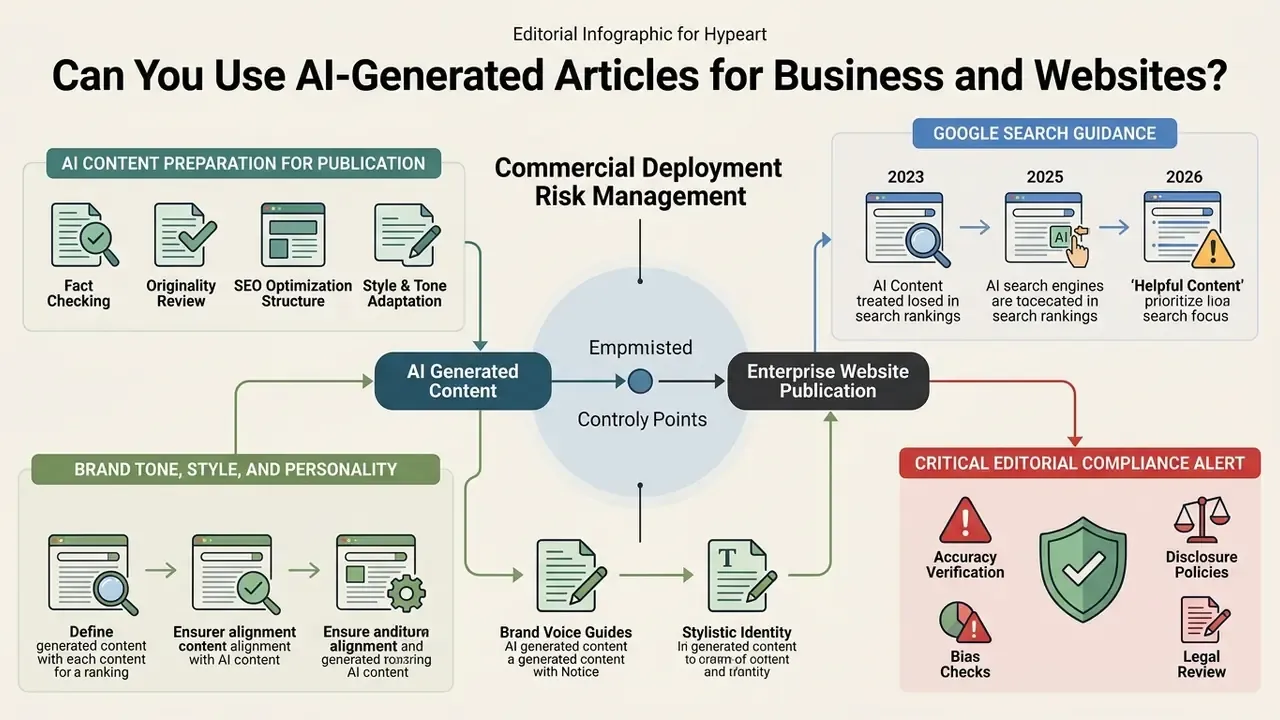
Commercial deployment of ai-generated articles on enterprise websites requires establishing strict risk management policies. Published guidance from search engine providers and federal regulators confirms that automated text is acceptable when it provides original value, accurate information, and undergoes human oversight.
«Two preregistered experiments (N = 4,976) found that labeling headlines as "AI-generated" lowered perceived accuracy by 0.17 points on a six-point scale (p = 0.010).»
Disclosure carries a measurable trust cost, which makes the substantive quality of the underlying article, not its labeling strategy, the decisive variable for audience retention. Labeling still stays; hiding provenance is a worse trade.
How to Prepare AI-Generated Content for Website Publication
Preparing automated drafts for website publishing requires executing a five-stage preparation workflow:
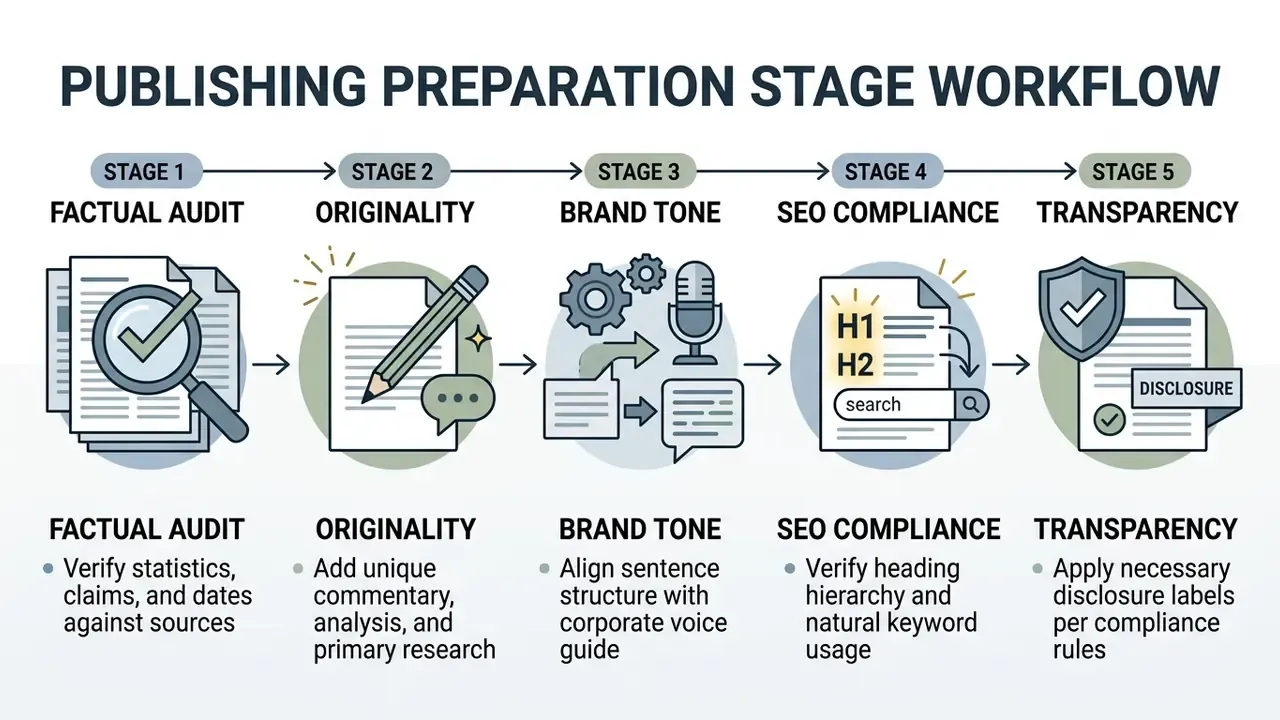
«By mid-2025 roughly 35% of new websites were AI-generated or AI-assisted, with no statistically significant increase in factual error rates.»
Official search documentation states that using automation primarily to manipulate search rankings violates search spam policies, whereas deploying AI to assist content production is fully permitted when quality standards are met (Google Search Guidance on AI Content, 2023 to 2026). Organizations extending the same publishing policy to generated visuals consult the licensing analysis for AI image generators in commercial use, and design teams often check narrower cases such as an ai person generator or an ai pet portrait generator free before shipping synthetic imagery.
Regulated industries add a supervisory layer above search policy. Financial marketing communications in the United States remain subject to SEC, FINRA, and CFPB requirements for fair, balanced, and non-misleading statements regardless of whether a human or a model produced the first draft. The same principle applies to healthcare claims under FDA advertising rules. Automated drafting does not create an exemption, and supervisory review records must survive audit. In practice, that means the record has to show who approved which claim, when, and against what source.
- Google Search Guidance on AI Content, 2023 to 2026
How to Preserve Brand Tone, Style, and Personality
Maintaining brand identity across automated drafts requires converting tone guidelines, prohibited vocabulary, and formatting standards into explicit system instructions. Corporate style frameworks published by communications platforms recommend establishing fixed rules for punctuation, sentence length ranges, and preferred vocabulary lists (Klaviyo Brand Messaging Guide, 2025; Glean Enterprise Voice Framework, 2026).
«Preference for ChatGPT texts reflects conformity with standard journalistic structures rather than a distinctive voice; AI defaults to generic patterns.»
Without explicit brand instructions, the model's default is competent averageness, which erodes differentiation across a content library. Feeding annotated text examples into custom model instructions ensures generated articles match institutional communication standards. Multimedia teams apply the same discipline to motion and imagery, which is why workflow notes on an ai photo animator and on the mobile-first ai photo editor sit next to written style guides in most brand libraries.
«Perceived quality of AI-assisted and fully AI-generated articles was statistically equivalent to human-written articles when authorship was unknown (N = 599).»
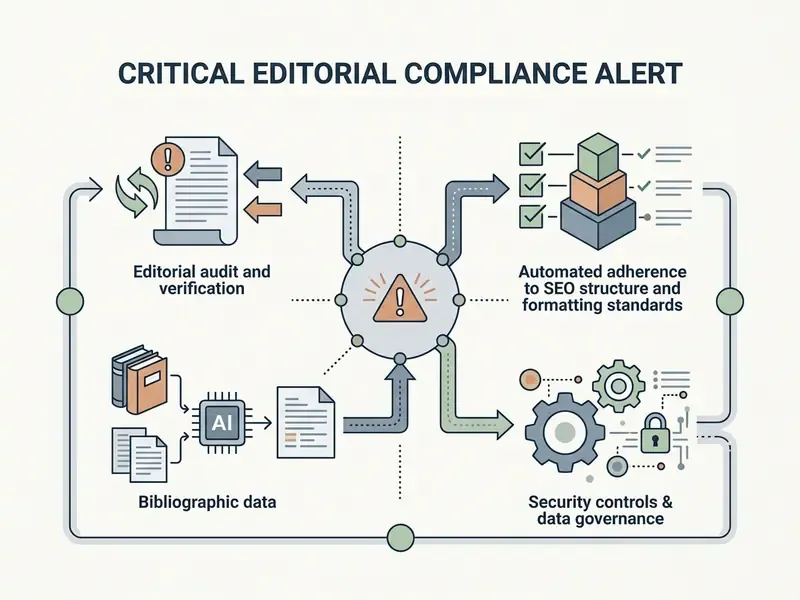
CRITICAL EDITORIAL COMPLIANCE ALERT
Data Privacy, Shadow AI, and Vendor Security Screening
Enterprise adoption fails more often on data handling than on text quality. Three controls matter most.
1. Confidential input boundaries. Prohibit pasting personally identifiable information, customer records, non-public financial data, credentials, or unreleased product specifications into any consumer-grade interface. Where such content is unavoidable, route it through a private deployment with contractual exclusion from model training and a documented retention window. Write the rule into the acceptable-use policy, not into a training slide.
2. Shadow AI prevention. Unapproved tool use spreads when sanctioned tooling is slower or more restricted than the public alternative. Effective programs pair a published allowlist with a fast approval path, network-level monitoring for unsanctioned endpoints, browser-extension governance, and a single sanctioned workspace that is genuinely convenient. Enforcement without a usable sanctioned option reliably produces circumvention. That pattern repeats across institutions.
3. Vendor security checklist. Before procurement, confirm in writing: training-data exclusion clause; retention period and deletion mechanism; SOC 2 Type II or ISO/IEC 27001 attestation; regional data residency; subprocessor list; SSO/SAML and role-based access control; prompt and output audit logs with export; incident notification SLA; and model-change notification policy. Map each answer to the risk categories defined in the NIST AI Risk Management Framework Generative AI Profile, then document residual risk acceptance at the appropriate governance level. If your model risk committee already reviews credit and AML models, generative drafting tools belong in the same inventory. Implementation questions can be routed through the assistance desk, where you can open the hub for onboarding and access-control documentation.
FAQ About AI Article Generators
How Long Does Article Generation Take?
Generating a draft article using an article ai generator typically takes between 15 and 60 seconds. Total completion time depends on output token length, model parameter size, server deployment load, and prompt complexity (OpenAI API Latency Guide, 2026). Reducing requested output length by half reduces latency by roughly the same proportion, because generation time scales with produced tokens. Review time, of course, does not shrink with it.
Does the AI Writer Support Multiple Languages?
Yes. Modern platforms support more than 30 languages, including regional variants:
- Europe: English (US and UK), Deutsch, Français, Español, Italiano, Português, Nederlands, Polski, Svenska, Dansk, Suomi, Čeština, Română, Ελληνικά.
- Asia and the Middle East: 日本語 (Japanese), 中文 (Mandarin), 한국어 (Korean), हिन्दी (Hindi), தமிழ் (Tamil), Bahasa Indonesia, Bahasa Melayu, ไทย (Thai), Tiếng Việt, العربية (Arabic), עברית (Hebrew), Türkçe.
- CIS region: Russian, Ukrainian, Kazakh, Belarusian. Models do not translate word for word; they adapt idioms, grammatical register, and cultural context to the target market. Multilingual LLMs process source context and output localized prose directly, though translation fidelity and stylistic accuracy remain highest in widely represented languages (NAACL SRW Multilingual Benchmark, 2025).
«The MultiSocial benchmark evaluated machine-generated text quality across ten languages: OPT-IML-Max-30B performed worst, Gemini and Aya-101 best.» Source: MultiSocial Multilingual Benchmark Study (2024). https://arxiv.org Cross-lingual style transfer remains the weakest link. Research on low-resource pairs reports style preservation rates of 38% to 46% without language-specific fine-tuning, so native-speaker post-editing stays mandatory for brand-critical localizations.
Will Google Penalize AI-Generated Articles?
No, not on the basis of authorship mode. Search guidance evaluates helpfulness, originality, accuracy, and demonstrated expertise. Penalties apply to scaled, low-value automation deployed primarily to manipulate rankings. Pages with substantial human contribution measurably outperform fully automated ones in organic impressions.
Can an AI Article Generator Produce Academic Papers With Citations?
It can produce structured drafts with formatted APA, MLA, Chicago, IEEE, or Vancouver references drawn from uploaded PDFs and connected publication databases. Every citation still requires manual verification: the DOI must resolve, the source must exist, and the claim must actually appear in it. Institutional guidance treats unverifiable references as fabricated.
Does the Tool Check for Plagiarism?
Specialized platforms include text-matching modules, but detection scores are unreliable on edited or paraphrased text. One study recorded a drop from 91.3% to 27.8% detection after obfuscation processing. Treat similarity scanning as a supplementary control, not as proof of originality.
Can Multiple Team Members Work on the Same Article?
Yes. Commercial tiers provide shared workspaces with role-based permissions, simultaneous editing, comment threads, version history, and export locks that prevent unreviewed drafts from leaving the workspace.
What Should a Regulated Institution Document Before Launch?
At minimum: the approved use cases, the data classes permitted in prompts, the named owner of each workflow, the reviewer roles, the retention configuration, and the escalation path for disputed claims. Keep the evidence reproducible. If an examiner cannot reconstruct how a published claim was approved, the control effectively does not exist.
Key Takeaways and Strategic Summary
- Automated drafting efficiency A randomized controlled trial (n = 453) confirmed a 40% reduction in task completion time, an 18% quality increase, and reduced inequality between writers, which is the empirical basis for productivity claims surrounding article generators (Noy & Zhang, 2023, https://arxiv.org).
- Mandatory human oversight Operational value depends on human verification. Raw model output requires multi-source fact checking, citation validation, grammar editing, and brand voice alignment prior to publication. GPT-4o assigns correct verdicts to claims only about 70% of the time.
- Search compliance Google evaluates content on quality, expertise, and original value rather than authorship mode, while scaled low-quality automation violates web spam policies. Ahrefs data shows pages with under 50% AI content earn two to three times more organic impressions than fully automated pages.
- Structured input rules High-precision prose generation requires explicit system instructions detailing target audience, tone register, document constraints, delimiters, and primary source context.
- Security before scale Training-data exclusion, retention controls, SOC 2 attestation, and shadow AI governance determine enterprise viability more than word quotas.
- True ROI includes review Net savings equal drafting savings minus human-in-the-loop review cost minus subscription cost. Omitting the review layer overstates returns.
- Open question Long-run effects on brand differentiation are not settled. Evidence on voice homogenization is early, and we treat it as a hypothesis rather than a finding.
Enterprise Content Governance Framework
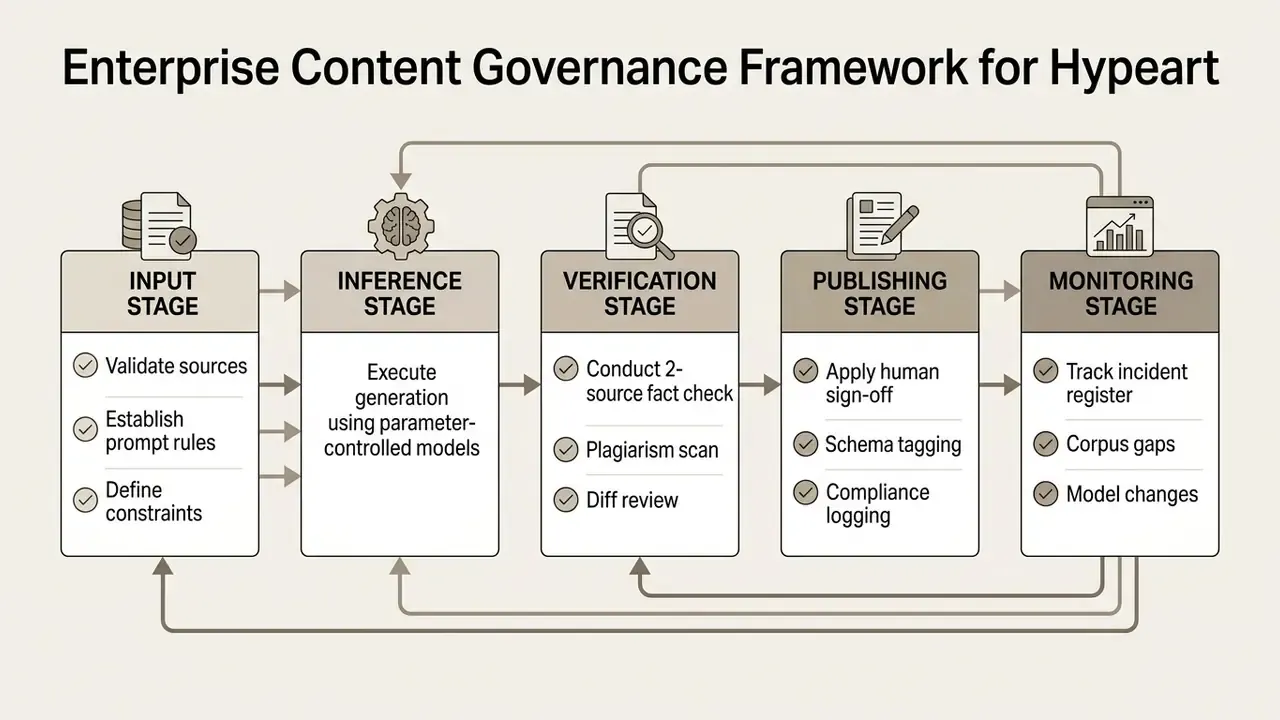
A reasonable next step is small: pick one recurring document type, bind it to an approved source corpus, add a named reviewer, and measure net hours over a single quarter. No pilot expansion until the audit log holds.
Editorial Standards and Publisher Verification