«Automating social copy without a human verification loop introduces compounding model and brand risk. The rule for enterprise deployment is straightforward: zero autonomy without verifiable evidence.»
Executive Summary for Risk, Marketing, and Compliance Leads
- What it is: An AI Facebook post generator converts a prompt, a pasted article, or a product URL into feed-ready primary text, hooks, captions, hashtags, and CTAs, plus multiple wording variations for A/B testing inside Meta Ads Manager.
- Why it matters now: 71% of surveyed social media marketers already use generative AI, and high-performing teams are 185% more likely to use AI content generation than underperformers (HubSpot 2024 Social Trends Report). Meanwhile, an audit of 8,885 long-form posts estimated that by November 2024 roughly 41% of long Facebook posts were likely AI-assisted (Originality.AI, 2024).
- The core risk: Consumers penalize perceived automation. 73% of UK adults express concern about AI content and 48% distrust AI labeling (YouGov, 2024), while experimental work shows brand authenticity perceptions fall when audiences learn posts are AI-automated (Bruns & Meissner, 2024).
- The control model: Four mandatory pre-queue checks adapted from the NIST AI Risk Management Framework Generative AI Profile (NIST AI 600-1) and Reducing Risks Posed by Synthetic Content (NIST AI 100-4): factual consistency, tone alignment, bias and harm screening, provenance logging.
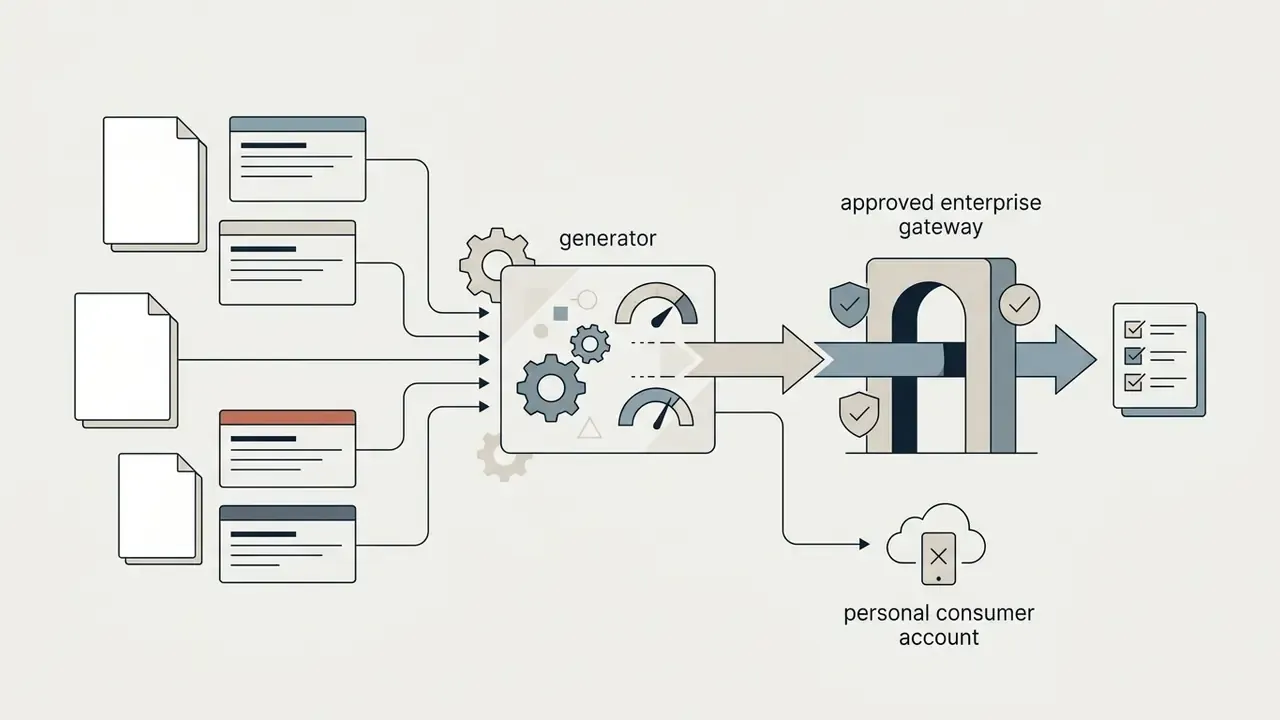
- The tooling decision: Split vendors into public web generators (fast, free, no data guarantees) and enterprise managed gateways (SSO/SAML, SOC 2 Type II, Zero Data Retention, PII/NPI masking, audit export). Never allow regulated-product copy to pass through a public consumer endpoint.
- The output specification: Draft above Facebook's roughly 125-character "See More" truncation point, and produce visuals at 1080 × 1080 px (square feed), 1200 × 628 px (link preview), and 1080 × 1920 px (Reels and Stories).
Who this guide is written for. Three roles, three different questions. Social leads want a repeatable production line. Compliance and model-risk owners want to know which control breaks first when volume triples. Finance leaders want the cost of controls inside the ROI model, not outside it. The sections below answer all three in sequence: capability, workflow, prompts, formats, governance, free-tier limits, and vendor selection.
What is an AI Facebook Post Generator and What is it Used For?
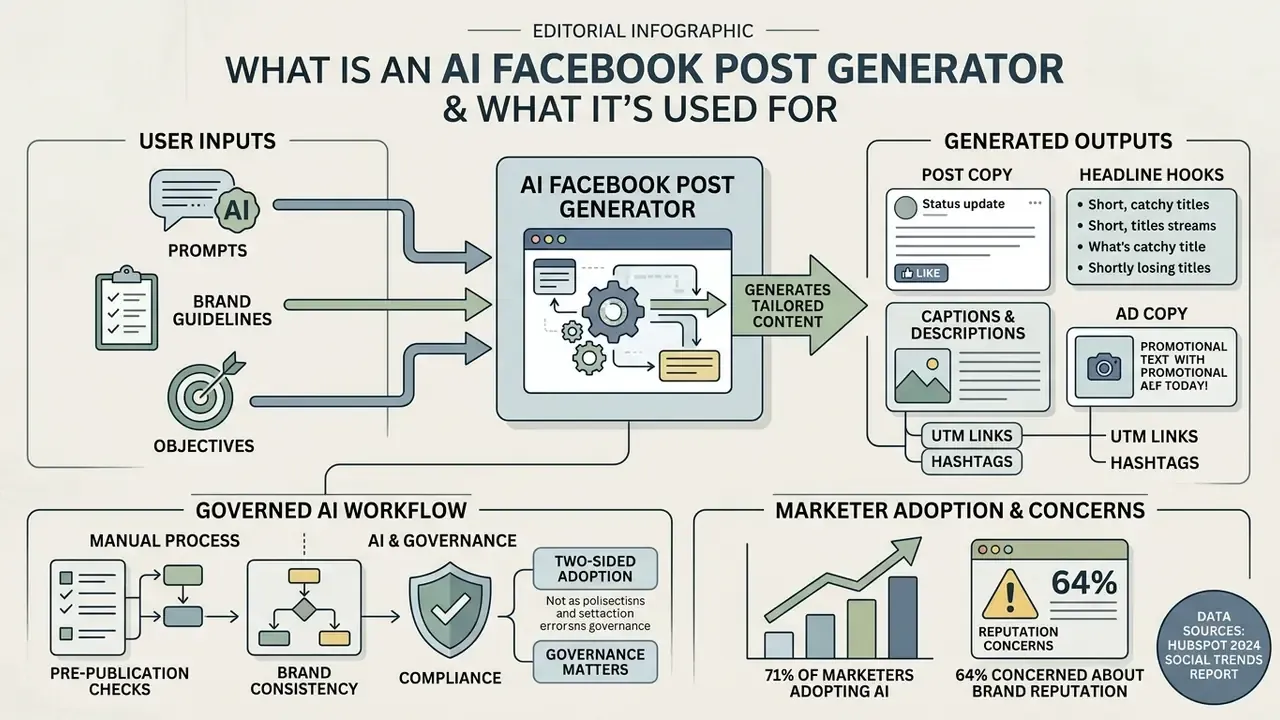
An ai facebook post generator is a software application or large language model interface designed to turn user prompts into tailored Facebook copy. These tools process marketing objectives, target demographics, and product attributes to output structured captions, primary ad text, and engaging post variations. Organizations use an ai generator for facebook post creation to reduce manual copywriting cycles, reformat existing blog assets, and test multiple messaging angles across audience segments.
The functional difference between manual copywriting and a governed AI workflow is not only speed. It is where the human effort sits. Manual production concentrates labor in drafting. AI-assisted production shifts labor into specification (prompt design) and verification (editorial review). That shift is the part budget models usually miss.
| Production Stage | Traditional Copywriting Cycle | Governed AI-Assisted Cycle (2026) |
|---|---|---|
| Ideation | Manual brainstorm, 30-60 min per campaign | Prompt brief with objective, persona, tone, constraints (5-10 min) |
| Drafting | 1 draft per writer, 20-40 min per post | 3-5 candidate variations generated in under 2 minutes |
| Variation testing | Rarely more than 2 versions due to cost | Single-variable variants for hook, length, and CTA position |
| Editorial review | Line edits and proofreading | Fact verification, buzzword removal, tone filter, claim check |
| Compliance | Ad-hoc, often post-publication | Mandatory provenance log, disclosure check, approval gate |
| Bottleneck | Writing capacity | Verification capacity and prompt quality |
What Facebook Post Elements Can AI Generate?
«By November 2024, an analysis of 8,885 long-form Facebook posts estimated that about 41% were likely AI-generated.»
That scale explains the shift in what actually differentiates teams. Not generation capacity. Editorial control.
Who Should Use an AI Generator for Facebook Posts?
«87% of social media marketers believe AI tools will be critical to a successful strategy in 2024.»
«At the same time, 64% of marketers express concern that AI content could damage brand reputation.» — HubSpot 2024 Social Trends Report (survey of 1,500+ social media marketers)
Deployment is accelerating outside social teams too: roughly 30% of marketers report rolling out initial generative AI solutions, while a further 27% already use them and are measuring effectiveness (Statista global survey of 626 marketers, September to October 2024). Treat these figures as directional market signals, not as a benchmark for your own risk appetite.
How to Create a Facebook Post with AI in a Few Steps
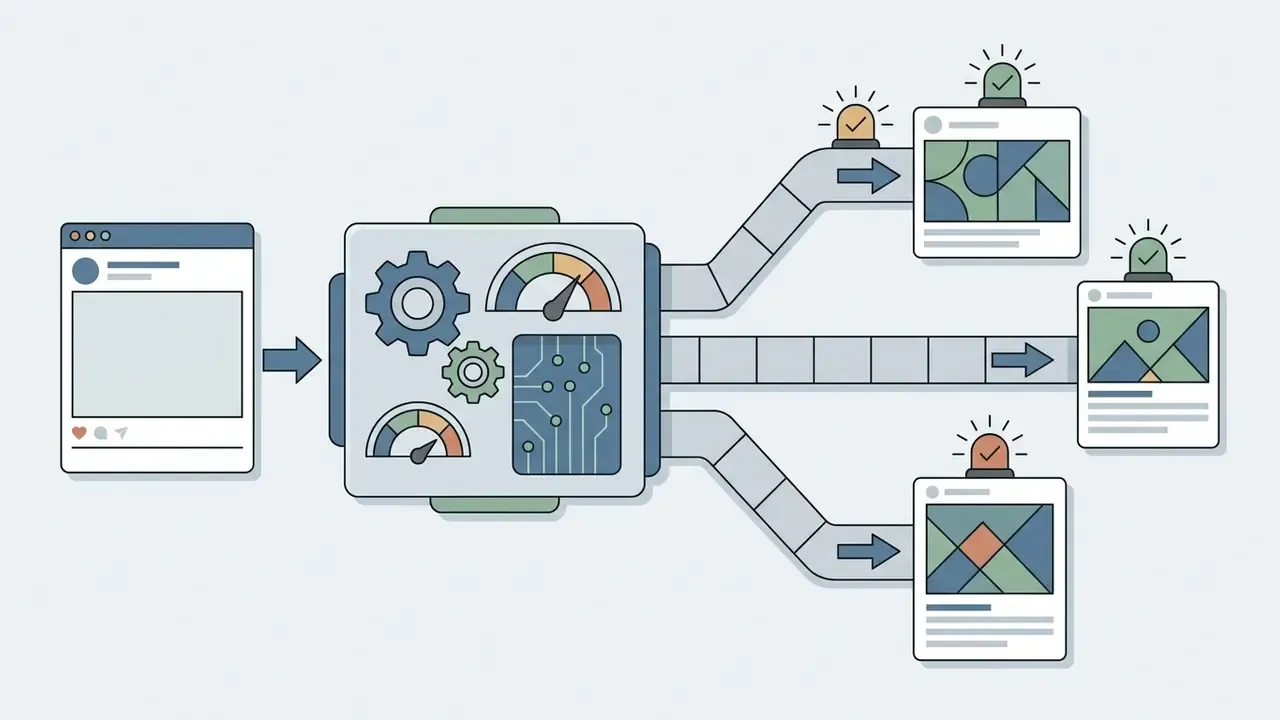
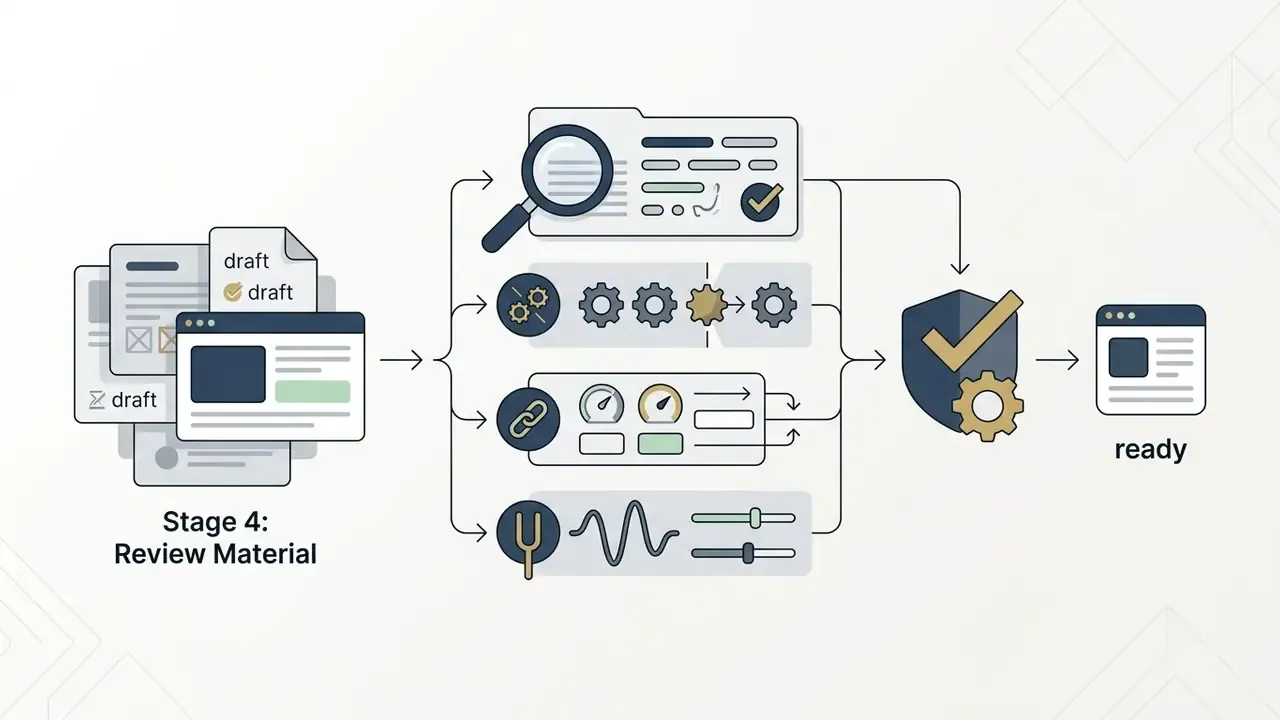
To create facebook post with ai outputs reliably, teams follow a standardized six-step sequence that connects initial ideation to verified publishing. This pipeline keeps low-quality drafts out of the queue without slowing the calendar.
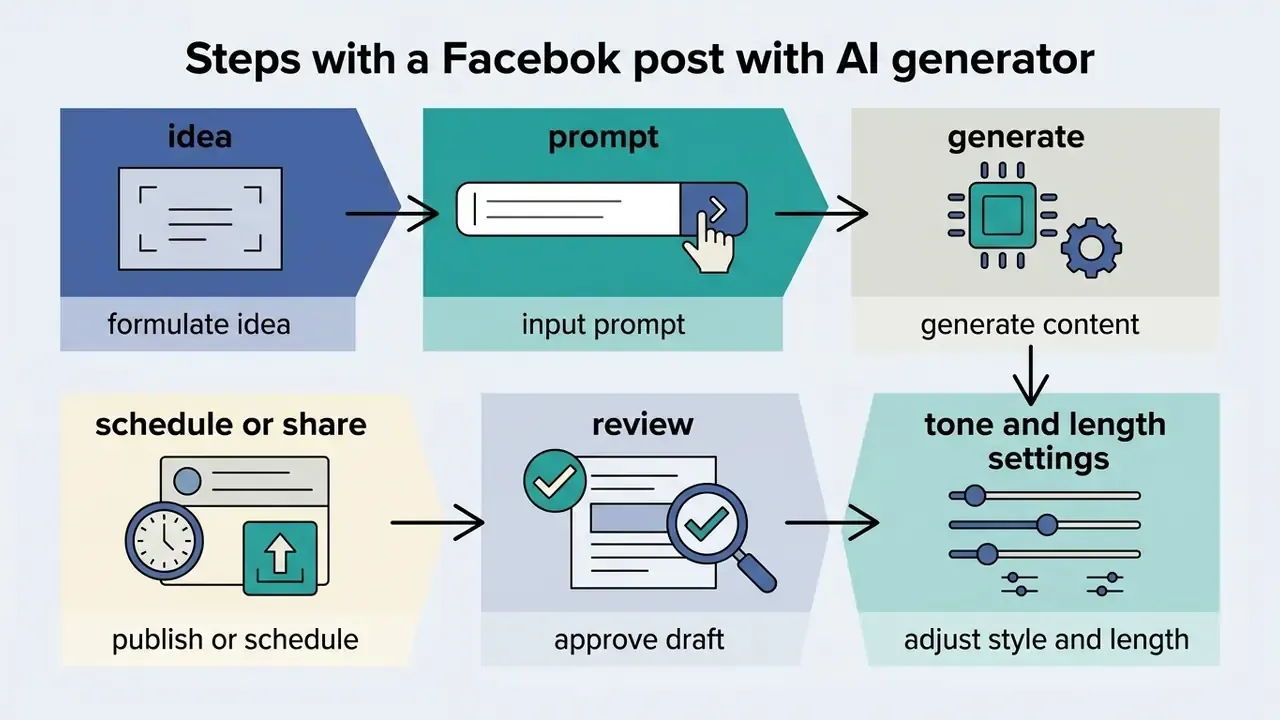
Workflow: creating a Facebook post with AI
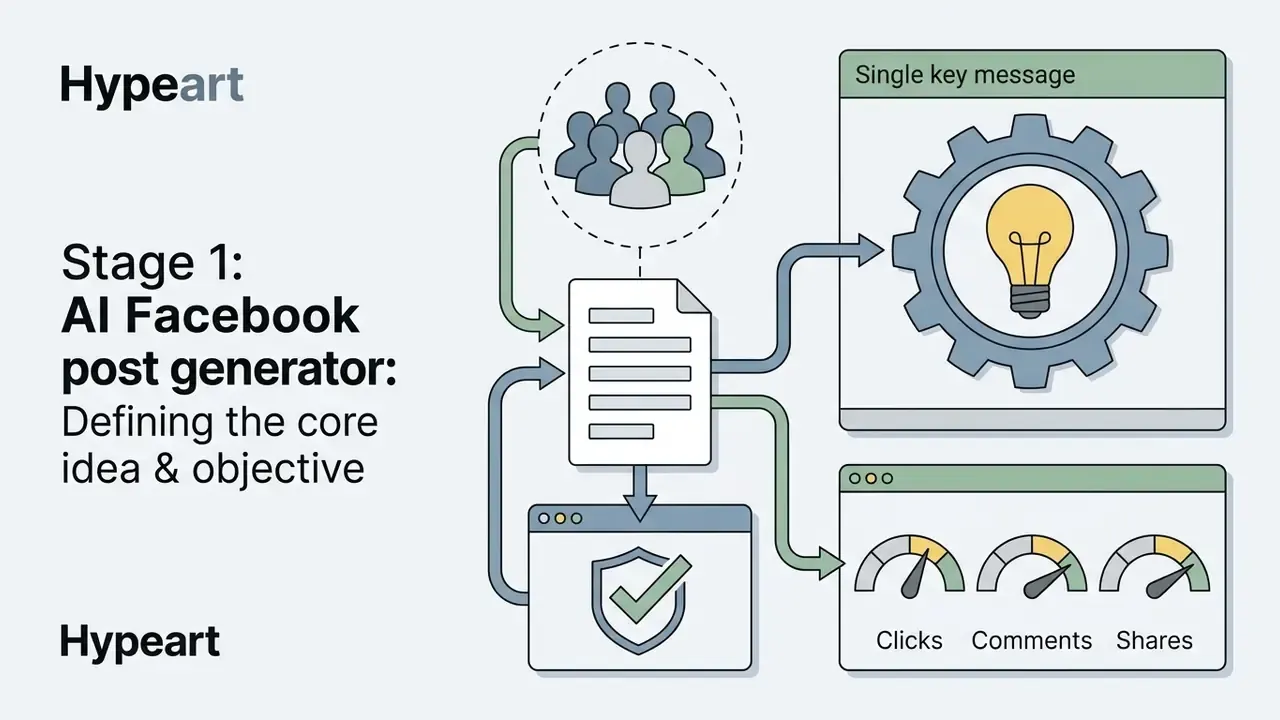


Step-by-Step: Converting a Website URL into a 7-Day Facebook Campaign
One of the highest-leverage uses of an ai fb post generator is repurposing a single URL, whether a landing page, product detail page, or long-form article, into a structured multi-post sequence. Follow this order:
- URL ingestion.Provide the model (or the tool's URL field) with the direct link to the landing page or article. Tools built around this pattern scan the destination page and align generated copy to the product or service described there.
- Extraction prompt.Run: "Extract 3 core value propositions, 2 target persona pain points, 1 primary objection, and 1 primary CTA from [URL]. Output as a labeled list with no commentary."
- Angle mapping.Generate five distinct posts from that extraction: 1 × educational, 1 × direct-response sales, 1 × social proof or case evidence, 1 × interactive question, 1 × short summary. Add 1 × behind-the-scenes and 1 × FAQ post to fill a 7-day rotation.
- Format assignment.Assign each angle a placement: square feed image, link preview, Reel hook, or poll. Copy length and hook structure change per placement.
- UTM construction.Instruct the model to append a consistent tracking structure:
https://yoursite.com/page?utm_source=facebook&utm_medium=social&utm_campaign=[Campaign_Name]&utm_content=[Post_Angle]. - Calendar export.Compile the seven approved drafts into the scheduling queue with dates, owners, and creative references, then run the pre-publication checklist on each item before it is queued.
Applied at scale, this is what vendors market as a "30-day content calendar from one URL". The governance requirement does not change: extraction is automated, approval is not.
What to Include in the Prompt Before Generation
A prompt for a facebook post generator ai must carry five core parameters: topic, target audience, primary objective, tone of voice, and character constraints. Specifying visual media context, such as whether the text accompanies a single image, a video link, or a poll, keeps the output matched to the asset it will sit beside.
Character boundaries keep the decisive message above Facebook's "See More" truncation point. Institutional social media guidance documents that Facebook displays approximately the first 125 characters of post text before requiring expansion, and recommends 1080 × 1080 px post images (University of Michigan, Social Media Facebook Best Practices, 2023). Treat 125 characters as a working design constraint for the hook rather than a hard platform-enforced limit, and verify current behavior in your own placements.
How to Refine Generated Posts Before Publishing
Refining drafts from an ai facebook generator means removing generic buzzwords, adjusting sentence cadence, and verifying embedded claims. Editors replace passive phrasing with direct active voice and confirm that calls to action match the destination landing page. When two or three rewrite passes fail to fix the tone, rewrite the prompt instead of the paragraph. That is usually faster.
«Study participants were willing to forgo monetary compensation in exchange for AI writing assistance, particularly on highly creative tasks.»
The value of assistance is real. It is captured only when a human owns the final claim set.
Teams pairing copy with generated creative should standardize the visual pipeline in parallel. Comparison guidance on AI art and image generation tools and on commercial licensing for Canva's AI generator helps confirm whether a visual asset may legally accompany a paid campaign. For developer-side configuration and enterprise licensing terms, review the API implementation guidance, see the overview of available endpoints, and compare options across usage-rights documentation.
Prompts for AI Facebook Post Generator: How to Get Precise Results
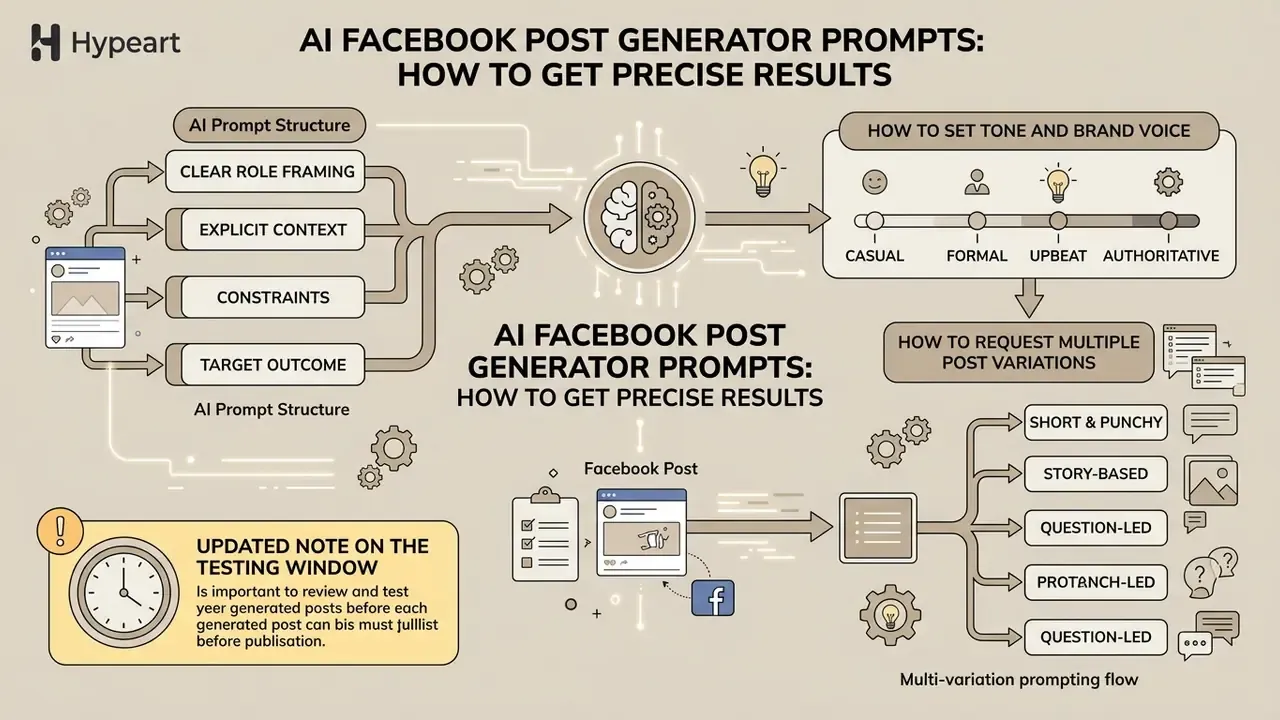
To get precise results from an ai fb post generator, copywriters structure prompts with clear role framing, explicit context, constraints, and a target outcome. Unstructured prompts return generic prose that no audience reacts to.
«Detailed prompts specifying topic, tone, and audience allow AI to generate text that more closely matches user intent.»
Table: structured prompt templates for Facebook post generation
| Goal / Post Type | Prompt Template (copy-pasteable) | Expected Output Format |
|---|---|---|
| Product launch / sales | Act as a social media copywriter. Write a 100-word Facebook post launching [Product Name] for [Target Audience]. Focus on [Primary Benefit]. Tone: authoritative yet approachable. Include 1 primary CTA pointing to [URL]. Exclude buzzwords like "game-changing". | Short hook, 3 bulleted benefits, direct CTA link description |
| Engagement / question | Draft 3 distinct Facebook post options asking our audience of [Demographic] about [Topic]. Tone: conversational and curious. Keep each option under 150 characters. End with a single focused question that encourages comments. | 3 concise question-based post variations with emoji accents |
| Content repurposing | Summarize the key insights from this article: [Insert URL/Text] into a Facebook post for [Target Audience]. Tone: professional. Structure: 1-sentence hook, 3 short key takeaways, and a question asking for reader opinions. Max 120 words. | Structured status update with clear visual spacing and bullet points |
| Event announcement | Write a Facebook announcement post for an upcoming webinar titled [Title] on [Date/Time]. Highlight [Key Speaker/Topic]. Goal: drive registrations. Tone: urgent and informative. Include a placeholder link and a clear registration CTA. | Event headline, key date details, benefit summary, registration CTA |
| Multimodal visual and copy generation (image upload plus text) | [Upload Reference Image] "Analyze the color palette, mood, and subject of this uploaded visual. Write a matching Facebook caption (under 100 words) for [Target Audience]. The hook must reference a specific visual element in the image. Do not describe the image literally. Include CTA: [URL] with standard UTM parameters." | 1-sentence visual hook, 2 short descriptive body lines, direct CTA link |
| Regulated product announcement (finance, fintech, health) | Act as a compliance-aware social copywriter. Write a 90-word Facebook post announcing [Regulated Product] for [Eligible Audience]. State no performance guarantees, no forward-looking returns, and no comparative superiority claims. Use only benefits listed here: [approved benefit list]. End with the exact placeholder: [MANDATORY_REGULATORY_DISCLOSURE]. Flag any sentence that could be read as advice. | Neutral hook, 2 factual benefit lines, CTA, mandatory disclosure placeholder, plus a list of flagged sentences for legal review |
How to Set Tone and Brand Voice
Setting tone in a facebook post creator ai requires explicit attributes, not broad labels. Instead of asking for a "professional" tone, instruct the generator to "use clear, active language with short sentences, zero hyperbole, and precise industry terminology". Organizations can upload existing brand guidelines or representative content samples into tools that support custom instructions. Koala AI and DXPR, for example, let users paste a 200-word text sample and save a reusable brand voice profile, while guideline-driven workflows ingest full brand documentation, marketing collateral, and published content for analysis.
A complete brand voice guide for AI use should specify purpose, three to five voice principles, tone ranges per scenario, preferred and banned vocabulary, structural rules, and annotated on-brand versus off-brand samples. Write it once. Version it like a policy document.
How to Request Multiple Post Variations
To request multiple variations from a facebook ai post generator, instruct the model to alter one specific parameter per variation: the hook angle, the length, or the CTA position. Three to five distinct variations give performance teams enough spread to test in Meta Ads Manager or in native feed posts.
Multi-variation prompting flow:
| Step | Fixed Elements | Varied Element | Output |
|---|---|---|---|
| 1 | Core offer, audience, creative asset, posting time | none | Control post (baseline) |
| 2 | Everything except opening line | Hook angle (problem-first vs. outcome-first) | Variant A |
| 3 | Everything except body length | Length (60 words vs. 130 words) | Variant B |
| 4 | Everything except CTA | CTA position (first line vs. last line) | Variant C |
| 5 | Everything except emoji and formatting | Formatting density | Variant D |
Updated note on the testing window. Practitioner guidance recommends holding each variant on comparable audiences, comparable time slots, and identical creative, then picking a winner only once each variant has accumulated enough observed activity. The figures usually quoted are roughly 48 to 72 hours for fast-moving feed posts and 3 to 7 days for Reels or slower-cycling formats. These windows are operational conventions from vendor and practitioner playbooks, not a peer-reviewed standard, so calibrate them against your own account's historical velocity before treating a result as decisive.
For teams expanding visual assets alongside copy, evaluate licensing and output quality first. Our comparisons of free AI art generators and free AI video generators document watermark rules, credit caps, and usage rights that decide whether a generated asset can accompany a commercial Facebook post.
What Types of Facebook Posts Can You Create with AI?
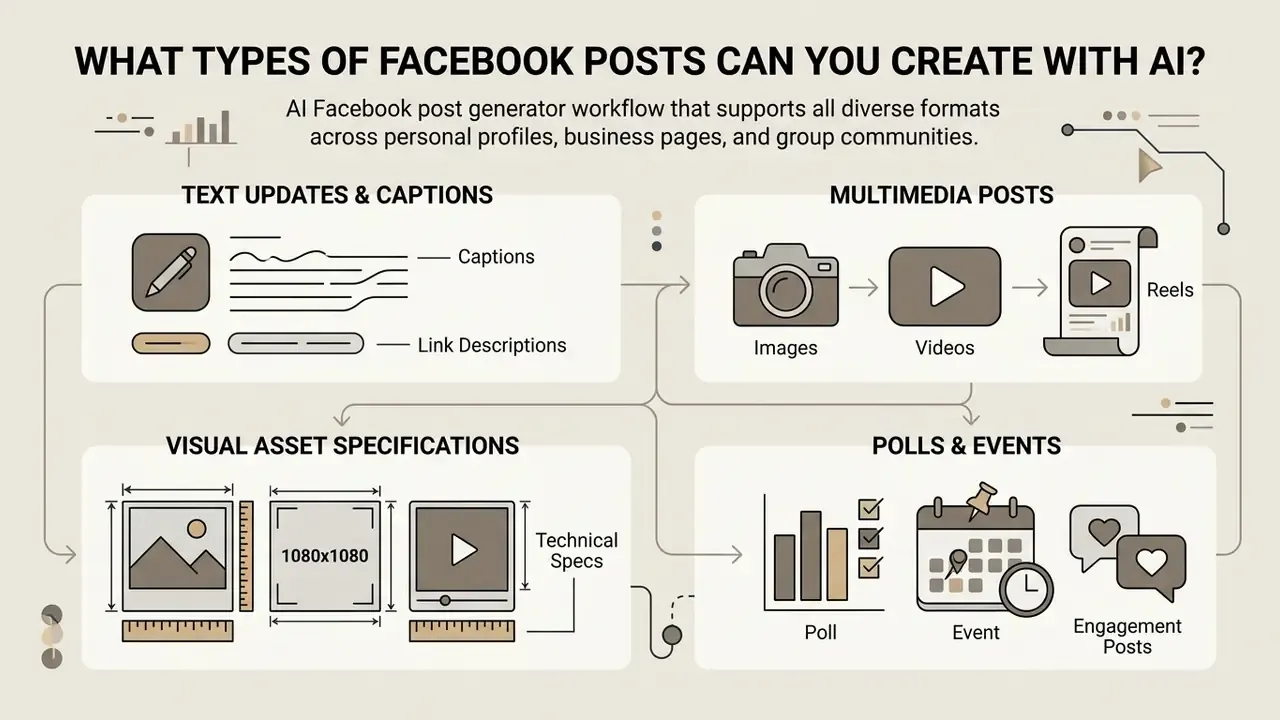
An ai generator facebook post workflow supports diverse formats across personal profiles, business pages, and group communities. Modern language models adjust structure depending on whether the output pairs with a static image, short-form video, or a link preview. Facebook supports four practical content families for AI drafting: plain text posts, media posts, polls, and event announcements. A facebook post maker ai setup handles all four from one brief, provided the brief names the placement.
Text Updates, Captions, and Link Descriptions
A facebook ai text generator creates plain text status updates, link preview commentary, and short promotional copy. Link posts need concise captions that summarize the destination page's value without echoing the auto-pulled metadata headline. Accessibility guidance from U.S. Section 508 practice and the European Commission expects captions to stay readable, avoid excessive emoji, use clear sentence structures, and carry verified alt text rather than auto-generated image descriptions (U.S. Access Board, 2024; European Commission social media accessibility guidance, 2024).
Volume alone does not equal legitimacy here, and the failure mode is documented:
«125 Facebook pages publishing AI-generated images averaged 146,681 followers; a single post reached 40 million views and 1.9 million interactions.»
Posts for Images, Videos, and Reels
Copy for visual assets should complement the frame, not narrate it. For Facebook Reels and video posts, the generator produces high-impact opening hooks, supporting descriptions, and transcript summaries. Teams building short-form video pipelines can review workflow guidance for video editing and publishing and animation production to keep captions synchronized with the on-screen narrative. Where static assets need to become motion, documentation on a photo to video ai app, on photo to video conversion limits, and on pictory ai text to video output rights clarifies which pipeline is safe for paid distribution.
Controlled experiments on Instagram and Facebook content show that AI-generated synthetic images can lower user trust when published unedited, while high-quality AI captions paired with authentic visuals reach engagement comparable to human-written posts (Desveaud & Pavone, 2026).
«AI images were perceived and engaged with more negatively than user-generated content, whereas AI captions improved engagement in lifestyle categories.»
The practical implication is compact: automate the caption, authenticate the image.
Technical Specifications for AI-Generated Visual Assets
Generated copy fails when it sits next to an incorrectly sized asset. The hook gets cropped, safe zones disappear under UI, link previews letterbox. Specify dimensions inside the visual prompt itself:
| Format Type | Aspect Ratio | Dimensions (Pixels) | AI Visual Generation Prompt Tip |
|---|---|---|---|
| Standard feed post | 1:1 (square) | 1080 × 1080 px | Specify "centered subject, clean uncluttered background, 1:1 aspect ratio, no embedded text" |
| Landscape feed link preview | 1.91:1 | 1200 × 628 px | Request "horizontal layout, clear focal point on the left third, right side reserved for headline overlay" |
| Stories and Reels | 9:16 (vertical) | 1080 × 1920 px | Specify "vertical framing, subject in middle third, top and bottom safe zones clear for UI overlays" |
| Event cover | 1.91:1 | 1200 × 628 px | Request "date and venue space in lower band, high-contrast subject, legible at thumbnail scale" |
| Profile / Page avatar | 1:1 | 320 × 320 px minimum | Specify "single clear mark, readable at 40 px, no fine detail" |
Square 1080 × 1080 px remains the default feed layout. Resize features in mainstream design tools convert the same source design into story, banner, or profile formats without regenerating the asset. Before pairing generated visuals with paid distribution, confirm rights and provenance using guidance on commercial use of Google's AI image generator and AI reverse image search, and clean up raw output with an online photo editor instead of publishing model output untouched. Stylized brand assets carry extra licensing nuance, documented in our notes on photo to painting ai, photo to sketch conversion, and photo video maker tools. Voice-over assets for Reels have their own terms, covered in the guide to AI voice generators.
Polls, Events, and Engagement Posts
Engagement content, meaning polls, event announcements, and interactive questions, benefits from AI ideation more than from AI authorship. When generating polls, direct the tool to produce one concise question with two to four clear, non-overlapping options. Shorter polls get completed more often, and plain wording outperforms detailed wording. For event promotion, the copy must lead with date, time, and the primary attendee value, then a direct registration link and one specific interaction prompt such as "Which session are you most interested in?"
For interactive question posts, prepare discussion points in advance and ask one focused question at a time to keep a live comment thread moving. Teams adding heavier media to these campaigns can compare AI headshot and portrait generation for speaker announcements or use a video compressor to keep recap clips inside upload limits without visible quality loss.
Editorial Methodology, Model Governance, and Audit Trail (E-E-A-T)
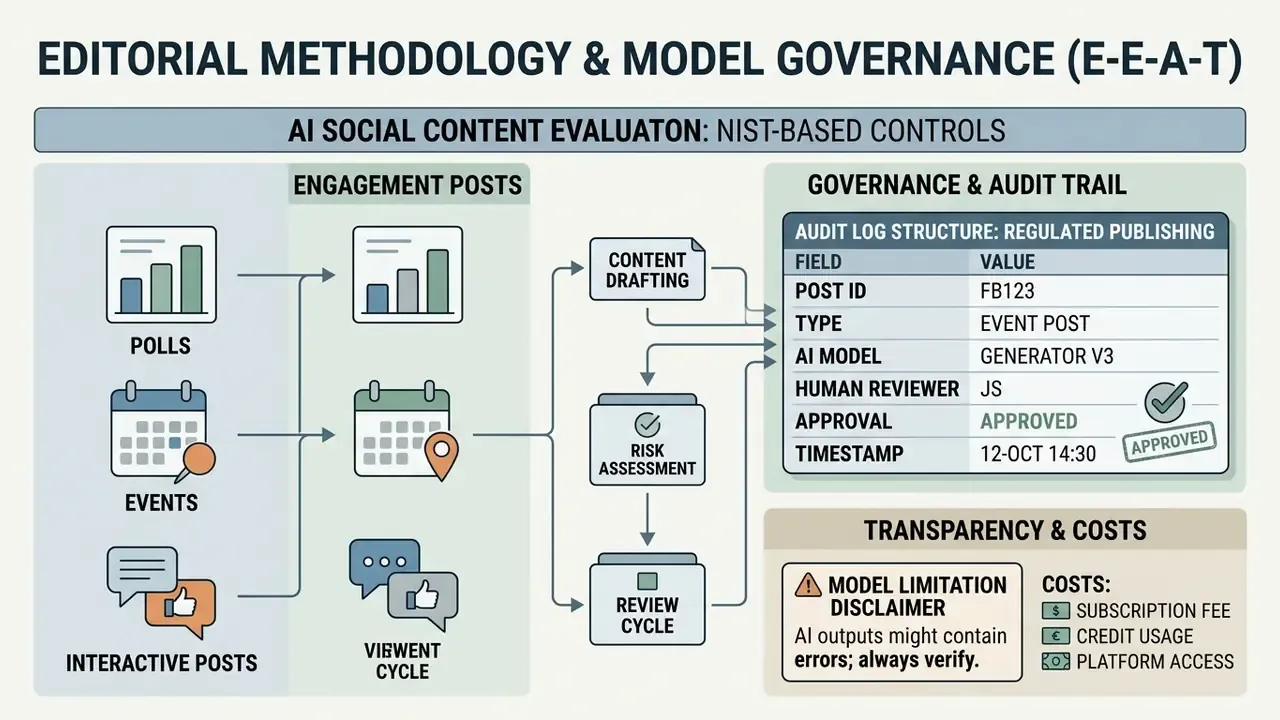
Audit Log Structure for Regulated Publishing
Governance claims are unverifiable without a reproducible record. Capture one log entry per published post and export it to your GRC system:
| Field | Type | Purpose |
|---|---|---|
timestamp | ISO 8601 | Establishes sequence and retention window |
post_id | string | Links the entry to the published Facebook object |
model_id / model_version | string | Identifies which model produced the draft |
gateway_id | string | Confirms the request passed an approved enterprise endpoint |
prompt_hash | SHA-256 | Proves the prompt text without storing sensitive input |
sanitization_check | boolean plus rule set version | Evidence that PII/NPI screening ran before generation |
human_approver_id | string | Names the accountable reviewer |
edit_delta | percentage or diff reference | Documents the extent of human authorship contribution |
disclosure_applied | enum (none / ai_info_label / ad_disclosure) | Records synthetic-content labeling decisions |
risk_score | integer | Triggers escalation thresholds for regulated claims |
Example entry, expressed as field and value pairs: timestamp 2026-03-11T09:42:17Z; post_id fb_1198320041; model_id vendor-llm-2026-03; gateway_id ent-gw-eu-01; prompt_hash a3f9c2...e71b; sanitization_check passed, ruleset PII-NPI-v4.2; human_approver_id editor_214; edit_delta 31%; disclosure_applied ai_info_label; risk_score 2.
The edit_delta field earns its place twice. It evidences human oversight for internal audit, and it documents the human authorship contribution relevant to copyright claims.
What this costs, honestly. Verification capacity is a line item. If a reviewer spends four minutes per post and the calendar runs 60 posts a month, that is roughly four hours of qualified editorial time, plus gateway licensing and log retention. Risk-adjusted ROI models that omit those inputs will overstate the benefit. Include them, and the case usually still holds. It simply becomes defensible.
How to Make AI-Generated Facebook Posts Natural and On-Brand
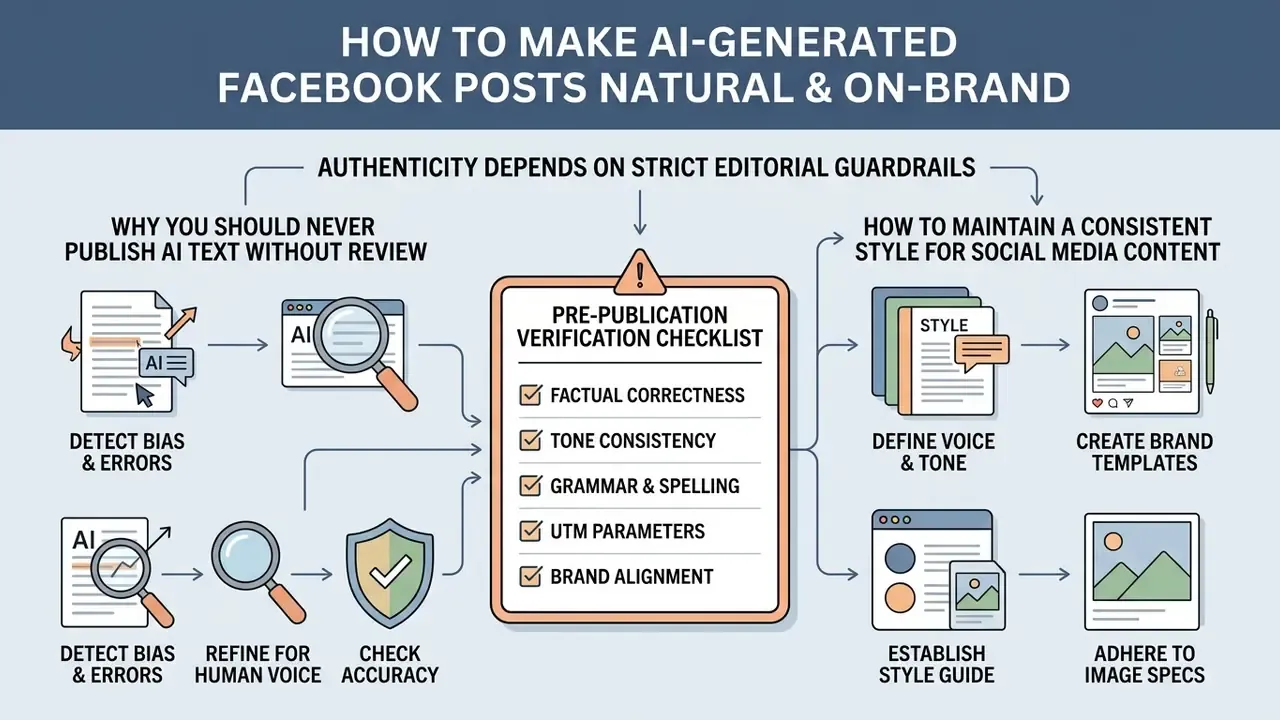
Authenticity in ai generated copy depends on strict editorial guardrails. Unrefined synthetic text carries recognizable tells: overused buzzwords, unnatural emotional declarations, uniform sentence lengths.
Why You Should Never Publish AI Text Without Review
Publishing unedited copy from an ai facebook post generator exposes organizations to factual hallucinations, tone mismatches, and audience skepticism. Research published in the Harvard Kennedy School Misinformation Review identified hundreds of Facebook pages using unmonitored AI content to drive manipulative spam networks, generating hundreds of millions of exposures (DiResta & Goldstein, 2024).
«When consumers learn a brand uses AI to automate posts, perceived brand authenticity declines, producing negative behavioral responses.»
Empirical work adds that when audiences perceive posts as fully automated, brand trust and perceived sincerity fall measurably (Bruns & Meissner, 2024). Consumer sentiment data reinforces the exposure:
«73% of UK consumers express concern about AI-generated content, and 48% do not trust AI content labeling.»
Publishing guidance from institutional publishers is equally direct: raw, unedited AI-generated text must not appear in a final published product, and must be reviewed for factual errors, omissions, and hallucinations (FAO, Responsible use of AI in publishing, 2025). University social media policies go further, requiring every AI-assisted post to be reviewed by a human for brand voice, tone, grammar, clarity, context, and appropriateness before publication.
Human oversight keeps every published post aligned with current operational facts and genuine brand values. Editors verifying visuals before publication can cross-check suspected synthetic imagery with AI image detection and reverse-search tooling inside the same review pass.
⚠️ ALERT BOX: pre-publication verification checklist
Free AI Facebook Post Generator: What Included in Free Use
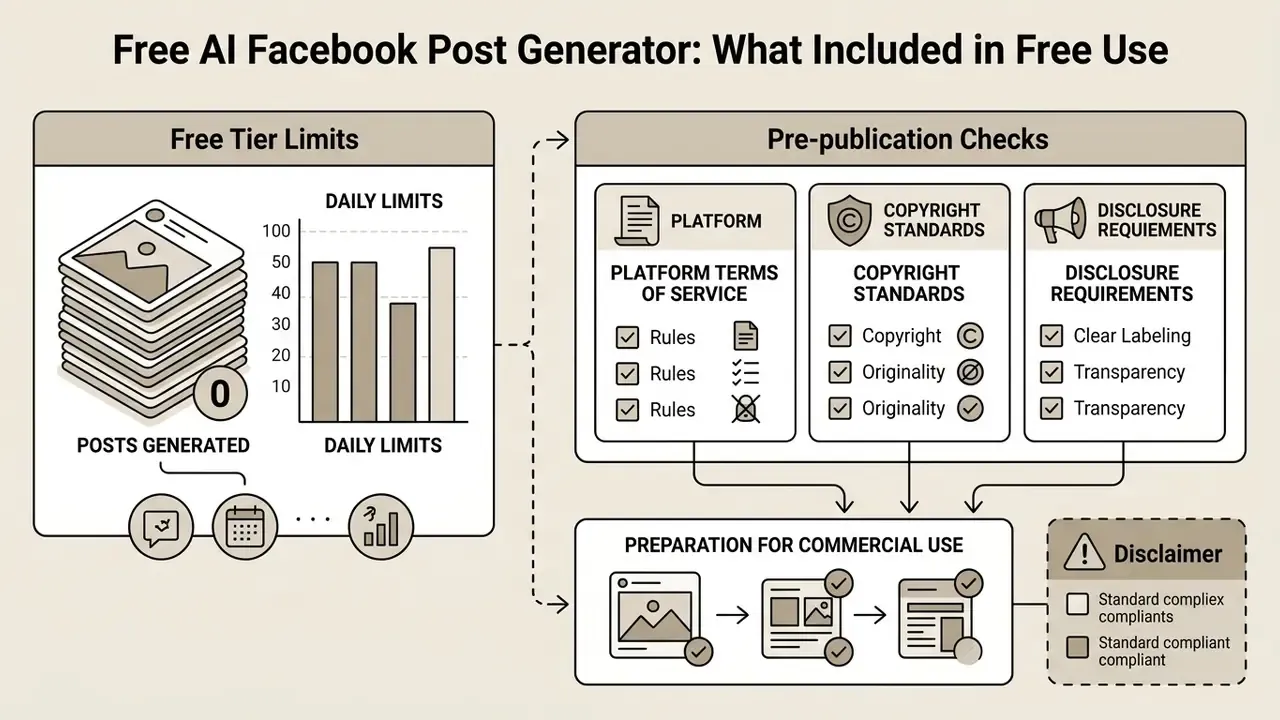
Many social media management platforms offer a free ai facebook post generator or a free ai post generator for facebook copy tier so teams can test model quality before committing budget. Searches for ai facebook post generator free and facebook post generator ai free usually land on these entry points.
Limits on the Number of Generated Posts
Free plans for tools like Buffer, ContentStudio, and BulkPublish normally enforce quotas. Common structures include:
- Daily or monthly prompt limits (for example, 5 generations per day on Buffer's browser generator, or 50 credits monthly on entry-level plans).
- Character or word output caps per generation.
- Restricted access to saved custom brand voice profiles.
- Exclusion of scheduling and multi-account publishing.
| Capability | Free Web Interface | Paid SMM Platform | Enterprise Managed Deployment |
|---|---|---|---|
| Generations | Capped (commonly 3-10 per day; some vendors uncapped) | High or unlimited within plan credits | Contracted volume via gateway |
| Scheduling | Usually unavailable | Full queue, multi-channel | Queue plus approval workflow |
| Brand voice profiles | Not saved between sessions | Saved profiles | Enforced, versioned, centrally governed |
| Content history | Often lost | Retained | Retained with audit export |
| Analytics and attribution | None | Native reporting | Reporting plus UTM governance |
| Data handling | No retention guarantees | Vendor-dependent | Zero Data Retention option, tenant isolation |
| Access control | Email login | Team seats | SSO/SAML, role-based permissions |
For instance, Buffer provides free tier access to its AI Assistant across up to 3 social channels with a 10-scheduled-post queue cap, while its standalone web generator limits anonymous usage to 5 generations daily, and retries, expansions, shortening, or tone changes each count against that daily allowance (Buffer, 2026). Buffer's earlier 2023 beta model issued one-time AI credits (50 on the free plan), which current documentation supersedes. Where vendor pages conflict, the newest published page governs. Other vendors publish different structures: ContentStudio advertises no usage cap and no account requirement, Chatslide allows up to 10 posts per day on free access, and BulkPublish grants 3 generations per day anonymously or 50 AI generations per month with a free account.
Underlying model tiers add their own ceilings. Google's free Gemini tier has been documented at up to 5 prompts per day on its Pro model, up to 100 image generations per day, and a 32,000-token context window, while ChatGPT's free access is described in official help material as dynamic rather than a fixed message count, with custom instruction fields capped at 1,500 characters. Anyone comparing free image output alongside copy generation should check documented restrictions for Bing AI image creation and Microsoft's AI image generator, plus feature ceilings in free photo editors.
What to Check Before Commercial Use of AI Content
Before using outputs from a free ai facebook post generator in commercial campaigns, evaluate three legal and regulatory conditions:
A fourth condition applies to regulated industries: infringement risk survives automation. Congressional Research Service analysis notes that AI outputs can still infringe when they reproduce a substantial part of a protected work, so commercial reuse of generated copy or imagery carries residual exposure even when no human wrote the text.
For pricing models and enterprise licensing detail, managers can review our AI Media Pricing Guides or open the hub of cost estimators to model operational automation spend, control overhead included.
How to Choose the Best AI Generator for Facebook Posts
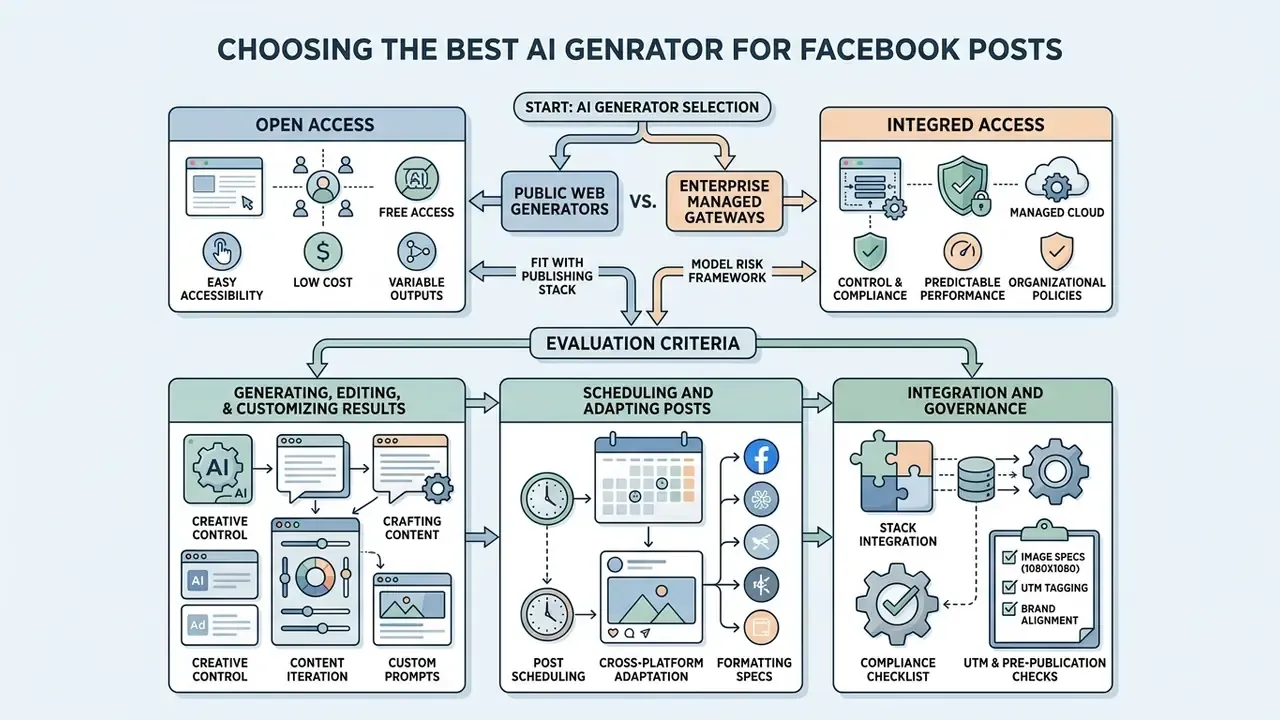
Selecting the best ai facebook post generator comes down to how well the software fits your existing publishing stack, scheduling tools, and model risk framework. Feature lists rarely decide it. Data handling and audit evidence usually do.
«Brand-voice fidelity and compliance adherence rank among the most critical evaluation parameters for AI content tools.»
Public Web Generators vs. Enterprise Managed Gateways
The first decision is not which vendor. It is which class of tool the use case permits.
| Security and Governance Criterion | Public Web Generator | Enterprise Managed Gateway |
|---|---|---|
| Identity and access | Email or anonymous session | SSO/SAML, SCIM provisioning, role-based access |
| Independent assurance | Rarely published | SOC 2 Type II, ISO 27001, penetration test reports |
| Data retention | Prompts may be retained or used for training | Zero Data Retention mode, contractual no-training clause |
| Tenant isolation | Shared consumer infrastructure | Dedicated or logically isolated tenant |
| PII/NPI handling | No masking layer | Pre-prompt redaction, DLP integration, token substitution |
| Audit evidence | None exportable | Full prompt and response logs exportable to GRC systems |
| Approval workflow | Single user | Multi-stage approval with segregation of duties |
| Shadow AI exposure | High, usage invisible to security teams | Controlled, traffic routed through a monitored endpoint |
| Appropriate use | Low-risk organic experimentation | Regulated products, customer-facing claims, paid campaigns |
Any workflow touching regulated products, customer data, or paid distribution belongs in the right-hand column. A public fb ai generator still earns its keep for ideation on non-sensitive topics, provided nothing confidential enters the prompt.
Table: enterprise matrix for evaluating AI social media post generators
| Evaluation Criterion | Key Functional Requirement | Strategic Impact on Operations |
|---|---|---|
| Model control and tone customization | Support for uploaded brand guidelines, custom system prompts, and vocabulary bans | Protects brand authenticity and prevents repetitive AI writing artifacts |
| Native platform integration | Direct publishing via official Meta Graph API endpoints for Facebook Pages and Instagram | Keeps scheduled posting stable without relying on unauthorized scraping |
| Editorial and review controls | Multi-user approval workflows, change tracking, audit logging | Meets governance requirements for regulated industries such as finance and healthcare |
| Cross-platform adaptation | Automated reformatting of Facebook posts into LinkedIn copy or Instagram captions | Scales content distribution efficiency across multiple networks |
| Data security and privacy | Zero Data Retention mode, tenant isolation, PII/NPI masking, contractual guarantee that prompts are not used for public model training | Prevents accidental disclosure of confidential corporate data and limits Shadow AI exposure |
| Attribution and measurement | Automatic UTM parameter injection and campaign-level tagging of AI-generated variants | Enables performance comparison between AI-assisted and human-written copy |
| Provenance and disclosure support | Prompt and model logging plus workflow prompts for platform "AI info" labeling | Supports NIST-aligned traceability and Meta disclosure obligations |
Generating, Editing, and Customizing Results
Leading social media management platforms, including Buffer, Hootsuite, and Jasper, embed AI assistants directly in their post composers. These interfaces let copywriters shorten, expand, or retune generated copy with single-click controls. Buffer's composer shifts copy between "casual" and "formal" tones instantly and can shorten or expand a draft in one click, while Canva's generator asks users to pick an authoritative, persuasive, casual, or friendly goal before drafting (Buffer, 2026; Canva, 2026). SocialBee's customization function adapts caption length, hashtag count, and formatting per network, and QuillBot supports iterative direction plus wording, tone, and length adjustment. Hootsuite positions generation inside a broader workflow spanning listening, best-time-to-publish, and analytics. Jasper markets a dedicated Facebook post agent with tone guardrails aimed at conversation and organic reach.
Buyers comparing these composers against general-purpose models can review our evaluations of ChatGPT image and content generation, Midjourney, and Canva's AI generator licensing. A facebook post ai generator built into a scheduler wins on workflow. A raw model wins on flexibility. Pick according to who owns the approval step.
Scheduling and Adapting Posts for Other Platforms
Modern social media post generator tools plug straight into scheduling queues, so teams draft, edit, and schedule Facebook posts inside one workflow. Meta's Graph API exposes scheduled-post endpoints for Pages, and Meta documentation confirms Instagram Business accounts can be scheduled and published from third-party platforms. Native API support, rather than browser automation, is therefore a hard selection criterion.
Cross-platform tools also adapt post length, hashtag density, and formatting when repurposing Facebook content for LinkedIn, X, or Instagram. Vendor documentation describes patterns such as converting an Instagram carousel into a LinkedIn PDF post from the same asset set. Adaptation is not translation, though:
«The "algorithmic uncanny valley" describes user discomfort with content that almost, but not quite, reproduces human style.»
Mechanical cross-posting is where that discomfort shows up most. So every repurposed variant should pass a human tone check for the destination platform, not only a length check. To compare multi-tool workflows, consult our AI Media Comparison Matrices or review recent developments in AI Litigation and Case Timelines.
FAQ About AI Facebook Post Generator
Can an AI Generator Create Facebook Posts in Different Languages?
Yes. Modern large language models can generate Facebook post copy across dozens of languages. Benchmark work such as MultiSocial reports that LLM-generated social media texts were of similar or higher quality than the original human texts in meta-evaluation, using separate generation prompts per language (MultiSocial: Multilingual Benchmark of Machine-Generated Social Media Texts, ACL 2025). Complementary research on multilingual prompting describes a three-step method: enrich the source query with language and cultural cues, translate the prompt into each target language, then aggregate and back-translate answers for comparison (Multilingual Prompting for Improving LLM Generation, EMNLP 2025). For best results, write prompts in the target language or state cultural and regional context explicitly inside an English brief, then route every non-English draft through a native-speaker reviewer before publishing.
Who Is Liable if an AI-Generated Facebook Post Contains a False Claim?
The publishing organization is. Editorial and publishing guidance assigns accountability to the human author or publisher, not the model: AI can fabricate references and figures, so claims must be fact-checked before release (FAO, Responsible use of AI in publishing, 2025). For regulated advertising, treat every generated numeric claim, comparative statement, and performance reference as unverified until it is matched against an approved source document.
What Should an Audit Log Contain for AI-Assisted Social Publishing?
At minimum: timestamp, model ID and version, gateway ID, prompt hash, sanitization result, human approver ID, edit delta, disclosure decision, risk score. That structure satisfies the provenance and traceability control in NIST AI 100-4 and gives reproducible evidence that a human reviewed the output before publication.
How Do We Prevent Shadow AI in a Social Media Team?
Route all generation through an approved enterprise gateway with SSO, block consumer endpoints at the network layer for accounts handling regulated content, publish an approved-tool list, and require a provenance record before any post enters the scheduling queue. Free consumer generators create exposure precisely because their usage leaves no organizational trace.
Do AI-Generated Facebook Posts Need to Be Labeled?
Photorealistic synthetic media and certain AI-generated ad creatives require disclosure under Meta's policies, and Meta applies "AI info" labels to qualifying content. Political and social-issue ads containing photorealistic AI-created or altered media must disclose that fact (Meta, 2026). Meta has also stated it is signing the EU AI Act Code of Practice on transparency of AI-generated content. Text substantially written and verified by a human generally sits outside photorealistic-media labeling rules, but platform policy is the controlling reference. Check it per campaign.
How Long Should Post Text Be Before It Gets Truncated?
Design the decisive message into roughly the first 125 characters. Institutional social media guidance documents that Facebook shows approximately 125 characters before requiring expansion (University of Michigan, Social Media Facebook Best Practices, 2023). Longer bodies are fine. The hook, offer, and reason to click should still appear above the fold.
Can Free AI Facebook Post Generators Be Used for Paid Campaigns?
Only after verifying three things: that the free plan's terms grant commercial rights, that any accompanying imagery is licensed for commercial use, and that the generated claims have passed human verification. Free tiers also commonly lack scheduling, saved brand voice, content history, and analytics, which makes attribution and audit evidence impossible to reconstruct later. Summary & Next Steps An ai facebook post generator lets marketing organizations accelerate content creation, test message variations, and hold a consistent publishing rhythm. Sustainable performance, though, depends on treating generative tools as drafting assistants rather than autonomous publishers. Structured prompts, sanitized inputs, correct visual specifications, tagged destination links, strict pre-publication checklists, provenance logs, and platform disclosure compliance are what convert speed into a defensible process. Immediate next actions:
- Publish a one-page brand voice brief with banned vocabulary and load it into your generator's custom instructions.
- Add the data sanitization check and provenance log to your existing publishing workflow this quarter.
- Classify every AI tool currently in use as a public generator or an enterprise gateway, and reassign regulated content accordingly.
- Standardize the three core image dimensions and the UTM template across all AI-generated campaigns. Start with one campaign, not the whole calendar. If the log holds up under an internal audit sample, widen the scope. For platform documentation, licensing terms, and support resources, teams can explore the hub or compare options in our glossary of technical guides. Appendix A: Superseded Guidance Notes Retained for traceability, per our editorial policy of documenting revised claims rather than silently deleting them.
- Variation testing window. The previous version stated: "A testing protocol recommended by social media researchers involves running post variations across identical audience segments over a 48 to 72-hour window before selecting a winning messaging structure." This is now reframed as practitioner convention rather than research-backed protocol, because no peer-reviewed source in our reference set establishes the 48 to 72-hour figure.
- Free-tier AI credits. Buffer's 2023 announcement described one-time AI Assistant beta credits (50 on the free plan). Current Buffer documentation describes AI Assistant availability on free accounts without credit caps, alongside a 5-generation daily limit on the anonymous browser generator. Where vendor pages conflict by date, the newest published page governs.
- Creative tool references. Earlier drafts linked consumer-oriented style-conversion utilities inside enterprise governance sections. Those references now sit in the visual production section instead, framed by licensing, provenance, and workflow documentation appropriate to regulated publishing contexts. The underlying guidance on pairing generated visuals with generated copy is unchanged.
Update Policy and Review Cadence
- Last updated: March 2026.
- Review trigger events: a Meta policy or labeling change, a new NIST AI publication, a vendor free-tier revision, or updated U.S. Copyright Office guidance.
- Standing review interval: quarterly, with vendor limits re-verified against live documentation rather than cached figures.
- Open questions we have not resolved: no peer-reviewed source yet establishes an optimal variant testing window for feed posts, and the long-run effect of platform "AI info" labels on click-through remains unmeasured in public data. Where evidence is thin, we say so rather than round it up.