«In generative systems, autonomy without governance creates unquantifiable residual risk. AI image models do not "think" or "draw". They execute mathematical inference over probabilistic visual distributions derived from training data. To deploy or evaluate these tools effectively, institutions must govern the input prompts, audit the underlying model pipelines, and establish clear human decision ownership.»
Last reviewed and updated: March 2026 · Checked for technical accuracy against current model documentation (OpenAI, Stability AI, Midjourney) and regulatory texts (EU AI Act, USCO reports).
If you sit in a control function at a US bank or a mature fintech, generative image tools probably arrived in your organization before your policy did. Marketing wanted campaign visuals. Product wanted mockups. Somebody uploaded a customer document into a consumer tool "just to test it." That is the practical reason a risk owner needs to know how AI art works: the mechanism determines the control surface.
AI art works through generative machine learning models, primarily latent diffusion architectures, that convert text prompts into synthetic images by reversing a mathematical noise process. Rather than searching a database or stitching together pre-existing pictures, an AI art generator samples from a statistical distribution of visual patterns learned during training on large-scale image-text datasets.
For institutional leaders, technology teams, and digital creators, understanding how does AI art work requires examining three distinct phases: model training, prompt conditioning, and human-in-the-loop refinement. Whether you are deploying internal generative workflows or reviewing automated tools against our reference entries in the AI Media Glossary, governance starts with the algorithmic mechanics beneath the canvas.
What Is AI Art and How Does It Work?
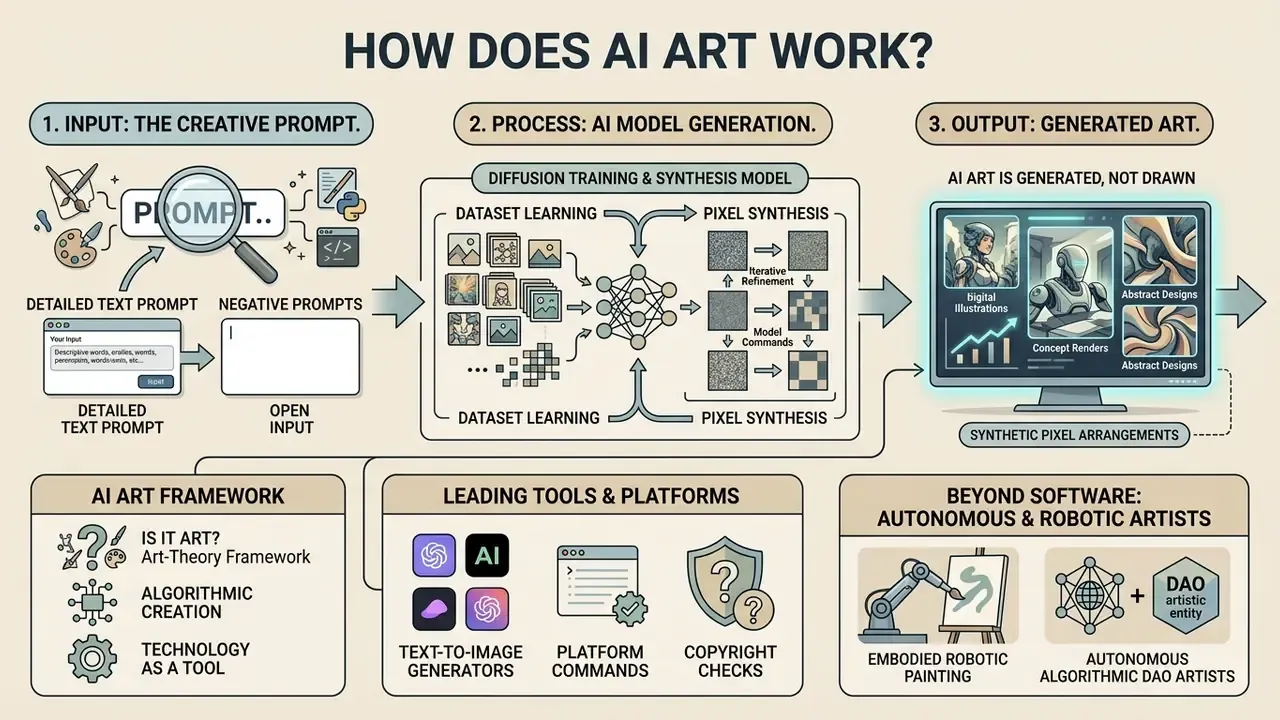
AI art is visual content, such as digital illustrations, photorealistic concept renders, or synthetic designs, created by algorithms that synthesize new pixel arrangements based on human instructions. If you are new to the category, start with our reference entry on AI art generators for tool-level definitions and licensing basics. Generative artificial intelligence relies on deep neural networks trained to emulate the statistical relationships between visual features and descriptive text. According to the National Institute of Standards and Technology (NIST), generative AI models emulate the structure and characteristics of input data to generate synthetic content across images, text, and video (NIST Generative AI Profile, 2024).
Human involvement remains essential. The user defines the operational parameters, crafts the natural language prompt, and evaluates the synthetic output. Nothing here is autonomous by default.
- NIST Generative AI Profile, 2024
«Survey participants viewed digital art as the primary application area for such tools and considered them especially suitable for producing illustrations and logos.»
Traditional software requires direct manual execution. AI visual tools rely on probabilistic inference instead, which is a meaningful distinction for anyone writing a control narrative. Readers who want broader definitions can explore adjacent hubs such as an ai form generator, an ai game maker, or an ai flyer generator to see how generative prompts behave across different media, or review editing categories like an online photo editor where AI features now sit next to manual sliders.
AI Art Is Generated, Not Drawn Like Traditional Artwork
AI art is generated algorithmically through probabilistic calculations rather than drawn manually through human motor control or software brush inputs. In traditional digital or analog art, an artist exercises continuous control over strokes, color blending, and spatial composition. An AI art generator, by contrast, predicts pixel values by pushing input vectors through billions of model parameters.
Studies on human-AI co-creation show that users act as directors rather than manual illustrators. Interview-based research describes the workflow as an iterative editorial loop rather than a single command:
The user establishes the visual subject, style constraints, and compositional rules inside a text prompt, while the model executes pixel synthesis. Broader perception data on how non-experts interpret these tools comes from a separate survey study (Oppenlaender et al., CHI 2023), which is distinct from the 2024 interview research cited just above.
It is also worth noting the counter-framing used by some technologists. Because engineers design the mathematical models, curate the data, and tune the objectives, part of the field argues that AI art is better described as engineer-generated art. Under either reading, creative intent still originates with a human, either the model builder or the prompt author. That matters for accountability far more than for aesthetics.
What an AI Art Generator Does With a Text Prompt
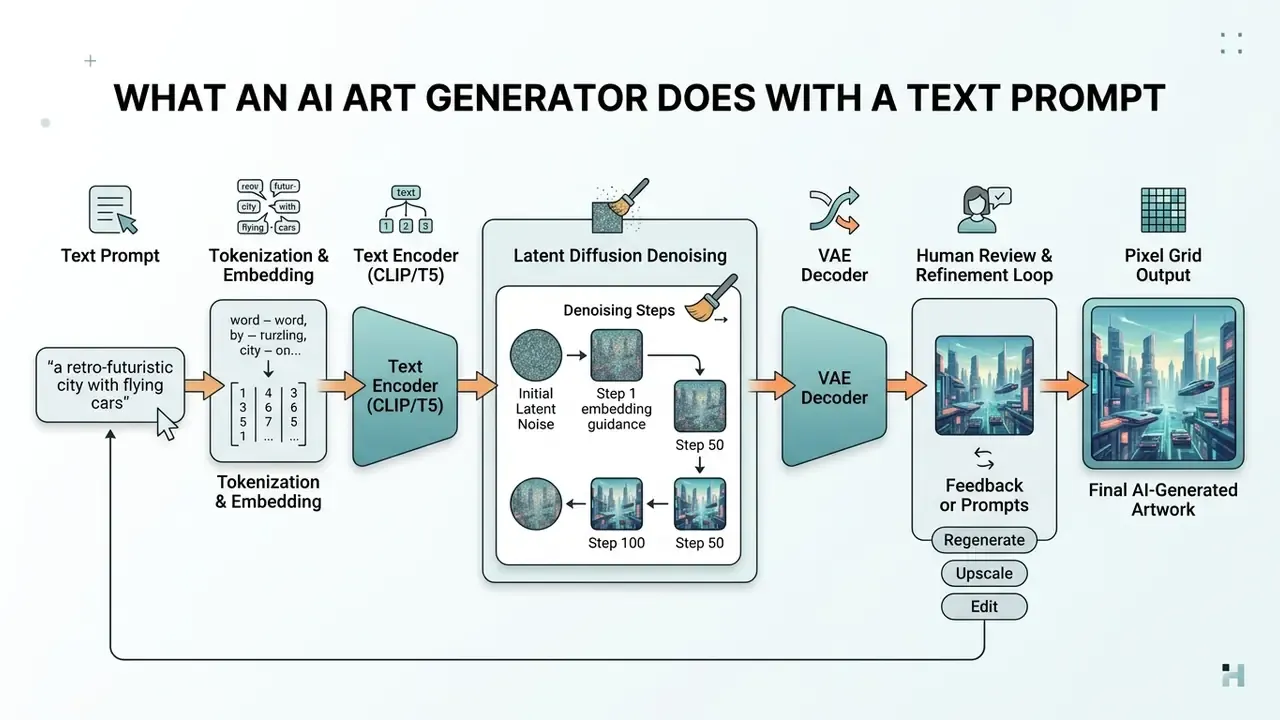
When an AI art generator receives a text prompt, it converts the natural language input into mathematical embeddings that guide the image synthesis engine. A text encoder translates words into conditioning vectors, which steer the neural network toward specific visual concepts, lighting conditions, and artistic styles learned during training. In Stable Diffusion-style pipelines, CLIP text embeddings act as Key/Value tensors inside cross-attention layers, while evolving image features act as Query tensors.
Output quality correlates directly with input structure. Vague prompts yield broad, generic distributions. Structured prompts containing defined subjects, framing details, and stylistic modifiers let the algorithm narrow its sampling trajectory. Teams benchmarking output fidelity across engines can consult our roundup of the best AI image generators before standardizing on a single vendor.
Beyond Software: Robotic and Autonomous AI Artists
AI generation extends beyond hosted web interfaces and APIs into physical and autonomous systems. Two reference cases define the outer boundary of the category:
- Embodied robotic painting (Ai-Da) Named after Ada Lovelace and devised by Aidan Meller, Ai-Da is presented as an ultra-realistic humanoid robot artist that draws and paints using cameras mounted in her eyes, computer-vision algorithms, and a robotic arm. Her work has been shown at the University of Oxford and internationally, including a virtual exhibition connected to United Nations programming. Her creators argue the output qualifies as art because it satisfies the criterion associated with Professor Margaret Boden: that creative work be new, surprising, and of cultural value, without requiring human agency alone.
- Autonomous algorithmic DAO artists (Botto) Created by artist Mario Klingemann, Botto is a "decentralised autonomous artist" that generates hundreds of candidate images weekly, roughly 350 pieces per cycle, and submits them to a token-holding community. Community votes are fed back as training signal, shifting the aesthetic over time, and one selected work per week is auctioned, with proceeds returning to participants. Klingemann has compared his role to guardianship: "Right now Botto is like a toddler and I am its guardian that has to guide its first steps and make sure it does not hurt itself."
For risk owners, these cases matter because "AI art" can describe a software API call, a physical robotic actuator with computer-vision inputs, or an autonomous agent with a decentralized human feedback loop. Each configuration produces a different accountability chain and a different answer to the question of who authored the work. Ask that question early, because the answer decides who signs off.
Is AI-Generated Art Actually Art? An Art-Theory Framework
The question is older than diffusion models, and classical aesthetics supplies four useful lenses:
| Theory | Origin | Core criterion | Applied to AI output |
|---|---|---|---|
| Art as representation (mimesis) | Plato | Value measured by fidelity of imitation | Diffusion models excel here: photorealistic synthesis is their strongest capability. |
| Art as expression of emotion | Romantic movement | Work must convey and evoke feeling | Contested: models have no affective state, though outputs demonstrably move viewers. |
| Art as form | Immanuel Kant | Judged on formal qualities, not surface beauty | Applicable: composition, contrast, and structure can be assessed independently of authorship. |
| Institutional theory | George Dickie | An object becomes art through the institutions of "the art world" | Strongest practical case: auctions, museums, and galleries have already absorbed AI work. |
Harold Cohen, who built the earliest sustained AI art system, framed the dilemma precisely: if what his program produced was not art, what exactly was it, and in what way, other than origin, did it differ from the real thing? The institutional answer has arguably already been given by the market. Once major auction houses, fairs, and galleries document, exhibit, and sell synthetic work, the "art world" test is satisfied regardless of philosophical objections.
How Are AI Art Generators Trained?
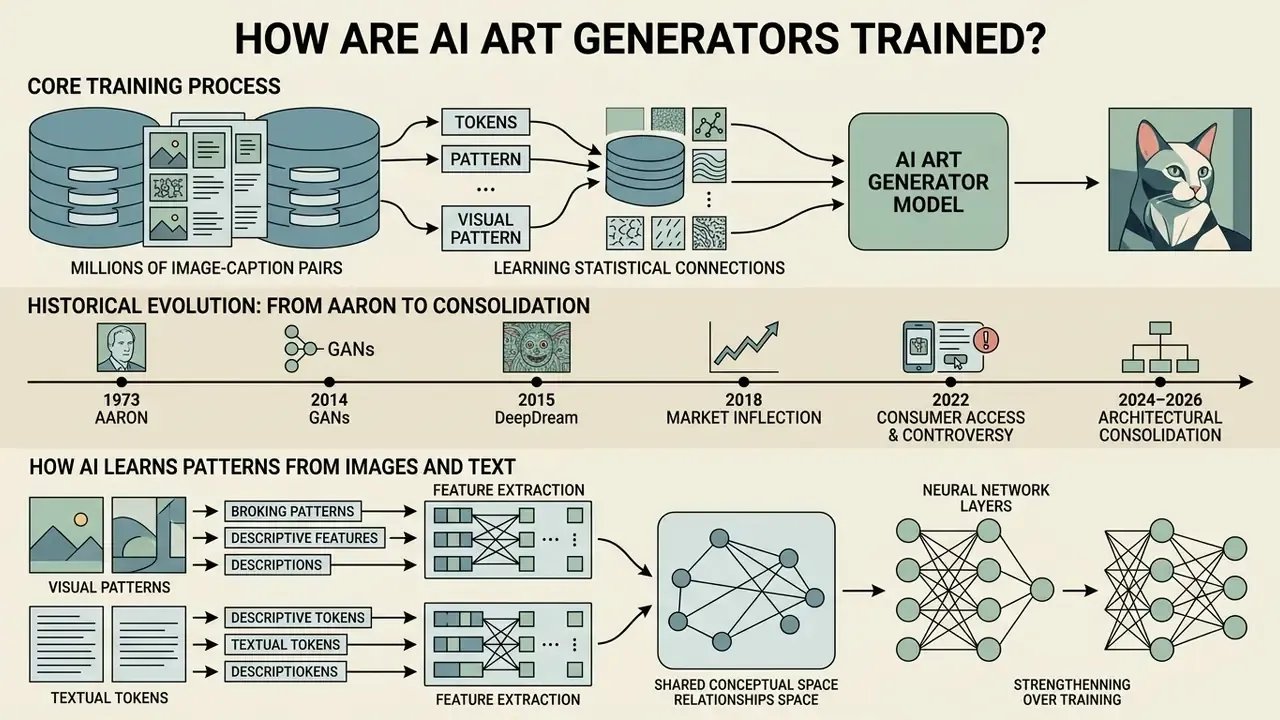
AI art generators are trained by analyzing tens or hundreds of millions of image-caption pairs to learn the statistical connections between textual tokens and visual patterns. During training, neural networks examine images alongside descriptive text to identify recurring shapes, textures, lighting cues, and artistic styles. That is the short answer to how does AI art learn.
Open models such as Stable Diffusion were initially trained on massive public web scrapes like LAION-2B, while recent efforts like CommonCanvas demonstrate that high-quality models can be trained on roughly 70 million Creative Commons images when paired with dense synthetic captions (CommonCanvas Research, 2024).
«CommonCanvas reaches quality comparable to Stable Diffusion 2 while using only about 3% of LAION-2B's data volume, provided dense synthetic captions are supplied.»
Evaluating model lineage and training provenance is critical when establishing risk controls, inspecting AI Media Commercial-Use rights, or reviewing commercial-use licensing for AI images before assets enter production channels. Provenance is not a footnote. It is the first line of your legal exposure.
The Historical Evolution: From AARON (1973) to Multi-Million Dollar Auctions
AI art did not begin with diffusion models. Understanding the lineage explains both the technical trajectory and the market's willingness to price synthetic work.
- 1973, AARON. British-born artist Harold Cohen wrote AARON, a rule-based program built around the question: what are the minimum conditions under which a set of marks functions as an image? Early versions produced abstract drawings; representational elements such as rocks, plants, and figures were added through the 1980s, and color arrived in the 1990s. Cohen later enabled AARON to paint physically, using special brushes and dyes selected by the program itself.
- 2014, GANs. Computer scientist Ian Goodfellow and colleagues introduced generative adversarial networks, pairing a generator that proposes images with a discriminator that judges them. This adversarial loop made photorealistic synthesis viable for the first time.
- 2015, DeepDream. Google released DeepDream, which amplified learned patterns through algorithmic pareidolia, producing the recognizable over-processed, dream-like aesthetic that first brought neural image generation to mass audiences.
- 2018, market inflection. Edmond de Belamy, produced by the collective Obvious using GANs, sold at Christie's in New York for $432,500, against a pre-sale estimate of $7,000 to $10,000. The name is a French-language pun honoring Goodfellow ("bel ami" = "good friend").
- 2022, consumer access and cultural controversy. Public releases of DALL·E 2, Midjourney, and Stable Diffusion put generation in anyone's hands. That same year, Jason M. Allen's Théâtre D'opéra Spatial, generated with Midjourney, won first place in its category at the Colorado State Fair fine arts competition, triggering a still-unresolved debate about disclosure, skill, and eligibility in juried competitions.
- 2024 to 2026, architectural consolidation. Transformer-based diffusion (MMDiT in Stable Diffusion 3/3.5), rectified-flow training, and multi-encoder text conditioning replaced the U-Net-centric designs of the previous generation, while regulators moved from guidance to binding transparency rules.
How AI Learns Patterns From Images and Text
AI models learn visual patterns using multimodal architectures such as CLIP (Contrastive Language-Image Pre-training), which map images and text descriptions into a shared multidimensional vector space, 512 dimensions in the original implementation. By optimizing alignment across millions of pairs, the network discovers that tokens like "cyberpunk," "watercolor," or "cinematic lighting" correspond to specific numerical clusters in image feature space (OpenAI CLIP Research, 2021). Later interpretability work decomposed CLIP representations across patches, layers, and attention heads and identified property-specific heads that encode location and shape (Interpreting CLIP's Image Representation via Text-Based Decomposition, arXiv 2023), while a peer-reviewed study found CLIP features correlate with human aesthetic judgment because training pairs images with human-written descriptions (Frontiers in Artificial Intelligence, 2022).
During training, diffusion models apply a two-step process:
- Forward noising Gaussian noise is incrementally added to a training image until it becomes pure random static.
- Reverse denoising The network learns to predict and remove the exact noise added at each step, conditioned on the associated text embedding.
Through gradient descent across billions of iterations, the algorithm acquires a deep mathematical representation of object geometry, lighting, and composition. Representation, not comprehension. The distinction is worth keeping in your documentation.
«Increasing the number of transformer blocks improves text-image alignment more efficiently than simply widening convolutional channel counts.»
It also helps to be precise about what the machine actually processes: it never "sees" an image. Each image is decomposed into pixels represented as numerical arrays encoding edges, gradients, and color values. Historically, these arrays were annotated by hand. ImageNet, for instance, indexes over 14 million image URLs with human-specified content labels while holding no copyright in the underlying images, a provenance fact that remains directly relevant to today's licensing disputes.
ConvNets vs GANs vs Diffusion: Why the Architecture Changed
Earlier neural approaches were not abandoned for fashion reasons. Each hit a structural ceiling. The table below summarizes the shift that most consumer explainers skip.
| Architecture | Period | Operating principle | Key limitation |
|---|---|---|---|
| ConvNets (CNNs) | ~2012 to 2016 | Classification and segmentation of pixel data through convolutional filters trained on labeled corpora such as ImageNet | Optimized for recognition, not synthesis; cannot compose novel complex scenes from a text description. |
| GANs (adversarial) | 2014 to 2021 | Generator proposes images; discriminator separates real from synthetic; adversarial signal drives improvement (Goodfellow et al.) | Mode collapse, unstable training, limited prompt controllability, narrow output diversity. |
| Latent Diffusion / MMDiT | 2021 to 2026 and beyond | Iterative removal of Gaussian noise in a compressed latent space, conditioned on text embeddings via cross-attention | High compute cost per generation; multi-step inference latency; quality depends on caption density. |
In short: convolutional networks taught machines to recognize visual patterns, GANs taught them to fabricate plausible images within narrow domains, and diffusion added controllable, prompt-conditioned synthesis at scale. Governance frameworks written for CNN-era classifiers therefore need explicit extension to cover generative conditioning, sampling randomness, and output marking.
Why AI Generates New Images Instead of Retrieving One Image
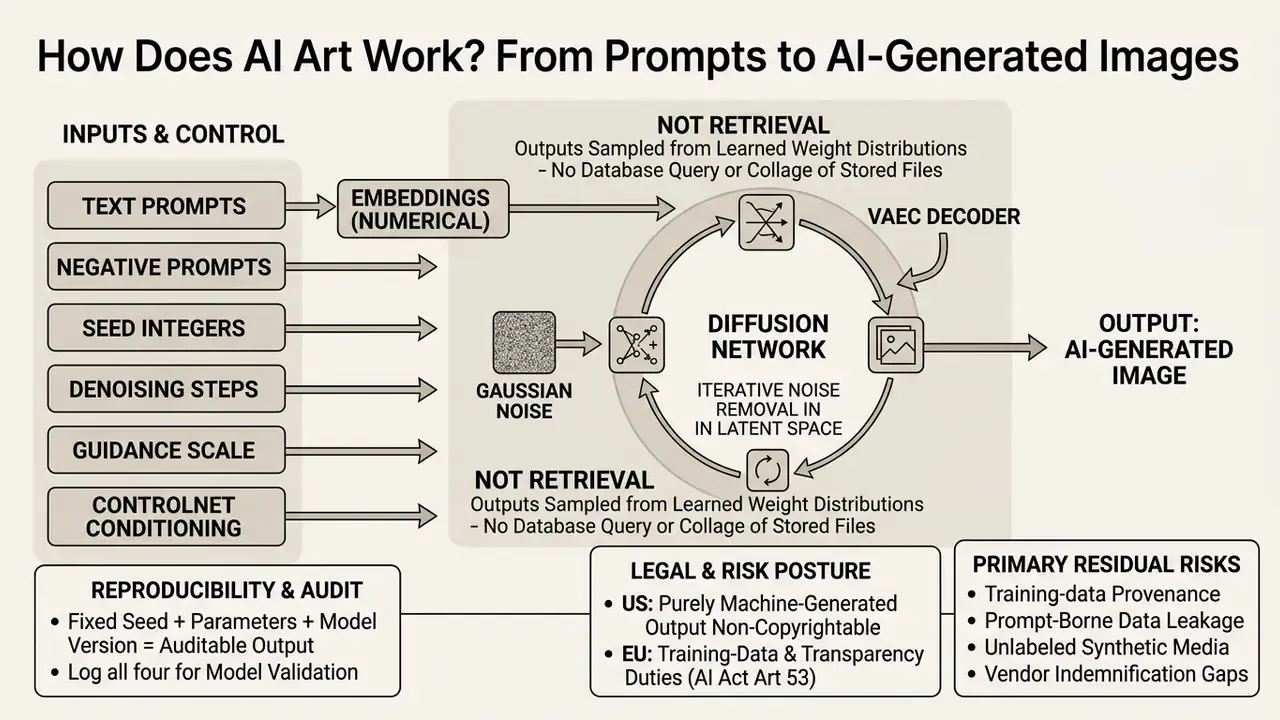
An AI art generator creates entirely new pixel combinations from random latent noise rather than retrieving, cutting, or collaging existing database images. The training dataset is not stored inside the model. The model retains only learned mathematical weights that represent general visual rules.
When generating an image, the model initializes a matrix of pure random Gaussian noise (seeded by a random integer) and applies its reverse diffusion pipeline. Guided by the prompt embedding, it iteratively removes predicted noise across multiple timesteps until a novel image emerges.
Can You Use AI-Generated Art Commercially?
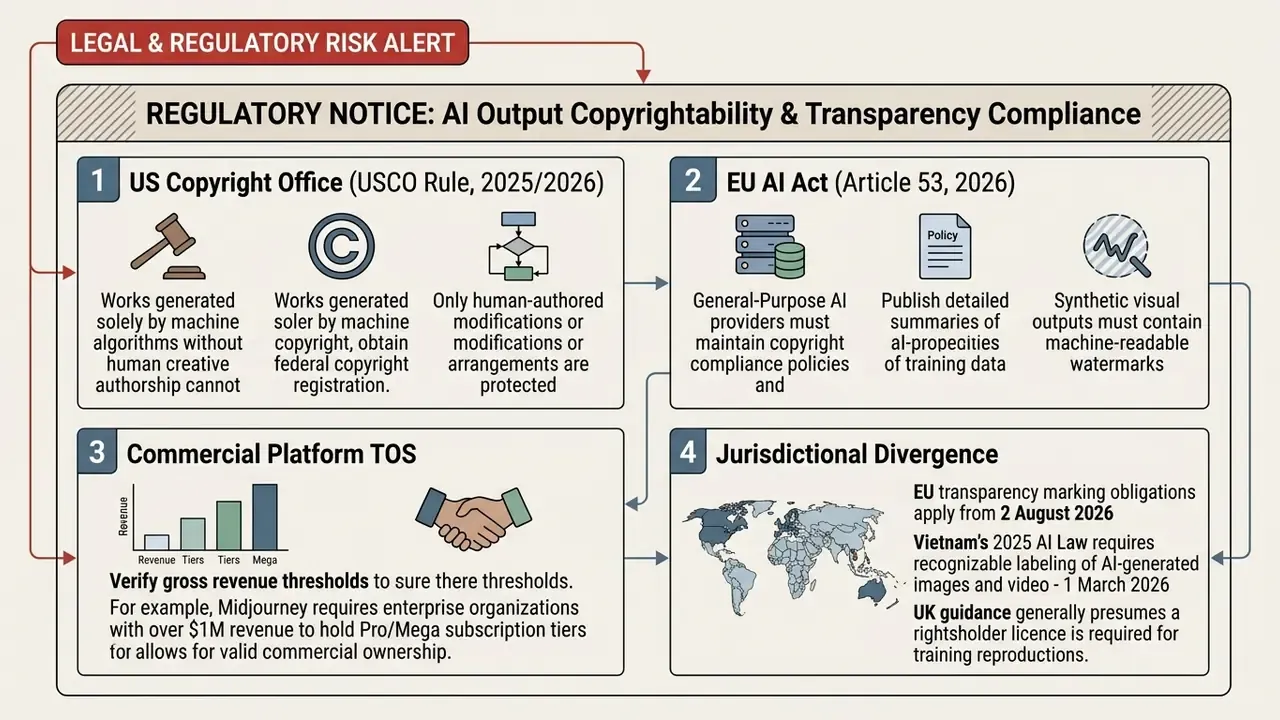
Commercial deployment of AI-generated art depends on platform licensing terms, regional copyright regulations, and training data provenance. Because legal exposure flows directly from the training corpus discussed above, this section sits deliberately next to it. Commercial licenses may allow commercial use of platform outputs, yet visual assets generated entirely by machine algorithms still face unique intellectual property challenges in major legal jurisdictions.
Copyright, Ownership and Training Data Considerations
Under current guidance from the United States Copyright Office (USCO), purely machine-generated images lack human authorship and are ineligible for copyright protection (USCO Report on AI and Copyright, 2025).
«Protection extends only to elements reflecting sufficient human creative control; AI-generated portions are generally not protected.»
Copyright protection may still apply to human-authored elements combined with AI assets: manual digital edits, custom graphic layouts, or complex original arrangements. USCO Part 2 (2025) is explicit that prompts alone are generally insufficient, while separately original human edits can qualify.
Key legal considerations for commercial deployment include:
Organizations tracking legal precedents, regulatory deadlines, and ongoing intellectual property disputes can review our archive at AI Litigation and Case Timelines.
The AI Art Generation Process: From Prompt to Image
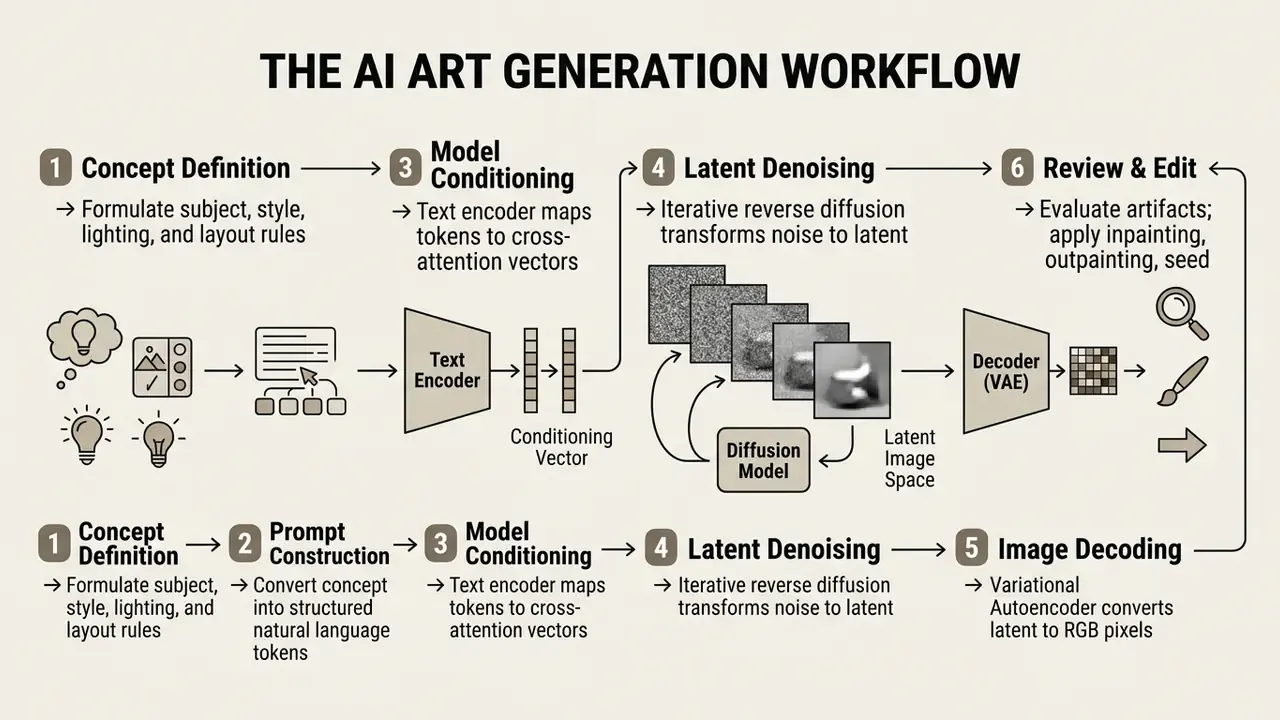
The AI art creation process follows a structured sequence: concept formulation, prompt tokenization, latent denoising, VAE decoding, and post-generation refinement. Understanding this pipeline step by step lets creators and control functions achieve consistent visual results while minimizing technical errors. Read the rest of this section as operational and quality control, not artistic inspiration. Every element below is a lever that determines output predictability and auditability.
Writing a Prompt for an AI Art Generator
Writing an effective prompt means structuring natural language into distinct functional components: subject, environment, artistic style, framing, and technical parameters. Leading prompt engineering frameworks recommend ordering instructions systematically to maximize cross-attention fidelity (Google Cloud Vertex AI Prompting Guide, 2025), typically background and scene, then subject, then key details, then constraints.
A robust prompt structure includes:

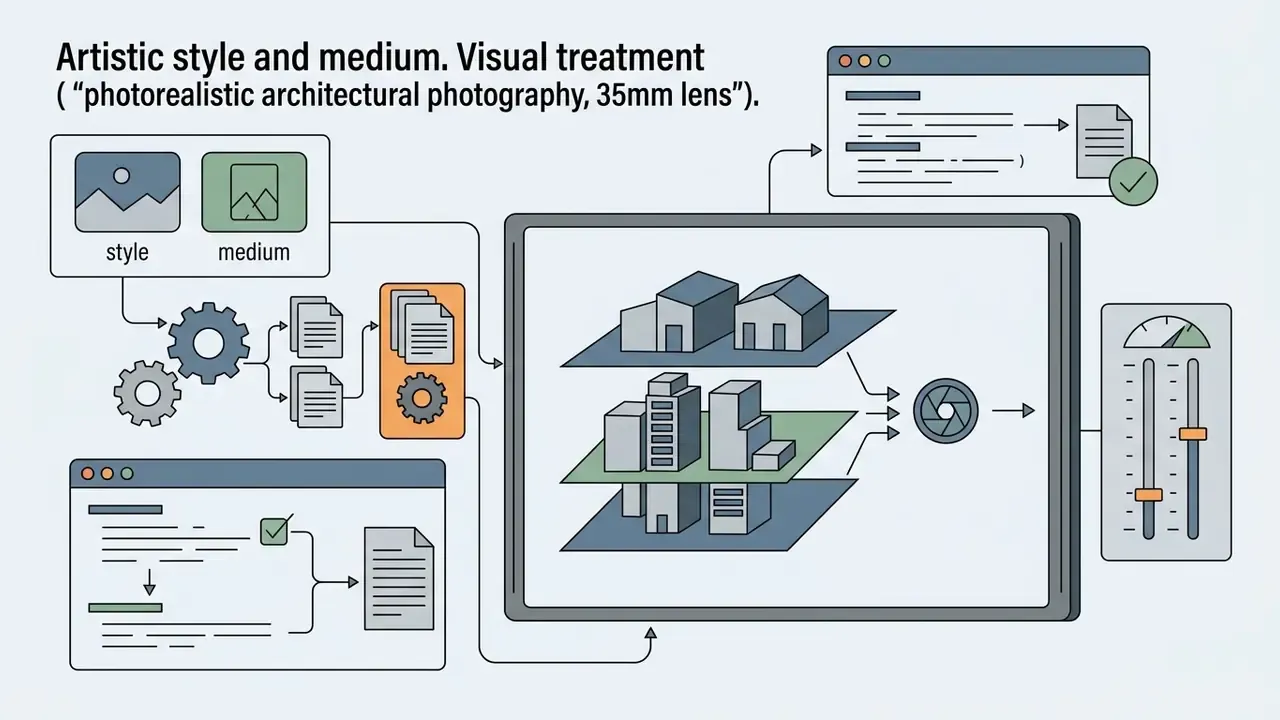
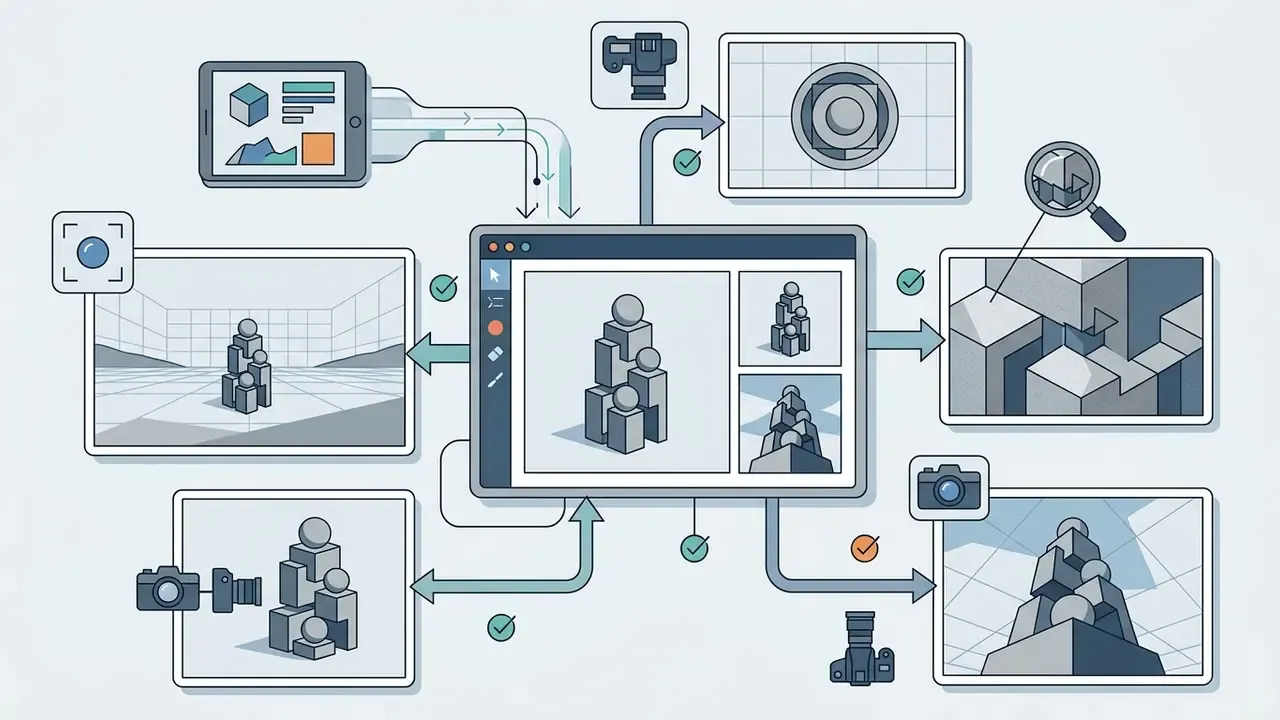
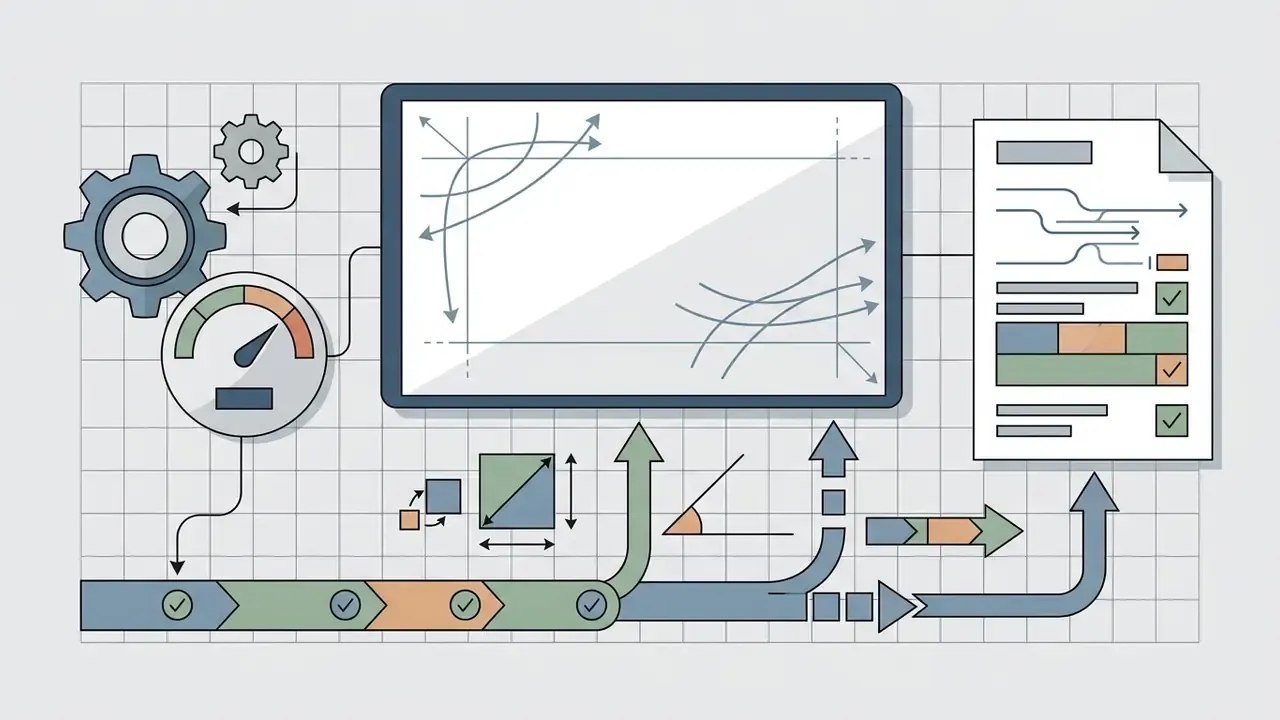
--ar 16:9).Prompt sensitivity varies substantially between engines, so teams standardizing a house style should first benchmark the best AI image generators against a fixed prompt set. When designing interfaces or form-based tools that translate structured fields into prompts, our guide on an ai form generator shows how field inputs convert into prompt variables.
Negative Prompts, Parameters and Platform UI Commands
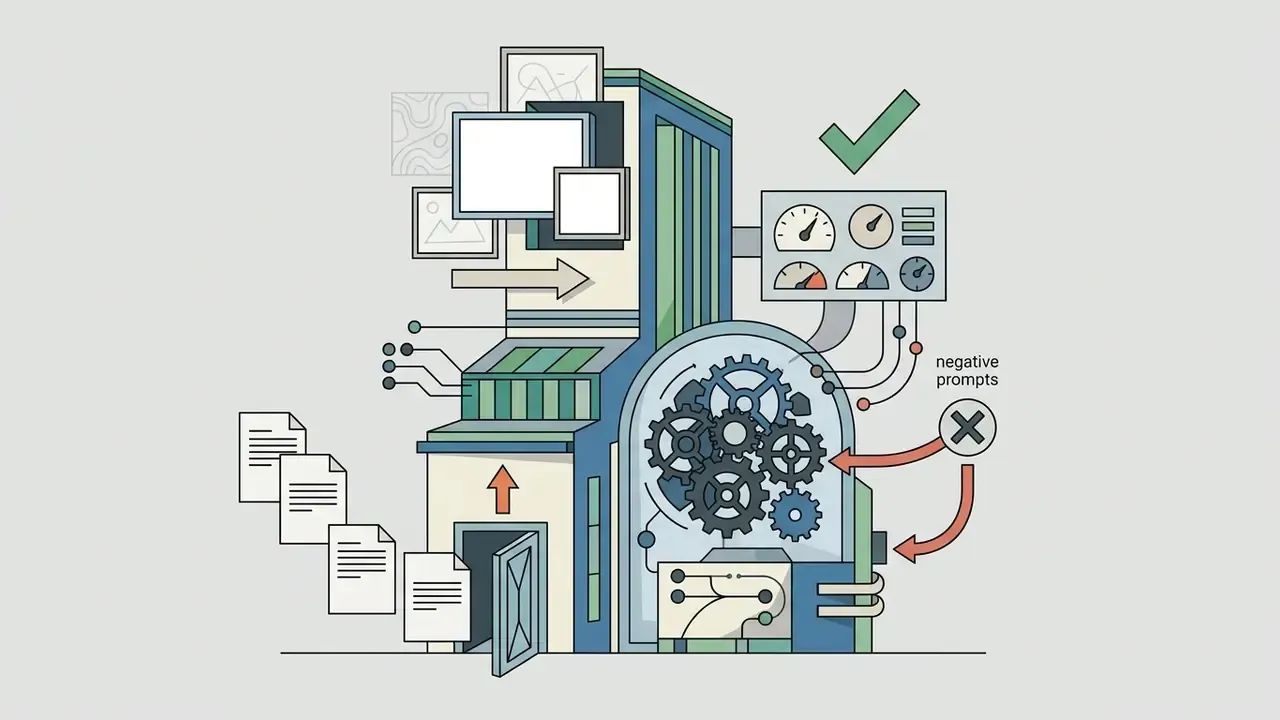
Positive prompts describe what should appear. Negative prompts describe what must be suppressed. Mechanically, negative prompts act as inverted conditioning vectors in cross-attention, steering the reverse diffusion trajectory away from undesirable statistical attribute clusters. In practice, they are the fastest single lever for reducing defect rates.
Negative prompting mechanics (Stable Diffusion / ComfyUI):
- Positive prompt
- "A cinematic portrait of an astronaut on Mars, 8k, highly detailed, volumetric light"
- Negative prompt
- "blurry, low quality, deformed hands, extra fingers, cartoon, illustration, watermark, text"
- Practical example
- a reference community prompt, "A small cabin on top of a snowy mountain in the style of Disney, artstation" with the negative prompt "low quality, ugly", demonstrates how two suppression tokens alone materially clean up composition. Adding "animated," "hand-drawn," "unrealistic," "cartoon" to negative space is the standard method for pushing an output out of the illustrated register and toward photographic realism.
- Governance note
- version-control negative prompts alongside positive prompts. They are part of the reproducible parameter set, and reviewers will ask for them.
Platform UI commands (Midjourney):
/imagine prompt: [text]initializes the generation chain from the chat bar. Generation renders progressively, typically in around 30 seconds.- Grid output. The first response returns a four-image grid, indexed clockwise: top-left is position 1, bottom-right is position 4.
U1toU4upscale the selected quadrant to target resolution; "Upscale to Max" pushes the selected frame to the highest available definition.V1toV4generate four new variations from the selected quadrant while retaining the base composition and seed lineage.--ar 16:9controls aspect ratio;--srefapplies a style reference;--crefapplies a character reference.
Core sampler parameters worth logging:
| Parameter | Function | Governance relevance |
|---|---|---|
seed | Fixes the initial Gaussian noise tensor | Enables byte-comparable reproduction of an audited output |
steps (num_inference_steps) | Number of denoising iterations | Trades latency against detail stability |
guidance_scale (CFG) | Strength of prompt adherence | High values increase fidelity but can cause saturation artifacts |
strength / denoising strength | How far img2img deviates from source | Controls how much original structure survives |
lora_scale | Weight applied to LoRA adapters | Determines how strongly brand or character training is expressed |
| Model version / checkpoint hash | Identifies exact weights used | Mandatory for reproducibility across model updates |
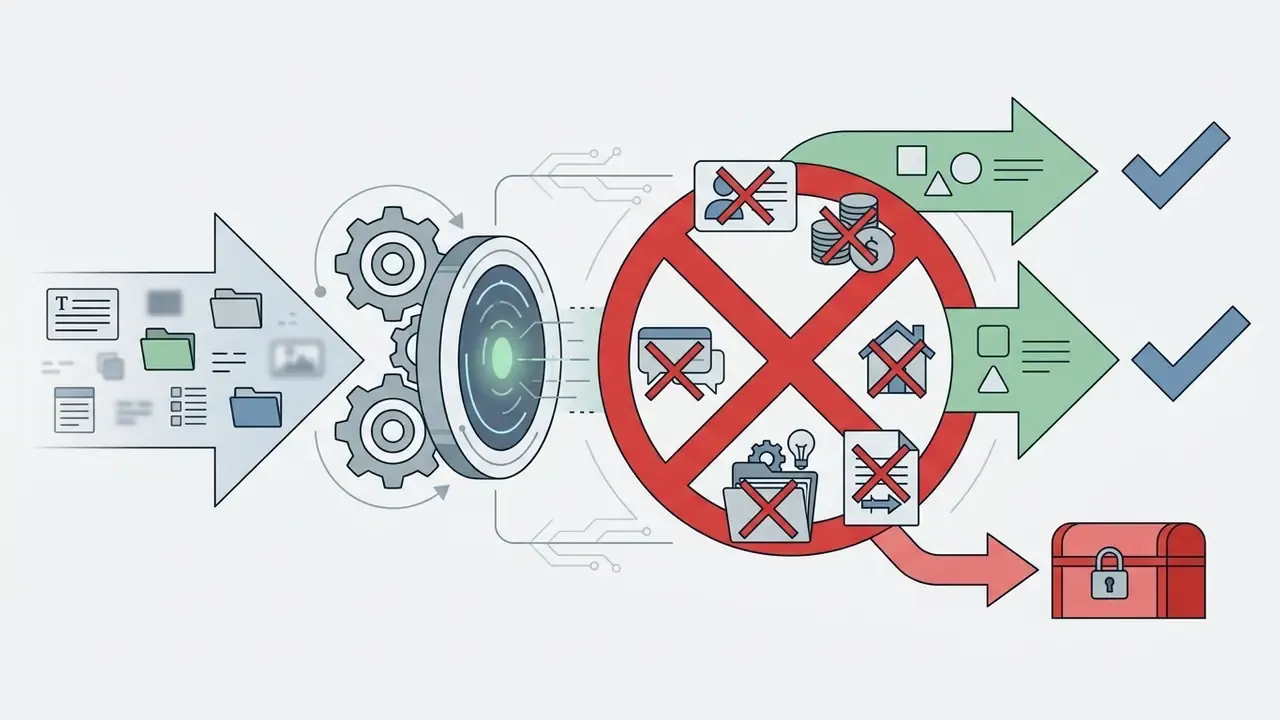
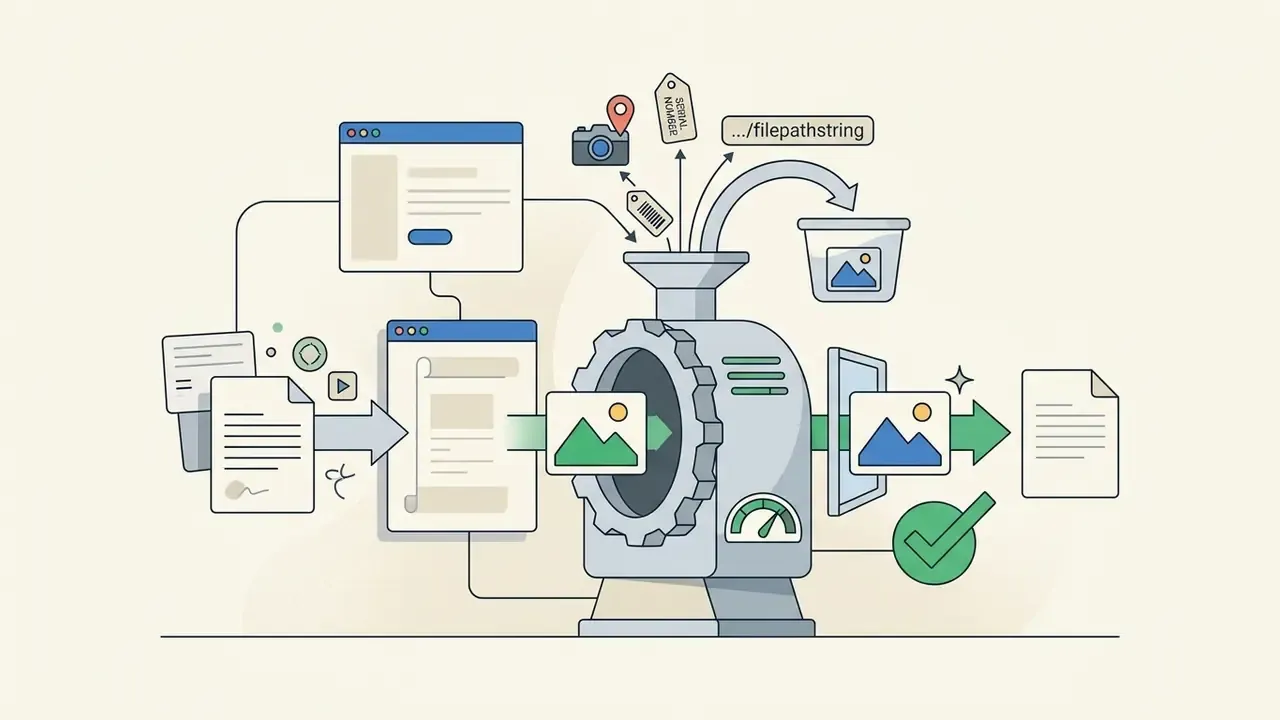
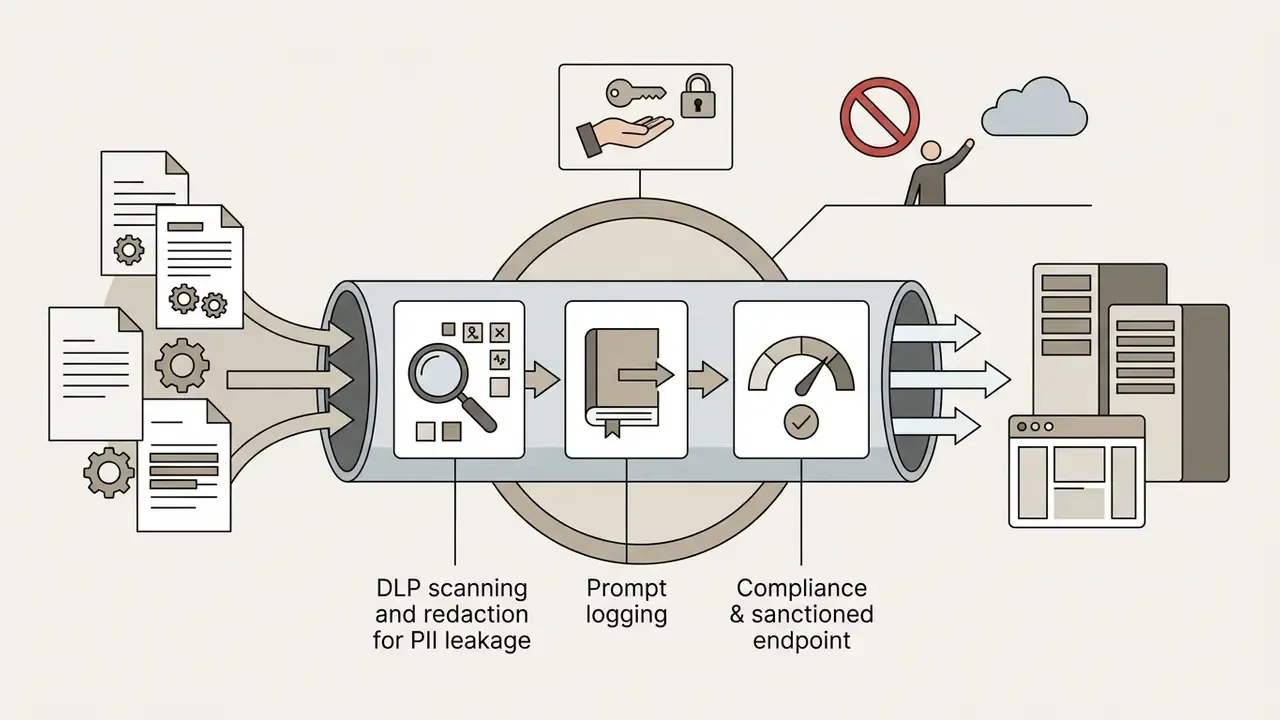
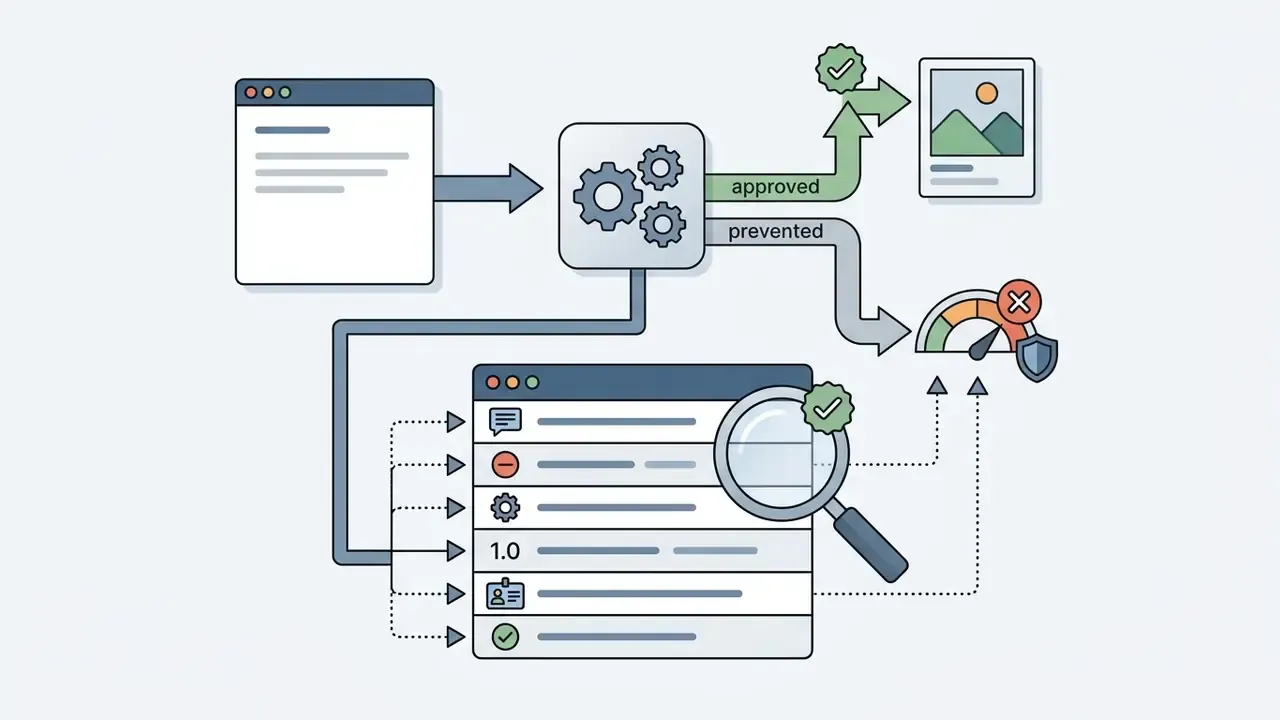
Prompt Security: Preventing PII Leakage and Shadow AI
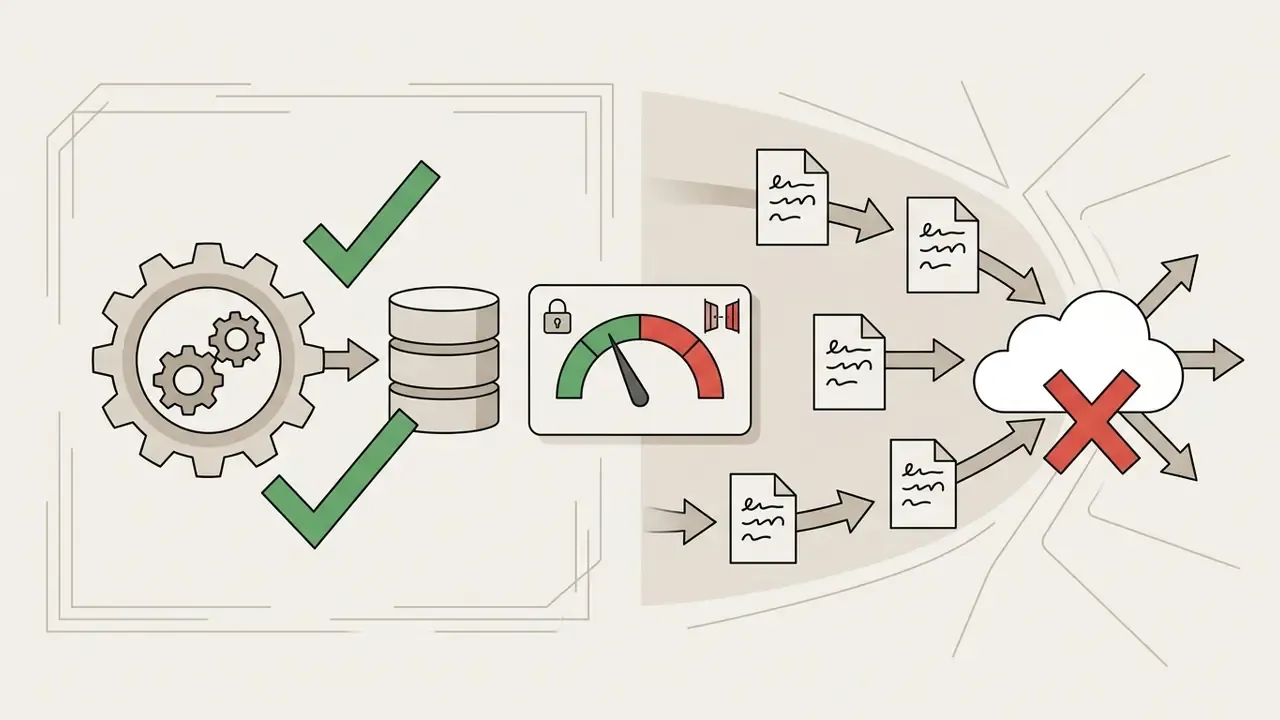
Prompts are inputs to a third-party inference endpoint, and in hosted configurations they are frequently retained, logged, or used for service improvement. That makes the prompt field a data-egress channel. Unmanaged personal use of consumer generators inside a regulated institution is the textbook definition of Shadow AI.
Practical controls:
How the Model Turns a Prompt Into an Image
After prompt submission, the model processes the text through its conditioning pipeline and initiates latent space denoising. The text encoder converts tokens into numerical tensors, which feed the network's cross-attention mechanisms.
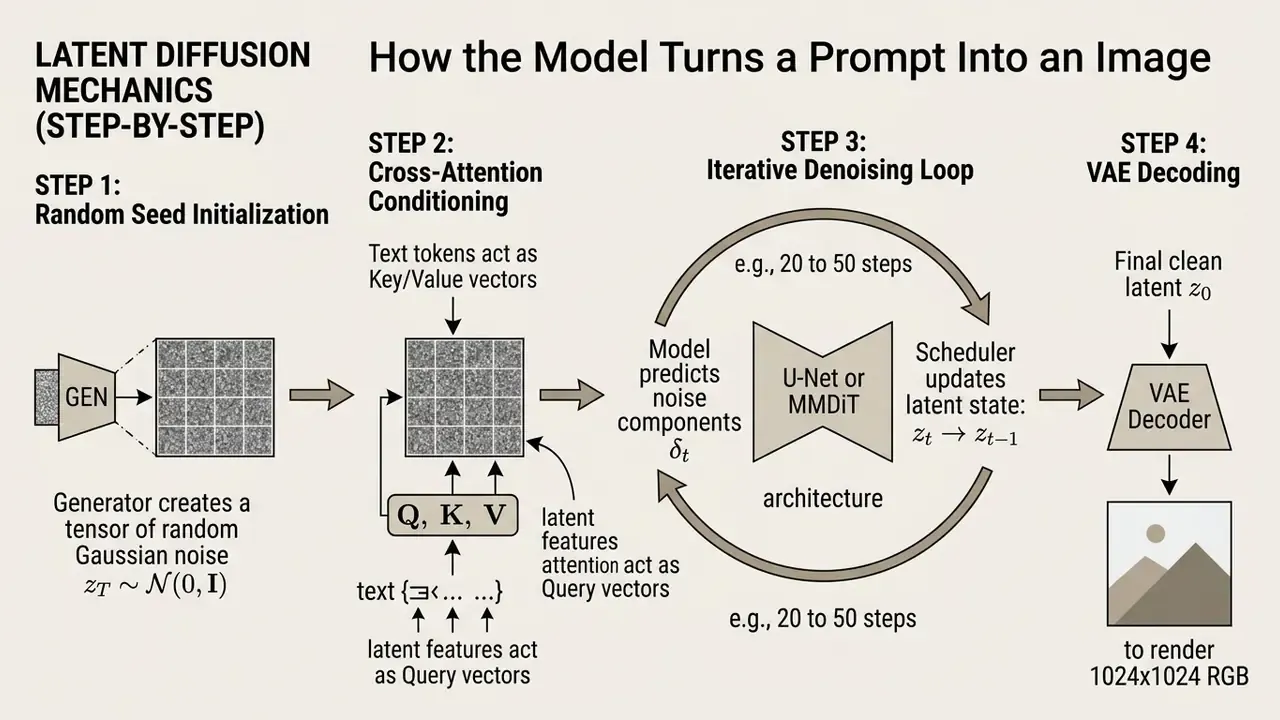
Two properties of this loop matter for model risk management. First, the process is stochastic by construction: identical prompts produce different outputs unless the seed is fixed. Second, it is fully reproducible when parameterized: seed plus sampler settings plus checkpoint version yields a deterministic result, which is what makes generative image pipelines auditable at all. Without those four fields logged, you have a demo, not a control.
When building scalable infrastructure for automated media pipelines, developers can reference our technical breakdown in AI Media API Guides, or review a concrete implementation and cost model in our Google Veo API guide for the video-generation analogue.
Refining the Output and Creating New Variations
Initial generative outputs frequently require human review and targeted refinement to resolve local artifacts, composition flaws, or anatomy errors.
«Analysis of 2.84 million Midjourney prompts shows that users systematically issue related requests back-to-back, changing only a handful of keywords.»
Creators use several established editing techniques to iterate on generated images:
How Do AI Art Generators Work in Popular Tools?
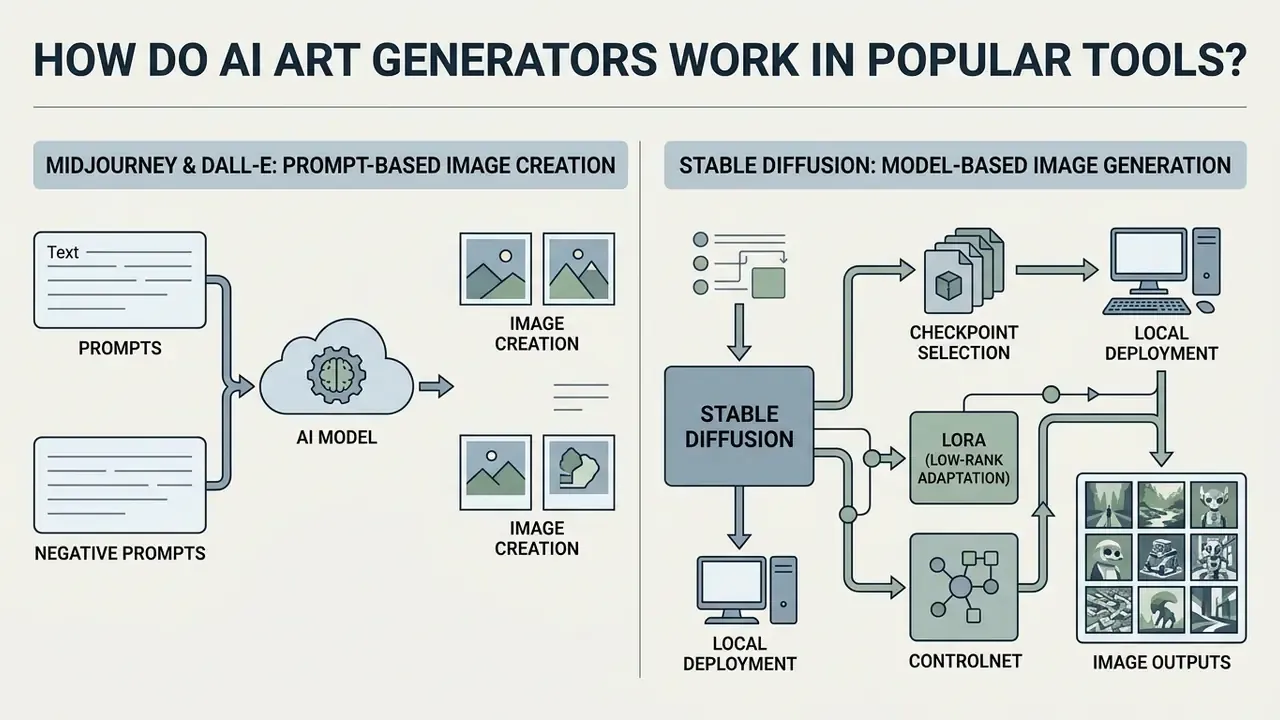
Popular AI art generators use different underlying architectures, user interfaces, and control mechanisms. Commercial systems like Midjourney and DALL-E operate as hosted cloud platforms, while open-ecosystem models like Stable Diffusion allow local deployment and granular code-level customization.
| Platform | Core Architecture | Primary Input Method | Control & Fine-Tuning Capabilities | Data Isolation & On-Prem Support | Best Commercial Use Cases |
|---|---|---|---|---|---|
| Midjourney (v7) | Proprietary Hosted Diffusion | Discord commands / Web UI (/imagine) | Style references (--sref), character references (--cref), variation modes, Draft Mode, Niji 7 | None. Cloud-only; prompts and outputs processed on vendor infrastructure; broad vendor licence to prompts | Concept art, editorial illustration, creative moodboards |
| DALL-E 3 | Closed GPT-4 Conditioned Diffusion | Natural language chat / API | Conversational prompt expansion, masked inpainting API, image variations | None on-prem. Enterprise API tiers offer contractual data-handling terms; no local weights | Rapid prototyping, web graphics, integrated app workflows |
| Stable Diffusion (SD3.5 / SDXL) | Open-Source MMDiT / Latent Diffusion | Web WebUIs (ComfyUI, Automatic1111) / API | ControlNet (depth/pose/Canny), LoRAs, custom checkpoint fine-tuning, sampler-level parameters | Full. Weights run on-premises or in a private VPC; prompts never leave the perimeter; removing the 4.7B T5 encoder further reduces inference memory | Enterprise pipelines, custom brand training, regulated-data deployments |
For a wider feature and licensing matrix, see our extended comparison of the best AI art generators, the free-tier equivalents, and our head-to-head evaluation of the ChatGPT picture generator versus alternatives.
Midjourney and DALL-E: Prompt-Based Image Creation
Midjourney and DALL-E 3 represent hosted, prompt-first platforms optimized for high aesthetic fidelity and ease of use. Midjourney parses text instructions through proprietary Discord parameters, offering advanced style-matching through flags like --sref (style reference) and --ar (aspect ratio); its documentation notes that style references transfer visual "vibe" rather than copying objects, and that subtle variations alter local detail while preserving the overall result. For a like-for-like breakdown, see Midjourney compared with competing tools.
DALL-E 3, developed by OpenAI, integrates directly with ChatGPT. It automatically expands short user inputs into detailed, descriptive captions before passing them to the diffusion model, and it can decline requests that name living artists' styles. Academic benchmarks show DALL-E 3 achieving 65.2% accuracy on scene-text rendering tasks, significantly outperforming unassisted diffusion baselines (DEsignBench Evaluation, 2024).
«DALL·E 3 reaches 65.2% in-image text rendering accuracy, while Midjourney records roughly 1.1% and SDXL approximately 10 to 20%.»
Stable Diffusion and Model-Based Image Generation
Stable Diffusion operates as an open-weights ecosystem that gives developers and artists direct control over internal model parameters. Running on architectures like Multimodal Diffusion Transformer (MMDiT), Stable Diffusion 3.5 separates text processing across triple encoders (CLIP ViT-L, OpenCLIP ViT-G, and T5-XXL), uses separate image and language weights, and pairs them with an improved autoencoder to improve prompt adherence.
Key technical extensions in the Stable Diffusion ecosystem include:
- ControlNet: Adds conditional control signals, such as edge detection (Canny), depth maps, or human pose estimation (OpenPose), to dictate precise spatial structure (Zhang & Agrawala, 2023).
«ControlNet adds conditional control signals, depth maps, Canny edges, OpenPose skeletons, to precisely govern the spatial structure of the generated image.»
- LoRA (Low-Rank Adaptation)Small, targeted weight files (typically 10MB to 200MB) trained to inject specific characters, corporate brand assets, or niche art styles without retraining the base checkpoint. Application strength is set explicitly via
lora_scale. - Checkpoint selection and local deploymentBecause weights are downloadable, organizations can pin a specific checkpoint hash, run inference inside a private network, and eliminate prompt egress entirely. For regulated data classes, that is usually the decisive factor.
Teams evaluating operational costs and asset licensing across these platforms can inspect current plan tiers via our overview of pricing models or use the financial planning tools in our calculators section.
How Do People Create AI Art That Matches Their Idea?
Creating AI art that matches a specific visual concept requires a deliberate, structured workflow rather than random prompt roulette. Professional artists and corporate teams use pre-generation planning, structured prompt testing, and iterative error analysis to control visual outcomes. That, more than any secret keyword list, is how people create AI art that survives review.
«Analysis of over three million text-image pairs shows users concentrate on surface aesthetics and popular motifs, refining prompts iteratively.»
Research on creative-intent interfaces organizes that intent into six controllable categories: Subject, Style, Artistic Reference, Composition, Mood, and Tone. It maps cleanly onto the prompt structure described earlier.
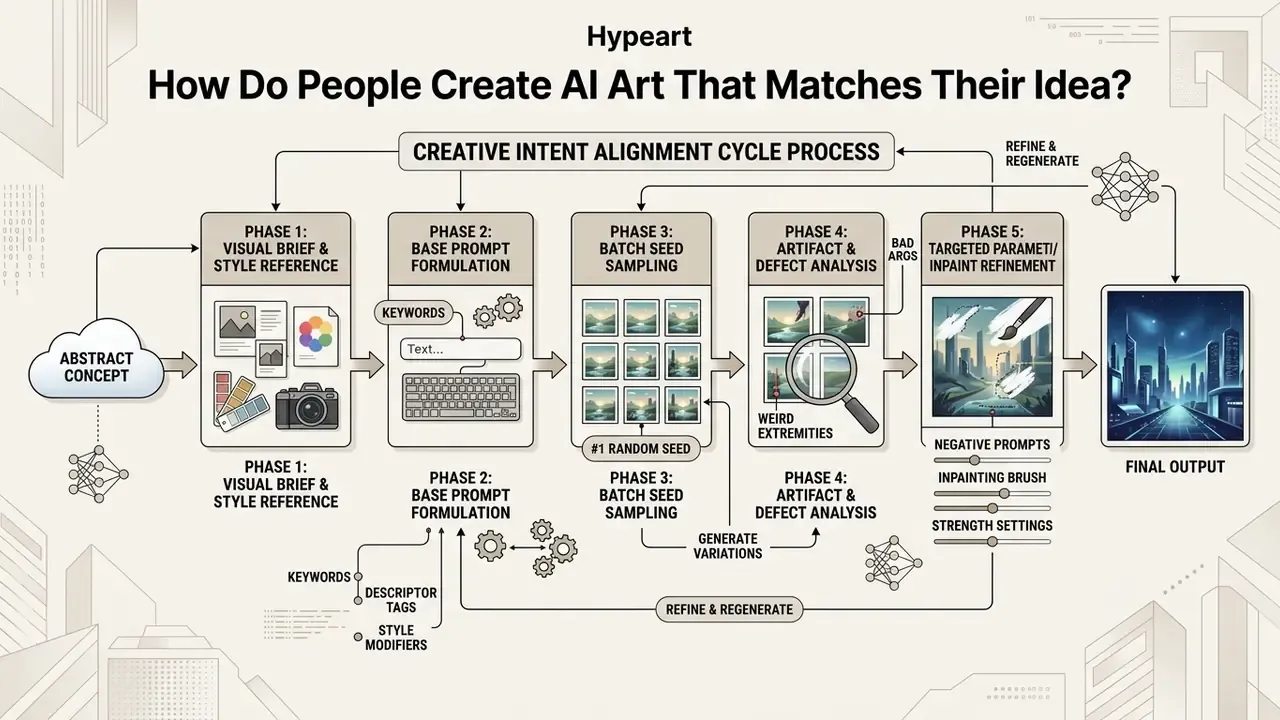
Choose a Visual Idea Before You Create AI Art
Before typing a text prompt, define a visual brief specifying subject matter, spatial composition, color palette, and lighting dynamics. Clear stylistic boundaries prevent decision fatigue and cut down unproductive prompting cycles.
Key preparation steps include:
Model selection should follow the concept brief rather than replace it. The brief defines which control surfaces you actually need, which in turn determines whether a hosted or locally deployed engine is appropriate. Teams working in adjacent media, such as motion graphics, explainer video, or animated brand assets, can review our guide to animation makers for equivalent planning steps.
Experiment With Prompts and Analyze the Results
Systematic prompt experimentation relies on changing one variable at a time while holding seed numbers and base parameters constant. When an output misses the mark, analyze the image for common failure modes and apply targeted corrections. Published prompt-engineering methodology recommends a compact evaluation set of roughly 20 to 50 representative input/output pairs including known failure modes, testing three to nine seeds per prompt variant, and running a four-step loop: error collection, error taxonomy, category selection, guidance revision.
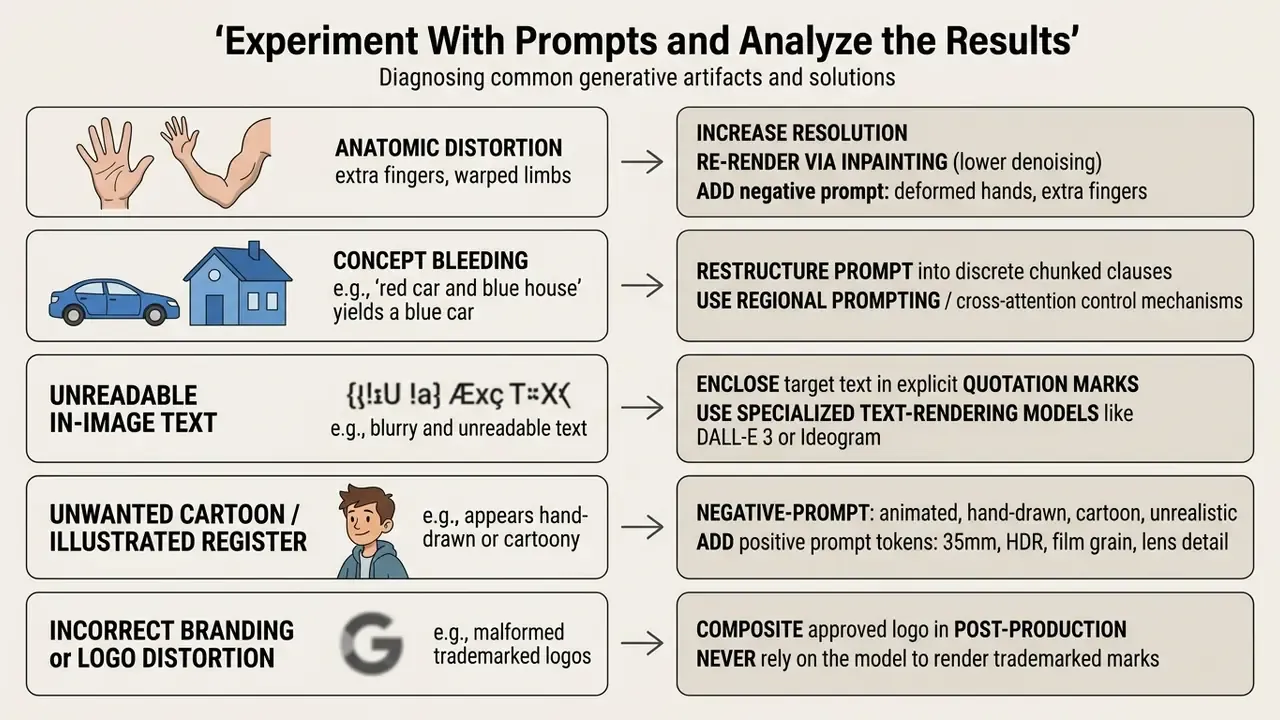
Illustrative optimization pattern (method described; figures require organization-specific measurement): a marketing team standardizing generative social assets can build an internal evaluation set of 50 fixed visual prompts, then measure defect rate before and after adding explicit lighting, focal length, and negative-prompt tokens. Teams that have run this pattern report large reductions in visual defect rates, but the magnitude depends on the base checkpoint, subject class, and reviewer criteria, so baseline and post-optimization rates must be measured internally rather than assumed. (No third-party benchmark supports a universal figure.)
If you hit technical errors during model generation or API integration, consult our dedicated guide on AI Media Support and Troubleshooting.
Technical Summary & Governance Checklist
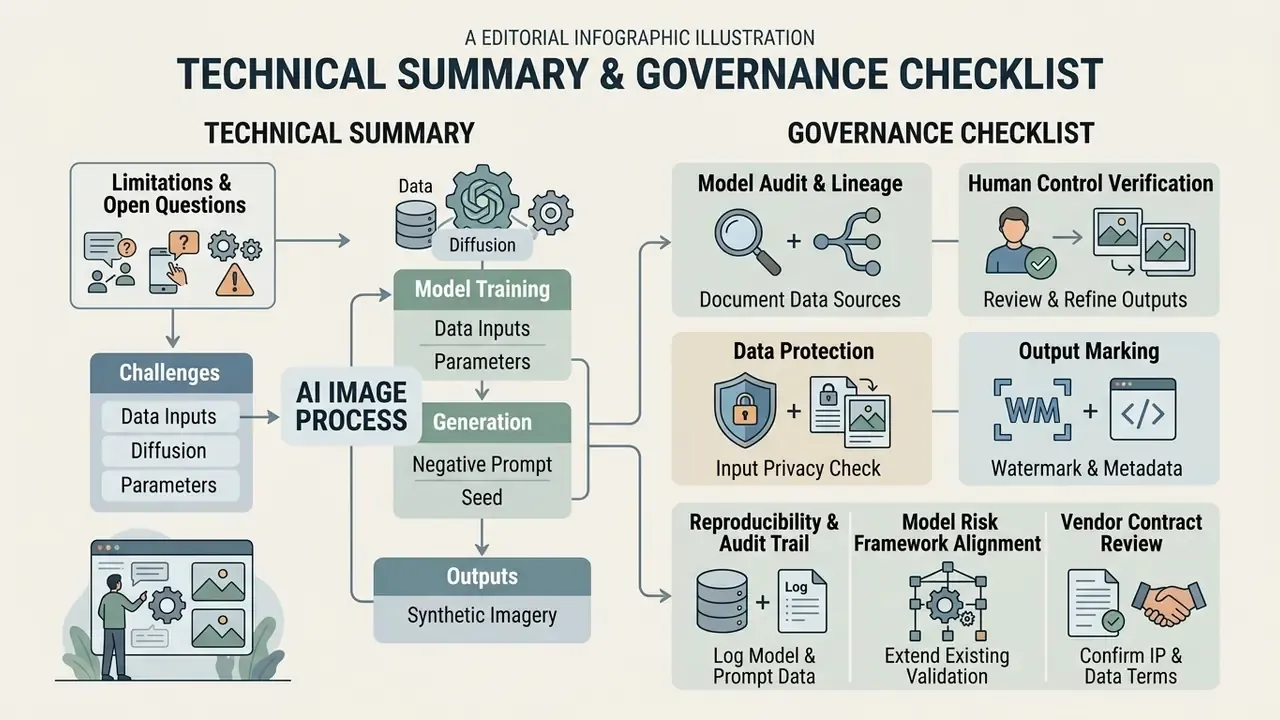
To keep generative image tools controlled, compliant, and consistently high quality, enforce a standardized checklist:
- Model audit and lineage: Document whether the generative model uses open, Creative Commons, or licensed training corpora, and record the exact checkpoint version or hash used for each production output.
- Human control verification: Ensure human reviewers select and refine all synthetic outputs before public or commercial release, and record the named approver.
- Data protection: Verify that input prompts and source reference images do not upload protected personal data or confidential intellectual property to public cloud endpoints; prefer locally deployed weights for regulated data classes.
- Output marking: Implement technical watermarking and metadata tags compliant with regional transparency regulations; pair this with AI image detectors to verify that published assets carry the expected markers.
- Reproducibility and audit trail: Log prompt, negative prompt, seed, sampler parameters, model version, operator, and approval decision for every released asset. Treat this log as the evidence package for internal audit and examiner requests.
- Model risk framework alignment: Extend existing model validation practice, including the conceptual soundness, ongoing monitoring, and outcomes-analysis expectations familiar from supervisory model-risk guidance (for example SR 11-7 in the United States or EBA guidance in the EU), to cover generative conditioning, sampling stochasticity, and output marking. (Applicability depends on institution type and jurisdiction; confirm with your compliance function.)
- Vendor contract review: Confirm IP indemnification scope and caps, data-retention terms, training-data transparency commitments, and revenue-threshold licensing conditions before deployment.
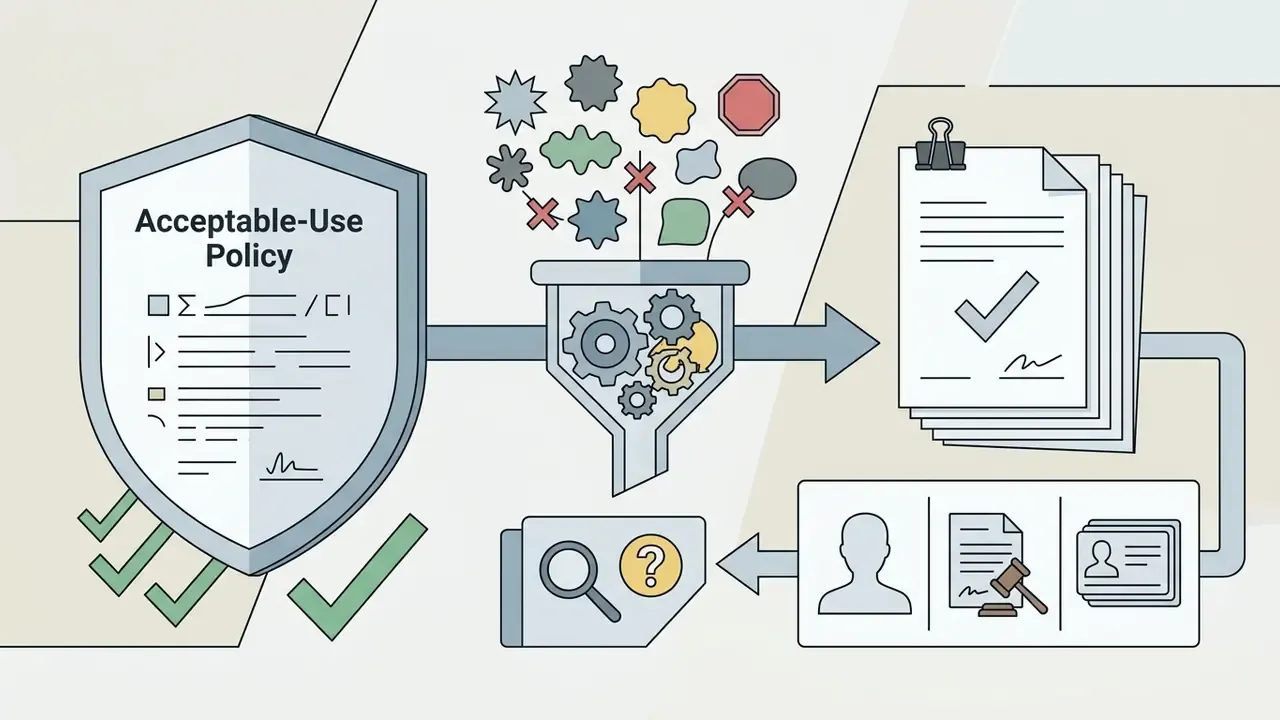
- Shadow AI containment: Publish an acceptable-use policy, provide a sanctioned internal endpoint, and monitor for unmanaged consumer-tool usage.
- Inventory coverage: Register every generative image tool in the same AI inventory used for predictive models, with an owner, an approved use case, and a documented shutdown path. Tools outside the inventory are, by definition, uncontrolled.
Limitations and Open Questions
A few things are genuinely unsettled, and pretending otherwise would be dishonest. Watermark durability under cropping, recompression, and re-generation is still weak in practice. Training-data provenance for most closed models cannot be independently verified by a customer. Courts have not fully resolved whether training reproductions require a licence in the United States. And validation methodology for generative visual output has no widely accepted quantitative standard comparable to backtesting a credit model. Where evidence is thin, keep the human gate and document the uncertainty.
A safe next step for most institutions is narrow rather than sweeping: pick one low-risk use case, such as internal presentation graphics, run it through the checklist above for a quarter, and use the resulting audit trail to argue for or against expansion. Small scope, real evidence.
For a complete catalog of terminology, model architectures, and regulatory definitions, explore the AI Media Glossary.
Frequently Asked Questions (FAQ)
How does AI art work in one sentence?
A text encoder converts your prompt into numerical conditioning vectors, a diffusion network iteratively removes Gaussian noise from a random latent tensor under that conditioning, and a VAE decoder renders the cleaned latent into a pixel image.
Where do AI art generators get their images?
They do not fetch images at generation time. Models are trained in advance on large image-caption corpora, some from curated or Creative Commons collections, much of it scraped from the open web, and retain only numerical weights. The provenance of that training data is the central legal dispute in the field.
How do AI drawings work compared with photorealistic renders?
Same mechanism, different conditioning. Illustrated or "drawn" output comes from style tokens and checkpoints weighted toward artistic corpora, while photographic realism comes from lens, film, and lighting tokens plus negative prompts that suppress the cartoon register. There is no separate drawing engine underneath.
Do you own the AI art you create?
Ownership and copyrightability are different questions. Platform terms may grant you ownership and commercial rights to outputs, often subject to revenue thresholds, while the US Copyright Office holds that output lacking sufficient human authorship cannot be registered. Human-authored edits and arrangements may be separately protectable. Consult counsel for your jurisdiction.
Is AI-generated art really art?
Philosophically contested, institutionally settled in practice. Under mimesis and formal criteria, much AI output qualifies; under expression-of-emotion criteria it is disputed. Under Dickie's institutional theory, the fact that auction houses, galleries, and fairs already exhibit and sell such work is itself the qualifying condition.
Why do AI images have distorted hands and unreadable text?
Hands involve high-variance articulated geometry that is underrepresented in clean training captions, and text rendering requires precise glyph-level spatial control that most diffusion models learn only weakly. Fixes include inpainting at higher resolution, targeted negative prompts, and text-specialized models.
Can the same prompt produce the same image twice?
Only if seed, sampler parameters, and model checkpoint are all fixed. Otherwise the initial noise tensor differs and the output diverges, which is precisely why seed logging is a reproducibility requirement rather than a nice-to-have.
What is the difference between GANs and diffusion models?
GANs pit a generator against a discriminator in a single-pass adversarial game and were prone to mode collapse and unstable training. Diffusion models learn to reverse a noising process across many steps, which yields greater output diversity, far better prompt controllability, and higher fidelity at the cost of more compute per image.
How are people making AI art at scale inside companies?
Usually through a small standardized stack: a fixed checkpoint, a shared prompt library with version control, a seed logging convention, and one human approver per campaign. The creative variance lives in the prompts; the controls live in the parameters and the log.
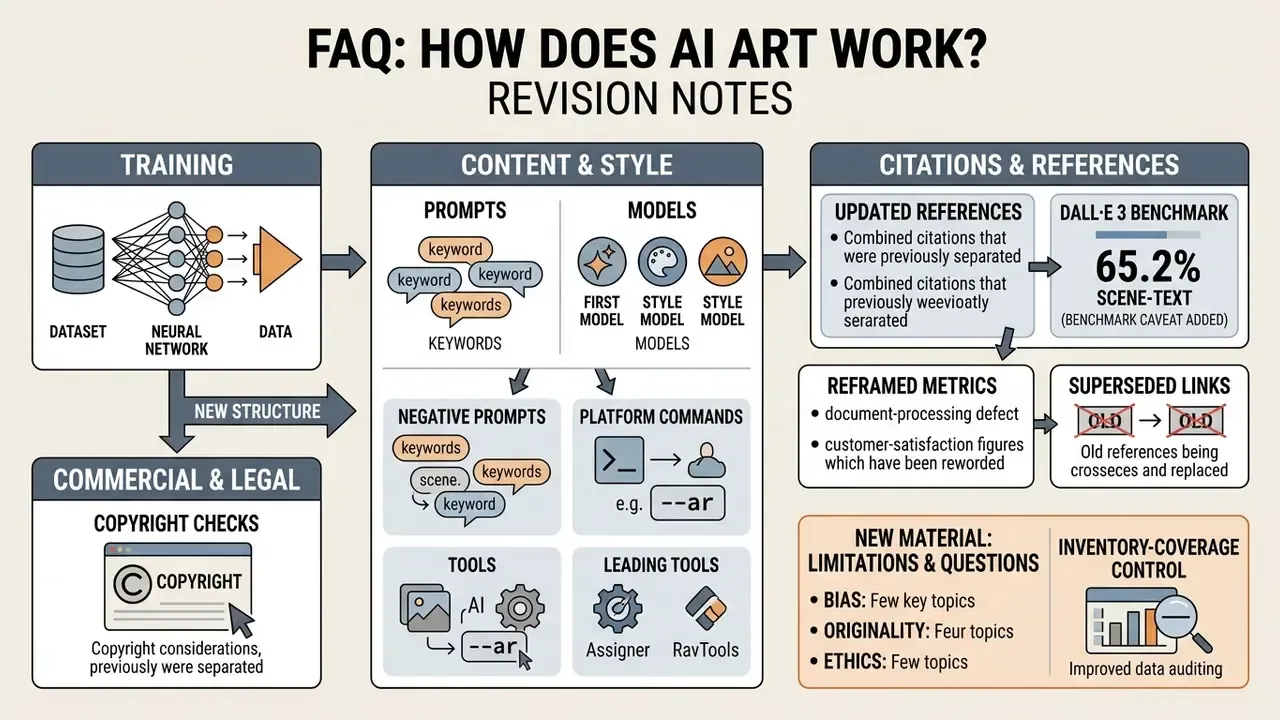
Appendix A: Editorial Revision Notes