If you run risk, compliance, or model governance at a bank, this is not a design question. It is a procurement and control question wearing a creative costume. Marketing wants faster campaign assets. Finance wants cheaper visuals for investor decks. Meanwhile prompts, unreleased product photos, and occasionally customer-adjacent material move through consumer chat windows that nobody logged.
So the practical ask is narrow. Which engine produces usable output, under which contract, with which evidence trail?
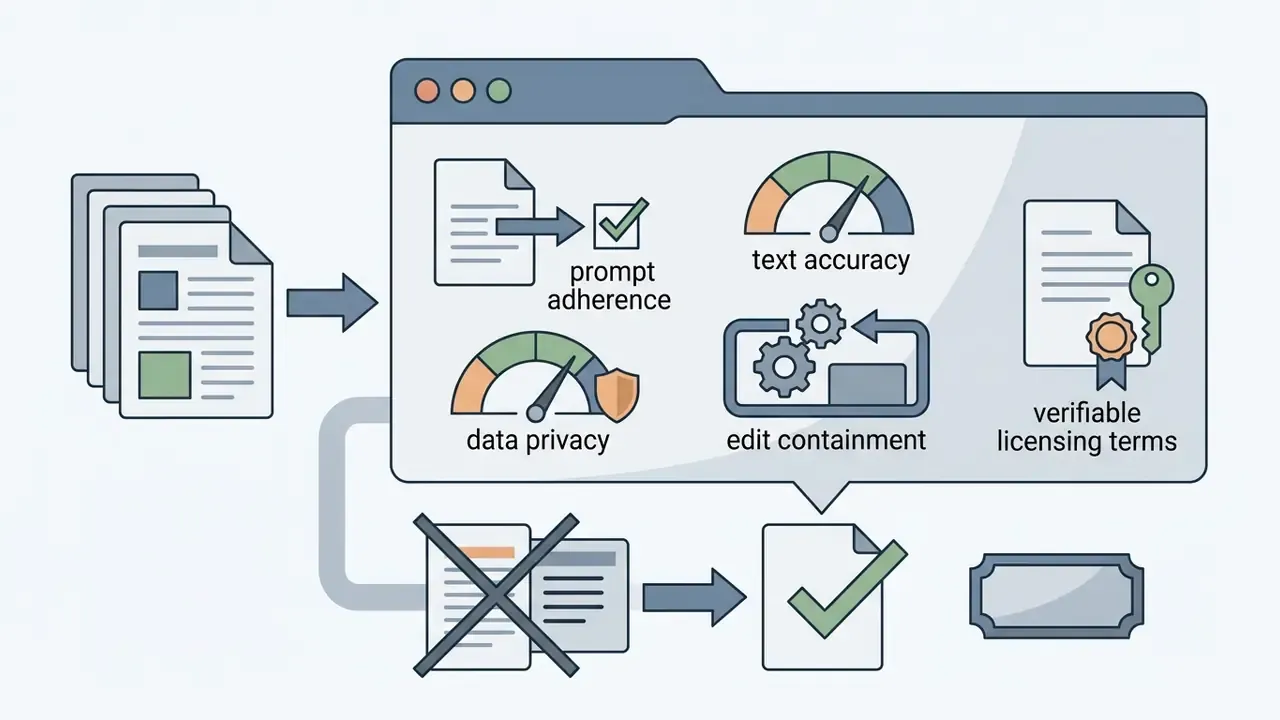
Evaluating an AI image generation model requires analyzing technical capabilities, operational controls, and legal terms rather than visual aesthetics alone. Enterprise adoption depends on prompt adherence, text rendering accuracy, edit containment, and verifiable licensing rights. Aesthetics are the easiest thing to judge and the least defensible thing to write into a control document.
Evaluating media generation tools across an enterprise tech stack often overlaps with adjacent synthetic media solutions. Teams analyzing visual workflows can also check our evaluations for the best ai video upscaler or review options for the best ai voice generator when building broader content automation strategies.
Executive Matrix: Model Selection at a Decision-Maker Level
This matrix is designed for procurement, risk, and governance stakeholders who need a one-screen summary before reviewing technical detail. Read it as a shortlist generator, not as a verdict.
| Requirement | Recommended engine | Data privacy posture | Legal protection | Deployment complexity | Audit readiness |
|---|---|---|---|---|---|
| Maximum legal protection for published brand assets | Adobe Firefly (Enterprise) | Enterprise agreement; customer assets excluded from public training pools | Contractual indemnification for non-beta features | Low (Creative Cloud native) | High (Content Credentials attached automatically) |
| Highest data isolation / no third-party inference | FLUX.1 [schnell], Stable Diffusion 3.5 (self-hosted) | Full isolation; prompts never leave the VPC or on-prem GPU | None from vendor; responsibility sits with the deploying entity | High (GPU provisioning, MLOps, model registry) | High only if internal prompt logging is implemented |
| Fastest time-to-asset for marketing teams | ChatGPT (GPT Image), Gemini (Nano Banana) | API-tier controls differ from consumer tiers; consumer tiers are a Shadow AI vector | Output rights assigned to user under vendor terms; no IP infringement indemnity | Very low | Medium (C2PA metadata present; prompt logs vendor-side) |
| Exact typography, packaging, and vector deliverables | Ideogram 4.0, Recraft V4 | Standard SaaS terms; free tiers may make assets public | Commercial rights on paid tiers only | Low | Medium |
| Concept art and campaign moodboards | Midjourney v7, Leonardo AI | Public gallery by default on lower tiers | Commercial rights on paid tiers | Low | Low |
| Pipeline automation at scale | FLUX API hosts, OpenAI API, Stable Diffusion | Zero-data-retention options available on enterprise API contracts | Contract-dependent | Medium | High (full request/response logging under your control) |
How We Evaluate the Best AI Image Generation Models
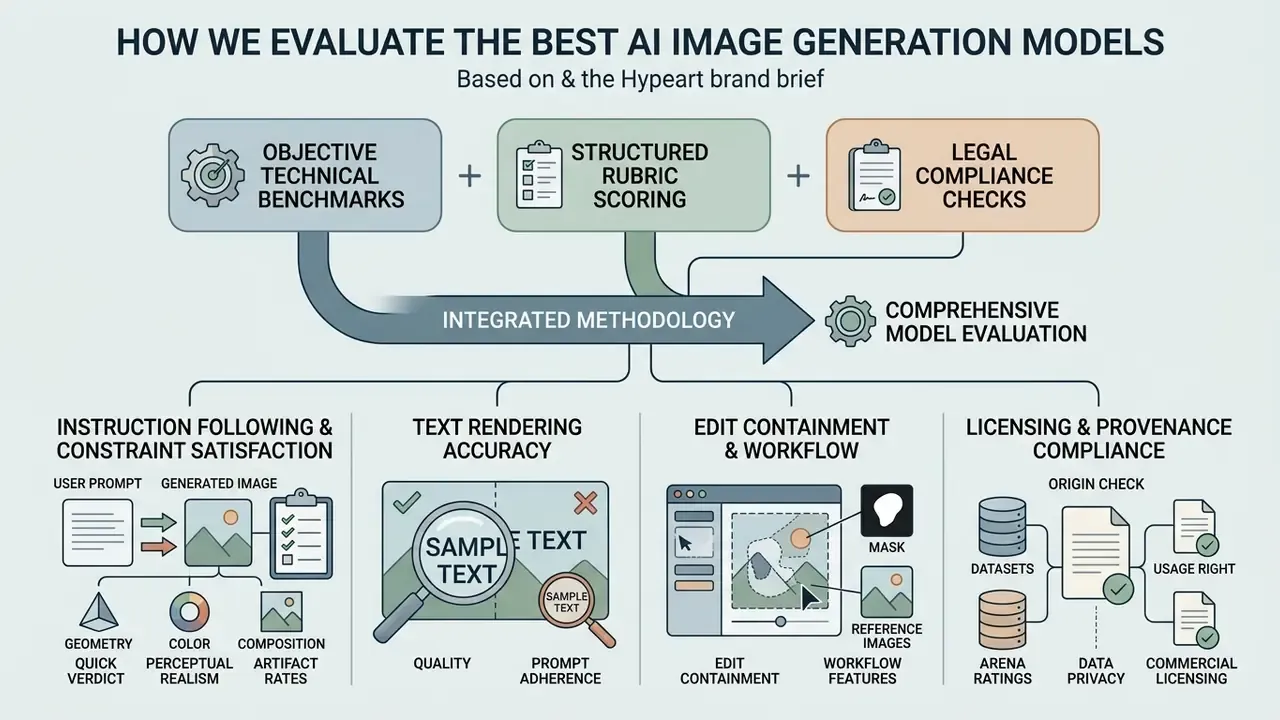
The evaluation of best ai image generation models uses a hybrid framework combining objective technical benchmarks, structured rubric scoring, and legal compliance checks. This methodology separates pure visual fidelity from instruction adherence, layout control, and commercial rights. A model that produces gorgeous, wrongly-numbered charts is not a high quality tool for a regulated publisher.
Quality, Prompt Adherence, and Text Accuracy
Prompt adherence measures how faithfully an ai image generation model renders requested objects, spatial arrangements, and numerical constraints specified in a text prompt. Traditional metrics like Fréchet Inception Distance (FID) measure overall dataset distribution matching. Modern evaluation frameworks rely instead on benchmark suites such as GenEval, TIIF, and LMD to quantify exact attribute binding and object counts (GenEval Benchmark, 2023; Lumina-DiMOO Study, 2025).
«CLIPScore correlates reasonably with human judgments at low quality but saturates as models improve, becoming insensitive to subtle differences in prompt adherence.»
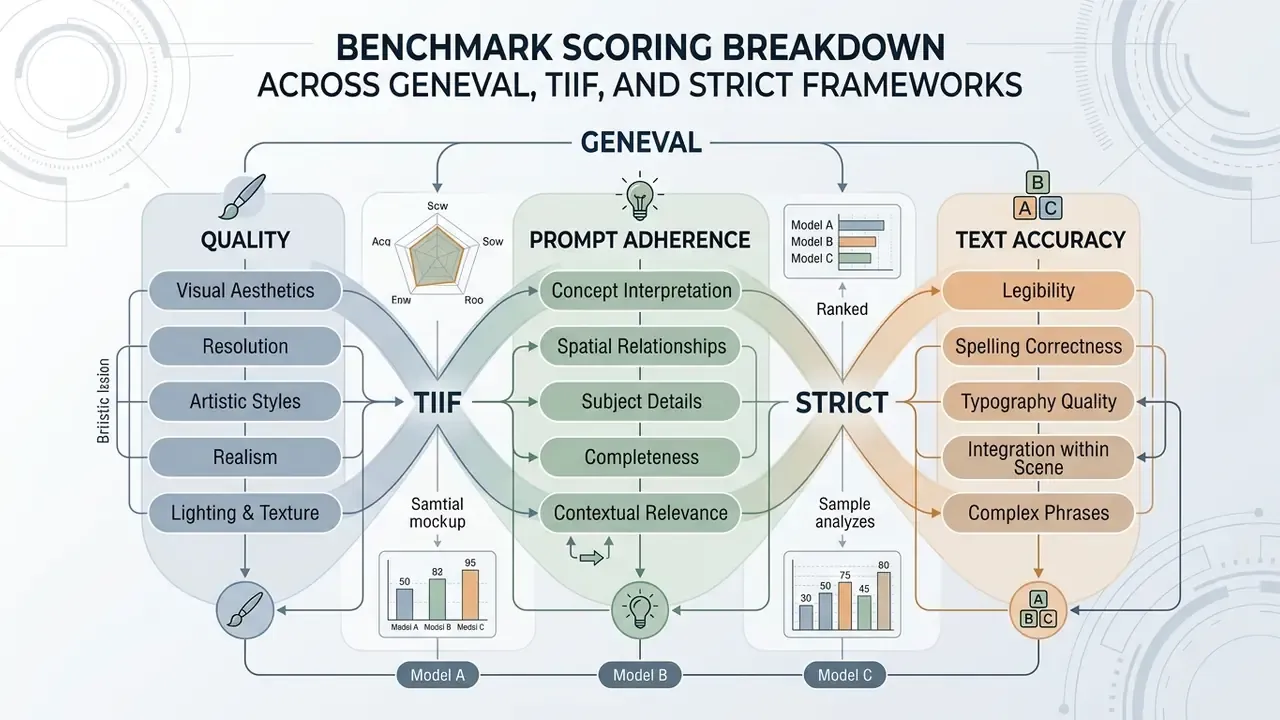
In academic studies, advanced models like FLUX.1 [Dev] achieve GenEval overall scores of 0.66, outperforming legacy baselines like Stable Diffusion XL (0.55) on complex multi-object prompts. Crucially, FLUX is not the ceiling:
«OmniGen (3.8B) achieves a GenEval overall score of 0.68, surpassing FLUX.1 [Dev] (0.66) and SDXL (0.55) on compositional multi-object prompts.»
Embedded text accuracy is evaluated independently using OCR metrics such as Character Error Rate (CER) and Normalized Edit Distance (NED). Teams translating these scores into production decisions should also review how licensing interacts with output quality when selecting AI image generators for commercial use. Related suites such as HRS-Bench formalize this split by reporting prompt-adherence (PA) and composition-accuracy (CA) alongside CER and NED, while OCRGenBench adds an accuracy ratio (AR) and a composite OCRGenScore for instruction-aligned typography.
Multimodal architectures like GPT-4o and Gemini 2.0 demonstrate superior performance on long-form text rendering inside images, whereas specialized diffusion systems vary significantly when generating structured typography (STRICT Benchmark, 2025).
«GPT-4o and Gemini 2.0 substantially outperform competitors on character accuracy, word accuracy, and instruction adherence across all evaluated languages and text lengths.»
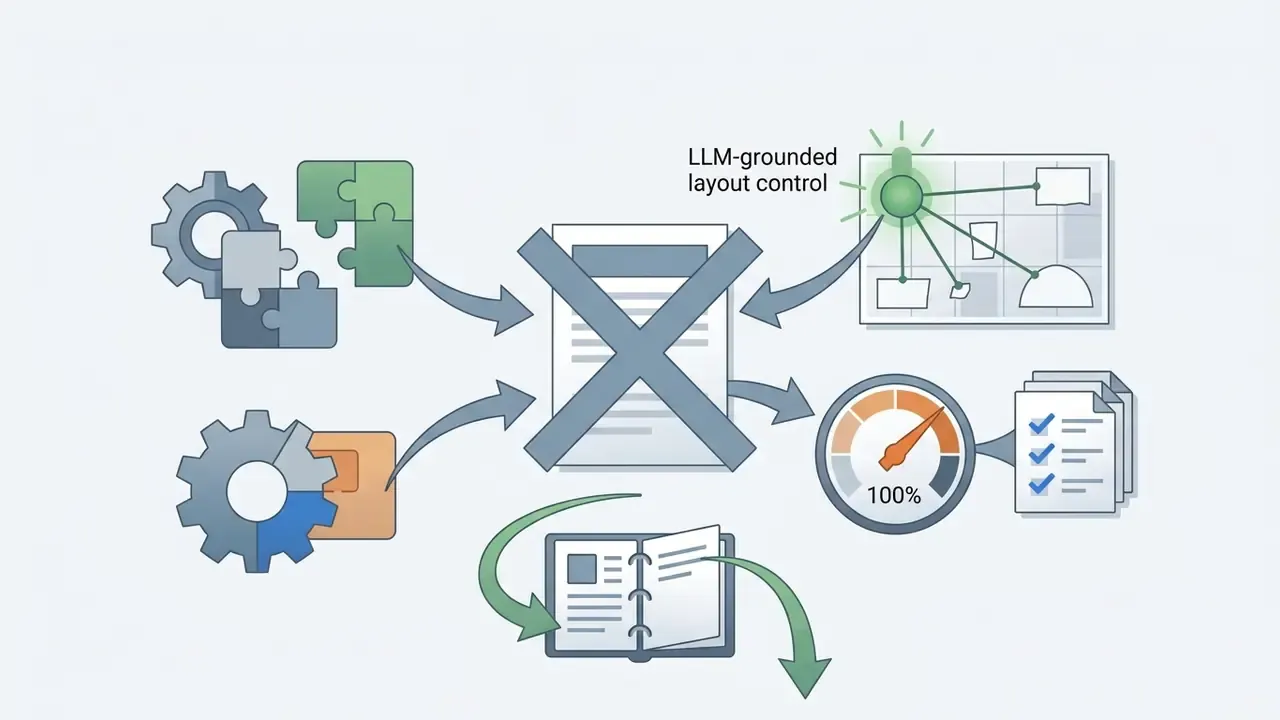
A small internal example, because abstractions get argued and examples get remembered. During an evaluation for a commercial campaign, a team tested an ai model for image generation on a prompt requiring three distinct financial charts with legible callout text. The initial base diffusion setup failed on numerical counting and rendered garbled characters in 8 out of 10 test runs. Legible, no. Convincing at thumbnail size, unfortunately yes, which is exactly the reputational trap. Updated finding: after switching to a hybrid architecture with LLM-grounded layout control, the same ten-prompt sample produced correct object placement in every run and fully legible callout text in 10 of 10 samples. The sample size (n = 10 prompts, single seed per prompt) is too small to generalize. Broader statistical claims require a larger prompt set and multi-seed sampling, and the figures above should be read as a directional internal observation rather than a benchmark result.
Evaluation framework: quick verdict
Pros of benchmark-led selection:
- Replaces subjective "looks better" judgments with reproducible pass/fail gates
- Separates text accuracy (CER/NED) from aesthetic preference, preventing false confidence
- Creates an audit trail suitable for model risk management reviews
Cons and caveats:
- Benchmarks rarely cover domain-specific assets such as banking UI mockups or regulated disclosures
- Leaderboard positions shift with prompt type and evaluation design
- FID and CLIPScore saturate on frontier models and stop discriminating quality
Editing, Reference Images, and Workflow Features
Modern image editing requires ai models for images to modify localized visual elements while preserving unchanged background content and character identity. Structural image editing relies on three primary capabilities: inpainting (filling masked areas), outpainting (extending the canvas boundary), and reference-conditioned image-to-image generators transformation (ByteEdit Study, ECCV 2024). ByteEdit reports a 388% quality gain and a 135% consistency gain on outpainting relative to its own baseline, which illustrates how quickly containment metrics have moved.
Research demonstrates that reference conditioning prevents identity drift when generating multiple variations of a brand asset or character. Updated evidence: rather than relying on survey-level summaries without measured outcomes, the strongest current comparison is a controlled four-criterion human evaluation.
«Dedicated editors Imagic and Forgedit consistently lead across four criteria: instruction alignment, content preservation, visual quality, and practical acceptability.»
Benchmarks such as HQ-Edit and Emu Edit evaluate edit containment using CLIP image similarity and region-boundary checks to confirm that non-targeted pixels remain untouched during image editing. For a compliance reviewer, containment matters for one reason: an edit that silently rewrites a disclosure line or a rate figure is a control failure, not a rendering artifact.
«SeedEdit achieves substantially higher editing scores on HQ-Edit and Emu Edit than baseline models while maintaining higher CLIP similarity to the source image.»
Best AI Image Generators at a Glance
Selecting the best ai for image generation depends on whether an organization prioritizes conversational flexibility, fine-grained open-source control, or enterprise brand safety. The market includes multimodal platforms, dedicated diffusion engines, specialized design models, and creator-focused canvases.
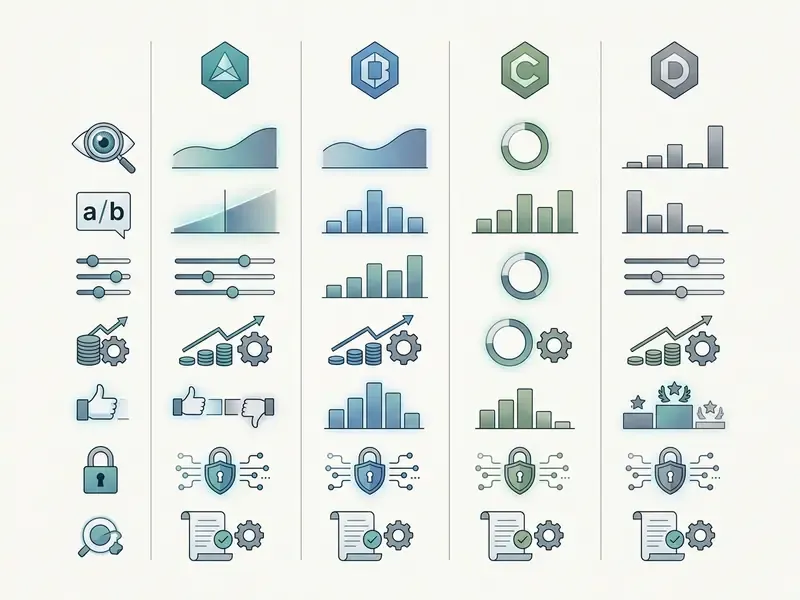
Comparative Analysis of Leading AI Image Generation Models (2026)
| Model / Platform | Primary use case | Prompt adherence & quality | Arena rating (TrueSkill / Elo) | API pricing (input / output per 1M tokens) | Text accuracy | Image-to-image / editing | Free plan availability | Commercial use terms | Key limitations |
|---|---|---|---|---|---|---|---|---|---|
| ChatGPT / GPT Image | Conversational creation & iterative text edits | High (GPT-4o multimodal alignment) | TrueSkill 506 (rank 1, image arena) | $0.05 / $0.05 (cached input tier as low as $0.00) | Very high (top character accuracy in STRICT) | Iterative chat edits & regional selection | Limited free access (rolling daily cap) | Permitted under OpenAI terms | No numerical user daily quota published; recognizable "house style" |
| Gemini / Nano Banana | Everyday generation & Google app integration | High (Gemini 2.5 / 3.1 Flash Image) | TrueSkill 261 (rank 2) | $0.02 / $0.02 (Flash tier $0.04 / $0.04) | Very high (multilingual text rendering) | Native text + image inputs; scene edits | Free tier available in Google ecosystem | Allowed under Google AI Terms | Imagen model series scheduled for shutdown on 17 Aug 2026 (verify against current Google Cloud release notes); visible watermark on some surfaces |
| FLUX.1 / FLUX.2 | High-control diffusion & custom pipelines | Very high (0.66 overall in GenEval-style tests) | TrueSkill 251 (FLUX Pro 1.1) | $0.02 / $0.02 (schnell); $0.05 / $0.06 (Pro); $0.06 / $0.06 (Pro 1.1 Ultra) | Moderate to high | ControlNet, IP-Adapter & structural hooks | Open weights available (schnell variant) | Apache 2.0 (schnell / 4B); non-commercial (dev / 9B) | Requires local hardware or third-party API hosts; text rendering trails GPT Image |
| Adobe Firefly | Graphic design & brand-safe commercial workflows | High (integrated with Creative Cloud) | Not listed in public blind arenas | Credit-based; no public per-1M-token rate | High (optimized for design layouts) | Generative Fill & Generative Match | Limited free plan with credit limits | Commercial rights for non-beta features; indemnification available | Deepest features locked behind paid plans; no negative-prompt control |
| Midjourney | Artistic concepts & high aesthetic stylization | High aesthetic preference; lower physical accuracy | Listed in blind arenas; below GPT Image on text tasks | No public API; subscription only | Moderate (stylized short text) | Inpainting, pan, zoom & Omni Reference | No standing free trial | Commercial rights on paid tiers | Fails on strict physical commonsense tests; ToS grants broad license over inputs and outputs |
| Ideogram | In-image text, logos & typography design | High (Ideogram 4.0 design engine) | Below Recraft on design Elo comparisons | Credit-based platform pricing | Very high (exact spelling & hex palettes) | Style references & custom model guidance | Limited daily free credits | Permitted on paid subscriber tiers | Higher focus on raster graphics than native vector |
| Recraft | Vector graphics, icons & brand style sets | Top Elo rating (1172) in design comparisons | Elo 1172 (Hugging Face T2I leaderboard, v3) | $0.04 per raster image; $0.08 per vector image (V3) | Very high (renders long text blocks) | Multi-reference style sets & region editing | Free tier with public asset visibility | Allowed on commercial paid plans | Requires vector mode selection for SVG exports |
| Leonardo AI | Realtime canvas & character consistency for creators | High on stylized and game-asset prompts | Not listed in major blind arenas | Credit/token based; API available on paid tiers | Moderate | Generative Motion, Canvas Editor, style & content reference | 150 daily tokens free | Paid tiers allow commercial usage | Complex UI for beginners; multi-model selection adds decision overhead |
Summary of table data: Multimodal models like ChatGPT (GPT Image) and Gemini (Nano Banana) lead in complex text rendering and conversational edits. FLUX provides maximum structural pipeline control for technical deployments; see our full comparison of the best AI image generators for extended head-to-head scoring. Adobe Firefly and Recraft specialize in commercially safe brand design and vector exports, while Midjourney remains focused on aesthetic concepts and Leonardo AI targets realtime creator canvases.
«Recraft v3 ranks first on the Hugging Face leaderboard with an Elo score of 1172, ahead of Flux and Ideogram in blind pairwise user comparisons.»
Independent arena data adds a second signal. As of September 2026, an 11,289-vote blind comparison ranked OpenAI's image model first with a TrueSkill score of 506, followed by Gemini's Nano Banana family (261) and FLUX Pro 1.1 (251). Arena rankings use a conservative TrueSkill formulation (μ − 3σ) from four-way blind comparisons, which suppresses brand bias but also means a new model needs many wins before it climbs. Treat those numbers as crowd preference, not as validation evidence.
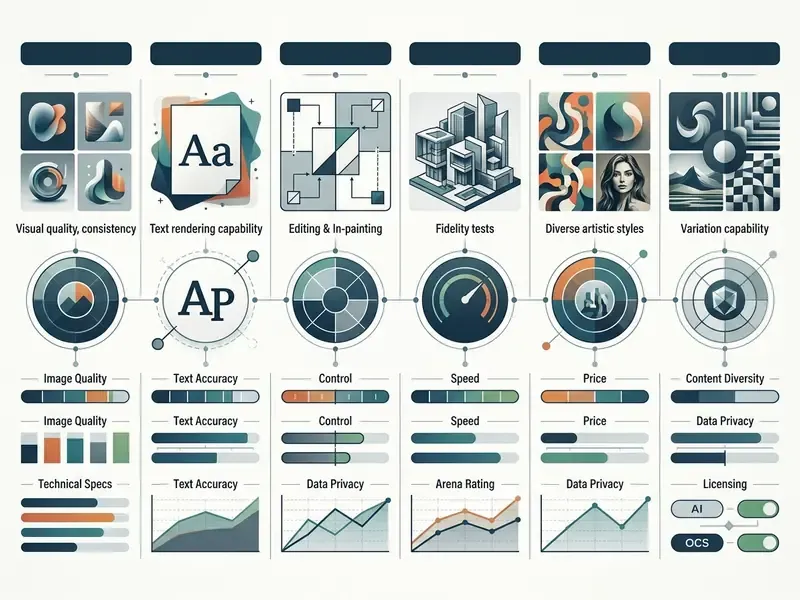
Enterprise Governance Comparison: Data Handling, Indemnification, and Deployment
Capability tables alone do not answer procurement questions. The second dimension is how each vendor handles prompts, logs, and legal exposure.
| Model / Platform | Prompt & asset retention posture | Zero-data-retention option | IP indemnification | Deployment models | Provenance metadata |
|---|---|---|---|---|---|
| ChatGPT / GPT Image | Enterprise and API tiers separate from consumer memory features; consumer tiers retain conversation context | Available on enterprise API agreements (contract-dependent) | Output rights assigned to user; no blanket infringement indemnity. Code-generation outputs may carry third-party licenses | Hosted API, ChatGPT apps | C2PA metadata attached automatically |
| Gemini / Nano Banana | Consumer and enterprise terms differ materially; Workspace/Cloud terms govern business use | Available under Google Cloud enterprise terms | Google Cloud offers generative AI indemnification on eligible services; verify per-service scope | Hosted API, Vertex AI, Google apps | SynthID-class watermarking and visible marks on some surfaces |
| FLUX (self-hosted) | Prompts never leave your infrastructure | Inherent, full isolation | None from vendor; the deploying entity assumes responsibility | On-prem, private VPC, third-party API hosts | Must be implemented internally |
| Stable Diffusion 3.5 | Same as above when self-hosted | Inherent when self-hosted | None from vendor; Community License is revenue-gated | On-prem, VPC, hosted UIs | Must be implemented internally |
| Adobe Firefly | Adobe states customer content does not train its models; enterprise custom models stay private | Enterprise agreement dependent | Contractual indemnification for non-beta features | SaaS, Creative Cloud, enterprise APIs | Content Credentials applied automatically to fully Firefly-generated pixels |
| Midjourney | Public gallery default on standard tiers; Stealth Mode on higher tiers | Not offered | Not offered; ToS grants a perpetual, worldwide, royalty-free license over inputs and outputs | SaaS (Discord + web) | Not standardized |
| Ideogram / Recraft / Leonardo AI | Free tiers may publish assets publicly | Not documented publicly | Not offered | SaaS, API on paid tiers | Varies by platform |
Note: retention, indemnification, and ZDR terms are contractual and change frequently. Every row above must be re-verified against the vendor's current Data Processing Addendum before procurement sign-off.
ChatGPT and GPT Image for Natural-Language Image Creation
ChatGPT / GPT Image: quick verdict
Pros:
- Top character accuracy in the STRICT benchmark for long-text rendering
- Iterative conversational visual edits with region masking
- Automated C2PA cryptographic metadata tagging on every output
- Highest TrueSkill arena rating (506) in blind human comparisons
Cons:
- No published daily usage caps for free users, making capacity planning unreliable
- Distinctive "GPT house style" on default photorealism prompts
- Higher latency on multi-subject layout prompts compared with FLUX
- Autoregressive rendering returns a single image per request in consumer surfaces
OpenAI's gpt-image-2 and gpt-image-2.5 model series power visual generation within ChatGPT, allowing users to create images and refine outputs through natural-language conversation. The gpt-image-2.5-sunburst variant is optimized for editing precision, while gpt-image-2.5-flare targets fast everyday generation. The platform supports direct image inputs, enabling conversational editing where users can select a specific region or describe targeted revisions in chat (OpenAI Help Center, 2026).
Gemini and Nano Banana for Everyday Image Generation
Gemini / Nano Banana: quick verdict
Pros:
- Best-in-class edit realism when modifying existing photographs
- Native availability across Gemini app, Search, and NotebookLM
- Generous free tier plus high-resolution 2K/4K output on Pro surfaces
- Lowest listed API rate among frontier engines ($0.02 / $0.02 per 1M tokens)
Cons:
- Prompt adherence can be inconsistent on multi-step action prompts
- Visible watermarks appear on some consumer surfaces
- Imagen series deprecation forces migration work for existing pipelines
- Consumer data collection posture differs sharply from Cloud enterprise terms
Google's Nano Banana (the technical model designation for Gemini 2.5 Flash Image) serves as the primary visual generation engine across Google's consumer and enterprise ecosystem, with Nano Banana 2 corresponding to Gemini 3.1 Flash Image for production-scale visual creation. Google officially deprecated the legacy Imagen model series in mid-2026, transitioning API workflows directly to Nano Banana (Google Gemini API Documentation, 2026).
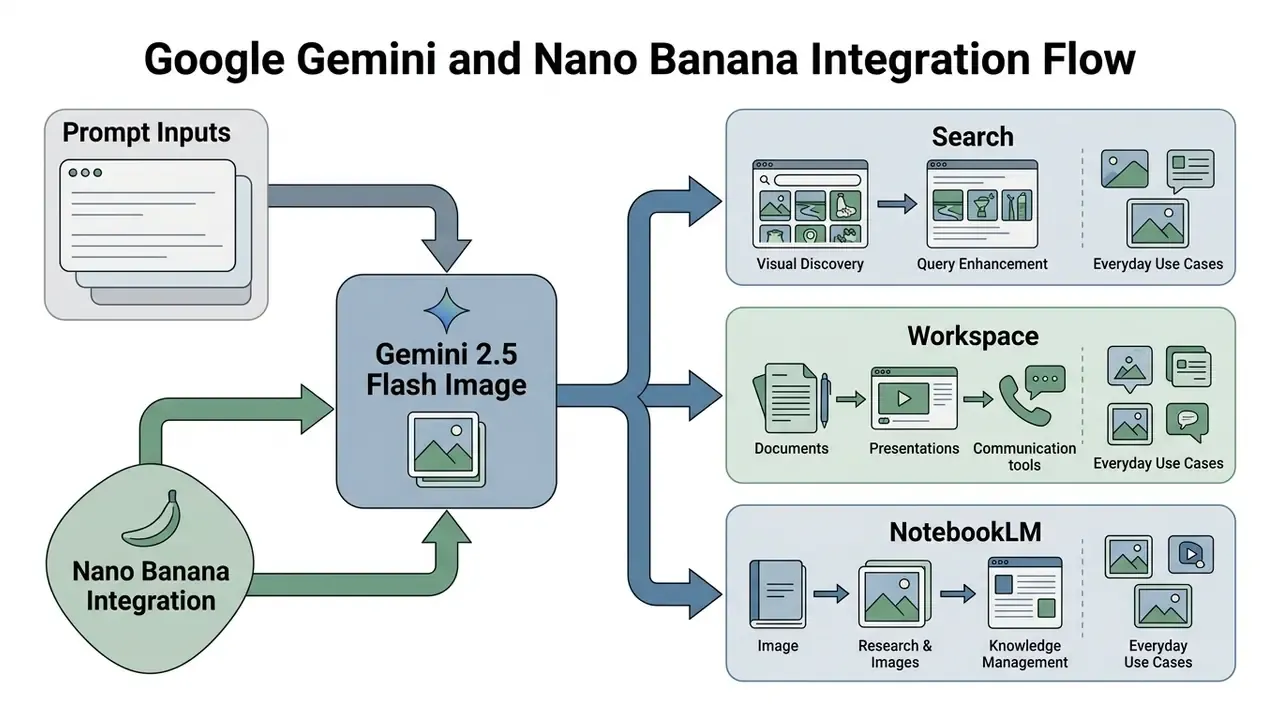
The model supports simultaneous text and image inputs, allowing users to modify backgrounds, swap objects, and maintain visual consistency across generated assets. It is natively integrated into the Gemini web application, Search, and NotebookLM (Google Product Announcements, 2026). Documented input limits include up to 3 reference images for Gemini 2.5 Flash Image and up to 14 for Gemini 3 Pro Image, and Google notes the model may not always return the exact number of requested images. That last detail sounds trivial until a batch job depends on a fixed count. For a deeper vendor-specific breakdown, see our overview of Google AI image generation.
FLUX and Stable Diffusion for Control and Customization
FLUX & Stable Diffusion: quick verdict
Pros:
- Open weights enable on-prem or VPC deployment with complete data isolation
- FLUX.1 [schnell] and FLUX.2 4B ship under Apache 2.0 for unrestricted commercial use
- Lowest marginal cost per image at volume; schnell is free when self-hosted
Cons:
- Text rendering still trails GPT Image and Ideogram on long strings
- Requires GPU provisioning, MLOps maturity, and internal safety filtering
- No vendor indemnification, so legal exposure sits entirely with the deploying entity
Open-source and customizable ai models for generating images are dominated by Black Forest Labs' FLUX family and Stability AI's Stable Diffusion 3.5. FLUX models offer deep parameter-level control and are split into permissive variants like FLUX.1 [schnell] (Apache 2.0 license) and non-commercial developmental versions (Black Forest Labs Documentation, 2026). FLUX.2 continues this split, licensing 4B models under Apache 2.0 and 9B models under the FLUX Non-Commercial License, with self-hosting supported for FLUX.2 [klein], FLUX.1 [dev], FLUX.1 Tools [dev], and FLUX.1 Kontext [dev].

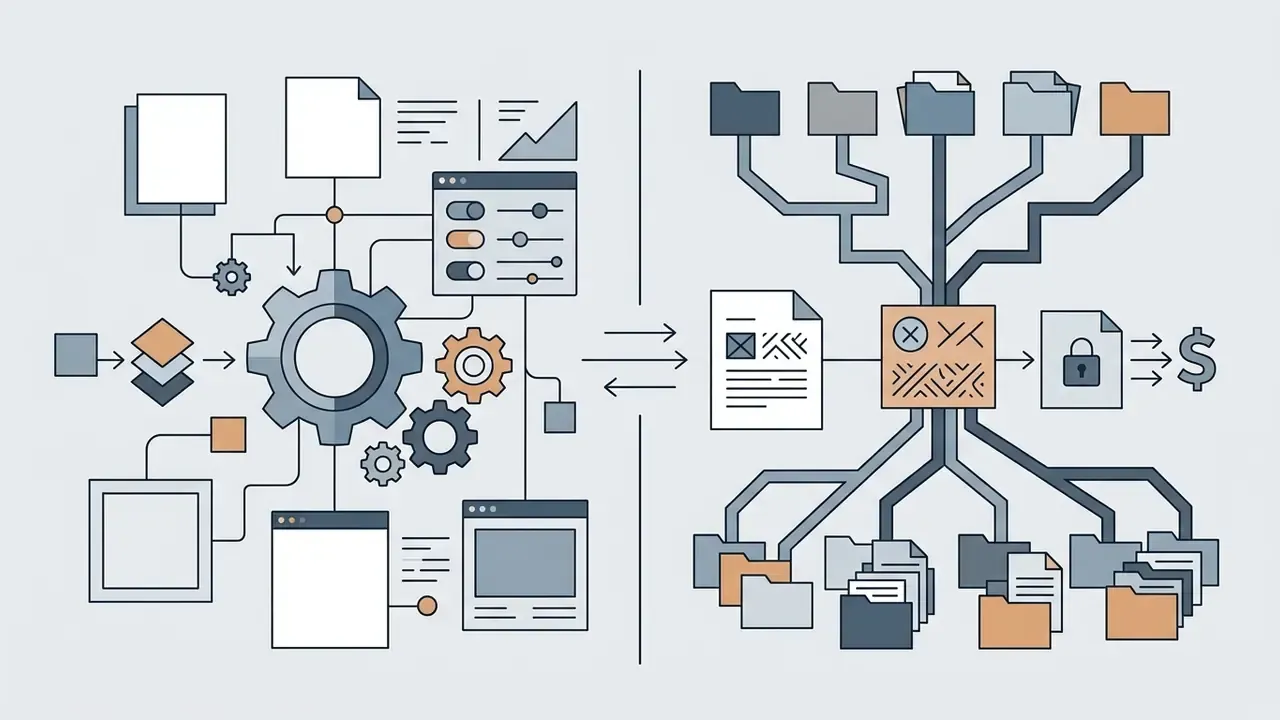
«Lumina-DiMOO reaches an overall TIIF score of 86.04, surpassing all previous models on global scene understanding, attribute accuracy, and relational reasoning.»
Stable Diffusion 3.5 provides Large (8B), Large Turbo, and Medium (2.5B) model sizes under a community license that permits free commercial usage for entities earning under $1M in annual revenue (Stability AI License Terms, 2025). For a mid-size bank that revenue gate is decorative; a paid licence will be required. Both model families support ControlNet adapters (Canny, HED/Soft Edge, Pose, Blur, Depth), depth maps, IP-Adapter style transfer, and local self-hosting for enterprise data privacy. Readers on constrained budgets can also compare the free AI image generators that run on these open weights.
Best AI Image Generator by Use Case
Different operational requirements demand different model architectures. Achieving high quality results requires matching the underlying engine to the specific output format, such as commercial design, artistic concepting, or precise typographic layout.
Adobe Firefly for Graphic Design and Commercial Workflows
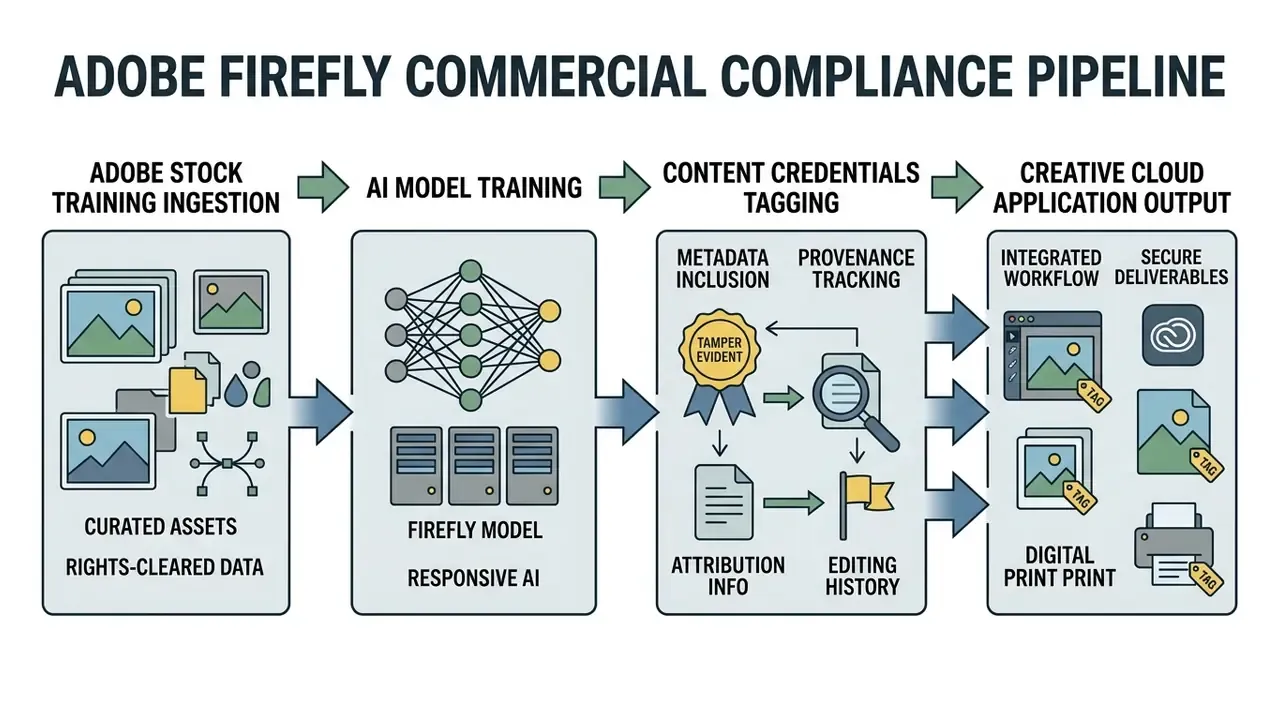
Firefly automatically attaches Content Credentials metadata to generated assets, verifying provenance and editing history, including issuer, date, application or device, AI tool used, and the actions performed. Non-beta Firefly outputs include commercial usage rights, and enterprise accounts can train Firefly Custom Models on proprietary brand assets without exposing data to public training pools (Adobe Enterprise Documentation, 2026). A 2026 enterprise-oriented benchmark set compares Firefly 4.0 against Bria 3.2, Google Imagen 4, FLUX.1-Dev, and Stability 3.5 Large on B2B use cases, which is the closest available proxy for independent commercial evaluation. Teams working inside template-driven design systems may also compare the Canva AI generator and the Microsoft AI image generator for lighter-weight alternatives.
Midjourney for Artistic Results and Visual Style
Midjourney: quick verdict
Pros:
- Highest aesthetic preference ratings among creative and concept-art teams
- Granular stylistic control via
--stylize,--raw,--sref,--oref,--chaos,--p - Omni Reference (v7) preserves character identity across multiple scenes
- Mature inpainting, pan, and zoom tools for canvas extension
Cons:
- Fails strict physical-commonsense tests such as PhyBench
- No standing free trial; commercial rights only on paid tiers
- Terms of Service grant a perpetual, worldwide, royalty-free licence over inputs and outputs
- Public gallery by default on lower tiers, a confidentiality risk for unreleased assets
- No public API, which blocks native pipeline automation
Midjourney remains a primary tool for artistic concept generation, visual style exploration, and high-aesthetic social media assets. Control over output styling is driven by specific command-line parameters appended to the end of the text prompt in the Imagine bar on Discord or the web interface:
--chaos(or--c),--ar/--aspect,--no,--seed, and--p(Personalization) round out the documented parameter set.
Midjourney scores lower on strict physical correctness tests like PhyBench, yet its aesthetic preference ratings remain high among creative teams. Our side-by-side review of Midjourney image generation breaks down where those trade-offs matter. One caution for regulated publishers: that broad input licence in the Terms of Service is the clause your legal team will flag first, and they will be right to.

--stylize (or --s)Controls artistic interpretation on a scale from 0 to 1000; lower values produce more literal interpretations, higher values increase stylization. Default is 100.
--rawBypasses default Midjourney aesthetic bias for more literal prompt interpretation.
--srefStyle Reference, allowing the model to match the color palette and visual tone of an input image or saved style code.
--orefOmni Reference (introduced in v7, replacing Character Reference), preserving character identity across multiple scene generations (Midjourney Official User Guide, 2026).«PhyBench shows that even advanced models frequently fail physical scenarios beyond optics, although embedding explicit physical principles in the prompt improves results.»
Organizations expanding from static artistic visuals into moving media can review our detailed analysis of the best app to edit videos, and teams benchmarking stylistic engines against one another may find our roundup of the best AI art generators useful for shortlisting.
Ideogram and Recraft for Accurate Text, Icons, and Brand Assets
Ideogram & Recraft: quick verdict
Pros:
- Ideogram 4.0 renders correct spelling, kerning, and weight directly in-image
- Exact hex-palette control and native 2K generation for design layouts
- Recraft V4 is the only major engine with native editable SVG export
- Recraft v3 holds the top Elo rating (1172) on the Hugging Face T2I leaderboard
- Custom models trainable on approved brand assets for guideline consistency
Cons:
- Free tiers publish generated assets publicly on some plans
- Vector output requires explicit mode selection and costs roughly double per image
- No vendor indemnification against third-party IP claims
- Weaker general photorealism than FLUX or Gemini on non-design prompts
Ideogram 4.0 and Recraft V4 are specialized models designed to solve typographical errors and vector design limitations common in standard diffusion engines. Ideogram renders legible typography, exact hex color palettes, and structured layouts directly inside generated images, making it suitable for posters, packaging mockups, and social graphics (Ideogram Product Release, 3 June 2026). Because brand marks are the highest-risk category of text-in-image work, teams should read the constraints documented in our guide to AI logo generators before shipping generated marks.
Recraft V4 is currently the only model offering native SVG vector file exports alongside high-resolution raster generation, with export options spanning SVG, PNG, PDF, TIFF, and Lottie. In blind pairwise human evaluations on the Hugging Face text-to-image leaderboard, Recraft v3 achieved an Elo rating of 1172, demonstrating strong performance in rendering multi-sentence text blocks and maintaining uniform line weights across icon sets (Hugging Face Elo Leaderboard, 2025; Recraft Technical Docs, 2026).
«Recraft v3's key advantage is correctly rendering long text fragments in a single generation, along with precise text-placement control and multi-reference support for a unified brand style.»
Specialized benchmark suites now target exactly this territory: BizGenEval evaluates commercial and document-style layouts, while STRICT measures text rendering, layout control, and instruction alignment, giving design teams an objective basis for engine selection. Worth remembering, though: none of these suites test whether the rendered disclaimer text is legally correct. That review stays human.
Leonardo AI and Native OS Integrations for Creators
Leonardo AI & Microsoft Copilot: quick verdict
Pros:
- 150 daily tokens free, plus style reference, content reference, and consistent characters
- Multiple built-in models and an API on paid tiers for pipeline use
- Microsoft Copilot delivers inline generation inside native Windows apps including Paint and Photos
- Copilot adds free AI background and object removal at the OS level
Cons:
- Leonardo's multi-model interface is complex for first-time users
- Copilot's underlying image models trail ChatGPT and Gemini on quality
- Bing Image Creator free access caps at 15 weekly boost credits and fixed 1024×1024 output
- Free Microsoft tiers carry restrictive non-commercial terms
For creators needing real-time canvas control, Leonardo AI provides live sketch-to-image rendering, a canvas editor, generative motion, and consistent-character workflows, with 150 free tokens issued daily before an upgrade is required. Microsoft Copilot approaches the same problem from the operating system layer, delivering inline image generation directly within native Windows applications such as Paint and Photos, alongside prompt-driven background and object removal.
These platforms occupy a different niche from the seven flagship engines. They optimize for iteration speed and accessibility rather than benchmark-leading fidelity or contractual indemnification. There is a governance wrinkle here that is easy to miss: OS-level generation runs on managed endpoints, so it lands inside your device estate rather than outside it. Adjacent creator tools worth evaluating in the same pass include the Ghibli-style AI image generators for stylized illustration and AI headshot generators for portrait workflows.
Best AI Image-to-Image Generator and Editing Tools
Image-to-image workflows enable teams to transform an existing image while preserving its structural composition, subject identity, or layout constraints. This approach relies on conditioning the generation process with both a reference photo and a modifying text prompt.
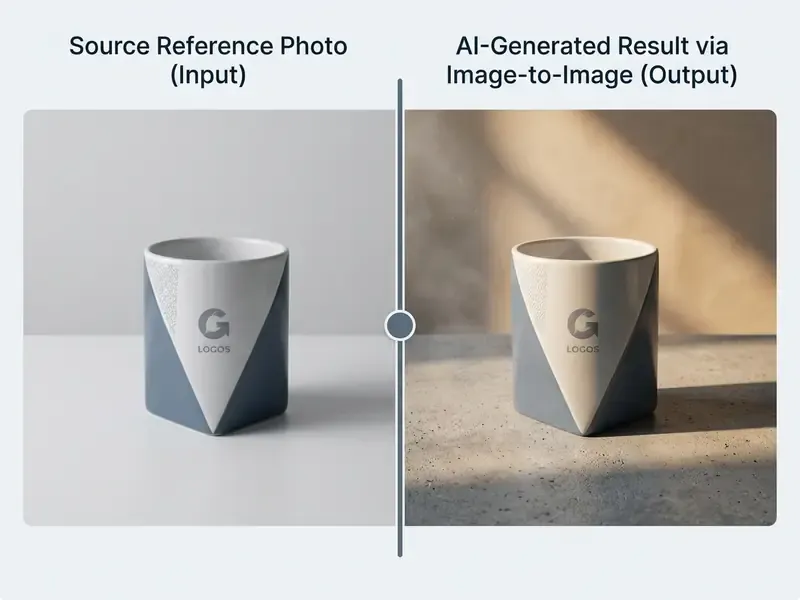
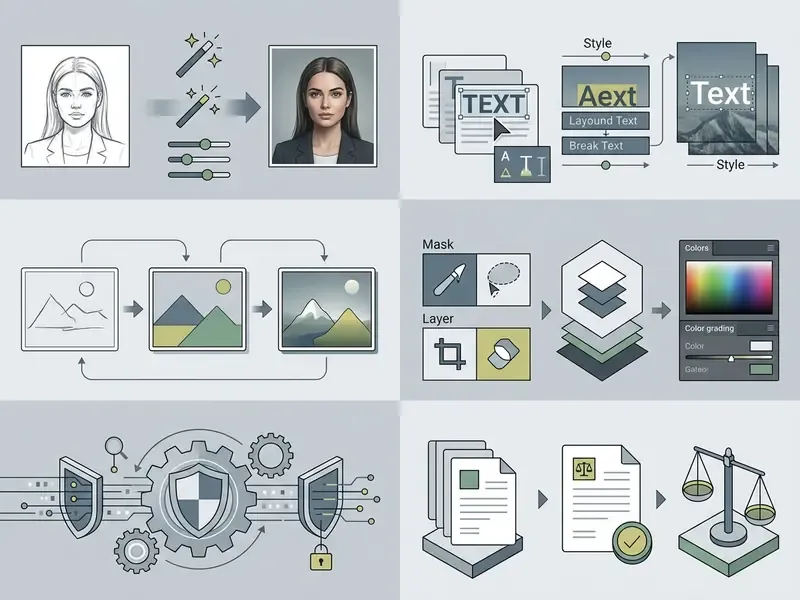
Transforming Photos with Image-to-Image AI
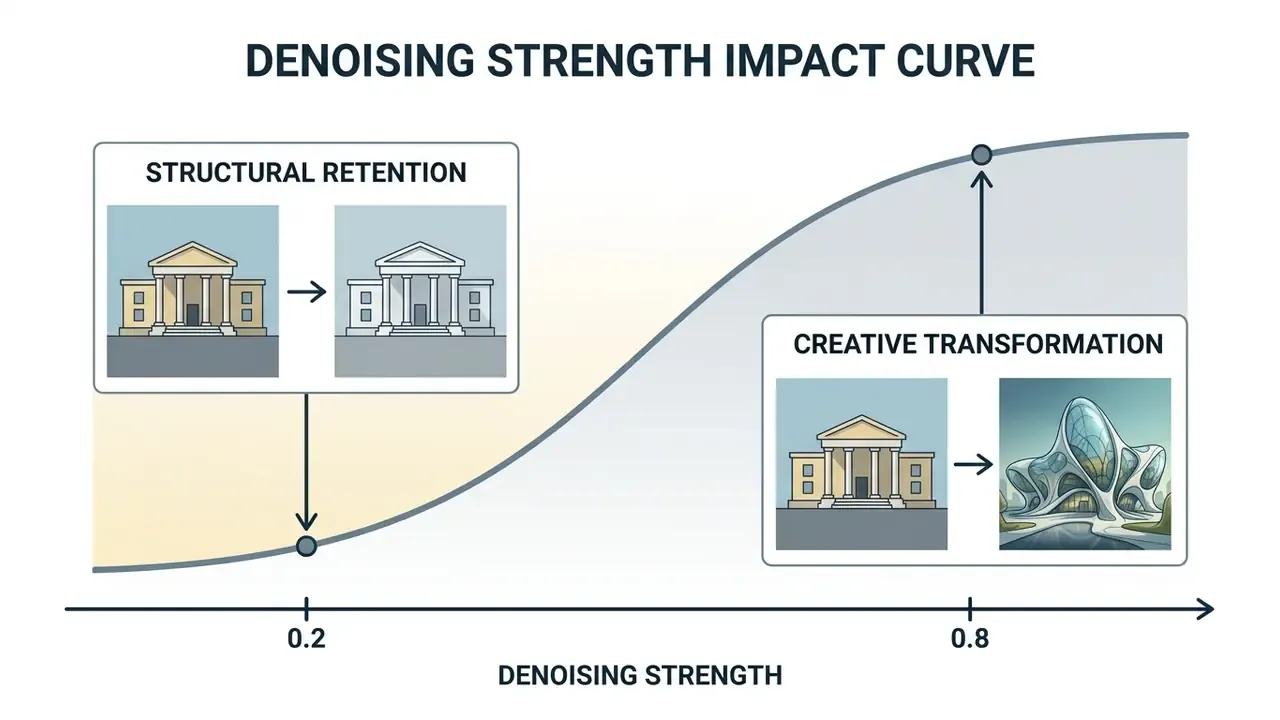
Transforming photos using an ai image generator from a photo requires adjusting the denoising strength parameter. Denoising strength (ranging from 0.0 to 1.0) dictates how much of the original image structure is retained: lower values (0.2-0.4) preserve source geometry and facial features, while higher values (0.7-0.9) grant the model freedom to re-imagine the scene (Stable Diffusion Developer Documentation).
For specialized portrait edits, identity-freezing frameworks like SaveFace inject face-recognition embeddings into the diffusion process, preventing facial distortion during background replacement or style transfer (SaveFace Technical Report, 2024). Specialized editing tools such as DiffEditor enable fine-grained object dragging, resizing, and appearance replacement, reporting state-of-the-art results on moving, resizing, dragging, appearance replacement, and object pasting (DiffEditor Study, 2024). GeoDiffuser extends this by framing edits as geometric transformations, unifying 2D and 3D object editing in a single zero-shot method. In inpainting workflows, the mask determines what is regenerated: black regions are preserved, white regions are edited.
In an enterprise asset migration, a marketing team needed to convert 500 studio product photos into outdoor lifestyle visuals while preserving exact product dimensions. Using an automated image-to-image AI tools pipeline with a fixed denoising strength of 0.35 and localized inpainting masks, the team re-contextualized the entire catalog. Updated finding: the team reported a substantial reduction in manual retouching hours, internally estimated at roughly four-fifths of the previous per-asset editing time, while the output continued to pass the brand's geometry audit. This figure is a single-project internal estimate based on tracked editor hours before and after automation. It was not measured under controlled conditions and should not be read as a generalizable efficiency benchmark.
Combining Multiple Images and References
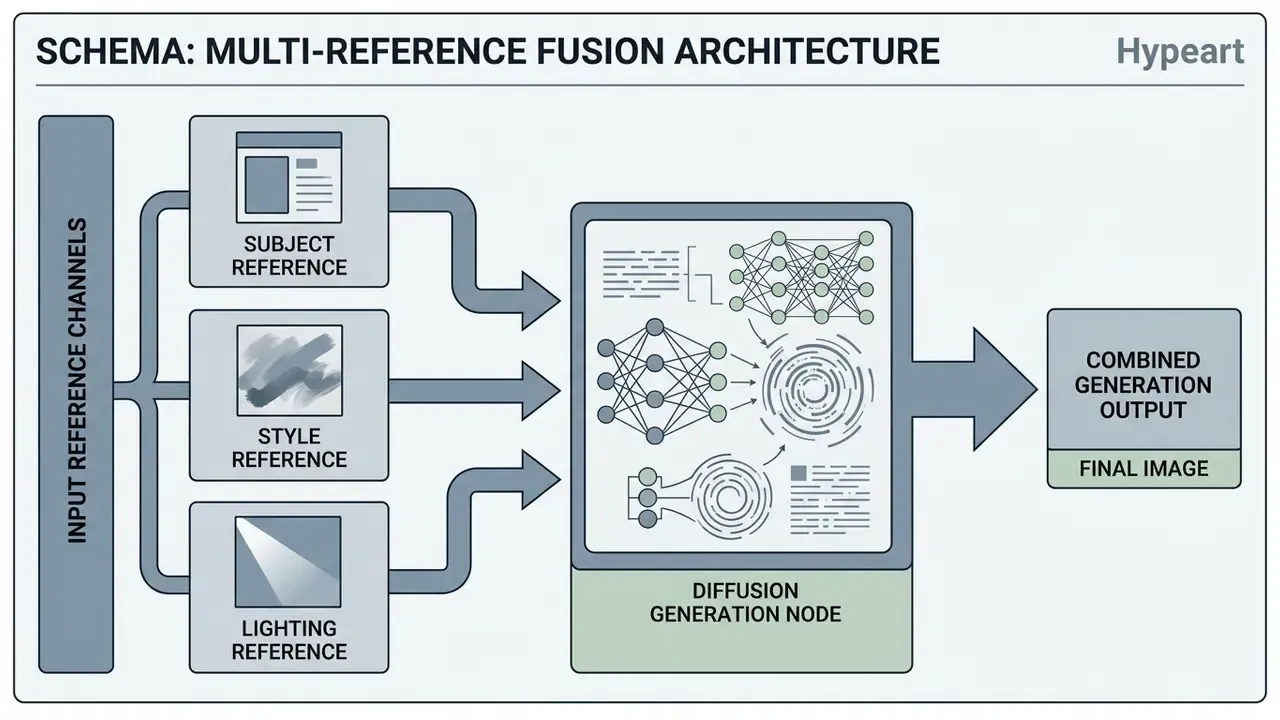
Combining multiple reference images allows creators to extract distinct visual elements, such as a character from Image A, a lighting style from Image B, and a background from Image C, into a unified output. Advanced multi-reference frameworks like MultiRef categorize input assets into five structural channels: Subject, Background, Style, Lighting, and Pose (MultiRef Framework Study, 2025/2026). MultiRef explicitly targets lighting modifications, artistic style transfers, texture changes, and spatial or environmental manipulation from multiple visual references.
Enterprise Security, Data Privacy, Licensing Controls, and Shadow AI Risk
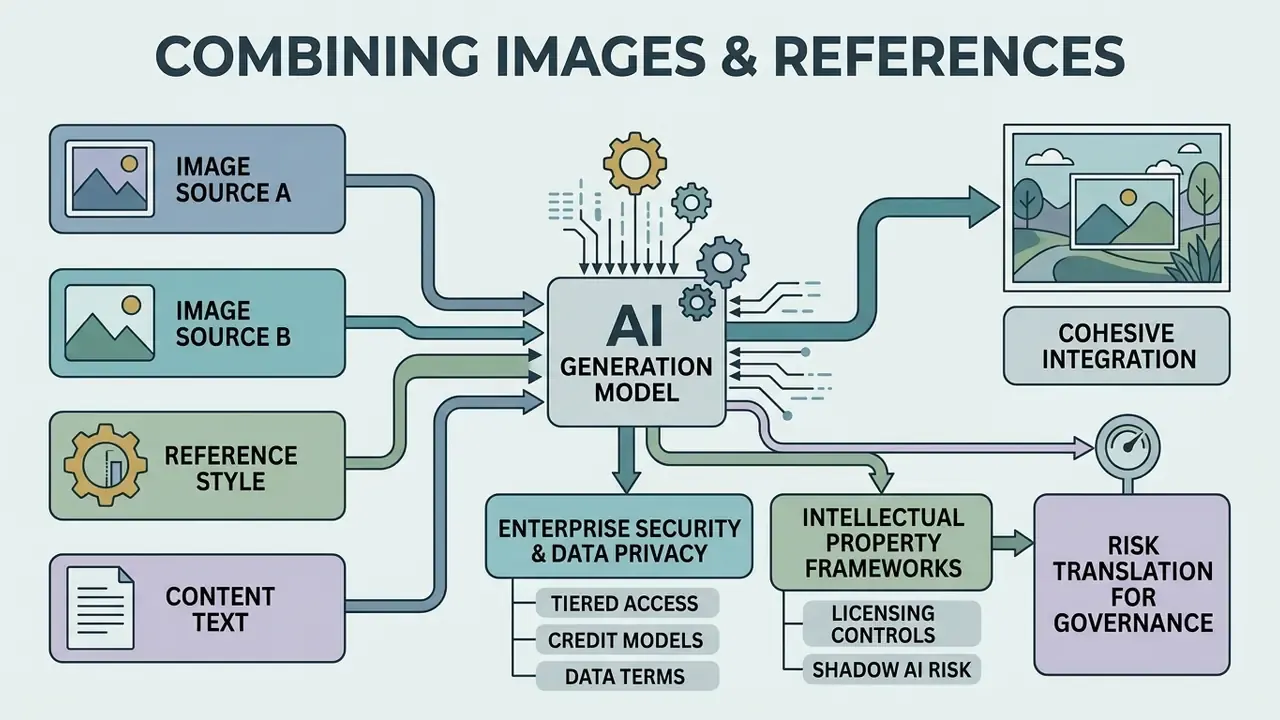
Best Free AI Image Generation Options, and Why They Create Shadow AI Exposure
Most free ai image generation services enforce daily generation caps, resolution constraints, or public asset visibility. Standard consumer platforms provide limited free plan access to demonstrate core functionality:
- ChatGPT (free tier) Access to GPT Image creation capped at approximately 2-3 generations per rolling 24-hour window, with standard web resolutions (OpenAI User Limits, 2026).
- Google Gemini (free tier) Provides access to Nano Banana image generation, offering roughly 8-20 daily generations depending on regional platform load (Google Product Guidance, 2026).
- Microsoft Copilot / Bing Image Creator Offers 15 weekly "boost" credits for fast generation, rendering fixed 1024×1024 images under non-commercial license terms (Microsoft Copilot Terms, 2026). Detailed access requirements are covered in our guide to Bing AI image creation.
- Leonardo AI (free tier) 150 daily tokens covering a limited number of generations across built-in models.
- Adobe Firefly (free plan) Limited daily generations with watermarking; Adobe does not publish a fixed numeric quota on its public product page.
- Open-source self-hosting Running models like Stable Diffusion XL or FLUX.1 [schnell] locally provides unlimited generations without subscription fees, subject to local GPU hardware capacity. Zero-signup browser options are compared in our review of free AI image generators without sign-up.
Risk translation for governance teams. Each of the hosted free tiers above shares three properties that matter more than the generation cap. Outputs are frequently restricted to non-commercial use. Prompts and uploaded reference images are processed under consumer terms rather than an enterprise Data Processing Addendum. And there is typically no administrative visibility into who used the service or what they uploaded.
That combination is the textbook definition of Shadow AI. The practical mitigation is not prohibition, which drives usage further underground, but provisioning a sanctioned, logged enterprise endpoint that is at least as convenient as the consumer one. Convenience is the control. If the approved path takes three extra clicks and a ticket, the unapproved path wins by Tuesday.
Users exploring entry-level visual editing tools can review our guide to the best android photo editor for mobile workflows.
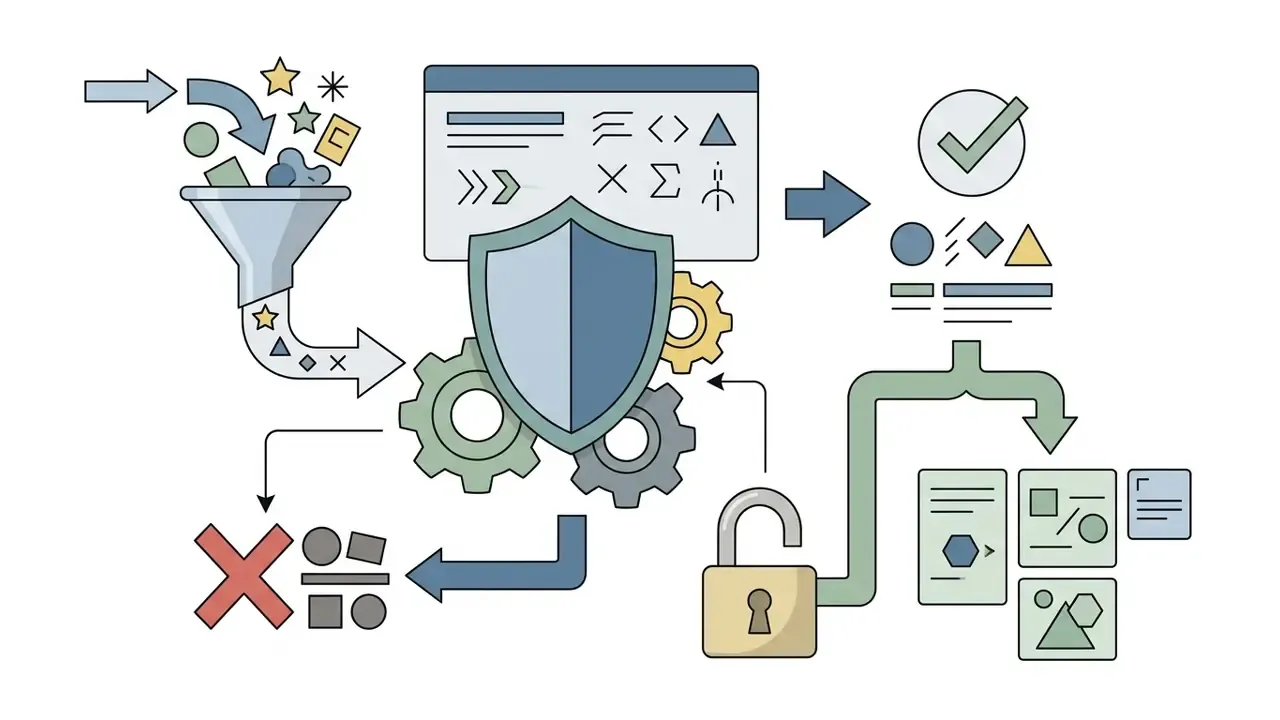
Content Moderation, Safety Guardrails, and Uncensored Models
Model providers enforce fundamentally different safety alignment filters, and those differences alter output flexibility as much as any architectural choice:
Quantitatively, over-refusal is a measurable failure mode, not a rhetorical complaint:
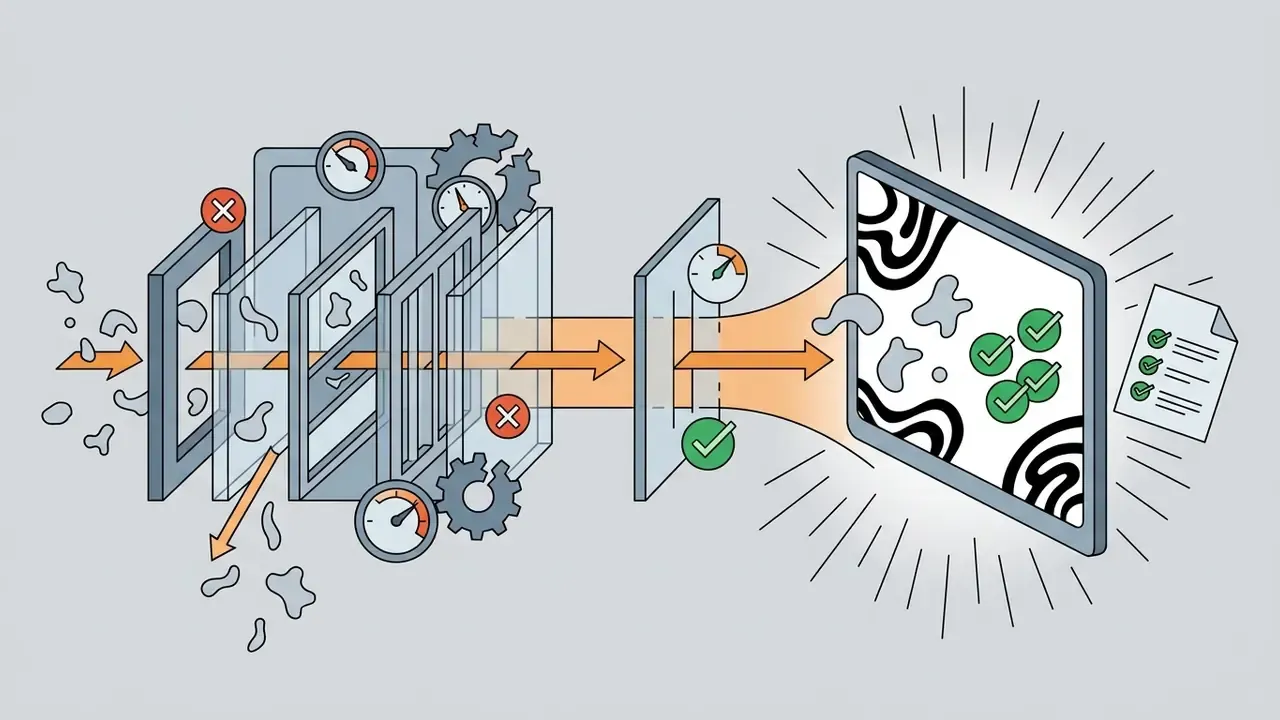
«DALL·E 3 exhibits a 51.7% over-refusal rate on benign OVERT-mini prompts while achieving an 82.5% safe-response rate on genuinely harmful requests.»
«T2ISafety shows Nano Banana Pro reaching a 52% safe-response rate versus 40% for Seedream 4.5 at comparable refusal rates (~21%); under adversarial attack, harmful content is still generated.» - T2ISafety / 2026 Safety Report on Frontier Models
NIST's synthetic-content guidance adds a further caution relevant to provenance strategy: watermark detection has limited capacity and is most reliable in private, controlled settings, which constrains how much weight any organization should place on automated provenance checks alone. Translation for an oversight committee: provenance metadata is useful evidence, but it is not a detection control you can lean on.
Commercial Rights and Brand-Safe Image Generation
Determining whether an organization can allow commercial use of AI-generated visuals involves analyzing both provider license terms and federal copyright guidance. Under guidance issued by the U.S. Copyright Office, pure AI-generated outputs lacking human authorship are not eligible for copyright protection (U.S. Copyright Office Guidance on AI Works, 2025). However, human-authored arrangements, selection, and substantial creative modifications remain protectable. The Office states that using AI to assist creation, or including AI-generated material inside a larger human-generated work, does not by itself bar copyrightability.
«Generative AI unsettles two foundational copyright doctrines: the idea/expression distinction and the substantial-similarity test for infringement.»
Enterprise platforms like Adobe Firefly provide contractual indemnification against copyright claims for non-beta features, whereas general web scrapers require internal legal clearance before commercial deployment (Adobe Terms of Service, 2026). Google Cloud similarly offers generative AI indemnification on eligible services, with scope defined per service.
«The CPDM dataset demonstrates that models trained on broad web corpora can unintentionally reproduce copyrighted works or imitate protected styles.»
Stock-distribution adds a further layer. Adobe Stock contributor guidance (2026) requires generative AI submissions to avoid third-party IP, real people, and misleading event claims, showing that platform rules can be stricter than copyright law itself. Because C2PA metadata can be stripped in transit, verification workflows should pair provenance archiving with independent AI image detectors and, where infringement is suspected, AI reverse-image-search tools.
Disclaimer: This information is general in nature and does not substitute for advice from qualified counsel on intellectual property, licensing, or regulatory matters concerning AI-generated content. Vendor licensing terms, indemnification scope, and service level agreements change frequently and require Legal and Compliance review before deployment.
Enterprise Procurement Checklist for Image Generation Models
Use this as a pre-purchase gate. Any unchecked item should be escalated rather than waived.
- Data handlingIs there a signed Data Processing Addendum? Are prompts and uploaded reference images excluded from model training by contract, not just by marketing copy?
- Zero data retentionIs a ZDR configuration available on the tier you are buying, and is retention set to zero by default or on request?
- CertificationsHas the vendor provided a current SOC 2 Type II report? Where applicable, confirm PCI-DSS or HIPAA scoping for any environment touching regulated data.
- Deployment topologyDoes the vendor support VPC, private endpoint, or on-premise deployment? If not, can an open-weight fallback (FLUX.1 [schnell], SD 3.5) cover the confidential subset of workloads?
- Access controlDoes the platform support SSO, SCIM provisioning, and role-based access control with per-team quotas?
- Logging and auditabilityCan every generation request be logged with user identity, prompt text, reference-image hash, model version, and output hash, and retained per your record-keeping policy?
- IndemnificationIs IP indemnification offered in writing? What is excluded: beta features, third-party models routed through the same interface, trademark and likeness claims?
- ProvenanceAre C2PA or Content Credentials applied automatically? Is there a process to archive provenance metadata before publication?
- Moderation configurabilityCan safety thresholds be tuned for legitimate business content without disabling protections, and is over-refusal rate measured on your own prompt set?
- Model lifecycleWhat is the deprecation notice period? Google's Imagen shutdown and Azure's
dall-e-3retirement show that pipelines must be built to survive model sunsets. - Model risk management alignmentHas the model been registered in your inventory and documented against your internal MRM framework (validation evidence, performance monitoring, fallback procedure, and ongoing testing cadence)?
- Cost of controlsDoes the total cost estimate include logging storage, human review, legal clearance, and retouching, not just per-image API price?
One honest limitation: item 12 is where most ROI models quietly break. Per-image pricing looks trivial next to a designer's hourly rate, then review, storage, and legal clearance absorb the savings.
How to Choose the Best AI Model for Image Generation
Selecting the best ai model for image generation requires aligning task complexity with model architecture, workflow integration, financial constraints, and governance capacity. A defensible selection framework scores candidates on three measurable axes rather than one: semantic consistency, perceptual quality, and safety or harmlessness. ImagenHub standardizes this by scoring Semantic Consistency and Perceptual Quality at 0, 0.5, or 1 and reporting an overall geometric mean, while ImageReward adds explicit harmlessness alongside alignment and fidelity.
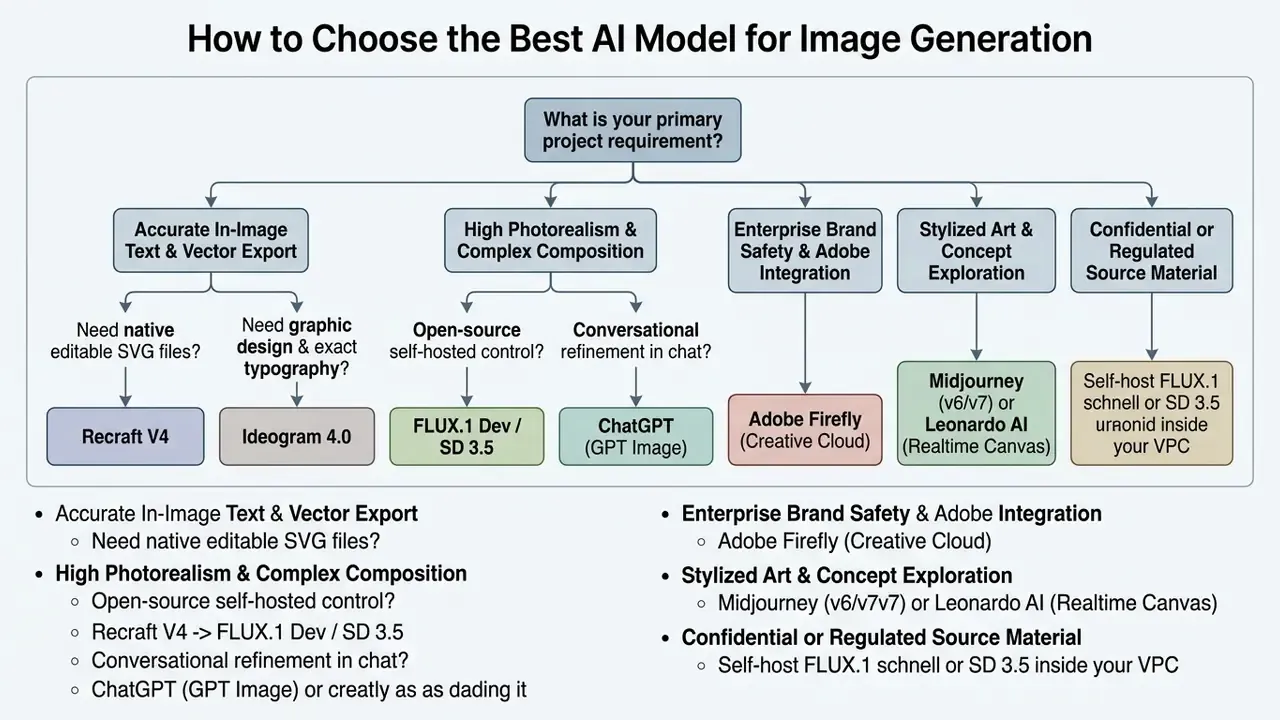
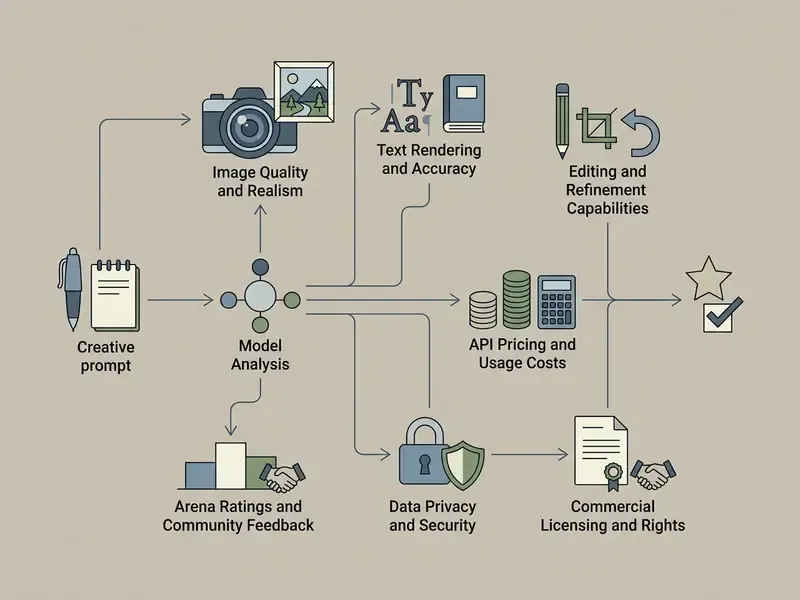
Choose by Output: Photorealism, Art, Design, or Text
To select the best ai model for images, teams must categorize their primary target asset type:
- Photorealistic images FLUX.1, OmniGen, and Gemini 2.5 Flash Image lead in spatial layout, object counting, and realistic lighting (GenEval Benchmark, 2023-2025). Imagen 4 and DALL·E 2 are also documented by their vendors as photorealism-preferred engines.
- Artistic concepts and visual style Midjourney provides strong aesthetic stylization and reference-matching controls for creative direction; Leonardo AI covers realtime iteration.
- Graphic design and typography Ideogram 4.0 and Recraft V4 excel when the prompt requires legible text rendering, exact hex color codes, and clean icon layouts.
- Vector deliverables Recraft V4 is the primary choice for native SVG export requirements. Post-generation cleanup is usually still needed, so pair it with the tooling reviewed in our guide to AI photo editors.
«The Multi-dimensional Preference Score (MPS), trained on 918,315 annotations, shows improved correlation with human judgments on aesthetics, semantic alignment, and detail versus existing metrics.» - Multi-dimensional Preference Score (MPS), 2024. https://arxiv.org/abs/2405.14705
Choose by Workflow: Prompting, Editing, and Integration
Workflow integration dictates how seamlessly an image tool fits into existing production stacks:
- Conversational promptingChatGPT and Google Gemini allow iterative natural-language adjustments directly within a chat thread. OpenAI's own prompting guidance separates generation from edits and instructs users to explicitly preserve identity, geometry, layout, lighting, or labels during iteration.
- Creative suite integrationAdobe Firefly integrates natively into Photoshop and Illustrator, operating as an inline editing layer via Generative Fill. Final delivery frequently requires resolution work, which is where AI image upscalers enter the pipeline.
- API and developer pipelinesFLUX, Stable Diffusion, and OpenAI's API allow developers to automate batch processing, custom control nets, and server-side image editing.
«T2I-FactualBench shows Stable Diffusion 3.5 reaching factual-accuracy scores of 46.2-68.9 versus 45.8-51.7 for SDXL, demonstrating progress on knowledge-intensive concept generation.»
Automating Image Generation in Enterprise Workflows
While web interfaces suit manual asset creation, enterprise pipelines require automated triggers via APIs and iPaaS platforms such as Zapier, Make, n8n, or custom webhooks. The pattern is always the same: an event in a system of record triggers a generation call, the output is written back with provenance metadata attached, and a human approves before publication.
- Form-to-asset generation Incoming form submissions, whether Google Forms responses, HubSpot CRM lead records, or Typeform intake, trigger OpenAI
gpt-image-2endpoints to dynamically create customized visual pitch decks, personalized email header banners, or territory-specific ad variants. - E-commerce catalog ingestion Batch image-to-image processing using hosted FLUX APIs enables automated background swapping whenever a new SKU photo is uploaded to Shopify, with denoising strength locked at a validated value (for example 0.35) so product geometry never drifts.
- CMS publication hooks A new blog post draft in the CMS triggers generation of a hero image sized to the template's aspect ratio, with the prompt assembled from the article's title, category, and brand style token.
- Ticket and support enrichment A Zendesk or Jira ticket describing a UI defect triggers generation of an annotated mockup illustrating the expected state, attached back to the ticket automatically.
- Batch variant generation A single prompt is expanded across a batch by setting
num_images_per_promptor by passing a list of per-image generators bound to fixed seeds, producing a reproducible candidate set for creative review. - Approval and audit gate Every automated generation writes a log record containing user or system identity, prompt text, model version, seed, and output hash. Without this step, automation removes the very audit trail that model risk management requires.
Each of these automations is effectively a digital worker. It needs a named owner, an approved scope, an access boundary, an escalation path, and a switch that turns it off. No evidence, no autonomy.
For teams extending automation into motion assets, our Google Veo implementation guide documents equivalent API patterns for video. Organizations reviewing broader developer capabilities across media platforms can analyze cost structures via our guide to AI Media Pricing or compare infrastructure options using our compare options developer page.
When to Add Human-in-the-Loop Services
When in-house prompt engineering fails to produce exact brand geometry, teams often combine automated model APIs with human-in-the-loop retouching services. Freelance marketplaces such as Fiverr list image-generation and model-training specialists starting around $10 per task, which finalizes enterprise assets faster than another week of internal iteration. Usually cheaper, too. But it introduces a third-party data-handling question: any unreleased asset shared with an external contractor requires the same NDA and data-classification review as any other vendor engagement.
FAQ About AI Models That Generate Images
Are There Any AI Models That Can Generate Images From Text?
Yes, are there any ai models that can generate images is a foundational question answered by modern generative AI. Numerous text-to-image architectures generate high-resolution visuals from text prompts, including diffusion models (FLUX, Stable Diffusion), autoregressive transformers (Emu3-Gen), and multimodal large language models (GPT-4o, Gemini 2.5 Flash Image) (Diffusion Survey, 2024). These systems translate text descriptions into visual tokens, progressively refining noise into structured images.
«Diffusion models excel on smooth continuous visual manifolds, whereas autoregressive models handle discrete structures such as embedded text differently.» - Text-to-image Diffusion Models in Generative AI: A Survey, arXiv (2024). https://arxiv.org/abs/2308.09388 Latent diffusion systems compress the image into a lower-dimensional space before denoising, then decode to full resolution. That compression step is what made high-resolution generation computationally practical.
Why Do Different AI Image Generation Models Produce Different Results?
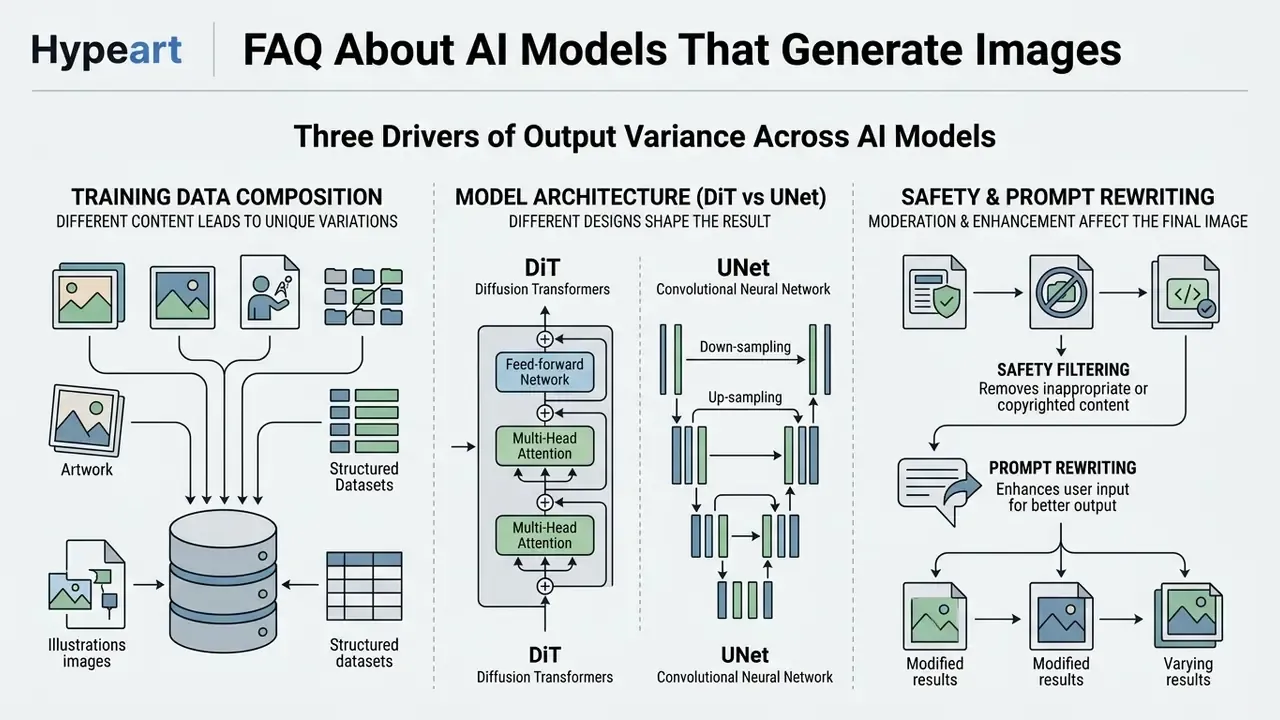
Different ai image generation models produce varied visual outputs because they rely on distinct training datasets, model architectures, and safety alignment filters. A model trained primarily on web-scraped image-text pairs, like early Stable Diffusion on LAION-5B, exhibits different aesthetic biases than a model trained on curated stock photos, like Adobe Firefly (Imagen 4 Model Card, 2026). Google's Imagen 4 model card documents multi-stage safety and quality filtering, deduplication, and synthetic captions, each of which shifts learned style and detail patterns. Midjourney's exact training corpus is not public, which itself is a source of unexplained output variance.
«LMD shows that prompt adherence depends not only on the generative backbone but on the control strategy: hybrid architectures with LLM-generated layouts double average generation accuracy.» - LLM-Grounded Diffusion (LMD), arXiv (2023/2024). https://arxiv.org/abs/2305.13655 Additionally, platforms apply proprietary prompt-rewriting layers behind the UI. ChatGPT automatically expands simple text prompts into descriptive paragraphs before passing them to the image engine, altering the final output style (OpenAI System Documentation, 2026). For reproducibility work, that hidden rewrite is the variable you cannot log.
Can AI Generate Multiple Images From One Prompt?
Yes, modern AI tools can generate multiple images from a single text prompt by using batch generation settings or varying the random seed value. A random seed acts as the starting point for the image generation noise pattern; holding the text prompt constant while changing the seed produces varied composition candidates (Stable Diffusion Code Guide). Commercial applications allow users to request 2 to 4 variations per prompt call, enabling creative teams to select the most accurate visual before performing localized edits. For iterative refinement, the reliable method is the inverse: fix the winning seed and change only the prompt, so the effect of each edit is isolated from randomness.
«In GenEval and TIIF benchmarks, models are typically sampled multiple times per prompt to assess consistency; generation accuracy is computed across all samples, reflecting output variability.» - GenEval Benchmark (2023); Lumina-DiMOO Study (2025). https://arxiv.org/abs/2310.11513
What Are the Known Limitations of Current Image Generation Models?
Prompt complexity remains the dominant failure mode. One study measured an 8.53% drop in composition-image similarity per additional prompt component, alongside a 15.91% decrease in Inception Score and a 9.62% increase in FID as scene complexity rose. DALL·E 3 testing additionally found weak performance on convincing official documentation and inaccuracies in science-related outputs. That is a direct caution for anyone considering generated imagery for technical diagrams, regulatory disclosures, or identity-document-adjacent content.
Can Free Tiers Be Used for Commercial Work?
Rarely without qualification. Free and trial tiers frequently restrict outputs to non-commercial personal use, may publish generated assets to a public gallery, and are governed by consumer rather than enterprise terms. The governance risk is greater than the licensing risk: free tiers offer no administrative visibility, which makes them the primary Shadow AI channel inside most organizations.
How Should AI Image Generation Be Registered in a Model Risk Framework?
Treat each production generation endpoint as a registered model. Document its intended use, input data classification, validation evidence against your own prompt set, over-refusal and safety test results, provenance handling, monitoring cadence, and a documented fallback if the vendor deprecates the model. Model lifecycle events such as Google's Imagen shutdown and Azure's dall-e-3 retirement should be treated as foreseeable operational risks with pre-approved migration paths, not emergencies.
Conclusion and Strategic Next Steps
Selecting the right AI image generation model requires balancing visual quality against operational controls, editing capabilities, data governance, and legal compliance. Multimodal platforms like ChatGPT and Gemini provide fast conversational prototyping and currently lead blind arena rankings. Open-source systems like FLUX and Stable Diffusion offer deep pipeline customization plus the only genuine data-isolation option. Dedicated design engines like Adobe Firefly, Recraft, and Ideogram deliver brand-safe, text-accurate visual assets with the strongest contractual protection. Leonardo AI and Microsoft Copilot round out the field for creators who prioritize iteration speed and native OS convenience over benchmark-leading fidelity. Final output quality often depends as much on post-processing as on generation, so pair your chosen engine with appropriate AI image enhancers.
A safe next step, if you are early: run a 30-prompt internal bake-off on two engines, log every request, and report over-refusal and text-accuracy rates to your model risk committee before signing anything. Small scope, real evidence.
To explore related tools, cost structures, and technical comparisons across our media generation benchmarks:
- Compare top media creation platforms see the overview
- Evaluate alternative generative tools browse the hub
- Compare head-to-head model evaluations versus
- Calculate usage costs and credit estimates browse the hub
- Review enterprise usage rights and licensing explore the hub
- Review objective performance metrics see the overview
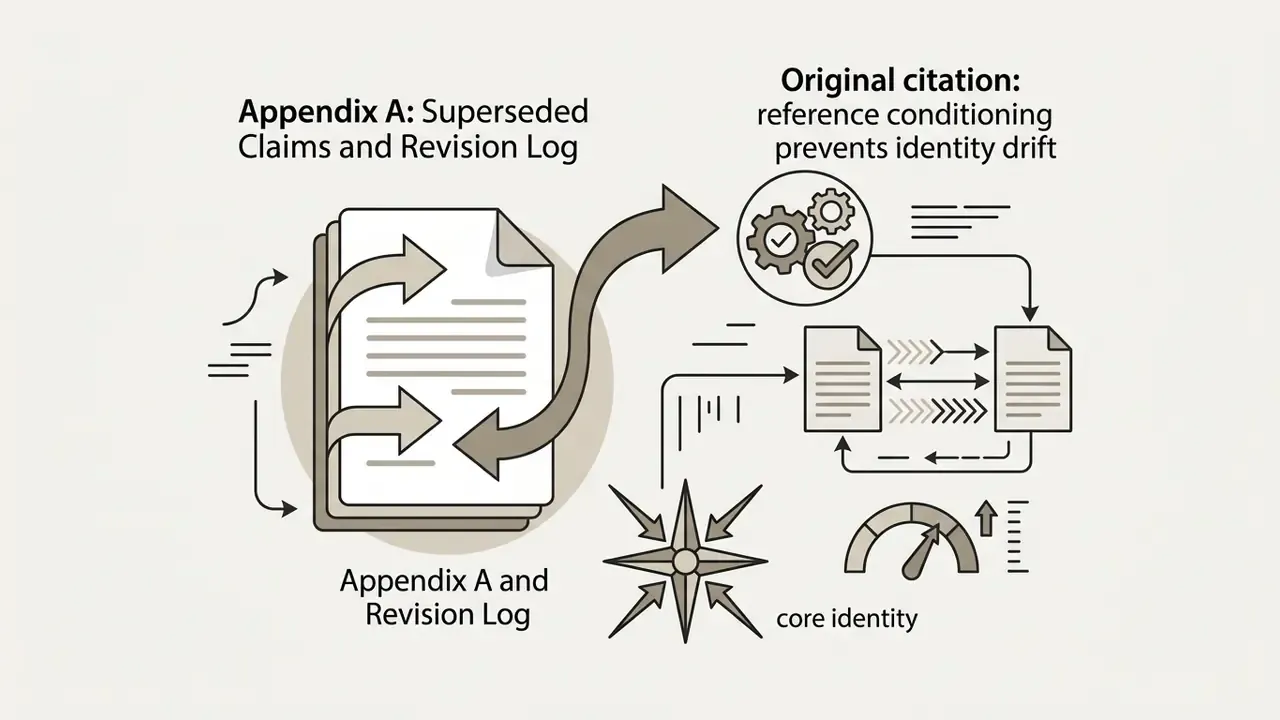
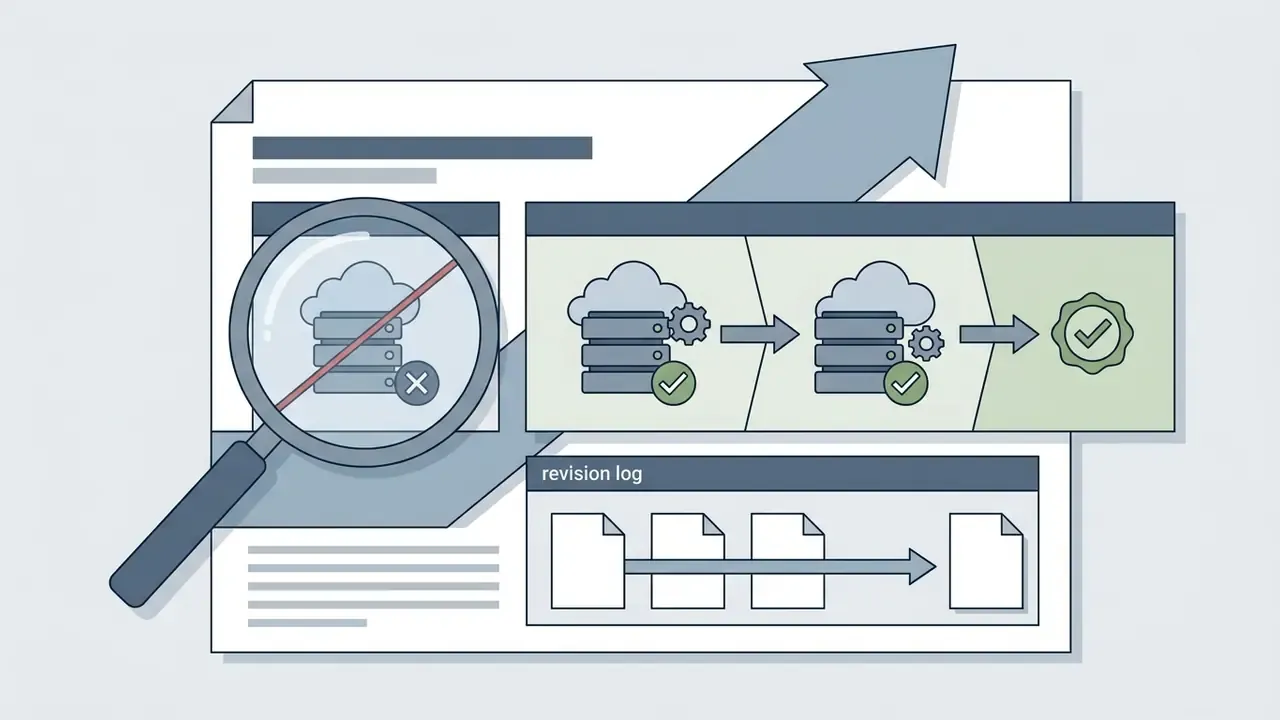
Appendix A: Superseded Claims and Revision Log
For transparency, the following statements appeared in earlier versions of this analysis and have been revised. The original wording is preserved here alongside the reason for the change.
Reason for revision: A clearly fictional attribution undermines E-E-A-T in a document making technical and legal claims. The statement is now presented as an editorial standards framework tied to the published methodology box rather than to a named persona.
Reason for revision: A 100% figure without a stated sample size or methodology is not verifiable. The main text now discloses the sample (n = 10 prompts, single seed) and labels the result as a directional internal observation.
Reason for revision: The 80% figure lacked a documented measurement method. The main text now describes it as a single-project internal estimate based on tracked editor hours and explicitly declines to present it as a generalizable benchmark.
Reason for revision: The survey provides taxonomy but no measured outcomes. It has been supplemented with a controlled four-criterion human evaluation (IEEE CICN 2024) that reports comparative results for Imagic and Forgedit.
Reason for revision: This is Adobe's own representation and has not been independently audited. The main text now attributes the claim to Adobe and reframes brand safety as a contractual commitment backed by indemnification.
Reason for revision: Google's documentation lists a shutdown date of 17 August 2026, but deprecation schedules change. The table now instructs readers to verify against current Google Cloud release notes.

Appendix B: Working Glossary for Governance Reviewers
Short definitions, written for the people who sign off rather than the people who prompt.
- C2PA / Content Credentials A cryptographic provenance standard that records who created an asset, with which tool, and what edits followed. Useful as evidence, easily stripped in transit, so archive it at the point of generation.
- Zero data retention (ZDR) A contractual configuration where the provider does not store prompts, uploads, or outputs after the request completes. Availability is tier-dependent and must be confirmed in writing.
- Denoising strength The image-to-image parameter controlling how much source structure survives. Low values (0.2-0.4) preserve geometry; high values (0.7-0.9) effectively re-imagine the scene.
- Edit containment Whether an inpainting or reference-conditioned edit leaves unmasked pixels untouched. A containment failure can silently alter a figure or disclosure line.
- Over-refusal The rate at which a model blocks benign prompts. Measure it on your own prompt set; vendor averages will not match a bank's vocabulary.
- Shadow AI Unsanctioned use of AI services outside the logged, contracted environment. The main mitigation is a sanctioned path that is genuinely easier to use.
- Model inventory The authoritative register of production AI systems, including image generation endpoints, with owner, scope, validation evidence, and fallback plan recorded for each entry.