Executive summary
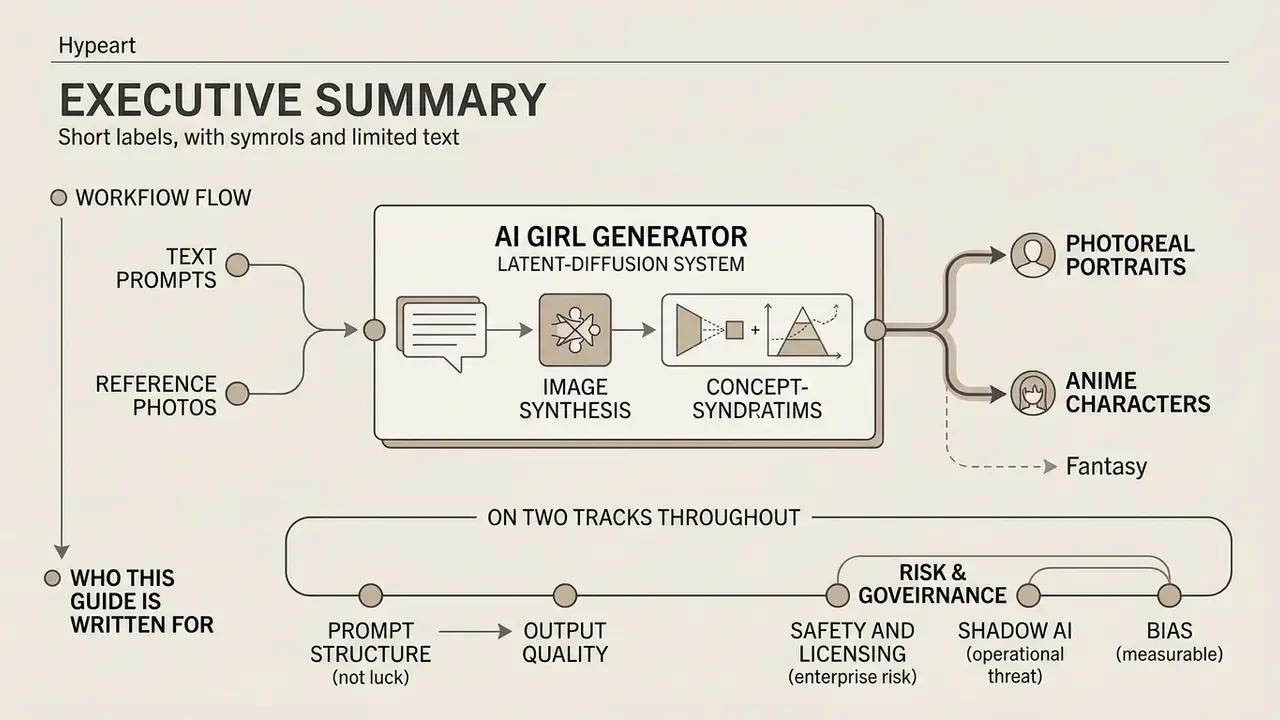
- An ai girl generator is a latent-diffusion image synthesis system that turns text prompts or reference photos into female character images: photoreal portraits, anime characters, fantasy concept art, avatars and PFPs.
- Two pipelines matter. Text-to-image gives maximum creative freedom with higher sample variance. Image-to-image (photo-based) retains identity through IP-Adapter and ControlNet, governed by one dial called
denoising strength. - Output quality is a function of prompt structure, not luck. Seven prompt components (subject, clothing, pose, environment, lighting, style, technical parameters) plus seed sampling, negative prompts, inpainting and upscaling.
- Bias is measurable, not theoretical. Gender-neutral prompts under-represent women relative to training data, and occupational prompts skew heavily male across Midjourney, Stable Diffusion and DALL·E 2. Demographic attributes therefore need to be stated, not assumed.
- Safety and licensing are the real enterprise risk. Published research documents unsafe-content rates and successful filter-bypass attacks. Free tiers rarely grant commercial rights. Pure AI output cannot be copyrighted in the U.S. without demonstrable human authorship.
- Shadow AI is the operational threat. Staff uploading customer photos, employee headshots or unreleased product imagery into a consumer generator creates PII and trade-secret exposure. A governance checklist sits further down this page.
Who this guide is written for
Two readers, one document. The first is a designer, marketer or creator who wants to create an AI girl image that actually looks intentional rather than generated. The second is the person who has to sign off on it: a risk, compliance or brand-governance owner asking a narrower question, which is whether a synthetic female character can be published without a licensing, privacy or disclosure problem attached to it.
So the guide runs on two tracks throughout. Craft first, controls immediately after. Skipping the second track is how a pleasant afternoon of avatar generation turns into an incident report.
That framing matters even for a consumer-looking category like character image generation. Visual generators are the single most common entry point for Shadow AI inside organizations. Marketing, design and social teams adopt them faster than procurement can review them, they ingest uploaded photographs, and their outputs land directly in public-facing campaigns. The controls described by the National Institute of Standards and Technology in NIST AI 100-4: Reducing Risks Posed by Synthetic Content, namely provenance metadata, watermarking, transparency and output review, apply to an anime avatar exactly as they apply to a credit-risk model. Different aesthetic, same control logic.
An ai girl generator relies on deep learning architectures, primarily latent diffusion models and generative transformers, to synthesize visual assets depicting female characters. Teams use these systems to generate custom images from text prompts or from an input reference photo. Evaluating the tools means balancing four things at once: visual fidelity, prompt adherence, data governance, and compliance with synthetic-content rules.
What is an AI girl generator and what can it create?
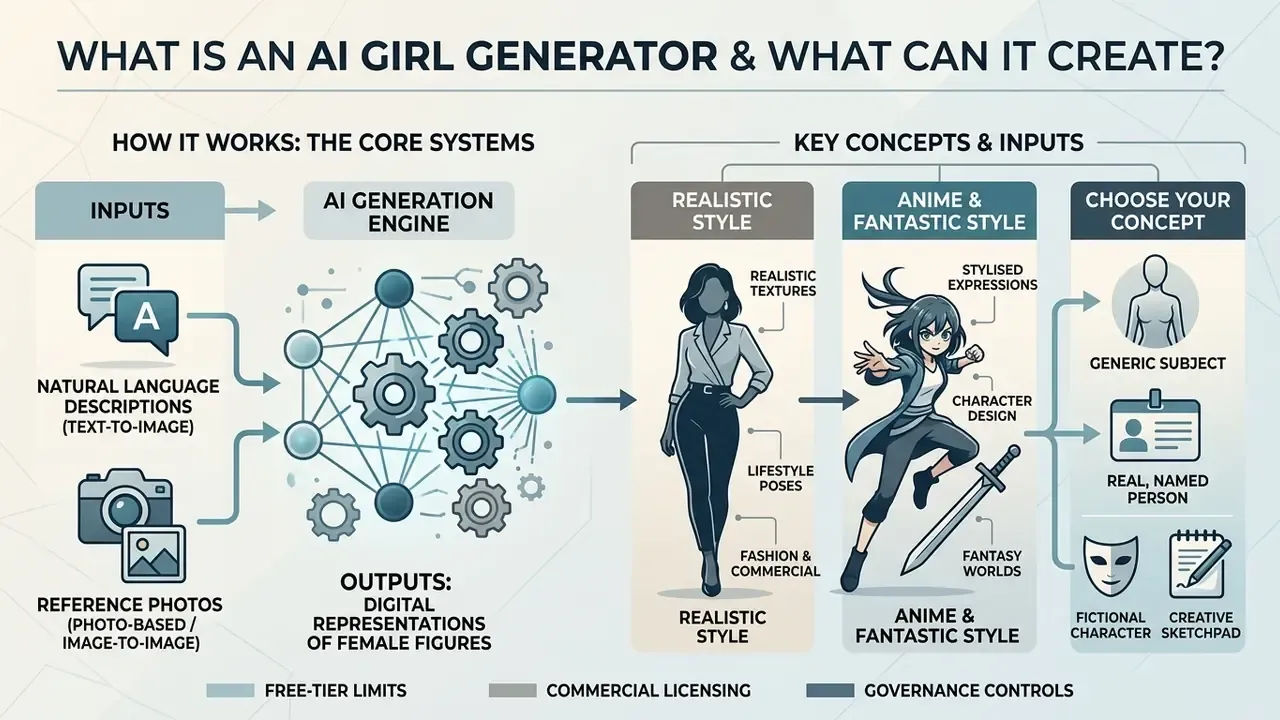
An ai girl generator is a computational image synthesis system that transforms natural language descriptions or reference photos into digital representations of female figures. These systems use neural networks trained on very large datasets of image and text pairs, from which they infer attributes, lighting, textures and artistic style. In practice people reach for such an ai female image generator to produce photorealistic portraits, stylized anime characters, concept art and digital avatars across quite different creative workflows.
Figure 1. AI girl generation process architecture (schematic, text-described).
| Stage | Input / Action | Operational Output |
|---|---|---|
| 1. Input | Text prompt or uploaded reference photo | Conditioning signal (text embedding and/or latent image) |
| 2. Configuration | Model checkpoint, LoRA or style preset, aspect ratio, seed | Bounded generation parameters, reproducible run |
| 3. Generation | Iterative denoising across sampler steps | Candidate image batch, typically 1 to 4 variants |
| 4. Refinement | Inpainting, negative prompts, upscaling, colour grading | Corrected, production-grade asset |
| 5. Delivery | Download in PNG, WebP or JPEG; log prompt and seed | Auditable, licence-checked deliverable |
Documenting stages 2 and 5, meaning model version, prompt text, seed value and licence status, is the minimum viable audit trail for any team working under an internal model-risk regime. A generation you cannot reproduce is a generation you cannot defend. That single sentence saves more escalations than any prompt trick in this article.
AI girl, woman, model or character: choosing the right concept
The conceptual term you pick shapes prompt syntax, output distribution and risk boundary all at once. Prompts specifying an adult «woman» or «female model» signal mature proportions and professional portrait characteristics. A «character» designation pushes the model toward stylized, narrative or fictional aesthetics. An ai create woman phrasing and an ai cute girl generator phrasing will not land in the same region of the model's latent space, which is exactly the point.
Terminology is not cosmetic. It changes the statistics of what comes back:
The same effect appears on closed commercial platforms:
Practical consequence. If the brief requires a specific age band, ethnicity, body type or skin tone, write it into the prompt. Leaving demographics unspecified means inheriting the checkpoint's defaults rather than authoring them, and defaults are not a creative decision.
The word «girl» is highly age-sensitive across commercial platforms and regulatory frameworks. Vendor usage policies (OpenAI among them) and risk-management guidance such as NIST AI 100-4 enforce strict filtering to prevent generation of minors in inappropriate or sexualized contexts. It is worth comparing how different AI image generators implement those guardrails before you standardise on one platform. When you deploy an ai female photo generator for commercial design work, describing generic adult traits or clearly fictional character markers keeps you inside both the safety filters and the terms of service.
A three-way split that keeps prompt hygiene simple:
- Real, named person. Prohibited or heavily restricted. Vendor policies bar impersonation and unauthorised editing of identifiable individuals.
- Generic adult subject. Permitted. Describe traits (
a 34-year-old woman, short dark hair, neutral expression) instead of names. - Fictional character. Broadest creative latitude, though still avoid prompts that map onto protected copyrighted characters.
Text-to-image and photo-based AI generation
Text-to-image synthesis builds new content out of Gaussian noise, guided step by step by a text embedding. Photo-based generation, or image-to-image, conditions the same diffusion pipeline on a reference image so that structure, face shape and identity survive the transformation. For a platform-by-platform view of reference-conditioned tooling, see our overview of image-to-image generators.
- Text-to-image. Maximum creative flexibility. The model constructs composition, pose and lighting from descriptive tags alone. Text alignment is usually measured with CLIP similarity; perceptual realism with FID.
- Photo-based (image-to-image). Identity features are injected from a source image through adapters such as IP-Adapter, or structure is held by ControlNet. Facial geometry and proportions stay put while clothing, background or rendering style change.
An ai art generator girl workflow that uses photo conditioning delivers noticeably higher identity consistency across sequential frames than pure text prompting. Personalization research frames this as a trade-off rather than a free win: reference conditioning raises subject fidelity (face shape, eye geometry, skin texture) while reducing responsiveness to novel text instructions, whereas text-only generation maximises prompt freedom at the price of identity drift between samples. So teams that need the same face across ten scenes should budget for reference conditioning at the start, not retrofit it in week three. To see how text-conditioned models interface with other multimodal tasks, our breakdown of the ai poem generator shows the same embedding logic driving a non-visual output.
AI girl generator styles: realistic, anime, fantasy and art
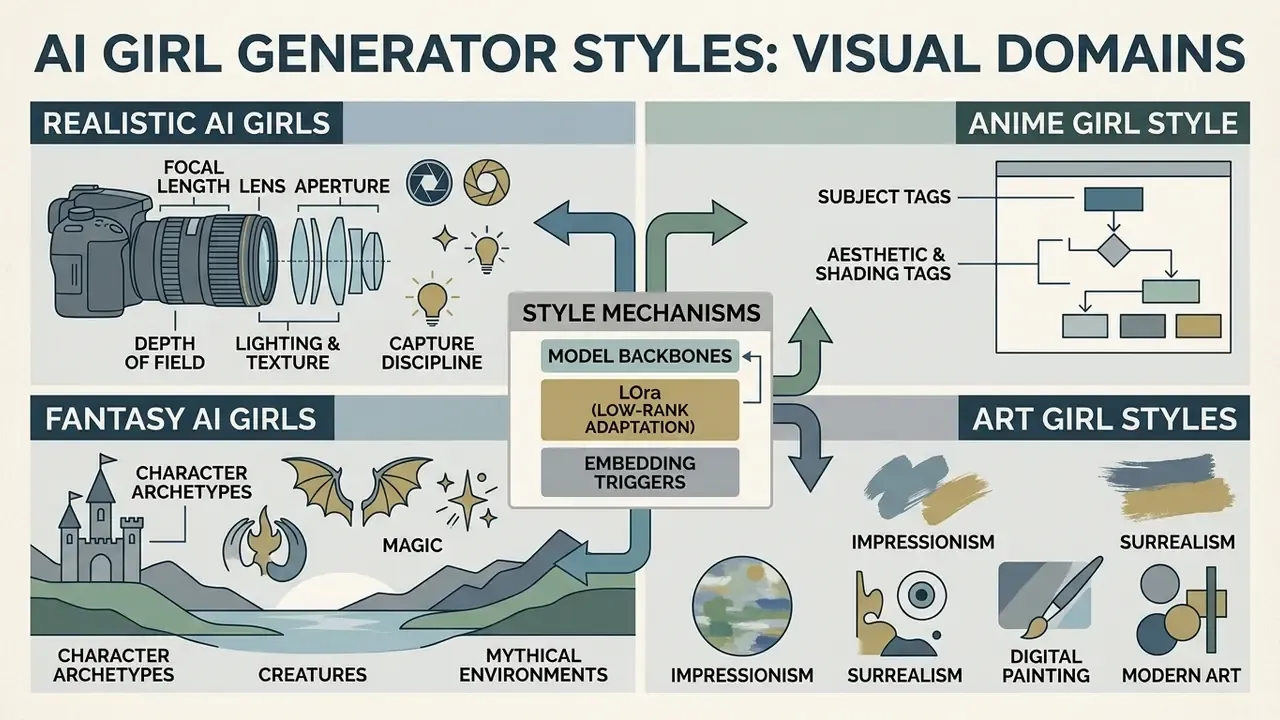
An ai art girl generator moves between visual domains by swapping model backbones, fine-tuned LoRA (Low-Rank Adaptation) modules, or embedding triggers. Style dictates how the model treats lighting, skin texture, line work and background geometry. Capability differs sharply between platforms, so benchmark leading AI image generators against the aesthetic your pipeline actually needs.
| Style | Visual Characteristics | Prompt Keyword Structure | Technical / Camera Parameters | Primary Operational Scenarios |
|---|---|---|---|---|
| Realistic | Photorealistic lighting, natural skin pores, real depth of field, authentic hair detail | Camera specs, lighting type (soft directional light), physical traits, detailed clothing | 85 to 135 mm lens, f/1.8 to f/4 for separation or f/5.6 to f/8 for full-face sharpness, ISO 100, white balance matched to light source | Marketing assets, professional avatars, commercial design, stock imagery concepts |
| Anime | Distinct 2D line art, cel-shaded colouring, expressive eyes, stylized proportions | Danbooru tags (1girl, solo, cel-shading, detailed eyes, dynamic angle), studio references, hair and outfit descriptors | Illustration-tuned checkpoints, 1024 to 1536 px native training resolution, mandatory negative prompt block | Social avatars, VTuber concept art, comic illustration, digital entertainment |
| Fantasy | Atmospheric lighting, intricate costume, magical particle effects, dramatic backdrops | Worldbuilding terms, character class (warrior, mage), ornate armour, dramatic lighting cues | High stylization weight, wide aspect ratios (16:9), volumetric and rim lighting descriptors | Game concept design, book covers, digital worldbuilding |
| Digital Art | Painterly brushwork, balanced vibrant palette, stylized composition, geometric harmony | Medium descriptors (oil painting, concept art render), colour scheme, art movement terms | Composition-first prompting, quality boosters, palette constraints | Editorial artwork, mood boards, brand storytelling |
Read the table as a routing decision. Realistic and Digital Art tolerate the same checkpoint family surprisingly often; anime and fantasy usually do not, and mixing them is where uncanny hybrids come from.
Creating realistic AI girls and female model images
Photorealistic output needs precise technical parameters in the prompt, otherwise you get synthetic smoothing and that plastic-skin look everyone recognises instantly. Photoreal checkpoints respond to photographic terminology far better than to generic quality boosters.
To build an ai female model generator prompt, borrow the vocabulary of an actual shoot:
- Focal length and lens.Specify
85mm portrait lensor135mm telephotofor natural facial compression. - Aperture and depth of field.Add
f/2.8orf/4for natural bokeh with crisp facial focus, then move tof/5.6tof/8when the brief demands full-face sharpness. - Lighting and texture.Name the source (
soft directional side lighting,natural window light, key light 30 to 60 degrees off-axis and slightly above eye level) and the surface qualities (visible natural skin pores,subtle fine facial hairs). - Capture discipline.Add
ISO 100,low noise, and a white-balance cue matched to the described light, which stabilises skin tone across a whole batch.
One correction to a common assumption: an ai beautiful woman generator prompt does not need more adjectives, it needs better constraints. Occupational and model portraits carry strong demographic defaults that have to be counteracted at prompt level.
Explicit skin tone, ethnicity, age and expression counteract systemic defaults baked into base checkpoints. It costs eight words.
Anime, cartoon and fantasy girl styles
Anime and fantasy generation depends on domain-specialised diffusion models trained on curated illustration datasets, Illustrious and various Stable Diffusion fine-tunes among them. These systems want structured tags rather than conversational prose, and they are explicitly not optimised for photorealism.
When you run an ai fantasy girl generator or an anime creation system, tag-based prompts improve feature accuracy:
- Subject tags.
1girl,solo,detailed eyes,stylized hair, and2girlsfor two-character frames. - Aesthetic and shading tags.
cel-shading(crisp boundaries between exactly two tones per colour, base plus one shadow, no gradients),crisp line art,vibrant palette. - 3D and render tags.
high-quality 3D render,soft global illumination,cinematic lighting,shallow depth of field. - Fantasy attributes.
ornate filigree armor,magical glow,epic scale background.
Style itself carries bias, which is easy to miss:
Anime and fantasy presets therefore tend to exaggerate feminine proportions unless you counterweight them with explicit structural descriptors: full coverage plate armour, loose tailored coat, athletic realistic proportions. Reviewers notice. Clients notice faster.
Specialized archetype and niche style prompt library
| Archetype / Style | Technical Prompt Construction | Operational Focus and Lighting Specs |
|---|---|---|
| Corporate Leader / Executive | professional portrait of a 35-year-old female CEO, tailored dark navy suit, subtle silver jewellery, modern glass office background | Studio rim lighting, neutral grade, 85 mm lens, sharp eye focus |
| Research Scientist | female laboratory scientist, protective eyewear, crisp white lab coat, holding a glass vial, futuristic research facility | Cool fluorescent light, shallow depth of field, high detail on glass reflections |
| Physician / Clinician | compassionate female doctor in a bright clinic consulting room, stethoscope, clean scrubs, calm confident expression | Soft daylight fill, low contrast, 50 mm documentary framing |
| Chef / Hospitality | female chef plating a dish in a busy restaurant kitchen, white jacket, steam and motion in background | Warm tungsten key, practical highlights, slight background motion blur |
| Athlete in Action | female athlete mid-sprint on an outdoor track, technical sportswear, sweat detail, competitive intensity | Hard directional sunlight, 200 mm compression, frozen-motion shutter cue |
| Fashion Runway Model | fashion model walking a minimalist runway, structured couture dress, editorial pose, audience bokeh | Overhead strobe array, high-key exposure, crisp fabric texture |
| Teacher / Educator | female teacher engaging with students in a sunlit classroom, cardigan and blouse, open body language | Ambient window light, medium wide shot, natural colour balance |
| Entrepreneur / Startup Founder | female founder in a co-working space, casual blazer over t-shirt, laptop and whiteboard sketches behind her | Mixed daylight and LED, candid three-quarter angle, moderate grain |
| Cyberpunk / Sci-Fi Girl | cyberpunk female operative, neon-lit rainy street background, subtle glowing facial cybernetics, tactical techwear jacket | High-contrast volumetric light, cyan and magenta palette, wet street reflections |
| Robot / Android | android woman with visible seam lines and matte alloy plating, futuristic corridor, calm neutral gaze | Cool rim light, specular metal highlights, hard shadow falloff |
| 90s Retro Anime | 1girl, solo, 1990s anime aesthetic, hand-drawn cel style, retro school uniform, nostalgic soft grain, film grain filter | Soft diffuse light, muted pastels, clean outline emphasis |
| Ghibli-Adjacent Illustration | girl standing in a wildflower meadow, hand-painted background, gentle watercolour skies, wholesome storybook mood | Flat soft daylight, saturated mid-tones, painterly edges |
| 3D Chibi / Stylized Toy | cute 3D chibi girl character, oversized expressive eyes, claymation texture, miniature scale, isometric clean background | Softbox studio light, ambient occlusion shadows, vibrant saturation |
| Claymation / Brick-Toy | girl figure rendered as stop-motion clay model, visible fingerprint texture, tiny diorama set, or brick-toy minifigure girl, studded plastic surfaces | Tabletop macro lighting, shallow focus, tactile material emphasis |
| Line Art / Sketch | single-weight ink line drawing of a young woman, minimal shading, clean white background | Flat lighting, no gradients, high-contrast monochrome |
| Fantasy Elf / Mythic | elven warrior woman, silver filigree armour, ancient forest ruins, faint arcane glow on runes | Dappled backlight, atmospheric haze, cool-to-warm colour split |
How to create an AI girl from a text prompt
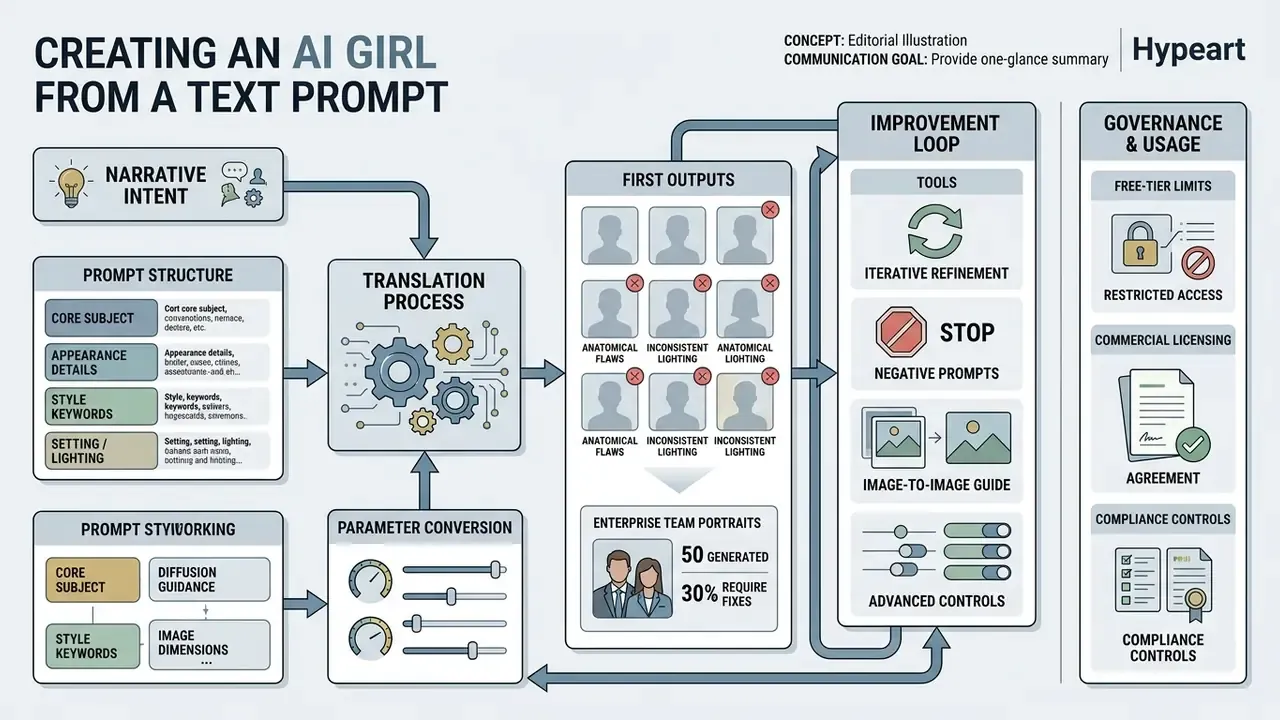
Generating a strong image through a text-to-image ai girl generator is a structured translation job: narrative intent goes in, parameters the diffusion process recognises come out.
What to include in an AI girl prompt
An effective prompt is modular and covers seven foundations. Omit one and the model substitutes noise or dataset defaults, which is where most disappointing results come from.
Checklist0 / 7
Keep block order consistent across a project. Vendor prompt-engineering documentation recommends a stable scaffold, scene then subject then key details then constraints, because consistent ordering makes A/B comparisons between prompt variants interpretable instead of noisy. Change one variable at a time. Boring advice, reliably correct.
How to improve generated AI girl images
First outputs from an ai create girl prompt usually need work: anatomical flaws, inconsistent lighting, background artifacts. Re-rolling the whole prompt at random is the slowest possible fix.
- Sample multiple seeds. Generate 3 to 9 seed variations per prompt change to see the model's stochastic range.
«Subject and style keywords outperform connective wording; sampling three to nine seeds is recommended to explore the model's stochastic range.» Design Guidelines for Prompt Engineering Text-to-Image Generative Models, CHI 2022.
- Expect iteration, and log it.
«Users cycle through three recurring steps, structuring the prompt, evaluating the image, and revising iteratively, usually without recognising the model's built-in gender defaults.» Mahdavi Goloujeh, Sullivan and Magerko, Is It AI or Is It Me?, CHI 2024.
The takeaway is procedural: build an explicit review step into the loop, because unexamined iteration quietly bakes model defaults into the final asset set.
- Refine negative prompts. Suppress what you do not want, for example
blurry, extra fingers, oversaturated, plastic skin, low resolution.«Applying negative prompts in the middle segment of the reverse diffusion process improved output quality over uniform application.» Understanding the Impact of Negative Prompts (2024).
- Apply inpainting. Masked local diffusion repaints flawed regions such as eyes or hands without touching the rest of the composition. In Diffusers-based pipelines that is an
init_imageplusmask_imageplus prompt operation, withnegative_promptavailable in the same call.- Change the sampler. Sampler and scheduler choice is an independent axis. If composition is right but micro-detail is mushy, switch sampler before rewriting the prompt.
- Upscale. Pass the selected image through a latent upscaler for fine texture, hair strands and micro-contrast. Tooling is compared in our guide to AI image upscalers.
How to create an AI girl from an existing photo
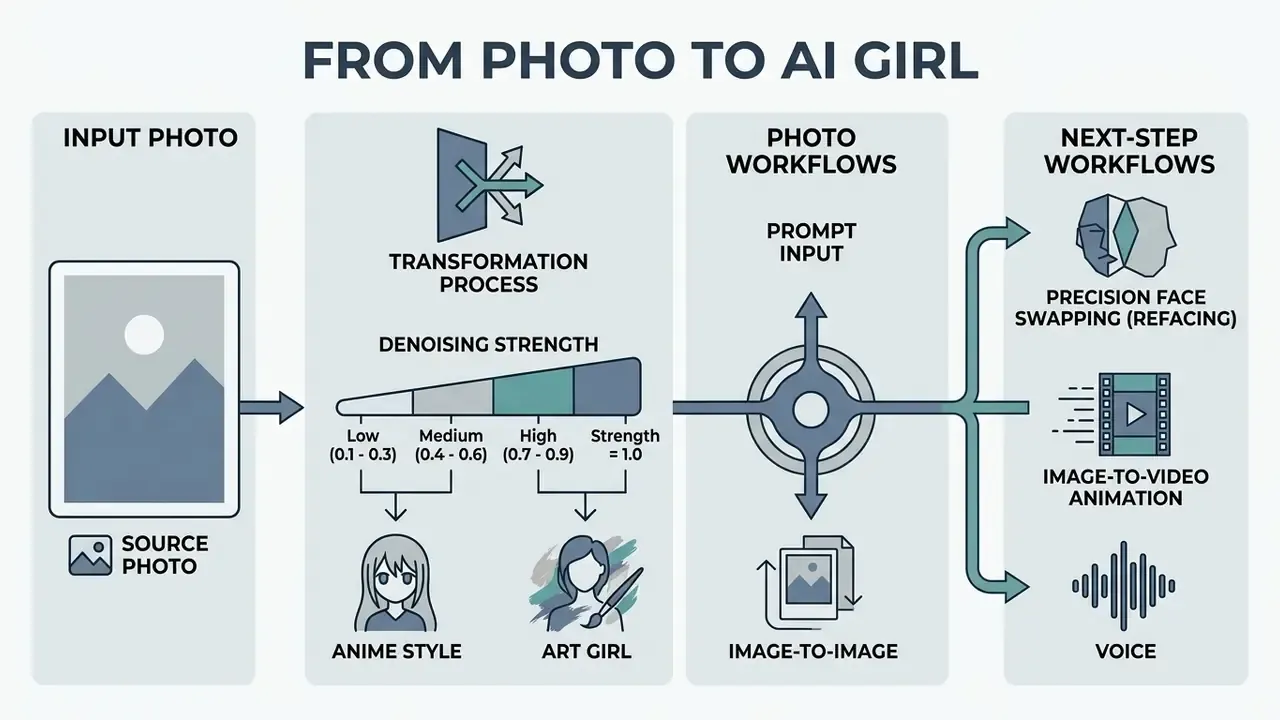
Working from a source photograph lets you hold facial identity steady while the aesthetic, background or outfit changes. This is the workflow most ai female picture generator products are actually built around.
Turning a photo into an anime or art girl image
The platform treats your source photo as a conditioning image. The main dial controlling transformation intensity is denoising strength, sometimes labelled image weight.
- Low (0.1 to 0.3). Preserves original photographic detail, lighting and composition with minimal artistic change.
- Medium (0.4 to 0.6). The usable middle. Face shape and identity survive while anime, cel-shaded or painted styles take hold.
- High (0.7 to 0.9). Geometry and detail bend heavily toward the text prompt, and source facial fidelity is sacrificed for creative deviation.
- Strength = 1.0. Denoising runs the full step count and the input image is effectively ignored, which is functionally text-to-image again.
Passing the photo through ControlNet (OpenPose, or Canny edge detection) keeps the generated anime character in the exact posture, head tilt and frame composition of the original subject. Where facial identity specifically must survive a restyle, IP-Adapter (including face-cropped checkpoints) injects reference identity features while ControlNet handles structure. Complementary tools, not interchangeable ones.
Image-to-image pipelines also carry an exposure that text-only pipelines do not:
For enterprise deployments the uploaded image is an attack surface, not merely an input. Filters that inspect prompts alone are insufficient, so moderation has to evaluate generated output too. This is also why sexualised categories deserve separate policy treatment rather than an informal understanding; if that risk class is in scope for your review, our reference pages on the ai porn generator category and on ai porn images document why most brand-safe programmes exclude it outright.
Next-step workflows: face swapping, video animation and voice
Once a first image exists, pipelines tend to extend outward:
- Precision face swapping (refacing).Instead of re-rendering a whole composition, standalone face-swap models such as InsightFace-based pipelines transplant subject identity onto an existing target pose while keeping background, lighting and clothing geometry intact. That is the right tool when the composition is already approved and only identity changes. It is also the highest-risk tool here: swapping a real, identifiable person's face without documented consent may constitute non-consensual imagery and, in advertising, an undisclosed synthetic performer.
- Image-to-video animation.Static renders can be animated with image-conditioned video diffusion. Subtle motion prompts (
slow cinematic zoom,hair blowing gently in wind,subtle breathing motion) turn a portrait into a short loop suited to social placement. - Talking avatars and voice synthesis.For virtual influencers or VTuber assets, combine the rendered avatar with lip-sync models driven by synthetic voiceover. Voice adds a second licensing layer, because voice likeness is treated separately from image likeness in digital-replica guidance. Both need clearing. See our reference material on AI voice generators for licensing and language coverage.
Editing an AI-generated girl image after creation
Post-generation editing fixes small defects and adjusts environment without a full re-render.
- Background removal and replacement. Isolate the subject and drop her into new environment plates or vector layouts.
- Facial inpainting. Mask the distorted element, adjust the prompt slightly, re-sample at low denoising strength (around 0.35) to repair eyes, teeth or hair flow. Hand defects respond to the same masked-detailer approach.
- Colour grading and post-processing. Adjust temperature, brightness, contrast, highlight clipping, saturation and gamma so the character sits naturally beside surrounding collateral. Options are compared in our overview of AI photo editors.
For broader editing workflows, including export formats and canvas handling, our guide to free photo editors covers the basics.
Shadow AI, PII and the data-governance checklist
This is where consumer AI tooling collides hardest with corporate data policy. Every upload sends an image, frequently containing a real person, to a third-party inference endpoint whose retention and training practices vary by vendor and by plan tier. Published terms in this category range from «uploaded photos are not used for model training or shared publicly» to a broad, irrevocable worldwide licence over whatever you upload. The difference is contractual, not technical, and it should be read before the first upload rather than after the first incident.
Run this checklist before any team touches an AI girl generator on a corporate device or with corporate assets:
Checklist0 / 10
Who owns this checklist? Name a person, not a department. Unowned controls decay within a quarter.
Free AI girl generator, pricing limits and commercial usage
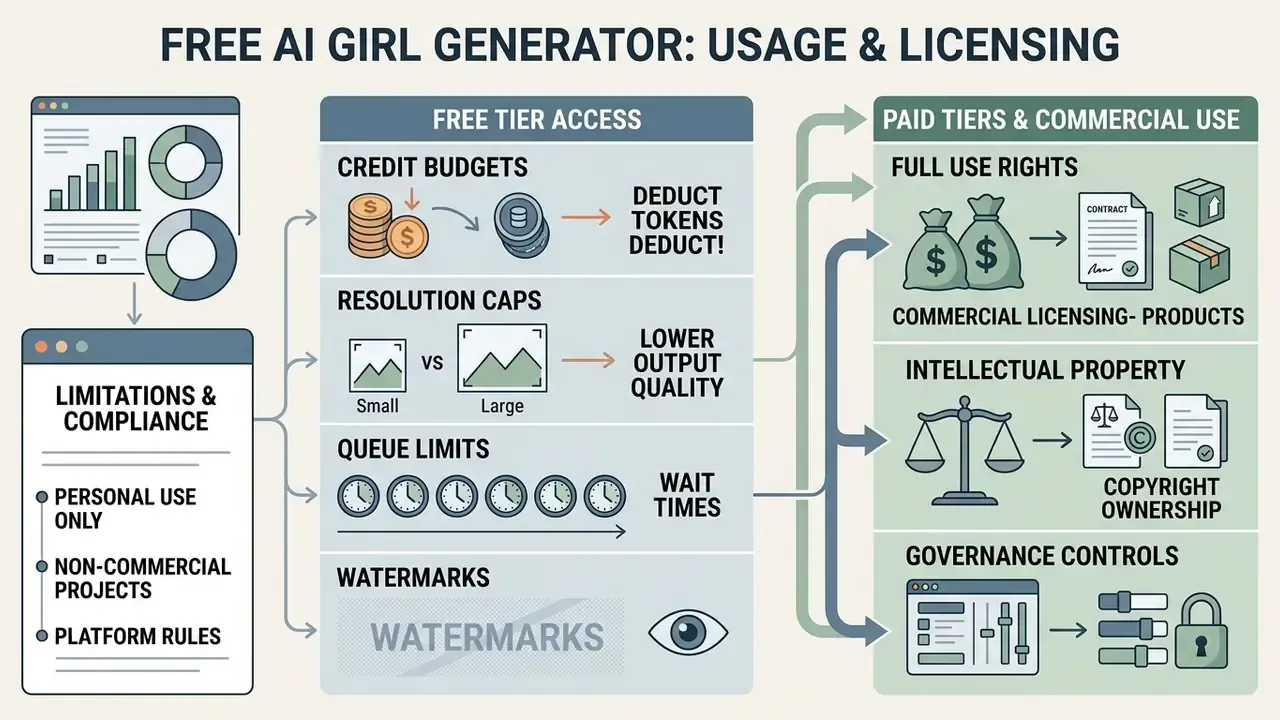
Working out what a free ai girl generation tool actually permits means reading three things at once: technical caps, subscription structure, and the legal usage framework underneath both.
Content-safety exposure is quantified in the literature, which is why «free and unmoderated» is never a neutral setting:
What "free" means in an AI girl generator
When a platform advertises an ai female generator free tier, limits exist to control compute cost and to nudge conversion. Comparative benchmarking across free AI image generators shows four recurring constraint types.
| Constraint | Typical Implementation | Published Examples |
|---|---|---|
| Credit budgets | Daily refresh or one-time lifetime allocation | 10 fast credits/day; 66 credits/day; 125 lifetime credits (around 25 s of video on a turbo tier); 80 monthly credits |
| Resolution caps | Hard ceiling on output pixels | 1024 px cap on free renders; 360 to 540p on free video tiers; 480p-only basic tiers |
| Watermarks | Visible branding or restrictive metadata | Watermark on all free-tier output; 1080p reserved for paid plans |
| Queue priority | Unlimited but throttled «slow» queues | Unlimited slow-queue generation alongside limited fast credits |
- Credit budgets. Free accounts usually get a non-refreshing allocation, say 125 lifetime credits, or a daily cap between 10 and 66 fast credits.
- Resolution and queue caps. Free renders are frequently limited to 540p or 1024 px and routed through low-priority queues at peak hours.
- Watermarking. Free-tier output often carries visible platform branding or metadata that restricts commercial distribution. Where sign-up friction is the real obstacle rather than quality, our review of no-sign-up AI image generators covers anonymous access and its trade-offs.
To model the cost of moving off a free tier at production volume, our cost tooling can view the guide for compute and subscription estimates, and plan-level breakdowns explore the hub across commercial tiers.
Commercial use of AI-generated girl images
Whether an ai dream girl generator free render can appear in advertising, a social campaign or corporate media depends on three stacked compliance layers.
Platform safety filters, meanwhile, should be treated as porous rather than absolute:
Comparative licence posture (illustrative categories, verify current ToS):
| Licence pattern | What it typically permits | Where it fails commercially |
|---|---|---|
| Paid-plan ownership grant | Reprint, sale, merchandising of your own output | Editing or depicting real, identifiable individuals |
| Personal, non-commercial licence | Private use, portfolio-only display | Any advertising, client work, or resale |
| Free tier with watermark | Evaluation and internal comping | Public campaigns, brand assets |
| Approval-gated commercial use | Commercial use after written vendor consent | Fast-turnaround campaigns without lead time |
| Broad upload licence to vendor | Free processing of your uploads | Confidential imagery, client-owned photography |
For teams assembling a production stack, licensing comparison across platforms is critical, including the wider field of AI art generators. Our analysis of best free AI art generators evaluates usage rights and watermark policy side by side, and general rights frameworks see the overview.
Where to use AI-generated girls: avatars, social media and design
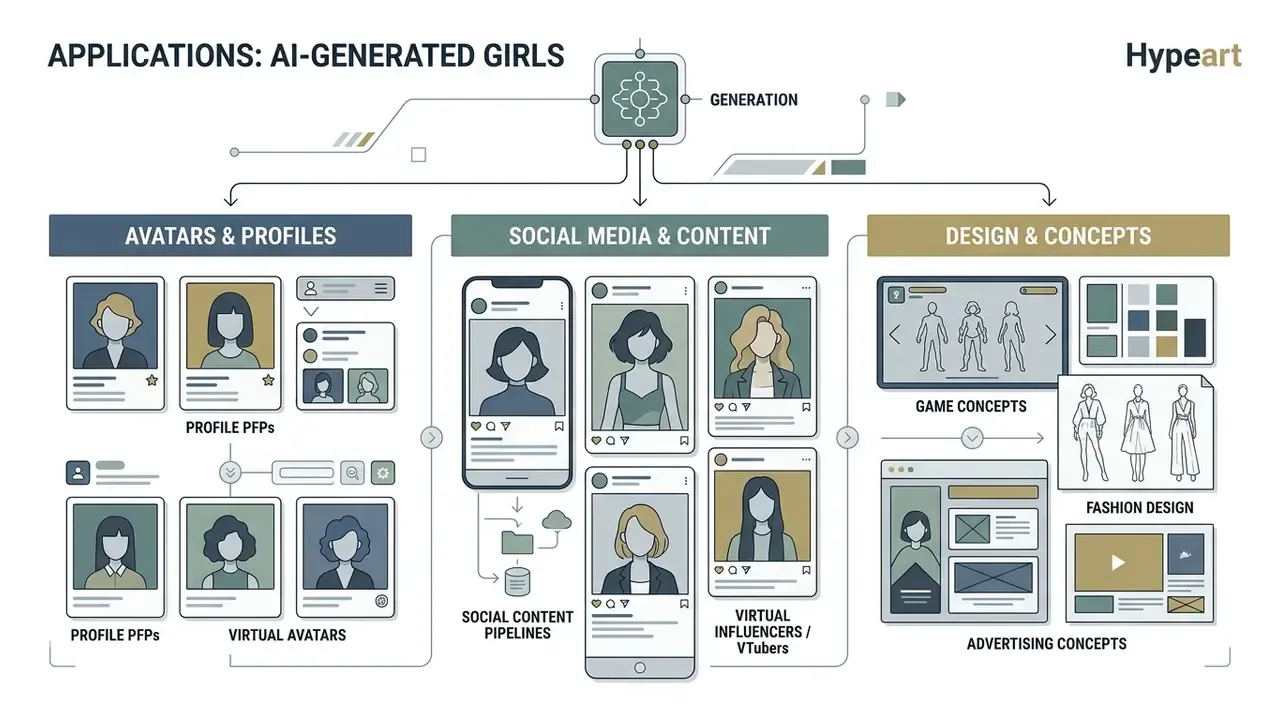
Brands, creators and game studios deploy ai girls across a wider set of channels than most people expect, and the constraints differ per channel.
AI girls for game, fashion and advertising concepts
In professional design environments the value shows up earliest, during ideation and concept prototyping.
- Game concept art. Designers generate mood boards, costume variations and character placement early in pre-production. Audit literature notes that female game characters are a recurring bias case, sometimes rendered with less clothing than male equivalents under comparable prompts. Catch that at review, not at launch.
- Virtual fashion lookbooks. Apparel brands prototype fabric patterns, garment cuts and styling on synthetic models before committing to physical samples.
«Across 300 fashion descriptions rendered in neutral, masculine and feminine variants, Stable Diffusion XL automatically feminised garments and body proportions even under neutral prompts.» Ponce-Escudero et al., Expert Systems (2024).
The operational implication is counterintuitive: neutral prompts narrow your exploration range rather than widening it, so cut and silhouette must be specified explicitly.
- Advertising mockups. Agencies build high-fidelity comps to sell creative concepts in pitch rooms, with disclosure obligations attaching the moment a synthetic performer reaches a live advertisement.
To see how synthetic assets extend into motion, review our overview of best free AI video generators and our reference entry on AI video generators.
AI girl generator FAQ
Can I create more than one AI girl and customize each character?
Yes. Platforms support multi-character generation and per-character customisation through advanced prompting, reference images or seed tracking. Putting several distinct female characters in one scene needs explicit spatial prompts (a blonde woman on the left in a blue dress, a dark-haired woman on the right in a red suit), tag-level subject counts such as 2girls, or multi-subject conditioning frameworks. TheaterGen (arXiv, 2024) is one example, using an LLM-managed «prompt book» plus per-character reference images to hold identity stable across multi-turn generation. Holding identity across separate scenes means passing reference face embeddings through IP-Adapters, sharing features between shots (as in multi-shot video storyboarding research, arXiv 2024), or using the dedicated character-consistency features shipped in newer suites. If your goal is an ai create your own girl workflow with a recurring cast, decide on the consistency mechanism before you generate asset one.
Do AI girl generators work on mobile devices?
Yes. Most run in a responsive browser interface or as native iOS and Android apps. Cloud generation offloads the compute-heavy diffusion work to remote GPUs, so a phone can display high-resolution results quickly. Mobile builds are usually assessed against web accessibility standards (WCAG 2.2 AA) for touch target sizing, contrast, focus order, labelled form controls, responsive viewports and screen reader compatibility.
Can an AI girl generator create an AI girlfriend?
No. An ai female creator tool produces static or animated visual images, whereas an «AI girlfriend» is a conversational dialogue system built for interactive text or voice exchange. A visual generator can supply the portrait or avatar that represents such a character, but the underlying technology differs. Image generators run text-to-image or image-to-image diffusion and are evaluated on prompt alignment and image fidelity. Companion platforms run large language models tuned for multi-turn dialogue, relationship simulation and emotional engagement, and are increasingly regulated for AI disclosure and data-collection practice (Congressional Research Service, AI Chatbots as Companions: Overview, Uses, and Considerations, congress.gov). Several U.S. state bills define a «companion chatbot» as a generative system with a natural-language interface that must disclose it is not human, a requirement with no equivalent in image generation.
Are "ai babe generator" style tools suitable for brand work?
Usually not without review. Products marketed as an ai babe generator, ai babes generator, ai babe creator or an ai beautiful girl generator frequently sit on permissive or explicitly adult-oriented checkpoints, and their terms often reserve broad rights over uploads. Two questions decide it. Does the licence grant commercial use in writing, and does the platform apply output moderation as well as prompt filtering? If either answer is unclear, treat the tool as unapproved. An ai female maker aimed at editorial or corporate portraiture is the safer default for brand-facing assets.
Do I own the copyright to a generated AI girl image?
Ownership under platform terms and protection under copyright law are separate questions, and conflating them causes real problems. A paid plan may grant you the right to use and sell an output while U.S. copyright law simultaneously refuses registration for the purely AI-generated portions of that same image. Protection attaches only to demonstrable human creative contribution: composition decisions, manual edits, assembly of multiple elements. AI-generated material must be disclosed at registration.
How many images should I generate before selecting a final asset?
Plan for a batch, not a hit. Prompt-engineering guidance recommends 3 to 9 seeds per prompt variant, and observed defect rates (30% anatomical or texture artifacts in the corporate-portrait case above) mean roughly one raw output in three needs inpainting. For a 20-asset campaign, budget 60 to 100 generations plus a refinement pass. An ai female model generator free tier will rarely absorb that volume without watermarks or queue delay.
What should a governance owner ask before approving a generator?
Six questions, in order. Who owns the tool internally? What data can be uploaded, and what cannot? Are uploads retained or used for training? Does the licence cover our intended commercial use in writing? Is output moderated, not just prompts? Can we reproduce any published asset from logged prompt, seed and model version? If four of six answers are missing, the tool is not ready for production, whatever the image quality looks like.
Additional resources and system access
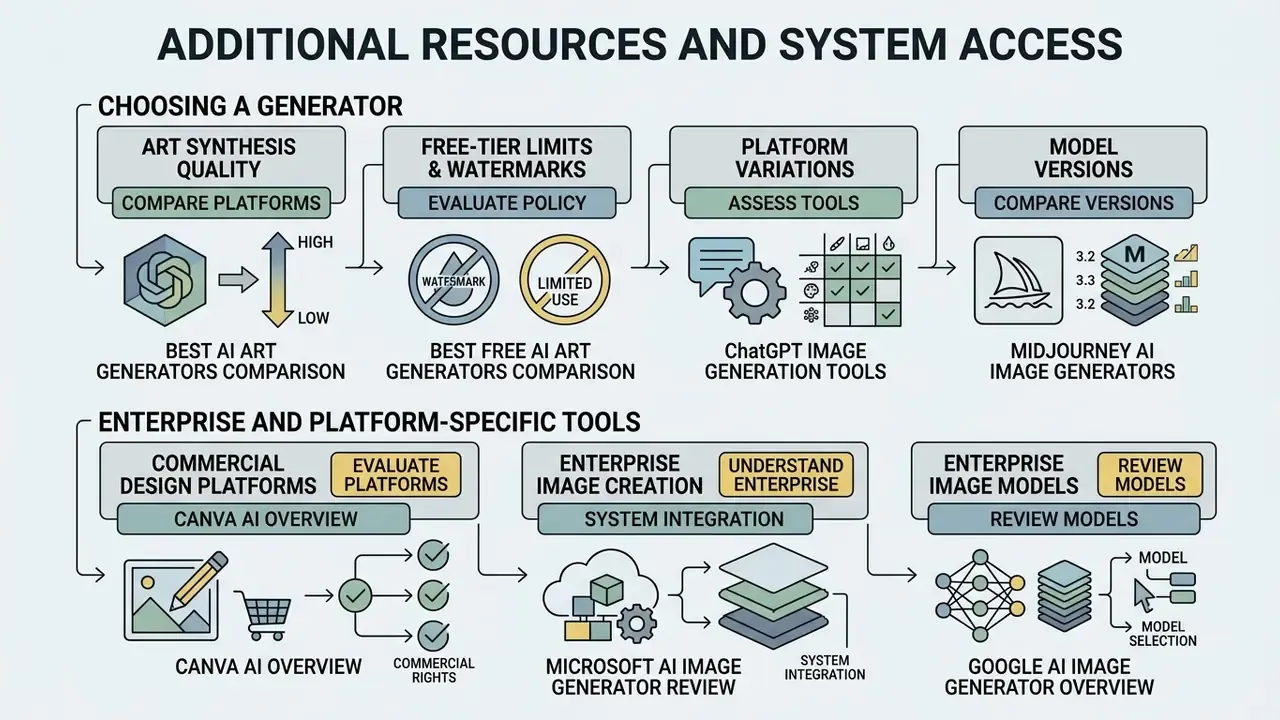
Choosing a generator
- Compare art synthesis quality across leading platforms in our best AI art generators comparison.
- Evaluate free-tier limits and watermark policy in our best free AI art generators comparison.
- Assess platform variations in our evaluation of ChatGPT image generation tools.
- Compare model versions in our evaluation of Midjourney AI image generators.
Enterprise and platform-specific tools
- Evaluate commercial design platforms via the Canva AI overview.
- Understand enterprise image creation in our Microsoft AI image generator review.
- Review enterprise image models in the Google AI image generator overview.
- Review desktop and browser tooling in our Bing AI image guide.
Style, editing and post-production
- Review tool capabilities in our guide to AI headshots.
- Analyze specialised art styles with our Ghibli AI image generator comparison.
- Explore canvas expansion techniques in our AI expand image guide.
- Compare editors in our photo editor guide.
Motion, audio and publishing workflows
- Examine developer video workflows using the Google Veo API guide.
- Examine animation editing tools in our animation maker guide.
- Explore publishing workflows in our YouTube video editor guide.
- Review audio generation workflows in our AI voice generator guide.
- Reduce delivery file sizes with our video compressor guide.
Provenance, rights and cost planning
- Analyze image-origin verification in our AI reverse image search guide.
- For legal and usage-rights frameworks, see the overview.
- For regulatory dispute history, see litigation.
- For pricing breakdowns across commercial plans, explore the hub.
- To estimate compute and subscription cost, view the guide.
Developer and reference material
- To examine technical infrastructure endpoints, browse the hub.
- To review technical documentation and benchmarks, view the guide.
- For developer assistance, contact support.
- For our full terminology repository and architectural benchmarks, view the guide.
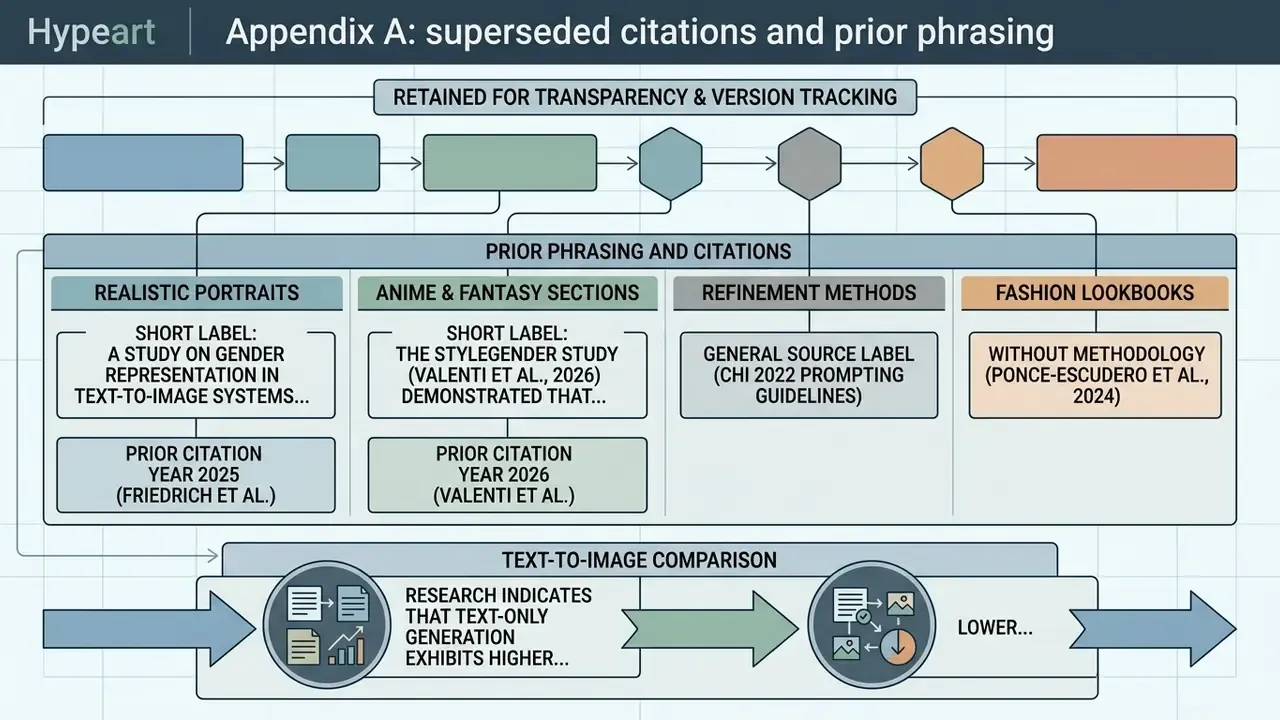
Appendix A: superseded citations and prior phrasing